Article

Evaluating Global and National Datasets in an Ensemble Approach to Estimating Carbon Emissions as Part of SERVIR’s CArbon Pilot


by
Christine Evans
1,2,
Emil A. Cherrington
1,2,*,
Lauren Carey
1,2,
Ashutosh Limaye
2,3,
Sajana Maharjan
4,
Diego Incer Nuñez
5,
Eric R. Anderson
2,3,
Kelsey Herndon
1,2 and
Africa I. Flores-Anderson
3
1
Earth System Science Center, University of Alabama in Huntsville, Huntsville, AL 35899, USA
2
SERVIR Science Coordination Office, NASA Marshall Space Flight Center, Huntsville, AL 35812, USA
3
Earth Science Branch, NASA Marshall Space Flight Center, Huntsville, AL 35812, USA
4
International Centre for Integrated Mountain Development, Lalitpur 44700, Nepal
5
Centro de Estudios Ambientales y Biodiversidad, Universidad del Valle de Guatemala, Guatemala City 01015, Guatemala
*
Author to whom correspondence should be addressed.
Remote Sens. 2025, 17(24), 3975; https://doi.org/10.3390/rs17243975
Submission received: 1 October 2025 / Revised: 17 November 2025 / Accepted: 4 December 2025 / Published: 9 December 2025
(This article belongs to the Section Earth Observation Data)

Highlights

What are the main findings?
  • An ensemble analysis of 17 biomass and 12 land cover datasets revealed substantial variability in forest loss and carbon stock estimates across Guatemala, Nepal, and Zambia.
  • Comparisons with national reference data showed large differences between global and national NFI.
What is the implication of the main finding?
  • The results demonstrate that understanding dataset variability is essential for transparent and robust national greenhouse gas reporting under REDD+ frameworks.
  • Integrating regional reference data with global Earth Observation products through ensemble methods can improve the reliability of national carbon accounting.

Abstract

Understanding where forest loss occurs and the resulting carbon emissions is a critical component of assessing national carbon budgets. To complement existing greenhouse gas (GHG) guidance and evaluate input datasets used in emissions estimation, SERVIR—a joint USAID and NASA initiative—implemented the SERVIR CArbon Pilot (S-CAP) project. This study focuses on the variability and reliability of land cover and biomass datasets that serve as inputs for such calculations. Seventeen aboveground biomass and twelve land cover change datasets were analyzed to characterize the variability in forest cover loss and biomass estimates for Guatemala, Nepal, and Zambia. Forest loss estimates varied substantially, ranging from 20,733 to 441,227 ha/yr in Guatemala, 1738 to 385,087 ha/yr in Nepal, and 6141 to 1,902,957 ha/yr in Zambia. Biomass estimates also differed widely depending on the dataset and forest mask applied: mean values ranged from 54.6 to 293.3 tons/ha across countries and periods. Accuracy assessments using national reference data for forest changes ranged from 67 to 97%, while National Forest Inventory biomass estimates diverged notably from global products. The ensemble approach highlights how differences in input datasets, particularly in forest extent and biomass magnitude, can propagate through emissions calculations. These findings underscore the importance of understanding and evaluating dataset variability prior to national carbon reporting and emissions estimation.

1. Introduction

As a part of the Paris Agreement, nations across the globe agreed to take action to reduce and mitigate forest loss to combat global climate change. Estimating greenhouse gas (GHG) emissions from forest loss and degradation is a central challenge for participating countries to report their progress on these goals through the reducing emissions from forest loss and forest degradation (REDD+) mechanism [1]. The International Panel on Climate Change (IPCC) maintains guidelines to ensure the methodological consistency of these estimations in required reports that document national goals and efforts to reduce emissions, such as the Forest Reference Level (FRL) [2,3]. Many of these reports rely on field collection information and plot measurements to quantify both changes in forests and the associated shifts in forest stock. While methodologically robust, these guidelines can be costly to implement on an annual time-step. Understanding where forest loss occurs and the resulting amount of carbon dioxide released is a critical component to assess a nation’s carbon budget [4].
Guidance on the use of Earth Observation (EO) to monitor forest change and estimate GHG emissions has grown significantly, in particular under the Global Forest Observations Initiative (GFOI) and capacity building programs like SilvaCarbon from the United States Geological Service (USGS) and the United States Forest Service (USFS) [4]. Still, with an ever-increasing array of EO-based information, more guidance is needed for monitoring authorities to make informed decisions about which products are best suited for any given purpose.
Users must consider that EO-derived land cover and biomass products, the two key datasets needed in GHG estimations, have their own distinct challenges. While there is no shortage of land cover products updated on a regular basis, they are derived using many different approaches. GHG estimations are therefore highly dependent on the land cover product used. A growing number of options exist for aboveground biomass and carbon (AGB and AGC) products, and most were developed from only a single year of observations. The inevitable variability in estimations derived from these different products is well documented [5,6,7].
Ensemble approaches provide a way to address this variability by integrating multiple datasets to quantify the range and sources of uncertainty in resulting emissions estimates. Rather than depending on any single product, ensemble frameworks synthesize information across inputs, identify areas of agreement, and highlight where input choice most strongly affects reported GHG outcomes. Such approaches are increasingly relevant for countries developing REDD+ Forest Reference Levels (FRLs), where the transparent reporting of data-driven uncertainty is required.
In this paper, we present three country-level case studies from the SERVIR CArbon Pilot (S-CAP) and apply this ensemble approach. We combined multiple biomass datasets with land cover and change datasets from global and national sources to evaluate the data inputs used to estimate GHG emissions from forest cover loss in each of these countries. Using this methodology, we produced a range of annual forest loss rates and carbon stock estimates based on the various combinations of input datasets and discussed the differences and similarities between them.
Previous work on uncertainty in EO-based carbon accounting has largely focused on harmonizing or fusing global AGB products to improve map accuracy. Foundational efforts by Saatchi et al. [8] and Baccini et al. [9] produced the first pan-tropical biomass maps, later combined by Avitabile et al. [10] into a fused 1 km product that reduced regional biases and improved agreement with ground observations. These fusion studies provided essential benchmarks for global AGB estimation but do not explicitly assess how dataset choice influences emissions calculations.
More recent efforts have adopted explicit ensemble frameworks to address that question. Cherrington et al. [7] conducted a global ensemble analysis of forest cover and AGB products to quantify variability and agreement among datasets, demonstrating that input data choice can substantially alter the resulting carbon emission estimates. At the national scale, Melo [1] applied an ensemble approach to evaluate how global remote sensing products perform in estimating forest loss and associated emissions, showing that disagreements in forest loss area often drive the largest variations, while validation against national data greatly improves accuracy. Together, these studies demonstrate the value of ensemble-based frameworks for understanding uncertainty in EO-derived carbon estimates. However, few have operationalized these methods across multiple countries using national forest definitions, emission factors, and locally validated datasets, an important gap this study addresses through three country-level ensemble analyses.
This paper builds on the work of Cherrington et al. [7], utilizing the same ensemble modeling approach but at the national, rather than global, scale, allowing for the inclusion of localized forest definitions, national emission factors, and the use of local reference data. To develop this framework, the analysis integrated open data, national FRL documentation, and REDD+ guidelines to evaluate multi-scale datasets used in GHG reporting. Specifically, we addressed two questions: Firstly, how do various land cover and forest cover datasets differ in how they identify the change in forest cover at the national scale? Secondly, what are the ranges and variability of estimates of AGB/AGC according to commonly used, EO-derived data? This design links global EO products with national inventory frameworks, providing a basis from which to characterize data-driven uncertainties directly relevant to GHG estimation for REDD+ and FRL reporting.

2. Materials and Methods

Based on the guidance provided by the IPCC, there are two essential data components for estimating carbon emissions from forest loss: activity data (change in forest cover to non-forest, measured in hectares (1 ha = 10,000 m2)) [3] and emission factors (dry matter, measured in tons C) [11]. This work investigates ten pre-existing land cover and land cover change datasets, two change detection algorithms, and seventeen available biomass measurements.
For the purposes of this study, “forest cover” encompassed both “forest” and “tree” cover classes from the included land cover and land use products (Table 1). It should be noted that this simplified definition encompassed different purposes (e.g., commercial vs. protected) and densities of forest cover (Table A1). We estimated forest loss by differencing forest cover extents or by time series-based change detection. Both change detection approaches used in this study are widely used to identify potential deforestation based on breaks in spectral trends [12,13].
Our ensemble approach generates multiple estimates by systematically combining each biomass dataset with each forest change dataset, yielding up to 204 permutations per country (Equation (1)). Adhering to NASA’s commitment to open science, all datasets were selected due to their open-access availability, whether through Google Earth Engine’s data catalog, cited publications, or open-source data platforms, linked in references [14,15,16]. To combine various datasets, we followed the IPCC guidelines for using annual activity data and the associated carbon stock for that change [3], as shown in Figure 1.
This methodology ensured that only the biomass contained within areas of forest loss was accounted for in the estimations (Equation (1)), where TB is the total biomass for the forest loss area (tons/ha), AGB is the estimated AGB from the chosen biomass dataset (tons), and A is the area of “activity data” or region of forest loss (ha). The overall biomass was converted to total carbon stock (tons C) using the dry carbon fraction listed in each country’s FRL report (Equation (2)), where Cstock is the total carbon stock of the deforested region and CF is the dry carbon fraction. While Guatemala and Nepal used the default value of 0.47 provided in the IPCC guidelines of 2006, Zambia followed Vesa et al. [17] and used a carbon fraction of 0.49.
T B = Σ ( A G B ) ( A )
C s t o c k = ( T B ) ( C F )

2.1. Geographic Domain

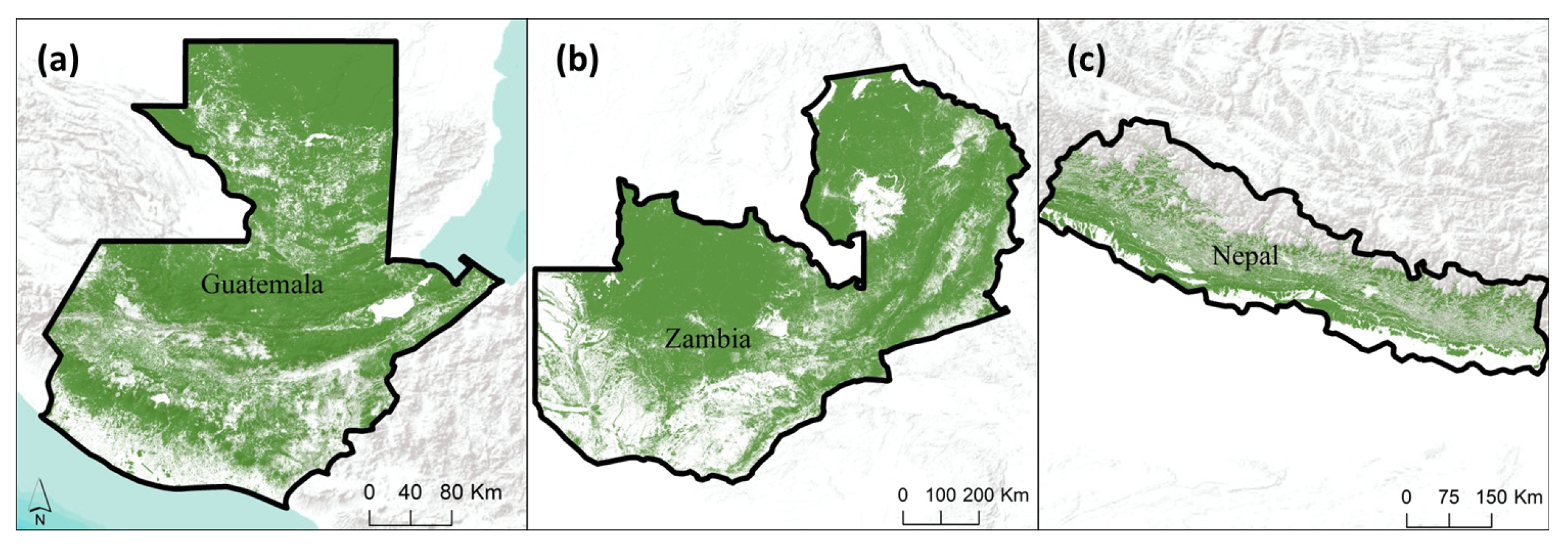
This analysis was conducted within the framework of S-CAP, a NASA and USAID initiative supporting EO-based approaches for national greenhouse gas (GHG) accounting. From the broader set of participating countries, we selected Guatemala, Nepal, and Zambia for detailed case studies, as shown in Figure 2. These three tropical and sub-tropical countries represent distinct ecological regions, Mesoamerican lowland forests, Himalayan montane forests, and African woodlands, each facing ongoing pressures from land use change and forest loss. Importantly, all three maintain national forest monitoring systems and accessible National Forest Inventory (NFI) or reference data, allowing for the comparison and validation of ensemble-based estimates.
Each of the countries in this analysis submit FRL reports to the UNFCCC reducing emissions from deforestation and forest degradation in developing countries (REDD+) program. Data approaches and results from these reports were included in the creation of this ensemble and details from those reports are described in the Country Reporting Section [19,20,21].

Country Reporting

Each country’s national forest definitions, baseline periods, and loss rates reported in their REDD+ FRL reports to the UNFCCC [19,20,21] provided validation benchmarks for our ensemble analysis. Guatemala defined forest as an area of at least 0.5 ha of continuous tree cover, with a minimum of 5 m in height and 10 cm in diameter, and a minimum crown cover of 30%, encompassing both natural forests and plantations (2.6% of total forest area). Between 2006 and 2016, Guatemala reported 3,593,337 ha total forest area (approximately one-third of national land) and an annual loss of 37,832 ha/yr, driven primarily by unsustainable resource extraction and conversion to pasture [19].
Nepal applied a 10% canopy threshold with a minimum tree height of 5 m, covering more than half a ha. This represents two-fifths of national land, reporting 5,887,240 ha total forest. The 2000–2010 baseline period showed minimal net change (7576 ha total loss), concentrated in the Terai lowlands where agricultural expansion and illegal harvesting predominate [20,22].
Zambia used identical thresholds to Nepal, reporting 45,000,000 ha forest cover (60% of land area). Between 2009 and 2018, Zambia documented a 191,569 ha/yr loss, concentrated along transportation corridors and driven by shifting cultivation and agricultural expansion [21,23]. These national definitions guided our harmonization of global land cover products to ensure comparability with reported baselines.

2.2. Activity Data Inputs and Preparation

2.2.1. Pre-Existing Datasets

All land cover and land use datasets considered in this study were either publicly available products or the official products of the three countries of interest (Table 1). As an additional criteria, we considered products with a relatively high spatial resolution (30 m), with the exception of Moderate Resolution Imaging Spectroradiometer (MODIS)-based (500 m) and European Space Agency (ESA) Climate Change Initiative (CCI) (300 m) data.
To enable consistent comparison across products with differing classification schemes, spatial resolutions, and temporal coverage, all datasets were harmonized to a common framework prior to analysis. All forest and tree cover classes were reclassified as a single forest cover class (Table A1), ensuring that the threshold for canopy cover, minimum mapping unit, and land use type aligned with the country of interest’s national FRL documentation. Activity data were derived by differencing annual forest cover extents to identify forest loss. To address differences in spatial resolution, all static forest loss layers were resampled to one ha using a nearest-neighbor approach. Temporal differences were addressed by normalizing to annual averages. Final data layers were then used as masks which were applied to the AGB datasets, as described in Section 2.3.
Table 1. Forest/tree cover and change datasets used in this study. Reported accuracy values represent the overall accuracies provided in the original publications for each dataset and are included here for context only. As each product was validated using different land cover classes, reference data, and time periods, the accuracies are not directly comparable across datasets.
Geographic AreaDataset SourceDataset TypeSpatial ResolutionEpochsReported AccuracyDataset Purpose
Global/TropicsEnvironmental Systems Research Institute, Inc. (ESRI)/Impact Observatory [24]Tree Cover10 m2017–202185.0%Static land cover
WorldCover [25,26]Tree Cover10 m2020–202274.4%, 76.7%Static land cover
Japan Aerospace Exploration Agency (JAXA) Forest/Non-Forest Cover (F/NF) [27]Tree Cover25 m2007–202191.0%Static land cover
Hansen et. al./Global Forest Watch (GFW) [18]‘treecover2000’ and ‘lossyear’30 m2000–202194.5%Static 2000 tree cover and change dataset
ESA CCI Land Cover [28]Tree Cover300 m1992–202075.4%Static land cover
MODIS MCD12Q1 [29]Forest Cover500 m2001–202173.6%Static land cover
GuatemalaMapa de Cobertura Forestal de Guatemala (MAGA) [30,31]Forest Cover30 m1991–202085.0%Static land cover
NepalRegional Land Cover Monitoring System (RLCMS) [32,33]Forest Cover30 m2000–202181.7%Static land cover
National Land Cover Monitoring System (NLCMS) [34]Forest Cover30 m2000–201984.8%Static land cover
ZambiaRegional Centre for Mapping Resource for Development (RCMRD) [35]Forest Cover30 m2000–201768%–74%Static land cover
Parameterized individually for each country: Reference Table 2Continuous Change Detection and Classification—Spectral Mixture Analysis (CCDC-SMA) [36]Change Detection Algorithm30 m2000–2020VariableChange detection
Landsat-based Detection of Trends in Disturbance and Recovery (LandTrendr) [37]Change Detection Algorithm30 m2000–2020VariableChange detection

2.2.2. Change Detection Algorithms

In addition to the existing land cover and change datasets, the team also generated change detection layers for each country using the algorithms CCDC-SMA, and LandTrendr [36,37]. LandTrendr was originally developed for the Pacific Northwest region of the United States considering diverse forest types, while CCDC-SMA was developed considering temperate forests in the country of Georgia. The reported accuracies from the original publications were 84% [37] and 89% [36] for LandTrendr and CCDC-SMA, respectively. Both algorithms employ temporal segmentation methods that leverage the entire Landsat collection to detect disturbance during a period of interest. However, while LandTrendr bases a time series analysis on annual composites, CCDC-SMA inputs all available observations [38].
Both are available through Google Earth Engine (GEE) and for this study were parameterized individually for each country. The team ran both algorithms over two decades, 2000–2020, to align with the longest global datasets used in this study. Both techniques allow the user to adjust a set of parameters to optimize detection. Three parameterizations were tested for each algorithm within each country, defined by the team as “high”, “neutral”, and “low” thresholds to detect changes (Table 2). For a more complete discussion of LandTrendr and CCDC-SMA parameters, see Kennedy [37] and Chen [36]. The results from each were discussed with in-region partners to select the most appropriate parameter settings based on their expertise.
This project used the LandTrendr “Greatest Magnitude of Change” script [37] and the CCDC-SMA “Tropics Collection 2” script [36]. The outputs of these scripts were 30 m resolution maps, with each pixel representing a change and included the corresponding year of detection. To isolate changes in only forest cover, we applied forest cover masks from each country’s land cover dataset (Table 2). In GEE, a pixel was classified as forest loss if it began the study period as forest, experienced a spectral change, and was non-forest at the end according to the countries’ reference land cover maps. These final classifications were used as annual activity data.

2.2.3. Reference Data Sources and Preparation

Although most of the land cover datasets report overall global accuracy, our focus was on forest loss, rather than static land cover classifications. Thus, instead of computing class-specific accuracies, we used point validation data provided by regional geospatial experts within the three countries of focus to evaluate the changes in forest/tree cover at the national and regional scales. However, it should be noted that these collection points were created and stratified for overall land cover mapping rather than change mapping, thus the number of change points in forests specifically was lower.
The Ministry of Agriculture, Livestock and Food of Guatemala collected 11,000 points for the years of 2006, 2018, and 2020 defining the land covers of “Forested Land”, “Pasture and Grassland”, “Agriculture”, “Urbanized”, “Wetlands and Water Bodies”, and “Other.” These classes were condensed into classes of “forest” and “non-forest” to match that of the activity data results. From there, the team determined changes in land cover between each available year. These points were then compared to those from the layers of activity data generated [19].
For Nepal, the International Centre for Integrated Mountain Development (ICIMOD) collected 8000 points throughout the region with land cover information from 2000 to 2020. These points contained land cover classes of “Snow”, “Bare Rock”, “Bare Soil”, “Built-up”, “Cropland”, “Grassland”, “Riverbed”, “Tree”, and “Water”. From there, the team grouped points by tree cover and non-tree cover classes and determined whether a change in tree cover occurred between the start, middle, and end of the time-defined time period. The ICIMOD reference points, which were originally collected for general land cover mapping, had limited spatial overlap with areas where the change products detected forest loss. To address this gap, the team generated an additional 250 stratified points (25 points within each change product’s detected change areas) and visually inspected them using Collect Earth Online. These supplementary points were combined with the original ICIMOD dataset for the final accuracy assessment.
For Zambia, the Regional Center for Mapping of Resources for Development (RCMRD), located in Kenya, collected and provided the team with 2000 points of land cover information defining “Cropland”, “Open Forest”, “Dense Forest”, “Open Grassland”, “Open Water”, “Other”, “Settlement”, “Vegetated Wetland”, and “Wooded Grassland”. Each point was collected annually, providing stable or change information on that particular point from 2000 to 2017. Again, these classes were condensed into classes of “forest” and “non-forest” to match that of the activity data results above. These points were then compared to those from the layers of activity data generated to determine whether change occurred during the years. This allowed us to determine the accuracy, precision, and sensitivity of our reclassified forest cover class from each global land cover dataset for every country [21].

2.3. Aboveground Biomass Data and Processing

Seventeen biomass datasets ranging from the global to national scale were used as the AGB component, as shown in Table 3. The dataset years span from 2000 to 2020 at spatial resolutions of 100 m to 10 km. To ensure consistency across datasets, all layers were resampled to 1 ha spatial resolution using nearest-neighbor resampling [7]. Per-pixel summary statistics (e.g., mean, standard deviation, range, coefficient of variation) were extracted to evaluate dataset agreement and characterize variability within each country.
The sixteen global or pan-tropical biomass datasets (excluding Nepal’s national dataset) were grouped by relative date coverage to enable more consistent comparison. This step separated eleven datasets covering c.2000 [8,10,39,40,41,43,44,45,46,48], six covering c.2010 [9,21,41,42,43,47,49], and three covering c.2020 [41,42]. To further harmonize, the c.2000 datasets were segmented once more by those with pre-applied forest masks [39,45,46,50] and those without.
Because biomass values are highly dependent on forest types and the extent of forest cover, the biomass data were not restricted to a particular extent for the initial comparison. Rather, we compared across the entire area, covering both forest and non-forest land covers. However, to determine the biomass within the forest class, the AGB datasets (Table 3) were subsequently masked using the annual forest change layers generated from the various land cover datasets. This ensured that only biomass contained within areas of forest loss was considered. This harmonized framework enabled direct comparison across datasets differing in spatial resolution, temporal coverage, and forest definitions, while maintaining consistency in spatial units and analytical boundaries.

Assessment of Biomass Products

Our partner organizations in Guatemala and Nepal provided NFI data, which we used to evaluate the accuracy of the biomass products at the country level. Many of the existing datasets report global or regional accuracies based on diverse remote sensing inputs and unevenly distributed validation data, but do not provide assessments for the three specific countries analyzed in this work. To address this gap, we performed linear regressions comparing NFI biomass estimates with the values extracted from biomass products. In Guatemala, The Ministry of Agriculture, Livestock and Food shared 2364 field measurement locations with sample areas ranging from 0.03 to 2 ha and temporal coverage from 1994 to 2016. The points were scaled to match the spatial resolution of the biomass products, and comparisons were restricted to overlapping years (e.g., 2010 NFI measurement with CCI-Biomass 2010 estimate). Similarly, ICIMOD in Nepal used their NFI points collected between 2016 and 2022 to carry out the same regression analysis. This approach allowed us to evaluate the performance of global biomass products in specific national contexts where accuracy is critical for reporting.
For example, Saatchi et al. [8] and Baccini et al. [9] relied on pan-tropical validation plots, while Hu et al. [45] and Yang et al. [50] integrated thousands of plots worldwide. While these approaches provided their products with robust global validation, they did not offer country-specific analyses. Our additional national-scale analysis directly addresses this gap using NFI reports from Guatemala and Nepal to evaluate product performance in the national context.

3. Results

3.1. Forest Cover and Change

To better understand each country’s “current” forest coverage, we calculated each dataset’s ha of forest or tree cover for 2020. Estimates varied widely, ranging from 34% to 65% forest cover in Guatemala and 28% to 60% in Nepal, as shown in Table 4. The regional dataset from Zambia was excluded from Table 4 as the latest data year covers 2017 but not further; however, the 2017 forest coverage was estimated to be 54.76%. Estimates for the 2020 datasets ranged from 9% to 80% forest cover. To determine the 2020 forest coverage using GFW, as the product in GEE does not directly provide annual forest cover, we first applied each country’s nationally defined tree canopy percentage (30%, 10%, and 10%, respectively; see Country Reporting Section) to the ‘treecover2000’ static layer and removed forest losses through 2019. LandTrendr and CCDC-SMA were excluded from this comparison as they produce a disturbance product rather than stratified land cover.
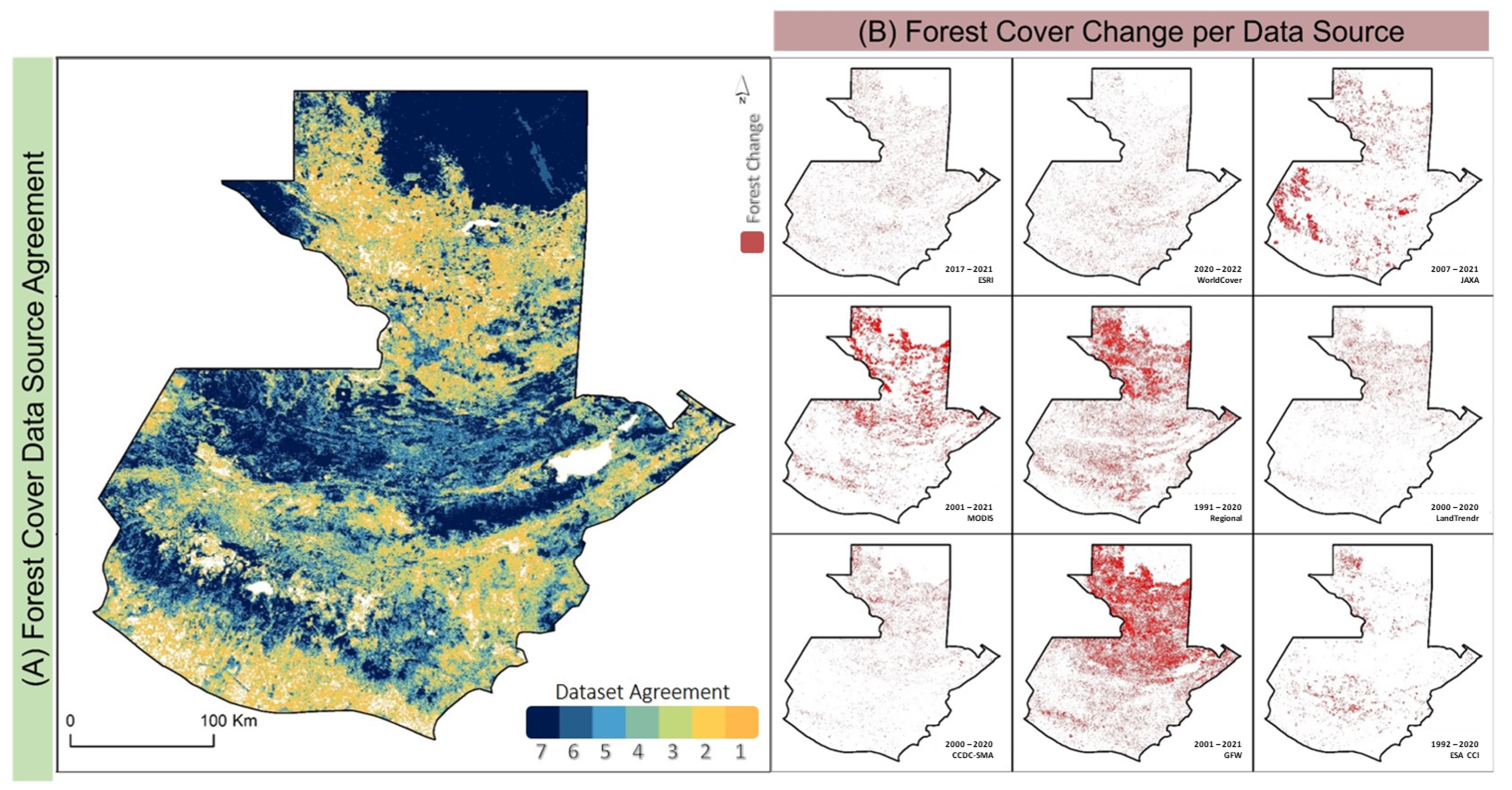
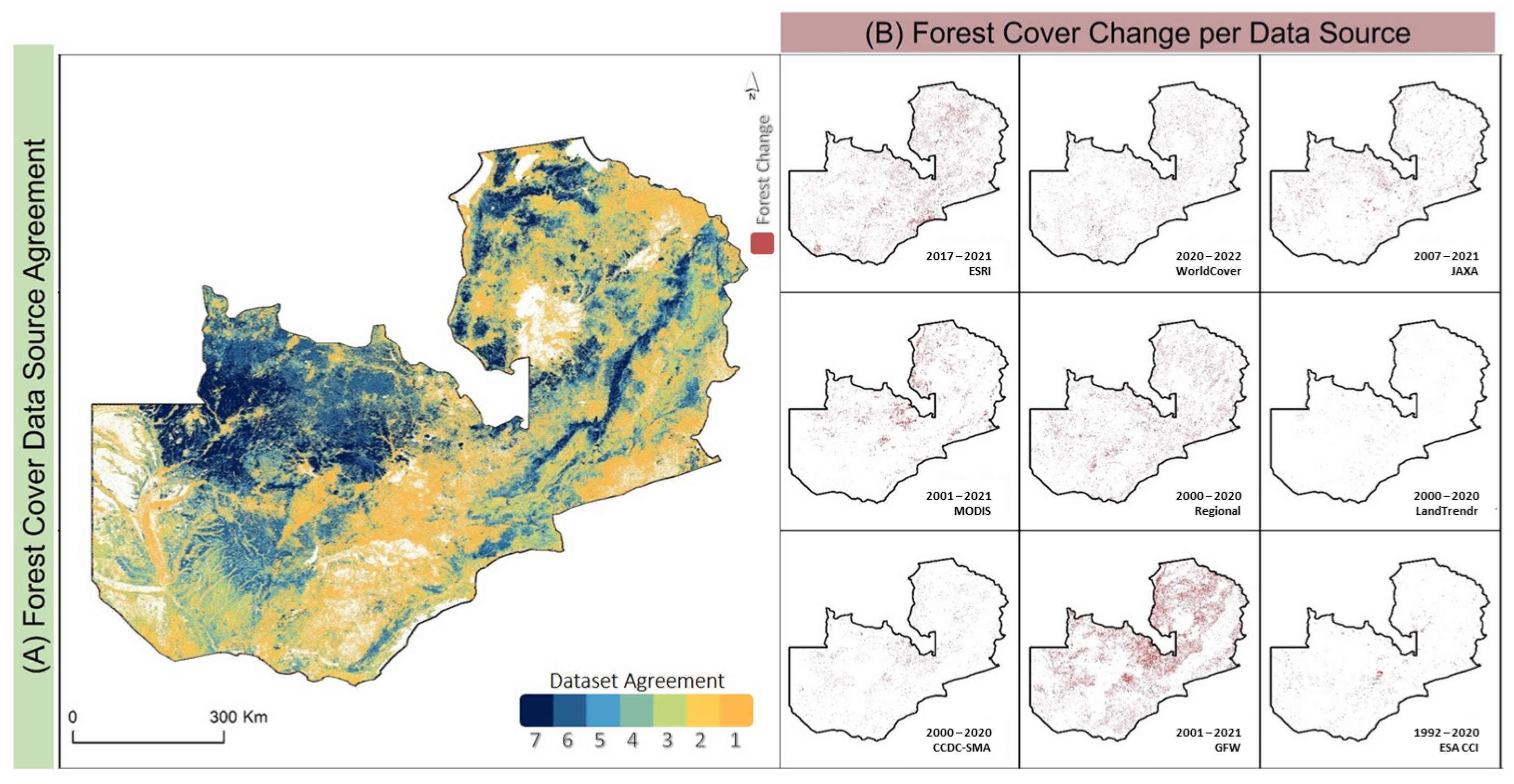
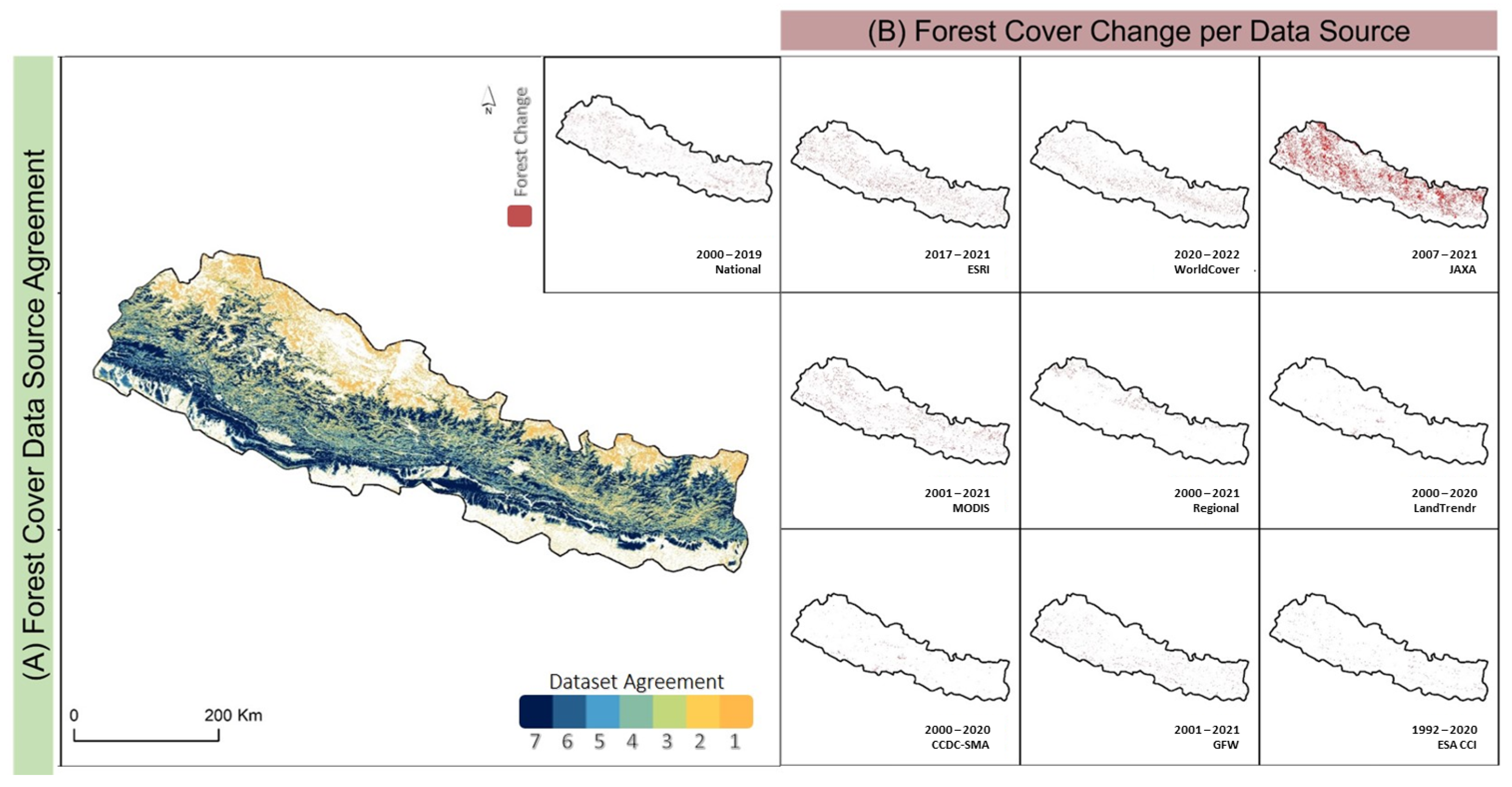
The overlaps between the datasets are better visualized in Figure 3A, Figure 4A and Figure 5A. Figure 3A demonstrates spatial agreement in forest cover for the year 2020 among the seven datasets, with blue indicating complete agreement and yellow indicating increasing divergence. Dense forest areas, such as national forests and protected areas, generally show higher agreement. Focusing on forest loss, Figure 3B, Figure 4B and Figure 5B show total forest change across the years covered by each dataset. Because the datasets span different time periods, absolute totals are not directly comparable. Year ranges are indicated on each map, and total changes have been summarized as average annual change to aid interpretation. These figures are intended to illustrate spatial patterns of change rather than absolute magnitude, guiding readers to focus on areas of agreement and divergence.
In Guatemala, (Figure 3), the average annual forest change ranged from 20,733 ha/yr. with the LandTrendr (2000–2020) to 441,227 ha/yr. with WorldCover (2020–2021), with a mean of 115,572.33 ha/yr across all datasets. While there is variation across different datasets, the trends are in the same direction. The majority of the agreement among change datasets occurred in the Department of Peten, Guatemala, home to the Maya Biosphere Reserve [53], and a well-documented region of forest loss [19,54,55].
In Nepal (Figure 4), the average annual forest change ranged from 1738 ha/yr, based on LandTrendr covering 2000–2020, to 385,087 ha/yr using the WorldCover dataset covering 2020–2021, with a mean of 79,442 ha/yr. Nepal showed substantially lower mean forest loss estimates across all datasets compared with Guatemala (115,572 ha/yr) and Zambia (511,568 ha/yr), likely reflecting successful community forest management efforts that have driven reforestation gains in recent decades.
In Zambia, the average annual forest change ranged from 6141 ha/yr, from LandTrendr (2000–2020), to 1,902,957 ha/yr with the WorldCover dataset from 2020 to 2021, with a mean of 511,568 ha/yr (Figure 5). These estimates, generated from remotely sensed datasets and products, were compared to those reported in the country’s FRL. Zambia’s reporting approach was point-based, where over 11,000 sample points over the period of 10 years were classified into the six IPCC classes [21]. The Global Forest Watch change product, ESRI land cover, and CCI land cover also had their greatest percentages of change within the Central province at 17%, 15%, and 35%, respectively; while JAXA F/NF and RCMRD’s regional products were greatest in the Northwestern province, the province with the highest mean biomass stock (38.3 tons/ha) [56] (19% and 15%, respectively).

Accuracy Assessment of Activity Data

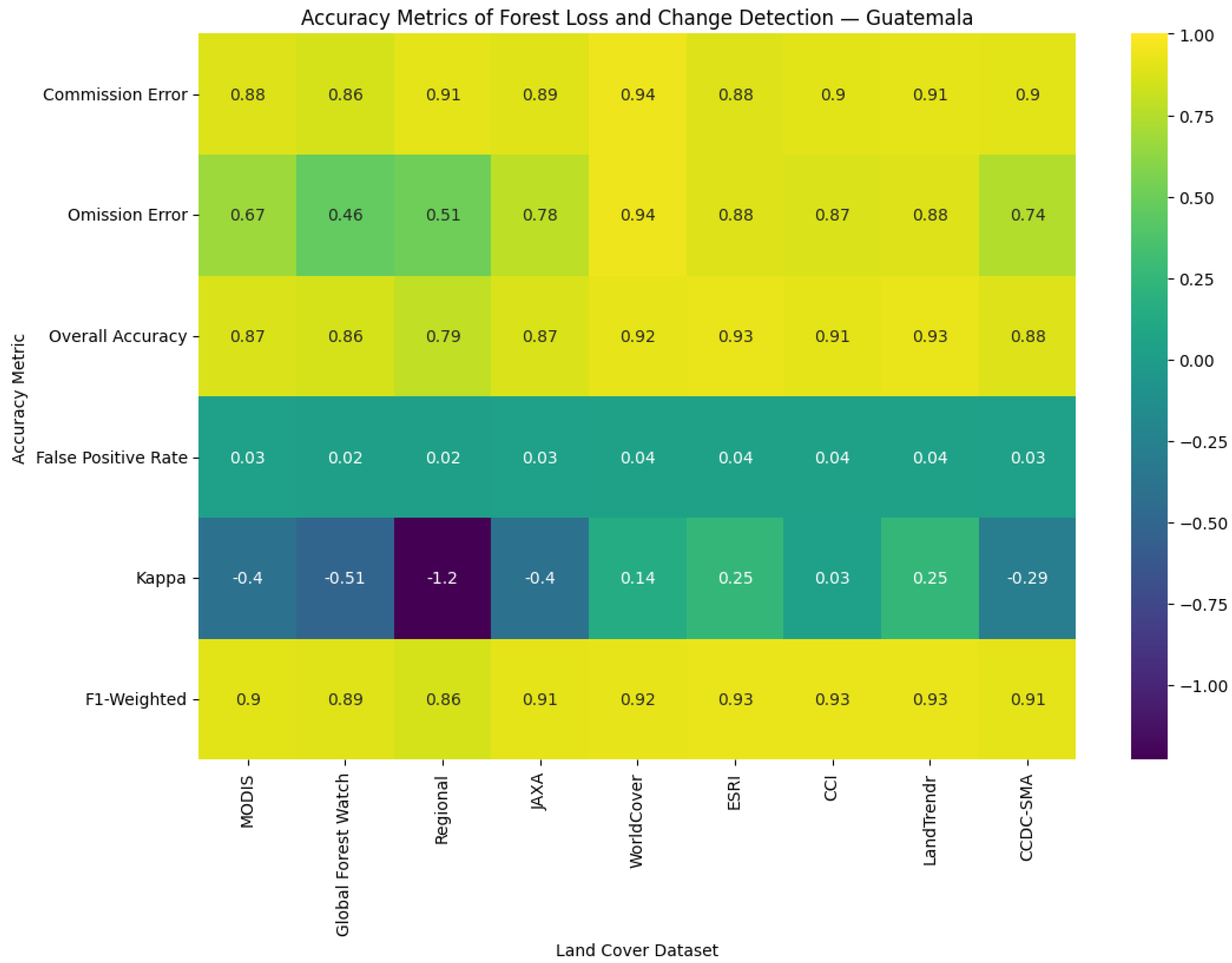
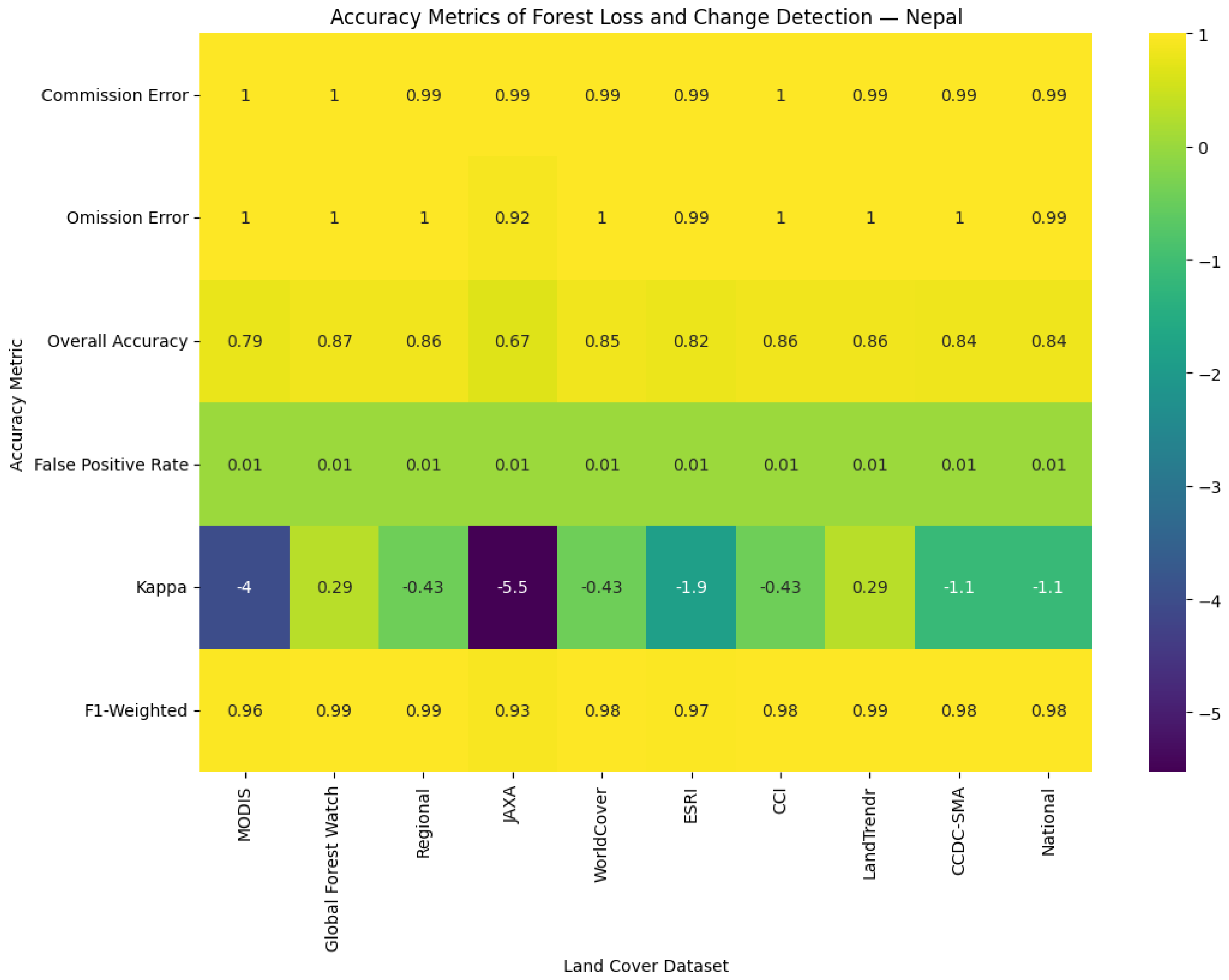
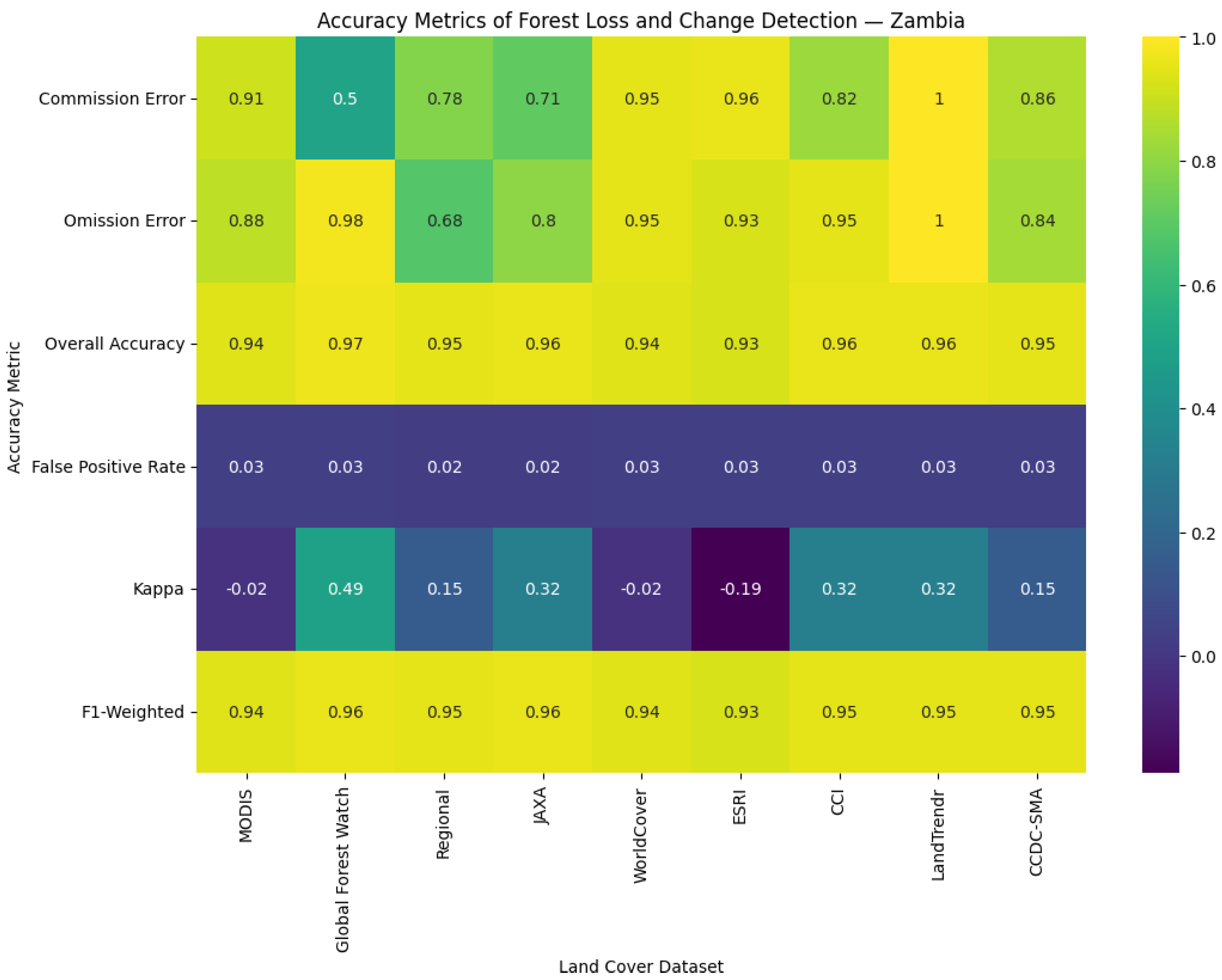
This paper does not intend to determine the “best” land cover dataset for each country; rather, the comparison of different global datasets in a given geography facilitates an evaluation of their varying performances at national levels. Using the reference points from Guatemala, Nepal, and Zambia, we accessed the accuracy of each change product—Figure 6, Figure 7 and Figure 8.
In Guatemala, all datasets had a high overall accuracy ranging from 0.79 to 0.93. The country’s official land cover product ([30,31]) had the lowest accuracy at 79% and the lowest kappa value (–1.2), indicating limited agreement with the reference data despite capturing more change events. This is consistent with its higher omission error (0.51) and commission error (0.91). By contrast, global products such as WorldCover, ESRI, and CCI achieved higher overall accuracies (0.91–0.93) and more balanced omission and commission errors, with kappa values up to 0.25. The relatively low false positive rates (0.02–0.04) across all products indicate similar tendencies when identifying change.
Land cover change accuracy assessments in Nepal revealed that GFW had the highest overall accuracy at 87%; however, omissions and commission errors indicated that this was driven primarily by agreement on stable locations rather than the correct identification of actual forest loss. The relatively low kappa of 0.29 further suggests moderate agreement beyond random chance. Even with the addition of 250 targeted points within detected change areas, the lowest overall accuracy was observed from JAXA F/NF at 67%. When investigating the disagreement related to change locations, we found that a majority of the point locations identified as change in the land cover change products fell in locations of high altitude, barren land coverage, or steep slopes within the Himalayas. These locations were either non-forest land cover types to begin with or were undisturbed forest throughout the study time frame.
In Zambia, all datasets exhibited a high overall accuracy, ranging from 0.93 to 0.97 (Figure 8). The GFW change dataset achieved the highest accuracy (0.97) and a moderate kappa value (0.49), reflecting good agreement with the reference data. By contrast, the ESRI 10 m product showed the lowest overall accuracy (0.93) and the lowest kappa (–0.19), indicating lower consistency in detecting change areas. The national dataset [35] had a higher overall accuracy (0.95), both omission (0.68) and commission (0.78) errors were high, and the low kappa (0.15) suggests only slight agreement beyond random chance. Despite overall accuracies above 0.93 across all datasets, the consistently high omission and commission errors (0.68–0.98 and 0.50–1.00, respectively) suggest that agreement is driven largely by stable areas rather than true forest loss detections. During the FRL time frame, it was estimated that the average forest loss rate was 191,569.23 ha/yr, landing in the middle of the forest change ensemble. The FRL also reported that the majority of this change occurred in the Central province of Zambia [21], which is known to have the largest portion of commercial farming [56], followed by the Eastern and Northwestern provinces.

3.2. Biomass

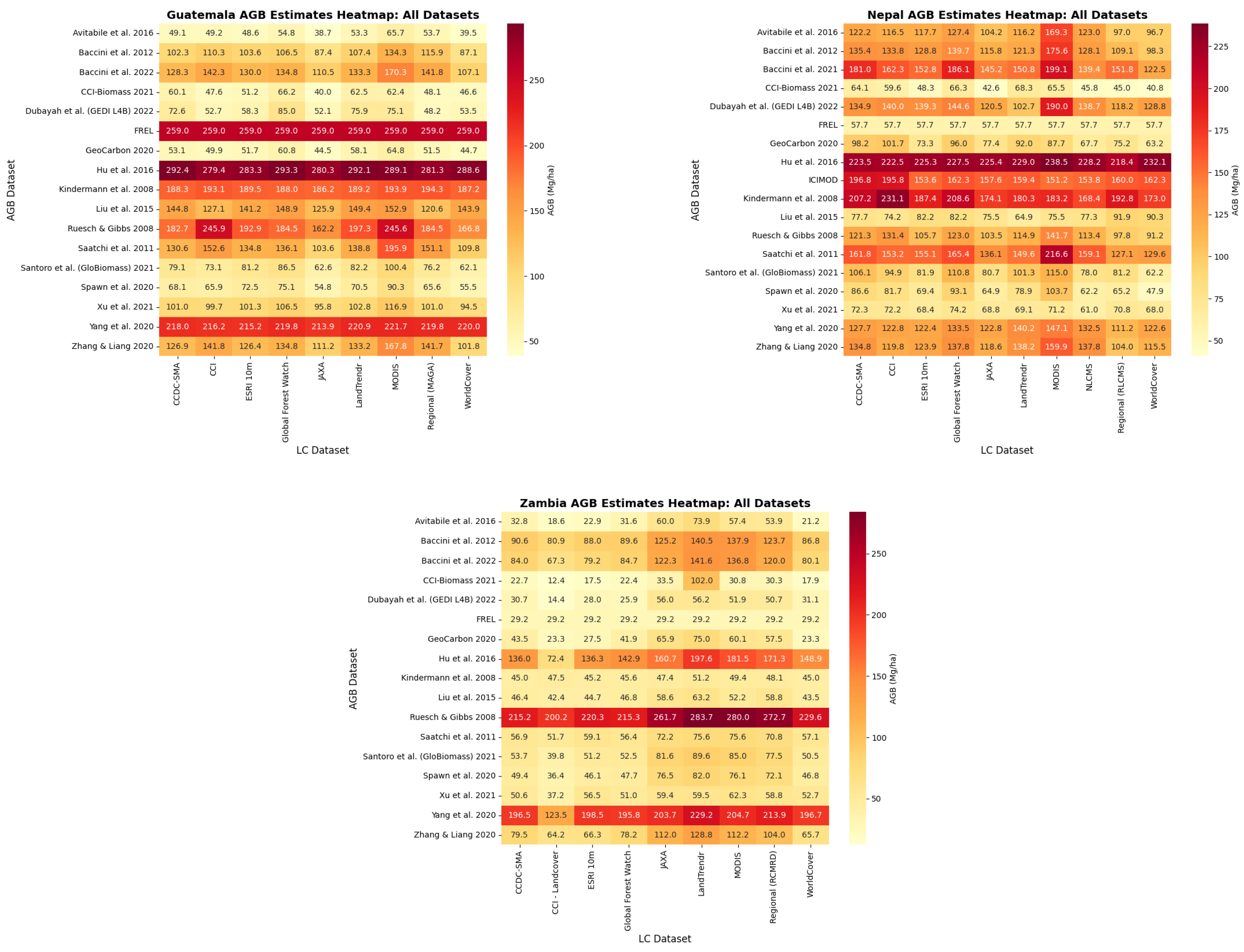
The c.2000 datasets were separated once more by datasets with forest masks already incorporated [39,42,45,50] and those without. While the datasets that exclude non-forest land cover held consistently higher means of biomass, as expected, across the three countries, Hu et al. [45] estimated the highest means in Guatemala and Nepal while Yang et al. [50] had the highest estimates in Zambia. Mean biomass estimates were differentiated depending on the corresponding land cover change extent (Figure 9). In Guatemala, the results from Hu et al. ranged from 279.4 tons/ha when combined with CCI to 293.3 tons/ha with GFW; in Nepal, the results from Hu et al. ranged from 218.4 tons/ha when combined with RLCMS to 238.5 tons/ha when combined with MODIS. In Zambia, the results from Yang et al. ranged from 123.5 tons/ha when combined with CCI to 229.2 tons/ha when combined with LandTrendr’s change extent (Figure 9).
Datasets covering both forest and non-forest regions estimated lower means of biomass; however Ruesch & Gibbs [40] estimated the highest biomass values amongst those in both Guatemala (245.6 tons/ha.; MODIS change extent) and Zambia (283.7 tons/ha.; LandTrendr). In Nepal, their local dataset from ICIMOD [52] estimated the highest biomass mean (196.8 tons/ha.; CCDC-SMA) when compared with the other datasets. Regarding the c.2010 and c.2020 datasets, which included both forested areas and non-forested areas, Xu et al. [41] estimated the lowest values of biomass throughout Guatemala, Nepal, and Zambia (54.58, 15.06, and 11.63 tons/ha., respectively.) Liu et al. [43] showed the highest biomass estimate for Guatemala (175.84 tons/ha) whereas Baccini et al. [9] indicated higher estimates at 76.99 tons/ha. for Zambia and 105.97 tons/ha. for Nepal. Similarly, Xu et al. [41] estimated the lowest values of biomass throughout Guatemala, Nepal, and Zambia for c.2020, although estimates from all three datasets were much lower in 2020 than the estimates from previous years. It should be noted that the GEDI L4B biomass product [51] does not produce full coverage due to the pattern of data collection, and with more data points, the values may change.
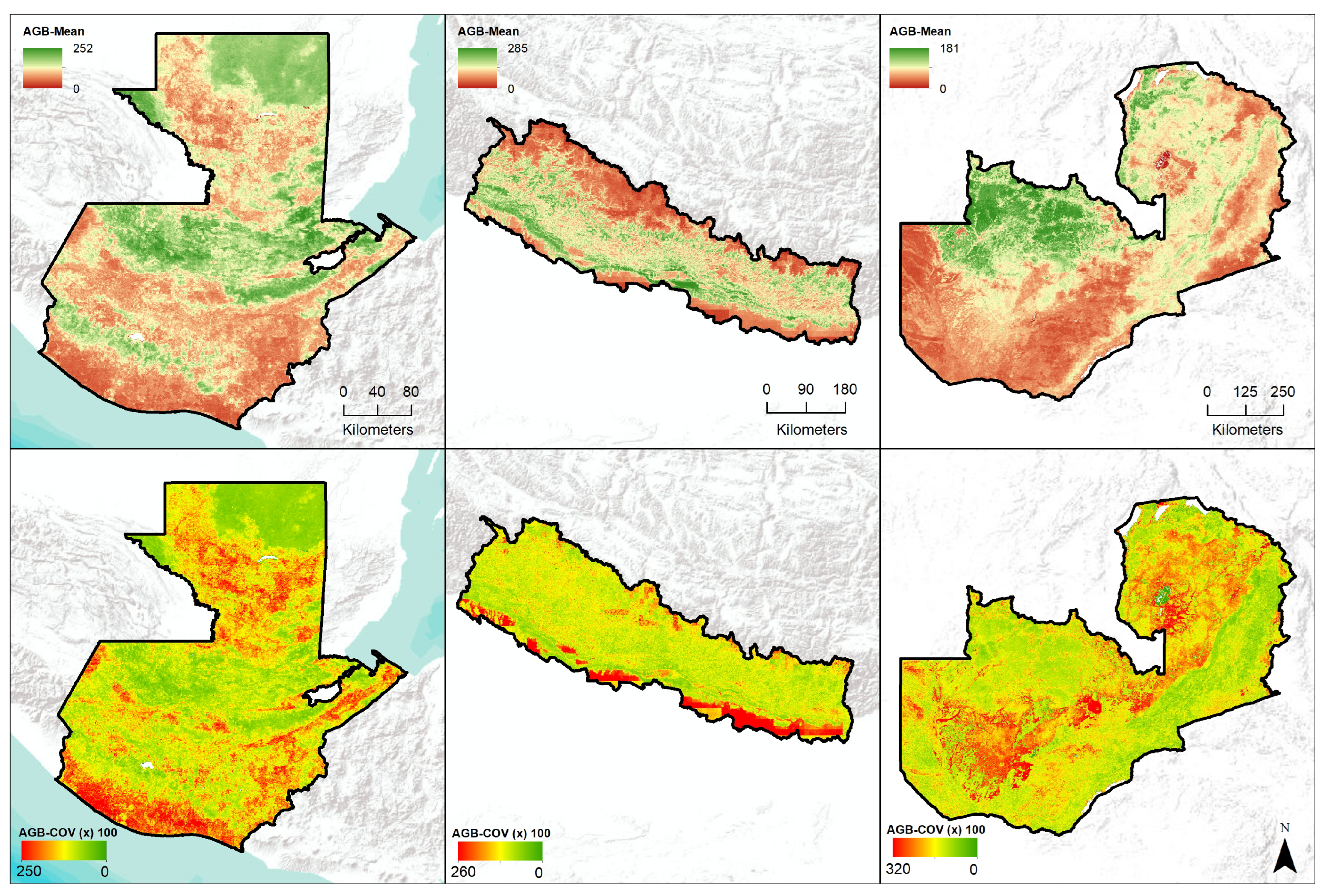
Figure 10 demonstrates both the mean of all biomass datasets along with the differences between them. While the datasets cannot be directly compared due to differences in year coverage, this visual allows us to identify regions of carbon-dense forests for each country. The coefficient of variation maps show that the datasets diverge from the mean in regions of lower forest AGB stocks and converge in areas of assumed higher stock. The areas of greatest biomass align with the areas of greatest estimated forest coverage seen in Figure 3, Figure 4 and Figure 5.

3.2.1. Assessment of Biomass Data

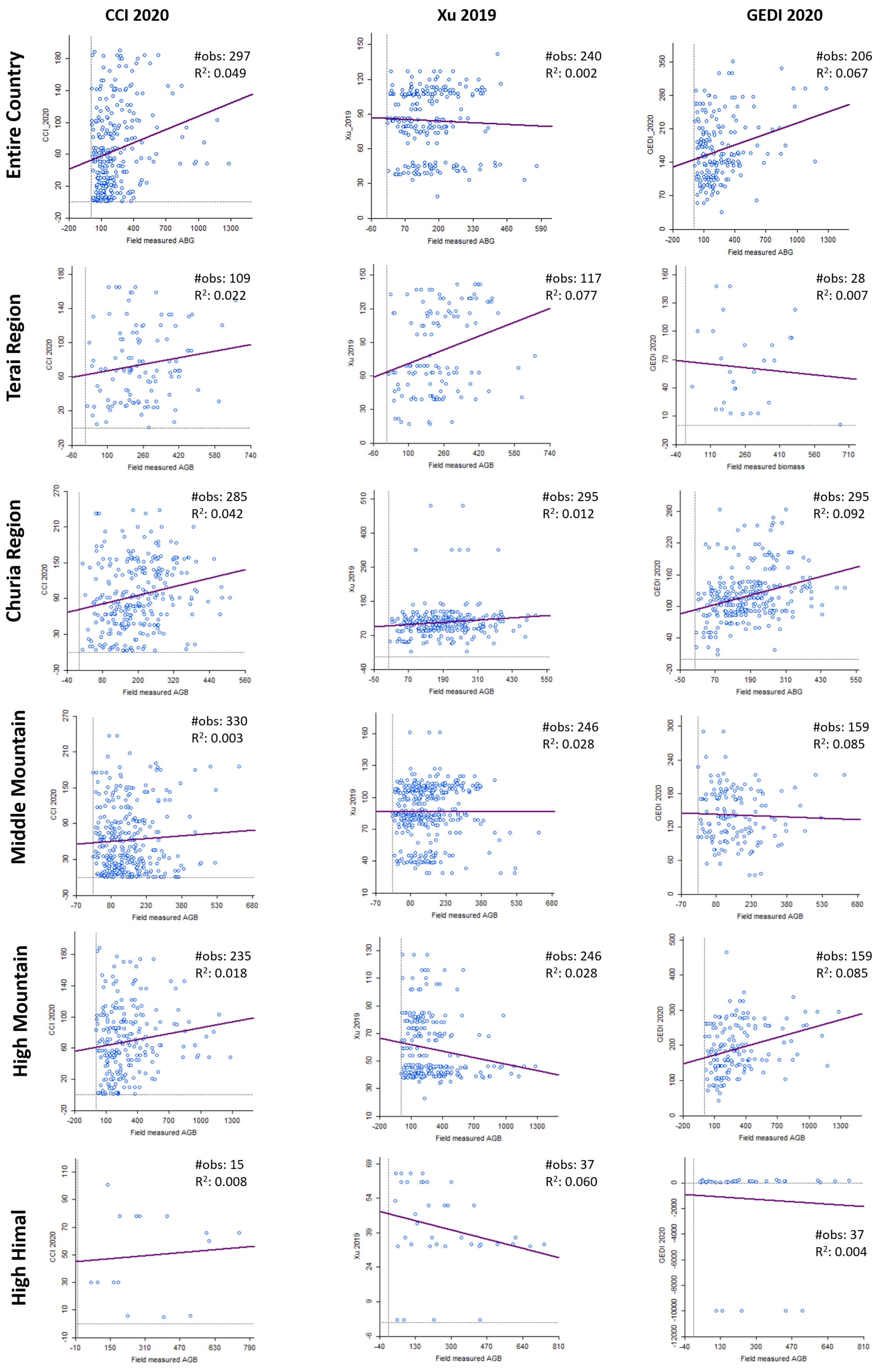
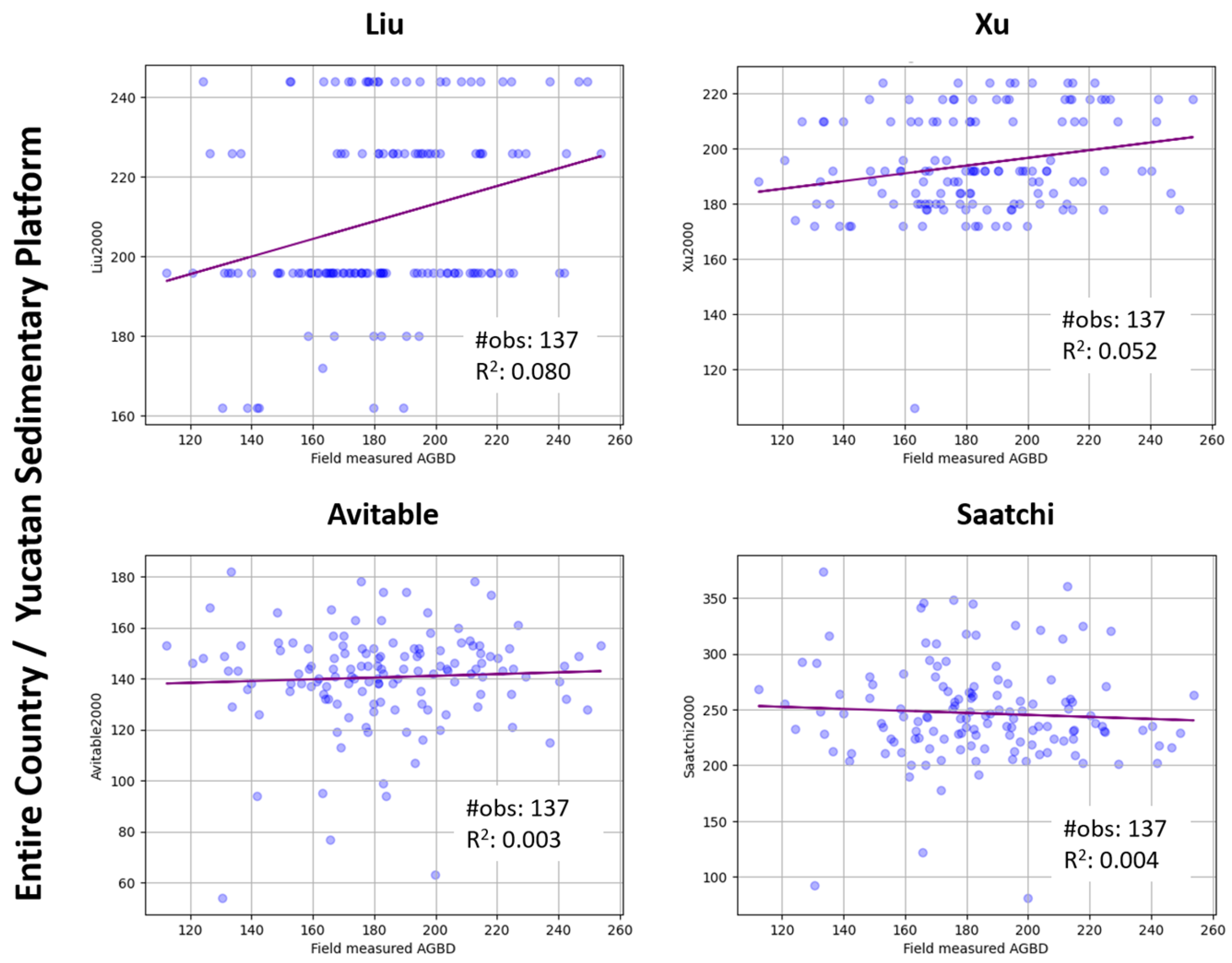
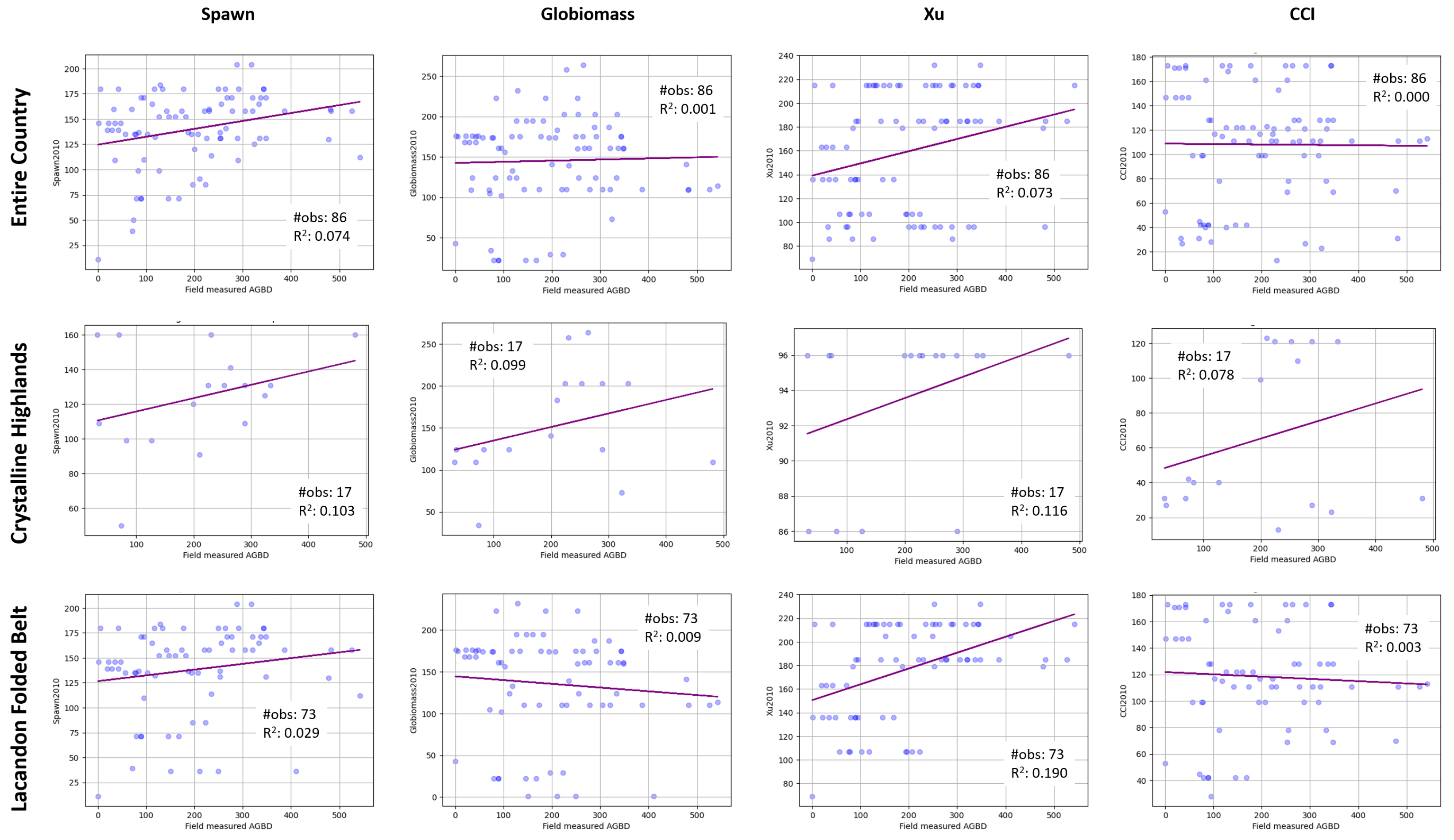
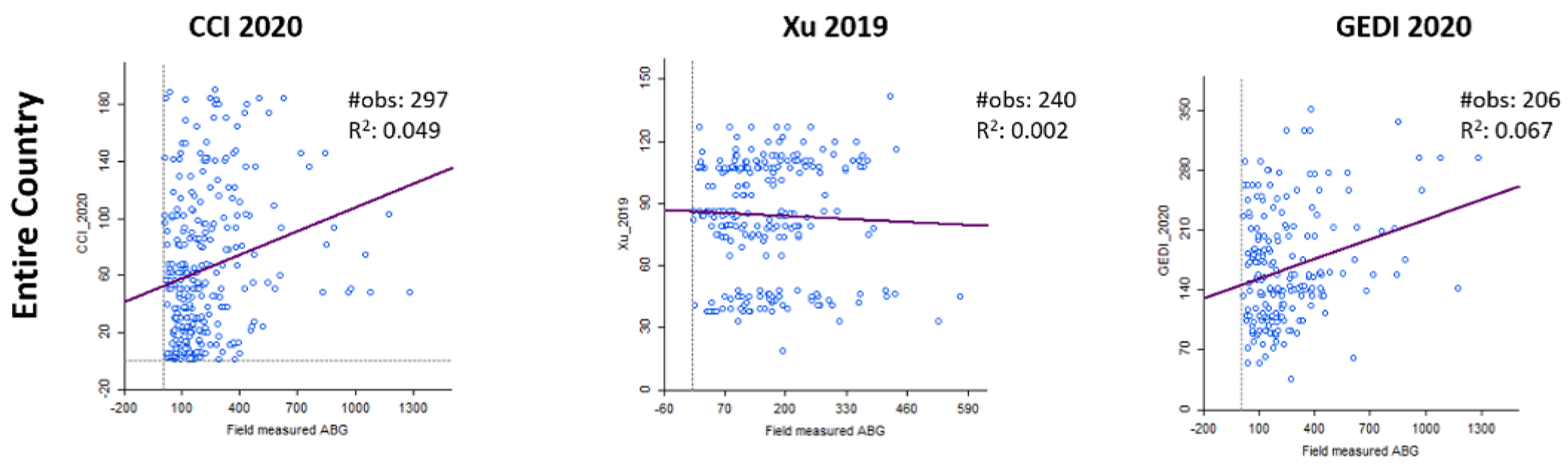
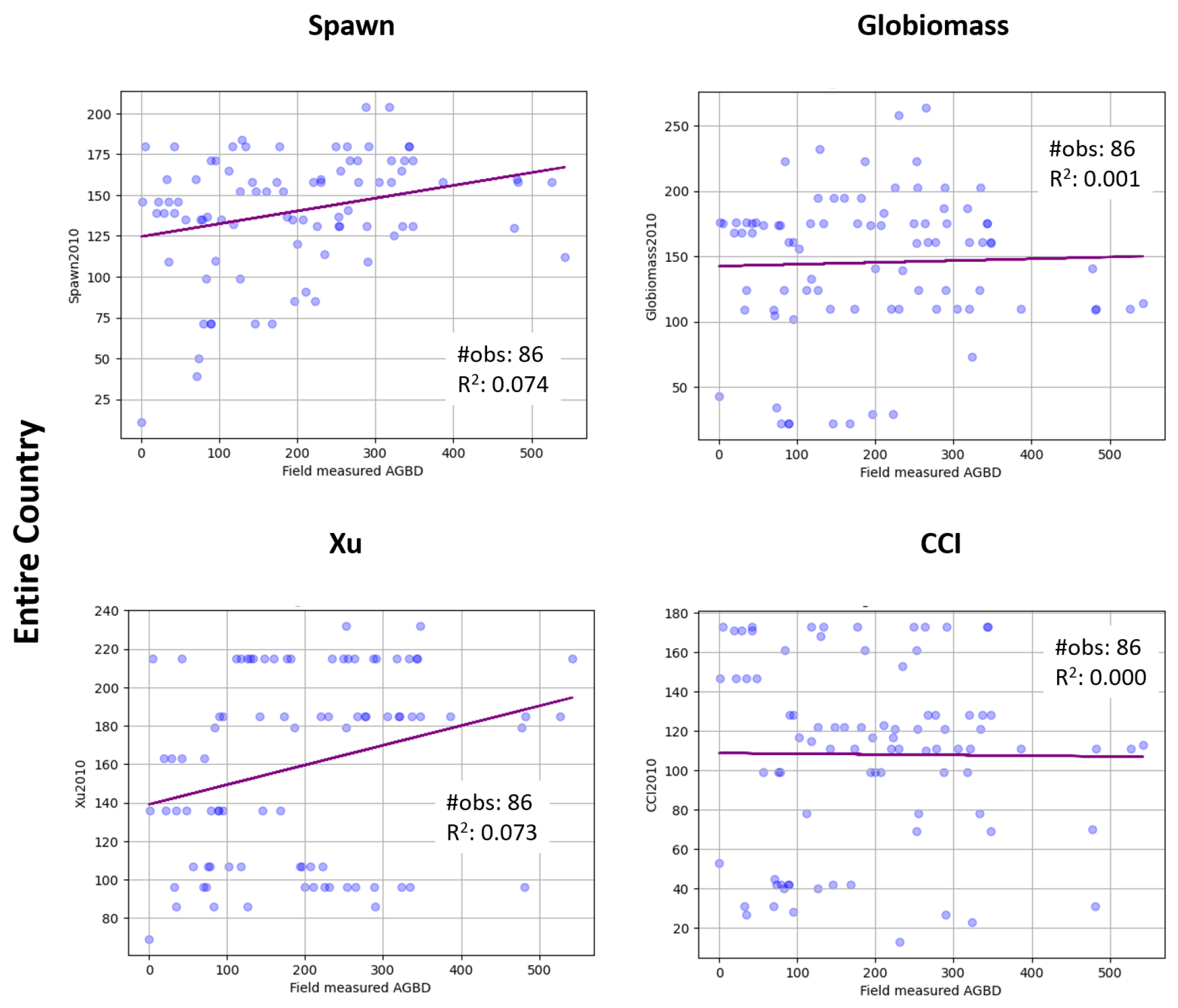
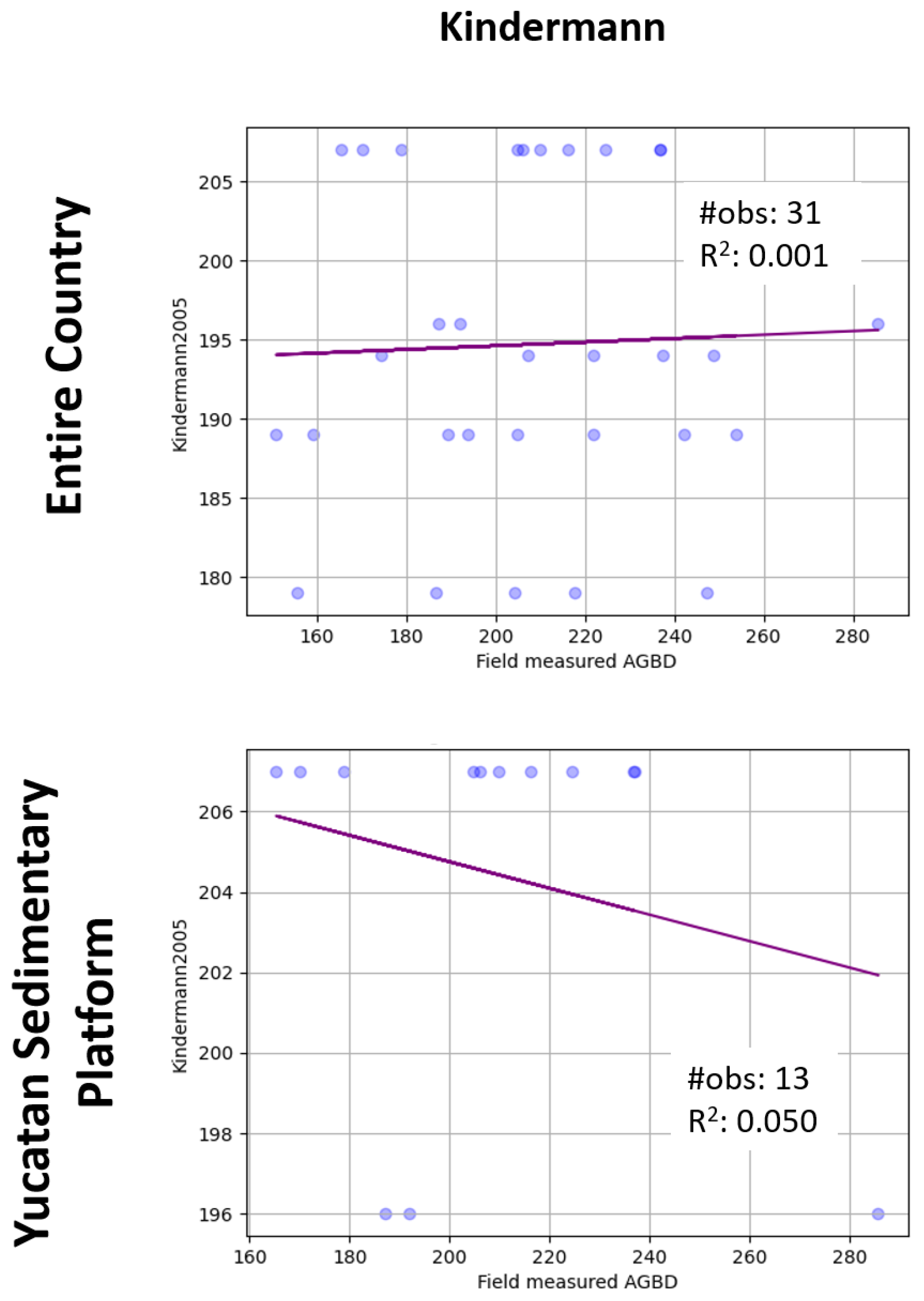
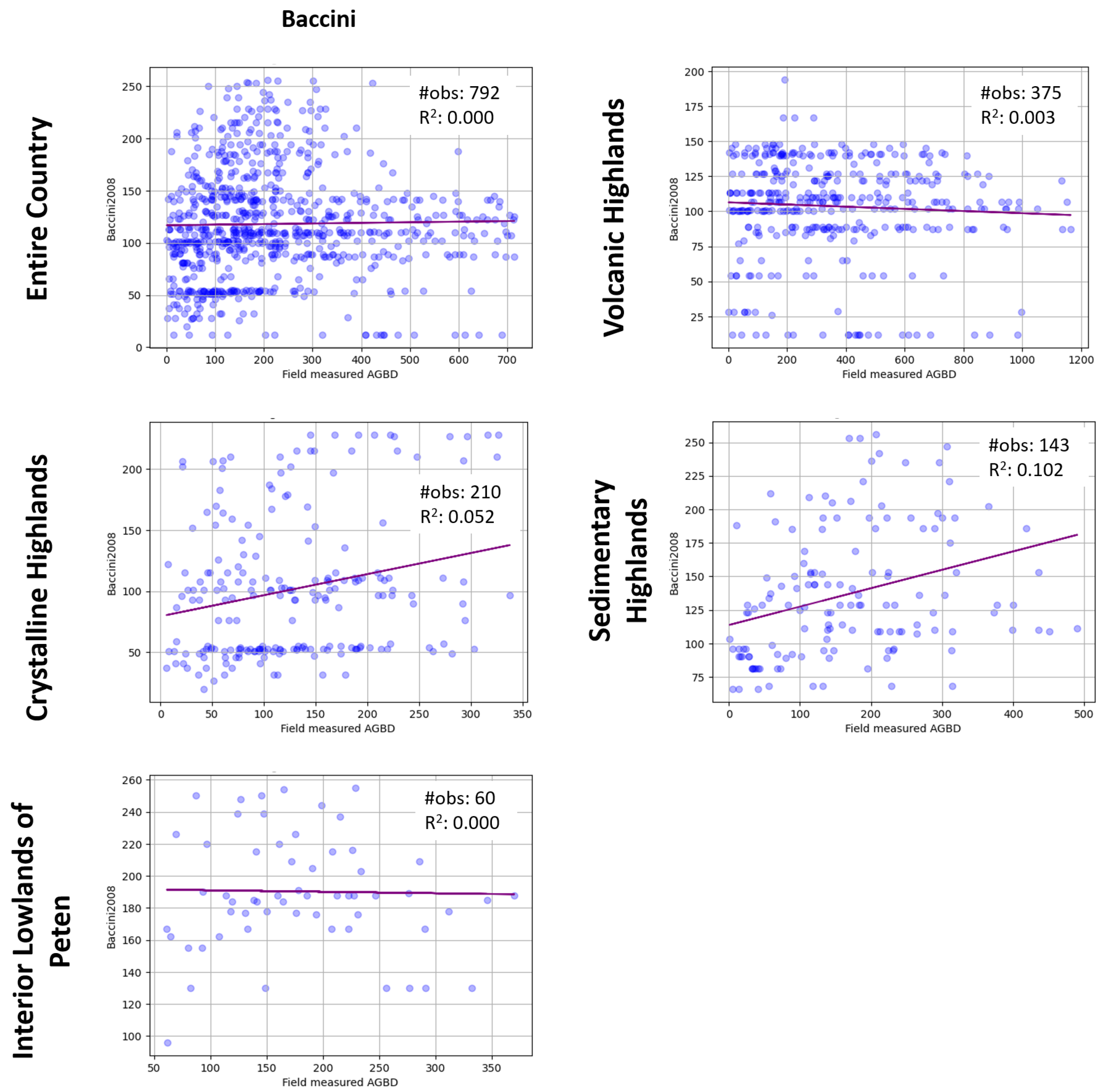
NFI data were compared directly to the biomass products listed in Table 3 with linear regressions. To ensure temporal consistency, as NFI data were collected at various times, validation was performed using only the field data corresponding to the year of the predicted biomass. This analysis provided insight into how these products perform against national standards. The regression results for Guatemala and Nepal are shown in Figure 11 and Figure 12, respectively. The analysis was performed for all datasets with overlapping timestamps; the complete set of regressions is included in Appendix B (Figure A1, Figure A2, Figure A3, Figure A4 and Figure A5). Shown here is a subset of the results.
In both regions, the R2 values were rather low, ranging from 0 to 0.080 in Guatemala and 0.001 to 0.067 in Nepal. Regressions were also performed subregionally by physiographic regions in both countries. The results were similar with ranges from 0.003 (Middle Mountain Region; CCI 2020) to 0.092 (Churia Region; GEDI) in Nepal and 0.00 (Interior Lowlands of Peten; Baccini) to 0.190 (Lacandon Folded Belt; Xu) in Guatemala.

3.2.2. Additional GEDI Analysis

Based on our analysis of global biomass products over Guatemala, we wanted to further investigate whether lower-level GEDI products (L4A aboveground biomass density and L2A RH98 canopy height metrics) could serve as viable alternatives for measuring biomass in the region. The results from both Table 5 and Table 6 demonstrate that neither the GEDI L4A agbd footprint data (with R2 values ranging from 0.005 to 0.113 and rRMSE from 50.64% to 129.04% across physiographic regions) nor the quality-filtered GEDI L2A RH98 data (with R2 values from 0.03 to 0.16 and rRMSE from 108.98% to 387.45% across physiographic regions) provided a satisfactory performance when compared with NFI biomass estimations.

4. Discussion

Overall, our ensemble revealed consistent spatial patterns of forest loss across datasets, but large discrepancies in the magnitude of forest loss and AGB estimates. Agreement was highest in stable, densely forested regions, while divergence increased near forest loss frontiers, illustrating how dataset choice can strongly affect inputs for reported national emissions.

4.1. Activity Data

The disagreement among datasets differed between countries, which is expected. Areas of dense forest coverage such as national forests and protected areas tended to have more agreement amongst datasets. Bordering these densely forested areas, where forest loss is occurring and conversion to other land use is increasing, there tended to be less agreement in the 2020 forest coverage (although not complete disagreement). Datasets of higher resolution, such as GFW (‘lossyear’), WorldCover, and ESRI, were able to detect the majority of smaller forest/tree coverage, in between other land use types, and are mostly in agreement.
GFW detection patterns differed in Nepal compared with Guatemala and Zambia, where GFW had detected substantially more change than other products. Visual comparison reveals that GFW registered greater change in mountainous terrain in both countries (e.g., Guatemalan highlands south of Petén; Muchinga mountains in Zambia). A similar pattern is observed in Nepal, where all products captured change concentrated in complex topography; however, differences among products were less pronounced, possibly due to Nepal’s gains in slowing forest loss in recent years. The relatively consistent detection across products in Nepal, despite GFW’s longer temporal coverage (2000–2021 vs. 2020–2021 for WorldCover), suggests that terrain complexity alone does not fully explain inter-product differences. The Terai and Hilly regions of Nepal hold the majority of forested land and have been well monitored for forest changes over the years [57].
The activity data used for Nepal’s FRL was generated by modifying SERVIR’s RLCMS [58] to create the NLCMS. This provides context to the differences between the RLCMS results and those reported in Nepal’s FRL. The FRL showed that the highest level of forest loss was found in the Terai region, the southern plains of Nepal [59], and regions of increased agricultural land use [20]. To compare the FRL estimates to the remote sensing datasets, we separated the country into three primary regions, Terai, mountain, and Hilly, defined using methods from Joshi et al. [60]. Contrary to the FRL, all remotely sensed datasets and products estimated that the most forest loss occurred in the Hilly regions in central Nepal.
Outside of LandTrendr, CCDC-SMA, and the GFW ’lossyear’ product, these global and national datasets were generated to classify land cover rather than change (as is being compared here), which may explain the lower accuracies. Moreover, the methodology used to generate the national datasets for Guatemala [31] (1991–2001) was updated in the ensuing years [30] (2016–2020), introducing uncertainty into this evaluation.

4.2. Biomass Assessments

The regression results do not suggest strong agreement between the various biomass datasets with the NFI data, but rather show that the biomass estimates from different sources vary widely. The methods behind the generation of the products and field measurements of biomass often differ and thus will result in diverging estimations [61].
After expanding the analysis to include two GEDI products, the low R2 values and high rRMSE observed across all physiographic regions indicated that both GEDI L4A AGBD and L2A RH98 products have limited agreement with plot-based biomass estimates. These discrepancies likely stem from spatial mismatches between GEDI footprints and smaller NFI plots, compounded by the variations in forest type, canopy density, and topography of Guatemala’s forests which can strongly influence lidar signal returns, reducing the reliability of global or uncalibrated biomass relationships in diverse landscapes [62,63]. Additional uncertainty may arise from differences in data acquisition timing.
Overall, these findings suggest that while GEDI’s lower-level products provide valuable structural information, they are not reliable as stand-alone biomass measures in Guatemala. Instead, they would be most effective when integrated with local field data and higher-resolution optical or radar observations within ensemble or data fusion frameworks. However, since this evaluation was limited to Guatemala, we cannot extend these recommendations to other geographic regions where the performance of these GEDI products may differ due to varying forest types, topography, or environmental conditions.

4.3. Limitations

There were several limitations and assumptions in this analysis. Firstly, the land cover datasets cannot be compared directly because they differ in temporal coverage, spatial resolution, and methodologies used to define “forest”. For example, JAXA, Esri, and WorldCover have a shorter reporting period compared with the 20-year coverage of GFW, MODIS, and CCI LC. To address this, we compared annual averages of forest cover rather than exact year to year estimates. Additionally, we resampled all datasets to 1 ha. In areas of dense forest (e.g., the Maya Biosphere), resampling from higher resolution data (e.g., 10 m) to 1 ha could have overestimated forest cover, as small non-forest patches may be absorbed within contiguous forest. Conversely, in more fragmented or sparse forest landscapes, this process may have underestimated forest cover due to the loss of isolated forest pixels during aggregation.
Secondly, the definition of forest varies between not only products but also countries. JAXA F/NF and MODIS MCD12Q1 have specific classes for forest, while the other datasets use a general tree cover class. For the purposes of this analysis, we made the assumption that the tree cover classes contained mainly forest. This could have introduced overestimation of forest cover for datasets with more broadly defined tree cover classes. National definitions of “forest” also differ. We took these differing definitions into account when reclassifying the land cover products or parameterizing the change products, ensuring that the threshold for canopy cover, minimum mapping unit, and land use type aligned with the country of interest’s national FRL documentation.
Datasets that include general tree cover within their forest classes may include areas of tree plantation, new growth, or trees found in urban areas. While these trees still sequester carbon, their capacity is much lower than that of an old growth, dense-coverage forest. It is important to also highlight that the WorldCover 2020 product is documented to have overestimated forest cover in some regions [64], which could partly explain the unusually high estimates of forest loss between 2020 and 2021 in Guatemala and Zambia. Additionally, this analysis only considered complete forest to forest loss transitions. Partial disturbances and forest degradation (e.g., selective logging, thinning, or minor canopy loss) were excluded. As a result, the estimates presented here are likely conservative, particularly in regions where degradation contributes substantially to carbon loss. Future applications of this methodology could incorporate these partial changes, which would provide a more comprehensive assessment of forest carbon dynamics.
Thirdly, our partnering organizations within each of these countries provided the team with a large amount of “ground truth” point information; however, the original use for these collections was each institution’s process of land cover classification. The accuracy assessment presented here used reclassified points to ensure consistency across all data inputs, but this came at the cost of fewer total points overall located within the change areas presented by each of our datasets. The lack of overlap, while useful for stable locations, likely impacted the accuracy analysis of forest change. A separate stratified random sampling approach (per change product) would be needed in any future analysis. Delving even deeper into dataset classification methods, the separation of forest types and heights, and the separation of blue carbon sequestration (i.e., mangroves, sea grass, and tidal marsh) would provide a more comprehensive ensemble.
There were large differences in the initial pixel size (100 m to 50 km) and the size of the plot data for field collection. To address this, other work has normalized plot-level AGB by multiplying it by an estimated “forest fraction,” based on a land cover input, prior to aggregation to coarser spatial scales [6]. Future work could incorporate plot normalization approaches. The methods behind the generation of the biomass products and field measurements of biomass often differ and thus will result in divergent estimations. Considerations such as those listed here, along with others, will influence the overall estimate of carbon stock and carbon emissions. Future analyses could also utilize bias-adjusted biomass maps to reduce systematic errors in global AGB estimates. Additionally, future analyses could incorporate additional datasets, such as the Potapov et al. [65] Global 2000–2020 Land Cover and Land Use Change dataset or tropical tree cover products, to provide a more comprehensive view of land cover variability and improve spatial coverage.

5. Summary and Conclusions

Between the three countries, the average annual forest cover change in Guatemala totaled 107,798 ha/yr, in Nepal totaled 72,423 ha/yr, and in Zambia totaled 479,571 ha/yr. In total, on average, this estimates 659,793 ha/yr, which accounts for 5.31% of the average annual loss throughout the globe [7]. Maintaining this rate annually, and extrapolating across all countries, could have large, compounding effects in terms of forest and ecosystem loss globally. Across the twelve datasets, while diverging in terms of the quantity of change, the overall spatial trends in forest loss were consistent. This convergence identifies locations of importance when allocating resources, focusing monitoring efforts, and prioritizing potential interventions. The lack of concurrence among the datasets also provides an interesting look into the different definitions of forest, the types of forest throughout each region, and the importance of data selection when reviewing national changes in land cover.
Analyzing the biomass datasets at the national scale also provided more detail when compared to Cherrington et al. [7]. While their comparison found a convergence of many datasets across latitude coverage, at the finer scale, this work highlighted some divergence among the same datasets, due to differences in land type coverage. These differences are important when estimating carbon emissions at this finer scale: the ability to identify which biomass datasets captured the regions’ forest types as well as old versus new growth. While this work did not separate these characteristics, it was evident throughout the direct comparison of biomass that this distinction is important. The most accurate measurement of biomass would come from destructive sampling, which is time-consuming and costly; therefore, many rely on estimates provided by Earth Observation methods or field measurements combined with statistical methods. Melo et al. [1] found that for official reporting purposes, most countries still rely on field measurements, due to the lack of uncertainty information from global biomass products, and use satellite-based products primarily as supporting information and verification.
Though the carbon accounting methodologies and datasets in this study demonstrate significant variability, the trends across all the datasets are similar. Although this paper does not distinguish which datasets are best for each region, by quantifying the differences between these datasets, we offer a basis to characterize how this variability would propagate in subsequent GHG reporting.
In 2021, at the 26th Conference of the Parties of the UNFCCC, 120 countries committed to reducing the deforestation of forests and increasing sequestration to reach net zero by 2030. National reporting on an annual basis, while required through the agreement, is very time-consuming and costly. The availability of forest and AGB datasets derived from remote sensing products is an asset for countries seeking to monitor and make data-driven decisions to reduce emissions nationally. Understanding the range of estimations provided by these different products is critical for authorities to determine how to best apply these data to their contexts. An ensemble approach takes into account the variability of available estimations to inform countries’ carbon accounting processes.
Based on our findings, we recommend that national reporting teams incorporate multiple EO datasets to generate ensemble ranges, rather than relying on a single source, allowing them to characterize variability across datasets. Where available, regionally and nationally validated products such as NFI data should be prioritized while global products can provide supplemental information. Teams should also consider calibrating global AGB datasets using NFI plots to improve accuracy and relevance [66], while robustly characterizing different sources of potential error in the respective NFI plot data [6]. Finally, reporting should explicitly document how dataset definitions align with FRL forest criteria to ensure transparency and consistency.
While this report demonstrates the S-CAP methodology across only three countries, the overall reach of S-CAP expands to fifteen countries across the SERVIR region, and the results can be found on our web platform [67]. The methodology presented here is rather straightforward; however, with the ever-increasing amount of data products published for use in estimating carbon emissions, analyses such as this one are needed to serve as guidance for determining the datasets appropriate for a particular region.

Author Contributions

Conceptualization, E.A.C., A.I.F.-A., and A.L.; data curation, C.E., E.A.C., S.M., D.I.N., and A.I.F.-A.; formal analysis, C.E., E.A.C., L.C., S.M., and D.I.N.; funding acquisition, E.A.C., A.I.F.-A., and A.L.; investigation, C.E. and E.A.C.; methodology, C.E. and E.A.C.; resources, C.E. and E.A.C.; software, C.E. and E.A.C.; supervision, C.E., E.A.C., E.R.A., A.I.F.-A., and A.L.; validation, C.E., S.M., and D.I.N.; visualization, C.E.; writing—original draft, C.E., and L.C.; writing—review and editing, E.A.C., A.I.F.-A., A.L., L.C., E.R.A., and K.H. All authors have read and agreed to the published version of the manuscript.

Funding

Funding for this work was provided through the cooperative agreement 80MSFC22N0004 between NASA and UAH. SERVIR was a joint NASA- and USAID-led program.

Data Availability Statement

The global/tropical datasets (ESRI, WorldCover, JAXA Forest/Non-Forest Cover, Hansen et. al./Global Forest Watch, ESA CCI Land Cover, MODIS MCD12Q1) used in this study are open and freely available on Google Earth Engine. The national and regional datasets (Mapa de Cobertura Forestal de Guatemala, Nepal Regional Land Cover Monitoring System, National Land Cover Monitoring System, Regional Centre for Mapping Resource for Development) are linked and available through the S-CAP web platform (https://s-cap.servirglobal.net/, accessed on 1 June 2024).

Acknowledgments

This study was performed according to the framework of the SERVIR-CArbon Pilot (S-CAP) activity which was funded by the NASA Earth Science Division’s Earth Action Capacity Building Program. SERVIR was a joint NASA- and USAID-led program. We acknowledge and appreciate strong support from Nancy Searby and Lawrence Friedl from NASA headquarters. We also acknowledge Phoebe Oduor (SERVIR Continental Coordinator—Africa), Rajesh Thapa (Science and Data Lead of ICIMOD), Danger Gomez, of the National Forest Institute of Guatemala (INAB), and Kenset Rosales, of The Ministry of Environment and Natural Resources (MARN), for their support in the accuracy assessment portion of this research and local knowledge of the regions analyzed. Robert Griffin of the UAH Earth System Science Center is acknowledged for all of his support. The Technical Assessment Group established for evaluating the S-CAP activity, composed of Steven Ogle (Colorado State University), Laura Duncanson (University of Maryland), and Pontus Olofsson (NASA, formerly of Boston University) are also acknowledged for having provided feedback to the precursor to this effort. Peter Epanchin, Evan Notman, and Janet Nackoney of USAID are also acknowledged for their feedback at different stages in the elaboration of this work.

Conflicts of Interest

The authors declare no conflicts of interest.

Abbreviations

The following abbreviations are used in this manuscript:
AGBAboveground biomass
AGCAboveground carbon
CCDC-SMAContinuous Change Detection and Classification—Spectral Mixture Analysis
CCIClimate Change Initiative
CEOCollect Earth Online
CFDry Carbon Fraction
EOEarth Observation
ESAEuropean Space Agency
ESRIEnvironmental Systems Research Institute, Inc.
FRLsForest Reference Levels
GEDIGlobal Ecosystem Dynamics Investigation
GEEGoogle Earth Engine
GFWGlobal Forest Watch
GHGGreenhouse Gas
ICIMODInternational Centre for Integrated Mountain Development
IPCCInternational Panel on Climate Change
LandTrendrLandsat-based Detection of Trendrs in Disturbance and Recovery
MAGAMapa de Cobertura Forestal de Guatemala
MODISModersate Resolution Imaging Spectroradiometer
NASANational Aeronautics and Space Administration
NLCMSNational Land Cover Monitoring System
RCMRDRegional Centre for Mapping Resouce for Development
REDD+Reducing Emissions from Deforestation and forest Degradation
RLCMSRegional Land Cover Monitoring System
S-CAPSERVIR CArbon Pilot
UNFCCCUnited National Framework on Climate Change
USAIDUnited States Agency for International Development

Appendix A. Dataset Reclassification

Table A1. Original dataset classes used to determine annual forest cover.
Geographic AreaLand Cover DatasetClasses Used to Determine Forest Cover
Global/TropicsESRI/Impact ObservatoryTrees
WorldCoverTree cover
JAXA Forest/Non-Forest CoverDense Forest, Non-dense Forest
Global/TropicsESA CCI Land coverEvergreen Tree Cover, Deciduous Tree Cover, Needleleaved Tree Cover, Mixed Tree Cover
MODIS MCD12Q1Evergreen Needleleaf Forests, Evergreen Broadleaf Forests, Deciduous Needleleaf Forests Deciduous, Broadleaf Forests, Mixed Forests
GuatemalaMAGAForests and semi-natural environments
NepalRLCMSForest
NLCMSForest
ZambiaRCMRDForest

Appendix B. Biomass

Figure A1. Linear regression charts for [49]—2020, [41]—2019, and [51]—2020; separated by physiographic regions of Nepal. Each blue dot represents a field-measured plot, the purple line shows the linear regression fit, and #obs indicates the number of observations used in each regression.
Remotesensing 17 03975 g0a1
Figure A2. Linear regression charts for 2000 datasets [8,43] and [10,41]; separated by physiographic regions of Guatemala. Each blue dot represents a field-measured plot, the purple line shows the linear regression fit, and #obs indicates the number of observations used in each regression. All points from 2000 fell within the Yucatan Sedimentary Platform Physiographic Region.
Remotesensing 17 03975 g0a2
Figure A3. Linear regression charts for 2005 [39] dataset; separated by physiographic regions of Guatemala. Each blue dot represents a field-measured plot, the purple line shows the linear regression fit, and #obs indicates the number of observations used in each regression.
Remotesensing 17 03975 g0a3
Figure A4. Linear regression charts for 2008 [9] dataset; separated by physiographic regions of Guatemala. Each blue dot represents a field-measured plot, the purple line shows the linear regression fit, and #obs indicates the number of observations used in each regression.
Remotesensing 17 03975 g0a4
Figure A5. Linear regression charts for 2010 datasets [8,41,46,47]; separated by physiographic regions of Guatemala. Each blue dot represents a field-measured plot, the purple line shows the linear regression fit, and #obs indicates the number of observations used in each regression.
Remotesensing 17 03975 g0a5

References

  1. Melo, J.; Baker, T.; Nemitz, D.; Quegan, S.; Ziv, G. Satellite-based global maps are rarely used in forest reference levels submitted to the UNFCCC. Environ. Res. Lett. 2023, 18, 034021. [Google Scholar] [CrossRef]
  2. UNFCCC. Paris Agreement to the United Nations Framework Convention on Climate Change, 2015. Available online: https://unfccc.int/sites/default/files/english_paris_agreement.pdf (accessed on 15 August 2023).
  3. Gitarskiy, M.L. The refinement to the 2006 IPCC guidelines for national greenhouse gas inventories. Fundam. Appl. Climatol. 2019, 2, G.2. [Google Scholar] [CrossRef]
  4. Rosenqvist, A. Earth Observation Support to the UN Framework Convention on Climate Change: The Example of REDD+. In Satellite Earth Observations and Their Impact on Society and Policy; Springer: Singapore, 2017; pp. 143–153. [Google Scholar] [CrossRef]
  5. Duncanson, L.; Armston, J.; Disney, M.; Avitabile, V.; Barbier, N.; Calders, K.; Carter, S.; Chave, J.; Herold, M.; MacBean, N.; et al. Aboveground Woody Biomass Product Validation Good Practices Protocol. Version 1.0; Technical Report; Committee on Earth Observation Satellites (CEOS) Working Group on Calibration & Validation (WGCV) Land Product Validation Subgroup: Paris, France, 2021. [Google Scholar] [CrossRef]
  6. Araza, A.; de Bruin, S.; Herold, M.; Quegan, S.; Labrière, N.; Rodríguez-Vega, P.; Avitabile, V.; Santoro, M.; Willcock, S.; Mitchard, E.T.A.; et al. A comprehensive framework for assessing the accuracy and uncertainty of global above-ground biomass maps. Remote Sens. Environ. 2022, 272, 112917. [Google Scholar] [CrossRef]
  7. Cherrington, E.A.; Evans, C.A.; Limaye, A.S.; Anderson, E.R.; Flores-Anderson, A.I. Reviews and syntheses: One forest carbon model to rule them all? Utilizing ensembles of forest cover and biomass datasets to determine carbon budgets of the world’s forest ecosystems. EGUsphere 2024, 2024, 1–32. [Google Scholar] [CrossRef]
  8. Saatchi, S.S.; Harris, N.L.; Brown, S.; Lefsky, M.; Mitchard, E.T.A.; Salas, W.; Zutta, B.R.; Buermann, W.; Lewis, S.L.; Hagen, S.; et al. Benchmark map of forest carbon stocks in tropical regions across three continents. Proc. Natl. Acad. Sci. USA 2011, 108, 9899–9904. [Google Scholar] [CrossRef]
  9. Baccini, A.G.S.J.; Goetz, S.J.; Walker, W.S.; Laporte, N.T.; Sun, M.; Sulla-Menashe, D.; Hackler, J.; Beck, P.S.A.; Dubayah, R.; Friedl, M.A.; et al. Estimated carbon dioxide emissions from tropical deforestation improved by carbon-density maps. Nat. Clim. Change 2012, 2, 182–185. [Google Scholar] [CrossRef]
  10. Avitabile, V.; Herold, M.; Heuvelink, G.B.M.; Lewis, S.L.; Phillips, O.L.; Asner, G.P.; Armston, J.; Ashton, P.S.; Banin, L.; Bayol, N.; et al. An integrated pan-tropical biomass map using multiple reference datasets. Glob. Change Biol. 2016, 22, 1406–1420. [Google Scholar] [CrossRef]
  11. De Sy, V.; Herold, M.; Achard, F.; Avitabile, V.; Baccini, A.; Carter, S.; Clevers, J.G.P.W.; Lindquist, E.; Pereira, M.; Verchot, L. Tropical deforestation drivers and associated carbon emission factors derived from remote sensing data. Environ. Res. Lett. 2019, 14, 94022. [Google Scholar] [CrossRef]
  12. Castelo, M.; López, J.; Merino, E.; Buñay, G.; Peñafiel, M.; Villa, R.; Santana, J.; Tipán, E. Monitoring Forest Dynamics in the Palmira Area of Ecuador Using the Land Trendr and Continuous Change Detection Algorithms. Environ. Sci. Proc. 2024, 29, 54. [Google Scholar] [CrossRef]
  13. Miguel, S.; Ruiz-Benito, P.; Rebollo, P.; Viana-Soto, A.; Mihai, M.C.; García-Martín, A.; Tanase, M. Forest disturbance regimes and trends in continental Spain (1985–2023) using dense Landsat time series. Environ. Res. 2024, 262, 119802. [Google Scholar] [CrossRef]
  14. ICIMOD. Regional Land Cover Monitoring System, 2018. Available online: https://geoapps.icimod.org/RLCMS/ (accessed on 18 May 2024).
  15. ICIMOD. National Landcover Monitoring System for Nepal, 2024. Available online: https://nepal.spatialapps.net/nlcms (accessed on 18 May 2024).
  16. RCMRD. Eastern and Southern Africa Land Cover Viewer, 2024. Available online: https://www.rcmrd.org/land-cover-viewer (accessed on 21 June 2024).
  17. Vesa, L.; Mukosha, J.; Roberts, W. Open Foris Calc Scripts for ILUA-II Project, 2015. Available online: https://www.openforis.org/tools/ (accessed on 21 June 2024).
  18. Hansen, M.C.; Potapov, P.V.; Moore, R.; Hancher, M.; Turubanova, S.A.; Tyukavina, A.; Thau, D.; Stehman, S.V.; Goetz, S.J.; Loveland, T.R.; et al. High-resolution global maps of 21st-century forest cover change. Science 2013, 342, 850–853. [Google Scholar] [CrossRef]
  19. Ministerio de Ambiente y Recursos Naturales; Ministerio de Agricultura, Ganadería y Alimentación; Instituto Nacional de Bosque; Consejo Nacional de Áreas Protegidas; EQUIPO TÉCNICO DE LA FAO. Nivel de Referencia de Emisiones/Absorciones Forestales de la Republica de Guatemala, 2022. Available online: https://www.inab.gob.gt/images/dependencias/dccs/Niveles%20de%20Referencia/Niveles%20de%20Referencia%20Forestales_2022.pdf (accessed on 25 February 2024).
  20. Ministry of Forest and Soil Conservation; Ministry of Population and Environment; REDD Implementation Center; Department of Forest Research and Survey; Department of Forests; FRL Nepal Technical Team; FAO International Experts. National Forest Reference Level of Nepal (2000–2010), 2017. Available online: https://redd.gov.np/upload/e66443e81e8cc9c4fa5c099a1fb1bb87/files/Nepal-Forest-RL.pdf (accessed on 18 May 2024).
  21. Ministry of Green Economy and Environment. Forest Reference Emissions Level (Zambia). 2021. Available online: https://redd.unfccc.int/files/zambia_frel_modified_2021.pdf (accessed on 21 June 2024).
  22. Paudel, N.S.; Karki, R. The Context of REDD+ in Nepal: Drivers, Agents and Institutions; CIFOR: Bogor, Indonesia, 2013; Volume 81. [Google Scholar]
  23. Phiri, D.; Mwitwa, J.; Ng’andwe, P.; Kanja, K.; Munyaka, J.; Chileshe, F.; Hamazakaza, P.; Kapembwa, S.; Kwenye, J.M. Agricultural expansion into forest reserves in Zambia: A remote sensing approach. Geocarto Int. 2023, 38, 2213203. [Google Scholar] [CrossRef]
  24. Karra, K.; Kontgis, C.; Statman-Weil, Z.; Mazzariello, J.C.; Mathis, M.; Brumby, S.P. Global land use/land cover with Sentinel 2 and deep learning. In Proceedings of the 2021 IEEE International Geoscience and Remote Sensing Symposium IGARSS, Brussels, Belgium, 11–16 July 2021; pp. 4704–4707. [Google Scholar] [CrossRef]
  25. Zanaga, D.; Van De Kerchove, R.; Daems, D.; De Keersmaecker, W.; Brockmann, C.; Kirches, G.; Wevers, J.; Cartus, O.; Santoro, M.; Fritz, S.; et al. ESA WorldCover 10 m 2020 v100, 2021. Available online: https://worldcover2020.esa.int/download?utm_source=chatgpt.com (accessed on 28 September 2023).
  26. Zanaga, D.; Van De Kerchove, R.; Daems, D.; De Keersmaecker, W.; Brockmann, C.; Kirches, G.; Wevers, J.; Cartus, O.; Santoro, M.; Fritz, S.; et al. ESA WorldCover 10 m 2021 v200, 2022. Available online: https://worldcover2021.esa.int/download (accessed on 28 September 2023).
  27. Shimada, M.; Itoh, T.; Motooka, T.; Watanabe, M.; Shiraishi, T.; Thapa, R.; Lucas, R. New global forest/non-forest maps from ALOS PALSAR data (2007–2010). Remote Sens. Environ. 2014, 155, 13–31. [Google Scholar] [CrossRef]
  28. ESA. Land Cover CCI Product User Guide Version 2; Tech. Rep.; ESA: Paris, France, 2017. [Google Scholar]
  29. Friedl, M.; Sulla-Menashe, D. MODIS/Terra+ Aqua land cover type yearly L3 global 500m SIN grid V061. In NASA EOSDIS Land Process; DAAC: Sioux Falls, SD, USA, 2022; Volume 10. [Google Scholar]
  30. Instituto Nacional de Bosques (INAB); Consejo Nacional de Areas Protegidas (CONAP). Estudio de la Cobertura Forestal para el año 2020 y Dinámica de la Cobertura Forestal en el periodo 2016–2020. Available online: https://www.sifgua.org.gt/SIFGUAData/PaginasEstadisticas/Recursos-forestales/Cobertura.aspx (accessed on 25 February 2024).
  31. Universidad Del Valle Instituto Nacional de Bosques (INAB); Consejo Nacional de Areas Protegidas (CONAP). Dinámica de Cobertura Forestal 1991–2001. Available online: https://www.sifgua.org.gt/SIFGUAData/PaginasEstadisticas/Recursos-forestales/Cobertura.aspx (accessed on 25 February 2024).
  32. ICIMOD. Land Cover of HKH Region [2001–2021]. Available online: https://rds.icimod.org/Home/DataDetail?metadataId=1972511 (accessed on 18 May 2024).
  33. Uddin, K.; Matin, M.A.; Khanal, N.; Maharjan, S.; Bajracharya, B.; Tenneson, K.; Poortinga, A.; Quyen, N.H.; Aryal, R.R.; Saah, D.; et al. Regional Land Cover Monitoring System for Hindu Kush Himalaya. In Earth Observation Science and Applications for Risk Reduction and Enhanced Resilience in Hindu Kush Himalaya Region: A Decade of Experience from SERVIR; Springer International Publishing: Cham, Switzerland, 2021; pp. 103–125. [Google Scholar] [CrossRef]
  34. Forest Research and Training Centre (FRTC). National Land Cover Monitoring System of Nepal. Available online: https://rds.icimod.org/Home/DataDetail?metadataId=1972729 (accessed on 18 May 2024).
  35. RCMRD SERVIR Eastern Southern Africa; The Government of Zambia. Zambia Landcover Scheme I. Available online: https://maps.rcmrd.org/arcgis/rest/services/Zambia/Zambia_Landcover_2000_Scheme_II/ImageServer (accessed on 21 June 2024).
  36. Chen, S.; Woodcock, C.E.; Bullock, E.L.; Arévalo, P.; Torchinava, P.; Peng, S.; Olofsson, P. Monitoring temperate forest degradation on Google Earth Engine using Landsat time series analysis. Remote Sens. Environ. 2021, 265, 112648. [Google Scholar] [CrossRef]
  37. Kennedy, R.E.; Yang, Z.; Gorelick, N.; Braaten, J.; Cavalcante, L.; Cohen, W.B.; Healey, S. Implementation of the LandTrendr algorithm on google earth engine. Remote Sens. 2018, 10, 691. [Google Scholar] [CrossRef]
  38. Pasquarella, V.J.; Arévalo, P.; Bratley, K.H.; Bullock, E.L.; Gorelick, N.; Yang, Z.; Kennedy, R.E. Demystifying LandTrendr and CCDC temporal segmentation. Int. J. Appl. Earth Obs. Geoinf. 2022, 110, 102806. [Google Scholar] [CrossRef]
  39. Kindermann, G.; McCallum, I.; Fritz, S.; Obersteiner, M. A global forest growing stock, biomass and carbon map based on FAO statistics. Silva Fenn. 2008, 42, 387–396. [Google Scholar] [CrossRef]
  40. Gibbs, H.K.; Ruesch, A. New IPCC Tier-1 Global Biomass Carbon Map for the Year 2000; 2008. Available online: https://data.ess-dive.lbl.gov/datasets/doi:10.15485/1463800 (accessed on 5 May 2023).
  41. Xu, L.; Saatchi, S.S.; Yang, Y.; Yu, Y.; Pongratz, J.; Bloom, A.A.; Bowman, K.; Worden, J.; Liu, J.; Yin, Y.; et al. Changes in global terrestrial live biomass over the 21st century. Sci. Adv. 2021, 7, eabe9829. [Google Scholar] [CrossRef] [PubMed]
  42. Santoro, M. CCI-Biomass: Algorithm Theoretical Basis Document, Version 4.0; 2013; Available online: https://climate.esa.int/media/documents/D2_2_Algorithm_Theoretical_Basis_Document_ATBD_V4.0_20230317.pdf (accessed on 5 May 2023).
  43. Liu, Y.Y.; Van Dijk, A.I.J.M.; De Jeu, R.A.M.; Canadell, J.G.; McCabe, M.F.; Evans, J.P.; Wang, G. Recent reversal in loss of global terrestrial biomass. Nat. Clim. Change 2015, 5, 470–474. [Google Scholar] [CrossRef]
  44. Baccini, A.; Walker, W.; Carvahlo, L.; Farina, M.; Sulla-Menashe, D. Aboveground Live Woody Biomass Density. 2021. Available online: https://data.globalforestwatch.org/datasets/gfw::aboveground-live-woody-biomass-density/about (accessed on 5 May 2023).
  45. Hu, T.; Su, Y.; Xue, B.; Liu, J.; Zhao, X.; Fang, J.; Guo, Q. Mapping global forest aboveground biomass with spaceborne LiDAR, optical imagery, and forest inventory data. Remote Sens. 2016, 8, 565. [Google Scholar] [CrossRef]
  46. Santoro, M.; Beaudoin, A.; Beer, C.; Cartus, O.; Fransson, J.E.S.; Hall, R.J.; Pathe, C.; Schmullius, C.; Schepaschenko, D.; Shvidenko, A.; et al. Forest growing stock volume of the northern hemisphere: Spatially explicit estimates for 2010 derived from Envisat ASAR. Remote Sens. Environ. 2015, 168, 316–334. [Google Scholar] [CrossRef]
  47. Spawn, S.A.; Sullivan, C.C.; Lark, T.J.; Gibbs, H.K. Harmonized global maps of above and belowground biomass carbon density in the year 2010. Sci. Data 2020, 7, 112. [Google Scholar] [CrossRef]
  48. Zhang, Y.; Liang, S. Fusion of multiple gridded biomass datasets for generating a global forest aboveground biomass map. Remote Sens. 2020, 12, 2559. [Google Scholar] [CrossRef]
  49. Santoro, M.; Cartus, O.; Carvalhais, N.; Rozendaal, D.; Avitabilie, V.; Araza, A.; De Bruin, S.; Herold, M.; Quegan, S.; Rodríguez Veiga, P.; et al. The global forest above-ground biomass pool for 2010 estimated from high-resolution satellite observations. Earth Syst. Sci. Data Discuss. 2020, 2020, 1–38. [Google Scholar] [CrossRef]
  50. Yang, L.; Liang, S.; Zhang, Y. A new method for generating a global forest aboveground biomass map from multiple high-level satellite products and ancillary information. IEEE J. Sel. Top. Appl. Earth Obs. Remote Sens. 2020, 13, 2587–2597. [Google Scholar] [CrossRef]
  51. Dubayah, R.O.; Armston, J.; Healey, S.P.; Yang, Z.; Patterson, P.L.; Saarela, S.; Stahl, G.; Duncanson, L.; Kellner, J.R. GEDI L4B Gridded Aboveground Biomass Density, Version 2. ORNL DAAC 2022. Available online: https://daac.ornl.gov/GEDI/guides/GEDI_L4B_Gridded_Biomass.html (accessed on 18 May 2024).
  52. ICIMOD. Above Ground Biomass (AGB) Data in Nepal.R 2015. Available online: https://rds.icimod.org/Home/DataDetail?metadataId=23172 (accessed on 18 May 2024).
  53. Shriar, A.J. Food security and land use deforestation in northern Guatemala. Food Policy 2002, 27, 395–414. [Google Scholar] [CrossRef]
  54. Devine, J.A.; Currit, N.; Reygadas, Y.; Liller, L.I.; Allen, G. Drug trafficking, cattle ranching and Land use and Land cover change in Guatemala’s Maya Biosphere Reserve. Land Use Policy 2020, 95, 104578. [Google Scholar] [CrossRef]
  55. Bullock, E.L.; Nolte, C.; Reboredo Segovia, A.L.; Woodcock, C.E. Ongoing forest disturbance in Guatemala’s protected areas. Remote Sens. Ecol. Conserv. 2020, 6, 141–152. [Google Scholar] [CrossRef] [PubMed]
  56. Environment of Zambia Ministry of Tourism and Natural Resources. Integrated Land Use Assessment (ILUA) II, 2013. Available online: https://www.woodwellclimate.org/wp-content/uploads/2016/02/Wamunyima_ILUA.pdf (accessed on 15 September 2024).
  57. Paudel, B.; Zhang, Y.l.; Li, S.C.; Liu, L.S.; Wu, X.; Khanal, N.R. Review of studies on land use and land cover change in Nepal. J. Mt. Sci. 2016, 13, 643–660. [Google Scholar] [CrossRef]
  58. Khanal, N.; Matin, M.A.; Uddin, K.; Poortinga, A.; Chishtie, F.; Tenneson, K.; Saah, D. A comparison of three temporal smoothing algorithms to improve land cover classification: A case study from NEPAL. Remote Sens. 2020, 12, 2888. [Google Scholar] [CrossRef]
  59. Webb, E.L.; Sah, R.N. Structure and diversity of natural and managed sal (Shorea robusta Gaertn. f.) forest in the Terai of Nepal. For. Ecol. Manag. 2003, 176, 337–353. [Google Scholar] [CrossRef]
  60. Joshi, O.; Parajuli, R.; Kharel, G.; Poudyal, N.; Taylor, E. Stakeholder opinions on scientific forest management policy implementation in Nepal. PLoS ONE 2018, 13, e0203106. [Google Scholar] [CrossRef] [PubMed]
  61. El Masri, B.; Xiao, J. Comparison of Global Aboveground Biomass Estimates From Satellite Observations and Dynamic Global Vegetation Models. J. Geophys. Res. Biogeosci. 2025, 130, e2024JG008305. [Google Scholar] [CrossRef]
  62. Duncanson, L.; Kellner, J.R.; Armston, J.; Dubayah, R.; Minor, D.M.; Hancock, S.; Healey, S.P.; Patterson, P.L.; Saarela, S.; Marselis, S.; et al. Aboveground biomass density models for NASA’s Global Ecosystem Dynamics Investigation (GEDI) lidar mission. Remote Sens. Environ. 2022, 270, 112845. [Google Scholar] [CrossRef]
  63. Hancock, S.; Armston, J.; Hofton, M.; Sun, X.; Tang, H.; Duncanson, L.; Kellner, J.R.; Dubayah, R. The GEDI simulator: A large-footprint waveform lidar simulator for calibration and validation of spaceborne missions. Earth Space Sci. 2019, 6, 294–310. [Google Scholar] [CrossRef]
  64. Tsendbazar, N.E.; Li, L.; Koopman, M.; Carter, S.; Herold, M.; Georgieva, I.; Lesiv, M. Product Validation Report (D12-PVR) v1.1: ESA WorldCover; Version 1.1; Technical Report; ESA WorldCover Consortium/IIASA: Laxenburg, Austria, 2021. [Google Scholar]
  65. Potapov, P.; Hansen, M.C.; Pickens, A.; Hernandez-Serna, A.; Tyukavina, A.; Turubanova, S.; Zalles, V.; Li, X.; Khan, A.; Stolle, F.; et al. The Global 2000–2020 Land Cover and Land Use Change Dataset Derived from the Landsat Archive: First Results. Front. Remote Sens. 2022, 3, 856903. [Google Scholar] [CrossRef]
  66. Nazir, A.; Hanan, N.P.; Yu, Q.; Gilani, H. Enhancing GEDI aboveground biomass density estimates in contrasting forests of Pakistan. For. Ecol. Manag. 2025, 587, 122747. [Google Scholar] [CrossRef]
  67. SERVIR Science Coordination Office. SERVIR CArbon Pilot. Available online: https://s-cap.servirglobal.net/ (accessed on 1 June 2024).
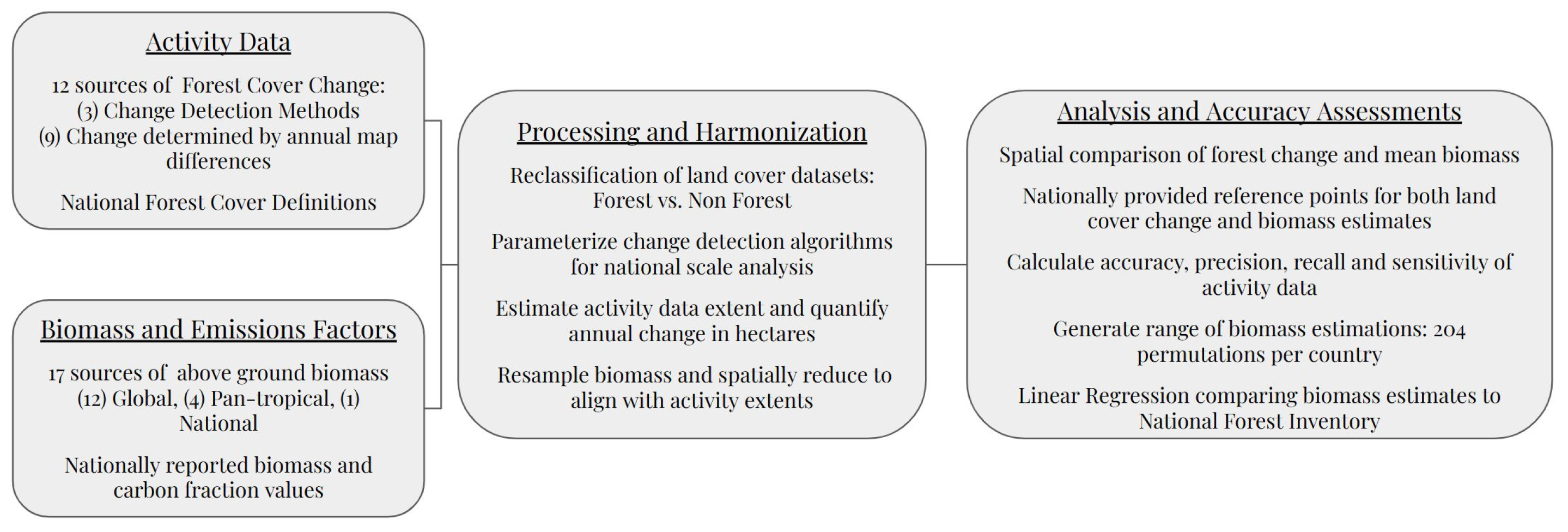
Figure 1. Workflow for estimating forest cover change and biomass emissions: data sources, harmonization, and accuracy assessments.
Remotesensing 17 03975 g001
Figure 2. Three pilot countries, (a) Guatemala, (b) Zambia, (c) Nepal, selected from the S-CAP project regions, displayed with estimated tree cover in 2000 from the Global Forest Watch dataset in Google Earth Engine [18].
Remotesensing 17 03975 g002
Figure 3. (A) Calculated 2020 forest coverage agreement amongst seven land cover sources throughout Guatemala. (B) Activity data results produced through each land cover dataset with varying date ranges, with reference to Table 1.
Remotesensing 17 03975 g003
Figure 4. (A) Calculated 2020 forest coverage agreement amongst seven land cover sources throughout Nepal. (B) Activity data results produced through each land cover dataset with varying date ranges, with reference to Table 1.
Remotesensing 17 03975 g004
Figure 5. (A) Calculated 2022 forest coverage agreement amongst seven land cover sources throughout Zambia. (B) Activity data results produced through each land cover dataset with varying date ranges.
Remotesensing 17 03975 g005
Figure 6. Accuracy assessment for all activity datasets throughout Guatemala, conducted using “ground truth” points provided through national collections using Collect Earth Online.
Remotesensing 17 03975 g006
Figure 7. Accuracy assessment for all activity datasets throughout Nepal, conducted using “ground truth” points provided through national collections using Collect Earth Online.
Remotesensing 17 03975 g007
Figure 8. Accuracy assessment for all activity datasets throughout Zambia, conducted using “ground truth” points provided through national collections using Collect Earth Online.
Remotesensing 17 03975 g008
Figure 9. Heatmaps showing mean aboveground biomass (AGB) estimates for Guatemala, Nepal, and Zambia. Each heatmap displays AGB estimates (in Mg/ha) from various biomass product sources (rows) applied to different land cover change datasets (columns) [8,9,10,39,40,41,42,43,44,45,46,47,48,49,50,51,52]. Color intensity represents biomass density values, with darker red indicating higher AGB estimates.
Remotesensing 17 03975 g009
Figure 10. Biomass mean (top trio) and coefficient of variation across datasets (bottom trio) used to visually interpret areas of divergence.
Remotesensing 17 03975 g010
Figure 11. Linear regressions demonstrating the relationships between 2010 biomass products ([41,42,47,49]) and Guatemalan NFI. Each blue dot represents a field-measured plot, the purple line shows the linear regression fit, and #obs indicates the number of observations used in each regression.
Remotesensing 17 03975 g011
Figure 12. Linear regressions demonstrating the relationships between 2019 and 2020 biomass products ([41,49,51]) and Nepal’s NFI. Each blue dot represents a field-measured plot, the purple line shows the linear regression fit, and #obs indicates the number of observations used in each regression.
Remotesensing 17 03975 g012
Table 2. Parameters tested for both change detection algorithms applied to each country individually using “High” (H), “Neutral” (N), and “Low” (L) sensitivity to change settings and regional (R) land cover sources for the 2000 forest mask.
CCDC-SMA (2000–2020) [36]LandTrendr (2000–2020) [37]
ParametersHNLParametersHNL
Forest MaskRRRMax Segments456
Threshold630026000Spike Threshold10.90.75
Change Probability0.990.990.99Vertex Count Overshoot333
Num of Consec555Prevent One Year RecoveryFFF
CCDC-SMA performed better when including imagery from the entire year, whereas LandTrendr performed better when only including imagery during the dry season for that region.Recovery Threshold0.250.51
pval Threshold0.050.51
Best Model Proportion0.750.750.75
Min Observations Needed666
MMU: True111111
Table 3. Aboveground biomass datasets. Datasets that contain individual years of available data are indicated by * symbols.
Geographic AreaBiomass Data SourceSpatial ResolutionEpochs
GlobalKindermann et al. 2008 [39]50 km2005
Ruesch and Gibbs 2008 [40]1 km2000
Xu et al. 2021 [41]10 km2000–2019 *
CCI-Biomass 2021 [42]100 m2010, 2017–2020 *
Liu et al. 2015 [43]25 km1993–2012 *
Baccini et al. 2021 [44]30 m2000
Hu et al. 2016 [45]1 km2000
GeoCarbon 2020 [46]1 km2000
Spawn et al. 2020 [47]250 m2010
Zhang and Liang 2020 [48]1 km2000
Santoro et al. (GloBiomass) 2021 [49]100 m2010
Yang et al. 2020 [50]1 km2005
Pan-tropicalBaccini et al. 2012 [9]500 m2008
Saatchi et al. 2011 [8]1 km2000
Avitabile et al. 2016 [10]1 km2000
Dubayah et al. (GEDI, Global Ecosystem Dynamics Investigation, L4B) 2022 [51]1 km2017–2020 *
NepalICIMOD [52]5 km2015
Table 4. Results of 2020 forest/tree coverage in terms of ha and percent of total land coverage for Guatemala (GTM), Nepal (NPL), and Zambia (ZMB). Cell strike-through indicates a lack of data for 2020. National and Regional refers to the national- or regional-scale land cover dataset applicable to each country and are specified in the first column.
Forest/Tree Cover SourceGTM (ha)GTM (%)NPL (ha)NPL (%)ZMB (ha)ZMB (%)
ESRI6,063,84055.687,527,72151.1442,310,27556.22
WorldCover7,160,10965.758,964,78160.9130,908,70041.07
JAXA F/NF5,624,12551.656,581,40444.726,509,6838.65
GFW6,373,68155.006,331,63943.0259,738,56979.37
ESA CCI LC6,731,93757.238,569,63658.2324,835,16233.00
MODIS MCD12Q13,735,72934.304,156,32528.248,863,94411.77
Regional GTM: n/a, NPL: RLCMS, ZMB: RCMRD--7,252,71349.28--
National GTM: MAGA, NPL: NLCMS, ZMB: n/a2,917,00034.337,053,21547.92--
Table 5. GEDI_L4A agbd footprint.
RegionOverlapping PtsGEDI PtsNFI PtsR2rRMSE
Cinturon Plegado Del Lacandon6949,881960.04288.49%
Crystalline Highlands5835,3333190.088101.37%
Izabal Depression144298290.11350.64%
Yucatan Sedimentary Platform19379,3416690.00777.62%
Volcanic Highlands7345,7076220.00596.34%
Sedimentary Highlands3390,4175260.013129.04%
Table 6. GEDI_L2A RH98—quality flag 1–35 m buffer on GEDI/100 m buffer on NFI.
RegionOverlapping PtsGEDI PtsNFI PtsR2rRMSE
Cinturon Plegado Del Lacandon1436,077960.06256.77%
Crystalline Highlands812,9933190.16387.45%
Yucatan Sedimentary Platform6454,5446690.04373.29%
Volcanic Highlands1524,8906220.12226.61%
Sedimentary Highlands534,1265260.03108.98%
Disclaimer/Publisher’s Note: The statements, opinions and data contained in all publications are solely those of the individual author(s) and contributor(s) and not of MDPI and/or the editor(s). MDPI and/or the editor(s) disclaim responsibility for any injury to people or property resulting from any ideas, methods, instructions or products referred to in the content.