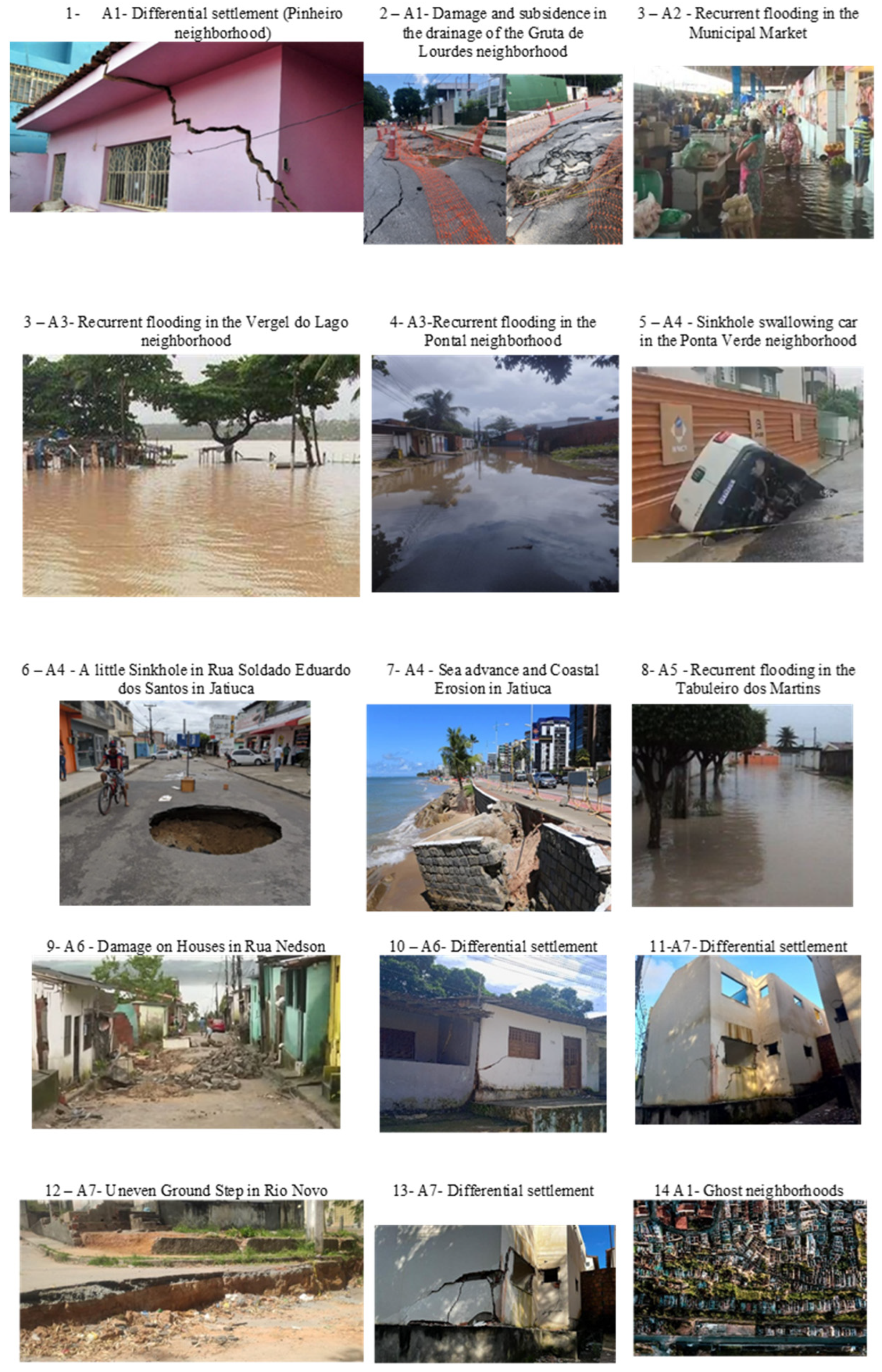
Highlights
What are the main findings?
- City-wide SBAS-InSAR deformation map (Sentinel-1, 2016–2024) delineates ~55 km2 of anomalous ground motion, clustered into seven macro-areas (A1–A7) with distinct kinematics and potential for subsidence.
- Beyond the mining central bowl, elongated lagoonal anisotopic zones and diffuse coastal/peri-urban low-gradient zones are mapped and described.
What are the implications of the main findings?
- Subsidence acts as a compound hazard, amplifying flood/coastal-erosion exposure; Monitoring and zoning must extend beyond the mining district.
- The workflow is reproducible/transferable for monitoring other low-lying coastal cities.
Abstract
Land subsidence in Maceió, Brazil, has triggered a significant urban crisis, resulting in widespread evacuations, population displacement, and, in some cases, the partial or complete destruction of neighborhoods. However, the full extent and underlying mechanisms beyond the mining epicenter have remained unclear. This study presents a comprehensive, city-wide subsidence assessment (2016–2024) that tests a multi-mechanistic hypothesis. SBAS-InSAR (Sentinel-1) ground-motion data are integrated with geological and geomorphological context, well-density mapping, and physical–environmental and morphological metrics to delineate and characterize subsiding zones. The results reveal several patterns of deformation: in addition to the central bowl associated with rock salt mining, a peripheral, elongated corridor extends along the Mundaú Lagoon shoreline, diffuse low-gradient zones occur within the coastal urban belt, and a peri-urban subsidence corridor is identified. The identifyed subsidence areas cover approximately 55 km2 (10.8% of the city), with about 5 km2 exhibiting rates exceeding 10 mm yr−1. These patterns correspond to sedimentary plains and areas of intensive well use, extending far beyond the salt mining crisis zone. The primary contribution of this work is the identification of multiple subsidence mechanisms through an integrated analytical workflow, demonstrating that subsidence in Maceió constitutes a compound hazard that progressively increases city-wide risks of flooding, coastal and lagoonal erosion and slope instabilities, with direct consequences for structural integrity. The findings underscore the urgent need for risk-management strategies that address mining legacies, uncontrolled groundwater abstraction, and proper urban planning to prevent future crises.
1. Introduction
Urban subsidence is the gradual or abrupt lowering of the ground surface caused by interacting natural and anthropogenic processes. Anthropogenic drivers include groundwater, hydrocarbon, and mineral extraction, as well as rapid urbanization, while natural factors encompass karst dissolution, sinkholes, earthquakes, and tectonic activity [1,2,3]. Climate variability further modulates these processes by altering aquifer storage and water demand [3,4,5,6]. Globally, projected exposure is high: by 2040, up to 1.6 billion people could be affected, including more than 635 million in flood-prone areas, with economic losses estimated in the trillions of US dollars [7].
Conventional techniques such as optical leveling, Global Navigation Satellite System (GNSS) measurements, extensometers, inclinometers, and piezometric records provide very high accuracy but limited spatial coverage [8,9]. Interferometric Synthetic Aperture Radar (InSAR) complements these methods with extensive area coverage deformation maps at meter-to-tens-of-metres resolution and up to millimetric relative precision [10,11]. Multitemporal InSAR (MT-InSAR) approaches such as Persistent Scatterer Interferometry (PSI) and Small Baseline Subset (SBAS) mitigate topographic and atmospheric artefacts allowing to reach mm-level accuracy of ground deformation [12,13,14,15].
MT-InSAR has been used to monitor aquifer-compaction subsidence in Mexico City, Jakarta, and Bangkok, and city-scale deformation in Shanghai [16,17,18,19,20,21]. In California’s San Joaquin Valley it has been used to quantify subsidence linked to drought-related groundwater extraction, and similar patterns have been reported across irrigated plains in India, Turkey, and Iran [19,22,23,24,25]. In mining contexts, PSI and SBAS, often combined with Differential InSAR (D-InSAR) or offset tracking, capture steep-gradient subsidence bowls [26,27,28]. In Brazil, a recent national review synthesised approximately 75 subsidence cases and highlighted persistent monitoring gaps and the scarcity of operational, city-scale InSAR products [29].
In Maceió, multitemporal analyses have documented progressive deformation associated with rock-salt solution mining beneath the western districts. Since 2018, this process has displaced about 60,000 residents and led to the evacuation of nearly 15,000 properties, culminating in a surface rupture beneath the Mundaú Lagoon in December 2023 [30,31,32,33,34,35]. However, most MT-InSAR studies conducted over Maceió have concentrated on the mining district, leaving wider city-scale patterns, additional macro-areas, and likely controlling factors poorly understood.
To address these gaps, we derived using SBAS-InSAR a city-wide ground deformation map for Maceió (2016–2024) based on Sentinel-1 SAR acquisitions. Persistent subsidence hotspots are identified using a minimal temporal-persistence criterion, requiring pixels to exhibit recurrent negative velocities across multiple acquisitions and in more than one year, thereby excluding isolated outliers. These hotspot masks are then compared with geology, geomorphology, soils, and well density/proximity. The study pursues three objectives: (i) to delineate subsidence hotspots using a simple, reproducible approach; (ii) to characterise the displacement behavior of the identified macro-areas, including the halite mining complex; and (iii) to correlated deformations with physical and anthropogenic factors. The resulting city-scale analysis clarifies where and how Maceió is subsiding and paves a basis for future scientific analyses, risk management, and the prioritisation of monitoring and field inspections.
2. Study Area
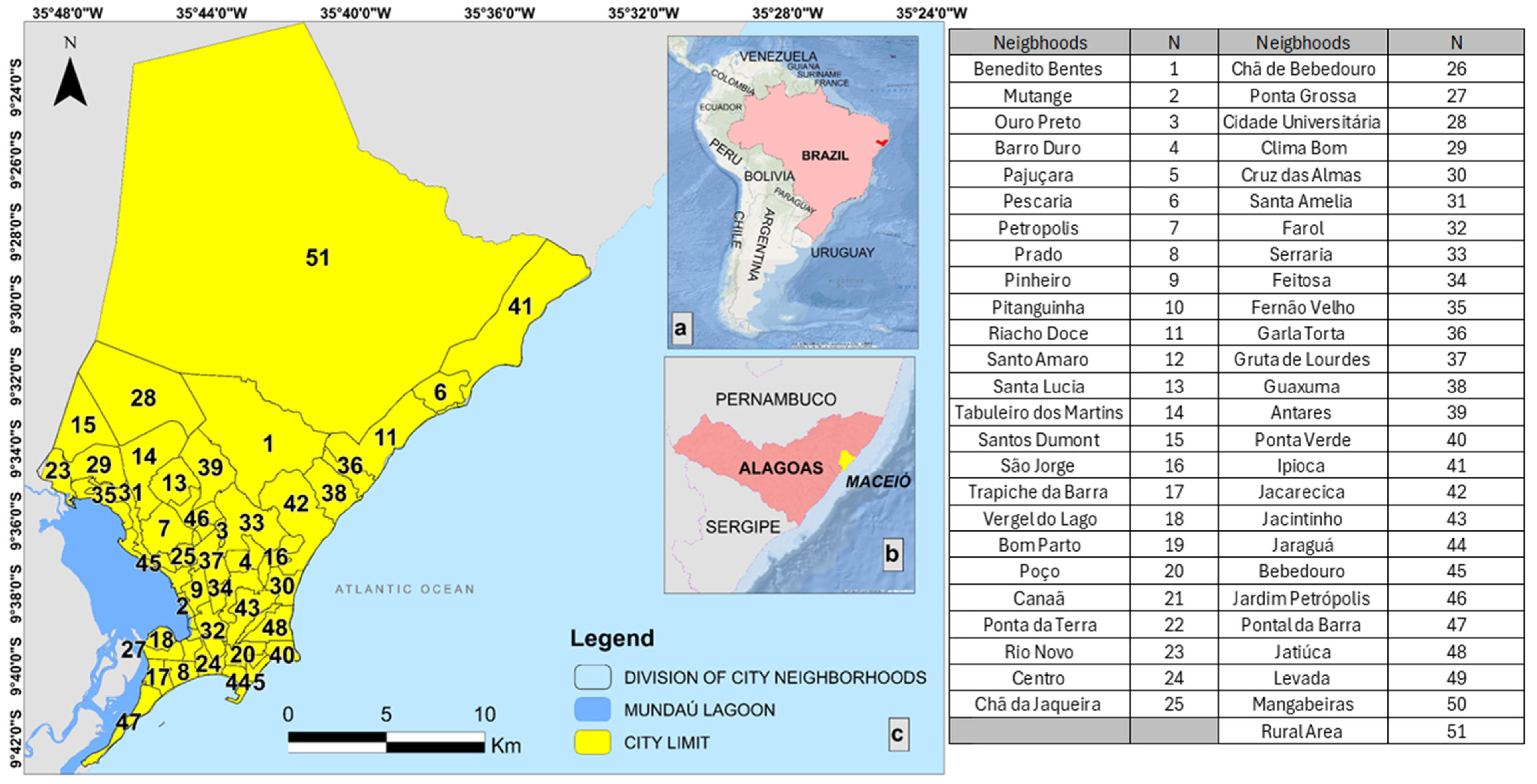
Maceió, the capital of Alagoas in northeastern Brazil, is located between the Atlantic Ocean and the Mundaú Lagoon, forming a prominent part of the Mundaú–Manguaba estuarine complex. Covering 509.6 km2, the city comprises 50 neighborhoods and one rural area, with a population of approximately 958,000 residents (Figure 1).
Figure 1.
Study area map: (a) Regional location within Brazil and the state of Alagoas. (b) Maceió, Alagoas, Brazil (c) Administrative division of the municipality into 51 official neighborhoods (labels 1–51); Neighborhood index corresponding to the numeric labels in panel. Map compiled by the authors from datasets cited in Section 3. No panel is reproduced from prior publications.
The city is densely populated and is undergoing rapid urbanization, resulting in significant socio-spatial inequalities. Informal settlements and inadequate infrastructure are primarily located on higher ground and along the lagoon shoreline, while the coastal belt contains high-income neighborhoods and the majority of economic activity [36]. The local economy is primarily driven by the service and tourism sectors, with additional industrial activity in food, textiles, and chemicals, as well as a history of salt extraction. Persistent unemployment, informal labor, and reliance on tourism heighten vulnerability to external and seasonal shocks, leading to income insecurity, unstable employment, and economic volatility for residents [37].
2.1. Climate and Hydrography
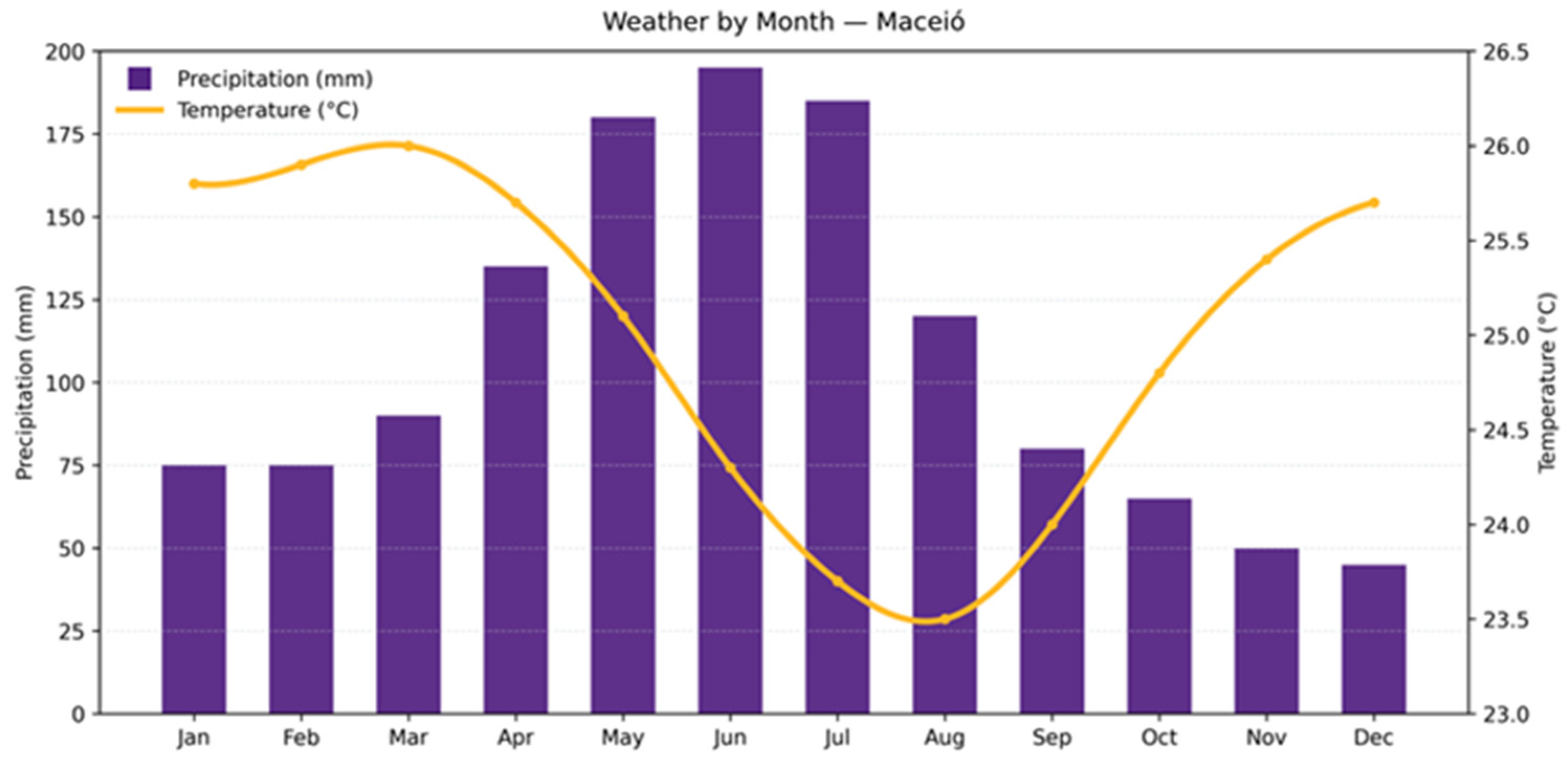
The region experiences a humid tropical climate (Köppen As), characterized by a mean annual air temperature of approximately 25.5 °C and consistently high relative humidity exceeding 80%. Precipitation occurs throughout the year, with significantly higher rainfall from April to August, with picks in May and July (Figure 2) [38].
Figure 2.
Monthly climate of Maceió: precipitation (purple bars, left axis, mm) and air temperature (gold line, right axis, °C). Graphic compiled by the authors from datasets cited in Section 3. No panel is reproduced from prior publications.
Maceió’s hydrography encompasses the Atlantic coast, the Mundaú–Manguaba estuarine–lagoon complex (CELMM), and a network of short rivers and streams that traverse the urban area, including the Jacarecica River and the Silva and Reginaldo streams. These water bodies support fishing, tourism, and transportation; however, certain sections, particularly the Reginaldo stream, are significantly impacted by pollution [39].
2.2. Geomorphology
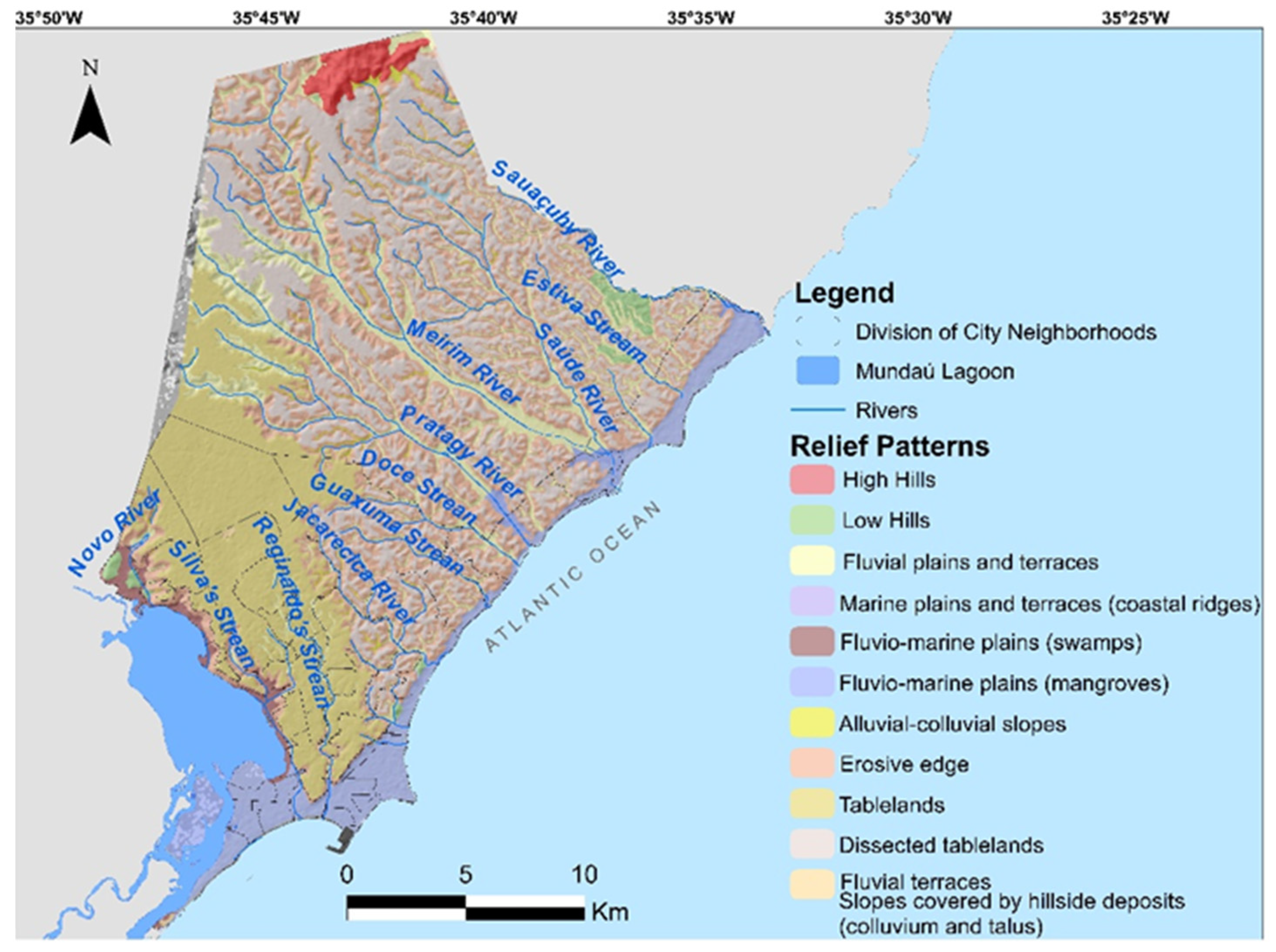
Maceió is characterized by diverse coastal landscapes, fluvial plains, and coastal plateaus (Figure 3).
Figure 3.
Geomorphological Map of Maceió (Alagoas, Brazil), with relief patterns. Map compiled by the authors from datasets cited in Section 3. No panel is reproduced from prior publications.
The city is situated at the boundary between Quaternary marine and fluvial de-posits of the Coastal Plain and the Coastal Plateaus, which are formed from Barreiras Group siliciclastics and are locally covered by Quaternary sediments. Coastal areas include beaches, both mobile and fixed dunes, mangroves, and restingas. The plateaus, ranging from approximately 50 to 200 m above sea level, contain sandy–clayey soils such as Argisols and Latosols. Erosional scarps define slope breaks and are focal points for instability, particularly under urban development. The lowlands preserve evidence of mid- to late-Holocene sea-level fluctuations; the Mundaú–Manguaba barrier-lagoon system alternated between progradation and retrogradation, resulting in the formation of beach-ridge plains, inland stabilized dunes, and discontinuous fluviomarine marsh belts [40,41,42].
At slope breaks, short and steep catchments dissect the margins of the Barreiras Formation and transport colluvium to the adjacent plains. The alignment of valleys and scarps corresponds to pre-existing basement lineaments, which are associated with neo-tectonic reactivation of Precambrian shear zones and lithological contrasts.
Standard Penetration Test (SPT) results reveal the presence of soft or organic clays and loose sands in lagoonal and coastal areas, while the plateaus are characterized by sandy to sandy–clayey Barreiras deposits, which are locally lateritic. This stratigraphic configuration creates pronounced spatial variations in permeability, compressibility, and bearing capacity, thereby influencing differential settlement and increasing susceptibility to subsidence [43,44,45].
2.3. Geology
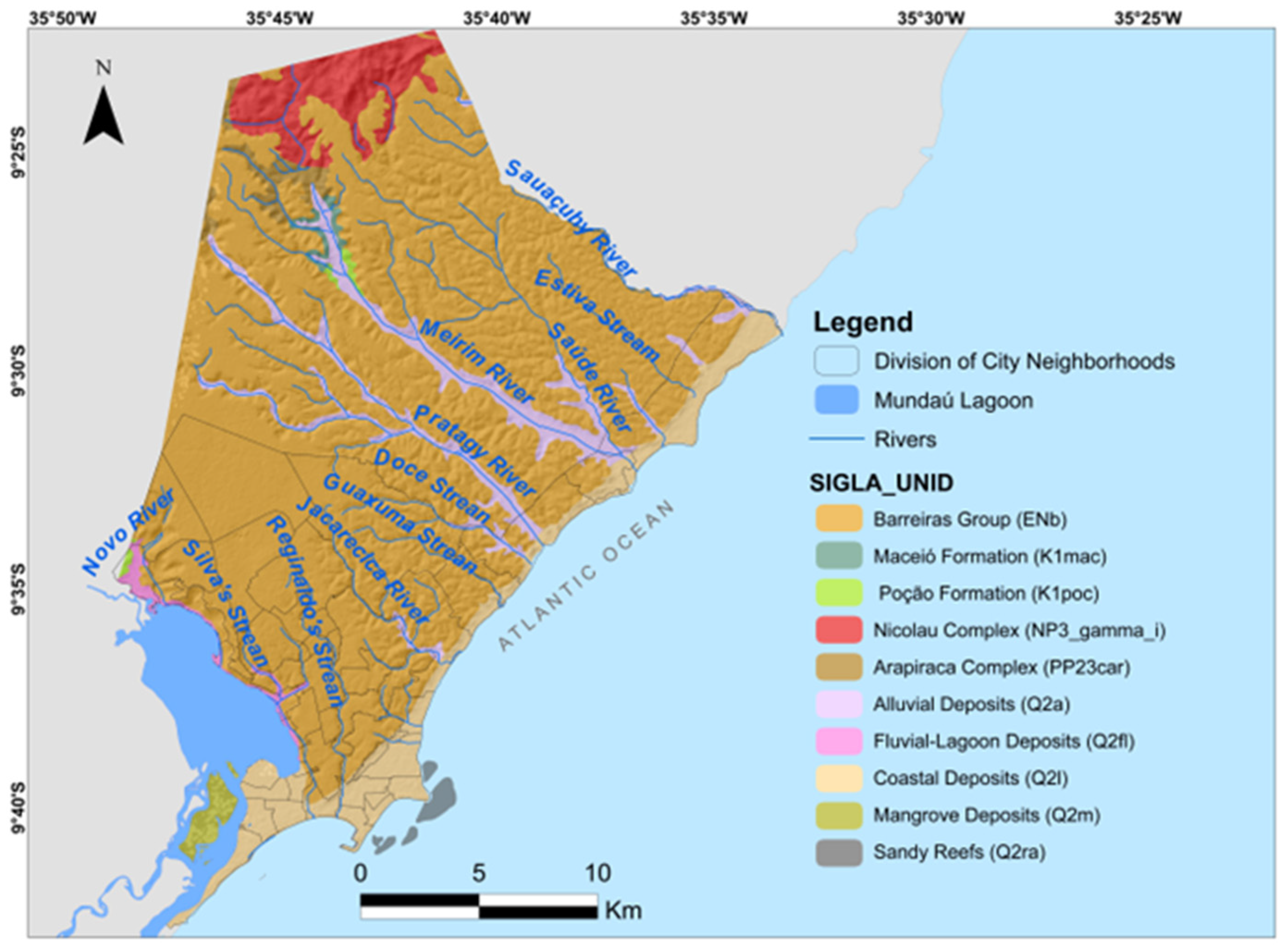
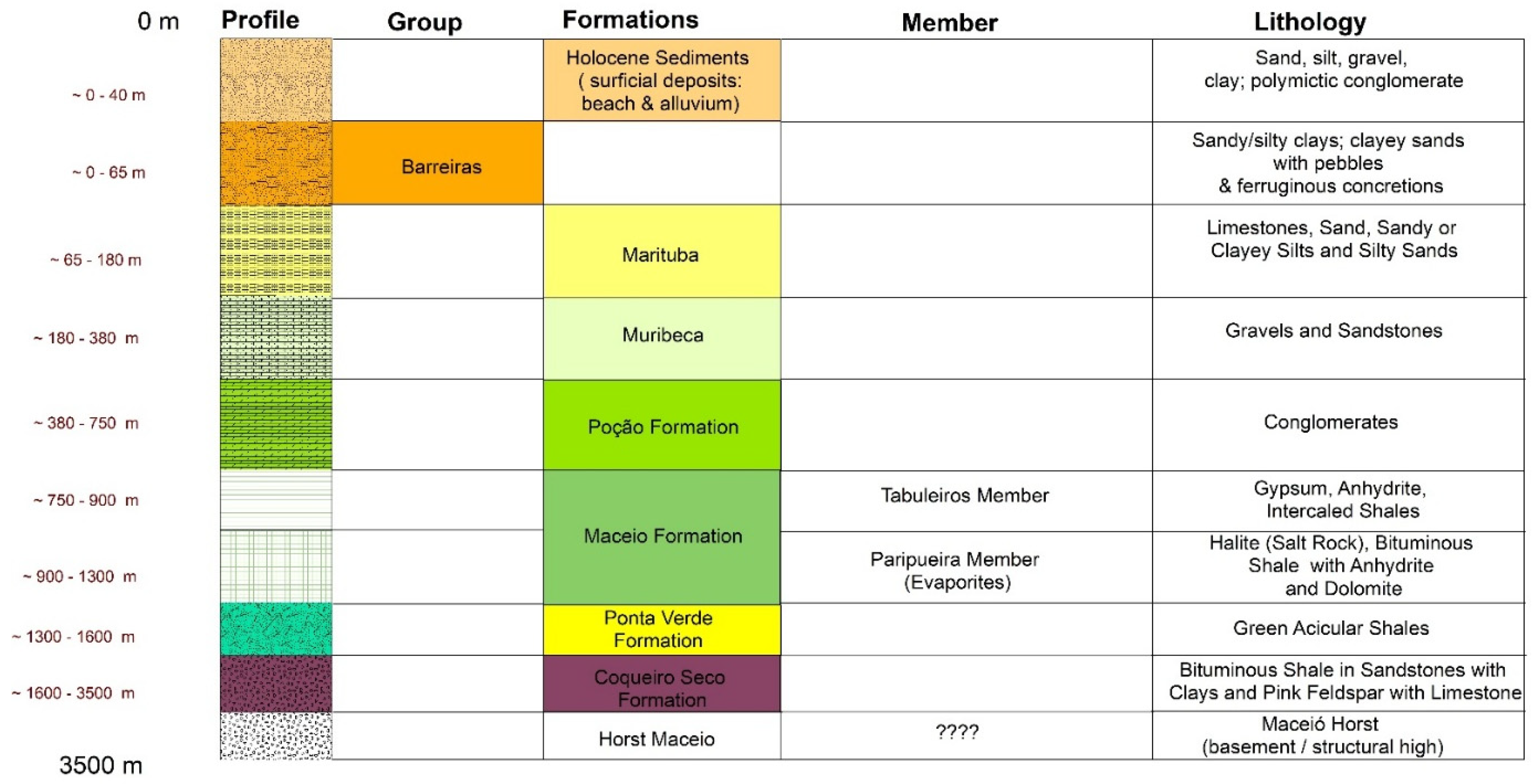
Maceió is situated above the onshore Alagoas (Sergipe–Alagoas) Basin and the crystalline basement of the Alagoas–Pernambuco Massif, which consists of granites and migmatites dated to approximately 0.9–1.4 Ga [46]. The Lower Cretaceous sedimentary sequence includes the Marituba, Muribeca, Poção, Maceió (with the Tabuleiros and Paripueira members), Ponta Verde, and Coqueiro Seco formations. These units are regionally overlain by the extensive Barreiras Group and, in some areas, by Quaternary coastal or alluvial deposits [47,48]. (Figure 4).
Figure 4.
Geology Map of Maceió (Alagoas, Brazil), with geological units. Map compiled by the authors from datasets cited in Section 3. No panel is reproduced from prior publications.
The Barreiras Group comprises sandy to sandy–clayey strata with interbedded clays and siltstones, typically ochre to reddish-brown in color, and averages approxi-mately 62.5 m in thickness. This group overlies both the basement rocks and the Poção/Marituba formations [41,49,50,51]. Within the Maceió Formation, particularly near the mouth of the Pratagy River, gray-white sandstone interbeds are found along-side bituminous shales, anhydrite, dolomite, and halite, collectively referred to as the Paripueira evaporites. Bituminous shales and anhydrites are specifically grouped within the Tabuleiro do Martins Member [41,46,51].
The transition to the Ponta Verde Formation is characterized by the presence of the Mundaú Limestone, which was deposited from the Meso-Aptian to early Albian and is observed at depths ranging from approximately 299 to 1503 m [51,52]. The Poção Formation, composed of polymictic conglomerate containing pebbles and granite blocks, is exposed in the Meirim valley and is more prominent near identified fault zones. The Nicolau Complex, part of the Pernambuco–Alagoas Batholith, constitutes the crystalline basement and is composed of migmatites, granites, diatexites, and banded gneisses. This basement is predominantly found in rural areas and serves as the substrate for the Barreiras Group (Figure 5) [49,50,51].
Figure 5.
Geological Profile of Maceió (Alagoas, Brazil), with geological units, formations and lithology. The interval labelled ‘????’ marks a depth range with uncertain lithology because of limited subsurface information. Chart compiled by the authors from datasets cited in Section 3. No panel is reproduced from prior publications.
Fine- to coarse-grained sands are predominant along the coastal plains. In fluvial environments, sands are commonly mixed with clays and gravels. Marsh and lagoonal zones retain muddy sediments with clayey sands, whereas reef barriers are composed of cemented sandstones and limestone. The typical thickness of these deposits ranges from approximately 10 to 50 m. The use of aquifers in these settings is limited by the risks of contamination and saline intrusion [49,50,51,53]. These lithological characteristics and structural features are directly related to subsidence mechanisms, such as evaporite dissolution, load-induced consolidation, and fault-controlled drainage and permeability).
2.4. Soils
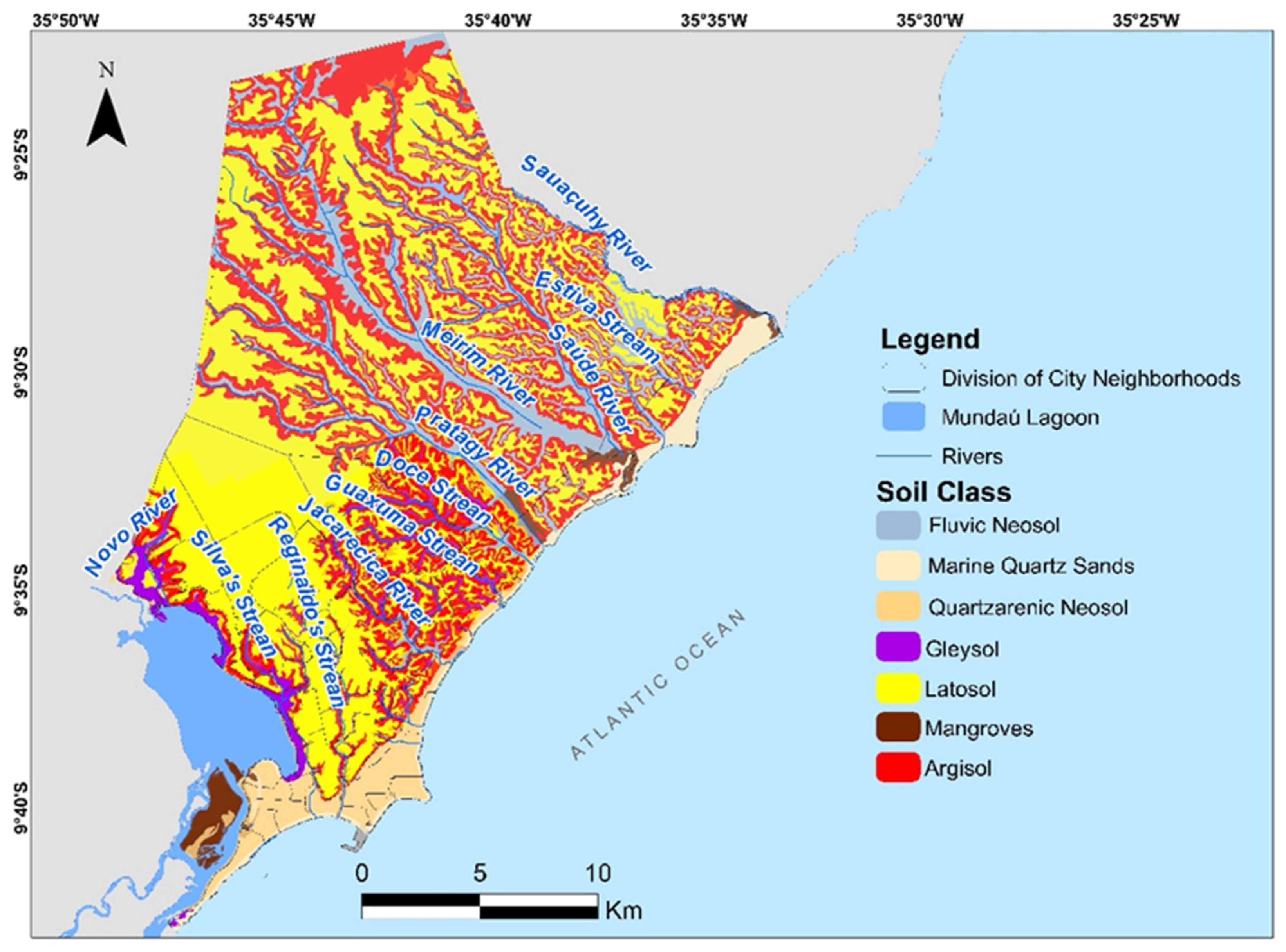
In the humid tropical environment of Maceió, the pedological characteristics reflect the contrast between coastal–lagoonal lowlands and the Barreiras tablelands. Figure 6 presents the distribution and associations of soil classes, which are named according to the Brazilian Soil Classification System (SiBCS). Hydromorphic and sandy soils are predominant in the lowlands. Gleysols are found in poorly drained depressions and marshy areas surrounding the Mundaú Lagoon, as well as along short coastal rivers. Mangrove soils are present along tidally influenced brackish margins. Fluvic Neosols develop on active floodplains and levees, characterized by fine to medium textures, shallow water tables, and seasonal inundation. Beach ridges and foredunes are classified as Marine Quartz Sands, which are very loose and quartz rich. Stabilized inland dunes and ridges are identified as Quartzarenic Neosols, which are characterized as being deep, weakly developed, highly permeable, and possessing low natural fertility [41,54].
Figure 6.
Soil Map of Maceió (Alagoas, Brazil), with soil class types. Map compiled by the authors from datasets cited in Section 3. No panel is reproduced from prior publications.
Slightly elevated marine and fluvial terraces contain mosaics of Fluvic and Quartzarenic Neosols, indicative of youthful soils developed on reworked coastal deposits. On the plateaus, Argisols with textural-contrast Bt horizons are prevalent on slopes and shoulders, whereas Latosols dominate interfluves and hilltops. Steep erosional scarps and colluvial foot slopes are primarily composed of Argisols, with Gleysols occurring locally at seepage zones. Incised slopes may reveal the underlying Barreiras substrate [41,49,50,51,53,54].
This configuration delineates three pedo-geomorphic units: (i) hydromorphic and sandy recent soils in coastal–fluvio-marine lowlands; (ii) youthful, moderately drained soils on terraces; and (iii) more developed soils on the Barreiras tablelands and scarps. Each unit exhibits distinct permeability, compressibility, and capacity, which influences differential settlement and susceptibility to subsidence.
3. Materials and Methods
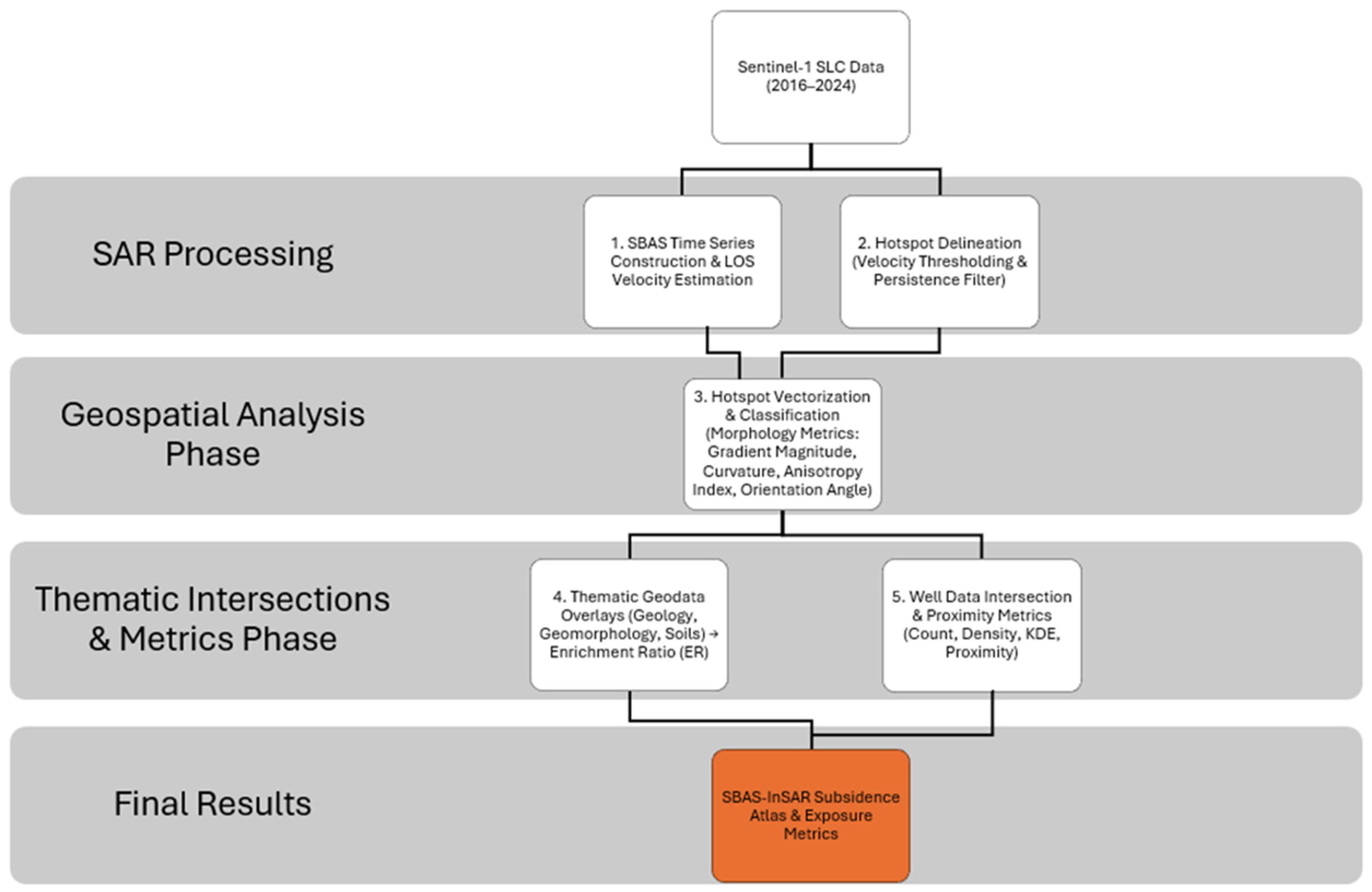
A city-wide ground deformation map of Maceió was obtained using SBAS-InSAR and Sentinel-1 imagery (2016–2024; IW/TOPS, VV, descending, Level 1 SLC). This map allowes to delineate subsidence hotspots which are then related to mapped geology, geomorphology, soils, and the spatial distribution of registered wells. The workflow (Figure 7) comprises six steps: (i) building SBAS-InSAR time series through co-registration, small-baseline interferogram network formation, phase unwrapping, and atmospheric mitigation; (ii) estimating mean line-of-sight (LOS) velocity and associated uncertainty; (iii) delineating persistent hotspots using a velocity decision threshold τ and a temporal-persistence criterion, requiring pixels to exhibit recurrent negative velocities across multiple acquisitions and in more than one year; (iv) vectorizing and labeling hotspot macro-areas; (v) classifying spatial behaviour based on velocity gradients (), curvature (κ), and plan-view anisotropy using structure-tensor eigenanalysis; and (vi) intersecting hotspots with thematic layers to derive exposure, proximity to wells, and enrichment metrics.
Figure 7.
Methodological Flowchart.
A concise dossier in Supplementary File S1 provides: (i) time-series and annual-rate comparisons against published MT-InSAR results for the same area; (ii) spatial cross-checks against SEMARH static and dynamic groundwater levels; and (iii) uncertainty quantification using bootstrap confidence intervals for linear trends. As no local GNSS, spirit-leveling, or tiltmeter records were available for 2016–2024, triangulation was performed using the literature and administrative well observations. These validation steps ensure the accuracy of the MT-InSAR products and facilitate multi-mechanism interpretation.
3.1. SAR Data and SBAS-InSAR Processing
We utilized Sentinel-1A descending scenes (2016–2024; IW/TOPS, VV, Level 1 SLC), excluding Sentinel-1B data to maintain a constant minimum temporal baseline across the entire time series. The negligible coverage of ascending Sentinel-1 acquisition over Maceió during this period precludes the establishment of a stable SBAS network for this geometry. Consequently, we adopt a single-geometry (descending) approach and address the implications for vertical projection and uncertainty in the Supplementary Material [55,56]. The scene inventory is detailed in Table S1.
Small along-slope motions may project into the LOS, particularly on hillslopes in A6–A7. For incline terrain, we prioritize pattern-level values such as velocity gradients, curvature, and plan-view anisotropy over absolute vertical magnitudes [13].
The Single Look Complex (L1 SLC) data were corrected using precise orbits (POE-ORB) and co-registered with TOPS-aware, spectral-diversity control to verify burst overlap. We constructed a small-baseline interferogram network to minimize temporal and spatial baselines, reduced the topographic phase using SRTM 30m data, applied the adaptive Goldstein–Werner filter, and unwrapped the data using the Minimum-Cost-Flow (MCF) algorithm. A coherence mask (≥0.3) was applied to exclude low-quality pixels and disconnected islands [56,57,58,59,60].
For each interferogram i, the phase ϕᵢ is modeled as the sum of LOS displacement, residual topography, atmospheric screen (low-spatial/high-temporal), and noise. We estimated mean LOS velocity (mm yr−1) and cumulative displacement using least-squares SBAS with standard space–time filtering (spatial low-pass and temporal high-pass) to mitigate atmospheric and correlated noise. Trend significance was evaluated using the Mann–Kendall test with effective sample size correction [13,59,61].
The outputs comprise a geocoded mean LOS-velocity map, a cumulative LOS mosaic for 2016–2024 (Figure S1), and a representative LOS time series. We use a fixed mid-swath incidence angle θ = 39° for the whole city (Sentinel-1 IW spans approximately 29–46°), where θ denotes the local incidence angle. For example, −10 mm yr−1 LOS corresponds to −12.9 mm yr−1 vertical displacement. Where higher fidelity is necessary, such as at the site level or in slope-affected neighborhoods and adjacent-sector comparisons, we compute the local incident angle per-pixel θ(x) from the terrain-corrected SAR geometry. Sensitivity is determined by θ in radians; near θ ≈ 39° and LOS = −10 mm yr−1, a ±2° change results in a ±0.36 mm yr−1 variation. LOS remains the reference field, and the vertical proxy is applied only in city-scale summaries [62].
In addition to coherence filtering, we removed clusters of MCF-unwrap residue, burst-boundary artifacts, residual ramps, and pixels with incomplete or inconsistent time series. Hotspot-level summaries (contiguous S1/S5/S10 masks) utilize robust statistics, including the median, interquartile range (IQR), and 5th/95th percentiles, to minimize the influence of outliers compared to the mean and standard deviation. The use of TOPS-aware co-registration, small-baseline design, Goldstein–Werner filtering, MCF unwrapping, SRTM-based topography removal, and SBAS inversion with atmospheric attenuation adheres to standard MT-InSAR practices for urban environments, ensuring traceability and reproducibility [62,63].
3.2. Applicability and Error Behavior Under a Single-Geometry (Descending) Setup
With a single descending track, the LOS vector retains finite sensitivity to east–west motion. If horizontal components are neglected, a first-order vertical proxy can be obtained by scaling the LOS velocity with the incidence angle θ, θ, where denotes the apparent vertical component. When an east–west component exists, the bias between the proxy and the true vertical component is bounded by [64,65]:
For (mid-swath) and a modest along-slope drif in hilly sectors (e.g., A6–A7), the resulting bias remains, , which is insufficient to change hotspot rankings or the S10 class at city scale. Accordingly, LOS-derived products are interpreted cautiously on slopes, with emphasis on pattern-level assessment (, curvature, plan-view anisotropy) rather than absolute vertical magnitudes [66].
Incidence-angle uncertainty also propagates into to . Over the Sentinel-1 IW range , the scaling varies by about −11.1%/+11.9% around . Thus, only pixels lying within ~10–12% of the downstream decision thresholds τ could change their eventual classification; empirically, such pixels occur at mask margins and do not affect city-scale assessment [55]. LOS maps and time series are themselves invariant to θ and remain the primary reference field. The vertical-proxy layer is provided for interpretability and can be recomputed with per-pixel incidence angles when needed. Combined with the persistence criterion (occupancy ), the single-track configuration satisfy the operational subsidence analysis purpose [64].
3.3. Hotspot Delineation with Directional Thresholds and Persistence Criteria
Three per-pixel descriptors are derived from the SBAS–InSAR solution: (i) the vertical-rate proxy (mm ), (ii) the rate uncertaty defined as the standard error of the linear rate (square root of the diagonal of the rate-covariance); and (iii) the mean interferometric coherence. This parameterization aligns with standard practice for characterizing time-series InSAR errors [64].
Pixels are initially partitioned by subsidence magnitude and subsequently by temporal persistence, facilitating the distinction between sustained small deformation and atmospheric or residual artifacts [67,68,69]. Four bands are defined: a stable band: and three directional tiers: S1 (low–persistent) , S5 (moderate) , and S10 (high), which are operationally prioritized [64,67,69,70]. The stable band is intentionally kept thin to avoid masking weak but persistent negative signals [71].
Two alternative criteria are imposed. (1) The trend criterion requires a significant monotonic negative trend on de-seasonalized series (Mann–Kendall, adjusted ), paired with a Theil–Sen slope [70,71,72]. (2) The occupancy-and-amplitude criterion requires at least 70% of years with an annual median rate and cumulative displacement over 2016–2024 of [71]. To suppress transient spikes, we compute occupancy (Equation (2)):
A pixel is classified as persistent only if the negative state recurs across multiple acquisitions and in more than one year; this minimal requirement is combined with the trend and amplitude criteria (Theil–Sen, Mann–Kendall with ) [72,73,74]. Pixels are retained only if (i) (signal-to-noise ≥ 2) and (ii) mean coherence , which reduces phase-unwrapping artifacts and decorrelation errors [59,65].
Annual and semiannual seasonality are removed using harmonic regressors (1-year and 0.5-year), and the Mann–Kendall test is computed on the residuals [66]. To avoid inflated significance due to serial dependence, an effective-sample-size correction for AR(1) processes is applied. n_“eff” is then used to evaluate the adjusted p_“adj” after de-seasonalization [75,76,77,78,79]. This conservative correction reduces false positives while preserving city-scale hotspot masks [77], (stable/S1/S5/S10), a 3 × 3 morphological opening is applied, followed by a 3 × 3 closing using a square structuring element. Eight-neighbour connectivity is used for components, and polygons smaller than 1 ha are removed as a minimum mapping unit (MMU); the pixel-count threshold is derived from the geocoded pixel area a_“px” [80,81].
MT–InSAR detection limits are typically 2–5 mm yr−1 [64,67,69,70]. To ensure robust signals, we adopt a conservative near-zero stability band defined by (|Vₙ|< 3 mm yr−1) combined with a recurrence-based persistence criterion. Pixels that systematically exceed this band are grouped into three subsidence classes based on velocity magnitude S1 (3–5 mm yr−1), S5 (5–10 mm yr−1), and S10 (≥10 mm yr−1). These velocity tiers provide an operational differentiation between background surveillance (S1) and higher-priority sectors (S5, S10) [64,67,69,70]. The resulting masks are converted into polygon layers for overlays with geology, geomorphology, soils, well density, and exposure metrics [82].
3.4. Characterization of Spatial Behaviour (Gradient, Curvature, Anisotropy)
Hotspots are classified based on the plan-view morphology of the mean LOS velocity field (mm yr−1), sampled as a 20 m geocoded raster (SIRGAS 2000/UTM 25S). Three primary patterns are identified: (i) Bowl (steep-rimmed), (ii) Diffuse (low-gradient floor), and (iii) Elongated (anisotropic corridor). The descriptors used are spatial-gradient magnitude (rimsteepness) and plan-view anisotropy (eigen-ratio), both of which require directional stability. A light Gaussian smoothing (σ = 1 pixel) is applied before derivatives to suppress high-frequency noise without erasing meaningful discontinuities [83,84,85,86,87]. The gradient is calculated using 3 × 3 Sobel filters, and its strength is measured (Equation (3)). The resulting differences are adjusted for pixel size (in meters).
According to the sign convention, more negative vindicates greater subsidence. Sharp rims are represented by bands of high surrounding deeper cores, while diffuse pattern exhibit low [83,88,89,90]. Plan-view curvature is estimated to be using a simple Laplacian operator with a 3 × 3 matrix (Equation (4)):
Under this convention, bowls (local minima) typically exhibit at the core; maxima or domes display . Elongated corridors present along their axes with sustained on the flanks. Diffuse mantles are characterized by small and low–moderate . For summary statistics, core-mean and are reported. The combination of and effectively distinguishes bowls from atmospheric or other artefacts [83,89,91,92].
Directionality is quantified using the structure tensor of within a 5 × 5 window (with Gaussian pre-filter), extracting (i) an anisotropy index (eigenvalue ratio; ≈1 for isotropic, higher values for elongated features) and (ii) the long-axis azimuth. Directions are accepted only if tensor directional coherence and mean SBAS-InSAR coherence are both at least 0.30. Pixel orientations are aggregated by axial means using circular statistics, and a directional concentration of at least 0.40 is required to accept a single direction per polygon. As a consistency check, an oriented minimum-bounding ellipse (OBB) is fitted, and its major axis is compared to the field orientation; substantial mismatches prompt further review. Where mapped lineaments or faults exist [30], the hotspot azimuth is compared to the nearest lineament, and axes are considered aligned if the misfit is less than or equal to 15° [82,83,93,94,95].
Class assignment proceeds as follows. Elongated hotspots are characterized by robust planar anisotropy (high median eigen-ratio) and a stable principal orientation (directional concentration ≥ 0.40). Where mapped lineaments are present, the long axis typically aligns within 15° of the nearest lineaments, serving as a consistency check rather than evidence of causation. Bowl hotspots display a distinct rim–core signature, with high inner-rim percentiles surrounding a core disk where κ > 0. A minimum shape compactness criterion is applied to avoid spurious strands. Diffuse hotspots exhibit low to moderate and weak directionality (small anisotropy), resulting in broad, shallow subsidence with smooth transitions [1,95].
To ensure transferability and minimize ad-hoc parameter tuning, thresholds for rim strength, core shape, and diffuse behavior are established using city-wide distributions. For instance, the upper decile of defines the rim, the upper quartile of κ defines the core, and the median gradient distinguishes diffuse pattern. All parameter values, window sizes, filters, and reliability criteria are documented with the products for traceability. For each macro-area, the following attributes are stored: class label, area, median V_“LOS”, a high-quantile rim metric, anisotropy statistics (median and high quantile, axial orientation with concentration), and the angular misfit to the nearest mapped lineament. [1,82,83,88,90,93,95].
3.5. Thematic Overlays and Exposure/Proximity Metrics
InSAR-derived deformation was associated with the physical setting and anthropogenic factors by integrating data from official Brazilian geodatabases. Geological and geomorphological information included the state geology of Alagoas (1:250,000), the Maceió Metropolitan Region Geological Map, and municipal geomorphology (1:60,000) [96,97]. Soil data were obtained from the EMBRAPA municipal survey and aligned with the Brazilian Soil Classification System (SiBCS) [54]. Well registries, representing subsurface stress due to abstraction, were compiled from SEMARH/AL, the Digital Groundwater Atlas, and ANA CNARH, with records extending to 2022. All data layers were reprojected to SIRGAS 2000/UTM 25S, topology-cleaned, and semantically harmonized for interpretation. Lithologies were consolidated into operational units, landforms were standardized into classes (plains, benches/terraces, slopes, hilltops), and the soil legend was cross-referenced to SiBCS attributes (texture, drainage, depth). Groundwater extraction well registries were deduplicated by coordinate or ID, spatially validated, and standardized for use type, status, and permit date. This geospatial database is then overlapped with the mean V_LOS raster and subsidence hotspot polygons.
The analytical workflow addresses two objectives: (1) characterizing the physical context of each hotspot and (2) quantifying potential anthropogenic pressure. For the first objective, area proportions per hotspot are calculated by geology, geomorphology, and soil classes, with over- or under-representation summarized using the Enrichment Ratio (ER) [98,99] (Equation (5)):
where denotes the area of class within the hotspotpot (the portion of the geographic region classified as a hotspot), represents the hotspot area (total geographic extent identified as the hotspot), the area of class within the municipality (the portion of the class present in the municipality), and the municipal area (total area of the municipality). A logarithmic form is also reported for comparability (Equation (6)).
In this context (or ) indicates over-representation, indicates neutrality, and indicates under-representation.
For the second objective, well-field pressure is evaluated using four complementary indicators [100,101,102]. Third, nearest-well distances (Euclidean) are calculated for hotspot pixels, summarized by median and P10, and categorized into four distance bins: 0–200 m, 200–500 m, 500–1000 m, and greater than 1000 m, to account for the influence of wells located just outside polygon boundaries. Fourth, a kernel density surface (wells·) is estimated on a 100 m grid using an isotropic Gaussian kernel (Equation (7)):
The Gaussian kernel produces a smooth, rotation-invariant field. The m balances noise suppression and neighborhood-scale resolution, and sensitivity checks at m stable ridge patterns and rankings [101,103,104]. KDE is performed within the municipal mask, so boundaries represent the lack of wells outside the mask, with a conservative edge treatment applied in urban areas. Overlays use QA-filtered masks with a coherence threshold and a minimum mapping unit (MMU) of at least 1 ha. Summaries use robust estimators, such as medians and high quantiles, to reduce artifact sensitivity [71].
For each hotspot, outputs include area-normalized proportions and by geology, geomorphology, and soils; well-density estimates (grid-based and administrative); nearest-well distance summaries and histograms by category; and the KDE field showing high-intensity abstraction belts. Limitations include registries underestimating abstraction and data consolidated only through 2022. These overlays, together with observed links between well distribution and InSAR-detected subsidence in urban aquifer systems, support the proposed mechanism hypotheses [14,105].
4. Results
4.1. InSAR Products and Municipal Statistical Coverage
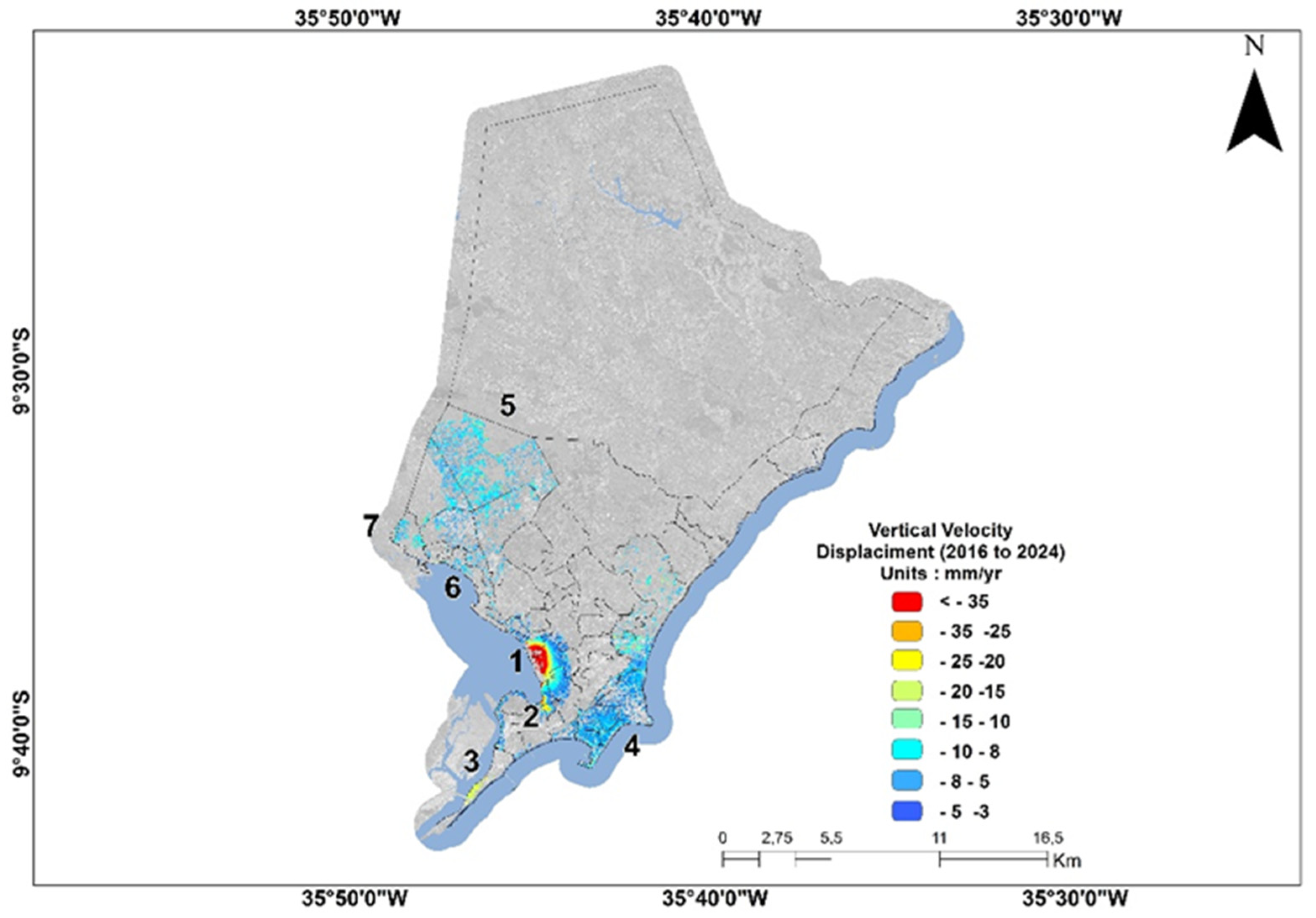
Figure 8 presents the city-wide mean annual LOS velocity (mm yr−1) in descending geometry (VV polarization), where negative values indicate motion toward the satellite, interpreted as downward movement. The cumulative LOS displacement map for 2016–2024 is shown in Figure S1 (Supplementary Materials). Analysis of the map delineates seven macro-areas (A1–A7) characterized by predominantly negative LOS deformation, with corresponding neighborhoods detailed in Table 1.
Figure 8.
Mean LOS velocity (mm yr−1) from SBAS-InSAR, 2016–2024 (descending, VV). The numbers 1–7 indicate the seven subsidence macro-areas (A1–A7).
Table 1.
Deformation macro-areas with predominantly negative LOS motion (A1–A7) and corresponding neighborhoods.
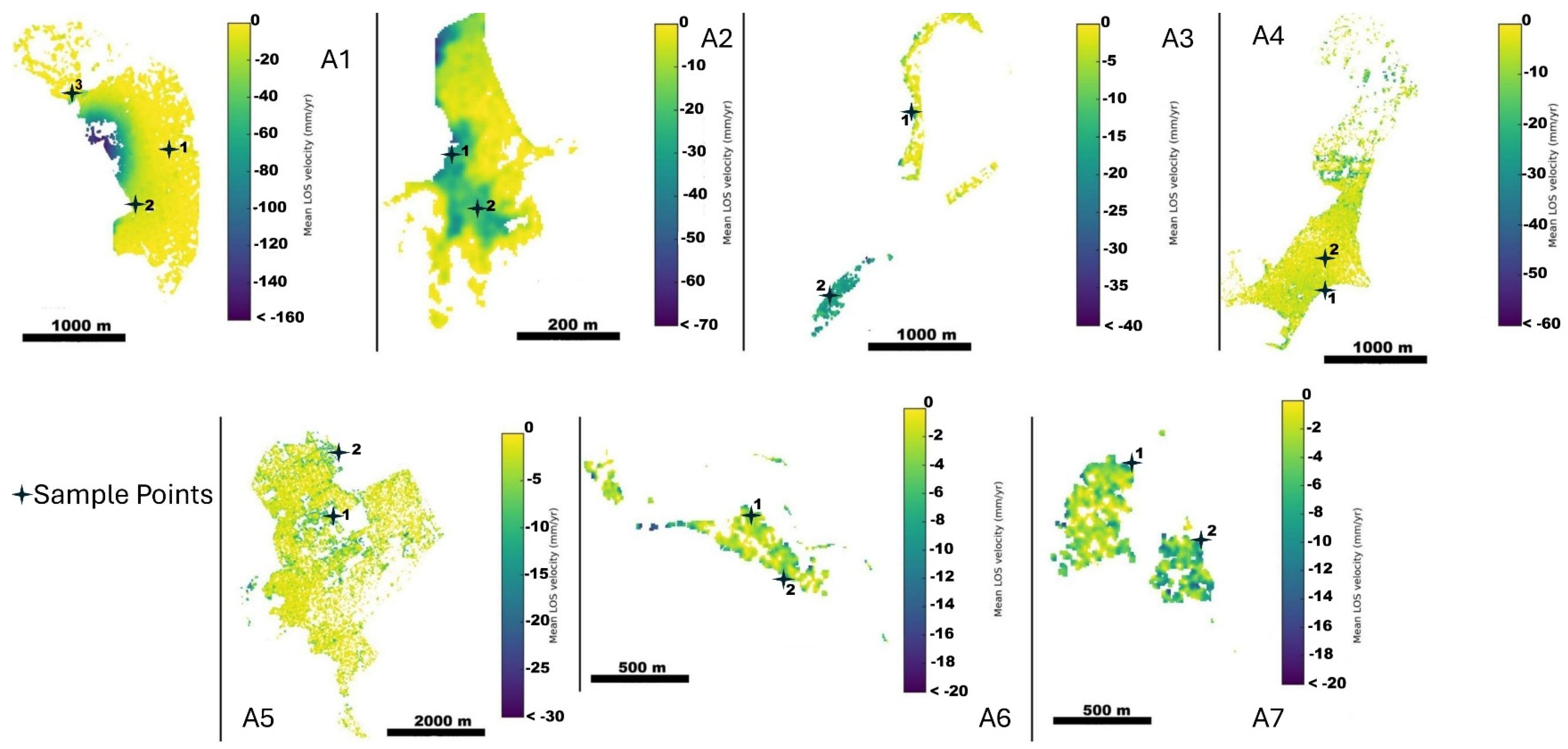
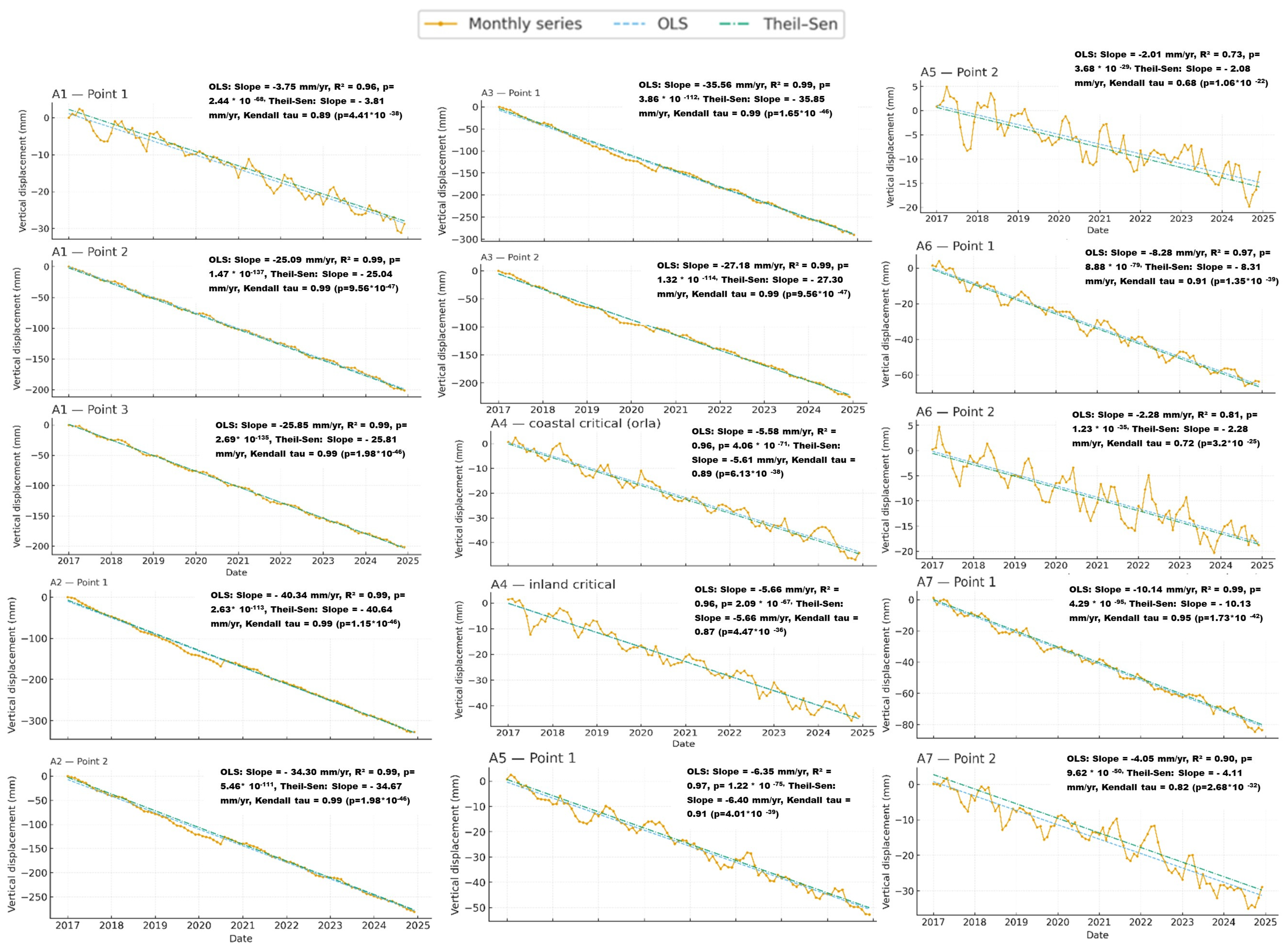
Spatial and temporal patterns were characterized by extracting SBAS–InSAR LOS time series (2016–2024) for each macro-area. For each macro-area, two representative points were selected: one with the highest non-outlier magnitude (following a Tukey filter) and, when necessary, a spatially distinct moderate sample to capture intra-area variability. Figure 9 displays sample locations as black crosses, and Figure 10 presents the corresponding time series.
Figure 9.
Spatial cutouts of the seven macro-areas (A1–A7). Background colors show SBAS-InSAR LOS velocity (2016–2024; descending). Black crossers mark the representative sample points used for the time-series analysis.
Figure 10.
Cumulative SBAS-LOS deformation (mm) at the numbered sample points in Figure 9, panels A1–A7, over 2016–2024. Negative values denote motion toward the satellite (downward). Lines report OLS slope (mm), Theil–Sen slope, and Mann–Kendall τ () after de-seasonalization and serial-dependence adjustment.
The time series are accompanied by ordinary-least-squares (OLS) slope, Theil–Sen slope, and Mann–Kendall statistic (τ, p_“adj”) calculated from de-seasonalized data with effective-sample-size correction. Color scales in Figure 9 panels are set individually for each area; therefore, absolute values should only be compared within the same panel. The maximum cumulative LOS displacement values corresponding to subsidence are approximately −160 mm in A1, −70 mm in A2, −40 mm in A3, and −60 mm in A4, with smaller negative values in A5–A7 (approximately −30 to −20 mm). Negative pixels are concentrated in the core or bands of each area and are more dispersed in A6 and A7.
Area A1 exhibits a compact zone of subsidence with pronounced internal variation. Three sample points were analyzed from the west, center, and east: Pitanguinha (west edge), in Str. Coronel de Lima Rocha near close army base, experienced a decline of −28.7 mm (approximately −3.6 mm yr−1), characteristic of edge locations with clearer signals. Bom Parto and Flexal (Str. Beira da Lagoa and Str. Tobias Barreto—near Silva’s river discharge point) (center/east), each subsided by −201.2 mm and −201.7 mm (approximately −25.2 mm yr−1), respectively, displaying a steady decline, minimal variation, consistent trend metrics, and strong evidence of a persistent trend.
Area A2 forms an elongated belt aligned with the long axis of the cutout. The lagoon margin records −328 mm (approximately −41.0 mm yr−1), while the Municipal Market vicinity shows −281 mm (approximately −35.1 mm yr−1). Both time series are nearly linear with minor seasonality, and the OLS and Theil–Sen slopes, as well as the Mann–Kendall statistic, are in strong agreement. These results indicate persistent subsidence along the lagoon corridor. Area A3 features subsidence along narrow corridors. The subsidence reaches −290 mm (−36.3 mm yr−1) at Pontal and −225 mm (−28.1 mm yr−1) at Vergel, both showing a persistent decline confirmed by all trend metrics.
Area A4 is characterized by a coastal-parallel band that is locally fragmented. Both the Ponta Verde/Pajuçara seafront and Jatiúca exhibit subsidence of −44.1 mm (approximately −5.5 to −5.6 mm yr−1). Seasonality is more pronounced in this area, with consistent weak to moderate declines, and significant Mann–Kendall statistics are observed. This zone is operationally classified as low-to-moderate intensity but spatially extensive.
In A5, two locations between Eustáquio Gomes/Cidade Universitária and the Industrial District exemplify the internal gradient: −52.7 mm (approximately −6.6 mm yr−1) at the highest-magnitude site and −12.7 mm (approximately −1.6 mm yr−1) at the moderate site. The applied statistical metrics consistently indicate a negative trend, with lower values observed at the moderate site.
A6, including locations such as St. Mensageiro Nedson and St. Major Prado, exhibits fine, patchy textures. The highest-magnitude site records −63.7 mm (approximately −8.0 mm yr−1), while the moderate site records −18.8 mm (approximately −2.4 mm yr−1). At the highest-magnitude site, all three statistical metrics demonstrate strong agreement, whereas the moderate site shows greater relative variability among the metrics.
A7, comparing St. Boa Vista and St. Waldemar Rufino dos Santos, records −83.6 mm (approximately −10.5 mm yr−1) at Boa Vista and −28.9 mm (approximately −3.6 mm yr−1) in the Waldemar Rufino dos Santos. Although the dynamic range of A7 (approximately 0 to −20 mm yr−1) diminishes the map-scale visibility of the core–periphery gradient in Figure 9, the time-series analysis reveals a clear contrast: the core exhibits a steeper decline, while the periphery demonstrates lower magnitude and more pronounced seasonal modulation. In all instances, the trend estimators are in agreement, and the Mann–Kendall τ is statistically significant.
4.2. Macro-Areas and Neighborhoods; S1/S5/S10 Extent
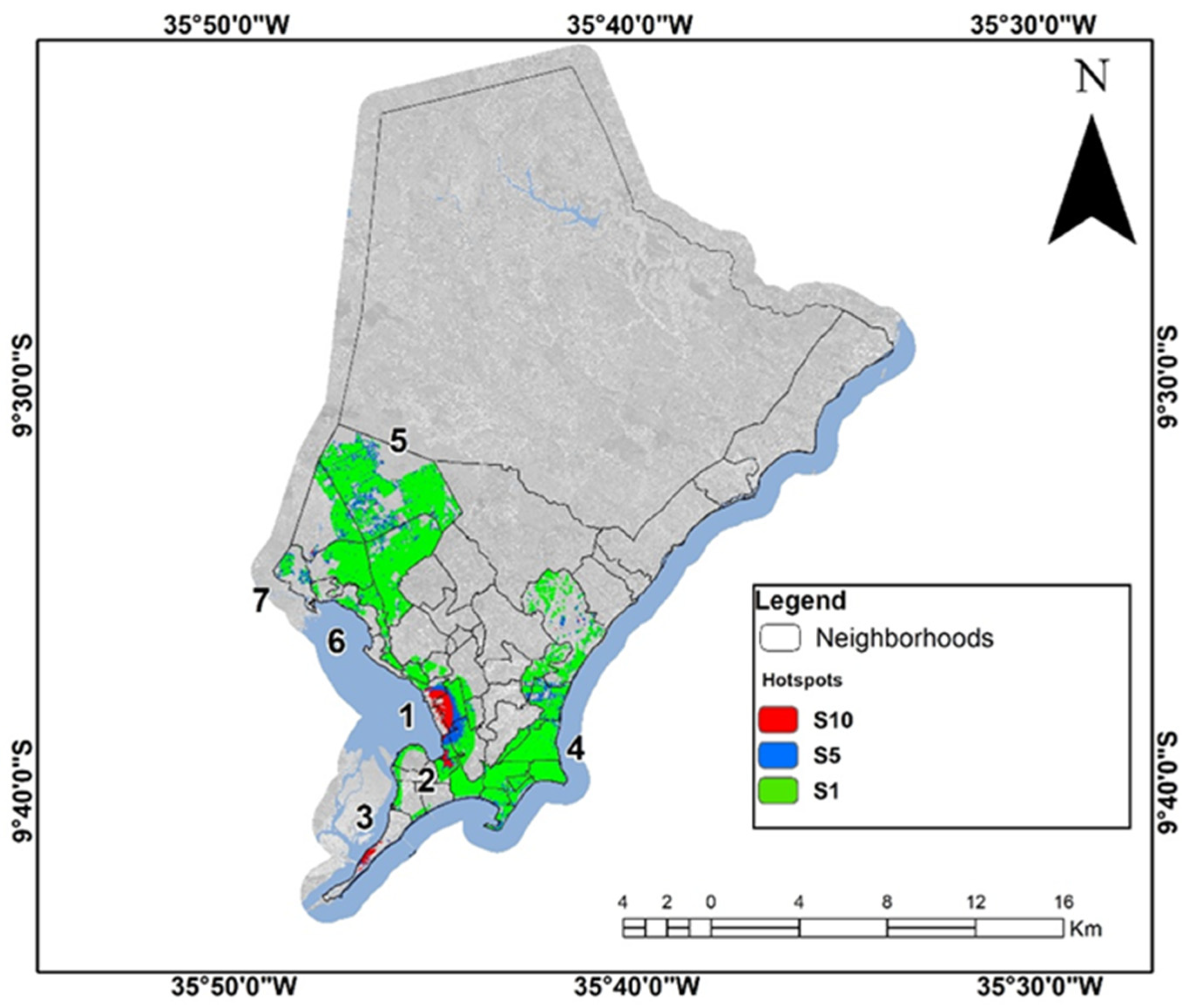
The identified areas are classified into operational subsidence classes based on the mean annual SBAS-InSAR rate (mm yr−1; negative values indicate subsidence): stable, S1 (low), S5 (moderate), and S10 (high/priority). This stratification enables effective comparison of subsidence hotspots, distinguishes noise from persistent signals, and supports prioritization (Figure 11). Maceió covers 509.6 km2. The combined extent of the seven identified subsiding areas delineates an extent of 54.772 km2, representing 10.75% of the municipality and the class areas are as follows: S1 = 41.777 km2 (8.20%), S5 = 7.860 km2 (1.54%), and S10 = 5.136 km2 (1.01%). Thus, the total affected area consists of 76.3% S1, 14.35% S5, and 9.38% S10. All datasets are harmonized to SIRGAS 2000, and maps were quality-assurance filtered (coherence ≥ 0.30; minimum mapping unit ≥ 1 ha). In accordance with the directive, the entire cutout union is considered subsiding and is partitioned into S1, S5, and S10 classes.
Figure 11.
Spatial extent of operational subsidence classes across Maceió, as determined by SBAS-InSAR (2016–2024). S1 (green) = low but persistent subsidence (−5 < v ≤ −3 mm yr−1); S5 (blue) = moderate (−10 < v ≤ −5 mm yr−1); S10 (red) = high/priority (v ≤ −10 mm yr−1).
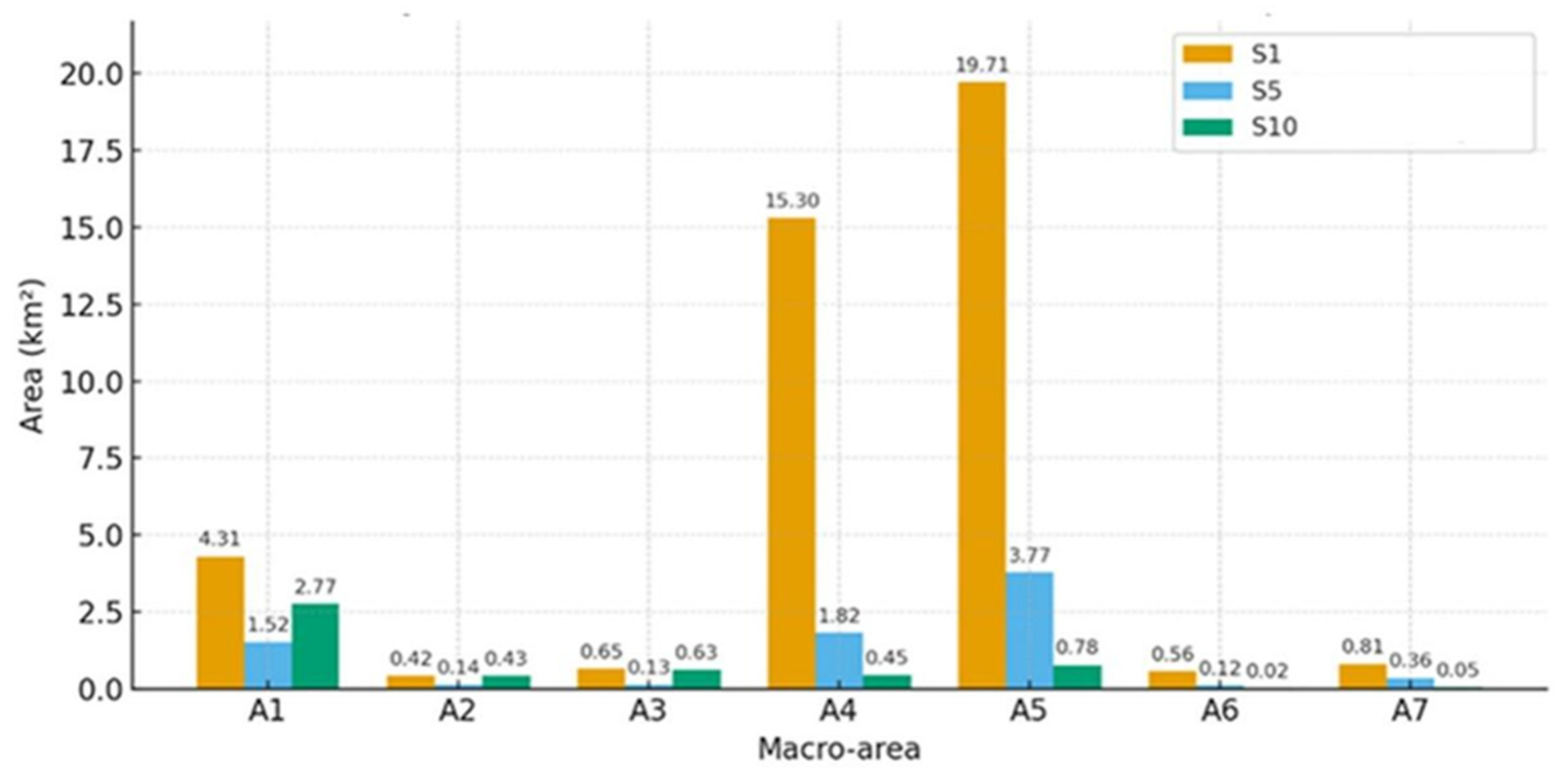
Table 2 and Figure 12 present the class extents by macro-area (km2), totaling 54.772 km2: A5 = 24.268 (44.3%), A4 = 17.574 (32.1%), A1 = 8.600 (15.7%), A3 = 1.416 (2.6%), A7 = 1.223 (2.2%), A2 = 0.990 (1.8%), and A6 = 0.703 (1.3%). This distribution highlights two dominant belts: A5 (western plateau/peri-urban) and A4 (coastal), followed by the A1 central mining bowl. Although A2, A3, A6, and A7 have smaller footprints, they contain specific bands that shift into S5 and S10.
Table 2.
Table of Area by macro-area in S1/S5/S10 classes (km2).
Figure 12.
Class distribution (S1/S5/S10) by macro-area extent (km2) of subsidence (A1–A7).
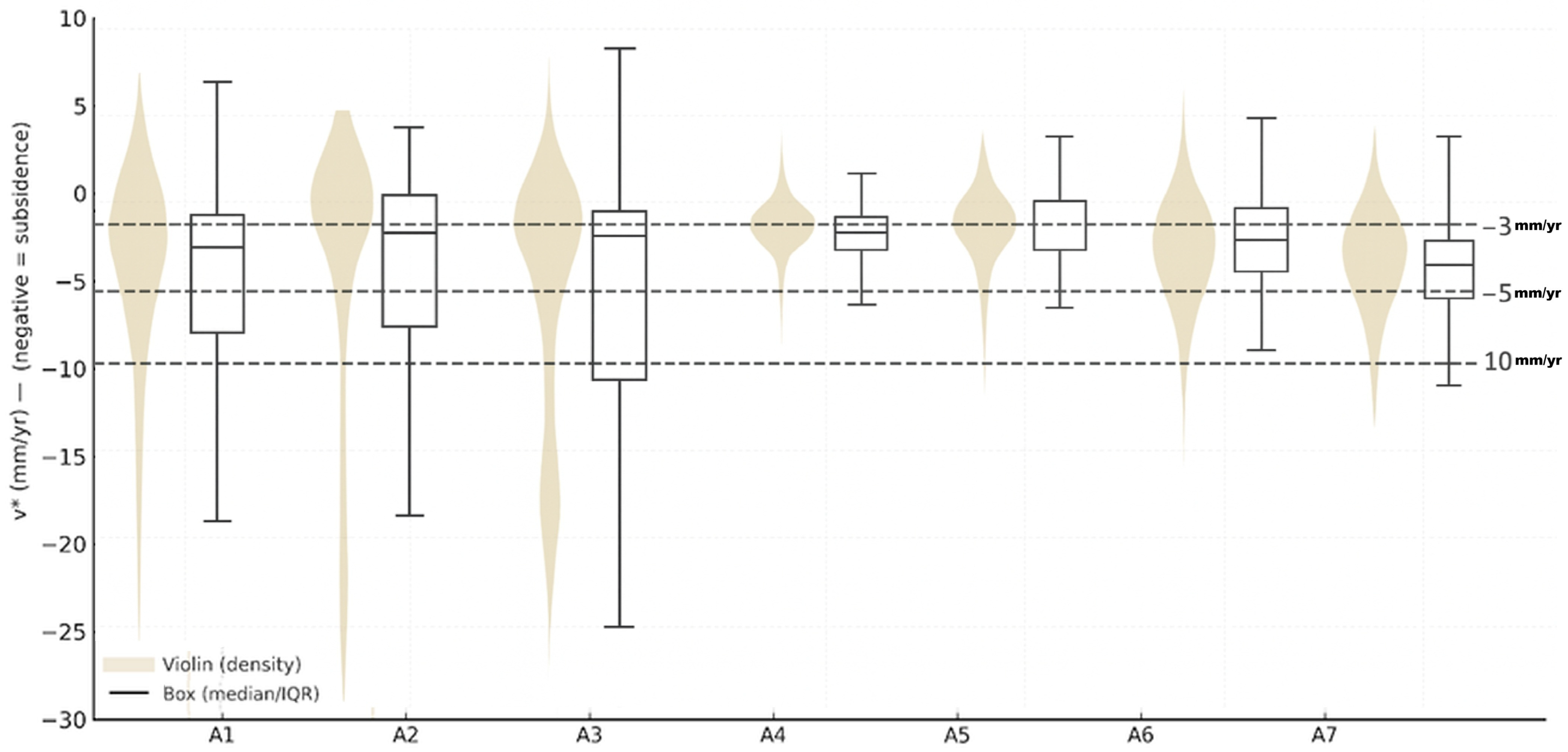
Figure 13 illustrates, for each macro-area (A1–A7), the pixel-wise mean line-of-sight (LOS) LOS velocity (mm ) using kernel-density violin plots (area = 1; width = relative probability) after applying quality masks (negative-only, = 1, occupancy ≥ 0.60). The width of each violin represents pixel density, the center line denotes the median, the box shows the interquartile range (Q1–Q3), whiskers indicate the 5th to 95th percentiles, and horizontal dashed lines correspond to −3, −5, and −10 mm yr−1. At the municipal scale, medians range from 0 to −5 mm yr−1, indicating that most of the city is stable or exhibits weak subsidence, while certain areas fall within the S5 and S10 classes.
Figure 13.
Pixel-wise distributions of mean LOS velocity (v*, mm yr−1; negatives indicate subsidence) for A1–A7 after quality masks (negative-only, MKneg = 1, occupancy ≥ 0.60). Each violin plot shows a kernel probability density over pixels (width = relative probability; area normalized to 1). Boxes show median and interquartile range (Q1–Q3); whiskers denote the 5th–95th percentiles. Horizontal dashed lines mark −3, −5, and −10 mm yr−1. n (number of pixels) is shown under each violin plot.
At the macro-area scale, A1 displays a violin-shaped distribution that extends well be-low −10 mm yr−1, with a low box and broad body, indicating a concentration in S10 and wide dispersion. A5 exhibits a similar distribution, with a tail approaching −10 mm yr−1, but a greater proportion of values are observed in S5. In A4, the median typically falls between −3 and −5 mm yr−1, with a long lower tail crossing −5 mm yr−1 and a smaller fraction reaching −10 mm yr−1, indicating that S5 is more prevalent than S10. A2 and A3 have slightly negative medians and moderate tails, with most values in S1, some in S5, and few in S10, as reflected by an intermediate interquartile range. A6 and A7 show higher medians (near 0 or −1 mm yr−1), a narrow violin-shaped distribution, and short tails, with S1 dominating and only sporadic S5 and rare S10 occurrences.
4.3. Morphological Classification of Hotspots (Gradient, Curvature, Anisotropy)
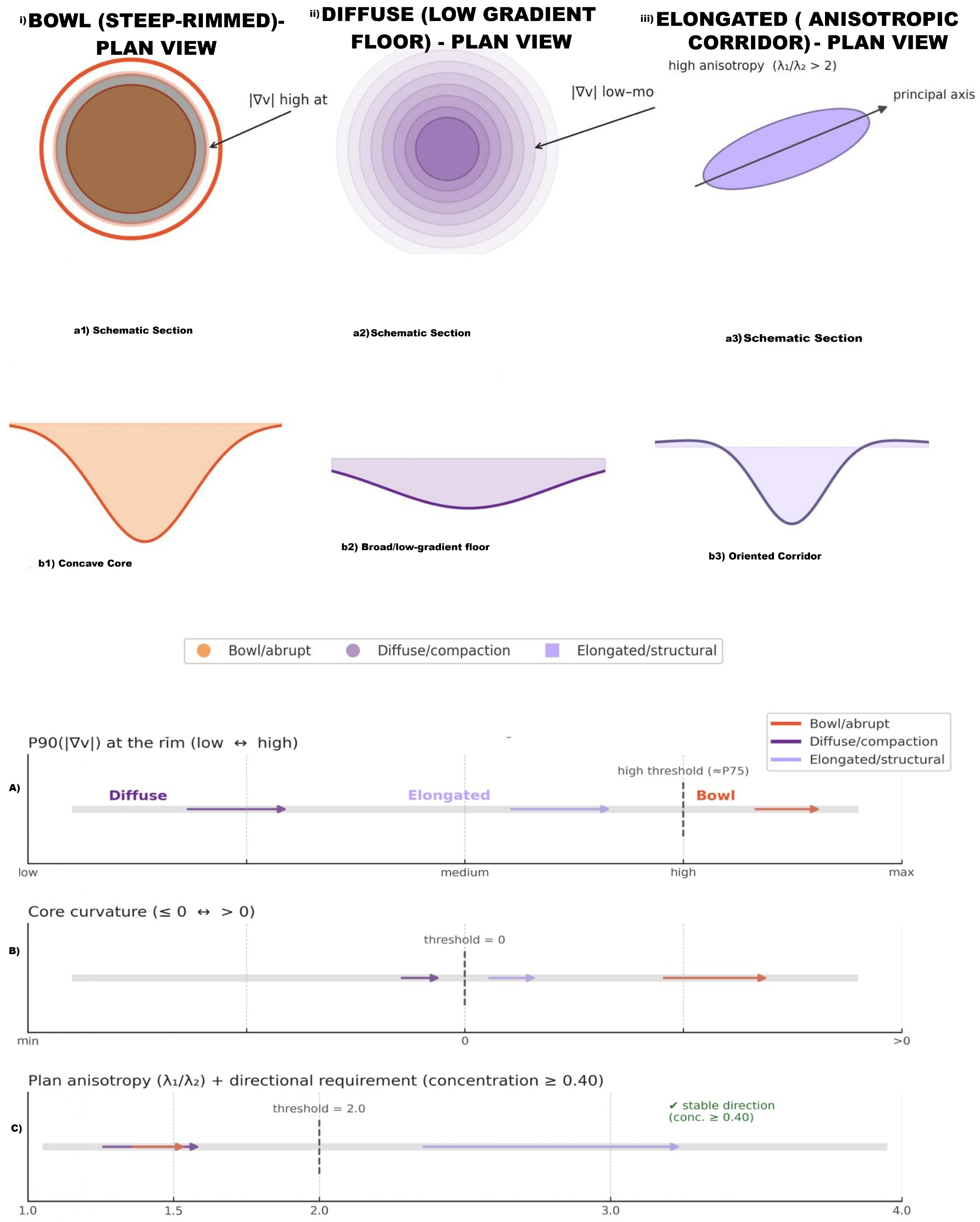
Three plan-view morphologies are identified: Bowl (steep-rimmed), Diffuse (low-gradient floor), and Elongated (anisotropic corridor), each distinguished using three complementary landscape metrics. Rim gradient quantifies the steepness of the outer edge, core curvature measures the convexity or concavity of the central floor, and plan anisotropy describes the degree and direction of stretching in plan view (Figure 14).
Figure 14.
Morphological typology of subsidence hotspots. Upper panels: conceptual plan views and schematic cross-sections for (i) Bowl (steep rim, concave core), including (a1) Schematic Section, (b1) Concave Core; (ii) Diffuse (broad, low-gradient floor), including (a2) Schematic Section, (b2) Broad/low-gradient floor; and (iii) Elongated (oriented corridor with roughly parallel flanks), including (a3) Schematic Section, (b3) Oriented Corridor. Lower panels: data-driven ranges for three diagnostics computed around the HMS: (A) on a rim annulus (low → high; vertical dashed line marks the high threshold, taken as the of all hotspots); (B) core curvature given by the sign of on a core disk (vertical dashed line at ); and (C) plan anisotropy with a directional-stability requirement (directional concentration ≥ 0.40; vertical dashed line at ). Ranges indicate typical positions per morphotype; overlaps may occur, and classification uses the joint pattern of the three metrics.
A light Gaussian pre-smoothing (σ = 1 pixel) is applied prior to derivative operators to suppress high-frequency noise while preserving meaningful discontinuities [81,82,83,84,85]. Gradients delineate rims, curvature characterizes cores, and anisotropy determines axis direction and stability. Classification is based on the joint pattern of these metrics rather than any single threshold [83,88,89,90,91,92].
Bowl polygons exhibit a continuous concave floor with positive mean core curvature (κ > 0, U-shaped cross-section), surrounded by an annulus of high rim steepness, characterized by short internal ramps and steep outer edges. Diffuse features display broad, shallow floors with core curvature that is occasionally slightly negative and low-to-moderate rim gradients; transitions are smooth, and the texture is spatially homogeneous. Elongated features are directionally stretched and typically asymmetric along a stable major axis (directional concentration ≥ 0.40), with high plan anisotropy (median eigen-ratio) and core curvature near zero to weakly positive, generally lower than in bowls. Empirical ranges of these diagnostics are computed within a neighborhood around the highest-magnitude sample (HMS) to illustrate typical positions for each morphotype. Overlaps may occur; classification relies on the joint use of all three metrics [1,95].
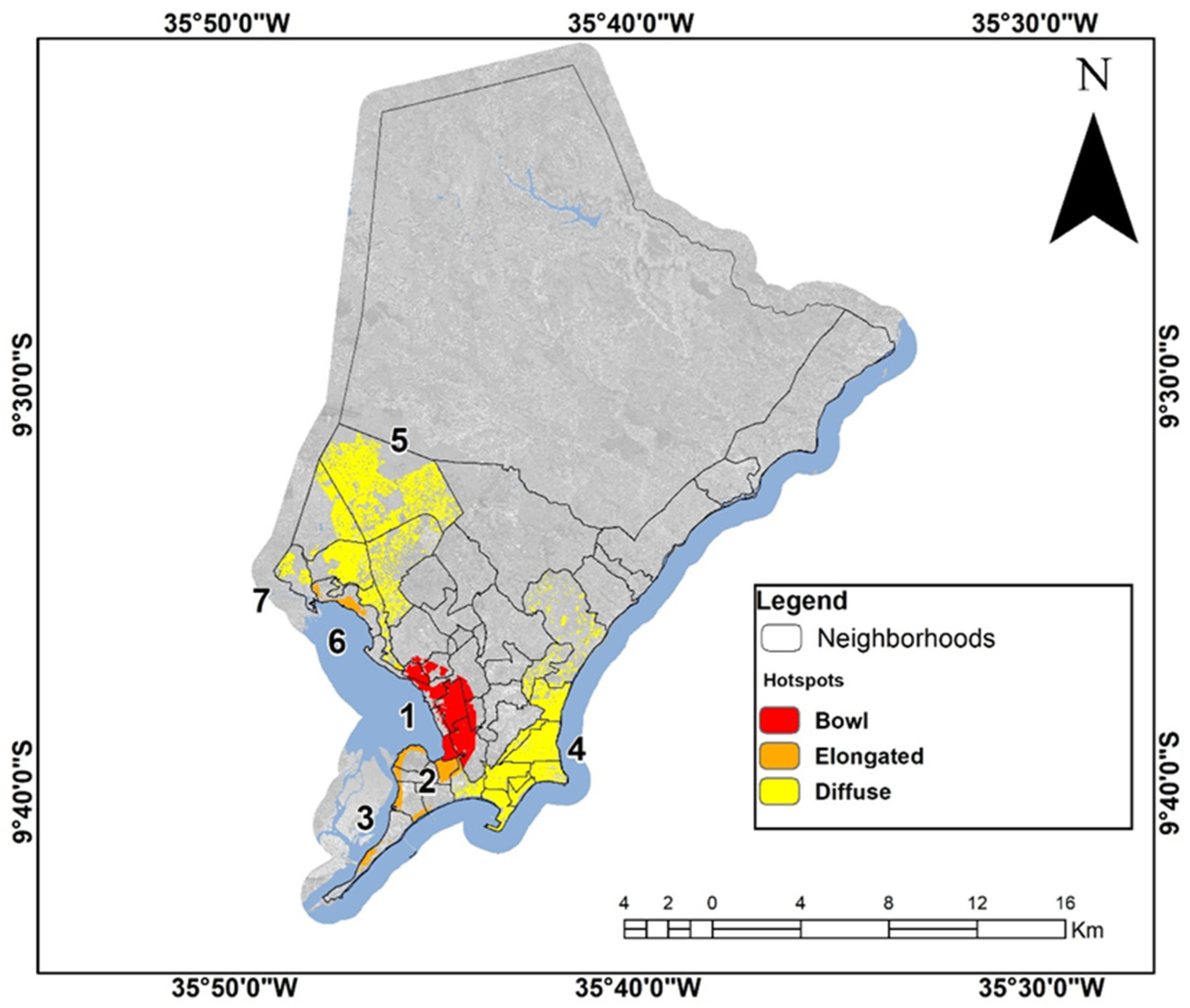
At the municipal scale, the dominant morphotype is reported for each subsidence entity, defined as the class with the largest pixel share (Figure 15). Bowls cluster in areas where rim gradients are highest and core curvature is distinct. Elongated entities exhibit well-defined axes and corridor-like continuity. Diffuse entities form broad, low- to moderate-intensity blankets, often over plains.
Figure 15.
Hotspots morphology by macro-area (A1–A7). Colors: red = Bowl; yellow = Elongated; teal = Diffuse.
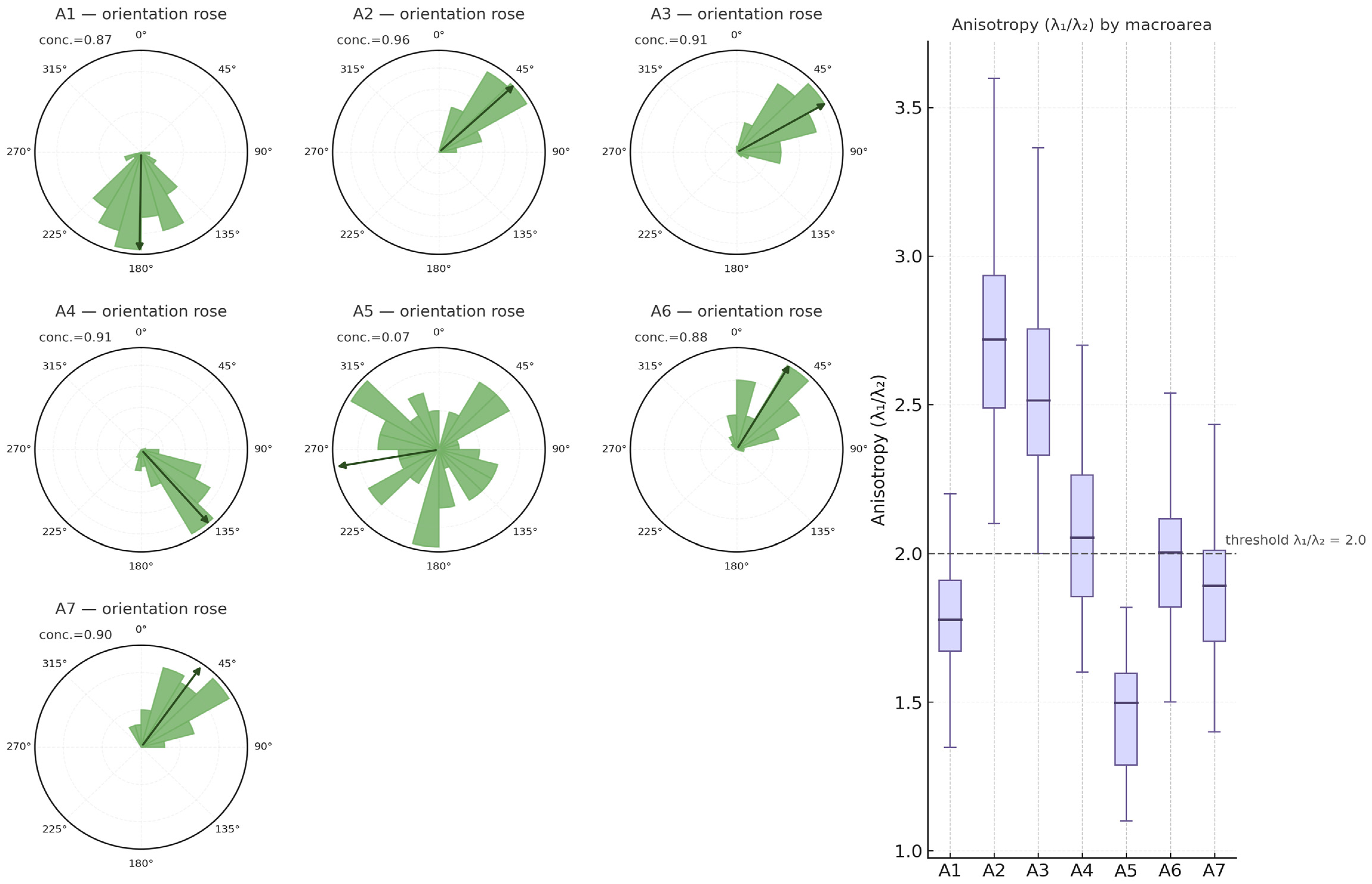
Orientation roses of principal axes reveal distinct directional families associated with specific environments. NNE–SSW to NE–SW axes are observed along the lagoon corridor (A2–A3), while ENE–WSW axes dominate the coastline (A4). N–S to NNE–SSW orientations are prevalent in interior valleys (A6–A7). In A5, distributions are diffuse and lack a marked preferred axis. A1 displays multimodal and dispersed orientations, consistent with circular to semi-elliptical bowl geometry. Anisotropy indices are greater than 2 in elongated features and less than or equal to 2 in diffuse areas. Bowls combine low anisotropy with high compactness, reflecting their core characteristics and steeper rims (Figure 16).
Figure 16.
Orientation and anisotropy of hotspot geometry by macro-area (A1–A7), Left: orientation rose diagrams of principal-axis azimuths within each macro-area; the conc. value indicates directional concentration. Right: boxplots of plan-form anisotropy; the dashed line marks the threshold used to flag elongated features.
Spatial analysis indicates that A1 (Bebedouro–Mutange–Bom Parto–Farol–Pinheiro) forms a continuous Bowl, characterized by a concave core, high rim steepness, and central core curvature. Polygons are compact and nearly isotropic, with attenuation toward the east-southeast and west. To the south-southeast, A2 along Levada and the lagoon corridor is organized into an Elongated system with substantial spatial continuity. This area exhibits robust anisotropy (median) and a stable NNE–SSW to NE–SW orientation parallel to the lagoon axis. Inner margins locally display tightened gradients, and cores maintain near-zero to weakly positive curvature.
Along the lagoon margins in A3 (Pontal da Barra–Trapiche–Ponta Grossa–Vergel do Lago), Elongated geometry is predominant, with stable NE–SW axes aligned to the shoreline. Small, bowl-like pockets and low-to-moderate diffuse textures are present but remain secondary. In contrast, the broader coastal plain (A4, Jaraguá coast to Jacarecica coast) is characterized by diffuse signatures, generally exhibiting low to moderate core curvature and weak anisotropy. Short shore-parallel segments (ENE–WSW) occur but lack corridor-scale continuity, and bowls are rare and small.
In the interior (A5: Santa Amélia, Clima Bom, Tabuleiro dos Martins, Santos Dumont, Cidade Universitária), Diffuse polygons are predominant, appearing extensive yet fragmented, with modest gradients, low anisotropy, and poorly defined edges. Occasional elongated traces follow headwater drainages but remain spatially limited. A6 (Fernão Velho) exhibits a mixed pattern: Diffuse floors are present on lagoonal plains and slopes, with secondary Elongated corridors along N–S to NNE–SSW valleys, where anisotropy is moderate in corridors and low on broad floors. Further west, A7 (Rio Novo) is mainly diffuse, with patchy blankets over valley floors and terraces, low to moderate gradients, and overall weak anisotropy. Narrow elongated tongues appear along N–S to NNE–SSW valleys but are short and minor compared to the diffuse fabric.
Taken together, the municipal map resolves into three operational regimes. First, steep-rimmed Bowls have high rim gradients and ores (western arc and locally at depressed lagoonal margins); these occur in the western arc and locally at depressed lagoonal margins. Second, elongated corridors have stable axes that parallel the lagoon shoreline and valley directions. These are prominent along the Levada–lagoon and selected coastal or valley tracts. Third, diffuse low-gradient blankets dominate the coastal belt and peri-urban interiors. They show low–moderate , weak anisotropy, and poorly defined boundaries. This integrated picture clarifies where geometry is focal, corridor-like, or diffuse. It shows how these regimes co-organize across the city, most notably via the ellipsoidal continuity linking the central bowl to the lagoonal corridor along a shared NE–SW principal axis [1,82,83,93,94,95].
4.4. Physical Setting: Geology, Geomorphology, and Soils (Overlay Analyses)
To relate SBAS-InSAR hotspots to the physical setting of Maceió, active polygons were compared with mapped geology, landforms, and soils. Over- or under-representation was quantified using the enrichment ratio (ER) and its natural logarithm (ln ER). An ER greater than 1 (ln ER > 0) indicates that a unit occupies a larger proportion of the hotspot than expected based on its area within the city. An ER approximately equal to 1 is considered neutral, while an ER less than 1 indicates under-representation.
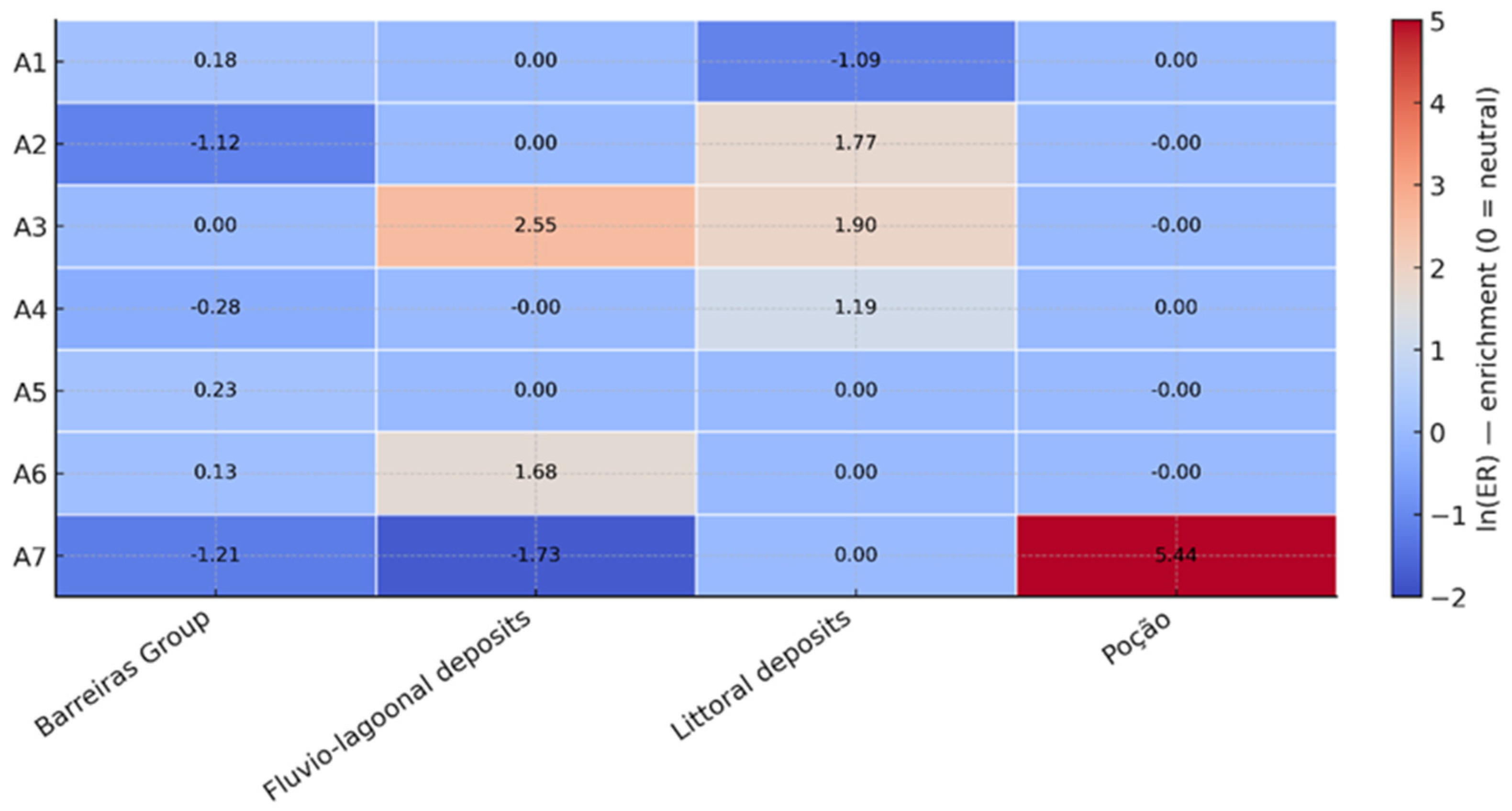
The lagoon-corridor and shoreline hotspots exhibit distinct geological patterns (Figure 17). This distinction, as demonstrated by the enrichment analysis, highlights the correspondence between spatial patterns and varying geologic settings.
Figure 17.
Geological enrichment ln(ER) Heatmap by macro-area (A1–A7).
In A2, coastal deposits are over-represented (ER > 1), which aligns with the presence of the adjacent estuarine–beach belt. In A3, fluvio-lagoonal deposits demonstrate the highest enrichment along the inner lagoon margin. In A1, although the lagoon-facing low sector is active, the composition is primarily dominated by the Barreiras Group (ER slightly > 1), while coastal and fluvio-lagoonal covers are under-represented within the analyzed mask. Across the broader coastal belt (A4), the Barreiras Group again predominates with an ER slightly above 1, suggesting that selected hotspots are not confined to the youngest surficial mantles. In the interior regions (A5–A6), the ER for Barreiras remains close to 1, indicating no systematic lithological preference; the compositions reflect those of the municipal supply. The exception is A7, where Poção exhibits a very high ER. This result is attributed to its small municipal extent (denominator effect), so the absolute intersected areas remain limited despite the high ER.
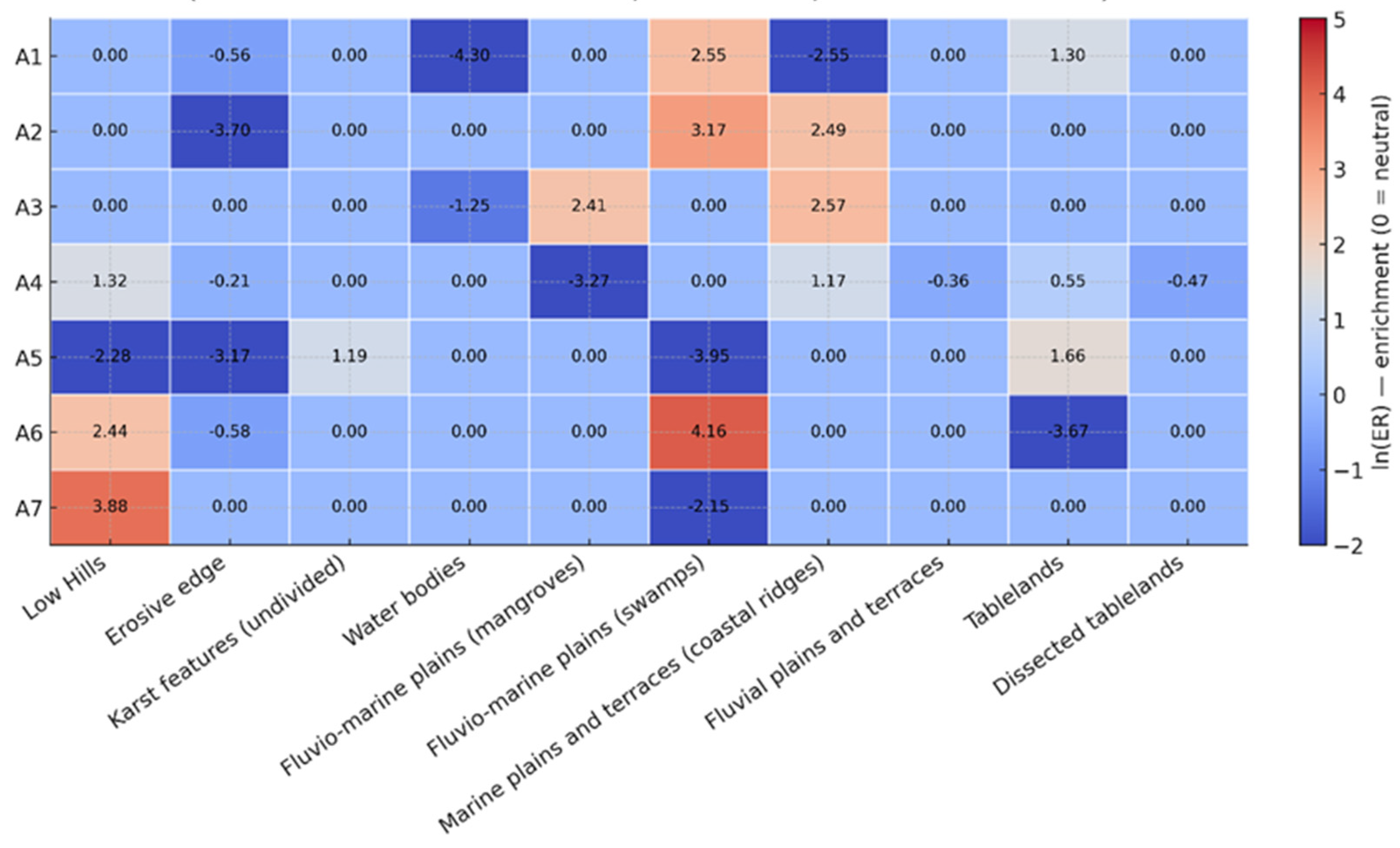
A distinct contrast is observed between plains and tablelands in geomorphological analysis (Figure 18). Within lagoonal and coastal cutouts (A2–A4), coastal and fluvio-marine plains, including mangroves and marshes, exhibit ER values consistently greater than 1. This pattern indicates that hotspots are preferentially located on low-elevation, aggradational surfaces. In A1, the lagoon-facing arc demonstrates a similar plain-enrichment pattern, while higher sectors display ER values close to 1. In the interior regions (A5–A7), hotspot composition is primarily dominated by tablelands, including dissected tablelands, with no significant enrichment (ER ≈ 1), suggesting occupancy proportional to surface availability. However, local fluvial plains are disproportionately represented along valley floors, particularly in A6 and A7, resulting in ln ER peaks that define elongated valley-floor corridors.
Figure 18.
Geomorphological enrichment ln (ER) Heatmap by macro-area (A1–A7).
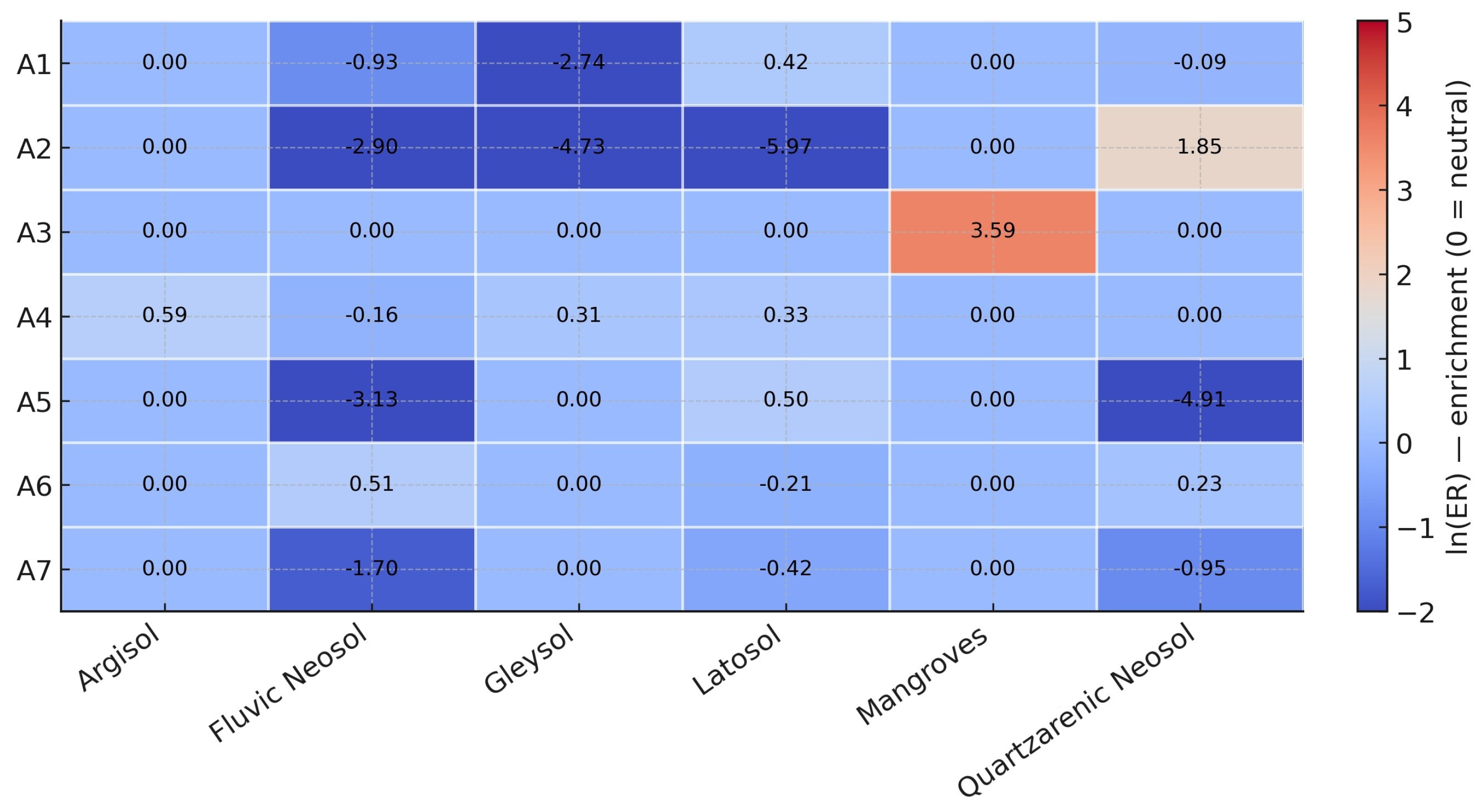
Soil distribution patterns correspond to the environmental gradient (Figure 19). In coastal–lagoonal sectors (A2–A4 and the lagoon-edge of A1), sandy and hydromorphic soils such as Quartzarenic Neosols, Fluvic Neosols, Gleysols, and, where mapped, Marine Quartz Sands, are systematically more prevalent in hotspots (ER > 1; ln ER > 0), frequently adjacent to mangroves. In the interior (A5–A7), hotspots predominantly involve Latosols and Argisols with values near neutrality (ER ≈ 1), consistent with municipal distributions. Exceptions include localized concentrations of Gleysols, and occasionally Fluvic Neosols, in thalwegs and low-lying areas, particularly in A6–A7. In A4, the transition from coast to interior is characterized by shore-parallel enrichment of Quartzarenic/Fluvic Neosols and Gleysols.
Figure 19.
Soil enrichment ln (ER) Heatmap by macro-area (A1–A7).
Collectively, the overlays indicate that coastal–lagoon sectors (A2–A4 and lagoon-facing A1) are systematically enriched on plains with unconsolidated littoral and fluviolagoonal deposits, as well as sandy and hydromorphic soils. In contrast, interior tableland areas (A5–A7) generally reflect municipal availability (ER ≈ 1) for Barreiras units and Latosol/Argisol. However, there is a local overrepresentation of fluvial plains and Gleysols along valley corridors, most notably in sections A6–A7.
4.5. Abstraction Wells: Count, Density, and Proximity
Statistics are computed exclusively inside the previously defined subsidence hotspots. Four indicators were assessed: (i) absolute well counts per macro-area; (ii) areal well density (wells per square kilometer), where the number of registered wells within the hotspot is divided by its area (km2); (iii) pixel-to-nearest-well Euclidean distance, summarized by the median and binned into the following ranges: 0–200, 200–500, 500–1000, and greater than 1000 m; and (iv) a Gaussian kernel density estimate (KDE) of well locations on a 100 m grid with a specified bandwidth (wells per square kilometer). Distances were calculated from pixels to wells, including those located inside or immediately outside hotspot polygons.
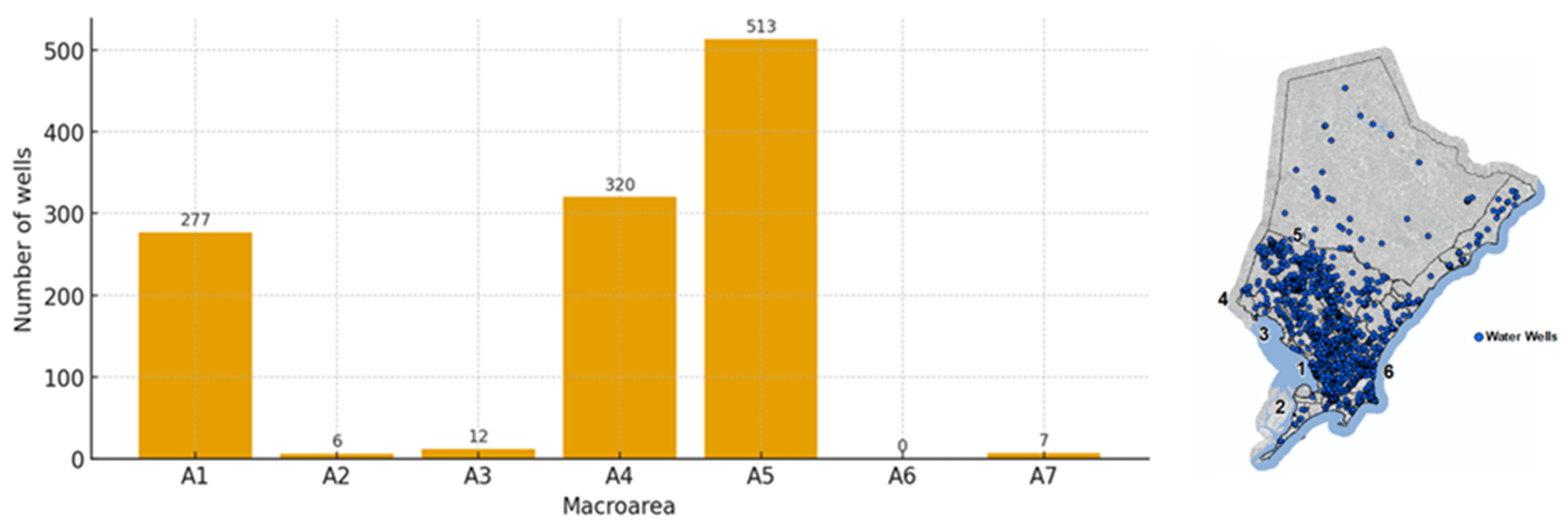
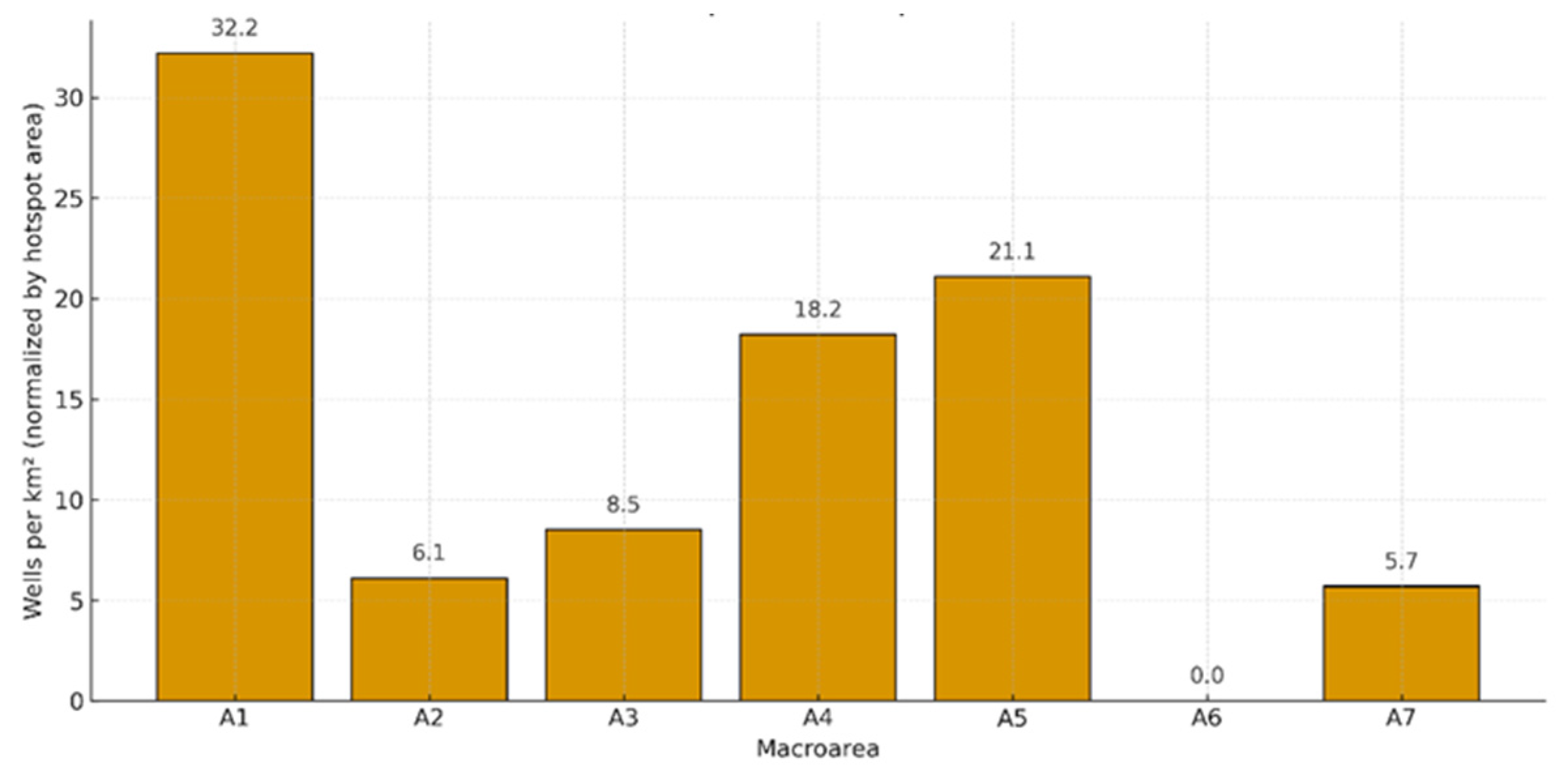
In absolute terms, the majority of wells are located in A5 (513) and A4 (320), followed by A1 (277). A2, A3, and A7 have low counts (6, 12, and 7, respectively), while A6 contains none. When normalized by hotspot area, the ranking shifts: A1 (32.2 wells per km2), A5 (21.1), A4 (18.2), A3 (8.5), A2 (6.1), A7 (5.7), and A6 (0)—Figure 20.
Figure 20.
Number of Wells by Macro-areas (A1–A7).
Areal well density (wells per km2) is estimated for each macro-area by dividing the number of wells within the hotspot by the hotspot area (km2). This normalization facilitates equitable comparison of abstraction intensity and highlights zones most af-fected by subsidence. The resulting densities display a clear decreasing trend: A1 (32.2 wells per km2), A5 (21.1), A4 (18.2), A3 (8.5), A2 (6.1), A7 (5.7), and A6 (0) (Figure 21).
Figure 21.
Wells density per Macro-areas (A1–A7).
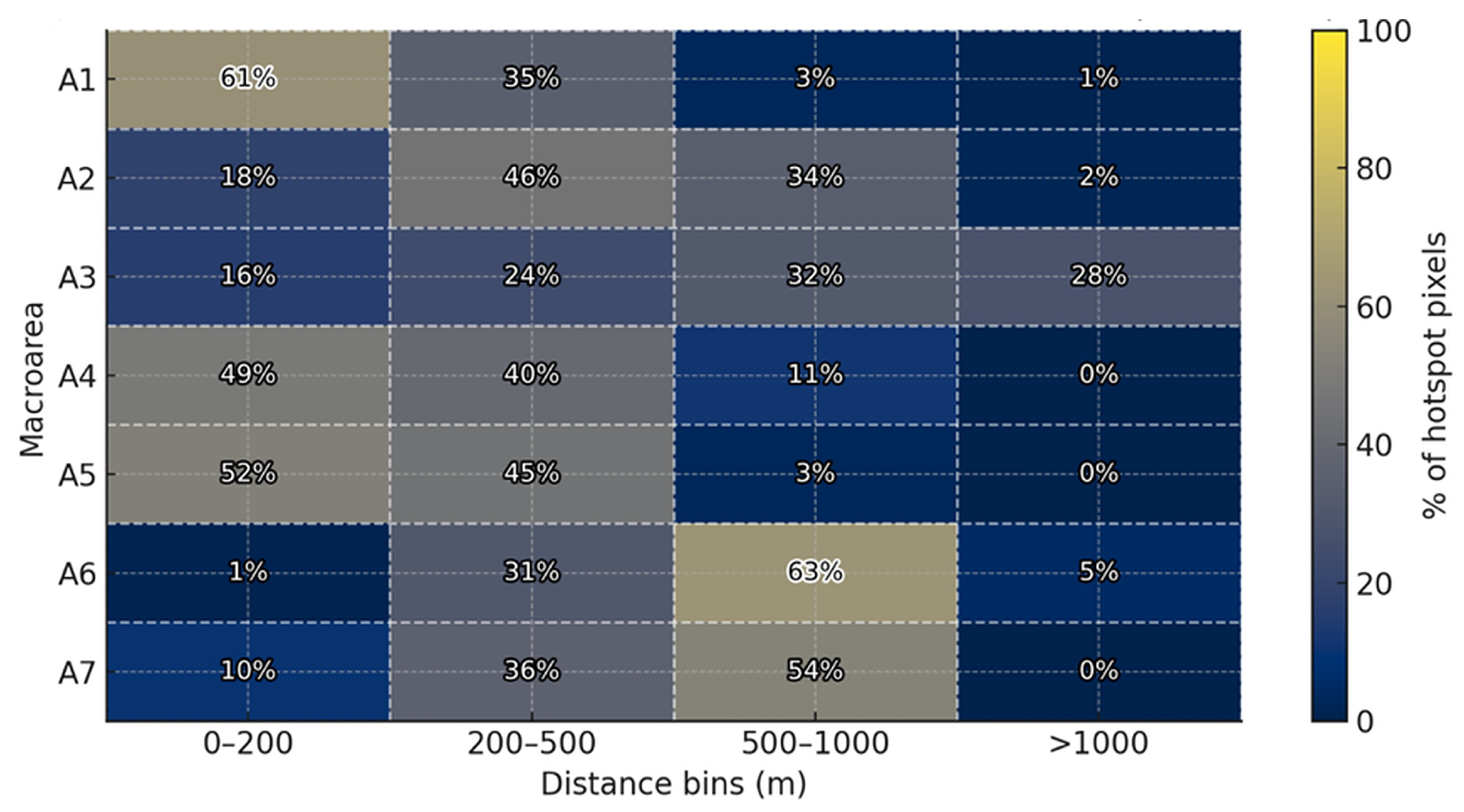
The Euclidean proximity metrics corroborate the preceding findings. Median pixel-to-nearest-well distances are shortest in A1 (approximately 168 m), A5 (195 m), and A4 (204 m). In contrast, A2 (408 m), A6 (555 m), A7 (567 m), and A3 (600 m) exhibit longer distances. The distribution of binned distance shares (0–200, 200–500, 500–1000, and greater than 1000 m) reflects this hierarchy (Figure 22). A1, A4, and A5 are concentrated in the 200–500 m range, whereas A2, A3, and A7 shift toward 200–1000 m. A3 displays the pixel-to-nearest-well distance distributions, which indicate three distinct regimes.
Figure 22.
Heatmap of Nearest-Well Distance Shares by Macro-Areas (A1–A7).
Macro-areas with higher well density and continuous KDE plateaus have the majority of hotspot pixels located near a well. In A1, approximately 61% of pixels are within 200 m, and 35% are within 200–500 m. In A4, 49% are within 200 m and 44% within 200–500 m. In A5, 52% are within 200 m. Areas with intermediate densities display right-shifted distributions. In A2, 18% are within 200 m, 46% within 200–500 m, and 34% within 500–1000 m. A6 and A7 have most pixels in the 200–500 m and 500–1000 m ranges, with a minority exceeding 1000 m. A3 represents the sparse, long-tail case: only 16% are within 200 m, and approximately 28% exceed 1000 m. The P10 distances are lowest where well density or KDE is highest (approximately 70–140 m for A1, A4, and A5) and higher where abstractions are sparse (A2, A3, A6, A7), confirming the differences among macro-areas are higher where abstractions are sparse (A2, A3, A6, A7), confirming the difference between macro-areas.
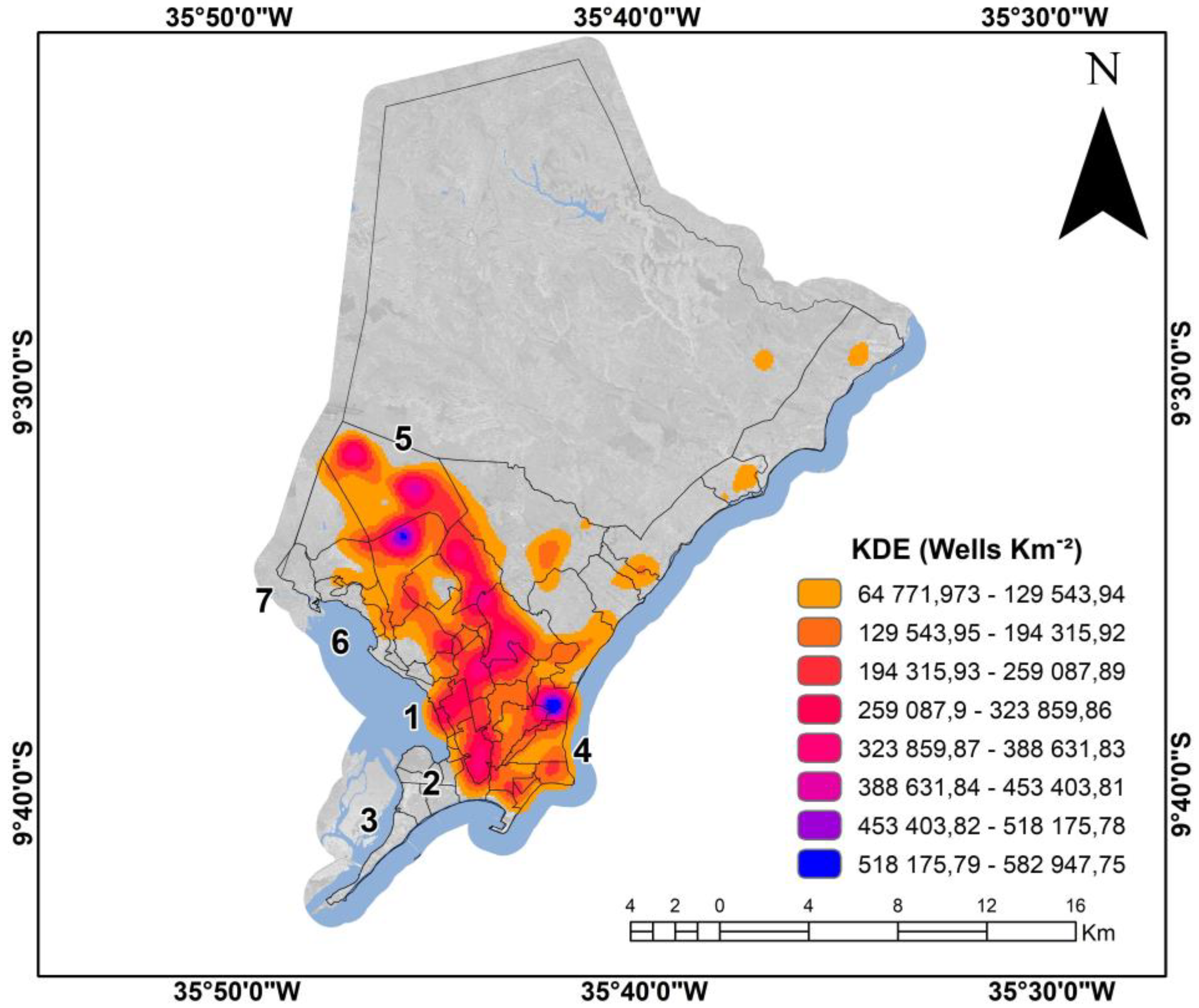
The Gaussian kernel density estimate (KDE) of well locations (wells per km2) generates a continuous surface that illustrates well field intensity and spatial continuity. Local maxima and elongated ridges correspond to dense clusters and connected belts, while low, blotchy values indicate sparse or uneven distributions. The KDE reveals continuous, high-intensity belts in A4–A5 and the central arc of A1. In contrast, A2, A3, A6, and A7 display patchy, low-contrast patterns (Figure 23).
Figure 23.
Kernel Density Wells map in Well/Km-2 by Macro-areas (A1–A7).
As an independent line of evidence, administrative static and dynamic water-level pairs (NE/ND) from the SEMARH registry (Supplementary File S1) are analyzed. These instantaneous readings indicate localized drawdown. In A4 and A5, the median drawdown is approximately 3.3 m, with about 22% of wells showing values above the threshold, suggesting a groundwater-pressure component in these areas (see Supplementary File S1, Figure S2). In the hydrogeological subset of A1, not well exceeds the threshold, and drawdowns cluster in the 0–5 m range, consistent with a weaker hydraulic contribution relative to other mechanisms. The remaining areas lack sufficient certified well data for analysis. These NE/ND pairs represent administrative snapshots, which evidence local cones at the time of measurement but do not demonstrate long-term declines. Future borehole logging and piezometer monitoring are required to resolve trends (Supplementary File S1).
The four metrics are consistent. A1, A4, and A5 are the most intensively exploited, as indicated by high values, short distances, and continuous KDE plateaus. A2, A3, and A7 exhibit sparser and more fragmented abstraction, while A6 is effectively absent. These indicators provide complementary evidence: areal density measures intensity, KDE captures spatial continuity, and pixel-to-well distance quantifies local proximity. The findings align with administrative NE/ND levels (Supplementary File S1), which show localized drawdown in A4 and A5.
5. Discussion
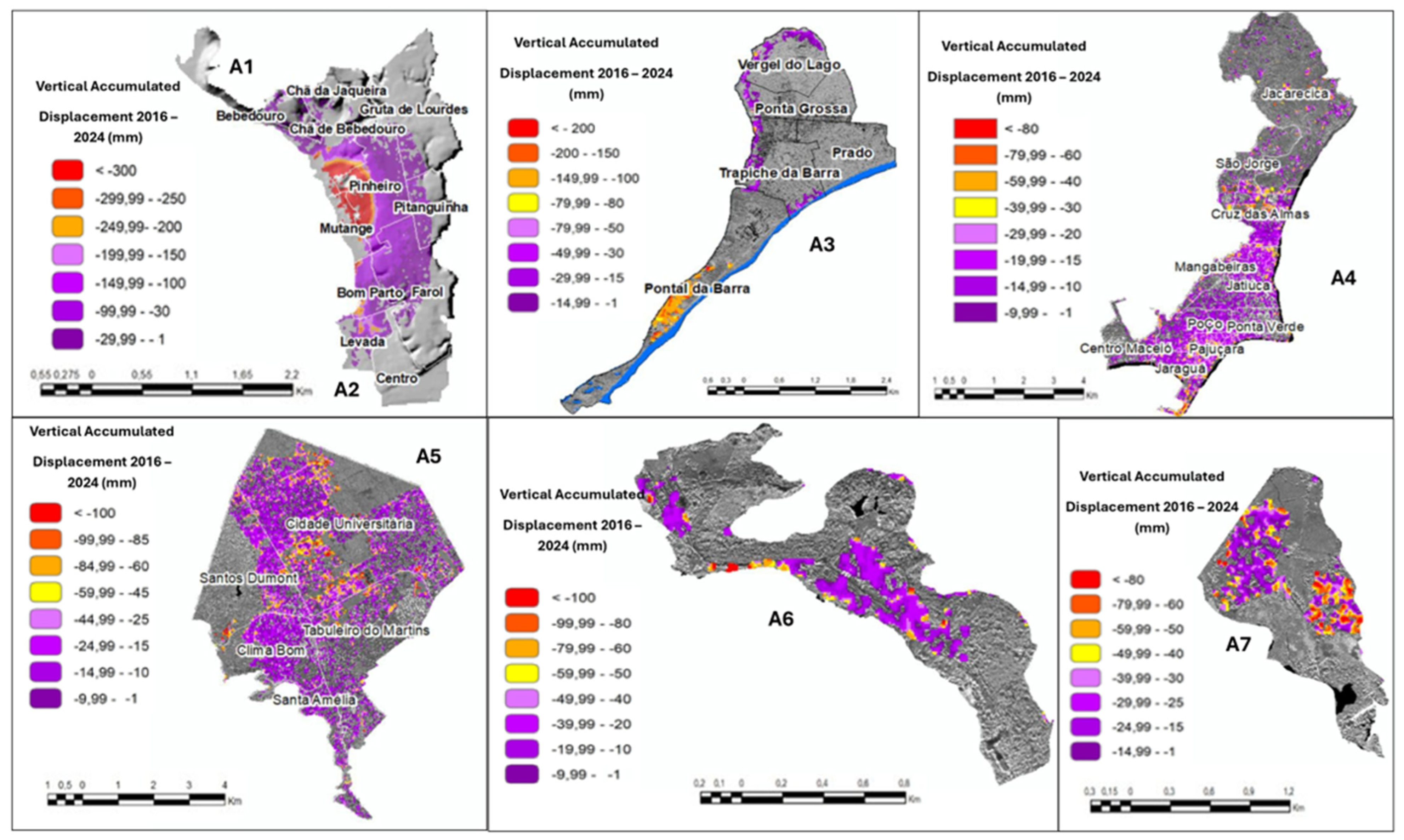
The results demonstrate that subsidence in Maceió exhibits a non-random spatial organization. The data reveals that a combination of morpho-structural framework, susceptible lithologies and soils, and anthropogenic forcing governs this process, resulting in coherent kinematic patterns. Subsidence is distributed across seven persistent macro-areas (Figure 24), where three plan-view regimes—bowls, elongated corridors, and diffuse mantles—overprint the coastal–lagoon framework and urban fabric, aligning with Holocene coastal–lagoon features and the Barreiras Group tableland.
Figure 24.
Vertical Accumulated Displacement (mm)—2016–2024—in Macro-areas (A1–A7).
The operational hierarchy S1 (structure type 1: diffuse matrix) > S5 (structure type 5: transition or deformation zone) > S10 (structure type 10: concave basin core) is consistently observed and aligns with established process physics. S10 is primarily located in basin cores that exhibit high gradients, where deeply concave nuclei (curvature κ > 0) and steep rims (high gradient magnitude ) are present. S5 marks structural transitions or directed deformation zones, whereas S1 dominates the diffuse mantles of young sediments and hydromorphic soils. This structural organization is characterized by three independent and convergent metrics: rim steepness (gradient magnitude |v|), concavity or convexity (curvature κ = ∇2v), and directional preference (anisotropy index AI, azimuth φ derived from the structure tensor). Four well-based measures—count, areal density, kernel density estimate (KDE), and proximity—complement these metrics by delineating continuous abstraction fields, KDE ridges, short median distances, influence halos, and sparse sectors. The interplay among these metrics elucidates specific relationships; for example, rim steepness and concavity jointly define the basin core, while directional preferences distinguish transition zones. Well-based measures enhance spatial resolution by quantifying the distribution and interaction of these metric-defined domains.
The Bebedouro, Mutange, Bom Parto, Pinheiro, Farol, Chã da Jaqueira, Pitanguinha, Chã de Bebedouro, and Gruta de Lourdes arc (A1) exhibits characteristics consistent with a mining-induced bowl. These features include a high rim, pronounced rim steepness, a core with positive curvature indicative of a concave or bowl-shaped floor, and low intra-basin anisotropy, which suggests uniform deformation within the bowl. This pattern indicates focused, steep-rimmed subsidence. The S10/S5 ratios, which describe specific deformation measurements, are predominant in the center of area, while S1 deformation, representing the direction of primary stretching, is oriented along the ellipse periphery. Sustained negative values further support the presence of a mining-induced subsidence trough, in agreement with technical records and previous studies [30,31,32,33,34,35], which attribute this phenomenon to halite (rock salt) mining and evaporite (water-soluble mineral) field instability.
In A1, the displacement pattern is also compatible with a mining-induced subsidence bowl, characterized by a relatively smooth central depression surrounded by a ring of high velocity gradients. On the continental side, this structure appears as a well-defined half-ellipse, approximately limited by the shoreline. In classical mining-subsidence settings, influence-function approaches and empirical observations commonly show approximately circular to elliptical basins with some degree of symmetry around the main deformation axis [106]. In light of this geometry and of the NE–SW orientation of the major axis, one cannot rule out the hypothesis that the complementary portion of the ellipse extends beneath the Mundaú Lagoon, where the lack of coherent scatterers and poor coherence over water prevents direct characterization of the deformation. This reading thus remains a plausible geometric interpretation, to be refined by future investigations using additional geodetic and geophysical datasets.
A2 (Levada) is situated on lagoonal Holocene clays that are susceptible to slow settlement; however, the observed deformation patterns are not readily explained by these clays alone. Anisotropy increases toward the A1 rim, and the principal axes ϕ (ENE–WSW to NE–SW) are oriented toward the A1 core, suggesting that A2 may act as a peripheral sub-trough within the same deformation ellipse. Stress variations and hydraulic changes associated with mining, such as regional gradients and head declines, are possible contributors that could deform the low-stiffness substrate (hydromorphic Gleysols and Holocene muds), thereby enhancing the geotechnical response. This elliptical structure, defined by a steep bowl and anisotropic lagoonal corridors, is consistent with mining-subsidence influence functions and with the elliptical sag described in subsidence troughs [106,107,108]. Similar lagoonal cities, including the Venice Lagoon and the Ravenna coastland, illustrate that Holocene estuarine and marine deposits can exhibit directional, anisotropic subsidence when anthropogenic activities, such as groundwater withdrawal and local loading, interact with compressible layers. These urban examples support the interpretation that A2’s response may be, at least in part, mechanically and hydraulically coupled to that of A1, rather than being fully explained by a shallow, clay-limited settlement process; nonetheless, a definitive causal attribution would require additional in situ data and geo-mechanical analyses beyond the scope of this study [109,110,111,112,113,114].
The maps indicate that S1 is the dominant feature, with isolated S5 areas that may correspond to diffuse lowering and reduced freeboard, possibly influenced by adjacent mining activities. In the absence of the administrative boundary, the displacement envelope can be described as a single ellipsoidal structure, with its major axis oriented in the NE–SW or NNE–SSW direction. The bowl completes the half-ellipse with its high-gradient ring, whereas the lagoonal segment extends along the same axis through anisotropic corridors. Rose diagrams and anisotropy vectors indicate co-axiality and geometric continuity across the boundary, supporting the hypothesis of persistent shape and orientation, even though this pattern is neither spatially uniform nor universally consistent.
A3 is situated along an extensive zone of mangrove trees and sand dunes (Pontal da Barra, Trapiche da Barra, Ponta Grossa, Vergel do Lago) and displays evidence of uneven ground subsidence. This subsidence is manifested by minor ground displacements, slight bending, shallow depressions, and flat surfaces. These characteristics, observed in low-lying regions near the estuary and within recently deposited wet, muddy soils, suggest ongoing settlement, particularly in areas with abundant organic material loading [115,116]. The ground typically undergoes further subsidence as it dries, when air infiltrates, or when additional load is applied. S1 represents the most prevalent type of ground shift, whereas S5 occurs only in isolated locations, supporting the conclusion that subsidence is diffuse and shallow in soft, thick soils loading [109]. In both A2 and A3, subsidence adjacent to the lagoon reduces land elevation relative to the water, increasing water ingress and diminishing protection for roads and embankments. This process elevates the risk of flooding during lagoon level rises, especially under conditions of high tide, strong winds, or intense rainfall. In A2, narrow channels direct floodwater and slow drainage, resulting in prolonged inundation. In A3, substantial subsidence over soft mud and organic material lowers the plain’s margins, permitting the lagoon to encroach further into urban areas. This process elevates the water table, facilitates saltwater intrusion, and delays post-flood recovery, thereby increasing the frequency of flooding even under typical weather conditions.
The coastal urban belt of A4 (Jaraguá, Poço, Pajuçara, Ponta da Terra, Ponta Verde, Jatiúca, Mangabeiras, Cruz das Almas, Jacarecica) exhibits a distinct pattern. This area is situated on coastal silts and clays and is characterized by dense urbanization. The predominant behavior is diffuse, although small, elongated corridors (stable ϕ) and local bowls are observed near clusters of buildings. Two independent lines of evidence elucidate the underlying mechanism. Well, KDE, and proximity maps reveal continuous ridges and short medians, which indicate drawdown cones consistent with pumping or construction dewatering [117,118]. Elevated values outside excavation areas indicate consolidation driven by drawdown associated with basements and garages, with the cone extending beyond the excavation pit [119,120]. This process results in S5/S10 pockets within a diffuse S1 background, shaped by the alongshore storm-drain network and NE–SW lineaments.
Urban loading in coastal zones, defined as the weight of buildings and infrastructure, is a recognized cause of ground settlement and subsidence. A densely developed waterfront increases effective stress on Holocene marine and estuarine silts and clays. This process reinforces alongshore anisotropy, which is aligned with the storm-drain network parallel to the shoreline and is consistent with the observed results [87,114,117]. Previous studies indicate that the settlement of Holocene sediments is influenced by both loading and fluctuations in groundwater levels. Consequently, this leads to the formation of shallow basins and directional corridors, in contrast to the steep, rimmed bowls typically associated with mining-induced subsidence [87,112,119,120,121,122,123].
Therefore, the A4 sector likely reflects the combined effects of urban loading and hydraulic forces, whether temporary or sustained. This interaction accounts for the presence of S5/S10 pockets within a diffuse S1 background. The orientations observed correspond to the storm-drain network parallel to the shoreline, while perpendicular cross-shore outfall conduits remain distinct. NE–SW lineaments delineate preferential drawdown, flow paths, and the structural orientation of coastal units. This pattern is consistent with national and international reports that identify groundwater pumping as the primary anthropogenic driver of urban subsidence, with additional impact from infrastructure weight in coastal cities [7,117,123,124,125]. To validate these analyses, SEMARH well registry data for this zone were examined. In total, 118 wells have paired static (water level at rest) and dynamic (during pumping) measurements. The median instantaneous drawdown, defined as the difference between static and dynamic levels, is s = N D − N E = 3.34 m (Q1 = 1.28; Q3 = 8.19). Of these, 26 wells (22%) exhibit s > 10 m (Supplementary File S1; Figure S1). Although these are single-time administrative readings and do not constitute time series data, they may indicate local cones of depression associated with active pumping or drainage. These findings support the hydraulic load-drawdown mechanism inferred for A4 and complement the geodetic signal.
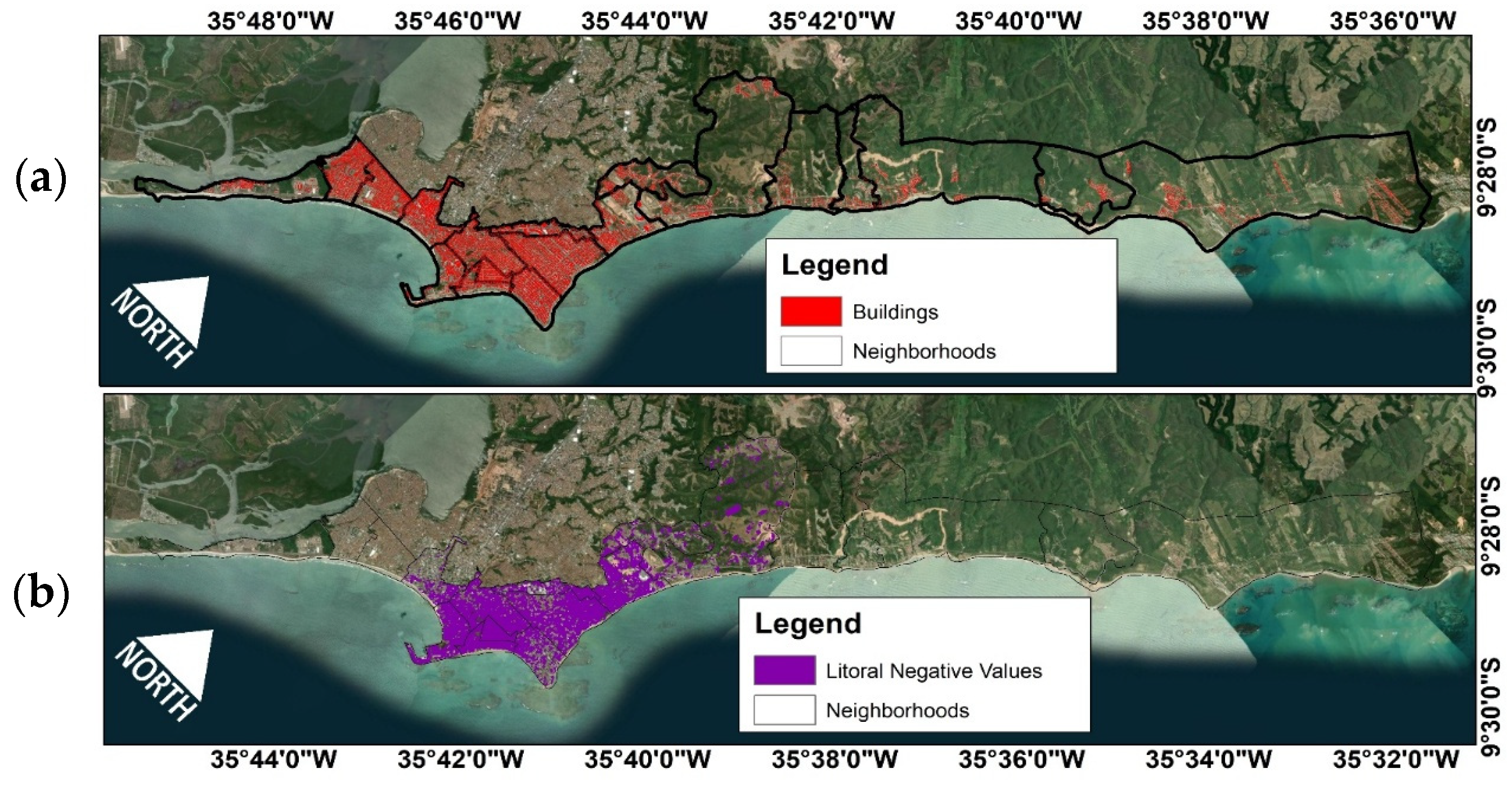
To determine whether subsidence in area A4 predominantly occurs beneath the built-up waterfront, the LOS velocity field was compared to a building footprint mesh. The coastline was divided into longitudinal strips (Figure 25), which revealed a distinct spatial contrast. The central corridor of tall buildings (A4) exhibits areas of negative LOS velocities, whereas the southern and particularly the northern waterfronts, which have few or no tall buildings, display no negative velocities and remain stable. This longitudinal variation, observed within the same lithofacies, supports the conclusion that urban loading, in conjunction with groundwater lowering, intensifies subsidence in the developed area. In contrast, adjacent undeveloped coastal areas demonstrate greater stability.
Figure 25.
Differential subsidence along the same shoreline (A4, Maceió). (a) Building footprints (red) within neighbourhood boundaries (black), showing a densely built central waterfront. (b) Littoral pixels with negative InSAR line-of-sight velocities (2016–2024) (purple). Negative velocities cluster beneath the built corridor, whereas the sparsely built northern and southern shorelines show no negative velocities. This alongshore contrast supports settlement focused on the urbanised waterfront.
Primary consolidation generally diminishes after construction as excess pore water is expelled. However, in A4, the InSAR record from 2016 to 2024 indicates persistent negative rates within the built corridor. This trend is not a simple reduction but is consistent with (i) ongoing building overburden, (ii) secondary compression or creep of Holocene sands and clays, and (iii) recurrent groundwater level declines, as demonstrated by well pairs (Supplementary File S1; Figure S1). The contrast between built and unbuilt coastlines (Figure 25) provides independent evidence that this subsidence is not merely a short-term effect resulting from construction but is sustained by both loading and hydraulic forcing.
Coastal subsidence directly contributes to relative sea-level rise (RSLR): sinking at 1–5 mm yr−1 adds roughly 3–15 cm of RSL over 30 years, thereby elevating coastal hazards. Historical records illustrate this compounding: in Venice, vertical land motion plus ocean rise produced about 31 cm of RSLR from 1872–2000, with an apparent trend of ≈2.5 mm yr−1 including subsidence versus ≈1.23 mm yr−1 after removing vertical land motion [126,127]. Even 1–10 cm of additional RSL can double the probability of exceeding flood thresholds [128]. U.S. tide-gauge data show that there have been 5–10 times more high-tide floods since the 1960s, as RSL has risen [129]. Here, we use shoreline retreat to mean landward migration of the shoreline and shoreline advance (progradation) to mean seaward migration.
In coastal plains such as Maceió, vertical compaction of Holocene silts and clays typically results in subsidence rates of approximately 4–5 mm yr−1 [112]. In rapidly subsiding megacities, such as Jakarta, rates exceeding 100 mm yr−1 enable subsidence to dominate local RSLR and contribute to chronic flooding [130,131]. Even a few millimeters of subsidence (mm yr−1), sustained over decades, can increase RSLR and wave run-up. When the sediment budget is insufficient, the shoreline is expected to retreat (landward migration); conversely, with a surplus, shoreline advance (progradation) may occur. In the studied sector, S5/S10 pockets within a diffuse S1 background indicate elevated RSL and an increased likelihood of overtopping and flooding, consistent with a trend toward shoreline retreat.
In macro-area A5 (Santa Amélia, Clima Bom, Tabuleiro dos Martins, Santos Dumont, Cidade Universitária), the observed patterns are distinctly anthropogenic. This peri-urban and agro-residential zone exhibits convergence across four well metrics: counts, areal density, kernel density estimation (KDE), and proximity. Sharp KDE ridges and elevated densities are present, while short proximities correspond to corridors characterized by stable ϕ values and high circular concentration. These features collectively form the S1–S5 corridors. In the silt–sand–clay soils of the Tabuleiros/Barreiras in Maceió, such patterns are indicative of pumping-induced settlement. The S1–S5 corridors demonstrate aquifer-system anisotropy and reflect the configuration of the capture system, as widely documented [7,14,121,123].
Independent water-level records support this interpretation. In A5, 166 wells provide paired static and dynamic level measurements (SEMARH). The median instantaneous drawdown is 3.34 m (P10 = 0.60; P90 = 18.73), with 36 wells (21.7%) exhibiting higher values. The median static head is 33.41 m, and the median dynamic head is 37.94 m, with typical operation durations of approximately 16 h per day (Supplementary File S1). Although these data represent snapshots rather than time series, they reveal local cones of depression and reduced pore-water pressures resulting from pumping. These observations correspond with the KDE ridges and short proximities that delineate the S1–S5 corridors.
Urban or industrial loading may locally increase the magnitude of the hydraulic gradient. However, the spatial extent and continuity of observed changes suggest that groundwater heads are the primary factor controlling these changes. This macro-area encompasses Maceió’s industrial district in Tabuleiro dos Martins and adjoins peri-urban agricultural areas on the upper plateau, which is a key hydrogeologic region. The Barreiras silt–sand–clay substrate in A5 is characterized by low natural fertility and variable permeability. These conditions promote directional drainage and uneven consolidation during pumping [132,133].
Groundwater is extensively utilized, with city reviews indicating that all neighborhoods are adequately served. Approximately half of Maceió’s water supply is sourced from groundwater, supported by over 100 municipal wells. Numerous private wells also supply buildings, residences, and businesses, corresponding to the dense well fields identified in A4 and A5 [134,135,136].
In Fernão Velho (A6), anomalies predominantly occur where hill slopes transition to valley floors across tableland colluvium. The magnitude of vertical motion is low yet persistent (S1). Structured patches and moderate are observed, with elongated features oriented parallel to both the slope and the stream. Only minor S5 pockets and traces of S10 are present in the lowest areas. The terrain characteristics and previous regional studies, which document creep [41], indicate shallow settling and gradual soil creep. There is no evidence of a significant settlement basin or pumping control, and no well fields are present within the analysis window. The velocity field is derived from a single descending LOS geometry, projected vertically. Minor horizontal compo-nents along slopes may be interpreted as subsidence. Nevertheless, the results indicate localized, small-scale subsidence in lower areas, attributable to local landforms and colluvial or Barreiras materials. Such phenomena are typical in weathered silty-clayey soils overlying the Barreiras Formation.
Vertical deformation rates remain persistent but low. Diffuse patches are aligned with the slope and thalweg, with a few more pronounced pockets. This spatial pattern is consistent with hillslope creep, which is governed by topography and material properties. In various settings, slow-landslide velocities have been shown to correlate with rainfall, as evidenced by MT-InSAR time series analyses in multiple environments [137,138,139,140]. However, the present dataset does not resolve seasonal subsidence cycles in this area. On hillslopes, horizontal movement along the slope may be misinterpreted as downward motion in LOS geometry, necessitating careful vertical interpretation in accordance with established InSAR guidelines [141].
Kinematic and morphological patterns are aligned with the slope and thalweg. Moderate values and persistent millimetric deformation are observed. These findings suggest that A6 is primarily influenced by creep and shallow, distributed lowering. Weak, localized subsidence is confined to small zones within valley bottoms. S1 is the dominant feature, with only sporadic occurrences of S5 and S10 pockets.
Rio Novo (A7) is situated within a low-lying landscape composed of marshes and wetlands, dissected by valleys and fluvial terraces, and bordered by the gentle slopes of the tablelands. In this context, the findings indicate a diffuse layer of weak subsidence (S1), interrupted by elongate lobes of S5 and occasional traces of S10. These features align with the valley axes, exhibiting stable ϕ from north–south to north-northeast–south-southwest, moderate , and limited concentrated foci. This pattern represents a shallow and distributed subsidence regime, which contrasts with the steep, mining-origin basins [106,107].
Pumping plays a secondary role in this context. The low number and density of wells, combined with the considerable median distance between wells, do not support the formation of drawdown cones that could account for the observed subsidence pattern, in contrast to areas A4–A5. In comparison, the Poção Formation is locally exposed at the surface and consists of alluvial fan ortho-conglomerates. This formation introduces geo-mechanical heterogeneity and permeability contrasts that channel drainage and contributes to the orientation of the S5 lobes along valleys and terraces. Nevertheless, it does not exert a dominant influence on the macro-area scale.
This pattern is consistent with the combined influence of two primary mechanisms. The first is the consolidation of fill materials placed for urban development over organic and hydromorphic substrates, such as Gleysols and Histosols, within the marsh and wetland zones. This process corresponds to the documented history of landfilling for urbanization in the area [142] and is related to the mechanics of primary and secondary settlement in organic soils [143,144,145]. These mechanisms result in the overloading of soft sediments, promoting sustained long-term settlement. The second mechanism involves very slow hillslope creep in colluvium on the tablelands, which is seasonally influenced by pore pressure variations resulting from rainfall or infiltration. This observation aligns with InSAR studies of slow landslides in tropical or seasonally affected environments [137,138,139].
This analysis is consistent with existing literature and the historical classification of the area as solifluction [41]. In humid tropical climates, more precise terminology includes creep, defined as the extremely slow, downslope movement of soil or debris, and very slow earthflow, which refers to the gradual movement of saturated soil. Both processes are associated with consolidation in the absence of a periglacial component [146,147]. Deformation in A7 is primarily driven by shallow processes, such as very slow creep on slopes and the consolidation of fills in marsh belts, in addition to weak, persistent subsidence (S1: gradual ground settlement) and localized S5 zones (localized subsidence). The Poção Formation influences the directionality of deformation but does not result in the formation of a deep, central subsidence basin.
At the municipal scale, Maceió demonstrates a multi-mechanistic subsidence pattern. A mining core (A1) structures the principal ellipse and extends into A2, forming a mechanically and hydraulically coupled anisotropic corridor. Additional corridors are present along the lagoonal margin (A2–A3) and the urbanized coastal belt (A4), where drawdown from pumping or dewatering and infrastructure loading are observed. Diffuse subsidence mantles result from the consolidation of Holocene and organic sediments (A3, A7) and shallow hillslope creep on tablelands and valleys (A6–A7). In the peri-urban and agro-residential sector (A5), aquifer abstraction is the predominant activity. This configuration can result in differential settlements, which may damage housing and infrastructure, including cracking, distortion, door or window binding, and utility failures. It also contributes to relative sea level rise and increases vulnerability to lagoonal flooding or coastal erosion at low elevations. Localized collapses may occur in filled ground over organic material, and shallow slides or creep can develop on slopes and valley floors, in addition to the historical occurrence of mining-area sinkholes (Figure 26).
Figure 26.
Primary and secondary damage caused by subsidence and soil movement.
6. Conclusions
The findings of this study demonstrate that ground subsidence in Maceió is a mul-tifaceted issue that extends beyond the impacts of rock-salt mining. The operational subsidence map, developed through the integration of radar remote sensing, targeted GIS mapping, and comprehensive ground displacement analysis from 2016 to 2024, reveals a consistent spatial pattern throughout the city. This methodology enabled the identification and characterization of seven major areas (A1–A7), each exhibiting dis-tinct morphologies and interconnections. Area A1, centrally located, is bowl-shaped and encircled by the elongated zone of A2. Additional elongated zones are present along the lagoon (A3/A2), while a broad, gradual subsidence area spans the coastal region (A3/A4). Narrow subsidence zones are observed near the city periphery (A4/A5), and shallow, discontinuous movement occurs on valley floors and hillsides (A6/A7). The integration of these technical analyses with data on soil composition and anthropogenic activities suggests that risk zones emerge from the interplay of weak substrates, topography, and human interventions, such as groundwater extraction or in-creased surface loading. Ground subsidence transcends administrative boundaries; its extent and intensity are determined by natural landforms, soil types, intensive water use, and urban expansion. The consequences are immediate and significant, including heightened coastal and lagoon hazards, increased flooding frequency, accelerated coastal erosion, and ground deformation that compromises urban infrastructure. Ad-dressing these challenges requires a transformation in urban management strategies. Public policy should encompass areas beyond mining sites, implement continuous monitoring rather than static boundaries, and promote interdepartmental coordination. The methodology presented in this study is transferable to other contexts, as it illustrates the value of integrating diverse analytical tools for evidence-based decision-making. Effective management of ground subsidence using this approach is essential for enhancing the resilience of Maceió and may benefit other coastal cities confronting similar challenges.
Supplementary Materials
The following supporting information can be downloaded at: https://www.mdpi.com/article/10.3390/rs17243974/s1, Figures S1–S6, Tables S1–S5 [1,4,5,6,7,8,9,12,13,30,64,67,69,148,149,150,151,152,153,154,155,156,157,158,159,160].
Author Contributions
Conceptualization, T.A.S.L. and S.J.C.S.; Data curation, T.A.S.L. and S.J.C.S.; Formal analysis, T.A.S.L. and M.S.V.; Funding acquisition, Z.X.; Investigation, T.A.S.L., M.S.V. and S.J.C.S.; Methodology, Z.X. and S.J.C.S.; Project administration, Z.X. and S.J.C.S.; Supervision, Z.X. and S.J.C.S.; Validation, T.A.S.L., M.S.V., Z.X. and S.J.C.S.; Visualization, T.A.S.L., M.S.V. and Z.X.; Writing—original draft, T.A.S.L., M.S.V., Z.X. and S.J.C.S.; Writing—review & editing, T.A.S.L., M.S.V., Z.X. and S.J.C.S. All authors have read and agreed to the published version of the manuscript.
Funding
This work was supported by the Natural Science Foundation of Jiangsu Province (Grants No BK20251497), and the Fundamental Research Funds for the Central Universities (Grant No B250201054).
Data Availability Statement
The raw data supporting the conclusions of this article will be made available by the authors upon reasonable request.
Acknowledgments
Thyago Anthony Soares Lima acknowledges a doctoral scholarship from the Coordination for the Improvement of Higher Education Personnel (CAPES, Brazil), Process No. 88887984816/2024-00 (CAPES–PDSE).
Conflicts of Interest
The authors declare no conflicts of interest. The funders had no role in the design of the study; in the collection, analyses, or interpretation of data; in the writing of the manuscript; or in the decision to publish the results.
Abbreviations
The following abbreviations are used in this manuscript:
| SAR | Synthetic Aperture Radar |
| InSAR | Interferometric Synthetic Aperture Radar |
| TS-InSAR | Time-Series Interferometric SAR |
| SBAS | Small Baseline Subset |
| PSI | Persistent Scatterer Interferometry |
| D-InSAR | Differential InSAR |
| LOS | Line of Sight |
| VLOS | Line-of-sight velocity |
| Vz | Vertical velocity (projected from LOS) |
| VV | Vertical–vertical polarization |
| IW/TOPS | Interferometric Wide swath/Terrain Observation with Progressive Scans |
| SLC | Single Look Complex |
| POE-ORB | Precise Orbit Ephemerides (precise orbit) |
| DEM | Digital Elevation Model |
| SRTM | Shuttle Radar Topography Mission |
| MCF | Minimum-Cost-Flow (phase unwrapping) |
| QA | Quality Assurance |
| UTM | Universal Transverse Mercator |
| SIRGAS 2000 | Geocentric Reference System for the Americas (2000) |
| ER | Enrichment Ratio |
| lnER | Natural-log Enrichment Ratio |
| KDE | Kernel Density Estimation |
| AI | Anisotropy Index (λ1/λ2) |
| OLS | Ordinary Least Squares |
| MK | Mann–Kendall (trend test) |
| IQR | Interquartile Range |
| R2 | Coefficient of determination |
| S1/S5/S10 | Operational subsidence classes (−5 < v ≤ −1; −10 < v ≤ −5; v ≤ −10 mm·yr−1) |
| CELMM | Mundaú–Manguaba Estuarine–Lagoon Complex |
| SiBCS | Brazilian Soil Classification System |
| ASF DAAC | Alaska Satellite Facility Distributed Active Archive Center |
| IBGE | Brazilian Institute of Geography and Statistics |
| SGB/CPRM | Geological Survey of Brazil |
| ANA | National Water and Sanitation Agency (Brazil) |
| CNARH | National Register of Water Resources Users |
| SEMARH/AL | Alagoas State Secretariat for Environment and Water Resources |
| EMBRAPA | Brazilian Agricultural Research Corporation |
| PMSB | Municipal Basic Sanitation Plan (Plano Municipal de Saneamento Básico) |
| RSLR | Relative Sea-Level Rise |
| GNSS | Global Navigation Satellite System |
| HMS | Highest-Magnitude Sample |
References
- Galloway, D.L.; Burbey, T.J. Review: Regional land subsidence accompanying groundwater extraction. Hydrogeol. J. 2011, 19, 1459–1486. [Google Scholar] [CrossRef]
- Kuniansky, E.L.; Weary, D.J.; Kaufmann, J.E. The current status of mapping karst areas and availability of public sinkhole-risk resources in karst terrains of the United States. Hydrogeol. J. 2016, 24, 613–624. [Google Scholar] [CrossRef]
- Hu, J.; Motagh, M.; Guo, J.; Haghshenas Haghighi, M.; Li, T.; Qin, F.; Wu, W. Inferring subsidence characteristics in Wuhan (China) through multitemporal InSAR and hydrogeological analysis. Eng. Geol. 2022, 297, 106530. [Google Scholar] [CrossRef]
- Su, G.; Wu, Y.; Zhan, W.; Zheng, Z.; Chang, L.; Wang, J. Spatiotemporal evolution characteristics of land subsidence caused by groundwater depletion in the North China Plain during the past six decades. J. Hydrol. 2021, 600, 126678. [Google Scholar] [CrossRef]
- Bagheri-Gavkosh, M.; Hosseini, S.M.; Ataie-Ashtiani, B.; Sohani, Y.; Ebrahimian, H.; Morovat, F.; Ashrafi, S. Land subsidence: A global challenge. Sci. Total Environ. 2021, 778, 146193. [Google Scholar] [CrossRef]
- Haghshenas Haghighi, M.; Motagh, M. Uncovering the impacts of depleting aquifers: A remote sensing analysis of land subsidence in Iran. Sci. Adv. 2024, 10, eadk3039. [Google Scholar] [CrossRef]
- Herrera-García, G.; Ezquerro, P.; Tomás, R.; Béjar-Pizarro, M.; López-Vinielles, J.; Rossi, M.; Ye, S. Mapping the global threat of land subsidence. Science 2021, 371, 34–36. [Google Scholar] [CrossRef]
- Tomás, R.; Romero, R.; Mulas, J.; Marturià, J.J.; Mallorquí, J.J.; Lopez-Sanchez, J.M.; Herrera, G.; Gutiérrez, F.; González, P.J.; Duque, S.; et al. Radar interferometry techniques for the study of ground subsidence phenomena: A review of practical issues through cases in Spain. Environ. Earth Sci. 2014, 71, 163–181. [Google Scholar] [CrossRef]
- Fergason, K.C.; Rucker, M.L.; Panda, B.B. Methods for monitoring land subsidence and earth fissures in the Western USA. Proc. Int. Assoc. Hydrol. Sci. 2015, 372, 361–366. [Google Scholar] [CrossRef]
- Massonnet, D.; Souyris, J.-C. Imaging with Synthetic Aperture Radar; EPFL Press: Lausanne, Switzerland; CRC Press: Boca Raton, FL, USA, 2008. [Google Scholar] [CrossRef]
- Hussain, M.A.; Chen, Z.; Zheng, Y.; Shoaib, M.; Ma, J.; Ahmad, I.; Asghar, A.; Khan, J. PS-InSAR based monitoring of land subsidence by groundwater extraction for Lahore Metropolitan City, Pakistan. Remote Sens. 2022, 14, 3950. [Google Scholar] [CrossRef]
- Ferretti, A.; Prati, C.; Rocca, F. Permanent scatterers in SAR interferometry. IEEE Trans. Geosci. Remote Sens. 2001, 39, 8–20. [Google Scholar] [CrossRef]
- Berardino, P.; Fornaro, G.; Lanari, R.; Sansosti, E. A new algorithm for surface deformation monitoring based on small baseline differential SAR interferograms. IEEE Trans. Geosci. Remote Sens. 2002, 40, 2375–2383. [Google Scholar] [CrossRef]
- Chaussard, E.; Wdowinski, S.; Cabral-Cano, E.; Amelung, F. Land subsidence in central Mexico detected by ALOS InSAR time-series. Remote Sens. Environ. 2014, 140, 94–106. [Google Scholar] [CrossRef]
- Chen, C.W.; Zebker, H.A. Two-dimensional phase unwrapping with use of statistical models for cost functions in nonlinear optimization. J. Opt. Soc. Am. A 2001, 18, 338–351. [Google Scholar] [CrossRef] [PubMed]
- Cabral-Cano, E.; Dixon, T.H.; Miralles-Wilhelm, F.; Díaz-Molina, O.; Sánchez-Zamora, O.; Carande, R.E. Space geodetic imaging of rapid ground subsidence in Mexico City. GSA Bull. 2008, 120, 1556–1566. [Google Scholar] [CrossRef]
- Chaussard, E.; Amelung, F.; Abidin, H.; Hong, S.-H. Sinking cities in Indonesia: ALOS PALSAR detects rapid subsidence due to groundwater and gas extraction. Remote Sens. Environ. 2013, 128, 150–161. [Google Scholar] [CrossRef]
- Aobpaet, A.; Cuenca, M.C.; Hooper, A.; Trisirisatayawong, I. InSAR time-series analysis of land subsidence in Bangkok, Thailand. Int. J. Remote Sens. 2013, 34, 2969–2982. [Google Scholar] [CrossRef]
- Lees, M.; Knight, R. Quantification of record-breaking subsidence in California’s San Joaquin Valley. Commun. Earth Environ. 2024, 5, 677. [Google Scholar] [CrossRef]
- Liu, G.; Luo, X.; Chen, Q.; Huang, D.; Ding, X. Detecting land subsidence in Shanghai by PS networking InSAR. Sensors 2008, 8, 4725–4741. [Google Scholar] [CrossRef]
- Damoah-Afari, P.; Ding, X.; Li, Z.; Lu, Z.; Omura, M. Six years of land subsidence in Shanghai revealed by JERS-1 SAR data. In Proceedings of the 2007 IEEE International Geoscience and Remote Sensing Symposium, Barcelona, Spain, 23–28 July 2007. [Google Scholar] [CrossRef]
- Neely, W.R.; Borsa, A.A.; Burney, J.A.; Levy, M.C.; Silverii, F.; Sneed, M. Characterization of groundwater recharge and flow in California’s San Joaquin Valley from InSAR. Water Resour. Res. 2021, 57, e2020WR028451. [Google Scholar] [CrossRef]
- Garg, S.; Motagh, M.; Indu, J.; Karanam, V. Tracking hidden crisis in India’s capital from space. Sci. Rep. 2022, 12, 22434. [Google Scholar] [CrossRef]
- Caló, F.; Notti, D.; Galve, J.P.; Abdikan, S.; Görüm, T.; Pepe, A.; Balik Şanli, F. Dinsar-Based detection of land subsidence and correlation with groundwater depletion in Konya Plain, Turkey. Remote Sens. 2017, 9, 83. [Google Scholar] [CrossRef]
- Motagh, M.; Shamshiri, R.; Haghshenas Haghighi, M.; Wetzel, H.-U.; Akbari, B.; Nahavandchi, H.; Roessner, S.; Arabi, S. Quantifying groundwater exploitation induced subsidence in the Rafsanjan plain, southeastern Iran, using InSAR time-series and in situ measurements. Eng. Geol. 2017, 218, 134–151. [Google Scholar] [CrossRef]
- Dong, L.; Zhang, Z.; Wang, C.; Tang, Y.; Fu, Q. Time Series InSAR three-dimensional displacement for coal-mining subsidence. Remote Sens. 2021, 13, 2143. [Google Scholar] [CrossRef]
- Ma, J.; Yang, J.; Zhu, Z.; Cao, H.; Li, S.; Du, X. Decision-making fusion of InSAR and offset-tracking in mining areas. Front. Earth Sci. 2022, 10, 962362. [Google Scholar] [CrossRef]
- Jiang, X.; Min, X.; Ye, T.; Li, X.; Hu, X. Monitoring the subsidence at different periods of a mining area using D-InSAR. Geocarto Int. 2023, 38, 2215730. [Google Scholar] [CrossRef]
- Lima, T.A.S.; Coelho Simões, S.J. MAPEAMENTO E ANÁLISE DAS SUBSIDÊNCIAS NO BRASIL. Geo UERJ 2025, 47, 1. [Google Scholar]
- Do Brasil, C.S.G.; C.P.R.M./S.G.B. Estudos Sobre a Instabilidade do Terreno nos Bairros Pinheiro, Mutange, Bebedouro, Maceió (AL): Volume I—Relatório Síntese dos Resultados (Nº 1.). 2019; 41p. Available online: https://rigeo.sgb.gov.br/jspui/handle/doc/21133 (accessed on 17 August 2025).
- Euillades, P.A.; Euillades, L.E.; Rosell, P.; Roa, Y.E. Subsidence in Maceió, Brazil, characterized by DInSAR and inverse modeling. In Proceedings of the 2020 IEEE Latin American GRSS & ISPRS Remote Sensing Conference (LAGIRS), Santiago, Chile, 22–26 March 2020; pp. 313–317. [Google Scholar] [CrossRef]
- Vassileva, M.; Al-Halbouni, D.; Motagh, M.; Walter, T.R.; Dahm, T.; Wetzel, H.U. A decade-long silent ground subsidence hazard culminating in a metropolitan disaster in Maceió, Brazil. Sci. Rep. 2021, 11, 7704. [Google Scholar] [CrossRef]
- Hartwig, M.E.; Gama, F.F.; da Silva, J.L.; Jofré, G.C.; Mura, J.C. The significance of geological structures on the subsidence phenomenon at the Maceió salt dissolution field (Brazil). Acta Geotech. 2023, 18, 5551–5573. [Google Scholar] [CrossRef]
- Mantovani, J.R.; Alcântara, E.; Lima, T.A.S.; Simões, S.J.C. An assessment of ground subsidence from rock salt mining in Maceió (2019–2023) using remotely sensed data. Environ. Chall. 2024, 16, 100983. [Google Scholar] [CrossRef]
- Teixeira, A.C.; Bakon, M.; Perissin, D.; Sousa, J.J. InSAR Analysis of Partially Coherent Targets in a Subsidence Deformation: A Case Study of Maceió. Remote Sens. 2024, 16, 3806. [Google Scholar] [CrossRef]
- de Holanda, E.P.T.; Badiru, A.I.; Nascimento, F.A.T.; de Araujo Braz, M.C.; Barroso, I.R.S. O Processo De Ocupação Do Solo De Maceió: Do Porto De Jaraguá Ao Plano Diretor. Cad. De Grad.—Ciências Exatas E Tecnológicas-UNIT-ALAGOAS 2016, 3, 11–28. Available online: https://periodicos.grupotiradentes.com/cdgexatas/article/view/3088 (accessed on 12 August 2025).
- Vasconcelos, D.A.L.; de Araujo, L.M.; Ramos, S.P. Turismo de sol y playa y territorio: El destino Maceió, Brasil. PASOS. Rev. Tur. Y Patrim. Cult. 2019, 17, 695–708. [Google Scholar] [CrossRef]
- Bezerra da Silva Cavalcante, I.; Fonseca da Silva, D.; Cavalcanti Borba Brandão, J.C. Análise da variabilidade espaço-temporal da precipitação em Maceió-AL e de suas causas climáticas. Pesqui. Geociências 2023, 49, e123971. [Google Scholar] [CrossRef]
- Gama, W.; Neto, J.V.F.N.; Zanella, M.E.Z. Suscetibilidade E Exposição A Inundações Fluviais Em Bacias Hidrpgráficas: O Caso Do Riacho Do Silva, Maceió, Alagoas. Sociedade E Território 2024, 35. [Google Scholar] [CrossRef]
- Santos, R.J.Q.; Lima, R.C.A.; Ferreira Neto, J.V. A geomorfologia do tabuleiro como consequência do neotectonismo. In Geografia: Espaço, Tempo e Planejamento; Araújo, L.M., Ed.; EDUFAL: Maceió, Brazil, 2004; pp. 255–268. [Google Scholar]
- Lima, I.F. Maceió, a Cidade Restinga: Contribuição ao Estudo Geomorfológico do Litoral Alagoano; EDUFAL: Maceió, Brazil, 1990. [Google Scholar]
- Angulo, R.J.; Lessa, G.C.; de Souza, M.C. A critical review of mid-to late-Holocene sea-level fluctuations on the eastern Brazilian coastline. Quat. Sci. Rev. 2006, 25, 486–506. [Google Scholar] [CrossRef]
- Rodrigues, B.T.; Calheiros, S.Q.C.; Melo, N.A. Potencial de movimento de massa no município de Maceió-Alagoas. Geo. UERJ 2013, 24, 207–227. [Google Scholar] [CrossRef]
- Santos, J.C.; Coutinho, R.Q.; Marques, J.A.F. Typical geotechnical profiles of the main soil deposits found in the Maceió city, Alagoas, from SPT boreholes. Soils Rocks 2022, 45, e2022000122. [Google Scholar] [CrossRef]
- Rossetti, D.F.; Góes, A.M. Marine influence in the Barreiras Formation, State of Alagoas, Northeastern Brazil. An. Acad. Bras. Ciências 2009, 81, 741–755. [Google Scholar] [CrossRef]
- Brito Neves, B.B.; Santos, E.J.; Van Schmus, W.R. Tectonic history of the Borborema Province. In Tectonic Evolution of South America. In Proceedings of the 31st International Geological Congress, Rio de Janeiro, Brazil, 6–17 August 2000; pp. 151–182. [Google Scholar]
- Mabesoone, J.M.; de Castro, C. Desenvolvimento geomorfológico do Nordeste brasileiro. Bol. Núcleo Nordeste Soc. Bras. Geol. 1975, 3, 5–37. [Google Scholar]
- Saldanha, L.A.R.; Cavalcante, A.T.; de Wanderley, P.R.M.; Rocha, F.C. Grupo Barreiras: Contribuição ao seu conhecimento no estado de Alagoas. In Anais do VII Simpósio de Geologia do Nordeste; Sociedade Brasileira de Geologia: Fortaleza, CE, Brazil, 1975; pp. 113–119. [Google Scholar]
- Schaller, H. Revisão estratigráfica da Bacia de Sergipe–Alagoas. Bol. Técnico Petrobras 1969, 12, 21–86. [Google Scholar]
- Figueiredo, A.M.F. Avaliação das Perspectivas Petrolíferas da Bacia Sergipe–Alagoas [Relatório Interno]; Petrobras: Rio de Janeiro, Brazil, 1978; 85p. [Google Scholar]
- Feijó, F.J. Bacias de Sergipe-Alagoas. Bol. Geociências Petrobrás 1994, 8, 149–161. [Google Scholar]
- Falkenheim, F.U.H. Projeto Sergipe–Alagoas [Relatório Interno]; Petrobras: Rio de Janeiro, Brazil, 1984; 53p. [Google Scholar]
- Marques, A.G.; Marques, J.A.F. Prática de fundações no Estado de Alagoas. In Geotecnia no Nordeste; Gusmão, A.D., Filho, J.G., Oliveira, J.T.R., Maia, G.B., Eds.; Editora Universitária da UFPE/ABMS—Núcleo Nordeste: Recife, Brazil, 2005; pp. 247–264. [Google Scholar]
- Cavalcanti, A.C. (Ed.) Diagnóstico Ambiental do Município de Maceió, AL: Levantamento Semidetalhado de solos, Potencial Agroecológico das Terras, Áreas de Risco Para Construção Civil e de Risco de Poluição, Uso Atual das Terras; Embrapa Solos: Recife, Brazil, 2005. [Google Scholar]
- Torres, R.; Snoeij, P.; Geudtner, D.; Bibby, D.; Davidson, M.; Attema, E.; Potin, P. GMES Sentinel-1 mission. Remote Sens. Environ. 2012, 120, 9–24. [Google Scholar] [CrossRef]
- Yagüe-Martínez, N.; Prats-Iraola, P.; Scheiber, R.; Marotti, L.; Wollstadt, S.; Reigber, A. Interferometric Processing of Sentinel-1 TOPS Data. IEEE Trans. Geosci. Remote Sens. 2016, 54, 2220–2234. [Google Scholar] [CrossRef]
- Farr, T.G.; Rosen, P.A.; Caro, E.; Crippen, R.; Duren, R.; Hensley, S.; Alsdorf, D. The Shuttle Radar Topography Mission. Rev. Geophys. 2007, 45, RG2004. [Google Scholar] [CrossRef]
- Goldstein, R.M.; Werner, C.L. SAR interferogram filtering for geophysical applications. Geophys. Res. Lett. 1998, 25, 4035–4038. [Google Scholar] [CrossRef]
- Lanari, R.; Casu, F.; Manzo, M.; Zeni, G.; Berardino, P.; Manunta, M.; Pepe, A. An overview of the Small BAseline Subset (SBAS) algorithm: A DInSAR technique for surface deformation analysis. Pure Appl. Geophys. 2007, 164, 637–661. [Google Scholar] [CrossRef]
- Luo, P.; Jin, X.; Nie, D.; Liu, Y.; Wei, Y. Deformation Monitoring Based on SBAS-InSAR and Leveling Measurement: A Case Study of the Jing-Mi Diversion Canal in China. Sensors 2024, 24, 3871. [Google Scholar] [CrossRef]
- Raspini, F.; Caleca, F.; Del Soldato, M.; Festa, D.; Confuorto, P.; Bianchini, S. Review of satellite radar interferometry for subsidence analysis. Earth-Sci. Rev. 2022, 235, 104239. [Google Scholar] [CrossRef]
- Jiang, J. Lohman Coherence-guided InSAR deformation analysis in the presence of ongoing land surface changes in the Imperial Valley, California. Remote Sens. Environ. 2021, 253, 112160. [Google Scholar] [CrossRef]
- Nikolakopoulos, K.G.; Kyriou, A.; Koukouvelas, I.K.; Tomaras, N.; Lyros, E. UAV, GNSS, and InSAR Data Analyses for Landslide Monitoring in a Mountainous Village in Western Greece. Remote Sens. 2023, 15, 2870. [Google Scholar] [CrossRef]
- Hanssen, R.F. Radar Interferometry: Data Interpretation and Error Analysis; Springer: Berlin/Heidelberg, Germany, 2001. [Google Scholar] [CrossRef]
- Wright, T.J.; Parsons, B.E.; Lu, Z. Toward mapping surface deformation in three dimensions using InSAR. Geophys. Res. Lett. 2004, 31, L01607. [Google Scholar] [CrossRef]
- Ku, H.H. Notes on the use of propagation of error formulas. J. Res. Natl. Bur. Stand. Sect. C Eng. Instrum. 1966, 70, 263–273. [Google Scholar] [CrossRef]
- Crosetto, M.; Monserrat, O.; Cuevas-González, M.; Devanthéry, N.; Crippa, B. Persistent Scatterer Interferometry: A review. ISPRS J. Photogramm. Remote Sens. 2016, 115, 78–89. [Google Scholar] [CrossRef]
- Ferretti, A.; Savio, G.; Barzaghi, R.; Borghi, A.; Musazzi, S.; Novali, F.; Rocca, F. Submillimeter Accuracy of InSAR Time Series: Experimental Validation. IEEE Trans. Geosci. Remote Sens. 2007, 45, 1142–1153. [Google Scholar] [CrossRef]
- Hooper, A.; Bekaert, D.; Spaans, K.; Arıkan, M. Recent advances in SAR interferometry time series analysis for measuring crustal deformation. Tectonophysics 2012, 514–517, 1–13. [Google Scholar] [CrossRef]
- Milillo, P.; Fielding, E.J.; Schulz, W.H.; Delbridge, B.; Bürgmann, R. COSMO-SkyMed Spotlight Interferometry Over Rural Areas: The Slumgullion Landslide in Colorado, USA. IEEE J. Sel. Top. Appl. Earth Obs. Remote Sens. 2014, 7, 2919–2926. [Google Scholar] [CrossRef]
- Helsel, D.R.; Hirsch, R.M.; Ryberg, K.R.; Archfield, S.A.; Gilroy, E.J. Statistical Methods in Water Resources (USGS Techniques and Methods, Book 4, Chap. A3, v2.1); U.S. Geological Survey: Reston, VA, USA, 2020. [CrossRef]
- Sen, P.K. Estimates of the Regression Coefficient Based on Kendall’s Tau. J. Am. Stat. Assoc. 1968, 63, 1379–1389. [Google Scholar] [CrossRef]
- Havazli, E.; Wdowinski, S. Detection threshold estimates for InSAR time series: A simulation of tropospheric delay approach. Sensors 2021, 21, 1124. [Google Scholar] [CrossRef]
- Bloomfield, P. Fourier Analysis of Time Series: An Introduction, 2nd ed.; Wiley: Hoboken, NJ, USA, 2000. [Google Scholar] [CrossRef]
- Hamed, K.H.; Rao, A.R. A modified Mann–Kendall trend test for autocorrelated data. J. Hydrol. 1998, 204, 182–196. [Google Scholar] [CrossRef]
- Pyper, B.J.; Peterman, R.M. Comparison of methods to account for autocorrelation in correlation analyses of fish data. Can. J. Fish. Aquat. Sci. 1998, 55, 2127–2140. [Google Scholar] [CrossRef]
- Yue, S.; Wang, C.Y. The Mann–Kendall test modified by effective sample size to detect trend in serially correlated hydrological series. Water Resour. Manag. 2004, 18, 201–218. [Google Scholar] [CrossRef]
- Mann, H.B. Nonparametric Tests Against Trend. Econometrica 1945, 13, 245–259. [Google Scholar] [CrossRef]
- Kendall, M.G. Rank Correlation Methods, 4th ed.; Griffin: London, UK, 1975; ISBN 0852641990. [Google Scholar]
- Soille, P. Morphological Image Analysis: Principles and Applications, 2nd ed.; Springer: Berlin/Heidelberg, Germany, 2004. [Google Scholar] [CrossRef]
- Serra, J. Image Analysis and Mathematical Morphology; Academic Press: Cambridge, MA, USA, 1982; ISBN 0126372403. [Google Scholar]
- Longley, P.A.; Goodchild, M.F.; Maguire, D.J.; Rhind, D.W. Geographic Information Science and Systems, 4th ed.; Wiley: Hoboken, NJ, USA, 2015; ISBN 978-1118676950. [Google Scholar]
- Wood, J. The Geomorphological Characterisation of Digital Elevation Models. Ph.D. Thesis, University of Leicester, Leicester, UK, 1996. [Google Scholar]
- Weickert, J. Anisotropic Diffusion in Image Processing; B. G. Teubner: Stuttgart, Germany, 1998; ISBN 3519026066. [Google Scholar]
- Herrera, G.; Tomás, R.; Monells, D.; Centolanza, G.; Mallorquí, J.J.; Vicente, F.; Mulas, J. Analysis of subsidence using TerraSAR-X data: Murcia case study. Eng. Geol. 2010, 116, 284–295. [Google Scholar] [CrossRef]
- Burbey, T.J. The influence of faults in basin-fill deposits on land subsidence, Las Vegas Valley, Nevada, USA. Hydrogeol. J. 2002, 10, 525–538. [Google Scholar] [CrossRef]
- Tosi, L.; Da Lio, C.; Teatini, P.; Strozzi, T. Land subsidence in coastal environments: Knowledge advance in the Venice coastland by TerraSAR-X PSI. Remote Sens. 2018, 10, 1191. [Google Scholar] [CrossRef]
- Gonzalez, R.C.; Woods, R.E. Digital Image Processing, 3rd ed.; Pearson/Prentice Hall: Upper Saddle River, NJ, USA, 2008; ISBN 978-0135052679. [Google Scholar]
- Fernández-Torres, E.; Cabral-Cano, E.; Solano-Rojas, D.; Havazli, E.; Salazar-Tlaczani, L. Land subsidence risk maps and InSAR-based angular distortion structural vulnerability assessment: An example in Mexico City. Proc. IAHS 2020, 382, 583–587. [Google Scholar] [CrossRef]
- Cigna, F.; Tapete, D. Satellite InSAR survey of structurally-controlled land subsidence due to groundwater exploitation in the Aguascalientes Valley, Mexico. Remote Sens. Environ. 2021, 254, 112254. [Google Scholar] [CrossRef]
- Ding, P.; Jia, C.; Di, S.; Wu, J.; Wei, R. Analysis and evaluation of land subsidence along linear engineering based on InSAR data. KSCE J. Civ. Eng. 2021, 25, 3477–3491. [Google Scholar] [CrossRef]
- Li, Y.; Yang, K.; Zhang, J.; Hou, Z.; Wang, S.; Ding, X. Research on time series InSAR monitoring method for multiple types of surface deformation in mining area. Nat. Hazards 2022, 114, 2479–2508. [Google Scholar] [CrossRef]
- Koenderink, J.J.; van Doorn, A.J. Surface shape and curvature scales. Image Vis. Comput. 1992, 10, 557–564. [Google Scholar] [CrossRef]
- Mardia, K.V.; Jupp, P.E. Directional Statistics; John Wiley & Sons: Chichester, UK, 2000. [Google Scholar] [CrossRef]
- Del Ventisette, C.; Ciampalini, A.; Manunta, M.; Calò, F.; Paglia, L.; Ardizzone, F.; Mondini, A.C.; Reichenbach, P.; Mateos, R.M.; Bianchini, S.; et al. Exploitation of large archives of ERS and ENVISAT C-band SAR data to characterize ground deformations. Remote Sens. 2013, 5, 3896–3917. [Google Scholar] [CrossRef]
- Dantas, M.E.; Mello, L.B.; Goes, H.; Lima, V.R.A.; Gama, W.M. Carta Geomorfológica: Município de Maceió, AL (escala 1:60.000); Serviço Geológico do Brasil—CPRM: Rio de Janeiro, Brazil, 2004.
- Mendes, V.A.; Lima, M.A.B.; Moraes, D.M.F.; de Fátima Lyra Brito, M. Geologia e recursos minerais do estado de Alagoas: Escala 1:250.000; CPRM: Rio de Janeiro, Brazil, 2017; ISBN 978-85-7499-304-1. [Google Scholar]
- Manly, B.F.J.; McDonald, L.; Thomas, D.; McDonald, T.L.; Erickson, W.P. Resource Selection by Animals: Statistical Design and Analysis for Field Studies, 2nd ed.; Kluwer Academic Publishers: Dordrecht, The Netherlands, 2002. [Google Scholar] [CrossRef]
- Miller, R.E.; Blair, P.D. Input–Output Analysis: Foundations and Extensions, 2nd ed.; Cambridge University Press: Cambridge, UK, 2009. [Google Scholar] [CrossRef]
- O’Sullivan, D.; Unwin, D. Geographic Information Analysis, 2nd ed.; Wiley: Hoboken, NJ, USA, 2010. [Google Scholar] [CrossRef]
- Baddeley, A.; Rubak, E.; Turner, R. Spatial Point Patterns: Methodology and Applications with R; Chapman & Hall/CRC: Boca Raton, FL, USA, 2015; ISBN 1482210215/9781482210217. [Google Scholar]
- Bivand, R.S.; Pebesma, E.; Gómez-Rubio, V. Applied Spatial Data Analysis with R, 2nd ed.; Springer: Berlin/Heidelberg, Germany, 2013; ISBN 978-1-4614-7617-7. [Google Scholar]
- Silverman, B.W. Density Estimation for Statistics and Data Analysis; Routledge: Oxfordshire, UK, 2018. [Google Scholar] [CrossRef]
- Wand, M.P.; Jones, M.C. Kernel Smoothing; Chapman & Hall/CRC: Boca Raton, FL, USA, 1994; ISBN 04125527001. [Google Scholar]
- Sun, H.; Peng, H.; Zeng, M.; Wang, S.; Pan, Y.; Pi, P.; Xue, Z.; Zhao, X.; Zhang, A.; Liu, F. Land subsidence in a coastal city based on SBAS-InSAR monitoring: A case study of Zhuhai, China. Remote Sens. 2023, 15, 2424. [Google Scholar] [CrossRef]
- Whittaker, B.N.; Reddish, D.J. Subsidence: Occurrence, Prediction and Control; Elsevier: Amsterdam, The Netherlands, 1989; ISBN 978-0-444-56533-4. [Google Scholar]
- Kratzsch, H. Mining Subsidence Engineering; Springer: Berlin/Heidelberg, Germany, 1983. [Google Scholar] [CrossRef]
- Malinowska, A.; Hejmanowski, R.; Dai, H.Y. Ground movements modeling applying adjusted influence function. Int. J. Min. Sci. Technol. 2020, 30, 243–249. [Google Scholar] [CrossRef]
- Tosi, L.; Teatini, P.; Strozzi, T. Natural versus anthropogenic subsidence of Venice. Sci. Rep. 2013, 3, 2710. [Google Scholar] [CrossRef]
- Bock, Y.; Wdowinski, S.; Ferretti, A.; Novali, F.; Fumagalli, A. Recent subsidence of the Venice Lagoon from continuous GPS and interferometric synthetic aperture radar. Geochem. Geophys. Geosyst. 2012, 13, Q03023. [Google Scholar] [CrossRef]
- Carbognin, L.; Teatini, P.; Tosi, L. Eustacy and land subsidence in the Venice Lagoon at the beginning of the new millennium. J. Mar. Syst. 2004, 51, 345–353. [Google Scholar] [CrossRef]
- Teatini, P.; Tosi, L.; Strozzi, T. Quantitative evidence that compaction of Holocene sediments drives the present land subsidence of the Po Delta, Italy. J. Geophys. Res. Solid Earth 2011, 116, B08407. [Google Scholar] [CrossRef]
- Teatini, P.; Ferronato, M.; Gambolati, G.; Gonella, M. Groundwater pumping and land subsidence in the Emilia-Romagna coastland, Italy: Modeling the past occurrence and the future trend. Water Resour. Res. 2006, 42, W01406. [Google Scholar] [CrossRef]
- Antonellini, M.; Giambastiani, B.M.S.; Greggio, N.; Bonzi, L.; Calabrese, L.; Luciani, P.; Perini, L.; Severi, P. Processes governing natural land subsidence in the shallow coastal aquifer of the Ravenna coast, Italy. Catena 2019, 172, 76–86. [Google Scholar] [CrossRef]
- Woodroffe, C.D.; Rogers, K.; McKee, K.L.; Lovelock, C.E.; Mendelssohn, I.A.; Saintilan, N. Mangrove Sedimentation and Response to Relative Sea-Level Rise. Annu. Rev. Mar. Sci. 2016, 8, 243–266. [Google Scholar] [CrossRef] [PubMed]
- Callaway, J.C.; Cahoon, D.R.; Lynch, J.C. The surface elevation table–marker horizon method for measuring wetland accretion and elevation dynamics. Methods Biogeochem. Wetl. 2013, 10, 901–917. [Google Scholar]
- Galloway, D.L.; Jones, D.R.; Ingebritsen, S.E. (Eds.) Land subsidence in the United States (USGS Circular 1182); U.S. Geological Survey: Reston, VA, USA, 1999. [CrossRef]
- USGS. Cone of depression: Pumping a Well Can Cause Water Level Lowering. Water Science School. 24 July 2018. Available online: https://www.usgs.gov/media/images/cone-depression-pumping-a-well-can-cause-water-level-lowering (accessed on 10 June 2025).
- Wu, Y.-X.; Zhao, M.; Zhou, J.; Zheng, G. Numerical evaluation of the ground response induced by dewatering. Geosci. Front. 2021, 12, 101209. [Google Scholar] [CrossRef]
- Zeng, C.-F.; Song, W.-W.; Xue, X.-L.; Li, M.-K.; Bai, N.; Mei, G.-X. Construction dewatering in a metro station incorporating buttress retaining wall to limit ground settlement: Insights from experimental modelling. Tunn. Undergr. Space Technol. 2021, 116, 104124. [Google Scholar] [CrossRef]
- Wang, H.; Wright, T.J.; Yu, Y.; Lin, H.; Jiang, L.; Li, C.; Qiu, G. InSAR reveals coastal subsidence in the Pearl River Delta, China. Geophys. J. Int. 2012, 191, 1119–1128. [Google Scholar] [CrossRef]
- Zhou, N.; Vermeer, P.A.; Lou, R.; Tang, Y.; Jiang, S. Numerical simulation of deep foundation pit dewatering and optimization of controlling land subsidence. Eng. Geol. 2010, 114, 251–260. [Google Scholar] [CrossRef]
- Hasan, M.F.; Smith, R.; Vajedian, S.; Pommerenke, R.; Majumdar, S. Global land subsidence mapping reveals widespread loss of aquifer storage capacity. Nat. Commun. 2023, 14, 6180. [Google Scholar] [CrossRef]
- Ohenhen, L.O.; Zhai, G.; Lucy, J.; Werth, S.; Carlson, G.; Khorrami, M.; Shirzaei, M. Land subsidence risk to infrastructure in US metropolises. Nat. Cities 2025, 2, 543–554. [Google Scholar] [CrossRef]
- Parsons, T.; Brink, U. The weight of New York City: Possible contributions to subsidence and relative sea-level rise. Earth’s Future 2023, 11, e2022EF003465. [Google Scholar] [CrossRef]
- Zanchettin, D.; Bruni, S.; Raicich, F.; Lionello, P.; Zerbini, S. Sea-level rise in Venice: Historic and future trends. Nat. Hazards Earth Syst. Sci. 2021, 21, 2643–2678. [Google Scholar] [CrossRef]
- Ferrarin, C.; Lionello, P.; Orlić, M.; Raicich, F.; Salvadori, G. Venice as a paradigm of coastal flooding under multiple compound drivers. Sci. Rep. 2022, 12, 5754. [Google Scholar] [CrossRef] [PubMed]
- Taherkhani, M.; Vitousek, S.; Barnard, P.L.; Frazer, N.; Anderson, T.R.; Fletcher, C.H. Sea-level rise exponentially increases coastal flood frequency. Sci. Rep. 2020, 10, 6466. [Google Scholar] [CrossRef] [PubMed]
- NOAA Office for Coastal Management. Sea Level Rise Viewer. NOAA Digital Coast. 2025. Available online: https://coast.noaa.gov/slr/ (accessed on 24 September 2025).
- Harintaka, H.; Suhadha, A.G.; Syetiawan, A.; Ardha, M.; Rarasati, A. Current land subsidence in Jakarta: A multi-track SBAS InSAR analysis during 2017–2022 using C-band SAR data. Geocarto Int. 2024, 39, 2364726. [Google Scholar] [CrossRef]
- Bott, L.-M.; Schöne, T.; Illigner, J.; Haghshenas Haghighi, M.; Gisevius, K.; Braun, B. Land subsidence in Jakarta and Semarang Bay—The relationship between physical processes, risk perception, and household adaptation. Ocean Coast. Manag. 2021, 211, 105775. [Google Scholar] [CrossRef]
- Agra, S.; Silva , O., Jr. Caracterização da problemática das cheias na bacia do Tabuleiro dos Martins–Maceió/AL. Simpósio Bras. Recur. Hídricos 1999, 13, 1999. [Google Scholar]
- Ferreira Neto, J.V.; dos Santos, R.J.Q.; Wanderley, P.R.B.; de Mendonça Wanderley, P.R.; Cavalcante, A.T. Vulnerabilidade Natural Das Águas Subterrâneas Em Área Do Tabuleiro Do Martins—Maceió—Alagoas—Br. Águas Subterrâneas. 2000. Available online: https://aguassubterraneas.abas.org/asubterraneas/article/view/23921 (accessed on 1 June 2025).
- Bueno Da Fonseca Cardoso, F.; De Oliveira, F.R.; Gonçalves, M.; Soares Do Nascimento, F. Disponibilidade Hídrica Subterrânea Na Região Metropolitana De Maceió-Al. Águas Subterrâneas. 2012. Available online: https://aguassubterraneas.emnuvens.com.br/asubterraneas/article/view/27717 (accessed on 7 July 2025).
- BRK Ambiental. BRK Ambiental Avança com ação de Melhoria nos Poços de Produção de água em Maceió. Available online: https://www.brkambiental.com.br/brk-ambiental-avanca-com-acao-de-melhoria-nos-pocos-de-producao-de-agua-em-maceio (accessed on 28 September 2025).
- MUNICIPAL GOVERNMENT OF MACEIÓ/AL. Plano de Saneamento Básico do Município de Maceió/AL. Fase II—Elaboração do Plano de Saneamento Básico. In Etapa 2—Diagnóstico da Situação do Saneamento Básico e de seus Impactos nas Condições de Vida da População; Produto 2.2—Situação Institucional; Prefeitura Municipal de Maceió: Maceió, Brazil, 2016. Available online: https://www.sedet.maceio.al.gov.br/servicos/pdf/pmsb/fase2/etapa2/2_2.pdf (accessed on 12 October 2025).
- Handwerger, A.L.; Huang, M.H.; Fielding, E.J.; Booth, A.M.; Bürgmann, R. A shift from drought to extreme rainfall drives a stable landslide to catastrophic failure. Sci. Rep. 2019, 9, 1569. [Google Scholar] [CrossRef]
- Kang, Y.; Lu, Z.; Zhao, C.; Xu, Y.; Kim, J.W.; Gallegos, A.J. InSAR monitoring of creeping landslides in mountainous regions: A case study in Eldorado National Forest, California. Remote Sens. Environ. 2021, 258, 112400. [Google Scholar] [CrossRef]
- Dille, A.; Kervyn, F.; Handwerger, A.L.; d’Oreye, N.; Derauw, D.; Bibentyo, T.M.; Dewitte, O. When image correlation is needed: Unravelling the complex dynamics of a slow-moving landslide in the tropics with dense radar and optical time series. Remote Sens. Environ. 2021, 258, 112402. [Google Scholar] [CrossRef]
- Cook, M.E.; Brook, M.S.; Hamling, I.J.; Cave, M.; Tunnicliffe, J.F.; Holley, R. Investigating slow-moving shallow soil landslides using Sentinel-1 InSAR data in Gisborne, New Zealand. Landslides 2023, 20, 427–446. [Google Scholar] [CrossRef]
- ESA (European Space Agency). InSAR Principles: Guidelines for SAR Interferometry Processing and Interpretation (TM-19); ESA Training Manual; ESA Publications: Noordwijk, The Netherlands, 2007. [Google Scholar]
- Verde, M.B.L. Conflitos Socioambientais: Estudo de Caso da APA do Catolé e Fernão Velho, Maceió-AL. Master’s Thesis, Universidade Federal de Alagoas, Faculdade de Arquitetura e Urbanismo, Maceió, Brazil, 2010. [Google Scholar]
- Mesri, G.; Ajlouni, M. Engineering properties of fibrous peats. J. Geotech. Geoenviron. Eng. 2007, 133, 850–866. [Google Scholar] [CrossRef]
- Hayashi, H.; Nishimoto, S.; Yamanashi, T. Applicability of settlement prediction method to peaty ground. Soils Found. 2016, 56, 144–151. [Google Scholar] [CrossRef]
- van Asselen, S.; Erkens, G.; Stouthamer, E.; Woolderink, H.A.; Geeraert, R.E.; Hefting, M.M. The relative contribution of peat compaction and oxidation to subsidence in built-up areas in the Rhine-Meuse delta, The Netherlands. Sci. Total Environ. 2018, 636, 177–191. [Google Scholar] [CrossRef] [PubMed]
- Matsuoka, N. Solifluction rates, processes and landforms: A global review. Earth-Sci. Rev. 2001, 55, 107–134. [Google Scholar] [CrossRef]
- French, H.M. The Periglacial Environment, 3rd ed.; Discusses Solifluction as a Periglacial Process; Wiley: Hoboken, NJ, USA, 2007; ISBN 978-0-470-86588-0. [Google Scholar]
- Freeze, R.A.; Cherry, J.A. Groundwater; Prentice-Hall: Englewood Cliffs, NJ, USA, 1979; Volume 7632, p. 604. [Google Scholar]
- Fetter, C.W. Applied Hydrogeology, 4th ed.; Prentice Hall: Upper Saddle River, NJ, USA, 2001. [Google Scholar]
- Kruseman, G.P.; De Ridder, N.A.; Verweij, J.M. Analysis and Evaluation of Pumping Test Data, 2nd ed.; Publication 47; International Institute for Land Reclamation and Improvement (ILRI): Wageningen, The Netherlands, 1990; Available online: https://edepot.wur.nl/70972 (accessed on 7 September 2025).
- Hoaglin, D.C.; Mosteller, F.; Tukey, J.W. Understanding Robust and Exploratory Data Analysis; John Wiley & Sons: New York, NY, USA, 1983. [Google Scholar]
- Theis, C.V. The relation between the lowering of the piezometric surface and the rate and duration of discharge of a well using ground-water storage. Eos Trans. Am. Geophys. Union 1935, 16, 519–524. [Google Scholar] [CrossRef]
- Cooper, H.H., Jr.; Jacob, C.E. A generalized graphical method for evaluating formation constants and summarizing well-field history. Eos Trans. Am. Geophys. Union 1946, 27, 526–534. [Google Scholar] [CrossRef]
- Driscoll, F.G. Groundwater and Wells, 3rd ed.; Johnson Screens: New Brighton, MN, USA, 2005. [Google Scholar]
- Anderson, M.P.; Woessner, W.W.; Hunt, R.J. Applied Groundwater Modeling: Simulation of Flow and Advective Transport, 2nd ed.; Academic Press/Elsevier: Amsterdam, The Netherlands, 2015. [Google Scholar]
- Altman, D.G.; Bland, J.M. Statistical methods for assessing agreement between two methods of clinical measurement. Lancet 1986, 327, 307–310. [Google Scholar] [CrossRef]
- Linnet, K. Evaluation of regression procedures for methods comparison studies. Clin. Chem. 1993, 39, 424–432. [Google Scholar] [CrossRef]
- Everingham, M.; Van Gool, L.; Williams, C.K.I.; Winn, J.; Zisserman, A. The Pascal visual object classes (VOC) challenge. Int. J. Comput. Vision 2010, 88, 303–338. [Google Scholar] [CrossRef]
- Saito, T.; Rehmsmeier, M. The precision–recall plot is more informative than the ROC plot when evaluating binary classifiers on imbalanced datasets. PLoS ONE 2015, 10, e0118432. [Google Scholar] [CrossRef]
- Pepe, A.; Calò, F. A Review of Interferometric Synthetic Aperture RADAR (InSAR) Multi-Track Approaches for the Retrieval of Earth’s Surface Displacements. Appl. Sci. 2017, 7, 1264. [Google Scholar] [CrossRef]
Disclaimer/Publisher’s Note: The statements, opinions and data contained in all publications are solely those of the individual author(s) and contributor(s) and not of MDPI and/or the editor(s). MDPI and/or the editor(s) disclaim responsibility for any injury to people or property resulting from any ideas, methods, instructions or products referred to in the content. |
© 2025 by the authors. Licensee MDPI, Basel, Switzerland. This article is an open access article distributed under the terms and conditions of the Creative Commons Attribution (CC BY) license (https://creativecommons.org/licenses/by/4.0/).