Article

Assessing Surface Water Dynamics of Wetlands in Reclaimed Mining Areas in the Athabasca Oil Sands Region, Alberta, Canada, with Time-Varying Sentinel-1 SAR and Sentinel-2 Multi-Spectral Imagery

by
Erik Biederstadt
1,
Faramarz F. Samavati
1,
Hannah Porter
2,
Elizabeth Gillis
2 and
Jan J. H. Ciborowski
2,*
1
Department of Computer Science, University of Calgary, Calgary, AB T2N 1N4, Canada
2
Department of Biological Sciences, University of Calgary, Calgary, AB T2N 1N4, Canada
*
Author to whom correspondence should be addressed.
Remote Sens. 2025, 17(23), 3927; https://doi.org/10.3390/rs17233927
Submission received: 8 September 2025 / Revised: 9 November 2025 / Accepted: 20 November 2025 / Published: 4 December 2025
(This article belongs to the Section Ecological Remote Sensing)

Highlights

What are the main findings?
  • Satellite-based imaging estimates of wetland surface water extent derived from Sentinel-1 and Sentinel-2 multispectral data closely matched estimates derived from high-resolution UAV data ( R 2 = 0.92 , open-water model; 0.90 , open-water + emergent vegetation model).
  • Surface water dynamics were broadly similar between recently formed wetlands in reclaimed and reference landscapes, with larger wetlands exhibiting greater variability in water extent.
What are the implications of the main findings?
  • Sentinel-1/2 imagery provides a reliable method for monitoring wetland surface water and intra-annual hydrodynamics.
  • Deeper and larger wetlands are more vulnerable to fluctuations in water availability.

Abstract
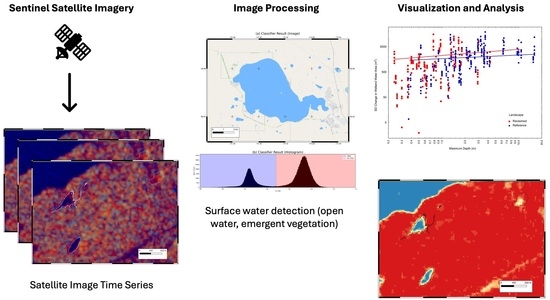
Wetlands provide critical ecological and socio-economic benefits, covering approximately 45% of the Athabasca Oil Sands Region in Alberta, Canada. However, open-pit oil sand mining has led to widespread wetland loss. While reclamation efforts are ongoing, the development of effective wetland monitoring methods remain essential. This paper presents a novel approach to tracking wetland dynamics in reclaimed and reference landscapes using Sentinel-1 SAR and Sentinel-2 multispectral imagery. We assess surface water extent and emergent vegetation, validating our satellite-based measurements against high-resolution UAV-derived wetland area data ( R 2 = 0.902 ). Our results reveal minor differences in intra-annual variability in wetland area between wetlands in reclaimed versus those in reference landscapes. Wetlands exhibit a positive log-linear relationship between maximum depth and variability in open-water area, a pattern that was consistent between landscape types. Intra- and interannual variability in spatial extent were both positively associated with wetland area. This paper introduces the first ground-truthed automated wetland monitoring approach for the region. These findings document the similarities in range of variation between wetlands developing in reclaimed and reference landscapes and provide a simple tool to support long-term monitoring to document the persistence of wetlands forming in reclaimed landscapes.

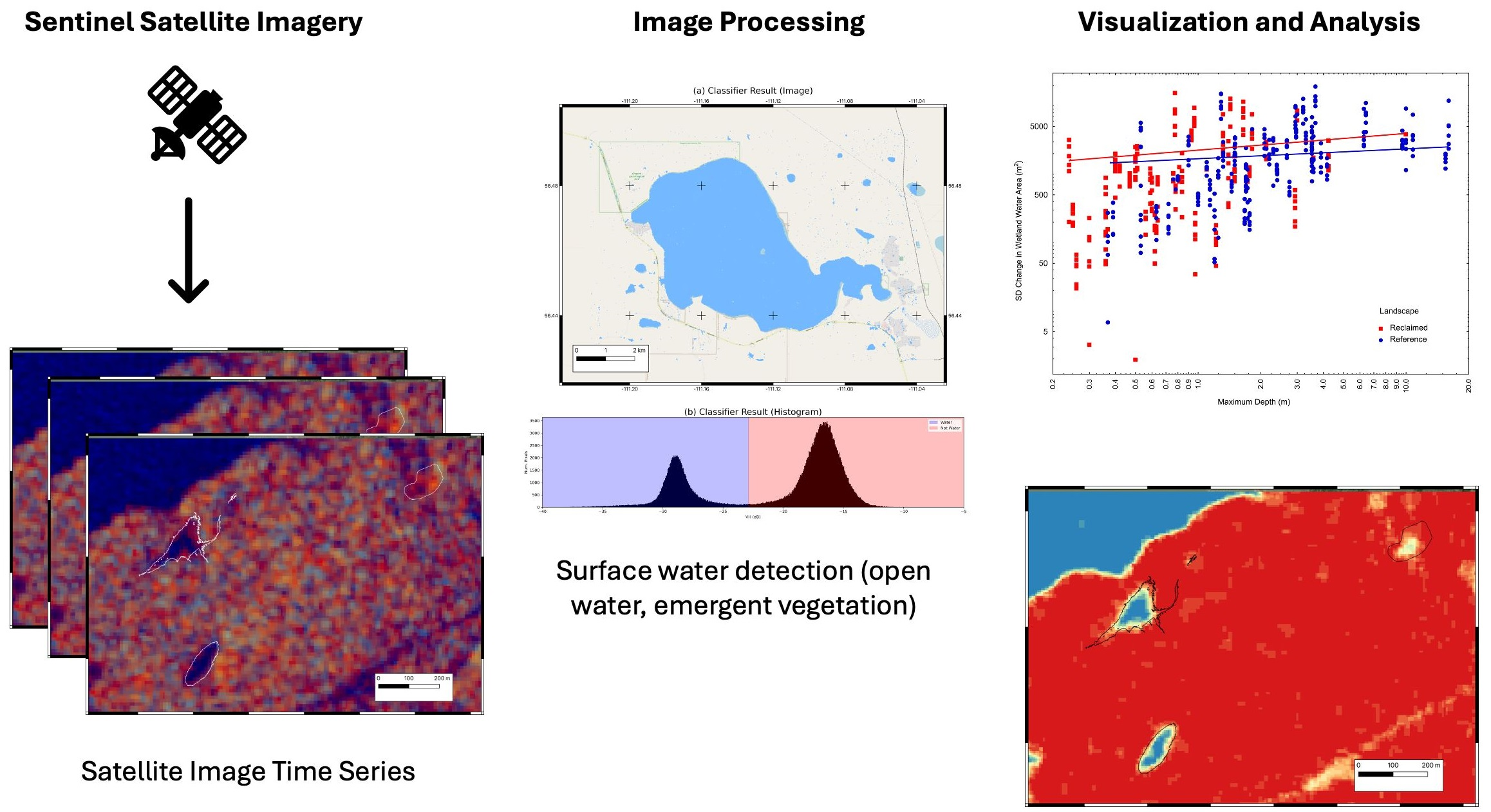
Graphical Abstract

1. Introduction

The Athabasca oil sands region (AOSR) of northern Alberta is dominated by wetlands, wherein up to 45% of the land area is covered by wetlands [1]. Open-pit oil sand mining is a major landscape disturbance, entailing removal of vegetation, topsoil and overburden to expose the bitumen ore. As of 2023, 1100 km2 of land in the AOSR has been impacted by oil sand mining operations [2]. The Alberta Environmental Protection and Enhancement Act requires that after mining activities are complete, these landscapes must be reclaimed to “equivalent land capabilities” [2,3,4]. As a result of reclamation efforts, Suncor Energy has reclaimed approximately 20 km2 of land [5]. Most research has focused on reclamation of forested uplands, but wetlands have appeared opportunistically in these landscapes [6,7], with a few demonstration and research wetlands having been constructed in newly reclaimed landscapes [8]. This has left a significant knowledge gap in understanding how to document the appearance and persistence of wetlands forming in reclaimed AOSR landscapes.
Preliminary surveys evaluating wetland areal extent [5,9] and early succession [8,10] in reclaimed uplands have estimated coverage at 18% of reclaimed upland landscapes [11]. Although much of this work is still in its early stages, initiatives such as the Boreal Wetland Reclamation Assessment Program (BWRAP [12]) are evaluating the condition of newly-formed wetlands in reclaimed landscapes. Using a chronosequencing approach [13,14], BWRAP compares the environmental and biological attributes of young, mineral wetlands in reclaimed post-mining landscapes and in reference wetlands of similar age located outside of oil sand mining lease areas of the AOSR [12]. The use of young wetland comparators provides an appropriate successional frame of reference against which to compare the wetlands forming in reclaimed landscapes [15].
Wetlands are important ecosystems, supporting approximately 40% of the world’s plant and animal species for some portion of their life cycle [16]. They can perform critical functions such as water filtration [17], flood reduction and water storage [18], and carbon storage [19]. Many of these functions are related to wetland hydrological conditions or water balance patterns, the characterization of which requires monitoring over several years, often with many variables. To mitigate this, wetland practitioners in Alberta more commonly interpret indicators to summarize the permanence of individual wetlands into several broad categories [20,21] (Table 1). This approach relies primarily on interpreting vegetation zones as an indicator of wetland hydroperiod, or the length of time in a typical year that a wetland remains inundated with surface water (Table 1) [20,22]. It is important to note that the reported hydroperiods are considered accurate for wetlands in the prairie pothole region of southern Alberta, but while the boreal mineral wetlands of northern Alberta are characterized by similar vegetation communities, they are supported by substantially longer, albeit undefined, hydroperiods [20]. Interpretation of historic inundation patterns is often supported by examining shallow wetland sediments for physical signs of hydric soils, which indicate anaerobic conditions resulting from prolonged saturation [20]. However, many of the newly-forming wetlands in reclaimed and reference landscapes are too young to exhibit these typical morphological features in their soils, limiting their applicability in many reclaimed landscapes [23,24]. In contrast, vegetation communities establish relatively rapidly and are useful in classifying reclaimed wetlands [11,24]. The use of aerial imagery is therefore an effective approach to quantifying variability in the spatial extent of surface water and emergent vegetation zones for the purpose of assessing wetland permanence [25,26,27,28].
Given its central role in shaping wetland communities and functions, effective monitoring of hydrological variability is essential. Remote sensing offers a promising solution because it enables repeated landscape-scale observations of indicators of surface water dynamics. While high-resolution imagery from unmanned aerial vehicles (UAVs) and aircraft can detect fine-scale wetland features, these platforms are often limited by their spatial coverage and operational costs. Additionally, continuous data capture over extended periods can be both financially demanding and logistically challenging. In contrast, satellite-based remote sensing provides a broad geographic reach and consistent revisit intervals, making it well-suited for tracking changes in wetland hydrology. Advances in multi-spectral and radar technologies enhance the detection of water and vegetation patterns under a variety of environmental conditions [29]. Moreover, the increasing availability of global, public satellite datasets has expanded opportunities for monitoring wetland permanence with improved spatial and temporal resolution. These capabilities position satellite remote sensing as a key tool for assessing hydrological variability across wetland landscapes [30,31].
The primary objectives of this paper were to (a) design a fully automated and ground-truth validated model for delineating wetland extent; (b) remotely assess the temporal variability in surface water area across mineral wetlands; and (c) demonstrate practical applications of the model in an environmental monitoring context. To achieve these goals, we introduce a novel, scalable framework that leverages freely available satellite imagery from Sentinel-1 Synthetic Aperture Radar (SAR) and Sentinel-2 multispectral sensors, combined with advanced image classification and visualization techniques. Applied to young, developing wetlands in the reclaimed landscapes of the Athabasca Oil Sands Region (AOSR), this approach enables the evaluation of hydrological permanence and enhances remote sensing methodologies through spatial and temporal analysis, ultimately supporting ecological restoration in complex, human-impacted environments.
In this paper, we assess a subset of wetlands investigated as part of BWRAP ( n = 86 wetlands, 51 of which were also used for validation) in the area, most of which have formed over the last 40 years. To assess and compare the developmental trends of newly formed wetlands in landscapes reclaimed after mining (aged between 2 and 40 years), an equal number of wetlands of similar age but forming in ‘reference areas’ (as a result of changes to hydrological balance due to local natural and anthropogenic disturbances unrelated to oil sands mining) were included. We evaluated the following hypotheses:
  • Class IV and V wetlands would have regions of open water detected, with emergent vegetation surrounding the open-water area. We also expected class III wetlands to have regions of emergent vegetation detected.
  • Small, shallow wetlands exhibit greater variability in spatial extent than larger, deeper wetlands.
  • Wetlands in reclaimed landscapes exhibit higher intra- and interannual surface water variability than those in reference landscapes.
To provide greater depth and structure, we present the related work in a dedicated section rather than within the Introduction. This allows for a more comprehensive discussion of relevant studies.

2. Related Work

Satellite imagery, including synthetic aperture radar (SAR) and multi-spectral optical systems, has become a cornerstone for wetland monitoring because it can capture landscape-scale features with high temporal resolution. SAR systems emit and record the reflection of polarized microwave beams (vertical or horizontal) that interact with the Earth’s surface. Scattering phenomena lead to either preserved (co-polarized) or altered (cross-polarized) polarization states, which are recorded by the satellite. These scattering properties vary based on surface characteristics: smooth surfaces like water bodies maintain polarization, while vegetation or surfaces with heterogeneous structures alter it [32]. SAR’s reliance on microwave wavelengths enables data acquisition under all weather conditions, including cloud cover [33]. The interaction of SAR’s different frequency bands with ground surfaces further enhances its versatility. For instance, L-band SAR penetrates forest canopies, whereas C- and X-band SAR primarily interact with vegetation surfaces [34,35]. The C-band has been shown to be particularly effective for monitoring boreal wetlands [36].
In contrast with SAR, multi-spectral optical systems passively record reflected energy across specific wavelength bands, capturing detailed spectral signatures of various surface types. For example, healthy vegetation strongly reflects near-infrared (NIR) light due to plant cell structure and chlorophyll levels, while water absorbs it [37,38]. These spectral properties enable the differentiation of wetland classes, with NIR, red edge, and red bands found to be particularly effective [39]. Advanced techniques such as spectral indices (e.g., NDVI) and machine learning models further enhance the accuracy of classification [40,41,42]. However, these methods often require extensive training data or ancillary datasets, which can limit their accessibility [43].
Numerous studies have built on these technological advancements to map and classify wetlands using satellite data. Many employ a mosaic approach, aggregating multiple images collected over a given period of time to create a single composite map. For example, Mahdianpari et al. developed a Canada-wide Wetland Inventory using Sentinel-1 and Sentinel-2 imagery combined with random forest classification [44,45]. Similar approaches have been used to map wetlands in Alaska [46,47], the Great Slave Lake area in Canada [48], and Alberta’s boreal region [49,50]. While effective for large-scale classification, these studies often lack temporal resolution, focusing instead on static maps that do not capture dynamic wetland changes.
Other work has incorporated temporal dynamics to address this limitation. For instance, Carroll et al. mapped annual surface water extent changes in Arctic boreal regions [51], while Widhalm et al. created seasonal wetland maps in Arctic tundra regions [52]. Huang et al. tracked inundation dynamics in Alaska and northern Alberta [53]. These studies highlight the potential of remote sensing for capturing wetland dynamics, but their validation strategies often focus on large-scale features, overlooking smaller wetlands. For example, Mahdianpari et al. validated their work using polygons larger than 1 h a [44], and Huang et al. relied on ecosystem maps derived from satellite data with coarse (30 m ) spatial resolution [48,53].
A critical limitation of many studies includes the extensive data processing requirements associated with remote sensing methods often used to characterize reclaimed AOSR wetlands. For example, Hawkes et al. characterized opportunistic wetland extent in reclaimed AOSR landscapes using manual GIS delineation of features using a variety of data sources [5]. Here, we present a fully automated approach, validated with ground-truthed data, to provide a robust, rapid protocol for monitoring changes in wetland area. We use the system to assess and analyze temporal variation in spatial extent across different scales in novel landscapes and ecological settings [54].

3. Methods

To improve the clarity of our methodology, a workflow diagram showing an overview of our methodology is shown in Figure 1.

3.1. Model Development

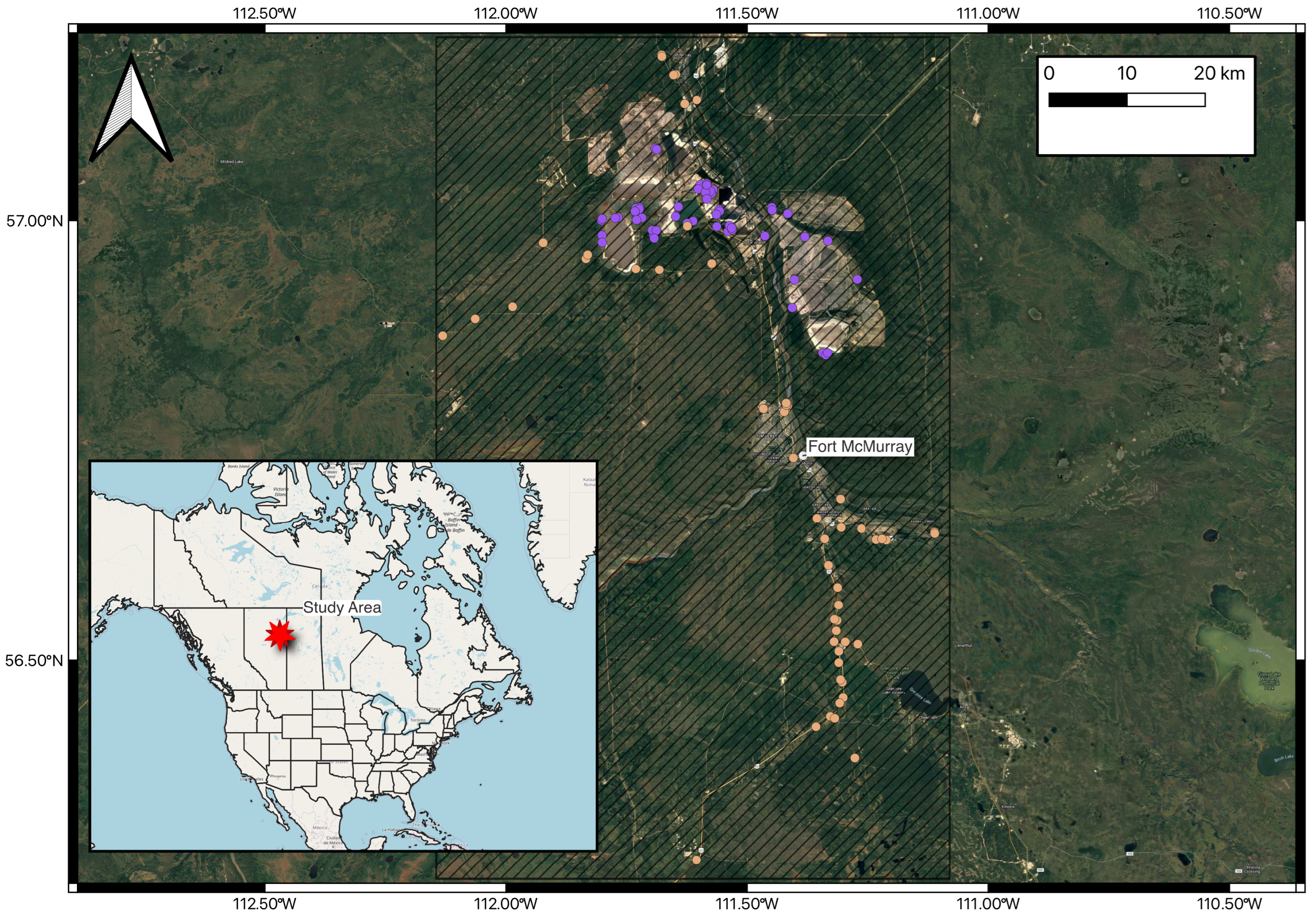
This research is conducted to inform the Boreal Wetland Reclamation Assessment Program, which assessed attributes of 120 young AOSR mineral wetlands (aged 2–65 years) from 2021–2023 Figure 2. The primary goal of this research program is to compare hydrochemistry and early successional development of wetlands forming in landscapes reclaimed following open-pit mining activities to those of similar age but in areas assumed not to be impacted by open-pit oil sand mining [15]. Details of the general rationale and study design are reported elsewhere [12,55,56,57]. Satellite imagery covering this area is obtained from the European Space Agency [58].

3.1.1. Remote Sensing Data

Analyses were performed on Sentinel-1 C-Band synthetic aperture radar (SAR) and Sentinel-2 multi-spectral optical satellite imagery collected between 2019 and 2024. Sentinel-1 utilizes active radar technology to measure surface features regardless of weather, atmospheric conditions, or time of day. The satellite can achieve high spatial and temporal resolutions, providing data with a 5–40 m pixel size (depending on the operating mode), and with a return rate of six days [58]. For this paper, we use the interferometric wide swath (IW) mode, which has a spatial resolution of 10 m. We use dual-polarized (VV and VH) IW ground range detected (GRD) data to detect wetland features.
All images are pre-processed using the Sentinel-1 Toolbox before they are added to the Google Earth Engine (GEE) data and analysis platform [59,60]. Noise removal is performed to reduce thermal and border noise, as well as noise on the edges of images. Images are orthorectified to minimize distortion of the measured values using the Shuttle Radar Topography Mission (SRTM) 30-m DEM [61]. Backscatter coefficients were then converted into decibels (DB). Given that backscatter coefficients are sensitive to changes in viewing geometry [62], we selected images with the same orbital direction. Images taken from ascending (south to north) orbital directions were more numerous, so only images with ascending orbital passes were selected and analyzed.
Speckle noise is present in all SAR images because interference among waves with constant amplitude leads to phase changes in the returned signal [63]. We reduce (or remove where possible) speckle effects without obscuring edges and other true features by applying Yu’s speckle reducing anisotropic diffusion filter [64], which outperforms traditional methods (e.g., the Lee filter [65], or the Frost Filter [66]) in terms of mean preservation, variance reduction, and edge localization. The filter can be considered as an extension to traditional Perona-Malik diffusion [67].
Differentiating snow, ice, and water in satellite imagery is challenging during winter [68]. We exclude winter imagery (Figure 2, and described below), as shallow water bodies are frozen and much of the vegetation is obscured from aerial view. To account for climate-driven shifts in snow cover timing [69,70], we automatically estimate the snow-free period using the snow probability band from Sentinel-2 imagery [71]. The snow-free season is defined as beginning on the first spring day and ending on the last fall day when snow and ice cover is also below 0.5%. This threshold minimizes the exclusion of valid data caused by residual snow or classification noise. Only Sentinel-1 images within these periods were retained for analysis. The date ranges for each year are
  • 2019: April 22–October 20;
  • 2020: May 10–October 2;
  • 2021: May 5–October 21;
  • 2022: May 12–October 27;
  • 2023: April 25–October 22.

3.1.2. Detection of Open-Water and Emergent Vegetation

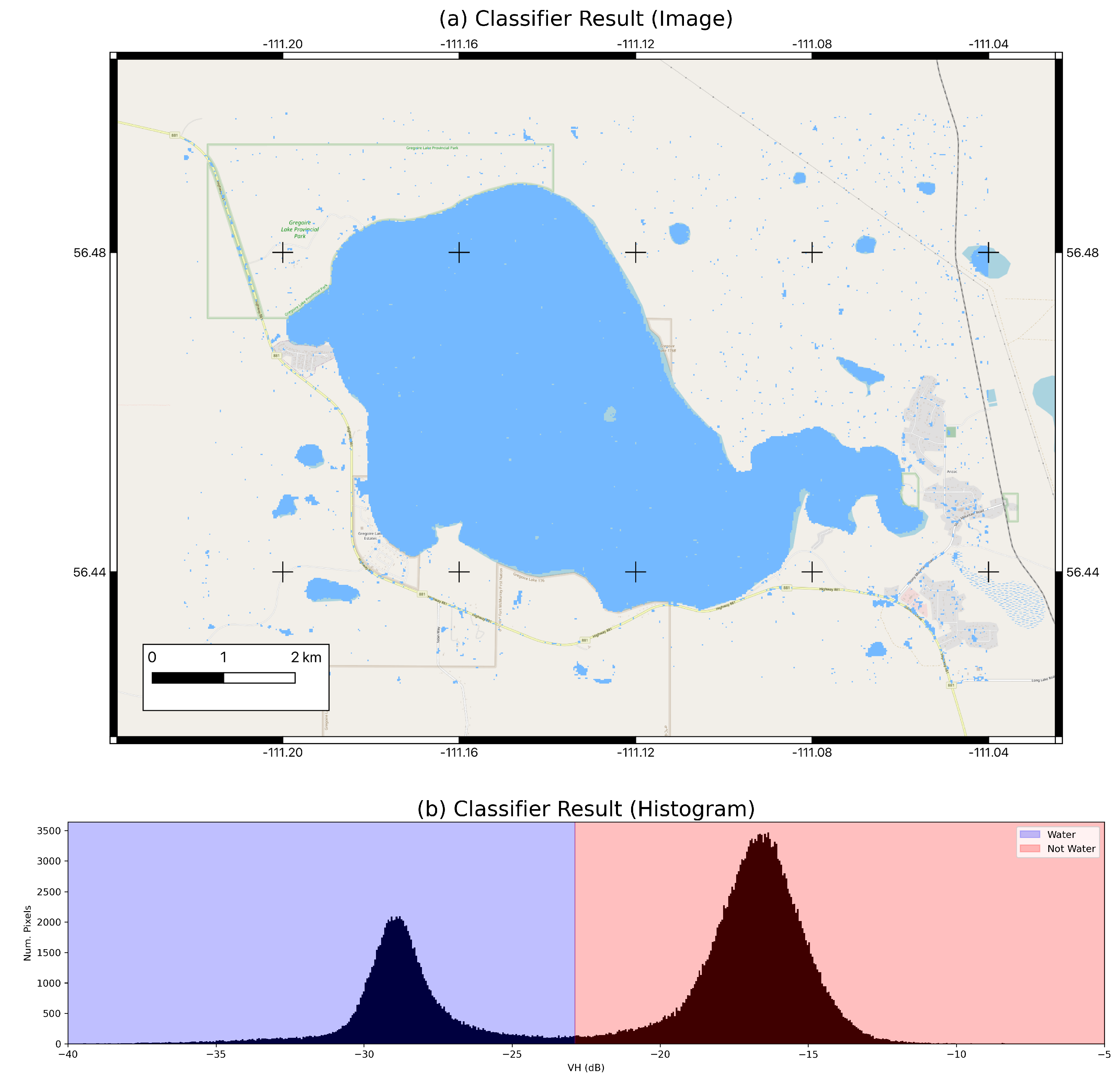
Smooth water surfaces are highly reflective, causing most of the SAR signal to be reflected away from the satellite and resulting in low backscatter values. Any region containing a mixture of open-water and other landcover types will have a bimodal distribution of pixel values (see Figure 3b). Water can be detected by separating the histogram into water and non-water regions using image thresholding techniques [72]. Stormy weather conditions (e.g., wind and rain) can increase the backscatter values and cause water to be misclassified [73]. To address this issue, other authors suggest the use of the cross-polarized satellite bands (VH and HV), which are less affected by these influences than the co-polarized bands (VV and HH) [27,29]. We utilize Otsu thresholding [74] on the VH band to separate landcover classes effectively by minimizing the intra-class variance:
arg min t ( ω 0 ( t ) σ 0 2 ( t ) + ω 1 ( t ) σ 1 2 ( t ) ) ,
where ω i is the probability that a pixel falls into the ith class and σ i 2 is the class variance. All pixels with VH t are classified as open water (e.g., Figure 3). Otsu thresholding is applied to the set of all images that overlap the ROI and the time-period of interest, { I 0 , I 1 , , I n } (where n is the total number of images in the time series) to produce a collection of n binary images { J 0 , J 1 , , J n } .
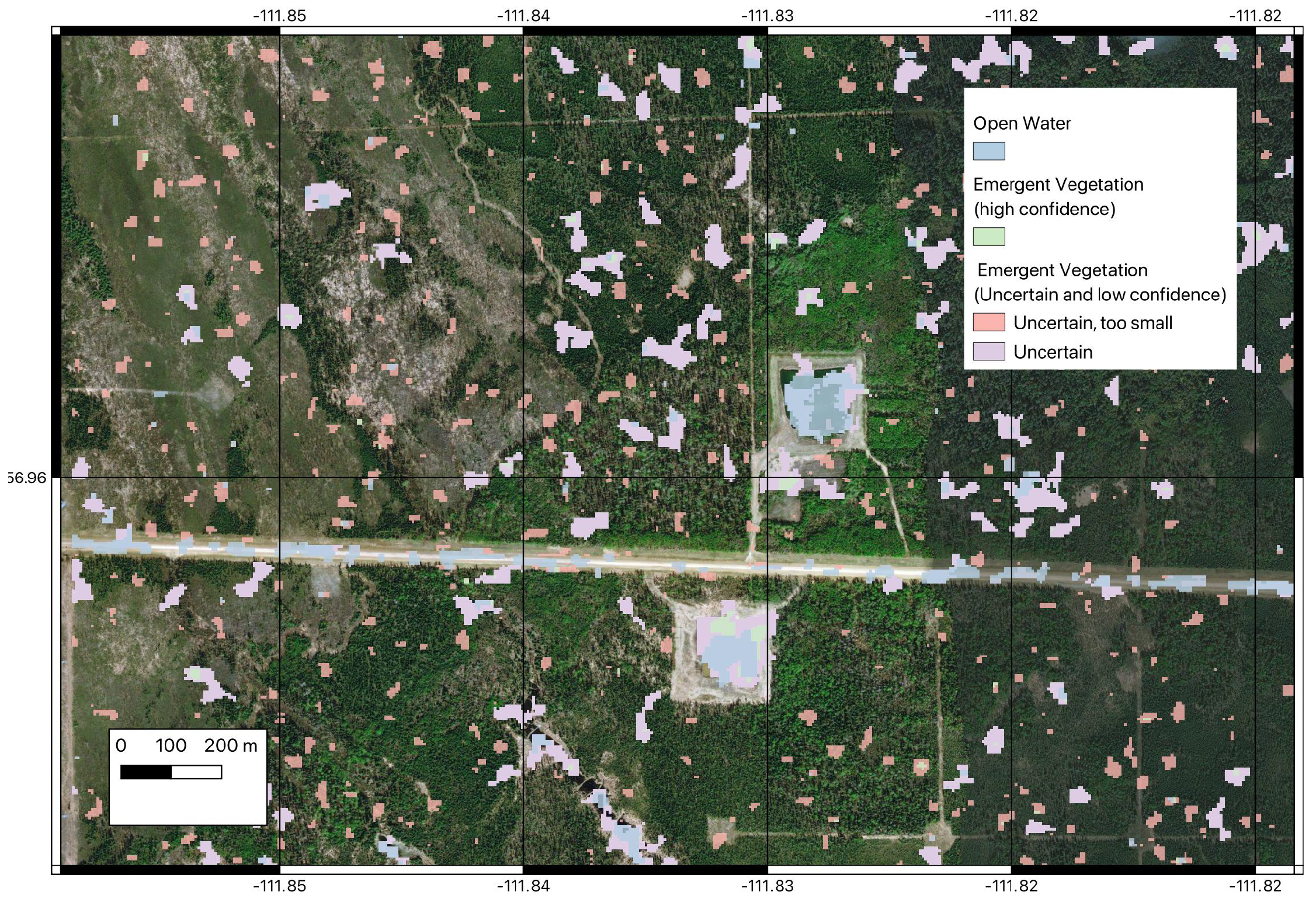
In complement to the open-water and submerged vegetation zones, the emergent vegetation zone is an area that is inundated for at least part of the growing season [20,22]. When SAR signals interact with emergent vegetation, double-bounce and volume scattering occur, resulting in elevated backscatter values [36]. Backscatter strength depends on both the spectral characteristics of each wetland, and the orbital direction of the satellite. Spatial information must be considered: pixels that are close to areas of high confidence should be included in the final result; however, pixels situated far from areas of high confidence should be excluded from adjacent areas. To perform this task we use hysteresis thresholding, first described by Canny [75], to define open-water areas with high confidence and low confidence. The high-confidence region consists of all pixels p ( x , y ) t h , where t h is the high-confidence threshold, while the low-confidence region consists of all pixels p ( x , y ) < t l , where t l is the low-confidence threshold. All high-confidence pixels are incorporated into the final result, while pixels of indeterminate status (neither assignable with high confidence nor low confidence) are included in the final result only if they are contiguous with a high-confidence region [75]. Other authors have effectively used this technique for measuring emergent vegetation in wetlands [28,36,53]. In particular, the ratio between co-polarized and cross-polarized bands is found to best distinguish emergent wetland vegetation from surrounding landscapes [36]. Since Sentinel-1 bands are measured on a logarithmic rather than a linear scale, we instead use the log-transformed ratio of co-polarized to cross-polarized bands (Equation (2)):
log 10 V V V H = log 10 V V log 10 V H .
Huang et al. found that setting t h = 12 dB and t l = t h δ V V effectively detected emergent vegetation using hysteresis thresholding [53]. δ V V represents 68% of the backscatter time series close to the median of the V V band and is calculated independently for each pixel in the image (e.g., Figure 4). The northern wetland has steeper banks and a narrow emergent vegetation zone compared to the southern wetland. As a result, most indeterminate pixels in the northern wetland are unconnected to the high-confidence pixels and generally excluded from the final result. In contrast, high-confidence pixels and indeterminate pixels are well connected in the southern wetland, leading to their inclusion in the final result.
To improve the efficiency of hysteresis thresholding, we remove very small connected patches (regions of pixels p ( x , y ) , p ( x , t ) t l , connected through at least one neighbouring pixel). We use the eight-way neighbour convention, where pixels along the diagonal connections are also considered. Their exclusion reduces noise in the final mask and improves classification accuracy (Figure 4).
A limitation of this approach is that open-water areas may also be classified as emergent vegetation, as VH values are very low in areas of open water. Consequently, Equation (2) generates inflated values combining areas with open-water and emergent vegetation. To address this issue, we utilize the open-water result calculated with Otsu thresholding (Equation (1)) to exclude areas already detected as open water. After generating the binary result for emergent vegetation and open water, we filter the emergent vegetation result to include only pixels classified as emergent vegetation that are not part of the open-water result. Using logical notation, the final emergent vegetation mask is
Emergent ( Final ) ( p ) = Emergent ( p ) ¬ Water ( p ) ,
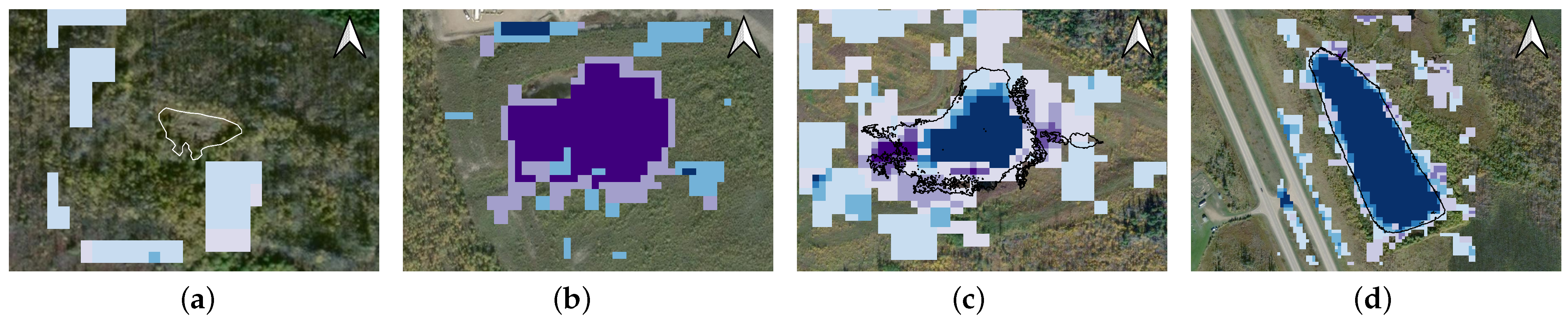
for every pixel p within the subsection of the image intersecting the region of interest. This filtering step ensures that pixels classified as open water (defined by Equation (1)) and the emergent vegetation pixels (defined by Equation (3)) are in mutually exclusive classes, thereby clearly isolating the two components for interpretation. Although the combined distribution of open-water and emergent vegetation is the final value of interest, this additional step reduces misclassification in cases where it is desirable to focus on wetland zones independently. Figure 5 shows the results of the combined open-water and emergent vegetation models for the four permanence classes to which BWRAP wetlands belong.
The spectral characteristics of highways and bare soil are similar to those of open water and can produce numerous false positive detections. This is addressed by overlaying the Alberta Biodiversity Monitoring Institute’s (ABMI) human footprint data [76] to delineate and remove these anthropogenic structures from the image dataset, as performed by [77]. Despite integration of the human footprint data, some false positive results remained, especially in newly urbanized regions where land cleared for developments had not been incorporated into the human footprint inventory. Accordingly, we use the normalized difference vegetation index (NDVI) measured using the Sentinel-2 satellite to further reduce misclassification. Typically, unvegetated areas exhibit very small NDVI values, while emergent wetland vegetation areas have higher NDVI values. Our algorithm breaks the NDVI time series into yearly data. For every pixel and every NDVI image in the given year, the maximum NDVI value is computed. If max ( NDVI ) 0.3 , the result is considered as a potential candidate for the final emergent vegetation mask; otherwise, it is excluded. Huang et al., found that this threshold was effective for boreal wetlands [53]. Maximum NDVI is relatively insensitive to contamination from cloud-covered pixels [78,79], increasing the reliability of our approach.
The open-water and emergent maps are overlain to create a combined map, representing the surface water extent of the wetland. Using logical notation, the combined map is created from the open-water and emergent vegetation measurements as
Combined ( p ) = Water ( p ) Emergent ( p ) ,
for every pixel p of the image intersecting the region of interest.

3.1.3. Visualizing Surface Water Variability

We generate composite images summarizing the surface water permanence and variability across a given time period of wetland area. The time period can be adjusted as needed, with typical values being the ice-free period(s) between 2019 and 2023. Statistics are summarized for each pixel across the time series. We calculate the proportion of images for which a positive result is observed (i.e., the pixel is classified as open water or emergent vegetation) using the single image summary technique [80] and create a recurrence map to visualize wetland persistence.
The relative frequency of detection was computed as
r ( p ) = 1 N ( p ) t = 1 N ( p ) c ( p , t ) ,
where c ( p , t ) represents the result of classification at pixel p inside the region of interest at time point t, and N ( p ) is the number of images covering that pixel within the selected analysis period. Evaluating r ( p ) at every pixel p within the ROI gives the recurrence map, forming a summary image of surface water dynamics. Additionally, we calculate the standard deviation for each pixel. The resulting summary images capture both the spatial and temporal variability of water dynamics at the pixel scale.
We also estimate intra-annual and interannual variation in wetland area by estimating wetland area for each image gathered at times t 1 , t 2 , t 3 , t n over the course of a season, determined the change in area between time points (i.e., ( t 2 t 1 ) , ( t 3 t 2 ) , ( t 4 t 3 ) , ( t n t n 1 )), and calculated the standard deviation of the sequence of changes for each wetland.

3.2. Model Validation

To validate the satellite-estimated wetland area values, we compare them to wetland area assessments derived from high-precision synoptic aerial imagery collected as part of BWRAP ( n = 51 wetlands) [12]. This aerial imagery was collected for each wetland using an eBee X fixed-wing drone equipped with a SenseFly camera capable of collecting RGB imagery. These images were precisely geo-referenced by deploying 3–10 visual targets in each wetland, and recording their precise locations using real-time kinematic Global Navigation Satellite System (RTK-GNSS) positioning, producing 5-cm resolution. The data is processed in ArcGIS Pro 3.3, resulting in highly accurate wetland area estimates used to assess the accuracy of our model.
For each wetland, we use the satellite image taken closest to the date on which each UAV image was captured (generally within 3 days or less, so differences in wetland area between satellite and UAV estimates are expected to be negligible). The UAV estimates of wetland area were measured at a scale of 10 m to match the resolution of these estimates to the satellite-derived results. We compare the wetland area estimates from the two models using linear regression, with outliers (two very large wetlands) excluded. Precision was summarized according to the coefficient of determination. Accuracy was assessed by testing the null hypothesis that the slope of the relationship between areas estimated by each set of imagery was not significantly different from 1.0.
In addition, we measure the accuracy of each measurement using the relative error η { w , c } , as shown in Equation (6):
η w = | A u A w A u | η c = | A u A c A u | ,
where A u is the area estimated from the UAV imagery, A w is the area estimated from the open-water model, and A c is the area estimated from the combined model. Accuracy is said to be increased when η { w , c } is reduced.

3.3. Assessing Wetlands Situated in Reclaimed and Reference Landscapes

We examined the relationships between surface water variability measures estimated by our model and other attributes related to landscape reclamation and wetland size. A total of 86 wetlands characterized by BWRAP were detectable using our tool and subsequently analyzed. We related the measures of variability in wetland surface extent to the maximum depth of each wetland (a measure of wetland size and permanence that is somewhat independent of surface area) and then determined whether the relationship for wetlands situated in reclaimed landscapes differed from wetlands of comparable depth located in reference landscapes.
The maximum water depth for each wetland was determined from two data sources. A single measurement of a wetland’s deepest point was taken using a sounding line or pole. Temporal variation in depth between May and late September was estimated from a pair of Onset Hobo U20L-01 water level loggers deployed at each wetland, with one submerged in the deepest wadeable point of the wetland, and the other nearby recording barometric pressure [57]. Water depth was logged every 15 minutes during the year of study. A wetland’s maximum depth was defined as the deepest-point depth, adjusted to account for the highest logger-recorded value throughout the season [57].
Surface water area is estimated using our combined classification approach (Equation (4)) at a spatial resolution of 10 m . Measurements were derived from all available Sentinel-1 images collected between May 2019 and October 2023, yielding a time series of surface water area during the open-water season for each wetland.
Variability in surface area is quantified using the standard deviation of the differences in areal estimates between sequential images of each wetland for each year of the study period (2019–2023). We assess both intra-annual and interannual variability of the surface area for each wetland. Intra-annual variability was computed as described above. Interannual variability was calculated for consecutive years, using 5 annual mean area estimates calculated yearly for the full 5-year time series, producing a single measurement per wetland. Analysis of Covariance [81] (ANCOVA) was performed to evaluate whether surface area variability relates to wetland maximum depth and if variability differs between wetlands in reclaimed vs. reference landscapes. Numerical variables were log-transformed to meet analysis assumptions.

4. Results

4.1. Model Assessment

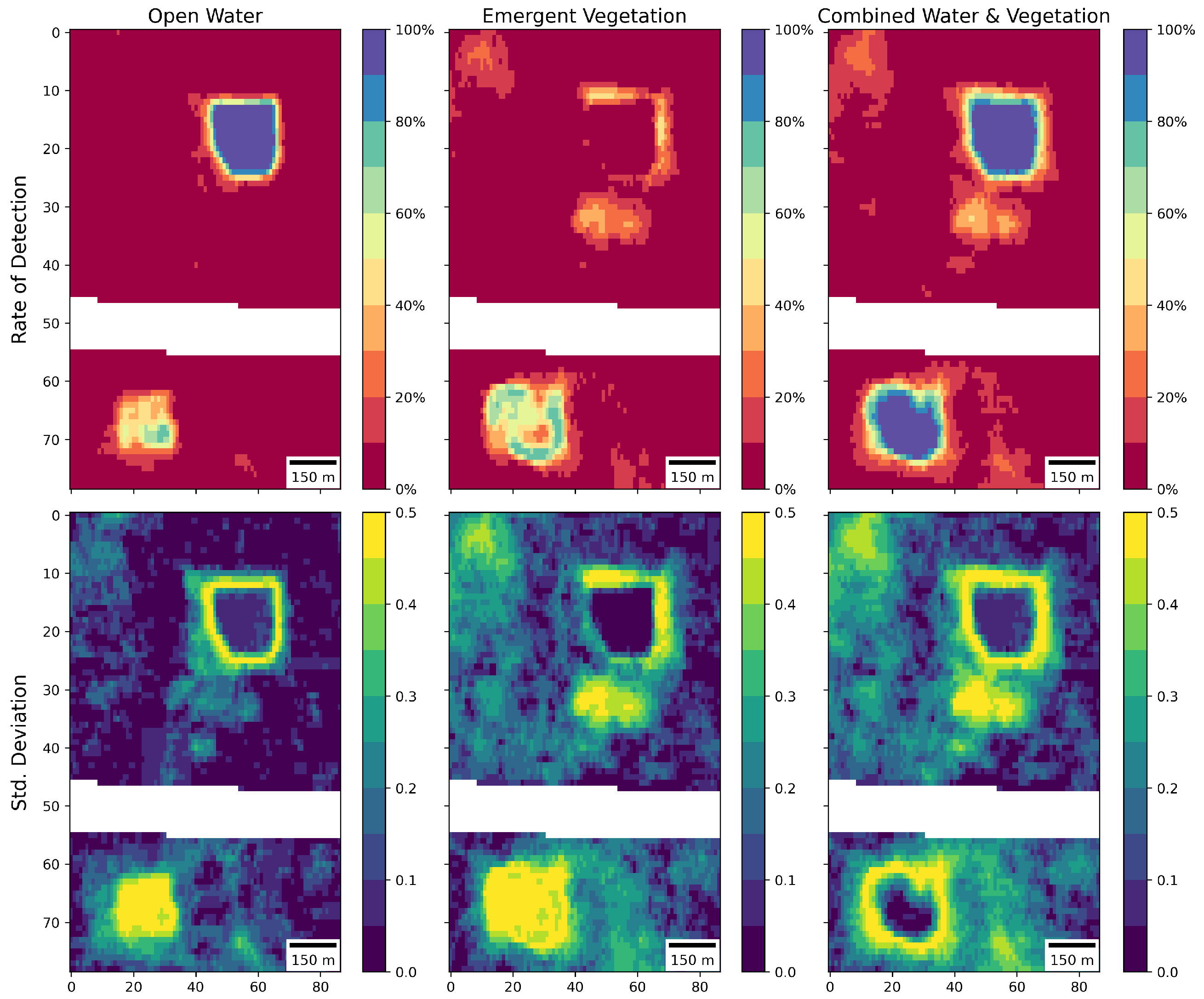
Our tool produces a good representation of a variety of wetland classes. We conducted a qualitative exploration of our results. One example is shown in Figure 6. Two wetlands (flooded borrow pits) are shown from a reference landscape. The northern wetland is mostly open water, with a sharply defined boundary between the emergent vegetation zone and the dry upland, and is classified as a permanent (class V) wetland. In comparison, the shallower southern wetland has a smaller relative expanse of open water and is dominated by emergent vegetation (class IV wetland). In the northern wetland, areas of variability in the presence/absence of water or vegetation (summarized by the standard deviation) are limited to the wetland’s periphery. The standard deviations for the southern wetland are higher for open-water and emergent vegetation, but similar patterns are observed for the combined result, indicating that surface water extent is stable over time, even if open-water and emergent regions within wetlands vary through time.
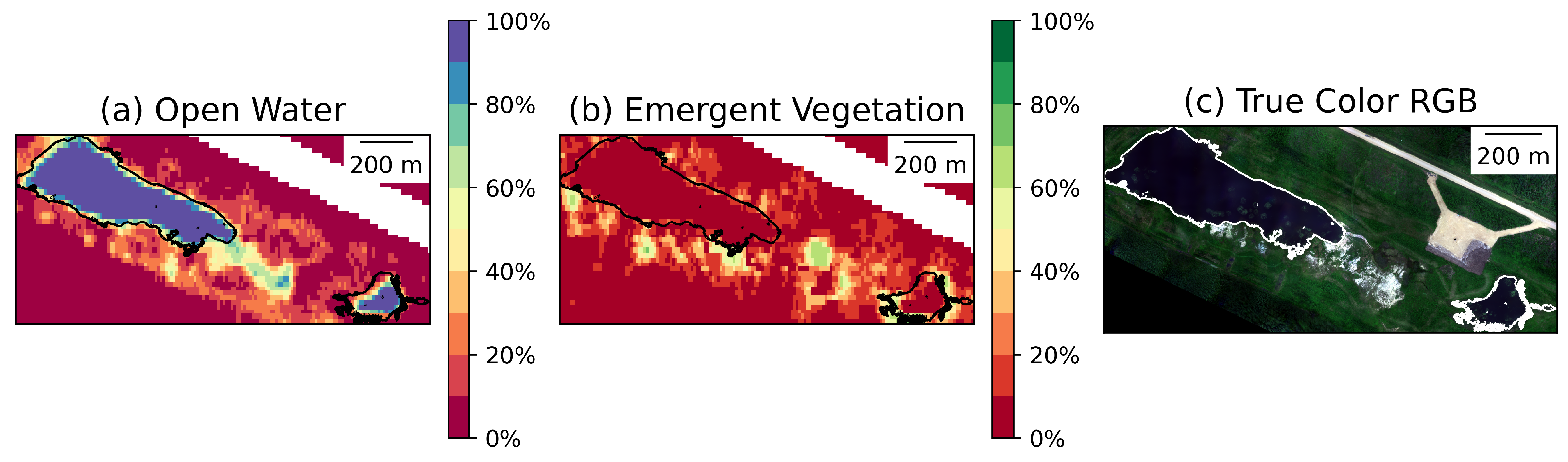
We are able to effectively distinguish between wetland and non-wetland areas in cases where terrestrial vegetation surrounds the wetland (Figure 7). The true colour RGB imagery reveals two wetlands that are surrounded by forest. Both the open-water map (Figure 7a) and the emergent vegetation map (Figure 7b) demarcate the wetland area periphery as identified by high-resolution UAV imagery.
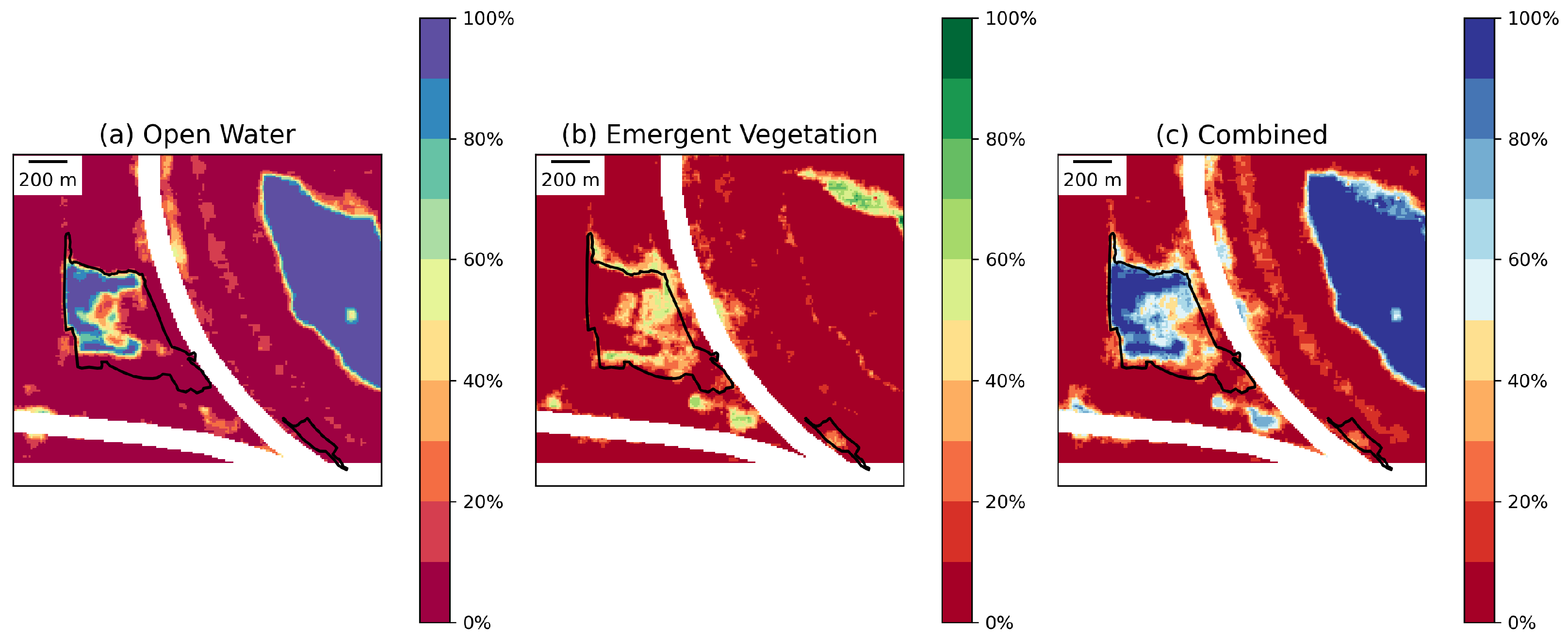
Some wetland classes (i.e., classes II and III) lack regions of open-water/submergent vegetation [20,22]. In these cases, characterization of surface water variability relies only on identifying the emergent vegetation zone (e.g., Figure 8). Comparing our measurements to the UAV measurements indicates that the southern portion of the larger wetland (west of the N-S roadway) lacks open-water pixels (Figure 8a), but the region can be seen more clearly in the emergent vegetation layer (Figure 8b). In the open-water measurements, the small water body east of the N-S roadway appears smaller than expected with low permanence, while the emergent vegetation statistics show that it is about the same size as the UAV polygon, with higher permanence. The open-water detection frequency is close to 0%, while the emergent vegetation frequency is close to 30%.
In this representation, the temporal range of images is left to the user’s discretion, and the range selected can be adjusted to address specific research questions. Summary images representing specific time periods can be compared to assess features such as seasonality or landscape-associated changes.

4.2. Model Validation

There was a strong concordance between the open-water area estimated from satellite imagery and UAV-estimated open-water area ( R 2 = 0.92 , Figure 9). The satellite-derived model overestimated the UAV-determined area by 12%; the regression coefficient (±SE) (0.895 ± 0.038) was significantly different from 1.0 ( t = 2.724 ,   p < 0.01 ;   n = 51 ). The slopes describing the relationship between satellite estimates and UAV estimates were not significantly different from one another ( t = 1.821 ,   p = 0.0751 ; Table 2).
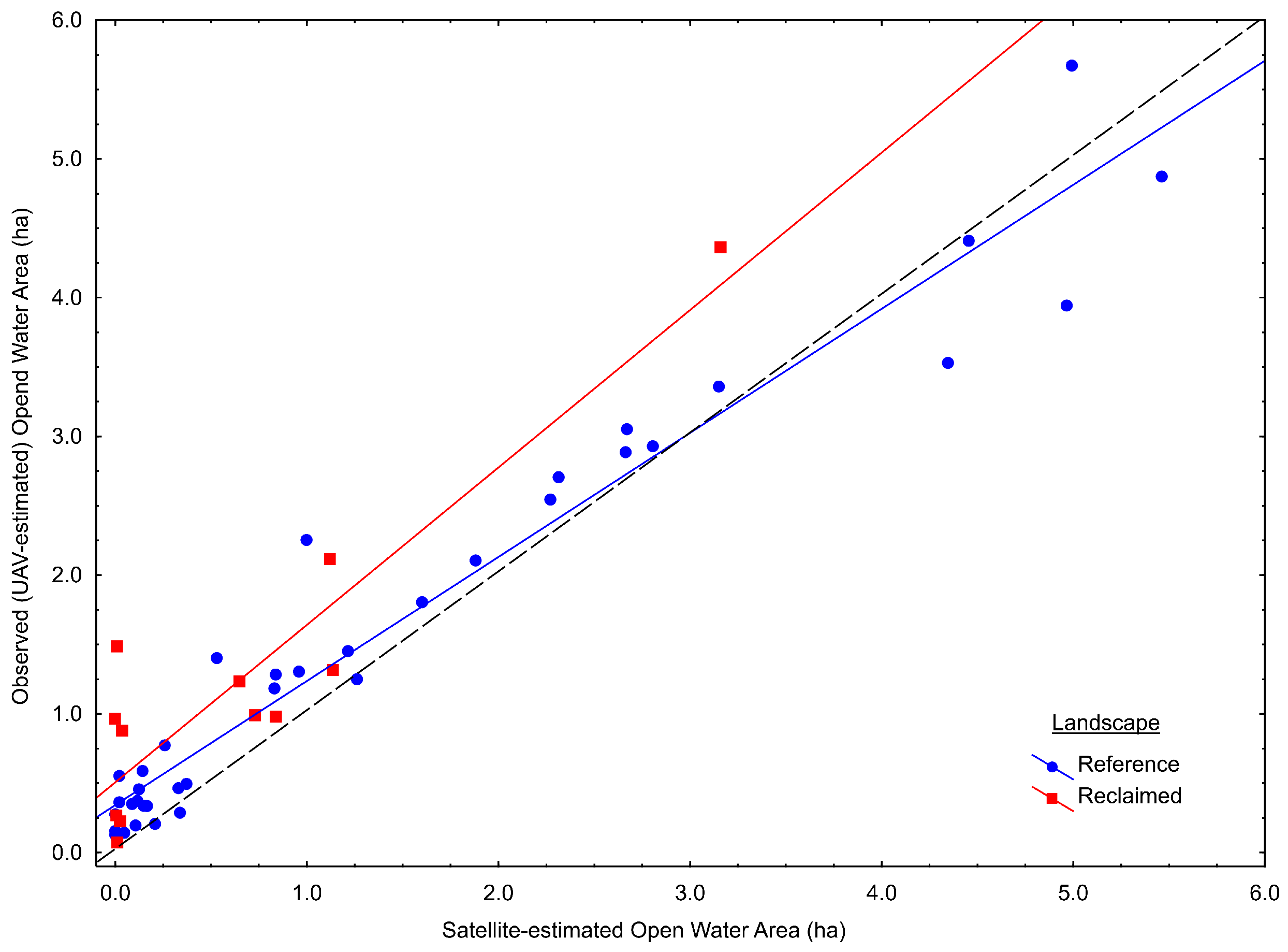
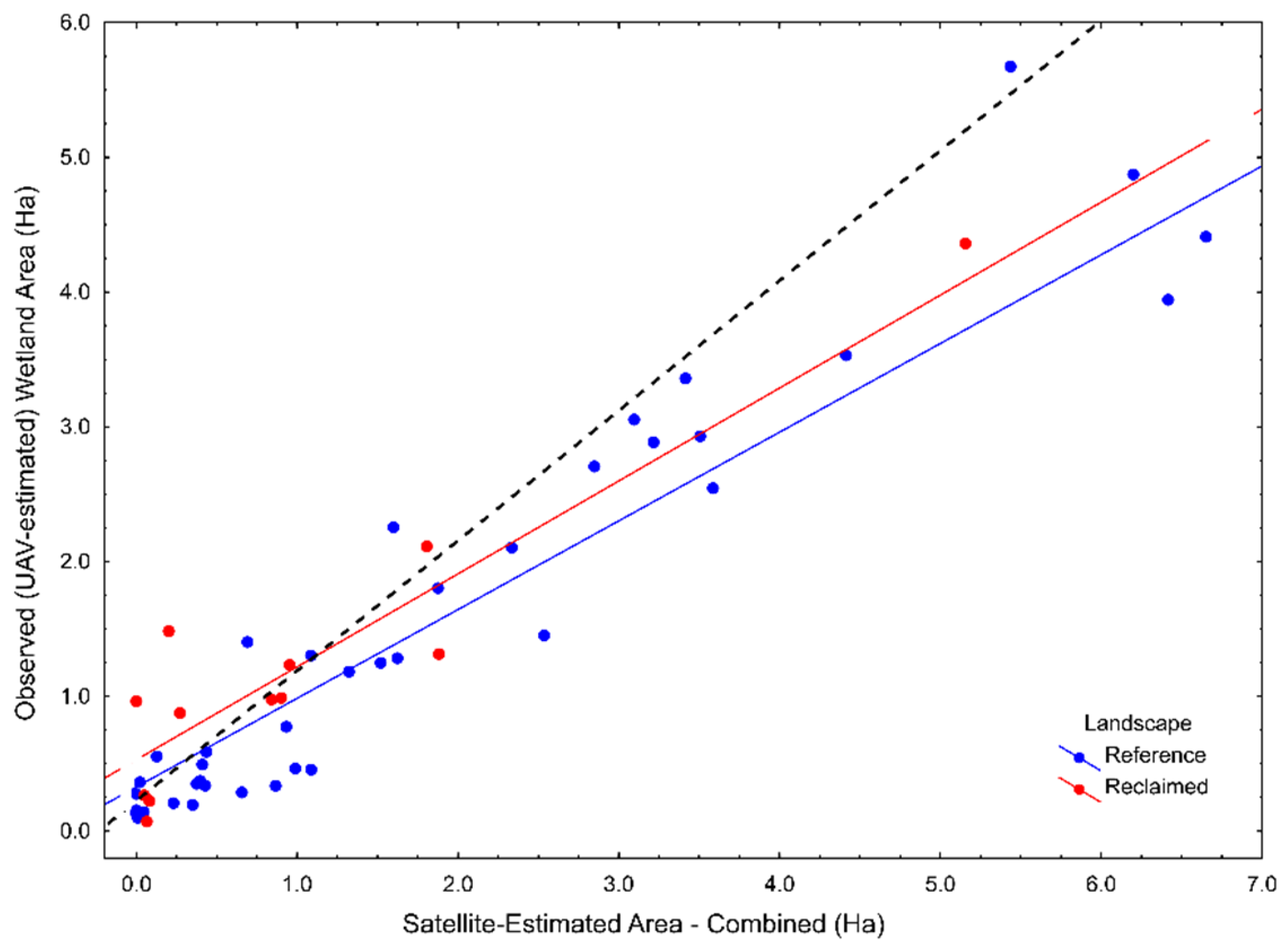
There was also a strong linear relationship between UAV-determined wetland open-water area and the satellite-derived areal estimates of the combined water and emergent vegetation zones (Figure 10). The regression coefficient (±SE) was 0.733 ± 0.035), which was significantly less than 1.0 ( t = 7.62 ;   p < 0.001 ), indicating that the combined model overestimates the open-water area of the wetland delineated from UAV imagery by about 36 percent ( 1 / 0.733 ; reflecting the relative extent of emergent vegetation in the study wetlands). The high coefficient of determination ( R 2 = 0.90 ) indicates that the satellite-derived model is able to precisely infer the wetted areal extent of wetlands in our study area.
Figure 10. UAV-estimated open-water area vs. satellite-estimated wetland area (combined water and emergent vegetation model). The line y = x is shown with a dashed black line, while the regression lines are shown using colored lines. The regression equation for wetlands in reference landscapes was y = 0.19 + 0.749 ( ± 0.04 ) x , ( R 2 = 0.910 ,   n = 39 ), while the regression equation for wetlands in reclaimed landscapes was y = 0.50 + 0.727 ( ± 0.09 ) x ( R 2 = 0.86 ,   n = 12 ). There was no significant difference between elevation or slopes of regression lines for wetlands in reference vs. reclaimed landscapes (Analysis of Covariance, p > 0.05; Table 3). Simple equation for the combined data takes the form Observed (UAV) area = 0.28 + 0.733 ( ± 0.035 ) x , R 2 = 0.90 , n = 51 .
Remotesensing 17 03927 g010
Table 3. Regression summary predicting UAV estimated open-water area from satellite-estimated area (combined open-water + vegetation model). n = 51 , R 2 = 0.90 .
Independent VariableRegr. CoeffStd. Errort-ValuePr(>|t|)
Intercept0.19360.09981.940.0584
Satellite-estimated area0.74860.038019.71<0.0001
Reclaimed Landscape (1 vs. 0)0.30500.18941.610.1140
Homogeneity of slopes−0.02140.1004−0.210.8323

4.3. Applying the Model

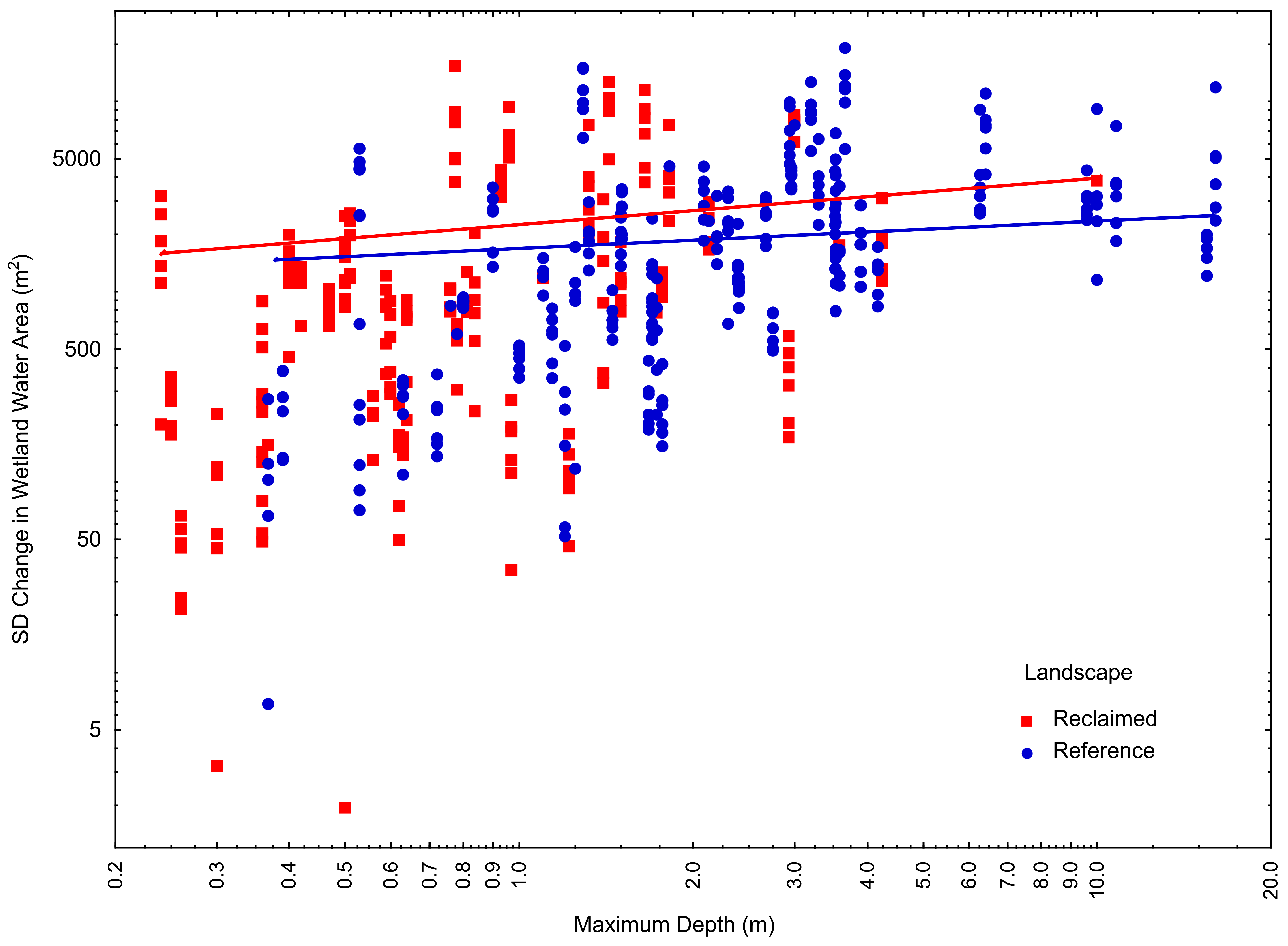
To determine how the variability of shallow wetlands may compare to the variability of deeper wetlands, we related intra-annual variability in wetland area (SD of change in wetland area between consecutive Sentinel images) to each wetland’s maximum recorded depth. We also assessed whether the variability–depth relationship differed between wetlands of reclaimed landscapes from those forming in reference landscapes. The standard deviation of intra-annual time series differed greatly among wetlands in each landscape. The range of inter-wetland variation was broader for the shallowest wetlands and reduced for the deepest wetlands, which consistently exhibited higher standard deviations than all but the most variable (highest SD) shallower wetlands (Figure 11). Overall, there was a slight but statistically significant positive relationship between intra-annual variability in area and wetland depth (Table 4). There was no difference in the variability–depth relationship for wetlands in the two landscape classes. Similar results were obtained when wetland intra-annual variability was assessed relative to wetland open-water area.
To assess how interannual wetland variability differs between reclaimed and reference landscapes, we compared the distribution of the standard deviations of differences in mean open-water wetland area between consecutive years between wetlands in the two landscapes.
Interannual variation in wetland area was greater for large (deeper) wetlands than for smaller wetlands in both reclaimed and reference landscapes. Although the regression coefficient of the wetland area parameter was greater for wetlands in reclaimed landscapes than in reference landscapes, neither the elevations nor the slopes were significantly different (Analysis of Covariance of reclamation status p = 0.98 ; slope homogeneity, p < 0.153 ; Table 5). However, sample sizes were low ( n = 22 for reference landscapes; n = 8 for reclaimed landscapes), so the power of the test of slope homogeneity was relatively weak.

5. Discussion

5.1. Model Strengths

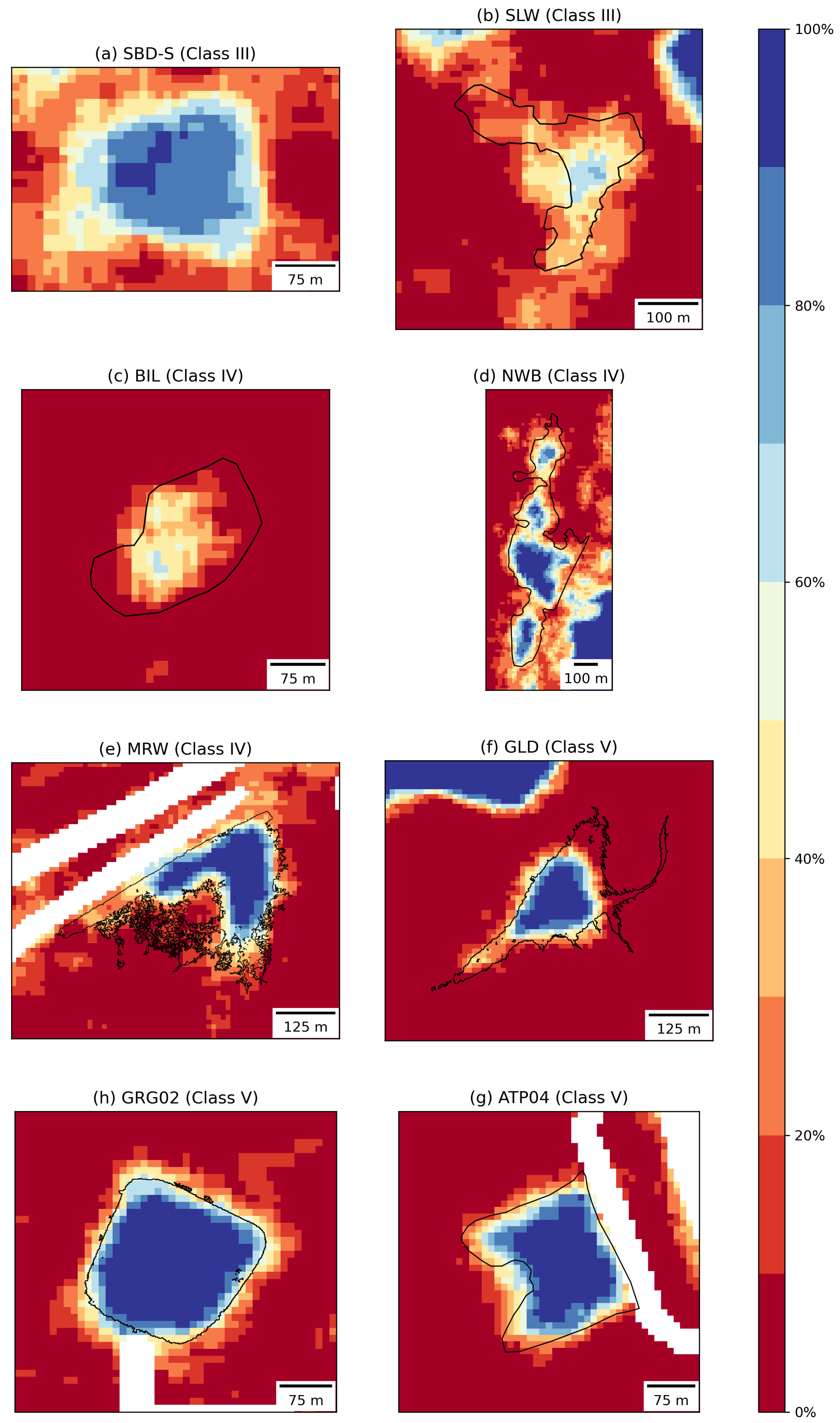
Our model demonstrated strong performance in detecting wetlands belonging to seasonal, semipermanent, and permanent wetlands (classes III, IV, and V). The qualitative analyses indicated that the patterns identified by the model align with expected hydrological and biological attributes in these wetland types. By incorporating temporal variation, the method enables detailed characterization of surface water dynamics, offering insight into both intra- and inter-annual variability. Additional results for class III, IV, and V wetlands are shown in Figure 12. The flexible temporal framework supports a range of ecological and hydrological inquiries, accommodating different timescales of interest. Furthermore, the method is fully automated, facilitating reproducibility and efficient application across diverse geographic regions.
Despite the substantial difference in spatial resolution between satellite and UAV imagery, estimates of wetland extent derived from satellite data were highly correlated, albeit biased with those from UAV observations. Regression analyses confirmed strong agreement for reference and reclaimed wetlands, underscoring the reliability of the satellite-based estimates. The inclusion of emergent vegetation was important for accurate mapping in many cases, delineating obscured flooded areas.
We found that the combined model (Equation (4)) was more accurate than the open-water model (Equation (1)) for 34 of the 51 wetlands tested. For 27 of the wetlands tested, η c < η w (the combined model is more accurate). For the other 17 wetlands, η c > η w (open-water model is more accurate). The satellite-derived overestimates of wetland size (relative to the UAV-derived estimates) likely reflect bias introduced by the coarse (10-m) resolution in combination with the use of hysteresis thresholding to classify the membership of shoreline-associated pixels that contain some emergent vegetation as “wetland” rather than “non-wetland.” The use of NDVI to distinguish emergent vegetation pixels from terrestrial vegetation (research in progress) might improve the accuracy of the hysteresis threshold filter and reduce that bias.
The time-resolved nature of the model further enhances its utility for addressing ecological questions related to the evolution and functioning of reference and reclaimed wetlands. This capability is potentially valuable for monitoring restoration progress and assessing long-term wetland dynamics.

5.2. Model Applications

We hypothesized that small, shallow wetlands would exhibit greater variability compared to larger, deeper wetlands. The range of SD values among wetlands was indeed much greater for shallow than for deeper wetlands. However, our analysis revealed a very weak but positive relationship in intra-annual variation with wetland depth in log-transformed space and a stronger positive relationship between interannual variation and wetland area. We had expected that shallower wetlands would exhibit significantly more water level fluctuations than deeper wetlands because their relatively small volume might make their peripheries more susceptible to drying and wetting than larger water bodies. However, the disproportionately larger periphery and catchment areas of large wetlands likely play a more dominant role in determining both intra- and interannual variation. Wetland origins and catchment topography (especially slope) also contribute substantially to variation among wetlands and are topics of continuing research. We found that wetlands in reclaimed landscapes exhibited no greater intra- and interannual variability than those in reference landscapes.

5.3. Comparison to Other Wetland Monitoring Programs

Wetland mapping involves balancing trade-offs among spatial scale, wetland type, and temporal coverage. Methods optimized for one context may not generalize well to others; for example, large-scale models may overlook fine details, while high-resolution local models may not scale effectively.
Broad-scale wetland inventories, such as the Canadian Wetland Inventory [82,83] and ABMI wetland inventory [49,50], provide standardized classification for long-term monitoring and policy decisions. While effective for tracking regional trends, they may miss smaller, ephemeral wetlands. In contrast, localized models like the Lower Athabasca Regional Planning Area classification [84] perform well in specific areas but can misclassify wetlands as developed footprints. Our model, while highly accurate for wetland delineation, occasionally misclassifies roads as open water—an acceptable trade-off given our study’s focus.
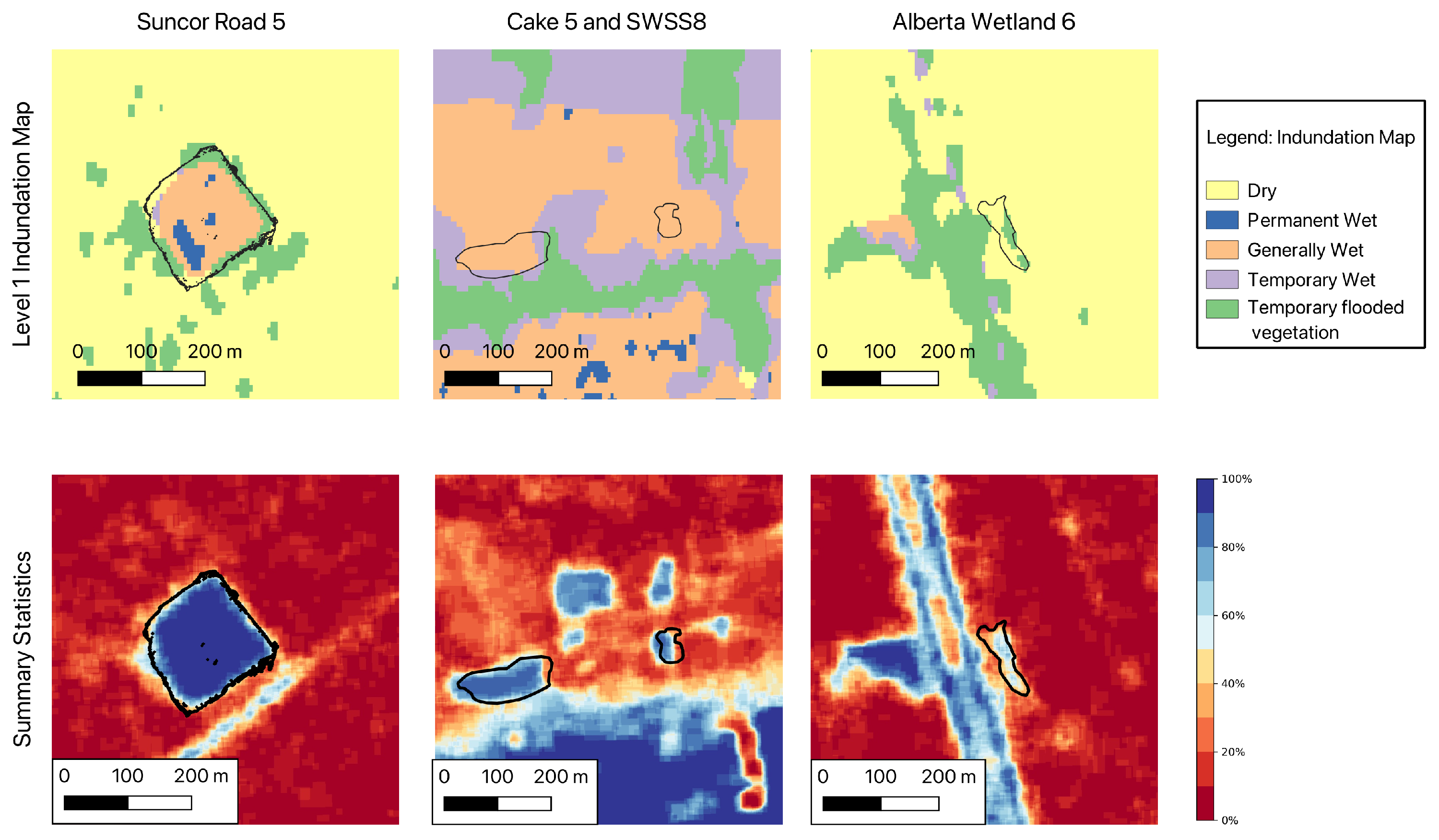
Huang et al.’s approach [53] produces high-quality results across many wetlands but differs in methodology. Their classification is effective at broadly categorizing wetlands, whereas our model provides finer details on temporal variability and surrounding landscape features, making it more suitable for dynamic wetland systems. Figure 13 compares some of the results from their model to the results generated from our framework. Our method provides a more detailed analysis of water recurrence, essential for rapidly changing landscapes like reclaimed former oil sands mining areas. For example, in a mine-reclaimed landscape (Figure 13, column 2), which experience extreme surface water level fluctuations, Huang et al.’s approach correctly classifies two wetlands as wet but lacks temporal resolution. Similarly, in a reference landscape (Figure 13, column 3), their classification identifies only a small flooded region, whereas our results show the presence of surface water across 50–60% of the wetland over time.
Ultimately, the choice of mapping method depends on the intended application. Large-scale inventories prioritize consistency but lack detail, while specialized models offer local accuracy at the cost of generalizability. Our approach is tailored for precise wetland delineation within our study area, even if it introduces specific classification challenges.

5.4. Limitations

Our method suffers from several limitations. First, the coarse spatial resolution of the satellite imagery limits the detection of very small wetlands. Our validation procedure revealed that the largest undetected wetland had an area of 0.96   h a . Compared to UAV-derived estimates of surface water extent, our model is unable to resolve fine-scale spatial variation, primarily due to the limited resolution of the satellite imagery. Incorporating higher-resolution imagery in future work may help address this constraint.
Second, the method is unable to detect wetlands that lack surface water in the form of either open water or emergent vegetation. For instance, class II wetlands that consist solely of wet meadow zones are not captured, and wet meadow areas within larger wetlands (typically distinguished by examining community composition) also remain undetected. Addressing this limitation is essential for enabling more comprehensive analysis of developing and transitional wetland landscapes. Multispectral features of Sentinel-2 imagery have good potential to yield algorithms that can resolve this limitation (research in progress).
Third, our method relies on NDVI derived from Sentinel-2 imagery to distinguish emergent vegetation from other land cover types that produce similar SAR backscatter signatures. While this approach effectively reduces false positive rates, it may increase false negative errors. Sentinel-2 imagery has a maximum spatial resolution of 10 m, and many pixels representing emergent vegetation contain a mixture of vegetation and water. Because water has low NDVI values, mixed pixels can result in underestimated NDVI (ultimately leading to the previously documented overestimates of wetland area) even when vegetation is present. Although using the maximum NDVI value across time helps mitigate this effect, waterlogged vegetation remains a potential source of error. Future work could explore advanced techniques such as spectral unmixing algorithms [85], subpixel mapping [86], or simulated annealing [87] to improve detection accuracy in mixed-pixel scenarios.
Finally, the generalizability of our model to other geographic regions is a key consideration. Our study focuses on young wetlands in early-succession landscapes in the AOSR, whose vegetation community composition is in a state of flux. While this dynamic nature makes our analysis valuable for tracking early reclamation processes, it also presents unique classification challenges and contributes to the need for localized thresholding. Our methodology relies on empirically derived thresholds optimized for the boreal wetland context in the Athabasca Oil Sands Region. Specifically, the Otsu thresholding for open-water detection is applied dynamically to local image histograms, which helps with local adaptability, but the hysteresis thresholds (e.g., t h = 12 dB ) and the NDVI 0.3 filter were adopted from literature calibrated for similar boreal environments [53]. Applying this model to areas with significantly different hydrological regimes (e.g., arid regions), climate patterns (e.g., year-round open water), or dominant vegetation species (e.g., tropical mangroves or grasslands) would likely require re-calibration of these static thresholds. Differences in vegetation structure and dielectric properties of dominant species would significantly alter the log 10 ( V V / V H ) backscatter relationship used for emergent vegetation detection, potentially compromising model accuracy in the absence of validating site-specific optimization. While the core framework (using Sentinel-1 SAR, VH for water, log 10 ( V V / V H ) for emergent vegetation, and NDVI for filtering) is robust, regional adaptation would likely be necessary for accurate classification outside of the temperate to boreal zone.

6. Conclusions and Future Work

In this paper, we investigated methods for monitoring the areal extent of young wetlands forming or created in reclaimed and reference landscapes in the AOSR. Using Sentinel-1 SAR and Sentinel-2 multi-spectral optical imagery, along with an automatic classification scheme, we produced maps showing the occurrence and variability of open-water (SAR and optical) and emergent wetland vegetation. We validated our methods by comparing and contrasting them with high-precision measurements of wetland extent obtained from UAV imagery. Satellite estimates of wetland extent were somewhat biased (consistent overestimates), but were highly correlated with the high spatial resolution synoptic estimates (UAV-Lidar/RGB), allowing precise predictions of the open-water and combined open-water + emergent vegetation area. Applications of the model suggested that intra- and interannual water variability was greater in deeper/larger wetlands, possibly indicating greater susceptibility to fluctuations in water availability. These relationships were similar for wetlands situated in both reclaimed and reference landscapes. These examples highlight the relevance of our model for investigating environmental questions.
Future research should focus on integrating higher-resolution data and employing advanced classification techniques to overcome the current model limitations. To improve the spatial resolution and feature detection, we recommend investigating incorporation of satellite missions operating at different microwave frequencies, such as NISAR [88] and ALSO [89], alongside higher-resolution optical satellites. These additions will facilitate the detection of smaller wetland features, reduce pixel mixing common in dynamic wetland boundaries [90], and allow for the essential incorporation of high-resolution topographic data, which significantly influences runoff and groundwater flux, thereby promising enhanced wetland mapping accuracy [46,91]. Concurrently, more sophisticated, supervised classification techniques could be employed, such as deep learning with convolutional neural networks (CNNs), which are promising for eliminating the misclassification of roads and bare soil in SAR results [50]. While simpler “shallow” techniques remain effective [92], the effective application and generalizability of these advanced methods require gathering large volumes of training samples and ancillary data [43].

Supplementary Materials

The following supporting information can be downloaded at https://www.mdpi.com/article/10.3390/rs17233927/s1, Table S1: Validation Results, Table S2: Wetland Time Series Data, Figure S1: High-Quality Figures. References [33,93] are cited in the supplementary materials

Author Contributions

Conceptualization, E.B., F.F.S. and J.J.H.C.; Data curation, E.B., H.P. and E.G.; Formal analysis, E.B. and J.J.H.C.; Funding acquisition, J.J.H.C., E.B. and F.F.S.; Investigation, E.B.; Methodology, E.B.; Project administration, J.J.H.C.; Resources, E.B.; Software, E.B.; Supervision F.F.S. and J.J.H.C.; Validation E.B.; Visualization, E.B.; Writing—original draft, E.B.; Writing—review and editing, E.B., F.F.S., H.P., E.G. and J.J.H.C. All authors have read and agreed to the published version of the manuscript.

Funding

This research was supported by grants from the Natural Sciences and Engineering Research Council of Canada (NSERC) Industrial Research Chair program, Canada’s Oil Sands Innovation Alliance and Canada Foundation for Innovation, John R. Evans Leadership Fund & Alberta Economic Development and Trade, and Alberta Innovates to J.J.H.C., and the NSERC Discovery program to F.F.S. The research also received support from the Alberta Graduate Excellence Scholarship (AGES) to E.B.

Data Availability Statement

The original contributions presented in this study are included in the article/Supplementary Material. Further inquiries can be directed to the corresponding author.

Acknowledgments

We thank Ashlee Mombourquette for their work in estimating wetland age and Carla Wytrykush, Wendy Kline, and Virgil Hawkes for sharing industry data used, including information on wetland age. We also thank BWRAP field members for their contributions to data collection, especially Ian Perry, Jacob Kraft, and Arden Ogilvie for performing UAV work, and Michael Wendlandt and Evan Bishko for their work in identifying and measuring wetland maximum depths. We also extend great thanks to Kwok Kei (Maverick) Fong for UAV data processing and wetland area estimation and Mir Mustafiz Rahman for work on the UAV team, for providing advice and research support, and for providing suggestions for improvements to this manuscript. We thank Michael Wendlandt for providing helpful comments on the manuscript and all members of both the Graphics, Interaction, and Visualization (GIV) and BWRAP research teams at the University of Calgary for their insightful thoughts and discussions.

Conflicts of Interest

The authors declare no conflicts of interest.

Abbreviations

The following abbreviations are used in this manuscript:
ANCOVAAnalysis of Covariance
AOSRAthabasca Oil Sands Region
BWRAPBoreal Wetland Reclamation Assessment Program
NIRNear-infrared light
SARSynthetic aperture radar
UAVUnmanned aerial vehicle
VVVertical-vertical polarization
VHVertical-horizontal polarization

References

  1. Ficken, C.D.; Cobbaert, D.; Rooney, R.C. Low Extent but High Impact of Human Land Use on Wetland Flora across the Boreal Oil Sands Region. Sci. Total Environ. 2019, 693, 133647. [Google Scholar] [CrossRef]
  2. Government of Alberta (GOA). Environmental Protection and Enhancement Act; Updated December 2021; Government of Alberta (GOA): Edmonton, AB, Canada, 2021. [Google Scholar]
  3. Powter, C.; Chymko, N.; Dinwoodie, G.; Howat, D.; Janz, A.; Puhlmann, R.; Richens, T.; Watson, D.; Sinton, H.; Ball, K.; et al. Regulatory History of Alberta’s Industrial Land Conservation and Reclamation Program. Can. J. Soil Sci. 2012, 92, 39–51. [Google Scholar] [CrossRef]
  4. Government of Alberta. Oil Sands Facts and Stats; Government of Alberta: Edmonton, AB, Canada, 2017. [Google Scholar]
  5. Hawkes, V.C.; Miller, M.T.; Novoa, J.; Ibeke, E.; Martin, J.P. Opportunistic Wetland Formation, Characterization, and Quantification on Landforms Reclaimed to Upland Ecosites in the Athabasca Oil Sands Region. Wetl. Ecol. Manag. 2020, 28, 953–970. [Google Scholar] [CrossRef]
  6. Rooney, R.C.; Bayley, S.E. Development and Testing of an Index of Biotic Integrity Based on Submersed and Floating Vegetation and Its Application to Assess Reclamation Wetlands in Alberta’s Oil Sands Area, Canada. Environ. Monit. Assess. 2012, 184, 749–761. [Google Scholar] [CrossRef] [PubMed]
  7. Hawkes, V.C.; Gerwing, T.G. Wildlife Usage Indicates Increased Similarity between Reclaimed Upland Habitat and Mature Boreal Forest in the Athabasca Oil Sands Region of Alberta, Canada. PLoS ONE 2019, 14, e0217556. [Google Scholar] [CrossRef]
  8. Vitt, D.H.; House, M.; Hartsock, J.A. Sandhill Fen, an Initial Trial for Wetland Species Assembly on in-Pit Substrates: Lessons after Three Years. Botany 2016, 94, 1015–1025. [Google Scholar] [CrossRef]
  9. Little-Devito, M.; Mendoza, C.A.; Chasmer, L.; Kettridge, N.; Devito, K.J. Opportunistic Wetland Formation on Reconstructed Landforms in a Sub-Humid Climate: Influence of Site and Landscape-Scale Factors. Wetl. Ecol. Manag. 2019, 27, 587–608. [Google Scholar] [CrossRef]
  10. Borkenhagen, A.; Cooper, D.J. Creating Fen Initiation Conditions: A New Approach for Peatland Reclamation in the Oil Sands Region of Alberta. J. Appl. Ecol. 2016, 53, 550–558. [Google Scholar] [CrossRef]
  11. Hawkes, V.C.; Hornung, J.; Novoa, J.; Miller, M.T.; Kohlsmith, S. Wetlands Happen: The Delineation and Classification of Opportunistic Wetlands in the Athabasca Oil Sands Region of Canada. Wetl. Ecol. Manag. 2025, 33, 19. [Google Scholar] [CrossRef]
  12. Ciborowski, J.J.H. Boreal Wetland Reclamation Assessment Program (BWRAP): Industrial Research Chair in Oil Sands Wetland Reclamation. In Canada’s Oil Sands Innovation Alliance. 2020 COSIA Land EPA In Situ Research Report; COSIA Land EPA: Calgary, AB, Canada, 2021; pp. 8–14. [Google Scholar]
  13. Johnson, E.A.; Miyanishi, K. Testing the Assumptions of Chronosequences in Succession. Ecol. Lett. 2008, 11, 419–431. [Google Scholar] [CrossRef]
  14. Damgaard, C. A Critique of the Space-for-Time Substitution Practice in Community Ecology. Trends Ecol. Evol. 2019, 34, 416–421. [Google Scholar] [CrossRef]
  15. Ciborowski, J.J.H.; Kang, M.; Grgicak-Mannion, A.; Raab, D.; Bayley, S.E.; Foote, L.A. Synthesis: Applying the Reference Condition Approach for Monitoring Reclamation Areas in the Athabasca Oil Sands Region; Cumulative Environmental Management Association: Edmonton, AB, Canada, 2013; Reference Document. Contract No. 2010-0025. [Google Scholar] [CrossRef]
  16. Matthews, G.V.T. The Ramsar Convention on Wetlands: Its History and Development; Ramsar Convention Bureau: Gland, Switzerland, 1993. [Google Scholar]
  17. Coveney, M.F.; Stites, D.L.; Lowe, E.F.; Battoe, L.E.; Conrow, R. Nutrient Removal from Eutrophic Lake Water by Wetland Filtration. Ecol. Eng. 2002, 19, 141–159. [Google Scholar] [CrossRef]
  18. Mitsch, W.J.; Gosselink, J.G. The Value of Wetlands: Importance of Scale and Landscape Setting. Ecol. Econ. 2000, 35, 25–33. [Google Scholar] [CrossRef]
  19. Mitsch, W.J.; Bernal, B.; Nahlik, A.M.; Mander, Ü.; Zhang, L.; Anderson, C.J.; Jørgensen, S.E.; Brix, H. Wetlands, Carbon, and Climate Change. Landsc. Ecol. 2013, 28, 583–597. [Google Scholar] [CrossRef]
  20. Alberta Environment and Sustainable Resource Development (ESRD). Alberta Wetland Classification System; Water Policy Branch, Policy and Planning Division: Edmonton, AB, Canada, 2015. [Google Scholar]
  21. Daniel, J.; Rooney, R.C. Wetland Hydroperiod Predicts Community Structure, but Not the Magnitude of Cross-Community Congruence. Sci. Rep. 2021, 11, 429. [Google Scholar] [CrossRef]
  22. Stewart, R.E.; Kantrud, H.A. Classification of Natural Ponds and Lakes in the Glaciated Prairie Region; U.S. Bureau of Sport Fisheries and Wildlife: Washington, DC, USA, 1971; Volume 92.
  23. Spennato, H.M.; Ketcheson, S.J.; Mendoza, C.A.; Carey, S.K. Water Table Dynamics in a Constructed Wetland, Fort McMurray, Alberta. Hydrol. Process. 2018, 32, 3824–3836. [Google Scholar] [CrossRef]
  24. Farnden, C. Results from a Pilot Ecosystem Mapping Project on Syncrude’s Reclaimed Oil Sands Mine Sites. 2023. Available online: https://open.library.ubc.ca/soa/cIRcle/collections/59367/items/1.0437481 (accessed on 5 May 2025).
  25. Paterson, J.E.; Bortolotti, L.E.; Boychuk, L. A Wetland Permanence Classification Tool to Support Prairie Wetland Conservation and Policy Implementation. Conserv. Sci. Pract. 2023, 5, e12954. [Google Scholar] [CrossRef]
  26. Pham, H.T.; Nguyen, H.Q.; Le, K.P.; Tran, T.P.; Ha, N.T. Automated Mapping of Wetland Ecosystems: A Study Using Google Earth Engine and Machine Learning for Lotus Mapping in Central Vietnam. Water 2023, 15, 854. [Google Scholar] [CrossRef]
  27. Bangira, T.; Iannini, L.; Menenti, M.; van Niekerk, A.; Vekerdy, Z. Flood Extent Mapping in the Caprivi Floodplain Using Sentinel-1 Time Series. IEEE J. Sel. Top. Appl. Earth Obs. Remote Sens. 2021, 14, 5667–5683. [Google Scholar] [CrossRef]
  28. Cazals, C.; Rapinel, S.; Frison, P.L.; Bonis, A.; Mercier, G.; Mallet, C.; Corgne, S.; Rudant, J.P. Mapping and Characterization of Hydrological Dynamics in a Coastal Marsh Using High Temporal Resolution Sentinel-1A Images. Remote Sens. 2016, 8, 570. [Google Scholar] [CrossRef]
  29. Baghdadi, N.; Bernier, M.; Gauthier, R.; Neeson, I. Evaluation of C-band SAR Data for Wetlands Mapping. Int. J. Remote Sens. 2001, 22, 71–88. [Google Scholar] [CrossRef]
  30. Chasmer, L.; Cobbaert, D.; Mahoney, C.; Millard, K.; Peters, D.; Devito, K.; Brisco, B.; Hopkinson, C.; Merchant, M.; Montgomery, J.; et al. Remote Sensing of Boreal Wetlands 1: Data Use for Policy and Management. Remote Sens. 2020, 12, 1320. [Google Scholar] [CrossRef]
  31. Chasmer, L.; Mahoney, C.; Millard, K.; Nelson, K.; Peters, D.; Merchant, M.; Hopkinson, C.; Brisco, B.; Niemann, O.; Montgomery, J.; et al. Remote Sensing of Boreal Wetlands 2: Methods for Evaluating Boreal Wetland Ecosystem State and Drivers of Change. Remote Sens. 2020, 12, 1321. [Google Scholar] [CrossRef]
  32. López-Martínez, C.; Pottier, E. Basic Principles of SAR Polarimetry. In Polarimetric Synthetic Aperture Radar: Principles and Application; Hajnsek, I., Desnos, Y.L., Eds.; Springer International Publishing: Cham, Switzerland, 2021; pp. 1–58. [Google Scholar] [CrossRef]
  33. Ottinger, M.; Kuenzer, C. Spaceborne L-Band Synthetic Aperture Radar Data for Geoscientific Analyses in Coastal Land Applications: A Review. Remote Sens. 2020, 12, 2228. [Google Scholar] [CrossRef]
  34. Li, W.; Tong, Q.; Xu, L.; Ji, P.; Dong, F.; Yu, Y.; Chen, J.; Zhao, L.; Zhang, L.; Xie, C.; et al. The P-band SAR Satellite: Opportunities and Challenges. In Proceedings of the 2019 6th Asia-Pacific Conference on Synthetic Aperture Radar (APSAR); Institute of Electrical and Electronics Engineers: Piscataway, NJ, USA, 2019; pp. 1–6. [Google Scholar] [CrossRef]
  35. Flores-Anderson, A.I.; Herndon, K.E.; Thapa, R.B.; Cherrington, E. The SAR Handbook: Comprehensive Methodologies for Forest Monitoring and Biomass Estimation; NASA Marshall Space Flight Center: Huntsville, AL, USA, 2019. [CrossRef]
  36. Brisco, B.; Kapfer, M.; Hirose, T.; Tedford, B.; Liu, J. Evaluation of C-band Polarization Diversity and Polarimetry for Wetland Mapping. Can. J. Remote Sens. 2011, 37, 82–92. [Google Scholar] [CrossRef]
  37. Rouse, J.W.; Haas, R.H.; Schell, J.A.; Deering, D.W. Monitoring Vegetation Systems in the Great Plains with ERTS. NASA Spec. Publ 1974, 351, 309. [Google Scholar]
  38. Gao, B.C. NDWI—A Normalized Difference Water Index for Remote Sensing of Vegetation Liquid Water from Space. Remote Sens. Environ. 1996, 58, 257–266. [Google Scholar] [CrossRef]
  39. Amani, M.; Salehi, B.; Mahdavi, S.; Brisco, B. Spectral Analysis of Wetlands Using Multi-Source Optical Satellite Imagery. ISPRS J. Photogramm. Remote Sens. 2018, 144, 119–136. [Google Scholar] [CrossRef]
  40. Berhane, T.M.; Lane, C.R.; Wu, Q.; Autrey, B.C.; Anenkhonov, O.A.; Chepinoga, V.V.; Liu, H. Decision-Tree, Rule-Based, and Random Forest Classification of High-Resolution Multispectral Imagery for Wetland Mapping and Inventory. Remote Sens. 2018, 10, 580. [Google Scholar] [CrossRef] [PubMed]
  41. Han, X.; Pan, J.; Devlin, A.T. Remote Sensing Study of Wetlands in the Pearl River Delta during 1995–2015 with the Support Vector Machine Method. Front. Earth Sci. 2018, 12, 521–531. [Google Scholar] [CrossRef]
  42. Pouliot, D.; Latifovic, R.; Pasher, J.; Duffe, J. Assessment of Convolution Neural Networks for Wetland Mapping with Landsat in the Central Canadian Boreal Forest Region. Remote Sens. 2019, 11, 772. [Google Scholar] [CrossRef]
  43. Tsyganskaya, V.; Martinis, S.; Marzahn, P.; Ludwig, R. SAR-based Detection of Flooded Vegetation—a Review of Characteristics and Approaches. Int. J. Remote Sens. 2018, 39, 2255–2293. [Google Scholar] [CrossRef]
  44. Mahdianpari, M.; Salehi, B.; Mohammadimanesh, F.; Homayouni, S.; Gill, E. The First Wetland Inventory Map of Newfoundland at a Spatial Resolution of 10 m Using Sentinel-1 and Sentinel-2 Data on the Google Earth Engine Cloud Computing Platform. Remote Sens. 2019, 11, 43. [Google Scholar] [CrossRef]
  45. Mahdianpari, M.; Brisco, B.; Granger, J.E.; Mohammadimanesh, F.; Salehi, B.; Banks, S.; Homayouni, S.; Bourgeau-Chavez, L.; Weng, Q. The Second Generation Canadian Wetland Inventory Map at 10 Meters Resolution Using Google Earth Engine. Can. J. Remote Sens. 2020, 46, 360–375. [Google Scholar] [CrossRef]
  46. Whitcomb, J.; Moghaddam, M.; McDonald, K.; Kellndorfer, J.; Podest, E. Mapping Vegetated Wetlands of Alaska Using L-band Radar Satellite Imagery. Can. J. Remote Sens. 2009, 35, 54–72. [Google Scholar] [CrossRef]
  47. Clewley, D.; Whitcomb, J.; Moghaddam, M.; McDonald, K.; Chapman, B.; Bunting, P. Evaluation of ALOS PALSAR Data for High-Resolution Mapping of Vegetated Wetlands in Alaska. Remote Sens. 2015, 7, 7272–7297. [Google Scholar] [CrossRef]
  48. Bourgeau-Chavez, L.L.; Graham, J.A.; Grelick, S.E.; French, N.H.F.; Battaglia, M.J.; Hansen, D.; Tanzer, D. ABoVE: Ecosystem Map, Great Slave Lake Area, Northwest Territories, Canada, 1997–2011; Oak Ridge National Laboratory DAAC: Oak Ridge, TN, USA, 2019. [CrossRef]
  49. DeLancey, E.R.; Kariyeva, J.; Bried, J.T.; Hird, J.N. Large-Scale Probabilistic Identification of Boreal Peatlands Using Google Earth Engine, Open-Access Satellite Data, and Machine Learning. PLoS ONE 2019, 14, e0218165. [Google Scholar] [CrossRef]
  50. DeLancey, E.R.; Simms, J.F.; Mahdianpari, M.; Brisco, B.; Mahoney, C.; Kariyeva, J. Comparing Deep Learning and Shallow Learning for Large-Scale Wetland Classification in Alberta, Canada. Remote Sens. 2020, 12, 2. [Google Scholar] [CrossRef]
  51. Carroll, M.; Wooten, M.; DiMiceli, C.; Sohlberg, R.; Kelly, M. Quantifying Surface Water Dynamics at 30 Meter Spatial Resolution in the North American High Northern Latitudes 1991–2011. Remote Sens. 2016, 8, 622. [Google Scholar] [CrossRef]
  52. Widhalm, B.; Bartsch, A.; Heim, B. A Novel Approach for the Characterization of Tundra Wetland Regions with C-band SAR Satellite Data. Int. J. Remote Sens. 2015, 36, 5537–5556. [Google Scholar] [CrossRef]
  53. Huang, C.; Smith, L.C.; Kyzivat, E.D.; Fayne, J.V.; Ming, Y.; Spence, C. Tracking Transient Boreal Wetland Inundation with Sentinel-1 SAR: Peace-Athabasca Delta, Alberta and Yukon Flats, Alaska. GISci. Remote Sens. 2022, 59, 1767–1792. [Google Scholar] [CrossRef]
  54. Volik, O.; Elmes, M.; Petrone, R.; Kessel, E.; Green, A.; Cobbaert, D.; Price, J. Wetlands in the Athabasca Oil Sands Region: The Nexus between Wetland Hydrological Function and Resource Extraction. Environ. Rev. 2020, 28, 246–261. [Google Scholar] [CrossRef]
  55. Mombourquette, A.D. Effects of Landscape Age and Salinity on Plant Community Composition and Productivity in Opportunistic and Constructed Wetlands in the Athabasca Oil Sands Region, Alberta. Master’s Thesis, University of Calgary, Calgary, AB, Canada, 2023. [Google Scholar]
  56. Wendlandt, M.E. Characterizing Hydrological Balance and Hydrochemistry of a Chronosequence of Newly Formed Wetlands Within the Athabasca Oil Sands Region Using Isotopic and Geochemical Tracers. Master’s Thesis, University of Calgary, Calgary, AB, Canada, 2023. [Google Scholar]
  57. Porter, H. Patterns in Aquatic Macroinvertebrate Community Composition Among Athabasca Oil Sands Wetlands. Master’s Thesis, University of Calgary, Calgary, AB, Canada, 2025. [Google Scholar]
  58. Torres, R.; Snoeij, P.; Geudtner, D.; Bibby, D.; Davidson, M.; Attema, E.; Potin, P.; Rommen, B.; Floury, N.; Brown, M.; et al. GMES Sentinel-1 Mission. Remote Sens. Environ. 2012, 120, 9–24. [Google Scholar] [CrossRef]
  59. Gorelick, N.; Hancher, M.; Dixon, M.; Ilyushchenko, S.; Thau, D.; Moore, R. Google Earth Engine: Planetary-scale Geospatial Analysis for Everyone. Remote Sens. Environ. 2017, 202, 18–27. [Google Scholar] [CrossRef]
  60. Google Earth Engine Developers. Sentinel-1 Algorithms|Google Earth Engine. 2024. Available online: https://developers.google.com/earth-engine/guides/sentinel1 (accessed on 23 October 2024).
  61. Farr, T.G.; Rosen, P.A.; Caro, E.; Crippen, R.; Duren, R.; Hensley, S.; Kobrick, M.; Paller, M.; Rodriguez, E.; Roth, L.; et al. The Shuttle Radar Topography Mission. Rev. Geophys. 2007, 45, RG2004. [Google Scholar] [CrossRef]
  62. Kaplan, G.; Fine, L.; Lukyanov, V.; Manivasagam, V.S.; Tanny, J.; Rozenstein, O. Normalizing the Local Incidence Angle in Sentinel-1 Imagery to Improve Leaf Area Index, Vegetation Height, and Crop Coefficient Estimations. Land 2021, 10, 680. [Google Scholar] [CrossRef]
  63. Singh, P.; Shree, R. Analysis and Effects of Speckle Noise in SAR Images. In Proceedings of the 2016 2nd International Conference on Advances in Computing, Communication, & Automation (ICACCA) (Fall), Bareilly, India, 30 September–1 October 2016; pp. 1–5. [Google Scholar] [CrossRef]
  64. Yu, Y.; Acton, S. Speckle Reducing Anisotropic Diffusion. IEEE Trans. Image Process. 2002, 11, 1260–1270. [Google Scholar] [CrossRef]
  65. Lee, J.S. Speckle Analysis and Smoothing of Synthetic Aperture Radar Images. Comput. Graph. Image Process. 1981, 17, 24–32. [Google Scholar] [CrossRef]
  66. Frost, V.S.; Stiles, J.A.; Shanmugan, K.S.; Holtzman, J.C. A Model for Radar Images and Its Application to Adaptive Digital Filtering of Multiplicative Noise. IEEE Trans. Pattern Anal. Mach. Intell. 1982, PAMI-4, 157–166. [Google Scholar] [CrossRef] [PubMed]
  67. Perona, P.; Malik, J. Scale-Space and Edge Detection Using Anisotropic Diffusion. IEEE Trans. Pattern Anal. Mach. Intell. 1990, 12, 629–639. [Google Scholar] [CrossRef]
  68. Huang, C.; Chen, Y.; Zhang, S.; Wu, J. Detecting, Extracting, and Monitoring Surface Water From Space Using Optical Sensors: A Review. Rev. Geophys. 2018, 56, 333–360. [Google Scholar] [CrossRef]
  69. Beniston, M. Impacts of Climatic Change on Water and Associated Economic Activities in the Swiss Alps. J. Hydrol. 2012, 412–413, 291–296. [Google Scholar] [CrossRef]
  70. Clow, D.W. Changes in the Timing of Snowmelt and Streamflow in Colorado: A Response to Recent Warming. J. Clim. 2010, 23, 2293–2306. [Google Scholar] [CrossRef]
  71. European Space Agency. Sentinel-2 MSI Level-2A BOA Reflectance; European Space Agency: Paris, France, 2018. [Google Scholar] [CrossRef]
  72. Sezgin, M.; Sankur, B. Survey over Image Thresholding Techniques and Quantitative Performance Evaluation. J. Electron. Imaging 2004, 13, 146–165. [Google Scholar] [CrossRef]
  73. O’Grady, D.; Leblanc, M.; Bass, A. The Use of Radar Satellite Data from Multiple Incidence Angles Improves Surface Water Mapping. Remote Sens. Environ. 2014, 140, 652–664. [Google Scholar] [CrossRef]
  74. Otsu, N. A Threshold Selection Method from Gray-Level Histograms. IEEE Trans. Syst. Man Cybern. 1979, 9, 62–66. [Google Scholar] [CrossRef]
  75. Canny, J. A Computational Approach to Edge Detection. IEEE Trans. Pattern Anal. Mach. Intell. 1986, PAMI-8, 679–698. [Google Scholar] [CrossRef]
  76. Alberta Biodiversity Monitoring Institute and Alberta Human Footprint Monitoring Program. ABMI Human Footprint Inventory (HFI) for Alberta 2021 (Version 1.0); Alberta Biodiversity Monitoring Institute: Edmonton, AB, Canada, 2023. [Google Scholar]
  77. Hirsh-Pearson, K.; Johnson, C.J.; Schuster, R.; Wheate, R.D.; Venter, O. Canada’s Human Footprint Reveals Large Intact Areas Juxtaposed against Areas under Immense Anthropogenic Pressure. Facets 2022, 7, 398–419. [Google Scholar] [CrossRef]
  78. Kazemi, M.; Samavati, F.F. Automatic Soil Sampling Site Selection in Management Zones Using a Multi-Objective Optimization Algorithm. Agriculture 2023, 13, 1993. [Google Scholar] [CrossRef]
  79. Heidari, R.; Samavati, F.F. A New Dissimilarity Metric for Anomaly Detection in Management Zones Delineation Constructed from Time-Varying Satellite Images. Agriculture 2024, 14, 688. [Google Scholar] [CrossRef]
  80. Tripathi, G.; Etemad, K.; Samavati, F. Single Image Summary of Time-Varying Earth-features. In Proceedings of the 26th International Conference in Central Europe on Computer Graphics, Visualization and Computer Vision (WSCG 2017), Pilsen, Czech Republic, 29 May–2 June 2017; pp. 8–15. [Google Scholar] [CrossRef]
  81. Tabachnick, B.G.; Fidell, L.S. Using Multivariate Statistics, 6th ed.; Pearson Education: Boston, MA, USA, 2013. [Google Scholar]
  82. Amani, M.; Mahdavi, S.; Afshar, M.; Brisco, B.; Huang, W.; Mohammad Javad Mirzadeh, S.; White, L.; Banks, S.; Montgomery, J.; Hopkinson, C. Canadian Wetland Inventory Using Google Earth Engine: The First Map and Preliminary Results. Remote Sens. 2019, 11, 842. [Google Scholar] [CrossRef]
  83. Mahdianpari, M.; Salehi, B.; Mohammadimanesh, F.; Brisco, B.; Homayouni, S.; Gill, E.; DeLancey, E.R.; Bourgeau-Chavez, L. Big Data for a Big Country: The First Generation of Canadian Wetland Inventory Map at a Spatial Resolution of 10-m Using Sentinel-1 and Sentinel-2 Data on the Google Earth Engine Cloud Computing Platform. Can. J. Remote Sens. 2020, 46, 15–33. [Google Scholar] [CrossRef]
  84. Chowdhury, S.; Chao, D.K. Land-Use/Land-cover Classification of the Lower Athabasca Regional Planning Area of Alberta, Derived from 2018 Sentinel-2 Multispectral Data (Image Data, TIFF Format); Alberta Energy Regulator: Calgary, AB, Canada, 2020. [Google Scholar]
  85. Keshava, N. A Survey of Spectral Unmixing Algorithms. Linc. Lab. J. 2003, 14, 55–78. [Google Scholar]
  86. Atkinson, P.M.; Cutler, M.E.J.; Lewis, H. Mapping Sub-Pixel Proportional Land Cover with AVHRR Imagery. Int. J. Remote Sens. 1997, 18, 917–935. [Google Scholar] [CrossRef]
  87. Su, L.; Xu, Y.; Yuan, Y.; Yang, J. Combining Pixel Swapping and Simulated Annealing for Land Cover Mapping. Sensors 2020, 20, 1503. [Google Scholar] [CrossRef]
  88. NASA Earth Science Data Systems. NISAR L-Band SAR|Earthdata. 2024. Available online: https://www.earthdata.nasa.gov/sensors/nisar-l-band-sar (accessed on 21 April 2024).
  89. Chapman, B.; McDonald, K.; Shimada, M.; Rosenqvist, A.; Schroeder, R.; Hess, L. Mapping Regional Inundation with Spaceborne L-Band SAR. Remote Sens. 2015, 7, 5440–5470. [Google Scholar] [CrossRef]
  90. Cooley, S.W.; Smith, L.C.; Stepan, L.; Mascaro, J. Tracking Dynamic Northern Surface Water Changes with High-Frequency Planet CubeSat Imagery. Remote Sens. 2017, 9, 1306. [Google Scholar] [CrossRef]
  91. Pierdicca, N.; Chini, M.; Pulvirenti, L.; Macina, F. Integrating Physical and Topographic Information Into a Fuzzy Scheme to Map Flooded Area by SAR. Sensors 2008, 8, 4151–4164. [Google Scholar] [CrossRef]
  92. Huang, W.; DeVries, B.; Huang, C.; Lang, M.W.; Jones, J.W.; Creed, I.F.; Carroll, M.L. Automated Extraction of Surface Water Extent from Sentinel-1 Data. Remote Sens. 2018, 10, 797. [Google Scholar] [CrossRef]
  93. Zanaga, D.; Van De Kerchove, R.; Daems, D.; De Keersmaecker, W.; Brockmann, C.; Kirches, G.; Wevers, J.; Cartus, O.; Santoro, M.; Fritz, S.; et al. ESA WorldCover 10 m 2021 v200 [Data set]. Zenodo 2022. [Google Scholar] [CrossRef]
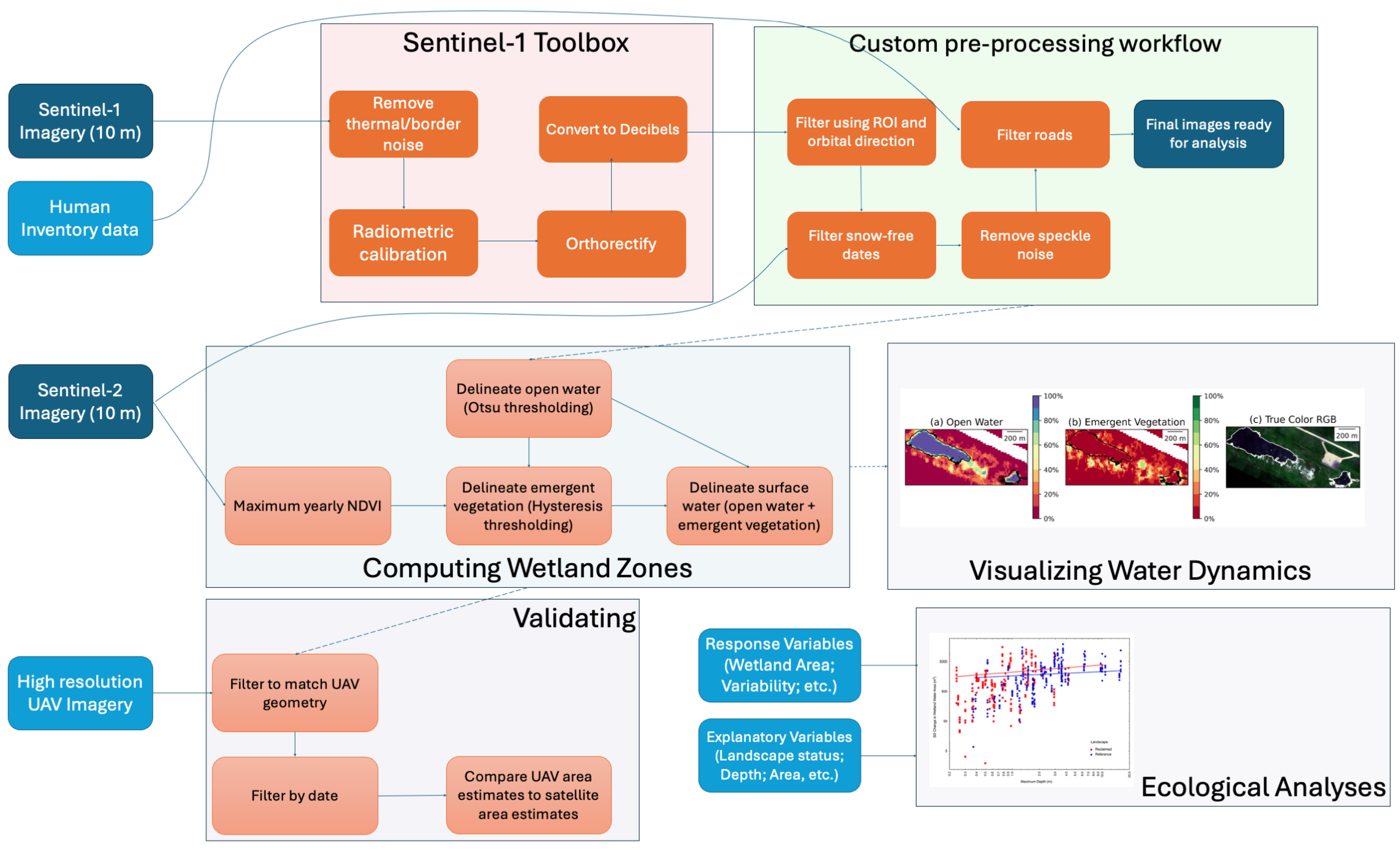
Figure 1. Overview of the workflow, from data acquisition to final analysis. Major systems are highlighted in boxes. Blue indicates an input (dark blue is a core input, light blue is a supplementary input). Dashed lines are used to indicate steps moving between major systems. Orange boxes are used to indicate processing steps (dark orange is used for preprocessing, light orange is used for core processing steps). Visual examples of the key processing steps are provided in the Supplementary Materials.
Remotesensing 17 03927 g001
Figure 2. The Boreal Wetland Reclamation Assessment Program study region and its context within Alberta and Canada; coloured points indicate study wetland locations. Wetlands in reclaimed landscapes (within mine lease areas) are shown in purple. Wetlands in reference landscapes (located off-lease) are shown in orange. Google Satellite Imagery is used to provide context about the region. To ensure computational feasibility, analysis was limited to the bounding box shown.
Remotesensing 17 03927 g002
Figure 3. Otsu classification of an image of Gregoire Lake and surrounding area (292 km2), located approximately 20 km south of Fort McMurray, Alberta (3 June 2020). (a) Illustration of the Otsu classifier showing the bimodal frequency distribution of pixels, with water pixels shown highlighted in blue. All other pixels are not shown. Pixel size is 30 m. (b) frequency distribution of VH pixel values. Pixels with VH values less than the threshold (−22.87 dB) are classified as water (blue-shaded background; all other pixels are classified as land (red-shaded background).
Remotesensing 17 03927 g003
Figure 4. Sentinel-1 Image illustrating hysteresis thresholding. Pixels p ( x , y ) , where p ( x , y ) t h are shown in green (high confidence); indeterminate pixels ( t l < p ( x , y ) t h ) are shown in either pink (excluded because they are too small) or purple (status uncertain). Pixels classified as open water are shown in blue. Two large wetlands are shown on either side of a road transecting the image. All other pixels are not shown. Image date: 15 June 2020. The base map layers are visualized using raster tiles sourced from Bing Maps from Microsoft to provide context about the area.
Remotesensing 17 03927 g004
Figure 5. Examples of wetland imagery showing spatial extent of open-water (output from Equation (1); drawn in blue) and emergent vegetation (output from Equation (3); drawn in purple). Features of each wetland class are listed in Table 1. The background context is drawn using Bing satellite imagery from Microsoft, and UAV estimates of wetland extent are drawn using white polygons when available. The Sentinel-1 images used in this example are from July 2020. Note that scales differ among images. Pixel resolution is 10 m × 10 m. (a) Class II wetland, which generally lacks emergent vegetation and open water. (b) Class III wetland, dominated by an emergent vegetation zone. (c) Class IV wetland, dominated by a submergent vegetation zone (classified as open water). (d) Class V wetland, dominated by open water.
Remotesensing 17 03927 g005
Figure 6. Summary images of two class V, 14-year-old wetlands (former borrow pits) in a reference landscape. The central white bar is a roadway. Images are compiled from 30 images collected between May and October 2019. The upper row shows the pixel specific detection frequency of water (percent of images), while the lower row shows the variability (standard deviation). Left-hand column—open water, center—emergent vegetation, and the right-hand column—combined open water and vegetation result.
Remotesensing 17 03927 g006
Figure 7. Summary images ((a) Open water; (b) Emergent vegetation) for two class V wetlands in a reference landscape (large wetland 7 years old; smaller wetland 14 years old) compared to a true colour RGB Image gathered by UAV observation on 17 July 2023 (c). The RGB image was gathered by UAV observation on 14 July 2023 (c). The UAV- estimated wetland boundary is illustrated by black lines superimposed on images in (a,b). Neither the open-water (a) nor emergent vegetation (b) images falsely detect the vegetation surrounding the wetlands visible in image (c).
Remotesensing 17 03927 g007
Figure 8. Comparison of variability of the extent of Open-Water (a), Emergent Wetland Vegetation (b), and combined results (c) in two adjacent wetlands in a reference landscape north of Fort McMurray. The UAV-estimated wetland boundaries are illustrated by black lines. Gateway Wetland is situated between the two diverging branches of a road. Crane Road Marsh is located on the north side of the road at the point at which it forks. The large water body on the east edge of the images is Crane Lake.
Remotesensing 17 03927 g008
Figure 9. Relationship between UAV-estimated open-water area and Satellite Model estimated open-water area. The line y = x is shown with a dashed black line, while regression lines fitted to wetlands in reclaimed ( n = 17 ) and reference (n = 34) landscapes are shown in red and blue, respectively. Simple equation for the combined data takes the form Observed (UAV) area = 0.42   +   0.895   ( ± 0.038 )   ·   ( Satellite - estimated   area ) , R 2   =   0.92 ,   n   =   51 .
Remotesensing 17 03927 g009
Figure 11. Relationship between intra-annual variability in area (standard deviation of difference in open-water area between sequential images) and maximum wetland depth in reference (blue points and lines) and reclaimed (red points and lines) landscapes. Regression equations are SD = 0.0025 + 0.0013 log 10 ( Max Depth ) for reference landscapes and SD = 0.0045 + 0.00005 log 10 ( Max Depth ) for reclaimed landscapes.
Remotesensing 17 03927 g011
Figure 12. Example Visual results highlighting water dynamics of wetlands (combined water and emergent vegetation model). Sentinel-1 Imagery from 2020 is used in these examples. UAV estimates of actual wetland extent are drawn using a black polygon when available.
Remotesensing 17 03927 g012
Figure 13. Comparison of results algorithm from Huang et al. [53] to our model results. Top row—results from Huang et al.; bottom row—results (combined model, Equation (4)). The wetland area estimates from UAV imagery are drawn using a black polygon.
Remotesensing 17 03927 g013
Table 1. Alberta Wetland Classification System Permanence Classes. Typical depth was assessed from BWRAP study wetlands in the AOSR.
CategoryWater Regime ModifierDeepest Vegetation ZoneTypical TaxaTypical Depth (m)
IITemporaryWet meadowCarex spp.;
Calamagrostis spp.
0.41 (n  = 18 )
IIISeasonalEmergentTypha latifolia; Schoenoplectus spp.0.63 ( n = 21 )
IVSemi-PermanentSubmergentUtricularia spp.; Myriophyllum spp.1.14 ( n = 42 )
VPermanentshallow Open waterStuckenia spp.; None4.06 ( n = 38 )
Table 2. Regression summary predicting UAV estimated open-water area from satellite-estimated area (open-water model). n = 51 , R 2 = 0.92 .
Independent VariableRegr. CoeffStd. Errort-ValuePr(>|t|)
Intercept0.32290.08014.280.0001
Satellite-estimated area0.89420.037923.58<0.0001
Reclaimed Landscape (1 vs. 0)0.16390.15941.030.3090
Homogeneity of slopes (Recl. vs. Ref.)0.24060.13221.8210.0751
Table 4. ANCOVA table for the relationship between intra-annual variation in open-water area and maximum wetland depth among wetlands in reclaimed and reference landscapes.
EffectDFSum of SquaresMean SquareF-Valuep-Value
Whole model39.9693.32312.87<0.0001
Intercept148.11648.116186.35<0.0001
Landscape10.0660.0660.250.614
log 10 (MaxDepth)14.5934.59317.79<0.0001
Homogeneity of Slopes (Ref. vs. Recl.)10.0890.0890.340.557
Error22457.8360.258
Total22767.805
Table 5. ANCOVA table for the relationship between interannual water variability vs. maximum wetland depth among wetlands in reclaimed and reference landscapes.
EffectDFSum of SquaresMean SquareF-Valuep-Value
Whole model366,48522,1624.380.0127
Intercept1136,778136,77827.03<0.0001
Landscape155<0.0010.9763
log 10 (MaxDepth)155,51855,51810.970.0027
Homogeneity of Slopes110,96210,9622.170.1530
Error26131,5455059
Total29198,030
Disclaimer/Publisher’s Note: The statements, opinions and data contained in all publications are solely those of the individual author(s) and contributor(s) and not of MDPI and/or the editor(s). MDPI and/or the editor(s) disclaim responsibility for any injury to people or property resulting from any ideas, methods, instructions or products referred to in the content.