
Article

Effects of Prescribed Fire on Spatial Patterns of Plant Functional Traits and Spectral Diversity Using Hyperspectral Imagery from Savannah Landscapes on the Edwards Plateau of Texas, USA

1
Department of Ecology and Conservation Biology, Texas A&M University, College Station, TX 77843, USA
2
United States Department of Agriculture—Agricultural Research Service, Livestock and Range Research Lab, Miles City, MT 59301, USA
3
United States Department of Agriculture—Agricultural Research Service, Aerial Application Technology Research Unit, College Station, TX 77845, USA
4
Texas A&M AgriLife Research, Sonora, TX 76950, USA
5
Department of Natural Resource Ecology & Management, Oklahoma State University, Stillwater, OK 74078, USA
*
Author to whom correspondence should be addressed.
Remote Sens. 2025, 17(23), 3873; https://doi.org/10.3390/rs17233873 (registering DOI)
Submission received: 1 August 2025 / Revised: 26 November 2025 / Accepted: 27 November 2025 / Published: 29 November 2025
(This article belongs to the Special Issue Remote Sensing for Risk Assessment, Monitoring and Recovery of Fires)

Highlights

  • What are the main findings?
  • Weather and soil moisture shaped spectral diversity, whereas fire dampened the effects of reduced precipitation for spectral indices indicative of plant functional traits like canopy structure, greenness, and chlorophyll content. Although functional trait spectral indices declined with dry-down, the declines were smaller in burned areas.
  • Fire substantially influenced the spatial patterns of spectral evenness and functional trait indices. Fire disrupted the spatial patterns of spectral evenness (but not β-diversity) and spectral functional traits. Additionally, the combined effects of fire and dry-down increased spatial heterogeneity in spectral evenness and in spectral indices indicative of biophysical and biochemical traits across scales.
  • What is the implication of the main finding?
  • Prescribed fire can modestly moderate drought impacts but does not override soil–climate controls. Fire’s influence on vegetation resilience operates mainly through short-term phenological effects rather than large shifts in spectral diversity and savanna ecosystems’ functional diversity and resilience under changing rainfall patterns, highlighting the need to integrate climate forecasts into fire management plans.
  • Hyperspectral remote sensing supports adaptive fire management. Multi-scale hyperspectral monitoring can inform adaptive fire management by identifying where functional recovery is strongest and where environmental constraints limit post-fire vegetation responses.

Abstract

Vegetation heterogeneity supports biodiversity, while homogeneity limits it. In the Great Plains, fire and herbivory enhance ecosystem function by increasing spatial heterogeneity. However, quantifying their effects on plant functional traits and spectral diversity remains challenging due to landscape complexity and scaling limitations. Hyperspectral remote sensing offers a high-resolution approach to assessing these dynamics, improving the evaluations of post-fire recovery and vegetation function. This study examines the impact of fire on plant functional traits and spectral diversity within a savanna landscape in the Edwards Plateau, Texas, using airborne hyperspectral and multispectral imagery. Specifically, it aims to (1) quantify the spatial patterns of plant functional traits and spectral diversity, (2) assess fire’s effects on these patterns, and (3) evaluate how soil type, woody structure, and burn patterns mediate fire responses. High-resolution airborne images from 2018 (pre-fire) and 2020 (post-fire) were analyzed to classify burned and unburned areas, pre-fire woody cover, and derive spectral indices representing plant functional traits, β-diversity components, and spectral evenness. The results indicate that temporal patterns in spectral diversity were driven primarily by soil properties and weather, with limited evidence that fire altered spectral evenness or β-diversity across soils. In contrast, spectral indices showed clearer—but still soil-dependent—fire effects: declines in canopy structure, greenness, and chlorophyll content were less pronounced in burned areas, indicating that fire partially moderated late-season senescence. Fire had a substantial influence on spatial patterns of spectral evenness (but not β-diversity) and vegetation spectral functional traits, and fire and dry-down increased spatial heterogeneity in spectral evenness and in spectral indices indicative of biophysical and biochemical traits across scales. These findings demonstrate that environmental drivers, particularly soil–moisture interactions and interannual moisture variability, exert a stronger control over post-fire spectral diversity than fire alone. Hyperspectral imaging effectively captured these dynamics, supporting its role in monitoring post-fire vegetation responses. In addition to the use of hyperspectral imaging, fire management strategies should consider broader ecological drivers, including soil and weather interactions, to improve the assessments of ecosystem resilience and recovery.

1. Introduction

In the 21st century, remote sensing has revolutionized the quantification of biodiversity, ecosystem functions, and vegetation structure across landscapes [1,2,3,4]. Unlike traditional field-based assessments, remote sensing offers scalable and repeatable data for monitoring ecological patterns over broad areas [5,6,7]. Emerging hyperspectral sensors, such as those in the Environmental Mapping and Analysis Program (EnMAP), PRecursore IperSpettrale della Missione Applicativa (PRISMA), and NASA’s Surface Biology and Geology (SBG) missions, are expected to enhance biodiversity assessments using satellite, airborne, UAV, and field-based hyperspectral imaging [8]. Remote sensing techniques increasingly measure spectral diversity as a proxy for functional and taxonomic diversity, providing a non-invasive approach to evaluating landscape heterogeneity [9,10,11]. Spectral diversity, defined as the variation in reflectance patterns captured by remote sensors, indicates both species composition and functional traits, making it a valuable tool for assessing biodiversity across ecosystems [8,12,13].
Palmer et al. [14] suggested that vegetated areas with a higher spectral heterogeneity correspond to a higher species richness and functional diversity. This concept has been deemed the Spectral Variation Hypothesis (SVH), and multiple studies have been conducted during the last two decades to evaluate this scale-dependent concept [8,12,14]. It has also been suggested that differences in plant species’ optical traits or variations in habitat compositions contribute to differences in canopy reflectance [10,15,16].
Empirical studies have validated the Spectral Variation Hypothesis (SVH) in forests and grasslands, where spectral variance and diversity metrics correlate with species richness [12,17,18,19]. However, SVH has limitations, especially in ecosystems where spectral contrast does not directly correspond to species diversity, such as homogeneous habitats or regions with dominant abiotic factors like soil reflectance and moisture content [12,20]. While SVH is promising for biodiversity estimation, its effectiveness varies across spatial scales and disturbance regimes, necessitating refined methodologies [8,12,20]. Spectral diversity–biodiversity relationships are often scale-dependent and context-specific, posing challenges when applying SVH at larger scales with satellite sensors versus high-resolution airborne hyperspectral data, especially in fire-affected areas [8]. Alternative SVH approaches, such as direct trait mapping, remote sensing-estimated functional trait diversity, and spectral diversity assessment via cluster algorithms and radiative transfer models, may better capture ecological processes across different scales [11,21]. A key challenge is reconciling herbaceous layer spectral properties, often obscured in mixed pixels or dominated by canopy signals in multi-layered vegetation. Kamaraj et al. [22] showed that, while β-diversity from imaging spectroscopy correlates with plant community composition, these relationships differ significantly across sensor types and spatial resolutions, underscoring the importance of considering spectral diversity patterns.
The application of hyperspectral and multispectral imagery for mapping spectral profiles as proxies for plant diversity and functional traits faces challenges due to spectral and spatial resolution constraints [23,24,25]. Despite these limitations, spectral variations captured through remote sensing have proven ecologically relevant as biodiversity indicators. Studies have used diversity metrics like the Shannon–Wiener (H’) Index, Evenness (J) Index, and Simpson’s (D) Index to quantify spectral diversity [10,24,26,27]. However, traditional indices often fail to capture the spatial arrangement of spectral diversity. Remote sensing has also been used to assess heterogeneity in plant functional traits through vegetation indices (VIs), which serve as proxies for plant biochemical and biophysical properties [12,28,29]. Plant functional traits are morphological, physiological, or biochemical characteristics of plants that influence growth, survival, and ecosystem processes [30]. These functional traits derived from spectral signatures provide insights into grassland biodiversity, ecosystem processes, productivity, and resilience [11,13]. From advanced indices like the Enhanced Vegetation Index (EVI), Sun et al. [31] proposed a new Hyperspectral Image-Based Vegetation Index (HSVI) for detecting vegetation structure in complex urban landscapes [31,32]. Hyperspectral indices like the Modified Triangulated Vegetation Index (MTVI-2) and Chlorophyll Red-Edge Index (CIred-edge) have improved the detection of canopy chlorophyll, nitrogen status, and photosynthetic stress levels [29,33,34,35]. These advancements highlight the evolving role of remote sensing in characterizing plant functional diversity at broader spatial and temporal scales.
While vegetation indices may effectively capture plant productivity, they may not fully correspond to underlying biodiversity patterns, and scene and sensor effects can influence the accurate detection of functional diversity [29]. Additionally, the spectral resolution of remote sensing instruments plays a crucial role in capturing functional trait variability, as coarser resolutions may obscure fine-scale differences in plant physiology [29]. By integrating spectral diversity with functional trait assessments, researchers can develop a more holistic framework for understanding ecosystem structure and function at multiple spatial scales [10,12]. The relationship between spectral and species diversity is not always straightforward, with studies showing that spectral heterogeneity does not universally predict biodiversity, especially in structurally heterogeneous savannas or in areas with low structural diversity like grasslands [13]. In that regard, an opportunity exists for using remote sensing to monitor spectral and functional diversity, especially in rangelands, to better understand biodiversity patterns and ecosystem processes involved in these systems.
Rangelands, covering 40% of the landscape globally, not only supply crucial ecosystem services but are dynamic ecosystems characterized by heterogeneous vegetation, grazing, and fire regimes [36,37]. In the Great Plains of North America, periodic fires can stimulate plant productivity, which attracts ungulate herbivores, thus creating a disturbance that can lead to greater vegetation heterogeneity across the landscape. In the last 20 years, research has demonstrated the ecological value of reintroducing periodic fires with ungulate herbivory to improve ecosystem food webs (trophic levels) and pyrodiversity (fire-induced diversity), ultimately stimulating ecological processes (e.g., nutrient cycling, primary production, and succession) [38,39]. The combination of fire and selective grazing, known as pyric herbivory—an interaction between fire and grazing that shapes rangeland structure and composition [40,41]—has proven to increase biodiversity [42], vegetation productivity [38], cattle performance [43], and habitat conservation [44,45]. The topic of pyric herbivory as a scale-dependent feedback mechanism between landscape patterns and ecological processes [46] and its influence on woody structure [47,48] remains underexplored in remote sensing studies with regard to its effects on the spatial patterns of biodiversity and functions in rangeland systems.
Remote sensing in rangelands can capture fine-scale heterogeneity by detecting shifts in plant functional groups, soil exposure, and structural complexity [5,24]. However, disturbances like fire, grazing, and land-use changes introduce a variability that complicates spectral-based biodiversity estimates [12,13]. Fire history significantly influences spectral β-diversity, with recently burned areas showing stronger correlations between spectral and plant diversity, particularly when fine-resolution (e.g., centimeter-scale to sub-meter grid size) hyperspectral data are used [18,22]. Fire alters canopy reflectance through biomass loss and post-fire recovery, while grazing affects spectral patterns by influencing species composition and canopy structure [12,19]. Research is needed to understand how fire affects spectral diversity and functional traits within a pyric herbivory framework. High-resolution hyperspectral remote sensing can provide a comprehensive spatial and spectral analysis of vegetation response to pyric herbivory, enhancing the ability to analyze post-fire vegetation dynamics and landscape heterogeneity. Evaluating the spatial patterns and ecological interpretation of spectral diversity and functional traits using spectral indices will validate the role of remote sensing in examining landscape heterogeneity [28]. This approach is particularly valuable for assessing variations in spectral diversity following a fire, where field data are often limited, thereby enhancing our ability to analyze post-fire vegetation dynamics and ecosystem responses at fine spatial and spectral scales.
This study aims to investigate the impact of fire on the spatial patterns of spectral diversity and plant functional traits in a heterogeneous savanna in the Edwards Plateau of Texas, USA. Our objectives were as follows: (1) quantify the spatial patterns of plant functional traits and spectral diversity using airborne hyperspectral remote sensing; (2) evaluate the effect of fire on spatial patterns of plant functional traits and spectral diversity; and (3) examine how woody structures and fire patterns on different soil types affect plant functional traits and spectral diversity responses. Specifically, we asked the following: How does the vegetation’s spatiotemporal pattern of spectral reflectance change following a fire? How much of the spatial variation in spectral diversity is explained by soil types, pre-fire woody structure, and spatial burn patterns? Does fire increase the spatial heterogeneity in woody structure, plant functional traits, spectral evenness, and spectral beta diversity? How significant are the effects of prescribed fires, weather, and soil types in determining the spatiotemporal patterns of spectral diversity and functional traits in mesquite-oak savanna landscapes?

2. Methods

2.1. Study Site

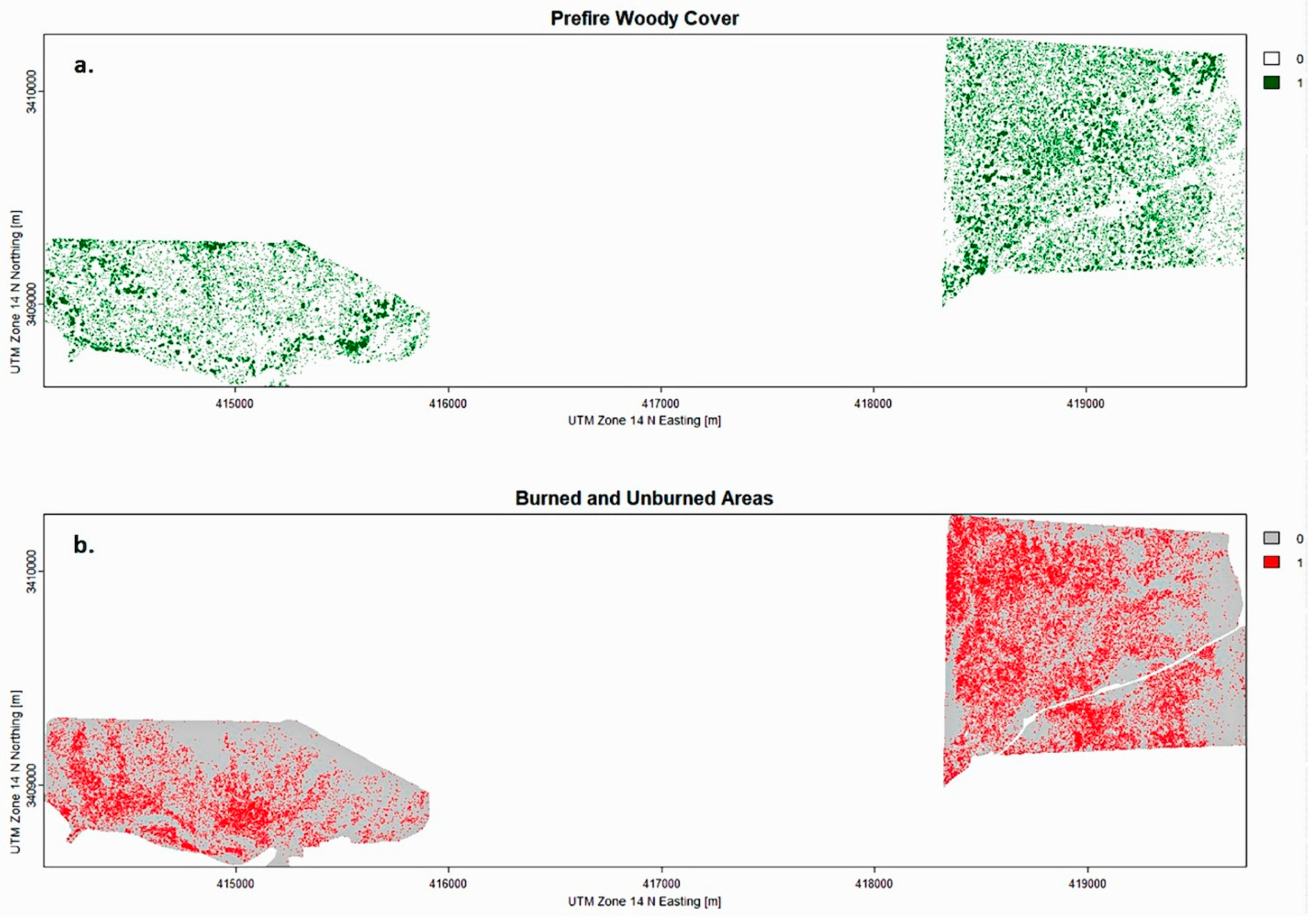
Research was conducted on a 2010.2-ha research ranch (Texas A&M AgriLife Research Martin Ranch) located in Menard County within the eastern Edwards Plateau (30.809670° N, 9.865701° W) of Texas, USA (Figure 1a). Our study area in the Edwards Plateau is primarily challenged by woody encroachment from native species, particularly Ashe juniper (Juniperus ashei) and honey mesquite (Neltuma glandulosa), rather than non-native invasive species. Jointed Goatgrass (Aegilops cylindrica), King Ranch bluestem (Bothriochloa ischaemum), and Buffelgrass (Cenchrus ciliaris) are noted as invasive grass species in the Edwards Plateau, but these are not found at our study site. In this ranch, the dominant plant community is composed of a mosaic of woody plants, shrubs, succulents, and seasonal herbaceous [49]. Dominant woody species include Neltuma glandulosa (can resprout), Quercus fusiformis (non-resprouting), Diospyros texana, and Juniperus ashei. In the lower canopy, shrubs such as Mahonia trifoliolata and Sideroxylon lanuginosum, succulents like Yucca constricta, and cacti (e.g., Opuntia engelmannii, Cylindropuntia leptocaulis) are common. In this study, we use “cacti” to specifically refer to members of the Cactaceae family, while “succulents” refers more broadly to other water-storing plants from families such as Asparagaceae, Agavaceae, and Crassulaceae. The herbaceous understory includes forbs (e.g., Solanum elaegnifolium, Salvia farinacea, Engelmannia peristenia, and Asclepias asperula), warm-season grasses (e.g., Hilaria belangeri, Bouteloua curtipendula, Panicum hallii and Aristida purpurea), and cool-season grasses dominated by Nassella leucotricha. Woody plant encroachment is a problem in the Edwards Plateau region [48], and the study site has had woody encroachment of Ashe juniper (Juniperus ashei) and honey mesquite (Neltuma glandulosa). Infestations of invasive grasses and forbs are currently not an issue at the study site.
The elevation at the ranch ranges from 612.8 m to 677.8 m above sea level, and the topography varies from 1 to 15% slopes, with soils composed of very cobbly clay and silty clay. From the US Natural Resources Conservation Service’s (NRCS) Soil Survey Geographic Database [50], three soil series occur within the study area: Tarrant (TA), Valera silty clay (VaB), and Kavett silty clay (KaB). The very shallow TA soil (111.98 ha) consists of very to extremely cobbly clay (0–33 cm) and clayey residuum weathered from limestone bedrock (33–76 cm). TA soils are well-drained with high runoff and shallow water storage capacity, with slopes ranging from 1% to 15%. The moderately deep VaB soils (41.54 ha) have moist silty clay (0–76 cm), cemented petrocalcic material (76–91 cm), and fragmented petrocalcic limestone bedrock (91–116 cm). VaB soils are well-drained with medium runoff capability, high water storage capacity, and slopes from 1% to 30%. The shallow KaB soils (35.74 ha) consist of calcium carbonate (0–38 cm), cemented material (38–51 cm), and residuum weathered from limestone bedrock (51–152 cm). KaB soil has medium runoff with moderate water storage capacity at 0–3% hillslopes. Soil properties and their interpretation were characterized using NRCS Web Soil Survey data for soils within the burn units of the study area (Figure 1), focusing on available water storage (AWS) as an indicator of soil water capacity. The three dominant soil types—Valera silty clay (13.68 cm AWS, high—H), Kavett silty clay (5.7 cm AWS, medium—M), and Tarrant soils (1.86 cm AWS, low—L)—reflecting differences in their water-holding capacities due to their respective depths and textures, were included as a factor in our analyses to evaluate how soil variability influences pre-fire and post-fire spectral diversity in burned and unburned areas.
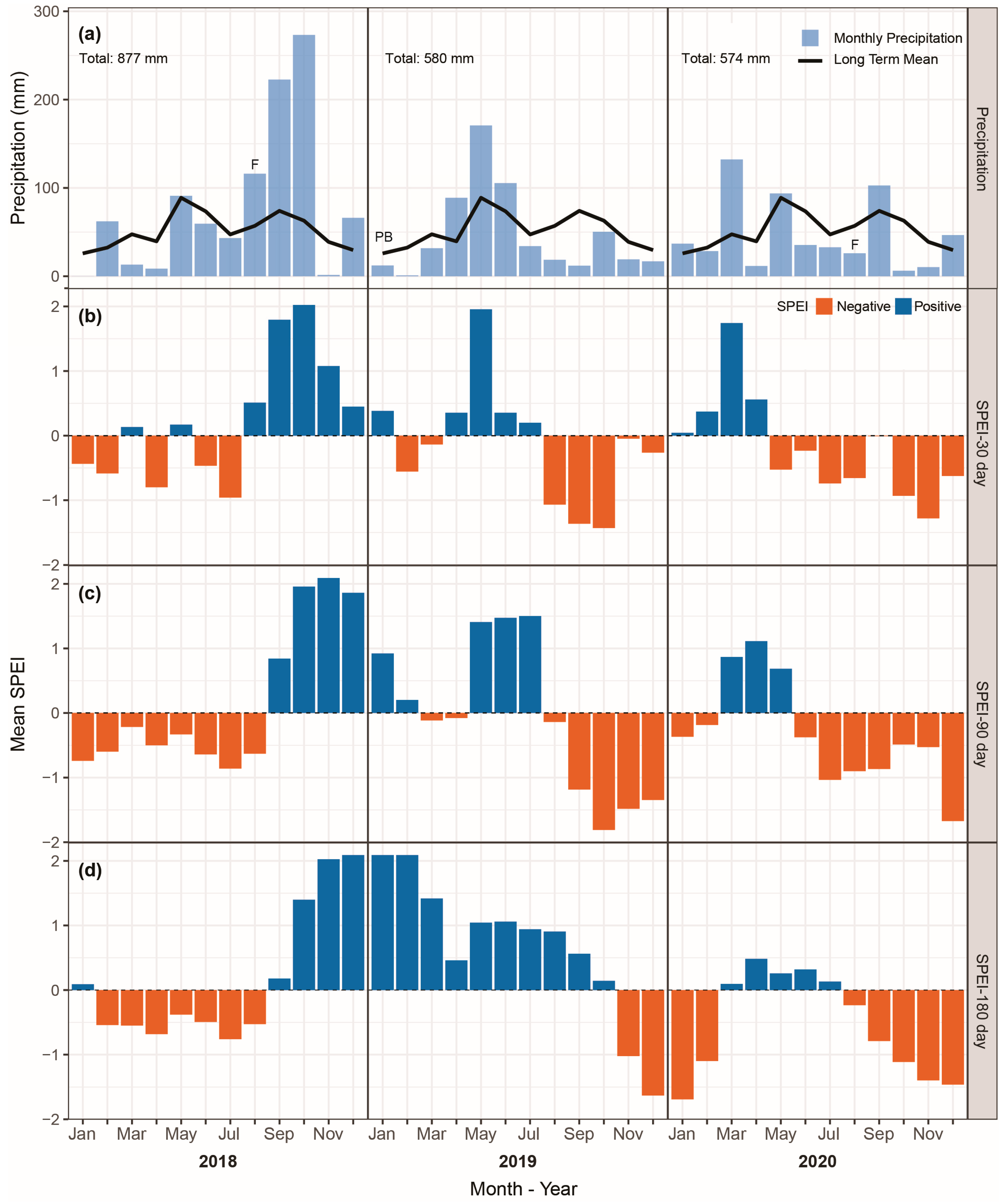
Average temperatures range from 7.9 °C in January to 34.4 °C in August. Mean annual rainfall is approximately 624 mm based on the 30-year normal [51,52], and monthly precipitation during the study period (2018–2020) was variable, with the highest precipitation amounts recorded in 2018 (Figure 2). Within the study site, two pastures (sizes: Lively 93.71-ha and E6M 147.72-ha) were subjected to prescribed burns conducted in late winter, 2–3 February 2019 (Figure 1b).

2.2. Remote Sensing Data

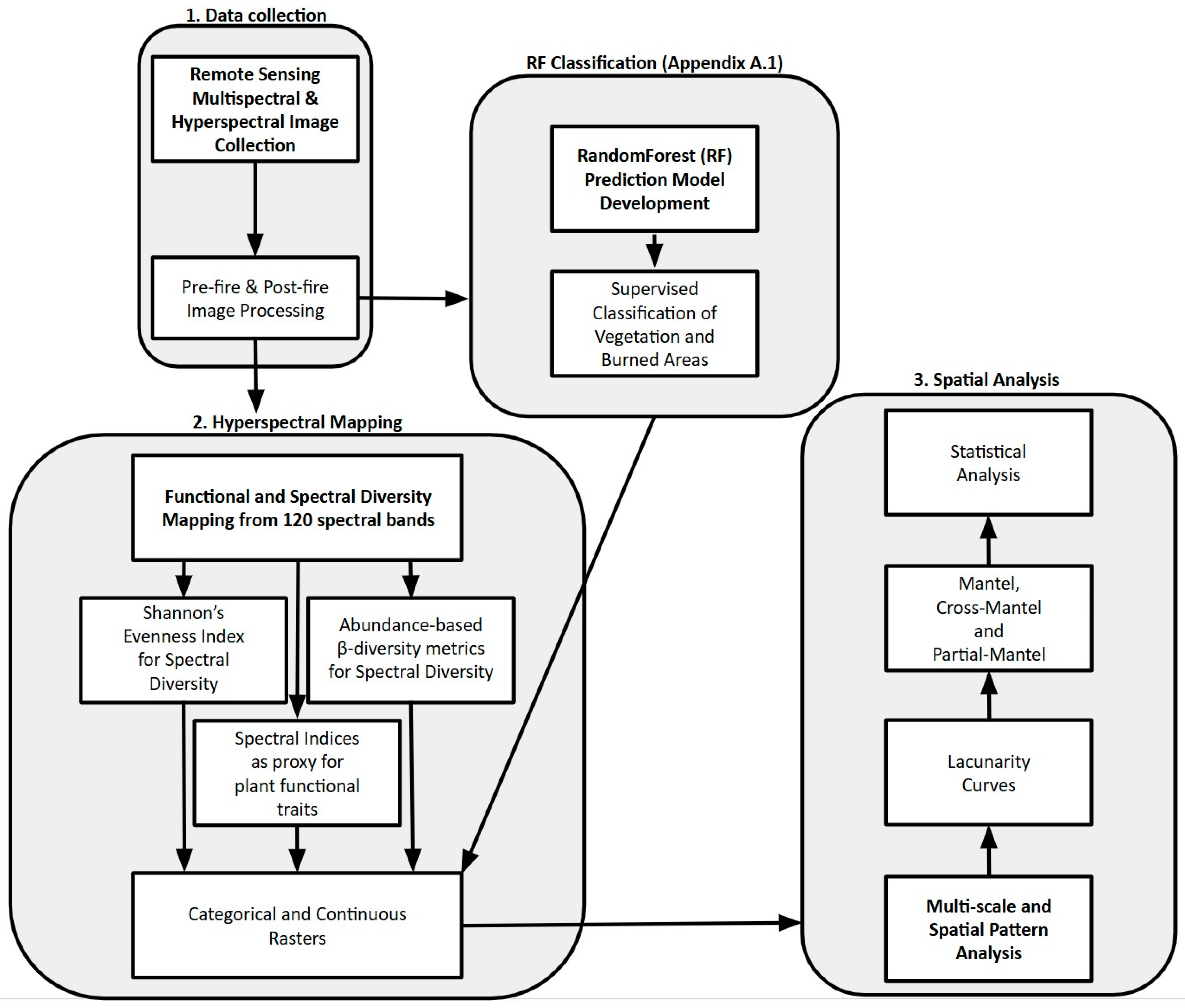
High-resolution aerial multispectral and hyperspectral images were collected during the peak vegetation biomass season (August–September) in 2018 (pre-fire) and 2020 (post-fire). The multispectral images with a pixel resolution of 21 cm were collected at 1980 m above mean sea level (MSL) within two months after the fire [55,56] to estimate the actual burned area and evaluate its influence on the spatial pattern of spectral indices. Two Nikon D810 digital cameras were used to collect multispectral images during the flyovers (one for RGB and the other for NIR imaging). The pre-fire and post-fire multispectral images (Appendix A.1) were classified to create vegetation cover maps of woody and non-woody pixels using Random Forest (RF) supervised classification [57,58]. Similarly, the post-fire multispectral image was classified using Random Forest (RF) to create maps with burned and unburned pixels. Following the classification, patch-based metrics for woody and burn cover (%) were calculated from the binary raster products of woody cover and burn cover maps [55]. Additional details on the pre-processing steps for multispectral image classification are included in Appendix A.1.
To derive functional trait proxies and spectral diversity metrics, we used the hyperspectral data (Figure 3) collected pre- and post-fire. A Headwall HyperSpec VNIR hyperspectral spectrometer with a GPS/inertial navigation system (Headwall Photonics, Bolton, MA, USA) was used to capture 16-bit hyperspectral images with a swath of 1608 pixels (50 cm resolution) and 120 spectral bands in the 382–999 nm spectral range (Figure 3) in 5 nm band width increments. The raw digital numbers (DN) for each spectral band were converted to percent reflectance using the Empirical Line Compute Factors and Correct method in ENVI 5.3, based on field spectral data from calibration tarps (3%, 4%, 16%, 32%, and 48% nominal reflectance) collected using an ASD HandHeld 2 (VNIR) Spectroradiometer (Malvern Panalytical Ltd., Malvern, Worcestershire, UK) (see [55] for additional information on camera and flight specifications). The hyperspectral and multispectral datasets were not fused at the pixel level; rather, they were applied in a complementary manner, with multispectral-derived vegetation and burn cover maps used as categorical factors in the spatial analysis of hyperspectral functional traits and spectral diversity. Radiometric normalization was performed using pseudo-invariant feature (PIF) methods [59,60]. PIFs were identified as pixels exhibiting minimal spectral change between the two image acquisition dates. For each spectral band, a linear regression model was fit between the reflectance values of the target image (2020) and the reference image (2018) using only the PIF pixels. The regression intercept and slope were then applied to the full target image to normalize it to the radiometric scale of the reference scene.

2.3. Indices of Plant Functional Traits

Fire effects on spatial patterns of spectral indices indicative of plant functional traits were examined using hyperspectral-based spectral indices separated into functional groupings representing biophysical and biochemical traits (Figure 3). To estimate vegetation biomass, canopy structure, and vigor, HSVI (leaf biophysical index developed by [31]) was used (Table 1). To assess variations in canopy green-LAI chlorophyll content and photosynthetic activity, MTVI-2 (leaf biochemical index by [34]) was chosen, since it has been found to be a useful proxy for identifying canopy structure and plant health while reducing soil background noise (Table 1). Lastly, we used CIred-edge (Table 1) to assess photosynthetic stress and plant post-fire regrowth [29], especially since the hyperspectral data collected lacked SWIR bands.
The “terra” and “tidyverse” R packages [61,62] were used to calculate spectral indices (Table 1) from the hyperspectral imagery data and produce output rasters for spatial analyses. The “terra” package [61] was used for raster handling and the calculation of spectral indices from hyperspectral imagery, while the “tidyverse” package [62] was used for data wrangling and organizing the outputs into final raster layers for spatial analyses.

2.4. Spectral Evenness and β-Diversity

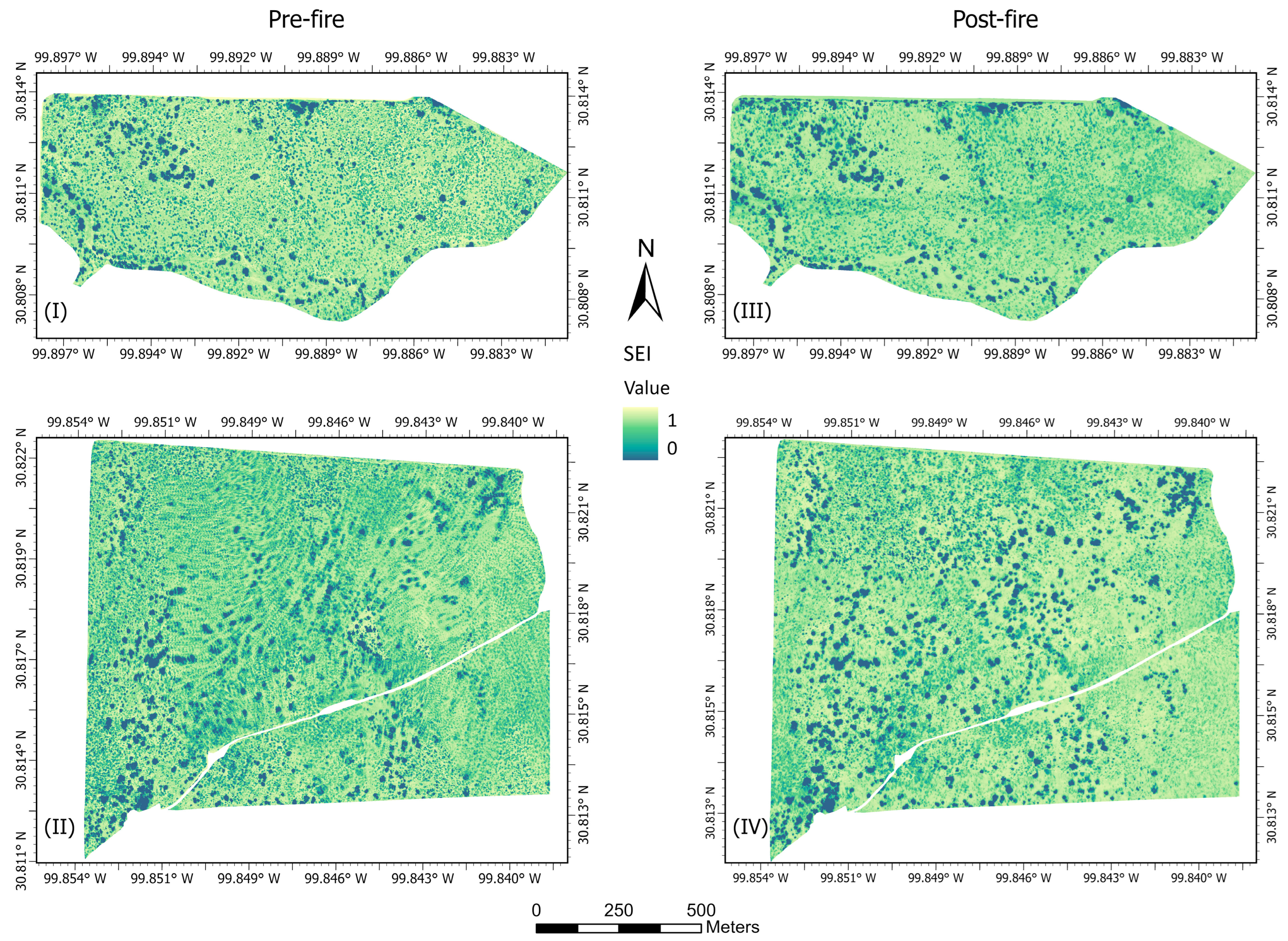
To assess the effect of fire on spectral diversity, spectral evenness was calculated from the standard deviation of the reflectance across photosynthetically active bands for the sampled zones [26,63]. To capture chlorophyll-related signals, including chlorophyll a, chlorophyll b, and reflectance/fluorescence features, we used bands 13–103, corresponding approximately to the 400–900 nm spectral range. This subset encompasses the key absorption and reflectance regions relevant for chlorophyll assessment. The reflectance values of the chlorophyll bands of each pixel were extracted using the R “raster”, “tictoc”, and “terra” packages that convert raster pixels to a data frame [61,64,65]. Shannon’s Evenness Index (SEI) maps were built based on these spectral profiles from pre-fire and post-fire images using the R package “vegan” [66].
Spectrally sampled locations were generated using a stratified random design in ArcGIS Pro 3.4.3 (Environmental Systems Research Institute, Inc. [ESRI], Redlands, California, USA), with 843 locations in the Lively unit and 999 in the E6M unit. The total number of sampling buffers per burn unit were allocated proportionally to soil type (TA, KaB, VaB) and burn status (burned vs. unburned) based on their relative area. Full details of the sampling procedure, including buffer creation and proportional allocation, are provided in Appendix A.2 and Table A3. These sampling locations were used to extract pixel values within the sampled 1 m2 buffer from pre-fire and post-fire spectral indices and SEI maps. For spectral β-diversity, we extracted spectral reflectance data using the same sampled locations from pre-fire and post-fire hyperspectral images.
Using Baselga’s abundance-based dissimilarity framework for species abundance [67], we replaced the original quantitative measure of species abundance with spectral reflectance data. We labeled it as spectral β-diversity, from which the percent of spectral reflectance values across the chlorophyll wavelengths were calculated to assess composition-based dissimilarities (β.BRAY) between sampled locations. Additionally, two decomposed components of the Bray–Curtis index of dissimilarity were calculated: (1) the balanced variation in abundance (β.BAL), which captures the differences in reflectance patterns across bands before and after the fire, and (2) the abundance gradient (β.GRA), which captures overall differences in reflectance magnitude from pre-fire to post-fire across bands [67]. The “betapart” package in R was used to generate the maps of spectral abundance-based dissimilarity measures, in addition to the two components of the Bray–Curtis index of dissimilarity [67].

2.5. Lacunarity Analysis

Lacunarity analyses of spectral evenness and indices of plant functional traits were performed to assess scale-dependent spatial patterns [68,69,70]. Lacunarity has been successfully used for describing the spatial pattern within grassland plant communities [71]. Lacunarity curves were constructed using the “spatLac” R package [72] for the binary rasters of vegetation structure and burn maps, and continuous rasters of spectral evenness and spectral indices. Lacunarity ( Λ ) was defined by using gliding box algorithms at nine different spatial scales [70,71] with corresponding box sizes (r) of 3, 5, 9, 17, 33, 65, 129, 257, and 513 m. Λ r =   S s 2 ( r ) S ¯ 2 ( r ) + 1 , where Λ r is simply the ratio of the variance S s 2 and their squared mean S ¯ 2 for the given box sizes [68,73,74]. The lacunarity curves were plotted as ln Λ(r) against ln(r) to examine the scale-dependent patterns of gappiness or aggregation [68,75] and for gradient-based analysis of landscape surfaces [76].

2.6. Statistical Analysis

We used linear mixed-effects models (LMMs) (lmer function in the “lme4” package) [77] to examine the effects of fire on the spectral proxies for plant functional traits and spectral diversity indices. Fixed effects were soil type, burn treatment (burned vs. unburned) and time (pre-fire vs. post-fire) along with their associated interactions. Woody cover (%) and burned area (%) were included as covariates. Sampling units nested within soil type and burn treatment were treated as a random effect.
LMM assumptions were verified by visually inspecting histograms, Q–Q plots, and frequency distributions of residuals. Formal tests of normality (Shapiro–Wilk) and homogeneity of variance (Levene’s test) were also conducted in R (v. 4.4.3; R Core Team, 2025). Cook’s distance [78] with a threshold of 0.2 was used to identify potential outliers. Locations of influential values in the hyperspectral images were inspected, and sample points were removed from the dataset in cases of georectification errors or spectral distortions at image edges. Variables that did not meet LMM normality assumptions were transformed as follows: Box–Cox transformations with appropriate lambda (λ) values were applied to plant functional trait proxies using the boxcox function in the “MASS” package [79], and the ordered quantile normalization function (orderNorm), found in the “bestNormalize” package [80,81], was applied to spectral diversity indices.
LMMs were fitted using the transformed variables. We used Type III sums of squares to calculate F-statistics and p-values for all fixed effects and interactions, applying the Satterthwaite approximation method to estimate the denominator degrees of freedom for the F-tests using the “lme4” package. For significant interactions, we conducted pairwise comparisons of the transformed estimated marginal means (EMMs) using the “emmeans” package [82]. p-values were adjusted for multiple comparisons using the Bonferroni method to control the family-wise error rate. To ensure the validity of confidence intervals following back-transformation, confidence intervals (CIs) for contrasts were obtained using 2500 sample parametric bootstrapping in bootMer (from “lme4” package) [77] with all contrasts recomputed on the back-transformed (original) scale for each bootstrap replicate. The back-transformed EMMs and CIs were used for reporting and interpretation.
We used the R package “betapart” [83] to calculate the three ꞵ-diversity measures for all pairs of sampled locations. The overall values (pre-fire and post-fire) of these ꞵ-diversity measures were then used to evaluate the effect of fire on spectral ꞵ-diversity. Averages of the ꞵ-diversity measures for pairs within burned and unburned areas were used to explore the impact of fire, soils, and vegetation structure on ꞵ-diversity.
Simple Mantel tests (βD) were used to assess the spatial autocorrelation for each spectral ꞵ-diversity measure, where D is the spatial distance matrix (Euclidean distance between sampled locations). Cross-Mantel tests (βB) were performed to assess the spatial cross-correlation between each ꞵ-diversity measure and the burn status (1 = burned, 0 = unburned), where B is a binary-derived distance matrix (absolute value of the difference in burn status between sampled locations). Cross-Mantel tests (βpreβpost) were also performed to assess the spatial cross-correlation between pre- and post-fire β-diversity. Partial Mantel tests (βD.B and βpreβpostB) were used to evaluate the spatial autocorrelation in post-fire β-diversity and spatial cross-correlation between pre- and post-fire β-diversity, respectively, when factoring out the effect of burn status [84,85]. For Mantel and cross-Mantel tests, we used the “ade4” R package [86,87]. All simple and cross-Mantel tests were then introduced to a spatial neighborhood structure as spatial weights for constrained permutations using the msr function from “adespatial” and “spdep” R packages [88,89] for spatially constrained spatial autocorrelation. Moran Spectral Randomization, which can account for global autocorrelation (Moran’s I) when conducting the Mantel test on georeferenced data [90], has been recommended over traditional Mantel tests. For partial Mantel tests, we generated Moran’s eigenvectors map (MEM) using the scores.listw function on the spatial weights list (listw) and included it as a strata permutation factor in the vegan::mantel.partial function from the “vegan” package [66]. RStudio v.2024.09 [91] was used to implement R 4.3.1 software [92] for statistical analyses.

3. Results

3.1. Changes in Shannon’s Evenness and Abundance-Based β-Diversity from Vegetation Spectra

For all spectral diversity indices, the three-way interactions between soil, burn treatment, and time were not significant. However, significant two-way interactions were detected specifically for time × soil and soil × burn treatment combinations.
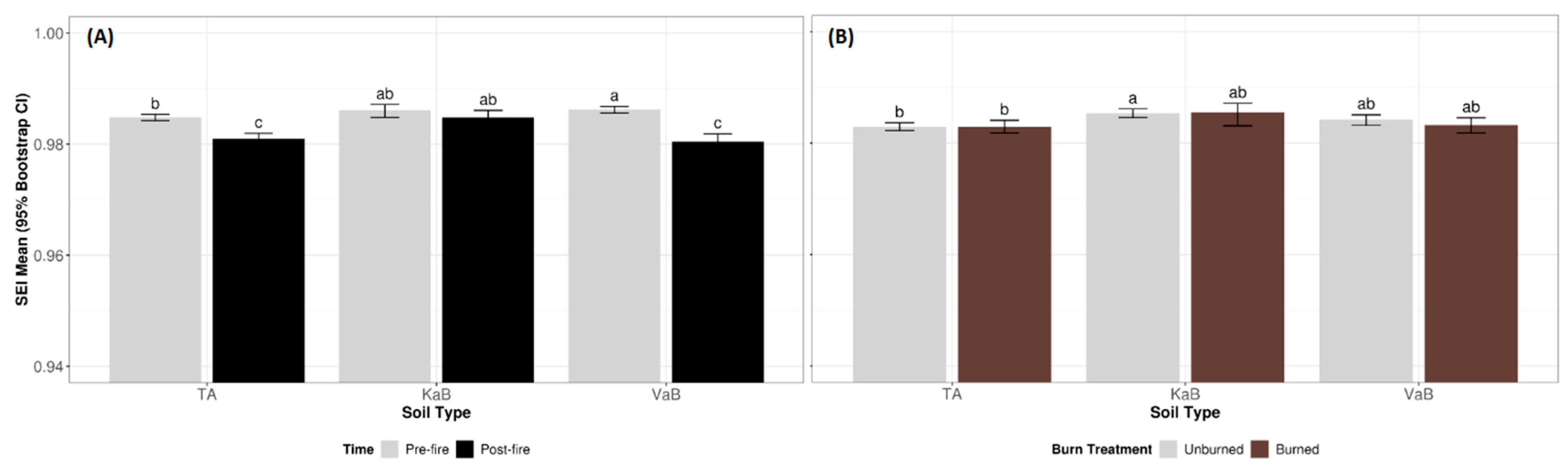
The Shannon Evenness Index, which quantifies the equitability of abundance distributions, revealed subtle but significant patterns. Significant interactions between time and soil types were observed, as the post-fire Shannon’s Evenness Index (SEI) was significantly (F2,1850 = 12.38, p < 0.001) lower than pre-fire values for the TA and VaB soils (Figure 4A). In TA soils, SEI significantly decreased from pre-fire to post-fire, suggesting a shift toward a greater dominance by a subset of spectral groups after the fire. KaB soil exhibited minimal temporal change, indicating stable spectral abundance distributions over time. In VaB soil, spectral evenness declined, indicating that VaB soil experienced the strongest temporal reductions in SEI. In contrast, the soil × burn treatment interaction was not significant (p = 0.43), as SEI values were generally similar across soil types and between burned and unburned areas within each soil (Figure 4B). Although the absolute magnitude of SEI differences across soils was small (all values between 0.98 and 0.99; Figure 4A,B), the relative shifts in spectral composition observed indicate soil conditions that, over time, played a stronger role than fire in shaping the spectral abundance balance at fine scales.
We also evaluated the effects of environmental covariates, including pre-fire woody plant cover (%) and fire pattern (i.e., % burn cover), on spectral SEI responses to fire and soil types. From the linear mixed-model with the F-test using Satterthwaite’s method, we found a significant influence of pre-fire woody cover on the response in SEI (p < 0.001). However, the burn pattern covariate did not show a significant influence on the SEI response.
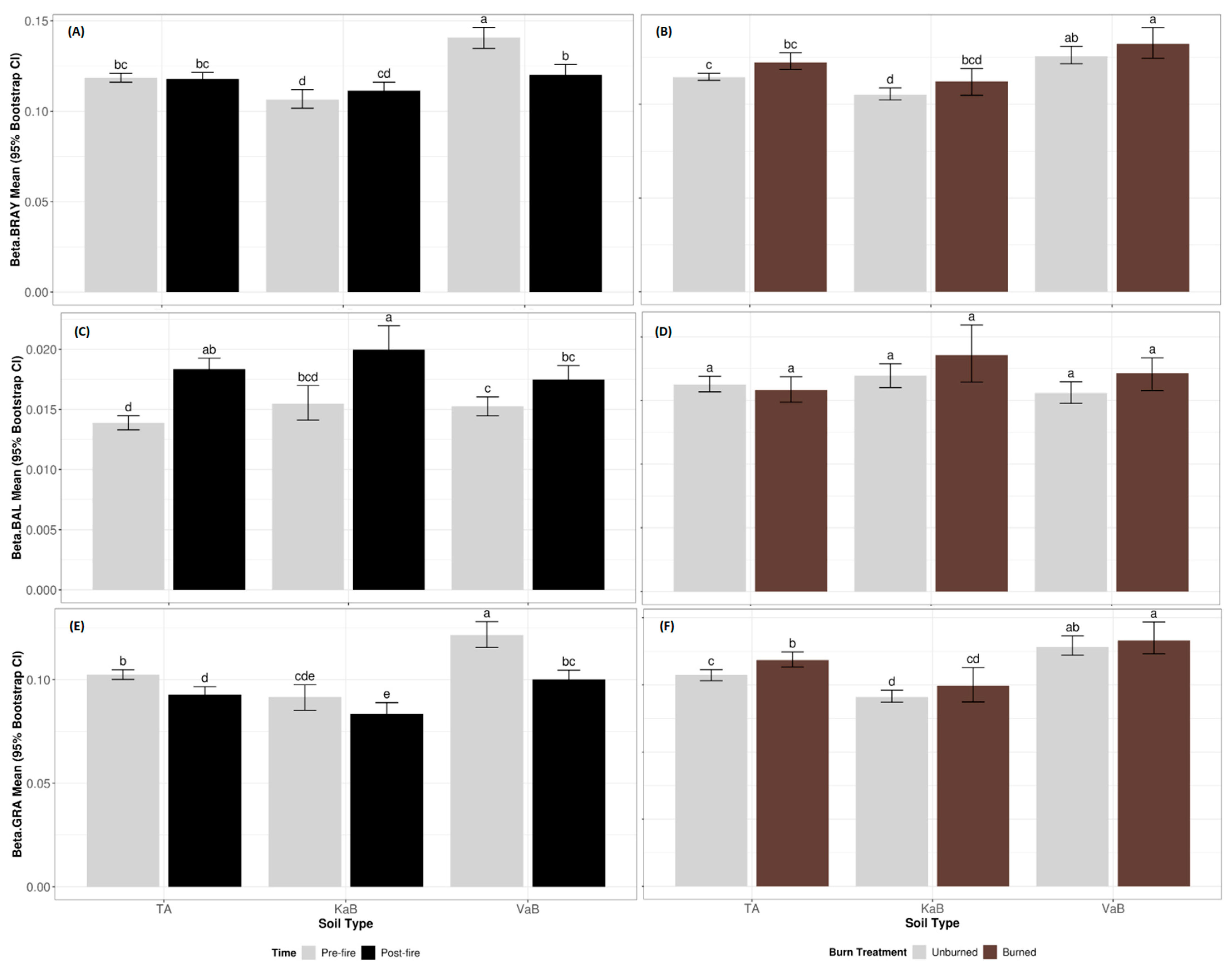
The Bray–Curtis dissimilarity exhibited a significant soil × time interaction (F2,1865 = 17.86, p < 0.001), indicating that temporal patterns in community composition differed among soils (Figure 5A). The spectral compositional dissimilarity decreased significantly from pre- to post-fire in VaB soil. However, pre- and post-fire means were similar in both TA and KaB soils. The burn treatment × time interaction was marginally significant (p = 0.058) but was not retained as a strong driver based on the Type III test. The soil × burn treatment interaction was not significant (Figure 5B), indicating that burned and unburned areas did not differ systematically within each soil type. After accounting for these interactions, the soil main effect was a strong predictor of β.BRAY (F2,1861 = 43.55, p < 0.001), with VaB soils showing the highest dissimilarity, followed by TA and KaB soils. The fire (burn treatment) showed a significant main effect (F1,3457 = 5.13, p = 0.02), with unburned areas exhibiting a higher overall dissimilarity in spectral abundance than burned areas.
β.BAL exhibited two significant two-way interactions. First, the soil × time interaction was significant (F2,1829 = 9.03, p < 0.001), indicating that temporal changes in balanced spectral turnover varied among soils (Figure 5C). Across all soils, β.BAL had a general trend of increased β.BAL from pre- to post-fire, but the increase was significant only for KaB and TA soils (Figure 5C) Second, the soil × burn treatment interaction was also significant (F2,1830 = 4.76, p = 0.009; Figure 5D), but pairwise comparisons did not identify any significant differences in pairs of means. KaB and VaB soils exhibited slightly higher β.BAL in burned areas compared to unburned areas, while burned TA areas had a slightly lower, but not significant difference in β.BAL compared to unburned areas (Figure 5D).
The soil × time interaction was not significant (p = 0.120) for β.GRA, but visual patterns (Figure 5E) suggest modest temporal declines across soils, most noticeably in VaB and KaB. The burn treatment × time interaction was also not significant (p = 0.108), indicating that pre- to post-fire changes did not differ consistently between burned and unburned areas. However, the fire effect on β.GRA revealed a significantly (F2,1863 = 3.20, p = 0.041) distinct dynamic, as burned and unburned areas varied across soils (Figure 5F). Among soil types, VaB showed the highest pre- and post-fire β.GRA values, while KaB soils had the lowest; however, the pre- and post-fire means for both VaB and KaB were not significantly different. The post-fire gains in the β.GRA means were significant only for TA soils.
The environmental covariates of woody plant cover (%) and fire pattern (% burn cover) had differential influences on abundance-based β-diversity metrics. For β.BRAY, both woody cover (F1,2247 = 7.61, p = 0.006) and fire pattern (F1,3653 = 5.64, p = 0.02) showed a significant influence on the temporal response of β.BRAY to fire and soil type. For the other two β-diversity components, only woody cover showed a significant influence on the temporal changes in β.BAL (F1,2327 = 109.25, p < 0.001) and β.GRA (F1,2240 = 14.43, p < 0.001) in response to fire and soil type. Meanwhile, the fire pattern (p = 0.08) had a marginal influence on β.GRA.

3.2. Pre-Fire and Post-Fire Spatial Patterns of Shannon’s Evenness and Abundance-Based β-Diversity

Simple Mantel statistics on the spatial relationships between SEI and geographic distance (XD) showed a positive spatial correlation among spectrally sampled locations before the fire but weakened after the fire (Table 2). Within the study area, a significant positive autocorrelation was found between space and SEI (XposD) measured after the fire. This indicates a weakened similarity in the chlorophyll range spectra between sampled areas in the same vicinity, sharing similar environmental conditions. Meanwhile, β.BRAY also showed a weakened spatial structure after the fire (XposD; Table 2). The abundance-based components of β-diversity (β.BAL and β.GRA) also exhibited a significant spatial structure for pre-fire and post-fire spectra, whereas β.BAL had a stronger significant spatial structure post-fire (XposD), while the β.GRA spatial structure weakened after the fire (XposD; Table 2). The cross-Mantel (XpreXpos) results indicated a significant spatial cross-correlation between pre-fire and post-fire measures of SEI and abundance-based β-diversity (Table 2). However, we observed a significant but negative spatial cross-correlation (XposB) only for SEI and burn status, while burn status positively influenced the β.GRA component of β-diversity (Table 2). Partial Mantel (XposD.B) tests showed no significant Mantel’s r, indicating that no spatial structure existed for post-fire spectral diversity measures after factoring out the effect of burn status.

3.3. Effect of Fire on Spectral Functional Traits

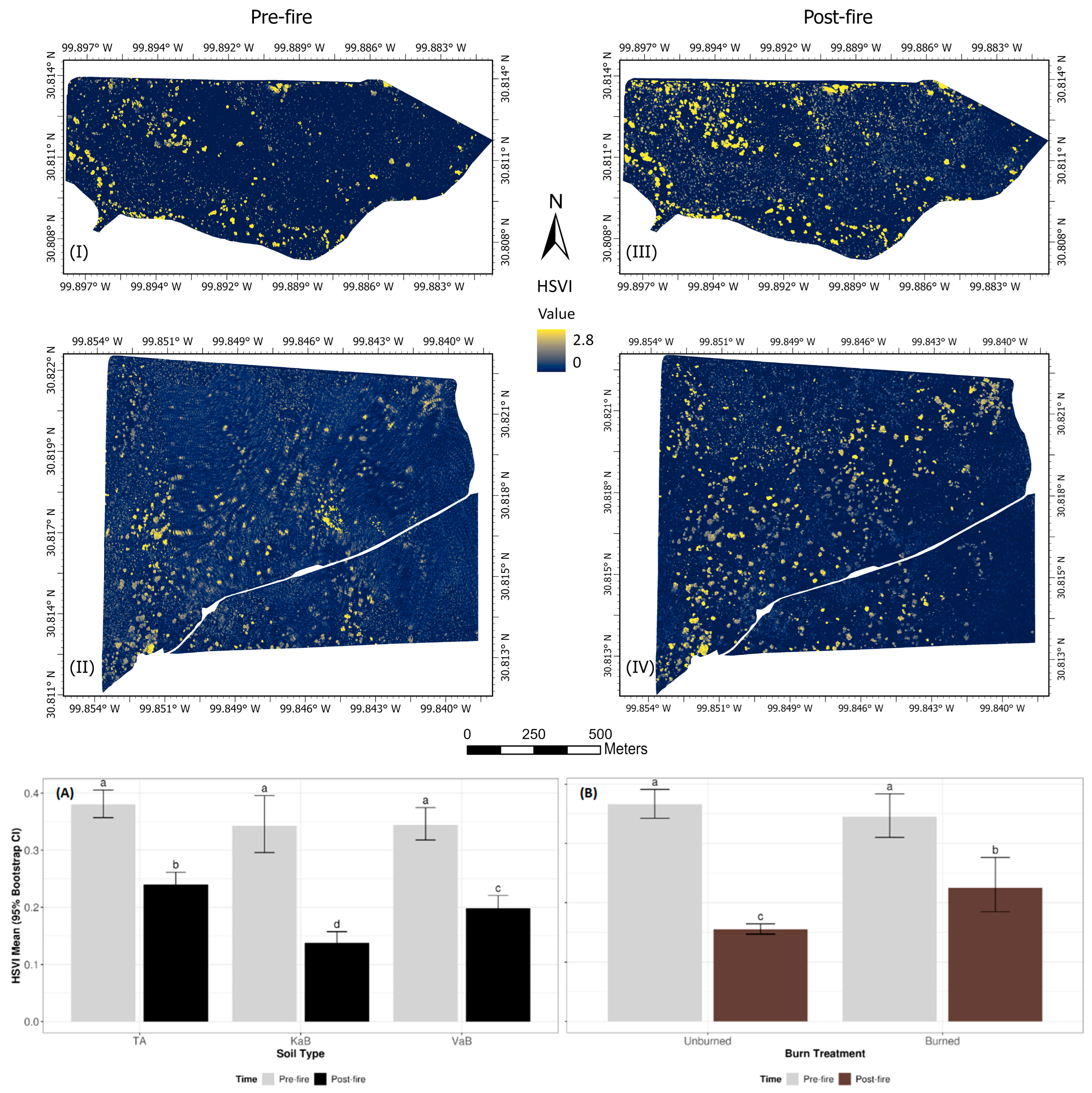
LMM analyses on spectral index proxies for plant functional traits resulted in non-significant three-way interactions between soil, burn treatment, and time for all three spectral indices (HSVI, MTVI2, and CIred-edge). Significant two-way interactions for time × soil and time × burn treatment emerged for all spectral vegetation indices (Figure 6, Figure 7 and Figure 8). For HSVI, the soil × time interaction was highly significant (F2,1848 = 17.45, p < 0.001), indicating that pre- to post-fire changes in vegetation biophysical properties varied among soils (Figure 6A). In TA and VaB soils, HSVI declined markedly from pre-fire to post-fire, whereas KaB soils exhibited an even stronger decline, with post-fire values being significantly lower than the post-fire values in the VaB and TA soils. The effect of fire and time was also significant (F1,3010 = 11.89, p < 0.001), indicating that the magnitude of HSVI change over time differed between burned and unburned areas (Figure 6B). Unburned areas showed a large decline from pre- to post-fire, while burned areas showed a smaller but still significant reduction in greenness and photosynthetic activity, as indicated by the reduced HSVI values.
Evaluating the influence of pre-fire woody plant cover (%) and burn cover (%) covariates on the biophysical index (HSVI) revealed that woody cover had a very strong negative effect on HSVI (p < 0.001). The effect from woody cover could indicate that woody-dominated vegetation exhibited a lower biophysical activity relative to herbaceous-dominated areas. Meanwhile, the fire pattern increased the likelihood of a lower HSVI (p = 0.0014), indicating that more extensively burned areas experienced greater biophysical modifications.
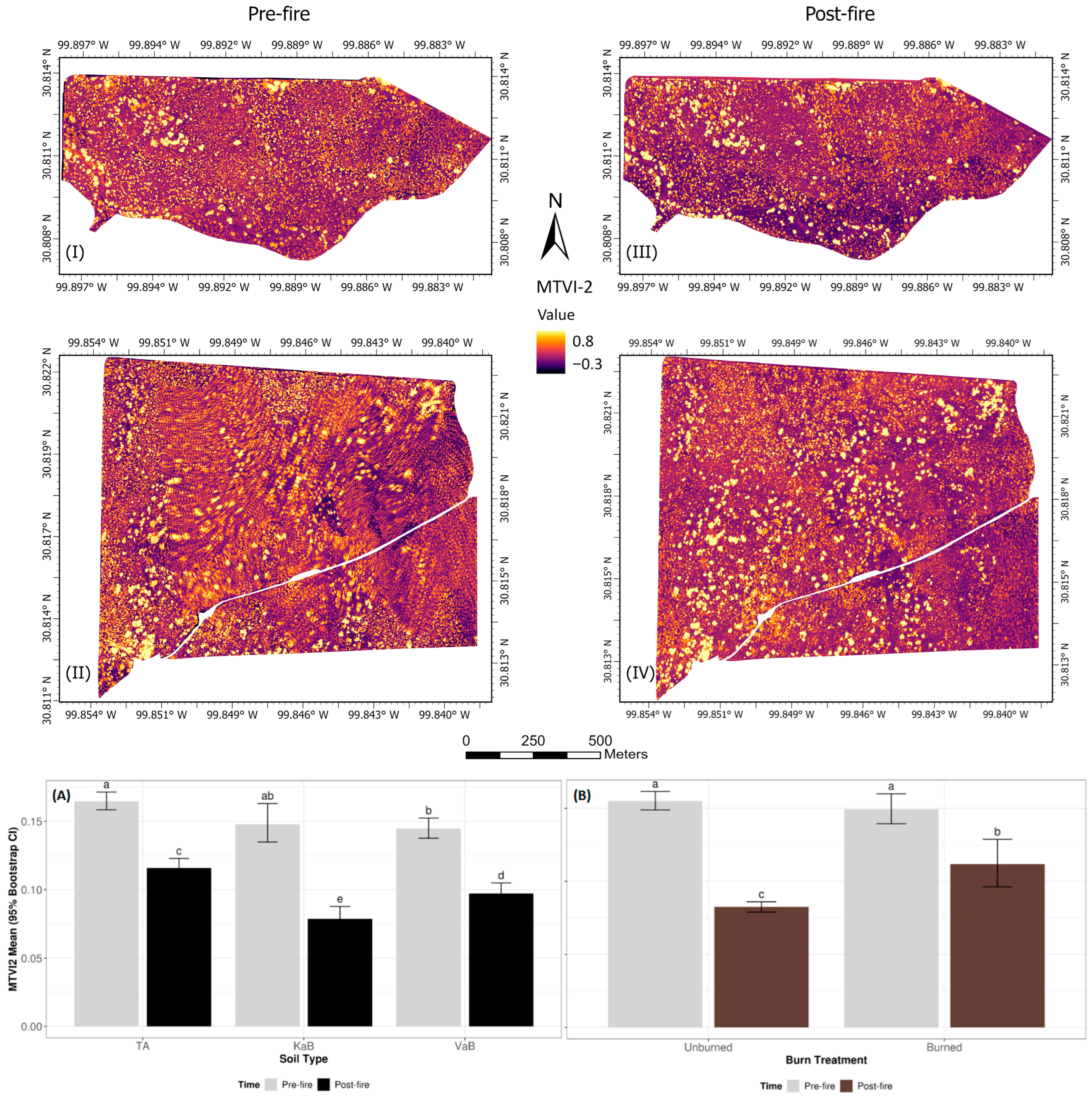
The analyses of the spectral index indicative of plant biochemical properties (MTVI-2) showed that the soil × time interaction was significant (F2,1845 = 10.31, p < 0.001), suggesting that the chlorophyll-sensitive reflectance changed differently among soils across the pre- to post-fire period (Figure 7A). Across all soils, the reductions in MTVI-2 from pre-fire to post-fire varied, with TA soils showing a moderate decline, KaB soils showing the strongest decline, and VaB soils showing an intermediate reduction. Like that seen with HSVI, the post-fire MTVI-2 in the KaB soil was significantly lower than the post-fire MTVI-2 in TA and VaB soils, even though the pre-fire conditions were similar among soils (Figure 7A). The interaction of fire effect and time was also significant (F1,3006 = 14.06, p < 0.001), with unburned areas exhibiting a larger reduction in MTVI-2 than burned areas (Figure 7B). This may suggest that the vegetation in burned areas exhibited a partial regreening or reduced senescence relative to unburned areas during the post-fire period.
Among covariates, the fire pattern significantly decreased MTVI-2 (p < 0.001), indicating a stronger reduction in chlorophyll activity in more extensively burned areas. Woody cover also strongly reduced MTVI-2 (p < 0.001), demonstrating that woody-dominated areas exhibited a lower chlorophyll-sensitive reflectance compared to herbaceous-dominated vegetation.
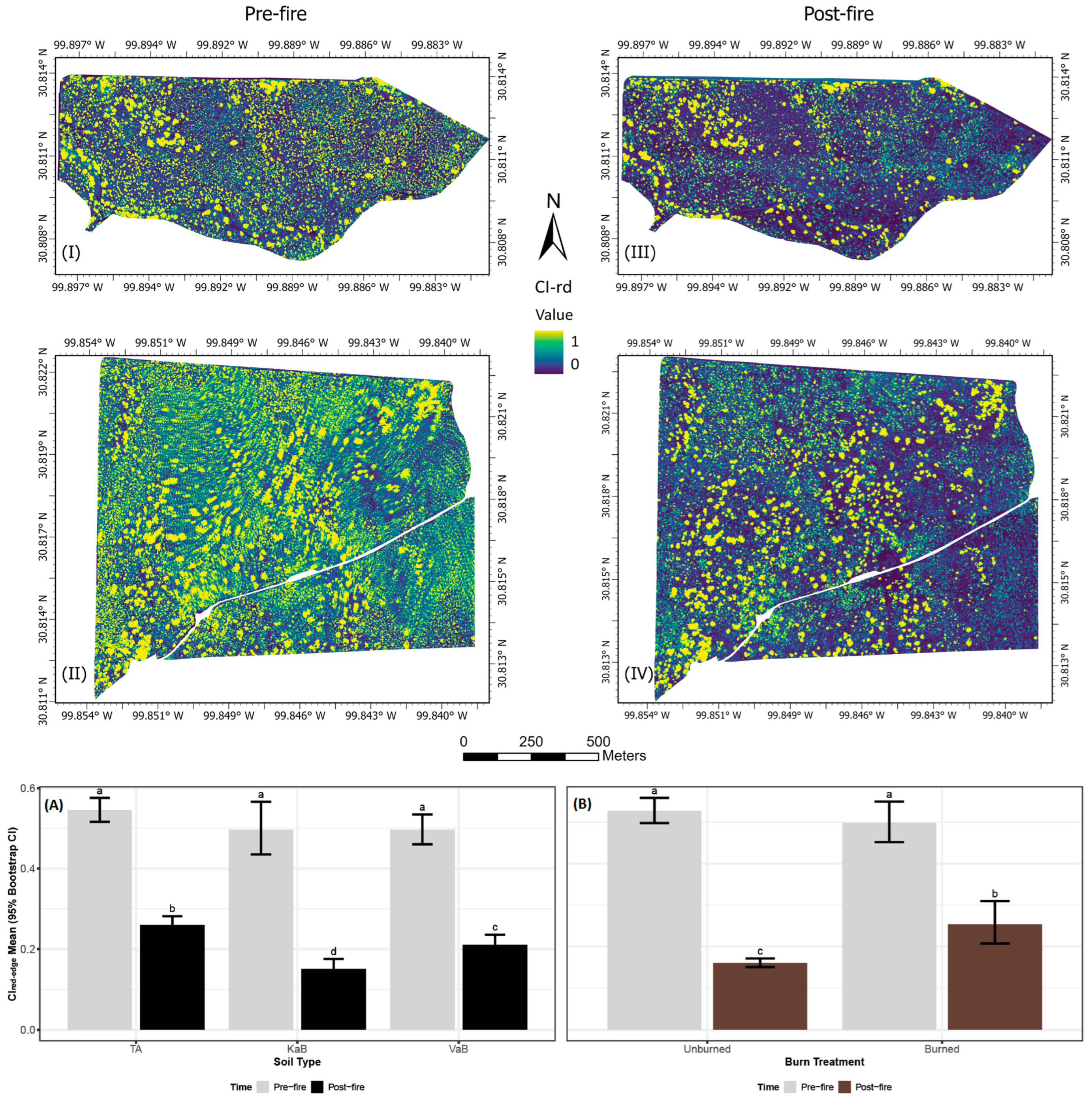
For the spectral index used as a proxy for plant photosynthetic capacity (either signaling stress or regreening phase), CIred-edge (Figure 8), the soil × time interaction was significant (F2,1824 = 13.29, p < 0.001). Soil type appears to have strongly modulated pre- to post-fire changes in photosynthetic capacity (Figure 8A). All soils showed substantial declines in CIred-edge from pre-fire to post-fire, but the magnitude differed, as TA and VaB soils dropped from high pre-fire values to moderate post-fire values. However, KaB soil showed the steepest reduction compared to the other two soils. Secondly, the effect of the fire × time interaction was significant (F1,2956 = 14.28, p < 0.001; Figure 8B), showing that the temporal change differed between burned and unburned areas. Unburned areas showed a large temporal decline in CIred-edge, while burned areas showed a smaller decrease. This suggests that the vegetation in burned areas either began recovering or experienced less late-season senescence relative to unburned areas. But these patterns also indicate a soil-dependent variation in chlorophyll loss and post-fire canopy stress.
Among covariates, both pre-fire woody plant cover (%) (p < 0.001) and fire pattern (p < 0.001) significantly contributed to the decline of CIred-edge, indicating that more woody-dominated areas exhibited a lower chlorophyll content and greater canopy stress, while extensively burned areas might experience more loss than other areas.

3.4. Pre-Fire and Post-Fire Spatial Patterns of Spectral Functional Traits

The Mantel test results for spectral indices indicative of biophysical traits (HSVI) and biochemical traits (MTVI-2 and CIred-edge) revealed a stronger spatial structure before the fire (Table 3). However, the spatial structure in HSVI and MTVI-2 weakened, and that of CIred-edge was lost after the fire. Significant spatial cross-correlations were found between pre-fire and post-fire measures for all three spectral indices, indicating connections between the pre- and post-fire patterns. There were also significant cross-correlations between burn status and the three spectral indices, suggesting an influence of the burn pattern on the post-fire patterns of the three spectral indices. After factoring out the effects of burn status, partial Mantel tests revealed no significant spatial structure, reinforcing the strong associations between the burn pattern and the spatial patterns of the biophysical traits (HSVI) and biochemical traits (MTVI-2 and CIred-edge).

3.5. Multiscale Analysis of Heterogeneity of Vegetation Structure, Burn Pattern, Spectral Diversity, Functional Trait Indices

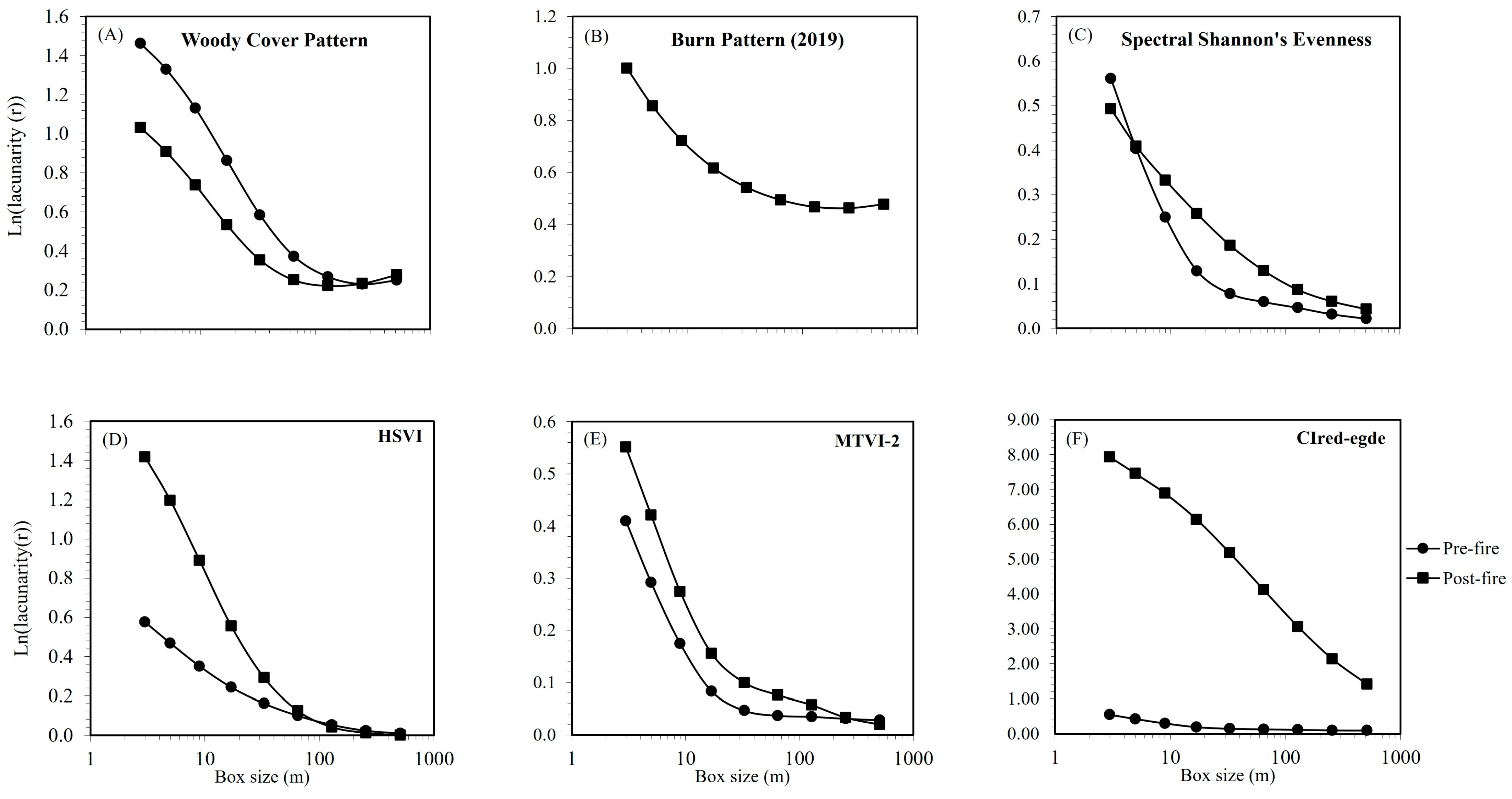
The results of the lacunarity analysis showed that the post-fire pattern of woody cover had a lower spatial heterogeneity (gappiness) than the pre-fire pattern at all scales less than 256 m. Beyond 256 m, the post-fire woody cover had a slightly higher level of spatial heterogeneity (Figure 9A). The level of spatial heterogeneity of the burn pattern was similar to that of the post-fire woody cover at small scales but higher at larger scales (Figure 9B). The results of the lacunarity analysis for SEI showed cross-scale interactions—the spatial heterogeneity for post-fire spectral evenness was higher at small scales but lower at larger scales (>5 m) (Figure 9C).
The results of the lacunarity analysis captured the changes in spatial configuration of the biophysical and biochemical indices at multiple scales and showed a higher spatial heterogeneity in the post-fire patterns of all three functional trait indices (Figure 9D,F). The post-fire HSVI had a substantially higher spatial heterogeneity than pre-fire at small scales (<64 m), and the difference diminished at larger scales (Figure 9D).
The lacunarity curves for MTVI-2 showed a noticeable increase in spatial heterogeneity after the fire at scales less than 256 m (Figure 9E). Interestingly, the magnitude of the difference between the pre- and post-fire lacunarity measure at small scales, relative to those at larger scales, appeared considerably smaller for MTVI-2 than for HSVI and CIred-edge.
For the lacunarity curves of the spectral index representing plant biochemical stress (CIred-edge), post-fire spatial heterogeneity was substantially higher than pre-fire across all scaled measured (Figure 9F). Interestingly, the pre-fire pattern of CIred-edge was relatively homogeneous across the scales and was near translational invariance beyond 32 m, forming a strong contrast with the post-fire lacunarity curve.

4. Discussion

4.1. Temporal Environmental Conditions Outweighted the Fire as Primary Drivert of Spectral Diversity Dynamics

Our results revealed that the spectral evenness (SEI) was influenced primarily by soil type and its interaction with time, rather than by prescribed fire itself. Even where temporal differences occurred, they were subtle, suggesting that fire did not substantially alter the balance of vegetation spectra within these plant communities. These findings contrast with the strong fire responses observed in hyperspectral vegetation indices (HSVI, MTVI-2, CIred-edge), indicating that fire’s effects on canopy structure and photosynthetic function are more pronounced than changes in community-level spectral evenness, at least within the temporal window and scale captured in a savanna landscape in the Edwards Plateau. However, the results from unburned areas indicated a very subtle but greater decline in SEI than in burned areas, suggesting that interannual weather conditions (Figure 2) prior to and after the burn had a greater impact on the SEI than the fire on this landscape. Although not explicitly tested, we speculate that fire may mitigate some of the adverse effects of weather conditions within burned areas.
The spectral reflectance diversity appears to have been negatively affected by the substantial decline in precipitation and dry-down conditions [93,94,95] (as indicated by SPEI declines) from pre-fire to post-fire (Figure 2), both overall (across soils) and within specific soil types (Figure 4A). The significant temporal differences in SEI across soils appear to result primarily from weather-driven dry-down effects rather than fire, as SEI did not differ significantly between burned and unburned areas when averaged across time (Figure 4B). The larger declines in TA and VaB soils from pre-fire to post-fire indicate that the soil water-holding capacity strongly modulated the severity of spectral evenness loss during the dry-down period, with KaB soils showing comparatively less change. These soil-specific temporal responses likely reflect differences in soil moisture buffering: shallow TA soils and deeper VaB soils exhibited stronger late-season senescence signatures in 2020, whereas KaB soils maintained a more stable spectral evenness. Although certain disturbance-sensitive species (e.g., Opuntia engelmannii and Mahonia trifoliolata) were reduced in some burned areas, the SEI patterns themselves provide little evidence that fire directly influenced spectral evenness. Instead, it more likely reflects differential species responses to the availability of soil water after a fire. These results are consistent with a companion study in the Edwards Plateau [56], which further examines the role of fire and soil dry-down conditions on shaping plant species diversity patterns and species-specific responses, which ultimately influence spectral diversity patterns. In that study, certain taxa (e.g., Opuntia engelmannii and Mahonia trifoliolata) were disproportionately reduced, while others persisted or expanded (e.g., Nasella leucotrichia) [56], indicating that the post-fire landscape appears to have been shaped mainly by soil moisture constraints, phenological timing, and drought sensitivity rather than by the burn treatment. Topo-edaphic factors can shape the surface hydrological process and soil moisture regimes, and depth profiles of soils can limit plant root length, thus modulating spatial patterns of plant spectral reflectance, functional traits, and plant responses to fire and drought [96,97,98].
Additionally, across soils in general, the temporal decline in SEI is more strongly explained by dry-down conditions and soil moisture limitations than by the presence or absence of fire. As soil moisture was depleted between the wetter pre-fire year (2018) and the drier post-fire year (2020) (Figure 2), the distribution of herbaceous and woody biomass likely became increasingly heterogeneous across soils. This effect would be especially pronounced in soils with a shallow depth-to-bedrock (TA) or high clay content (VaB), both of which constrain root-zone water availability during late-season senescence. Consequently, the sharp SEI declines seen in TA and VaB soils may reflect soil-mediated differences in drought exposure, whereas KaB soil (moderate water-holding capacity) exhibited comparatively smaller temporal changes. These patterns emphasize that the soil–water interaction, rather than fire, was the dominant driver of SEI dynamics.
Woody plant cover was found to be a significant covariate influencing SEI; however, none of the burn treatment-specific changes in SEI were statistically significant (Figure 4B). Pre- and post-fire differences were significant depending on soil type (e.g., TA and VaB soils; Figure 4A), suggesting that these differences are more consistent with weather- and soil-mediated dry-down dynamics rather than direct fire effects. The significance of woody vegetation likely reflects underlying differences in the vegetation structure and soil moisture availability, which influence spectral evenness regardless of fire. Thus, woody cover should be interpreted as a structural and hydrological driver of SEI variation, not as a fire effect mechanism.
Similarly to SEI, the spectral β-diversity metrics indicated that weather-driven temporal changes and soil moisture properties likely exerted a greater influence on spectral heterogeneity than fire treatments. A general trend of a slightly higher β-diversity in burned areas was seen within soil types by burn treatment (Figure 5); however, pairwise comparisons showed that this effect was statistically significant only for β.GRA in TA soils, where burned areas exhibited a greater reflectance magnitude turnover than unburned areas. For the remaining β-diversity components, fire had little detectable influence. Instead, the soil × time interactions revealed that dry-down conditions from 2018 to 2020 (Figure 2) were the primary drivers of spectral dissimilarity patterns. β.BRAY significantly declined in VaB soils over time, suggesting a post-fire and seasonal convergence in spectral composition, while β.BAL significantly increased in TA and KaB soils, reflecting a greater balanced turnover under moisture stress. All soils showed significant temporal declines in β.GRA, indicating widespread reductions in reflectance gradient heterogeneity associated with late-season dry-down. Research has shown that fires can result in larger dissimilarities in species composition and abundances between burned and unburned savannas, especially at low fire severities [99,100]. However, these patterns demonstrate that environmental conditions, particularly soil-mediated moisture availability and interannual weather differences [93,94,95,101], were more influential than fire in shaping post-disturbance spectral β-diversity. While fire-related processes such as litter removal, canopy opening, and altered competitive dynamics may contribute subtly to post-disturbance heterogeneity, these effects were secondary to the larger influence of interannual moisture deficits. Remote sensing assessments from related studies indicate that biomass and canopy greenness often recover more slowly than vegetation moisture, which may help explain the dynamic, soil-specific β-diversity patterns observed during the post-fire dry-down period [95,102].
The lack of spectral β-diversity differences in burned and unburned areas was surprising given that fire can create spectral differences through the scorching of leaves and other plant parts, litter removal, and increased bare-ground exposure [103,104]. However, it appears that these may have only contributed marginally to local spectral differences [104], as the statistical results indicate that these effects were inconsistent across soils and small relative to the broader influence of interannual moisture deficits. The dry-down effect on green vegetation between the pre-fire and post-fire period created spectrally different environments across the burned and unburned areas, thus affecting β-diversity. Woody cover, as indicated by its statistical significance as a covariate, emerged as a strong positive predictor across all three β-diversity measures, underscoring that spatial variation in woody dominance—and the patchiness, shading, and understory suppression it creates—is a major source of spectral heterogeneity in this system. This supports a growing body of evidence that woody encroachment [48,97,105]—common throughout the Southern Great Plains—fundamentally reshapes reflectance variability by increasing patchiness in the canopy structure, shadowing, and understory suppression. In contrast, the fire pattern had weaker or inconsistent effects, suggesting that the degree of woody presence may be a more persistent driver of spectral turnover than the extent of the fire itself, at least within the study’s temporal frame. For both SEI and β-diversity metrics, grazing during the post-fire dry-down may also have contributed to localized spectral variability, as herbivores concentrate on preferred vegetation patches and can reduce biomass heterogeneously across the landscape. Grazing can reduce vegetation cover and biomass, increasing variability in plant communities [106] and their spectral reflectance. Additionally, differences in grazing pressure within burned and unburned areas can exist, since ungulates will preferentially graze burned areas [107,108,109]. However, these influences appear secondary to the overriding effects of weather, soil moisture availability, and woody canopy distribution.

4.2. Fire Influenced the Spatial Pattern of Spectral Evenness and Abundance-Based β-Diversity

There were significant spatial structures for both SEI and abundance-based β-diversity (β.BRAY) pre-fire and post-fire, but spatial structures were weaker post-fire (Table 2), suggesting a disruption of the spatial patterns of the evenness and abundance-based β-diversity of spectral bands by fire and dry-down. Interestingly, the post-fire SEI pattern appeared to be associated with the burn pattern based on the cross-Mantel test. However, this association did not hold for the β.BRAY pattern (Table 2). This suggests that the burn pattern has a substantial influence on the changes in the SEI pattern, but not on those of the β.BRAY pattern. The dry-down conditions—not fire—may have had a stronger influence on the changes in the β.BRAY pattern.
Notably, the balanced variation component β.BAL had a slightly stronger spatial structure post-fire, whereas the abundance gradient component β.GRA had a considerably weaker spatial structure after the fire. Furthermore, the β.GRA pattern was associated with the burn pattern, while β.BAL was not, based on the cross-Mantel tests (Table 2). We speculate that the regrowth in the burned areas likely had a greater greenness and higher reflectance in many photosynthetically active bands, which might disrupt the gradient pattern between burn–unburn paired sampling locations and increase the balancing among different bands (increasing in some bands and decreasing in others between burn–unburn paired sample locations), which likely led to the strengthening of the balanced variation component and weakening of the abundance gradient component [110].
Significant spatial cross-correlations between pre-fire and post-fire measures of SEI and β-diversity components were observed (Table 3), indicating a certain level of persistence of the patterns of these measures despite the impact of fire and dry-down. Given the heterogeneous burn pattern, substantial portions of the burn units were not burned, and these unburned areas, often with woody cover or sparse vegetation, are well mixed with the burned areas throughout the burn units, which likely contributed to the strong spatial associations of the pre-fire and post-fire patterns of SEI and β-diversity.

4.3. Biophysical and Biochemical Spectral Indices Responded Primarily to Time and Weather-Driven Dry-Down Across Soils, with Some Moderation by Fire

Among the different VIs that we examined as proxies for plant biophysical and biochemical functional traits, HSVI was specifically developed for hyperspectral imagery (HSVI; [31]). HSVI showed clear declines from 2018 to 2020 across all soils (Figure 6A), reflecting the strong seasonal dry-down between the pre- and post-fire years. Across burn treatments, HSVI in burned and unburned areas was statistically similar during the pre-fire period. However, in the post-fire period, HSVI was significantly higher in burned areas compared to unburned areas (Figure 6B). Although fire influenced HSVI through a significant time × burn treatment interaction, this effect did not manifest as a post-fire increase in HSVI. Instead, burned areas maintained a higher HSVI than unburned areas after the fire, indicating that fire partially buffered vegetation against late-season senescence by resetting phenology and enabling earlier regrowth. This effect was secondary to the dominant influence of weather-driven moisture loss and soil water-holding capacity, which shaped the magnitudes of HSVI declines across soils. TA and KaB soils exhibited the strongest declines, whereas VaB soils showed a greater resilience due to higher moisture availability, driven by the higher water storage capacity in this soil. The characteristics of HSVI that could allow for the detection of fire effects on spectral characteristics include its ability to detect rapid or gradual changes to green, red-edge, and near-infrared bands, especially in areas with high vegetation densities [31]. In the present study, the unique spectral bands used to derive HSVI may have been better able to capture the changes in succulents, cacti, or herbaceous vegetation post-fire compared to the bands used to derive more traditional vegetation indices such as EVI. As an example, post-fire conditions generally stimulate herbaceous recovery in grasses [111,112,113,114], but such conditions can also lead to a higher prickly pear cactus density beneath the canopies of woody species [55,115,116]. However, as documented in a previous study at this location, in burned areas, fire can damage cladophylls on prickly pear cacti, thus reducing the volume and leaf area index (LAI) of this species [55]. The increased herbaceous recovery in grasses post-fire most likely resulted in an increased photosynthetic activity, resulting in variations in leaf chlorophyll and nitrogen content [117], both of which are detectable through the 689–760 nm (red-edge) and 800–889 nm (NIR) wavelengths used in HSVI, which could account for the increased HSVI post-fire.
The higher post-fire HSVI observed in burned areas (Figure 6B) reflects a reduced decline in greenness relative to unburned areas, rather than a fire-driven increase in vegetation conditions. This pattern appears to be driven largely by TA soils, which showed the smallest decrease in HSVI from 2018 to 2020 (Figure 6A) and therefore contributed most strongly to the higher HSVI values observed in burned areas after the fire. In contrast, KaB soils exhibited the largest pre–post decline, suggesting little positive influence of fire on maintaining the HSVI in this soil type, while VaB soils showed an intermediate decline. Given the absence of a significant three-way interaction, these soil-specific patterns cannot be attributed directly to fire–weather interactions but instead reflect how soil water-holding capacity shaped vegetation sensitivity to the dry-down [94,95]. Fire likely played a secondary role by resetting the canopy structure and reducing late-season senescence rather than by enhancing post-fire greenness. Reductions in LAI, litter cover, and shrub canopies can alter microclimate and water fluxes, decreasing transpiration and the competition for soil moisture and thereby moderating post-fire declines in greenness. In contrast, unburned vegetation retained more photosynthetically inactive material and experienced stronger moisture limitations during the dry-down period [118]. These mechanisms help explain why burned areas showed smaller HSVI declines, even though weather and soil moisture constraints were the dominant drivers of the observed spectral patterns.
For spectral indices indicative of biochemical traits, MTVI-2 showed strong and soil-specific reductions following the fire period, indicating that photosynthetic capacity and canopy greenness were jointly shaped by fire disturbance and seasonal moisture limitations (Figure 7). Among soil types, MTVI-2 declined from pre- to post-fire in TA soils, but the reduction was moderate compared to KaB (Figure 7A). The pattern that burned VaB areas declined less than unburned areas further reinforces that sufficient soil moisture enables post-fire greening, while unburned vegetation follows typical late-season chlorophyll loss. For MTVI-2, significant differences existed between burned and unburned areas, with unburned areas having a significantly greater loss due to dry-down conditions after the fire (Figure 7B). MTVI-2 values in burned areas declined less from 2018 to 2020 than in unburned areas, indicating that fire partially buffered vegetation against the late-season dry-down. Similarly to our findings, Gómez-Candón et al. [119] reported that drought-related changes in green biomass, LAI, and chlorophyll-sensitive reflectance can be effectively captured by spectral indices and energy balance models, highlighting MTVI-2’s sensitivity to moisture-driven variations in the canopy physiological status. The negative effect of the fire pattern as a covariate on MTVI-2 and the strong negative influence of woody cover further clarify these relationships. Burn extent intensifies the immediate losses in pigments and canopy integrity, whereas woody-dominated areas show a lower greenness and chlorophyll content due to their inherently different structural and physiological traits. However, despite these additive stresses, burned areas consistently declined less over time than unburned areas, indicating fire-mediated phenological resetting: once the herbaceous canopy is removed, regrowth or reduced senescence can stabilize or maintain greenness relative to unburned vegetation entering late-season decline.
Fire can also influence post-disturbance vegetation dynamics through short-lived nutrient pulses generated by the combustion of organic matter [120]. Numerous studies show that burning releases nitrogen, phosphorus, and other cations into surface soils and ash layers [120,121,122], often producing sharp increases in available ammonium and phosphorus during the first months after burning [123,124]. These nutrient pulses frequently stimulate the early post-fire growth of grasses and forbs in nutrient-limited systems, although the magnitude and persistence of these effects depend strongly on rainfall patterns, soil texture, and leaching process recovery [123,125,126]. Recent research also highlights foliar uptake pathways through ash deposition [127], providing an additional mechanism by which fire-derived nutrients support rapid regrowth. While we did not quantify nutrient changes in the three soils at our site, such nutrient pulses may have contributed—alongside soil moisture buffering and phenological resetting—to the smaller late-season declines observed in chlorophyll-sensitive indices (MTVI-2 and CIred-edge) within burned areas relative to unburned areas. These nutrient–soil–moisture interactions can influence the post-fire trajectories of canopy chemistry and photosynthetic functioning, reinforcing the greater sensitivity of biochemical spectral indices to fire compared to spectral diversity metrics.
The CIred-edge revealed strong declines across the landscape following the fire period, reflecting substantial reductions in chlorophyll content and shifts in canopy biochemical properties, especially in TA and VaB soils (Figure 8A). However, as with HSVI and MTVI-2, the magnitude of these CIred-edge declines varied markedly among TA, KaB, and VaB soils, indicating that soil water-holding capacity likely plays a central role in mediating post-fire chlorophyll loss and recovery potential. In VaB soils (Figure 8A), post-fire values diverged significantly across all three soils, highlighting the role of soil-mediated differences in moisture retention in shaping chlorophyll-related reflectance during the dry-down period. Burned areas also exhibited a higher post-fire CIred-edge than unburned areas, a pattern consistent with the time × burn treatment interaction and likely driven by reduced late-season senescence and phenological resetting rather than by enhanced vegetation conditions. Because the time × soil × burn treatment interaction was not significant, soil-specific fire effects cannot be fully disentangled; however, the post-fire separation among soils clearly demonstrates differential dry-down responses, with TA showing the smallest decline, KaB the largest, and VaB an intermediate decline. Deep, fine-textured VaB soil provides substantially more water storage capacity compared to TA and KaB soils, suggesting that the greater soil water storage in VaB moderates the impact of late-season dry-down. KaB soils exhibited the sharpest reductions in CIred-edge—greater than in both TA and VaB. Vegetation on these moderately deep, moderately retentive soils typically maintains higher chlorophyll concentrations and greener canopy conditions pre-fire. Fire removes canopy cover and litter, increases soil temperature and evaporative demand, and exposes the surface to rapid moisture loss. When the subsequent seasonal dry-down occurs, KaB soil might not retain enough water to buffer post-fire chlorophyll loss. Although fire reduced chlorophyll content through tissue combustion and pigment degradation, the available soil moisture likely buffered post-fire stress, limiting the extent of CIred-edge decline.
The CIred-edge serves as a vital proxy for evaluating the chlorophyll and nitrogen content without saturating like in NDVI [29,33,63,128], which is directly linked to photosynthetic efficiency and regrowth potential after disturbances. Its sensitivity to red-edge and near-infrared wavelengths makes it particularly effective for detecting the changes in canopy biochemical traits associated with fire, seasonal drought, and grazing pressure, all of which influence chlorophyll concentration and pigment dynamics in semi-arid rangelands. In this study, CIred-edge declined substantially from 2018 to 2020 across all soils, reflecting strong dry-down effects on canopy chlorophyll (Figure 8A). The lower CIred-edge in unburned areas may indicate a lower canopy chlorophyll content and more disturbance to photosynthesis from dry-down conditions (Figure 8B). However, the higher changes in CIred-edge within burned areas may reflect regrowth, green-up, or even the buffered stress-induced suppression of chlorophyll production (Figure 8B). While this pattern aligns with the expectations of fire-induced chlorophyll loss, it may also reflect the influence of concurrent multi-species livestock grazing in the burned areas, which can reduce chlorophyll content and leaf area, leading to lower CIred-edge values compared to the pre-fire period. The effect of post-fire grazing in combination with more bare ground exposure within burned areas can influence the spatial pattern of CIred-edge. No difference was found for CIred-edge between burned and unburned areas before the fire (Figure 8B), and CIred-edge was higher overall during the pre-fire period compared to the post-fire period. However, the gains in chlorophyll activity were less in the unburned areas. This phenomenon could be related to multiple factors such as an increase in bare ground and slow recovery of “green” vegetative species, like cacti such as Opuntia engelmannii [55], smaller evergreen shrubs (e.g., Mahonia trifoliolata), and larger woody species (e.g., Neltuma glandulosa, Juniperus sp., and Quercus fusiformis). The roles of fire pattern and woody cover as covariates showed that, the greater the burned areas and woody cover, the lower the chlorophyll density, demonstrating that CIred-edge captures both fire-induced pigment loss and moisture-supported post-fire phenology.

4.4. Fire Significantly Influenced the Spatial Pattern of Spectral Indices Representative of Plant Functional Traits

An analysis of the pre-fire and post-fire spatial patterns of spectral functional traits using Mantel tests [90,129] provided insights into how fire impacts the spatial structure of biophysical and biochemical processes. The results revealed both persistence and changes in the spatial structure of spectral functional traits and the potential influence of the fire.
The HSVI (Table 3), as a proxy for green biomass and vegetation cover, exhibited a strong spatial structure before the fire. Post-fire, this spatial structure weakened, suggesting that the fire disrupted the spatial pattern in green biomass. This is corroborated by the significant spatial cross-correlation between the post-fire HSVI and the burn pattern. However, the significant spatial cross-correlation between pre-fire and post-fire measures of green biomass production, as depicted through HSVI, indicates that some spatial structures persisted despite the disruption. This suggests a resilience in the spatial patterns of green biomass and vegetation despite the disturbance [130]. Similarly, the spatial structure of MTVI-2 (as a proxy for green LAI and leaf chlorophyll) weakened from pre- to post-fire, with a significant spatial association (cross-correlation) between the post-fire pattern and the burn pattern (Table 3), suggesting the influence of fire on these biochemical traits. The strong spatial cross-correlation between the pre-fire and post-fire MTVI-2 also suggests some persistence in the spatial configuration of these biochemical traits despite the impact of the disturbance.
Canopy photosynthetic activity, as expressed by CIred-edge, reveals an important spatial pattern related to the plant regrowth status and chlorophyll content in the canopy foliage. In contrast, the CIred-edge had a significant spatial structure pre-fire but not post-fire (Table 3), indicating that the fire and dry-down significantly disrupted the spatial patterns of photosynthetic activity. The post-fire pattern of CIred-edge still maintained a significant spatial association (cross-correlation) with the pre-fire pattern, however, indicating a certain level of persistence of the pattern of photosynthetic activity over time. The cross-correlation between the burn status and post-fire CIred-edge showed the association of the patterns of CIred-edge with the burn pattern, potentially due to the impact of fire on the photosynthetic activity of the regrowth in burned areas, since the post-fire regrowth often has higher photosynthetic rates compared to undisturbed vegetation, largely due to the increased leaf nutrient concentrations released by the burning [98,124].

4.5. Fire and Weather Altered the Scale-Dependent Spatial Heterogeneity of Spectral Evenness and Spectral Indices Representing Plant Functional Traits

In examining lacunarity in this study (Figure 9), it is essential to note that this analysis evaluated the entire landscape, making it impossible to separate the effects of fire and weather. However, the results represent the combined effects of fire, weather, and soil types on the spatial heterogeneity of spectral evenness and spectral indices, thus providing valuable insights into the multiscale spatial heterogeneity of vegetation structure, burn patterns, spectral diversity, and spectral indices before and after a fire event.
The lacunarity analysis of woody plant cover revealed a decrease in spatial heterogeneity post-fire across most of the scales examined (Figure 9A), indicating a decreased spatial variation in woody cover across the landscape. This change could be a result of the removal of many small shrubs and prickly pear cactus patches [55] by the fire. Many of these small patches are near or adjacent to the larger woody patches mostly composed of juniper (Juniperus spp.), honey mesquite (Neltuma glandulosa, formerly known as Prosopis glandulosa), and oak (Quercus spp.) trees [56], which likely reduced the high woody cover in these areas. At larger scales, approximately 300 m and above, the spatial heterogeneity post-fire became slightly higher than pre-fire. The lacunarity curve for burn patterns leveled off after approximately 60 m (Figure 9B), indicating a more limited and consistent spatial variation in areas burned (translational invariance) at these larger measurement scales [69].
The combination of fire and dry-down resulted in an increased spatial heterogeneity in spectral evenness (SEI) and all three spectral indices (HSVI, MTVI-2, CIred-edge) across most of the scales (Figure 9C–F). The lacunarity of SEI post-fire was slightly lower than pre-fire at a very small scale (3 m), but consistently higher at all scales beyond 5 m. This increase in spatial heterogeneity in SEI across scales suggests that fire likely resulted in a more variable spectral composition with the changed species composition and rigor of growth in the burned patches across the landscape [7].
The post-fire lacunarity measures for both HSVI and MTVI-2 were consistently higher than the pre-fire ones, except at larger scales above 100 m where the post-fire and pre-fire measures became similar (Figure 9D,E), demonstrating the substantial impact of the fire–weather interaction on the spatial heterogeneity of these biophysical and biochemical traits. The post-fire lacunarity measures for CIred-edge were strikingly higher than the pre-fire ones across all scales (Figure 9F). This likely results from both increased greenness in burned areas due to effect of fire and increased plant stress and bare ground exposure due to the dry-down, which were likely amplified by the contrasting moisture regime of the different soil types and may lead to asynchronized recovery and succession [131,132].

4.6. Limitations

Several limitations in the study warrant further discussion. First, the absence of field-based vegetation measurements limited our ability to directly validate spectral diversity patterns. While our results provide valuable remote sensing evidence of fire effects, some interpretations remain speculative, particularly regarding the interactions between fire and weather. Because we did not measure in situ soil moisture, we relied on gridded climate products (e.g., GRIDMET) and derived indices (e.g., SPEI) to describe weather conditions or serve as proxies for trends in soil moisture and dry-down. Additionally, we used geospatial products like the SSURGO database to estimate soil properties such as water-holding capacity. However, the coarse resolution of these products relative to our burn units introduces uncertainty and reduces reliability compared to field-collected measures. While these datasets reveal landscape-level patterns, they may miss the microclimatic variability and site-specific management effects known to influence post-fire recovery. Future research should incorporate concurrent field data collection to validate spectral patterns and link them more directly to plant community composition and soil conditions. Second, the collection and post-processing of hyperspectral imagery collected from airborne sensors can create distortions in imagery which can affect spectral and spatial properties of the images. Uneven stretching and rubber-sheet distortions can be caused by rapid aircraft motion (e.g., sudden roll or yaw changes) and are difficult to correct because pushbroom sensors acquire data line-by-line. These high-frequency distortions often exceed the temporal resolution of the GPS/IMU system and cannot be fully removed through orthorectification or image-to-image registration. For the images we used, we tried to limit the occurrence of these distortions, but we were unable to remove all distortions. Third, the focus on post-fire effects on spectral reflectance does not address the long-term temporal dynamics of recovery after fire. While our study design provides valuable insight into fire effects, it cannot fully capture the dynamic trajectory of vegetation recovery. More frequent image acquisitions would improve the temporal resolution; however, repeated fine-resolution hyperspectral surveys remain constrained by steep logistical and financial costs. Future work should incorporate repeated hyperspectral acquisitions to monitor vegetation spectral responses and the complementary impact of grazing on spectral diversity [22]. In addition, spatial patterns over multiple years should be evaluated to better capture the trajectories of ecosystem resilience and changes in biodiversity and functional traits. Fourth, the study infers soil moisture impacts based on pedon characteristics and ecological site descriptions without direct field measurement. Recent findings (e.g., [29]) highlight that soil moisture interacts with fine-scale spatial heterogeneity and functional diversity in complex ways. Therefore, future efforts should consider the collection of pedon data and establish networks of sensors for pre- and post-fire conditions.
The last potential limitation is the reliance on spectral data and indices to assess vegetation responses to fire. Although these are valuable tools, incorporating field-based species inventories and functional trait measurements would enable a more mechanistic interpretation of the observed spectral patterns [22]. Conti et al. [13] emphasize that plant species richness and spectral diversity may not always align particularly in heterogeneous landscapes, underscoring the need for ground validation to ensure accurate biodiversity assessments. Moreover, the spatial analysis presented in this study provides information on post-fire spatial patterns of vegetation spectral diversity and plant functional traits. However, the study does not extensively explore the potential underlying mechanisms driving these spatial patterns, such as weather heterogeneity and fire timing. Furthermore, expanding hyperspectral wavelength ranges to include the SWIR region [22,133] to assess changes in vegetation health and water stress, in addition to conducting time series analysis, could provide a further clarification of these ecosystem processes, improving the study’s explanatory power for effective rangeland management.

5. Conclusions

This study suggests that hyperspectral imagery is effective for assessing fire’s effects on vegetation by quantifying the changes in spectral diversity (evenness and β-diversity) and spectral functional traits in semi-arid savannas. Comparisons of pre- and post-fire conditions indicate that weather-driven dry-down and soil properties exerted the strongest influence on spectral diversity, whereas fire contributed only subtle and soil-limited effects. For spectral diversity measures (SEI and c metrics), temporal differences were driven primarily by the soil type and its interaction with time, with little evidence that prescribed fire produced consistent shifts in vegetation spectral composition across soils. Instead, the variations in spectral diversity indices over time appear to reflect weather conditions and soil characteristics (e.g., water-holding capacity and depth to indurated layers), which regulate vegetation productivity. In contrast, vegetation indices of plant functional traits exhibited clearer fire-related patterns. Declines in these indices during soil dry-down were less pronounced in burn areas than in unburned areas, suggesting that fire moderated functional response trajectories. These moderated declines indicate that spectral functional trait indices are more sensitive to fire-mediated changes in canopy structure and chlorophyll dynamics than spectral diversity metrics during the period of our study.
Spatial analyses reinforced these findings. Mantel tests revealed that the spatial pattern of fire, characterized by burned and unburned patches, had a significant spatial association with the post-fire pattern of SEI but not with that of the overall spectral β-diversity (β.BRAY). In contrast, the burn pattern had significant spatial associations with all three spectral indices of biophysical and biochemical traits. The combination of fire and dry-down resulted in an increased spatial heterogeneity in spectral evenness (SEI) and the spectral indices of biophysical and biochemical traits (HSVI, MTVI-2, CIred-edge) across most of the scales.
Our findings highlight the complexity of fire’s impact on various spectral indices used as proxies for functional traits. Biophysical and biochemical indices, such as HSVI and CIred-edge, were more responsive to fire than spectral diversity metrics, reflecting their sensitivity to canopy greenness, pigment concentration, and photosynthetic functioning. Although vegetation in all soils exhibited substantial declines during the 2018–2020 dry-down, burned areas showed smaller reductions in greenness and chlorophyll-related reflectance, consistent with fire-induced phenological resetting and early-stage recovery. These results suggest that functional trait indices are particularly informative for detecting subtle post-fire regrowth and shifts in canopy structure, while the spectral diversity measures are less sensitive to fire disturbance and largely governed by soil moisture gradients and interannual weather. Together, these findings support the use of hyperspectral metrics to monitor vegetation function under interacting fire–grazing–drought regimes and underscore the needs and potential for future work to systematically explore the responses of spectral diversity and functional traits to different temporal patterns of fire–weather sequences common for semi-arid rangeland systems to better inform rangeland management.

Author Contributions

Conceptualization: X.A.J., J.P.A., X.B.W., D.R.T., S.D.F. and C.Y.; methodology, X.A.J., J.P.A., X.B.W., D.R.T. and C.Y.; formal analysis, X.A.J. and J.P.A.; investigation, X.A.J., J.P.A., C.Y., D.R.T. and X.B.W.; data curation, X.A.J. and C.Y.; writing—original draft preparation, X.A.J.; visualization, X.A.J., J.P.A. and X.B.W.; writing—review and editing, X.A.J., J.P.A., X.B.W., S.D.F., D.R.T. and C.Y.; supervision, J.P.A. and X.B.W.; project administration, X.B.W. and J.P.A.; funding acquisition, X.B.W. and J.P.A. All authors have read and agreed to the published version of the manuscript.

Funding

This research was funded in part by the U.S. Department of Agriculture’s Agriculture Research Service and the National Institute of Food and Agriculture (2019-68012-29819 and Hatch Project 1003961). The U.S. Department of Agriculture is an equal opportunity lender, provider, and employer. Support was also provided to Xavier Jaime through a Graduate Diversity Fellowship from Texas A&M University. Partial support for this research was also provided by the Savanna Long-term Research and Education Initiative (SLTREI), Department of Ecosystem Science and Management, Texas A&M University.

Data Availability Statement

All data used in this research were obtained from federally funded sources. However, the raw data supporting the conclusions of this article will be made available by the authors upon request.

Acknowledgments

The authors wish to thank all the anonymous reviewers for their valuable comments and helpful suggestions, which resulted in significant improvements in this paper. We also thank Jose M. Mata, Jesse Goplin, Deann Burson, Zheng Li, Weiqian Gao, and the Grazingland Animal Nutrition Lab at TAMU AgriLife Research for their assistance with field sampling and remote sensing logistics, in addition to TAMU AgriLife San Angelo for providing lodging accommodations and aiding in field logistics.

Conflicts of Interest

The authors declare no conflicts of interest.

Appendix A

Appendix A.1. Multispectral Image Classification for Vegetation and Burn Cover Maps
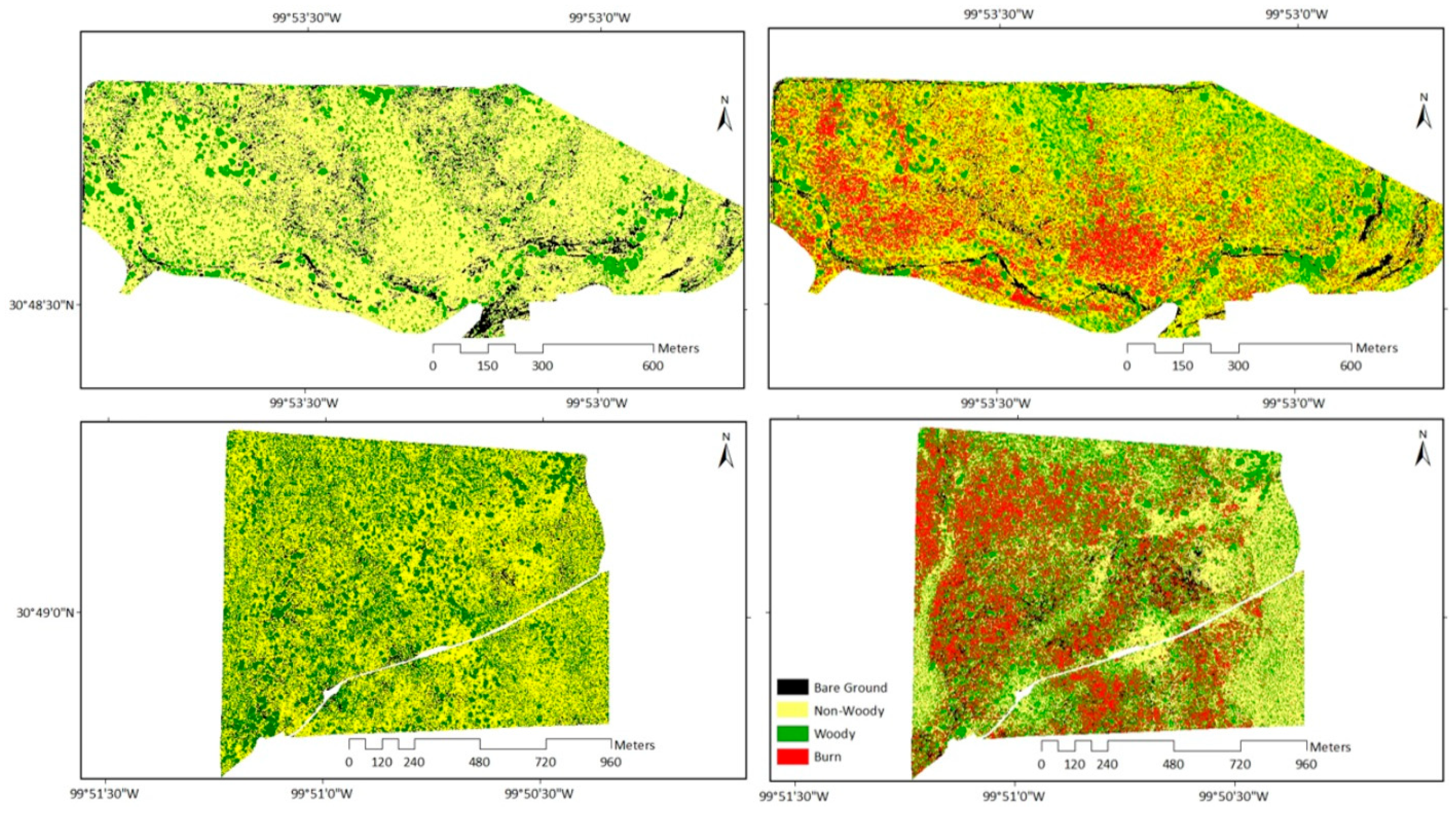
1. Multispectral image acquisition and logistics before/after prescribed fire
High-resolution aerial multispectral images (21-cm pixel resolution) were collected by the USDA-ARS (College Station, TX) through coordinated flight missions before and after the fire, at an altitude of 1981.2 m above mean sea level (MSL), following standard USDA-ARS protocols [134,135,136]. Image acquisitions occurred during peak biomass season (August-September) and low biomass season (February-March) from 2018 to 2020 [55]. The two Nikon D810 digital cameras (one RGB and one NIR) used during the USDA flyovers, along with their respective multispectral data specifications, are the same as those described in [55].
2. Random Forest classification process
To generate cover maps for woody, non-woody, burned areas and bare ground classes (Figure A1), we applied the Random Forest (RF) supervised classification approach for multispectral images collected between 2018 and 2020, capturing both peak and low biomass seasons. The classification process utilized the “randomForest” R package [57], and was complemented by additional spatial data processing and visualization packages, including “terra” [61], “sp” [137], “caret” [138], and “rasterVis” [139]. For the prefire (2018) mosaicked image, 500 geometrically drawn (spatially distinct) small training polygons per class were defined as regions of interest (ROIs) using ENVI 5.5 (NV5 Geospatial Solutions, Inc., Broomfield, CO, USA) for woody, non-woody, and bare ground categories (n = 1500) to extract pixel data for training RF model. A similar RF supervised classification was conducted for each burn unit after the 2019 prescribed burn to map the fire-affected areas, as visible in the pixel data. In the post-fire (2019-2020) mosaicked images, an additional 500 training polygons were added to account for burned areas (i.e., burned and scorched material spectrally depicted from the multispectral high-resolution imagery). ENVI 5.5 was used to conduct Jeffries-Matusita distance separability analysis, which confirmed the distinctiveness of each training class [55,140].
Figure A1. Random Forest supervised classification maps for burn units (panel rows) during the pre-fire season (left column) and post-fire season (right column) in Martin Ranch (MR).
Remotesensing 17 03873 g0a1
The pre-fire testing dataset consisted of 3,829 randomly chosen geometric polygons (ROIs) that were drawn directly on the burn units using ENVI 5.5. These ROIs were comprised of 1,030 bare ground, 1,144 non-woody vegetation, and 1,655 woody vegetation reference samples that were separate and independent from the training dataset. The post-fire testing dataset consisted of 4,973 independent ROIs for each class: bare ground (n = 1025), non-woody (n = 1209), woody (n = 1600), and burn area (n = 1054). These testing polygons were developed through interpretation of high-resolution (3-cm UAV and 20-cm) multispectral imagery, field verification, and ancillary data sources. Stratified random sampling was used to ensure spatial distribution across burn units and soils. Jeffries-Matusita distance separability analysis was subsequently performed to confirm the spectral distinctiveness and separability of each cover class prior to conducting the accuracy assessment. For accuracy assessment, we generated a confusion matrix in R software [91,92] using the “confusionMatrix ()” function from the “caret” R package [138] to evaluate the RF classification accuracy for each cover class (pre-fire: woody vs. non-woody and bare ground; post-fire: woody vs. non-woody and bare ground vs. burned areas).
3. Results of the Random Forest-based classification cover maps before and after the fire
The overall accuracy of the RF classification using training samples for major cover types (non-woody, woody, burned, and bare ground) was 94.8% with a Kappa coefficient of 92.0% for pre-fire conditions (Table A1). The error matrix table reveals well-balanced performance from Random Forest classification across all classes, with Producer’s Accuracy ranging from 94.2% to 95.5% and User’s Accuracy ranging from 93.1% to 95.9% (Table A1). Among classified cover types, the woody class showed the highest accuracy (95.5% PA and 95.9% UA) while non-woody class has lowest User’s Accuracy (93.1%). Still, there is overall low confusion between classes, indicating good separability. For postfire images, RF classification achieved 92.8% accuracy and a Kappa of 90.3%, which indicates excellent agreement. User accuracy (UA) for post-fire classification ranged from lowest (83.7%) for non-woody vegetation to highest (98.7%) for bare ground while burned areas scored 93.4% (Table A2). Additionally, producer’s accuracy (PA) ranged from 90.2% for non-woody vegetation to 97.4% for bare ground (Table A2). The non-woody vegetation class consistently showed the lowest UA and PA, whereas burn class performed well with balanced UA (93.4%) and PA (92.5%). Verification of the RF model indicated that most misclassification occurred between woody cover pixels misclassified as non-woody pixels. However, these confusions or misclassifications between woody and non-woody are expected in post-fire environments where vegetation recovery creates spectral similarities. The resulting binary raster products of pre-fire woody cover and burn pattern maps (as first developed in [55]) were used to calculate class-level percent (%) cover, used as covariates in the statistical analysis, lacunarity analysis of woody structure and burn pattern, and to aid in interpretation of spectral responses pre- and post-fire (Figure A2).
Table A1. Summary of error matrix accuracies for pre-fire RF classification classes.
Classified data Bare GroundWoodyNon-WoodyRow TotalsUser’s Accuracy (%)
Bare Ground9703020102095.1
Woody25158043164895.9
Non-Woody35451081116193.1
Column Totals1030165511443829
Producer’s Accuracy (%)94.295.594.5 OA (94.8%)
K (92.0%)
Table A2. Summary of error matrix accuracies for post-fire RF classification classes.
Classified data Reference Data
Bare GroundNon-WoodyWoodyBurnRow TotalsUser’s Accuracy (%)
Bare Ground99812010102097.8
Non-Woody10109112875130483.7
Woody04814720152096.8
Burn175801054112993.4
Column Totals10251209160011394973
Producer’s Accuracy (%)97.490.292.092.5 OA (92.8%)
K (90.3%)
Figure A2. Extracted maps for landscape analysis of pre-fire (a) woody and (b) burn cover in burn units following the classification.
Remotesensing 17 03873 g0a2
Using the RF classification, we estimated that 17.6% of the area burned in the Lively burn unit. Of this burned area, 23.4% occurred within the deeper soil (VaB), compared to 14.4% in the very shallow soil (TA). The E6M burn unit accounted for 22.1% of the total burned area, with 25.9% of the burned area located within the TA soil and 10.1% within the KaB soil. Regarding woody vegetation cover across prefire and postfire seasons, the RF model indicated that woody vegetation cover in the Lively unit was 26.9% during the prefire season and 31.4% during the postfire season. In the EM6 burn unit, 38.9% of the land area was classified as woody cover prior to the fire and 42.1% as woody cover after the fire. Within soil types, prefire woody cover on TA soils was 24.2% in the Lively unit and 38.9% in the E6M unit. For VaB soils, prefire woody cover was 28.3%, and for KaB soil, it was 32% across both burn units. Areas classified as bare ground accounted for 4.5-7.7% within the Lively unit and 3.5-4.3% in the E6M unit before and after the fire, respectively.

Appendix A.2. Sampling Procedure for Spectrally Sampled Locations

To generate spectrally sampled locations, we used ArcGIS Pro to create a fishnet grid across each burn unit and derived centroid points for the grid cells. Each centroid was buffered to 1-m2, with a minimum spacing of 10 m enforced in burned areas and 5 m in unburned areas to reduce clustering. Sampling was stratified by soil type (TA, KaB, VaB) and burn status (burned vs. unburned). The total area (ha) of each soil ×fire category was calculated, and its proportional share of the burn unit area was used to allocate a projected 1,000 samples per burn unit. For example, if a category represented 20% of the burn unit area, 200 buffers were randomly selected from that category using the ArcGIS “Sample” tool. Considering the criteria, this procedure resulted in 843 sampled locations for the Lively burn unit and 999 for the E6M burn unit. The proportional allocation for each soil × fire category is provided in Table A3.
Table A3. Summary of the proportional unbalanced stratified random sampling design.
UNITCategoriesHectares%AreaSamplesAllowed Minimal Distance
LivelyTA-Burn15.110.16116110
LivelyTA-Unburn22.430.2392395
LivelyVaB-Burn20.490.21921910
LivelyVaB-Unburn20.960.2242245
E6MTA-Burn33.450.22622610
E6MTA-Unburn78.450.5315315
E6MKaB-Burn14.290.0979710
E6MKaB-Unburn21.450.1451455
LivelyOverall93.711.00843
E6MOverall147.721.00999

References

  1. Dahlin, K.M. Spectral Diversity Area Relationships for Assessing Biodiversity in a Wildland–Agriculture Matrix. Ecol. Appl. 2016, 26, 2758–2768. [Google Scholar] [CrossRef] [PubMed]
  2. Kerr, J.T.; Ostrovsky, M. From Space to Species: Ecological Applications for Remote Sensing. Trends Ecol. Evol. 2003, 18, 299–305. [Google Scholar] [CrossRef]
  3. Baldeck, C.A.; Harms, K.E.; Yavitt, J.B.; John, R.; Turner, B.L.; Valencia, R.; Navarrete, H.; Davies, S.J.; Chuyong, G.B.; Kenfack, D.; et al. Soil Resources and Topography Shape Local Tree Community Structure in Tropical Forests. Proc. R. Soc. B Biol. Sci. 2013, 280, 20122532. [Google Scholar] [CrossRef] [PubMed]
  4. Baldeck, C.A.; Colgan, M.S.; Féret, J.-B.; Levick, S.R.; Martin, R.E.; Asner, G.P. Landscape-scale Variation in Plant Community Composition of an African Savanna from Airborne Species Mapping. Ecol. Appl. 2014, 24, 84–93. [Google Scholar] [CrossRef]
  5. Naidoo, L.; Cho, M.A.; Mathieu, R.; Asner, G. Classification of Savanna Tree Species, in the Greater Kruger National Park Region, by Integrating Hyperspectral and LiDAR Data in a Random Forest Data Mining Environment. ISPRS J. Photogramm. Remote Sens. 2012, 69, 167–179. [Google Scholar] [CrossRef]
  6. Wang, R.; Gamon, J.A.; Cavender-Bares, J.; Townsend, P.A.; Zygielbaum, A.I. The Spatial Sensitivity of the Spectral Diversity-Biodiversity Relationship: An Experimental Test in a Prairie Grassland. Ecol. Appl. Publ. Ecol. Soc. Am. 2018, 28, 541–556. [Google Scholar] [CrossRef]
  7. Rossi, C.; Kneubühler, M.; Schütz, M.; Schaepman, M.E.; Haller, R.M.; Risch, A.C. Spatial Resolution, Spectral Metrics and Biomass Are Key Aspects in Estimating Plant Species Richness from Spectral Diversity in Species-rich Grasslands. Remote Sens. Ecol. Conserv. 2021, 8, 297–314. [Google Scholar] [CrossRef]
  8. Torresani, M.; Rossi, C.; Perrone, M.; Hauser, L.T.; Féret, J.; Moudrý, V.; Simova, P.; Ricotta, C.; Foody, G.M.; Kacic, P.; et al. Reviewing the Spectral Variation Hypothesis: Twenty Years in the Tumultuous Sea of Biodiversity Estimation by Remote Sensing. Ecol. Inform. 2024, 82, 102702. [Google Scholar] [CrossRef]
  9. Serbin, S.P.; Singh, A.; McNeil, B.E.; Kingdon, C.C.; Townsend, P.A. Spectroscopic Determination of Leaf Morphological and Biochemical Traits for Northern Temperate and Boreal Tree Species. Ecol. Appl. 2014, 24, 1651–1669. [Google Scholar] [CrossRef]
  10. Schweiger, A.K.; Cavender-Bares, J.; Townsend, P.A.; Hobbie, S.E.; Madritch, M.D.; Wang, R.; Tilman, D.; Gamon, J.A. Plant Spectral Diversity Integrates Functional and Phylogenetic Components of Biodiversity and Predicts Ecosystem Function. Nat. Ecol. Evol. 2018, 2, 976–982. [Google Scholar] [CrossRef]
  11. Cavender-Bares, J.; Schweiger, A.K.; Gamon, J.A.; Gholizadeh, H.; Helzer, K.; Lapadat, C.; Madritch, M.D.; Townsend, P.A.; Wang, Z.; Hobbie, S.E. Remotely Detected Aboveground Plant Function Predicts Belowground Processes in Two Prairie Diversity Experiments. Ecol. Monogr. 2022, 92, 01488. [Google Scholar] [CrossRef]
  12. Fassnacht, F.E.; Müllerová, J.; Conti, L.; Malavasi, M.; Schmidtlein, S. About the Link between Biodiversity and Spectral Variation. Appl. Veg. Sci. 2022, 25, 12643. [Google Scholar] [CrossRef]
  13. Conti, L.; Malavasi, M.; Galland, T.; Komárek, J.; Lagner, O.; Carmona, C.P.; Rocchini, D.; Šímová, P. The Relationship between Species and Spectral Diversity in Grassland Communities Is Mediated by Their Vertical Complexity. Appl. Veg. Sci. 2021, 24, 1–8. [Google Scholar] [CrossRef]
  14. Palmer, M.W.; Earls, P.G.; Hoagland, B.W.; White, P.S.; Wohlgemuth, T. Quantitative tools for perfecting species lists. Environmetrics 2002, 13, 121–137. [Google Scholar] [CrossRef]
  15. Rocchini, D.; Balkenhol, N.; Carter, G.A.; Foody, G.M.; Gillespie, T.W.; He, K.S.; Kark, S.; Levin, N.; Lucas, K.; Luoto, M.; et al. Remotely Sensed Spectral Heterogeneity as a Proxy of Species Diversity: Recent Advances and Open Challenges. Ecol. Inform. 2010, 5, 318–329. [Google Scholar] [CrossRef]
  16. Rocchini, D.; McGlinn, D.; Ricotta, C.; Neteler, M.; Wohlgemuth, T. Landscape Complexity and Spatial Scale Influence the Relationship between Remotely Sensed Spectral Diversity and Survey-Based Plant Species Richness. J. Veg. Sci. 2011, 22, 688–698. [Google Scholar] [CrossRef]
  17. Thornley, R.H.; Gerard, F.F.; White, K.; Verhoef, A. Prediction of Grassland Biodiversity Using Measures of Spectral Variance: A Meta-Analytical Review. Remote Sens. 2023, 15, 668. [Google Scholar] [CrossRef]
  18. Laliberté, E.; Schweiger, A.K.; Legendre, P. Partitioning Plant Spectral Diversity into Alpha and Beta Components. Ecol. Lett. 2020, 23, 370–380. [Google Scholar] [CrossRef]
  19. Wang, R.; Gamon, J.A. Remote sensing of terrestrial plant biodiversity. Remote Sens. Environ. 2019, 231, 111218. [Google Scholar] [CrossRef]
  20. Rocchini, D.; Bacaro, G.; Chirici, G.; Re, D.; Feilhauer, H.; Foody, G.M.; Galluzzi, M.; Garzon-Lopez, C.X.; Gillespie, T.W.; He, K.S.; et al. Remotely Sensed Spatial Heterogeneity as an Exploratory Tool for Taxonomic and Functional Diversity Study. Ecol. Indic. 2018, 85, 983–990. [Google Scholar] [CrossRef]
  21. Zhao, Y.; Sun, Y.; Chen, W.; Zhao, Y.; Liu, X.; Bai, Y. The Potential of Mapping Grassland Plant Diversity with the Links among Spectral Diversity, Functional Trait Diversity, and Species Diversity. Remote Sens. 2021, 13, 3034. [Google Scholar] [CrossRef]
  22. Kamaraj, N.P.; Gholizadeh, H.; Hamilton, R.G.; Fuhlendorf, S.D.; Gamon, J.A. Estimating Plant β-Diversity Using Airborne and Spaceborne Imaging Spectroscopy. Int. J. Remote Sens. 2024, 1–20. [Google Scholar] [CrossRef]
  23. Rocchini, D.; Boyd, D.S.; Féret, B.; Foody, G.M.; He, K.S.; Lausch, A.; Nagendra, H.; Wegmann, M.; Pettorelli, N. Satellite Remote Sensing to Monitor Species Diversity: Potential and Pitfalls. Remote Sens. Ecol. Conserv. 2016, 2, 25–36. [Google Scholar] [CrossRef]
  24. Wang, R.; Gamon, J.A.; Schweiger, A.K.; Cavender-Bares, J.; Townsend, P.A.; Zygielbaum, A.I.; Kothari, S. Influence of Species Richness, Evenness, and Composition on Optical Diversity: A Simulation Study. Remote Sens. Environ. 2018, 211, 218–228. [Google Scholar] [CrossRef]
  25. Wang, Z.; Chlus, A.; Geygan, R.; Ye, Z.; Zheng, T.; Singh, A.; Couture, J.J.; Cavender-Bares, J.; Kruger, E.L.; Townsend, P.A. Foliar Functional Traits from Imaging Spectroscopy across Biomes in Eastern North America. New Phytol. 2020, 228, 494–511. [Google Scholar] [CrossRef]
  26. Aneece, I.P.; Epstein, H.; Lerdau, M. Correlating Species and Spectral Diversities Using Hyperspectral Remote Sensing in Early-Successional Fields. Ecol. Evol. 2017, 7, 3475–3488. [Google Scholar] [CrossRef]
  27. Peng, Y.; Fan, M.; Bai, L.; Sang, W.; Feng, J.; Zhao, Z.; Tao, Z. Identification of the Best Hyperspectral Indices in Estimating Plant Species Richness in Sandy Grasslands. Remote Sens. 2019, 11, 588. [Google Scholar] [CrossRef]
  28. Schneider, F.D.; Morsdorf, F.; Schmid, B.; Petchey, O.L.; Hueni, A.; Schimel, D.S.; Schaepman, M.E. Mapping Functional Diversity from Remotely Sensed Morphological and Physiological Forest Traits. Nat. Commun. 2017, 8, 1441. [Google Scholar] [CrossRef]
  29. Helfenstein, I.S.; Schneider, F.D.; Schaepman, M.E.; Morsdorf, F. Assessing Biodiversity from Space: Impact of Spatial and Spectral Resolution on Trait-Based Functional Diversity. Remote Sens. Environ. 2022, 275, 113024. [Google Scholar] [CrossRef]
  30. Violle, C.; Navas, M.; Vile, D.; Kazakou, E.; Fortunel, C.; Hummel, I.; Garnier, É. Let the Concept of Trait Be Functional! Oikos 2007, 116, 882–892. [Google Scholar] [CrossRef]
  31. Sun, G.; Jiao, Z.; Zhang, A.; Li, F.; Fu, H.; Li, Z. Hyperspectral Image-Based Vegetation Index (HSVI): A New Vegetation Index for Urban Ecological Research. Int. J. Appl. Earth Obs. Geoinf. 2021, 103, 102529. [Google Scholar] [CrossRef]
  32. Miura, T.; Huete, A.R.; Yoshioka, H.; Holben, B.N. An Error and Sensitivity Analysis of Atmospheric Resistant Vegetation Indices Derived from Dark Target-Based Atmospheric Correction. Remote Sens. Environ. 2001, 78, 284–298. [Google Scholar] [CrossRef]
  33. Grimm, B. Chlorophyll: Structure and Function. In Encyclopedia of Life Sciences; John Wiley & Sons: Hoboken, NJ, USA, 2001. [Google Scholar]
  34. Barry, K.M.; Stone, C.; Mohammed, C.L. Crown-scale Evaluation of Spectral Indices for Defoliated and Discoloured Eucalypts. Int. J. Remote Sens. 2008, 29, 47–69. [Google Scholar] [CrossRef]
  35. Gitelson, A.A.; Gritz, Y.; Merzlyak, M.N. Relationships between Leaf Chlorophyll Content and Spectral Reflectance and Algorithms for Non-Destructive Chlorophyll Assessment in Higher Plant Leaves. J. Plant Physiol. 2003, 160, 271–282. [Google Scholar] [CrossRef] [PubMed]
  36. Briske, D.D.; Coppock, D.L. Rangeland Stewardship Envisioned through a Planetary Lens. Trends Ecol. Evol. 2023, 38, 109–112. [Google Scholar] [CrossRef] [PubMed]
  37. Briske, D.D.; Archer, S.R.; Burchfield, E.; Burnidge, W.; Derner, J.D.; Gosnell, H.; Hatfield, J.; Kazanski, C.E.; Khalil, M.; Lark, T.J.; et al. Supplying ecosystem services on US rangelands. Nat. Sustain. 2023, 6, 1524–1532. [Google Scholar] [CrossRef]
  38. Bowman, D.M.; Perry, G.L.; Higgins, S.I.; Johnson, C.N.; Fuhlendorf, S.D.; Murphy, B.P. Pyrodiversity Is the Coupling of Biodiversity and Fire Regimes in Food Webs. Philos. Trans. R. Soc. B Biol. Sci. 2016, 371, 20150169. [Google Scholar] [CrossRef]
  39. McGranahan, D.A.; Hovick, T.J.; Elmore, R.D.; Engle, D.M.; Fuhlendorf, S.D. Moderate Patchiness Optimizes Heterogeneity, Stability, and Beta Diversity in Mesic Grassland. Ecol. Evol. 2018, 8, 5008–5015. [Google Scholar] [CrossRef]
  40. Fuhlendorf, S.D.; Engle, D.M.; Kerby, J.; Hamilton, R. Pyric Herbivory: Rewilding Landscapes through the Recoupling of Fire and Grazing. Conserv. Biol. J. Soc. Conserv. Biol. 2009, 23, 588–598. [Google Scholar] [CrossRef]
  41. Fuhlendorf, S.; Fynn, R.; McGranahan, D.; Twidwell, D. Heterogeneity as the Basis for Rangeland Management. In Rangeland Systems: Processes, Management and Challenges; Springer International Publishing: Cham, Switzerland, 2017; ISBN 978-3-319-46707-8. [Google Scholar]
  42. Fuhlendorf, S.D.; Engle, D.M. Application of the Fire–Grazing Interaction to Restore a Shifting Mosaic on Tallgrass Prairie. J. Appl. Ecol. 2004, 41, 604–614. [Google Scholar] [CrossRef]
  43. Limb, R.F.; Fuhlendorf, S.D.; Engle, D.M.; Weir, J.R.; Elmore, R.D.; Bidwell, T.G. Pyric–Herbivory and Cattle Performance in Grassland Ecosystems. Rangel. Ecol. Manag. 2011, 64, 659–663. [Google Scholar] [CrossRef]
  44. McGranahan, D.; Engle, D.; Fuhlendorf, S.; Winter, S.; Miller, J.; Debinski, D. Inconsistent Outcomes of Heterogeneity-Based Management Underscore Importance of Matching Evaluation to Conservation Objectives. Environ. Sci. Policy 2013, 31, 53–60. [Google Scholar] [CrossRef]
  45. Fuhlendorf, S.; Davis, C.; Elmore, R.; Goodman, L.; Hamilton, R. Perspectives on Grassland Conservation Efforts: Should We Rewild to the Past or Conserve for the Future? Philos. Trans. R. Soc. B Biol. Sci. 2018, 373, 20170438. [Google Scholar] [CrossRef] [PubMed]
  46. Kerby, J.; Fuhlendorf, S.; Engle, D. Landscape Heterogeneity and Fire Behavior: Scale-Dependent Feedback between Fire and Grazing Processes. Landsc. Ecol. 2007, 22, 507–516. [Google Scholar] [CrossRef]
  47. Winter, S.; Fuhlendorf, S.; Goad, C.; Davis, C.; Hickman, K. Topoedaphic Variability and Patch Burning in Sand Sagebrush Shrubland. Rangel. Ecol. Manag. 2011, 64, 633–640. [Google Scholar] [CrossRef]
  48. Wilcox, B.P.; Birt, A.; Fuhlendorf, S.D.; Archer, S.R. Emerging Frameworks for Understanding and Mitigating Woody Plant Encroachment in Grassy Biomes. Curr. Opin. Environ. Sustain. 2018, 32, 46–52. [Google Scholar] [CrossRef]
  49. Jaime Davila, X.A. Spatial Patterns and Interactions of Prescribed Fire and Plant Communities in Heterogeneous Landscapes in the Edwards Plateau. Ph.D. Dissertation, Texas A&M University, College Station, TX, USA, 2024. [Google Scholar]
  50. Soil Survey Staff Soil Survey Geographic (SSURGO) Database. Available online: https://sdmdataaccess.sc.egov.usda.gov (accessed on 21 October 2022).
  51. PRISM Group. PRISM Gridded Climate Data; Oregon State University: Corvallis, Oregon, USA, 2018. [Google Scholar]
  52. Abatzoglou, J.T. Development of Gridded Surface Meteorological Data for Ecological Applications and Modelling. Int. J. Climatol. 2013, 33, 121–131. [Google Scholar] [CrossRef]
  53. Vicente-Serrano, S.M.; Beguería, S.; López-Moreno, J.I. A Multiscalar Drought Index Sensitive to Global Warming: The Standardized Precipitation Evapotranspiration Index. J. Clim. 2010, 23, 1696–1718. [Google Scholar] [CrossRef]
  54. Gorelick, N.; Hancher, M.; Dixon, M.; Ilyushchenko, S.; Thau, D.; Moore, R. Google Earth Engine: Planetary-Scale Geospatial Analysis for Everyone. Remote Sens. Environ. 2017, 202, 18–27. [Google Scholar] [CrossRef]
  55. Jaime, X.A.; Angerer, J.P.; Yang, C.; Walker, J.; Mata, J.; Tolleson, D.R.; Wu, X.B. Exploring Effective Detection and Spatial Pattern of Prickly Pear Cactus (Opuntia Genus) from Airborne Imagery before and after Prescribed Fires in the Edwards Plateau. Remote Sens. 2023, 15, 4033. [Google Scholar] [CrossRef]
  56. Jaime, X.A.; Angerer, J.P.; Fuhlendorf, S.D.; Walker, J.W.; Yang, C.; Tolleson, D.R.; Wu, X.B. Effects of Prescribed Fire on Plant α- and ꞵ-Diversity and the Regulating Role of Soil in a Mesquite-Oak Savanna. Landsc. Ecol. 2025, 40, 233. [Google Scholar] [CrossRef]
  57. Liaw, A.; Wiener, M. Classification and Regression by randomForest. R News 2002, 2, 18–22. [Google Scholar]
  58. Breiman, L. Random Forests. Mach. Learn. 2001, 45, 5–32. [Google Scholar] [CrossRef]
  59. Schott, J.R.; Salvaggio, C.; Volchok, W.J. Radiometric Scene Normalization Using Pseudoinvariant Features. Remote Sens. Environ. 1988, 26, 1–16. [Google Scholar] [CrossRef]
  60. Hall, F.G.; Strebel, D.E.; Nickeson, J.E.; Goetz, S.J. Radiometric Rectification: Toward a Common Radiometric Response among Multidate, Multisensor Images. Remote Sens. Environ. 1991, 35, 11–27. [Google Scholar] [CrossRef]
  61. Hijmans, R.J. Terra: Spatial Data Analysis, Version 1.8-44. 2025. Available online: https://github.com/rspatial/terra (accessed on 20 June 2024).
  62. Wickham, H.; Averick, M.; Bryan, J.; Chang, W.; McGowan, L.D.; François, R.; Grolemund, G.; Hayes, A.; Henry, L.; Hester, J.; et al. Welcome to the Tidyverse. J. Open Source Softw. 2019, 4, 1686. [Google Scholar] [CrossRef]
  63. Gitelson, A.A.; Keydan, G.P.; Merzlyak, M.N. Three-Band Model for Noninvasive Estimation of Chlorophyll, Carotenoids, and Anthocyanin Contents in Higher Plant Leaves. Geophys. Res. Lett. 2006, 33, L11402. [Google Scholar] [CrossRef]
  64. Hijmans, R.J. Raster: Geographic Data Analysis and Modeling. 2024. Available online: https://github.com/rspatial/raster (accessed on 15 January 2024).
  65. Izrailev, S. Tictoc: Functions for Timing R Scripts, as Well as Implementations of “Stack” and “StackList”, version 1. Structures R Package Version. 2023. Available online: https://jabiru.github.io/tictoc/ (accessed on 15 January 2024).
  66. Oksanen, J.; Blanchet, F.G.; Friendly, M.; Kindt, R.; Legendre, P.; McGlinn, D.; Minchin, P.R.; O’Hara, R.B.; Simpson, G.L.; Solymos, P.; et al. Vegan: Community Ecology Package, Version 2.7-2. 2024. Available online: https://vegandevs.github.io/vegan/ (accessed on 3 December 2024).
  67. Baselga, A. Separating the Two Components of Abundance-based Dissimilarity: Balanced Changes in Abundance vs. Abundance Gradients. Methods Ecol. Evol. 2013, 4, 552–557. [Google Scholar] [CrossRef]
  68. Plotnick, R.; Gardner, R.; Hargrove, W.; Prestegaard, K.; Perlmutter, M. Lacunarity Analysis: A General Technique for the Analysis of Spatial Patterns. Phys. Rev. E 1996, 53, 5461–5468. [Google Scholar] [CrossRef]
  69. Wu, X.B.; Thurow, T.L.; Whisenant, S.G. Fragmentation and Changes in Hydrologic Function of Tiger Bush Landscapes, South-West Niger. J. Ecol. 2000, 88, 790–800. [Google Scholar] [CrossRef]
  70. Wu, X.B.; Sui, D.Z. An Initial Exploration of a Lacunarity-Based Segregation Measure. Environ. Plan. B Plan. Des. 2001, 28, 433–446. [Google Scholar] [CrossRef]
  71. Derner, J.D.; Wu, X.B. Light Distribution in Mesic Grasslands: Spatial Patterns and Temporal Dynamics. Appl. Veg. Sci. 2001, 4, 189–196. [Google Scholar] [CrossRef]
  72. Brinkmann, S.T. spatLac: R Package for Computing Lacunarity for Spatial Raster. 2021. Available online: https://doi.org/10.5281/zenodo.5786547 (accessed on 22 February 2022).
  73. Allain, C.; Cloitre, M. Characterizing the Lacunarity of Random and Deterministic Fractal Sets. Phys. Rev. A 1991, 44, 3552–3558. [Google Scholar] [CrossRef] [PubMed]
  74. Dong, P. Lacunarity for Spatial Heterogeneity Measurement in GIS. Geogr. Inf. Sci. 2000, 6, 20–26. [Google Scholar] [CrossRef]
  75. Feagin, R.A. Heterogeneity Versus Homogeneity: A Conceptual and Mathematical Theory in Terms of Scale-Invariant and Scale-Covariant Distributions. Ecol. Complex. 2005, 2, 339–356. [Google Scholar] [CrossRef]
  76. Hoechstetter, S.; Walz, U.; Thinh, N. Adapting Lacunarity Techniques for Gradient-Based Analyses of Landscape Surfaces. Ecol. Complex. 2011, 8, 229–238. [Google Scholar] [CrossRef]
  77. Bates, D.; Mächler, M.; Bolker, B.; Walker, S. Fitting Linear Mixed-Effects Models Using Lme4. J. Stat. Softw. 2015, 67, 1–48. [Google Scholar] [CrossRef]
  78. Cook, R.D. Detection of Influential Observation in Linear Regression. Technometrics 1977, 19, 15–18. [Google Scholar] [CrossRef]
  79. Venables, W.N.; Ripley, B.D. Modern Applied Statistics with S, 4th ed.; Statistics and Computing; Springer: New York, NY, USA, 2002; ISBN 978-0-387-95457-8. [Google Scholar]
  80. Peterson, R.A. Finding Optimal Normalizing Transformations via bestNormalize. R J. 2021, 13, 310. [Google Scholar] [CrossRef]
  81. Peterson, R.A.; Cavanaugh, J.E. Ordered Quantile Normalization: A Semiparametric Transformation Built for the Cross-Validation Era. J. Appl. Stat. 2020, 47, 2312–2327. [Google Scholar] [CrossRef]
  82. Lenth, R.V.; Piaskowski, J. Emmeans: Estimated Marginal Means, aka Least-Squares Means. R package Version 2.0.0. 2017. Available online: https://rvlenth.github.io/emmeans/ (accessed on 23 March 2021).
  83. Baselga, A.; Orme, C.D.L. Betapart: An R Package for the Study of Beta Diversity. Methods Ecol. Evol. 2012, 3, 808–812. [Google Scholar] [CrossRef]
  84. Wu, X.; Mitsch, W.J. Spatial and Temporal Patterns of Algae in Newly Constructed Freshwater Wetlands. Wetlands 1998, 18, 9–20. [Google Scholar] [CrossRef]
  85. Legendre, P.; Fortin, M.-J. Comparison of the Mantel Test and Alternative Approaches for Detecting Complex Multivariate Relationships in the Spatial Analysis of Genetic Data. Mol. Ecol. Resour. 2010, 10, 831–844. [Google Scholar] [CrossRef] [PubMed]
  86. Thioulouse, J.; Dray, S.; Dufour, A.; Siberchicot, A.; Jombart, T.; Pavoine, S. Multivariate Analysis of Ecological Data with Ade4; Springer: Berlin/Heidelberg, Germany, 2018. [Google Scholar]
  87. Dray, S.; Dufour, A.; Chessel, D. The Ade4 Package—II: Two-Table and K-Table Methods. R News 2007, 7, 47–52. [Google Scholar]
  88. Dray, S.; Bauman, D.; Blanchet, G.; Borcard, D.; Clappe, S.; Guénard, G.; Jombart, T.; Larocque, G.; Legendre, P.; Madi, N.; et al. Adespatial: Multivariate Multiscale Spatial Analysis. 2025. Available online: https://CRAN.R-project.org/package=adespatial (accessed on 8 August 2025).
  89. Bivand, R. R Packages for Analyzing Spatial Data: A Comparative Case Study with Areal Data. Geogr. Anal. 2022, 54, 488–518. [Google Scholar] [CrossRef]
  90. Crabot, J.; Clappe, S.; Dray, S.; Datry, T. Testing the Mantel Statistic with a Spatially-Constrained Permutation Procedure. Methods Ecol. Evol. 2019, 10, 532–540. [Google Scholar] [CrossRef]
  91. Team, P. RStudio: Integrated Development Environment for R. 2024. Available online: http://www.posit.co/ (accessed on 6 January 2024).
  92. R Core Team. R: A Language and Environment for Statistical Computing. In R; R Foundation for Statistical Computing: Vienna, Austria, 2023. [Google Scholar]
  93. Barnard, D.M.; Germino, M.J.; Bradford, J.B.; O’Connor, R.C.; Andrews, C.M.; Shriver, R.K. Are Drought Indices and Climate Data Good Indicators of Ecologically Relevant Soil Moisture Dynamics in Drylands? Ecol. Indic. 2021, 133, 108379. [Google Scholar] [CrossRef]
  94. Starks, P.J.; Steiner, J.L.; Neel, J.P.S.; Turner, K.E.; Northup, B.K.; Gowda, P.H.; Brown, M.A. Assessment of the Standardized Precipitation and Evaporation Index (SPEI) as a Potential Management Tool for Grasslands. Agronomy 2019, 9, 235. [Google Scholar] [CrossRef]
  95. Martín-Sotoca, J.J.; Sanz, E.; Saa-Requejo, A.; Moratiel, R.; Almeida-Ñauñay, A.F.; Tarquis, A.M. Relationship between Vegetation and Soil Moisture Anomalies Based on Remote Sensing Data: A Semiarid Rangeland Case. Remote Sens. 2024, 16, 3369. [Google Scholar] [CrossRef]
  96. Yue, Y.; Wang, K.; Zhang, B.; Chen, Z.; Jiao, Q.; Liu, B.; Chen, H. Exploring the Relationship between Vegetation Spectra and Eco-Geo-Environmental Conditions in Karst Region, Southwest China. Environ. Monit. Assess. 2008, 160, 157–168. [Google Scholar] [CrossRef]
  97. Twidwell, D.; Wonkka, C.L.; Taylor, C.A.; Zou, C.B.; Twidwell, J.J.; Rogers, W.E. Drought-induced Woody Plant Mortality in an Encroached Semi-arid Savanna Depends on Topoedaphic Factors and Land Management. Appl. Veg. Sci. 2014, 17, 42–52. [Google Scholar] [CrossRef]
  98. Soares, C.; Silva, J.M.; Cerasoli, S. Spectral-Based Monitoring of Climate Effects on the Inter-Annual Variability of Different Plant Functional Types in Mediterranean Cork Oak Woodlands. Remote Sens. 2022, 14, 711. [Google Scholar] [CrossRef]
  99. Pastro, L.A.; Dickman, C.R.; Letnic, M. Burning for Biodiversity or Burning Biodiversity? Prescribed Burn vs. Wildfire Impacts on Plants, Lizards, and Mammals. Ecol. Appl. 2011, 21, 3238–3253. [Google Scholar] [CrossRef]
  100. Fuentes-Ramirez, A.; Salas-Eljatib, C.; González, M.E.; Urrutia-Estrada, J.; Arroyo-Vargas, P.; Santibañez, P. Initial Response of Understorey Vegetation and Tree Regeneration to a Mixed-Severity Fire in Old-Growth Araucaria–Nothofagus Forests. Appl. Veg. Sci. 2020, 23, 210–222. [Google Scholar] [CrossRef]
  101. Yuan, S.; Quiring, S.M.; Zhao, C. Evaluating the Utility of Drought Indices as Soil Moisture Proxies for Drought Monitoring and Land–Atmosphere Interactions. J. Hydrometeorol. 2020, 21, 2157–2175. [Google Scholar] [CrossRef]
  102. Ryu, J.; Han, K.; Hong, S.; Park, N.; Lee, Y.; Cho, J. Satellite-Based Evaluation of the Post-Fire Recovery Process from the Worst Forest Fire Case in South Korea. Remote Sens. 2018, 10, 918. [Google Scholar] [CrossRef]
  103. Prudnikova, E.; Savin, I.; Vindeker, G.; Grubina, P.; Shishkonakova, E.; Sharychev, D. Influence of Soil Background on Spectral Reflectance of Winter Wheat Crop Canopy. Remote Sens. 2019, 11, 1932. [Google Scholar] [CrossRef]
  104. Veraverbeke, S.; Somers, B.; Gitas, I.; Katagis, T.; Polychronaki, A.; Goossens, R. Spectral Mixture Analysis to Assess Post-Fire Vegetation Regeneration Using Landsat Thematic Mapper Imagery: Accounting for Soil Brightness Variation. Int. J. Appl. Earth Obs. Geoinf. 2012, 14, 1–11. [Google Scholar] [CrossRef]
  105. Ansley, R.J.; Pinchak, W.E. Stability of C3 and C4 Grass Patches in Woody Encroached Rangeland after Fire and Simulated Grazing. Diversity 2023, 15, 1069. [Google Scholar] [CrossRef]
  106. Masunga, G.S.; Moe, S.R.; Pelekekae, B. Fire and Grazing Change Herbaceous Species Composition and Reduce Beta Diversity in the Kalahari Sand System. Ecosystems 2013, 16, 252–268. [Google Scholar] [CrossRef]
  107. Vermeire, L.T.; Mitchell, R.B.; Fuhlendorf, S.D.; Gillen, R.L. Patch Burning Effects on Grazing Distribution. J. Range Manag. 2004, 57, 248–252. [Google Scholar] [CrossRef]
  108. Allred, B.W.; Fuhlendorf, S.D.; Engle, D.M.; Elmore, R.D. Ungulate Preference for Burned Patches Reveals Strength of Fire–Grazing Interaction. Ecol. Evol. 2011, 1, 132–144. [Google Scholar] [CrossRef]
  109. Spiess, J.W.; McGranahan, D.A.; Berti, M.T.; Gasch, C.K.; Hovick, T.; Geaumont, B. Spatio-Temporal Patterns of Rangeland Forage Nutritive Value and Grazer Selection with Patch-Burning in the US Northern Great Plains. J. Environ. Manag. 2024, 357, 120731. [Google Scholar] [CrossRef] [PubMed]
  110. Mahood, A.L.; Balch, J.K. Repeated Fires Reduce Plant Diversity in Low-Elevation Wyoming Big Sagebrush Ecosystems (1984–2014. Ecosphere 2019, 10, 02591. [Google Scholar] [CrossRef]
  111. Bond, W.J.; Midgley, G.F.; Woodward, F.I. The Importance of Low Atmospheric CO2 and Fire in Promoting the Spread of Grasslands and Savannas. Glob. Change Biol. 2003, 9, 973–982. [Google Scholar] [CrossRef]
  112. Ansley, R.J.; Wiedemann, H.T.; Castellano, M.J.; Slosser, J.E. Herbaceous Restoration of Juniper Dominated Grasslands With Chaining and Fire. Rangel. Ecol. Manag. 2006, 59, 171–178. [Google Scholar] [CrossRef]
  113. Ansley, R.J.; Boutton, T.W.; Mirik, M.; Castellano, M.J.; Kramp, B.A. Restoration of C4 Grasses with Seasonal Fires in a C3/C4 Grassland Invaded by Prosopis glandulosa, a Fire-resistant Shrub. Appl. Veg. Sci. 2010, 13, 520–530. [Google Scholar] [CrossRef]
  114. Ansley, R.J.; Moeller, A.K.; Fuhlendorf, S.D. Pyric-based Restoration of C4 Grasses in Woody (Prosopis glandulosa) Encroached Grassland Is Best with an Alternating Seasonal Fire Regime. Restor. Ecol. 2022, 30, e13644. [Google Scholar] [CrossRef]
  115. Van Auken, O.W. Shrub Invasions of North American Semiarid Grasslands. Annu. Rev. Ecol. Syst. 2000, 31, 197–215. [Google Scholar] [CrossRef]
  116. Ansley, R.J.; Castellano, M.J. Prickly Pear Cactus Responses to Summer and Winter Fires. Rangel. Ecol. Manag. 2007, 60, 244–252. [Google Scholar] [CrossRef]
  117. Sparks, A.M.; Kolden, C.A.; Talhelm, A.F.; Smith, A.M.; Apostol, K.G.; Johnson, D.M.; Boschetti, L. Spectral Indices Accurately Quantify Changes in Seedling Physiology Following Fire: Towards Mechanistic Assessments of Post-Fire Carbon Cycling. Remote Sens. 2016, 8, 572. [Google Scholar] [CrossRef]
  118. Pettigrew, W.T. Physiological Consequences of Moisture Deficit Stress in Cotton. Crop Sci. 2004, 44, 1265–1272. [Google Scholar] [CrossRef]
  119. Gómez-Candón, D.; Bellvert, J.; Royo, C. Performance of the Two-Source Energy Balance (Tseb) Model as a Tool for Monitoring the Response of Durum Wheat to Drought by High-Throughput Field Phenotyping. Front. Plant Sci. 2021, 12, 658357. [Google Scholar] [CrossRef]
  120. Certini, G. Effects of Fire on Properties of Forest Soils: A Review. Oecologia 2005, 143, 1–10. [Google Scholar] [CrossRef]
  121. Neary, D.G.; Klopatek, C.C.; DeBano, L.F.; Ffolliott, P.F. Fire Effects on Belowground Sustainability: A Review and Synthesis. For. Ecol. Manag. 1999, 122, 51–71. [Google Scholar] [CrossRef]
  122. Pellegrini, A.F.A.; Hedin, L.O.; Staver, A.C.; Govender, N. Fire Alters Ecosystem Carbon and Nutrients but Not Plant Nutrient Stoichiometry or Composition in Tropical Savanna. Ecology 2015, 96, 1275–1285. [Google Scholar] [CrossRef]
  123. Souza-Alonso, P.; Prats, S.A.; Merino, A.; Guiomar, N.; Guijarro, M.; Madrigal, J. Fire Enhances Changes in Phosphorus (P) Dynamics Determining Potential Post-Fire Soil Recovery in Mediterranean Woodlands. Sci. Rep. 2024, 14, 21718. [Google Scholar] [CrossRef]
  124. Rogers, E.I.E.; Mehnaz, K.R.; Ellsworth, D.S. Stimulated Photosynthesis of Regrowth after Fire in Coastal Scrub Vegetation: Increased Water or Nutrient Availability? Tree Physiol. 2024, 44, tpae079. [Google Scholar] [CrossRef]
  125. Fultz, L.M.; Moore-Kucera, J.; Dathe, J.; Davinic, M.; Perry, G.; Wester, D.; Schwilk, D.W.; Rideout-Hanzak, S. Forest Wildfire and Grassland Prescribed Fire Effects on Soil Biogeochemical Processes and Microbial Communities: Two Case Studies in the Semi-Arid Southwest. Appl. Soil. Ecol. 2016, 99, 118–128. [Google Scholar] [CrossRef]
  126. Knicker, H. How Does Fire Affect the Nature and Stability of Soil Organic Nitrogen and Carbon? A Review. Biogeochemistry 2007, 85, 91–118. [Google Scholar] [CrossRef]
  127. Lokshin, A.; Palchan, D.; Gross, A. Direct Foliar Phosphorus Uptake from Wildfire Ash. Biogeosciences 2024, 21, 2355–2365. [Google Scholar] [CrossRef]
  128. Clevers, J.G.P.W.; Gitelson, A.A. Remote Estimation of Crop and Grass Chlorophyll and Nitrogen Content Using Red-Edge Bands on Sentinel-2 and -3. Int. J. Appl. Earth Obs. Geoinf. 2013, 23, 344–351. [Google Scholar] [CrossRef]
  129. Duane, A.; Piqué, M.; Castellnou, M.; Brotons, L. Predictive Modelling of Fire Occurrences from Different Fire Spread Patterns in Mediterranean Landscapes. Int. J. Wildland Fire 2015, 24, 407. [Google Scholar] [CrossRef]
  130. Çolak, E.; Sunar, F. Spatial Pattern Analysis of Post-Fire Damages in the Menderes District of Turkey. Front. Earth Sci. 2020, 14, 446–461. [Google Scholar] [CrossRef]
  131. Staver, A.C.; Archibald, S.; Levin, S.A. The Global Extent and Determinants of Savanna and Forest as Alternative Biome States. Science 2011, 334, 230–232. [Google Scholar] [CrossRef] [PubMed]
  132. Salazar, A.; Goldstein, G.; Franco, A.C.; Miralles-Wilhelm, F. Differential Seedling Establishment of Woody Plants along a Tree Density Gradient in Neotropical Savannas. J. Ecol. 2012, 100, 1411–1421. [Google Scholar] [CrossRef]
  133. Gholizadeh, H.; Dixon, A.P.; Pan, K.H.; McMillan, N.A.; Hamilton, R.G.; Fuhlendorf, S.D.; Cavender-Bares, J.; Gamon, J.A. Using Airborne and DESIS Imaging Spectroscopy to Map Plant Diversity across the Largest Contiguous Tract of Tallgrass Prairie on Earth. Remote Sens. Environ. 2022, 281, 113254. [Google Scholar] [CrossRef]
  134. Song, X.; Yang, C.; Wu, M.; Zhao, C.; Yang, G.; Hoffmann, W.C.; Huang, W. Evaluation of Sentinel-2A Satellite Imagery for Mapping Cotton Root Rot. Remote Sens. 2017, 9, 906. [Google Scholar] [CrossRef]
  135. Li, X.; Yang, C.; Huang, W.; Tang, J.; Tian, Y.; Zhang, Q. Identification of Cotton Root Rot by Multifeature Selection from Sentinel-2 Images Using Random Forest. Remote Sens. 2020, 12, 3504. [Google Scholar] [CrossRef]
  136. Yang, C. Remote Sensing Technologies for Crop Disease and Pest Detection. In Soil and Crop Sensing for Precision Crop Production; Agriculture Automation and Control; Li, M., Yang, C., Zhang, Q., Eds.; Springer International Publishing: Cham, Switzerland, 2022; pp. 159–184. ISBN 978-3-030-70432-2. [Google Scholar]
  137. Pebesma, E.; Bivand, R. Classes and methods for spatial data in R. R News 2005, 5, 9–13. [Google Scholar]
  138. Kuhn, M. Building Predictive Models in R Using the caret Package. J. Stat. Softw. 2008, 28, 1–26. [Google Scholar] [CrossRef]
  139. Perpiñán, O.; Hijmans, R. rasterVis. R package Version 0.51.7. 2025. Available online: https://oscarperpinan.codeberg.page/rastervis/ (accessed on 21 October 2022).
  140. Richards, J.A. Remote Sensing Digital Image Analysis; Springer: Berlin/Heidelberg, Germany, 2022; Volume 5. [Google Scholar]
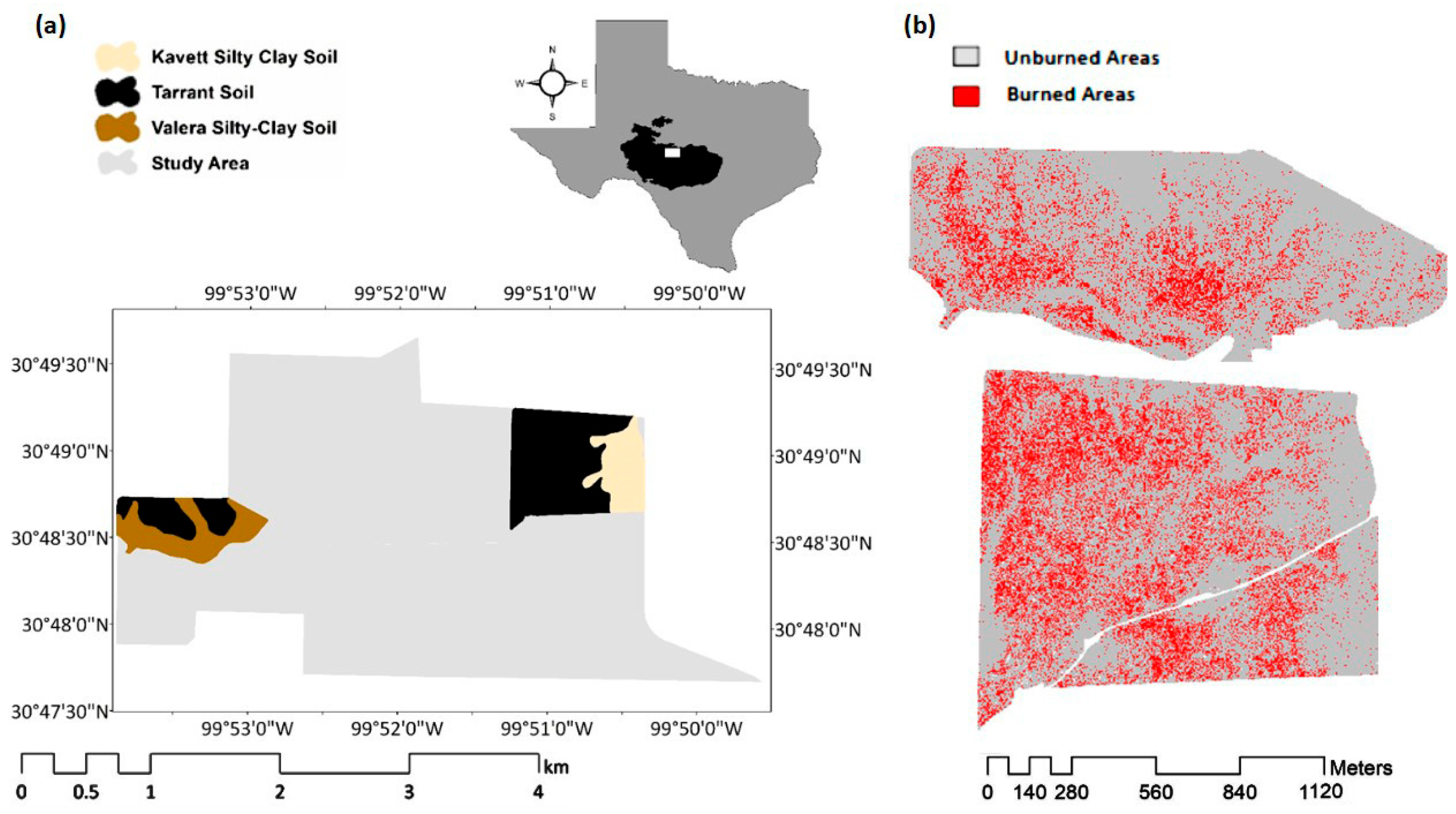
Figure 1. Location of the (a) Martin ranch in the Edwards Plateau of Texas with depicted soil boundary delineations considered in the study, and (b) the burned pattern in the burn units inside the study area [49]. White box in the state of Texas map indicates general location of the Martin Ranch study area.
Remotesensing 17 03873 g001
Figure 2. Monthly precipitation (bars; 2018–2020) and long-term mean monthly precipitation (lines; 1981–2020) (panel (a)), and monthly mean Standardized Precipitation Evapotranspiration Index (SPEI; [53]) at 30-, 90-, and 180-day timescales (panels (bd)) for 2018–2020. Precipitation and SPEI were derived from GRIDMET gridded climate datasets [52] and spatially averaged across burn units in Google Earth Engine [54]. In panel (a), “F” indicates months when hyperspectral imagery was acquired, and “PB” marks the month of the prescribed burn.
Remotesensing 17 03873 g002
Figure 3. The workflow involved collecting pre-fire and post-fire remote sensing data, post-processing, machine learning (RF) classification, mapping spectral evenness and vegetation indices, and the spatial analyses employed for the study areas.
Remotesensing 17 03873 g003
Figure 4. Spatial comparisons of the Shannon’s Evenness Index (SEI) for pre-fire (maps (I,II)) and post-fire (maps (III,IV)) conditions. SEI pre-fire and post-fire data, which were evaluated using a linear mixed-effects model transformed to an ordered quantile normalized scale to improve adherence to normality assumptions, are presented as back-transformed mean values for the two-way interactions: (A) time × soils and (B) burn treatment × soils. Soil types included Tarrant (TA), Kavett (KaB), and Valera (VaB); burn treatments were burned versus unburned. Error bars represent the bootstrap 95% confidence intervals on the back-transformed data. Means sharing the same lower-case letter were not significantly different (Bonferroni-adjusted pairwise comparisons on the transformed data, p < 0.05).
Remotesensing 17 03873 g004aRemotesensing 17 03873 g004b
Figure 5. Estimated marginal means (back-transformed from an ordered quantile normalized scale) of pre-fire and post-fire (A,B) β.BRAY, (C,D) β.BAL, and (E,F) β.GRA for two-way interactions of time × soil type (left column) and burn treatment × soil type (right column). Soil types include Tarrant (TA), Kavett (KaB), and Valera (VaB), and burn treatments include burned versus unburned areas. Bray–Curtis dissimilarity measures of spectral abundance for sampled points in each area were extracted from hyperspectral images. Spectral dissimilarity metrics include the following: β.BRAY measures overall composition-based dissimilarity in chlorophyll reflectance between pre- and post-fire pixels; β.BAL captures balanced variation in reflectance patterns across spectral bands; β.GRA captures differences in overall reflectance magnitude between time periods across bands. Error bars represent bootstrap 95% confidence intervals on back-transformed data. Means sharing the same lower-case letter are not significantly different (p < 0.05, Bonferroni-adjusted pairwise comparisons conducted on transformed scale).
Remotesensing 17 03873 g005
Figure 6. Spatial comparisons of the Hyperspectral Vegetation Index [HSVI] for pre-fire (maps (I,II)) and post-fire (maps (III,IV)) conditions. Estimated marginal means (back-transformed) of HSVI representing significant two-way interactions of (A) time × soil and (B) burn treatment × soil are presented. Prior to analysis, data were Box–Cox transformed (λ = −0.2) to meet normality assumptions. Soil types were Tarrant (TA), Kavett (KaB), and Valera (VaB). Burn treatments were burned vs. unburned, and time represents pre-fire and post-fire conditions. Error bars represent the 95% bootstrap confidence intervals for the back-transformed means. Means sharing the same lowercase letter within each panel are not significantly different (Bonferroni-adjusted pairwise comparisons on the transformed data, p < 0.05).
Remotesensing 17 03873 g006
Figure 7. Spatial comparisons of the Modified Triangulated Vegetation Index 2 [MTVI-2] spectral index for pre-fire (maps (I,III)) and post-fire (maps (II,IV)) conditions. Estimated marginal means (back-transformed) of MTVI-2, representing significant two-way interactions of (A) time × soil and (B) burn treatment × soil are presented. Prior to analysis, data were Box–Cox transformed (λ= 0.1) to meet normality assumptions. Soil types were Tarrant (TA), Kavett (KaB), and Valera (VaB). Burn treatments were burned vs. unburned, and time represents pre-fire and post-fire conditions. Error bars represent the 95% bootstrap confidence intervals for the back-transformed means. Means sharing the same lowercase letter within each panel are not significantly different (Bonferroni-adjusted pairwise comparisons on the transformed data, p < 0.05).
Remotesensing 17 03873 g007
Figure 8. Spatial comparisons of the Red-Edge Chlorophyll Index [CIred-edge; CI-rd] for pre-fire (maps (I,III)) and post-fire (maps (II,IV)) conditions. Estimated marginal means (back-transformed) of CIred-edge representing significant two-way interactions of (A) time × soil and (B) burn treatment × soil are presented. Prior to analysis, data were Box–Cox transformed (λ = 0.1) to meet normality assumptions. Soil types were Tarrant (TA), Kavett (KaB), and Valera (VaB). Burn treatments were burned vs. unburned, and time represents pre-fire and post-fire conditions. Error bars represent the 95% bootstrap confidence intervals for the back-transformed means. Means sharing the same lowercase letter within each panel are not significantly different (Bonferroni-adjusted pairwise comparisons on the transformed data, p < 0.05).
Remotesensing 17 03873 g008
Figure 9. The pre-fire and post-fire lacunarity curves of the woody cover (panel (A)), burn pattern (panel (B)), Shannon’s Evenness Index (SEI) (panel (C)), HSVI (panel (D)), MTVI-2 (panel (E)), and CIred-edge (panel (F)).
Remotesensing 17 03873 g009
Table 1. List of spectral indices used to evaluate spatial patterns in plant functional (biophysical and biochemical) traits before and after prescribed fire.
Spectral IndexTraitsBands (nm)Formula
HSVI 1Biophysical520, 689, 760, 861, 889 2 R 760 1 R 689 + a × R 861 R 889 R 520 + R 689 ;   a = 1.5
MTVI-2 2Biochemical
Activity
550, 670, 800 1.5 × 1.2 R 800 R 550 2.5 R 670 R 550 2 R 800 + 1 2 6 R 800 5 R 670 0.5
CIred-edge 3Biochemical Stress710, 780 ( R 780 / R 710 ) 1
1 Hyperspectral Image-Based Vegetation Index [31]; 2 Modified Triangulated Vegetation Index 2 [34]; 3 Chlorophyll Red-Edge Index [29].
Table 2. Mantel’s r and associated p-values (p-val; based on 10,000 permutations with spatial constraints) for simple (XD), cross- (XposB and XpreXpos), and partial (XposD.B) Mantel tests conducted on spectral diversity measures (SEI, β.Bray, β.Bal, and β.Gra). The Xpre and Xpos are variable dissimilarity matrices (absolute value of the difference in X pre-burn and X post-burn, respectively, between sampling points); D is the spatial distance matrix (Euclidean distance between sampled pixels); and B is a variable distance matrix (absolute value of the difference in burn status between sampled pixels).
MantelSEI (r; p-val)β.BRAY (r; p-val)β.BAL (r; p-val)β.GRA (r; p-val)
XpreD0.0155; <0.0010.0559; <0.0010.0050; 0.0020.0569; <0.001
XposD0.0067; <0.0010.0075; <0.0010.0134; <0.0010.0146; <0.001
XPreXPos0.3949; <0.0010.0664; 0.0050.3730; <0.0010.0627; 0.002
XposB−0.1174; <0.001nsns0.0889; <0.001
XposD.Bnsnsns ns
ns = not significant; pre = pre-fire conditions; pos = post-fire conditions.
Table 3. Mantel’s r and associated p-values (p-val; based on 10,000 permutations with spatial constraints) for the spectral biophysical and biochemical traits. Simple (XD), cross- (XposB and XpreXpost), and partial (XposD.B) Mantel tests were conducted for each biophysical (HSVI) and biochemical index (MTVI-2 and CIred-edge). The Xpre and Xpost are variable dissimilarity matrices (absolute value of the difference in X pre-burn and X post-burn, respectively, between sampled pixels); D is spatial distance matrix (Euclidean distance between sampled pixels); and B is a variable distance matrix (absolute value of the difference in burn status between sampled pixels).
MantelHSVI 1
(r; p-val)
MTVI-2 2
(r; p-val)
CIred-edge 3
(r; p-val)
XpreD0.0121; <0.0010.0305; <0.0010.0208; <0.001
XposD0.0012; <0.001−0.0001; 0.002ns
XPreXPos0.3749; <0.0010.3512; <0.0010.0560; <0.001
XposB−0.0983; 0.046−0.1202; 0.0230.1118; 0.039
XposD.Bnsnsns
ns = not significant; pre = pre-fire conditions; pos = post-fire conditions. 1 Hyperspectral Image-Based Vegetation Index (Sun et al. 2021) [31]; 2 Modified Triangulated Vegetation Index 2 (Barry et al. 2008) [34]; 3 Chlorophyll Red-Edge Index (Helfenstein et al. 2022) [29].
Disclaimer/Publisher’s Note: The statements, opinions and data contained in all publications are solely those of the individual author(s) and contributor(s) and not of MDPI and/or the editor(s). MDPI and/or the editor(s) disclaim responsibility for any injury to people or property resulting from any ideas, methods, instructions or products referred to in the content.