
Automated Lithology Segmentation of 3D Point Clouds from Highwalls Using Deep Learning



Highlights
- Transformer-based models outperform CNNs in complex lithology segmentation of 3D point cloud mine highwall datasets.
- The approach proved to be robust across a variety of geological conditions, highlighting its potential for broader application.
- Improved automation reduces reliance on manual interpretation in mining operations.
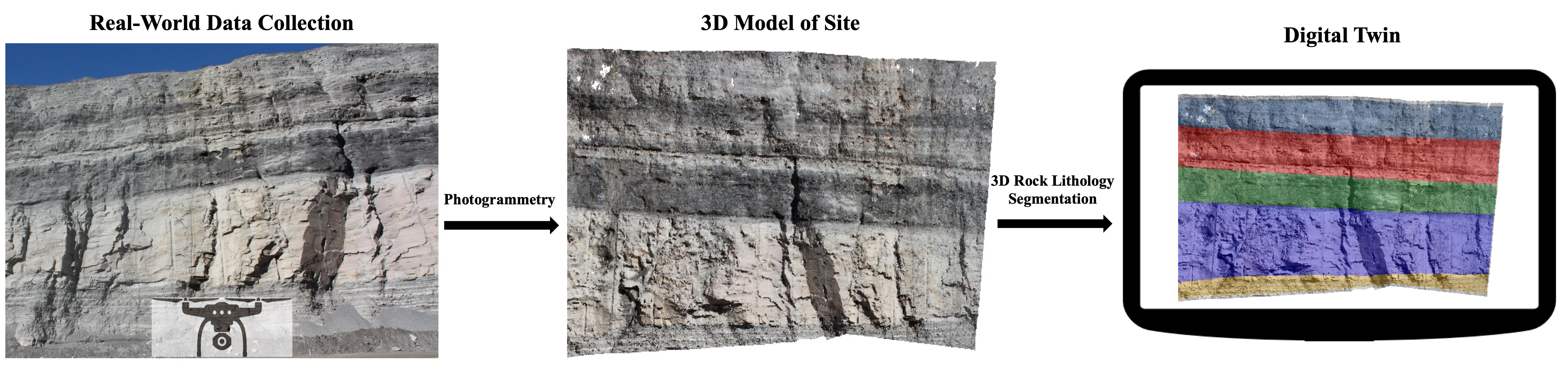
- Supports more accurate digital twins, enhancing hazard assessment and decision-making.
Abstract
1. Introduction
2. Methodology
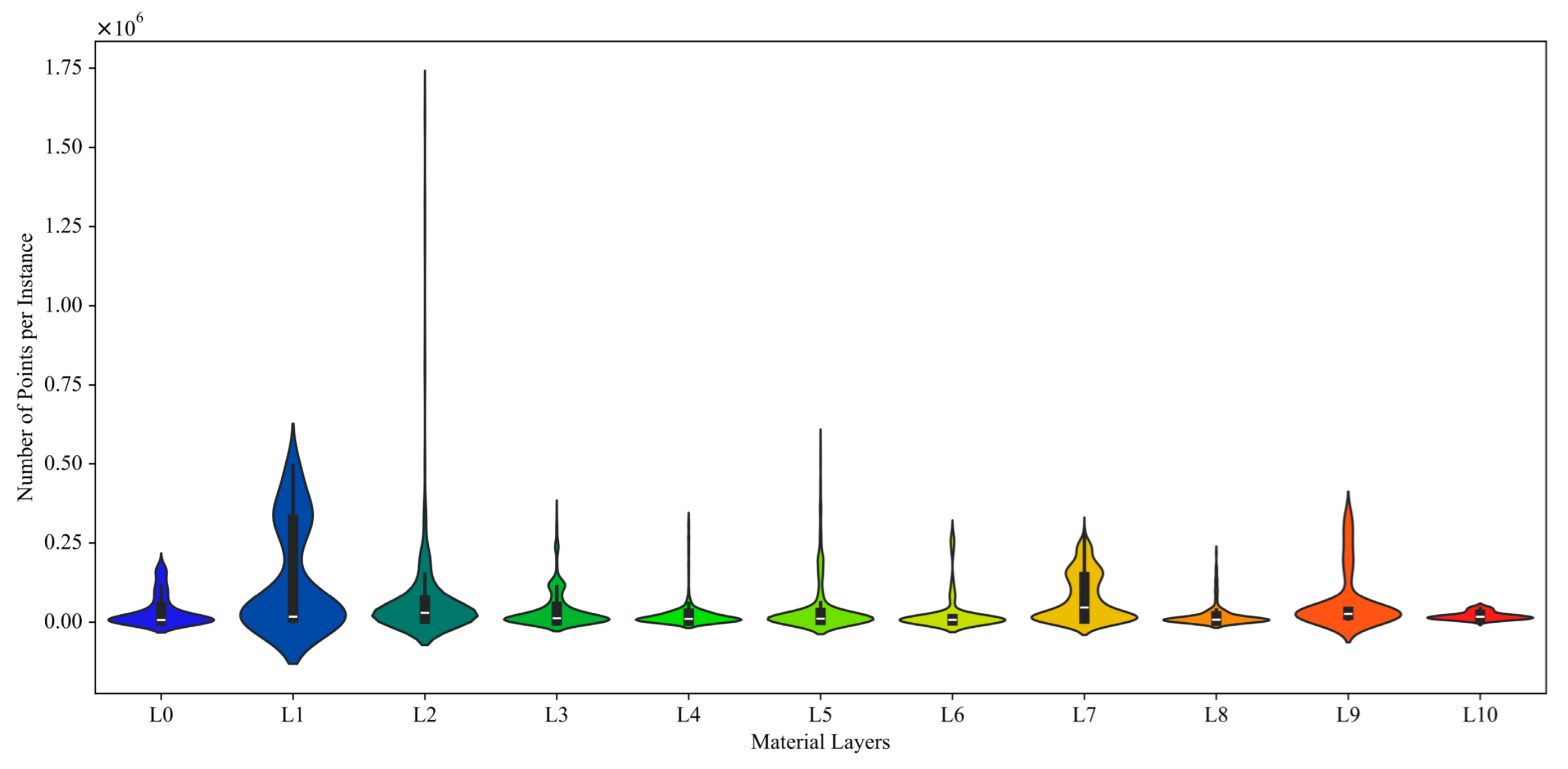
2.1. Mine Highwall Dataset (MHD)
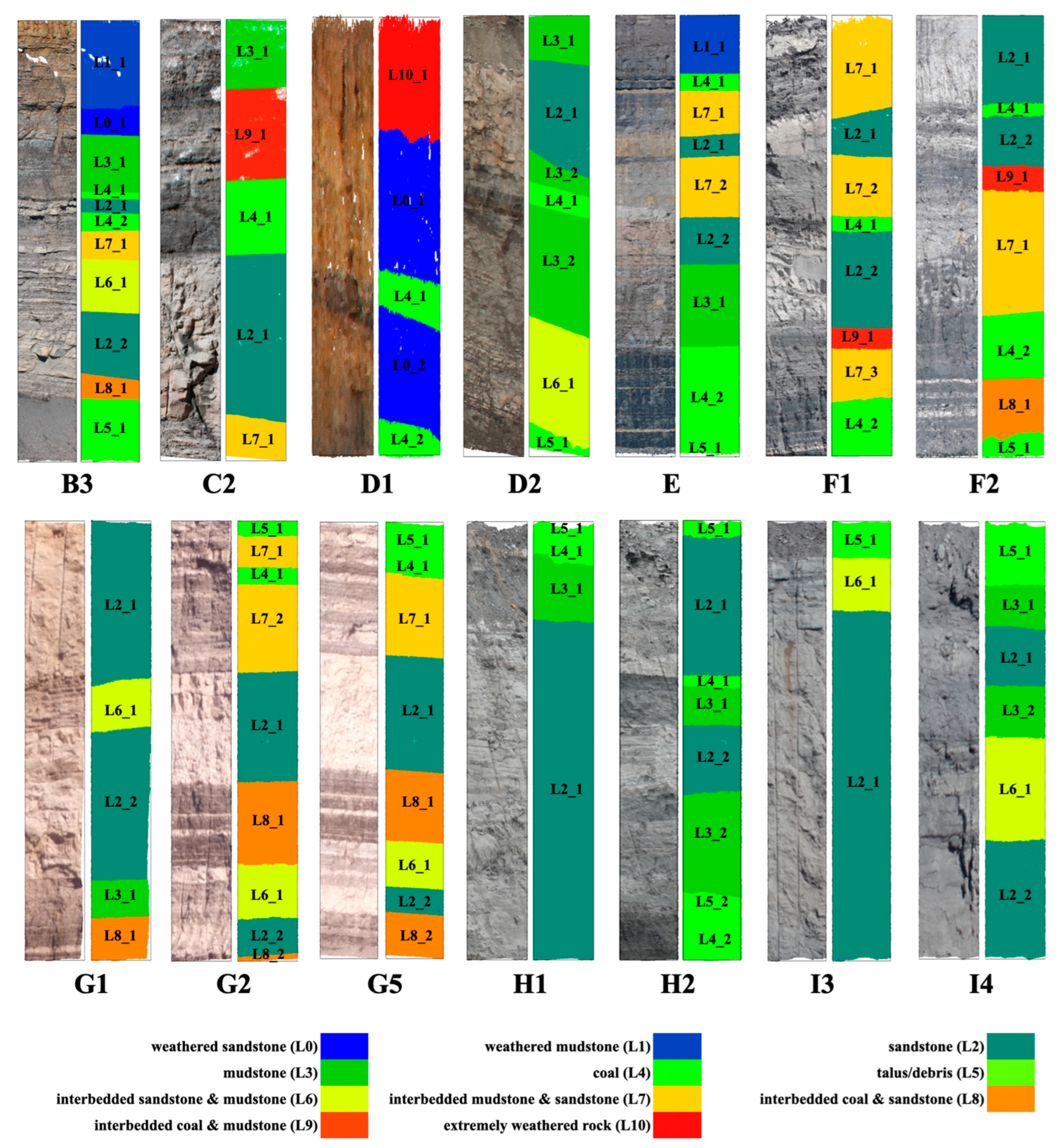
2.2. Data Annotation and Labelling Criteria
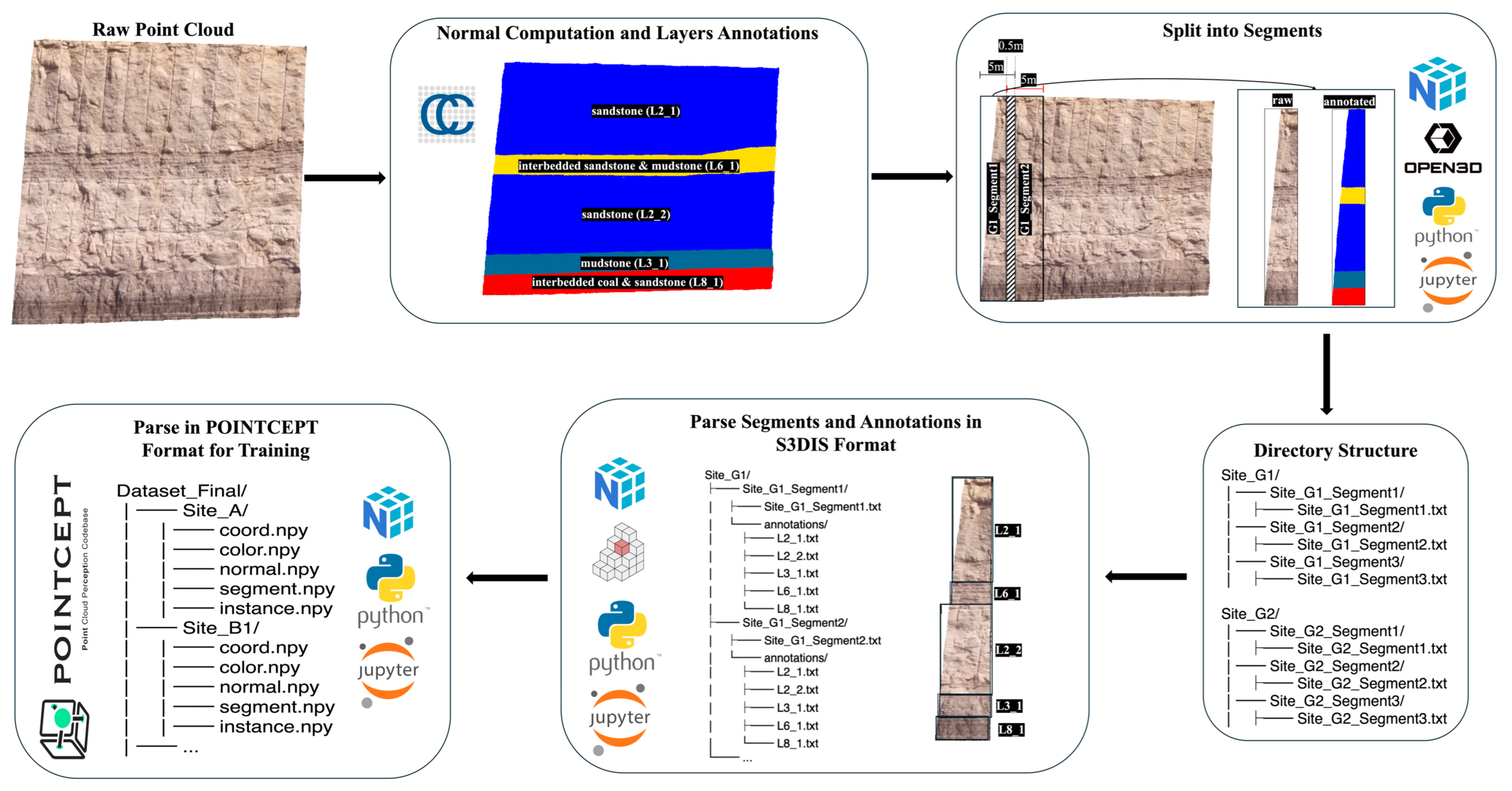
2.3. Data Pre-Processing
2.4. Deep Learning Based 3D Segmentation Models
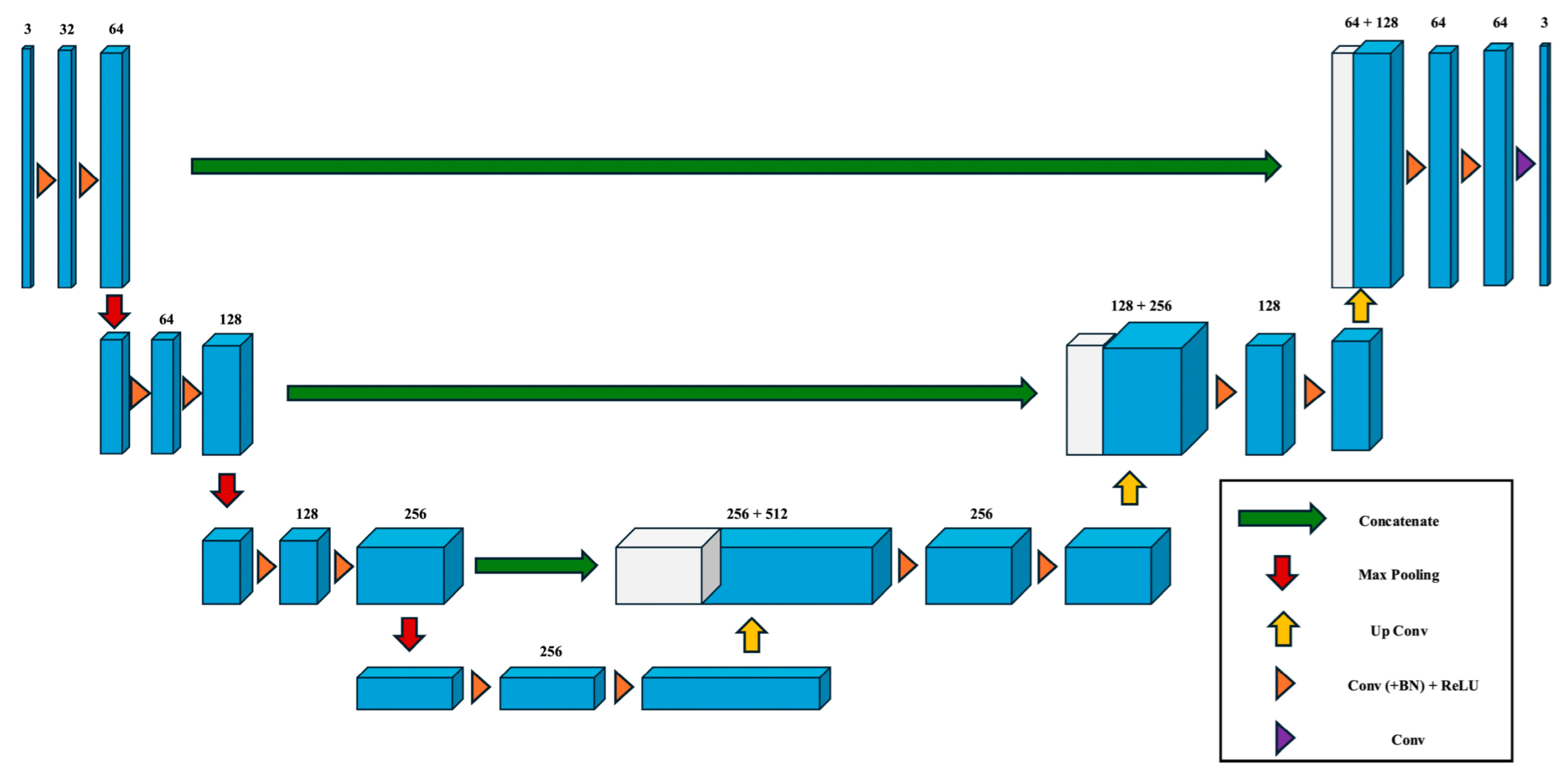
2.4.1. SparseUNet (SPUNet)
2.4.2. Point Transformer v2 (PTv2)
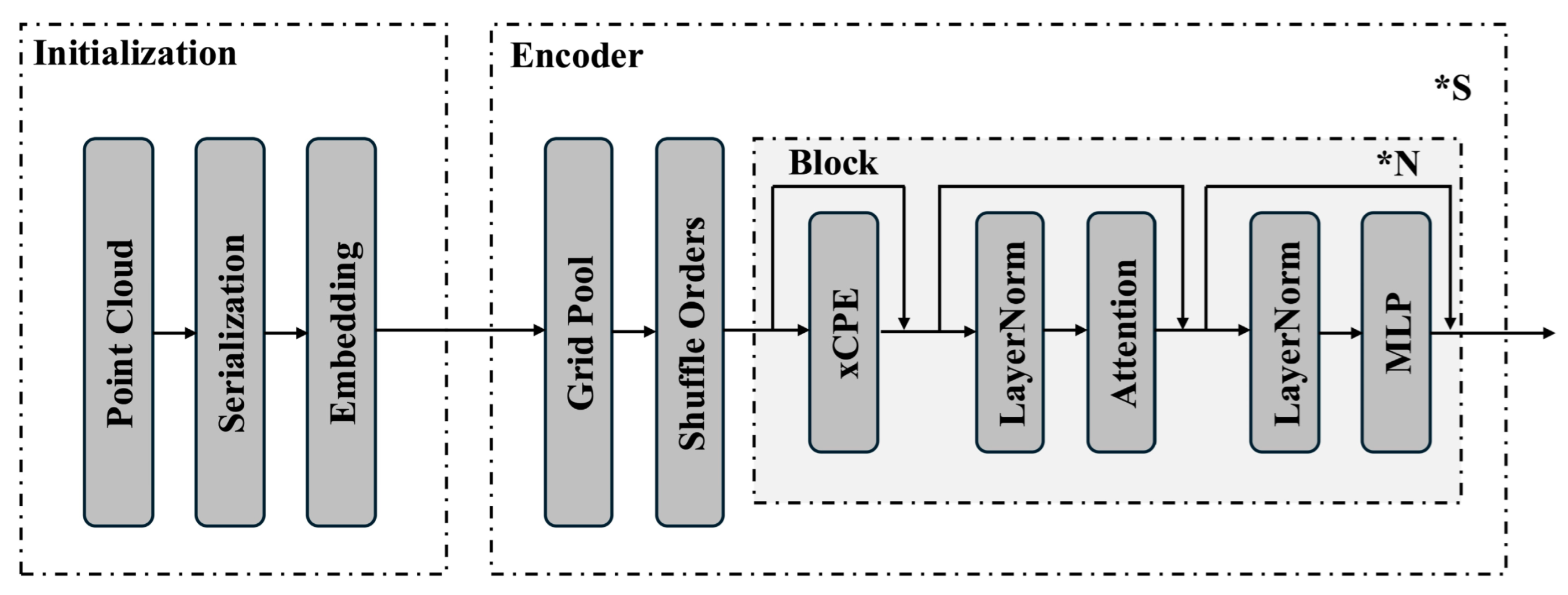
2.4.3. Point Transformer v3 (PTv3)
2.4.4. Sonata
2.5. Experimental Protocols and Evaluation Measures
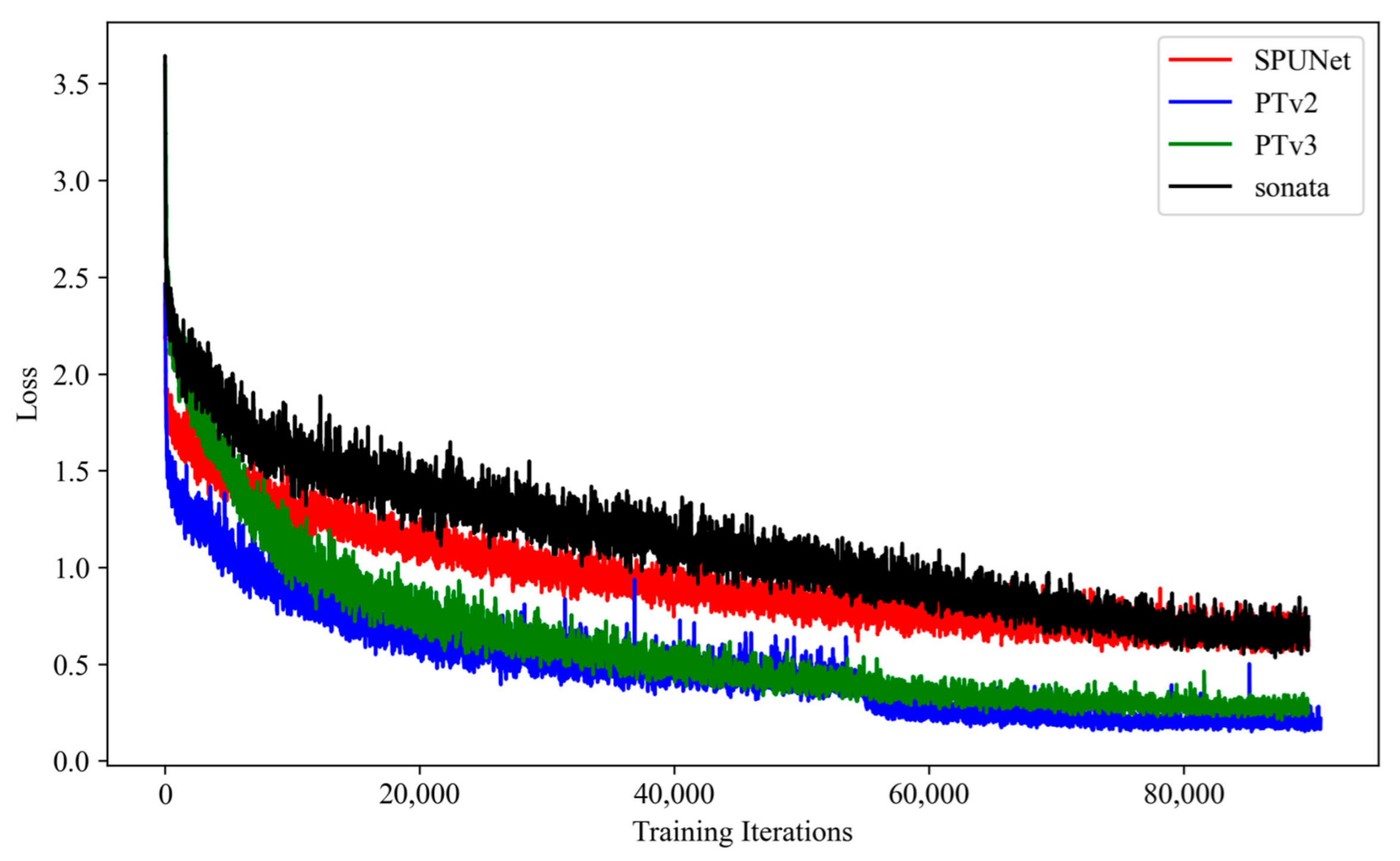
3. Results and Discussion
4. Conclusions
Author Contributions
Funding
Data Availability Statement
Acknowledgments
Conflicts of Interest
Appendix A. Data Pre-Processing Pseudocodes
Appendix A.1. Pseudocode to Extract Layer Annotations

Appendix A.2. Pseudocode to Parse the Data into Pointcept Training Format

References
- Akbulut, N.K.; Anani, A.; Brown, L.D.; Wellman, E.C.; Adewuyi, S.O. Building a 3D Digital Twin for Geotechnical Monitoring at San Xavier Mine. Rock Mech. Rock Eng. 2024, 1–18. [Google Scholar] [CrossRef]
- Ando, A.; Gidaris, S.; Bursuc, A.; Puy, G.; Boulch, A.; Marlet, R. Rangevit: Towards vision transformers for 3d semantic segmentation in autonomous driving. In Proceedings of the IEEE/CVF Conference on Computer Vision and Pattern Recognition, Vancouver, BC, Canada, 17–24 June 2023. [Google Scholar]
- Armeni, I.; Sener, O.; Zamir, A.R.; Jiang, H.; Brilakis, I.; Fischer, M.; Savarese, S. 3d semantic parsing of large-scale indoor spaces. In Proceedings of the 2016 IEEE Conference on Computer Vision and Pattern Recognition (CVPR), Las Vegas, NV, USA, 27–30 June 2016. [Google Scholar]
- Bahootoroody, F.; Giacomini, A.; Guccione, D.E.; Thoeni, K.; Watman, A.; Griffiths, D.V. Predictive Modelling of Rainfall-Induced Rockfall: A Copula-Based Approach. Georisk Assess. Manag. Risk Eng. Syst. Geohazards 2025, 1–13. [Google Scholar] [CrossRef]
- Chen, G.; Deng, W.; Lin, M.; Lv, J. Slope stability analysis based on convolutional neural network and digital twin. Nat. Hazards 2023, 118, 1427–1443. [Google Scholar] [CrossRef]
- CloudCompare Wiki. Normals\Compute. 2024. Available online: https://cloudcompare.org/doc/wiki/index.php/Normals%5CCompute (accessed on 10 November 2025).
- Ferrero, A.M.; Forlani, G.; Roncella, R.; Voyat, H. Advanced geostructural survey methods applied to rock mass characterization. Rock. Mech. Rock. Eng. 2009, 42, 631–665. [Google Scholar] [CrossRef]
- Girardeau-Montaut, D. CloudCompare. Fr. EDF RD Telecom ParisTech. 2016, 11, 2016. [Google Scholar]
- Humair, F.; Abellan, A.; Carrea, D.; Matasci, B.; Epard, J.-L.; Jaboyedoff, M. Geological layers detection and characterisation using high resolution 3D point clouds: Example of a box-fold in the Swiss Jura Mountains. Eur. J. Remote Sens. 2015, 48, 541–568. [Google Scholar] [CrossRef]
- Ibrahim, M.; Akhtar, N.; Anwar, S.; Mian, A. SAT3D: Slot attention transformer for 3D point cloud semantic segmentation. IEEE Trans. Intell. Transp. Syst. 2023, 24, 5456–5466. [Google Scholar] [CrossRef]
- Idrees, M.O.; Pradhan, B. A decade of modern cave surveying with terrestrial laser scanning: A review of sensors, method and application development. Int. J. Speleol. 2016, 45, 71. [Google Scholar] [CrossRef]
- Jing, R.; Shao, Y.; Zeng, Q.; Liu, Y.; Wei, W.; Gan, B.; Duan, X. Multimodal feature integration network for lithology identification from point cloud data. Comput. Geosci. 2025, 194, 105775. [Google Scholar] [CrossRef]
- Li, J.; Yang, T.; Liu, F.; Zhao, Y.; Liu, H.; Deng, W.; Gao, Y.; Li, H. Modeling spatial variability of mechanical parameters of layered rock masses and its application in slope optimization at the open-pit mine. Int. J. Rock. Mech. Min. Sci. 2024, 181, 105859. [Google Scholar] [CrossRef]
- Pointcept Contributors. Pointcept: A Codebase for Point Cloud Perception Research. 2023. Available online: https://github.com/Pointcept/Pointcept (accessed on 27 October 2025).
- Robiati, C.; Mastrantoni, G.; Francioni, M.; Eyre, M.; Coggan, J.; Mazzanti, P. Contribution of High-Resolution Digital Twins for the Definition of Rockfall Activity and Associated Hazard Modelling. Land 2023, 12, 191. [Google Scholar] [CrossRef]
- Singh, S.K.; Banerjee, B.P.; Raval, S. A review of laser scanning for geological and geotechnical applications in underground mining. Int. J. Min. Sci. Technol. 2023, 33, 133–154. [Google Scholar] [CrossRef]
- Tan, W.; Wu, S.; Li, Y.; Guo, Q. Digital Twins’ Application for Geotechnical Engineering: A Review of Current Status and Future Directions in China. Appl. Sci. 2025, 15, 8229. [Google Scholar] [CrossRef]
- Thoeni, K.; Santise, M.; Guccione, D.E.; Fityus, S.; Roncella, R.; Giacomini, A. Use of low-cost terrestrial and aerial imaging sensors for geotechnical applications. Aust. Geomech. J. 2018, 53, 101–122. [Google Scholar]
- Ugur, M.; Ustaoglu, A.O.; Yasin, B.; Ilyas, Y.; Sultan, K.; Candan, G. Rockfall Hazard Assessment for Natural and Cultural Heritage Site: Close Vicinity of Rumkale (Gaziantep, Türkiye) Using Digital Twins. Heritage 2025, 8, 270. [Google Scholar] [CrossRef]
- Wang, B.; Mohajerpoor, R.; Cai, C.; Kim, I.; Vu, H.L. Traffic4cast--Large-scale Traffic Prediction using 3DResNet and Sparse-UNet. arXiv 2021, arXiv:2111.05990. [Google Scholar]
- Wu, X.; DeTone, D.; Frost, D.; Shen, T.; Xie, C.; Yang, N.; Engel, J.; Newcombe, R.; Zhao, H.; Straub, J. Sonata: Self-Supervised Learning of Reliable Point Representations. In Proceedings of the Computer Vision and Pattern Recognition Conference, Nashville, TN, USA, 10–17 June 2025; pp. 22193–22204. [Google Scholar]
- Wu, X.; Jiang, L.; Wang, P.-S.; Liu, Z.; Liu, X.; Qiao, Y.; Ouyang, W.; He, T.; Zhao, H. Point transformer v3: Simpler faster stronger. In Proceedings of the IEEE/CVF Conference on Computer Vision and Pattern Recognition (CVPR), Seattle, WA, USA, 17–18 June 2024; pp. 4840–4851. [Google Scholar]
- Wu, X.; Lao, Y.; Jiang, L.; Liu, X.; Zhao, H. Point transformer v2: Grouped vector attention and partition-based pooling. Adv. Neural Inf. Process. Syst. 2022, 35, 33330–33342. [Google Scholar]
- Wyllie, D.C.; Mah, C. Rock Slope Engineering; CRC Press: Boca Raton, FL, USA, 2024. [Google Scholar]
- Xu, J.; Zhang, Y. AI-Powered Digital Twin Technology for Highway System Slope Stability Risk Monitoring. Geotechnics 2025, 5, 19. [Google Scholar] [CrossRef]
- Yang, B.; Haala, N.; Dong, Z. Progress and perspectives of point cloud intelligence. Geo-Spat. Inf. Sci. 2023, 26, 189–205. [Google Scholar] [CrossRef]
- Yue, Z.; Yue, X.; Wang, X.; Li, Y.; Li, W.; Dai, S.; Gan, L. Experimental study on identification of layered rock mass interface along the borehole while drilling. Bull. Eng. Geol. Environ. 2022, 81, 353. [Google Scholar] [CrossRef]
- Zhou, Q.-Y.; Park, J.; Koltun, V. Open3D: A modern library for 3D data processing. arXiv 2018, arXiv:1801.09847. [Google Scholar] [CrossRef]



| Site | Wall | Source | Number of Data Segments | Maximum Height (m) | Surface Point Density (Points/m2) (Average) | Number of Points |
|---|---|---|---|---|---|---|
| A | A1 | Photogrammetry | 9 | 48 | 2320 | 5,038,500 |
| B | B1 | Photogrammetry | 14 | 59 | 4293 | 20,026,713 |
| B2 | 12 | 56 | 4424 | 17,273,986 | ||
| B3 | 12 | 53 | 4305 | 15,427,307 | ||
| C | C1 | Photogrammetry | 11 | 43 | 7405 | 14,790,255 |
| C2 | 12 | 47 | 7145 | 15,699,843 | ||
| C3 | 10 | 36 | 7476 | 10,993,681 | ||
| C4 | 8 | 34 | 7528 | 8,787,134 | ||
| D | D1 | Photogrammetry | 67 | 18 | 1062 | 4,902,965 |
| D2 | 64 | 35 | 1072 | 7,486,549 | ||
| E | E1 | Photogrammetry | 52 | 49 | 534 | 6,012,656 |
| F | F1 | Photogrammetry | 55 | 55 | 1277 | 19,929,059 |
| F2 | 47 | 49 | 1327 | 14,137,515 | ||
| F3 | 36 | 32 | 2567 | 12,994,226 | ||
| F4 | 25 | 23 | 2637 | 6,466,573 | ||
| G | G1 | Photogrammetry | 9 | 36 | 176 | 264,072 |
| G2 | 17 | 31 | 190 | 521,113 | ||
| G3 | 66 | 44 | 173 | 4,216,752 | ||
| G4 | 63 | 40 | 186 | 3,688,460 | ||
| G5 | 75 | 53 | 214 | 2,995,802 | ||
| G6 | 72 | 49 | 210 | 3,439,859 | ||
| H | H1 | TLS | 11 | 37 | 2109 | 4,375,256 |
| H2 | 46 | 59 | 552 | 8,448,001 | ||
| H3 | 52 | 64 | 545 | 8,760,566 | ||
| H4 | 50 | 69 | 545 | 8,945,944 | ||
| H5 | 38 | 62 | 847 | 15,189,697 | ||
| H6 | 40 | 60 | 848 | 14,688,649 | ||
| H7 | 37 | 57 | 855 | 11,782,258 | ||
| H8 | 34 | 51 | 856 | 11,365,073 | ||
| I | I1 | TLS | 96 | 61 | 213 | 5,213,236 |
| I2 | 49 | 37 | 258 | 2,021,271 | ||
| I3 | 141 | 41 | 237 | 6,101,271 | ||
| I4 | 43 | 25 | 268 | 1,007,451 | ||
| I5 | 33 | 24 | 278 | 926,112 | ||
| I6 | 92 | 16 | 272 | 1,353,910 | ||
| Total | 1498 |
| Layer Name | Scalar Field (SF) | Abbreviation |
|---|---|---|
| Weathered Sandstone | 0 | L0 |
| Weathered Mudstone | 1 | L1 |
| Sandstone | 2 | L2 |
| Mudstone | 3 | L3 |
| Coal | 4 | L4 |
| Talus\Debris | 5 | L5 |
| Interbedded Sandstone & Mudstone | 6 | L6 |
| Interbedded Mudstone & Sandstone | 7 | L7 |
| Interbedded Coal & Sandstone | 8 | L8 |
| Interbedded Coal & Mudstone | 9 | L9 |
| Extremely Weathered Rock | 10 | L10 |
| Hyperparameter | Definition |
|---|---|
| Epoch | An epoch refers to one full cycle through the entire training dataset, allowing the model to learn from all samples once. |
| Batch size | The number of training examples processed together in one forward/backward pass. |
| Learning rate | A scalar that determines the step size at each iteration while moving toward a minimum of the loss function. |
| Loss function | A mathematical function that measures the difference between predicted output and true labels. |
| Optimiser | An algorithm used to adjust model weights based on gradients computed from the loss function. |
| Dropout | A regularisation technique that randomly sets a fraction of neurons to zero during training to reduce overfitting and improve generalisation. |
| Backbone | The core feature extractor network used in a deep learning model to capture key representations from input data. |
| LR Scheduler | A mechanism that adjusts the learning rate during training based on a predefined schedule or training progress to improve convergence. |
| SPUNet | PTv2 | PTv3 | Sonata | |
|---|---|---|---|---|
| Optimiser | SGD | AdamW | AdamW | AdamW |
| BackBone | PointTransformer-Seg50 | PT-v2m1 | PT-v3m1 | PT-v3m2 |
| Trainable Parameters | 39,156,971 | 3,908,543 | 46,190,423 | 124,793,563 |
| LR Scheduler | PolyLR | MultiStepLR | OneCycleLR | OneCycleLR |
| Class | SPUNet | PTv2 | PTv3 | Sonata | ||||
|---|---|---|---|---|---|---|---|---|
| IoU | Acc | IoU | Acc | IoU | Acc | IoU | Acc | |
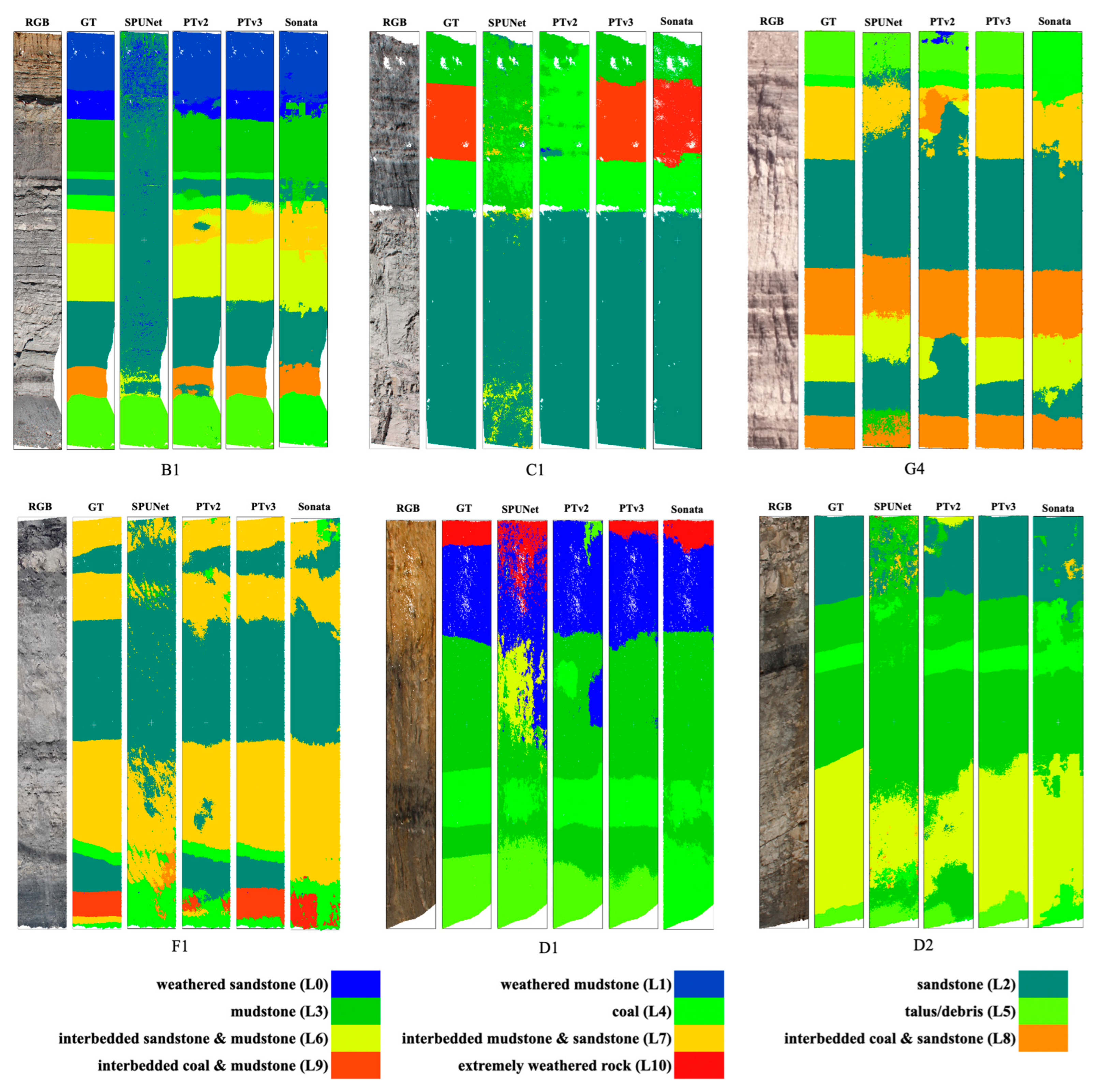
| L0 | 0.2515 | 0.3837 | 0.4736 | 0.5843 | 0.8390 | 0.9630 | 0.4966 | 0.6925 |
| L1 | 0.2325 | 0.2570 | 0.8358 | 0.9441 | 0.9521 | 0.9600 | 0.7622 | 0.8118 |
| L2 | 0.5524 | 0.8190 | 0.8738 | 0.9555 | 0.9438 | 0.9690 | 0.8414 | 0.8945 |
| L3 | 0.3716 | 0.6330 | 0.7215 | 0.8914 | 0.8879 | 0.9205 | 0.6280 | 0.7751 |
| L4 | 0.3497 | 0.4470 | 0.6237 | 0.8592 | 0.8090 | 0.9029 | 0.5482 | 0.6883 |
| L5 | 0.7198 | 0.8507 | 0.8753 | 0.9247 | 0.9342 | 0.9664 | 0.9064 | 0.9390 |
| L6 | 0.1947 | 0.3024 | 0.7159 | 0.8020 | 0.8966 | 0.9589 | 0.7673 | 0.8867 |
| L7 | 0.3028 | 0.3638 | 0.8066 | 0.8578 | 0.9244 | 0.9584 | 0.6915 | 0.8643 |
| L8 | 0.2464 | 0.3121 | 0.7503 | 0.8144 | 0.8907 | 0.9534 | 0.6612 | 0.8914 |
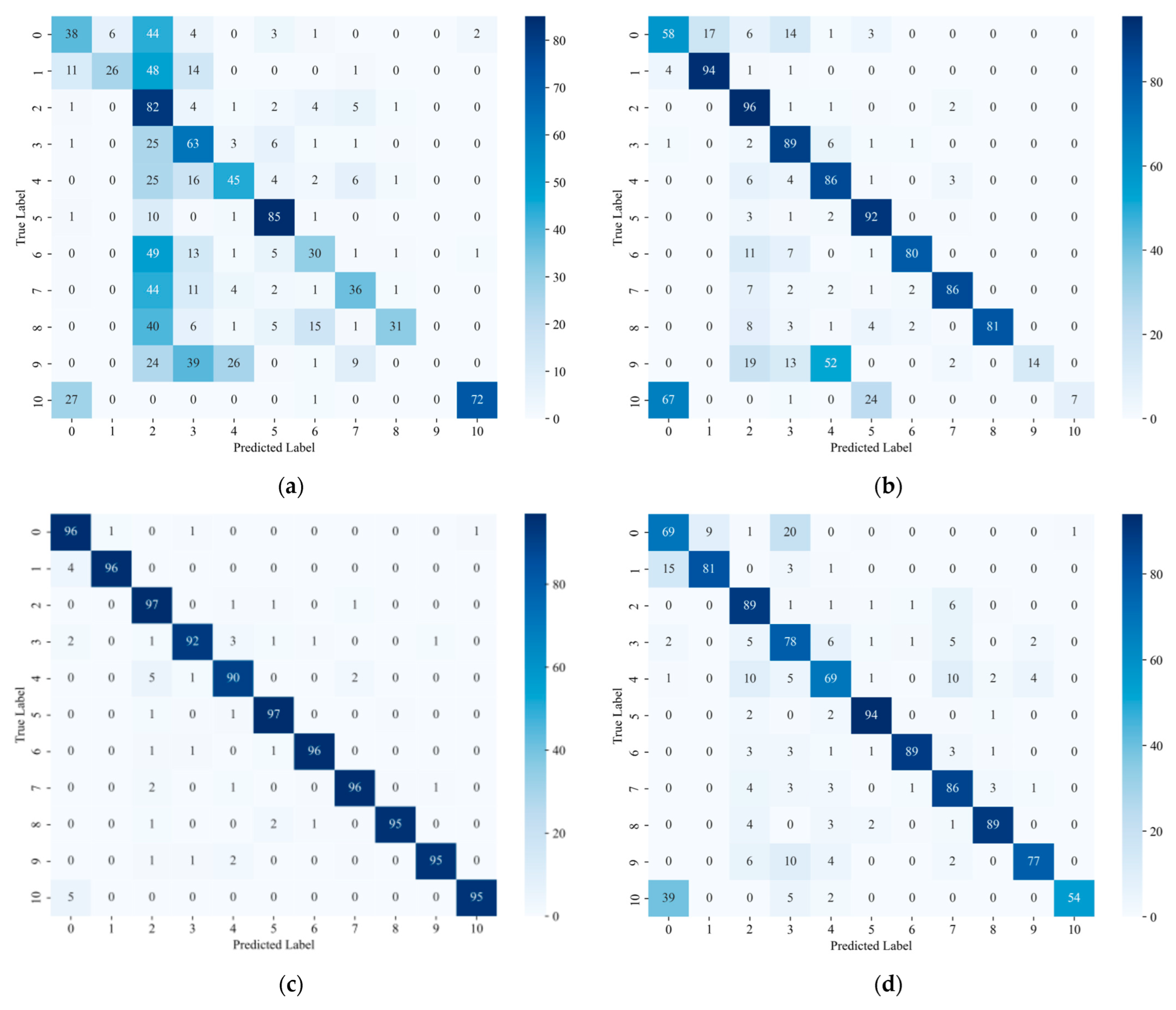
| L9 | 0.0018 | 0.0018 | 0.1349 | 0.1378 | 0.8573 | 0.9472 | 0.5937 | 0.7733 |
| L10 | 0.5426 | 0.7210 | 0.0743 | 0.0746 | 0.8686 | 0.9474 | 0.5256 | 0.5429 |
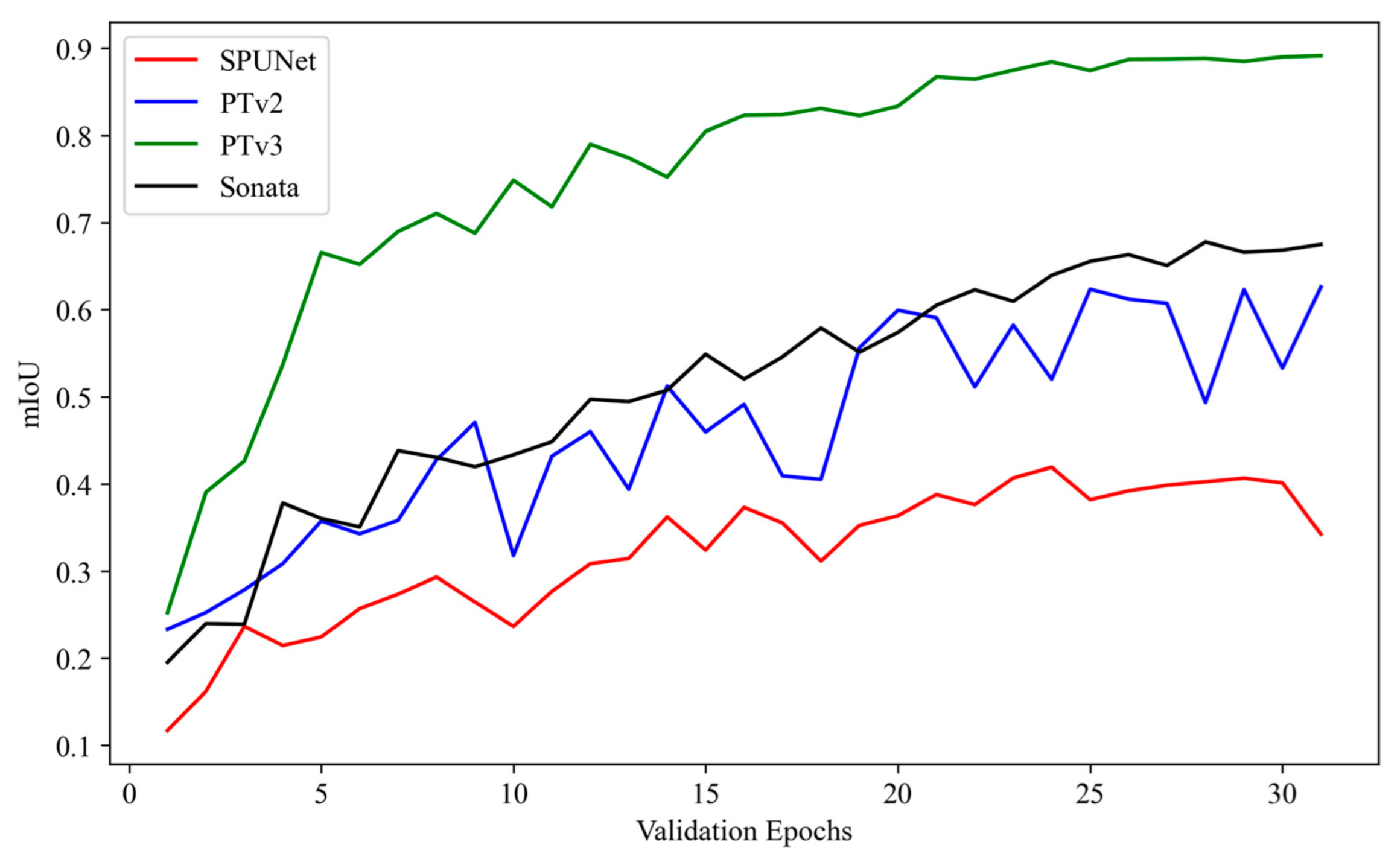
| Mean | 0.3423 | 0.4629 | 0.6260 | 0.7132 | 0.8912 * | 0.9497 * | 0.6747 | 0.7963 |
| SPUNet | PTv2 | PTv3 | Sonata | |
|---|---|---|---|---|
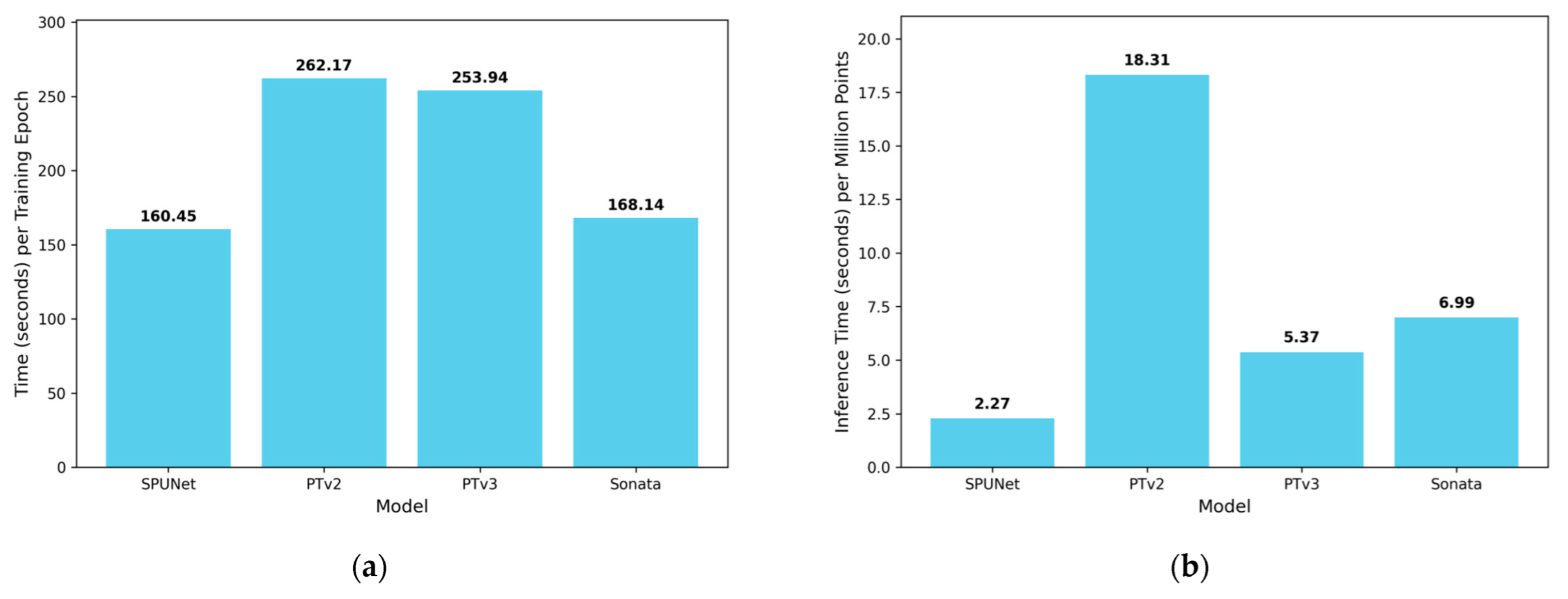
| Training Time per Epoch (sec) | 160.45 | 262.17 | 253.94 | 168.14 |
| Inference Time per Million Points (sec) | 2.27 | 18.31 | 5.37 | 6.99 |
Disclaimer/Publisher’s Note: The statements, opinions and data contained in all publications are solely those of the individual author(s) and contributor(s) and not of MDPI and/or the editor(s). MDPI and/or the editor(s) disclaim responsibility for any injury to people or property resulting from any ideas, methods, instructions or products referred to in the content. |
© 2025 by the authors. Licensee MDPI, Basel, Switzerland. This article is an open access article distributed under the terms and conditions of the Creative Commons Attribution (CC BY) license (https://creativecommons.org/licenses/by/4.0/).
Share and Cite
Iqbal, U.; Giacomini, A.; Thoeni, K. Automated Lithology Segmentation of 3D Point Clouds from Highwalls Using Deep Learning. Remote Sens. 2025, 17, 3835. https://doi.org/10.3390/rs17233835
Iqbal U, Giacomini A, Thoeni K. Automated Lithology Segmentation of 3D Point Clouds from Highwalls Using Deep Learning. Remote Sensing. 2025; 17(23):3835. https://doi.org/10.3390/rs17233835
Chicago/Turabian StyleIqbal, Umair, Anna Giacomini, and Klaus Thoeni. 2025. "Automated Lithology Segmentation of 3D Point Clouds from Highwalls Using Deep Learning" Remote Sensing 17, no. 23: 3835. https://doi.org/10.3390/rs17233835
APA StyleIqbal, U., Giacomini, A., & Thoeni, K. (2025). Automated Lithology Segmentation of 3D Point Clouds from Highwalls Using Deep Learning. Remote Sensing, 17(23), 3835. https://doi.org/10.3390/rs17233835