

Article

3D High-Resolution Seismic Imaging of Elusive Seismogenic Faults: The Pantano-Ripa Rossa Fault, Southern Italy

1
Dipartimento di Scienze della Terra, Ambiente e Risorse, Università degli Studi di Napoli “Federico II”, Via Cintia, 80126 Napoli, Italy
2
Istituto Nazionale di Geofisica e Vulcanologia, Sezione di Geomagnetismo, Aeronomia, e Geofisica Ambientale, Via di Vigna Murata 605, 00143 Roma, Italy
3
Istituto Nazionale di Geofisica e Vulcanologia, Osservatorio Nazionale Terremoti, Via di Vigna Murata 605, 00143 Roma, Italy
4
Istituto Nazionale di Geofisica e Vulcanologia, Sezione di Sismologia e Tettonofisica, Via di Vigna Murata 605, 00143 Roma, Italy
*
Author to whom correspondence should be addressed.
Remote Sens. 2025, 17(22), 3717; https://doi.org/10.3390/rs17223717
Submission received: 26 September 2025 / Revised: 10 November 2025 / Accepted: 12 November 2025 / Published: 14 November 2025

Highlights

What are the main findings?
  • First application of high-resolution 3D seismic imaging to a seismogenic fault in a complex intramontane basin, providing the first detailed subsurface images of a branch of the causative fault of the 1980 Mw 6.9 Irpinia Earthquake and associated depocenter.
  • Integration of new 3D data with 2D legacy profiles demonstrates that 3D seismic surveys significantly outperform 2D methods in imaging subtle, shallow faults, capturing fault splays, stratigraphy, and basement depth variations unresolved by 2D approaches.
What are the implications of the main findings?
  • The results show that 2D imaging alone can lead to depth inaccuracies, misinterpretations, and incomplete estimates of fault displacement in structurally complex basins, while 3D seismic data provide a robust basis for assessing fault geometry and basin evolution.
  • High-resolution 3D imaging opens new opportunities for paleoseismic calibration and drilling, offering optimal targets to constrain slip rates, timing of fault activity, and basin stratigraphy—critical steps toward improving seismic hazard assessment in active intramontane systems.

Abstract
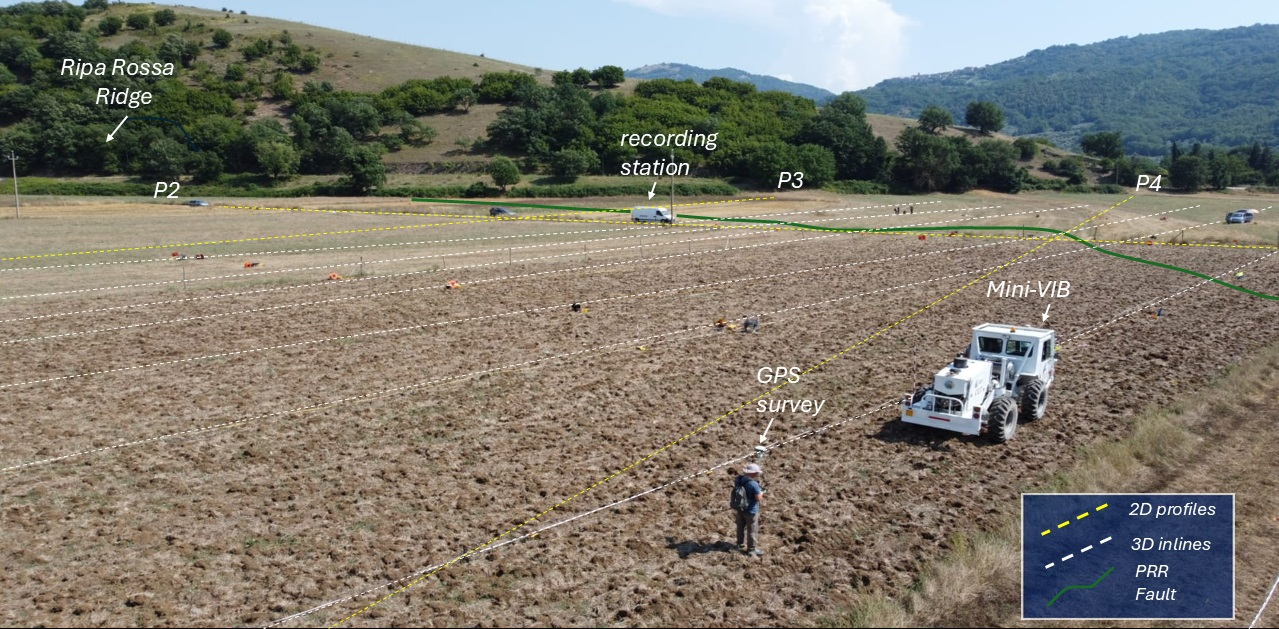
While 3D seismic reflection is well established in hydrocarbon exploration at the kilometer scale in relatively simple offshore settings, its application to shallow faulting in continental basins is rare, owing to difficulties in adapting acquisition and processing to rugged terrains and complex near-surface conditions. We present the first high-resolution 3D seismic study of a seismogenic fault in a structurally complex intramontane basin at depths < 200 m. The survey focuses on the Pantano–Ripa Rossa Fault, ruptured during the 1980 Mw 6.9 Irpinia earthquake, the largest Italian event of the past century. This fault cuts across the Pantano di San Gregorio Magno, a small basin filled with Quaternary sediments and showing modest cumulative displacement. Our results demonstrate that in such environments, where morphotectonic analysis and 2D geophysics provide limited constraints, high-resolution 3D seismic imaging is crucial to resolve fault geometry and to assess surface-faulting hazard. The 3D volume reveals a ~35–40 m wide intra-basin deformation zone beneath the 1980 rupture, composed of synthetic and antithetic splays, and highlights lateral variations in fault geometry and stratigraphy. Deformation is distributed and complex, with fault-controlled depocenters, variable sedimentary architectures, and rapid basement-depth changes—features unresolved by 2D data. We infer that the Pantano–Ripa Rossa Fault is relatively young, active since the late Middle Pleistocene, and developed in the hanging wall of the NE-dipping southern basin-bounding fault, challenging previous models that located the master fault along the northern basin margin.

Graphical Abstract

1. Introduction

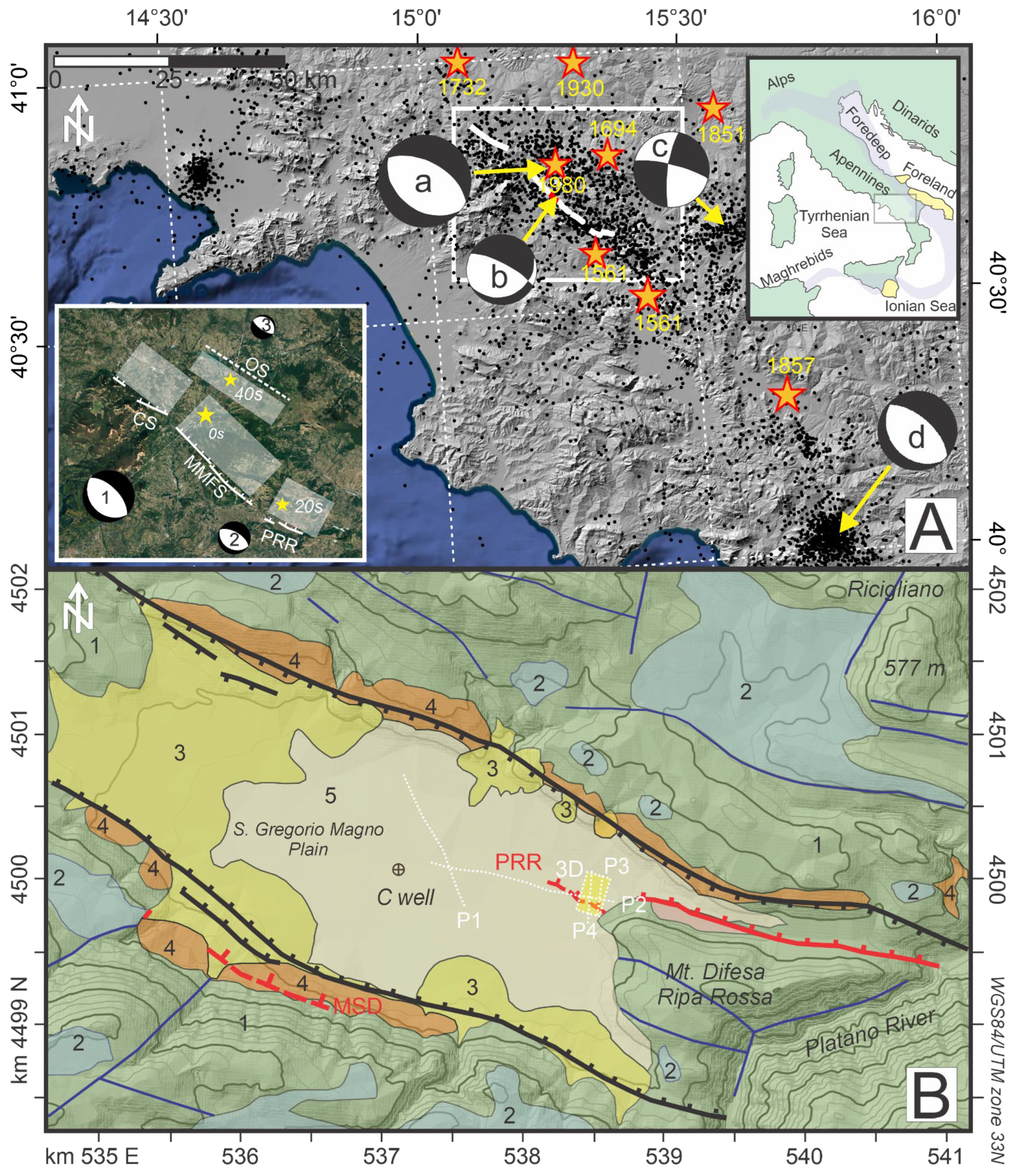
Within the Mediterranean region, the central and southern Italian Apennines represent a major source of extensional earthquakes with M ≥ 6. Most earthquakes result from the rupture of multiple segments of NW-striking normal fault systems located along the axial zone of the Apennine range [1,2,3,4,5,6,7]. An example is the Mw 6.9 1980 Campania-Lucania earthquake, also known as the Irpinia earthquake [8] (Figure 1A), the largest to strike Italy in the past 100 yrs. It consisted of three normal-faulting events that occurred sequentially at ~0, ~20, and ~40 s [9,10,11]. The first two events occurred on the main Irpinia Fault, a NE-dipping structure striking N310–320° and extending for ~40 km (Figure 1A). These two ruptures produced well-developed fault scarps (i.e., the Cervialto segment, the Monte Marzano Fault System and the Pantano-Ripa Rossa, or PRR, Fault) [8,12]. The first and largest rupture affected the eastern flank of Mt. Carpineta and the Monte Marzano ridge, while the second event ruptured the PRR Fault, within our study area, the Pantano di San Gregorio Magno basin (hereinafter “Pantano”; Figure 1B). The third event, ~40 s later, ruptured a subordinate, antithetic structure under the Ofanto basin. Coseismic slip reached more than 1 m in the main segments [8,12].
Many authors interpreted the Irpinia Fault as a relatively young structure (likely not older than 150 kyr) with fairly low slip rates (0.2–0.4 mm/yr), based on elusive morphostructural features, as in Ascione et al. [13] and references therein. It was in fact recognized only after the 1980 earthquake through field investigations [8,14]. Its subtle geomorphic expression is consistent with a small cumulative vertical displacement estimated to be a few tens of meters through field geologic surveys and 2D geophysical investigations [15,16,17,18,19]. The Irpinia Fault segments locally bound or cut across small intramontane basins, such as the Pantano, which are too shallow, heterogeneous and complex to be efficiently imaged by conventional 2D seismic profiles. In such settings, both high-resolution and 3D seismic imaging are needed to resolve small cumulative displacements, high lateral heterogeneities and subtle near-surface features. The Pantano Basin therefore offers an ideal site for such investigations.
3D seismic reflection imaging is widely employed in the oil and gas industry to investigate geological structures, fault systems, and subsurface stratigraphy in detail [20,21,22]. This method allows the analysis of lateral variations in complex structures, enhancing spatial resolution and improving the detection and migration of out-of-plane reflections and diffractions [23,24,25]. However, such surveys are typically designed at the medium-resolution scale of hydrocarbon exploration, while the few high-resolution 3D applications for shallow fault imaging are mostly offshore, where acquisition logistics are far simpler. Bruno et al. [26] provided the first documented adaptation of 3D seismic imaging to the metric-scale resolution required by small intramontane basins with complex near-surface geology. Their paper focused on demonstrating feasibility, with detailed discussion of logistical and acquisition challenges, the adaptation of 2D equipment for 3D use, and the main processing workflow, while limiting the interpretation to preliminary descriptions of the Pantano dataset (seismic, gravimetric, aeromagnetic, GPR, and resistivity).
Figure 1. (A) DEM of the southern Apennines with 10 m-resolution [27], showing the instrumental seismicity in the epicentral region of the 1980 Mw6.9 Irpinia earthquake. Yellow stars denote epicenters of M > 6 historical earthquakes; the beach-balls are the focal mechanisms of M > 5 earthquakes (a—1980 Mw 6.9; b—1996 Mw 5.0; c—1990 Mw 5.7; d—1998 Mw 5.6) from Pondrelli & Salimbeni [28]. The white segments are the 1980 co-seismic scarps along the Irpinia Fault (IF). Upper inset show the map location relative to the Italian Peninsula. The multi-segment rupture model of the 1980 Irpinia earthquake, modified after Pantosti and Valensise [8], enclosed in the white rectangle is detailed in the lower inset; Thick white segments denote co-seismic fault scarps: CS—Cervialto segment, MMFS—Mt. Marzano fault system, PRR—Pantano-Ripa Rossa segment. Numbers indicate the time progression of the rupture episodes in seconds: 0 s = Marzano-Cervialto rupture, 20 s = Pantano di San Gregorio Magno rupture, and 40 s = Ofanto rupture. The dashed line is the surface projection of the Ofanto blind fault segment (OS). Gray areas represent the surface projection of the downdip extent of the fault planes defined through geological, geodetic and seismological data. (B) Geological sketch map of the Pantano Basin: (1) Mesozoic limestones, (2) Pliocene marine sands and conglomerates, (3) alluvial fans, (4) slope debris, (5) lacustrine and colluvial deposits. Quaternary basin-bounding normal faults (PSGM system) are in black. The red lines are the two fault scarps produced by the 1980 earthquake in the eastern sector of the basin (PRR) and along its southwestern margin (MSD). Also shown: the 2D seismic profiles P1 to P4 (white dotted lines); the 3D survey area (dotted yellow box); the scientific “C well” of Aiello et al. [29].
Remotesensing 17 03717 g001
The present work moves beyond feasibility, delivering the first comprehensive imaging of the PRR Fault and the Pantano depocenter. We achieve this by reprocessing, integrating, and fully interpreting the 3D seismic volume and the 2D profile (P4) acquired by Bruno et al. [26], together with three legacy profiles (P1–P3) collected in 2006. Among these, only P3 had been previously published [30], whereas P1 and P2 are here presented for the first time. Profile P3, acquired with a shotgun source and tied to paleoseismic trenches [31], confirmed subsurface faulting beneath the 1980 rupture but was hindered by limited penetration depth, a shortcoming later emphasized by Bruno et al. [26] through comparison with a random line from the new 3D volume.
By combining the legacy 2D profiles with the newly acquired 3D dataset and profile P4, we generate a continuous and detailed image of both the fault zone reactivated in 1980 and the associated basin stratigraphy. This integrated interpretation demonstrates that high-resolution 3D seismic data can greatly enhance the detection of small-offset seismogenic faults while at the same time providing a coherent stratigraphic and structural framework for seismotectonic analysis in intramontane basins, an environment where seismic imaging has traditionally been considered extremely challenging.

2. Geological Settings

The Irpinia region in the Southern Apennines range of Italy has experienced extensional deformation since the Middle Pleistocene, occurring along a currently active NE-trending extension direction [32,33,34] (Figure 1A). The Southern Apennines is a Neogene thrust-and-fold belt that was dissected by NW-striking Quaternary normal faults, often associated with intramontane tectonic basins in their hanging wall.
Among these, the Irpinia Fault is one of the most studied structures, being the source of the 1980 Mw 6.9 Irpinia earthquake [8,9,12,15,18]. Since the Middle Pleistocene, faulting across the Mt. Cervialto and Mt. Marzano carbonate massifs, characterized by normal-to-oblique kinematics, has downthrown the massif edges, see also Ascione et al. [13] and references therein, leading to the formation of intramontane basins, such as the Pantano basin (Figure 1B).
Most co-seismic scarps of the Mw 6.9 Irpinia earthquake cut slope debris and Mesozoic carbonates of the Apennine Platform along the Mt. Marzano and Mt. Cervialto massifs. The Apennine Carbonate Platform is tectonically sandwiched between the underlying pelagic succession of the Lagonegro Basin and the overlying ocean-derived basinal units [35]. These units are covered by unconformable Pliocene deposits of thrust-sheet-top basins [36]. These deposits are mainly composed of marine clays, sands, and conglomerates, which are preserved in small outcrops onto the massifs. Geological and geomorphological investigations from the 1990s–2000s [8,15,37] and more recent studies [12,18] on the main fault segments consistently define the Irpinia Fault as a relatively young structure (Middle to Upper Pleistocene age of fault inception) with relatively low long-term deformation rates. However, new paleoseismological data suggests a marked increase in slip rate from the late Upper Pleistocene [38]. The weak morphological expression of certain segments of the Irpinia Fault aligns with results from very high-resolution 2D geophysical surveys (i.e., seismics, electric resistivity tomography and ground-penetrating radar) conducted in small basins along the Mt. Marzano ridge [16,17] and in the Pantano basin [30], examined in the present work. These studies suggest that fault activity has produced decametric step-like displacements (<30–50 m) in the carbonate substratum of the basins and weakly developed fault-related depocenters. As a result, the relationship between the fault segments ruptured during the 1980 earthquake and the complex system of normal and oblique-slip faults cutting through Mt. Marzano remains often poorly understood.
Pantano di San Gregorio Magno is a Quaternary intramontane tectono-karstic depression developed into Mesozoic shelf limestones, which crop out in the surrounding ridges (Figure 1B). The Mesozoic carbonates are covered by remnants of a thrust-sheet-top basinal unit that consists of transgressive sandstones and conglomerates dating back to the Middle Pliocene [15]. The plain has a WNW-elongated shape, with the basin floor located at around 350 m, sloping towards the ESE. The basin is bounded on both sides by high-angle normal-fault systems striking N120°. Its opening and evolution has been proposed to be mainly controlled since the Middle Pleistocene by the south-throwing fault system that bounds the Pantano to the north (i.e., the Pantano-San Gregorio Magno or PSGM basin master fault [13,15,29]). According to Ascione et al. [15], alluvial fans suggest reduced activity of the southern bounding fault, whose height may have been partly influenced by older tectonic/erosional events. A 60 m-deep scientific borehole in the center of the basin (Figure 1B; see Figure S1 for details) drilled late Middle Pleistocene–Holocene lacustrine deposits (clayey-silty deposits with sandy intercalations) interbedded by tephra layers, without reaching the basin substratum [29]. The deepest dated tephra cored at 52 m depth allowed Ascione et al. [36] to infer that basin sedimentation began before 240 ka, influenced by variations in tectonically controlled subsidence rates. The lacustrine sediments pass laterally into alluvial fan deposits (late Middle Pleistocene-Holocene) and slope carbonate deposits, which are visible along the basin edges. Several generations of slope deposits (coarse-grained screes and scree-colluvial deposits) and entrenched alluvial fans occur along the basin’s northern border [15]. On the surrounding ridges, the landscape is characterized by hanging remnants of low-gradient erosional surfaces developed in the Mesozoic carbonates and Middle Pliocene terrigenous deposits. The paleosurface remnants that are found from 800 to 500 m a.s.l. along the basin-bounding ridges are ascribed to the Lower Pleistocene and were in turn displaced and uplifted due to the Middle Pleistocene-recent activity of the normal fault systems [15,29].
The 1980 earthquakes produced two main scarp strands in the basin area (Figure 1B) [8]. A 2 km-long scarp strikes N310° and dips NE along the south-western edge of the basin in carbonate breccias and limestones. A maximum throw of 40 cm and 60 cm was measured along this strand by Pantosti and Valensise [8] and Bello et al. [12], respectively. The second strand affected recent sediments in the eastern side of the basin and was rapidly obliterated due to the intense farming. Aerial photos taken soon after the earthquake indicate a fault strike of about N295°. The NE-dipping scarp starts from the eastern carbonate ridge and runs WNW-ESE for about 600 m towards the center of the basin with a decreasing throw before disappearing (Figure 1B). The co-seismic scarp was up to 40-50 cm high [8,31]. The co-seismic rupture then continues eastward for about 2 km along the northern slope of the Ripa Rossa carbonate ridge (Figure 1B), where it cuts recent slope debris with a maximum throw of 90 cm [8,12]. It remains unclear whether the disappearance of the scarp inside the Pantano, revealed by an aerial photo taken just after the 1980 earthquake, reflects the progressive tapering of coseismic slip toward the fault segment edge or is instead an effect of the presumed westward thickening of the lacustrine infill towards the center of the basin, which may promote ductile deformation. The same phenomenon has been reported in the small basin of Piano di Pecore on Mt. Marzano ridge [8,16], where the 1980 coseismic deformation appears as a clear scarp at the basin edges and as a wide surface warping affecting lacustrine deposits in the basin center.
Paleoseismological data suggest that the intra-basin fault has experienced four coseismic rupture events comparable to the 1980 earthquake over the past 20 kyr with an average fault slip rate of 0.3 mm/yr [31]. The ultra-shallow seismic profile of Bruno et al. [30] confirmed that the PRR surface scarp investigated in paleoseismic trenches by D’Addezio et al. [31] relates to a fault zone displaying evidence of syn-sedimentary activity, producing a step of ~30–40 m in the carbonate substratum. However, this seismic survey provides only a limited image of the fault zone geometry and internal structure, the associated depocenter, and the stratigraphy of the basin fill. Remarkably, the fault geometry is not coherent with the overall basin setting reported by Ascione et al. [15] and Aiello et al. [29]. Indeed, the PRR fault is antithetic to the northern PSGM fault considered as the basin master fault by the previous authors; this fault did not show evidence of reactivation during the 1980 event.
Unfortunately, unlike recent normal-faulting sequences of the central Apennines [2,39], the aftershocks of the 1980 earthquake, as well as recent background seismicity, contribute little to the comprehension of the architecture of the fault segments activated during the mainshock. The background seismicity recorded in the last two decades by dense permanent networks and analyzed with advanced location techniques spreads within a crustal wedge roughly delimited by the sources of the two sub-events that occurred at 0 sec and 40 s, without revealing the multiple fault segments ruptured during the 1980 earthquake [19,40].

3. Data and Methods

During the TESIRA project, Bruno et al. [26] acquired, among other geophysical data, a high-resolution 3D seismic volume (Figure 2A) along with a 2D profile (P4). In this study, we briefly summarize the field procedures they adopted while incorporating those used for the three legacy profiles (P1–P3) collected in 2006.
Both the seismic volume and the profiles, except P3, were acquired using a high-resolution seismic vibrator mounted on a 6-ton, four-wheel-drive truck (IVI-MiniVib 1, Industrial Vehicle International). This source delivers ~27 kN of energy at each shot point. A linear upsweep from 5 to 200 Hz over 15 s was employed for all acquisitions, including the legacy data. Acquisition parameters are summarized in Supplementary Materials (Table S1), which also provides additional details on the processing workflow. Both the 2006 and 2024 surveys were recorded with arrays of 4.5 Hz vertical geophones and digitized using distributed 24-bit Geode® acquisition systems (Geometrics Inc., San Jose, CA, USA). Acquisition parameters were designed to maximize Common-Midpoint (CMP) redundancy, thereby enhancing the signal-to-noise ratio.

3.1. Two-Dimensional Seismic Surveys

All profiles, except P1, cross the intra-basin coseismic surface rupture of the Pantano-Ripa Rossa fault. Three profiles (P1, P2, and P3) were acquired in 2006, with only P3 previously published in Bruno et al. [30]. As shown in Figure 2A, profile P1 spans 950 m with a NNW orientation, extending from the northern edge to the central sector of the basin, where it intersects the western end of profile P2. Profile P2 extends 1190 m with a WNW orientation from the basin center to its eastern margin, terminating near the carbonate ridge of Ripa Rossa. P2 intersects the seismic volume and crosses profiles P3 and P4 at right angles near the co-seismic surface rupture. It cuts the fault scarp with an angle of 20–30°. P3 and P4, oriented N-S and nearly parallel, are spaced ~60 m apart and are almost perpendicular to the surface fault scarp.
The seismic profiles were acquired using 168-to-190-channel arrays. Profile P3, the only one recorded using a buffalo-gun source, represents the highest-spatial-resolution profile, with geophones spaced at 1.5 m and shot intervals of 4 m. For the other profiles, the vibration points spacing varied, ranging from a minimum of 4 m for P4 to 10 m for P1 and P2. Geophone spacing was 4 m for P4, while P1 and P2 were acquired with a 5 m spacing. Elevation variations within the basin are negligible; therefore, all profiles exhibit relatively minor elevation changes. The quality of the seismic data is illustrated in Figure S2 through four representative common-shot gathers selected from the four profiles. All data show high signal-to-noise ratios, clear first arrivals and evident reflections in the full offset range.

3.2. Three-Dimensional Seismic Survey

The 3D seismic survey acquired by Bruno et al. [26] covers ~12.5 acres (50,468 m2), in the eastern sector of the basin, above the PRR surface rupture. Acquisition was performed using a non-orthogonal geometry with a 45° angle between source and receiver lines to reduce acquisition footprints in shallow levels. The receiver array consisted of 17 lines, oriented N-7°E, each equipped with 48 vertical geophones, totaling 816 geophone nodes. The source array included 41 lines oriented approximately N-62°E, with 1 to 40 vibration points per line, resulting in 784 vibration points. The survey aimed to capture signals from shallow depths to the maximum estimated basement depth (about 150–200 m), with a maximum offset of 350 m. Data acquisition utilized a modified Geode system, originally designed for 2D surveys. To handle the increased channel count required for 3D surveys, the system was divided into four sub-arrays, each connected to a separate Ethernet card to optimize data transmission. This involved merging, remapping seismic channels, and editing traces to address challenges such as dead traces and polarity reversals. Seismic data were organized into common midpoints with a bin size of 25 m2 (5 × 5), achieving an inline fold of 6 and a crossline fold of 9 (Figure S3).

3.3. Data Processing

The reflection processing workflow we adopted was designed to address variations in data quality across profiles (Figure S4). The 3D volume and profile P1 were depth-migrated post-stack following traditional Normal Moveout (NMO) analysis, while all other profiles underwent Pre-Stack Depth Migration (PSDM). Traditional NMO processing involved trace editing, deconvolution [41,42,43], and refraction static corrections [44]. Those were computed using first-arrival travel times picked from the full-offset shot gathers. Travel times were interpreted through the Generalized Reciprocal Method refraction technique [45] to estimate a high-resolution overburden/bedrock interface morphology and its velocity contrast. Semblance-based velocity analysis applied to hyperbolic moveout [46] was used to estimate the velocity models used for NMO correction, followed by CMP stacking. All velocity models were refined through several cycles of residual statics corrections, each followed by additional velocity analysis. Residual statics were computed using the method outlined by Ronen and Claerbout [47]. For profile P1 and the seismic volume, stacking was followed by post-stack Kirchhoff depth migration (e.g., [48,49,50,51]).
To complement the seismic reflection imaging, a set of smoothed Vp models was generated using a multiscale, non-linear refraction tomography approach specifically suited for resolving complex shallow subsurface geometries ([52], and references therein). The inversion process utilized manually picked first arrivals from selected seismic traces. The method involves successive inversion stages in which the velocity model is gradually refined by decreasing the spacing of the velocity grid (i.e., by increasing the number of model parameters), following the multi-scale inversion approach of Lutter and Nowack [53]. Each inversion step identifies the optimal model by combining a global Monte Carlo search with a local Simplex optimization, eliminating the need for an initial velocity model [54]. The spatial resolution of the model improves with each inversion stage, whereas the resolution depth tends to decrease. This trade-off and the overall model resolution are assessed through ‘a posteriori’ checkerboard resolution tests (see Figure S5).
PSDM provides significant advantages over traditional NMO processing by accurately imaging reflectors in areas with complex velocity structures [49,55,56]. However, developing an accurate velocity model for PSDM is particularly challenging in regions characterized by significant lateral heterogeneities and/or lacking velocity constraints, as in this case study, which limited its broader application. Preliminary velocity models for depth migration were constructed by analyzing and integrating semblance-based velocity models with tomographic images obtained from first arrivals. Velocity model-building techniques (VMB: e.g., [55,57,58,59] were employed to iteratively refine the P-wave velocity model before stacking [60]. These methods use Residual Move-Out (RMO) analysis from common image gatherings (e.g., [61]). If the velocity used for migration is affected by errors, reflected events in those gatherings will have a RMO that can be picked and used to update the velocity model. However, due to the geological complexity, these techniques were not always successful.

4. Seismic Interpretation

To interpret the seismic reflection data, we integrated the results of geophysical surveys and literature data, specifically: (1) P-wave background velocity models from refraction tomography; (2) the 3D resistivity model of the basin obtained through FullWaver electrical resistivity tomography [26]; (3) gravity data acquired by Bruno et al. [26] providing constraints on a larger-scale; (4) magneto-telluric resistivity sections across the 1980 fault scarp, published by Troiano et al. [62]; (5) geological field data [12,15,18,36]), paleo-seismological trenches [31] and the scientific drilling of Aiello et al. [29].
To ensure consistency between the 3D seismic volume and the control 2D profiles, we performed a detailed cross-comparison between the segments of profiles P2, P3, and P4 that intersect the seismic volume and the corresponding random lines extracted from the 3D cube along the same trajectories. The structural geometries imaged on the 2D lines closely match those observed in the 3D seismic cube, within the expected limits related to out-of-plane energy positioning inherent to 2D migration. The main reflectors show coincident depths, and the velocity models derived from both datasets display a good agreement in the overlapping areas. Moreover, the seismic facies patterns are consistent, confirming the reliability of the imaging and velocity calibration used for the subsequent interpretation.

4.1. Seismo-Stratigraphic Features

Our stratigraphic analysis aimed to identify the main seismic units by examining reflection characteristics, reflector terminations, and internal reflection configurations. These criteria serve as the primary basis for defining seismo-facies and recognizing stratigraphic unconformities, which are typically marked by strong impedance contrasts. To this purpose, we applied classical seismic sequence analysis methods (see, e.g., [63]). Given the complex near-surface conditions and the variable quality of reflections, the interpretation of seismic units and faults was performed through manual picking of reflectors, integrating geological and geophysical constraints from previous studies. Automatic horizon tracking, commonly applied in hydrocarbon exploration, was not suitable because of the limited lateral continuity of reflectors and the heterogeneous nature of the basin fill. Seismic attributes such as the trace envelope were tested but did not provide significant additional information and were therefore not included in this work.
The key reflectivity characteristics of the main seismic units are visible in Figure 3, Figure 4, Figure 5, Figure 6 and Figure 7 that show the interpreted seismic profiles and key 3D inline slices with overlaid interpretations. The uninterpreted profiles are shown in Figures S6 and S7. We identified five seismic stratigraphic units, each bounded by unconformities and characterized by distinctive features.
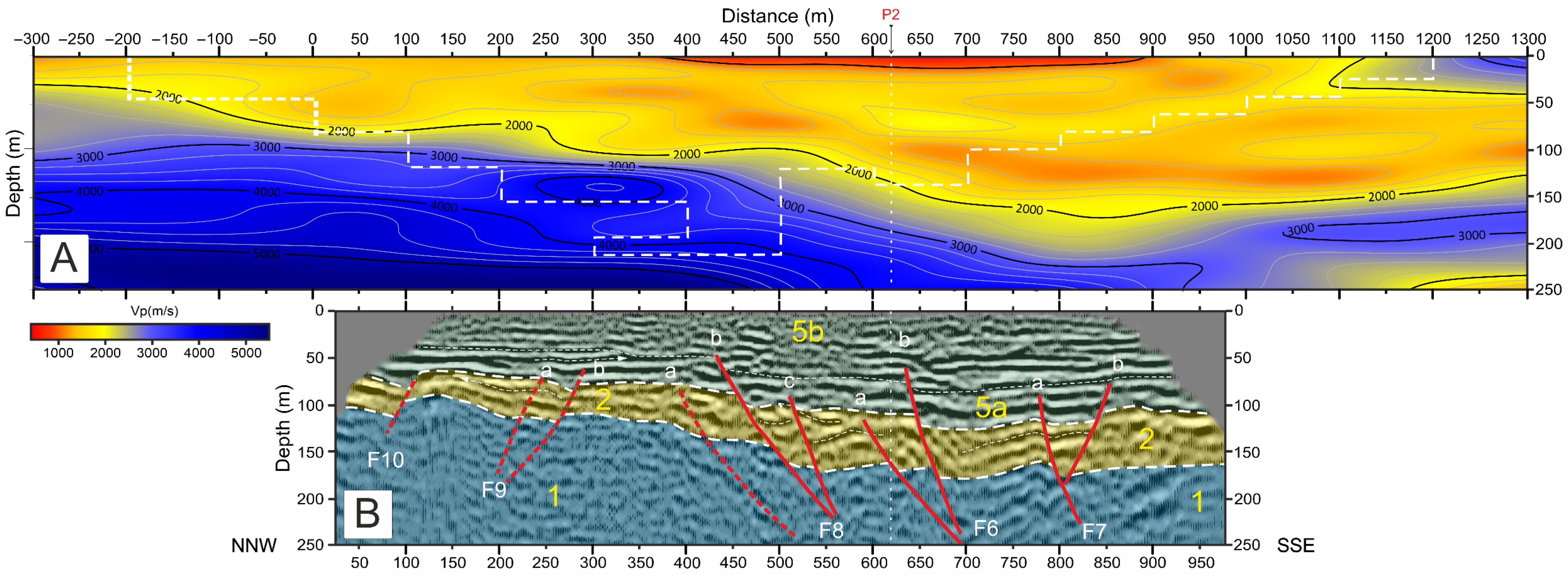
Unit 1, the oldest and deepest unit, is characterized by a large-amplitude, low-frequency reflective event bounding the top of a reflection-free zone (Figure 3B), typical of massive rocks. It corresponds to the basin basement, composed of fractured Meso-Cenozoic limestones with high P-wave velocity (3500–4500 m/s; Figure 3 and Figure 4) and high resistivity (>200 Ohm m). Its top surface exhibits an erosional morphology, while internal fracturing causes scattered energy and high seismic noise.
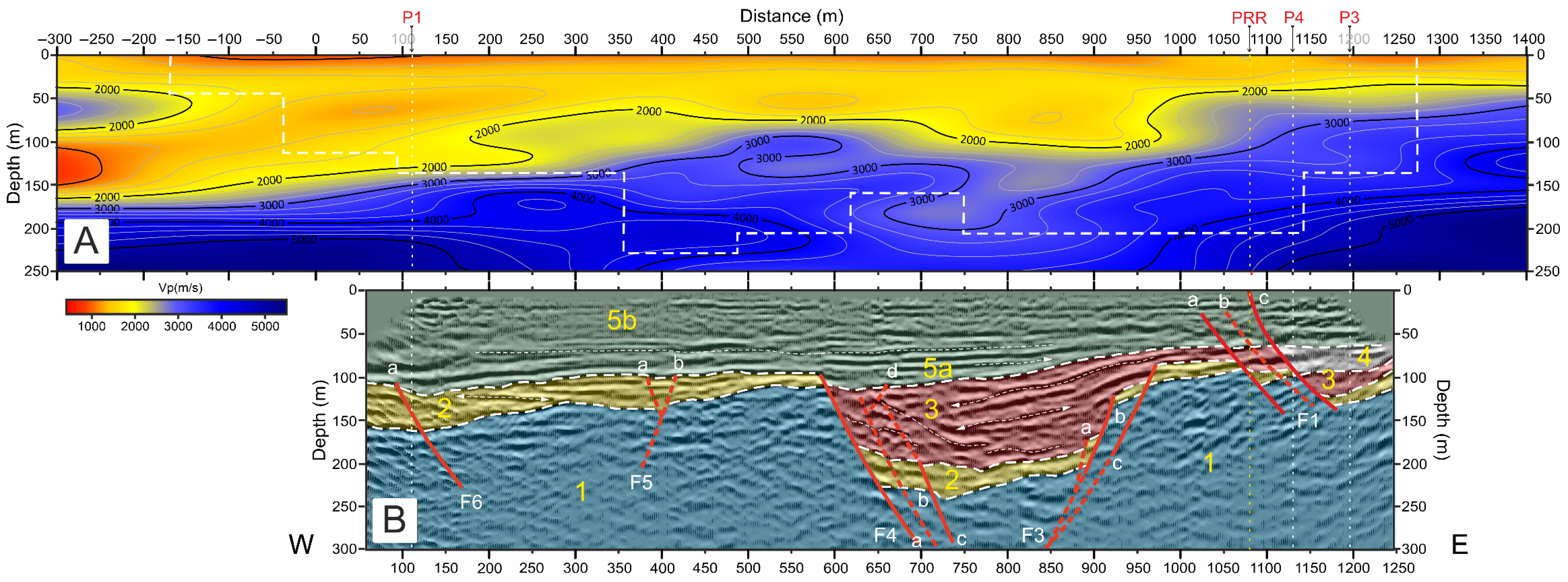
Unit 2 is concordant (Figure 3) or locally onlaps (Figure 4: metric distance 200–550) above the unconformity, but generally in the eastern part of the basin, it is too thin to resolve stratigraphic relationships. Reflectors exhibit fair amplitude, with internal configurations ranging from subparallel to chaotic (Figure 3 and Figure 4). Tomographic data indicate relatively high Vp (2000–3000 m/s) and lower resistivity than unit 1, ranging from 150 to 200 Ωm [26]. Unit 2 is interpreted as Middle Pliocene sandstones and conglomerates deposited in a thrust-sheet-top satellite basin, consistent with field observations [15,29], which document remnants of these terrigenous sediments unconformably overlying the limestones on ridge tops and in structural depressions (Figure 1B). The unconformity capping Unit 2 can be interpreted as an erosional surface analog to the Lower Pleistocene paleosurfaces recognized at different elevations on the basin-bounding ridges [15,29].
Unit 3 is a syn-tectonic unit deposited in the hanging wall of faults F3 and F4, typically prograding above the top of Unit 2. It exhibits reflections with variable amplitude, fair-to-high frequency, and varying continuity. Divergent configurations and fault-controlled wedging are visible in the fault-bounded structural low detected by line P2 (Figure 4: distance 600–950). Unit 3, as well as Unit 4, are absent in the western part of the study area, where Unit 5 directly overlies Unit 2 (Figure 3 and Figure 4). Relatively high P-wave velocities (2000–3500 m/s) are indicative of coarse-grained continental deposits, variably cemented. The thickening of Unit 3 in the structural depression is also suggested by the low-Vp anomaly outlined by the 3000 m/s isovelocity contour in Figure 3A. Age of Unit 3 is uncertain, but its stratigraphic position suggests a possible correlation with the oldest phases of accumulation of carbonate slope breccias ascribed to the Middle Pleistocene by Ascione et al. [15].
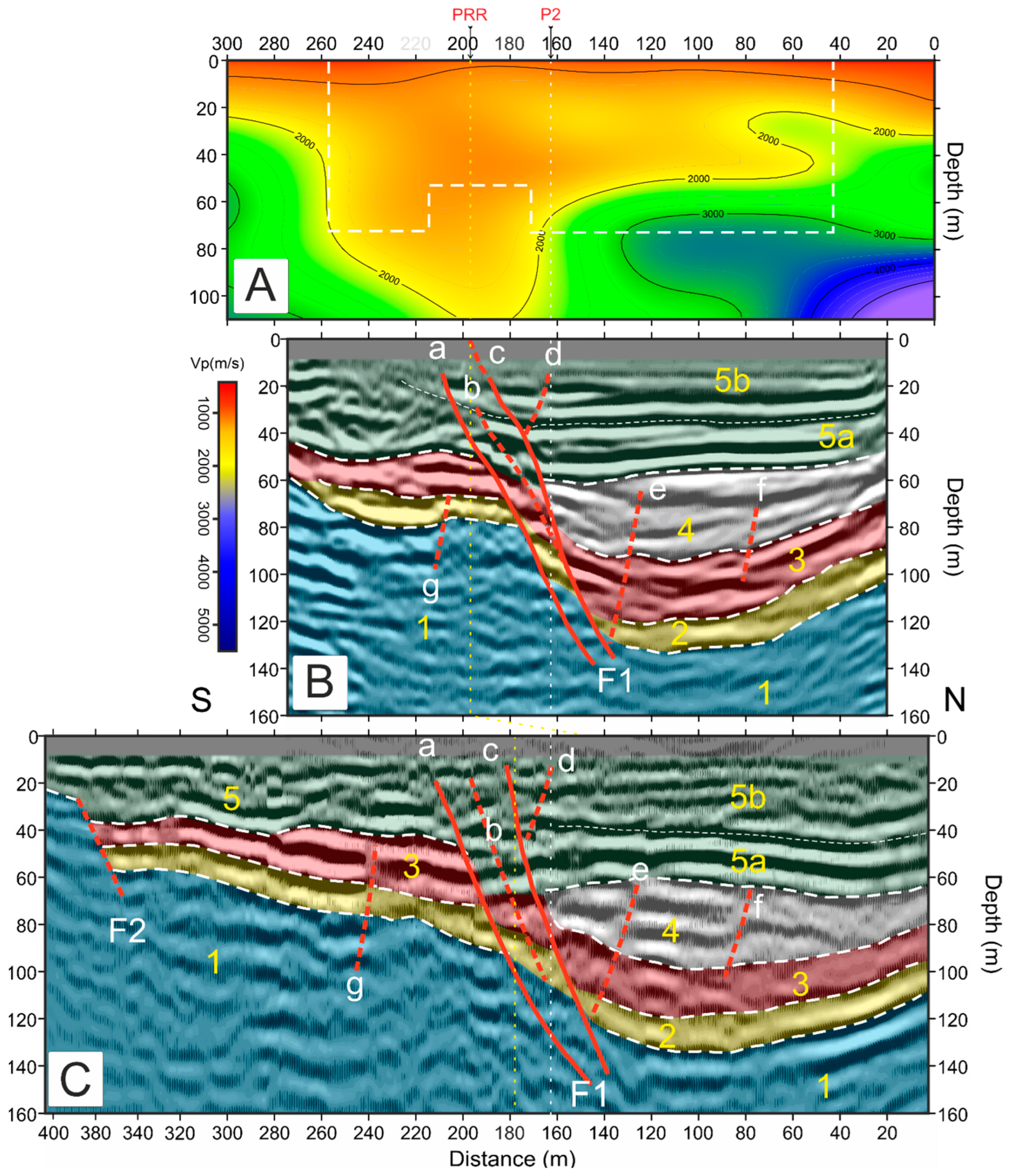
Unit 4, another syn-tectonic unit, is restricted to the hanging wall of Fault F1 (Figure 4 and Figure 5). Tectonic activity inhibited its deposition in the footwall. In the vertical slices extracted along the inline direction from the 3D volume and shown later, it downlaps above Unit 3. Its relationship with Unit 3 is less clear in profiles P3 and P4, where it shows local concordance (Figure 5). Unit 4 exhibits subparallel to hummocky internal configurations, as well as high amplitude, continuity and fair frequency. Vp remains high but lower than Unit 3 (Figure 5A), while resistivity is low (20–50 Ωm) [16]. These properties suggest fine to coarse sediments, which might belong to alluvial-fan or fluvio-lacustrine sequences in the F1 hanging wall [15,36].
Unit 5 has higher continuity and frequency than Unit 4, with generally parallel reflectors (Figure 3, Figure 4 and Figure 5). It exhibits very low Vp (1000–2000 m/s) and low to very low resistivity (5–70 Ωm) [16], suggesting fine-grained, lacustrine sediments (silts and clays with sandy layers). This interpretation is supported by borehole data from C well [29] (Figure 1 and Figure S1). In the hanging wall of the PRR fault, reflection characteristics are maintained, but in the footwall, Unit 5 displays lower continuity, frequency, and more chaotic configurations (Figure 5B). This suggests a lateral transition to coarser slope and fan deposits near the carbonate ridge of Ripa Rossa. The upper portion exhibits lower amplitude and continuity but higher frequency (Figure 4 and Figure 5B), prompting subdivision into subunits Unit 5a and Unit 5b. In the near-surface (<20 m depth), Vp around 1500 m/s and very low resistivity (5–20 Ωm) [16] suggest water-saturated lacustrine soils consistent with trench data [31]. Unit 5 thickens SW-wards (i.e., towards the center of the basin), where it reaches 80–100 m (Figure 3 and Figure 4). Based on the tephrostratigraphical data of C well scientific drilling [29], we can assume a late Middle Pleistocene-Holocene age for Unit 5 in the eastern part of the basin. Tephrostratigraphic markers found in the well down to 52 m depth (Figure S1) allowed Ascione et al. [36] and Aiello et al. [29] to estimate long-term mean sedimentation rates of 0.22 and 0.30 mm/yr, respectively, over the last 170–239 kyr for the whole lacustrine sequence.

4.2. Structural Features

In this section, we analyze the structural features of the explored portion of the basin observed in the 2D profiles. We then examine in detail the volume investigated with the 3D seismic survey, focusing on the PRR fault and its relationship with the basin.
We begin with the analysis of line P1, located at the center of the Pantano (Figure 1B). This profile is the only one that does not intersect the PRR surface rupture, yet it provides a broad image of the central basin along a NW-oriented section. It runs ~650 m east of C well scientific drilling [29] (Figure 1B) and reveals a carbonate basement (Unit 1) deepening southward, reaching approximately 160–170 m depth below metric 850 toward the south (Figure 3). Unit 2 follows the basement’s structural pattern, with a slight thickening toward the basin center. As previously discussed, Unit 5 directly overlies Unit 2, as Unit 3 and Unit 4 are absent in this sector.
Basement displacement occurs along a series of south-dipping normal faults (F6, F7, F8), while the northern splays (F9–F10) dip northward. The S-dipping faults clearly offset Unit 5 and show hints of syn-sedimentary activity, indicating fault activity during the Middle to Upper Pleistocene. However, the upper subunit, Unit 5b, seals most faults except F6b and F8b. Normal faulting in the basin fill is also suggested by lateral variation in the tomographic velocity model that shows abrupt southward deepening of the low-velocity lacustrine sediments (Vp < 1500 m/s) just in correspondence with faults F6b and F8b (Figure 3A).
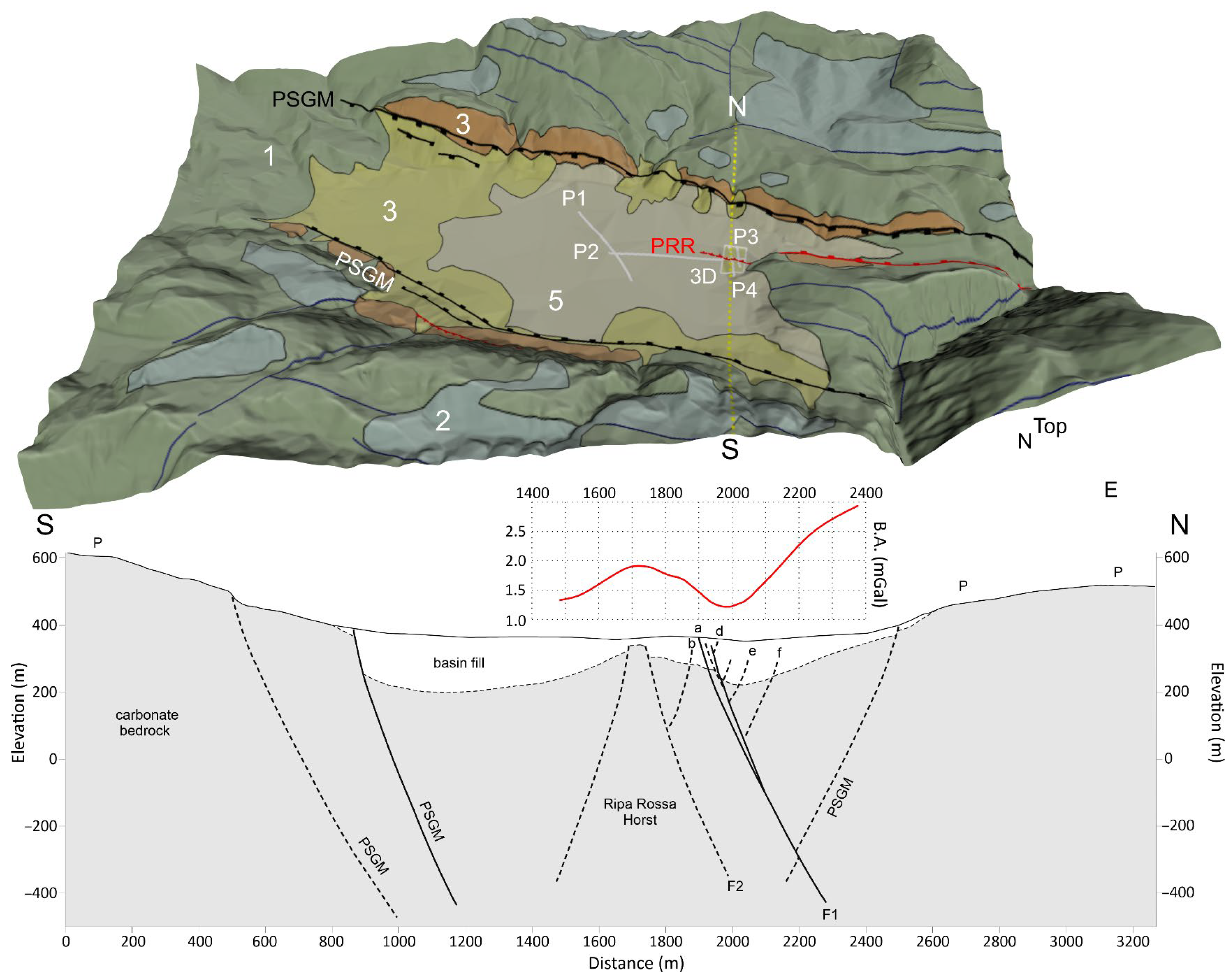
Even if P1 does not cross the northern basin bounding fault (the profile ending is about 200 m apart from PSGM; Figure 1B), seismic data provide clues about the geometrical relations of intra-basin faults. The overall trend indicates a southward deepening of the substratum and thickening of the Quaternary fill partially controlled by the S-dipping faults F6–F8. The shape of the gravity anomaly (Figure 2A) suggests that the basin may deepen further southward. Close to the basin’s northern edge, in the hanging wall of the PSGM basin master fault, seismic data do not show evidence of significant syn-sedimentary activity, such as growth strata and N-dipping horizons in the basin fill. Instead, this is characterized by horizontal continuous reflectors or weakly dipping S-wards, while the basement is locally downthrown toward the north by the N-dipping faults F9 and F10, both sealed by continental deposits. Based on these observations, we interpret the north-dipping faults (F9–F10) as minor antithetic splays of the PSGM fault system. Conversely, the S-dipping faults F6–F8, which show evidence of syn-sedimentary activity, can be tentatively interpreted as antithetic structures of the southern basin bounding fault. This underpins the hypothesis, discussed in the next section, that the master fault of the Pantano Basin is more likely located along its southern margin, rather than to the north as previously proposed by Ascione et al. [15] based on morphotectonic surveys.
Profile P2 (Figure 4) is the most intriguing among the acquired seismic profiles. It runs WNW-ESE (see Figure 1B), parallel to the PSGM bounding fault and the PRR fault, which is intersected at metric position 1080 at a low apparent strike angle, making it suboptimal for interpretation.
Originally, P2 was designed as a strike-oriented line intended to image the basin along its longitudinal axis and link profile P1, roughly aligned along the dip of the PSGM master fault. However, P2 proved highly significant due to its unexpected structural complexity. The profile reveals a horst-and-graben structure, with a well-defined structural depression between metric positions 600 and 950, bounded by two major faults (F3 and F4) that offset the carbonate basement by more than 100 m. This graben separates the western sector of the basin, where P1 is located, from the more structurally complex eastern sector. The latter features a central horst and a smaller graben at its easternmost extent (metric position 1050), bounded to the west by the PRR fault (F1), which will be discussed in detail later.
The carbonate basement along P2 exhibits a variable pattern. It reaches a minimum depth of approximately 80 m at metric position 1075, in the footwall of the PRR fault, and a maximum depth of about 240 m within the central graben. It then rises sharply in the footwall of F4 to ~110 m before gradually deepening again to over 160 m in the westernmost part of the profile, where it is further displaced by minor faults (F5 and F6a). The latter, located at the intersection with P1, has an apparent dip of ~53° on both profiles. The accommodation space created by faults F3-F4 and F1 is filled by a thick syn-tectonic sequence: Unit 3 in the central graben and both Unit 3 and Unit 4 in the graben east of the PRR fault (i.e., F1). These deposits, primarily composed of carbonate slope breccias and alluvial fans or fluvio-lacustrine bodies, have been discussed in the previous section. The 400 m-wide central graben, bounded by faults F3-F4, is older: F3 and F4 offset Units 1 and 2, but they die out within Unit 3. Fault F3 is clearly sealed by Unit 5, whereas F4a might show faint indications of offset at the base of Unit 5a. Therefore, the onset of F3 and F4 is subsequent to the development of the erosional surface (i.e., Lower Pleistocene; see Ascione et al. [15]), while their activity ceased before or at the beginning of deposition of Unit 5 (i.e., Middle Pleistocene). The same considerations can be made for F5 and F6 westward. F4 appears to be the graben’s master fault, defining a 70 m-wide fault zone (splays a-c) towards which Unit 3 thickens from the east. The reflection patterns of Unit 3 above F4 indicate slope accumulation, consistent with rapid vertical displacement. In general, reflections within Unit 3 in the graben show high complexity, suggesting a high-energy depositional environment with sediment input from both east and west. The apparent dip of these faults is ~55–60°.
Imaging the graben formed by F1 is inherently limited on line P2, as this structure lies at the easternmost end of the profile. Additionally, the seismic line intersects the PRR fault (F1) at an oblique angle (20–30°), making interpretation challenging. Therefore, a more detailed analysis of this sector is deferred below to profiles P3 and P4, as well as the 3D seismic data.
Profile P4 (Figure 5C) begins approximately 20 m south of the carbonate outcrops of Ripa Rossa Hill and runs nearly perpendicular to the PRR fault scarp (Figure 1 and Figure 2). This profile is the outermost among those acquired across the surface rupture, providing an image of the intra-basin portion of the fault zone. Profile P3 (Figure 5B) is parallel to P4 but positioned ~65 m farther east, offering a more proximal view of the fault near the carbonate ridge of Ripa Rossa, from which it is just over 15 m away. Both profiles provide a clearer image of the easternmost structural depression observed in profile P2 and of the architecture of the F1 fault zone. In particular, P3 benefits from higher-resolution imaging of the uppermost Unit 5 due to its acquisition with a Buffalo gun source and reduced shot/receiver spacing [30]. A direct comparison between P3 and P4 reveals an overall concordant image of the F1 fault zone and of the seismic units, but lateral variations in the stratigraphy of the infill are also evident over the 65 m offset between the two profiles. On both profiles, fault F1 exhibits a consistent geometry: beneath the PRR surface scarp, F1 is imaged as a ~65° north-dipping deformation zone, approximately 35–40 m wide, comprising at least two main fault splays (a–c), along with additional secondary synthetic (b) and antithetic (d-e-f-g) segments. Segment c extends to the near surface, matching the 1980 scarp, and offsets the entire reflective sequence. The shallow tomographic model acquired along profile P3 (Figure 5A) further supports the seismic interpretation. Although the model is only reliable down to approximately 80 m, it shows a low-velocity zone (~1000–1200 m/s) coinciding with the F1 fault zone and relatively higher velocities in the surrounding blocks. These features are consistent with the disrupted reflectivity observed in the seismic sections and indicate the presence of a fault-related damage zone. Below about 80 m depth, the model is poorly constrained and has not been interpreted.
On P4, displacement of the carbonate basement across F1 is limited to ~42 m, with the deepest point of the hanging wall reaching ~135 m at metric position 100. In the footwall, the basement rises gradually, suggesting subaerial erosion, until metric position 340, where Unit 1 is uplifted by fault F2. This structure may be interpreted as a previously unknown secondary splay along the basin margin.
Conversely, along P3, the displacement of the carbonate basement across F1 increases significantly to ~60 m, and lateral variations in the seismic facies of the infill between the hanging wall and footwall are more evident, particularly within the well-resolved Unit 5. Within this unit, the reflection character in the footwall suggests the presence of coarser, slope-derived sediments, likely due to its closer proximity to the basin margin compared to P4. The difference in basement displacement across F1 is primarily due to a shallower depth in the footwall along P3, as the depth of the limestones in the hanging wall of F1 is comparable between the two profiles (130 m on P3 vs. 135 m on P4). These complexities are fully captured by 3D data and interpreted in the next section. Additionally, P3 shows a clear dip of reflectors within Unit 3 and, to some extent, Unit 4 and Unit 5 toward F1, whereas on P4, the reflectors are mostly horizontal or display an inverse dip. On both profiles, the carbonate basement in the hanging wall exhibits a concave geometry, gradually rising northward, consistent with the Bouguer anomaly trend in this area (Figure 2A). Notably, Unit 4 is restricted to the hanging wall and exhibits typical progradational reflection patterns on P3, with a gentler dip than Unit 3.

4.3. The 3D Volume

One key advantage of 3D seismic data is the ability to identify lateral variations that cannot be resolved with 2D profiles. To illustrate this, Figure 6, Figure 7, Figure 8 and Figure 9 present slices extracted from the 3D volume along the inline, crossline, and depth directions.
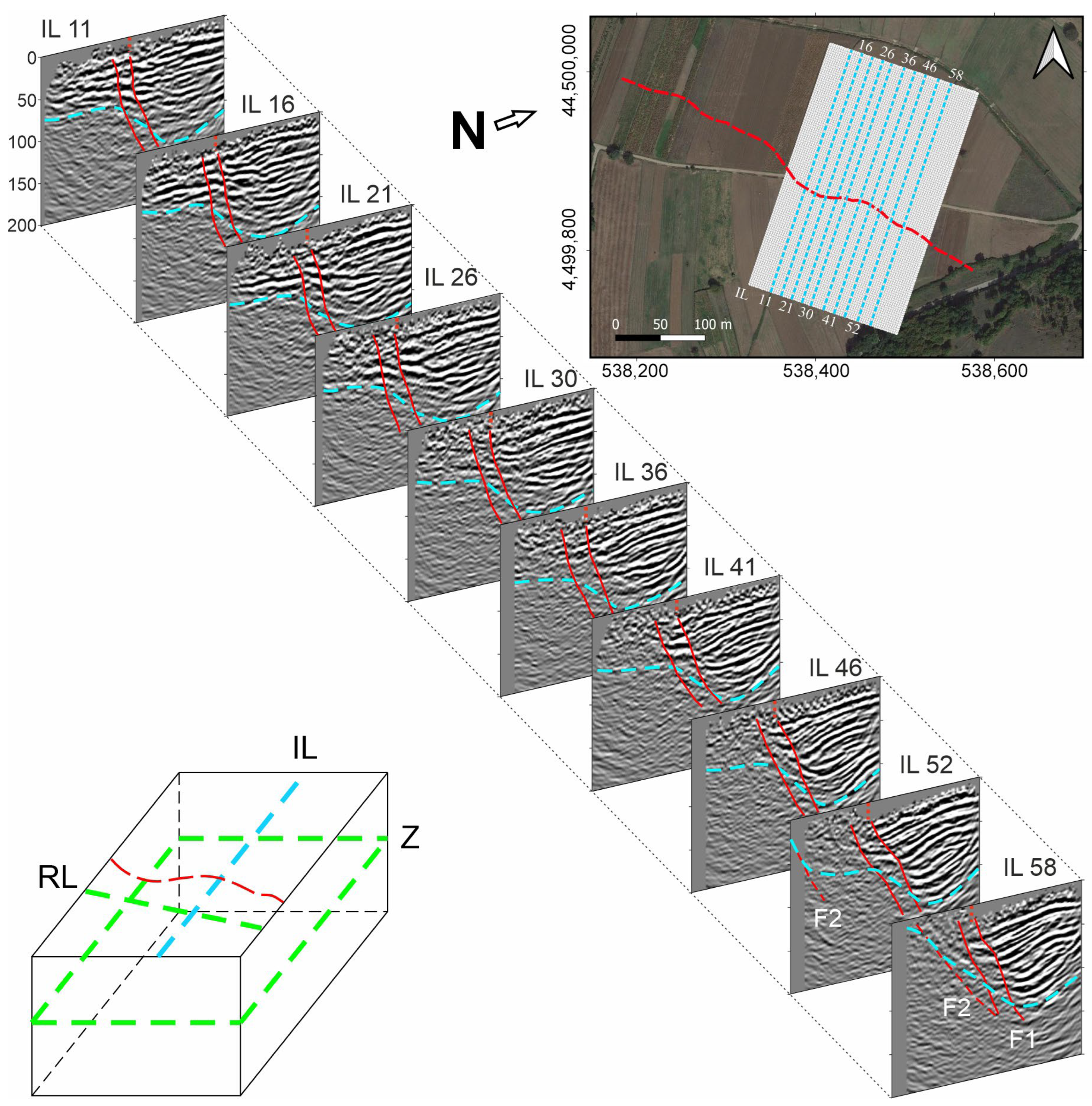
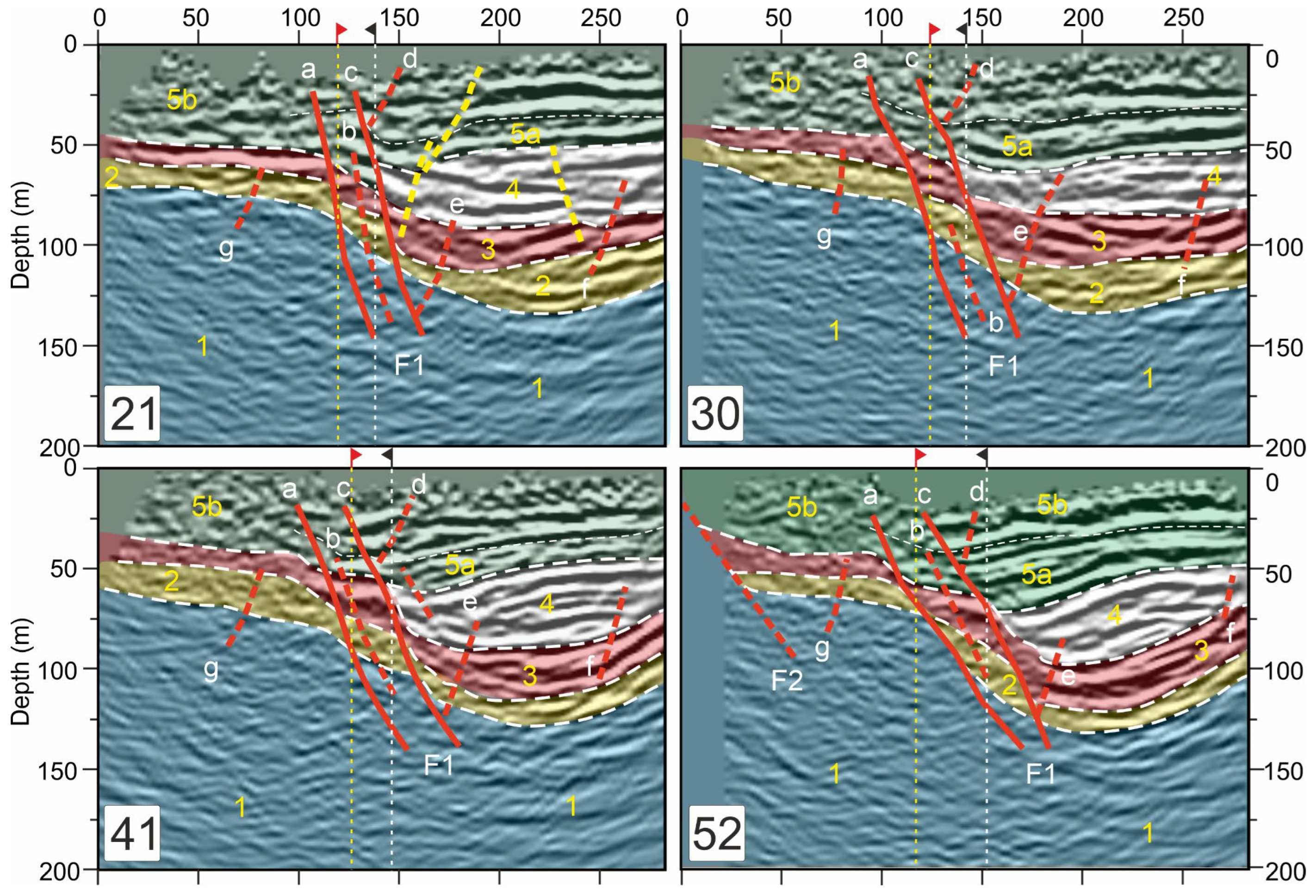
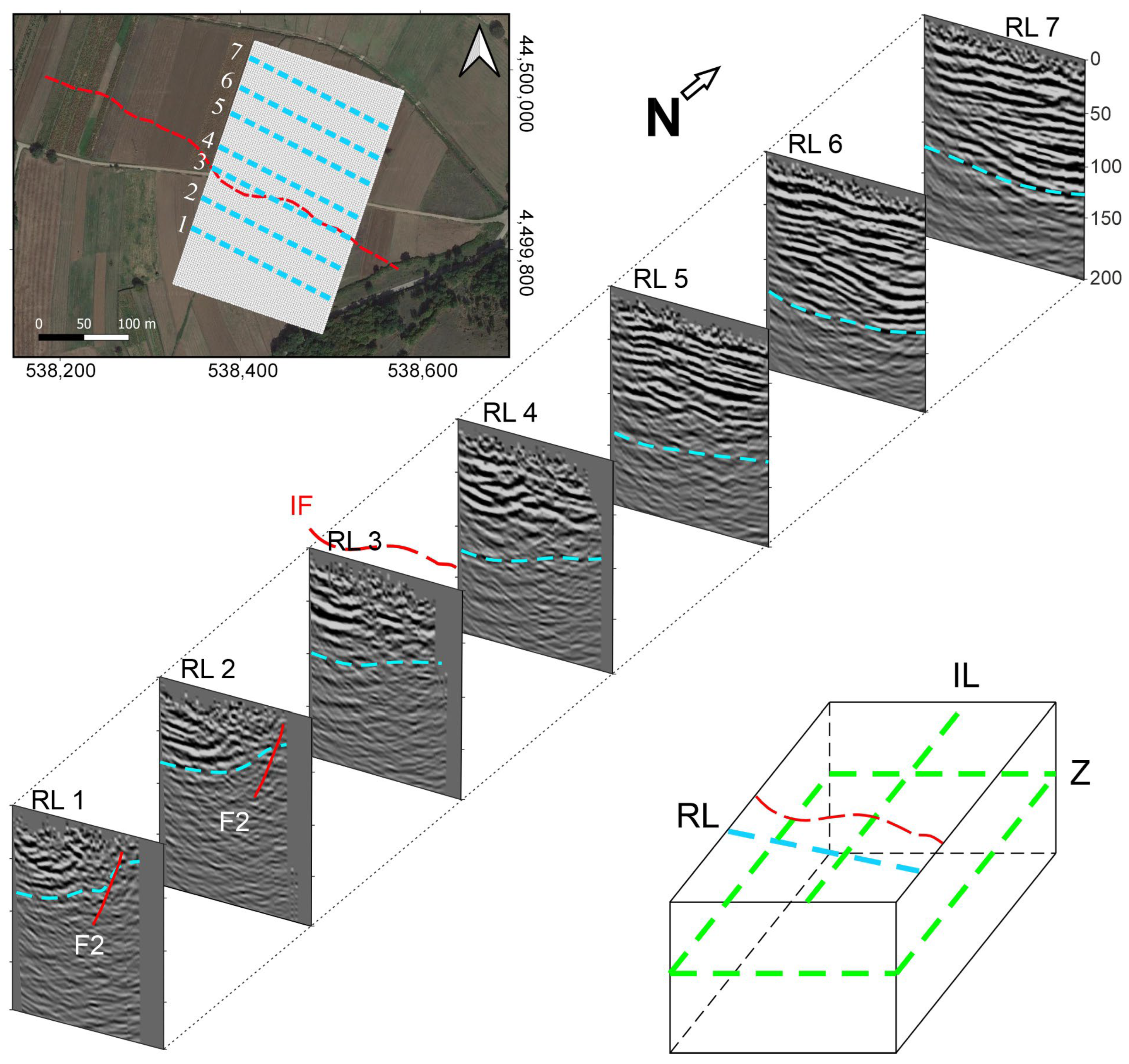
The inlines in Figure 6 provide a progressive view of lateral variations across the fault zone, ranging from IL11 in the western, more intra-basin sector to IL58 at the easternmost edge of the volume, near the Ripa Rossa carbonate ridge. The approximate depth of the carbonate basement has been highlighted with a dashed blue line on the images, while the two main branches of the PRR fault (segments a and c of F1) and fault F2 are painted in red in Figure 6. The easternmost inlines show a shallow basement in the footwall, similar to profile P3, with depths of 60–65 m. Moving northwest, the basement gradually deepens in the footwall, consistent with profile P4, reaching 75–80 m. In contrast, the maximum depth of the basement in the hanging wall remains relatively constant at 130–135 m. As a result, the total vertical throw in the basement across the PRR fault zone rapidly decreases from 70 to 75 m in the eastern sector to 50–55 m in the west. These 3D complexities can be explained by considering two factors: (a) F1 displaces the northern flank of the small carbonate ridge that deepens westward; (b) fault activity is characterized by slip tapering toward WNW, i.e., the basin center. Notably, near the carbonate outcrop (IL58), the syn-tectonic units in the hanging wall initially dip steeply toward the fault, with a back-tilt that increases with depth. Moving westward the back-tilt and dip gradually decrease, the reflectors become sub-horizontal and the growth strata are less clear. All these features are consistent with a rapid decrease in fault activity in the WSW direction. This finding indicates that moving westward we approach the fault tip and that the progressive disappearance of the 1980 scarp reflects the tapering of the coseismic slip and is not an effect of the thickening of lacustrine unconsolidated sediments towards the basin center.
Additionally, as previously discussed, reflectivity in the footwall increases toward the basin center due to both a deeper footwall and the presence of finer-grained material (i.e., silty-clayey lacustrine deposits with sandy layers). Consequently, lateral variations across F1 are weaker, and this makes the fault zone less clear.
In the final inlines of Figure 6, specifically 52–58, we hypothesize that fault F2, identified on profile P4 approximately 200 m south of F1, tends to merge spatially with F1. However, this remains a tentative hypothesis, as the supposed intersection between F1 and F2 lies in a peripheral portion of the seismic volume. This area is characterized by a low fold and, consequently, a signal-to-noise ratio that is insufficient to validate this interpretation.
The analysis of lateral variability provided by the inlines in Figure 6 is further refined in Figure 7, where IL 21, 30, 41, and 52 are examined in detail. As shown in the map (Figure 2B), these slices form an ~11° angle with seismic profiles P3 and P4, making them nearly orthogonal to the 1980 surface rupture—an optimal orientation for interpretation. Notably, profile P3 originates north of IL 41 and crosses IL 52 at about two-thirds of its length, while P4 starts ~50m south of IL 41, intersects IL 21 and IL 30, and terminates slightly farther northwest. Although the 3D seismic volume does not resolve Unit 5b as clearly as the 2D profiles due to its better spatial resolution in the near surface, it strongly resembles the imaging provided by P3 and P4. The overall geometry and complexity of the F1 fault zone are consistent across both datasets, but the 3D volume reveals lateral variations in structural and stratigraphic features along the crossline direction. Additional splays (highlighted in yellow in the inline 21, Figure 7) appear beyond those identified in the 2D profiles, and stratigraphic changes not fully captured in P3 and P4 are evident.
It is worth noting in Figure 7 that syn-tectonic units (Unit 3–Unit 5) exhibit a steeper dip in the 3D volume than in profile P3. This discrepancy likely results from the inherent inability of 2D migration to resolve lateral variations outside the profile plane [16]. Nevertheless, the similarity between the 2D profiles and the IL of Figure 7 remains strong. A key observation is the decrease in dip and rapid change in internal reflective configurations of Unit 4 from IL 52 to IL 21, likely reflecting both fault zone complexity and the oblique intersection of the fault with the basin/relief. As the fault rapidly diverges from the Ripa Rossa topographic high, the supply of coarse sediments decreases. This structural pattern, together with the localized distortion of reflectors, is interpreted as fault-related deformation rather than purely depositional or compactional (aseismic) processes, consistent with the proximity of Unit 4 to the active fault zone.
Additionally, the complex 3D morphology of the Pantano Basin, evident at a small scale in the 3D volume and at a larger scale in profile P2, leads to shifts in sediment supply direction, affecting the internal geometry of the syn-tectonic wedge. This trend is confirmed by IL 30 and IL 21, where seismic imaging increasingly resembles that of profile P4 toward the basin center. Indeed, ILs 21 and 30 show a smaller vertical offset of the fault and a deeper position of the footwall compared to ILs 41 and 52. In these central parts of the basin, the reflectors within the syn-tectonic units (mainly Unit 4 and, to a lesser extent, Unit 3) display a gentler dip toward the fault plane, sub-horizontal geometries, or even local reverse dips (Unit 4 on IL 21). These variations likely reflect both fault zone complexity and the progressive decrease in fault throw along strike.
This variability in reflection characteristics of the younger units is further illustrated by the slices in Figure 8. These are not true crossline slices but rather random vertical slices (RL) extracted from the 3D volume parallel to the PRR rupture. They highlight the strong difference in reflectivity of the sediments deposited in the footwall (RL 1–3) and the hanging wall (RL 4–7) blocks. The approximate depth of the fractured limestones that correspond to the reflection-free deep region is again indicated by a dashed blue line. Notably, seismic reflectivity within the footwall is limited and nearly absent on the right side of RL 1 and RL 2, particularly where they approach the relief (see inset), bounded by fault F2. The absence of reflectivity in the footwall may be related to the lack of strong seismic impedance contrasts within an essentially coarse-grained material, as suggested by nearby outcrops. Moving toward the basin center, the reflective package becomes thicker (down to ~140m) and continuity, amplitude and frequency increase, both because the section transitions into the fault’s hanging wall and because finer sediments become predominant away from the carbonate ridge.
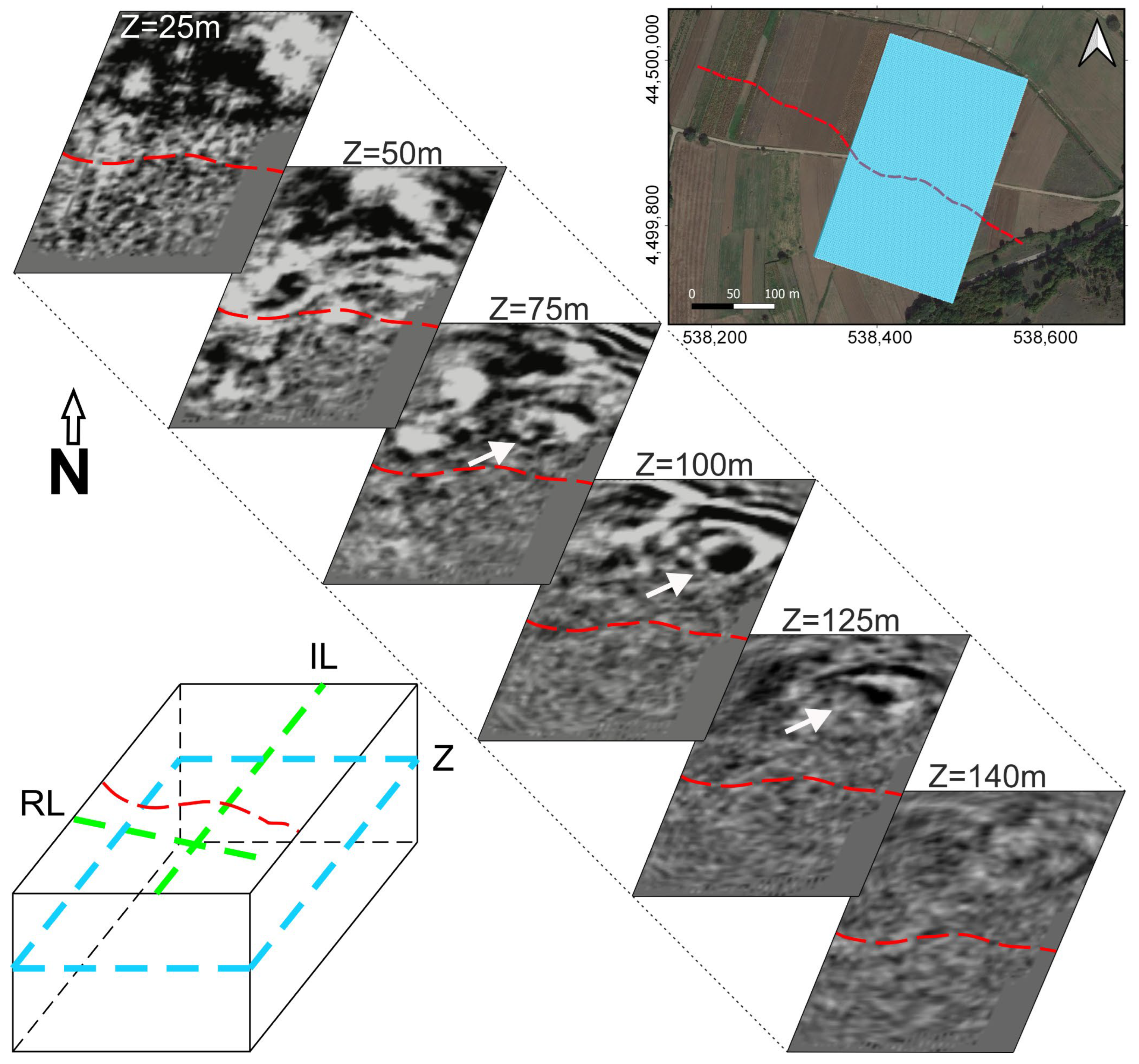
The depth slices (Z) in Figure 9 illustrate the geometric complexity of the sub-basin associated with fault F1. Except for the shallowest section (Z = 25 m), which primarily shows acquisition-related noise, the deeper slices reveal distinct reflectivity variations. In the footwall (southwest), reflection-free Unit 1 is dominant, particularly in the deeper sections. In the hanging wall (northeast), seismic amplitude is constant where the slice intersects horizontal beds, but it shows variations where it cuts through WNW-striking, S-dipping reflectors of Units 3–4 (e.g., at Z = 75 m). Even if reflectivity gradually decreases with depth in this sector, the depth slices allow imaging of the depocenter of the sub-basin. It appears as sub-circular amplitude patterns, with two distinct centers at Z = 100 m, one of which extends down to Z = 125 m. This latter is in the eastern sector of the hanging wall block, in agreement with a progressive increase in fault activity in the ESE direction, as discussed above. At Z = 140 m, reflectivity is entirely absent, confirming that this slice lies below the basin maximum depth in this area, as indicated by profiles P3 and P4.

5. Discussion

By integrating high-resolution 3D seismic data with unconventional 2D profiles, we have for the first time illuminated the shallow geometry of the Pantano-Ripa Rossa fault and the surrounding basin architecture. The improvement in imaging details provided by the 3D seismic volume for fault characterization is demonstrated by comparing seismic profiles with the continuous coverage of the 3D data. The two seismic profiles P3 and P4 (Figure 5), which are nearly orthogonal to the 1980 co-seismic scarp, provide a clear picture of the fault zone, as well as of the overall geometry and stratigraphy of the associated sub-basin. In contrast, analysis of the seismic data cube through vertical and horizontal slices (Figure 6, Figure 7, Figure 8 and Figure 9) enables a more comprehensive stratigraphic and structural interpretation. In particular, the 3D dataset is essential for evaluating along-strike variations in fault vertical throw and syn-sedimentary activity, identifying lateral stratigraphic changes in both the footwall and hanging wall, constraining the geometry of the substratum and delineating the sub-basin depocenter.
Regarding the geometry of the Pantano di San Gregorio basin, seismic profiles P1 and P2 reveal unexpected structural complexity. Reflection and refraction data from profile P1 show a marked deepening of the basin toward the south, controlled in part by previously unmapped south-dipping intra-basin normal faults exhibiting evidence of syn-sedimentary activity (Figure 3). Integration with Bouguer anomaly data (Figure 2A) indicates that the basin depocenter lies beneath the central-southern sector, away from the PSGM Fault located at the base of the northern carbonate ridge (Figure 1B). The pre-Quaternary substratum, shallow (50 m) at the northern edge of profile P1, just 300 m from the ridge, reaches depths of 110–120 m at the profile’s southern end.
Furthermore, seismic stratigraphic features do not bear the signature of significant syn-tectonic activity nearby the hanging wall of the PSGM fault system bounding Pantano to the north. These observations contrast with previous interpretations [15,29,36], which identified the northern PSGM fault as the basin master fault based on the following morphostructural features: its greater linearity and continuity with respect to the southern basin-bounding fault and the size of alluvial fans that suggests a higher subsidence rate along the northern side of the basin.
The schematic cross-section of Figure 10, combining seismic and gravity interpretation, supports an alternative scenario in which the southern PSGM fault system acted as the main structure that controlled the long-term evolution of the basin and is located along its southern bounding fault. This interpretation is consistent with the different altitudinal distribution of the Lower Pleistocene age paleosurfaces recognized on both basin-bounding ridges by Ascione et al. [15], which appear significantly higher to the south than to the north (Figure 10). Coeval paleosurface remnants are found at elevations of 500–550 m a.s.l. in the close footwall of the northern PSGM and at elevations of 600–650 m a.s.l. in the footwall of the southern fault. The higher elevation of the southern paleosurfaces suggests that long-term tectonic subsidence and activity have been greater for the southern faults.
Regarding short-term activity, although recent faulting (Late Pleistocene–Holocene) has been reported for both basin-bounding faults [15], it is noteworthy that during the 1980 earthquake surface ruptures were confined to a ~2 km-long segment of the southern fault system (MSD; Figure 1B) and to the PRR splay within the basin. Both segments are antithetic to the northern PSGM fault that instead showed no evidence of reactivation [8,12,31];. We therefore suggest that the southern fault acted as the basin’s master fault, or alternatively, that basin evolution involved a progressive shift in fault activity and maximum subsidence from the northern to southern margin. Comparable evolutionary models have been proposed for other intramontane tectonic basins [64,65].
The discovery of the tectonic depression associated with the high-offset (~100 m) faults F3 and F4 in the eastern part of the basin along profile P2 (Figure 4) adds further complexity to the basin’s structural framework. The age of these faults remains uncertain. However, because they displace the Lower Pleistocene erosional surface and ceased their activity likely before the deposition of the thick Middle Pleistocene lacustrine sequence, their activity can be ascribed to the early evolutionary stage of the basin. Their onset also pre-dates the onset of fault F1 (i.e., PRR fault). Nonetheless, the geometric relationships between faults F3, F4, PRR, and PSGM remain unclear, as the current seismic volume does not cover the graben area where they may intersect. Additional investigations are required to resolve their geometric relationships, temporal evolution, and structural linkage.
Geomorphological data and scientific drilling from C well, located 650 m west of the intersection between profiles P1 and P2 (Figure 1B), indicate that long-term sedimentation rates have balanced tectonic subsidence driven by extensional faulting in the basin [15,29]. Well stratigraphy documents a 60 m-thick sedimentary infill consisting of lacustrine deposits. Within the upper 52 m, tephrostratigraphic markers constrain long-term sedimentation rates to 0.22–0.30 mm/yr for the past 170–239 kyr [29,36]). Assuming steady subsidence and considering the 120 m-thick lacustrine sequence imaged by seismic data, we infer that lacustrine deposition likely began between 400 and 545 kyr. While this calculation relies on strong assumptions, and the actual onset may be older due to potential southward thickening of the basin fill, we tentatively assign a Middle Pleistocene age to the initiation of tectonic subsidence and fault activation in the Pantano basin. This interpretation aligns with the basin age proposed by Bruno et al. [26] and Ascione et al. [15].
The 3D seismic volume, integrated with orthogonal 2D profiles across the 1980 coseismic scarp, reveals the PRR fault as a complex intra-basin structure. This ~35–40 m wide fault zone contains multiple synthetic and antithetic splays (Figure 5, Figure 7 and Figure 10) and is associated with a near-surface deformation zone approximately 50 m wide. The fault zone shows variable width and appears to intersect eastward with the previously unmapped minor fault F2, which displayed no deformation during the 1980 event (Figure 6). Logistical limitations prevented eastward extension of the 3D seismic coverage, precluding a complete characterization of the relationships between PRR and F2. The complex architecture of the F1 fault zone was not revealed by the two paleoseismic trenches of D’Addezio et al. [31] that exposed instead a single deformation zone (<5 m wide) in correspondence with the coseismic scarp down to 5 m depth. This discrepancy likely reflects the trenches’ limited scope: both 30 m-long excavations focused solely on the coseismic scarp (fault F1c in Figure 5 and Figure 7) without investigating the broader deformation zone between synthetic fault F1a and antithetic fault F1d.
Moving northwest, away from the carbonate ridge, the PRR fault functions as a typical intra-basin fault. However, its deep part displaces the northern flank of the carbonate ridge, which dips northeastward and northwestward beneath the sedimentary cover (Figure 6, Figure 7 and Figure 8). The seismic data cube proves essential for characterizing this complex carbonate substratum morphology, likely shaped by erosional processes active when the limestones were exposed. Measurements of total vertical displacement at the top of carbonate, Unit 1, show a progressive decrease in the WNW direction. However, the complex inherited morphology of the substratum could potentially lead to a misestimation of the actual fault throw, making the hypothesized along-strike variation possibly misleading. On the other hand, three arguments can be made in favor of a primary tectonic origin of the variation in the total vertical throw in the WNW direction. The first is the progressive decrease in the scarp’s height and its disappearance in the basin center (see Pantosti and Valensise [8]). The second is the syn-sedimentary deformation (growth strata, back-tilted wedges) that becomes progressively weaker westward (Figure 6 and Figure 7). The third is the total thickness of the fluvio-lacustrine (Unit 4) and lacustrine (Unit 5) syn-tectonic sequences that decrease from 100 m in the eastern sector to about 80 m in the western one (IL52 and IL30-21 in Figure 7, respectively). All these arguments strongly support the hypothesis of slip tapering as the fault splay approaches its tip.
Trench data [31] indicate a short-term (uppermost Pleistocene-Holocene) vertical slip rate of 0.3 mm/yr for F1 and a sedimentation rate of about 0.38 mm/yr in the fault hanging wall. Assuming a steady subsidence and that this slip rate is also representative of the long-term fault activity, we used the maximum value of vertical throw measured across the fault zone (60 m, along profile P3) and the thickness of the sediments showing evident syn-sedimentary deformation (80–100 m, Unit 4 and Unit 5) to estimate the ages of the fault’s inception and of the fluvio-lacustrine and lacustrine sequences. Aware of the above assumptions, the onset of faulting for PRR can be tentatively estimated at 200 kyr ago, dividing the total vertical throw by the vertical slip rate, while the deposition of the units Unit 4 and Unit 5 can be tentatively assigned to the late Middle Pleistocene-Holocene (210–260 kyr).
Our findings suggest that the PRR is a relatively young fault (<200 kyr) developed inside the Pantano Basin that in turn underwent tectonic subsidence and extensional faulting since Middle Pleistocene times [15,36]. While this subtle intra-basin structure has produced limited geomorphic expression, it has controlled the evolution of the basin’s eastern sector since the late Middle Pleistocene, facilitating the development of a sub-basin dominated by fine-grained lacustrine sedimentation. Considering that both the MSD (a segment of the southern basin-bounding fault) and the PRR fault ruptured during the 1980 earthquake, we hypothesize that the PRR intra-basin fault is a younger fault developed in the hanging wall of the basin master fault and arranged in a left en-echelon pattern with respect to it. The interaction between these two structures requires further geological and geophysical investigation, as it could have significant implications for seismic hazard assessment in the area. Unfortunately, due to the lack of high-quality commercial seismic data [19,66,67] in the study area, as well as the absence of high-resolution seismic catalogs that clearly illuminate the fault segment ruptured at depth during the 1980 event, we are not able to correlate the shallow PRR fault zone imaged in detail in this study with its deep seismogenic counterpart as it was possible in cases such as the 2009 L’Aquila earthquake [2,4] and the Amatrice–Visso–Norcia 2016–2017 sequence [68,69] where such correlations were possible.
The enhanced near-surface imaging of the fault zone provided by the 3D data compared to the seismic profiles carries significant methodological implications for studies on surface faulting. Surface-faulting hazard assessment critically depends on the accurate reconstruction of the 3D geometry of surface-rupturing splays, particularly challenging for intra-basin faults and sediment-hosted faulting. With this study, we show that 3D high-resolution seismic imaging is central for achieving this goal. In the near-surface (<20 m depth), the intra-basin fault zone is up to 60 m wide and includes two main synthetic fault splays at least. Even if the 1980 earthquake produced a single surface scarp (aligned with splay F1c imaged in our seismic data), large future events may distribute slip across the other imaged fault splays. We speculate that this could have occurred during a strong paleo-earthquake that ruptured the Irpinia Fault between 4411 and 6736 yr B.P. This event was not detected in the trenches of D’Addezio et al. [31] that explored only part of the fault zone and revealed a single, narrow deformation zone under the fault scarp associated with four other paleo-earthquakes.

6. Conclusions

This study employs high-resolution 3D seismic imaging to investigate the shallow structure of the Pantano-Ripa Rossa surface-rupturing fault that repeatedly activated during M > 6.5 earthquakes. Our approach, combining for the first time 2D and 3D shallow imaging, has broad methodological significance. Moreover, the seismic images of the subsurface provide valuable new insights into the internal architecture and activity of a seismogenic normal fault with small cumulative displacement and subtle morphotectonic expression. These findings are complemented by the first structural and stratigraphic images of the Pantano di San Gregorio tectonic basin obtained from high-resolution seismic profiles. These results are consistent with field, trenching, and drilling evidence [7,12,15,29,31,36] and with the fault patterns and coseismic ruptures documented after the 1980 Irpinia earthquake [8,12,31], supporting the proposed interpretation within the regional seismotectonic framework [64,65].
Comparison between the 3D subsurface image of the fault zone and of the sub-basin with 2D seismic images demonstrates that a purely 2D imaging approach, though an improvement over traditional active fault studies based primarily on geological field surveys, can be highly limiting in structurally complex settings such as continental tectonic basins. A key methodological limitation of 2D seismic imaging is its inability to account for out-of-plane reflections, as 2D migration assumes all seismic energy originates within the profile plane. This results in depth inaccuracies and structural misinterpretations, particularly in complex geological settings such as thrust belts (e.g., [70]). Moreover, 2D data often exhibit misties at line intersections due to unresolved lateral velocity variations and dips misaligned with the profile [70,71]. Additionally, fault displacement estimates and deformation rates derived from 2D profiles are inherently incomplete, as they capture only a limited section of the fault zone. In cases like the Pantano-Ripa Rossa Fault, where lateral variations in fault throw, stratigraphy and substratum morphology are significant, interpretations based on a single (e.g., [30]) or even multiple 2D profiles fail to fully resolve this complexity.
This study also highlights the value of high-resolution 3D seismic exploration in structurally complex settings, where pre-existing fault systems intersect with more recent structures, making their geometric and kinematic relationships and hierarchy difficult to resolve using conventional 2D surveys. The 3D seismic volume also opens new avenues for future research. One particularly promising line of investigation involves targeted boreholes in both the footwall and hanging wall of the PRR fault within the surveyed volume. Such drilling would allow calibrating seismic data interpretation and coring tephra layers well preserved in the lacustrine sequence, thus obtaining time constraints on the basin evolution and faulting activity. Cores may also provide critical data to assess the short- to long-term PRR slip rate, thereby extending the statistical record of a relatively young but seismogenically significant fault beyond that obtained by paleoseismic data. The devastating 1980 Irpinia earthquake, which caused over 3000 casualties and widespread damage in southern Italy, underscores the need for a more detailed understanding of this fault system that repeatedly activated with M > 6.5 earthquakes in the last 10 kyr [18,31,37].

Supplementary Materials

The following supporting information can be downloaded at: https://www.mdpi.com/article/10.3390/rs17223717/s1, Figure S1. C well stratigraphy (modified from Aiello et al. [29], with associated ages of samples analyzed from Ascione et al. [36]) showing the following lithologies: 1—sand layers; 2—silt layers; 3—sand layers with clay intervals; 4—clay layers; 5—paleosol; 6—fine gravel; Figure S2. Eight representative common-shot gather panels, extracted from profiles P1 to P4 (A–D) and from the 3D array (E–H). Panels E–H show the data as recorded by the 12 individual sub-arrays of the 3D layout. All panels illustrate the high data quality, with strong high-frequency reflections in the 0–250 ms TWT range and a dominant frequency of 80–120 Hz. Clear first arrivals are visible across the full offset range. The lower part of the records (i.e., below 500 ms TWT) is dominated by multiple arrivals. Ground roll (i.e., the vertical component of Rayleigh waves), partially spatially aliased except in panel D (profile P3), appears as low-velocity linear arrivals at near offsets in both the 2D and 3D data; Figure S3. Acquisition parameters for seismic profiles P1 (A), P2 (B), and P4 (C). In each panel, the red line shows the fold, while the blue line represents elevation along the profile. All lines exhibit high fold values in their central portions (see also Table S1), with elevation variations ranging from ~3 m in P1 to up to ~4.5 m in P2 and P4, consistent with the area’s gentle topography. (D) CDP fold distribution map for the 3D seismic volume. The 3D data were sorted into common midpoint (CMP) gathers using a 25 m2 bin size (5 × 5 m). The maximum fold value, 374, occurs in the central-western part of the surveyed area; Figure S4. Flowchart illustrating the main steps of seismic data processing. The central upper section (green) shows the initial preprocessing steps used to correlate raw field data and prepare them for first-arrival picking (orange), which provides input for refraction statics and tomographic inversion. The upper left section (blue) outlines the early reflection processing phase aimed at enhancing the signal-to-noise ratio and temporal resolution. The left portion (yellow) describes the construction of the RMS velocity model used for CMP stacking. For profile P1 and the 3D volume, the final CMP stack was migrated using post-stack Kirchhoff migration. The lower section (pink) illustrates the pre-stack depth migration (PSDM) workflow, which includes RMS velocity model updating through two iterative methods—the Layer Stripping approach (used for P3) and the Deregowski Loop (used for P2 and P4)—followed by Residual Moveout (RMO) correction and pre-stack Kirchhoff migration; Figure S5. Checkerboard resolution tests for the tomographic velocity models of profile P1 (A), P2 (B) and P3 (C). P1, 16 × 16 nodes. The input perturbation patterns have extreme values of ±75 m/s (P1 and P2) and of ±40 m/s (P3) centered on the velocity nodes (black circles). The black dashed line bounds the best resolved region of the models; Figure S6. P1 depth-migrated seismic section. P2 depth-migrated seismic section. P3 depth-migrated seismic section. P4 depth-migrated seismic section. Figures are plotted at the same scale and without vertical exaggeration; Figure S7. 3D depth-migrated seismic slices without interpretation. Figures are plotted at the same scale and without vertical exaggeration; Table S1. Seismic parameters of profiles acquired in Pantano San Gregorio Magno basin.

Author Contributions

The acquisition of 2D and 3D seismic data was planned by P.P.G.B. and G.F., with support from S.M., and carried out by all authors. Seismic processing and interpretation were performed by P.P.G.B. and G.F., with additional input on interpretation from L.I. The refraction tomography was performed by L.I. that interpreted the velocity models. The preliminary version of the manuscript was prepared by G.F. and P.P.G.B., then revised and expanded by L.I. and P.P.G.B. and finally refined with contributions from all authors. All authors have read and agreed to the published version of the manuscript.

Funding

This study received funding from the University of Naples Federico II through the University Research Funding (F.R.A., year 2021) for the TEst Site IRpinia fAult project (TESIRA), PI: Pier Paolo G. Bruno.

Data Availability Statement

In accordance with the MDPI Research Data Policies, the seismic datasets analyzed in this study, including the 3D seismic volume, are available from the corresponding author upon reasonable request. Due to the large size of the datasets, they have not been deposited in a public repository but can be shared for scientific research purposes and to enable validation of the results reported in this article.

Acknowledgments

The authors gratefully acknowledge additional support provided by the Landmark Grant Program to the University of Napoli Federico II, sponsored by Halliburton Software and Services, a Halliburton Company. We also appreciate the assistance of dGB Earth Science, who provided an academic license agreement for OpendTect Pro software to the University of Naples Federico II. We extend our sincere gratitude to the mayors and administrative offices of San Gregorio Magno and Ricigliano for their invaluable support during the planning and execution of survey acquisitions in their municipalities. We would also like to thank the researchers and technicians of CNR and INGV and the MsC students and Faculty of the DiSTAR, University Federico II, whose collaboration and contributions were instrumental in the successful data acquisition.

Conflicts of Interest

The authors declare that they conducted this research without any commercial or financial conflicts of interest.

Abbreviations

The following abbreviations are used in this manuscript:
PRRPantano Ripa-Rossa
PSGMPantano-San Gregorio Magno
NMONormal MoveOut
CMPCommon MidPoint
VMBVelocity model-building
RMOResidual Move-Out
PSDMPre-Stack Depth Migration

References

  1. Collettini, C.; Chiaraluce, L.; Pucci, S.; Barchi, M.R.; Cocco, M. Looking at fault reactivation matching structural geology and seismological data. J. Struct. Geol. 2005, 27, 937–942. [Google Scholar] [CrossRef]
  2. Valoroso, L.; Chiaraluce, L.; Piccinini, D.; Di Stefano, R.; Schaff, D.; Waldhauser, F. Radiography of a normal fault system by 64,000 high-precision earthquake locations: The 2009 L’Aquila (central Italy) case study. J. Geophys. Res. Solid Earth 2013, 118, 1156–1176. [Google Scholar] [CrossRef]
  3. Civico, R.; Pucci, S.; Villani, F.; Pizzimenti, L.; De Martini, P.M.; Nappi, R.; Open EMERGEO Working Group. Surface ruptures following the 30 October 2016 Mw 6.5 Norcia earthquake, central Italy. J. Maps 2018, 14, 151–160. [Google Scholar] [CrossRef]
  4. Villani, F.; Pucci, S.; Civico, R.; De Martini, P.M.; Cinti, F.R.; Pantosti, D. Surface Faulting of the 30 October 2016 Mw 6.5 Central Italy Earthquake: Detailed Analysis of a Complex Coseismic Rupture. Tectonics 2018, 37, 3378–3410. [Google Scholar] [CrossRef]
  5. Iezzi, F.; Roberts, G.; Walker, J.F.; Papanikolaou, I. Occurrence of partial and total coseismic ruptures of segmented normal fault systems: Insights from the Central Apennines, Italy. J. Struct. Geol. 2019, 126, 83–99. [Google Scholar] [CrossRef]
  6. Faure Walker, J.; Boncio, P.; Pace, B.; Roberts, G.; Benedetti, L.; Scotti, O.; Visini, F.; Peruzza, L. Fault2SHA Central Apennines database and structuring active fault data for seismic hazard assessment. Sci. Data 2021, 8, 87. [Google Scholar] [CrossRef]
  7. Bello, S.; Lavecchia, G.; Andrenacci, C.; Ercoli, M.; Cirillo, D.; Carboni, F.; Barchi, M.R.; Brozzetti, F. Complex trans-ridge normal faults controlling large earthquakes. Sci. Rep. 2022, 12, 10676. [Google Scholar] [CrossRef]
  8. Pantosti, D.; Valensise, G. Faulting mechanism and complexity of the November 23, 1980, Campania-Lucania earthquake, inferred from surface observations. J. Geophys. Res. 1990, 95, 319–341. [Google Scholar] [CrossRef]
  9. Westaway, R.; Jackson, J. The earthquake of 1980 november 23 in campania-basilicata (southern Italy). Geophys. J. Roy. Astron. Soc. 1987, 90, 375–443. [Google Scholar] [CrossRef]
  10. Bernard, P.; Zollo, A. The Irpinia (Italy) 1980 earthquake: Detailed analysis of a complex normal faulting. J. Geophys. Res. 1989, 94, 1631–1647. [Google Scholar] [CrossRef]
  11. Giardini, D. Teleseismic observation of the November 23 1980, Irpinia earthquake. Ann. Geophys. 1993, 36, 114. [Google Scholar]
  12. Bello, S.; de Nardis, R.; Scarpa, R.; Brozzetti, F.; Cirillo, D.; Ferrarini, F.; di Lieto, B.; Arrowsmith, R.J.; Lavecchia, G. Fault pattern and seismotectonic style of the Campania–Lucania 1980 earthquake (Mw 6.9, Southern Italy): New multidisciplinary constraints. Front. Earth Sci. 2021, 8, 608063. [Google Scholar] [CrossRef]
  13. Ascione, A.; Nardò, S.; Mazzoli, S. The MS 6.9, 1980 Irpinia Earthquake from the Basement to the Surface: A Review of Tectonic Geomorphology and Geophysical Constraints, and New Data on Postseismic Deformation. Geosciences 2020, 10, 493. [Google Scholar] [CrossRef]
  14. Westaway, R.; Jackson, J. Surface faulting in the southern Italian Campania-Basilicata earthquake of 23 November 1980. Nature 1984, 312, 436–438. [Google Scholar] [CrossRef]
  15. Ascione, A.; Cinque, A.; Improta, L.; Villani, F. Late Quaternary faulting within the Southern Apennines seismic belt: New data from Mt. Marzano area (Southern Italy). Quat. Int. 2003, 101–102, 27–41. [Google Scholar] [CrossRef]
  16. Improta, L.; Zollo, A.; Bruno, P.P.; Herrero, A.; Villani, F. High-resolution seismic tomography across the 1980 (Ms 6.9) Southern Italy earthquake fault scarp. Geophys. Res. Lett. 2003, 30, 1–4. [Google Scholar] [CrossRef]
  17. Galli, P.A.C.; Giocoli, A.; Peronace, E.; Piscitelli, S.; Quadrio, B.; Bellanova, J. Integrated near surface geophysics across the active Mount Marzano Fault System (southern Italy): Seismogenic hints. Int. J. Earth Sci. 2014, 103, 315–325. [Google Scholar] [CrossRef]
  18. Galli, P.; Peronace, E. New paleoseismic data from the Irpinia Fault. A different seismogenic perspective for southern Apennines (Italy). Earth-Sci. Rev. 2014, 136, 175–201. [Google Scholar] [CrossRef]
  19. Feriozzi, F.; Improta, L.; Maesano, F.E.; De Gori, P.; Basili, R. The 3D crustal structure in the epicentral region of the 1980, Mw 6.9, Southern Apennines earthquake (southern Italy): New constraints from the integration of seismic exploration data, deep wells, and local earthquake tomography. Tectonics 2024, 43, e2023TC008056. [Google Scholar] [CrossRef]
  20. Gibson, D.; Spann, M.; Turner, J.; Wright, T. Fault surface detection in 3-D seismic data. IEEE Trans. Geosci. Remote Sens. 2005, 43, 2094–2102. [Google Scholar] [CrossRef]
  21. Wu, X.; Hale, D. 3D seismic image processing for faults. Geophysics 2016, 81, IM1–IM11. [Google Scholar] [CrossRef]
  22. Iacopini, D.; Butler, R.W.H.; Purves, S.; McArdle, N.; De Freslon, N. Exploring the seismic expression of fault zones in 3D seismic volumes. J. Struct. Geol. 2016, 89, 54–73. [Google Scholar] [CrossRef]
  23. Hart, B.S. Definition of subsurface stratigraphy, structure and rock properties from 3-D seismic data. Earth-Sci. Rev. 1999, 47, 189–218. [Google Scholar] [CrossRef]
  24. Cartwright, J.; Huuse, M. 3D seismic technology: The geological ‘Hubble’. Basin Res. 2005, 17, 1–20. [Google Scholar] [CrossRef]
  25. Kaiser, A.; Holden, C.; Beavan, J.; Beetham, D.; Benites, R.; Celentano, A.; Zhao, J. The Mw 6.2 Christchurch earthquake of February 2011: Preliminary report. N. Z. J. Geol. Geophys. 2012, 55, 67–90. [Google Scholar] [CrossRef]
  26. Bruno, P.P.G.; Ferrara, G.; Zambrano, M.; Maraio, S.; Improta, L.; Volatili, T.; Di Fiore, V.; Florio, G.; Iacopini, D.; Accomando, F.; et al. Multidisciplinary High Resolution Geophysical Imaging of Pantano Ripa Rossa Segment of the Irpinia Fault (Southern Italy). Sci. Rep. 2024, 14, 26891. [Google Scholar] [CrossRef]
  27. Tarquini, S.; Isola, I.; Favalli, M.; Battistini, A.; Dotta, G. TINITALY, a Digital Elevation Model of Italy with a 10 Meters Cell Size (Version 1.1) [Dataset]. Istituto Nazionale di Geofisica e Vulcanologia (INGV). 2023. Available online: https://tinitaly.pi.ingv.it/Download_Area1_1.html (accessed on 11 November 2025).
  28. Pondrelli, S.; Salimbeni, S. Italian CMT Dataset [Data Set]; Istituto Nazionale di Geofisica e Vulcanologia (INGV): Roma, Italy, 2006. [Google Scholar] [CrossRef]
  29. Aiello, G.; Ascione, A.; Barra, D.; Munno, R.; Petrosino, P.; Russo Ermolli, E.; Villani, F. Evolution of the late Quaternary San Gregorio Magno tectono-karstic basin (southern Italy) inferred from geomorphological, tephrostratigraphical and palaeoecological analyses: Tectonic implications. J. Quat. Sci. 2007, 22, 233–245. [Google Scholar] [CrossRef]
  30. Bruno, P.P.; Castiello, A.; Improta, L. Ultrashallow seismic imaging of the causative fault of 1980, M6. 9, southern Italy earthquake by pre-stack depth migration of dense wide-aperture data. Geophys. Res. Lett. 2010, 37, L19302. [Google Scholar] [CrossRef]
  31. D’Addezio, G.; Pantosti, D.; Valensise, G. Paleoearthquakes along the Irpinia fault at the Pantano di San Gregorio Magno (southern Italy). Il Quat. 1991, 4, 121–136. [Google Scholar]
  32. Hippolyte, J.C.; Angelier, J.; Roure, F.B. A major geodynamic change revealed by Quaternary stress patterns in the Southern Apennines (Italy). Tectonophysics 1994, 230, 199–210. [Google Scholar] [CrossRef]
  33. Amato, A.; Montone, P. Present-day stress field and active tectonics in southern peninsular Italy. Geophys. J. Int. 1997, 130, 519–534. [Google Scholar] [CrossRef]
  34. Caiazzo, C.; Ascione, A.; Cinque, A. Late Tertiary–Quaternary tectonics of the Southern Apennines (Italy): New evidences from the Tyrrhenian slope. Tectonophysics 2006, 421, 23–51. [Google Scholar] [CrossRef]
  35. Ciarcia, S.; Mazzoli, S.; Vitale, S.; Zattin, M. On the tectonic evolution of the Ligurian accretionary complex in southern Italy. Geol. Soc. Am. Bull. 2012, 124, 463–483. [Google Scholar] [CrossRef]
  36. Ascione, A.; Mazzoli, S.; Petrosino, P.; Valente, E. A decoupled kinematic model for active normal faults: Insights from the 1980, MS = 6.9 Irpinia earthquake, southern Italy. GSA Bull. 2013, 125, 1239–1259. [Google Scholar] [CrossRef]
  37. Pantosti, D.; D’Addezio, G.; Cinti, F.R. Paleoseismological evidence of repeated large earthquakes along the 1980 Irpinia earthquake fault. Ann. Geophys. 1993, 36, 321–330. [Google Scholar] [CrossRef]
  38. Galli, P. Nearly Simultaneous Pairs and Triplets of Historical Destructive Earthquakes with Distant Epicenters in the Italian Apennines. Seismol. Res. Lett. 2024, 95, 1057–1065. [Google Scholar] [CrossRef]
  39. Tan, Y.J.; Waldhauser, F.; Ellsworth, W.L.; Zhang, M.; Zhu, W.; Michele, M.; Chiaraluce, L.; Beroza, G.C.; Segou, M. Machine-Learning-Based High-Resolution Earthquake Catalog Reveals How Complex Fault Structures Were Activated during the 2016–2017 Central Italy Sequence. Seism. Rec. 2021, 1, 11–19. [Google Scholar] [CrossRef]
  40. Matrullo, E.; De Matteis, R.; Satriano, C.; Amoroso, O.; Zollo, A. An improved 1-D seismic velocity model for seismological studies in the Campania–Lucania region (Southern Italy). Geophys. J. Int. 2013, 195, 460–473. [Google Scholar] [CrossRef]
  41. Arya, V.K.; Holden, H.D. Deconvolution of seismic data-an overview. IEEE Trans. Geosci. Electron. 1978, 16, 95–98. [Google Scholar] [CrossRef]
  42. Taner, M.T.; Koehler, F. Velocity spectra—Digital computer derivation applications of velocity functions. Geophysics 1969, 34, 859–881. [Google Scholar] [CrossRef]
  43. Levin, S.A. Surface-consistent deconvolution. Geophysics 1989, 54, 1082–1216. [Google Scholar] [CrossRef]
  44. Hileman, J.A.; Embree, P.; Pflueger, J.C. Automated static corrections. Geophys. Prospect. 1968, 16, 326–358. [Google Scholar] [CrossRef]
  45. Palmer, D. The Generalized Reciprocal Method of Seismic Refraction Interpretation; Society of Exploration Geophvsicists: Tulsa, OK, USA, 1980. [Google Scholar]
  46. Neidell, N.S.; Taner, M.T. Semblance and other coherency measures for multichannel data. Geophysics 1971, 36, 467–618. [Google Scholar] [CrossRef]
  47. Ronen, J.; Claerbout, J.F. Surface-consistent residual statics estimation by stack-power maximization. Geophysics 1985, 50, 2297–2904. [Google Scholar] [CrossRef]
  48. Sheriff, R.E.; Geldart, L.P. Exploration Seismology; Cambridge university press: Cambridge, UK, 1995. [Google Scholar]
  49. Gray, S.H.; Etgen, J.; Dellinger, J.; Whitmore, D. Seismic migration problems and solutions. Geophysics 2001, 66, 1340–1649. [Google Scholar] [CrossRef]
  50. Dondurur, D. Acquisition and Processing of Marine Seismic Data; Elsevier: Amsterdam, The Netherlands, 2018; p. 606. [Google Scholar]
  51. Cox, D.R.; Newton, A.M.W.; Huuse, M. An introduction to seismic reflection data: Acquisition, processing and interpretation. In Regional Geology and Tectonics: Principles of Geologic Analysis; Elsevier: Amsterdam, The Netherlands, 2020; pp. 571–603. [Google Scholar] [CrossRef]
  52. Improta, L.; Zollo, A.; Herrero, A.; Frattini, R.; Virieux, J.; Dell’Aversana, P. Seismic imaging of complex structures by non-linear traveltime inversion of dense wide-angle data: Application to a thrust belt. Geophys. J. Int. 2002, 151, 264–278. [Google Scholar] [CrossRef]
  53. Lutter, W.J.; Nowack, R.L. Inversion of crustal structure using reflections from the PASSCAL Ouachita Experiment. J. Geophys. Res. 1990, 95, 4633–4646. [Google Scholar] [CrossRef]
  54. Herrero, A.; Zollo, A.; Virieux, J. Two-dimensional non linear first-arrival time inversion applied to Mt. Vesuvius active seismic data (TomoVes96). In 24th General Assembly, Abstract Book; European Geophysical Society: Hague, The Netherlands, 1999. [Google Scholar]
  55. Yilmaz, Ö. Seismic data analysis: Processing, inversion, and interpretation of seismic data. In Society of Exploration Geophysicists; Society of Exploration Geophysicists: Tulsa, OK, USA, 2001. [Google Scholar]
  56. Biondi, B.L. 3D Seismic Imaging. Investig. Geophys. Ser. 2006, 14, 219. [Google Scholar] [CrossRef]
  57. Deregowski, S.M. Prestack depth migration by the 2-D boundary integral method. In SEG Technical Program Expanded Abstracts 1985; SEG: Tulsa, OK, USA, 1985; pp. 414–417. [Google Scholar] [CrossRef]
  58. Deregowski, S.M. Common-offset migrations and velocity analysis. First Break. 1990, 8. [Google Scholar] [CrossRef]
  59. Guo, N.; Fagin, S. Becoming effective velocity-model builders and depth imagers, Part 1 and 2—The basics of prestack depth migration. Lead Edge 2002, 21, 1205–1216. [Google Scholar] [CrossRef]
  60. Bradford, J.H.; Liberty, L.M.; Lyle, M.W.; Clement, W.P.; Hess, S. Imaging complex structure in shallow seismic-reflection data using pre stack depth migration. Geophysics 2006, 71, 175–181. [Google Scholar] [CrossRef][Green Version]
  61. Stork, C. Making Depth Migration Work in Complex Structures. In Advance Geophysics; SEG: Tulsa, OK, USA, 1992. [Google Scholar] [CrossRef]
  62. Troiano, A.; Di Giuseppe, M.G.; Petrillo, Z.; Patella, D. Imaging 2D structures by the CSAMT method: Application to the Pantano di S. Gregorio Magno faulted basin (Southern Italy). J. Geophys. Eng. 2009, 6, 120–130. [Google Scholar] [CrossRef]
  63. Ramsayer, G.R. Seismic Stratigraphy, a Fundamental Exploration Tool. In Proceedings of the Offshore Technology Conference, Houston, TX, USA, 30 April–3 May 1979. OTC-3568-MS. [Google Scholar] [CrossRef]
  64. Zembo, I. Stratigraphic architecture and quaternary evolution of the Val d’Agri intermontane basin (Southern Apennines, Italy). Sediment. Geol. 2010, 223, 206–234. [Google Scholar] [CrossRef]
  65. Patruno, S.; Scisciani, V. Testing normal fault growth models by seismic stratigraphic architecture: The case of the Pliocene-Quaternary Fucino Basin (Central Apennines, Italy). Basin Res. 2021, 33, 2118–2156. [Google Scholar] [CrossRef]
  66. Ercoli, M.; Carboni, F.; Akimbekova, A.; Carbonell, R.B.; Barchi, M.R. Evidencing subtle faults in deep seismic reflection profiles: Data pre-conditioning and seismic attribute analysis of the legacy CROP-04 profile. Front. Earth Sci. 2023, 11, 1119554. [Google Scholar] [CrossRef]
  67. Ferranti, L.; Carboni, F.; Akimbekova, A.; Ercoli, M.; Bello, S.; Brozzetti, F.; Bacchiani, A.; Toscani, G. Structural architecture and tectonic evolution of the Campania-Lucania arc (Southern Apennines, Italy): Constraints from seismic reflection profiles, well data and structural-geologic analysis. Tectonophysics 2024, 879, 230313. [Google Scholar] [CrossRef]
  68. Barchi, M.R.; Carboni, F.; Michele, M.; Ercoli, M.; Giorgetti, C.; Porreca, M.; Chiaraluce, L. The influence of subsurface geology on the distribution of earthquakes during the 2016–2017 Central Italy seismic sequence. Tectonophysics 2021, 807, 228797. [Google Scholar] [CrossRef]
  69. Waldhauser, F.; Michele, M.; Chiaraluce, L.; Di Stefano, R.; Schaff, D.P. Fault planes, fault zone structure and detachment fragmentation resolved with high-precision aftershock locations of the 2016–2017 central Italy sequence. Geophys. Res. Lett. 2021, 48, e2021GL092918. [Google Scholar] [CrossRef]
  70. Malz, A.; Madritsch, H.; Kley, J. Improving 2D seismic interpretation in challenging settings by integration of restoration techniques: A case study from the Jura fold-and-thrust belt (Switzerland). Interpretation 2015, 3, SAA37–SAA58. [Google Scholar] [CrossRef]
  71. Huston, D.C.; Backus, M.M. Offset-dependent mis-tie analysis at seismic line intersections. Geophysics 1989, 54, 962–972. [Google Scholar] [CrossRef]
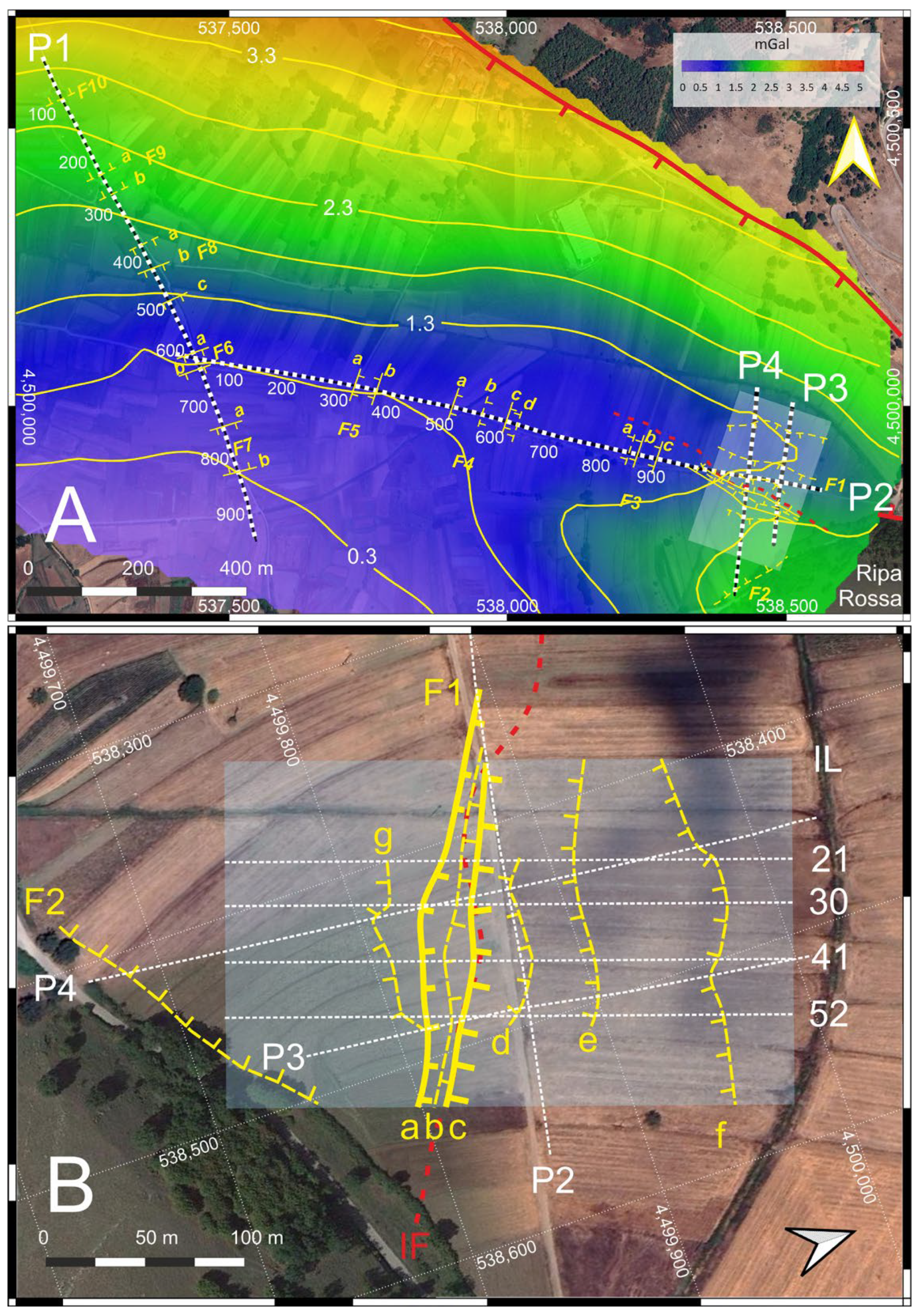
Figure 2. (A) Aerial photograph from Google Earth Pro, v. 7.3.3 (https://www.google.com/earth/, accessed on 15 September 2025) of the eastern part of the Pantano Basin, with an overlay of the seismic acquisition surveys. The Bouguer anomaly map published by Bruno et al. [26] is superimposed on the photograph. The grayed rectangle highlights the surface extent of the seismic volume and white dashed lines seismic profiles. Interpreted faults are numbered from F1 to F10, with associated splays labeled as lowercase letters (a, b, c, etc.). (B) Zoomed-in view of the PRR fault F1 corresponding to the surfacer rupture (IF), with its associated splays, and fault F2 interpreted in the text as a blind splay cutting the eastern ridge. The gray shaded area shows the surface extent of the seismic volume, while the white dashed lines mark the seismic profiles (P2, P3 and P4) and inline vertical slices (21, 30, 41 and 52).
Remotesensing 17 03717 g002
Figure 3. (A) Long-wavelength refraction tomography Vp model from profile P1. This model is parameterized by using a horizontal and vertical grid spacing of 100 m and 18 m, respectively, (this corresponds to 16 nodes horizontally and 16 nodes vertically). The area outlined by the white dashed line indicates the well-resolved zone, as defined by a posteriori checkerboard resolution tests (see Figure S5); (B) Interpreted seismic reflection section from the same profile. Faults are shown in red; dashed where inferred. Symbols as described in the text. The intersection with profile P2 is marked by a white dashed line. The sections are plotted without vertical exaggeration.
Remotesensing 17 03717 g003
Figure 4. (A) Long-wavelength refraction tomography Vp model from profile P2. This model is parameterized by using a horizontal and vertical grid spacing of 130 m and 23 m, respectively, (this corresponds to 13 nodes horizontally and 13 nodes vertically). The area outlined by the white dashed line indicates the well-resolved zone, as defined by a posteriori checkerboard resolution tests (see Figure S5); (B) Interpreted seismic reflection section from the same profile. Major faults are shown in red; dashed where inferred. Symbols are described in the text. Dashed lines mark the intersections with profiles P3 and P4 (white) and with the PRR surface rupture (yellow). Dashed lines mark the intersections with profiles P3 and P4 (white) and with the PRR surface rupture (yellow). The sections are plotted without vertical exaggeration.
Remotesensing 17 03717 g004
Figure 5. (A) Long-wavelength refraction tomography Vp model from profile P3. This model is parameterized by using a horizontal and vertical grid spacing of 43 m and 18 m, respectively, (this corresponds to 7 nodes horizontally and 7 nodes vertically). The area outlined by the white dashed line indicates the well-resolved zone, as defined by a posteriori checkerboard resolution tests (see Figure S5); (B) Interpreted seismic reflection section from the same profile. (C) Interpreted seismic reflection section from profile P4 located ~65m west of P3. Major faults are shown in red; dashed where inferred. Symbols as described in the text. Dashed lines mark the intersections with profiles P2 (white) and with the PRR surface rupture (yellow). The sections are plotted without vertical exaggeration.
Remotesensing 17 03717 g005
Figure 6. Vertical sections from the 3D seismic volume along the inline direction (NNE, approximately parallel to the dip of the PRR Fault), extracted every 20–25 m from west to east (see upper map). The top of Unit 1 is marked with a dashed cyan line, while Faults F1 (PRR) and F2 are shown in red. The orientation of the inlines within the seismic volume is illustrated in the lower inset.
Remotesensing 17 03717 g006
Figure 7. Inline vertical slices 21, 30, 41, and 52 from the 3D seismic volume with overlaid interpretation (uninterpreted data in Figure S7). Major faults are shown in red, dashed where inferred. Symbols are as described in the text. The sections are displayed without vertical exaggeration.
Remotesensing 17 03717 g007
Figure 8. Random lines (RLs) from the 3D seismic volume, oriented parallel to the Pantano–Ripa Rossa rupture and extracted at 35–45 m intervals from south to north (see upper map). The red dashed line marks the approximate trace of the Pantano–Ripa Rossa surface rupture, the blue line indicates the top of the carbonate basement, and Fault F2 is shown in red. The orientation of the random lines within the seismic volume is illustrated in the lower inset.
Remotesensing 17 03717 g008
Figure 9. Depth slices extracted from the 3D seismic volume, oriented parallel to the Pantano–Ripa Rossa rupture and extracted at 35–45 m intervals from south to north (see upper map). The red dashed line marks the approximate trace of the PRR surface rupture and the Fault F2 is shown in red. White arrows mark the sub-basin depocenter. The orientation of the depth slices within the seismic volume is illustrated in the lower inset.
Remotesensing 17 03717 g009
Figure 10. (Top): Perspective view of the Pantano Basin structural setting (symbols as in Figure 1). The dashed yellow line marks the trace of a schematic N–S cross-section crossing the PRR surface rupture and the 3D seismic volume near profile P4. (Bottom): Schematic cross-section based on seismic (this study) and gravity data [26] (see Figure 2A). The intersection of the Bouguer anomaly with the section trace is shown above the profile. Major faults are indicated as in Figure 4, Figure 5, Figure 6 and Figure 7: PRR Fault (F1, with segments a, b, c, d, f) and Fault F2. P are paleosurfaces, from Ascione et al. [15]. Basement depths in the northern and southern sectors of the basin, as well as the deep continuation of the PRR and PSGM faults and their mutual relationships, are speculative. Only the basin fill (white) and carbonate bedrock (light gray) are represented.
Remotesensing 17 03717 g010
Disclaimer/Publisher’s Note: The statements, opinions and data contained in all publications are solely those of the individual author(s) and contributor(s) and not of MDPI and/or the editor(s). MDPI and/or the editor(s) disclaim responsibility for any injury to people or property resulting from any ideas, methods, instructions or products referred to in the content.