Article

Terahertz Squint SAR Imaging Based on Decoupled Frequency Scaling Algorithm

College of Electronic Science and Technology, National University of Defense Technology, Changsha 410003, China
*
Author to whom correspondence should be addressed.
Remote Sens. 2025, 17(22), 3685; https://doi.org/10.3390/rs17223685
Submission received: 12 September 2025 / Revised: 2 November 2025 / Accepted: 7 November 2025 / Published: 11 November 2025

Highlights

What are the main findings?
  • In the terahertz band, the two-dimensional coupling effect under high-squint-angle conditions is aggravated, making phase errors non-negligible and causing traditional frequency-domain algorithms to fail to achieve precise focusing. Therefore, this paper proposes a terahertz squint SAR imaging algorithm based on decoupled frequency scaling.
  • Following time-domain decoupling, the proposed algorithm combined range frequency scaling with azimuth nonlinear chirp scaling, which can achieve better imaging results.
What is the implication of the main finding?
  • The experimental results show that the proposed algorithm can achieve better imaging results and provide an effective technical approach to squint SAR imaging in the terahertz band.
  • This result has application value in airborne terahertz radar detection, cooperative observation of UAV formation, and other fields.

Abstract

Terahertz synthetic aperture radar (SAR) can achieve high-resolution imaging of the target area through a large bandwidth, while squint imaging can flexibly detect the target area by adjusting the beam direction. However, the two-dimensional coupling effect intensifies under squint conditions, making it challenging for traditional frequency domain algorithms for high-resolution imaging. This paper analyzes the Doppler variations and proposes a two-dimensional decoupling algorithm for squint SAR imaging in the terahertz band. The proposed algorithm decouples in the time domain and combines the improved frequency scaling operation with the azimuthal nonlinear frequency scaling operation to obtain the focused SAR image. Compared to the Range Doppler algorithm and nonlinear frequency scaling algorithm, the simulation and experimental results verified the effectiveness of the proposed algorithm, which demonstrates the application potential for squint SAR imaging in the terahertz band.

1. Introduction

Synthetic Aperture Radar (SAR) forms a large virtual aperture through platform motion to achieve two-dimensional imaging [1]. In the terahertz band (0.1–10 THz), its short wavelength helps generate wideband signals and high-gain narrow beams, enabling high-resolution imaging in both range and azimuth directions [2,3,4]. The shorter synthetic aperture time also allows for rapid imaging [5,6,7,8]. Squint SAR imaging, as an important operational mode, uses flexible beam steering to image targets ahead of the platform, providing richer target information and diverse observation perspectives [9,10].
However, efficient imaging for high-squint SAR data remains challenging [11,12,13]. Conventional SAR imaging techniques face significant challenges under high-squint conditions due to severe two-dimensional coupling effects, which prevent accurate phase modeling in the frequency domain [14]. While algorithms such as the chirp scaling algorithm (CSA) and the frequency scaling algorithm (FSA) offer solutions for small squint angles, their performance degrades substantially with increasing squint angles [15,16]. Even with their improved algorithms, the chirp scaling algorithm (ECSA) and the nonlinear frequency scaling algorithm (NFSA) are unable to meet the precise imaging requirements under conditions of large squint and large bandwidth in the terahertz band [17,18].Although the modified Range Doppler algorithm (MRDA) partially mitigates coupling through range cell migration correction, it remains restricted to small scene sizes [19,20]. Frequency domain approaches such as the range migration algorithm (RMA) avoid explicit analytical expressions and accommodate larger squint angles in the terahertz band, yet their efficiency is limited by Stolt mapping operations and inability to adapt the parameters range-dependently [21,22]. Similarly, the Polar Format Algorithm (PFA) suffers from scene size restrictions due to wavefront curvature effects, and though extendable via multi-step processing, this exacerbates computational costs [23]. Recent advances have incorporated motion compensation, sub-aperture processing, and advanced interpolation to enhance scalability, though balancing precision and computational efficiency remains a constant research challenge [24,25].
The back projection algorithm (BPA) and its variants represent the most widely used time domain approaches for high-squint SAR imaging, renowned for their principled simplicity and adaptability to various radar systems and scene configurations [26]. By processing echoes pixel by pixel based on precise time delays in the slant range, BPA achieves accurate imaging without being constrained by severe squint angles or complex geometries [27,28]. However, since it does not exploit the azimuth invariance property of SAR signals, it suffers from high computational complexity, which severely limits its real-time application on high mobility platforms [29]. Especially in the terahertz frequency band, the amount of echo data increases significantly, and it is difficult for the efficiency of the BP algorithm to meet the requirements. Consequently, despite its robustness, the inefficiency of BPA underscores the continued importance of developing frequency domain fast imaging algorithms for high-squint SAR data.
This paper proposes an improved decoupled frequency scaling algorithm for squint SAR imaging in the terahertz band. By analyzing variations in Doppler parameters and combining two-dimensional time-domain decoupling, range frequency scaling, and azimuth nonlinear frequency scaling methods, the processing flow of the proposed algorithm is derived. Simulations of multiple point targets and airborne experiments demonstrate that, in the terahertz band, this algorithm offers significant advantages over RDA and NFSA.
The structure of this paper is organized as follows. Section 2 develops the terahertz squint imaging echo model and analyzes the Doppler characteristics of terahertz radar echoes. Section 3 proposes an improved imaging algorithm to address the two-dimensional coupling problem under terahertz squint conditions. In Section 4, multipoint target simulations are conducted to compare and analyze the proposed algorithm with traditional algorithms, demonstrating its superior performance. Section 5 analyzes the imaging quality based on airborne high-squint terahertz radar data utilizing both the proposed and conventional algorithms. Finally, Section 6 concludes this paper with a summary of the research findings.

2. Signal Model

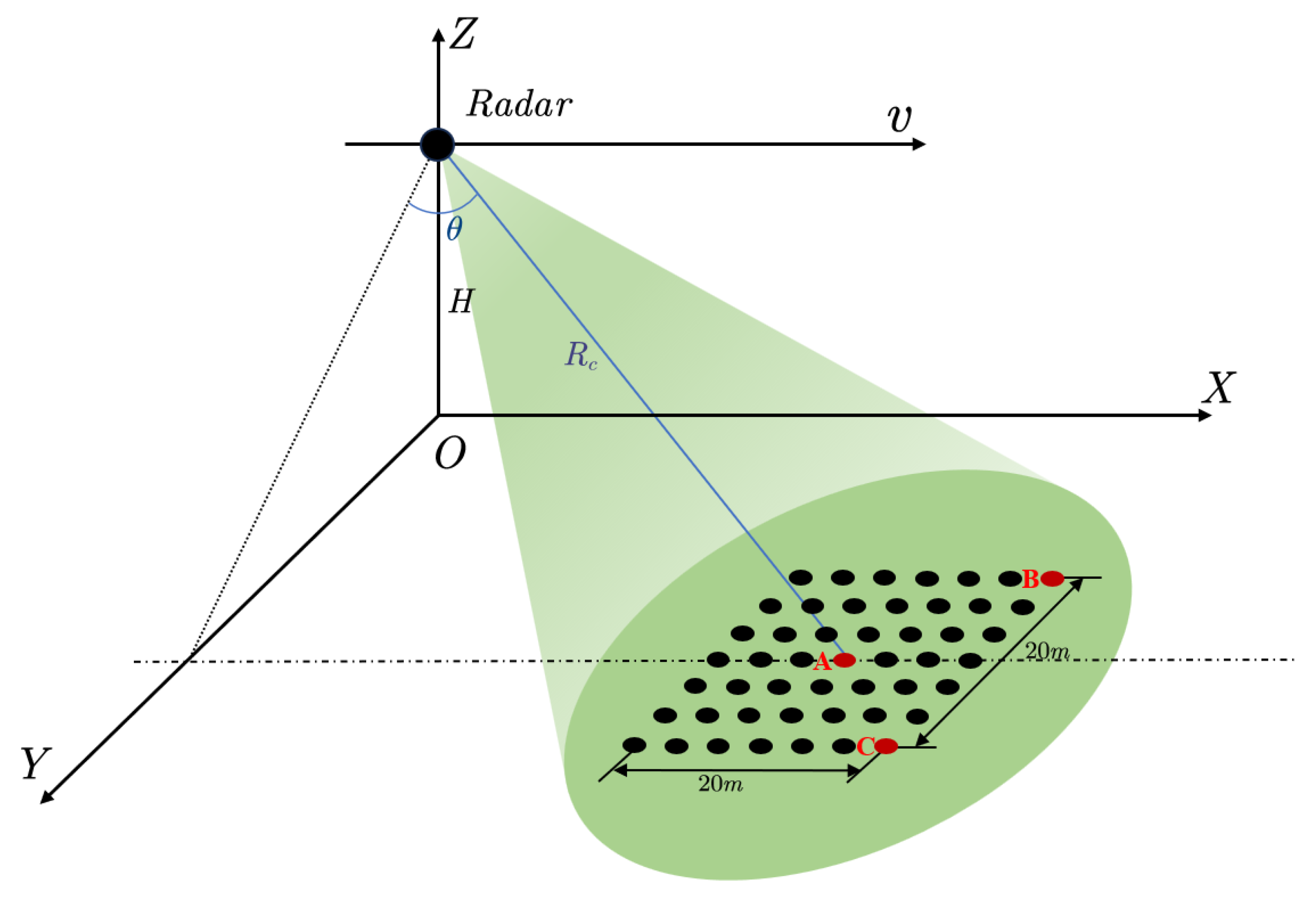
The imaging geometry of squint SAR is shown in Figure 1. The radar operates in strip-map mode. The green ellipse in the figure represents the beam coverage area, while the blue area shows the entire region scanned by the radar beam. The angle between the direction of the radar beam and the direction perpendicular to the velocity is the squint angle θ. Suppose that the time when the radar platform is located at the point A is the azimuth slow time starting point, the closest distance between the point target P and the flight trajectory is R B , and the slant range when the beam center scans over the target P is R 0 . On the line parallel to the flight track, the starting position of the beam center is the point B.
After the slow-time t m , the radar platform moves to point A , with a lateral displacement of v t m . Let the distance between the target point P and point B be X p . From the geometric relationship, the instantaneous slant range R ( t m ; R 0 ) between the point target P and the radar is given as follows:
R ( t m ; R 0 ) = ( v t m X p ) 2 + R 0 2 2 R 0 ( v t m X p ) sin θ
When the condition | v t m X p |   R 0 is satisfied, expanding Equation (2) as a Taylor series around t m = X p v yields the following:
R ( t m ; R 0 ) = R 0 v sin θ t m X p v + v 2 cos 2 θ 2 R 0 t m X p v 2 + v 3 cos 2 θ sin θ 2 R 0 2 t m X p v 3 + n = 4 1 n ! n R ( t m ; R 0 ) t m n | t m = X p v t m X p v n
In the expansion of the instantaneous slant range, the first term represents the nominal range between the point target and the radar. The second term is the linear range walk term. The third term is the quadratic range curvature term. The fourth term is the cubic range shift term. Higher-order terms (fourth-order and beyond) are termed higher-order range shift terms [30].
It can be observed that the magnitudes of each order of range cell migration (RCM) depend on the inherent squint angle of the moving platform and the azimuth position of the target. Specifically the RCM terms increase with the azimuth distance X p , and the RCM terms decrease with the nominal slant range R 0 .
Radar achieves high range resolution by transmitting wide-bandwidth signals in the range direction. Due to the high carrier frequency in the terahertz band, large transmission bandwidths (typically exceeding 5 GHz) can be achieved. Limited by the sampling rate of conventional analog-to-digital (AD) converters, direct sampling is generally not employed in terahertz SAR imaging systems [31]. Instead, the dechirp method is utilized for signal reception, thereby reducing the required sampling rate [32].
Typically, the transmitted radar signal is a linear frequency modulated (LFM) signal:
s ( τ , t m ) = rect τ T p rect t m T a exp j 2 π f c t + 1 2 γ τ 2
where t = t m + τ represents the full time, τ denotes the range fast time, t m is the azimuth slow time, T p is the pulse width, γ is the chirp rate, f c is the carrier frequency, and the rectangular envelope function is defined as follows:
rect ( u ) = 1 | u | 1 2 0 | u | > 1 2
Taking the scene center distance R c as the reference range, the reference signal at this distance is:
s ref ( τ , t m ) = rect τ 2 R c c T p rect t m T a exp j 2 π f c t 2 R c c + 1 2 γ τ 2 R c c 2
For a point target P with instantaneous slant range R ( t m ; R 0 ) , the echo signal can be expressed as:
s r ( τ , t m ) = rect τ 2 R ( t m ; R 0 ) c T p rect t m T a · exp j 2 π f c t 2 R ( t m ; R 0 ) c + 1 2 γ τ 2 R ( t m ; R 0 ) c 2
After coherent demodulation through dechirping between the echo signal and the reference signal, the output signal becomes the desired dechirped echo:
s dechirp ( τ , t m ) = rect τ 2 R ( t m ; R 0 ) c T p rect t m T a · exp j 4 π λ R Δ + 4 π γ c 2 R Δ 2 4 π γ c R Δ τ 2 R c c
where R Δ = R ( t m ; R 0 ) R c and λ is the wavelength of the carrier frequency. The second term in the exponential is known as the residual video phase (RVP) term, introduced by the dechirp mechanism. This term has no utility for imaging and must be removed in subsequent processing stages.
Under the dechirp receiving scheme, when a squint angle exists, the Doppler centroid of the signal is no longer zero. After removing the RVP (Residual Video Phase) term, the Doppler history derived from the echo signal expression is as follows:
Φ a = 4 π λ R Δ
The azimuth Doppler frequency is then:
f a = 1 2 π · d Φ a d t m = 2 λ · d R ( t m ; R 0 ) d t m 2 λ v sin θ 2 v 2 cos 2 θ λ R 0 t m X p v
From this, we obtain the Doppler centroid frequency:
f a c = 2 v sin θ λ
and the Doppler chirp rate:
K a = 2 v 2 cos 2 θ λ R 0
Approximating with the slant range at scene center, the Doppler bandwidth can be derived as follows:
B a = | K a | T a = 2 v 2 cos 2 θ λ R c · 1 v · L s a r = 2 v cos 2 θ λ R c · θ B W R c cos θ = 2 v θ B W cos θ λ
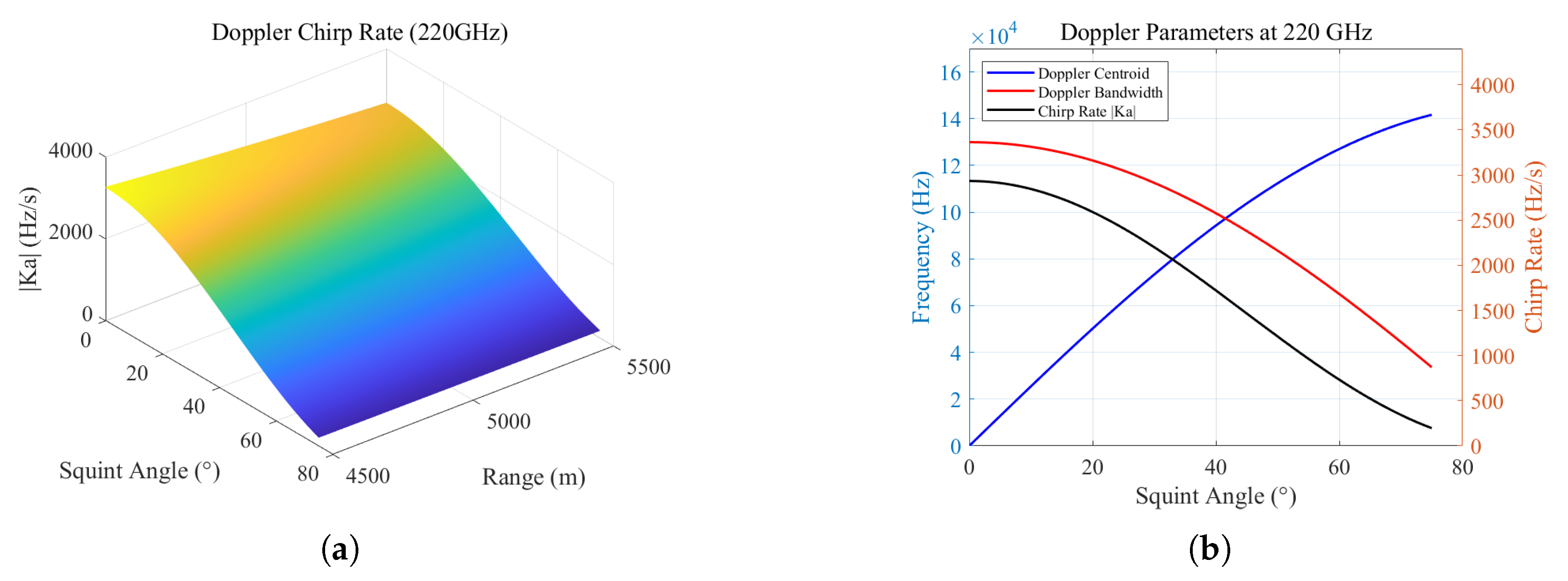
When θ = 0 , the Doppler centroid frequency becomes zero, and the Doppler bandwidth reduces to 2 v θ B W λ , where θ B W is the azimuth beamwidth. To avoid azimuth aliasing, the pulse repetition frequency (PRF) must exceed the Doppler bandwidth. With a carrier frequency of 220 GHz, a squint angle of 60°, and a platform velocity of 60 m/s, the Doppler bandwidth is calculated as 7768.48 Hz for the simulated data (beamwidth of 1°) and 1075.87 Hz for the measured data (beamwidth of 1.4°). In both simulation and practical measurement scenarios, the selected parameters satisfy the anti-aliasing condition.
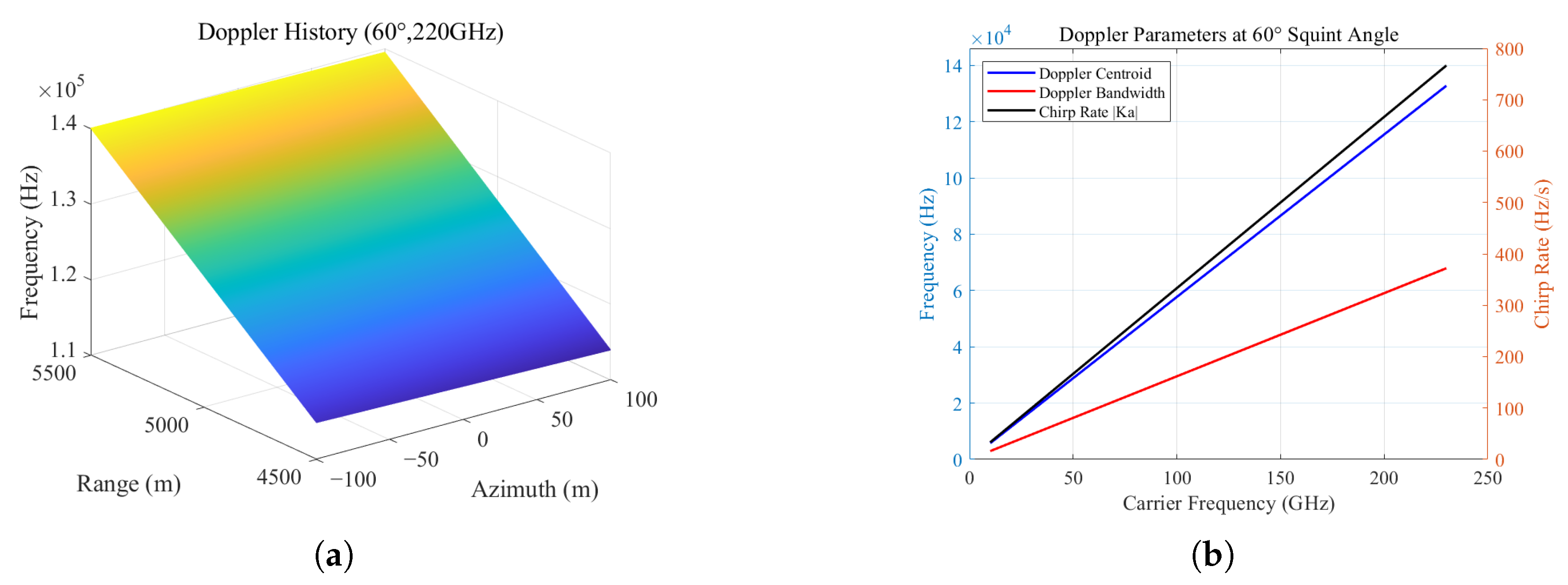
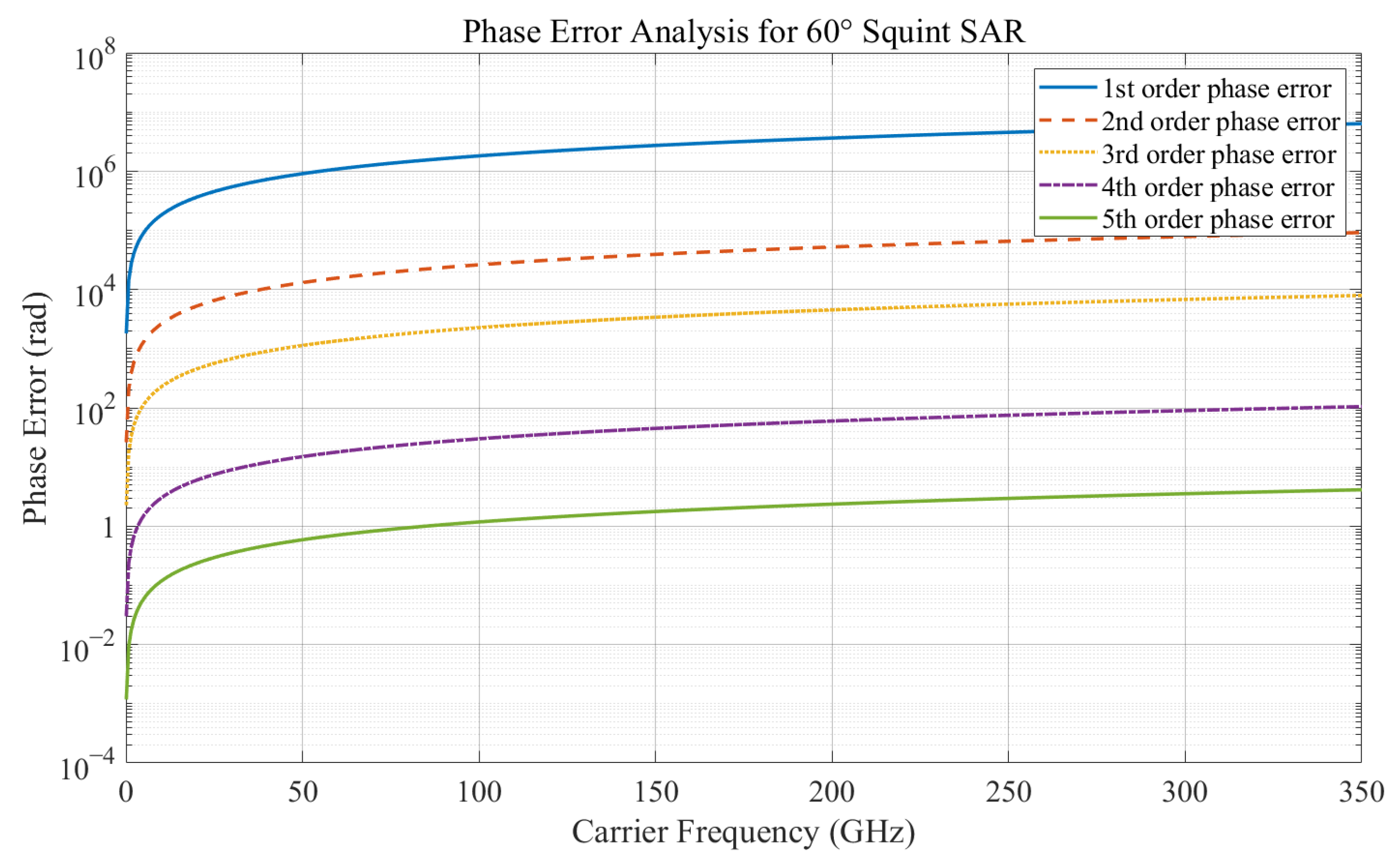
The influence of different squint angles and carrier frequencies on Doppler information is shown in Figure 2 and Figure 3. The influence of carrier frequency on phase errors of different orders is illustrated in Figure 4.
It can be observed that as the squint angle increases, the Doppler bandwidth continuously decreases, but the Doppler center frequency continuously increases, which can cause azimuthal aliasing issues. In the terahertz band, when the squint angle is the same, the phase error increases with increasing carrier frequency, and the high-order phase error cannot be ignored. The Doppler center frequency increases significantly with the decrease in wavelength, the Doppler bandwidth also increases as the wavelength decreases when the beamwidth is fixed, which poses more challenges to imaging. Moreover, as the Doppler frequency varies with the target’s range and azimuth position, the use of a reference target at the scene center may lead to incomplete phase compensation for targets located near the edges. This results in defocusing in the peripheral regions of the image.

3. Methods

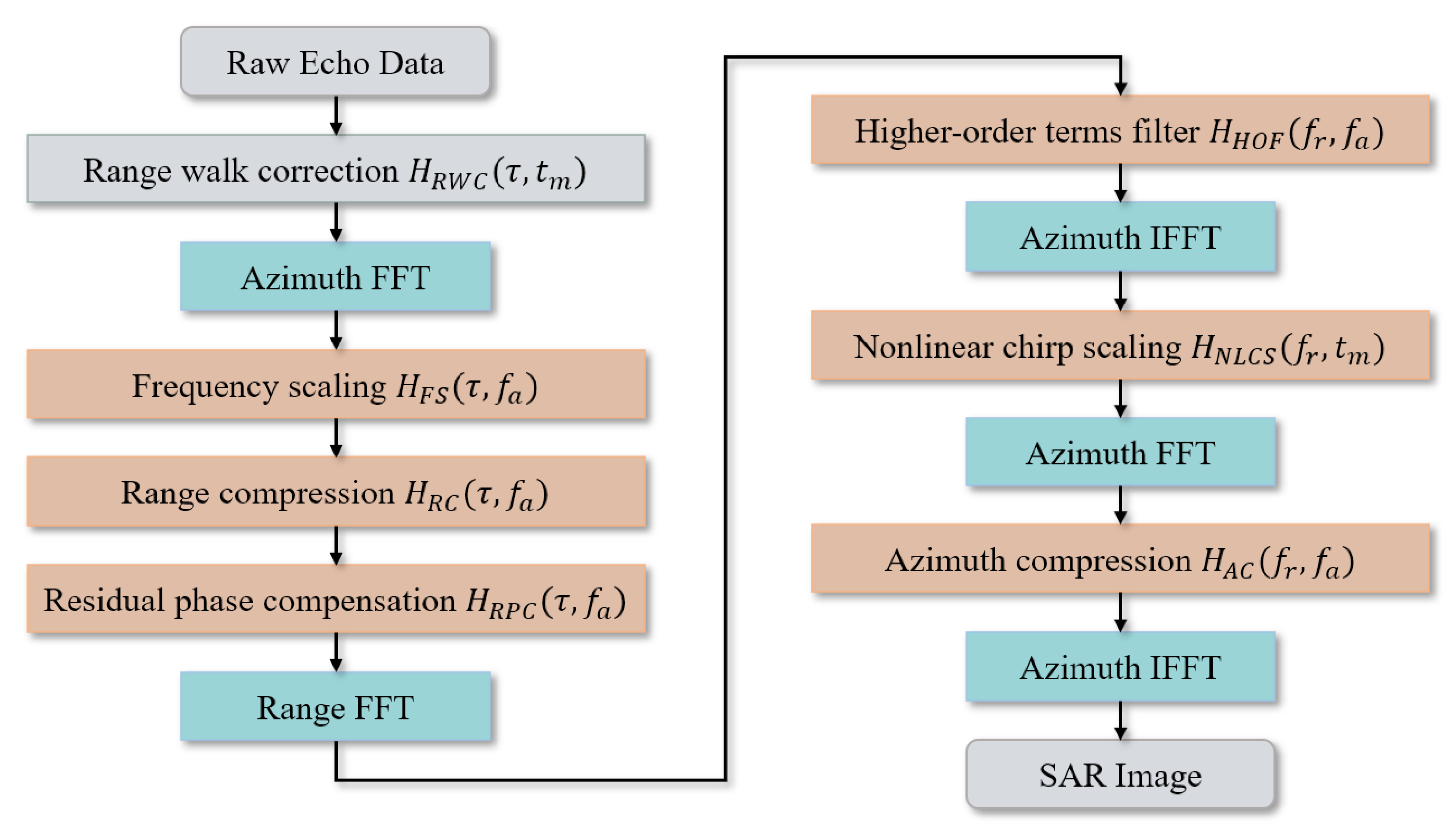
The imaging method consists of two main parts: range processing followed by azimuth processing. As the squint angle increases, the range walk becomes significantly larger than the range curvature, causing severe coupling between the azimuth and range directions. The flowchart of the proposed algorithm is shown in Figure 5.
Compared to the nonlinear frequency scaling method, the method proposed in this paper first corrects the distance walk in the time domain. Then, a frequency scaling operation corrects the range curvature, followed by range compression (RC) and phase compensation to complete range compression. After compensating for the cubic phase term, an improved nonlinear chirp scaling is performed, multiplied with a reference function to complete azimuth compression, and the final two-dimensional image is formed in the distance frequency domain azimuth time domain.
The signal after RVP correction is as follows:
s τ , t m = w r τ 2 R t m c w a t m · exp j 4 π λ R Δ + 4 π γ c R Δ τ 2 R c c
The instantaneous slant range expression can be approximated as follows:
R ( t m ; R 0 ) = ( v t m X p ) 2 + R 0 2 2 R 0 ( v t m X p ) sin θ v 2 cos 2 θ t m X p v 2 + R 0 2 v sin θ t m X p v + v 3 cos 2 θ sin θ 2 R 0 2 t m X p v 3
Using range walk correction to solve two-dimensional coupling, range walk correction is performed using the time-domain correction function:
H R W C ( τ , t m ) = exp j 4 π λ + 4 π γ c τ 2 R c c v sin θ t m
After range walk correction, frequency scaling is performed in the 2D frequency-domain for range curvature correction:
s f r , f a = W r W a · exp j 2 π f a X p v exp j π γ f r 2 exp j 4 π R c c f r · exp j 4 π c X p sin θ f r + f c exp j 4 π R 0 f c + f r 2 c 2 f a 2 4 v 2 cos 2 θ
After Fourier transforming it to the distance time domain, azimuth frequency domain, the echo signal becomes:
s τ , f a = w r W a · exp j 4 π λ X p sin θ exp j 2 π f a X p v exp j 4 π λ R 0 D f a · exp j 4 π γ c R 0 D f a R c + X p sin θ τ 2 R c c · exp j 2 π γ 2 R 0 cos θ 1 D f a 2 c f c D f a 3 τ 2 R c c 2 · exp j 2 π γ 3 R 0 cos 2 θ sin θ 1 D f a 2 c f c 2 D f a 5 τ 2 R c c 3 · exp j π λ 2 sin θ R 0 f a 3 4 v 3 cos 4 θ D f a 3 exp j π γ τ 2
where the scaling factor is D ( f a ) = 1 λ 2 f a 2 4 v 2 cos 2 θ , and ⊗ is the convolution symbol.
Using the frequency scaling method for calibration, in order to prevent excessive bandwidth after scaling, a new scaling function is adopted:
H F S τ , f a = exp j π cos θ γ 1 D f a τ 2
After frequency scaling, the echo signal becomes:
s τ , f a = w r W a · exp j 4 π λ X p sin θ exp j 2 π f a X p v exp j 4 π R 0 λ D f a · exp j π λ 2 sin θ R 0 f a 3 4 v 3 cos 4 θ D f a 3 · exp j 2 π γ 2 R 0 cos θ 1 D f a 2 c f c D f a 3 τ 2 R c c 2 · exp j 2 π γ 3 R 0 cos 2 θ sin θ 1 D f a 2 c f c 2 D f a 5 τ 2 R c c 3
Range compression is performed in Range-Doppler domain. The range compression function is as follows:
H R C τ , f a = exp j 2 π γ 2 R 0 cos θ 1 D f a 2 c f c D f a 3 τ 2 R c c 2 · exp j 2 π γ 3 R 0 cos 2 θ sin θ 1 D f a 2 c f c 2 D f a 5 τ 2 R c c 3
After range compression, the signal becomes as follows:
s τ , f a = w r W a · exp j 2 π f a X p v exp j 4 π R 0 λ D f a exp j π λ 2 sin θ R 0 f a 3 4 v 3 cos 4 θ D f a 3
Residual phase compensation is performed using the following:
H R P C τ , f a = exp j π λ 2 sin θ R 0 f a 3 4 v 3 cos 4 θ D f a 3
After phase compensation, the compressed signal is:
s τ , f a = w r W a · exp j 2 π f a X p v exp j 4 π R 0 λ D f a
After completing range compression processing, azimuth processing must be performed. The azimuth Doppler frequency exhibits spatial variability and couples with the range direction. While time-domain walk correction partially decouples these effects (sufficient for low-precision applications), the terahertz band’s higher resolution demands more precise compensation of higher-order phase terms. Particularly with increasing squint angles, these higher-order effects become non-negligible. We perform Taylor expansion on D f a at f a = 0 and approximate it to a cubic term. The echo signal becomes as follows:
s f r , f a = W r W a · exp j 4 π λ X p sin θ exp j 2 π f a X p v · exp j 4 π R 0 λ + j π R 0 X p sin θ λ 2 v 2 cos 2 θ f a 2 + π λ 2 R 0 X p sin θ sin θ 4 v 3 cos 4 θ f a 3
First, we filter higher-order terms using the following:
H H O F f r , f a = exp j π 2 sin 2 θ cos θ sin θ λ 2 R 0 12 sin θ 2 cos θ v 3 cos 4 θ f a 3
After high-order phase filtering, the echo signal becomes as follows:
s f r , t m = W r w a · exp j 2 π v 2 cos 2 θ λ R 0 X p sin θ t m X p v 2 · exp j 2 π R 0 v 3 cos 2 θ sin θ 2 sin 2 θ cos θ 3 λ R 0 X p sin θ 3 sin 2 θ cos θ t m X p v 3
The nonlinear chirp scaling operation in the range-frequency/azimuth-time domain gives the following:
H N L C S f r , t m = W r W a · exp j π 2 v 2 cos θ sin 2 θ cos θ λ R 0 t m 2 · exp j π 2 v 3 cos θ sin θ sin 2 θ cos θ 3 λ R 0 2 t m 3
After nonlinear frequency scaling, the echo signal becomes as follows:
s f r , f a = W r W a · exp j 2 π X p cos θ v sin 2 θ f a · exp j π λ R 0 2 v 2 cos θ sin 2 θ f a 2 + j π λ 2 R 0 12 v 3 cos 2 θ sin θ sin 2 θ cos θ f a 3 · exp j 2 π cos 2 θ sin 2 θ cos θ λ R 0 sin 2 θ X p 2 + j 4 π cos 2 θ sin 2 θ cos θ 3 λ R 0 2 sin θ X p 3
After nonlinear frequency scaling operation, further azimuth compression processing can be performed:
H A C f r , f a = exp j π λ R 0 2 v 2 sin 2 θ cos θ f a 2 exp j π λ 2 R 0 12 sin θ sin 2 θ cos θ v 3 cos 2 θ f a 3
Finally, ignoring high-order terms, the compressed signal is:
s f r , t m = sin c B r f r + 2 γ c R 0 + X p sin θ R c · sin c B a t m X p cos θ v
where B r is the bandwidth of the transmitted signal. After geometric correction, the final imaging result can be obtained.

4. Simulations and Experimental Results

4.1. Simulations

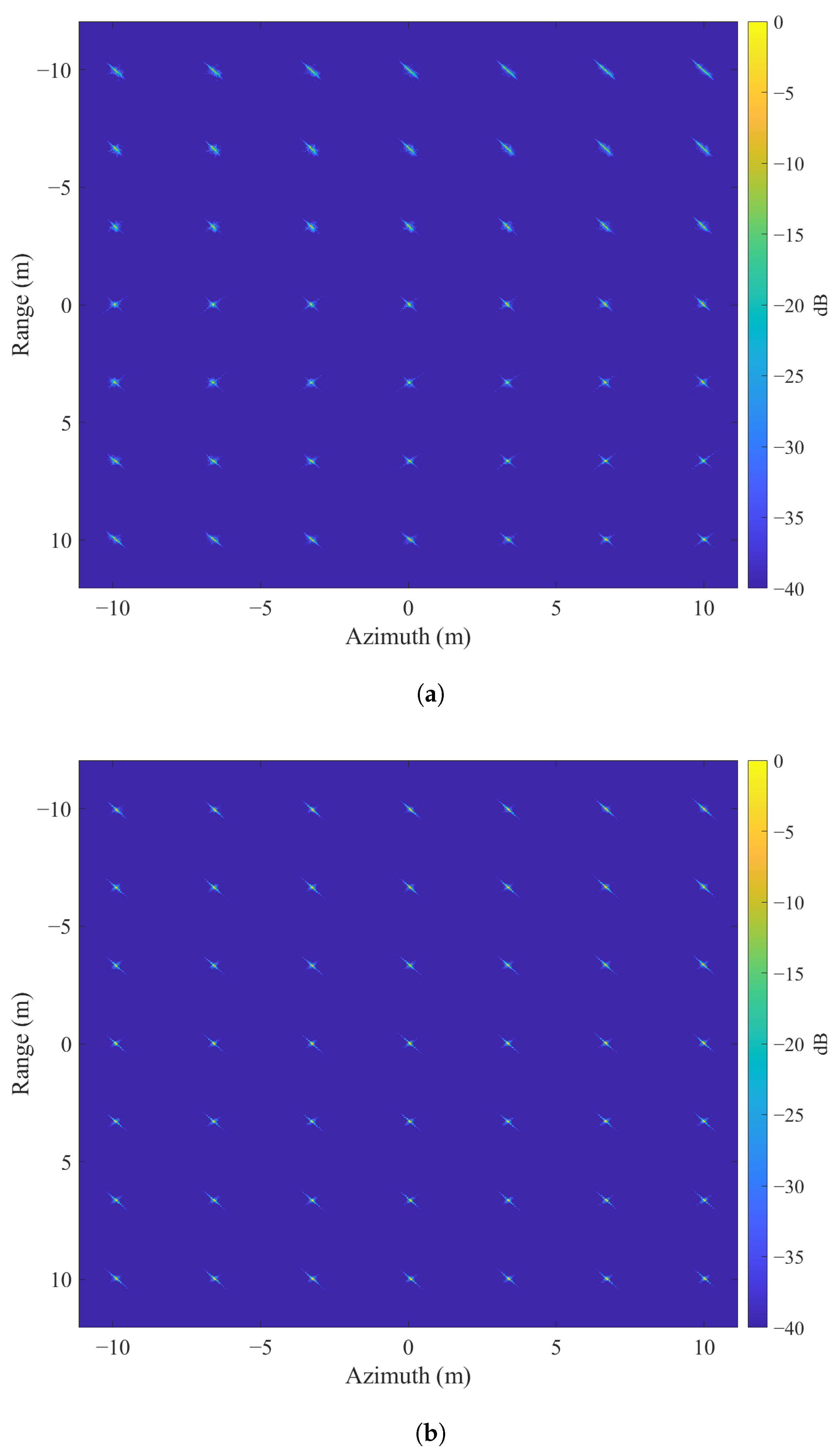
The point target simulation is carried out in this section using the parameters given in Table 1. The layout of the targets is shown in Figure 6. A uniform grid of 49 point targets is distributed across the scene, arranged in 7 rows and 7 columns, covering a 20 m × 20 m area with an inter-target spacing of 3.33 m. The imaging results after geometric correction of the NFSA and the proposed algorithm are shown in Figure 7.
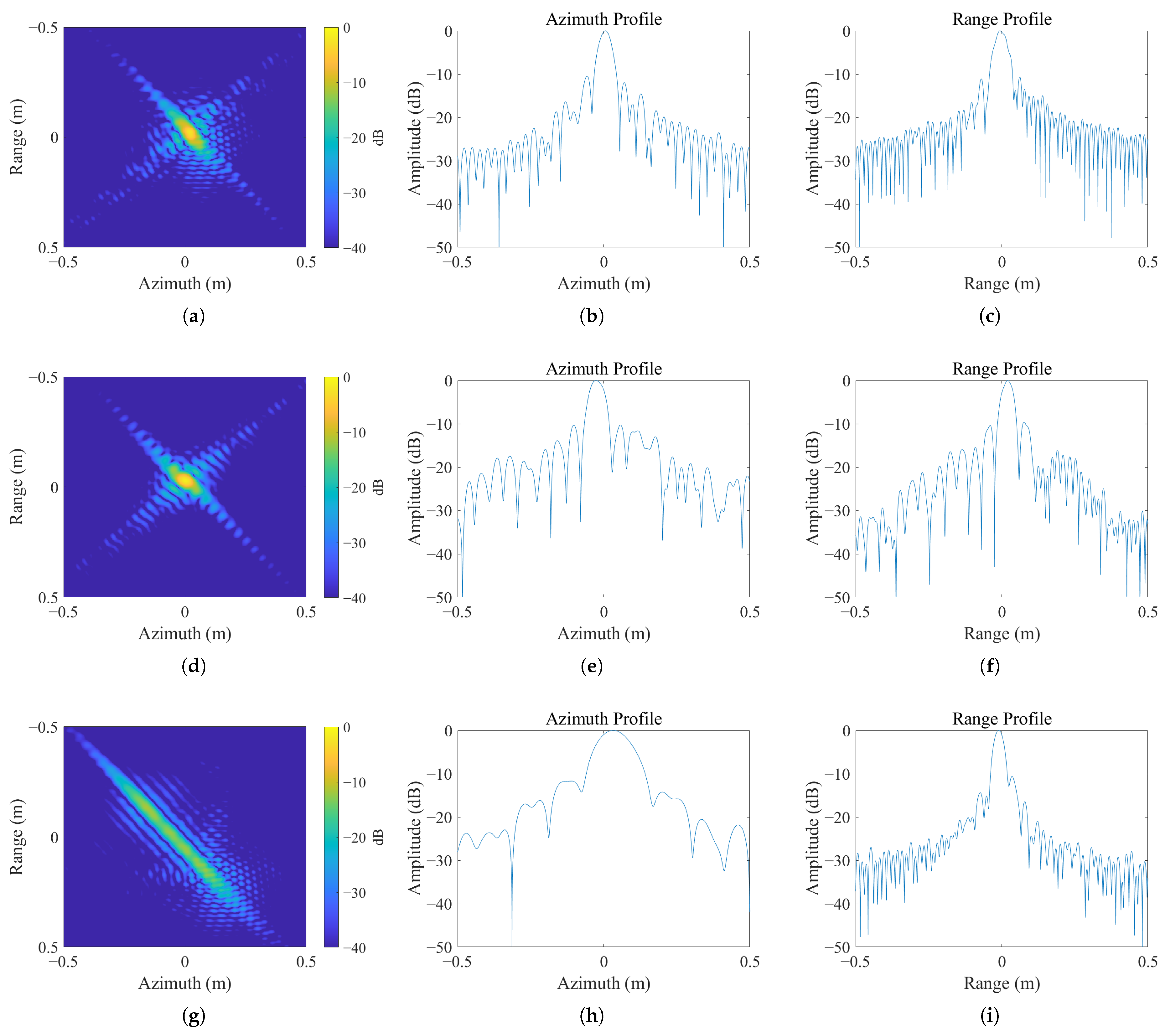
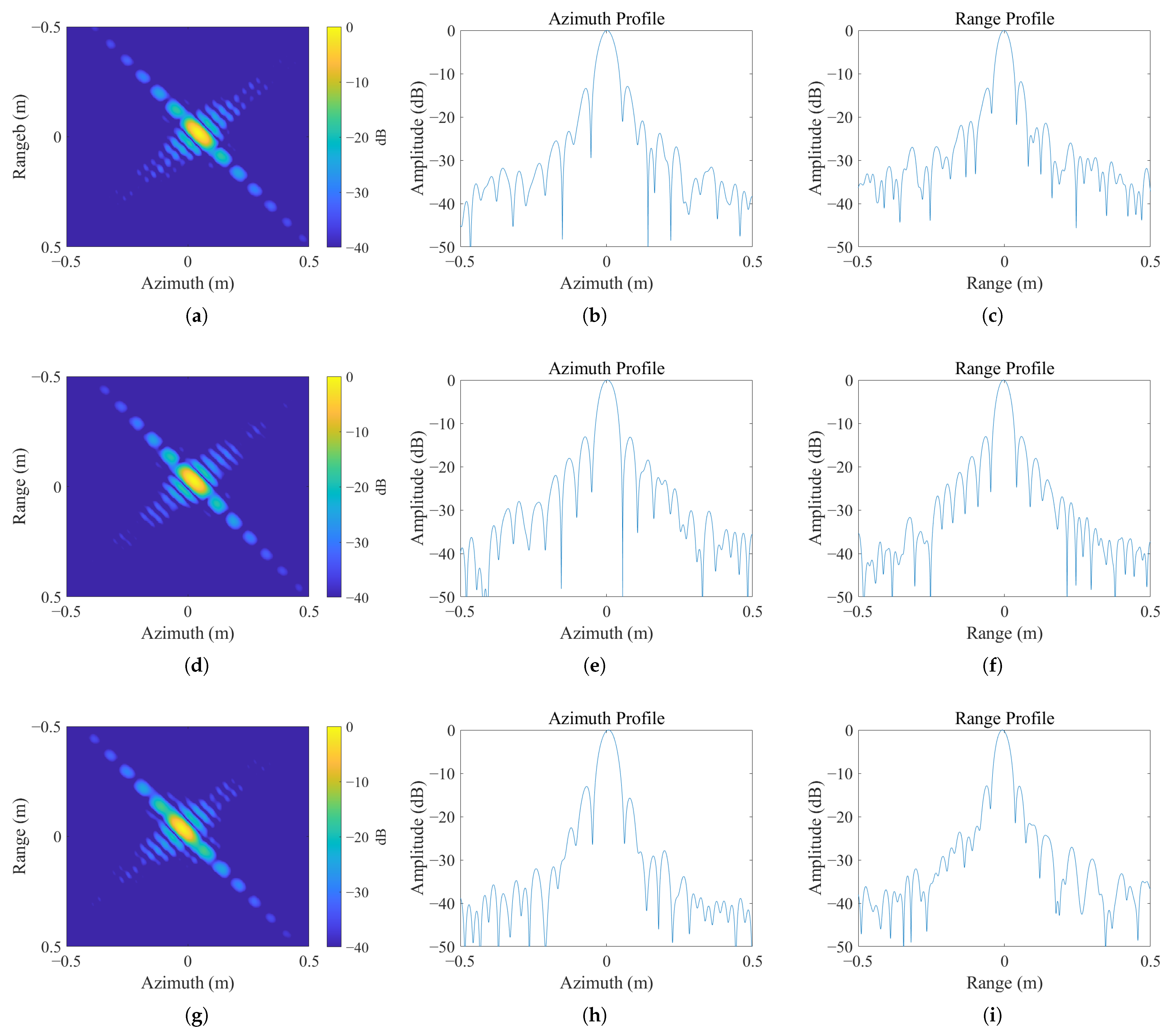
To better compare the imaging performance of different algorithms, three representative points were magnified for detailed analysis. We select the points in the center, upper right corner, and lower right corner of the scene for analysis, which are points A, B, and C, respectively. The imaging results and the corresponding 2D profiles of different algorithms are presented in Figure 8 and Figure 9, respectively.
Observing the imaging results of multi-point targets in Figure 8 and Figure 9, it can be seen that at a 60° squint angle, the NFSA exhibits defocusing issues. This occurs because the terahertz band demands a higher phase compensation accuracy, while NFSA fails to adequately account for the two-dimensional coupling induced by the squint angle. The algorithm neglects the space variation of the compression kernel and exceeds the effective depth of focus, resulting in moderate range defocusing and severe azimuth defocusing, ultimately degrading image quality. Particularly for point targets B and C at the scene edges, the effects of chirp rate mismatch and higher-order phase terms become non-negligible, causing significant 2D defocusing.
In contrast, the proposed algorithm addresses the range–azimuth coupling through decoupling processing. Although it partially ignores the space-variance of the compression kernel and higher-order residual phase terms during subsequent operations, these simplifications do not substantially affect the final results. The azimuth mainlobe shows no noticeable broadening, and both range and azimuth impulse responses maintain ideal profiles. All point targets in the scene achieve well-focused signatures, yielding high-quality final imagery. As evidenced by the two-dimensional profiles in Figure 8 and Figure 9 and the data in Table 2, when the squint angle is 60°, the proposed algorithm achieves a reduction in range PSLR and ISLR compared to NFSA, along with an improvement in range resolution. Moreover, the azimuth PSLR and ISLR is lower, and the azimuth resolution is enhanced, approaching the theoretical value. These results demonstrate that the proposed algorithm offers superior focusing performance.

4.2. Experimental Results

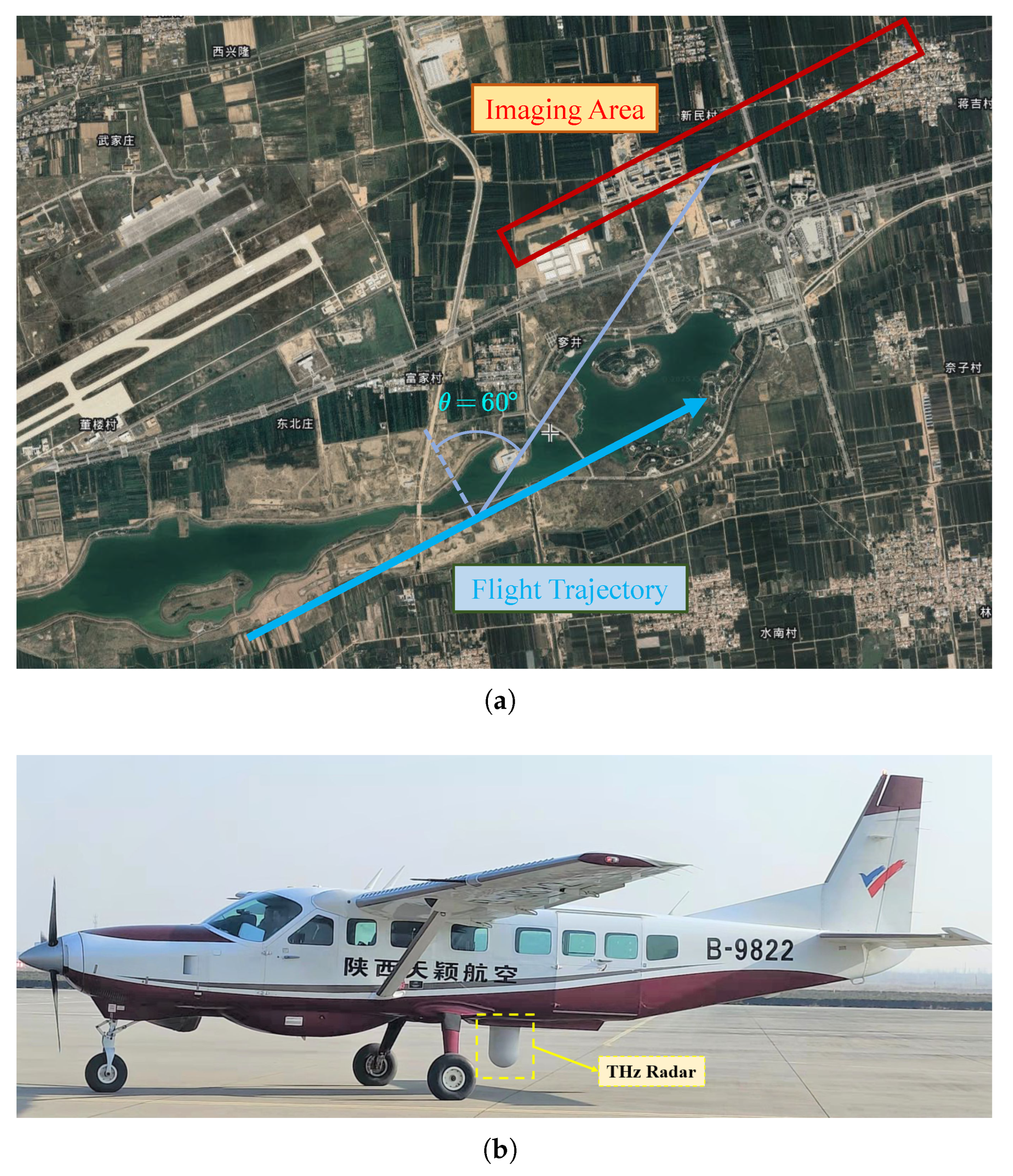
To validate the effectiveness of the proposed algorithm, a terahertz SAR imaging experiment was performed under high-squint conditions using an airborne platform, and different algorithms were used to process the airborne measured data. The optical satellite image of the actual imaging scenario is presented in Figure 10. The radar was mounted under a small aircraft from Shaanxi Tianying Aviation Company, and the system parameters of the THz radar used for experimental testing are detailed in Table 3. The radar platform passes along the light blue trajectory at a velocity of 60 m/s, with the imaging area demarcated by the red rectangular frame. Key radar parameters include carrier frequency of 220 GHz, bandwidth of 900 MHz, pulse repetition frequency (PRF) of 15 kHz, azimuth beamwidth of 1.4 degrees, and squint angle of 60 degrees, with the scene center located at a slant range of 3 km and the platform operating at an altitude of 1 km. The data were acquired using strip-map SAR mode, with the observation target being a town on the ground. According to the system parameters, the theoretical range and azimuth resolutions are 0.34 and 0.35 m, respectively.
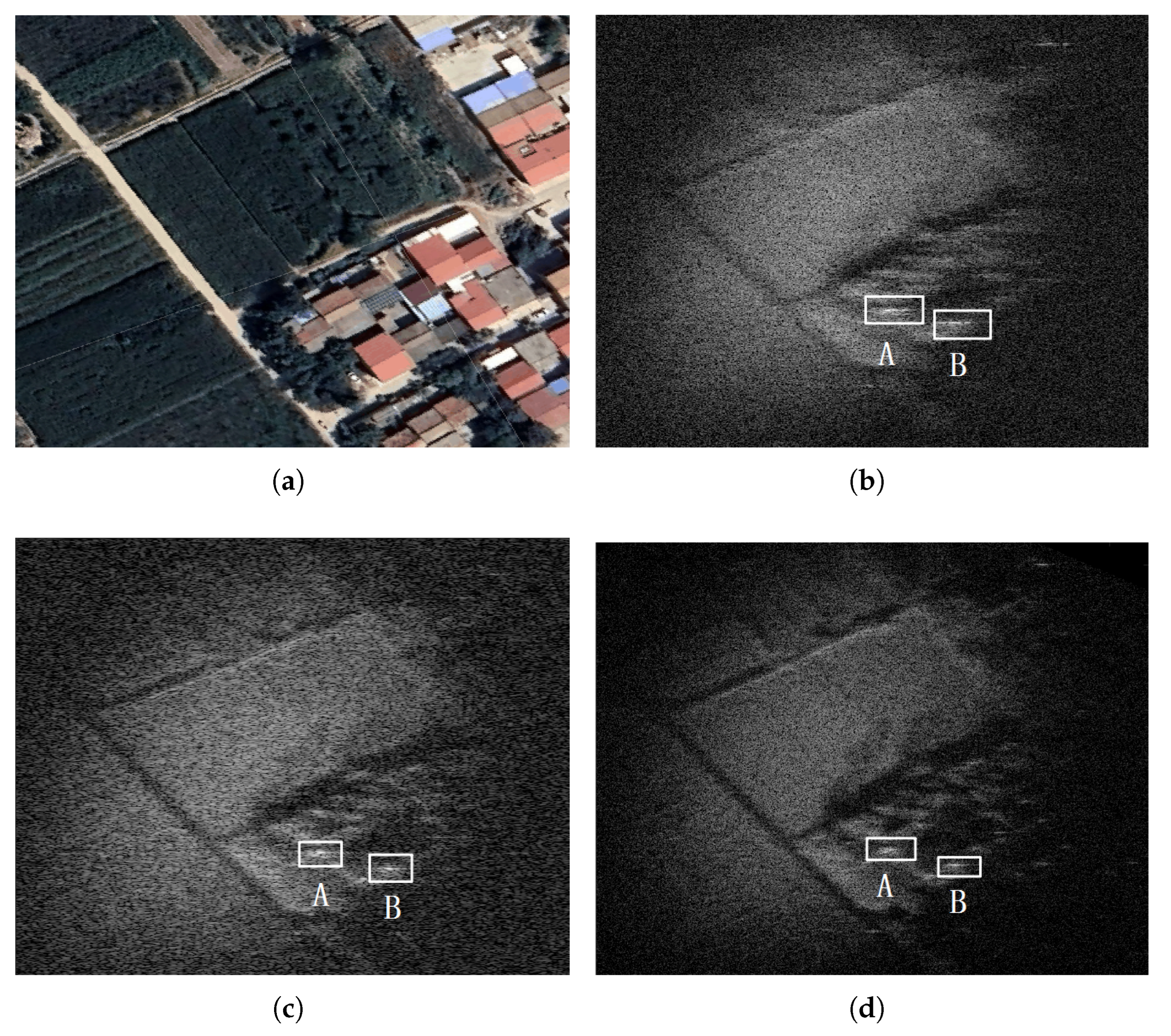
For partial scene imaging, the corresponding optical satellite image is presented in Figure 11a. RDA, NFSA, and the proposed algorithm are applied to process this segment of echo data, and the imaging results are compared in Figure 11.
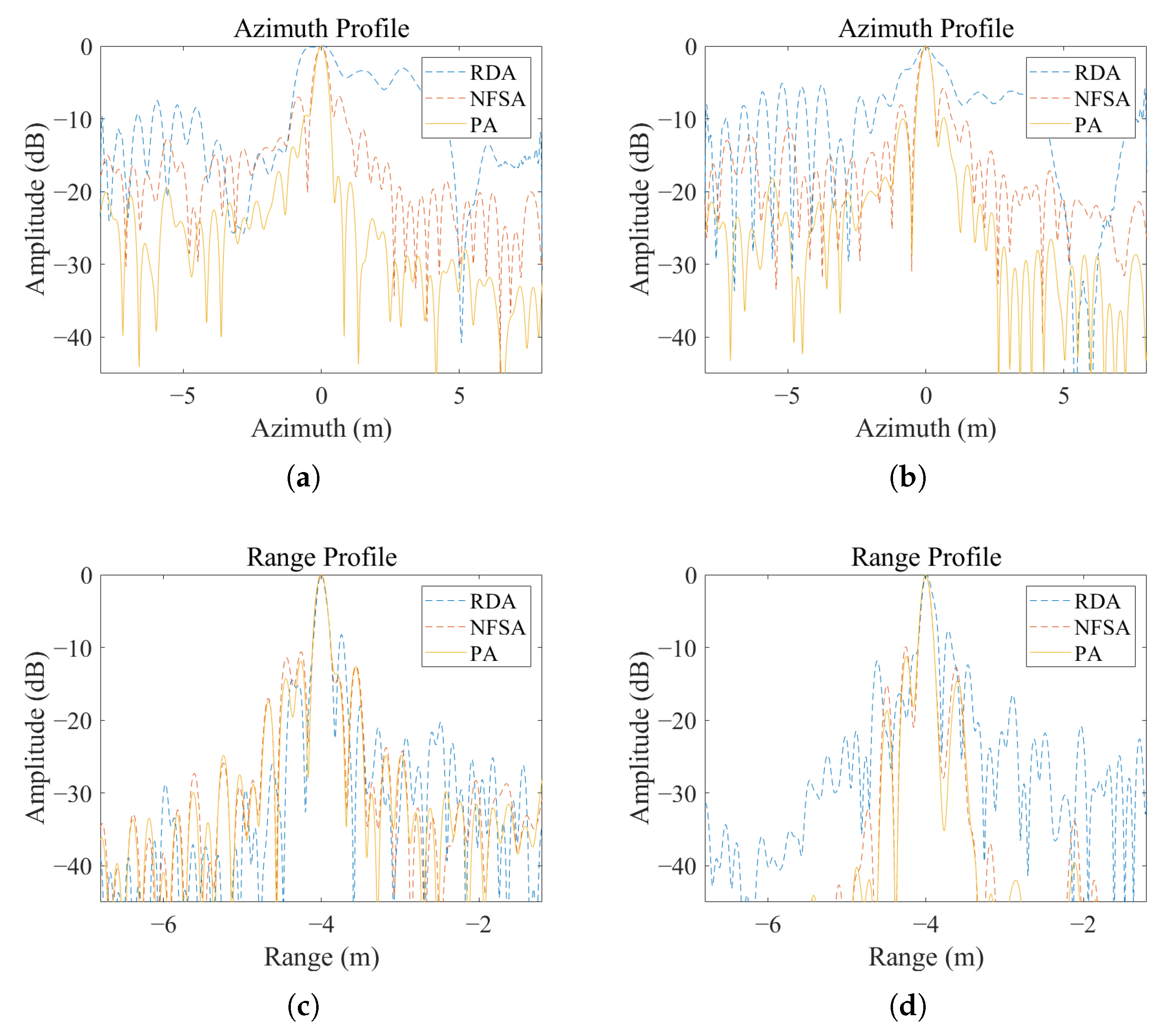
Figure 11 compares the imaging results of the RDA, NFSA, and the proposed algorithm. It can be observed that the RDA algorithm exhibits noticeable defocusing in the image due to inaccurate phase compensation. The NFSA algorithm has improved the imaging quality, but due to the lack of compensation for high-order phases, there is severe azimuthal defocusing. The algorithm proposed in this article has achieved precise phase compensation, resulting in the better preservation of the target contour and detailed features in the imaging results. The image quality metrics in Table 4 further confirm these observations: the proposed algorithm demonstrates the lowest image entropy (4.58), indicating a higher energy concentration, and the highest contrast (5.91), reflecting better sharpness. We select two strong scattering points (A and B) in the imaging scene for profile analysis, as shown in Figure 12 and Table 5. By observing the two-dimensional profile, it can be seen that compared to the other two algorithms, the proposed algorithm achieves a lower azimuth peak sidelobe ratio and narrower mainlobe width for the imaging results of prominent points in the scene. The airborne measured data experiments verify that the proposed algorithm improves the focusing quality in terahertz squint SAR imaging.

5. Discussion

While the superior focusing quality validates the imaging accuracy of the proposed method, its practical value, especially for real-time processing on resource-constrained platforms, hinges on computational efficiency. Therefore, a detailed analysis of the computational complexity is presented below.
The original SAR echo data has a size of N a × N r , where N a and N r represent the number of samples in the azimuth and range directions, respectively. As illustrated in Figure 5, the proposed algorithm involves only FFTs and complex multiplications. Specifically, the entire procedure includes seven complex multiplications, four azimuth FFTs/IFFTs, and one range FFT. According to standard computational principles, one complex multiplication requires six FLOPs, while a 1D FFT (or IFFT) of length N requires approximately 5 N log 2 N FLOPs. Thus, for a dataset of size N a × N r , the total complexity of the complex multiplication steps is O 6 N a N r , and the total complexity of FFT is O 5 N a N r log 2 N a / r when considering both dimensions. The overall computational complexity of the proposed method can be summarized by Equation (30).
O 7 × 6 N a N r + 4 × 5 N a N r log 2 N a + 5 N a N r log 2 N r
When both Na and Nr are large, the logarithmic term dominates, leading to the simplified expression:
O N a N r log 2 N a + log 2 N r = O N a N r log 2 N a N r
In contrast, the BP algorithm consists of one range FFT and numerous complex multiplications per azimuth sample. Assuming that the range interpolation and phase application require four FLOPs per pixel per azimuth position, its complexity is:
O 4 × 6 N a 2 N r + 5 N a N r log 2 N r
When both Na and Nr are large, this leads to the simplified expression:
O N a N r N a + log 2 N r = O N a 2 N r
Assuming N a = 4096 and N r = 8192 , the total FLOPs required by the proposed algorithm are approximately 1 . 16 × 10 10 , while the BP algorithm requires roughly 3 . 30 × 10 12 . Despite incorporating various high-order compensation functions, the proposed method achieves an estimated 283-fold speed up compared to the time-domain BP algorithm. It should be noted that while constant factors may vary in practical implementations depending on hardware and optimization, the order-of-magnitude advantage remains unchanged.
The efficiency of the proposed algorithm stems mainly from its frequency-domain processing (using FFTs), which yields a complexity of O N a N r log 2 N a N r compared to the quadratic complexity O N a 2 N r of the BP algorithm. Although BP is highly accurate, its high computational cost makes the proposed method more suitable for real-time processing and large-scale data scenarios.
Regarding the processing of terahertz real-data, the azimuth data volume is exceptionally large. Utilizing the full aperture would yield very high azimuth resolution, which is often unnecessary; instead, a balanced resolution between azimuth and range is generally preferred. Therefore, a complete synthetic aperture is typically not formed, and the raw data are processed immediately after acquisition. However, it is essential to determine the minimum synthetic aperture length in advance to achieve the desired imaging resolution.
The azimuth resolution ρ a can be expressed in terms of the Doppler bandwidth B a and the platform velocity as ρ a = v B a λ R c 2 v cos θ t a , where the Doppler bandwidth is given by B a = 2 v sin θ + θ a / 2 λ 2 v sin θ θ a / 2 λ = 4 v cos θ sin θ a / 2 λ 2 v cos θ λ θ a Here, θ a denotes the synthetic aperture angle. Substituting the real-data parameters, the theoretical range resolution is approximately 0.33 m, and the azimuth resolution is also 0.33 m, ensuring a well-matched resolution in both dimensions.
In video SAR (ViSAR), the frame update strategy is often categorized as either true-frame (when the data overlap ratio α = 0 % ) or pseudo-frame (when α > 0 % ), with the frame rate determined by:
Frame rate = 1 1 α 2 v cos θ λ R c ρ a
Under the pseudo-frame condition ( α = 80 % ), using a carrier frequency of 35 GHz for traditional Ka-band and 220 GHz for the terahertz band, the resulting frame rates are approximately 2.33 Hz for Ka-band and 14.67 Hz for THz, the latter being close to real-time video rates. Even in the true-frame case ( α = 0 % ), the terahertz system achieves a frame rate of about 2.93 Hz under the same experimental parameters, whereas the Ka-band only reaches 0.46 Hz. These results clearly demonstrate the significant advantage of the terahertz band in high-squint video SAR imaging, particularly in achieving high frame rates under matching resolution conditions.

6. Conclusions

This paper proposes a terahertz squint SAR imaging algorithm based on decoupled frequency scaling. Following time-domain decoupling, the proposed algorithm combined range frequency scaling with nonlinear azimuthal chirp scaling, which can achieve better imaging results. The proposed algorithm was validated through multipoint target simulations and measured data processing. It achieved better imaging results, as indicated by improvements in IRW and PSLR, and it outperformed other algorithms in high-resolution imaging of airborne terahertz squint SAR data. Furthermore, analyses of computational efficiency and imaging frame rate verified its operational advantages. These results collectively confirm the method’s value for applications such as airborne terahertz detection and UAV formation cooperative observation.

Author Contributions

Conceptualization, Y.W. and H.W.; methodology, Y.W.; software, Y.W.; validation, Y.W. and Y.Z.; formal analysis, Y.W.; investigation, Y.W. and Y.Z.; resources, J.Y., B.D. and Q.Y.; data curation, Y.W. and Y.Z.; writing—original draft preparation, Y.W.; writing—review and editing, Y.W. and J.Y.; visualization, Y.W.; supervision, J.Y., H.W. and Q.Y.; project administration, J.Y., B.D., H.W. and Q.Y.; funding acquisition, J.Y., B.D. and H.W. All authors have read and agreed to the published version of the manuscript.

Funding

This work was supported by the National Natural Science Foundation of China under Grant 62201591, Grant 62105363, Grant 62301573, and Grant 62035014.

Data Availability Statement

The data are not publicly available due to privacy.

Acknowledgments

We would like to thank the Beijing Institute of Radio Measurement for providing the airborne THz-band SAR data; we are also grateful to the editors and reviewers for their time and effort in reviewing our manuscript and facilitating its publication.

Conflicts of Interest

The authors declare no conflicts of interest.

References

  1. Davidson, G.W.; Cumming, I. Signal properties of spaceborne squint-mode SAR. IEEE Trans. Geosci. Remote Sens. 2002, 35, 611–617. [Google Scholar] [CrossRef]
  2. Yang, Q.; Fan, L.; Yi, J.; Wang, H. A Novel High Precision Terahertz Video SAR Imaging Method. IEEE Geosci. Remote Sens. Lett. 2024, 22, 4002405. [Google Scholar] [CrossRef]
  3. Gezimati, M.; Singh, G. Curved synthetic aperture radar for near-field terahertz imaging. IEEE Photon. J. 2023, 15, 5900113. [Google Scholar] [CrossRef]
  4. Li, Y.; Yang, Q.; Hua, X.; Wang, H. A Motion Compensation Method for Terahertz SAR Imaging with a Large Squint. Photonics 2024, 11, 1187. [Google Scholar] [CrossRef]
  5. Wang, C.; Zhang, Q.; Hu, J.; Shi, S.; Li, C.; Cheng, W.; Fang, G. An efficient algorithm based on frequency scaling for THz stepped-frequency SAR imaging. IEEE Trans. Geosci. Remote Sens. 2022, 60, 5225815. [Google Scholar] [CrossRef]
  6. Jiang, J.; Li, Y.; Zheng, Q. A THz Video SAR Imaging Algorithm Based on Chirp Scaling. In Proceedings of the 2021 CIE International Conference on Radar (Radar), Haikou, China, 15–20 December 2021; pp. 656–660. [Google Scholar]
  7. Fan, L.; Yang, Q.; Wang, H.; Qin, Y.; Deng, B. Sequential ground moving target imaging based on hybrid ViSAR-ISAR image formation in terahertz band. IEEE Trans. Circuits Syst. Video Technol. 2025, 35, 8738–8753. [Google Scholar] [CrossRef]
  8. Batra, A.; Barowski, J.; Damyanov, D.; Wiemeler, M.; Rolfes, I.; Schultze, T.; Balzer, J.C.; Göhringer, D.; Kaiser, T. Short-range SAR imaging from GHz to THz waves. IEEE J. Microw. 2021, 1, 574–585. [Google Scholar] [CrossRef]
  9. Xu, X.; Su, F.; Gao, J.; Jin, X. High-squint SAR imaging of maritime ship targets. IEEE Trans. Geosci. Remote Sens. 2020, 60, 5200716. [Google Scholar] [CrossRef]
  10. Hu, R.; Rao, B.S.M.R.; Murtada, A.; Alaee-Kerahroodi, M.; Ottersten, B. Automotive squint-forward-looking SAR: High resolution and early warning. IEEE J. Sel. Top. Signal Process. 2021, 15, 904–912. [Google Scholar] [CrossRef]
  11. Chen, Z.; Wang, W.; Zhang, Y.; Deng, Y.; Zhang, Z.; Meng, X. First Study on the Processing Approach of DBF for Squint Spaceborne SAR Imaging. IEEE Trans. Geosci. Remote Sens. 2024, 62, 5217716. [Google Scholar] [CrossRef]
  12. Tong, X.; Bao, M.; Sun, G.; Han, L.; Zhang, Y.; Xing, M. Refocusing of moving ships in squint SAR images based on spectrum orthogonalization. Remote Sens. 2021, 13, 2807. [Google Scholar] [CrossRef]
  13. Wang, Y.; Min, R.; Li, L.; Ding, Z. High-squint high-frame-rate uniform-resolution video SAR: Parameter design and fast imaging. IEEE Trans. Aerosp. Electron. Syst. 2023, 59, 9160–9176. [Google Scholar] [CrossRef]
  14. Guo, Y.; Wang, P.; Zhou, X.; He, T.; Chen, J. A Decoupled Chirp Scaling Algorithm for High-Squint SAR Data Imaging. IEEE Trans. Geosci. Remote Sens. 2023, 61, 5213417. [Google Scholar] [CrossRef]
  15. Guo, Y.; Wang, P.; Men, Z.; He, T.; Chen, J. A hybrid chirp scaling algorithm for squint sliding spotlight SAR data imaging. IEEE Geosci. Remote Sens. Lett. 2024, 21, 4005005. [Google Scholar] [CrossRef]
  16. Song, Y.; Zhang, J.; Jin, S.; Li, G.; Bi, H. Frequency-Scaling-Based Spaceborne Squint SAR Sparse Imaging. IEEE J. Sel. Top. Appl. Earth Obs. Remote Sens. 2022, 15, 8064–8073. [Google Scholar] [CrossRef]
  17. Jin, L.; Liu, X. Nonlinear frequency scaling algorithm for high squint spotlight SAR data processing. EURASIP J. Adv. Signal Process. 2008, 2008, 657081. [Google Scholar] [CrossRef][Green Version]
  18. An, D.; Huang, X.; Jin, T.; Zhou, Z. Extended nonlinear chirp scaling algorithm for high-resolution highly squint SAR data focusing. IEEE Trans. Geosci. Remote Sens. 2012, 50, 3595–3609. [Google Scholar] [CrossRef]
  19. Guo, Y.; Wang, P.; Men, Z.; Chen, J.; Zhou, X.; He, T.; Cui, L. A modified Range Doppler algorithm for high-squint SAR data imaging. Remote Sens. 2023, 15, 4200. [Google Scholar] [CrossRef]
  20. Fan, W.; Zhang, M.; Li, J.; Wei, P. Modified range-Doppler algorithm for high squint SAR echo processing. IEEE Geosci. Remote Sens. Lett. 2018, 16, 422–426. [Google Scholar] [CrossRef]
  21. Lin, H.; Chen, J.; Xing, M.; Chen, X.; You, D.; Sun, G. 2-D frequency autofocus for squint spotlight SAR imaging with extended omega-K. IEEE Trans. Geosci. Remote Sens. 2021, 60, 5211312. [Google Scholar] [CrossRef]
  22. Zhang, T.; Li, Y.; Wang, J.; Xing, M.; Guo, L.; Zhang, P. A modified range model and extended omega-K algorithm for high-speed-high-squint SAR with curved trajectory. IEEE Trans. Geosci. Remote Sens. 2023, 61, 5204515. [Google Scholar] [CrossRef]
  23. Wang, Y.; Li, J.; Chen, J.; Xu, H.P.; Sun, B. A parameter-adjusting polar format algorithm for extremely high squint SAR imaging. IEEE Trans. Geosci. Remote Sens. 2013, 52, 640–650. [Google Scholar] [CrossRef]
  24. Meng, Z.; Zhang, L.; Wang, G.; Lu, J. Improved parametric polar format algorithm for high-squint and wide-beam SAR imaging. IEEE Trans. Geosci. Remote Sens. 2023, 61, 5213916. [Google Scholar] [CrossRef]
  25. Guo, P.; Wu, F.; Wang, A. Extended Polar Format Algorithm (EPFA) for High-Resolution Highly Squinted SAR. Remote Sens. 2023, 15, 456. [Google Scholar] [CrossRef]
  26. Wu, Y.; Huang, L.; Zhang, B.; Wang, X.; Qi, X. An accurate and efficient BP algorithm based on precise slant range model and rapid range history construction method for GEO SAR. Remote Sens. 2023, 15, 5191. [Google Scholar] [CrossRef]
  27. Ran, L.; Liu, Z.; Li, T.; Xie, R.; Zhang, L. An adaptive fast factorized back-projection algorithm with integrated target detection technique for high-resolution and high-squint spotlight SAR imagery. IEEE J. Sel. Top. Appl. Earth Obs. Remote Sens. 2017, 11, 171–183. [Google Scholar] [CrossRef]
  28. Gao, A.; Sun, B.; Yan, M.; Xue, C.; Li, J. Modified auto-focusing algorithm for high squint diving SAR imaging based on the back-projection algorithm with spectrum alignment and truncation. Remote Sens. 2023, 15, 2976. [Google Scholar] [CrossRef]
  29. Sahay, P.; Kiran, K.L. Squint SAR Algorithm for Real-Time SAR Imaging. In Proceedings of the 2022 IEEE International Conference on Electronics, Computing and Communication Technologies (CONECCT), Bangalore, India, 8–10 July 2022; pp. 1–4. [Google Scholar]
  30. Yun, Z.; Hou, Z.; Li, D.; He, F.; Dong, Z. An Improved Range-Doppler Algorithm In High Squint Spaceborne SAR Imaging. In Proceedings of the 2024 IEEE International Conference on Signal, Information and Data Processing (ICSIDP), Zhuhai, China, 22–24 November 2024; pp. 1–6. [Google Scholar]
  31. Batra, A.; Zantah, Y.; Vu, V.T.; Wiemeler, M.; Pettersson, M.I.; Goehringer, D.; Kaiser, T. Experimental analysis of high resolution indoor THz SAR imaging. In Proceedings of the WSA 2020: 24th International ITG Workshop on Smart Antennas, Hamburg, Germany, 18–20 February 2020; pp. 1–5. [Google Scholar]
  32. Fan, L.; Yang, Q.; Wang, H.; Deng, B. Robust ground moving target imaging using defocused RoI data and sparsity-based ADMM autofocus under terahertz video SAR. IEEE Trans. Geosci. Remote Sens. 2025, 63, 2003816. [Google Scholar] [CrossRef]
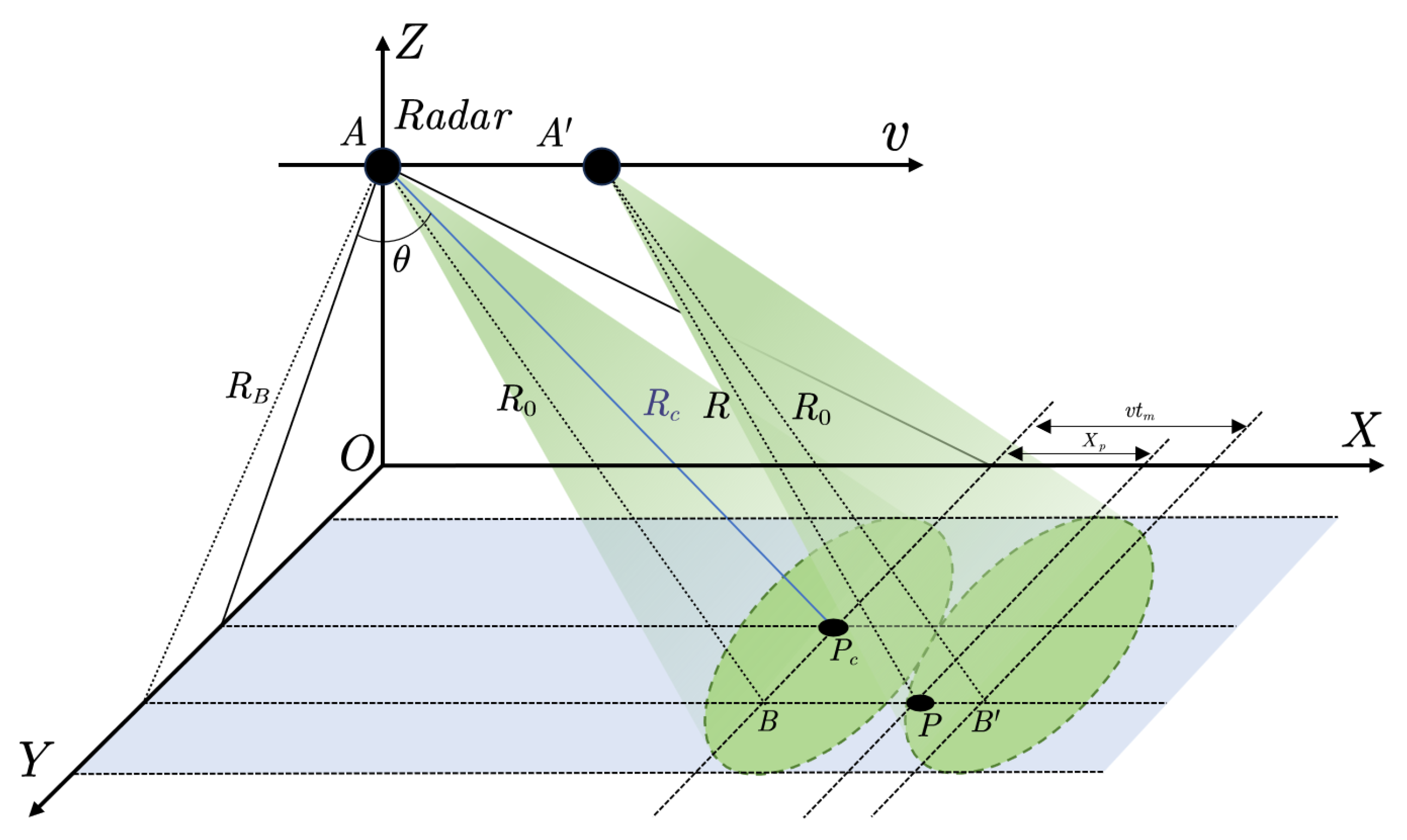
Figure 1. Geometry of squint SAR imaging.
Remotesensing 17 03685 g001
Figure 2. (a) Doppler chirp rate at different squint angles and range when the carrier frequency is 220 GHz. (b) Doppler parameters at different squint angles when the carrier frequency is 220 GHz.
Remotesensing 17 03685 g002
Figure 3. (a) The Doppler history at different range and azimuth when the carrier frequency is 220 GHz and the squint angle is 60 degrees. (b) Doppler parameters at different carrier frequencies when the squint angle is 60 degrees.
Remotesensing 17 03685 g003
Figure 4. Phase errors of different orders when the squint angle is 60 degrees.
Remotesensing 17 03685 g004
Figure 5. Flowchart of the proposed algorithm.
Remotesensing 17 03685 g005
Figure 6. The layout of the point targets in the simulation.
Remotesensing 17 03685 g006
Figure 7. (a) The imaging results of the NFSA. (b) The imaging results of the proposed algorithm.
Remotesensing 17 03685 g007
Figure 8. The imaging result and 2D profiles of (ac) target A, (df) target B, and (gi) target C utilizing NFSA.
Remotesensing 17 03685 g008
Figure 9. The imaging result and 2D profiles of (ac) target A, (df) target B, and (gi) target C utilizing the proposed algorithm.
Remotesensing 17 03685 g009
Figure 10. (a) The actual imaging scenario. (b) The actual airborne platform.
Remotesensing 17 03685 g010
Figure 11. (a) The actual imaging scenario. (b) The imaging results of the RDA. (c) The imaging results of the NFSA. (d) The imaging results of the proposed algorithm.
Remotesensing 17 03685 g011
Figure 12. (a,b) The azimuth profile of different algorithms for targets A and B. (c,d) The range profile of different algorithms for targets A and B.
Remotesensing 17 03685 g012
Table 1. Simulation parameters.
DescriptionValue
Carrier frequency220 GHz
Bandwidth5 GHz
Pulse width26 µs
Pulse repetition frequency10 kHz
Reference distance3 km
Height1 km
Radar velocity60 m/s
Squint angle60°
Table 2. Performance metrics comparison of simulated imaging results.
Imaging Result of NFSA (A/B/C)Imaging Result of the Proposed Algorithm (A/B/C)
IRW (cm)Range6.48/6.72/7.216.03/6.19/6.23
Azimuth6.63/7.91/13.156.34/6.72/6.89
PSLR (dB)Range−12.03/−11.14/−10.65−13.56/−13.93/−13.63
Azimuth−11.56/−10.98/−10.78−13.87/−13.06/−13.42
ISLR (dB)Range−10.35/−9.13/−9.01−11.56/−11.04/−11.32
Azimuth−9.62/−8.03/−6.47−11.23/−10.92/−10.39
Table 3. Terahertz imaging system parameters.
DescriptionValue
Carrier frequency220 GHz
Bandwidth900 MHz
Pulse repetition frequency15 kHz
Reference distance3 km
Radar velocity60 m/s
Squint angle60°
Azimuth beamwidth1.4°
Flying height1 km
Table 4. Image quality metrics comparison of real-data imaging results.
RDANFSAThe Proposed Algorithm
Image entropy5.214.934.58
Image contrast5.435.525.91
Table 5. Performance metrics comparison of real-data imaging results.
Imaging Result of RDA (A/B)Imaging Result of NFSA (A/B)Imaging Result of the Proposed Algorithm (A/B)
IRW (m)Range0.42/0.410.37/0.360.36/0.35
Azimuth1.41/1.120.42/0.430.41/0.42
PSLR (dB)Range−7.65/−8.23−9.90/−10.58−11.22/−11.90
Azimuth−3.40/−3.23−6.91/−5.79−9.47/−9.99
ISLR (dB)Range−8.54/−8.93−9.22/−9.36−9.13/−9.64
Azimuth−3.81/−3.47−6.23/−6.92−7.29/−7.13
Disclaimer/Publisher’s Note: The statements, opinions and data contained in all publications are solely those of the individual author(s) and contributor(s) and not of MDPI and/or the editor(s). MDPI and/or the editor(s) disclaim responsibility for any injury to people or property resulting from any ideas, methods, instructions or products referred to in the content.