Article

Integration of SBAS-InSAR and KTree-AIDW for Surface Subsidence Monitoring in Grouting Mining Areas


1
School of Surveying and Land Information Engineering, Henan Polytechnic University, Jiaozuo 454003, China
2
State Collaborative Innovation Center of Coal Work Safety and Clean-Efficiency Utilization, Henan Polytechnic University, Jiaozuo 454003, China
*
Author to whom correspondence should be addressed.
Remote Sens. 2025, 17(17), 3111; https://doi.org/10.3390/rs17173111
Submission received: 26 July 2025 / Revised: 3 September 2025 / Accepted: 4 September 2025 / Published: 6 September 2025
(This article belongs to the Special Issue Advances in Surface Deformation Monitoring Using SAR Interferometry)

Abstract

Small Baseline Subset Interferometric Synthetic Aperture Radar (SBAS-InSAR) technology, with its advantages in large-scale and high-precision deformation monitoring, has become an essential tool for monitoring surface subsidence in coal mining areas. To address the issue of missing deformation values resulting from interferometric decoherence when using InSAR technology for surface subsidence monitoring in mining areas, this study proposes a combined approach integrating SBAS-InSAR with KTree Adaptive Inverse Distance Weighting (KTree-AIDW). The method constructs a dynamic neighborhood search mechanism through the KTree algorithm, considering the spatial heterogeneity between the interpolation points and adjacent sample points, and optimizes the weight distribution of heterogeneous sample points. The study is based on Sentinel-1 data with a 12-day revisit cycle, focusing on the 2021 grouting working face of the Liangbei Mine in Yuzhou, Henan Province, China. The results show the following: (1) Along both the strike and dip lines, the correlation coefficient between the SBAS-InSAR + KTree-AIDW results and leveling result is 0.95, with an overall root mean square error (RMSE) of 22.08 mm and a relative root mean square error (RRMSE) of 9.48%. The Mean Absolute Error (MAE) of characteristic points in the decoherence region is 19.05 mm, indicating a significantly improved accuracy in the decoherence region compared to traditional methods. (2) The cumulative maximum subsidence in the study area reached 233 mm, with an average maximum subsidence rate of 171 mm/yr. The maximum positive/negative inclines were 2.4 mm/m and −2.9 mm/m; the maximum positive/negative curvatures were ±0.18 mm/m2. The surface structures are within the threshold values specified for Class I damage. The proposed method effectively addresses the decoherence issue that leads to missing deformation data in mining areas, providing a novel technical approach to accurate surface subsidence monitoring under grouting and backfilling conditions.

1. Introduction

Coal has long been the primary source of energy in China. The coal industry holds a pivotal position in China’s energy structure and plays a significant role in the country’s economic development and social stability [1,2]. However, large-scale and continuous mining activities in mining areas often lead to ground subsidence, which can damage surface infrastructure and trigger various geological hazards [3,4,5]. To mitigate surface disasters caused by subsidence and minimize economic losses, it is essential to quickly and comprehensively obtain surface subsidence information through effective mining damage prevention and control technologies.
Traditional surface subsidence monitoring techniques, such as leveling measurements and high-precision Global Navigation Satellite System (GNSS) measurements, provide accurate point-based deformation data but are costly and unsuitable for large-scale applications due to limited spatial coverage [6,7]. In contrast, Interferometric Synthetic Aperture Radar (InSAR) offers wide spatial coverage, all-weather operability, and high measurement accuracy and has become a widely used technique for mining subsidence monitoring [8,9]. Traditional Differential Interferometric Synthetic Aperture Radar (D-InSAR) technology is susceptible to atmospheric delay effects and errors inherent in the Digital Elevation Model (DEM), which limits deformation monitoring accuracy [10,11]. To address these technical limitations, time-series InSAR (TS-InSAR) techniques, such as Persistent Scatterer InSAR (PS-InSAR) [12,13,14] and Small Baseline Subset InSAR (SBAS-InSAR) [15], have been developed. PS-InSAR performs well in urban areas [16,17,18,19] and with exposed rock surfaces [20,21,22,23] due to stable scatterers, whereas SBAS-InSAR constructs interferometric networks by optimizing spatiotemporal baseline thresholds, effectively suppressing spatiotemporal decoherence, and has been widely applied to subsidence monitoring in mining areas [24,25,26,27]. Nevertheless, SBAS-InSAR still faces challenges in practical applications. In areas characterized by high vegetation cover, complex terrain, or severe deformation, interferometric phase noise accumulation and phase unwrapping failures often occur, leading to decoherence and data gaps in monitoring results. Therefore, addressing data gaps caused by decoherence is critical in effective SBAS-InSAR applications.
To address this challenge, scholars have conducted extensive research. For example, the integration of SBAS-InSAR with the Probability Integral Method (PIM) can improve subsidence prediction [28,29], but this method is mainly applicable to longwall mining areas and shows limited accuracy in grouting working faces, where stratum reinforcement significantly alters physical and mechanical properties. Offset Tracking (OT) has been employed to capture large deformation gradients [30,31,32], but its precision for small-scale deformation is relatively low. The combination of SBAS-InSAR with airborne LiDAR or UAV-based LiDAR can partially compensate for data gaps [33,34], yet the acquisition of LiDAR data requires substantial manpower and resources, making it unsuitable for long-term time-series monitoring. In comparison, interpolation methods provide a cost-effective alternative, especially for moderate subsidence values. Among these, sbas-insar integrated with the Kriging method [35] and Inverse Distance Weighting method (IDW) [36] are the most commonly used. Kriging, as a geostatistical interpolation technique, incorporates spatial autocorrelation to produce unbiased estimates with minimized variance, but variogram modeling is complex and often unstable in heterogeneous mining environments. IDW is computationally simple and efficient but only considers distance decay while ignoring spatial heterogeneity, which frequently results in oversmoothing and reduced accuracy [37]. Therefore, these methods exhibit limitations in addressing the spatial complexity of mining-induced subsidence.
To address these issues, this study proposes an integrated method that combines SBAS-InSAR with KTree-Enhanced Adaptive Inverse Distance Weighting (KTree-AIDW) for mining subsidence monitoring. First, cumulative subsidence results derived from SBAS-InSAR are classified according to coherence characteristics. Then, during the training process, the optimal neighborhood size (k) is adaptively determined for each sample, and adaptive weights are assigned based on classification results. KTree-AIDW interpolation is subsequently applied in decoherent regions to reconstruct a complete deformation field. Unlike previous studies, this research represents the first application of KTree-AIDW in mining subsidence monitoring, with particular suitability for grouting working faces. The proposed method not only improves the reliability and spatial continuity of SBAS-InSAR results but also provides practical value for subsidence risk management in mining areas.

2. Study Area and Data Sources

2.1. Study Area

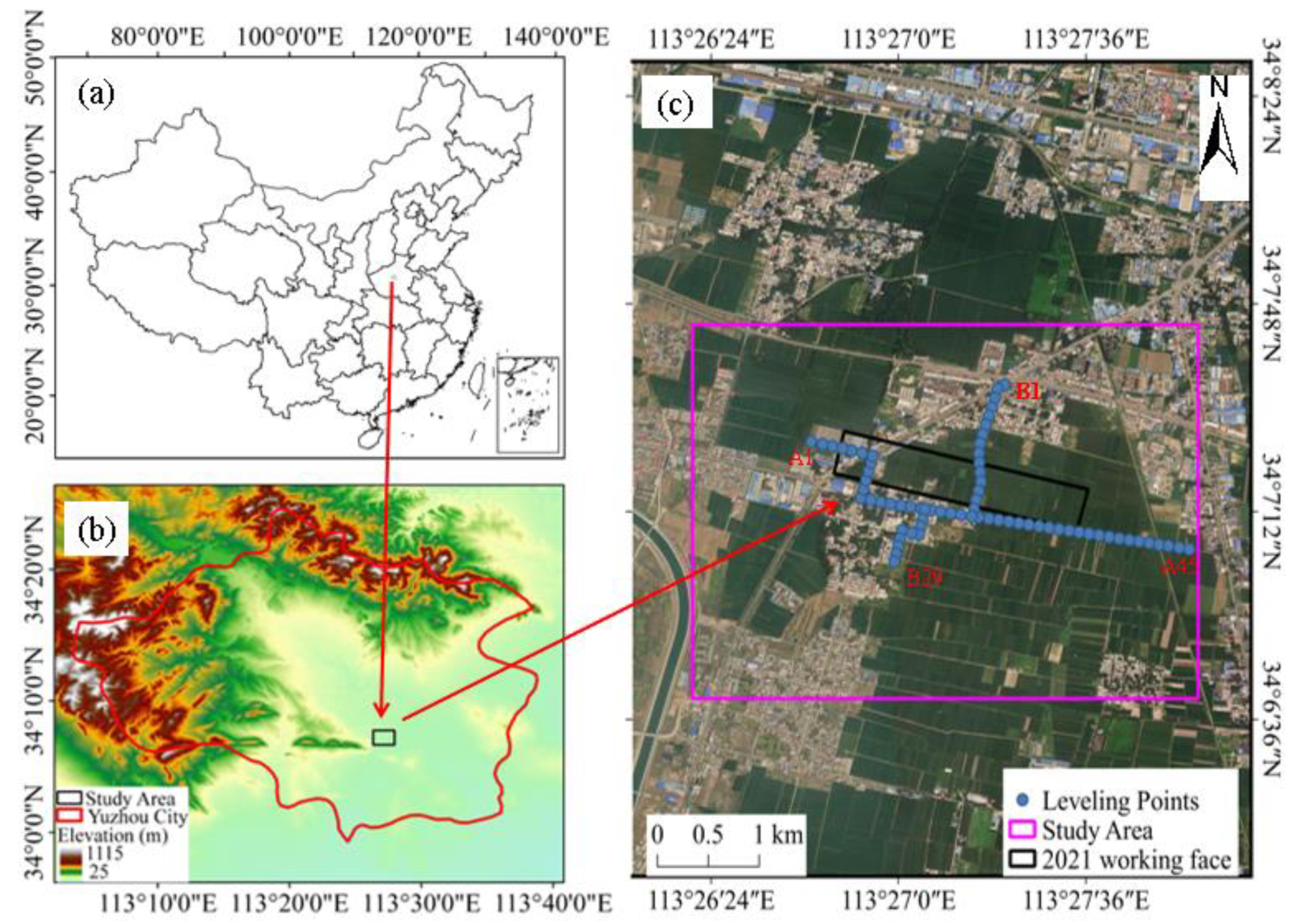
The study area is located approximately 6.0 km southwest of Yuzhou City, Henan Province, China, within the Liangbei Coal Mine, as shown in Figure 1. The 2021 working face employs overburden isolation grouting backfill technology to mitigate surface subsidence induced by mining activities. The working face has an average strike length of approximately 1195.6 m and a panel width of 231 m. The coal seam thickness ranges from 0.15 m to 14.2 m, with an average thickness of approximately 6.7 m. The dip angle of the seam ranges between 6° and 16°, with an average of 11°. The mining elevation ranges from −373.9 m to −432.8 m, corresponding to burial depths of approximately 492.1 m to 547.4 m. The recoverable coal reserves within this working face are estimated at around 2.07 million tons. Mining operations on the 2021 working face commenced in June 2022, progressing from the northwest toward the southeast. By January 2024, approximately 898.8 m of the working face had been extracted.

2.2. Data Sources

2.2.1. Datasets Used in SBAS-InSAR Processing

In this study, Sentinel-1A satellite imagery provided by the European Space Agency (ESA) was employed. Sentinel-1A carries a C-band Synthetic Aperture Radar (SAR) sensor operating in Interferometric Wide-swath (IW) mode, with VV polarization, a range resolution of approximately 5 m, and an azimuth resolution of about 20 m. A total of 49 Single Look Complex (SLC) format images covering the study area were acquired from 9 June 2022, to 30 January 2024, with a revisit time of 12 days (the data for 9 October 2022 and 3 August 2023 were not collected). The detailed acquisition dates are listed in Table 1. The average incidence angle at the scene center was approximately 41.88°. Precise Orbit Determination (POD) data were applied to correct satellite orbital errors. Topographic phases were removed using Shuttle Radar Topography Mission (SRTM) DEM data with a spatial resolution of 30 m. Additionally, atmospheric phase delays were corrected using data from the Generic Atmospheric Correction Online Service (GACOS) [38,39].

2.2.2. Leveling Data

A surface movement observation station was established above the 2021 working face in the Liangbei Coal Mine. Leveling measurements were conducted using a South DL-2007 electronic level manufactured by China South Surveying & Mapping Technology Co., Ltd., located in Guangzhou, China. The data were measured according to the fourth-order leveling survey standards, with the allowable closing error of 20 L mm (L is the length of the leveling line in km). Monitoring points were strategically positioned within the coal mining subsidence area to measure and record elevation changes regularly, providing reliable subsidence data. In the 2021 working face of Liangbei Coal Mine, due to dense surface infrastructure and extensive farmland, the deployment of ground deformation monitoring stations was significantly constrained, making it impractical to establish stations within the main subsidence basin. Consequently, two leveling measurements lines, one along the strike direction and the other along the dip direction, were established along an existing roadway. The strike-direction survey line consisted of 45 monitoring points (A1–A45), spaced at 50 m intervals, covering approximately 2250 m. The dip-direction survey line included 29 monitoring points (B1–B29), also spaced at 50 m intervals, spanning approximately 1450 m. Four monitoring points were shared between the two measurements lines (A20/B19, A21/B18, A22/B17, and A23/B16). Periodic leveling measurements were conducted at these points to capture surface deformation over time. The spatial layout of the monitoring points is illustrated in Figure 1c.

3. Research Methods

3.1. Principles of SBAS-InSAR

Suppose a collection of N + 1 SAR images covering the study area were acquired at sequential acquisition times ( t 0 , t 1 , …, t N ). Each SAR image can form an interferogram with at least one other SAR image based on the conditions of spatiotemporal baselines. Combining interferometric pairs according to the conditions of spatiotemporal baselines will yield M interferograms, where the range of M is as follows:
N + 1 2 M N N + 1 2
Taking the moment t 0 as the reference moment, φ ( t m ) is the differential phase at the time t i ( i = 1, …,   N ). For the m-th differential interferogram generated at t A and t B ( t A > t B ), the interference phase value of any pixel x , r is
δ φ m x , r = φ t A , x , r φ t B , x , r 4 π λ d t A , x , r d t B , x , r
where δ φ m x , r is the interferometric phase of the pixel x , r in the m-th interferogram; λ is the wavelength of the satellite; and d t A , x , r and d t B , x , r are the cumulative line-of-sight (LOS) deformations at times t A and t B , respectively, relative to the reference time t 0 .
To obtain the time series of surface deformation for the study area, the interferometric phase ν m can be expressed as the product of the average phase change rate between two time points and the time difference, specifically given by
ν m = φ m φ m 1 t m t m 1
Assuming that the deformation rate between different interferograms is v k , k and k 1 represent the serial number of SAR images. The value of the m-th differential interferogram can be reformulated as
  δ φ m = k = t B , m + 1 t A , m   t k t k 1 v k
In other words, it represents the integration of the velocity over each time period across the master and slave image time intervals. Equation (4) can be rewritten into the matrix form as
  B ν = δ φ
Equation (5) is a matrix with the dimension of M × N. If there is more than one small baseline set, matrix B exhibits a rank deficiency. In such cases, the Singular Value Decomposition (SVD) method can be employed to decompose the coefficient matrix B, facilitating the joint solution of multiple small baseline sets. Consequently, a least-squares solution that minimizes the norm of the cumulative shape variable can be obtained, enabling the estimation of the shape variable.
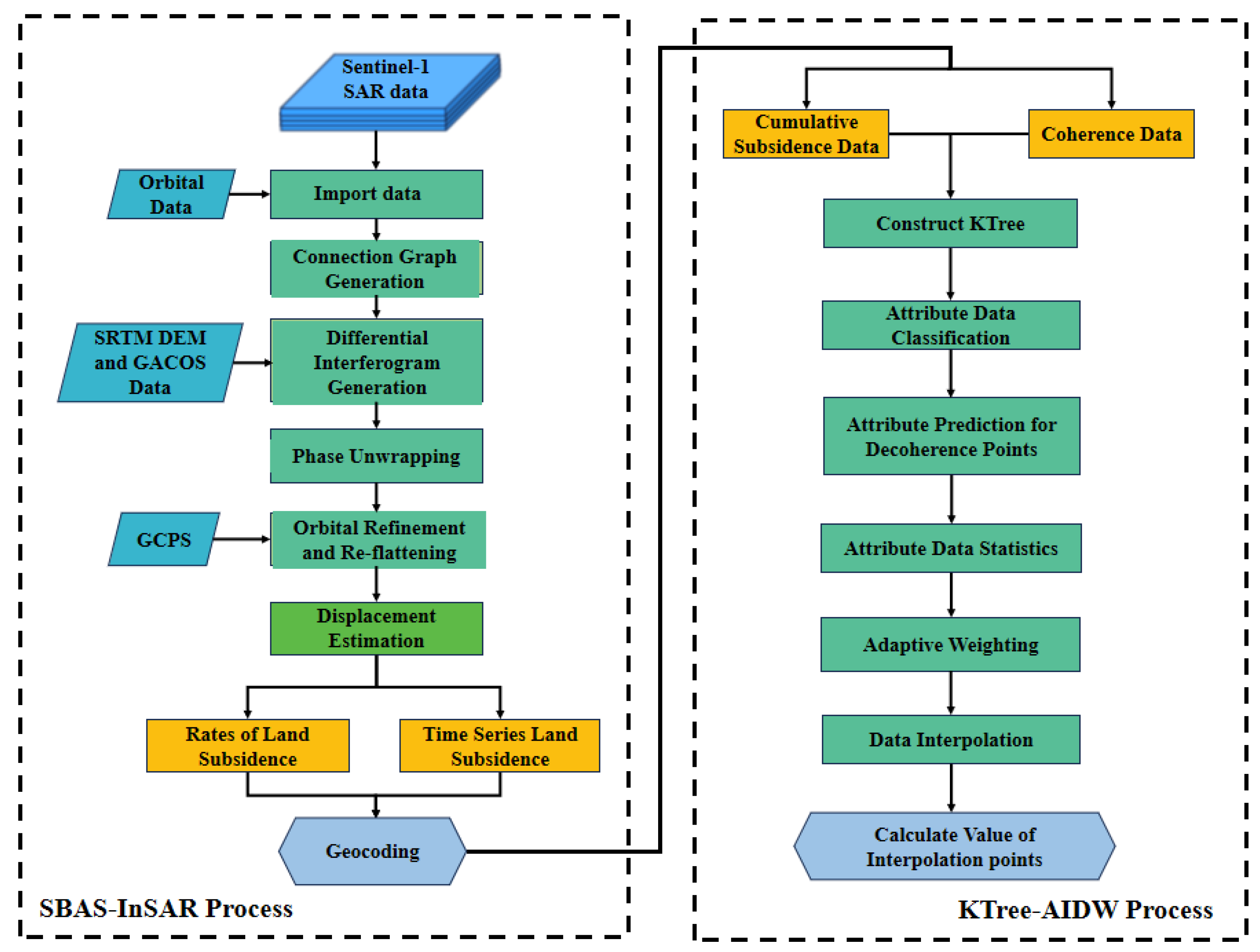
Based on the principles of SBAS-InSAR, the workflow includes preprocessing, baseline network construction, interferogram generation, phase unwrapping, deformation estimation, and geocoding.

3.2. Principles of KTree-AIDW Interpolation Method

The KTree-AIDW interpolation method employed in this study is based on Tobler’s First Law of Geography. By utilizing the KTree algorithm to assess spatial heterogeneity between interpolation points and neighboring samples, the method dynamically adjusts weights during interpolation. In regions exhibiting high spatial heterogeneity, weights of certain reference samples are reduced to mitigate adverse effects, thereby enhancing interpolation accuracy. Overall, the method consists of three main phases: KTree construction, classification, and interpolation.

3.2.1. KTree Construction

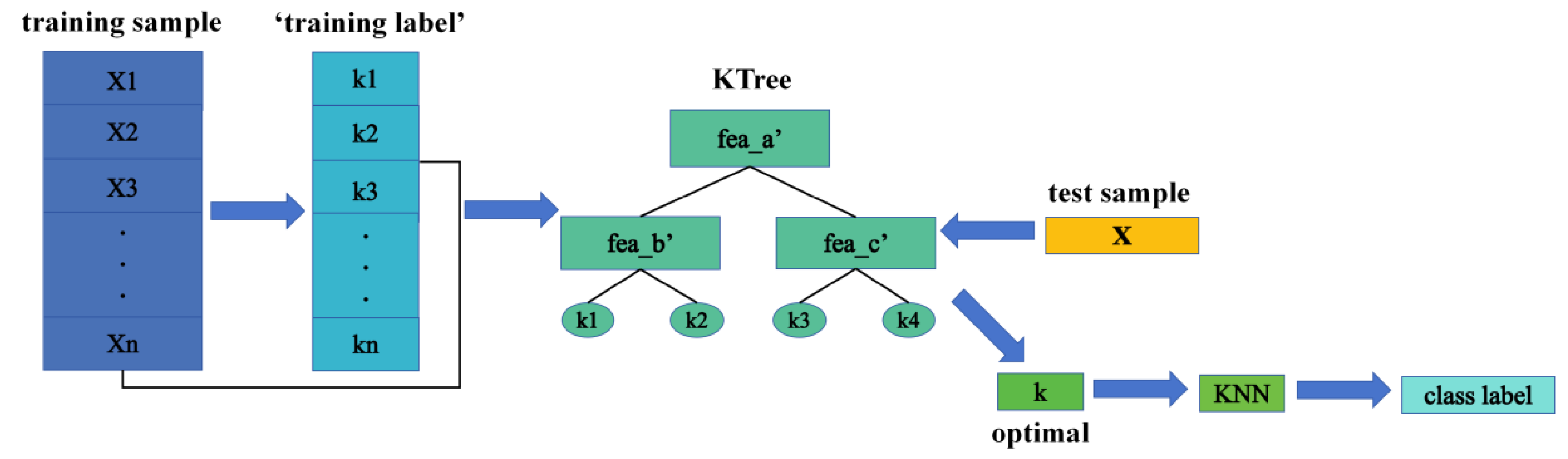
In the traditional k-nearest neighbors (KNN) algorithm, the neighborhood size k is fixed and cannot adapt to local data characteristics. To overcome this, the KTree algorithm introduces a training phase: it learns an optimal k for each sample, adapting to local distributions and improving classification accuracy. In this study, we adopt the KTree model proposed by Zhang et al. [40], where a KTree is constructed using training samples and their corresponding optimal k values, stored in the leaf nodes.
During training, a maximum neighbor size k m a x is specified. For each sample, the optimal k is obtained through sparse reconstruction, adaptively considering class distributions. Homogeneous neighborhoods require smaller k, while heterogeneous ones need larger k. Practically, the max nearest neighbors are identified, class proportions are tallied stepwise, and neighborhoods expand until a class proportion reaches a threshold; if none does, k m a x is chosen to ensure stability. The derived optimal k values act as “pseudo-labels” for constructing a KTree via decision tree methods. In testing, the optimal k for a new sample is quickly retrieved from the KTree, enabling KNN prediction of its category. The process of KTree is shown in Figure 2.

3.2.2. Classification

After KTree construction, each subsidence point is classified to account for spatial heterogeneity in interpolation. SBAS-InSAR cumulative subsidence data are first converted to point form and matched with coherence values. The optimal neighborhood size (k) for each point is then determined using the KTree, and the k nearest training samples are selected. Majority voting assigns the most frequent category to the point.
The Pearson correlation coefficient (r) was applied to evaluate the relationship between datasets. Since cumulative subsidence from SBAS-InSAR data shows strong correlation with coherence (r = 0.68) [41], coherence was adopted as the classification criterion. Accordingly, samples were divided into four categories based on coherence: High, Medium, Low, and Extremely Low.
t i = H i g h ,                                                                     0.6 z i 1   m e d i u m ,                                               0.35 < z i 0.6 L o w ,                                                           0.15 < z i 0.35 E x t r e m e l y   l o w ,                               0 < z i 0.15
where t i is the attribute of the dataset sample; z i is the coherence of the dataset sample.

3.2.3. Interpolation

Following dataset classification, the KTree algorithm is combined with AIDW to build an interpolation model that accounts for spatial heterogeneity, termed KTree-AIDW. This model extends traditional IDW by introducing a harmonizing factor that incorporates spatial coherence and heterogeneity into the weight calculation. In regions with strong heterogeneity, the weights of local reference samples are reduced, enhancing interpolation robustness. After classification, the numbers of first-order neighbors in the categories High, Medium, Low, and Extremely Low are denoted as m 1 , m 2 , m 3 , and m 4 , respectively. The KTree algorithm is then used to predict the attribute of the point to be interpolated. Based on these steps, an interpolation model that explicitly considers spatial heterogeneity is established, as detailed below:
  z x = i = 1 m 1 m 1 d i n z i + j = 1 m 2 m 2 d j n z j + k = 1 m 3 m 3 d k n z k + l = 1 m 4 m 4 d l n z l i = 1 m 1 m 1 d i n + j = 1 m 2 m 2 d j n + k = 1 m 3 m 3 d k n + l = 1 m 4 m 4 d l n
where z x is the estimated value of the points to be interpolated; m 1 , m 2 , m 3 , and m 4 are the number of samples with High, Medium, Low, and Extremely Low attributes, respectively; z i , z j , z k , and z l are the observed values of samples with High, Medium, Low, and Extremely Low attributes, respectively; d i , d j , d k , and d l are the Euclidean distances between the samples and the interpolation points; and n is the power exponent.
The specific research method flow chart of this paper is as shown in Figure 3.

4. Result Analysis

4.1. Analysis of SBAS-InSAR Results

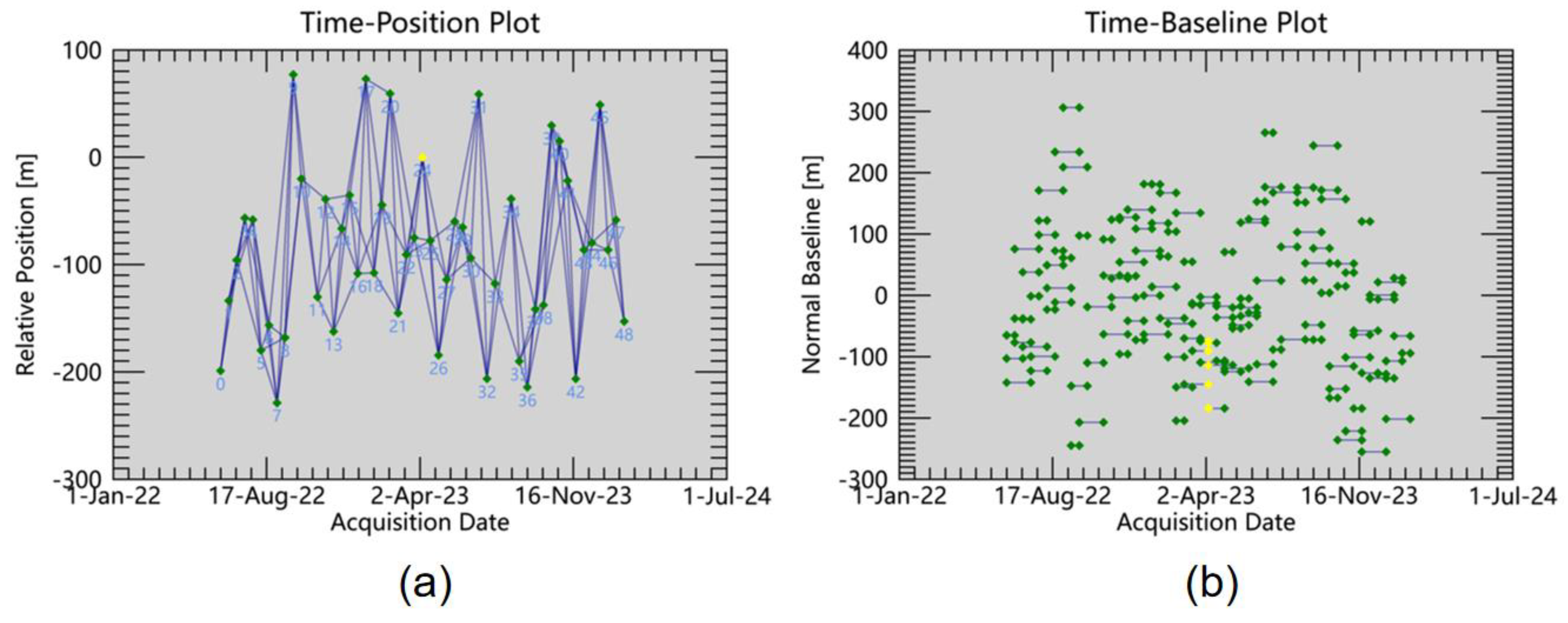
In this study, the Environment for Visualizing Images (ENVI) and SARscape 5.6 software were employed to process the SAR images. The temporal baseline threshold was set to 40 days, while the spatial baseline threshold was defined as 45% of the critical baseline to reduce geometric decoherence and ensure the quality of the interferograms. This configuration followed the small baseline principle, thereby maintaining the stability and connectivity of the SBAS network. The spatio-temporal distribution and baseline connectivity of the dataset are shown in Figure 4, where yellow dots represent the super master images, green dots denote the remaining SAR images, and connecting line segments indicate the interferometric pairs. A total of 135 interferometric pairs were generated by combining appropriate spatiotemporal baselines. The Goldstein filtering method was utilized for interferometric filtering, and the Delaunay Minimum Cost Flow (Delaunay MCF) method, based on Delaunay triangulation, was employed for phase unwrapping. This approach unwraps the phase exclusively for high-coherence pixels, thus avoiding interference from low-coherence pixels. When multiple low-coherence regions exist in the image, Delaunay triangulation is particularly effective in minimizing phase jumps. To improve phase-unwrapping results, the coherence threshold for unwrapping was set to 0.3. Following SBAS-InSAR processing, the average subsidence rate and cumulative subsidence along the line of sight (LOS) were derived for the study area. InSAR exhibits the highest sensitivity to vertical deformation, moderate sensitivity to east–west motion, and the lowest sensitivity to north–south motion [42]. When horizontal displacements are low, their effects can be disregarded, and the line-of-sight (LOS) measurements can be converted into vertical deformation. The formula for calculating vertical deformation at any given point is
W x , y = W L o s x , y cos θ
where W x , y is the deformation value at any point; W L o s ( x , y ) is the subsidence value in LOS direction at any point; and θ is the radar incidence angle.
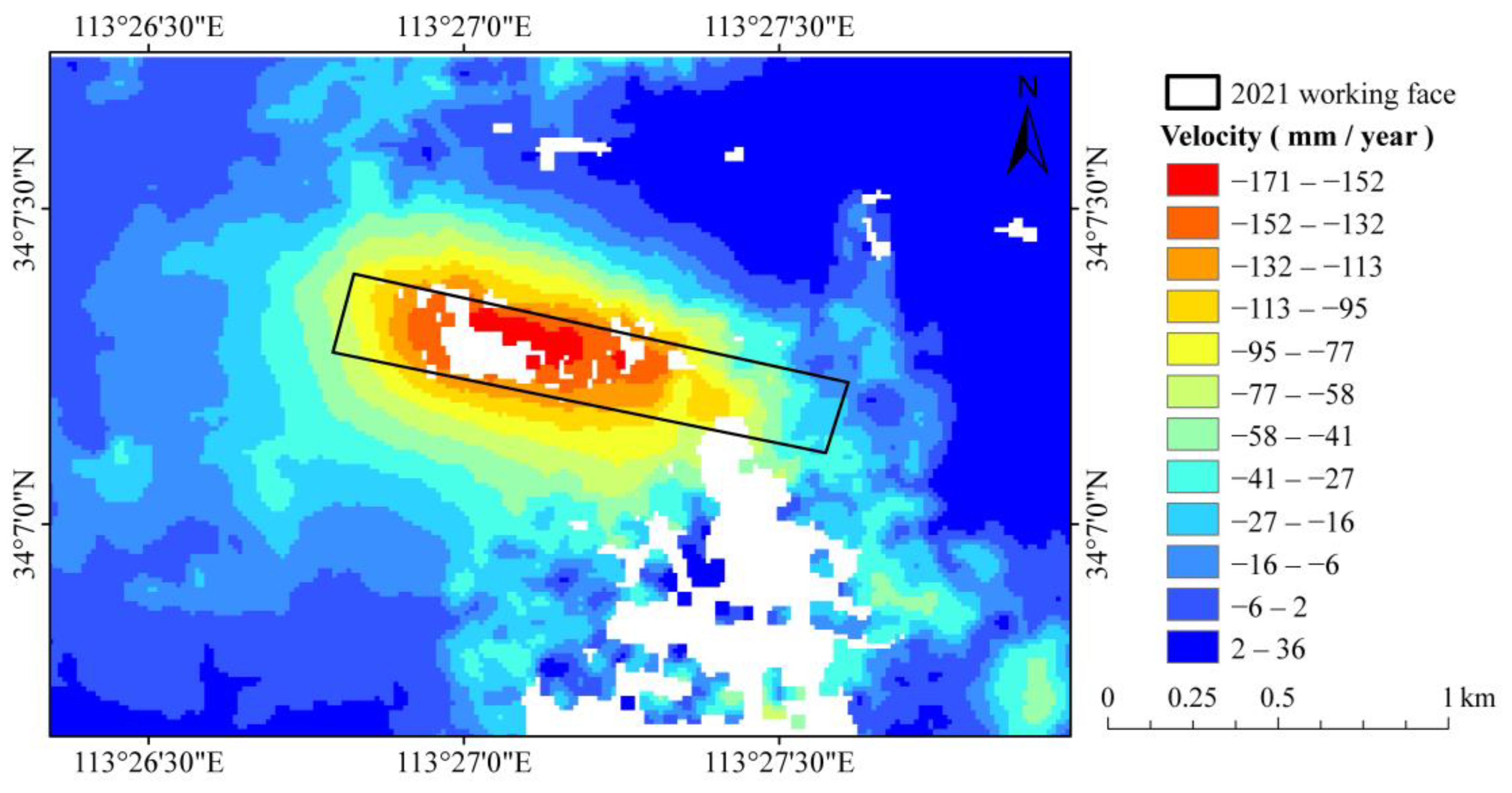
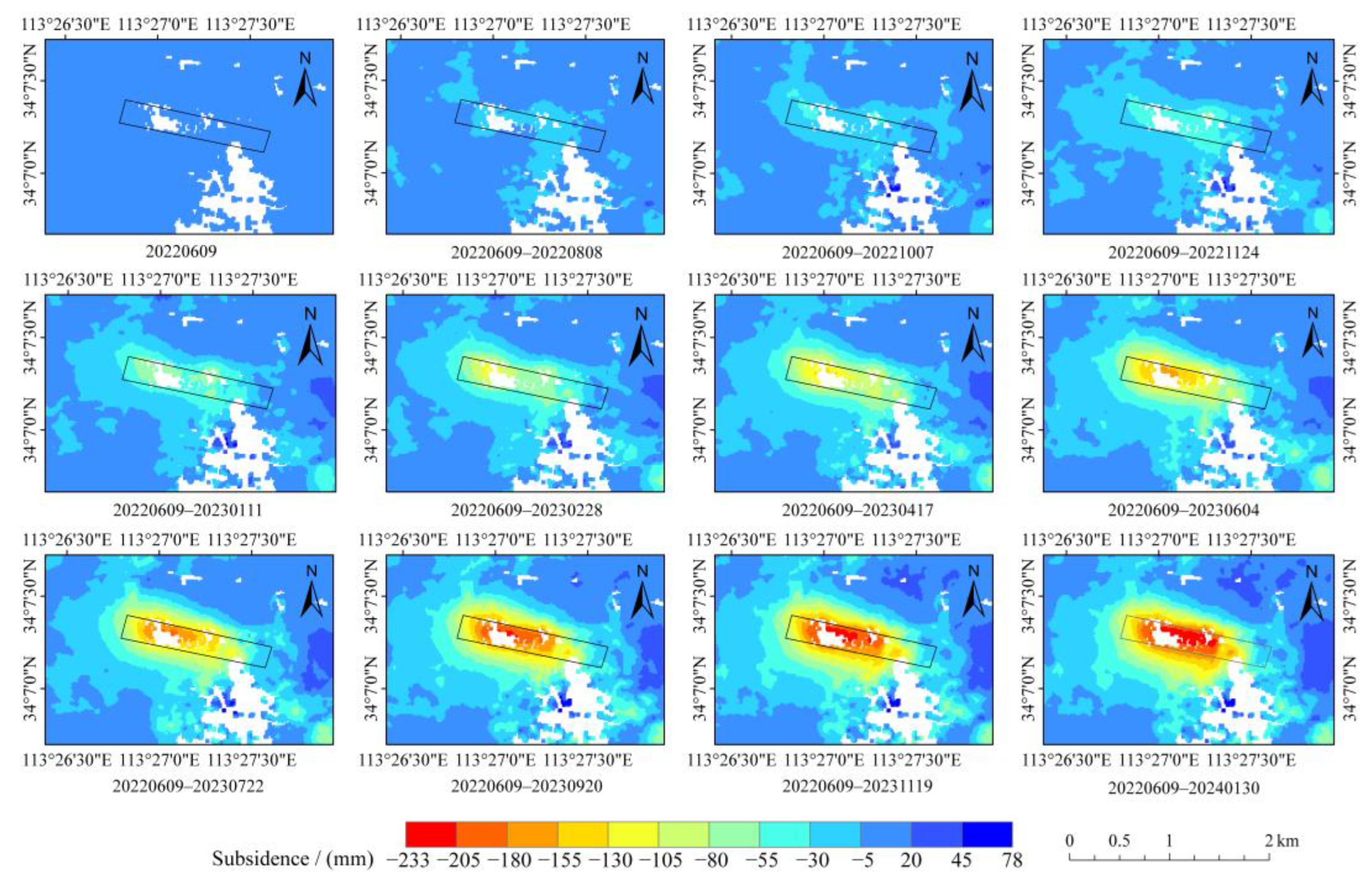
Through the data processing steps outlined above, the subsidence rate and cumulative subsidence diagrams for the Liangbei mining area from 9 June 2022 to 30 January 2024 were obtained, as shown in Figure 5 and Figure 6.
The operational wavelength of SAR significantly affects ground deformation monitoring effectiveness. Generally, longer SAR wavelengths enhance monitoring capabilities and maintain higher coherence. Because the wavelength of C-band Sentinel-1A SAR is relatively short (approximately 5.6 cm), decoherence is more likely to occur when monitoring subsidence in mining areas. Additionally, substantial subsidence over short intervals induced by mining activities leads to decoherence. Vegetation coverage further impedes radar wave penetration and alters backscattering properties, thereby intensifying spatiotemporal decoherence. Consequently, SBAS-InSAR often encounters difficulties in identifying highly coherent points at the center of mining subsidence, resulting in information loss for these critical areas. As shown in Figure 6, decoherence appears in the center of the 2021 working face and in most of its southeastern region. The decoherence regions are predominantly located in farmland areas, as shown in Figure 1c, which is primarily caused by vegetation cover. The results confirm significant subsidence in the mining region, with maximum subsidence reaching approximately 233 mm and an average subsidence rate of about 171 mm/yr. The maximum uplift is around 78 mm. Overall, the subsidence exhibits a clear spatial clustering pattern.

4.2. Analysis of KTree-AIDW Interpolation Results

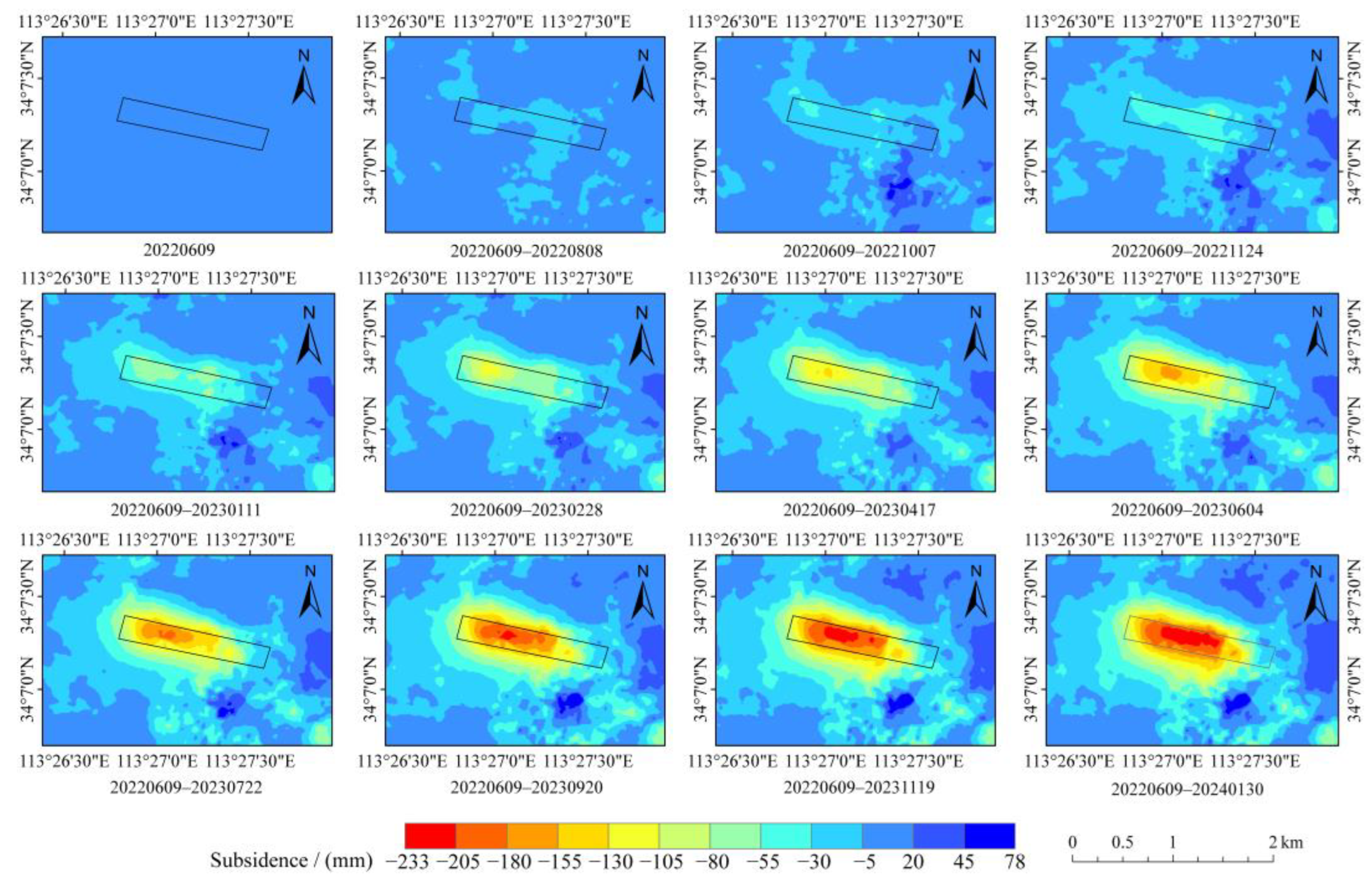
The KTree-AIDW algorithm was applied to interpolate the decoherence regions, thereby generating a complete and reliable time-series subsidence dataset for the mining region, as shown in Figure 7. Prior to August 2022, the subsidence basin associated with the 2021 working face had not yet become pronounced. However, by November 2022, surface subsidence at the 2021 working face had reached 53.9 mm, indicating the initial formation of a noticeable subsidence basin. Beginning in June 2023, the subsidence basin became more prominent, and the extent of the subsidence zone gradually stabilized. Throughout the monitoring period, the maximum cumulative subsidence at the 2021 working face reached 233 mm. As mining activities progressed, the center of subsidence shifted southwestward, and the subsidence zone gradually expanded.
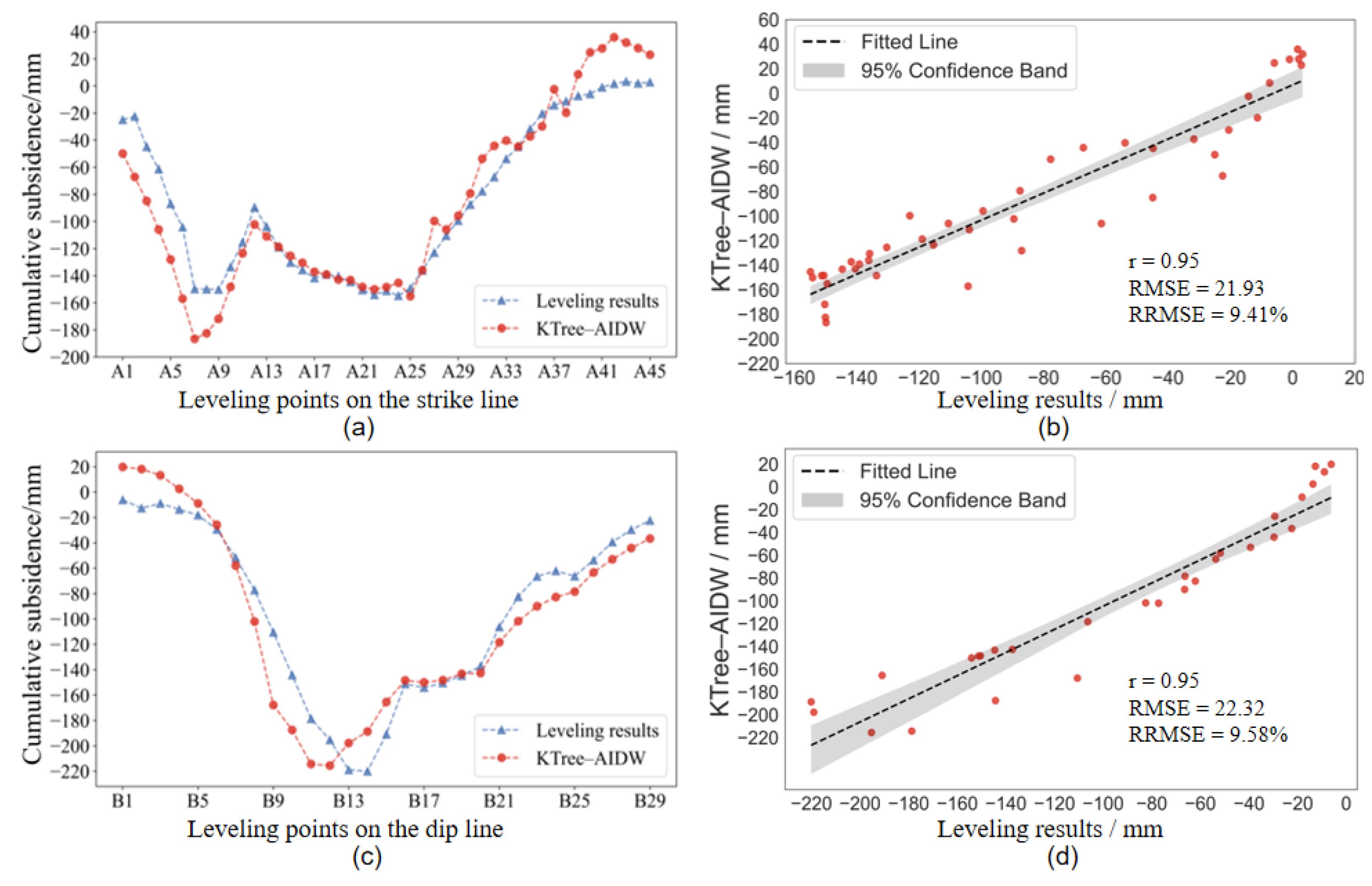
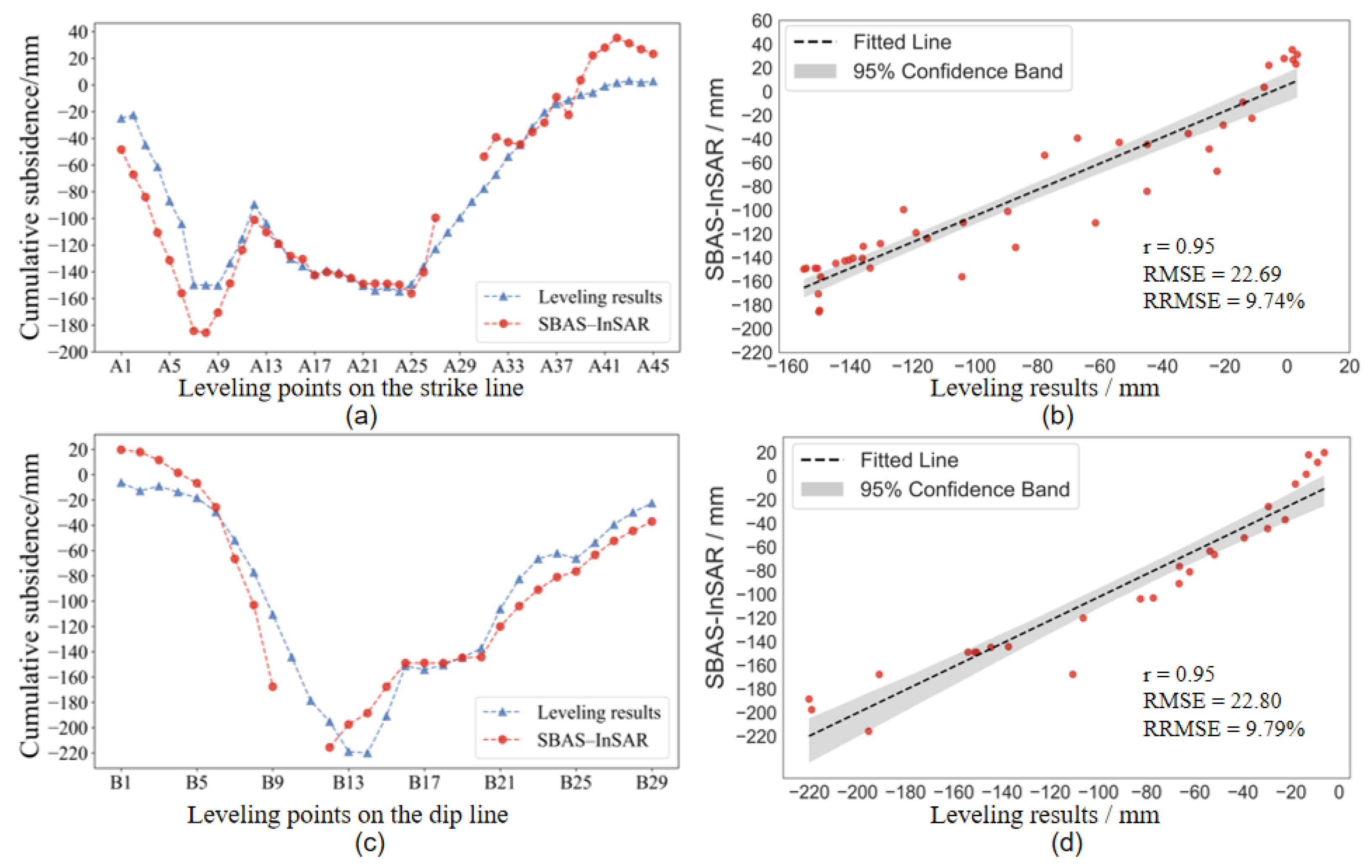
To verify the reliability of the SBAS-InSAR results, the Pearson correlation coefficients between the cumulative subsidence on the strike and dip lines of the working face (as of 30 January 2024) and the leveling results were calculated, as shown in Figure 8. The SBAS-InSAR results exhibited strong agreement with the leveling data, with correlation coefficients of 0.95 for both lines, indicating a high level of consistency. In addition, two metrics were employed to quantitatively assess the accuracy: the root mean square error (RMSE) and the relative root mean square error (RRMSE), calculated using Equations (9) and (10), respectively. The results are summarized in Table 2. Compared to the leveling results, the RMSE and RRMSE for the strike line were 22.69 mm and 9.74%, respectively. For the dip line, the RMSE and RRMSE were 22.80 mm and 9.79%. Overall, the RMSE and RRMSE were 22.73 mm and 9.76%, respectively. Notably, the RRMSE of the extracted subsidence values is below 10%, indicating that the results are reliable. After interpolation using the KTree-AIDW method, the correlation coefficients on both the strike and dip lines remained at 0.95, as shown in Figure 9. Compared with the leveling results, the SBAS-InSAR results yielded an RMSE of 21.93 mm and an RRMSE of 9.41% along the strike line. Along the dip line, the RMSE and RRMSE were 22.32 mm and 9.58%, respectively. Overall, the RMSE and RRMSE were 22.08 mm and 9.48%. Since most of the monitoring points are located within coherent regions, and only five monitoring points fall within decoherence regions, the influence of interpolation on points in coherent regions is limited. In contrast, points located within or near decoherence regions are more significantly affected by the interpolation results. As a result, the overall accuracy after interpolation did not improve significantly.
σ l e v e l = i = 1 n V i 2 n
σ r = σ v m × 100 %
where σ l e v e l is RMSE; σ r is RRMSE; V represents the difference between the real value and the extracted value; n is the number of points; and v m is the maximum surface subsidence value.
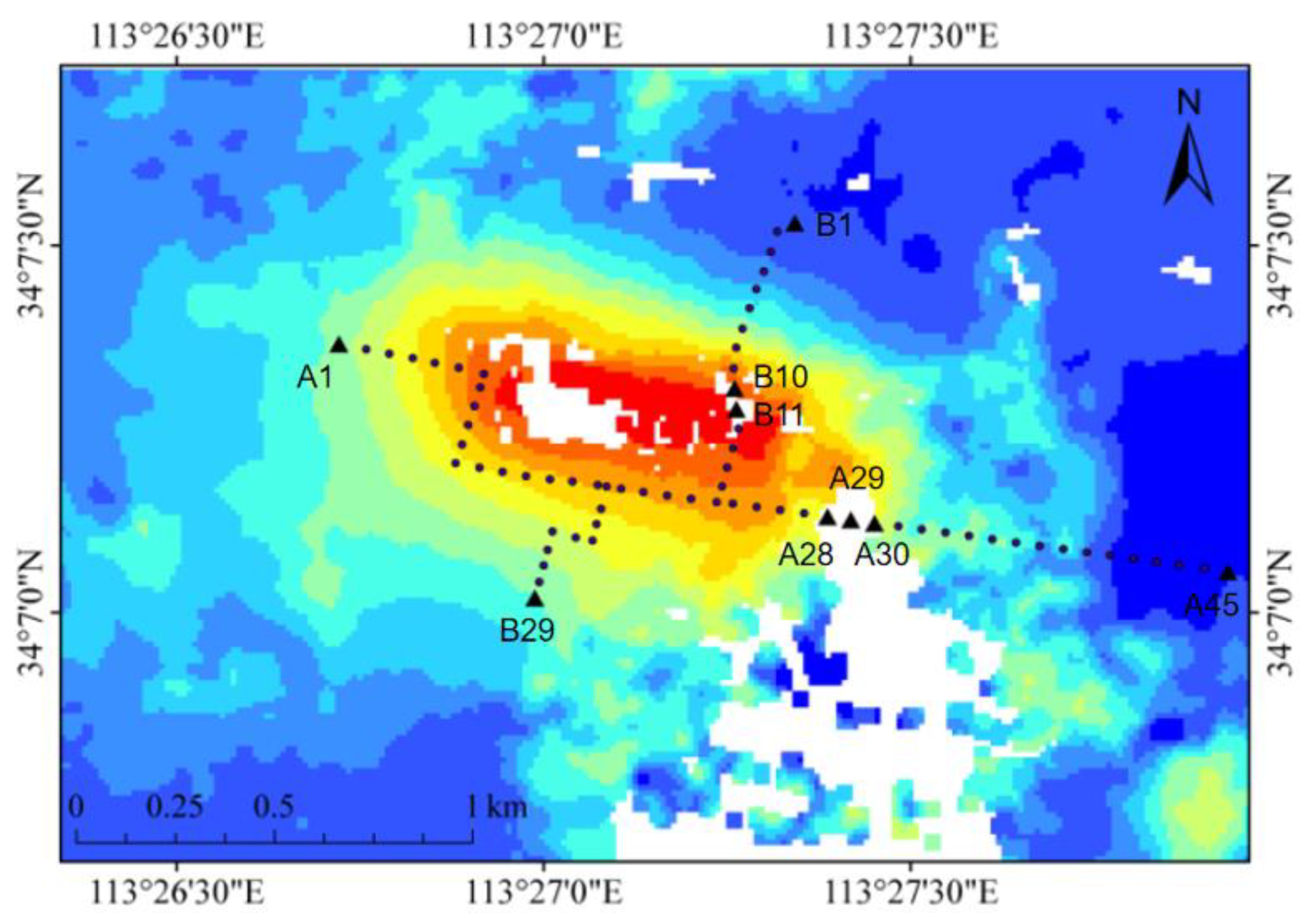
As shown in Figure 10, points A28, A29, and A30 on the strike line, as well as points B10 and B11 on the dip line, are located within the SBAS-InSAR decoherence region. The values at these five monitoring points were extracted for accuracy validation. Several widely used interpolation methods were selected as comparative benchmarks, including Minimum Curvature Interpolation, Nearest Neighbor Interpolation, Bilinear Interpolation, Natural Neighbor Interpolation, Kriging, and Inverse Distance Weighting (IDW). The interpolated results obtained using these methods were compared against KTree-AIDW, as summarized in Table 3. The performance of each method was evaluated by calculating the Absolute Error (AE), Mean Absolute Error (MAE), and Mean Relative Error (MRE).
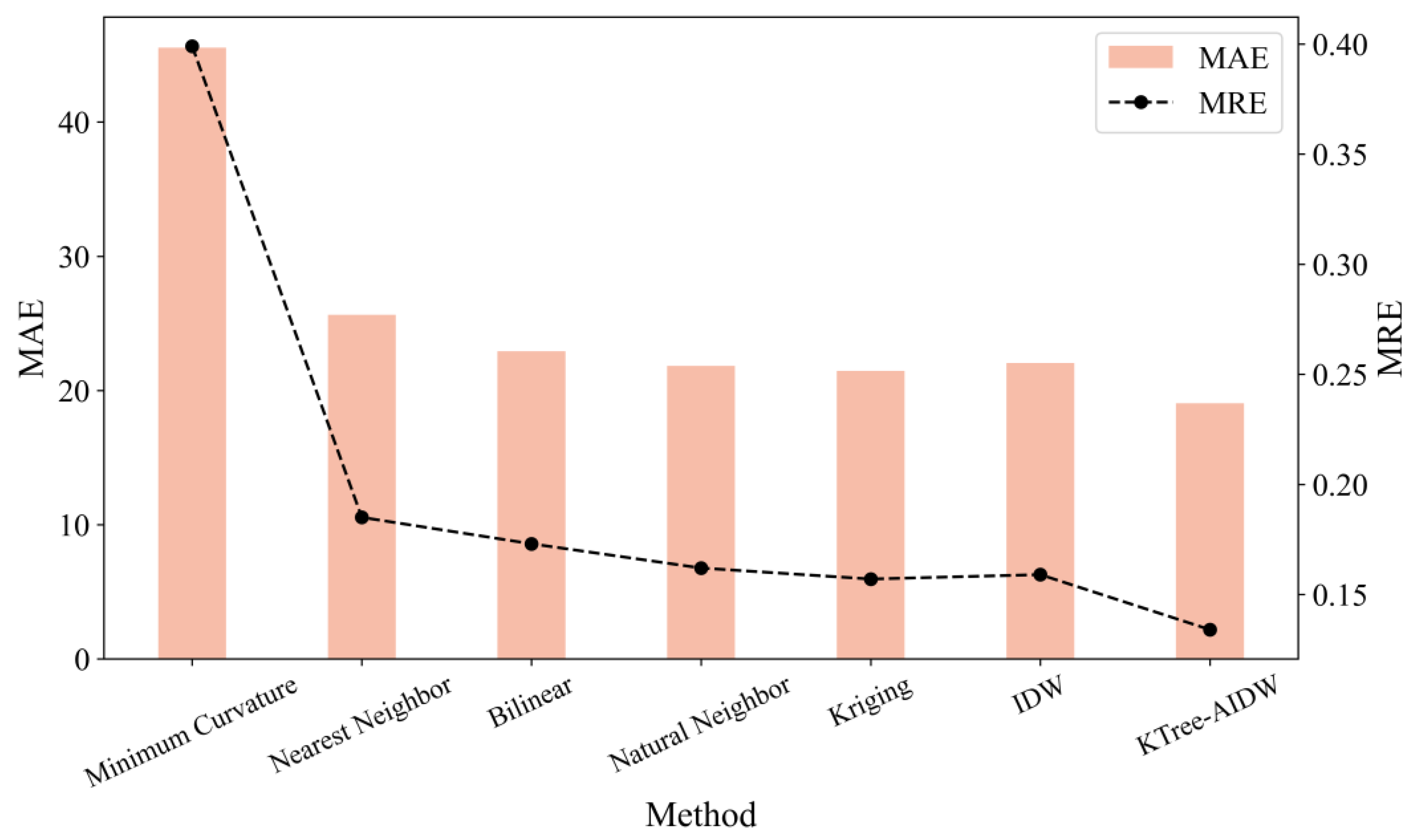
In the decoherence regions, the SBAS-InSAR + KTree-AIDW method achieved a Mean Absolute Error (MAE) of 19.05 mm and a Mean Relative Error (MRE) of 0.134, both significantly lower than those obtained using the other comparative methods as shown in Table 3 and Figure 11. Compared with Minimum Curvature Interpolation, Nearest Neighbor Interpolation, Bilinear Interpolation, Natural Neighbor Interpolation, Kriging, and IDW, the proposed method improved the MAE by 58.18%, 25.67%, 16.92%, 12.73%, 11.23%, and 13.57%, respectively. The improved accuracy of the proposed algorithm facilitates more reliable subsidence estimation in practical applications, thereby providing valuable support for surface deformation monitoring in mining areas. Overall, the KTree-AIDW method demonstrates excellent performance in SBAS-InSAR-based surface subsidence monitoring in mining areas.
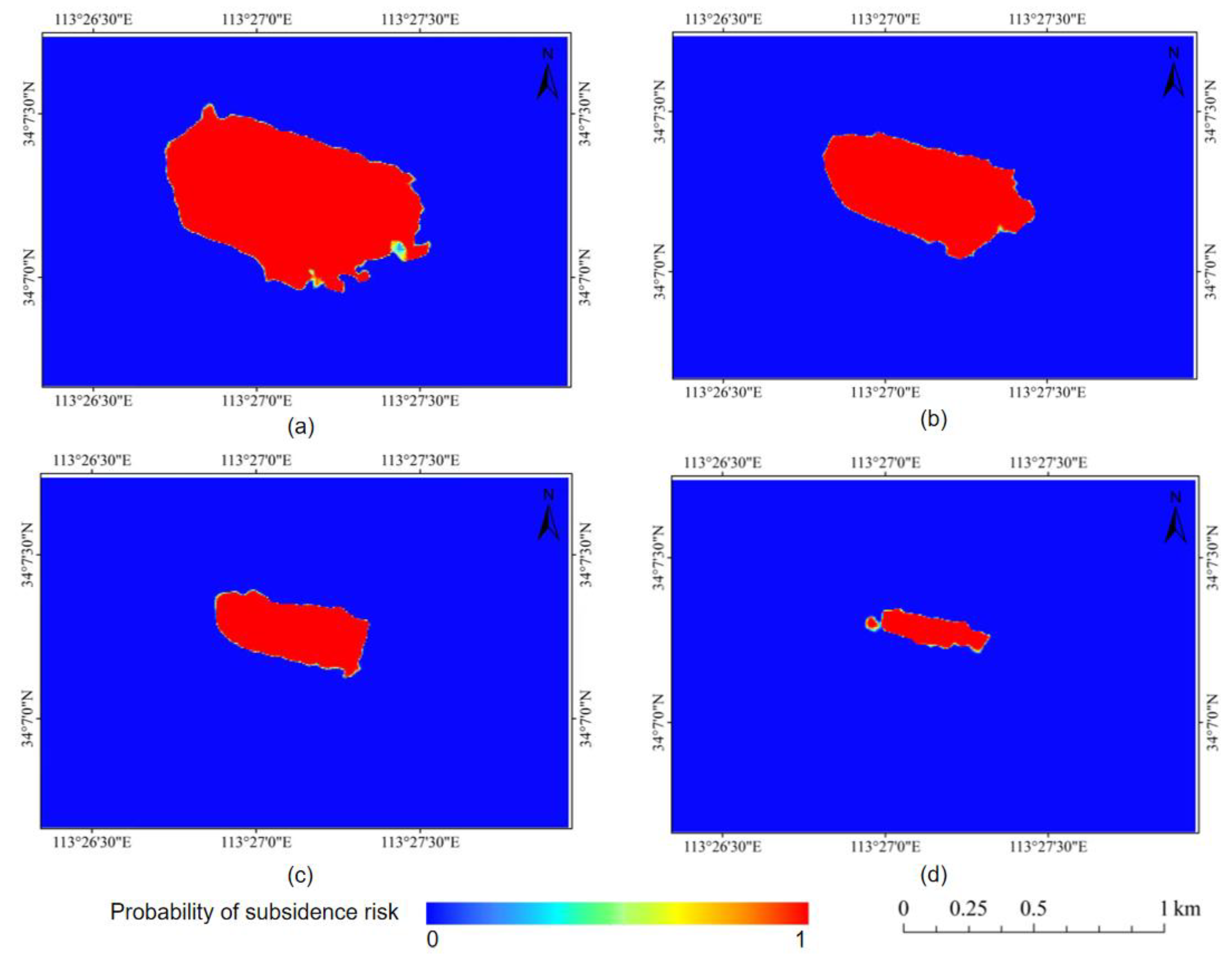
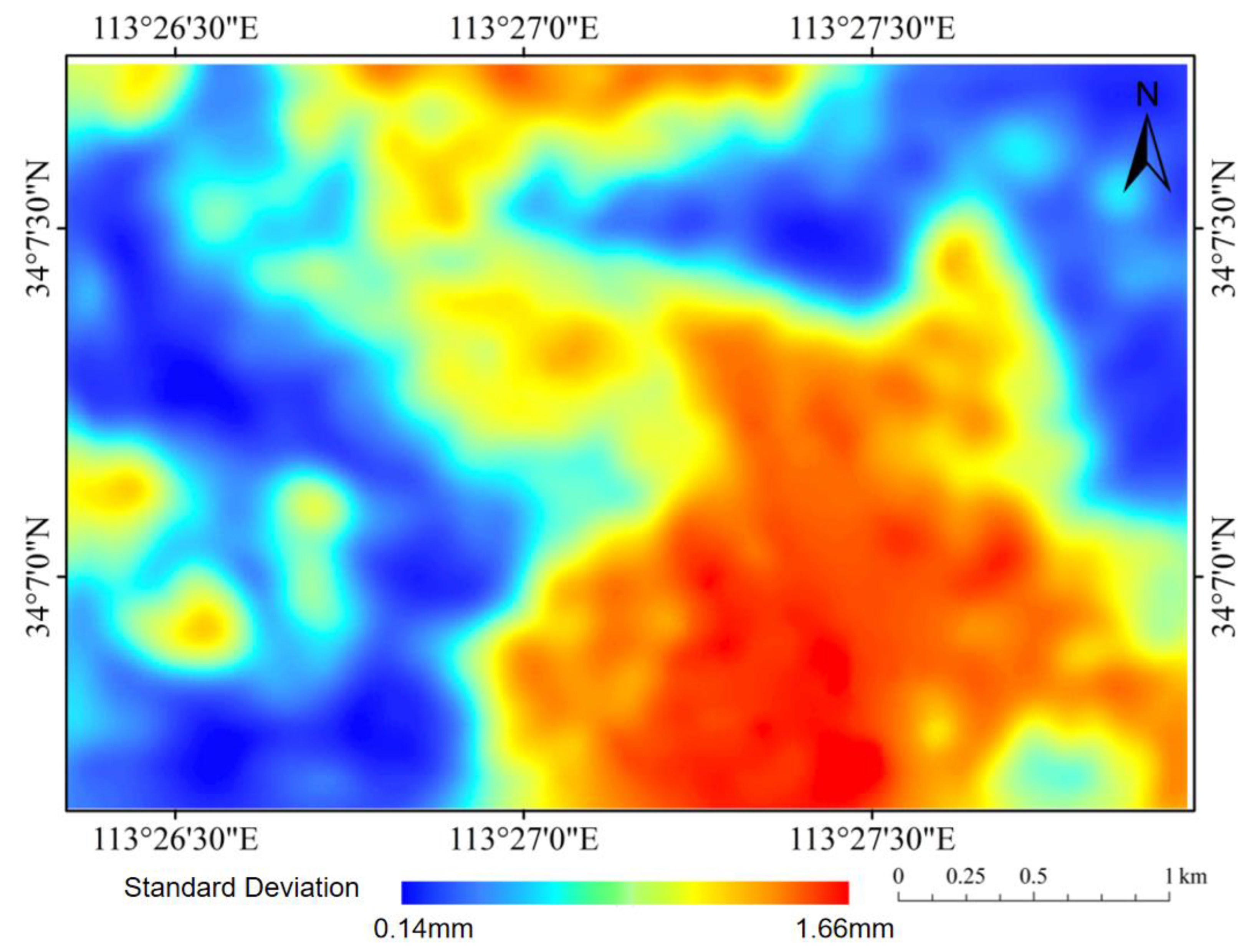
To quantify the uncertainty of the KTree-AIDW interpolation, we employed leave-one-out cross-validation (LOOCV) to compute residuals at each observation point. The squared residuals were then spatially modeled using adaptive Gaussian kernel smoothing to estimate the prediction standard deviation, thereby reflecting the spatial heterogeneity of model reliability, as shown in Figure 12. Since both SBAS-InSAR and leveling data are subject to measurement errors, the total uncertainty at each location was calculated by combining the predicted standard deviation with the observed measurement error under the assumption of error independence. To assess systematic bias, the mean residual and its 95% confidence interval were constructed using Student’s t-distribution. The 95% confidence interval of the KTree-AIDW interpolation error was finally determined to be [−2.16, 8.06] mm. Furthermore, exceedance probability maps for subsidence thresholds of 50 mm, 100 mm, 150 mm, and 200 mm were generated to provide risk-informed decision support for mining subsidence assessment.
K a , a = e x p a a 2 2 σ 2
s ^ i n t e r p 2 x = i = 1 N K a , a r i 2 i = 1 N K a , a
s ^ o b s = 1 n 1 i = 1 n ε i ε 2
s ^ t o t a l 2 = s ^ i n t e r p 2 + s ^ o b s 2
C I 1 α x = ε t n 1 , α 2 s ^ t o t a l n , ε + t n 1 , α 2 s ^ t o t a l n
p T x = 1 Φ T W ^ x s ^ t o t a l x
where ( a , a ) are two points in the input space, a a denotes the Euclidean distance between them, and σ   is the bandwidth parameter of the Gaussian kernel function. s ^ i n t e r p represents the standard deviation of residuals obtained from interpolation and cross-validation, where r i   denotes the residual at the i -th point. s ^ t o t a l is the total standard deviation, while s ^ o b s corresponds to the standard deviation of residuals between the interpolation results and leveling measurements. ε i denotes the residual at each point, and ε is the mean residual. t n 1 , α 2 is the critical value of Student’s t-distribution with n − 1 degrees of freedom, and n is the number of points. p T x denotes the probability that subsidence at location x exceeds the threshold T, and W ^ x is the predicted subsidence at location x.
As shown in Figure 12, uncertainty is relatively low in areas with dense coherent points and gentle deformation, while it increases significantly in incoherent regions, at their boundaries, and at the edges of the study area due to insufficient effective neighborhood samples. This spatial pattern is consistent with the regions of cumulative subsidence gradient variations observed in the SBAS-InSAR results. As shown in Figure 13, when a low threshold is applied, the exceedance probability is close to 1 across a wide area; as the threshold increases, the high-probability regions gradually converge toward the center of the subsidence funnel. For the 200 mm threshold, only the maximum subsidence center exhibits probabilities close to 1, while the surrounding regions approach 0. Such a probabilistic representation provides a more risk-orientated framework for delineating basin boundaries at different subsidence thresholds and supports safety early-warning in mining areas.

4.3. Spatiotemporal Analysis of Ground Surface Deformation

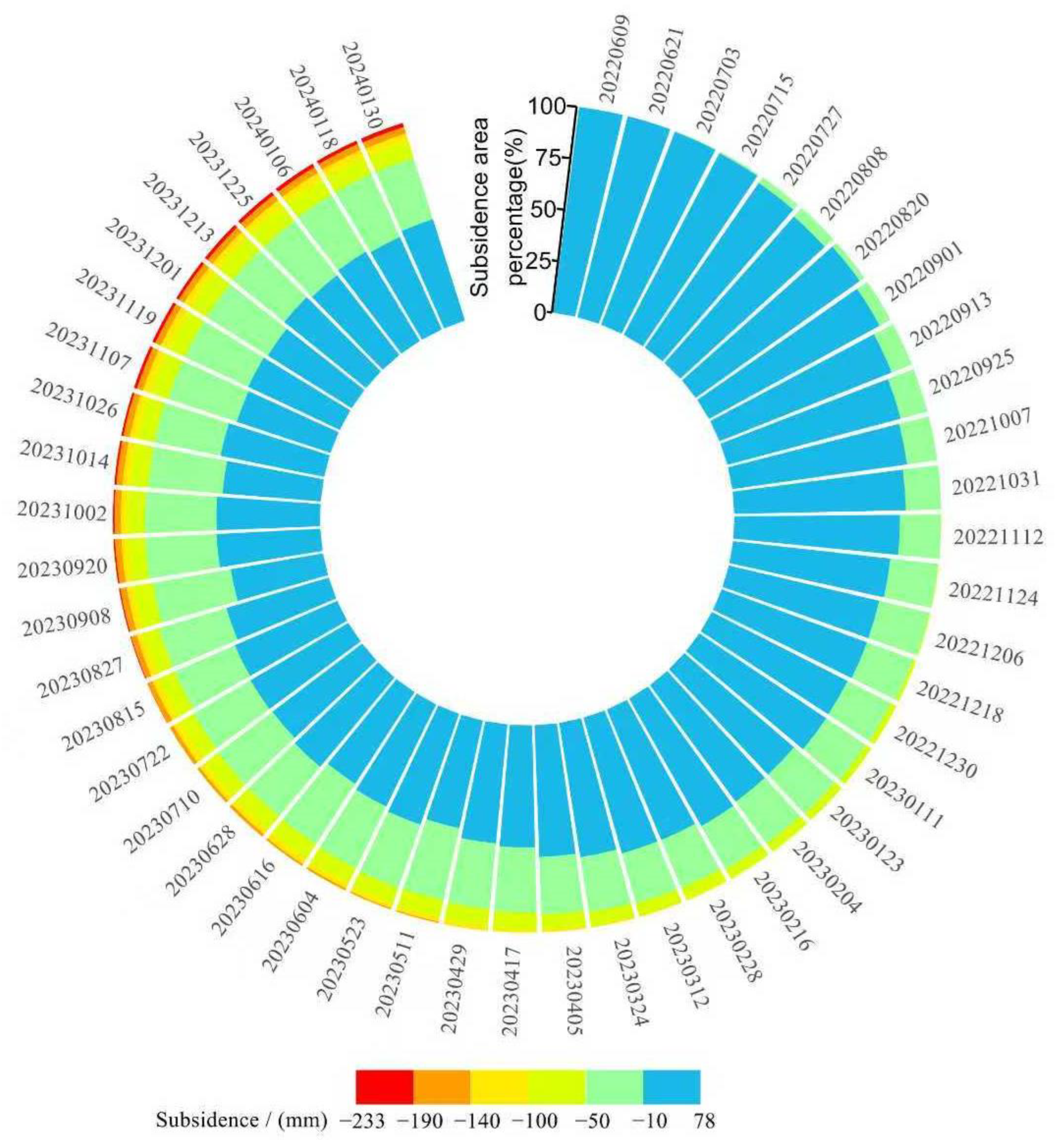
To investigate ground deformation within the study area in greater depth, a statistical analysis of the subsidence area was performed. A column chart depicting changes in the proportion of subsidence area over time was also generated for a clear illustration of the subsidence dynamics, as shown in Figure 14. According to statistical analysis, the total zone of the study area is approximately 5.91 km2. During the initial monitoring phase, the subsidence zone expanded rapidly, resulting in a broader spatial extent of deformation and a gradual reduction in uplifted zones. After 4 June 2023, the rate of change in the subsidence zone began to stabilize, indicating that the deformation process had entered a relatively steady stage. Based on the monitoring results and statistical classification, 2.1% of the area experienced cumulative subsidence exceeding 190 mm, 3.3% subsided between 140 mm and 190 mm, 3.8% subsided between 100 mm and 140 mm, 8.68% subsided between 50 mm and 100 mm, and 30.9% subsided between 10 mm and 50 mm. Using a subsidence threshold of 10 mm to define the subsidence zone, the total cumulative subsidence zone was calculated to be approximately 2.88 km2.
Underground mining induces ground subsidence, leading to uneven subsidence, which creates incline and curvature. Each pixel in the SBAS-InSAR cumulative subsidence results is treated as an approximate ground deformation observation point. The subsidence value of each pixel corresponds to surface observation points over the same period, and the pixel spacing is considered as the distance between adjacent observation points. Accordingly, the incline between two pixels is calculated by dividing the differential subsidence of adjacent pixels by the distance between their centers. This incline value is the first derivative of the subsidence difference between two points with respect to the horizontal distance (17). Curvature arises from uneven incline and is defined as the ratio of the incline difference between two adjoining line segments to the horizontal distance between their midpoints (18). In this study, the positive direction for both incline and curvature in the east–west direction is defined from west to east, while in the north–south direction, it is defined from north to south. A positive slope indicates downward inclination of the surface in the specified direction, whereas a negative value indicates upward inclination in the opposite direction. The curvature value describes the degree of surface bending: positive values represent concave deformation, and negative values represent convex deformation.
i 2 3 = W 3 W 2 l 2 3
where i 2 3 is the inclination value between surface points 2 and 3, mm/m; W 2 and W 3 are the subsidence values of surface points 2 and 3, mm; and l 2 3 is the horizontal distance between surface points 2 and 3, m.
      k 2 3 4 = i 3 4 i 2 3 1 2 l 3 4 + l 2 + 3
where k 2 3 4 is the curvature value between surface points 2, 3, and 4, mm/m2; i 3 4 is the average slope between surface points 3 and 4, mm/m; and l 3 4 is the horizontal distance between surface points 3 and 4, m.
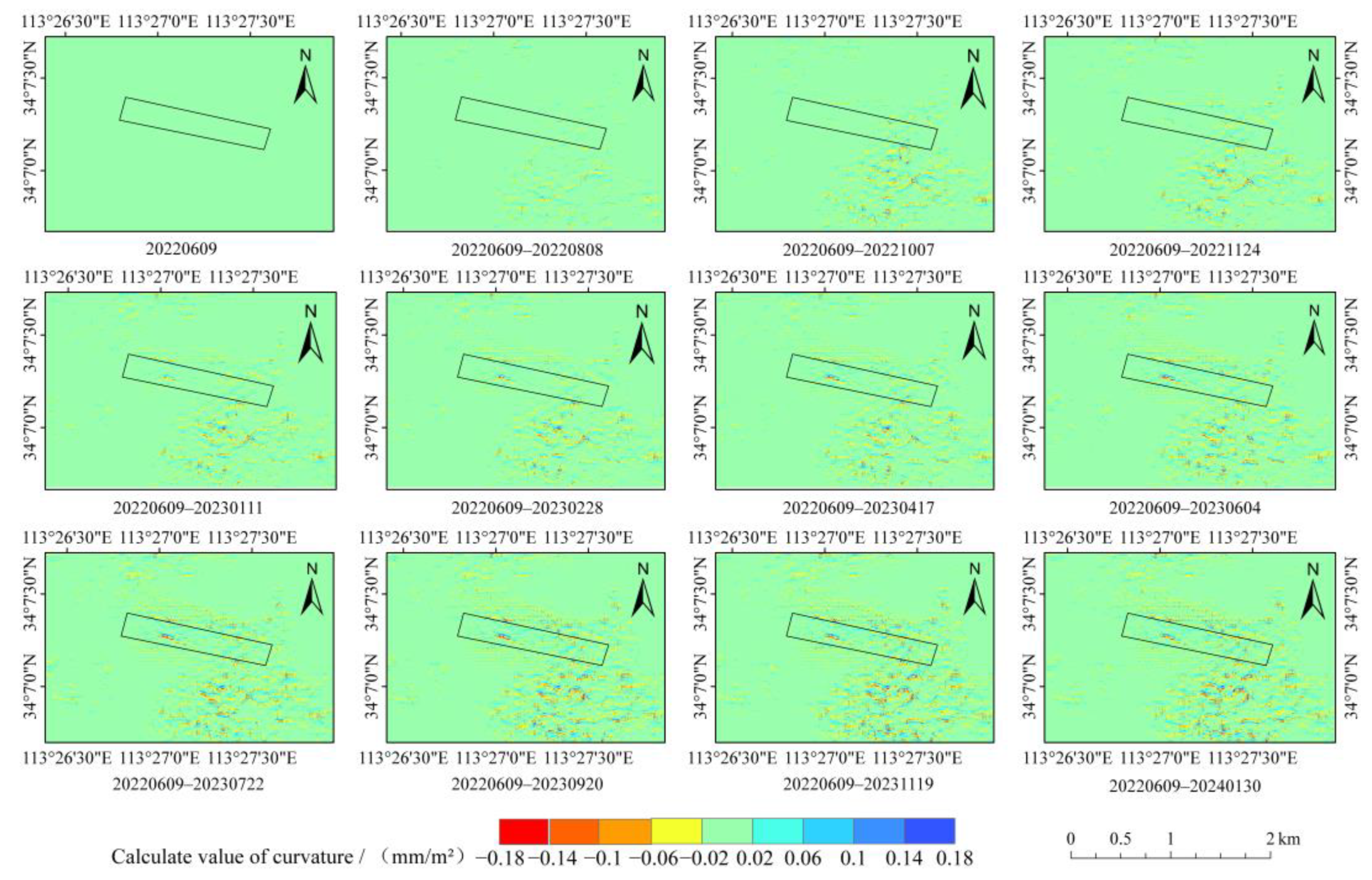
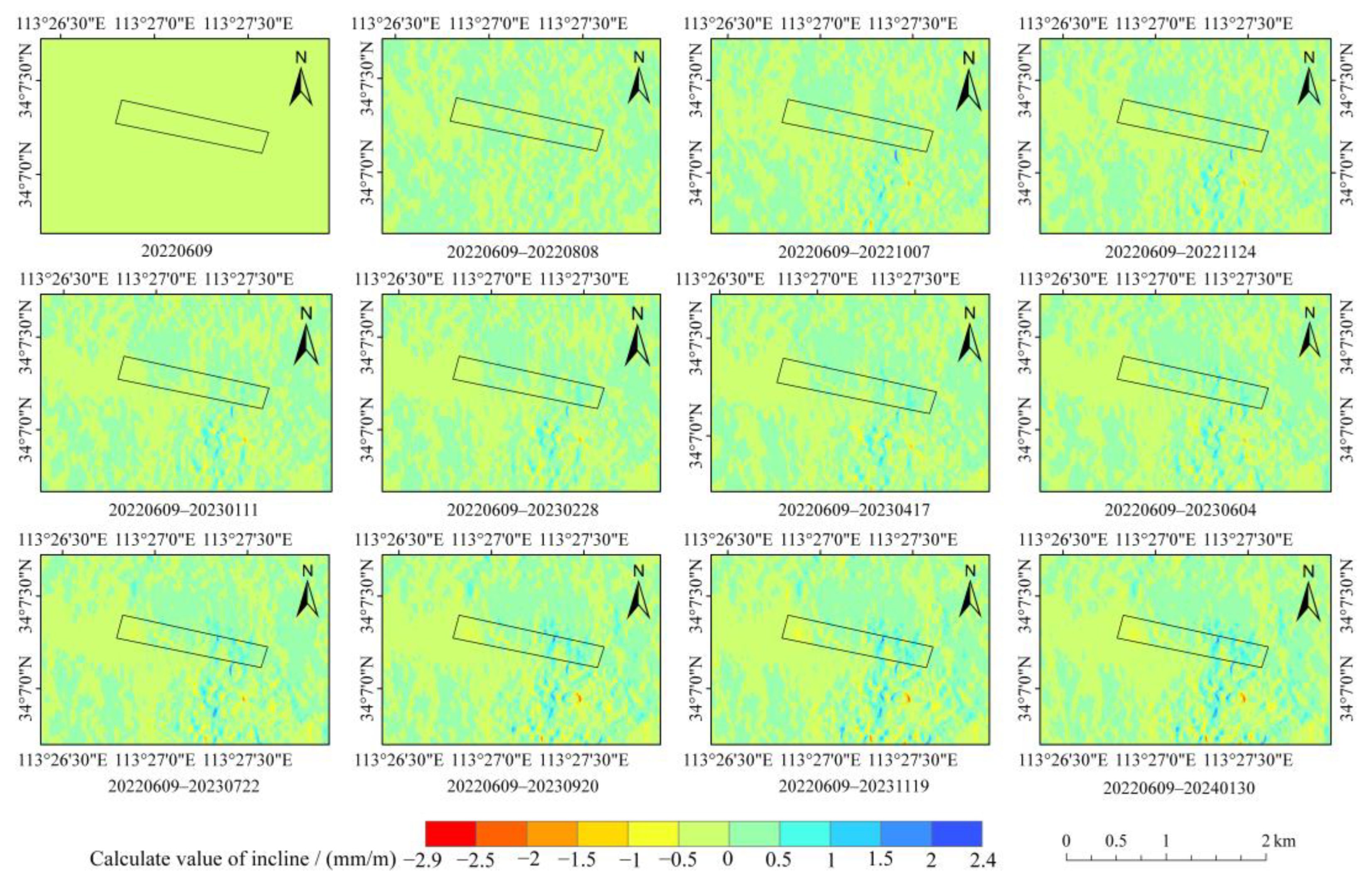
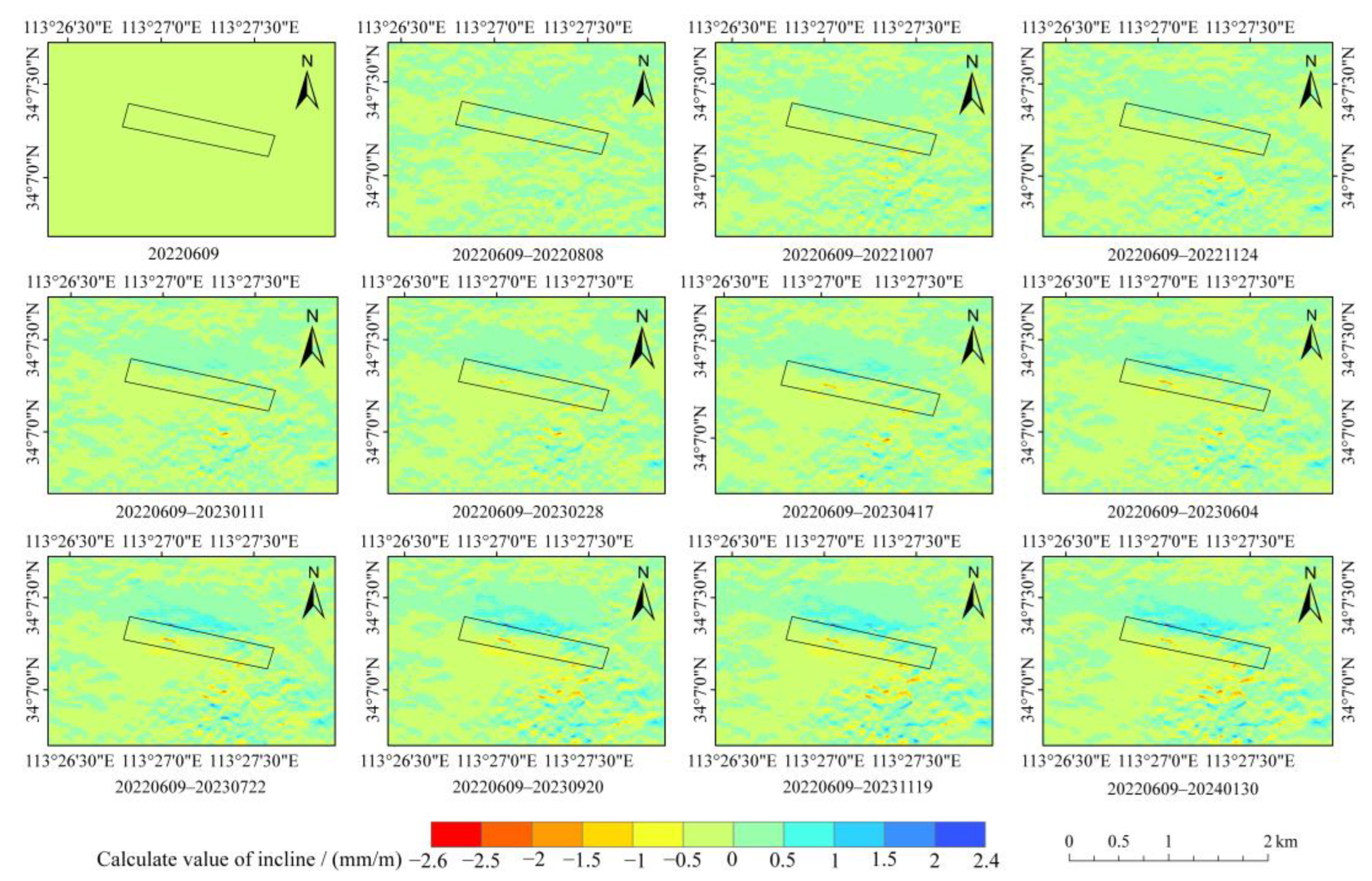
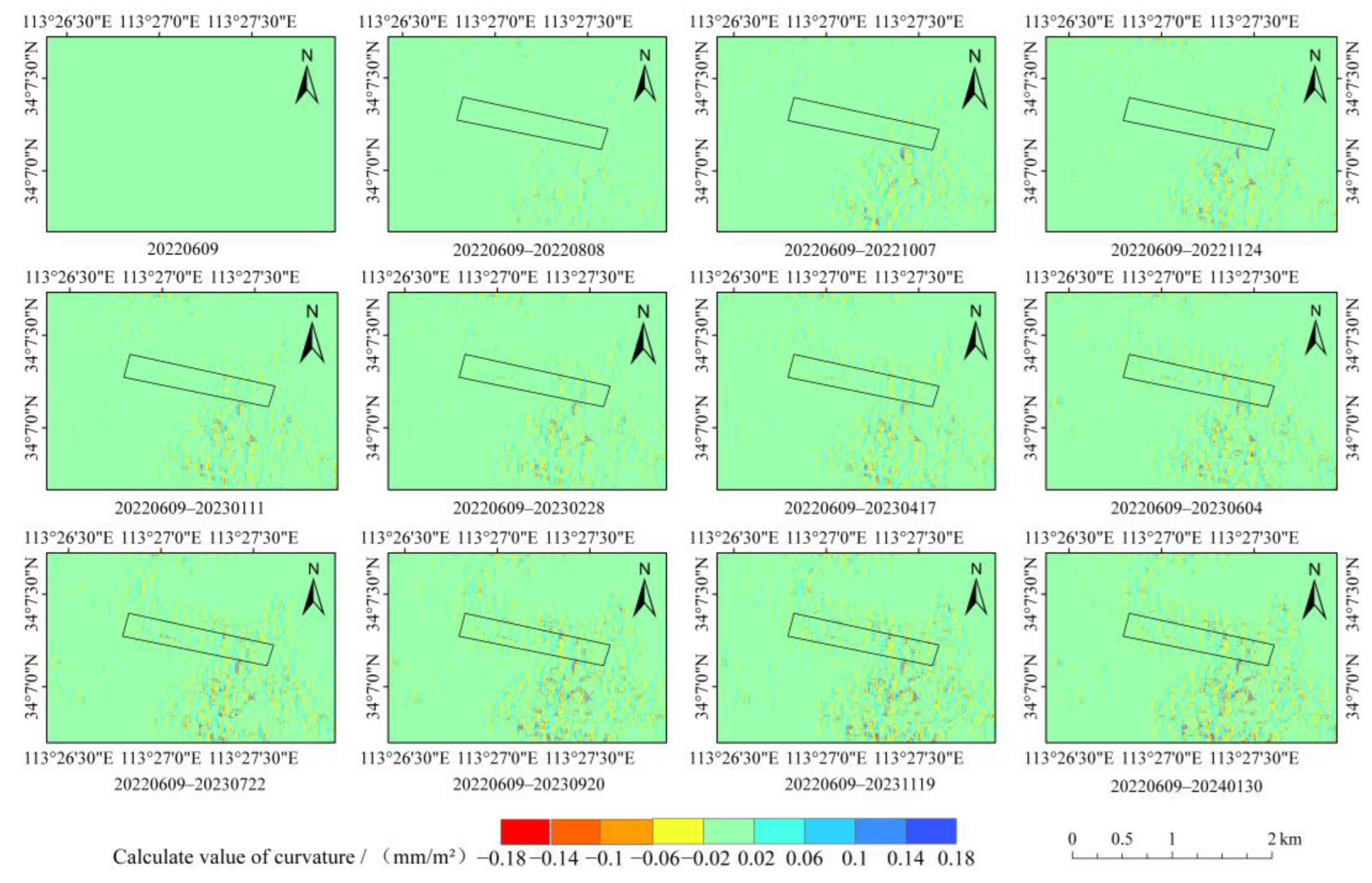
As shown in Figure 15 and Figure 16, the maximum positive incline in the east–west direction is 2.4 mm/m, observed on 20 September 2023, whereas the maximum negative incline is −2.9 mm/m, recorded on 30 January 2024. Inclines generally ranged between −1 mm/m and 1 mm/m. In the north–south direction, the maximum positive and negative inclines were both approximately 2.4 mm/m and −2.6 mm/m, respectively, recorded on 30 January 2024. Throughout the region, the north–south incline also remains within −1 mm/m to 1 mm/m. According to Figure 17 and Figure 18, the maximum positive curvature in both the east–west and north–south directions is 0.18 mm/m2, observed on 30 January 2024. Meanwhile, the maximum negative curvature is −0.18 mm/m2, also recorded on 30 January 2024. In general, curvature in the study area varies between −0.02 mm/m2 and 0.02 mm/m2. Both the maximum incline and maximum curvature occur in the southeastern farmland region of the working face, where decoherence is evident. Between 9 June 2022 and 30 January 2024, both incline and curvature values in the mining area remained within the allowable ground deformation limits specified in “The regulation of leaving coal pillar and mining coal of holding under the buildings, water bodies, railways and the main roadway” (i ≤ 3 mm/m, k ≤ 0.2 mm/m2) [43]. Accordingly, the building damage level is classified as Grade I.

5. Discussion

5.1. Influence of Measured Data Fusion on Interpolation Results

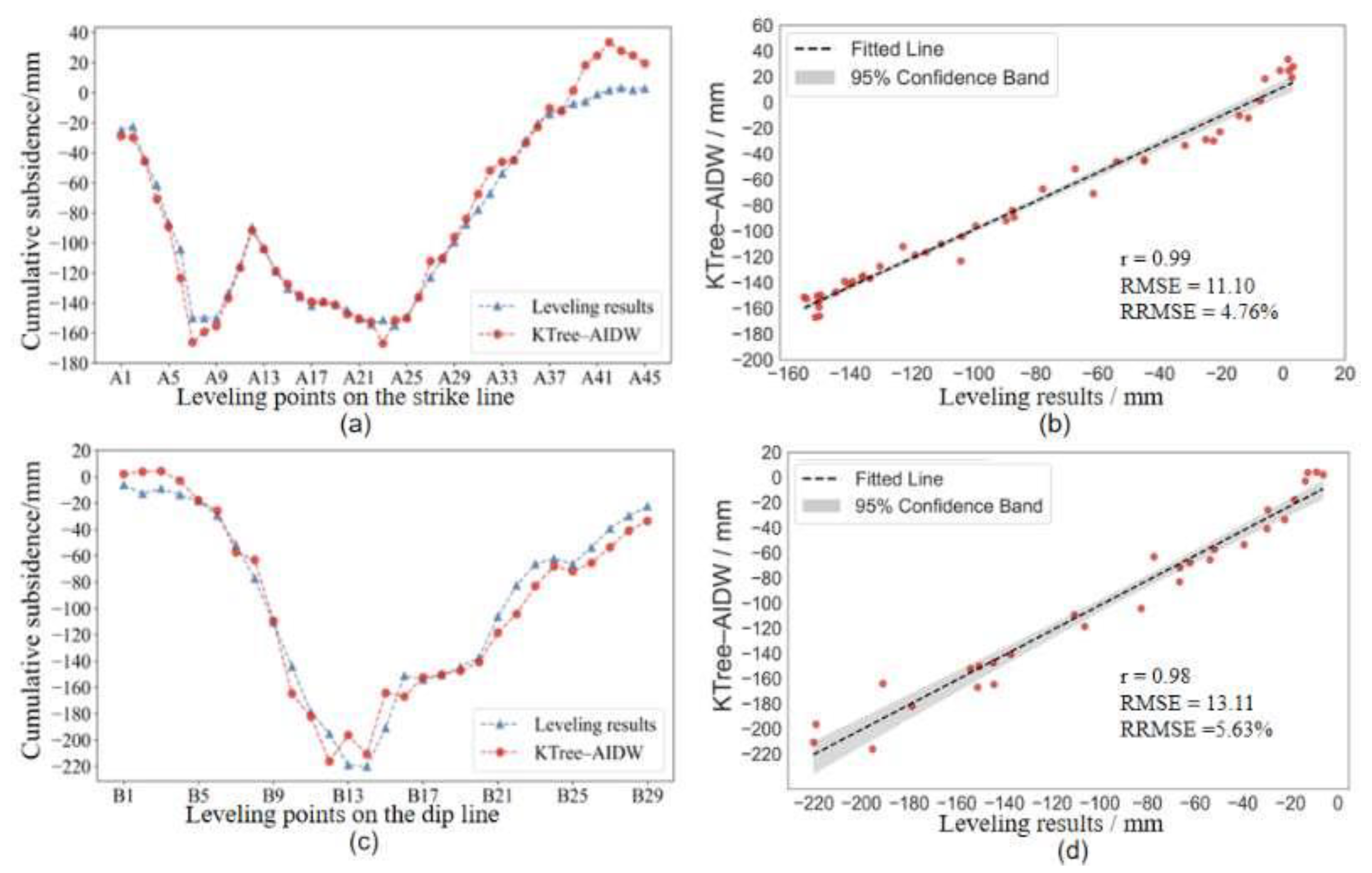
The leveling data mentioned in Section 2.2 were fused with SBAS-InSAR results for KTree-AIDW interpolation. Define the attribute with the largest proportion of the nearest m points as the attribute of the incoherent level point. As shown in Figure 19, accuracy along the strike and dip directions was significantly improved, with correlation coefficients of 0.99 and 0.98, respectively. The RMSE along the strike line was 11.10 mm, with an RRMSE of 4.76%, while along the dip line, the RMSE was 13.11 mm and the RRMSE was 5.63%. At five monitoring points located in the decoherence region, the MAE before fusing the leveling data was 19.05 mm, with an MRE of 0.134. After fusing the leveling data, the MAE decreased to 6.20 mm, with an MRE of 0.047, as show in Table 4. These results indicate that integrating leveling data improved the overall accuracy of SBAS-InSAR monitoring and made the deformation results more consistent with actual conditions. However, this also increases the demand for high-quality acquisition and measurement accuracy in the leveling data.

5.2. Influence of Attribute Prediction Accuracy and Search Scope on Interpolation Results

In Section 4, the reliability of the KTree-AIDW method was validated. However, any method inevitably introduces errors. The errors associated with the KTree-AIDW method primarily stem from two factors: the accuracy of attribute predictions for sample data and the search scope for interpolation points. These two factors are discussed separately in terms of their impact on the interpolation results.
First, to evaluate the effect of the sample point attribute prediction accuracy in the KTree model on the interpolation results, random errors levels of 20%, 40%, 60%, and 80% were introduced into the sample classification predictions. Five feature points located in the decoherence region were selected, and the resulting errors for these feature points are summarized in Table 5.
As shown in Table 5, the errors for points A28, A29, A30, B10, and B11 changed upon the introduction of random errors, with the error at point A29 being particularly significant. Analysis revealed that points A28, A30, B10, and B11 had numerous coherent points nearby, thus experiencing minimal change. Conversely, point A29, having fewer coherent neighboring points, exhibited substantial error changes. Therefore, the accuracy of attribute prediction for sample points in the KTree-AIDW model notably impacts the interpolation results.
To examine the impact of the search scope for interpolation points in the KTree-AIDW method, the number of search points (m) was sequentially varied from 4 to 20, and the Absolute Error (AE), Mean Absolute Error (MAE), and Mean Relative Error (MRE) for points A28, A29, A30, B10, and B11 were calculated.
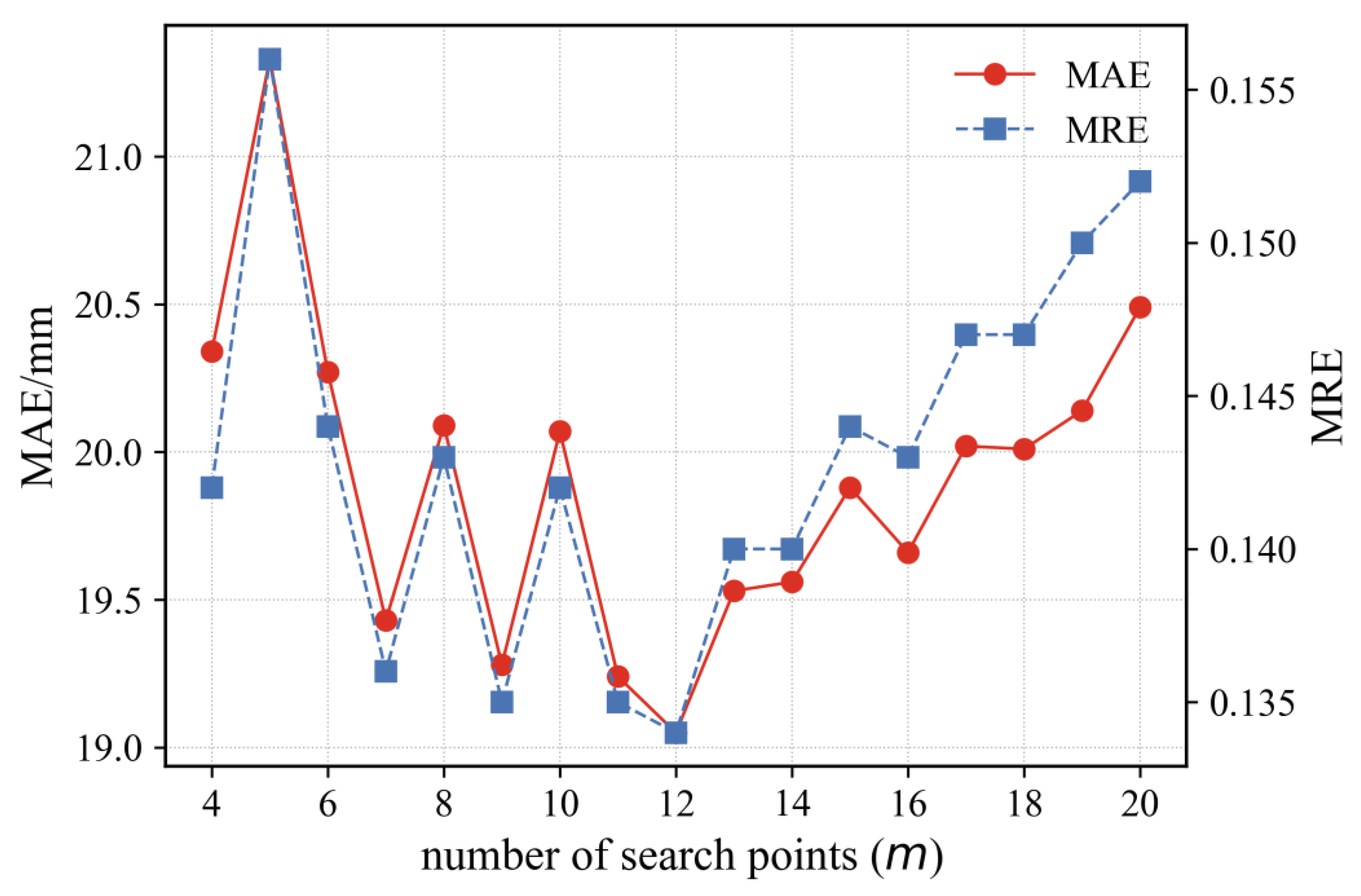
To examine the impact of the search scope for interpolation points in the KTree-AIDW method, the number of search points (m) was sequentially varied from 4 to 20, and the Absolute Error (AE), Mean Absolute Error (MAE), and Mean Relative Error (MRE) for points A28, A29, A30, B10, and B11 were calculated. Table 6 and Figure 20 illustrate the effect of varying m, representing the number of nearest reference points used for interpolation. The results indicate that variations in m influence the interpolated subsidence values. Although adjusting m can optimize overall interpolation performance, it does not necessarily achieve local optimization, implying that errors at individual points may not reach their minimum simultaneously. When m = 12, the MAE and MRE values reached their lowest at 19.05 mm and 0.134, respectively. Consequently, selecting an appropriate value of m is critical for interpolation accuracy in decoherence regions. However, this choice was based on a single grouting panel, and the lack of multi-panel validation is a limitation. A more systematic parameter search and testing under different geological conditions will be considered in future work as more datasets become available.

5.3. Advantages and Limitations

To address the problem of deformation value loss in mining subsidence monitoring caused by InSAR, particularly considering the heterogeneity of grouting zones, this study proposes a new method that combines SBAS-InSAR with the KTree-AIDW algorithm to more effectively analyze subsidence patterns. Compared with traditional leveling and RTK techniques, the method offers broader spatial coverage, and, compared with common interpolation methods, it demonstrates superior performance in mining subsidence monitoring. By integrating SBAS-InSAR with KTree-AIDW interpolation, missing data can be effectively compensated, providing reliable support for subsidence monitoring of grouting panels. Despite its promising performance, some limitations remain. The method depends largely on the accuracy and distribution of coherent points around the interpolation targets, and thus the interpolation quality may decrease in areas with sparse coherent points or complex geological conditions. In such cases, auxiliary data such as GNSS stations or high-resolution DEMs could be incorporated. Future work will further examine the robustness of the method under different levels of data sparsity and in diverse geological settings, in order to improve its applicability.

6. Conclusions

To address the limitations of InSAR in monitoring surface subsidence in grouting working faces, this study employed Sentinel-1A data combined with the SBAS-InSAR technique to obtain subsidence monitoring results for the 2021 working face of the Liangbei mining area from 9 June 2022 to 30 January 2024. Subsequently, the SBAS-InSAR results were integrated with the KTree-AIDW interpolation algorithm to achieve comprehensive monitoring and detailed spatiotemporal analysis of surface subsidence processes. The main conclusions are summarized as follows:
(1)
To address the challenge that SBAS-InSAR temporal monitoring methods fail to fully capture surface deformation characteristics in grouting working faces, this study proposed an SBAS-InSAR approach that incorporates adaptive weighting based on coherence variations. The proposed method significantly alleviated decoherence issues caused by vegetation cover, thereby enabling comprehensive subsidence information retrieval throughout the mining area. By analyzing subsidence profiles along both strike and dip directions, derived from integrated SBAS-InSAR data and the KTree-AIDW interpolation method, the study demonstrated a strong agreement with leveling results, achieving correlation coefficients of 0.95 in both directions. The RMSE for the strike and dip directions was 21.93 mm and 22.32 mm, respectively, with an overall RMSE of 22.08 mm and an overall RRMSE of 9.48%. Additionally, five monitoring points located within decoherence regions exhibited superior accuracy compared to conventional interpolation methods.
(2)
In the study area, the maximum vertical subsidence observed was 233 mm, with an average maximum subsidence rate of 171 mm/yr, and the total cumulative subsidence area reached 2.88 km2. The maximum positive and negative incline values in the east–west direction were 2.4 mm/m and −2.9 mm/m, respectively, while those in the north–south direction were 2.4 mm/m and −2.6 mm/m, respectively. Additionally, the maximum positive and negative curvature values in both the east–west and north–south directions were ±0.18 mm/m2. The surface structures are within the threshold values specified for Class I damage.
(3)
The study discussed the influence of incorporating leveling data, attribute prediction accuracy, and the search scope used for interpolation points on the final interpolation results. The findings indicated that integrating actual leveling data substantially improved interpolation accuracy. Furthermore, enhancing the precision of attribute predictions and selecting an appropriate search scope were critical factors in obtaining reliable subsidence monitoring outcomes.

Author Contributions

Methodology, S.Y.; software, S.Y.; writing—original draft, S.Y.; writing—review and editing, Conceptualization, J.C.; resources, J.C. and W.Y.; funding acquisition, J.C. and W.Y.; visualization, C.Z.; visualization, H.L.; visualization, H.P. All authors have read and agreed to the published version of the manuscript.

Funding

This research was funded by the National Natural Science Foundation of China (42207534, U21A20108); Natural Science Foundation of Henan Province (242300421363); Excellent Youth Foundation of Henan Polytechnic University (J2024-4); Training Plan for Young Backbone Teachers in Higher Education Institutions in Henan Province (2024GGJS038); and Program for Science & Technology Innovation Talents in Universities of Henan Province (25HASTIT013).

Data Availability Statement

The Sentinel-1A SAR data used in the study are available through https://search.asf.alaska.edu/#/ (accessed on 1 March 2024); The GACOS data are openly available from http://www.gacos.net/ (accessed on 1 March 2024); the Sentinel Precise Orbit Ephemerides (POD) data are available through https://dataspace.copernicus.eu/ (accessed on 1 March 2024); and SRTM1 DEM data can be obtained at https://earthexplorer.usgs.gov/ (accessed on 1 March 2024).

Acknowledgments

The authors sincerely thank the European Space Agency (ESA) for providing the Sentinel-1 radar satellite data. The authors thank the anonymous reviewers for their valuable comments. All individuals have agreed to these acknowledgments.

Conflicts of Interest

The authors declare no conflicts of interest.

References

  1. Wang, J.; Feng, L.; Davidsson, S.; Höök, M. Chinese coal supply and future production outlooks. Energy 2013, 60, 204–214. [Google Scholar] [CrossRef]
  2. Ghadimi, P.; Wang, C.; Azadnia, A.H.; Lim, M.K.; Sutherland, J.W. Life cycle-based environmental performance indicator for the coal-to-energy supply chain: A Chinese case application. Resour. Conserv. Recycl. 2019, 147, 28–38. [Google Scholar] [CrossRef]
  3. Yang, Z.; Li, W.; Li, X.; Wang, Q.; He, J. Assessment of eco-geo-environment quality using multivariate data: A case study in a coal mining area of Western China. Ecol. Indic. 2019, 107, 105651. [Google Scholar] [CrossRef]
  4. Wang, M.; Fang, Z.; Li, X.; Kang, J.; Wei, Y.; Wang, S.; Zheng, Y.; Zhang, X.; Liu, T. Research on the Prediction Method of 3D Surface Deformation in Filling Mining Based on InSAR-IPIM. Energy Sci. Eng. 2025, 13, 2401–2414. [Google Scholar] [CrossRef]
  5. Dai, M.; Li, H.; Long, B.; Wang, X. Quantitative identification of landslide hazard in mountainous open-pit mining areas combined with ascending and descending orbit InSAR technology. Landslides 2024, 21, 2975–2991. [Google Scholar] [CrossRef]
  6. Zheng, Y.; Zhao, Z.; Zeng, M.; Zhou, D.; Su, X.; Liu, D. Monitoring and Analysis of Surface Deformation in the Buzhaoba Open-Pit Mine Based on SBAS-InSAR Technology. Remote Sens. 2024, 16, 4177. [Google Scholar] [CrossRef]
  7. Xia, Y.; Wang, Y.; Du, S.; Liu, X.; Zhou, H. Integration of D-InSAR and GIS technology for identifying illegal underground mining in Yangquan District, Shanxi Province, China. Environ. Earth Sci. 2018, 77, 319. [Google Scholar] [CrossRef]
  8. Du, Y.; Zhang, L.; Feng, G.; Lu, Z.; Sun, Q. On the accuracy of topographic residuals retrieved by MTInSAR. IEEE Trans. Geosci. Remote Sens. 2016, 55, 1053–1065. [Google Scholar] [CrossRef]
  9. Chen, Y.; Tong, Y.; Tan, K. Coal mining deformation monitoring using SBAS-InSAR and offset tracking: A case study of Yu County, China. IEEE J. Sel. Top. Appl. Earth Obs. Remote Sens. 2020, 13, 6077–6087. [Google Scholar] [CrossRef]
  10. Wang, H.; Li, K.; Zhang, J.; Hong, L.; Chi, H. Monitoring and analysis of ground surface settlement in mining clusters by SBAS-InSAR technology. Sensors 2022, 22, 3711. [Google Scholar] [CrossRef] [PubMed]
  11. Niraj, K.; Chatterjee, R.S.; Shukla, D.P. Estimating the period of probable landslide event using advanced D-InSAR technique for time-series deformation study of Kotrupi region. Geomat. Nat. Hazards Risk 2023, 14, 2281245. [Google Scholar] [CrossRef]
  12. Ferretti, A.; Prati, C.; Rocca, F. Nonlinear subsidence rate estimation using permanent scatterers in differential SAR interferometry. IEEE Trans. Geosci. Remote Sens. 2000, 38, 2202–2212. [Google Scholar] [CrossRef]
  13. Ferretti, A.; Prati, C.; Rocca, F. Permanent scatterers in SAR interferometry. IEEE Trans. Geosci. Remote Sens. 2002, 39, 8–20. [Google Scholar] [CrossRef]
  14. Hooper, A.; Zebker, H.; Segall, P.; Kampes, B. A new method for measuring deformation on volcanoes and other natural terrains using InSAR persistent scatterers. Geophys. Res. Lett. 2004, 31, L23611. [Google Scholar] [CrossRef]
  15. Berardino, P.; Fornaro, G.; Lanari, R.; Sansosti, E. A new algorithm for surface deformation monitoring based on small baseline differential SAR interferograms. IEEE Trans. Geosci. Remote Sens. 2002, 40, 2375–2383. [Google Scholar] [CrossRef]
  16. Khan, J.; Ren, X.; Hussain, M.A.; Jan, M.Q. Monitoring land subsidence using PS-InSAR technique in Rawalpindi and islamabad, Pakistan. Remote Sens. 2022, 14, 3722. [Google Scholar] [CrossRef]
  17. Yang, Q.; Ke, Y.; Zhang, D.; Chen, B.; Gong, H.; Lv, M.; Zhu, L.; Li, X. Multi-scale analysis of the relationship between land subsidence and buildings: A case study in an eastern Beijing Urban Area using the PS-InSAR technique. Remote Sens. 2018, 10, 1006. [Google Scholar] [CrossRef]
  18. Ghaderpour, E.; Mazzanti, P.; Bozzano, F.; Mugnozza, G.S. Ground deformation monitoring via PS-InSAR time series: An industrial zone in Sacco River Valley, central Italy. Remote Sens. Appl. Soc. Environ. 2024, 34, 101191. [Google Scholar] [CrossRef]
  19. Zhang, M.; Pan, J.; Ma, P.; Lin, H. Identification and Analysis on Surface Deformation in the Urban Area of Nanchang Based on PS-InSAR Method. Remote Sens. 2025, 17, 157. [Google Scholar] [CrossRef]
  20. Frattini, P.; Crosta, G.B.; Rossini, M.; Allievi, J. Activity and kinematic behaviour of deep-seated landslides from PS-InSAR displacement rate measurements. Landslides 2018, 15, 1053–1070. [Google Scholar] [CrossRef]
  21. Hussain, S.; Hongxing, S.; Ali, M.; Ali, M. PS-InSAR based validated landslide susceptibility modelling: A case study of Ghizer valley, Northern Pakistan. Geocarto Int. 2022, 37, 3941–3962. [Google Scholar] [CrossRef]
  22. Yang, C.; Lu, Z.; Zhang, Q.; Zhao, C.; Peng, J.; Ji, L. Deformation at longyao ground fissure and its surroundings, north China plain, revealed by ALOS PALSAR PS-InSAR. Int. J. Appl. Earth Obs. Geoinf. 2018, 67, 1–9. [Google Scholar] [CrossRef]
  23. Rosi, A.; Tofani, V.; Tanteri, L.; Tacconi Stefanelli, C.; Agostini, A.; Catani, F.; Casagli, N. The new landslide inventory of Tuscany (Italy) updated with PS-InSAR: Geomorphological features and landslide distribution. Landslides 2018, 15, 5–19. [Google Scholar] [CrossRef]
  24. Wang, F.; Tao, Q.; Liu, G.; Chen, Y.; Han, Y.; Guo, Z.; Liu, X. Monitoring of surface deformation in mining area integrating SBAS InSAR and Logistic Function. Environ. Monit. Assess. 2023, 195, 1493. [Google Scholar] [CrossRef] [PubMed]
  25. Zhang, G.; Xu, Z.; Chen, Z.; Wang, S.; Cui, H.; Zheng, Y. Predictable condition analysis and prediction method of SBAS-InSAR coal mining subsidence. IEEE Trans. Geosci. Remote Sens. 2022, 60, 5232914. [Google Scholar] [CrossRef]
  26. Tao, Q.; Wang, F.; Guo, Z.; Hu, L.; Yang, C.; Liu, T. Accuracy verification and evaluation of small baseline subset (SBAS) interferometric synthetic aperture radar (InSAR) for monitoring mining subsidence. Eur. J. Remote Sens. 2021, 54, 642–663. [Google Scholar] [CrossRef]
  27. Yao, S.; He, Y.; Zhang, L.; Yang, W.; Chen, Y.; Sun, Q.; Zhao, Z.a.; Cao, S. A convLSTM neural network model for spatiotemporal prediction of mining area surface deformation based on SBAS-InSAR monitoring data. IEEE Trans. Geosci. Remote Sens. 2023, 61, 5201722. [Google Scholar] [CrossRef]
  28. Liu, H.; Yuan, M.; Li, M.; Li, B.; Zhang, H.; Wang, J. An efficient and fully refined deformation extraction method for deriving mining-induced subsidence by the joint of probability integral method and sbas-insar. IEEE Trans. Geosci. Remote Sens. 2023, 61, 5208717. [Google Scholar] [CrossRef]
  29. Liu, H.; Li, M.; Yuan, M.; Li, B.; Jiang, X. A fine subsidence information extraction model based on multi-source inversion by integrating InSAR and leveling data. Nat. Hazards 2022, 114, 2839–2854. [Google Scholar] [CrossRef]
  30. Ma, J.; Yang, J.; Zhu, Z.; Cao, H.; Li, S.; Du, X. Decision-making fusion of InSAR technology and offset tracking to study the deformation of large gradients in mining areas-Xuemiaotan mine as an example. Front. Earth Sci. 2022, 10, 962362. [Google Scholar] [CrossRef]
  31. Sun, L.; Muller, J.-P.; Chen, J. Time series analysis of very slow landslides in the three gorges region through small baseline SAR offset tracking. Remote Sens. 2017, 9, 1314. [Google Scholar] [CrossRef]
  32. Huang, J.; Bai, Y.; Lei, S.; Deng, K. Time-series SBAS pixel offset tracking method for monitoring three-dimensional deformation in a mining area. IEEE Access 2020, 8, 118787–118798. [Google Scholar] [CrossRef]
  33. Xu, Q.; Guo, C.; Dong, X.; Li, W.; Lu, H.; Fu, H.; Liu, X. Mapping and characterizing displacements of landslides with InSAR and airborne LiDAR technologies: A case study of danba county, southwest China. Remote Sens. 2021, 13, 4234. [Google Scholar] [CrossRef]
  34. Wang, R.; Huang, S.; He, Y.; Wu, K.; Gu, Y.; He, Q.; Yan, H.; Yang, J. Construction of High-Precision and Complete Images of a Subsidence Basin in Sand Dune Mining Areas by InSAR-UAV-LiDAR Heterogeneous Data Integration. Remote Sens. 2024, 16, 2752. [Google Scholar] [CrossRef]
  35. Chen, D.; Chen, H.; Zhang, W.; Cao, C.; Zhu, K.; Yuan, X.; Du, Y. Characteristics of the residual surface deformation of multiple abandoned mined-out areas based on a field investigation and SBAS-InSAR: A case study in Jilin, China. Remote Sens. 2020, 12, 3752. [Google Scholar] [CrossRef]
  36. Chai, H.; Hu, J.; Geng, S. SBAS-InSAR monitoring method of ground subsidence in mining areas by fusion with measured data. J. China Coal Soc. 2021, 46, 17–24. [Google Scholar]
  37. Lu, G.Y.; Wong, D.W. An adaptive inverse-distance weighting spatial interpolation technique. Comput. Geosci. 2008, 34, 1044–1055. [Google Scholar] [CrossRef]
  38. Yu, C.; Li, Z.; Penna, N.T.; Crippa, P. Generic atmospheric correction model for interferometric synthetic aperture radar observations. J. Geophys. Res. Solid Earth 2018, 123, 9202–9222. [Google Scholar] [CrossRef]
  39. Yu, C.; Li, Z.; Penna, N.T. Interferometric synthetic aperture radar atmospheric correction using a GPS-based iterative tropospheric decomposition model. Remote Sens. Environ. 2018, 204, 109–121. [Google Scholar] [CrossRef]
  40. Zhang, S.; Li, X.; Zong, M.; Zhu, X.; Wang, R. Efficient kNN classification with different numbers of nearest neighbors. IEEE Trans. Neural Netw. Learn. Syst. 2017, 29, 1774–1785. [Google Scholar] [CrossRef] [PubMed]
  41. Zhou, Y.; Guan, Y.; Cao, Z.; Wu, Z.; Yu, F. Direct and indirect impacts of urbanization on vegetation growth in Guangdong Province. Acta Ecol. Sin. 2024, 44, 7063–7073. [Google Scholar] [CrossRef]
  42. Eriksen, H.Ø.; Lauknes, T.R.; Larsen, Y.; Corner, G.D.; Bergh, S.G.; Dehls, J.; Kierulf, H.P. Visualizing and interpreting surface displacement patterns on unstable slopes using multi-geometry satellite SAR interferometry (2D InSAR). Remote Sens. Environ. 2017, 191, 297–312. [Google Scholar] [CrossRef]
  43. State Bureau of Coal Industry. The Regulation of Leaving Coal Pillar and Mining Coal of Holding Under the Buildings, Water Bodies, Railways and the Main Roadway; Coal Industry Press: Beijing, China, 2004.
Figure 1. Study area. (a) The geographical location of Yuzhou City. (b) The geographical location of the study area. (c) Detailed layout of the working face.
Remotesensing 17 03111 g001
Figure 2. Flowchart of the proposed KTree method.
Remotesensing 17 03111 g002
Figure 3. SBAS-InSAR basic processing flow and KTree-AIDW basic processing flow.
Remotesensing 17 03111 g003
Figure 4. Temporal and spatial baseline graph: (a) the time−position plot; (b) the time−baseline plot.
Remotesensing 17 03111 g004
Figure 5. The average annual subsidence rate of the mining area monitored by SBAS−InSAR.
Remotesensing 17 03111 g005
Figure 6. Spatial and temporal variations in ground subsidence in the study area.
Remotesensing 17 03111 g006
Figure 7. Spatial and temporal variations in ground subsidence in the study area after interpolation.
Remotesensing 17 03111 g007
Figure 8. Comparison and correlation coefficients of subsidence curves monitored by SBAS-InSAR and leveling results: (a) strike line comparison of subsidence curves monitored, (b) strike line comparison of correlation coefficients monitored, (c) dip line comparison of subsidence curves monitored, (d) dip line comparison of correlation coefficients monitored.
Remotesensing 17 03111 g008
Figure 9. Comparison and correlation coefficients of subsidence curves monitored by SBAS-InSAR + KTree-AIDW and leveling results: (a) strike line comparison of subsidence curves monitored, (b) strike line comparison of correlation coefficients monitored, (c) dip line comparison of subsidence curves monitored, (d) dip line comparison of correlation coefficients monitored.
Remotesensing 17 03111 g009
Figure 10. Location of measurement points in SBAS-InSAR.
Remotesensing 17 03111 g010
Figure 11. Accuracy of different interpolation methods for points in decoherence regions.
Remotesensing 17 03111 g011
Figure 12. Kernel-smoothed error map for cross-validation residuals.
Remotesensing 17 03111 g012
Figure 13. Subsidence exceedance probability maps. (a) Subsidence exceeding 50 mm. (b) Subsidence exceeding 100 mm. (c) Subsidence exceeding 150 mm. (d) Subsidence exceeding 200 mm.
Remotesensing 17 03111 g013
Figure 14. Column chart of subsidence area percentage change.
Remotesensing 17 03111 g014
Figure 15. Spatial and temporal variations in ground incline in the study area after interpolation in the east–west direction.
Remotesensing 17 03111 g015
Figure 16. Spatial and temporal variations in ground incline in the study area after interpolation in the north–south direction.
Remotesensing 17 03111 g016
Figure 17. Spatial and temporal variations in ground curvature in the study area after interpolation in the east–west direction.
Remotesensing 17 03111 g017
Figure 18. Spatial and temporal variations in ground curvature in the study area after interpolation in the north–south direction.
Remotesensing 17 03111 g018
Figure 19. Comparison and correlation coefficients of subsidence curves monitored by SBAS-InSAR and leveling after fusion with leveling data: (a) strike line comparison of subsidence curves monitored, (b) strike line comparison of correlation coefficients monitored, (c) dip line comparison of subsidence curves monitored, (d) dip line comparison of correlation coefficients monitored.
Remotesensing 17 03111 g019
Figure 20. Variation in MAE and MRE with different numbers of search points (m).
Remotesensing 17 03111 g020
Table 1. Acquisition dates of Sentinel-1A SAR data.
No.Imaging DateOrbitNo.Imaging DateOrbit
19 June 2022435852617 April 202348135
221 June 2022437602729 April 202348310
33 July 2022439352811 May 202348485
415 July 2022441102923 May 202348660
527 July 202244285304 June 202348835
68 August 2022444603116 June 202349010
720 August 2022446353228 June 202349185
81 September 2022448103310 July 202349360
913 September 2022449853422 July 202349535
1025 September 2022451603515 August 202349885
117 October 2022453353627 August 202350060
1231 October 202245685378 September 202350235
1312 November 2022458603820 September 202350410
1424 November 202246035392 October 202350585
156 December 2022462104014 October 202350760
1618 December 2022463854126 October 202350935
1730 December 202246560427 November 202351110
1811 January 2023467354319 November 202351285
1923 January 202346910441 December 202351460
204 February 2023470854513 December 202351635
2116 February 2023472604625 December 202351810
2228 February 202347435476 January 202451985
2312 March 2023476104818 January 202452160
2424 March 2023477854930 January 202452335
255 April 202347960
Table 2. Pre-interpolation and post-interpolation accuracy.
MethodsStrike Line Area
RMSE/mm
Dip Line Area
RMSE/mm
Overall Results
RMSE/mm
Strike Line Area
RRMSE
Dip Line Area
RRMSE
Overall Results
RRMSE
SBAS-InSAR22.6922.8022.739.74%9.79%9.76%
SBAS-InSAR + KTree-AIDW21.9322.3222.089.41%9.58%9.48%
Table 3. Accuracy of different interpolation methods for points in decoherence regions.
MethodsA28
AE/mm
A29
AE/mm
A30
AE/mm
B10
AE/mm
B11
AE/mm
MAE/mmMRE
Minimum Curvature Interpolation37.2494.7818.6046.5130.6345.550.399
Nearest Neighbor Interpolation4.7628.711.0844.0049.5825.630.185
Bilinear Interpolation4.5015.2013.4844.2537.2422.930.173
Natural Neighbor Interpolation4.3010.6612.5147.3234.3421.830.162
Kriging5.167.6211.9946.5535.9621.460.157
IDW8.546.8410.5743.4140.8622.040.159
KTree-AIDW4.553.638.1643.2835.6419.050.134
Table 4. The accuracy of fusing measured data and non-fused leveling data at points in the decoherence region.
MethodsA28
AE/mm
A29
AE/mm
A30
AE/mm
B10
AE/mm
B11
AE/mm
MAE/mmMRE
Non-fused leveling data4.553.638.1643.2835.6419.050.134
Fusion of leveling data0.433.343.4920.433.316.20.047
Table 5. Change in accuracy as error increases.
Add Error PercentageA28
AE/mm
A29
AE/mm
A30
AE/mm
B10
AE/mm
B11
AE/mm
MAE/mmMRE
No added error4.553.638.1643.2835.6419.050.134
Added 20% error4.8628.6911.2143.1539.0525.390.196
Added 40% error5.4027.4211.7243.2933.1124.190.189
Added 60% error5.1930.339.4143.2337.9525.220.194
Added 80% error4.7232.3110.6543.2436.7825.540.199
Table 6. Changes in accuracy as search scope increases.
mA28
AE/mm
A29
AE/mm
A30
AE/mm
B10
AE/mm
B11
AE/mm
MAE/mmMRE
46.076.865.1143.8539.8020.340.142
56.5813.437.4643.8435.3421.330.156
67.286.47.3143.4136.9620.270.144
77.082.177.8543.2736.7619.430.136
86.506.797.0643.2936.8220.090.143
94.963.187.0743.2637.9119.280.135
103.746.388.1343.2538.8320.070.142
115.233.007.5743.2737.1419.240.135
124.553.638.1643.2835.6419.050.134
136.883.779.1842.9634.8419.530.140
146.143.9210.0742.8434.8419.560.140
156.654.8610.2143.1834.4819.880.144
167.133.7611.1442.7733.5019.660.143
177.924.5312.2742.7232.6420.020.147
187.025.2111.9842.9632.8720.010.147
197.373.8713.5942.9232.9720.140.150
207.953.5015.0342.6933.2920.490.152
Disclaimer/Publisher’s Note: The statements, opinions and data contained in all publications are solely those of the individual author(s) and contributor(s) and not of MDPI and/or the editor(s). MDPI and/or the editor(s) disclaim responsibility for any injury to people or property resulting from any ideas, methods, instructions or products referred to in the content.