Article

Restoration of Streak Tube Imaging LiDAR 3D Images in Photon Starved Regime Using Multi-Sparsity Constraints and Adaptive Regularization


1
Key Laboratory of Space Precision Measurement Technology, Xi’an Institute of Optics and Precision Mechanics (XIOPM), Chinese Academy of Sciences (CAS), Xi’an 710119, China
2
University of Chinese Academy of Sciences (UCAS), Beijing 100049, China
3
State Key Laboratory of Ultrafast Optical Science and Technology, Xi’an Institute of Optics and Precision Mechanics (XIOPM), Chinese Academy of Sciences (CAS), Xi’an 710119, China
*
Author to whom correspondence should be addressed.
Remote Sens. 2025, 17(17), 3089; https://doi.org/10.3390/rs17173089
Submission received: 25 July 2025 / Revised: 29 August 2025 / Accepted: 2 September 2025 / Published: 4 September 2025
(This article belongs to the Section Remote Sensing Image Processing)

Abstract

Streak Tube Imaging Lidar (STIL) offers significant advantages in long-range sensing and ultrafast diagnostics by encoding spatial-temporal information as streaks, and hence decodes 3D images using tailored algorithm. However, under low-photon conditions that caused either long-range or reduced exposure time, the reconstructed image suffer from low contrast, strong noise and blurring, hindering the application in various scenarios. To address this challenge, we propose a Multi-Sparsity Constraints and Adaptive Regularization (MSC-AR) algorithm based on the Maximum a Posteriori (MAP) framework, which jointly denoises and deblurs degraded streak images and efficiently solved using the Alternating Direction Method of Multipliers (ADMM). MSC-AR considers gradient sparsity, intensity sparsity, and an adaptively weighted Total Variation (TV) regularization along the temporal dimension of the streak image which collaboratively optimizing image quality and structural detail, thus better 3D restoration results in low-photon conditions. Experimental results demonstrate that MSC-AR significantly outperforms existing approaches under low-photon conditions. At an exposure time of 300 ms, it achieves millimeter-level RMSE and over 88% SSIM in depth image reconstruction, while maintaining robustness and generalization across different reconstruction strategies and target types.

1. Introduction

Streak Tube Imaging Lidar (STIL) stands out as an advanced three-dimensional imaging system, distinguished by its unique spatiotemporal encoding mechanism, which leads to high temporal resolution, high spatial resolution, and a high frame rate [1,2,3]. These inherent advantages enable STIL to excel in capturing high-fidelity three-dimensional target structural information in diverse fields. Specifically, its capabilities render it highly effective in applications such as remote sensing, space object imaging and oceanic exploration, where accurate 3D reconstruction of objects is essential [4,5,6,7].
However, when deployed in challenging environments, STIL often faces the predicament of low-photon imaging. This issue stems from a variety of factors, such as atmospheric scattering, underwater absorption, increased imaging range, or limitations in laser power [8,9,10,11,12,13]. Under low-photon conditions, the reduced return signal causes streak images to exhibit diminished contrast and makes them highly susceptible to noise, which can easily overwhelm the signal. In addition, blur induced by the imaging system and environmental factors further increases the difficulty and uncertainty in extracting accurate three-dimensional structural information [14,15,16]. In current STIL systems, commonly used 3D reconstruction algorithms such as Peak [17] and Maximum Likelihood Estimation (MLE) [18] perform reasonably well under normal illumination, but their accuracy drops significantly in photon-starved due to noise dominance and insufficient signal strength. To improve reconstruction quality, several studies have proposed incorporating image preprocessing techniques such as Wiener deconvolution [19], the Lucy–Richardson algorithm [20], and Cross-Correlation Algorithm (CCA) [21] prior to applying the reconstruction algorithms. While these methods help mitigate degradation, they still suffer from limited robustness and adaptability under low Signal-to-Background Ratio (SBR) conditions. Moreover, some approaches require prior measurement of the environmental Imaging Response Function (IRF), introducing considerable complexity and reducing generalizability across different scenarios.
The MAP image reconstruction framework combines observational data with prior information and has demonstrated excellent performance in complex imaging tasks such as denoising and deblurring [22,23]. For example, Xu et al. [24] proposed a stepwise estimation approach based on total variation (TV) deconvolution to effectively mitigate motion blur; Ren et al. [25] designed two generative networks to model the deep priors of both sharp images and blur kernels, thereby improving deblurring outcomes; Fang et al. [26] utilized a pre-trained denoising network (FFDNet) as a prior and incorporated it into an ADMM-based solver to reconstruct clear images. While these approaches have achieved promising results in conventional image restoration, they focus solely on general image-level degradation and fail to address the unique regularity and structural characteristics of low-photon streak images. Therefore, it remains a critical challenge to design robust and adaptive regularization constraints that incorporate the structural priors of STIL streak images, in order to enhance 3D reconstruction performance under photon-starved conditions.
To address the aforementioned challenges, this paper proposes a MAP-based image reconstruction method that integrates prior knowledge of both intensity and gradient characteristics of streak images under low-photon conditions. The proposed model incorporates gradient sparsity, intensity sparsity, and an adaptively weighted total TV regularization term. The optimization problem is efficiently solved using the ADMM, enabling the model to achieve high reconstruction quality while significantly improving computational efficiency.
The main contributions of this work are summarized as follows:
  • A joint denoising and deblurring algorithm is proposed for STIL systems operating under low-photon conditions. MSC-AR significantly enhances reconstructed images quality across various targets and scenarios, and is compatible with both Peak and MLE reconstruction strategies, thereby substantially improving overall 3D reconstruction accuracy;
  • A multi-regularization cooperative constraint mechanism is introduced, which improves reconstruction robustness and accuracy while preserving image details. MSC-AR approach exhibits reduced dependence on the environmental IRF prior, thus reduced algorithmic complexity and shed light on real world application.

2. Methods

2.1. Principle of STIL System and Existing Reconstruction and Pre-Processing Methods

2.1.1. Principle of STIL System

STIL acquires the 3D information of a target by scanning its surface frame-by-frame using a line laser pulse. The core component of the system is a streak camera, which offers theoretical depth resolution at the micrometer scale. The basic imaging principle is illustrated in Figure 1.
When a line laser pulse illuminates the target surface, depth variations at different surface points result in echo signals with varying time-of-flight. These differences are illustrated in Figure 1 using color gradients, where red represents the nearest and green the farthest depths. The returned photons sequentially reach the photocathode of the streak camera, where they trigger photoelectrons via the photoelectric effect. Guided by accelerating and focusing electrodes, the electrons enter the vacuum chamber. Subjected to a time-varying deflection field, the electrons experience different degrees of deflection depending on their arrival time, ultimately forming spatially shifted light spots on the phosphor screen. The light spots formed on the phosphor screen are captured by a CMOS camera, resulting in a two-dimensional streak image.
In the streak image, the vertical axis (temporal channel) encodes the arrival time of the echo signals, corresponding to depth information, while the horizontal axis (spatial channel) represents the line laser scanning position, capturing the target’s lateral spatial structure. By controlling the line laser scanning path and sequentially acquiring streak images frame by frame, a series of 2D streak frames can be obtained. When these images are temporally ordered and reconstructed, the target’s 3D surface morphology can be reconstructed accordingly [27,28,29]. However, under low-photon imaging conditions, the number of received echo photons by STIL significantly decreases, and the signal becomes easily overwhelmed by dark current and background noise. Therefore, in the photon-starved regime, the 3D restoration process in STIL typically consists of two steps: the first step involves preprocessing the streak image to enhance its quality and suppress noise and system-induced blur, thereby facilitating subsequent depth extraction; the second step applies a classical 3D reconstruction method to recover the depth and intensity maps from the processed streak image. Therefore, pre-processing is essential to enable reliable downstream 3D reconstruction tasks. Our proposed method MSC-AR primarily focuses on addressing the limitations in existing approaches for the first step.

2.1.2. Existing Reconstruction and Pre-Processing Methods

Currently, the mainstream 3D reconstruction methods used in STIL systems include Peak [17] and MLE [18]. The Peak method estimates depth and reflectivity by identifying the maximum grayscale value along the temporal channel of the streak image. As one of the classical reconstruction techniques applied to STIL systems, it suffers from severe noise sensitivity. In particular, when the echo signal is weak or background noise is high, the method tends to produce significant depth estimation errors. In contrast, the MLE method analyzes the intensity distribution of the echo signal and computes its centroid to estimate depth, offering better robustness and higher accuracy—provided that the signal has a high SBR and a smooth profile. Additionally, the IRF of STIL inherently causes image blurring, which smooths the gradient at the streak edges and undermines the precision of depth extraction. Under low-photon conditions, the streak images suffer from low contrast, strong noise, and severe blurring, which prevents classical STIL-based 3D reconstruction algorithms from accurately recovering the target. Although several studies have explored image pre-processing techniques to alleviate these issues, their robustness and generalization capabilities under low-photon conditions remain limited. For example, Luo et al. [19] applied Wiener deconvolution to mitigate IRF-induced blur, which performs well under multi-photon conditions in air over short distances but is highly noise-sensitive under low-photon settings and prone to ringing artifacts. Thomas et al. [20] employed an iterative Lucy-Richardson algorithm to enhance edge sharpness for better depth retrieval, but the algorithm often amplifies random noise in low-SBR images, mistaking it for true signal. Fang et al. [21] proposed a CCA approach tailored to low-photon conditions, which estimates the blur kernel by relying solely on a pre-measured system IRF while neglecting the environmental IRF. While this can improve reconstruction quality to a certain degree, neglecting the environmental IRF in real-world low-photon detection scenarios may lead to inaccurate results. Furthermore, obtaining precise measurements of the environmental IRF in practical STIL deployments is often impractical and adds considerable complexity to the system, thus limiting its applicability.
To overcome the limitations of the aforementioned methods, this study proposes an image restoration approach based on the MAP framework. MSC-AR leverages the prior characteristics of intensity and gradient distributions observed in streak images under low-photon conditions. A joint optimization model is constructed by incorporating gradient sparsity, intensity sparsity, and an adaptively weighted TV regularization terms. The model is efficiently solved using the ADMM. Experimental results demonstrate that MSC-AR significantly enhances reconstructed images quality under low SBR conditions, improving the accuracy and robustness of 3D reconstruction.

2.2. Mathematical Modeling and Optimization of the Objective Function

2.2.1. Mathematical Modeling

In the STIL system, the observed streak image g is degraded by both the IRF, denoted as h , which causes edge smoothing and structural blurring, and background noise n b g , which becomes particularly dominant under low-photon conditions due to its comparable intensity to the signal. This degradation reduces the visual interpretability of the streak image and, more critically, impairs the accurate extraction of three-dimensional structural information, thereby degrading the performance of downstream 3D reconstruction tasks.
To address these challenges, we propose a MAP-based joint deblurring and denoising model tailored for low-photon streak imaging. The model is optimized using the ADMM. Let g represent the observed degraded image, f the latent clean streak image, and h the blur kernel. The objective function formulated in this work is defined as:
m i n f , h f * h g 2 2 + γ | | h | | 2 2 + R ( f ) .
The objective function consists of three components. The first term f * h g 2 2 serves as a data fidelity term, ensuring that the reconstructed image remains consistent with the observed data and constraining the solution within the support of the measurements. The second term γ h 2 2 introduces an L 2 norm regularization on the blur kernel to suppress large kernel magnitudes during optimization, thereby mitigating the risk of overfitting. The third term R ( f ) represents a structural prior regularization that incorporates multiple priors specifically tailored to the characteristics of streak images. It is designed to preserve both the structural fidelity and the sparsity of the restored image [30,31,32].
To effectively recover structural details, the regularization term R ( f ) is composed of three components: gradient sparsity, intensity sparsity, and an adaptive weighted TV constraint. These components are weighted by coefficients μ , λ , τ , respectively. The corresponding formulation is given by:
R ( f ) = μ x , y | f ( x , y ) | 2 | f ( x , y ) | 2 + ε 1 2 + λ x , y f ( x , y ) n b g 2 f ( x , y ) n b g   2 + ε 2 2 + τ x , y ω ( x , y ) x f ( x , y )
  • Gradient Sparsity Regularization
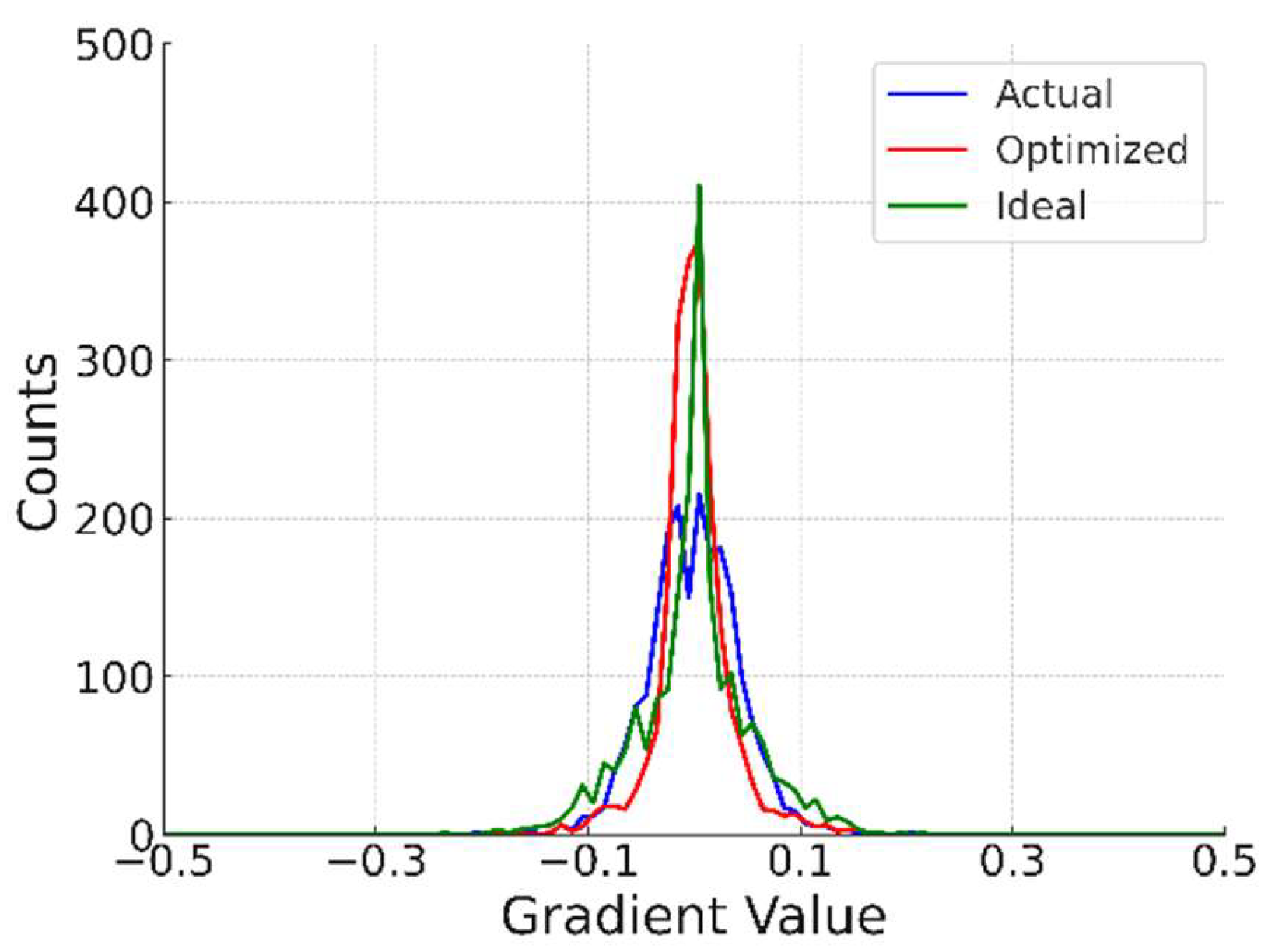
Under ideal conditions, streak images exhibit a highly sparse gradient distribution along the temporal (x-axis) direction, where non-edge regions are expected to have near-zero gradients [33]. However, under low-photon conditions, the observed streak images are degraded due to the influence of the IRF and noise. This degradation manifests as gradient smoothing and spatial diffusion, as illustrated in Figure 2. To suppress such non-structural disturbances, a gradient regularization term is introduced in the form of an approximate L 0 norm:
x , y | f ( x , y ) | 2 | f ( x , y ) | 2 + ε 1 2
To enforce gradient sparsity while maintaining the tractability of the optimization, we introduce a gradient regularization term in the form of an approximate L 0 norm. This formulation preserves the structural constraints of the streak image while avoiding the non-convexity and non-differentiability issues inherent in the exact L 0 norm. The parameter ε 1 serves as a stabilizer to prevent numerical instability when the gradient approaches zero.
Figure 2 illustrates the gradient distributions along the temporal (x-axis) direction for three types of images. In the ideal image, gradients are highly concentrated around the central region, with values near zero across most of the domain. In contrast, the degraded image exhibits dispersed gradients due to noise and IRF-induced blurring. The result restored using MSC-AR successfully suppresses non-structural gradients while preserving salient features near the center.
2.
Intensity Sparsity Regularization
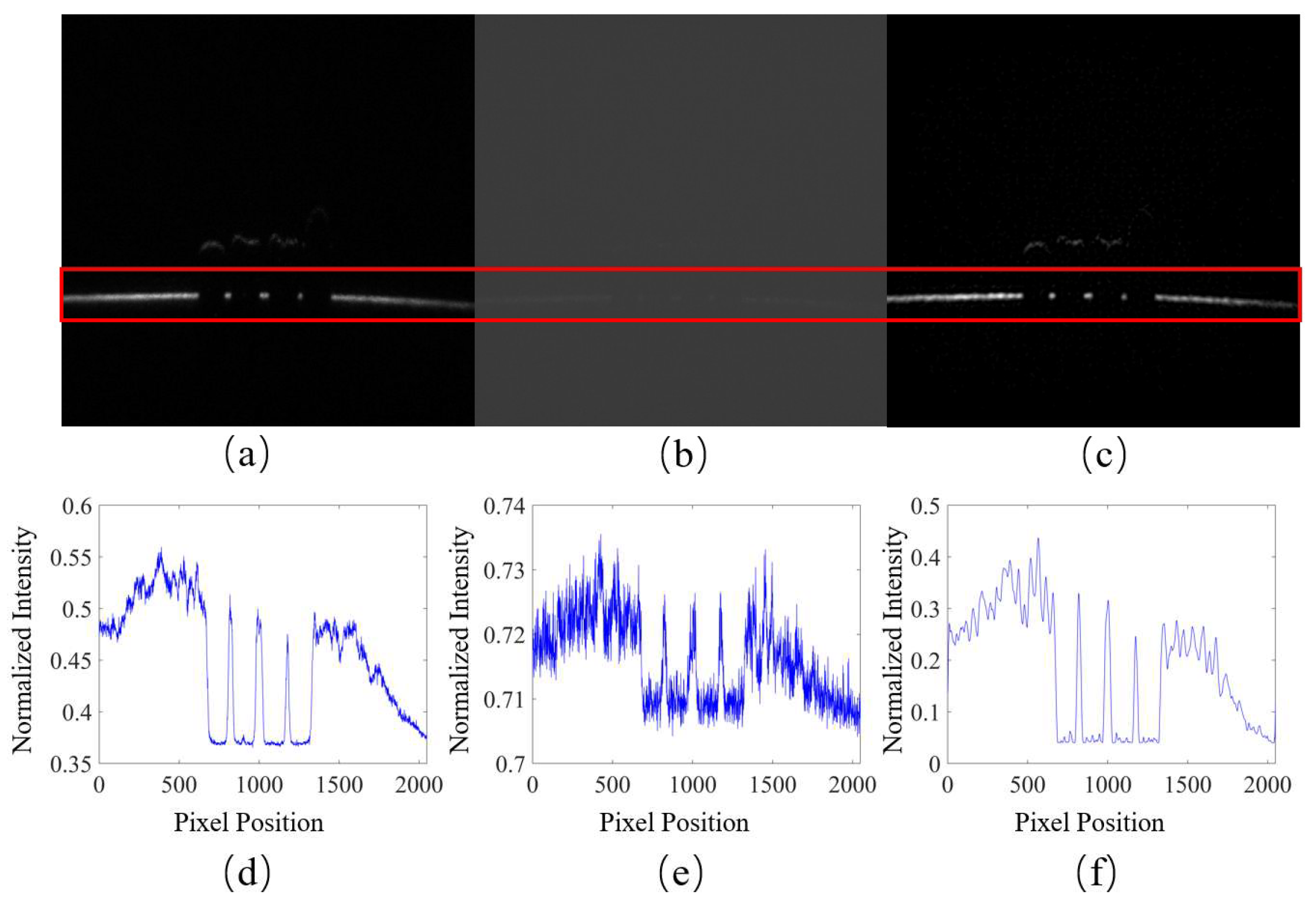
Under ideal imaging conditions, streak images typically exhibit a pronounced sparsity in intensity distribution, characterized by a substantial number of near-zero pixel values in non-signal regions [22,34]. As shown in Figure 3d, the pixel intensity distribution within the red-boxed area of the ideal image reveals a predominance of low-intensity (near-zero) values. In contrast, the degraded image acquired under low-photon conditions (Figure 3b) suffers from reduced contrast due to the comparable magnitude of signal and noise. Consequently, the histogram in Figure 3e shows a significant reduction in zero-valued pixels in non-signal regions. To address this degradation, we introduce the following intensity sparsity regularization term to enhance the representation of low-intensity structures in the image:
x , y f ( x , y ) n bg   2 f ( x , y ) n bg   2 + ε 2 2 .
Here, n b g denotes the estimated background noise component, following the approach described in [21]. The parameter ε 2 controls the penalty strength. This term contributes to enhancing background smoothness, suppressing spurious responses, and improving the overall image contrast. Unlike general denoising methods (e.g., LR, Wiener, CCA) that treat all noise uniformly, the intensity sparsity regularization targets STIL’s unique ‘signal-sparse’ structure—ideal STIL streak images have near-zero intensity in non-signal regions (Figure 3d), and this regularization restores such sparsity to suppress STIL dark current/background noise. Additionally, MSC-AR avoids pre-measuring environment IRF (required by CCA), which is impractical for STIL’s dynamic scenarios (e.g., varying propagation media), benefiting STIL’s real-world deployment.
3.
Adaptive Weighted TV Term (Temporal Channel Direction)
As illustrated in Figure 1, the x-axis of a streak image acquired by the STIL system corresponds to the temporal channel. Ideally, the intensity profile along each x-direction line exhibits a unimodal distribution, where the central positions of the peak encode depth information of the target. Thus, it is critical to preserve signal structures along the temporal axis to ensure accurate extraction of 3D spatial features. To enhance signal edge sharpness and improve depth estimation, a one-dimensional weighted TV regularization term is introduced along the x-direction. This term also functions as a balancing factor between gradient and intensity sparsity constraints during optimization, promoting more robust and structure-preserving image restoration. The regularization is formulated as:
x , y ω ( x , y ) x f ( x , y )   ,   ω ( x , y ) = 1 1 + α | x f x , y |
By applying spatially adaptive weighted ω to local gradients, this regularization term effectively suppresses non-structural noise while preserving signal edge structures, such as abrupt transitions in the streak profile. The balancing parameter α regulates the trade-off between signal edge preservation and denoising strength. Notably, the adaptive weighted TV regularization is exclusively applied along the x-axis (temporal channel) of STIL streak images—this design targets the unimodal intensity distribution of STIL’s depth-related temporal channel (Figure 1), ensuring preservation of the peak position critical for depth extraction. For general natural images without spatiotemporal encoding, such direction-specific regularization is unnecessary.
In summary, the proposed regularization term R ( f ) integrates prior knowledge on structural gradients, intensity sparsity, and signal temporal channel edge characteristics of streak images. By solving the optimization problem within the ADMM framework, this model achieves robust image restoration performance, providing a reliable foundation for accurate 3D reconstruction in low-photon STIL imaging.

2.2.2. Optimization of the Objective Function

To efficiently solve the proposed composite regularization optimization problem, we adopt the ADMM for variable decomposition and iterative optimization. ADMM is well-suited for problems involving multiple separable variables and complex regularization structures. It transforms a challenging global objective into a series of tractable subproblems, which are solved in an alternating manner to gradually approach a global optimum or saddle point [35,36].
Given that the original objective function contains non-smooth and nonlinear components, directly solving for f is computationally intractable. To address this, we introduce auxiliary variables r , s , z , reformulating the original problem into an equivalent constrained form. This enables structured optimization under the ADMM framework, enhancing both convergence and computational efficiency.
r = f ,   s = x f ,   z = f n b g
We then introduce Lagrange multipliers u r , u s , u z , and construct the augmented Lagrangian function:
f , h , r , s , z , u r , u s , u z = | | f * h g | | 2 2 + γ | | h | | 2 2 + μ x , y ϕ ( r ) + λ x , y ϕ ( z ) + τ x , y w ( x , y ) | s | + ρ 2 r f + u r 2 2 + ρ 2 s x f + u s 2 2 + ρ 2 z ( f n b g ) + u z 2 2 ρ 2 ( u r 2 2 + u s 2 2 + u z 2 2 )
where ρ > 0 is a penalty parameter controlling the convergence rate. For the gradient and intensity sparsity regularizations, we adopt a convex and smooth surrogate function ϕ ( x ) = x 2 + ξ 2 ( ξ > 0 is a smoothing parameter), which ensures the convergence of each subproblem [37,38,39]. The variables f and h are then updated sequentially through iterative optimization:
arg min f | | f h g | | 2 2 + ρ 2 r k f + u r k 2 2 + ρ 2 s k x f + u s k 2 2 + ρ 2 z k f n b g + u z k 2 2 ,
arg min h | | f k + 1 h g | | 2 2 + γ | | h | | 2 2 .
The subproblem for solving f in Equation (8), which is a smooth quadratic optimization, is efficiently addressed using FFT-based deconvolution. The estimation of h in Equation (9) is formulated as a least squares problem and can be analytically solved via direct differentiation. Once the updated estimates f k + 1 and h k + 1 are obtained, the auxiliary variables r k + 1 , s k + 1 , z k + 1 are subsequently updated according to Equations (10)–(12):
arg min r μ | | r | | 2 2 | | r | | 2 2 + ε 1 2 + ρ 2 r f k + 1 + u r k 2 2 ,
arg min s τ ω ( x , y ) | s | + ρ 2 s x f k + 1 + u s k 2 ,
arg min z λ z 2 z 2 + ε 2 2 + ρ 2 z f k + 1 + n b g + u z k 2 .
Finally, the Lagrange multipliers u r k + 1 , u s k + 1 , u z k + 1 are updated accordingly:
u r k + 1 = u r k + r k + 1 f k + 1 ,
u s k + 1 = u s k + s k + 1 x f k + 1 ,
u z k + 1 = u z k + z k + 1 f k + 1 + n b g .
The stopping criteria is given by a maximum number of iterations ( K = 30 )   and a convergence threshold for the loss ( δ = 1 × 10 4 ) , thereby preventing overfitting and potential image distortion. The detailed procedural steps are illustrated in Algorithm 1. As shown in Figure 2, the gradient distribution along the temporal (x) axis of the reconstructed image becomes more concentrated, indicating effective suppression of non-structural noise and a clear trend toward the ideal sparse pattern. Figure 3 further demonstrates that the intensity transitions along the spatial (y) axis are more distinct in the restored image, with significantly reduced background noise—highlighting the complementary effects of intensity sparsity and TV regularization. These results confirm that MSC-AR effectively balances noise suppression and edge preservation, providing a robust image foundation for subsequent 3D reconstruction under low-photon conditions.
Algorithm 1. ADMM Optimization for MAP-based Restoration
1: Input: Observed degraded image g , maximum iteration   K ,   Threshold δ
2: Output: Reconstructed image f
3: Introduce auxiliary variables r , s , z
4: Introduce Lagrange multipliers u r , u s , u z ,
 Construct Augmented Lagrangian Function L
5: Initialize δ l o s s , k
6: for k 1 … K do
7:  Update f k + 1 via Equation (8)
8:  Update h k + 1 via Equation (9)
9:  Update auxiliary variables r k + 1 , s k + 1 , z k + 1   via Equations (10)–(12)
10:   Update multipliers u r k + 1 , u s k + 1 , u z k + 1 via Equations (13)–(15)
11:   Compute loss change δ l o s s
12:   if δ l o s s >   δ then
13:  break
14: return f k + 1

3. Experiment

3.1. STIL Experimental System Setup

To evaluate the performance of MSC-AR in enhancing echo signal acquisition under low-photon conditions, we employed a multiple laser pulses STIL system previously developed in [21], which is based on a multi-pulse exposure mechanism. The key parameters of the system are listed in Table 1. During the experiments, optical attenuation was applied to the laser output to simulate low-photon imaging scenarios. A femtosecond pulsed laser source was selected to align with the ultrahigh temporal resolution of the streak camera (331 fs), thereby improving the depth measurement accuracy of the STIL system.
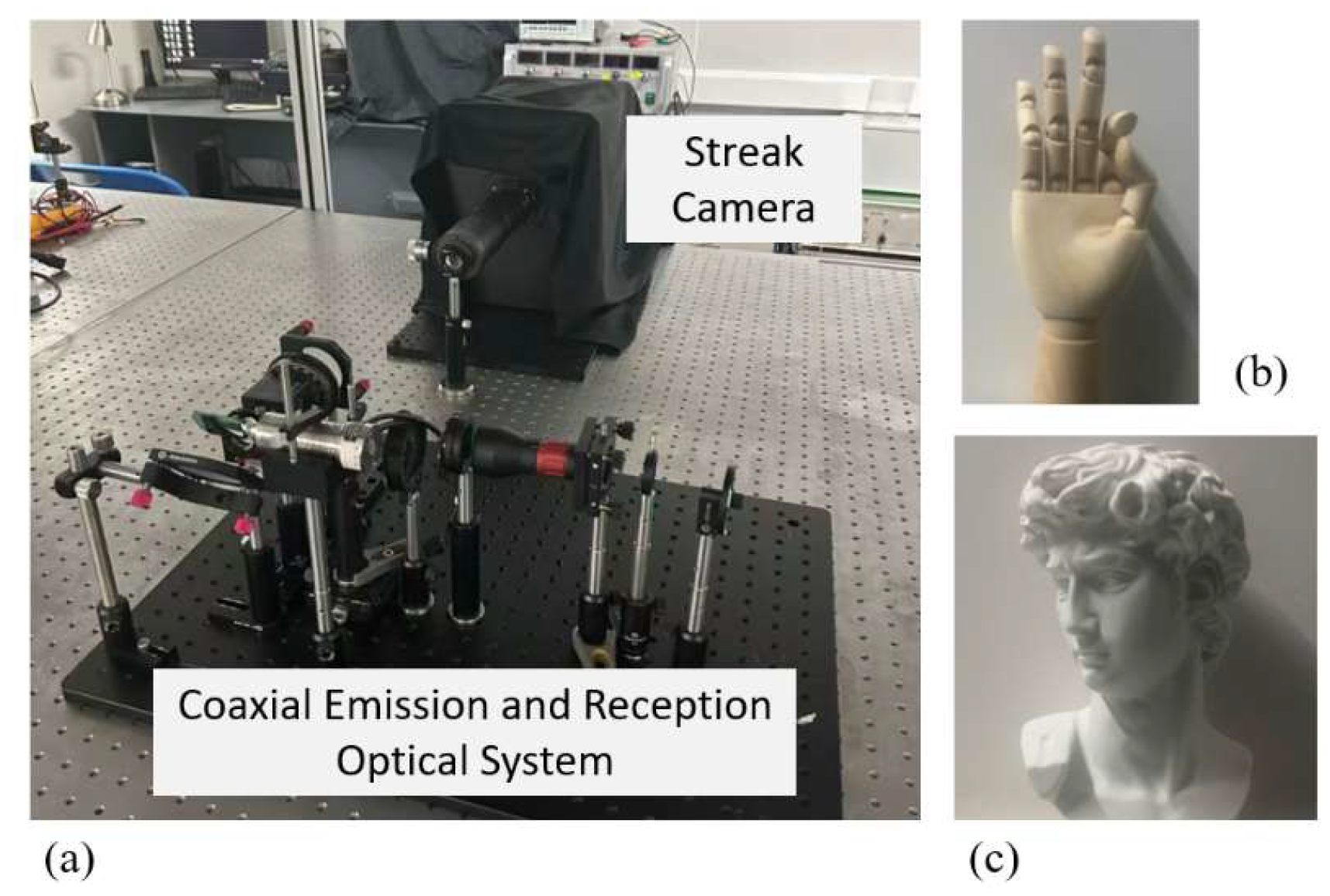
In the imaging experiments, the target objects were positioned approximately 4.25 m away from the STIL system. Figure 4 illustrates the structural schematic of the experimental setup along with the test targets used for validation. Due to system parameter constraints, the maximum detectable object size in our STIL system is approximately 306 mm × 531 mm × 102.4 mm. Specifically, the horizontal field of view (FOV) is primarily dictated by the focal length of the objective lens. We use a 400 mm focal length lens, which yields a horizontal FOV of 531 mm at a detection distance of 4.25 m. The vertical FOV is determined by the product of the galvo mirror’s single-frame scan angle and the number of captured streak frames. With a minimum scan angle of 0.18 mrad and 400 frames acquired per scan, the vertical FOV reaches approximately 306 mm. Additionally, based on the system’s theoretical temporal resolution of 331 fs per time bin (equivalent to ~0.05 mm depth resolution), and considering the CMOS sensor resolution of 2048 × 2048 pixels, the maximum measurable depth range is approximately 0.05 mm/bin × 2048 pixels = 102.4 mm. These optical and electronic limitations define the upper bounds of object dimensions suitable for our experimental system. The Hand target is a small wooden object with fine surface details, measuring 180 mm × 60 mm × 50 mm. The David target is made of plaster and features more complex contours and significant depth variations, with dimensions of 230 mm × 150 mm × 100 mm. To assess the algorithm’s performance under varying illumination conditions, three exposure times (50 ms, 300 ms, and 1000 ms) were configured, corresponding to 500, 3000, and 10,000 laser pulses, respectively. The short exposure settings were used to simulate low-photon detection scenarios. In practical STIL applications, photon starved regimes may arise from various factors such as atmospheric scattering, underwater absorption, extended imaging distances, or laser power constraint. However, based on the imaging principles of STIL, most of these low-photon scenarios produce similar effects on the streak image, typically resulting in increased blur and reduced SBR. In our experiments, we simulate representative photon-limited conditions by adjusting the exposure time, and we quantify the signal strength in the resulting streak images using SBR, defined as:
S B R = 1 m n i = 1 m j = 1 n I i , j n b g n b g ,
Here, m and n denote the horizontal and vertical pixel dimensions of the streak image, respectively; I i , j represents the grayscale intensity at pixel location ( i , j ) , and n b g refers to the noise estimate defined in Equation (4). The calculated SBR for the “Hand” target is 0.0183 at 50 ms exposure and 0.1069 at 300 ms, while for the “David” target, the SBR values are 0.0585 and 0.1330 under the same exposure settings, respectively. The data acquired under 1000 ms exposure is used as the reference standard (Ground Truth). The reconstruction results under 50 ms and 300 ms exposure conditions are then compared against this benchmark to validate MSC-AR’s enhancement capability for low-photon image recovery.

3.2. Comparison Methods

To comprehensively evaluate the effectiveness of MSC-AR, comparative experiments were conducted under different exposure conditions using representative algorithms in STIL imaging. Specifically, streak images acquired at exposure durations of 50 ms and 300 ms were used as inputs, while the results obtained under 1000 ms exposure served as the Ground Truth for performance benchmarking.
For algorithmic comparison, several representative streak image denoising techniques were selected, including Lucy-Richardson algorithm (LR), Wiener filtering, and CCA, and compared them against the proposed MSC-AR. Quantitative evaluation was carried out using peak signal-to-noise ratio (PSNR), structural similarity index (SSIM), and root-mean-square error (RMSE), which jointly measure the fidelity and structural accuracy of the reconstructed 3D images [21].
Additionally, to evaluate the adaptability of MSC-AR across different 3D reconstruction strategies, the MSC-AR based image preprocessing module was integrated into two commonly used algorithms: Peak and MLE. Comparative analyses were conducted before and after denoising to assess the impact on reconstruction performance. The experimental results demonstrate the generalizability and effectiveness of MSC-AR in enhancing both image quality and 3D reconstruction accuracy across various processing pipelines.

3.3. Denoising Method Comparison Experiments

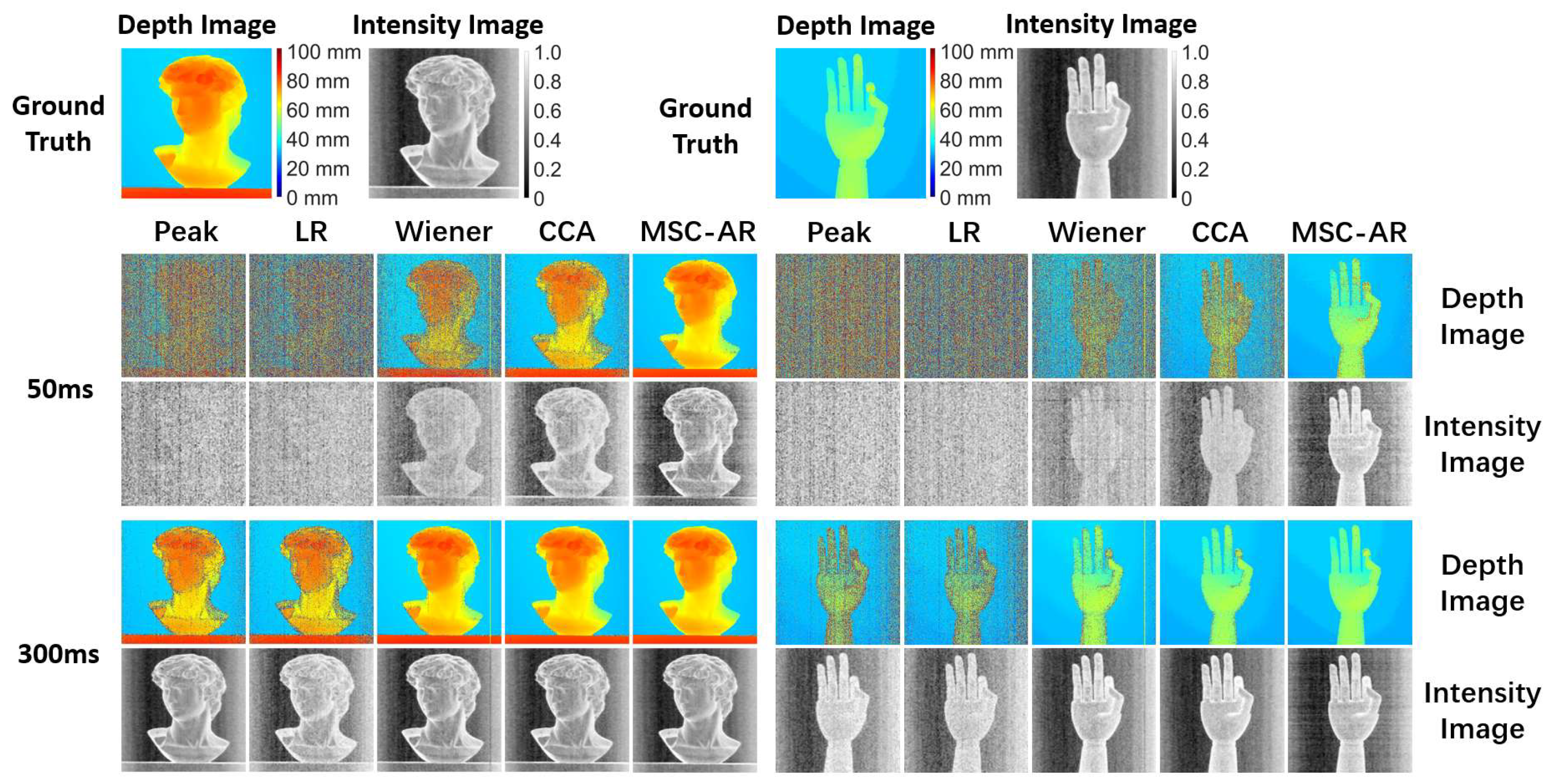
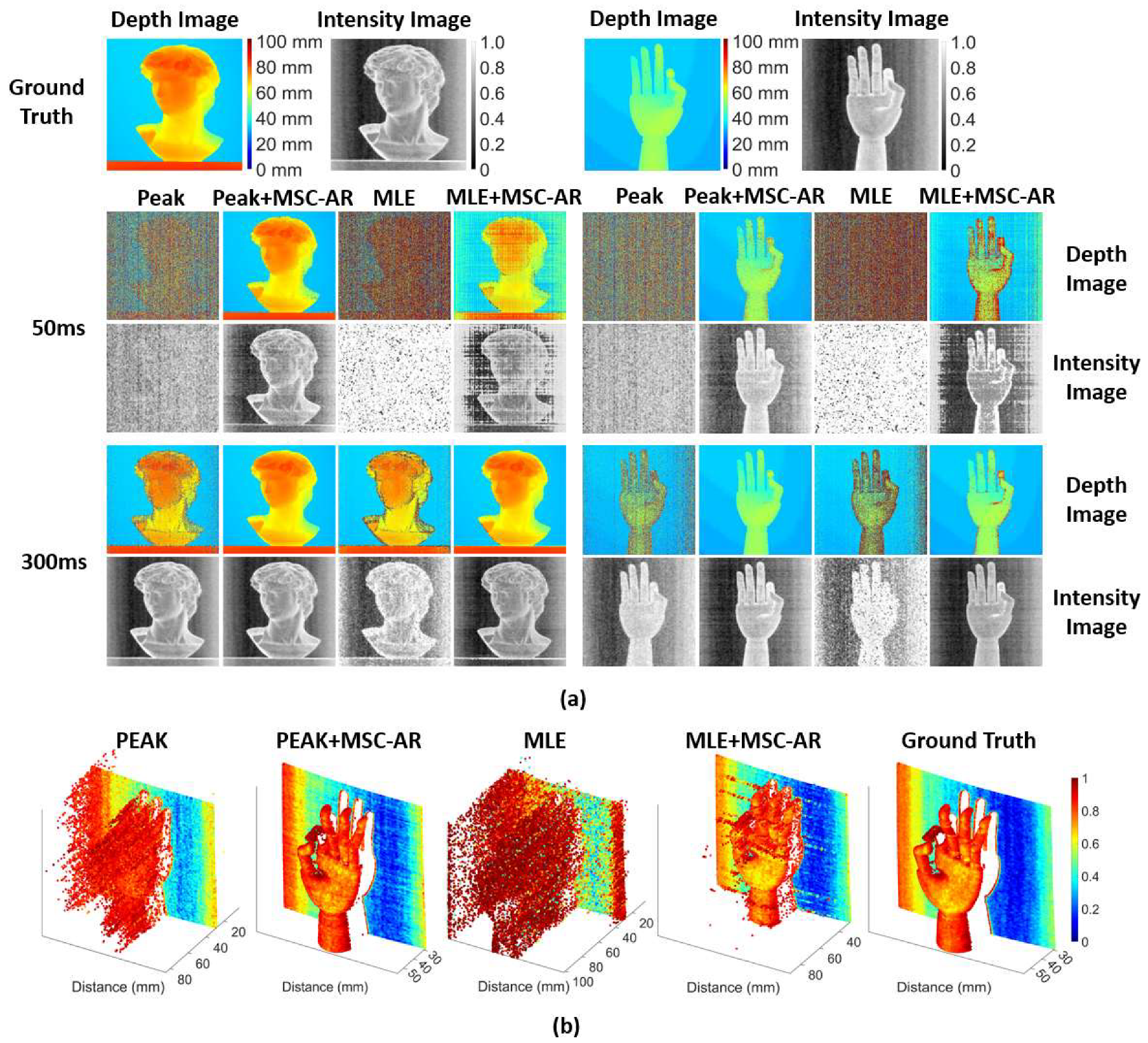
This section evaluates the impact of various image denoising and preprocessing methods on the 3D reconstruction performance of the STIL system under different low-photon conditions, using two representative targets: “Hand” and “David.” In MSC-AR, to ensure a fair comparison, the initial blur kernel ℎ is set identically to that of the compared methods. The regularization weights μ (gradient sparsity), λ (intensity sparsity), and τ (adaptive TV) were selected via discrete grid search. The selection was based on PSNR and SSIM performance on the validation set of STIL images under low-photon conditions. The final default parameter setting adopted in this paper is μ = 0.3, λ = 0.2, and τ = 0.5. All subsequent experiments were conducted using this same default configuration. In this section, both the visual quality of the reconstructed depth images and intensity images are assessed, along with quantitative evaluations of each method’s performance recovery under low (50 ms) and moderate (300 ms) exposure conditions, relative to the high-exposure reference (1000 ms). Figure 5 presents the depth and normalized intensity images reconstructed by different methods under varying exposure settings.
Under the 50 ms exposure condition, the streak images of the “David” target yields an SBR value of only 0.0585, indicating extremely weak signal intensity that is nearly submerged in background noise. As a result, direct reconstruction using the Peak algorithm fails to recover any recognizable structure. Traditional methods such as LR and Wiener filtering also perform poorly, exhibiting severe edge blurring and contour fragmentation. Although CCA partially restores the target’s outline, the reconstructed depth image still contains significant noise. In contrast, MSC-AR achieves clear contours and effectively suppresses noise, even under such extremely low-photon conditions. The “Hand” target poses greater reconstruction difficulty due to its smaller structure and more limited depth variation. At 50 ms exposure (SBR = 0.0183), MSC-AR still yields a notably better reconstruction than conventional approaches, despite a slight degradation in quality.
Table 2 summarizes the quantitative performance metrics (PSNR, RMSE, SSIM) across different methods, targets, and exposure levels. For the “Hand” target at 50 ms, MSC-AR improves the depth image PSNR by 14.5 dB over the Peak baseline, reduces RMSE by 81.2%, and increases SSIM by nearly 70 times, demonstrating outstanding reconstruction accuracy and structural fidelity. At 300 ms exposure, MSC-AR achieves an RMSE of 1.6069 mm, only 38.8% of that of the second-best method (CCA), illustrating its ability to capture millimeter-level surface features. The SSIM rises to 0.9699, approaching the quality of the 1000 ms Ground Truth image. These results validate the method’s effectiveness in delivering high-fidelity depth recovery even under moderate exposure, highlighting the potential of STIL for fine-scale target perception. Although the MSC-AR’s intensity image performance is slightly lower than that of CCA, it remains highly competitive, particularly under low-photon conditions, exhibiting greater image stability and structural preservation. This further confirms the MSC-AR’s adaptability and robustness in low-SBR environments.
In summary, MSC-AR consistently outperforms existing mainstream methods under both low and moderate exposure levels. It maintains strong adaptability and robustness across targets with varying structural characteristics, thereby providing a reliable image foundation for achieving high-precision 3D reconstruction in low-photon STIL systems.

3.4. Evaluation of MSC-AR Integrated into Different Reconstruction Strategies

To validate the generality and compatibility of MSC-AR across different 3D reconstruction strategies, we integrate MSC-AR into two representative algorithms: Peak and MLE. Experiments are conducted under two exposure settings (50 ms, 300 ms). Both qualitative visual comparisons and quantitative evaluations are performed to assess the reconstruction quality of the original algorithms with and without MSC-AR integration. Figure 6 presents the reconstructed depth and intensity images under different reconstruction strategies, along with the 3D point cloud of the “Hand” target under 300 ms exposure. In the point cloud visualization, color denotes the target’s intensity information. Table 3 summarizes the corresponding quantitative results, including PSNR, RMSE, and SSIM.
MSC-AR’s performance gain is not just general image quality improvement, instead, it directly enhances STIL’s depth extraction logic. The STIL-specific optimization distinguishes it from general preprocessing methods. Conventional reconstruction methods exhibit notable limitations under low-photon imaging conditions. Peak, which relies solely on identifying the maximum gray value along the temporal axis, is highly susceptible to noise. Under extremely low exposure (50 ms), it fails to recover meaningful structural information, and even at moderate exposure (300 ms), it yields reconstructions contaminated with substantial noise. In contrast, MLE employs centroid estimation, which moderately suppresses local noise and produces more continuous depth images. However, MLE assumes all signals contribute to the estimation, it becomes sensitive to strong noise or distorted intensity distributions. Under such conditions, especially when the SBR is low, the centroid estimated by MLE can deviate significantly, which may result in worse performance than Peak. Given these limitations, and to ensure experimental consistency while highlighting the adaptability of our proposed method, only MSC-AR is used as the fixed preprocessing module in this section, combined with Peak and MLE as representative 3D reconstruction strategies. Other combinations, such as LR/Wiener/CCA with MLE, are omitted for two reasons: first, their performance under low-SBR conditions has already been shown to be consistently inferior (see Section 3.3); and second, including such redundant results would not provide additional insight, but rather dilute the attribution of improvements to MSC-AR itself. By incorporating the proposed MSC-AR image preprocessing into both reconstruction pipelines, notable improvements are achieved in both image quality and 3D reconstruction accuracy. Especially under the 50 ms exposure setting, the integration of MSC-AR with classical algorithms enables accurate recovery of target contours and fine structures, while effectively suppressing background noise. For instance, using the “Hand” and “David” targets, MSC-AR + Peak improves depth image PSNR by 14.5 dB and 18.5 dB, respectively, compared to the original Peak. RMSE is reduced by over 80%, and SSIM increases by nearly 70 times. For intensity images, PSNR improves by over 7.8 dB, RMSE decreases by about 60%, and SSIM improves more than 60%, demonstrating the MSC-AR’s strong capability in noise suppression and structural fidelity under photon-starved conditions.
These performance gains can be attributed to MSC-AR’s ability to enhance contrast and suppress blur and noise during streak image restoration, thereby providing a more stable and reliable input for subsequent depth and intensity extraction. Overall, MSC-AR demonstrates strong robustness and adaptability across various reconstruction strategies. It significantly enhances data utility and reconstruction fidelity under ultra-low photon conditions, while under moderate exposure, it effectively reduces reconstruction errors and improves structural preservation. These results underscore its practical potential for deployment in low-photon 3D STIL systems.

3.5. Ablation Study of Regularization Components

To further validate the effectiveness of each regularization term in the algorithm, an ablation study was conducted. Each term was removed individually, and the resulting differences in reconstruction performance were analyzed. We chose to remove one regularization term at a time, rather than multiple simultaneously, in order to isolate and analyze the contribution of each component. If multiple terms were removed, the optimization would suffer from weakened constraints and tend to converge to suboptimal solutions, making it difficult to attribute the observed performance changes to any specific term. Considering the consistency across multiple target types, the streak images of the “David” target under 50 ms exposure was chosen for analysis. The experimental configurations are as follows:
  • Configuration (a): Gradient sparsity term removed (only intensity sparsity and TV_X included);
  • Configuration (b): Intensity sparsity term removed (only gradient sparsity and TV-X included);
  • Configuration (c): Adaptive weighted TV term removed (only gradient and intensity terms included);
  • Configuration (d): Full model with all regularization terms (MSC-AR)
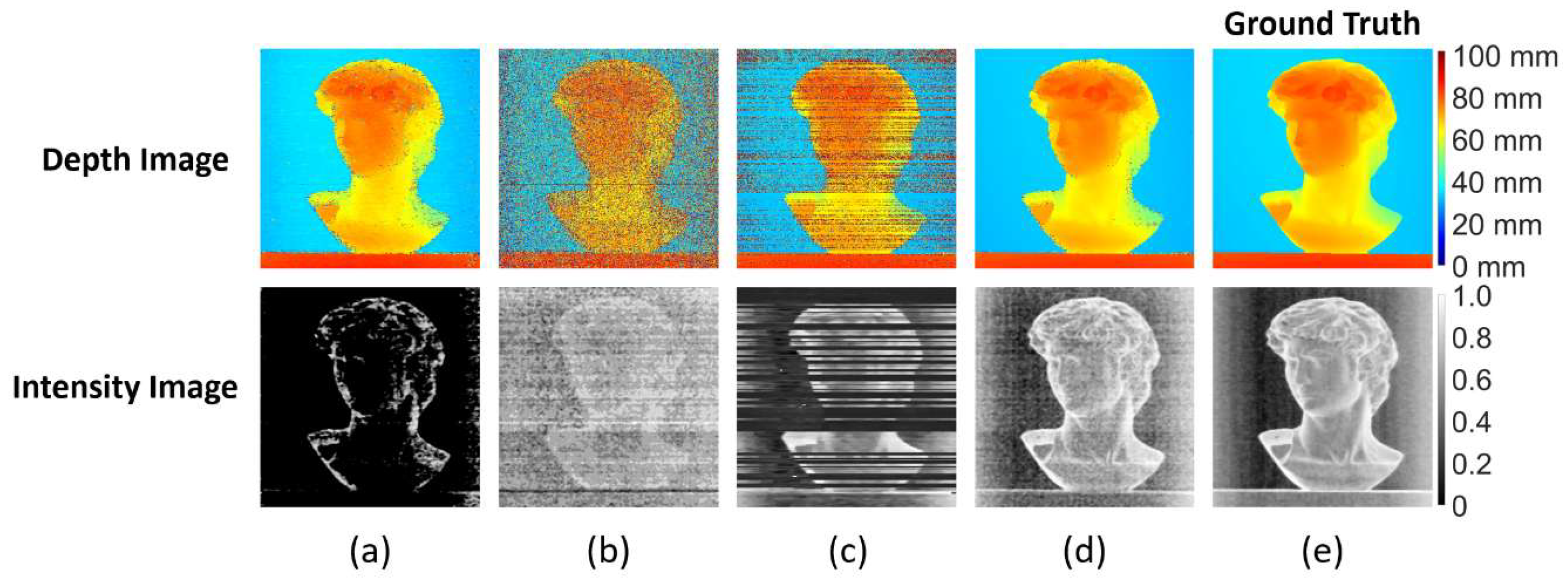
Figure 7 illustrates the depth and intensity reconstruction results under different regularization configurations, while Table 4 presents the corresponding quantitative metrics, including PSNR, RMSE, and SSIM. As observed from the visual outcomes, omitting any single regularization term leads to a noticeable degradation in reconstruction quality:
  • Configuration (a): Without the gradient sparsity term, although the depth image appears relatively accurate, the intensity image shows excessive gray-level fluctuations. This is due to an overabundance of near-zero pixel values and a lack of gradient sparsity, which increases image contrast abnormally;
  • Configuration (b): Excluding the intensity sparsity term results in poor noise suppression, leading to visible background artifacts in the intensity image. The increased noise also compromises depth estimation accuracy;
  • Configuration (c): Without the temporal TV-X constraint, the optimization relies only on gradient and intensity sparsity. This leads to overly dark stripe patterns due to excessive suppression, causing significant structural distortions and artifacts in the reconstructed depth image;
  • Configuration (d): The complete model exhibits the best overall performance, preserving structural details, suppressing background noise, and maintaining edge sharpness.
Quantitatively, the full model (d) outperforms all other configurations in depth PSNR, RMSE, and SSIM. Configuration (a) achieves relatively good depth accuracy but fails in intensity preservation. Removing the intensity prior (b) increases the depth RMSE to 23.1266 mm and reduces SSIM to 0.0844, highlighting its importance in enhancing structural sparsity. Configuration (c) performs worst across all metrics, with an RMSE of 27.4285 mm and SSIM of only 0.0230, emphasizing the crucial role of temporal channel noise suppression. These results confirm the complementary nature and synergistic effectiveness of the proposed regularization components in robust image restoration under low-photon conditions.

3.6. Summary of Experimental Results

Extensive experiments conducted on two representative targets, “Hand” and “David,” demonstrate the superior performance of the proposed MAP-based image optimization method under low-photon conditions in the STIL system. Across both low (50 ms) and moderate (300 ms) exposure scenarios, MSC-AR consistently improves image quality and enhances the accuracy of subsequent 3D reconstruction—particularly in terms of depth image fidelity and structural completeness. Quantitatively, MSC-AR achieves substantial improvements over traditional methods in key metrics such as PSNR, RMSE, and SSIM, with consistent trends observed across both test targets. Furthermore, integrating MSC-AR into two mainstream reconstruction strategies (Peak and MLE) reveals its strong adaptability and generalization capability. The MSC-AR module significantly mitigates the distortion typically observed in low-photon reconstructions and yields depth images closely aligned with Ground Truth results obtained under high exposure. This suggests a reduced dependence on photon counts for accurate 3D perception. Additionally, ablation studies validate the complementary contributions of the three regularization terms. The removal of any individual component results in a marked decline in reconstruction quality, confirming the necessity of their joint integration.
In summary, the experimental evaluations comprehensively validate the robustness, accuracy, and generalizability of MSC-AR under challenging low-photon conditions, providing strong technical support for enhancing 3D sensing capability in practical STIL deployments.

4. Conclusions

To address the degradation of 3D reconstruction accuracy in STIL systems under the photon-starved regime, this paper proposes an image optimization method (MSC-AR) based on the MAP estimation framework. The method focuses on optimizing the streak image to improve the accuracy of subsequent 3D information extraction. MSC-AR addresses the degradation introduced by blur and noise in the image formation process by incorporating three regularization terms: gradient sparsity, intensity sparsity, and temporally weighted total variation. This joint regularization framework effectively recovers structural details and enhances the accuracy of 3D reconstruction.
A multiple laser pulses STIL system was developed to cover a range of exposure times from 50 ms to 1000 ms and simulate diverse low-photon imaging scenarios. Experimental results on two representative targets (Hand and David) demonstrate that MSC-AR achieves substantial performance improvements across both Peak and MLE reconstruction strategies. Under extreme photon-limited conditions, MSC-AR reduces depth image RMSE by over 70% on average and boosts SSIM beyond 0.9, outperforming existing mainstream denoising and restoration algorithms.
Ablation experiments further validate the indispensable role of each regularization component, confirming that the synergy among multiple priors is a key factor in achieving high-quality reconstructions. Moreover, MSC-AR exhibits strong generalizability and ease of deployment. Without relying on prior measurement of the environmental IRF, it can be flexibly integrated into various 3D reconstruction pipelines, offering a reliable imaging solution for STIL systems in resource-constrained or bandwidth-limited applications. In particular, MSC-AR demonstrates practical value for deployment on edge platforms such as underwater AUV/ROV systems, remote sensor nodes, or embedded industrial LiDAR, where computational resources and power budgets are limited. Unlike environment calibration-dependent or learning-based methods, MSC-AR is training-free, environment calibration-free, and CPU-executable, making it deployable on resource-constrained platforms without relying on GPU or large datasets. Moreover, by outputting compact depth and intensity images instead of raw streak images, it substantially reduces communication overhead, thus adapting well to bandwidth-limited environments.
Although the current implementation of MSC-AR is not yet optimized for real-time inference due to the high-resolution input and iterative MAP optimization, its lightweight nature and independence from pre-trained models or calibration data make it well-suited for offline deployment in field applications. Future work will explore algorithmic simplification and hardware-specific acceleration to further reduce inference latency and move toward real-time processing capability.

Author Contributions

Conceptualization, Z.Y. and S.C.; methodology, Z.Y. and M.F.; software, Z.Y.; validation, Z.Y.; formal analysis, Z.Y. and P.C.; investigation, Z.Y. and M.F.; data curation, M.F.; writing—original draft preparation, Z.Y.; writing—review and editing, P.R. and S.C.; supervision, Y.X., M.X., and W.H.; funding acquisition, X.W. and S.C. All authors have read and agreed to the published version of the manuscript.

Funding

This research was funded by National Natural Science Foundation of China (Grant No. 62075236, 62305375); Key Program of the Chinese Academy of Sciences (Grant No. KGFZD-145-25-15); Natural Science Basic Research Program of Shaanxi Province (Grant No. 2025JC-YBQN-118); Key Research and Development Projects of Shaanxi Province (Grant No. 2024GX-YBXM-090).

Data Availability Statement

The data presented in this study are available on request from the corresponding author.

Conflicts of Interest

The authors declare no conflicts of interest.

Abbreviations

The following abbreviations are used in this manuscript:
STILStreak Tube Imaging Lidar
MSC-ARMulti-Sparsity Constraints and Adaptive Regularization algorithm
MAPMaximum a Posteriori
ADMMAlternating Direction of Multipliers
TVTotal Variation
MLEMaximum Likelihood Estimation
CCACross-Correlation Algorithm
SBRSignal-to-Background Ratio
IRFImaging Response Function
LRLucy-Richardson algorithm

References

  1. Tian, L.; Shen, L.; Xue, Y.; Chen, L.; Chen, P.; Tian, J.; Zhao, W. 3-D Imaging Lidar Based on Miniaturized Streak Tube. Meas. Sci. Rev. 2023, 23, 80–85. [Google Scholar] [CrossRef]
  2. Mondal, J.; Maity, N.C.; Biswas, R. Detection of Ultrafast Solvent Dynamics Employing a Streak Camera. J. Chem. Sci. 2023, 135, 84. [Google Scholar] [CrossRef]
  3. Invernizzi, L.; Duluard, C.Y.; Höft, H.; Hassouni, K.; Lombardi, G.; Gazeli, K.; Prasanna, S. Peculiarities of Measuring Fluorescence Decay Times by a Streak Camera for Ps-TALIF Experiments in Reactive Plasmas. Meas. Sci. Technol. 2023, 34, 095203. [Google Scholar] [CrossRef]
  4. Gao, J.; Sun, J.; Wang, Q. Experiments of Ocean Surface Waves and Underwater Target Detection Imaging Using a Slit Streak Tube Imaging Lidar. Optik 2014, 125, 5199–5201. [Google Scholar] [CrossRef]
  5. Hui, D.; Luo, D.; Tian, L.; Lu, Y.; Chen, P.; Wang, J.; Sai, X.; Wen, W.; Wang, X.; Xin, L.; et al. A Compact Large-Format Streak Tube for Imaging Lidar. Rev. Sci. Instrum. 2018, 89, 045113. [Google Scholar] [CrossRef]
  6. Zong, F.; Zhang, J.; Guo, B.; Yang, Q. Research of Mini Steak Tube with Planar Image Plane for Laser Three-Dimensional Scanning Lidar. Optik 2019, 185, 1157–1162. [Google Scholar] [CrossRef]
  7. Kornienko, V.; Bao, Y.; Bood, J.; Ehn, A.; Kristensson, E. The Space-Charge Problem in Ultrafast Diagnostics: An All-Optical Solution for Streak Cameras. Ultrafast Sci. 2024, 4, 0055. [Google Scholar] [CrossRef]
  8. Lee, J.; Ingle, A.; Chacko, J.V.; Eliceiri, K.W.; Gupta, M. CASPI: Collaborative Photon Processing for Active Single-Photon Imaging. Nat. Commun. 2023, 14, 3158. [Google Scholar] [CrossRef]
  9. Shin, D.; Xu, F.; Venkatraman, D.; Lussana, R.; Villa, F.; Zappa, F.; Goyal, V.K.; Wong, F.N.C.; Shapiro, J.H. Photon-Efficient Imaging with a Single-Photon Camera. Nat. Commun. 2016, 7, 12046. [Google Scholar] [CrossRef]
  10. Li, Z.-P.; Huang, X.; Cao, Y.; Wang, B.; Li, Y.-H.; Jin, W.; Yu, C.; Zhang, J.; Zhang, Q.; Peng, C.-Z.; et al. Single-Photon Computational 3D Imaging at 45 Km. Photon. Res. 2020, 8, 1532. [Google Scholar] [CrossRef]
  11. Chan, S.; Halimi, A.; Zhu, F.; Gyongy, I.; Henderson, R.K.; Bowman, R.; McLaughlin, S.; Buller, G.S.; Leach, J. Long-Range Depth Imaging Using a Single-Photon Detector Array and Non-Local Data Fusion. Sci. Rep. 2019, 9, 8075. [Google Scholar] [CrossRef] [PubMed]
  12. Li, Z.; Wu, E.; Pang, C.; Du, B.; Tao, Y.; Peng, H.; Zeng, H.; Wu, G. Multi-Beam Single-Photon-Counting Three-Dimensional Imaging Lidar. Opt. Express OE 2017, 25, 10189–10195. [Google Scholar] [CrossRef] [PubMed]
  13. Li, Z.-P.; Ye, J.-T.; Huang, X.; Jiang, P.-Y.; Cao, Y.; Hong, Y.; Yu, C.; Zhang, J.; Zhang, Q.; Peng, C.-Z.; et al. Single-Photon Imaging over 200 Km. Optica 2021, 8, 344–349. [Google Scholar] [CrossRef]
  14. Nevis, A.J.; Hilton, R.J.; Taylor, J.S., Jr.; Cordes, B.; McLean, J.W. Advantages of three-dimensional electro-optic imaging sensors. In Detection and Remediation Technologies for Mines and Minelike Targets VIII; SPIE: Bellingham, WA, USA, 2003; Volume 5089, pp. 225–237. [Google Scholar] [CrossRef]
  15. Taylor, J.S.; Hulgan, M.C. Electro-Optic Identification Research Program. In Proceedings of the OCEANS ’02 MTS/IEEE, Biloxi, MI, USA, 29–31 October 2002; Volume 2, pp. 994–1002. [Google Scholar]
  16. Pawlikowska, A.M.; Halimi, A.; Lamb, R.A.; Buller, G.S. Single-Photon Three-Dimensional Imaging at up to 10 Kilometers Range. Opt. Express 2017, 25, 11919. [Google Scholar] [CrossRef] [PubMed]
  17. Gleckler, A.D. Multiple-slit streak tube imaging lidar (MS-STIL) applications. In Laser Radar Technology and Applications V; SPIE: Bellingham, WA, USA, 2000; Volume 4035, pp. 266–278. [Google Scholar] [CrossRef]
  18. Zhang, Y.; Zhao, Y.; Liu, L.; He, J.; Jin, C.; Mi, G.; Sun, X. Improvement of Range Accuracy of Range-Gating Laser Radar Using the Centroid Method. Appl. Opt. 2010, 49, 267. [Google Scholar] [CrossRef]
  19. Luo, T.; Fan, R.; Chen, Z.; Wang, X.; Chen, D. Deblurring Streak Image of Streak Tube Imaging Lidar Using Wiener Deconvolution Filter. Opt. Express 2019, 27, 37541. [Google Scholar] [CrossRef]
  20. Thomas, C.A.; Martin, I.P.S.; Rehm, G. Diagnostics Beamline Optimisation and Image Processing for Sub-Ps Streak Camera Bunch Length Measurement. In Proceedings of the IBIC2012, Tsukuba, Japan, 1–4 October 2012. [Google Scholar]
  21. Fang, M.; Qiao, K.; Yin, F.; Xue, Y.; Chang, Y.; Su, C.; Wang, Z.; Tian, J.; Wang, X. Streak Tube Imaging Lidar with Kilohertz Laser Pulses and Few-Photons Detection Capability. Opt. Express 2024, 32, 19042. [Google Scholar] [CrossRef]
  22. Pan, J.; Hu, Z.; Su, Z.; Yang, M.-H. L_0-Regularized Intensity and Gradient Prior for Deblurring Text Images and Beyond. IEEE Trans. Pattern Anal. Mach. Intell. 2017, 39, 342–355. [Google Scholar] [CrossRef]
  23. Li, J.; Hu, H.; Bai, Y. Double-Channel Cyclic Image Deblurring Algorithm Based on Edge Features. J. Meas. Sci. Instrum. 2025, 16, 75–84. [Google Scholar] [CrossRef]
  24. Xu, L.; Jia, J. Two-Phase Kernel Estimation for Robust Motion Deblurring. In Proceedings of the Computer Vision—ECCV 2010, Heraklion, Greece, 5–11 September 2010; Daniilidis, K., Maragos, P., Paragios, N., Eds.; Springer: Berlin/Heidelberg, Germany, 2010; pp. 157–170. [Google Scholar]
  25. Ren, D.; Zhang, K.; Wang, Q.; Hu, Q.; Zuo, W. Neural Blind Deconvolution Using Deep Priors. In Proceedings of the 2020 IEEE/CVF Conference on Computer Vision and Pattern Recognition (CVPR), Seattle, WA, USA, 13–19 June 2020; pp. 3338–3347. [Google Scholar]
  26. Fang, M.; Qiao, K.; Yin, F.; Xue, Y.; Tian, J.; Wang, X. Underwater 4D Imaging Quality Enhancement of Streak Tube Imaging LiDAR at Extremely Low SNR. Appl. Opt. 2025, 64, 3880. [Google Scholar] [CrossRef]
  27. Gao, J.; Sun, J.; Wang, Q.; Cong, M. 4-D Imaging of the Short Scale Ocean Waves Using a Slit Streak Tube Imaging Lidar. Optik 2017, 136, 136–143. [Google Scholar] [CrossRef]
  28. Wu, L.; Wang, X.; Yang, H.; Yu, B.; Chen, C.; Yang, B.; Yuan, L.; Wu, L.; Xue, Z.; Li, G.; et al. Signal-to-Noise Performance Analysis of Streak Tube Imaging Lidar Systems II Theoretical Analysis and Discussion. Appl. Opt. 2012, 51, 8836. [Google Scholar] [CrossRef]
  29. Yang, H.; Wu, L.; Wang, X.; Chen, C.; Yu, B.; Yang, B.; Yuan, L.; Wu, L.; Xue, Z.; Li, G.; et al. Signal-to-Noise Performance Analysis of Streak Tube Imaging Lidar Systems. I. Cascaded Model. Appl. Opt., AO 2012, 51, 8825–8835. [Google Scholar] [CrossRef]
  30. Hu, N.; Tan, J.; Ge, X.; Hu, D.; Liu, J. Blind Image Deblurring via Enhanced Rational Channel Prior. Circuits Syst. Signal Process. 2025, 1–26. [Google Scholar] [CrossRef]
  31. Yang, C.; Wang, W. Edge Enhancing Based Blind Kernel Estimation for Deep Image Deblurring. Circuits Syst. Signal Process. 2025, 44, 1017–1044. [Google Scholar] [CrossRef]
  32. Wang, J.; Hao, W.; Chen, S.; Xie, M.; Li, X.; Shi, H.; Feng, X.; Su, X. Underwater Single-Photon Profiling Under Turbulence and High Attenuation Environment. IEEE Geosci. Remote Sens. Lett. 2024, 21, 6501605. [Google Scholar] [CrossRef]
  33. Chen, L.; Fang, F.; Wang, T.; Zhang, G. Blind Image Deblurring with Local Maximum Gradient Prior. In Proceedings of the 2019 IEEE/CVF Conference on Computer Vision and Pattern Recognition (CVPR), Long Beach, CA, USA, 15–20 June 2019; pp. 1742–1750. [Google Scholar]
  34. Yan, Y.; Ren, W.; Guo, Y.; Wang, R.; Cao, X. Image Deblurring via Extreme Channels Prior. In Proceedings of the 2017 IEEE Conference on Computer Vision and Pattern Recognition (CVPR), Honolulu, HI, USA, 21–26 July 2017. [Google Scholar] [CrossRef]
  35. HimaBindhu, J.; Karimullah, S.; Fahimuddin, S.; Sushma, A.; Reddy, K.V.; Simha, E.V.; Reddy, S.S.N. Enhancing Remote Sensing Image Quality with Advanced ADMM-Based Stripe Noise Removal. In Proceedings of the 2025 International Conference on Computer, Electrical & Communication Engineering (ICCECE), Kolkata, India, 7–8 February 2025; pp. 1–6. [Google Scholar]
  36. Pham, T.-H.; Hong, I.-P. Fast Adaptive Plug-and-Play ADMM Framework for Short-Range 3-D SAR Imaging. IEEE Trans. Comput. Imaging 2025, 11, 764–778. [Google Scholar] [CrossRef]
  37. Boyd, S.; Parikh, N.; Chu, E.; Peleato, B.; Eckstein, J. Distributed Optimization and Statistical Learning via the Alternating Direction Method of Multipliers. Found. Trends® Mach. Learn. 2011, 3, 1–122. [Google Scholar] [CrossRef]
  38. Eckstein, J.; Bertsekas, D.P. On the Douglas—Rachford Splitting Method and the Proximal Point Algorithm for Maximal Monotone Operators. Math. Program. 1992, 55, 293–318. [Google Scholar] [CrossRef]
  39. Goldstein, T.; Osher, S. The Split Bregman Method for L1-Regularized Problems. SIAM J. Imaging Sci. 2009, 2, 323–343. [Google Scholar] [CrossRef]
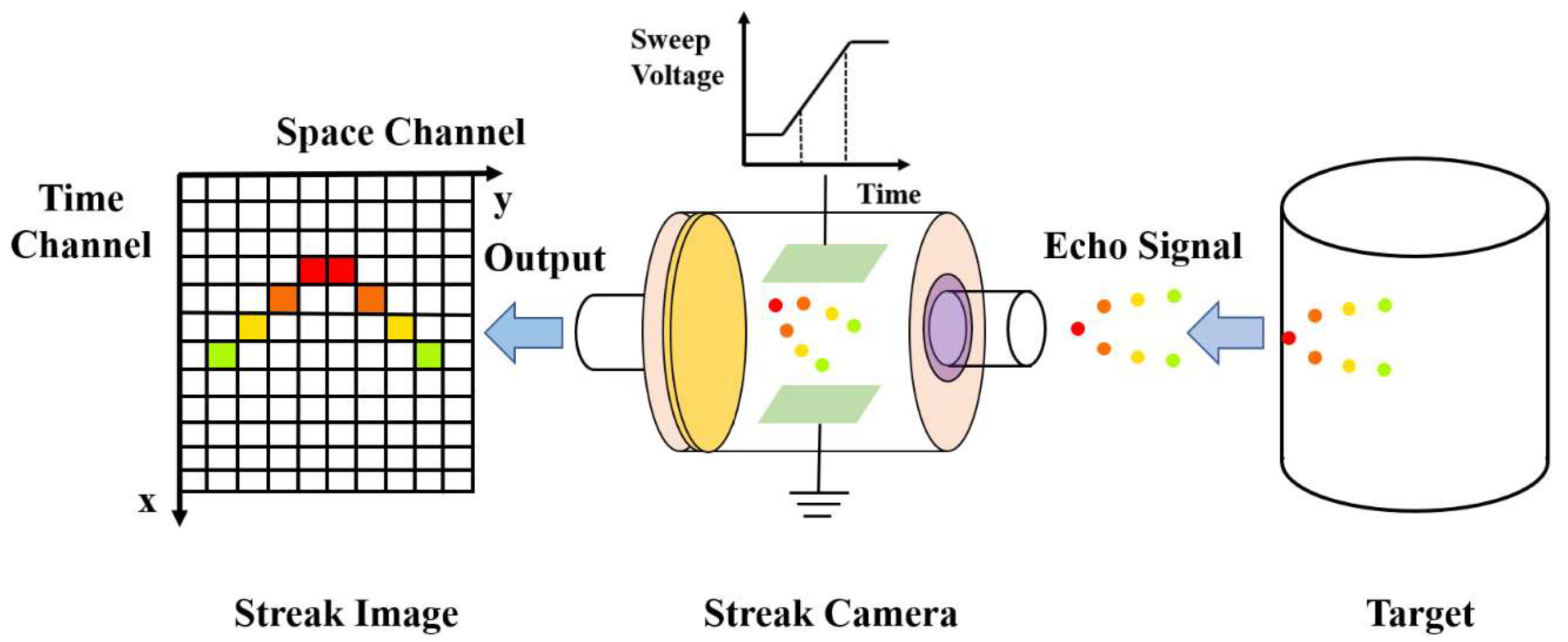
Figure 1. Principle of streak camera imaging. Colored dots correspond to echo photons at distinct depths; the color scale encodes range from red (near) to green (far).
Remotesensing 17 03089 g001
Figure 2. Comparison of gradient distributions along the temporal (x-axis) direction for three types of streak images. The blue curve represents the gradient distribution of the observed degraded image, the red curve corresponds to the result restored using MSC-AR, and the green curve indicates the reference gradient of an ideal streak image.
Remotesensing 17 03089 g002
Figure 3. Comparison of normalized streak images and the corresponding intensity distributions along the spatial (y) direction in the highlighted region. (a) Ideal streak image; (b) Observed degraded streak image; (c) Reconstructed image using MSC-AR; (df) Intensity profiles along the spatial (y) direction for the red-box region in (ac), respectively.
Remotesensing 17 03089 g003
Figure 4. Schematic of the experimental system and target setup. (a) Experimental system; (b) Hand target (180 mm × 60 mm × 50 mm); (c) David target (230 mm × 150 mm × 100 mm).
Remotesensing 17 03089 g004
Figure 5. Comparison of depth and normalized intensity image reconstruction results for two target types under different image preprocessing methods.
Remotesensing 17 03089 g005
Figure 6. Comparison of reconstructed images using different reconstruction strategies (Peak/MLE) with and without MSC-AR under 50 ms and 300 ms exposure conditions: (a) Depth images and normalized intensity images; (b) 3D point cloud comparisons of the “Hand” target under 300 ms exposure, where color encodes intensity information.
Remotesensing 17 03089 g006
Figure 7. Comparison of reconstruction results under different configurations in the ablation study of regularization terms (David target, 50 ms exposure).(a) Gradient sparsity term removed (only Intensity and TV-X retained); (b) Intensity sparsity term removed (only Gradient and TV-X retained); (c) TV-X term removed (only Gradient and Intensity retained); (d) Full configuration (all three regularization terms applied); (e) Ground Truth.
Remotesensing 17 03089 g007
Table 1. Summary of the main system parameters.
System ModuleMain Parameters
SensorsStreak tube: XIOPM 5200
CMOS: XIOPM 5200
Resolution: 2048 × 2048, 331 fs time bin width
The maximum detectable object size: 306 mm × 531 mm × 102.4 mm
LaserWavelength (nm): 513
Attenuated output power (μW): 23
Frequency (Hz): 10K
Pulse width (fs): 290
Table 2. Quantitative Results of Different Stripe Image Restoration Methods under Varying Exposure Times.
TargetMethodsTimeDepth ImageIntensity Image
PSNR (dB) ↑ RMSE (mm) ↓SSIM ↑PSNR (dB) ↑RMSE ↓SSIM ↑
HandPeak50 ms9.211635.21870.010412.49240.23730.3245
300 ms14.730518.65180.146220.75360.09170.5927
LR 50 ms9.481634.14070.010212.83630.22810.3628
300 ms14.084520.09590.085219.56680.10510.5565
Wiener 50 ms10.997028.66920.015813.21940.21830.4475
300 ms21.84098.22750.674221.28650.08620.5230
CCA50 ms13.492521.50960.059416.81810.14420.5156
300 ms27.81584.13920.875324.71220.05810.6775
MSC-AR50 ms23.71556.63080.729720.22280.09750.5260
300 ms36.00681.60690.969923.19700.06920.6414
DavidPeak50 ms9.561733.82540.011911.15270.27690.3078
300 ms17.168414.08550.318621.65190.08270.6939
LR 50 ms9.288634.90340.011012.18000.24600.3577
300 ms15.655216.77030.206822.47340.07520.6601
Wiener 50 ms12.169725.04870.030713.58390.20930.4645
300 ms24.39216.13250.827422.32980.07650.5925
CCA50 ms16.285715.60080.235218.64960.11680.5909
300 ms30.38793.07130.947429.57720.03320.7636
MSC-AR50 ms28.04434.02730.899222.04290.07900.5952
300 ms34.18161.98320.979623.78720.06470.7207
Table 3. Evaluation of the Adaptability of MSC-AR Under Different 3D Reconstruction Strategies.
TargetReconstruction
Methods
Reg. TermTimeDepth ImageIntensity Image
PSNR (dB) ↑RMSE (mm) ↓SSIM ↑PSNR (dB) ↑RMSE ↓SSIM ↑
HandPeak-50 ms9.211635.21870.010412.49240.23730.3245
-300 ms14.730518.65180.146220.75360.09170.5927
Y50 ms23.71556.63080.729720.22280.09750.5260
Y300 ms36.00681.60690.969923.19700.06920.6414
MLE -50 ms6.364848.87700.00756.59880.46780.1365
-300 ms13.610421.22480.283912.62440.23380.1717
Y50 ms16.261515.64150.331613.84740.20310.2859
Y300 ms26.00295.09520.886120.43210.09510.4323
DavidPeak-50 ms9.561733.82540.011911.15270.27690.3078
-300 ms17.168414.08550.318621.65190.08270.6939
Y50 ms28.04434.02730.899222.04290.07900.5952
Y300 ms34.18161.98320.979623.78720.06470.7207
MLE -50 ms7.869141.10710.00926.61400.46700.1538
-300 ms18.484912.11250.460513.85820.20280.3287
Y50 ms19.573810.67850.248611.08340.27910.3248
Y300 ms31.93482.57300.963023.91270.06370.7075
Table 4. Quantitative evaluation metrics (PSNR/RMSE/SSIM) for ablation experiments of regularization terms.
Reg. TermDepth ImageIntensity Image
GradientIntensityTV-XPSNR (dB) ↑RMSE (mm) ↓SSIM ↑PSNR (dB) ↑RMSE ↓SSIM ↑
-YY24.42166.11220.73946.30940.48360.0343
Y-Y12.863523.12660.084410.39290.30220.2364
YY-11.381027.42850.023011.49640.26620.3366
YYY28.04434.02730.899222.04290.07900.5952
Disclaimer/Publisher’s Note: The statements, opinions and data contained in all publications are solely those of the individual author(s) and contributor(s) and not of MDPI and/or the editor(s). MDPI and/or the editor(s) disclaim responsibility for any injury to people or property resulting from any ideas, methods, instructions or products referred to in the content.