Article

The Effect of Modulation of Urban Morphology of Canopy Urban Heat Islands Using Machine Learning: Scale Dependency and Seasonal Dependency

1
School of Mathematics and Computer Science, Tongling University, Tongling 244000, China
2
Anhui Province Key Laboratory of Physical Geographic Environment, Chuzhou University, Chuzhou 239000, China
3
Anhui Engineering Research Center of Remote Sensing and Geoinformatics, Chuzhou 239000, China
4
Anhui Center for Collaborative Innovation in Geographical Information Integration and Application, Chuzhou 239000, China
5
Collaborative Innovation Center on Forecast and Evaluation of Meteorological Disasters, Nanjing University of Information Science and Technology, Nanjing 210041, China
6
School of Earth and Space Sciences, University of Science and Technology of China, Hefei 230026, China
*
Author to whom correspondence should be addressed.
Remote Sens. 2025, 17(17), 3040; https://doi.org/10.3390/rs17173040
Submission received: 27 June 2025 / Revised: 24 August 2025 / Accepted: 29 August 2025 / Published: 1 September 2025

Abstract

The formation, development, and spatial distribution of CUHIs are influenced by urban spatial heterogeneity, yet the scale and seasonal dependencies of the effects of urban morphology modulation on CUHIs have not been fully explored, needing further study. Based on multi-source data for the Yangtze-Huaihe River Valley (YHRV), this study employs the XGBoost model to systematically investigate the effects of two-dimensional (2D)/three-dimensional (3D) urban morphological indicators on CUHIs and their inherent scale–seasonal dependencies. Results show significant provincial heterogeneity in YHRV’s CUHIs: Shanghai exhibits the highest CUHI intensity (CUHII) across all seasons, with a peak of 1.55 °C in winter, followed by Zhejiang and Jiangsu. Seasonally, winter CUHII averages 0.6–0.8 °C (the highest), followed by autumn, while spring and summer have lower values. The effect of the modulation of urban morphology on CUHIs exhibits distinct spatiotemporal dependence: in winter and autumn, CUHII is mainly dominated by the percentage of landscape (PLAND) and largest patch index (LPI) at the 4 km buffer scale (correlation coefficients r = 0.475 and 0.406 for winter); in spring and summer, the 2 km buffer scale shows a more balanced regulatory role of multiple urban morphological indicators. Notably, 2D indicators of urban morphology are consistently more influential in regulating CUHIs than 3D indicators. The Hefei station case effectively validates the model’s sensitivity to changes in urban morphology. This study provides a quantitative basis for season–scale collaborative regulation of urban thermal environments in the YHRV. Future research will integrate climatic factors into XGBoost via screening, reconstruction, and interaction quantification to enhance its predictability for transient heat island processes.

1. Introduction

The process of urbanization has significantly intensified the urban heat island effect. Among this, the CUHI poses a prominent threat to public health against the backdrop of global warming. Its synergistic effect with heatwaves markedly increases the risk of morbidity and mortality, making in-depth research on this challenge urgently necessary [1,2,3,4,5,6,7]. Spatial heterogeneity in urban areas and their internal infrastructure exerts a crucial influence on the formation and distribution of CUHIs [8,9,10,11,12,13]. The academic community has conducted systematic research on the relationship between 2D urban morphology and air temperature, confirming that urban vegetation can significantly mitigate the heat island effect, while artificial surfaces and buildings exhibit a distinct heating effect [14,15]; for instance, when the building area is constant, air temperature shows a significant positive correlation with building patch indices [16]. In recent years, the regulatory role of 3D urban morphology on the thermal environment has also received widespread attention [17,18,19,20,21]; for example, Han et al. found that among 3D indicators, the sky view factor (SVF) has the most significant impact on the urban thermal environment [17]. It should be noted that most of the aforementioned studies focus on the surface urban heat island (SUHI). However, there are fundamental differences in the formation mechanisms between SUHIs and CUHIs [22,23], and there is still scientific controversy regarding whether the regulatory rules of urban morphology in SUHIs can be extended to CUHIs.
Furthermore, although existing studies have confirmed that the impact of 2D/3D urban morphology on the local thermal environment exhibits significant spatiotemporal dependence [24,25], relevant research still has obvious shortcomings: in terms of study scale selection, the academic community has not reached a consistent conclusion on the optimal scale for the impact of building morphology on air temperature. Some studies propose that the influence is most significant within a 5 km radius of meteorological stations [26,27], others argue that a 2 km radius is more optimal [28], and some scholars believe that a 500 m radius is the optimal scale [29]. In the seasonal dimension, although the seasonal variation in CUHIs has long been one of the core topics in urban thermal environment research [30,31,32,33,34,35], only a few studies have focused on the seasonal regulatory effect of urban morphology on CUHIs [22,36]; for example, Wang et al. found that the shape diversity and aggregation of impervious surfaces had the greatest impact in spring, summer, and autumn, while building indicators dominated in winter [36]. Nevertheless, systematic analysis of the seasonal effect of urban morphology remains insufficient at present. More importantly, the academic community still has an inadequate understanding of the “scale–season interaction mechanism of 2D/3D urban morphology in CUHIs”—it has neither clarified how seasonal changes alter the optimal analysis scale for morphological indicators to regulate CUHIs (e.g., the basis for selecting 0.5 km, 2 km, or 4 km buffer zones) nor clarified the reshaping effect of scale expansion on the seasonal dominance of 2D indicators (PLAND, LPI) and 3D indicators (such as building height (H) or sky view factor (SVF)), making it difficult to fully reveal the complex characteristics of the relationship between them.
Existing studies have confirmed that nonlinear relationships are widespread between various influencing factors and the thermal environment [37], and traditional linear regression models struggle to effectively capture such nonlinear local characteristics [38]. In analytical models for the relationship between urban morphology and the thermal environment, many scholars currently use the random forest (RF) algorithm; for example, based on the local climate zone framework, Li et al. used the RF method to study the direct and interactive effects of building height on the urban thermal environment [39]. However, in principle, the RF model relies on Bootstrap sampling and random feature selection to construct an ensemble of decision trees, lacking an explicit regularization mechanism. With high-dimensional data, it is prone to overfitting due to the high complexity of the feature space; moreover, its feature importance is affected by the randomness of sampling and feature selection, resulting in insufficient stability, which makes it difficult to fully capture the complex correlation between independent and dependent variables [40,41]. In contrast, XGBoost demonstrates significant advantages in principle: it optimizes the loss function through second-order Taylor expansion and introduces L1/L2 regularization, which can effectively reduce the risk of overfitting; at the same time, it can better handle noise and outliers, making it more suitable for complex modeling tasks in principle with better analytical performance [42,43]. Therefore, XGBoost can effectively analyze the nonlinear mechanism between factor changes and the local thermal environment and is suitable for the quantitative study of CUHI regulatory mechanisms under scale–season interaction scenarios.
Focusing on the regulatory mechanism of urban morphology in CUHIs, this study takes the YHRV in China as the study area, with specific research objectives as follows: (1) to calculate CUHII based on meteorological observation data and integrate multi-source remote sensing data (such as land cover, building outline, and height data) to construct a 2D/3D urban morphology database covering the study area; (2) to combine spatial information technology and the XGBoost machine learning model to systematically explore the regulatory mechanism of 2D and 3D urban morphology in CUHIs, with a focus on clarifying the scale dependence and seasonal dependence of this regulatory effect; (3) to select typical stations to verify the model’s sensitivity to urban morphology and its predictive ability for CUHII in different seasons, so as to provide theoretical support for the optimization of urban planning indicators and the construction of resilient cities in the YHRV and regions with similar climate and urbanization backgrounds.

2. Data and Methodology

2.1. Study Area

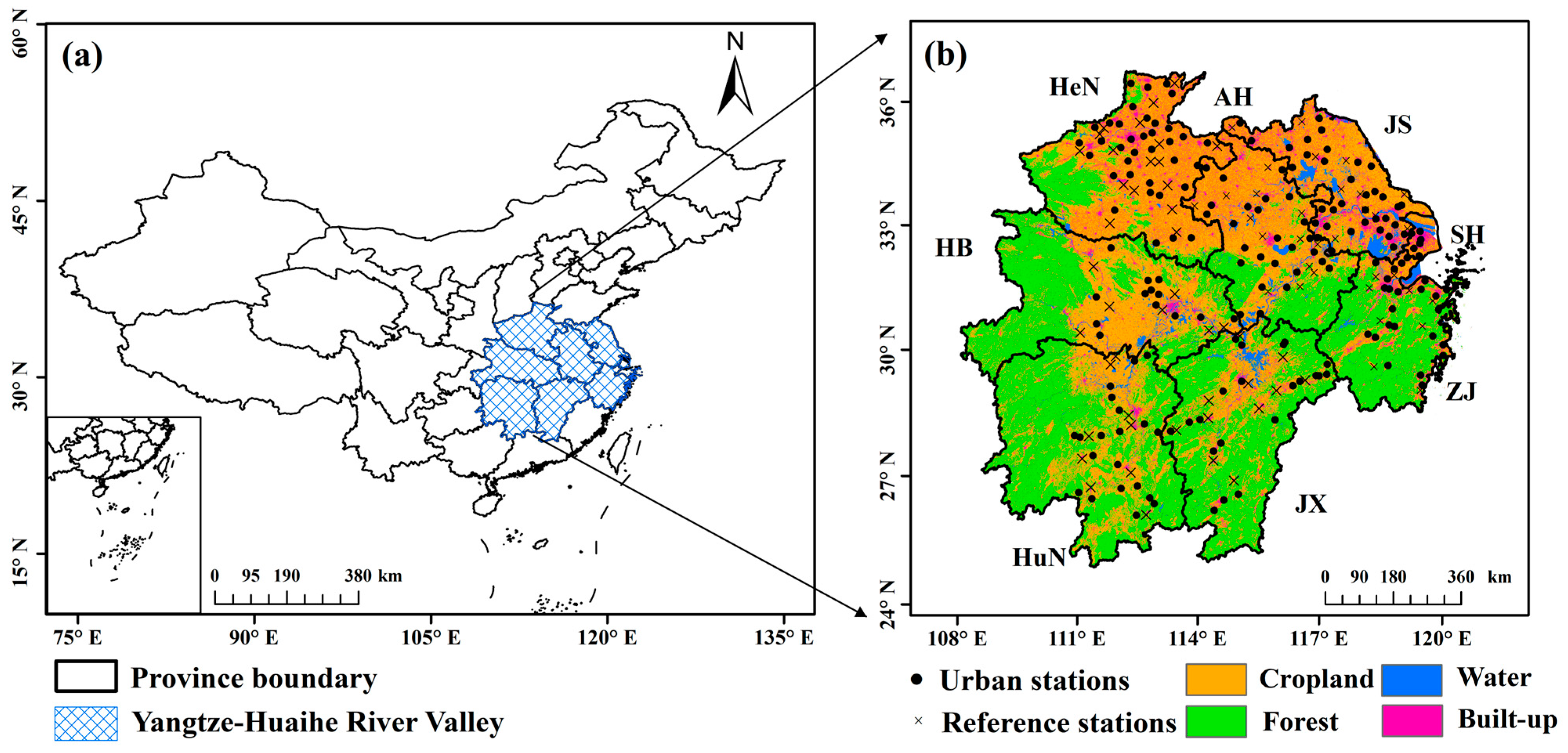
The intricate interplay between climate and urbanization across China’s vast territory is characterized by a remarkable diversity. A notable observation has been the varied extent to which urbanization influences surface air temperature (SAT) series across diverse climate zones within various Chinese cities. In this study, we have chosen the YHRV, a region with homogenous climatic attributes, as our focal research area, facilitating a more nuanced analysis of the effects of urbanization on climatic patterns within a defined geographical and climatic context. As depicted in Figure 1, this region encompasses eight administrative divisions, namely, Shanghai (SH), Anhui (AH), Jiangsu (JS), Zhejiang (ZJ), Henan (HeN), Hubei (HB), Hunan (HuN), and Jiangxi (JX).

2.2. Data

Land cover plays a pivotal role in governing energy exchange, water, and carbon cycles across different terrestrial regions, underscoring the indispensable value of accurate land cover datasets for climate research. In recent decades, China’s land cover has experienced substantial alterations driven by rapid economic growth. To document these evolving patterns, the annual China Land Cover Dataset (CLCD) was developed by Yang & Huang [42] and released by Wuhan University. This dataset integrates 335,709 Landsat images processed via Google Earth Engine, providing land cover information at a 30 m spatial resolution. Encompassing the years from 1985 to 2021, the latest CLCD boasts an overall land classification accuracy of 80%, making it an invaluable resource for investigating China’s land use changes.
Previous studies have indicated that airborne Light Detection and Ranging (LIDAR) is the optimal method for extracting 3D urban landscapes [43]. However, due to data source and financial constraints, conducting large-scale and long-term serial studies using airborne LIDAR is often challenging. Alternatively, unmanned aerial vehicle data and other real-time data sources have emerged as viable alternatives [44]. Nevertheless, the limited flight duration of unmanned aerial vehicle restricts their applicability to large-scale 3D landscape information extraction. In this study, we obtained building vector data in 2021 from Baidu Maps (official link: https://map.baidu.com, accessed on 30 May 2025), including building base projection boundaries (used to characterize the horizontal distribution of urban buildings) and total floor count information. The above data—covering building outlines and floor count information—was extracted using Python v. 3.7-based open APIs, with an overall accuracy of over 86.78% verified [15]. For building height calculation, we multiplied the total number of floors by 3 m (a common estimation for urban building floor height) [15]. This height calculation method has been confirmed to have an overall accuracy, and the regularity of urban building floor heights further ensures the reliability of the height conversion results [45].
This section uses daily observation data from China’s national surface meteorological stations, with a time span of 1985–2021, including daily temperature data for the YHRV region. The data are provided by the National Meteorological Information Center of the China Meteorological Administration (http://Data.cma.cn/en, accessed on 20 May 2025), and 252 of these stations were used in this study. The dataset has undergone strict quality control. To further ensure data completeness and accuracy, this study conducted additional quality control, with specific criteria as follows: missing values in the observation series were filled using the mean of synchronous observations from the 5 nearest neighboring stations around the target station; the missing data rate of each station was calculated individually, and stations with a missing data rate exceeding 5% or an excessive number of erroneous records were excluded from the analysis [46].

2.3. Method

2.3.1. Selection of Reference Stations and Calculation of CUHII

The key to evaluating CUHII is the selection of reference stations (RSs). This article refers to previous methods for determining the background of urban heat islands and rural areas [26,30,47,48,49,50] and determines the RS based on the following three criteria: ① The candidate RS boasts an extensive record spanning over 50 years, maintaining a continuous and uninterrupted data series. ② The relocation frequency of candidate RSs must be less than 3 times, and the horizontal distance of relocation must be maintained within 5 km. ③ The proportion of building area for candidate reference stations within a buffer zone with a radius of 5 km is below 33.0%. According to the aforementioned criteria, this paper screened 79 RSs. For urban stations (USs), 173 stations located in the urban area were selected. The calculation method for CUHII for each US [7] is as follows:
C U H I I = T U S T R S
In the above formula, TUS is the average air temperature value (°C) of USs; TRS is the average air temperature value (°C) of RSs, which can represent the background climate.

2.3.2. Calculation of 2D/3D Urban Morphological Indicators

To characterize urban buildings’ multidimensional morphology and fit the study’s goal of exploring the effects of the modulation of urban morphology on CUHII and its scale–seasonal dependencies, this study completed indicator screening through three steps. It should be noted that all selected indicators were analyzed at the class level, with a core focus on the “built-up area” as the specific land use category, rather than conducting a landscape-level multi-category comprehensive analysis.
First, we performed the initial inclusion of common indicators. Based on existing studies on urban morphology and thermal environment [2,17,18,19,30,33,51], 12 common 2D landscape pattern indices (including PLAND, LPI, CONTAG, PD, ED, and AREA_MN) and 4 common 3D indicators (including H, SVF, BVD, and FAR) were initially selected to cover basic dimensions of 2D/3D morphology.
Second, we carried out correlation analysis for redundancy elimination. Pearson correlation coefficients between initial indicators were calculated using the study area’s remote sensing data. The results showed CONTAG (contagion index) and AI (aggregation index) (r = 0.93, p < 0.01) both reflect patch connectivity and PD (patch density) and SPLIT (splitting index) (r = 0.95, p < 0.01) both reflect fragmentation; indicators with more intuitive physical meaning for CUHII analysis (AI, SPLIT) were retained, and redundant ones (CONTAG, PD) were excluded.
Third, we performed screening based on data and research goals. For 3D indicators, BVD (building volume density) was excluded because parts of the study area lacked high-precision building floor data, leading to inaccurate calculations; FAR (floor area ratio) was excluded as it overlaps with H (mean building height) in reflecting vertical building characteristics, and H is more directly related to canopy temperature [18,33]. For 2D indicators, ED (edge density) was excluded for overlapping with LSI (shape index) in characterizing patch shape complexity; AREA_MN (area-weighted mean patch size) was excluded because LPI (largest patch index) better reflects the dominance of built-up patches, key in analyzing heat accumulation [22,44].
Finally, eight 2D indicators (PLAND, LPI, LSI, SHAPE, FRACT, COHESION, SPLIT, and AI) and two 3D indicators (H and SVF) were determined (as shown in Table 1).

2.3.3. Machine Learning Model

XGBoost employs classification and regression trees (CARTs) as base models, enhancing the traditional gradient boosting decision tree (GBDT) framework to enable the ensemble learning of multiple CARTs. The process begins by constructing an initial tree using training data, followed by calculating residuals between predicted and observed values; in each subsequent iteration, an additional tree is generated to approximate prior prediction residuals, and this iteration continues until predefined stopping criteria are met, forming an integrated model of sequentially trained residual trees [52]. Compared with traditional machine learning methods, XGBoost has advantages in accuracy, flexibility, anti-overfitting ability, and missing value processing, which stem from three core mechanisms: loss function optimization based on second-order Taylor expansion, multi-thread parallel computing support, and regularization constraints [40]. Existing studies indicate nonlinear relationships between various influencing factors and the thermal environment—traditional linear regression models struggle to capture these nonlinear local characteristics, while XGBoost can effectively analyze the nonlinear mechanism between factor changes and the local thermal environment [53].
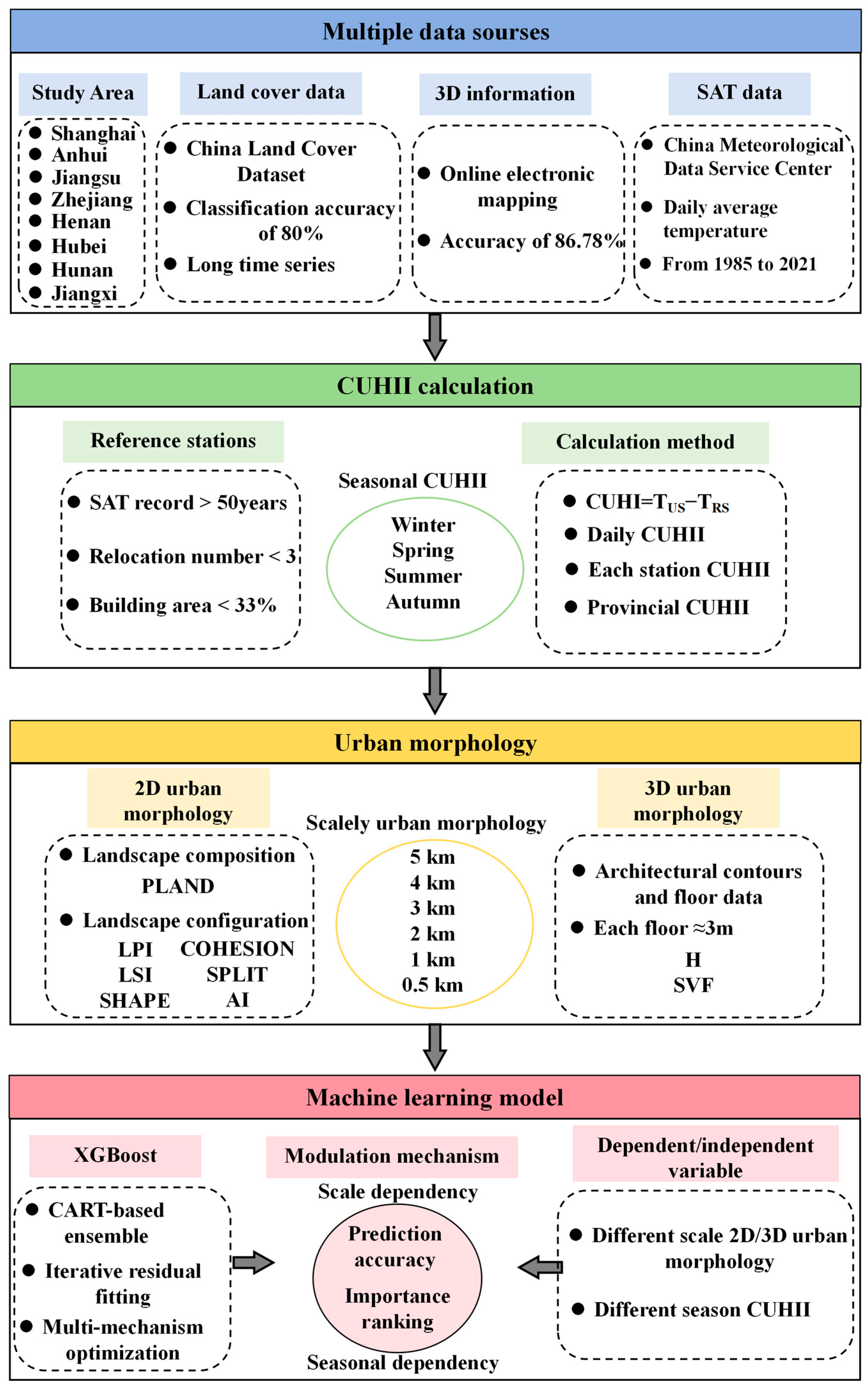
The specific implementation details of the XGBoost model in this study are as follows: for 7 commonly used hyperparameters of the model (eta, gamma, max_depth, min_child_weight, subsample, colsample_bytree, and nrounds), iterative calculations were conducted within a preset hyperparameter tuning space, and the 5-fold cross-validation method was used to screen for the optimal hyperparameter combination that minimizes model error [37]. For sample points in the YHRV, a 7:3 random division was adopted—70% of the samples served as training samples for model training, and 30% served as validation samples for model performance verification. In the model, CUHII is set as the dependent variable, and 2D/3D urban morphological indicators (PLAND, LPI, LSI, SHAPE, COHESION, SPLIT, AI, H, and SVF) are set as independent variables, ultimately outputting the importance ranking of factors affecting CUHII. The workflow for processing multi-source data and implementing the modeling approach involved in this study is detailed in Figure 2.

3. Results

3.1. Seasonal Patterns in CUHII in the YHRV

For this section, we selected the YHRV as the study area. Based on data from national meteorological stations, we focused on the period of 2018–2022 to systematically explore the spatiotemporal evolution patterns in CUHII.
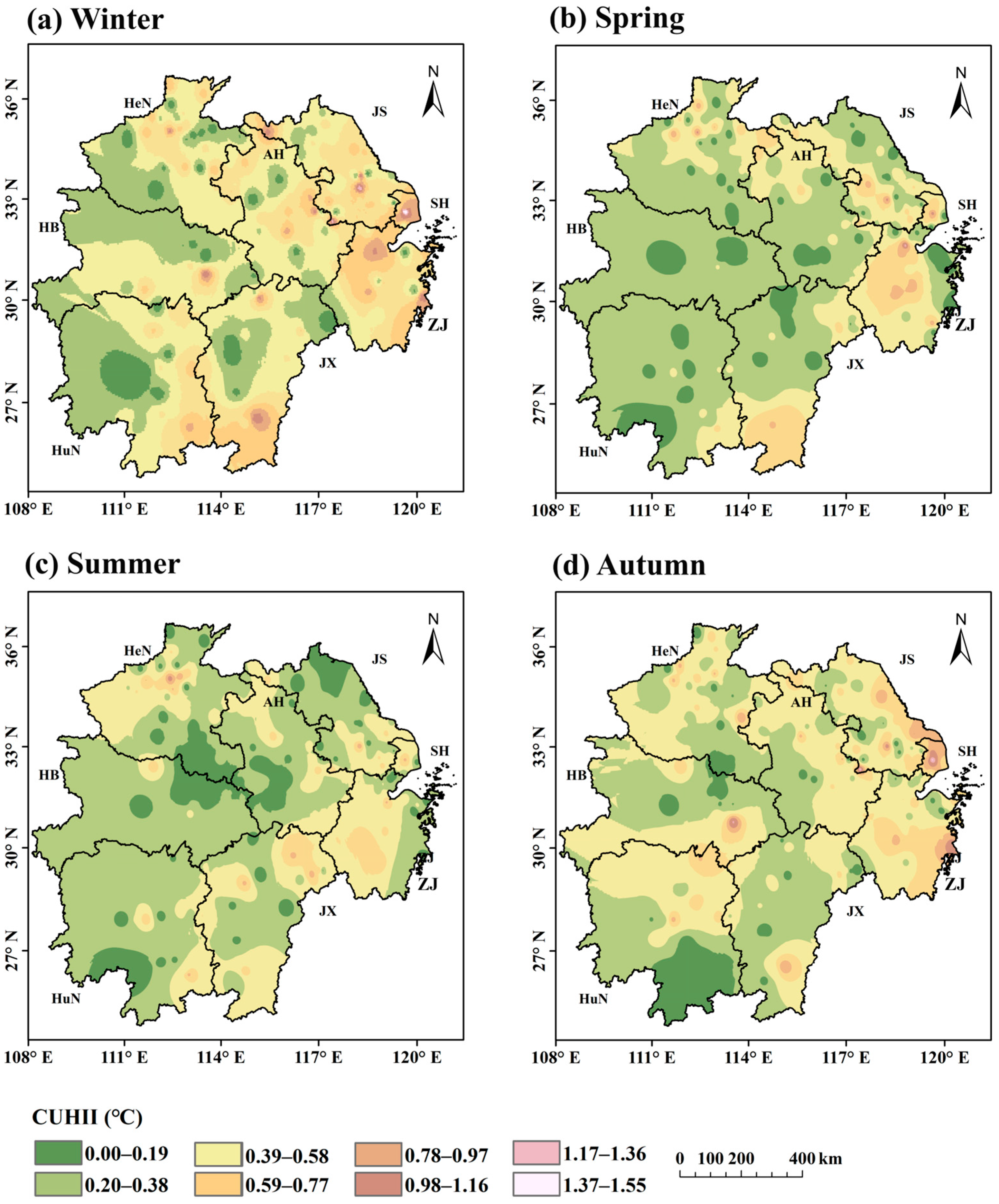
Figure 3 presents the high-resolution spatial distribution of seasonal CUHII across the YHRV. The data basis of this figure comprises the CUHII calculation results from 173 USs in the study; to generate the high-resolution spatial distribution, the IDW (Inverse Distance-Weighted) interpolation method was used. As reflected in Figure 3, there are significant provincial heterogeneities in the spatial pattern of CUHII: as a megacity, Shanghai (SH) exhibits higher CUHII than other provinces throughout all seasons. Taking winter (Figure 3a) as an example, its high CUHII zones are concentrated, influenced by dense buildings and high anthropogenic heat emissions under high urbanization [2], with the 0.78–1.36 °C range accounting for a large proportion and even reaching an extreme value of 1.55 °C. The urban agglomerations in Zhejiang (ZJ) and Jiangsu (JS), with high urbanization levels, maintain CUHII at 0.59–1.16 °C across seasons, ranking second and third. In contrast, provinces like Henan (HeN), Hunan (HuN), Hubei (HB), and Jiangxi (JX), featuring extensive hills, mountains, and farmland, are less affected by urbanization, showing continuous low-value zones (0.00–0.38 °C) in spring (Figure 3b) and summer (Figure 3c), and medium–low values (0.20–0.58 °C) in autumn (Figure 3d). Anhui (AH), located in the urbanization gradient transition zone, displays patchy CUHII distribution, reflecting the gradient impact of urbanization on the thermal environment. These provincial differences indicate that SH, ZJ, and JS have significantly higher CUHII, which may be related to anthropogenic heat and underlying surface changes [54,55], while AH, HeN, HuN, HB, and JX maintain medium–low CUHII under the regulation of natural underlying surfaces.
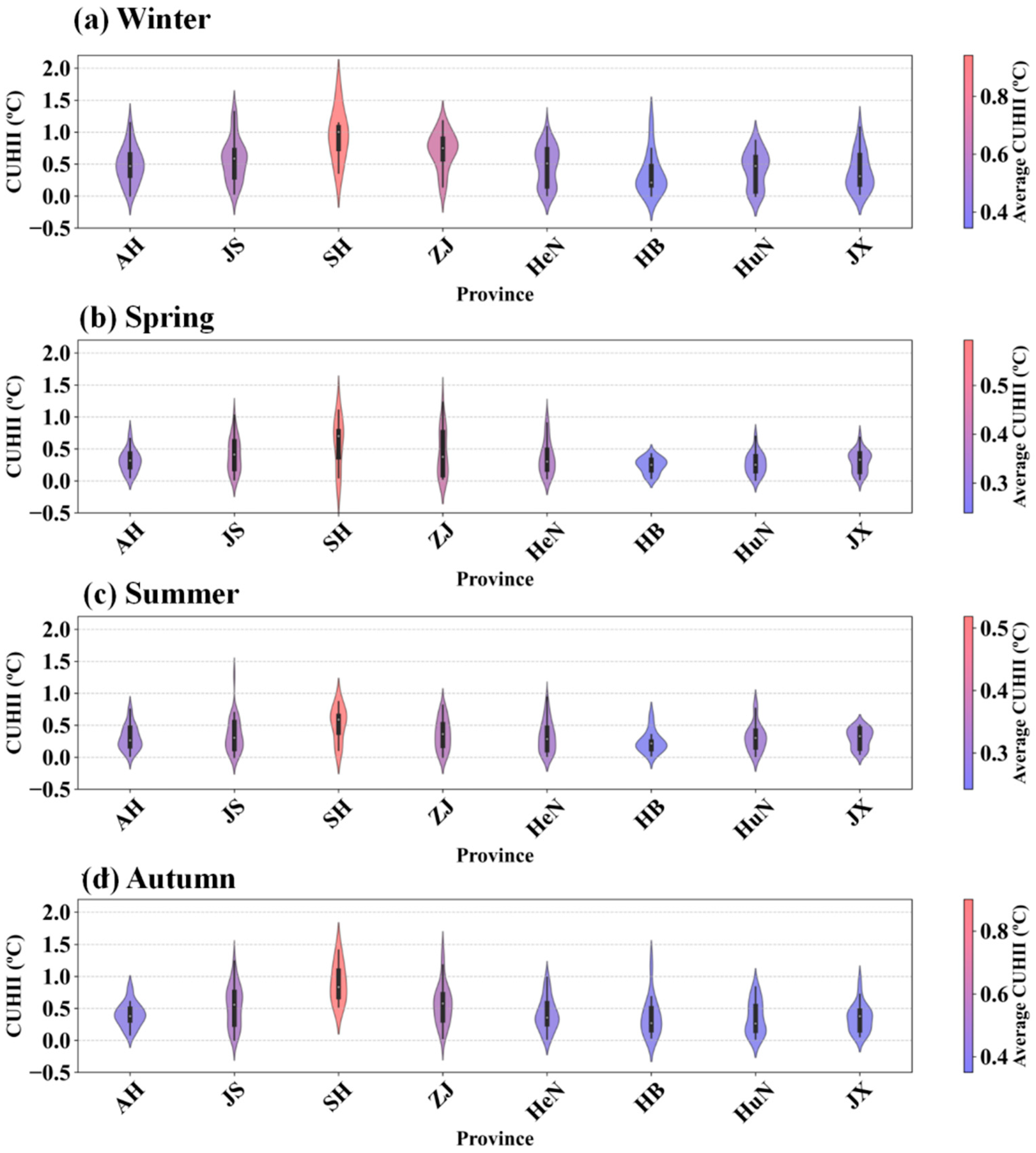
The violin plots of CUHII show that in winter (Figure 4a), the CUHII of provinces in the YHRV exhibits high dispersion. The violin plots in highly urbanized areas such as SH and JS are wider with reddish colors, and the average CUHII reaches 0.6–0.8 °C. This may be attributed to increased anthropogenic heat emissions from winter heating and the obstruction of air circulation by dense buildings, which exacerbates canopy heat accumulation [56]. In spring (Figure 4b), the violin plots show a symmetric bell-shaped distribution, with converged widths across provinces and predominantly blue-light blue colors (mean 0.3–0.5 °C). With the rise in temperature, the greening of vegetation enhances transpiration cooling, leading to a significant regulatory effect of the natural environment [57]. In summer (Figure 4c), the violin plots generally show a narrow distribution, with inland provinces such as HB and HuN mainly in blue, and the mean value is below 0.3 °C. The combined effect of vegetation transpiration and strong convective activities in summer cools the canopy air, weakening the heat island intensity [58]. In autumn (Figure 4d), the width of violin plots increases in some provinces, such as SH, ZJ, and JS, with the average CUHII rising to 0.53–0.90 °C. The reduction in farmland vegetation in autumn weakens the latent heat regulation, leading to an intensified canopy temperature gradient [59]. In summary, under the combined influence of natural factors and human activities, the CUHII of provinces in the YHRV shows significant seasonal variations.

3.2. Urban Morphological Indicators Around Meteorological Stations in the YHRV

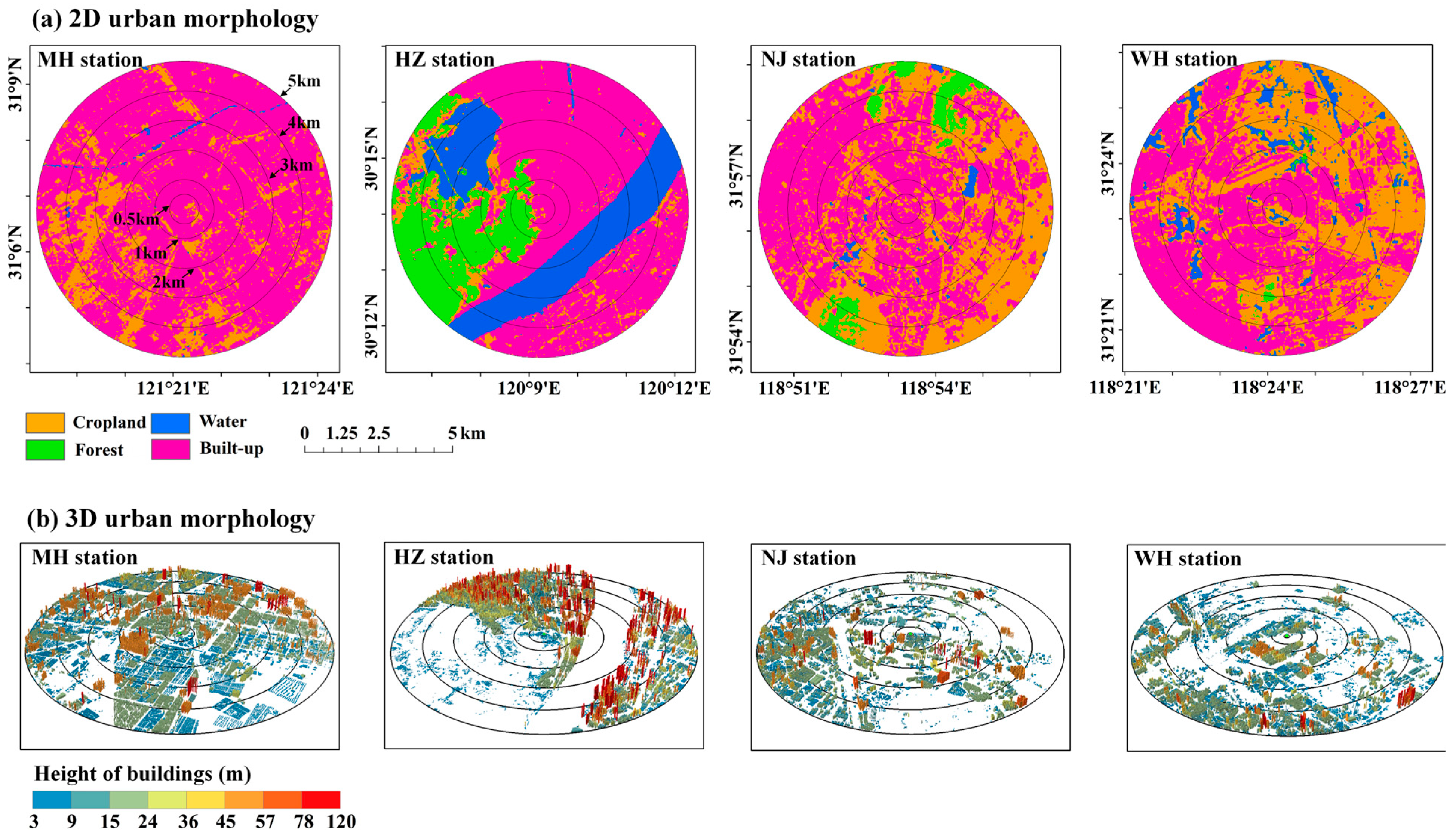
In this section, we use remote sensing data to focus on typical urban stations in the YHRV, analyzing the spatial differentiation characteristics of 2D and 3D urban morphological indicators within different buffer zones (0.5 km, 1 km, 2 km, 3 km, 4 km, and 5 km).
Figure 5 illustrates significant differences in land use and building height characteristics of four representative cities across buffer zone scales. At the Shanghai Minhang station (MH), the built-up area accounts for 85.2% within the 500 m buffer, dominated by high-density commercial–residential buildings with an average height of 14.5 m, forming a typical “urban canyon” landscape. As the buffer expands to 5 km, the built-up proportion decreases to 79.3%, and building height averages 13.2 m, highlighting obvious suburban transition characteristics. The Hangzhou station (HZ) shows a land use pattern of a dense core and sparse periphery: within the 0.5 km buffer, the built-up area accounts for 71.9%, interspersed with green spaces and low-rise buildings around West Lake, with a building height of 11.3 m; the 5 km buffer reduces the built-up proportion to 52.3%, with building height rising to ~14.5 m. For the Nanjing station, the proportion of water bodies and green spaces increases as the buffer expands from 0.5 km to 5 km, causing a rapid decline in built-up area and a slight increase in building height. Unlike medium–large cities, the Wuhu station (WH) is surrounded by low-rise residences and industrial land, with stable built-up proportions and building heights across buffer scales, reflecting the low-density development of small cities and the protective effect of the detecting environment. In terms of scale effects, urban morphological parameters around stations in medium–large cities fluctuate significantly across buffer zones, while those in small cities change more gently with scale.
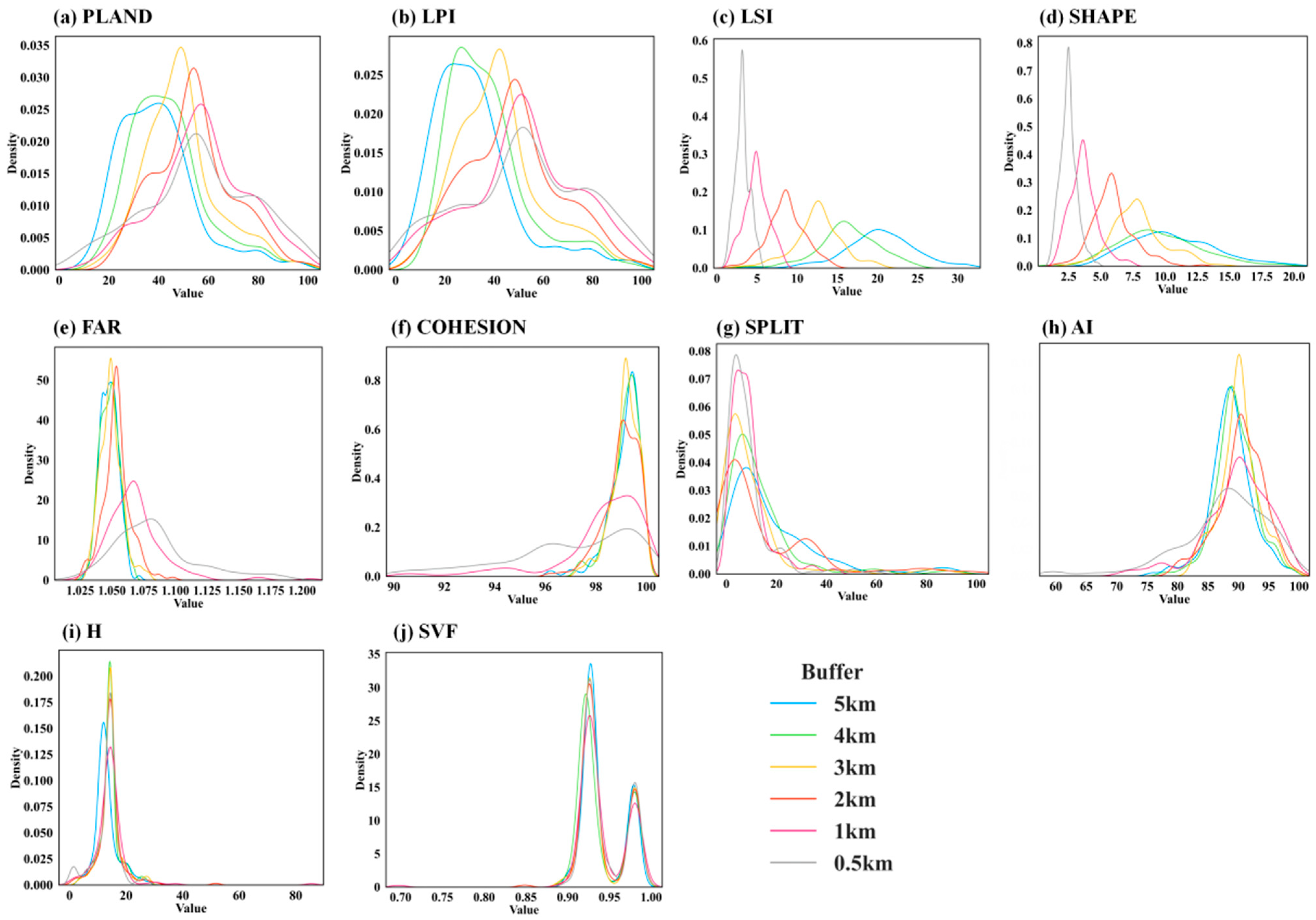
Figure 6 illustrates the kernel density distribution of 10 urban morphological indices across different buffer zones, revealing distinct scale-dependent characteristics. The PLAND shows the lowest kernel density in the 500 m buffer, presenting a platykurtic distribution; as the scale expands, the density curve sharpens, peaking at 3 km, indicating stronger heterogeneity of built-up density at large scales and significant regional averaging effects at small scales. The LPI follows a trend similar to PLAND but peaks at the 5 km buffer. The LSI and SHAPE reach their maximum kernel densities at the 5 km buffer (18.7 and 1.45, respectively), suggesting that the irregularity of building patches at this scale more crucially influences the thermal environment. The SPLIT and AI exhibit mirrored distributions: SPLIT peaks at the 500 m buffer and decreases with increasing scale, while AI peaks at the 3 km buffer, confirming that patch fragmentation of built-up areas weakens with scale. Among 3D parameters, H has the lowest density peaks in the 0.5 km and 1 km buffers, reflecting the protected detection environment around national meteorological stations; the other three 3D indices show similar density curve shapes and value ranges. The SVF kernel density curves across buffer zones exhibit bimodal characteristics, with peaks near 0.92 and close to 1.00, indicating two typical distributions of urban vertical morphology. The 5 km buffer has the highest kernel density peak, meaning the SVF distribution corresponding to the peak is most concentrated at this scale; the 0.5 km and 1 km buffers have the smallest peaks, indicating more dispersed SVF peak distributions, with minor peak differences in other scales. Overall, the density distribution of each index reveals scale thresholds for urban morphology’s impact on canopy urban heat islands, providing data support for machine learning models to identify optimal research scales.

3.3. Effects of the Modulation of Urban Morphology on the CUHII and Spatiotemporal Dependencies

This section analyzes the internal relationships between urban morphology and CUHII across different seasons and scales, to decipher the nonlinear influence mechanisms behind how 2D/3D urban morphology indicators affect CUHII. The analysis provides statistical support for machine learning models in identifying key driving factors.
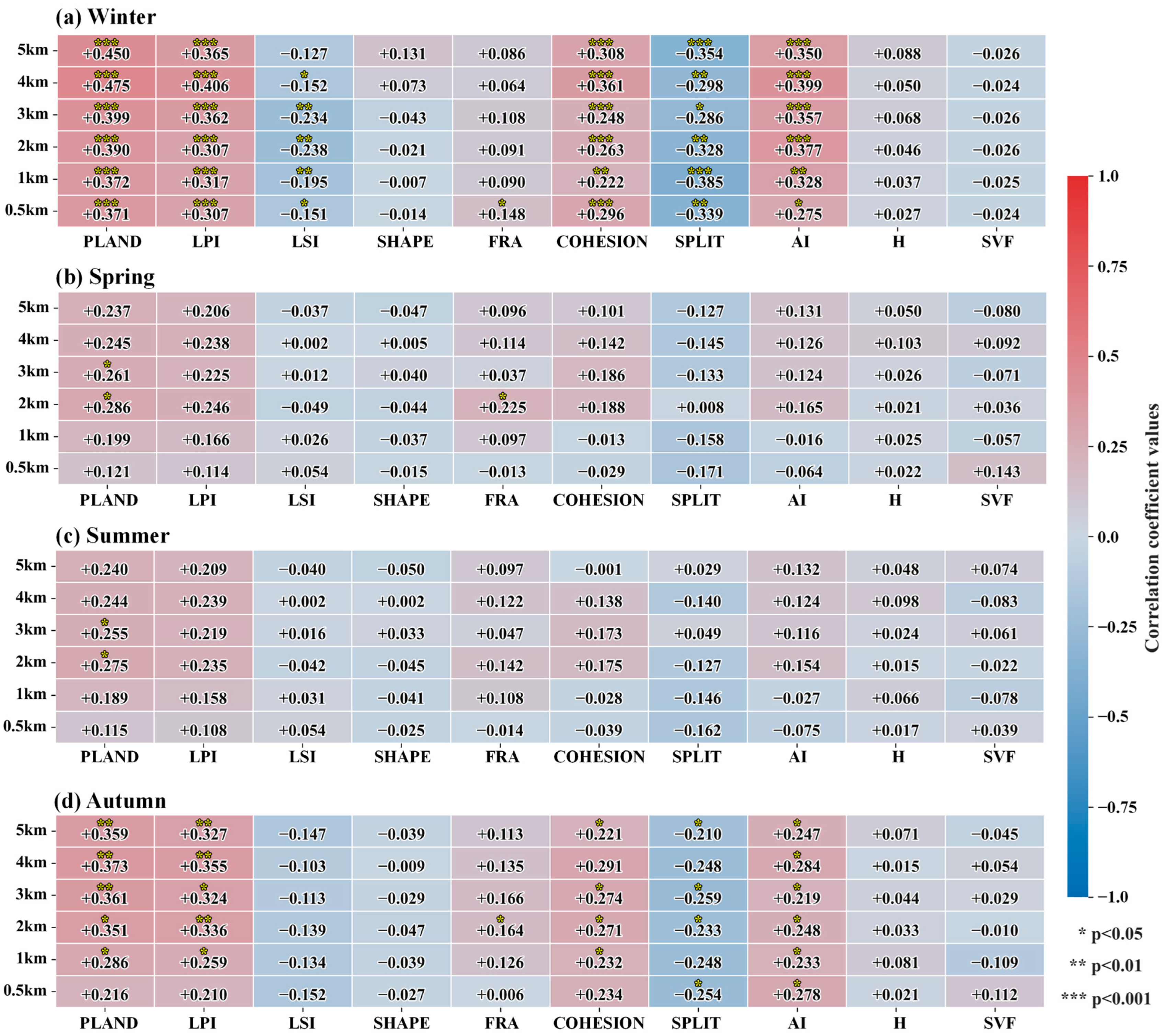
The winter heat map (Figure 7a) shows that the PLAND and the LPI exhibit the strongest positive correlations with CUHII at a 4 km scale (r = 0.475, 0.406), indicating that building agglomeration intensifies heat accumulation [60]. The LSI shows negative correlations at all scales, suggesting that irregular patch layouts facilitate heat dissipation [59]. The positive correlations of COHESION and AI with CUHII increase with scale (r = 0.361, 0.399 at 4 km), while the SPLIT shows significant negative correlation, confirming that more fragmented building patches alleviate the heat island effect [61]. The H shows a weak positive correlation with CUHII, and the SVF shows a weak negative correlation, indicating that 3D indicators have a weaker modulating effect on the CUHII than 2D indicators.
The correlation patterns between urban morphology and CUHII in spring (Figure 7b) and summer (Figure 7c) are quite similar. Among all morphological indicators, PLAND and LPI have the highest correlations with CUHII, with the strongest positive correlations at 2 km and 3 km scales, indicating that the aggregation and connectivity of built-up areas significantly promote heat accumulation [62]. Autumn (Figure 7d) is the season where the correlation of urban morphological indicators ranks second only to winter. PLAND and LPI still remain dominant. The SPLIT shows the strongest negative correlation at a 3 km scale, indicating that patch fragmentation facilitates heat diffusion. The SPLIT shows the strongest negative correlation at a 3 km scale, suggesting that patch fragmentation facilitates heat diffusion [63]. Overall, the effect of the modulation of urban morphology on CUHII exhibits significant seasonal and scale dependencies, with 2D indicators serving as key influencing factors in all seasons; the effects of their modulation are obviously stronger than those of the modulation of 3D indicators.
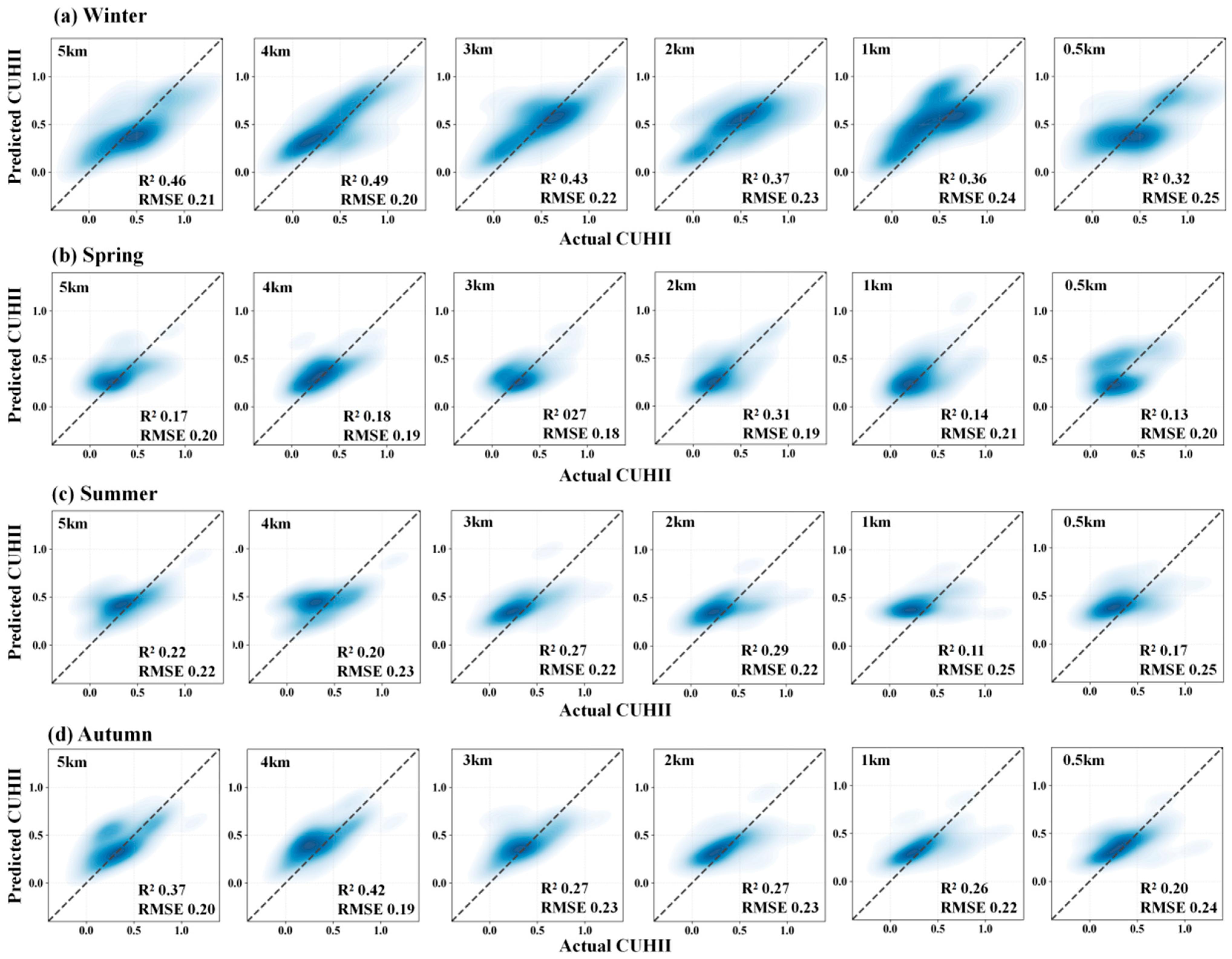
This study investigates the predictive performance of CUHII in YHRV across seasons (winter, spring, summer, autumn) and buffer zones (5 km to 0.5 km) using the XGBoost model, revealing that machine learning predictions exhibit significant seasonal and scale dependencies. The model performs best in winter (Figure 8a), with an R2 of 0.49 and RMSE of 0.20 for the 4 km buffer, indicating that large-scale buffers better fit winter characteristics, with close agreement between predicted and measured values and strong explanatory power. Spring (Figure 8b) shows the weakest overall performance, with R2 generally below 0.3 across buffers, though the 2 km buffer performs relatively best (R2 = 0.31), reflecting complex interference factors that stop the model from capturing spring CUHII patterns precisely. Summer (Figure 8c) also yields suboptimal results, with the 2 km buffer outperforming other scales (R2 = 0.29), but small scales show high volatility (e.g., R2 = 0.11 at 1 km), suggesting that the 2 km scale optimizes feature extraction while minimizing noise interference in summer. Autumn (Figure 8d) achieves the highest R2 (0.42, RMSE = 0.19) for the 4 km buffer, indicating that large-scale buffers suit autumn characteristics, with better stability than medium–small scales. In summary, XGBoost predicts winter CUHII most accurately, with weaker performance in spring/summer; 4 km buffers excel in winter/autumn, while 2 km buffers are optimal for spring/summer.
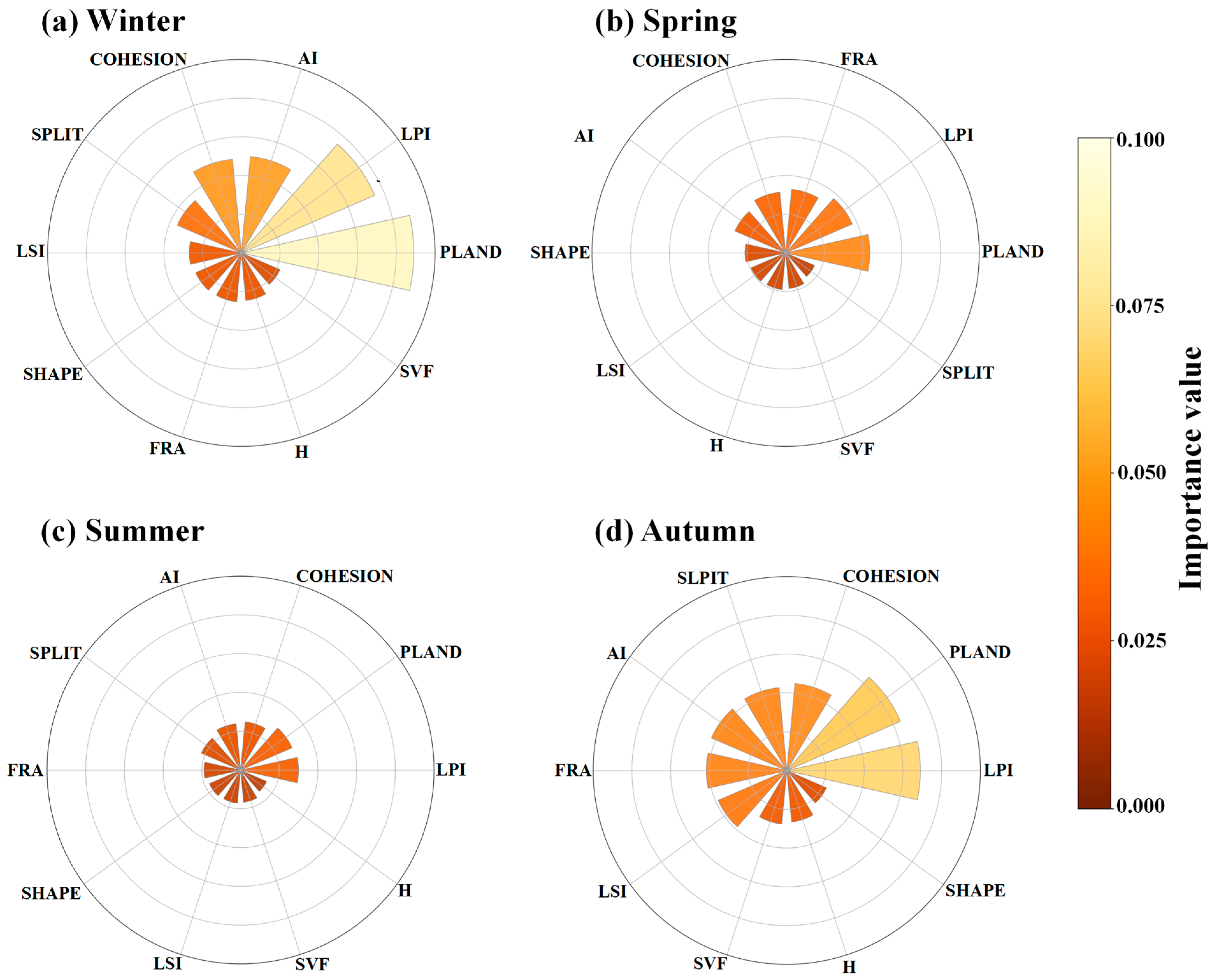
Based on the above conclusions, this study statistically analyzed the importance characteristics of urban morphological indices for Canopy Urban Heat Island Intensity (CUHII) across different seasons and scales, specifically in winter (4 km), spring (2 km), summer (2 km), and autumn (4 km). As shown in Figure 9, indices such as Percentage of Landscape (PLAND) and Largest Patch Index (LPI) exhibited prominent importance in winter and autumn. This indicates that land use proportion and the largest patch index exert a significant influence on winter CUHII at large scales. During winter and autumn, with lower temperatures and smaller solar altitude angles, building-dense areas (high PLAND) and large building patches (high LPI) can reduce heat loss [64]. The regulatory effect of other urban morphological indices on the thermal environment is relatively weak in winter and autumn. In low-temperature environments, the “agglomeration and heat preservation” effect of buildings dominates [65], and the driving role of other morphological indices is overshadowed at this time. PLAND remained a key index in spring, but the gap in importance between PLAND and other morphological indices narrowed significantly. In summer, the importance pattern of PLAND, LPI, and other indicators was consistent with that in spring, with a more balanced distribution of importance among indicators. In spring and summer, as temperatures rise and solar radiation intensifies, the synergistic effect of multiple urban morphological factors begins to stand out at medium and small scales. For example, the warming effect of building area and the largest patch index is offset by the cooling effect of shape indices (such as irregular buildings increasing edge heat dissipation) and separation indices (dispersed layouts promoting ventilation), resulting in a narrowed difference in the role between indices. Overall, seasons and scales synergistically regulate the impact of urban morphological indices on CUHII: large scales (4 km) enhance the role of land use indices in winter and autumn, while medium–small scales (2 km) promote the balance of multiple factors in spring and summer. This provides a seasonal and scale-adaptive basis for the precise regulation of urban thermal environments.

4. Discussion

4.1. Exploration of the Effects of the Modulation Mechanism of Urban Morphology on CUHII and Seasonal/Scale Dependence

The pattern that “2D indicators have a stronger impact on CUHII than 3D indicators” is likely determined by differences in data reliability and the physical advantages of 2D morphology in large-scale thermal regulation. From a data perspective, 2D indicators are derived from high-precision datasets, such as the CLCD with an overall classification accuracy of 80% [47], which ensures uniform and reliable coverage of the YHRV. In contrast, 3D indicators face accuracy constraints: building height (H) is estimated using the empirical “3 m per floor” method [15], which may lead to estimation biases in vertical morphology. This is reflected in the correlation results: 2D indicators exhibit significant linear relationships with CUHII (e.g., the correlation coefficients of PLAND and LPI in the 4 km buffer zone in winter are 0.475 and 0.406, respectively, p < 0.001), while the correlations of 3D indicators are negligible (H, r < 0.05; SVF, r < 0.03) [37,66]. From a physical perspective, 2D indicators directly characterize the proportion and aggregation degree of built-up areas, which are the core driving factors of CUHII in the YHRV [67]. In winter and autumn, low solar altitude angles reduce surface solar input, making heat retention dependent on contiguous building patches and the capture of anthropogenic heat [60,61]. In spring and summer, high solar altitude angles intensify surface heating, and fragmented built-up areas increase the interface between built-up areas and green spaces, promoting latent heat cooling through vegetation transpiration [47,62]. In contrast, 3D indicators only regulate local microclimates, but their impacts are overshadowed by large-scale heat accumulation or diffusion processes driven by 2D morphology [37,66]. Regarding the “scale–season coupling” phenomenon, this may be related to seasonal differences in solar radiation input and urban energy balance [61]. In winter and autumn, solar radiation input is low, and nighttime radiative cooling becomes the main heat loss pathway. At this point, the 4 km buffer scale plays a dominant role: it reduces turbulent heat exchange between urban and rural air [54]; it can lower SVF to reduce longwave radiation loss [30,67]; and it traps anthropogenic heat within built-up clusters [60]. In spring and summer, solar radiation input increases, and latent heat cooling becomes the key regulatory process. The 2 km buffer scale is more suitable for this scenario: scattered built-up areas within 2 km increase the contact area between built-up areas and green spaces, enhancing transpiration cooling; irregular patch shapes also strengthen edge heat dissipation [30,66].

4.2. Application and Verification of the Machine Learning Model

In recent years, Hefei has developed rapidly. In 2020, its population and GDP exceeded USD 9 million and 130 billion, respectively [68]. The SAT series at the Hefei station is deeply affected by the urbanization process, with a prominent urban heat island phenomenon [69]. Therefore, for this section, we selected the Hefei station as a typical station in the Jianghuai River Basin and used the machine learning models established in the previous section for different seasons to predict the long-time series CUHII of typical stations.
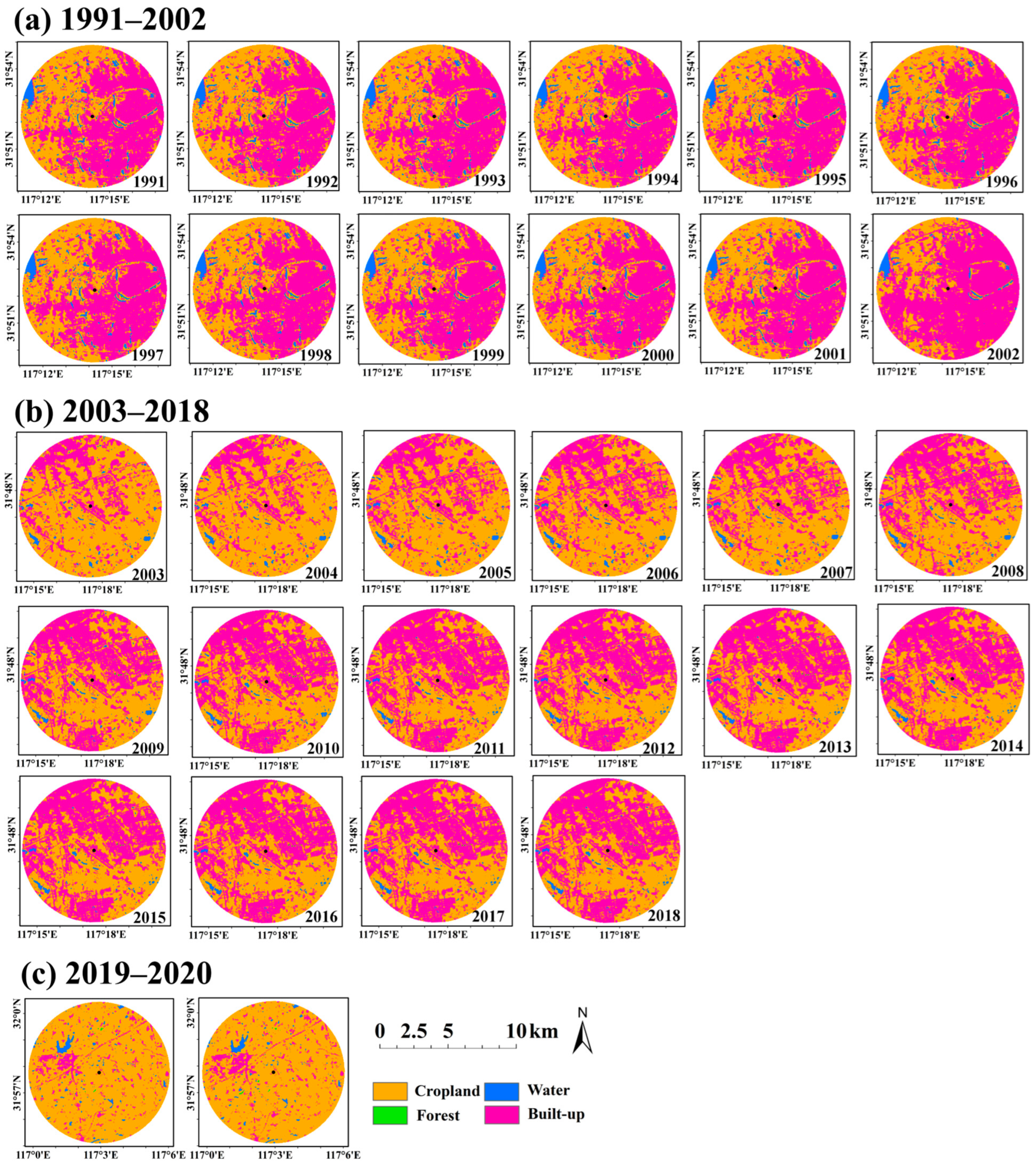
During 1991–2020, the land cover in the buffer zone of the Hefei station underwent significant changes. The station experienced two relocations after 2000, leading to drastic alterations in its observation environment. As shown in Figure 10a, from 1991 to 2002, with Hefei’s rapid urban expansion, the percentage of built-up area around the station increased from 58.38% to 75.77%. Sustained urban construction and expansion of impervious surfaces gradually deteriorated the observation environment, potentially affecting the representativeness and accuracy of meteorological observation data [26]. In 2003, in accordance with the Regulations on the Protection of Meteorological Facilities and Meteorological Detection Environment, the Hefei station was relocated to the vicinity of a suburban airport, causing the built-up area ratio to drop sharply to 25.3%. This allowed meteorological observations to be conducted in an environment with minimal urban interference, improving data quality. However, during 2003–2018 (Figure 10b), as urban development expanded outward, buildings around the suburban airport increased gradually. Urban development once again damaged the observation environment, with the built-up area ratio rising to 62.05%, threatening the meteorological detection environment. After the station’s second relocation in 2019 (Figure 10c), the built-up area ratio dropped to 9.59%.
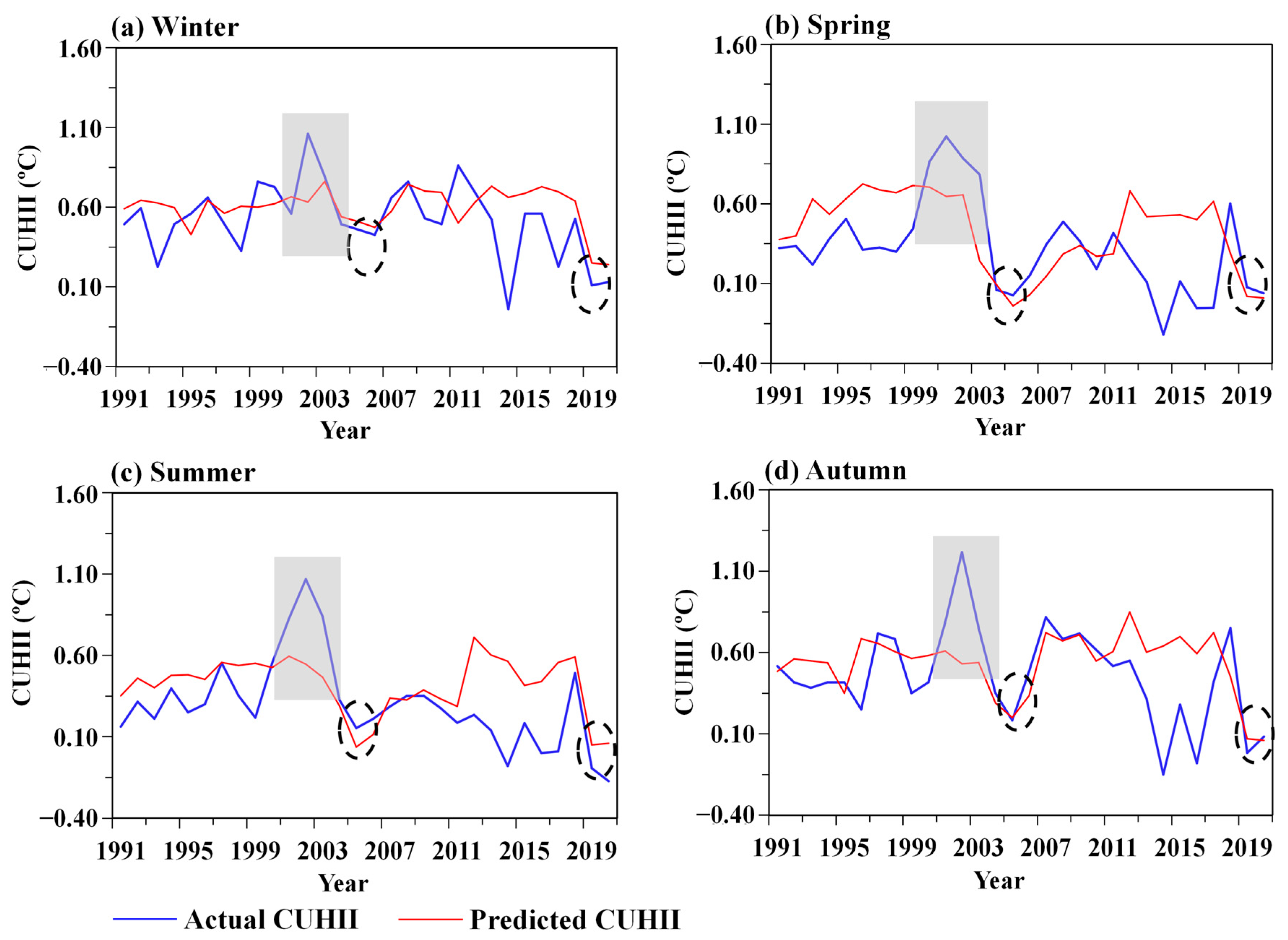
Based on machine learning models for winter/autumn (4 km scale) and spring/summer (2 km scale), we conducted predictive analysis on the long-term CUHII series at the Hefei station. Results show that during 1991–2001 in winter/autumn (Figure 11a,d), the actual CUHII (blue line) increased year by year with urbanization, and the predicted CUHII (red line) highly matched the actual trend, with an average error of only 0.06 °C. In spring/summer (Figure 11b,c), while the predicted CUHII curve trended upward, the average error from actual CUHII curve exceeded 0.15 °C, possibly due to vegetation transpiration and soil evaporation consuming substantial heat (latent heat exchange) in spring/summer, which weakens the driving effect of urban morphology on CUHII [66,67]. Meteorological station relocations are evident in actual CUHII curves: relocations in 2003 and 2019 caused abrupt CUHII drops (black dashed circles), verifying the dominant role of land use patterns in the CUHII, which the predicted curves (red lines) also reflected. Notably, during continuous building expansion around the station in 2002 and 2014, actual CUHII curves showed abnormal fluctuations (gray boxes), such as 0.50 °C unusual warming in spring, which the predicted CUHII curves failed to capture. This may relate to the coupling effect of climatic background fields and human activities, such as the synergism between heatwaves and CUHIs [7,16].

4.3. Research Limitations and Future Research Directions

This study also has the following limitations: firstly, this study omits climatic covariates—the original XGBoost model only includes urban morphological indicators, leading to spring and summer prediction errors at the Hefei station, as unaccounted factors (e.g., extreme precipitation, East Asian Summer Monsoon intensity) affect latent heat exchange. Second, there is a lack of quantification of indicator interactions—while the importance of individual indicators has been analyzed, the synergistic/antagonistic effects between them have not been quantified.
From the perspective of the YHRV’s climate characteristics and CUHII driving mechanisms, we will focus on three types of climatic background factors. First, we will examine near-surface meteorological elements (mean wind speed, relative humidity, precipitation), which directly affect canopy heat diffusion and latent heat exchange. For instance, low wind speed in winter exacerbates heat accumulation in built-up areas, while summer precipitation enhances cooling through evaporation. Second, we will look at atmospheric circulation factors (winter Siberian High index, summer East Asian Summer Monsoon intensity), which are, respectively, associated with the heat island suppression effect of cold air and the distribution of precipitation. Third, we will focus on solar radiation factors (seasonal solar radiation intensity, sunshine duration), whose seasonal variations correlate with the impact of building morphology on CUHII. Meanwhile, the integration of these factors into the XGBoost model will be carried out in three steps. First, there is factor screening—for the optimal spatial scales of different seasons (4 km for winter and autumn, 2 km for spring and summer), we will use Pearson correlation analysis to select climatic factors significantly associated with CUHII, while excluding redundant ones. Second, there is model reconstruction—the screened climatic factors will be added as independent variables to the original input layer (composed of 2D and 3D morphological indicators) for training season-specific models. Third, there is interaction quantification—the SHAP model will be used to quantify the synergistic or antagonistic effects between climatic factors and morphological indicators, thereby clarifying their respective contributions to CUHII in different scenarios. This integration is expected to make up for the original model’s inability to adequately capture climate-driven CUHII fluctuations, thereby improving the model’s ability to predict transient heat island processes. Future research should incorporate climatic fluctuation factors for coupled analysis to guide model optimization, thereby providing more precise theoretical support for resilient urban planning. In summary, the model constructed based on urban morphology and machine learning provides an important reference for revealing the mechanism by which land use dynamics modulate urban thermal environments. It also offers useful insights to planners and researchers for coordinating the construction of climate observation networks during urbanization.

5. Conclusions

This study investigated the impact of the modulation mechanism of urban morphology on CUHII in the YHRV using meteorological observation data and multi-source remote sensing information, employing machine learning models to reveal significant scale and seasonal dependencies. The results showed that Shanghai exhibited the highest CUHII values across all seasons (reaching 1.55 °C in winter), followed by Zhejiang and Jiangsu provinces. Provinces such as Henan had relatively lower CUHII values due to the strong regulatory effect of natural underlying surfaces. Seasonal variations indicated that the mean CUHII was 0.6–0.8 °C in winter, followed by autumn, with spring and summer showing the lowest values, reflecting obvious seasonal differences. The effect of the modulation of urban morphology on CUHII exhibited significant spatiotemporal dependencies: at the large scale (4 km), PLAND and LPI played a dominant role in influencing CUHII during winter and autumn, while at the medium scale (2 km), multiple morphological factors drove CUHII in a more balanced manner. Two-dimensional indicators generally had a stronger impact on CUHII across seasons than three-dimensional indicators. Four-season predictions of long-term CUHII at the Hefei station using the XGBoost model revealed a sharp decrease in the CUHII curve caused by station relocations, indicating the model’s sensitivity to abrupt urban morphological changes. However, the model insufficiently captured abnormal CUHII fluctuations induced by climatic variations. Future research could further integrate climatic background fluctuation factors to improve the model’s predictive capability for transient heat island processes, thereby providing more precise theoretical support for resilient urban planning.

Author Contributions

Conceptualization, T.S., Y.Y. and G.L.; methodology, T.S.; software, T.S. and P.Q.; validation, T.S., Y.Y. and G.L.; formal analysis, T.S.; investigation, T.S.; resources, T.S.; data curation, T.S., Y.Y. and G.L.; writing—original draft preparation, T.S., Y.Y. and G.L.; writing—review and editing, T.S. and P.Q. All authors have read and agreed to the published version of the manuscript.

Funding

This research has been supported by the National Natural Science Foundation of China (grant no. 42105147), the Nanjing Joint Institute for Atmospheric Sciences Open Research Fund (Grant no. BJG202506), and the Anhui Key Laboratory of Real Scene Geographical Environment Open Fund Project (Grant no. 2024PEG010).

Data Availability Statement

The original contributions presented in the study are included in the article, further inquiries can be directed to the corresponding author.

Conflicts of Interest

The authors declare no conflicts of interest.

References

  1. Muthers, S.; Laschewski, G.; Matzarakis, A. The Summers 2003 and 2015 in South-West Germany: Heat waves and heat-related mortality in the context of climate change. Atmosphere 2017, 8, 224. [Google Scholar] [CrossRef]
  2. Salimi, M.; Al-Ghamdi, S.G. Climate change impacts on critical urban infrastructure and urban resiliency strategies for the Middle East. Sustain. Cities Soc. 2020, 54, 101948. [Google Scholar] [CrossRef]
  3. Xia, Y.; Li, Y.; Guan, D.; Tinoco, D.M.; Xia, J.; Yan, Z.; Liu, Q.; Huo, H. Assessment of the economic impacts of heat waves: A case study of Nanjing, China. J. Clean. Prod. 2018, 171, 811–819. [Google Scholar] [CrossRef]
  4. Herbel, I.; Croitoru, A.E.; Rus, A.V.; Roca, C.F.; Harpa, G.V.; Ciupertea, A.F.; Rus, I. The impact of heat waves on surface urban heat island and local economy in Cluj-Napoca city, Romania. Theor. Appl. Climatol. 2018, 133, 681–695. [Google Scholar] [CrossRef]
  5. Marks, D.; Connell, J. Unequal and unjust: The political ecology of Bangkok’s increasing urban heat island. Urban Stud. 2024, 61, 2887–2907. [Google Scholar] [CrossRef]
  6. Singh, V.K.; Mohan, M.; Bhati, S. Industrial heat island mitigation in Angul-Talcher region of India: Evaluation using modified WRF-Single Urban Canopy Model. Sci. Total Environ. 2023, 858, 159949. [Google Scholar] [CrossRef]
  7. Yang, Y.; Guo, M.; Wang, L.; Zong, L.; Liu, D.; Zhang, W.; Wang, M.; Wan, B.; Guo, Y. Unevenly spatiotemporal distribution of urban excess warming in coastal Shanghai megacity, China: Roles of geophysical environment, ventilation and sea breeze. Build. Environ. 2023, 235, 110180. [Google Scholar] [CrossRef]
  8. Oke, T.R.; Mills, G.; Christen, A.; Voogt, J.A. Urban Climates; Cambridge University Press: Cambridge, UK, 2017. [Google Scholar]
  9. Merckx, T.; Souffreau, C.; Kaiser, A.; Baardsen, L.F.; Backeljau, T.; Bonte, D.; Brans, K.I.; Cours, M.; Dahirel, M.; Debortoli, N.; et al. Body-size shifts in aquatic and terrestrial urban communities. Nature 2018, 558, 113–116. [Google Scholar] [CrossRef]
  10. Tian, Y.; Miao, J. Overview of mountain-valley breeze studies in China. Meteorol. Sci. Technol. 2019, 47, 11–20. [Google Scholar] [CrossRef]
  11. Fenner, D.; Meier, F.; Bechtel, B.; Otto, M.; Scherer, D. Intra and inter ‘local climate zone’ variability of air temperature as observed by crowdsourced citizen weather stations in Berlin, Germany. Meteorol. Z. 2017, 26, 525–547. [Google Scholar] [CrossRef]
  12. Wu, C.; Li, J.; Wang, C.; Song, C.; Rosa, D.L. Understanding the relationship between urban blue infrastructure and land surface temperature. Sci. Total Environ. 2019, 694, 133742. [Google Scholar] [CrossRef] [PubMed]
  13. Dang, B.; Liu, Y.; Lyu, H.; Zhou, X.; Du, W.; Xuan, C.; Xing, P.; Yang, R.; Xiong, F. Assessment of urban climate environment and configuration of ventilation corridor: A refined study in Xi’an. J. Meteorol. Res. 2022, 36, 914–930. [Google Scholar] [CrossRef]
  14. Wang, J.; Tett, S.F.B.; Yan, Z. Correcting urban bias in large-scale temperature records in China, 1980–2009. Geophys. Res. Lett. 2017, 44, 401–408. [Google Scholar] [CrossRef]
  15. Liu, M.; Ma, J.; Zhou, R.; Li, C.; Li, D.; Hu, Y. High-resolution mapping of mainland China’s urban floor area. Landsc. Urban Plan. 2021, 214, 104187. [Google Scholar] [CrossRef]
  16. Shi, T.; Yang, Y.; Qi, P.; Lolli, S. Diurnal variation in an amplified canopy urban heat island during heat wave periods in the megacity of Beijing: Roles of mountain–valley breeze and urban morphology. Atmos. Chem. Phys. 2024, 24, 12807–12825. [Google Scholar] [CrossRef]
  17. Han, T.; Du, C.X.; Xie, Y.J.; Xian, X.Y.; Zhang, X.C.; Yang, B.S.; Chen, Y.P. A 3D perspective for understanding the mechanisms of urban heat island and urban morphology using multi-modal geospatial data and interpretable machine learning. Build. Environ. 2025, 282, 113184. [Google Scholar] [CrossRef]
  18. Yuan, C.; Chen, L. Mitigating urban heat island effects in high-density cities based on sky view factor and urban morphological understanding: A study of Hong Kong. Archit. Sci. Rev. 2011, 54, 305–315. [Google Scholar] [CrossRef]
  19. Scarano, M.; Mancini, F. Assessing the relationship between sky view factor and land surface temperature to the spatial resolution. Int. J. Remote Sens. 2017, 38, 6910–6929. [Google Scholar] [CrossRef]
  20. Sun, F.; Liu, M.; Wang, Y.; Wang, H.; Che, Y. The effects of 3D architectural patterns on the urban surface temperature at a neighborhood scale: Relative contributions and marginal effects. J. Clean. Prod. 2020, 258, 120706. [Google Scholar] [CrossRef]
  21. Zhou, R.; Xu, H.; Zhang, H.; Zhang, J.; Liu, M.; He, T.; Gao, J.; Li, C. Quantifying the Relationship between 2D/3D Building Patterns and Land Surface Temperature: Study on the Metropolitan Shanghai. Remote Sens. 2022, 14, 4098. [Google Scholar] [CrossRef]
  22. Liu, Y.; Xu, Y.; Zhang, Y.; Han, X.; Weng, F.; Xuan, C.; Shu, W. Impacts of the Urban Spatial Landscape in Beijing on Surface and Canopy Urban Heat Islands. J. Meteorol. Res. 2022, 36, 882–899. [Google Scholar] [CrossRef]
  23. Yang, Y.; Luo, F.; Xue, J.; Zong, L.; Tian, W.; Shi, T. Research progress and perspective on synergy between urban heat waves and canopy urban heat island. Adv. Earth Sci. 2024, 39, 331. [Google Scholar] [CrossRef]
  24. Berger, C.; Rosentreter, J.; Voltersen, M.; Baumgart, C.; Schmullius, C.; Hese, S. Spatio-temporal analysis of the relationship between 2D/3D urban site characteristics and land surface temperature. Remote Sens. Environ. 2017, 193, 225–243. [Google Scholar] [CrossRef]
  25. Guo, F.; Schlink, U.; Wu, W.; Hu, D.; Sun, J. Scale-dependent and season-dependent impacts of 2D/3D building morphology on land surface temperature. Sustain. Cities Soc. 2023, 97, 104788. [Google Scholar] [CrossRef]
  26. Shi, T.; Huang, Y.; Shi, C.; Yang, Y. Influence of urbanization on the thermal environment of meteorological stations: Satellite-observational evidence. Adv. Clim. Change Res. 2015, 6, 7–15. [Google Scholar] [CrossRef]
  27. Yang, P.; Liu, W.; Zhong, J.; Yang, J. Evaluating the quality of temperature measured at automatic weather stations in Beijing. J. Appl. Meteorol. Sci. 2011, 22, 706–715. [Google Scholar] [CrossRef]
  28. Tysa, S.K.; Ren, G.; Qin, Y.; Zhang, P.; Ren, Y.; Jia, W.; Wen, K. Urbanization effect in regional temperature series based on a remote sensing classification scheme of stations. J. Geophys. Res. Atmos. 2019, 124, 7064–7079. [Google Scholar] [CrossRef]
  29. Davis, A.Y.; Jung, J.; Pijawka, B.C.; Minor, E.S. Combined vegetation volume and “greenness” affect urban air temperature. Appl. Geogr. 2016, 71, 106–114. [Google Scholar] [CrossRef]
  30. Ren, G.; Li, J.; Ren, Y.; Chu, Z.; Zhang, A.; Zhou, Y.; Zhang, L.; Zhang, Y.; Bian, T. An integrated procedure to determine a reference station network for evaluating and adjusting urban bias in surface air temperature data. J. Appl. Meteorol. Climatol. 2015, 54, 1248–1266. [Google Scholar] [CrossRef]
  31. Arnfield, A.J. Two decades of urban climate research: A review of turbulence, exchanges of energy and water, and the urban heat island. Int. J. Climatol. 2003, 23, 1–26. [Google Scholar] [CrossRef]
  32. Xie, Z.; Cui, J.L.; Chen, D.G.; Hu, B.K. The annual, seasonal and monthly characteristics of diurnal variation of urban heat island intensity in Beijing. Environ. Res. Clim. 2006, 11, 69–75. [Google Scholar] [CrossRef]
  33. Miao, Y.; Hu, X.M.; Liu, S.; Qian, T.; Xue, M.; Zheng, Y.; Wang, S. Seasonal variation of local atmospheric circulations and boundary layer structure in the Beijing-Tianjin-Hebei region and implications for air quality. J. Adv. Model. Earth Syst. 2015, 7, 1602–1626. [Google Scholar] [CrossRef]
  34. Hu, Y.; Hou, M.; Jia, G.; Zhao, C.; Zhen, X.; Xu, Y. Comparison of surface and canopy urban heat islands within megacities of eastern China. ISPRS J. Photogramm. Remote Sens. 2019, 156, 160–168. [Google Scholar] [CrossRef]
  35. Yan, Z.; Zhou, D. Rural agriculture largely reduces the urban heating effects in China: A tale of the three most developed urban agglomerations. Agric. For. Meteorol. 2023, 331, 109343. [Google Scholar] [CrossRef]
  36. Wang, Z.; Zhou, R.; Yu, Y. The impact of urban morphology on land surface temperature under seasonal and diurnal variations: Marginal and interaction effects. Build. Environ. 2025, 272, 112673. [Google Scholar] [CrossRef]
  37. Lin, Z.; Xu, H.; Han, L.; Zhang, H.; Peng, J.; Yao, X. Day and night: Impact of 2D/3D urban features on land surface temperature and their spatiotemporal non-stationary relationships in urban building spaces. Sustain. Cities Soc. 2024, 108, 105507. [Google Scholar] [CrossRef]
  38. He, J.; Shi, Y.; Xu, L.; Lu, Z.; Feng, M. An investigation on the impact of blue and green spatial pattern alterations on the urban thermal environment: A case study of Shanghai. Ecol. Indic. 2024, 158, 111244. [Google Scholar] [CrossRef]
  39. Li, J.; Liu, Z.; Tang, X.; Liu, Y.Q.; Qin, C.; Wu, Y.L.; Huang, J. How Building Height Affects the Global Urban Surface Heat Island from Local Climate Zone Perspective. Sustain. Cities Soc. 2025, 30, 106660. [Google Scholar] [CrossRef]
  40. Shao, Z.; Ahmad, M.N.; Javed, A. Comparison of Random Forest and XGBoost Classifiers Using Integrated Optical and SAR Features for Mapping Urban Impervious Surface. Remote Sens. 2024, 16, 665. [Google Scholar] [CrossRef]
  41. Sahin, E.K. Assessing the predictive capability of ensemble tree methods for landslide susceptibility mapping using XGBoost, gradient boosting machine, and random forest. SN Appl. Sci. 2020, 2, 1308. [Google Scholar] [CrossRef]
  42. Yang, J.; Huang, X. The 30 m annual land cover dataset and its dynamics in China from 1990 to 2019. Earth Syst. Sci. Data 2021, 13, 3907–3925. [Google Scholar] [CrossRef]
  43. Gong, P.; Li, X.; Wang, J.; Bai, Y.; Chen, B.; Hu, T.; Liu, X.; Xu, B.; Yang, J.; Zhang, W. Annual maps of global artificial impervious area (GAIA) between 1985 and 2018. Remote Sens. Environ. 2020, 236, 111510. [Google Scholar] [CrossRef]
  44. Chen, Z.; Xu, B.; Devereux, B. Urban landscape pattern analysis based on 3D landscape models. Appl. Geogr. 2014, 55, 82–91. [Google Scholar] [CrossRef]
  45. Alavipanah, S.; Schreyer, J.; Haase, D.; Lakes, T.; Qureshi, S. The effect of multi-dimensional indicators on urban thermal conditions. J. Clean. Prod. 2018, 177, 115–123. [Google Scholar] [CrossRef]
  46. Xu, W.; Li, Q.; Wang, X.; Yang, S.; Cao, L.; Feng, Y. Homogenization of Chinese daily surface air temperatures and analysis of trends in the extreme temperature indices. J. Geophys. Res. Atmos. 2013, 118, 9708–9720. [Google Scholar] [CrossRef]
  47. Ren, Y.; Ren, G. A remote-sensing method of selecting reference stations for evaluating urbanization effect on surface air temperature trends. J. Clim. 2011, 24, 3179–3189. [Google Scholar] [CrossRef]
  48. Zhang, A.; Ren, G.; Zhou, J.; Chu, Z.; Ren, Y.; Tang, G. Urbanization effect on surface air temperature trends over China. Acta Meteorol. Sin. 2010, 68, 957–966. [Google Scholar] [CrossRef]
  49. Wen, K.; Ren, G.; Li, J.; Zhang, A.; Ren, Y.; Sun, X.; Zhou, Y. Recent surface air temperature change over mainland China based on an urbanization-bias adjusted dataset. J. Clim. 2019, 32, 2691–2705. [Google Scholar] [CrossRef]
  50. Yang, Y.; Guo, M.; Ren, G.; Liu, S.; Zong, L.; Zhang, Y.; Zheng, Z.; Miao, Y.; Zhang, Y. Modulation of wintertime canopy urban heat island (CUHI) intensity in Beijing by synoptic weather pattern in planetary boundary layer. J. Geophys. Res. Atmos. 2022, 127, e2021JD035988. [Google Scholar] [CrossRef]
  51. Li, J.; Song, C.; Cao, L.; Zhu, F.; Meng, X.; Wu, J. Impacts of landscape structure on surface urban heat islands: A case study of Shanghai, China. Remote Sens. Environ. 2011, 115, 3249–3263. [Google Scholar] [CrossRef]
  52. Chen, T.; Guestrin, C. XGBoost: A scalable tree boosting system. In Proceedings of the 22nd ACM SIGKDD International Conference on Knowledge Discovery and Data Mining, San Francisco, CA, USA, 13–17 August 2016; pp. 785–794. [Google Scholar] [CrossRef]
  53. Lin, Z.; Xu, H.; Hu, X.; Liu, Z.; Yao, X.; Zhu, Z. Characterizing the seasonal relationships between urban heat island and surface energy balance fluxes considering the impact of three-dimensional urban morphology. Build. Environ. 2024, 265, 112017. [Google Scholar] [CrossRef]
  54. Yang, Y.; Shen, G.; Zhang, C.; Hao, S.; Zhouyiling, Z.; Shan, Y. Quantitative analysis and prediction of urban heat island intensity on urban-rural gradient: A case study of Shanghai. Sci. Total Environ. 2022, 829, 154264. [Google Scholar] [CrossRef]
  55. Sun, Y.; Gao, C.; Li, J.; Wang, R.; Liu, J. Evaluating urban heat island intensity and its associated determinants of towns and cities continuum in the Yangtze River Delta Urban Agglomerations. Sustain. Cities Soc. 2019, 50, 101659. [Google Scholar] [CrossRef]
  56. Shen, P.; Zhao, S.; Zhou, D.; Lu, B.; Han, Z.; Ma, Y.; Wang, Y.; Zhang, C.; Shi, C.; Song, L. Surface and canopy urban heat island disparities across 2064 urban clusters in China. Sci. Total Environ. 2024, 955, 177035. [Google Scholar] [CrossRef] [PubMed]
  57. Manoli, G.; Fatichi, S.; Bou-Zeid, E.; Katul, G.G. Seasonal hysteresis of surface urban heat islands. Proc. Natl. Acad. Sci. USA 2020, 117, 7082–7089. [Google Scholar] [CrossRef]
  58. Shen, P.; Zhao, S.; Ma, Y.; Liu, S. Urbanization-induced Earth’s surface energy alteration and warming: A global spatiotemporal analysis. Remote Sens. Environ. 2023, 284, 113361. [Google Scholar] [CrossRef]
  59. Wang, Q.; Peng, J.; Yu, S.; Dan, Y.; Dong, J.; Zhao, X.; Wu, J. Key attributes of greenspace pattern for heat mitigation vary with urban functional zones. Landsc. Ecol. 2023, 38, 2965–2979. [Google Scholar] [CrossRef]
  60. Ren, Z.; Wang, C.; Guo, Y.; Hong, S.; Zhang, P.; Ma, Z.; Hong, W.; Wang, X.; Geng, R.; Meng, F. The cooling capacity of urban vegetation and its driving force under extreme hot weather: A comparative study between dry-hot and humid-hot cities. Build. Environ. 2024, 263, 111901. [Google Scholar] [CrossRef]
  61. Guan, S.; Chen, Y.; Wang, T.; Hu, H. Mitigating urban heat island through urban-rural transition zone landscape configuration: Evaluation based on an interpretable ensemble machine learning framework. Sustain. Cities Soc. 2025, 123, 106272. [Google Scholar] [CrossRef]
  62. Li, K.; Gao, S. Global patterns and drivers of summertime surface urban heat island cohesion. Sustain. Cities Soc. 2025, 128, 106470. [Google Scholar] [CrossRef]
  63. Gao, J.; Gong, J.; Yang, J.; Li, J.; Li, S. Measuring Spatial Connectivity between patches of the heat source and sink (SCSS): A new index to quantify the heterogeneity impacts of landscape patterns on land surface temperature. Landsc. Urban Plan. 2022, 217, 104260. [Google Scholar] [CrossRef]
  64. Song, Y.; Xu, H.; Liu, T.; Song, X. Linking spatiotemporal variations in urban land surface temperature to land use and land Cover: A case study in Hangzhou City, China. Ecol. Indic. 2025, 173, 113336. [Google Scholar] [CrossRef]
  65. Li, H.; Li, Y.; Wang, T.; Wang, Z.; Shen, H. Quantifying 3D building form effects on urban land surface temperature and modeling seasonal correlation patterns. Build. Environ. 2021, 204, 108132. [Google Scholar] [CrossRef]
  66. Zhang, P.; Ghosh, D.; Park, S. Spatial measures and methods in sustainable urban morphology: A systematic review. Landsc. Urban Plan. 2023, 237, 104776. [Google Scholar] [CrossRef]
  67. Cui, S.; Xu, L.; Huang, Y.; Huang, W. Progress and prospect of study on urban spatial patterns to cope with climate change. Prog. Geogr. 2015, 34, 1209–1218. [Google Scholar] [CrossRef]
  68. National Bureau of Statistic. China Statistical Yearbook; China Statistics Press: Beijing, China, 2024; pp. 107–153.
  69. Shi, T.; Sun, D.B.; Huang, Y.; Lu, G.P.; Yang, Y.J. A new method for correcting urbanization-induced bias in surface air temperature observations: Insights from comparative site-relocation data. Front. Environ. Sci. 2021, 9, 62541. [Google Scholar] [CrossRef]
Figure 1. Location and land use distribution of the study area in the YHRV. (a) Geographical location of the YHRV within China; (b) land use types and distribution of meteorological stations in the study area.
Remotesensing 17 03040 g001
Figure 2. Data and methodology flowchart. This figure illustrates how this paper integrates multi-source data, calculates CUHII, characterizes urban morphology, and applies a machine learning model for analysis.
Remotesensing 17 03040 g002
Figure 3. Spatial patterns in CUHII in the YHRV across seasons. Different colors represent CUHII values of different intervals, with temperature interval breakpoints set using the Jenks natural breaks method. (a) Winter, (b) spring, (c) summer, (d) autumn.
Remotesensing 17 03040 g003
Figure 4. Violin plots depicting seasonal CUHII variations across provinces. (a) Winter, (b) spring, (c) summer, (d) autumn. It is worth noting that the provincial CUHII values in the manuscript are aggregated results of all individual station CUHII values, intended to reflect regional characteristics.
Remotesensing 17 03040 g004
Figure 5. Characteristics of 2D (a) and 3D (b) urban morphological indicators of observation environment at representative urban stations in different buffer zones (5 km, 4 km, 3 km, 2 km, 1 km, and 0.5 km): MH (the Minhang station in Shanghai, 58361), HZ (the Hangzhou station in Zhejiang, 58457), NJ (the Nanjing station in Jiangsu, 58238), and WH (the Wuhu station in Anhui, 58334).
Remotesensing 17 03040 g005
Figure 6. Kernel distribution density variations in urban morphological indicators across buffer zones. x axis, value range of the corresponding urban morphology indicator; y axis, density value. Different colored lines represent statistical results for distinct buffer scales.
Remotesensing 17 03040 g006
Figure 7. Heat map of Spearman’s rank correlation coefficients between 2D/3D urban morphological indicators and CUHII. (a) Winter, (b) spring, (c) summer, (d) autumn.
Remotesensing 17 03040 g007
Figure 8. Scatter density plots for XGBoost prediction for seasonal CUHII across different buffer zones. X axis, actual CUHII; Y axis, predicted CUHII. (a) Winter, (b) spring, (c) summer, (d) autumn.
Remotesensing 17 03040 g008
Figure 9. Polar plots of urban morphological indicators importance for XGBoost-based CUHII prediction. Color intensity represents the magnitude of importance.
Remotesensing 17 03040 g009
Figure 10. Land use change within the buffer zone of the Hefei station from 1991 to 2020 (a), 2003–2018 (b), and 2019–2020 (c). The Hefei station underwent relocation in 2003 and 2019.
Remotesensing 17 03040 g010
Figure 11. Seasonal actual CUHII (blue lines) and predicted CUHII (red lines) at the Hefei station (1991–2020): (a) winter; (b) spring; (c) summer; (d) autumn. Black dashed circles indicate CUHII fluctuations due to station relocation (well predicted by XGBoost). Gray boxes denote CUHII variations potentially driven by climatic background (not captured by XGBoost).
Remotesensing 17 03040 g011
Table 1. Description and calculation formulas of urban morphological indicators.
MetricsDescriptionCalculation Formula
Percent of landscape
(PLAND)
PLAND denotes the proportion of specific land types within a total area. P L A N D = j = 1 n a i j A × 100
Largest patch index
(LPI)
LPI identifies the dominant land type in a study area, with higher values indicating greater patch prevalence in the landscape. L P I = a i max A × 100
Landscape shape index
(LSI)
LSI measures patch shape variation; higher values signify more irregular landscapes. L S I = j = 1 n P i j A
Shape index
(SHAPE)
SHAPE is the ratio of patch perimeter to that of an equal-area circle, quantifying shape complexity—higher values indicate more irregular forms. S H A P E = j = 1 n P i j A 2
Fractal dimension
(FRACT)
FRACT is a patch shape index, where higher values reflect more complex shapes and fragmented distributions. F R A C T = 2 n j = 1 n ln P i j 2 j = 1 n ln P i j n j = 1 n ln P i j × ln a i j j = 1 n ln P i j × j = 1 n ln a i j
Patch cohesion index (COHESION)COHESION assesses patch aggregation (ranging from −1 to 1), with higher values denoting more clustered landscapes. C O H E S I O N = 1 j = 1 n ln P i j j = 1 n ln P i j a i j 1 1 A
Splitting index
(SPLIT)
SPLIT evaluates landscape fragmentation, where greater values indicate more divided patches. S P L I T = j = 1 n a i j 2 j = 1 n a i j
Aggregation index
(AI)
AI gauges connectivity between landscape patches; lower values signify more discrete distributions. A I = g i i max _ g i i
Height of buildings
(H)
H represents the mean building height within a buffer zone. H = k = 1 s H k s
Sky view factor
(SVF)
SVF is the ratio of sky-derived radiation to hemispheric radiation received by a planar surface. S V F = 1 q = 1 r sin β r
i is the ith landscape type. j is the jth patch of the ith landscape type. n is the number of patches of the ith landscape type. aij is the area of patch ij. pij is the circumference of patch ij. aimax is the area of the largest patch in the ith landscape type. A is the total landscape area. gii and max_gii are the number and maximum number of adjacent units to landscape type i. Hk is the height of building k. s is the number of buildings. r is the number of azimuths. β is the influence of height on azimuth.
Disclaimer/Publisher’s Note: The statements, opinions and data contained in all publications are solely those of the individual author(s) and contributor(s) and not of MDPI and/or the editor(s). MDPI and/or the editor(s) disclaim responsibility for any injury to people or property resulting from any ideas, methods, instructions or products referred to in the content.