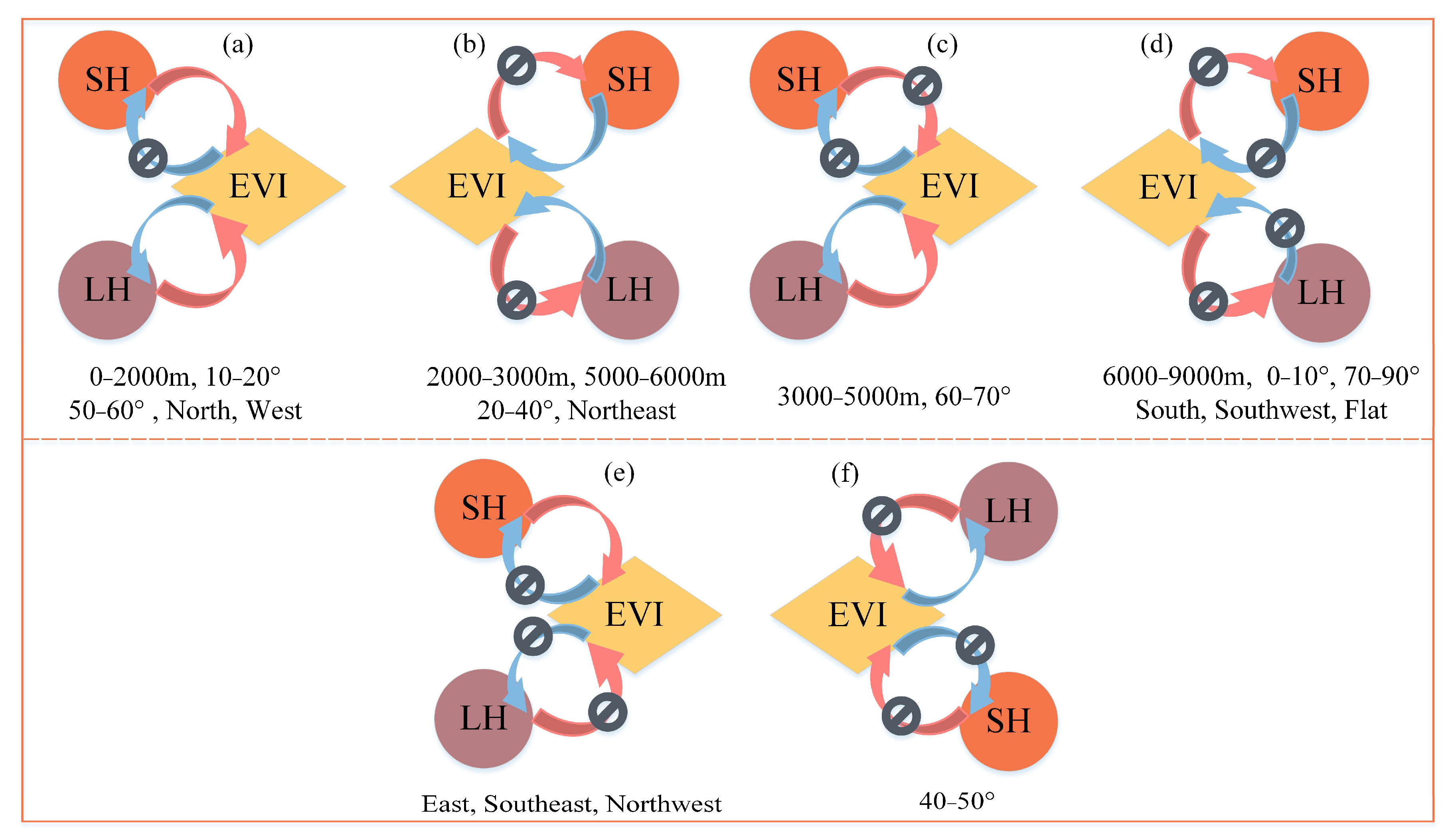
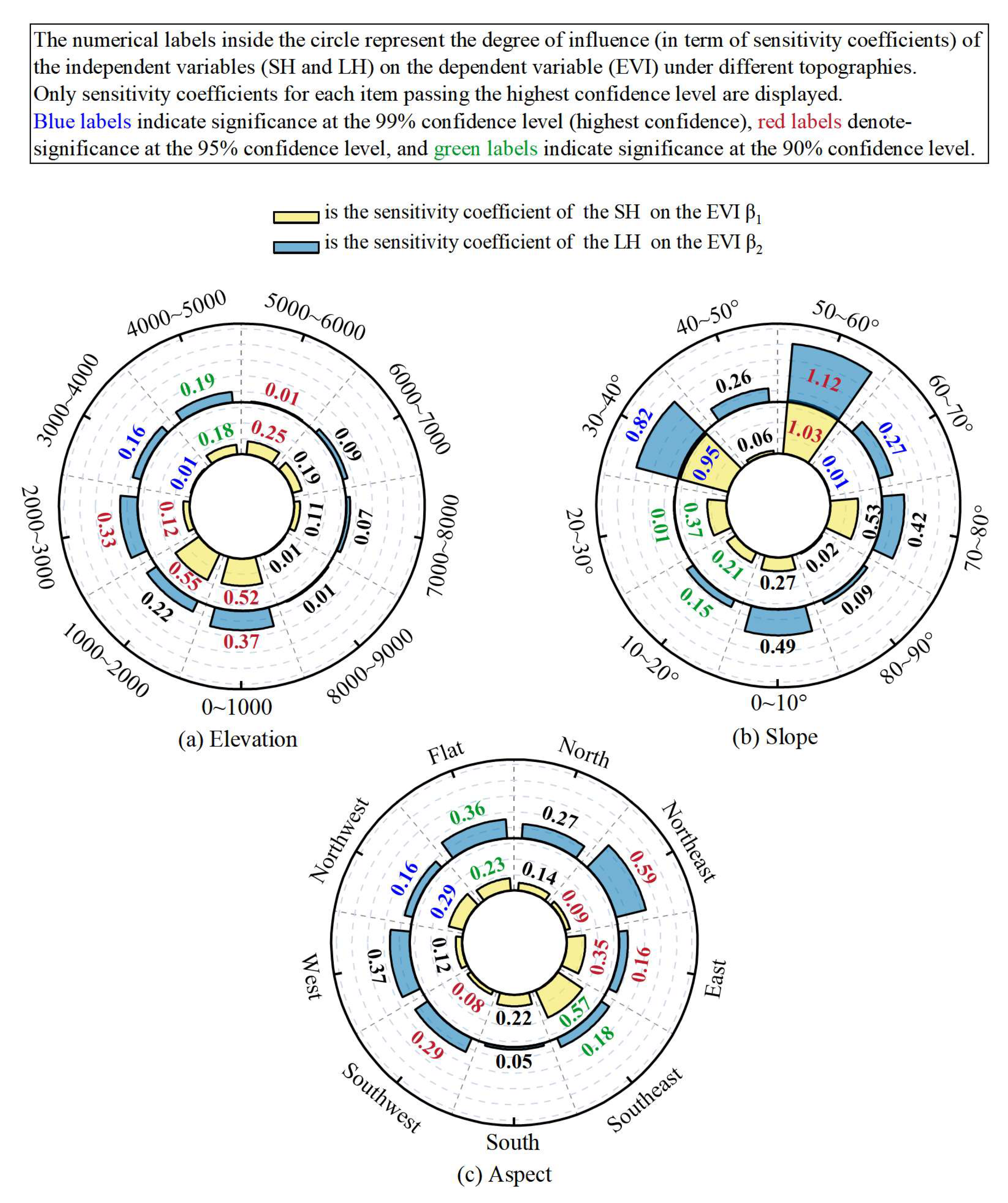
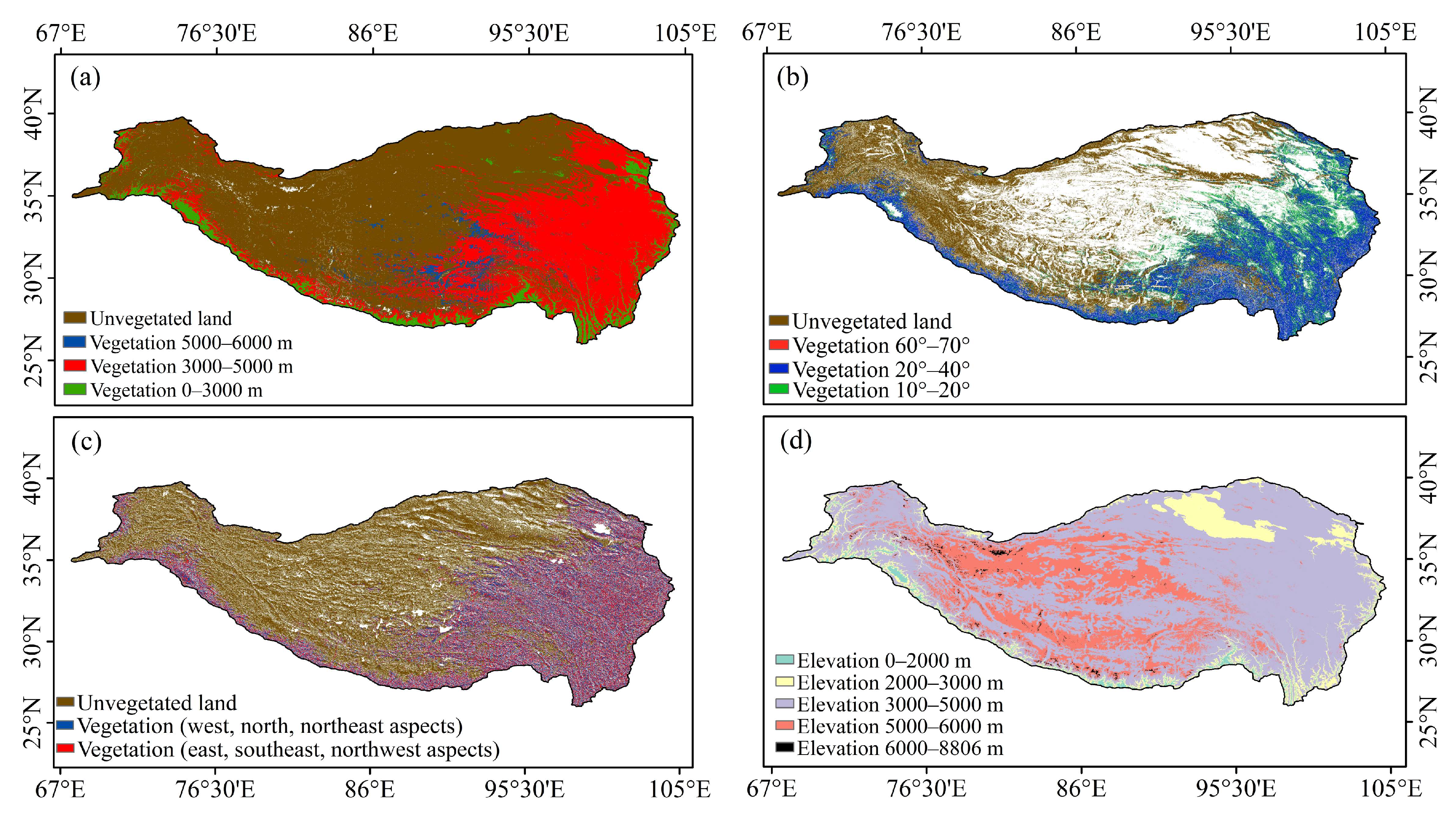
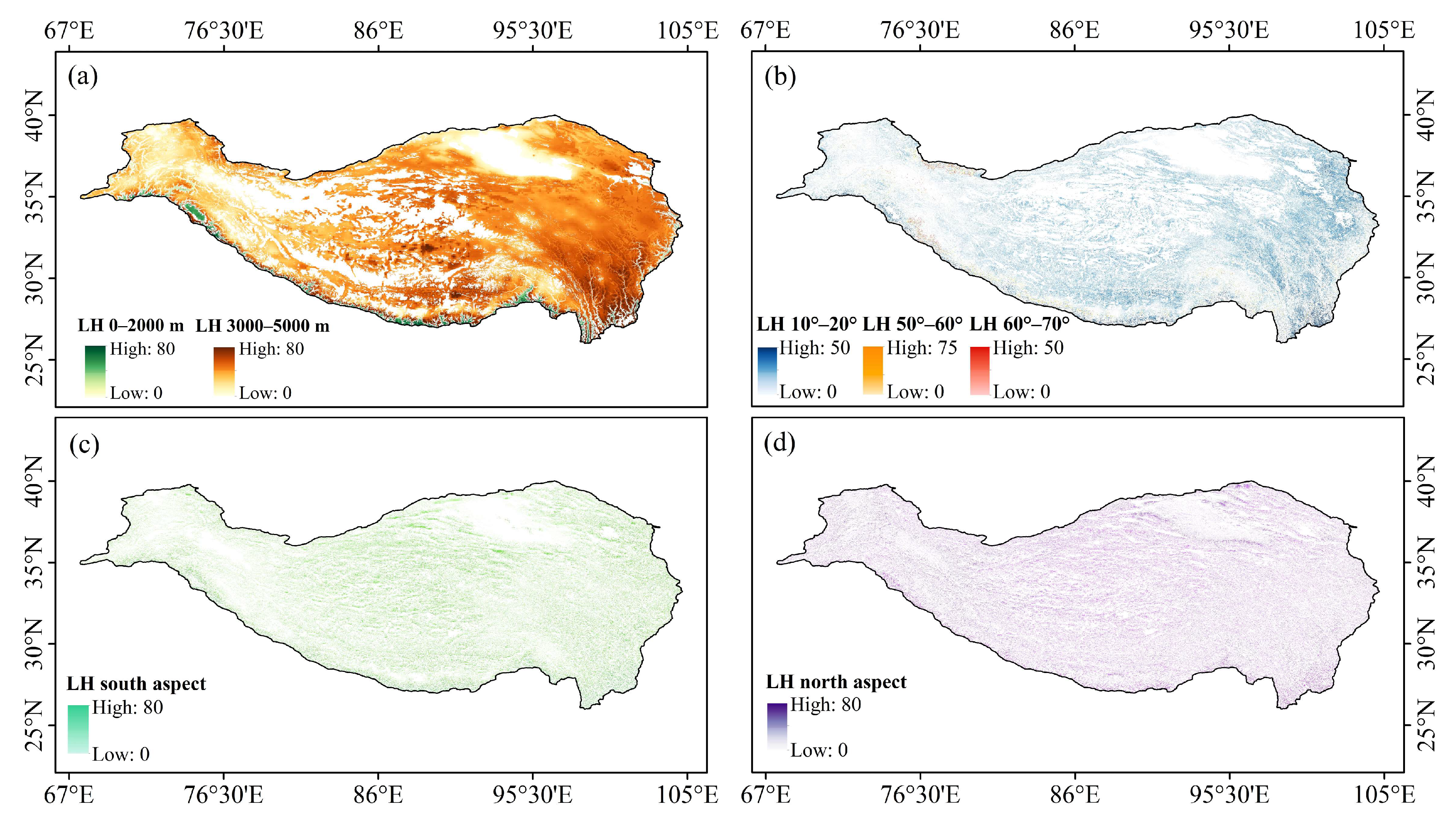
The Interaction Between Vegetation Change and Land–Atmosphere Heat Exchange on the Tibetan Plateau

 ,
,  ,
,
Abstract
1. Introduction
2. Materials and Methods
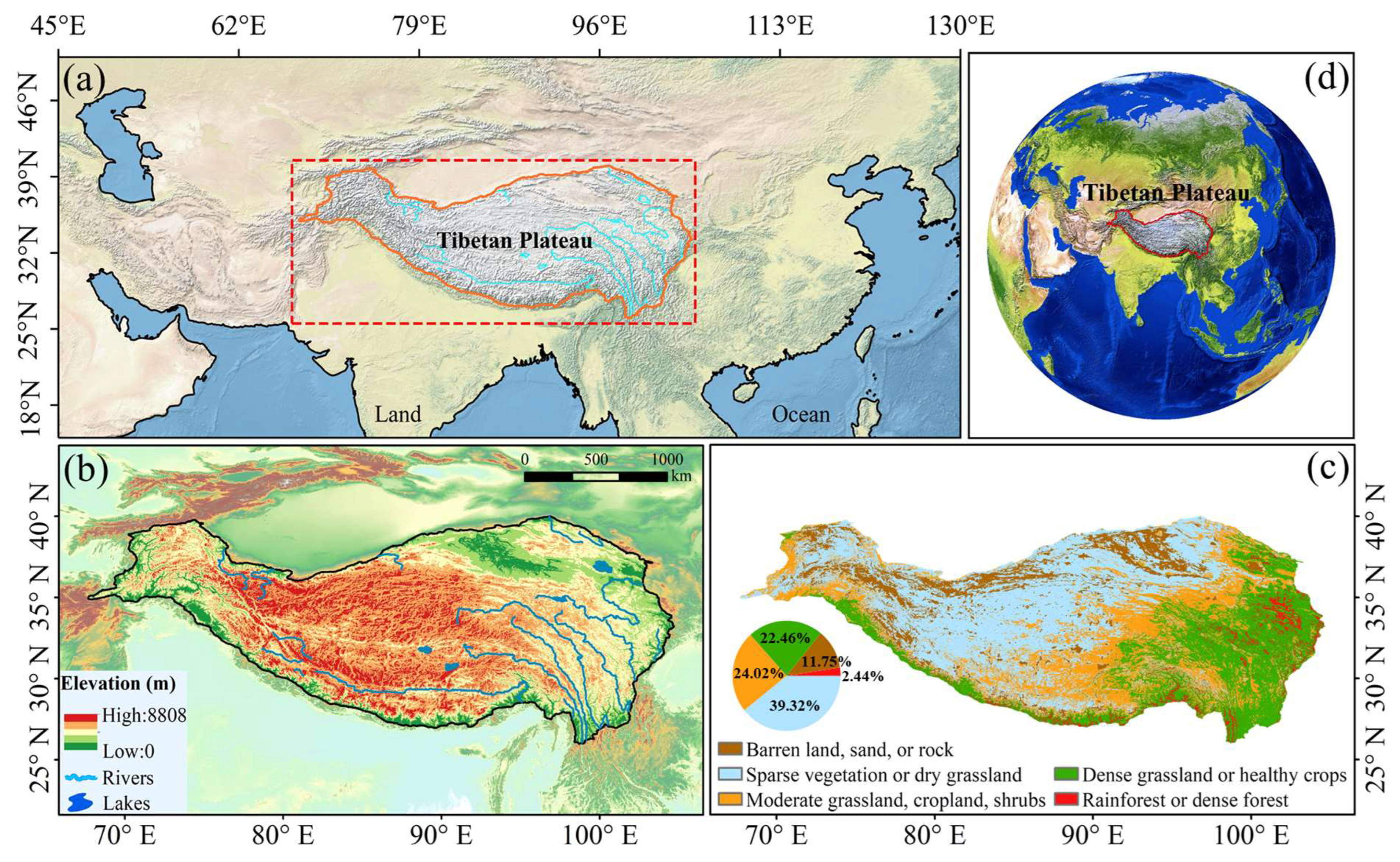
2.1. Study Area
2.2. Data Sources
2.2.1. Enhanced Vegetation Index Data
2.2.2. Heat Fluxes Data
2.2.3. Digital Elevation Model Data
2.3. Research Methodologies
2.3.1. EEMD–Granger Causality Test
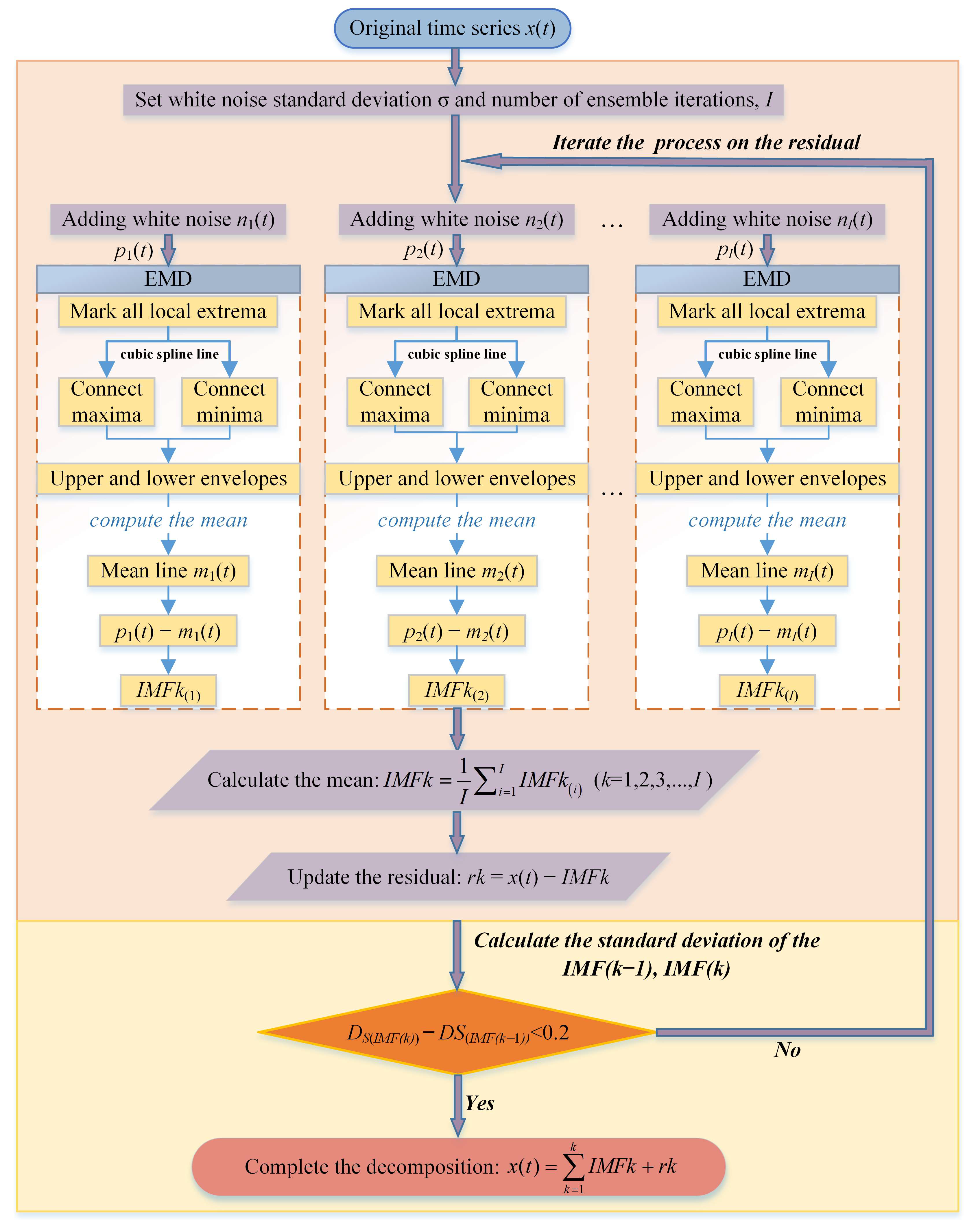
- Gaussian white noise with a standard deviation equal to 20% of the original data’s standard deviation is added to the original time-series data of SH, LH, and EVI. The length of the white noise matches the original time series.
- The noise-augmented time series is treated as a whole, and all local extrema (both maxima and minima) are identified. A cubic spline interpolation is then applied to connect all local maxima to form an upper envelope, and all local minima to form a lower envelope.
- The mean of the upper and lower envelopes is calculated at each corresponding time point to obtain a local mean line. This local mean is subtracted from the noise-augmented time series to derive the first Intrinsic Mode Function (IMF) component and the residual.
- Steps 1 through 3 are repeated 100 times in this study, with a new Gaussian white noise sequence of the same standard deviation used for each iteration. The IMFs obtained from all iterations are averaged to reduce uncertainties caused by the added noise, yielding stable IMF components for SH, LH, and EVI.
- The lowest-frequency IMF component from the stable IMFs obtained in step 4 is selected. The selected IMF time series is subjected to a Granger causality test to evaluate the Granger causal relationships among SH, LH, and EVI.
2.3.2. Sensitivity Analysis Method of Vegetation and Heat Fluxes
3. Results
3.1. The Temporal Variation Characteristics of SH and LH on the TP
3.2. The Causality Relationships Between Vegetation and Heat Fluxes
3.3. Analysis of the Strength of Causality Between Vegetation and Heat Fluxes
4. Discussion
5. Conclusions
Author Contributions
Funding
Data Availability Statement
Conflicts of Interest
References
- Piao, S.; Fang, J.; He, J. Variations in vegetation net primary production in the Qinghai-Xizang Plateau, China, from 1982 to 1999. Clim. Change 2006, 74, 253–267. [Google Scholar] [CrossRef]
- Song, Y.; Jin, L.; Wang, H. Vegetation changes along the Qinghai-Tibet Plateau engineering corridor since 2000 induced by climate change and human activities. Remote Sens. 2018, 10, 95. [Google Scholar] [CrossRef]
- Yang, B.; Duan, Y.; Zhao, J.; Tan, C.; Gesang, J.-m.; Chen, L.; Zhao, Y.; Zhang, X. Response of soil hydrothermal processes within the active layer to variable alpine vegetation in the Yangtze River Source Area, Qinghai-Tibet plateau. J. Hydrol. Reg. Stud. 2024, 54, 101850. [Google Scholar] [CrossRef]
- Hu, C.; Fu, B.; Liu, G.; Jin, T.; Guo, L. Vegetation patterns influence on soil microbial biomass and functional diversity in a hilly area of the Loess Plateau, China. J. Soils Sediments 2010, 10, 1082–1091. [Google Scholar] [CrossRef]
- Li, L.; Zhang, Y.; Liu, L.; Wu, J.; Wang, Z.; Li, S.; Zhang, H.; Zu, J.; Ding, M.; Paudel, B. Spatiotemporal patterns of vegetation greenness change and associated climatic and anthropogenic drivers on the Tibetan Plateau during 2000–2015. Remote Sens. 2018, 10, 1525. [Google Scholar] [CrossRef]
- Nemani, R.R.; Keeling, C.D.; Hashimoto, H.; Jolly, W.M.; Piper, S.C.; Tucker, C.J.; Myneni, R.B.; Running, S.W. Climate-driven increases in global terrestrial net primary production from 1982 to 1999. Science 2003, 300, 1560–1563. [Google Scholar] [CrossRef]
- Shen, M.; Piao, S.; Chen, X.; An, S.; Fu, Y.H.; Wang, S.; Cong, N.; Janssens, I.A. Strong impacts of daily minimum temperature on the green-up date and summer greenness of the Tibetan Plateau. Glob. Change Biol. 2016, 22, 3057–3066. [Google Scholar] [CrossRef]
- Kuang, X.; Jiao, J.J. Review on climate change on the Tibetan Plateau during the last half century. J. Geophys. Res. Atmos. 2016, 121, 3979–4007. [Google Scholar] [CrossRef]
- Chen, J.; Yan, F.; Lu, Q. Spatiotemporal variation of vegetation on the Qinghai–Tibet Plateau and the influence of climatic factors and human activities on vegetation trend (2000–2019). Remote Sens. 2020, 12, 3150. [Google Scholar] [CrossRef]
- Ding, M.; Zhang, Y.; Sun, X.; Liu, L.; Wang, Z.; Bai, W. Spatiotemporal variation in alpine grassland phenology in the Qinghai-Tibetan Plateau from 1999 to 2009. Chin. Sci. Bull. 2013, 58, 396–405. [Google Scholar] [CrossRef]
- Diao, C.; Liu, Y.; Zhao, L.; Zhuo, G.; Zhang, Y. Regional-scale vegetation-climate interactions on the Qinghai-Tibet Plateau. Ecol. Inform. 2021, 65, 101413. [Google Scholar] [CrossRef]
- Duan, H.; Xue, X.; Wang, T.; Kang, W.; Liao, J.; Liu, S. Spatial and temporal differences in alpine meadow, alpine steppe and all vegetation of the Qinghai-Tibetan Plateau and their responses to climate change. Remote Sens. 2021, 13, 669. [Google Scholar] [CrossRef]
- Feng, J.; Chen, G.; Duan, X.; Cai, F.; Zhao, H.; Zhang, Y.; Duan, Q. Time-lag and accumulation responses of vegetation to precipitation in the Jinsha River dry-hot valley at multiple spatial–temporal scales. J. Hydrol. 2025, 661, 133605. [Google Scholar] [CrossRef]
- Wei, Y.; Lu, H.; Wang, J.; Wang, X.; Sun, J. Dual influence of climate change and anthropogenic activities on the spatiotemporal vegetation dynamics over the Qinghai-Tibetan plateau from 1981 to 2015. Earth’s Future 2022, 10, e2021EF002566. [Google Scholar] [CrossRef]
- Yu, J.; Wang, W.; Chen, Z.; Cao, M.; Qian, H. Disentangling the dominance of atmospheric and soil water stress on vegetation productivity in global drylands. J. Hydrol. 2025, 657, 133043. [Google Scholar] [CrossRef]
- Piao, S.; Fang, J.; Zhou, L.; Guo, Q.; Henderson, M.; Ji, W.; Li, Y.; Tao, S. Interannual variations of monthly and seasonal normalized difference vegetation index (NDVI) in China from 1982 to 1999. J. Geophys. Res. Atmos. 2003, 108, 4401. [Google Scholar] [CrossRef]
- Xu, H.; Wang, X.; Zhang, X. Alpine grasslands response to climatic factors and anthropogenic activities on the Tibetan Plateau from 2000 to 2012. Ecol. Eng. 2016, 92, 251–259. [Google Scholar] [CrossRef]
- Li, H.; Zhang, H.; Li, Q.; Zhao, J.; Guo, X.; Ying, H.; Deng, G.; Rihan, W.; Wang, S. Vegetation productivity dynamics in response to climate change and human activities under different topography and land cover in Northeast China. Remote Sens. 2021, 13, 975. [Google Scholar] [CrossRef]
- Pang, G.; Wang, X.; Yang, M. Using the NDVI to identify variations in, and responses of, vegetation to climate change on the Tibetan Plateau from 1982 to 2012. Quat. Int. 2017, 444, 87–96. [Google Scholar] [CrossRef]
- Shi, Y.; Wang, Y.; Ma, Y.; Ma, W.; Liang, C.; Flynn, D.; Schmid, B.; Fang, J.; He, J.-S. Field-based observations of regional-scale, temporal variation in net primary production in Tibetan alpine grasslands. Biogeosciences 2014, 11, 2003–2016. [Google Scholar] [CrossRef]
- Sun, J.; Cheng, G.; Li, W.; Sha, Y.; Yang, Y. On the variation of NDVI with the principal climatic elements in the Tibetan Plateau. Remote Sens. 2013, 5, 1894–1911. [Google Scholar] [CrossRef]
- Ding, M.; Li, L.; Zhang, Y.; Sun, X.; Liu, L.; Gao, J.; Wang, Z.; Li, Y. Start of vegetation growing season on the Tibetan Plateau inferred from multiple methods based on GIMMS and SPOT NDVI data. J. Geogr. Sci. 2015, 25, 131–148. [Google Scholar] [CrossRef]
- Wang, S.; Zhang, B.; Yang, Q.; Chen, G.; Yang, B.; Lu, L.; Shen, M.; Peng, Y. Responses of net primary productivity to phenological dynamics in the Tibetan Plateau, China. Agric. For. Meteorol. 2017, 232, 235–246. [Google Scholar] [CrossRef]
- Hua, T.; Wang, X. Temporal and spatial variations in the climate controls of vegetation dynamics on the Tibetan Plateau during 1982–2011. Adv. Atmos. Sci. 2018, 35, 1337–1346. [Google Scholar] [CrossRef]
- Shao, Q.; Fan, J.; Liu, J.; Huang, L.; Cao, W.; Liu, L. Target-based assessment on effects of first-stage ecological conservation and restoration project in three-river source region, China and policy recommendations. Bull. Chin. Acad. Sci. (Chin. Version) 2017, 32, 35–44. [Google Scholar] [CrossRef]
- Yu, C.; Zhang, X.; Zhang, J.; Li, S.; Song, C.; Fang, Y.; Wurst, S.; Wu, J. Grazing exclusion to recover degraded alpine pastures needs scientific assessments across the northern Tibetan Plateau. Sustainability 2016, 8, 1162. [Google Scholar] [CrossRef]
- Gray, M.A.; McGowan, H.A.; Lowry, A.L.; Guyot, A. Surface energy exchanges over contrasting vegetation types on a sub-tropical sand island. Agric. For. Meteorol. 2018, 249, 81–99. [Google Scholar] [CrossRef]
- Su, Y.; Zhang, C.; Chen, X.; Liu, L.; Ciais, P.; Peng, J.; Wu, S.; Wu, J.; Shang, J.; Wang, Y. Aerodynamic resistance and Bowen ratio explain the biophysical effects of forest cover on understory air and soil temperatures at the global scale. Agric. For. Meteorol. 2021, 308, 108615. [Google Scholar] [CrossRef]
- Zhang, M.; Wang, J.; Li, S. Tempo-spatial changes and main anthropogenic influence factors of vegetation fractional coverage in a large-scale opencast coal mine area from 1992 to 2015. J. Clean. Prod. 2019, 232, 940–952. [Google Scholar] [CrossRef]
- Cho, J.; Oki, T.; Yeh, P.J.-F.; Kim, W.; Kanae, S.; Otsuki, K. On the relationship between the Bowen ratio and the near-surface air temperature. Theor. Appl. Climatol. 2012, 108, 135–145. [Google Scholar] [CrossRef]
- Nicholls, E.M.; Carey, S.K. Evapotranspiration and energy partitioning across a forest-shrub vegetation gradient in a subarctic, alpine catchment. J. Hydrol. 2021, 602, 126790. [Google Scholar] [CrossRef]
- Rotenberg, E.; Yakir, D. Contribution of semi-arid forests to the climate system. Science 2010, 327, 451–454. [Google Scholar] [CrossRef]
- Li, Y.; Zhao, M.; Motesharrei, S.; Mu, Q.; Kalnay, E.; Li, S. Local cooling and warming effects of forests based on satellite observations. Nat. Commun. 2015, 6, 6603. [Google Scholar] [CrossRef]
- Pang, G.; Chen, D.; Wang, X.; Lai, H.-W. Spatiotemporal variations of land surface albedo and associated influencing factors on the Tibetan Plateau. Sci. Total Environ. 2022, 804, 150100. [Google Scholar] [CrossRef] [PubMed]
- Forzieri, G.; Miralles, D.G.; Ciais, P.; Alkama, R.; Ryu, Y.; Duveiller, G.; Zhang, K.; Robertson, E.; Kautz, M.; Martens, B. Increased control of vegetation on global terrestrial energy fluxes. Nat. Clim. Change 2020, 10, 356–362. [Google Scholar] [CrossRef]
- Lin, H.; Li, Y.; Zhao, L. Partitioning of sensible and latent heat fluxes in different vegetation types and their spatiotemporal variations based on 203 FLUXNET sites. J. Geophys. Res. Atmos. 2022, 127, e2022JD037142. [Google Scholar] [CrossRef]
- Li, F.; Hao, D.; Zhu, Q.; Yuan, K.; Braghiere, R.K.; He, L.; Luo, X.; Wei, S.; Riley, W.J.; Zeng, Y. Global impacts of vegetation clumping on regulating land surface heat fluxes. Agric. For. Meteorol. 2024, 345, 109820. [Google Scholar] [CrossRef]
- Smith, I.A.; Winbourne, J.B.; Tieskens, K.F.; Jones, T.S.; Bromley, F.L.; Li, D.; Hutyra, L.R. A satellite-based model for estimating latent heat flux from urban vegetation. Front. Ecol. Evol. 2021, 9, 695995. [Google Scholar] [CrossRef]
- Tariq, S.; Nawaz, H.; ul-Haq, Z.; Mehmood, U. Response of enhanced vegetation index changes to latent/sensible heat flux and precipitation over Pakistan using remote sensing. Environ. Sci. Pollut. Res. 2022, 29, 65565–65584. [Google Scholar] [CrossRef] [PubMed]
- Wang, J.; Buttar, N.A.; Hu, Y.; Lakhiar, I.A.; Javed, Q.; Shabbir, A. Estimation of sensible and latent heat fluxes using surface renewal method: Case study of a tea plantation. Agronomy 2021, 11, 179. [Google Scholar] [CrossRef]
- Tian, X.; Qiu, B.; Ni, Y.; Chen, J.; Li, L.; Cao, Y.; Zhao, S. Divergent response of energy exchange to heatwaves from flux tower observations among various vegetation types. Environ. Res. Lett. 2024, 19, 094029. [Google Scholar] [CrossRef]
- Machado, M.J.; Botero, B.A.; López, J.; Francés, F.; Díez-Herrero, A.; Benito, G. Flood frequency analysis of historical flood data under stationary and non-stationary modelling. Hydrol. Earth Syst. Sci. 2015, 19, 2561–2576. [Google Scholar] [CrossRef]
- Jehanzaib, M.; Ali, S.; Kim, M.J.; Kim, T.-W. Modeling hydrological non-stationarity to analyze environmental impacts on drought propagation. Atmos. Res. 2023, 286, 106699. [Google Scholar] [CrossRef]
- Granger, C.W. Investigating causal relations by econometric models and cross-spectral methods. Econom. J. Econom. Soc. 1969, 37, 424–438. [Google Scholar] [CrossRef]
- Geweke, J. Measurement of linear dependence and feedback between multiple time series. J. Am. Stat. Assoc. 1982, 77, 304–313. [Google Scholar] [CrossRef]
- Ancona, N.; Marinazzo, D.; Stramaglia, S. Radial basis function approach to nonlinear Granger causality of time series. Phys. Rev. E—Stat. Nonlinear Soft Matter Phys. 2004, 70, 056221. [Google Scholar] [CrossRef]
- Ma, N.; Zhang, Y. Increasing Tibetan Plateau terrestrial evapotranspiration primarily driven by precipitation. Agric. For. Meteorol. 2022, 317, 108887. [Google Scholar] [CrossRef]
- Yang, K.; Wu, H.; Qin, J.; Lin, C.; Tang, W.; Chen, Y. Recent climate changes over the Tibetan Plateau and their impacts on energy and water cycle: A review. Glob. Planet. Change 2014, 112, 79–91. [Google Scholar] [CrossRef]
- Zhang, W.; Zhou, T.; Zhang, L. Wetting and greening Tibetan Plateau in early summer in recent decades. J. Geophys. Res. Atmos. 2017, 122, 5808–5822. [Google Scholar] [CrossRef]
- Luo, Y.; Ma, N.; Zhang, Y. Divergent vegetation greening’s direct impacts on land-atmosphere water and carbon exchanges in the northeastern Tibetan Plateau. Glob. Planet. Change 2025, 251, 104825. [Google Scholar] [CrossRef]
- Zong, Y.; Li, Y.; Huang, D.; Hao, K.; Lu, G. Characteristics of the bacterial community-structure and microbial diversity of activated sludge undergoing different temperature conditions in plateau areas based on a2o processes. Appl. Ecol. Environ. Res. 2021, 19, 1437–1455. [Google Scholar] [CrossRef]
- An, Z.; Colman, S.; Zhou, W.; Li, X.; Brown, E.; Jull, A.; Cai, Y.; Huang, Y.; Lu, X.; Chang, H. Interplay between the Westerlies and Asian monsoon recorded in Lake Qinghai sediments since 32 ka. Sci. Rep. 2012, 2, 619. [Google Scholar] [CrossRef]
- Huang, X.; Yin, Y.; Feng, L.; Tong, X.; Zhang, X.; Li, J.; Tian, F. A 10 m resolution land cover map of the Tibetan Plateau with detailed vegetation types. Earth Syst. Sci. Data 2024, 16, 3307–3332. [Google Scholar] [CrossRef]
- Torres, M.E.; Colominas, M.A.; Schlotthauer, G.; Flandrin, P. A complete ensemble empirical mode decomposition with adaptive noise. In Proceedings of the 2011 IEEE International Conference on Acoustics, Speech and Signal Processing (ICASSP), Prague, Czech Republic, 22–27 May 2011; pp. 4144–4147. [Google Scholar]
- Wu, Z.; Huang, N.E. Ensemble empirical mode decomposition: A noise-assisted data analysis method. Adv. Adapt. Data Anal. 2009, 1, 1–41. [Google Scholar] [CrossRef]
- Zhang, J.; Yan, R.; Gao, R.X.; Feng, Z. Performance enhancement of ensemble empirical mode decomposition. Mech. Syst. Signal Process. 2010, 24, 2104–2123. [Google Scholar] [CrossRef]
- Wu, D.; Zhao, X.; Liang, S.; Zhou, T.; Huang, K.; Tang, B.; Zhao, W. Time-lag effects of global vegetation responses to climate change. Glob. Change Biol. 2015, 21, 3520–3531. [Google Scholar] [CrossRef]
- Vu, D.H.; Muttaqi, K.M.; Agalgaonkar, A.P. A variance inflation factor and backward elimination based robust regression model for forecasting monthly electricity demand using climatic variables. Appl. Energy 2015, 140, 385–394. [Google Scholar] [CrossRef]
- Sun, J.; Yang, K.; Yu, Y.; Lu, H.; Lin, Y. Land–Atmosphere Interactions Partially Offset the Accelerated Tibetan Plateau Water Cycle through Dynamical Processes. J. Clim. 2023, 36, 3867–3880. [Google Scholar] [CrossRef]
- Myhre, G.; Samset, B.H.; Hodnebrog, Ø.; Andrews, T.; Boucher, O.; Faluvegi, G.; Fläschner, D.; Forster, P.; Kasoar, M.; Kharin, V. Sensible heat has significantly affected the global hydrological cycle over the historical period. Nat. Commun. 2018, 9, 1922. [Google Scholar] [CrossRef]
- Siler, N.; Roe, G.H.; Armour, K.C.; Feldl, N. Revisiting the surface-energy-flux perspective on the sensitivity of global precipitation to climate change. Clim. Dyn. 2019, 52, 3983–3995. [Google Scholar] [CrossRef]
- Mishra, P.; Kannan, S.R.; Radhakrishnan, C. The effect of anthropogenic heat and moisture on local weather at industrial heat islands: A numerical experiment. Atmosphere 2022, 13, 357. [Google Scholar] [CrossRef]
- Taylor, C.M.; de Jeu, R.A.; Guichard, F.; Harris, P.P.; Dorigo, W.A. Afternoon rain more likely over drier soils. Nature 2012, 489, 423–426. [Google Scholar] [CrossRef] [PubMed]
- Pendergrass, A.G.; Hartmann, D.L. The atmospheric energy constraint on global-mean precipitation change. J. Clim. 2014, 27, 757–768. [Google Scholar] [CrossRef]
- Song, F.; Zhang, G.J.; Ramanathan, V.; Leung, L.R. Trends in surface equivalent potential temperature: A more comprehensive metric for global warming and weather extremes. Proc. Natl. Acad. Sci. USA 2022, 119, e2117832119. [Google Scholar] [CrossRef]
- Tariq, S.; Zeydan, Ö.; Nawaz, H.; Mehmood, U. Impact of land use/land cover (LULC) changes on latent/sensible heat flux and precipitation over Türkiye. Theor. Appl. Climatol. 2023, 153, p1237. [Google Scholar] [CrossRef]
- Bao, Y.; Wei, Y.; Nan, S.; Zang, W. Vegetation over the Qinghai-Xizang Plateau in Response to Climate Change with a 2 ℃ Global Warming. Plateau Meteorol. 2023, 42, 49–59. [Google Scholar] [CrossRef]
- Zhu, Z.; Piao, S.; Myneni, R.B.; Huang, M.; Zeng, Z.; Canadell, J.G.; Ciais, P.; Sitch, S.; Friedlingstein, P.; Arneth, A. Greening of the Earth and its drivers. Nat. Clim. Change 2016, 6, 791–795. [Google Scholar] [CrossRef]
- Zheng, W.; Askari, K.; Song, C.; Shi, P.; Ge, W.; Shi, S.; Chu, J.; Chen, H.; Wang, F. Increasing vulnerability of vegetation to Meteorological and Groundwater drought: A Case study in Argentina. J. Hydrol. Reg. Stud. 2024, 55, 101931. [Google Scholar] [CrossRef]
- Craine, J.M.; Nippert, J.B.; Elmore, A.J.; Skibbe, A.M.; Hutchinson, S.L.; Brunsell, N.A. Timing of climate variability and grassland productivity. Proc. Natl. Acad. Sci. USA 2012, 109, 3401–3405. [Google Scholar] [CrossRef]
- Xue, Y.; Lu, H. Analysis of vegetation cover change and climate driving factors on the Qinghai-Tibet plateau. Hubei Agric. Sci. 2020, 59, 44–48. [Google Scholar] [CrossRef]
- Zhuo, G.; Chen, S.; Zhou, B. Spatio-temporal variation of vegetation coverage over the Tibetan Plateau and its responses to climatic factors. Acta Ecol. Sin. 2018, 38, 3208–3218. [Google Scholar] [CrossRef]
- Wang, L.; Yue, Y.; Cui, J.; Liu, H.; Shi, L.; Liang, B.; Li, Q.; Wang, K. Precipitation sensitivity of vegetation growth in southern China depends on geological settings. J. Hydrol. 2024, 643, 131916. [Google Scholar] [CrossRef]
- Wu, L.; Zhang, J.; Dong, W. Vegetation effects on mean daily maximum and minimum surface air temperatures over China. Chin. Sci. Bull. 2011, 56, 902–907. [Google Scholar] [CrossRef]
- Wang, Z.; Cui, G.; Liu, X.; Zheng, K.; Lu, Z.; Li, H.; Wang, G.; An, Z. Greening of the Qinghai–Tibet plateau and its response to climate variations along elevation gradients. Remote Sens. 2021, 13, 3712. [Google Scholar] [CrossRef]
- Chu, D.; Liu, L.; Wang, Z. Snow cover on the Tibetan Plateau and topographic controls. Remote Sens. 2023, 15, 4044. [Google Scholar] [CrossRef]
- Deng, M.; Meng, X.; Sheng, D.; Niu, H.; Wu, P.; Li, Z.; Zhao, L.; Chen, H.; Shang, L.; Wang, S. Observed surface heat fluxes partitioning during the local growing season over the Tibetan Plateau. Agric. For. Meteorol. 2024, 356, 110186. [Google Scholar] [CrossRef]
- Ma, Y.; Yao, T.; Zhong, L.; Wang, B.; Xu, X.; Hu, Z.; Ma, W.; Sun, F.; Han, C.; Li, M. Comprehensive study of energy and water exchange over the Tibetan Plateau: A review and perspective: From GAME/Tibet and CAMP/Tibet to TORP, TPEORP, and TPEITORP. Earth-Sci. Rev. 2023, 237, 104312. [Google Scholar] [CrossRef]
- Shimono, A.; Zhou, H.; Shen, H.; Hirota, M.; Ohtsuka, T.; Tang, Y. Patterns of plant diversity at high altitudes on the Qinghai-Tibetan Plateau. J. Plant Ecol. 2010, 3, 1–7. [Google Scholar] [CrossRef]
- Zhang, Y.; Li, Y.; Zhu, G. The effects of altitude on temperature, precipitation and climatic zone in the Qinghai-Tibet Plateau. J. Glaciol. Geocryol. 2019, 41, 505–515. [Google Scholar] [CrossRef]
- Wang, Z.; Wang, Q.; Wu, X.; Zhao, L.; Yue, G.; Nan, Z.; Wang, P.; Yi, S.; Zou, D.; Qin, Y. Vegetation changes in the permafrost regions of the Qinghai-Tibetan Plateau from 1982-2012: Different responses related to geographical locations and vegetation types in high-altitude areas. PloS One 2017, 12, e0169732. [Google Scholar] [CrossRef]
- Wang, Z.-w.; Wang, Q.; Zhao, L.; Wu, X.-d.; Yue, G.-y.; Zou, D.-f.; Nan, Z.-t.; Liu, G.-y.; Pang, Q.-q.; Fang, H.-b. Mapping the vegetation distribution of the permafrost zone on the Qinghai-Tibet Plateau. J. Mt. Sci. 2016, 13, 1035–1046. [Google Scholar] [CrossRef]
- Miao, L.; Lu, Q.; Liu, G.; Wei, X. Spatiotemporal Evolution Characteristics of NDVI of Different Vegetation Types and Its Response to Climate Factors on the Qinghai-Tibet Plateau from 1999 to 2019. Res. Soil Water Conserv. 2023, 30, 97–105. [Google Scholar] [CrossRef]
- Yuan, Y.; Ma, Y.; Yang, C.; Chen, J.; Xiao, G.; Xu, M. A new roughness parameterization scheme based on vegetation dynamics and its applicability on the Tibetan Plateau. J. Hydrol. 2025, 654, 132822. [Google Scholar] [CrossRef]
- Jia, Z.; Lin, T.; Guo, X.; Zheng, Y.; Geng, H.; Zhang, J.; Chen, Y.; Liu, W.; Lin, M. Vegetation greening mitigates the positive impacts of climate change on water availability in Northwest China. J. Hydrol. 2024, 644, 132086. [Google Scholar] [CrossRef]



| Elevation (m) | Slope (°) | Aspect |
|---|---|---|
| 0–1000 | 0–10 | Flat |
| 1000–2000 | 10–20 | Northeast |
| 2000–3000 | 20–30 | East |
| 3000–4000 | 30–40 | Southeast |
| 4000–5000 | 40–50 | South |
| 5000–6000 | 50–60 | Southwest |
| 6000–7000 | 60–70 | West |
| 7000–8000 | 70–80 | Northwest |
| 8000–9000 | 80–90 | North |
| Elevations/m | SH to EVI | EVI to SH | LH to EVI | EVI to LH | ||||
|---|---|---|---|---|---|---|---|---|
| F | p-Value | F | p-Value | F | p-Value | F | p-Value | |
| 0–1000 | 4.029 | 0.041 ** | 1.037 | 0.38 | 11.509 | 0.001 *** | 7.762 | 0.005 *** |
| 1000–2000 | 6.067 | 0.023 ** | 0.945 | 0.343 | 0.92 | 0.021 ** | 4.13 | 0.039 ** |
| 2000–3000 | 5.108 | 0.019 ** | 0.374 | 0.694 | 4.345 | 0.030 ** | 1.971 | 0.177 |
| 3000–4000 | 3.797 | 0.066 * | 0.115 | 0.738 | 8.416 | 0.006 *** | 0.314 | 0.026 ** |
| 4000–5000 | 1.695 | 0.219 | 1.293 | 0.305 | 1.856 | 0.016 ** | 0.749 | 0.045 ** |
| 5000–6000 | 0.664 | 0.027 ** | 0.614 | 0.444 | 2.07 | 0.033 ** | 0.432 | 0.658 |
| 6000–7000 | 0.406 | 0.674 | 0.568 | 0.579 | 0.197 | 0.223 | 0.336 | 0.119 |
| 7000–8000 | 0.043 | 0.958 | 1.399 | 0.275 | 0.366 | 0.699 | 1.132 | 0.347 |
| 8000–9000 | 1.759 | 0.208 | 0.929 | 0.418 | 0.354 | 0.708 | 0.072 | 0.931 |
| Slopes/° | SH to EVI | EVI to SH | LH to EVI | EVI to LH | ||||
|---|---|---|---|---|---|---|---|---|
| F | p-Value | F | p-Value | F | p-Value | F | p-Value | |
| 0–10 | 1.599 | 0.233 | 0.571 | 0.576 | 0.59 | 0.566 | 0.664 | 0.528 |
| 10–20 | 6.067 | 0.006 ** | 0.114 | 0.893 | 1.334 | 0.017 ** | 1.507 | 0.012 ** |
| 20–30 | 6.98 | 0.001 *** | 0.199 | 1.046 | 5.209 | 0.024 ** | 3.602 | 0.073 * |
| 30–40 | 4.283 | 0.032 ** | 1.096 | 0.358 | 5.143 | 0.035 ** | 1.766 | 0.2 |
| 40–50 | 0.268 | 0.61 | 0.297 | 2.235 | 1.496 | 0.254 | 1.114 | 0.049 ** |
| 50–60 | 6.788 | 0.018 ** | 0.134 | 1.017 | 4.321 | 0.021 ** | 4.506 | 0.028 ** |
| 60–70 | 3.143 | 0.069 * | 0.738 | 0.587 | 4.197 | 0.023 ** | 3.336 | 0.048 ** |
| 70–80 | 1.569 | 0.226 | 0.516 | 0.482 | 0.741 | 0.495 | 1.331 | 0.296 |
| 80–90 | 0.3 | 0.591 | 0.022 | 0.884 | 0.949 | 0.408 | 0.038 | 0.963 |
| Aspects | SH to EVI | EVI to SH | LH to EVI | EVI to LH | ||||
|---|---|---|---|---|---|---|---|---|
| F | p-Value | F | p-Value | F | p-Value | F | p-Value | |
| Flat | 0.448 | 0.723 | 0.376 | 0.772 | 3.814 | 0.066 * | 0.044 | 0.837 |
| North | 5.731 | 0.017 ** | 2.159 | 0.148 | 4.334 | 0.027 ** | 3.804 | 0.045 ** |
| Northeast | 5.798 | 0.015 ** | 0.899 | 0.668 | 4.783 | 0.037 ** | 2.247 | 0.15 |
| East | 3.443 | 0.042 ** | 0.396 | 0.121 | 2.274 | 0.135 | 0.021 | 0.979 |
| Southeast | 4.467 | 0.050 ** | 0.443 | 0.514 | 0.405 | 0.674 | 0.131 | 0.878 |
| South | 3.97 | 0.057 * | 1.27 | 0.274 | 0.913 | 0.421 | 0.325 | 0.727 |
| Southwest | 0.61 | 0.557 | 0.062 | 0.94 | 4.401 | 0.676 | 0.386 | 0.686 |
| West | 4.871 | 0.047 ** | 0.458 | 0.765 | 7.741 | 0.007 *** | 6.57 | 0.014 ** |
| Northwest | 5.613 | 0.022 ** | 0.606 | 0.623 | 1.222 | 0.343 | 0.088 | 0.965 |
Disclaimer/Publisher’s Note: The statements, opinions and data contained in all publications are solely those of the individual author(s) and contributor(s) and not of MDPI and/or the editor(s). MDPI and/or the editor(s) disclaim responsibility for any injury to people or property resulting from any ideas, methods, instructions or products referred to in the content. |
© 2025 by the authors. Licensee MDPI, Basel, Switzerland. This article is an open access article distributed under the terms and conditions of the Creative Commons Attribution (CC BY) license (https://creativecommons.org/licenses/by/4.0/).
Share and Cite
Gong, C.; Dong, X.; Ma, Y.; Yu, D.; Wei, C.; Peng, T.; An, M.; Su, B. The Interaction Between Vegetation Change and Land–Atmosphere Heat Exchange on the Tibetan Plateau. Remote Sens. 2025, 17, 2996. https://doi.org/10.3390/rs17172996
Gong C, Dong X, Ma Y, Yu D, Wei C, Peng T, An M, Su B. The Interaction Between Vegetation Change and Land–Atmosphere Heat Exchange on the Tibetan Plateau. Remote Sensing. 2025; 17(17):2996. https://doi.org/10.3390/rs17172996
Chicago/Turabian StyleGong, Chengqi, Xiaohua Dong, Yaoming Ma, Dan Yu, Chong Wei, Tao Peng, Min An, and Bob Su. 2025. "The Interaction Between Vegetation Change and Land–Atmosphere Heat Exchange on the Tibetan Plateau" Remote Sensing 17, no. 17: 2996. https://doi.org/10.3390/rs17172996
APA StyleGong, C., Dong, X., Ma, Y., Yu, D., Wei, C., Peng, T., An, M., & Su, B. (2025). The Interaction Between Vegetation Change and Land–Atmosphere Heat Exchange on the Tibetan Plateau. Remote Sensing, 17(17), 2996. https://doi.org/10.3390/rs17172996