Detection of Pine Wilt Disease-Infected Dead Trees in Complex Mountainous Areas Using Enhanced YOLOv5 and UAV Remote Sensing
 ,
,
Abstract
1. Introduction
2. Materials
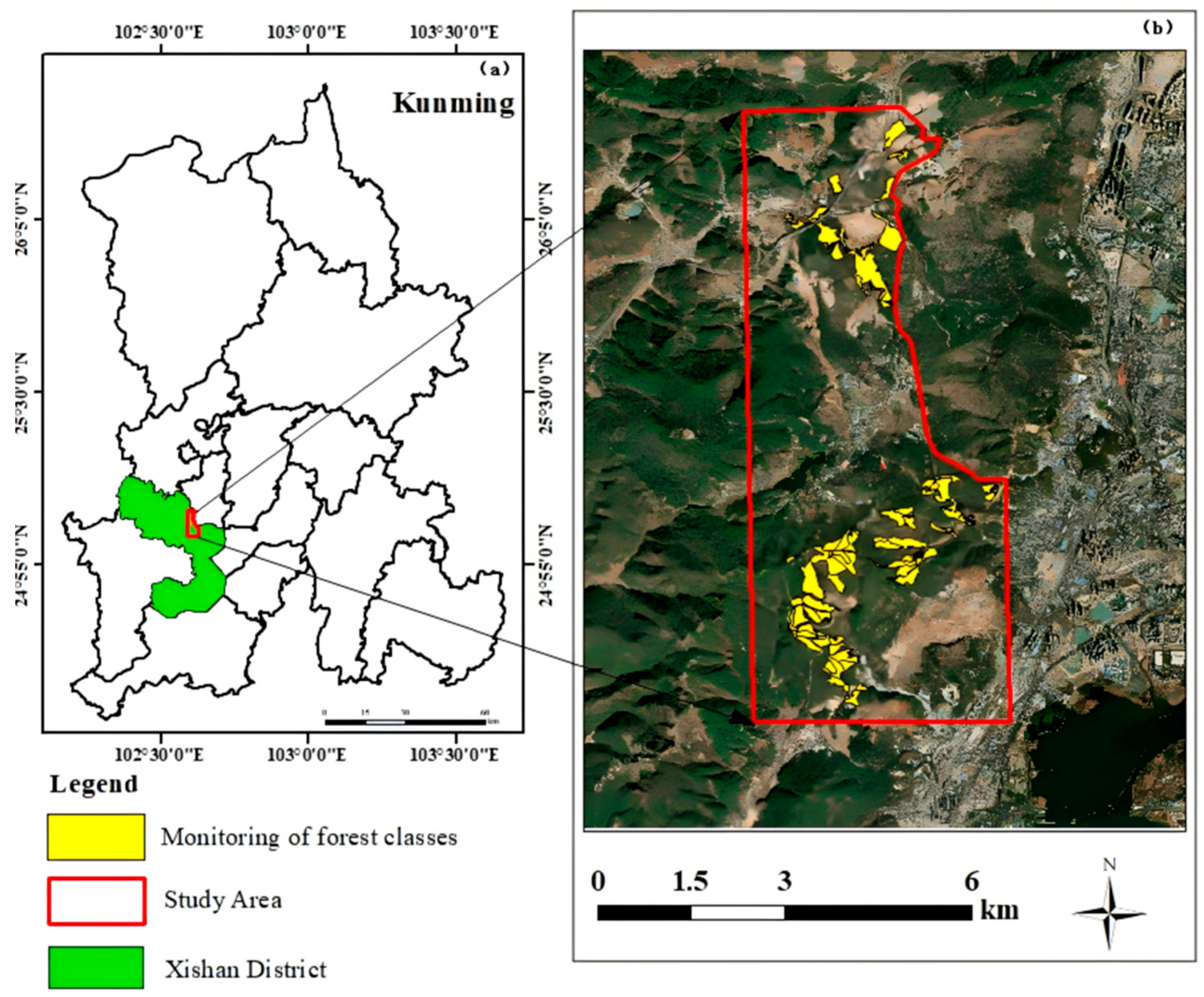
2.1. Study Area
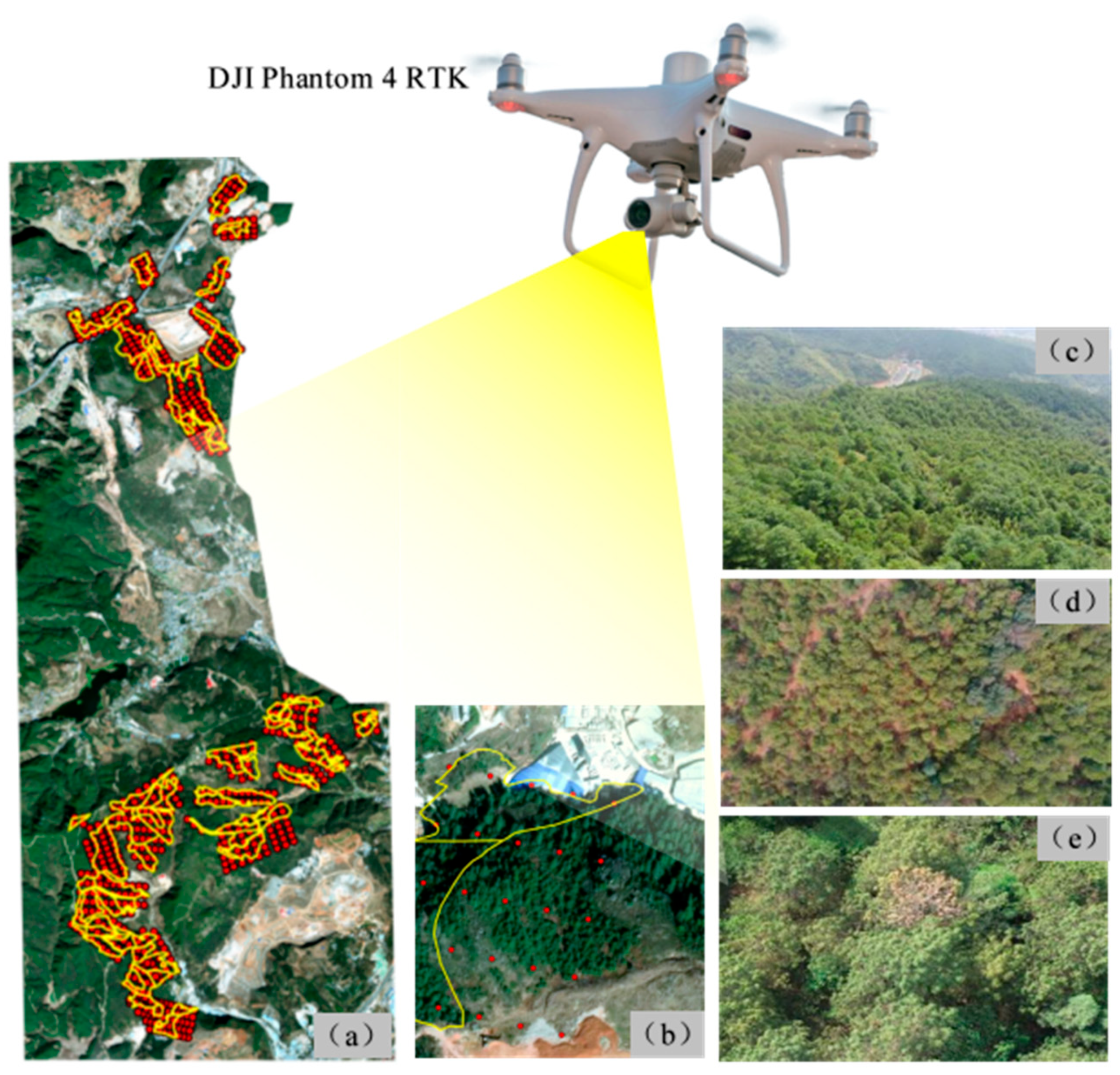
2.2. Data Acquisition
2.3. Data Preprocessing and Dataset Development
2.3.1. Data Preprocessing
2.3.2. Annotation and Dataset Partitioning
3. Methods
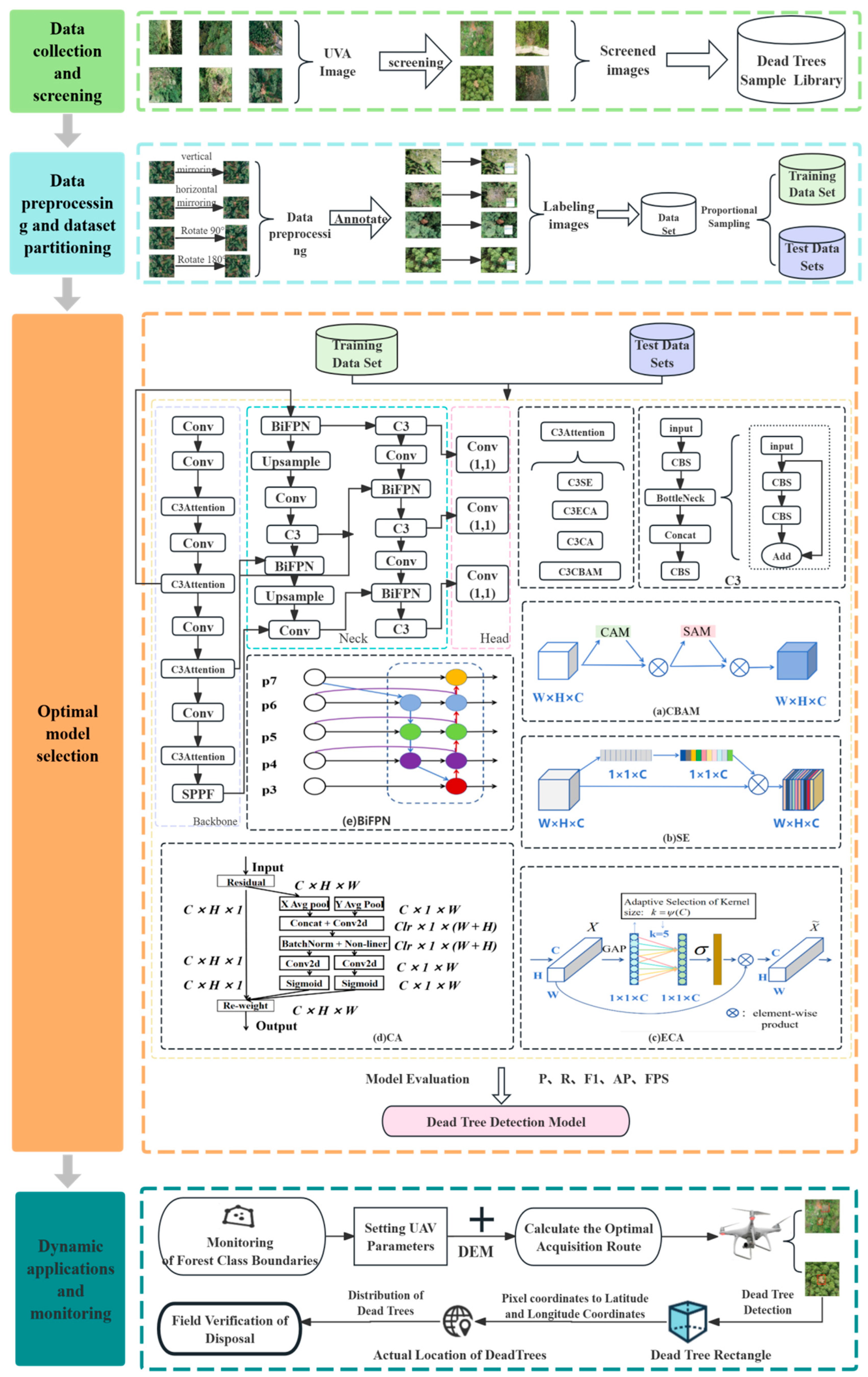
3.1. Conceptual Framework and Methodology
- (1)
- Data Collection and Screening: UAVs with visible-light cameras captured images of dead pine trees infected by PWD in Xishan District. A manual screening process was conducted to ensure data quality; images that were blurred or lacked clear visual features of infection were excluded. A sample library of dead infected trees was constructed by retaining high-quality imagery that clearly depicted the characteristics of infected trees.
- (2)
- Data Preprocessing and Dataset Partitioning: The screened images were augmented through horizontal flipping, vertical flipping, and 90° and 180° rotations to enhance model generalization. Annotation of PWD-infected trees was completed via the LabelImg tool, with bounding boxes used to mark each target instance. The annotated dataset was subsequently split into training and testing subsets at a 9:1 ratio, supplying data for model training and performance evaluation.
- (3)
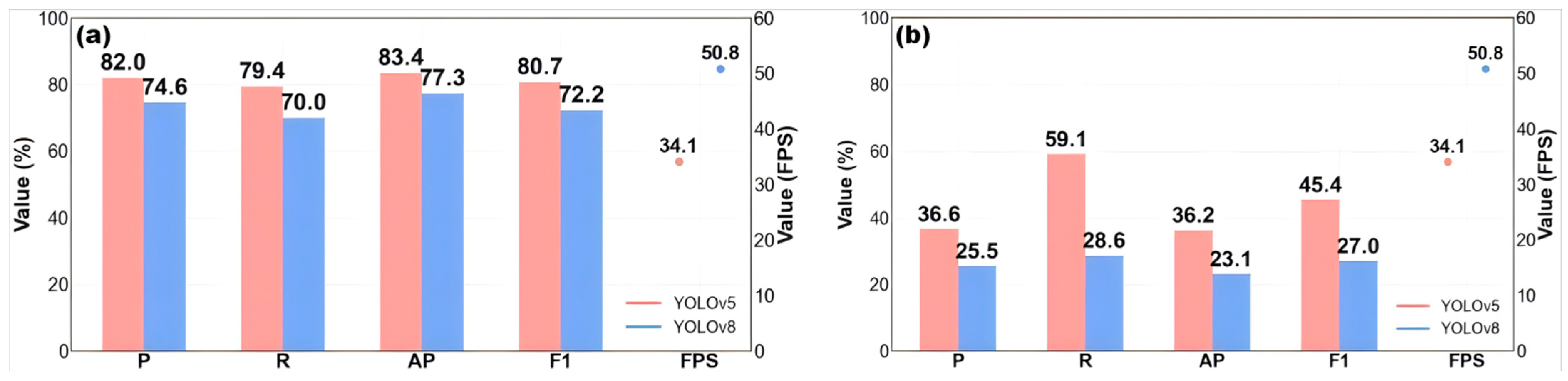
- Optimal Model Selection: This study leveraged the comprehensive advantages of the YOLO series algorithms in terms of accuracy, speed, and real-time performance, selecting YOLOv5 and YOLOv8 for comparative experiments. The results demonstrated that YOLOv5 achieved a superior balance between accuracy and efficiency, and was therefore adopted as the baseline model. Its lightweight architecture—characterized by small model size and fast inference speed—enables deployment on mobile platforms and supports real-time monitoring scenarios, thereby facilitating precise localization of infected trees and informed decision-making for their removal. To address the challenges of insufficient feature extraction and interference from spectrally similar objects in complex environments, targeted improvements to the baseline model were proposed as follows:
- (4)
- Dynamic Application and Monitoring: The optimal model identified through comparative analysis was deployed to process UAV imagery collected in Xishan District during the spring and autumn of 2023. The model was exported in TorchScript format for efficient deployment. UAV flight paths were planned based on the boundaries of the monitored forest plots, and the acquired images were directly input into the detection model for automated identification of PWD-infected dead trees. Upon detection, bounding boxes were generated around infected targets, and the pixel coordinates of the bounding box centers were extracted. Using the georeferenced coordinates (latitude and longitude) of the image centers and known spatial resolution parameters, the pixel coordinates were converted into geographic coordinates. These geographic locations were then associated with the corresponding detected trees and outputted to enable spatial localization. The resulting coordinate data provided a basis for subsequent field verification and on-site disposal of infected trees.
3.2. Experimental Environment and Evaluation Indicators
4. Results
4.1. Comparative Performance Analysis and Validation of Model Enhancements
4.2. Ablation Experiment
4.3. Analysis of Detection Performance and Field Validation
5. Discussion
5.1. YOLO Model Comparison and Performance Analysis
5.2. Validation and Field Application of SEBiE-YOLOv5
5.3. Limitations and Future Work
6. Conclusions
- (1)
- This research utilizes the YOLOv5 object detection model, bolstered by attention modules to sharpen the focus on critical features. It also incorporates BiFPN to facilitate the fusion of multi-scale features and adopts the EIoU loss function to refine the accuracy of bounding box predictions. These improvements boost the model’s precision in identifying dead pines, minimizing both false alarms and overlooked cases. While maintaining high detection precision, the approach significantly boosts the AP and F1. The findings highlight that this approach provides a reliable and budget-friendly option for UAV-assisted remote sensing surveillance, delivering solid technical backing for the accurate and prompt management of pine wilt disease.
- (2)
- In practical field applications, continuous UAV-based monitoring identified 550 and 66 dead pine trees in the spring and autumn of 2023, respectively. Ground-truth validation confirmed detection accuracies of 88.91% and 92.42%, with spatial deviations between UAV-identified trees and actual ground coordinates ranging from 1 to 10 m. These findings confirm the precision, dependability, and real-world effectiveness of the new monitoring method in rugged mountain forest settings. The remote sensing system crafted in this research offers crucial technical assistance for identifying forest pests and monitoring forest health. By doing so, it plays a vital role in safeguarding regional forest resources and upholding ecological balance.
Author Contributions
Funding
Data Availability Statement
Acknowledgments
Conflicts of Interest
Abbreviations
| Abbreviation | Definition of abbreviation |
| ANN | Artificial Neural Networks |
| BiFPN | Bidirectional Feature Pyramid Network |
| CA | Coordinate Attention |
| CBAM | Convolutional Block Attention Module |
| ECA | Efficient Channel Attention |
| EIoU | Efficient Intersection over Union |
| HSV | Hue, Saturation, Value |
| Mask R-CNN | Mask Region-based Convolutional Neural Network |
| PWD | Pine Wilt Disease |
| ResNet50 | Residual Network 50 |
| SCANet | Spatial-Context-Attention network |
| SE | Squeeze-and-Excitation |
| SVM | Support Vector Machines |
| UAV | Unmanned Aerial Vehicle |
| VGG16 | Visual Geometry Group 16 |
| YOLOv5 | You Only Look Once version 5 |
References
- Ye, W.; Lao, J.; Liu, Y.; Chang, C.C.; Zhang, Z.; Li, H.; Zhou, H. Pine pest detection using remote sensing satellite images combined with a multi-scale attention-UNet model. Ecol. Inform. 2022, 72, 101906. [Google Scholar] [CrossRef]
- Long, L.; Chen, Y.; Song, S.; Zhang, X.; Jia, X.; Lu, Y.; Liu, G. Remote sensing monitoring of pine wilt disease based on time-series remote sensing index. Remote Sens. 2023, 15, 360. [Google Scholar] [CrossRef]
- Hao, Z.; Huang, J.; Zhou, Y.; Fang, G. Spatiotemporal pattern of pine wilt disease in the Yangtze river basin. Forests 2021, 12, 731. [Google Scholar] [CrossRef]
- Huang, J.; Lu, X.; Chen, L.; Sun, H.; Wang, S.; Fang, G. Accurate identification of pine wood nematode disease with a deep convolution neural network. Remote Sens. 2022, 14, 913. [Google Scholar] [CrossRef]
- Deng, X.; Tong, Z.; Lan, Y.; Huang, Z. Detection and location of dead trees with pine wilt disease based on deep learning and UAV remote sensing. Agri. Eng. 2020, 2, 294–307. [Google Scholar] [CrossRef]
- Yao, H.; Qin, R.; Chen, X. Unmanned aerial vehicle for remote sensing applications—A review. Remote Sens. 2019, 11, 1443. [Google Scholar] [CrossRef]
- Tao, H.; Li, C.; Xie, C.; Zhou, J.; Huai, H.; Jiang, L.; Li, F. Recognition of red-attack pine trees from UAV imagery based on the HSV threshold method. J. Nanjing For. Univ. 2019, 43, 99. [Google Scholar]
- Liu, X.; Cheng, D.; Li, T.; Chen, X.; Gao, W. Preliminary study on automatic monitoring trees infected by pine wood nematode with high resolution images from unmanned aerial vehicle. For. Pest Dis. 2018, 37, 16–21. [Google Scholar]
- Syifa, M.; Park, S.J.; Lee, C.W. Detection of the pine wilt disease tree candidates for drone remote sensing using artificial intelligence techniques. Engineering 2020, 6, 919–926. [Google Scholar] [CrossRef]
- Iordache, M.D.; Mantas, V.; Baltazar, E.; Pauly, K.; Lewyckyj, N. A machine learning approach to detecting pine wilt disease using airborne spectral imagery. Remote Sens. 2020, 12, 2280. [Google Scholar] [CrossRef]
- Wan, S.; Qi, L.; Xu, X.; Tong, C.; Gu, Z. Deep learning models for real-time human activity recognition with smartphones. Mob. Netw. Appl. 2020, 25, 743–755. [Google Scholar] [CrossRef]
- Garg, D.; Khan, S.; Alam, M. Integrative use of IoT and deep learning for agricultural applications. In Proceedings of the ICETIT 2019: Emerging Trends in Information Technology, Baghdad, Iraq, 15 June 2020; Springer International Publishing: Cham, Switzerland, 2020; pp. 521–531. [Google Scholar]
- Li, Y.; Zhang, H.; Xue, X.; Jiang, Y.; Shen, Q. Deep learning for remote sensing image classification: A survey. Wiley Interdiscip. Rev. Data Min. Knowl. Discov. 2018, 8, e1264. [Google Scholar] [CrossRef]
- Yu, R.; Luo, Y.; Zhou, Q.; Zhang, X.; Wu, D.; Ren, L. Early detection of pine wilt disease using deep learning algorithms and UAV-based multispectral imagery. For. Ecol. Manag. 2021, 497, 119493. [Google Scholar] [CrossRef]
- Sun, J.; He, X.; Ge, X.; Wu, X.; Shen, J.; Song, Y. Detection of key organs in tomato based on deep migration learning in a complex background. Agriculture 2018, 8, 196. [Google Scholar] [CrossRef]
- Qin, J.; Wang, B.; Wu, Y.; Lu, Q.; Zhu, H. Identifying pine wood nematode disease using UAV images and deep learning algorithms. Remote Sens. 2021, 13, 162. [Google Scholar] [CrossRef]
- Hu, G.; Wang, T.; Wan, M.; Bao, W.; Zeng, W. UAV remote sensing monitoring of pine forest diseases based on improved Mask R-CNN. Int. J. Remote Sens. 2022, 43, 1274–1305. [Google Scholar] [CrossRef]
- Zhou, Y.; Liu, W.; Bi, H.; Chen, R.; Zong, S.; Luo, Y. A detection method for individual infected pine trees with pine wilt disease based on deep learning. Forests 2022, 13, 1880. [Google Scholar] [CrossRef]
- Xu, X.; Tao, H.; Li, C.; Cheng, C.; Guo, H.; Zhou, J. Detection and location of pine wilt disease induced dead pine trees based on faster R-CNN. Trans. Chin. Soc. Agric. Mach. 2020, 51, 228–236. [Google Scholar]
- Ma, Y.; Lu, J.; Huang, X. Damage diagnosis of Pinus yunnanensis canopies attacked by Tomicus using UAV hyperspectral images. Forests 2022, 14, 61. [Google Scholar] [CrossRef]
- Wang, L.; Gao, Y.; Liu, Y.; Zhong, L.; Wang, S.; Ma, Y.; Zhan, Z. Monitoring Pine Shoot Beetle Damage Using UAV Imagery and Deep Learning Semantic Segmentation Under Different Forest Backgrounds. Forests 2025, 16, 668. [Google Scholar] [CrossRef]
- Futai, K. Two Infectious Diseases:“COVID-19” and “Pine Wilt Disease”. Forests 2024, 15, 1724. [Google Scholar] [CrossRef]
- Naves, P.; Bonifácio, L.; de Sousa, E. The pine wood nematode and its local vectors in the Mediterranean Basin. In Insects and Diseases of Mediterranean Forest Systems; Springer: Berlin/Heidelberg, Germany, 2016; pp. 329–378. [Google Scholar]
- Hu, J.; Shen, L.; Sun, G. Squeeze-and-excitation networks. In Proceedings of the IEEE Conference on Computer Vision and Pattern Recognition, Salt Lake City, UT, USA, 18–23 June 2018; pp. 7132–7141. [Google Scholar]
- Woo, S.; Park, J.; Lee, J.Y.; Kweon, I.S. Cbam: Convolutional block attention module. In Proceedings of the European Conference on Computer Vision (ECCV), Munich, Germany, 8–14 September 2018; pp. 3–19. [Google Scholar]
- Wang, Q.; Wu, B.; Zhu, P.; Li, P.; Zuo, W.; Hu, Q. ECA-Net: Efficient channel attention for deep convolutional neural networks. In Proceedings of the IEEE/CVF Conference on Computer Vision and Pattern Recognition, Seattle, WA, USA, 14–19 June 2020; pp. 11534–11542. [Google Scholar]
- Chen, J.; Mai, H.; Luo, L.; Chen, X.; Wu, K. Effective feature fusion network in BIFPN for small object detection. In Proceedings of the 2021 IEEE International Conference on Image Processing (ICIP), Anchorage, AK, USA, 19–22 September 2021; pp. 699–703. [Google Scholar]
- Zheng, Z.; Wang, P.; Ren, D.; Liu, W.; Ye, R.; Hu, Q.; Zuo, W. Enhancing geometric factors in model learning and inference for object detection and instance segmentation. IEEE Trans. Cybern. 2021, 52, 8574–8586. [Google Scholar] [CrossRef]
- Dang, C.; Wang, Z.; He, Y.; Wang, L.; Cai, Y.; Shi, H.; Jiang, J. The accelerated inference of a novel optimized yolov5-lite on low-power devices for railway track damage detection. IEEE Access 2023, 11, 134846–134865. [Google Scholar] [CrossRef]
- Zhang, Y.F.; Ren, W.; Zhang, Z.; Jia, Z.; Wang, L.; Tan, T. Focal and efficient IOU loss for accurate bounding box regression. Neurocomputing 2022, 506, 146–157. [Google Scholar] [CrossRef]
- Wang, L.; Cai, J.; Wang, T.; Zhao, J.; Gadekallu, T.R.; Fang, K. Pine wilt disease detection based on uav remote sensing with an improved yolo model. IEEE J. Sel. Top. Appl. Earth Obs. Remote Sensing 2024, 17, 19230–19242. [Google Scholar] [CrossRef]
- Su, J.; Qin, B.; Sun, F.; Lan, P.; Liu, G. Identification of Pine Wilt-Diseased Trees Using UAV Remote Sensing Imagery and Improved PWD-YOLOv8n Algorithm. Drones 2024, 8, 404. [Google Scholar] [CrossRef]
- Dos Santos, C.S.; de Vasconcelos, M.W. Identification of genes differentially expressed in Pinus pinaster and Pinus pinea after infection with the pine wood nematode. Eur. J. Plant Pathol. 2012, 132, 407–418. [Google Scholar] [CrossRef]
- Xie, W.; Wang, H.; Liu, W.; Zang, H. Early-Stage Pine Wilt Disease Detection via Multi-Feature Fusion in UAV Imagery. Forests 2024, 15, 171. [Google Scholar] [CrossRef]



| Type of Labeling | Sick_Tree | Sick_Other | |||
|---|---|---|---|---|---|
| style | Yellow-stage pine | Reddish-brown-stage pine | White-brown-stage diseased dead pine | Red broadleaf trees | Other dead trees |
| Canopy |  |  |  |  |  |
 |  |  |  |  | |
| Software and Hardware | Technical Parameters |
|---|---|
| CPU | 13th Gen Intel(R) Core(TM) i7-13650HX |
| GPU | NVIDIA GeForce RTX 4060 Laptop GPU |
| Memory/GB | 16 |
| Storage Capacity/TB | 1 |
| Deep Learning Framework | Pytorch 2.4.1 |
| Programming Language | Python |
| Marking Software | LabelImg 1.8.6 |
| YOLOv5 Baseline Network | SE | BiFPN | EIoU | P/% | R% | F1% | AP% | FPS |
|---|---|---|---|---|---|---|---|---|
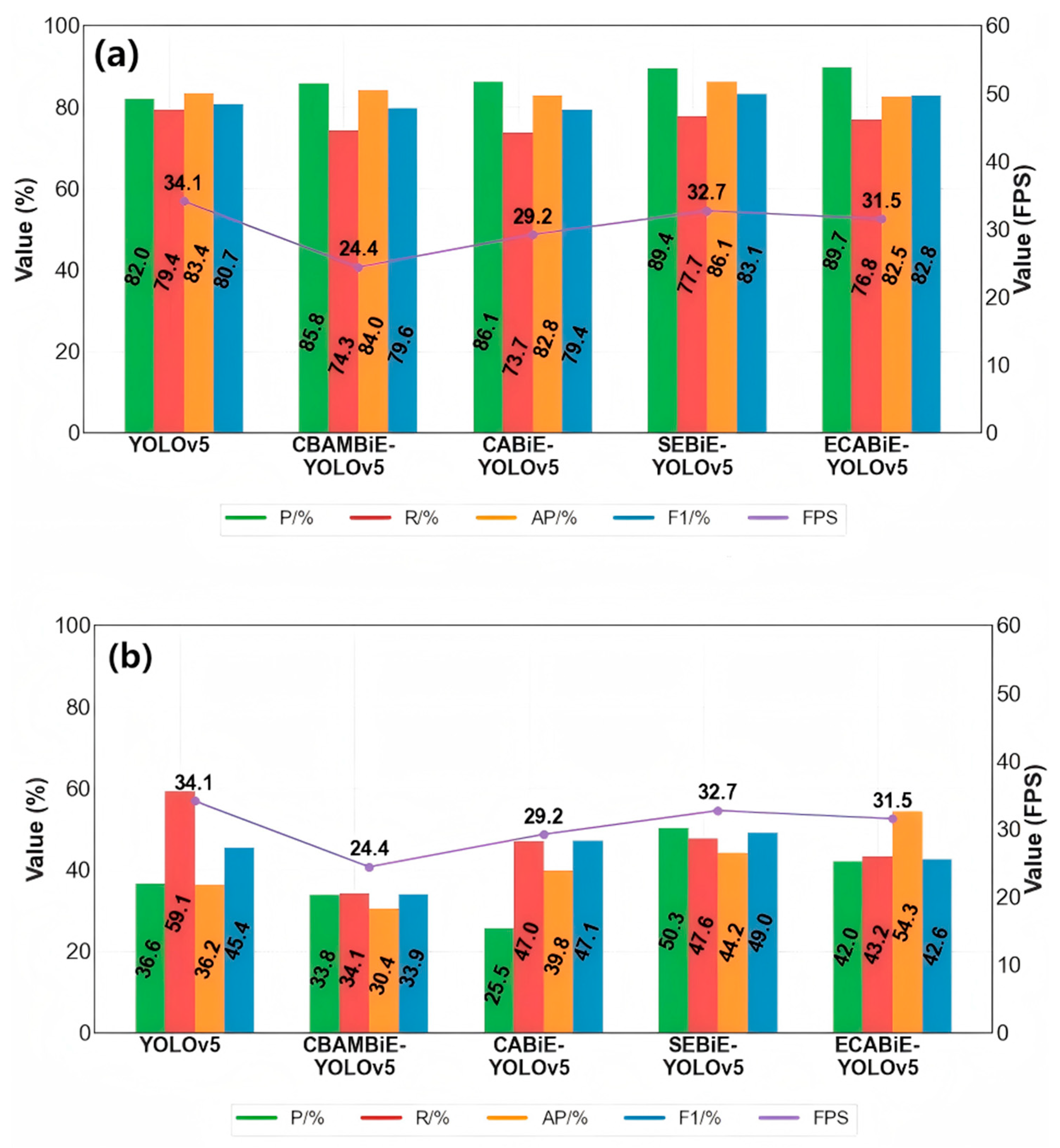
| √ | - | - | - | 82 | 79.4 | 80.7 | 83.4 | 34.1 |
| √ | √ | - | - | 86.1 | 77.5 | 81.7 | 84.1 | 32.6 |
| √ | - | √ | - | 87.3 | 71.6 | 78.5 | 81.1 | 31.9 |
| √ | - | - | √ | 76.7 | 83.1 | 79.8 | 82.6 | 34.2 |
| √ | √ | √ | - | 89 | 77.7 | 83 | 83 | 31.3 |
| √ | - | √ | √ | 85.6 | 80.2 | 82.8 | 82.3 | 33.3 |
| √ | √ | - | √ | 81.7 | 76.9 | 79.2 | 81.5 | 32.3 |
| √ | √ | √ | √ | 89.4 | 77.7 | 83.1 | 86.1 | 32.7 |
| ① | ② | ③ | ④ | |
|---|---|---|---|---|
| Original Image |  |  |  |  |
| YOLOv5 |  |  |  |  |
| SEBiE-YOLOv5 |  |  |  |  |
| CBAMBiE-YOLOv5 |  |  |  |  |
| ECABiE-YOLOv5 |  |  |  | 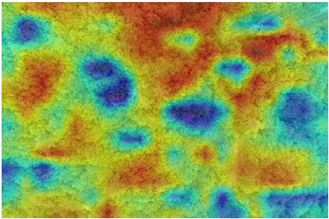 |
| CABiE-YOLOv5 |  |  |  |  |
| Scenario a | Scenario b | Scenario c | Scenario d | |
|---|---|---|---|---|
| Original Image | 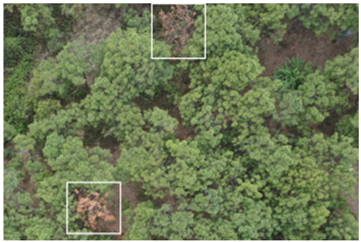 |  |  | 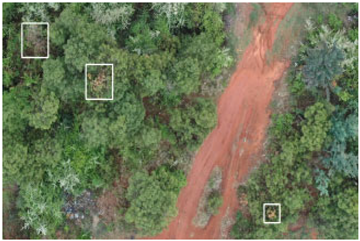 |
| YOLOv5 |  |  |  | 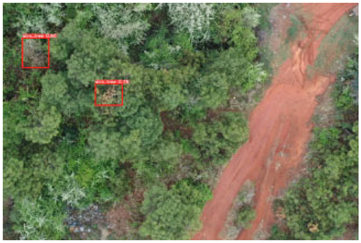 |
| SEBiE-YOLOv5 |  |  |  |  |
| CBAMBiE-YOLOv5 |  |  |  |  |
| ECABiE-YOLOv5 |  |  |  |  |
| CABiE-YOLOv5 |  |  |  |  |
| Monitoring Period | Number of Dead Trees Monitored (Plants) | Number of Dead Pine Trees Field Verified (Plants) | Number of Other Tree Species Killed (Plants) | Tree Species Accuracy (%) |
|---|---|---|---|---|
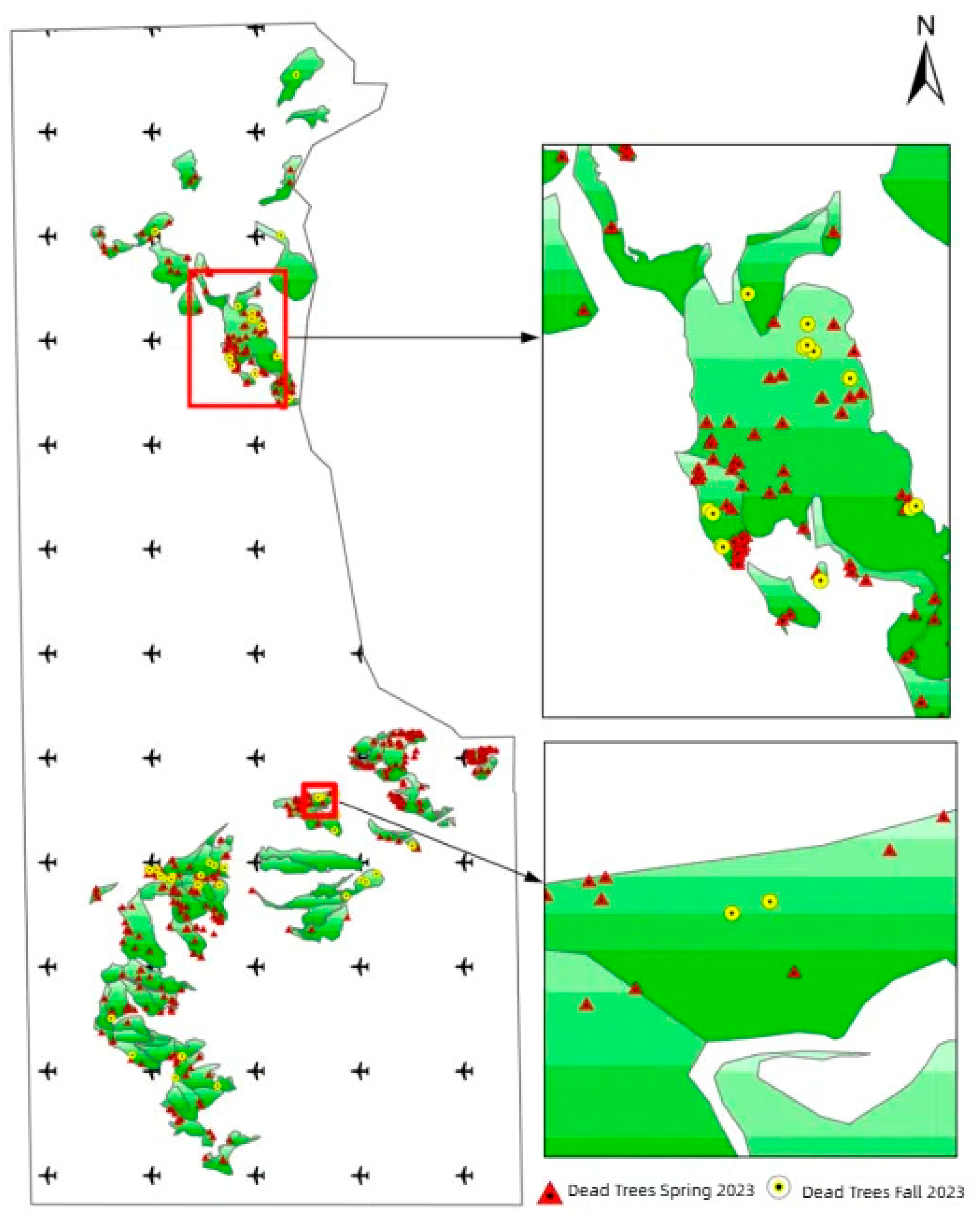
| Spring 2023 | 550 | 489 | 61 | 88.91 |
| Fall 2023 | 66 | 61 | 5 | 92.42 |
| Dead Tree Number | UAV Monitoring of Coordinates | Field Location Coordinates | Position Deviation (m) | ||
|---|---|---|---|---|---|
| Longitudes | Latitude | Longitudes | Latitude | ||
| 1 | 102°35′53.13000″ | 25°01′46.80000″ | 102°35′53.06778″ | 25°01′46.88202″ | 3.08 |
| 2 | 102°35′57.08000″ | 25°01′45.99000″ | 102°35′57.14614″ | 25°01′45.89928″ | 3.36 |
| 3 | 102°35′54.20000″ | 25°01′49.99000″ | 102°35′54.24086″ | 25°01′49.88282″ | 3.51 |
| 4 | 102°36′14.14000″ | 25°00′55.87000″ | 102°36′14.12237″ | 25°00′55.79849″ | 2.27 |
| 5 | 102°36′13.34000″ | 25°00′57.18000″ | 102°36′13.17424″ | 25°00′57.35415″ | 7.11 |
| 6 | 102°36′39.63000″ | 25°02′25.43000″ | 102°36′39.78296″ | 25°02′25.59917″ | 6.76 |
| 7 | 102°36′40.62000″ | 25°02′25.75000″ | 102°36′40.79011″ | 25°02′25.81068″ | 5.12 |
| 8 | 102°36′23.31000″ | 25°04′27.56000″ | 102°36′23.2465″ | 25°04′27.48446″ | 2.94 |
| 9 | 102°36′23.20000″ | 25°04′28.64000″ | 102°36′23.1797″ | 25°04′28.4707″ | 5.27 |
| 10 | 102°36′22.32000″ | 25°04′27.24000″ | 102°36′22.52544″ | 25°04′27.02691″ | 8.75 |
Disclaimer/Publisher’s Note: The statements, opinions and data contained in all publications are solely those of the individual author(s) and contributor(s) and not of MDPI and/or the editor(s). MDPI and/or the editor(s) disclaim responsibility for any injury to people or property resulting from any ideas, methods, instructions or products referred to in the content. |
© 2025 by the authors. Licensee MDPI, Basel, Switzerland. This article is an open access article distributed under the terms and conditions of the Creative Commons Attribution (CC BY) license (https://creativecommons.org/licenses/by/4.0/).
Share and Cite
Yang, C.; Lu, J.; Fu, H.; Guo, W.; Shao, Z.; Li, Y.; Zhang, M.; Li, X.; Ma, Y. Detection of Pine Wilt Disease-Infected Dead Trees in Complex Mountainous Areas Using Enhanced YOLOv5 and UAV Remote Sensing. Remote Sens. 2025, 17, 2953. https://doi.org/10.3390/rs17172953
Yang C, Lu J, Fu H, Guo W, Shao Z, Li Y, Zhang M, Li X, Ma Y. Detection of Pine Wilt Disease-Infected Dead Trees in Complex Mountainous Areas Using Enhanced YOLOv5 and UAV Remote Sensing. Remote Sensing. 2025; 17(17):2953. https://doi.org/10.3390/rs17172953
Chicago/Turabian StyleYang, Chen, Junjia Lu, Huyan Fu, Wei Guo, Zhenfeng Shao, Yichen Li, Maobin Zhang, Xin Li, and Yunqiang Ma. 2025. "Detection of Pine Wilt Disease-Infected Dead Trees in Complex Mountainous Areas Using Enhanced YOLOv5 and UAV Remote Sensing" Remote Sensing 17, no. 17: 2953. https://doi.org/10.3390/rs17172953
APA StyleYang, C., Lu, J., Fu, H., Guo, W., Shao, Z., Li, Y., Zhang, M., Li, X., & Ma, Y. (2025). Detection of Pine Wilt Disease-Infected Dead Trees in Complex Mountainous Areas Using Enhanced YOLOv5 and UAV Remote Sensing. Remote Sensing, 17(17), 2953. https://doi.org/10.3390/rs17172953