Article

Enhancing Overtaking Safety with Mobile LiDAR Systems: Dynamic Analysis of Road Visibility

by
Diego Guerrero-Sevilla
1,
Mariano Gonzalez-de-Soto
2,
Susana Del Pozo
1,
José A. Martín-Jiménez
1,
Pablo Rodríguez-Gonzálvez
3,4,* and
Diego González-Aguilera
1
1
Department of Cartographic and Land Engineering, Universidad de Salamanca, 05003 Avila, Spain
2
Department of Electronic and Automatic Technology, Catholic University of Avila, 05005 Avila, Spain
3
Department of Mining Technology, Topography and Structures, Universidad de León, 24401 Ponferrada, Spain
4
DRACONES Research Group, Universidad de León, 24401 Ponferrada, Spain
*
Author to whom correspondence should be addressed.
Remote Sens. 2025, 17(17), 2948; https://doi.org/10.3390/rs17172948
Submission received: 30 June 2025 / Revised: 9 August 2025 / Accepted: 21 August 2025 / Published: 25 August 2025

Abstract

This study presents a methodology to automatically assess visibility distance on secondary roads using mobile LiDAR systems. The method evaluates both braking and overtaking visibility distances based on the 3D geometry of the road, applying a dynamic analysis through a series of parametrised quadrangular pyramids that simulate the driver’s field of view. Road segments are classified into three risk levels, low, medium, and high, according to the feasibility of stopping or overtaking safely. The methodology was validated on three secondary roads in Spain, achieving an average accuracy of 92.7% when compared to existing road signage. These results demonstrate the method’s potential to improve road safety through continuous, data-driven visibility monitoring. Its application supports advanced driver assistance systems and offers road authorities a reliable tool for proactive risk assessment and road infrastructure planning.

1. Introduction

1.1. Motivation

Ensuring road safety is a multifaceted challenge, with road design and geometry standing at its core. These critical factors must guarantee the visibility required for safe driving and accident reduction. Central to this is the concept of visibility distance, denoting the length of the road visible to the driver. It plays a critical role in facilitating safe navigation, enabling drivers to avoid unexpected obstacles and oncoming vehicles [1]. This includes two key aspects: (i) the braking distance, which is the minimum length required for a driver to perceive an obstacle and bring the vehicle to a complete stop safely; and (ii) the overtaking distance, which refers to the minimum length of clear road ahead needed to complete a passing manoeuvre without interfering with oncoming traffic. In standard practice, the design phase of roads conscientiously takes into account visibility distance through analysis of the road in plan and elevation [2]. However, practical challenges arise when it comes to sustaining visibility over time, particularly on secondary roads. The nature of these roads often invites alterations through partial renovations and remodelling processes, causing deviations from their original design. Moreover, the dynamic environment of roads, characterised by factors like vegetation growth and minor embankment landslides, introduces further changes. Evaluating these ongoing changes in situ is essential, although it is logistically complex and expensive, and a universally applicable criterion for their estimation remains elusive.

1.2. Brief State of the Art

Addressing this challenge requires investigating data acquisition geotechnologies and data processing methods. Regarding the digitisation of roads in 2D and 3D, the current literature emphasises the use of Light Detection and Ranging (LiDAR) technology [3,4,5,6]. LiDAR offers unrivalled flexibility, precision, and objectivity compared to alternative methods. This technology has sparked significant research in road safety when it is mobile, as it presents a cost-effective means of obtaining detailed 3D point cloud data for roads and their surroundings without disrupting traffic flow. Mobile LiDAR Systems (MLS) are a geospatial technology that integrates multiple sensor types beyond active mapping sensors (LiDAR): high-precision Global Navigation Satellite System (GNSS) receivers, and inertial measurement units (IMUs). These components are synchronously mounted on a mobile platform (typically a car or a van) that moves along the road network to generate an accurate and high-resolution geospatial 3D point cloud in real time. The mobility of the platform facilitates the efficient digitisation of large-scale roadway environments, which is crucial for automated visibility distance analysis. Nevertheless, some studies have explored alternative low-cost technologies, such as drones [7], smartphones, or webcams combined with GNSS, as substitutes for LiDAR systems. However, these low-cost alternatives tend to be limited to urban roads [5,6,8,9] or specific road segments due to their performance limitations.
Regarding the data processing methods, MLS have demonstrated their versatility and potential in enhancing both road infrastructure monitoring and driver assistance systems. The study developed in [10] investigated real-time LiDAR-based obstacle detection and classification in urban traffic environments, significantly reducing collision risks by enabling prompt hazard response. Similarly, [11] explored LiDAR integration with machine learning models to predict pedestrian and vehicle movements, resulting in improved anticipatory warning systems. A complementary approach is presented by [12], focusing on using LiDAR scanning for roadway surface condition assessment, which supports early detection of damage to enhance maintenance planning. Finally, [13] examined LiDAR-based detection of visibility impairments such as fog or rain using signal attenuation analysis, paving the way for adaptive speed regulation and visibility-aware warnings. Taken together, these contributions highlight LiDAR’s critical role in enhancing situational awareness on roads, particularly through accurate sensing and predictive analytics—ultimately linking LiDAR performance directly to the concept of visibility distance, a key parameter in quantifying safe stopping or reaction thresholds on roadways.
The analysis of visibility distance has also seen a diversity of methodologies in the literature. While some studies propose direct estimation through 3D LiDAR point cloud analysis, employing techniques like ray tracing algorithms or cross-section creation [14], others generate digital elevation or surface models as intermediary products [15]. Various strategies are employed to assess visibility in roads, with the majority focusing on changes in vertical alignment [16,17] or obstacle detection [18,19]. Notably, a study by [20] introduced neural networks to classify visible and non-visible areas in 2D point cloud projections. Additionally, alternative methodologies, like the one proposed by [21], examine driver visibility through straight rectangular prisms drawn along the line of sight between the observer and the target. Advances in MLS technology have significantly improved visibility distance assessment methods. For instance, [22] introduced an automated method for evaluating passing sight distance on rural highways, identifying safe passing zones and correlating these with collision data to enhance road safety. Similarly, [23] utilised MLS to calculate visibility distances by identifying obstructions through 3D point cloud analysis. Ma et al., [24] further advanced this field by developing a framework for detecting 3D obstacles that hinder highway visibility, employing segmentation and connectivity techniques to improve efficiency.
On the other hand, traditional visual obstacle avoidance techniques, based on monocular or stereo vision, can detect on road obstacles and provide essential environmental perception for autonomous vehicles [25]. However, assisted driving systems rely heavily on accurate and timely obstacle detection and distance estimation to ensure safety and navigation efficiency. Consequently, traditional approaches require improved robustness and real-time performance [26], as they often struggle with depth ambiguity, sensitivity to illumination changes, and limited generalisation in complex environments. These limitations can result in inaccurate distance predictions, particularly in unstructured or dynamic scenarios caused by vegetation growth, evolving landscapes, new intersections, or temporary obstructions.
Despite these diverse geotechnologies and methodologies, the automation of visibility assessment has remained limited, predominantly confined to urban roads or highways [27,28,29,30].

1.3. Main Novelty and Research Objectives

The present research pivots towards addressing visibility on secondary roads, where unaddressed visibility issues for standard vehicles escalate accident risks. Our proposed methodology directly analyses point clouds acquired through MLS and dynamically categorises roads into three distinct risk levels: high, medium, and low. This comprehensive approach considers multiple factors, including driver height, line of sight, braking and overtaking visibility distances, and vertical transitions along the route axis. To achieve this, the method simulates driver visibility through a hierarchical and lightweight pyramid-based model that captures both geometric and environmental potential obstacles. As a result, this approach not only enhances road safety but also offers more effective detection of critical areas requiring targeted resource allocation, optimises signage to align with current visibility conditions, and proactively identifies potential hazards and obstacles. Furthermore, this approach facilitates the simulation and evaluation of driver visibility in road designs, providing an additional validation step before road projects proceed. Last but not least, the method is designed to be easily replicable and adaptable to different road typologies and regulatory contexts, requiring only the adjustment of input parameters to fit local design standards.
The structure of this paper is as follows: after this introduction, which provides a brief overview of the current state of research, Section 2 outlines the methodology comprising three main steps. Section 3 presents the experimental results obtained from real case studies covering three secondary roads with varying geometric characteristics. Finally, Section 4 highlights the impact of the proposed methodology and suggests potential venues for future improvement.

2. Materials and Methods

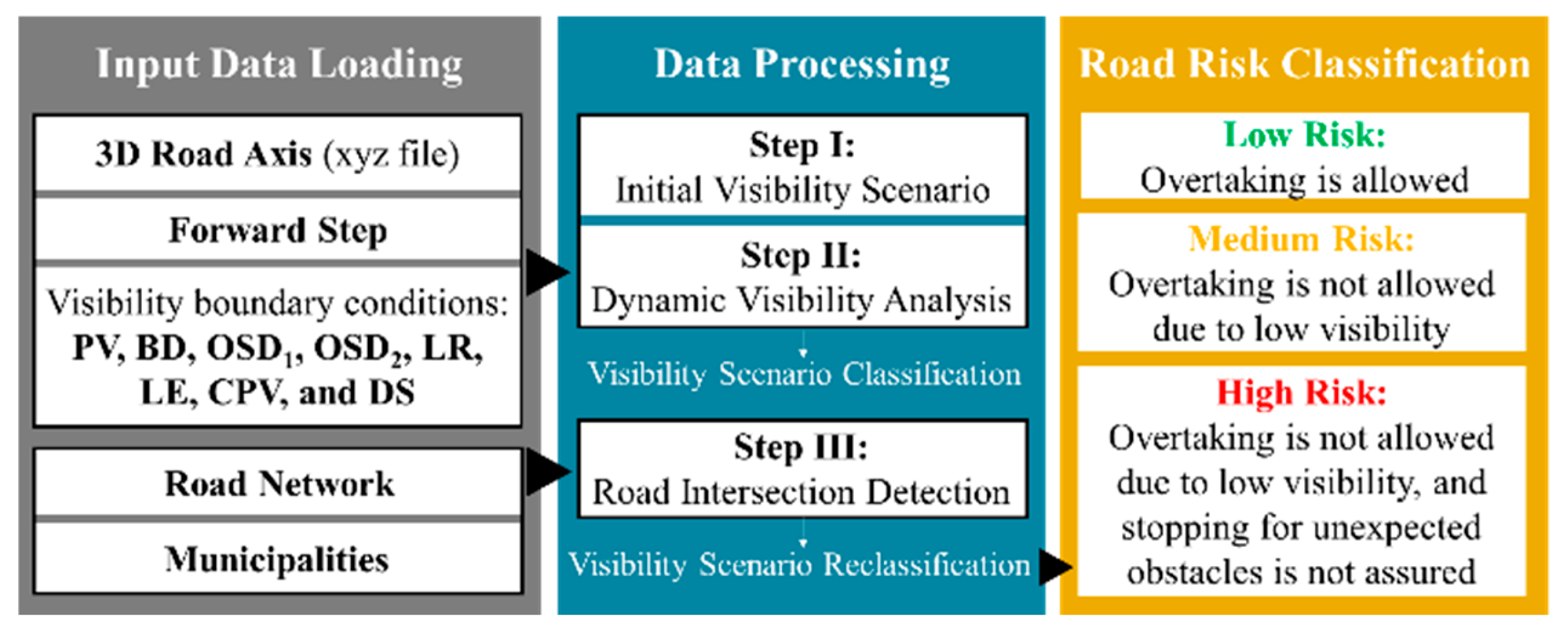
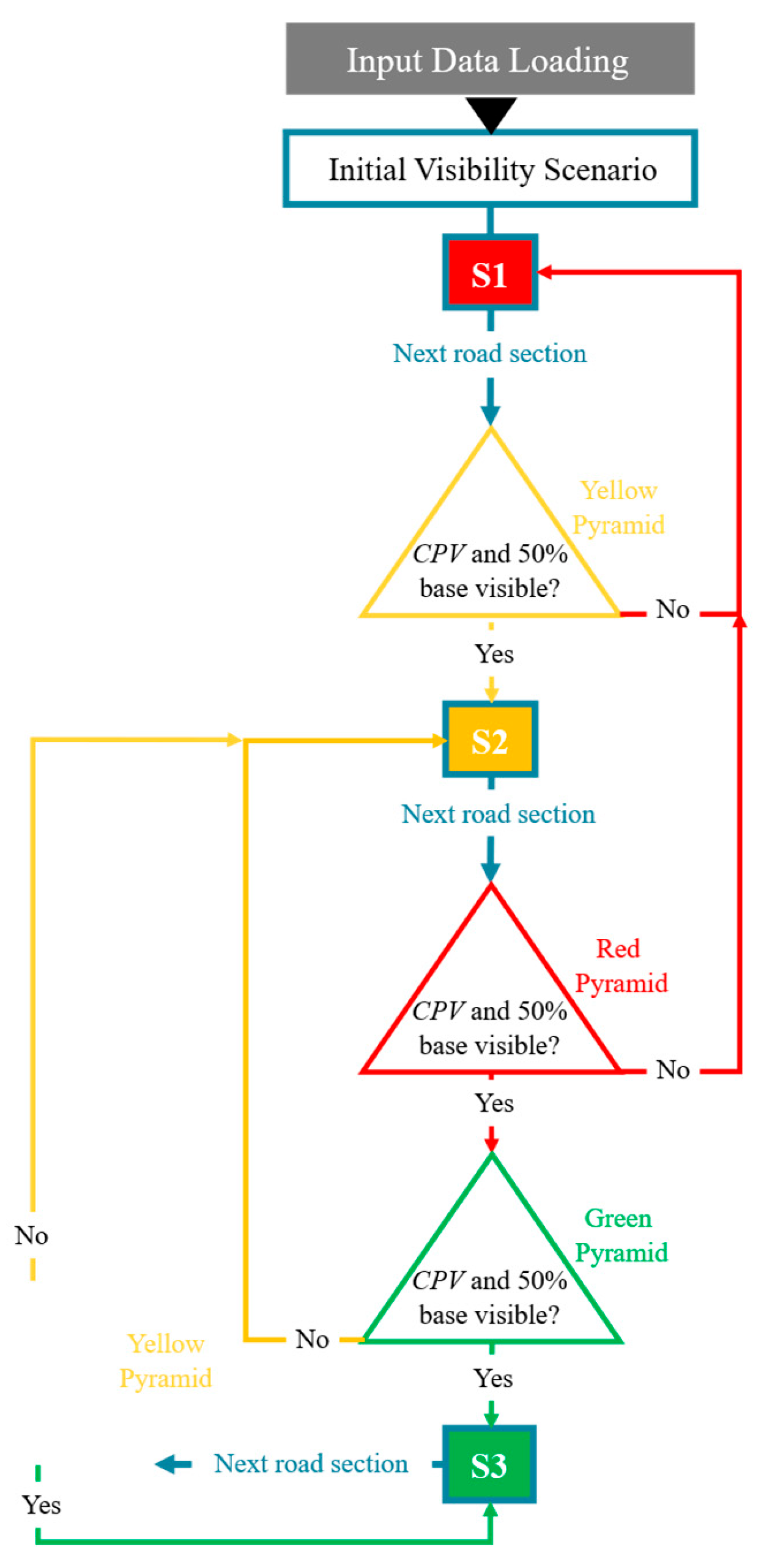
The methodology developed comprises three main steps: input data loading, data processing, and road risk classification (Figure 1). Regarding the inputs required:
  • The three-dimensional axis of the road extracted from the MLS point cloud, as detailed in [31], formatted in XYZ ascii file;
  • The forward step, representing the intervals (in metres) along the road during which the dynamic visibility analysis is assessed;
  • Eight crucial parameters (Table 1) acting as boundary conditions for assessing the driver visibility across three different scenarios outlined in Section 2.1. These scenarios consider overtaking and timely braking when faced;
  • The road network and municipalities of the country in Open Street Map (OSM) XML format.
The subsequent data processing involves three steps: establishing the initial driver visibility (step I) within the three pre-defined scenarios (Section 2.1), analysing transitional visibility dynamics (step II), and conducting a road intersection analysis (step III) to refine the outcomes of the previous analysis. To simulate the dynamic driver’s visibility, we propose using three colour-coded quadrangular pyramids of different dimensions as boundary conditions. These pyramids will allow evaluating visibility transitions from the initial scenario to the three pre-defined ones using the forward step established. This configurable parameter has been set to 5 m, striking a balance between computational demands and the need for a distance substantial enough to account for potential changes in visibility scenarios without introducing excessive uncertainty.
The 5 m forward step complies with Spanish roadway-geometry guidelines for curve sampling, ensuring that horizontal alignment changes are accurately captured. Thus, at 90 km/h (25 m/s), a 5 m increment corresponds to a 0.20 s interval (within the 0.3–0.5 s range of typical perception-reaction times), thereby providing even finer temporal resolution than required. This choice also balances spatial fidelity against computational cost: halving the step (to 2.5 m) would approximately double processing time while yielding only marginal gains in visibility delineation. Thus, 5 m provides sufficient resolution for our road-section scale and keeps computation tractable.
The methodology concludes with the road risk classification, assigning to each road segment a designation of low, medium, or high risk.

2.1. Input Data Loading

The methodology is initiated by loading the input data, including the 3D axis of the road, the predetermined forward step, and the boundary conditions to parametrise the three quadrangular pyramids. These pyramids will allow us to evaluate changes in the visibility scenario of the driver among these three possibilities:
  • Scenario 1: Insufficient visibility for both: (i) stopping in time when faced with an unexpected obstacle on the road, and (ii) executing an overtaking manoeuvre;
  • Scenario 2: Sufficient visibility to stop in time when faced with an unexpected obstacle on the road, but insufficient to execute an overtaking manoeuvre;
  • Scenario 3: Sufficient visibility for both (i) stopping in time when encountering an unexpected obstacle on the road, and (ii) executing an overtaking manoeuvre.
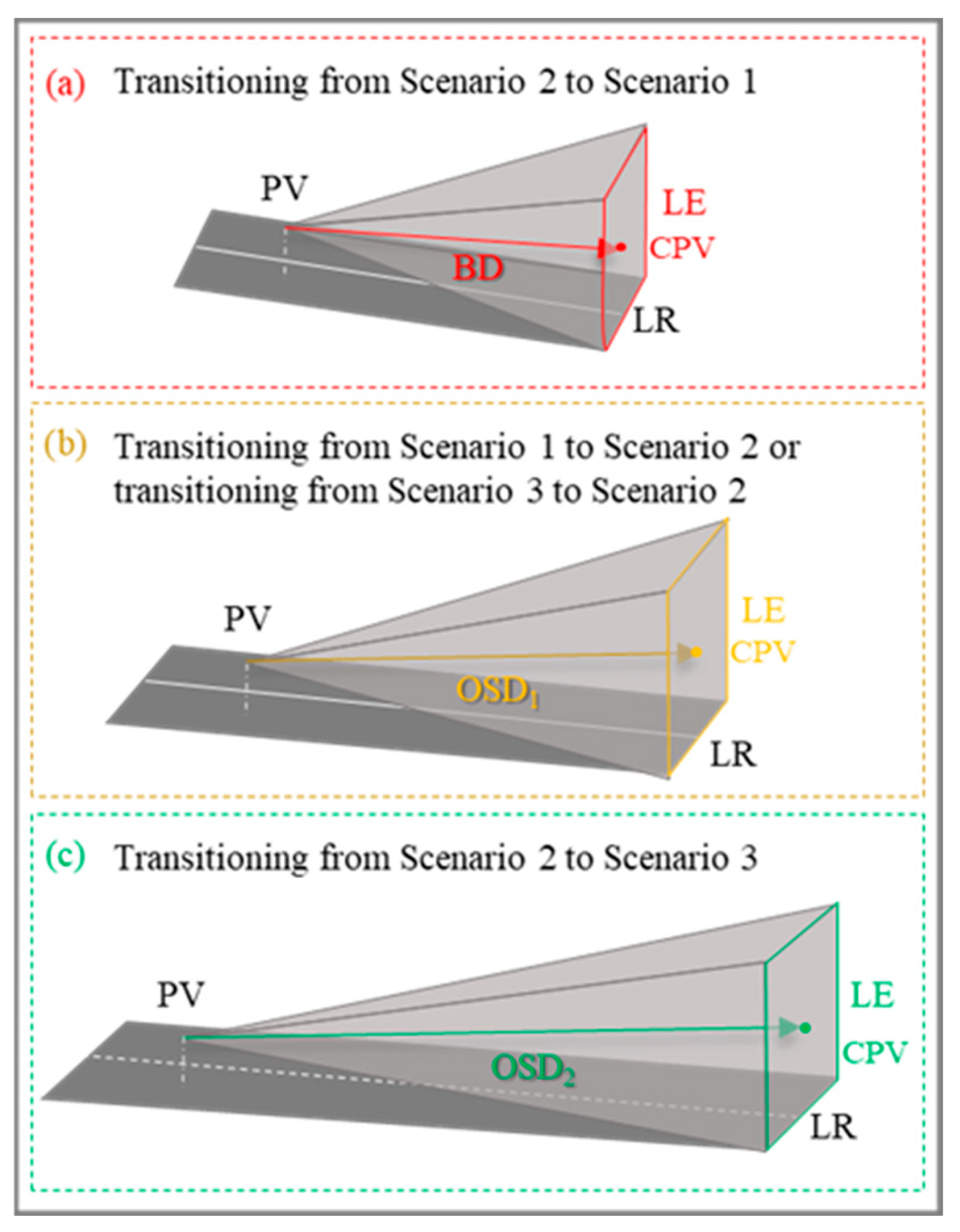
Concerning the pyramids (Figure 2), their specific dimensions are contingent upon the following eight parameters (Table 1), which function as visibility boundary conditions and must adhere to the regulations applicable in the country where the analysed roads are located.
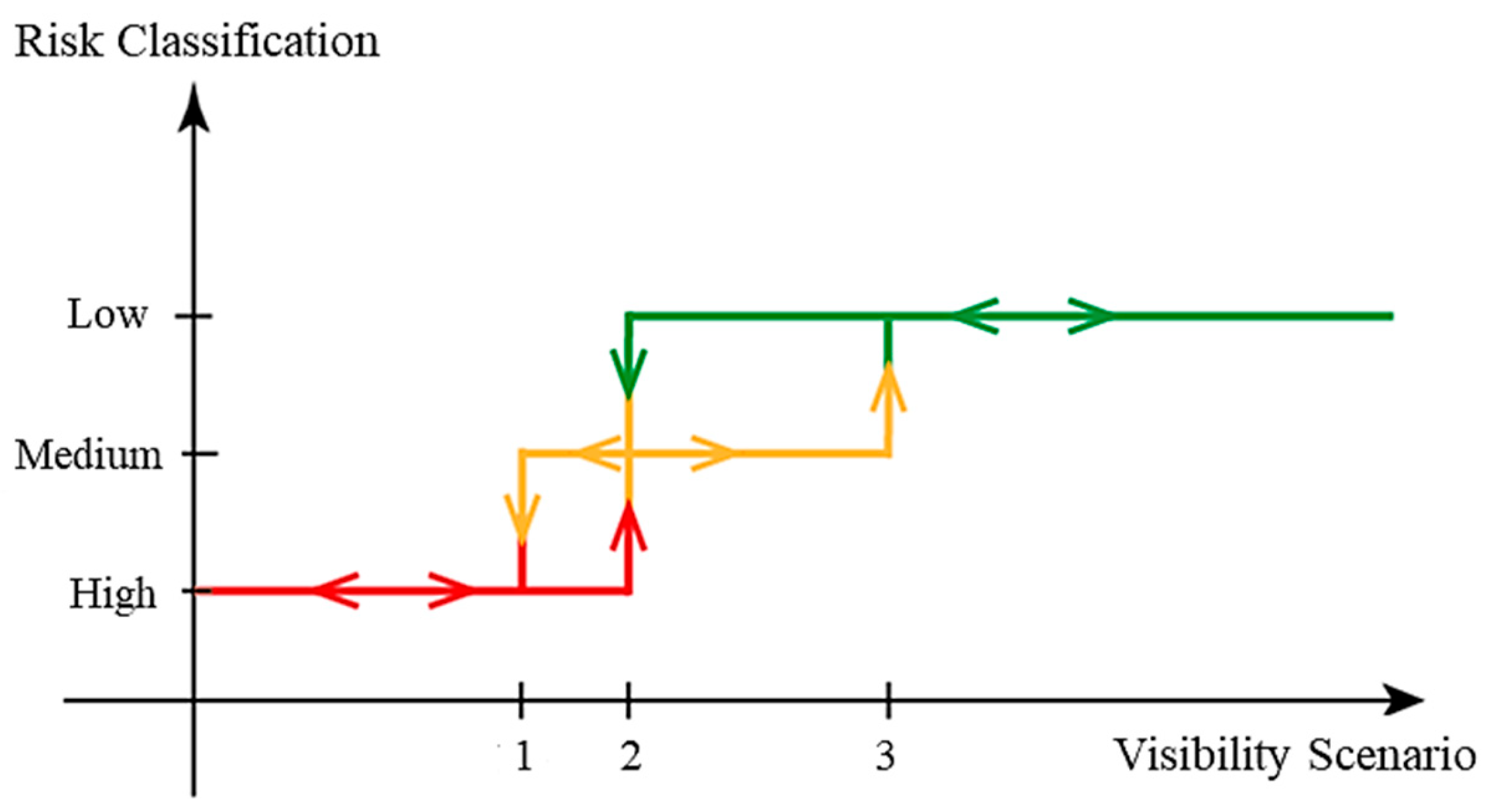
Furthermore, it is important to note the existence of hysteresis zones, where the scenario may correspond to either 1 or 2, depending on the previous state. For instance, if the visibility is sufficient to allow stopping in time but insufficient to safely initiate an overtaking manoeuvre, the current scenario may be either 1 or 2, identical to the previous one. A similar situation occurs between scenarios 2 and 3. If the visibility is sufficient to initiate an overtaking manoeuvre but insufficient to complete it safely and comfortably, the scenario may again be either 2 or 3, depending on the preceding scenario.
While LR and LE have been set to 7 m and 2 × CPV m, respectively, in accordance with Spanish secondary-road design standards, the methodology itself is fully configurable. End-users may supply any lane width or edge length to adapt the analysis to non-standard geometries. Moreover, actual occlusions (whether from guardrails, trees or other roadside objects) are captured directly in the MLS point cloud and incorporated into the visibility computation. In practice, this means that although the base-pyramid dimensions are fixed to a nominal cross-section, every obstacle protruding into that envelope automatically reduces visible volume and asymmetric or partially blocked sections are correctly evaluated.
BD, OSD1, and OSD2 are contingent on DS as detailed in Equation (1) and Table 2 and Table 3. CPV and LE, however, vary depending on the specific pyramid used in each case (Figure 2). Following this, the definition and application of these pyramids are provided:
  • Red pyramid: it will be used when the initial visibility scenario corresponds to Scenario 2. In such case, it assesses the potential driving visibility deterioration transitioning from Scenario 2 to 1 (Figure 2a). The height of this pyramid corresponds to BD, calculated in accordance with the Spanish regulations [32] using Equation (1).
    B D = D S · t b 3.6 + D S 2 254 f i + i
    being i the inclination of the road, t b   the perception and reaction time (set to 2 s according to the followed regulation), and f i   the wheel-pavement mobilised longitudinal friction coefficient estimated based on Table 2. For its part, i is calculated from the 3D road axis as the average inclination in the forward step defined expressed as per-unit. Under this situation, CPV is located at a height of 0.5 m above the road platform.
  • Yellow pyramid: it will be used when the initial visibility scenario corresponds to Scenario 1 or 3. In such cases, it assesses (i) potential driving visibility deterioration, transitioning from Scenario 3 to 2, or (ii) potential driver visibility enhancement moving from Scenario 1 to 2 (Figure 2b). The height of the yellow pyramid is OSD1 (Table 3), with CPV located at a height of 1.1 m above the road platform.
  • Green pyramid: it will be used when the initial visibility scenario corresponds to Scenario 2. In such case, it assesses the potential driving visibility enhancement moving from Scenario 2 to 3 (Figure 2c). The height of the green pyramid is OSD2 (Table 3), with CPV located at a height of 1.1 m above the road platform.
As should be derived from the above, when the initial visibility conditions align with Scenario 2, both the red and green pyramids must be used to assess either: (i) a potential driving visibility deterioration (by using the red pyramid) leading to transit to a visibility Scenario 1 (Figure 2a); or (ii) a potential driving visibility enhancement (by using the green pyramid) leading to transit to a visibility Scenario 3 (Figure 2c).
These parameters (Table 2 and Table 3) have been selected because the algorithm has been tested in Spain, where road regulations define these values. This allows for direct comparison with the ground truth data from Spanish roads evaluated in this study and aligns with the demand for this technology from Spanish companies. Nevertheless, these parameter values can be modified in the algorithm’s configuration file to comply with regulations from other countries. The algorithm has been tested using various values from Table 2 and Table 3, and the obtained results are consistent with theoretical expectations. The roads described in Section 3 were selected based on these criteria, as justified in that same section. This section also includes an error analysis based on the parameter values corresponding to the selected roads.
Regarding the input 3D road axis, it was extracted from RTK-GNSS trajectories, and the LiDAR point cloud was acquired at an average density of 2000 points/m2 using the Phoenix Scout MLS. The accuracy of the road axis and the completeness of the point cloud are critical for reliable visibility modelling. In our case, Phoenix Scout yields horizontal RTK-GNSS accuracy of ±3 cm and vertical accuracy of ±5 cm, with LiDAR distance error <  2 cm. We applied automated filters to remove axis nodes deviating >20 cm from the best-fit spline and discarded isolated point-cloud clusters <  0.1 m2 to mitigate noise. Based on preliminary down-sampling tests (1000 and 500 points/m2), we recommend a minimum point density of 500 points/m2 and axis accuracy ≤  10 cm to keep scenario-transition variance below 5 %.
After incorporating these quality controls, the developed methodology initiates an automatic visibility analysis.

2.2. Data Processing: Initial Visibility Scenario and Dynamic Visibility Analysis

After incorporating the required input data, the developed methodology initiates an automatic visibility analysis. The initial step involves loading the starting driving visibility scenario. While this parameter remains configurable, the default setting adopts the most unfavourable condition, Scenario 1, to ensure a conservative analysis.
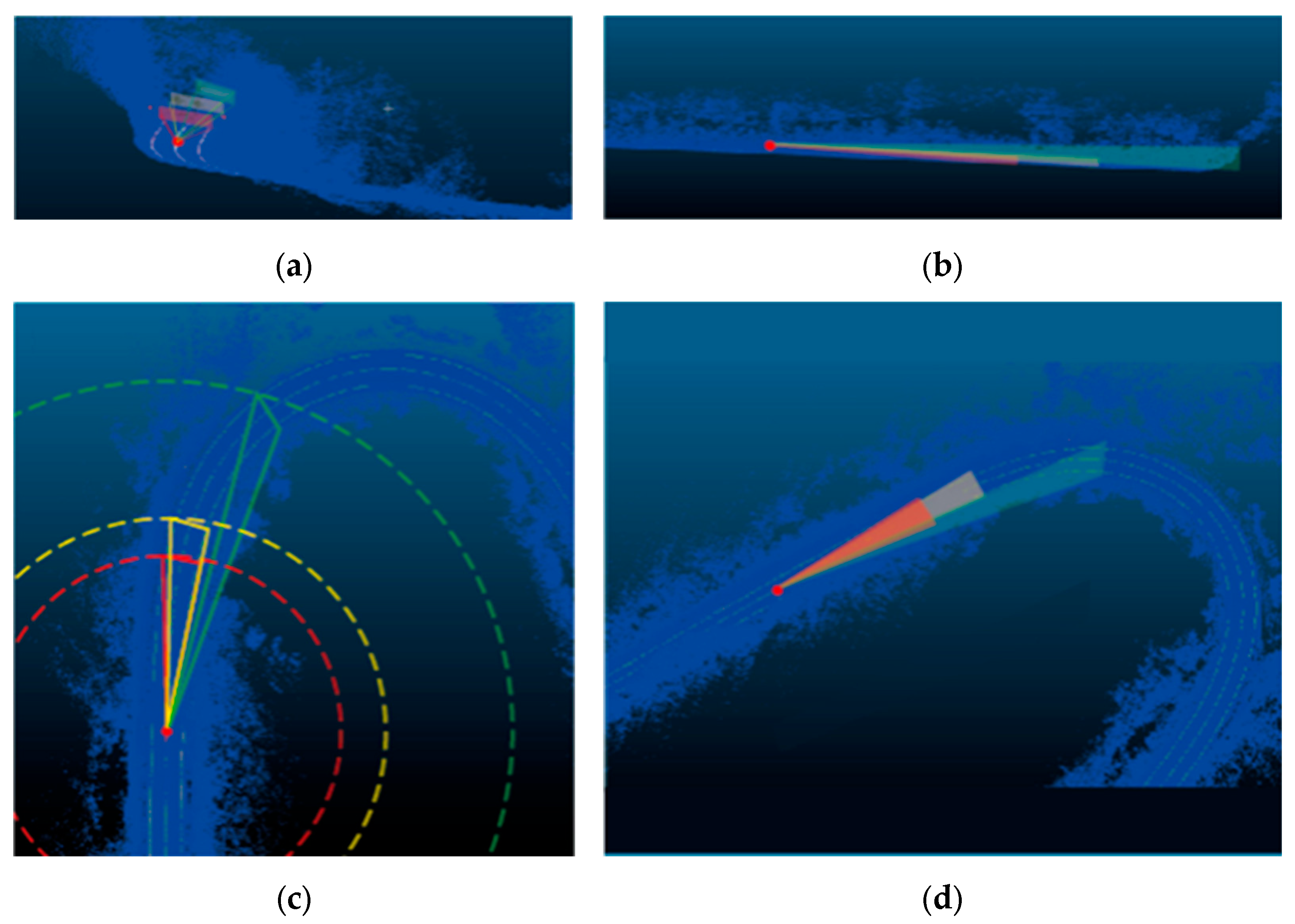
After this step, the script dynamically navigates the 3D road axis (Figure 3), assessing the potential transition among the three driver visibility scenarios. As such, the visibility scenario of the upcoming road section (which distances from the preceding one the “forward step”) is reliant upon the visibility scenario of the preceding road section. The script utilises the corresponding pyramid to evaluate whether there are possible enhancements or deteriorations in the visibility scenario of the subsequent road section compared to the previous one.
Outlined below are the four possible scenario transitions (Figure 2) depending on the preceding visibility scenario:
  • Transition from Scenario 1 to Scenario 2 (Figure 2b): using the yellow pyramid, the evaluation determines if the subsequent road section transitions to Scenario 2 or remains in Scenario 1. Specifically, if both the CPV and at least 50% from the base of the yellow pyramid are visible from the yellow pyramid PV, the visibility category shifts to Scenario 2; otherwise, it stays as Scenario 1.
  • Transition from Scenario 2 to Scenario 1 (Figure 2a): using the red pyramid, the evaluation determines if the subsequent road section transitions to Scenario 1. In this case, if both the CPV and at least 50% of its base are not visible from the red pyramid PV. Otherwise, the next transition should be evaluated.
  • Transition from Scenario 2 to Scenario 3 (Figure 2c): using the green pyramid, the evaluation determines if the subsequent road section transitions to Scenario 3 or remains Scenario 2. Specifically, if both the CPV and 50% of the green pyramid’s base are visible from the green pyramid PV, the visibility category shifts to Scenario 3; otherwise, it stays as Scenario 2.
  • Transition from Scenario 3 to Scenario 2 (Figure 2b): using the yellow pyramid, the evaluation determines if the subsequent road section transitions to Scenario 2 or remains in Scenario 3. Specifically, if the CPV and at least 50% from the base of the yellow pyramid are not visible from the yellow pyramid PV, the visibility category shifts to Scenario 2; otherwise, it transitions to Scenario 3.
Note that when the preceding road section is categorised as Scenario 2, the subsequent road section could fall into Scenario 1, 2 or 3. This situation might necessitate a dual analysis utilising different pyramids. Initially, the assessment involves the red pyramid to determine if it regresses to Scenario 1 (if the CPV and at least 50% of the pyramid’s base are not visible). Subsequently, if it does not regress in the category, the analysis continues with the green pyramid to ascertain if it advances to Scenario 3 (if the CPV and at least 50% of the green pyramid’s base are visible). If neither regression nor advancement occurs, the visibility category will persist as Scenario 2. The criterion of 50% visibility of the CPV and the pyramidal base was adopted as a practical approach widely used in visibility assessment protocols. This threshold provides a balance between overly strict requirements (demanding full visibility) and overly permissive rules (accepting minimal exposure), offering a conservative yet operationally feasible standard. Although inherently heuristic, the 50% rule is grounded in human-factors principles: perceptual studies have demonstrated that partial exposure of an object, often around half of its salient features, is sufficient for reliable recognition and localisation [33,34].

2.3. Data Processing: Road Intersection Detection

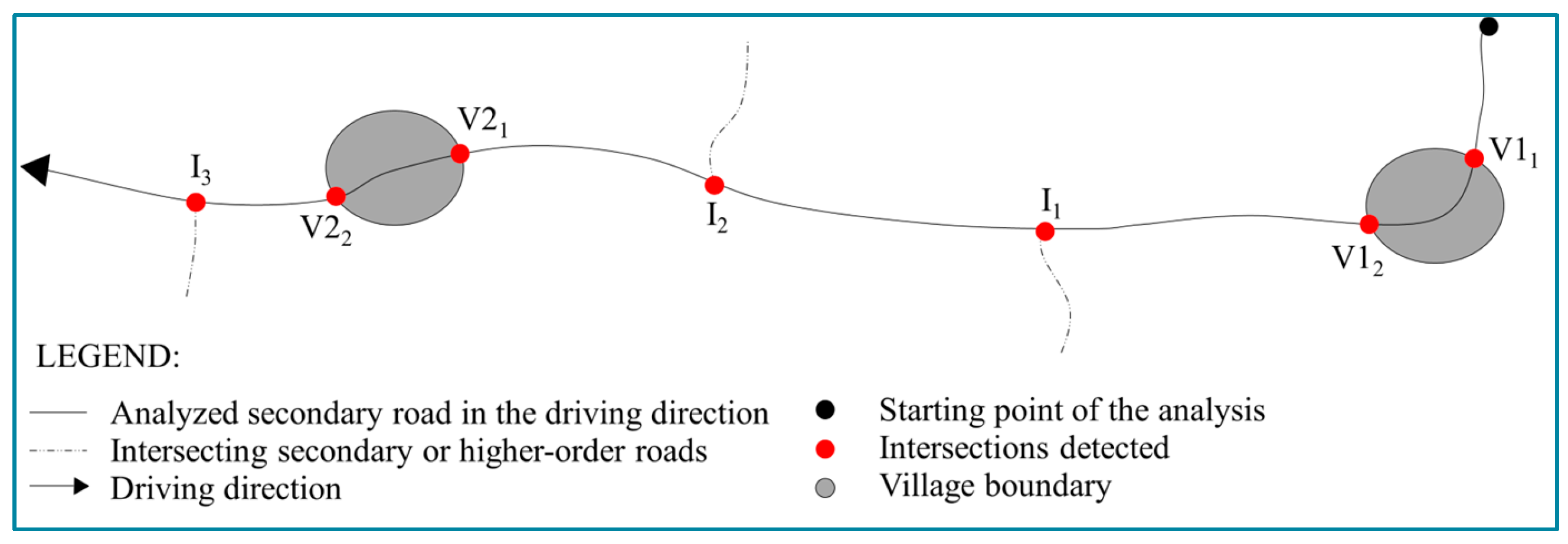
After categorising all road sections into Scenarios 1, 2, or 3, the third step of data processing involves analysing intersections along the 3D road axis at the same level as the secondary road under study. These intersections encompass points where drivers can exit, join, or traverse the road, demanding increased driver caution and sometimes leading to reduced traffic speed due to the inherently higher risk. They encompass (Figure 4):
  • Crossing through villages;
  • Road additions;
  • Exits to other roads or ring roads, excluding smaller paths.
The refinement of the visibility scenario classification affects only road sections categorised as Scenario 3. They transition to Scenario 2 when they are close to a road intersection or a village, while Scenarios 1 and 2 retain their categorisation. This precision enhancement precedes the subsequent road risk classification phase. However, for a sole focus on road visibility categorisation, the analysis would conclude with the results obtained after Step II of the data processing.
The input data includes the road network and municipalities of the country in OSM XML format. To streamline processing without overburdening computational resources, buffers delineate the areas of interest. These buffers focus on loading relevant road networks and municipalities within a 300 m span on both sides of the 3D road axis, selectively integrating necessary data while optimising processing efficiency.
After data loading, the method executes two core processes. Initially, municipalities within the buffer intersect with the road axis, generating two points of interest (Vi1 and Vi2) per municipality, representing the starting and ending points of the village.
Subsequently, an automated search for intersections between the loaded road network and the axis of the road under study occurs. Employing a neighbourhood algorithm, the primary road is identified in relation to the 2D axis of the analysed road. Then, computational geometry algorithms analyse potential intersections (Ij, with j as the incremental intersection number).
The last step involves reclassifying those road sections previously categorised as Scenario 3 into Scenario 2 when they match with one of the following conditions:
  • These are road sections within villages.
  • Road sections located 200 m before and after the villages.
  • Road sections located 200 m before and after intersections.
While 200 m signifies a cautious distance before and after villages or intersections, aligning with Spanish regulatory guidelines, this parameter remains configurable, ensuring a comprehensive assessment of intersection scenarios and nodes along international secondary roads.

2.4. Road Risk Classification

The final phase of the proposed methodology involves categorising the risk of each road section based on these three levels:
  • Low risk: Road segments categorised as visibility Scenario 3 that ensures sufficient visibility for overtaking and stopping the vehicle before encountering a static obstacle in the road. These sections should correspond to road segments where overtaking is permissible.
  • Medium risk: Road segments categorised as visibility Scenario 2, providing sufficient visibility for stopping the vehicle before colliding with a static obstacle in the road, but insufficient visibility for overtaking. It may also indicate proximity to a road intersection or a village. These road sections should correspond to road sections where overtaking is prohibited.
  • High risk: Road segments categorised as visibility Scenario 1, offering insufficient visibility for both stopping before a collision and overtaking. These road sections should correspond to road sections where overtaking is prohibited. They demand additional caution, so they should offer special signals regarding the particular risk associated.
After outlining these approaches within the developed methodology, it is important to describe the architecture of the programmed script. The dynamic visibility analysis makes use of a three-loop algorithm with hysteresis nature (Figure 5), wherein each loop aligns with a specific visibility scenario based on entry and exit conditions. Subsequently, the reclassification of visibility Scenarios 3 into Scenarios 2 is conducted following the conditions outlined in Section 2.3. This process culminates in assigning the risk level to each road section (Figure 6).
Note that the hysteresis nature of the developed algorithm is graphically represented in Figure 6, in which categorisation criteria is evidenced based on the visibility distances. This characteristic establishes two different conditions for entry and exit in each categorisation, resolving potential discrepancies in boundary cases.

3. Results

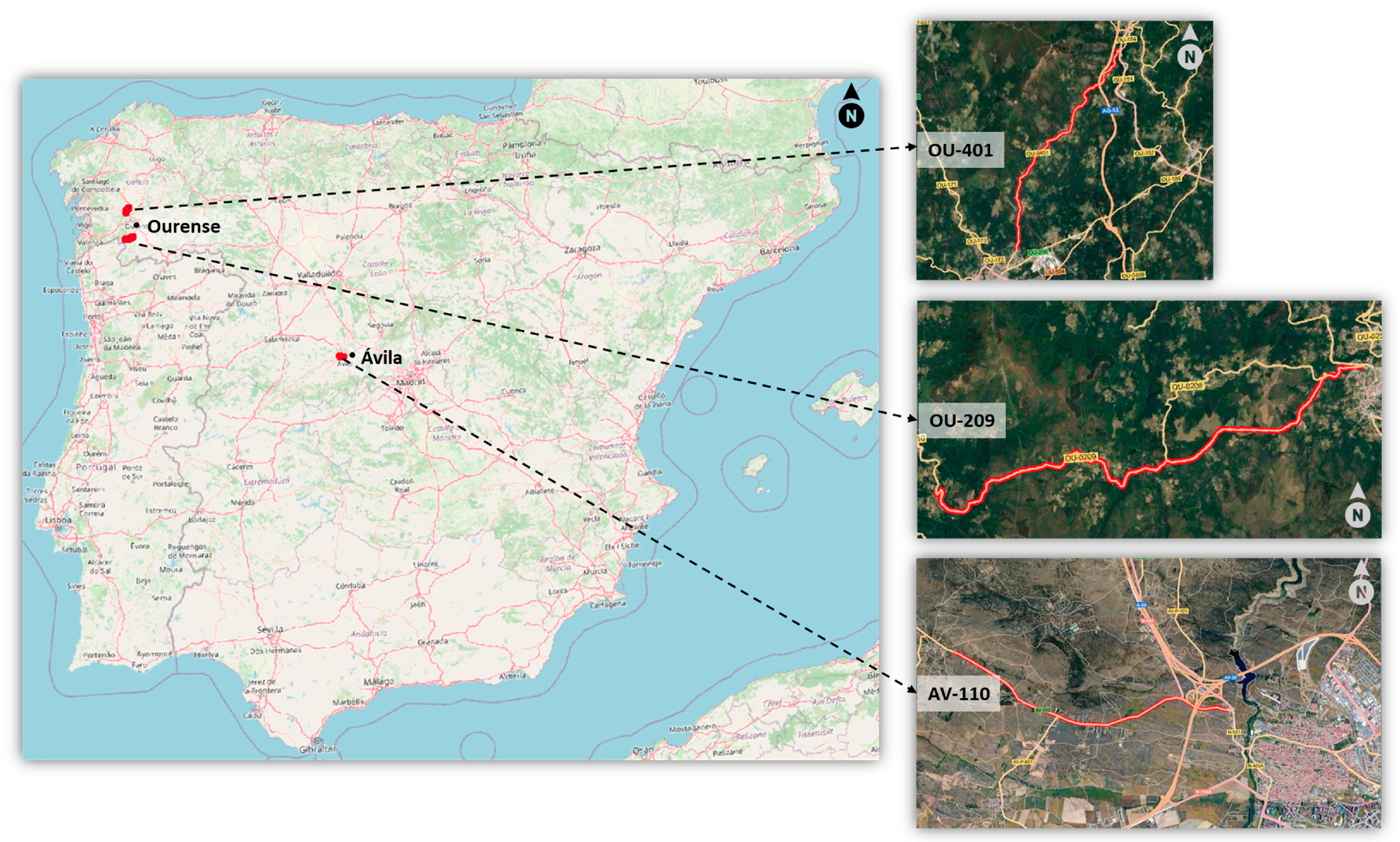
The proposed methodology has undergone validation on three roads within the secondary road network of Spain, as depicted in Figure 7. The three roads were acquired with an MLS mounted on a van with 45° tilt. The MLS was a Phoenix Scout Ultra 32 equipped with a Velodyne VLP-32C, with 32 laser beams and horizontal and vertical fields of view of 360° and 40°, respectively, with a scan rate of 600,000 measurements per second. The main objective is to validate the algorithms developed and to assess the precision of the automatic visibility outcomes derived from this methodology. For the evaluation and considering that road signs typically indicate only the allowance or prohibition of overtaking, the high and medium-risk categories were merged. Consequently, overtaking would be restricted on these road segments, whereas on sections categorised as low-risk, overtaking would remain permissible.
We selected two third-level Galician secondary roads, OU209 and OU401, in the vicinity of Ourense, and one second level AV110 secondary road in Castilla y León, near the town of Ávila. The evaluated sections covered 5.9 km of the AV110 road, 14.2 km of the OU209 road, and 9.9 km of the OU401 road. All three secondary roads have a maximum speed limit of 90 km/h and feature a cross-sectional design comprising a single platform with two basic 3 m lanes, one for each direction of traffic, and 1 m shoulders on each side. However, it is important to note that some sections of the OU209 and the OU401 lack shoulders. These three case studies were selected because they illustrate diverse challenges in real environments, including abrupt elevation changes, dense roadside vegetation, and varied infrastructure geometry. During the implementation of the method, specific issues were encountered, such as incomplete point cloud data in narrow segments with dense vegetation. These were addressed by interpolating missing road axis sections using MLS trajectory continuity and cross-validation with orthophotos.
Regarding the inputs the script required for the dynamic visibility analysis: i) the 3D axis of each road extracted after processing the MLS point cloud according to [31], ii) the forward step, set as 5 m, and iii) the following parameters, defined previously in Table 1:
  • PV: situated at 1.1 m high from the platform and 1.5 m to the right of each of 3D road axis per driving direction.
  • BD of the road calculated per each 5 m section. Since it depends on i (Equation (1)) from the average inclination of the road per forward step, and there are many values per road, these values are not offered in the paper.
  • OSD1: 205 m.
  • OSD2: 340 m.
  • LR: 7 m.
  • LE of the red pyramid: 1 m.
  • LE of the yellow and green pyramids: 2.2 m.
  • CPV of the red pyramid: situated at 0.5 m high from the platform.
  • CPV of the yellow and green pyramids: situated at 1.1 m high from the platform.
  • DS: 90 km/h.
Table 4 outlines the values of the input parameters for the algorithm. These values are the same for the three road sections because, as previously explained, all sections correspond to the same type of secondary road.
These datasets are not merely illustrative; they can be integrated into GIS platforms or driving assistant systems to provide real-time alerts to drivers. This functionality was tested successfully in a QGIS prototype with colour-coded risk zones along the analysed trajectories.
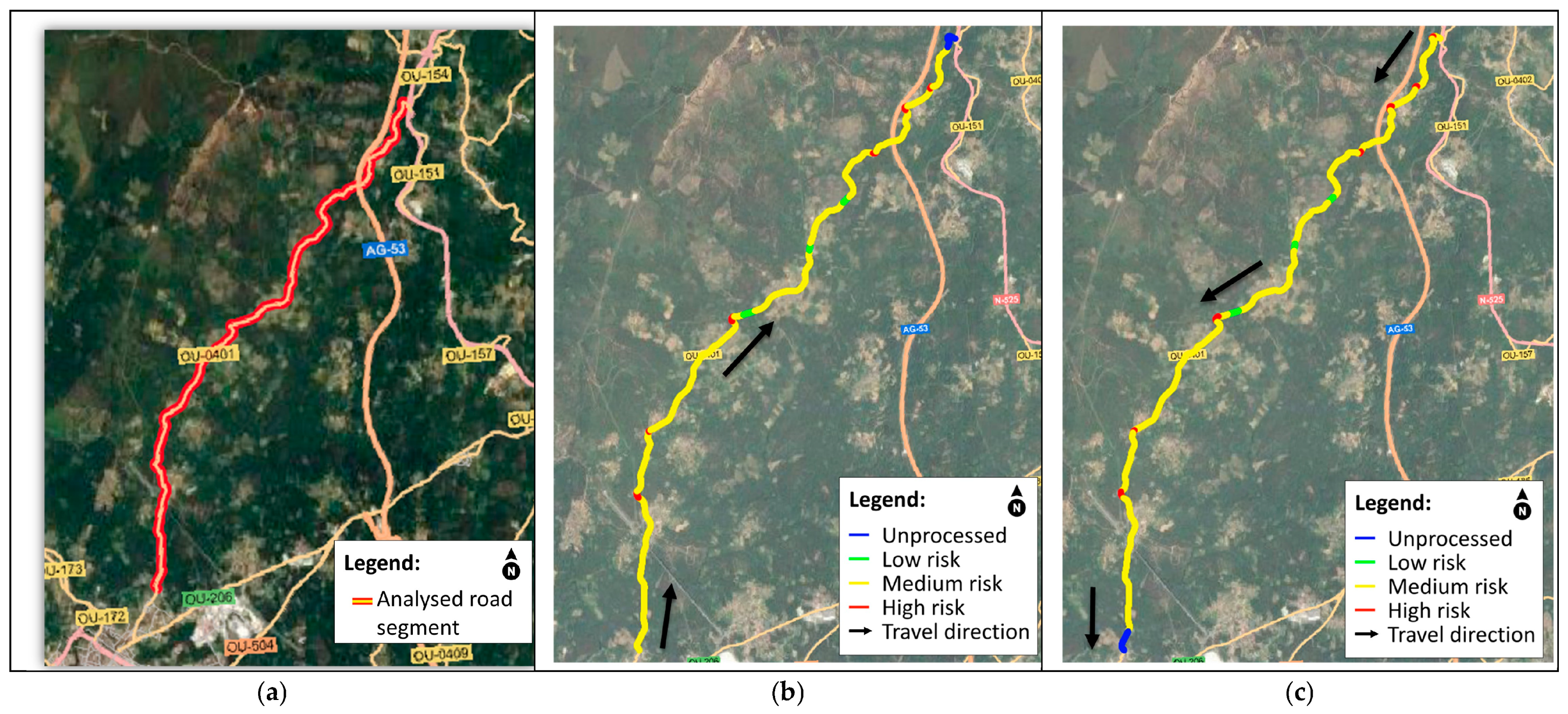
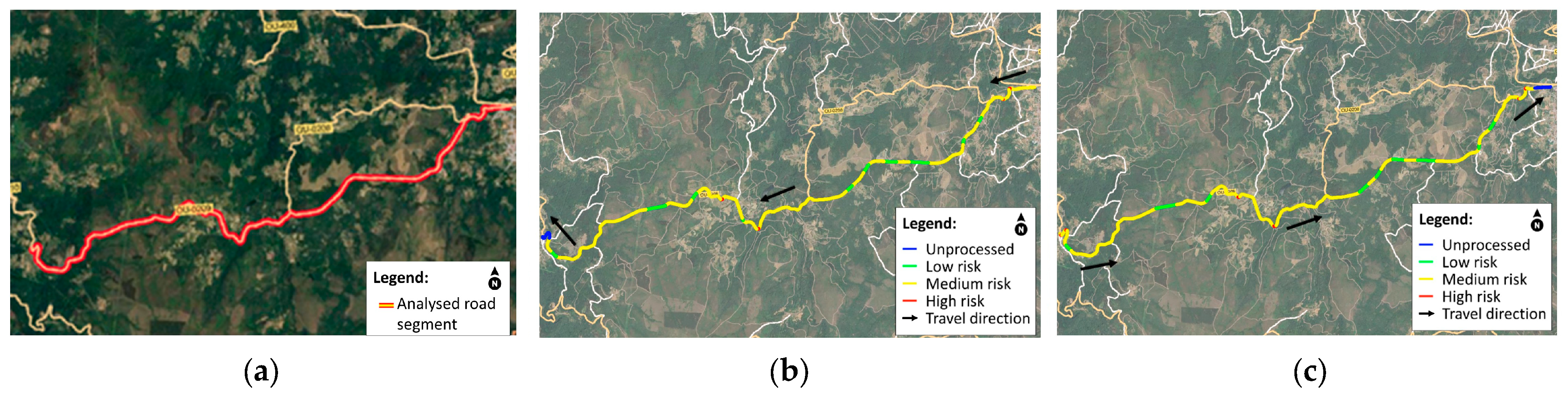
Regarding the stored data, apart from the XY planimetric coordinates of each trajectory, a numerical attribute ranging from 0 to 4, which indicates the associated road risk category, is stored. As is indicated in Table 5, the value “0” denotes points not evaluated (displayed in blue in Figure 8), the value “1” indicates low risk (displayed in green in Figure 8), the value “2” signifies medium risk (displayed in yellow in Figure 8), and the value “3” represents high risk (displayed in red in Figure 8).
It should be noted that the sections with value “0” correspond to the last metres of the road route (whose length is OSD2 distance) that cannot be analysed due to a lack of geometric information after it.
To validate the methodology proposed, the final risk classification output per road and travel direction under study were compared to the existing horizontal and vertical signalling (Table 5) after loading the results in Google Earth.
The following five potential categories were established to evaluate the reliability of the proposed methodology:
  • Successful: when one of these three situations occur: (a) the visibility script categorises a low risk (green colour), and the current road signs permit safe overtaking; (b) the visibility script categorises a medium risk (yellow colour) and the road mandates the prohibition of overtaking; and (c) the visibility script categorises a high risk (red colour) and the road mandates the prohibition of overtaking with some additional signs, such as maximum speed reduction or a dangerous curve signs.
  • Conservative error: when the visibility script categorises medium risk (yellow colour), and the road allows safe overtaking or when the visibility script categorises high risk (red colour), and the road signs prohibit overtaking without additional dangerous signs.
  • Very conservative error: when the visibility script categorises high risk (red colour), and the road allows safe overtaking.
  • Fatal error: when the visibility script categorises low risk (green colour) and the road mandates prohibition of overtaking.
  • Not considered: those final sections of the road that cannot be analysed due to the lack of geometric information in the after-road route (blue colour).
Figure 8 presents the results obtained from the OU-401. In Figure 8a, the road layout over a 9.9 km stretch is shown. As can be observed, the selected road segment includes several moderate curves and changes in gradient. This section is suitable for evaluating the system under medium visibility risk conditions, ensuring proper functionality in scenarios where the system is expected to operate predominantly between points 1 and 3 of Figure 6, with occasional deviations. These deviations have been compared with ground truth data, as detailed in Table 5. Figure 8b,c confirms that the system consistently reports a moderate risk level (yellow), with minor variations corresponding to conservative estimation errors.
Additionally, Figure 9 shows the results obtained from the OU-409, where a 14.2 km segment has been selected and its layout is depicted in Figure 9a. In this case, the road segment includes several pronounced gradient changes and sharp curves, which are marked with additional vertical signage indicating high risk. This section is suitable for evaluating the system under poor visibility risk conditions, verifying its proper functionality in scenarios where the system is expected to operate predominantly to the left of point 2 in Figure 6, albeit for relatively short segments, as such conditions are not typically sustained over long distances. Figure 9b,c confirms that the system consistently reports a high-risk level (red) in these zones, with minor variations corresponding to conservative estimation errors, which tend to slightly overestimate the extent of the affected segments, as reflected in Table 5.
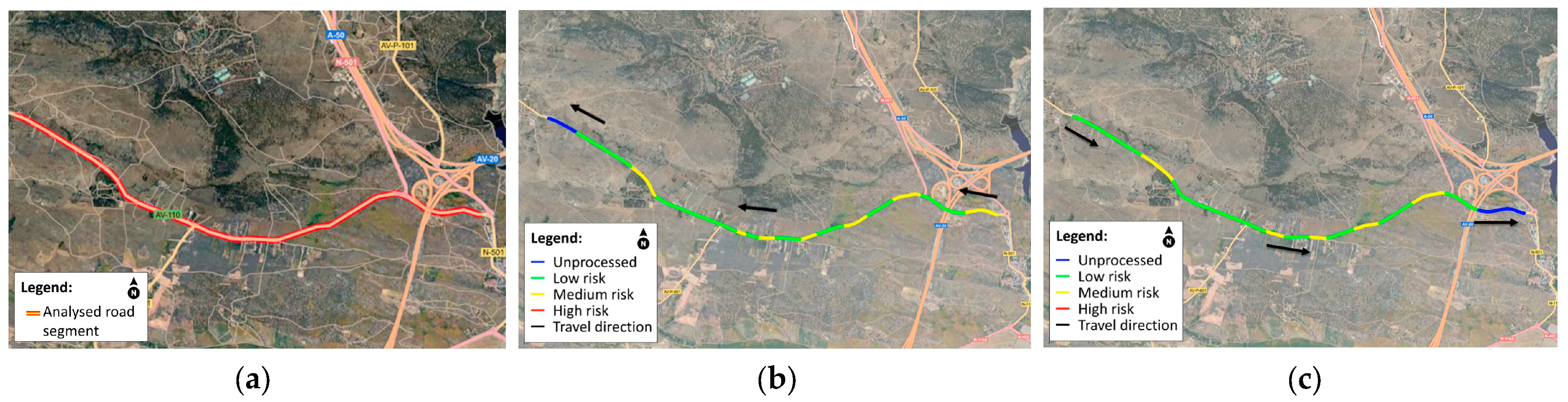
Finally, a road segment with very gentle curves and minimal gradient changes was selected, specifically, a 5.9 km section of the AV-110, as shown in Figure 10a. This case is suitable for evaluating the system under low visibility risk conditions, verifying its proper functionality in scenarios where the system is expected to operate predominantly to the right of point 2 in Figure 6. Figure 10b,c confirms that the system consistently reports a low-risk level (green) for most of the segment, with some variations corresponding to gentle curves, where the system slightly overestimates the segment length, generating minor conservative estimation errors, typically within 100–200 m, as reflected in Table 5.
These three analysed cases represent an evaluation of the system under three controlled visibility scenarios, and the obtained results demonstrate the excellent performance of the methodology proposed for classifying the risk of secondary roads. Specifically, regarding the OU401 and OU209, the success rate results exceed 95% in both cases, with conservative errors remaining under 2%. With respect to the second level secondary road AV110, results revealed slightly less favourable outcomes, achieving success rates of nearly 88% and conservative errors hovering around 4%. Despite the precision reduction on this road compared to the others, this deviation is deemed insignificant considering that the unanalysed portion on AV110 is four times larger than that of the other two roads. Furthermore, the 4% discrepancy translates to a mere 236 m within the 5.9 km assessed in this road that are categorised as medium-risk areas where it is permitted overtaking in the real scenario. Table 6 shows the validation results obtained for the three case studies analysed per travel direction.

4. Discussion

The results obtained from the three case studies demonstrate the robustness and applicability of the proposed methodology under varying road conditions and visibility risk scenarios. The system has been tested on secondary roads with different geometric configurations, ranging from roads with minimal curvature and elevation (AV-110) to those with abrupt changes in terrain and dense roadside vegetation (OU-209 and OU-401), obtaining high accuracy in visibility risk classification.
In particular, the OU-401 and OU-209 segments exhibited success rates exceeding 95% for both directions, indicating that the methodology is well-suited to complex environments with medium and high-risk visibility conditions. The presence of abrupt curves and topographic variations, which typically complicate visibility assessments, were successfully addressed by the algorithm. The low incidence of conservative errors (≤1.85%) further underscores the system’s reliability, with no instances of fatal errors detected, an essential outcome for any risk classification approach intended for integration with traffic safety tools.
On the AV-110 road, which represents a low-risk scenario due to its gentler curvature and smoother gradients, the algorithm achieved success rates close to 88%. While this is slightly lower than in the other two cases, it is important to contextualise the result. The larger proportion of segments labelled as “not considered” (8.32%) is attributable to the value of OSD2 parameter, which inherently limits visibility analysis in the final metres of the segment. Moreover, the 4% of conservative errors, corresponding to roughly 236 m misclassified as medium-risk despite real-world overtaking allowance, is within acceptable tolerances for early-stage deployment.
A key strength of the proposed approach is its conservative bias: when errors occurred, they did so in the direction of overestimating risk, which is preferable from a safety standpoint. This conservative classification paradigm ensures that, in uncertain situations, overtaking is discouraged, thereby aligning with the precautionary principle in road safety. Furthermore, the integration of output data into GIS platforms, as demonstrated in the QGIS prototype, confirms the practical potential for real-time applications. The risk classifications, encoded numerically and visualised via colour-coded segments, enable seamless incorporation into advanced driver assistance systems (ADAS) or infrastructure management tools.
The validation process confirms the method’s precision, especially in medium and high-risk contexts, and supports its application across diverse road geometries. Minor conservative misclassifications in low-risk scenarios do not undermine the methodology’s overall effectiveness. Rather, they reinforce its value as a safety-oriented visibility assessment tool, suitable for further deployment and potential regulatory consideration in secondary road networks.

5. Conclusions

The methodology developed demonstrates its effectiveness in evaluating the safety of secondary roads, particularly those with significant safety challenges due to irregularities, suboptimal layouts, and single lane configurations in each direction. By leveraging MLS data and simulating driver visibility through quadrangular pyramid parameterisation, this method categorises road danger into low-, medium-, and high-risk segments, based on their connectivity with other roads or towns. This study introduces a novel method for assessing visibility distance risk, offering both quantitative and qualitative evaluations to support safer driving. The proposed approach relies on a comprehensive, lightweight, and hierarchical pyramid-based visibility analysis that accounts for both braking and overtaking distances. Furthermore, the methodology is easily replicable and can be adapted to any road type by adjusting input parameters.
Its application to three secondary roads in Spain yielded excellent validation results, achieving an average success rate of 92.7%, with only 4.5% of road ends excluded from the evaluation. The methodology also showed a conservative discrepancy of just 3.31% when compared with existing road signage, primarily in medium-risk zones that currently allow overtaking. These findings underscore the reliability of LiDAR-based assessments and their potential to redefine overtaking safety evaluations.
Beyond identifying suitable overtaking zones, the methodology also detects localised high-risk road segments, enabling proactive warnings to drivers and the implementation of targeted safety measures in hazardous areas.
Looking ahead, future improvements might include predictive models that incorporate varying climatic conditions and dynamically adapt road design speed (DS) values per road segment. Such enhancements could be integrated into navigation systems to provide advanced alerts about upcoming hazardous road segments, particularly valuable on complex or secondary road networks. Additionally, we plan to explore the sensitivity of the visibility model to variations in parameters such as BD, OSD1, OSD2, CPV, and LE. While current values are grounded in national regulations and practical design standards, a deeper analysis of their influence on algorithm performance could enhance the model’s generalizability to other countries or contexts with differing road design criteria. This would involve the creation of new annotated datasets reflecting alternative visibility configurations and would allow for a more comprehensive robustness assessment of the proposed methodology.

Author Contributions

Conceptualisation, D.G.-S. and D.G.-A.; methodology, D.G.-A. and M.G.-d.-S.; software, D.G.-S., D.G.-A., M.G.-d.-S., S.D.P., J.A.M.-J. and P.R.-G.; validation, D.G.-S., D.G.-A., M.G.-d.-S., S.D.P., J.A.M.-J. and P.R.-G.; investigation, D.G.-S., D.G.-A., M.G.-d.-S., S.D.P., J.A.M.-J. and P.R.-G.; resources, D.G.-A.; writing—original draft preparation, D.G.-A. and M.G.-d.-S.; writing—review and editing, D.G.-S., D.G.-A., M.G.-d.-S., S.D.P., J.A.M.-J. and P.R.-G.; project administration, D.G.-A.; funding acquisition, D.G.-A. All authors have read and agreed to the published version of the manuscript.

Funding

This research received no external funding.

Data Availability Statement

The original contributions presented in this study are included in the article. Further inquiries can be directed to the corresponding author.

Conflicts of Interest

The authors declare no conflicts of interest.

References

  1. American Association of State Highway and Transportation Officials (AASHTO). LRFD Bridge Design Specifications, 4th ed.; American Association of State Highway and Transportation Officials: Washington, DC, USA, 2001. [Google Scholar]
  2. Wooldridge, M.D. Geometric design consistency on high-speed rural two-lane roadways. In Transportation Research Board; National Cooperative Highway Research Program: Washington, DC, USA, 2003; Volume 502. [Google Scholar]
  3. Miclea, R.C.; Dughir, C.; Alexa, F.; Sandru, F.; Silea, I. Laser and LIDAR in a system for visibility distance estimation in fog conditions. Sensors 2020, 20, 6322. [Google Scholar] [CrossRef]
  4. Tarel, J.P.; Charbonnier, P.; Goulette, F.; Deschaud, J.E. 3D road environment modeling applied to visibility mapping: An experimental comparison. In Proceedings of the 2012 IEEE/ACM 16th International Symposium on Distributed Simulation and Real Time Applications, Washington, DC, USA, 25–27 October 2012; IEEE: Piscataway, NJ, USA, 2012; pp. 19–26. [Google Scholar]
  5. González-Gómez, K.; Castro, M. Evaluating Pedestrians’ Safety on Urban Intersections: A Visibility Analysis. Sustainability 2019, 11, 6630. [Google Scholar] [CrossRef]
  6. Zhao, Y.; Wu, B.; Wu, J.; Shu, S.; Liang, H.; Liu, M.; Yu, B. Mapping 3D visibility in an urban street environment from mobile LiDAR point clouds. GIScience Remote Sens. 2020, 57, 797–812. [Google Scholar] [CrossRef]
  7. Iglesias, L.; Santos-Berbel, D.; Pascual, V.; Castro, M. Using Small Unmanned Aerial Vehicle in 3D Modeling of Highways with Tree-Covered Roadsides to Estimate Sight Distance. Remote Sens. 2019, 11, 2625. [Google Scholar] [CrossRef]
  8. Bassani, M.; Grasso, N.; Piras, M. 3D GIS based evaluation of the available sight distance to assess safety of urban roads. ISPRS Int. Arch. Photogramm. Remote Sens. Spat. Inf. Sci. 2015, XL-3/W3, 137–143. [Google Scholar] [CrossRef]
  9. Bassani, M.; Grasso, N.; Piras, M.; Catani, L. Estimating the Available Sight Distance in the Urban Environment by GIS and Numerical Computing Codes. ISPRS Int. J. Geo-Inf. 2019, 8, 69. [Google Scholar] [CrossRef]
  10. Akshay, G.; Shreyansh, J.; Pushpa, C.; Manoranjan, P. Dynamic object detection using sparse LiDAR data for autonomous machine driving and road safety applications. Expert Syst. Appl. 2024, 255, 124636. [Google Scholar] [CrossRef]
  11. Nan, Z.; Zhu, G.; Zhang, X.; Liu, X.; Lin, X.; Yang, Y. A novel algorithm for key road sections obstacle detection based on LiDAR. Robot. Auton. Syst. 2025, 194, 105136. [Google Scholar] [CrossRef]
  12. Wu, Z.; Wang, Y.; Gan, W.; Zou, Y.; Dong, W.; Zhou, S.; Wang, M. A Survey of the Landscape Visibility Analysis Tools and Technical Improvements. Int. J. Environ. Res. Public Health 2023, 20, 1788. [Google Scholar] [CrossRef]
  13. Zhao, L.; Hu, Y.; Han, F.; Dou, Z.; Li, S.; Zhang, Y.; Wu, Q. Multi-sensor missile-borne LiDAR point cloud data augmentation based on Monte Carlo distortion simulation. CAAI Trans. Intell. Technol. 2024, 10, 300–316. [Google Scholar] [CrossRef]
  14. González-Gómez, K.; Castro, M. Suitability Testing of LiDAR Processing Software Aimed at 3-D Sight Distance Estimations. Transp. Res. Procedia 2018, 33, 163–170. [Google Scholar] [CrossRef]
  15. Bartie, P.; Kumler, M.P. Route ahead visibility mapping: A method to model how far ahead a motorist may view a designated route. J. Maps 2010, 6, 84–95. [Google Scholar] [CrossRef]
  16. Santos Berbel, C.; Anta, J.A.; Castro, M.; Paréns González, M. La Distancia de Visibilidad en Carreteras como Herramienta para Evaluar la Seguridad Vial: Aplicación Práctica. In Proceedings of the Conferencia Esri España 2013, Madrid, Spain, 4 October 2013. [Google Scholar]
  17. Santos Berbel, C. A Methodology for Sight Distance Analysis on Highways, Alignment Coordination, and Their Relation to Traffic Safety. Ph.D. Thesis, Universidad Politécnica de Madrid, Madrid, Spain, 2017. [Google Scholar]
  18. Jung, J.; Olsen, M.J.; Hurwitz, D.S.; Kashani, A.G.; Buker, K. 3D Virtual Intersection Sight Distance Analysis Using Lidar Data. Transp. Res. Part C Emerg. Technol. 2018, 86, 563–579. [Google Scholar] [CrossRef]
  19. Iglesias Martínez, L.; Castro, M.; Pascual, V.; De Santos-Berbel, C. Estimation of Sight Distance on Highways with Overhanging Elements. In Proceedings of the International Conference on Traffic and Transport Engineering, Belgrade, Serbia, 24–25 November 2016. [Google Scholar]
  20. Ma, Y.; Zheng, Y.; Cheng, J.; Zhang, Y.; Han, W.A. Convolutional Neural Network Method to Improve Efficiency and Visualization in Modeling Driver’s Visual Field on Roads Using MLS Data. Transp. Res. Part C Emerg. Technol. 2019, 106, 317–344. [Google Scholar] [CrossRef]
  21. Campoy-Ungría, J.M.; García, A.; Pérez-Zuriaga, A.M.; Camacho-Torregrosa, F.J. Nueva metodología para la obtención de visibilidades disponibles en carreteras a partir de datos LiDAR Mobile. Rutas. Revista de la Asociación Técnica de Carreteras 2012, 153, 16–23. [Google Scholar]
  22. Agina, S.; Shalkamy, A.; Gouda, M.; El-Basyouny, K. Automated Assessment of Passing Sight Distance on Rural Highways Using Mobile LiDAR Data. Transp. Res. Rec. 2021, 2675, 676–688. [Google Scholar] [CrossRef]
  23. Gargoum, S.A.; El-Basyouny, K.; Sabbagh, J. Assessing Stopping and Passing Sight Distance on Highways Using Mobile LiDAR Data. J. Comput. Civ. Eng. 2018, 32, 04018025. [Google Scholar] [CrossRef]
  24. Ma, Y.; Easa, S.; Cheng, J.; Yu, B. Automatic Framework for Detecting Obstacles Restricting 3D Highway Sight Distance Using Mobile Laser Scanning Data. J. Comput. Civ. Eng. 2021, 35, 04021008. [Google Scholar] [CrossRef]
  25. Han, L.; Jiang, Y.; Qi, Y.; Altangerel, K. Monocular Visual Obstacle Avoidance Method for Autonomous Vehicles Based on YOLOv5 in Multi-Lane Scenes. Alex. Eng. J. 2024, 109, 497–507. [Google Scholar]
  26. Andrade, N.; Ribeiro, T.; Coelho, J.; Lopes, G.; Ribeiro, A.F. Combining YOLO and Deep Reinforcement Learning for Autonomous Driving in Public Roadworks Scenarios. In Proceedings of the 14th International Conference on Agents and Artificial Intelligence, Setúbal, Portugal, 3–5 February 2022; Volume 3, pp. 793–800. [Google Scholar] [CrossRef]
  27. Castro, M.; Iglesias, L.; Sánchez, J.A.; Ambrosio, L. Sight distance analysis of highways using GIS tools. Transp. Res. Part C Emerg. Technol. 2011, 19, 997–1005. [Google Scholar] [CrossRef]
  28. Castro, M.; Anta, J.A.; Iglesias, L.; Sánchez, J.A. GIS-based system for Sight Distance Analysis of Highways. J. Comput. Civ. Eng. 2014, 28, 04014005. [Google Scholar] [CrossRef]
  29. Santos-Berbel, C.; Castro, M. Effect of Vehicle Swiveling Headlamps and Highway Geometric Design on Nighttime Sight Distance. Math. Comput. Simul. 2020, 170, 32–50. [Google Scholar] [CrossRef]
  30. Ma, Y.; Zheng, Y.; Cheng, J.; Easa, S. Real-Time Visualization Method for Estimating 3D Highway Sight Distance Using LiDAR Data. Transp. Eng. J. ASCE 2019, 145. [Google Scholar] [CrossRef]
  31. Martín-Jiménez, J.A.; Zazo, S.; Justel, J.J.A.; Rodríguez-Gonzálvez, P.; González-Aguilera, D. Road safety evaluation through automatic extraction of road horizontal alignments from Mobile LiDAR System and inductive reasoning based on a decision tree. ISPRS J. Photogramm. Remote Sens. 2018, 146, 334–346. [Google Scholar] [CrossRef]
  32. Ministerio de Fomento. Instrucción 3.1-IC Trazado. In Norma Española de Trazado de Carreteras; Ministerio de Fomento: Madrid, Spain, 2020; pp. 17657–17893. [Google Scholar]
  33. Johnson, J.S.; Olshausen, B.A. The recognition of partially visible natural objects in the presence and absence of their occluders. Vision Res. 2005, 45, 3262–3276. [Google Scholar] [CrossRef]
  34. Gilroy, S.; Jones, E.; Glavin, M. Overcoming occlusion in the automotive environment—A review. IEEE Trans. Intell. Transp. Syst. 2019, 22, 23–35. [Google Scholar] [CrossRef]
Figure 1. Proposed workflow for automated assessment of road safety on secondary roads. Parameters PV, BD, OSD1, OSD2, LR, LE, CPV and DS are defined in Section 2.1.
Remotesensing 17 02948 g001
Figure 2. Pyramids that facilitate the dynamic evaluation of the driver’s visibility scenario transition between those predefined: (a) inability to overtake or stop in time for unexpected obstacles, (b) inability to overtake but capable of stopping in time for unexpected obstacles, and (c) ability to overtake and stop in time for unexpected obstacles.
Remotesensing 17 02948 g002
Figure 3. Illustration of the dynamic analysis depicting changes in driving visibility by evaluating visible and non-visible parts of the three pre-defined pyramids. Although the three pyramids are not used at the same interval analysis, it has been considered necessary to show what the representation of all of them would look like in (a) elevation view, (b) plan view, (c) profile view, and (d) perspective view overlaid on the MLS point cloud of a road.
Remotesensing 17 02948 g003
Figure 4. Existing intersections along the road under study. Vi1 and Vi2 mark the start and end points of a village along the road (with i as the village identification number), while Ij represents intersections with other roads within the road network (where j is the incremental intersection number).
Remotesensing 17 02948 g004
Figure 5. Operation flow of the iterative algorithm for categorising the driver visibility scenario per road section. S1, S2 and S3 are the acronyms of Scenario 1, 2 and 3, respectively.
Remotesensing 17 02948 g005
Figure 6. Transitions among potential visibility scenarios and their respective road risk categorisations, emphasising the hysteresis nature inherent in the developed algorithm.
Remotesensing 17 02948 g006
Figure 7. Case studies chosen to validate the proposed dynamic analysis of road visibility methodology.
Remotesensing 17 02948 g007
Figure 8. Road risk classification of the road OU-401, (a): Road layout (without risk data). (b): Road layout with risk data in one direction. (c): Road layout with risk data in the other direction. The black narrows represent the travel direction.
Remotesensing 17 02948 g008
Figure 9. Road risk classification of the road OU-209, (a): Road layout (without risk data). (b): Road layout with risk data in one direction. (c): Road layout with risk data in the other direction. The black narrows represent the travel direction.
Remotesensing 17 02948 g009
Figure 10. Road risk classification of the road AV-110, (a): Road layout (without risk data). (b): Road layout with risk data in one direction. (c): Road layout with risk data in the other direction. The black narrows represent the travel direction.
Remotesensing 17 02948 g010
Table 1. Visibility boundary parameters.
ParameterAcronymDescription
Driver’s Point of ViewPVPyramid vertex. Height = 1.1 m above the pavement and 1.5 m to the right of the 3D road axis (following the Spanish regulations [32]).
Braking DistanceBDDistance travelled from obstacle perception through the reaction and braking phases. Represents the height of the red pyramid.
Overtaking Sight Distance 1OSD1Minimum distance required to initiate an overtaking manoeuvre. Represents the height of the yellow pyramid.
Overtaking Sight Distance 2OSD2Distance required to complete loosely
an overtaking manoeuvre. Represents the height of the green pyramid.
Lateral Road LimitsLRTotal roadway width (7 m: two 3.5 m lanes); defines the length of each base edge of the three pyramids.
Driver’s Critical Point of VisibilityCPVCentral point of each pyramid’s base, critical for assessing the driver’s visibility.
Base Edge LengthLETwice the height of the CPV above the pavement.
Design SpeedDSMaximum safe speed consistently maintainable under low traffic and favourable weather conditions; used to calculate BD, OSD1, and OSD2.
Table 2. Wheel-pavement mobilised longitudinal friction coefficient [32].
DS (km/h)405060708090100
fi0.4320.4110.3900.3690.3480.3340.320
DS = Design speed of the road.
Table 3. Distance to begin (OSD1) or finish (OSD2) a road section with overtaking risk based on the road design speed (DS) [32].
DS (km/h)405060708090100
OSD1 (m)5075100130165205250
OSD2 (m)150180220260300340400
DS = Design speed of the road.
Table 4. Input parameter values to the algorithm.
ParameterValue
PV1.1 m
BDCalculated with Equation (1)
OSD1205 m
OSD2340 m
LR7 m
CPV red0.5 m
CPV yellow1.1 m
LE red1 m
LE yellow2.2 m
DS90 km/h
Step5 m
Table 5. Visibility risk categorisation contrasted with the ground truth, the existing signalling.
Existing SignallingScript Risk OutcomeValidation Result
Overtaking allowed0 = Not evaluatedNot considered
1 = Low riskSuccessful
2 = Medium riskConservative error
3 = High riskVery conservative error
No overtaking0 = Not evaluatedNot considered
1 = Low riskFatal error
2 = Medium riskSuccessful
3 = High riskSuccessful
Table 6. Distance to begin a road section with overtaking risk (OSD1) based on the road design speed [32].
Road and Travel DirectionLength (km)Successful (%)Conservative Error (%)Fatal
Error (%)
Not Considered (%)
OU-401
(Figure 8b)
9.9096.371.010.002.62
OU-401
(Figure 8c)
96.560.820.002.62
OU-209
(Figure 9b)
14.2295.601.790.002.61
OU-209
(Figure 9c)
95.511.850.002.61
AV-100
(Figure 10b)
5.9487.434.250.008.32
AV-100
(Figure 10c)
87.544.140.008.32
Disclaimer/Publisher’s Note: The statements, opinions and data contained in all publications are solely those of the individual author(s) and contributor(s) and not of MDPI and/or the editor(s). MDPI and/or the editor(s) disclaim responsibility for any injury to people or property resulting from any ideas, methods, instructions or products referred to in the content.