Article

Coarse-to-Fine Denoising for Micro-Pulse Photon-Counting LiDAR Data: A Multi-Stage Adaptive Framework


National Key Laboratory of Laser Spatial Information, Harbin Institute of Technology, Harbin 150080, China
*
Author to whom correspondence should be addressed.
Remote Sens. 2025, 17(17), 2931; https://doi.org/10.3390/rs17172931
Submission received: 9 June 2025 / Revised: 14 August 2025 / Accepted: 21 August 2025 / Published: 23 August 2025

Abstract

Micro-pulse photon-counting LiDAR has difficulty accurately extracting geophysical information in strong-noise environments, with solar noise interference being a key limiting factor. This study proposes a hierarchical coarse-to-fine denoising framework, combining grid-based pre-filtering with an optimized horizontal and vertical recursive division method using Otsu’s method to achieve high time efficiency and denoising accuracy. First, an adaptive meshing strategy is employed to remove most of the noise in the data while retaining more than 99.1% of the signal. Subsequently, an alternating horizontal and vertical recursive division algorithm with automatically selected parameters is applied for denoising; the method was validated on ICESat-2 ATL03 data, GlobeLand30 V2020 data, and USGS 3DEP airborne radar data, where the method achieved a classification accuracy of more than 91.2%, with a several-fold reduction in runtime compared to traditional clustering methods. The framework demonstrates high efficiency, robustness, and computational scalability across diverse terrains, including polar, forest, and plains. It can contribute to geographic mapping, environmental protection, and ecological monitoring.

1. Introduction

Photonic LiDAR is widely used in elevation surveying, and Ice, Cloud, and Land Elevation Satellite 2 (ICESat-2) [1] is one of its representatives. ICESat-2 has revolutionized Earth observation by providing photon-counting elevation data with 70 cm resolution along its orbit [2]. However, its Advanced Terrain LiDAR System (ATLAS) detects photons reflected from the surface and a significant amount of ambient noise, particularly pronounced under daytime operating conditions [3]. Noise pollution seriously affects data applications such as ice sheet mass balance calculations [4], forest canopy height estimation [5], and inland water level monitoring [6]. There are many research institutes, universities, and scholars who have carried out related work on noise removal by ICESat-2.
Several algorithms have been proposed to extract signals from raw photon-counting LiDAR data. For instance, Wang et al. [7] developed a Bayesian decision theory-based model for single-photon laser altimetry, which calculates the probability of a photon being a signal or noise using the distribution of distances to its k-nearest neighbors. Xie et al. [8] introduced an adaptive filtering direction method that dynamically adjusts the filtering kernel orientation to improve denoising accuracy. This method can effectively process ICESat-2 data for most landforms.
For vegetation canopy height estimation, Nie et al. [9] proposed an automatic method based on micropulse photon-counting LiDAR data. In the domain of machine learning, Chen et al. [10] applied a random forest algorithm to detect forest signal photons, demonstrating high classification accuracy with limited training samples. Similarly, Li et al. [11] developed a random forest-based classifier for satellite laser altimetry footprints, achieving 1:10,000 terrain mapping precision.
For shallow water photon extraction, Li et al. [12] developed a gridding-based denoising algorithm for ICESat-2 bathymetric photons. This method balances denoising and terrain accuracy, demonstrating strong adaptability and high precision. Experimental results indicated that it performs well in multiple study areas, providing robust support for complex terrain data processing. The method also reduces denoising complexity and processing time, particularly during nighttime data collection with lower background noise. Zhu et al. [13] designed an improved OPTICS algorithm for noise removal, combining elliptical search regions and Otsu’s method to determine thresholds. Gu et al. [14] focused on correcting ranging biases in ICESat-2 photon-counting LiDAR under fully saturated conditions. They investigated detector saturation caused by high reflectivity in calm inland or nearshore waters and proposed an effective correction method. For bathymetric applications, Chen et al. [15] proposed the Adaptive Variable Ellipse Filtering Bathymetric Method (AVEBM), which dynamically adjusts parameters to separate photons in water columns from surface signals. Furthermore, the AVEBM can only fully utilize its signal extraction capabilities when processing shallow water photon data. For other types of data, the processing results are poor or cannot be processed effectively.
Regarding parameter-free methods, Zhang, G. et al. proposed a parameter-free noise removal algorithm based on quadtree isolation [16]. The method does not require input parameters and distinguishes between signal and noise photons by the isolation depth (ID) of the photons. Liu, X et al. proposed an ICESat-2 point cloud denoising method for a strong noise background without input parameters [17], which effectively improves the denoising accuracy by combining pruned quadtree and box-and-line diagrams. Xie, F et al. proposed a signal photon detection algorithm (PRQSD) based on point-region quadtree (PR quadtree) [18]. The method introduces the total number of splits (TND) as a classification metric, replacing the traditional splitting depth (DT). TND is calculated by summing the number of valid child nodes generated at each split (for example, a signal photon requiring four splits to produce ten child nodes results in TND = 10, whereas a noise photon requiring two splits to generate six child nodes results in TND = 6). By quantifying spatial isolation costs, TND allows for more precise differentiation between signal and noise. Additionally, the method incorporates dual detection for vegetation: the first round extracts ground signals and fits the surface curve, while the second round processes only the above-ground photons, specifically targeting the canopy signals, thereby addressing the limitation of standard quadtree methods in separating vertical layer signals.
Traditional denoising strategies face three major challenges: (1) Fixed parameter dependence. Density-based methods typically require manual adjustment of parameters such as neighborhood radius, which needs to be changed in time when there is an abrupt change in photon density (e.g., the transition from an ice sheet to a crevasse region). (2) Elevation dependence limitation: Histogram-based filters rely on distinct elevation modality separation. In flat terrains where ground and low objects share overlapping elevation distributions, this causes systematic misclassification of ground points as noise. (3) Computational cost: Machine learning methods may present a risk of overfitting while being relatively computationally expensive. Therefore, the application of such methods on the ICESat-2 continental data faces significant challenges. The above problems can be avoided to some extent by using quadtrees for signal extraction of ICESat-2 data. The denoising method based on a quadtree can be used in combination with the Otsu method without input parameters. However, this method only relies on one parameter, the threshold depth, to determine the photons and noise, and the denoising accuracy is difficult to ensure. The quadtree-based denoising method does not analyze the distance, direction, and other features of the photons. The method may lead to unnecessary computational overhead. Therefore, the quadtree-based denoising method has difficulties in dealing with the tens of millions of photons in ICESat-2 data.
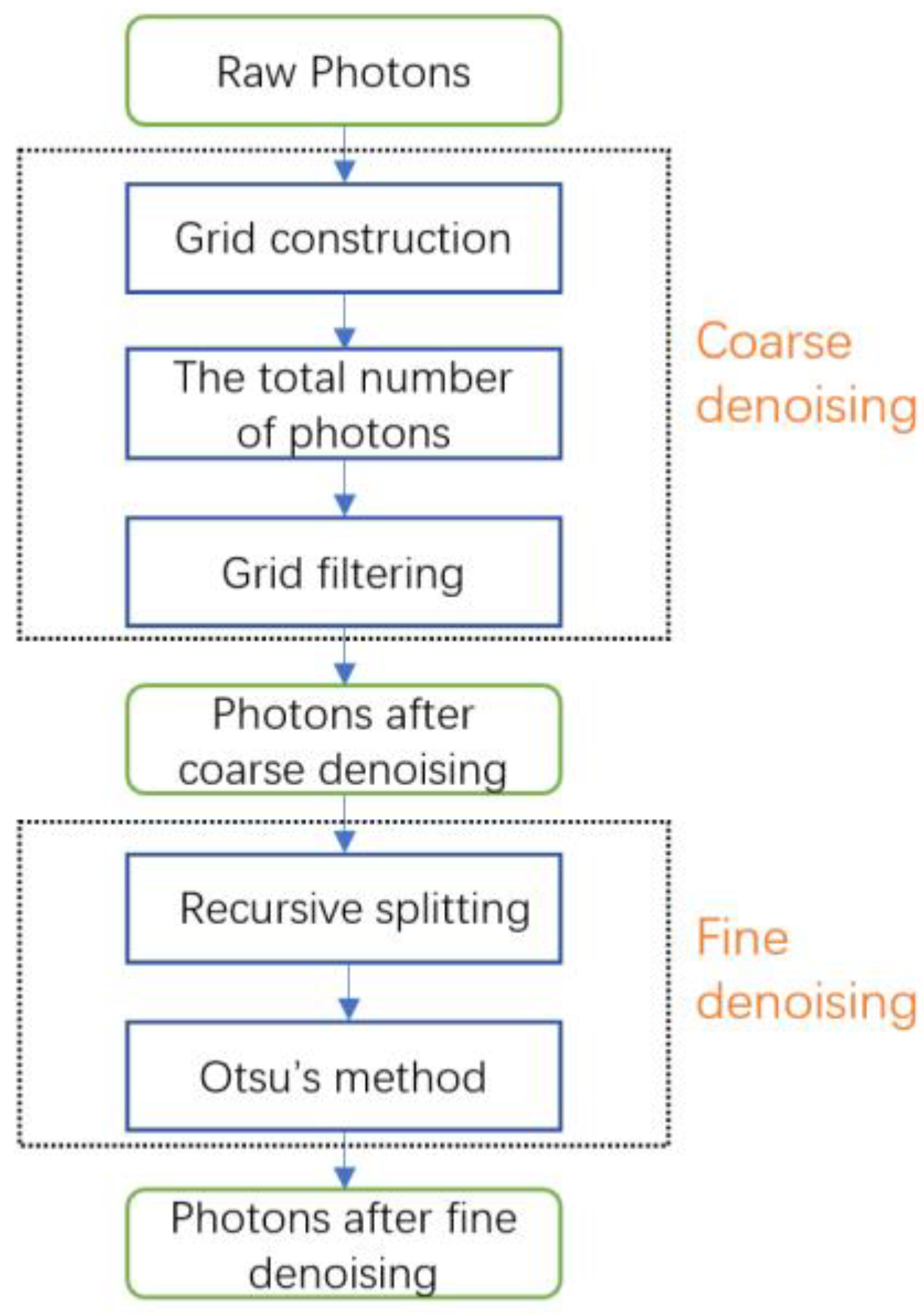
To overcome these limitations, a hierarchical denoising algorithm is proposed, termed grid filtering with horizontal and vertical recursive division (GHVRD). It is a method which transitions from coarse to fine denoising. Grid filtering is performed first, whereby photons are divided into an adaptive grid (300 m × 30 m). The grid is then classified into different types by counting the density of photons within the grid, thus allowing for fast partial noise filtering. This study established that the device exhibits the capacity to eliminate between 58% and 72% of the noise in the high-density region, while concurrently preserving over 99.1% of the authentic signal. Subsequently, a fine denoising process is implemented through the utilization of horizontal and vertical recursive divisions, which are optimized by Otsu’s method. The establishment of adaptive termination parameters is achieved through the implementation of alternating horizontal and vertical divisions. MinPts denotes the minimum number of photons in each partition, whilst MaxSplits is dynamically determined by the Otsu method. The workflow of the method is shown in Figure 1. The innovations of this study include the following. (1) We propose a novel coarse denoising method that relies solely on counting the density of photons in the grid, classifying the data into different regions, and denoising them based on this density. This method is fast and retains over 99.1% of the signal photons. While some noises cannot be canceled, this approach can significantly reduce the computation and denoising time required for subsequent fine denoising. (2) A new recursive division method is proposed, in which the direction of the division line alternates between horizontal and vertical orientations, allowing for local photon distribution to be adapted without a priori topographic knowledge. (3) Parameter automation: Otsu’s method replaces manual threshold selection for optimizing recursive depth.

2. Materials and Methods

2.1. Datasets

2.1.1. ICESat-2 ATL03 Data

The ICESat-2 mission, launched by NASA in 2018, is equipped with the advanced ATLAS [19,20,21]. It utilizes photon-counting LiDAR technology to obtain high-precision surface elevation data. It is a core data product at the L2A level, ATL03 [22,23,24], includes globally geo-located photons with information on latitude, longitude, ellipsoidal altitude (in the WGS-84 [25] reference frame), and time. This data serves as a fundamental resource for generating higher-level products, such as ATL08 for vegetation height and ATL10 [26] for sea ice thickness. ATLAS uses photon-counting LiDAR technology to transmit and receive laser pulses, combining these measurements with position and attitude data from satellites. This not only calculates the three-dimensional coordinates of the Earth’s surface but also ensures the accuracy of the data. ATL03 plays a vital role in advancing research, especially in forest ecosystems, biomass estimation, and other dynamic forest resource changes. It also provides crucial data support for polar research, such as measuring the height difference between the surface of sea ice and seawater and calculating sea ice thickness. It is essential for understanding the effects of climate change and the evolution of polar ecosystems.

2.1.2. Validation Data

(1)
USGS 3DEP 1m airborne radar data
The USGS 3DEP 1m airborne radar data [27,28,29,30] is a pivotal outcome of the U.S. Three-dimensional Elevation Program (3DEP), through which 1m data is acquired using three-wavelength LiDAR technology (Titan Sensor System) and covers the U.S. mainland, Alaska, Hawaii, and the Great Lakes. Following the coordinate system upgrade in 2022, the data is referenced to the North American Datum of 1983 (NAD83) [31] horizontal data and the North American Vertical Datum of 1988 (NAVD88) [32] vertical data. The raw point cloud meets the Quality Level 1 standard, with an elevation RMSE less than or equal to 10 cm and point density greater than or equal to 8 points per square meter. The gridded Digital Elevation Model (DEM) has a resolution of 1 m. The data adheres to the Extended American Society for Photogrammetry and Remote Sensing (ASPRS) Classification Standard (LiDAR Aerial Survey, LAS 1.4 format), incorporating 20 classification categories, including new elements such as snow and ice, power lines, and others. This data is extensively cited as a key input for flood simulation (Federal Emergency Management Agency, FEMA), surface deformation monitoring (National Aeronautics and Space Administration Jet Propulsion Laboratory, NASA JPL), and the creation of high-precision maps for automated driving, owing to the innovations in full-waveform recording and radiometric calibration technologies.
(2)
GlobeLand30 V2020 data
GlobeLand30 V2020 data [33,34,35] provides global surface cover data at a 30 m resolution, encompassing 10 surface cover types: cropland, forest, grassland, shrubland, wetland, water, tundra, man-made land, bare ground, glacier, and permanent snow. A total of 966 data are stored in UTM [36,37] and polar azimuthal projections based on the World Geodetic System 1984 (WGS-84) coordinate system, covering 149 million square kilometers of the global land surface. There are various sources of the GlobeLand30 data, including image data from Landsat and GF-1 [38,39] multispectral images. These data are classified using automated and semi-automated algorithms.

2.2. Methods

GHVRD Method

The first step in the GHVRD method is grid filtering. Grid construction is first performed by dividing the normalized 2D space into a rectangular grid with grid dimensions of Δx = 300 m (fixed distance interval along the track) and Δy = 30 m (fixed height interval) and then counting the data within each grid. For each grid at position (j, k) (Gjk),
I A ( x ) =   1         x A   0         x A
C jk   = i = 1 n   I ( x i ,     y i ) ,   x i     j Δ x ,   ( j   + 1 ) Δ x ,   y i     k Δ y ,   ( k + 1 ) Δ y
where Cjk represents the photon count in the grid at position (j, k), n is the total number of photons in the data, and xi and yi are the coordinates of the ith photon. The indicator function I (xi, yi) returns 1 if the condition inside the parentheses is true and 0 otherwise.
The grid size selection strategy serves the purpose of being the coarse noise removal algorithm, aiming to minimize signal misclassification while maximizing noise reduction. The elevation range of a segment of ICESat-2 data varies from tens of meters to several kilometers. According to theoretical calculations, if the size of parameter Δy is set to over 100 m, it will have little effect on scenes with minimal elevation change, such as the ocean surface. Conversely, if the size of Δy is set to below 10 m, there is a higher chance of misclassifying signal data when processing complex mountainous terrains. Regarding the selection of parameter Δx, if the size is set too small, it results in an excessive number of grids when processing large datasets, thus impacting computational efficiency. On the other hand, if the size is set too large, there is a risk of signal misclassification in steep mountainous regions. After extensive theoretical analysis and experimental validation, we determined that setting Δy to 30 m and Δx to 300 m yields the best performance.
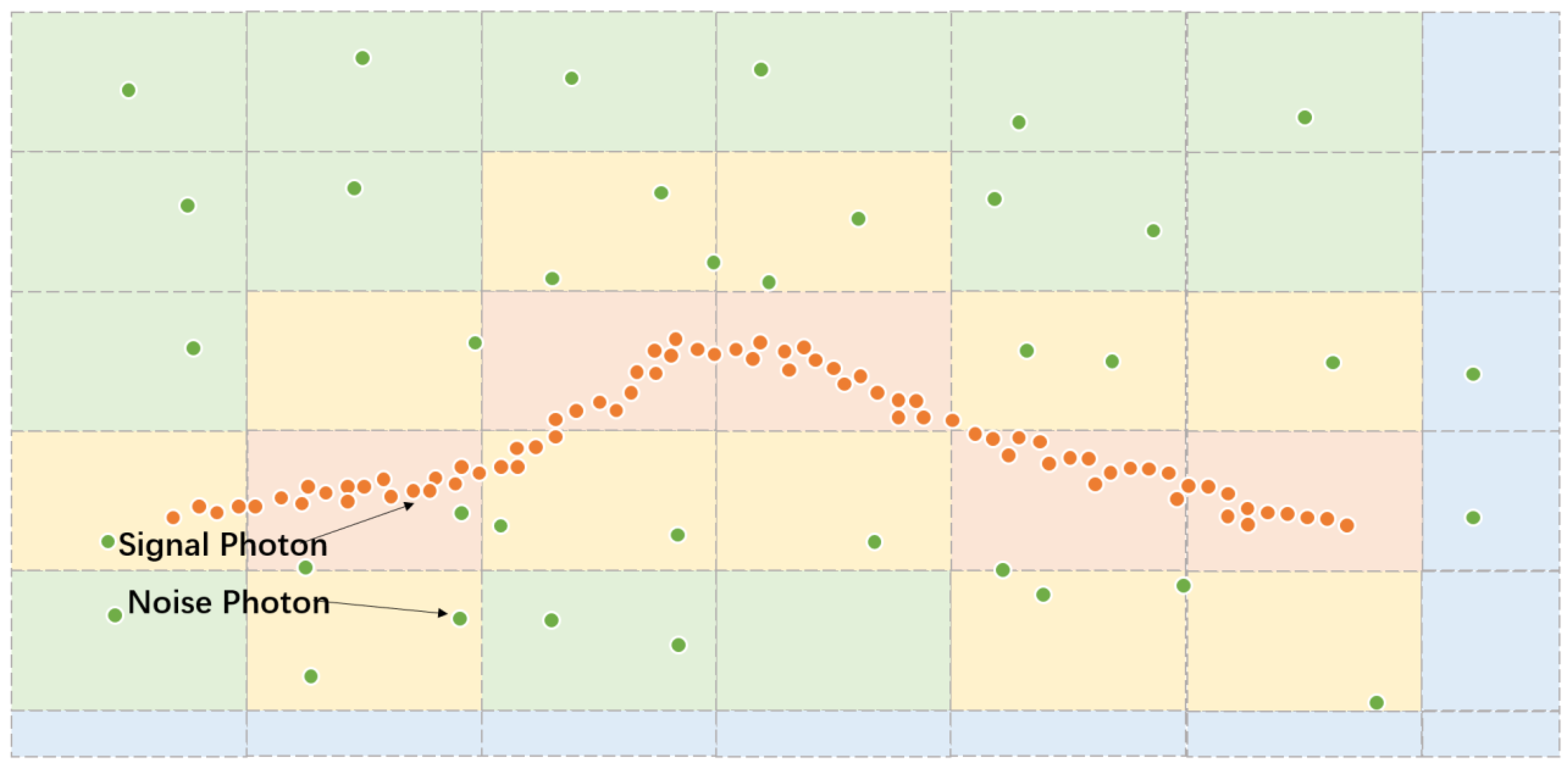
The objective is to calculate the data density for each grid and make decisions regarding the data within the grid based on this density. The method of dividing the photon density threshold within the grid is shown in Figure 2.
Assuming that the total number of photons in the region to be processed is N, if the sum of the densities of signal and noise in the grid is greater than or equal to N/4.5 per square kilometer, the value of ≥N/4.5 photons per square kilometer is empirically determined through systematic testing across diverse terrains. This threshold optimizes the balance between noise removal and signal preservation: validation confirmed that it retains over 99.1% of true signal photons while eliminating 58–72% of noise in high-density regions. By scaling relatively to the total photon count (N) in each processing region, the threshold dynamically adapts to local data characteristics without requiring absolute values. Its effectiveness is demonstrated quantitatively, where consistent performance is achieved across environments including forests, oceans, and urban areas. We acknowledge this calibration is specific to ICESat-2’s typical noise–signal distribution but emphasize its experimental robustness. This region is defined as the signal region G j k S . At this point, the region contains more signal photons, which should be retained for fine denoising. Next, the 3 × 3 neighboring grid around G j k S is defined as the buffer zone G j k B . Even though the density of G j k B does not reach the density threshold we set previously, G j k B is also reserved for fine denoising due to its proximity to G j k S and the characteristics of the grid construction, which may contain signal photons. If it does not belong to G j k S and G j k B in the constructed grid, it is defined as a noise region, G j k N , and filtered out. At the edges, if there is an area that does not satisfy Δx = 300 m and Δy = 30, the area is said to be the edge region G j k F . Because the size of G j k F is variable, no treatment is performed for G j k F in the coarse denoising environment.
Signal zone, G j k S : photon density ≥ N/4.5 per square kilometer;
Buffer zone, G j k B : 3 × 3 neighbor grid around G j k S ;
Noise zone, G j k N : grids other than G j k S and G j k B ;
Fringe zone, G j k F : the area where no grid is formed.
Finally, grid filtering is performed to keep the data in G j k S , G j k B , and G j k F and discard the data in G j k N . The formula for grid filtering is shown below: Pcoarse is the total data retained during the grid filtering process.
P coarse = ( x i , y i )   G ( x i , y i )     G j k   S     G jk B     G jk F
Here, we will briefly discuss the impact of different buffer sizes on the results. Signal Preservation: A 3 × 3 neighborhood optimally captures transitional zones where sparse signals neighbor high-density grids, preventing edge signal loss. Smaller buffers (e.g., 1 × 1) risk filtering weak-but-valid signals, while larger buffers (e.g., 5 × 5) retain excessive noise (>15% increase in false positives).
Noise–Signal Boundary Handling: The size of this balances coverage of potential signal photons near grid edges (e.g., canopy boundaries, terrain slopes) without overextending into low-density noise regions.
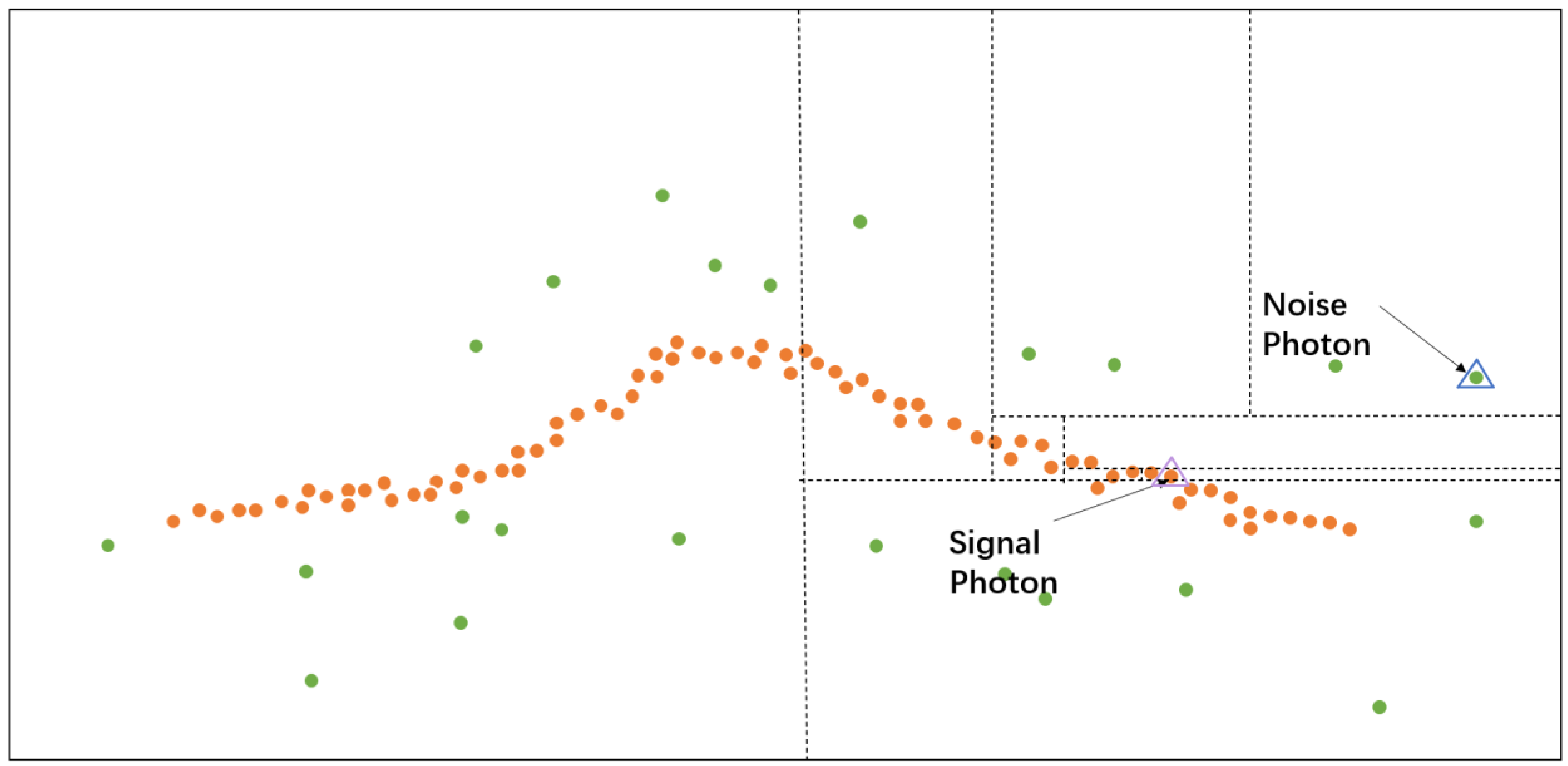
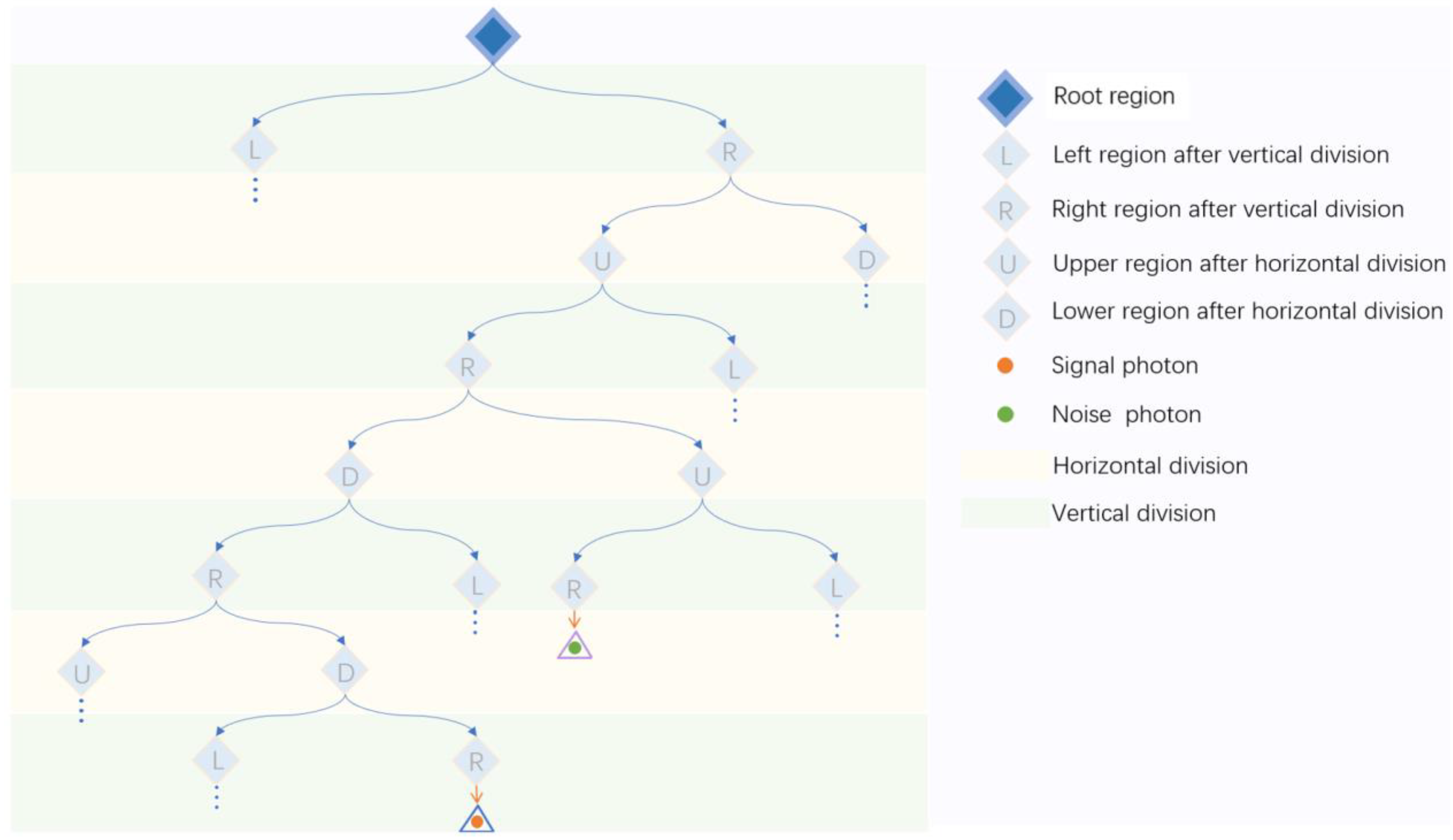
The second step in the GHVRD method is Otsu-optimized horizontal–vertical recursive division. The principle of the horizontal–vertical recursive division method is shown in Figure 3 and Figure 4, where the dense set of orange dots represents the signal and the sparse set of green dots represents the noise. After coarse denoising of the photon data by grid filtering, the Otsu-optimized horizontal–vertical recursive division method is as follows. (1) Initial division: The photons are segmented vertically parallel to the longitudinal axis, making sure that the photons on both sides of the division line and the distance between the division line are equal. (2) Secondary division: The photons are horizontally divided into two sub-regions along the parallel direction of the track, ensuring that the photons on both sides of the division line are equidistant from the division line. (3) Horizontal and vertical recursive splitting: Q denotes the value of the minimum point threshold, MinPts. If the number of photons in the region is equal to or less than MinPts, the region will not be segmented anymore (in the GHVRD method, MinPts is set to 1 by default). The number of times the region in which the data is located is divided is an important basis for determining whether the data is a signal or noise.
The division criteria are
D k 1   = {   X | X     D k 1 ,   sum   (   X   )   >   MinPts } D k = D V ( D k 1 )    
D k = {   X | X     D k ,   sum (   X   )   >   MinPts } D k + 1 = D h ( D k )        
DV in Equation (4) represents vertical division, and Dh in Equation (5) represents horizontal division. During the division process, the number of times Ci that each data point is segmented, from the beginning until the number of photons in its region becomes equal to or less than MinPts, is recorded. Subsequently, threshold selection is initiated. In the GHVRD method, the threshold selection is based on the distribution of photon division counts. The maximum division threshold, MaxSplits, is determined using the maximum interclass variance method. If the division count of the data exceeds MaxSplits, the data is classified as a signal. Conversely, data with division counts below the threshold is considered noise and filtered out.
As shown in Figure 3, the root region represents the undivided photon area. After the initial vertical division, the root region is split into two sub-regions: the left region and the right region. The left and right regions are then horizontally divided, forming the upper and lower regions, and the division continues until the stopping conditions are met. When the parameters MinPts = 2 and MaxSplits = 6 are set (including three horizontal divisions and three vertical divisions), it can be observed that the total number of photons in the sub-region containing the green point, selected by the purple triangle box, equals MinPts. This region is no longer divided, and the sub-region undergoes five divisions, which is fewer than MaxSplits. As a result, the green point is identified as noise. In contrast, the sub-region containing the orange point, selected by the blue triangle box, also has a total number of photons equal to MinPts, and this region stops dividing. However, the sub-region undergoes seven divisions, which exceeds MaxSplits, and the orange point is identified as a signal.
To implement the GHVRD method without parameter input, Otsu’s method is employed to adaptively determine MaxSplits. The total number of photon divisions within a window is defined as [0, k]. A division threshold, t, is introduced, which divides the photons into two categories: [0, t − 1] and [t, k]. The threshold that maximizes the variance between these two categories is selected as the optimal denoising threshold, providing more accurate MaxSplits for distinguishing noise from signal. During the determination of MaxSplits, MinPts can be considered under two scenarios: one where MinPts = 1 and another where MinPts ≥ 1. When MinPts = 1; this applies to cases where the density difference between noise and signal is evident (such as in the ocean, desert, or ice surfaces). In such scenarios, denoising is simplified, as MaxSplits is the only parameter. When background noise is strong and the signal is weak, this method assists in distinguishing noise from signal effectively. In some cases, the density of the signal data is only slightly higher than the density of the noise data, presenting a strong noise background. In such cases, the density of the noise data is higher, and its division layer values are usually also higher, approaching the layer values of the signal photons. If the threshold is based only on the number of divisions, the noise may be incorrectly determined as a signal, or the signal may be determined as noise. In addition, in environments such as forests and cities, the difference in density between noise and signals may not be significant. For example, in a forest, the density of ground signals is higher, the density of airborne noise is lower, and the density of signals from trees is somewhere in between. In this case, if the MinPts value is kept constant, signal photons may be mistakenly identified as noise. To avoid such problems, we set MinPts in a range to improve the robustness of the GHVRD method. As the number of photons N in ICESat-2 increases, the range of MinPts values increases.
1   <   MinPts   ln N n e 15
[] stands for the rounding function. Based on experimental experience, the effect is better when ne = 9900.
The following is a formula for solving the optimal threshold k* by the maximum inter-class variance method.
(1)
When MinPts = 1
k * = arg max 0 < k < L 1   σ B 2 k
The variance between classes is defined as
σ B 2 t =   ω 0 t ω 1 t μ 0 t μ 1 t 2
ω 0   =   l = 0 t   p l : The proportion of low-density data (noise-dominated).
ω 1   =   i = t + 1 L 1   p l   =   1     ω 0 : The proportion of high-density data (signal-dominated).
μ 0 ( t )   = 1   ω 0 ( t ) l = 0 t   lP ( l ) : The mean of low-density data classes.
μ 1 ( t )   =   1 ω 1 ( t ) l = t + 1 L 1   lP ( l ) : The mean of high-density data classes.
Data with several divisions less than the threshold k* is determined to be noise and filtered.
(2)
When MinPts   {   x     1   <   x   ln N n e 15 , x     Z }
Z represents an integer. Different values of MinPts result in different distributions of the number of divisions. Let the number of photon divisions be k ∈ [0, Kc], where c is all integer values desirable for MinPts.
The optimal threshold k* is
σ c 2 ( t ) = ω c , 1 ( t ) μ c , 1 ( t ) μ c 2 +   ω c , 2 ( t ) μ c , 2 ( t )     μ c 2
ω c , 1 ( t ) = i = 0 t 1   p c , i
ω c , 2 ( t ) = i = t K c   p c , i
μ c , 1 ( t ) = 1 ω c , 1 i = 0 t 1   i c , i
μ c , 2 ( t ) = 1 ω c , 2 i = 0 K c   i c , i
μ c = i = 0 K c   i c , i
p c , i   = n c , i N c

2.3. Method Evaluation

To quantitatively evaluate the signal extraction performance of the GHVRD method, three statistical metrics were used: precision (P), recall (R), and the F-measure (F).
P quantifies the model’s accuracy in detecting noise photons. It is calculated as the ratio of true positives (TP), or correctly identified noise photons, to the total number of predicted noise photons, which is the sum of true positives (TP) and false positives (FP).
P = TP TP + FP
High accuracy indicates a low false deletion rate for real signal photons, making the algorithm suitable for regions with complex terrain to prevent over-filtering.
R reflects the model’s ability to detect noise photons. It is calculated as the ratio of correctly identified noise photons (TP) to the total number of actual noise photons, which is the sum of true positives (TP) and false negatives (FN).
R = TP TP + FN
A high recall indicates that the algorithm effectively filters out most noise, minimizing the impact of residual noise on subsequent elevation inversion. F represents the harmonic mean of precision and recall. It is used to balance the trade-off between these two metrics.
F = 2 PR P + R
An F1-score approaching unity denotes optimal equilibrium between detection precision (P) and spatial coverage. Terrain-specific performance metrics (P, R, F1) were quantified post-GHVRD denoising across heterogeneous landscapes. In mountainous areas, the accuracy of the GHVRD method was evaluated by comparing it with the quadtree denoising method and the modified DBSCAN method using the R2 (coefficient of determination) and RMSE (root mean square error) indicators.
R 2 = 1 i = 1 n   ( x i     y i ) 2 i = 1 n   ( x i y ¯ ) 2
RMSE = 1 n i = 1 n   ( x i     y i ) 2
Systematic validation was implemented on an Intel i5-13500H CPU (16 GB RAM) with Python 3.9 framework.

3. Results

3.1. Experiments and Results

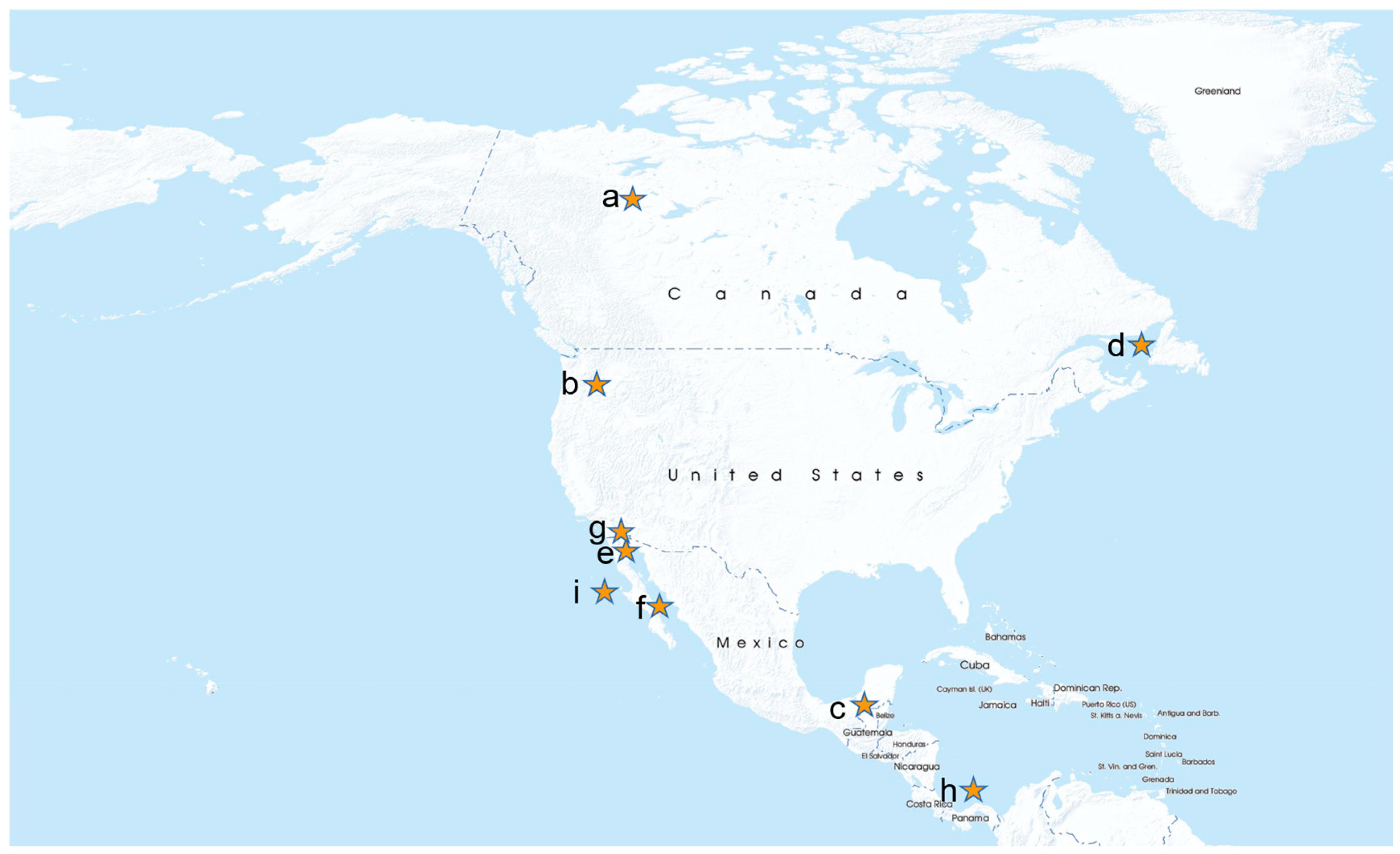
ATL03 data (2023–2024) were selected for noise reduction across nine representative regions. The location of the target area chosen for the experiment is shown in Figure 4. Target area a is located in northern Saskatchewan (59.08N, 114.07°W); target area b is located in Okanagan Hills (48.26N, 119.75W); target area c is located in Ejido Santa Cruz vegetation (18.04N, 91.56W); target area d is located in the Canadian Gulf of St. Lawrence (49.90N, 60.57W); target area e is located in San Bernardino (33.86N, 117.21W); target area f is located in the Gulf of California (25.89N, 111.32W); target area g is located in Kern County (35.58N, 117.85W); target area h is located in the Northwest Caribbean Sea (7.787N, 79.45W); and target area i is located in the North Pacific Ocean (27.33N, 115.48W). The locations of the above areas are marked in Figure 5.
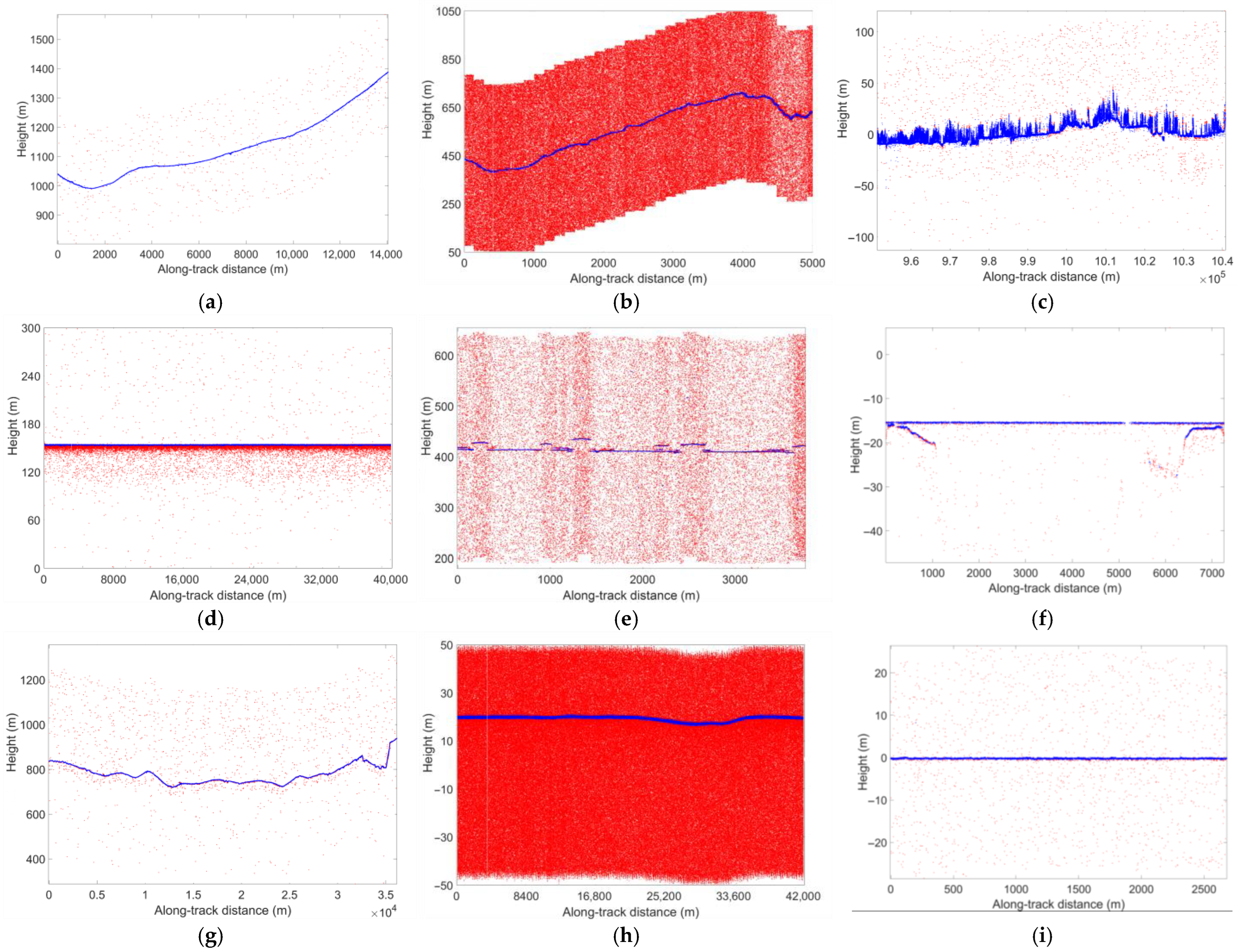
The result of the denoising process is shown in the Figure 6 below.
Table 1 presents the denoising performance metrics, including precision (P), recall (R), and F-score (F), for locations labeled from a to i. The precision, recall, and F-score values reflect the effectiveness of the denoising process, with higher values indicating better performance. From the perspective of precision, recall, and the F1-score, the GHVRD method demonstrated superior performance in aquatic and desert regions. At the same time, its effectiveness was relatively limited in urban and densely vegetated areas. In mountainous regions such as northern Saskatchewan (Location a) and Kern County’s Gobi Desert (Location g), the algorithm achieved high precision (P = 0.981 and P = 0.962, respectively) and F1-scores (F = 0.968 and F = 0.970). These results indicate that GHVRD effectively suppresses noise interference caused by rugged topography, likely due to its distance-based recursive partitioning mechanism. The iterative computation of spatial thresholds ensures accurate signal extraction even in discontinuous terrain, mitigating errors caused by excessive separation of signal clusters in traditional clustering methods. However, the lower recall (R = 0.933) in the Okanagan hills (Location b) suggests limitations in distinguishing subtle slope variations from noise under moderate gradients and mixed land cover. In Ejido Santa Cruz’s vegetation zone (Location c), the algorithm achieved balanced performance (P = 0.963; R = 0.952; F = 0.957), demonstrating its ability to preserve canopy structure while suppressing photon noise. Nevertheless, the relatively lower precision compared to that for open terrains highlights the inherent challenges of segmenting overlapping photon returns in dense vegetation layers. Urban environments, exemplified by San Bernardino (Location e), presented significant challenges, with markedly reduced metrics (P = 0.912; R = 0.831; F = 0.868). This suboptimal performance is likely attributable to the high spatial heterogeneity of anthropogenic structures, which introduce systematic biases in photon detection and complicate noise separation from artificial features. Aquatic regions, including the Gulf of St. Lawrence (Location d), the Northwest Caribbean Sea (Location h), and the North Pacific Ocean (Location i), resulted in exceptional denoising accuracy (F ≥ 0.969). The high F1-scores align with the uniform reflectivity characteristics of large water bodies, enabling efficient filtering of spurious photon returns. In contrast, the nearshore area of the Gulf of California (Location f) resulted in moderate performance (P = 0.923; R = 0.964; F = 0.943). This discrepancy may stem from the dual requirement to suppress both surface and subsurface noise in shallow coastal zones, which increases the complexity of signal–noise discrimination.
Overall, the GHVRD method could effectively denoise ICESat-2 data for all types of terrain, and the denoising effect was good in most areas. However, in complex urban environments and vegetation, there is still much room for improvement in the denoising accuracy of the GHVRD method.

3.2. Algorithm Accuracy Verification and Comparison

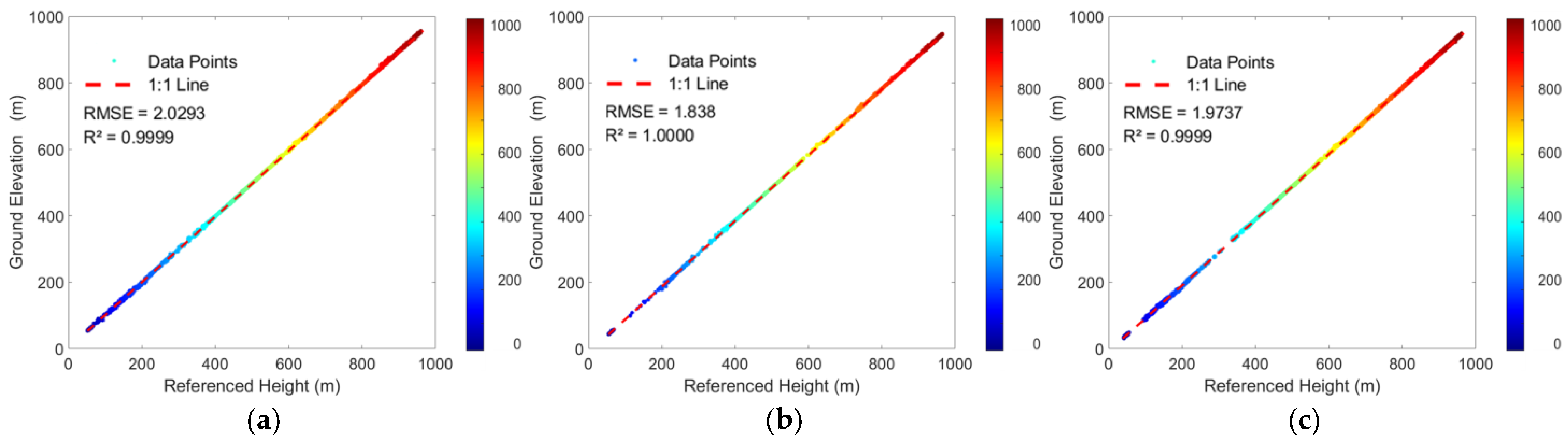
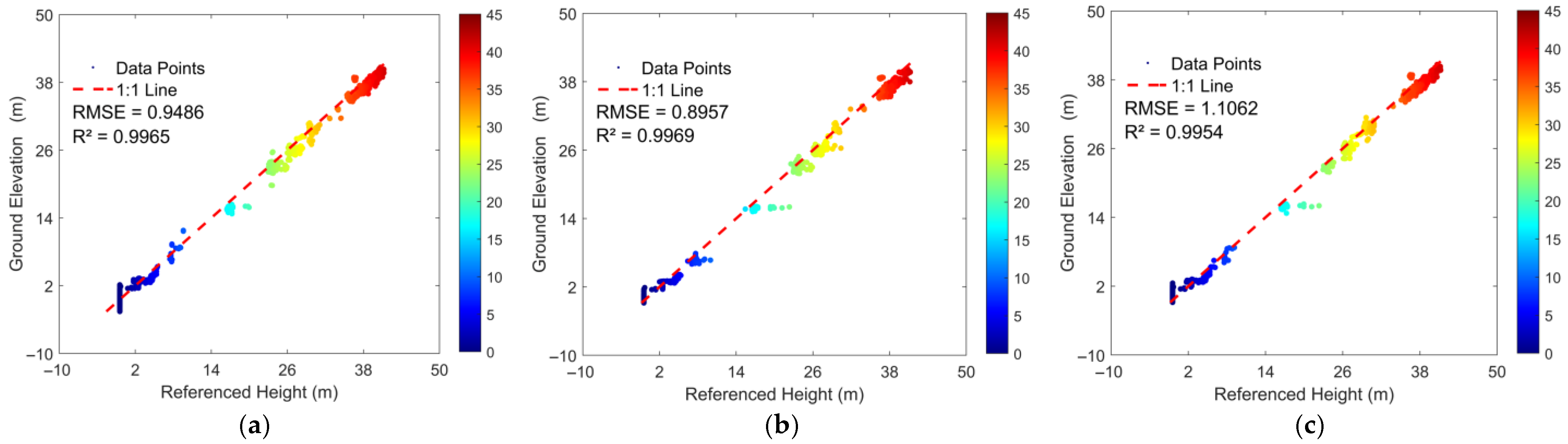
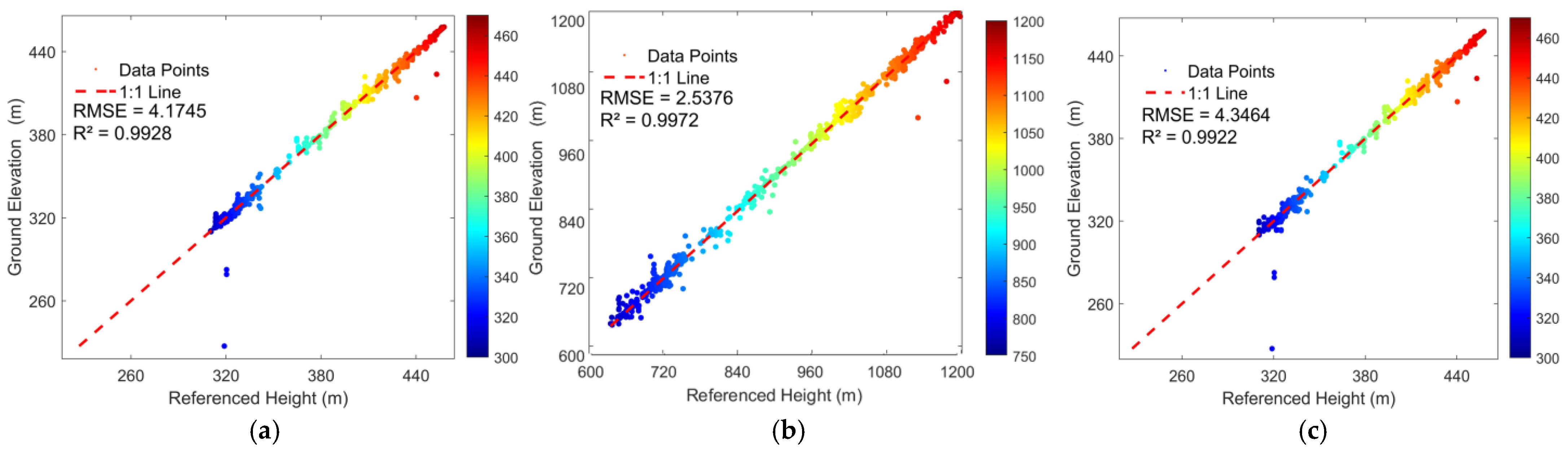
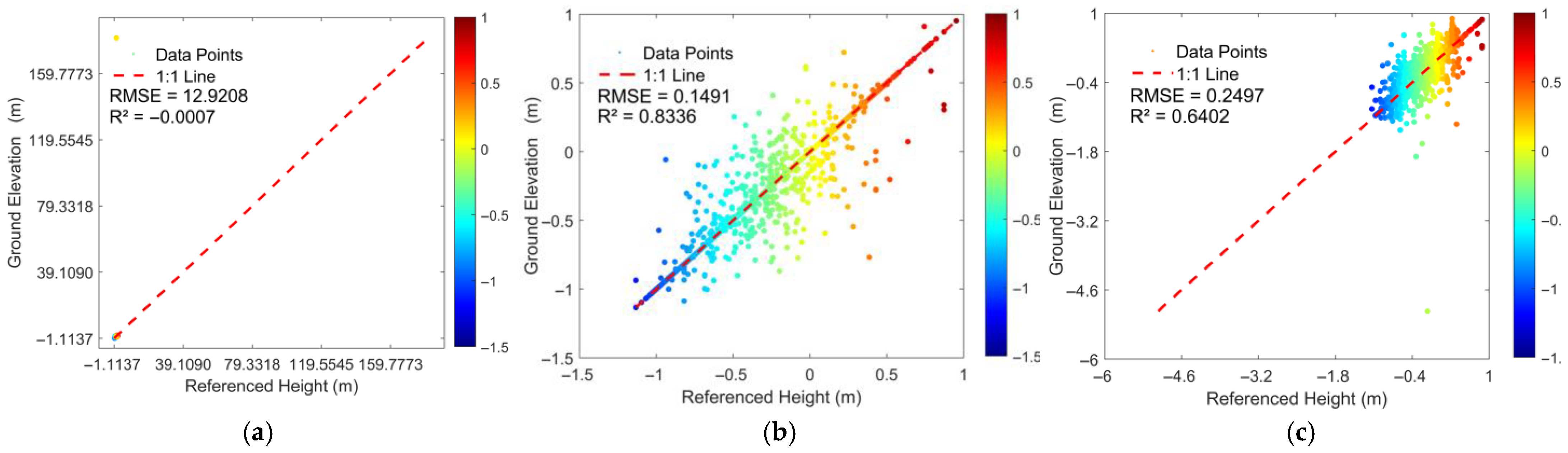
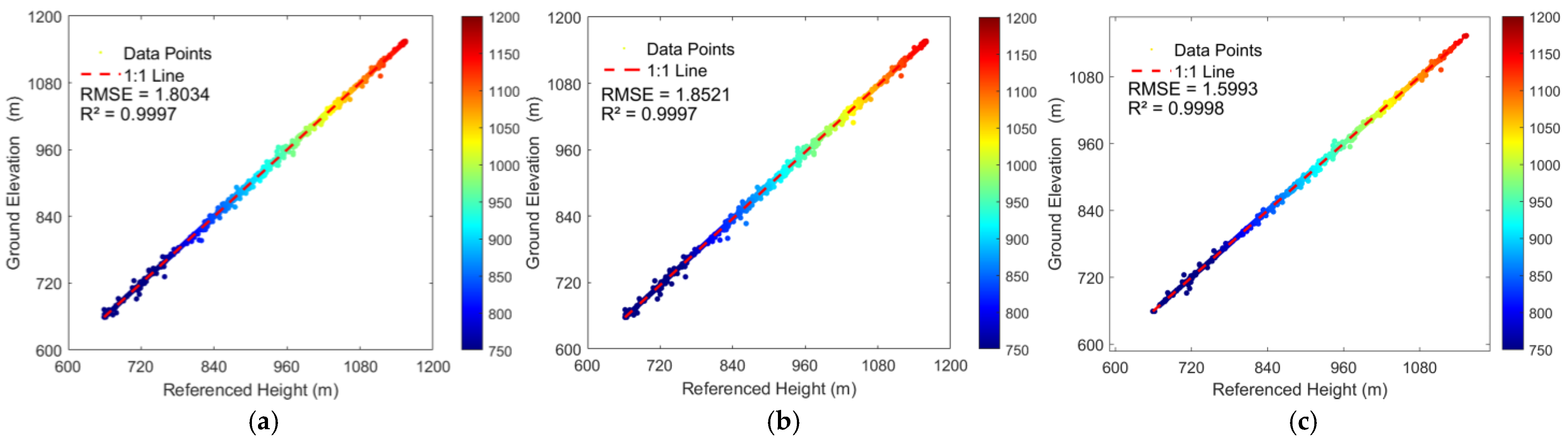
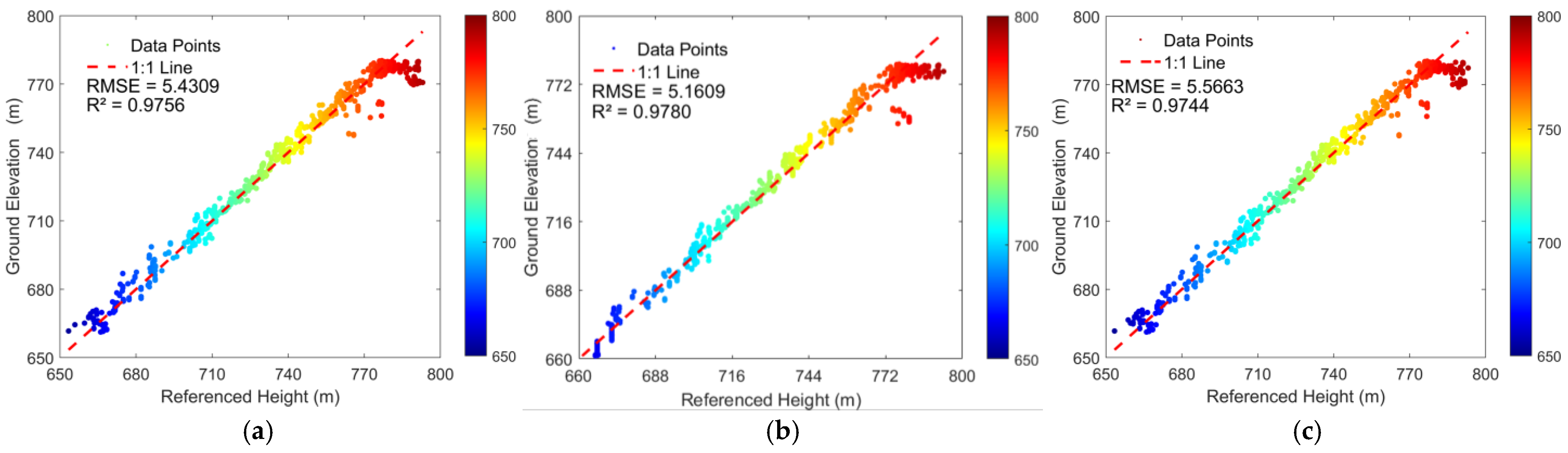
To validate the denoising accuracy of the proposed GHVRD method, this study selected six regions—mountains, buildings, hills, oceans, Gobi terrain, and vegetation—to test the accuracy of noise reduction. The ICESat-2 photon count data were denoised using grid filtering and longitudinal and transversal cross-division strategies. A 1m-resolution airborne LiDAR Digital Elevation Model, acquired by the USGS 3DEP program, was used as a reference benchmark. The denoising accuracy was quantitatively evaluated by calculating the coefficient of determination (R2) and root mean square error (RMSE). It is important to note that temporal inconsistency, due to the time difference between ICESat-2 satellite observations and airborne LiDAR data acquisition, may have introduced systematic bias. Residuals between the laser altimetry data and the reference elevation persisted, even after the ideal denoising process. Figure 7, Figure 8, Figure 9, Figure 10, Figure 11 and Figure 12 show the results of the noise reduction accuracy comparison verification, which are summarized in tables and bar charts.
Table 2 and Table 3 provide a systematic comparison of the performance of the GHVRD method, the quadtree isolation, and the improved DBSCAN algorithm across six regions. The quadtree isolation method achieved a commendable RMSE (0.949–5.430 m) and correspondingly high R2 values (≥0.996) across four terrain types, mountain, city, hill, and vegetation, indicating its effective preservation of terrain details. However, its accuracy significantly declined in the ocean terrain: although the R2 value remained at 0.992, the RMSE increased to 12.92 m. This performance drop was likely due to the retention of outlying noise resulting from the single-threshold approach of the quadtree isolation method, as evidenced by the analysis in Figure 10. Additionally, the method performed moderately on the Gobi terrain.
The improved DBSCAN algorithm yielded slightly higher RMSE values than the quadtree isolation method (1.106–5.566 m) across most terrain classes. However, its RMSE was the lowest in the Gobi terrain, outperforming all three methods. The R2 value in the vegetation area was also 0.001 lower compared to those of the other two methods. This can be attributed to the fact that the clustering algorithm exhibits strong robustness during the denoising process, as it is less affected by unprocessed data. However, its performance may be less favorable when dealing with data that exhibits minimal elevation changes, such as in the ocean terrain. Moreover, this method is susceptible to the sensitivity of its parameters.
The GHVRD method maintained good accuracy across all six terrain types (RMSE: 0.1491–5.1609 m; R2 ≥ 0.8336), achieving the best RMSE and R2 values among the three methods in the mountain, city, hill, and ocean terrains. Specifically, the RMSE in the ocean region decreased to 0.149 m, while the correlation coefficient in the mountain region exceeded 0.9999. This improvement confirms that the GHVRD method is effective in denoising ICESat-2 data across most terrain types.
In summary, GHVRD achieved the lowest average RMSE (2.072 m) and the highest average R2 (0.971) across all six land cover types, demonstrating an optimal balance between detail preservation and noise suppression. Its superior denoising performance is evident in the comparative analysis.
A comparison of the RMSE and coefficient of determination (R2) for the three methods reveals that the GHVRD method outperforms the other two in terms of signal extraction accuracy. The quadtree isolation method, relying solely on a single partition parameter, exhibits a fixed denoising strategy that struggles to distinguish between signal and noise in complex terrains effectively. This results in the risk of excessive signal filtering or residual noise. Although the improved DBSCAN algorithm introduces a multi-parameter adjustment mechanism (including the filter radius a/b and the density threshold T), it requires manual parameter configuration. When applied to different terrains, parameter adjustments are necessary, and the uniform global density threshold may still lead to misclassification. In contrast, the GHVRD method combines grid filtering with horizontal and vertical recursive divisions, enabling accurate signal extraction without prior terrain knowledge. Additionally, the method incorporates Otsu’s method for the adaptive selection of key parameters, significantly enhancing the algorithm’s robustness.

3.3. Algorithm Computational Efficiency and Comparison

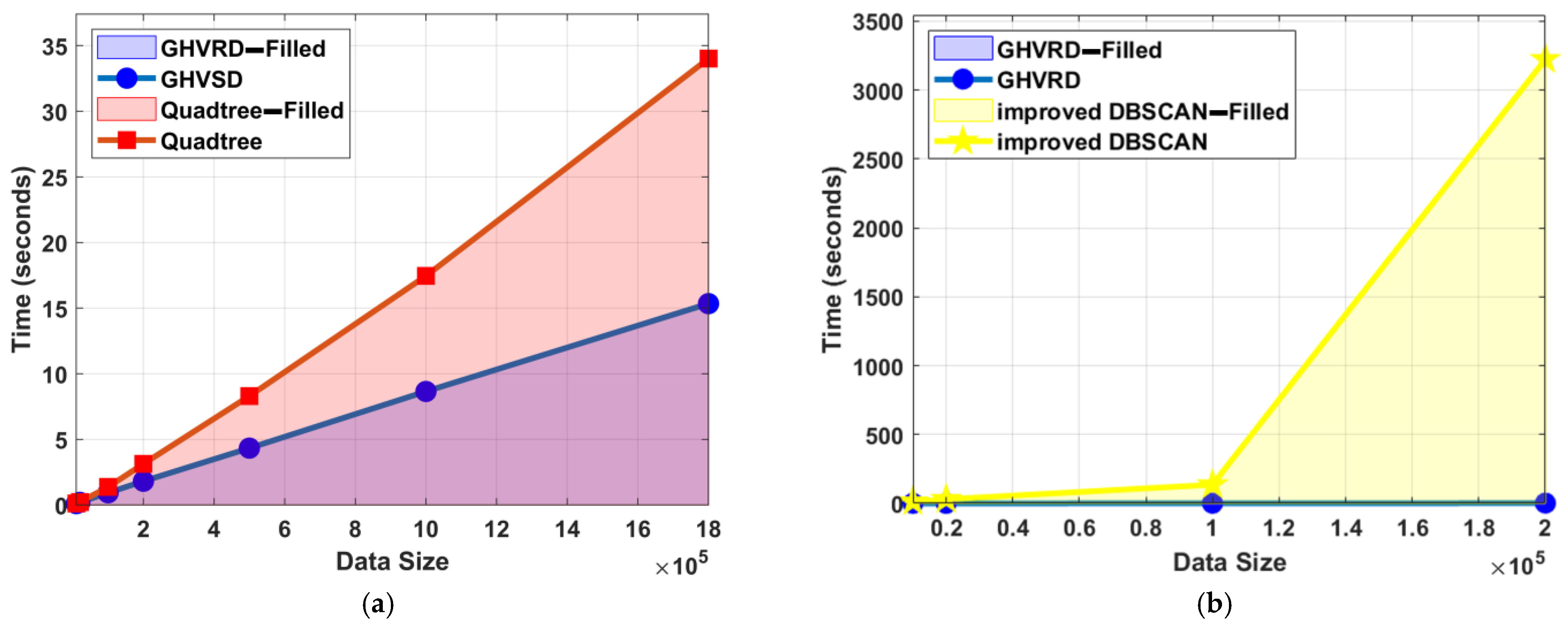
In the denoising process, running time is a critical factor that determines denoising efficiency. Figure 13a presents a comparison of the running times of the three methods. The results indicate that the execution time of all algorithms exhibits a positive correlation with data size. Specifically, Figure 13a compares the running times of the GHVRD and quadtree methods across different data sizes. The horizontal axis represents the data size, ranging from 0 to approximately 1.8 × 10⁵, while the vertical axis represents time (in seconds), ranging from 0 to about 70 s. The relationship between data volume and processing time is observed to be linear for both the GHVRD and quadtree methods. This is attributed to the fact that the primary computational process in both methods involves spatial division, resulting in nearly double the processing time when the data size is doubled. However, the processing time for the quadtree method remains consistently higher than that of the GHVRD method for each data volume, with a notable gap between the two. Consequently, the GHVRD method exhibits superior computational efficiency. In the GHVRD method, each division takes into account the relative positions of the spatial point clouds, making it more purposeful than the equal division approach of the quadtree method. This minimizes unnecessary calculations and enhances processing speed. Furthermore, the use of grid filtering in the GHVRD method further accelerates processing time.
Figure 13b presents a comparison of the running times of the GHVRD method and the improved DBSCAN across different data volumes. The data volume, shown on the horizontal axis, ranges from 0 to approximately 2 × 10⁵, while the vertical axis represents time (in seconds), ranging from 0 to around 3500 s. In contrast to the linear increase in processing time observed for the quadtree and GHVRD methods, the processing time for the improved DBSCAN method exhibits an accelerating trend. Specifically, the processing time increases by more than a factor of ten when the data volume is doubled. The time gap between the improved DBSCAN and the GHVRD algorithm gradually widens, highlighting the relatively high time overhead of the improved DBSCAN method when processing large-scale data. This issue becomes more pronounced when handling ICESat-2 data at the scale of ten million data points. It can be observed that the GHVRD method outperforms both the improved DBSCAN and quadtree methods in terms of time efficiency across all data sizes. The time consumption of the GHVRD method remains relatively stable, even as the data size increases substantially. This advantage becomes particularly evident when handling larger data volumes.

4. Discussion

4.1. The Significance of Using Grid Filtering

The GHVRD method with coarse denoising using grid filtering demonstrates a 10.5% improvement in speed and a 2.3% increase in accuracy compared to the GHVRD method without coarse denoising. The reasons for this improvement are discussed below. The fine denoising in the GHVRD method employs horizontal and vertical recursive division methods, requiring the calculation of distances between each point and the division. In contrast, during the coarse denoising stage, grid filtering only involves counting, significantly reducing computation and enhancing processing speed. This effect is particularly pronounced in high-noise conditions. In high-noise data, the amount of data may increase several times over compared to low-noise data over the same length of along-track distance. An increase in data volume impacts the transverse and longitudinal recursive division methods, as more points and divisions are required. The computational impact of grid filtering under the same along-track distance is less affected by the increase in data volume, as it only increases the count frequency. Therefore, the implementation of grid filtering significantly enhances the overall time efficiency of the algorithm.
In terms of accuracy, the GHVRD method with coarse denoising using grid filtering demonstrates improved performance compared to the GHVRD method without prior coarse denoising. A substantial portion of the ICESat-2 data exhibits a characteristic where the signal density exceeds the noise density, and the area occupied by noise is larger than that occupied by the signal. Grid filtering precisely exploits the spatial properties of ICESat-2 data to filter out the noise that is spatially farther away from the signal, resulting in a further increase in the percentage of signal points, which improves the denoising accuracy in the subsequent process of fine denoising. Since the buffer G j k B and the fringe zone G j k F are defined in the grid filtering, this mechanism makes it almost impossible for any signal to be filtered out as noise in the coarse denoising stage.

4.2. GHVRD’s Ability to Extract Signals in a Single Pass

When processing large amounts of ICESat-2 data in a single pass using the quadtree method, a single threshold is employed, making local optimization for longer along-track distance characteristics challenging. In scenarios with long along-track distances and relatively short height directions, the quadtree’s four-partitioning approach may divide continuous along-track signals into different sub-regions, leading to misclassification of signals as noise. Additionally, the quadtree method insufficiently accounts for data distance, direction, and other characteristics. As a result, when generating four sub-regions in each division, scenarios where the along-track span is large (e.g., hundreds of kilometers) but the height change is minimal (e.g., a few tens of meters) may cause an exponential increase in divisions. The generation of excessively small grids results in high memory usage and decreased processing efficiency, potentially causing over-partitioning of the global parameters in the quadtree.
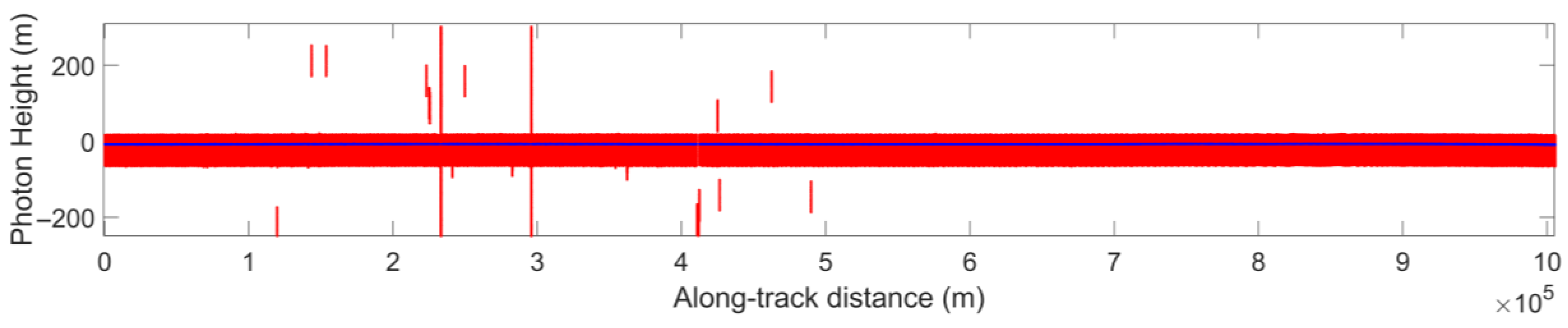
The GHVRD method effectively captures signal photons continuously distributed along the track direction (e.g., terrain features) by dynamically alternating the division direction and continuously calculating the distance between the division line and points in the area. In data with long track distances, signal photons may be distributed continuously along the track. As shown in Figure 14, when the track distance exceeds 100 km, the GHVRD method can still extract signals from the data effectively. When handling high data volumes, the GHVRD method maintains high efficiency, with a processing time of only 14.38 s for the data shown, demonstrating its capability to extract signals effectively. The GHVRD method preserves signals in continuous regions while reducing invalid operations and excessive divisions, thus minimizing the risk of signal fragmentation caused by the fine division of the quadtree method.

4.3. Effect of Parameter MinPts on Denoising

In the GHVRD method, the parameter MinPts plays a significant role in noise reduction. On one hand, it introduces an additional parameter, providing higher flexibility and accuracy in complex data scenarios compared to traditional methods with a single parameter. In situations where the signal positions undergo significant changes (e.g., transitioning from an ice sheet to a fracture zone), the dual-input parameters better adapt to the variations in signal locations, enhancing robustness. On the other hand, in low-signal-to-noise ratio (SNR) scenarios, such as vegetation or tree canopies in a high-noise environment, the density of certain signals may closely resemble that of the noise. In such cases, if a single depth threshold, like that used in the quadtree method, is applied to distinguish between signal and noise, erroneous noise classifications as signal photons may occur during the denoising process.
The GHVRD method leverages that noise in ICESat-2 data is more uniformly distributed than the signal. First, horizontal and vertical divisions are employed to separate signals, which exhibit a more concentrated distribution, from noise, which is more uniformly distributed. Subsequently, MinPts is applied to remove the divided noise, preventing the misclassification of high-density noise as signals due to multiple divisions. The MinPts parameter in the GHVRD method effectively mitigates the misrecognition issue described above. For data with a low signal-to-noise ratio (SNR < 10), denoising methods based on fixed thresholds may misclassify noise regions as signal areas. The GHVRD method not only improves this phenomenon by utilizing MinPts but also achieves accurate signal extraction for low-SNR data through grid-based coarse denoising and horizontal–vertical segmentation. For instance, in the case of a SNR = 10 with an elevation range of 600 m, the grid filtering strategy divides the data into a 20-row grid array. After regional identification, only one to three grids in each column of 20 are classified as G j k s , and two grids are classified as G j k B . Through grid filtering, the data corresponding to G j k s and G j k B are retained, effectively removing over half of the noise. The retained data is then subjected to horizontal and vertical segmentation, where the distances to the dividing lines are computed, and a dual-parameter method is employed to extract the signal. This approach ensures effective signal extraction even in the presence of dense noise. A low SNR and the extreme condition of divergent signal distribution pose a significant challenge to all denoising methods. In such scenarios, the GHVRD method, by adjusting MinPts values in the range of three to six, ensures that the F-score exceeds 0.85, thereby minimizing the risk of misidentification.

5. Conclusions

In this paper, a novel ICESat-2 point cloud denoising method, referred to as the GHVRD method, is proposed. Coarse denoising is achieved through grid filtering, while fine denoising is performed via horizontal and vertical recursive divisions optimized by Otsu’s method. The GHVRD method is applied to ICESat-2 ATL03 data, and the accuracy of the results is validated using USGS 3DEP data and GlobeLand30 V2020 data. Based on this study’s results, the following core conclusions are drawn. (1) The GHVRD method exhibits lower computational complexity compared to previous photon denoising algorithms. With MaxSplits fixed, the algorithm achieves linear complexity, significantly improving processing speed. (2) The GHVRD method effectively handles ICESat-2 data across multiple terrains, demonstrating strong robustness. Its dynamic division strategy exhibits high adaptability and denoising accuracy. (3) The GHVRD method exhibits strong orientation sensitivity. By alternating between horizontal and vertical division directions, it captures the distribution characteristics of local signals more effectively and performs denoising accordingly. (4) The GHVRD method performs well with high data-volume tasks. For ICESat-2 data with along-track distances exceeding 100 km, a single denoising process is sufficient. Compared to the other two methods, the GHVRD method demonstrates superior signal detection capability. The method proposed in this study provides a novel solution for processing photon-counting LiDAR data, considering both computational efficiency and terrain adaptability. It can be applied to vegetation area estimation, contributing to global environmental protection and governance efforts.

Author Contributions

Conceptualization, Z.C.; methodology, C.Z.; software, Z.C. and X.W.; validation, Z.C. and L.C.; formal analysis, Z.C.; investigation, L.C.; resources, R.F.; data curation, Z.C.; writing—original draft preparation, C.Z.; writing—review and editing, Z.C., Z.D., and D.C.; visualization, Z.C.; supervision, R.F.; project administration, C.Z.; funding acquisition, R.F. All authors have read and agreed to the published version of the manuscript.

Funding

This work was supported by the National Natural Science Foundation of China, with Grant No. 62305085 and No. 62192774.

Data Availability Statement

The raw data supporting the conclusions of this article will be made available by the authors on request.

Acknowledgments

The authors would like to thank the Ice, Cloud, and Land Elevation Satellite-2 (ICESat-2) Project Science Office for providing the ATL03 data, the United States Geological Survey for providing the 3DEP 1m data, and the National Geomatics Center of China for giving the GlobeLand30 V2020 data used in this article.

Conflicts of Interest

The authors declare no conflicts of interest. The funders had no role in the design of this study; in the collection, analyses, or interpretation of data; in the writing of the manuscript; or in the decision to publish the results.

Abbreviations

The following abbreviations are used in this manuscript:
ICESat-2Ice, Cloud, and Land Elevation Satellite-2
ATLASAdvanced Topographic Laser Altimeter System
LIDARLight Detection And Ranging
FEMAFederal Emergency Management Agency
DEMDigital Elevation Model
NASA JPLNational Aeronautics and Space Administration Jet Propulsion Laboratory
WGS84World Geodetic System 1984
NAD83North American Datum of 1983
NAVD88North American Vertical Datum of 1988
3DEPThree-dimensional Elevation Program
ASPRSAmerican Society for Photogrammetry and Remote Sensing
LASLiDAR Aerial Survey
UTMUniversal Transverse Mercator
DBSCANDensity-Based Spatial Clustering of Applications with Noise
SNRsignal-to-noise ratio
DSMDigital Surface Model
IDisolation depth
PRQSDproposed a signal photon detection algorithm
AVEBMAdaptive Variable Ellipse Filtering Bathymetric Method
TNDtotal number of divisions

References

  1. NASA/Goddard Space Flight Center; United Launch Alliance. ICESat-2 Reveals Profile of Ice Sheets, Sea Ice, Forests; Defense & Aerospace Week; NASA: Washington, DC, USA, 2018; p. 69. [Google Scholar]
  2. Popescu, S.; Zhou, T.; Nelson, R.; Neuenschwander, A.; Sheridan, R.; Narine, L.; Walsh, K. Photon Counting LiDAR: An Adaptive Ground and Canopy Height Retrieval Algorithm for ICESat-2 Data. Remote Sens. Environ. 2018, 208, 154–170. [Google Scholar] [CrossRef]
  3. Csatho, M.B.; Schenk, F.A.; Neumann, T. Ice Sheet Elevation Mapping and Change Detection with the Ice, Cloud, and Land Elevation Satellite-2. Int. Arch. Photogramm. Remote Sens. Spatial Inf. Sci. 2019, XLII-2/W13, 1747–1751. [Google Scholar] [CrossRef]
  4. Chang, B.; Xiong, H.; Li, Y.; Pan, D.; Cui, X.; Zhang, W. ALCSF: An Adaptive and Anti-Noise Filtering Method for Extracting Ground and Top of Canopy from ICESat-2 LiDAR Data Along Single Tracks. ISPRS J. Photogramm. Remote Sens. 2024, 215, 80–98. [Google Scholar] [CrossRef]
  5. Frappart, F.; Blarel, F.; Fayad, I.; Bergé-Nguyen, M.; Crétaux, J.-F.; Shu, S.; Schregenberger, J.; Baghdadi, N. Evaluation of the Performances of Radar and LiDAR Altimetry Missions for Water Level Retrievals in Mountainous Environment: The Case of the Swiss Lakes. Remote Sens. 2021, 13, 2196. [Google Scholar] [CrossRef]
  6. Liu, X.; Zhang, L.; Dai, Z.; Chen, Q.; Zhou, Y. A Parameter-Free Denoising Method for ICESat-2 Point Cloud Under Strong Noise. Acta Photonica Sinica 2022, 51, 1110002. [Google Scholar]
  7. Wang, X.; Pan, Z.; Glennie, C. A Novel Noise Filtering Model for Photon-Counting Laser Altimeter Data. IEEE Trans. Geosci. Remote Sens. 2016, 54, 947–951. [Google Scholar] [CrossRef]
  8. Xie, F.; Yang, G.; Shu, R.; Li, M. An Adaptive Directional Filter for Photon Counting LiDAR Point Cloud Data. J. Infrared Millim. Waves 2017, 36, 107–113. [Google Scholar]
  9. Nie, S.; Wang, C.; Xi, X.; Luo, S.; Li, G.; Tian, J.; Wang, H. Estimating the Vegetation Canopy Height Using Micro-Pulse Photon-Counting LiDAR Data. Opt. Express 2018, 26, A520–A540. [Google Scholar] [CrossRef]
  10. Chen, B.; Pang, Y.; Li, Z.; Lu, H.; North, P.; Rosette, J.; Yan, M. Forest Signal Detection for Photon Counting LiDAR Using Random Forest. Remote Sens. Lett. 2020, 11, 37–46. [Google Scholar] [CrossRef]
  11. Li, B.; Xie, H.; Tong, X.; Zhang, Z.; Liu, S. Extracting Satellite Laser Altimetry Footprints with the Required Accuracy by Random Forest. IEEE Geosci. Remote Sens. Lett. 2021, 18, 1347–1351. [Google Scholar] [CrossRef]
  12. Li, Y.; Zhou, L.; Jia, D.; Wu, Y.; Xu, N. A Denoising Algorithm for ICESat-2 Bathymetric Photons Based on Point Cloud Gridding. IEEE Trans. Geosci. Remote Sens. 2025, 63, 5702422. [Google Scholar] [CrossRef]
  13. Zhu, X.; Nie, S.; Wang, C.; Xi, X.; Wang, J.; Li, D.; Zhou, H. A Noise Removal Algorithm Based on OPTICS for Photon-Counting LiDAR Data. IEEE Geosci. Remote Sens. Lett. 2021, 18, 1471–1475. [Google Scholar] [CrossRef]
  14. Gu, Y.; Yang, J.; Ma, Y.; Li, Y.; Xu, N.; Wang, X.H. Ranging Bias Correction of Fully Saturated Data Over Waters for ICESat-2 Photon-Counting Lidar. IEEE Trans. Geosci. Remote Sens. 2025, 63, 5701315. [Google Scholar] [CrossRef]
  15. Chen, Y.; Le, Y.; Zhang, D.; Wang, Y.; Qiu, Z.; Wang, L. A Photon-Counting LiDAR Bathymetric Method Based on Adaptive Variable Ellipse Filtering. Remote Sens. Environ. 2021, 256, 112326. [Google Scholar] [CrossRef]
  16. Zhang, G.; Xu, Q.; Xing, S.; Li, P.; Zhang, X.; Wang, D.; Dai, M. A Noise-Removal Algorithm Without Input Parameters Based on Quadtree Isolation for Photon-Counting LiDAR. IEEE Geosci. Remote Sens. Lett. 2021, 19, 6501905. [Google Scholar] [CrossRef]
  17. Xie, H.; Sun, Y.; Xu, Q.; Li, B.; Guo, Y.; Liu, X.; Huang, P.; Tong, X. Converting Along-Track Photons into a Point-Region Quadtree to Assist with ICESat-2-Based Canopy Cover and Ground Photon Detection. Int. J. Appl. Earth Observ. Geoinf. 2022, 112, 102872. [Google Scholar] [CrossRef]
  18. Neuenschwander, A.; Pitts, K. The ATL08 Land and Vegetation Product for the ICESat-2 Mission. Remote Sens. Environ. 2019, 221, 247–259. [Google Scholar] [CrossRef]
  19. John, H.; Matthew, B.; John, C.; Allen, C.; Bente, E.; Tyler, E.; Samuel, H.; Eric, M.; Patrick, L.T.; Luis, R.-I.; et al. Advanced Topographic Laser Altimeter System (ATLAS) Receiver Telescope Assembly (RTA) and Transmitter Alignment and Test. In Proceedings of the SPIE OPTICAL ENGINEERING+APPLICATIONS, San Diego, CA, USA, 28 August–1 September 2016; NASA Goddard Space Flight Ctr. Volume 9972, p. 997207. [Google Scholar]
  20. Ott, M.N.; Thomes, J.; Onuma, E.; Switzer, R.; Chuska, R.; Blair, D.; Frese, E.; Matyseck, M. The Fiber Optic System for the Advanced Topographic Laser Altimeter System Instrument (ATLAS). In Proceedings of the SPIE OPTICAL ENGINEERING + APPLICATIONS, San Diego, CA, USA, 28 August–1 September 2016; NASA Goddard Space Flight Ctr. (United States), ASRC Federal Space and Defense (United States), California Polytechnic State Univ. San Luis Obispo (United States). Volume 9981, p. 99810C. [Google Scholar]
  21. Neumann, T.A.; Martino, A.J.; Markus, T.; Bae, S.; Bock, M.R.; Brenner, A.C.; Brunt, K.M.; Cavanaugh, J.; Fernandes, S.T.; Hancock, D.W.; et al. The Ice, Cloud, and Land Elevation Satellite—2 Mission: A Global Geolocated Photon Product Derived from the Advanced Topographic Laser Altimeter System. Remote Sens. Environ. 2019, 233, 111325. [Google Scholar] [CrossRef]
  22. Ranndal, H.; Sigaard Christiansen, P.; Kliving, P.; Baltazar Andersen, O.; Nielsen, K. Evaluation of a Statistical Approach for Extracting Shallow Water Bathymetry Signals from ICESat-2 ATL03 Photon Data. Remote Sens. 2021, 13, 3548. [Google Scholar] [CrossRef]
  23. Li, J.; Chu, S.; Hu, Q.; Cong, Y.; Cheng, J.; Chen, H.; Cheng, L.; Zhang, G.; Xing, S. Land-Sea Classification Based on the Fast Feature Detection Model for ICESat-2 ATL03 Data. Int. J. Appl. Earth Observ. Geoinf. 2024, 130, 103916. [Google Scholar]
  24. Wan, X.; Feng, H.; Xiao, C.; Qi, L. An Automated Algorithm to Retrieve the Location and Depth of Supraglacial Lakes from ICESat-2 ATL03 Data. Remote Sens. Environ. 2023, 298. [Google Scholar]
  25. Moore, T.; Dumville, M.; Chen, W. Implications of the Use of GNSS and WGS84 for Marine Navigation. J. Navig. 2000, 53, 413–423. [Google Scholar] [CrossRef]
  26. Petty, A.A.; Kurtz, N.T.; Kwok, R.; Markus, T.; Neumann, T.A. Winter Arctic Sea Ice Thickness from ICESat-2 Freeboard. J. Geophys. Res. Oceans 2020, 125, e2019JC015764. [Google Scholar] [CrossRef]
  27. Scott, C.P.; Beckley, M.; Phan, M.; Zawacki, E.; Crosby, C.; Nandigam, V.; Arrowsmith, R. Statewide USGS 3DEP Lidar Topographic Differencing Applied to Indiana, USA. Remote Sens. 2022, 14, 847. [Google Scholar] [CrossRef]
  28. Oh, S.; Jung, J.; Shao, G.; Shao, G.; Gallion, J.; Fei, S. High-Resolution Canopy Height Model Generation and Validation Using USGS 3DEP LiDAR Data in Indiana, USA. Remote Sens. 2022, 14, 935. [Google Scholar] [CrossRef]
  29. Arundel, S.T.; Bulen, A.N.; Adkins, K.F.; Brown, R.E.; Lowe, A.J.; Mantey, K.S.; Phillips, L.A. Assimilation of the National Elevation Dataset and Launch of the 3D Elevation Program Through the USGS Spatial Data Infrastructure. Int. J. Cartogr. 2018, 4, 129–150. [Google Scholar] [CrossRef]
  30. Arundel, S.T.; Phillips, L.A.; Lowe, A.J.; Bobinmyer, J.; Mantey, K.S.; Dunn, C.A.; Constance, E.W.; Usery, E.L. Preparing the National Map for the 3D Elevation Program—Products, Process and Research. Cartogr. Geogr. Inf. Sci. 2015, 42 (Suppl. S1), 40–53. [Google Scholar] [CrossRef]
  31. Craymer, R.M. The Evolution of NAD83 in Canada. Geomatica 2006, 60, 151–164. [Google Scholar]
  32. Li, X. Modeling the North American Vertical Datum of 1988 Errors in the Conterminous United States. J. Geod. Sci. 2018, 8, 1–13. [Google Scholar] [CrossRef]
  33. Chen, J.; Chen, J.; Liao, A.; Cao, X.; Chen, L.; Chen, X.; He, C.; Han, G.; Peng, S.; Lu, M.; et al. Global Land Cover Mapping at 30m Resolution: A POK-Based Operational Approach. ISPRS J. Photogramm. Remote Sens. 2015, 103, 7–27. [Google Scholar] [CrossRef]
  34. Brovelli, M.A.; Molinari, M.E.; Hussein, E.; Chen, J.; Li, R. The First Comprehensive Accuracy Assessment of GlobeLand30 at a National Level: Methodology and Results. Remote Sens. 2015, 7, 4191–4212. [Google Scholar] [CrossRef]
  35. Liang, D.; Zuo, Y.; Huang, L.; Zhao, J.; Teng, L.; Yang, F. Evaluation of the Consistency of MODIS Land Cover Product (MCD12Q1) Based on Chinese 30m GlobeLand30 Datasets: A Case Study in Anhui Province, China. ISPRS Int. J. Geo-Inf. 2015, 4, 2519–2541. [Google Scholar] [CrossRef]
  36. Seong, J.C. Findings on Geoscience Described by J.C. Seong and Colleagues. Sun Position Calculator (SPC) for Landsat Imagery with Geodetic Latitudes. Sci. Lett. 2015, 85, 68–74. [Google Scholar]
  37. Olliver, G.J. A Zone to Zone Transformation Method for the Universal Transverse Mercator Grid (Clarke 1880 Spheroid). Survey Rev. 2013, 26, 36–44. [Google Scholar] [CrossRef]
  38. Bian, J.; Li, A.; Zuo, J.; Lei, G.; Zhang, Z.; Nan, X. Estimating 2009–2017 Impervious Surface Change in Gwadar, Pakistan Using the HJ-1A/B Constellation, GF-1/2 Data, and the Random Forest Algorithm. ISPRS Int. J. Geo-Inf. 2019, 8, 443. [Google Scholar] [CrossRef]
  39. Shang, P.; Shen, F. Atmospheric Correction of Satellite GF-1/WFV Imagery and Quantitative Estimation of Suspended Particulate Matter in the Yangtze Estuary. Sensors 2016, 16, 1997. [Google Scholar] [CrossRef] [PubMed]
Figure 1. Grid filtering with the horizontal and vertical recursive division method’s workflow.
Remotesensing 17 02931 g001
Figure 2. Schematic diagram of the grid filtering process.
Remotesensing 17 02931 g002
Figure 3. Schematic diagram of the horizontal–vertical recursive division process.
Remotesensing 17 02931 g003
Figure 4. Schematic diagram of the horizontal–vertical recursive division method.
Remotesensing 17 02931 g004
Figure 5. The locations of the data used for the experiments in this paper.
Remotesensing 17 02931 g005
Figure 6. Results of ICESat-2 data from different landscapes using the GHVRD approach; red dots represent noise, and blue dots represent signal. (a) The mountains in northern Saskatchewan. (b) The hills of Okanagan. (c) The vegetation of Ejido Santa Cruz. (d) The Canadian Gulf of St. Lawrence of Inland Lake. (e) The City of San Bernardino. (f) The nearshore area of the Gulf of California. (g) Kern County of the Gobi Desert. (h) Water of the Northwest Caribbean Sea. (i) Water of the North Pacific Ocean.
Remotesensing 17 02931 g006
Figure 7. Scatter plots of referenced DEMs and ICESat-2-derived ground elevations using signal photons from Hawaii’s Big Island Mountain 1. (a) Quadtree isolation. (b) GHVRD method. (c) Improved DBSCAN algorithm.
Remotesensing 17 02931 g007
Figure 8. Scatter plots of referenced DEMs and ICESat-2-derived ground elevations using signal photons from artificial structures at Los Angeles Airport. (a) Quadtree isolation. (b) GHVRD method. (c) Improved DBSCAN algorithm.
Remotesensing 17 02931 g008
Figure 9. Scatter plots of referenced DTMs and ICESat-2-derived ground elevations using signal photons from hilly terrain. (a) Quadtree isolation. (b) I GHVRD method. (c) Improved DBSCAN algorithm.
Remotesensing 17 02931 g009
Figure 10. Scatter plots of referenced DEMs and ICESat-2-derived ground elevations using signal photons from the Gulf of Mexico. (a) Quadtree isolation. (b) I GHVRD method. (c) Improved DBSCAN algorithm.
Remotesensing 17 02931 g010
Figure 11. Scatter plots of referenced DEMs and ICESat-2-derived ground elevations using signal photons from the Gobi Desert. (a) Quadtree isolation. (b) I GHVRD method. (c) Improved DBSCAN algorithm.
Remotesensing 17 02931 g011
Figure 12. Scatter plots of referenced DEMs and ICESat-2-derived ground elevations using signal photons from highland vegetation (a) Quadtree isolation. (b) I GHVRD method. (c) Improved DBSCAN algorithm.
Remotesensing 17 02931 g012
Figure 13. Comparison of time efficiency between different methods (a) GHVRD and quadtree isolation (b) GHVRD and improved DBSCAN algorithm.
Remotesensing 17 02931 g013
Figure 14. GHVRD’s performance in processing long along-track data.
Remotesensing 17 02931 g014
Table 1. P, R, and F were obtained by applying the GHVRD method to ICESat-2 data from different landscapes.
Locationabcdefghi
P0.9810.9710.9630.9910.9120.9230.9620.9850.991
R0.9560.9330.9520.9850.8310.9640.9790.9540.982
F0.9680.9520.9570.9880.8680.9430.9700.9690.986
Table 2. Comparison of R2 values for the three methods on various terrains.
MethodR2 of the MountainR2 of the CityR2 of the HillR2 of the OceanR2 of the GobiR2 of the Vegetation
Quadtree isolation0.99990.99750.99650.9928−0.00070.9997
GHVRD1.00000.99800.99690.99720.83360.9997
Improved DBSCAN0.99990.99740.99540.99220.64020.9998
Table 3. Comparison of RMSE values for the three methods on various terrains.
MethodRMSE of the
Mountain
RMSE of the CityRMSE of the HillRMSE of the OceanRMSE of the GobiRMSE of the
Vegetation
Quadtree isolation2.20930.94864.174512.92081.80345.4309
GHVRD1.8380.89572.53760.14911.85215.1609
Improved DBSCAN1.97371.10624.34640.24971.59935.5663
Disclaimer/Publisher’s Note: The statements, opinions and data contained in all publications are solely those of the individual author(s) and contributor(s) and not of MDPI and/or the editor(s). MDPI and/or the editor(s) disclaim responsibility for any injury to people or property resulting from any ideas, methods, instructions or products referred to in the content.