Article

Temporal and Spatial Characteristics of Thermal Discharge of Xiangshan Harbor (China) Power Plant Derived from Landsat Remote Sensing Data

1
School of Marine Sciences, Nanjing University of Information Science and Technology, Nanjing 210044, China
2
School of Electronics & Information Engineering, Nanjing University of Information Science and Technology, Nanjing 210044, China
3
SANYA Oceanographic Laboratory, Sanya 572000, China
4
Marine Science and Technology College, Zhejiang Ocean University, Zhoushan 316004, China
5
College of Information and Communication, National University of Defense Technology, Wuhan 430015, China
*
Author to whom correspondence should be addressed.
Remote Sens. 2025, 17(17), 2926; https://doi.org/10.3390/rs17172926
Submission received: 21 July 2025 / Revised: 11 August 2025 / Accepted: 20 August 2025 / Published: 22 August 2025
(This article belongs to the Section Ocean Remote Sensing)

Abstract

The thermal discharge from coastal power plants exchanges heat with the surrounding marine environment, potentially affecting the aquatic ecosystem. This study utilizes Landsat-series satellite data from 2008 to 2023 to extract the spatiotemporal distribution characteristics of thermal discharges from the Xiangshan Harbor Guohua Power Plant (GPP) and the Wushashan Power Plant (WPP). Additionally, the study investigates the impact of thermal discharge on local aquatic life by examining the spatiotemporal distribution of chlorophyll-a (Chl-a). The results indicate that (1) the overall area of thermal rise in GPP and WPP shows a decreasing trend. The interannual variation in low thermal rise zones (+1 °C, +2 °C) is substantial, with significant seasonal differences mainly influenced by seasonal sea–air temperature differences, the flow velocity of seawater at the discharge outlet, and water depth. (2) The diffusion of thermal discharge is significantly affected by tides. The area of thermal rise is larger during ebb tide compared to flood tide, and during neap tide compared to mid-tide and spring tide. During the ebb tide of the neap tide period, the total area of thermal rise in WPP is approximately three times that of GPP. (3) There is a significant positive correlation between thermal discharge and concentrations of Chl-a. Thermal discharge has complex impacts on aquatic life, primarily positive. The findings of this study provide important references for analyzing the ecological impacts of thermal discharge from coastal power plants.

1. Introduction

Against the backdrop of increasing energy demand and continuous advancements in power technology, numerous thermal power plants have been established in China’s coastal regions to meet the needs for water resources and electricity supply. These power plants use seawater as a coolant, which, after being heated to high temperatures, is discharged directly into the surrounding environment. In the short term, this can cause local sea temperatures to rise by 6–14 K, thereby altering the physical and chemical properties of seawater and inducing thermal effects [1]. Additionally, the combined effects of anthropogenic thermal discharge and global warming exacerbate thermal stratification in the water column, affecting the abundance and community structure of aquatic organisms [2,3,4]. Since the mid-20th century, it has been recognized that residual heat from human activity may contaminate reservoirs, lakes, and rivers. One example of this is the cooling water released by thermal power plants [5,6]. However, its impact on aquatic life is not entirely negative. Research has demonstrated that thermal discharge impacts phytoplankton communities dynamically and seasonally [2,7,8,9]. In spring, autumn, and winter in temperate and cold regions, moderate temperature increases can promote the growth of phytoplankton, thereby benefiting the growth and reproduction of aquatic organisms.
Xiangshan Harbor, located in the central part of Zhejiang Province, is a narrow, semi-enclosed bay renowned for its abundant nutrients and diverse phytoplankton communities. It is one of the key aquaculture bases in Zhejiang Province [10,11] and serves as a significant pilot area for the development of coastal marine ranches and artificial reef projects [10,12,13,14]. The bay holds strategic importance in marine fisheries development, ecological protection, and sustainable resource utilization. In 2005 and 2006, the Guohua Power Plant (GPP) and the Wushashan Power Plant (WPP) were successively established in the southern and central regions of Xiangshan Harbor. The discharge of cooling water from these large thermal power plants, due to the bay’s relatively enclosed nature, results in poor water exchange, hindering the dispersion of thermal discharge [15]. Therefore, accurately monitoring and evaluating the spatiotemporal distribution and thermal rise levels of thermal discharge in the study area is crucial for protecting water quality and the ecological environment near the power plants and preventing thermal pollution.
The main methods used to evaluate the extent and strength of surface thermal plumes include thermal infrared remote sensing, numerical simulations, and ground surveys. Previous studies have employed in situ measurements [7,13] and numerical simulations [16,17] to explore the spatiotemporal distribution characteristics of thermal discharge in the Xiangshan Harbor area and the relationship between temperature changes and dominant algal species and phytoplankton biomass. However, buoy or cruise sampling is not suitable for large-scale monitoring, due to high costs and limited synchronous sampling coverage [18,19]. While numerical simulations can accurately model processes related to turbulence mixing and air–sea heat exchange associated with thermal plumes [20,21], the accuracy of the models and hydrodynamic parameters (such as boundary conditions and initial states) directly affects the assessment accuracy. In contrast, remote sensing data, with its advantages of synchronicity, extensive coverage, rapidity, and dynamic continuous observation, is an effective means for monitoring and evaluating thermal discharge in coastal areas [22,23,24]. Compared to land, the accuracy of marine inversion is higher, due to the lack of topographic undulation [25,26].
Thermal discharge from coastal nuclear power plants represents a small-scale human activity, and related remote sensing monitoring requires high-frequency observations and fine spatial resolution. Currently, research on thermal-discharge monitoring from power plants has become quite common using low- to medium-resolution sensors, such as the Advanced Very-High-Resolution Radiometer (AVHRR) [22,23], the Medium Resolution Spectral Imager (MERSI) on the FY-3A satellite [27], and the infrared scanner (IRS) on the HJ-1B satellite [27,28,29]. However, these large-scale resolution sensors may experience interference from coastline effects on pixel radiance during sea surface temperature (SST) retrieval, leading to reduced accuracy of water body radiance signals [30].
Therefore, the use of high-resolution coastal water quality-monitoring satellite data provides an effective supplement for analyzing the spatial distribution of thermal plumes from coastal power plants. The use of high-resolution satellite data, such as that from the thematic mapper (TM), enhanced thematic mapper (ETM+), and thermal infrared sensor (TIRS) on board the Landsat-series of satellites, has led to notable breakthroughs in recent years [15,22,31,32,33]. By employing radiative transfer models [34] and the split-window algorithm proposed by Jiménez-Muñoz et al. (2014) [35], the spatial distribution details of sea surface temperature (SST) in thermal-discharge regions have been successfully retrieved, achieving a root mean square deviation of less than 1.5 K. In addition, Landsat-5, Landsat-7 and Landsat-8 satellites, which have been launched successively since 1984, provide long time-series data with a revisit period of 16 days. This has offered an ideal data source for the continuous monitoring of the long-term variability and spatiotemporal distribution characteristics of thermal discharge from the two power plants at Xiangshan Harbor.
High-precision long-term remote sensing results can not only be used for dynamic monitoring of thermal-discharge boundaries, but also provide effective insights into the patterns of thermal-discharge variability and its influencing factors. However, current research on the high-resolution spatiotemporal distribution characteristics, seasonal and interannual variation trends of thermal discharge at Xiangshan Harbor, as well as the main factors affecting its spatial distribution, remains insufficient [7,13,15,16,17]. This study utilizes Landsat-series remote-sensing data to retrieve changes in thermal discharge near the Xiangshan Harbor power plants from 2008 to 2023. It analyzes the seasonal and interannual spatiotemporal distribution characteristics and explores how environmental factors, such as tides, affect the dispersion process of thermal discharge. Additionally, by examining the relationship between thermal discharge and the spatial distribution of chlorophyll-a (Chl-a), this study further assesses the potential impacts of thermal discharge on marine ecosystems. These findings provide a valuable reference for developing ecological and environmental protection strategies for coastal areas surrounding power plants.

2. Materials and Methods

2.1. Study Area

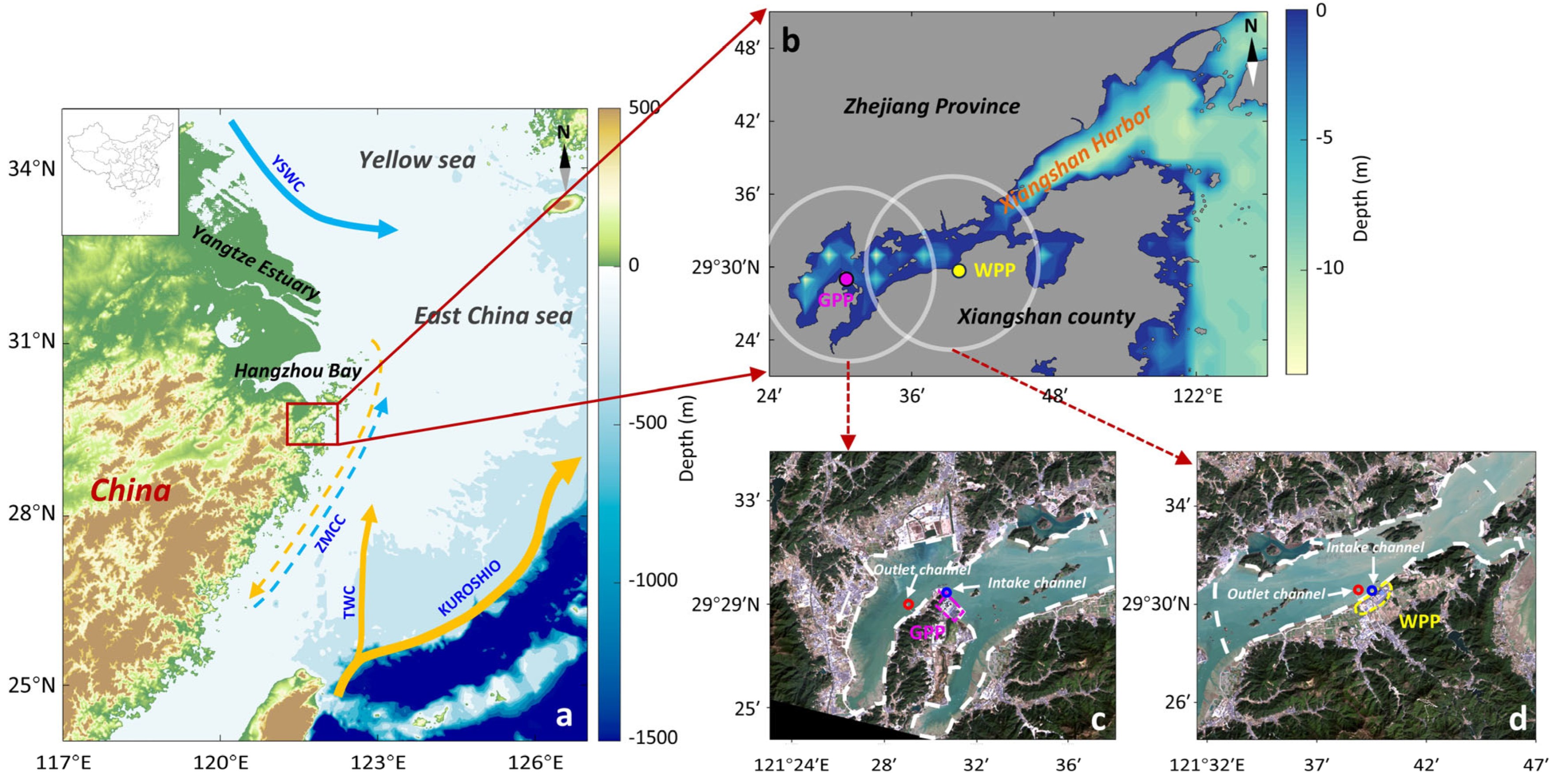
The Xiangshan Harbor (29°05′N–29°46′N, 120°00′E–121°25′E) is located along the central coast of Zhejiang, bordering the East China Sea. It is a narrow, semi-enclosed bay extending from northeast to southwest, with an average depth of 10 m and a maximum depth of 47 m. The bay stretches approximately 60 km in length and has a relatively narrow width (the widest part is only 18 km, while the inner port ranges from 3 to 8 km), covering an area of about 563 km2.
To address the power shortage in eastern Zhejiang, China constructed two large coal-fired power plants in Xiangshan Harbor: the GPP and the WPP, which commenced operations in 2005 and 2006, respectively. The geographical location imparts Xiangshan with distinct subtropical monsoon climate characteristics. Xiangshan Harbor exhibits significant tidal differences, characterized by a typical semi-diurnal tide. The hydrodynamic conditions in the Gulf are weak, and the ecosystem is very fragile. The long-term thermal discharge of the power station into Xiangshan Harbor has potential impacts on the aquatic ecological environment and natural resources. This study investigates the sea area covering the middle and southern part of Xiangshan Harbor, as detailed in Figure 1.

2.2. Satellite Data and Preprocessing

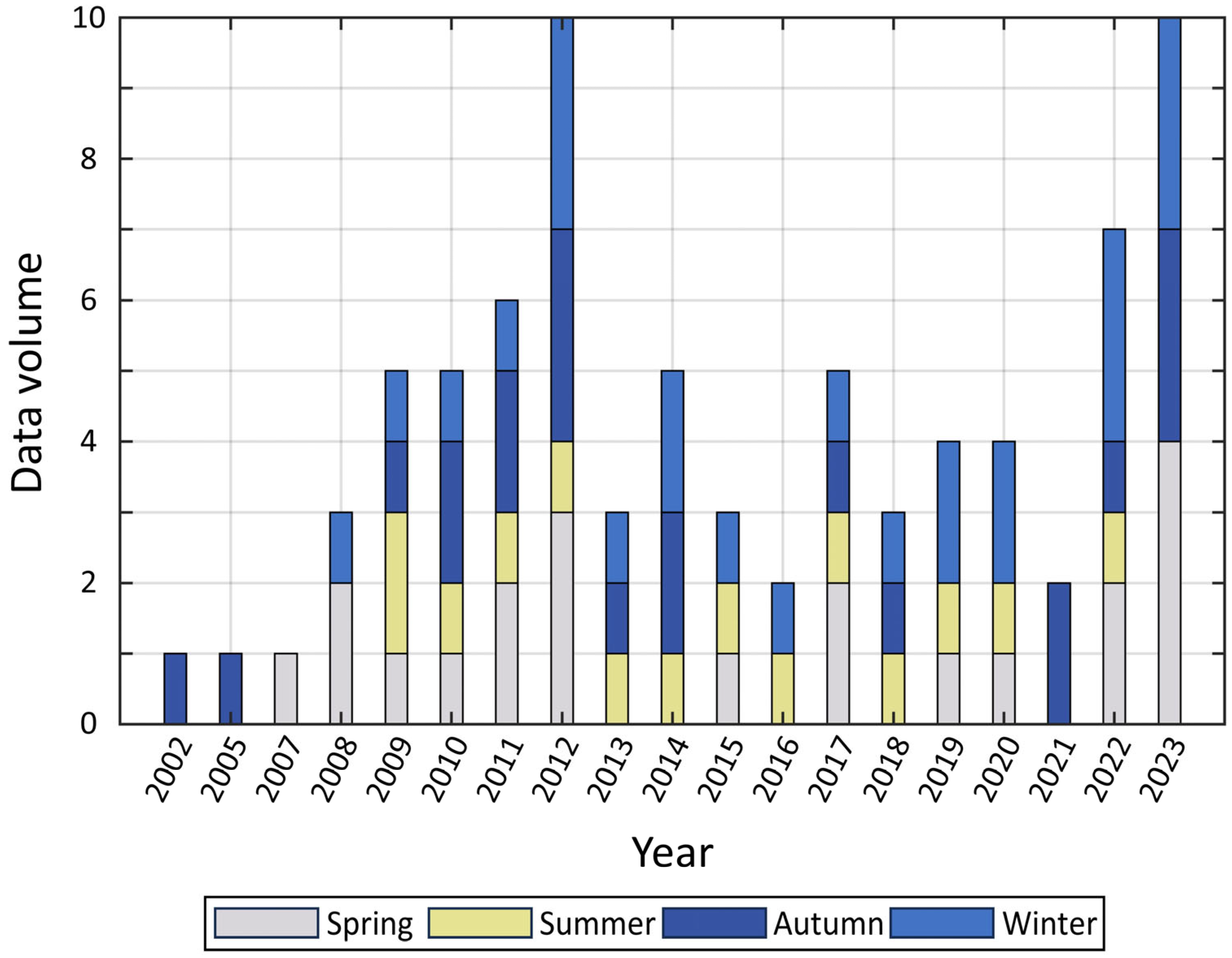
This study retrieves SST around Xiangshan Harbor Power Plant using thermal infrared images from Landsat-5/TM, Landsat-7/ETM+, and Landsat-8/TIRS. The GPP and the WPP commenced trial operations in 2005 and 2006, respectively, and were fully operational by 2008. To thoroughly examine interannual and seasonal variations in thermal-discharge patterns, 80 satellite images with cloud cover below 15% were selected, covering multiple time periods. The SST retrieval includes Landsat-5 data from 2002, 2005, and 2007–2011, Landsat-7 data from 2012, and Landsat-8 data from 2013–2023, as detailed in Figure 2. Landsat-series satellite data for this study were sourced from the National Aeronautics and Space Administration (NASA) and the United States Geological Survey (USGS) (https://earthexplorer.usgs.gov/, accessed on 13 November 2024).
Launched on 1 March 1984, the Landsat program of NASA, represented by its Landsat series of satellites, has provided a consistent and long-term record of the Earth’s surface for decades. Details of the sensors are presented in Table 1. The Landsat-5 satellite, launched in 1984 and decommissioned in 2013, was equipped with the Multi-Spectral Scanner (MSS) and the Thematic Mapper (TM) instrument, as part of this program. The thermal infrared band (B6, 10.40–12.50 μm) of the TM, with a spatial resolution of 120 m, effectively detected thermal radiation variations under normal temperature conditions.
After Landsat-5, Landsat-7 was launched on 15 April 1999, featuring the Enhanced Thematic Mapper Plus (ETM+), which enhanced the thermal infrared band’s spatial resolution to 60 m. This improvement increased the accuracy of land surface temperature monitoring. Despite data anomalies occurring after 31 May 2003, caused by the malfunction of the Scan Line Corrector (SLC), data from 2012—corrected using the SLC-off model—remains suitable for further sea surface-temperature retrieval research.
Launched on 11 February 2013, Landsat-8 carries the Operational Land Imager (OLI) and the Thermal Infrared Sensor (TIRS). TIRS features two thermal infrared bands (Band 10 and Band 11, 10–12 μm), which offer improved spectral data, enabling the retrieval of sea surface temperature using the Split-window (SW) algorithm [35].
The MODIS SST product is derived from MODIS-Terra/Aqua Level 2 ocean color remote-sensing data (https://oceancolor.gsfc.nasa.gov/, accessed on 21 December 2024). The data resolution is 1 km, with Terra overpass times nearly identical to Landsat-series images, while Aqua overpass times differ by approximately 2 h from Landsat-series images. Studies have shown that the daily variation of SST in the East China Sea coastal area is approximately 0.1–0.4 °C [36]. Therefore, it is approximated that SST remains stable over the study area over a 2-h period. The MODIS SST product can be used for cross-validation with results from the Landsat satellite series, assessing the accuracy and consistency of long-term time-series SST retrievals.
The 80 satellite datasets of the Landsat series required pre-processing to enhance image quality and usability, which involves steps such as radiometric calibration, atmospheric correction, and water extraction. Radiometric calibration aims to derive the top-of-atmosphere radiation values received by the sensor. The calibration equation uses Equation (1):
L λ   =   DN   ×   Gain     +     Bias
where Lλ is the radiance at sensor λ in W·m−2·sr−1·μm−1; DN is, and refers to, the original digital signal value recorded by the sensor; Gain is the gain value, which is used as a scaling factor to convert DN to radiance; and Bias is the offset value.
In this study, the Fast Line-of-Sight Atmospheric Analysis of Spectral Hypercubes (FLAASH) module was used to correct the calibrated top-of-atmosphere reflectance, effectively eliminating the scattering effects of water vapor and aerosols. Additionally, pixel-level adjustments were also made to address the “adjacency effect”, ensuring the acquisition of high-precision surface reflectance data.
To minimize interference from non-water features, this study applied the Modified Normalized Difference Water Index (MNDWI) method for accurate delineation of water boundaries. The MNDWI utilizes the different spectral characteristics of water and land, particularly the lower reflectance of water in the shortwave infrared (SWIR) range. By calculating the difference between the green and SWIR bands, a threshold is determined, enabling effective separation of water from land. The equation is as follows:
MNDWI   = ( Green     MIR ) ( Green     +     MIR )
where Green refers to radiance values in the green band: B2 (0.52–0.60 μm) for Landsat-5 and Landsat-7, and B3 (0.53–0.59 μm) for Landsat-8. MIR indicates radiance values in the mid-infrared band: B5 (1.55–1.75 μm) for Landsat-5 and Landsat-7, and B6 (1.55–1.65 μm) for Landsat-8.
To ensure inter-sensor consistency, all Landsat-5, -7, and -8 TIR data were resampled to a uniform 100 m×100 m resolution using bicubic interpolation, reducing potential sensor-related biases and improving temporal comparability [37]. In addition, a one-pixel buffer around the outlet was also excluded, to minimize mixed-pixel effects.

2.3. Model Simulations and Observed Data

Tidal current data for the Xiangshan Harbor area were obtained using the Finite Volume Coastal Ocean Model (FVCOM). This numerical model, known for its high computational accuracy and efficiency, applies the Finite Volume Method (FVM), and is particularly effective in modeling coastal boundaries and seabed topography [38]. The study area is located from 121°24′E to 122°6′E and 29°21′N to 29°51′N. Tidal current simulations were conducted for 8 December (neap tide), 12 December (mid-tide), and 17 December (spring tide) of 2020, with a temporal resolution of 1 h. From these 24-h simulations, data representing rapid current variations during flood and ebb tides were extracted for analysis.
The depth, topography, and coastline data utilized in this study were sourced from the ETOPO Global Relief Model, provided by the National Centers for Environmental Information (NCEI) under NOAA (https://www.ncei.noaa.gov/products/etopo-global-relief-model, accessed on 26 November 2024). Since ETOPO1’s release in 2010, the model has incorporated the latest advancements in data acquisition and processing methods. It combines extensive datasets from airborne lidar, satellite altimetry, and ship-based bathymetry, collected from both U.S. and international sources [39]. As a result, substantial enhancements have been made in geographic positioning and vertical accuracy.

2.4. Chl-a Inversion Algorithm

In examining the spatial relationship between concurrent Chl-a concentration and SST, the Chl-a model established by Huang et al. [40] was adopted, and the spatial distribution of Chl-a concentration within the study area was mapped using Landsat-8/OLI satellite data. The equation is as follows:
C chla = 124.3   ×   ( B 4 ) 2   +   15.28   ×   ( B 4 )   +   0.914
where C chla is the Chl-a concentration in μg/L, and B 4 is the reflectance of Landsat-8/OLI data in the near-infrared band.
The algorithm was previously validated using an independent in situ dataset collected in the adjacent coastal waters of the Zhoushan Archipelago (approximately 56 nautical miles northeast of Xiangshan Harbor, exhibiting similar estuarine–shelf optical characteristics) [41]. The validation results demonstrated that the adopted Chl-a algorithm performs well in waters with optical and dynamic conditions comparable to those of Xiangshan Harbor (R2 = 0.8338, RMSE = 0.6284 μg/L). Therefore, this algorithm is applicable to the study area of the present work.

2.5. SST Retrieval Algorithm

Depending on the number of thermal infrared bands of the sensor and the absolute radiometric calibration accuracy and noise equivalent temperature difference of each band, either single-channel or multi-channel SST retrieval methods can be selected. In this study, the SST inversion of Landsat-5 and Landsat-7 satellite data with only one thermal infrared spectral band was performed, using the radiative-transfer equation method [34]. For Landsat-8 satellite data, which possesses two thermal infrared bands, an improved split-window algorithm was used [35,42].

2.5.1. Radiative-Transfer Equation

The radiative-transfer equation approach mainly utilizes synchronized atmospheric sounding data to calculate the atmospheric influence on thermal radiation emitted from the Earth’s surface. By removing this atmospheric effect from the total radiation detected by satellite sensors, the intensity of sea-surface thermal radiation is determined. This value is then converted into sea surface temperature using the Planck Function.
Using the thermal infrared radiation-transfer equation, calculate the radiance corresponding to sea surface temperature in the study area. The equation is as follows:
L ( T S ) = L Sensor L up τ ( θ ) ε -   1 ε ε L down
where L ( T S ) represents sea surface radiance (W·m−2·sr−1. μm−1), L Sensor represents apparent radiance (W·m−2·sr−1. μm−1), and L up and L down represent the upwelling and downwelling atmospheric radiance (W·m−2·sr−1. μm−1). τ ( θ ) stands for atmospheric transmittance, and ε is the sea surface emissivity. Given that the study area is a relatively flat sea surface, we assigned the sea surface emissivity a value of 0.992. Furthermore, the atmospheric correction parameters for the Landsat ( τ ( θ ) , L up and L down ) are obtained from the USGS Landsat Collection-2 Surface Temperature products (ST_ATRAN, ST_URAD, and ST_DRAD).
The thermal radiance intensity is then converted into SST, with the equation as follows:
SST   =   K 2 / Ln   [ 1   +   K 1 / L ( T S ) ]
where K 1 and K 2 are predefined constants before satellite launch. For Landsat-5, K 1 = 607.76 W·m−2·sr−1. μm−1, K 2 = 1260.56 K. For Landsat-7, K 1 = 666.09 W·m−2·sr−1. μm−1, K 2 = 1282.71 K.

2.5.2. Split-Window Algorithm

The Jiménez-Muñoz Split-Window Algorithm employs two adjacent bands of TIRS to retrieve surface temperature [35]. It is built upon the framework introduced by Sobrino et al. [43], and has been re-parameterized for the Landsat-8 TIRS bands. The corresponding equation is as follows:
T S =   T 10   +     C 1 T 10   T 11   +     C 2   T 10 T 11 2   +     C 0   +     C 3   +     C 4 w 1 ε   +     C 5   +   C 6 w Δ ε
where T S is the SST inversion result, and T10 and T11 represent the brightness temperature values of the B10 and B11 of TIRS, respectively. Ci denotes the calculation coefficients obtained through the simulation of 4714 Atmospheric profile data using the GAPRI database in the atmospheric transmission software MODTRAN. Their values are as follows: C0 = −0.268, C1 = 1.378, C2 = 0.183, C3 = 54.30, C4 = −2.238, C5 = −129.20, and C6 = 16.40. Additionally, w stands for the water vapor content value, ε represents the average sea surface emissivity for B10 and B11, and Δε indicates the emissivity increment.

2.6. Methods for Analyzing Temperature Rise Changes

2.6.1. Reference-Temperature Extraction

The reference temperature is primarily defined in relation to the thermal anomalies resulting from thermal discharge, and is characterized as the average surface temperature of the water in the region, assuming the absence of thermal discharge [44]. Compared to open sea areas, semi-enclosed bay areas such as Xiangshan Harbor are more suitable for the radius-based average temperature method [45]. This study designated a 10 km radius surrounding the power plant’s discharge outlet as the study area, adhering to the principle of covering the thermal impact zone of the power plant’s thermal discharge (illustrated by the white line in Figure 1). We first computed the average SST within the study area. Subsequently, regions within the thermal-discharge impact zone that surpass the average temperature by 1 °C or more were omitted. The average SST of the remaining bay region was calculated and utilized as the reference temperature for monitoring thermal discharge [45,46].

2.6.2. Extraction of Temperature-Rise Distribution Range

After the reference temperature was determined, the temperature rise was calculated by Equation (6) and different temperature rise intensities were identified by grading, as shown in Table 2.
T = SST T 0
where T is the temperature rise, SST is the Landsat-series satellite image inversion of temperature, and T 0 is the extracted reference-temperature value.
The methods for measuring the reference temperature and extracting the thermal-rise distribution range were based on the standards outlined in the “Technical Specification for Satellite Remote Sensing Detection of Thermal Discharge from Coastal Nuclear Power Plants” (HJ1213–2021) (https://www.mee.gov.cn/ywgz/fgbz/bz/bzwb/jcffbz/202112/W020211210513662981218.pdf, accessed on 18 October 2024).

3. Results

3.1. Precision Verification

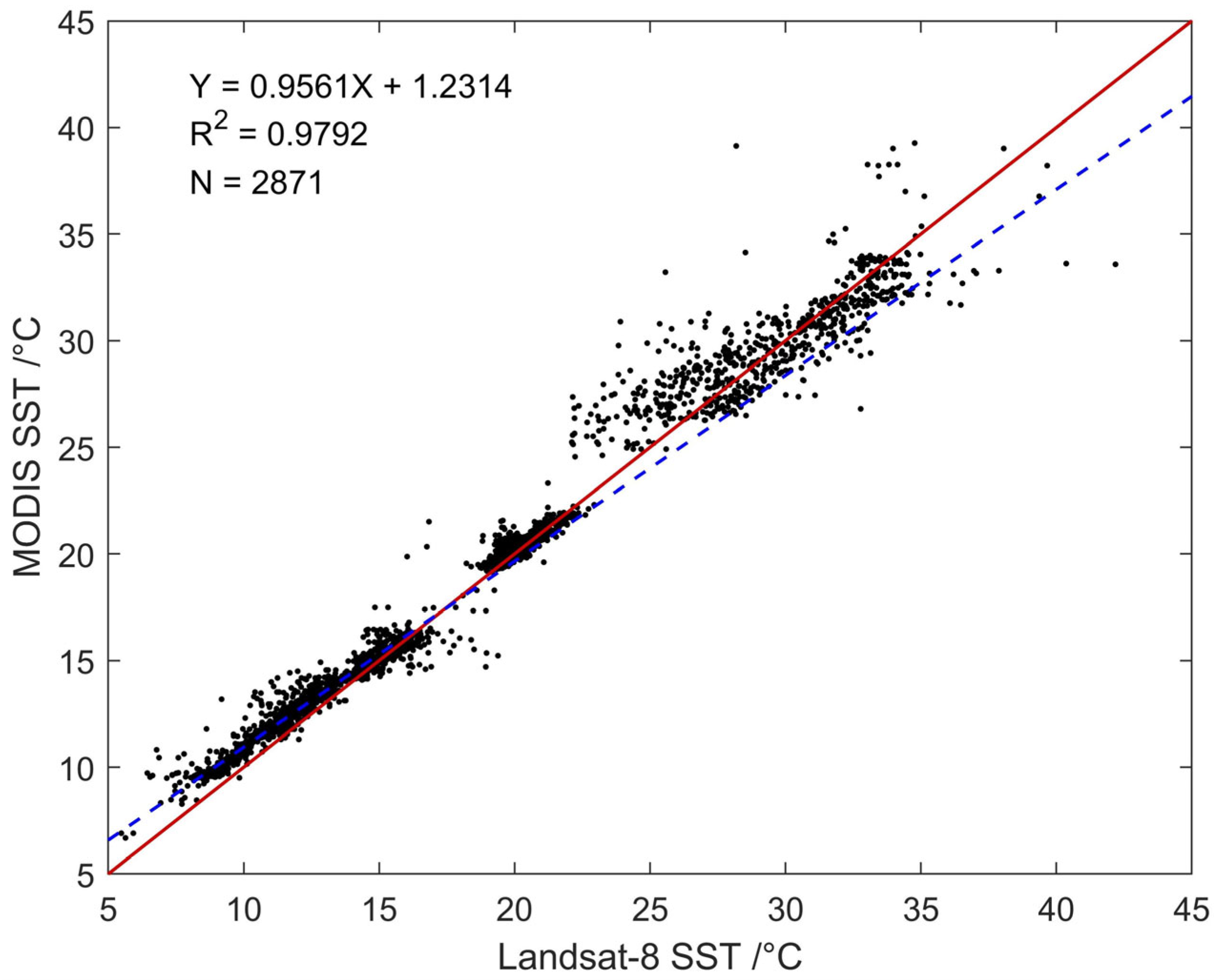
This study resampled SST inversion results from the Landsat series to a spatial resolution of 1 km, to correspond with the MODIS dataset from the same day, selecting pixel values from the Xiangshan Harbor area for validation. The findings reveal a strong correlation between the two datasets (R2 = 0.9792) (Figure 3), indicating that the SST derived from Landsat satellite data aligns closely with MODIS SST products, showcasing high accuracy and consistency. Landsat-series satellite SST data can be used to analyze the spatial and temporal patterns and trends of the thermal plume in the waters around the Xiangshan Harbor Power Plant.

3.2. Interannual Variability in the Distribution of Thermal Plumes

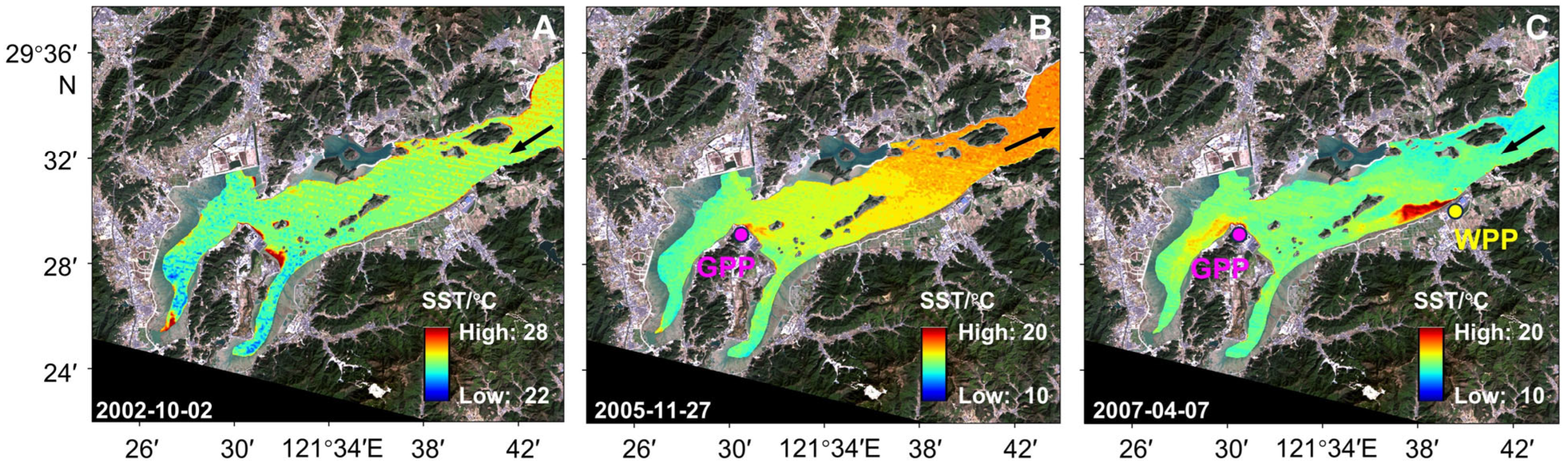
Based on Landsat-5/TM satellite data, this study selected three SST inversion images of the study area, captured at distinct times (2 October 2002; 27 November 2005; and 7 April 2007) (Figure 4). The SST in October 2002 ranged from 22 to 28 °C. As GPP and WPP were not operational, there was no significant seawater temperature increase around the power plants (Figure 4A). On 27 November 2005, the SST ranged from 10 to 20 °C. The black arrows denote the orientation of the sea currents, and the satellite image was captured during low tide. The thermal discharge released by GPP is carried outward by ocean currents, leading to a 1–4 °C rise in SST compared to the surrounding waters. As WPP was not yet operational, there were no signs of thermal plume in its vicinity (Figure 4B). SST on 7 April 2007, ranged from 10 to 20 °C, with black arrows indicating high tide conditions. SST near the GPP and WPP drain outlets was 1–6 °C warmer than the surrounding waters, with thermal plume having a significant effect in the waters southwesterly of the outlets, and spreading with the currents along the shoreline base and into the bay (Figure 4C).
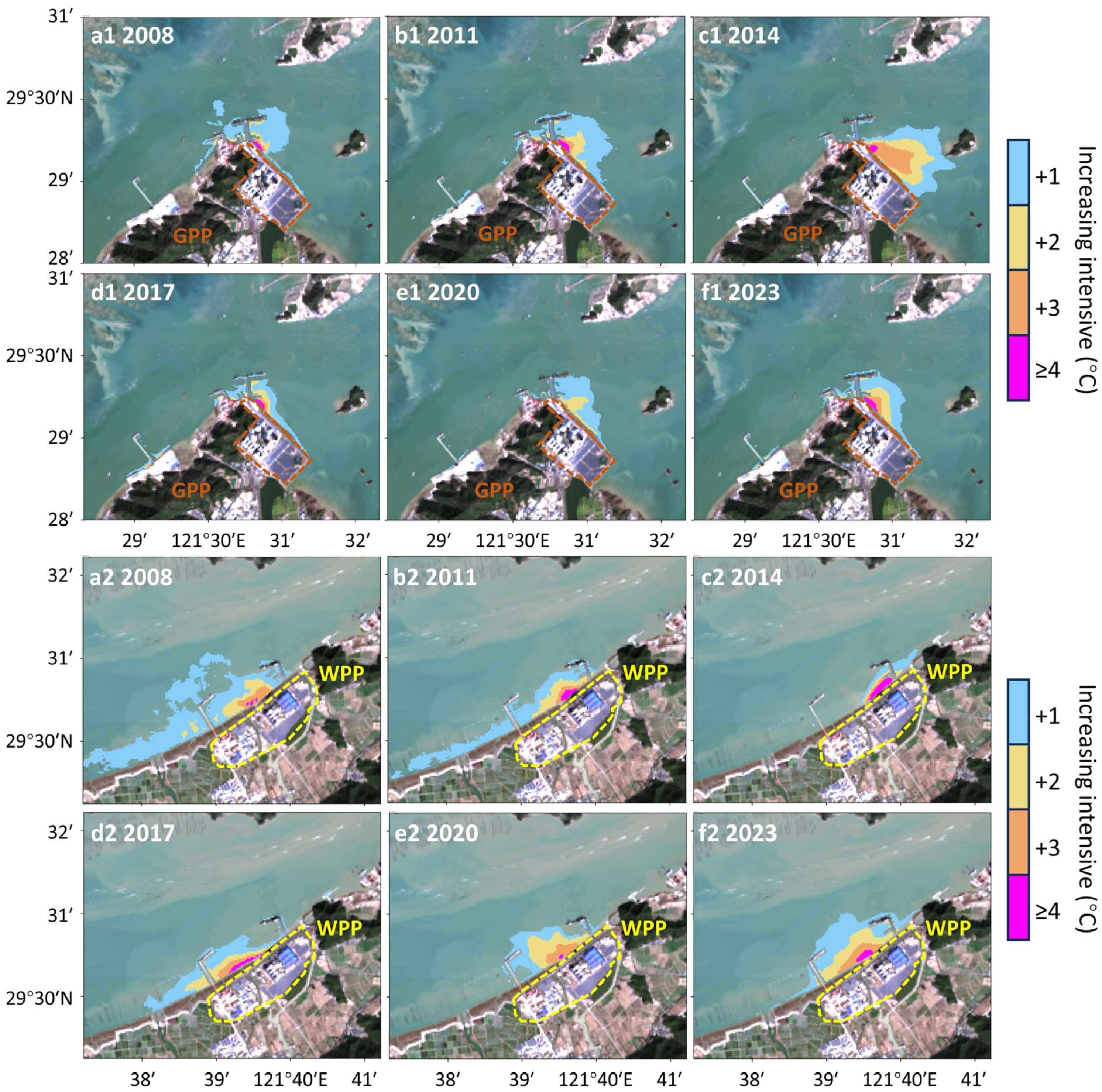
The GPP and WPP began to operate normally in 2008 [15]. This work integrated and superimposed annual thermal plume remote-sensing monitoring results [16], to examine the fluctuations in the extent of thermal discharge over an extended time series. For each year from 2008 to 2023, preprocessed Landsat scenes were used to retrieve SST. For every scene, the temperature rise was computed using the reference temperature T 0 (Section 2.6). The scene-level ΔT fields were then averaged to obtain the annual mean T map, which was classified into four thermal-intensity levels (+1 °C, +2 °C, +3 °C and +4 °C). Figure 5 depicts the spatial distribution of annual mean thermal-rise classes in the GPP and WPP regions for 2008, 2011, 2014, 2017, 2020, and 2023, with each temperature-rise interval color-coded. The figure clearly shows the range of the thermal-discharge envelope and the spatial variation of the annual average area for each intensity level. Employing identical methods, seasonal thermal-discharge envelopes were delineated for spring (March–May), summer (June–August), autumn (September–November), and winter (December–February of the subsequent year). The average regions of various thermal-rise intensity levels were computed for each season. This methodology facilitates the examination of interannual and seasonal fluctuations, including the spatial and temporal distribution characteristics of thermal discharge in the study area from 2008 to 2023.
According to the interannual thermal-discharge envelope maps, approximately half a square kilometer of surface water next to the GPP and WPP discharge stations exhibits a thermal increase exceeding 2 °C (Figure 5). The thermal rise zone adjacent to the GPP discharge point, located at the bottom of the port, radiates in a fan-shaped configuration toward the southeast (Figure 5a1–f1). A long and narrow region with a thermal increase beyond 1 °C develops along the coast near the WPP discharge point, located in the center of the bay, aligned southwest-to-northeast (Figure 5a2–f2). The geographical distribution features are intricately linked to the terrain and flow velocity at the locations of the two power plants.
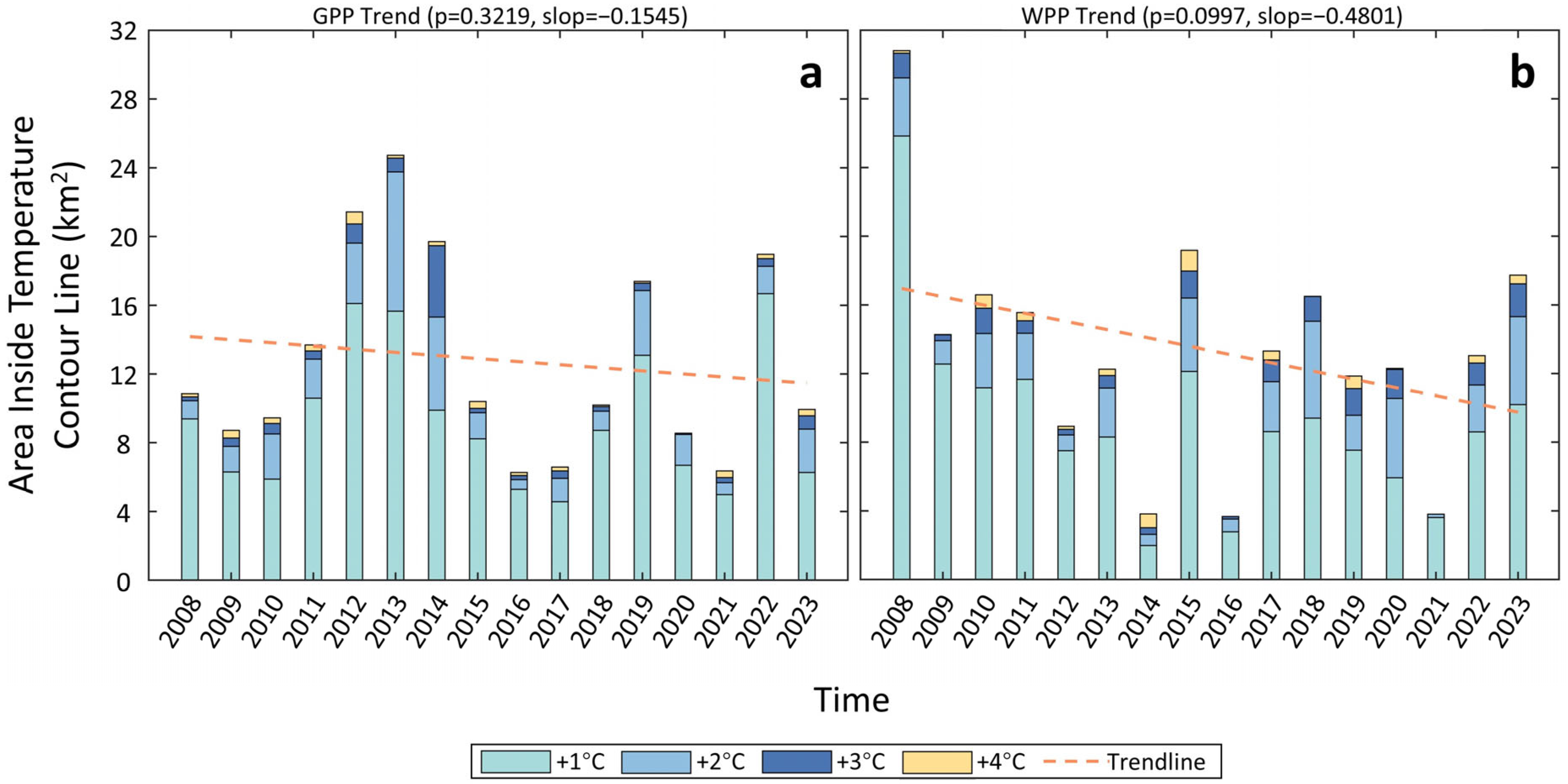
Analysis of the thermal rise area from 2008 to 2023 (Figure 6) shows a linear trend slope of –0.1545 (p = 0.3219) for GPP, indicating a decreasing tendency, while WPP exhibits a slope of –0.4801 (p = 0.0997), reflecting a statistically significant decreasing trend at the 90% confidence level. Each year, the regions with lower thermal increases (+1 °C, +2 °C) were more extensive than those with higher thermal increases (+3 °C, +4 °C), exhibiting significant variability. For GPP, the range of thermal discharge in 2008 was relatively small, with the total area of thermal-discharge envelope being approximately 10.86 km2, primarily concentrated at +1 °C (Figure 6a). As operational conditions and installed capacity expanded, the thermal-discharge area increased, peaking in 2013 with the total area of thermal-discharge envelope at 24.73 km2, with thermal rises concentrated between +1 °C and +2 °C. In contrast, WPP reached its peak thermal-discharge volume and diffusion range in 2008, with an area of about 30.79 km2, primarily concentrated at +1 °C (Figure 6b).

3.3. Seasonal Variability in the Distribution of Thermal Plumes

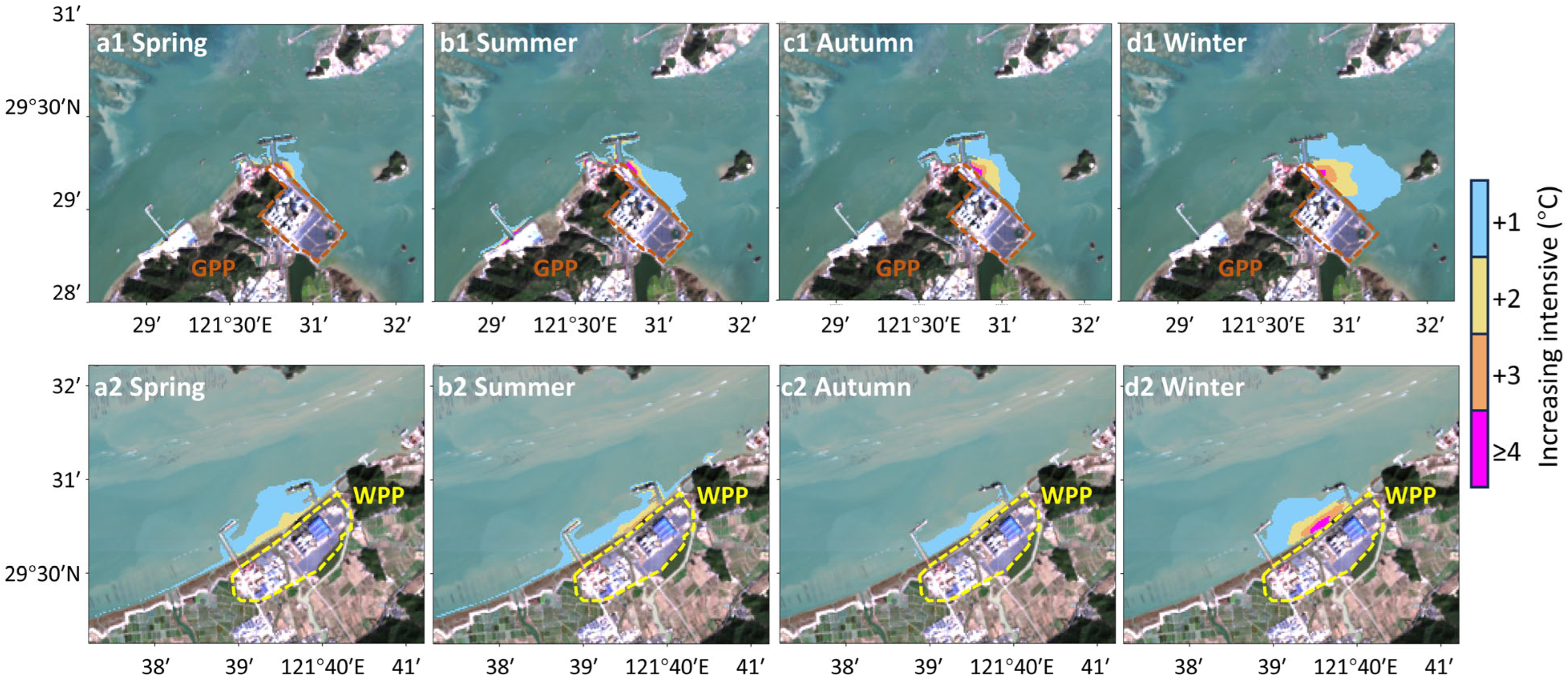
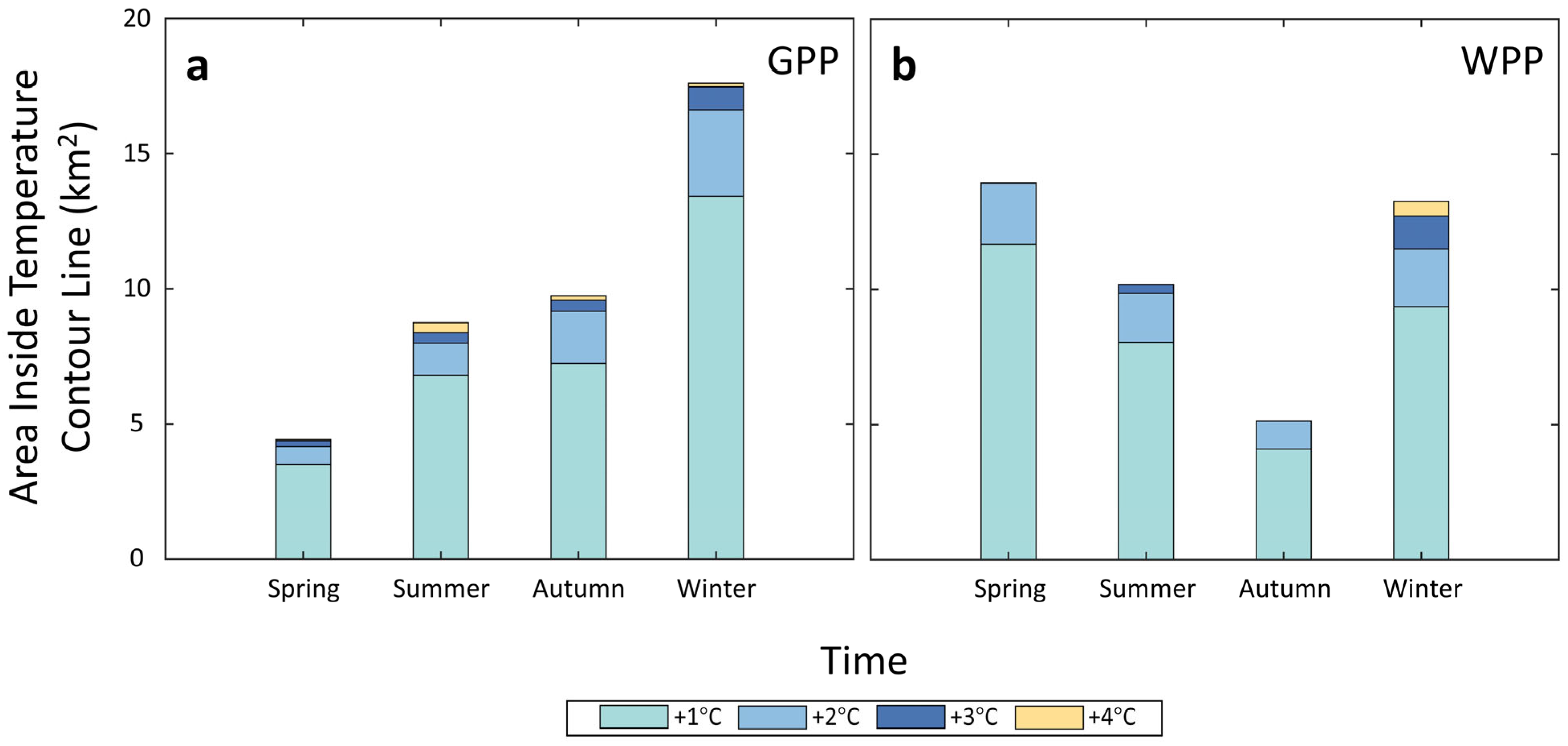
Figure 7 depicts the spatial distribution of thermal discharges from the two power plants in Xiangshan Harbor during several seasons. High thermal-increase locations (+3 °C, +4 °C) were primarily concentrated near the discharge outlets of GPP and WPP, exhibiting a cluster-like distribution. Conversely, regions of little heat increase (+1 °C, +2 °C) were dispersed outward from the discharge outlets in a fan-shaped pattern. The statistical analysis of thermal rise areas across several seasons (Figure 8) indicated that higher temperature-rise intensities corresponded to smaller area distributions. The low thermal-rise areas (+1 °C, +2 °C) exhibited significant seasonal variations, whereas the high thermal-rise areas (+3 °C, +4 °C) showed minimal changes.
Analysis of the total areas of thermal-discharge envelopes throughout several seasons reveals that GPP exhibits the most extensive thermal-plume dispersion in winter, encompassing an area of 17.6 km2, succeeded by autumn and summer; however, spring records the smallest area, at about 4.43 km2. The overall area of thermal rise in winter is quadruple that of spring (Figure 8a). In contrast, for WPP, the total area of thermal-discharge envelope is largest in spring (13.95 km2) and smallest in autumn (5.13 km2). Moreover, during spring and autumn, there is no high-amplitude thermal-discharge envelope exceeding 2 °C near the discharge point (Figure 7a2,c2 and Figure 8b). Thus, the amplitude of change in the thermal rise will be smaller for WPP compared to GPP.

3.4. Tidal Effects on Therma- Plume Distribution

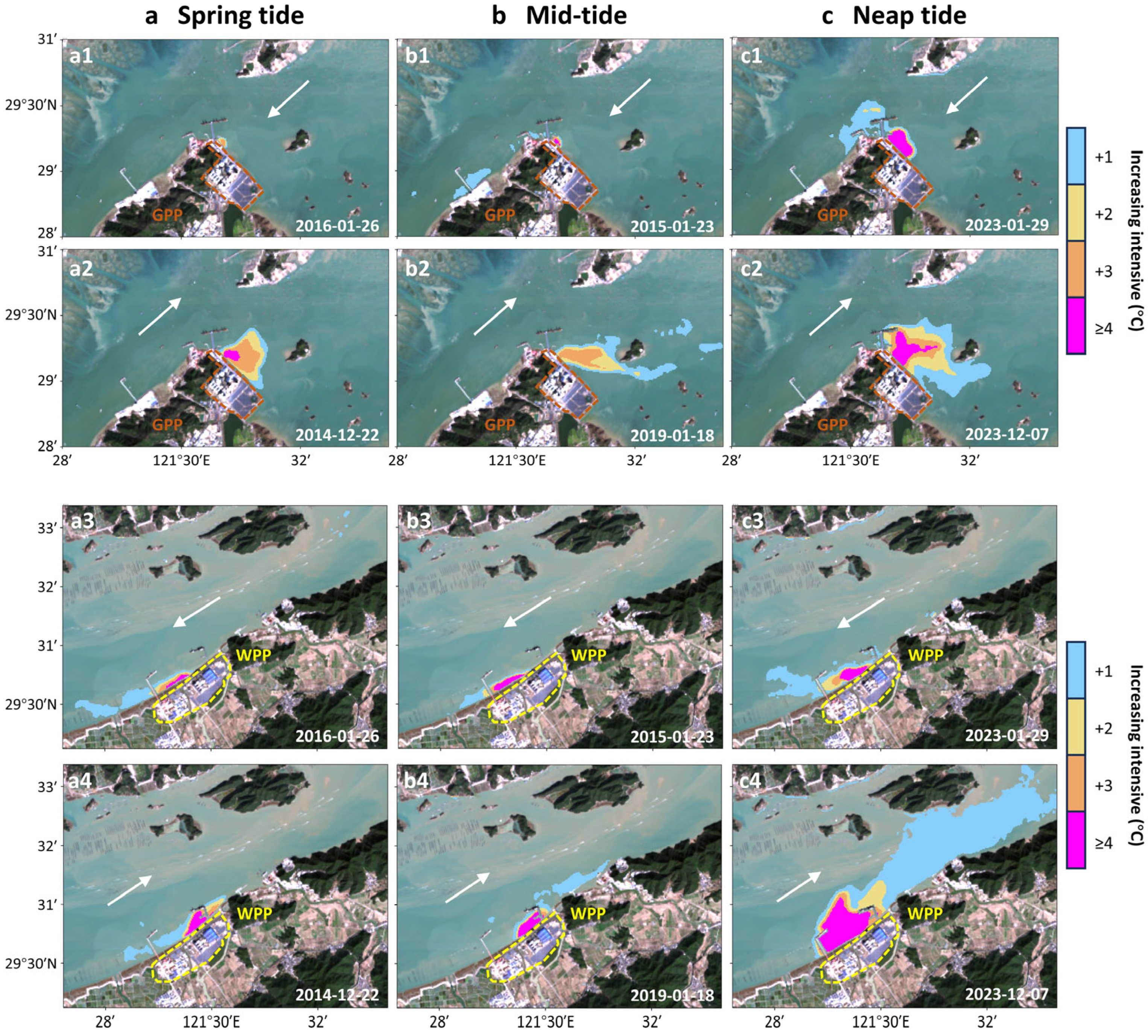
The extent of thermal-discharge influence in the study area is strongly linked to particular hydrodynamic conditions, including tidal flows [16]. To further investigate the patterns of thermal-discharge dispersion under different tidal conditions, this study collected satellite imagery of Xiangshan Harbor Power Plant during winter, capturing thermal rise distributions under various tidal states (spring tide, mid-tide, and neap tide) at both flood and ebb tides (Figure 9).
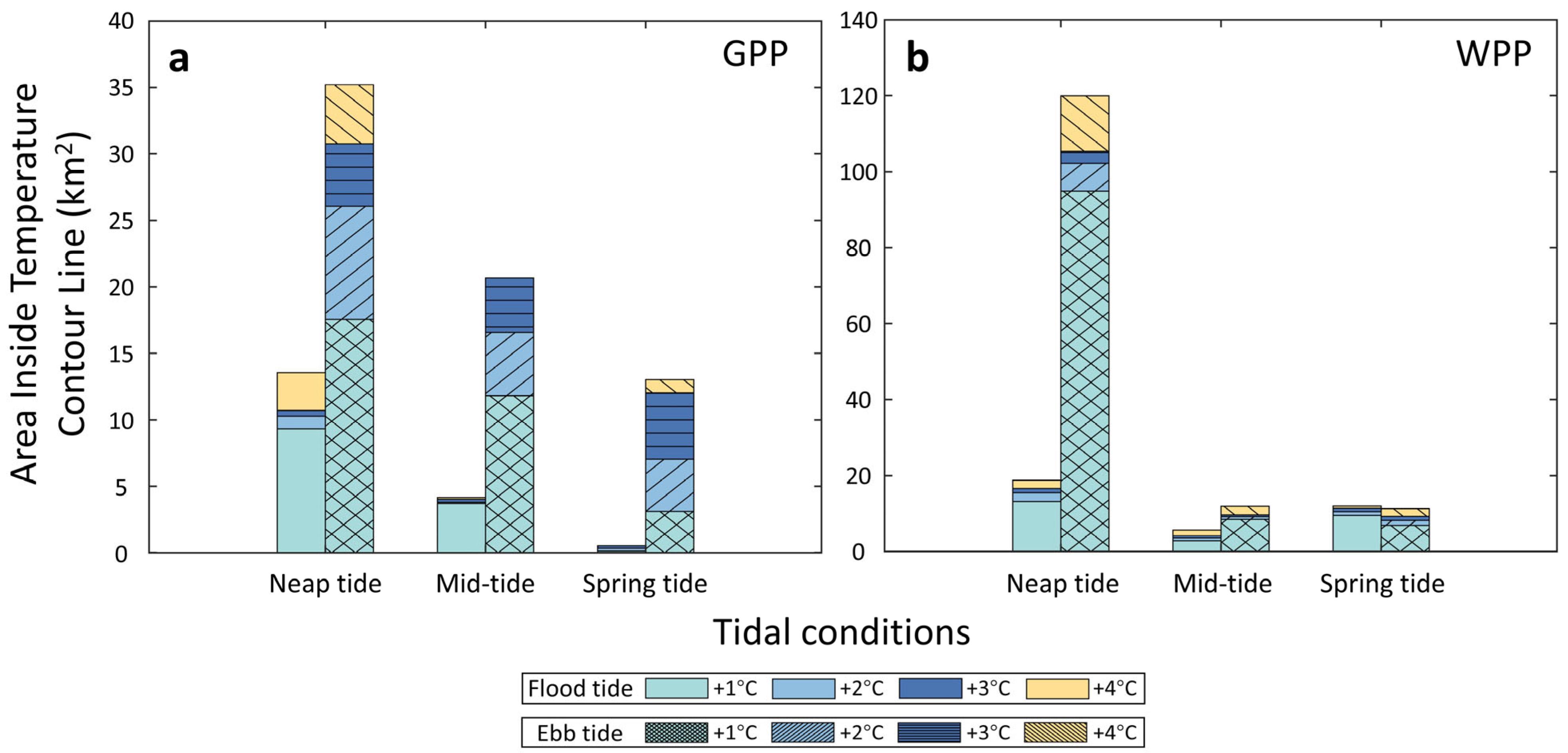
The direction of thermal-discharge dispersion aligns with the direction of tidal currents in the study area, spreading southwest and northeast along the coastline during flood and ebb tides, respectively. A comparison of the spatial distribution and average area of thermal rise zones under different tidal conditions (Figure 9 and Figure 10) reveals that, for both GPP and WPP, the area of various thermal-rise intensity levels in the surface waters is generally larger during ebb tide (Figure 9a2–c2,a4–b4) than during flood tide (Figure 9a1–c1,a3–b3). Regardless of the tidal phase, during neap tide (Figure 9c1–c4), the surface water area covered by the same thermal-rise intensity level exceeds that of mid-tide (Figure 9b1–b4) and spring tide (Figure 9a1–a4), with this pattern consistently observed in the differences in thermal rise areas. Under various tidal conditions, the difference in the area of thermal rise is more pronounced in low thermal-rise areas (+1 °C, +2 °C) compared to high thermal-rise areas (+3 °C, +4 °C) (Figure 10).
Due to tidal fluctuations, the area of thermal rise for the two power plants varies slightly at different tidal levels. During the neap-tide ebb periods, the area of thermal rise at WPP reaches 119.94 km2 (Figure 10b), which is more than three times the area of 35.18 km2 (Figure 10a) at GPP. In contrast, during the neap-tide flood periods, the thermal rise areas of both power plants are almost identical. The area of thermal rise showed no significant difference between WPP and GPP during mid-tide, regardless of whether it was flood tide or ebb tide. Similarly, during the spring-tide ebb periods, the thermal rise area remained nearly the same for both power plants. However, the area of thermal rise in the GPP is only 0.53 km2 during the spring-tide flood periods, indicating a very limited diffusion range of thermal discharge, and suggesting that GPP has a relatively small impact on the surrounding water environment under these tidal conditions.

4. Discussion

4.1. The Primary Factors Affecting the Spatial Distribution Characteristics of Thermal Plume

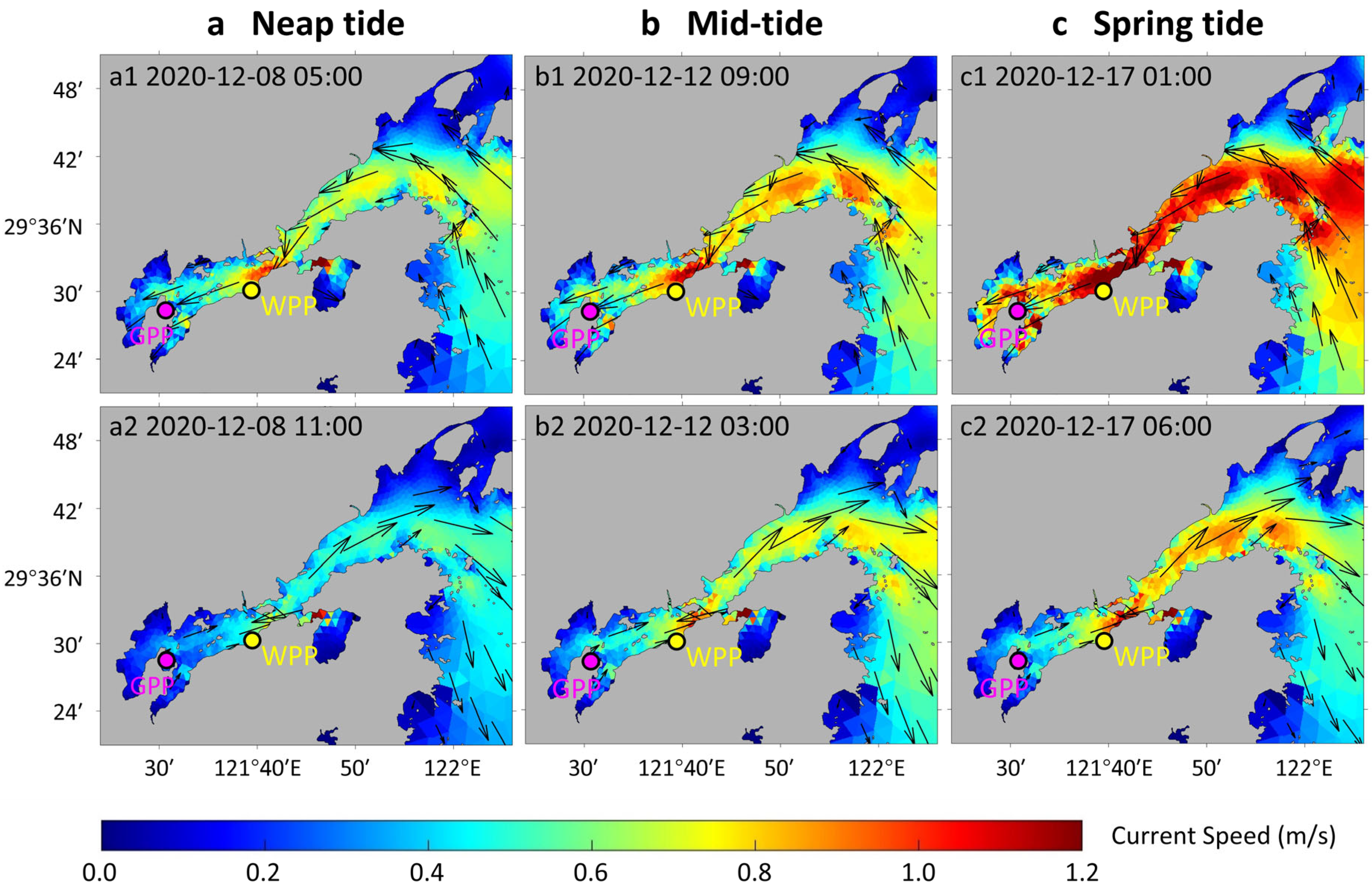
Xiangshan Harbor is located north of Hangzhou Bay and south of Sanmen Bay, with the Zhoushan Archipelago to the east (Figure 1). The tidal variations within the fjord are primarily influenced by the external tidal waves from the Niubishan Channel, which facilitate water exchange with the East China Sea [47,48]. Influenced by the shape and topography of the fjord, the tidal currents in the bay are characterized by a clear reciprocal flow, with two flood tides (southwestward) and two ebb tides (northeastward) each day [47], which are generally parallel to the coastline (Figure 11). Consequently, the surface water-temperature diffusion directions of GPP and WPP align with the tidal flow directions (Figure 9). With data limitations, the surface current data for Xiangshan Harbor were taken from 8 December (Figure 11a), 12 December (Figure 11b), and 17 December 2020 (Figure 11c). Tidal features and patterns follow a daily cycle, allowing the tides observed on any given day to effectively demonstrate the tidal variations within the study area.
In the winter study area, analysis of the FVCOM model’s tidal distribution maps (Figure 11) reveals significant differences in tidal range fluctuations and flow velocities during spring, middle, and neap tides. Specifically, compared to spring and middle tides (Figure 11b,c), the flow velocity of seawater during neap tides is considerably slower (Figure 11c), which reduces the tidal mixing effect on thermal discharge. Additionally, the lower water levels during neap tides result in a reduced volume of seawater available to receive thermal discharge. Consequently, the surface area of thermal-discharge diffusion during neap tides is more extensive than during spring and middle tides (Figure 9c1–c4), with a higher proportion of high-temperature zones (+3 °C, +4 °C). Further observation shows that the WPP, located in the central part of Xiangshan Harbor (yellow marker in Figure 11), has deeper water (Figure 1b) and faster flow speeds compared to the GPP near the bottom of the harbor (pink marker in Figure 11). This results in smaller seasonal variations in thermal rise at the WPP discharge point (Figure 7a2–c2). However, driven by vigorous currents, the surface area covered by a 1 °C thermal rise at the WPP far exceeds that of the GPP at the same time (Figure 9c2,c4). In summary, flow velocity, coastline topography, and water depth are key factors in determining the diffusion capacity and amplitude of change in thermal rise of thermal discharges. The contribution of these factors to thermal-discharge diffusion has been well documented and widely recognized in previous studies [20].
The tidal waves within the bay exhibit the characteristics of standing waves [47], and their flow velocities at ebb and flood tides are influenced by the coastline and seabed topography. Tidal current velocities are significantly higher at moments of flood-tide rapids (see Figure 11a1–c1) than at moments of ebb-tide rapids (see Figure 11a2–c2). Due to the direct discharge water-cooling system employed by the power plants [17], the discharge outlets are exposed above the sea surface during ebb tides and submerged during flood tide. This discharge method, combined with the higher flow velocities during flood tide, results in more pronounced vertical dissipation of heat, thereby reducing the total area of the thermal rise region during flood tide compared to ebb tide (Figure 9 and Figure 10).
The range and distribution characteristics of the thermal rise in the GPP and WPP exhibit significant differences in different seasons, which are primarily driven by seasonal variations in the air–sea temperature difference. The northern subtropical monsoon climate of Xiangshan Harbor is characterized by rising air temperatures in the spring, which exceed the water temperature, leading to heat absorption by the sea surface. The smaller temperature difference between the air and the thermal discharge in spring hinders heat dissipation, resulting in the largest thermal-rise range. In contrast, during autumn, the air temperature drops below the water temperature, increasing the temperature difference and facilitating heat dissipation, which leads to the smallest thermal-rise range. Winter and summer exhibit low and high temperatures, respectively, with smaller sea–air temperature differences, resulting in moderate thermal-rise ranges [49]. These findings align with the seasonal trends in WPP thermal discharge observed in our study (Figure 8b).
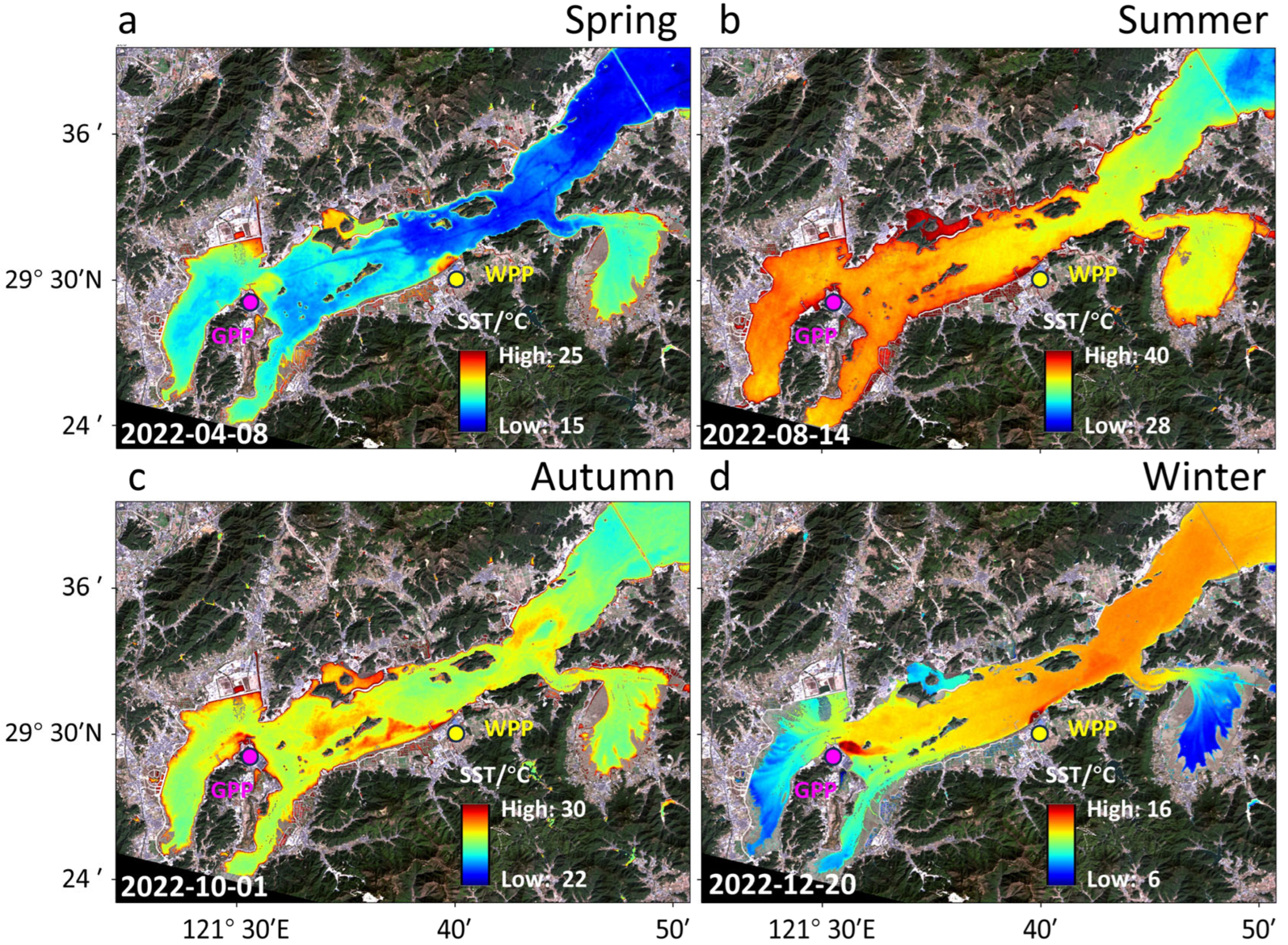
Upon further examination of the seasonal SST distribution (Figure 12), it is evident that the GPP region, located at the bottom of Xiangshan Bay, and the WPP region, situated in the middle of the bay, exhibit distinct seasonal characteristics in SST spatial distribution. In the spring and summer, the GPP region shows higher SST compared to the WPP region, while in the winter, the GPP region has relatively lower SST. This difference in seasonal and spatial distribution of variability is primarily attributed to the coastal wetland characteristics of the GPP area, which is significantly influenced by sediment content and tides throughout the year. The higher sediment load more effectively absorbs and retains heat, leading to greater temperature fluctuations in this region. In contrast, the WPP, located closer to the estuary, is relatively unaffected by sedimentation, due to the influence of outer ocean waters, the influx of land-based rivers, and its greater water depth. For these reasons, the heat-dissipation effect of thermal discharge in the GPP region is more significant in the spring, whereas it is relatively less effective in the winter. This seasonal effect is reflected in the total area of the thermal-discharge envelope, with the GPP region exhibiting a larger thermal-discharge envelope in winter compared to spring (Figure 8a).

4.2. Impact on Coastal Environment of Thermal Plume

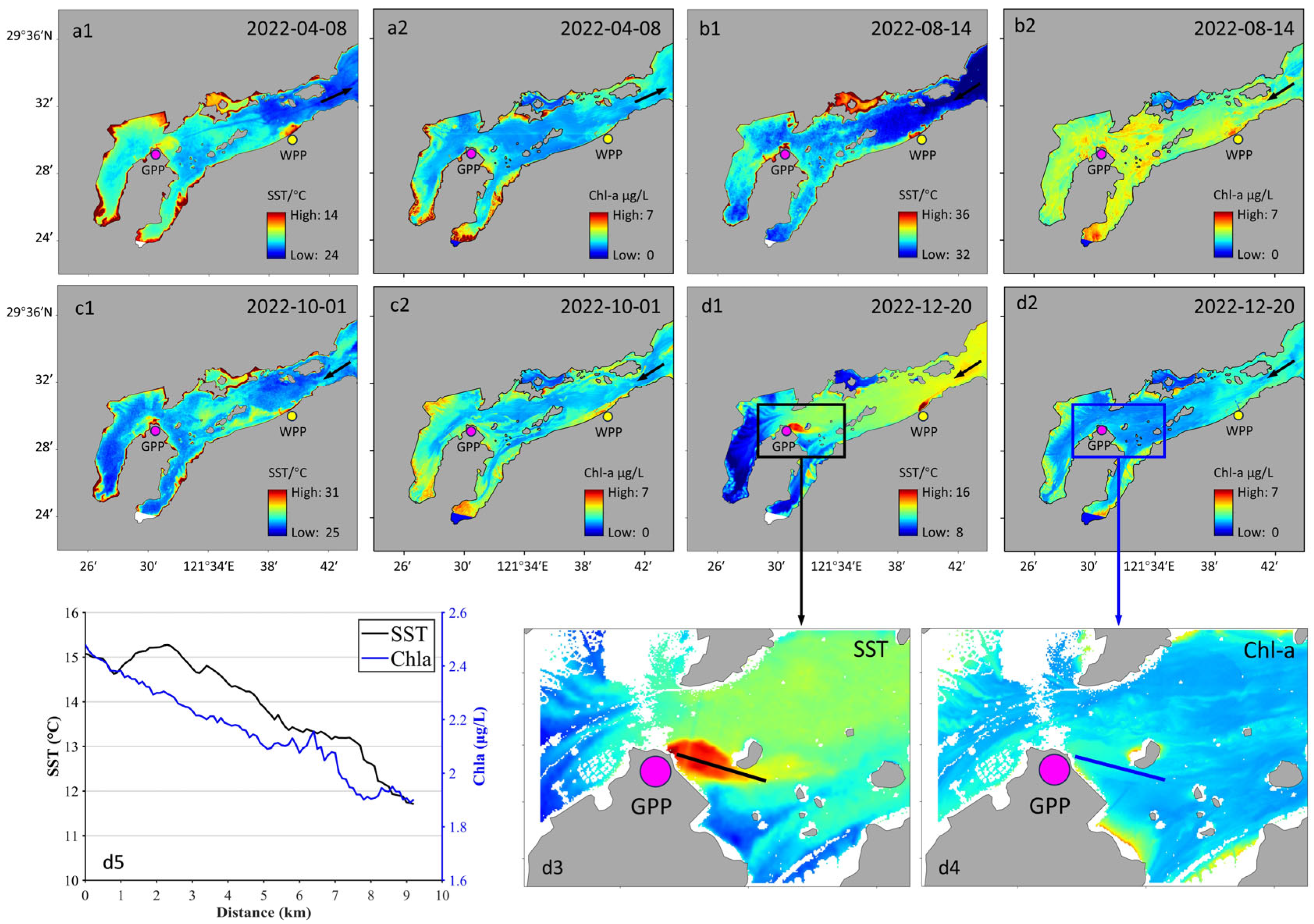
Based on the validated Chl-a inversion approach described earlier, Landsat-8/OLI satellite data was used to map the spatial variation of Chl-a concentration within the study area (Figure 13). Using winter as an example, the relationship between Chl-a concentration and the spatial distribution of SST during the same period was explored (Figure 13d3,d4), to reveal the potential effects of thermal plumes on the coastal ecosystem. There is a significant consistency between the coverage areas of thermal discharges from GPP and WPP and the regions with high Chl-a concentration across different seasons (Figure 13a1–d1,a2–d2), and a positive correlation is observed between them (Figure 13d3–d5). Previous research has shown a significant relationship between the variability in fish eggs and larvae biomass densities and the spatial distribution of Chl-a concentration [41]. Chl-a is a key indicator of phytoplankton biomass, and represents the foundational stage of the aquatic food chain [50]. Furthermore, it can be utilized to gauge water fertility and to estimate the potential productivity of fisheries [51,52]. Therefore, the presence of thermal discharges from GPP and WPP plays a positive role in mitigating the decline in water temperature at the bottom of the harbor during the autumn and winter seasons, which contributes, to a certain extent, to the enhancement of the productivity and biodiversity of the sea area of Xiangshan Harbor during this period.
The regional species of Xiangshan Port have distinct optimal-temperature and tolerance-temperature ranges, which we analyzed in the context of the thermal ecological niche of dominant plankton in the study area. For example, Skeletonema costatuma typically thrives around 15–25 °C [53], Prorocentrum donghaiense grows at over 15–30 °C, with an optimum near 22–28 °C and photosynthesis becoming constrained below 9 °C and above 33 °C (with tolerance limits reported around 10.2/30.6 °C) [54,55], and Prorocentrum micans Ehrenb shows maximum growth close to 25 °C and favorable growth over 18–28 °C [56]. The above algae are all common species in this sea area. During autumn and winter, when ambient temperatures fall below the suitable ranges for many diatoms and dinoflagellates, the buffering effect of thermal discharges on bottom-water temperature can keep portions of the harbor closer to species’ optimal thermal windows; this is consistent with the elevated Chl-a concentrations detected near the thermal-plume footprints (Figure 13c1,c2,d1–d5).
In contrast, the continuous release of thermal water into the aquatic ecosystem can trigger a series of problems. The most immediate changes include reduced water transparency and decreased dissolved-oxygen levels [14,57]. Nitrogen and phosphorus are released from the sediments and contribute to higher concentrations of these nutrients in the water, thereby speeding up the eutrophication process [58]. Where thermal discharges elevate local water temperatures above the ambient background, inputs of plume-warmed water in spring and early summer increase the likelihood that these taxa enter their optimal thermal windows earlier, thereby advancing algal-bloom phenology. The coincident spatial patterns between the thermal-discharge footprints and elevated Chl-a concentrations corroborate this interpretation (Figure 13a1,a2). Conversely, during peak summer, when surface temperatures exceed the upper bounds of many species’ optima (>30 °C), biomass may decline and community composition may shift toward heat-tolerant assemblages [8].
During extensive algal blooms, several adverse effects can occur. On one hand, the dense algal growth blocks sunlight from reaching bottom-dwelling aquatic plants, potentially leading to the loss of benthic organisms [59]. On the other hand, the surplus of algae serves as an easily accessible food supply for aerobic microorganisms, causing them to multiply quickly and consume more dissolved oxygen. This leads to hypoxic conditions, forming dead zones that cannot support most aquatic organisms [57,60]. Additionally, elevated temperatures (greater than a 5 °C increase) and rates of elevated warming around discharge points negatively impact the growth, development, metabolism, reproductive-cell maturation, and life cycles of aquatic organisms [14]. For example, these changes may result in developmental abnormalities in fish, severely impacting migratory species [61], and could even lead to shifts in the composition of aquatic communities [62].
This study has not yet obtained synchronous in situ measurement data for relevant biological environmental indicators. Future work will integrate targeted field surveys with a lower-trophic-level ecosystem model to validate and quantify thermal-plume effects on algal-bloom phenology, biomass, and community structure.

5. Conclusions

This study aims to analyze the spatiotemporal characteristics and ecological impacts of thermal discharge from coastal power plants in Xiangshan Harbor. Utilizing Landsat satellite data from 2008 to 2023, the study employs the radiative transfer equation and the Jiménez-Muñoz split-window algorithm to extract thermal plume characteristics for GPP and NPP. By categorizing different temperature elevation levels, the study further reveals the interannual, seasonal, and tidal-cycle variations of thermal discharge from GPP and NPP. Additionally, in combination with the spatiotemporal distribution of Chl-a, the potential impacts of thermal discharge on local aquatic ecosystems are explored.
Research findings indicate that nearly half a square kilometer of surface water area near the GPP and WPP discharge points has a thermal rise of more than 2 °C, with significant spatial distribution differences in the intensity levels of thermal discharge from the two power stations. The thermal drainage, aligned with the tidal currents, exhibits a southwest-to-northeast orientation. While the GPP, located at the bottom of the harbor, has its band of thermal rise spread out in a fan shape, the WPP, located in the middle of the harbor, creates a long and narrow band with a thermal rise exceeding 1 °C along the coast. These spatial distribution characteristics are closely related to the terrain where the power plants are located and the speed of the sea currents. In addition, the low thermal-rise zones (+1 °C, +2 °C) showed large interannual variations with significant seasonal differences.
Temporally, there is a general decreasing trend in the area of thermal rise for both GPP and WPP during 2008–2023. The seasonal variations in the area of thermal rise, influenced by seasonal air–sea temperature differences, current velocities at the discharge points, and water depths, showed a tendency for the GPP to have the largest area of thermal rise in the winter and the smallest in the spring, while the WPP had the smallest area in the spring and the largest in the autumn. In addition, the amplitude of change in thermal rise in the WPP is relatively smaller than that in the GPP.
Tidal patterns have a significant impact on the diffusion of thermal discharge, with the area of thermal rise being more extensive during ebb tide than flood tide, and more pronounced during neap tide than spring tide. Notably, at neap tide during ebb tide, the total area of thermal rise at WPP is nearly three times greater than that at GPP. Monitoring high-resolution Landsat satellite data reveals a significant positive correlation between thermal discharge and Chl-a concentration, indicating that thermal discharge has complex effects on aquatic organisms, predominantly positive. Moderate thermal rise during the fall and winter helps to mitigate the decrease in port water temperature, thereby enhancing productivity and biodiversity in the study area during this period.

Author Contributions

Conceptualization, R.T.; methodology, Z.Q. and L.C.; software, Z.Q. and L.C.; validation, R.T. and Z.Q.; formal analysis, R.T.; investigation, D.Z.; resources, D.Z.; data curation, R.T.; writing—original draft preparation, R.T.; writing—review and editing, Z.Q. and C.D.; visualization, R.T.; supervision, Z.Q. and D.Z.; project administration, Z.Q.; funding acquisition, Z.Q. All authors have read and agreed to the published version of the manuscript.

Funding

This research was funded by the National Natural Science Foundation of China (grant number 41976165), and the Hainan Province Science and Technology Special Fund (grant number SOLZSKY2025009).

Data Availability Statement

The Landsat satellite dataset is published by the United States Geological Survey (USGS) and is available at https://earthexplorer.usgs.gov/, accessed on 13 November 2024. The MODIS-Terra/Aqua Level 2 ocean color remote-sensing data are published by NASA Ocean Color, and can be obtained from https://oceancolor.gsfc.nasa.gov/, accessed on 21 December 2024. The ETOPO Global Relief Model is published by the National Centers for Environmental Information (NCEI) of the National Oceanic and Atmospheric Administration (NOAA), and is available at https://www.ncei.noaa.gov/products/etopo-global-relief-model, accessed on 26 November 2024.

Acknowledgments

Our sincere gratitude goes out to the anonymous reviewers for their constructive comments and suggestions which have substantially improved this paper. This study is supported by the National Natural Science Foundation of China (NoL 41976165) and the Hainan Province Science and Technology Special Fund. The authors have reviewed and edited the output and take full responsibility for the content of this publication.

Conflicts of Interest

The authors declare no conflicts of interest.

References

  1. Lan, J. Introduction of Water Thermal Impact, Beijing, China, 1993.
  2. Lin, J.; Zou, X.; Huang, F. Effects of the thermal discharge from an offshore power plant on plankton and macrobenthic communities in subtropical China. Mar. Pollut. Bull. 2018, 131, 106–114. [Google Scholar] [CrossRef] [PubMed]
  3. Li, X.; Li, B.; Sun, X. Effects of a coastal power plant thermal discharge on phytoplankton community structure in Zhanjiang Bay, China. Mar. Pollut. Bull. 2014, 81, 210–217. [Google Scholar] [CrossRef]
  4. Worthington, T.A.; Shaw, P.J.; Daffern, J.R.; Langford, T.E.L. The effects of a thermal discharge on the macroinvertebrate community of a large British river: Implications for climate change. Hydrobiologia 2015, 753, 81–95. [Google Scholar] [CrossRef]
  5. Dracup, J.A.; Fogarty, T.J. Optimal Planning for a Thermal Discharge Treatment System. Water Resour. Res. 1974, 10, 67–71. [Google Scholar] [CrossRef]
  6. Davidson, B.; Bradshaw, R.W. Thermal pollution of water systems. Environ. Sci. Technol. 1967, 1, 618–648. [Google Scholar] [CrossRef]
  7. Yang, H.; Zhao, Y.; Zhang, H.; Dai, G.; Ding, J.; Chen, J. Study on the Impact of Water Environmental Factors on Dominant Species of Phytoplankton around the Power Plant in Xiangshan Bay. Adv. Mater. Res. 2012, 610–613, 3371–3374. [Google Scholar] [CrossRef]
  8. Poornima, E.H.; Rajadurai, M.; Rao, T.S.; Anupkumar, B.; Rajamohan, R.; Narasimhan, S.V.; Rao, V.N.R.; Venugopalan, V.P. Impact of thermal discharge from a tropical coastal power plant on phytoplankton. J. Therm. Biol. 2005, 30, 307–316. [Google Scholar] [CrossRef]
  9. Zhang, J.; Wang, Y.; Ottmann, D.; Cao, P.; Yang, J.; Yu, J.; Lv, Z. Seasonal variability of phytoplankton community response to thermal discharge from nuclear power plant in temperate coastal area. Environ. Pollut. 2023, 318, 120898. [Google Scholar] [CrossRef]
  10. Gao, G.; Chen, Q.; Hu, X.; Yang, J.; Dong, Y.; Zeng, J.; Ning, X.; Zhang, J. Ecological characteristics on macrobenthos of net-cage cultural areas in the Xiangshan Bay. Acta Ocean. Sin. 2005, 27, 108–113. [Google Scholar] [CrossRef]
  11. Liao, Y.; Shou, L.; Jiang, Z.; Tang, Y.; Du, P.; Zeng, J.; Chen, Q.; Yan, X.; Chen, J. Effects of fish cage culture and suspended oyster culture on macrobenthic communities in Xiangshan Bay, a semi-enclosed subtropical bay in eastern China. Mar. Pollut. Bull. 2019, 142, 475–483. [Google Scholar] [CrossRef] [PubMed]
  12. Wang, Y.; Li, S.; Jiang, Y.; Zhang, S.; Jiao, H. Marine ranching and fishery stock enhancement in the Xiangshan Bay. J. Fish. China 2019, 43, 1972–1979. [Google Scholar] [CrossRef]
  13. Jiang, Z.; Du, P.; Liu, J.; Chen, Y.; Zhu, Y.; Shou, L.; Zeng, J.; Chen, J. Phytoplankton biomass and size structure in Xiangshan Bay, China: Current state and historical comparison under accelerated eutrophication and warming. Mar. Pollut. Bull. 2019, 142, 119–128. [Google Scholar] [CrossRef] [PubMed]
  14. Jiang, Z.; Zeng, J.; Chen, Q.; Liao, Y.; Gao, A.; Xu, X.; Shou, L.; Liu, J.; Huang, Y. Effect of heating rate on the upper incipient lethal temperature for copepods. J. Trop. Oceanogr. 2010, 29, 87–92. [Google Scholar] [CrossRef]
  15. Lin, Y.; Guo, Z.; Kan, P.; Ye, S. Research on Thermal Discharge Pollution of Xiangshan Power Plant Based on Remote Sensing. Adv. Eng. Forum 2012, 6–7, 128–134. [Google Scholar] [CrossRef]
  16. Zhang, H.; Zhao, Y.; Yang, H.; Cheng, B.; Ding, J.; Dai, G.; Du, P. Study on the temperature rise characteristics and influence effects of thermal discharge from coastal power plant in Xiangshan Bay. J. Shanghai Ocean. Univ. 2013, 22, 274–281. [Google Scholar]
  17. Lin, J.; Yan, Q.; Cheng, B.; Du, P. Ecological impact of thermal discharge from coastal power plants on plankton biomass in Xiangshan Bay. J. Shanghai Ocean Univ. 2015, 24, 894–905. [Google Scholar]
  18. Anupkumar, B.; Rao, T.S.; Venugopalan, V.P.; Narasimhan, S.V. Thermal mapping in the Kalpakkam Coast (Bay of Bengal) in the vicinity of Madras atomic power station. Int. J. Environ. Stud. 2005, 62, 473–485. [Google Scholar] [CrossRef]
  19. Jia, H.; Zheng, S.; Xie, J.; Ying, X.; Zhang, C. Influence of geographic setting on thermal discharge from coastal power plants. Mar. Pollut. Bull. 2016, 111, 106–114. [Google Scholar] [CrossRef]
  20. Lin, J.; Zou, X.; Huang, F. Quantitative analysis of the factors influencing the dispersion of thermal pollution caused by coastal power plants. Water Res. 2021, 188, 116558. [Google Scholar] [CrossRef]
  21. Feng, J.; Gu, J.; Kuang, C.; Zuo, L.; Zhu, Q. Advection and diffusion characteristics of a summer thermal discharge in Qinhuangdao coastal water. Shuidonglixue Yanjiu Yu Jinzhan/Chin. J. Hydrodyn. Ser. A 2018, 33, 490–499. [Google Scholar] [CrossRef]
  22. Ahn, Y.H.; Shanmugam, P.; Lee, J.H.; Kang, Y.Q. Application of satellite infrared data for mapping of thermal plume contamination in coastal ecosystem of Korea. Mar. Environ. Res. 2006, 61, 186–201. [Google Scholar] [CrossRef]
  23. Tang, D.; Kester, D.R.; Wang, Z.; Lian, J.; Kawamura, H. AVHRR satellite remote sensing and shipboard measurements of the thermal plume from the Daya Bay, nuclear power station, China. Remote Sens. Environ. 2003, 84, 506–515. [Google Scholar] [CrossRef]
  24. Bonansea, M.; Ferrero, S.; Ferral, A.; Ledesma, M.; German, A.; Carreño, J.; Rodriguez, C.; Pinotti, L. Assessing water surface temperature from Landsat imagery and its relationship with a nuclear power plant. Hydrol. Sci. J. 2020, 66, 50–58. [Google Scholar] [CrossRef]
  25. Xiong, Y.; Qiu, G. Estimation of evapotranspiration using remotely sensed land surface temperature and the revised three-temperature model. Int. J. Remote Sens. 2011, 32, 5853–5874. [Google Scholar] [CrossRef]
  26. Hansen, J.; Ruedy, R.; Sato, M.; Lo, K. Global surface temperature change. Rev. Geophys. 2010, 48, 7362–7388. [Google Scholar] [CrossRef]
  27. Zhou, Y.; Gong, C.; Hu, Y.; Chen, Q. Distribution of thermal discharge from a power station based on HJ-1B and FY-3 thermal infrared data. Int. Symp. Photoelectron. Detect. Imaging Adv. Infrared Imaging Appl. 2011, 8193, 806–815. [Google Scholar] [CrossRef]
  28. Zhou, Y.; Gong, C.; Kuang, D.; Hu, Y. Distribution of thermal discharge from a power plant: Analysis of thermal infrared data from the environmental mitigation satellite. J. Infrared Millim. Waves 2012, 31, 544–549. [Google Scholar] [CrossRef]
  29. Liang, S.; Zhang, B.; Li, J.; Zhang, H.; Sheng, Q. Distribution of therm-water pollution of nuclear power plant using the thermal infrared band of HJ-IRS data-taking daya bay as an example. Remote Sens. Inf. 2012, 2, 41–46. [Google Scholar] [CrossRef]
  30. Ding, H.; Elmore, A.J. Spatio-temporal patterns in water surface temperature from Landsat time series data in the Chesapeake Bay, U.S.A. Remote Sens. Environ. 2015, 168, 335–348. [Google Scholar] [CrossRef]
  31. Fisher, J.I.; Mustard, J.F. High spatial resolution sea surface climatology from Landsat thermal infrared data. Remote Sens. Environ. 2004, 90, 293–307. [Google Scholar] [CrossRef]
  32. Nie, P.; Zhu, H.; Xu, H.; Huang, Y.; Wu, H. Monitoring of Tianwan Nuclear Power Plant Thermal Pollution Based on Remotely Sensed Landsat Data. In Proceedings of the 2020 IEEE International Geoscience and Remote Sensing Symposium, Waikoloa, HI, USA, 26 September–2 October 2020; pp. 5624–5627. [Google Scholar]
  33. Liu, M.; Yin, X.; Xu, Q.; Chen, Y.; Wang, B. Monitoring of Fine-Scale Warm Drain-Off Water from Nuclear Power Stations in the Daya Bay Based on Landsat 8 Data. Remote Sens. 2020, 12, 627. [Google Scholar] [CrossRef]
  34. Yu, X.; Guo, X.; Wu, Z. Land Surface Temperature Retrieval from Landsat 8 TIRS—Comparison between Radiative Transfer Equation-Based Method, Split Window Algorithm and Single Channel Method. Remote Sens. 2014, 6, 9829–9852. [Google Scholar] [CrossRef]
  35. Jiménez-Muñoz, J.C.; Sobrino, J.; Skokovic, D.; Mattar, C.; Rosselló, J.C. Land Surface Temperature Retrieval Methods from Landsat-8 Thermal Infrared Sensor Data. IEEE Geosci. Remote Sens. Lett. 2014, 11, 1840–1843. [Google Scholar] [CrossRef]
  36. Li, X.; Ling, T.; Zhang, Y.; Zhou, Q. A 31-year Global Diurnal Sea Surface Temperature Dataset Created by an Ocean Mixed-Layer Model. Adv. Atmos. Sci. 2018, 35, 1443–1454. [Google Scholar] [CrossRef]
  37. Wei, J.; Feng, L.; Tong, Y.; Xu, Y.; Shi, K. Long-term observation of global nuclear power plants thermal plumes using Landsat images and deep learning. Remote Sens. Environ. 2023, 295, 113707. [Google Scholar] [CrossRef]
  38. Chen, C.; Beardsley, R.C.; Cowles, G.W. An unstructured grid, finite-volume coastal ocean model (FVCOM) system. Oceanography 2006, 19, 78–89. [Google Scholar] [CrossRef]
  39. NOAA National Centers for Environmental Information. ETOPO 2022 15 Arc-Second Global Relief Model. NOAA Natl. Cent. Environ. Inf. 2022. [Google Scholar] [CrossRef]
  40. Huang, L.; Fang, Y.; Zhang, D.; Lin, L. Quantitative Retrieval of Chlorophyll a Concentration Based on Landsat-8 OLI in the Lakes. Jiangxi Sci. 2016, 34, 441–444, 456. [Google Scholar] [CrossRef]
  41. Cai, L.; Tang, R.; Yan, X.; Zhou, Y.; Jiang, J.; Yu, M. The spatial-temporal consistency of chlorophyll-a and fishery resources in the water of the Zhoushan archipelago revealed by high resolution remote sensing. Front. Mar. Sci. 2022, 9, 1022375. [Google Scholar] [CrossRef]
  42. Wang, S.; He, L.; Hu, W. A Temperature and Emissivity Separation Algorithm for Landsat-8 Thermal Infrared Sensor Data. Remote Sens. 2015, 7, 9904–9927. [Google Scholar] [CrossRef]
  43. Sobrino, J.; Li, Z.; Stoll, M.P.; François, B. Multi-channel and multi-angle algorithms for estimating sea and land surface temperature with ATSR data. Int. J. Remote Sens. 1996, 17, 2089–2114. [Google Scholar] [CrossRef]
  44. Zhu, L.; Zhao, L.; Wang, Q.; Zhang, A.; Wu, C.; Li, J.; Shi, J. Monitoring the thermal plume from coastal nuclear power plant using satellite remote sensing data: Modeling, and validation. Spectrosc. Spectr. Anal. 2014, 34, 3079–3084. [Google Scholar] [CrossRef]
  45. Wang, Y.; Ma, X.; Li, J.; Zhu, L.; Li, K. Satellite-marine synergistic extraction and analysis of reference temperature of thermal plume from nuclear power by taking Ningde as an example. Natl. Remote Sens. Bull. 2023, 27, 1899–1913. [Google Scholar] [CrossRef]
  46. Zhu, L.; Wang, Q.; Wu, C.; Li, J. Principle and Application of Thermal Discharge Monitoring Using Remote Sensing; China Environmental Publishing House: Beijing, China, 2016. [Google Scholar]
  47. Wu, Q.; Shi, W.; Xu, X.; Song, Z. Characteristics of tidal waves in the tidal channels of Xiangshan Harbour and the influence factors. Mar. Sci. Bull. 2015, 34, 518–529. [Google Scholar] [CrossRef]
  48. Yin, M.; Cao, H.; Zhao, W.; Wang, T.; Huang, W.; Cai, M. Tide-driven microplastics transport in an elongated semi-closed bay: A case study in Xiangshan Bay, China. Sci. Total Environ. 2022, 846, 157374. [Google Scholar] [CrossRef] [PubMed]
  49. Lin, J.; Zhang, S.; Gong, P. Numerical study on site selection evaluation of the marine ranching planning zone in Xiangshan Bay: Hydrodynamic conditions and particle residence time. J. Shanghai Ocean Univ. 2012, 21, 816–824. [Google Scholar]
  50. Bierman, P.; Lewis, M.; Ostendorf, B.; Tanner, J. A review of methods for analysing spatial and temporal patterns in coastal water quality. Ecol. Indic. 2011, 11, 103–114. [Google Scholar] [CrossRef]
  51. Liang, J.; Wang, W.; Xu, H.; Zhou, Y.; Xu, K.; Zhang, H.; Lu, K. Diel and seasonal variation in fish communities in the Zhongjieshan marine island reef reserve. Fish. Res. 2020, 227, 105549. [Google Scholar] [CrossRef]
  52. Huot, Y.; Babin, M.; Bruyant, F.; Grob, C.; Twardowski, M.; Claustre, H. Does chlorophyll a provide the best index of phytoplankton biomass for primary productivity studies? Biogeosci. Discuss. 2007, 4, S1301–S1306. [Google Scholar] [CrossRef]
  53. Wang, Z.; Li, R.; Zhu, M.; Cheng, B.; Hao, Y.J. Study on Population Growth Processes and Interspecific Competition of Prorocentrum donghaiense and Skeletonema costatum in Semi-continuous Dilution Experiments. Adv. Mar. Sci. 2006, 24, 93–101. [Google Scholar] [CrossRef]
  54. Deng, G.; Geng, Y.; Hu, H.; Qi, Y.; Lv, S.; Li, Z.; Li, Y. Effects of environmental factors on photosynthesis of a high biomass bloom forming species Prorocentrum donghaiense. Mar. Sci. 2009, 33, 34–39. [Google Scholar]
  55. Chen, Y.; Zhao, D.; Yang, J.; Zhao, L. The quantitative study on ecological amplitude of sea temperature of algae. Haiyang Xuebao 2009, 31, 156–161. [Google Scholar]
  56. Wang, Z.; Zhang, Q.; Lv, H. Effects of temperature, salinity, light and pH on the growth of red tide organisms prorocentrum micans. Oceanol. Limnol. Sin. 2001, 32, 15–18. [Google Scholar]
  57. Jebakumar, J.P.P.; Nandhagopal, G.; Babu, B.R.; Ragumaran, S.; Ravichandran, V. Impact of coastal power plant cooling system on planktonic diversity of a polluted creek system. Mar. Pollut. Bull. 2018, 133, 378–391. [Google Scholar] [CrossRef] [PubMed]
  58. Wang, Y.; Liu, D.; Xiao, W.; Zhou, P.; Tian, C.; Zhang, C.; Du, J.; Guo, H.; Wang, B. Coastal eutrophication in China: Trend, sources, and ecological effects. Harmful Algae 2021, 107, 102058. [Google Scholar] [CrossRef] [PubMed]
  59. Yu, F.; Zhang, Y.; Cao, Y. The influence of NPP warm drainage on the marine ecosystems in the context of global warming. Trans. Oceanol. Limnol. 2010, 2, 155–161. [Google Scholar] [CrossRef]
  60. Eaton, J.G.; Scheller, R.M. Effects of climate warming on fish thermal habitat in streams of the United States. Limnol. Oceanogr. 1996, 41, 1109. [Google Scholar] [CrossRef]
  61. Yu, F.; Zhang, Y. The review on the efects of thermal emuent from nuclear plantsonthe arine ecosystem. Radiat. Prot. Transm. 2008, 28, 1–7. [Google Scholar] [CrossRef]
  62. Kelly, P.; Clementson, L.; Davies, C.; Corney, S.; Swadling, K. Zooplankton responses to increasing sea surface temperatures in the southeastern Australia global marine hotspot. Estuar. Coast. Shelf Sci. 2016, 180, 242–257. [Google Scholar] [CrossRef]
Figure 1. Maps of research area. (a) Study area location diagram. TWC: Taiwan Warm Current; ZMCC: Zhe-Min Coastal Current; YSWC: Yellow Sea Warm Current. (b) The topographic conditions of the Xiangshan Harbor. GPP: the Guohua Power Plant; WPP: the Wushashan Power Plant. The white circle: the thermal-discharge area, estimated as a circular region with a radius of 10 km around the power plants. (c,d) The geographic locations of GPP and WPP. White dashed range: location of the GPP and WPP thermal plumes in research areas.
Remotesensing 17 02926 g001
Figure 2. The number of Landsat-series satellite imagery used for this analysis.
Remotesensing 17 02926 g002
Figure 3. Comparison of sea surface temperature (SST) data from Landsat-8 and MODIS.
Remotesensing 17 02926 g003
Figure 4. SST distribution in Xiangshan Harbor based on Landsat-5/TM data. (A) 2 October 2002; (B) 27 November 2005; (C) 7 April 2007.
Remotesensing 17 02926 g004
Figure 5. Interannual thermal-discharge envelope, 2008–2023. (a1f1) Distribution of thermal rise zones for GPP thermal discharge; (a2f2) distribution of thermal rise zones for WPP thermal discharge. Maps show thermal rise distribution every 3 years.
Remotesensing 17 02926 g005
Figure 6. Interannual trends in the area enclosed by thermal-discharge temperature-rise contours (+1 °C, +2 °C, +3 °C, and +4 °C) from 2008 to 2023. (a) GPP; (b) WPP. Stacked bars indicate the contribution of each temperature-rise category, and dashed orange lines denote the fitted linear trends. For GPP, slope = −0.1545 (p = 0.3219, not significant at 90%); for WPP, slope = −0.4801 (p = 0.0997, significant at 90%).
Remotesensing 17 02926 g006
Figure 7. Seasonal thermal-discharge envelope, 2008–2023. (a1d1) Distribution of thermal rise zones for GPP thermal discharge; (a2d2) distribution of thermal rise zones for WPP thermal discharge.
Remotesensing 17 02926 g007
Figure 8. Average area of seasonal thermal-rise zone. (a) GPP; (b) WPP.
Remotesensing 17 02926 g008
Figure 9. Thermal-discharge distribution under different tidal conditions. (a) Spring tide; (b) mid-tide; (c) neap tide.
Remotesensing 17 02926 g009
Figure 10. The average area of thermal rise zones under different tidal conditions. (a) Average thermal rise zone area of GPP under neap, mid-, and spring tide conditions; (b) Average thermal rise zone area of WPP under neap, mid-, and spring tide conditions.
Remotesensing 17 02926 g010
Figure 11. Distribution of currents on the surface of Xiangshan Harbor in December 2020. (ac) Distribution of high-, medium- and low-tide currents; (a1c1) flood tide; (a2c2) ebb tide.
Remotesensing 17 02926 g011
Figure 12. The seasonal variation in SST for Xiangshan Harbor in 2022. (a) Spring; (b) Summer; (c) Autumn; (d) Winter.
Remotesensing 17 02926 g012
Figure 13. Seasonal spatial distribution and correlation analysis of SST and Chl-a concentration in Xiangshan Harbor waters in 2022. (a1d2) Spatial distribution of SST; (b1,b2) spatial distribution of Chl-a; (a1,a2) spring; (b1,b2) summer; (c1,c2) autumn; (d1,d2) winter; (d3d5) correlation analysis between SST and Chl-a concentration at the GPP discharge point, based on satellite imagery data from 20 December 2022 (black and blue lines represent vertical measurements of SST and Chl-a concentration values along the cross-section).
Remotesensing 17 02926 g013
Table 1. Spectral Bands of Landsat-5, Landsat-7, and Landsat-8 Satellites.
SatelliteTypeBand No.Spectral Range (µm)Spatiotemporal Resolution (m)Width (km)Revisit Time (d)
Landsat-5TMB1 (Blue)0.45–0.523018516
B2 (Green)0.52–0.60
B3 (Red)0.63–0.69
B4 (NIR)0.76–0.90
B5 (SWIR)1.55–1.75
B6 (LWIR)10.40–12.50120
B7 (SWIR)2.08–2.3530
Landsat-7ETM+B1 (Blue-Green)0.45–0.523018516
B2 (Green)0.52–0.60
B3 (Red)0.63–0.69
B4 (NIR)0.76–0.90
B5 (SWIR)1.55–1.75
B6 (LWIR)10.40–12.5060
B7 (SWIR)2.08–2.3530
B8 (Pan)0.52–0.9015
Landsat-8TIRSB10 (TIRS 1)10.60–11.1910018516
B11(TIRS 2)11.50–12.51
Note. TM: Thematic Mapper; ETM+: Enhanced Thematic Mapper Plus; TIRS: Thermal Infrared Sensor; SWIR: Shortwave Infrared; LWIR: Longwave Infrared; TIRS: Thermal Infrared Sensor.
Table 2. Classification of thermal-rise intensity levels.
Thermal Rise IntensityRange of Thermal Rise (°C)
+1 °C1 °C ≤   T   < 2
+2 °C2 °C ≤   T   < 3
+3 °C3 °C ≤   T   < 4
+4 °C T   ≥ 4
Disclaimer/Publisher’s Note: The statements, opinions and data contained in all publications are solely those of the individual author(s) and contributor(s) and not of MDPI and/or the editor(s). MDPI and/or the editor(s) disclaim responsibility for any injury to people or property resulting from any ideas, methods, instructions or products referred to in the content.