Article

Multi-Attitude Hybrid Network for Remote Sensing Hyperspectral Images Super-Resolution

1
Changchun Institute of Optics, Fine Mechanics and Physics, Chinese Academy of Sciences, Changchun 130033, China
2
University of Chinese Academy of Sciences, Beijing 100049, China
3
Department of Electronic Engineering, Tsinghua University, Beijing 100084, China
*
Author to whom correspondence should be addressed.
Remote Sens. 2025, 17(11), 1947; https://doi.org/10.3390/rs17111947
Submission received: 30 April 2025 / Revised: 29 May 2025 / Accepted: 3 June 2025 / Published: 4 June 2025

Abstract

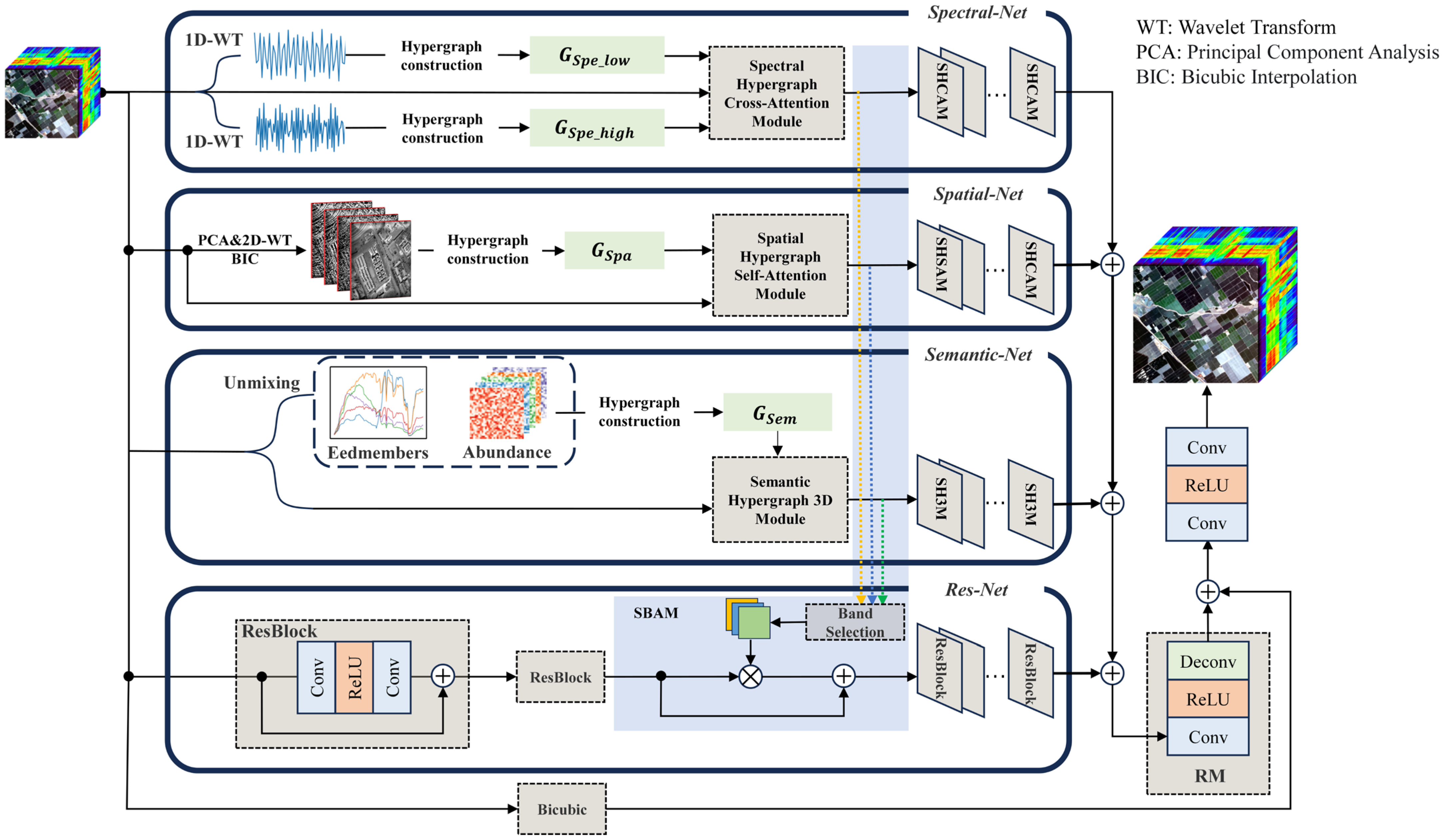
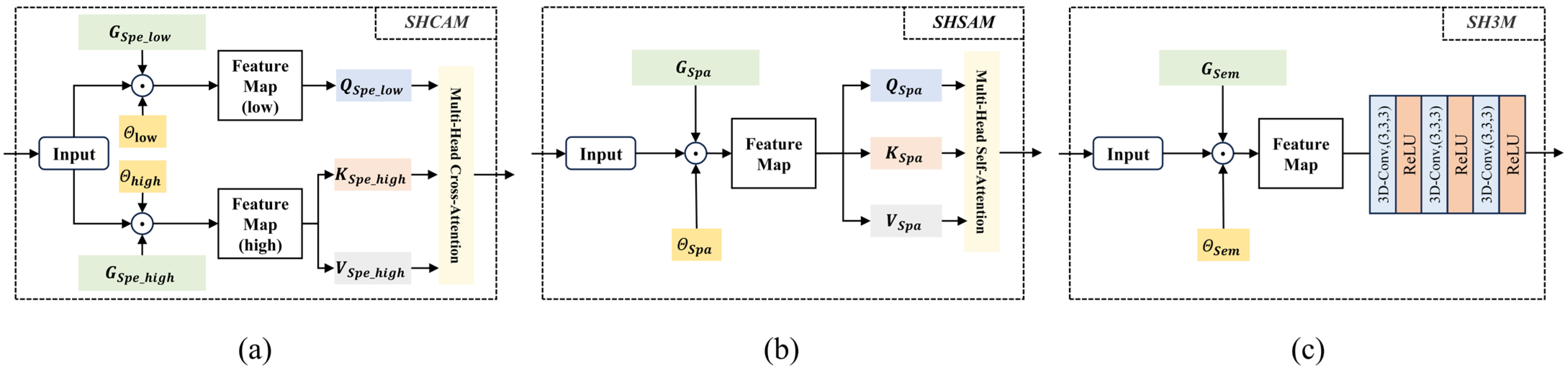
Benefiting from the development of deep learning, the super-resolution technology for remote sensing hyperspectral images (HSIs) has achieved impressive progress. However, due to the high coupling of complex components in remote sensing HSIs, it is challenging to achieve a complete characterization of the internal information, which in turn limits the precise reconstruction of detailed texture and spectral features. Therefore, we propose the multi-attitude hybrid network (MAHN) for extracting and characterizing information from multiple feature spaces. On the one hand, we construct the spectral hypergraph cross-attention module (SHCAM) and the spatial hypergraph self-attention module (SHSAM) based on the high and low-frequency features in the spectral and the spatial domains, respectively, which are used to capture the main structure and detail changes within the image. On the other hand, high-level semantic information in mixed pixels is parsed by spectral mixture analysis, and semantic hypergraph 3D module (SH3M) are constructed based on the abundance of each category to enhance the propagation and reconstruction of semantic information. Furthermore, to mitigate the domain discrepancies among features, we introduce a sensitive bands attention mechanism (SBAM) to enhance the cross-guidance and fusion of multi-domain features. Extensive experiments demonstrate that our method achieves optimal reconstruction results compared to other state-of-the-art algorithms while effectively reducing the computational complexity.
Keywords: attention mechanism; hypergraph learning; super-resolution; unmixing; wavelet transform attention mechanism; hypergraph learning; super-resolution; unmixing; wavelet transform