Article

Domain Feature Decomposition for Efficient Object Detection in Aerial Images

1
Beijing Key Laboratory of UAV Autonomous Control, Beijing Institute of Technology, Beijing 100081, China
2
School of Artificial Intelligence, Xidian University, Xi’an 710071, China
3
School of Systems Science and Engineering, Sun Yat-Sen University, Guangzhou 510006, China
*
Author to whom correspondence should be addressed.
Remote Sens. 2024, 16(9), 1626; https://doi.org/10.3390/rs16091626
Submission received: 1 March 2024 / Revised: 23 April 2024 / Accepted: 30 April 2024 / Published: 2 May 2024
(This article belongs to the Special Issue Deep Learning for the Analysis of Multi-/Hyperspectral Images II)

Abstract

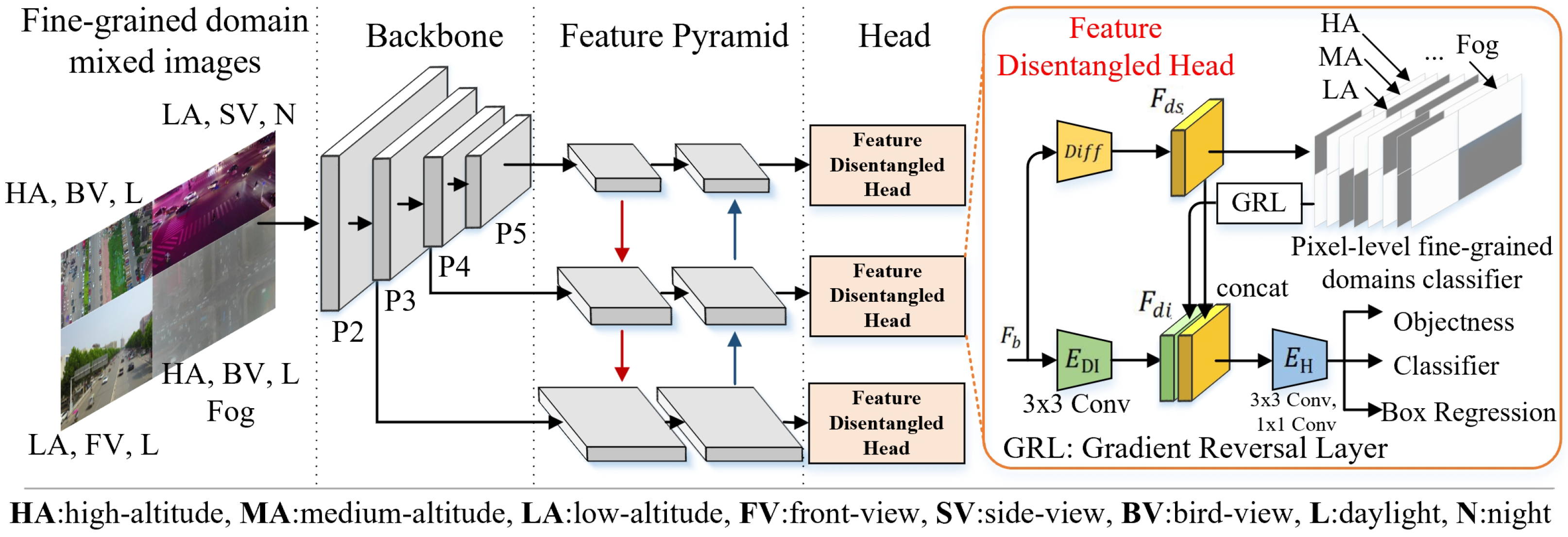
Object detection in UAV aerial images faces domain-adaptive challenges, such as changes in shooting height, viewing angle, and weather. These changes constitute a large number of fine-grained domains that place greater demands on the network’s generalizability. To tackle these challenges, we initially decompose image features into domain-invariant and domain-specific features using practical imaging condition parameters. The composite feature can improve domain generalization and single-domain accuracy compared to the conventional fine-grained domain-detection method. Then, to solve the problem of the overfitting of high-frequency imaging condition parameters, we mixed images from different imaging conditions in a balanced sampling manner as input for the training of the detection network. The data-augmentation method improves the robustness of training and reduces the overfitting of high-frequency imaging parameters. The proposed algorithm is compared with state-of-the-art fine-grained domain detectors on the UAVDT and VisDrone datasets. The results show that it achieves an average detection precision improvement of 5.7 and 2.4, respectively. The airborne experiments validate that the algorithm achieves a 20 Hz processing performance for 720P images on an onboard computer with Nvidia Jetson Xavier NX.
Keywords: aerial image; object detection; imaging condition; feature decomposition aerial image; object detection; imaging condition; feature decomposition