Article

Exploring the Spatial and Temporal Characteristics of China’s Four Major Urban Agglomerations in the Luminous Remote Sensing Perspective

1
College of Computer and Information Engineering, Hohai University, Nanjing 210098, China
2
Aerospace Information Research Institute, Chinese Academy of Sciences, Beijing 100190, China
3
Ping An Technology Company, Shanghai 200120, China
*
Author to whom correspondence should be addressed.
Remote Sens. 2023, 15(10), 2546; https://doi.org/10.3390/rs15102546
Submission received: 12 February 2023 / Revised: 21 April 2023 / Accepted: 9 May 2023 / Published: 12 May 2023
(This article belongs to the Special Issue Remote Sensing Imagery for Mapping Economic Activities)

Abstract

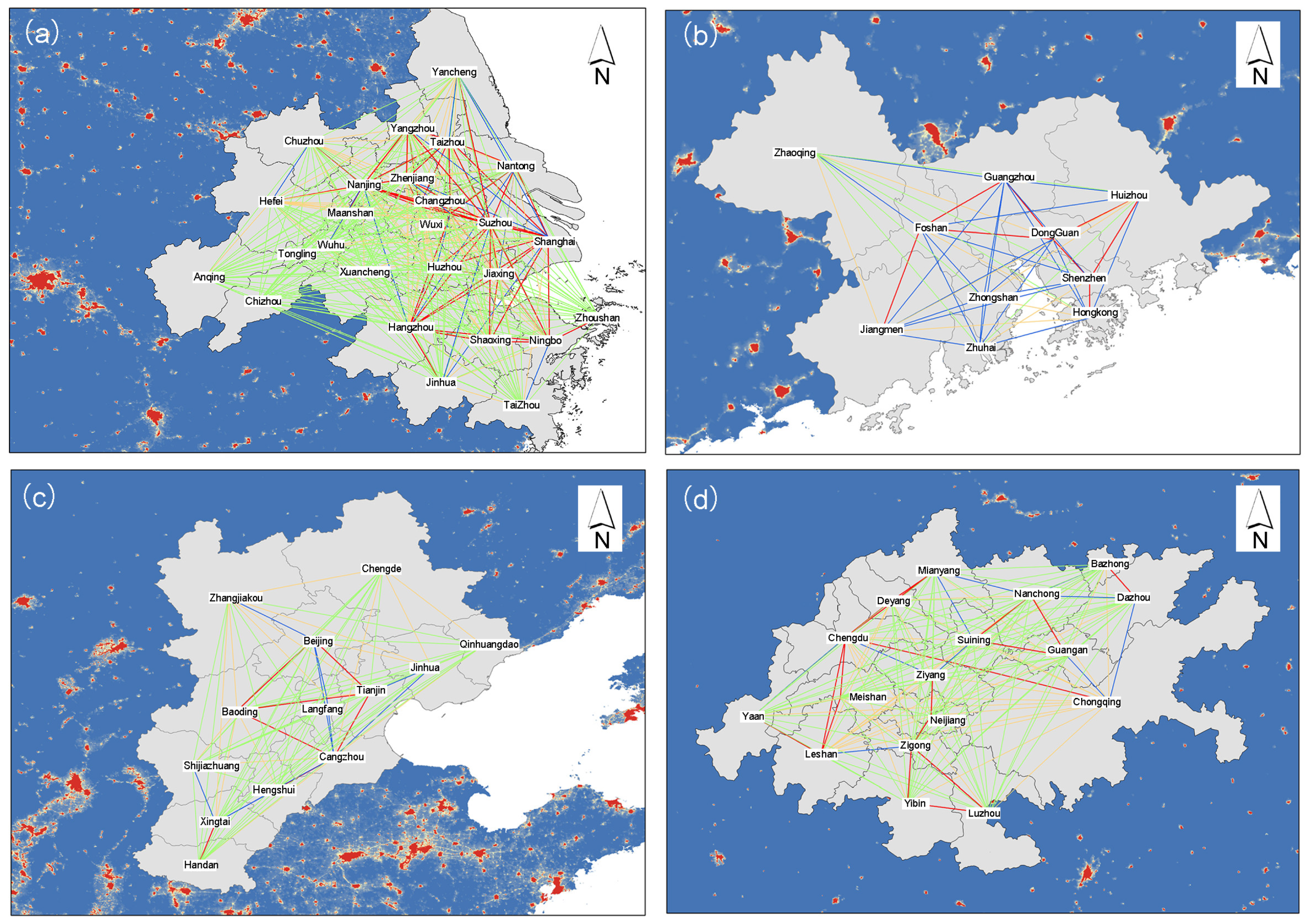
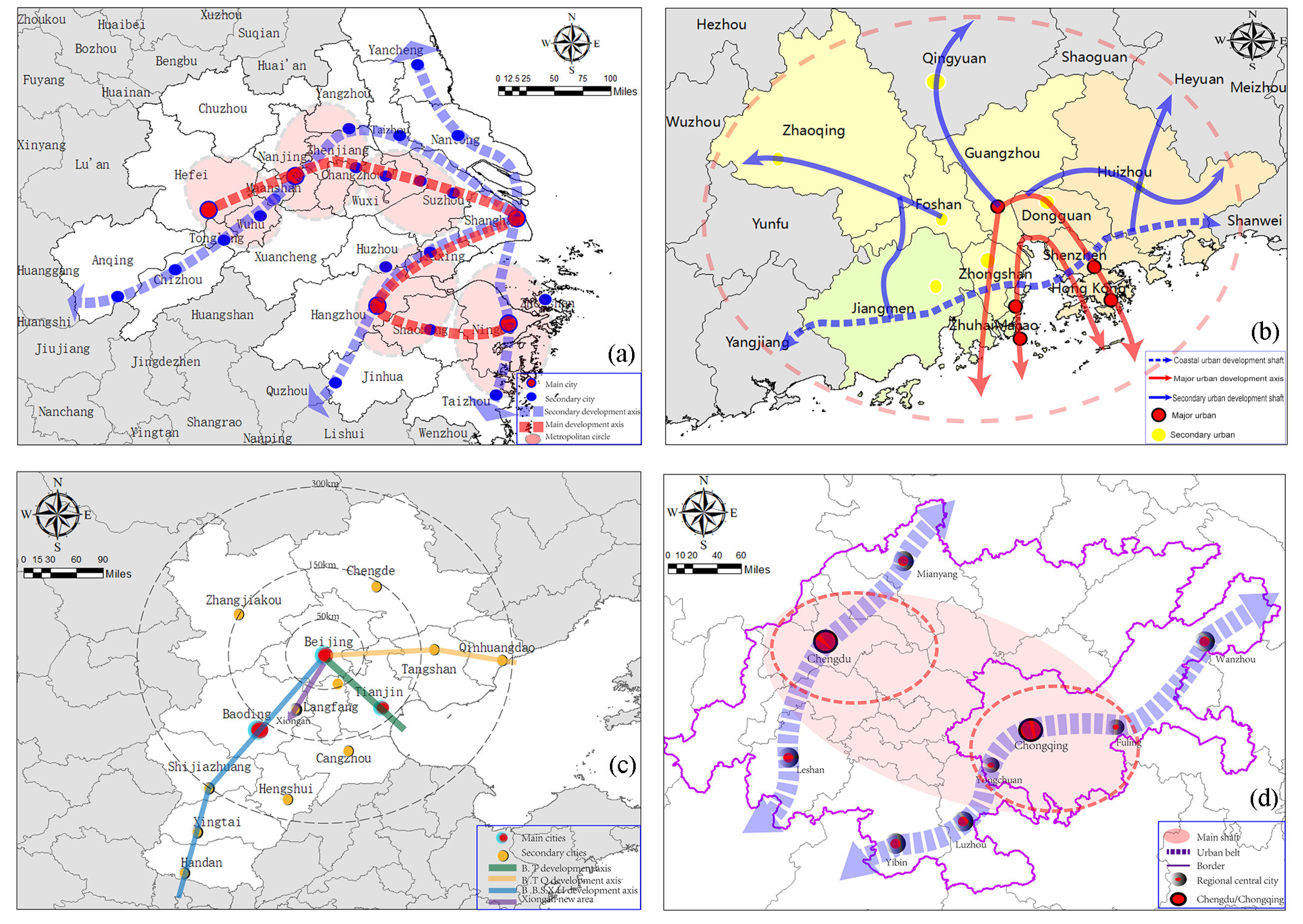
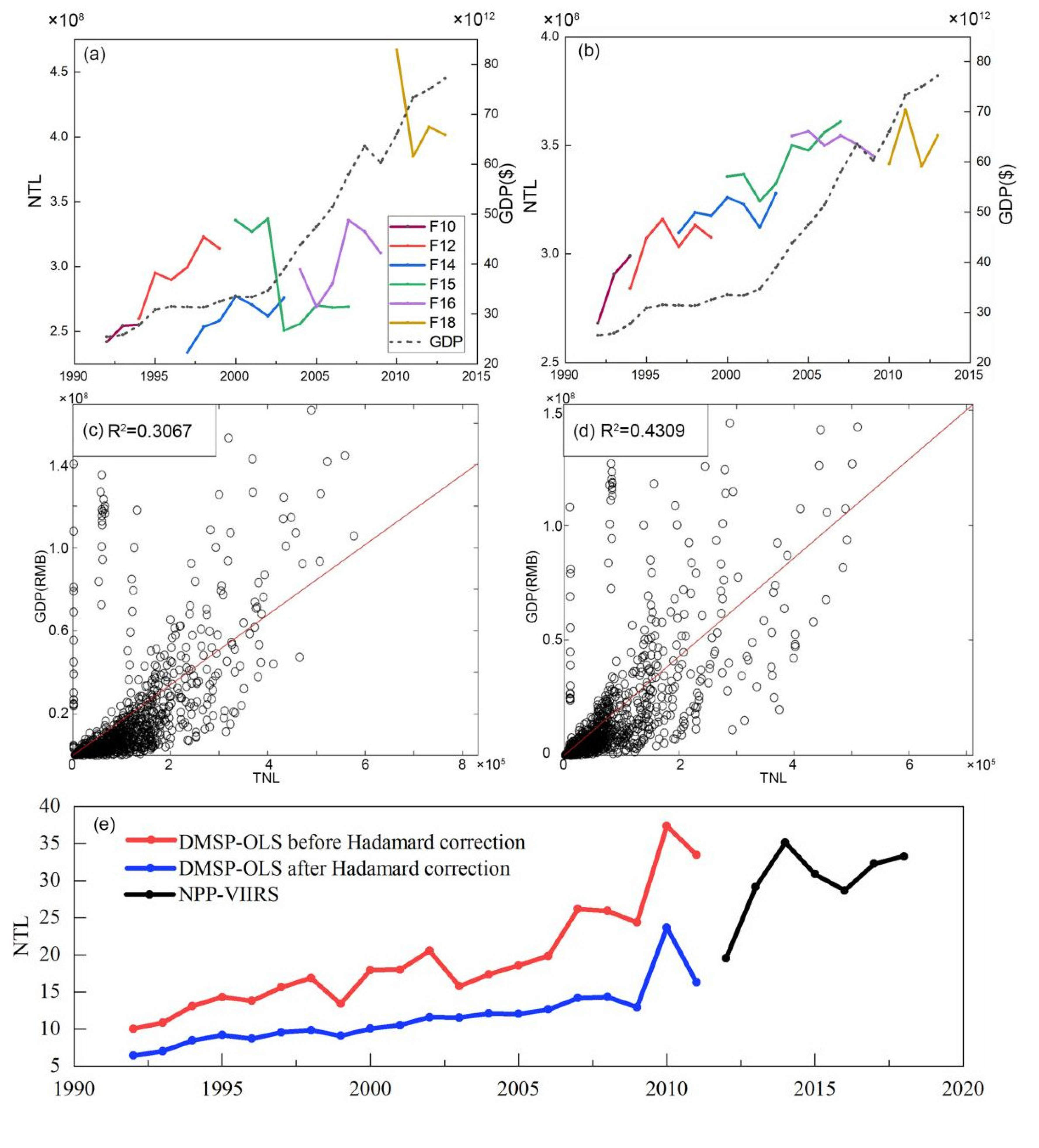
This study addresses the knowledge gap regarding the spatiotemporal evolution of Chinese urban agglomerations using long time series of luminescence remote sensing data. The evolution of urban agglomerations is of great significance for the future development and planning of cities. Nighttime light data provide a window for observing urban agglomerations’ characteristics on a large spatial scale, but they are affected by temporal discontinuity. To solve this problem, this study proposes a ridge-sampling regression-based Hadamard matrix correction method and constructs consistent long-term nighttime light sequences for China’s four major urban agglomerations from 1992 to 2018. Using the Getis-Ord Gi* hot-cold spot, standard deviation ellipse method, and Baidu search index, we comprehensively analyze the directional evolution of urban agglomerations and the correlations between cities. The results show that, after correction, the correlation coefficient between nighttime light intensity and gross domestic product increased from 0.30 to 0.43. Furthermore, this study identifies unique features of each urban agglomeration. The Yangtze River Delta urban agglomeration achieved balanced development by shifting from coastal to inland areas. The Guangdong-Hong Kong-Macao urban agglomeration developed earlier and grew more slowly in the north due to topographical barriers. The Beijing-Tianjin-Hebei urban agglomeration in the north has Beijing and Tianjin as its core, and the southeastern region has developed rapidly, showing an obvious imbalance in development. The Chengdu-Chongqing urban agglomeration in the inland area has Chengdu and Chongqing as its dual core, and its development has been significantly slower than that of the other three agglomerations due to the influence of topography, but it has great potential. Overall, this study provides a research framework for urban agglomerations based on four major urban agglomerations to explore their spatiotemporal characteristics and offers insights for government urban planning.
Keywords: remote sensing; long-term night-time light; spatiotemporal patterns; urban agglomerations remote sensing; long-term night-time light; spatiotemporal patterns; urban agglomerations