Article

A Novel Knowledge Distillation Method for Self-Supervised Hyperspectral Image Classification

Faculty of Computer Science and Technology, Qilu University of Technology (Shandong Academy of Sciences), Jinan 250353, China
*
Author to whom correspondence should be addressed.
Remote Sens. 2022, 14(18), 4523; https://doi.org/10.3390/rs14184523
Submission received: 3 August 2022 / Revised: 2 September 2022 / Accepted: 6 September 2022 / Published: 10 September 2022
(This article belongs to the Special Issue Advances in Hyperspectral Remote Sensing: Methods and Applications)

Abstract

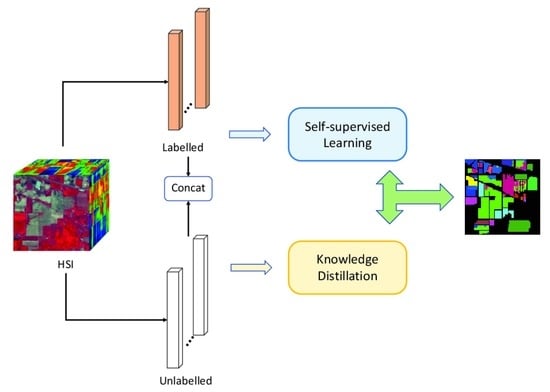

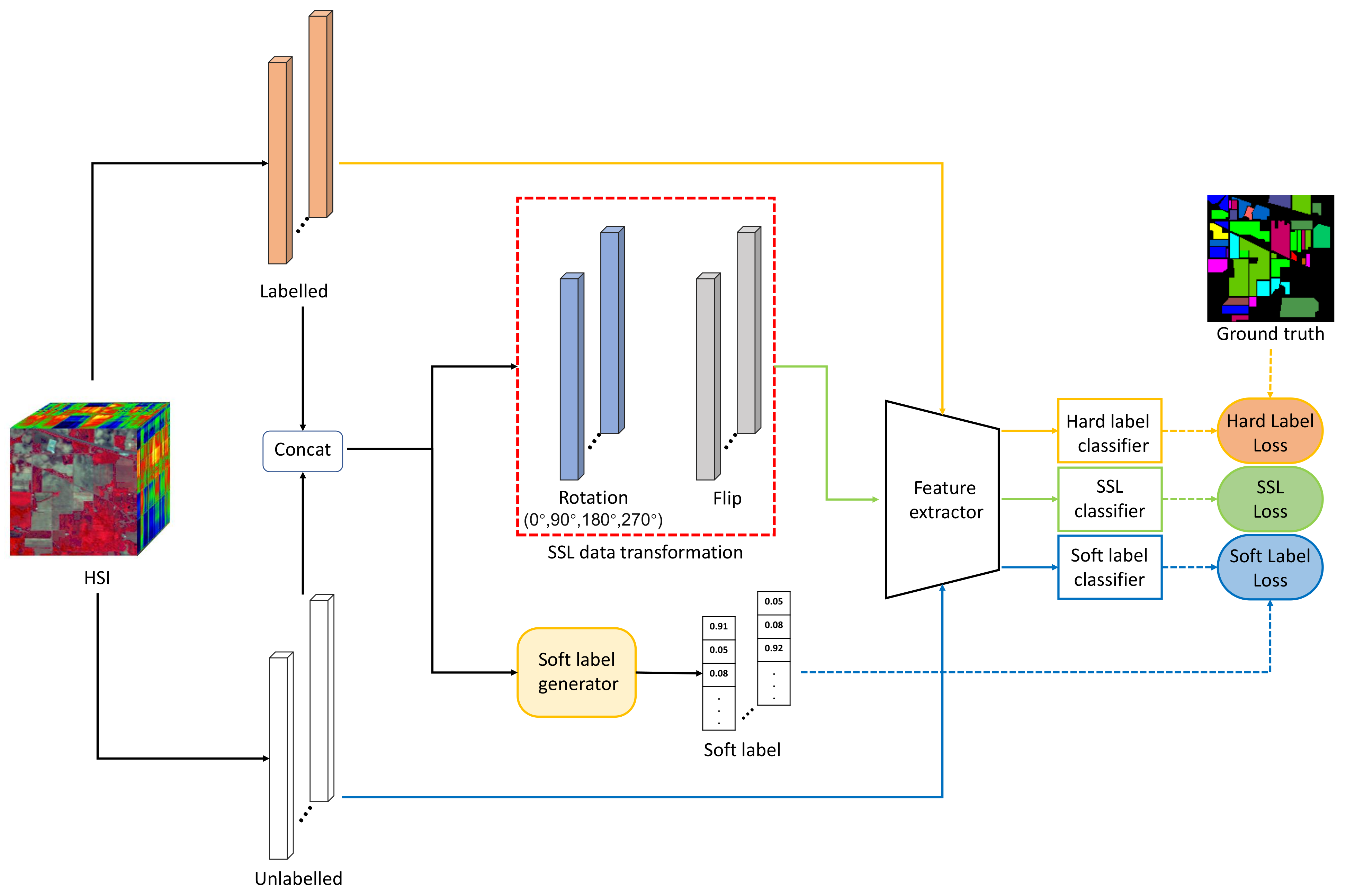
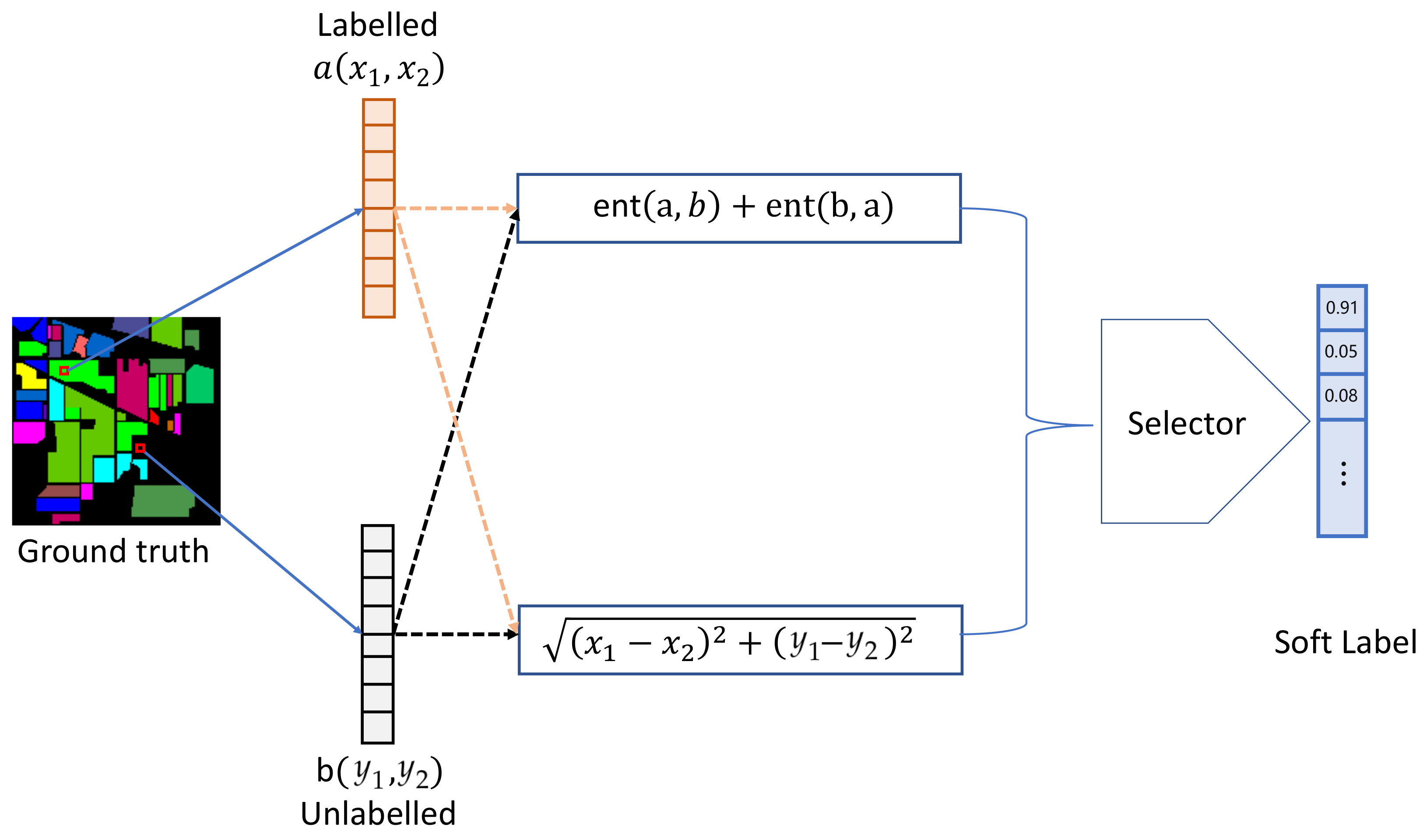
Using deep learning to classify hyperspectral image(HSI) with only a few labeled samples available is a challenge. Recently, the knowledge distillation method based on soft label generation has been used to solve classification problems with a limited number of samples. Unlike normal labels, soft labels are considered the probability of a sample belonging to a certain category, and are therefore more informative for the sake of classification. The existing soft label generation methods for HSI classification cannot fully exploit the information of existing unlabeled samples. To solve this problem, we propose a novel self-supervised learning method with knowledge distillation for HSI classification, termed SSKD. The main motivation is to exploit more valuable information for classification by adaptively generating soft labels for unlabeled samples. First, similarity discrimination is performed using all unlabeled and labeled samples by considering both spatial distance and spectral distance. Then, an adaptive nearest neighbor matching strategy is performed for the generated data. Finally, probabilistic judgment for the category is performed to generate soft labels. Compared to the state-of-the-art method, our method improves the classification accuracy by 4.88%, 7.09% and 4.96% on three publicly available datasets, respectively.
Keywords: soft labeling; deep learning; knowledge distillation; self-supervised learning; hyperspectral image classification soft labeling; deep learning; knowledge distillation; self-supervised learning; hyperspectral image classification
Graphical Abstract