Article

Towards Urban Scene Semantic Segmentation with Deep Learning from LiDAR Point Clouds: A Case Study in Baden-Württemberg, Germany

1
Chair of Remote Sensing and Landscape Information Systems, University of Freiburg, Tennenbacherstr. 4, 79106 Freiburg, Germany
2
College of Control Engineering, Chengdu University of Information Technology, Chengdu 610225, China
*
Author to whom correspondence should be addressed.
Remote Sens. 2021, 13(16), 3220; https://doi.org/10.3390/rs13163220
Submission received: 22 June 2021 / Revised: 2 August 2021 / Accepted: 9 August 2021 / Published: 13 August 2021

Abstract

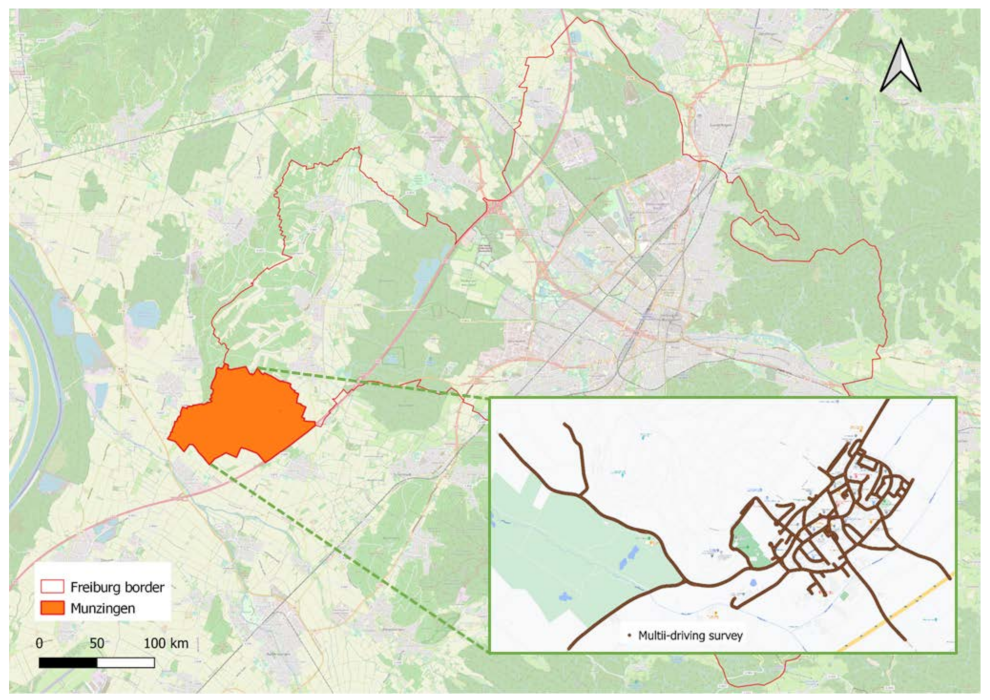
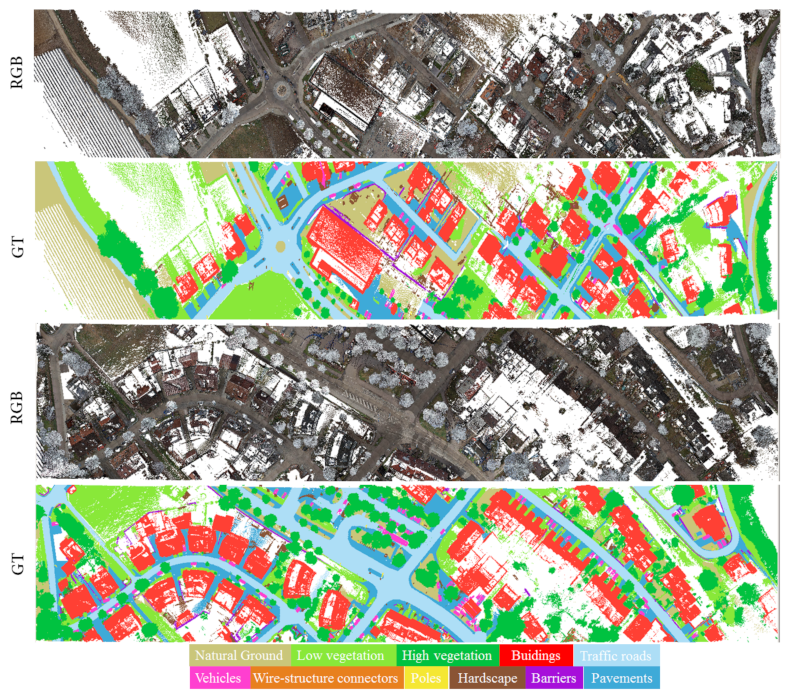
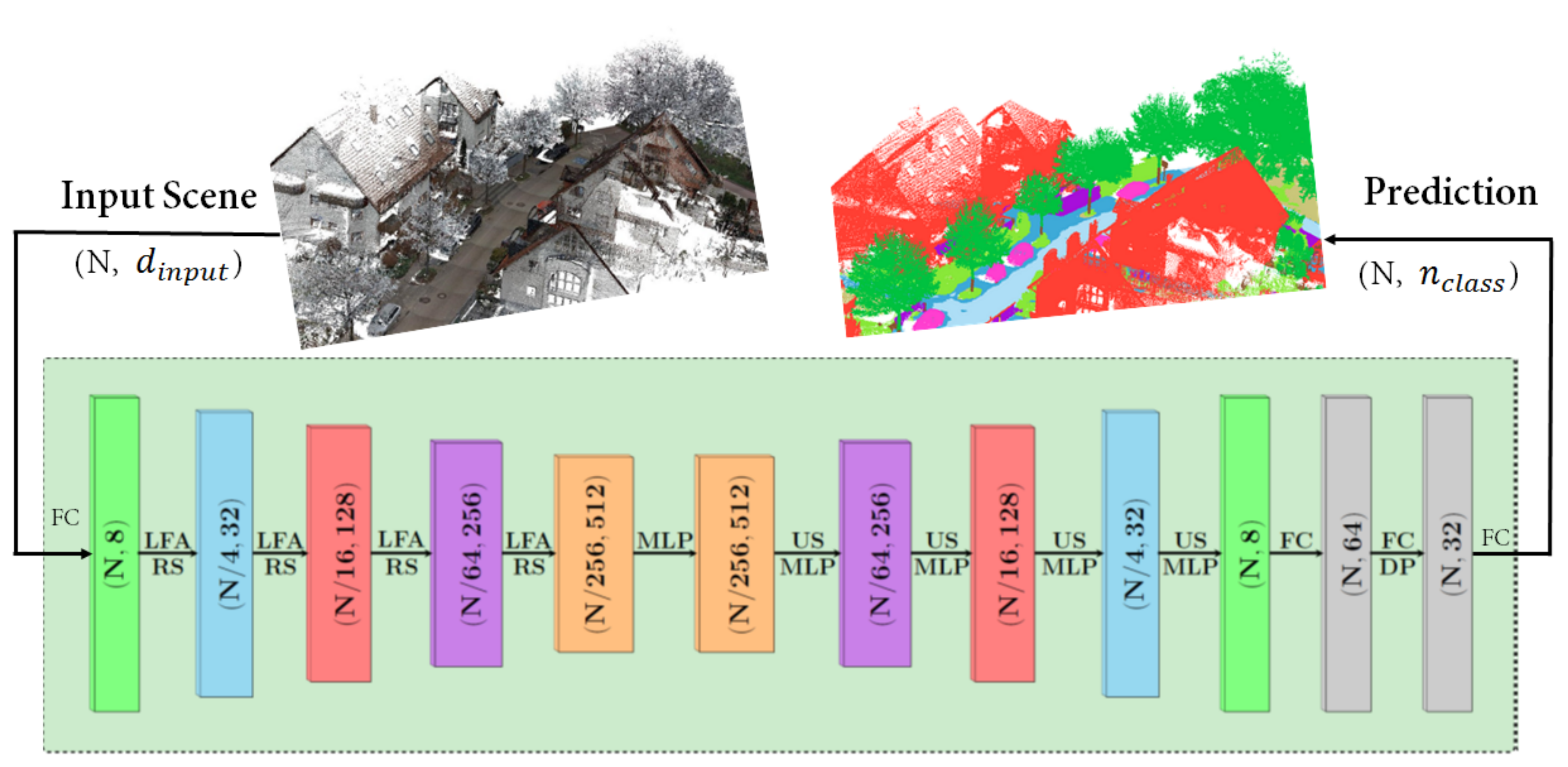
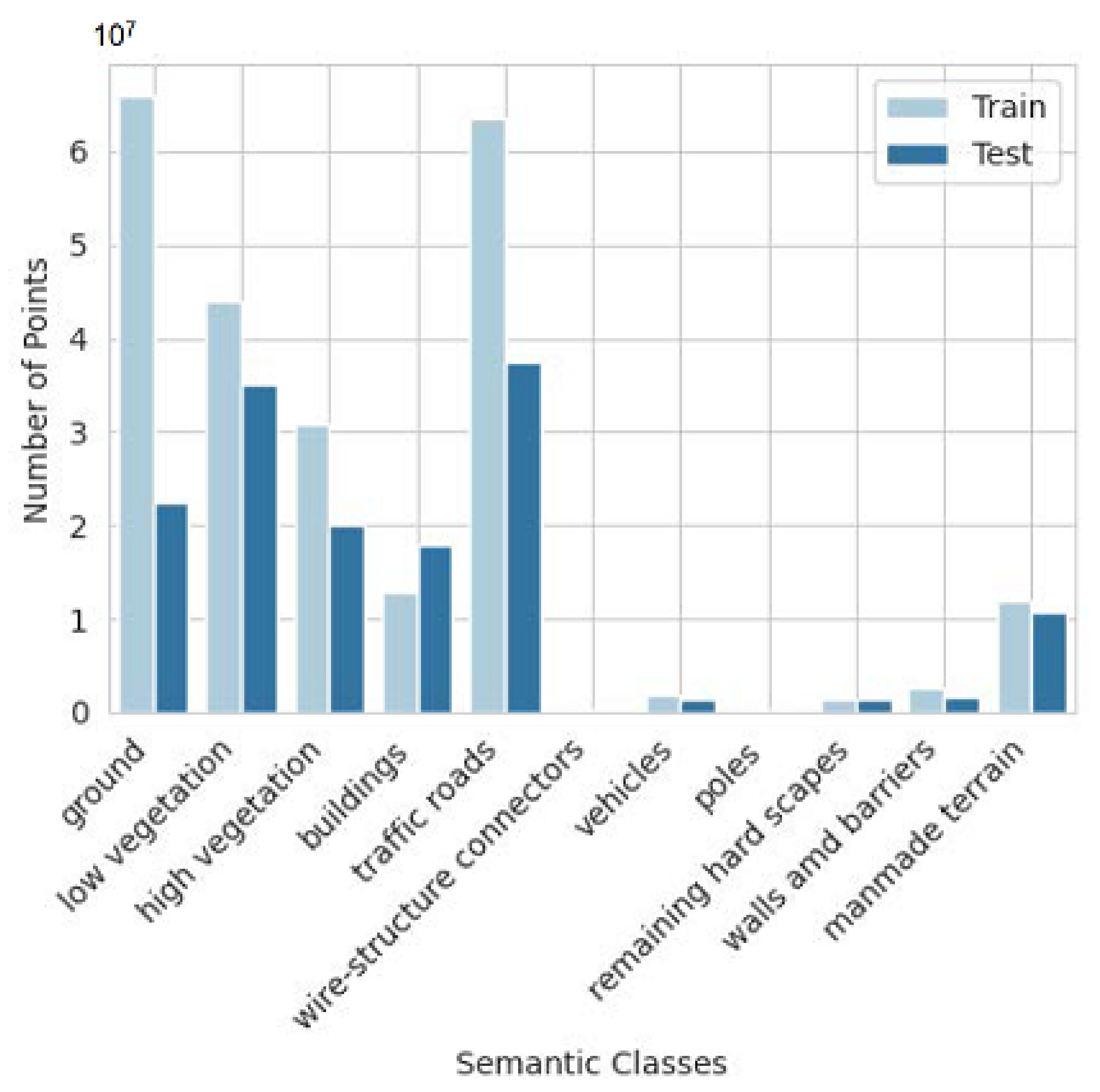
An accurate understanding of urban objects is critical for urban modeling, intelligent infrastructure planning and city management. The semantic segmentation of light detection and ranging (LiDAR) point clouds is a fundamental approach for urban scene analysis. Over the last years, several methods have been developed to segment urban furniture with point clouds. However, the traditional processing of large amounts of spatial data has become increasingly costly, both time-wise and financially. Recently, deep learning (DL) techniques have been increasingly used for 3D segmentation tasks. Yet, most of these deep neural networks (DNNs) were conducted on benchmarks. It is, therefore, arguable whether DL approaches can achieve the state-of-the-art performance of 3D point clouds segmentation in real-life scenarios. In this research, we apply an adapted DNN (ARandLA-Net) to directly process large-scale point clouds. In particular, we develop a new paradigm for training and validation, which presents a typical urban scene in central Europe (Munzingen, Freiburg, Baden-Württemberg, Germany). Our dataset consists of nearly 390 million dense points acquired by Mobile Laser Scanning (MLS), which has a rather larger quantity of sample points in comparison to existing datasets and includes meaningful object categories that are particular to applications for smart cities and urban planning. We further assess the DNN on our dataset and investigate a number of key challenges from varying aspects, such as data preparation strategies, the advantage of color information and the unbalanced class distribution in the real world. The final segmentation model achieved a mean Intersection-over-Union (mIoU) score of 54.4% and an overall accuracy score of 83.9%. Our experiments indicated that different data preparation strategies influenced the model performance. Additional RGB information yielded an approximately 4% higher mIoU score. Our results also demonstrate that the use of weighted cross-entropy with inverse square root frequency loss led to better segmentation performance than when other losses were considered.
Keywords: urban scene; mobile mapping; deep learning; remote sensing; point clouds; semantic segmentation; unbalanced classes urban scene; mobile mapping; deep learning; remote sensing; point clouds; semantic segmentation; unbalanced classes