Article

A Novel Multi-Model Decision Fusion Network for Object Detection in Remote Sensing Images

1
Key Laboratory of Intelligent Perception and Image Understanding of Ministry of Education, International Research Center for Intelligent Perception and Computation, Joint International Research Laboratory of Intelligent Perception and Computation, School of Artificial Intelligence, Xidian University, Xi’an 710071, China
2
School of Computer Science and Technology, Xidian University, Xi’an 710071, China
*
Author to whom correspondence should be addressed.
Remote Sens. 2019, 11(7), 737; https://doi.org/10.3390/rs11070737
Submission received: 28 January 2019 / Revised: 14 March 2019 / Accepted: 19 March 2019 / Published: 27 March 2019
(This article belongs to the Special Issue Remote Sensing for Target Object Detection and Identification)

Abstract

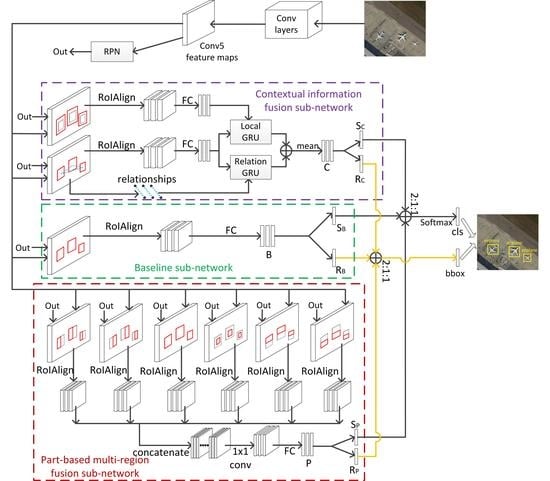
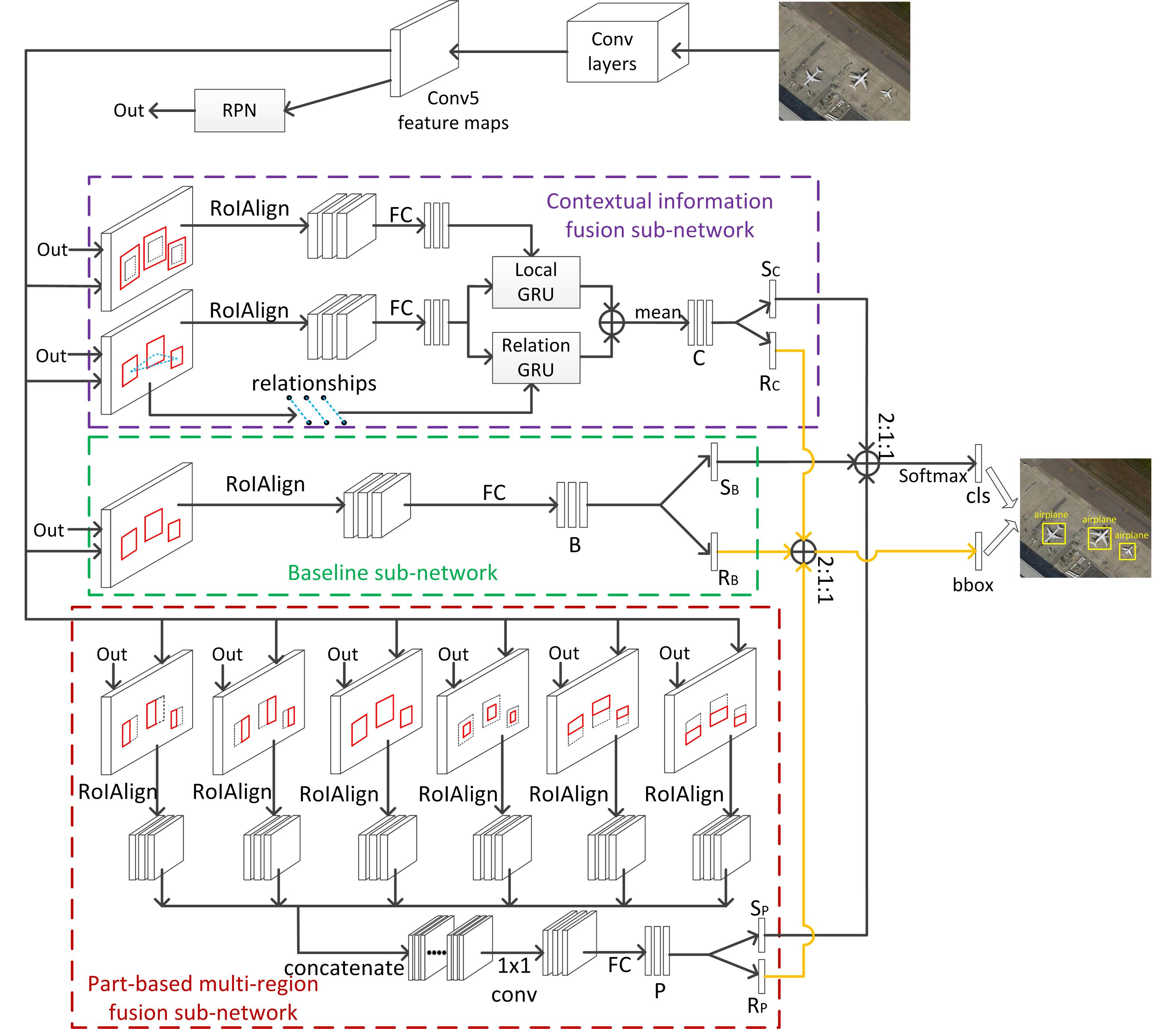
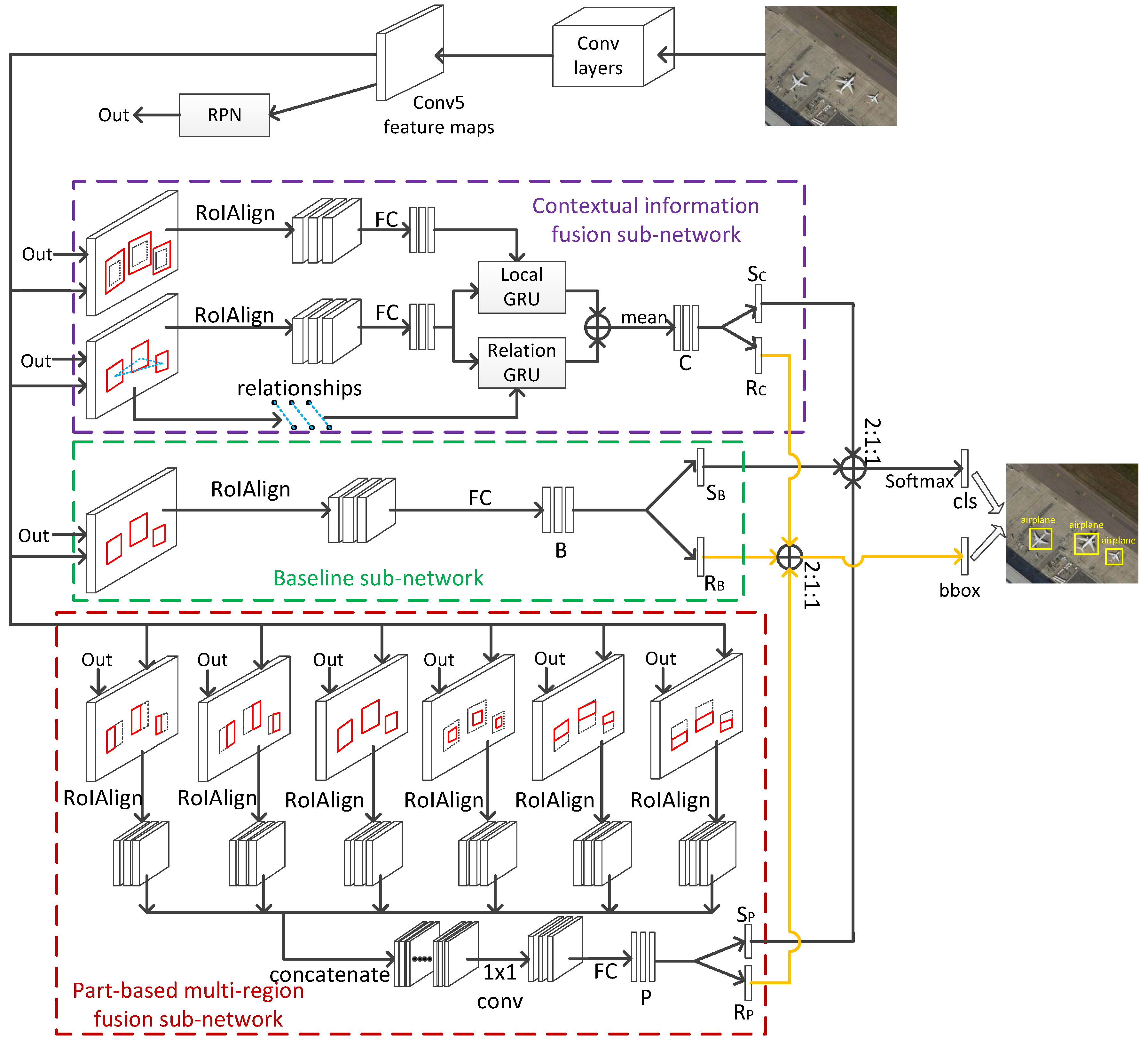
Object detection in optical remote sensing images is still a challenging task because of the complexity of the images. The diversity and complexity of geospatial object appearance and the insufficient understanding of geospatial object spatial structure information are still the existing problems. In this paper, we propose a novel multi-model decision fusion framework which takes contextual information and multi-region features into account for addressing those problems. First, a contextual information fusion sub-network is designed to fuse both local contextual features and object-object relationship contextual features so as to deal with the problem of the diversity and complexity of geospatial object appearance. Second, a part-based multi-region fusion sub-network is constructed to merge multiple parts of an object for obtaining more spatial structure information about the object, which helps to handle the problem of the insufficient understanding of geospatial object spatial structure information. Finally, a decision fusion is made on all sub-networks to improve the stability and robustness of the model and achieve better detection performance. The experimental results on a publicly available ten class data set show that the proposed method is effective for geospatial object detection.
Keywords: convolutional neural networks (CNNs); object detection; remote sensing images; contextual information; part-based; multi-model convolutional neural networks (CNNs); object detection; remote sensing images; contextual information; part-based; multi-model
Graphical Abstract