Article

A Markovian Approach to Unsupervised Change Detection with Multiresolution and Multimodality SAR Data


by
David Solarna
*,†,
Gabriele Moser
*,† and
Sebastiano B. Serpico
*,†
Department of Electrical, Electronic, Telecommunication Engineering and Naval Architecture, University of Genoa, Via All’Opera Pia 11A, 16145 Genoa, Italy
*
Authors to whom correspondence should be addressed.
These authors contributed equally to this work.
Remote Sens. 2018, 10(11), 1671; https://doi.org/10.3390/rs10111671
Submission received: 4 October 2018 / Revised: 17 October 2018 / Accepted: 19 October 2018 / Published: 23 October 2018
(This article belongs to the Special Issue Multisensor Data Fusion in Remote Sensing)

Abstract

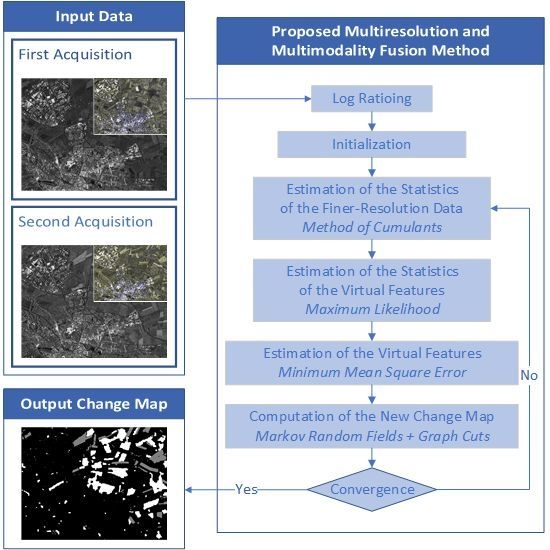
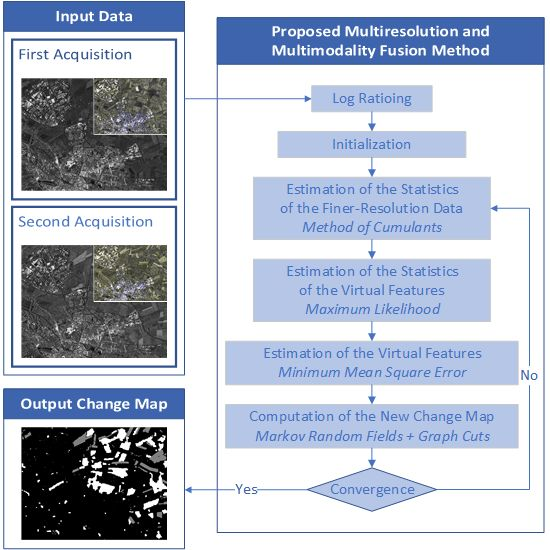
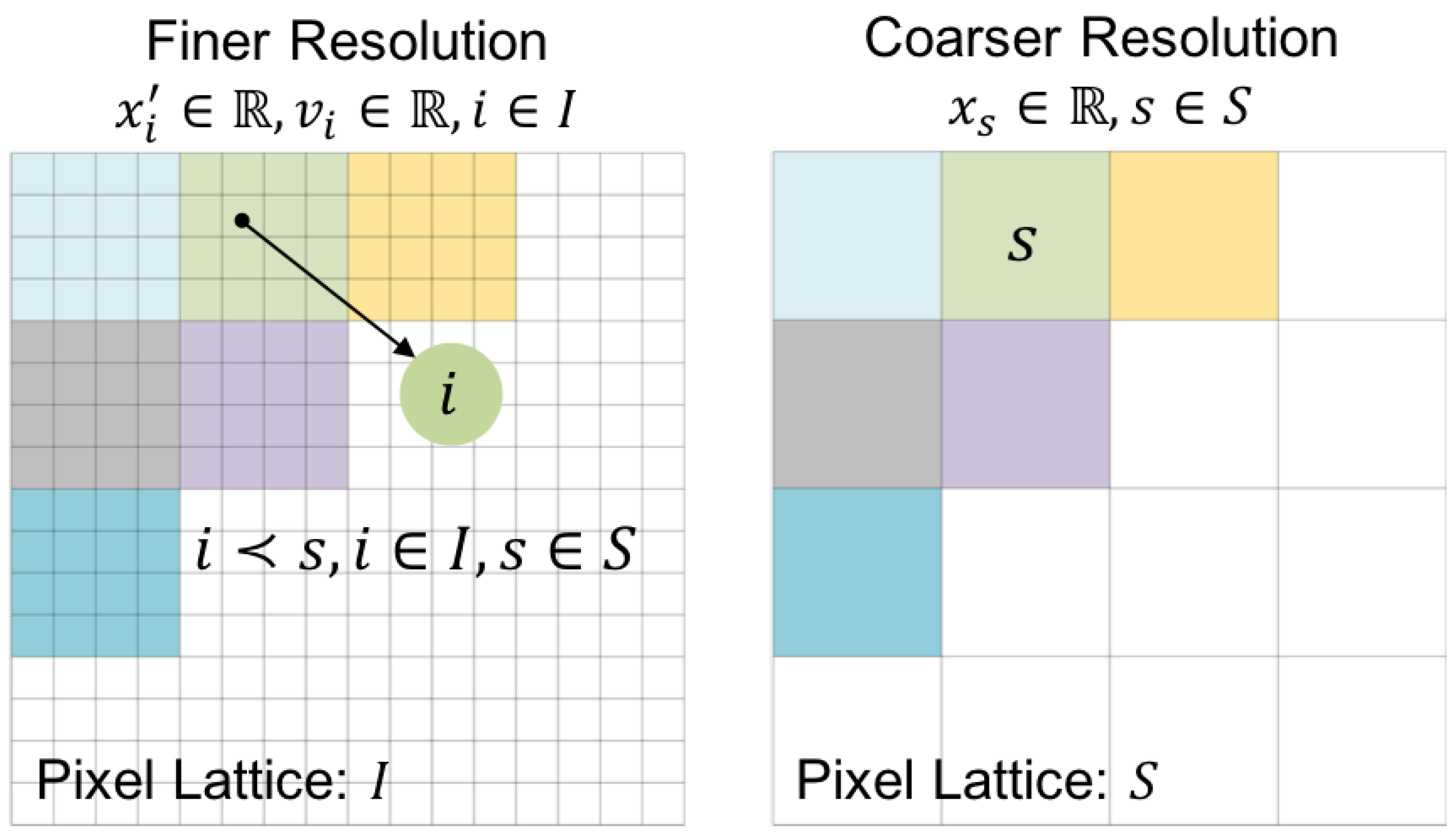
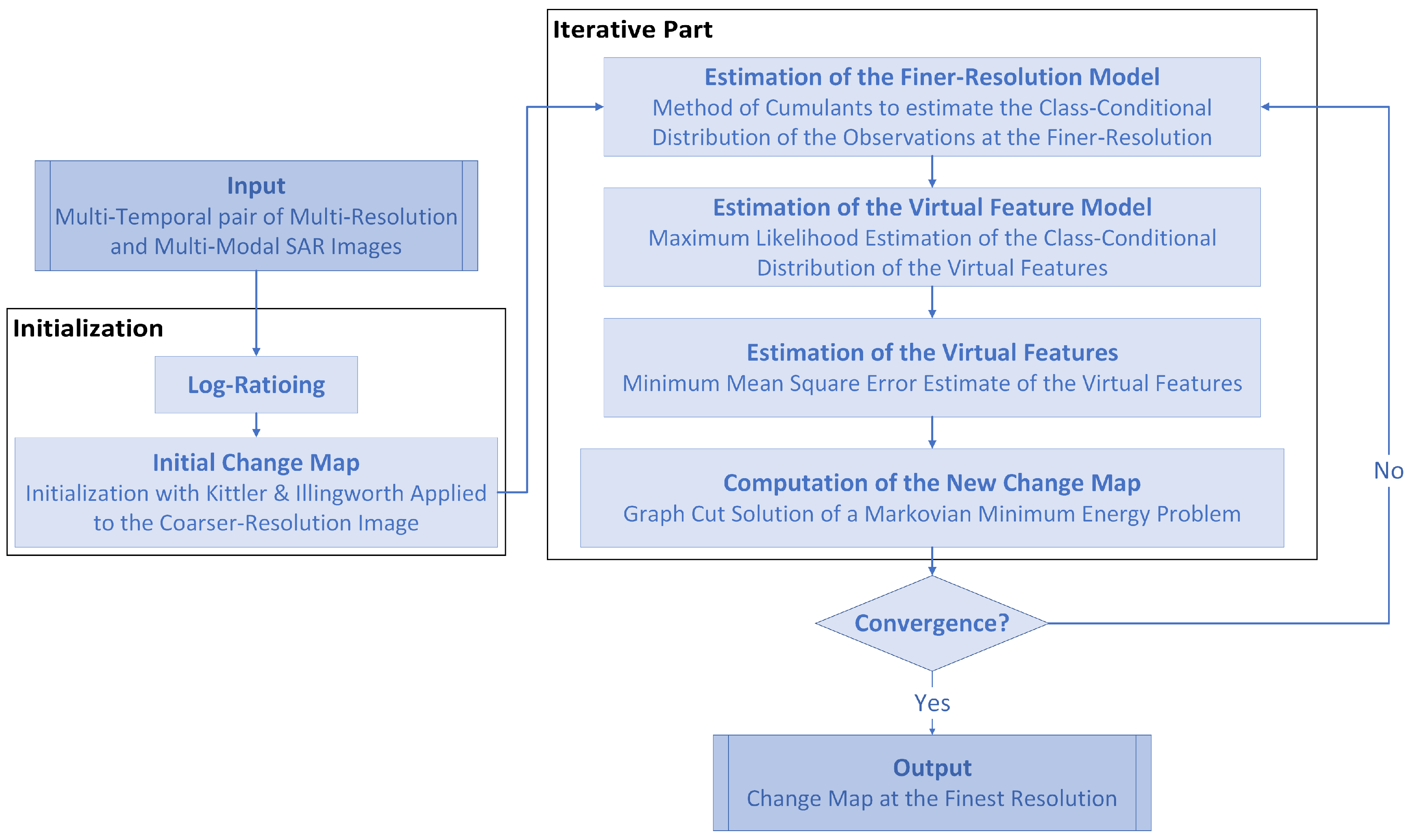
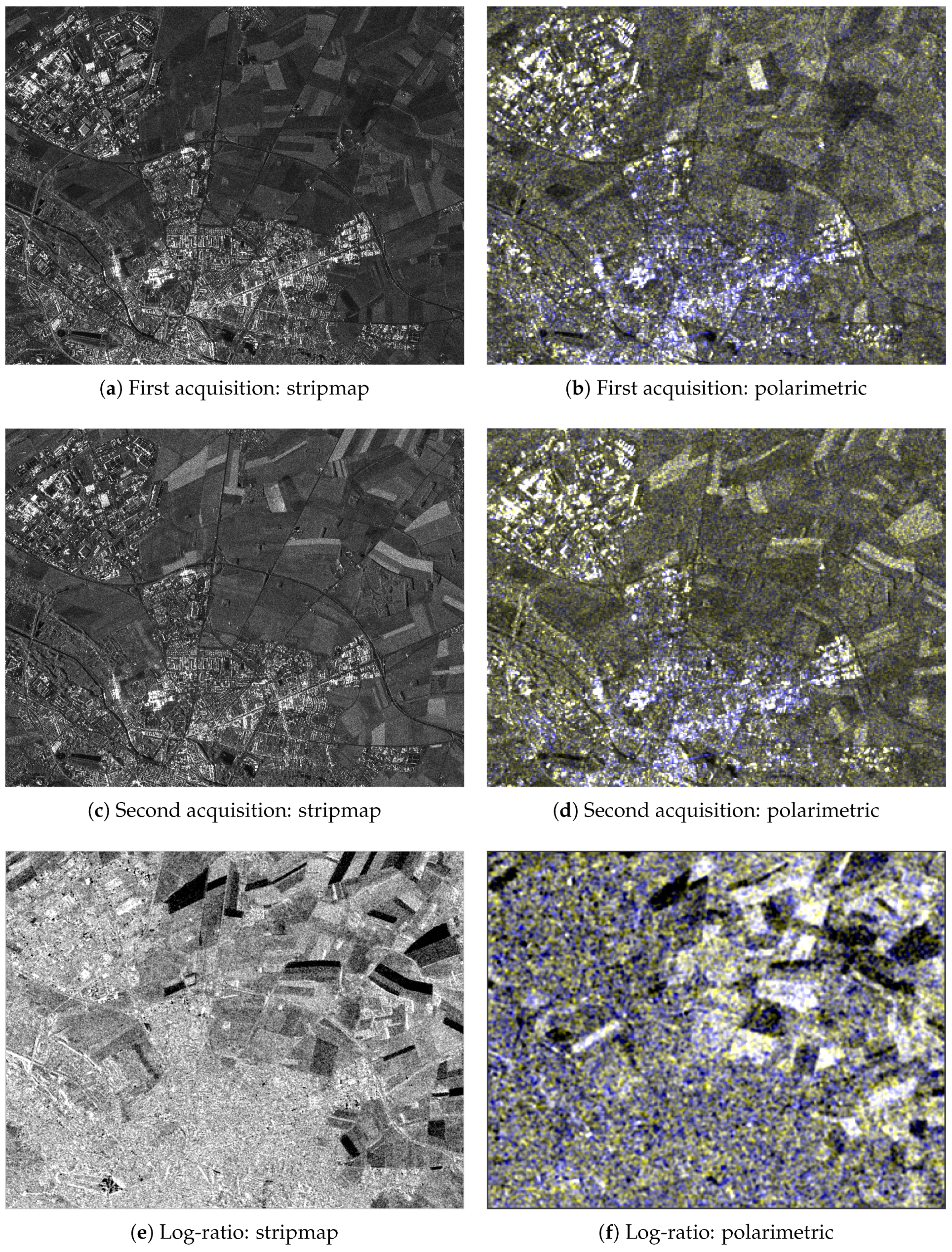
In the framework of synthetic aperture radar (SAR) systems, current satellite missions make it possible to acquire images at very high and multiple spatial resolutions with short revisit times. This scenario conveys a remarkable potential in applications to, for instance, environmental monitoring and natural disaster recovery. In this context, data fusion and change detection methodologies play major roles. This paper proposes an unsupervised change detection algorithm for the challenging case of multimodal SAR data collected by sensors operating at multiple spatial resolutions. The method is based on Markovian probabilistic graphical models, graph cuts, linear mixtures, generalized Gaussian distributions, Gram–Charlier approximations, maximum likelihood and minimum mean squared error estimation. It benefits from the SAR images acquired at multiple spatial resolutions and with possibly different modalities on the considered acquisition times to generate an output change map at the finest observed resolution. This is accomplished by modeling the statistics of the data at the various spatial scales through appropriate generalized Gaussian distributions and by iteratively estimating a set of virtual images that are defined on the pixel grid at the finest resolution and would be collected if all the sensors could work at that resolution. A Markov random field framework is adopted to address the detection problem by defining an appropriate multimodal energy function that is minimized using graph cuts.
Keywords: synthetic aperture radar (SAR); multiresolution data fusion; multimodality data fusion; generalized Gaussian; maximum likelihood (ML) estimation; minimum mean squared error (MMSE) estimation; Gram–Charlier approximation; Markov random fields (MRF); graph cuts synthetic aperture radar (SAR); multiresolution data fusion; multimodality data fusion; generalized Gaussian; maximum likelihood (ML) estimation; minimum mean squared error (MMSE) estimation; Gram–Charlier approximation; Markov random fields (MRF); graph cuts
Graphical Abstract