1. Introduction
Payments for ecosystem services (PES) are mechanisms whereby a buyer who benefits from an ecosystem service (ES) pays the provider of such a service [
1]. Despite the growing interest in PES in many countries in the world [
2,
3,
4], many shortcomings have been identified from different perspectives, discouraging the diffusion of PES and, therefore, obstructing their recognition within the relevant legal systems. We argue that one of the obstacles to the adoption of PES lies in the inevitable tension between the inherent characteristics of ecosystems and the way property rights over natural resources are currently understood.
On the one hand, natural resources, and, consequently, the ecosystem services which the natural resources are able to provide, are characterised by deep interconnections with other resources, other people’s interests, other ecosystems and also involve a variety of sectors (e.g., cultural and social) so that they cannot be managed in the same way as other commodities. On the other hand, and quite to the contrary, the current way to conceive private property rights responds to an anthropocentric logic dominated by individual entitlements and private (mostly monetary) interests [
5].
To overcome this conflict, this paper attempts to build an argument that PES should be provided within a legal framework and asks how this legal framework should be theoretically constructed. What are the desirable legal changes needed to set PES within the context of stewardship? In fact, there are many academic contributions to the relationship between property law and environmental law, [
6,
7] and the characteristics of PES [
3,
8,
9] and their drawbacks [
10,
11] especially when related with property rights [
12,
13]. However, the application of stewardship to PES has not yet been much explored.
The paper advocates an understanding of private property not as a crystallised entitlement but as a stewardship [
5,
14,
15,
16,
17,
18]. This is defined as “the responsible use (including conservation) of natural resources in a way that takes full and balanced account of the interests of society, future generations, and other species, as well as of private needs, and accepts significant answerability to society” [
16]. This approach could potentially make PES a more effective tool for sustainability, which might otherwise be harmed by an unregulated diffusion of such mechanisms.
Section 2 of this paper briefly analyses, firstly, the concept of ecosystem service and, secondly, what exactly it means to pay for that service. This raises the question of “who” will provide the service and receive payment, which leads to a focus on property rights. The tension between individual property rights and the responsibilities towards the whole community has been seen as a major weakness in PES, among other criticisms of it and even enable sustainable resource management through PES.
In
Section 3, we investigate if the application of stewardship could help overcome some of the drawbacks of PES. Here, we argue that the application of property-liability rules is consistent with the concept of stewardship and sustainability. Therefore, we advocate that it is crucial that PES are legally framed within such kinds of rules. This represents our novel contribution to knowledge and should be seen as the basis for further research to develop recommendations for specific reforms in laws and in understanding of property.
Section 4 discusses the role of the state and the balancing of public and private interests. More specifically, it begins a discussion of how legal frameworks built on such principles can contribute better to meeting ecosystem complexities and even enable sustainable resource management through PES. The application of stewardship principles will vary with the category of PES. Where a public body is one of the contracting parties or has established a cap-and-trade scheme, that public body is in a good position to promote stewardship. More problematic is how to balance public and private interests in private PES contracts. This is where we propose more research is particularly desirable.
Section 5 briefly concludes the paper.
2. Ecosystem Services, PES and Property Rights
“Ecosystem” is a concept first developed by British ecologist A.G. Tansley in 1935 who argued that organisms could not be understood without examining their relationship to each other and to their environment [
19]. More recently the Millennium Ecosystem Assessment (MEA) has recognized much more than only the ecological aspects in the concept of ecosystem defining them as the “dynamic complex of plant, animal, and microorganism communities and the non-living environment interacting as a functional unit” providing a variety of benefits to human needs, simultaneously fulfilling other species requirements [
20]. This means that thinking of an ecosystem as a whole requires not only scientific and physical considerations but also economic and social considerations. Moreover, the benefits referred to by the MEA and defined as ecosystem services have been categorized in four different groups: provisioning services (e.g., food and water), regulating services (e.g., flood and disease control), cultural services (e.g., spiritual, recreational, and cultural benefits) and supporting services (e.g., nutrient cycling) [
20]. This categorization of the possible services provided by ecosystems is only one way to try to catch their complexity because the same ecosystem is able to provide many different services at the same time. For example, the range of services that an ecosystem, such a river catchment, could provide varies from the prevention of flood risk to the promotion of recreational activities [
21].
The payment for ecosystem services aims at making the complexity of ecosystem services the subject of an agreement. A common definition of PES describes them as “(i) voluntary transactions, by which (ii) a well-defined environmental service (iii) is being “bought” by at least one buyer (iv) from at least one provider (v) if—and only if—the service is actually preserved (conditionality)” [
1]. They are understood as voluntary mechanisms which will be legally binding only between the parties involved in the scheme and only whenever they all agree about the relevant transaction, making them very different from the traditional “command and control” approach [
22]. It must be underlined that the PES definition has broadened over time and there are now some approaches which the traditional 2005 “Wunder definition” did not include. In fact Muradian
et al. recalls the complexity of the agreements in the real world where approaches such as sheer market transaction, or very indirect compensation, can also fall into a wider definition of PES [
23].
However, keeping in mind the complexity of PES agreements, what interests this paper is that three types of voluntary transactions for providing ecosystem services might usefully be distinguished: public PES schemes, PES trading schemes and private PES schemes [
3,
24]. The first kind of scheme is where the main party is a public institution (municipality, local or national governments) which acts as purchaser or provider of the ES, an agri-environment scheme in which all farmers have to meet a minimum standard but are eligible for additional stewardship payments if they farm in specified supplementary ways would be a common example. The second kind of scheme is designed using a cap and trade model and indeed these PES trading schemes, after establishing a cap, allocate pollution or abstraction permits allowing the trade of permits between those who do not need all their permits and those who need more than their allocation. These PES trading schemes therefore involve multiple parties and the payment varies according to demand for permits within the scheme. Finally, the third type of PES is an agreement between two or more private parties (e.g., companies or private individuals) which negotiate and agree the services provided, the length of the contract, the price, and every other clause that could be of interest for them.
The functioning of all of three types of PES is the same and is based on two main features. On one side, the PES involve natural resources and the ecosystem services that they provide. For example, any PES agreement would be focused on the protection of a natural resource which is, by nature, part of an ecosystem and, consequently, provides a service which, as mentioned in the introduction, could be a provisioning service, a regulating service, a cultural service or a supporting service. Such services are the actual object of the agreement whatever the type of PES scheme that has been chosen, but they would always be related to at least one physical natural resource. On the other hand, PES involve people who have a relationship with such resources and ecosystems so that they can take decisions about them according to their interests. This relationship [
25,
26] is mostly represented by property rights, which are at the base of Western society and its economic model, and so the interests that the owners have are mostly conceived as economic interests [
6,
27]. In summary, the functioning of the PES depends on natural resources on the one hand and on property rights on the other.
Even though property rights are fundamental components of the PES they also represent one of their main issues. Property has been defined as the relationship that one has with a thing [
28,
29], meaning that it is more appropriate to state that one has property in a thing rather than to declare that the thing is one’s property [
30]. This relationship has been understood as a bundle of social rules that need to be applied in resolving the problem of allocation which refers to who is to have access, to which resources, for what purposes, and when [
25]. From this point of view, the relationship is not towards the resource only, but it is also towards the other people who claim that resource [
26]. This means that the execution of legal entitlements on natural resources could lead to threatening someone else’s right. If for “someone else” we consider, in general, the entire community we are actually facing the so-called “tragedy of the commons” [
31]. This liberal approach to property stresses the central role of individual ownership in the society without paying very much attention to the community interests in the object of the ownership [
32].
Significantly, when dealing with natural resources such an approach has led, as judged by Joseph Sax talking about the United States, to forty years of ineffective environmental laws [
33]. This was not because the environmental laws were inappropriate themselves. On the contrary, in Sax’s opinion, it was because of the predominant importance of the counterweight in private property and, ultimately, property law on the whole, that sustained activities that environmental law aims at limiting [
6].
Limitation, indeed, is what Bosselmann advocates when he refers to the problem of the present definition of property rights: “since it is understood as an individual entitlement, it is detached from collective responsibilities” [
5]. He states, “We must coerce ourselves into a situation in which individual property rights no longer exclude collective responsibilities. In other words, we need to establish inherent responsibilities to any form of ownership” [
5].
Such a dichotomy between rights and responsibilities corresponds to the dichotomy between property law and environmental law. This dichotomy is reflected in the tension between the traditional way to understand private property and a new, more comprehensive interpretation of such a concept, and a revision of its taxonomy [
6,
7,
8,
26,
32]. This will be scrutinised in
Section 3, as part of the explanation of why a new perspective for considering property rights is required to achieve a more sustainable management of natural resources and how this theoretical understanding can be applied to the PES. Moreover, an explanation of this dichotomy is very relevant for our purpose, since earlier in this section we show that such a relationship between natural resources and property rights represents the main feature of the functioning of the PES. This means that the way PES schemes are currently promoted, as the new voluntary based approach to environmental issues mostly left to participant’s negotiations, has to change too. This means that they require a legal framework that could guarantee the balance between the many interests involved.
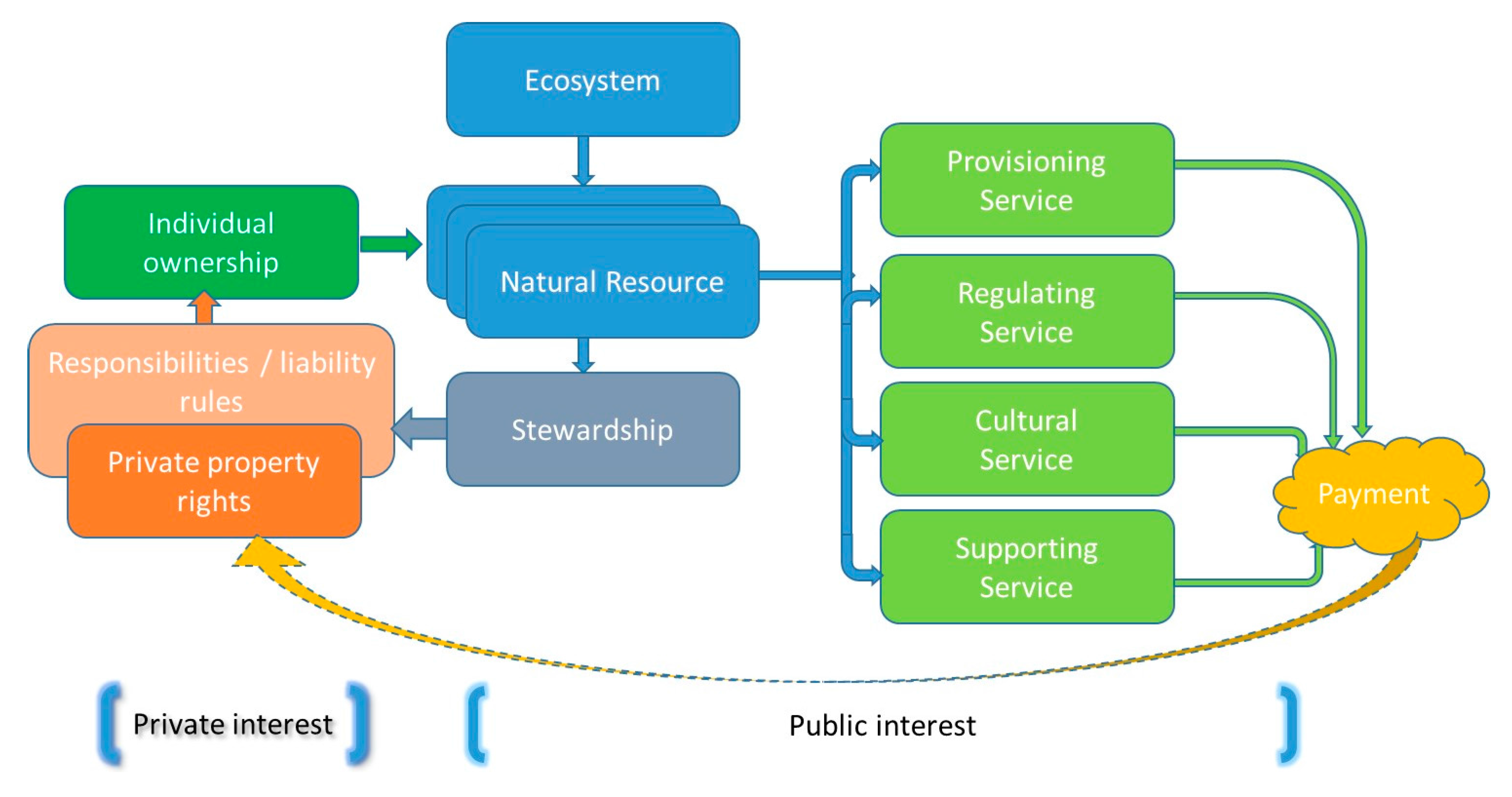
Figure 1 summarises our overall framing as presented in this section.
Figure 1.
Summary of our overall framing for the use of property rights and stewardship in the provision of ecosystem services.
Figure 1.
Summary of our overall framing for the use of property rights and stewardship in the provision of ecosystem services.
In addition to the property rights issue, another area of criticism of PES concerns the valuation of nature it assumes. Firstly, from an ethical point of view, natural resources are considered as invaluable entities so that turning their value into a price sounds unnatural and unfair as well as counterproductive for conservation [
10,
11,
34,
35,
36,
37]. Secondly, from an economic point of view, many doubts have arisen over the difficulties in converting some natural resources into something tradable in a market, specifically because of their physical characteristics of being non-rival. This means that ecosystems are often able to benefit one person without reducing the amount of benefits available for others. Therefore, they can be provided cooperatively and not competitively and considered as a public good. Recognizing such a feature to natural resources means that they are not amenable to voluntary payments [
9,
10]. Thirdly, from a scientific point of view, even though modern evaluation systems have been developed, attempting to cope with the continuously evolving state of nature and the interconnection between natural resources [
38], there are still many difficulties in measuring natural capital and ecosystem services related to it [
39].
Having briefly analysed ES, the PES schemes and their shortcomings the following section will look at the role of stewardship in providing a different approach to private property. The application of this approach to PES represents our attempt to demonstrate that PES, if it is to be an effective tool for the sustainable management of ecosystem services, will need to be well collocated in a legal framework and cannot operate outside a specific set of rules. In turn, these rules need to be able to balance private and public interests, taking into account the complexity of ecosystem services and be aimed at their protection.
3. The Role of Stewardship in Drafting the Legal Framework for the PES
As mentioned above, there is a debate amongst property law and environmental law practitioners and academia about changing the relationship between environmental law and property rights and the taxonomy itself of property, which refers to the way it is categorised among other rights [
6,
7,
8,
26,
32]. In this section, we firstly examine the relation between environmental law and property rights.
Thinking about a river catchment, which involves the property of different landowners, allows a first, easy example to demonstrate the connection between environmental law and property rights. Each owner uses his property for different purposes: for example, owner A for his industry, owner B for his farm, owner C for his real estate, and association D for promoting its local fauna conservation activity or its recreational activity. It is clear that an environmental law about, for instance, the chemical concentration that the industry can release in the river or the amount of water that the farmer can use for his activity could have huge repercussions on each other’s land. In particular, access to non-contaminated water for irrigation helps maintain the value of the real estate of the farmer. In fact, environmental rules have established an obligation which works as a limitation on the right of use of the land, in juxtaposition with the other actors’ rights.
The inevitable connection between environmental law and property rights, this time from a property rules perspective, is raised by Waldron, when he explains property rules as a way to dictate how scarce material resources are to be used [
25]. Moreover, Scotford, considering in particular the English legal system, states that there are significant “symbiotic connections” between property rights and environmental regulation [
7].
According to many authors, this connection contains a tension. Graham, stating that “where the landscape is in crisis, so too is the structure and content to the law of the land”, argues that law’s categories are not eternal [
6]. Therefore, since the current legal culture supports an anthropocentric perspective of nature, in which legal category any entitlement is largely unburdened by responsibilities towards natural resources, the taxonomy of law itself has to be changed and he suggests that a different approach in legal education is needed to better align property rights and environmental issues [
6]. Rodgers considers environmental legislation as a limitation or a way of redistributing property rights in order to pursue public policy objectives and makes a case for a theory of environmental property [
26].
To this extent, several aspects of the existing property rights theory would need to be reappraised, recognizing a new species of property management rules [
26]. Bosselmann, talking mostly about sustainability, builds his theory on the understanding that “environment is not a commodity, but physical reality, ultimately, life itself” and he investigates if environmental law and sustainability can be reconciled [
5]. The answer is that this reconciliation is not going to be an easy pathway, and, in fact, he refers to Constitutions as the supreme laws where this could happen [
5]. McGillivray, indeed, refers to Hardin’s “Tragedy of the commons” [
31] as an example often given to students of environmental law to explain the intersections between private rights and public responsibilities and the consequent tension between private and collective interests [
40].
One of the most interesting contributions to the debate about changing the relationship between natural resources and private property involves a way to understand private property not as a crystalized entitlement but as stewardship [
14,
15,
16,
17,
18]. It is not easy to properly define such a concept because as stated by Worrell and Appleby “people consider the term [of stewardship] to be well enough understood so as not to require defining” [
16]. Nonetheless, they define stewardship as “the responsible use (including conservation) of natural resources in a way that takes full and balanced account of the interests of society, future generations, and other species, as well as of private needs, and accepts significant answerability to society” [
16]. Moreover, referring to land, Lucy and Mitchel stated that “[i]n relation to those resources where comprehensive rights of exclusion, control and alienation are particularly apparent—personal belongings, for example—private property is clearly appropriate” [
15]. By contrast, “a stewardship regime—a regime of careful, constrained management of land in the interests of the steward and others—seems
prima facie better suited than a regime of private property to ensure the sustainable, socially important use of land” [
15].
Bavikatte and Bennett consider stewardship from a wider perspective underlining its potential regarding sustainability as a set of values which are not related only with environmental protection aims. They have recently stated that stewardship “creates a paradigm shift whereby rights to land, to culture, to traditional knowledge, to self-governance,
etc., are informed by a set of values that are not market based, and, what is more, are contained within the limitations of an overriding responsibility to protect the environment” [
18].
Defining stewardship as requiring a “responsible” management of natural resources implies that such a concept must be understood in relation to its own constraints. In fact, the owner must follow some moral [
14] or legal rules which require them to assume responsibilities. This point is central for the purpose of this paper because it stresses the need for a legal framework for those who manage “their” resources. Therefore, the owner should accept certain boundaries that derive from the inherent characteristic of the environmental resources—and, even more so, of ecosystem services—since such resources present deep interconnections with other resources. These resources must be understood and managed as part of an ecosystem not only from an environmental point of view but also in a wider perspective (such as the MEA has defined them), one which takes into account social and economic aspects. As described by Karkkainen, “The interdependencies among its [ecosystem] numerous interacting and mutually interdependent parts are so many, so thick, and form so elaborate and intricate a web that we cannot reasonably expect to manage individual components in isolation from one another” [
41]. Consequently, when dealing with ecosystems, a “bundle of responsibilities” must be particularly stressed along with the “bundle of rights” traditionally recognized within the property concept [
32,
42].
The responsibilities mentioned derive from the public interests of the community in the protection and conservation of the environment to a high standard, the access to natural resources and the prevention of resource scarcity. This kind of consideration requires decisions concerning a proportionate balance between the different rights of actors, which, we argue, can only be taken at government level. Using Harris’s categorization of property rules, we can refer to this category of rules as property-duty rules, meaning the rules imposed by the (national or local) government when setting the level of protection that has to be guaranteed by the owner [
43]. When talking about stewardship, it is more appropriate to talk about property-liability rules, which represent the constraints, which have to be recognised in managing natural resources [
26,
43,
44].
The PES agreements are structured in such a way that they are not a replacement of the already existing set of environmental rules which represent the property-duty rules set by the government with a “command and control” approach. On the contrary, they exceed, on a voluntary basis, the level of protection already set by the government, the level that might be termed “the line of compliance”. Alternatively, as for the cap and trade PES, the line of compliance is represented by the cap itself set by the state and under which the PES agreement works. Nonetheless, we argue agreements should respond to a setting of rules that can guarantee the balance between environmental law and property rights is maintained. In fact, one of the main difficulties that has prevented PES take up is their own structure. Since they are instruments that operate on a voluntary basis beyond the application of environmental laws, or as voluntary agreements “under the cap”, the stipulation of a PES agreement depends on the willingness of the beneficiary to pay the provider. This means that it is left to the different actors involved to decide which kind of environmental issue to tackle, for which price and for how long. Environmental issues often unfold over a long timescale and this does not always coincide with the parties’ commitment. Moreover, ecosystem services involve not only a very wide range of environmental and scientific competencies but also have social implications. In the final analysis, the parties of a PES are called to take decisions which strongly impact on public interests.
Administrative decisions—since environmental law is mostly administrative law [
7]—have already established a point of balance between different rights and interests. Voluntary mechanisms start to operate beyond environmental law, beyond the “line of compliance” that coincides with the limitation of property rights set by the law. Of course, in order to contract a PES the parties need, firstly, to comply with the existing laws already set by the government. The contribution to the protection of the environment through PES should be an extra commitment that the parties decide to establish and that operates only between them. Nonetheless, their decision influences other people’s interests in a similar way that administrative decisions do [
7]. This aspect is one of the main critiques in the matter of valuing nature, since decisions that are generally regarded as appropriately made by public authorities through an administrative/legislative procedure, such as balancing private and public interests, are left to the free negotiation of the parties.
Consider a landlord who has already respected the provisions for the disposal of a certain amount of chemicals in a river—what we have called, for convenience, “property-duty rules”. If he also decides to negotiate a PES agreement with his neighbour who has an organic farm in the downstream land, he would agree to be bound by an agreement that establishes a more rigorous limit to the chemical emissions. In this scenario, the agreement should still follow what we have defined, using a category of Harris, as “property-liability rules”. This is because the landlord, in order to diminish his emissions, could adopt, for example, other behaviours that still comply with the law but impacts other ecosystems such as reducing the emission in the river but producing more solid waste that in the end have a worse impact on the ecosystem where the landfill is located. To avoid this, property-liability rules are needed to impose on the parties a wider consideration of the effect of their agreement causing the landlord to consider the ecosystem impact of the emissions in total and creating a wider benefit in payment for this consideration by the organic farm. These rules provide a compulsion on the parties to take into account other kinds of interests beyond the benefits for their property contained within the agreement.
In order to solve shortcomings such as these undesirable knock-on effects of private-private PES, a public regulation that is able to manage that balance must be introduced. However, most PES involve a public party so that in these cases the relationship between private/public interests are more balanced and protected. Nonetheless, we believe that even beyond the line of compliance, and for both private and public parties, there is the need to observe certain property-liability rules. The fact that the PES agreements exceed the level of protection decided by the government, and the fact that most of the time one of the parties involved in a PES agreement is a public body, does not mean that the parties are relieved from any other obligation. These obligations should require the owner to act in accordance with the responsible management of what they own. In this sense, therefore, considering the relationship between natural resources and property rights in terms of stewardship appears much more coherent with an effective protection of the environment and the promotion of all the other aspects of sustainability contemplated in a PES agreement.
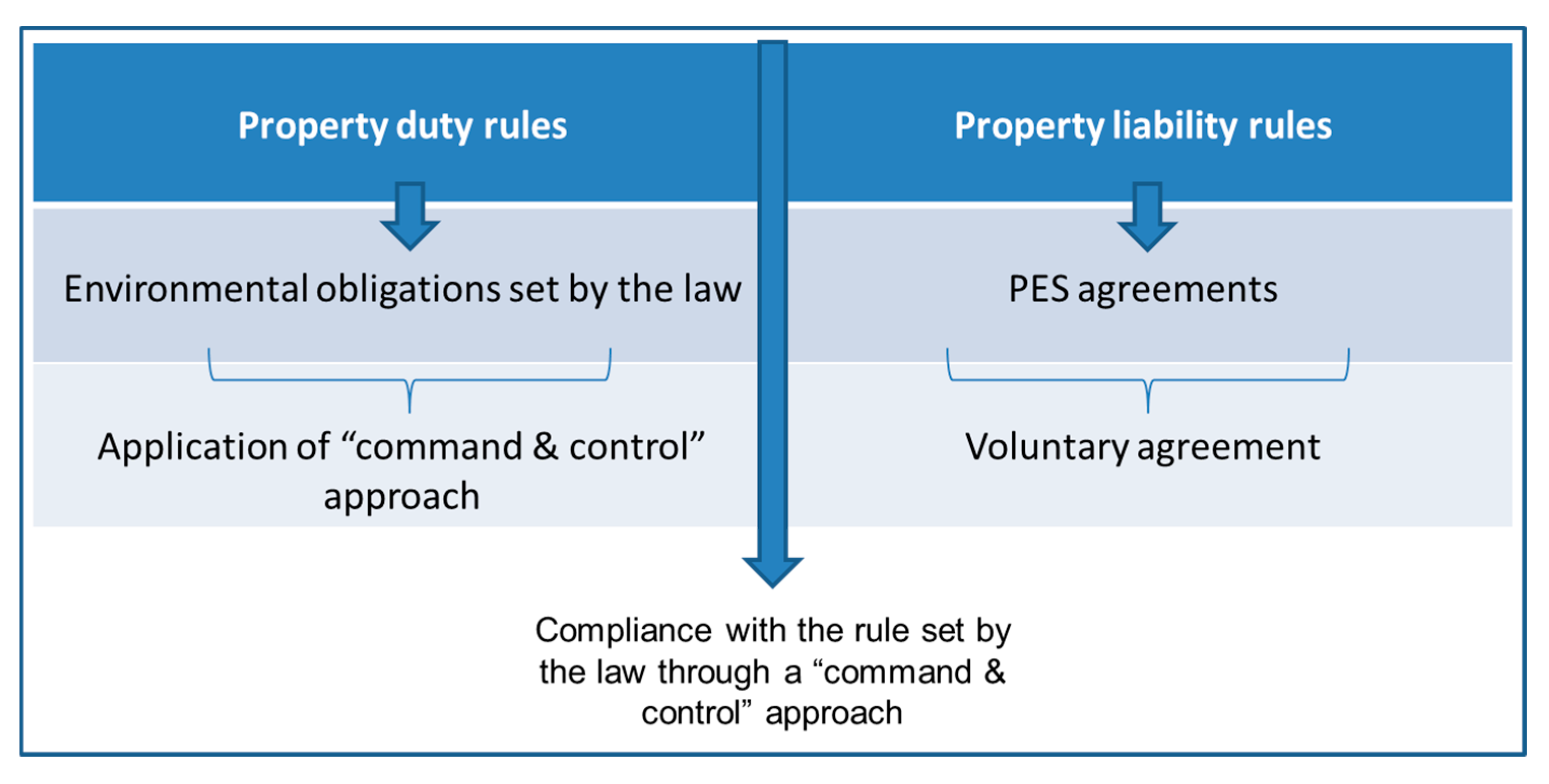
Stewardship, indeed, means “responsible management” of the environment and the related sustainability aspects and property-liability rules are crucial to establishing such responsibilities. Stewardship goes beyond the level of protection established by property-duty rules otherwise there would not be any guarantee that the property would be managed in a “responsible manner” regarding the environment and other aspects of sustainability (
Figure 2).
Figure 2.
Property duty rules under standard approaches to PES and property liability rules as a reflection of a stewardship approach.
Figure 2.
Property duty rules under standard approaches to PES and property liability rules as a reflection of a stewardship approach.
4. Discussion
This paper aims to outline the theoretical basis of the application of the stewardship approach to PES. We are particularly interested in understanding whether a different approach could counter some of the critique that has been applied to PES schemes. In this paper, the concept of stewardship has been used for this purpose because it represents a wider approach to property rights, which is well suited to the subject of contract of PES agreements—that is the ecosystem services. Since stewardship requires the responsible management of the subject of the property rights [
15,
16], meaning that property rights have to be constrained by responsibilities [
5], it is able to extend its operability beyond the actual compliance to the law. Although PES operate in the area of the voluntary mechanisms, they involve decisions that affect other people interests. Therefore, the role of public authorities—the only entities which can balance different rights and interests—is crucial.
Applying the understanding of the constraints to property rights from stewardship considerations while contracting a PES represents a new theoretical analysis that has not yet been properly scrutinized before in the literature. There are two papers that explore the relationship that underlies both stewardship and positive management mechanisms [
26,
40]. Both of these authors, though, refer to payments for environmental benefits which have a subject of contract which is not as wide as the PES. Rodgers, for instance, has written about the use of regulatory law to define property rights with examples about agri-environmental and nature conservation law [
26]. McGillivray, underlining the lack of studies on stewardship in relation to environmental protection and citing Rodgers as an exception, applies the concept of stewardship only at the water abstraction sector [
40]. Moreover, even if Reid mentions the link between stewardship and PES, he does so referring to the issue of PES and public participation. He states that within PES “the ideals of shared responsibility and stewardship are brought into play, as opposed to conservation being a matter that is dealt with exclusively by the public authorities”. In fact, he generally refers to stewardship in terms of “ideal”, not as an actual new approach for the management of natural resources that still requires regulating under property-liability rules [
13]. In doing so, he draws a line between stewardship, on one side, and the role of public authority, on the other. On the contrary, in this paper, we have stated that even if the stewardship approach is applied, the public authority has to play its role in maintaining the balance between public and private interests.
In particular, we have not found any literature that consolidates all the aspects mentioned in an organic theoretical frame. However, we can build on the previous literature of stewardship and positive management and add to them the consideration of two peculiarities which are inherent to the PES structure: (i) the complexity and interconnectedness of the subject of contract and (ii) the fact that they operate as voluntary mechanisms beyond the application of ordinary environmental law. After the provisions imposed by environmental law have been observed, the “line of compliance”, the voluntary mechanisms are only subjected to other types of compliance such as the one deriving from contract law or property law. The result, as we have argued, is that the traditional liberal, anthropocentric approach to commodities would be applied leaving the parties to the agreement to decide about interests of public relevance. In order to prevent this the role of public authorities, and those of the ecosystems, has to be central in balancing the different interests involved.
This has implications for PES contracts and these may differ according to the type of PES (public PES, trading PES and private PES). We highlight which type of PES may be most interesting to investigate to demonstrate the practical applications of the theoretical proposition within this paper and to suggest some concrete first ideas that should be the focus of new research to further explore and develop the application of stewardship to PES.
The paper has shown that in order to make PES sound instruments for sustainability, they cannot be considered outside a proper legal framework. It is important to note that PES are voluntary mechanisms for addressing complex subjects under which the decisions that the parties of a PES agreement have to take necessarily have public repercussions. A decision that involves the balance between private and public interests is a decision that should only be taken at the government level. If we want to understand the practical consequences of this, it is interesting to analyse within each of the types of PES scheme how the rules that underlie a stewardship approach can be applied.
Within the public PES scheme, the consideration of public concerns should already be guaranteed by the structure of the agreement itself. One of the parties of the agreement is, in fact, a public institution (national or, more likely local government) which acts as purchaser or provider of the ES. It is interesting to understand what the rules (property-liability rules) are—or should be—that regulate this kind of agreement—for example, how to practically guarantee public participation in a public PES agreement. Reid discussed the opportunities for public participation in setting the parameters of what will be acceptable in new approaches to biodiversity. He refers to public participation as an incidental stage of the decision-making processes, underlying that, at the moment, it is not an integral part of conservation regulation. In our opinion, this stage should be strengthened, starting from the provision of an effective regulation, which requires formal mechanisms for the public to be involved in the process [
13].
The trading PES scheme is often characterised by a public component. For example, in the cap and trade mechanism, the cap is usually set by the government. Within this type of PES scheme, it will be interesting to analyse in which way the balance between different interests can cope with market-based mechanisms. Rules that adhere to the principle of information and transparency in the ES market could be studied. Glicksman, for example, referring to the USA wetland mitigation program, proposes to create a “public accessible registry that allows interested person to track transitions” in order to improve transparency. Moreover, he continues proposing other options, which are stated also in the MEA report: “the creation of public boards with representatives of affected stakeholders to review and provide input on individual trades, citizens’ juries, community issue groups, electronic democracy, focus groups, and consensus conferences” [
45].
Unlike the other schemes, the private PES scheme presents more difficulties. Here, only private parties are involved in the agreement and they will follow the traditional rules of contract law and property law for regulating their relationship. Developing a practical legal tool that could cope with the need to balance public and private rights requires, of course, a specific study of case law. However, we propose the principle that should inspire the construction of such rules: holism. This concept, in fact, is very aligned with the stewardship approach. Recognizing holism as the basis of the rules required for the “responsible management” of natural resources appears to be, from a brief analysis, a starting point for building a sustainable legal framework for private PES. One new legal tool that has recently been proposed by Montini—The “Holistic Impact Assessment” (HIA)—gives an idea of how the holistic approach is increasingly becoming a first goal of environmental regulation for many commentators. The holistic approach fits coherently with the assessment of ecosystems, and with the understanding that even beyond the “line of compliance”, there is the need for private actors to take responsibility of the consequences of their agreements [
46]. Further exploration of approaches to stewardship in private PES schemes is required.
Summarizing, we believe that further studies to apply the theoretical proposal of this paper to practical and concrete legal tools should take into account principles such as public participation, transparency and holism.