1. Introduction
Nowadays, given the global trend towards sustainability [
1], remanufacturing activities are widely observed in the fashion industry. There are many business operations which collect used fashion products from consumers and remanufacture/reuse them in producing other products [
2,
3]. The “remanufactured products” are then either resold by them in their own retail outlets or supplied to other resellers who will then sell the remanufactured products to consumers. Usually, the remanufacturing activities in the fashion industry relate to the high quality and valuable materials such as carpets, silk products, and leathers. See [
2] for more details.
Many research studies on the remanufacturing supply chains have appeared over last two decades due to the growing importance of economy and environmental impact associated with remanufacturing activities. For an emerging economy, environmental issues arise and thus remanufacturing has become a matter of widespread concern in recent years in developing countries like China. For example, China’s automotive industry has entered a rapid development period due to the high-speed development of economy, and China has become the largest market in auto production and sales in the world. According to the data from the China Automotive Technology and Research Centre (CATARC) and National Bureau of Statistics of China, the number of in-use vehicles in China has risen to as much as 78.02 million until 2010, whereas the number of end-of-life vehicles (ELVs) is estimated at 4.8 million [
4]. Another example is the fashion apparel industry, in which some recycling companies such as I: CO
2 is making use of the collected used apparel for remanufacturing of new products. Fashion companies like Uniqlo, H&M, and Esprit are all participants in used apparel collection programs and they have worked with remanufacturing companies like I: CO
2 in further processing the collected products.
It should be pointed out that the characteristic of the remanufacturing industry in developing countries like China is distinctly different from that in many other developed countries. There are several factors which restrict their respective remanufacturing activities. For instance, the remanufacturing technologies are relatively low on the one hand; on the other hand, in light of the lower interests in remanufactured products and the lower environmental preferences, consumers are much less willing to pay for remanufactured products than new products. Therefore, it is difficult for the remanufacturer to make good profit by conducting remanufacturing activities. Then, enterprises do not actively participate in remanufacturing activities [
5,
6]. The government is conscious of the power of incentives for remanufacturing activities. For example, the State Council of China issued “several opinions on speeding up the development of recycling economy” in 2005 and clearly supported the development of remanufacturing. Meanwhile, the local government of China also stimulates remanufacturing activities by several preferential policies such as tax reduction, land policy, one-time subsidy. For example, as reported by Wang
et al. [
7], a one-time subsidy is provided by the government of Liuyang in Hunan province to motivate enterprises to launch remanufacturing activities. Subsequently, more and more Chinese firms are enticed to actively develop remanufacturing activities. Thus, remanufacturing is a relatively new problem in developing countries such as China, and little is known about the respective optimal marketing channel structure for remanufactured products. Thus, the remanufacturer faces the following channel choice problems as long as she decides to develop remanufacturing business: (1) Should the remanufacturer cooperate with the manufacturer and sell the remanufactured products via the manufacturer to customers; or (2) Should the remanufacturer compete with the manufacturer and sell the remanufactured products directly to customers? In short, there is a dilemma between cooperation and competition in this market channel selection problem. In addition, in such a context, the government faces the problem on how to set the financial subsidy policy. Meanwhile, the remanufacturers need to make corresponding channel choice when government subsidies are considered. Exploring the interaction between the manufacturer and remanufacturer under different marketing channels will help to solve this problem.
However, no existing literature exactly studies and analyzes the channel choice of the remanufacturer in the government-subsidized supply chains. Even though a few prior studies such as [
8,
9,
10] consider the impact of government subsidies on the remanufacturing activities, the channel structure of remanufacturing supply chains is given and no channel choice for the remanufacturer is considered. Furthermore, the lower customers’ willingness to pay for remanufactured products implies that the remanufacturer is relatively less competitive in markets like China than those in the developed countries. Therefore, the remanufacturer acts as the follower and the manufacturer acts as the dominant channel leader in the remanufacturing supply chains. Note that this is different from the usual assumption in the literature (such as [
11]) since they mainly focus on the developed country scenarios.
In this paper, to fill the gap between the current remanufacturing supply chain literature and the practice observed in developing countries’ remanufacturing operations, we consider a remanufacturing supply chain that consists of a “dominant leader” manufacturer and a follower remanufacturer. We consider an industry structure where the manufacturer does not engage in remanufacturing, which is the case for the majority of manufacturers [
12,
13], including the situation in fashion apparel. The manufacturer produces new products and sells it to customers, while the remanufacturer produces remanufactured products. The remanufacturer can sell the products directly to customers or the manufacturer at a wholesale price. This is an important decision making problem to be examined in this paper for the remanufacturer.
To accelerate the remanufacturing activities and hence reduce negative environmental influence, we consider the scenario in which the government first offers subsidy to the remanufacturer to enhance the quantity of remanufactured products. Then, the manufacturer decides the production quantity and price of the new products. Finally, according to the government’s subsidy and the manufacturer’s decisions, the remanufacturer chooses the channel and subsequently determines the production quantity and price of the remanufactured products. In such a context, this study seeks to address the following questions:
- (1)
What is the optimal channel choice for the remanufacturer (i.e., cooperation or competition)?
- (2)
How does government subsidy influence the channel choice?
- (3)
Are the government-subsidized remanufacturing activities always beneficial to the environment?
- (4)
How does customers’ willingness to pay for remanufactured products affect the remanufacturer’s channel choice?
The rest of the paper is organized as follows.
Section 2 reviews the closely related literature.
Section 3 introduces the model.
Section 4 analyzes the performances associated with the respective channel choices.
Section 5 conducts a comparison between two types of channel structures.
Section 6 examines the impact of acceptance of remanufactured products on the remanufacturer’s channel choice.
Section 7 concludes the research.
2. Literature Review
This paper relates to the research stream on sustainable development of supply chain systems. Given the rich literature in this research stream (see, e.g., Ferrer and Swaminathan [
14], Choi [
15], Savaskan
et al. [
16], Toffel [
17], Choi and Chiu [
18], Thierry
et al. [
19], Guide and Van Wassenhove [
20], Choi
et al. [
21], Li
et al. [
22],
etc.), we will only review the literature which is particularly relevant to our paper,
i.e., the literature on remanufacturing supply chains. As a matter of fact, there are many studies so far on the remanufacturing supply chains and several review studies have been conducted for this research line. For example, early studies can be found in a review paper [
23]. Guide and Van Wassenhove [
20] describe the evolution of the research on closed-loop supply chains. Subramoniam
et al. [
24] present a review of the literature on remanufacturing operations for the automotive aftermarket. Ilgin and Gupta [
25] systematically investigate the existing literature by classifying over 540 published references into four major categories, namely the environmentally conscious product design, reverse and closed-loop supply chains, remanufacturing, and disassembly. Souza [
26] provides a comprehensive tutorial of the literature on closed-loop supply chains. This paper classifies the related studies in terms of strategic, tactical, and operational issues. Junior and Filho [
27] conduct a survey for the field of production planning and control of remanufacturing.
Two streams of studies on the remanufacturing are very relevant to this study. One stream of literature focuses on the competitive behaviors between remanufactured and new products. The other examines the impact of government subsidies on the remanufacturing performance. We review them as follows. For the related literature with competition, Majumder and Groenevelt [
28] pioneer a study on a competition problem between a manufacturer and a remanufacturer. They examine a simultaneous Nash gaming between the manufacturer and the remanufacturer. Ferrer and Swaminathan [
14] extend Majumder-Groenevelt model and characterize the optimal production quantities and prices in both monopoly and duopoly environments. They explore both the multi-period and infinite-horizon settings. They investigate the effects of various parameters on equilibrium prices, profits, and remanufacturing activity. However, all the above studies consider the case in which the remanufactured product is the same as the new one in terms of customer willing-to-pay and prices. Recently, Ferrer and Swaminathan [
29] consider a situation where the remanufactured product is differentiated from the new one. Wu [
30] studies the price and service competition between new and remanufactured products in a two-echelon supply chain. The supply chain consists of a traditional manufacturer, a remanufacturer, and a retailer. Alinovi
et al. [
31] focus on closed loop supply chains and derive the analytical formulae of the optimal inventory management policy.
While all of the above studies mainly focus on the competitive behaviors between the new and remanufactured products, either between the players (a manufacturer and a remanufacturer), or within one manufacturer, none of these studies concern the role of government. However, according to prior research such as [
13,
32], government plays an important role in remanufacturing supply chains. The regulations and laws issued by governments not only change the channel members’ decisions in the remanufacturing reverse supply chains and therefore have a huge impact on the supply chain performance, but also result in different structures of the remanufacturing supply chains, e.g., China auto parts remanufacturing supply chains promoted by strong governments.
A few studies have explored the close relationship between government incentive policies and remanufacturing. Observe that the subsidy fees have been implemented in developed countries such as Canada and Japan [
33]. Webster and Mitra [
13] investigate the impact of take-back laws on firm profits and remanufacturing activity. Atasu
et al. [
34] study the efficiency of recycling regulations. Rahman and Subramanian [
32] claim that government legislation and incentive are the major drivers for computer recycling operations. Mitra and Webster [
8] find that the introduction of subsidies enhances remanufacturing activity. Aksen
et al. [
9] describe the subsidization agreement between the government and a company engaged in collection and recovery operations. They show that for the same collection rate and profitability ratio, the government has to grant a higher subsidy in the proposed supportive model than in the legislative model. Zhao and Chen [
10] make a comparison of the present situation of scrap automobiles between Japan and China. They find an appropriate way for China to deal with the problem of scrap automobiles. Simic and Dimitrijevic [
35] present a production planning problem for vehicle recycling factories in the EU legislative and global business environments. Wang and Chen [
4] systematically introduce and analyze ELV policies in China. They classify such policies and regulations to further analyze China’s ELV recycling industry to facilitate its development. Ma
et al. [
36] focus on how consumption-subsidy influences a dual-channel closed-loop supply chain. Debo
et al. [
37] identify conditions under which a monopolist manufacturer will invest in technologies to make a product suitable for remanufacturing. They also identify how these conditions change when independent remanufacturers enter the market to compete with the manufacturer. Heese
et al. [
38] and Ferguson and Toktay [
12] both examine the conditions under which a manufacturer will and will not choose to remanufacture or sell remanufactured products.
To the best of our knowledge, all of the above studies consider remanufacturing supply chains with a given channel structure. Thus, the model of remanufacturing supply chain in this paper not only embraces the traditional government subsidy research issues, but also opens up a new decision making issue on the optimal channel structure of manufacturer-dominant remanufacturing supply chains.
3. Model Description
The list of notation used in the paper is shown in
Table 1. Several key assumptions are discussed below.
Consider a remanufacturing supply chain consisting of two members, a manufacturer and a remanufacturer. The manufacturer produces new fashion products with a cost per unit, while the remanufacturer collects used products and remanufactures them with a total cos per unit. The total remanufacturing cost covers both collection cost and remanufacturing cost. To avoid trivial cases, we assume , which means that remanufacturing a used product is less costly than producing a new one. Actually, as reported in the literature, remanufactured products cost 40%–65% less than new products to produce [39]. Although the quality of remanufactured products is as good as that of new products, and remanufactured products are treated in the same way as new products with similar warranties and service contracts, the price of remanufactured products is lower than that of new products due to customers’ lower willingness to pay for the remanufactured products. As Mitra and Webster [8] point out, remanufactured product prices are typically 30%–40% lower than new products. Note that the different price makes this study different from lots of previous remanufacturing studies. The situation also makes the profit of remanufacturing activities low and therefore the remanufacturing firm may not actively participate in remanufacturing activities. Thus, the government offers a subsidy per unit of remanufactured product to incentivize the remanufacturing firm’s activities. Here, to avoid trivial cases, we assume . Namely, the subsidy is smaller than the difference between the unit costs of new products and remanufactured products. For the production quantities of new and remanufactured products, without loss of generality, we suppose that the production quantity of remanufactured products is smaller than that of new products in a steady period, that is, .
Table 1.
Parameters and definitions.
Table 1.
Parameters and definitions.
| Notation | Definition |
|---|
| Q | Market size |
| θ ∈ (0,1) | Valuation of remanufactured products relative to new products |
| pn,pr | Price of new products, remanufactured products |
| cn,cr | Cost of new products, remanufactured products |
| qn,qr | Demand quantity of new, remanufactured products |
| Πm,Πr | Profit of manufacturer, remanufacturer |
| w | Wholesale price of remanufactured products |
| s | Government subsidy of unit of remanufactured products |
| τ | Customers’ willingness to pay for new products |
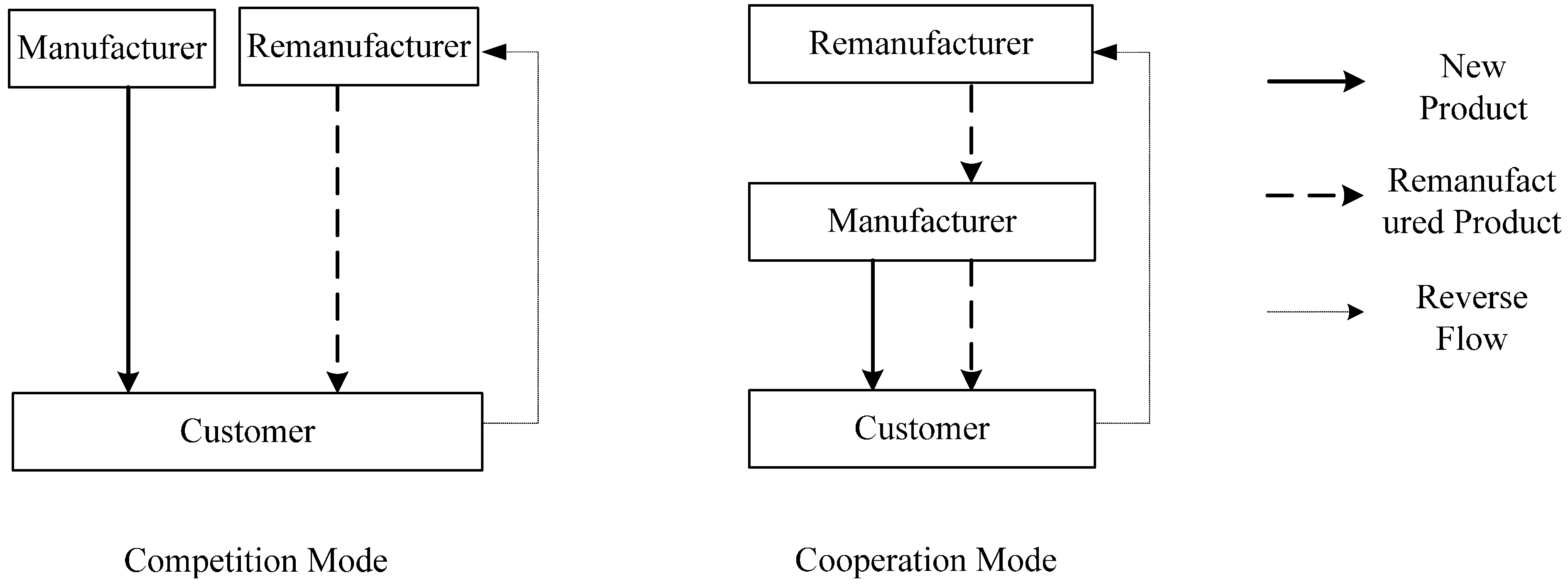
Two channel options (competition and cooperation) are illustrated in
Figure 1. In the competition mode, the remanufacturer sells remanufactured products directly to customers at a price
, the manufacturer sells new products to customers at a price
, hence the remanufacturer competes with the manufacturer. While the remanufacturer sells remanufactured products to the manufacturer at a wholesale price
in the cooperation mode and then the manufacturer sells both new products and remanufactured products to customers at prices
and
respectively.
Figure 1.
Two channel options of selling remanufactured products.
Figure 1.
Two channel options of selling remanufactured products.
As we discussed in earlier sections, in our model, the manufacturer acts as the channel leader (namely, Stackelberg leader). The emerging remanufacturer needs to decide whether to cooperate with the manufacturer or not. Following the general assumption in the literature, we assume that the manufacturer and the remanufacturer have access to the same information (i.e.,it is the information symmetric situation).
In our model, we consider the case that customer willingness to pay for new products,
, is heterogeneous and is a uniformly distributed random variable in the range of
. Note that this assumption is widely accepted in modeling the customers’ heterogeneity [12]. It implies that the potential market size is
, and the upper limitation of customer willingness to pay is also
. Then, we assume that customers’ valuation per unit of quality for remanufactured products is a fraction
of its valuation for new products. The empirical evidence of the lower valuation of remanufactured products by customers can be found in [
40,
41]. The new and remanufactured products’ demand functions are given as follows.
For further details and logics of the analytical demand functions employed in this paper, we refer readers to [
12,
14].
4. Models under Cooperation and Competition Modes
4.1. Cooperation
In the cooperation mode, the remanufacturer sells remanufactured products to the manufacturer at a wholesale price, and then the manufacturer sells both the remanufactured and the new products to customers. The manufacturer is the Stackelberg leader and the remanufacturer is the follower. The sequence of events is as follows. First, the manufacturer determines the price of the new product
and the price of the remanufactured product
. The manufacturer is the Stackelberg leader and knows the reaction of the remanufacturer. Second, the remanufacturer determines the wholesale price
according to the optimal pricing of the new and remanufactured products. Then, the profit function of the manufacturer is
And the profit function of the remanufacturer is
With solving this classical Stackelberg game, we can obtain the optimal pricing policies for the manufacturer and the remanufacturer as summarized in Proposition 1.
Proposition 1.- (1)
The optimal pricing for the manufacturer are
- (2)
The optimal wholesale pricing for the remanufacturer is
Based on the above optimal prices and profit functions, the corresponding optimal production quantities of the new and remanufactured products and the optimal profits associated with the manufacturer and the remanufacturer can be obtained as follows:
Corollary 1.- (1)
The optimal production quantities of the new and the remanufactured products are respectively given by
and
- (2)
The optimal profits of the manufacturer and the remanufacturer are respectively given by
and
From the performance expressions in Proposition 1 and Corollary 1, the impact of the subsidy on the remanufacturing performance under the cooperation mode can be derived. We summarize the core insights in Corollary 2.
Corollary 2. Under the cooperation mode:
- (1)
The production quantity of remanufactured products increases with the subsidy, whereas the price of remanufactured products decreases with the subsidy;
- (2)
The production quantity of new products decreases with the subsidy, whereas the subsidy has nothing impact on the price of remanufactured products;
- (3)
The wholesale price of remanufactured products decreases with the subsidy.
In order to give the comparison between the subsidy’s impacts on the performance of the remanufacturing supply chain under the cooperation and competition modes, the explanation of Corollary 2 will be presented after Corollary 4 in
Section 4.2.
4.2. Competition
In the competition mode, the remanufacturer sells remanufactured products directly to customers, and the manufacturer sells new products to customers. These two players compete with each other by pricing two types of corresponding products. The manufacturer acts as the Stackelberg leader and the remanufacturer is the follower.
The sequence of events in the supply chain under the competition model is given in the following. First, the manufacturer determines the price of new products
. The manufacturer is the Stackelberg leader and knows the reaction of the remanufacturer. Second, the remanufacturer determines the price of remanufactured products
according to the optimal price of new products. In contrast to the cooperation mode, the remanufacturer sells remanufactured products directly to customers, and therefore no wholesale price
appears in the competition mode. As a result, the profit function of the manufacturer is shown below,
The profit function of the remanufacturer is
By an induction similar to that of the cooperation mode, the two players’ optimal decisions under the competition mode are derived as shown in Proposition 2.
Proposition 2.- (1)
The optimal pricing policy of the manufacturer is
- (2)
The optimal pricing policy of the remanufacturer is
With Proposition 2, we can find the optimal production quantities and profits of both supply chain members. We summarize the result in Corollary 3.
Corollary 3.- (1)
The optimal production quantities of new products and remanufactured products are
and
- (2)
The optimal profits of the manufacturer and the remanufacturer under competition mode are
From Proposition 2 and Corollary 3, the impact of the subsidy on the performance of the remanufacturing supply chain under the competition mode is shown in following corollary.
Corollary 4. Under the competition mode:
- (1)
The production quantity of remanufactured products increases with the subsidy, whereas the price of remanufactured products decreases with the subsidy;
- (2)
Both the production quantity and price of new products decrease with the subsidy.
Comparing the impact of subsidy under cooperation mode in Corollary 2 with that in Corollary 4, we reveal the following insights.
The impacts of the government subsidy on the remanufacturing activity under the two modes are identical: The production quantities of remanufactured products under the two modes are both increasing in the subsidy, whereas the prices of remanufactured products under the two modes are both decreasing in the subsidy.
The above result indicates that the subsidy has a positive influence on the production quantity of remanufactured products, and the subsidy has a negative influence on the price of remanufactured products. Therefore, the subsidy will accelerate remanufacturing activities as the government hopes. Since the increasing subsidy leads to the decreasing of net cost, the price of remanufactured products is decreasing in the subsidy.
This finding illustrates that the subsidy has a negative influence on the production quantity of new products under both the cooperation and competition modes. The reason is that: As the subsidy can improve the quantities of remanufactured products under the two modes, and the total size of the demand is fixed, therefore the production quantities of new products under the two modes decrease with the subsidy. As the government expects, the decreasing of new products’ production quantity has a positive effect on the environment. As we all know, the resource and energy consumption of producing a new product is more significant than that of a remanufactured product.
In the cooperation mode, the price of new products is determined by the manufacturer; at the same time the manufacturer acts as the dominant leader whereas the remanufacturer acts as the follower. Therefore, the price of new products will not decrease with the subsidy, and the price will not increase when the price of remanufactured products decreases (with the subsidy). In short, the price of new products remains the same when the subsidy changes. However, in the competition mode, this is not the case. The manufacturer must compete with the remanufacturer through pricing. The price of remanufactured products is decreasing with the subsidy. Thus, the price of new products decreases with the subsidy, too.
It is clear that producing a remanufactured product consumes less natural resources and energy than producing a new product. The objective of government subsidies is to stimulate the remanufacturer produces more remanufactured products. We use the term “remanufacturing rate”
as a proxy of the remanufacturing environmental performance. Then, the following is true.
The above result shows that the subsidy has a positive influence on the benefits of remanufacturing. Therefore, the subsidy will reduce the consumption of resource and energy as the government hopes.
5. Comparative Study of Cooperation vs. Competition Modes
5.1. Channel Choice
This section studies the remanufacturer’s optimal channel choice by comparing the remanufacturer’s optimal profits under both the cooperation mode and competition mode.
According to Corollaries 2 and 3, the difference of the two optimal profits,
, is clear. It is obvious that
is a quadratic function of the government subsidy
. We can then get the two roots of equation
as follows.
and
It is easy to verify that . We simplify and modify the two roots as and . Here represents the net cost of unit remanufactured product when the government subsidy is .
For the sake of convenience, we denote , and let , and . Then we can show that , that is, . Therefore, we have Proposition 3.
Proposition 3. The optimal choice for the remanufacturer with regard to government subsidy is shown as follows.
- (1)
If , the remanufacturer should cooperate with the manufacturer to gain a higher profit;
- (2)
If or , the remanufacturer should compete with the manufacturer to gain a higher profit.
From Proposition 3, we have the following findings. An overly high or overly low subsidy implies that it is optimal for the remanufacturer to compete with the manufacturer, whereas the remanufacturer should cooperate with the manufacturer when the subsidy value is in between upper and lower bound. However, even if the subsidy is very low (namely, the net cost
is too high), the remanufacturer may cooperate with the manufacturer, and the choice is identical to that when the subsidy is very high. However, the performances are different. This will be discussed in
Section 5.2.
Next, we continue to explore the remanufacturer’s channel choice. The government subsidy should ensure that the optimal prices and production quantities under two modes are positive in practice. Meanwhile, without loss of generality, we assume that
. Hence,
satisfies the following inequality in practice,
where
,
. Therefore, we shall discuss the remanufacturer’s channel choice when the government subsidy falls within
. Meanwhile, by exploring the two roots
and
of the equation
and the relationship
, the optimal choices for the remanufacturer under different cases can be obtained. As the most important result of this paper, we present the remanufacturer’s optimal channel choice in Theorem 1.
Theorem 1. The optimal channel choices for the remanufacturer are different under different cases.
Case 1: If
,
, then
- (i)
1A: competition is the optimal channel choice for the remanufacturer when ;
- (ii)
1B: cooperation is the optimal channel choice for the remanufacturer when ;
Case 2: If , , then cooperation is the optimal channel choice;
Case 3: If
,
, then
- (i)
3A: competition is the optimal channel choice when ;
- (ii)
3B: cooperation is the optimal channel choice when ;
- (iii)
3C: competition is the optimal channel choice when ;
Case 4: If
,
, then
- (i)
4A: cooperation is the optimal channel choice when ;
- (ii)
4B: competition is the optimal channel choice when .
Theorem 1 implies that the remanufacturer should choose different channel structure modes when the problem parameters are different. This observation also indicates that the optimal channel choice for the remanufacturer is complicated in remanufacturing supply chains. In particular, the two types of costs and , the market size , the government sibsidy and customers’ willingness to pay for remanufactured products are vitally important in determining the remanufacturer’s optimal channel choice together.
5.2. Performance Comparison
This section analyzes the performance of the remanufacturing supply chain. Note that the performance indexes of the remanufacturing supply chain (i.e., the quantities and the prices of two types of products) are studied when the remanufacturer’s optimal channel choice is determined.
According to Propositions 1 and 2 and Corollaries 1 and 2, it is easy to obtain the differences of the optimal prices and production quantities of the cooperation mode and the competition mode (P.S.: The ones under cooperation minus the ones under competition) as follows.
We find that the signs of the differences are determined by the relationship between and . Recall the different cases in Proposition 3 and the remanufacturer’s corresponding optimal channel choices, the differences of the remanufacturing supply chain performances under the optimal choice and the non-optimal choice can be obtained. Then the following claim holds.
Corollary 5. The signs of the differences of the remanufacturing supply chain performance indexes under the remanufacturer’s optimal choice minus those under the remanufacturer’s other choice is shown in
Table 2.
Table 2.
Performance comparision between two modes.
Table 2.
Performance comparision between two modes.
| Performance | cr − s < c0 | (c0,θQ) | cr − s > θQ |
|---|
| qr,pr | + | − | − |
| pn | − | + | + |
| qn | 0 | 0 | 0 |
here
. “+” represents a positive difference,
i.e., the performance index under the optimal choice is greater than that under the other choice, and “−” refers to a negative difference.
Corollary 5 indicates the influence of remanufacturer’s optimal channel choice on the remanufacturing supply chain in terms of efficiency and productivity. For example, if the subsidy makes the net cost of remanufactured products fall within , Proposition 3 implies that the remanufacturer’s optimal choice is “cooperation”. Then the production quantity of remanufactured products under the cooperation mode is smaller than that under the competition mode. This reveals that, even though Corollaries 3 and 4 state that the production quantities of remanufactured products under both the cooperation and competition modes are increasing in the subsidy, the production quantities under the two modes are different and the remanufacturer’s optimal channel choice (namely, cooperation) is less efficient from the point of view of the government or society. That is, the remanufacturer’s optimal channel choice results in a sub-optimal performance of the remanufacturing supply chain. In addition, according to the signs in the second column, Corollary 5 implies that the smaller the subsidy, the more inefficient of the remanufacturer’s optimal channel choice in terms of the remanufacturing activity.
6. Numerical Experiments
Customers’ willingness to pay for remanufactured products has a significant influence on the remanufacturing supply chain. This section conducts numerical studies to show the influence of on the remanufacturer’s optimal channel choice. represents the value of the remanufactured product relative to the new product.
Theorem 1 indicates that the optimal channel choice for the remanufacturer is determined by both the upper and lower bounds of in practice (that is, and ) and the two roots of equation together. Proposition 3 shows that the remanufacturer’s optimal channel choice is cooperation when falls within and is competition otherwise. However, Theorem 1 indicates that the remanufacturer’s optimal channel choice is determined by both the two roots and the upper and lower bounds in practice. Thus, we shall investigate how and , and are shaped by
to explore the impact of on the remanufacturer’s optimal channel choice.
Next, we examine how
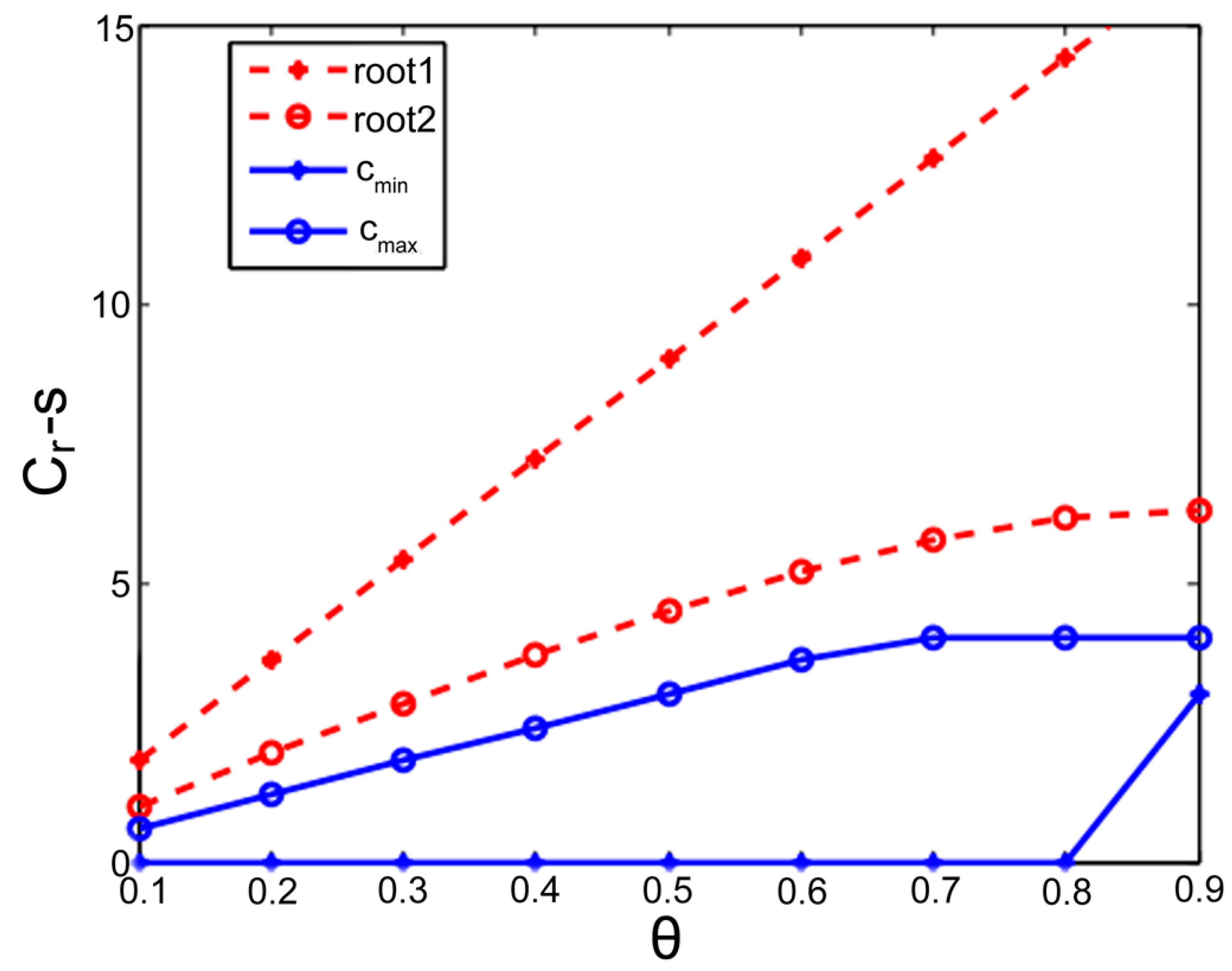
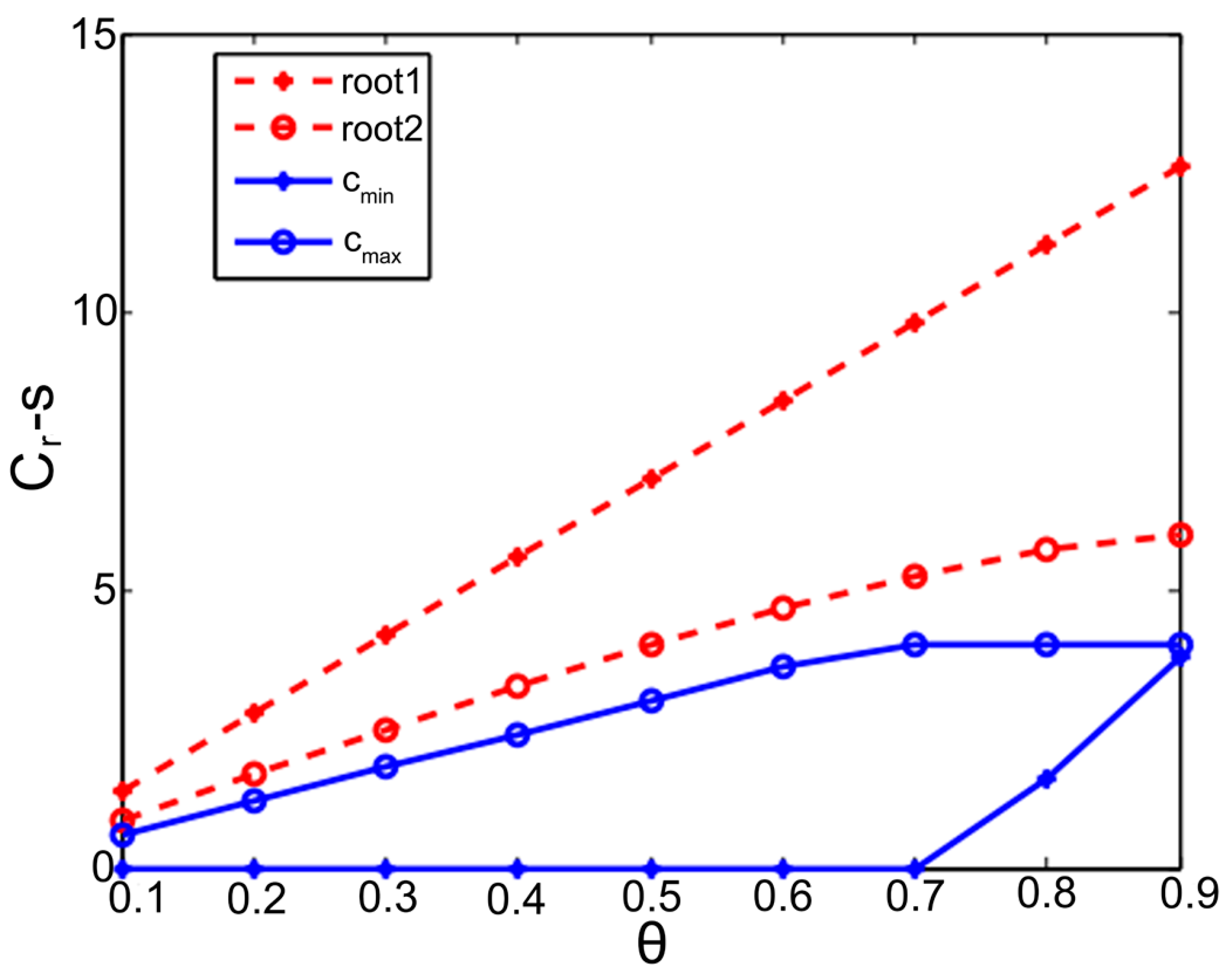
affects the remanufacturer’s optimal channel choice. The results are illustrated in
Figure 2 and
Figure 3. Here, we set the parameters
,
,
,
for
Figure 2 and
for
Figure 3, and
takes values in the range of
.
In
Figure 2 and
Figure 3, the area between two red lines represents the cooperation area, the area between two blue lines represents the valid area of
in practice.
Figure 2 shows that the remanufacturer will be more likely to choose cooperation with the increase of
. However, the valid area in practice locates completely in the competition area. Therefore, the optimal channel choice for the remanufacturer is competition.
Figure 3 indicates the same observation that the higher the acceptance of remanufactured products, the greater the cooperation area of the remanufacturer becomes. In addition, we find that the cooperation area in
Figure 3 is greater than that in
Figure 2 (noting that the upper red line in
Figure 3 is higher than the one in
Figure 2). The difference between these two areas means that a larger market size entices the remanufacturer to cooperate with the manufacturer. This is a result of the dominant role of the manufacturer in the remanufacturing supply chain. The manufacturer’s leadership makes it a must for the remanufacturer (the follower) to cooperate with the manufacturer so as to grab a larger market size of remanufactured products. Meanwhile, as the same to the scenario when
Q = 14, the valid area in practice locates completely in the competition area. Thus, the optimal channel choice for the remanufacturer is also competition when
Q = 18.
Figure 2.
Cooperation region when Q = 14.
Figure 2.
Cooperation region when Q = 14.
Figure 3.
Cooperation region when Q = 18.
Figure 3.
Cooperation region when Q = 18.
7. Conclusions
Remanufacturing plays a crucial role to enhance business competiveness and to ease environment pressure. In a closed loop supply chain, the remanufacturer faces the channel choice decision making problem on whether to cooperate with the manufacturer or not. Remanufacturing activities also attract governments’ investment and stimulus. Motivated by the observed industrial practices in fashion, the channel choice for the remanufacturer in a “developing country government”-subsidized remanufacturing supply chain is examined in this paper. The remanufacturer can sell remanufactured products to the manufacturer, and then the manufacturer sells both the new and remanufactured products to customers (i.e., the cooperation mode). The remanufacturer can also sell remanufactured products directly to customers and thus compete with the manufacturer in the market (i.e., the competition mode). We follow the observed market scenario and model the manufacturer as the Stackelberg leader, whereas the remanufacturer acts as the follower.
In the equilibrium, we examine the performance of the remanufacturing supply chain under the two types of channel structure, and then explore the channel choice of the remanufacturer when the subsidy is considered. The influence of the acceptance of remanufactured products on the remanufacturer’s channel choice is studied numerically. The insights are summarized in the following. First, the effect of the subsidy on the performance of the remanufacturing supply chain under the two modes is revealed. To be specific, the production quantities of remanufactured products under the two modes are both increasing in the subsidy, whereas the prices under the two modes are both decreasing in the subsidy. The production quantities of new products under the two modes are both decreasing in the subsidy. The subsidy has nothing to do with the price of new products under the cooperation mode, whereas the price of new products under the competition mode is decreasing in it. Second, the influence of the subsidy on the remanufacturer’s optimal channel choice is complicated. The remanufacturer’s optimal channel choice is determined by several problem parameters together. An overly high or overly low subsidy makes the remanufacturer compete with the manufacturer, and a modest value of the subsidy results in the cooperation between the remanufacturer and the manufacturer of the remanufacturing supply chain. Furthermore, if the acceptance of remanufactured products is higher, the remanufacturer will be more likely to compete with the manufacturer. These findings provide important implications for the closed loop supply chain management in fashion business operations.
It is noted that the analysis in
Section 5.2 reveals that a fixed subsidy per unit of the remanufactured product may make the remanufacturer choose an inefficient mode from the point of view of the government. Therefore, in future research, it might be promising to consider coordination issues within the remanufacturing supply chain system, which also includes the government.