

Integrated Assessment of the Water, Sanitation and Hygiene Situation in Haitian Schools in the Time of Emergency

Abstract
:1. Introduction
2. Study Area
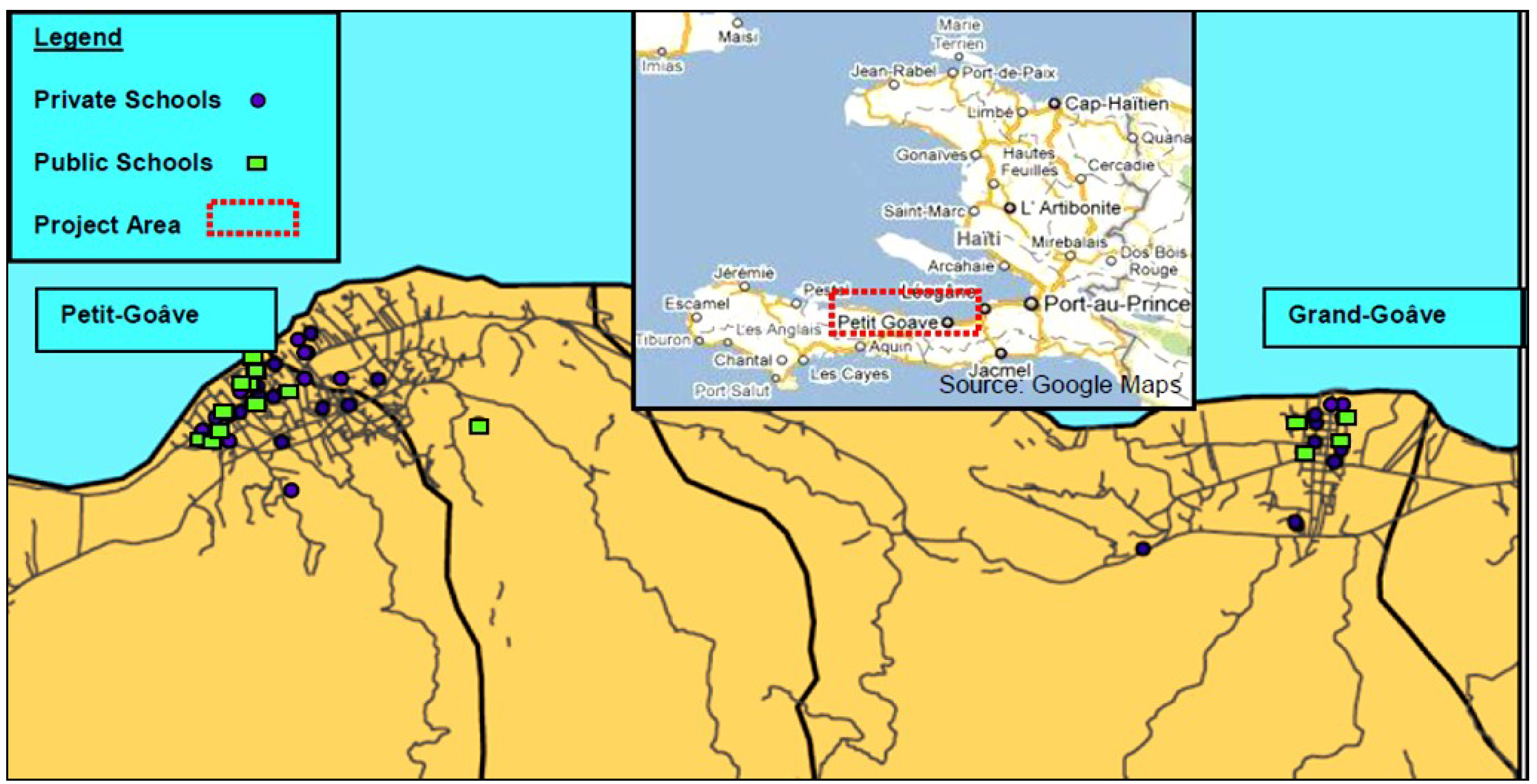
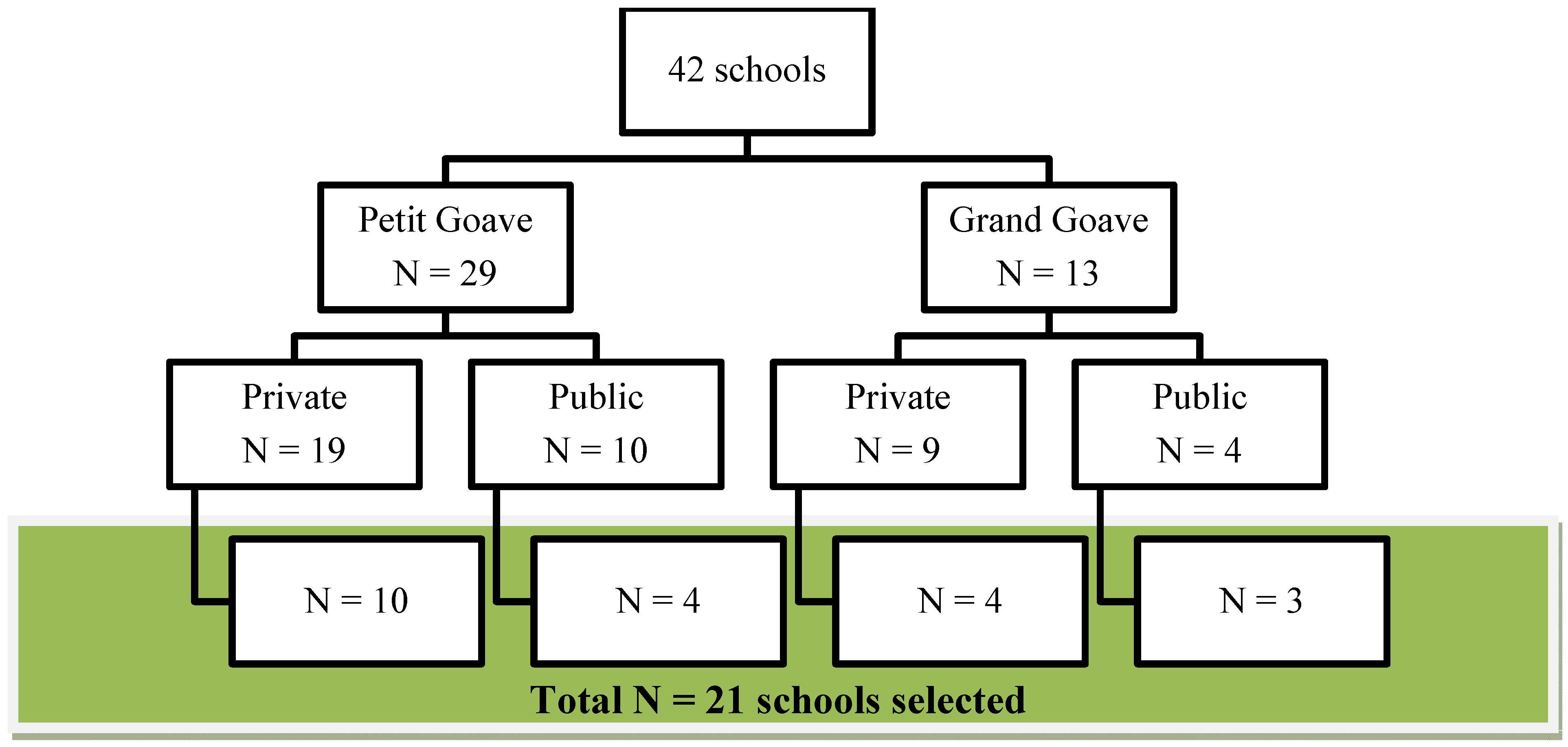
3. Methods
3.1. Selection and Training of Surveyors
3.2. Desk Study/Literature Review

| Literature review |
|
|
| Infrastructural Survey/direct observation (42 schools) |
|
|
| Key informants/ semi structured interview (42 schools) |
|
|
| Knowledge, Attitudes and Practices (KAP) questionnaires (21 schools) |
|
|
3.3. Infrastructural Survey
3.4. Semi-Structured Interviews
3.5. Knowledge, Attitudes and Practices (KAP) Questionnaire
3.6. Ethical Discussion
4. Results
4.1. Access to School Education
| Public | 14 (67) | 54 | 100–500 | 2.48–12.42 | 3.41 (6.92) | 0.4–2 |
| Private | 28 (33) | 20 | 1000–15000 | 24.84–372.67 | 138.5 (196.19) | 4–57 |
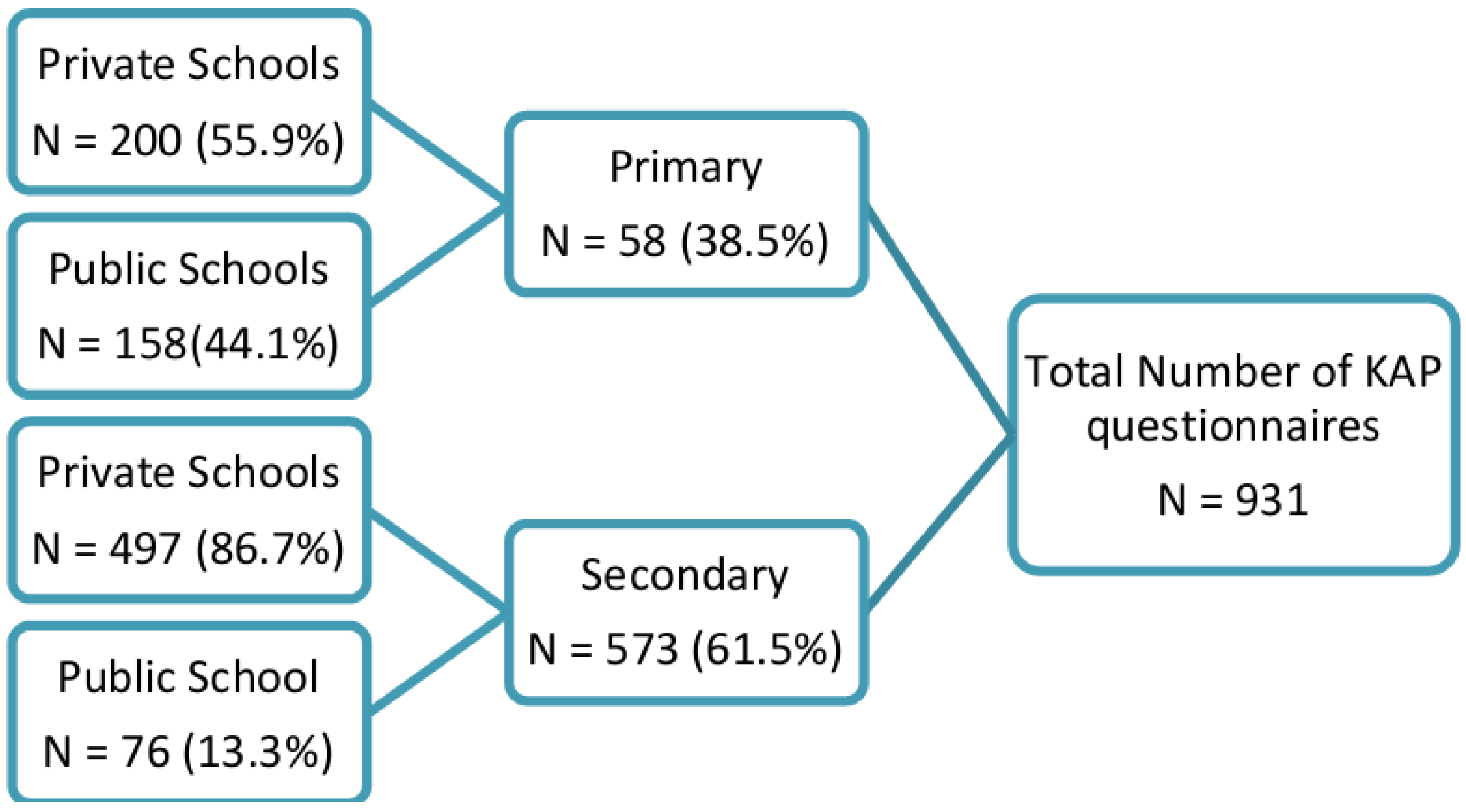
4.2. Results of the KAP Questionnaires and Infrastructural Survey in Petit-Goâve and Grand-Goâve
| Characteristic | Primary School Pupils | Secondary School Students | ||||
|---|---|---|---|---|---|---|
| Responses | (N = 358) | % | Responses | (N = 573) | % | |
| Town | Grand-Goâve | 94 | 26 | Grand-Goâve | 144 | 25 |
| Petit-Goâve | 264 | 74 | Petit-Goâve | 429 | 75 | |
| Gender | Male | 185 | 52 | Male | 257 | 45 |
| Female | 166 | 46 | Female | 291 | 51 | |
| Age | 9–11 | 159 | 44 | 11–13 | 57 | 10 |
| 12–14 | 119 | 33 | 13–15 | 145 | 25 | |
| 15–17 | 45 | 13 | 15–18 | 222 | 39 | |
| >17 | 2 | 1 | >18 | 94 | 16 | |
| Settlement | House | 219 | 61 | House | 437 | 76 |
| Camp Tent | 125 | 35 | Camp Tent | 136 | 24 | |
| Household number | 1–4 | 104 | 29 | 1–4 | 213 | 37 |
| 5–7 | 125 | 35 | 5-7 | 111 | 19 | |
| >7 | 107 | 30 | >7 | 193 | 34 | |
| Grade | 2 | 20 | 6 | 1 | 94 | 16 |
| 3 | 50 | 14 | 2 | 123 | 21 | |
| 4 | 87 | 24 | 3 | 88 | 15 | |
| 5 | 99 | 28 | 4 | 99 | 17 | |
| 6 | 102 | 28 | 5 | 73 | 13 | |
| 6 | 73 | 13 | ||||
| 7 | 22 | 4 | ||||
| Owning a Radio | Yes | 237 | 66 | Yes | 431 | 75 |
| No | 107 | 30 | No | 78 | 14 | |
| Owning a TV | Yes | 229 | 64 | Yes | 326 | 57 |
| No | 122 | 34 | No | 191 | 33 | |
4.2.1. Gender
4.2.2. Housing
4.2.3. Assessment on Water, Sanitation Infrastructures and Waste Management
| Sanitation facilities | Pit latrines/urinals | 25 (60) | 17 (59) | 8 (62) |
| WC + septic tanks | 3 (7) | 3 (10) | - | |
| Nothing | 14 (33) | 9 (31) | 5 (38) | |
| Hand-washing facilities | At the hand-pump | 8 (19) | 2 (7) | 6 (46) |
| Tap stands | 10 (24) | 9 (31) | 1 (8) | |
| With buckets | 6(14) | 2 (7) | 4 (31) | |
| Nothing | 18 (43) | 16 (55) | 2 (15) | |
| Water Supply | Water supply network | 10 (24) | 9 (31) | 1(8) |
| Borehole | 8 (19) | 2 (7) | 6 (46) | |
| Nothing/ private vendors | 24 (57) | 18 (62) | 6 (46) | |
| Solid Waste management | Open burning | 24 (57) | 16 (55) | 8 (62) |
| Buried | 4 (10) | 2 (7) | 2 (15) | |
| Dumped | 14 (33) | 10 (34) | 4 (31) |
4.2.3.1. Sanitation Infrastructures and Use
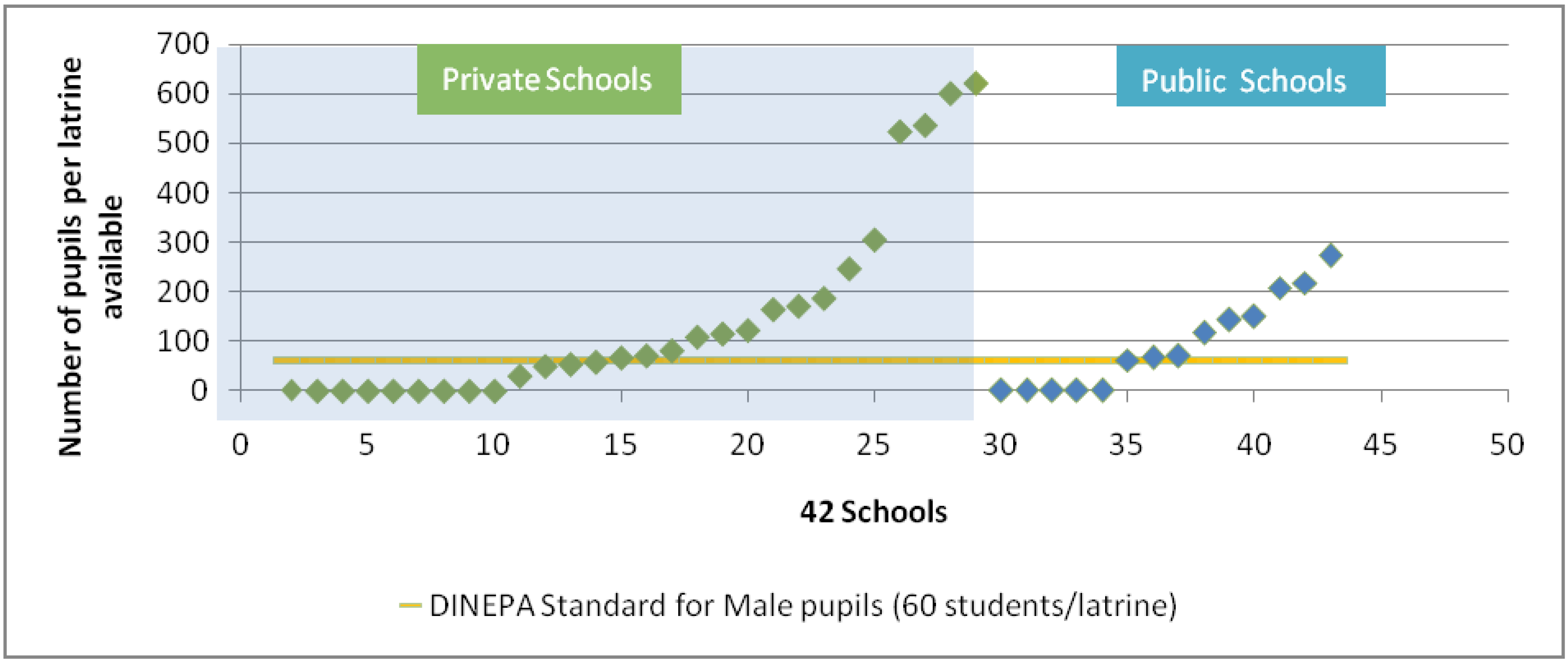
4.2.3.2. Water Supply and Point of Use Treatment
4.2.3.3. Solid Waste Management at Schools
4.2.4. Hand-Washing and Hygiene Education
4.2.5. Adequate Hygiene Knowledge
| Secondary School Pupils | n | % | n | % | ||
| Gender | Female | 257 | 44.8 | 202 | 52.2 | 0.8835 (0.6096–1.2783) |
| Male | 291 | 50.7 | 185 | 47.8 | 1.00 (Reference) | |
| Type of housing | House | 437 | 76.2 | 318 | 82.8 | 1.8602 (1.2039–2.8636) |
| Camp | 136 | 23.7 | 66 | 17.2 | 1.00 (Reference) | |
| Primary School Pupils | (N total = 358) | |||||
| Gender | Female | 166 | 46.4 | 108 | 44.3 | 1.00 (Reference) |
| Male | 185 | 51.7 | 136 | 55.7 | 0.6717 (0.4241–1.0609) | |
| Type of housing | House | 219 | 61.1 | 160 | 66.1 | 1.4206 (0.8807–2.2858) |
| Camp | 125 | 34.9 | 82 | 33.9 | 1.00 (Reference) | |
4.2.6. Cholera Knowledge and Prevention
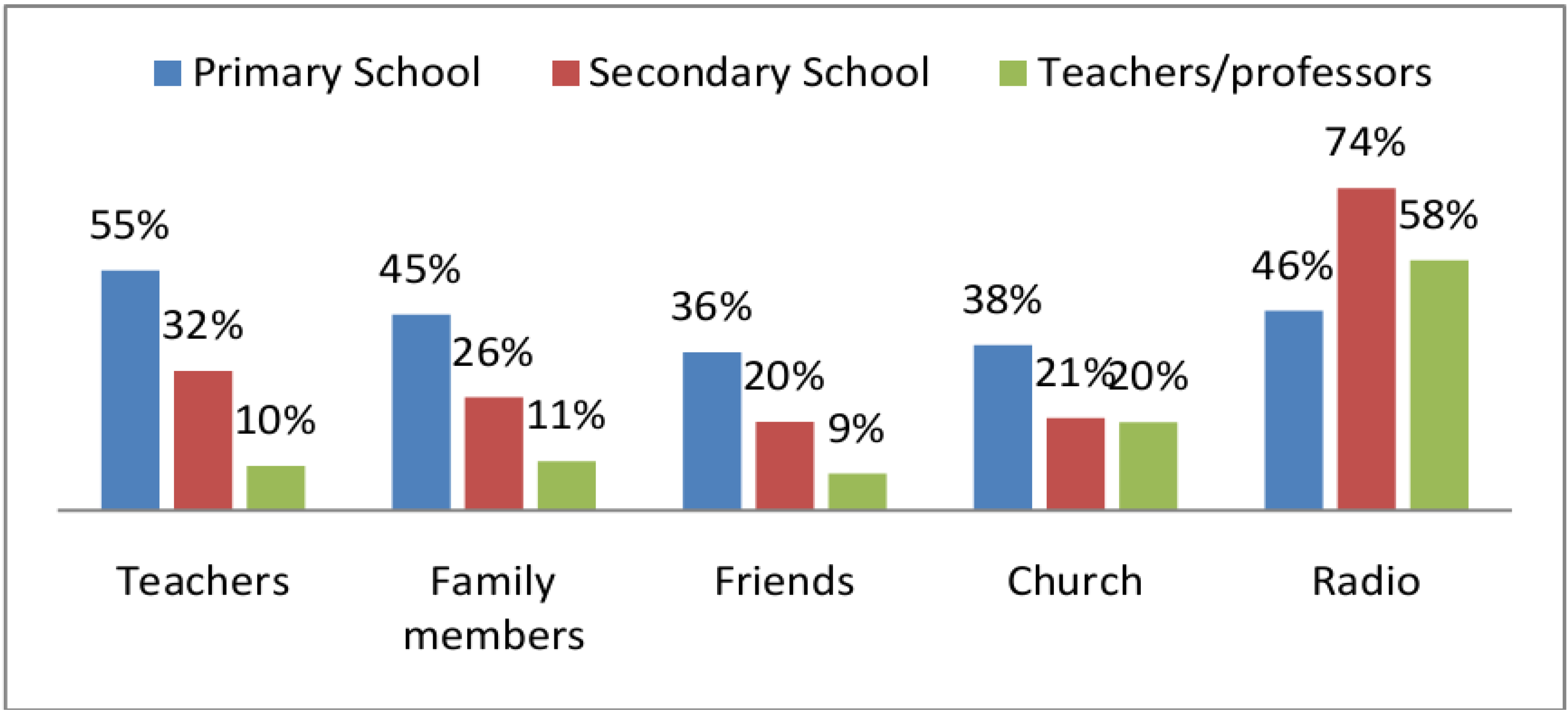
4.3. Semi-Structured Interviews with Stakeholders
5. Discussions and Further Remarks
| School Personnel | -School directors and teachers are committed to improve the school environment -Commitment in educating and supporting children | -Facing post disaster trauma -Not paid during emergency phase up to April 2010 -Not enough budget for public schools to pay all teachers -No specific training on hygiene issues -No maintenance of sanitary facilities | -The authorizations of inspectors is needed in order to successfully implement project -The involvement of school personnel will support giving continuity to the project -Reaching a considerable number of children with hygiene campaigns | -Changes in administration and leadership could cause confusion in terms of roles and responsibilities -Lack of salary payment could cause teachers to drop out -Concerns about possible increased work-load -Cholera outbreak is threatening the whole country, children being at the highest risk -In case of natural disasters: schools could close and again become hosting places for displaced people |
| School Students | -Link with their households and their fellow colleagues for learning activities | -Facing post disaster trauma -School closed from 13 January till April 2010 -Lower number of student inscription due to relocation or other earthquake effects -High rate of absenteeism due to difficulties in paying school fees and uniforms | -Contribute to the design and maintenance of school facilities -Contribute to the sanitary facilities development of the community where the school is located -Cholera sensitization could reach more children than conventional hygiene programs | |
| Community | -Recognize the value of the institution -Periodic parent meeting (not in all project schools) | -Facing post disaster trauma -Not much community involvement | -Replication factors. Do at home what you do at school |
| 1 latrine/every 30 girls 1 latrine/every 60 boys (1 Urinal for boys) 1 latrine/every 20 employees Minimum 3 latrines (low number of inscriptions) | 1–1.5 l drinking water/pupil/day 1.5–2 l for hand-washing/pupil/day 2–8 l for latrine cleaning/day Water quality (0-10 CF/100 ml) | Disinfectants products Soap Toilet paper 1 dust bin per class Hand-washing near to the toilets |
5.1. Sanitation and Hygiene Promotion
5.2. Access to Safe and Enough Water
5.3. Solid Waste Management
6. Conclusions
Acknowledgments
Conflicts of Interest
References and Notes
- United Nations. A new global partnership: Eradicate poverty and transform economies through sustainable development. Available online: http://www.un.org/sg/management/pdf/HLP_P2015_Report.pdf (accessed on 15 May 2013).
- INEE. Minimum Standards for Education in Emergencies, Chronic Crises and Early Reconstruction. Available online: http://www.unicef.org/violencestudy/pdf/min_standards_education_emergencies.pdf (accessed on 23 January 2012).
- The Sphere Project. Humanitarian charter and minimum standards in disaster. Available online: http://www.sphereproject.org/content/view/720/200/lang,english/ (accessed on 23 June 2011).
- UNICEF. Water, Sanitation and Hygiene for Schoolchildren in Emergencies: A guidebook for teachers. Available online: http://www.unicef.org/wash/files/WASH_in__Schools_in_Emergencies_Guidebook_for_teachers_.pdf (accessed on 12 May 2013).
- Emergency Events Database (EM-DAT). The OFDA/CRED International Disaster Database. Available online: http:/www.emdat.be/ (accessed on 30 July 2011).
- Institut Haïtien de l’Enfance (IHE); MEASURE DHS, ICF International. EMMUS-V, Enquête Mortalité, Morbidité et Utilisation des Services. Rapport Préliminaire. (in French). Available online: http://www.mspp.gouv.ht/site/downloads/Rapport%20preliminaire%20final%20EMMUS-V.pdf (accessed on 7 January 2013).
- UNICEF. Children of Haiti. Progress, Gaps and Plans in Humanitarian Action Supporting a Transformative Agenda for Children. Available online: http://www.unicef.gr/pdfs/UNICEF_Haiti_three_month_report.pdf (accessed on 6 July 2012).
- United Nations Office for the Coordination of Humanitarian Affairs (OCHA). Haiti Cholera snapshot. Available online: http://reliefweb.int/sites/reliefweb.int/files/resources/hti_cholera_Snapshot_1%20August%202013.pdf (accessed on 5 August 2013).
- Descombe, M. The Good Research Guide for Small-Scale Social Research Projects, 3rd ed.; Open University Press: Maidenhead, UK, 2007. [Google Scholar]
- Maxwell, J.A. Qualitative Research Design: An Interactive Approach (Applied Social Research Methods Series); Sage: London, UK, 2010; Volume 41. [Google Scholar]
- World Health Organization, Water, Sanitation and Hygiene Standards for Schools in Low-Cost Settings; Adams, J.; Bartram, J.; Chartier, Y.; Sims, Y. (Eds.) WHO: Genève, Switzerland, 2009.
- International Water and Sanitation Centre (IRC), Towards Effective Programming for WASH in Schools; IRC: Delft, The Netherlands, 2007.
- Haiti Education Cluster, Draft Cholera response strategy. Port-au-Prince, Haiti, November 2010; Unpublished document.
- Salmi, J. Equity and quality in private education: The Haitian paradox. Compare 2000, 30, 163–178. [Google Scholar]
- UN data. Haiti Country Profile. Available online: http://data.un.org/CountryProfile.aspx?crName=Haiti (accessed on 7 February 2011).
- Direction Nationale de l’Eau Potable et de l’Assainissement (DINEPA). Draft, Note d’orientation sur l’eau et l’assainissement dans les établissements scolaires. (in French). Available online: http://www.dinepa.gouv.ht/wash_cluster/index.php?option=com_rokdownloads&view=file&Itemid=27&id=1027:orientations-wash-ecoles (accessed on 2 September 2012).
- Bolt, E.; Shordt, K.; Krukkert, I. School Sanitation and Hygiene Education Results from the Assessment of a 6-Country Pilot Project; UNICEF and IRC International Water and Sanitation Centre: Delft, The Netherlands, 2006. Available online: http://www.irc.nl/page/29459 (accessed on 31 July 2011).
- Ministère des affaires sociales et du travail (MAST); Bureau du Secrétaire d’Etat à l’intégration des personnes handicapées. Pour une Scolarisation massive des personnes handicapées. (in French). Available online: http://haiti.humanitarianresponse.info/system/files/documents/files/Guidance%20note%20on%20School%20Enrolment%20of%20Disabled%20Children%20(in%20French).pdf (accessed on 13 March 2012).
- Deen, J.L.; von Seidlin, L.; Sur, D.; Agtini, M.; Lucas, M.E.S.; Lopez, A.L.; Kim, D.R.; Ali, M.; Clemens, J.D. The high burden of cholera in children: Comparison of incidence from endemic areas in Asia and Africa. PLoS Negl. Trop. Dis. 2008. [Google Scholar] [CrossRef]
- Bell, B. Analysis of school-led total sanitation in Chitwan, Nepal. Master’s Thesis, Utrecht University, Utrecht, The Netherlands, 2010. [Google Scholar]
- Water Resources Assessment of Haiti. Available online: http://www.gvsu.edu/cms3/assets/53940C9B-B252-5B69-626B48622A4C1002/publishedliterature/acoe_water_resources_of_haiti.pdf (accessed on 13 March 2012).
Appendix 1
| ID | School Name | Village | Statute | Level(P, F1, F2, S) |
|---|---|---|---|---|
| 1 | Ecole N.le Mixte de Grand-Goâve | GG | Public | F1 |
| 2 | Lycee Fito Gracia de Grand Goâve | GG | Public | F2, S |
| 3 | Ecole N.le des Filles de Grand-Goâve | GG | Public | F1 |
| 4 | Ecole N.le de Thozin | GG | Public | F1 |
| 5 | Centre d’Etude Secondaire Ernest Vaval | GG | Private | F2, S |
| 6 | Ecole Baptiste Siloe | GG | Private | F1, F2, S |
| 7 | Centre Saint François d'Assise | GG | Private | P, F1-F2, S |
| 8 | College Baptiste Maranatha | GG | Private | F1 |
| 9 | College Chretien | GG | Private | P2 , S |
| 10 | College Les frères Milord | GG | Private | F2, S |
| 11 | Ecole Batisseur de l’Espoir | GG | Private | P, F1 |
| 12 | Petit College de Grand Goâve | GG | Private | F2, S |
| 13 | Ecole Batisseur de l’Espoir- Colbert | GG | Private | P, F1 |
| 14 | Collège Adelina | PG | Private | S |
| 15 | Collège Paul Lochard | PG | Private | F-S |
| 16 | Collège Phillipe Guerrier | PG | Private | F1-F2, S |
| 17 | Ecole Mixte Therese Jean | PG | Private | P,F |
| 18 | Collège Pierre Baptiste | PG | Private | F,S |
| 19 | Ecole Apostolique | PG | Private | F,S |
| 20 | Ecole Louis Borno | PG | Private | F,S |
| 21 | Lycee Faustin Soulouque | PG | Private | F2, S |
| 22 | College Harry Brakeman | PG | Private | P, F1-F2, S |
| 23 | Ecole Pierre Mendès France | PG | Private | P, F1, F2 - S |
| 24 | Ecole Wesleyenne | PG | Private | P, F1-F2, S |
| 25 | College Emilie Nau | PG | Private | S |
| 26 | College Isaac Berde | PG | Private | S |
| 27 | College Jean Rene Jerome | PG | Private | S |
| 28 | College Notre Dame de Petit Goâve | PG | Private | S |
| 29 | Ecole Yves R.Lamartine | PG | Private | P, F1 |
| 30 | Institution Mixte le Renouveau | PG | Private | S |
| 31 | Collège Pradel Pompilus | PG | Private | F2, S |
| 32 | Ecole Adler Alexandre Leandre | PG | Private | F1 |
| 33 | Ecole Nationale Gilbert Desroches | PG | Public | F1 |
| 34 | Ecole de Vialet | PG | Public | P, F1 |
| 35 | Lycee Roseline Vaval de Vialet | PG | Public | S |
| 36 | College le Nouveau Monde | PG | Public | S |
| 37 | Ecole de Tapion | PG | Public | F1-F2, S |
| 38 | Ecole N.le Borno Lamarre | PG | Public | F1 |
| 39 | Ecole N.le des Filles de Petit-Goâve | PG | Public | F1 |
| 40 | Ecole Profesionelle Ci-Devant | PG | Public | S |
| 41 | Ecole N.le du Sacré Cœur | PG | Public | AM: P, F1 / PM:F1 |
| 42 | Ecole Notre Dame de la Sagesse | PG | Public | P, F1, F2 |
Appendix 2
Questionnaire Sections:
- A.
- General Questions (Age, School Grade, Family members, House/shelter).
- B.
- Awareness (radio/TV, teachers etc.).
- C.
- Access to water at school.
- D.
- Waste Management at school.
- E.
- Sanitation and Hygiene (Access to latrines at school, Physical status of sanitation facilities, Access to washing facilities and hygiene concepts).
© 2013 by the authors; licensee MDPI, Basel, Switzerland. This article is an open access article distributed under the terms and conditions of the Creative Commons Attribution license (http://creativecommons.org/licenses/by/3.0/).
Share and Cite
Giardina, D.; Prandini, F.; Sorlini, S. Integrated Assessment of the Water, Sanitation and Hygiene Situation in Haitian Schools in the Time of Emergency. Sustainability 2013, 5, 3702-3721. https://doi.org/10.3390/su5093702
Giardina D, Prandini F, Sorlini S. Integrated Assessment of the Water, Sanitation and Hygiene Situation in Haitian Schools in the Time of Emergency. Sustainability. 2013; 5(9):3702-3721. https://doi.org/10.3390/su5093702
Chicago/Turabian StyleGiardina, Daniela, Fausta Prandini, and Sabrina Sorlini. 2013. "Integrated Assessment of the Water, Sanitation and Hygiene Situation in Haitian Schools in the Time of Emergency" Sustainability 5, no. 9: 3702-3721. https://doi.org/10.3390/su5093702
APA StyleGiardina, D., Prandini, F., & Sorlini, S. (2013). Integrated Assessment of the Water, Sanitation and Hygiene Situation in Haitian Schools in the Time of Emergency. Sustainability, 5(9), 3702-3721. https://doi.org/10.3390/su5093702

