Article

Chemical Recycling of PET to Its Monomers via Heterogeneous ZnO-Catalysed Ethanolysis

by
Pierluigi Barbaro
1,
Carmen Moreno-Marrodán
1,*,
Werner Oberhauser
1,
Feliciana Real-Fernández
1,
Anna Maria Papini
2,3 and
Francesca Liguori
1
1
Istituto di Chimica dei Composti Organo Metallici, Consiglio Nazionale delle Ricerche, Via Madonna del Piano 10, 50019 Sesto Fiorentino, Florence, Italy
2
Dipartimento di Chimica “U. Schiff”, Università degli Studi di Firenze, Via della Lastruccia 3-13, 50019 Sesto Fiorentino, Florence, Italy
3
Interdepartmental Research Unit of Peptide and Protein Chemistry and Biology, Dipartimento di Chimica “U. Schiff”, Università degli Studi di Firenze, Via della Lastruccia 13, 50019 Sesto Fiorentino, Florence, Italy
*
Author to whom correspondence should be addressed.
Sustainability 2026, 18(9), 4578; https://doi.org/10.3390/su18094578
Submission received: 13 March 2026 / Revised: 11 April 2026 / Accepted: 29 April 2026 / Published: 6 May 2026

Abstract

Polyethylene terephthalate (PET) is among the most used plastics in domestic and industrial applications, particularly packaging, food containers and textiles. However, its recalcitrance to decomposition and biodegradation mostly results in landfilling and accumulation of PET waste in the environment if not processed. Chemical recycling of PET via selective depolymerization into its monomers may represent a pivotal step in the development of a truly circular economy of PET, which is still limited by economic and environmental sustainability issues. In this work, the depolymerization of PET is reported using ZnO as an insoluble catalyst, and ethanol as both a lytic agent and green solvent. A detailed investigation of reaction parameters, including reaction temperature, time and catalyst loading, showed that complete conversion of PET to diethyl terephthalate (DET) can be achieved with 92.5% selectivity at 180 °C and 48 h, with the potential for full DET selectivity at longer reaction times. The solid catalyst could be recovered and reused by simple centrifugation, with no loss of conversion or selectivity over three consecutive reuses.

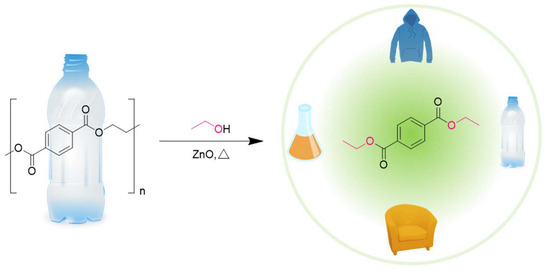
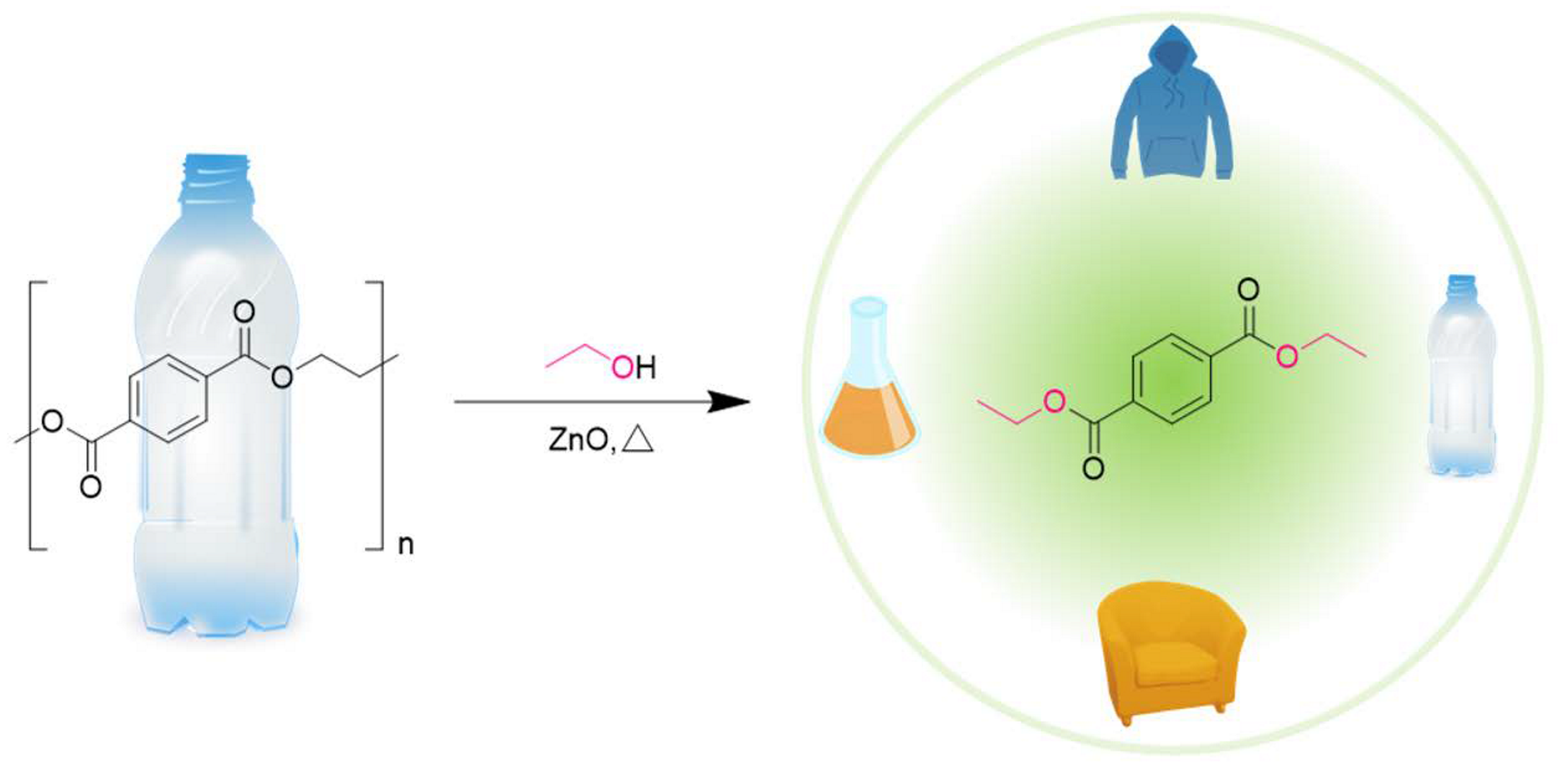
Graphical Abstract

1. Introduction

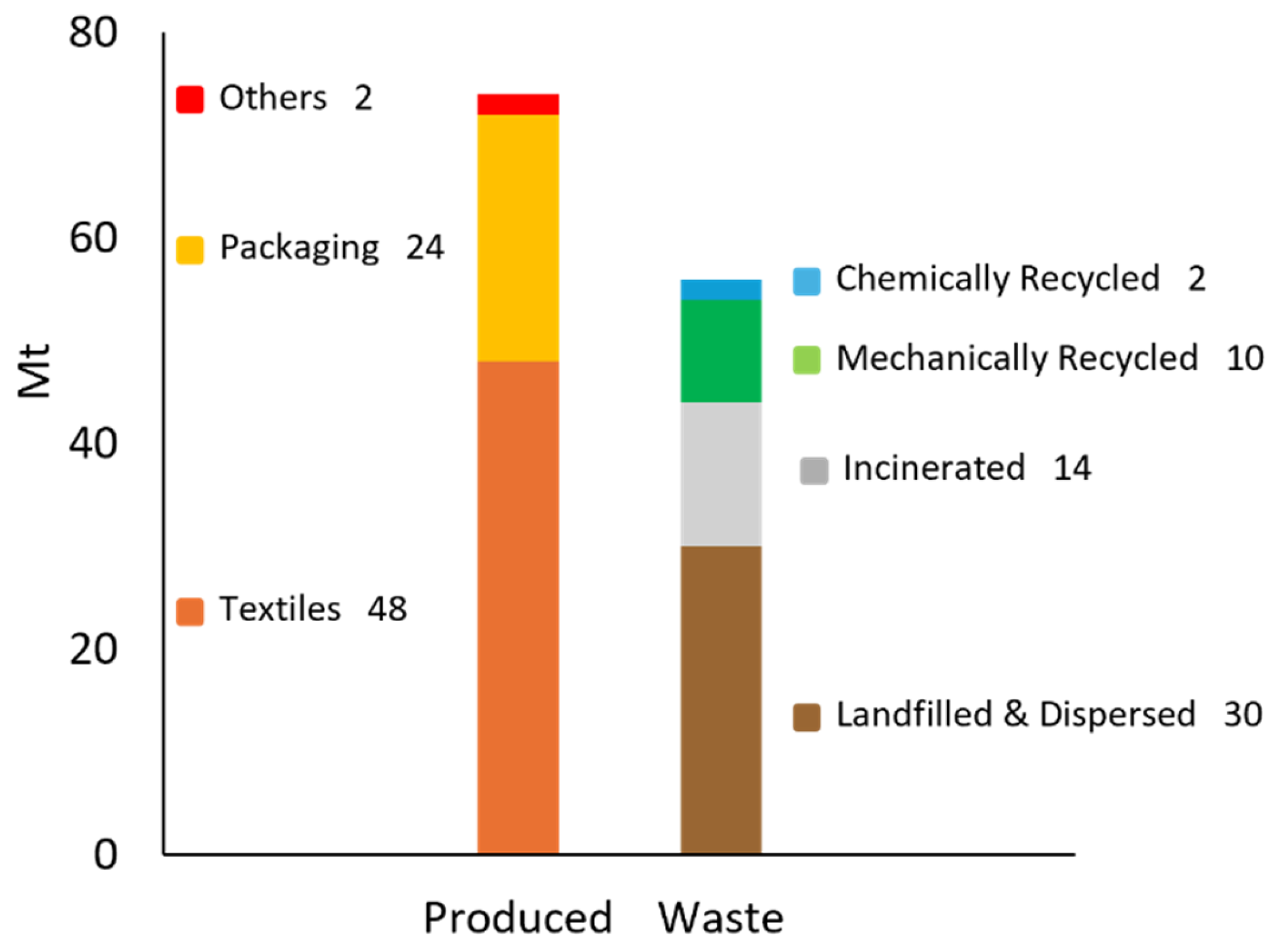
Polyethylene terephthalate (PET) is one of the most common synthetic organic polymers. PET is a durable thermoplastic resistant to shrinking and stretching; additionally, it is cheap. These properties allow for the versatile use of PET in the food packaging (containers, bottles, ca. 24 Mt/y) and textile (furniture, clothing, ca. 48 Mt/y) sectors, and in other niche industrial applications (electronics, 3D printing, adhesives) [1]. Accordingly, the global production of PET in 2019 was 74 Mt, which accounted for about 20% of all plastics manufactured [2]. Unfortunately, PET is not efficiently biodegradable, which results in its accumulation in the environment and in serious environmental issues [3,4]. The most recent data available, referring to 2019, indicate that 56 Mt of PET waste were generated, of which 18% were mechanically recycled, 25% were incinerated and 54% were landfilled or dispersed (Figure 1) [5,6]. It is estimated that about 2% of PET in clothing is lost in the oceans just upon washing [7,8]. On the other hand, mechanical recycling of PET is limited by the lower quality and economic value of the recycled material, for instance, due to oxidative or hydrolytic degradation, as well as by the high energy inputs of the related processes [9,10]. A more attractive option is the chemical recycling to re-processable monomers achieved by depolymerization [11,12], as this may enable the implementation of a true Circular Economy for Plastics [13,14]. Use of post-consumer plastics as secondary raw material allows for minimising the depletion of natural resources and the accumulation of scraps in the environment, while contributing to the decrease in the carbon footprint of the polymer industry at the same time [15,16]. Depolymerization processes may or may not be catalytic, though the latter benefits from milder reaction conditions, higher selectivity and faster kinetics, i.e., improved sustainability [17,18]. To this aim, heterogeneous (metal) catalysts are preferred due to the easier separation from the reaction mixtures, potential reuse and integration into existing reactor equipment [19,20]. However, achieving efficient depolymerization over heterogeneous catalysts is challenging because of the low solubility of most plastics in common organic solvents. This is usually circumvented by carrying out the reactions in the melt, i.e., at high temperatures, which may result in insufficient catalyst stability and in high energy inputs [21,22]. Depolymerization of PET to monomers has been reported using chemolytic methods, i.e., solvolysis (hydrolysis, alcoholysis, glycolysis, aminolysis) and hydrogenolysis [23,24,25]. Among the catalysts reported, zinc-based species stand out for their remarkable efficiency in facilitating polyester depolymerization [26]. Still, current technologies are energy intensive, require strong acidic/basic treatments, stoichiometric amounts of soluble promoters, harmful reagents or produce huge amounts of salt waste [27,28], which is disadvantageous for a large-scale production [29,30]. More sustainable methods for PET depolymerization are thus actively sought [31,32].
In a previous paper, we described the hydrolysis reaction of PET over a heterogeneous ZnO catalyst using neat water as the only reagent [33]. The process resulted in the complete depolymerization of PET to the valuable monomers terephthalic acid (TPA) and ethylene glycol (EG) in high selectivity, at reaction temperatures (180 °C) well below that of the melting point of PET (250–260 °C). Compared to conventional methods employing acid-base catalysts, soluble Zn salts or catalyst-free processes, the system offers significant advantages in terms of higher productivity and selectivity, reduced operating temperature, minimisation of waste generated and elimination of soluble additives. However, the heterogeneous ZnO catalyst is flawed by its scarce reusability due to its instability under hydrolysis reaction conditions. We showed that the amphoteric ZnO reacts with the incipient TPA formed upon hydrolysis to give insoluble yet poorly active ZnO-TPA MOF-like materials.
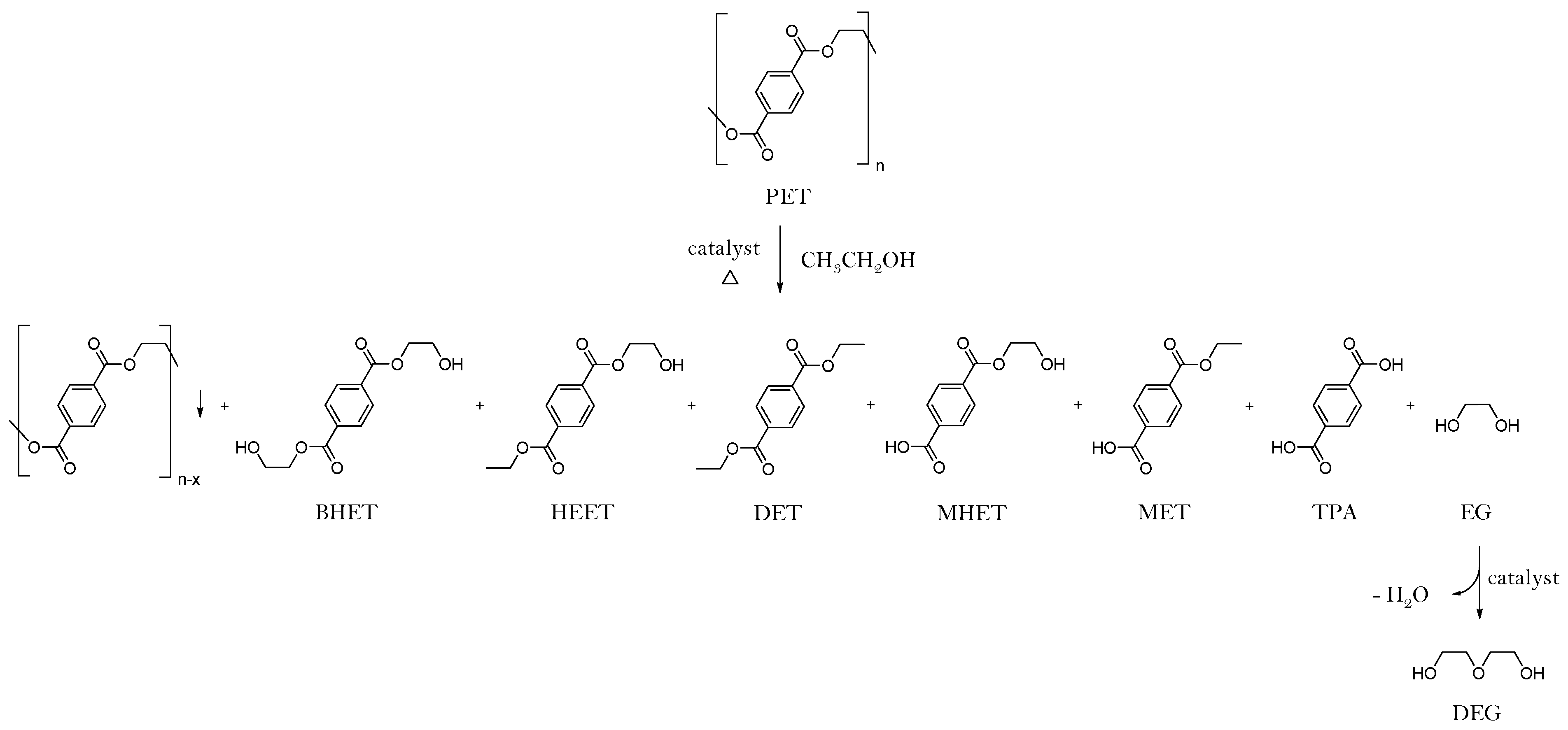
To overcome this limitation, while aiming at the production of reusable chemicals by depolymerization, herein we explored the catalytic ethanolysis reaction of PET over an insoluble ZnO catalyst. In this case, the valuable monomer expected is the transesterification product diethyl terephthalate (DET), which is devoid of carboxylic acid groups susceptible to reacting with ZnO. However, the ethanolysis reaction of PET may be complicated by the number of products potentially obtainable (Scheme 1), thus selectivity to the desired product is a crucial parameter. Ethanol is a non-toxic [34,35], inexpensive and abundant chemical obtained from renewable sources that can be readily recovered by distillation, which facilitates solvent recycling and reduces waste. Although its use at the industrial level requires safety measures due to its flammability and minor health issues, its use generally enhances the sustainability of the overall process [36,37].
The ethanolysis reaction of PET has been described in the past, mostly using supercritical ethanol to maximise the yield of DET (Pc = 60.6 atm, Tc = 241 °C) [38]. Despite diverse heterogeneous catalysts being reported, these invariably required harsh reaction pressures and temperatures [39]. Low PET conversions and DET yields have been previously reported in subcritical ethanol [40].

2. Materials and Methods

2.1. Materials

Polyethylene terephthalate technical grade (PET, film, thickness 0.05 mm, Tm 252–260 °C) was obtained from Aldrich, (Merck Life Science S.r.l., Milan, Italy, product n. GF31588229) and used as received without further treatments, after cutting into ca. 2 × 2 mm pieces. Waste PET feedstock was obtained from an end-of-life water bottle (blue colour) and was used without any treatment after cutting into 2 × 2 mm pieces. Bis(2-hydroxyethyl)terephthalate (BHET, product n. 465151), ethylene glycol (EG, product n. 102466), and diethylene glycol (DEG, product n. 03128) were obtained from Aldrich. Diethyl terephthalate (DET, product n. BD124771) and 4-(Ethoxycarbonyl) benzoic acid (MET, product n. BD292776) were obtained from BLDpharm (Shanghai, China). Ethanol absolute EMPATAR® > 99.5% (product n. 107017) was obtained from Supelco (Merck Life Science S.r.l., Milan, Italy). ZnO was prepared according to a reported procedure [33]. All other reagents were commercial products and were used as received without further purification.

2.2. Catalytic Depolymerization of PET via Ethanolysis

Catalytic experiments under batch, subcritical conditions were performed using a stainless-steel autoclave constructed at ICCOM-CNR (Sesto Fiorentino, Italy), equipped with a magnetic stirrer and a Teflon® inset (37 mL internal total volume). In a representative procedure, the reactor was charged with 15 mL of ethanol, 100 mg of PET pieces of a ca. 2 × 2 mm size (0.52 mmol, 0.035 M, based on PET repetition units) and 100 mg of solid catalyst. The reactor was closed and dipped into an oil bath at 180 °C under magnetic stirring (500 rpm). The autogenous pressure was 8 bar. After the desired time, the reactor was cooled down to room temperature using an ice bath (30 min). The obtained suspension was centrifuged (45 min @ 4000 rpm) to separate the liquid and solid fractions. The solid was then washed under stirring with ethanol for 15 min, and the obtained suspension was centrifuged as described above. The liquid fractions were gathered, filtered using a 0.20 μm Whatman syringe filter (Aldrich) and diluted to 20 mL for further analysis. The liquid solution was analysed by GC to quantify EG and DEG content, HPLC to quantify BHET, MET and DET content, ICP-OES to quantify metal leaching (Zn) in solution, GC-MS and 1H NMR, the latter using DMSO-d6 (Aldrich), to dissolve the residue of the ethanolic solution after evaporation. On the other hand, the solid recovered after centrifugation was dried in the oven at 70 °C overnight, then examined via ICP and PXRD.

2.3. Product Characterisation

The reaction products were unequivocally identified through comparison of the GC and HPLC-MS retention times, mass spectra, 1H NMR and 13C{1H} NMR resonances, with those of authentic specimens, whenever commercially available. In all other instances, they were identified by a combination of spectroscopic techniques (see ESI). Quantitative analysis of the ethanol-soluble reaction products with aromatic moiety, particularly BHET, MET and DET, was carried out via HPLC based on calibration curves of the pure compounds in ACN:water (1:1 v/v) solution. Calibration curves obtained within the concentration range [0.3–50] µM had all R2 values of 0.999. Yields were calculated with respect to the number of PET repetition units in the amount of PET used. The relative amount of other products found in the ethanolic fraction of the reaction mixture recovered at the end of the catalytic runs was estimated by integration of selected 1H NMR resonances (see Supporting Information).
Commercial PET used in our catalytic experiments was insoluble in ethanol within the temperature range under investigation. PET conversion was calculated on the basis of mass loss, as follows:
C o n v e r s i o n P E T % = W s o l i d   W Z n O W P E T   × 100
where WZnO and WPET correspond to the weight of the ZnO and of the initial amount of PET used, respectively, while Wsolid equals the weight of the solid residue recovered at the end of the catalytic experiments.
Selectivity of the catalytic runs was referred to the complete ethanolysis product, i.e., to the molar amount % of DET among all soluble terephthalate products detected in the ethanolic solution recovered at the end of the catalytic runs (see Scheme 1):
S e l e c t i v i t y D E T % =   m o l D E T m o l B H E T +   m o l H E E T +   m o l D E T +   m o l M H E T +   m o l M E T   × 100
Qualitative analysis of soluble products was supported by the detection of selected 1H NMR resonances in DMSO-d6 (see Supporting Information, Section S5). There were no significant formations of HEET and MHET observed.

3. Results and Discussion

3.1. Catalytic Depolymerization of PET

The depolymerization reaction of PET using neat ethanol as the lytic agent, under subcritical batch conditions, was investigated in detail within various temperature (160–200 °C), time (16–72 h) and catalyst amount (50–100 mg) ranges. The previously reported, fully characterised, home-made ZnO catalyst was used for this purpose [33], supported by the well-known ability of zinc-based catalysts to promote the depolymerization of oxygenated polymers [41]. All operations were performed in a metal-free tank reactor with magnetic stirring, where the autogenous pressure generated under the reaction conditions investigated was invariably below the ethanol critical point. An ethanol-to-PET weight ratio of 118 was used throughout. No other reagents, solvents or purification steps were used during the process, except for the recovery of the solid catalyst at the end of the catalytic runs, which was achieved by centrifugation. The commercial PET examined was insoluble in ethanol under the adopted experimental conditions [42], whereas the depolymerization products diethyl terephthalate (DET), monoethyl terephthalate (MET), bis(2-hydroxyethyl) terephthalate (BHET) and ethylene glycol (EG) were fully soluble, even at room temperature. Therefore, the unreacted PET, if any, could be easily separated from the catalytic reaction mixture by simple centrifugation.
A preliminary set of experiments was performed to ascertain the stability of ZnO under reaction conditions (see Supporting Information, Section S2.1). Thus, no soluble Zn species leached in solution were detected by ICP-OES after standing ZnO in ethanol at 180 °C for 24 h. The insoluble ZnO could be quantitatively recovered intact, as shown by PXRD analysis, which confirms the stability of the catalysts. Analogous findings were obtained either by contacting ZnO with a stoichiometric amount of DET at 180 °C for 24 h or by analysing the ZnO recovered after the catalytic experiments at full PET substrate conversion (vide infra).
Irrespective of the reaction conditions adopted for the ethanolysis reactions of PET, no ethanol-soluble products, other than DET, BHET, MET, EG and the self-condensation product diethylene glycol (DEG), were detected by 1H NMR, 13C NMR, HPLC, GC-MS and GPC analysis in the ethanolic solution recovered by centrifugation of the reaction mixture after catalysis (Scheme 1), unless for very low PET conversions (<50%), for which minor amounts of unidentified compounds were observed (particularly for catalyst-free runs). Similarly to previous reports, PET conversion was calculated on the basis of PET mass loss [42]. Herein, selectivity is defined as the molar amount of the complete transesterification DET product formed with respect to the cumulative molar amount of all terephthalate products detected in solution (i.e., DET, BHET and MET, which were quantified by HPLC). Representative results are reported in Table 1. A more complete data set is provided in the Supporting Information (Table S1).
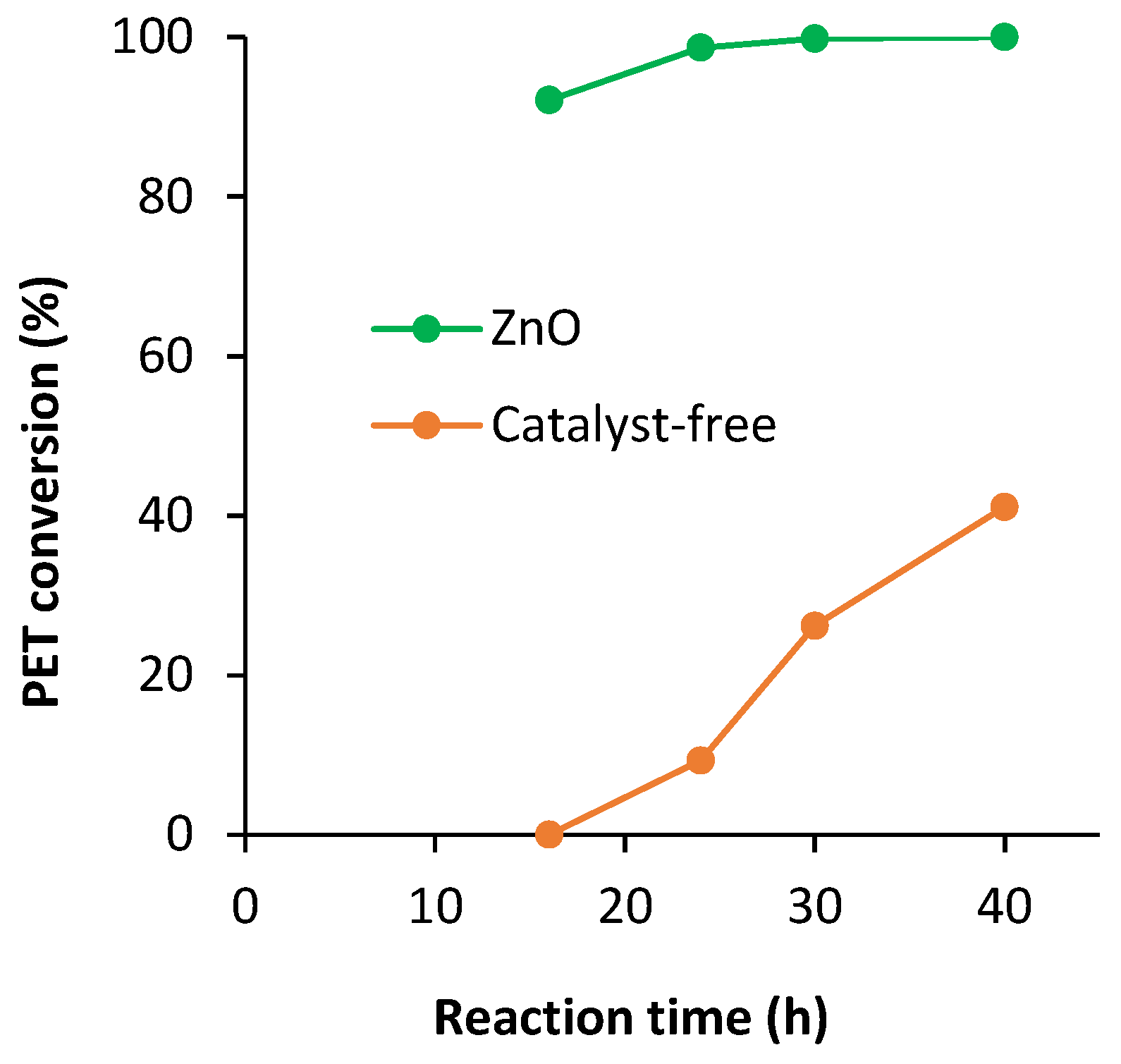
To demonstrate the catalytic activity of the ZnO, catalyst-free depolymerization experiments were performed and compared with those in the presence of ZnO under identical reaction conditions. Indeed, these indicated the ability of the solid catalyst to accelerate the conversion of PET at a given temperature. Experimental data are reported in graphical format in Figure 2. After 24 h reaction time at 180 °C, the conversion of PET was around ten times higher using 100 mg of solid ZnO, compared to the blank experiment (Table 1, entry 1 and 5). Under these conditions, complete PET conversion was achieved over ZnO for reaction times above 30 h.
In all depolymerization experiments using ZnO, regardless of the reaction conditions, the amount of Zn leached in solution was less than 0.15% wt by ICP-OES, confirming the stability of the catalyst. Furthermore, the absence of catalytic activity in the solution recovered after removal of the solid catalyst, besides that provided by thermal self-depolymerization, indicates the absence of soluble catalytically active species. Collectively, these findings provide strong evidence that the ZnO catalyst operates as a truly heterogeneous system (see Supporting Information, Section S2.6). The solid residue isolated after catalysis may contain ZnO, TPA (which is insoluble in ethanol), insoluble PET oligomers and unreacted PET, if any. However, no significant amount of TPA was detected either by conventional dissolution/precipitation treatment of the solid with NaOH/HCl followed by gravimetric analysis [43,44], or via 1H NMR spectroscopy after washing the solid residue with DMSO-d6 (see Supporting Information, Section S2.3).

3.2. Effect of the Reaction Temperature

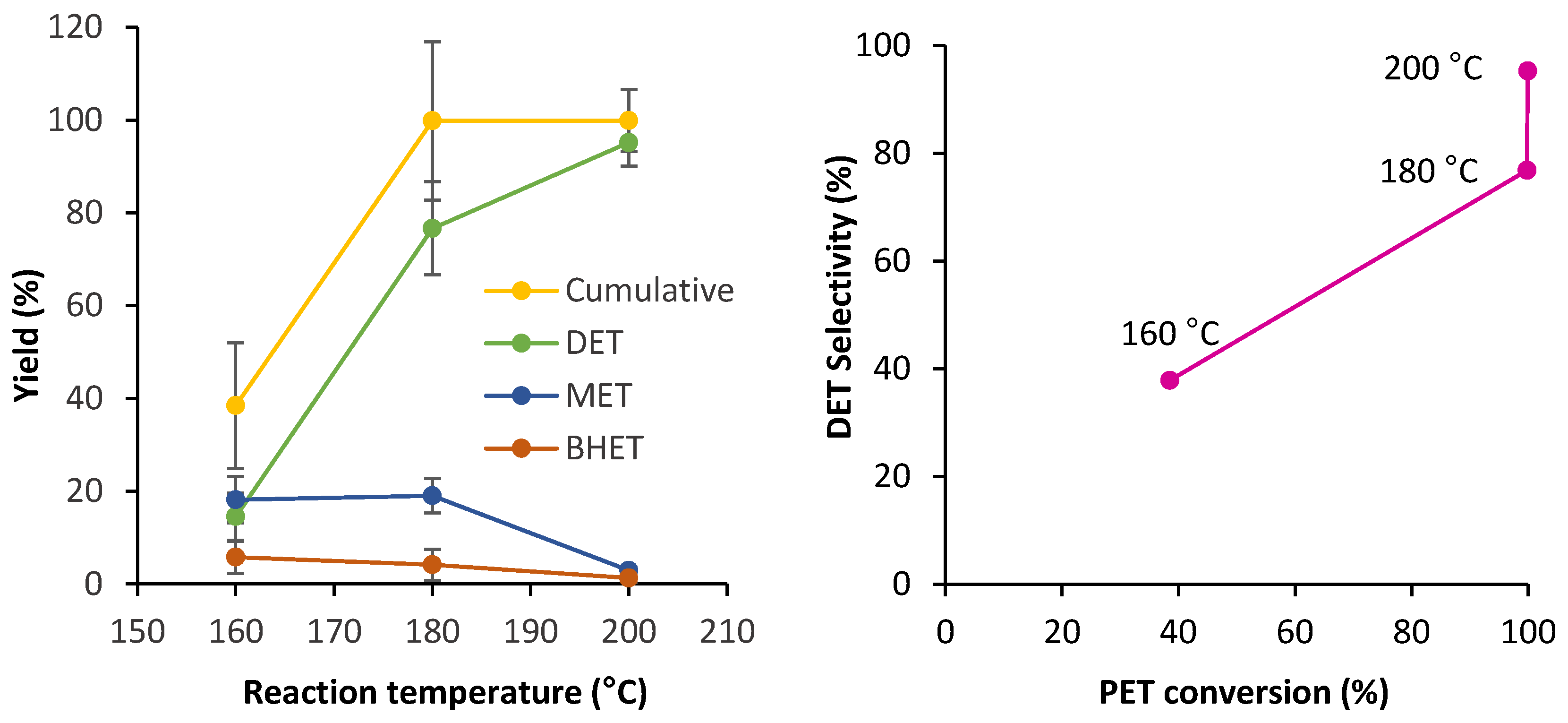
As mentioned above, PET may undergo minimal self-depolymerization in the presence of ethanol at elevated temperatures. Use of the ZnO catalyst greatly enhances the reaction rate at a given temperature, which implies that high PET conversion may be obtained under relatively mild reaction conditions, particularly below the melting point of PET and the critical point of ethanol. The effect of the reaction temperature was thus investigated in the range of 160–200 °C at fixed reaction times (Table 1, entries 6, 10 and 11). An increase in the reaction temperature resulted in a significant effect on both conversion and selectivity to the desired product DET. Representative data are reported in Figure 3 for 30 h reaction time, as an example.
Despite the ZnO catalyst showing to be active even at temperatures as low as 160 °C, this resulted in poor overall conversion and in a mixture of DET, MET and BHET products in comparable amounts, with DET selectivity being around 40%. Raising the temperature to 180 °C (still well below the melting point of PET) led to a 2.6-fold increase in PET conversion and a two-fold improvement in DET selectivity, achieving the values of 99.8% and 76.8%, respectively. Further increase to 200 °C enhanced DET selectivity to 95.3%. The literature reports on PET chemical depolymerization via ethanolysis typically involve high-temperature processes, often exceeding critical conditions. The only example performed under mild conditions was reported by Unruean et al. using a CaO catalyst at 180 °C, though PET conversion did not exceed 35% [45]. Although 200 °C was the optimal temperature for PET depolymerization using ZnO in terms of conversion and selectivity, the experiment at 180 °C was selected as the benchmark because it leaves room for improvement, which allows evaluating the influence of the other reaction parameters on the catalyst activity.

3.3. Effect of the Reaction Time

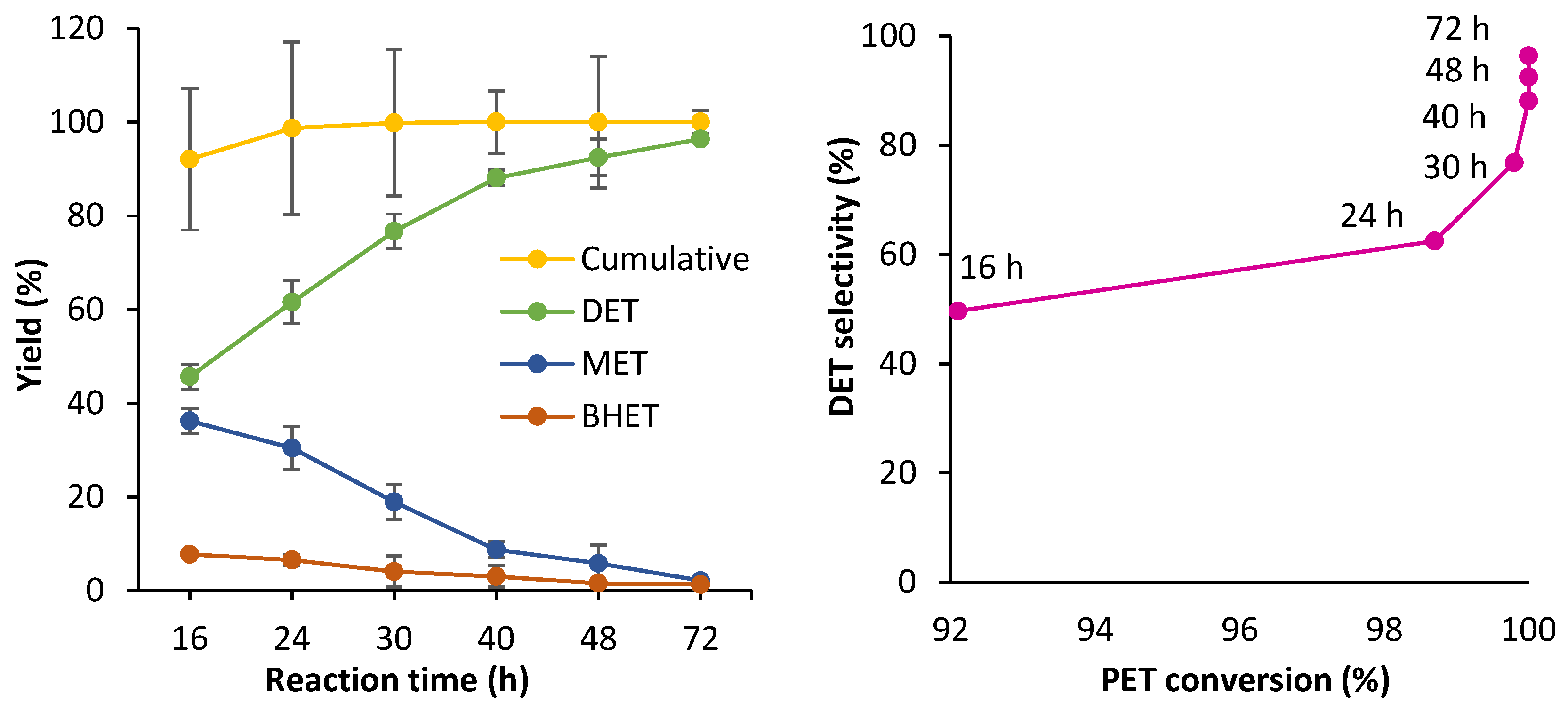
To investigate the influence of reaction time on PET depolymerization, particularly in terms of conversion and product distribution, the benchmark experiment was performed in the time range of 16–72 h. Representative results at a 180 °C temperature are reported in Figure 4. At short reaction times (16 and 24 h) (Table 1, entries 4 and 5), PET conversion was incomplete (<99%) and DET was identified as the main aromatic monomer in the ethanolic phase, albeit with moderate selectivity (ca. 50%). Increasing the reaction time to 30 h (Table 1, entry 6) resulted in nearly complete PET conversion and in a marked improvement in DET selectivity to 76.8%. Longer reaction times led to a progressive increase in DET selectivity up to 96.4%, which can be attributed to the continuous conversion of the intermediate products (BHET and MET) into DET, through stepwise esterification and transesterification reactions occurring during prolonged exposure to ethanol. These findings highlight the critical role of reaction time in optimising both conversion efficiency and product selectivity in PET ethanolysis. Although shorter reaction times have been reported in the literature, conditions invariably exceed those of the critical point, with reaction temperatures and pressures in the range of 255–275 °C and 80 to 200 bar, respectively, and molar DET yields around 70–85% (Table S2).

3.4. Effect of the Catalyst Loading

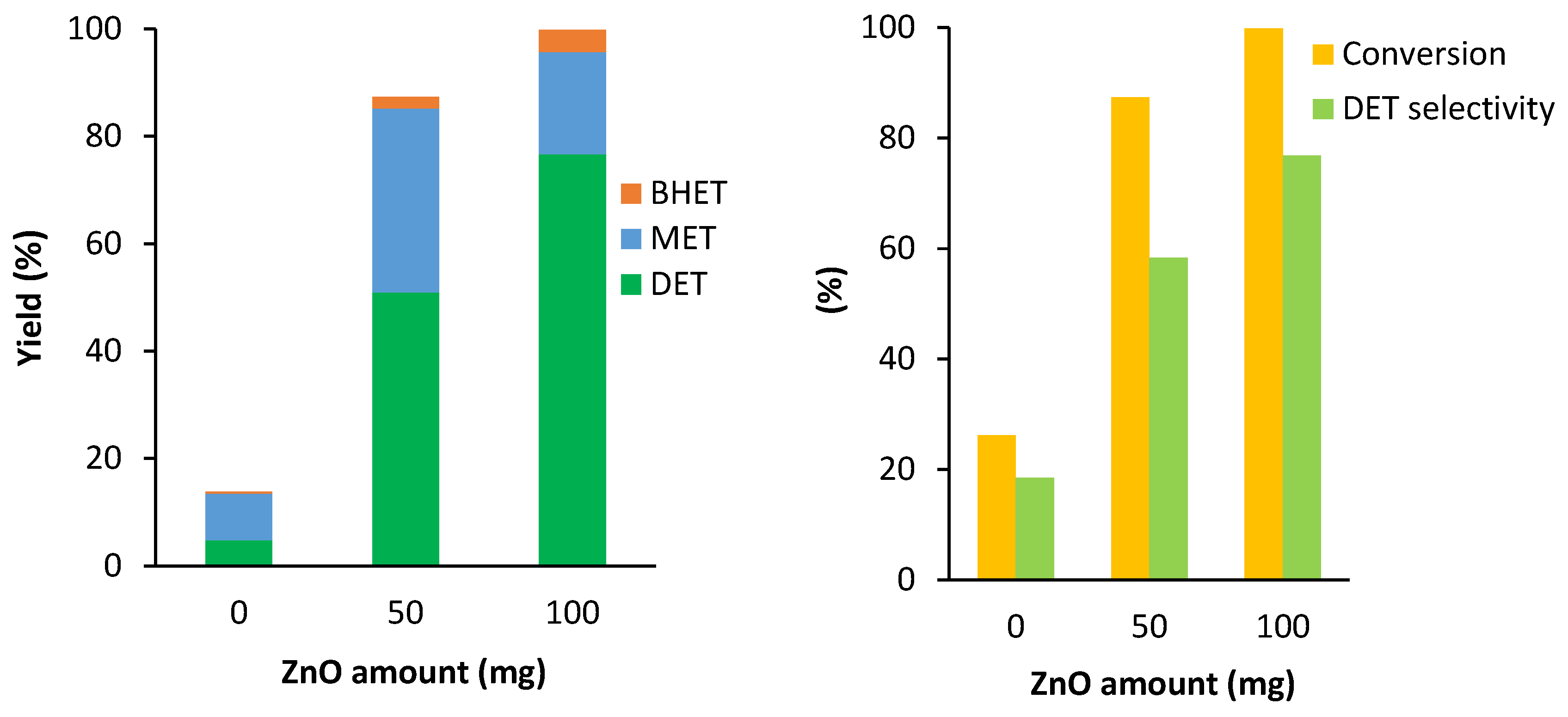
As discussed above, the use of ZnO catalyst greatly improves both the depolymerization rate and selectivity, compared to the catalyst-free ethanolysis reaction. To evaluate the potential for reducing catalyst usage without compromising performance, reactions were investigated using [50–100] mg of ZnO under fixed reaction times and temperatures (Table 1, entries 6 and 12); the outcomes are reported in Figure 5. Results clearly demonstrate the important role of ZnO in the depolymerization process and its ability to speed up the process using half of the catalyst. The use of 50 mg of catalyst led to slightly lower conversion values, with 12% of PET unreacted, and inevitably lower yield of DET, due to the accumulation of MET in the reaction media under smooth reaction conditions. As reaction conditions intensify, in this case doubling the amount of catalyst, nearly complete degradation of PET and greater DET yield were achieved, with the latter being due to both the higher conversion level and the esterification of the acid moiety in MET to further generate DET, two effects that enhance DET yield and selectivity.
It should be noted that in terms of catalyst productivity, expressed as the molar amount of DET generated by a specific amount of catalyst in a certain time, greater productivity was obtained at 50 mg loading (0.177 mmolDET gcat−1 h−1) compared to 100 mg loading (0.134 mmolDET gcat−1 h−1) (Table S1), yielding 32% more DET per gram of catalyst per hour. This outcome suggests that optimal efficiency may be achieved at reduced loadings by fine tuning of the reaction time.

3.5. Catalyst Recycling

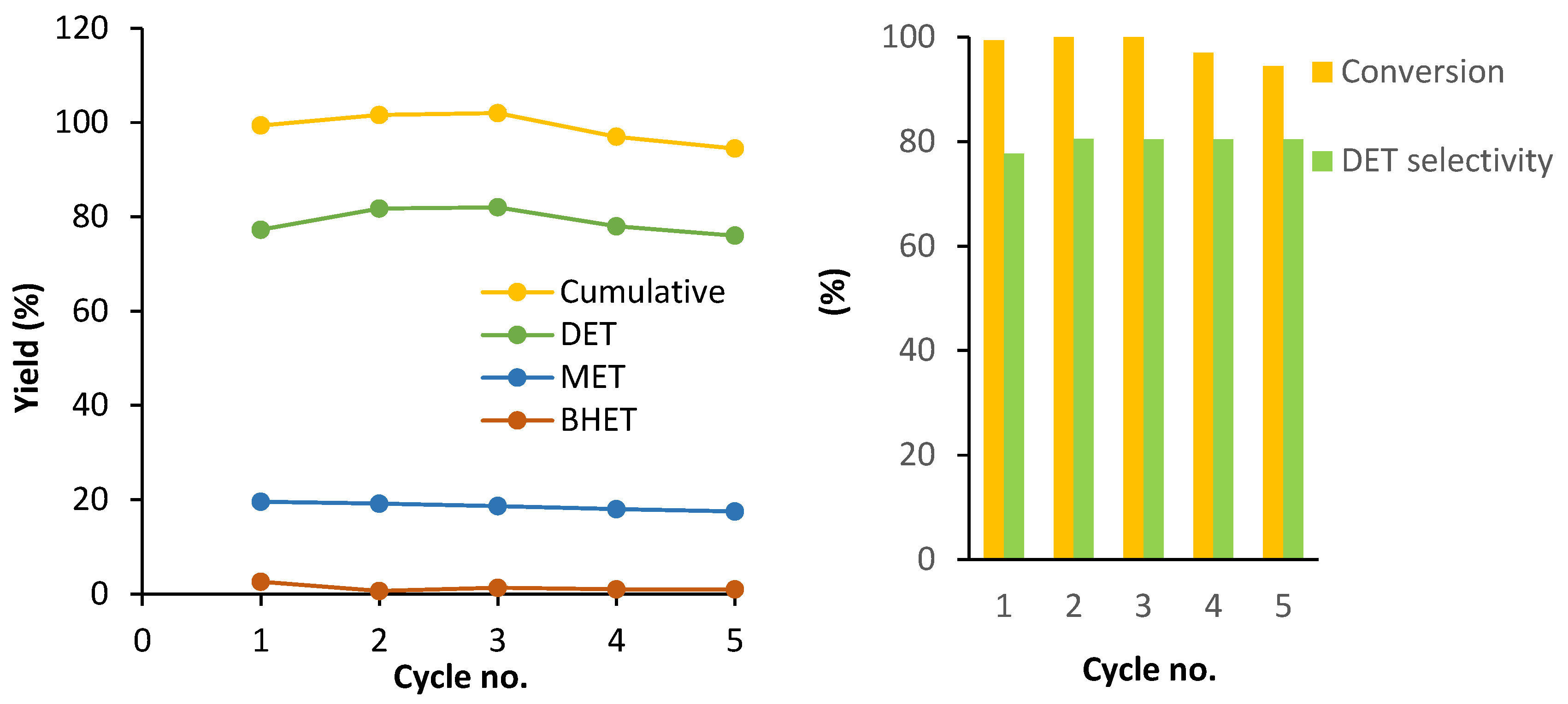
Compared to homogeneous systems, the use of a heterogeneous catalyst may offer significant advantages in terms of separation from the reaction mixture and reuse. Upon complete conversion of the PET feed, ZnO could be easily and quantitatively recovered by simple centrifugation of the ethanolic reaction mixture. To ascertain the reusability of ZnO, the catalyst performance and resistance were examined over five consecutive runs of 30 h at 180 °C. Figure 6 summarises significant data. DET selectivity was maintained across the cycles while conversion slightly decreased to 94.5%, probably due to minor loss of ZnO during centrifugation and transfer operations. Importantly, the catalyst did not require any regeneration throughout the process.
An overall production of 20.7 mmol DET per gram of catalyst could be estimated over five consecutive runs. ZnO leaching in solution was below 0.15% wt (ICP-OES). These findings show that ethanolysis over ZnO is a successful strategy to achieve PET depolymerization to useful monomers over stable heterogeneous catalysts.

3.6. Depolymerization of Actual Waste PET Feedstock

Following a detailed examination of the catalytic behaviour of ZnO in the depolymerization of technical-grade PET via ethanolysis, the catalyst was tested in the chemical recycling of post-consumer PET bottles. The results (Table 1, entry 13) indicated the viability of the catalyst to produce added-value and reprocessable monomers from real waste feedstock, since around 88% of end-of-life PET could be converted to terephthalate monomers under benchmark conditions (180 °C, 24 h, 40.0% DET, 41.4% MET, 6.1% BHET, see Table S1), with a minor amount of unidentified by-products (ca. 3%), which is in-line with the nature of the composite material treated and the presence of additives. In addition to the conventional route from TPA [46], PET production has been described both from BHET [47] and dimethyl terephthalate [48], with the potential for DET to be used for this aim.

4. Context Within the Literature

Plastic recycling is currently dominated by mechanical technologies; however, a chemical approach featured by the recovery of the constituent monomers is being actively sought, with many efforts focused on matching sustainability criteria. In the case of PET, depolymerization using ethanol as a lytic, transesterification agent has been proposed in the past as an attractive option. Supercritical conditions have been adopted in most cases, both in the presence of and without catalysts. De Castro et al. reported full conversion and near-quantitative DET yields exclusively when polyester strings were used as feedstock; however, the process performance was notably influenced by the presence of TiO2 additives [49]. On the other hand, the use of nanoparticles of metal oxides such as Co3O4 and NiO in supercritical ethanol allowed for comparable yields and selectivity at shorter reaction times [50]. A ZnO-based catalyst supported on acidic γ-Al2O3 has been reported for this process, with its effectiveness being attributed to the synergistic role of the γ-Al2O3 support; however, upon catalyst reuse in supercritical conditions, significant loss of active components and clogging of the catalyst pores due to carbonaceous deposits were observed [51]. To overcome these stability issues, nickel was incorporated into the ZnO/acidic γ-Al2O3 catalyst, which slightly improved the efficiency of the catalytic system, but monomer yield still decreased significantly after several cycles [52].
ZnO was previously reported as a catalyst for the depolymerization reaction of plastics, facilitating reactions such as hydrolysis, aminolysis and alcoholysis of polycarbonates [53], as well as the hydrolysis [33], methanolysis and glycolysis of PET [54]. However, a critical issue for ZnO is its instability under operating conditions. The stability of ZnO-based catalysts is not always examined in the literature (see Supporting Information, Table S3), and it is occasionally associated with regeneration steps [55,56]. In the case of PET methanolysis, ZnO performs as a pseudo-homogeneous catalyst, with ca. 30% activity loss upon reuse at 170 °C [57]. In the case of PET glycolysis, limited stability at 300 °C was observed by deposition onto silica nanospheres [58,59]. In the case of PET hydrolysis, the amphoteric nature of ZnO resulted in a reaction with the nascent TPA, giving composite materials featured by poor catalytic activity. Therefore, strategies need to be developed to ensure the stability of the powerful depolymerization catalyst ZnO. We recently proposed the incorporation of ZnO into an inert ZrO2 lattice, which proved successful for the hydrolytic depolymerization reaction of PLA [60]. Herein, we demonstrated that the use of an alternative solvent system, namely ethanol, may result in a stable and efficient ZnO catalyst for the production of valuable monomers under mild reaction conditions.

5. Conclusions

Herein, we described the chemical depolymerization of PET over heterogeneous zinc oxide catalyst under subcritical conditions, as an alternative to energy-intensive supercritical processes. Sustainability of the process is a matter of compromise between energy input and monomer productivity, so the use of a highly efficient catalyst able to operate under subcritical conditions may significantly reduce the energy demand. For instance, a previously reported CaO catalyst provided comparable yields to those of ZnO, although at reaction temperatures above 200 °C, whereas no information was provided on the recyclability of the catalyst [45].
In our case, a thorough study of key reaction parameters, including temperature, time and catalyst loading, showed zinc oxide to efficiently catalyse the ethanolysis reaction, with full depolymerization of PET being achieved under relatively mild conditions, notably below the melting point of the polymer. PET could be completely depolymerized to the aromatic monomers DET, MET and BHET at 180 °C with 92.5% selectivity to diethyl terephthalate, an important precursor usable to produce PET and other polyesters. In addition, quantitative production of DET was possible by increasing the reaction temperature to 200 °C or the reaction time. The catalyst was active in actual waste feedstock, with 91.1% of post-consumer PET bottles being broken down into their monomeric units under benchmark experimental conditions.
The proposed catalytic system offers several advantages that align with the principles of green chemistry and process efficiency, which are often lacking in chemical recycling strategies. The use of ethanol as a lytic agent contributes to the sustainability of the process due to its renewable origin, low toxicity and favourable safety profile. Operating under mild conditions reduces energy consumption. The absence of additives and high selectivity minimises reaction waste and the need for downstream purifications.
In conclusion, the present study describes a sustainable chemical process for recycling PET materials with the recovery of diethyl terephthalate monomer. The proposed protocol offers new insights for the development of innovative and environmentally conscious depolymerization strategies. Moreover, the stability and reusability of the catalyst contribute to the closed-loop concept of plastic recycling, and ultimately to the circular economy model.

Supplementary Materials

The following supporting information can be downloaded at: https://www.mdpi.com/article/10.3390/su18094578/s1, Figure S1: PXRD patterns acquired at room temperature for as-synthesized ZnO and the solid recovered after the stability test conducted in ethanol; Figure S2: PXRD patterns acquired at room temperature for as-synthesized ZnO and ZnO recovered after quantitative ethanolysis of PET (100 mg ZnO, 100 mg PET, 15 mL EtOH, 180 °C, 30 h) [61]; Figure S3: Section in the methyl region of the (a) 1H NMR spectrum acquired in DMSO-d6 (300.13 MHz. 298 K) and (b) 13C{1H} NMR spectrum acquired in DMSO-d6 (75.47 MHz. 298 K) of the residue obtained after evaporation of the ethanolic phase recovered at the end of catalytic ethanolysis reaction of PET over ZnO (180 °C. 24 h); Figure S4: HPLC spectra of the residue obtained after evaporation of the ethanolic phase recovered at the end of ethanolysis reaction of PET (180 °C. 24 h) in presence (A) and in absence (B) of ZnO catalyst; Figure S5: HPLC calibration curves within the concentration range [0.3–50] µM for the quantification of DET, BHET and MET; Table S1: Representative data for the ethanolysis reaction of PET over ZnO catalyst; Table S2: Representative literature data for the ethanolysis reaction of PET [62,63]; Table S3: Representative literature data of ZnO-based catalysts used in solvolytic depolymerization of PET [64,65,66].

Author Contributions

Conceptualization, P.B. and C.M.-M.; Data Curation, C.M.-M. and F.R.-F.; Formal analysis, C.M.-M.; Investigation, P.B., C.M.-M., W.O., F.R.-F. and F.L.; Methodology, C.M.-M.; Supervision, C.M.-M.; Funding acquisition, P.B.; Project administration, P.B., C.M.-M. and F.L.; Writing—original draft, C.M.-M.; Writing—review and editing, P.B., W.O., F.R.-F., A.M.P. and F.L. All authors have read and agreed to the published version of the manuscript.

Funding

This research was funded by the Made in Italy—Circular and Sustainable (MICS) Extended Partnership, funded by the European Union Next-Generation EU (Piano Nazionale di Ripresa e Resilienza (PNRR)—Missione 4, Componente 2, Investimento 1.3—D.D. 1551.11-10-2022, PE00000004); the LABSolve “Lactic Acid Based new green Solvents: design, synthesis and use in catalysis” project (20229P7PPM) funded by PNRR, Missione 4 “Istruzione e Ricerca”—Componente C2 Investimento 1.1, “Fondo per il Programma Nazionale di Ricerca e Progetti di Rilevante Interesse Nazionale (PRIN); and the “Le materie prime del futuro da fonti non-critiche, residuali e rinnovabili” (FutuRaw) project, Fondo Ordinario Enti di Ricerca (D.M. 789, 2023), Ministero dell’Università e della Ricerca, Italia.

Institutional Review Board Statement

Not applicable.

Informed Consent Statement

Not applicable.

Data Availability Statement

The original contributions presented in this study are included in the article/Supplementary Materials. Further inquiries can be directed to the corresponding author.

Acknowledgments

Thanks are due to Carlo Bartoli (ICCOM-CNR) for reactor design and to Elisa Passaglia (ICCOM-CNR) for GPC measurements.

Conflicts of Interest

The authors declare no conflicts of interest.

Abbreviations

The following abbreviations are used in this manuscript:
PETPolyethylene terephthalate
DETDiethyl terephthalate
TPATerephthalic acid
EGEthylene glycol
BHETBis(2-hydroxyethyl)terephthalate
HEETEthyl (2-hydroxyethyl) terephthalate
MHET4-((2-hydroxyethoxy)carbonyl)benzoic acid
MET4-(Ethoxycarbonyl) benzoic acid
DEGDiethylene glycol
ACNAcetonitrile

References

  1. Eunomia. Report PET Market in Europe: State of Play 2022. Available online: https://eunomia.eco/reports/pet-market-in-europe-state-of-play-2022/ (accessed on 1 June 2025).
  2. Rabnawaz, M.; Wyman, I.; Auras, R.; Cheng, S. A Roadmap towards Green Packaging: The Current Status and Future Outlook for Polyesters in the Packaging Industry. Green Chem. 2017, 19, 4737–4753. [Google Scholar] [CrossRef]
  3. Qi, X.; Yan, W.; Cao, Z.; Ding, M.; Yuan, Y. Current Advances in the Biodegradation and Bioconversion of Polyethylene Terephthalate. Microorganisms 2021, 10, 39. [Google Scholar] [CrossRef]
  4. Barnard, E.; Rubio Arias, J.J.; Thielemans, W. Chemolytic Depolymerisation of PET: A Review. Green Chem. 2021, 23, 3765–3789. [Google Scholar] [CrossRef]
  5. Data from DEMETO Project. Available online: https://cordis.europa.eu/project/id/768573 (accessed on 1 June 2023).
  6. Ryberg, M.; Laurent, A.; Hauschild, M.Z. Mapping of Global Plastic Value Chain and Plastic Losses to the Environment: With a Particular Focus on Marine Environment; United Nations Environment Programme: Nairobi, Kenya, 2018. [Google Scholar]
  7. De Falco, F.; Di Pace, E.; Cocca, M.; Avella, M. The Contribution of Washing Processes of Synthetic Clothes to Microplastic Pollution. Sci. Rep. 2019, 9, 6633. [Google Scholar] [CrossRef]
  8. Boucher, J.; Friot, D. Primary Microplastics in the Oceans: A Global Evaluation of Sources; IUCN International Union for Conservation of Nature: Gland, Switzerland, 2017. [Google Scholar] [CrossRef]
  9. Garcia-Gutierrez, P.; Amadei, A.M.; Klenert, D.; Nessi, S.; Tonini, D.; Tosches, D.; Ardente, F.; Saveyn, H. Environmental and Economic Assessment of Plastic Waste Recycling; EUR 31423 EN; Publications Office of the European Union: Luxembourg, 2023; ISBN 978-92-76-99528-9. [Google Scholar] [CrossRef]
  10. Schyns, Z.O.G.; Shaver, M.P. Mechanical Recycling of Packaging Plastics: A Review. Macromol. Rapid Commun. 2021, 42, 2000415. [Google Scholar] [CrossRef]
  11. Coates, G.W.; Getzler, Y.D.Y.L. Chemical Recycling to Monomer for an Ideal, Circular Polymer Economy. Nat. Rev. Mater. 2020, 5, 501–516. [Google Scholar] [CrossRef]
  12. Closed Loop Partners. Transitioning to a Circular System for Plastics—Assessing Molecular Recycling Technologies in the United States and Canada; Closed Loop Partners: New York, NY, USA, 2021. [Google Scholar]
  13. European Commission. A European Strategy for Plastics in a Circular Economy; European Commission: Brussels, Belgium, 2018. [Google Scholar]
  14. Ellen MacArthur Foundation. The New Plastics Economy: Rethinking the Future of Plastics & Catalysing Action; The World Economic Forum: Geneva, Switzerland, 2017. [Google Scholar]
  15. The European Chemicals Agency. Chemical Recycling of Polymeric Materials from Waste in the Circular Economy; Final Report; RPA Europe: Milan, Italy, 2021. [Google Scholar]
  16. McKinsey & Company. How Plastics Waste Could Transform the Chemical Industry. 2018. Available online: https://www.mckinsey.com/industries/chemicals/our-insights/how-plastics-waste-recycling-could-transform-the-chemical-industry (accessed on 4 May 2025).
  17. Martín, A.J.; Mondelli, C.; Jaydev, S.D.; Pérez-Ramírez, J. Catalytic Processing of Plastic Waste on the Rise. Chem 2021, 7, 1487–1533. [Google Scholar] [CrossRef]
  18. Chu, M.; Liu, Y.; Lou, X.; Zhang, Q.; Chen, J. Rational Design of Chemical Catalysis for Plastic Recycling. ACS Catal. 2022, 12, 4659–4679. [Google Scholar] [CrossRef]
  19. Khopade, K.V.; Chikkali, S.H.; Barsu, N. Metal-Catalyzed Plastic Depolymerization. Cell Rep. Phys. Sci. 2023, 4, 101341. [Google Scholar] [CrossRef]
  20. Liguori, F.; Moreno-Marrodán, C.; Barbaro, P. Valorisation of Plastic Waste via Metal-Catalysed Depolymerisation. Beilstein J. Org. Chem. 2021, 17, 589–621. [Google Scholar] [CrossRef]
  21. Zero Waste Europe. Understanding the Environmental Impacts of Chemical Recycling—Ten Concerns with Existing Life Cycle Assessments. 2020. Available online: https://zerowasteeurope.eu/wp-content/uploads/2020/12/zwe_jointpaper_UnderstandingEnvironmentalImpactsofCR_en.pdf (accessed on 4 May 2025).
  22. Hann, S.; Connock, T. Chemical Recycling: State of Play; Eunomia Research & Consulting Ltd.: Bristol, UK, 2020. [Google Scholar]
  23. Umdagas, L.; Orozco, R.; Heeley, K.; Thom, W.; Al-Duri, B. Advances in Chemical Recycling of Polyethylene Terephthalate (PET) via Hydrolysis: A Comprehensive Review. Polym. Degrad. Stab. 2025, 234, 111246. [Google Scholar] [CrossRef]
  24. Das, S.K.; Eshkalak, S.K.; Chinnappan, A.; Ghosh, R.; Jayathilaka, W.A.D.M.; Baskar, C.; Ramakrishna, S. Plastic Recycling of Polyethylene Terephthalate (PET) and Polyhydroxybutyrate (PHB)—A Comprehensive Review. Mater. Circ. Econ. 2021, 3, 9. [Google Scholar] [CrossRef]
  25. Bohre, A.; Jadhao, P.R.; Tripathi, K.; Pant, K.K.; Likozar, B.; Saha, B. Chemical Recycling Processes of Waste Polyethylene Terephthalate Using Solid Catalysts. ChemSusChem 2023, 16, e202300142. [Google Scholar] [CrossRef]
  26. Alberti, C.; Enthaler, S. Method for the Depolymerization of a Terephthalate Polyester. European Patent EP4273190A1, 8 November 2023. [Google Scholar]
  27. Cao, F.; Wang, L.; Zheng, R.; Guo, L.; Chen, Y.; Qian, X. Research and Progress of Chemical Depolymerization of Waste PET and High-Value Application of Its Depolymerization Products. RSC Adv. 2022, 12, 31564–31576. [Google Scholar] [CrossRef]
  28. Park, S.H.; Kim, S.H. Poly (Ethylene Terephthalate) Recycling for High Value Added Textiles. Fash. Text. 2014, 1, 1. [Google Scholar] [CrossRef]
  29. Raheem, A.B.; Noor, Z.Z.; Hassan, A.; Abd Hamid, M.K.; Samsudin, S.A.; Sabeen, A.H. Current Developments in Chemical Recycling of Post-Consumer Polyethylene Terephthalate Wastes for New Materials Production: A Review. J. Clean. Prod. 2019, 225, 1052–1064. [Google Scholar] [CrossRef]
  30. Damayanti; Wu, H.-S. Strategic Possibility Routes of Recycled PET. Polymers 2021, 13, 1475. [Google Scholar] [CrossRef]
  31. Payne, J.; Jones, M.D. The Chemical Recycling of Polyesters for a Circular Plastics Economy: Challenges and Emerging Opportunities. ChemSusChem 2021, 14, 4041–4070. [Google Scholar] [CrossRef]
  32. Closed Loop Partners. Accelerating Circular Supply Chain for Plastics: A Landscape of Transformational Technologies That Stop Plastic Waste, Keep Materials in Play and Grow Markets. 2021. Available online: https://www.closedlooppartners.com/wp-content/uploads/2021/01/CLP_Circular_Supply_Chains_for_Plastics_Updated.pdf (accessed on 4 May 2025).
  33. Liguori, F.; Moreno-Marrodán, C.; Oberhauser, W.; Passaglia, E.; Barbaro, P. Hydrolytic Depolymerisation of Polyesters over Heterogeneous ZnO Catalyst. RSC Sustain. 2023, 1, 1394–1403. [Google Scholar] [CrossRef]
  34. ECHA Substance Information. Ethanol. Available online: https://chem.echa.europa.eu/100.000.526/overview?searchText=ethanol (accessed on 4 May 2025).
  35. Prat, D.; Wells, A.; Hayler, J.; Sneddon, H.; McElroy, C.R.; Abou-Shehada, S.; Dunn, P.J. CHEM21 Selection Guide of Classical- and Less Classical-Solvents. Green Chem. 2016, 18, 288–296. [Google Scholar] [CrossRef]
  36. Tekin, K.; Hao, N.; Karagoz, S.; Ragauskas, A.J. Ethanol: A Promising Green Solvent for the Deconstruction of Lignocellulose. ChemSusChem 2018, 11, 3559–3575. [Google Scholar] [CrossRef]
  37. Tse, T.J.; Wiens, D.J.; Reaney, M.J.T. Production of Bioethanol—A Review of Factors Affecting Ethanol Yield. Fermentation 2021, 7, 268. [Google Scholar] [CrossRef]
  38. Gude, M.; Teja, A.S. Vapor-Liquid Critical Properties of Elements and Compounds. 4. Aliphatic Alkanols. J. Chem. Eng. Data 1995, 40, 1025–1036. [Google Scholar] [CrossRef]
  39. Li, H.; Aguirre-Villegas, H.A.; Allen, R.D.; Bai, X.; Benson, C.H.; Beckham, G.T.; Bradshaw, S.L.; Brown, J.L.; Brown, R.C.; Cecon, V.S.; et al. Expanding Plastics Recycling Technologies: Chemical Aspects, Technology Status and Challenges. Green Chem. 2022, 24, 8899–9002. [Google Scholar] [CrossRef]
  40. Tang, H.; Li, N.; Li, G.; Wang, A.; Cong, Y.; Xu, G.; Wang, X.; Zhang, T. Synthesis of Gasoline and Jet Fuel Range Cycloalkanes and Aromatics from Poly(Ethylene Terephthalate) Waste. Green Chem. 2019, 21, 2709–2719. [Google Scholar] [CrossRef]
  41. McGuire, T.M.; Buchard, A.; Williams, C.K. Chemical Recycling of Polyesters and Polycarbonates: Why Is Zinc(II) Such an Effective Depolymerization Catalyst? J. Am. Chem. Soc. 2025, 147, 43077–43085. [Google Scholar] [CrossRef]
  42. Karim, S.S.; Farrukh, S.; Matsuura, T.; Ahsan, M.; Hussain, A.; Shakir, S.; Chuah, L.F.; Hasan, M.; Bokhari, A. Model Analysis on Effect of Temperature on the Solubility of Recycling of Polyethylene Terephthalate (PET) Plastic. Chemosphere 2022, 307, 136050. [Google Scholar] [CrossRef]
  43. Cosimbescu, L.; Merkel, D.R.; Darsell, J.; Petrossian, G. Simple But Tricky: Investigations of Terephthalic Acid Purity Obtained from Mixed PET Waste. Ind. Eng. Chem. Res. 2021, 60, 12792–12797. [Google Scholar] [CrossRef]
  44. Yang, W.; Liu, R.; Li, C.; Song, Y.; Hu, C. Hydrolysis of Waste Polyethylene Terephthalate Catalyzed by Easily Recyclable Terephthalic Acid. Waste Manag. 2021, 135, 267–274. [Google Scholar] [CrossRef]
  45. Unruean, P.; Padungros, P.; Nomura, K.; Kitiyanan, B. Efficient Chemical Depolymerization of Polyethylene Terephthalate via Transesterification with Ethanol Using CaO Catalyst. J. Mater. Cycles Waste Manag. 2024, 26, 731–740. [Google Scholar] [CrossRef]
  46. Fuessl, A.; Yamamoto, M.; Schneller, A. Opportunities in Bio-Based Building Blocks for Thermoplastic Polymers. In Reference Module in Materials Science and Materials Engineering; Elsevier: Amsterdam, The Netherlands, 2016. [Google Scholar]
  47. Westover, C.C.; Long, T.E. Envisioning a BHET Economy: Adding Value to PET Waste. Sustain. Chem. 2023, 4, 363–393. [Google Scholar] [CrossRef]
  48. Shin, J.; Lee, Y.; Park, S. Optimization of the Pre-Polymerization Step of Polyethylene Terephthalate (PET) Production in a Semi-Batch Reactor. Chem. Eng. J. 1999, 75, 47–55. [Google Scholar] [CrossRef]
  49. De Castro, R.E.N.; Vidotti, G.J.; Rubira, A.F.; Muniz, E.C. Depolymerization of Poly(Ethylene Terephthalate) Wastes Using Ethanol and Ethanol/Water in Supercritical Conditions. J. Appl. Polym. Sci. 2006, 101, 2009–2016. [Google Scholar] [CrossRef]
  50. Rodrigues Fernandes, J.; Pereira Amaro, L.; Curti Muniz, E.; Favaro, S.L.; Radovanovic, E. PET Depolimerization in Supercritical Ethanol Conditions Catalysed by Nanoparticles of Metal Oxides. J. Supercrit. Fluids 2020, 158, 104715. [Google Scholar] [CrossRef]
  51. Yang, Y.; Chen, F.; Shen, T.; Pariatamby, A.; Wen, X.; Yan, M.; Kanchanatip, E. Catalytic Depolymerization of Waste Polyethylene Terephthalate Plastic in Supercritical Ethanol by ZnO/γ-Al2O3 Catalyst. Process Saf. Environ. Prot. 2023, 173, 881–892. [Google Scholar] [CrossRef]
  52. Yang, Y.; Sun, H.; Liu, Z.; Wang, H.; Zheng, R.; Kanchanatip, E.; Yan, M. Monomer Production from Supercritical Ethanol Depolymerization of PET Plastic Waste Using Ni-ZnO/Al2O3 Catalyst. Waste Manag. 2024, 190, 318–328. [Google Scholar] [CrossRef]
  53. Iannone, F.; Casiello, M.; Monopoli, A.; Cotugno, P.; Sportelli, M.C.; Picca, R.A.; Cioffi, N.; Dell’Anna, M.M.; Nacci, A. Ionic Liquids/ZnO Nanoparticles as Recyclable Catalyst for Polycarbonate Depolymerization. J. Mol. Catal. Chem. 2017, 426, 107–116. [Google Scholar] [CrossRef]
  54. Imran, M.; Kim, D.H.; Al-Masry, W.A.; Mahmood, A.; Hassan, A.; Haider, S.; Ramay, S.M. Manganese-, Cobalt-, and Zinc-Based Mixed-Oxide Spinels as Novel Catalysts for the Chemical Recycling of Poly(Ethylene Terephthalate) via Glycolysis. Polym. Degrad. Stab. 2013, 98, 904–915. [Google Scholar] [CrossRef]
  55. Cao, J.; Lin, Y.; Zhou, T.; Wang, W.; Zhang, Q.; Pan, B.; Jiang, W. Molecular oxygen-assisted in defect-rich ZnO for catalytic depolymerization of polyethylene terephthalate. iScience 2023, 26, 107492. [Google Scholar] [CrossRef]
  56. Cao, J.; Liang, H.; Chen, W.; Li, X.; Fu, S. Sustainable recycling of polyester wastes using a coordinatively unsaturated Zn catalyst. Nat. Commun. 2026; in press. [CrossRef]
  57. Du, J.-T.; Sun, Q.; Zeng, X.-F.; Wang, D.; Wang, J.-X.; Chen, J.-F. ZnO Nanodispersion as Pseudohomogeneous Catalyst for Alcoholysis of Polyethylene Terephthalate. Chem. Eng. Sci. 2020, 220, 115642. [Google Scholar] [CrossRef]
  58. Imran, M.; Lee, K.G.; Imtiaz, Q.; Kim, B.-K.; Han, M.; Cho, B.G.; Kim, D.H. Metal-Oxide-Doped Silica Nanoparticles for the Catalytic Glycolysis of Polyethylene Terephthalate. J. Nanosci. Nanotechnol. 2011, 11, 824–828. [Google Scholar] [CrossRef]
  59. Wi, R.; Imran, M.; Lee, K.G.; Yoon, S.H.; Cho, B.G.; Kim, D.H. Effect of Support Size on the Catalytic Activity of Metal-Oxide-Doped Silica Particles in the Glycolysis of Polyethylene Terephthalate. J. Nanosci. Nanotechnol. 2011, 11, 6544–6549. [Google Scholar] [CrossRef]
  60. Liguori, F.; Oberhauser, W.; Berretti, E.; Poggini, L.; Barbaro, P.; Moreno-Marrodán, C. Stabilization of ZnO Catalysts for Polyesters Hydrolytic Depolymerization by Incorporation into ZrO2 Lattice: A Polylactic Acid Case Study. Adv. Energy Sustain. Res. 2025, 6, 2400349. [Google Scholar] [CrossRef]
  61. Srivastava, V.; Gusain, D.; Sharma, Y.C. Synthesis, Characterization and Application of Zinc Oxide Nanoparticles (n-ZnO). Ceram. Int. 2013, 39, 9803–9808. [Google Scholar] [CrossRef]
  62. Santos Nunes, C.; Vieira da Silva, M.J.; da Silva, D.C.; dos Reis Freitas, A.; Rosa, F.A.; Forti Rubira, A.; Curti Muniz, E. PET Depolymerisation in Supercritical Ethanol Catalysed by [Bmim][BF4]. RSC Adv. 2014, 4, 20308–20316. [Google Scholar] [CrossRef]
  63. Lozano-Martinez, P.; Torres-Zapata, T.; Martin-Sanchez, N. Directing Depolymerization of PET with Subcritical and Supercritical Ethanol to Different Monomers through Changes in Operation Conditions. ACS Sustain. Chem. Eng. 2021, 9, 9846–9853. [Google Scholar] [CrossRef]
  64. Yang, T.; Fan, Q.; He, H.; Gao, C.; Yang, Z.; Xu, J. Closed-loop recycling for poly(ethylene terephthalate) (PET) plastic: Depolymerization, monomer separation, and recycled PET (rPET). Chem. Eng. J. 2025, 514, 163038. [Google Scholar] [CrossRef]
  65. Alzuhairi, M.A.H.; Khalil, B.I.; Hadi, R.S. Nano ZnO Catalyst for Chemical Recycling of Polyethylene terephthalate (PET). Eng. Technol. J. 2017, 35, 831–837. [Google Scholar] [CrossRef]
  66. Yang, T.; He, H.; Yan, S.; Gao, J.; Yang, Z.; Xu, J. Catalytic depolymerization of poly(ethylene terephthalate) plastic into value-added monomers using metal-modified mesoporous silica. Fuel 2025, 383, 133858. [Google Scholar] [CrossRef]
Figure 1. Global primary PET production (left) and waste generation, with fate (right), in million tonnes (2019) [5].
Sustainability 18 04578 g001
Scheme 1. Schematic representation of the ethanolysis reaction of PET, with main potential products.
Sustainability 18 04578 sch001
Figure 2. Comparison of catalyst-free and ZnO-catalysed ethanolysis reaction of PET. Reaction conditions: 15 mL ethanol, 100 mg PET (0.035 M based on PET repetition units), 100 mg ZnO, 180 °C.
Sustainability 18 04578 g002
Figure 3. Effect of the reaction temperature in the depolymerization reaction of PET via ethanolysis over ZnO catalyst. (Left): Terephthalate yields, (Right): conversion/selectivity diagram. Reaction conditions: 15 mL ethanol, 100 mg PET (0.035 M based on PET repetition units), 100 mg ZnO, 30 h.
Sustainability 18 04578 g003
Figure 4. Effect of the reaction time in the depolymerization of PET via ethanolysis using ZnO catalyst. (Left): Terephthalate yields, (Right): conversion/selectivity diagram. Reaction conditions: 15 mL ethanol, 100 mg PET (0.035 M based on PET repetition units), 100 mg ZnO, 180 °C.
Sustainability 18 04578 g004
Figure 5. Effect of the catalyst loading in the depolymerization of PET via ethanolysis using ZnO catalyst. (Left): Terephthalate yields, (Right): conversion and selectivity diagrams. Reaction conditions: 15 mL ethanol, 100 mg PET (0.035 M based on PET repetition units), 30 h, 180 °C.
Sustainability 18 04578 g005
Figure 6. Recycling test of ZnO catalyst in the depolymerization of PET via ethanolysis. (Left): Terephthalate yields, (Right): conversion and selectivity diagrams. Reaction conditions: 15 mL ethanol, 100 mg PET (0.035 M based on PET repetition units), 100 mg ZnO, 30 h, 180 °C, 100 mg ZnO.
Sustainability 18 04578 g006
Table 1. Representative data for the ethanolysis reaction of PET over heterogeneous ZnO catalyst (a).
EntryCatalystDET (e)
TypeWeight [mg]Temp. [°C] (b)Time [h] (c)PET Conv. [%] (d)Yield [%] (f)Selectivity [%]
1none-180249.32.021.5
23026.24.818.5
34041.18.821.3
4ZnO1001801692.045.949.9
52498.761.662.4
63099.876.776.8
740100.088.188.1
848100.092.592.5
972100.096.496.4
10ZnO1001603038.514.537.8
112003099.995.195.2
12ZnO501803087.451.058.3
13 (g)ZnO1001802491.140.045.7
(a) Reaction conditions: 15 mL ethanol, 100 mg PET (0.035 M based on PET repetition units). (b) Reaction temperature. (c) Reaction time. (d) PET conversion, based on PET mass loss. (e) The ethanolic fraction of the reaction mixture was recovered at the end of the catalytic run. Data from HPLC analysis, based on PET repetition units. (f) Based on molar amounts. (g) PET bottle.
Disclaimer/Publisher’s Note: The statements, opinions and data contained in all publications are solely those of the individual author(s) and contributor(s) and not of MDPI and/or the editor(s). MDPI and/or the editor(s) disclaim responsibility for any injury to people or property resulting from any ideas, methods, instructions or products referred to in the content.