Article

Integrating Climate Change Adaptation, Disaster Risk Reduction, and Civil Protection for Sustainable Development: A Comparative Analysis of Central European Strategies

by
Viktória Barna
,
Daniela Ridzoňová
and
Andrea Majlingová
*
Department of Fire Protection, Faculty of Wood Sciences and Technology, Technical University in Zvolen, T. G. Masaryka 24, 960 01 Zvolen, Slovakia
*
Author to whom correspondence should be addressed.
Sustainability 2026, 18(9), 4548; https://doi.org/10.3390/su18094548
Submission received: 17 January 2026 / Revised: 1 April 2026 / Accepted: 27 April 2026 / Published: 5 May 2026

Abstract

Climate change is intensifying natural hazards across Central Europe, increasing pressure on national systems of climate change adaptation (CCA), disaster risk reduction (DRR), and civil protection. Although international and European policy frameworks promote coherence among these domains, their practical integration remains uneven. This study presents a comparative governance analysis of five Central European countries (Slovakia, Czechia, Hungary, Poland, and Austria), examining how CCA, DRR, and civil protection are integrated across strategic, institutional, operational, and financial dimensions. A structured qualitative assessment of national strategies, legal acts, and institutional arrangements was conducted using a standardized indicator-based framework. The results reveal systematic cross-dimensional asymmetries. Strategic alignment between CCA and DRR is relatively advanced across all countries, largely driven by international and EU policy frameworks. However, institutional coordination mechanisms, operational integration of climate risk information into preparedness planning, and dedicated financing for prevention and adaptation remain weak or fragmented in most cases. Civil protection systems continue to be predominantly response-oriented, with limited linkage to long-term climate risk governance. Based on these patterns, the study identifies distinct national integration typologies and highlights key governance gaps constraining sustainable climate risk management. The findings underline that effective integration depends not only on strategic commitments but on reinforcing linkages across institutions, operational practice, and financing. The study concludes by identifying concrete governance adjustments needed to strengthen cross-sectoral coordination, climate-informed preparedness, and stable financing mechanisms for resilience-building in Central Europe.

1. Introduction

Climate change is increasingly reshaping the risk landscape in Europe by intensifying hydro-meteorological extremes and amplifying their interactions with socioeconomic vulnerabilities and critical infrastructure systems. Floods, heatwaves, droughts, wildfires, and windstorms are no longer isolated phenomena; they often occur as compound or cascading hazards, producing complex impacts on human health, ecosystems, economic activity, and public safety. Recent European assessments indicate that a substantial share of climate-related risks has already reached critical levels, with further escalation expected under projected warming if adaptive capacity and risk governance are not significantly strengthened [1]. These developments challenge governance systems that were largely designed around historical hazard patterns and sector-specific approaches to risk management.
Recent scholarship increasingly emphasizes the governance implications of compound and cascading climate risks, particularly in the European context. Studies published over the past five years highlight the growing interdependence between adaptation policy, disaster risk governance, and infrastructure resilience under accelerating climate pressures (e.g., [2,3,4,5]). European Environment Agency assessments further stress that climate impacts are intensifying faster than institutional adaptation capacities, reinforcing the need for cross-sectoral governance integration [1].
Within this evolving context, three policy domains play a central role in addressing climate-related risks: climate change adaptation (CCA), disaster risk reduction (DRR), and civil protection. CCA focuses on anticipatory and long-term adjustments in natural, social, and technical systems to reduce vulnerability and enhance resilience to observed and projected climate impacts [6]. DRR aims to prevent new disaster risks and reduce existing ones by addressing hazard characteristics, exposure, and vulnerability through governance, investment, preparedness, and knowledge-based measures [7]. Civil protection, particularly within the European institutional context, encompasses preparedness, emergency response, coordination, and recovery mechanisms designed to protect lives, property, and the environment during crises [8,9]. Although these domains address different stages of the risk management cycle, they are increasingly understood as interdependent components of a broader climate risk governance system.
A growing body of research examines linkages between CCA and DRR, often through conceptual discussions, sector-specific case studies, or policy coherence analyses [10,11,12,13,14,15]. However, most existing studies focus either on single-country contexts or on selected governance aspects, such as strategic alignment or institutional coordination [16,17,18,19]. Comparative assessments that systematically operationalize integration across multiple governance dimensions, including strategic, institutional, operational, and financial components, using a standardized cross-national framework remain limited [20,21,22].
International and European policy frameworks explicitly emphasize the need for integration across these domains. The Paris Agreement highlights adaptation and resilience as global priorities alongside mitigation [23]. The Sendai Framework for Disaster Risk Reduction 2015–2030 calls for policy coherence between DRR, climate change adaptation, and sustainable development [24]. At the European level, the EU Strategy on Adaptation to Climate Change and the European Green Deal frame climate resilience as a prerequisite for sustainable development, economic stability, and social cohesion [25,26]. The Union Civil Protection Mechanism further reinforces this orientation by strengthening prevention and preparedness alongside response capacities [8,9]. Despite this normative convergence, empirical evidence suggests that the practical implementation of integrated approaches remains uneven and context-dependent [10,11,27,28]. Recent European evaluations further document persistent gaps between strategic commitments and institutional embedding, particularly regarding financing mechanisms and accountability structures [1,12].
A recurring challenge identified in the literature is institutional fragmentation. Responsibilities for CCA, DRR, and civil protection are frequently distributed across different ministries and agencies, each operating with distinct mandates, planning horizons, and funding mechanisms. CCA is often embedded in environmental policy and long-term strategic planning, DRR is dispersed across sectoral domains such as water management, agriculture, transport, and health, while civil protection typically falls under interior or emergency management authorities. This separation can result in inconsistent risk assessments, limited information exchange, duplicated efforts, and misaligned priorities, particularly when emergency preparedness and response systems are weakly connected to long-term climate projections and vulnerability analyses [10,27,28].
Research on disaster governance further highlights the limitations of response-oriented systems. While civil protection mechanisms in many European countries are relatively effective in coordinating emergency response, they often play a more limited role in prevention, long-term adaptation, and resilience-building. Boin and McConnell argue that reliance on crisis management alone is insufficient for addressing low-probability but high-impact events and advocate a shift toward resilience-oriented governance that integrates preparedness, prevention, and recovery into a coherent framework [13]. In the context of climate change, such imbalances can lead to recurring losses and reconstruction processes that reproduce pre-existing vulnerabilities rather than reducing risk over time.
Against this background, integration has emerged as a key conceptual lens for advancing sustainable climate risk governance. Integration is understood here not merely as coordination between policies, but as a multidimensional governance attribute encompassing strategic coherence, institutional arrangements, operational practices, and financing mechanisms across policy domains [14]. Studies focusing on the integration of environmental and sectoral policies suggest that high-level commitments alone are insufficient; without institutionalized coordination mechanisms, incentives, and accountability structures, integration tends to remain declarative rather than transformative [14]. In climate risk contexts, closer alignment between CCA and DRR has been shown to improve effectiveness by linking long-term risk information with preventive and preparedness measures [15,27]. However, civil protection has received comparatively limited attention as an integral component of such integrated frameworks, despite its central role in preparedness, emergency response, and recovery.
Central Europe represents a particularly relevant yet underexplored setting for examining integration across CCA, DRR, and civil protection. Countries such as Slovakia, Czechia, Hungary, Poland, and Austria share similar climatic hazards, transboundary river basins, and common European Union policy obligations, while differing in administrative traditions, governance capacities, and institutional arrangements. Recent European assessments highlight that the region is increasingly exposed to compound risks, including interactions between flooding and heat stress, drought-driven wildfire risk, and cascading failures of critical infrastructure systems [1]. Nevertheless, comparative analyses that systematically examine how these countries integrate CCA, DRR, and civil protection within their governance frameworks remain limited.
This study contributes to the literature in several ways. First, it extends existing research on climate risk governance by jointly examining climate change adaptation (CCA), disaster risk reduction (DRR), and civil protection rather than focusing on only one or two of these domains. Second, it operationalizes integration through a standardized four-dimensional framework covering strategic, institutional, operational, and financial dimensions, thereby enabling more systematic cross-country comparison. Third, by applying this framework to five Central European countries, the study identifies cross-dimensional asymmetries and develops comparative integration typologies that help explain why strategic convergence does not necessarily translate into embedded governance capacity
This study addresses these gaps by operationalizing integration as a multidimensional governance property encompassing strategic, institutional, operational, and financial dimensions. Accordingly, the study addresses three research questions. First, how does the degree of integration vary across the strategic, institutional, operational, and financial dimensions in the five selected countries? Second, what cross-dimensional asymmetries characterize national governance systems linking CCA, DRR, and civil protection? Third, which governance features appear to distinguish more embedded forms of integration from primarily strategic or fragmented ones?
These dimensions capture alignment of objectives, formal coordination mechanisms, implementation practices, and resource allocation structures, enabling systematic identification of cross-dimensional integration gaps that are not visible in single-policy or narrative assessments.
The term “domains”, in this study, refers specifically to CCA, DRR, and civil protection governance structures. Although these domains share overlapping objectives related to risk management and societal resilience, they remain institutionally fragmented. To systematically assess the extent and nature of this fragmentation, integration is conceptualized as a multidimensional governance property encompassing four analytical dimensions: strategic, institutional, operational, and financial.
The analytical expectation underlying this framework is that strategic alignment alone is insufficient to produce integrated climate risk governance unless it is reinforced through institutional mandates, operational procedures, and financing mechanisms. For this reason, the study treats integration not as a single attribute, but as a layered governance property whose depth depends on the degree of cross-dimensional reinforcement.
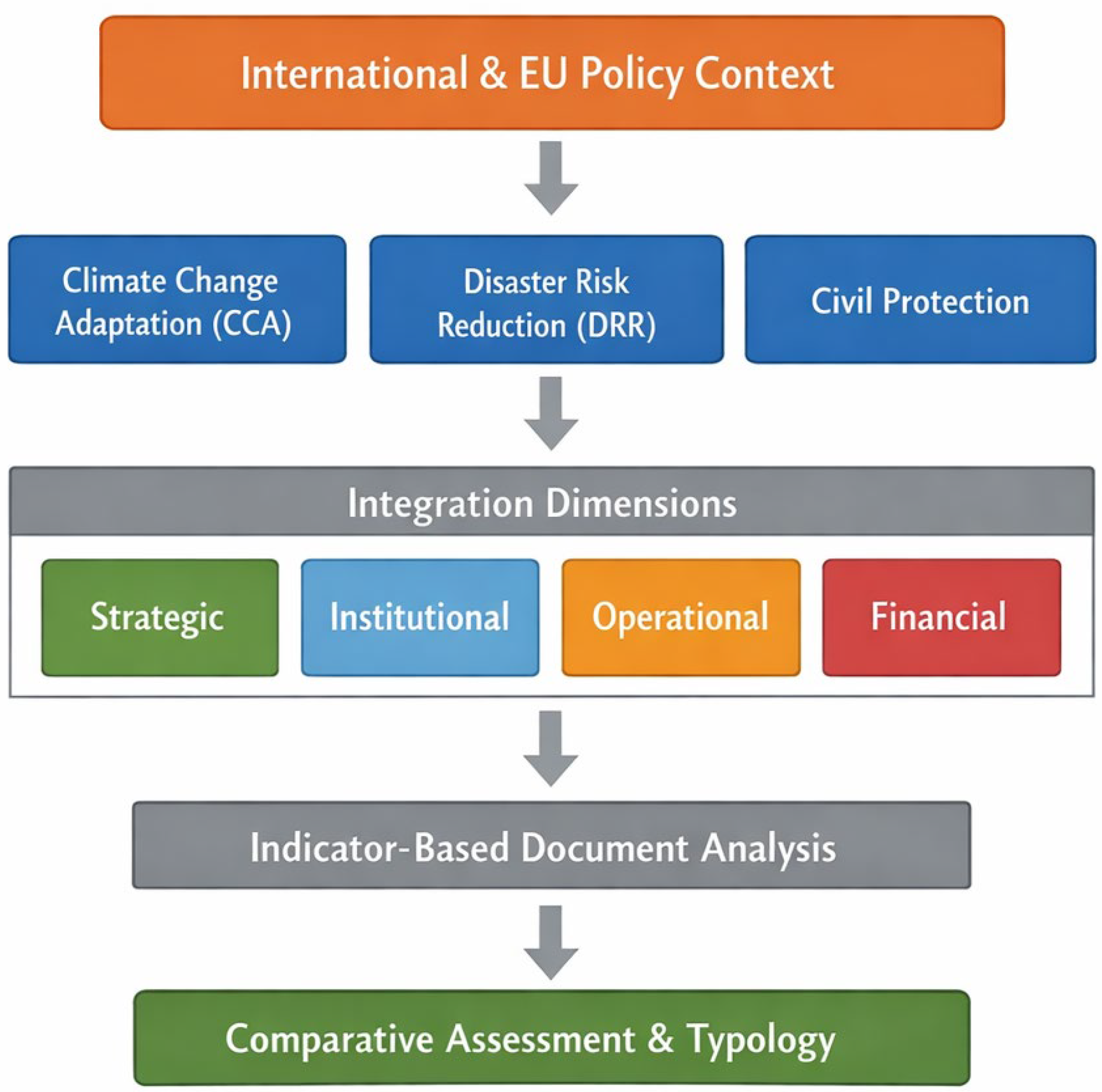
These dimensions capture alignment of objectives, formal coordination mechanisms, implementation practices, and resource allocation structures. Introducing these dimensions at the outset clarifies the analytical logic guiding the methodological approach and distinguishes this study from predominantly descriptive or sector-specific integration assessments. To clarify the analytical logic of the study, Figure 1 presents the research framework guiding the comparative assessment. The framework illustrates the relationship between the three governance domains (CCA, DRR, and civil protection), the four integration dimensions (strategic, institutional, operational, financial), and the structured document-based methodology applied across the five case countries.

2. Materials and Methods

2.1. Research Design

This study adopts a comparative governance analysis to examine how CCA, DRR, and civil protection are integrated within national governance systems in Central Europe. Comparative governance analysis is particularly suitable for addressing complex, cross-sectoral policy challenges, as it enables systematic comparison of institutional arrangements, policy instruments, and coordination mechanisms across different national contexts while accounting for shared external frameworks and region-specific characteristics.
The research design is qualitative and concept-driven, focusing on governance structures, policy coherence, and integration mechanisms rather than on quantitative performance indicators. This approach is appropriate given the exploratory and analytical objectives of the study, which seek to understand how and to what extent integration occurs, rather than to measure causal effects on disaster outcomes. The analysis compares five countries, i.e., Slovakia, Czechia, Hungary, Poland, and Austria, which share similar climatic hazards and European Union policy obligations but differ in administrative traditions, governance capacities, and institutional configurations.
The unit of analysis is the formally institutionalized national governance arrangement linking CCA, DRR, and civil protection, as reflected in official strategies, legal acts, and related policy instruments.

2.2. Analytical Framework

The comparative analysis is guided by a structured analytical framework that conceptualizes integration among CCA, DRR, and civil protection as a multidimensional governance property.
Integration is not treated as a binary condition but as a continuum reflecting varying degrees of coherence across governance domains. Coordination refers to interaction among institutions, coherence to consistency of policy objectives, integration to cross-domain linkage across governance dimensions, and embedding to the degree to which such integration is stabilized through mandates, routines, and financing.
Four analytical dimensions were defined based on established concepts in climate risk governance and policy integration:
  • Strategic integration, referring to the extent to which national strategies and high-level policy documents articulate shared objectives, consistent terminology, and explicit cross-references between CCA, DRR, and civil protection.
  • Institutional integration, capturing the presence and functionality of formal coordination mechanisms, such as inter-ministerial committees, joint mandates, and clearly assigned cross-sectoral responsibilities.
  • Operational integration, focusing on the alignment of practices, including shared risk assessment approaches, joint scenario planning, integrated early warning systems, and coordinated training and exercises.
  • Financial integration, addressing the degree to which funding mechanisms support prevention, preparedness, and long-term resilience through stable budget lines, mainstreaming into sectoral budgets, and alignment of investment priorities.
To operationalize the analytical framework, each dimension of integration (strategic, institutional, operational, and financial) was assessed using a structured set of qualitative indicators derived from established policy integration and climate governance scholarship. The multidimensional understanding of integration builds on environmental policy integration theory [16], recent process-oriented conceptualizations of climate policy integration [17], and adaptive governance approaches linking climate adaptation and disaster risk reduction [18]. These strands of literature emphasize that integration requires alignment not only at the level of strategy, but also through institutional mandates, operational practice, and financing structures.
For each dimension, indicators captured the presence of formal coordination mechanisms, cross-referencing of policy objectives, joint planning instruments, shared implementation procedures, and dedicated financial arrangements.
Based on the degree to which predefined indicators were fulfilled, Integration levels were assigned using a five-tier ordinal scale (High, Medium–High, Medium, Low–Medium, Low).
“High” indicates consistent and formally institutionalized integration across most predefined indicators; “Medium–High” reflects substantial but not fully comprehensive alignment; “Medium” indicates partial or fragmented institutional linkages; “Low–Medium” reflects limited and largely sector-specific coordination; and “Low” denotes either isolated or absent cross-domain integration.
The assessment was conducted through systematic document screening using a standardized checklist to limit interpretative discretion. All documents were reviewed repeatedly to ensure consistency of indicator interpretation across countries. Documents were obtained from official government portals, national climate adaptation platforms, civil protection agency websites, and European Union reporting repositories. Only formally adopted national strategies, legal acts, and official implementation plans valid as of December 2023 were included in the analysis.
The operationalization of the integration dimensions and the corresponding indicator structure are detailed in Section 2.5.
The four dimensions are also expected to be related analytically rather than merely coexisting as separate descriptive categories. Strategic integration is often the most visible and politically accessible form of alignment because it can be advanced through common objectives, shared terminology, and cross-referencing in policy documents. Institutional integration is more demanding, as it requires formal coordination mandates and organizational linkages capable of translating strategic commitments into decision-making processes. Operational integration reflects whether such commitments are embedded in planning routines, risk assessments, preparedness activities, and implementation practices. Financial integration is particularly important because it conditions whether cross-sectoral coordination and preventive action can be sustained over time. From this perspective, strong strategic integration combined with weak institutional or financial integration is interpreted as a relatively shallow form of governance integration.

2.3. Case Selection and Scope

The selection of Slovakia, Czechia, Hungary, Poland, and Austria is based on a most-similar systems logic. All five countries are located in Central Europe, are exposed to comparable climate-related hazards (e.g., floods, heatwaves, droughts), and operate within the same overarching European Union policy framework, including EU climate and civil protection instruments. At the same time, they differ in governance traditions (unitary vs. federal arrangements), administrative capacities, and historical development of adaptation and disaster management policies.
This combination of similarity and variation enables meaningful comparison while reducing the influence of external structural factors. This configuration makes it possible to assess whether variation in governance integration is associated less with broad external conditions and more with differences in domestic institutional arrangements and administrative traditions. The analysis focuses on the national level of governance, with attention to how national frameworks structure coordination with regional and local actors where relevant.

2.4. Data Sources and Document Selection

The empirical basis of the study consists of official policy and governance documents, selected through a structured document review. The primary data sources include:
  • National strategies and action plans for climate change adaptation;
  • National DRR strategies, risk assessment frameworks, and prevention policies;
  • Legal and strategic documents governing civil protection and emergency management;
  • Relevant European Union policy documents and legal acts that shape national governance contexts.
  • Documents were included if they met the following criteria:
  • Formal status as national strategies, action plans, legal acts, or authoritative policy documents;
  • Explicit relevance to CCA, DRR, and/or civil protection;
  • Applicability during the most recent policy cycle relevant to the study period.
All documents were analyzed in their official versions. The study relies exclusively on publicly available materials, ensuring transparency and replicability of the analysis. Non-binding commentaries, media sources, and secondary interpretations were excluded in order to maintain consistency in the assessment of formal governance arrangements.

2.5. Operationalization of Integration Dimensions

To assess integration in a systematic yet empirically grounded manner, the four analytical dimensions were translated into a set of qualitative indicators. These indicators were designed to capture concrete institutional and governance features observable in official policy documents, rather than abstract declarations of cooperation. The focus was placed on tangible arrangements that reveal how CCA, DRR, and civil protection interact in practice.
The operationalization follows a deductive qualitative content analysis logic, where theoretically defined dimensions are transformed into structured analytical categories prior to document review [19,20]. This procedure ensures that the assessment framework was conceptually grounded before empirical coding commenced.
For each integration dimension, between five and seven predefined indicators were applied (see Appendix A). Indicators were formulated to capture institutionalized features such as:
  • explicit cross-referencing between policy documents,
  • legally mandated coordination mechanisms,
  • formally assigned cross-sectoral responsibilities,
  • joint planning instruments or shared risk assessment procedures,
  • dedicated or structurally integrated funding mechanisms.
To enhance analytical transparency, the underlying indicator fulfillment matrix, cumulative scores, and corresponding ordinal classifications are reported in Appendix B.
Only explicit documentary evidence was considered valid for indicator fulfillment. Narrative references to cooperation without formal institutional anchoring were not sufficient to qualify as fulfilled indicators.
Each indicator was coded dichotomously (fulfilled = 1; not fulfilled = 0) based exclusively on verifiable documentary evidence. In cases of partially specified coordination mechanisms lacking formal mandate, the indicator was coded as not fulfilled. All indicators within a given dimension were weighted equally.
To enhance transparency and reproducibility, integration levels were assigned using cumulative fulfillment thresholds across predefined indicators within each dimension:
  • High: ≥80% of indicators fulfilled, including at least one formally mandated cross-sector coordination mechanism or legally binding cross-reference.
  • Medium–High: 60–79% of indicators fulfilled, with documented coordination mechanisms but without comprehensive institutional embedding.
  • Medium: 40–59% of indicators fulfilled, indicating partial or fragmented cross-domain linkages.
  • Low–Medium: 20–39% of indicators fulfilled.
  • Low: <20% of indicators fulfilled or absence of documented cross-domain integration mechanisms.
These thresholds were defined prior to comparative assessment and applied consistently across all five countries. To further enhance reproducibility, all indicators were operationalized as binary (presence/absence) based strictly on explicit documentary evidence, and ordinal scores reflect the cumulative fulfillment of these predefined criteria. This approach reduces interpretative variability and supports consistency across analysts.
Scores were assigned only when explicit documentary evidence confirmed indicator fulfillment.
By grounding ordinal classifications in predefined cumulative thresholds and verifiable institutional criteria, the framework limits interpretative discretion and enhances analytical replicability. The practical application of these indicators and thresholds within the coding procedure is described in Section 2.6.
The core indicators applied within each dimension are summarized in Table 1.
Each indicator was coded dichotomously (fulfilled = 1; not fulfilled = 0) based exclusively on explicit documentary evidence. Partial or rhetorical references without formal institutional anchoring were not coded as fulfilled. Scores were assigned only when documentary evidence demonstrated the presence of institutionalized coordination, cross-referencing mechanisms, or structured financial arrangements, as detailed in Appendix A.
The practical application of these indicators within the coding procedure is described in the following section.

2.6. Coding Procedure and Comparative Analysis

A qualitative content analysis was conducted using a deductive coding approach derived from the analytical framework [19,20]. Coding categories corresponded directly to the four integration dimensions and their associated indicators as defined in Section 2.5. Documents for each country were independently screened and coded by the authors using the same structured checklist derived from the predefined indicator framework. In total, 20 core indicators were reported across the four analytical dimensions in Appendix B, with five indicators presented for each dimension to ensure cross-country comparability and transparent cumulative scoring. Indicators were coded using the predefined binary scheme described in Section 2.5, and no scores were assigned on the basis of inferred intentions or rhetorical alignment. Initial disagreements were limited and occurred primarily in the financial dimension, where documentary evidence was more often indirect or fragmented. These discrepancies were resolved through joint re-examination of source materials and repeated application of the predefined coding rules. Because the indicators were binary and based exclusively on explicit documentary evidence, the final coding framework was designed to maximize reproducibility across similarly trained analysts.
Following consensus at the indicator level, cumulative fulfillment rates were calculated for each integration dimension. The resulting percentages were translated into ordinal integration levels (High, Medium–High, Medium, Low–Medium, Low) according to the predefined thresholds specified in Section 2.5. Comparative synthesis was then applied to identify cross-country patterns, dimension-specific asymmetries, and typological configurations of governance integration. The results of the comparative analysis are presented in a structured narrative form, supported by cross-country comparisons aligned with the analytical dimensions.
Although qualitative assessment inevitably involves analytical judgment, several safeguards were implemented to enhance replicability. Indicators were predefined prior to document review, coded dichotomously based exclusively on explicit documentary evidence, and translated into ordinal levels through fixed cumulative thresholds. Independent coding and structured reconciliation further reduced interpretative variability. Given the reliance on formally documented institutional arrangements rather than inferred policy intent, replication by similarly trained analysts applying the same criteria would be expected to produce highly comparable results.
The methodological limitations of this document-based comparative design are discussed in Section 4.8.

3. Results

The comparative governance analysis reveals that integration among climate change adaptation (CCA), disaster risk reduction (DRR), and civil protection in Central Europe is neither uniform nor linear. Instead, it is characterized by dimension-specific asymmetries, varying coordination capacities, and distinct national integration patterns. This section presents the results by combining analytical narrative with tables and figures, each serving a clearly differentiated purpose: tables provide detailed comparative assessments, figures visualize structural patterns, and text focuses on cross-cutting trends and relationships rather than repeating values.
The qualitative integration levels presented in the tables and figures are directly derived from the structured indicator framework defined in Section 2.5. For each country and dimension, scores were assigned exclusively on the basis of explicitly documented institutional arrangements, legally adopted coordination mechanisms, formal cross-references between strategies, or clearly defined financial instruments. No scores were inferred from narrative framing or policy rhetoric alone. Detailed references to the specific national documents and legal acts supporting each assessment are provided in Appendix A to enhance empirical transparency.

3.1. Overall Comparative Integration Profile

At an aggregate level, the results indicate that integration across governance dimensions is hierarchical. Strategic integration is generally more advanced than institutional, operational, and financial integration, suggesting that alignment at the level of policy narratives precedes implementation-oriented coherence. This overarching pattern is observed across all five countries, although the degree of imbalance differs.
Table 2 summarizes the cumulative fulfillment of predefined indicators within each integration dimension. The assigned ordinal levels (High, Medium–High, Medium, Low–Medium, Low) reflect the extent to which institutionalized coordination mechanisms and formal cross-domain linkages were identified in official documents. The table serves as the primary source of comparative values and supports subsequent analytical interpretation. The ordinal categories presented in Table 2 should be interpreted together with the underlying indicator fulfillment counts reported in Appendix B.
Beyond the individual dimension scores, the results also point to a recurring implementation gap between strategic alignment and the more demanding dimensions of institutional, operational, and financial integration. In several cases, climate resilience objectives are clearly articulated at the strategic level, yet these commitments are only weakly reinforced through formal coordination mandates, integrated planning routines, or stable funding arrangements. This gap is analytically important because it indicates that policy convergence may remain primarily declarative unless it is embedded across governance structures and implementation mechanisms.
Rather than restating individual values, the results highlight that countries converge most strongly at the strategic level, while divergence increases markedly in operational and financial dimensions. This suggests that policy alignment does not automatically translate into implementation capacity.
The hierarchical distribution across dimensions indicates that integration processes in the region are driven primarily by external normative pressures, while institutional reform and financial restructuring lag behind. This pattern suggests that convergence at the strategic level is necessary but insufficient for building integrated climate risk governance capacity.

3.2. Strategic Integration as a Shared but Limited Foundation

Strategic integration reflects the extent to which national policy documents conceptually link CCA, DRR, and civil protection. Across all cases, strategic alignment is evident through recognition of climate-related risks, references to resilience, and acknowledgment of interdependencies between adaptation and disaster management.
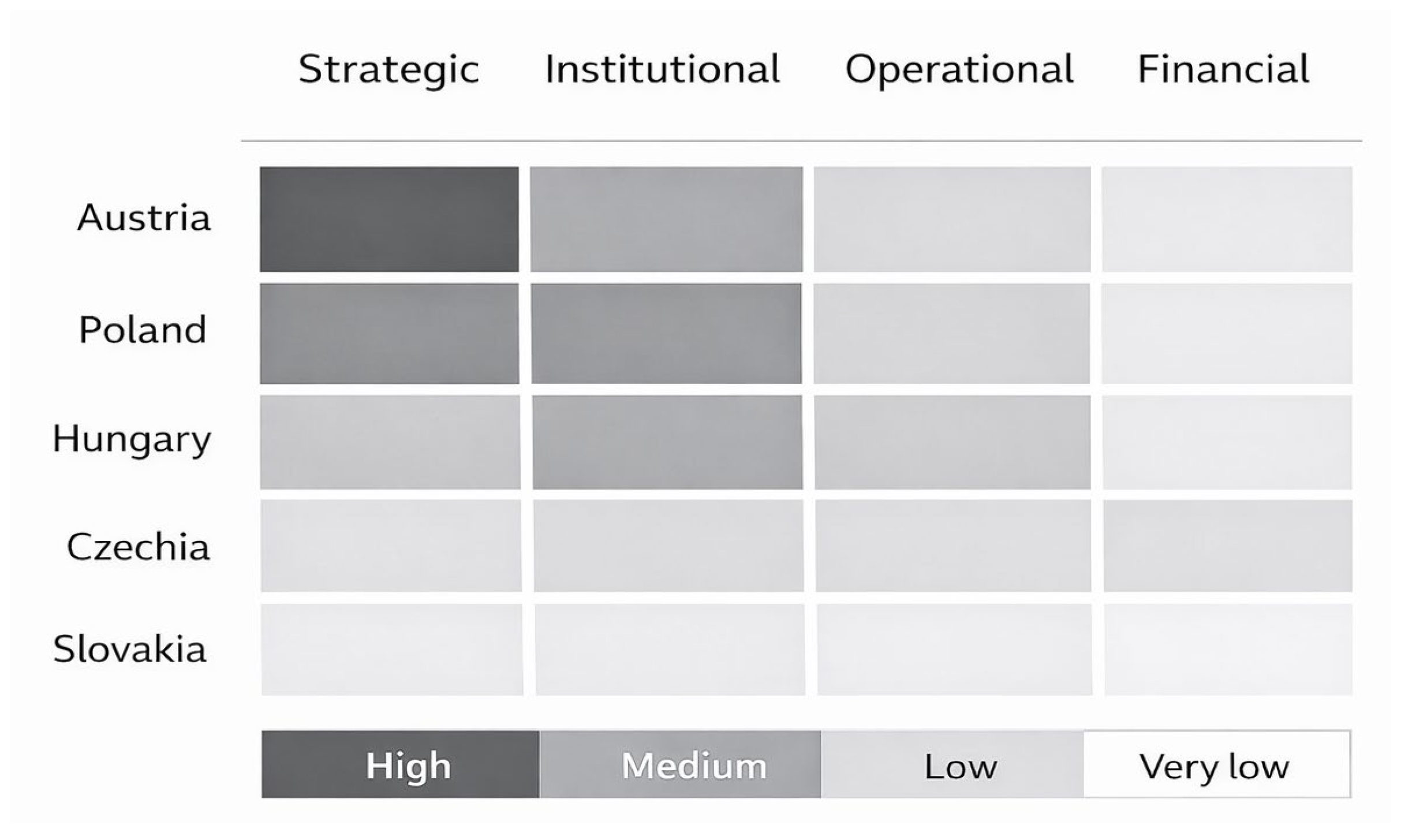
Figure 2 provides a visual synthesis of relative strategic integration patterns across countries, facilitating comparison of alignment without repeating the detailed values presented in Table 2.
The matrix confirms that while strategic integration is present across the region, its consistency varies considerably. In several cases, alignment remains largely declarative, characterized by shared terminology and references without explicit joint objectives, clearly assigned responsibilities, or binding implementation mechanisms. This suggests that strategic convergence reflects policy diffusion and EU-level alignment more than domestically embedded institutional reform. From an analytical perspective, this pattern suggests that strategic integration represents a necessary but relatively shallow layer of governance integration. It reflects the diffusion of shared resilience narratives and external policy expectations, but does not in itself demonstrate that these narratives have been translated into binding institutional arrangements or implementation capacities. The comparative results therefore indicate that strategic convergence should be interpreted as an enabling condition rather than as evidence of fully integrated governance.

3.3. Institutional Integration

Institutional integration concerns the presence and stability of coordination mechanisms linking CCA, DRR, and civil protection. To assess this dimension, formal coordination structures and planning arrangements were compared across countries.
Table 3 summarizes the key institutional coordination mechanisms identified in each case.
Institutional integration differs markedly across cases. Austria benefits from relatively stable coordination mechanisms that support cross-sectoral information exchange and joint planning. Poland and Hungary show partial institutional integration, while Czechia and Slovakia rely predominantly on ad hoc coordination, limiting continuity and institutional learning.
The observed variation indicates that institutional integration depends not only on formal structures but also on the degree to which coordination bodies possess decision-making authority and stable mandates. Where coordination is limited to information exchange without binding planning instruments, integration remains structurally weak despite strategic alignment.
The contrast between Austria and the lower-scoring cases is particularly instructive in this respect. Austria combines formal coordination mechanisms, clearer vertical linkages, and greater continuity of cross-sectoral interaction, whereas Slovakia and Czechia rely more heavily on sectorally separated arrangements with weaker formal integration mandates. This comparison suggests that the depth of institutional integration depends less on the mere existence of cooperation references and more on whether coordination is stabilized through durable organizational structures and legally or administratively anchored responsibilities. This contrast suggests that institutional integration is driven less by formal acknowledgment of cross-sectoral relevance than by the existence of stable coordination venues with continuity across planning cycles.

3.4. Operational Integration

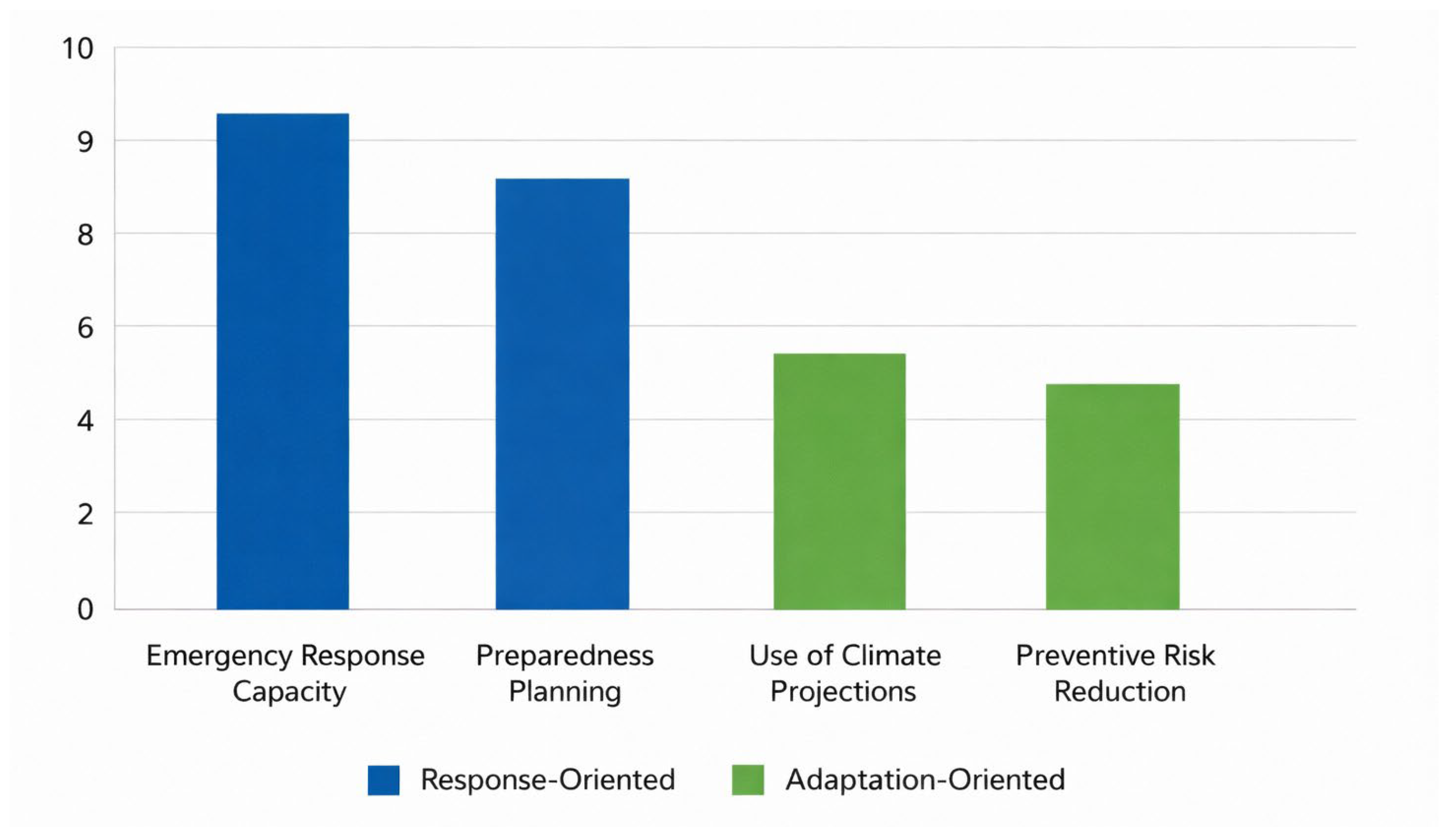
Operational integration reflects how governance arrangements are implemented in practice, particularly with respect to preparedness planning, risk assessment, and the incorporation of climate information. To highlight differences between response-oriented capacities and preventive or anticipatory practices, operational integration was examined across key functional areas. Figure 3 applies the same ordinal qualitative scale (Low to High) used throughout the indicator assessment to visualize operational integration differences across functional areas. The figure illustrates the imbalance between emergency response capacities and the integration of preventive and adaptation-oriented measures.
The bar chart compares the relative strength of emergency response capacity, preparedness planning, incorporation of climate projections, and preventive risk reduction measures.
Across all countries, emergency response capacities are more developed than preventive and anticipatory measures. However, this imbalance is not merely functional but structural. Operational routines remain centered on crisis response, while systematic incorporation of climate projections into training, contingency planning, and risk assessments remains limited. The absence of integrated scenario planning linking adaptation and civil protection reinforces a reactive governance model in which long-term risk reduction is secondary to short-term response capacity.
These results further suggest that operational integration is conditioned not only by technical preparedness capacity, but also by the extent to which adaptation, disaster risk governance, and civil protection are institutionally linked through shared planning procedures and climate-informed risk assessment practices. Where such linkages are weak, operational systems tend to remain response-oriented even when strategic commitments to resilience are formally acknowledged.

3.5. Financial Integration as a Cross-Cutting Constraint

Financial integration constitutes a structural constraint across all analyzed cases. Funding mechanisms for adaptation, risk reduction, and civil protection remain largely sector-specific and are frequently supplemented by time-limited project-based financing.
Table 4 summarizes common characteristics of financing frameworks relevant to climate risk governance.
The results indicate that fragmented financing structures not only hinder long-term planning but also reduce incentives for cross-sectoral coordination. The reliance on project-based or externally funded programs creates temporal discontinuity, limiting institutional learning and long-term preventive investment. This financial fragmentation functions as a systemic constraint across all other dimensions of integration.
In analytical terms, financial integration emerges as the most persistent bottleneck in the transition from strategic commitment to durable governance integration. Even where policy documents articulate shared objectives, fragmented and project-based financing reduces the likelihood that coordination mechanisms, preventive measures, and long-term resilience-building practices will be institutionalized and maintained over time.
This also indicates that financial integration should not be treated as a secondary support dimension, but as a constitutive component of governance embedding.

3.6. Cross-Dimensional Asymmetries and Governance Typologies

Synthesizing results across dimensions reveals internal asymmetries within national governance systems. In several cases, relatively advanced strategic integration coexists with weak institutional, operational, and financial integration. This lack of cross-dimensional reinforcement contributes to fragmented governance outcomes.
To deepen the comparative interpretation, the observed country patterns can be grouped into broader integration typologies rather than read only as a linear ranking of stronger and weaker cases. These typologies distinguish governance systems in which integration is relatively well embedded across several dimensions from those in which integration remains primarily strategic, sectorally fragmented, or predominantly response-oriented. The typological perspective is analytically useful because it captures differences in the internal consistency of governance systems, not merely differences in aggregate score levels.
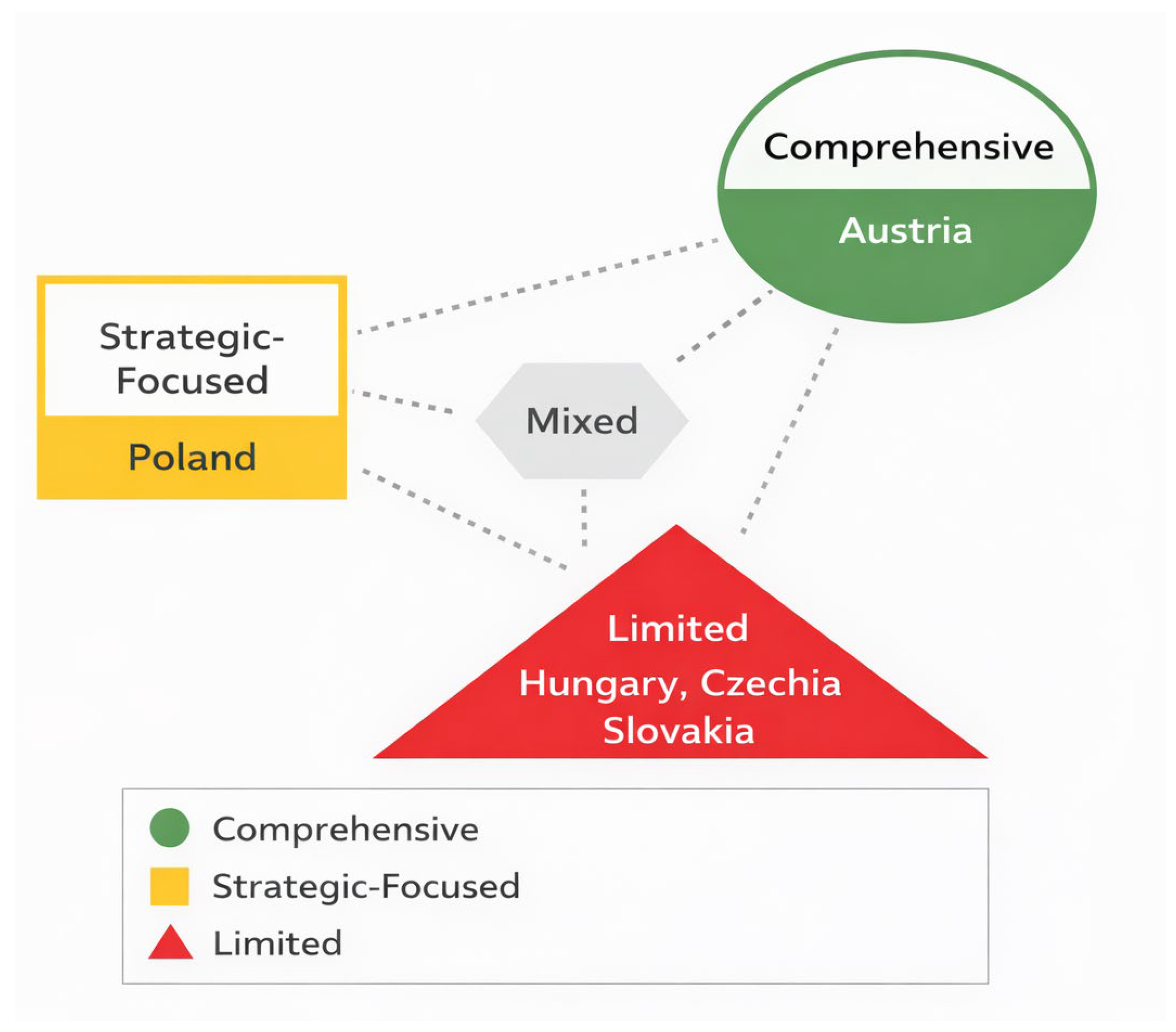
In this sense, Austria approaches the profile of an embedded integrator, Poland represents a more strategic but only partially embedded integrator, Hungary reflects a sector-coordinated but weakly operationalized model, while Czechia and Slovakia are closer to fragmented or response-dominant configurations in which cross-domain integration remains limited.
Based on these patterns, countries can be grouped into distinct integration typologies, reflecting different governance configurations rather than a single linear ranking. These typologies are defined by the relative consistency between strategic and institutional alignment on the one hand and operational and financial embedding on the other.
Figure 4 presents a typological visualization of integration models observed across the analyzed countries.
Figure 3 classifies countries according to their relative consistency across strategic and institutional dimensions versus operational and financial dimensions, illustrating differentiated integration pathways.

3.7. Summary of Results

Overall, the results demonstrate that governance integration across dimensions is structurally imbalanced, with relatively advanced strategic alignment but weaker institutional, operational, and financial embedding. This supports the interpretation that the principal challenge in the region is not the absence of policy recognition, but the weak cross-dimensional consolidation of integration.

4. Discussion

This study examined the integration of CCA, DRR, and civil protection in Central European governance systems based on formal policy and institutional arrangements derived from document analysis. The findings therefore reflect institutionalized governance structures and strategic commitments rather than direct measurement of operational performance during real hazard events. The results confirm the working hypothesis that strategic alignment across these domains has progressed more rapidly than institutional, operational, and financial integration, producing cross-dimensional asymmetries that limit policy reinforcement. This pattern reflects the broader European risk context, where climate hazards are intensifying while governance preparedness remains uneven [22,29].

4.1. Strategic Integration: Convergence Driven by Frameworks, Limited by Implementation

The comparatively strong strategic integration across all five countries reflects the normative influence of international and European policy frameworks, particularly the Paris Agreement, the Sendai Framework, and EU adaptation strategies. These frameworks have promoted conceptual convergence between CCA and DRR by embedding shared risk language, resilience objectives, and cross-referencing requirements within national strategies.
However, the literature consistently demonstrates that such convergence at the strategic level does not automatically translate into institutional or financial integration. While conceptual alignment between CCA and DRR has long been recognized [22,30], implementation gaps persist across Europe. Recent UNDRR syntheses confirm that although strategic alignment has advanced globally, institutional embedding and stable financing mechanisms remain uneven and highly context-dependent [31].
The IPCC Sixth Assessment Report similarly emphasizes that adaptation progress is increasingly constrained not by lack of strategic intent, but by governance capacity, coordination mechanisms, and financing structures [29]. EU evaluations further note that national strategies often lack binding operational instruments and monitoring frameworks [32].
The present findings align with this broader pattern: strategic coherence is achieved, yet without institutional mandates and financial reinforcement, it remains insufficient to generate durable cross-sectoral integration. The analytical contribution of the present study therefore lies not in demonstrating that integration matters, which is already well recognized in the literature, but in showing how integration remains unevenly embedded across governance dimensions within a comparable regional setting. By distinguishing between strategic convergence and cross-dimensional embedding, the study moves beyond descriptive comparison and provides a more structured explanation of why formally aligned governance systems may still exhibit weak implementation capacity.

4.2. Institutional Integration: Persistent Fragmentation

Institutional fragmentation remains a central barrier to integration. Recent European research on multi-hazard risk governance emphasizes that cross-sector coordination capacities remain underdeveloped in many national administrations, particularly where responsibilities for adaptation, DRR, and civil protection remain legally separated [33,34].
These differences indicate that the presence of coordination mechanisms alone does not ensure effective integration. Institutional integration depends on the stability of mandates, the authority of coordinating bodies, and their capacity to influence sectoral decision-making processes. Where coordination platforms function primarily as consultative forums without binding authority, integration remains structurally limited despite formal recognition. Peer-review exercises under the Union Civil Protection Mechanism further demonstrate that prevention and preparedness coordination structures differ substantially among EU Member States, affecting national capacity to mainstream risk reduction across sectors [35]. The Central European patterns identified in this study align closely with these observations: only Austria displays stable cross-sectoral coordination, while other countries rely on ad hoc arrangements with limited institutional permanence. However, even in comparatively consolidated cases, institutional integration remains dependent on political continuity and administrative capacity. This suggests that formal coordination structures alone are insufficient and require sustained political and administrative reinforcement to ensure long-term coherence.
Overall, the findings suggest that institutional integration in Central Europe remains uneven and path-dependent. Strategic convergence has not uniformly translated into binding cross-sectoral governance arrangements because coordination structures differ not only in presence, but in stability, authority, and capacity to influence sectoral decision-making. The observed variation therefore reflects differences in administrative traditions, inter-ministerial coordination cultures, and the degree to which climate risk governance is embedded within broader public administration structures.

4.3. Operational Integration: Dominance of Response over Prevention

Across all analyzed countries, operational capacity remains strongest in emergency response and weakest in preventive and anticipatory risk management. Recent European stakeholder research confirms that limited integration of climate projections into operational risk assessment and scenario planning remains a major bottleneck in multi-hazard governance [33,36]. As a result, preventive risk reduction remains weakly connected to real-time emergency management systems, reinforcing a reactive governance model rather than a resilience-oriented one.
The observed imbalance between emergency response capacities and preventive or anticipatory measures reflects a broader structural orientation within governance systems. Operational routines are predominantly designed around crisis management, while systematic incorporation of climate projections and long-term vulnerability assessments into planning and training remains limited. This asymmetry suggests that operational integration is constrained not only by institutional design but also by entrenched administrative practices.
Studies on critical infrastructure resilience stress that systemic risk management requires cross-sector stress-testing and joint preparedness planning, yet such practices remain rarely institutionalized at national civil protection levels [37]. The limited incorporation of climate-informed risk tools into civil protection operations observed in this study confirms that reactive crisis management still dominates over anticipatory resilience-building.
Overall, operational integration across the region remains uneven and largely response-driven. While emergency preparedness mechanisms are comparatively well developed, they remain oriented primarily toward short-term crisis management rather than anticipatory risk governance. The limited incorporation of forward-looking climate information into exercises, scenario planning, and training indicates that strategic convergence has not yet been translated into routine operational practice.

4.4. Financial Integration: Structural Constraints on Prevention

Financial integration represents the most persistent limitation. Recent EU auditing reports conclude that adaptation and disaster risk reduction financing remains fragmented, project-based, and insufficiently linked to sectoral investment planning [38]. This financial fragmentation limits long-term resilience investments and reinforces sectoral silos.
Financial fragmentation functions as a systemic constraint across all other integration dimensions. Even where strategic priorities emphasize resilience and prevention, the absence of stable cross-sectoral budget lines limits the capacity to institutionalize coordination mechanisms and sustain operational integration. As a result, financial arrangements do not merely reflect governance structures; they actively shape the degree to which integration becomes durable.
Complementary research on sovereign disaster risk financing further shows that preventive expenditure remains politically less visible than response spending, creating structural disincentives for cross-sector budget integration [39]. The Central European cases reflect precisely this financial imbalance.
Overall, financial integration represents the most structurally constrained dimension across the analyzed countries. The reliance on project-based funding and externally supported programs creates temporal discontinuity, weakens institutional learning, and reduces incentives for preventive cross-sectoral investment. Financial integration therefore functions not merely as a supporting condition, but as a core determinant of whether strategic commitments and coordination arrangements can be translated into sustained resilience-building.

4.5. Why Strategic Integration Does Not Automatically Translate into Embedded Governance

A central insight emerging from the comparative analysis is that strategic integration does not automatically translate into embedded governance capacity. This is partly because strategic alignment is more easily advanced through shared policy language, cross-referencing of objectives, and compliance with international or European frameworks than through reforms affecting institutional authority, planning routines, or budget structures. As a result, national systems may display substantial convergence at the level of policy narratives while continuing to operate through sectorally separated administrative arrangements.
The findings indicate that this gap is reinforced by three interrelated mechanisms. First, institutional mandates remain fragmented, limiting the capacity of coordination bodies to shape sectoral decision-making. Second, operational systems continue to prioritize response and emergency management over anticipatory risk reduction and climate-informed preparedness. Third, financial arrangements remain largely project-based or sector-specific, weakening long-term continuity and reducing incentives for preventive cross-sectoral investment. Taken together, these mechanisms help explain why governance integration in the region often remains stronger in principle than in practice.
This distinction between declarative alignment and embedded integration constitutes the main conceptual payoff of the study.

4.6. Typologies of Integration: Differentiated Governance Pathways

The typology developed in Figure 3 demonstrates that integration does not follow a linear progression but rather differentiated governance configurations shaped by national administrative traditions and institutional capacities. Recent policy integration research conceptualizes integration as a staged process that depends on coordination authority, incentive alignment, and institutional learning capacity [40]. Similarly, the contemporary climate risk governance literature emphasizes that adaptation and DRR integration evolves through context-specific governance arrangements rather than uniform convergence [41]. The Central European typology identified in this study thus contributes empirical evidence supporting these theoretical propositions.
The Central European typology identified in this study contributes empirical support to these theoretical propositions. These findings align with earlier empirical evidence that CCA–DRR policy integration progresses unevenly across governance dimensions and is strongly shaped by institutional path dependencies [41]. The findings suggest that integration trajectories are conditioned not only by formal structures but also by embedded administrative routines and long-standing coordination cultures. Rather than representing different stages of a single developmental pathway, the observed configurations reflect structurally distinct governance models.
The typological perspective adds analytical value because it shows that countries do not simply occupy different positions on a single continuum of integration. Rather, they exhibit qualitatively different configurations shaped by the interaction of strategic commitment, institutional coordination, operational embedding, and financial support. This reinforces the argument that governance integration should be understood as a structured and path-dependent configuration rather than as a uniform policy trajectory.

4.7. Implications for Sustainable Climate Risk Governance

Taken together, the findings suggest that Central European governance systems are approaching a ceiling of strategic integration while lagging in institutional, operational, and financial coupling. Recent EU knowledge-infrastructure initiatives, including risk data platforms and cross-border risk assessments, are designed to strengthen shared risk understanding and coordination capacity [42,43]. However, their effectiveness ultimately depends on national uptake and institutional embedding.
This ceiling effect reflects the continued institutional separation between environmental planning, sectoral risk regulation, and emergency management mandates. While strategic documents increasingly adopt shared resilience language, budgetary authority, legal competences, and implementation responsibilities remain distributed across distinct administrative domains. As a result, strategic convergence does not automatically translate into structural reinforcement across governance dimensions.
An overview of the principal national policy instruments relevant to CCA–DRR–civil protection integration is provided in Table 5.
The comparison of national policy instruments indicates that integration challenges in Central Europe are not primarily conceptual but structural. The configurations summarized in Table 5 reflect the cross-dimensional asymmetries identified in Section 3. Countries characterized by medium or low institutional and financial integration levels (e.g., Slovakia and Czechia) exhibit adaptation strategies and civil protection legislation that operate largely in parallel without binding cross-references or joint budgetary instruments. In contrast, Austria demonstrates comparatively stronger institutional coupling, although financial mainstreaming remains incomplete. These structural patterns confirm that policy coexistence does not equate to governance integration.
In typological terms, these configurations correspond to the fragmented and weakly coupled integration models identified in Section 3.6. Austria approaches a comparatively consolidated configuration, yet even there financial embedding remains partial. This confirms that cross-dimensional reinforcement, rather than strategic articulation alone, determines the depth and durability of integration.
Adaptation strategies remain primarily embedded in environmental planning, DRR frameworks in sector-specific legislation, and civil protection in response-oriented structures. Binding legal cross-references, shared budgeting instruments, and permanent coordination mandates remain limited, constraining the institutionalization of preventive climate risk governance.
Recent studies on metropolitan and regional adaptation governance highlight persistent coordination gaps between strategic planning and local implementation [60]. Without strengthened vertical alignment between national and subnational levels, strategic convergence at the national level is unlikely to translate into operational resilience at regional and municipal scales. The analysis therefore suggests that improving integration does not require additional strategic documents alone, but targeted modification of existing legal and financial frameworks [61]. From this perspective, improving integration in Central Europe is less a matter of producing additional strategic declarations than of strengthening the institutional, operational, and financial mechanisms through which existing commitments become durable governance practice. In several cases, adaptation strategies could be legally linked to civil protection risk assessment procedures, while disaster management acts could explicitly incorporate long-term climate risk projections.
Importantly, reform trajectories differ across countries. In contexts characterized by low institutional coupling, priority lies in establishing stable coordination mandates and legally binding cross-references. In countries with moderate institutional integration but weak financial embedding, fiscal mainstreaming and prevention-oriented budget allocation constitute the critical next steps. Integration therefore represents differentiated governance transitions rather than a standardized reform template.
From a practical governance perspective, advancing integration in Central European countries requires targeted institutional and policy reforms. These include establishing permanent inter-ministerial coordination bodies linking environment, interior, and sectoral ministries; embedding climate risk projections into national civil protection risk assessments and emergency planning procedures; introducing dedicated national budget lines for prevention and adaptation to reduce reliance on short-term project funding; and formalizing vertical coordination mechanisms with regional and municipal authorities. Expanding participation in Union Civil Protection Mechanism peer-review cycles and cross-border joint exercises would further support institutional learning and operational coherence.
Strengthening cross-dimensional reinforcement between strategy, institutions, operations, and financing therefore emerges as the central governance condition for transforming strategic convergence into durable resilience capacity in the region.
In this sense, the reform priority is not to broaden the strategic agenda further, but to increase the institutional durability of integration already formally acknowledged.

4.8. Limitations and Future Research Directions

This study is based exclusively on formally adopted national policy documents and legal instruments. From a data perspective, this approach ensures transparency, cross-country comparability, and replicability. At the same time, it limits the analysis to institutionalized governance structures and does not capture informal coordination practices, political bargaining processes, administrative cultures, or real-time crisis management dynamics. Consequently, the findings reflect formal governance capacity rather than day-to-day operational interaction among institutions. The study does not claim that higher formal integration automatically produces better hazard outcomes; rather, it assesses institutional conditions that may enable more coherent governance responses. This focus should not be interpreted solely as a limitation, but also as a deliberate analytical choice. Formal governance structures, legal mandates, and institutionalized coordination arrangements constitute an important precondition for consistent cross-sectoral action and therefore provide a meaningful basis for comparative assessment of integration capacity.
From a framework perspective, the four-dimensional analytical structure, i.e., strategic, institutional, operational, and financial, necessarily simplifies complex governance interactions into analytically separable components. While this operationalization enhances systematic comparison across cases, it may underrepresent interdependencies between dimensions and does not directly measure performance outcomes during hazard events. The use of a qualitative ordinal scale, although grounded in predefined indicators and documentary evidence, also abstracts from micro-level variations in implementation quality.
From a policy formulation perspective, national legal and administrative traditions differ in structure, terminology, and legislative drafting practices. Such variation may influence how integration is formally expressed in policy documents, potentially affecting the visibility of cross-domain linkages despite consistent coding criteria. In addition, the study does not assess political feasibility, fiscal constraints, or stakeholder acceptance of potential reform measures. The recommendations should therefore be interpreted as structurally informed rather than politically validated reform directions.
Future research should therefore complement document-based assessments with qualitative and mixed-method approaches, including semi-structured interviews, stakeholder surveys, and budget flow analysis across prevention–preparedness–response cycles. Event-based case studies examining actual crisis responses would further clarify how institutionalized coordination mechanisms operate in practice and whether formal integration translates into measurable resilience improvements. Comparative studies across additional European macro-regions could also test the robustness and transferability of the identified integration typologies under different administrative and climatic conditions.

5. Conclusions

This study contributes a structured comparative framework for assessing how climate change adaptation (CCA), disaster risk reduction (DRR), and civil protection are integrated across strategic, institutional, operational, and financial dimensions in Central Europe. By operationalizing integration as a multidimensional governance property encompassing strategic, institutional, operational, and financial, this analysis moves beyond sector-specific assessments and enables systematic cross-country comparison.
The most significant finding is the existence of pronounced cross-dimensional asymmetries. While strategic convergence is comparatively advanced across all cases—largely reflecting international and EU policy alignment, this coherence is not consistently reinforced at institutional, operational, and especially financial levels. Strategic integration therefore coexists with fragmented coordination mechanisms, limited operational embedding of climate information, and sectorally structured financing arrangements.
Analytically, the study shows that the key distinction is not simply between integrated and non-integrated systems, but between systems in which integration remains primarily strategic and those in which it is reinforced through institutional embedding, operational practice, and financial continuity.
These findings suggest that climate risk governance in Central Europe is characterized less by absence of integration than by uneven structural consolidation. Integration remains strongest at the level of policy narratives and weakest where binding mandates, operational routines, and stable budgetary mechanisms are required. Without cross-dimensional reinforcement, strategic commitments risk remaining declarative rather than transformative.
By identifying differentiated integration typologies rather than ranking countries along a single continuum, this study contributes to the understanding of integration as a layered and path-dependent governance configuration.
The findings underscore that advancing sustainable climate risk governance requires alignment not only of objectives, but of institutional authority, operational practice, and financial continuity. They also provide a transparent and replicable basis for comparative assessment of governance integration based on formally institutionalized arrangements.
By highlighting cross-dimensional asymmetries and distinguishing between declarative and embedded forms of governance integration, the study provides a more differentiated understanding of climate risk governance in Central Europe and offers a basis for more analytically grounded comparative research in this field.
More broadly, the framework developed here may serve as a transferable analytical heuristic for comparative assessment of governance integration in other European or multi-hazard contexts.

Author Contributions

Conceptualization, A.M.; methodology, A.M. and V.B.; validation, A.M.; formal analysis, V.B. and D.R.; investigation, V.B., D.R. and A.M.; resources, A.M.; data curation, V.B. and D.R.; writing—original draft preparation, V.B.; writing—review and editing, A.M.; visualization, D.R.; supervision, A.M.; project administration, A.M.; funding acquisition, A.M. All authors have read and agreed to the published version of the manuscript.

Funding

This work was supported by the Slovak Research and Development Agency under the contract No. APVV-22-0030 and the Matching grants to Horizon 2020 and Horizon Europe scheme No. 09I01-03-V04-00009 and No. 09I01-03-V04-00088.

Institutional Review Board Statement

Not applicable.

Informed Consent Statement

Not applicable.

Data Availability Statement

The original contributions presented in this study are included in the article. Further inquiries can be directed to the corresponding author.

Conflicts of Interest

The authors declare no conflicts of interest.

Abbreviations

The following abbreviations are used in this manuscript:
CCAClimate Change Adaptation
DG ECHODirectorate-General for European Civil Protection and Humanitarian Aid Operations
DRRDisaster Risk Reduction
EEAEuropean Environment Agency
EUEuropean Union
IPCCIntergovernmental Panel on Climate Change
JRCJoint Research Centre (European Commission)
UCPMUnion Civil Protection Mechanism
UNDRRUnited Nations Office for Disaster Risk Reduction
UNFCCCUnited Nations Framework Convention on Climate Change

Appendix A

This appendix (Table A1, Table A2, Table A3 and Table A4) summarizes the principal national policy documents, legal instruments, and institutional frameworks forming the evidentiary basis for the integration assessment. Integration levels correspond to the five-tier ordinal scale defined in Section 2.5 (High, Medium–High, Medium, Low–Medium, Low).
Scores were assigned exclusively on the basis of explicit documentary evidence demonstrating institutionalized coordination mechanisms, formal cross-referencing between domains, or structured financial and operational arrangements.
Table A1. Strategic Integration.
CountryAssigned Integration LevelEvidence of Cross-ReferencingKey Documents Reviewed
AustriaHighExplicit cross-referencing between CCA, DRR and civil protection strategies; shared resilience terminology; formal recognition of interdependencies in NAS and ASDR; strategic coherence across adaptation and risk governance frameworksAustrian Strategy for Adaptation to Climate Change (NAS); Austrian Strategy for Disaster Risk Reduction (ASDR); Rescue Organizations and Civil Protection Support Act
PolandMedium–HighClear recognition of climate–risk linkages and resilience framing; partial cross-referencing between adaptation and crisis management frameworks; integration present but not fully institutionalizedPolish National Adaptation Strategy (NAS 2020); Crisis Management Act; National Crisis Management Plan
HungaryMediumConceptual acknowledgment of climate-related risks in adaptation and disaster management frameworks; limited explicit strategic cross-referencing between domainsNational Climate Change Strategy; Disaster Management Act
CzechiaMediumClimate risks acknowledged in adaptation strategy; references to resilience objectives; weak formal cross-domain strategic alignmentNational Adaptation Strategy (updated 2021); Strategic Framework Czech Republic 2030; Act on Integrated Rescue System
SlovakiaMediumRecognition of overlapping risk concepts and climate impacts; adaptation and civil protection frameworks operate largely in parallel; limited explicit strategic linkageNational Adaptation Strategy (Updated); Act on Civil Protection of the Population
Table A2. Institutional Integration.
CountryAssigned Integration LevelCoordination Structures IdentifiedLegal or Formal Basis
AustriaHighPermanent inter-ministerial coordination platforms linking climate adaptation, disaster risk reduction, and civil protection; structured vertical coordination with Länder authoritiesFederal legal and strategic mandates supporting cross-sectoral coordination (NAS, ASDR, civil protection legislation)
PolandMediumInter-sectoral working groups and coordination mechanisms linking adaptation and crisis management; partially institutionalized vertical coordinationMixed statutory and administrative basis (Crisis Management Act; adaptation strategy framework)
HungaryMediumDisaster management coordination structures with cross-sector representation; adaptation responsibilities primarily embedded in environmental governancePrimarily sector-based legal framework with limited formal cross-domain mandates
CzechiaLow–MediumCoordination occurs mainly through sectoral ministries; no permanent cross-domain integration body linking CCA, DRR, and civil protectionFragmented legal references across adaptation, rescue system, and strategic development frameworks
SlovakiaLowCrisis management and civil protection structures operate predominantly within sectoral mandates; limited formal linkage to adaptation governanceNo formally institutionalized cross-domain coordination mandate between adaptation and civil protection frameworks
Table A3. Operational Integration.
CountryAssigned Integration LevelOperational Features IdentifiedDocumentary Sources
AustriaMedium–HighIntegrated national risk assessments incorporating climate projections; alignment between adaptation planning and civil protection preparedness; regular multi-level exercises and simulation activitiesNational Risk Assessment Reports; Austrian Strategy for Disaster Risk Reduction (ASDR); Civil Protection Planning Documents
PolandMediumPartial integration of climate adaptation considerations into crisis preparedness planning; selected joint exercises and scenario-based planning activitiesNational Crisis Management Plan; Polish National Adaptation Strategy
HungaryLow–MediumStrong response-oriented disaster management system; limited systematic integration of climate projections into operational planningDisaster Management Act; National Climate Change Strategy
CzechiaLowWell-developed emergency response capacity; limited preventive embedding of adaptation measures within operational civil protection planningIntegrated Rescue System Act; Emergency Planning Framework
SlovakiaLowOperational focus predominantly on emergency response; minimal formal integration of adaptation objectives into civil protection operationsAct on Integrated Rescue System, Act on Civil Protection of the Population; Civil Protection Operational Plans
Table A4. Financial Integration.
CountryAssigned Integration LevelBudgetary Characteristics IdentifiedEvidence Source
AustriaMediumDedicated climate adaptation funding streams; partial cross-sector allocation mechanisms; use of federal and EU co-financing instruments; limited fully integrated multi-domain budget linesFederal Budget Framework; National Adaptation Strategy implementation reports
PolandLow–MediumPredominantly project-based financing for adaptation and risk reduction; reliance on EU structural and cohesion funds; limited structural cross-sector budget alignmentMinisterial Documents; National Adaptation Strategy implementation framework
HungaryLowSector-specific financing structures; disaster management and climate policy funded separately; absence of stable cross-domain financing mechanismsDisaster Management Act; National Climate Strategy implementation reports
CzechiaLowLimited dedicated prevention funding; adaptation and civil protection financed through separate ministerial channels; no explicit cross-sectoral budget integrationState Budget Statements; Adaptation Strategy documentation
SlovakiaLowFragmented and sector-based funding structures; adaptation measures largely project-driven; limited institutionalized financial coordination between domainsState Budget Statements; Adaptation Strategy documentation

Appendix B

This appendix provides the comparative indicator fulfillment matrix underlying the ordinal integration levels reported in the main text. To enhance transparency and reproducibility, each country was assessed against a standardized set of binary indicators within each analytical dimension. Indicators were coded as fulfilled (1) only where explicit documentary evidence demonstrated the presence of formalized cross-domain linkage, coordination, operational integration, or structured financial support. Indicators were coded as not fulfilled (0) where such evidence was absent, weakly specified, or not institutionally anchored.
For presentation purposes, Appendix B reports the core indicator matrix used to derive country-level cumulative scores. The percentage of fulfilled indicators was calculated for each country and dimension and translated into ordinal integration levels according to the thresholds defined in Section 2.5. In this appendix, five core indicators are reported per dimension to ensure comparability across countries and facilitate transparent presentation of cumulative fulfillment patterns. These indicator summaries should be interpreted together with the qualitative documentary evidence presented in Appendix A.
Scoring thresholds used in Appendix B:
High: 80–100% of indicators fulfilled
Medium–High: 60–79%
Medium: 40–59%
Low–Medium: 20–39%
Low: 0–19%
Table A5. Strategic integration: indicator fulfillment matrix.
Core IndicatorAustriaPolandHungaryCzechiaSlovakia
Explicit cross-referencing between CCA and DRR policy documents11111
Explicit cross-referencing between adaptation and civil protection documents11000
Shared resilience terminology across the three domains11111
Joint or overlapping strategic objectives formally articulated10000
Formal recognition of interdependencies among CCA, DRR, and civil protection10000
Total fulfilled indicators5/53/52/52/52/5
Fulfillment rate (%)10060404040
Assigned integration levelHighMedium–HighMediumMediumMedium
Strategic integration is strongest where climate adaptation, disaster risk reduction, and civil protection are linked not only through shared terminology but also through explicit strategic cross-referencing and formally recognized interdependencies. Austria shows the most comprehensive strategic embedding, while the other countries demonstrate varying degrees of conceptual alignment without equally strong strategic consolidation.
Table A6. Institutional integration: indicator fulfillment matrix.
Core IndicatorAustriaPolandHungaryCzechiaSlovakia
Formal inter-ministerial coordination body linking relevant domains11100
Legally or administratively defined cross-sectoral coordination mandate10000
Stable vertical coordination with subnational authorities11100
Clearly assigned cross-sectoral institutional responsibilities10000
Permanent coordination mechanism beyond ad hoc consultation10000
Total fulfilled indicators5/52/52/51/50/5
Fulfillment rate (%)1004040200
Assigned integration levelHighMediumMediumLow–MediumLow
Institutional integration varies most clearly in the stability and formal authority of coordination mechanisms. Austria exhibits the highest degree of institutional embedding, while Poland and Hungary show partial institutionalization. Czechia and Slovakia remain weakly integrated institutionally, reflecting fragmented or largely sector-specific coordination arrangements.
Table A7. Operational integration: indicator fulfillment matrix.
Core IndicatorAustriaPolandHungaryCzechiaSlovakia
Climate-informed national risk assessment procedures11000
Joint preparedness or scenario-planning instruments across domains11000
Integration of climate projections into civil protection planning10000
Coordinated training, exercises, or simulations across relevant institutions00100
Preventive risk reduction linked to preparedness/response planning00000
Total fulfilled indicators3/52/51/50/50/5
Fulfillment rate (%)60402000
Assigned integration levelHighMedium–HighMediumMediumMedium
Operational integration remains more limited than strategic integration across the region. Austria and Poland show partial incorporation of climate-informed operational practices, whereas the remaining cases remain predominantly response-oriented, with limited evidence of integrated scenario planning or systematic linkage between adaptation planning and civil protection routines.
Table A8. Financial integration: indicator fulfillment matrix.
Core IndicatorAustriaPolandHungaryCzechiaSlovakia
Dedicated adaptation or prevention funding line relevant to cross-domain integration11000
Cross-sector budget mainstreaming across relevant domains10000
Multi-annual financing mechanism supporting resilience-building00000
Structured co-financing arrangement linking prevention and preparedness00000
Institutionalized financial coordination across sectors or ministries00000
Total fulfilled indicators2/51/50/50/50/5
Fulfillment rate (%)4020000
Assigned integration levelMediumLow–MediumLowLowLow
Financial integration is the weakest dimension across all analyzed cases. Even where funding streams for adaptation or risk reduction exist, cross-sectoral budget integration and stable multi-annual arrangements remain limited. This supports the interpretation that financing constitutes a structural bottleneck in the transition from strategic alignment to embedded governance integration.
Table A9. Comparative cumulative score summary across dimensions.
CountryStrategicInstitutionalOperationalFinancial
Austria5/5 (100%)—High5/5 (100%)—High3/5 (60%)—Medium–High2/5 (40%)—Medium
Poland3/5 (60%)—Medium–High2/5 (40%)—Medium2/5 (40%)—Medium1/5 (20%)—Low–Medium
Hungary2/5 (40%)—Medium2/5 (40%)—Medium1/5 (20%)—Low–Medium0/5 (0%)—Low
Czechia2/5 (40%)—Medium1/5 (20%)—Low–Medium0/5 (0%)—Low0/5 (0%)—Low
Slovakia2/5 (40%)—Medium0/5 (0%)—Low0/5 (0%)—Low0/5 (0%)—Low
The cumulative scoring matrix confirms the pattern discussed in the main text: strategic integration is consistently stronger than operational and financial integration, while institutional integration occupies an intermediate but uneven position. The results therefore support the interpretation that cross-dimensional asymmetries, rather than simple absence or presence of integration, are the defining feature of climate risk governance in the analyzed Central European cases.

References

  1. European Environment Agency. European Climate Risk Assessment; EEA Report 01/2024; European Environment Agency: Copenhagen, Denmark, 2024; Available online: https://www.eea.europa.eu/en/analysis/publications/european-climate-risk-assessment/european-climate-risk-assessment-report/@@download/file (accessed on 11 December 2025).
  2. Gim, C.; Miller, C.A. Institutional interdependence and infrastructure resilience. Curr. Opin. Environ. Sustain. 2022, 57, 101203. [Google Scholar] [CrossRef] [Scilit]
  3. Abdillah, A.; Widianingsih, I.; Buchari, R.A.; Nurasa, H. Adapting to climate change and multi-risk governance: Toward sustainable adaptation and enhancing urban resilience—Indonesia. Discov. Appl. Sci. 2025, 7, 81. [Google Scholar] [CrossRef] [Scilit]
  4. Leal Filho, W.; Abeldaño Zuñiga, R.A.; Sierra, J.; Dinis, M.A.P.; Corazza, L.; Nagy, G.J.; Aina, Y.A. An assessment of priorities in handling climate change impacts on infrastructures. Sci. Rep. 2024, 14, 14147. [Google Scholar] [CrossRef] [Scilit] [PubMed]
  5. Ayadi, R.; Forouheshfar, Y.; Moghadas, O. Enhancing system resilience to climate change through artificial intelligence: A systematic literature review. Front. Clim. 2025, 7, 1585331. [Google Scholar] [CrossRef] [Scilit]
  6. United Nations Office for Disaster Risk Reduction (UNDRR). Sendai Framework for Disaster Risk Reduction 2015–2030; United Nations: Geneva, Switzerland, 2015; Available online: https://www.undrr.org/publication/sendai-framework-disaster-risk-reduction-2015-2030 (accessed on 15 December 2025).
  7. European Union. Decision No 1313/2013/EU on a Union Civil Protection Mechanism. Off. J. Eur. Union 2013, 347, 924–947. Available online: https://eur-lex.europa.eu/LexUriServ/LexUriServ.do?uri=OJ:L:2013:347:0924:0947:EN:PDF (accessed on 11 October 2025).
  8. European Union. Decision (EU) 2019/420 Amending Decision No 1313/2013/EU on a Union Civil Protection Mechanism. Off. J. Eur. Union 2019, 74, 1–7. Available online: https://eur-lex.europa.eu/legal-content/SV/ALL/?uri=CELEX:32019D0420 (accessed on 11 October 2025).
  9. UNFCCC. Paris Agreement; United Nations Framework Convention on Climate Change: Bonn, Germany, 2015; Available online: https://unfccc.int/process-and-meetings/the-paris-agreement (accessed on 22 October 2025).
  10. Boin, A.; McConnell, A. Preparing for critical infrastructure breakdowns: The limits of crisis management and the need for resilience. J. Conting. Crisis Manag. 2007, 15, 50–59. [Google Scholar] [CrossRef] [Scilit]
  11. United Nations Office for Disaster Risk Reduction (UNDRR). INFFs for Disaster Risk Reduction (DRR): Guidance Note; United Nations Office for Disaster Risk Reduction: Geneva, Switzerland, 2023; Available online: https://www.undrr.org/media/93187/download?startDownload=20260217 (accessed on 15 February 2026).
  12. Jordan, A.; Lenschow, A. Environmental policy integration: A state of the art review. Environ. Policy Gov. 2010, 20, 147–158. [Google Scholar] [CrossRef] [Scilit]
  13. Munene, M.B.; Swartling, Å.G.; Thomalla, F. Adaptive governance as a catalyst for transforming the relationship between development and disaster risk through the Sendai Framework? Int. J. Disaster Risk Reduct. 2018, 28, 653–663. [Google Scholar] [CrossRef] [Scilit]
  14. IPCC. Climate Change 2022: Impacts, Adaptation and Vulnerability; Contribution of Working Group II to the Sixth Assessment Report of the Intergovernmental Panel on Climate Change; Cambridge University Press: Cambridge, UK, 2022. [Google Scholar] [CrossRef] [Scilit]
  15. Persson, Å.; Runhaar, H.; Karlsson-Vinkhuyzen, S.; Mullally, G.; Russel, D.; Widmer, A. Editorial: Environmental policy integration: Taking stock of policy practice in different contexts. Environ. Sci. Policy 2018, 85, 113–115. [Google Scholar] [CrossRef] [Scilit]
  16. Skagen, K.; Boasson, E.L. Climate policy integration as a process: From shallow to embedded integration. J. Environ. Policy Plan. 2024, 26, 279–294. [Google Scholar] [CrossRef] [Scilit]
  17. Agarwalla, N.; Parida, P.K. The role of adaptive governance in disaster risk reduction: A review study on the state of Odisha, India. Clim. Dev. 2026, 1–13. [Google Scholar] [CrossRef] [Scilit]
  18. Mayring, P. Qualitative content analysis: Theoretical background and procedures. In Approaches to Qualitative Research in Mathematics Education; Bikner-Ahsbahs, A., Knipping, C., Presmeg, N., Eds.; Advances in Mathematics Education; Springer: Dordrecht, The Netherlands, 2015; pp. 365–380. [Google Scholar] [CrossRef] [Scilit]
  19. Schreier, M. Qualitative Content Analysis in Practice, 1st ed.; SAGE Publications Ltd.: London, UK, 2012. [Google Scholar] [CrossRef] [Scilit]
  20. Candel, J.J.L.; Biesbroek, R. Toward a processual understanding of policy integration. Policy Sci. 2016, 49, 211–231. [Google Scholar] [CrossRef] [Scilit]
  21. European Environment Agency. Is Europe on Track Towards Climate Resilience? Status of Reported National Adaptation Actions in Europe; European Environment Agency: Copenhagen, Denmark, 2023; Available online: https://www.eea.europa.eu/en/analysis/publications/is-europe-on-track-towards-climate-resilience (accessed on 3 December 2025).
  22. European Commission. Interim Evaluation of the Implementation of Decision No 1313/2013/EU on a Union Civil Protection Mechanism (2017–2022); Publications Office of the European Union: Luxembourg, 2024; Available online: https://ec.europa.eu/echo/files/evaluation/2024/annexes_%20interim%20evaluation%20of%20the%20implementation%20of%20decision%20no%2013132013%20on%20a%20union%20civil%20protection%20mechanism.pdf (accessed on 3 December 2025).
  23. European Commission. Impact Assessment—Forging a Climate-Resilient Europe: The New EU Strategy on Adaptation to Climate Change (COM/2021/82); Commission Staff Working Document SWD/2021/1903 Final; European Commission: Brussels, Belgium, 2021; Available online: https://eur-lex.europa.eu/legal-content/EN/TXT/PDF/?uri=CELEX:52021IR1903 (accessed on 8 November 2025).
  24. European Commission. The European Green Deal (COM/2019/640 Final); European Commission: Brussels, Belgium, 2019; Available online: https://eur-lex.europa.eu/legal-content/EN/TXT/?uri=CELEX:52019DC0640 (accessed on 7 October 2025).
  25. Schipper, L.; Pelling, M. Disaster risk, climate change and international development: Scope for, and challenges to, integration. Disasters 2006, 30, 19–38. [Google Scholar] [CrossRef] [Scilit] [PubMed]
  26. Thomalla, F.; Downing, T.; Spanger-Siegfried, E.; Han, G.; Rockström, J. Reducing hazard vulnerability: Towards a common approach between disaster risk reduction and climate adaptation. Disasters 2006, 30, 39–48. [Google Scholar] [CrossRef] [Scilit]
  27. Djalante, R.; Thomalla, F. Disaster risk reduction and climate change adaptation: Institutional challenges and opportunities. Int. J. Disaster Resil. Built Environ. 2012, 3, 166–180. [Google Scholar] [CrossRef] [Scilit]
  28. Kelman, I. Linking disaster risk reduction, climate change, and the sustainable development goals. Disaster Prev. Manag. 2017, 26, 254–258. [Google Scholar] [CrossRef] [Scilit]
  29. Trogrlić, R.Š.; Reiter, K.; Ciurean, R.L.; Gottardo, S.; Torresan, S.; Daloz, A.S.; Ma, L.; Fumero, N.P.; Tatman, S.; Hochrainer-Stigler, S.; et al. Challenges in assessing and managing multi-hazard risks: A European stakeholders perspective. Environ. Sci. Policy 2024, 157, 103774. [Google Scholar] [CrossRef] [Scilit]
  30. Bignami, D.F.; Ambrosi, C.; Bertulessi, M.; Menduni, G.; Pozzoni, M.; Zambrini, F. Governance strategies and tools towards improvement of emergency management of natural disasters in transboundary areas. Int. J. Disaster Risk Reduct. 2024, 111, 104704. [Google Scholar] [CrossRef] [Scilit]
  31. Casartelli, V.; Salpina, D.; Marengo, A.; Vivo, G.; Sørensen, J.; Mysiak, J. An innovative framework to conduct peer reviews of disaster risk management capabilities under the Union Civil Protection Mechanism (UCPM). Int. J. Disaster Risk Reduct. 2025, 120, 105350. [Google Scholar] [CrossRef] [Scilit]
  32. Ward, P.J.; Daniell, J.; Duncan, M.; Dunne, A.; Hananel, C.; Hochrainer-Stigler, S.; Tijssen, A.; Torresan, S.; Ciurean, R.; Gill, J.C.; et al. A research agenda towards disaster risk management pathways in multi-(hazard-)risk assessment. Nat. Hazards Earth Syst. Sci. 2022, 22, 1487–1523. [Google Scholar] [CrossRef] [Scilit]
  33. Linkov, I.; Trump, B.D.; Trump, J.; Pescaroli, G.; Hynes, W.; Mavrodieva, A.; Panda, A. Resilience stress testing for critical infrastructure. Int. J. Disaster Risk Reduct. 2022, 82, 103323. [Google Scholar] [CrossRef] [Scilit]
  34. European Court of Auditors. Special Report 15/2024: Climate Adaptation in the EU; European Court of Auditors: Luxembourg, 2024; Available online: https://www.eca.europa.eu/en/publications/SR-2024-15 (accessed on 3 December 2025).
  35. Agnello, L.; Castro, V.; Sousa, R.M.; Hammoudeh, S. What is the impact of natural disasters on sovereign risk? Expect the unexpected! Financ. Res. Open 2025, 1, 100026. [Google Scholar] [CrossRef] [Scilit]
  36. Biesbroek, R. Policy integration and climate change adaptation. Curr. Opin. Environ. Sustain. 2021, 52, 75–81. [Google Scholar] [CrossRef] [Scilit]
  37. Johannessen, S.; Hancock, H.; Wickström, S.; Albrechtsen, E. Risk governance of climate-related hazards in Longyearbyen, Svalbard: A review of risk governance approaches and knowledge gaps. Clim. Risk Manag. 2024, 43, 100585. [Google Scholar] [CrossRef] [Scilit]
  38. Antofie, T.-E.; Salvi, A.; Sibilia, A.; Salari, S.; Rodomonti, D.; Eklund, G.; Zucca, N.; Corbane, C. Evidence for Disaster Risk Management from the Risk Data Hub: Analytical Reports on Natural Hazards, Vulnerabilities and Disaster Risks in Europe Based on the DRMKC Risk Data Hub; JRC Technical Report EUR 31627 EN; Publications Office of the European Union: Luxembourg, 2023; Available online: https://publications.jrc.ec.europa.eu/repository/handle/JRC136527 (accessed on 8 December 2025).
  39. Corbane, C.; Eklund, G.; Gyenes, Z.; Lentini, A.; San-Miguel, J.; Durrant, T.; Boca, R.; Maianti, P.; Liberta, G.; Oom, D.; et al. Cross-Border and Emerging Risks in Europe: Overview of State of Science, Knowledge and Capacity; JRC Technical Report EUR 31944 EN; Publications Office of the European Union: Luxembourg, 2024; Available online: https://publications.jrc.ec.europa.eu/repository/handle/JRC137818 (accessed on 8 December 2025). [CrossRef]
  40. UNDRR. Integrating Disaster Risk Reduction and Climate Change Adaptation in the Cooperation Framework: Lessons, Good Practices and Opportunities Ahead; United Nations Office for Disaster Risk Reduction: Geneva, Switzerland, 2025; Available online: https://www.undrr.org/publication/documents-and-publications/integrating-disaster-risk-reduction-and-climate-change (accessed on 3 December 2025).
  41. Majlingova, A.; Kádár, T.S. From Risk to Resilience: Integrating Climate Adaptation and Disaster Reduction in the Pursuit of Sustainable Development. Sustainability 2025, 17, 5447. [Google Scholar] [CrossRef] [Scilit]
  42. Magnan, A.K.; O’Neill, B.C.; Garschagen, M. Further understanding “severe” climate risk. Clim. Risk Manag. 2023, 42, 100538. [Google Scholar] [CrossRef] [Scilit]
  43. Parsons, M.; Nalau, J.; Muccione, V.; van Aalst, M.; Dessai, S.; Doeffinger, T.; Fu, X.; Hasegawa, T.; Khojasteh, D.; Kidane, R.; et al. Critical science for the next decade of climate risk management. Clim. Risk Manag. 2025, 51, 100770. [Google Scholar] [CrossRef] [Scilit]
  44. Federal Ministry of Agriculture; Regions and Tourism (BMLRT). National Adaptation Strategy (NAS)—Context; Federal Ministry of Agriculture; Regions and Tourism: Vienna, Austria, 2017; Available online: https://www.bmluk.gv.at/dam/jcr:fe3c9679-0b91-4001-9359-64492e2fa313/NAS_Context_2017_en.pdf (accessed on 11 December 2025).
  45. Austrian Strategy for Disaster Risk Reduction. Strengthening Disaster Risk Governance. Available online: https://www.asdr.at/en/strategie.html#strengthening-disaster-risk-governance (accessed on 11 December 2025).
  46. Rettungs- und Zivilschutzorganisationen-Unterstützungsgesetz (159. Bundesgesetzblatt für die Republik Österreich I 159/2023). Available online: https://www.ris.bka.gv.at/Dokumente/BgblAuth/BGBLA_2023_I_159/BGBLA_2023_I_159.html (accessed on 11 December 2025).
  47. Ministry of the Environment, Republic of Poland. Polish National Strategy for Adaptation to Climate Change (NAS 2020) with the Perspective by 2030; Ministry of the Environment: Warsaw, Poland, 2013. Available online: https://faolex.fao.org/docs/pdf/pol178018.pdf (accessed on 22 December 2025).
  48. Republic of Poland. National Crisis Management Plan. Available online: https://www.gov.pl/web/rcb-en/national-crisis-management-plan (accessed on 23 December 2025).
  49. Ustawa z Dnia 26 Kwietnia 2007 r. o Zarządzaniu Kryzysowym (Law of 26 April 2007 on Crisis Management); Dz.U. 2007 Nr 89 poz. 590; Consolidated Text Dz.U. 2022 poz. 261. 2022. Available online: https://disasterlaw.ifrc.org/media/3464 (accessed on 23 December 2025).
  50. Ustawa z Dnia 5 Grudnia 2024 r. o Ochronie Ludności i Obronie Cywilnej; Dz.U. 2024 poz. 1907. 2024. Available online: https://isap.sejm.gov.pl/isap.nsf/download.xsp/WDU20240001907/T/D20241907L.pdf (accessed on 17 February 2026).
  51. National Climate Change Strategy 2008–2025; Ministry of Environment and Water: Budapest, Hungary, 2008. Available online: https://www.preventionweb.net/publication/hungary-national-climate-strategy-2008-2025#downloads (accessed on 27 December 2025).
  52. Évi CXXVIII. Törvény a Katasztrófavédelemről és a Hozzá Kapcsolódó Egyes Törvények Módosításáról. 2011. Available online: https://njt.hu/jogszabaly/2011-128-00-00 (accessed on 27 December 2025).
  53. Národní Adaptační Strategie—Aktualizace 2021; Ministerstvo Životního Prostředí: Prague, Czechia, 2021. Available online: https://www.mzp.gov.cz/system/files/2025-03/OAZK_Narodni_adaptacni_strategie-aktualizace_20211026.pdf (accessed on 28 December 2025).
  54. Strategic Framework Czech Republic 2030; Office of the Government of the Czech Republic: Prague, Czechia, 2017. Available online: https://vlada.gov.cz/assets/ppov/udrzitelny-rozvoj/projekt-OPZ/Strategic_Framework_CZ2030.pdf (accessed on 28 December 2025).
  55. Zákon č. 239/2000 Sb., o Integrovaném Záchranném Systému a o Změně Některých Zákonů. Available online: https://www.zakonyprolidi.cz/cs/2000-239 (accessed on 28 December 2025).
  56. Koncepce Ochrany Obyvatelstva do Roku 2020 s Výhledem do Roku 2030; Ministry of the Interior—General Directorate of the Fire Rescue Service of the Czech Republic: Prague, Czechia, 2013. Available online: https://vlada.gov.cz/assets/ppov/brs/dokumenty/Koncepce-ochrany-obyvatelstva-2020-2030_1_.pdf (accessed on 28 December 2025).
  57. Stratégia Adaptácie Slovenskej Republiky na Zmenu Klímy—AKTUALIZÁCIA; Ministry of the Environment of the Slovak Republic: Bratislava, Slovakia, 2018. Available online: https://www.minzp.sk/files/odbor-politiky-zmeny-klimy/strategia-adaptacie-sr-zmenu-klimy-aktualizacia.pdf (accessed on 30 December 2025).
  58. Zákon č. 42/1994 Z. z., o Civilnej Ochrane Obyvateľstva a o Zmene a Doplnení Niektorých Zákonov. Available online: https://www.slov-lex.sk/ezbierky/pravne-predpisy/SK/ZZ/1994/42/ (accessed on 30 December 2025).
  59. Zákon č. 129/2002 Z. z., o Integrovanom Záchrannom Systéme a o Zmene a Doplnení Niektorých Zákonov. Available online: https://www.zakonypreludi.sk/zz/2002-129 (accessed on 30 December 2025).
  60. Nocentini, M.G. The governance of climate adaptation in metropolitan regions: A systematic review of emerging themes and issues. Urban Clim. 2024, 55, 101944. [Google Scholar] [CrossRef] [Scilit]
  61. IPCC. Climate Change 2014—Impacts, Adaptation and Vulnerability: Part A: Global and Sectoral Aspects: Working Group II Contribution to the IPCC Fifth Assessment Report; Cambridge University Press: Cambridge, UK, 2014. [Google Scholar] [CrossRef] [Scilit]
Figure 1. Research framework illustrating the multidimensional integration concept, operationalization logic, and comparative case study design.
Sustainability 18 04548 g001
Figure 2. Comparative matrix of relative strategic integration across CCA, DRR, and civil protection. Darker shades indicate higher levels of integration, while lighter shades indicate lower levels.
Sustainability 18 04548 g002
Figure 3. Operational integration gap between emergency response and preventive risk management. The y-axis represents an ordinal qualitative integration scale derived from structured document assessment (Low, Low–Medium, Medium, Medium–High, High), not a quantitative metric. Each bar shows the assessed integration level for key operational functions (emergency response capacity, preparedness planning, incorporation of climate projections, and preventive risk reduction measures) based on explicit documentary evidence.
Sustainability 18 04548 g003
Figure 4. Typology of integration models across governance dimensions.
Sustainability 18 04548 g004
Table 1. Operationalization of Integration Dimensions.
DimensionAnalytical FocusCore Indicators
Strategic
Integration
Alignment of objectives and policy narrativesExplicit cross-referencing between CCA, DRR and civil protection strategies; shared terminology; joint strategic goals; recognition of overlapping risk concepts
Institutional
Integration
Formal governance
arrangements
Inter-ministerial coordination bodies; defined mandates; legally established coordination platforms; vertical (national–regional) linkages
Operational
Integration
Implementation
and practice
Joint planning instruments; shared risk assessments;
coordinated exercises; integrated emergency procedures
Financial
Integration
Resource allocation structuresDedicated cross-sectoral funding lines; budget
mainstreaming; multi-annual financing mechanisms;
co-financing schemes
Table 2. Comparative integration profile of CCA–DRR–civil protection governance in Central Europe.
CountryStrategicInstitutionalOperationalFinancial
AustriaHigh (5/5; 100%)High (5/5; 100%)Medium–High (3/5; 60%)Medium (2/5; 40%)
PolandMedium–High (3/5; 60%)Medium (2/5; 40%)Medium (2/5; 40%)Medium (2/5; 40%)
HungaryMedium (2/5; 40%)Medium (2/5; 40%)Low–Medium (1/5; 20%)Low (0/5; 0%)
CzechiaMedium (2/5; 40%)Low–Medium (1/5; 20%)Low (0/5; 0%)Low (0/5; 0%)
SlovakiaMedium (2/5; 40%)Low (0/5; 0%)Low (0/5; 0%)Low (0/5; 0%)
Table 3. Institutional coordination mechanisms linking CCA, DRR, and civil protection.
IndicatorAustriaPolandHungaryCzechiaSlovakia
Formal inter-ministerial coordination body
Mandated cross-sectoral planning procedures
Stable coordination at subnational levels
Note: ✔ = mechanism is formally established and operational; ◐ = mechanism exists partially, informally, or inconsistently across sectors/levels; ✖ = no clearly identifiable mechanism.
Table 4. Key characteristics of financing frameworks for CCA, DRR, and civil protection.
AspectObserved Pattern
Integration of sectoral budgetsLimited
Reliance on project-based fundingHigh
Dedicated prevention fundingScarce
Incentives for mainstreamingWeak or Absent
Table 5. Existing National Policy Instruments Relevant to CCA–DRR–Civil Protection Integration.
CountryAdaptation PolicyDRR FrameworkCivil Protection PolicyIdentified Structural Gap
AustriaAustrian Strategy for Adaptation to Climate Change (NAS) [44]Austrian Strategy for Disaster Risk Reduction (ASDR) [45]Rescue Organizations and Civil Protection Support Act [46]Strong strategic alignment; financial integration and cross-sector budget mainstreaming remain partial
PolandPolish National Strategy for Adaptation to Climate Change by 2020 with the perspective by 2030” (NAS 2020) [47]Crisis Management Act [48] and National Crisis Management Plan [49]Act on Protection of the Population and Civil Defense [48]Strategic convergence present; institutional permanence and preventive financing limited
HungaryNational Climate Strategy [50]Disaster Management Act [51]Disaster Management Act [52]Sector-based coordination; limited embedding of adaptation into civil protection planning
CzechiaNational Adaptation Strategy (NAS) [53]Strategic Framework Czech Republic 2030 [54]Act on Integrated Rescue System [55] and Conception of population protection [56]Fragmented coordination across sectors; limited operational integration of adaptation measures
SlovakiaNational Adaptation Strategy [57]Act on Civil Protection of the Population [58]Act on Civil Protection of the Population [59] and Act on Integrated Rescue System [59]Minimal formal cross-domain integration; weak institutionalized coordination mechanisms
Disclaimer/Publisher’s Note: The statements, opinions and data contained in all publications are solely those of the individual author(s) and contributor(s) and not of MDPI and/or the editor(s). MDPI and/or the editor(s) disclaim responsibility for any injury to people or property resulting from any ideas, methods, instructions or products referred to in the content.