Review

Climate–Pollution Synergies in Hyper-Arid Marine Ecosystems: Mechanisms, Sustainability Impacts, and Future Directions

1
Biomedical Science Department, College of Health Sciences, Qatar University, Doha 2713, Qatar
2
Biomedical Research Centre, QU Health, Qatar University, Doha 2713, Qatar
*
Author to whom correspondence should be addressed.
Sustainability 2026, 18(9), 4518; https://doi.org/10.3390/su18094518
Submission received: 21 February 2026 / Revised: 19 March 2026 / Accepted: 20 March 2026 / Published: 4 May 2026

Abstract

Hyper-arid marine ecosystems, characterized by extreme environmental conditions, are experiencing intensified stress from the synergistic effects of climate change and pollution. This review synthesizes current knowledge on these interactions in Qatar’s coastal waters, serving as a model system for the Arabian Gulf. We document significant accumulations of heavy metals, petroleum hydrocarbons, microplastics, and emerging contaminants near urban and industrial zones. The region’s rapid warming, hypersalinity, and restricted circulation amplify pollutant toxicity through mechanisms such as increased bioavailability, oxidative stress, and impaired physiological responses. These synergies elevate mortality in sensitive species by 50–100% compared to single stressors, push organisms beyond their physiological limits, and trigger biodiversity loss. As an example, given a baseline of around USD 148 million, a 30% decrease in exploitable fish biomass might result in an annual loss of approximately USD 45 million in the value of Qatar’s fisheries and aquaculture industry. Despite growing evidence, critical gaps persist in understanding mixture toxicity under Gulf-specific extremes, endocrine and neurobehavioral endpoints, and quantitative ecosystem service valuations. We conclude by highlighting emerging solutions, including IoT-based monitoring, AI-driven forecasting, and nature-based remediation, as pathways to enhance resilience under accelerating environmental change. These findings have important implications for marine ecosystem sustainability, food security, and sustainable coastal management in Qatar and other hyper-arid regions. This synthesis establishes Qatar’s coastal ecosystem as a global model for understanding climate–pollution feedback in hyper-arid seas.

1. Introduction

Environmental pollution represents a paramount global challenge, critically impacting aquatic ecosystem integrity and human health [1,2]. This is particularly true for persistent and bioaccumulative contaminants, such as hydrocarbons and heavy metals, which pose long-term threats due to their toxicity and potential for trophic transfer [3,4]. Coastal marine ecosystems worldwide now confront a dual crisis: escalating pollution loads and the accelerating effects of climate change [5]. Critically, these stressors do not act in isolation; they may interact synergistically, whereby warming, acidification, and deoxygenation can amplify pollutant toxicity by altering chemical bioavailability, organismal uptake rates, and physiological stress tolerance, although the relative contribution of climate-driven, pollution-driven, and interaction-driven effects may vary depending on the species, pollutant type, and exposure context [6,7]. These synergistic interactions are especially severe in marginal marine environments, where endemic species already persist near their upper physiological thresholds, leaving minimal capacity to cope with additional anthropogenic stress [4,6].
To date, no review has integrated pollution and climate mechanisms specifically under the Gulf’s extreme salinity and heat regime, despite its global relevance as a model for hyper-arid marine systems.
The Arabian Gulf epitomizes such an extreme and vulnerable marine environment. As a shallow (mean depth ~35 m), semi-enclosed sea with restricted hydrodynamic exchange, it exhibits the world’s highest natural seawater temperatures (summer means 32–35 °C) and salinities (40–45 psu) [8]. Its hyper-arid climate, characterized by minimal annual rainfall (<100 mm) and extreme summer heat, imposes chronic environmental stress and water scarcity [9]. These baseline extremes position the Gulf’s marine biota at the very edge of their thermal and osmotic tolerance ranges, rendering them exceptionally vulnerable to additional anthropogenic pressures from pollution [9,10].
The State of Qatar, with its extensive ~560 km of coastline along the Arabian Gulf, provides a unique and critical natural laboratory for investigating these climate–pollution synergies. A period of rapid urbanization, industrial expansion, and extensive coastal development has significantly intensified pollutant discharge into its marine environment [1,11]. Despite these pressures, Qatar’s marine ecosystems (including coral reefs, seagrass meadows, and mangrove forests) support considerable biodiversity and deliver essential ecosystem services. These services, such as fisheries production and shoreline stabilization, are fundamental pillars of national food security and coastal resilience, aligning directly with the objectives of Qatar National Vision 2030 [10]. Accordingly, understanding climate–pollution interactions in Qatar is essential not only for ecotoxicological assessment, but also for safeguarding marine ecosystem sustainability, supporting food security, and informing sustainable coastal management in hyper-arid regions.
Notwithstanding its global significance as a sentinel system, the hyper-arid Gulf remains profoundly understudied relative to temperate and tropical regions. Several critical knowledge gaps impede a comprehensive understanding. First, there is a stark lack of data on mixture toxicity, as virtually no studies have assessed the combined effects of multiple contaminants under realistic Gulf-specific conditions of extreme temperature and salinity. Second, the fundamental mechanistic pathways, meaning the physiological and molecular processes through which environmental extremes enhance pollutant uptake and toxicity remain poorly characterized. Third, assessments of sublethal effects are notably scarce, particularly concerning endocrine disruption and neurobehavioral impacts on native species. Finally, robust ecosystem service valuation is absent, as direct, quantitative links between pollution exposure, ecological function degradation, and socioeconomic consequences have not been established.
The impacts discussed in this review are interpreted according to the nature of the available evidence, distinguishing where possible between responses primarily associated with pollutant exposure, responses primarily associated with climate-related stressors, and responses arising from their interaction. Where direct attribution is not possible, the relevant outcomes are discussed as combined or inferential rather than being assigned to a single driver.

Review Objectives and Scope

This review positions Qatar as a model system to advance the mechanistic understanding of climate–pollution synergies in hyper-arid marine environments. To this end, our specific objectives are to: (1) characterize observed patterns of pollutant accumulation across multiple contaminant classes and benchmark concentrations against international thresholds; (2) elucidate the key mechanistic pathways through which climatic extremes (e.g., elevated temperature, hypersalinity) amplify pollutant toxicity across molecular, cellular, and organismal levels; (3) quantify the subsequent ecological and socioeconomic impacts on biodiversity, fisheries productivity, and ecosystem service provision; (4) evaluate the efficacy of current management responses and the potential of emerging technological solutions; and (5) define a prioritized research agenda to address critical knowledge gaps and guide strategies for enhancing ecological resilience.
While the primary focus is on Qatar, we contextualize our findings within the broader biogeographic setting of the Arabian Gulf and draw comparisons to other hyper-arid marine systems where applicable. This approach aims to yield insights that are transferable to similar marginal marine environments globally facing the converging threats of climate change and pollution.

2. Major Pollutants in Qatar’s Aquatic Ecosystems

2.1. Chemical Pollutants: Heavy Metals and Hydrocarbons

The status of heavy metal contamination in Qatar’s marine environment is generally classified as low to moderate, yet it is punctuated by localized exceedances of environmental quality guidelines near urban and industrial centers, leading to significant sediment accumulation and bioaccumulation in marine biota [1,12]. Recent monitoring data (2022–2024) reveal elevated concentrations of several metals, including copper (~20.7 mg/kg), nickel (~17.9 mg/kg), zinc (~25.9 mg/kg), and cadmium (~0.66 mg/kg). Notably, copper levels exceed the US EPA’s sediment quality threshold (Effects Range-Low of 18.7 mg/kg), indicating a clear localized ecological risk. Similarly, arsenic concentrations (5.1–8.7 mg/kg) approach the EPA ERL benchmark of 8.2 mg/kg, particularly in sediments adjacent to desalination outfalls and industrial ports [1,12] (Table 1).
Spatial analysis reveals distinct contamination gradients, with the highest metal burdens consistently found in Doha Bay, Al Wakra, and the Mesaieed industrial zone, where copper and zinc show 2–3-fold enrichment over background levels from offshore reference sites [1,12]. In contrast, northern coastal areas typically display near-background concentrations, except in proximity to port infrastructure. The primary pollution sources include urban runoff, sewage effluents, and notably, desalination brine, which concentrates trace metals 1.5–2 times above intake seawater levels due to evaporative processes and corrosion of plant infrastructure [13]. A critical and persistent research gap is the quantification of contaminant transfer from sediments into locally harvested seafood, which is essential for a conclusive human health risk assessment.
In a broader context, concentrations of heavy metals in Qatari sediments remain below those typically reported for the South China Sea and Bay of Bengal but exceed Mediterranean averages for several PAHs, particularly pyrene and benzo(a)pyrene [14,15]. This pattern underscores Qatar’s position as an intermediate to high-risk hotspot in global contamination gradients, particularly where industrialization and restricted circulation coincide.
Petroleum hydrocarbons constitute another major concern due to intensive regional oil and gas activities [16]. Sediment concentrations of total petroleum hydrocarbons (TPHs) in Qatari coastal environments have been reported in the range of 75–1750 μg/kg dry weight, indicating chronic hydrocarbon presence in impacted areas. Polycyclic aromatic hydrocarbons (PAHs), including pyrene and benzo(a)pyrene, have also been detected in sediments and biota, reflecting ongoing contamination and bioaccumulation potential in the marine environment [16,17]. PAH concentrations in oyster tissue reached 25.9–2240 μg/kg dry weight, indicating notable bioaccumulation. However, direct comparison with FDA seafood action levels was not expressed as a formal risk ratio because those thresholds are compound-specific and reported on a different weight basis [16] (Table 1).

2.2. Physical Pollutants: Microplastics

Microplastic (MP) contamination is now a widespread and well-documented issue in Qatari coastal waters [18]. Surveys consistently report a predominance of low-density polyethylene (LDPE), polypropylene (PP), and their copolymers, most frequently in the form of fibrous particles [19]. Recent and more comprehensive surveys have quantified MP abundance in surface sediments at 34.9 ± 4.3 particles per kg, with polypropylene and polyethylene polymers being the most prevalent [20]. The spatial distribution is highly heterogeneous, with industrial zones exhibiting MP concentrations 2–4 times higher than those measured along more pristine northern coastlines [20].
The ingestion of microplastics by commercially important fish species, including Siganus canaliculatus (rabbitfish) and Epinephelus coioides (orange-spotted grouper), provides clear evidence of trophic transfer, thereby raising justifiable concerns regarding seafood safety [21]. The prevalence of MPs in the gastrointestinal tracts of commercially harvested species ranges from 45% to 78% of individuals examined, with herbivorous and omnivorous species typically exhibiting higher ingestion rates than piscivores [21]. A significant and concerning data gap exists regarding the translocation of nanoplastics and smaller microplastics (<20 µm) from the gut into edible muscle tissue, which has direct implications for human exposure.
Primary sources of MPs are linked to wastewater discharge, stormwater runoff, debris from fisheries and maritime activities, and inadequate waste management in some coastal areas [19,22]. Perhaps most critically, the potential leaching of plastic additives (e.g., phthalates, bisphenol A) and the interactive effects of MPs with climate stressors remain almost entirely unstudied in the Qatari context. The region’s extreme environmental conditions, including elevated temperatures, intense UV radiation, and hypersalinity are likely to accelerate MP fragmentation and the release of associated additives, potentially amplifying their environmental hazard; however, in the Qatari context, these interaction effects remain largely inferred rather than directly quantified [19,23].

2.3. Biological Pollutants: Pathogens

Pathogenic bacteria, particularly species within the Vibrio genus, represent a growing and tangible threat to both public health and ecological stability in Qatari waters [24,25]. Routine monitoring indicates that fecal indicator bacteria, such as total coliforms and E. coli, are present in coastal waters but generally remain below World Health Organization (WHO) guidelines for recreational water quality [25]. In contrast, pathogenic Vibrio species, including V. alginolyticus, V. parahaemolyticus, and V. harveyi, are frequently detected in both seawater and seafood, posing a direct risk of foodborne illness [24].
The abundance of Vibrio bacteria demonstrates pronounced seasonal dynamics, peaking sharply during the summer months (June–September) when sea surface temperatures reach 32–36 °C. During this period, Vibrio counts can increase by 10- to 100-fold compared to winter baselines, strongly suggesting that the ongoing warming trend in the Gulf is extending the annual window of high risk for vibriosis [24,26]. Despite these clear patterns, the combined impacts of seawater warming, nutrient enrichment (eutrophication), and concurrent pollutant exposure on pathogen virulence, persistence, and the dynamics of disease outbreaks remain a completely unexplored research frontier in Qatar.

2.4. Emerging Contaminants: Pharmaceuticals and Personal Care Products (PPCPs)

Pharmaceuticals and Personal Care Products (PPCPs) are emerging contaminants increasingly detected in Qatar’s coastal waters, primarily introduced via treated and untreated municipal wastewater effluent [27,28]. Compounds such as caffeine, carbamazepine (an anticonvulsant), and ciprofloxacin (an antibiotic) demonstrate persistence through conventional treatment processes. Of particular concern, ciprofloxacin concentrations in wastewater effluent have been measured up to 84.7 µg/L, exceeding its Predicted No-Effect Concentration (PNEC) for aquatic organisms by more than 1300-fold, indicating a potent driver for antibiotic resistance selection [27,29] (Table 1). These contaminants can accumulate in sediments, acting as long-term reservoirs, and are known to induce oxidative stress, endocrine disruption, and other sublethal toxicities in aquatic species [30].
Table 1. Pollutant Concentrations in Qatar’s Coastal Environment vs. International Quality Guidelines.
PollutantMatrixQatar RangeInternational ThresholdRisk RatioReference (Qatar)
HEAVY METALS (mg/kg dry weight sediment)
Copper (Cu)Sediment15.2–20.718.7
(EPA ERL)
1.11[1]
Nickel (Ni)Sediment12.1–17.920.9
(EPA ERL)
0.86
Zinc (Zn)Sediment18.3–25.9150
(EPA ERL)
0.17
Cadmium (Cd)Sediment0.42–0.661.2
(EPA ERL)
0.55
Mercury (Hg)Sediment0.01–0.080.15
(EPA ERL)
0.53
Lead (Pb)Sediment8.2–12.546.7
(EPA ERL)
0.27[12]
Arsenic (As)Sediment5.1–8.78.2
(EPA ERL)
1.06
PETROLEUM HYDROCARBONS (µg/kg dry weight)
Total PAHsSediment4.25–36.74000
(NOAA ERL)
0.009[16]
TPHsSediment75.0–1750----
PyreneSediment850–8200665
(NOAA ERL)
12.3
Benzo(a)pyreneSediment180–1420430
(NOAA ERL)
3.30
Total PAHsOyster tissue25.9–2240----
PESTICIDES (ng/L seawater)
DinoterbSeawater5–1820 (EU EQS) ‡0.90[28]
DDT (total)Sediment2.1–8.91.58 (NOAA ERL)5.63[31]
MICROPLASTICS (particles)
Surface waterSeawater0–3 per m3----[32]
SedimentSediment36–228 per m2----
SedimentSediment34.9 ± 4.3 per kg----[20]
PHARMACEUTICALS (ng/L or µg/L seawater)
CaffeineSeawater67.6–149.0 ng/L15,000 ng/L (PNEC) §0.01[29]
CarbamazepineSeawater12.5–45.3 ng/L250 ng/L (PNEC)0.18
CiprofloxacinWastewater5.2–84.7 µg/L0.064 µg/L (PNEC)1323
PATHOGENS (CFU/100 mL seawater)
Total coliformsSeawater0–53<500 (WHO bathing)0.11[25]
Fecal coliformsSeawater0–19<100 (WHO bathing)0.19
E. coliSeawater0–15<100 (WHO bathing)0.15
E. coliSediment<92 CFU/g----
Notes: Risk Ratio = (Maximum measured concentration)/(Guideline threshold), calculated only where a directly comparable international threshold was available on the same basis. Values > 1.0 in bold indicate exceedances; ERL (NOAA) Effects Range Low (sediment screening benchmark; adverse biological effects are rarely observed below ERL); EU EQS [33] = European Union Environmental Quality Standard; PNEC [34] = Predicted No Effect Concentration; WHO [35] = World Health Organization recreational water quality guidelines; ‡ EU EQS [36] for dinoterb is for freshwater; marine threshold not established. § PNEC values represent chronic no-effect concentrations for sensitive aquatic species; Priority Pollutants (Risk Ratio > 3): pyrene, benzo(a)pyrene in sediments; ciprofloxacin in wastewater; DDT in sediments; Localized Concerns (Risk Ratio 1–3): copper, arsenic in sediments; Emerging/Unregulated: microplastics, nanoplastics, most pharmaceuticals in marine waters lack established thresholds.
A critical research frontier involves understanding the environmental fate and transformation of PPCPs under Gulf-specific conditions. The intense solar UV radiation and elevated salinity are likely to alter degradation pathways, potentially generating transformation products with unknown or enhanced toxicity; however, these climate-related modification effects remain unquantified under Gulf-specific conditions. Furthermore, the mixture toxicity of PPCPs in combination with other prevalent pollutant classes (e.g., metals, microplastics) and their sublethal impacts on endocrine and neurobehavioral systems in Gulf species have not been assessed, representing a significant knowledge gap.

3. Effects on Aquatic Organisms

A comprehensive, mechanistic understanding of pollutant toxicity in Gulf species remains limited, particularly under combined climate stressors such as elevated temperature and hypersalinity [37,38]. The following sections synthesize current knowledge of biological impacts across multiple levels of organization.

3.1. Individual-Level Responses: Mortality, Growth, and Reproduction

Laboratory studies on the endemic shrimp Palaemon khori reveal severe impacts from contaminant exposure. Specimens collected from Qatari coastal waters (Doha Bay and Al Khor) demonstrated mortality exceeding 50% under elevated trace metal exposure (Zn, Ni, Cr, methylmercury, organotin), reaching 100% mortality by week eight in combined exposures, with sublethal outcomes including chromosomal abnormalities and aneuploidy [39]. The temperature dependence of this toxicity is particularly striking: 96-h LC50 values for zinc decreased by 46% (from 1.2 mg/L to 0.65 mg/L) when temperature increased from 25 °C to 32 °C, while nickel toxicity increased by 50% and methylmercury toxicity by 62% over the same temperature range. Most notably, combined metal exposures demonstrated synergistic mortality, with LC50 values 2–3-fold lower than predicted by concentration addition models, indicating clear supra-additive toxicity [39].
Field-based observations across Qatari coastal ecosystems mirror these laboratory trends. Embryo-larval toxicity tests on pearl oysters (Pinctada radiata) showed the EC50 for normal development following crude oil exposure was reduced by 50% (from 12.5 µg/L to 6.2 µg/L TPH) when temperature increased from 28 °C to 33 °C [40]. Copper and oil co-exposure reduced EC50 values by 70% compared to oil alone, demonstrating strong synergism during critical early development stages. At environmentally relevant concentrations (TPH: 5–10 µg/L), larval shell abnormalities increased dramatically from 8% in controls to 35–52% in exposed populations [40].
Field surveys further confirm metal and hydrocarbon bioaccumulation in local species, with mercury, cadmium, and lead detected in crustaceans, mollusks, and fish at concentrations associated with oxidative stress and reproductive impairment [39,41]. Polycyclic aromatic hydrocarbons (PAHs) have been detected in pearl oysters at concentrations up to 2240 μg/kg dry weight, indicating notable bioaccumulation under chronic hydrocarbon exposure [16]. Mercury biomagnification is particularly concerning, with trophic magnification factors (TMFs) in Qatari coastal food webs ranging from 2.8 to 4.2, indicating strong bioaccumulation potential. Top predators including groupers (Epinephelus coioides) and barracuda (Sphyraena spp.) accumulate muscle tissue mercury concentrations of 0.15–0.87 mg/kg wet weight, frequently approaching or exceeding the FAO/WHO safety guideline of 0.5 mg/kg [41].

3.2. Sublethal and Endocrine Effects

Pharmaceuticals and personal care products (PPCPs), along with plastic-associated compounds, are increasingly recognized for their endocrine-disrupting potential in marine environments [42,43]. These compounds can mimic or interfere with endogenous hormone signaling, resulting in physiological and reproductive abnormalities. However, in Qatar, direct field-based evidence linking measured PPCP concentrations to biological outcomes is almost entirely absent.
Globally, PPCPs at ng/L concentrations have been documented to cause vitellogenin induction in male fish (indicating estrogenic effects), altered sex ratios and intersex conditions in fish populations, reduced sperm quality and fertilization success, and behavioral alterations including reduced predator avoidance and altered mating behavior [44,45]. No comparable studies exist for Gulf species, despite detection of estrogenic compounds (17β-estradiol, BPA) and pharmaceuticals (carbamazepine, ciprofloxacin) in Qatari waters at concentrations known to elicit endocrine responses in other systems [27,29]. Accordingly, any attribution of endocrine effects in Gulf species remains inferential rather than directly demonstrated.
Behavioral and neurological (sublethal) endpoints remain largely under-represented in Qatar’s coral–seagrass ecotoxicology, and Gulf experiments on the pearl oyster (Pinctada radiata) show that warming and acidification can intensify contaminant effects, suggesting that sensitive habitat-forming taxa may face heightened vulnerability under combined stress [46,47]. The cyanobacterial neurotoxin BMAA (β-N-methylamino-L-alanine) and its isomers have been detected in Qatari seafood at concentrations of 0.15–1.8 µg/g [48]. While below levels associated with acute neurotoxicity (>100 µg/g), chronic low-level exposure is hypothesized to contribute to neurodegenerative diseases [48]. No studies have assessed BMAA accumulation kinetics or neurological endpoints in Gulf marine species, representing a significant research void.

3.3. Population and Community-Level Effects

While individual-level toxicity is increasingly documented, population and community responses remain poorly characterized. Available evidence suggests substantial ecological impacts, often concentrated in areas where hydrodynamic modification has created chronic pollution traps conditions and where climate stress and contaminant exposure are likely to converge (see Section 3.4).
The consequences are clear in population studies. For example, the pearl oyster (Pinctada radiata) from Qatari coastal waters exhibited elevated accumulation of PAHs, up to 2240 μg/kg, particularly at salinities exceeding 42 psu, indicating that extreme environmental conditions such as hypersalinity can amplify pollutant uptake and oxidative stress, although the relative contribution of salinity stress versus pollutant burden remains incompletely resolved [16].
At the community level, these pressures trigger distinct shifts in structure. Benthic invertebrate communities near industrial outfalls exhibit reduced diversity (Shannon-Wiener H’ = 1.2–1.8) compared to reference sites (H’ = 2.5–3.1), with dominance by opportunistic polychaetes and gastropods [49]. Collectively, these findings underscore that the interplay of physical habitat modification, climate extremes, and pollutant exposure creates population sinks and alters community composition, with early life stages and habitat-forming species being disproportionately vulnerable.

3.4. Hydrodynamic and Geomorphological Amplification

Large-scale coastal reclamation and reduced water circulation can create “pollution traps” that amplify organismal stress and habitat degradation. In Doha Bay, for instance, water residence times have increased to >25–30 days due to coastal construction [38]. Hydrodynamic modeling reveals that developments such as West Bay and The Pearl artificial island have increased water residence times by 150–200% in semi-enclosed embayments, reduced tidal flushing (thereby lowering pollutant dilution rates), and created stagnation zones where summer temperatures exceed 38 °C and dissolved oxygen drops below 3 mg/L [38].
These physical conditions effectively trap both pollutants and organisms together, maximizing exposure duration and intensity. Species with limited mobility, including sessile bivalves and slow-dispersing larvae, face unavoidable chronic stress in such environments, creating population sinks that can affect regional metapopulation dynamics.

3.5. Human Health Linkages

Pathogenic bacteria including Vibrio spp. and Pseudomonas aeruginosa, prevalent in coastal waters near urban centers, represent tangible foodborne and recreational exposure risks, particularly in rapidly urbanizing areas such as Doha and Al Wakra [25]. However, few studies have quantitatively linked seafood contaminant burdens to actual dietary intake, leaving a significant gap in human health risk assessment [1].
Preliminary risk assessment for Qatar suggests concerning exposure levels. Based on average seafood consumption (42 kg/capita/year; FAO, 2021) combined with measured mercury, cadmium, and lead concentrations, estimated dietary intakes approach 40–60% of Provisional Tolerable Weekly Intake for high-consumption groups [41]. Bivalve consumers may exceed the EPA cancer risk threshold if consuming more than two servings per week of contaminated oysters, based on measured benzo(a)pyrene levels [16]. Microplastic ingestion is estimated at 0.1–0.5 g/year for average seafood consumers, though the human health implications of this exposure remain uncertain [21]. A comprehensive exposure assessment integrating multiple pollutant classes, consumption patterns, and vulnerable populations (children, pregnant women) is urgently needed.

3.6. Socioeconomic Impacts

Beyond direct health threats, pollution exerts profound socioeconomic impacts. Fisheries contribute an estimated USD 67 million annually to Qatar’s economy [10], yet declines in fish biomass associated with pollutant bioaccumulation, species shifts, coral reef degradation, and broader multi-stressor ecosystem change threaten this revenue stream. The economic loss estimates presented here are preliminary and based on direct proportional scaling between biomass decline and fisheries value. This simplified approach assumes constant prices, no species substitution, no elasticity in supply or demand, and no market feedback; therefore, the resulting values should be interpreted as illustrative rather than predictive. Under this assumption, a hypothetical 10–15% decline in fisheries yield would correspond to an indicative annual economic loss of approximately USD 6.7–10.1 million.
Elevated coastal pollutant levels also constrain expansion of marine aquaculture, despite national food security priorities. Additionally, beach closures and advisories during algal bloom and pathogen events likely reduce coastal tourism revenue, though this impact has not been quantitatively assessed for Qatar.
Agricultural productivity is similarly jeopardized, as contaminated soils and irrigation water undermine food security despite national efforts to expand domestic production [50]. Desalination source water contamination with hydrocarbons, pathogens, and industrial effluents increases treatment costs and maintenance requirements, adding further economic burden [51]. Despite these clear socioeconomic risks, integrated assessments linking ecotoxicology to fisheries yield, food safety, and public health outcomes remain lacking, representing a major research frontier for the region.

4. Climate–Pollution Interactions and Mechanistic Pathways of Amplified Toxicity

4.1. Integrative Framework for Climate–Pollution Interactions in Hyper-Arid Marine Ecosystems

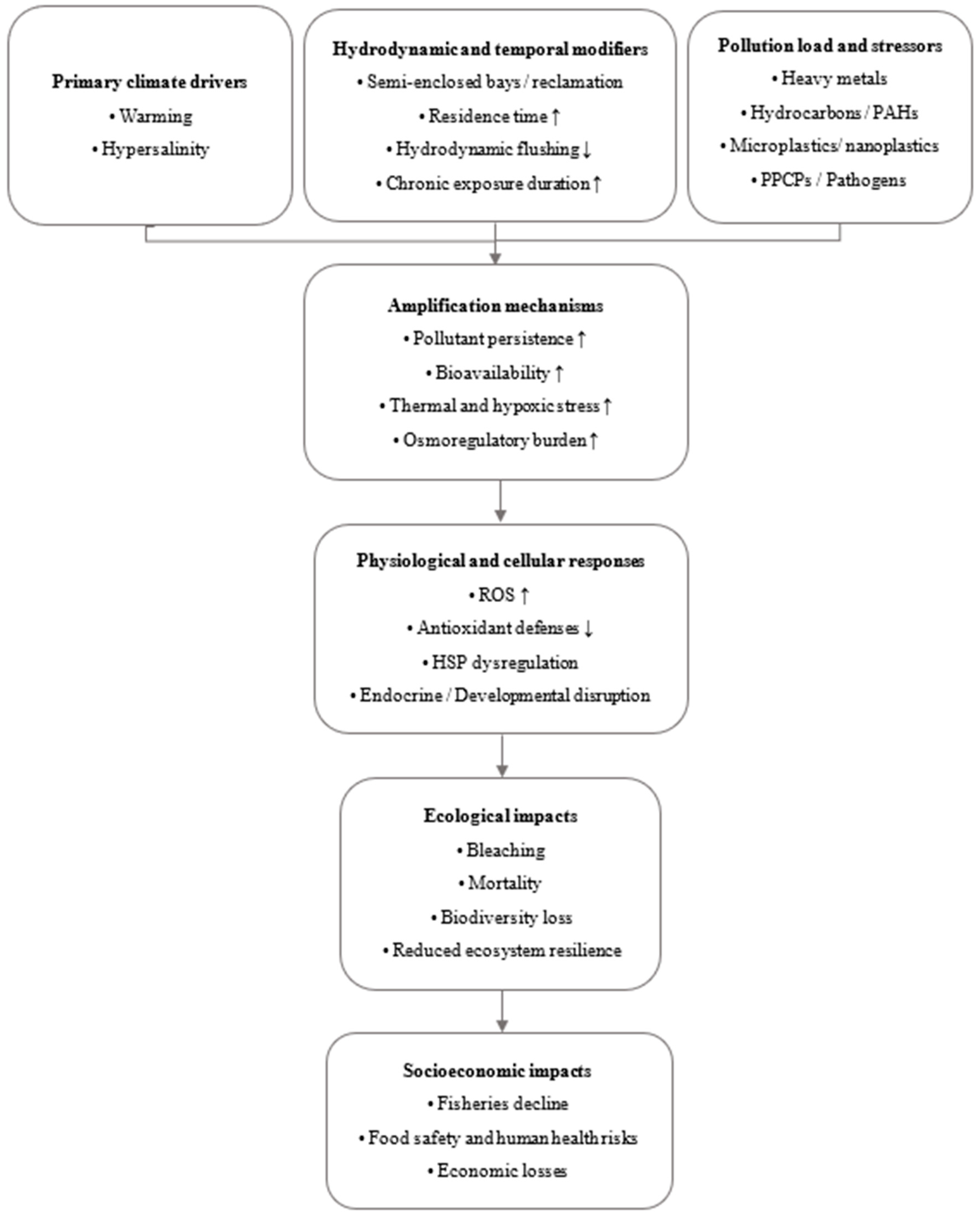
Figure 1 presents an integrative conceptual framework for understanding how climate drivers, pollution stressors, and hydrodynamic and temporal modifiers interact to amplify ecological risk in hyper-arid marine ecosystem. In this framework, warming and hypersalinity act alongside pollutant stressors, including heavy metals, hydrocarbons, microplastics, PPCPs, and pathogens, while semi-enclosed geomorphology, reduced flushing, increased residence time, and prolonged exposure duration further intensify system vulnerability. These interacting drivers influence pollutant persistence, bioavailability, thermal and hypoxic stress, and osmoregulatory burden, thereby enhancing physiological and cellular disruption, including oxidative stress, impaired antioxidant defenses, heat-shock protein dysregulation, and endocrine or developmental disturbance. These effects can scale up to ecological degradation and broader socioeconomic consequences, including fisheries decline, food safety concerns, human health risks, and economic losses. As similar ecological endpoints may arise through different pathways, this review distinguishes, where possible, between climate-driven effects, pollution-driven effects, and interaction-driven effects, while recognizing that many Gulf outcomes likely reflect multi-stressor convergence rather than a single isolated driver. The following subsections elaborate the main pathways represented in Figure 1.

4.2. Mechanistic Pathways of Climate-Enhanced Toxicity

Climate drivers can significantly modify the environmental fate of pollutants by altering key processes including deposition, degradation, and chemical partitioning, thereby influencing contaminant bioavailability and distribution [52]. The mechanistic pathways of climate-enhanced toxicity encompass the specific biological and chemical processes through which climate change interacts with pollutants to amplify their harmful effects on marine organisms [6]. A critical aspect involves how rising temperatures alter the absorption, distribution, metabolism, and excretion of contaminants, fundamentally changing how pollutants are absorbed, metabolized, and eliminated, often resulting in shifts toward more toxic metabolites and increased organismal sensitivity [6,53]
Thermal Amplification of Toxicity represents a crucial mechanism where rising temperatures intensify pollutant impacts on marine organisms. In hyper-arid regions such as Qatar, sea-surface temperatures have increased by approximately 0.36 °C per decade since 1982, reaching nearly 0.7 °C per decade in shallow western areas. Late-summer marine heatwaves now regularly exceed the 95th percentile threshold, pushing marine organisms dangerously close to their thermal limits [26]. While the concept of a Thermal Amplification Index (TAI) provides a promising framework for quantifying these interactions, it remains rarely applied to Gulf species. Conceptually, the TAI can be expressed as the ratio between a pollutant effect measured under elevated temperature and the corresponding effect measured under the baseline temperature, where values greater than 1 indicate thermal amplification of toxicity. The almost complete absence of quantitative studies testing pollutant dose–response curves under realistic Gulf heatwave scenarios represents a significant methodological gap in current risk assessments.
Cellular Stress Response Mechanisms undergo complex modifications under combined stress conditions. Heat shock proteins (HSPs), including HSP20, HSP70, and HSP90, play vital roles in protecting marine organisms from cellular damage under thermal and pollutant stress. In Gulf species, chronic heat exposure can suppress or dysregulate HSP expression, thereby compromising essential cellular defense mechanisms. Research on pearl oysters (Pinctada radiata) exposed to 25–29 °C for 30 days demonstrated tissue-specific HSP responses, including downregulation of HSP20 in adductor muscles, upregulation of HSP70 in mantle tissue, and consistently low expression of HSP90, reflecting complex stress regulation patterns [54]. Under combined heat and pollutant exposure, HSP disruption is expected to intensify, significantly increasing organismal vulnerability; however, this inference is based largely on analogous non-Gulf system, as direct combined stressor experiments remain limited for Gulf species. While similar patterns have been documented in tropical species, where co-exposure to warming and pollutants suppressed HSP expression and increased mortality [55], no studies have directly assessed HSP modulation under simultaneous heat and contaminant exposure in Gulf organisms. This represents a high-priority research gap, particularly since HSP suppression may determine critical thresholds for survival during marine heatwaves.
Oxidative Stress Synergy presents another significant pathway of climate–pollution interaction. Both heat stress and pollutants independently elevate reactive oxygen species (ROS) production; when combined, they can overwhelm antioxidant defense systems including superoxide dismutase (SOD) and glutathione peroxidase (GPx), causing intensified cellular damage [56]. This mechanism likely applies strongly to Gulf organisms facing simultaneous heat, salinity, and pollutant stress. However, antioxidant defense capacity has not been systematically measured in Qatari sentinel species such as oysters, groupers, or corals, leaving ROS–pollutant interactions fundamentally understudied in this region.

4.3. Hypersalinity as a Pollution Modifier

The hyper-evaporative nature of the Arabian Gulf creates naturally high salinity conditions that are further exacerbated near desalination outfalls, where salinity levels often reach 51–58 psu [24,26]. These high-salinity plumes frequently coincide with elevated temperatures and increased chemical loads, creating multiple compounded stressors for marine biota.
Hypersalinity significantly alters water chemistry by reducing gas solubility and shifting metal speciation through chloride complexation which in turn affects pollutant behavior and can intensify ecological stress in marine systems [57,58]. The Osmotic Stress Multiplier (OSM) effect describes how high salinity increases metal bioavailability while simultaneously burdening osmoregulatory systems, thereby compounding pollutant toxicity [59,60]. Conceptually, it may be expressed as the ratio between a pollutant effect under elevated salinity and the corresponding effect under baseline salinity, where values greater than 1 indicate salinity-driven amplification of toxicity. Despite its clear relevance to Gulf conditions, this framework has not been experimentally assessed in Gulf organisms.
Several specific mechanisms underscore the importance of hypersalinity effects. Elevated chloride concentrations promote metal–chloride complexation [58], yet no Gulf studies have quantified in situ speciation shifts under brine plumes, creating uncertainty about real-world exposure pathways. High salinity alters ion balance and antioxidant enzyme activity, reducing detoxification capacity, as demonstrated in Cerithidea cingulata from Qatari mangroves, which showed increased hemolymph ions and reduced antioxidant activity above 42 psu [61]. While this suggests a direct link between salinity stress and impaired pollutant tolerance, experimental confirmation through controlled salinity × pollutant exposures remain lacking. Furthermore, hypersalinity can modify membrane permeability and protein stability [62], but comparable experiments with Gulf phytoplankton, zooplankton, and early life stages are absent, leaving a critical knowledge gap at the base of the marine food web.

4.4. Temporal Dynamics of Climate–Pollution Interactions

Pollutant stress demonstrates dynamic interactions with seasonal and episodic climate extremes in the Gulf. Marine heatwaves lasting days to weeks significantly elevate metabolism and pollutant uptake in Gulf organisms, while the region’s extreme seasonal oscillations (from ~16 °C in winter to >36 °C in summer) alter pollutant partitioning, degradation, and toxicity [26,63,64].
The temporal aspects of these interactions reveal important patterns. Short-term climate shocks, including sudden hypersalinity from brine discharges and brief marine heatwaves, can trigger acute mortality events, whereas long-term warming and salinity rise create chronic background stress that progressively lowers resilience to pollutants [55]. Temporal dynamics also govern pollutant residence times, with summer stratification and reduced flushing in semi-enclosed bays coinciding with peak pollutant inputs from desalination and recreational activities, thereby prolonging exposure and creating “seasonal pollution traps” [38].
Despite these important insights, no studies have explicitly quantified how pollutant toxicity varies across Gulf seasonal cycles or during marine heatwaves. Developing time-resolved ecotoxicological models that integrate temperature, salinity, and hydrodynamic variability represents a critical research frontier for the region.

4.5. Species-Specific Vulnerability to Combined Stressors

Vulnerability to combining climate–pollution stress varies considerably across taxonomic groups, with early life stages, stenohaline organisms, and habitat-forming species consistently emerging as the most sensitive groups. Juvenile fish experience sharp mortality increases when pollutants coincide with elevated temperature, highlighting the narrow tolerance windows characteristic of early life stages [55].
Groupers biomagnified mercury to levels that may impair endocrine and neurological function, raising both ecological and food security concerns [41]. Similarly, coral bleaching occurs at lower thermal thresholds when oil contamination is present, with recovery delayed under combined stressors [65]. Collectively, these case studies demonstrate that many Gulf organisms already persist near their tolerance thresholds, and climate-driven stress combined with pollution pushes vulnerable species beyond survival limits, particularly those species critical to fisheries, reef structure, and cultural value.

4.6. Biogeochemical Cycling Under Climate Extremes

Climate extremes fundamentally alter nutrient, carbon, and contaminant cycling in shallow, semi-enclosed systems like the Arabian Gulf. Elevated temperatures accelerate microbial metabolism and oxygen demand, driving shifts in redox conditions that promote hypoxia [66,67]. In Qatar, these effects are compounded by high evaporation rates, restricted circulation patterns, and anthropogenic nutrient loading [68].
Pollutants themselves shape important biogeochemical feedback: hydrocarbon degradation intensifies oxygen demand [69], metal speciation shifts under hypersaline and hypoxic conditions [70], and microplastics alter sediment structure and microbial composition [71], influencing both organic matter breakdown and contaminant retention. Desalination brine introduces additional complications by altering carbonate chemistry through pH reduction and alkalinity elevation, potentially influencing calcification processes and contaminant solubility [14]. The combined effects of warming and acidification may mobilize trace elements from sediments, elevating their bioavailability and long-term bioaccumulation risk [1].
Despite the recognized importance of these interactions, Gulf-specific studies remain sparse. Three areas particularly warrant investigation: are the coupling of microbial processes with pollutant cycling under heat and salinity stress, the role of sediments as dynamic contaminant reservoirs under shifting redox conditions, and the carbonate system’s influence on pollutant solubility and trophic transfer. Addressing these knowledge gaps is crucial for predicting ecosystem resilience under continuing climate extremes.

4.7. Adaptive Responses and Evolutionary Pressures

Marine organisms respond to combined climate and pollution stress through various mechanisms including acclimation, phenotypic plasticity, and evolutionary adaptation [72,73]. These responses determine both short-term resilience and long-term persistence of Gulf populations.
Arabian Gulf corals represent a notable example of adaptation, exhibiting the world’s highest thermal tolerance (approximately 34–36 °C), achieved through genetic adaptation and symbiont flexibility [74,75]. However, this resilience remains fragile, as oil exposure and other pollutants can suppress symbiont function, reducing survival during marine heatwaves [65]. Some fish species acclimate to elevated temperatures by altering membrane composition or upregulating heat shock proteins, but these adaptive responses are often overwhelmed under combined metal exposure or hypoxic conditions [76,77]
Despite these examples of acclimation, evidence for true evolutionary adaptation to combined climate–pollution stress in Gulf species remains limited. Most research has focused exclusively on thermal tolerance, while genomic and epigenetic mechanisms underlying pollutant resistance are virtually unstudied. This represents a major frontier for research, with significant implications for predicting species persistence under accelerating environmental change.

5. Future Directions and Solutions

5.1. Predictive Modeling of Future Scenarios

Predictive models are essential tools for anticipating how climate and pollution stressors will interact in Gulf ecosystems. Currently, most Gulf modeling efforts emphasize hydrodynamics and temperature, while pollutant fate and biological response modules remain underdeveloped [14]. Coupled biophysical models offer promises for simulating pollutant dispersal under varying circulation, salinity, and heat regimes. For instance, hydrodynamic modeling of Doha Bay revealed that residence times have lengthened from approximately 10 days to more than 25–30 days, creating chronic exposure zones [38].
In the Gulf, ecotoxicological assessments still rely heavily on constant-condition laboratory tests, which is a poor fit for the region’s hyper-salinity, shallow geometry, and extreme seasonal heat. These limitations compromise both predictive accuracy and ecological relevance [78]. The development of integrated models linking physical drivers, pollutant fate, and organismal thresholds is urgently needed. Emerging artificial intelligence and machine learning approaches may help improve these future coupled models, particular for detecting nonlinear interactions and identifying critical thresholds [79].
Despite progress in physical oceanography, the Gulf region lacks predictive models that explicitly couple climate extremes, pollutant dynamics, and biological responses. Building such frameworks, calibrated with comprehensive local monitoring data, represents a critical research and policy priority for effective environmental management.

5.2. Emerging Contaminants Under Climate Stress

Pharmaceuticals, personal care products (PPCPs), nanoplastics, and endocrine disruptors are increasingly detected in marine environments worldwide but remain poorly characterized in Qatar and the wider Gulf region [27,28]. Antibiotics, hormones, UV filters, and synthetic musk compounds are of particular concern due to their ability to bioaccumulate and cause sublethal effects even at trace concentrations [30].
Climate extremes likely modulate the fate and toxicity of these emerging contaminants in important ways. Elevated temperatures may accelerate PPCP degradation but potentially generate more toxic byproducts. Hypersalinity alters solubility and partitioning of organic compounds, while extreme UV exposure enhances photolysis, potentially yielding reactive intermediates [62,80]. Nanoplastics remain almost entirely unmeasured in the Gulf. A study from broader aquatic system suggests that their nanoscale size may facilitate cellular penetration and tissue translocation, while heat and salinity may further amplify their uptake and toxicity. However, these mechanisms remain inferential for Gulf environments because no local experimental studies have yet evaluated these interactions [42]. Other emerging contaminants, including antifouling agents, disinfection byproducts, and per- and polyfluoroalkyl substances (PFAS), are virtually unstudied in Qatar’s waters, despite their concerning persistence, mobility, and bioaccumulation potential [1,81]
Overall, the Gulf region lacks essential baseline data on concentrations, transformation products, mixture effects, and organismal responses for most emerging contaminants. Addressing these knowledge blind spots should be a top research priority, as climate extremes are likely to magnify both the persistence and toxicity of these compounds.

5.3. Ecosystem Services at Risk from Combined Stressors

Integrated assessments using Combined Stress Impact Valuation frameworks reveal compounded threats to Qatar’s marine ecosystem services. Ensemble projections from Fisheries and Marine Ecosystem Model Intercomparison Project (Fish-MIP) suggest decline of more than 10% in exploitable fish biomass by mid-century under high-emissions scenarios, driven primarily by warming [82]. In Qatar’s semi-enclosed hotspots, chronic pollutant loads, including nutrients and particle-bound metals from Doha Bay stormwater/sewage outfalls and industrial discharges near Mesaieed, could accumulate under weak circulation, degrading water quality and services like filtration and blue carbon, thereby compounding climate-driven risks to fisheries [38,83,84,85]. When applied to Qatar’s fisheries and aquaculture industry valuation of USD 148,216,600 (2020), a 30% decrease in exploitable fish biomass would suggest ≈ USD 44–45 million annually in lost sector value using a proportionate scaling method (keeping prices constant) [86].
Coastal protection services face comparable risks, with models similar to FutureMARES forecasting an approximately 40% decline in shoreline stabilization capacity if coral reefs, seagrass meadows, and mangroves continue to degrade. Such habitat deterioration would significantly increase erosion risks and threaten coastal infrastructure. Tourism and blue carbon services also face substantial pressures, such as coral bleaching and habitat loss reduce both carbon sequestration potential and esthetic value, directly affecting local economies. Quantitative valuation tools, including Benefits Transfer models, support the estimation of these economic losses and inform restoration strategies aligned with Qatar National Vision 2030.

5.4. Technology-Enhanced Monitoring and Mitigation of Synergistic Risks

Addressing the complex, non-linear interactions of climate and pollution in Qatar necessitates a transition from conventional monitoring toward integrated systems capable of diagnosing and forecasting synergistic risks. Emerging technologies offer a pathway to support this transition through intelligent monitoring, predictive analytics, and targeted mitigation.
In the wider Persian Gulf, AI-based forecasting has already been explored at the research stage. Recent studies used remote-sensing variables and machine-learning models to predict harmful algal bloom events, showing promising predictive performance but still requiring broader in situ validation before routine operational use [87,88]. In Qatar, marine digital monitoring has progressed through the installation of four environmental monitoring buoys at Hamad Port and Ruwais Port as part of a national continuous-monitoring and early-warning network, although publicly available descriptions mainly emphasize monitoring infrastructure rather than a fully validated integrated IoT-AI forecasting system [89,90]. A more mature Gulf example is Abu Dhabi, where the Environment Agency-Abu Dhabi has operated marine water-quality monitoring since 2005 and introduced an automated buoy network in 2014; this network measures salinity, conductivity, temperature, pH, dissolved oxygen, chlorophyll, and cyanobacteria every 15 min, with data transmitted hourly to a central database [91,92]. While Persian Gulf AI forecasting studies already report performance metrics and validation results, the Qatar and Abu Dhabi cases mainly demonstrate real-time automated monitoring and early-warning infrastructure, with more limited publicly available evidence on formal predictive validation of integrated IoT-AI workflows. These examples are therefore best viewed as important steps toward digital marine management rather than fully standardized region-wide predictive solutions, highlighting the need for broader validation, transparent performance metrics, and stronger integration of in situ, laboratory, and satellite observations. The following discussion is framed as a proposed future framework for Qatar, informed by emerging Gulf examples rather than representing a fully established operational solution. Its effectiveness would need to be assessed using operational metrics such as sensor reliability, data completeness, forecast accuracy, false-alarm rate, and warning lead time, with validation based on comparison against in situ sampling, laboratory analyses, and hindcasting of historical bloom, heatwave, or pollution events.
The foundation of this proposed framework lies in the intelligent monitoring of multi-stressor hotspots. Future deployment of smart buoy-based monitoring systems in critical areas such as semi-enclosed bays and desalination outfalls could provide the high-resolution, real-time data needed to resolve synergy dynamics. These platforms could be equipped with multi-sensor payloads designed to measure not only standard parameters like temperature, salinity, and dissolved oxygen but also specific synergy indicators. Key environmental indicators may include fluctuations in pH, which link warming, hypoxia, and contaminant speciation, and in situ chlorophyll-a, which serves as a proxy for nutrient-driven algal blooms amplified by elevated temperatures. Such continuous data streams are indispensable for calibrating the predictive models outlined in Section 5.1.
Integrating these smart-monitoring systems into national coastal management frameworks could enable predictive ecosystem management, where real-time data directly trigger early-warning alerts for combined heat and pollution stress events, allowing proactive mitigation and resource protection.
AI and machine-learning models may further strengthen this proposed framework by helping forecast specific climate–pollution events once calibrated and validated with local monitoring data. For instance, such models can be developed to predict combined heat-pollution stress events by integrating forecasted marine heatwaves with real-time data on pollutant plumes from hydrocarbon spills or brine discharges. This would identify regions where organismal thermal limits are likely to be exceeded in conjunction with high contaminant exposure. Furthermore, AI frameworks may help forecast the risk of synergistic pathogen outbreaks by analyzing the relationship between rising sea surface temperatures, nutrient loads, and historical Vibrio abundance data, enabling early warnings for vibriosis. A critical application involves identifying “tipping point” conditions for key species such as P. radiata or corals by modeling the specific thresholds at which combined temperature and pollutant exposure lead to mass mortality or reproductive failure.
Complementing this monitoring and forecasting, mitigation efforts should prioritize breaking the synergy cycle itself. Nature-based solutions, including strategic seaweed cultivation and mangrove restoration, could be sited specifically within pollution hotspots and low-circulation zones. In these locations, they may serve a dual purpose: directly phyto-extracting pollutants like heavy metals and nutrients, while simultaneously providing localized cooling and habitat complexity. This dual action may reduce ambient physiological stress on the ecosystem, thereby building resilience against the primary climate driver of extreme heat.

6. Conclusions

To sum it up, Qatar and the Arabian Gulf provided a compelling model for understanding how pollution and climate extremes interact in hyper-arid marine ecosystem. The evidence compiled in this review indicates that pollutants such as heavy metals, hydrocarbons, microplastics, pathogens, and emerging contaminants operate in an environment define by extreme heat, hypersalinity, restricted circulation, and prolonged residence times. These baseline conditions can intensify pollutant persistence, bioavailability, uptake, and physiological stress, thereby increase ecological vulnerability and decrease ecosystem resilience. These interactions also have important sustainability impacts, with implications for biodiversity, fisheries productivity, food security, coastal protection, and the long-term resilience of marine ecosystem services in Qatar and other hyper-arid regions. In this context, climate–pollution synergies are not only an ecotoxicological concern, but also a challenge for sustainable coastal management and environmental resilience. However, there are still significant knowledge gaps. Mixture toxicity under Gulf-specific conditions, endocrine and neurobehavioral endpoints, nanoplastic effects, long-term ecological responses, and quantitative ecosystem-service valuation are still poorly resolved. Addressing these gaps will require integrated monitoring, Gulf-calibrated predictive models, and more combined-stressor experimental studies linking climate variables, pollutant dynamics, and biological thresholds. Under Qatar National Vision 2023, strengthening this body of evidence is crucial for enhancing risk assessment, directing management tactics, and promoting ecological resilience. All things considered, not only as a nationally important case study, but also as a valuable reference system for other climate-stressed marine environments facing converging pollution and warming pressures.

Author Contributions

Conceptualization: D.M.; Literature search: D.M., O.M. and S.A.; Data curation: D.M.; Writing (original draft): D.M., O.M. and S.A.; Writing (review and editing): A.N.; Supervision: A.N. All authors have read and agreed to the published version of the manuscript.

Funding

This research was supported by the Qatar Research, Development and Innovation Council (QRDI) under grant number ARG01-0604-230484. The article processing charge (APC) was funded by the Qatar National Library (QNL), which provided open-access support for the publication of this work.

Institutional Review Board Statement

Not applicable.

Informed Consent Statement

Not applicable.

Data Availability Statement

The data presented in this study are available on request from the corresponding author.

Conflicts of Interest

The authors declare no conflicts of interest.

Abbreviations

The following abbreviations are used in this manuscript:
AIartificial intelligence
APCarticle processing charge
CC BYCreative Commons Attribution
IoTInternet of Things
QNLQatar National Library
QRDIQatar Research, Development and Innovation Council
QUQatar University
USDUnited States dollar
USUnited States
Asarsenic
BMAAβ-N-methylamino-L-alanine
BPAbisphenol A
Cdcadmium
Crchromium
Cucopper
Ninickel
Znzinc
DDTdichlorodiphenyltrichloroethane
Hgmercury
LDPElow-density polyethylene
MPmicroplastic
MPsmicroplastics
PAHpolycyclic aromatic hydrocarbon
PAHspolycyclic aromatic hydrocarbons
Pblead
PFASper- and polyfluoroalkyl substances
PPpolypropylene
PPCPpharmaceutical and personal care product
PPCPspharmaceuticals and personal care products
TPHtotal petroleum hydrocarbon
TPHstotal petroleum hydrocarbons
CFUcolony-forming units
EC50half maximal effective concentration
EPAEnvironmental Protection Agency
ERLEffects Range-Low/Effects Range Low
EU EQSEuropean Union Environmental Quality Standard
FAOFood and Agriculture Organization
FDAFood and Drug Administration
LC50median lethal concentration
NOAANational Oceanic and Atmospheric Administration
PNECPredicted No-Effect Concentration
WHOWorld Health Organization
GPxglutathione peroxidase
HSPheat shock protein
HSP20heat shock protein 20
HSP70heat shock protein 70
HSP90heat shock protein 90
OSMOsmotic Stress Multiplier
ROSreactive oxygen species
SODsuperoxide dismutase
TAIThermal Amplification Index
TMFstrophic magnification factors
UVultraviolet
pHpotential of hydrogen
psupractical salinity unit
E. coliEscherichia coli
V. alginolyticusVibrio alginolyticus
V. parahaemolyticusVibrio parahaemolyticus
V. harveyiVibrio harveyi
P. radiataPinctada radiata
spp.multiple species within a genus

References

  1. Hasna, V.M.; Aboobacker, V.M.; Dib, S.; Izza, A.; Yigiterhan, O.; Al-Ansari, E.M.A.S.; Vethamony, P. Elemental distributions in the marine sediments off Doha, Qatar: Role of urbanisation and coastal dynamics. Environ. Earth Sci. 2024, 83, 434. [Google Scholar] [CrossRef] [Scilit]
  2. Bashar, A.; Heal, R.D.; Hasan, M.Z.; Al Rakib, A.; Ainuddin, M.; Alam, M.M.; Bablee, A.L.; Jahangir, M.M.R.; Jørgensen, N.O.G.; Hansen, L.H.; et al. A preliminary field-based assessment of greenhouse gas emissions from prawn aquaculture ponds in Bangladesh: Effects of farm management and water quality. Aquac. Int. 2026, 34, 99. [Google Scholar] [CrossRef] [Scilit]
  3. Elobaid, E.A.; Yigiterhan, O.; Al-Ansari, E.M.A.S.; Chen, Z.; Mohieldeen, Y.E.; Abdalla, R. Ecological risk assessment of heavy metals in the marine sediments associated with the petroleum hydrocarbon industry in the central Arabian Gulf. J. Hazard. Mater. Adv. 2025, 19, 100749. [Google Scholar] [CrossRef] [Scilit]
  4. Ghaemi, M.; Soleimani, F.; Gholamipour, S. Heavy metal and persistent organic pollutant profile of sediments from marine protected areas: The northern Persian Gulf. Environ. Sci. Pollut. Res. Int. 2023, 30, 120877–120891. [Google Scholar] [CrossRef] [Scilit]
  5. Nawab, A.; Khan, M.T.; Ihsanullah, I.; Nafees, M.; Shah, A.M. From pollution to ocean warming: The climate impacts of marine microplastics. J. Hazard. Mater. Plast. 2026, 2, 100032. [Google Scholar] [CrossRef] [Scilit]
  6. Hooper, M.J.; Ankley, G.T.; Cristol, D.A.; Maryoung, L.A.; Noyes, P.D.; Pinkerton, K.E. Interactions between chemical and climate stressors: A role for mechanistic toxicology in assessing climate change risks. Environ. Toxicol. Chem. 2013, 32, 32–48. [Google Scholar] [CrossRef] [Scilit]
  7. Gao, K.; Gao, G.; Wang, Y.; Dupont, S. Impacts of ocean acidification under multiple stressors on typical organisms and ecological processes. Mar. Life Sci. Technol. 2020, 2, 279–291. [Google Scholar] [CrossRef] [Scilit]
  8. Ben-Hamadou, R.; Mohamed, A.M.D.; Dimassi, S.N.; Razavi, M.M.; Alshuiael, S.M.; Sulaiman, M.O. Assessing and Reporting Potential Environmental Risks Associated with Reefing Oil Platform During Decommissioning in Qatar. In Sustainable Qatar: Social, Political and Environmental Perspectives; Springer: Singapore, 2022; pp. 167–191. [Google Scholar]
  9. Aloui, S.; Zghibi, A.; Mazzoni, A.; Elomri, A.; Triki, C. Groundwater resources in Qatar: A comprehensive review and informative recommendations for research, governance, and management in support of sustainability. J. Hydrol. Reg. Stud. 2023, 50, 101564. [Google Scholar] [CrossRef] [Scilit]
  10. Burt, J.A.; Ben-Hamadou, R.; Abdel-Moati, M.A.R.; Fanning, L.; Kaitibie, S.; Al-Jamali, F.; Range, P.; Saeed, S.; Warren, C.S. Improving management of future coastal development in Qatar through ecosystem-based management approaches. Ocean Coast. Manag. 2017, 148, 171–181. [Google Scholar] [CrossRef] [Scilit]
  11. Xu, W.; Zhang, Z. Impact of Coastal Urbanization on Marine Pollution: Evidence from China. Int. J. Environ. Res. Public Health 2022, 19, 10718. [Google Scholar] [CrossRef] [Scilit]
  12. Al-Naimi, H.A.; Al-Ghouti, M.A.; Al-Shaikh, I.; Al-Yafe, M.; Al-Meer, S. Metal distribution in marine sediment along the Doha Bay, Qatar. Environ. Monit. Assess. 2015, 187, 130. [Google Scholar] [CrossRef] [Scilit]
  13. Al-Thani, R.F.; Yasseen, B.T. Perspectives of future water sources in Qatar by phytoremediation: Biodiversity at ponds and modern approach. Int. J. Phytoremed. 2021, 23, 866–889. [Google Scholar] [CrossRef] [Scilit]
  14. Dib, S.; Veerasingam, S.; Alyafei, T.; Assali, M.A.; Al-Khayat, J.; Vethamony, P. PAHs and hopanes in the surface sediments of Qatar coast and their ecological risks: Comparison with regional and global coastal regions. Mar. Pollut. Bull. 2024, 203, 116494. [Google Scholar] [CrossRef] [Scilit]
  15. González-Fuenzalida, R.A.; Herráez-Hernández, R.; Verdú-Andrés, J.; Bouzas-Blanco, A.; Seco-Torrecillas, A.; Campíns-Falcó, P. Establishing the occurrence and profile of polycyclic aromatic hydrocarbons in marine sediments: The eastern Mediterranean coast of Spain as a case study. Mar. Pollut. Bull. 2019, 142, 206–215. [Google Scholar] [CrossRef] [Scilit]
  16. Hassan, H.M.; Castillo, A.B.; Yigiterhan, O.; Elobaid, E.A.; Al-Obaidly, A.; Al-Ansari, E.; Obbard, J.P. Baseline concentrations and distributions of Polycyclic Aromatic Hydrocarbons in surface sediments from the Qatar marine environment. Mar. Pollut. Bull. 2018, 126, 58–62. [Google Scholar] [CrossRef] [Scilit] [PubMed]
  17. Al-Shamary, N.; Hassan, H.; Leitão, A.; Hutchinson, S.M.; Mondal, D.; Bayen, S. Baseline distribution of petroleum hydrocarbon contamination in the marine environment around the coastline of Qatar. Mar. Pollut. Bull. 2023, 188, 114655. [Google Scholar] [CrossRef] [Scilit] [PubMed]
  18. Dib, S.; Mohamed, A.; Al-Khayat, F.A.; Veerasingam, S.; Aboobacker, V.M.; Al-Khayat, J.A.; Vethamony, P. Distinguishing microplastics from microplastic-like particles in the marine fish from Qatar. Sci. Rep. 2026, 16, 5981. [Google Scholar] [CrossRef] [Scilit]
  19. Castillo, A.B.; Al-Maslamani, I.; Obbard, J.P. Prevalence of microplastics in the marine waters of Qatar. Mar. Pollut. Bull. 2016, 111, 260–267. [Google Scholar] [CrossRef] [Scilit]
  20. Dib, S.; Veerasingam, S.; Aboobacker, V.M.; Al-Khayat, J.A.; Sadooni, F.N.; Al-Kuwari, H.A.; Vethamony, P. Horizontal and Vertical Distribution of Microplastics in the Beach Sediments of Qatar. Coas 2024, 113, 468–472. [Google Scholar] [CrossRef] [Scilit]
  21. Mohamed, A.; Dib, S.; Al-Khayat, F.A.; Aboobacker, V.M.; Veerasingam, S.; Al-Khayat, J.A.; Vethamony, P. Accumulation of Microplastics in the Gastrointestinal Tracts of Commercial Fish Species from the Waters of Qatar, Arabian Gulf. Coas 2024, 113, 880–884. [Google Scholar] [CrossRef] [Scilit]
  22. Veerasingam, S.; Vethamony, P.; Aboobacker, V.M.; Giraldes, A.E.; Dib, S.; Al-Khayat, J.A. Factors influencing the vertical distribution of microplastics in the beach sediments around the Ras Rakan Island, Qatar. Environ. Sci. Pollut. Res. Int. 2021, 28, 34259–34268. [Google Scholar] [CrossRef] [Scilit]
  23. Wei, X.-F.; Yang, W.; Hedenqvist, M.S. Plastic pollution amplified by a warming climate. Nat. Commun. 2024, 15, 2052. [Google Scholar] [CrossRef] [Scilit] [PubMed]
  24. Al-Thani, R.F.; Yasseen, B.T. Microbial Ecology of Qatar, the Arabian Gulf: Possible Roles of Microorganisms. Front. Mar. Sci. 2021, 8, 697269. [Google Scholar] [CrossRef] [Scilit]
  25. El-Malah, S.S.; Rasool, K.; Jabbar, K.A.; Sohail, M.U.; Baalousha, H.M.; Mahmoud, K.A. Marine Bacterial Community Structures of Selected Coastal Seawater and Sediment Sites in Qatar. Microorganisms 2023, 11, 2827. [Google Scholar] [CrossRef] [Scilit]
  26. Hereher, M.E. Assessment of Climate Change Impacts on Sea Surface Temperatures and Sea Level Rise—The Arabian Gulf. Climate 2020, 8, 50. [Google Scholar] [CrossRef] [Scilit]
  27. Jasim, S.Y.; Saththasivam, J.; Loganathan, K.; Ogunbiyi, O.O.; Sarp, S. Reuse of Treated Sewage Effluent (TSE) in Qatar. J. Water Process Eng. 2016, 11, 174–182. [Google Scholar] [CrossRef] [Scilit]
  28. Liu, L.; Aljathelah, N.M.; Hassan, H.; Giraldes, B.W.; Leitão, A.; Bayen, S. Targeted and suspect screening of contaminants in coastal water and sediment samples in Qatar. Sci. Total Environ. 2021, 774, 145043. [Google Scholar] [CrossRef] [Scilit] [PubMed]
  29. Al-Maadheed, S.; Goktepe, I.; Latiff, A.B.A.; Shomar, B. Antibiotics in hospital effluent and domestic wastewater treatment plants in Doha, Qatar. J. Water Process Eng. 2019, 28, 60–68. [Google Scholar] [CrossRef] [Scilit]
  30. Khalid, M.; Abdollahi, M. Environmental Distribution of Personal Care Products and Their Effects on Human Health. Iran. J. Pharm. Res. 2021, 20, 216–253. [Google Scholar]
  31. Saleh, I.A.; Zouari, N.; Al-Ghouti, M.A. Removal of pesticides from water and wastewater: Chemical, physical and biological treatment approaches. Environ. Technol. Innov. 2020, 19, 101026. [Google Scholar] [CrossRef] [Scilit]
  32. Abayomi, O.A.; Range, P.; Al-Ghouti, M.A.; Obbard, J.P.; Almeer, S.H.; Ben-Hamadou, R. Microplastics in coastal environments of the Arabian Gulf. Mar. Pollut. Bull. 2017, 124, 181–188. [Google Scholar] [CrossRef] [Scilit]
  33. European Parliament and Council Directive 2008/105/EC of 16 December 2008 on Environmental Quality Standards in the Field of Water Policy. Available online: https://eur-lex.europa.eu/eli/dir/2008/105/oj/eng (accessed on 1 January 2026).
  34. European Medicines Agency (EMA), CHMP. Guideline on the Environmental Risk Assessment of Medicinal Products for Human Use (EMEA/CHMP/SWP/4447/00 Rev. 1-Corr.). Available online: https://www.ema.europa.eu/en/documents/scientific-guideline/guideline-environmental-risk-assessment-medicinal-products-human-use-revision-1_en.pdf (accessed on 1 January 2026).
  35. World Health Organization. Guidelines on Recreational Water Quality: Volume 1, Coastal and Fresh Waters; WHO: Geneva, Switzerland, 2021; Available online: https://www.who.int/publications/i/item/9789240031302 (accessed on 1 January 2026).
  36. European Parliament and Council Directive 2013/39/EU of 12 August 2013 Amending Directives 2000/60/EC and 2008/105/EC as Regards Priority Substances in the Field of Water Policy. EUR-Lex Official. Available online: https://eur-lex.europa.eu/eli/dir/2013/39/oj/eng (accessed on 1 January 2026).
  37. Bouwmeester, J.; Riera, R.; Range, P.; Ben-Hamadou, R.; Samimi-Namin, K.; Burt, J.A. Coral and Reef Fish Communities in the Thermally Extreme Persian/Arabian Gulf: Insights into Potential Climate Change Effects. In Perspectives on the Marine Animal Forests of the World; Rossi, S., Bramanti, L., Eds.; Springer International Publishing: Cham, Switzerland, 2020; pp. 63–86. [Google Scholar]
  38. Lecart, M.; Dobbelaere, T.; Alaerts, L.; Randresihaja, N.R.; Mohammed, A.V.; Vethamony, P.; Hanert, E. Land reclamation and its consequences: A 40-year analysis of water residence time in Doha Bay, Qatar. PLoS ONE 2024, 19, e0296715. [Google Scholar] [CrossRef] [PubMed]
  39. Hassan, H.M. Effects of Pollution on Marine Crustaceans in Qatari Waters: A Baseline Survey and a Case Study on Genotoxicity Indicators in an Endemic Shrimp. 2018. Available online: https://salford-repository.worktribe.com/output/1383533/effects-of-pollution-on-marine-crustaceans-in-qatari-waters-a-baseline-survey-and-a-case-study-on-genotoxicity-indicators-in-an-endemic-shrimp (accessed on 1 January 2026).
  40. Elsayed, H.; Yigiterhan, O.; Al-Ansari, E.M.A.S.; Al-Ashwel, A.A.; Elezz, A.A.; Al-Maslamani, I.A. Methylmercury bioaccumulation among different food chain levels in the EEZ of Qatar (Arabian Gulf). Reg. Stud. Mar. Sci. 2020, 37, 101334. [Google Scholar] [CrossRef] [Scilit]
  41. Al-Sulaiti, M.M.; Soubra, L.; Al-Ghouti, M.A. The Causes and Effects of Mercury and Methylmercury Contamination in the Marine Environment: A Review. Curr. Pollut. Rep. 2022, 8, 249–272. [Google Scholar] [CrossRef] [Scilit]
  42. Pironti, C.; Ricciardi, M.; Proto, A.; Bianco, P.M.; Montano, L.; Motta, O. Endocrine-Disrupting Compounds: An Overview on Their Occurrence in the Aquatic Environment and Human Exposure. Water 2021, 13, 1347. [Google Scholar] [CrossRef] [Scilit]
  43. Osuoha, J.O.; Anyanwu, B.O.; Ejileugha, C. Pharmaceuticals and personal care products as emerging contaminants: Need for combined treatment strategy. J. Hazard. Mater. Adv. 2023, 9, 100206. [Google Scholar] [CrossRef] [Scilit]
  44. Aich, U.; Polverino, G.; Yazdan Parast, F.; Melo, G.C.; Tan, H.; Howells, J.; Nosrati, R.; Wong, B.B.M. Long-term effects of widespread pharmaceutical pollution on trade-offs between behavioural, life-history and reproductive traits in fish. J. Anim. Ecol. 2025, 94, 340–355. [Google Scholar] [CrossRef] [Scilit]
  45. Saaristo, M.; Brodin, T.; Balshine, S.; Bertram, M.G.; Brooks, B.W.; Ehlman, S.M.; McCallum, E.S.; Sih, A.; Sundin, J.; Wong, B.B.M.; et al. Direct and indirect effects of chemical contaminants on the behaviour, ecology and evolution of wildlife. Proc. Biol. Sci. 2018, 285, 20181297. [Google Scholar] [CrossRef] [Scilit]
  46. Fanning, L.M.; Al-Naimi, M.N.; Range, P.; Ali, A.-S.M.; Bouwmeester, J.; Al-Jamali, F.; Burt, J.A.; Ben-Hamadou, R. Applying the ecosystem services—EBM framework to sustainably manage Qatar’s coral reefs and seagrass beds. Ocean Coast. Manag. 2021, 205, 105566. [Google Scholar] [CrossRef] [Scilit]
  47. Jafari, F.; Naeemi, A.S.; Sohani, M.M.; Noorinezhad, M. Effect of elevated temperature, sea water acidification, and phenanthrene on the expression of genes involved in the shell and pearl formation of economic pearl oyster (Pinctada radiata). Mar. Pollut. Bull. 2023, 196, 115603. [Google Scholar] [CrossRef] [Scilit]
  48. Chatziefthimiou, A.D.; Deitch, E.J.; Glover, W.B.; Powell, J.T.; Banack, S.A.; Richer, R.A.; Cox, P.A.; Metcalf, J.S. Analysis of Neurotoxic Amino Acids from Marine Waters, Microbial Mats, and Seafood Destined for Human Consumption in the Arabian Gulf. Neurotox. Res. 2018, 33, 143–152. [Google Scholar] [CrossRef] [Scilit]
  49. Al-Khayat, J.A.; Veerasingam, S.; Aboobacker, V.M.; Vethamony, P. Hitchhiking of encrusting organisms on floating marine debris along the west coast of Qatar, Arabian/Persian Gulf. Sci. Total Environ. 2021, 776, 145985. [Google Scholar] [CrossRef] [Scilit]
  50. Alsafran, M.; Usman, K.; Al Jabri, H.; Rizwan, M. Ecological and Health Risks Assessment of Potentially Toxic Metals and Metalloids Contaminants: A Case Study of Agricultural Soils in Qatar. Toxics 2021, 9, 35. [Google Scholar] [CrossRef] [Scilit]
  51. Al-Thani, R.F.; Yasseen, B.T. Methods Using Marine Aquatic Photoautotrophs along the Qatari Coastline to Remediate Oil and Gas Industrial Water. Toxics 2024, 12, 625. [Google Scholar] [CrossRef] [Scilit]
  52. Bolan, S.; Padhye, L.P.; Jasemizad, T.; Govarthanan, M.; Karmegam, N.; Wijesekara, H.; Amarasiri, D.; Hou, D.; Zhou, P.; Biswal, B.K.; et al. Impacts of climate change on the fate of contaminants through extreme weather events. Sci. Total Environ. 2024, 909, 168388. [Google Scholar] [CrossRef] [Scilit]
  53. Singh, B.K.; Paul, S.; Das, I.; Singha, E.R.; Giri, A. Global Warming and Emerging Contaminants: Impacts on Aquatic Organisms and Their Responses. Int. J. Environ. Res. 2025, 19, 186. [Google Scholar] [CrossRef] [Scilit]
  54. Pourmozaffar, S.; Tamadoni Jahromi, S.; Gozari, M.; Rameshi, H.; Gozari, M.; Pazir, M.K.; Sarvi, B.; Abolfathi, M.; Nahavandi, R. The first reporting of prevalence Vibrio species and expression of HSP genes in rayed pearl oyster (Pinctada radiata) under thermal conditions. Fish Shellfish Immunol. 2023, 139, 108907. [Google Scholar] [CrossRef] [Scilit]
  55. Bai, Z.; Wang, M. Warmer temperature increases mercury toxicity in a marine copepod. Ecotoxicol. Environ. Saf. 2020, 201, 110861. [Google Scholar] [CrossRef] [Scilit]
  56. Messina, C.M.; Manuguerra, S.; Arena, R.; Espinosa-Ruiz, C.; Curcuraci, E.; Esteban, M.A.; Santulli, A. Contaminant-induced oxidative stress underlies biochemical, molecular and fatty acid profile changes, in gilthead seabream (Sparus aurata L.). Res. Vet. Sci. 2023, 159, 244–251. [Google Scholar] [CrossRef] [Scilit]
  57. Kenigsberg, C.; Abramovich, S.; Hyams-Kaphzan, O. The effect of long-term brine discharge from desalination plants on benthic foraminifera. PLoS ONE 2020, 15, e0227589. [Google Scholar] [CrossRef] [Scilit]
  58. Herce-Sesa, B.; López-López, J.; Moreno, C. Selective determination of metal chlorocomplexes in saline waters by magnetic ionic liquid-based dispersive liquid-liquid microextraction. Anal. Bioanal. Chem. 2025, 417, 1369–1379. [Google Scholar] [CrossRef] [Scilit]
  59. Dutton, J.; Fisher, N.S. Salinity effects on the bioavailability of aqueous metals for the estuarine killifish Fundulus heteroclitus. Environ. Toxicol. Chem. 2011, 30, 2107–2114. [Google Scholar] [CrossRef] [Scilit]
  60. Griffith, M.B. Toxicological perspective on the osmoregulation and ionoregulation physiology of major ions by freshwater animals: Teleost fish, crustacea, aquatic insects, and Mollusca. Environ. Toxicol. Chem. 2017, 36, 576–600. [Google Scholar] [CrossRef] [Scilit]
  61. Elezz, A.A.; Castillo, A.; Hassan, H.M.; Alsaadi, H.A.; Vethamony, P. Distribution and environmental geochemical indices of mercury in tar contaminated beaches along the coast of Qatar. Mar. Pollut. Bull. 2022, 175, 113349. [Google Scholar] [CrossRef] [Scilit]
  62. Dong, J.; Li, L.; Liu, Q.; Yang, M.; Gao, Z.; Qian, P.; Gao, K.; Deng, X. Interactive effects of polymethyl methacrylate (PMMA) microplastics and salinity variation on a marine diatom Phaeodactylum tricornutum. Chemosphere 2022, 289, 133240. [Google Scholar] [CrossRef] [Scilit]
  63. Oliver, E.C.J. Mean warming not variability drives marine heatwave trends. Clim. Dyn. 2019, 53, 1653–1659. [Google Scholar] [CrossRef] [Scilit]
  64. Smale, D.A.; Wernberg, T.; Oliver, E.C.J.; Thomsen, M.; Harvey, B.P.; Straub, S.C.; Burrows, M.T.; Alexander, L.V.; Benthuysen, J.A.; Donat, M.G.; et al. Marine heatwaves threaten global biodiversity and the provision of ecosystem services. Nat. Clim. Chang. 2019, 9, 306–312. [Google Scholar] [CrossRef] [Scilit]
  65. Halsband, C.; Thomsen, N.; Reinardy, H.C. Climate Change increases the risk of metal toxicity in Arctic zooplankton. Front. Mar. Sci. 2024, 11, 1510718. [Google Scholar] [CrossRef] [Scilit]
  66. Diaz, R.J.; Rosenberg, R. Spreading Dead Zones and Consequences for Marine Ecosystems. Science 2008, 321, 926–929. [Google Scholar] [CrossRef] [Scilit]
  67. Lachkar, Z.; Mehari, M.; Lévy, M.; Paparella, F.; Burt, J.A. Recent expansion and intensification of hypoxia in the Arabian Gulf and its drivers. Front. Mar. Sci. 2022, 9, 891378. [Google Scholar] [CrossRef] [Scilit]
  68. Al-Yamani, F.; Polikarpov, I.; Saburova, M. Northern Gulf Marine Biodiversity in Relevance to the River Discharge. In Southern Iraq’s Marshes: Their Environment and Conservation; Jawad, L.A., Ed.; Springer International Publishing: Cham, Switzerland, 2021; pp. 379–437. [Google Scholar]
  69. Hazen, T.C.; Prince, R.C.; Mahmoudi, N. Marine Oil Biodegradation. Environ. Sci. Technol. 2016, 50, 2121–2129. [Google Scholar] [CrossRef] [Scilit]
  70. Gantayat, R.R.; Elumalai, V. Salinity-Induced Changes in Heavy Metal Behavior and Mobility in Semi-Arid Coastal Aquifers: A Comprehensive Review. Water 2024, 16, 1052. [Google Scholar] [CrossRef] [Scilit]
  71. Li, W.; Wang, Z.; Li, W.; Li, Z. Impacts of microplastics addition on sediment environmental properties, enzymatic activities and bacterial diversity. Chemosphere 2022, 307, 135836. [Google Scholar] [CrossRef] [Scilit]
  72. Dinh, K.V.; Konestabo, H.S.; Borgå, K.; Hylland, K.; Macaulay, S.J.; Jackson, M.C.; Verheyen, J.; Stoks, R. Interactive Effects of Warming and Pollutants on Marine and Freshwater Invertebrates. Curr. Pollut. Rep. 2022, 8, 341–359. [Google Scholar] [CrossRef] [Scilit]
  73. Wernberg, T.; Thomsen, M.S.; Baum, J.K.; Bishop, M.J.; Bruno, J.F.; Coleman, M.A.; Filbee-Dexter, K.; Gagnon, K.; He, Q.; Murdiyarso, D.; et al. Impacts of Climate Change on Marine Foundation Species. Ann. Rev. Mar. Sci. 2024, 16, 247–282. [Google Scholar] [CrossRef] [Scilit]
  74. Kirk, N.L.; Howells, E.J.; Abrego, D.; Burt, J.A.; Meyer, E. Genomic and transcriptomic signals of thermal tolerance in heat-tolerant corals (Platygyra daedalea) of the Arabian/Persian Gulf. Mol. Ecol. 2018, 27, 5180–5194. [Google Scholar] [CrossRef] [Scilit]
  75. Hume, B.C.C.; D’Angelo, C.; Smith, E.G.; Stevens, J.R.; Burt, J.; Wiedenmann, J. Symbiodinium thermophilum sp. nov., a thermotolerant symbiotic alga prevalent in corals of the world’s hottest sea, the Persian/Arabian Gulf. Sci. Rep. 2015, 5, 8562. [Google Scholar] [CrossRef] [Scilit]
  76. Metz, M.; Cowan, Z.-L.; Leeuwis, R.H.J.; Yap, K.N.; Lindgren, M.; Jutfelt, F. Physiological mechanisms of rapid and long-term thermal acclimation in a fish. J. Therm. Biol. 2025, 131, 104171. [Google Scholar] [CrossRef] [Scilit]
  77. Park, K.; Han, E.J.; Ahn, G.; Kwak, I.-S. Effects of combined stressors to cadmium and high temperature on antioxidant defense, apoptotic cell death, and DNA methylation in zebrafish (Danio rerio) embryos. Sci. Total Environ. 2020, 716, 137130. [Google Scholar] [CrossRef] [Scilit]
  78. Khatir, Z.; Leitão, A.; Lyons, B.P. The biological effects of chemical contaminants in the Arabian/Persian Gulf: A review. Reg. Stud. Mar. Sci. 2020, 33, 100930. [Google Scholar] [CrossRef] [Scilit]
  79. Zhang, H.; Chen, Y.; Wang, J.; Wang, Y.; Wang, L.; Duan, Z. Effects of temperature on the toxicity of waterborne nanoparticles under global warming: Facts and mechanisms. Mar. Environ. Res. 2022, 181, 105757. [Google Scholar] [CrossRef] [Scilit]
  80. Li, W.; Jin, W.; Wu, D.; Wang, C.; Xu, H.; Song, N. The substantial generation of photochemically produced reactive intermediates (PPRIs) in algae-type zones from one large shallow lake promoted the removal of organic pollutants. Sci. Total Environ. 2024, 954, 176821. [Google Scholar] [CrossRef] [Scilit]
  81. Nishmitha, P.S.; Akhilghosh, K.A.; Aiswriya, V.P.; Ramesh, A.; Muthuchamy, M.; Muthukumar, A. Understanding emerging contaminants in water and wastewater: A comprehensive review on detection, impacts, and solutions. J. Hazard. Mater. Adv. 2025, 18, 100755. [Google Scholar] [CrossRef] [Scilit]
  82. Blanchard, J.L.; Novaglio, C. (Eds.) Climate Change Risks to Marine Ecosystems and Fisheries. Projections to 2100 from the Fisheries and Marine Ecosystem Model Intercomparison Project; FAO: Rome, Italy, 2024. [Google Scholar] [CrossRef] [Scilit]
  83. Al Mamoon, A.; Keupink, E.; Rahman, M.M.; Eljack, Z.A.; Rahman, A. Sea outfall disposal of stormwater in Doha Bay: Risk assessment based on dispersion modelling. Sci. Total Environ. 2020, 732, 139305. [Google Scholar] [CrossRef] [Scilit]
  84. Atta, A.; Gad, M.; Elsayed, S.; Fattah, M.K.; El-Fadaly, E. Environmental Impact Assessment Study Associated with Heavy Metals in Aquatic Life at Arabian Gulf Region. Int. J. Environ. Stud. Res. 2024, 3, 185–206. [Google Scholar] [CrossRef] [Scilit]
  85. Quiros, T.E.A.L.; Sudo, K.; Ramilo, R.V.; Garay, H.G.; Soniega, M.P.G.; Baloloy, A.; Blanco, A.; Tamondong, A.; Nadaoka, K.; Nakaoka, M. Blue Carbon Ecosystem Services Through a Vulnerability Lens: Opportunities to Reduce Social Vulnerability in Fishing Communities. Front. Mar. Sci. 2021, 8, 671753. [Google Scholar] [CrossRef] [Scilit]
  86. International Trade Administration, U.S. Department of Commerce. Qatar Agribusiness Fish Farming Opportunities. 2023. Available online: https://www.trade.gov/market-intelligence/qatar-agribusiness-fish-farming-opportunities (accessed on 1 January 2026).
  87. Shahmiri, A.; Seyed-Djawadi, M.H.; Siadatmousavi, S.M. AI-driven forecasting of harmful algal blooms in Persian Gulf and Gulf of Oman using remote sensing. Environ. Model. Softw. 2025, 185, 106311. [Google Scholar] [CrossRef] [Scilit]
  88. Naeimi, M.; Azizi, Z.; Mortazavi, M.S.; Mohebbi Nozar, S.L.; Ezam, M. Prediction of harmful algal blooms in the Persian Gulf using remote sensing and artificial intelligence modeling. J. Sea Res. 2025, 207, 102619. [Google Scholar] [CrossRef] [Scilit]
  89. The Peninsula Newspaper Environmental Monitoring Buoys Installed at Hamad, Ruwais Ports. 19 October 2020. Available online: https://thepeninsulaqatar.com/article/19/10/2020/Environmental-monitoring-buoys-installed-at-Hamad%2C-Ruwais-ports%20 (accessed on 8 March 2026).
  90. The Peninsula Newspaper MME and Mwani Qatar Discuss Environment Monitoring at Ports. 2 October 2021. Available online: https://thepeninsulaqatar.com/article/02/10/2021/MME-and-Mwani-Qatar-discuss-environment-monitoring-at-ports (accessed on 8 March 2026).
  91. Environment Agency—Abu Dhabi. Marine Water Quality Annual Summary Report 2022; Environment Agency—Abu Dhabi: Abu Dhabi, United Arab Emirates, 2022. Available online: https://www.ead.gov.ae/-/media/Project/EAD/EAD/Documents/KnowledgeHub/Resources-and-Materials/Marian-Water-Quality-_ANNUAL-REPORT-2022.pdf (accessed on 1 January 2026).
  92. Environment Agency—Abu Dhabi (EAD). Marine Water Quality Annual Summary Report 2023; Environment Agency—Abu Dhabi: Abu Dhabi, United Arab Emirates, 2024. Available online: https://www.ead.gov.ae/-/media/Project/EAD/EAD/Documents/KnowledgeHub/Resources-and-Materials/MWQ-ANNUAL-REPORT-2024-EN.pdf (accessed on 1 January 2026).
Figure 1. Integrative conceptual framework showing how climate drivers, pollution stressors, hydrodynamic and temporal modifiers interact to intensify amplification mechanisms, physiological and cellular stress responses, ecological degradation, and socioeconomic impacts in hyper-arid marine ecosystem.
Sustainability 18 04518 g001
Disclaimer/Publisher’s Note: The statements, opinions and data contained in all publications are solely those of the individual author(s) and contributor(s) and not of MDPI and/or the editor(s). MDPI and/or the editor(s) disclaim responsibility for any injury to people or property resulting from any ideas, methods, instructions or products referred to in the content.