Article

Eco-Friendly Chitosan-Pectin Polyelectrolyte Films for Sustainable Food Packaging: Performance and Functional Properties


1
Agrobiotechnology and Bioengineering Center, CNRST-Labeled Research Unit (Agro Biotech-URL-CNRST-05 Center), Faculty of Science and Technology, Cadi Ayyad University, P.O. Box 549, Marrakesh 40000, Morocco
2
Bioresources and Food Safety Laboratory, Faculty of Science and Technology of Marrakech, Cadi Ayyad University, P.O. Box 549, Marrakech 40000, Morocco
3
Laboratory of Microbial Biotechnology and Bioactive Molecules, Faculty of Sciences and Technology, Sidi Mohamed Ben Abdellah University, Fez 30000, Morocco
*
Author to whom correspondence should be addressed.
Sustainability 2026, 18(9), 4482; https://doi.org/10.3390/su18094482
Submission received: 6 April 2026 / Revised: 27 April 2026 / Accepted: 30 April 2026 / Published: 2 May 2026

Abstract

Polyelectrolyte complexes (PECs) are recognized as promising materials for the development of sustainable food packaging. In this study, eco-friendly PECs based on pectin (P) and chitosan (C) were prepared by solvent casting at different pH values and volume ratios (C, P, 1C:1P, 1C:2.5P, and 1C:5P) (v/v). The resulting films were characterized for numerous features, including thickness, opacity, moisture content, swelling degree, and water solubility, while mechanical performance (elongation at break and tensile strength), water vapor transmission rate (WVTR), surface energy, and anti-adhesive activity were evaluated for the most promising formulation. The results revealed that blending chitosan with pectin significantly improved the films’ physicochemical properties, notably by increasing thickness (up to 100 µm) and opacity (slightly above 2) while reducing the swelling degree (from over 1800% for pure chitosan to below 600% for 1C:2.5P film at pH 3.2) and the water solubility (from 100% for pectin films to around 45–50% for the blended films). The film 1C:2.5P at pH 3.2 showed improved barrier performance, with a lower WVTR (approximately 20 g/h·m2) compared to the single polymer films (more than 30 g/h·m2), and exhibited significant anti-adhesive activity by reducing bacterial adhesion to below 5% compared to 65% for the conventional packaging film. However, these improvements were accompanied by reduced tensile strength (From ~4.2 MPa to ~1.3 MPa) and in elongation at break (from ~50% to ~20%). Overall, PEC films demonstrate strong potential as sustainable packaging materials by combining improved barrier properties and anti-adhesive activity, despite some limitations in mechanical resistance.

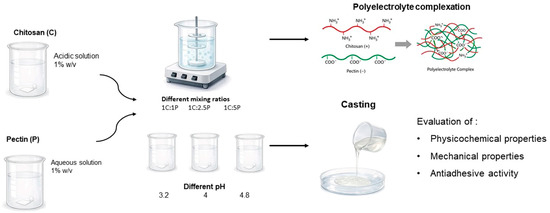
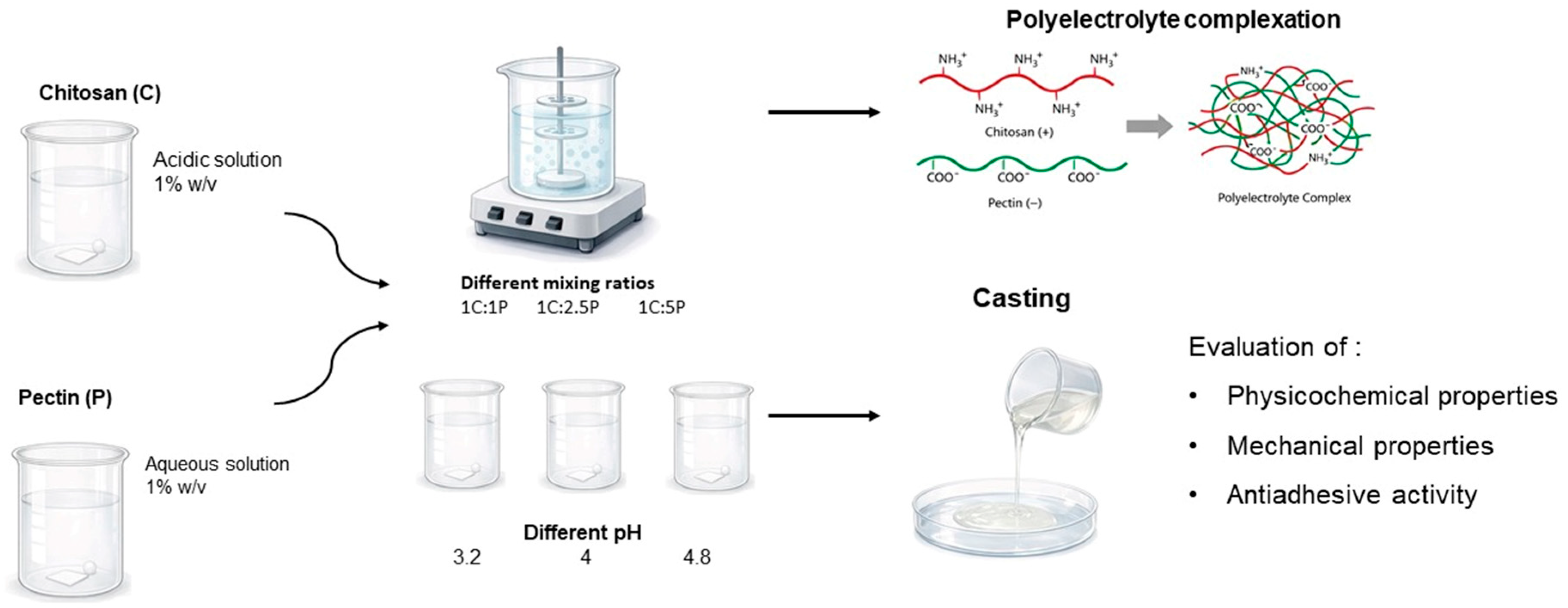
Graphical Abstract

1. Introduction

Currently, the majority of plastics are derived from petrochemical polymers. These non-biodegradable materials are widely used in the packaging industry and represent a major environmental threat to terrestrial and marine ecosystems. The need for sustainable and environmentally friendly food packaging is growing, driven by increasing consumer demand for sustainable products and rising awareness of environmental problems. Within a vision of a circular economy where reuse and recycling are essential, biodegradable polymers derived from renewable resources and agro-industrial waste represent a sustainable alternative for the next-generation packaging materials [1,2]. Polysaccharides are the most abundant biopolymers in nature. They are biodegradable, non-toxic, with minimal environmental impact [3], and are particularly suitable for sustainable food packaging and coating applications due to their diverse chemical composition, reactive groups, and functional versatility [4,5]. They can be obtained from renewable resources such as plants, animals, algae, or microbial sources [6]. Among them, chitosan is an excellent candidate. This cationic polysaccharide, composed of D-glucosamine and N-acetyl-D-glucosamine units, is obtained through partial alkaline deacetylation of chitin, the second most abundant polysaccharide in nature, making it accessible and renewable [7]. It is biocompatible, edible, and has inherent antimicrobial, low permeability to oxygen and carbon dioxide, as well as good film-forming properties, further encouraging its use in the food packaging industry [8,9], despite some functional and physical limitations, such as its high vapor permeability and weak mechanical properties that need to be improved [10].
Pectin is a major structural component of plant cells, thus a very abundant and renewable biopolymer at a relatively low cost. It is an anionic heteropolysaccharide composed of β-(1→4)-linked D-galacturonic acid units often substituted with galactose and rhamnose. The carboxyl groups of galacturonic acids can be partially esterified by a methyl group. This makes it possible to classify pectins as either highly methoxylated (>50% esterification) or weakly methoxylated (<50% esterification). The carboxyl groups are variably esterified depending on the source of the pectin and the extraction method. Due to its versatility, pectin is commonly used in the food industry as edible films or coatings as well as a thickening, gelling, or emulsifier agent [6]. Despite its many advantages, pectin, similarly to other polysaccharides, exhibits poor mechanical and thermal stability as well as moderate barrier properties when used alone [11]. This emphasizes the functional limitations of the biopolymer-based films derived from single polysaccharides compared to their synthetic counterparts [12]. Consequently, several strategies have been explored to overcome these drawbacks, such as the incorporation of plasticizers [13], nanoparticles [14], essential oils [15], or bioactive compounds such as plant extracts [16]. However, many of these approaches impact both the complexity and the cost of the material and may allow the migration of compounds into food products [17,18,19]. In this context, blending biopolymers with complementary properties is one of the simplest and most effective approaches to obtain materials with improved functional properties [8]. A number of studies were conducted on the possible combination of chitosan and pectin through hydrogen bonds and electrostatic interactions between the protonated amino groups of chitosan and the carboxyl groups of pectin, likely to form a denser and more compact matrix [20,21]. However, the combined influence of chitosan–pectin ratio and pH-dependent charge balance on complex formation and the resulting anti-adhesive potency toward food-related bacteria remains poorly understood.
We hypothesized that controlling polymer ratio and pH would modulate electrostatic complexation, thereby tailoring film microstructure, physicochemical properties, and surface free energy, ultimately influencing bacterial adhesion behavior. Therefore, this study aimed to develop chitosan–pectin polyelectrolyte complex films at different ratios and pH values and evaluate their structural, physicochemical, mechanical, and anti-adhesive properties, both experimentally and theoretically, for potential application in sustainable food packaging.

2. Materials and Methods

2.1. Materials

Commercialized pectin from citrus peel P9135 (Mw = 23–71 kDa) and chitosan 448869 (Mw= 50–190 kDa; DDA = 84%) were purchased from Sigma Aldrich (Sigma–Aldrich, St. Louis, MI, USA).
The bacterial test cultures included four strains: two Gram-negative (Escherichia coli K-12 MG1655 and Pseudomonas aeruginosa ATCC53) and two Gram-positive (Staphylococcus aureus ATCC29213 and Enterococcus hirae CIP5855).
The culture media were Luria–Bertani broth (Labkem, Barcelona, Spain) and Muller-Hinton Agar (Biokar diagnostics, Beauvais, France); the chemicals were methanol (Sigma–Aldrich, St. Louis, MI, USA), acetic acid (VWR, Fontenay-sous-Bois, France), glycerol (Solvachim, Casablanca, Morocco), ethanol (VWR, Fontenay-sous-Bois, France), hydrochloric acid (Sigma–Aldrich, St. Louis, MI, USA), sodium hydroxide (Loba Chemie Maharashtra, India), potassium nitrate, (Oxford Lab Fine Chem LLP, Maharashtra, India), formamide and diiodomethane (Sigma–Aldrich, Darmstadt, Germany).

2.2. Degree of Pectin Esterification

The degree of pectin esterification (DE) was determined by the titration method described by Bochek et al., 2001 [22]. Briefly, 200 mg of commercial pectin was first humidified with a few drops of 95% ethanol and then dissolved in 20 mL preheated distilled water (40 °C) under magnetic stirring for 2 h. The solution was then titrated with NaOH (0.1 M) in the presence of phenolphthalein, and the volume corresponding to the first appearance of a pale pink color was recorded as the initial titration volume (Ti). This initial titration neutralizes the free carboxylic groups of galacturonic acids. Afterward, 10 mL of NaOH (0.1 M) was added to saponify the esterified carboxylic groups of pectin. The solution was stirred for 2 h at room temperature and later heated to complete the saponification. After cooling, 10 mL of hydrochloric acid (0.1 M) was added to neutralize the excess base. Ultimately, the excess acid was titrated with NaOH to obtain the final volume of titration (Tf). The degree of pectin esterification was determined using Equation (1):
DE % = 100 × Tf Ti + Tf

2.3. Preparation of Chitosan-Pectin Polyelectrolyte Complexes (PEC)

According to Maciel et al. 2015 [23], chitosan (C) and pectin (P) solutions (1% w/v) were prepared in acidified and neutral deionized water, respectively, under magnetic stirring. The pH of the resulting solutions was adjusted to 3.2, 4.0, and 4.8 using glacial acetic acid and NaOH (1 M). Based on the degree of deacetylation and degree of esterification of chitosan and pectin, respectively, different volume ratios were utilized (v/v): C, P, 1C:1P, 1C:2.5P, and 1C:5P. Glycerol was added as a plasticizer at 30% w/w of the total polymer content. The films were prepared by the casting method, dried overnight in an oven at 40 °C, and then subjected to microscopic visualization to verify the homogeneity and the interaction between the two biopolymers. Prior to physicochemical, mechanical, and biological analyses, the films were equilibrated at 60 ± 5% relative humidity and 25 ± 3 °C for 2 days to simulate Mediterranean industrial storage conditions.

2.4. Charge Analysis

Zeta potential, as a key indicator of electrostatic stability of the blends at the different pH values and ratios, was measured by dynamic light scattering using a ZetaSizer Nano series (Nano-ZS, Malvern, Sweden), at 25 °C.

2.5. Thickness and Opacity

Film thickness was measured at 3 different points using a digital micrometer (iGaging 0–1”, San Clemente, CA, USA), and the opacity was calculated based on the thickness (mm) and the absorbance at 600 nm as follows (Equation (2)) [24]:
Opacity = Ab s 600 thickness

2.6. Moisture Content (MC), Swelling Degree (SD), and Water Solubility (WS)

Following the work of Mouhoub et al., 2025 [24], 1 cm2 film samples were weighed before (W1) and after (W2) drying at 50 °C for 24 h, and the moisture content was determined using Equation (3):
MC   % = 100 × W 1 W 2 W 1
The dried samples were then immersed in distilled water overnight, gently surface dried, and reweighed (W3) to determine the swelling degree (Equation (4)):
SD   % = 100   ×   W 3 W 2 W 2  
Finally, the films were dried again at 50 °C for 24 h to obtain the final dry mass (W4). Water solubility was calculated as shown in Equation (5):
WS   % = 100   ×   W 2 W 4 W 2  
All measurements were performed in triplicate.

2.7. Water Vapor Transmission Rate (WVTR)

To measure the water vapor transmission rate (WVTR), cups containing equal amounts of CaCl2 were tightly sealed with the film samples and placed in a desiccator. Distilled water was used inside the desiccator to maintain a controlled environment at 90% relative humidity and 25 °C [24]. The cups were weighed regularly, and the WVTR (g/h.m2) was calculated as follows (Equation (6)):
WVTR = Δ m / Δ t S
where Δm is the weight difference, Δt is the time interval, and S is the surface of the film.

2.8. Mechanical Properties of Chitosan-Pectin Films

Tensile strength (TS) and elongation at break (EAB) were measured using an INSTRON 3369 electrohydraulic instrument (Norwood, MA, USA). film strips of 20 × 50 mm were mounted on the grips of the device at 2 mm/min speed. All measurements were performed in triplicate, and the data were processed using the Bluehill program (Bluehill 3) [24].

2.9. Theoretical Adhesion of Bacteria

2.9.1. Preparation of the Bacterial Mixture

The four studied bacterial strains were cultivated independently in 200 mL flasks containing Luria–Bertani broth and incubated at 37 °C for 24 h with agitation in a shaker incubator. The resulting cultures underwent three successive centrifugation cycles at 5000 rpm for 10 min to form bacterial cell pellets. These initial pellets were rinsed twice with sterile 0.1 M potassium nitrate (KNO3) solution. Afterward, the supernatant was removed, and the pellets were resuspended in the same sterile KNO3 solution. The suspensions were homogenized equally using a vortex mixer and adjusted with sterile KNO3 solution to achieve an optical density (OD600) of 0.4 at 600 nm. To create a uniform, adequately thin bacterial layer, the adjusted bacterial mixture suspension was vacuum-filtered through cellulose acetate membranes with a pore size of 0.2 µm. The resulting membranes were allowed to air-dry for 30 min at room temperature before conducting contact angle measurements, following the protocol outlined by El Abed et al. (2011) [25].

2.9.2. Contact Angle Measurement of Composite Material and Bacterial Mixture

The sessile drop technique was utilized to evaluate the wettability of the composite material that exhibited the best performance, the commercial plastic food wrap (control), and the bacterial lawns, providing quantitative measurements of the contact angle (θ). The latter formed at the interface where liquid, gas, and solid phases meet [26]. The assessment involved three probe liquids: water and formamide (polar) and diiodomethane (apolar). A 2 µL droplet of each liquid was deposited on the sample surfaces, and the contact angle was measured after 15 s to ensure stabilization. All measurements were conducted in three replicates at 25 °C, and the average values were recorded. The physicochemical characteristics of the probe liquids are detailed in Table 1.
The surface free energy components for both the composite material and bacterial mixture, specifically the Lifshitz–van der Waals (γLW), Lewis acid (γ+), and Lewis base (γ) components, were determined using the Young–Dupré equation as described by Bertola and Wang (2015) [28].

2.9.3. Surface Free Energy and Components

Surface hydrophobicity was evaluated using contact angle measurements, which also enabled the determination of surface free energy components utilizing the Van Oss and Giese (1995) method [29]. This procedure was conducted in accordance with Young–Dupré’s equation: (Equation (7))
γ SV = γ SL + γ LV   cos θ
In this context, γSV, γSL, and γLV signify the interfacial energies at the boundaries of solid–vapor, solid–liquid, and liquid–vapor, respectively, while θ represents the contact angle. The Lifshitz–van der Waals components (γLW) and the Lewis acid–base components (γ+, γ) were evaluated using: (Equation (8))
Δ Giwi = - 2 [ 2 ( ( γ i - γ i + ) 1 2 + ( γ w - γ w + ) 1 2 - ( γ w - γ i + ) 1 2 - ( γ i - γ w + ) 1 2 ) + ( ( γ i LW ) 1 2 - ( γ w LW ) 1 2 ) 2 ]
The Lewis acid–base term was expressed as: (Equation (9))
γ S AB = 2 γ S - γ S + 1 / 2
The values of γLW, γ+, and γ were determined by employing the Young–Dupré equation (Equation (10)) for each liquid–solid combination, Van Oss and Giese (1995) [30]:
γ L Cos θ + 1 = 2 γ S LW γ L LW 1 2 + 2 γ S - γ L + 1 2 + 2 γ L - γ S + 1 2  
Subscripts (S) and (L) denote the solid and liquid phases, respectively.

2.9.4. Total Free Energy of Interaction

According to Van Oss and Giese (1995) [30], the total free energy of interaction between the microbial cell (M) and the substrate (S) through water (W) is determined as the sum of the LW and AB interactions [29]. (Equation (11))
Δ G MSL Total = Δ G MSL AB + Δ G MSL LW
where
Δ G MSL LW =   ( ( γ M LW ) 1 / 2 ( γ S LW ) 1 / 2 ) 2 - ( ( γ M LW ) 1 / 2 - ( γ L LW ) 1 / 2 ) 2 - ( ( γ S LW ) 1 / 2 - ( γ L LW ) 1 / 2 ) 2
and
Δ G MSL AB = 2 [ ( γ L + ) 1 / 2 ( ( γ S - ) 1 / 2 + ( γ M - ) 1 / 2 - ( γ L - ) 1 / 2 ) + ( γ L - ) 1 / 2 ( ( γ S + ) 1 / 2 + ( γ M + ) 1 / 2 - ( γ L + ) 1 / 2 ) - ( γ L + γ S - ) 1 / 2 - ( γ L - γ S + ) 1 / 2 ]
A negative ΔGTotal indicates a propensity for adhesion, whereas a positive value suggests repulsion [29].

2.10. Experimental Adhesion

To validate the theoretical prediction of the cells’ adhesion on the composite material and on the commercial plastic food wrap, the experimental adhesion test was conducted following Mouhoub et al. (2025) [24]. Concisely, the samples were immersed for 24 h in the bacterial suspension previously utilized to form the lawn. Next, the films were gently handled with sterile tweezers, briefly immersed in sterile distilled water to remove loosely suspended and non-adherent cells, and gently blotted with sterile filter paper before SEM visualization. Ultimately, the Adobe Photoshop program Version 13.0 x32 was used to calculate the percentage of cell attachment to the material.

2.11. Statistical Analysis

Statistical analyses were carried out using one-way ANOVA with Tukey’s post hoc test (SPSS v 25.0) and a significance level of 0.05. Data are reported as mean values ± standard deviation.

3. Results

3.1. Degree of Esterification of Pectin

The degree of esterification (DE) of pectin is an important parameter that influences its physicochemical behavior. The alkalimetric titration revealed that the commercial pectin used in this study was a high-methoxyl pectin with a DE of 68%. This result confirms that pectin is suitable for use in acidic conditions and in the formation of polyelectrolyte complexes (PECs).

3.2. Zeta Potential Analysis

The zeta potential values of the different chitosan-pectin formulations, obtained under various ratios and pH conditions, are shown in Table 2. Pure chitosan showed a positive zeta potential due to its protonated amino groups, while pectin exhibited negative values associated with its carboxylate groups. When mixed in aqueous solutions, these oppositely charged polysaccharides associate via electrostatic interactions, creating polyelectrolyte complexes [31].
The PEC with a 1C:2.5P ratio exhibited a Zeta potential near neutrality (−1.04 ± 0.66 mV) at pH 3.2.

3.3. Optical Microscopic Visualization

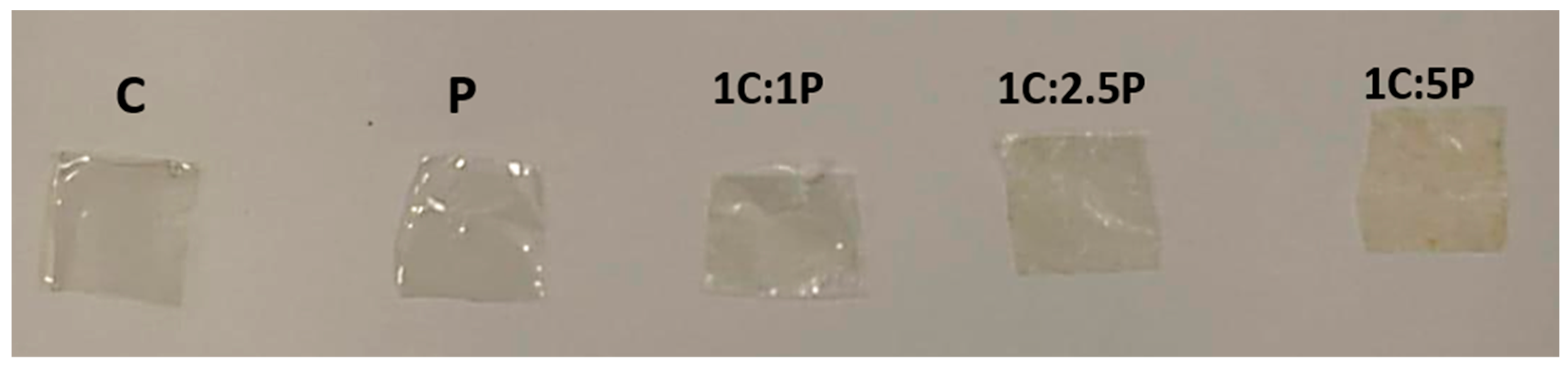
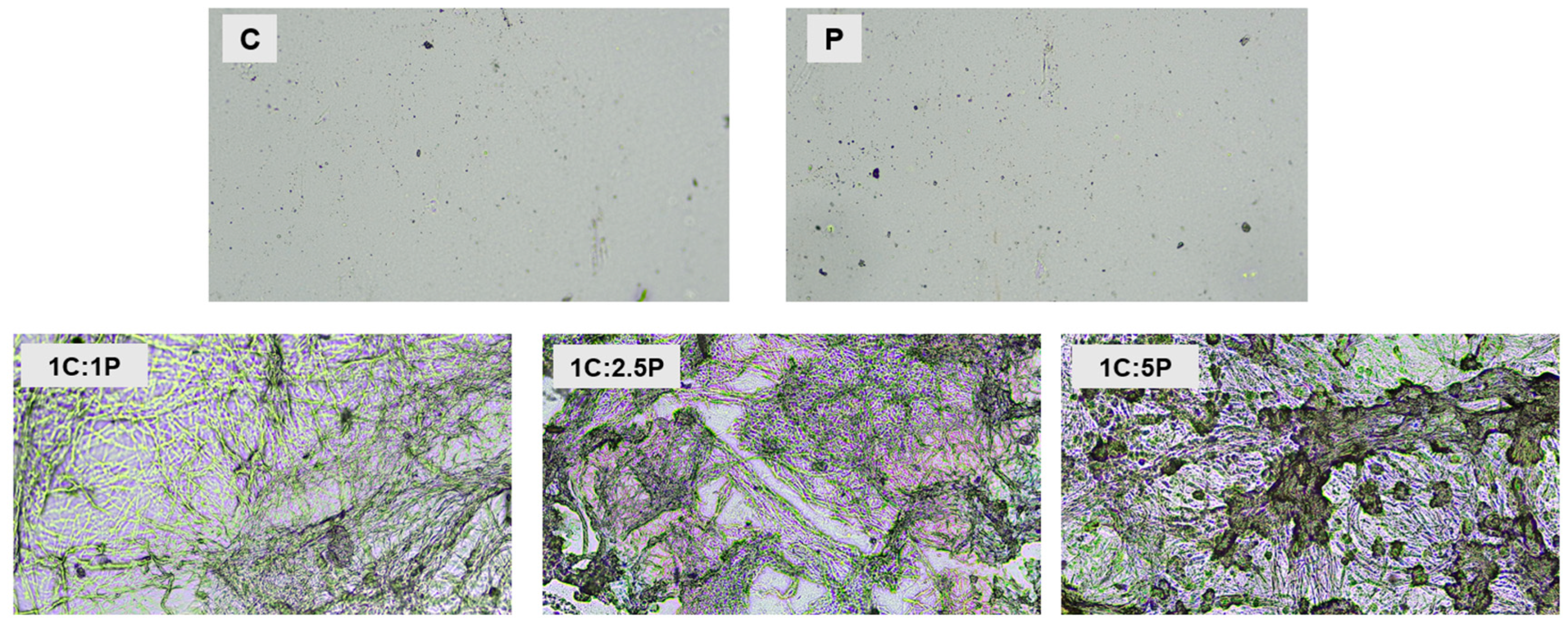
The visual appearance of the developed films is presented in Figure 1. Based on the Zeta potential analysis, the microscopic visualization was carried out on films prepared at pH 3.2 to analyze homogeneity, structure, and interactions between the two polysaccharides at the microscale. The single-polymer films showed a clean surface and homogeneous structure. On the other hand, a fiber-like structure was noticed in the case of the blended polymer films. By increasing the concentration of pectin, denser microdomains were formed, highlighting the dominance of this polymer (Figure 2).

3.4. Film Thickness and Opacity

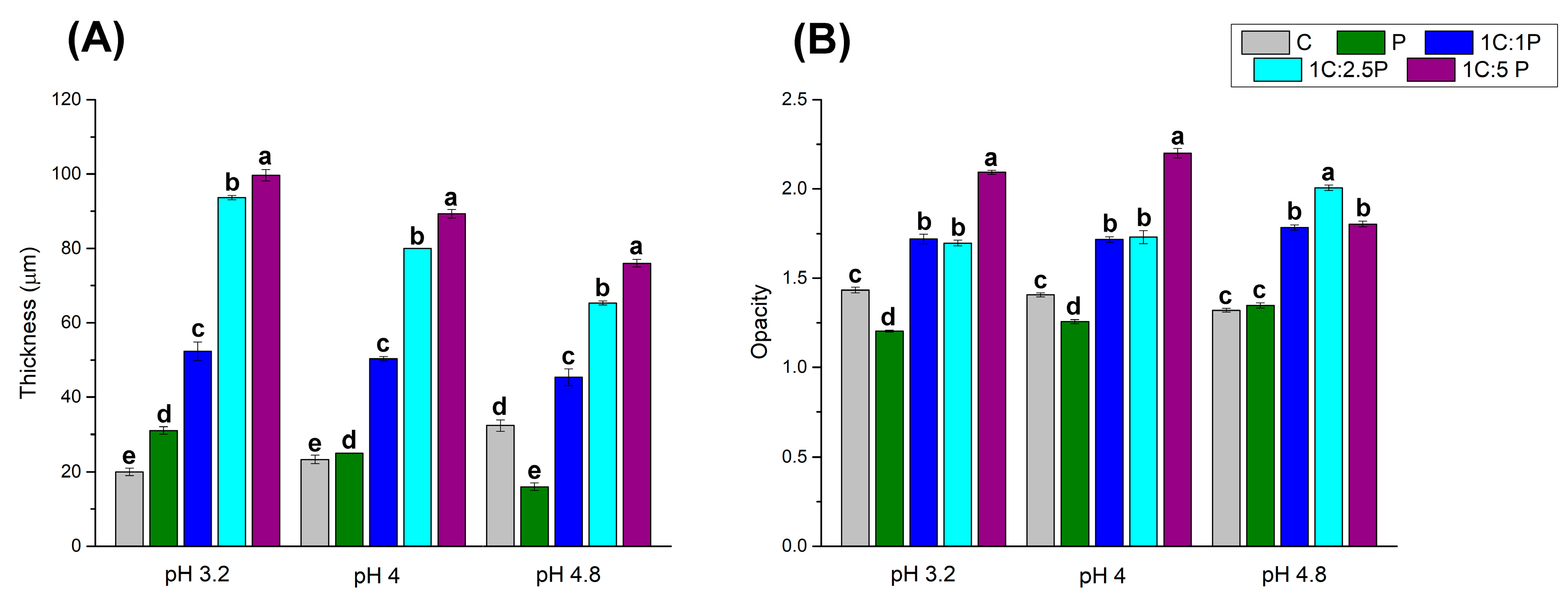
The film thickness and opacity as a function of polymer ratios and pH are shown in Figure 3A,B. PEC-based films, particularly the 1C:2.5P and 1C:5P formulations under acidic conditions (pH 3.2), were 3 to 5 times thicker (50 µm to 100 µm) than the single-polymer films (20 µm to 30 µm). Overall thickness decreased with increasing pH (4 to 4.8), but PEC films with higher ratios of pectin remained thicker, over 80 µm. Similarly, the pectin-rich PEC films had significantly higher opacity values than the single-polymer films, with a maximum opacity of 2.2 observed for 1C:5P at pH 4.

3.5. Film Moisture Content (MC), Swelling Degree (SD), and Water Solubility (WS)

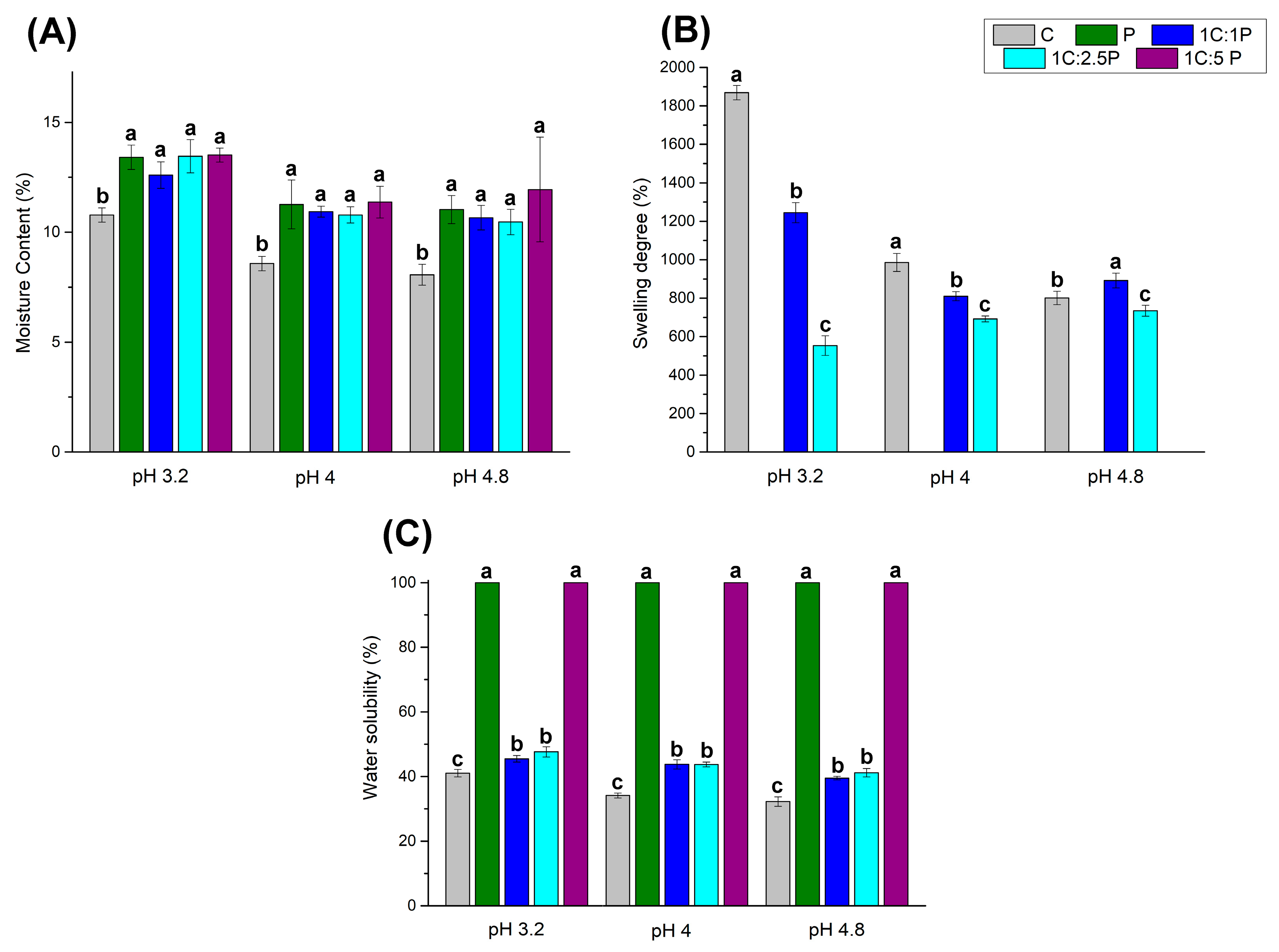
The results are shown in Figure 4A–C. The MC results (Figure 4A) showed slightly lower water content for pure chitosan films compared to pectin and chitosan-pectin composites (p < 0.05). The SD results (Figure 4B) showed that pure chitosan films exhibited the highest swelling degrees, exceeding 1800% at pH 3.2. In contrast, composite films showed reduced swelling, with the 1C:2.5P formulation displaying the lowest swelling degree at all tested pH levels (<700%). The pectin-based and the 1C:5P blend underwent complete solubilization, and their SD values could not be obtained.
The WS results (Figure 4C) indicated that pH had no significant effect on the film’s solubility. The pectin-based film and the 1C:5P composite exhibited complete solubility (100%), while 1C:1P and 1C:2.5P showed intermediate values (45–50%), higher than those of pure chitosan films (less than 40%) (p < 0.05).

3.6. Water Vapor Permeability

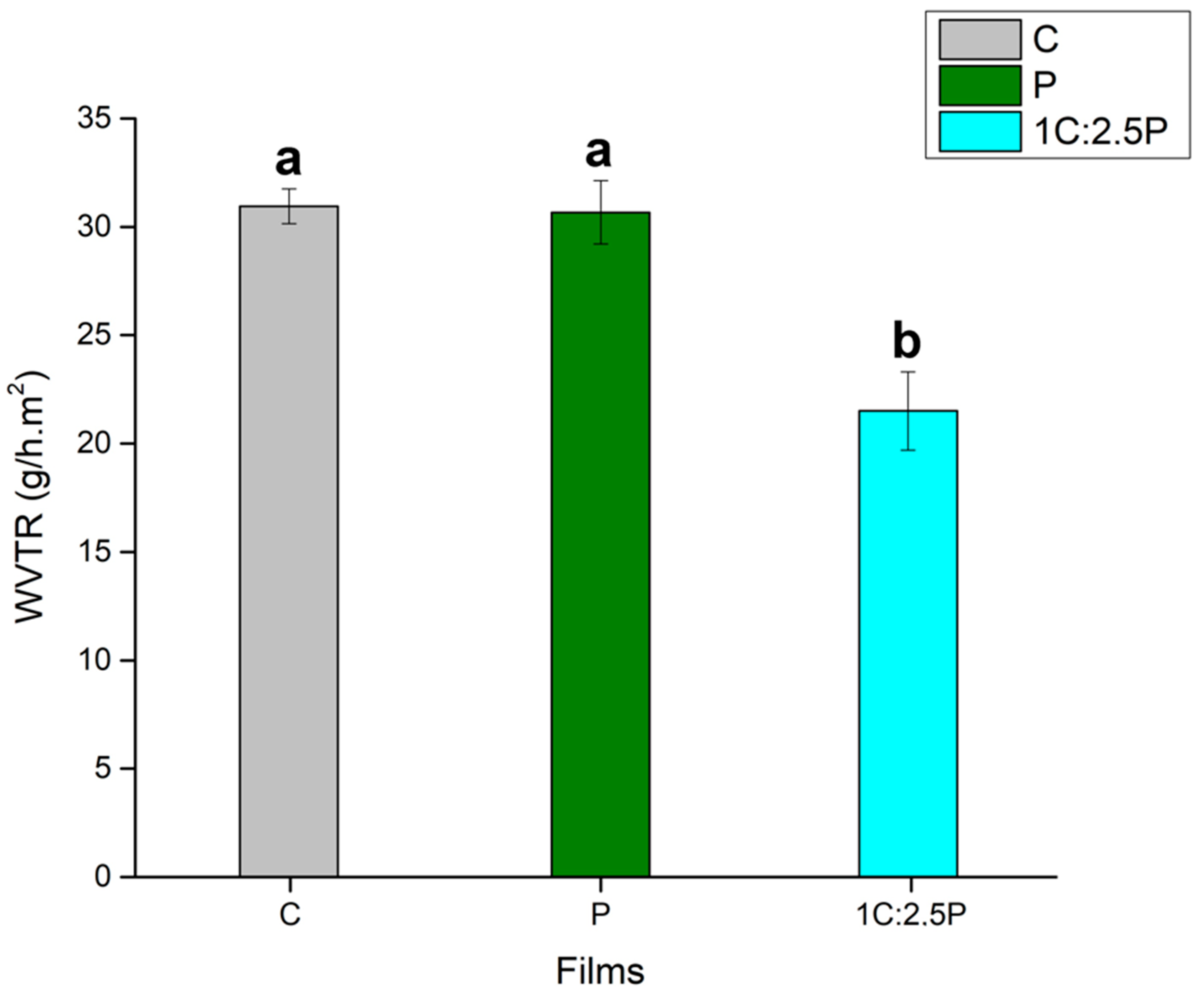
The water vapor transmission rate (WVTR) is a critical parameter for evaluating the barrier properties of packaging materials and is highly dependent on the film formulation, thickness, and structural organization. Based on the previous tests, the PEC (1C:2.5P) at pH 3.2 was selected as the most suitable formulation. The results (Figure 5) showed similar values for pure chitosan and pure pectin films (31 g/h.m2) (p < 0.05). However, the 1C:2.5P composite film showed improved water vapor barrier properties (20 g/h.m2), compared to that of pure polymer films. This decrease in WVTR is correlated, at least in part, with the higher thickness of the composite film observed in Figure 3, which was markedly greater than that of the individual pectin and chitosan films.

3.7. Films’ Mechanical Properties

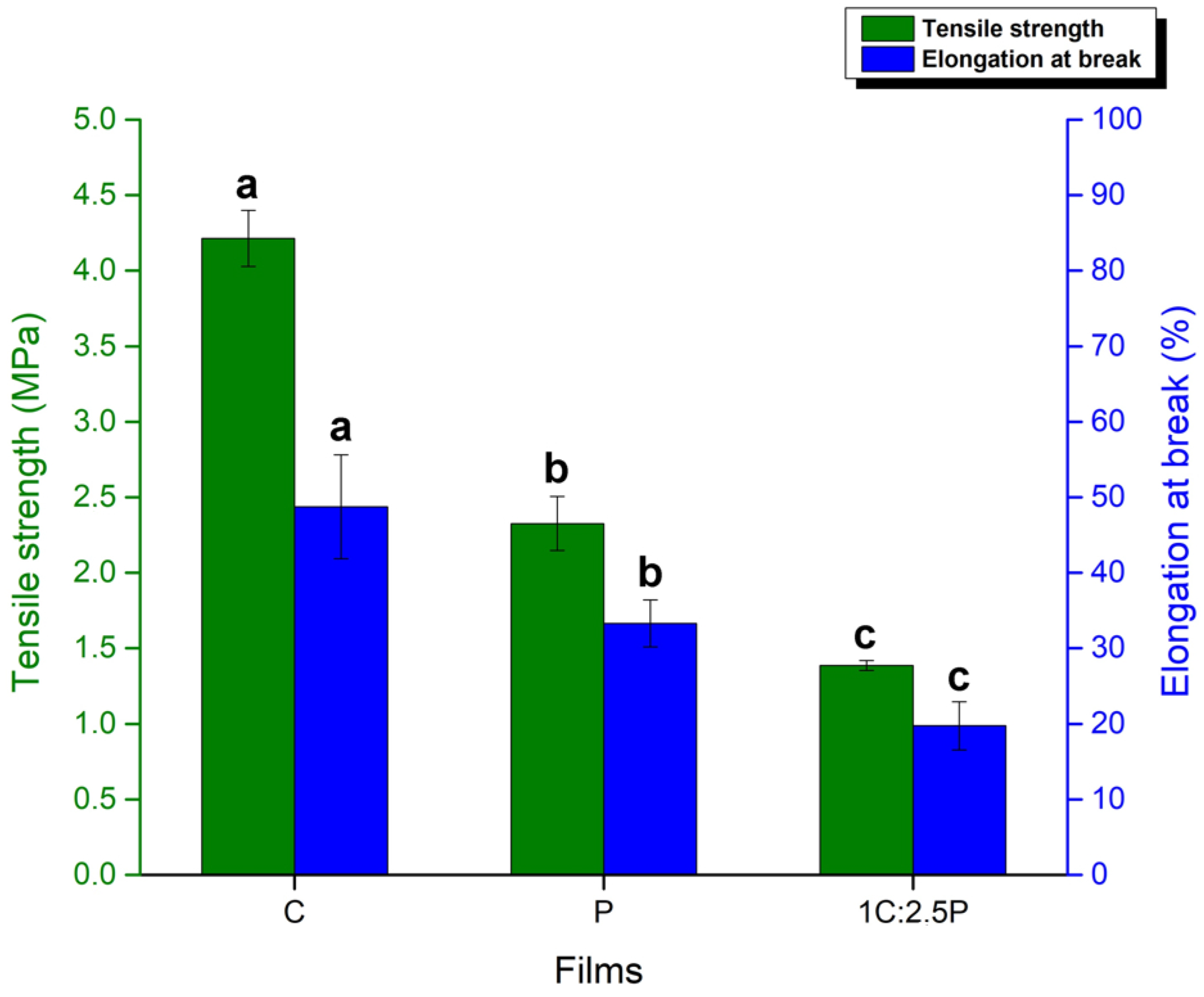
The tensile strength (TS) and elongation at break (EAB)of the films are presented in Figure 6. The chitosan-based film showed the highest mechanical properties (TS of ~4.2 MPa and EAB of ~50%), followed by the pectin-based film (TS of ~2.3 MPa and EAB of ~33%). However, the combination of both polymers significantly reduced the mechanical performance (TS of ~1.3 MPa and EAB of ~20% (p < 0.05).

3.8. Contact Angle and Physicochemical Properties

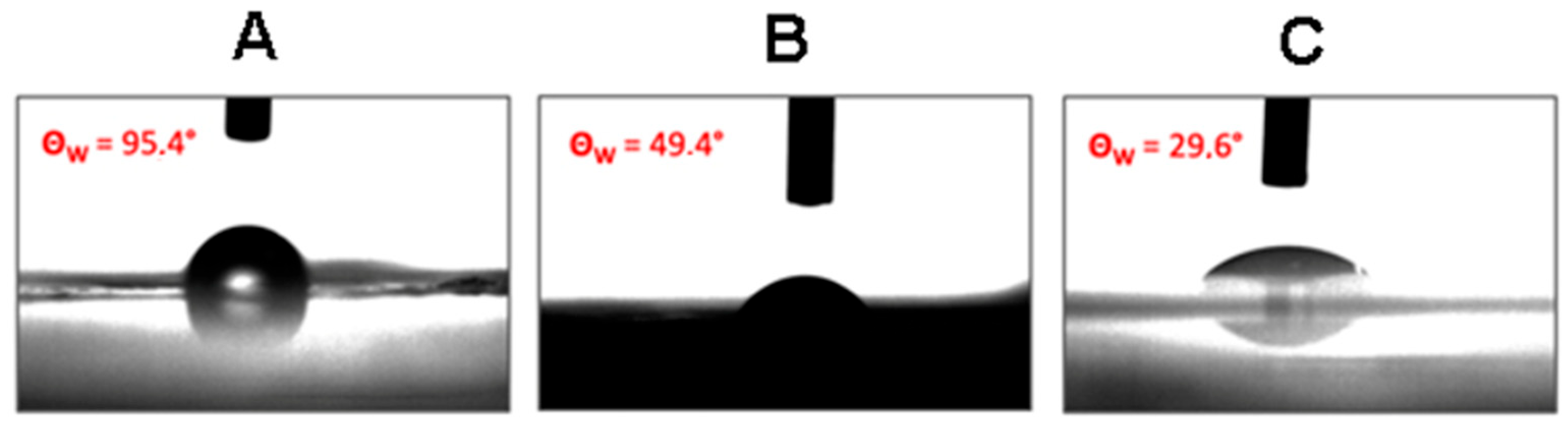
The physicochemical properties of the utilized materials and the bacterial lawn are summarized in Table 3. According to data, both bacteria and the elaborated composite presented a hydrophilic behavior with θw values lower than 90° (Figure 7) and a positive ΔGiwi, while the commercialized material is hydrophobic w = 95.43° and ΔGiwi = −42.83 mJ/m2). Furthermore, only the plastic food wrap is an electron acceptor (γ+ > γ) with a lower Lewis acid–base component.

3.9. Theoretical and Experimental Adhesion

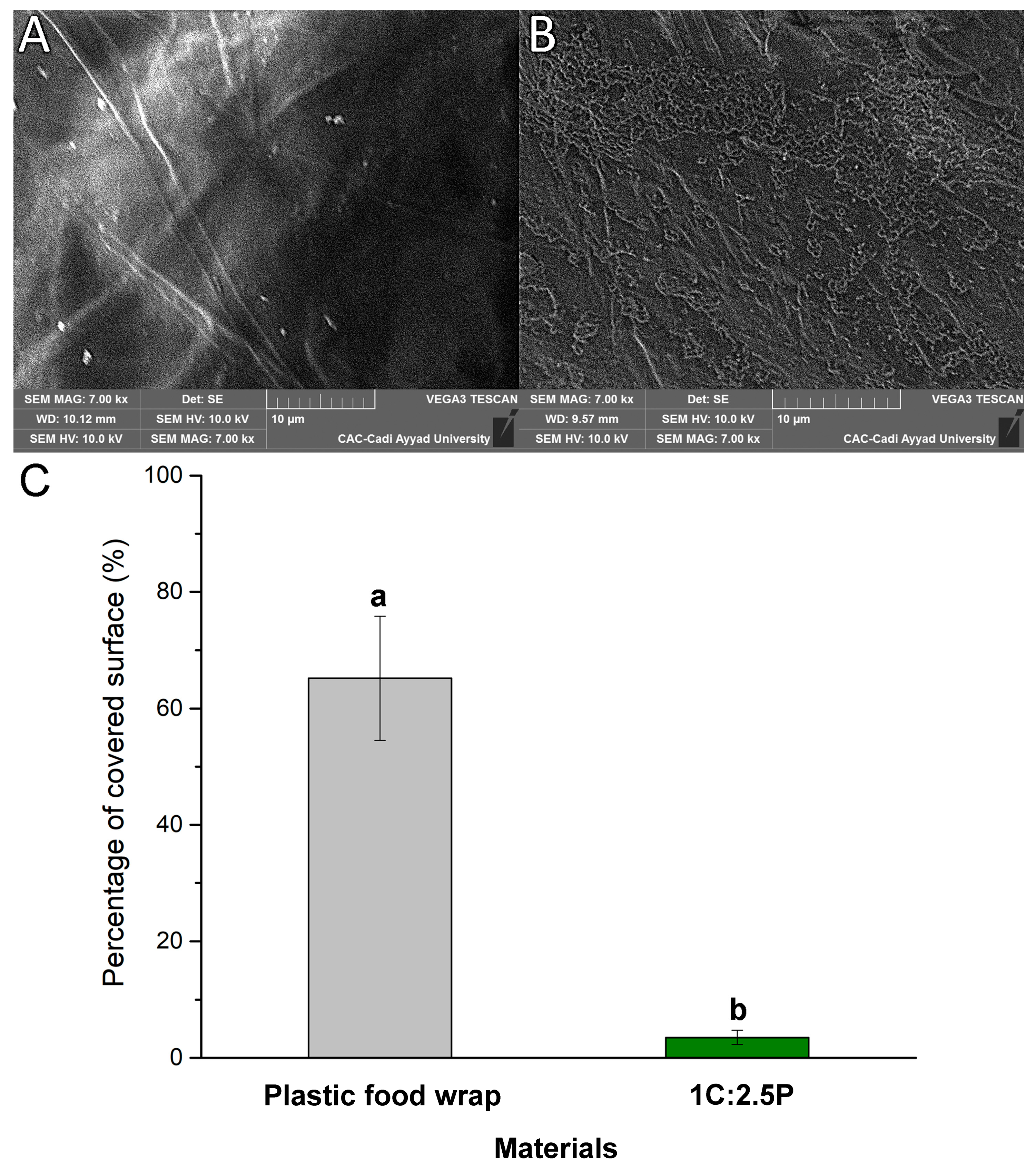
Table 4 presents the components that allow the prediction of the bacterial cell adhesion on the commercial plastic food wrap and 1C:2.5P. The electrical interactions ΔGEL were not involved due to the utilization of the KNO3 solution. Based on our results, the attachment of the bacterial cell is favored with regard to commercialized plastic food wrap (negative ΔGTotal) and conversely for the elaborated composite (positive ΔGTotal). These results were confirmed by experimental observations obtained by SEM micrographs (Figure 8), where the cell adhesion was considerably mitigated in the case of 1C:2.5P (the percentage of covered surface decreased from about 65% to less than 5%).

4. Discussion

To better understand the influence of pH and pectin-chitosan ratio on the general performance of the composite, a series of physical, mechanical, and physicochemical features was evaluated.
Several factors influence the electrostatic interactions governing the formation of biopolymer films, including the nature of the raw materials and their mixing ratio, pH, and ionic strength [32]. High zeta potential values of the particles, whether positive or negative, are indicative of electrostatic repulsion and thus suspension stability. However, as this potential approaches zero, charges are neutralized through electrostatic interaction between the oppositely charged polymers, resulting in the formation of heterogeneous morphologies with fibrous or aggregated domains, as observed in Figure 2. During film preparation, electrostatic interactions are the primary force occurring between the oppositely charged polymers. Van der Waals forces and hydrogen bonds further enhance the stability of the ionic bonds formed between the functional groups of the PECs, while the hydrophobic interactions minimize contact with water [33]. Our results are in agreement with the work of Boughanmi et al. (2024) [34], Méndez et al. (2020) [35], and Ofori-Kwakye and Fell (2003) [36], where the mixing of pectin and chitosan gels resulted in the formation of heterogeneous films. Depending on their aggregation state, PECs can be divided into three categories: clear soluble systems; turbid colloids, or phase-separated mixtures with a solid PEC fraction [37]. This structural diversity also influences the optical behavior of the resulting films, particularly their ability to block light. This is a key requirement in sustainable food packaging, as photooxidation, caused by continuous exposure to natural or artificial light throughout the supply chain, especially UV light, is one of the major causes of food deterioration and nutritional loss [38]. In the present work, the combination of chitosan and pectin significantly increased film thickness and opacity in comparison with individual biopolymer films. These features are generally associated with reduced light transmittance and therefore may contribute to enhanced UV-shielding behavior, as demonstrated in previous studies [39,40]. In this context, Machado et al. (2020) reported that increased thickness in chitosan-pectin films improved their UV-blocking capacity [7], while Li et al. (2019) noticed that polyelectrolyte complexation between alginate and chitosan reduced UV transmittance [41]. Although UV–Vis transmission was not directly measured in the present work, the observed increase in thickness and opacity suggests a potential enhancement in light-screening properties.
Additionally, the water resistance of packaging materials is an important parameter for the shelf life of food. Chitosan and pectin are highly hydrophilic polysaccharides due to the presence of numerous hydroxyl, amino, and carboxyl groups that can interact with water molecules [42]. This strong affinity for water is reflected in their relatively high MC, the high SD of chitosan, and the complete solubilization of pectin and pectin-rich films (1C:5P). However, the blending of the two biopolymers significantly decreased the SD and WS (except for the 1C:5P film). In the same context, the WVTR of the chosen PEC film (1C:2.5P) was significantly lower than that of the single-polymer ones. This reduction can be attributed to both increased film thickness and the formation of intermolecular interactions, mainly hydrogen bonds and electrostatic attractions, between the oppositely charged groups of chitosan and pectin. The latter may engender less water binding to the complex, thereby reducing the swelling capacity of the film and limiting water penetration [43]. In addition to good barrier properties, a reliable packaging film must exhibit good mechanical properties, which can be evaluated by parameters such as tensile strength (TS) and elongation at break (EAB). These two parameters correspond respectively to the maximum stress the film can endure before breaking and to the extent of deformation the material can support until it tears [44]. The results here showed a decrease in both TS and EAB for the PEC film compared to the single polymer films. Previous studies reported EAB values of 23.02% and 20% for chitosan-pectin blend films, respectively, which are comparable to the value obtained in this work (~20%). However, the corresponding TS values (7.43 MPa and 20 MPa, respectively) were significantly higher than those obtained in the present study (~1.3 MPa) [20,45]. Nevertheless, such mechanical performance may remain suitable for low-stress food packaging uses, including fresh produce wraps and coating layers. Higher TS values reported in the literature are generally associated with the incorporation of nanoparticles [14,46] or crosslinking agents [47,48], which enhance intermolecular interactions and structural integrity. These differences may be attributed to differences in polymer molecular weights, blending ratios, and preparation conditions, as well as to the film’s aggregated and fibrous structure, as shown by optical microscopic analysis. The partial phase separation and heterogeneous dispersion can create weak zones within the matrix under tension [45].
Along with physical and moisture-induced damages, microbial contamination via biofilm formation on biotic or abiotic surfaces is a major issue in the food industry. Therefore, preventing microbial adhesion is the first step in biofilm development [49]. This initial adhesion is influenced by the bacterial characteristics (cell composition and density, motility…) as well as surface properties of the materials (composition, surface charge density, wettability, and topography, etc.) [50]. The contact angle test was performed to define the wettability of surfaces and to better understand the interaction between the material and bacterial cells. The antiadhesive activity of the 1C:2.5 PEC film and commercial plastic food wrap was evaluated theoretically and by SEM observations. The ΔGTotal parameter that combines both Lifshitz–van der Waals and acid-base interactions revealed that the PEC film is theoretically unfavorable for bacterial cell adhesion. At the same time, conventional plastic food wrap shows thermodynamically favorable conditions for adhesion. This was confirmed by the SEM micrographs (Figure 8). Additionally, the PEC film exhibited hydrophilic behavior, manifested by its low contact angle and positive ΔGiwi values. This suggests that bacteria tend to attach more to hydrophobic surfaces. These findings are consistent with the work described by Machado et al. (2020) [7], who developed pectin/chitosan/glycerol composite films and demonstrated that their hydrophilic nature contributed to their anti-adhesive behavior and reduced bacterial colonization. Our results are also in agreement with several studies [51,52,53], which reported that hydrophilic substrates had lower adhesion rates than hydrophobic ones. However, it is important to note that bacterial adhesion does not always follow a single pattern, and some bacterial strains do not adhere to hydrophobic surfaces [54,55]. Moreover, numerous parameters may affect microbial adhesion, including incubation period [56], material surface roughness [57], medium pH [58], and bacterial adhesins synthesis [59].
Overall, chitosan-pectin films represent a promising alternative to conventional petroleum-based packaging, since both polymers are derived from renewable resources, including crustacean waste and citrus by-products, thereby contributing to a circular economy approach. Despite lower mechanical performance compared to synthetic plastics, their biodegradability and reduced environmental impact make them attractive candidates for the development of sustainable materials.

5. Conclusions

This work demonstrates the potential of chitosan–pectin PEC films as sustainable and functional materials for eco-friendly food packaging applications. By varying pH conditions and chitosan–pectin ratios, the compatibility of both biopolymers and the resulting film properties were systematically evaluated. Among the tested formulations, the 1C:2.5P film at pH 3.2 exhibited the most promising overall performance, combining reduced water solubility, moderate swelling behavior, improved resistance to water vapor transmission, suitable opacity, and significant anti-adhesive activity against bacterial attachment. These findings highlight the ability of polyelectrolyte complexation to enhance key functional properties compared with single-biopolymer films, thereby addressing some intrinsic limitations of chitosan and pectin when used individually. Nevertheless, further optimization is needed to improve mechanical performance and broaden functional bioactivity without affecting the cost of the developed material, particularly through the variation in polymers Mw, DDA, and DE. Overall, chitosan–pectin PEC films represent a promising biodegradable platform for the development of next-generation sustainable packaging materials with reduced environmental impact.

Author Contributions

Conceptualization, D.Q., A.M., A.A., A.D., A.G., Z.E.A.-T., S.I.K., and C.E.M.; supervision, A.A., A.G., and C.E.M.; validation, D.Q., A.M., A.A., A.D., A.G., Z.E.A.-T., S.I.K., and C.E.M.; resources, C.E.M.; methodology, D.Q., A.M., A.A., A.G. and K.S.; formal analysis, D.Q., A.M., A.A., A.G. and C.E.M.; data curation, D.Q., A.M., A.A. and A.G.; software, D.Q. and A.M.; writing, D.Q. and A.M.; and writing—review, D.Q., A.M., A.A., A.D. and A.G.; All authors have read and agreed to the published version of the manuscript.

Funding

This research was carried out within the framework of the “PLAnt-based antiMIcrobial aNd circular PACKaging for plant products” (PLAMINPACK) project, which is part of the Partnership for Research and Innovation in the Mediterranean Area (PRIMA) Programme supported by the European Union. Each partner is funded by its National Funding Agency (NFA). The Moroccan entity was funded by the Ministère de l’Enseignement Supérieur, de la Recherche Scientifique et de l’Innovation (MESRSI) under Grant No. 04/FSTM/2024. The first author, Doha Quebouch, was additionally supported by the National Center for Scientific and Technical Research (CNRST) through the Research Excellence Grants Program and received financial assistance under the PhD-Associate Scholarship (PASS) Program (Scholarship No. 72 UCA2024).

Institutional Review Board Statement

Not applicable.

Informed Consent Statement

Not applicable.

Data Availability Statement

The data presented in this study are available upon request from the corresponding author, as the authors do not have permission to share data.

Conflicts of Interest

The authors declare no conflicts of interest.

Abbreviations

The following abbreviations are used in this manuscript:
PECPolyelectrolyte complex
CChitosan
PPectin
MwMolecular weight
DDADegree of deacetylation
DEDegree of esterification
MCMoisture content
SWSwelling degree
WSWater solubility
WVTRWater vapor transmission rate
TSTensile strength
EAB Elongation at break
SEM Scanning electron microscope

References

  1. Kumar, A.; Kumar, A.; Wei, S.; Chopra, S.; Rudra, S.G.; Rabbani, A. Biodegradable and smart packaging films for food quality and safety: A review. Appl. Food Res. 2025, 5, 101491. [Google Scholar] [CrossRef]
  2. Abdullahi, A.; Korumilli, T.; Rao, K.J. Revolutionizing Food Packaging with Biobased Polymers, Active and Intelligent Materials for Enhanced Food Safety and Sustainability: Review. Food Bioprocess Technol. 2025, 18, 6836–6868. [Google Scholar] [CrossRef]
  3. Younis, H.G.; Zhao, G. Physicochemical properties of the edible films from the blends of high methoxyl apple pectin and chitosan. Int. J. Biol. Macromol. 2019, 131, 1057–1066. [Google Scholar] [CrossRef]
  4. Andreica, B.-I.; Cheng, X.; Marin, L. Quaternary ammonium salts of chitosan. A critical overview on the synthesis and properties generated by quaternization. Eur. Polym. J. 2020, 139, 110016. [Google Scholar] [CrossRef]
  5. Mouhoub, A.; Guendouz, A.; El Alaoui-Talibi, Z.; Koraichi, S.I.; Delattre, C.; El Modafar, C. Utilization of chitosan-based coating enriched with Syzygium aromaticum, Cinnamomum zeylanicum, and Thymus satureioides essential oils mixture for strawberries with extended shelf life. J. Food Meas. Charact. 2024, 18, 3315–3325. [Google Scholar] [CrossRef]
  6. Mellinas, C.; Ramos, M.; Jiménez, A.; Garrigós, M.C. Recent Trends in the Use of Pectin from Agro-Waste Residues as a Natural-Based Biopolymer for Food Packaging Applications. Materials 2020, 13, 673. [Google Scholar] [CrossRef]
  7. Machado, B.R.; Facchi, S.P.; de Oliveira, A.C.; Nunes, C.S.; Souza, P.R.; Vilsinski, B.H.; Popat, K.C.; Kipper, M.J.; Muniz, E.C.; Martins, A.F. Bactericidal Pectin/Chitosan/Glycerol Films for Food Pack Coatings: A Critical Viewpoint. Int. J. Mol. Sci. 2020, 21, 8663. [Google Scholar] [CrossRef] [PubMed]
  8. Bonilla, J.; Fortunati, E.; Atarés, L.; Chiralt, A.; Kenny, J.M. Physical, structural and antimicrobial properties of poly vinyl alcohol–chitosan biodegradable films. Food Hydrocoll. 2014, 35, 463–470. [Google Scholar] [CrossRef]
  9. Andreica, B.-I.; Anisiei, A.; Rosca, I.; Marin, L. Quaternized chitosan-based nanofibers with strong antibacterial and antioxidant activity designed as ecological active food packaging. Food Packag. Shelf Life 2023, 39, 101157. [Google Scholar] [CrossRef]
  10. Mouhoub, A.; Guendouz, A.; El Alaoui-Talibi, Z.; Koraichi, S.I.; El Modafar, C. Optimization of Chitosan-Based Film Performance by the Incorporation of Cinnamomum Zeylanicum Essential Oil. Food Biophys. 2025, 20, 1–19. [Google Scholar] [CrossRef]
  11. Var, I.; Uzunlu, S. A Glance at Food Processing Applications; IntechOpen: London, UK, 2022. [Google Scholar]
  12. Hu, D.; Wang, L. Fabrication of antibacterial blend film from poly (vinyl alcohol) and quaternized chitosan for packaging. Mater. Res. Bull. 2016, 78, 46–52. [Google Scholar] [CrossRef]
  13. Aitboulahsen, M.; El Galiou, O.; Laglaoui, A.; Bakkali, M.; Zerrouk, M.H. Effect of plasticizer type and essential oils on mechanical, physicochemical, and antimicrobial characteristics of gelatin, starch, and pectin-based films. J. Food Process. Preserv. 2020, 44, 14480. [Google Scholar] [CrossRef]
  14. Lorevice, M.V.; Otoni, C.G.; de Moura, M.R.; Mattoso, L.H.C. Chitosan nanoparticles on the improvement of thermal, barrier, and mechanical properties of high- and low-methyl pectin films. Food Hydrocoll. 2016, 52, 732–740. [Google Scholar] [CrossRef]
  15. Mouhoub, A.; Guendouz, A.; El Alaoui-Talibi, Z.; Koraichi, S.I.; Raouan, S.E.; Delattre, C.; El Modafar, C. Preparation of bioactive film based on chitosan and essential oils mixture for enhanced preservation of food products. Int. J. Biol. Macromol. 2024, 259, 129396. [Google Scholar] [CrossRef]
  16. Lin, X.; Chen, S.; Wang, R.; Li, C.; Wang, L. Fabrication, characterization and biological properties of pectin and/or chitosan-based films incorporated with noni (Morinda citrifolia) fruit extract. Food Hydrocoll. 2022, 134, 108025. [Google Scholar] [CrossRef]
  17. Sharma, S.; Mulrey, L.; Byrne, M.; Jaiswal, A.K.; Jaiswal, S. Encapsulation of Essential Oils in Nanocarriers for Active Food Packaging. Foods 2022, 11, 2337. [Google Scholar] [CrossRef] [PubMed]
  18. Dejene, B.K. Leveraging synergistic effects of metallic nanoparticles and essential oils in biopolymers: Emerging nanocomposites for food packaging applications–A review. J. Agric. Food Res. 2025, 21, 101885. [Google Scholar] [CrossRef]
  19. Mirzajani, F.; Ebrahimi, R.; Weisany, W.; Khademi, O. Biopolymer-based active packaging with TiO2 and nano-encapsulated essential oils improves postharvest stability of fresh-cut kale. Food Chem. X 2025, 31, 103141. [Google Scholar] [CrossRef]
  20. Mulla, M.Z.; Ahmed, J.; Vahora, A.; Pathania, S. Effect of pectin incorporation on characteristics of chitosan based edible films. J. Food Meas. Charact. 2023, 17, 5569–5581. [Google Scholar] [CrossRef]
  21. Gao, H.-X.; He, Z.; Sun, Q.; He, Q.; Zeng, W.-C. A functional polysaccharide film forming by pectin, chitosan, and tea polyphenols. Carbohydr. Polym. 2019, 215, 1–7. [Google Scholar] [CrossRef]
  22. Bochek, A.M.; Zabivalova, N.M.; Petropavlovskii, G.A. Determination of the Esterification Degree of Polygalacturonic Acid. Russ. J. Appl. Chem. 2001, 74, 796–799. [Google Scholar] [CrossRef]
  23. Maciel, V.B.V.; Yoshida, C.M.; Franco, T.T. Chitosan/pectin polyelectrolyte complex as a pH indicator. Carbohydr. Polym. 2015, 132, 537–545. [Google Scholar] [CrossRef] [PubMed]
  24. Mouhoub, A.; Guendouz, A.; El Alaoui-Talibi, Z.; Koraichi, S.I.; El Modafar, C. Development of Bioactive Formulation Based on Crustacean Chitosan and Thymus satureioides, Cinnamomum zeylanicum, and Eugenia Caryophyllus Essential Oils for Food Preservation. Food Biophys. 2025, 20, 90. [Google Scholar] [CrossRef]
  25. El Abed, S.I.; El Abed, S.; Houari, A.; Latrache, H.; Remmal, A. In vitro Activity of Four Common Essential Oil Components against Biofilm-producing Pseudomonas aeruginosa. Res. J. Microbiol. 2011, 6, 394–401. [Google Scholar] [CrossRef]
  26. Barkai, H.; Sadiki, M.; Abed, S.E.L.; Iraqui, M. Comparison of the evolution of physico-chemical properties due to the single and combined adhesion of two species of the Penicillium genus on cedar wood. Nat. Sci. 2015, 6, 749–755. [Google Scholar]
  27. Van Oss, C.; Good, R.; Chaudhury, M. The role of van der Waals forces and hydrogen bonds in “hydrophobic interactions” between biopolymers and low energy surfaces. J. Colloid Interface Sci. 1986, 111, 378–390. [Google Scholar] [CrossRef]
  28. Bertola, V.; Wang, M. Dynamic contact angle of dilute polymer solution drops impacting on a hydrophobic surface. Colloids Surf. A Physicochem. Eng. Asp. 2015, 481, 600–608. [Google Scholar] [CrossRef]
  29. Bayoudh, S.; Othmane, A.; Bettaieb, F.; Bakhrouf, A.; Ben Ouada, H.; Ponsonnet, L. Quantification of the adhesion free energy between bacteria and hydrophobic and hydrophilic substrata. Mater. Sci. Eng. C 2006, 26, 300–305. [Google Scholar] [CrossRef]
  30. Van, C.J.; Glese, R.F. The hydrophilicity and hydrophobicity of clay minerals. Clays Clay Miner. 1995, 43, 474–477. [Google Scholar] [CrossRef]
  31. Norcino, L.B.; de Oliveira, J.E.; Moreira, F.K.; Marconcini, J.M.; Mattoso, L.H. Rheological and thermo-mechanical evaluation of bio-based chitosan/pectin blends with tunable ionic cross-linking. Int. J. Biol. Macromol. 2018, 118, 1817–1823. [Google Scholar] [CrossRef]
  32. Sabbah, M.; Esposito, M. Insight into Zeta Potential Measurements in Biopolymer Film Preparation. J. Biotechnol. Biomater. 2016, 6, 1000e126. [Google Scholar] [CrossRef]
  33. Boughanmi, R.; Oelmann, M.; Steinbach, C.; Schwarz, S. Sustainable polyelectrolyte complexes of pectin and chitosan as adsorbents for heavy metal ions from surface water. J. Polym. Sci. 2024, 63, 133–145. [Google Scholar] [CrossRef]
  34. Boughanmi, R.; Oelmann, M.; Steinbach, C.; Schwarz, S. Comparative Study on Polyelectrolyte Complex Formation of Chitosan and Pectin or PEMA: Effects of Molecular Weight and Mixing Speed. Polysaccharides 2024, 5, 842–856. [Google Scholar] [CrossRef]
  35. Méndez, P.A.; López, B.L. Polyelectrolyte Nanoparticles of Amphiphilic Chitosan/Pectin from Banana Peel as Potential Carrier System of Hydrophobic Molecules. Polymers 2020, 12, 2109. [Google Scholar] [CrossRef]
  36. Ofori-Kwakye, K.; Fell, J.T. Leaching of pectin from mixed films containing pectin, chitosan and HPMC intended for biphasic drug delivery. Int. J. Pharm. 2003, 250, 251–257. [Google Scholar] [CrossRef]
  37. Buchhammer, H.-M.; Mende, M.; Oelmann, M. Formation of mono-sized polyelectrolyte complex dispersions: Effects of polymer structure, concentration and mixing conditions. Colloids Surf. A Physicochem. Eng. Asp. 2003, 218, 151–159. [Google Scholar] [CrossRef]
  38. Ezati, P.; Khan, A.; Priyadarshi, R.; Bhattacharya, T.; Tammina, S.K.; Rhim, J.-W. Biopolymer-based UV protection functional films for food packaging. Food Hydrocoll. 2023, 142, 108771. [Google Scholar] [CrossRef]
  39. Khalil, H.P.S.A.; Yap, S.W.; Tye, Y.Y.; Tahir, P.M.; Rizal, S.; Fazita, M.R.N. Effects of Corn Starch and Kappaphycus alvarezii Seaweed Blend Concentration on the Optical, Mechanical, and Water Vapor Barrier Properties of Composite Films. BioResources 2018, 13, 1157–1173. [Google Scholar] [CrossRef]
  40. Gennaro, M.; Büyüktaş, D.; Carullo, D.; Pinto, A.; Dallavalle, S.; Farris, S. UV-Shielding Biopolymer Coatings Loaded with Bioactive Compounds for Food Packaging Applications. Coatings 2025, 15, 741. [Google Scholar] [CrossRef]
  41. Li, K.; Zhu, J.; Guan, G.; Wu, H. Preparation of chitosan-sodium alginate films through layer-by-layer assembly and ferulic acid crosslinking: Film properties, characterization, and formation mechanism. Int. J. Biol. Macromol. 2019, 122, 485–492. [Google Scholar] [CrossRef]
  42. Li, K.; Liu, X.; Jiang, F.; Zhang, B.; Qiao, D.; Xie, F. In the process of polysaccharide gel formation: A review of the role of competitive relationship between water and alcohol molecules. Int. J. Biol. Macromol. 2024, 281, 136398. [Google Scholar] [CrossRef] [PubMed]
  43. Rodsamran, P.; Sothornvit, R. Lime peel pectin integrated with coconut water and lime peel extract as a new bioactive film sachet to retard soybean oil oxidation. Food Hydrocoll. 2019, 97, 105173. [Google Scholar] [CrossRef]
  44. Shah, Y.A.; Bhatia, S.; Al-Harrasi, A.; Afzaal, M.; Saeed, F.; Anwer, K.; Khan, M.R.; Jawad, M.; Akram, N.; Faisal, Z. Mechanical Properties of Protein-Based Food Packaging Materials. Polymers 2023, 15, 1724. [Google Scholar] [CrossRef]
  45. Merino, D.; Bellassi, P.; Paul, U.C.; Morelli, L.; Athanassiou, A. Assessment of chitosan/pectin-rich vegetable waste composites for the active packaging of dry foods. Food Hydrocoll. 2023, 139, 108580. [Google Scholar] [CrossRef]
  46. Rodrigues, C.; de Mello, J.M.M.; Dalcanton, F.; Macuvele, D.L.P.; Padoin, N.; Fiori, M.A.; Soares, C.; Riella, H.G. Mechanical, Thermal and Antimicrobial Properties of Chitosan-Based-Nanocomposite with Potential Applications for Food Packaging. J. Polym. Environ. 2020, 28, 1216–1236. [Google Scholar] [CrossRef]
  47. Liu, B.; Ye, H.; Liang, Q.; Jiang, L.; Chen, M.; Yang, S. Development and characterization of pectin and chitosan films incorporated with a new cross-linking agent. J. Sci. Food Agric. 2023, 103, 1964–1973. [Google Scholar] [CrossRef]
  48. Guevara, M.S.; Saucedo-Rivalcoba, V.; Rivera-Armenta, J.L.; Elvira-Torales, L.I. Evaluation of a cross-linking agent in the preparation of films based on chitosan and pectin for food packaging applications. Cellul. Chem. Technol. 2022, 56, 1061–1070. [Google Scholar] [CrossRef]
  49. Carrascosa, C.; Raheem, D.; Ramos, F.; Saraiva, A.; Raposo, A. Microbial Biofilms in the Food Industry—A Comprehensive Review. Int. J. Environ. Res. Public Health 2021, 18, 2014. [Google Scholar] [CrossRef]
  50. Zheng, S.; Bawazir, M.; Dhall, A.; Kim, H.-E.; He, L.; Heo, J.; Hwang, G. Implication of Surface Properties, Bacterial Motility, and Hydrodynamic Conditions on Bacterial Surface Sensing and Their Initial Adhesion. Front. Bioeng. Biotechnol. 2021, 9, 643722. [Google Scholar] [CrossRef] [PubMed]
  51. Wassmann, T.; Kreis, S.; Behr, M.; Buergers, R. The influence of surface texture and wettability on initial bacterial adhesion on titanium and zirconium oxide dental implants. Int. J. Implant Dent. 2017, 3, 32. [Google Scholar] [CrossRef] [PubMed]
  52. Verhorstert, K.W.J.; Guler, Z.; de Boer, L.; Riool, M.; Roovers, J.-P.W.R.; Zaat, S.A.J. In Vitro Bacterial Adhesion and Biofilm Formation on Fully Absorbable Poly-4-hydroxybutyrate and Nonabsorbable Polypropylene Pelvic Floor Implants. ACS Appl. Mater. Interfaces 2020, 12, 53646–53653. [Google Scholar] [CrossRef]
  53. Yuan, Y.; Hays, M.P.; Hardwidge, P.R.; Kim, J. Surface characteristics influencing bacterial adhesion to polymeric substrates. RSC Adv. 2017, 7, 14254–14261. [Google Scholar] [CrossRef]
  54. Montgomerie, Z.; Popat, K.C. Improved hemocompatibility and reduced bacterial adhesion on superhydrophobic titania nanoflower surfaces. Mater. Sci. Eng. C 2021, 119, 111503. [Google Scholar] [CrossRef] [PubMed]
  55. Naderizadeh, S.; Dante, S.; Picone, P.; Di Carlo, M.; Carzino, R.; Athanassiou, A.; Bayer, I.S. Bioresin-based superhydrophobic coatings with reduced bacterial adhesion. J. Colloid Interface Sci. 2020, 574, 20–32. [Google Scholar] [CrossRef]
  56. Er-Rahmani, S.; Errabiti, B.; Raouan, S.E.; Elharchli, E.; Elaabedy, A.; El Abed, S.; El Ghachtouli, N.; Sadiki, M.; Zanane, C.; Latrache, H.; et al. Reduction of biofilm formation on 3D printing materials treated with essential oils major compounds. Ind. Crop. Prod. 2022, 182, 114864. [Google Scholar] [CrossRef]
  57. Mu, M.; Liu, S.; DeFlorio, W.; Hao, L.; Wang, X.; Salazar, K.S.; Taylor, M.; Castillo, A.; Cisneros-Zevallos, L.; Oh, J.K.; et al. Influence of Surface Roughness, Nanostructure, and Wetting on Bacterial Adhesion. Langmuir 2023, 39, 5426–5439. [Google Scholar] [CrossRef]
  58. El Abed, S.; Ibnsouda, S.K.; Latrache, H.; Meftah, H.; Tahri, N.J.; Hamadi, F. Environmental Scanning Electron Microscopy characterization of the adhesion of conidia from Penicillium expansum to cedar wood substrata at different pH values. World J. Microbiol. Biotechnol. 2011, 28, 1707–1713. [Google Scholar] [CrossRef]
  59. Lipke, P.N.; Ragonis-Bachar, P. Sticking to the Subject: Multifunctionality in Microbial Adhesins. J. Fungi 2023, 9, 419. [Google Scholar] [CrossRef] [PubMed]
Figure 1. Visual appearance of chitosan (C), pectin (P), and chitosan–pectin composite films prepared at pH 3.2 with different mixing ratios (1C:1P, 1C:2.5P, and 1C:5P).
Sustainability 18 04482 g001
Figure 2. Microscopic appearance (magnification ×100) of chitosan (C), pectin (P), and chitosan–pectin composite films prepared at pH 3.2 with different mixing ratios (1C:1P, 1C:2.5P, and 1C:5P).
Sustainability 18 04482 g002
Figure 3. Effect of pH and polymer ratio on film thickness (A) and opacity (B). a, b, c, d, e refer to thickness and opacity groups for the same pH.
Sustainability 18 04482 g003
Figure 4. (A) Moisture content, (B) swelling degree, and (C) water solubility of the different film ratios at different pH values. a, b, c refer to the MC, SD, and WS groups for the same pH.
Sustainability 18 04482 g004
Figure 5. Water vapor transmission rates of (C) chitosan, (P) pectin, and 1C:2.5P films. a, b refer to the WVTR groups.
Sustainability 18 04482 g005
Figure 6. Tensile strength and elongation at break of (C) chitosan, (P) pectin, and 1C:2.5P films. a, b, c refer to the TS, and EAB groups.
Sustainability 18 04482 g006
Figure 7. Water contact angle on (A) Plastic food wrap, (B) 1C:2.5P film, and (C) bacterial lawn.
Sustainability 18 04482 g007
Figure 8. SEM micrographs of bacterial adhesion after 24 h of contact with (A) 1C:2.5P and (B) Plastic food wrap. (C) Percentage of covered surface. a, b refer to the percentage of covered surface groups.
Sustainability 18 04482 g008
Table 1. Surface energy characteristics (mJ/m2) of probe liquids used for contact angle measurements, Van Oss (1986) [27].
Liquid γLW (mJ/m2)γ+ (mJ/m2)γ (mJ/m2)
Water (H2O)21.825.525.5
Formamide (CH3NO)39.02.339.6
Diiodomethane (CH2I2)50.50.00.0
Table 2. Zeta potential analysis of the PEC at different pH values.
CompositesCharge (mV)
pH 3.2pH 4pH 4.8
C81.17 ± 9.67 a77.9 ± 12.61 a8.37 ± 2.09 a
P−15.26 ± 0.93 e−32.13 ± 1.03 d−38.11 ± 1.67 d
1C:1P17.53 ± 2.66 b13.93 ± 0.71 b−22.63 ± 4.00 b
1C:2.5P−1.04 ± 0.66 c−9.64 ± 1.26 c−31.77 ± 3.21 c
1C:5P−5.26 ± 1.91 d−11.48 ± 4.82 c−39.87 ± 3.20 d
a, b, c, d, e refer to charge groups for the same pH.
Table 3. The physicochemical features of the utilized materials and the bacterial lawn.
SampleContact Angles (°)Surface Free Energy Components (mJ/m2)ΔGiwi (mJ/m2)
θWθFθDγLWγ+γγABγTotal
Commercial plastic food wrap95.43
± 0.22 a
55.96
± 0.11 b
72.76
± 0.04 b
21.307.450.192.3823.68−42.83
1C:2.5P49.40
± 0.98 b
82.50
± 0.96 a
64.50
± 0.42 c
25.934.1485.9037.7163.6450.50
Bacterial lawn29.60
± 0.32 c
32.50
± 0.20 c
82.20
± 0.15 a
16.358.0948.0839.4455.7915.86
a, b, c refer to the contact angle groups for the same solvent.
Table 4. Lewis ΔGAB, Lifshitz–van der Waals ΔGLW, and total free energy of interaction ΔGTotal between the bacterial cells and the utilized materials.
Material-Bacterial Cells InteractionΔGLW (mJ/m2)ΔGAB (mJ/m2)ΔGTotal (mJ/m2)
Plastic food wrap−0.04−11.46 −11.50
1C:2.5P0.5429.9530.49
Disclaimer/Publisher’s Note: The statements, opinions and data contained in all publications are solely those of the individual author(s) and contributor(s) and not of MDPI and/or the editor(s). MDPI and/or the editor(s) disclaim responsibility for any injury to people or property resulting from any ideas, methods, instructions or products referred to in the content.