Article

The Impact of Artificial Intelligence on the Labor Skill Premium: Evidence from Chinese Listed Companies

School of Government, University of International Business and Economics, Beijing 100029, China
*
Author to whom correspondence should be addressed.
Sustainability 2026, 18(9), 4480; https://doi.org/10.3390/su18094480
Submission received: 16 March 2026 / Revised: 30 April 2026 / Accepted: 30 April 2026 / Published: 2 May 2026

Abstract

With the rapid development of artificial intelligence (AI), its implications for income distribution have attracted increasing attention. As a key indicator of earnings differences between high- and low-skilled workers, the skill premium is important for distributional equity and sustainable economic and social development. Using AI-related patent data from Chinese listed firms, this paper constructs a firm-level measure of AI development and examines its impact on the skill premium within firms. The results show that AI development significantly increases the firm-level skill premium. Mechanism analysis suggests that AI increases the firm-level skill premium by substituting for low-skilled labor, improving firm productivity, promoting capital deepening, and facilitating technological upgrading. The main findings remain robust after addressing endogeneity using an instrumental variable approach and conducting a series of robustness checks, including alternative constructions and measures of the dependent variable, alternative measures of AI development, AI pilot zone policy shock tests, and alternative sample restrictions. Heterogeneity analysis further shows that the effect is more pronounced in non-state-owned firms, firms with higher levels of digitalization, and firms operating in industries with lower market concentration. Further analysis indicates that AI development may also reduce firms’ labor income share and widen income disparities across industries. These findings highlight the need to strengthen workers’ skills and adaptability, improve income distribution mechanisms, and promote a more balanced relationship between technological progress and social equity.

1. Introduction

Against the backdrop of the ongoing global digital transformation, the effects of artificial intelligence on the skill composition of labor, job quality, and income distribution have become increasingly salient. This issue concerns not only the economic consequences of technological progress, but also the broader agenda of sustainable development. Sustainable development emphasizes the alignment of economic growth, social equity, and long-term stability, and has become a central objective for countries seeking to promote high-quality development and enhance overall social welfare [1,2]. At the same time, the development of AI is closely related to several Sustainable Development Goals, including Quality Education (SDG 4), Decent Work and Economic Growth (SDG 8), and Reduced Inequalities (SDG 10). Although AI can enhance productivity and foster economic growth, its potentially skill-biased effects may also widen earnings differentials across workers with different skill levels by increasing the skill premium. Examining the impact of AI development on the skill premium is therefore of clear importance for promoting more inclusive and sustainable development.
In recent years, artificial intelligence has made remarkable advances in areas such as machine learning, deep learning, and natural language processing, and has increasingly penetrated production, management, and service activities, thereby reshaping firms’ production modes and labor demand structures. As a new general-purpose technology, AI not only enhances productivity and promotes industrial upgrading, but also affects the allocation of factors within firms and the distribution of labor income. The relationship between technological progress and income distribution has long been a central concern in economics. Since the 1980s, many advanced economies have experienced the so-called skill premium puzzle, where the relative wages of high-skilled workers continued to rise despite an increasing supply of skilled labor [3,4,5]. With the rapid development of AI, the evolution of the skill premium has once again become a key issue in the literature.
From a theoretical perspective, the skill-biased technological change framework suggests that technological progress tends to favor high-skilled workers by increasing their relative demand and productivity, thereby widening the skill premium [6]. The task-biased technological change approach further argues that technological progress primarily affects the task structure of work, with routine tasks being more susceptible to automation [7]. In the Chinese context, AI is both an important driver of productivity growth and industrial upgrading, and a potential source of widening income disparities across skill groups [8]. As an indicator of wage differentials between high-skilled and low-skilled workers, the skill premium provides a useful lens for examining the distributional consequences of AI. Therefore, systematically analyzing the impact of AI on the skill premium is essential for understanding both labor market adjustments and income distribution under technological change.
Although the existing literature has examined the relationship between technological progress and the skill premium in considerable depth, several important gaps remain. First, there is still no consensus on the effect of AI on the skill premium. One strand of the literature argues that, as technology diffuses and skill training becomes more widespread, a larger share of workers can acquire the capabilities required to use new technologies, thereby reducing the scarcity of high-skilled labor. Under this view, AI may dampen the rise in the skill premium [9]. Another strand contends that AI is strongly complementary to high-skilled labor. When firms adopt AI technologies, they increase their demand for high-skilled workers, which in turn widens the income gap between high-skilled and low-skilled workers [10,11]. Second, with respect to measurement, some studies use the number of industrial robots to capture the extent of AI adoption, but this approach is less well suited to accurately measuring firm-level AI capabilities [12]. Third, regarding the underlying mechanisms, existing studies often focus on a single channel such as the substitution effect and lack a systematic examination of multiple related mechanisms [13,14]. Finally, most existing research concentrates on skill-based wage differentials within firms, while relatively little attention has been paid to how AI may further affect the labor income share and wage disparities across firms.
Accordingly, using a sample of Chinese A-share listed firms on the Shanghai and Shenzhen stock exchanges, this paper aims to address the unresolved question of whether AI development widens or narrows the firm-level skill premium and to identify the mechanisms through which this effect operates. The main contributions of this paper are threefold. First, in terms of measurement, this paper constructs a firm-level AI indicator based on firms’ AI-related patent data and a keyword identification approach. Compared with studies that rely on industry-level proxies or robot adoption measures, this indicator provides a more direct micro-level measure of firms’ AI technological development. Second, with respect to mechanisms, this paper analyzes the channels through which AI affects the skill premium from four perspectives, namely the substitution effect, the productivity effect, the capital deepening effect, and the technological upgrading effect. These mechanisms capture distinct but complementary pathways through which AI reshapes firms’ labor demand, production efficiency, factor allocation, and technological structure. Third, in terms of research scope, this paper not only examines the effect of AI on skill-based wage differentials within firms, but also further investigates its distributional consequences from two additional dimensions, namely firms’ labor income share and wage differentials across firms. By extending the analysis from within-firm wage inequality to broader labor income distribution outcomes, this paper provides a more comprehensive understanding of the distributional consequences of AI development.
The remainder of the paper is organized as follows. Section 2 presents the theoretical analysis and literature review. Section 3 describes the research design. Section 4 reports the empirical analysis. Section 5 provides additional analysis. Section 6 concludes with conclusions, discussion, limitations, and future research directions.

2. Theoretical Analysis and Literature Review

2.1. Artificial Intelligence and the Skill Premium

Within-firm income inequality is an important source of overall income inequality. In recent years, within-firm income disparities in China have continued to widen and have gradually become an important factor shaping the broader distribution of income in society [15].
From a theoretical perspective, the main frameworks for understanding how AI affects the skill premium include skill-biased technological change, task-biased technological change, and capital–skill complementarity. The skill-biased technological change framework holds that technological progress tends to benefit high-skilled workers, thereby increasing their relative demand and widening the skill premium [16,17]. This line of reasoning can be traced back to Hicks (1963), who distinguished among different types of technological change [18].
Building on this perspective, the task-biased technological change framework further explains the labor market consequences of technological progress from the standpoint of the task structure of work. This framework holds that technological progress primarily affects different types of job tasks rather than skills themselves [19]. Automation technologies are more likely to replace routine and repetitive tasks, whereas non-routine and creative tasks continue to rely more heavily on human labor. As a result, low-skilled workers are more vulnerable to technological displacement, while demand for high-skilled workers may increase because they are more likely to perform complex or creative tasks.
In addition, the theory of endogenous technological change emphasizes that technological bias is not exogenously given but is instead determined endogenously by economic structure and market size [20,21]. Acemoglu (2002) argues that when the supply of high-skilled workers expands, firms have stronger incentives to develop technologies that favor high-skilled labor, thereby further reinforcing skill-biased technological change [6]. The capital–skill complementarity framework explains the effect of technological progress on the skill premium from the perspective of factor inputs. Griliches (1969) argues that high-skilled labor is more strongly complementary to capital, whereas low-skilled labor is more easily substituted by capital [22]. As capital deepening and technological progress advance, the marginal productivity of high-skilled workers continues to rise, while the relative productivity of low-skilled workers declines, thereby pushing up the skill premium [23].
Some studies argue that AI exhibits a clear skill bias. By increasing demand for high-skilled workers while reducing demand for low-skilled workers, the adoption of automation technologies tends to raise the skill premium [24,25]. Duan et al. (2023) show that skill-biased technological change and capital deepening are important drivers of the rising skill premium, with skill-biased technological change accounting for more than 60 percent of the increase [26]. However, other studies suggest that AI may narrow the skill premium to some extent. On the one hand, AI technologies may enhance the productivity of low-skilled workers and thereby raise their wages [27]. On the other hand, some studies point out that AI may also substitute for certain high-skilled cognitive tasks, thereby dampening the growth of the skill premium [28,29,30].
Despite these differing views, most studies conclude that AI tends to raise the skill premium overall. The development of AI may lead to employment polarization, with a decline in middle-skill jobs and an increase in both high-skill and low-skill jobs, thereby widening skill-related income disparities [31]. After adopting AI technologies, firms often increase their demand for high-skilled workers, which in turn enlarges the income gap between high-skilled and low-skilled workers [32]. In addition, when the supply of high-skilled labor is relatively limited, technological progress may further drive up the skill premium [33,34]. Although AI may theoretically exert both positive and negative effects on the skill premium, the overall effect is expected to be positive in the context of Chinese firms.
Based on the above theoretical analysis, this study proposes the following hypothesis:
Hypothesis 1 (H1).
Artificial intelligence increases the labor skill premium.

2.2. Mechanisms of Artificial Intelligence Affecting the Skill Premium

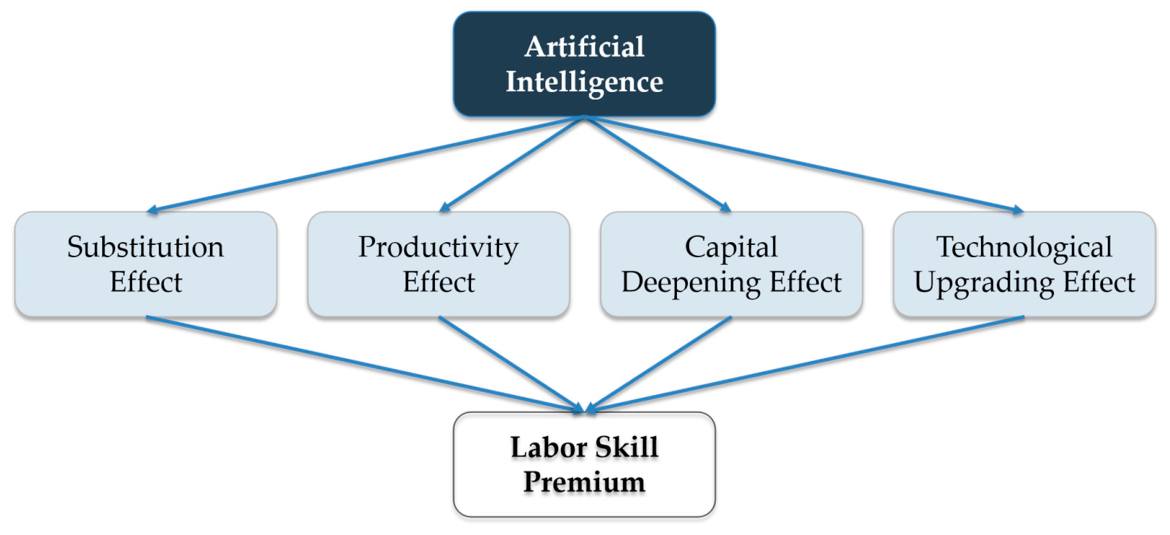
Artificial intelligence may affect the skill premium through four main mechanisms, including the substitution effect, the productivity effect, the capital deepening effect, and the technological upgrading effect. These mechanisms are conceptually distinct. The substitution effect captures task replacement, the productivity effect reflects efficiency gains from AI use, the capital deepening effect emphasizes changes in factor intensity, while the technological upgrading effect refers to firms’ long-term transformation in innovation and technological capability.

2.2.1. Mechanism of the Substitution Effect

The substitution effect refers to the replacement of certain labor tasks by AI-driven automation, which reduces firms’ demand for specific types of labor. Low-skilled workers are more likely to perform routine, repetitive, and standardized tasks, such as simple production operations and basic information processing, which are more susceptible to replacement by AI and automation technologies [35,36,37,38]. As AI technologies are adopted, firms can use automated equipment and algorithmic systems to replace part of their low-skilled workforce, thereby reducing demand for low-skilled labor. Autor and Dorn (2013) find that, with the advance of automation, low-skilled manufacturing jobs declined, whereas medium- and high-skilled service jobs expanded [39]. Because low-skilled workers often have weaker bargaining power, the decline in labor demand may further weaken their wage growth.
From the perspective of factor substitution, AI changes the comparative advantage between capital and labor. When AI performs tasks previously undertaken by low-skilled workers at lower cost, firms have stronger incentives to substitute technology for labor, which reduces the relative marginal productivity of low-skilled workers. At the same time, AI may also stimulate firms’ research and development, innovation, and job restructuring, giving rise to new occupations that require higher levels of knowledge and skills [40,41,42,43]. High-skilled workers, who possess stronger problem-solving ability, technical competence, and innovative capacity, are therefore more likely to complement AI technologies rather than be replaced by them.
Taken together, AI changes the structure of labor demand within firms by reducing the relative demand for low-skilled labor while increasing the relative demand for high-skilled labor. This shift widens wage differences between high-skilled and low-skilled workers and leads to an increase in the skill premium.
Based on the above analysis, this paper proposes the following hypothesis:
Hypothesis 2 (H2).
Artificial intelligence increases the labor skill premium through the substitution effect.

2.2.2. Mechanism of the Productivity Effect

The productivity effect refers to the mechanism through which technological progress improves production efficiency, reduces operating costs, and expands firms’ output capacity, thereby affecting labor demand and wage determination. As a general-purpose technology, AI can enhance firm-level productivity through applications such as automated production, intelligent decision-making, and data analytics, all of which improve operational efficiency and facilitate the reorganization of production processes [44,45].
However, the productivity gains generated by AI are unlikely to be distributed evenly across workers with different skill levels. The effective use of AI usually requires technical expertise, problem-solving ability, and the capacity to work with complex digital systems. High-skilled workers are therefore better positioned to complement AI technologies and convert productivity improvements into higher marginal productivity [46]. In particular, workers engaged in analytical, managerial, and technology-related tasks are more likely to experience an increase in marginal productivity when AI is introduced into production and organizational processes.
By contrast, low-skilled workers engaged in routine or less technology-intensive tasks may have fewer opportunities to share in AI-driven productivity gains. Even when overall firm productivity increases, these gains are more likely to be reflected in the wages of workers whose skills are closely aligned with AI adoption [47]. As a result, AI-induced productivity growth tends to raise the relative productivity of high-skilled workers more than that of low-skilled workers.
This uneven distribution of productivity gains changes the wage structure within firms. When high-skilled workers benefit more from AI-driven productivity improvements, firms have stronger incentives to increase their demand for such workers and offer higher wages, while low-skilled workers may experience only limited wage growth [48,49]. Consequently, AI-driven productivity improvements can widen the earnings gap between different skill groups and ultimately increase the labor skill premium.
Based on the above analysis, this paper proposes the following hypothesis:
Hypothesis 3 (H3).
Artificial intelligence increases the labor skill premium through the productivity effect.

2.2.3. Mechanism of the Capital Deepening Effect

AI may also affect the skill premium through the capital deepening effect. As capital investment increases, especially in technological capital, digital capital, and intelligent capital, capital becomes more strongly complementary to high-skilled labor while exhibiting a relatively stronger substitutive relationship with low-skilled labor. As a result, the marginal productivity and relative earnings of high-skilled workers increase [50,51].
As a typical general-purpose technology, the application of AI is usually accompanied by increased investment in automated equipment, digital systems, algorithmic tools, and intelligent platforms, thereby promoting capital deepening within firms [52,53]. On the one hand, these technological applications raise firms’ demand for capabilities related to data processing, system control, equipment maintenance, and organizational coordination. Because high-skilled workers possess stronger technological adaptability and greater absorptive capacity, they are better able to work in conjunction with these new forms of capital and to play a more important role in production organization [54,55]. On the other hand, the tasks performed by low-skilled workers are often more easily replaced by automated equipment and intelligent systems, which weakens their relative position in the production process [56].
Further, this type of technological progress does not merely replace labor in a mechanical sense. Rather, it reshapes the factor allocation structure within firms by changing the way capital and labor are combined. As capital intensity rises, the complementarity between high-skilled labor and technological capital is strengthened, leading to higher marginal productivity and greater bargaining power for high-skilled workers. By contrast, low-skilled workers display weaker complementarity with technological capital and may even be more exposed to displacement [57,58]. Capital deepening therefore tends to raise the relative returns to high-skilled workers and to widen the skill premium within firms.
Moreover, in the context of digital transformation, new forms of capital are increasingly knowledge-intensive and technology-intensive, and the returns to such capital often depend on the support and cooperation of high-skilled workers. This implies that the deeper the application of AI, the stronger the complementarity between capital and high-skilled labor, and the more pronounced the skill-biased pattern of income distribution. The ultimate result is an increase in the skill premium within firms [59].
Based on the above analysis, this paper proposes the following hypothesis:
Hypothesis 4 (H4).
Artificial intelligence increases the labor skill premium through the capital deepening effect.

2.2.4. Mechanism of the Technological Upgrading Effect

The development of AI may also affect the skill premium through the technological upgrading effect. According to Schumpeterian innovation theory, technological progress is not simply reflected in improvements in individual production tools. More importantly, it advances through new combinations that reconstruct firms’ modes of production, process flows, and organizational systems, thereby enabling the continuous upgrading of firms’ technological capabilities [60]. As a broadly pervasive general-purpose technology, the application of AI is therefore manifested not only in efficiency gains within existing production stages, but also in firms’ continued adjustment in research and development, process optimization, technical equipment, and production systems, which in turn drives technological upgrading [61].
From the perspective of firm operations, technological upgrading is typically accompanied by greater research and development investment, stronger technological transformation, and deeper innovation activity. On the one hand, the introduction of new technologies raises firms’ demand for technological improvement and process optimization, thereby encouraging firms to expand research and development investment in order to strengthen their capacity for technology absorption, integration, and re-innovation [62]. On the other hand, technological upgrading implies that firms continuously evolve toward higher levels in both production organization and technological systems, thereby improving their overall technological capabilities. Accordingly, the development of AI is reflected not only in the adoption of new technological tools, but also in a dynamic process of technological transformation and enhanced innovative capacity within firms.
In the process of technological upgrading, production activities place increasing demands on capabilities related to research and development, technical management, process design, system maintenance, and the resolution of complex problems. High-skilled workers are better able to participate effectively in the adoption of new technologies, process improvement, and innovation activities, and their marginal productivity therefore rises more substantially [63]. By contrast, low-skilled workers are relatively constrained in technology learning, adaptation, and participation in innovation, and thus tend to gain less from technological upgrading [64]. As a result, technological upgrading further raises the relative wages of high-skilled workers and, in turn, widens income disparities among workers with different skill levels within firms.
Based on the above analysis, this paper proposes the following hypothesis:
Hypothesis 5 (H5).
Artificial intelligence increases the labor skill premium through the technological upgrading effect.
Figure 1 illustrates the theoretical framework linking AI development to the firm-level skill premium. Specifically, AI affects the skill premium through four conceptually distinct but interrelated mechanisms, including the substitution effect, the productivity effect, the capital deepening effect, and the technological upgrading effect. Through these mechanisms, AI reshapes firms’ labor demand, improves production efficiency, changes the allocation and complementarity of production factors, and promotes technological transformation. These changes increase the relative productivity and earnings of high-skilled workers, thereby widening the skill premium within firms.

3. Research Design

3.1. Data Sources

This paper uses Chinese A-share listed firms on the Shanghai and Shenzhen stock exchanges over the 2012 to 2022 period as the research sample. Patent data are obtained from the IRPDB intellectual property database. This sample period primarily captures the stage of AI development prior to the widespread diffusion of generative AI technologies such as large language models. Since the rapid expansion of generative AI after 2022 may have introduced qualitatively different patterns of task substitution and skill complementarity from those observed in the pre-2022 period, the findings of this paper should be interpreted within the context of earlier-stage AI development. Data on firms’ basic characteristics, financial indicators, and employee structure are drawn primarily from the CSMAR database and supplemented and matched with information from the Wind database.
To ensure sample validity and comparability, the original sample is processed as follows. Firms subject to special treatment, including ST and *ST firms, during the sample period are excluded. Observations with missing values for key variables are removed. Firms in the financial sector are also excluded. In addition, firms in the information transmission, software and information technology services industry and in the scientific research and technical services industry are excluded. This restriction is motivated by the conceptual distinction between AI adoption and AI production. In most industries, AI mainly functions as a general-purpose technology used in production or management, whereas in these technology-intensive sectors, AI may be closely tied to firms’ core business activities and may constitute a primary output rather than an input. Including such firms could make the patent-based AI measure capture heterogeneous economic meanings across industries and weaken the interpretation of the estimated relationship between AI development and the skill premium. This exclusion also helps reduce the possibility that the AI measure reflects broader technological capability rather than AI application itself.
After these procedures, the final sample consists of 17,825 firm-year observations. To mitigate the influence of outliers on the estimation results, all continuous variables are further Winsorized at the 1st and 99th percentiles.

3.2. Baseline Model Specification

The baseline regression model is specified in Equation (1):
S P i t = α 0 + α 1 A I i t + β X i t + μ i + λ t + ε i t
Here, i denotes the firm and t denotes the year. S P i t represents the firm’s skill premium. A I i t captures the level of AI development at the firm-level. X i t is a set of control variables at the firm and city levels. μ i and λ t denote firm fixed effects and year fixed effects, respectively. ε i t is the random disturbance term, and α 0 is the constant term. The coefficient of primary interest is α 1 . If α 1 is significantly positive, this indicates that firm level AI development significantly increases the skill premium. In the empirical analysis, standard errors are clustered at the firm level.

3.3. Variable Definition and Descriptive Statistics

3.3.1. Independent Variable

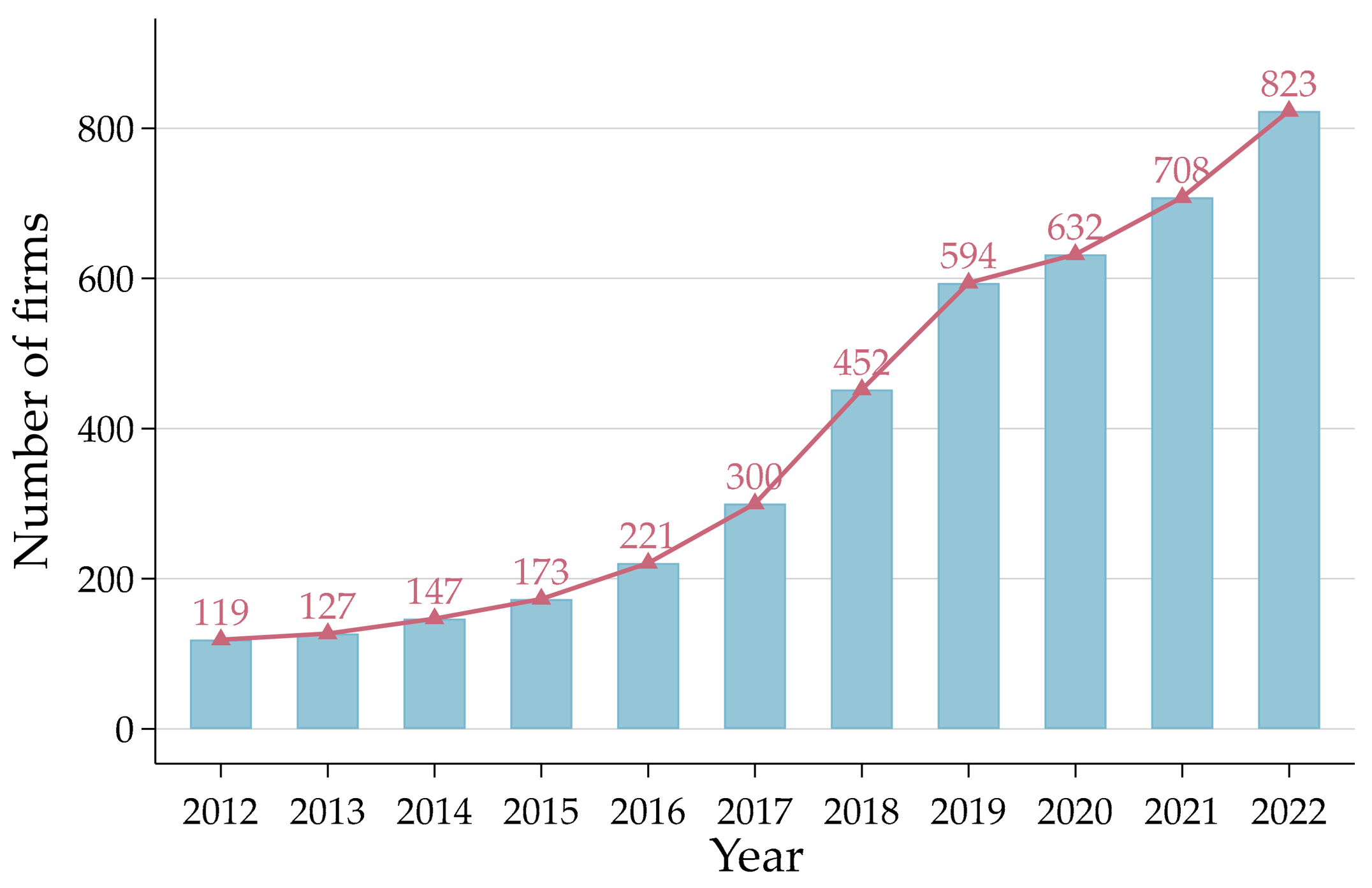
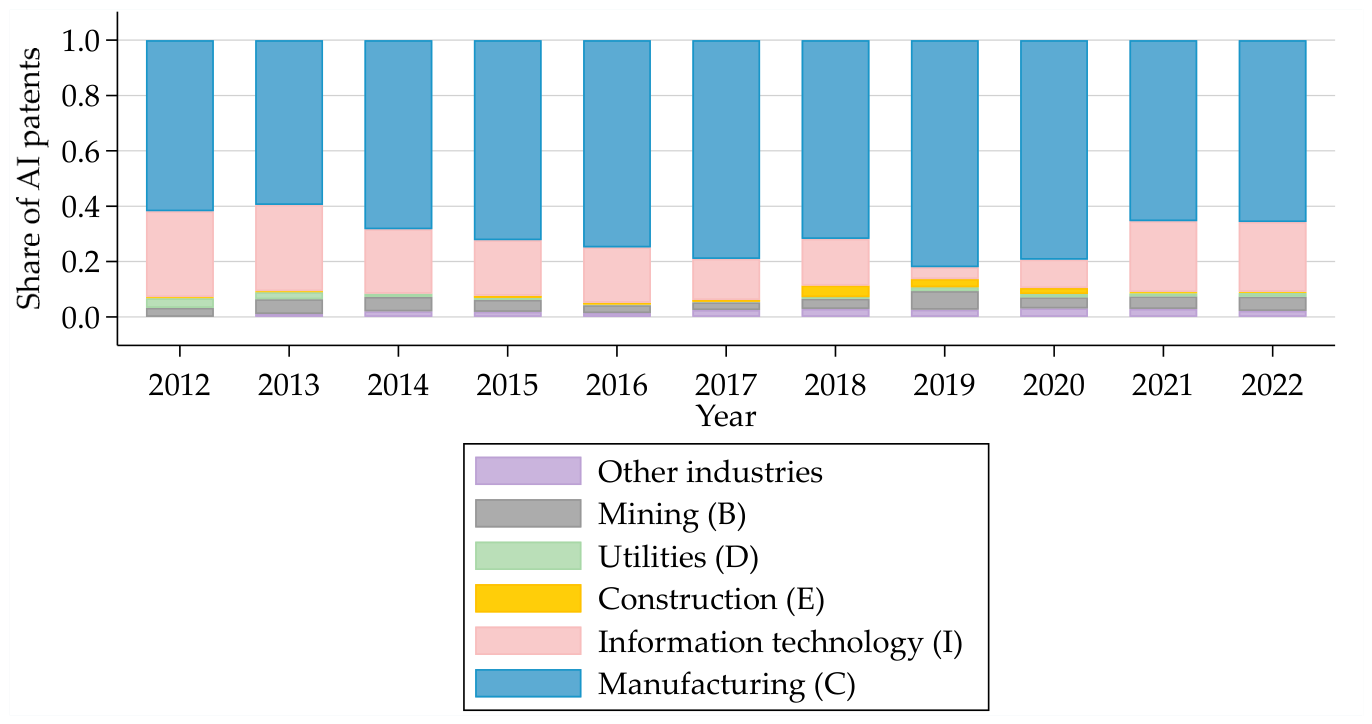
This paper measures firm-level AI development using firms’ AI-related patent data. Specifically, the core explanatory variable is defined as the natural logarithm of one plus the number of AI-related patent applications at the firm-year level. Given the lack of unified, continuous, and comparable data on the actual application of AI at the firm level, the existing literature often relies on innovation output indicators such as patents to capture firms’ innovative activity and technological accumulation in relevant fields [65,66,67]. Figure 2 further shows that AI-related patenting is highly concentrated in a limited number of industries, especially manufacturing and information technology, whereas most other sectors account for only a small share. This pattern indicates that AI-related innovation is not evenly distributed across industries. Figure 3 further shows that the number of listed firms applying for AI-related patents has increased steadily over time, suggesting a gradual diffusion of AI-related innovation across firms during the sample period. Specifically, the baseline regressions use the number of firms’ AI patent applications to reflect the intensity of their technological innovation activity in the field of AI.
To identify firms’ AI-related patents, this paper first constructs a dictionary of AI keywords. The keywords are drawn primarily from policy documents such as the Development Plan for a New Generation of Artificial Intelligence, the Guidelines for the Construction of the National New Generation Artificial Intelligence Standards System, the Three-Year Action Plan for Promoting the Development of the New Generation Artificial Intelligence Industry from 2018 to 2020, and the Guidelines for the Construction of the National Artificial Intelligence Industry Comprehensive Standardization System (2024 Edition). These sources are supplemented by the Stanford Artificial Intelligence Index Report, the AI-related keyword list released by the World Intellectual Property Organization (WIPO), as well as relevant academic studies and industry reports from China and abroad. On this basis, this paper first extracts AI-related technical terms and application terms and then screens the keywords through cross-validation across multiple sources. Priority is given to keywords that appear repeatedly in multiple authoritative sources and exhibit strong representativeness and stability, so as to improve the standardization, scientific rigor, and general applicability of the keyword system. The final dictionary contains 85 core keywords, including machine learning, deep learning, natural language processing, knowledge graphs, computer vision, image recognition, speech recognition, human–computer interaction, intelligent chips, autonomous driving, smart healthcare, smart finance, smart education, intelligent manufacturing, smart logistics, and intelligent robotics.
In the keyword identification process, this paper uses Python 3.12 to conduct keyword retrieval and matching within patent texts. The search scope is mainly restricted to patent titles, abstracts, and claims, which more directly reflect the core technological content of patents. Compared with a broad full-text search, this approach helps reduce interference from irrelevant descriptions and thereby improves the alignment between the identified keywords and the core technological content of patents. To further assess the reliability of the identification results, this paper manually verifies a randomly selected subset of sample patents by comparing the technological content reflected in the patent texts with the keyword matching results on a case-by-case basis. The results indicate that this method achieves a relatively high level of accuracy in identifying AI-related patents, with the overall error remaining within an acceptable range. Overall, although the keyword identification approach cannot completely eliminate omissions or misclassification, it offers strong operability and replicability in large-sample research and has become a commonly used method for identifying patents in specific technological fields.
After identifying AI-related patents, we further match them to listed firms and construct the explanatory variable. Specifically, patent information, including titles, abstracts, application dates, grant announcement dates, and applicant names, is extracted to identify firms’ AI patent applications and grants. AI patent applications are assigned to years based on their application dates, whereas AI patent grants are assigned according to their grant announcement dates. To minimize matching errors caused by name inconsistencies, applicant names are standardized and manually verified using the full names, former names, and affiliated entities of listed firms. We then aggregate AI patent applications and grants at the firm-year level to measure firms’ AI technological development. To mitigate the influence of right-skewness and extreme values in patent counts, we use the natural logarithm of one plus the number of AI patent applications as the core explanatory variable in the baseline regressions and apply the same transformation to AI patent grants in the robustness tests.
It should be noted that using AI-related patents to measure firm-level AI development may involve certain limitations. Firms that are closer to the technological frontier are more likely to engage in AI patenting and also tend to exhibit stronger innovation capacity. As a result, the patent-based measure may partly capture firms’ technological sophistication in addition to AI development, and the estimated relationship may therefore be influenced by such firms’ characteristics. To address this concern, the empirical analysis controls for key firm characteristics such as firm size and capital structure. In addition, robustness checks employ alternative AI measures based on annual report texts and MD&A disclosures, thereby capturing firm-level AI development from multiple dimensions and reducing reliance on a single patent-based proxy. This complementary measure helps capture AI development from a different perspective and alleviates concerns regarding the innovation-oriented nature of patent-based indicators.

3.3.2. Dependent Variable

This paper defines the skill premium as the income gap between high-skilled workers and low-skilled workers within firms and measures it accordingly. Owing to limitations in the availability of micro-level data, existing studies generally cannot directly obtain wage information for workers with different skill levels within firms from listed company databases such as CSMAR or Wind. As a result, the firm-level skill premium is typically estimated using indirect methods.
From a theoretical perspective, wage differentials between workers with different skill levels within firms reflect not only differences in human capital, but also workers’ relative positions in rent sharing and wage bargaining. Drawing on the fair wage model and rent sharing theory, workers with different skill levels may all participate in sharing the economic rents generated by the firm, but the extent of such sharing depends on their relative bargaining power, the substitutability of their jobs, and the degree to which their work is linked to firm performance [68]. In general, high-skilled workers tend to possess stronger professional capabilities, greater job-specific irreplaceability, and stronger bargaining positions. Their wages are therefore more closely tied to firm performance and economic profits. By contrast, low-skilled workers typically have weaker bargaining power, and their wages are more strongly constrained by external labor market conditions, often converging toward the lower end of wage levels within the same industry and region [69,70]. Accordingly, the wage gap between high-skilled and low-skilled workers within firms partly reflects differences in their ability to share firm rents and also serves as an important indicator of the structure of income distribution within firms.
Existing studies typically estimate the skill premium indirectly by combining indicators such as firms’ average wages and the educational composition of the workforce. In recent years, a common approach has been to use the average wage of firms located at the lower end of the wage distribution within a given year by region and industry cell as a proxy for the wage of low-skilled workers. In the baseline specification, this proxy is measured by the lowest firm average wage within that cell [71]. The underlying logic is that, within the same region and industry, firms with lower productivity or relatively weaker technological capability tend to have average wage levels that are closer to the market wage of low-skilled workers. Their average wages can therefore serve as an approximate proxy for compensation received by low-skilled labor.
Following this approach, this paper uses the lowest firm average wage within the same year by prefecture-level city and two-digit industry cell as a proxy for the wage of low-skilled workers. Combined with the firm’s own average wage, this measure is then used to estimate the firm-level skill premium. This approach makes it possible, to some extent, to capture income differentials between workers with different skill levels within firms. It also helps incorporate regional, industry, and firm heterogeneity into the empirical framework, thereby providing a better representation of the distributional characteristics of income at the firm level.
The firm’s average wage can be expressed as W ¯ i t = θ i t H × W i t H + 1 θ i t H × W i t L . Based on these definitions, the formula for the task-based wage gap is derived as Equation (2).
S P i t = W ¯ i t 1 θ i t H W i t L θ i t H W i t L = W ¯ i t 1 θ i t H W i t L θ i t H W i t L θ i t H = W ¯ i t W i t L θ i t H
Here, W ¯ i t , W i t H and W i t L denote the overall average wage, the average wage of non-routine workers, and the average wage of routine workers in firm i in year t respectively.
Following Xie et al. (2022) and Chen and He (2013), this study measures the task-based wage gap accordingly [69,70]. Specifically, production staff, customer service staff, human resources personnel, administrative staff, and other personnel are classified as routine occupations within the firm, and the combined labor share of these five occupational categories is defined as the firm’s routine labor share. By contrast, technical staff, sales staff, financial personnel, general management personnel, risk control and inspection personnel, and procurement and warehousing personnel are classified as non-routine occupations, and the combined labor share of these six occupational categories is defined as the firm’s non-routine labor share [72,73].
The firm’s average wage ( W ¯ i t ) is calculated by dividing the total wage payable to employees by the number of employees in the firm. The minimum firm-level average wage within the same year–region–industry group is used to approximate the wage of routine workers ( W i t L ) within the industry. θ i t H denotes the proportion of non-routine workers within the firm. S P i t represents the firm-level skill premium, and its logarithmic form is used in the empirical analysis.
It should be noted that this proxy is an indirect measure of low-skilled wages and may partly reflect broader wage conditions within a year–city–industry cell. As such, the constructed skill premium may be influenced by heterogeneity in firm productivity, workforce composition, industry characteristics, and local wage-setting institutions. In the context of AI adoption, adjustments in the benchmark wage may also absorb part of the productivity-related wage changes within the cell, thereby rendering the estimated relationship between AI and the skill premium conservative.
Existing studies generally classify skill structures from two perspectives, including educational attainment and task composition [74]. In the baseline regressions, this study measures the skill premium from the task-based perspective, while in the robustness tests it adopts the classification based on educational attainment. In addition, the paper implements additional robustness checks using alternative indicators. Specifically, the first alternative measure is the ratio of R&D personnel wages to those of non-R&D employees, capturing within-firm skill differentials from a task-based perspective. The second measure is the ratio of executive compensation to that of ordinary employees, which reflects internal income stratification and provides complementary evidence on the presence of skill premium.

3.3.3. Control Variables

To mitigate the influence of potential confounding factors, this paper includes a set of control variables in the regression model. Specifically, at the regional level, the controls include population density (Pop), GDP per capita (Pgdp), the level of industrial upgrading (Upgrade), the level of human capital (Hcapital), internet penetration rate (Internet), and road network density (Road_density). At the firm level, the control variables include firm size (Size), leverage (Lev), return on assets (ROA), firm growth (Growth), cash flow capacity (CashFlow), firm value (Tobin’s Q), and an indicator for whether the chairman and general manager positions are held by the same person (Dual). In addition, all regressions include firm fixed effects and year fixed effects in order to further control for firm-specific heterogeneity and time-varying factors. Table 1 reports the definitions and measurement of the dependent variable, the explanatory variable, and the control variables.

3.3.4. Descriptive Statistics and Correlation Analysis

Table 2 reports the descriptive statistics for the main variables. The dependent variable, the skill premium, has a mean of 4.920 and a standard deviation of 5.180, indicating substantial heterogeneity in skill-related wage differentials across firms. The core explanatory variable, artificial intelligence, is measured as the natural logarithm of one plus the number of AI patent applications filed by listed firms. Its mean is 0.063 and its standard deviation is 0.353, suggesting considerable variation across sample firms in the intensity of AI-related innovation activity and the accumulation of AI-related technological capabilities.
At the regional level, population density (Pop), GDP per capita (Pgdp), the level of industrial upgrading (Upgrade), the level of human capital (Hcapital), internet penetration rate (Internet), and road network density (Road_density) all exhibit noticeable cross-regional variation, indicating substantial heterogeneity in the external environments faced by sample firms. At the firm level, the descriptive statistics for firm size (Size), leverage (Lev), return on assets (ROA), growth (Growth), cash flow capacity (CashFlow), firm value (Tobin’s Q), and the indicator for CEO duality (Dual) also suggest substantial differences across firms in operating conditions, financial characteristics, and governance structures. Overall, the sample exhibits sufficient variation in the main variables, which provides an adequate basis for the subsequent empirical analysis.
Table 3 reports the correlation matrix for the main variables. The results show that the core explanatory variable, artificial intelligence, is significantly and positively correlated with the dependent variable, the skill premium, which provides preliminary support for the main expectation of this paper. More generally, the correlations among the explanatory and control variables are moderate, with all absolute values below 0.6, suggesting no obvious pattern of excessively high pairwise correlation. Further variance inflation factor (VIF) tests indicate that the VIF values for all variables are well below the commonly used threshold. The maximum VIF is 2.15 and the average VIF is 1.53, suggesting that the model does not suffer from serious multicollinearity.

4. Empirical Analysis

4.1. Baseline Regression

Table 4 reports the baseline regression results. The dependent variable is the firm-level skill premium, and the core explanatory variable is the firm’s level of artificial intelligence. Columns (1) through (3) sequentially add regional controls, firm-level controls, and the full set of controls. The results show that the coefficient on AI is significantly positive in all specifications. In column (3), the estimated coefficient on AI is 0.072 and is significant at the 1 percent level, indicating that firms with a higher level of AI exhibit a larger skill premium. This suggests that AI development may widen the wage gap between high-skilled and low-skilled workers within firms by increasing the relative demand for high-skilled labor or raising their marginal productivity. This finding is consistent with the conclusions of Hémous and Olsen (2022) and Lankisch et al. (2017), who show that technological progress increases the demand for and productivity of high-skilled labor, thereby widening income disparities between high-skilled and low-skilled workers [75,76]. In terms of economic significance, because both AI and SP are measured in logarithmic form, the estimated coefficient can be interpreted approximately as an elasticity. In column (3), a 1 percent increase in AI is associated with an average increase of about 0.072 percent in the skill premium. Further, combining this estimate with the standard deviation reported in Table 2, where the standard deviation of AI is 0.353, a one-standard-deviation increase in firm-level AI is associated with an increase of about 2.54 percent in the skill premium. This suggests that the effect of AI on the skill premium is not only statistically significant but also economically meaningful.
With respect to the control variables, population density (Pop), GDP per capita (Pgdp), the level of industrial upgrading (Upgrade), internet penetration rate (Internet), and road network density (Road_density) are all significantly positive, indicating that the skill premium is larger in regions with higher levels of economic development, a more advanced industrial structure, and better infrastructure conditions. At the firm level, firm size (Size), leverage (Lev), return on assets (ROA), cash flow capacity (CashFlow), firm value (Tobin’s Q), and CEO duality (Dual) all exhibit significantly positive effects. By contrast, the level of human capital (Hcapital) and firm growth (Growth) do not pass conventional significance tests. Overall, the baseline results support Hypothesis 1, indicating that artificial intelligence significantly increases the skill premium within firms.

4.2. Endogeneity Tests

To mitigate potential endogeneity in firms’ artificial intelligence development, this paper employs two instrumental variables: the interaction between prefecture-level base station density and time, and the interaction between terrain relief and time [77,78,79]. The identification strategy is based on the fact that the development, training, and application of AI technologies are not purely digital processes, but rely heavily on physical infrastructure conditions, including data transmission capacity, computing connectivity, and low-latency communication networks. A higher density of base stations provides the bandwidth redundancy and low-latency environment required for cloud computing, large-scale deep learning, and AI deployment, thereby facilitating firms’ engagement in AI-related activities [80]. Meanwhile, terrain relief affects the marginal cost of constructing and maintaining communication infrastructure. More rugged terrain raises the cost of laying optical fiber, installing base stations, and maintaining communication networks, which may hinder the expansion of digital infrastructure and the diffusion of AI technologies, creating a geographically determined barrier to technology adoption [81].
The validity of these instruments depends on the absence of direct effects on the skill premium outside the AI channel. Terrain relief is a long-standing geographical characteristic determined well before the sample period and is therefore plausibly exogenous to firms’ current wage-setting and skill demand decisions [82]. Although base station density reflects communication infrastructure, the deployment of mobile communication networks in China has been largely shaped by national strategies such as the “Broadband China” initiative and the “New Infrastructure” program, rather than by firm-level labor demand or wage structures [83].
In addition, the baseline specification controls for internet penetration and traditional transportation infrastructure, to account for potential non-AI channels through which digital or physical infrastructure may affect the skill premium. Taken together, these considerations suggest that base station density and terrain relief are more likely to affect the skill premium through firms’ differential exposure to AI adoption than to directly determine wage gaps between high- and low-skilled workers.
Table 5 reports the two-stage least squares estimates. Columns (1) and (2) present the first-stage and second-stage results based on the first instrumental variable, columns (3) and (4) report the corresponding results based on the second instrumental variable, and columns (5) and (6) report the results when both instrumental variables are included simultaneously. The first-stage results show that both instrumental variables are significantly and positively associated with firms’ AI development at the 1 percent level, indicating strong relevance.
Turning to the identification tests, the Kleibergen–Paap rk Wald F-statistic is 22.1 for the first instrumental variable and 17.5 for the second instrumental variable, both of which are above the conventional threshold for weak-instrument tests. The corresponding Kleibergen–Paap rk LM statistics are 35.2 and 27.6, respectively, indicating that the model is not underidentified. When both instruments are used jointly, the Kleibergen–Paap rk Wald F-statistic remains 18.2, suggesting that weak instrument concerns are unlikely to affect the results. In addition, the Durbin–Wu–Hausman endogeneity test statistics are 19.6 and 16.3, respectively, both significant at the 1 percent level, supporting the view that AI is endogenous and that the instrumental variables approach is warranted. Moreover, the Hansen J test fails to reject the null hypothesis of instrument validity (p = 0.27), providing support for the joint exogeneity of the two instruments.
The second-stage results show that, after accounting for potential endogeneity, firms’ level of artificial intelligence development still has a significantly positive effect on the skill premium. Specifically, the estimated coefficient is 0.083 when the first instrumental variable is used and 0.076 when the second instrumental variable is used. When both instruments are included simultaneously, the estimated coefficient remains positive and significant at 0.079. These estimates are close to the baseline results, indicating that the positive effect of AI on the firm-level skill premium remains robust after addressing endogeneity.
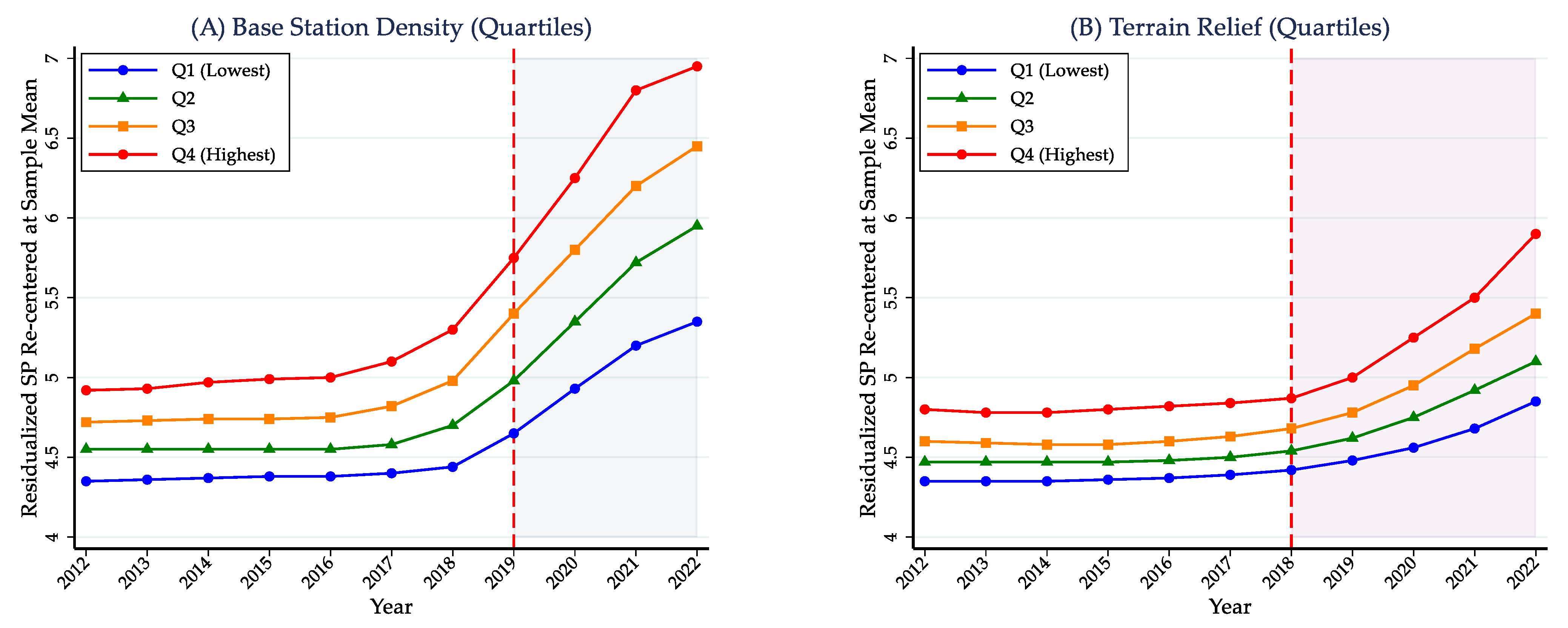
To further address concerns regarding the exclusion restriction, we provide graphical evidence on the dynamic evolution of the skill premium across regions stratified by quartiles of the instrumental variables (Figure 4). China’s AI-related policy environment experienced a marked intensification during the sample period. Since the release of Made in China 2025 in 2015, which laid the foundation for intelligent manufacturing, the density of AI-related policies has continued to increase. The 2016 “Internet Plus” Artificial Intelligence Three-Year Action Plan initiated industrial deployment, while the 2017 New Generation Artificial Intelligence Development Plan formally elevated AI development to a national strategy. Subsequently, in 2018, policy initiatives issued by the Ministry of Industry and Information Technology and the Ministry of Education further promoted AI-related industrial implementation and talent cultivation. The cumulative effect of these policies provided strong institutional support for the rapid diffusion of AI after 2017 and strengthened firms’ demand for high-skilled labor. Accordingly, this study treats 2017 as a key policy turning point marking the onset of large-scale AI diffusion, which provides a natural temporal benchmark for examining the differential evolution of the skill premium across regions with varying initial conditions.
As shown in Figure 4, during the pre-treatment period, the trends in the skill premium are largely parallel across quartiles of both base station density and terrain relief. This indicates that regions with different initial conditions did not exhibit systematically different trajectories in skill premium before the large-scale diffusion of AI technologies. In contrast, clear divergence emerges only after 2018–2019. Regions with higher base station density experience a faster increase in skill premium, showing a pronounced J-shaped pattern, while regions with more favorable terrain conditions display a more gradual but persistent divergence. This timing pattern suggests that these regional characteristics do not directly affect the skill premium but rather influence it through differential exposure to AI diffusion. Therefore, the graphical evidence provides empirical support for the validity of the exclusion restriction.
Overall, the instrumental variables estimates are broadly consistent with the baseline regression results. These findings provide further support for the robustness of the paper’s main conclusion that artificial intelligence is positively associated with the skill premium within firms.

4.3. Robustness Checks

4.3.1. Sensitivity Tests for the Construction of the Dependent Variable

Given that the proxy for low-skilled wages, W i t L , may be sensitive to the definition of the grouping cell, this paper further conducts sensitivity tests along both the regional and industry dimensions. Specifically, while the baseline regression uses the year by prefecture level city by two-digit industry cell, this paper alternatively reconstructs the low-skilled wage proxy using the year by province by two-digit industry cell and the year by prefecture level city by three-digit industry cell, and then re-estimates the firm skill premium accordingly.
Table 6 reports the results of these sensitivity tests. In column (1), the low-skilled wage proxy is reconstructed using the year by province by two-digit industry cell, and the coefficient on AI is 0.069, significant at the 1 percent level. In column (2), the low-skilled wage proxy is reconstructed using the year by prefecture level city by three-digit industry cell, and the coefficient on AI is 0.065, significant at the 5 percent level. It is clear that, after changing the grouping cell definition, the sign and statistical significance of the coefficient on the core explanatory variable remain broadly unchanged, and the magnitude of the estimated coefficient remains close to that in the baseline regression.
Overall, these results indicate that the conclusion of this paper that artificial intelligence significantly increases the skill premium within firms does not depend on a particular grouping cell definition and is therefore robust.

4.3.2. Alternative Measures of the Dependent Variable

To further examine the robustness of the baseline results, this paper adopts three alternative measures of the firm-level skill premium.
First, worker skill types are redefined on the basis of educational attainment. Following the existing literature, employees with a junior college degree or above are classified as high-skilled workers, while the remaining employees are classified as low-skilled workers. On this basis, the firm-level skill premium is reconstructed from the perspective of educational attainment [84,85]. This measure can, to some extent, capture income differentiation among workers with different levels of education within firms.
Second, an alternative indicator is constructed based on the pay gap between research and development personnel and ordinary employees. Relative to ordinary employees, research and development personnel typically possess stronger professional knowledge, technical ability, and innovative capacity, and they play a key role in technology development, the commercialization of innovation outcomes, and process optimization. Accordingly, this paper further divides employees into research and development personnel and non-research personnel and uses the ratio of average annual compensation of research and development personnel to that of ordinary employees to capture pay differentials across job categories within firms. This provides a supplementary test of the main findings from the perspective of job functions.
Third, this paper further constructs an alternative indicator based on the pay ratio between executives and ordinary employees. Compared with ordinary employees, executives generally occupy positions associated with higher managerial responsibility, stronger decision-making power, and greater strategic influence, and their compensation often reflects the market valuation of managerial and organizational skills. Accordingly, this paper uses the ratio of executive compensation to the average compensation of ordinary employees as another proxy for the firm-level skill premium. Although this measure does not directly correspond to the wage gap between high-skilled and low-skilled workers in a strict sense, it provides an additional supplementary perspective on within-firm income differentiation.
Table 7 reports the robustness results after replacing the dependent variable. In column (1), the skill premium measure constructed on the basis of educational attainment is used, and the coefficient on AI is 0.067, significant at the 1 percent level. It is worth noting that the coefficient based on the education-based skill premium is slightly smaller than that in the baseline regression. This subtle difference suggests that task-based measures may more accurately capture the specific functional shifts in labor demand driven by AI, whereas education-based proxies, being coarser in nature, might introduce slight attenuation bias due to the inclusion of non-task-related educational signals.
In column (2), the alternative measure based on the ratio of average annual compensation of research and development personnel to that of ordinary employees is used, and the coefficient on AI is 0.054, significant at the 5 percent level. In column (3), the alternative measure based on the ratio of executive compensation to that of ordinary employees is used, and the coefficient on AI is 0.062, significant at the 1 percent level. These results show that, after remeasuring the firm-level skill premium using different definitions, the estimated coefficient on the core explanatory variable remains significantly positive, and its magnitude remains close to that in the baseline regression.
Overall, the empirical results based on alternative dependent variables are consistent with the baseline findings. This indicates that the positive association between artificial intelligence and the firm-level skill premium remains robust to alternative constructions of the dependent variable.

4.3.3. Alternative Measures of the Independent Variable

To further examine the robustness of the baseline results, this paper replaces the measurement of the core independent variable.
First, firm-level AI is remeasured using the number of AI patent grants. Compared with the number of patent applications, patent grants are subject to a more stringent review process and can therefore better reflect the maturity, validity, and quality of the underlying technologies. Accordingly, this paper reconstructs the core explanatory variable using the number of firms’ AI patent grants in the robustness checks.
Second, this paper uses an AI indicator constructed from annual report texts as an alternative explanatory variable. Specifically, based on the AI keyword dictionary, this paper identifies and counts AI-related terms in the annual reports of listed firms, and uses the natural logarithm of one plus the frequency of AI-related keywords in annual reports as an alternative core explanatory variable. Compared with patent-based measures, this text-based indicator complements the analysis by capturing firms’ attention to, strategic positioning in, and application of AI from the perspective of corporate information disclosure, thereby providing another feasible measure of firms’ AI-related activities.
Third, this paper further constructs an alternative AI indicator based on the Management Discussion and Analysis (MD&A) section of annual reports. Specifically, using the same AI keyword dictionary, this paper counts the frequency of AI-related terms appearing in the MD&A section and uses the natural logarithm of one plus this frequency as another alternative measure of firm-level AI development. Compared with the AI keyword frequency calculated from the full annual report, the MD&A-based indicator is more focused on firms’ managerial discussion of business operations, strategic planning, and technology deployment, and therefore may better capture firms’ substantive attention to and application of AI in their operating activities.
These indicators capture firms’ AI development from both textual disclosures and technological innovation, allowing different data sources to mutually validate firms’ AI activities. We further conduct Pearson correlation tests for these variables, and the results are reported in Table 8. The correlation coefficient between Lnpatent_app and Lnpatent_grant is 0.882 and significant at the 1% level, indicating that the two patent-based measures are closely related and capture similar aspects of firms’ AI-related technological innovation. Meanwhile, the correlation coefficient between Lnwords and Lnwords_MD&A is 0.863 and significant at the 1% level, suggesting strong consistency between the two text-based measures. The correlations between text-based and patent-based measures are positive and statistically significant, ranging from 0.286 to 0.318. Overall, these findings provide supplementary support for the consistency and validity of the alternative AI measures used in this paper.
Table 9 reports the robustness results after replacing the core explanatory variable. Column (1) remeasures firm-level AI using the number of AI patent grants, column (2) remeasures the core explanatory variable using the AI indicator constructed from annual report texts, and column (3) further remeasures firm-level AI using the AI keyword frequency in the MD&A section of annual reports. The results show that, after replacing the explanatory variable, both the sign and the statistical significance of the estimated coefficients remain consistent with the baseline results, and the coefficient magnitudes remain within a reasonable range. Specifically, the estimated coefficients on the AI variable are 0.088 in column (1), 0.105 in column (2), and 0.103 in column (3), all of which are significant at the 1 percent level.
Overall, these results indicate the conclusion of this paper, that the positive association between artificial intelligence and the skill premium within firms remains robust to alternative measures of the core explanatory variable.

4.3.4. AI Pilot Zone Policy Shock

To further examine the robustness of the baseline results, this paper exploits the policy of establishing National New Generation Artificial Intelligence Innovation and Development Pilot Zones as a quasi natural experiment. Since 2019, the Ministry of Science and Technology has successively promoted the establishment of these pilot zones. By the end of 2021, three batches covering 18 cities had been approved, including Beijing, Shanghai, Tianjin, Shenzhen, Hangzhou, Hefei, Deqing County, Chongqing, Chengdu, Xi’an, Jinan, Guangzhou, Wuhan, Suzhou, Changsha, Zhengzhou, Shenyang, and Harbin. Because the pilot zone policy was implemented in multiple waves over time, this paper constructs a staggered difference-in-differences model to examine the effect of the AI innovation and development pilot zone policy on the skill premium within firms, thereby providing an additional test of the robustness of the main findings.
This paper specifies the staggered difference-in-differences model in Equation (3). Here, D I D i t is the policy treatment variable. If the city in which firm i is located is approved as a National New Generation Artificial Intelligence Innovation and Development Pilot Zone in year t or thereafter, then D I D i t is assigned a value of 1 for year t and all subsequent years. Otherwise, it is assigned a value of 0. The definitions of the other variables are the same as those in Equation (1).
S P i t = α 0 + α 1 D I D i t + β X i t + μ i + λ t + ε i t
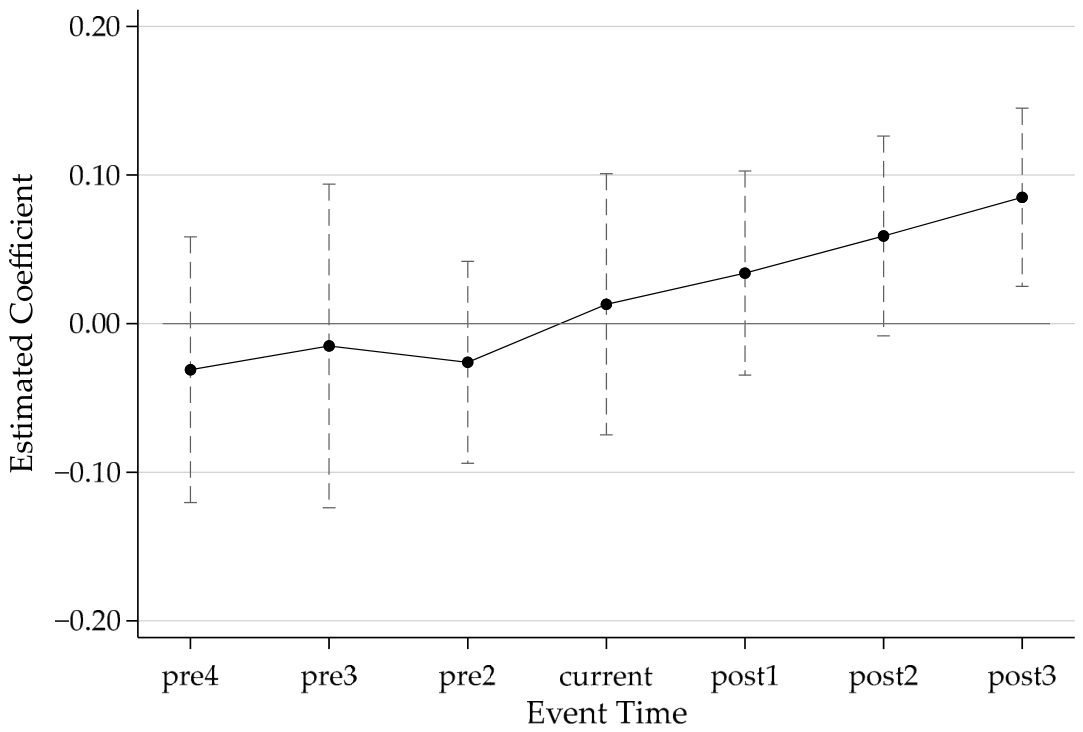
To further test the parallel trends assumption, this paper adopts an event-study approach and specifies the dynamic effects model in Equation (4).
S P i t = α 0 + t = 4 , k 1 3 δ k D I D i t k + β X i t + μ i + λ t + ε i t
Here, the year immediately preceding policy implementation, that is k = −1, is used as the reference period in the event-study analysis. D I D i t k denotes the interaction between the treatment group indicator and a dummy variable for the k-th year relative to the timing of policy implementation in the city where firm i is located. This paper denotes the interaction terms for the periods before policy implementation as prek, the interaction term for the year of implementation as current, and the interaction terms for the periods after policy implementation as postk. When k < 0, the coefficients capture the dynamic effects in the pre-policy periods. When k = 0, the coefficient captures the effect in the year of policy implementation. When k > 0, the coefficients capture the dynamic effects in the post-policy periods. Given the sample period, this paper includes in the regression the dynamic effects for up to four years before implementation and up to three years after implementation.
Column (1) of Table 10 reports the regression results based on this quasi natural experiment. The coefficient on DID is 0.055 and is significant at the 5 percent level, indicating that the AI innovation and development pilot zone policy significantly increases the skill premium within firms. Column (2) of Table 10 and Figure 5 further report the results of the parallel trends test. It can be seen that, during the four years before policy implementation, the coefficients on the interaction terms for all pre-policy periods are statistically insignificant. This suggests that, prior to policy implementation, there is no significant difference in the trend of the skill premium between the treated and control groups, which provides support for the parallel trends assumption. At the same time, the policy effect emerges gradually after implementation. The coefficients on post2 and post3 are 0.059 and 0.085, respectively, with the latter being significant at the 1 percent level. This indicates that the positive effect of the policy shock on the firm-level skill premium is characterized by a certain degree of lag and accumulation.
Overall, the results from the quasi natural experiment based on the AI innovation and development pilot zone policy are consistent with the baseline regression findings and further support the core conclusion of this paper that AI increases the skill premium within firms.

4.3.5. Alternative Sample Restrictions

To further examine the robustness of the baseline results, this paper conducts tests based on alternative sample restrictions. First, the sample is restricted to manufacturing firms only. Manufacturing is a sector in which the application of AI is more direct. Its production processes are more standardized, and its employment structure and skill differentiation are also more pronounced. It is therefore particularly informative to examine the effect of AI on the skill premium within the manufacturing sample. Second, firms located in municipalities directly under the central government, namely Beijing, Shanghai, Tianjin, and Chongqing, are excluded. Since these municipalities differ markedly from other cities in terms of AI development, talent concentration, and the broader economic environment, they may introduce additional interference into the estimation. Excluding them therefore helps reduce the influence of sample heterogeneity.
Column (1) of Table 11 reports the regression results using only the manufacturing sample, while column (2) reports the results after excluding firms located in the municipalities directly under the central government. The results show that, after restricting the sample to manufacturing firms or excluding the municipalities, the coefficient on AI remains significantly positive at the 1 percent level, and its magnitude is broadly consistent with that in the baseline regression. These findings indicate that the positive effect of AI on the skill premium within firms remains significant after changing the sample scope, further supporting the robustness of the main conclusion.

4.4. Mechanism Analysis

To further examine the transmission mechanisms through which artificial intelligence affects the skill premium within firms, this paper conducts mechanism tests based on the baseline regressions. Drawing on the mediation analysis framework proposed by Baron and Kenny (1986) [86], and combining it with the Bootstrap method to test indirect effects, this paper specifies the following models.
M i t = β 0 + β 1 A I i t + θ X i t + μ i + λ t + ε i t
S P i t = γ 0 + γ 1 A I i t + γ 2 M i t + η X i t + μ i + λ t + ε i t
Here, M i t denotes the mediating variable and is used to capture the specific transmission mechanism through which AI affects the skill premium within firms. Equation (5) is the mediator equation and is mainly used to examine whether AI significantly affects the mechanism variable. If β 1 is significant, this indicates that the application of AI has a significant effect on the corresponding mechanism variable. Equation (6) is the mediation effect equation. Building on the baseline regression, it includes both the AI variable and the mediating variable in order to examine the effect of the mediating variable on the firm skill premium as well as the direct effect of AI adoption. In this specification, γ 2 captures the effect of the mediating variable on the firm skill premium, while γ 1 captures the direct effect of AI adoption on the firm skill premium after controlling for the mediating variable. If both β 1 and γ 2 are significant, this indicates that the corresponding channel plays a role in the process through which AI affects the firm skill premium. This paper further uses the Bootstrap method to test the significance of the indirect effect, thereby improving the reliability of the mechanism identification results. The remaining control variables and fixed effects are specified in the same way as in the baseline regression model.
Accordingly, the following analysis examines four potential mediating channels, namely the substitution effect, productivity effect, capital deepening effect, and technological upgrading effect. To alleviate potential reverse causality concerns, all mediating variables are included in their one-period lagged form. The corresponding results are reported in Table 12.

4.4.1. Substitution Effect

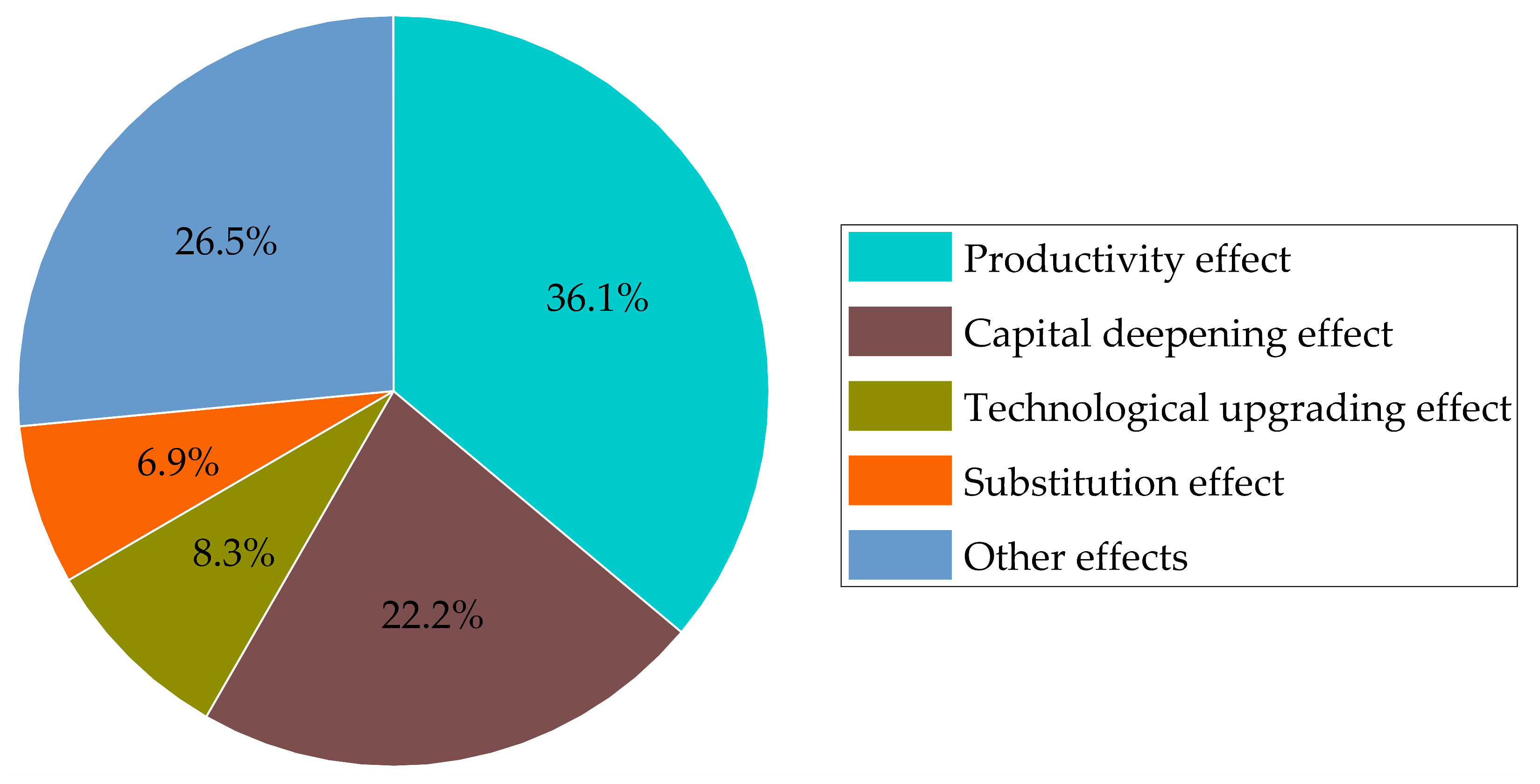
This paper uses the share of routine labor (RoutineShare) to capture the substitution effect, measured as the proportion of workers in routine occupations relative to total employment. Columns (1) and (2) of Table 12 report the results. Column (1) shows that the coefficient of AI on RoutineShare is −0.058 and significant at the 1 percent level, indicating that AI significantly reduces the share of routine labor within firms. Column (2) shows that the coefficient on RoutineShare is −0.079 and significant at the 5 percent level, suggesting that a higher share of routine labor is associated with a lower skill premium. Meanwhile, after controlling for the mediating variable, the coefficient of AI on the skill premium remains 0.069 and significant at the 1 percent level. The bootstrap results show that the indirect effect through this channel is 0.005, with a 95 percent confidence interval of [0.002, 0.009], excluding zero. This indirect effect accounts for about 6.9 percent of the total effect, indicating that the substitution effect constitutes a partial mediating channel through which AI affects the skill premium, thus supporting Hypothesis 2.

4.4.2. Productivity Effect

This paper uses total factor productivity (TFP) to capture the productivity effect, which is estimated using the OP method. Columns (3) and (4) of Table 12 report the results. Column (3) shows that the coefficient of AI on TFP is 0.123 and significant at the 1 percent level, indicating that AI significantly enhances firm productivity. Column (4) shows that the coefficient on TFP is 0.208 and significant at the 1 percent level, suggesting that higher productivity is associated with a higher skill premium. After controlling for the mediating variable, the coefficient of AI on the skill premium decreases to 0.048 and remains significant at the 5 percent level, implying that part of the effect of AI operates through productivity improvement. The bootstrap results show that the indirect effect through this channel is 0.026, with a 95 percent confidence interval of [0.015, 0.039], excluding zero. This indirect effect accounts for about 36.1 percent of the total effect, indicating that the productivity effect constitutes an important mediating channel through which AI affects the skill premium, thus supporting Hypothesis 3.

4.4.3. Capital Deepening Effect

This paper uses the capital-labor ratio (CapLabRatio), defined as the ratio of net fixed assets to total employment, to capture capital deepening. Columns (5) and (6) of Table 12 report the results. Column (5) shows that the coefficient of AI on CapLabRatio is 0.118 and significant at the 1 percent level, indicating that AI significantly increases firms’ capital intensity. Column (6) shows that the coefficient on CapLabRatio is 0.136 and significant at the 1 percent level, suggesting that capital deepening is associated with a higher skill premium. After controlling for the mediating variable, the coefficient of AI on the skill premium remains 0.057 and significant at the 1 percent level. The bootstrap results show that the indirect effect through this channel is 0.016, with a 95 percent confidence interval of [0.008, 0.026], excluding zero. This indirect effect accounts for about 22.2 percent of the total effect, indicating that capital deepening also serves as a partial mediating channel through which AI affects the skill premium, thus supporting Hypothesis 4.

4.4.4. Technological Upgrading Effect

This paper uses research and development intensity (RDIntensity), measured as the ratio of R&D expenditure to operating revenue, to capture technological upgrading. Columns (7) and (8) of Table 12 report the results. Column (7) shows that the coefficient of AI on RDIntensity is 0.034 and significant at the 1 percent level, indicating that AI significantly increases firms’ R&D intensity. Column (8) shows that the coefficient on RDIntensity is 0.184 and significant at the 1 percent level, suggesting that technological upgrading is associated with a higher skill premium. After controlling for the mediating variable, the coefficient of AI on the skill premium remains 0.065 and significant at the 1 percent level. The bootstrap results show that the indirect effect through this channel is 0.006, with a 95 percent confidence interval of [0.003, 0.012], excluding zero. This indirect effect accounts for about 8.3 percent of the total effect, indicating that technological upgrading constitutes a partial mediating channel through which AI affects the skill premium, thus supporting Hypothesis 5.
Taken together, the four channels account for about 73.5 percent of the total effect of AI on the skill premium, indicating that they jointly explain a substantial share of the overall effect. Figure 6 further illustrates the proportional contributions of the different effects to the total effect, thereby providing a visual decomposition of the relative importance of each channel.


4.5. Heterogeneity Analysis

4.5.1. Heterogeneity by Ownership Type

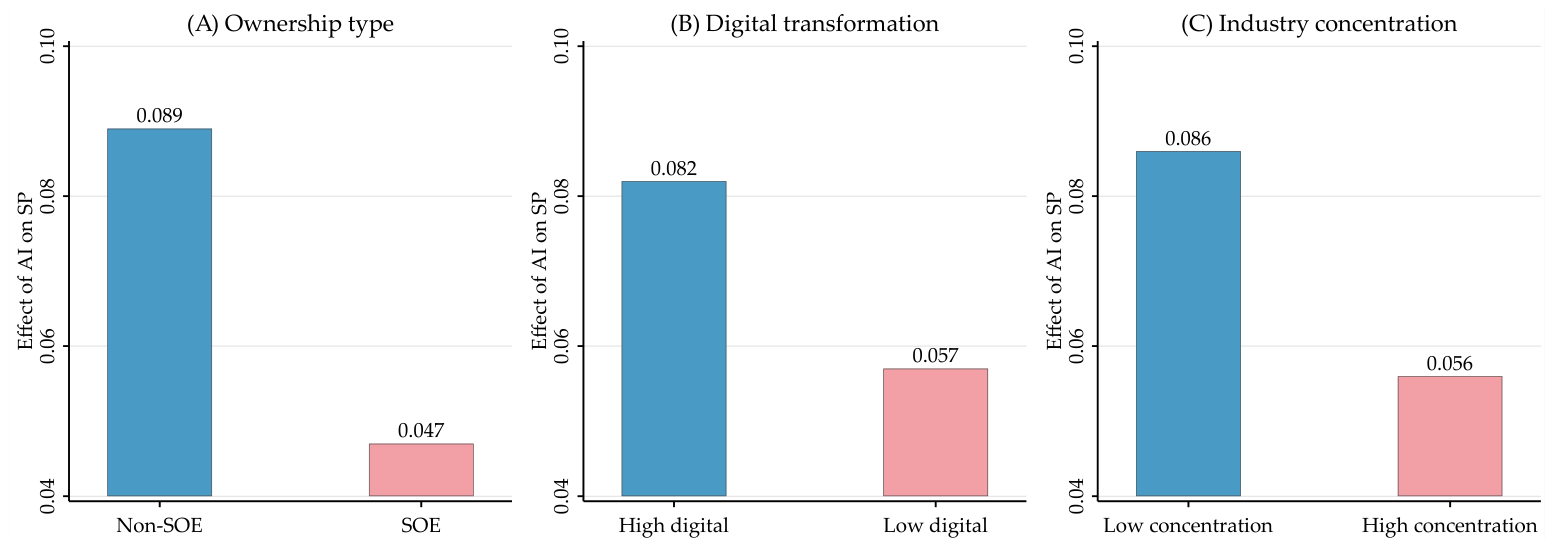
Differences in income distribution and factor allocation across ownership types may lead to heterogeneity in the effect of AI on wage structures. This paper uses the ownership dummy variable SOE to indicate whether a firm is state-owned and interacts with the AI variable to construct the term SOE × AI, so as to examine ownership heterogeneity in the effect of AI on the skill premium. It should be noted that, because SOE is a relatively stable firm-level characteristic, its main effect is absorbed by the firm fixed effects model. The analysis therefore focuses on the estimated coefficient on the interaction term SOE × AI. Panel A of Table 13 reports the corresponding results. The coefficient on SOE × AI is −0.042 and is significant at the 1 percent level, indicating that, relative to non-state-owned firms, the positive effect of AI on the skill premium is significantly weaker in state-owned firms. One possible explanation is that non-state-owned firms operate under more market-oriented compensation mechanisms and labor allocation systems, so the skill demand induced by AI is more readily translated into a relative increase in the wages of high-skilled workers. By contrast, wage adjustment in state-owned firms may be subject to stronger institutional constraints, which weakens the effect of AI shocks on the skill premium.

4.5.2. Heterogeneity by Digital Transformation

A firm’s level of digitalization may affect its ability to absorb, integrate, and apply AI technologies. Following Zhang et al. (2021) [87], this paper measures firm digitalization by the proportion of digital transformation-related items in the year-end breakdown of intangible assets disclosed in the notes to listed firms’ financial statements relative to total intangible assets. This paper directly uses the continuous digitalization indicator Digital and constructs the interaction term Digital × AI to test whether digitalization strengthens the effect of AI on the skill premium. Panel B of Table 13 reports the corresponding results. The coefficient on Digital × AI is 0.025 and is significant at the 1 percent level, indicating that the higher the level of digitalization, the stronger the positive effect of AI on the skill premium within firms. This result suggests that a higher level of digitalization helps firms integrate and apply AI technologies more effectively, thereby further strengthening the relative demand for and returns to high-skilled workers.

4.5.3. Heterogeneity by Industry Market Concentration

Industry market structure may affect the strength of the effect of AI on the skill premium. This paper uses the Herfindahl–Hirschman Index (HHI) to measure industry market concentration and constructs the interaction term HHI × AI for empirical testing. It should be noted that a higher HHI indicates a higher degree of market concentration and usually implies weaker competitive pressure within the industry. Panel C of Table 13 shows that the coefficient on HHI × AI is −0.030 and is significant at the 1 percent level, indicating that the positive effect of AI on the skill premium becomes weaker as industry market concentration increases. Put differently, in industries with lower market concentration and more intense competition, AI is more likely to induce firms to make skill-biased wage adjustments, whereas in industries with higher market concentration, this effect is relatively limited. One possible explanation is that, in more competitive industries, firms have stronger incentives to use AI to improve efficiency, optimize labor allocation, and adjust compensation structures, thereby more markedly increasing the relative returns to high-skilled workers.
Figure 7 presents the results of the heterogeneity analysis, illustrating how the effect of AI on the skill premium varies across different firm characteristics.

5. Extended Analysis

To further extend the analysis, this paper goes beyond the effect of artificial intelligence on the skill premium within firms and examines its impact on the labor income share and wage dispersion across firms, thereby exploring the broader role of AI in factor income distribution and income differentiation. Following Xiao et al. (2022), this paper measures the labor income share as cash paid to employees in the current period divided by total operating revenue [88]. Following Liu and Wang (2019), wage dispersion across firms is measured by the standard deviation of average wages across firms within the same industry [89].
Table 14 reports the results of the extended analysis. In column (1), the dependent variable is the labor income share. The results show that the estimated coefficient on the AI variable is −0.022 and is significant at the 1 percent level, indicating that AI significantly reduces firms’ labor income share. This suggests that, as the application of AI deepens, the roles of capital and technology in the production process become relatively more important, and the share of labor compensation in total income declines, thereby widening the income distribution gap between capital and labor.
In column (2), the dependent variable is wage dispersion across firms. The results show that the estimated coefficient on the AI variable is 0.040 and is significant at the 1 percent level, indicating that AI significantly widens wage disparities across firms. This implies that AI not only increases income differentials between workers with different skill levels within firms, but also further enlarges wage inequality across firms. One possible explanation is that firms with a higher degree of AI typically possess stronger technological capability and productivity advantages, making them more able to attract high-skilled workers and pay higher wages, thereby widening income disparities across firms [90].
Overall, the extended analysis indicates that the effects of AI are not limited to raising the skill premium within firms. They also manifest in a decline in firms’ labor income share and an increase in wage inequality across firms, highlighting the broad influence of AI on the structure of income distribution.

6. Conclusions and Discussion

6.1. Conclusions

Against the backdrop of sustainable development, the impact of artificial intelligence on the skill structure of labor and the distribution of income has become an important real-world issue. Using a sample of A-share listed firms on the Shanghai and Shenzhen stock exchanges over the 2012 to 2022 period, this paper systematically examines the effect of firm-level AI development on the skill premium and its underlying mechanisms. The empirical results show that, within the sample of listed firms, AI significantly increases the skill premium. This effect operates mainly through the substitution effect, the productivity effect, the capital deepening effect, and the technological upgrading effect. The main conclusion remains unchanged after a variety of robustness checks and endogeneity tests. Further heterogeneity analysis shows that the effect is more pronounced among non-state-owned firms, firms with higher levels of digitalization, and firms in industries with lower market concentration. In addition, the extended analysis indicates that AI not only widens the skill premium within firms but also reduces firms’ labor income share and enlarges wage disparities across firms.
From a theoretical perspective, this paper makes two main contributions. First, it provides firm-level evidence on how AI is associated with wage differentials across workers with different skill levels within firms, thereby complementing existing studies that mainly examine the distributional consequences of technological change at the macro, regional, or industry level. Second, by jointly examining the substitution effect, productivity effect, capital deepening effect, and technological upgrading effect, this paper provides a more systematic framework for understanding how AI affects the skill premium within firms. Unlike general digital technologies that mainly improve information processing and operational efficiency, AI is more closely related to task substitution, prediction, decision support, and innovation activities. These features imply that AI may influence labor market outcomes not only through routine-task substitution, but also through productivity improvement, capital–skill complementarity, and innovation-related upgrading, thereby highlighting the distinctive ways in which AI reshapes the internal allocation of labor and rewards to skills.
From a practical perspective, this paper shows that even for resource-rich listed firms, the gains from AI adoption are not distributionally neutral. They are accompanied by a structural shift toward skill polarization and increased income inequality. This finding highlights that productivity improvements driven by AI do not automatically translate into more equitable outcomes. Accordingly, both policymakers and firms should adopt appropriate measures to mitigate these distributional imbalances and promote greater inclusiveness. Such efforts can help ensure that the benefits of AI-driven development are more broadly shared across the workforce, fostering a more balanced relationship between technological progress and social equity.

6.2. Discussion

Based on the findings of this paper, artificial intelligence can improve firm productivity and promote technological upgrading, but it may also intensify income differentiation across skill groups by widening the skill premium. Accordingly, in promoting the development of AI, greater attention should be paid to the coordination between technological progress and social equity, so as to foster a more inclusive and sustainable pattern of development.

6.2.1. Policy Implications

To better align technological progress with social equity, the government should strengthen institutional design in the areas of education, employment policy, and income distribution adjustment. In the context of China’s ongoing digital transformation and industrial upgrading, policies such as “Digital China” and the development of the digital economy further accelerate the diffusion of AI technologies across industries. While these policies promote productivity growth, they may also reinforce skill-biased effects if not accompanied by adequate labor market adjustments. Therefore, policy design should explicitly account for the distributional consequences of AI adoption.
First, the education system and the skill training system should be improved. The government should promote reforms in the education system, strengthen vocational education and skill training, and gradually build a lifelong learning system that covers different stages of the life cycle, so as to enhance workers’ ability to adapt to technological change. Given that AI adoption increases demand for high-skilled and innovation-oriented labor, the education system should place greater emphasis on interdisciplinary skills, digital literacy, and problem-solving capabilities. At the same time, greater support should be provided for the cultivation of skilled talent. Skill-oriented talent development should be incorporated into university training plans and evaluation systems, thereby raising the overall skill level of the labor force.
Second, employment policy and income distribution mechanisms should be better aligned with the labor market adjustments induced by AI. In terms of employment policy, the government can encourage firms to create new positions during technological upgrading and provide tax incentives or fiscal subsidies to firms that actively absorb workers affected by occupational transition. Particular attention should be paid to middle- and low-skilled workers engaged in routine tasks, who are more exposed to technological substitution. The mechanism results suggest that these workers are more likely to be affected not only by direct substitution but also by indirect effects arising from changes in firms’ production structures. Targeted retraining programs, job-matching services, and transition support can help these workers move into tasks that are more complementary to AI. In terms of income distribution, the social security system should be further improved, social insurance coverage should be expanded, and redistributive mechanisms should be strengthened to reduce the risk that technological progress widens income inequality. More broadly, AI-related industrial policies should be coordinated with labor market policies and vocational education reform, so that productivity gains from AI are more likely to translate into inclusive employment and shared development.

6.2.2. Managerial Implications

At the firm level, sustainable development in the age of AI requires improvements in human resource management and skill development systems. First, firms should optimize their talent structure and human resource allocation in response to the changing demand for skills brought about by AI adoption. Consistent with the mechanism analysis, firms need to adjust their internal labor allocation by increasing the share of high-skilled workers in tasks related to innovation, data analysis, and decision support, while redesigning routine-task positions that are more susceptible to automation. In particular, firms should establish comprehensive talent databases and dynamically manage employees’ skills, experience, and career development needs, thereby improving the efficiency of human resource allocation.
Second, firms should strengthen employee training and skill development mechanisms. Through continuous vocational training and skill upgrading programs, firms can enhance employees’ ability to adapt to technological change and promote the sustained accumulation of human capital. In particular, internal training systems should be closely aligned with firms’ technological upgrading strategies, so that skill development can effectively complement AI adoption and enhance productivity gains.
At the worker level, individuals should actively embrace lifelong learning and continuously upgrade their skills in order to adapt to changes in the employment environment brought about by AI. High-skilled workers should continue to track technological trends and strengthen their innovative capacity, while middle- and low-skilled workers should improve their skills through vocational training and professional certification so as to reduce the risk of technological displacement. Raising the overall skill level of the workforce can not only improve job quality but also help mitigate the income differentiation associated with skill gaps. From a broader perspective, enhancing workers’ adaptability to technological change is essential for ensuring that the benefits of AI-driven growth are more widely shared across society.

6.2.3. Limitations and Future Research

First, the measurement of the skill premium in this paper is still subject to certain limitations. Due to data constraints, we are unable to directly observe the wage gap between high-skilled and low-skilled workers within firms, and therefore rely on an indirect proxy. As a result, the constructed measure may not fully capture the true within-firm skill wage differential. Future research may overcome this limitation by collecting more detailed compensation data through field surveys or questionnaire-based investigations, which would allow a more direct and accurate identification of the impact of AI on the skill premium.
Second, with respect to the data sample, this paper focuses on A-share listed firms on the Shanghai and Shenzhen stock exchanges. Compared with the broader population of firms, listed firms generally have advantages in terms of scale, resource endowments, governance quality, and capacity for technology adoption, and they are often among the earliest firms to undertake digital transformation and invest in AI. Accordingly, the findings of this paper primarily reflect the relationship between AI development and skill-related wage differentiation within the sample of listed firms. For small- and medium-sized enterprises, unlisted firms, and other types of firms, the underlying mechanisms and empirical patterns may differ. Future research could therefore extend the sample scope and use broader-based firm data to examine more deeply the relationship between AI development and changes in skill wage structures across different types of firms.
Third, the sample period of this study covers 2012–2022, prior to the rapid diffusion of generative AI technologies such as large language models. As a result, the analysis primarily captures the effects of earlier forms of AI (e.g., machine learning and automation) on the skill premium. Given that generative AI may exhibit different patterns of skill complementarity and task substitution, the applicability of the identified transmission channels in this new technological context remains an open question. Future research should extend the sample period and re-examine these mechanisms using post-2022 data to assess whether the underlying relationships continue to hold.

Author Contributions

Conceptualization, H.L.; methodology, H.L.; software, H.L.; validation, H.L., X.Z. and J.F.; formal analysis, H.L., X.Z. and J.F.; investigation, H.L., X.Z. and J.F.; resources, H.L., X.Z. and J.F.; data curation, H.L., X.Z. and J.F.; writing—original draft preparation, H.L., X.Z. and J.F.; writing—review and editing, H.L., X.Z. and J.F.; visualization, H.L., X.Z. and J.F.; supervision, X.Z. and J.F.; project administration, J.F.; funding acquisition, J.F. All authors have read and agreed to the published version of the manuscript.

Funding

This study was supported by grants from the Humanities and Social Sciences Fund of the Ministry of Education (20YJCZH026) and the Beijing Municipal Science & Technology Commission (9202016).

Institutional Review Board Statement

Not applicable.

Informed Consent Statement

Not applicable.

Data Availability Statement

Data will be available from the corresponding author upon reasonable request.

Conflicts of Interest

The authors declare no conflicts of interest.

References

  1. Wu, R.; Wang, J.; Wang, X. Digital economy, factor allocation and urban–rural income disparity: Insights from prefecture-level data in China. Sustainability 2026, 18, 3421. [Google Scholar] [CrossRef]
  2. Burksiene, V.; Dvorak, J.; Burbulyte-Tsiskarishvili, G. Sustainability and sustainability marketing in competing for the title of European Capital of Culture. Organizacija 2018, 51, 66–78. [Google Scholar] [CrossRef]
  3. Autor, D.H.; Katz, L.F.; Krueger, A.B. Computing inequality: Have computers changed the labor market? Q. J. Econ. 1998, 113, 1169–1213. [Google Scholar] [CrossRef]
  4. Gosling, A.; Machin, S.; Meghir, C. The changing distribution of male wages in the UK. Rev. Econ. Stud. 2000, 67, 635–666. [Google Scholar]
  5. Katz, L.F.; Murphy, K.M. Changes in relative wages, 1963-1987: Supply and demand factors. Q. J. Econ. 1992, 107, 35–78. [Google Scholar] [CrossRef]
  6. Acemoglu, D. Technical change, inequality, and the labor market. J. Econ. Lit. 2002, 40, 7–72. [Google Scholar] [CrossRef]
  7. Autor, D.H.; Levy, F.; Murnane, R.J. The skill content of recent technological change: An empirical exploration. Q. J. Econ. 2003, 118, 1279–1333. [Google Scholar] [CrossRef]
  8. Acemoglu, D. Why do new technologies complement skills? Directed technical change and wage inequality. Q. J. Econ. 1998, 113, 1055–1089. [Google Scholar] [CrossRef]
  9. Huang, H.Q.; Dai, T.S.; Shen, J. AI, learning-by-doing and skill premium: A study based on a model of endogenous technological change. China Ind. Econ. 2024, 28, 99–117. (In Chinese) [Google Scholar] [CrossRef]
  10. Tang, C.J.; Huang, K.Q.; Liu, Q.R. Robots and skill-biased development in employment structure: Evidence from China. Econ. Lett. 2021, 205, 109960. [Google Scholar] [CrossRef]
  11. Acemoglu, D.; Restrepo, P. Low-skill and high-skill automation. J. Hum. Cap. 2018, 12, 204–232. [Google Scholar] [CrossRef]
  12. Hu, S.M.; Wang, L.H.; Dong, Z.Q. The application of industrial robots and the labor skill premium: Theoretical hypothesis and industrial evidence. Ind. Econ. Res. 2021, 4, 69–84. (In Chinese) [Google Scholar] [CrossRef]
  13. Hui, X.; Reshef, O.; Zhou, L.F. The short-term effects of generative artificial intelligence on employment: Evidence from an online labor market. Organ. Sci. 2024, 35, 1977–1989. [Google Scholar] [CrossRef]
  14. Lankisch, C.; Prettner, K.; Prskawetz, A. How can robots affect wage inequality? Econ. Model. 2019, 81, 161–169. [Google Scholar] [CrossRef]
  15. Cheng, C.; Luo, J.; Zhu, C.; Zhang, S. Artificial intelligence and the skill premium: A numerical analysis of theoretical models. Technol. Forecast. Soc. Change 2024, 200, 123140. [Google Scholar] [CrossRef]
  16. Zheng, J.L.; Wang, X.H.; Zhang, X.M. How does AI affect labor income share? Based on the mechanism of industrial structure and enterprise upgrading. Nankai Econ. Stud. 2024, 4, 3–22. [Google Scholar] [CrossRef]
  17. Acemoglu, D.; Restrepo, P. Automation and new tasks: How technology displaces and reinstates labor. J. Econ. Perspect. 2019, 33, 3–30. [Google Scholar] [CrossRef]
  18. Hicks, J. The Theory of Wages; Springer: London, UK, 1963; pp. 179–197. [Google Scholar]
  19. Frank, M.R.; Autor, D.; Bessen, J.E.; Brynjolfsson, E. Toward understanding the impact of artificial intelligence on labor. Proc. Natl. Acad. Sci. USA 2019, 116, 6531–6539. [Google Scholar] [CrossRef]
  20. Romer, P.M. Endogenous technological change. J. Polit. Econ. 1990, 98, 71–102. [Google Scholar] [CrossRef]
  21. Aghion, P.; Howitt, P.; Brant-Collett, M. Endogenous Growth Theory; MIT Press: London, UK, 1998; pp. 123–147. [Google Scholar]
  22. Griliches, Z. Capital-skill complementarity. Rev. Econ. Stat. 1969, 51, 465–468. [Google Scholar] [CrossRef]
  23. Dinlersoz, E.; Greenwood, J. The rise and fall of unions in the United States. J. Monet. Econ. 2016, 83, 129–146. [Google Scholar] [CrossRef]
  24. Acemoglu, D.; Restrepo, P. The race between man and machine: Implications of technology for growth, factor shares, and employment. Am. Econ. Rev. 2018, 108, 1488–1542. [Google Scholar] [CrossRef]
  25. Autor, D.H. Why are there still so many jobs? The history and future of workplace automation. J. Econ. Perspect. 2015, 29, 3–30. [Google Scholar] [CrossRef]
  26. Duan, W.; Shu, X.; Wu, F.X.; Liu, T.T. Intangible capital, capital-skill complementarity and skill premium. Econ. Res. J. 2023, 58, 116–134. [Google Scholar]
  27. Brynjolfsson, E.; Li, D.; Raymond, L. Generative AI at work. Q. J. Econ. 2025, 140, 889–942. [Google Scholar] [CrossRef]
  28. Noy, S.; Zhang, W. Experimental evidence on the productivity effects of generative artificial intelligence. Science 2023, 381, 187–192. [Google Scholar] [CrossRef]
  29. Eloundou, T.; Manning, S.; Mishkin, P.; Rock, D. GPTs are GPTs: Labor market impact potential of LLMs. Science 2024, 384, 1306–1308. [Google Scholar] [CrossRef]
  30. Kanazawa, K.; Kawaguchi, D.; Shigeoka, H.; Watanabe, Y. AI, skill, and productivity: The case of taxi drivers. Manag. Sci. 2025, 72, 1376–1388. [Google Scholar] [CrossRef]
  31. Bloom, D.E.; Prettner, K.; Saadaoui, J.; Veruete, M. Artificial intelligence and the skill premium. Financ. Res. Lett. 2025, 81, 107401. [Google Scholar] [CrossRef]
  32. Dixon, J.; Hong, B.; Wu, L. The robot revolution: Managerial and employment consequences for firms. Manag. Sci. 2021, 67, 5586–5605. [Google Scholar] [CrossRef]
  33. Engberg, E.; Koch, M.; Lodefalk, M.; Schroeder, S. Artificial intelligence, tasks, skills, and wages: Worker-level evidence from Germany. Res. Policy 2025, 54, 105285. [Google Scholar] [CrossRef]
  34. Mallick, S.K.; Sousa, R.M. The skill premium effect of technological change: New evidence from United States manufacturing. Int. Labour Rev. 2017, 156, 113–131. [Google Scholar] [CrossRef]
  35. Acemoglu, D.; Restrepo, P. Robots and jobs: Evidence from US labor markets. J. Polit. Econ. 2020, 128, 2188–2244. [Google Scholar] [CrossRef]
  36. Arntz, M.; Gregory, T.; Zierahn, U. The risk of automation for jobs in OECD countries. In OECD Social Employment and Migration Working Papers; Organisation for Economic Co-Operation and Development: Paris, France, 2016. [Google Scholar] [CrossRef]
  37. Cheng, W. Artificial intelligence, solow paradox and high-quality development: A perspective of the diffusion of general purpose technology. Econ. Res. J. 2021, 56, 22–38. [Google Scholar]
  38. Chen, N.; Sun, D.; Chen, J. Digital transformation, labour share, and industrial heterogeneity. J. Innov. Knowl. 2022, 7, 100173. [Google Scholar] [CrossRef]
  39. Autor, D.H.; Dorn, D. The growth of low-skill service jobs and the polarization of the US labor market. Am. Econ. Rev. 2013, 103, 1553–1597. [Google Scholar] [CrossRef]
  40. Hubmer, J. The race between preferences and technology. Econometrica 2023, 91, 227–261. [Google Scholar] [CrossRef]
  41. Chen, G.F.; Han, J.; Han, K.M. Urban digital economy development, skill-biased technological change and underemployment. China Ind. Econ. 2022, 8, 118–136. (In Chinese) [Google Scholar] [CrossRef]
  42. Fang, M.Y.; Lin, J.N.; Nie, H.H. Does digital transformation promote common prosperity within firms? Evidence from Chinese A-share listed firms. J. Quant. Technol. Econ. 2022, 39, 50–70. (In Chinese) [Google Scholar] [CrossRef]
  43. Chen, L.; Gao, Y.P.; Yu, L.H. How is AI shaping the labor demands of enterprises? Evidence from big data analysis of recruitment platforms. J. Manag. World 2024, 40, 74–93. (In Chinese) [Google Scholar] [CrossRef]
  44. Li, Z.; Yang, H.; Zhang, T. Impact of enterprise artificial intelligence development on human capital structure. Financ. Res. Lett. 2025, 82, 107600. [Google Scholar] [CrossRef]
  45. Beaudry, P.; Green, D.A.; Sand, B.M. The great reversal in the demand for skill and cognitive tasks. J. Labor Econ. 2016, 34, S199–S247. [Google Scholar] [CrossRef]
  46. Ma, H.M.; Gao, Q.; Li, X.Z.; Zhang, Y. AI development and employment skill structure: A case study of China. Econ. Anal. Policy 2021, 73, 242–254. [Google Scholar] [CrossRef]
  47. Meng, K.; Ba, Z.C.; Liu, L.L. Impact mechanism of artificial intelligence-driven changes in corporate workforce skill composition. Soft Sci. 2026, 1–16. Available online: https://link.cnki.net/urlid/51.1268.g3.20260417.1346.002 (accessed on 20 November 2025). (In Chinese)
  48. Wu, Y.Q.; Lin, Z.W.; Zhang, Q.C.; Wang, W. Artificial intelligence, wage dynamics, and inequality: Empirical evidence from Chinese listed firms. Int. Rev. Econ. Financ. 2024, 96, 103739. [Google Scholar] [CrossRef]
  49. Yang, C.H. How artificial intelligence technology affects productivity and employment: Firm-level evidence from Taiwan. Res. Policy 2022, 51, 104536. [Google Scholar] [CrossRef]
  50. Krusell, P.; Ohanian, L.E.; Ríos-Rull, J.-V.; Violante, G.L. Capital-skill complementarity and inequality: A macroeconomic analysis. Econometrica 2000, 68, 1029–1053. [Google Scholar] [CrossRef]
  51. Duffy, J.; Papageorgiou, C.; Perez-Sebastian, F. Capital-skill complementarity? Evidence from a panel of countries. Rev. Econ. Stat. 2004, 86, 327–344. [Google Scholar] [CrossRef]
  52. Maliar, L.; Maliar, S.; Tsener, I. Capital-skill complementarity and inequality: Twenty years after. Econ. Lett. 2022, 220, 110844. [Google Scholar] [CrossRef]
  53. Graetz, G.; Michaels, G. Robots at Work. Rev. Econ. Stat. 2018, 100, 753–768. [Google Scholar] [CrossRef]
  54. Tschang, F.T.; Almirall, E. Artificial intelligence as augmenting automation: Implications for employment. Acad. Manag. Perspect. 2021, 35, 642–659. [Google Scholar] [CrossRef]
  55. Akerman, A.; Gaarder, I.; Mogstad, M. The skill complementarity of broadband internet. Q. J. Econ. 2015, 130, 1781–1824. [Google Scholar] [CrossRef]
  56. Cirillo, V.; Sostero, M.; Tamagni, F. Innovation and within-firm wage inequalities: Empirical evidence from major European countries. Ind. Innov. 2017, 24, 468–491. [Google Scholar] [CrossRef]
  57. Grant, R.; Üngör, M. The AI revolution with 21st century skills: Implications for the wage inequality and technical change. Scott. J. Polit. Econ. 2024, 71, 731–765. [Google Scholar] [CrossRef]
  58. Sun, Z.; Zong, R. Industrial robot applications, biased technological progress, and gender employment gap. Res. Econ. Manag. 2025, 46, 91–109. (In Chinese) [Google Scholar] [CrossRef]
  59. Guo, K.M. Artificial intelligence, structural transformation and labor share. J. Manag. World 2019, 35, 60–77. (In Chinese) [Google Scholar] [CrossRef]
  60. Schumpeter, J.A. Capitalism, Socialism and Democracy, 1st ed.; Routledge: London, UK, 1976; pp. 114–156. [Google Scholar]
  61. Brynjolfsson, E.; McAfee, A. The Second Machine Age: Work, Progress, and Prosperity in a Time of Brilliant Technologies, 1st ed.; WW Norton & Company: New York, NY, USA, 2014; pp. 71–89. [Google Scholar]
  62. Brem, A.; Giones, F.; Werle, M. The AI digital revolution in innovation: A conceptual framework of artificial intelligence technologies for the management of innovation. IEEE Trans. Eng. Manag. 2021, 70, 770–776. [Google Scholar] [CrossRef]
  63. Cirillo, V. Technology, employment and skills. Econ. Innov. New Tech. 2017, 26, 734–754. [Google Scholar] [CrossRef]
  64. Vivarelli, M. Innovation, employment and skills in advanced and developing countries: A survey of economic literature. J. Econ. Issues 2014, 48, 123–154. [Google Scholar] [CrossRef]
  65. Chen, N.; Cai, Y.Z. Al innovation and coordinated development of regional economy-Analysis of technological development and regional impact using patent data. Res. Econ. Manag. 2023, 44, 16–40. (In Chinese) [Google Scholar] [CrossRef]
  66. Mann, K.; Püttmann, L. Benign effects of automation: New evidence from patent texts. Rev. Econ. Stat. 2023, 105, 562–579. [Google Scholar] [CrossRef]
  67. Yin, Z.F.; Cao, A.J.; Guo, J.B. A study of the impact of artificial intelligence on employment based on patents data—Evidence from Zhongguancun enterprises. China Ind. Econ. 2023, 5, 137–154. (In Chinese) [Google Scholar] [CrossRef]
  68. Egger, H.; Kreickemeier, U. Firm heterogeneity and the labor market effects of trade liberalization. Int. Econ. Rev. 2009, 50, 187–216. [Google Scholar] [CrossRef]
  69. Xie, J.; Guo, C.Y.; Chen, K.J.; Guo, J. Minimum wage, industrial automation and skill premium. China Ind. Econ. 2022, 102–120. (In Chinese) [Google Scholar] [CrossRef]
  70. Chen, B.; He, C.Q. The gap between exports and wages: A theory based on China’s industrial firms, and a case study. J. Manag. World 2013, 8, 6–15. (In Chinese) [Google Scholar] [CrossRef]
  71. Chen, B.; Yu, M.; Yu, Z. Measured skill premia and input trade liberalization: Evidence from Chinese firms. J. Int. Econ. 2017, 109, 31–42. [Google Scholar] [CrossRef]
  72. Zhao, S.; Shi, X.Z.; Lu, Y.; Liu, X.Y.; Can, M. As promote the optimization and upgrading of labor structures? J. Financ. Res. 2020, 10, 150–169. [Google Scholar]
  73. Zhao, C.Y. Research on the impact of digital transformation on enterprises’ labor employment. Stud. Sci. Sci. 2023, 41, 241–252. (In Chinese) [Google Scholar] [CrossRef]
  74. Yu, L.Z.; Wei, X.H.; Sun, Z.W.; Wu, C.X. Industrial robots, job tasks and non-routine capability premium: Evidence from “Enterprise-worker” matching data in manufacturing industry. J. Manag. World 2021, 37, 47–59. (In Chinese) [Google Scholar] [CrossRef]
  75. Hémous, D.; Olsen, M. The rise of the machines: Automation, horizontal innovation, and income inequality. Am. Econ. J. Macroecon. 2022, 14, 179–223. [Google Scholar] [CrossRef]
  76. Lankisch, C.; Prettner, K.; Prskawetz, A. Robots and the skill premium: An automation-based explanation of wage inequality. In Hohenheim Discussion Papers in Business, Economics and Social Sciences; Universität Hohenheim: Stuttgart, Germany, 2017. [Google Scholar]
  77. Chao, X.J.; Lian, Y.M.; Yuan, J.R.; Chen, S.Y. Digital infrastructure construction and industrial chain resilience: Empirical analysis based on industrial chain recovery capability Data. J. Quant. Tech. Econ. 2024, 41, 112–131. [Google Scholar] [CrossRef]
  78. Liu, C.M.; Ma, Q.S. Research on the influence of network infrastructure construction on total factor productivity growth: A quasi-natural experiment of “Broadband China” pilot policy. Chin. J. Popul. Sci. 2020, 3, 75–88. (In Chinese) [Google Scholar]
  79. Zhang, L.P.; Zhong, Y.L. Impact of artificial intelligence application on total factor productivity from the perspective of value chain-empirical research based on Chinese A-Share listed companies. Reform. Econ. Syst. 2023, 106–113. (In Chinese) [Google Scholar]
  80. Baark, E. China’s new digital infrastructure: Expanding 5G mobile communications. East Asian Policy 2022, 14, 124–136. [Google Scholar] [CrossRef]
  81. Zhang, J.; Gong, X.; Cheng, M. Broadband cities: Bridging urban-rural consumption gap with digital innovation. Cities 2025, 167, 106315. [Google Scholar] [CrossRef]
  82. Wang, L.; Hu, Z.; Song, W.; Xi, J. Geographic constraints shape urban and economic growth worldwide. Commun. Earth Environ. 2026, 7, 177. [Google Scholar] [CrossRef]
  83. China Academy of Information and Communications Technology (CAICT). China Digital Economy Development White Paper. 2021. Available online: https://www.caict.ac.cn/kxyj/qwfb/bps/202104/P020210424737615413306.pdf (accessed on 24 April 2026).
  84. Acemoglu, D.; Autor, D. Skills, Tasks and Technologies: Implications for Employment and Earnings. In Handbook of Labor Economics; Ashenfelter, O., Card, D., Eds.; Elsevier: Amsterdam, The Netherlands, 2011; Volume 4, pp. 1043–1171. [Google Scholar]
  85. Wang, Q.Y.; Wei, S.D.; Jin, S.; Chen, H. A research on the effects of industrial intelligence on employment: Based on spatial econometric analysis of laborers’ skills and genders. J. Manag. World 2022, 38, 110–126. (In Chinese) [Google Scholar] [CrossRef]
  86. Baron, R.M.; Kenny, D.A. The Moderator-Mediator Variable Distinction in Social Psychological Research: Conceptual, Strategic and Statistical Considerations. J. Pers. Soc. Psychol. 1986, 51, 1173–1182. [Google Scholar] [CrossRef]
  87. Zhang, Y.K.; Li, X.B.; Xing, M.Q. Enterprise digital transformation and audit pricing. Audit. Res. 2021, 3, 62–71. [Google Scholar]
  88. Xiao, S.S.; Sun, R.Q.; Yuan, C.; Sun, J. Digital transformation, human capital structure adjustment and labor income share. J. Manag. World 2022, 38, 220–237. (In Chinese) [Google Scholar] [CrossRef]
  89. Liu, C.L.; Wang, Y.J. Export growth and wage inequality across firms: Mechanism and impacts. J. World Econ. 2019, 42, 99–120. (In Chinese) [Google Scholar] [CrossRef]
  90. Stokey, N.L. Technology, skill, and the wage structure. J. Hum. Cap. 2018, 12, 343–384. [Google Scholar] [CrossRef]
Figure 1. Theoretical framework of how AI affects skill premium.
Sustainability 18 04480 g001
Figure 2. Evolution of AI patent distribution across industries, 2012–2022. Notes: The figure displays the distribution of AI-related patents across industries from 2012 to 2022 based on the full sample before sample restrictions. The shares are calculated as the number of AI-related patents in each industry divided by the total number of AI-related patents in that year. Industries are classified based on the first letter of the industry code, and “Other industries” aggregates all remaining sectors not shown separately.
Sustainability 18 04480 g002
Figure 3. Evolution in the number of listed firms applying for AI patents, 2012–2022. Notes: The figure presents the annual number of listed firms that apply for AI-related patents over the period 2012–2022. A firm is classified as an AI-patenting firm in a given year if it files at least one AI-related patent in that year.
Sustainability 18 04480 g003
Figure 4. Trends in skill premium across quartiles of initial base station density and terrain relief. Notes: This figure plots the average residualized skill premium across quartiles of initial base station density and terrain relief from 2012 to 2022. The skill premium is residualized by controlling for city and year fixed effects and then re-centered at the full-sample mean. (A) groups regions by quartiles of initial base station density, while (B) groups regions by quartiles of terrain relief. The dashed vertical line marks the period associated with the acceleration of AI-related policy implementation and diffusion (around 2017–2019). The shaded areas denote the post-treatment period. The largely parallel pre-treatment trends across quartiles suggest that regions with different initial infrastructure and geographic conditions did not exhibit systematically different skill-premium trajectories prior to the large-scale diffusion of AI technologies. The subsequent divergence supports the interpretation that these regional characteristics are more likely to affect the skill premium through differential exposure to AI diffusion rather than through direct channels.
Sustainability 18 04480 g004
Figure 5. Parallel trend test of the policy shock on firm skill premium. Notes: The figure presents the estimated coefficients from the event-study specification, capturing the dynamic effects of the policy shock on the firm-level skill premium. The horizontal axis denotes event time relative to policy implementation, with the year prior to implementation (k = −1) serving as the reference period. The dots correspond to point estimates, and the vertical lines represent 95% confidence intervals. The estimates in the pre-policy periods are close to zero and statistically insignificant, providing support for the parallel trends assumption.
Sustainability 18 04480 g005
Figure 6. Decomposition of total effect. Notes: The figure presents the decomposition of the total effect of AI on the skill premium into four identified transmission channels, namely the productivity effect, the capital deepening effect, the technological upgrading effect, and the substitution effect, together with the remaining unexplained component. The percentages shown in the figure indicate the proportional contribution of each component to the total effect. Collectively, the four identified channels account for 73.5 percent of the total effect.
Sustainability 18 04480 g006
Figure 7. Heterogeneous effects of AI on the skill premium. Notes: The figure summarizes the heterogeneity analysis of the effect of AI on the skill premium across different firm characteristics. (A) compares the estimated effect between non-state-owned firms and state-owned firms. (B) compares the estimated effect between firms with high and low levels of digital transformation. (C) compares the estimated effect between industries with low and high market concentration. The plotted values are calculated based on the estimated coefficients reported in Table 13 and illustrate how the strength of the effect of AI on the skill premium varies across groups.
Sustainability 18 04480 g007
Table 1. Variable definitions and measurements.
CategoryVariablesDefinitionMeasurement
Dependent variableSPSkill premiumMeasured as the natural logarithm of the task-based wage gap between high-skilled and low-skilled workers.
Independent variableAIArtificial intelligence Measured as the natural logarithm of one plus the number of AI-related patent applications at the firm-year level.
City-level controlsPopPopulation densityMeasured as the natural logarithm of the ratio of regional registered population to administrative land area.
PgdpGDP per capitaMeasured as the natural logarithm of regional GDP divided by permanent population.
UpgradeIndustrial structure upgradingMeasured as the ratio of value added in the tertiary industry to that in the secondary industry.
HcapitalHuman capital levelMeasured as the ratio of students enrolled in regular higher education institutions to the total population at year-end.
Internet Internet penetration rateMeasured as the ratio of broadband Internet subscribers to the local resident population.
Road_densityRoad network densityMeasured as the ratio of total road length to administrative land area.
Firm-level controlsSizeFirm sizeMeasured as the natural logarithm of total assets at year-end.
LevLeverageDefined as total liabilities divided by total assets at year-end.
ROAReturn on assetsCalculated as net profit divided by total assets.
GrowthFirm growthMeasured as the growth rate of operating revenue, calculated as (current-year operating revenue/previous-year operating revenue) − 1.
CashFlowCash flow capacityMeasured as net cash flows from operating activities divided by total assets.
Tobin’s QFirm valueMeasured as market value divided by total assets.
DualCEO dualityA dummy variable equal to 1 if the CEO also serves as the board chair, and 0 otherwise.
Table 2. Descriptive statistics.
VariablesObsMeanSDMinMax
SP17,7804.9205.1800.00012.650
AI17,8250.0630.3530.0005.805
Pop17,8256.4300.6454.7008.050
Pgdp17,82511.7600.71010.05013.020
Upgrade17,8251.6801.0500.5005.180
Hcapital17,8250.0440.0310.0040.136
Internet17,8250.5600.1500.2100.890
Road_density17,8254.8502.6300.72012.400
Size17,82522.3601.28020.01026.150
Lev17,8250.4180.1980.0610.882
ROA17,8250.0380.059−0.2210.192
Growth17,7900.3320.812−0.6635.742
CashFlow17,8250.0510.064−0.1360.236
Tobin’s Q17,5202.0101.2400.8517.982
Dual17,4800.3010.4590.0001.000
Table 3. Correlation matrix.
VariablesSPAIPopPgdpUpgradeHcapitalInternetRoad_DensitySize
SP1
AI0.086 ***1
Pop0.173 ***0.094 ***1
Pgdp0.158 ***0.088 ***0.486 ***1
Upgrade0.121 ***0.072 ***0.214 ***0.418 ***1
Hcapital−0.018 **−0.015 *0.138 ***0.226 ***0.152 ***1
Internet0.132 ***0.148 ***0.521 ***0.463 ***0.287 ***0.214 ***1
Road_density0.095 ***0.082 ***0.438 ***0.356 ***0.241 ***0.167 ***0.402 ***1
Size0.104 ***0.067 ***0.061 ***0.082 ***0.046 ***0.018 **0.076 ***0.052 ***1
Lev0.061 ***0.031 ***−0.028 ***−0.041 ***−0.022 **−0.011−0.060 ***−0.050 ***0.352 ***
ROA0.073 ***0.046 ***0.033 ***0.027 ***0.019 **0.0060.050 ***0.040 ***0.024 ***
Growth0.018 **0.0120.019 **0.016 **0.014 *0.0040.020 **0.020 **−0.041 ***
CashFlow0.079 ***0.051 ***0.026 ***0.035 ***0.021**0.0090.060 ***0.050 ***0.097 ***
TobinQ0.055 ***0.038 ***0.044 ***0.051 ***0.037 ***0.0120.070 ***0.060 ***0.283 ***
Dual0.022 **0.017 **0.0120.0090.008−0.0050.0000.000−0.106 ***
VariablesLevROAGrowthCashFlowTobinQDual
Lev1
ROA−0.396 ***1
Growth0.0050.021**1
CashFlow−0.171 ***0.441 ***−0.109 ***1
TobinQ−0.124 ***0.138 ***0.066 ***0.084 ***1
Dual−0.084 ***0.042 ***0.003−0.0120.058 ***1
Notes: *** p < 0.01, ** p < 0.05, * p < 0.1.
Table 4. Baseline regression results.
VariablesSP
(1)(2)(3)
AI0.087 ***0.081 ***0.072 ***
(3.55)(3.48)(3.18)
Pop1.241 *** 1.156 ***
(3.29) (3.05)
Pgdp0.884 *** 0.842 ***
(3.11) (2.98)
Upgrade0.226 ** 0.219 **
(2.31) (2.18)
Hcapital−1.021 −0.986
(−0.94) (−0.89)
Internet0.452 *** 0.438 ***
(3.02) (2.91)
Road_density0.071 ** 0.064 **
(2.18) (2.07)
Size 0.171 ***0.143 **
(3.36)(2.61)
Lev 0.401 **0.338 **
(2.41)(2.16)
ROA 1.246 ***1.122 ***
(3.22)(2.97)
Growth −0.029−0.025
(−0.86)(−0.76)
CashFlow 0.824 ***0.912 ***
(3.11)(3.24)
Tobin’s Q 0.066 **0.060 **
(2.32)(2.18)
Dual 0.121 **0.107 **
(2.28)(2.14)
Firm FEYESYESYES
Year FEYESYESYES
N17,43017,12016,980
Adj. R20.7190.7190.725
Notes: *** p < 0.01, ** p < 0.05. t-statistics are reported in parentheses. Robust standard errors are clustered at the firm level. All regressions include firm and year fixed effects.
Table 5. Instrumental variable tests.
VariablesAISPAISPAISP
Base Station Density × TimeTerrain Relief × TimeBoth IVs
First StageSecond StageFirst StageSecond StageFirst StageSecond Stage
(1)(2)(3)(4)(5)(6)
Base Station Density × Time0.179 *** 0.136 ***
(4.52) (4.01)
Terrain Relief × Time 0.139 *** 0.105 ***
(4.05) (3.58)
AI 0.083 *** 0.076 *** 0.079 ***
(2.98) (2.68) (2.85)
ControlsYESYESYESYESYESYES
Firm FEYESYESYESYESYESYES
Year FEYESYESYESYESYESYES
Kleibergen–Paap rk LM35.2 27.6 38.9
Kleibergen–Paap rk Wald F22.1 17.5 18.2
Endogeneity test19.6 16.3 17.1
Hansen J p-value 0.27
N16,98016,98016,98016,98016,98016,980
Notes: *** p < 0.01. t-statistics are reported in parentheses. Robust standard errors are clustered at the firm level. All regressions include firm and year fixed effects. The Hansen J test reports the p-value for overidentification.
Table 6. Sensitivity test for the construction of the dependent variable.
VariablesSP
Province × 2-Digit Industry CellPrefecture-Level City × 3-Digit Industry Cell
(1)(2)
AI0.069 ***0.065 **
(3.15)(2.32)
ControlsYESYES
Firm FEYESYES
Year FEYESYES
N17,04216,518
Adj. R20.7160.714
Notes: *** p < 0.01, ** p < 0.05. t-statistics are reported in parentheses. Standard errors are clustered at the firm level. All regressions include firm and year fixed effects.
Table 7. Alternative measures of the dependent variable.
VariablesSP
Education-Based Skill PremiumR&D-Based Skill PremiumExecutive-Based Skill Premium
(1)(2)(3)
AI0.067 ***0.054 **0.062 ***
(3.11)(2.43)(2.98)
ControlsYESYESYES
Firm FEYESYESYES
Year FEYESYESYES
N16,54016,08216,082
Adj. R20.7030.6900.695
Notes: *** p < 0.01, ** p < 0.05. t-statistics are reported in parentheses. Standard errors are clustered at the firm level. All regressions include firm and year fixed effects.
Table 8. Pearson correlations among alternative AI measures.
VariablesLnpatent_AppLnpatent_GrantLnwordsLnwords_MD&A
Lnpatent_app1
Lnpatent_grant0.882 ***1
Lnwords0.286 ***0.301 ***1
Lnwords_MD&A0.295 ***0.318 ***0.863 ***1
Notes: *** p < 0.01.
Table 9. Alternative measures of the explanatory variable.
VariablesSP
Based on AI Patent GrantsBased on Annual Report AI Keyword FrequencyBased on MD&A AI Keyword Frequency
(1)(2)(3)
AI0.088 ***0.105 ***0.103 ***
(3.15)(3.59)(3.52)
ControlsYESYESYES
Firm FEYESYESYES
Year FEYESYESYES
N16,87216,98016,980
Adj. R20.7160.7220.723
Notes: *** p < 0.01. t-statistics are reported in parentheses. Standard errors are clustered at the firm level. All regressions include firm and year fixed effects.
Table 10. Policy shock.
VariablesSP
(1)(2)
DID0.055 **
(2.21)
pre4 −0.031
(−0.68)
pre3 −0.015
(−0.27)
pre2 −0.026
(−0.75)
current 0.013
(0.29)
post1 0.034
(0.97)
post2 0.059 *
(1.72)
post3 0.085 ***
(2.78)
ControlsYESYES
Firm FEYESYES
Year FEYESYES
N16,98016,980
Adj R20.7240.725
Notes: *** p < 0.01, ** p < 0.05, * p < 0.1. t-statistics are reported in parentheses. Standard errors are clustered at the firm level. All regressions include firm and year fixed effects.
Table 11. Alternative samples.
VariablesSP
Manufacturing Firms SubsampleSample Excluding Four Municipalities
(1)(2)
AI0.079 ***0.067 ***
(3.28)(3.01)
ControlsYESYES
Firm FEYESYES
Year FEYESYES
N10,420 14,760
Adj. R20.7250.719
Notes: *** p < 0.01. t-statistics are reported in parentheses. Standard errors are clustered at the firm level. All regressions include firm and year fixed effects.
Table 12. Mechanism analysis results.
VariablesRoutineShareSPTFPSPCapLabRatioSPRDIntensitySP
Substitution EffectProductivity EffectCapital Deepening EffectTechnological Upgrading Effect
(1)(2)(3)(4)(5)(6)(7)(8)
AI−0.058 ***0.069 ***0.123 ***0.048 **0.118 ***0.057 ***0.034 ***0.065 ***
(−3.31)(2.98)(3.18)(2.64)(3.87)(2.61)(2.96)(2.83)
L.RoutineShare −0.079 **
(−2.11)
L.TFP 0.208 ***
(3.06)
L.CapLabRatio 0.136 ***
(2.83)
L.RDIntensity 0.184 ***
(3.08)
ControlsYESYESYESYESYESYESYESYES
Firm FEYESYESYESYESYESYESYESYES
Year FEYESYESYESYESYESYESYESYES
N15,29015,29015,29015,29015,29015,29014,65014,650
Adj. R20.6790.7220.6910.7270.7580.7260.6110.724
Effect95% CIEffect95% CIEffect95% CIEffect95% CI
Indirect Effect0.005 ***[0.002, 0.009]0.026 ***[0.015, 0.039]0.016 ***[0.008, 0.026]0.006 ***[0.003, 0.012]
Notes: *** p < 0.01, ** p < 0.05. t-statistics are reported in parentheses. Robust standard errors are clustered at the firm level. All regressions include firm and year fixed effects. Indirect effects are estimated using the product-of-coefficients method, and the reported 95% confidence intervals are based on 5000 bootstrap replications.
Table 13. Heterogeneity tests.
VariablesSP
Panel A: Heterogeneity by ownership type
AI0.089 ***
(3.56)
SOE × AI−0.042 ***
(−2.90)
ControlsYES
Firm FEYES
Year FEYES
N16,980
Adj. R20.724
Panel B: Heterogeneity by digital transformation
AI0.057 ***
(2.93)
Digital0.017 ***
(2.76)
Digital × AI0.025 ***
(3.10)
ControlsYES
Firm FEYES
Year FEYES
N16,240
Adj. R20.725
Panel C: Heterogeneity by industry market concentration
AI0.086 ***
(3.40)
HHI0.011
(1.09)
HHI × AI−0.030 ***
(−2.73)
ControlsYES
Firm FEYES
Year FEYES
N16,980
Adj. R20.723
Notes: This table reports the results of heterogeneity analyses examining whether the effect of AI on the skill premium varies across firm ownership type (Panel A), digital transformation level (Panel B), and industry market concentration (Panel C). Each panel includes the interaction term between AI and the corresponding moderating variable. SOE is a dummy variable indicating state-owned enterprises; its main effect is absorbed by firm fixed effects. Digital and HHI are continuous moderating variables. Control variables are the same as those used in the baseline regressions. Robust standard errors clustered at the firm level are reported in parentheses. All regressions include firm and year fixed effects. *** indicates significance at the 1% level.
Table 14. Extended analysis results.
VariablesLabor ShareWage Gap
(1)(2)
AI−0.022 ***0.040 ***
(−3.12)(3.30)
ControlsYESYES
Firm FEYESYES
Year FEYESYES
N16,98016,720
Adj. R20.7040.692
Notes: *** p < 0.01. t-statistics are reported in parentheses. Robust standard errors are clustered at the firm level. All regressions include firm and year fixed effects.
Disclaimer/Publisher’s Note: The statements, opinions and data contained in all publications are solely those of the individual author(s) and contributor(s) and not of MDPI and/or the editor(s). MDPI and/or the editor(s) disclaim responsibility for any injury to people or property resulting from any ideas, methods, instructions or products referred to in the content.