1. Introduction
The demographic dividend is a terribly complicated and ambivalent phenomenon that stands at the centre of the modern discussions on the socio-economic sustainability of Europe. It is characterised as the potential economic gain that changes in the age composition of the population produce, especially when the ratio of the working-age population to the dependent population rises [
1]. In principle, such a setting can trigger economic growth, both in terms of productivity and the fiscal cost of dependency. Nevertheless, in most of the European countries, this opportunity has passed, or is passing, and is being replaced by an intensifying demographic pressure and a reverse potential—a negative dividend [
2].
The size of the phenomenon also matters in 2023: the demographic dependency ratio in the EU is greater than 55, and growth rates are accelerating in Central, Eastern, and Southern Europe. The imbalances in space are heterogeneous, as reflected in the history of demographics, social policies, and migration. Nordic and Western nations are undergoing active ageing and a slowing population growth, while Eastern European nations are experiencing both ageing and natural decline, as well as external migration, which contribute to the risk of demographic non-compensation [
3].
Risks related to the lack of remedial and compensatory actions (migration, family policies, technologization) are the shrinking of the labour market, the aggravation of the fiscal load, the overstrain of health and pension systems, and the rise in regional inequalities. In this regard, the demographic dividend is transforming into a vehicle for prosperity, and its association with well-being and territorial convergence needs to be understood.
The relationship between demographic forces and economic development has been examined in the literature [
4], where the demographic dividend has been found to positively affect GDP per capita when economic integration and proactive policies are in place. Without them, the structural rigidities and territorial imbalances cancel out the possible impacts [
5].
This research seeks to add to existing information on demographic ageing in Europe by combining demographic dependency analysis with spatiotemporal modelling methods. Although prior research has focused on analysing demographic dependence ratios mainly through econometric or macroeconomic models, the current study proposes a composite analytical model that integrates demographic forecasts with GIS-based spatial analysis and forecasting systems. The study offers fresh insights into the regional dynamics of demographic ageing and its impact on labour force sustainability by examining how the economic dependency ratio (ADR1) across European countries has evolved spatio-temporally. The variation in ADR1 reflects the balance between the dependent and working-age populations, providing an empirical measure of the gradual loss of the demographic dividend as the population ages. Moreover, this analysis is part of the wider discourse on how the first demographic dividend, linked with age-favourable age structures and growing working-age populations, is replaced by the second demographic dividend, which relies on the rise in productivity, human capital accumulation, and adjustment to evolving institutions in ageing societies [
2,
5]
2. Literature Review
This section consists of three large subsections: the first one focuses on the concept and the connection of the demographic dividend with the economy and the welfare state, the second one on the ADR1 dependency ratio and its relation to the demographic dividend and the economic–social system, and the last part is devoted to methodological assessments and advantages of modern methods of integrated analysis and forecasting of demographic transitions and the ADR1 ratio (mathematical models for the ADR1 forecast).
2.1. Demographic Dividend Concept and Framework
The United Nations Population Fund [
6] defined the demographic dividend as “the economic growth potential that can result from shifts in a population’s age structure, mainly when the share of the working-age population (15–64) is larger than the non-working-age share of the population (14 and younger, and 65 and older)”. Demographic dividend, or the population bonus, is very important for boosting the economy, and if it is well understood and well harnessed, it can lead to a greater economic growth than in other period of demographic transitions.
Cruz and Ahmed [
7] assumed that an increase of one percentage point in the working-age population share is found to be associated with an increase in gross domestic product per capita growth by more than one percentage point, with similarly positive effects on savings and poverty reduction.
The period when the most favourable age structures exist is referred to as the “demographic window of opportunity” (or simply “demographic window”). The UN [
8] suggested that the window is open when people aged 0–14 make up less than 30% of the population and those aged 65 and over make up less than 15%. Known as a “demographic dividend”, the available expanding working-age population is larger than the dependent, nonproductive population, creating more output in the economy, a margin that can be invested in human capital, namely in health, education, employment, social protection, and social assistance. But note that this window of opportunity is limited in time. The UN uses the following classifications [
8]:
Traditional phase (>40% of the population under 15 years old and <15% of the population over 64 years old);
Pre-window phase (30–40% of the population under 15 and <15% over 64 years old);
Early-window phase (25–30% of the population under 15 and <15% over 64 years old);
Mid-window phase (20–25% of the population under 15 and <15% over 64 years old);
Late-window phase (<20% under 15 and <15% over 64 years old);
Post-window phase (>15% over 64 years old).
The demographic dividend is not a “bonus” automatically offered. It becomes a gain for individuals and for the economy only if the structure of ages shows an expanding working-age workforce and the manpower meets the appropriate conditions provided by policies to obtain a higher level of productivity, opportunities for savings, revenues for a good quality of life, all those contributing to boost and grow the economy, and able to invest in human capital. In this respect, the paper by Soldan [
9] proposes tailored approaches based on the heterogeneous economic life-cycle profiles observed in different countries.
2.2. Historical Context and Global Perspectives
The demographic dividend concept has emerged after almost three decades of scientific debate aimed at proving a link between population growth and economic growth. Bloom and Freeman [
10] and other authors were the forerunners of the demographic dividend literature. These studies were typically based on cross-country regressions of per capita income growth on population growth. Williamson [
11] evaluated the findings of these studies, which found a negative and significant association between fertility measures and economic growth, while mortality rates were insignificant.
In 1997, David Bloom and Jeffrey Williamson [
12] developed a more advanced concept, calculating what is called “demographic dividend”. They not only used the empirical convergence model but went further and demonstrated that “population growth was allowed to affect economic growth by its overall rate and by its age structure.” Also, they note that “the extent to which the population dynamics could help account for a significant portion of East Asia’s economic miracle.” Williamson concluded in 2013 [
11] that “the demographic dividend is not simply a labour participation rate effect, but also a growth effect” (and the aspects of life-cycle savings, the investment amplification, the foreign capital, and educational performance have all experienced considerable influence from the demographic transition).
In a recent paper, Taguchi and Latjin [
13] estimated that demographic bonuses contributed about 15% to economic growth in earlier periods. To estimate the effects of demographic dynamics, focusing on the share of the working-age population and life expectancy, on economic growth, the authors analysed 19 EU economies from 1970 to 2020 and projections for 2020 to 2050.
The EU enjoyed this dividend, especially in the post-World War II period, when a significant population increase could provide a substantial pool for the labour market [
10]. At the same time, the population underwent a specific transition from rural to urban areas, with people’s behaviour changing as the Industrial Age began.
Until the second half of the 20th century, European countries benefited from the first demographic dividend more in the West than in the communist bloc, owing to differing economic and political contexts. The second demographic dividend brings into the economy the benefits from investment in human capital and savings as the population ages. This dividend depends heavily on the efficiency and effectiveness of policies in education and health, and on influencing saving behaviour. The Nordic countries, such as Sweden and Denmark, have implemented policies that are favourable to capitalising on this bonus, while Italy and Spain are experiencing difficulties for this reason. In the Post-Industrial Era, most EU countries have passed through the first two stages of the demographic dividend and are now in the post-dividend stage [
14], characterised by an ageing population and associated economic and social challenges [
2,
15,
16,
17].
Misra [
18] shows that the demographic dividend correlates with GDP growth rates and positively impacts economic growth in EU countries. However, the EU is facing low rates of savings, resulting, in the author’s opinion, in the need for growth-friendly reforms and for stimulating this demographic opportunity through investment in health, education, and skills development, including job creation and educational support. Research shows that GDP growth in many European countries over the past decade has been driven by demographic change, but this trend is expected to reverse as the working-age population falls.
That means, today, the population trend has radically changed, indicating an inflexion point. In the EU, this transition is evident in the working-age population decreasing and the elderly population increasing [
9,
13,
19].
An ageing population, including the labour force, combined with dramatically declining fertility rates and rising life expectancy, is changing the age structure of the population, and the positive effect of the demographic dividend is becoming a demographic burden [
19,
20,
21,
22].
That means lower labour market participation and a higher dependency ratio (reflecting a larger share of the population that is inactive relative to the active), changing labour market dynamics and posing challenges to future economic development.
2.3. The Magnitude of the Ageing Phenomenon: Implications on Labour Force
Based on projections for labour force participation and government budgets in the EU-27 between 2010 and 2030, Dolls et al. [
23] have said that the labour force will shrink in most countries, with an average decline of 9.2% in the harsh scenario and 1.0% in the friendly scenario. Demographic changes in fertility and migration rates have contributed to this outcome. The most significant decreases are projected for countries such as Romania, Bulgaria, the Baltic States, and Germany. Taguchi and Latjin [
13], drawing on the period between 2020 and 2050 projections for 19 European economies, show that “the magnitude of the negative demographic effect on annual economic growth due to the population onus is −0.385 on average among all sample economies”.
Carone et al., in 2008 [
24], evaluated the budgetary impact of population ageing on EU Member States, providing projections of ageing-related expenses in pensions, healthcare, and long-term care. These projections highlight the potential timing and magnitude of budgetary changes that could result from demographic trends, especially as the baby-boom generation retires: “In the EU as a whole, the current fiscal positions coupled with the projected cost of ageing would lead to government debt being on an explosive path, and it would reach some 130% of GDP in 2050”.
The share of the ageing population is rising, increasing healthcare and pension expenditure, putting pressure on public funds. This phenomenon was presented in a rich literature which explores the implications of demographic change on economic stability and labour market dynamics, highlighting the need for strategic policy interventions to mitigate these challenges [
23,
25,
26,
27,
28,
29,
30,
31,
32,
33].
Cooley et al. [
34] argue that, despite earlier studies which found that labour is supplied inelastically, the biggest impact on growth is “increased life expectancy, which changes individuals’ savings and labour supply decisions over the life cycle. Changes in longevity are also quantitatively more important than fertility for both the number and the proportion of the population in advanced ages, where they have accumulated the most assets, and where labour market decisions change…”. The author concludes that reforming the labour market for the ageing workforce system and retirement pension system, the welfare system, and those who will bring gains. If households resist the possibility of working at older ages, seemingly obvious policy reforms, such as raising the retirement age, may prove welfare-reducing.
Mačiulytė-Šniukienė et al. [
28] choose to evaluate the effect of the ageing population on the labour force. The authors draw attention to aspects of the complex processes of population ageing, economic stabilisation, labour force participation, and migration rates in EU countries. Between 2003 and 2017, the labour force declined in four countries: Romania, Lithuania, Portugal, and Greece. This negative effect was determined by depopulation, structural changes in the workforce, and population ageing. The size of the labour force has increased in 23 countries, but in 11 of them, these positive changes were influenced by the rise in population activity (related policy decisions), while depopulation was influenced negatively.
2.4. Regional Differences and Different Trends over Time in the Acquisition of the Demographic Dividend
According to World Population Prospects [
35], for an extended list of countries and areas, fertility has remained at very low levels for several decades, meaning the populations have reached their maximum growth. In the 1980s, only 14 countries, nearly all in Europe or North America, had reached the maximum dimension. Today, that number stands at 63, spanning a wide geographical area that includes eastern and Southeastern Asia, Latin America and the Caribbean, and Oceania (excluding Australia and New Zealand), as well as Europe and North America. This group also includes China, Germany, Japan, and the Russian Federation. This trend will continue to the end of the century, but not for all mentioned. Among the countries that are expected to limit the decline of their populations until 2054 are Georgia in Western Asia; Germany, Portugal, the Russian Federation, and Spain in Europe; and Uruguay in Latin America. That means these countries can still gain from the population bonus, allowing them to stimulate production, increase productivity, motivate consumption, provide facilities for health and education, improve the social protection system, and protect the environment.
Central and Eastern Europe. The countries of Central and Eastern Europe (CEE) are experiencing considerable demographic changes within the European Union today. Several CEE countries share similar trends, including reduced birth rates, high emigration rates, and rapidly ageing populations. These trends are causing a significant shrinking of labour forces among CEE countries, consequently creating labour shortages that have negative implications for economic growth [
36,
37,
38,
39,
40,
41,
42].
One of the key drivers of the decrease in working-age individuals in Central and Eastern European countries has been emigration. A significant proportion of highly educated youngsters have moved to Western Europe in search of better job opportunities, creating a brain drain effect and decreased labour market participation [
43,
44,
45,
46].
Western Europe is also experiencing demographic change, though the impact is less pronounced compared to the CEE countries. Western European countries have higher birth rates and lower emigration rates, which have helped to maintain a comparatively stable working-age population.
Immigration has been instrumental in supporting the number of working-age people in Western Europe. The immigrant labour force has helped counteract shortages in key sectors, as well as enable economic growth and ensure the viability of social security programmes.
Despite the comparatively stable working-age population, Western countries continue to grapple with issues related to an ageing workforce. The older component of the workforce tends to have reduced flexibility in adopting new technology, which, in turn, affects overall productivity and rising health expenses [
43,
47,
48].
2.5. Changes in Demographic Dividend Analysis Approach
Demographic forecasts for the working-age population over time could emphasise the benefits or challenges posed by population changes and predict the impact on strategies and policy initiatives to support economic growth in a sustainable manner over the next decade or two. Jörg Peschner [
49] explored different labour supply scenarios and their potential impact on Europe’s economic growth. His research highlights the productivity returns required to realise these scenarios, suggesting that a multi-faceted approach is essential. He stated that “the decline in the working-age population in Europe will place its welfare system under strain unless it can maintain the growth of the pre-crisis decade (1999–2008).”
In most of the research, the preoccupation was only with the size and growth of the population. The emergence of the demographic dividend changed the approach to analysis. This demographic bonus has attracted the attention of all age groups, including older people. Between population ageing and economic growth, research indicates a nonlinear relationship. While moderate ageing can positively impact growth through increased human capital and experience, deepening ageing leads to negative effects, such as reduced labour force participation and higher dependency burdens. The threshold beyond which ageing becomes detrimental varies across regions and economies [
50]. Thus, the structure by category became more relevant for policies and decision-makers.
2.6. The Demographic Dependency Ratio (ADR1)
The demographic dependency ratio (ADR1), which measures the proportion of dependents (youth and elderly) relative to the working-age population, is an essential tool for investigating population structure by age and its implications for economic and political systems, demographic transitions, and welfare systems. Thus, regarding the ADR1 trends picture, it shows differences from continent to continent, country to country, and region to region.
The pace and extent of demographic ageing in Europe differ from region to region. The share of dependents on the active population has different outcomes when comparing different countries that are defined by distinct demographic, economic and social trends.
The general trend is an increase in the ADR1 across all European countries due to declining birth rates and rising life expectancy. It is known that longevity is correlated with the economic conditions of countries. The European continent is known as the most “long-lived” and most pronounced among the continents [
51,
52].
In the next 25 years, the old dependency ratio is projected to rise from 25.9% in 2010 to 50.4% in 2050 in the EU–27 countries. The dependency ratio is expected to double in the next four decades, when there will be one old-age person and two of working age. A similar situation awaits most countries in the EU-27; the old-age dependency ratio is projected to rise to 59.2% in Italy, 58.7% in Spain, 57% in Greece, and 56.4% in Germany. The picture points to difficulties in maintaining pension and healthcare systems, which are slowing economic growth and creating labour market imbalances [
53].
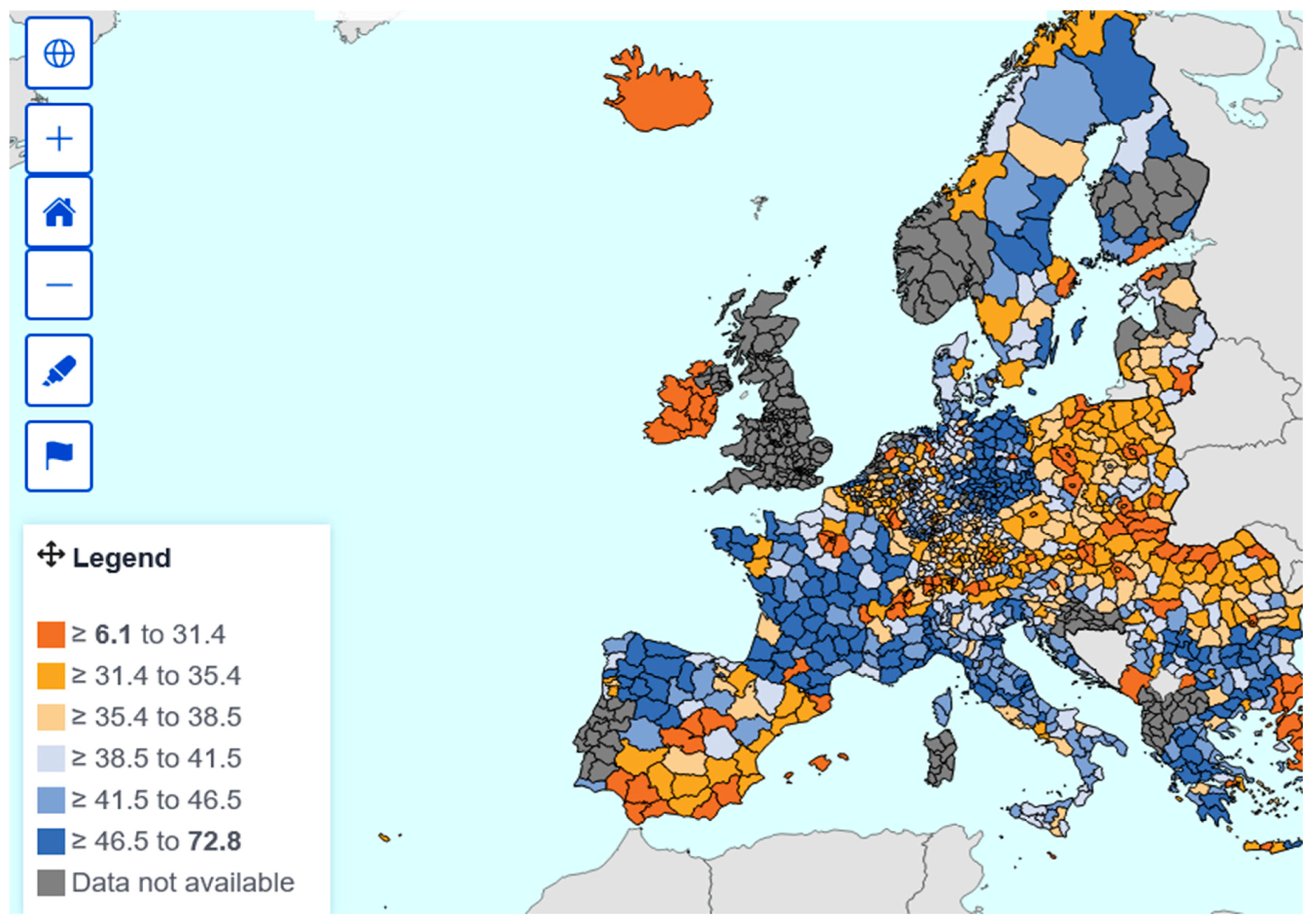
Southern Europe faces some of the highest current and projected levels of ADR1, as mentioned above. These statistics indicate decades of low fertility (well below the replacement rate) and high life expectancy, without sufficient compensation by immigrants. In contrast, Western and Northern European countries have and will have a relatively high but more attenuated ADR1 40–45% due to relatively higher fertility and compensating immigration [
53]. These differences in ADR1 will also require different, adapted responses: Southern Europe will have to reform its employment and birth policies to sustain its social systems, while the West must integrate immigrants into the labour market and develop ageing-appropriate policies. At the regional level, respectively NUTS 3, in 2024, the indicator ADR1 looks more like a puzzle, with differences from one region to another, and of course, with different challenges (
Figure 1).
Central and Eastern Europe (CEE) also has its particularities. Many countries in Eastern Europe (including Southeastern Europe, such as Romania, Bulgaria, and the countries of the former Yugoslavia) have experienced declines in their young populations, natural ageing of the population and labour force, and emigration flows. In these countries, ADR1 is growing faster than in other regions of Europe because the ageing of the labour force is compounded by a declining birth rate and an exodus of young adults to the West, which accelerates the trend. Projections show that Bulgaria could reach ~55% in 2050, Romania ~54%, and Poland ~55%, even surpassing some Western countries [
53]. Overall, in five to six EU countries (in Southern and Eastern Europe), the size of the labour force has declined significantly despite some rebalancing measures, marking that depopulation and ageing are holding back economic expansion. Regional disparities in ADR1 are closely linked to the stage of the demographic transition and local socio-economic factors. Eastern and Southern European countries have rapidly reached the final phase of the transition (very low fertility, net emigration), which exposes them to a higher and more abrupt dependency burden. A study by the International Monetary Fund showed that some Eastern European countries, such as Poland, Slovenia, and Czech Republic, will have elderly dependency ratios much higher than the average for Western European countries towards 2050, if current trends continue [
54].
Figure 1.
Old-age dependency ratio 1st variant in 2024 (population 65 years or over to population 15 to 64 years).
Source: Eurostat, [demo_pjanind] [
55].
Figure 1.
Old-age dependency ratio 1st variant in 2024 (population 65 years or over to population 15 to 64 years).
Source: Eurostat, [demo_pjanind] [
55].
It should be noted that the spatial representation in
Figure 1 is based on Eurostat regional data (NUTS level 3), which ensures high comparability but may reduce visual clarity for smaller countries or regions. For instance, countries such as Croatia are included in the dataset, but their subnational units may be less visually prominent due to scale and regional granularity. Additionally, specific demographic processes, such as strong emigration dynamics in certain countries, may not be fully captured at the aggregated level.
These demographic inequalities may contribute to deepening regional differences in economic development in the EU, affecting the cohesion of the union and posing significant challenges for these countries and areas in maintaining the health of their social systems [
56]. Thus, concluding these countries wishing to reach the “per capita income levels of Western Europe”, the demographic imbalances put them at “risk of” growing old before becoming rich.” [
54]. In this regard, the literature emphasises the imperative need for differentiated policies, in Eastern Europe for youth retention and diaspora return, and in Southern Europe for policies to increase the birth rate and attract labour, to ensure long-term socio-economic sustainability [
56].
In contrast, the Nordic and Western countries, although ageing, have benefited from immigration and slight increases in birth rates that mitigate the dependency ratio [
56].
2.7. Global Trends of ADR1
In Taiwan, as the population ages rapidly, the old-age dependency ratio has risen, negatively impacting economic growth. Huang et al. [
57] propose policies to lower the economic effects of demographic transitions by increasing labour supply in the elderly care sector, offering lifelong training programmes to maintain the level of productivity and integrating foreign labour.
The case study of India’s economic adjusted dependency ratio (EADR and EAODR), as defined by the authors, provides a more accurate estimate of the ageing economic burden. For different states, not all working-age individuals are active on the labour market, and not all the elderly are dependent [
58]. This approach indicates a need for granular analysis to help policymakers design targeted employment and social security measures.
Research by Abbas et al. [
59], investigating the impact of population dependency ratios on economic growth in SAARC nations (Bangladesh, India, and Pakistan) from 1960 to 2021, showed a positive correlation between the old-age dependency ratio and economic growth, and a negative correlation with the youth dependency ratio.
Auerbach and Kotlikoff [
60] conducted simulations indicating that demographic transitions (i.e., falling birth rates) can lead to changes in economic variables such as saving rates, interest rates, and wage rates. These changes in the dependency ratio are reflected in economic growth and in welfare systems. The demographic changes presented are Baby Bust (characterised by a sudden and permanent reduction in the birth rate; this transition meant moving from an annual population growth rate of 3% to a stationary population) and the Bust–Boom–Bust cycle (a cycle of declining and increasing birth rates, followed by a permanent decline). The authors presented some interesting and relevant conclusions in the context of our research. They emphasised that “the choice of social security policy in the midst of the demographic transition is of considerable importance to the intergenerational distribution of welfare”. They also emphasise the need for integrated workforce planning to address the economic impact of demographic transitions, particularly in the USA context.
Also relevant to the present research is a paper by Wang [
61] which includes two comparative case studies, China and the USA, examining the implications of the demographic dependency ratio on labour force planning, economic impacts and welfare systems. Although both countries have promoted policies like fertility incentives, immigration reform, and education investments to address the need for a skilled workforce, the impacts of demographic changes vary significantly between the two countries. The research emphasises the need for mutual learning from each other’s experiences, but the policies adopted must be unique and targeted in response to the demographic transitions in China and the US.
Bentlage and Thierstein [
62] defined the agglomeration economies as existing when production is cheaper because of the clustering of economic activity. As a result of this clustering, it becomes possible to establish other businesses that may take advantage of these economies without joining any big organisation. Gardiner et al. [
63] developed research, which is indirectly connected to the subject of this article, questioning “does spatial agglomeration increase national growth? Evidence for Europe”. This process may help to urbanise areas as well. The author highlights the negative aspects of regional agglomerations and their relationship to sustainable development and a just transition (congestion and environmental impacts, competition for resources and inequalities, and the concentration of activities that can lead to economic and social inequalities relative to other regions, etc.).
These types of regional developments (urbanisation economies and localisation economies), however, also affect the demographic dividend. Agglomeration leads to the concentration of activities, thereby increasing the potential for innovation and labour productivity by attracting more workers (increasing the labour market participation rate), with a direct positive effect on the demographic dividend. Including the dependency ratio in the analysis requires a more comprehensive approach (local versus national) and also accounts for a negative impact that is not negligible [
64]. Congestion-related manifestations arise (resulting from competition for resources, which not only stimulates economic growth), i.e., from increased living costs, which may influence the decisions of some demographic groups to move to those areas. This creates imbalances, limiting the demographic dividend by restricting the potential for a balanced age structure in these agglomerated regions. The inter-regional and intersectoral movement of the labour force is increasing, and age could be an important factor in accelerating it [
65].
Igor Sîrodoev [
66] said that “the study of space is inseparable from the study of time. The cumulative decisions of past actors—businesses, individuals, organisations, governments and others—have created the present, and it is impossible to give a full explanation of the contemporary world without continuous reference to their actions”.
2.8. Research Question and Hypothesis
The demographic dividend remains a key concept in analysing Europe’s socio-economic sustainability. It is characterised as the potential economic gain that changes in the age composition of the population produce, especially when the ratio of the working-age population to the dependent population increases.
Therefore, the core research gap identified in this paper is: to what degree can the spatiotemporal transformation of the demographic dependency ratio (ADR1) be comprehended, predicted, and functionally categorised to inform sustainable development policies? The solution to this issue must be not only a powerful forecasting process but also a combined approach that accounts for territorial differences and age-structure dynamics.
To address this gap, we formulate the following research question:
What is the most appropriate mathematical model for estimating the evolution of the demographic dependency ratio (ADR1) in European countries until 2057, and how can these estimates be used to substantiate public policies regarding the workforce and socio-economic sustainability?
The research hypotheses we considered in this study to find a proper answer to the research question are:
Hypothesis 1: The Gompertz model is most frequently selected by the Curve Fit Forecast algorithm for adjusting the time series of ADR1 in European countries, due to its ability to capture nonlinear and asymptotic behaviours specific to the demographic ageing process.
Hypothesis 2: All European countries analysed register a statistically significant increasing trend in the demographic dependency ratio (ADR1) in the period 2022–2052, with high levels of confidence (95% or 99%).
Hypothesis 3: There are significant differences between European countries in terms of ADR1 dynamics, which can be highlighted by clustering methods applied to time series, depending on the trajectory of values (trend), the absolute level of ADR1, and the frequency profile (Fourier).
Hypothesis 4: Southern and Eastern European countries are predominantly included in temporal clusters characterised by high values of ADR1 and accelerated growth trajectories, which reflect an increased risk of demographic imbalance and pressure on the labour force and social systems.
Hypothesis 5: Identifying the most appropriate adjustment function for each country allows for the anticipation of inflexion points in the evolution of ADR1 and supports the formulation of differentiated public policies adapted to national specificities.
3. Materials and Methods
Considering the complexity of ageing and its influence on the workforce, as reflected in the ADR1, we applied an integrated research methodology.
3.1. Mathematical Models for the ADR1 Forecast (Logistic, Gompertz)
As mentioned above, population trends are nonlinear, so there is a need for demographic models that can reproduce the evolution of AD1 as closely as possible to reality. Both classical parametric models (exponential, logistic, Gompertz) and non-parametric smoothing models are used in the literature to project indicators at a given time horizon. The aim is to capture the upward or downward curves of demographic dependency realistically, avoiding unrealistic extrapolations.
The sigmoidal growth models (S-curves) are of two types: logistic and Gompertz. Both assume slow, gradual growth at the beginning, then acceleration and then a plateau phase, and are suitable for naturally limiting phenomena (e.g., population cannot grow infinitely). The logistic (Verhulst) model yields a symmetric S-shaped curve, whereas the Gompertz model produces an asymmetric S-shaped curve (rapid growth followed by a slower plateau phase). In the last century, such models have been used in total population forecasting—for example, Pearl and Reed [
67] used logit models for the US population. Modern assessments note, however, that the logistic tends to underestimate future population growth, whereas the exponential model (which has constant percentage increases) overestimates the projected population growth. In contrast, intermediate sigmoidal curves (such as Gompertz) lie between the two types of curves, often suggesting more realistic projections, balancing the two extremes [
68]. The Gompertz model is very popular in demography for modelling mortality (Gompertz Law—exponential increase in mortality with age) and survival, and is also used to project old-age dependency as a function of mortality trends [
69].
Comparative evaluations of models: empirical studies assessing the accuracy of different nonlinear models for demographic indicators often demonstrate the advantage of sigmoidal over simple models in population forecasting in the USA. Pflaumer [
70] compared several growth curves and noted the differences between them (exponential versus logistic versus Gompertz) and that it is desirable to use a model as appropriate to the demographic stage as possible.
The general conclusion is that there is no optimal model in every situation, and therefore, it is recommended to combine several approaches (multi-factor or hybrid models, or multiple scenarios) to capture the inherent uncertainty of demographic forecasts. Moreover, modern demographic forecasting methods often include stochastic components (e.g., Monte Carlo simulations and confidence intervals) in addition to the deterministic models mentioned above.
The Curve Fit Forecast procedure has been used to determine the best functional form for modelling the long-term evolution of demographic dependency. The method enables a number of candidate models to be compared, and the specification that minimises forecasting errors is chosen based on statistical goodness-of-fit measures. Unlike other algorithms (ARIMA or machine learning) that tend to emphasise only the short-term predictive accuracy, Curve Fit Forecast enables the detection of functional demographic growth processes that are theoretically aligned with long-term population dynamics.
Nonlinear growth models are common in demographic forecasting research to capture the dynamics of population structure and the progressive acceleration of ageing [
68,
71]. The Gompertz growth function had the best fitment of most of the countries that were analysed, as shown by a lower Root Mean Square Error (RMSE) as the model is being calibrated.
The Gompertz model has been extensively used in the fields of demography and population dynamics due to its ability to capture asymmetric growth and gradual saturation mechanisms that characterise ageing populations [
67,
69]. In terms of the theory of demographic transition, the Gompertz specification is especially appropriate since ageing processes become more rapid in later years of the demographic transition before reaching a structural plateau.
The Gompertz specification is more indicative of the accelerated pace and ultimate stabilisation of dependency ratios in ageing populations as compared to linear or purely exponential models.
3.2. Clustering Methods Applied to Time Series ADR1
Time series clustering is an important exploratory method that allows grouping countries and regions according to certain similar demographic patterns. For example, in the case of ADR1, clustering can be done on groups of countries with comparable trends in demographic dependency with specific characteristics (either a cluster of countries with rapid and continuous growth of ADR1, or a cluster with slow growth or stagnation, or other patterns). Three main criteria according to which demographic time series clustering is done are highlighted in the literature, ESRI (pro.arcgis.com) (accessed on 19 Aprill 2026) [
72]:
The trend or shape of the curve over time—Cluster series that “are maintained in similar proportions over time”, i.e., have comparable (independent of the absolute level) forms of evolution [
72,
73] study of fertility rates in the EU shows that “the shape of the decline and subsequent recovery varies across countries”, but the resulting clusters largely reflect geographical position—e.g., Western vs. Eastern countries had different fertility trajectories after 1990. Analogously, we expect that for ADR1 clustering by trend will also reveal regional clusters, as demographic factors (fertility, migration, mortality) tend to have spatial regularities.
Level, i.e., absolute values—Clustering by level groups the series by similar values of ADR1 over time, emphasising the magnitude of the indicated trends. Thus, countries with high levels of ADR1 dependence, irrespective of the evolution, can be found in the same cluster, separated from their opposites, countries with consistently low levels. In this way, size disparities can be observed, e.g., Japan, Italy, and Germany would form a high ADR1 cluster, whereas countries with relatively young populations, such as Ireland and/or some Nordic countries, form another cluster. With ArcGIS Pro 3.2.2 [
74], locations with similar values over time can be grouped together (pro.arcgis.com) (accessed on 19 Aprill 2026). In this context, both very old regions with high ADR1 and young regions with high ADR1 can be visualised, regardless of whether the growth trend is similar.
The frequency profile (Fourier component)—Refers to the grouping of series based on periodic patterns or time-variability structure. Instead of directly comparing values or slopes, Fourier coefficients (frequency spectrum) or other frequency-domain indicators are compared. Instead of directly comparing values or slopes, Fourier coefficients (frequency spectrum) or other frequency-domain indicators are compared for each series [
75].
In practice, frequency analysis is more applicable if there are oscillations (e.g., when the population temporarily increases, then decreases due to cyclical migration or fluctuating policies). In this sense, wavelet analysis or Fourier analysis can detect periodic anomalies, e.g., a temporary jump in ADR1 followed by stabilisation that would otherwise go unnoticed if the trend method is used. In conclusion, applying clustering to the ADR1 series identifies typologies in Europe. For example, clusters of countries with early and severe ageing versus late and moderate ageing, or with high versus low ADR1 levels, can be identified. Studies have shown that clustering results correlate with geography due to common historical and socio-economic conditions [
73]. This shows the need to integrate the spatial component into the analysis.
The forecasting outcomes were incorporated into a spatiotemporal analysis environment based on GIS to incorporate the spatial aspect of demographic ageing. To create a space–time cube that allows analysing both the temporal evolution and the spatial distribution of demographic indicators, the ArcGIS Pro Space 3.2.2–Time Pattern Mining toolbox was employed. The method enables the detection of spatial patterns and regional clusters with similar demographic trends. The spatial analytical paradigm presupposes that ageing of the population can exhibit spatially patterned regularities, or, in other words, countries with a certain geographical closeness or similar socio-economic experiences can experience similar demographic trajectories over time.
Time series clustering procedures were then implemented to cluster countries based on the closeness of the dynamics of the dependency ratio over time. Three complementary clustering criteria, including similarity of the trend evolution, similarity of absolute values, and similarity of the frequency profile (Fourier component) of the time series, were taken into account. These clustering processes are based on distance-based similarity metrics and allow highlighting shared demographic trajectories on a regional level [
74,
76]. In the forecasting step, model performance was measured using RMSE, whereas the consistency of the clustering results was assessed relative to the three clustering methods, with the maximum pseudo-F parameter used to determine how many clusters to use.
The clusters thus formed were compared against each other so as to provide coherence between the various clustering methods and to show convergent patterns of spatial democracies between different regions in Europe. The analysis integrates the spatial clustering with demographic forecasting, which gives a more detailed insight into the spatial heterogeneity of population ageing and identifies regional demographic trends that can potentially affect labour market sustainability.
3.3. GIS-Integrated Spatiotemporal Analysis of Demographic Phenomena
The phenomenon of ageing and changes in population structure are closely linked to the spatial dimension: not only between continents, between countries, but also intra-regionally (
Figure 1). One can talk about a certain typology at city level, another at rural level, or in the east or west of a country. This has increasingly allowed the introduction of tools such as Geographic Information Systems (GIS), which allow the visualisation and spatiotemporal modelling of data as a method to summarise complex characteristics of series [
73]. Therefore, Geographic Information Systems (GIS) tools have become increasingly important in demographic studies, enabling the visualisation and spatiotemporal modelling of population data as a method to summarise complex series characteristics [
73].
Despite notable progress, there are methodological gaps in the literature. The literature reviewed shows a lack of approaches that simultaneously integrate demographic forecasting, cluster analysis of time series and differentiation by spatial mapping of indicators such as ADR1. More often than not, studies tend to assess the temporal and spatial or exploratory components separately: they either focus on demographic forecasting, using projections of indicators at national or local level, using logistic functions or the Gompertz curve, without also investigating clustering between countries or regions, or they focus on clustering and demographic typologies based on historical data without looking at future trends, or on descriptive spatial analyses of the current state of affairs, without integrating predictive or clustering components of trajectory trends.
This endeavour of trying to capture more and more realistic the population growth is the insistent preoccupation of demographers, geographers, economists, and other social scientists finding the most appropriate models to assess population dynamics and the ADR1 indicator to provide policy makers with real measurements on which to design more relevant and impactful solutions.
Faced with a future of rapidly growing numbers and proportions of older persons, countries and areas in a group that have already reached their maximum of working population should consider “measures to strengthen their systems of health care and long-term care, promote lifelong learning, expand employment opportunities for older persons who want to continue to work, address age-based prejudice and discrimination, invest in and explore new industries that cater to this growing population group, and improve the sustainability and equity of social protection systems” [
8].
3.4. Research Framework
In the literature on spatial–temporal demographic analysis, most studies focus either on retrospective trend modelling or on projections made using classical deterministic methods, without integrating the GIS environment [
71,
77]. Also, few studies simultaneously address the functional aspects of demographic evolution and the territorial character of these trajectories, using a coherent methodological framework. A clearly identified methodological gap is the absence of an integrated sequence that combines functional modelling of time series (through forecasting) with typological analysis (through clustering). In addition, the literature rarely applies these methods to the ADR1 indicator (demographic dependency ratio), despite its relevance for labour market sustainability and social policy planning [
71]. Another insufficiently explored aspect is the differential treatment of interstate variability from the perspective of the shape of the distribution—asymmetry, dispersion (IQR), and absence of normality—in the context of constructing the spatiotemporal cube. These limitations affect the ability of the analysis to provide comparable predictions and to detect relevant structural patterns.
Therefore, the present research responds to these shortcomings by applying an integrated Curve Fit Forecast + Clustering methodology, complemented by a detailed statistical analysis and a coherent spatiotemporal visual representation. Each stated hypothesis was associated with a methodology to be verified as presented in
Table 1.
3.5. Data Sources and Study Indicators
The dataset used contains Eurostat estimates of the demographic dependency ratio (ADR1), version 1, for the period 2022–2052, at the level of Member States (NUTS 0). The values are provided at annual granularity, allowing analysis of demographic trends over a 30-year period in the context of the accelerated demographic transition and population ageing. These baseline [BSL] projections reflect a reference scenario, without major policy interventions, and are essential for anticipating future pressure on the active population and social protection systems. For the period 2022–2052, these estimated data were used as input to construct the spatiotemporal cube (STC), providing the basis for applying the Curve Fit Forecast methods.
The economic dependency ratio (ADR1) used in this study represents the ratio between the population aged 65 years and over and the working-age population (15–64 years). It is calculated as: ADR1 = Population aged 65+/Population aged 15–64
This indicator reflects the potential economic pressure generated by population ageing on the active population and is widely used in analyses of labour market sustainability and social protection systems. Indicators of demographic dependency are frequently applied to assess long-term pressures on labour supply and welfare systems in ageing societies [
32,
79].
The ADR1 dataset was obtained from the Eurostat database “Population structure indicators at national level” (demo_pjanind), which provides harmonised and comparable demographic indicators for European countries. The use of Eurostat data ensures methodologi, check cal consistency and cross-country comparability within the European statistical system and is widely adopted in demographic and economic sustainability analyses (Rouzet et al., 2019) [
80].
It should be noted that while Eurostat data ensure cross-country comparability, certain country-specific demographic processes (e.g., migration-driven labour force decline in countries such as Croatia) may be only partially captured.
The period 2022–2052 corresponds to the medium-term demographic projection horizon used in the Eurostat baseline scenario and allows capturing the structural effects of population ageing on labour markets and dependency ratios over a generational time span.
3.6. Space–Time Modelling of ADR1 Using Curve Fit Forecast
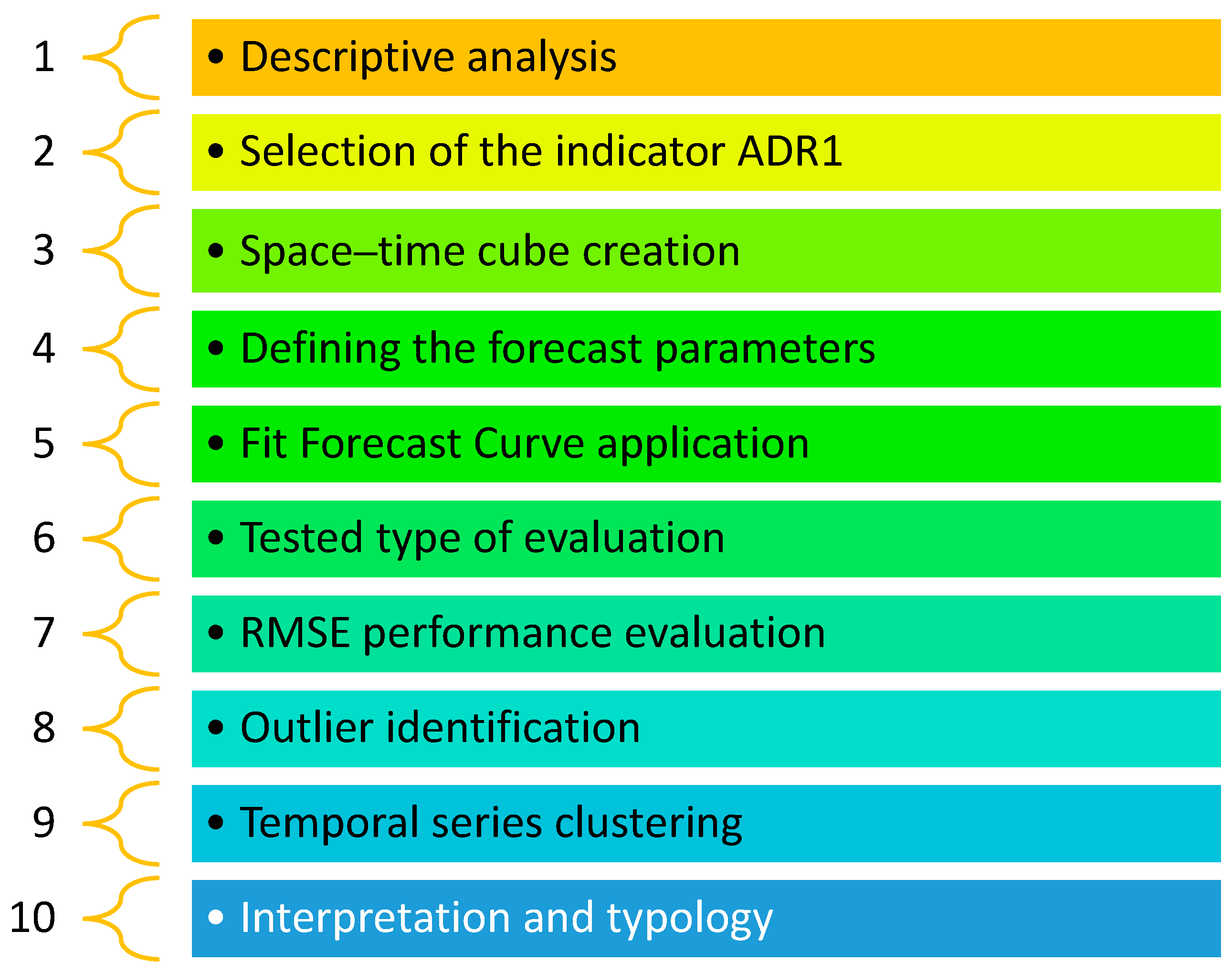
A comprehensive methodological framework was employed to study the spatiotemporal changes in the demographic dependency ratio (ADR1) in the Member States of the European Union in the form of ten main steps. This chain enabled the comprehensive understanding of interstate differences and projections till 2056. It entailed descriptive analysis, space–time cube, Curve Fit Forecast algorithm, and model evaluation, which were supported by outlier analysis and time series grouping based on multivariate clustering methods. The approach was applied in the GIS (ArcGIS Pro 3.2.2) environment, providing a powerful framework for exploring and predicting the demographic transition.
The framework of the model is presented in
Figure 2.
1.
Descriptive analysis of distributions of ADR1—In each country, the following was calculated: median, 25th percentile (P25), 75th percentile (P75), IQR (P25–P75), skewness, and qualitative description of the dispersion. The analysed variables are not normally distributed, at least in the majority of cases, and their skewness and kurtosis exceed values (−1, 1), which is the classical parameter of the statistic [
81]. These statistics gave a foundation on the form of distribution of ADR1 values and geographical differences on level and variability. Detailed information is given in
Appendix A.1.
2.
The choice of the indicator of analysis—The indicator of analysis was adopted ADR1 (demographic dependency ratio), which is presented in the form of the dependence of the population (0–14 years and 65+ years) in relation to the active population (15–64 years), and is found in the Eurostat database [proj 23 ndbi] [
81].
3.
Creation of the Space–Time Cube—The ADR1 file was formatted in NetCDF format (the file is named with an extension of Nc) with spatial (30 locations at NUTS 0 level) and temporal (31 years, 2021–2052) data. A spatiotemporal unit is represented by each bin. The characteristics of the space–time cubes are shown in
Appendix A.2.
4. Setting forecast parameters—The time interval was decided to be 1 year; 5 forecast steps were introduced (the period considered will be 2052–2056); 3 time steps were not included in the training set and were used to validate the model set.
5. Using the Curve Fit Forecast (CFC) tool—There were 4 curve types—linear, parabolic, exponential, and Gompertz (S-shaped)—which were automatically run. The forecast was generated in the model that had the least RMSE.
6. Types of equations involved in the modelling—The equations used in Curve Fit Forecast algorithm are:
Linear model: Xt = at + b
Parabolic model: Xt = at2 + bt + c
Exponential model: Xt = k + a exp (bt).
Gompertz (S-shaped) model: Xt = k + aexp (−bexp (−ct)).
The function is determined automatically by minimising the RMSE at each location.
7.
Model performance assessment—RMSE was used to assess errors of the forecast and validation dataset. Its median RMSE forecasted 0.50 with a validation of 0.52, which indicates high accuracy [
82].
8.
Determination of anomalies (outliers)—About 20% of the locations had outliers. The outlier identification criteria, the methodology proposed by ESRI [
74], and the IQR rules (the values that were worse than the Q1 − 1.5IQR or better than Q3 + 1.5IQR) added that the significant deviation of the local trend and significant residual of the local regression were the criteria for identifying outliers. The mean of the outliers was 0.2, and the highest value was 1. The most outliers occurred in 2021 (a maximum of 4).
9. Time series clustering—The time series ADR1 underwent a multivariate clustering. We applied three dimensions of analysis to point out the diversity of developments:
(a) Absolute values—to demonstrate the overall rate of the ADR1 in a country in comparison with other countries;
(b) Temporal trend (correlations)—to cluster countries that experience similar trends over time, irrespective of the level of values;
(c) Fourier transform—to acquire the internal structure of variation in time (e.g., regularity, cyclicality, accelerations).
The maximum pseudo-F value was used in methodically choosing the best number of clusters [
82].
10. Results interpretation and typology of territories—The descriptive analysis and the outcomes of the forecasts helped to discover the definite patterns of demographic transition of the population at the European level. The median level of ADR1, dispersion, and shape of distribution (positive/negative asymmetry) were used to categorise territories.
3.7. Justifying the Model’s Selection
Our instrument to achieve the latter is the Curve Fit Forecast tool in ArcGIS Pro 3.2.2 [
74] which can be used to make forecasts on future values, but the primary purpose of our analysis is not to make long-term predictions, but to find the most suitable model among the four models available (linear, exponential, parabolic, and Gompertz) to understand the dynamics and implications of the process of demographic ageing better. Although Eurostat has provided projections of the demographic dependency ratio (ADR1) up to 2100, in our analysis, we considered the period 2022–2052, bearing in mind that the data provided are annual variation estimates at the NUTS 0 level.
In this way, using the Curve Fit Forecast method, it is possible to compare the performance of various curve-fitting models to determine which best fits the observed demographic ageing processes. This strategy helps gain deeper knowledge of the phenomenon and develop appropriate policies in the demographic sphere.
The use of Curve Fit Forecast (CFC) analysis prior to temporal clustering is both methodologically sound due to the different purposes that both methods play, and to achieving similar patterns of movement between sites. The basic role of CFC is to estimate the most suitable evolution function for the ADR1 indicator at individual locations, testing various forms of functions (linear, parabolic, exponential, and Gompertz-type), and auto-parametrically selecting the one that minimises adjustment error (RMSE). This will enable one to project the time series up to 2056, allowing forecasting up to that time and providing a consistent, homogeneous foundation for further analysis.
Conversely, temporal clustering seeks to identify shared typologies of change over time by clustering collections of places that show similar trends. To achieve validity in these comparisons, the series on which the clustering is performed must be of the same length and exhibit deterministic behaviour consistent with the estimated behaviour. Therefore, pre-applying CFC standardises the time series, ensuring that the critical factors in the dynamics of ADR1 are captured.
This sequential analysis can also be justified by the suggestions of the geospatial software provider [
74], according to which CFC tool is to be an initial step to exploratory analysis like clustering. Moreover, special literature justifies this practice. As Mitchell [
80] demonstrates, predictive models can be a solid input for determining hidden patterns in data, and Calinski and Harabasz [
81] proved that clustering is more effective when performed on transformed, complete series rather than raw data.
To sum up, there is methodological rationale for using Curve Fit Forecast prior to temporal clustering, as it can estimate an integrated, similar evolution of the indicator under consideration. The resulting clustering is then used to leverage this coherence and determine spatial trajectories’ typologies, which provide a cohesive view of the demographics under study.
ESRI [
74] explains that the Curve Fit Forecast application in ArcGIS Pro 3.2.2 aims to provide a consistent input for further analysis of clustering, trend discovery, or hypothesis testing of temporal dynamics. The same methods have been proposed in the literature for spatiotemporal demographic and social studies [
81,
82], where classification follows prediction.
4. Results
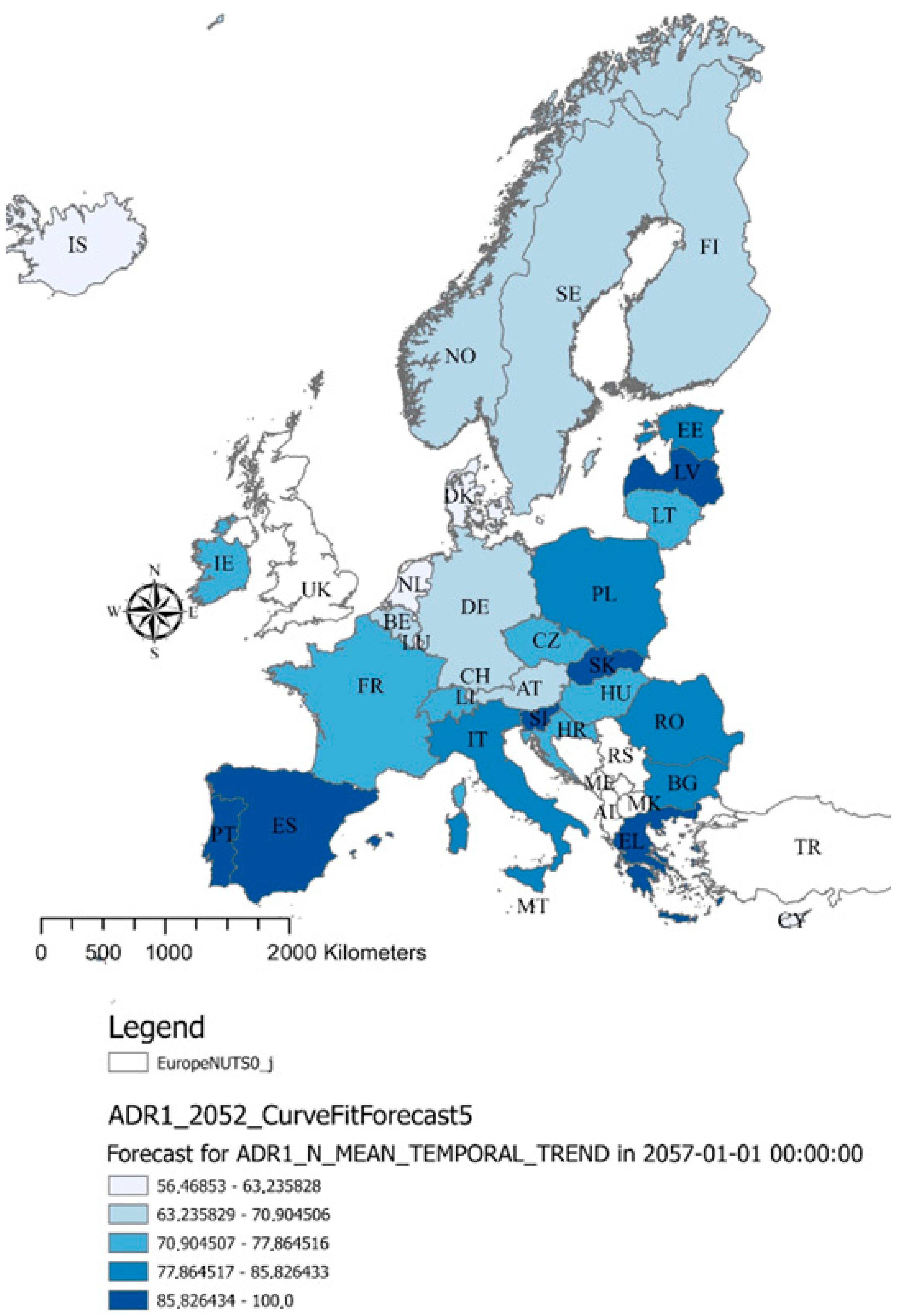
4.1. Age Dependency Ratio in 2057 Estimation with Curve Fit Forecast
In
Figure 3, it is estimated that there will be 30 European countries with each having the demographic dependency ratio (ADR1) in 2057, which is estimated in five classes (light to dark colours):
56.47–63.23—very low values (e.g., Iceland, Norway, The Netherlands)
63.24–70.90–—moderating values (e.g., Germany, France, Italy)
70.90–77.86—high demographic pressure (e.g., Czech Republic, Romania)
77.86–85.82—very high pressure (e.g., Bulgaria, Hungary, Slovakia)
Less than 85.82 100—topmost values, and impending demographic crisis (e.g., Greece, Spain, Latvia).
ADR1 has the highest in Eastern and Southern Europe (e.g., Greece, Spain, Latvia, Bulgaria, Romania), indicating that it has an advanced demographic transition and burdens its pension and health systems.
A lower value is typical of Northern and Western Europe, which can be linked to higher fertility stability, positive net migration, and more effective social policies.
The geographical inequalities that are vividly depicted demonstrate the necessity of discriminatory national policies and European collaboration in the sphere of demography and labour.
The findings suggest that there is a strong spatiotemporal approach to ADR1 rate, both in terms of its high accuracy (low RMSE) and sufficient adaptation of the forecast functions to the characteristics of a particular site. The Gompertz curve in 1/3 of cases confirms the nonlinear and saturable nature of the demographic phenomenon, and small errors and the high number of outliers proved the structurability of the historical series in the process of training.
The spatiotemporal cube under analysis consists of 31 annual steps (first year 2021, last year 2052), 30 different locations (when discussing European countries) were identified (a total of 930 spatiotemporal cell is described in
Appendix A.3). The spatial pattern of the units is the type of polygon, which proves the fact that the data were grouped on the territory of NUTS 0. The bias in the first temporal interval is 100%, meaning that all the observations of that interval fell into the 2021 bin, and the last (2051) has a bias of 0, meaning that it was only upper-bound.
The curve-fitting forecasting model is utilised and the parameters are as follows:
Five projections (i.e., predictions of the years 2052–2056),
excluded time steps of validation, which enables the determination of the actual model performance.
This approach is significant because the training and testing data are separated, which strengthens model assessment. RMSE (Root Mean Squared Error) is applied to assess the model accuracy. The mistakes are also small, with average variances less than 1, indicating that the models used to predict the ADR1 are performing well. RMSE in validation being larger than in forecast is expected to point to the fact that the validation data are more difficult to predict than those acquired during the training.
Locations do vary, but a low median (below 0.6) indicates that most estimates are correct.
The most typical one is the Gompertz curve (S-shaped), whereby over one-third of the locations exhibit a logistic ADR1 evolution with an acceleration phase and levelling off.
Parabolic and linear models are widely used, and this indicates the presence of constant or accelerating/slowing-down trends.
The exponential model is rarely applied, a choice made only in cases where growth is maintained.
This model pattern proves the non-homogeneity of demographic–economic processes in Europe—some of the countries are constantly expanding, while some of them have already surpassed the turning point.
4.2. Temporal Patterns with Confidence Levels
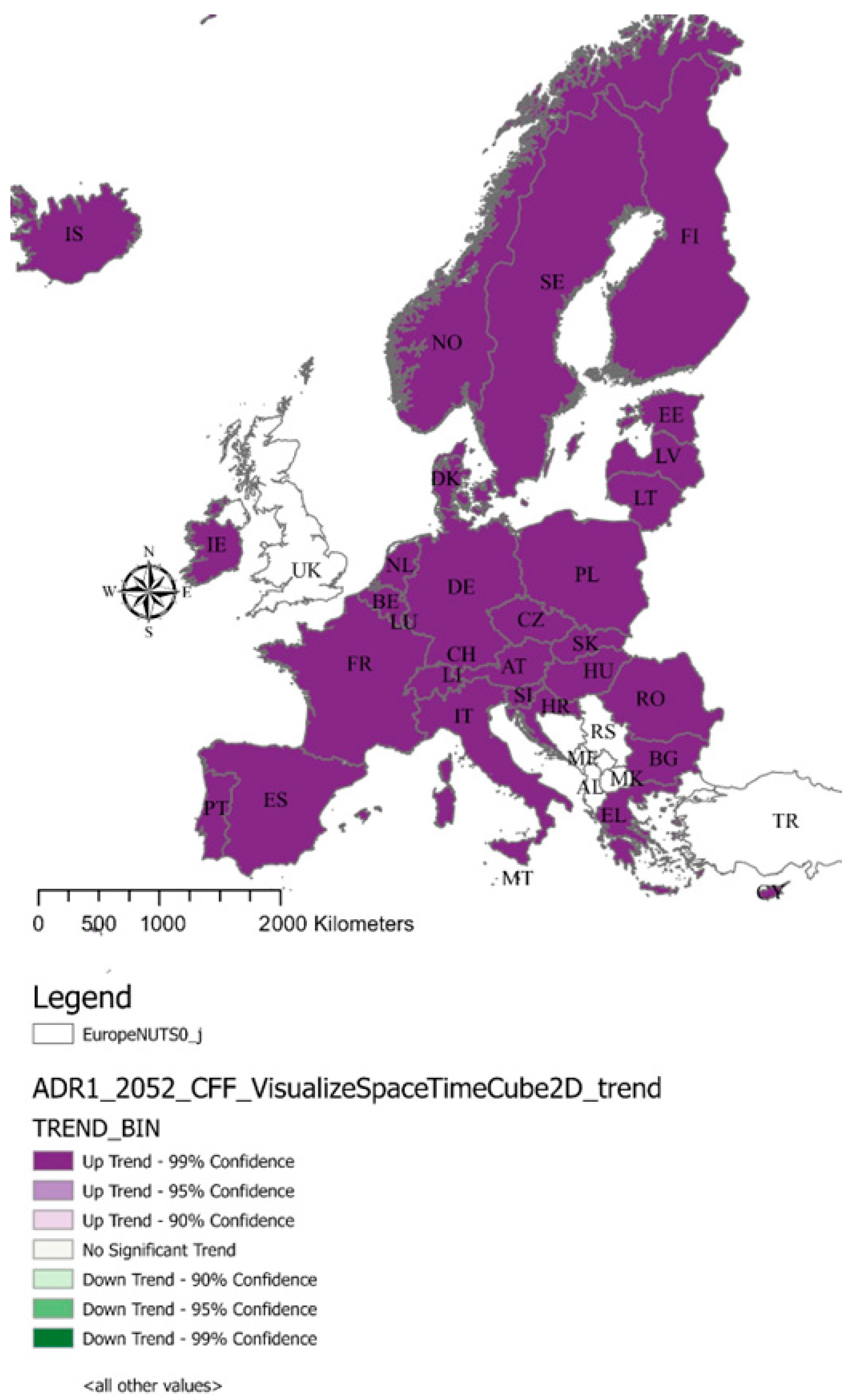
Figure 4 is the outcome of a 2D visualisation of the time trends found through the space–time cube (STC) analysis of the ADR1 values (demographic dependency ratio, variant 1) between the years 2022 and 2052. The colour of each EU Member State indicates the direction and the statistical confidence level of the observed trend.
The legend shows all countries on the map in dark purple, with the upward trend (Up Trend) at a 99% confidence level. This means that in each of the European countries considered in the analysis, the demographic dependency ratio is increasing, and this growth is statistically significant at a very high confidence level (p < 0.01). None of the nations is assigned to the downward trend or lack of a meaningful trend.
The data validate population ageing as a generalised process in Europe, with no geographical exceptions during this period. The steady rise of ADR1 at a 99 per cent level of confidence shows that structural pressure on the working population is on the rise, and this presents grave consequences for the workforce, pension, health, and education. This tendency encourages the use of powerful models (such as the Gompertz model) to describe long-term behaviour and underscores the relevance of active measures in public policy.
4.3. Identification of Model-Fit Outliers Using Curve Fit Forecast
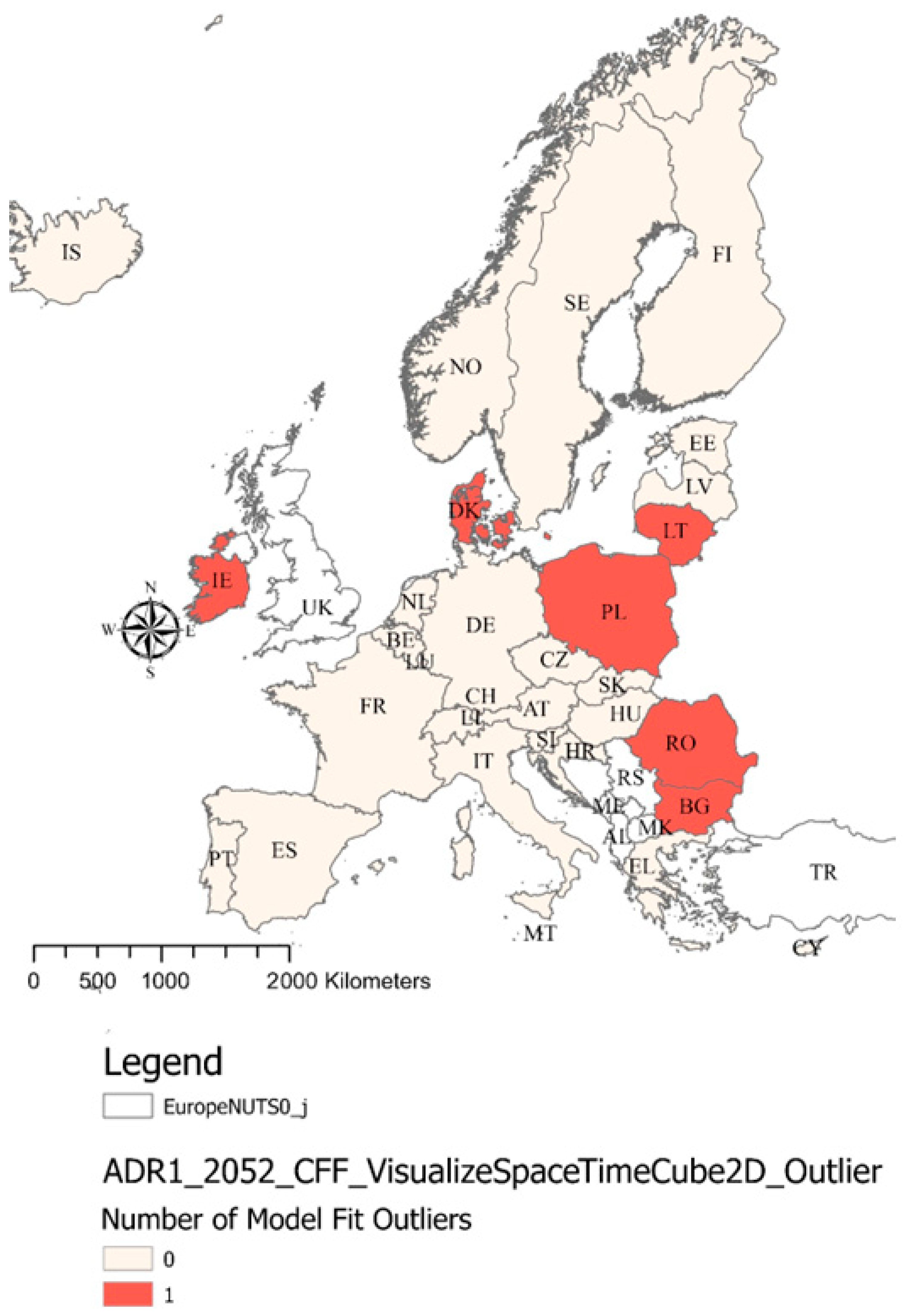
Figure 5 provides a visualisation of the data obtained from the Curve Fit Forecast tool, generated by analysing the spatiotemporal cube and showing the countries where outliers (abnormal values) were identified during model adjustment.
The countries that were found to have at least one outlier in model adjustment are marked in red (Ireland, Denmark, Lithuania, Poland, Romania, and Bulgaria). The remaining nations are coloured in cream, which means that the deviations that were found were not major in outlining what was being applied with the model.
What would be considered an outlier in Curve Fit Forecast?
An adjustment outlier implies that the chosen mathematical model and the real data of a particular point in time series do not coincide. It may indicate an irregularity in the data, or it may indicate a major change in the demographic process (e.g., migration, political changes, health/economic crisis).
Outlier countries are to be examined, because they are not entirely subject to the reduced model of proportionality, which can be expressed in terms of standard demographic functions. Although the Gompertz model has dominated Europe, the presence of outliers indicates that its predictive power is limited in some national contexts. The policymakers should not base their same patterns, but they need to explore the potential causes of the deviations, as well as add new factors into the equation (net migration, systemic crises, social reforms).
4.4. Model Type Used for Best Estimation with Curve Fit Forecast
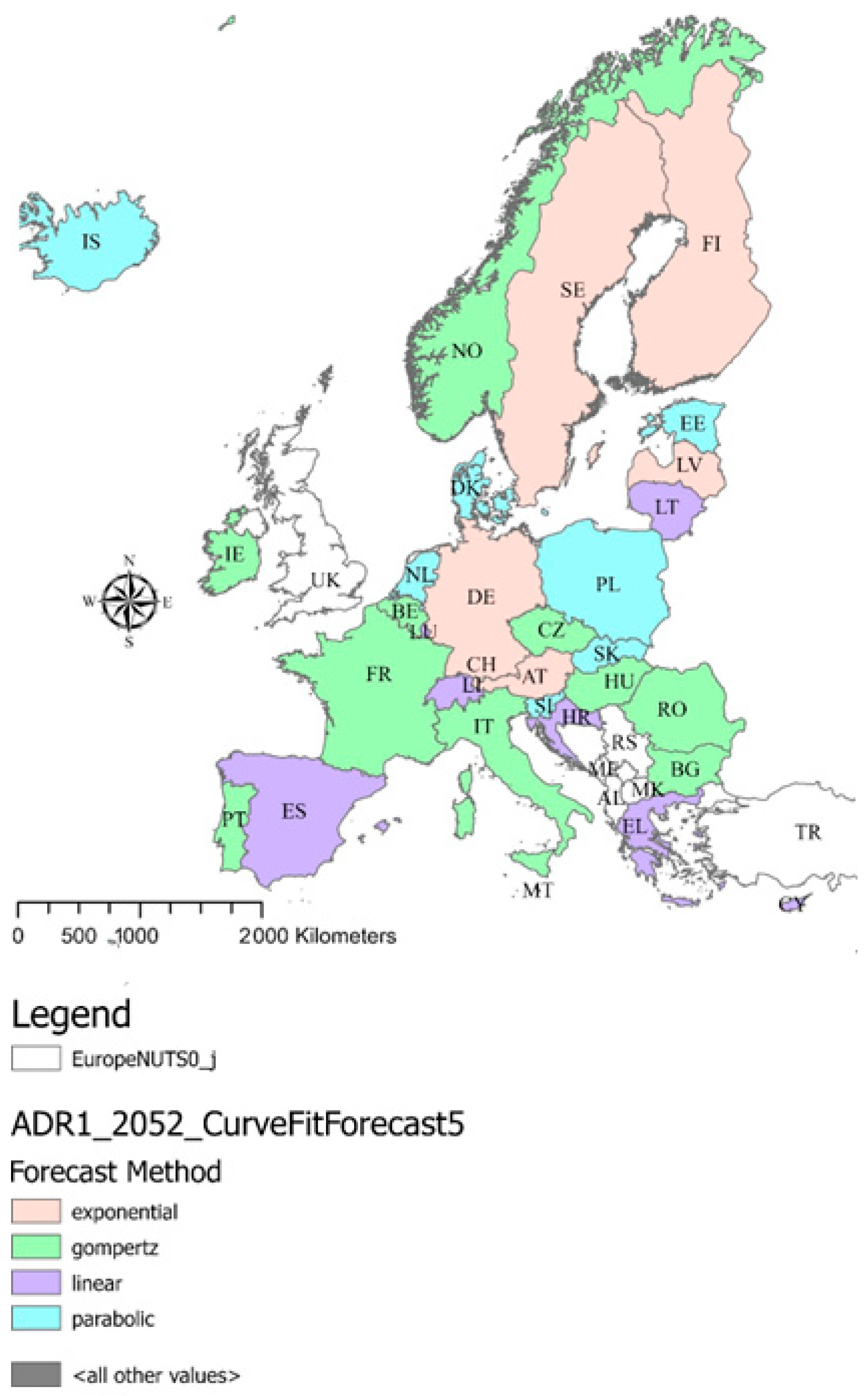
In
Appendix A.4 we noted the type of forecast function that was automatically chosen in each European country in the analysis of ADR1, on the Curve Fit Forecast method over the data provided by Eurostat (2022–2052), which was then projected to 2057. The distribution is presented in
Figure 6.
Allocation of adjustment procedures:
The Gompertz model is more dominant as it is chosen in 12 countries (e.g., Belgium, France, Italy, Ireland, Romania, Hungary). This addresses the nonlinear and asymptotic demographic ageing process that is particular to the population of Europeans.
The parabolic operation is applied in eight cases (e.g., Denmark, Estonia, Poland, Slovenia), which is the indication of the evolution, with inflexion points, which signify the potential periods of stagnation or growth.
Linear model is found in seven countries (e.g., Croatia, Cyprus, Greece, Spain) where the trends of demographic are viewed as being relatively constant, possible because the model is perceived to be rather stable or simply because it is an imperfection in the model.
The exponential functional is used in five nations (e.g., Austria, Finland, Germany, Sweden), which means a rapid rise in ADR1.
The equations are constructed country-specifically, and that is why not only the direction and the magnitude of the demographic trend can be comprehended, but also the models can be compared. Parameters a, b, c (in case of Gompertz or parabolic) are the demographic and historical peculiarities of each member state.
Those findings verify that Gompertz model prevails in the European region, and the theory that demographic changes are governed by a logistic curve whereby the rate of growth slows down to a structural limit. This supports the hypothesis that processes of demographic ageing proceed in nonlinear and asymptotic curves, and Gompertz would be the best designation to gain this insight into long-term effects. The automatic selection of models offered by the Curve Fit Forecast algorithm gives an objective and rigorous view of the processes taking place as an indicator of importance as the means of predicting demographic risks and establishing proactive policies.
4.5. Comparative Analysis of Forecasting Models Used in Estimating ADR1: Representative Case Studies
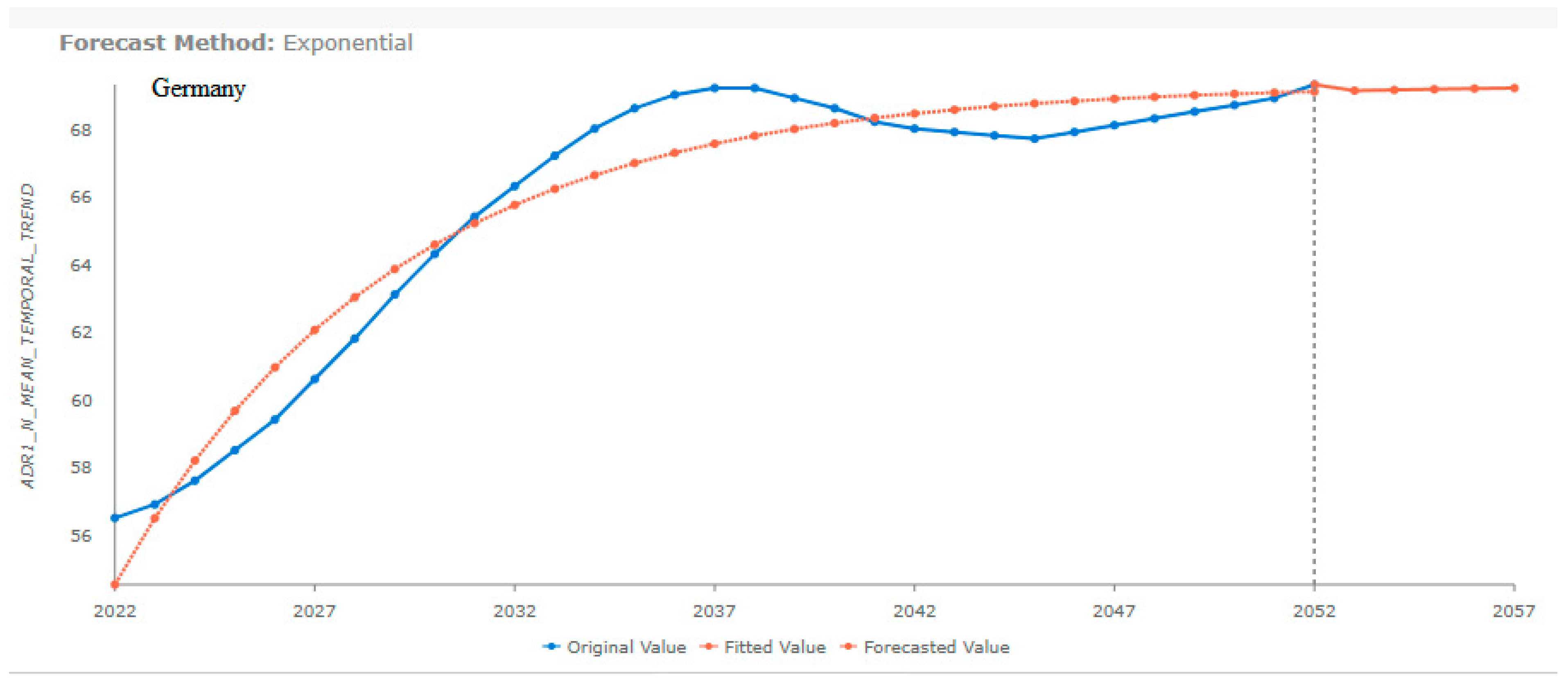
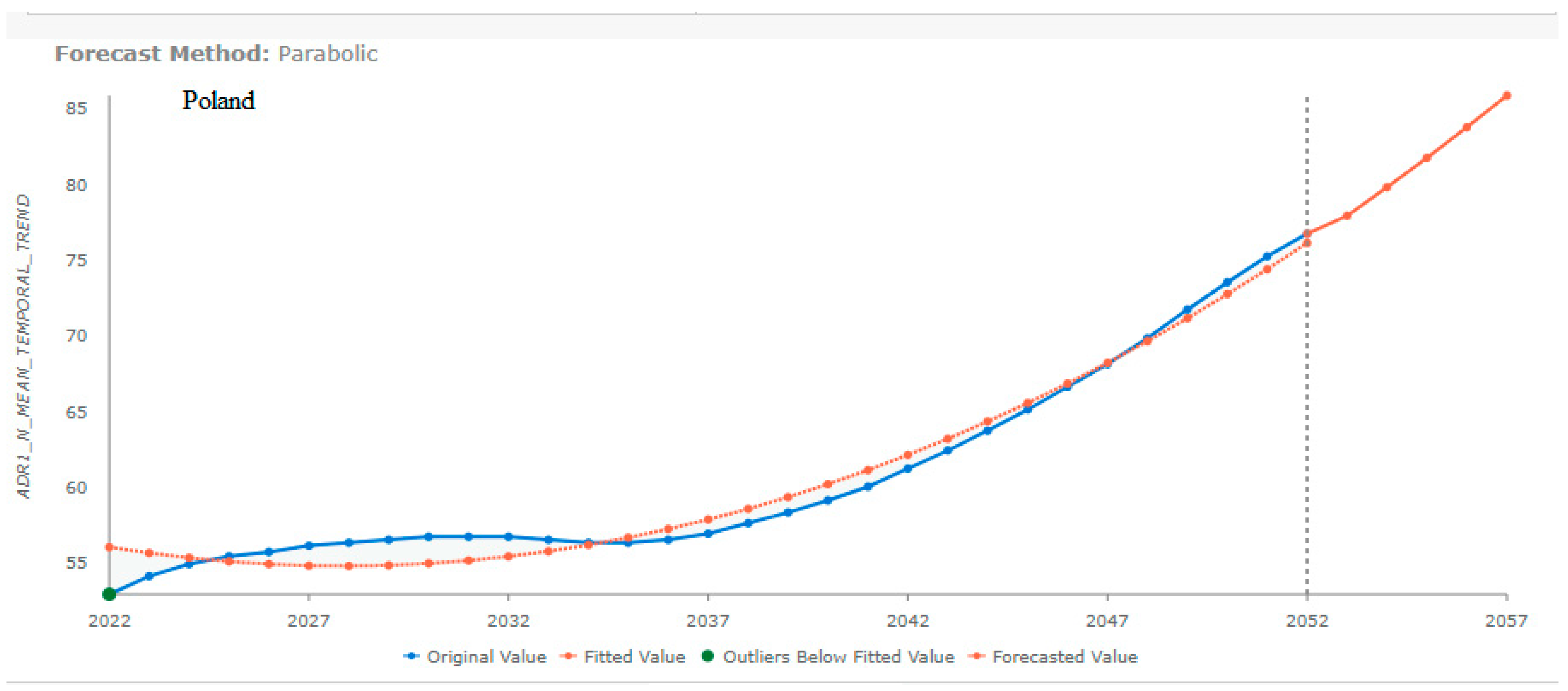
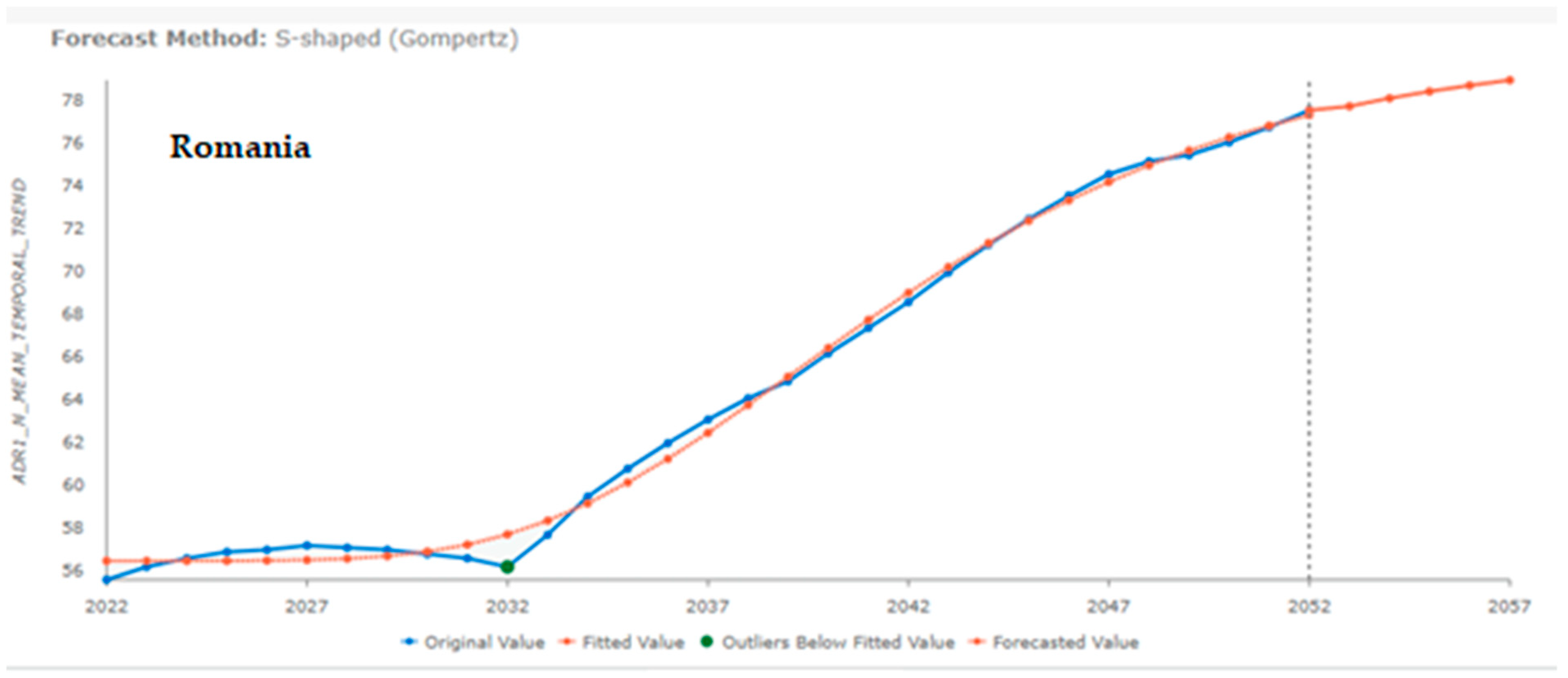
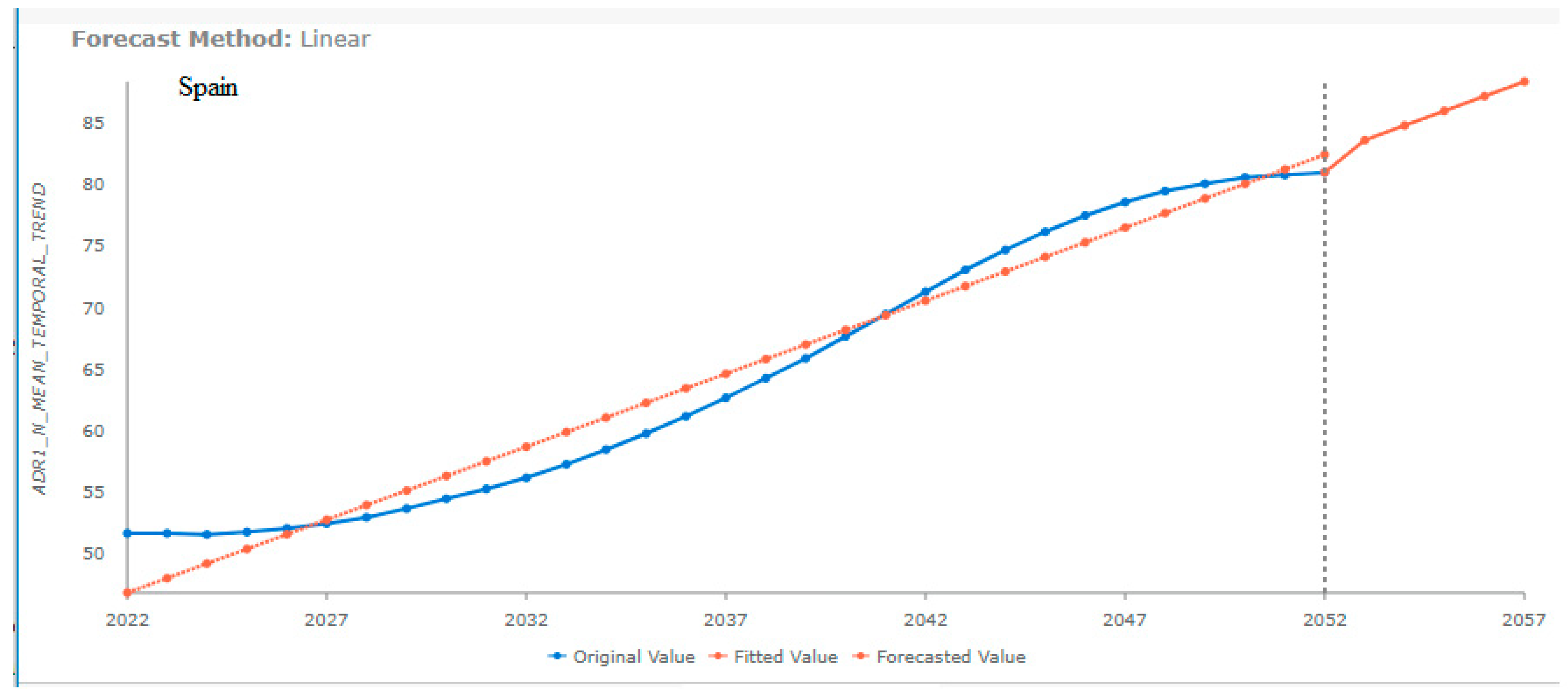
To show the performance of each type of equation to adjust the demographic trend, this section shows four typical national instances, one of each of the four automatic forecast functions used by the Curve Fit Forecast method: exponential (Germany), parabolic (Poland), Gompertz (Romania), and linear (Spain). Such graphs help to see a graphical picture of the goodness of the fit, i.e., the values of the forecast up to the year 2057, and any deviations (outliers), and hence help to understand the relevance and limitations of each model in terms of analysing the evolution of the demographic dependency ratio (ADR1).
- (a)
Forecast method—Exponential function: Figure 7 is an estimation of the future (2022–2057) development of the demographic dependency ratio (ADR1) in Germany through the exponential method.
In the graph, the evolution of the demographic dependency ratio (ADR1) in Germany has accelerated in 2022–2040, followed by a plateauing trend in 2052. The exponential curve (red) fits the original values rather well in the early part (2045), but there the real changes around 2042 are underestimated to some extent. A longer-term prediction (up to 2057) can be made whereby the value of ADR1 will stabilise at 69–70; hence, the predicted result is faster ageing with ensuing demographic balancing. The exponential model is a better representation of the growth rate at the start of growth but is less effective at capturing inflexion points.
- (b)
Forecasting method—Parabolic function: The estimated changes in the dependency ratio (ADR1) of the Polish demographic in the framework of using its parabolic function (2022–2057) are in
Figure 8.
In the case of Poland, the evolution of the forecast curve is evidently parabolic, which means an inverted U-shaped evolution. The curve predicts a sudden hastening of the dependency ratio of the ADR1 towards 2057, after a demographic stagnation period, equivalent to about 2035. In 2057, people are strongly pressured to the extent the forecast values are above 85. The parabola fits rather well, and a single outlier is located below the fitted curve. This operator is appropriate in cases when to the changes in speed with time a pattern of comparative stasis and rapid growth can be modelled.
- (c)
Forecast method—Gompertz function (S-shaped): Estimated evolution of the demographic dependency ratio (ADR1) in Romania using the Gompertz model (2022–2057) is presented in
Figure 9.
The Gompertz model is very suitable in the case of Romania, and the logistic S-shaped line is a typical feature of the demographic ageing process. The curve can be said to represent a sluggish growth until 2022–2032, and then a faster growth rate than sluggish growth between 2035–2050 afterwards and a plateau. The sole outlier is in the year 2032; however, on the whole, the adjusted values are basically consistent with the actual values. Gompertz is a perfect model to study the processes with limited growth, where structural threshold in demographic dependency is supposed to be achieved. This is also the explanation why the model was the most commonly chosen in the analysis at European level.
- (d)
Forecasting method—Linear Function: Estimated evolution of the demographic dependency ratio (ADR1) in Spain using the linear function (2022–2057) is presented in
Figure 10.
ADR1 development in the case of Spain is modelled using a linear function, which assumes steady annual growth in the demographic dependency ratio between 2022 and 2057. The model fits quite well, and the adjusted values are similar to the actual ones, but the first stage of the interval is slightly optimistic. Nonetheless, the linear nature can miscalculate potential inflexion points or potential acceleration in future, which are particular to actual demographic mechanisms. The application of a linear function implies a seeming homogeneity in the ageing rate and the absence of complications in the long-term dynamics.
4.6. Time Series Clustering—Identifying Clusters Based on Absolute Values (2022–2052)
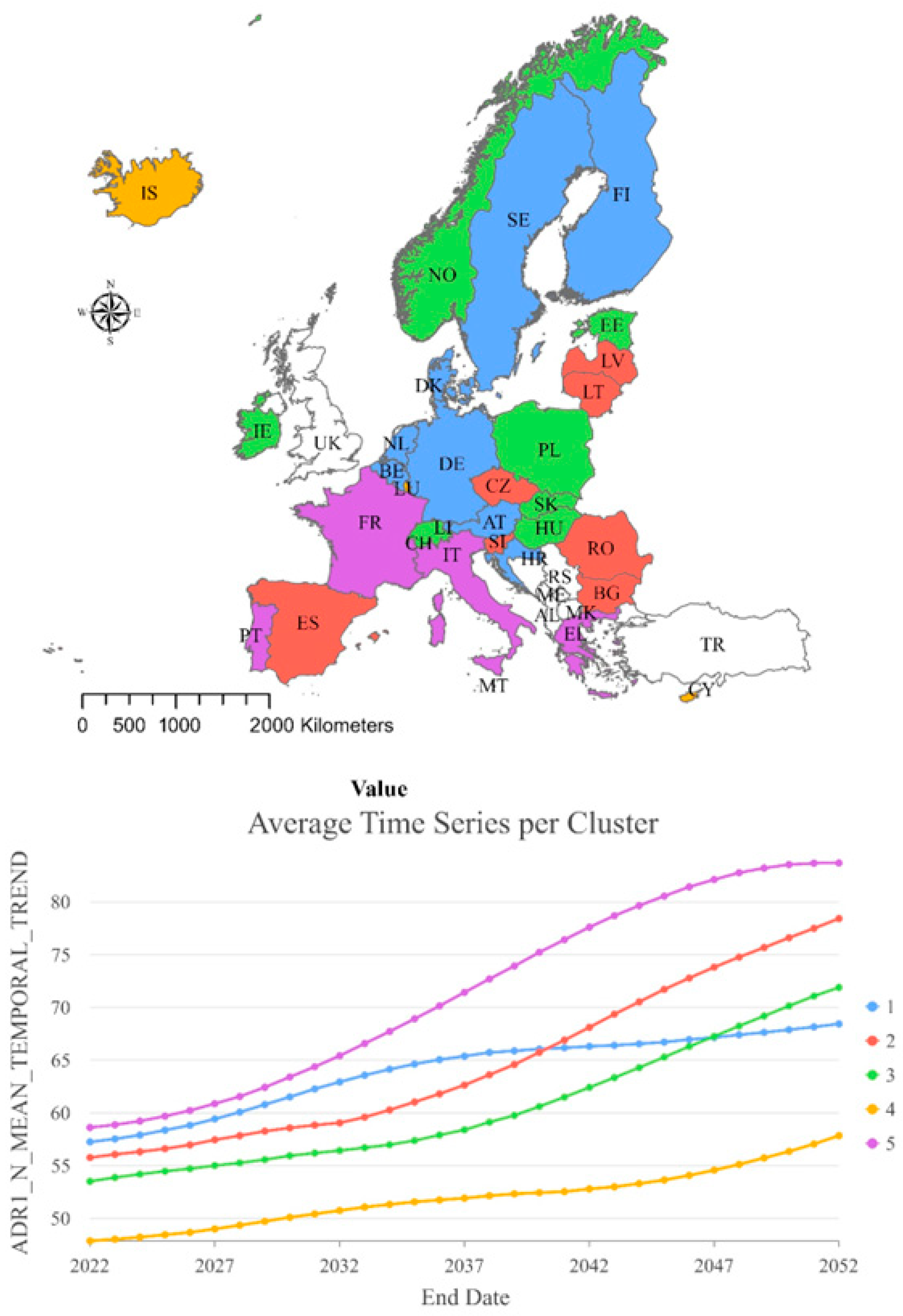
The model outputs the clustering of European countries based on the absolute values of the demographic dependency ratio (ADR1) for 2022–2052. Unlike the previous figure, where grouping was based on the evolution trend (correlations), this time, in
Figure 11, the average ADR1 value was used for classification.
The first map shows the clustering of nations into five differently coloured groups. The lower graph shows the mean evolution curves for ADR1 in each cluster.
The countries that have the highest absolute values of ADR1, more than 80, are found in cluster 5 (purple), which amounts to 2052—the highest democracy pressure, perhaps in Southeastern Europe.
Cluster 1 (blue) clusters the countries whose values are moderate to high and with a moderately rising trend—controlled ageing.
Cluster 4 (yellow) includes the ones that have the lowest ADR1 values, lower than 55 in 2022 and lower than 65 in 2052—those with the least demographic pressure.
Cluster 2 (red) unites the countries in which the value of demographic dependency ratio (ADR1) is high during the period studied (2022–2052). Based on the map, the countries in this cluster include Spain, Portugal, Romania, Lithuania, and Latvia. The mean curve that is linked to this cluster shows a faster and more permanent growth, between about 58 in 2022 and above 75 in 2052. This development implies a fast-growing demographic stress, unique to the countries with the high stage of demographic transition with a steep ageing process of population and a comparative decline of the working population.
The variations between clusters are noticeable and evident in both the amplitude of the curves not only in slope.
Romania, as well as the other states in the red cluster, is most likely to experience:
low fertility rates,
increased death rates in youths and any active adult, or
better net migration in the working-age groups.
Regarding the policy of the population, the nations included in this group should take immediate actions to restructure the system of pension, health, and education, as well as encourage the involvement of underrepresented groups in the working world (active ageing citizens, females, migrants).
This design emphasises that in the study of the demographic impact, the absolute values of ADR1 are just important as much as their trend. Grouping by value allows:
placing adaptation policies in order of the degree of demographic pressure;
selecting those areas at risk in the short and medium term;
a good empirical ground to the differentiated distribution of social and economic resources.
The red cluster may be referred to as one of the priority groups that require proactive policies in the demographic, social, and economic sectors.
4.7. Time Series Clustering—Visualising Trends Using Correlated Profiles (2022–2052)
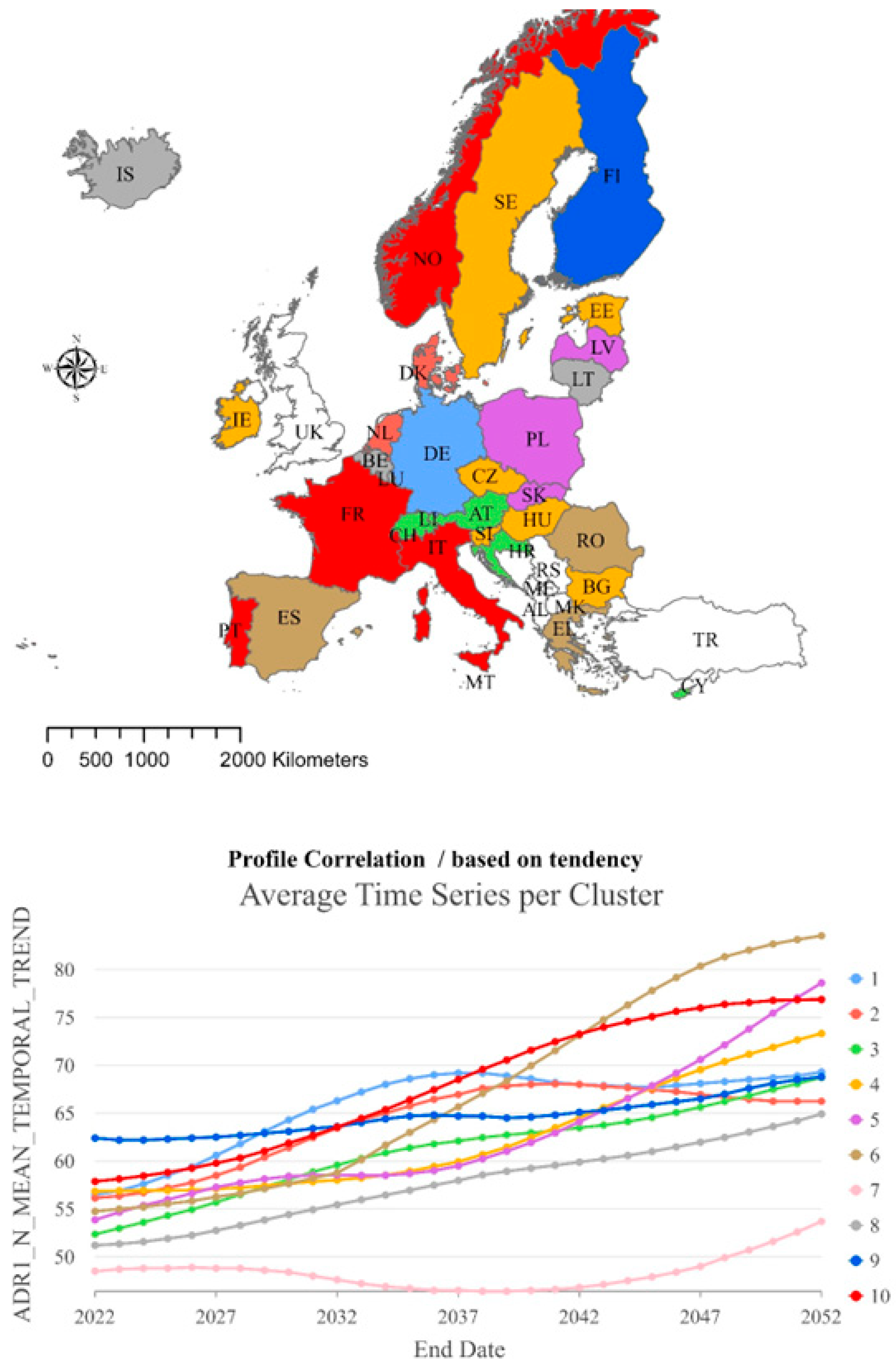
The outcome of grouping the time series of demographic dependency ratio (ADR1), in the period between 2022 and 2052, by level of European countries (NUTS 0), is shown in
Figure 12. The clustering was done according to the correlation of the evolution patterns and resulted in 10 separate clusters. The clusters differ in colour and depict a common average curve in the graph below.
The upper map shows the geographical distribution of nations for the ADR1 trend profile. The evolution of the dependency ratio is similar (correlated) in the same cluster of countries. The lower graph shows the average curve for each group: the average development of ADR1 for the relevant group of countries.
Cluster 6 (light pink) is opposite to this, as the first part of the time span of ADR1 is decreasing and then after 2042 increasing. This may be explained as unusual behaviour, implying demographic instability or short-term influences peculiar to the countries in question.
Cluster 2 (red) shows the most aggressive upward trend, culminating in estimated values over 75 in 2052, indicating rapid and consistent ageing.
Cluster 1 (dark blue) shows a stable, controlled trend with moderate growth and indicates countries whose demographic transition is slower or more controlled.
Cluster 10 (brown) shows a faster growth pattern for ADR1, and its estimated value exceeds 80 in 2052, which reflects states with extreme demographic stress, perhaps in Southeastern Europe.
The other clusters depict intermediate courses, the differences in the rate of ageing of the population.
The current time series analysis with clustering enables the division of countries based on the closeness of the demographic patterns, taking it a notch higher than mere geographical division. It can therefore be used to:
develop general communal policies at each cluster;
find some regional dynamics within the raw data;
see the importance of interventions based on the relevant demographic risk.
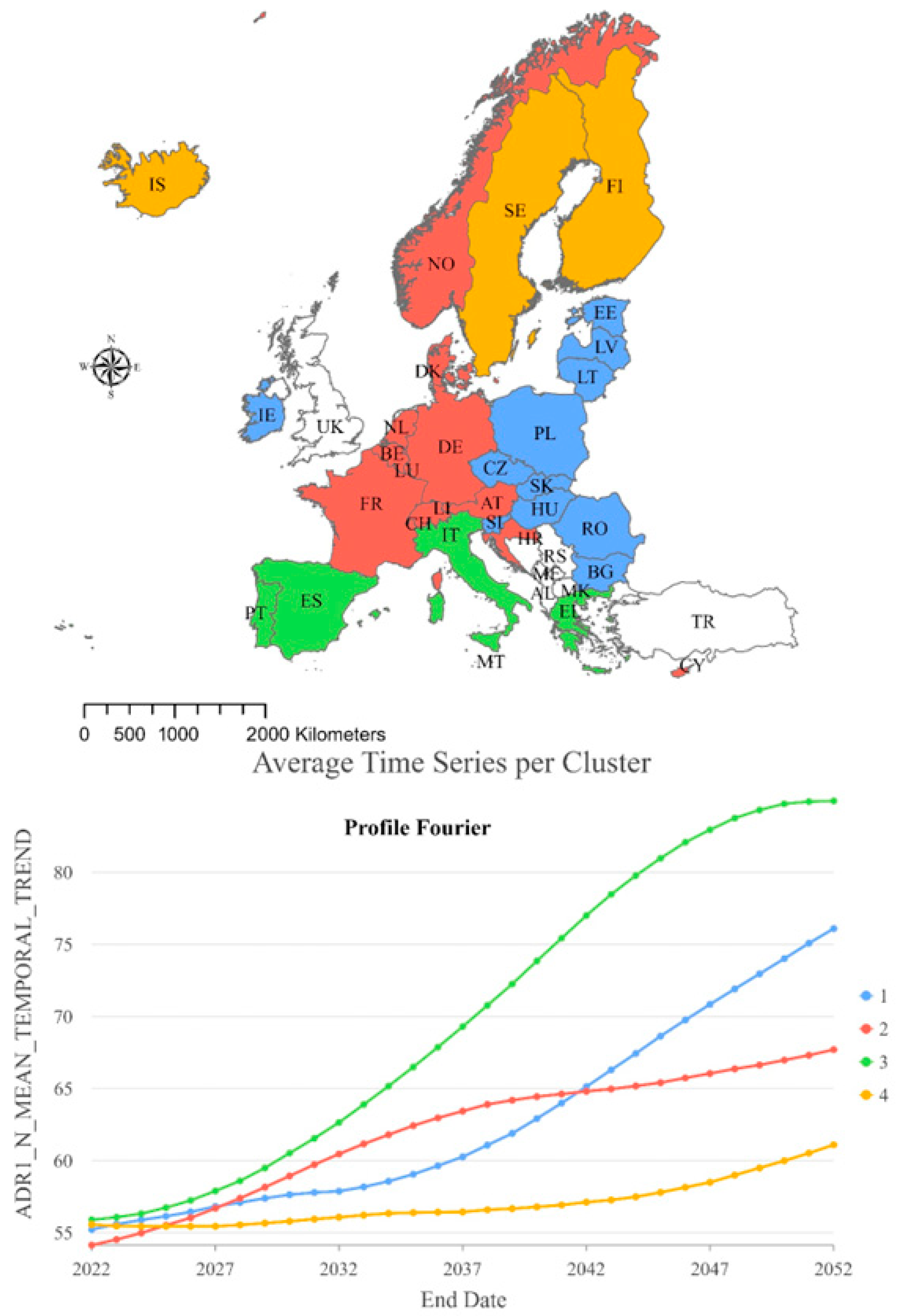
4.8. Time Series Clustering—Representation of Clusters Based on Fourier Profile (2022–2052)
Figure 13 represents the outcome of clustering the European countries with the Fourier transform time series analysis of ADR1 (age dependency ratio, variant 1) values in the period of time 2022–2052. The Fourier approach permits the identification of cyclic dynamics or prevailing frequencies in the evolutionary dynamics of demographic data, providing an additional perspective beyond classical clustering approaches.
The k-means are used to put the countries into four clusters (different colours), which represent the results of the most prevalent frequencies in the time series.
Cluster 1 (blue)—Poland, Romania, Bulgaria, Slovakia, Austria, etc.
Cluster 2 (red)—France, Germany, Belgium, Italy, Luxembourg.
Cluster 3 (green)—Portugal, Spain, Greece, Cyprus.
Cluster 4 (yellow) Nordic countries: Iceland, Norway, Sweden, and Denmark.
The lower graph shows the average ADR1 change for each cluster.
Cluster 3 (green) shows the most significant rate of increase, exceeding 80 ADR1 in 2052, a clear indication of a rapid demographic risk.
Cluster 2 (red) is stable, and growth increases moderately, indicating a moderate demographic transition.
Cluster 4 (yellow) is the lowest, with a clear tendency toward slow growth that could indicate either a temporary demographic gap or the effectiveness of existing public policies.
The one between the two extremes is cluster 1 (blue), and, in terms of trend, it has a stronger trend than cluster 2 but not as steep as cluster 3.
Another solution that can be used to cluster demographic developments is Fourier clustering, which considers not only the values or trends but also the internal structure of the variations.
This approach is applicable to predicting the dynamics of cyclical changes in ADR1 development, aligning demographic development with external factors (immigration, reform, etc.), and developing specific policies depending on the expected rate and extent of change.
The spatial clustering results reveal important differences in the demographic trajectories of European countries. The identified clusters, as shown in
Figure 11,
Figure 12 and
Figure 13, are manifestations of distinct demographic regimes, with varying degrees and dynamics of the dependency ratio. Whereas a few countries show a fast-growing dependency ratio due to a declining fertility rate and rising life expectancy, others show a more moderate pattern due to migration inflows or more balanced demographic patterns. This comparative approach underscores that demographic ageing is not a uniform process within Europe but rather reflects a wide range of national demographic and labour market factors.
Further information can be drawn from the model-fit outliers shown in
Figure 5. The outliers (Ireland, Denmark, Lithuania, Poland, Romania, and Bulgaria) exhibit unusual demographic patterns that do not conform to prevailing forecasting trends. Such deviations can be a product of certain structural properties, including high migration volatility, asymmetries in demographic transition, or labour market imbalances that influence the stability of long-term demographic forecasts.
Taken together, the clustering results provide a synthetic interpretation of the spatial pattern of demographic ageing in Europe by identifying clusters of countries with similar demographic patterns. This type of spatial heterogeneity of demographic ageing is a well-documented phenomenon in the literature that emphasises the role of regional demographic structures and migration patterns in the sustainability of labour supply in Europe [
3,
32].
5. Discussion
5.1. Study Findings and Contributions
The integrated model used to test the hypothesis of this study shows that a complex approach to a complex phenomenon could offer solid information and forecasts to serve as a basis for policy and strategy designers and decision-makers.
A synthesis of the results is presented in
Table 2.
Figure 13 is the result of clustering the European countries with the Fourier transform time series of ADR1 (age dependency ratio, variant 1) values in the period 2022–2052. The Fourier method allows the determination of cyclic dynamics or dominant frequencies of the evolutionary state from demographic data, offering an alternative perspective alongside classical clustering methods.
The most prevalent frequencies in the time series are identified using k-means, with the countries divided into four clusters (different colours).
Cluster 1 (blue)—Poland, Romania, Bulgaria, Slovakia, Austria, etc.
Cluster 2 (red)—France, Germany, Belgium, Italy, Luxembourg.
Cluster 3 (green)—Spain, Greece, Cyprus, Portugal.
Cluster 4 (yellow)—Nordic countries: Iceland, Norway, Sweden, and Denmark.
The average graph of the ADR1 change of each cluster is shown in the lower graph.
Cluster 3 (green) shows the largest rate of increase, exceeding 80 ADR1 in 2052 in real terms, indicating a high risk of population explosion.
Cluster 2 (red) is stable, and the moderate growth increases meaning that there is a moderate demographic transition.
Cluster 4 (yellow) is the worst, with a clear tendency toward slow growth, which can be explained either by the current decrease in the demographic gap or by the efficacy of current public policies.
Cluster 1 (blue), the one between the two extremes, has a stronger trend than cluster 2 and is not as steep as cluster 3.
The other solution that may cluster the demographic developments is Fourier clustering, which takes into account not only the values or trends but also the inner structure of the variations.
Such a method can be used to predict the dynamics of cyclical changes in ADR1 development, demonstrate the alignment of demographic development with external factors (e.g., immigration, reform, etc.), and create specific policies based on the expected rate and magnitude of change. The advantages of the curve type models are presented in
Table 3.
The dominance of the Gompertz model in estimating ADR1 until 2057 is scientifically and empirically justified, providing a robust key to understanding and anticipating the end of the demographic dividend in Europe. In a context of accelerated ageing, Gompertz helps to formulate differentiated policies, grounded in spatiotemporal realities and statistically validated forecasts (average RMSE < 0.6).
The results of this research have significant implications for the labour market and demographic policies in Europe. With the current demographic ageing gaining momentum, to achieve labour force sustainability, policy actions are needed to raise labour market participation, support human capital development, and prolong working life. Moreover, labour mobility and migration flows might also help alleviate regional demographic imbalances and support labour supply in ageing regions. Past studies have indicated that migration and labour market integration have the potential to partially counterbalance the impacts of demographic decline in the European economies [
42,
45]
Notably, not only statistically significant, but the size of the growth in ADR1 in each country is also quite large, suggesting that there is a different degree of strain on labour markets, pension systems and social protection structures, and that policy needs to be implemented differently across the European regions.
Although the limitations are discussed in detail in
Section 5.2, it should be mentioned that the limitations that are related to demographic forecasting are still applicable. Projections in the long run are always uncertain in terms of fertility, migration, and economic conditions, and thus should be viewed as scenarios but not specific predictions. Moreover, the assessment of forecasts in this work is based mainly on the RMSE measures, and other diagnostic measures, like MAE, AIC, or BIC, have not been analysed systematically, which is a weakness of the modelling framework.
The analysis is conducted at the national level (NUTS 0), which ensures data comparability across countries but may limit the granularity of spatial insights. Future research should extend the approach to subnational levels (NUTS 2 or NUTS 3) to capture intra-country demographic variations.
5.2. Study Limitations
Despite the likelihood that the new approach offers fresh insight into the logic of spatiotemporal modelling of the demographic dependency ratio (ADR1) in Europe, the study has some limitations that should be identified to properly interpret the findings and develop the methodology.
The first is that, with the sole use of the Eurostat projections (proj_23ndbi), there is a need to adopt a baseline scenario, implying the absence of policy intervention variables or disruptive variables such as pandemics, conflicts, or significant legislative modifications. The outcomes, therefore, are an approximation of structural trend, rather than an entirely adaptive prospective scenario [
5].
Second, even though the Gompertz model is effective in the cases of nonlinear and asymptotic processes, there is a structural constraint of the model: since the model directly relies on an asymptote of evolution, which is designed only to comprehend gradual processes, it misses the important case involving faster dynamics or sudden events that could be caused by migration or technologization [
80]. In this way, it fails to identify potential structural discontinuities that could prove applicable in the face of geopolitical or economic change.
Third, the ADR1 univariate model lacks exogenous variables (like family policies, international immigration, technological innovation, or reproductive behaviour adjustments) to explain the effect, making the analysis incapable of providing causal conclusions and other possible scenarios [
17].
In addition, analysis is conducted at the NUTS 0 (national) level, masking intra-state disparities that are important for developing regional policy. This restriction has the potential to affect the differentiated action at the subnational level in the European context of territorial cohesion [
3].
The present analysis does not explicitly model spatial spillover effects between countries (e.g., through spatial weighting matrices or spatial autocorrelation measures such as Moran’s I or LISA). Each country is treated as an independent unit, and therefore cross-country interactions such as migration flows or labour market integration are not formally captured.
Finally, but not least, the Curve Fit Forecast algorithm is used in the GIS environment (ArcGIS Pro 3.2.2) where the optimal model is automatically selected on the basis of RMSE, yet this does not necessarily consider the economic/demographic significance of the parameters, which can result in statistically good but theoretically poor fits [
74,
81].
The present study does not aim to generate independent forecasts, but rather to approximate and analytically interpret the official Eurostat projections using functional models. As such, uncertainty is implicitly embedded in the baseline scenario, and the results should be interpreted as structural approximations rather than probabilistic forecasts.
5.3. Further Research Directions
The Gompertz model is relevant for explaining the nonlinear dynamics of the demographic dependency ratio (ADR1) and offers insights to enhance the analysis of the demographic transition in Europe. In accordance with the achieved results as well as the gaps in the literature, the following directions of future research can be defined:
In further studies, the Gompertz model may be further expanded to include some explanatory variables of net labour migration or workforce, or fertility and life expectancy, which offer a comprehensive view of the ADR1 dynamics [
5]. These could be used as models to evaluate the sensitivity of demographics to public policy interventions.
- 2.
Subnational application of spatial–temporal analysis.
Relative to the considerable intra-state inequalities, it is necessary to model ADR1 at a regional scale (NUTS 2 or NUTS 3) to implement effective and fair territorial planning [
3]. It would enable interventions to be regional and demographic-specific.
- 3.
Altering the simulation of the public policy case.
The impact of reforms on fertility, migration, retirement age, or digitalisation of work as measured by ADR1 in identifying patterns of changing adoption can be estimated through counterfactual scenarios as part of Gompertz models [
1,
2]. Evidence-based policy making can be supported through such a simulation.
- 4.
Comparison of Gompertz performance and other models.
To evaluate how sound the forecasts are, future research could test alternative models, including Richards, modified logistic/machine learning (LSTM, Random Forest, XGBoost), which can detect irregularities or breaks in the series [
80].
- 5.
Analysing spatial correlations and contagion effects between countries.
The discussion of spatial interdependencies among nations, particularly labour mobility alongside cross-border migration issues, can point to new regional trends in the demographic transition [
71].
- 6.
Investigating the effect of ADR1 on the sustainability of the economy.
The next important step in the research is to study the correlations between ADR1 and the fiscal sustainability indicators of labour productivity and social expenditures. It can assess the risks that population ageing poses to macroeconomic balances [
82].
6. Conclusions
In this paper, the spatiotemporal dynamics of the demographic dependency ratio (ADR1) in European countries will be presented from an integrated perspective, combining curve-fitting forecasting, clustering, and GIS analysis. The findings prove that demographic ageing is a universalised and accelerating phenomenon in Europe, with serious ramifications for labour markets, pension schemes, and the long-term sustainability of fiscal systems.
The results on the dominance of the Gompertz model in the nonlinear and asymptotic behaviour of demographic transitions have been revealed. This provides a solid foundation for understanding the existing dynamics as well as the future inflexion points. Meanwhile, the incorporation of spatiotemporal analysis recognises a subtle distinction between national fates and the determination of focal points of demographic risk, which allows for more specific and prioritised policy interventions.
One of the main contributions of the study is the combination of predictive modelling, descriptive statistics, multivariate clustering and an analytical framework. In this way, it is possible to interpret demographic trends in greater detail and develop differentiated public policies. The findings suggest that Southern and Eastern European states experience greater population pressure, which underscores the need to raise labour market flexibility and reform social protection systems.
The multi-layered time series clustering approach also adds significance to the study, as it enables the determination of specific demographic portraits based on absolute levels, trends, and Fourier-based cyclical forms. This complementary view of clustering demonstrates that not only the intensity of demographic ageing but also its temporal pattern and structures vary. The findings point to the presence of high-risk groups, especially in Southern and Eastern Europe, where countries have both high dependency ratios and faster ageing curves. The typology enables more precise prioritisation of policy interventions and creates opportunities to develop differentiated, cluster-specific strategies to address demographic pressures.
In a broader sense, this study attests that the demographic dividend in Europe is no longer a postulated phenomenon but a statistically and spatially empirical one. The application of the Gompertz function to demographic dependency ratios has provided a consistent diagnostic instrument as well as a repeatable methodological framework for forecasting future demographic pressures.
Despite its contributions, this study has limitations in using baseline projections and no long-term multivariate explanatory modelling. Future studies ought to incorporate subnational dynamics, include additional socio-economic variables, and develop scenario-based simulations to ensure that the proposed approach is more predictive and policy-applicable.
The results of this research indicate a fundamental structural change in global demographic and economic processes. The traditional surplus-labour paradigm is undergoing a gradual shift towards one characterised by chronic and endemic labour deficits. This shift is an indicator of the combined effects of the declining age cohorts in young populations and the gradual growth of ageing populations across different areas. Migration will not adequately offset the demographic imbalances in this new topography because youth populations around the world are shrinking.
More to the point, the dynamics might call into question the existing welfare models, as is traditionally known. The ageing and diminishing workforce is linked, as has been noted in literature, to possible productivity and the ability to embrace new technologies. It exerts structural pressures not only on labour markets and social protection mechanisms but also on long-term economic growth and the capacity to innovate.
Such a change indicates that more economies will have to operate under structural labour shortages, rather than excess. This kind of transformation will tend to reconfigure the process of resource allocation, and this is the beginning of new forms of economic logic, which have yet to be formulated.