


Abstract
With the progressive decline of tailpipe emissions, non-exhaust sources such as brake wear are becoming an increasingly important contributor to traffic-related particulate matter in urban environments. In this context, improving real-world characterization of brake wear particles is essential for air-pollution assessment, source apportionment, and the development of cleaner and more sustainable road transport systems. Here, we investigated the emissions levels, particle size distribution and elemental composition of particles released during harsh real-world braking events by a single light-duty vehicle braking system equipped with an original manufacturer (OEM) non-asbestos organic (NAO) pad formulation. Using a direct on-vehicle sampling system combined with real-time particle sizing and high-resolution microscopy, we observed that particle emissions remained close to background levels at speeds up to 100 km/h, but rose sharply at 120 km/h, reaching 3.7 × 10⁷ #/cm3 in the 8–10 nm size range. This increase suggests that higher speeds are associated with elevated particle emissions, likely due to the higher braking temperatures reached at increased vehicle speeds. The emitted particles were mainly spherical agglomerates rich in iron, titanium, barium, zirconium, and sulphur, consistent with NAO pad formulations. Our results show that the investigated NAO pad system can deteriorate under thermal stress, potentially leading to higher levels of nanoparticle emissions compared to low-metallic or semi-metallic pads investigated under similar conditions. These findings provide real-world evidence relevant to urban air quality research, support the refinement of non-exhaust emissions inventories, and highlight the importance of thermally resilient friction-material formulations for mitigating residual particulate emissions in increasingly cleaner transport systems.
1. Introduction
Emissions of inhalable particulate matter (PM) from road transport represent a major environmental and public health challenge. Fine particles are of great concern due to their ability to penetrate deep into the lungs and trigger cardiovascular and respiratory ailments [1,2,3]. Moreover, the toxicity of these particles is influenced by their size, source, and chemical composition [4]. With the significant reduction in tailpipe emissions and the increasing share of electrified vehicles, attention has increasingly shifted towards non-exhaust sources, especially brake wear.
Brake wear particles are generated by the combined effects of mechanical abrasion and thermal decomposition during braking. Under severe conditions, high temperatures accelerate the degradation of friction materials, promoting the formation of ultrafine particles [5,6,7]. In this context, the composition and microstructure of brake pads are crucial, as they directly influence wear behaviour and emission profiles [8]. Studies have linked abrasive wear, thermal fatigue, and the formation of glazed surfaces to specific microstructural properties [9]. In addition, the incorporation of graphite lubricants has been shown to enhance wear resistance and reduce particulate emissions by forming a protective film over the pad surface [9]. Moreover, low-metallic brake pads tend to emit larger quantities of airborne nano- and micro-sized particles that may contain potentially harmful transition metals such as iron, copper, zinc, and tin [10].
Recent findings have advanced our understanding of the elemental composition of brake wear particles. Neukirchen et al. [8] conducted a detailed chemical and physical characterization of brake wear emissions using two different brake pad materials on a dynamometer and aligned with Global Technical Regulation No. 24 (GTR24) procedures using Worldwide Harmonised Light Vehicle Test Procedure (WLTP) braking conditions. They reported PM10 emission factors of 15.1 ± 0.1 mg/km and 16.3 ± 0.4 mg/km, exceeding the forthcoming EURO 7 threshold of 7 mg/km. These values are consistent with the emission factor ranges reported by Giechaskiel et al. [11], who found that emissions can vary widely depending on test cycle and braking severity, sometimes exceeding regulatory thresholds under demanding conditions. The study also shows that braking intensity, vehicle speed, and road surface conditions further shape the emission profile. The same study showed that iron (Fe) was found to constitute between 43% and 75% by mass in individual particles, with average Fe contributions to PM10 of 54.9% and 58.1%, highlighting the importance of rotor wear. Other trace metals such as copper (Cu), manganese (Mn), chromium (Cr), and zinc (Zn) were also identified, reinforcing the need for further research into the toxicity of brake-derived particles and their long-term environmental impact.
Variations in brake pad formulation affect the particle size distribution, with ultrafine particles predominating at high temperatures [7]. Due to their greater surface area and capacity to carry toxic compounds, ultrafine particles pose heightened health risks [4]. Furthermore, comparative studies between non-asbestos organic (NAO) and low-metallic (LM) brake pads have revealed differences in their emission behaviour. LM pads generally release greater quantities of solid, metal-rich ultrafine particles, largely due to their higher metallic content by mass and friction levels [12]. On the other hand, under demanding braking conditions, NAO pads have been observed to emit more volatile nanoparticles. This is mainly attributed to their higher proportion of organic materials and lower thermal conductivity, which together create favourable conditions for the volatilization of certain compounds [13,14].
In addition to their emission profiles, NAO and LM pads differ significantly in terms of chemical makeup, thermal behaviour, and regional usage. NAO pads—predominantly used in North America and parts of Asia—typically consist of phenolic resins, aramid fibres, rubber, carbon, and various non-metallic fillers such as glass powder, mica, and graphite. They also include inorganic components like barium (Ba), titanium (Ti), and zirconium (Zr), which serve as friction modifiers and thermal stabilizers [14,15]. More broadly, brake friction composites are highly sensitive to formulation design, since the balance between fibres, fillers, binders, abrasives, and lubricants affects friction stability and wear behaviour. In this regard, Katharbasha et al. [16] showed that the combination of potassium titanate fibres and metal sulfides can influence wear resistance and friction stability in brake friction composites. This formulation results in low thermal conductivity, which, during intense braking events, may cause localized overheating. Such conditions promote the thermal degradation of organic constituents and, consequently, the release of volatile nanoparticles [14,17]. In parallel, the increasing use of natural or partially bio-based constituents in friction materials also raises questions regarding their stability under aggressive service or environmental conditions. Moreover, Sunardi et al. [18] reported performance changes in composite brake pads based on natural-material constituents after exposure to engine oil, underlining the importance of material stability when assessing brake systems intended to be more sustainable. By contrast, LM pads—more commonly used across Europe—contain higher levels of copper (Cu), iron (Fe), aluminum (Al), and silicon (Si). These elements not only enhance heat dissipation and braking performance but are also associated with increased emissions of solid metallic particles [8,13].
Recognizing the importance of brake-pad composition, as well as that of bridging laboratory findings with real-world conditions, the present study evaluates brake wear emissions from an OEM NAO brake pad formulation mounted on one light-duty vehicle platform though on-road measurements using advanced onboard sampling techniques to capture the dynamic variations in brake wear emissions during everyday driving combined with off-line chemical and physical characterization of the measured particles using transmission electron microscopy (TEM) combined with energy-dispersive X-ray spectroscopy (EDS). The results are compared with previous findings obtained for LM pads under comparable conditions. This comparative approach allows us to explore how the tested pad formulation may influence both the emission levels and the physicochemical nature of brake wear particles. Moreover, it provides insights into the elemental composition and emission behaviour of this specific NAO configuration under harsh braking conditions.
2. Materials and Methods
The NAO-equipped braking systems investigated were mounted on a light-duty vehicle, a Nissan Leaf. The tested braking system was equipped with the original manufacturer (OEM) brake pads supplied with the vehicle. The platform presented total loaded weight of 1858 kg, including measurement equipment and occupants. This closely matched the 1885 kg of the test LM-equipped vehicle used in Al Wasif-Ruiz et al. [19]. The similarity in vehicle mass reduces the influence of weight on brake wear particle emissions, thereby allowing the comparison between the two pad systems.
The mileage of NAO-equipped test vehicle was approximately 1000 km. To reduce the influence of the initial surface condition, the braking system was conditioned before testing by performing 80 braking events. This preconditioning step was intended to promote bedding/running-in of the pad-disk interface and stabilize the contact prior to the measurements [20,21]. During the initial use period, the surface state of new brake components may differ from their steady operating condition, since both the disk and the pad undergo a running-in/bedding process during the first braking events, progressively evolving toward a quasi-stationary tribological contact [20,21]. Taken together, these conditions enabled a focused assessment of the role of pad formulation on the physical and chemical properties of the emitted particles.
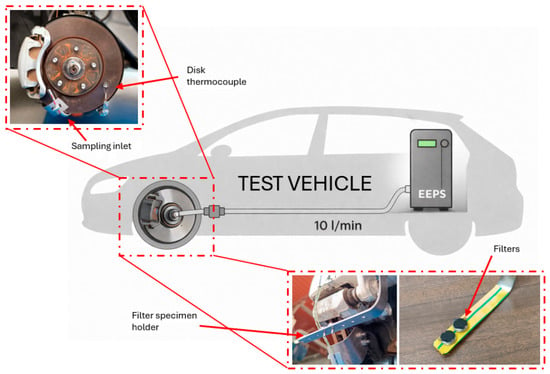
A simplified schematic overview of the vehicle-mounted sampling configuration used is provided in Figure 1. The figure shows the main elements of the setup, including the brake assembly, the sampling inlet location, and the general sampling line layout.
Figure 1.
Schematic of the vehicle-mounted sampling configuration.
The sampling setup included a stainless-steel tube connected to a segment of Tygon® tubing (Saint-Gobain, Courbevoie, France), positioned near the lower lateral edge of the front-left brake pad, near the pad–disk contact zone. In line with the setup used in the previous study [19], the sampling line was kept as short and straight as possible (ID 7 mm, total length 2 m), with smooth bends, to minimise residence time and potential losses. This configuration was designed to capture particles emitted directly from the braking interface and to limit setup-induced differences. Particle number concentration and size distribution were recorded in real time using an Engine Exhaust Particle Sizer (EEPS™, model 3090, TSI Incorporated, Shoreview, MN, USA), which classifies particles in the 5.6 to 560 nm range based on their electrical mobility. The data were processed using the instrument’s default inversion matrix. No sample-conditioning system was applied upstream of the EEPS; therefore, the measurements represent total particles reaching the instrument.
To ensure that the measured particles originated from the brake system, a transparent polycarbonate shield was mounted around the wheel rim. This isolator reduced the risk of environmental particle intrusion. To verify the shielding effectiveness, the vehicle was driven at a steady speed while using only the parking brake for deceleration. During these control tests, the total particle concentration measured at the sampling point was comparable to the ambient background, which was approximately 2.0 × 10⁴ (#/cm3), confirming the effectiveness of the shielding configuration.
To monitor the thermal behaviour of the braking system, a total of three type K thermocouples (±1 °C) were installed, with one sensor positioned at each of the following locations: the brake disk, the brake calliper, and the brake pad. In all cases, the thermocouples remained in continuous surface contact with the corresponding component throughout the tests, without penetrating the material. These sensors were mounted using a custom plate system attached to the vehicle’s suspension arm, which ensured stable positioning during operation without affecting braking performance. Temperature data were recorded continuously throughout the experiments at a sampling frequency of 2 Hz.
In addition to real-time measurements, brake particles were collected for off-line analysis on carbon-coated copper grids. The grids were stored in their original protective boxes until used to minimize contamination from the surrounding environment. Immediately before the tests, the collection supports were prepared using an aluminum specimen holder fitted with double-sided carbon adhesive tape, onto which the grids were mounted. Each holder was then positioned independently of the EEPS, close to the brake emission source, near the pad-disk interaction zone, during the selected braking events. No pump or other active flow assistance was used during sampling. Therefore, particle collection was based on passive exposure and deposition of the emitted aerosol onto the grids. As a passive method, it may be affected by size-dependent deposition biases, potentially underrepresenting the smallest highly diffusive particles while favouring the collection of larger particles or pre-existing agglomerates. In addition, secondary agglomeration of ultrafine particles on the grid during deposition cannot be fully excluded.
For this study, the grids were exposed only during braking events from 120 km/h to a complete stop. This condition was selected because preliminary tests at lower speeds showed particle concentrations close to background levels, whereas braking from 120 km/h ensured sufficient particle generation for a representative sample collection. The collected samples were analyzed by transmission electron microscopy (TEM, JEM-2100HT, JEOL Ltd., Tokyo, Japan) combined with energy-dispersive X-ray spectroscopy (EDS, INCA Energy, Oxford Instruments, High Wycombe, UK), which provided nanometric resolution imaging and elemental identification, thereby allowing the characterization of the particles’ morphology and chemical composition.
Moreover, prior to the braking tests, small samples of brake material were mechanically scraped from both the brake pads and the disk and analyzed as reference samples. These additional analyses were performed to obtain a compositional baseline for the interpretation of the emitted particles, as this information was not provided by the manufacturer. For the control analyses, carbon-coated nickel grids were used to avoid any possible interference from copper supports during EDS analysis. In this way, it was possible to verify that any Cu signal detected in the reference samples was not an artefact originating from the grid itself. Once this possibility had been ruled out, carbon-coated copper grids were used for the collection and subsequent analysis of airborne particles generated during braking.
The setup and approach were previously investigated under comparable conditions [19]. The methodology was developed by assessing emissions during real-world operation and comparing the results to emissions recorded in laboratory control setups under comparable conditions.
The braking tests were performed on public roads. To minimise variability in road and ambient conditions, the same route was used as in [19]. Moreover, all experiments were performed on dry pavement over five consecutive days with similar meteorological conditions, and each target speed was repeated three times. Since brake thermal behaviour can be influenced by ambient temperature and humidity, the braking system was thermally conditioned prior to each test by performing 15 consecutive full stops. This preheating step reduced differences in the initial thermal state across tests. Subsequently, the main test sequence—referred to as “hot braking”—consisted of full stops from four initial speeds: 60, 80, 100, and 120 km/h. Decelerations of approximately 2.1 m/s2 (from 60 km/h) and approximately 4.2 m/s2 (from 120 km/h) were prescribed for the hot braking tests.
For each initial speed (60, 80, 100 and 120 km/h), three representative trials were selected to ensure comparability across groups. Repeatability was assessed via the coefficient of variation in total particle concentration, a metric used for experimental variability [22]. Data normality was confirmed by Shapiro–Wilk tests, while homogeneity of variances was verified by Levene’s test. Differences in mean concentrations between groups were analyzed through one-way ANOVA, a statistical approach used to evaluate the influence of braking parameters on particulate emissions [23], followed by post-hoc comparisons using Tukey HSD. All statistical analyses were conducted in R (v 4.2.0) using the “stats” and “multcomp” packages, with a significance level of α = 0.05.
3. Results and Discussion
3.1. Emissions and Size Distributions
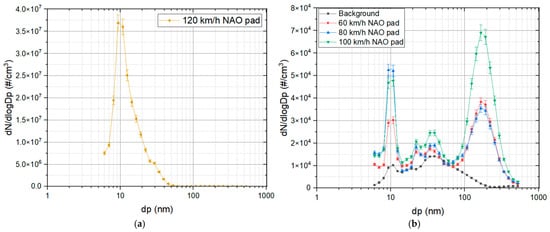
Figure 2 illustrates the average particle emissions and number–size distributions recorded during the “hot braking” tests from 60, 80, 100 and 120 km/h. Figure 2a represents the emissions during the 120 km/h condition, which are orders of magnitude higher compared to the other speeds. Figure 2b shows the emissions during 60, 80 and 100 km/h.
Figure 2.
Particle number–size distributions recorded during hot braking conditions: (a) 120 km/h and (b) 60, 80, 100 km/h.
As illustrated in Figure 2b, at 60, 80 and 100 km/h, the distributions remain clustered near background levels and do not exceed 1 × 10⁵ #/cm3. In contrast, the distribution at 120 km/h stands out with higher particle concentrations up to 107 #/cm3 (see Figure 2a).
Despite the low absolute concentrations observed at 60, 80 and 100 km/h, shape features can be identified in the size distributions. The first mode, centred between approximately 8 and 16 nm, is consistent with particles formed through evaporation–condensation processes, likely associated with thermally driven volatilisation of brake material constituents followed by nucleation [10,24,25,26]. In the intermediate range (16–64 nm), a secondary mode can be distinguished, consistent with previously reported size distributions in brake-related studies [26,27]. Such particles within this size interval may reflect particle growth processes, including coagulation and condensation mechanisms [27,28]. In parallel, a broader mode extending from roughly 64 to 512 nm can be distinguished, which is plausibly linked to mechanically generated wear fragments originating from abrasion and fragmentation processes within the braking interface [29,30].
These visual trends were confirmed by statistical analysis. First, we calculated the coefficients of variation in total particle concentration, which quantify the relative variability of each group: 19.9%, 16.8%, 29.8% and 22.5% for 60, 80, 100 and 120 km/h, respectively. To check the assumptions required for parametric testing, we tested whether each group followed a normal distribution using the Shapiro–Wilk test (null hypothesis H0: data are normally distributed). In all cases, p > 0.05, so normality could not be rejected (60 km/h: W = 0.948, p = 0.559; 80 km/h: W = 0.910, p = 0.417; 100 km/h: W = 0.804, p = 0.124; 120 km/h: W = 0.992, p = 0.833). Homogeneity of variances was evaluated with Levene’s test (H0: all group variances are equal), which also returned p > 0.05 (F3,8 = 3.16, p = 0.095), confirming this assumption. Given these conditions, a one-way ANOVA was appropriate to test the null hypothesis that all mean concentrations are equal across speeds. The ANOVA showed a highly significant effect of speed on particle concentration (F3,8 = 50.22, p < 0.001), meaning that not all group means are equal. Post hoc Tukey HSD tests revealed that the 120 km/h group was significantly different from all other groups (p < 0.001), whereas no significant differences were observed between 60, 80 and 100 km/h.
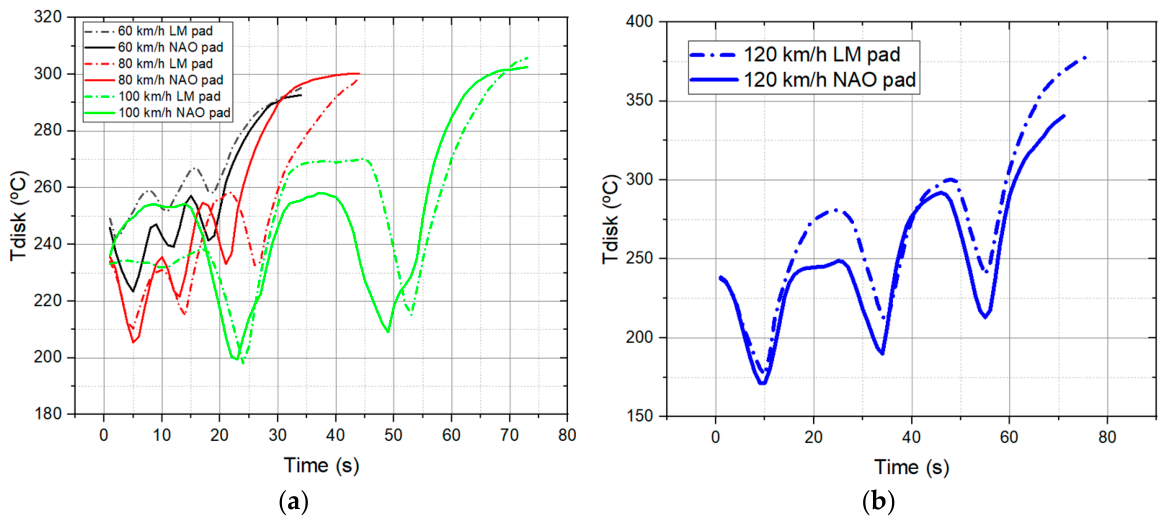
When braking from higher speeds (e.g., 120 km/h), the curve experiences a surge below 20 nm, shooting upwards sharply. This sudden increase may be linked to intrinsic degradation mechanisms —such as matrix fragmentation and thermal breakdown of organic additives— that become relevant within a critical temperature range associated with enhanced ultrafine particle formation [10,25,31]. To contextualize these observations, our results were compared with those presented in a previous study [19] where the performance of the LM brake pads was evaluated under comparable on-road conditions and using the same sampling system. In both experimental campaigns, the braking system was pre-heated prior to the hot braking sequence to ensure similar initial disk temperatures. In the present NAO campaign, the initial disk temperature ranged from 236 to 246 °C, thereby enabling a comparison under equivalent thermal boundary conditions, as this appeared to be a key feature for the emissions from LM pads [19].
In the case of the NAO pads, particle emissions at 60, 80 and 100 km/h remained at background levels, even though the increase in final disk temperature with speed, reaching 293 °C at 60 km/h, 300 °C at 80 km/h, and 303 °C at 100 km/h. At these three speeds, despite reaching final disk temperatures comparable to those measured for the LM brake pads (295 °C at 60 km/h, 301 °C at 80 km/h, and 307 °C at 100 km/h), the braking system equipped with NAO brake pads exhibited only a weak nucleation-mode signal, with particle concentrations remaining close to background levels. By contrast, in the case of the LM brake pads, the rise in disk temperature with speed was accompanied by an increase in ultrafine particle emissions [19].
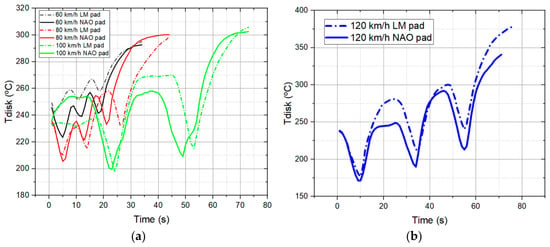
Figure 3a,b present the brake disk temperature evolution during the hot-braking events, illustrating that both systems follow similar thermal trajectories while displaying different ultrafine particle responses. For the 120 km/h condition, the total recording time differs slightly between the NAO and LM systems because, although both tests started from comparable initial thermal conditions, the LM configuration reached a higher peak brake disk temperature (379 °C) than the NAO configuration (341 °C) and therefore required a longer time to stabilize. These findings suggest that, under comparable thermal stress, the NAO brake formulation limits the amplification of nucleation processes [31,32]. In this regard, Patel et al. [33], in a laboratory study based on a pin-on-disk tribometer, reported that ultrafine particle formation during braking is temperature-dependent and may increase once a transition temperature is exceeded, particularly through the formation of semi-volatile emissions associated with thermal decomposition of organic brake pad constituents. Our on-road results are consistent with this temperature-dependent behaviour, but they also indicate that the particle response cannot be explained by brake disk temperature alone.
Figure 3.
Brake disk temperature profiles for the NAO and LM brake pads during hot-braking events: (a) 60, 80 and 100 km/h; (b) 120 km/h.
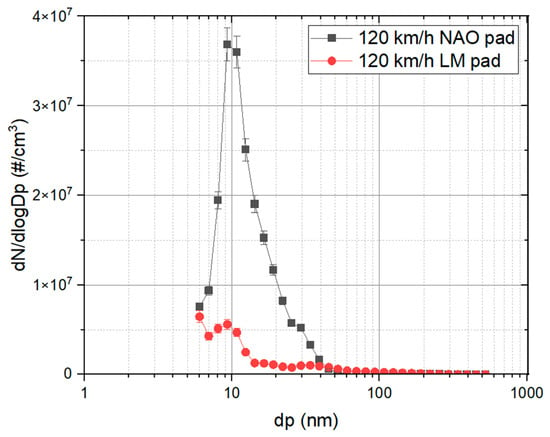
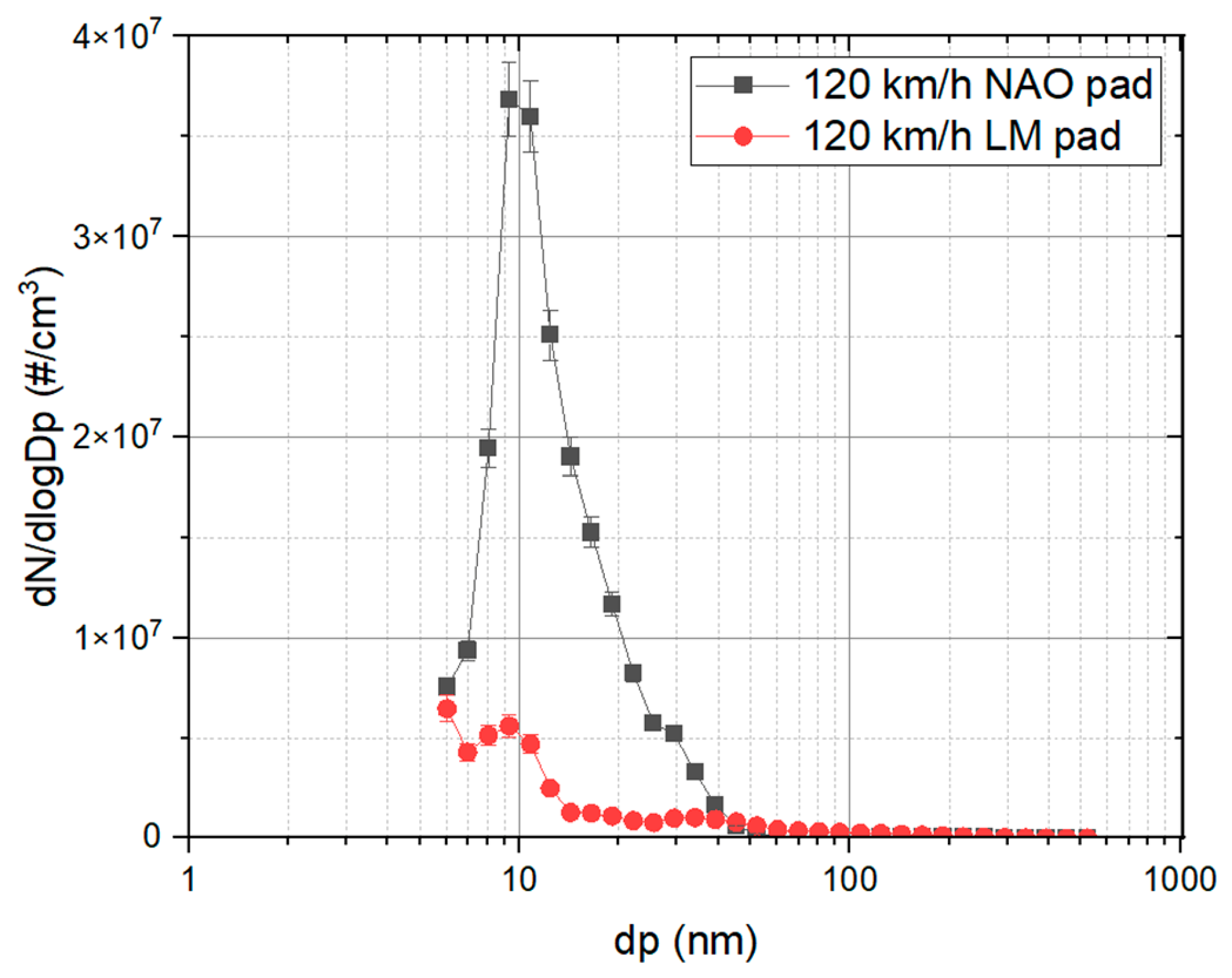
At 120 km/h—when the braking system equipped with NAO brake pads reached a disk temperature of 341 °C—a pronounced surge in ultrafine particle emissions was observed, nearly saturating the upper limit of the EEPS detection range (Figure 4). Under these conditions, particle concentrations in the 8–10 nm size range reached about 3.7 × 10⁷ #/cm3. Notably, although the braking system equipped with NAO brake pads reaches lower disk temperature at 120 km/h than that equipped with LM brake pads at the same speed, the NAO configuration emits approximately an order of magnitude more ultrafine particles. This suggests that ultrafine particle generation is not solely governed by temperature, but it is also influenced by friction material formulation and microstructural design. This is in line with Durif et al. [28] and Diana et al. [34], which showed that differences in brake pad composition can affect gaseous precursor emissions, particle size distribution, and the relative abundance of fine and ultrafine particles.
Figure 4.
Particle number–size distributions recorded for the NAO and LM brake pads during hot-braking events from 120 km/h.
The distinct behaviours observed between braking systems equipped with NAO and LM brake pads indicate the existence of material-specific critical temperature ranges over which emission patterns shift—ranging from suppression to nucleation. The observed increase in sub-10 nm particles is attributed to nucleation processes driven by the thermal degradation of organic components in NAO brake pads, such as phenolic binders and organic additives [7,14]. Such dynamics are consistent with tribological models that highlight the influence of chemical composition and third-body interactions on particle formation [32] and are supported by experimental and review studies documenting how formulation and thermal conditions jointly shape particle size distributions and emission intensity [35,36].
Ultimately, these insights suggest that merely limiting vehicle speed or managing disk temperatures could not be sufficient to curb ultrafine brake-wear emissions. Instead, developing friction materials engineered for enhanced thermal stability and optimizing brake-system cooling could be promising strategies to limit nanoparticle release, ultimately resulting in benefits for air quality and public health.
3.2. Morphology and Chemical Composition
Following EDS analysis of the blank samples collected on nickel filters across the eight tests performed, the results indicated that the brake disk consisted primarily of iron (>93 wt.%), whereas the NAO pads were rich in titanium (>70 wt.%), together with silicon, sulphur, calcium, potassium, zinc, zirconium, and barium.
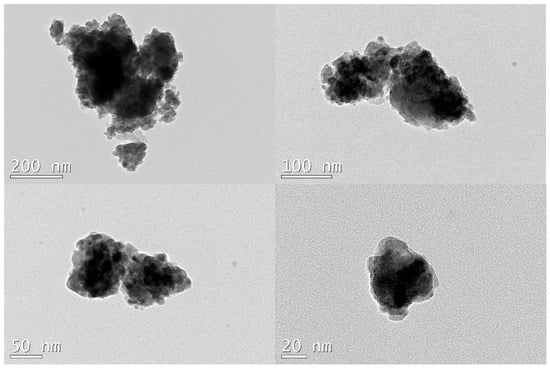
Figure 5 shows multiple TEM images of brake wear particles collected during braking events from 120 km/h to a complete stop. These images illustrate the diversity in particle size, while showing similar morphological features across the different sampling grids. Despite the size variations, the overall structures remained reproducible. During these tests, the filters were exposed to a final disk temperature of 350 °C, representing the thermal conditions under which the particles were collected.
Figure 5.
TEM images of brake wear particles collected during braking events from 120 km/h, corresponding to a final disk temperature of 350 °C.
TEM analysis revealed that, under the present passive collection conditions, the particles deposited on the grids mostly appeared as rounded agglomerated structures, while isolated particles were not readily observed at this scale. However, some degree of deposition-induced agglomeration during collection cannot be excluded. At this disk temperature of 350 °C, thermal degradation processes are expected to be pronounced. The heat can soften or partially melt components of the friction material, promoting the formation of smaller, smoother, and more spherical particles. In line with this interpretation, Al Wasif-Ruiz et al. [19] reported that particles tended to appear as rougher aggregates at 257 °C, gradually evolving towards smoother and more spherical shapes at 307 °C. The present findings at 350 °C can thus be seen to be in line with this trend, where thermal degradation processes appear to play a central role in defining particle morphology.
These observations made from particles collected during on-road operations also align with studies performed under control conditions in the laboratory. For example, that of Liati et al. [37], who used a brake test bench and electron microscopy to examine the morphology and chemistry of airborne brake particles at disk temperatures between 150 °C and 300 °C. Their results showed that particles predominantly formed aggregates across a wide size range—from coarse to ultrafine—while isolated particles were rarely detected. Similarly, Švábenská et al. [38] found that the particles, ranging in size from tens to hundreds of nanometers, mainly appeared as agglomerates.
Comparable patterns were also reported by Woo et al. [14], who analysed brake particles from two distinct pad formulations under both standard and severe braking conditions using a brake dynamometer. Under harsh conditions, they observed nanoparticles around 50 nm in diameter with a rounded morphology, which they attributed to the volatilisation and subsequent nucleation of organic compounds from the pad material. These nanoparticles tended to attach to larger particles as temperatures rose. Although Woo et al. [14] primarily focused on pad temperatures, a similar mechanism likely contributes here, given the strong link between elevated disk and pad temperatures and the resulting morphological changes. These results support the evidence that brake wear particles tend to form aggregated structures rather than existing as individual entities. Notably, this behaviour appears consistent across different pad formulations, as both NAO and LM pads [19] exhibited similar morphologies. The results suggest that laboratory testing can provide particles with representative morphology of the real-world operation and that brake particles can be measured and isolated from other sources during on-road investigations.
Based on EDS analysis of the 40 copper grids collected during the test campaign, the elemental composition of the brake wear particles revealed iron (36 wt.%), titanium (19 wt.%), zirconium (11 wt.%), barium (9 wt.%), sulphur (8 wt.%), potassium (4 wt.%), silicon (4 wt.%), zinc (4 wt.%) and calcium (2 wt.%) as the dominant constituents. The elevated iron content is primarily attributed to the mechanical wear of the cast iron brake disk, as confirmed by the elemental composition of the disk material itself and supported by previous reports [19,39]. This is consistent with previous studies showing that brake wear particles may originate from both the brake pad and the brake disk, with rotor wear making a substantial contribution in some brake configurations [40,41]. The co-occurrence of titanium and potassium, also identified in the pad material, suggests the presence of potassium titanate, commonly employed as an abrasive in NAO formulations [42,43]. Similarly, zirconium and silicon detected in both the wear particles and the pads indicate a likely origin from zirconium silicate and other silicate-based additives widely used in non-asbestos organic materials [25]. The combination of barium and sulfur, also present in the pad composition, is consistent with the incorporation of barium sulfate, a thermally stable, high-density filler [12,44], while sulfur may also derive from solid lubricants such as zinc or molybdenum sulfides [45,46]. Furthermore, trace levels (<1 wt.%) of magnesium, aluminium, phosphorus, sodium and manganese, all observed in the pad material, point to the presence of various mineral fillers and friction modifiers intended to enhance thermal resistance, wear stability, and noise-damping properties [12,47].
When comparing these results with those reported for LM pads by Al Wasif-Ruiz et al. [19], differences emerge that can be linked to the distinct pad formulations employed. In their study, Fe was also the most abundant element, reflecting the contribution from the brake disk, but the accompanying elements were mainly Cu, Al, and Zn. In contrast, in the present work, the particles contained higher proportions of Ti, Zr, Ba, and S, consistent with the NAO formulation of the pads used here. These discrepancies suggest that, while the disk material acts as a common source of Fe across different systems, the specific pad composition determines the secondary metals present in the airborne particles. Taken together, these findings may be relevant for future source-apportionment and hazard-oriented studies.
4. Conclusions
This study set out to explore the behaviour of brake wear particle emissions from a system equipped with NAO pads under harsh real-world braking conditions. The findings reveal a shift in particle behaviour with increasing speed: while concentrations remained close to background levels up to 100 km/h, a spike of ultrafine particles occurred at 120 km/h. This suggests the existence of a critical temperature range, beyond which particle formation accelerates. Importantly, this behaviour highlights that brake wear emissions are not solely driven by temperature or vehicle speed but are also shaped by the chemical formulation and microstructural properties of the friction material itself.
Although disk temperatures reached levels comparable to previous studies with low-metallic pads, the NAO-based system exhibited a different emission pattern. Ultrafine particle emissions remained stable up to a critical point, after which a clear increase was observed. This suggests that emissions of NAO pads can differ from those of low-metallic pads under high thermal stress. In this respect, the study provides real-world data on NAO brake wear emissions levels and elemental composition, information that is currently very scarce in the literature. These results could support the refinement of non-exhaust emission inventories and source-apportionment studies, while also contributing to the identification of composition-related tracers associated with NAO brake wear particles.
Additionally, brake wear particles from the NAO-based system were predominantly spherical nanoparticle agglomerates and contained amounts of iron, titanium, barium, and other metals. These findings highlight the relevance of further investigating ultrafine particles generated during braking. These results question the common perception that NAO brake pads are more environmentally friendly. While NAO pads may perform well under moderate operating conditions, the present data suggest that their environmental advantage may not be maintained under high thermal loads, where increased nanoparticle emissions were observed relative to the low-metallic system considered for comparison.
Although the present study was conducted using a single vehicle platform and one NAO brake pad configuration, this approach provides insight into the temperature-dependent behaviour of NAO brake wear emissions under harsh braking conditions. In particular, the results contribute to the current state of knowledge by providing additional experimental data on a brake pad formulation that is perceived as environmentally preferable, while showing that its performance may differ when exposed to severe thermal stress. While the findings should not be understood as a generalization across any brake system or vehicle platform, they highlight the need to assess brake pad properties not only under standard or moderate conditions, but also under demanding operating scenarios. Further work should investigate NAO pads from different manufacturers and with different formulations, including variations in the relative proportions of their constituent materials, to assess how formulation-dependent differences may influence brake wear emissions and their potential environmental and health impacts. In addition, comparative studies using alternative friction material formulations, including low-metallic pad compatible with the same brake system and vehicle platform, would help to isolate more clearly the effect of pad composition from vehicle- and system-dependent factors.
Author Contributions
Conceptualization: T.A.W.-R. and R.S.-B.; Methodology: T.A.W.-R. and J.A.S.-M.; Software: T.A.W.-R.; Validation: T.A.W.-R. and R.S.-B.; Formal analysis: T.A.W.-R.; Investigation: T.A.W.-R.; Resources: C.C.B.-S.; Data curation: T.A.W.-R.; Writing—original draft preparation: T.A.W.-R.; Writing—review and editing: T.A.W.-R. and R.S.-B.; Visualization: T.A.W.-R.; Supervision: T.A.W.-R. and R.S.-B.; Project administration: C.C.B.-S.; Funding acquisition: C.C.B.-S. C.C.B.-S. passed away prior to the publication of this manuscript. All other authors have read and agreed to the published version of the manuscript.
Funding
This research was funded by the European Union’s Life programme, grant number: Project 101148428—LIFE23-ENV-ES-LIFE NEEVE.
Institutional Review Board Statement
Not applicable.
Informed Consent Statement
Not applicable.
Data Availability Statement
The original contributions presented in this study are included in the article. Further inquiries can be directed to the corresponding authors.
Acknowledgments
The authors would like to thank the Centro Nacional de Microscopía Electrónica (CNME, Madrid, Spain) for providing access to their facilities and equipment for the morphological and compositional analysis of the samples.
Conflicts of Interest
The authors declare no conflicts of interest.
Abbreviations
The following abbreviations are used in this manuscript:
| NAO | Non-Asbestos Organic |
| PM | Particulate Matter |
| GTR24 | Global Technical Regulation No. 24 |
| WLTP | Worldwide Harmonised Light Vehicle Test Procedure |
| LM | Low-Metallic |
| EEPS™ | Engine Exhaust Particle Sizer |
| TEM | Transmission Electron Microscopy |
| EDS | Energy-Dispersive X-ray Spectroscopy |
References
- Amato, F.; Pandolfi, M.; Moreno, T.; Furger, M.; Pey, J.; Alastuey, A.; Bukowiecki, N.; Prevot, A.S.H.; Baltensperger, U.; Querol, X. Sources and variability of inhalable road dust particles in three European cities. Atmos. Environ. 2011, 45, 6777–6787. [Google Scholar] [CrossRef] [Scilit]
- Kwak, J.; Lee, S.; Lee, S. On-road and laboratory investigations on non-exhaust ultrafine particles from the interaction between the tire and road pavement under braking conditions. Atmos. Environ. 2014, 97, 195–205. [Google Scholar] [CrossRef] [Scilit]
- Timmers, V.R.; Achten, P.A. Non-exhaust PM emissions from electric vehicles. Atmos. Environ. 2016, 134, 10–17. [Google Scholar] [CrossRef] [Scilit]
- Kelly, F.J.; Fussell, J.C. Size, source and chemical composition as determinants of toxicity attributable to ambient particulate matter. Atmos. Environ. 2012, 60, 504–526. [Google Scholar] [CrossRef] [Scilit]
- Gehrig, R.; Zeyer, K.; Bukowiecki, N.; Lienemann, P.; Poulikakos, L.D.; Furger, M.; Buchmann, B. Mobile load simulators—A tool to distinguish between the emissions due to abrasion and resuspension of PM10 from road surfaces. Atmos. Environ. 2010, 44, 4937–4943. [Google Scholar] [CrossRef] [Scilit]
- Mamakos, A.; Kolbeck, K.; Arndt, M.; Schröder, T.; Bernhard, M. Particle emissions and disc temperature profiles from a commercial brake system tested on a dynamometer under real-world cycles. Atmosphere 2021, 12, 377. [Google Scholar] [CrossRef] [Scilit]
- Niemann, H.; Winner, H.; Asbach, C.; Kaminski, H.; Frentz, G.; Milczarek, R. Influence of disc temperature on ultrafine, fine, and coarse particle emissions of passenger car disc brakes with organic and inorganic pad binder materials. Atmosphere 2020, 11, 1060. [Google Scholar] [CrossRef] [Scilit]
- Neukirchen, C.; Saraji-Bozorgzad, M.R.; Mäder, M.; Mudan, A.P.; Czasch, P.; Becker, J.; Di Bucchianico, S.; Trapp, C.; Zimmermann, R.; Adam, T. Comprehensive elemental and physical characterization of vehicle brake wear emissions from two different brake pads following the Global Technical Regulation methodology. J. Hazard. Mater. 2025, 482, 136609. [Google Scholar] [CrossRef] [Scilit]
- Elzayady, N.; Elsoeudy, R. Microstructure and wear mechanisms investigation on the brake pad. J. Mater. Res. Technol. 2021, 11, 2314–2335. [Google Scholar] [CrossRef] [Scilit]
- Kukutschová, J.; Moravec, P.; Tomášek, V.; Matějka, V.; Smolík, J.; Schwarz, J.; Seidlerová, J.; Šafářová, K.; Filip, P. On airborne nano/micro-sized wear particles released from low-metallic automotive brakes. Environ. Pollut. 2011, 159, 998–1006. [Google Scholar] [CrossRef] [Scilit] [PubMed]
- Giechaskiel, B.; Grigoratos, T.; Dilara, P.; Karageorgiou, T.; Ntziachristos, L.; Samaras, Z. Light-Duty Vehicle Brake Emission Factors. Atmosphere 2024, 15, 97. [Google Scholar] [CrossRef] [Scilit]
- Hulskotte, J.H.J.; Roskam, G.D.; Denier van der Gon, H.A.C. Elemental composition of current automotive braking materials and derived air emission factors. Atmos. Environ. 2014, 99, 436–445. [Google Scholar] [CrossRef] [Scilit]
- Davin, E.A.T.; Cristol, A.L.; Beaurain, A.; Dufrénoy, P.; Zaquen, N. Differences in wear and material integrity of nao and low-steel brake pads under severe conditions. Materials 2021, 14, 5531. [Google Scholar] [CrossRef] [Scilit] [PubMed]
- Woo, S.H.; Jang, H.; Na, M.Y.; Chang, H.J.; Lee, S. Characterization of brake particles emitted from non-asbestos organic and low-metallic brake pads under normal and harsh braking conditions. Atmos. Environ. 2022, 278, 119089. [Google Scholar] [CrossRef] [Scilit]
- Shirsath, S.S.; Yerrawar, R.N. Scoping Review on Composition of Non Asbestos Organic Friction Materials for Automotive Brake Pad. In Advanced Manufacturing Systems and Innovative Product Design; Davim, A., Ed.; Springer: Berlin/Heidelberg, Germany, 2021; pp. 271–282. [Google Scholar] [CrossRef] [Scilit]
- Katharbasha, S.; Ponnarengan, H.; Arulvizhi, V.K.; Mutyala, V.R.; Chandramohan, S. Effect of potassium titanate fibres and metal sulphides in the tribological behaviour of brake friction composites. Tribol. Mater. 2024, 3, 108–117. [Google Scholar] [CrossRef] [Scilit]
- Kanagaraj, M.M.; Babu, S.; Jegan Mohan, S.R.; Christy, T.V. The evaluation of friction and wear performances of commercial automotive brake friction polymer composites. Ind. Lubr. Tribol. 2023, 75, 299–304. [Google Scholar] [CrossRef] [Scilit]
- Sunardi, S.; Saefuloh, I.; Ula, S.; Ariawan, D.; Surojo, E.; Prabowo, A.R.; Purnomo, D. Engine oil exposure and performance degradation of composite brake pad based on natural materials. Tribol. Mater. 2025, 4, 201–212. [Google Scholar] [CrossRef] [Scilit]
- Al Wasif-Ruiz, T.; Suárez-Bertoa, R.; Sánchez-Martín, J.A.; Barrios-Sánchez, C.C. Direct measurement of brake wear particles from a light-duty vehicle under real-world driving conditions. Environ. Sci. Pollut. Res. 2025, 32, 2551–2560. [Google Scholar] [CrossRef] [Scilit]
- Eriksson, M.; Bergman, F.; Jacobson, S. On the nature of tribological contact in automotive brakes. Wear 2002, 252, 26–36. [Google Scholar] [CrossRef] [Scilit]
- Ilie, F.; Cristescu, A.-C. Tribological behavior of friction materials of a disk-brake pad braking system affected by structural changes—A review. Materials 2022, 15, 4745. [Google Scholar] [CrossRef] [Scilit] [PubMed]
- Mathissen, M.; Grigoratos, T.; Lahde, T.; Vogt, R. Brake wear particle emissions of a passenger car measured on a chassis dynamometer. Atmosphere 2019, 10, 556. [Google Scholar] [CrossRef] [Scilit]
- Wei, L.; Choy, Y.S.; Cheung, C.S. The effect of braking conditions on the particulate matter emissions and brake squeal. Wear 2023, 530–531, 205045. [Google Scholar] [CrossRef] [Scilit]
- Bondorf, L.; Köhler, L.; Grein, T.; Epple, F.; Philipps, F.; Aigner, M.; Schripp, T. Airborne brake wear emissions from a battery electric vehicle. Atmosphere 2023, 14, 488. [Google Scholar] [CrossRef] [Scilit]
- Grigoratos, T.; Martini, G. Brake wear particle emissions: A review. Environ. Sci. Pollut. Res. 2015, 22, 2491–2504. [Google Scholar] [CrossRef] [Scilit] [PubMed]
- Mathissen, M.; Scheer, V.; Vogt, R.; Benter, T. Investigation on the potential generation of ultrafine particles from the tire–road interface. Atmos. Environ. 2011, 45, 6172–6179. [Google Scholar] [CrossRef] [Scilit]
- Löber, M.; Bondorf, L.; Grein, T.; Reiland, S.; Wieser, S.; Epple, F.; Philipps, F.; Schripp, T. Investigations of airborne tire and brake wear particles using a novel vehicle design. Environ. Sci. Pollut. Res. 2024, 31, 53521–53531. [Google Scholar] [CrossRef] [Scilit]
- Durif, O.; Bard, L.; Elihn, K.; Nozierè, B.; Olofsson, U.; Steimer, S.S. Emissions of volatile organic compounds from brake wear and their role in ultrafine particle nucleation. ACS ES T Air 2025, 2, 1308–1314. [Google Scholar] [CrossRef] [Scilit]
- Namgung, H.-G.; Kim, J.-B.; Woo, S.-H.; Park, S.; Kim, M.; Kim, M.-S.; Bae, G.-N.; Park, D.; Kwon, S.-B. Generation of nanoparticles from friction between railway brake disks and pads. Environ. Sci. Technol. 2016, 50, 3453–3461. [Google Scholar] [CrossRef] [Scilit]
- Wahlström, J.; Olander, L.; Olofsson, U. Size, shape and elemental composition of airborne wear particles from disc brake materials. Tribol. Lett. 2009, 38, 15–24. [Google Scholar] [CrossRef] [Scilit]
- Luo, Q.; Shen, J.; Wang, X.; Farmilo, N.; Guo, X. Microstructure evolution and tribo-oxidation induced by friction and wear of cast iron brake discs. Surf. Sci. Technol. 2024, 2, 1. [Google Scholar] [CrossRef] [Scilit]
- Ostermeyer, G.P.; Kijanski, J. Friction, Wear and Emission in Brakes. In 12th International Munich Chassis Symposium 2021. Proceedings; Pfeffer, P., Ed.; Springer: Berlin/Heidelberg, Germany, 2022. [Google Scholar] [CrossRef] [Scilit]
- Patel, A.; Aggarwal, S.; Bard, L.; Durif, O.; Introna, M.; Juárez-Facio, A.T.; Tu, M.; Elihn, K.; Nozière, B.; Olofsson, U.; et al. Gaseous emissions from brake wear can form secondary particulate matter. Sci. Rep. 2024, 14, 23253. [Google Scholar] [CrossRef] [Scilit]
- Diana, A.; Conca, E.; Bartrolí, R.; Moreno, T.; Querol, X.; Padoan, E.; Abollino, O.; Inaudi, P.; Malandrino, M.; Amato, F. Particulate matter emissions from brake pads: A comparative study of low-steel and non-asbestos organic materials. Wear 2025, 576–577, 206131. [Google Scholar] [CrossRef] [Scilit]
- Gong, Y.; Dong, Y.; Xu, B.; Shao, P.; Shi, W. Numerical and experimental investigation of braking performance of carbon/ceramic brakes. Heat Mass Transf. 2023, 59, 1647–1659. [Google Scholar] [CrossRef] [Scilit]
- Wahid, S.M.S. Automotive brake wear: A review. Environ. Sci. Pollut. Res. 2018, 25, 174–180. [Google Scholar] [CrossRef] [Scilit]
- Liati, A.; Schreiber, D.; Lugovyy, D.; Gramstat, S.; Dimopoulos Eggenschwiler, P. Airborne particulate matter emissions from vehicle brakes in micro- and nano-scales: Morphology and chemistry by electron microscopy. Atmos. Environ. 2019, 212, 281–289. [Google Scholar] [CrossRef] [Scilit]
- Švábenská, E.; Roupcová, P.; Friák, M.; Schneeweiss, O. Nanoparticles from brake pads wear. In Proceedings of the 14th International Conference on Nanomaterials—Research & Application, Brno, Czech Republic, 19–21 October 2022. [Google Scholar] [CrossRef] [Scilit]
- Wahlström, J.; Olander, L.; Olofsson, U. A pin-on-disc study focusing on how different load levels affect the concentration and size distribution of airborne wear particles from the disc brake materials. Tribol. Lett. 2012, 46, 195–204. [Google Scholar] [CrossRef] [Scilit]
- Cai, R.; Zhang, J.; Nie, X.; Tjong, J.; Matthews, D.T.A. Wear mechanism evolution on brake discs for reduced wear and particulate emissions. Wear 2020, 452–453, 203283. [Google Scholar] [CrossRef] [Scilit]
- Sanders, P.G.; Xu, N.; Dalka, T.M.; Maricq, M.M. Airborne brake wear debris: Size distributions, composition, and a comparison of dynamometer and vehicle tests. Environ. Sci. Technol. 2003, 37, 4060–4069. [Google Scholar] [CrossRef] [Scilit]
- Cho, K.H.; Cho, M.H.; Kim, S.J.; Jang, H. Tribological properties of potassium titanate in the brake friction material; morphological effects. Tribol. Lett. 2008, 32, 59–66. [Google Scholar] [CrossRef] [Scilit]
- Ji, Z.; Jin, H.; Luo, W.; Cheng, F.; Chen, Y.; Ren, Y.; Wu, Y.; Hou, S. The effect of crystallinity of potassium titanate whisker on the tribological behavior of NAO friction materials. Tribol. Int. 2017, 107, 213–220. [Google Scholar] [CrossRef] [Scilit]
- Marin, E.; Daimon, E.; Boschetto, F.; Rondinella, A.; Inada, K.; Zhu, W.; Pezzotti, G. Diagnostic spectroscopic tools for worn brake pad materials: A case study. Wear 2019, 432–433, 202969. [Google Scholar] [CrossRef] [Scilit]
- Chen, L.; Li, X.; Ji, Z.; Zhang, C.; Li, W.; Li, J. Oil-Soluble Sulfur-Containing Organic Molybdenum as Lubricant Additives: A Review. J. Tribol. 2024, 146, 5984. [Google Scholar] [CrossRef] [Scilit]
- Parenago, O.P.; Kuz’mina, G.N.; Zaimovskaya, T.A. Sulfur-containing molybdenum compounds as high-performance lubricant additives (Review). Pet. Chem. 2017, 57, 631–642. [Google Scholar] [CrossRef] [Scilit]
- Spikes, H. Friction Modifier Additives. Tribol. Lett. 2015, 60, 5. [Google Scholar] [CrossRef] [Scilit]
Disclaimer/Publisher’s Note: The statements, opinions and data contained in all publications are solely those of the individual author(s) and contributor(s) and not of MDPI and/or the editor(s). MDPI and/or the editor(s) disclaim responsibility for any injury to people or property resulting from any ideas, methods, instructions or products referred to in the content. |
© 2026 by the authors. Licensee MDPI, Basel, Switzerland. This article is an open access article distributed under the terms and conditions of the Creative Commons Attribution (CC BY) license.