Article

28-Day Unconfined Compression Screening and Direct-Shear Response of Cement- and Lime-Stabilized Dredged Clay Modified with Fibers and SBR Latex

1
China Railway Construction Corporation Suzhou Design & Research Institute Co., Ltd, Suzhou 215009, China
2
School of Civil Engineering, Southeast University, Nanjing 211189, China
3
School of Transportation Engineering, Southeast University, Nanjing 210096, China
4
CSCEC City Construction Development Co., Ltd., Beijing 100037, China
*
Author to whom correspondence should be addressed.
Sustainability 2026, 18(9), 4462; https://doi.org/10.3390/su18094462
Submission received: 18 March 2026 / Revised: 22 April 2026 / Accepted: 29 April 2026 / Published: 1 May 2026
(This article belongs to the Section Sustainability in Geographic Science)

Abstract

Fine-grained dredged clay is difficult to reuse without treatment due to its high water content and weak soil structure. From a sustainability perspective, this limitation poses challenges for the beneficial reuse of dredged materials and often leads to disposal and increased demand for natural resources. In this study, the 28-day mechanical behavior of stabilized dredged clay, treated with cement or lime and modified with coir fiber, polypropylene (PP) fiber, and styrene–butadiene rubber (SBR) latex, was systematically investigated through experimental measurements, with an emphasis on resource-efficient and sustainable ground improvement. The unconfined compressive strength (UCS) results showed that the UCS of dredged clay stabilized with 4% cement was 374 kPa, and this value increased linearly with increasing cement content, reaching 2487 kPa at 16% cement. In contrast, the UCS of dredged clay stabilized with 16% lime was approximately 30% of that achieved with cement at the same dosage, at only 780 kPa, indicating the need to balance mechanical performance with the environmental impact associated with high cement usage and its carbon footprint. In addition, the inclusion of fibers significantly enhanced the UCS of the stabilized soil samples. The experimental results indicate that the UCS of specimens stabilized with 16% cement could be doubled with the addition of fibers, suggesting the potential to achieve target strength with reduced binder content, thereby contributing to a low-carbon and material-efficient design. Among the fibers tested, coir fiber exhibited better performance than PP fiber in improving UCS, highlighting the effectiveness of natural, renewable, and biodegradable materials in sustainable soil stabilization. Furthermore, fiber length also influenced the UCS of the stabilized soil samples. Additionally, the direct shear test results indicated that both fiber content and length played important roles in determining the internal friction angle of the stabilized soil. It was observed that stabilized soil reinforced with 6 mm fibers exhibited a higher internal friction angle compared to that reinforced with 12 mm fibers. These findings provide insights into optimizing material composition for improved mechanical performance while supporting environmentally sustainable and resource-efficient geotechnical practices.

1. Introduction

Dredged fine-grained soils typically exhibit high water content, low shear strength, and high deformability, which limit their practical application in construction engineering. However, their engineering properties can be significantly improved through stabilization using appropriate additives, offering a sustainable pathway for the beneficial reuse of dredged materials and reducing reliance on natural borrow soils.
Cement and lime are among the most commonly used stabilizing agents for modifying the engineering properties of soft clay. Studies by Chew et al. [1], Horpibulsuk et al. [2], and Jan et al. [3] demonstrated that the shear strength of dredged soils can be significantly improved with cement addition. Haq et al. [4] reported that lime stabilization also enhances the shear strength of dredged soils. Furthermore, Horpibulsuk et al. [5], Kamruzzaman et al. [6], and Liu et al. [7] investigated the structural behavior of cement-treated dredged soils. Kang et al. [8,9] showed that both shear strength and stiffness vary with curing time. Shi et al. [10] examined the mechanical properties of cement-treated soils with partial replacement of cement by steel slag, highlighting the potential for industrial by-product utilization. More recently, Ding et al. [11] reported the synergistic effects of red mud and phosphogypsum, demonstrating the feasibility of waste valorization within a circular economy framework. These studies confirm that cement and lime are widely used and effective stabilizing agents, although their relatively high carbon footprint has motivated the exploration of more sustainable alternatives.
In addition to cement and lime, polymers and fibers have also been employed as stabilizing agents. Bian et al. [12] investigated the effects of superabsorbent polymers on the undrained shear strength of cement-treated dredged soils. Buritatun et al. [13] reported that incorporating natural rubber latex enhances the shear strength of cement-stabilized soils in pavement base applications, offering a bio-based and potentially renewable material option. Similarly, Baghini et al. [14] examined the effects of styrene–butadiene copolymer latex on the engineering properties of cement-stabilized soil–aggregate bases. These studies indicate that polymer modification can significantly influence strength development and deformation behavior, while also providing opportunities for material optimization and durability enhancement.
Fiber reinforcement has also been shown to improve soil performance. Tang et al. [15] demonstrated that short polypropylene fibers influence both unconfined compressive strength and direct shear behavior of cement-stabilized clay. Consoli et al. [16] further reported significant enhancement in shear strength through fiber inclusion. The use of fibers, particularly recycled or synthetic fibers, also contributes to improved ductility and offers potential for sustainable material reuse.
More recently, artificial intelligence (AI) techniques have been applied to predict the engineering properties of stabilized dredged soils, as demonstrated by Mastoi et al. [17], Zhang et al. [18], and Yao et al. [19]. AI offers advantages in modeling complex relationships and optimizing material design, which may contribute to more resource-efficient and low-carbon engineering solutions. However, its predictive accuracy strongly depends on the size and quality of the training dataset. In this study, AI techniques are not adopted for determining the engineering properties of stabilized soils.
Despite these advances, the combined effects of cement content, fiber content, and polymer content on the mechanical properties of stabilized dredged soils remain insufficiently explored, particularly from the perspective of sustainable material design. This study therefore investigates the combined influence of these factors on the shear strength of stabilized dredged soils through a series of experimental measurements, with the aim of supporting more resource-efficient and environmentally sustainable ground improvement practices.

2. Materials and Methods

2.1. Untreated Soil

The parent material was collected from the Desheng River at the Weicun Navigation Hub in Changzhou, China. The dredged soil has a liquid limit of 40%, a plasticity index of 18%, and more than 80% of its particles passing the 0.075 mm sieve. According to the Unified Soil Classification System (USCS), it is classified as CL (low-plasticity clay). In this study, the untreated soil is denoted as UTS.
Based on direct shear tests conducted on the UTS, the cohesion of the soil is approximately 23 kPa, and the internal friction angle is about 11°. The index properties of the UTS are summarized in Table 1.

2.2. Stabilizing Agents

Two binders were used for stabilization: ordinary Portland cement (Chinese Grade 42.5) and quicklime (CaO). Cement was added at contents of 4%, 8%, and 16% by dry mass of soil, while lime was added at 3%, 6%, and 16%. A styrene–butadiene rubber (SBR) latex admixture (Sika Latex) was incorporated into selected mixtures at 5% by dry soil mass.
Fiber reinforcement was provided using coir fiber (CC) and polypropylene (PP) fiber. Each fiber type was evaluated at dosages of 0.4%, 0.8%, and 2.0% by dry soil mass, with nominal lengths of 6 mm and 12 mm. These dosage levels were selected to provide controlled comparison points representing low, intermediate, and high reinforcement contents within the experimental matrix.

2.3. Experimental Program and Mix Design

A total of nine mix designs were prepared for the stabilized dredged soil in this study, and specimens from each mix were used for both unconfined compressive strength (UCS) and direct shear tests. The details of the nine mix designs are summarized in Table 2.
The mixture codes were defined in the sequence of binder type, binder content, optional “SL” (indicating the inclusion of SBR latex), fiber type, fiber length, and fiber content. For example, C8–PP6–0.8 denotes a specimen stabilized with 8% cement and reinforced with 0.8% polypropylene (PP) fiber of 6 mm length. Similarly, L6–SL denotes a specimen stabilized with 6% lime and modified with SBR latex. All specimens were prepared at a water content of 45%, which is approximately equal to the liquid limit of the parent material.

2.4. Specimen Preparation and Curing

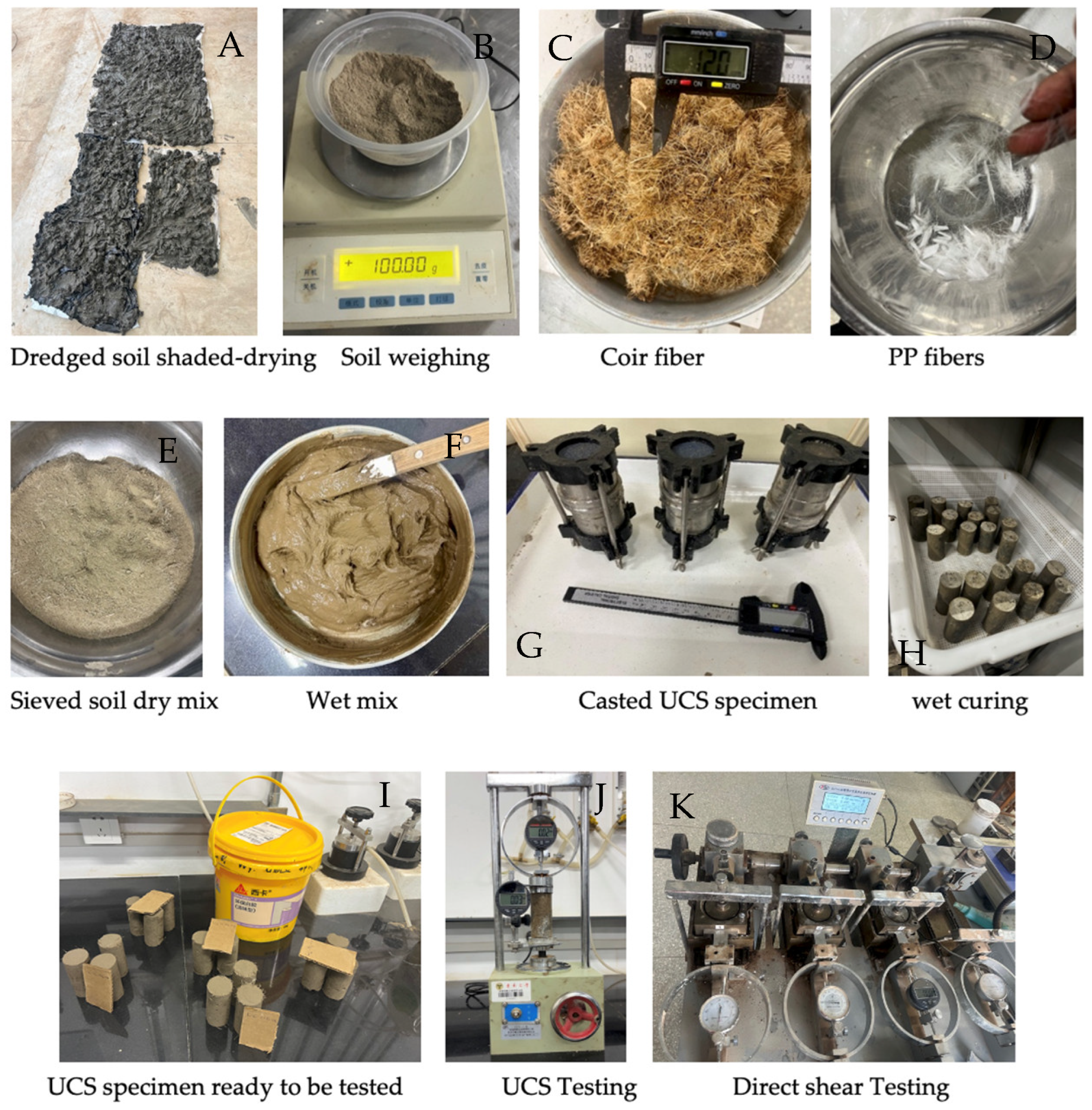
Bulk soil was first spread in a shaded outdoor area and air-dried for approximately 2–3 days, followed by oven drying at 105 °C. Larger shells and other visible debris were manually removed, and the dried soil was passed through an ASTM No. 10 sieve (2.00 mm), which is purchased from Nanjing Ningxi soil instrument co. ltd, Nanjing, to eliminate oversized particles prior to mixing. For each mixture, the required quantities of binder, fibers, SBR latex, and water were calculated based on the specified dosages relative to the dry soil mass. The soil and binder were initially mixed in a dry state, after which fibers were gradually introduced during dry mixing to minimize clumping. Subsequently, water and, where applicable, SBR latex were added, and wet mixing continued for approximately 5 min until a homogeneous paste with no visible dry pockets was obtained.
The preparation of specimens for the unconfined compressive strength (UCS) tests is illustrated in Figure 1. The specimens had a diameter of 39.1 mm and a height of 80 mm. The mixture was placed into a compaction mold in three layers and lightly compacted using a light hammer to remove large air voids. The applied compactive effort was intentionally low, approximately 84 kJ/m3, which is significantly lower than the Standard Proctor energy.
For direct shear tests, specimens were prepared with a diameter of 61.8 mm and a height of 20 mm. The slurry-like mixture was spooned into the shear rings without external compaction and trimmed flush with the ring surface. All specimens were cured for 28 days in a humid room at approximately 20 °C and 98% relative humidity.
Previous studies by Zhai et al. [20,21] have shown that unsaturated soil specimens may exhibit significantly higher shear strength and shear modulus compared to saturated specimens. Therefore, to ensure consistent and conservative measurements, all specimens in this study were submerged in water for at least 24 h prior to UCS and direct shear testing.

2.5. Unconfined Compressive Strength Tests and Direct Shear Tests

Unconfined compressive strength (UCS) tests were conducted in accordance with ASTM D2166 [22] using cylindrical specimens. Axial loading was applied without lateral confinement at a constant displacement rate of 2.4 mm/min. The axial stress was calculated with cross-sectional area correction, based on the common assumption of approximately constant specimen volume during compression. The reported UCS corresponds to the peak axial compressive stress. For mixtures that did not exhibit a distinct peak, the compressive stress at 15% axial strain was adopted as the UCS value. This approach provides a consistent basis for comparison among specimens that exhibit strain hardening or a flattened response without a clear peak within the conventional UCS interpretation range. The stress–strain response and failure modes were also qualitatively assessed to distinguish between more brittle and more ductile behavior.
Direct shear tests were performed with reference to ASTM D3080 [23]. After 28 days of curing, specimens were saturated by submersion and subsequently allowed to consolidate for 24 h under the isotropic normal stress prior to shearing. Three normal stress levels were applied: 50, 100, and 200 kPa. Shearing was carried out at a constant horizontal displacement rate of 0.4 mm/min, and the tests were continued to approximately 6 mm of shear displacement. The peak shear stress at each normal stress level was calculated from the measured peak horizontal force divided by the specimen cross-sectional area. Both the cohesion (c) and internal friction angle (ϕ) were determined using a linear Mohr–Coulomb fit to the peak shear stress data. The reported direct shear results therefore correspond to this specific test configuration and shear rate, and the influence of shear rate was not independently evaluated.

3. Results and Discussions

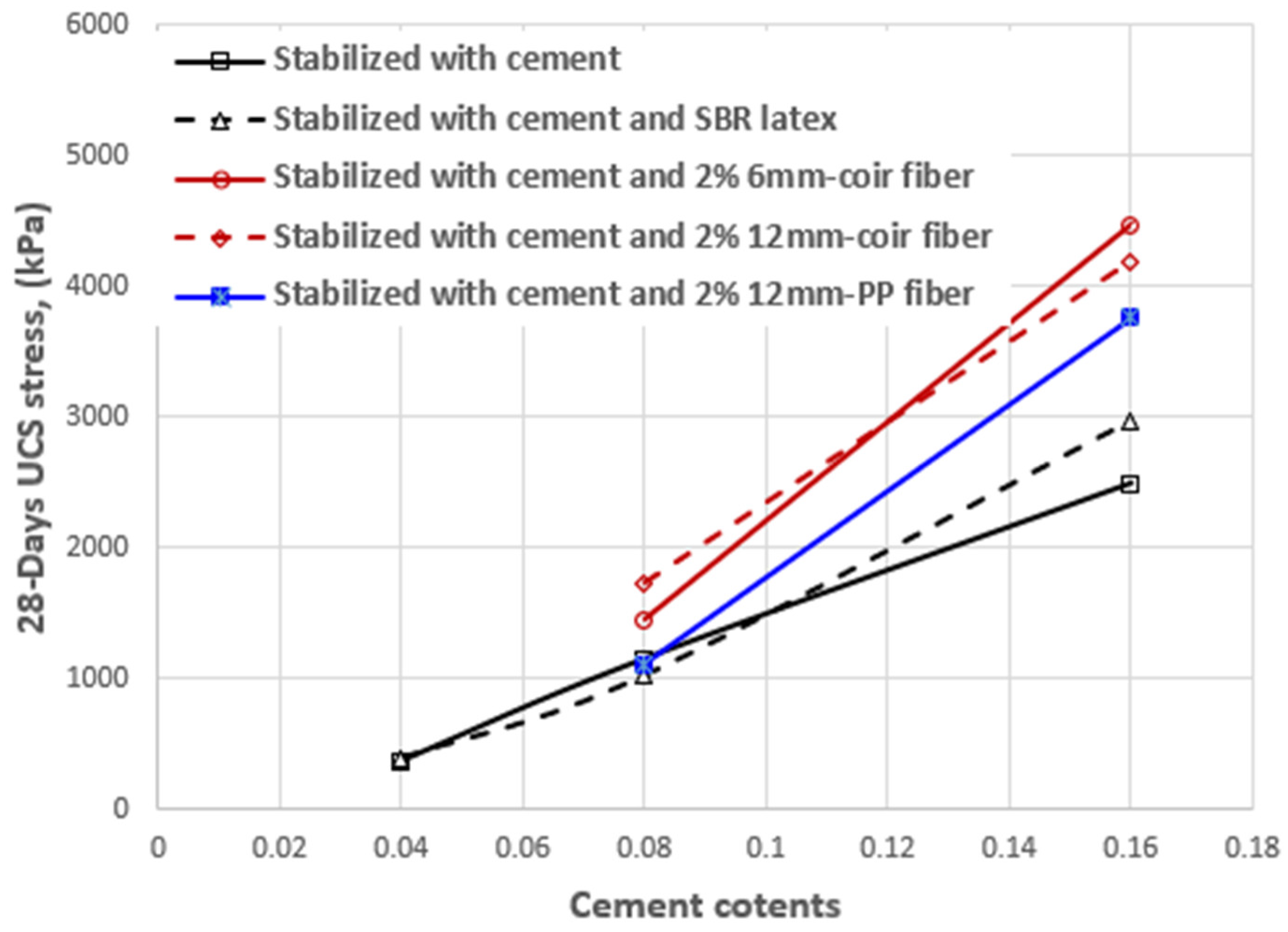
The UCS results for the various specimens are summarized in Table 3. Based on the experimental data, the UCS of stabilized dredged soils ranged from 316.88 to 620.64 kPa for mixtures containing 4% cement, 627.16 to 1726.88 kPa for those with 8% cement, and 2350.89 to 4473.52 kPa for those with 16% cement. For lime-stabilized soils, the UCS ranged from 329.62 to 1312.34 kPa for mixtures containing 6% lime and from 347.74 to 1202.55 kPa for those with 16% lime.
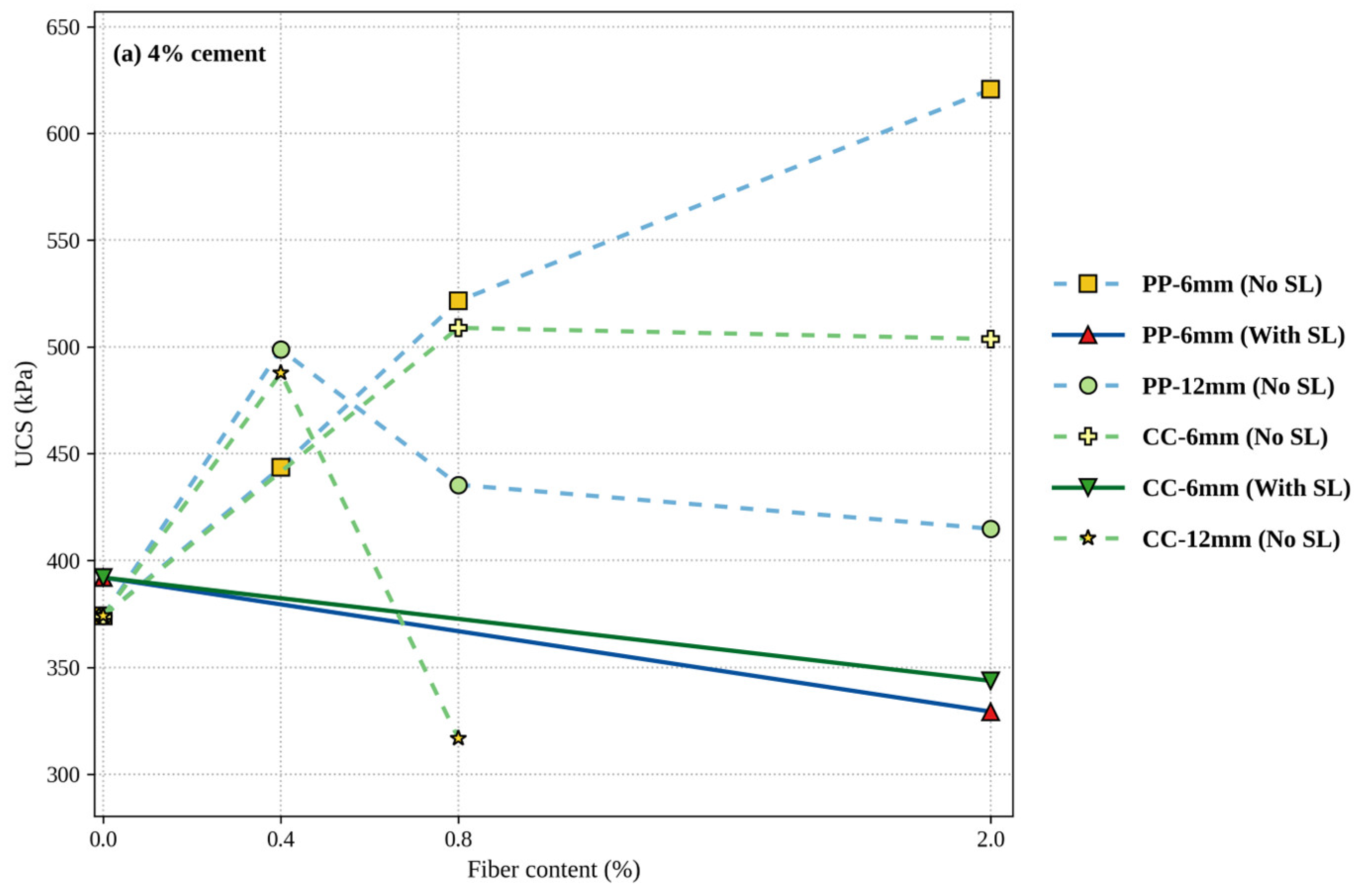
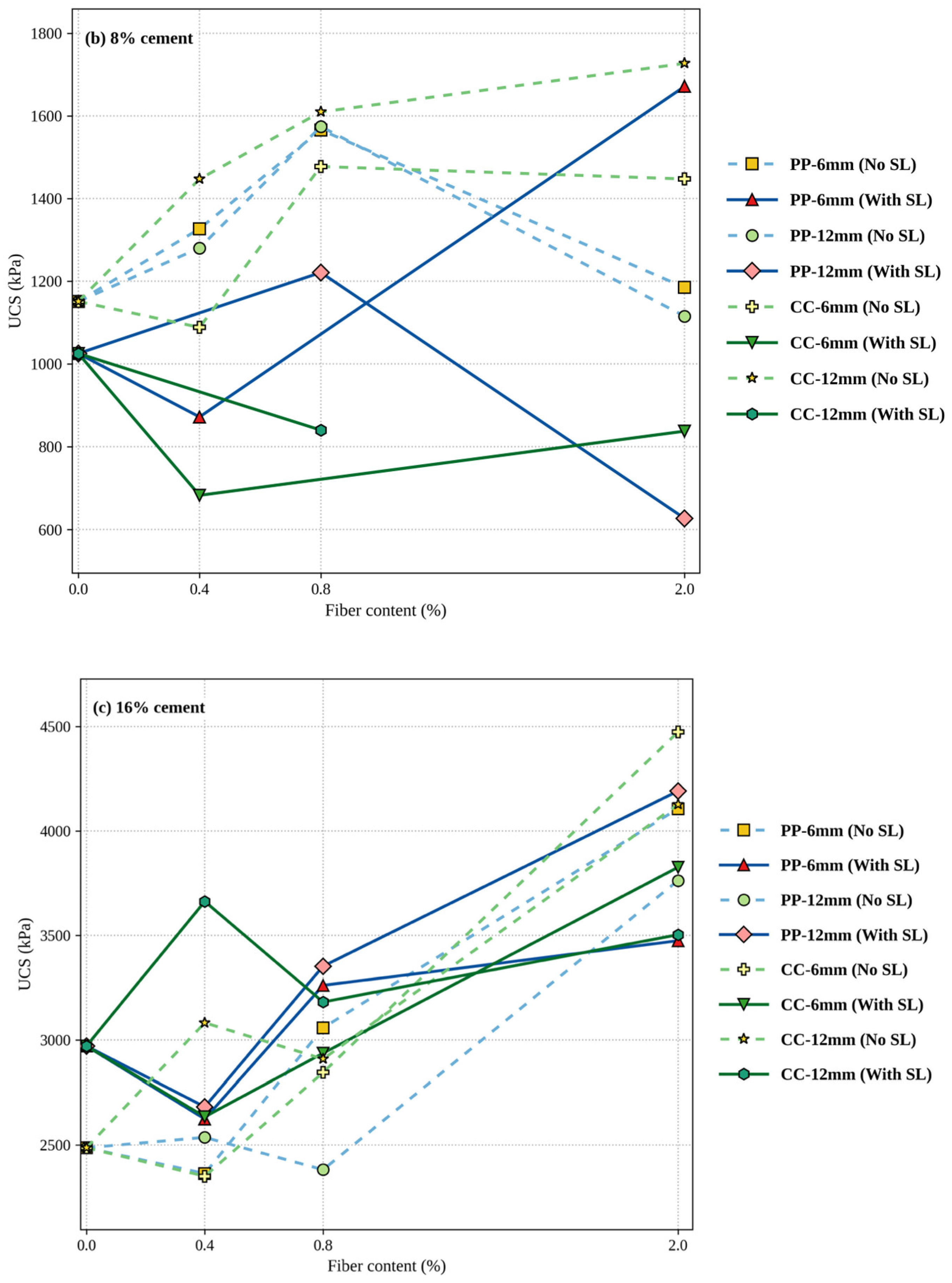
The 28-day UCS values of the stabilized dredged clay are illustrated in Figure 2. As shown in Figure 2, the UCS increases approximately linearly with increasing cement content. The addition of fibers can further enhance the UCS, with increases of up to twofold observed in some cases. Among the fiber types considered, coir fiber exhibited better performance than polypropylene fiber in enhancing the 28-day UCS of the stabilized dredged soil.

3.1. Binder-Controlled Strength Development and Mechanical Responses

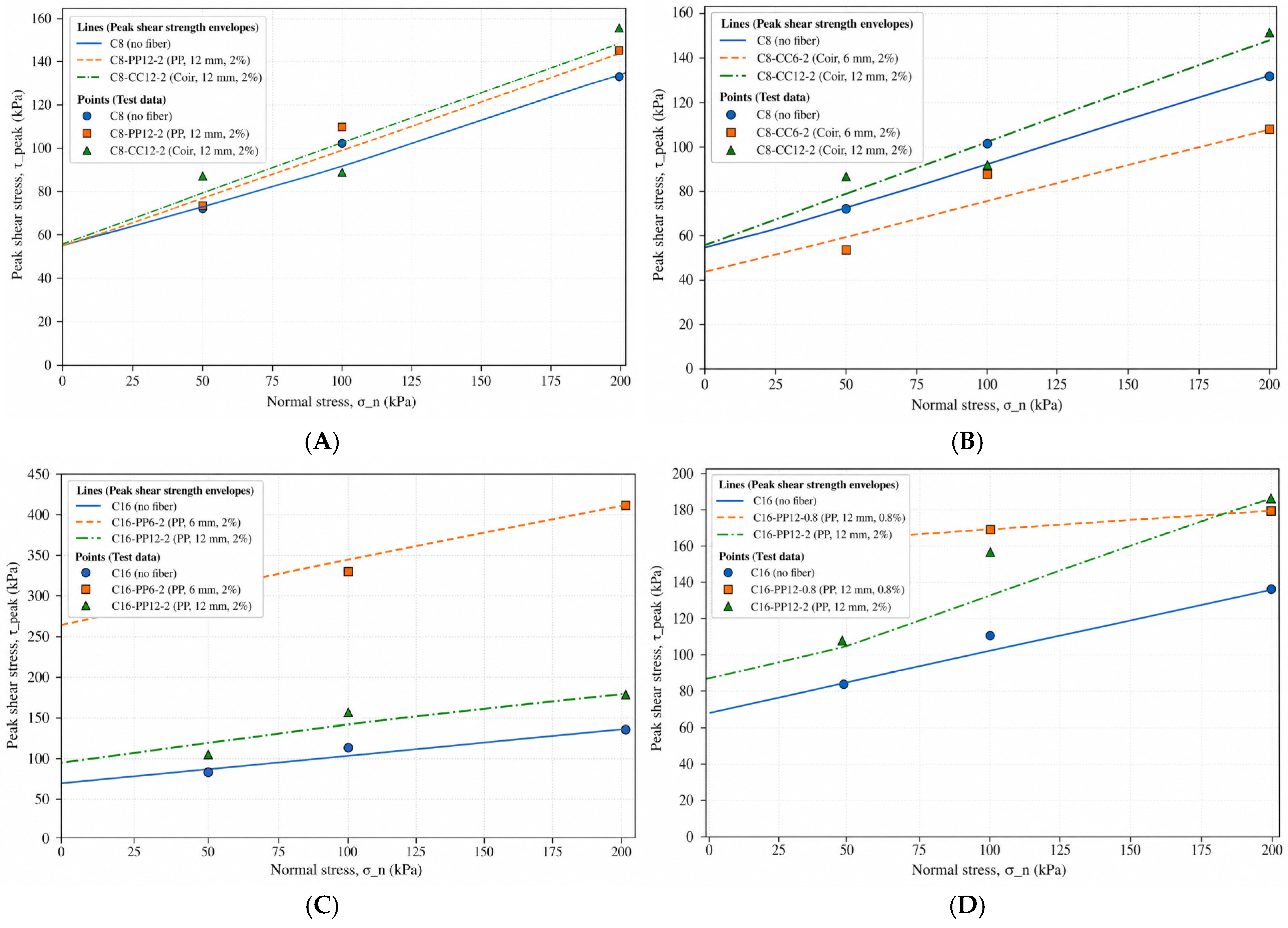
Both the cohesions and the internal friction angles of the stabilized dredged soil from the direct shear test are illustrated in Table 4. The direct shear test results for specimens with different mix IDs are presented in Figure 3. Based on preliminary measurements, the untreated dredged soil exhibited a cohesion of approximately 23 kPa and an internal friction angle of about 11°.
As shown in Figure 3, the cohesion of the stabilized soil increased to 57 kPa with 8% cement and further to 69 kPa with 16% cement. In contrast, the internal friction angle increased to 21° at 8% cement but slightly decreased to 19° at 16% cement. These results suggest that both cohesion and internal friction angle vary nonlinearly with increasing cement content. In addition, the contribution of fiber reinforcement to cohesion and internal friction angle appears to be less significant compared with the effect of cement content.

3.2. Fiber Reinforcement Effects on Strength, Failure Mode, and Selected Shear Response

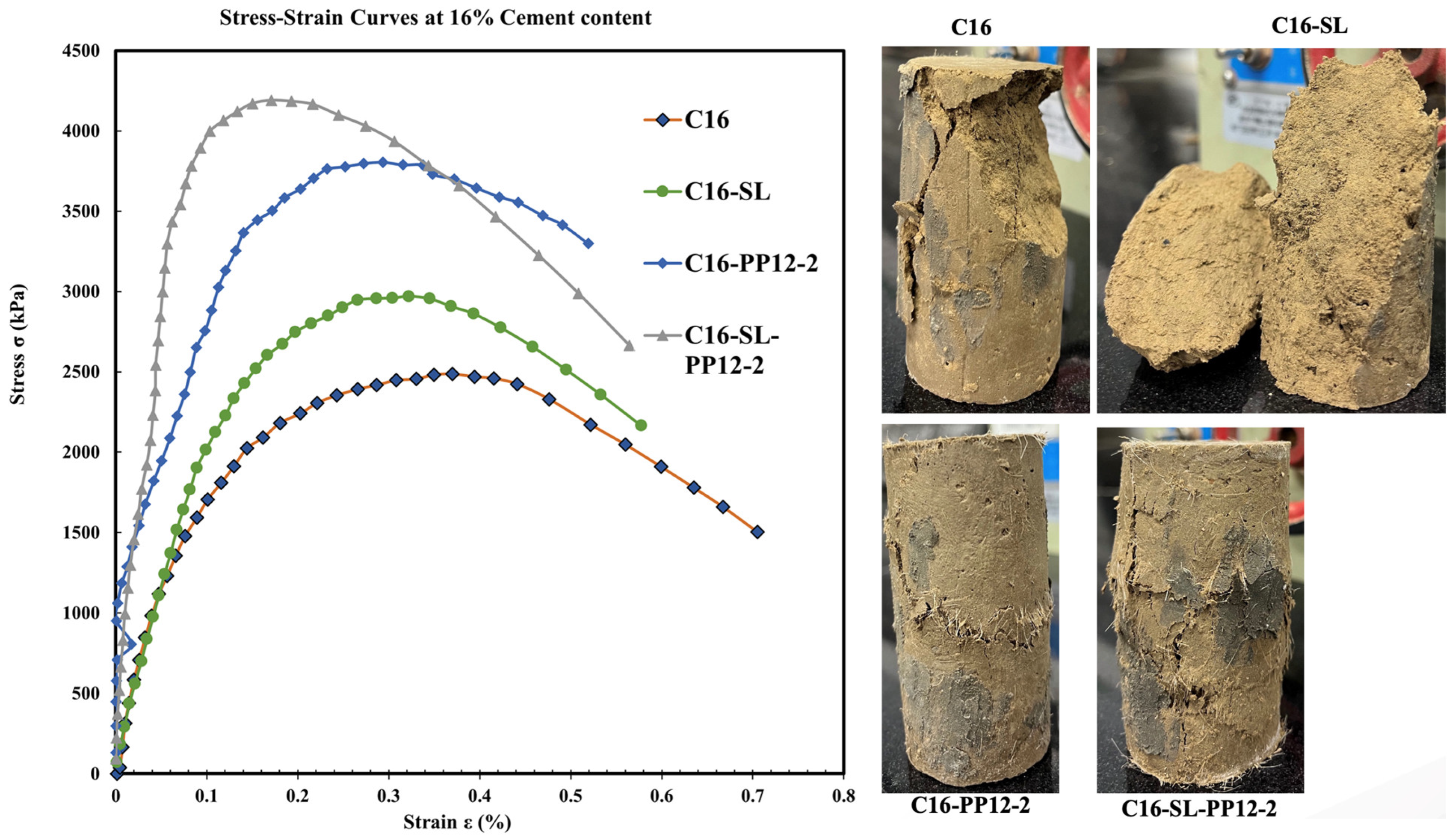
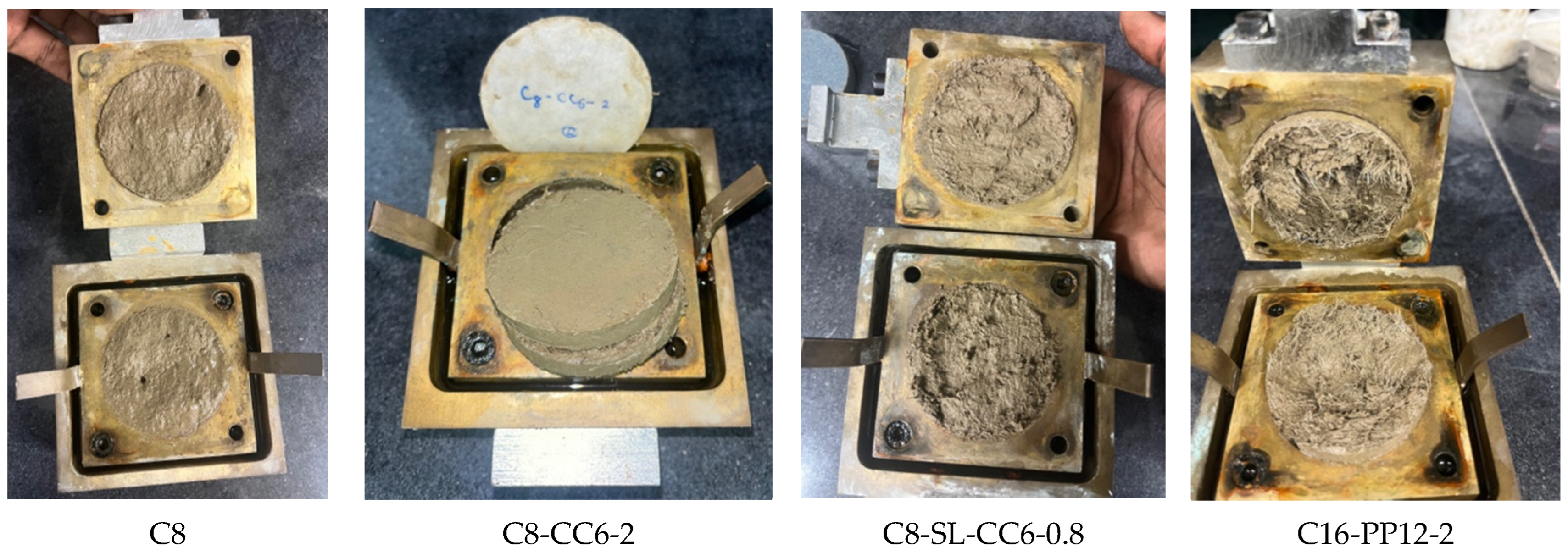
The stress–strain curves obtained from the UCS tests for stabilized dredged soil with 16% cement, including mixtures with SBR latex and fibers, are presented in Figure 4. The failure patterns of specimens from the direct shear tests are shown in Figure 5. The UCS stress of the specimens with different fiber contents is illustrated in Figure 6.
Based on the experimental results, at 8% cement content, longer coir fibers were consistently beneficial within the tested range. For example, C8–CC12–2 exhibited a higher UCS than C8–CC6–2 (1726.88 kPa versus 1447.21 kPa), and a similar trend was observed at 0.8% fiber dosage (1609.39 kPa versus 1477.43 kPa). In contrast, for the 16% cement polypropylene (PP) series, shorter fibers were more effective: C16–PP6–2 exceeded C16–PP12–2 (4106.67 kPa versus 3762.71 kPa), and the same pattern was observed at 0.8% dosage (3058.14 kPa versus 2382.04 kPa). These comparisons suggest that the relatively weaker matrix at 8% cement benefits from longer crack-bridging fibers, whereas the stiffer matrix at 16% cement benefits more from the denser and more uniform crack interception provided by shorter PP fibers.
Fiber dosage did not exhibit a universally monotonic trend. In the non-latex 8% cement PP series, a fiber content of 0.8% yielded the maximum UCS for both 6 mm and 12 mm fibers (1566.00 kPa and 1574.09 kPa, respectively), followed by a reduction at 2.0%. In the non-latex 8% cement coir series, the 12 mm coir mixtures showed a progressive increase in UCS from 1447.03 kPa to 1609.39 kPa and 1726.88 kPa as the fiber dosage increased from 0.4% to 0.8% and 2.0%, respectively, whereas the 6 mm coir series peaked at 0.8% and then exhibited less pronounced changes. At 16% cement content, higher fiber dosages were generally more beneficial, particularly for the 6 mm fiber groups, where both C16–PP6–2 and C16–CC6–2 significantly outperformed their 0.4% and 0.8% counterparts.
The observed failure modes further support the mechanical significance of these trends. In UCS tests, high-cement specimens without fiber reinforcement exhibited abrupt cracking and rapid post-peak strength loss, indicative of brittle behavior. In contrast, fiber-reinforced specimens remained more intact after peak stress and displayed a more gradual post-peak response. In direct shear tests, unreinforced cemented specimens tended to fail along a distinct planar shear surface, whereas fiber-reinforced specimens exhibited bridging across the shear plane even at large displacements. These observations indicate that fibers contribute not only to peak strength in certain cases but also to post-peak integrity and ductility. This finding is consistent with previous studies on fiber-reinforced cemented soils [11,12].
A literature-consistent interpretation suggests that coir and PP fibers contribute through different, though partially overlapping, mechanisms. Coir fibers, characterized by a rougher and more hydrophilic surface, likely enhance mechanical interlocking and crack bridging in moderately cemented matrices, consistent with their superior performance at 8% cement. In contrast, PP fibers are chemically inert and disperse differently within the matrix; their contribution becomes more pronounced once a stronger cemented skeleton is established, as observed in high-cement mixtures such as C16–PP6–2. These interpretations are based on existing literature and should not be considered direct microstructural evidence.
The direct shear results further indicate that fiber effectiveness is dependent on the evaluation metric. For the 8% cement mixtures with 12 mm fibers at 2.0% dosage, coir and PP fibers exhibited nearly identical shear strength at a normal stress of 100 kPa (approximately 103 kPa) and similar internal friction angles, despite the higher UCS observed for coir-reinforced specimens. In contrast, at 16% cement content, the influence of PP fiber length on shear behavior was more pronounced: C16–PP6–2 exhibited a cohesion of approximately 270 kPa and a shear strength of about 338 kPa at 100 kPa normal stress, compared to approximately 93 kPa and 139 kPa, respectively, for C16–PP12–2. These results demonstrate that fiber type, length, and dosage influence not only the magnitude of strength but also the mechanisms by which strength is mobilized.

3.3. Effects of SBR Latex Under Different Binder and Reinforcement Conditions

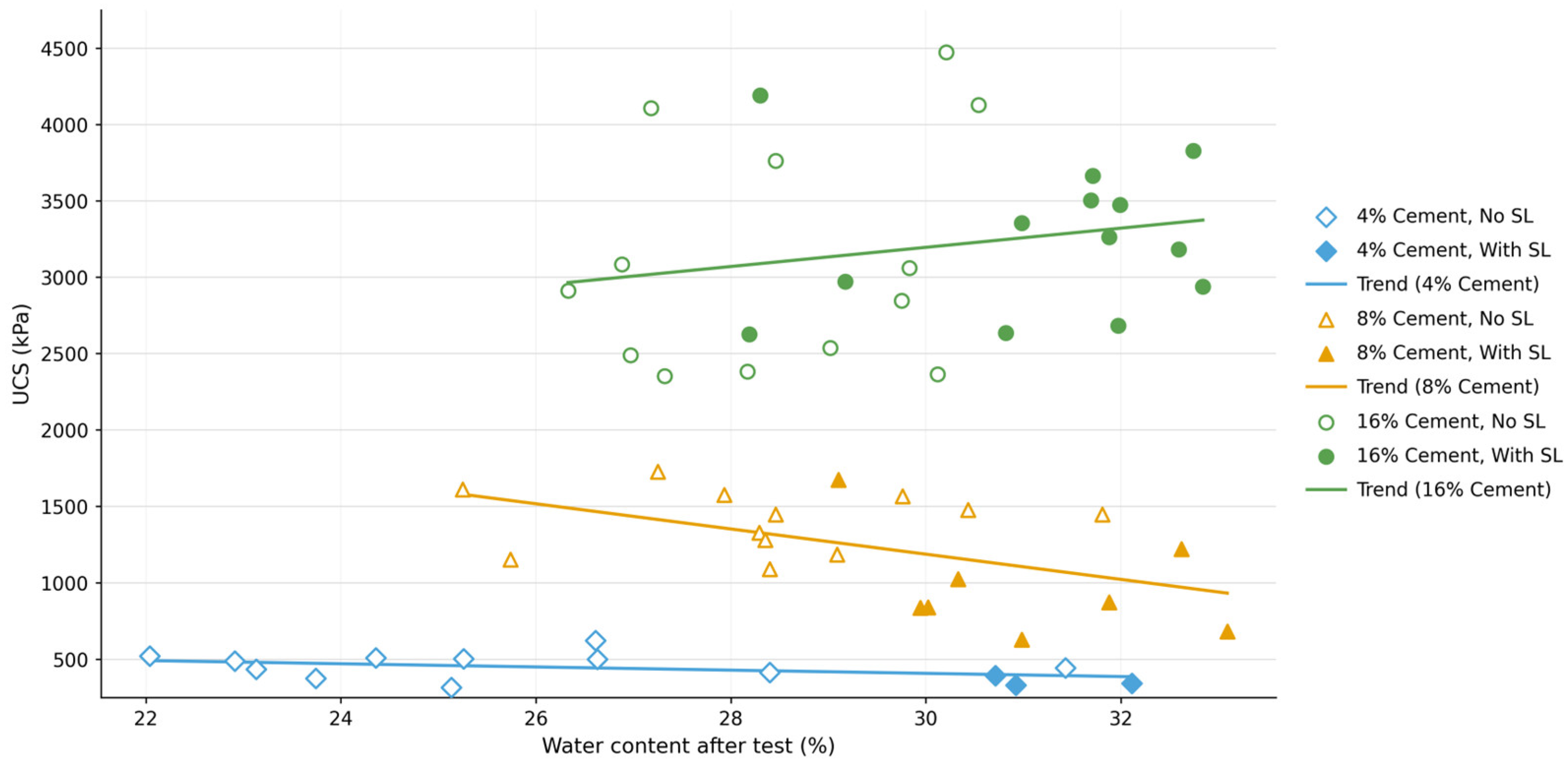
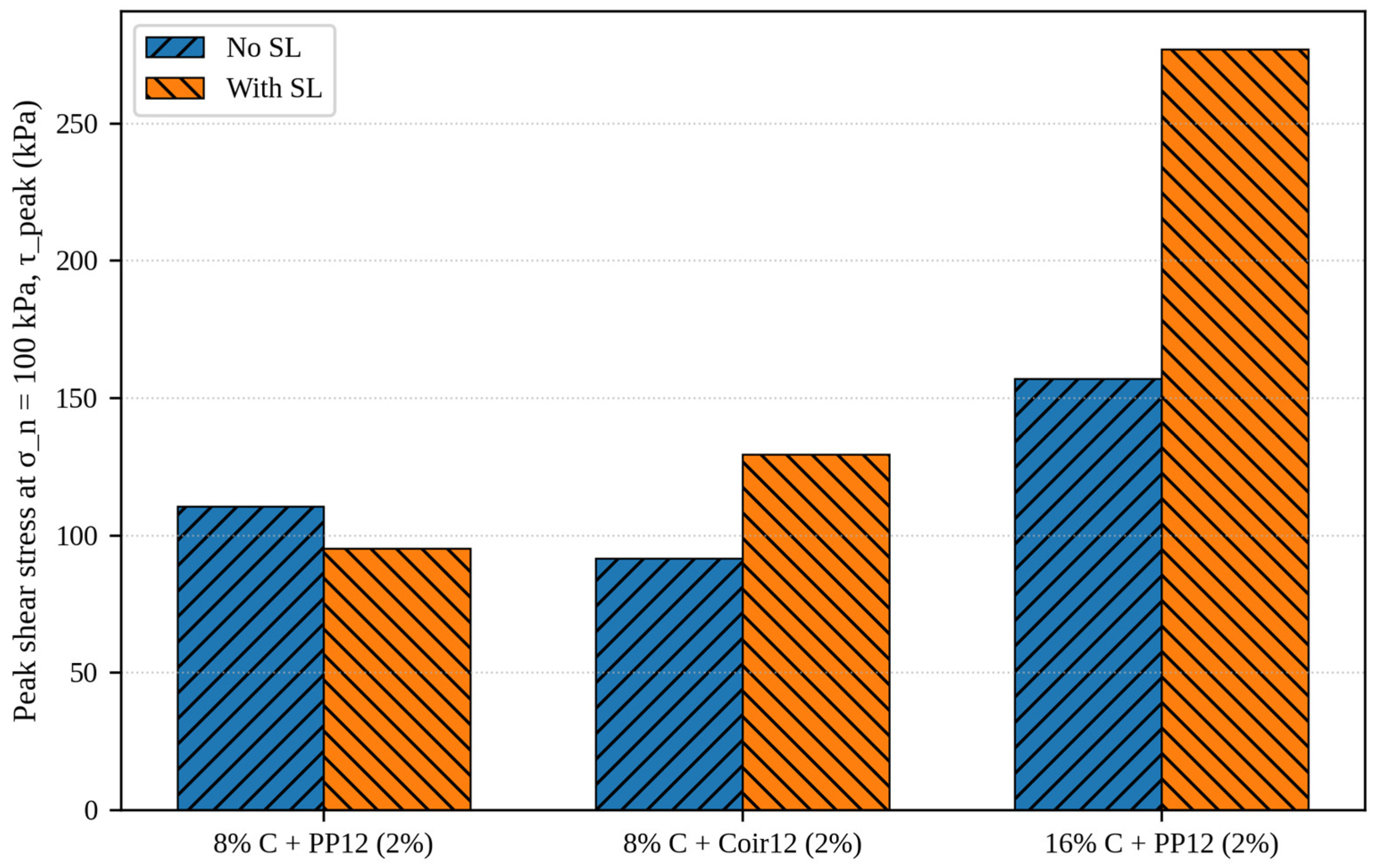
The UCS values of specimens prepared at different water contents are presented in Figure 7, while the effects of Sika Latex on the peak shear stress at a normal stress of 100 kPa are shown in Figure 8.
Based on the experimental results, in the binder-only cement series, the addition of latex slightly increased the UCS of cement-stabilized dredged soils. In contrast, latex slightly reduced the UCS of lime-stabilized soils. However, in a sufficiently cemented matrix, the polymer appears to act more effectively as a secondary modifier by enhancing crack resistance and improving local continuity within an already well-developed cemented framework. This interpretation is consistent with previous studies on polymer-modified soil–cement behavior [13,14,15].
The direct shear results support this conditional interpretation. Latex reduced the shear performance of the 8% cement PP 12 mm mixture, where the shear strength at a normal stress of 100 kPa decreased from approximately 102 kPa to 88 kPa, and the internal friction angle decreased from about 25° to 17°. Conversely, latex improved the performance of the 8% cement coir 12 mm mixture, increasing the shear strength at 100 kPa from approximately 103 kPa to 119 kPa and the cohesion from about 56 kPa to 75 kPa. The most pronounced positive effect was observed in the high-cement PP 12 mm mixture, where C16–SL–PP12–2 outperformed C16–PP12–2 in terms of shear strength at 100 kPa (236 kPa versus 139 kPa), cohesion (129 kPa versus 93 kPa), and internal friction angle (47° versus 25°).
Overall, Sika Latex should be regarded as a targeted modifier whose effectiveness depends on the binder system and matrix condition, rather than as a universally beneficial additive. Nevertheless, the combined use of latex and fiber reinforcement can further enhance the UCS of stabilized soils.

4. Conclusions and Limitations

Based on the experimental results obtained in this study, the following conclusions can be drawn:
(1) Cement was the primary factor governing strength development in stabilized dredged soils. The UCS of dredged clay stabilized with 4% cement was 374 kPa, and it increased approximately linearly with cement content, reaching 2487 kPa at 16% cement.
(2) The UCS of dredged clay stabilized with 16% lime was approximately 30% of that achieved with cement at the same dosage, indicating that lime was less effective than cement in improving strength under the tested conditions.
(3) Both fiber content and fiber length significantly influenced the shear strength parameters, particularly the internal friction angle, of the stabilized soil.
(4) Specimens reinforced with 6 mm fibers generally exhibited higher internal friction angles compared to those reinforced with 12 mm fibers.
The hydraulic conductivity of stabilized soils with different additives was not investigated in this study and warrants further research.

Author Contributions

Conceptualization, X.F., X.L., P.N. and Q.Z.; methodology, P.N., X.F., X.L., E.d.G.M.C., Y.Z., R.M. and Q.Z.; software, P.N. and J.C.S.; validation, P.N. and Q.Z.; formal analysis, P.N. and Q.Z.; investigation, P.N., R.M. and T.H.; resources, P.N., J.C.S., R.M. and Q.Z.; writing—original draft preparation, X.F., T.H. and P.N.; writing—review and editing, all authors; visualization, P.N.; supervision, Q.Z.; project administration, P.N. and Q.Z.; funding acquisition, X.F. and Q.Z. All authors have read and agreed to the published version of the manuscript.

Funding

This research received no external funding.

Institutional Review Board Statement

Not applicable.

Informed Consent Statement

Not applicable.

Data Availability Statement

The raw data supporting the conclusions of this article will be made available by the authors on request.

Acknowledgments

The authors acknowledge Southeast University for providing laboratory facilities for the experimental program.

Conflicts of Interest

Author Xiao Fan was employed by the company China Railway Construction Corporation Suzhou Design & Research Institute Co., Ltd. Author Xiangzhao Liu was employed by the company CSCEC City Construction Development Co., Ltd., Beijing, China. The remaining authors declare that the research was conducted in the absence of any commercial or financial relationships that could be construed as a potential conflict of interest.

References

  1. Chew, S.H.; Kamruzzaman, A.H.M.; Lee, F.H. Physicochemical and engineering behavior of cement treated clays. J. Geotech. Geoenviron. Eng. 2004, 130, 696–706. [Google Scholar] [CrossRef]
  2. Horpibulsuk, S.; Miura, N.; Bergado, D.T. Undrained shear behavior of cement admixed clay at high water content. J. Geotech. Geoenviron. Eng. 2004, 130, 1096–1105. [Google Scholar] [CrossRef]
  3. Jan, O.Q.; Mir, B.A. Strength behaviour of cement stabilised dredged soil. Int. J. Geosynth. Ground Eng. 2018, 4, 16. [Google Scholar] [CrossRef]
  4. Haq, M.; Khan, M.A.; Ali, S.; Ali, K.; Yusuf, M.; Kamyab, H.; Ishad, K. Enhancing clayey soil performance with lime and waste rubber tyre powder: Mechanical, microstructural, and statistical analysis. Environ. Res. 2024, 256, 119217. [Google Scholar] [CrossRef] [PubMed]
  5. Horpibulsuk, S.; Miura, N.; Nagaraj, T.S. Clay-water/cement ratio identity for cement admixed soft clays. J. Geotech. Geoenviron. Eng. 2005, 131, 187–192. [Google Scholar] [CrossRef]
  6. Kamruzzaman, A.H.M.; Chew, S.H.; Lee, F.H. Structuration and destructuration behavior of cement-treated Singapore marine clay. J. Geotech. Geoenviron. Eng. 2009, 135, 573–589. [Google Scholar] [CrossRef]
  7. Liu, Y.; Zheng, Y.; Ding, H.; Zhu, D.; Miao, Y.; Yin, J. Strength Behavior and Micromechanism of Waste Shredded Tire and Cement-Stabilized Dredged Clay. J. Mater. Civ. Eng. 2026, 38, 04026064. [Google Scholar] [CrossRef]
  8. Kang, G.; Tsuchida, T.; Athapaththu, A.M.R.G. Strength mobilization of cement-treated dredged clay during the early stages of curing. Soils Found. 2015, 55, 375–392. [Google Scholar] [CrossRef]
  9. Kang, G.; Tsuchida, T.; Kim, Y.-S. Strength and stiffness of cement-treated marine dredged clay at various curing stages. Constr. Build. Mater. 2017, 132, 71–84. [Google Scholar] [CrossRef]
  10. Shi, J.; Wang, S.; Cao, W.; Su, J.; Zhang, X. Mechanical Properties and Strengthening Mechanism of Dredged Silty Clay Stabilized by Cement and Steel Slag. Materials 2022, 15, 3823. [Google Scholar] [CrossRef]
  11. Ding, J.; Wan, X.; Jiao, N.; Zhang, S.; Chen, W. Collaborative effects of red mud and phosphogypsum on geotechnical behavior of cement-stabilized dredged clay. Bull. Eng. Geol. Environ. 2024, 83, 200. [Google Scholar] [CrossRef]
  12. Bian, X.; Cao, Y.; Wang, Z.; Ding, G.-Q.; Lei, G.-H. Effect of super-absorbent polymer on the undrained shear behavior of cemented dredged clay with high water content. J. Mater. Civ. Eng. 2017, 29, 04017023. [Google Scholar] [CrossRef]
  13. Buritatun, A.; Takaikaew, T.; Horpibulsuk, S.; Udomchai, A.; Hoy, M.; Vichitcholchai, N.; Arulrajah, A. Mechanical strength improvement of cement-stabilized soil using natural rubber latex for pavement base applications. J. Mater. Civ. Eng. 2020, 32, 04020372. [Google Scholar] [CrossRef]
  14. Baghini, M.S.; Ismail, A.; Asghar, M.P.; Fendereski, G.; Sadeghi, M. Measuring the effects of styrene butadiene copolymer latex-Portland cement additives on properties of stabilized soil-aggregate base. Int. J. Pavement Res. Technol. 2018, 11, 458–469. [Google Scholar] [CrossRef]
  15. Tang, C.; Shi, B.; Gao, W.; Chen, F.; Cai, Y. Strength and mechanical behavior of short polypropylene fiber reinforced and cement stabilized clayey soil. Geotext. Geomembr. 2007, 25, 194–202. [Google Scholar] [CrossRef]
  16. Consoli, N.C.; Bassani, M.A.A.; Festugato, L. Effect of fiber-reinforcement on the strength of cemented soils. Geotext. Geomembr. 2010, 28, 344–351. [Google Scholar] [CrossRef]
  17. Mastoi, A.K.; Arisar, F.A.; Khan, U.; Channa, I.A.; Ali, S.; Ali, M.; Mangrio, S.; Traore, A.F. Abdoul Fatah Traore3 Integrating vacuum-solidification and machine learning for enhanced solidification of high water content dredged slurry. Transp. Infrastruct. Geotechnol. 2026, 13, 11. [Google Scholar] [CrossRef]
  18. Zhang, B.; Tao, X.; Zhang, H.; Yu, J. Study of an SSA-BP Neural Network-Based Strength Prediction Model for Slag–Cement-Stabilized Soil. Materials 2025, 18, 3520. [Google Scholar] [CrossRef]
  19. Yao, Z.; Xu, K.; Wang, Z.; Sun, H.; Cui, P. Estimating shear strength of dredged soils for marine engineering: Experimental investigation and machine learning modeling. Front. Earth Sci. 2025, 13, 1645393. [Google Scholar] [CrossRef]
  20. Zhai, Q.; Rahardjo, H.; Satyanaga, A.; Dai, G.L. Estimation of unsaturated shear strength from soil-water characteristic curve. Acta Geotech. 2019, 14, 1977–1990. [Google Scholar] [CrossRef]
  21. Zhai, Q.; Chen, Y.H.; Rahardjo, H.; Satyanaga, A.; Dai, G.L.; Gong, W.M.; Zhao, X.L.; Qian, L.Z. Estimation of the initial shear modulus of unsaturated soil from soil-water characteristic curve. Eng. Geol. 2026, 366, 108674. [Google Scholar] [CrossRef]
  22. ASTM D2166/D2166M-16; Standard Test Method for Unconfined Compressive Strength of Cohesive Soil. ASTM International: West Conshohocken, PA, USA, 2016.
  23. ASTM D3080/D3080M-20; Standard Test Method for Direct Shear Test of Soils Under Consolidated Drained Conditions. ASTM International: West Conshohocken, PA, USA, 2020.
Figure 1. Specimen preparation and test workflow. (A), Dredged soil recovered in slurry state; (B), outdoor shaded air drying; (C,D), removal of larger shells and visible debris; (E), sieving through ASTM No. 10 (2.00 mm); (F), wet mix; (G), casting in split cylindrical molds; (H), humid curing; (I), representative cured UCS specimens; (J), UCS equipment; and (K), direct shear equipment.
Sustainability 18 04462 g001
Figure 2. 28-day UCS stresses of specimens with different cement contents.
Sustainability 18 04462 g002
Figure 3. Representative Mohr-Coulomb failure envelopes: (A) PP versus coir at 8% cement (2.0% fiber, 12 mm, no latex); (B) coir length effect at 8% cement (2.0% fiber, 6 mm versus 12 mm, no latex); (C) PP length effect at 16% cement (2.0% fiber, 6 mm versus 12 mm, no latex); and (D) PP dosage effect at 16% cement (12 mm, 0.8% versus 2.0%, no latex).
Sustainability 18 04462 g003
Figure 4. The stress–strain curve in the UCS test for the stabilized soil.
Sustainability 18 04462 g004
Figure 5. The failure patterns of specimens in the direct shear testing.
Sustainability 18 04462 g005
Figure 6. Fiber reinforcement effect on 28-day UCS of the specimens with (a) 4%, (b) 8%, and (c) 16% cement content.
Sustainability 18 04462 g006aSustainability 18 04462 g006b
Figure 7. Relationship between UCS and post-curing water content.
Sustainability 18 04462 g007
Figure 8. Effect of Sika Latex on peak shear stress of the stabilized dredged soil.
Sustainability 18 04462 g008
Table 1. Index properties of the dredged clay.
CategoryPropertySymbolValue
GradationParticle size at 10% passingd100.06 mm
Particle size at 30% passingd300.14 mm
Particle size at 60% passingd600.29 mm
Coefficient of uniformityCu4.83
Coefficient of curvatureCc1.13
Fines content (<0.075 mm)>80%
Atterberg LimitsLiquid limitLL40%
Plastic limitPL22%
Plasticity indexPI18%
Specific gravityGs2.63
Shear strength parameterCohesionc23 kPa
Friction angleϕ11°
ClassificationUSCS classCL
Table 2. Representative mix codes and dosage basis.
Mix CodeBinder System
(% Dry Soil)
SBR Latex
(% Dry Soil)
Fiber ReinforcementAdded
Water
(% Dry Soil)
C4Cement, 4%45%
C4-SLCement, 4%5%45%
C8-PP12-2Cement, 8%PP, 12 mm, 2.0%45%
C8-SL-PP12-2Cement, 8%5%PP, 12 mm, 2.0%45%
C16Cement, 16%45%
C16-SLCement, 16%5%45%
C16-PP6-2Cement, 16%PP, 6 mm, 2.0%45%
L6-CC12-0.8Lime, 6%Coir, 12 mm, 0.8%45%
L16-SL-CC12-0.4Lime, 16%5%Coir, 12 mm, 0.4%45%
Table 3. Selected 28-day UCS values discussed in the text.
Mix IDDescription28-Day UCS (kPa)
C44% cement, binder only374.09
C4-SL4% cement + 5% SBR latex, binder only392.02
C88% cement, binder only1150.85
C8-SL8% cement + 5% SBR latex, binder only1025.21
C1616% cement, binder only2486.70
C16-SL16% cement + 5% SBR latex, binder only2971.09
L1616% lime, binder only780.13
C8-PP12-28% cement + 2.0% PP fiber, 12 mm1115.20
C8-CC12-28% cement + 2.0% coir fiber, 12 mm1726.88
C8-CC6-28% cement + 2.0% coir fiber, 6 mm1447.21
C16-PP12-216% cement + 2.0% PP fiber, 12 mm3762.71
C16-PP6-216% cement + 2.0% PP fiber, 6 mm4106.67
C16-SL-PP12-216% cement + 5% SBR latex + 2.0% PP fiber, 12 mm4190.98
C16-CC6-216% cement + 2.0% coir fiber, 6 mm4473.52
Table 4. Direct-shear parameters for untreated soil and the selected cement-based subset.
Mix IDϕ (°)c (kPa)τ@100 (kPa)
UTS112342
C8215796
C8-PP12-22556102
C8-SL-PP12-2175888
C8-CC12-22556103
C8-SL-CC12-22475119
C8-CC6-2194478
C8-SL-CC6-0.8146691
C161969104
C16-PP6-234270338
C16-PP12-0.85160170
C16-PP12-22593139
C16-SL-PP12-247129236
Disclaimer/Publisher’s Note: The statements, opinions and data contained in all publications are solely those of the individual author(s) and contributor(s) and not of MDPI and/or the editor(s). MDPI and/or the editor(s) disclaim responsibility for any injury to people or property resulting from any ideas, methods, instructions or products referred to in the content.