A Quantitative Investigation of the Effects of Landscape Composition and Spatial Configuration on Epigaeic Arthropods

Abstract
1. Introduction
2. Materials and Methods
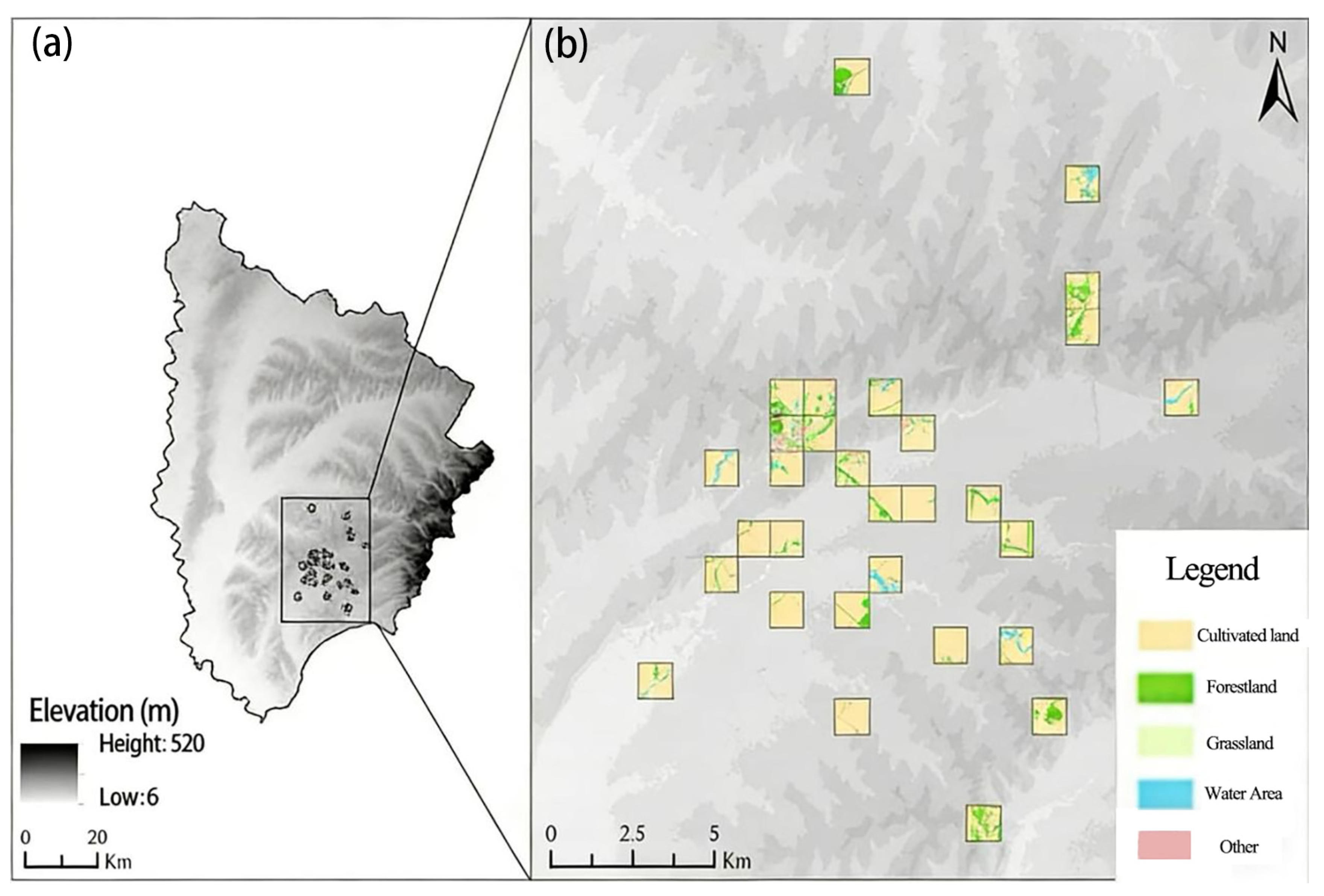
2.1. Study Area
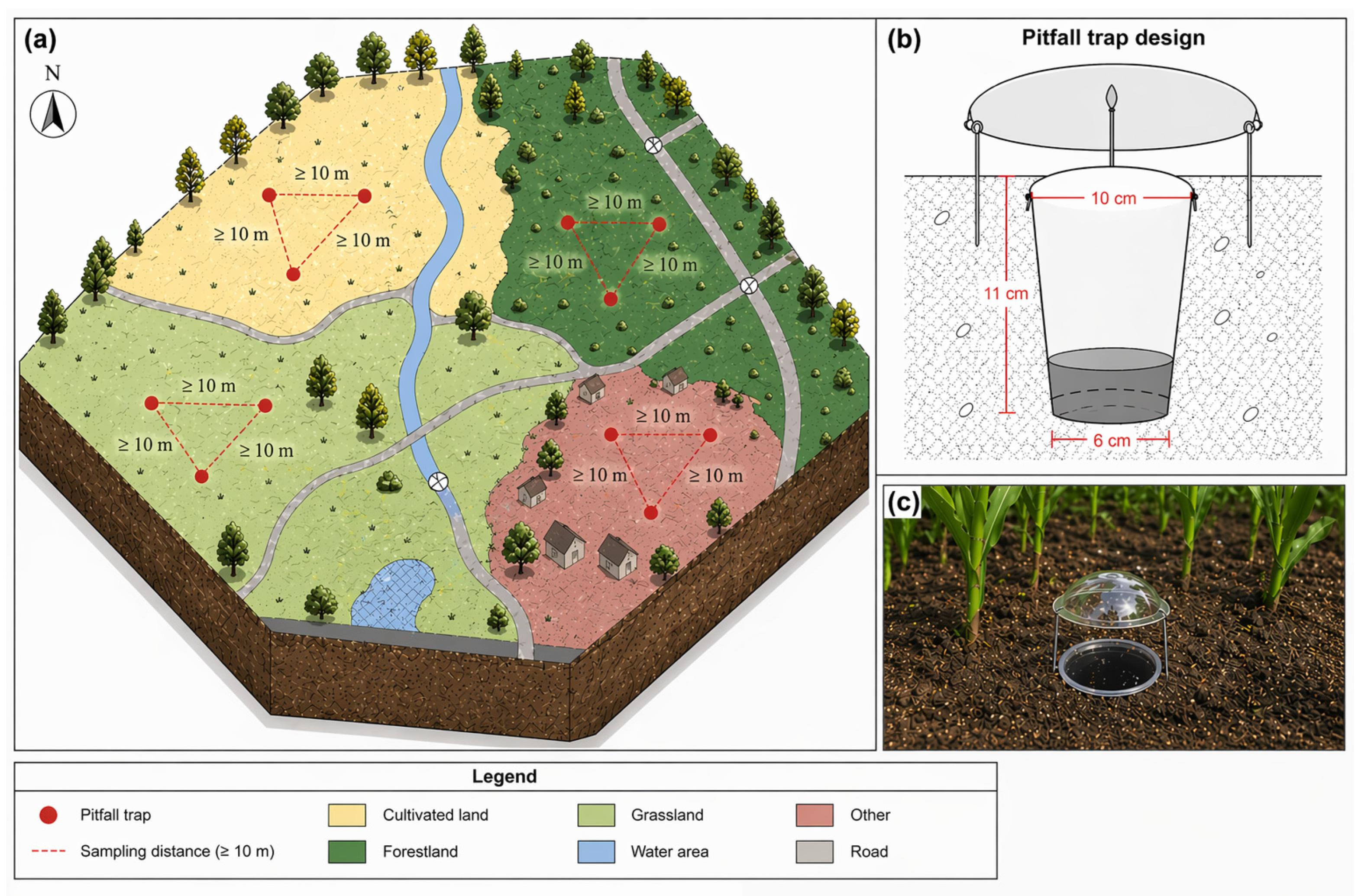
2.2. Epigaeic Arthropod Collection
2.3. Landscape Composition Heterogeneity and Spatial Configuration Heterogeneity
2.4. Statistical Analysis
3. Results
3.1. Characteristics and Summary Statistics of Epigaeic Arthropods
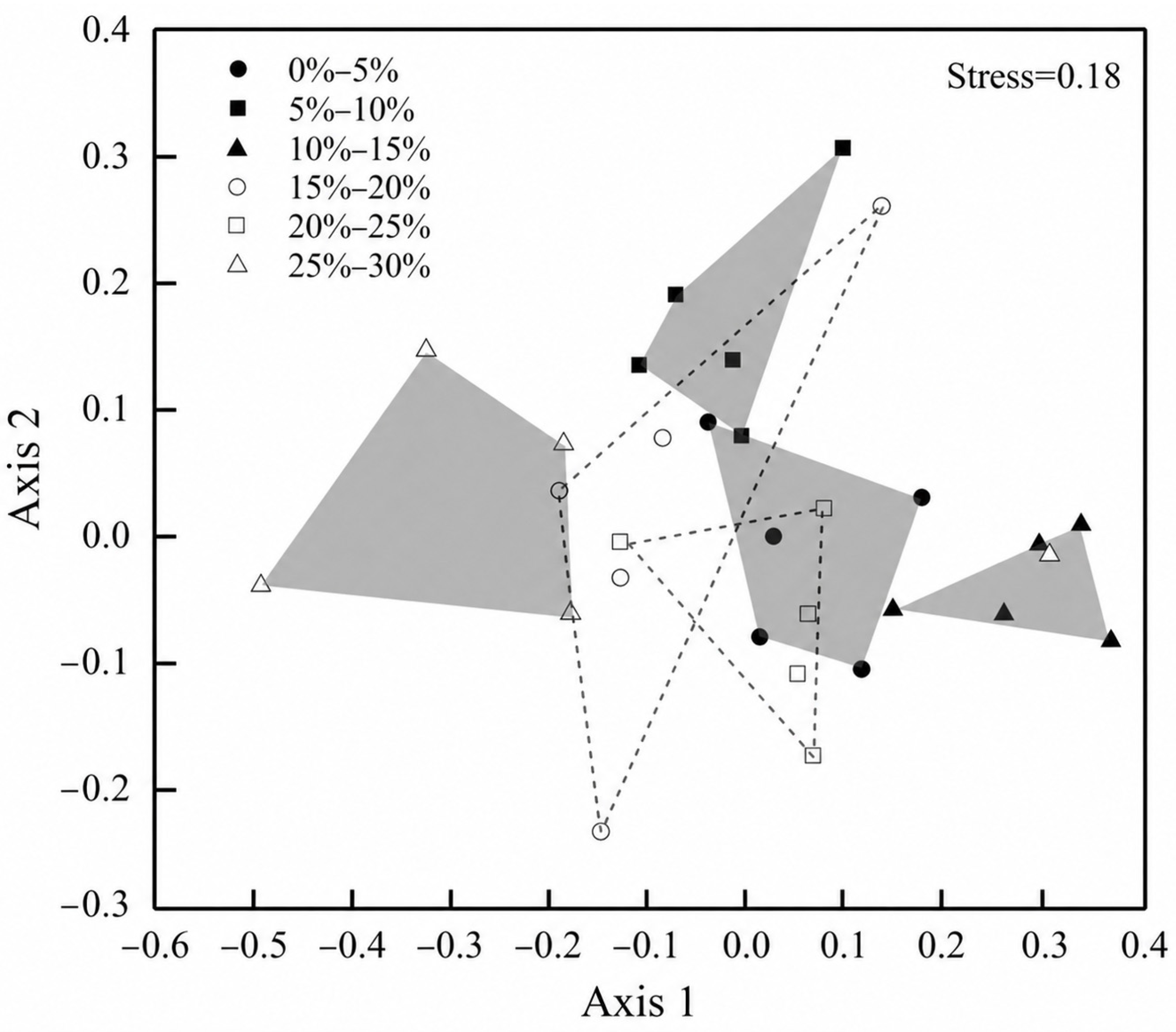
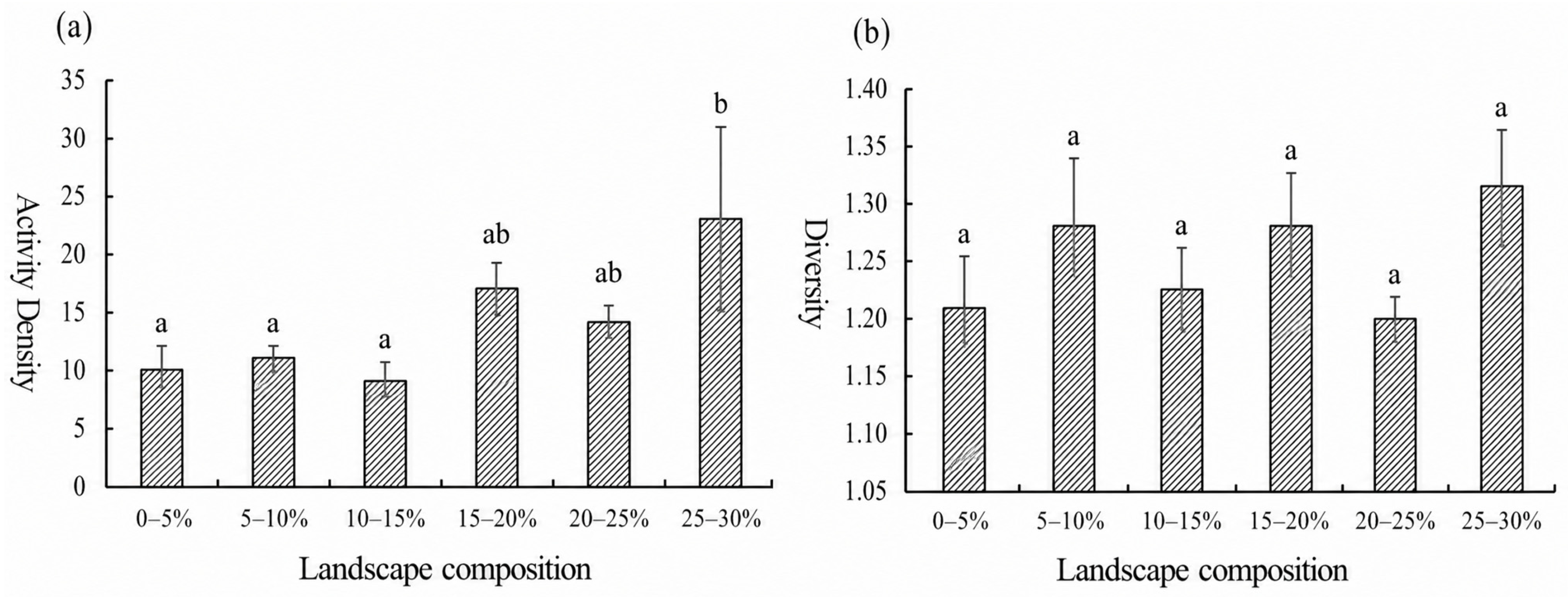
3.2. Effect of Composition Heterogeneity on Epigaeic Arthropods
3.3. Effect of Spatial Configuration Heterogeneity on Epigaeic Arthropods
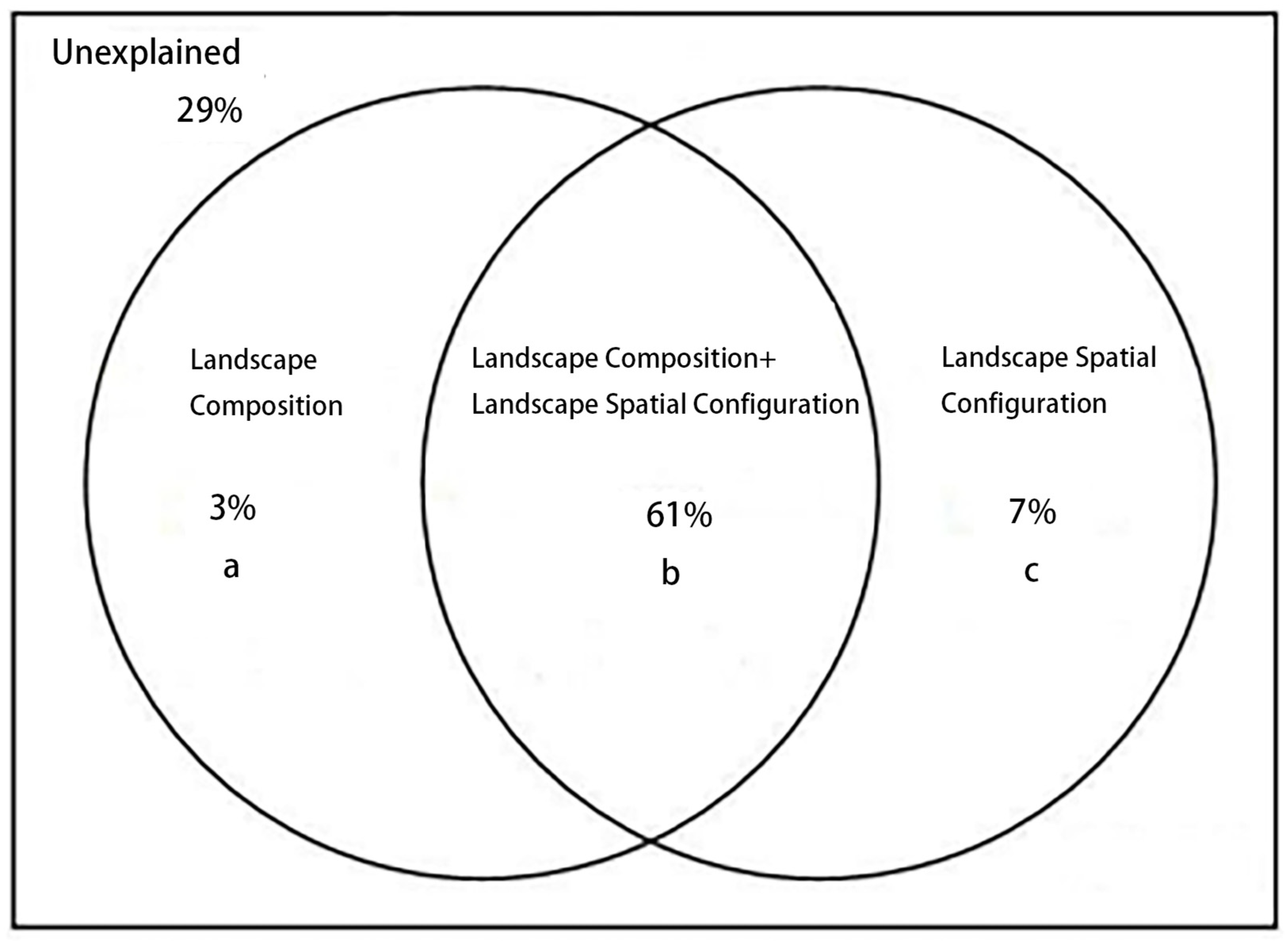
3.4. Quantifying the Effects of Landscape Composition and Spatial Configuration on Epigaeic Arthropod Communities
4. Discussion
5. Conclusions
Author Contributions
Funding
Institutional Review Board Statement
Informed Consent Statement
Data Availability Statement
Conflicts of Interest
Abbreviations
| PP | Polypropylene |
| PE | Polyethylene |
| NMDS | Non-metric Multidimensional Scaling |
| ANOVA | Analysis of Variance |
| VPA | Variance Partitioning Analysis |
| RDA | Redundancy Analysis |
| PD | Patch Density |
| PR | Patch Richness |
| CONTAG | Contagion Index |
| DIVISION | Landscape Division Index |
| SHDI | Shannon Diversity Index |
| SHEI | Shannon Evenness Index |
| CAP | Common Agricultural Policy |
| EFAs | Ecological Focus Areas |
| SP | Species Code |
Appendix A

| Epigaeic Arthropods | Taxa Codes | Numbers | Percentage | Dominance | ||
|---|---|---|---|---|---|---|
| Classes | Orders | Families | ||||
| Insecta | Coleoptera | Carabidae | SP4 | 891 | 18.58 | +++ |
| Aphodiidae | SP7 | 34 | 0.71 | ++ | ||
| Crioceridae | SP8 | 2 | 0.04 | + | ||
| Cleridae | SP9 | 1 | 0.02 | + | ||
| Elateridae | SP13 | 2 | 0.04 | + | ||
| Dytiscidae | SP15 | 1 | 0.02 | + | ||
| Nitidulidae | SP17 | 6 | 0.13 | + | ||
| Tenebrionidae | SP21 | 298 | 6.21 | ++ | ||
| Dermestidae | SP22 | 4 | 0.08 | + | ||
| Coccinellidae | SP23 | 7 | 0.15 | + | ||
| Geotrupidae | SP24 | 8 | 0.17 | + | ||
| Lucanidae | SP25 | 1 | 0.02 | + | ||
| Melolonthidae | SP28 | 2 | 0.04 | + | ||
| Mycetophagidae | SP31 | 5 | 0.10 | + | ||
| Meloidae | SP34 | 1 | 0.02 | + | ||
| Curculionidae | SP36 | 12 | 0.25 | + | ||
| Hydrophilidae | SP39 | 35 | 0.73 | ++ | ||
| Histeridae | SP40 | 2 | 0.04 | + | ||
| Chrysomelidae | SP42 | 66 | 1.38 | ++ | ||
| Staphylinidae | SP44 | 18 | 0.38 | + | ||
| Orthoptera | Oedipodidae | SP1 | 74 | 1.54 | ++ | |
| Catantopidae | SP2 | 71 | 1.48 | ++ | ||
| Acrididae | SP12 | 18 | 0.38 | + | ||
| Gryllotalpidae | SP16 | 12 | 0.25 | + | ||
| Gryllidae | SP35 | 587 | 12.24 | +++ | ||
| Tettigoniidae | SP49 | 1 | 0.02 | + | ||
| Pyrgomorphidae | SP51 | 110 | 2.29 | ++ | ||
| Hemiptera | Aradidae | SP3 | 159 | 3.32 | ++ | |
| Pyrrhocoridae | SP10 | 4 | 0.08 | + | ||
| Nabidae | SP11 | 1 | 0.02 | + | ||
| Reduviidae | SP14 | 8 | 0.17 | + | ||
| Miridae | SP18 | 1 | 0.02 | + | ||
| Cydnidae | SP33 | 1 | 0.02 | + | ||
| Nepidae | SP37 | 1 | 0.02 | + | ||
| Coreidae | SP47 | 4 | 0.08 | + | ||
| Lygaeidae | SP48 | 1 | 0.02 | + | ||
| Homoptera | Cicadellidae | SP41 | 42 | 0.88 | ++ | |
| Hymenoptera | Formicidae | SP43 | 1256 | 26.19 | +++ | |
| Dermaptera | Labiduridae | SP27 | 66 | 1.38 | ++ | |
| Arachnida | Araneae | Linyphiidae | SP20 | 1 | 0.02 | + |
| Theridiidae | SP26 | 155 | 3.23 | ++ | ||
| Salticidae | SP32 | 178 | 3.71 | ++ | ||
| Thomisidae | SP38 | 13 | 0.27 | + | ||
| Araneidae | SP46 | 7 | 0.15 | + | ||
| Trochanteriidae | SP50 | 1 | 0.02 | + | ||
| Opilliones | Protolophidae | SP19 | 190 | 3.96 | ++ | |
| Malacostraca | Isopoda | Oniscidae | SP5 | 158 | 3.30 | ++ |
| Diplopoda | Polydesmoidae | Paradoxosomatidae | SP29 | 195 | 4.07 | ++ |
| Chilopoda | Scutigeromorpha | Scutigeridae | SP45 | 18 | 0.38 | + |
| Lithobiomorpha | Geophilomorpha | SP6 | 8 | 0.17 | + | |
| Lithobiidae | SP30 | 58 | 1.21 | ++ | ||
| total | 4795 | 100 | ||||
References
- Lu, Y.; Bullock, J.M. Biodiversity conservation in a changing environment beyond 2020. Sci. Adv. 2021, 7, eabl8162. [Google Scholar] [CrossRef]
- Dainese, M.; Martin, E.A.; Aizen, M.A.; Albrecht, M.; Bartomeus, I.; Bommarco, R.; Carvalheiro, L.G.; Chaplin-Kramer, R.; Gagic, V.; Garibaldi, L.A. A global synthesis reveals biodiversity-mediated benefits for crop production. Sci. Adv. 2019, 5, eaax0121. [Google Scholar] [CrossRef]
- de la Riva, E.G.; Ulrich, W.; Batáry, P.; Baudry, J.; Beaumelle, L.; Bucher, R.; Čerevková, A.; Felipe-Lucia, M.R.; Gallé, R.; Kesse-Guyot, E. From functional diversity to human well-being: A conceptual framework for agroecosystem sustainability. Agric. Syst. 2023, 208, 103659. [Google Scholar] [CrossRef]
- Robertson, G.P. A sustainable agriculture? Daedalus 2015, 144, 76–89. [Google Scholar] [CrossRef]
- Steffen, W.; Richardson, K.; Rockström, J.; Cornell, S.E.; Fetzer, I.; Bennett, E.M.; Biggs, R.; Carpenter, S.R.; De Vries, W.; De Wit, C.A. Planetary boundaries: Guiding human development on a changing planet. Science 2015, 347, 1259855. [Google Scholar] [CrossRef]
- Landis, D.A. Designing agricultural landscapes for biodiversity-based ecosystem services. Basic Appl. Ecol. 2017, 18, 1–12. [Google Scholar] [CrossRef]
- Priyadarshana, T.S.; Martin, E.A.; Sirami, C.; Woodcock, B.A.; Goodale, E.; Martínez-Núñez, C.; Lee, M.B.; Pagani-Núñez, E.; Raderschall, C.A.; Brotons, L. Crop and landscape heterogeneity increase biodiversity in agricultural landscapes: A global review and meta-analysis. Ecol. Lett. 2024, 27, e14412. [Google Scholar] [CrossRef] [PubMed]
- Gardiner, M.; Landis, D.; Gratton, C.; Schmidt, N.; O’Neal, M.; Mueller, E.; Chacon, J.; Heimpel, G. Landscape composition influences the activity density of Carabidae and Arachnida in soybean fields. Biol. Control 2010, 55, 11–19. [Google Scholar] [CrossRef]
- Benton, T.G.; Vickery, J.A.; Wilson, J.D. Farmland biodiversity: Is habitat heterogeneity the key? Trends Ecol. Evol. 2003, 18, 182–188. [Google Scholar] [CrossRef]
- Fahrig, L.; Baudry, J.; Brotons, L.; Burel, F.G.; Crist, T.O.; Fuller, R.J.; Sirami, C.; Siriwardena, G.M.; Martin, J.L. Functional landscape heterogeneity and animal biodiversity in agricultural landscapes. Ecol. Lett. 2011, 14, 101–112. [Google Scholar] [CrossRef]
- Pasher, J.; Mitchell, S.W.; King, D.J.; Fahrig, L.; Smith, A.C.; Lindsay, K.E. Optimizing landscape selection for estimating relative effects of landscape variables on ecological responses. Landsc. Ecol. 2013, 28, 371–383. [Google Scholar] [CrossRef]
- De Simone, S.; Sigura, M.; Boscutti, F. Patterns of biodiversity and habitat sensitivity in agricultural landscapes. J. Environ. Plan. Manag. 2017, 60, 1173–1192. [Google Scholar] [CrossRef]
- Gebhardt, S.; Van Dijk, J.; Wassen, M.J.; Bakker, M. Agricultural intensity interacts with landscape arrangement in driving ecosystem services. Agric. Ecosyst. Environ. 2023, 357, 108692. [Google Scholar] [CrossRef]
- Fu, B.; Wang, Y.; Xu, P.; Wang, D. Changes in overland flow and sediment during simulated rainfall events on cropland in hilly areas of the Sichuan Basin, China. Prog. Nat. Sci. 2009, 19, 1613–1618. [Google Scholar] [CrossRef]
- Bhavya, T.; Bhavana, A. Tiny Architects of Fertile Soils: Understanding the Role of Soil Arthropods. Int. J. Environ. Clim. Change 2024, 14, 532–541. [Google Scholar]
- Neher, D.A.; Barbercheck, M.E. Soil microarthropods and soil health: Intersection of decomposition and pest suppression in agroecosystems. Insects 2019, 10, 414. [Google Scholar] [CrossRef]
- Shehzad, K.; Tu, S.; Majeed, M.Z.; Lei, B.; Zhang, J. Arthropods in soil reclamation and bioremediation: Functional roles, mechanisms and future perspective. J. Environ. Manag. 2024, 370, 122820. [Google Scholar] [CrossRef] [PubMed]
- Chiappero, M.F.; Rossetti, M.R.; Moreno, M.L.; Perez-Harguindeguy, N. A global meta-analysis reveals a consistent reduction of soil fauna abundance and richness as a consequence of land use conversion. Sci. Total Environ. 2024, 946, 173822. [Google Scholar] [CrossRef]
- Yin, W.; Hu, S.; Shen, Y. Pictorial Keys to Soil Animals of China; Science Press: Beijing, China, 1998. [Google Scholar]
- Huang, Q.; Tian, L.; Yang, L. Identification of Agricultural Insects; Shanghai Scientific and Technical Publishers: Shanghai, China, 1984. [Google Scholar]
- Zhang, Z.; Zhao, Y.; Ding, X. The Color Iconography of Insects in Shenyang; Liaoning Nationalities Publishing House: Shenyang, China, 2009. [Google Scholar]
- Song, D. Spiders from Agricultural Regions of China; Agricultural Press: Beijing, China, 1987. [Google Scholar]
- Zhang, W. The Insect Family Trees; Chongqing University Press: Chongqing, China, 2014. [Google Scholar]
- Jost, L. Entropy and diversity. Oikos 2006, 113, 363–375. [Google Scholar] [CrossRef]
- Wu, J. Landscape Ecology: Pattern, Process, Scale and Hierarchy, 2nd ed.; Higher Education Press: Beijing, China, 2007. [Google Scholar]
- Deppe, F.; Dietze, A.; Huerter, A.; Kaffenberger, M.; Fischer, K. Landscape type and variation in landscape heterogeneity cause species turnover rather than loss in agricultural landscapes. Agric. Ecosyst. Environ. 2025, 385, 109560. [Google Scholar] [CrossRef]
- García-Feced, C.; Weissteiner, C.J.; Baraldi, A.; Paracchini, M.L.; Maes, J.; Zulian, G.; Kempen, M.; Elbersen, B.; Pérez-Soba, M. Semi-natural vegetation in agricultural land: European map and links to ecosystem service supply. Agron. Sustain. Dev. 2015, 35, 273–283. [Google Scholar] [CrossRef]
- Estrada-Carmona, N.; Sánchez, A.C.; Remans, R.; Jones, S.K. Complex agricultural landscapes host more biodiversity than simple ones: A global meta-analysis. Proc. Natl. Acad. Sci. USA 2022, 119, e2203385119. [Google Scholar] [CrossRef]
- Guo, X.; Guan, M.; Bian, Z.; Wang, Q. A quantitative survey of effect of semi-natural habitat composition and configuration on landscape heterogeneity in arable land system. Land 2022, 11, 1018. [Google Scholar] [CrossRef]
- Coyle, D.R.; Nagendra, U.J.; Taylor, M.K.; Campbell, J.H.; Cunard, C.E.; Joslin, A.H.; Mundepi, A.; Phillips, C.A.; Callaham, M.A., Jr. Soil fauna responses to natural disturbances, invasive species, and global climate change: Current state of the science and a call to action. Soil Biol. Biochem. 2017, 110, 116–133. [Google Scholar] [CrossRef]
- Li, P.; Qin, R.; Shen, M.; Wang, C.; Xiao, H.; Liu, J.; Qian, W.; Duan, M. Woodlands as refuges and resources for paddy spider communities: Varying importance with land consolidation intensity. Agric. Ecosyst. Environ. 2025, 393, 109815. [Google Scholar] [CrossRef]
- Perrot, T.; Rusch, A.; Coux, C.; Gaba, S.; Bretagnolle, V. Proportion of grassland at landscape scale drives natural pest control services in agricultural landscapes. Front. Ecol. Evol. 2021, 9, 607023. [Google Scholar] [CrossRef]
- Tscharntke, T.; Tylianakis, J.M.; Rand, T.A.; Didham, R.K.; Fahrig, L.; Batáry, P.; Bengtsson, J.; Clough, Y.; Crist, T.O.; Dormann, C.F. Landscape moderation of biodiversity patterns and processes-eight hypotheses. Biol. Rev. 2012, 87, 661–685. [Google Scholar] [CrossRef]
- Perović, D.; Gámez-Virués, S.; Börschig, C.; Klein, A.M.; Krauss, J.; Steckel, J.; Rothenwöhrer, C.; Erasmi, S.; Tscharntke, T.; Westphal, C. Configurational landscape heterogeneity shapes functional community composition of grassland butterflies. J. Appl. Ecol. 2015, 52, 505–513. [Google Scholar] [CrossRef]
- Gazzea, E.; Battisti, A.; Marini, L. Strategies and barriers to reconcile pest management with insect conservation in temperate and boreal forests. Curr. For. Rep. 2024, 10, 103–118. [Google Scholar] [CrossRef]
- Rudnick, D.; Ryan, S.J.; Beier, P.; Cushman, S.A.; Dieffenbach, F.; Epps, C.; Gerber, L.R.; Hartter, J.N.; Jenness, J.S.; Kintsch, J. The role of landscape connectivity in planning and implementing conservation and restoration priorities. In Issues in Ecology; The Ecological Society of America: Washington, DC, USA, 2012. [Google Scholar]
- Haynes, K.J.; Walter, J.A. Advances in understanding the drivers of population spatial synchrony. Curr. Opin. Insect Sci. 2022, 53, 100959. [Google Scholar] [CrossRef]
- Zhao, Z.; Reddy, G.V. Semi-natural habitats mediate influence of inter-annual landscape variation on cereal aphid-parasitic wasp system in an agricultural landscape. Biol. Control 2019, 128, 17–23. [Google Scholar] [CrossRef]
- Gámez-Virués, S.; Perović, D.J.; Gossner, M.M.; Börschig, C.; Blüthgen, N.; De Jong, H.; Simons, N.K.; Klein, A.-M.; Krauss, J.; Maier, G. Landscape simplification filters species traits and drives biotic homogenization. Nat. Commun. 2015, 6, 8568. [Google Scholar] [CrossRef]
- Duflot, R.; Aviron, S.; Ernoult, A.; Fahrig, L.; Burel, F. Reconsidering the role of ‘semi-natural habitat’in agricultural landscape biodiversity: A case study. Ecol. Res. 2015, 30, 75–83. [Google Scholar] [CrossRef]
- Fahrig, L.; Girard, J.; Duro, D.; Pasher, J.; Smith, A.; Javorek, S.; King, D.; Lindsay, K.F.; Mitchell, S.; Tischendorf, L. Farmlands with smaller crop fields have higher within-field biodiversity. Agric. Ecosyst. Environ. 2015, 200, 219–234. [Google Scholar] [CrossRef]
- Timms, L.L.; Bowden, J.J.; Summerville, K.S.; Buddle, C.M. Does species-level resolution matter? Taxonomic sufficiency in terrestrial arthropod biodiversity studies. Insect Conserv. Divers. 2013, 6, 453–462. [Google Scholar] [CrossRef]


| Index x: | Diversity Transformed by x | Diversity Transformed by pi |
|---|---|---|
| Species richness x ≡ | x | |
| Shannon entropy x ≡ pilnpi | exp(x) | exp(pilnpi) |
| Simpson index x ≡ | 1/x | 1/ |
| Gini-Simpson index x ≡ 1 − | 1/(1 − x) | 1/ |
| Landscape Index | Abbreviation | Formula | Ecological Implication |
|---|---|---|---|
| Patch Density | PD | Patch Density (PD) represents the density of a given patch type within the landscape and reflects landscape heterogeneity and fragmentation, allowing comparisons among landscapes of different sizes. | |
| Patch Richness | PR | Patch Richness (PR) represents the number of different patch types in the landscape and reflects landscape composition and heterogeneity, often showing a positive relationship with species richness. | |
| Contagion Index | CONTAG | The Contagion Index (CONTAG) reflects the degree of aggregation and connectivity among patch types, with higher values indicating greater connectivity and lower values indicating increased landscape fragmentation. | |
| Landscape Division Index | DIVISION | The Landscape Division Index (DIVISION) reflects the degree of patch dispersion; values close to 0 indicate a single patch, whereas values approaching 1 indicate a highly fragmented landscape with many small patches. | |
| Shannon Diversity Index | SHDI | The Shannon Diversity Index (SHDI) reflects landscape heterogeneity and the diversity of patch types, with higher values indicating greater diversity and more even distribution. | |
| Shannon Evenness Index | SHEI | The Shannon Evenness Index (SHEI) reflects the evenness of patch type distribution, with values close to 1 indicating a more even distribution and low dominance, and lower values indicating dominance by one or a few patch types. |
| Landscape Spatial Configuration Combination | Correlation Coefficient | Mantel Test (P) |
|---|---|---|
| PD | 0.6482 | 0.02 |
| PD DIVISION | 0.7857 | 0.01 |
| PD DIVISION SHDI | 0.6857 | 0.03 |
| PD CONTAG DIVISION SHDI | 0.5821 | 0.04 |
| PD CONTAG DIVISION SHDI SHEI | 0.5607 | 0.04 |
| PD PR CONTAG DIVISION SHDI SHEI | 0.5107 | 0.07 |
| Variable | df | Explanatory Rate |
|---|---|---|
| Landscape Composition | 2 | 0.03 |
| Landscape spatial configuration | 1 | 0.07 |
| Landscape Composition + Landscape spatial configuration | 3 | 0.61 |
Disclaimer/Publisher’s Note: The statements, opinions and data contained in all publications are solely those of the individual author(s) and contributor(s) and not of MDPI and/or the editor(s). MDPI and/or the editor(s) disclaim responsibility for any injury to people or property resulting from any ideas, methods, instructions or products referred to in the content. |
© 2026 by the authors. Licensee MDPI, Basel, Switzerland. This article is an open access article distributed under the terms and conditions of the Creative Commons Attribution (CC BY) license.
Share and Cite
Guo, X.; Dou, Z.; Zhang, Y.; Yang, Z. A Quantitative Investigation of the Effects of Landscape Composition and Spatial Configuration on Epigaeic Arthropods. Sustainability 2026, 18, 4458. https://doi.org/10.3390/su18094458
Guo X, Dou Z, Zhang Y, Yang Z. A Quantitative Investigation of the Effects of Landscape Composition and Spatial Configuration on Epigaeic Arthropods. Sustainability. 2026; 18(9):4458. https://doi.org/10.3390/su18094458
Chicago/Turabian StyleGuo, Xiaoyu, Zhuoming Dou, Yufei Zhang, and Zijiao Yang. 2026. "A Quantitative Investigation of the Effects of Landscape Composition and Spatial Configuration on Epigaeic Arthropods" Sustainability 18, no. 9: 4458. https://doi.org/10.3390/su18094458
APA StyleGuo, X., Dou, Z., Zhang, Y., & Yang, Z. (2026). A Quantitative Investigation of the Effects of Landscape Composition and Spatial Configuration on Epigaeic Arthropods. Sustainability, 18(9), 4458. https://doi.org/10.3390/su18094458