From Tempting Aisles to Guilty Leftovers: Exploring Generation Z’s Food Waste Behavior Through the Motivation, Opportunity, and Ability Framework


Abstract
1. Introduction
2. Conceptual Background
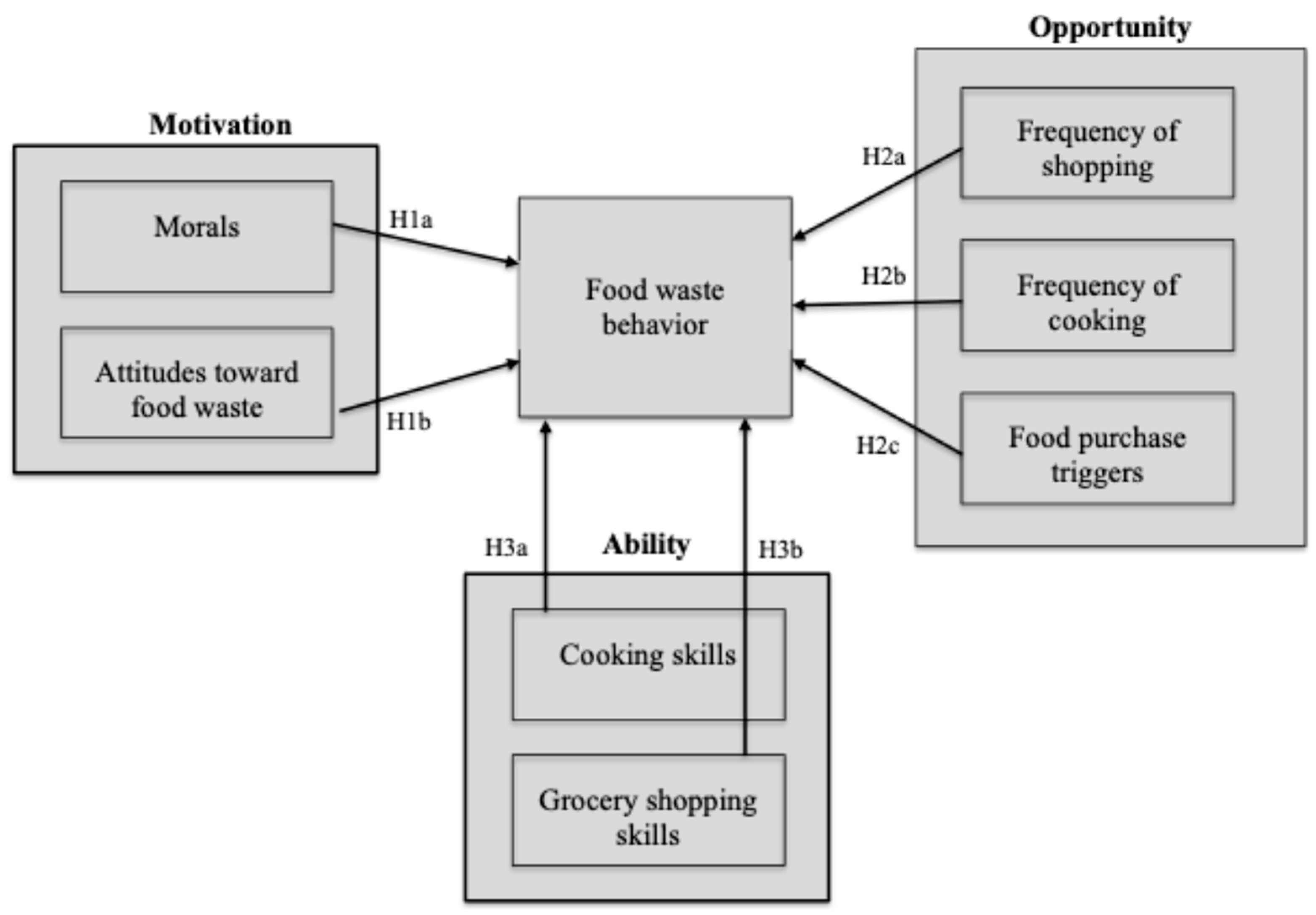
2.1. Motivation
2.2. Opportunity
2.3. Ability
3. Method
3.1. Participants and Measures
3.2. Analysis and Results
4. Discussion
5. Theoretical and Practical Implications
6. Limitations and Directions for Future Research
Supplementary Materials
Funding
Institutional Review Board Statement
Informed Consent Statement
Data Availability Statement
Conflicts of Interest
References
- Durán-Sandoval, D.; Durán-Romero, G.; Uleri, F. How Much Food Loss and Waste Do Countries with Problems with Food Security Generate? Agriculture 2023, 13, 966. [Google Scholar] [CrossRef]
- UNEP (United Nations Environment Programme). Food Waste Index Report 2024. Think Eat Save: Tracking Progress to Halve Global Food Waste. 2024. Available online: https://wedocs.unep.org/20.500.11822/45230 (accessed on 5 February 2025).
- UNCC (United Nations Climate Change). Food Loss and Waste Account for 8–10% of Annual Global Greenhouse Gas Emissions; Cost USD 1 Trillion Annually. 2024. Available online: https://unfccc.int/news/food-loss-and-waste-account-for-8-10-of-annual-global-greenhouse-gas-emissions-cost-usd-1-trillion (accessed on 2 February 2025).
- UN DESA. The Sustainable Development Goals Report 2025; United Nations: New York, NY, USA, 2025; Available online: https://unstats.un.org/sdgs/report/2025/The-Sustainable-Development-Goals-Report-2025.pdf (accessed on 27 March 2026).
- Principato, L.; Secondi, L.; Pratesi, C.A. Reducing food waste: An investigation on the behaviour of Italian youths. Br. Food J. 2015, 117, 731–748. [Google Scholar] [CrossRef]
- Schanes, K.; Dobernig, K.; Gözet, B. Food waste matters—A systematic review of household food waste practices and their policy implications. J. Clean. Prod. 2018, 182, 978–991. [Google Scholar] [CrossRef]
- MacInnis, D.J.; Moorman, C.; Jaworski, B.J. Enhancing and measuring consumers’ motivation, opportunity, and ability to process brand information from ads. J. Mark. 1991, 55, 32–53. [Google Scholar] [CrossRef]
- Vandersip, S.E.; Taillie, L.S.; Grummon, A.H.; Prestemon, C.E.; Reimold, A.E. Food Waste among Young Adults: Behaviors, Barriers, and Opportunities for Intervention. Curr. Dev. Nutr. 2025, 9, 107541. [Google Scholar] [CrossRef] [PubMed]
- Bettiga, D.; Lamberti, L.; Noci, G. Investigating social motivations, opportunity and ability to participate in communities of virtual co-creation. Int. J. Consum. Stud. 2018, 42, 155–163. [Google Scholar] [CrossRef]
- Malau, L.R.E.; Khaliqi, M.; Yulni, T.; Rambe, K.R.; Novanda, R.R.; Wibowo, R.P. Why we waste: A meta-analysis of food waste behavior using the Theory of Planned Behavior (TPB). Sustain. Futures 2025, 10, 101421. [Google Scholar] [CrossRef]
- Nguyen, T.T.G.; Nguyen, G.H. Extended theory of planned behavior and demographics in household food waste reduction: Evidence from Vietnam. Clean. Waste Syst. 2025, 12, 100349. [Google Scholar] [CrossRef]
- Manika, D.; Iacovidou, E.; Canhoto, A.; Pei, E.; Mach, K. Capabilities, opportunities and motivations that drive food waste disposal practices: A case study of young adults in England. J. Clean. Prod. 2022, 370, 133449. [Google Scholar] [CrossRef]
- Soma, T.; Li, B.; Maclaren, V. An evaluation of a consumer food waste awareness campaign using the motivation opportunity ability framework. Resour. Conserv. Recycl. 2021, 168, 105313. [Google Scholar] [CrossRef]
- Aloysius, N.; Ananda, J.; Mitsis, A.; Pearson, D. The last bite: Exploring behavioural and situational factors influencing leftover food waste in households. Food Qual. Prefer. 2025, 123, 105327. [Google Scholar] [CrossRef]
- Heidig, W.; Dobbelstein, T.; Mason, R.B. Beyond the Bin: The Influence of Motivation, Opportunity, and Ability on Food Waste Behavior in Households. Sustain. Dev. 2024, 33, 3151–3169. [Google Scholar] [CrossRef]
- Shan, L.; Lu, Q.; Tong, X. ‘How to improve the consistency of consumers’ food waste reduction intentions and behaviors? An analysis based on the expanded Motivation–Opportunity–Ability framework. Humanit. Soc. Sci. Commun. 2024, 11, 1530. [Google Scholar] [CrossRef]
- Mondéjar-Jiménez, J.A.; Ferrari, G.; Secondi, L.; Principato, L. From the table to waste: An exploratory study on behavior towards food waste of Spanish and Italian youths. J. Clean. Prod. 2016, 138, 8–18. [Google Scholar] [CrossRef]
- Novitasari, S.D.; Purwadi, D.; Marseno, D.W. The effect of food waste behavior among Generation Z on sustainable food security. Food Res. 2025, 9, 236–244. [Google Scholar] [CrossRef]
- Karunasena, G.G.; Ananda, J.; Pearson, D. Generational differences in food management skills and their impact on food waste in households. Resour. Conserv. Recycl. 2021, 175, 105890. [Google Scholar] [CrossRef]
- Galan, S. Share of the Global Population in 2024, and a Projection for 2030, by Generation. Statista. 2024. Available online: https://www.statista.com/statistics/1607121/estimated-population-of-the-world-by-generation/ (accessed on 26 October 2024).
- Clement, J.; Alenčikienė, G.; Riipi, I.; Starkutė, U.; Čepytė, K.; Buraitytė, A.; Zabulionė, A.; Šalaševičienė, A. Exploring causes and potential solutions for food waste among young consumers. Foods 2023, 12, 2570. [Google Scholar] [CrossRef]
- Filip, A.; Stancu, A.; Onișor, L.-F.; Mogoș, O.C.; Catană, Ș.-A.; Goldbach, D. Drivers of Purchase Intentions of Generation Z on Eco-Products. Sustainability 2025, 17, 629. [Google Scholar] [CrossRef]
- Van Geffen, L.; Van Herpen, E.; Sijtsema, S.; van Trijp, H. Food waste as the consequence of competing motivations, lack of opportunities, and insufficient abilities. Resour. Conserv. Recycl. 2020, 5, 100026. [Google Scholar] [CrossRef]
- Baumhof, R.; Decker, T.; Röder, H.; Menrad, K. Which factors determine the extent of house owners’ energy-related refurbishment projects? A motivation–opportunity–ability approach. Sustain. Cities Soc. 2018, 36, 33–41. [Google Scholar] [CrossRef]
- Li, B.; Maclaren, V.; Soma, T. Urban household food waste: Drivers and practices in Toronto, Canada. Br. Food J. 2021, 123, 1793–1809. [Google Scholar] [CrossRef]
- Brug, J. Determinants of healthy eating: Motivation, abilities and environmental opportunities. Fam. Pract. 2008, 25, i50–i55. [Google Scholar] [CrossRef]
- Moorman, C.; Matulich, E. A model of consumers’ preventive health behaviors: The role of health motivation and health ability. J. Consum. Res. 1993, 20, 208–228. [Google Scholar] [CrossRef]
- Rayner, J.; Morgan, D. An empirical study of ‘green’ workplace behaviours: Ability, motivation and opportunity. Asia Pac. J. Hum. Resour. 2018, 56, 56–78. [Google Scholar] [CrossRef]
- Yener, G.; Secer, A.; Ghazalian, P.L. What factors influence consumers to buy green products? An analysis through the motivation–opportunity–ability framework and consumer awareness. Sustainability 2023, 15, 13872. [Google Scholar] [CrossRef]
- Raimondo, M.; Spina, D.; Hamam, M.; D’Amico, M.; Caracciolo, F. Intrinsic motivation strongly affects the readiness toward circular food consumption: Evidence from the motivation–opportunity–ability model. Br. Food J. 2024, 126, 715–737. [Google Scholar] [CrossRef]
- Rydström, C. Sustainable Consumption in Vietnam: An Examination of the Behavior of Young Consumers Through the Motivation, Opportunity, and Ability Model; Lund University, Centre for East and South-East Asian Studies: Lund, Sweden, 2020. [Google Scholar]
- Vittuari, M.; Falasconi, L.; Masotti, M.; Piras, S.; Segrè, A.; Setti, M. “Not in My Bin”: Consumer’s Understanding and Concern of Food Waste Effects and Mitigating Factors. Sustainability 2020, 12, 5685. [Google Scholar] [CrossRef]
- Ryan, R.M.; Deci, E.L. Self-determination theory and the facilitation of intrinsic motivation, social development, and well-being. Am. Psychol. 2000, 55, 68–78. [Google Scholar] [CrossRef]
- Barrera-Verdugo, G.; Durán-Sandoval, D. Influence of moral reasoning and environmental concern on sustainable food consumption behaviors: A gender comparison among university students. Clean. Waste Syst. 2024, 9, 100164. [Google Scholar] [CrossRef]
- Visschers, V.H.; Wickli, N.; Siegrist, M. Sorting out food waste behaviour: A survey on the motivators and barriers of self-reported amounts of food waste in households. J. Environ. Psychol. 2016, 45, 66–78. [Google Scholar] [CrossRef]
- Aydin, H.; Aydin, C. Investigating consumers’ food waste behaviors: An extended theory of planned behavior of Turkey sample. Clean. Waste Syst. 2022, 3, 100036. [Google Scholar] [CrossRef]
- Aydin, A.E.; Yildirim, P. Understanding food waste behavior: The role of morals, habits and knowledge. J. Clean. Prod. 2021, 280, 124250. [Google Scholar] [CrossRef]
- Stefan, V.; Van Herpen, E.; Tudoran, A.A.; Lähteenmäki, L. Avoiding food waste by Romanian consumers: The importance of planning and shopping routines. Food Qual. Prefer. 2013, 28, 375–381. [Google Scholar] [CrossRef]
- Bretter, C.; Unsworth, K.L.; Kaptan, G.; Russell, S.V. It is just wrong: Moral foundations and food waste. J. Environ. Psychol. 2023, 88, 102021. [Google Scholar] [CrossRef]
- Talwar, S.; Kaur, P.; Kumar, S.; Salo, J.; Dhir, A. The balancing act: How do moral norms and anticipated pride drive food waste/reduction behaviour? J. Retail. Consum. Serv. 2022, 66, 102901. [Google Scholar] [CrossRef]
- Sitompul, C.; Gunawan, T.; Mesiranta, N.; Närvänen, E.; Octavia, J.R. Impact of food waste-related course attendance on students’ food waste reduction behaviours and knowledge: A case study from Indonesia. Int. J. Sustain. High. Educ. 2025, 26, 36–54. [Google Scholar] [CrossRef]
- Valentin, A.P.; Vega, A.M.D.; Kho, M.I.; Licayan, S.R.; Nierras, E.L.; Pabalate, J.C. Predicting food waste reduction behavior among students in higher education institutions. Int. J. Sustain. High. Educ. 2023, 25, 885–898. [Google Scholar] [CrossRef]
- Quested, T.E.; Marsh, E.; Stunell, D.; Parry, A.D. Spaghetti soup: The complex world of food waste behaviours. Resour. Conserv. Recycl. 2013, 79, 43–51. [Google Scholar] [CrossRef]
- Fanelli, R.M. Using causal maps to analyse the major root causes of household food waste: Results of a survey among people from central and southern Italy. Sustainability 2019, 11, 1183. [Google Scholar] [CrossRef]
- Giordano, C.; Alboni, F.; Cicatiello, C.; Falasconi, L. Do discounted food products end up in the bin? An investigation into the link between deal-prone shopping behavior and quantities of household food waste. Int. J. Consum. Stud. 2019, 43, 199–209. [Google Scholar] [CrossRef]
- Ananda, J.; Karunasena, G.G.; Mitsis, A.; Kansal, M.; Pearson, D. Analysing behavioral and socio-demographic factors and practices influencing Australian household food waste. J. Clean. Prod. 2021, 306, 127280. [Google Scholar] [CrossRef]
- Ghinea, C.; Ghiuta, O.A. Household food waste generation: Young consumers behaviour, habits and attitudes. Int. J. Environ. Sci. Technol. 2019, 16, 2185–2200. [Google Scholar] [CrossRef]
- Farr-Wharton, G.; Foth, M.; Choi, J.H.-J. Identifying factors that promote consumer behaviours causing expired domestic food waste. J. Consum. Behav. 2014, 13, 393–402. [Google Scholar] [CrossRef]
- Graham-Rowe, E.; Jessop, D.C.; Sparks, P. Identifying motivations and barriers to minimizing household food waste. Resour. Conserv. Recycl. 2014, 84, 15–23. [Google Scholar] [CrossRef]
- Ponis, S.T.; Papanikolaou, P.A.; Katimertzoglou, P.; Ntalla, A.C.; Xenos, K.I. Household food waste in Greece: A questionnaire survey. J. Clean. Prod. 2017, 149, 1268–1277. [Google Scholar] [CrossRef]
- Chalak, A.; Abiad, M.G.; Diab, M.; Nasreddine, L. The determinants of household food waste generation and its associated caloric and nutrient losses: The case of Lebanon. PLoS ONE 2019, 14, e0225789. [Google Scholar] [CrossRef]
- Jörissen, J.; Priefer, C.; Bräutigam, K.-R. Food waste generation at household level: Results of a survey among employees of two European research centers in Italy and Germany. Sustainability 2015, 7, 2695–2715. [Google Scholar] [CrossRef]
- Bittner, B.; Vida, V.; Szakos, D.; Kasza, G.; Kovács, S.; Nagy, A. A study of the behavioral and environmental factors influencing food waste in higher education. Clean. Waste Syst. 2025, 11, 100256. [Google Scholar] [CrossRef]
- Li, D.; Menassa, C.C.; Karatas, A. Energy use behaviors in buildings: Towards an integrated conceptual framework. Energy Res. Soc. Sci. 2017, 23, 97–112. [Google Scholar] [CrossRef]
- Palmieri, N.; Boccia, F. Food waste is embarrassing! Motivations and actions to prevent it among students in Italy. Young Consum. 2025, 26, 111–125. [Google Scholar] [CrossRef]
- Nabi, N.; Karunasena, G.G.; Pearson, D. Food waste in Australian households: Role of shopping habits and personal motivations. J. Consum. Behav. 2021, 20, 1523–1533. [Google Scholar] [CrossRef]
- Bandura, A. Self-efficacy: Toward a unifying theory of behavioral change. Psychol. Rev. 1977, 84, 191–215. [Google Scholar] [CrossRef]
- Cooper, A.; Lion, R.; Rodriguez-Sierra, O.E.; Jeffrey, P.; Thomson, D.; Peters, K.; van Herpen, E. Use-up day and flexible recipes: Reducing household food waste by helping families prepare food they already have. Resour. Conserv. Recycl. 2023, 194, 106986. [Google Scholar] [CrossRef]
- Scalvedi, M.L.; Rossi, L. Comprehensive measurement of Italian domestic food waste in a European framework. Sustainability 2021, 13, 1492. [Google Scholar] [CrossRef]
- Roe, B.E.; Bender, K.; Qi, D. The impact of COVID-19 on consumer food waste. Appl. Econ. Perspect. Policy 2021, 43, 401–411. [Google Scholar] [CrossRef]
- Ammann, J.; Osterwalder, O.; Siegrist, M.; Hartmann, C.; Egolf, A. Comparison of two measures for assessing the volume of food waste in Swiss households. Resour. Conserv. Recycl. 2021, 166, 105295. [Google Scholar] [CrossRef]
- Begho, T.; Fadare, O. Does household food waste prevention and reduction depend on bundled motivation and food management practices? Clean. Responsible Consum. 2023, 11, 100142. [Google Scholar] [CrossRef]
- Vittuari, M.; Masotti, M.; Iori, E.; Falasconi, L.; Toschi, T.G.; Segrè, A. Does the COVID-19 external shock matter on household food waste? The impact of social distancing measures during the lockdown. Resour. Conserv. Recycl. 2021, 174, 105815. [Google Scholar] [CrossRef]
- Russell, S.V.; Young, C.W.; Unsworth, K.L.; Robinson, C. Bringing habits and emotions into food waste behaviour. Resour. Conserv. Recycl. 2017, 125, 107–114. [Google Scholar] [CrossRef]
- Cantaragiu, R. The impact of gender on food waste at the consumer level. Stud. Univ. Vasile Goldiş Arad-Ser. Ştiinţe Econ. 2019, 29, 41–57. [Google Scholar] [CrossRef]
- Principato, L.; Mattia, G.; Di Leo, A.; Pratesi, C.A. The household wasteful behaviour framework: A systematic review of consumer food waste. Ind. Mark. Manag. 2021, 93, 641–649. [Google Scholar] [CrossRef]
- Lyndhurst, B.; Cox, J.; Downing, P. Food Behaviour Consumer Research: Quantitative Phase; Waste & Resources Action Programme (WRAP): Banbury, UK, 2007. [Google Scholar]
- Nunnally, J.C.; Bernstein, I.H. Psychometric Theory, 3rd ed.; McGraw-Hill: New York, NY, USA, 1994. [Google Scholar]
- Hu, L.T.; Bentler, P.M. Cutoff criteria for fit indexes in covariance structure analysis: Conventional criteria versus new alternatives. Struct. Equ. Model. Multidiscip. J. 1999, 6, 1–55. [Google Scholar] [CrossRef]
- Bagozzi, R.P.; Yi, Y. On the evaluation of structural equation models. J. Acad. Mark. Sci. 1988, 16, 74–94. [Google Scholar] [CrossRef]
- Hair, J.F.; Black, W.C.; Babin, B.J.; Anderson, R.E.; Tatham, R.L. Multivariate Data Analysis, 6th ed.; Pearson Prentice Hall: Upper Saddle River, NJ, USA, 2006. [Google Scholar]
- Fornell, C.; Larcker, D.F. Evaluating structural equation models with unobservable variables and measurement error. J. Mark. Res. 1981, 18, 39–50. [Google Scholar] [CrossRef]
- Djafarova, E.; Foots, S. Exploring ethical consumption of generation Z: Theory of planned behaviour. Young Consum. 2022, 23, 413–431. [Google Scholar] [CrossRef]
- Mallinson, L.J.; Russell, J.M.; Barker, M.E. Attitudes and behaviour towards convenience food and food waste in the United Kingdom. Appetite 2016, 103, 17–28. [Google Scholar] [CrossRef]
- Martindale, W. Using consumer surveys to determine food sustainability. Br. Food J. 2014, 116, 1194–1204. [Google Scholar] [CrossRef]



| Constructs | A | B | C | D | E | F |
|---|---|---|---|---|---|---|
| A. Food waste behavior | 1 | |||||
| B. Morals | −0.321 ** | 1 | ||||
| C. Attitudes toward food waste | 0.131 * | −0.266 ** | 1 | |||
| D. Cooking skills | −0.305 ** | 0.582 ** | −0.113 * | 1 | ||
| E. Grocery shopping skills | −0.177 ** | 0.501 ** | −0.048 | 0.672 ** | 1 | |
| F. Food purchase triggers | 0.196 ** | −0.105 | 0.114 * | 0.129 * | −0.081 | 1 |
| Mean | 0.985 | 5.053 | 1.078 | 3.971 | 4.816 | 2.321 |
| Std. Deviation | 0.398 | 1.059 | 0.792 | 1.206 | 1.103 | 0.906 |
| Constructs/Items | Factor Loading | CR | AVE |
|---|---|---|---|
| Food waste behavior | 0.759 | 0.448 | |
| “How regularly do you think food is thrown away in your household (e.g., as a result of cooking too much or food spoiling)?” (1 = Never, 5 = Most mealtimes) | 0.575 | ||
| “How much bread and other bakery products is thrown away in your household of what you buy in a regular week” | 0.555 | ||
| “How much rice and pasta is thrown away in your household of what you buy in a regular week” | 0.673 | ||
| “How much food in total is thrown away in your household of what you buy in a regular week” | 0.836 | ||
| Morals | 0.882 | 0.652 | |
| “I feel guilty when I throw food away.” | 0.772 | ||
| “It is contrary to my principles when I have to discard food.” | 0.825 | ||
| “Wasting food does not fit in well with my self image.” | 0.849 | ||
| “I have been raised to believe that food should not be wasted and, I still live according to this principle.” | 0.781 | ||
| Attitudes toward food waste | 0.905 | 0.761 | |
| “I think engaging in food waste behaviors is bad/good.” | 0.915 | ||
| “I think engaging in food waste behaviors is harmful/beneficial.” | 0.843 | ||
| “I think engaging in food waste behaviors is not at all negative/to extremely negative.” | 0.857 | ||
| Cooking skills | 0.7203 | 0.465 | |
| “I can use the leftovers to create some new dishes.” | 0.631 | ||
| “I can use the food items at my disposal to improvise a recipe.” | 0.786 | ||
| “Due to my superior cooking skills, the tasty food I cook is never wasted.” | 0.616 | ||
| Grocery shopping skills | 0.769 | 0.532 | |
| “I always check my supplies before I go food shopping.” | 0.83 | ||
| “I always use a shopping list when I go food shopping.” | 0.766 | ||
| “I always plan my meals before I go food shopping.” | 0.565 | ||
| Food purchase triggers | 0.827 | 0.551 | |
| “I usually buy higher amounts of food when they offer good value for money” | 0.535 | ||
| “I tend to buy more than I need when shopping for groceries because food displays are tempting.” | 0.84 | ||
| “I like to buy extra food just in case.” | 0.779 | ||
| “I often impulsively purchase food items that I did not plan to buy.” | 0.778 |
| Path | Standardized Path Coefficient | p |
|---|---|---|
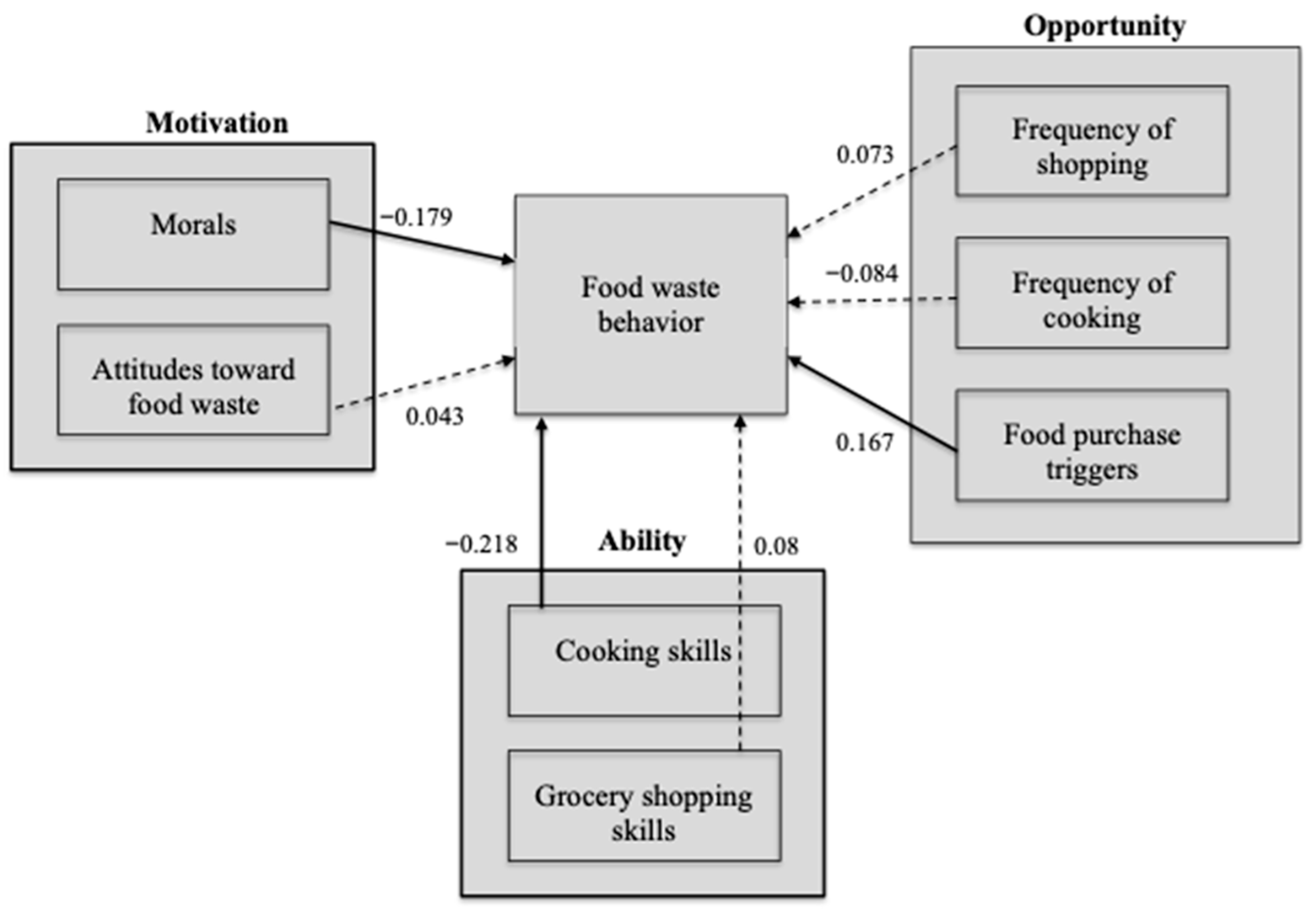
| Morals → Food waste behavior | −0.179 | 0.029 |
| Attitudes toward food waste → Food waste behavior | 0.043 | 0.494 |
| Cooking skills → Food waste behavior | −0.218 | 0.035 |
| Grocery shopping skills → Food waste behavior | 0.08 | 0.375 |
| Frequency of shopping → Food waste behavior | 0.073 | 0.262 |
| Frequency of cooking → Food waste behavior | −0.084 | 0.2 |
| Food purchase triggers → Food waste behavior | 0.167 | 0.016 |
Disclaimer/Publisher’s Note: The statements, opinions and data contained in all publications are solely those of the individual author(s) and contributor(s) and not of MDPI and/or the editor(s). MDPI and/or the editor(s) disclaim responsibility for any injury to people or property resulting from any ideas, methods, instructions or products referred to in the content. |
© 2026 by the author. Licensee MDPI, Basel, Switzerland. This article is an open access article distributed under the terms and conditions of the Creative Commons Attribution (CC BY) license.
Share and Cite
Aydin, A. From Tempting Aisles to Guilty Leftovers: Exploring Generation Z’s Food Waste Behavior Through the Motivation, Opportunity, and Ability Framework. Sustainability 2026, 18, 4430. https://doi.org/10.3390/su18094430
Aydin A. From Tempting Aisles to Guilty Leftovers: Exploring Generation Z’s Food Waste Behavior Through the Motivation, Opportunity, and Ability Framework. Sustainability. 2026; 18(9):4430. https://doi.org/10.3390/su18094430
Chicago/Turabian StyleAydin, Asli. 2026. "From Tempting Aisles to Guilty Leftovers: Exploring Generation Z’s Food Waste Behavior Through the Motivation, Opportunity, and Ability Framework" Sustainability 18, no. 9: 4430. https://doi.org/10.3390/su18094430
APA StyleAydin, A. (2026). From Tempting Aisles to Guilty Leftovers: Exploring Generation Z’s Food Waste Behavior Through the Motivation, Opportunity, and Ability Framework. Sustainability, 18(9), 4430. https://doi.org/10.3390/su18094430