Article

Assessing the Low-Carbon Transition of Manufacturing Clusters and Its Evolution: Evidence from China
School of Economics and Management, Changsha University of Science and Technology, Changsha 410076, China
*
Author to whom correspondence should be addressed.
Sustainability 2026, 18(9), 4384; https://doi.org/10.3390/su18094384
Submission received: 25 February 2026 / Revised: 16 April 2026 / Accepted: 24 April 2026 / Published: 29 April 2026

Abstract

The low-carbon transition (LCT) of manufacturing clusters is a critical pathway to addressing bottlenecks in global climate governance and promoting sustainable economic development in developing countries. Accurately measuring the level of this transition and clarifying its dynamic trends are of great significance. Drawing on the economic rationale of a low-carbon economy, this study constructs a comprehensive evaluation indicator system and employs the entropy-weighted CRITIC-grey relational TOPSIS method to measure the LCT levels of China’s four major industrial bases from 2013 to 2023. Combined with convergence analysis, the Theil index, mechanism analysis, and policy scenario simulation, it systematically analyzes the characteristics of disparities and the underlying mechanisms. The study’s results show that low-carbon technology is the core driver of the LCT of the four major industrial bases. The LCT levels of the four major industrial bases have generally increased, with some bases exhibiting a catch-up effect internally. The overall disparity among the four major industrial bases has widened, primarily driven by intra-base differences. Specifically, the Beijing–Tianjin–Tangshan industrial base displays polarization characteristics, while the Central-Southern Liaoning industrial base shows a relatively low-level equilibrium. The transition of resource-based cities lags, mainly constrained by rigid industrial structures and insufficient investment in technology. Industrial structure optimization plays a certain role in improving resource-based regions, whereas technological innovation has a more pronounced effect in developed regions. This study constructs a comprehensive analytical framework of “measurement–evolution–mechanism–simulation,” which refines the quantitative evaluation system for the LCT of manufacturing clusters. The findings provide empirical support for formulating differentiated low-carbon policies for manufacturing clusters and optimizing coordinated emission reduction pathways, while also offering a reference paradigm for similar research in other developing countries.

1. Introduction

Global climate governance has entered a critical stage of implementation. The implementation of the Paris Agreement’s 1.5 °C temperature control target has made the low-carbon transition (LCT) a core consensus for countries seeking to enhance industrial competitiveness and realize long-term sustainability. The manufacturing sector is a core sector of the global economy, while also being a significant consumer of energy and emitter of carbon. It accounts for approximately 37% of global CO2 emissions. Manufacturing’s LCT not only helps reshape the green development landscape but also represents an essential pathway for cultivating new competitive advantages in green technology, exploring new drivers of economic growth, and achieving sustainable economic development. In this process, manufacturing clusters, leveraging their agglomeration effects, technology spillovers, and resource-sharing mechanisms, have become a key focus for coordinated emission reduction.
China is the largest developing country globally and a leading manufacturing nation, which hosts numerous and widely distributed manufacturing clusters. The degree of their LCT significantly affects both the global manufacturing decarbonization process and China’s sustainable economic development. Scientific and accurate measurement of the LCT’s level is the foundation and key to formulating differentiated and refined transition pathways. Accordingly, a comprehensive evaluation system for the LCT of manufacturing clusters is constructed in this study. The transition levels of China’s four major industrial bases are scientifically measured, and their dynamic trends are analyzed. Furthermore, through mechanism analysis and policy scenario simulation, this study attempts to clarify the characteristics of disparities and the underlying mechanisms, with a view to providing a theoretical basis and decision-making references for promoting context-specific LCT strategies for manufacturing clusters in China, while also offering empirical support for other developing countries exploring LCT pathways for industrial clusters.
Specifically, the contributions of this study are mainly reflected in the following three aspects.
First, in terms of research framework, this study integrates LCT measurement, convergence analysis, distribution evolution, mechanism analysis, and policy scenario simulation to construct a comprehensive analytical framework of “measurement–evolution–mechanism–simulation.” This framework not only characterizes the static level of LCT but also systematically reveals its dynamic processes and intrinsic driving mechanisms.
Second, in terms of research content, this study moves beyond the previous research paradigm that focuses only on average levels or regional comparisons. It introduces the Theil index to decompose intra-base disparities and, combined with kernel density estimation and convergence characteristics, identifies distinct evolutionary paths within regions, such as “polarization expansion” and “low-level equilibrium.”
Third, in terms of policy formulation, this study introduces scenario simulation methods based on mechanism identification. By incorporating industrial structure adjustment and technological innovation into a unified analytical framework, it provides a forward-looking assessment of the effects of LCT under different policy pathways, thereby offering more targeted quantitative evidence for the formulation of differentiated LCT policies.

2. Literature Review

Manufacturing clusters are important vehicles for promoting the LCT of industry and essentially consist of geographically concentrated networks of upstream and downstream enterprises and related institutions within an industrial chain [1]. Under the dual pressure to mitigate climate change and achieve sustainable development, scholars have shifted their focus from pure competitiveness and innovation spillovers to how manufacturing clusters can facilitate LCT. For one thing, clusters enable more cost-effective deployment of green technologies and accelerate their diffusion through scale effects and resource sharing. For another, knowledge spillovers within clusters, demonstrations by leading enterprises, and supply chain pressures can create a “peer effect,” driving improvements in the environmental performance of the entire cluster [2,3]. Empirical studies show that clustering or co-agglomeration helps improve regional or urban carbon emission efficiency, primarily through pathways such as technological innovation diffusion, factor recombination, and synergy of green finance and policy incentives [4,5].
The factors influencing the LCT of manufacturing clusters can be summarized into two dimensions: technology and structure, and institutions and markets. In the technology and structure dimension, green technological innovation is a fundamental driver for reducing carbon emissions and promoting economic growth [6,7]. Digital transition and the upgrading of industrial structures can significantly improve energy allocation, thereby contributing to the LCT of industries [8,9]. In the institutions and markets dimension, environmental regulations compel enterprises to pursue LCT through the “Porter Hypothesis” effect. Furthermore, energy price fluctuations and support from green finance, as market signals, directly affect enterprises’ decisions regarding energy substitution and their willingness to invest in low-carbon initiatives [10]. These studies provide theoretical support for the multidimensional characteristics of LCT and suggest that multiple factors, including the economy, energy, the environment, and institutions, should be considered when measuring the LCT of clusters.
The measurement methods for the LCT of manufacturing clusters are mainly divided into three categories: measurement based on single-factor characteristics, measurement based on input–output efficiency, and comprehensive evaluation based on a multidimensional indicator system.
Measurements based on single-factor characteristics use individual indicators such as energy intensity or carbon emission intensity to assess the degree of LCT. Feng et al. [11] adopted energy intensity as the primary metric for assessing low-carbon energy transition effectiveness and, through an empirical analysis of 77 countries and regions worldwide, verified the significant impact of transition actions on reducing energy intensity. Focusing on the Chinese provincial level, Tao et al. [12] also used energy consumption intensity as a single indicator to quantitatively evaluate the environmental performance and LCT progress of 30 Chinese provinces. Additionally, Xu et al. [13] employed methods such as the Mann–Kendall test to thoroughly analyze the dynamic changes in carbon emission intensity in 210 countries worldwide, thereby revealing the driving characteristics of LCT in different countries. To further analyze the transition details of high-energy-consuming sectors, Tong et al. [14] moved beyond aggregate measurements and, by decomposing the carbon emission structures of industrial sectors, identified the main contributors to carbon emissions, using this as a basis for promoting LCT pathways. Although single indicators have the advantages of intuitiveness and data availability, their limitation lies in reflecting only the outcomes of the transition rather than the process, making it difficult to comprehensively capture the multidimensional systemic efforts of manufacturing clusters in technological upgrading, structural adjustment, and resource recycling.
Measurement based on input–output efficiency is grounded in production frontier theory, using data envelopment analysis (DEA) and its improved models to quantify total factor productivity (TFP) or carbon performance to assess the effectiveness of LCT. Ke et al. [15] proposed a four-stage DEA framework that incorporates stochastic frontier analysis (SFA) to eliminate external environmental interference and correct input deviations, overcoming the limitations of traditional DEA, which is susceptible to external factors. Within the input–output efficiency measurement framework, Du et al. [16] developed a novel hybrid triangular envelopment analysis-ideal solution (TEA-IS) model at the city level, which can simultaneously measure urban ecological efficiency and identify synergistic effects between positive and negative indicators. At the provincial level, Taleb [17] extended the traditional slacks-based measure (SBM) model to construct a mixed-integer SBM model that includes undesirable outputs, thereby accurately measuring carbon efficiency and potential carbon reduction in Chinese provinces. Considering the green connotation of TFP, Long et al. [18] employed the SBM-GML index method to measure China’s provincial-level green TFP (GTFP) and verified the spatially heterogeneous impact of environmental concern on this indicator. For a broader range of industrial sectors, Zhu et al. [19] constructed a global Malmquist–Luenberger (GML) index to measure the total factor carbon emission productivity (TFCEP) of 41 industrial sectors in China, dynamically measuring the LCT level of the industrial system. Furthermore, Duan et al. [20] quantified high-quality development efficiency of Chinese regions using a non-radial directional distance function, revealing significant technological efficiency gaps between leading and lagging regions in decarbonization. While efficiency measurement methods effectively address input–output ratios, they struggle to identify specific transition drivers within the system, are sensitive to outliers in indicator data, and offer limited guidance for specific structural optimization pathways.
Comprehensive evaluation based on multidimensional indicator systems involves constructing an indicator system encompassing economic, energy, environmental, and other dimensions and combining it with multi-criteria decision-making (MCDM) methodologies for comprehensive assessment. Shen et al. [21] innovatively formulated an energy transition index (ETI) aimed at describing the LCT roadmaps for 282 Chinese cities, across two axes: energy system performance and transition readiness, thus quantifying heterogeneity gaps between cities. Zhang et al. [22] developed a low-carbon complexity index (LCCI) to quantify a country’s low-carbon production capacity, aiming to address the shortcomings of traditional indicators in predicting transition potential. Regarding specific evaluation algorithms, Niu et al. [23] constructed a four-dimensional low-carbon transition effectiveness (LCTE) evaluation system covering energy consumption and carbon emissions, energy structure and efficiency, green economy and innovation, and urban environment and ecology, and employed a game–theoretic weighting method combining the Bayesian Best–Worst Method (BBWM) and the Interval Doubling of CRITIC Weights (IDOCRIW) to comprehensively assess LCT effectiveness. Wang et al. [24] took Liaoning Province, China, as an example, established an indicator system including economic growth and environmental protection, and used the entropy-weighted TOPSIS method for comprehensive assessment of low-carbon development levels. Furthermore, Zhang et al. [25] introduced grey relational analysis into the TOPSIS framework to improve traditional ranking methods, thereby enhancing the ability of comprehensive evaluation to characterize the structure features of multiple indicators. Comprehensive evaluation effectively compensates for the limitations of single indicators in terms of dimensional coverage while avoiding the shortcomings of efficiency measurement methods in identifying transition drivers, and it can effectively meet the research demands of measuring regional LCT levels and analyzing spatiotemporal differentiation characteristics.
In summary, although existing studies have made some progress in identifying the influencing factors and measurement methods of LCT, several limitations remain. First, in terms of weighting methods, most current studies adopt a single entropy weighting method but neglect the comparative strength and conflicts among indicators. Second, regarding evaluation models, the traditional TOPSIS method measures the proximity of evaluated objects to the ideal solution only based on Euclidean distance, ignoring the geometric similarity of data samples, which makes it difficult to accurately characterize the dynamic fitting features during the transition process. Finally, regarding the in-depth analysis of measurement results, although existing studies have revealed temporal changes in transition levels, they are mostly limited to simple trend descriptions or static rankings, lacking in-depth analysis of whether cluster transition differences exhibit a “catch-up effect” and how the overall distribution pattern evolves. Therefore, in this study, an entropy-weighted CRITIC-grey relational TOPSIS model is constructed in light of the inherent meaning of the low-carbon economy—namely, the multidimensional symbiotic relationships among economy, energy, environment, and technology—and approaches are developed from four dimensions: economic development, environmental protection, energy consumption, and technological innovation. A comprehensive measurement of the LCT levels of China’s four major industrial bases from 2013 to 2023 is provided. On this basis, the Theil index is further introduced to quantitatively decompose the overall disparities among industrial bases, and combined with convergence analysis and kernel density estimation, the catch-up effects and distribution evolution characteristics of LCT levels are systematically examined. Meanwhile, mechanism analysis is conducted from the perspective of resource-based city classification to identify key constraints on transition lag, and based on this, policy scenario simulations are carried out to incorporate industrial structure adjustment and technological innovation into a unified analytical framework, providing a forward-looking assessment of future transition trends under different intervention pathways. Through the above analysis, this study aims to provide a more scientific basis for decision-making to advance the LCT of manufacturing clusters in China and globally.

3. Research Design

3.1. Research Methods

This study selects a multidimensional indicator system combined with the entropy-weighted CRITIC-grey relational TOPSIS model as its research methodology, primarily based on the following considerations. First, comprehensive evaluation based on a multidimensional indicator system effectively compensates for the limitations of single indicators in terms of dimensional coverage while avoiding the shortcomings of efficiency measurement methods in identifying transition drivers, and it can effectively align with the research demands of measuring regional LCT levels and analyzing spatiotemporal differentiation characteristics. Second, LCT exhibits the characteristics of a complex system, including long cycles, cross-regional dynamics, and multiple actors [26]. Single-indicator calculations and efficiency measurement methods struggle to identify the contribution of each dimension and the associated weaknesses, whereas a composite index framework, through dimension-specific analysis, can provide a more operational basis for structural optimization. Third, compared with mixed methods that further incorporate policy preferences or address data uncertainty, the dual-ranking approach of the entropy-weighted CRITIC-grey relational TOPSIS method avoids potential subjective bias in the evaluation results. Moreover, the data used in this study are sourced from official statistical yearbooks, ensuring high data quality and relatively low levels of uncertainty. Therefore, an objective, data-driven, robust hybrid method is more suitable for the research objectives and data characteristics of this study.

3.2. Indicator System

A low-carbon economy refers to a sustainable economic development model that is predicated on low pollution, low energy consumption, and low emissions, aiming to minimize the consumption and pollutant generation of high-carbon energy through technological innovation, the development of new energy, and industrial transition, thereby achieving a win–win outcome in both environmental protection and economic development [22]. The manufacturing clusters’ LCT represents the practical application of the low-carbon economy concept within industrial agglomeration areas. Therefore, in light of the essence of the low-carbon economy, four main dimensions of LCT are identified: technological innovation, energy consumption, economic development, and environmental protection. Among these, technological innovation and energy consumption are considered the means, while economic growth and environmental protection are considered the ultimate goals. Based on the above dimensional framework, this study draws on the definition of LCT indicators from the “Guidelines for Evaluating Sustainability and Low-Carbon Transition Levels of Cities and Communities” jointly issued by China’s State Administration for Market Regulation and the Standardization Administration, as well as the “Green Development Indicator System” issued by the National Development and Reform Commission. In the specific operational process, some indicators directly adopt the definitions from the above-mentioned documents (such as green coverage rate of urban built-up areas and number of days meeting air quality standards), while others (such as industrial added value, proportion of the tertiary industry, and total fixed asset investment) are selected based on the principles of indicator system construction established in these documents. Adhering to the principles of scientific rigor, systematic structure, and operability, and drawing on relevant research in the field of low-carbon economics [27,28], this study constructs a comprehensive evaluation indicator system comprising 19 specific indicators across four dimensions—economic growth, environmental protection, resource utilization, and low-carbon technology—as shown in Table 1.
The specific explanations are as follows:
(1)
Level of Economic Growth: LCT regards economic growth as both one of its objectives and its material foundation. The level of economic growth should be assessed from both qualitative and quantitative dimensions. In this study, per capita GDP, industrial added value, and total fixed asset investment are selected to measure the quantitative aspect of economic growth, while the proportion of the tertiary industry, actual utilization of foreign direct investment, and per capita disposable income of urban residents are selected as indicators to measure the qualitative aspect of economic growth. In China, per capita GDP directly affects innovation and low-carbon capacity, while fixed asset investment effectively promotes the growth of production growth rates [29], both are important drivers of economic growth. Furthermore, actual utilization of foreign direct investment helps absorb advanced foreign technologies, enhance green innovation capacity, and foster a more open industrial structure.
(2)
Level of Environmental Protection: Indicators of environmental protection are selected from three aspects: before, during, and after pollution events. Prior to the generation of pollution, preventive measures should be taken to enhance environmental protection capacity and avert potential risks. During the pollution-generating process, efforts should be made to reduce environmental pollution and control emission intensity. After pollution occurs, the capacity for pollutant treatment should be improved to minimize environmental impacts. The construction of green spaces in built-up areas can enhance regional carbon sequestration capacity and optimize ecosystem services, thereby improving the regional environment. Therefore, the green coverage rate of urban built-up areas is selected as a pre-event indicator of environmental protection. Zhou et al. [30], by analyzing the frequency of energy indicators in relevant production standards, found that the industrial “three wastes” appeared with frequencies of 12/70, 48/70, and 10/70, respectively, indicating their important role in environmental performance evaluation. Accordingly, this study selects the emission intensities of the industrial “three wastes” as during-event indicators of environmental protection. The harmless treatment of municipal solid waste can promote the sustainable development of the urban environment [31], while the number of days meeting air quality standards reflects the effectiveness of urban environmental protection efforts. Therefore, this study selects the harmless treatment rate of municipal solid waste and the number of days meeting air quality standards as post-event indicators of environmental protection.
(3)
Level of Resource Utilization: The level of resource utilization can be reflected by energy consumption intensity and the level of waste recycling. Additionally, referring to the classification of “resource utilization” indicators in the “Green Development Indicator System” issued by the National Development and Reform Commission, this study selects three indicators to measure resource utilization efficiency: the comprehensive utilization rate of industrial solid waste, energy consumption per 10,000 yuan of industrial added value, and electricity consumption per unit of industrial added value.
(4)
Level of Low-Carbon Technology: Advancing and deploying low-carbon technologies requires both human capital and physical infrastructure. The number of university students per 10,000 people reflects the educational level of a city; a higher educational level is more conducive to low-carbon technology research and development. Science and technology expenditure provides financial support for low-carbon technological innovation and helps attract high-end talent [32]. Therefore, the number of university students per 10,000 people and science and technology expenditure are selected to measure the potential for regional low-carbon technology development. The number of invention patents granted can reflect the development of innovative activities, while the number of green patents granted can demonstrate the level of green innovation [33]. Thus, the number of invention patents granted, and the number of green patents granted are selected to measure existing achievements in low-carbon technology.

3.3. Measurement Model

3.3.1. Entropy-Weighted CRITIC-Grey Relational TOPSIS Method

The entropy-weighted CRITIC-grey relational TOPSIS evaluation model compensates for the limitations of single weighting methods and addresses the fact that the traditional TOPSIS method fails to capture correlations and importance levels among variables. It more accurately captures how close evaluation objects are to the ideal solution, enhancing both the reliability of the model and the comprehensiveness of the evaluation results. The specific computational steps are as follows.
(1)
Indicator normalization.
The global max–min normalization method is employed, utilizing the maximum and minimum values of each indicator across all cities throughout the entire study period (2013–2023) to standardize the data and eliminate dimensional effects. Let x i j denote the original value of indicator j for city i.
For positive indicators (where a larger indicator value corresponds to a higher level of LCT), the normalization is performed as follows:
z i j = x i j min ( x i j ) max ( x i j ) min ( x i j )
For negative indicators (where a larger indicator value corresponds to a lower level of LCT), the normalization is performed as follows:
z i j = max ( x i j ) x i j max ( x i j ) min ( x i j )
where max ( x i j ) and min ( x i j ) are the maximum and minimum values of indicators in city i , z i j 0 , 1 . To avoid the occurrence of ln(0) in subsequent logarithmic operations, the normalized value is adjusted by adding a very small constant 10−5.
(2)
Entropy weight method
A normalization transformation is performed on the standardized indicators:
p i j = z i j i = 1 N z i j
where N represents the total number of cities (sample size).
For the entropy value of indicator (using natural logarithm), it is calculated as follows:
E j = 1 ln N i = 1 N p i j ln ( p i j )
The entropy weight of the j -th indicator is calculated as follows:
w j ( 1 ) = 1 E j j = 1 n ( 1 E j )
where n represents the total number of indicators.
(3)
CRITIC method
The CRITIC method determines indicator weights by comprehensively considering both the dispersion degree of indicators and the degree of conflict among indicators. The coefficient of variation for the j-th indicator is calculated as follows:
C V j = σ j z ¯ j
where σ j and z ¯ j represent the standard deviation and mean of the normalized j-th indicator, respectively.
The conflict coefficient among indicators is calculated as follows:
c j = k = 1 n ( 1 | r j k | )
r j k is the Pearson correlation coefficient between indicator j and indicator k .
The amount of information for the j-th indicator is calculated as follows:
I j = σ j × c j
The CRITIC weight of the j-th indicator is calculated as follows:
w j ( 2 ) = I j j = 1 n I j
The combined weight of the j -th indicator is calculated as follows:
w j = η w j ( 1 ) + ( 1 η ) w j ( 2 )
In this study, we assume that the two weighting methods are equally important and thus set η = 0.5 .
(4)
The grey relational analysis-TOPSIS (GRA-TOPSIS) method
The weighted normalized matrix is constructed as follows:
a i j = z i j × w j
In the above matrix, since all indicators have been transformed into benefit-type indicators (larger values indicate better performance) during the normalization process, the positive ideal solution and the negative ideal solution are defined as the maximum and minimum values of each indicator, respectively. The positive ideal solutions A + and negative ideal solutions A are defined as follows:
A + = { max i   a i j | j = 1 , 2 , , n } = { a 1 + , a 2 + , , a n + }
A = { min i   a i j | j = 1 , 2 , , n } = { a 1 , a 2 , , a n }
The Euclidean distances from each evaluation object to the positive and negative ideal solutions are calculated as follows:
l i + = j = 1 n ( a i j a j + ) 2 , l i =   j = 1 n ( a i j a j ) 2
The grey relational coefficient γ i j ± between each evaluation object and the positive and negative ideal solutions is calculated as follows:
γ i j + = min i min j | a j + a i j | + ρ max i max j | a j + a i j | | a j + a i j | + ρ max i max j | a j + a i j | , γ i j = min i min j | a i j a j | + ρ max i max j | a i j a j | | a i j a j | + ρ max i max j | a i j a j |
where ρ denotes the distinguishing coefficient, which is typically set to 0.5.
The grey relational degree is calculated as follows:
r i + = 1 n j = 1 n γ i j + , r i = 1 n j = 1 n γ i j
To eliminate dimensional effects, the Euclidean distances and grey relational degrees are normalized by dividing each by their respective maximum values:
L i + = l i + max i l i + , L i = l i max i l i , R i + = r i + max i r i + , R i = r i max i r i
(5)
Comprehensive evaluation
Finally, the comprehensive closeness index (LCT score) is calculated as follows:
Y i = α 1 R i + + α 2 L i ( α 1 R i + + α 2 L i ) + ( α 1 R i + α 2 L i + )
The parameters α 1 and α 2 reflect the decision-maker’s preference for positional closeness and shape similarity, respectively, and satisfy α 1 + α 2 = 1 . In this study, we set α 1 = α 2 = 0.5 . A higher value of Y i indicates a higher level of LCT for that city.

3.3.2. Convergence Analysis Method

Convergence analysis consists of σ-convergence and β-convergence. σ-convergence captures the narrowing of dispersion over time and is measured by the coefficient of variation. Conditional β-convergence, on the other hand, measures growth trends from the perspective of growth rates. When β-convergence exists, it indicates that growth rates are converging toward an equilibrium state. The formulas for convergence analysis are as follows:
σ j t = 1 N j i = 1 N j ( Y i j t Y ¯ j t ) 2
Let i denote a city within an industrial base; j denote the industrial base; N j represent the number of cities within industrial base j ; Y ¯ j t represent the LCT level of industrial base j at time t .
ln ( Y i t Y i , t 1 ) = α + β ln ( Y i , t 1 ) + μ i + ε i t
where μ i denotes the city fixed effect, and ε i t is the error term. A statistically significant negative estimate of β indicates the presence of conditional β-convergence in the LCT level of industrial bases, whereas a positive or insignificantly negative estimate suggests divergence.

3.3.3. Kernel Density Estimation Method

Kernel density estimation is a non-parametric probability density estimation technique. This method can intuitively display the dynamic evolution trend of LCT levels by plotting three-dimensional kernel density graphs. The formula is as follows:
f m ( x ) = 1 m h m i = 1 m K ( x x i h m )
where m represents the total number of observed cities; h m is the bandwidth; and K ( ) is the kernel function.

3.3.4. Theil Index Calculation

The Theil index is used to quantify the degree of inequality in LCT levels across the four major industrial bases. A smaller Theil index indicates smaller disparities among the bases. Moreover, it can further measure the contribution of intra-base disparities and inter-base disparities to the overall disparity among the bases.
The total Theil index is defined as follows:
T t o t a l = 1 m i = 1 m Y i Y ¯ ln ( Y i Y ¯ )
where m is the total number of cities, Y i is the LCT score of city i , and Y ¯ is the national average score.
The intra-base Theil index T j for industrial base j is calculated as follows:
T j = 1 N j i = 1 N j Y i j Y ¯ j ln ( Y i j Y ¯ j )
The total Theil index can be decomposed into two components: the between-group Theil index (among the four major industrial bases) and the within-group Theil index (within each industrial base):
T t o t a l = T b e t w e e n + T w i t h i n
The between-group Theil index is calculated as follows:
T between = j = 1 J N j m Y ¯ j Y ¯ ln ( Y ¯ j Y ¯ )
where J is the number of industrial bases, N j is the number of cities in industrial base j , and Y ¯ j is the average LCT score of industrial base j .
The within-group Theil index is calculated as follows:
T within = j = 1 J N j m Y ¯ j Y ¯ T j

3.4. Research Subjects

3.4.1. Evaluation Subjects

A manufacturing cluster is typically defined as a highly concentrated and interconnected network system composed of enterprises, suppliers, and related institutions within a specific geographic space. Its core characteristics lie in the industrial linkages and knowledge spillovers among firms, rather than being strictly confined by administrative boundaries. In contrast, an industrial base refers to a highly concentrated industrial agglomeration formed within a certain geographical area based on resource endowments and industrial foundations. It usually possesses a relatively complete industrial system and a clearly defined spatial scope and is closely associated with administrative divisions or national development strategies.
From the perspective of actual composition, the manufacturing sector plays a dominant role in the industrial system. According to the China Statistical Yearbook 2025, among China’s industrial enterprises above a designated size (according to the National Bureau of Statistics of China, industrial enterprises above a designated size refer to those with annual main business revenue of 20 million yuan or more) in 2024, manufacturing enterprises accounted for 93.18% of the total number and 86.57% of the total operating revenue, indicating that the manufacturing sector holds an absolutely dominant position within the industrial system. Therefore, when taking industrial bases as the research subjects, their core economic activities remain predominantly manufacturing-oriented, which provides a practical basis for considering industrial bases as the spatial carriers of manufacturing clusters.
Furthermore, existing studies have shown that mature manufacturing bases not only significantly promote industrial development and efficiency improvement but also provide important support for the formation and expansion of industrial clusters by facilitating enterprise agglomeration, industrial chain coordination, and knowledge spillovers [34]. At the same time, constrained by data availability and research scale, existing empirical studies typically measure industrial agglomeration at the regional level. Therefore, using industrial bases with pronounced industrial agglomeration characteristics as proxy variables for manufacturing clusters is reasonably justified at the macro level. Based on the above analysis, this study takes China’s four major industrial bases as the evaluation subjects to investigate the LCT level of manufacturing clusters.
The four major industrial bases in China are the Beijing–Tianjin–Tangshan Industrial Base, the Central-Southern Liaoning Industrial Base, the Shanghai–Nanjing–Hangzhou Industrial Base, and the Pearl River Delta Industrial Base. Given that key data for 2024, such as energy consumption and industrial emissions for some cities, have not yet been released in official statistical yearbooks, and that statistical bulletin data may differ in scope from yearbook data, to ensure the accuracy and comparability of the empirical results, this study therefore selects relevant data from 2013 to 2023 for a total of 41 cities across China’s four major industrial bases as the research sample, based on the principle of data availability. Details are shown in Table 2.

3.4.2. Data Sources

In this study, the data were sourced from a range of official Chinese statistical yearbooks and bulletins, including municipal statistical yearbooks, environmental status bulletins, and statistical report on the economic and social development of cities in provincial administrative regions across China. Supplementary sources included provincial yearbooks (e.g., Liaoning Statistical Yearbook) and national compilations such as the China Statistical Yearbook on Science and Technology, City Statistical Yearbook, and China Energy Statistical Yearbook. We used linear interpolation and extrapolation to handle missing data.

4. Measurement of Low-Carbon Transition Levels in China’s Four Major Industrial Bases

4.1. Weight Calculation Results

Based on the weighting model and using Stata/MP 18.0 and SPSSAU 24.0 software, the weights for each indicator were calculated, as detailed in Table 3. As evidenced by the data in Table 3, the weights calculated by the entropy method vary significantly. The highest entropy weight is for the Number of Invention Patents Granted, accounting for 20.11%, while the lowest is for the Harmless Treatment Rate of Municipal Solid Waste, accounting for only 0.13%. This indicates varying degrees of dispersion in the indicator values. Indicators such as the harmless treatment rate of municipal solid waste, the industrial SO2, wastewater, and soot emission intensities, and the comprehensive utilization rate of industrial solid waste exhibit higher dispersion and more disordered distributions. In contrast, the weights calculated by the CRITIC method show less variation, ranging from 3.25% to 7.90%. The combined weights reveal that among the 19 specific indicators, those with relatively high proportions include expenditure on science and technology, the number of invention patents granted, the number of green patents granted, total fixed asset investment, the number of university students per 10,000 people, industrial added value, and actual utilization of foreign direct investment. Among the four dimensions, low-carbon technology has the highest weight, reaching 40.59%, followed by economic growth at 35.05%.

4.2. Comprehensive Evaluation Results

The weight results were substituted into Equation (11) to obtain the weighted normalized matrix. The measurement results for the LCT levels of China’s four major industrial bases from 2013 to 2023 were obtained through stepwise calculation using Equations (12)–(18). Overall and specific analyses of the LCT levels over the 11-year study period were then conducted.

4.2.1. Overall Analysis

In constructing the indicators at the industrial base level, this study employs the simple average method to aggregate city-level LCT scores. The choice of this method is primarily based on the research objective: this study aims to characterize the relative differences and structural characteristics of LCT levels among cities within each industrial base, rather than emphasizing the contribution differences of cities with varying economic or industrial scales.
In this context, the simple average method avoids the dominance effect of large cities or high-output cities on the overall results, giving each city equal weight in the regional evaluation. This approach is more conducive to reflecting the internal balance, degree of polarization, and dynamic evolution process within each industrial base. This treatment is highly applicable to research on regional disparities and convergence analysis.
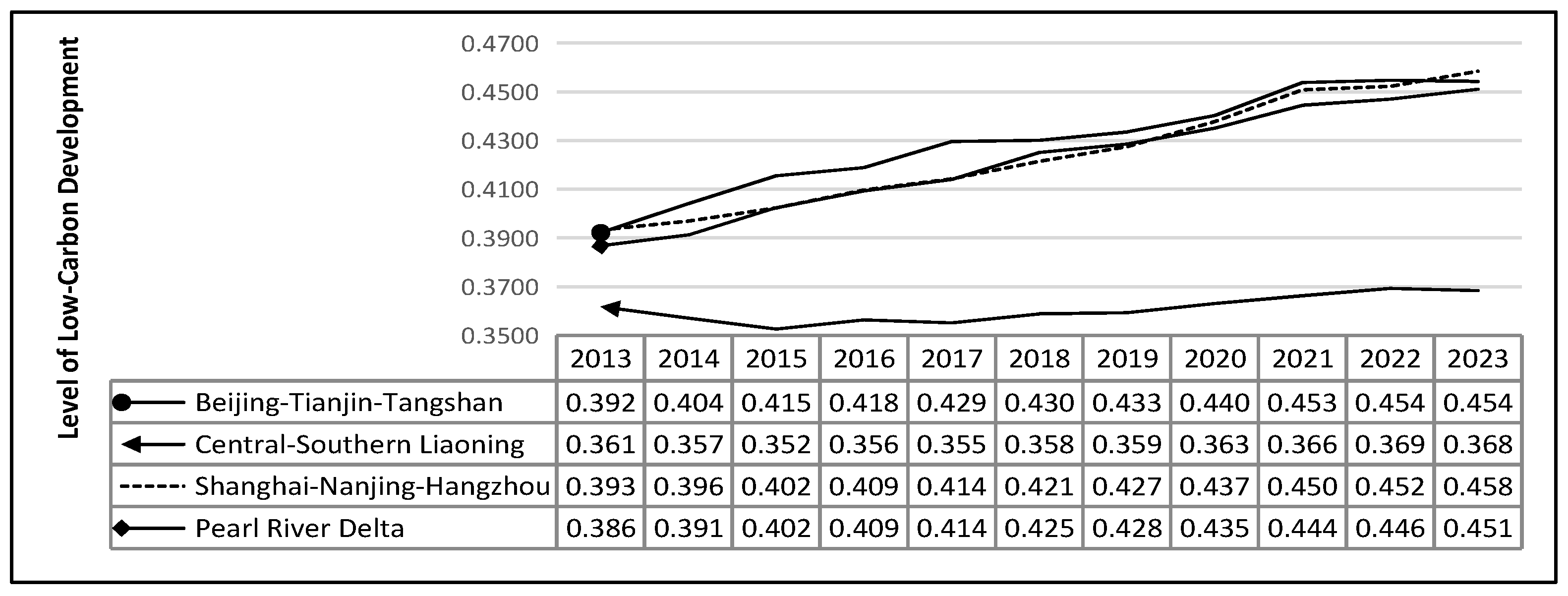
Figure 1 illustrates the trends in the LCT levels of China’s four major industrial bases from 2013 to 2023. Over the 11-year period, the LCT scores of the four industrial bases ranged between 0.35 and 0.46. The highest score (0.458) was recorded in the Shanghai–Nanjing–Hangzhou base in 2023, while the lowest (0.352) occurred in the Central-Southern Liaoning base in 2015. Moreover, over the 11-year period, the rankings of China’s four major industrial bases have been in dynamic flux. As shown in Table 4, the rankings of the Beijing–Tianjin–Tangshan base and the Shanghai–Nanjing–Hangzhou base have fluctuated over time. However, in recent years, the LCT levels of the industrial bases have generally exhibited the following order: Beijing–Tianjin–Tangshan > Shanghai–Nanjing–Hangzhou > Pearl River Delta > Central-Southern Liaoning. Notably, the LCT levels of the Shanghai–Nanjing–Hangzhou, Beijing–Tianjin–Tangshan, and Pearl River Delta industrial bases have generally exhibited a year-on-year upward trend, with the gaps among them gradually narrowing. In contrast, the Central-Southern Liaoning industrial base not only exhibited fluctuating transition levels but also experienced a widening gap compared with the other three bases. In 2013, the LCT level of the Central-Southern Liaoning base was 0.032 and 0.025 lower than those of the first- and third-ranked bases, respectively. By 2023, the differences with the first- and third-ranked bases had increased to 0.09 and 0.083, representing increases of 1.81 and 2.32 times, respectively.
The aforementioned phenomenon can be analyzed from two perspectives: natural location and human geography. In terms of natural location, the Central-Southern Liaoning industrial base is located in Liaoning Province, in the southern part of Northeast China, and is relatively distant from major coastal economic centers. Moreover, the province’s terrain is predominantly mountainous and hilly, which increases the cost of economic development and affects transportation convenience. In addition, Liaoning Province is rich in natural resources, with reserves of iron, diamonds, and talc ranking among the highest in China, while its oil and natural gas reserves account for 15% and 10% of the national total, respectively. This resource endowment has contributed to the historical prosperity of many heavy industrial cities in Liaoning but has also resulted in significant environmental degradation. From the perspective of human and regional factors, after the reform and opening-up and with changes in national policies and the southward shift of the economic focus, the economic growth momentum of Liaoning Province gradually weakened. Additionally, Liaoning lags behind the other three industrial bases in terms of transportation convenience, the number of higher education institutions, climate conditions, and wage levels, placing it at a disadvantage in attracting talent and promoting technological innovation, which ultimately affects the region’s level of LCT.

4.2.2. Specific Analysis

Table 5 presents the LCT levels of the Beijing–Tianjin–Tangshan industrial base from 2013 to 2023. Overall, the LCT level of this industrial base has shown a gradual upward trend, although the growth rate has been moderate. The level increased from 0.3922 in 2013 to 0.4542 in 2023, representing an increase of 15.8% over 11 years. A city-level examination shows that the LCT levels within the Beijing–Tianjin–Tangshan industrial base are unbalanced. Beijing’s LCT level is the highest among all cities and has consistently exhibited an upward trend, increasing by 41.15% over the 11-year study period. The other cities have shown fluctuating upward trends. Compared with 2013, the LCT levels of Tianjin, Tangshan, Qinhuangdao, and Langfang increased by 3.29%, 13.15%, 7.52%, and 8.41%, respectively, by 2023, which are all lower than the growth rate of Beijing. Moreover, the distance between Beijing and other cities has gradually increased. In 2013, the differences between Beijing and Tianjin, the second-ranked city, and Qinhuangdao, the lowest-ranked city, were 0.03 and 0.13, respectively. By 2023, these gaps had increased to 0.2 with Tianjin and 0.3 with Qinhuangdao, representing increases of 6.7 and 2.3 times in disparity, respectively.
The LCT levels of the Central-Southern Liaoning industrial base are shown in Table 6. Overall, from 2013 to 2023, the level of LCT in this industrial base exhibited a fluctuating upward trend, with its average level remaining below 0.4 over the 11-year study period. At the city level, compared with 2013, the LCT levels in Shenyang, Anshan, Fushun, Benxi, Dandong, Jinzhou, Liaoyang, Panjin, and Huludao increased by 2023, while the levels in Dalian, Yingkou, and Tieling decreased. The rankings of LCT levels among cities have changed continuously, but the top three cities each year have generally been Dalian, Shenyang, and Panjin. The differences in LCT levels among cities were relatively small: in 2013, the disparity between the highest- and lowest-ranked cities stood at 0.0845, and by 2023, the difference between the highest and lowest levels had narrowed to 0.0687.
The measurement results for the LCT of the Shanghai–Nanjing–Hangzhou industrial base are shown in Table 7. Overall, the level of LCT in this industrial base has increased year by year, consistently remaining under 0.45, with an increase of 15.38% in 2023 compared with 2013. Within the industrial base, the LCT levels of individual cities have increased annually. In 2023, three cities—Shanghai, Suzhou, and Hangzhou—recorded LCT levels above 0.5. The rankings of LCT levels among cities have fluctuated from year to year, but Shanghai has consistently ranked first over the 11-year study period. The second and third positions have alternated among Nanjing, Suzhou, and Hangzhou, while Taizhou and Huzhou have generally ranked lower.
Between 2013 and 2023, the LCT level of the Pearl River Delta industrial base increased year by year, with a 16.59% increase in 2023 compared to 2013. The detailed data are shown in Table 8. The average development level of this industrial base remained under 0.46 over the 11-year period. The LCT levels of the cities within the base all exhibit an upward trend. City rankings changed dynamically over time, but Guangzhou and Shenzhen consistently occupied the top two positions. Before 2015, Guangzhou ranked first; from 2015 onward, Shenzhen became the leading city and maintained this position through 2023. Jiangmen and Zhaoqing, in contrast, lagged behind, with LCT levels of 0.3857 and 0.3832, respectively, in 2023, both below the industrial base’s 11-year minimum of 0.3868. This phenomenon may be attributed to their locational disadvantages. Jiangmen and Zhaoqing are situated on the periphery of the Pearl River Delta region, at some distance from nodal cities such as Shenzhen, Guangzhou, and Zhuhai. Zhaoqing lies in the central-western part of Guangdong Province. Although its administrative area exceeds 15,000 square kilometers, the terrain is predominantly mountainous, with plains accounting for only about one-fifth of the area, constraining economic development. Jiangmen, known as the “China’s First Hometown of Overseas Chinese,” has plains covering approximately 60% of its administrative area, giving it more favorable terrain than Zhaoqing. However, to the east and north lies the wide Xijiang River, to the south the South China Sea, and to the west mountainous areas, all bordering the city and limiting its transportation connectivity with the core cities of the Pearl River Delta, constituting a significant constraint on its economic development.

4.3. Dynamic Evolution and Disparity Decomposition Analysis

4.3.1. Convergence Analysis

σ-Convergence Analysis
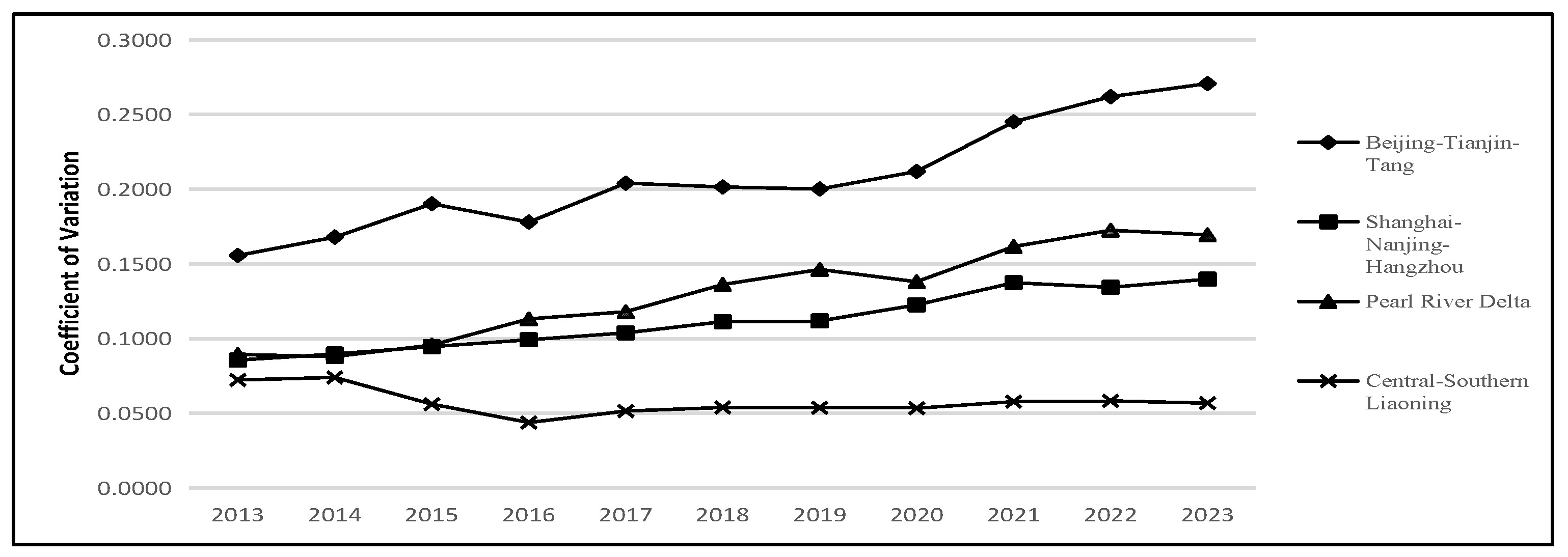
The results of the σ-convergence test for the LCT levels of China’s four major industrial bases from 2013 to 2023 are shown in Figure 2. The coefficients of variation for the Beijing–Tianjin–Tangshan, Shanghai–Nanjing–Hangzhou, and Pearl River Delta industrial bases show a continuous upward trend, indicating a widening gap between major cities and others in the region, reflecting σ-divergence. Among them, the Beijing–Tianjin–Tangshan industrial base has the highest coefficient of variation and the fastest growth rate, demonstrating significant internal inequality in LCT. As noted, Beijing—the nation’s political and tech hub—is a clear leader in LCT, with its level significantly above other cities in the sample and a steady growth rate throughout the study period. The trends in the coefficients of variation for the Pearl River Delta and Shanghai–Nanjing–Hangzhou industrial bases are highly similar, characterized by relatively developed regional economies with core cities whose LCT levels significantly exceed those of other cities in the region. The coefficient of variation for the Central-Southern Liaoning industrial base steadily declined between 2013 and 2016, indicating σ-convergence. This suggests that disparities in LCT levels within this industrial base narrowed and became more uniform over several years. However, after 2016, the coefficient of variation began to increase, indicating σ-divergence, although the disparity in LCT levels within this base remained the smallest among the four industrial bases.
Based on data from 2013 to 2023, although China has vigorously promoted its dual-carbon strategy, the level of internal coordination within the four major industrial bases still requires improvement. In the Beijing–Tianjin–Tangshan, Pearl River Delta, and Shanghai–Nanjing–Hangzhou regions, while striving to enhance overall performance, greater attention should be given to cities with relatively low levels of LCT to prevent widening disparities. The overall level of LCT in the Central-Southern Liaoning region also needs to be improved.
Conditional β-Convergence Analysis
Using Stata/MP 18.0 software, a conditional β-convergence test was conducted on the LCT levels of China’s four major industrial bases, and the regression results are reported in Table 9. The results show that the regression coefficients β for the Beijing–Tianjin–Tangshan, Central-Southern Liaoning, and Pearl River Delta industrial bases are all negative and statistically significant at the 1% level. This indicates that these regions exhibit significant conditional β-convergence characteristics, meaning that cities with lower initial levels demonstrate faster growth rates than leading cities, reflecting a clear catch-up effect and the presence of endogenous momentum to narrow internal development gaps. Among the three regions showing convergence, the Central-Southern Liaoning industrial base has the fastest convergence rate and the strongest internal catch-up effect, whereas the convergence rate of the Pearl River Delta industrial base is relatively slower than those of the other two.
It should be noted that β-convergence and σ-divergence are not contradictory; rather, they reveal different dimensions of “relative speed” and “absolute distance” in the growth process. β-convergence reflects the relative catch-up of cities with low initial levels in terms of growth rates—i.e., lagging cities grow faster. σ-divergence measures whether the absolute gap between cities is narrowing. In the Beijing–Tianjin–Tangshan industrial base, Beijing, as the core city of the region, not only had an initial LCT level significantly higher than other cities but also maintained a sustained leading growth trend under the combined effects of policy support, technological innovation, and industrial structural upgrading. Therefore, although cities such as Tangshan and Qinhuangdao show signs of catch-up in growth rates, the absolute gap has widened further due to the large initial gap with Beijing and Beijing’s own growth momentum. This phenomenon can be understood as: “lagging cities run faster, but the leading city started too far ahead, so the distance becomes even larger.”
Looking at the specific values, the LCT score gaps between Beijing and Tianjin and between Beijing and Qinhuangdao in 2013 were 0.03 and 0.13, respectively; by 2023, these gaps had widened to 0.2 and 0.3, respectively. Although the β-convergence coefficient for the Beijing–Tianjin–Tangshan region is significantly negative, indicating catch-up in growth rates among low-scoring cities, Beijing, leveraging its comprehensive advantages, achieved sustained leading growth, causing the absolute gap to increase rather than decrease during the catch-up process. This explains the intrinsic logic of the coexistence of β-convergence and σ-divergence and also confirms the “Matthew effect” in regional development.
In contrast, the regression coefficient for the Shanghai–Nanjing–Hangzhou industrial base is not statistically significant, indicating the absence of a significant catch-up effect within this region. The core reason is that core cities such as Shanghai and Hangzhou have reached high development levels, making it difficult for other cities to narrow the gap through simple catch-up mechanisms in the short term. This also explains the phenomenon of continuously widening development disparities within the region and corroborates the conclusions of the previous σ-convergence analysis.

4.3.2. Kernel Density Analysis

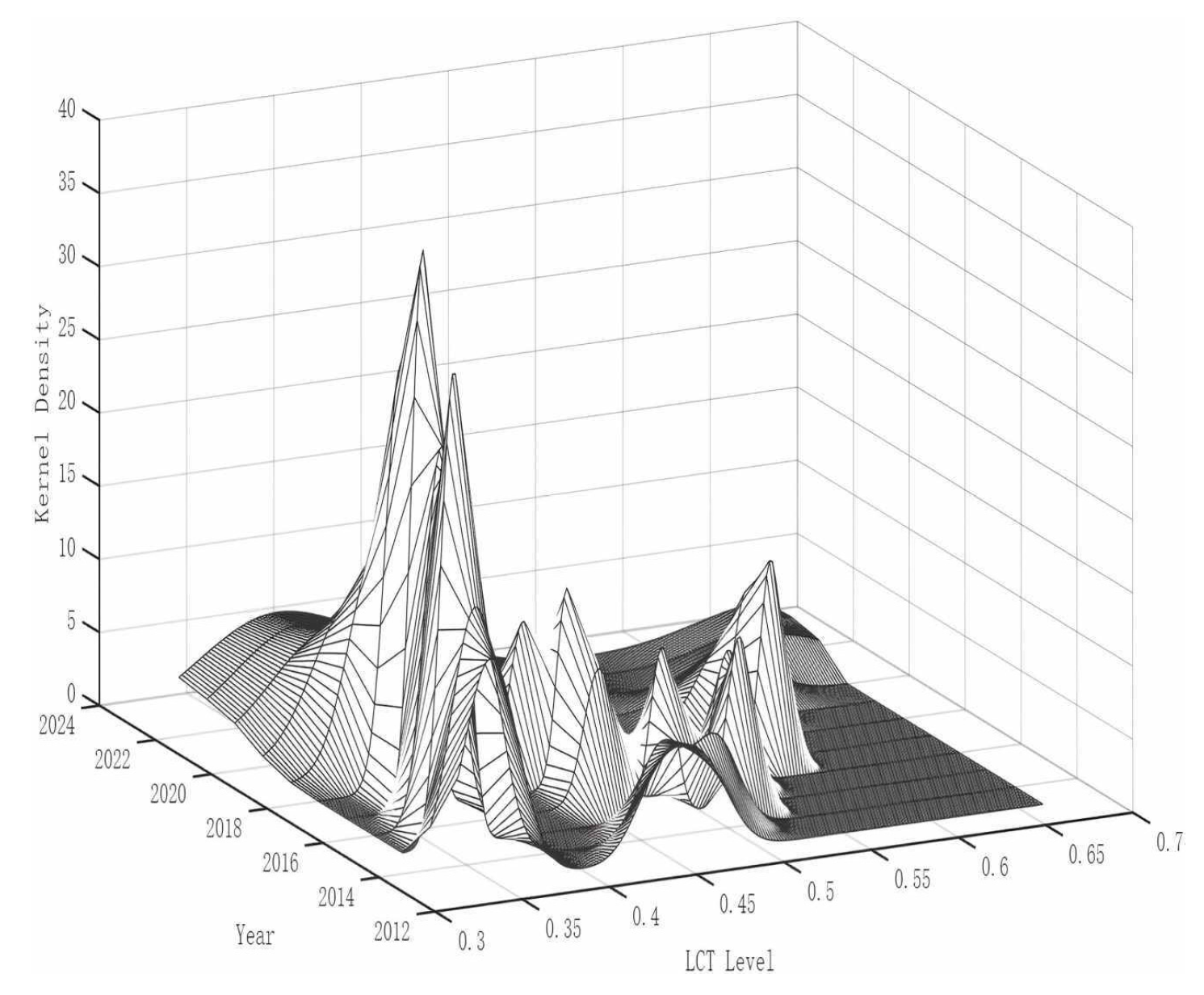
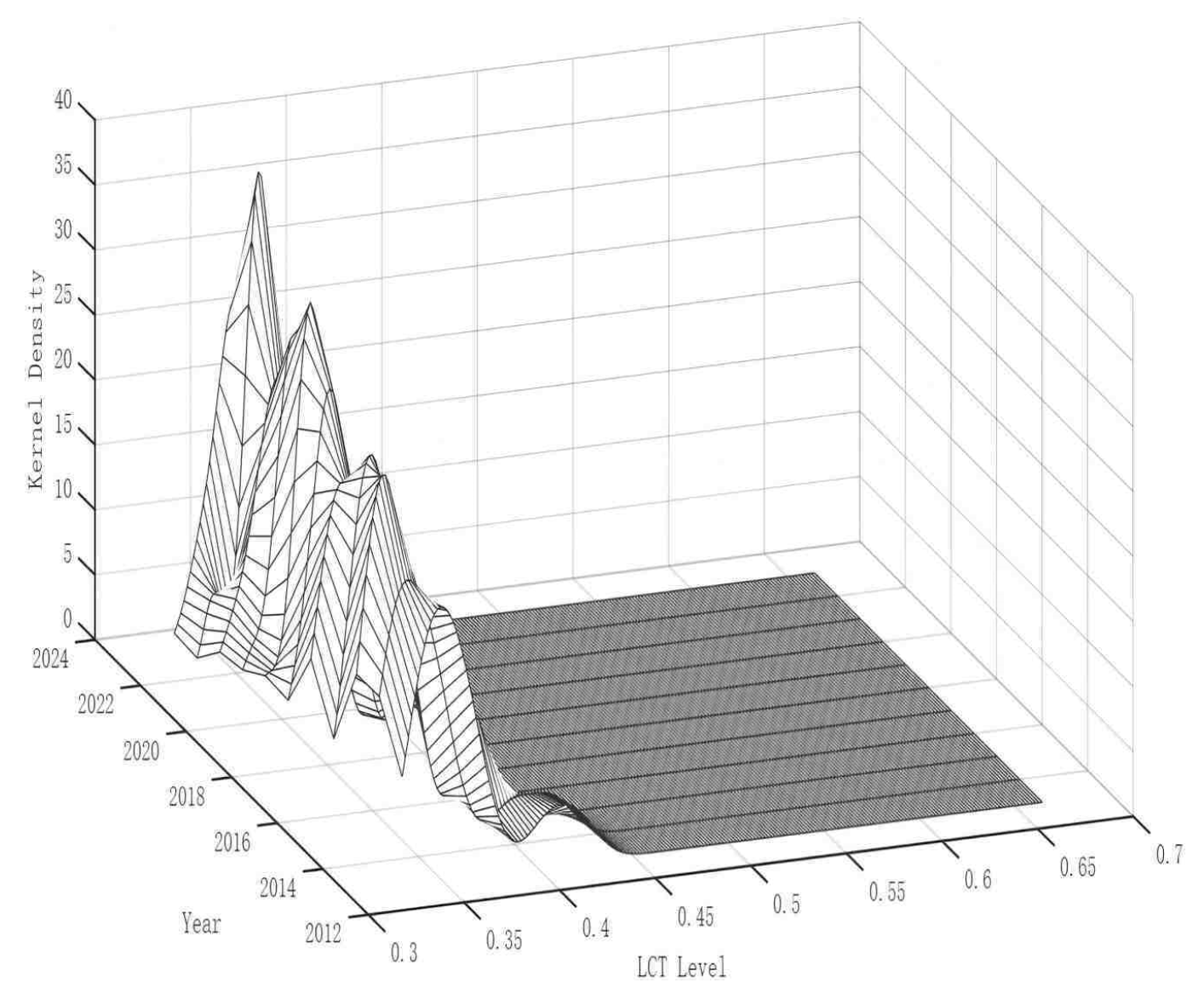
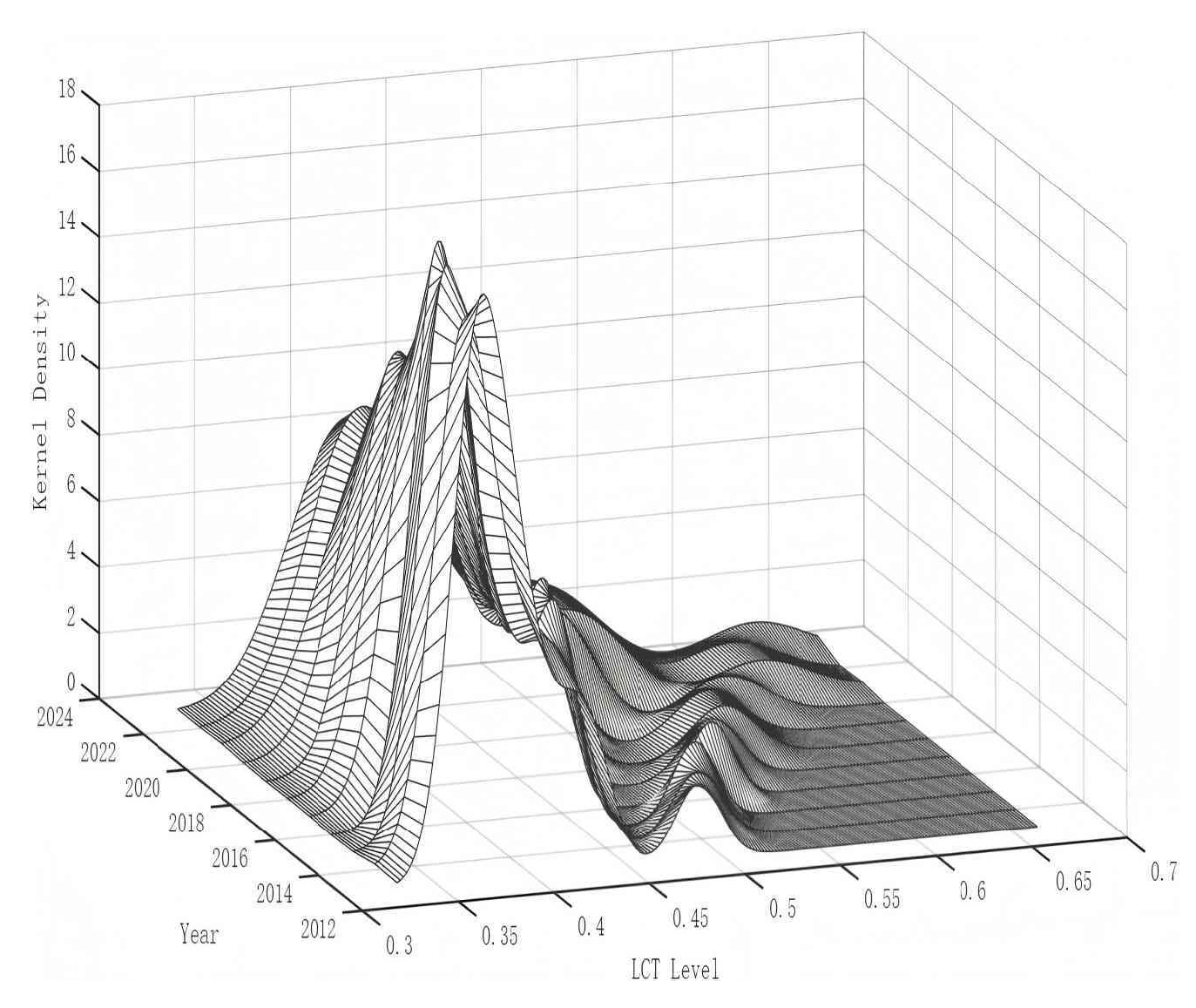
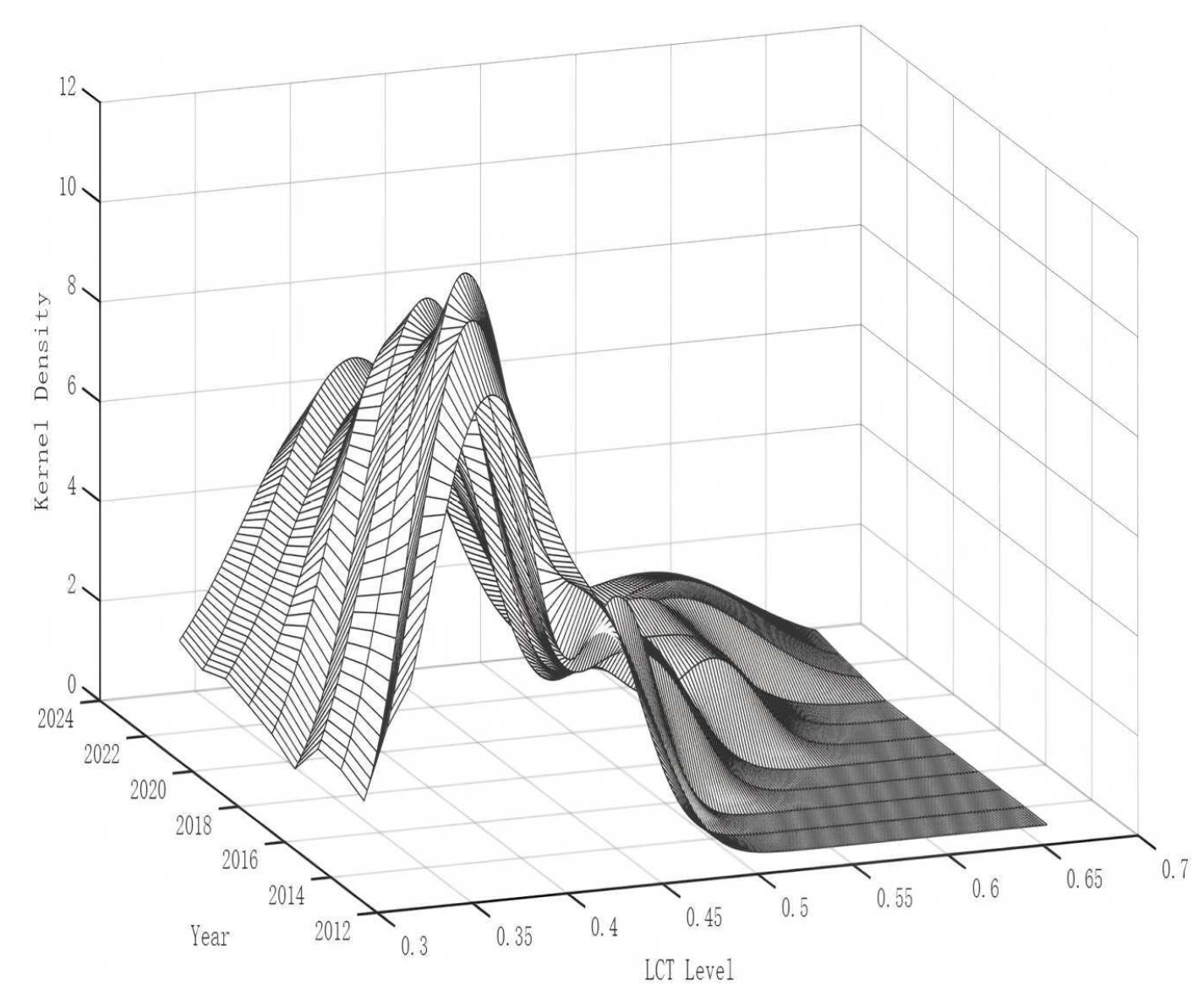
MATLAB R2025a software was utilized to generate three-dimensional kernel density plots of the low-carbon development levels from 2013 to 2023 for the four major industrial bases: Beijing–Tianjin–Tangshan, Shanghai–Nanjing–Hangzhou, the Pearl River Delta, and Central-Southern Liaoning, as shown in Figure 3, Figure 4, Figure 5 and Figure 6.
Figure 3 illustrates the dynamic evolution of the low-carbon development level of the Beijing–Tianjin–Tangshan industrial base. The main peak of the kernel density curve shows a significant rightward shift, and the peak interval in 2023 achieves a breakthrough, indicating remarkable progress in the LCT of the Beijing–Tianjin–Tangshan industrial base and an overall leapfrog improvement. In terms of distribution pattern, the kernel density curve gradually evolves from a single peak at the initial stage to a distinctly multi-peak structure, with a noticeably extended right-hand tail, reflecting a structural shift from relative balance to severe polarization. This “discontinuous” development pattern results from the significant disparities among cities within the region. As the political and technological innovation center, Beijing is pursuing a path characterized by deep optimization of its energy structure, the promotion of advanced green industries, and the use of finance and digital technologies to enhance governance efficiency. The city’s political resolve, resource endowments, and systemic innovations collectively facilitate a high-level LCT. Although cities such as Tangshan and Qinhuangdao show some catch-up momentum, constrained by industrial structure lock-in, technological path dependence, and a substantial initial development gap, their growth rates are insufficient to close the absolute gap with the core city. This results in a typical pattern of cumulative advantage in the region—where the leading city’s advantage continues to strengthen, and internal development disparities keep widening.
Figure 4 illustrates the dynamic evolution characteristics of low-carbon development levels in the Shanghai–Nanjing–Hangzhou industrial base. A significant rightward shift of the kernel density curve’s main peak and flattening trend are observed. From 2013 to 2023, the main peak achieved substantial breakthroughs, reflecting the region’s strong transition momentum and its position as a low-carbon leader nationally, with continuous improvements in low-carbon development levels. The main peak first rises, then declines in height, while its width first narrows and then widens, indicating that disparities in low-carbon development levels initially decreased but later began to widen. In addition, the kernel density curve exhibits a noticeable right-tail phenomenon, suggesting that some areas have low-carbon development levels far exceeding those of other cities. This pattern is primarily due to core cities such as Shanghai, Suzhou, and Hangzhou leveraging strong technological innovation capabilities and digital economy advantages to continuously raise the upper limits of regional development. Although surrounding cities have made steady progress in their transitions, their development pace cannot match that of the core cities. It is worth noting the difference between this region and the Beijing–Tianjin–Tangshan region: the “right tail” in the Shanghai–Nanjing–Hangzhou region does not stem from resource misallocation but rather from innovation-driven “head spillover” that has not yet fully translated into “inclusive growth.” This region is in a deepening phase of transition from factor-driven to innovation-driven development, where core cities break through first, but the time lag in innovation diffusion has led to a recent widening of internal disparities.
Figure 5 illustrates the dynamic evolution of the low-carbon development level in the Pearl River Delta industrial base. The kernel density curve begins at the highest point, with a high curve centroid, indicating that the region’s LCT level is higher than those of the other three industrial bases. In terms of morphology, the curve exhibits a pronounced right skew, with a long tail extending from the main peak and the emergence of secondary peaks. The essence of this morphological evolution is the formation of a coordinated development pattern of “core leadership and echelon follow-up” in the region. As central cities, Shenzhen and Guangzhou lead the nation in green finance, high-end manufacturing, and low-carbon pilot initiatives, producing a pronounced high-value tail effect. Manufacturing hubs such as Foshan and Dongguan, benefiting from the spillover effects of industrial upgrading, closely follow, forming a strong supporting backbone. Unlike the “discontinuous” polarization in Beijing–Tianjin–Tangshan, the distribution pattern of the Pearl River Delta exhibits relatively continuous gradient characteristics, reflecting the region’s stronger integration capacity in industrial coordination, technology diffusion, and infrastructure connectivity. This enables high-value areas to more effectively drive the development of surrounding cities through the transmission mechanisms of industrial and innovation chains.
Figure 6 illustrates the dynamic evolution of low-carbon development in the Central-Southern Liaoning industrial base. Compared with the other industrial bases, its kernel density curve exhibits a pronounced left-skewed and tall-narrow profile. Although the curve shifts to the right, the overall LCT level remains relatively low. Morphologically, the curve consistently maintains a sharp unimodal shape, indicating relatively minor internal variation. The underlying reason for this morphological feature is that, as a typical old industrial base, its industrial structure is dominated by heavy and chemical industries, facing structural constraints such as aging equipment, high resource dependence, and insufficient technological innovation capacity. Unlike the Beijing–Tianjin–Tangshan region, which has an absolute leading city like Beijing, or the Shanghai–Nanjing–Hangzhou region, which has innovation core cities, the Central-Southern Liaoning region lacks a “bellwether” city that can break through and raise the development ceiling. Most cities in the region face similar transition difficulties, presenting an overall characteristic of “low-level equilibrium.” This “lockstep” transition path, while exhibiting small internal disparities in the short term, also reflects the region’s practical difficulty in lacking breakthrough growth points, with relatively insufficient endogenous momentum for LCT.
In summary, between 2013 and 2023, the LCT levels across China’s four major industrial bases exhibited a significant overall upward trend, yet uneven development both between and within regions remained pronounced. The Shanghai–Nanjing–Hangzhou and Pearl River Delta industrial bases achieved rapid improvements in LCT through innovation-driven approaches, establishing a clear leading advantage, whereas the Central-Southern Liaoning base lagged due to insufficient transition momentum. At the intra-regional level, each base displays distinct structural characteristics. The kernel density curve of the Beijing–Tianjin–Tangshan base exhibits a typical multi-peak pattern, reflecting a pronounced discontinuous polarization between Beijing and the surrounding heavy industrial cities. The Shanghai–Nanjing–Hangzhou curve shows noticeable flattening and right-skewness, indicating that core cities maintain substantially higher LCT levels than other cities. The Pearl River Delta industrial base demonstrates high right-skewness, suggesting synergistic growth among its cities. In contrast, the Central-Southern Liaoning curve is narrow and single-peaked, indicating a relatively low overall level of LCT. These findings suggest that promoting the LCT of manufacturing clusters requires not only quantitative improvements but also targeted strategies to address polarization and lag, tailored to the structural characteristics of each industrial base.

4.3.3. Theil Index Analysis

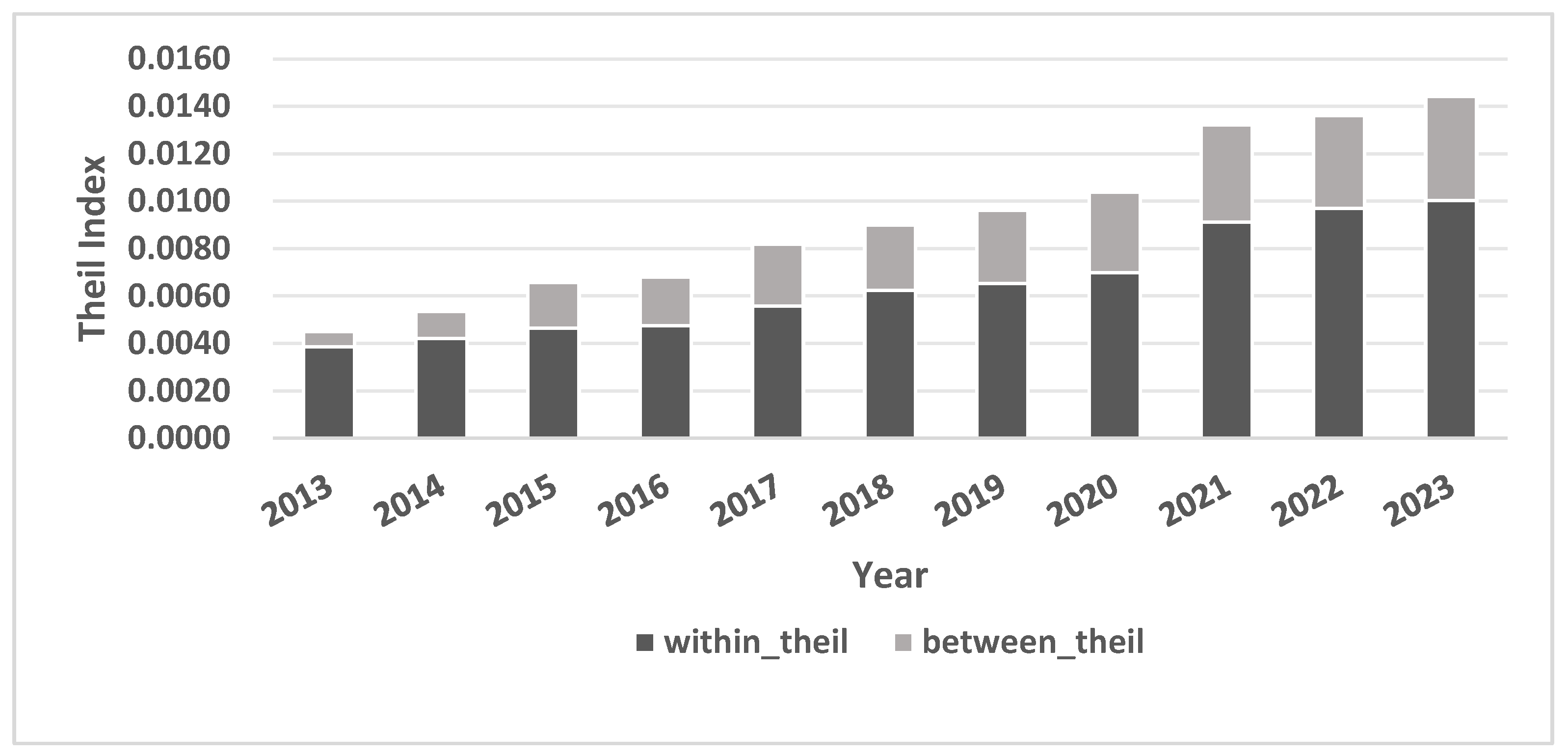
To further identify the sources of disparities in LCT among the four major industrial bases, this study employs the Theil index to decompose the overall disparity into two components: inter-base disparity and intra-base disparity.
As shown in Figure 7, the overall Theil index of LCT across China’s four major industrial bases continued to rise from 2013 to 2023, indicating a deepening imbalance in development among the bases. The decomposition results reveal that intra-base disparity has consistently been the dominant source of the overall disparity, yet the contribution share of inter-base disparity has gradually increased, rising from 14.05% in 2013 to 30.45% in 2023. This suggests that, over time, development divergence among different industrial bases has also intensified.
This finding is consistent with the “widening overall gap” revealed by the previous σ-convergence analysis but further clarifies the structural sources of this widening: the current imbalance in LCT is characterized by a pattern in which intra-base disparity dominates while inter-base disparity is on the rise.
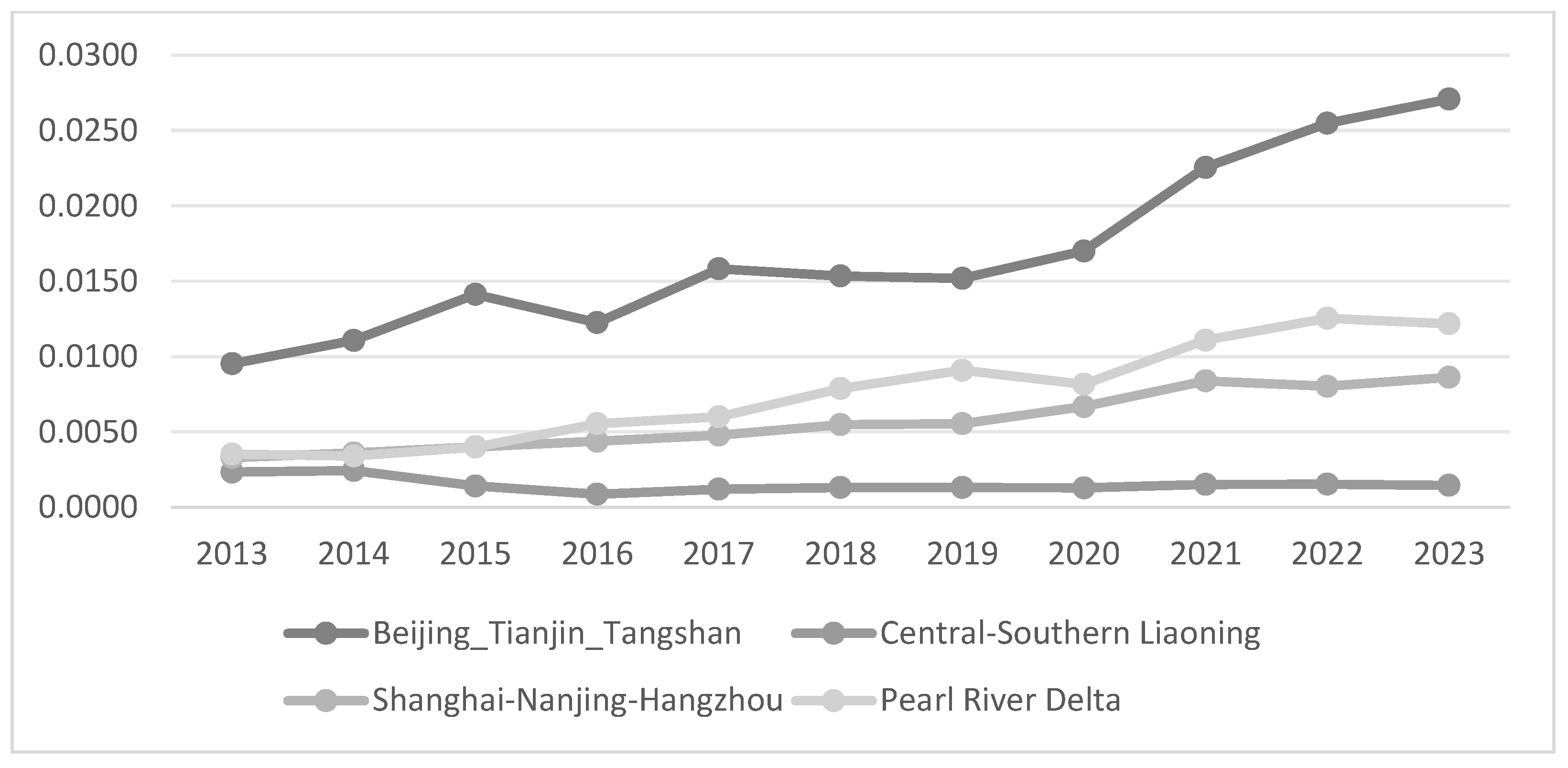
As shown in Figure 8, the degree of internal imbalance varies significantly across industrial bases. The Beijing–Tianjin–Tangshan industrial base exhibits the highest intra-base Theil index and a relatively rapid growth trend, indicating that its internal development imbalance is the most prominent. In contrast, the Central-Southern Liaoning industrial base maintains a consistently low intra-base Theil index with small fluctuations, suggesting relatively limited internal disparities. The Shanghai–Nanjing–Hangzhou and Pearl River Delta industrial bases show moderate levels of internal disparity, with a gradual upward trend.
Combined with the previous β-convergence results, it is evident that although some regions exhibit a significant “catch-up effect,” this relative convergence in growth rates has not translated into a reduction in absolute gaps; rather, it has been accompanied, to some extent, by an expansion of internal imbalances. This phenomenon further suggests that relying solely on spontaneous catch-up mechanisms is insufficient for achieving coordinated regional development, and that institutional guidance remains necessary.

4.4. Robustness Analysis

4.4.1. Sensitivity Analysis of Key Parameters

The above analysis is based on the LCT levels calculated under the baseline scenario, in which all key parameters are set to 0.5. To test the sensitivity of the evaluation results to parameter specifications, this study conducts a sensitivity analysis focusing on the mixing coefficient η in the combined weighting method, the distinguishing coefficient ρ in the grey relational analysis, and the combined weight α 1 , α 2 of the grey relational degree and the Euclidean distance. Specifically, the mixing coefficient η is set to 0.2 and 0.8, respectively; the distinguishing coefficient ρ of grey relational analysis is set to 0.1 and 0.9, respectively; and the weight α 1 , α 2 of the grey relational degree relative to the Euclidean distance is adjusted to 0.2 and 0.8 in turn. Based on these alternative specifications, the LCT scores of each city are recalculated, and the results under each scenario are compared with those under the baseline scenario using Spearman’s rank correlation test, in order to assess the consistency and robustness of the results across different parameter settings.
The test results are shown in Table 10. Spearman’s rank correlation coefficients under all scenarios are higher than 0.98, indicating that parameter variations do not substantially affect the ranking of cities’ LCT levels. Thus, the evaluation results are not sensitive to parameter specifications and demonstrate good robustness.

4.4.2. Alternative Weighting Schemes

To further test the robustness of the evaluation results to alternative weight specifications, this study selects three alternative weighting schemes—equal weights, single entropy weight, and single CRITIC weight—representing no prior weighting and two typical objective weighting approaches, respectively. Based on different logics of weight generation, a comparative analysis is conducted, and the LCT level of each city is recalculated accordingly. The results are then compared with those under the baseline scenario using Spearman’s rank correlation test.
The test results are shown in Table 11. Spearman’s correlation coefficients between the results obtained under the three alternative weighting schemes and those under the baseline scenario are all higher than 0.98, indicating that the relative ranking of cities’ LCT levels remains highly consistent across different weight specifications. This suggests that the evaluation results are not dependent on a specific weighting structure and exhibit strong robustness.

4.4.3. Cross-Method Validation with VIKOR

To test whether the evaluation results are dependent on a specific multi-criteria decision-making (MCDM) method, this study further employs the VIKOR method [35] to re-evaluate the sample. The VIKOR method, like TOPSIS, is an MCDM approach but differs in its ranking mechanism. Spearman’s rank correlation test is conducted between the VIKOR results and those under the baseline scenario to examine the consistency and robustness of the evaluation results across different methodological frameworks.
After calculating the LCT levels under the VIKOR method, they are compared with the baseline scenario results. Spearman’s rank correlation coefficient between the two is 0.9875, indicating that the evaluation results are highly consistent across different methodological frameworks and that the study’s conclusions are robust.

4.4.4. Robustness Analysis for Indicators with High Missing Rates

To enhance data transparency, this study reports the missing rate of each indicator and the corresponding imputation method. A robustness test is conducted for indicators with high missing rates. The missing rates of all indicators are shown in Table 12. Given that some indicators required imputation via interpolation or linear extrapolation, which may affect the results, a sensitivity analysis of indicator selection is further conducted. Specifically, to examine the impact of indicators with high missing rates across different dimensions on the measurement results, the robustness analysis is divided into four scenarios:
(i)
removing ×11: Industrial Soot Emission Intensity (from the environmental protection dimension);
(ii)
removing ×13: Comprehensive Utilization Rate of Industrial Solid Waste (from the resource utilization dimension);
(iii)
removing both ×11: Industrial Soot Emission Intensity and ×13: Comprehensive Utilization Rate of Industrial Solid Waste; and
(iv)
removing all indicators with missing rates higher than 5%, namely the following indicators: ×9: Industrial SO2 Emission Intensity, ×10: Industrial Wastewater Emission Intensity, ×11: Industrial Soot Emission Intensity, and ×13: Comprehensive Utilization Rate of Industrial Solid Waste.
For each scenario, the evaluation system is reconstructed, the LCT levels are recalculated, and the results are compared with those under the baseline scenario using Spearman’s rank correlation test.
The test results are shown in Table 13. Under all four scenarios, Spearman’s correlation coefficients between the recalculated LCT levels and those under the baseline scenario are all above 0.98, indicating that the ranking of cities remains highly consistent even when the indicator system is altered. This suggests that the evaluation results of this study do not depend on specific indicator selections and exhibit strong robustness.

4.4.5. Aggregation Sensitivity Analysis

In the baseline analysis, city-level LCT scores were aggregated to the industrial base level using the simple average method. Considering that the industrial scale varies considerably across cities, the simple average may not accurately reflect the overall performance of each industrial base. This study further adopts a weighted average approach based on industrial added value to aggregate city-level LCT scores, recalculates the comprehensive scores for each industrial base, and conducts Spearman’s rank correlation test between the results and those under the baseline scenario.
The test results show that Spearman’s rank correlation coefficient between the industrial base-level scores calculated under the two different aggregation methods is 0.9903, indicating a very strong consistency in the ranking sequences. Therefore, the choice of aggregation method does not affect the evaluation results of the LCT levels of industrial bases in this study.

5. Further Analysis

5.1. Mechanism Analysis

To identify the mechanism through which resource-based cities influence LCT, this study incorporates city type (resource-based vs. non-resource-based) as an important heterogeneity dimension into the analytical framework. Existing studies have shown that classifying cities by resource endowment is highly significant for revealing differences in LCT. Resource-based cities, due to their high degree of resource dependence, generally face challenges such as a singular industrial structure, insufficient technological innovation, and low energy utilization efficiency, exhibiting significant structural constraints in the LCT process [36,37]. To identify the impact of resource-based cities on LCT levels, this study constructs the following panel regression model:
L C T it = α + β r e s o u r c e i + γ X i t + μ i + λ t + ε i t
In the model, r e s o u r c e i is the resource-based city dummy variable (set according to the Notice on Issuing the National Sustainable Development Plan for Resource-based Cities (2013–2020) by the State Council; 1 for resource-based cities, 0 otherwise), X i t represents control variables including Per Capita GDP (ln_×1) and Actual Utilization of Foreign Direct Investment (ln_×4), μ i and λ t denote city fixed effects and year fixed effects respectively, and ε i t is the random error term. A significantly negative β indicates that resource-based cities have significantly lower LCT levels than non-resource-based cities.
Moreover, when examining the transmission mechanisms of LCT, existing studies typically consider Industrial Structure, Technological Innovation, and Energy Efficiency as key channels [38,39]. Therefore, based on the classification of resource-based and non-resource-based cities, this study further takes Proportion of the Tertiary Industry (as a proxy for industrial structure), Expenditure on Science and Technology (as a proxy for technological innovation), and Energy Consumption per 10,000 yuan of Industrial Added Value (as a proxy for energy efficiency) as dependent variables to examine the impact of resource-based cities on these intermediate variables:
M it = α + β r e s o u r c e i + γ X i t + μ i + λ t + ε i t
In the above model, M it takes each of the three intermediate variables in turn, which helps to identify the specific pathways through which resource-based cities experience delayed LCT.
The baseline regression results are presented in Table 14. The coefficient of the resource-based city variable is negative in both the pooled OLS model and the random-effects model, and it is significant at the 1% level in the random-effects model. This indicates that, after controlling for economic development level and degree of openness, resource-based cities exhibit significantly lower LCT levels than non-resource-based cities. This finding is consistent with the previous analysis, suggesting that resource-based cities, due to their long-term dependence on resource exploitation, face more pronounced structural constraints and are therefore at a relative disadvantage in the LCT process. For instance, in the Central-Southern Liaoning industrial base, the high proportion of resource-based cities partially explains the relatively low overall LCT level observed in the region.
Building on the baseline regression, this study further examines the specific pathways through which resource endowment affects LCT from three dimensions: technological innovation, industrial structure, and energy efficiency.
Regarding technological innovation, the coefficient of the resource variable is negative and passes the 10% significance level test, indicating that resource-based cities exhibit relative underinvestment in technological innovation. This phenomenon may stem from the long-term dependence of resource-based cities on resource-intensive industries, whose economic structure exerts a strong absorption effect on capital and credit resources, thereby crowding out R&D investment to some extent. Insufficient technological innovation capacity weakens the endogenous momentum for LCT.
In terms of industrial structure, the coefficient of the resource variable is significantly negative, passing the 1% significance level, suggesting that, after controlling for other factors, the share of the tertiary industry in resource-based cities is significantly lower than that in non-resource-based cities. This reflects the prevalent issue of industrial structure bias and strong path dependence in resource-based cities. In regions dominated by heavy industry, adjusting the industrial structure entails high transformation costs and institutional inertia, which constrains the LCT process.
For energy efficiency, the coefficient of the resource variable is positive but fails to pass the significance test. This indicates that resource-based cities tend to have higher energy consumption per 10,000 yuan of industrial added value compared with non-resource-based cities, though the difference is not statistically robust. Nevertheless, the positive direction of the estimate suggests that resource-based cities still exhibit certain high-energy-consumption characteristics, implying higher adjustment costs in advancing LCT. For example, in the Central-Southern Liaoning industrial base, where heavy industry is predominant and the energy structure is rigid, cost constraints in the transformation process are particularly prominent.
Overall, resource-based cities affect LCT through multiple pathways: industrial structure bias and path dependence limit the space for structural optimization; insufficient technological innovation weakens the endogenous momentum for transition; and high energy consumption further increases transformation costs. The combined effects of these mechanisms constitute a key reason for the relative lag of LCT in traditional industrial bases. This not only provides empirical evidence for the regional disparities identified earlier but also offers practical guidance for formulating differentiated LCT policies.

5.2. Scenario Simulation

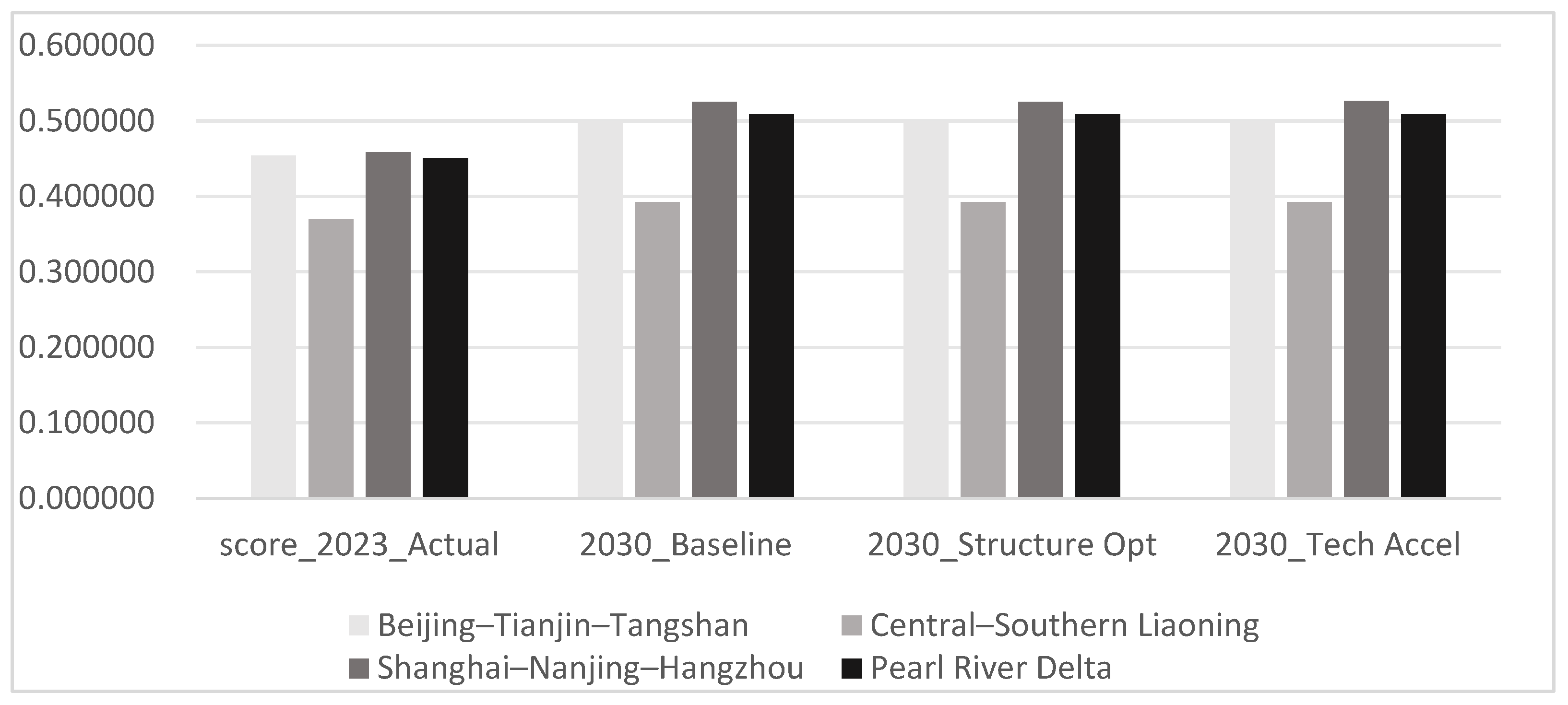
The mechanism analysis results indicate that the primary constraints on the LCT of resource-based cities are rigid industrial structures and insufficient investment in technological innovation. Based on these findings, this study designs the following three scenarios to simulate the LCT levels of China’s four major industrial bases in 2030 under different policy interventions:
(i)
Baseline Scenario: The industrial structure (proportion of the tertiary industry) and technological innovation (expenditure on science and technology) of each city are projected forward according to their historical compound annual growth rates (CAGR) observed during 2013–2023. The LCT level of each city in 2030 is then calculated based on these projected values.
(ii)
Industrial Structure Optimization Scenario: In resource-based cities, the CAGR of the proportion of the tertiary industry is increased by 50% relative to its historical value during 2013–2023, while other cities are projected forward according to the baseline scenario.
(iii)
Technological Innovation Acceleration Scenario: In resource-based cities, the CAGR of expenditure on science and technology is increased by 30% relative to its historical value during 2013–2023, while other cities are projected forward according to the baseline scenario.
The specific calculation steps for the policy scenario simulation are as follows:
(1)
Estimate the relationship between city-level LCT scores and the core driving variables (industrial structure and technological innovation) using the fixed-effects model:
L C T it = α + β 1 S t r u c t u r e i t + β 2 I n n o v a t i o n i t + δ X i t + μ i + λ t + ε i t
Here, S t r u c t u r e i t and I n n o v a t i o n i t represent the variables for industrial structure and technological innovation, respectively; μ i and λ t denote city fixed effects and year fixed effects, respectively; and ε i t is the random error term.
(2)
Calculate the historical compound annual growth rates of the industrial structure and technological innovation variables for each city during 2013–2023:
g i = V 2023 V 2013 1 / 10 1
(3)
Set up the three scenarios: baseline (historical growth rates unchanged), industrial structure optimization, and technological innovation acceleration. Project the core driving variables forward based on their historical growth rates or policy-specified adjustments:
Z i , 2030 = Z i , 2023 × ( 1 + g i ) t
where g i represents the CAGR of the variable, and t is the length of the forecast period.
(4)
Substitute the adjusted core driving variables into the estimated coefficients from step 1 to predict the LCT level of each city in 2030 and then aggregate the results to the industrial base level.
Figure 9 presents the actual LCT levels of China’s four major industrial bases in 2023 and the projected LCT levels in 2030 under the three policy scenarios. Overall, under the baseline scenario, LCT scores of all industrial bases improve compared with 2023, with the Shanghai–Nanjing–Hangzhou Industrial Base showing the most notable increase (from 0.4584 to 0.5253).
Regarding the effects of policy interventions, the Industrial Structure Optimization Scenario produces a modest positive effect in resource-based regions. The LCT level of the Central-Southern Liaoning Industrial Base rises from 0.3923 in the baseline scenario to 0.3928, an increase of approximately 0.0005; the Beijing–Tianjin–Tangshan Industrial Base also shows slight improvement. Although the magnitude of change is small, the direction aligns with expectations, indicating that while industrial structure adjustments may not yield dramatic effects in the short term, they remain a feasible path for the transformation of resource-based cities.
The Technological Innovation Acceleration Scenario leads to a relatively more pronounced improvement in the Shanghai–Nanjing–Hangzhou Industrial Base, with the score increasing from 0.5253 in the baseline scenario to 0.5261, an increment of approximately 0.0008. By contrast, the Central-Southern Liaoning and Beijing–Tianjin–Tangshan Industrial Bases show minimal gains under this scenario, likely due to their weaker innovation foundations, meaning that translating R&D investment into tangible LCT outcomes requires more time.
It is noteworthy that the Pearl River Delta Industrial Base maintains an unchanged projected score of 0.5087 across all policy scenarios, as no resource-based cities are located within this base. This confirms the targeted design of the policy scenarios, since interventions do not exert direct effects where resource dependency is absent.
Based on the results of the policy scenario simulation, several policy implications can be derived. First, although industrial structure optimization represents a necessary pathway, its short-term effects are limited, indicating the importance of sustained long-term implementation. Second, technological innovation is more effective in industrial bases with stronger foundational capacity, suggesting the need for differentiated regional support. Third, policy interventions should be designed to accurately identify key targets, such as resource-based cities, rather than adopting a one-size-fits-all approach. Fourth, LCT is inherently a long-term process, requiring the continuity and stability of policy frameworks.

6. Conclusions

6.1. Main Findings

Industrial bases serve as spatial carriers of highly concentrated manufacturing activities and pivotal regions for implementing national sustainable development strategies. The LCT level of the manufacturing sector generally corresponds with that of the industrial base. This study examined China’s four major industrial bases from 2013 to 2023, establishing a comprehensive evaluation system for measuring the LCT of manufacturing clusters. The system comprises 19 specific indicators across four dimensions: economic growth, environmental protection, resource utilization, and low-carbon technologies. Based on this framework, the entropy–CRITIC combination weighting method is used to objectively assign weights to each indicator, and the grey relational-TOPSIS method is employed to measure the LCT levels of China’s four major industrial bases. In addition, convergence analysis and kernel density estimation are conducted on the LCT levels of the four industrial bases, and further extended analyses are performed from the perspectives of disparity decomposition, mechanism analysis, and scenario simulation. The key findings are as follows: (1) The influence of the four dimensions on the LCT level of China’s industrial bases is ranked as follows: low-carbon technology > economic growth > environmental protection > resource utilization. (2) The LCT levels of China’s four major industrial bases exhibit an upward trend. (3) In recent years, the LCT levels of the four major industrial bases have followed this order: Beijing–Tianjin–Tangshan > Shanghai–Nanjing–Hangzhou > Pearl River Delta > Central-Southern Liaoning. The gap among the Shanghai–Nanjing–Hangzhou, Beijing–Tianjin–Tangshan, and Pearl River Delta bases is gradually narrowing, whereas the gap between Central-Southern Liaoning and the other three bases is widening. (4) The LCT levels vary among cities within each industrial base, with central cities generally exhibiting higher levels and peripheral cities lower levels. This pattern is particularly evident in the Beijing–Tianjin–Tangshan industrial base. (5) The LCT levels within China’s four major industrial bases generally exhibit σ-divergence, while the Beijing–Tianjin–Tangshan, Central-Southern Liaoning, and Pearl River Delta bases show conditional β-convergence. This indicates that although a “catch-up effect” in the growth rate of LCT levels exists within some industrial bases, the disparity among cities is widening. (6) Further decomposition using the Theil index reveals that the overall disparity mainly originates from intra-base imbalances. Among them, the Beijing–Tianjin–Tangshan industrial base shows a clear trend of widening disparities, reflecting certain polarization characteristics; the Central-Southern Liaoning industrial base has long maintained a relatively low-level equilibrium; and the Shanghai–Nanjing–Hangzhou and Pearl River Delta bases exhibit moderate expansion of internal disparities, which corroborates the findings of the kernel density analysis. (7) The mechanism analysis results show that resource-based cities lag in LCT, primarily constrained by a rigid industrial structure, with insufficient investment in technology also constituting an important influencing factor, while the role of energy efficiency is relatively limited. (8) The results of the policy scenario simulation indicate that, in the short term, the improvement in LCT levels brought about by different policy interventions is overall limited, but significant regional differences are observed: industrial structure optimization has a certain ameliorative effect on resource-based regions, whereas investment in technological innovation yields more pronounced effects in regions with better foundational capacity.

6.2. Policy Implications

Based on the results of the LCT measurement, mechanism analysis, and policy scenario simulation presented above, this study proposes the following policy recommendations from three perspectives: technology-driven development, regional heterogeneity, and coordinated governance.
(1)
Focus on the core driver and establish a full-chain low-carbon technology innovation ecosystem. The weighting results indicate that low-carbon technology is the primary driver of LCT, while the mechanism analysis further reveals that resource-based cities suffer from a notable deficiency in R&D investment, which constrains their transition capacity. Therefore, technological innovation must be prioritized as a key lever for LCT, with efforts directed toward establishing a full-chain low-carbon technology innovation ecosystem. Specifically, first, the green finance support system must be improved by expanding financing channels such as green credit and green bonds to channel capital into low-carbon technology sectors. Second, talent supply must be strengthened by reinforcing the cultivation of professionals in key fields through universities and research institutions, while promoting industry–university–research collaboration. Third, technology transfer efficiency must be enhanced by facilitating the deployment of low-carbon technologies through demonstration projects and application scenarios, thereby shortening the cycle from R&D to application.
(2)
Implement differentiated LCT strategies based on regional heterogeneity. Both the empirical results and scenario simulations reveal significant differences among industrial bases in terms of transition foundations and policy responsiveness. A one-size-fits-all policy approach should therefore be avoided. For resource-dependent regions such as Central-Southern Liaoning, the focus should be on industrial structure adjustment, gradually reducing reliance on traditional resource-based industries and fostering alternative industries and modern services. Although the simulation results indicate limited improvement in the short term, structural optimization remains a critical pathway for enhancing LCT levels in the long run. For the Beijing–Tianjin–Tangshan region, particular attention should be paid to internal development imbalances, with measures such as relocating non-core functions of the central city and jointly establishing industrial platforms to strengthen the driving effect on surrounding cities. For developed regions such as Shanghai–Nanjing–Hangzhou and the Pearl River Delta, the innovation-driven advantage should be further reinforced by increasing investment in green technology R&D and promoting technology diffusion to facilitate coordinated improvements in surrounding areas.
(3)
Break down administrative barriers and establish a coordinated governance mechanism for factor flows. The convergence analysis and Theil index decomposition indicate a general trend of widening disparities within industrial bases, with pronounced polarization between central cities and peripheral cities. Therefore, it is necessary to strengthen regional coordination mechanisms. First, optimize industrial division and collaboration. Intercity industrial cooperation platforms should be established, enabling central cities to gradually transfer general manufacturing industries while peripheral cities undertake industries aligned with their endowments, forming an efficient division system of “R&D in the core, manufacturing in the periphery.” Second, enhance transportation infrastructure networks. A transportation network centered on rail transit should be developed to achieve the integration of rail, road, information, and logistics networks, facilitating the flow of people, goods, and information, reducing the diffusion cost of low-carbon technologies, and expanding the radiation radius of central cities. Third, promote the equalization of public services. Infrastructure in less developed cities should be improved, social welfare protections strengthened, and regional sharing of educational and medical resources advanced. By establishing benefit-sharing and ecological compensation mechanisms, peripheral cities that undertake industrial transfers can receive fair compensation, thereby achieving coordinated regional development and empowering sustainable economic growth in China.
(4)
Anchor long-term goals and maintain the continuity and stability of LCT policies. The results of the policy scenario simulation show that, in the short term, the improvement in LCT levels resulting from various policies is overall limited, indicating that the transition process is inherently gradual. Therefore, a short-term orientation should be avoided, and policy design should emphasize continuity and stability, gradually achieving LCT goals through sustained efforts in structural adjustment and technological progress.

6.3. Limitations and Future Research

Although this study systematically analyzes the measurement of LCT levels, regional disparities, and the underlying mechanisms, several limitations remain that warrant further exploration in future research.
First, regarding the construction of the indicator system, direct carbon emission indicators are not included, and there may be omitted variable bias. Due to the limited availability of city-level CO2 emission data, this study mainly employs environmental indicators such as SO2, soot, and wastewater as proxy variables. In addition, specific local environmental policies (e.g., low-carbon city pilots, carbon emissions trading pilots) are not incorporated into the model, which may have influenced the results. Future research could integrate satellite remote sensing data, quantify policy texts, or employ instrumental variable methods to further improve measurement accuracy and the reliability of causal identification.
Second, regarding methodological specifications, the combined weights used in this study are static, failing to capture the dynamic changes in the importance of indicators over time. Although robustness checks show that the results are highly consistent across different weighting schemes, the introduction of dynamic weighting methods would help better characterize the impact of policy environments and technological progress on the evaluation system.
Third, in terms of research subjects and data granularity, this study focuses on the four major industrial bases and conducts analyses at the city level. Although it has been argued that the four major industrial bases are highly correlated with manufacturing clusters in terms of industrial composition and agglomeration characteristics, they are not entirely equivalent: manufacturing clusters place greater emphasis on enterprise network relationships shaped by market mechanisms, with spatial boundaries that are fluid and dynamic, whereas industrial bases are defined administratively or by policy, making it difficult to fully capture cross-regional industrial linkages and factor flows. This may introduce certain measurement biases. Moreover, while using the four major industrial bases as the research subjects helps capture regional characteristics, it limits the generalizability of the findings and fails to reflect firm-level heterogeneity. Future research could integrate firm-level microdata and employ network analysis to identify the actual boundaries of manufacturing clusters, thereby exploring the mechanisms underlying LCT at a more granular level.
Fourth, regarding the extension of econometric methodology, this study does not account for spatial spillover effects or the stationarity of time series. On the one hand, significant spatial dependence may exist across cities through industrial linkages, technology diffusion, or policy imitation. Although individual heterogeneity is partially controlled for through fixed effects, the spatial interaction mechanisms among regions remain underexplored. On the other hand, the time-series stationarity of variables is not examined in this study, which may affect the robustness of the estimation results. Future research could introduce spatial econometric models (e.g., spatial Durbin models) to systematically analyze interregional interactions, while incorporating unit root tests and cointegration analysis to enhance the reliability of the econometric results.
Fifth, in the policy simulation section, this study makes predictions regarding future transition pathways based on scenario assumptions, which are still relatively simplified. For instance, policy shocks are primarily targeted at resource-based cities, and the intervention intensities are set based on empirical parameters, without fully accounting for heterogeneity in policy implementation or time-lag effects. Future research could adopt more sophisticated dynamic models to conduct deeper assessments of the synergistic effects of policy mixes and their associated economic costs.
Overall, with improvements in data availability and the continuous refinement of methodological frameworks, future research is expected to make further progress in terms of measurement accuracy, mechanism identification, and policy evaluation in the field of low-carbon transition.

Author Contributions

Conceptualization, Q.C. and X.S.; Methodology, X.L. and X.S.; Software, Q.C.; Validation, Q.C. and X.S.; Formal analysis, X.L. and X.S.; Investigation, X.L. and Q.C.; Resources, X.L.; Data curation, X.L., Q.C. and X.S.; Writing—original draft preparation, X.L., Q.C. and X.S.; Writing—review and editing, X.L.; Visualization, X.S.; Supervision, X.L.; Project administration, X.L.; Funding acquisition, X.L. All authors have read and agreed to the published version of the manuscript.

Funding

This research was funded by the National Social Science Fund of China, grant number 22BJY200.

Institutional Review Board Statement

Not applicable.

Informed Consent Statement

Not applicable.

Data Availability Statement

All data used in this study are publicly available from official Chinese statistical yearbooks and bulletins, including municipal statistical yearbooks, environmental status bulletins, statistical reports on the economic and social development of cities, provincial yearbooks, the China Statistical Yearbook on Science and Technology, the City Statistical Yearbook, and the China Energy Statistical Yearbook.

Acknowledgments

During the preparation of this manuscript, the authors used [ChatGPT (GPT-5.2 Thinking), DeepSeek-V3.2, DeepL Translator] for the purposes of English translation. The authors have reviewed, edited, and take full responsibility for the content of this publication.

Conflicts of Interest

The authors declare no conflicts of interest. The funders had no role in the design of the study; in the collection, analyses, or interpretation of data; in the writing of the manuscript; or in the decision to publish the results.

References

  1. Porter, M.E. Clusters and the New Economics of Competition. Harv. Bus. Rev. 1998, 76, 77–90. [Google Scholar]
  2. Lis, A.M.; Mackiewicz, M. The implementation of green transition through clusters. Ecol. Econ. 2023, 209, 107842. [Google Scholar] [CrossRef]
  3. Jiang, X.; Zhang, X.; Xia, Y. Peer effect on low-carbon practices of firms along the value chain: Evidence from China. Energy Econ. 2023, 127, 107102. [Google Scholar] [CrossRef]
  4. Yuan, H.; Liu, J.; Li, X.; Zhong, S. The impact of industrial collaborative agglomeration on total factor carbon emission efficiency in China. Sci. Rep. 2023, 13, 12347. [Google Scholar] [CrossRef]
  5. Rattle, I.; Taylor, P.G. Factors driving the decarbonisation of industrial clusters: A rapid evidence assessment of international experience. Energy Res. Soc. Sci. 2023, 105, 103265. [Google Scholar] [CrossRef]
  6. Han, L.; Li, J. Does green finance reform promote corporate carbon emission reduction? Evidence from China’s green finance reform and innovation pilot zones. Econ. Anal. Policy 2025, 85, 2091–2111. [Google Scholar] [CrossRef]
  7. Du, K.; Li, P.; Yan, Z. Do green technology innovations contribute to carbon dioxide emission reduction? Empirical evidence from patent data. Technol. Forecast. Soc. Change 2019, 146, 297–303. [Google Scholar] [CrossRef]
  8. Hao, X.; Li, Y.; Ren, S.; Wu, H.; Hao, Y. The role of digitalization on green economic growth: Does industrial structure optimization and green innovation matter? J. Environ. Manag. 2023, 325, 116504. [Google Scholar] [CrossRef]
  9. Chen, P. Is the digital economy driving clean energy development?—New evidence from 276 cities in China. J. Clean. Prod. 2022, 372, 133783. [Google Scholar] [CrossRef]
  10. Zhang, Z.; Wang, J.; Feng, C.; Chen, X. Do pilot zones for green finance reform and innovation promote energy savings? Evidence from China. Energy Econ. 2023, 124, 106763. [Google Scholar] [CrossRef]
  11. Feng, Y.; Zhang, J.; Geng, Y.; Jin, S.; Zhu, Z.; Liang, Z. Explaining and modeling the reduction effect of low-carbon energy transition on energy intensity: Empirical evidence from global data. Energy 2023, 281, 128276. [Google Scholar] [CrossRef]
  12. Tao, M.; Wen, L.; Sheng, M.S.; Yan, Z.J.; Poletti, S. Dynamics between energy intensity and carbon emissions: What does the clustering effect of labor and capital play? J. Clean. Prod. 2024, 452, 142223. [Google Scholar] [CrossRef]
  13. Xu, P.; Chen, X.; Chen, J. Characteristics and drivers of carbon emissions intensity vary across countries and time: Evidence from 210 countries worldwide. Ecol. Indic. 2025, 178, 114056. [Google Scholar] [CrossRef]
  14. Tong, Y.; Wang, K.; Liu, J.; Zhang, Y.; Gao, J.; Dan, M.; Yue, T.; Zuo, P.; Zhao, Z. Refined assessment and decomposition analysis of carbon emissions in high-energy intensive industrial sectors in China. Sci. Total Environ. 2023, 872, 162161. [Google Scholar] [CrossRef] [PubMed]
  15. Ke, Y.; Liu, W.; Wang, J.; Wu, Y.; Yao, Q.; Liu, F. How to improve eco-efficiency of projects with low-carbon transition in energy utilization. Energy 2025, 322, 135531. [Google Scholar] [CrossRef]
  16. Du, M.; Antunes, J.; Wanke, P.; Chen, Z. Ecological efficiency assessment under the construction of low-carbon city: A perspective of green technology innovation. J. Environ. Plan. Manag. 2022, 65, 1727–1752. [Google Scholar] [CrossRef]
  17. Taleb, M. Modelling environmental energy efficiency in the presence of carbon emissions: Modified oriented efficiency measures under polluting technology of data envelopment analysis. J. Clean. Prod. 2023, 414, 137743. [Google Scholar] [CrossRef]
  18. Long, Y.; Liu, L.; Yang, B. Different types of environmental concerns and heterogeneous influence on green total factor productivity: Evidence from Chinese provincial data. J. Clean. Prod. 2023, 428, 139295. [Google Scholar] [CrossRef]
  19. Zhu, Q.; Liu, C.; Li, X.; Zhou, D. The total factor carbon emission productivity in China’s industrial Sectors: An analysis based on the global Malmquist-Luenberger index. Sustain. Energy Technol. Assess. 2023, 56, 103094. [Google Scholar] [CrossRef]
  20. Duan, H.; Li, B.; Wang, Q. Static High-Quality Development Efficiency and Its Dynamic Changes for China: A Non-Radial Directional Distance Function and a Metafrontier Non-Radial Malmquist Model. Mathematics 2024, 12, 2323. [Google Scholar] [CrossRef]
  21. Shen, Y.; Shi, X.; Zhao, Z.; Sun, Y.; Shan, Y. Measuring the low-carbon energy transition in Chinese cities. iScience 2023, 26, 105803. [Google Scholar] [CrossRef]
  22. Zhang, L.; Diao, G.; You, K. Toward a low-carbon economy: Insights from low-carbon complexity index. Environ. Impact Assess. Rev. 2025, 112, 107856. [Google Scholar] [CrossRef]
  23. Niu, D.; Du, R.; Xu, X.; Zhao, Y. City low-carbon transition efficacy evaluation and prediction based on game combination empowerment and Stacking integration model—An example of 296 cities in China. Energy 2025, 337, 138612. [Google Scholar] [CrossRef]
  24. Wang, F.; Xu, L.; Wang, W. Low Carbon City Evaluation Based on Entropy Weight-TOPSIS Method—Taking Liaoning Province as an Example. Sustain. Dev. 2024, 14, 144–151. [Google Scholar] [CrossRef]
  25. Zhang, W.; Zhang, X.; Liu, F.; Huang, Y.; Xie, Y. Evaluation of the Urban Low-Carbon Sustainable Development Capability Based on the TOPSIS-BP Neural Network and Grey Relational Analysis. Complexity 2020, 2020, 6616988. [Google Scholar] [CrossRef]
  26. Wei, Y.-M.; Chen, W. A time-space-efficiency-benefit (TSEB) mix approach to carbon mitigation roadmap design. Struct. Change Econ. Dyn. 2026, 77, 412–427. [Google Scholar] [CrossRef]
  27. Zhang, J.; Bai, C.; Zhou, L.; Yin, S. Low-carbon transformation of China’s cities: Evaluation and spatiotemporal pattern evolution. Humanit. Soc. Sci. Commun. 2025, 12, 597. [Google Scholar] [CrossRef]
  28. Li, X.; Zhou, X.; Zhao, Y.; Zhou, S. Exploring coupling coordination of new urbanization, green innovation and low-carbon development systems in China. J. Clean. Prod. 2025, 495, 145022. [Google Scholar] [CrossRef]
  29. Atabayeva, A.; Kurmanalina, A.; Kalkabayeva, G.; Lambekova, A.; Myrzhykbayeva, A.; Akbayev, Y. Utilizing Investment in Fixed Assets and R&D as a Catalyst for Boosting Productivity to Stimulate Economic Growth. Economies 2024, 12, 266. [Google Scholar] [CrossRef]
  30. Zhou, R.; Yang, X.; Han, Y. Cleaner production and total factor productivity of polluting enterprises. J. Clean. Prod. 2023, 423, 138827. [Google Scholar] [CrossRef]
  31. Ríos, A.-M.; Picazo-Tadeo, A.J. Measuring environmental performance in the treatment of municipal solid waste: The case of the European Union-28. Ecol. Indic. 2021, 123, 107328. [Google Scholar] [CrossRef]
  32. Ding, Y.; Bi, C.; Sun, P. Low carbon constraints, innovation driven and carbon neutral technological innovation: Empirical evidence based on multiple policy combinations. Sci. Rep. 2025, 15, 22912. [Google Scholar] [CrossRef] [PubMed]
  33. Liu, C.; Wang, C.; Yang, S.; Wang, W.; Zhao, L.; Li, Q. Catalyst or Obstacle? Green innovation and total factor energy efficiency. Front. Environ. Sci. 2024, 12, 1397462. [Google Scholar] [CrossRef]
  34. Jin, C.; Fan, C.; Gong, Y.; Huang, X.; Li, S.; Liu, R.; Guo, C.; Liu, Y. An analysis of spatial changes in the manufacturing industry in china’s three major urban clusters from 2015 to 2019 using POI data. Sci. Rep. 2025, 15, 7401. [Google Scholar] [CrossRef]
  35. Opricovic, S.; Tzeng, G.-H. Compromise solution by MCDM methods: A comparative analysis of VIKOR and TOPSIS. Eur. J. Oper. Res. 2004, 156, 445–455. [Google Scholar] [CrossRef]
  36. Zheng, H.; Ge, L. Carbon emissions reduction effects of sustainable development policy in resource-based cities from the perspective of resource dependence: Theory and Chinese experience. Resour. Policy 2022, 78, 102799. [Google Scholar] [CrossRef]
  37. Guo, C.; Yu, J. Determinants and their spatial heterogeneity of carbon emissions in resource-based cities, China. Sci. Rep. 2024, 14, 5894. [Google Scholar] [CrossRef]
  38. Xu, H.; Li, H.; Yan, X.-W.; Cui, X.; Liang, X.; Xu, N. Can the Digital Economy Empower Low-Carbon Transition Development? New Evidence from Chinese Resource-Based Cities. Sustainability 2024, 16, 5966. [Google Scholar] [CrossRef]
  39. Lu, S.; Li, J.; Zhang, W.; Xiao, F. Towards sustainable development in resource-based cities: Assessing the effects of extraregional technology and investment on the low-carbon transition. J. Environ. Manag. 2024, 364, 121388. [Google Scholar] [CrossRef] [PubMed]
Figure 1. The low-carbon transition levels of China’s four major industrial bases from 2013 to 2023.
Sustainability 18 04384 g001
Figure 2. The trends in the coefficients of variation for China’s four major industrial bases.
Sustainability 18 04384 g002
Figure 3. The kernel density curve of Beijing–Tianjin–Tangshan.
Sustainability 18 04384 g003
Figure 4. The kernel density curve of Shanghai–Nanjing–Hangzhou.
Sustainability 18 04384 g004
Figure 5. The kernel density curve of the Pearl River Delta.
Sustainability 18 04384 g005
Figure 6. The kernel density curve of Central-Southern Liaoning.
Sustainability 18 04384 g006
Figure 7. Theil Decomposition.
Sustainability 18 04384 g007
Figure 8. Dynamic Evolution of Intra-Base Inequality.
Sustainability 18 04384 g008
Figure 9. Policy Simulation: Projected LCT Scores in 2030.
Sustainability 18 04384 g009
Table 1. A comprehensive evaluation indicator system for the low-carbon transition of manufacturing clusters.
DimensionSpecific IndicatorsUnitIndicator Attribute
Economic GrowthPer Capita GDPYuan+
Industrial Added Value100 million yuan+
Proportion of the Tertiary Industry%+
Actual Utilization of Foreign Direct Investment10,000 USD+
Total Fixed Asset Investment10,000 yuan+
Per Capita Disposable Income of Urban ResidentsYuan+
Environmental ProtectionGreen Coverage Rate of Urban Built-up Areas%+
Harmless Treatment Rate of Municipal Solid Waste%+
Industrial SO2 Emission IntensityTons/100 million yuan
Industrial Wastewater Emission IntensityTons/100 million yuan
Industrial Soot Emission IntensityTons/100 million yuan
Number of Days Meeting Air Quality StandardsDays+
Resource UtilizationComprehensive Utilization Rate of Industrial Solid Waste%+
Energy Consumption per 10,000 yuan of Industrial Added ValueTons of standard coal/10,000 yuan
Electricity Consumption per Unit of Industrial Added ValuekWh/yuan
Low-carbon TechnologyNumber of University Students per 10,000 PeoplePersons+
Expenditure on Science and Technology10,000 yuan+
Number of Invention Patents GrantedItem+
Number of Green Patents GrantedItem+
Table 2. The scope of China’s four major industrial bases.
Base NameScope (Cities)
Beijing–Tianjin–Tangshan Industrial BaseBeijing, Tianjin, Tangshan, Langfang, Qinhuangdao
Central-Southern Liaoning Industrial BaseShenyang, Dalian, Tieling, Fushun, Benxi, Liaoyang, Panjin, Anshan, Yingkou, Huludao, Dandong, Jinzhou
Shanghai–Nanjing–Hangzhou Industrial BaseShanghai, Hangzhou, Nanjing, Suzhou, Yangzhou, Wuxi, Zhenjiang, Changzhou, Taizhou, Nantong, Ningbo, Zhoushan, Shaoxing, Jiaxing, Huzhou
Pearl River Delta Industrial BaseGuangzhou, Shenzhen, Zhuhai, Dongguan, Foshan, Zhongshan, Huizhou, Zhaoqing, Jiangmen
Table 3. The results of indicator weights.
DimensionSpecific IndicatorsEntropy WeightCRITIC WeightCombined Weight
Economic GrowthPer Capita GDP0.03350.05640.04490.3505
Industrial Added Value0.08300.05960.0713
Proportion of the Tertiary Industry0.01270.05040.0316
Actual Utilization of Foreign Direct Investment0.07320.06170.0674
Total Fixed Asset Investment0.12950.05430.0919
Per Capita Disposable Income of Urban Residents0.02980.05690.0434
Environmental ProtectionGreen Coverage Rate of Urban Built-up Areas0.00650.03790.02220.1553
Harmless Treatment Rate of Municipal Solid Waste0.00130.04130.0213
Industrial SO2 Emission Intensity0.00250.04300.0227
Industrial Wastewater Emission Intensity0.00250.04650.0245
Industrial Soot Emission Intensity0.00210.04220.0221
Number of Days Meeting Air Quality Standards0.00610.07900.0425
Resource UtilizationComprehensive Utilization Rate of Industrial Solid Waste0.00440.07170.03800.0883
Energy Consumption per 10,000 yuan of Industrial Added Value0.00250.05020.0263
Electricity Consumption per Unit of Industrial Added Value0.00220.04570.0239
Low-carbon TechnologyNumber of University Students per 10,000 People0.06420.07450.06930.4059
Expenditure on Science and Technology0.18490.05290.1189
Number of Invention Patents Granted0.20110.03250.1168
Number of Green Patents Granted0.15820.04350.1009
Table 4. Average LCT Scores and Ranks of Industrial Bases (2013, 2018, 2023).
Industrial Base201320182023
RankMeanRankMeanRankMean
Beijing–Tianjin–Tangshan20.392210.430120.4542
Central-Southern Liaoning40.361840.358940.3684
Shanghai–Nanjing–Hangzhou10.393320.427510.4584
Pearl River Delta30.386830.425130.4510
Table 5. The measurement results of the low-carbon transition in the Beijing–Tianjin–Tangshan industrial base.
20132014201520162017201820192020202120222023
Beijing0.47070.49300.52250.53230.57250.57500.57710.59440.63870.65680.6644
Tianjin0.44560.46180.47820.45810.45580.44680.45400.46250.47650.46600.4603
Tangshan0.35580.36030.35930.36700.37520.37890.38540.39170.39930.40170.4026
Qinhuangdao0.34300.35650.35580.36460.37010.37210.37240.37310.37210.37090.3688
Langfang0.34590.34910.36190.37220.37400.37750.37850.37960.38210.37790.3750
Mean0.39220.40410.41550.41880.42950.43010.43350.44030.45370.45470.4542
Table 6. The measurement results of the low-carbon transition in the Central-Southern Liaoning industrial base.
20132014201520162017201820192020202120222023
Shenyang0.40490.39850.39260.38160.38550.39170.39410.39640.40400.41180.4070
Dalian0.42140.42000.38900.39020.39320.40030.39760.40200.40730.41080.4099
Anshan0.36110.34530.34610.35260.34030.34940.35540.36290.36910.36610.3678
Fushun0.33690.33780.34170.34190.34100.34540.34550.34820.35500.35410.3483
Benxi0.33890.33520.32960.34260.33860.34470.34780.35610.35940.36420.3606
Dandong0.35840.35600.35460.36160.36130.36250.35350.35530.35620.36130.3612
Jinzhou0.35330.35440.34740.35500.35200.35360.35420.35560.35620.36180.3606
Yingkou0.37100.35820.35150.35120.35460.35560.36150.36820.37020.36930.3706
Liaoyang0.34690.33920.34130.34730.34730.35050.35380.35720.36220.36010.3607
Panjin0.36040.36290.36220.36400.36470.36640.36750.37110.37450.37580.3768
Tieling0.34520.34340.33830.34130.33560.33340.32960.33370.33530.33840.3412
Huludao0.34360.33480.33730.34720.34750.35290.35160.35090.34620.35830.3557
Mean0.36180.35710.35260.35640.35510.35890.35930.36310.36630.36930.3684
Table 7. The measurement results of the low-carbon transition in the Shanghai–Nanjing–Hangzhou industrial base.
20132014201520162017201820192020202120222023
Shanghai0.48720.49820.50820.52820.54000.55720.56150.58130.61170.60840.6309
Nanjing0.42490.42650.43780.44340.45020.45760.46890.48490.50200.49960.4939
Wuxi0.39280.39700.40550.40970.41540.42320.42890.44060.45580.45140.4562
Changzhou0.38640.38960.39360.39850.40300.40480.41000.41820.43000.43090.4339
Suzhou0.43170.43410.43740.44260.46370.46370.47210.49660.52610.52600.5300
Nantong0.38330.38270.38560.39260.39740.40550.40940.41770.42870.43020.4327
Zhenjiang0.37630.37860.38250.38810.39000.38920.38960.39610.40130.40180.4051
Taizhou0.37140.36780.37330.38000.38420.38770.39250.39490.40140.40410.4057
Yangzhou0.37150.37390.37590.38240.38390.38970.39530.40330.40710.41070.4094
Hangzhou0.40990.41770.43010.43800.44310.45590.46770.48950.51240.51870.5267
Ningbo0.39620.40370.41090.41750.42110.42970.43550.44170.45810.46350.4732
Jiaxing0.36670.37490.37610.38470.38920.39460.40200.40640.41320.41610.4462
Huzhou0.35830.36080.36380.36970.37370.37980.38650.39270.39800.40000.4039
Shaoxing0.36870.37390.38040.38720.39150.39880.40210.40650.41490.41860.4213
Zhoushan0.37360.37440.37390.38160.38130.38460.39070.39530.40090.40340.4068
Mean0.38660.38970.39480.40110.40630.41180.41790.42750.43930.44110.4461
Table 8. The measurement results of the low-carbon transition in the Pearl River Delta industrial base.
20132014201520162017201820192020202120222023
Guangzhou0.43820.44500.45790.46630.47820.48560.50610.52620.54690.55340.5537
Shenzhen0.43820.44260.46910.49910.50680.55000.55560.54380.58180.59810.5999
Zhuhai0.40810.41080.41430.42030.42350.42560.42500.43060.43200.42640.4326
Foshan0.38360.38870.39600.39970.40800.41900.42950.43550.44260.44890.4468
Jiangmen0.35560.35790.36600.37010.36980.37390.37350.38670.38400.38350.3857
Zhaoqing0.34040.34990.36070.35860.36450.37320.37240.38140.38200.38280.3832
Huizhou0.37030.37540.37970.38300.38540.39450.39510.40020.40770.41670.4153
Dongguan0.38020.37920.39970.40660.40670.41310.41240.42210.43030.42370.4501
Zhongshan0.36690.37170.37840.38030.38300.39100.38750.38870.39270.38900.3917
Mean0.38680.39120.40240.40930.41400.42510.42860.43500.44440.44690.4510
Table 9. The absolute β-convergence regression results of China’s four major industrial bases.
Industrial BaseβConstant Number R 2 ObservationsCity Fixed Effects
Beijing–Tianjin–Tangshan−0.145 ***
(0.023)
−0.113 ***
(0.018)
0.17450yes
Shanghai–Nanjing–Hangzhou−0.003
(0.012)
0.012
(0.010)
0.0002150yes
Pearl River Delta−0.092 ***
(0.019)
0.067 **
(0.031)
0.09590yes
Central-Southern Liaoning−0.285 ***
(0.042)
−0.290 ***
(0.038)
0.138120yes
Note: ***, ** indicate significance at the 1%, 5% levels, respectively.
Table 10. Parameter sensitivity analysis Spearman rank correlation coefficients.
ScenarioParameter SettingDescriptionSpearman’s ρ
BaseAll are 0.5.Average1.0000
S1 η = 0.8Entropy-dominant0.9850 ***
S2 η = 0.2CRITIC-dominant0.9931 ***
S3 ρ = 0.1Low distinguishing coefficient0.9963 ***
S4 ρ = 0.9High distinguishing coefficient0.9981 ***
S5 α 1 = 0.2, α 2 = 0.8Grey-relational-dominant0.9932 ***
S6 α 1 = 0.8, α 2 = 0.2Distance-dominant0.9872 ***
Note: *** indicate significance at the 1%, level, respectively.
Table 11. Method choices Spearman rank correlation coefficients.
TypeMethodSpearman’s ρ
Alternative weighting schemesEqual weights0.9928 ***
Entropy-only0.9806 ***
CRITIC-only0.9941 ***
Note: *** indicate significance at the 1%, level, respectively.
Table 12. Summary of missing data and imputation methods for the 19 indicators (2013–2023, 41 cities × 11 years = 451 observations).
DimensionSpecific IndicatorsMissing CountMissing Rate (%)Imputation Method
Economic GrowthPer Capita GDP40.89%Linear Interpolation & Extrapolation
Industrial Added Value102.22%Linear Interpolation & Extrapolation
Proportion of the Tertiary Industry00.00%None
Actual Utilization of Foreign Direct Investment61.33%Linear Interpolation & Extrapolation
Total Fixed Asset Investment00.00%None
Per Capita Disposable Income of Urban Residents20.44%Linear Interpolation & Extrapolation
Environmental ProtectionGreen Coverage Rate of Urban Built-up Areas194.21%Linear Interpolation & Extrapolation
Harmless Treatment Rate of Municipal Solid Waste00.00%None
Industrial SO2 Emission Intensity245.32%Linear Interpolation & Extrapolation
Industrial Wastewater Emission Intensity275.99%Linear Interpolation & Extrapolation
Industrial Soot Emission Intensity367.98%Linear Interpolation & Extrapolation
Number of Days Meeting Air Quality Standards30.67%Linear Interpolation & Extrapolation
Resource UtilizationComprehensive Utilization Rate of Industrial Solid Waste296.43%Linear Interpolation & Extrapolation
Energy Consumption per 10,000 yuan of Industrial Added Value102.22%Linear Interpolation & Extrapolation
Electricity Consumption per Unit of Industrial Added Value102.22%Linear Interpolation & Extrapolation
Low-carbon TechnologyNumber of University Students per 10,000 People30.67%Linear Interpolation & Extrapolation
Expenditure on Science and Technology00.00%None
Number of Invention Patents Granted30.67%Linear Interpolation & Extrapolation
Number of Green Patents Granted00.00%None
OverallAverage Missing Rate1862.17%-
Table 13. Spearman’s ρ After Excluding Indicators with High Missing Rates.
TypeExcluded IndicatorsSpearman’s ρ
Baseline_1.0000
(1)×110.9895 ***
(2)×130.9877 ***
(3)×11 and ×130.9868 ***
(4)×9, ×10, ×11, ×13 (missing rate > 5%)0.9857 ***
Note: *** indicate significance at the 1%, level, respectively.
Table 14. Mechanism Analysis Regression Results.
LCT (OLS)LCT (RE)Tech (×17)Structure (×3)Energy (×14)
resource−0.015
(0.011)
−0.028 ***
(0.006)
−2.53 × 105 * (1.53 × 105)−11.051 ***
(2.586)
0.375
(0.746)
ln_×10.043 *** (0.014)0.026
(0.028)
38607.151
(5.77 × 10⁵)
−11.317 ***
(2.798)
−0.838 *
(0.507)
ln_×40.021 *** (0.006)0.015
(0.009)
3.04 × 10⁵
(2.25 × 10⁵)
0.968
(0.772)
−0.621 *
(0.337)
Constant−0.442 *** (0.134)−0.152
(0.178)
−5.18 × 10⁶
(3.28 × 10⁶)
155.587 ***
(23.655)
20.208 ***
(6.680)
Observations451451451451451
R-squared0.629
Notes: * p < 0.10, *** p < 0.01.
Disclaimer/Publisher’s Note: The statements, opinions and data contained in all publications are solely those of the individual author(s) and contributor(s) and not of MDPI and/or the editor(s). MDPI and/or the editor(s) disclaim responsibility for any injury to people or property resulting from any ideas, methods, instructions or products referred to in the content.