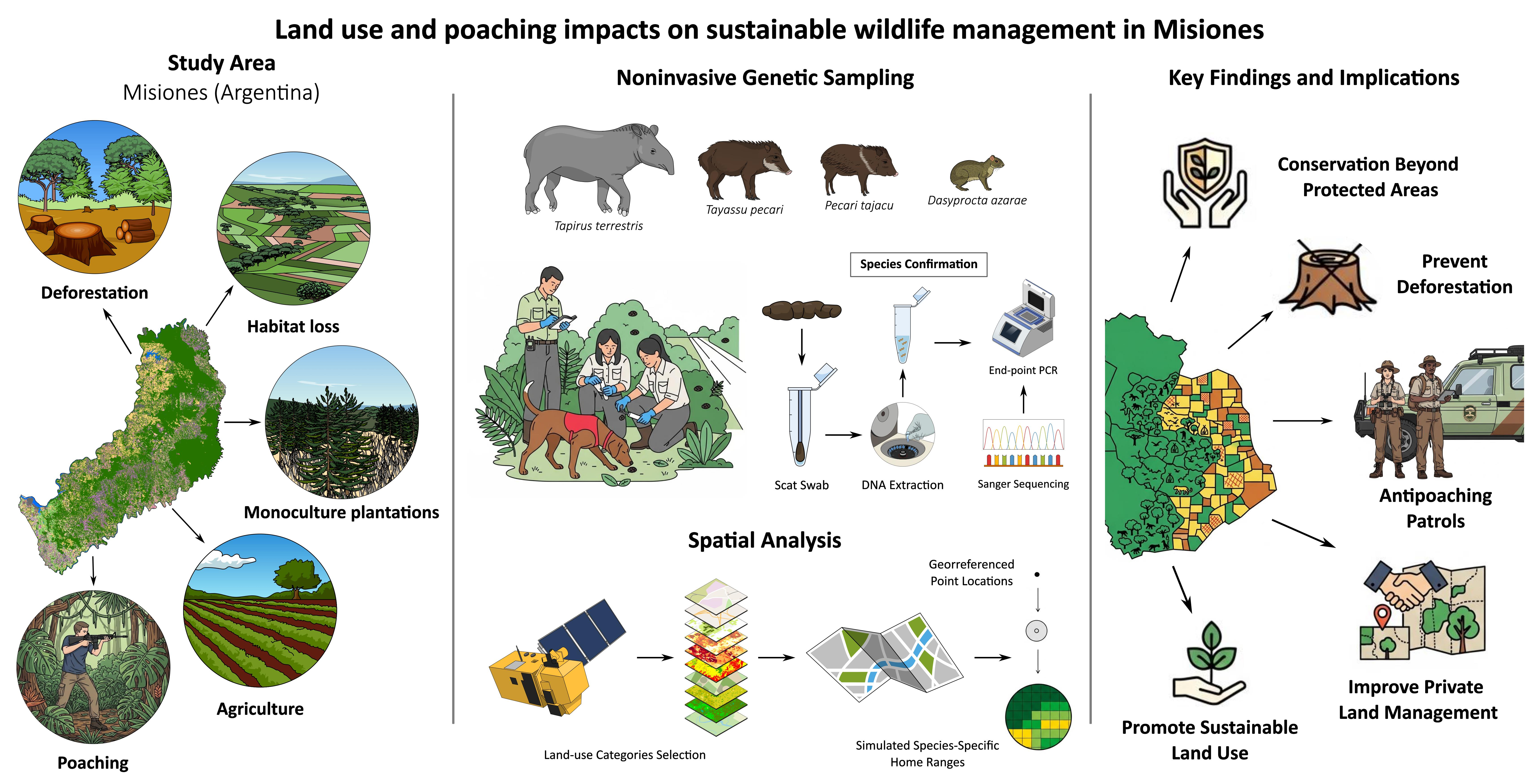
Integrating Land Use and Poaching Impacts for Sustainable Wildlife Management in the Atlantic Forest of Misiones, Argentina

 ,
,  ,
, 
Abstract
1. Introduction
2. Materials and Methods
2.1. Sampling Design
2.2. Sample Collection
2.3. Evidence of Poaching
2.4. Genetic Analysis
2.5. Habitat Association Analysis
2.6. Proximity Analysis
3. Results
3.1. Confirmed Species Presence
3.2. Evidence of Poaching
3.3. Habitat Association Analysis
3.4. Proximity Analysis
4. Discussion
4.1. Spatial Variation in Species Detection
4.2. Habitat Associations
4.3. Poaching Patterns
4.4. Limitations and Methodological Considerations
4.5. Conservation Implications
Author Contributions
Funding
Institutional Review Board Statement
Informed Consent Statement
Data Availability Statement
Acknowledgments
Conflicts of Interest
Appendix A
| Land Use | Protection Level | 2018 | 2022 | Total |
| Native forest | Unprotected | 174.4 (43.7) | 165.9 (45.8) | 340.3 (44.7) |
| Protected | 59.5 (14.9) | 103.1 (28.5) | 162.6 (21.4) | |
| Forest plantations | Unprotected | 109.8 (27.5) | 70.5 (19.5) | 180.3 (23.7) |
| Protected | 11.8 (3.0) | 0.1 (<0.1) | 11.9 (1.6) | |
| Perennial crops | Unprotected | 31.3 (7.9) | 9.5 (2.6) | 40.8 (5.4) |
| Protected | 1.6 (0.4) | 0.9 (0.3) | 2.5 (0.3) | |
| Annual crops | Unprotected | 0.7 (0.2) | 3.4 (0.9) | 4.1 (0.5) |
| Protected | 0.1 (<0.1) | 2.3 (0.6) | 2.4 (0.3) | |
| Pastures | Unprotected | 5.4 (1.4) | 2.7 (0.8) | 8.1 (1.1) |
| Protected | 0.1 (<0.1)) | 0.2 (0.1) | 0.3 (<0.1) | |
| Non-vegetated | Unprotected | 4.0 (1.0) | 2.7 (0.7) | 6.7 (0.9) |
| Protected | 0.1 (0.1) | 0.6 (0.2) | 0.7 (0.1) |
Appendix B
- (1)
- Remove the 1.7 mL tube with the scat swab collected in the field from the freezer and let it thaw at room temperature for 5–10 min.
- (2)
- Add 500 μL of 2% TEC-SDS buffer and 5 μL of Proteinase K (25 mg/mL).
- (3)
- Gently agitate with a vortex mixer followed by a quick/pulse spin.
- (4)
- Incubate in a humid bath (60 °C) overnight (24 h), with additional agitation with a vortex mixer followed by a quick/pulse spin, at 30 min and 1 h into the incubation period.
- (5)
- Drain and remove the swab, trying to retain the maximum amount of liquid in the tube.
- (6)
- Add 500 μL of phenol solution and mix by inversion several times.
- (7)
- Centrifuge (15,842× g) for 5 min and transfer the resulting aqueous (upper) phase to a new 1.7 mL tube.
- (8)
- Add 500 μL of chloroform:isoamyl alcohol (24:1) to the new tube and mix vigorously by inversion for 2–3 min.
- (9)
- Centrifuge (15,842× g) for 7 min and transfer the aqueous (upper) phase to another 1.7 mL tube. Important: record the recovered volume (necessary for subsequent dilution).
- (10)
- Add 1/10 (v/v) of 3 M NaCl and mix by inversion, then agitate with a vortex mixer several times.
- (11)
- Add 2/3 (v/v) of absolute ethanol and mix gently by inversion, followed by a quick/pulse spin.
- (12)
- Place the tube in a −20 °C freezer for 30 min to promote DNA precipitation.
- (13)
- Remove the tube from the freezer and centrifuge (15,842× g) for 10 min.
- (14)
- Discard the aqueous phase in a single motion, pouring it from the side opposite the DNA pellet.
- (15)
- Let the DNA pellet dry at room temperature for 24 h.
- (16)
- Once dry, rehydrate the DNA in 30 μL of ultrapure water (pH 7.0) and elute at room temperature for 12–24 h.
- (17)
- Store the extracted DNA in a −20 °C freezer.
Appendix C
- (1)
- Remove the 1.7 mL tube with the scat swab collected in the field from the freezer and let it thaw at room temperature for 5–10 min.
- (2)
- Add 300 μL of Qiagen ATL buffer and 33 μL of Proteinase K (25 mg/mL).
- (3)
- Incubate in a humid bath (70 °C) for 1 h, mixing with a vortex mixer followed by quick/pulse spin every 20 min.
- (4)
- Add an additional 33 μL of Proteinase K (25 mg/mL) and incubate in a humid bath (65 °C) overnight (10–12 h).
- (5)
- Drain and remove the swab, trying to retain the maximum amount of liquid in the tube.
- (6)
- Add 366 μL of Qiagen AL buffer and shake gently with the help of a vortex mixer and incubate in a humid bath (70 °C) for 1 h.
- (7)
- Add 366 μL of absolute ethanol (96%) and gently mix by inversion.
- (8)
- Label a Genesee Scientific UPrep Spin Column and place it in a new 1.7 mL collection tube. Pour the full volume of the tube from step 7 and centrifuge (2817× g) for 10 min.
- (9)
- Add 500 μL of Qiagen AW1 and centrifuge (2817× g) for 5 min.
- (10)
- Remove the column from the collection tube, discard the decanted liquid at the bottom of the collection tube and place the column back into the collection tube.
- (11)
- Add 500 μL of Qiagen AW2 and centrifuge (2817× g) for 15 min. Repeat step 10.
- (12)
- Remove the column from the collection tube, discard the decanted liquid at the bottom of the collection tube and place the column in a new 1.7 mL tube.
- (13)
- Place the Qiagen AE container in a humid bath (37 °C) for 5–7 min (for increasing efficiency and DNA yield during the elution step).
- (14)
- Add 100 μL of Qiagen AE to the center of the column filter and elute at room temperature for 30 min. Centrifuge (15,842× g) for 1 min.
- (15)
- Repeat the elution with a second aliquot of 100 μL of Qiagen AE and elute at room temperature for 30 min. Centrifuge (15,842× g) for 1 min.
- (16)
- Remove and discard the column and store the tube with extracted DNA in a −20 °C freezer.
References
- Dirzo, R.; Young, H.S.; Galetti, M.; Ceballos, G.; Isaac, N.J.B.; Collen, B. Defaunation in the Anthropocene. Science 2014, 345, 401–406. [Google Scholar] [CrossRef] [Scilit]
- Gibson, L.; Lee, T.M.; Koh, L.P.; Brook, B.W.; Gardner, T.A.; Barlow, J.; Peres, C.A.; Bradshaw, C.J.A.; Laurance, W.F.; Lovejoy, T.E.; et al. Primary Forests Are Irreplaceable for Sustaining Tropical Biodiversity. Nature 2011, 478, 378–381. [Google Scholar] [CrossRef] [Scilit]
- Haddad, N.M.; Brudvig, L.A.; Clobert, J.; Davies, K.F.; Gonzalez, A.; Holt, R.D.; Lovejoy, T.E.; Sexton, J.O.; Austin, M.P.; Collins, C.D.; et al. Habitat Fragmentation and Its Lasting Impact on Earth’s Ecosystems. Sci. Adv. 2015, 1, e1500052. [Google Scholar] [CrossRef] [Scilit] [PubMed]
- Myers, N.; Mittermeier, R.A.; Mittermeier, C.G.; da Fonseca, G.A.B.; Kent, J. Biodiversity Hotspots for Conservation Priorities. Nature 2000, 403, 853–858. [Google Scholar] [CrossRef] [Scilit]
- Ribeiro, M.C.; Metzger, J.P.; Martensen, A.C.; Ponzoni, F.J.; Hirota, M.M. The Brazilian Atlantic Forest: How Much Is Left, and How Is the Remaining Forest Distributed? Implications for Conservation. Biol. Conserv. 2009, 142, 1141–1153. [Google Scholar] [CrossRef] [Scilit]
- DeMatteo, K.E.; Sotorres, D.; Escalante, O.M.; Ibañez Alegre, D.M.; Delgado, P.M.; Rinas, M.A.; Argüelles, C.F. Integrating Species Distribution Models to Identify Overlapping Predator–Prey Conservation Priorities in Misiones, Argentina. Diversity 2025, 17, 748. [Google Scholar] [CrossRef] [Scilit]
- Di Bitetti, M.S.; Placci, G.; Dietz, L.A. Una Visión de Biodiversidad Para La Ecorregión Del Bosque Atlántico Del Alto Paraná: Diseño de Un Paisaje Para La Conservación de La Biodiversidad y Prioridades Para Las Acciones de Conservación; World Wildlife Fund: Washington, DC, USA, 2003; 154p. [Google Scholar]
- Galindo-Leal, C.; de Gusmão Câmara, I. (Eds.) The Atlantic Forest of South America: Biodiversity Status, Threats and Outlook; Island Press: Washington, DC, USA, 2003; Volume 1. [Google Scholar]
- IMiBio (Instituto Misionero de Biodiversidad). Available online: https://imibio.misiones.gob.ar/es (accessed on 17 January 2026).
- Izquierdo, A.E.; Grau, H.R.; Aide, T.M. Implications of Rural–Urban Migration for Conservation of the Atlantic Forest and Urban Growth in Misiones, Argentina (1970–2030). AMBIO 2011, 40, 298–309. [Google Scholar] [CrossRef] [Scilit] [PubMed]
- Placci, G.; Di Bitetti, M.S. Situación Ambiental En La Ecorregión Del Bosque Atlántico Del Alto Paraná (Selva Paranaense). In La Situación Ambiental Argentina; Brown, A., Martinez Ortiz, U., Acerbi, M., Corcuera, J., Eds.; Fundación Vida Silvestre Argentina: Buenos Aires, Argentina, 2006; pp. 193–210. [Google Scholar]
- SIB Sistema de Información de Biodiversidad (SIB-Argentina). Catálogo Taxonómico. Administración de Parques Nacionales. Available online: https://sib.gob.ar/ (accessed on 17 January 2026).
- Cartes, J.L. Brief History of Conservation in the Interior Atlantic Forest. In The Atlantic Forest of South America: Biodiversity Status, Threats and Outlook; Galindo-Leal, C., Gusmão Câmara, I., Eds.; Island Press: Washington DC, USA, 2003; Volume 1, pp. 269–287. [Google Scholar]
- Brooks, T.M.; Mittermeier, R.A.; Mittermeier, C.G.; Fonseca, G.A.B.; Rylands, A.B.; Konstant, W.R.; Hilton-Taylor, C. Habitat Loss and Extinction in the Hotspots of Biodiversity. Conserv. Biol. 2002, 16, 909–923. [Google Scholar] [CrossRef] [Scilit]
- Ceballos, G.; Ehrlich, P.R. Global Mammal Distributions, Biodiversity Hotspots, and Conservation. Proc. Natl. Acad. Sci. USA 2006, 103, 19374–19379. [Google Scholar] [CrossRef] [Scilit]
- Iezzi, M.E.; Cruz, P.; Varela, D.; Angelo, C.; Bitetti, M.S. Tree Monocultures in a Biodiversity Hotspot: Impact of Pine Plantations on Mammal and Bird Assemblages in the Atlantic Forest. For. Ecol. Manag. 2018, 424, 216–227. [Google Scholar] [CrossRef] [Scilit]
- Marques, M.; Grelle, C. The Atlantic Forest: History, Biodiversity, Threats and Opportunities of the Megadiverse Forest of South America; Springer Nature: Cham, Switzerland, 2021; 517p. [Google Scholar]
- Orme, C.D.L.; Davies, R.G.; Burgess, M.; Eigenbrod, F.; Pickup, N.; Olson, V.A.; Owens, I.P.F. Global Hotspots of Species Richness Are Not Congruent with Endemism or Threat. Nature 2005, 436, 1016–1019. [Google Scholar] [CrossRef] [Scilit]
- da Silva, J.; Casteleti, C. Status of the biodiversity of the Atlantic Forest of Brazil. In The Atlantic Forest of South America: Biodiversity Status, Threats, and Outlook; Galindo-Leal, C., Câmara, I., Eds.; Island Press: Washington, DC, USA, 2003; Volume 1, pp. 43–59. [Google Scholar]
- DeMatteo, K.E.; Rinas, M.A.; Argüelles, C.F.; Holman, B.E.; Di Bitetti, M.S.; Davenport, B.; Parker, P.G.; Eggert, L.S. Using Detection Dogs and Genetic Analyses of Scat to Expand Knowledge and Assist Felid Conservation in Misiones, Argentina. Integr. Zool. 2014, 9, 623–639. [Google Scholar] [CrossRef] [Scilit]
- DeMatteo, K.E.; Rinas, M.A.; Argüelles, C.F.; Zurano, J.P.; Selleski, N.; Bitetti, M.S.; Eggert, L.S. Noninvasive techniques provide novel insights for elusive bush dog (Speothos venaticus). Wildl. Soc. Bull. 2014, 38, 862–873. [Google Scholar] [CrossRef] [Scilit]
- Fundación Vida Silvestre Argentina; World Wildlife Fund. El Estado Del Bosque Atlántico: Tres Países, 148 Millones de Personas, Uno de Los Bosques Más Ricos Del Planeta; Fundación Vida Silvestre Argentina: Puerto Iguazú, Argentina; World Wildlife Fund: Puerto Iguazú, Argentina, 2017. [Google Scholar]
- Izquierdo, A.E.; De Angelo, C.; Aide, M.T. Thirty Years of Human Demography and Land-Use Change in the Atlantic Forest of Misiones, Argentina: An Evaluation of the Forest Transition Model. Ecol. Soc. 2008, 13, 3. [Google Scholar] [CrossRef] [Scilit]
- ME Desarrollo Foresto Industrial. Tablero de Plantaciones Forestales. Available online: https://www.magyp.gob.ar/sitio/areas/desarrollo-foresto-industrial/inventarios/tablero.php (accessed on 8 February 2026).
- Metzger, J.P. Tree Functional Group Richness and Landscape Structure in a Brazilian Tropical Fragmented Landscape. Ecol. Appl. 2000, 10, 1147–1161. [Google Scholar] [CrossRef]
- Altrichter, M.; Almeida, R. Exploitation of White-Lipped Peccaries Tayassu pecari (Artiodactyla: Tayassuidae) on the Osa Peninsula, Costa Rica. Oryx 2002, 36, 126–132. [Google Scholar] [CrossRef] [Scilit]
- de Bustos, S.; Varela, D.; Lizárraga, L.; Cirignoli, S.; Quiroga, V.A.; Chalukián, S.; Giombini, M.; Juliá, J.P.; Quse, V.; Giraudo, A.R.; et al. Tapirus terrestris. In Categorización 2019 de los mamíferos de Argentina según su riesgo de extinción. Lista Roja de los mamíferos de Argentina; Subsecretaría de Ambiente de la Nación: Ciudad Autónoma de Buenos Aires, Argentina; Sociedad Argentina para el Estudio de los Mamíferos: Mendoza, Argentina, 2019. [Google Scholar]
- Chalukian, S.; Bustos, S.; Bitetti, M.; Angelo, C.; Paviolo, A. Orden Perissodactyla. In Libro Rojo de los Mamíferos Amenazados de la Argentina. Sociedad Argentina para el Estudio de los Mamíferos; Ojeda, R.A., Chillo, V., Díaz Isenrath, G.B., Eds.; Sociedad Argentina para el Estudio de los Mamíferos: Mendoza, Argentina, 2012; p. 116. [Google Scholar]
- Cullen, L.J.; Bodmer, R.E.; Valladares Pádua, C. Effects of Hunting in Habitat Fragments of the Atlantic Forests, Brazil. Biol. Conserv. 2000, 95, 49–56. [Google Scholar] [CrossRef] [Scilit]
- de Freitas, T.P.T.; Keuroghlian, A.; Eaton, D.P.; de Freitas, E.B.; Figueiredo, A.; Nakazato, L.; de Oliveira, J.M.; Miranda, F.; Paes, R.C.S.; Monteiro, L.A.R.C.; et al. Prevalence of Leptospira Interrogans Antibodies in Free-Ranging Tayassu pecari of the Southern Pantanal, Brazil, an Ecosystem Where Wildlife and Cattle Interact. Trop. Anim. Health Prod. 2010, 42, 1695–1703. [Google Scholar] [CrossRef] [Scilit] [PubMed]
- Galetti, M.; Giacomini, H.C.; Bueno, R.S.; Bernardo, C.S.; Marques, R.M.; Bovendorp, R.S.; Begotti, R.A. Priority Areas for the Conservation of Atlantic Forest Large Mammals. Biol. Conserv. 2009, 142, 1229–1241. [Google Scholar] [CrossRef] [Scilit]
- Keuroghlian, A.; Eaton, D.P.; Longland, W.S. Area Use by White-Lipped and Collared Peccaries (Tayassu pecari and Tayassu tajacu) in a Tropical Forest Fragment. Biol. Conserv. 2004, 120, 411–425. [Google Scholar] [CrossRef] [Scilit]
- Reyna-Hurtado, R.; Tanner, G.W. Ungulate Relative Abundance in Hunted and Non-Hunted Sites in Calakmul Forest (Southern Mexico). Biodivers. Conserv. 2007, 16, 743–756. [Google Scholar] [CrossRef] [Scilit]
- Conrad, J.M.; Lopes, A.A. Poaching and the Dynamics of a Protected Species. Resour. Energy Econ. 2017, 48, 55–67. [Google Scholar] [CrossRef] [Scilit]
- Ferreguetti, A.C.; Rocha, C.F.D.; Bergallo, H.G. Poaching in non–volant mammals in the Neotropical region: The importance of a metric to assess its impacts. Anim. Biodivers. Conserv. 2019, 42, 203–211. [Google Scholar] [CrossRef] [Scilit]
- Moore, J.F.; Uzabaho, E.; Musana, A.; Uwingeli, P.; Hines, J.E.; Nichols, J.D. What Is the Effect of Poaching Activity on Wildlife Species? Ecol. Appl. 2021, 31, e02397. [Google Scholar] [CrossRef] [Scilit]
- de Bustos, S.; Varela, D.; Lizárraga, L.; Camino, M.; Quiroga, V.A. Tayassu pecari. In Categorización 2019 de los Mamíferos de Argentina Según su Riesgo de Extinción: Lista Roja de los Mamíferos de Argentina; Subsecretaría de Ambiente de la Nación: Ciudad Autónoma de Buenos Aires, Argentina; Sociedad Argentina para el Estudio de los Mamíferos: Mendoza, Argentina, 2019. [Google Scholar]
- Cirignoli, S.; Varela, D. Dasyprocta azarae. In Categorización 2019 de los Mamíferos de Argentina Según su Riesgo de Extinción. Lista Roja de los Mamíferos de Argentina; Subsecretaría de Ambiente de la Nación: Ciudad Autónoma de Buenos Aires, Argentina; Sociedad Argentina para el Estudio de los Mamíferos: Mendoza, Argentina, 2019. [Google Scholar]
- Delgado, P.M.; Argüelles, C.F.; DeMatteo, K.E. Using Noninvasive Techniques to Monitor Game Species Targeted by Poaching in Misiones, Argentina. Neotrop. Biodivers. 2021, 7, 78–85. [Google Scholar] [CrossRef] [Scilit]
- Paviolo, A.; Angelo, C.D.; Blanco, Y.E.; Agostini, I.; Pizzio, E.; Melzew, R.; Ferrari, C.; Palacio, L.; Bitetti, M.S. Efecto de la caza furtiva y el nivel de protección en la abundancia de los grandes mamíferos del Bosque Atlántico de Misiones. In Contribuciones para la conservación y manejo en el Parque Nacional Iguazú; Carpinetti, B., Garciarena, M., Eds.; Administración de Parques Nacionales: Buenos Aires, Argentina, 2009; pp. 237–254. [Google Scholar]
- Taber, A.; Chalukian, S.C.; Altrichter, M.; Minkowski, K.; Lizárraga, L.; Sanderson, E.; Rumiz, D.; Ventincinque, E.; Moraes, E.A.; Angelo, C.; et al. El Destino de Los Arquitectos de Los Bosques Neotropicales: Evaluación de La Distribución y El Estado de Conservación de Los Pecaríes Labiados y Los Tapires de Tierras Bajas; IUCN/SSC Tapir Specialist Group: Gland, Switzerland, 2008; pp. 1–181. [Google Scholar]
- Camino, M.; Cirignoli, S.; Varela, D.; Barri, F.; Aprile, G.; Periago, M.E.; de Bustos, S.; Quiroga, V.A.; Torres, R.M.; Di Martino, S. Pecari tajacu. In Categorización 2019 de los Mamíferos de Argentina Según su Riesgo de Extinción. Lista Roja de los Mamíferos de Argentina; Subsecretaría de Ambiente de la Nación: Ciudad Autónoma de Buenos Aires, Argentina; Sociedad Argentina para el Estudio de los Mamíferos: Mendoza, Argentina, 2019. [Google Scholar]
- Beck, H. Seed Predation and Dispersal by Peccaries throughout the Neotropics and Its Consequences: A Review and Synthesis. In Seed Fate: Predation, Dispersal and Seedling Establishment, 1st ed.; Forget, P.M., Lambert, J.E., Hulme, P.E., Vander Wall, S.B., Eds.; CABI Books: Wallingford, UK, 2005; pp. 77–115. [Google Scholar]
- Bello, C.; Galetti, M.; Pizo, M.A.; Magnago, L.F.S.; Rocha, M.F.; Lima, R.A.F.; Peres, C.A.; Ovaskainen, O.; Jordano, P. Defaunation Affects Carbon Storage in Tropical Forests. Sci. Adv. 2015, 1, e1501105. [Google Scholar] [CrossRef] [Scilit]
- O’Farrill, G.; Galetti, M.; Campos-Arceiz, A. Frugivory and Seed Dispersal by Tapirs: An Insight on Their Ecological Role. Integr. Zool. 2013, 8, 4–17. [Google Scholar] [CrossRef] [Scilit]
- Keuroghlian, A.; Eaton, D.P. Fruit Availability and Peccary Frugivory in an Isolated Atlantic Forest Fragment: Effects on Peccary Ranging Behavior and Habitat Use. Biotropica 2008, 40, 62–70. [Google Scholar] [CrossRef] [Scilit]
- Jansen, P.A.; Hirsch, B.T.; Emsens, W.-J.; Zamora-Gutierrez, V.; Wikelski, M.; Kays, R. Thieving Rodents as Substitute Dispersers of Megafaunal Seeds. Proc. Natl. Acad. Sci. USA 2012, 109, 12610–12615. [Google Scholar] [CrossRef] [Scilit] [PubMed]
- Pires, A.S.; Galetti, M. The Agouti Dasyprocta leporina (Rodentia: Dasyproctidae) as Seed Disperser of the Palm Astrocaryum Aculeatissimum. Mastozoología Neotrop. 2012, 19, 147–153. [Google Scholar]
- Dirzo, R.; Miranda, A. Altered Patterns of Herbivory and Diversity in the Forest Understory: A Case Study of the Possible Consequences of Contemporary Defaunation. In Plant-Animal Interactions: Evolutionary Ecology in Tropical and Temperate Regions; Price, P., Lewinsohn, T.M., Fernandes, G., Benson, W., Eds.; John Wiley & Sons: New York, NY, USA, 1991; pp. 273–287. [Google Scholar]
- Stoner, C.; Caro, T.I.M.; Mduma, S.; Mlingwa, C.; Sabuni, G.; Borner, M. Assessment of Effectiveness of Protection Strategies in Tanzania Based on a Decade of Survey Data for Large Herbivores. Conserv. Biol. 2007, 21, 635–646. [Google Scholar] [CrossRef] [Scilit]
- Aliaga-Rossel, E.; Kays, R.W.; Fragoso, J.M. Home-Range Use by the Central American Agouti (Dasyprocta punctata) on Barro Colorado Island, Panama. J. Trop. Ecol. 2008, 24, 367–374. [Google Scholar] [CrossRef] [Scilit]
- Entringer, H.; Del Duque, H.J.; Chiarello, A.G.; Srbek-Araujo, A.C. Temporal Variation of the Diet of a Top Terrestrial Predator: The Jaguar as a Case Study. Mamm. Res. 2022, 67, 417–431. [Google Scholar] [CrossRef] [Scilit]
- Paviolo, A.; Cruz, P.; Iezzi, M.E.; Pardo, J.M.; Varela, D.; Angelo, C.; Bitetti, M.S. Barriers, Corridors or Suitable Habitat? Effect of Monoculture Tree Plantations on the Habitat Use and Prey Availability for Jaguars and Pumas in the Atlantic Forest. For. Ecol. Manag. 2018, 430, 576–586. [Google Scholar] [CrossRef] [Scilit]
- Polisar, J.; Scognamillo, D.; Maxit, I.E.; Sunquist, M. Patterns of Vertebrate Abundance in a Tropical Mosaic Landscape. Stud. Neotrop. Fauna Environ. 2008, 43, 85–98. [Google Scholar] [CrossRef] [Scilit]
- Taber, A.B.; Novaro, A.J.; Neris, N.; Colman, F.H. The Food Habits of Sympatric Jaguar and Puma in the Paraguayan Chaco. Biotropica 1997, 29, 204–213. [Google Scholar] [CrossRef] [Scilit]
- Weckel, M.; Giuliano, W.; Silver, S. Jaguar (Panthera onca) Feeding Ecology: Distribution of Predator and Prey through Time and Space. J. Zool. 2006, 270, 25–30. [Google Scholar] [CrossRef] [Scilit]
- Whitworth, A.; Beirne, C.; Basto, A.; Flatt, E.; Tobler, M.; Powell, G.; Forsyth, A. Disappearance of an Ecosystem Engineer, the White-Lipped Peccary (Tayassu pecari), Leads to Density Compensation and Ecological Release. Oecologia 2022, 199, 937–949. [Google Scholar] [CrossRef] [Scilit]
- Altrichter, M.; Taber, A.; Beck, H.; Reyna-Hurtado, R.; Lizarraga, L.; Keuroghlian, A.; Sanderson, E. A Report of Range-Wide Declines for a Key Neotropical Ecosystem Architect, the White-Lipped Peccary. Oryx 2012, 46, 87–98. [Google Scholar] [CrossRef] [Scilit]
- Thornton, D.; Reyna, R.; Perera-Romero, L.; Radachowsky, J.; Hidalgo-Mihart, M.G.; Garcia, R.; McNab, R.; Mcloughlin, L.; Foster, R.; Harmsen, B.; et al. Precipitous Decline of White-Lipped Peccary Populations in Mesoamerica. Biol. Conserv. 2020, 242, 108410. [Google Scholar] [CrossRef] [Scilit]
- Cordeiro, J.L.P.; Fragoso, J.M.V.; Crawshaw, D.; Oliveira, L.F.B. Lowland Tapir Distribution and Habitat Loss in South America. PeerJ 2016, 4, e2456. [Google Scholar] [CrossRef] [Scilit]
- Kays, R.; Arbogast, B.S.; Baker-Whatton, M.; Beirne, C.; Boone, H.M.; Bowler, M.; Burneo, S.F.; Cove, M.V.; Ding, P.; Espinosa, S.; et al. An Empirical Evaluation of Camera Trap Study Design: How Many, How Long and When? Methods Ecol. Evol. 2020, 11, 700–713. [Google Scholar] [CrossRef] [Scilit]
- Long, R.A.; Donovan, T.M.; Mackay, P.; Zielinski, W.J.; Buzas, J.S. Effectiveness of Scat Detection Dogs for Detecting Forest Carnivores. J. Wild. Manag. 2007, 71, 2007–2017. [Google Scholar] [CrossRef] [Scilit]
- Burton, A.C.; Neilson, E.; Moreira, D.; Ladle, A.; Steenweg, R.; Fisher, J.T.; Bayne, E.; Boutin, S. Wildlife Camera Trapping: A Review and Recommendations for Linking Surveys to Ecological Processes. J. Appl. Ecol. 2015, 52, 675–685. [Google Scholar] [CrossRef] [Scilit]
- O’Connell, A.F.; Nichols, J.D.; Karanth, K.U. Camera Traps in Animal Ecology: Methods and Analyses; Springer Nature: Tokyo, Japan, 2011. [Google Scholar]
- Beebe, S.C.; Howell, T.J.; Bennett, P.C. Using Scent Detection Dogs in Conservation Settings: A Review of Scientific Literature Regarding Their Selection. Front. Vet. Sci. 2016, 3, 96. [Google Scholar] [CrossRef] [Scilit]
- DeMatteo, K.E.; Rinas, M.A.; Sede, M.M.; Davenport, B.; Argüelles, C.F.; Lovett, K.; Parker, P.G. Detection dogs: An effective technique for bush dog (Speothos venaticus) surveys. J. Wildl. Manag. 2009, 3, 1436–1440. [Google Scholar] [CrossRef] [Scilit]
- Long, R.A.; Donovan, T.M.; Mackay, P.; Zielinski, W.J.; Buzas, J.S. Comparing Scat Detection Dogs, Cameras, and Hair Snares for Surveying Carnivores. J. Wildl. Manag. 2007, 71, 2018–2025. [Google Scholar] [CrossRef] [Scilit]
- Beja-Pereira, A.; Oliveira, R.; Alves, P.C.; Schwartz, M.K.; Luikart, G. Advancing Ecological Understandings through Technological Transformations in Noninvasive Genetics. Mol. Ecol. Resour. 2009, 9, 1279–1301. [Google Scholar] [CrossRef] [Scilit]
- Byrne, M.S.; Peralta, D.M.; Ibañez, E.A.; Nardelli, M.; Túnez, J.I. Non-Invasive Sampling Techniques Applied to Conservation Genetic Studies in Mammals. In Molecular Ecology and Conservation Genetics of Neotropical Mammals; Nardelli, M., Túnez, J.I., Eds.; Springer International Publishing: Cham, Switzerland, 2021; pp. 63–83. [Google Scholar]
- Höss, M.; Kohn, M.; Pääbo, S.; Knauer, F.; Schröder, W. Excrement Analysis by PCR. Nature 1992, 359, 199. [Google Scholar] [CrossRef] [Scilit]
- Taberlet, P.; Bouvet, J. Génétique de l’Ours brun des Pyrénées (Ursus arctos): Premiers résultats. C. R. Acad. Sci. 1992, 314, 15–21. [Google Scholar]
- Waits, L.P.; Paetkau, D. Noninvasive Genetic Sampling Tools for Wildlife Biologists: A Review of Applications and Recommendations for Accurate Data Collection. J. Wildl. Manag. 2005, 69, 1419–1433. [Google Scholar] [CrossRef] [Scilit]
- Bach, B.H.; Quigley, A.B.; Gaynor, K.M.; McInturff, A.; Charles, K.L.; Dorcy, J.; Brashares, J.S. Identifying Individual Ungulates from Fecal DNA: A Comparison of Field Collection Methods to Maximize Efficiency, Ease, and Success. Mamm. Biol. 2022, 102, 863–874. [Google Scholar] [CrossRef] [Scilit]
- de Oliveira, M.E.; Gonçalves, F.; Galetti, P.M., Jr. Scat DNA Applications for Low-Density Carnivore Survey: Techniques, Efficiency and Future Directions. Mamm. Rev. 2025, 56, e70007. [Google Scholar] [CrossRef] [Scilit]
- Ogden, R.; Dawnay, N.; McEwing, R. Wildlife DNA Forensics—Bridging the Gap between Conservation Genetics and Law Enforcement. Endanger. Species Res. 2009, 9, 179–195. [Google Scholar] [CrossRef] [Scilit]
- Rutledge, L.Y.; Holloway, J.J.; Patterson, B.R.; White, B.N. An Improved Field Method to Obtain DNA for Individual Identification from Wolf Scat. J. Wildl. Manag. 2009, 73, 1430–1435. [Google Scholar] [CrossRef] [Scilit]
- Stenglein, J.L.; Barba, M.; Ausband, D.E.; Waits, L.P. Impacts of Sampling Location within a Faeces on DNA Quality in Two Carnivore Species. Mol. Ecol. Resour. 2010, 10, 109–114. [Google Scholar] [CrossRef] [Scilit]
- Taberlet, P.; Coissac, E.; Hajibabaei, M.; Rieseberg, L.H. Environmental DNA. Mol. Ecol. 2012, 21, 1789–1793. [Google Scholar] [CrossRef] [Scilit] [PubMed]
- Vynne, C.; Baker, M.R.; Breuer, Z.K.; Wasser, S.K. Factors Influencing Degradation of DNA and Hormones in Maned Wolf Scat. Anim. Conserv. 2011, 15, 184–194. [Google Scholar] [CrossRef] [Scilit]
- Brinkman, T.; Schwartz, M.; Person, D.; Pilgrim, K.; Hundertmark, K. Effects of Time and Rainfall on PCR Success Using DNA Extracted from Deer Fecal Pellets. Conserv. Genet. 2010, 11, 1547–1552. [Google Scholar] [CrossRef] [Scilit]
- Glen, A.S.; Veltman, C.J. Search Strategies for Conservation Detection Dogs. Wildl. Biol. 2018, 2018, 1–9. [Google Scholar] [CrossRef] [Scilit]
- Reed, S.E.; Bidlack, A.L.; Hurt, A.; Getz, W.M. Detection Distance and Environmental Factors in Conservation Detection Dog Surveys. J. Wildl. Manag. 2011, 75, 243–251. [Google Scholar] [CrossRef] [Scilit]
- Kokocińska-Kusiak, A.; Woszczyło, M.; Zybala, M.; Maciocha, J.; Barłowska, K.; Dzięcioł, M. Canine Olfaction: Physiology, Behavior, and Possibilities for Practical Applications. Animals 2021, 11, 2463. [Google Scholar] [CrossRef] [Scilit]
- Osterkamp, T. Detector Dogs and Scent Movement: How Weather, Terrain, and Vegetation Influence Search Strategies; CRC Press: Boca Raton, FL, USA, 2020. [Google Scholar]
- Wohlfahrt, G.; Schmitt, M.; Zeller, L.; Hörand, A.; Spittel-Schnell, K.; Wulms, T.; Schnell, R.; Bültge, M. Air Temperature and Humidity Effects on the Performance of Conservation Detection Dogs. Appl. Anim. Behav. Sci. 2023, 262, 105909. [Google Scholar] [CrossRef] [Scilit]
- DeMatteo, K.E.; Rinas, M.A.; Zurano, J.P.; Selleski, N.; Schneider, R.G.; Argüelles, C.F. Using Niche-Modelling and Species-Specific Cost Analyses to Determine a Multispecies Corridor in a Fragmented Landscape. PLoS ONE 2017, 12, e0183648. [Google Scholar] [CrossRef] [Scilit] [PubMed]
- DeMatteo, K.E.; Escalante, O.M.; Ibañez Alegre, D.M.; Rinas, M.A.; Sotorres, D.; Argüelles, C.F. A Multispecies Corridor in a Fragmented Landscape: Evaluating Effectiveness and Identifying High-Priority Target Areas. PLoS ONE 2023, 18, e0283258. [Google Scholar] [CrossRef] [Scilit] [PubMed]
- Nussear, K.; Esque, T.; Heaton, J.; Cablk, M.; Drake, K.; Valentin, C.; Yee, J.; Medica, P. Are Wildlife Detector Dogs or People Better at Finding Desert Tortoises (Gopherus agassizii)? Herpetol. Conserv. Biol. 2008, 3, 103–115. [Google Scholar]
- Lazarowski, L.; Rogers, B.; Waggoner, L.P.; Katz, J.S. When the Nose Knows: Ontogenetic Changes in Detection Dogs’ (Canis Familiaris) Responsiveness to Social and Olfactory Cues. Anim. Behav. 2019, 153, 61–68. [Google Scholar] [CrossRef] [Scilit]
- DeMatteo, K.E.; Davenport, B.; Wilson, L.E. Back to the Basics with Conservation Detection Dogs: Fundamentals for Success. Wild. Biol. 2019, 2019, 1–9. [Google Scholar] [CrossRef] [Scilit]
- Ball, M.C.; Pither, R.; Manseau, M.; Clark, J.; Petersen, S.D.; Kingston, S.; Morrill, M.; Wilson, P. Characterization of Target Nuclear DNA from Faeces Reduces Technical Issues Associated with the Assumptions of Low-Quality and Quantity Template. Conserv. Genet. 2007, 8, 577–586. [Google Scholar] [CrossRef] [Scilit]
- Manning, J.A.; Edwards, T.; Clemons, J.; Leavitt, D.J.; Goldberg, C.S.; Culver, M. Scat as a Source of DNA for Population Monitoring. Ecol. Evol. 2022, 12, e9415. [Google Scholar] [CrossRef] [Scilit]
- Marrero, P.; Fregel, R.; Cabrera, V.M.; Nogales, M. Extraction of High-Quality Host DNA from Feces and Regurgitated Seeds: A Useful Tool for Vertebrate Ecological Studies. Biol. Res. 2009, 42, 147–151. [Google Scholar] [CrossRef] [Scilit] [PubMed]
- Miles, K.A.; Holtz, M.N.; Lounsberry, Z.T.; Sacks, B.N. A Paired Comparison of Scat-collecting versus Scat-swabbing Methods for Noninvasive Recovery of Mesocarnivore DNA from an Arid Environment. Wildl. Soc. Bull. 2015, 39, 797–803. [Google Scholar] [CrossRef] [Scilit]
- Cirignoli, S.; Galliari, C.A.; Pardiñas, U.F.J.; Podestá, D.H.; Abramson, R. Mamíferos de la Reserva Valle del Cuña Pirú, Misiones, Argentina. Mastozool. Neotrop. 2011, 18, 25–43. [Google Scholar]
- De Angelo, C. Guía de Huellas de Mamíferos y Grandes Reptiles de Misiones, Norte Grande y Otras Áreas del Subtrópico de Argentina, 3rd ed.; CeIBA, Centro de Investigaciones del Bosque Atlántico Misiones; Ediciones del Subtrópico, Fundación ProYungas: Puerto Iguazú, Argentina, 2017. [Google Scholar]
- Norris, D. Model Thresholds Are More Important than Presence Location Type: Understanding the Distribution of Lowland Tapir (Tapirus terrestris) in a Continuous Atlantic Forest of Southeast Brazil. Trop. Conserv. Sci. 2014, 7, 529–547. [Google Scholar] [CrossRef] [Scilit]
- Norris, D.; Peres, C.A.; Michalski, F.; Hinchsliffe, K. Terrestrial Mammal Responses to Edges in Amazonian Forest Patches: A Study Based on Track Stations. Mammalia 2008, 72, 15. [Google Scholar] [CrossRef] [Scilit]
- Rumboll, M. Guía de Huellas, Rastros y Señales de los Mamíferos de los Parques Nacionales, 1st ed.; Administración de Parques Nacionales: Buenos Aires, Argentina, 2011.
- Salas, L.A.; Fuller, T.K. Diet of the Lowland Tapir (Tapirus terrestris L.) in the Tabaro River Valley, Southern Venezuela. Can. J. Zool. 1996, 74, 1444–1451. [Google Scholar] [CrossRef] [Scilit]
- Sambrook, J.; Fritsch, E.F.; Maniatis, T. Molecular Cloning: A Laboratory Manual; Cold Spring Harbor Laboratory: Cold Spring Harbor, NY, USA, 1989. [Google Scholar]
- Vynne, C. Landscape Use by Wide-Ranging Mammals of the Brazilian Cerrado. Ph.D. Thesis, University of Washington, Seattle, WA, USA, 2010. [Google Scholar]
- Farrell, L.E.; Roman, J.; Sunquist, M.E. Dietary Separation of Sympatric Carnivores Identified by Molecular Analysis of Scats. Mol. Ecol. 2000, 9, 1583–1590. [Google Scholar] [CrossRef] [Scilit] [PubMed]
- Miotto, R.A.; Rodrigues, F.P.; Ciocheti, G.; Galetti, P.M. Determination of the Minimum Population Size of Pumas (Puma concolor) Through Fecal DNA Analysis in Two Protected Cerrado Areas in the Brazilian Southeast. Biotropica 2007, 39, 647–654. [Google Scholar] [CrossRef] [Scilit]
- Sotorres, D. Identificación Forense y Análisis de Distribución de Especies Presa a Lo Largo Del Corredor Biológico Propuesto Para Misiones (Argentina); Universidad Nacional de Misiones: Posadas, Argentina, 2019. [Google Scholar]
- Verma, S.K.; Singh, L. Novel Universal Primers Establish Identity of an Enormous Number of Animal Species for Forensic Application. Mol. Ecol. Notes 2003, 3, 28–31. [Google Scholar] [CrossRef] [Scilit]
- Altschul, S.F.; Gish, W.; Miller, W.; Myers, E.W.; Lipman, D.J. Basic Local Alignment Search Tool. J. Mol. Biol. 1990, 215, 403–410. [Google Scholar] [CrossRef] [PubMed]
- Izquierdo, A.E.; Clark, M.L. Spatial Analysis of Conservation Priorities Based on Ecosystem Services in the Atlantic Forest Region of Misiones, Argentina. Forests 2012, 3, 764–786. [Google Scholar] [CrossRef] [Scilit]
- Bolker, B.M.; Brooks, M.E.; Clark, C.J.; Geange, S.W.; Poulsen, J.R.; Stevens, M.H.H.; White, J.-S.S. Generalized Linear Mixed Models: A Practical Guide for Ecology and Evolution. Trends Ecol. Evol. 2009, 24, 127–135. [Google Scholar] [CrossRef] [Scilit]
- Zuur, A.F.; Ieno, E.N.; Walker, N.; Saveliev, A.A.; Smith, G.M. Mixed Effects Models and Extensions in Ecology with R; Statistics for Biology and Health; Springer: New York, NY, USA, 2009. [Google Scholar]
- O’Hara, R.B.; Kotze, D.J. Do Not Log-Transform Count Data. Methods Ecol. Evol. 2010, 1, 118–122. [Google Scholar] [CrossRef] [Scilit]
- Brooks, M.; Kristensen, K.; van Benthem, K.; Magnusson, A.; Berg, C.; Nielsen, A.; Skaug, H.; Mächler, M.; Bolker, B. glmmTMB Balances Speed and Flexibility Among Packages for Zero-Inflated Generalized Linear Mixed Modeling. R J. 2017, 9, 378–400. [Google Scholar] [CrossRef] [Scilit]
- Burnham, K.P.; Anderson, D.R. (Eds.) Model Selection and Multimodel Inference; Springer: New York, NY, USA, 2002. [Google Scholar]
- Hartig, F.; Lohse, L.; de Souza Leite, M. DHARMa: Residual Diagnostics for Hierarchical (Multi-Level/Mixed) Regression Models. 2024. Available online: https://CRAN.R-project.org/package=DHARMa (accessed on 12 March 2026).
- Johnson, D.H. The Comparison of Usage and Availability Measurements for Evaluating Resource Preference. Ecology 1980, 61, 65–71. [Google Scholar] [CrossRef] [Scilit]
- Manly, B.F.J.; McDonald, L.L.; Thomas, D.L.; McDonald, T.L.; Erickson, W.P. (Eds.) Studies with Resources Defined by Several Categories. In Resource Selection by Animals: Statistical Design and Analysis for Field Studies; Springer: Dordrecht, The Netherlands, 2002; pp. 46–82. [Google Scholar]
- Medici, E.P.; Mezzini, S.; Fleming, C.H.; Calabrese, J.M.; Noonan, M.J. Movement Ecology of Vulnerable Lowland Tapirs between Areas of Varying Human Disturbance. Mov. Ecol. 2022, 10, 14. [Google Scholar] [CrossRef] [Scilit]
- Judas, J.; Henry, O. Seasonal Variation of Home Range of Collared Peccary in Tropical Rain Forests of French Guiana. J. Wildl. Manag. 1999, 63, 546–552. [Google Scholar] [CrossRef] [Scilit]
- Ribeiro, J.F.; Vieira, E.M. Interactions between a Seed-Eating Neotropical Rodent, the Azara’s Agouti (Dasyprocta azarae), and the Brazilian ‘Pine’ Araucaria angustifolia. Austral Ecol. 2014, 39, 279–287. [Google Scholar] [CrossRef] [Scilit]
- De Angelo, C.; Paviolo, A.; Di Bitetti, M. Differential Impact of Landscape Transformation on Pumas (Puma concolor) and Jaguars (Panthera onca) in the Upper Paraná Atlantic Forest. Divers. Distrib. 2011, 17, 422–436. [Google Scholar] [CrossRef] [Scilit]
- Dehaudt, B. Seed Disperser Populations and Plant-Animal Interactions in Tropical Forests of the Anthropocene. Ph.D. Thesis, The University of Queensland, Brisbane, QLD, Australia, 2025. [Google Scholar]
- Matthiopoulos, J.; Fieberg, J.; Aarts, G. Species-Habitat Associations: Spatial Data, Predictive Models, and Ecological Insights, 2nd ed.; University of Minnesota Libraries Publishing: Minneapolis, MN, USA, 2023. [Google Scholar]
- Dormann, C.F.; McPherson, J.M.; Araújo, M.B.; Bivand, R.; Bolliger, J.; Carl, G.; Davies, R.G.; Hirzel, A.; Jetz, W.; Kissling, W.D.; et al. Methods to Account for Spatial Autocorrelation in the Analysis of Species Distributional Data: A Review. Ecography 2007, 30, 609–628. [Google Scholar] [CrossRef] [Scilit]
- DeMatteo, K.E.; Blake, L.W.; Young, J.K.; Davenport, B. How Behavior of Nontarget Species Affects Perceived Accuracy of Scat Detection Dog Surveys. Sci. Rep. 2018, 8, 13830. [Google Scholar] [CrossRef] [Scilit] [PubMed]
- Alaeddini, R. Forensic Implications of PCR Inhibition—A Review. Forensic Sci. Int. Genet. 2012, 6, 297–305. [Google Scholar] [CrossRef] [Scilit]
- Bessetti, J. An Introduction to PCR Inhibitors. J. Microbiol. Methods 2007, 28, 159–167. [Google Scholar]
- Monteiro, L.; Bonnemaison, D.; Vekris, A.; Petry, K.G.; Bonnet, J.; Vidal, R.; Mégraud, F. Complex Polysaccharides as PCR Inhibitors in Feces: Helicobacter Pylori Model. J. Clin. Microbiol. 1997, 35, 995–998. [Google Scholar] [CrossRef] [Scilit]
- Ramón-Laca, A.; Soriano, L.; Gleeson, D.; Godoy, J.A. A Simple and Effective Method for Obtaining Mammal DNA from Faeces. Wildl. Biol. 2015, 21, 195–203. [Google Scholar] [CrossRef] [Scilit]
- Flesher, K.M.; Medici, E.P. The Distribution and Conservation Status of Tapirus terrestris in the South American Atlantic Forest. Neotrop. Biol. Conserv. 2022, 17, 1–19. [Google Scholar] [CrossRef] [Scilit]
- Medici, E.P. Assessing the Viability of Lowland Tapir Populations in a Fragmented Landscape. Ph.D. Thesis, University of Kent, Canterbury, UK, 2010. [Google Scholar]
- Taber, A.; Chalukian, S.C.; Altrichter, M.; Minkowski, K.; Lizárraga, L. Análisis de la Distribución y el Estado de Conservación del Tapir (Tapirus terrestris) y el Pecarí Labiado (Tayassu pecari) en Latinoamérica; Pigs, Peccaries and Hippos Specialist Group (IUCN, Gland, Switzerland); Tapir Specialist Group (IUCN/SSC Tapir Specialist Group, Gland, Switzerland); Wildlife Conservation Society: New York, NY, USA; Wildlife Trust: London, UK, 2008. [Google Scholar]
- Vidolin, G.P.; Batista, D.B.; Wandembruck, A. Landscape Valuation Based on the Ecological Requirements of ‘Tayassu pecari’ and ‘Tapirus terrestris’—A Forest with Araucaria, in Paraná State, Brazil. Ciênc. Florest. 2011, 21, 509–519. [Google Scholar] [CrossRef] [Scilit]
- Cruz, P.; Paviolo, A.; Bó, R.F.; Thompson, J.J.; Di Bitetti, M.S. Daily Activity Patterns and Habitat Use of the Lowland Tapir (Tapirus terrestris) in the Atlantic Forest. Mamm. Biol. 2014, 79, 376–383. [Google Scholar] [CrossRef] [Scilit]
- Hou, R.; Gogarten, J.F.; Golooba, M.; Kalbitzer, U.; Kirumira, D.; Omeja, P.A.; Opito, E.A.; Reyna-Hurtado, R.; Sarkar, D.; Tumwesigye, C.; et al. Parks Can Effectively Protect Ungulates and Elephants despite a Constant Poaching Threat. Glob. Ecol. Conserv. 2024, 54, e03075. [Google Scholar] [CrossRef] [Scilit]
- Medici, E.P.; Desbiez, A.L.J. Population Viability Analysis: Using a Modeling Tool to Assess the Viability of Tapir Populations in Fragmented Landscapes. Integr. Zool. 2012, 7, 356–372. [Google Scholar] [CrossRef] [Scilit]
- Rivera, L.O.; Martinuzzi, S.; Politi, N.; Bardavid, S.; de Bustos, S.; Chalukian, S.; Lizárraga, L.; Radeloff, V.; Pidgeon, A. National Parks Influence Habitat Use of Lowland Tapirs in Adjacent Private Lands in the Southern Yungas of Argentina. Oryx 2020, 55, 625–634. [Google Scholar] [CrossRef] [Scilit]
- Teixeira-Santos, J.; da Cunha Ribeiro, A.C.; Wiig, Ø.; Pinto, N.S.; Cantanhêde, L.G.; Sena, L.; Mendes-Oliveira, A.C. Environmental Factors Influencing the Abundance of Four Species of Threatened Mammals in Degraded Habitats in the Eastern Brazilian Amazon. PLoS ONE 2020, 15, e0229459. [Google Scholar] [CrossRef] [Scilit] [PubMed]
- Keuroghlian, A.; Eaton, D.P. Importance of Rare Habitats and Riparian Zones in a Tropical Forest Fragment: Preferential Use by Tayassu pecari, a Wide-Ranging Frugivore. J. Zool. 2008, 275, 283–293. [Google Scholar] [CrossRef] [Scilit]
- Romero, A.; O’Neill, B.J.; Timm, R.M.; Gerow, K.G.; McClearn, D. Group Dynamics, Behavior, and Current and Historical Abundance of Peccaries in Costa Rica’s Caribbean Lowlands. J. Mammal. 2013, 94, 771–791. [Google Scholar] [CrossRef] [Scilit]
- Tobler, M.W.; Carrillo-Percastegui, S.E.; Powell, G. Habitat Use, Activity Patterns and Use of Mineral Licks by Five Species of Ungulate in South-Eastern Peru. J. Trop. Ecol. 2009, 25, 261–270. [Google Scholar] [CrossRef] [Scilit]
- Desbiez, A.L.J.; Bodmer, R.E.; Santos, S.A. Wildlife Habitat Selection and Sustainable Resources Management in a Neotropical Wetland. Int. J. Biodivers. Conserv. 2009, 1, 11–20. [Google Scholar]
- Regolin, A.L.; Oliveira-Santos, L.G.; Ribeiro, M.C.; Bailey, L.L. Habitat Quality, Not Habitat Amount, Drives Mammalian Habitat Use in the Brazilian Pantanal. Landsc. Ecol. 2021, 36, 2519–2533. [Google Scholar] [CrossRef] [Scilit]
- Teixeira Rodrigues, É. Padrão de Ocupação de Cutias (Dasyprocta azarae) em Paisagens Neotropicais. Bachelor’s Thesis, Universidade Estadual Paulista, São Paulo, Brazil, 2017. [Google Scholar]
- Falconi-Briones, F.A.; Naranjo, E.J.; Reyna-Hurtado, R.; Spínola, M.; Enríquez-Rocha, P.; Medellín, R.A. Habitat Use and Activity Patterns of Ungulates in a Tropical Rainforest of Southern México. Therya 2022, 13, 171–182. [Google Scholar] [CrossRef] [Scilit]
- Fragoso, J.M.V.; Antunes, A.P.; Silvius, K.M.; Constantino, P.A.L.; Zapata-Ríos, G.; Bizri, H.R.E.; Bodmer, R.E.; Camino, M.; de Thoisy, B.; Wallace, R.B.; et al. Large-Scale Population Disappearances and Cycling in the White-Lipped Peccary, a Tropical Forest Mammal. PLoS ONE 2022, 17, e0276297. [Google Scholar] [CrossRef] [Scilit]
- Barnas, A.F.; Ladle, A.; Burgar, J.M.; Burton, A.C.; Boyce, M.S.; Eliuk, L.; Fisher, J.T. How Landscape Traits Affect Boreal Mammal Responses to Anthropogenic Disturbance. Sci. Total Environ. 2024, 915, 169285. [Google Scholar] [CrossRef] [Scilit]
- Abreu Pestana, L.F.; Martello, F.; Fonseca, R.C.B. Richness and Composition of Terrestrial Mammals Vary in Eucalyptus Plantations Due to Stand Age. Austral Ecol. 2023, 48, 743–760. [Google Scholar] [CrossRef] [Scilit]
- Zhang, C.; Li, Y.; Hu, X.; Ma, X.; Jia, W.; Liu, K.; Nie, Y. Human-Induced Behavioural Changes of Global Threatened Terrestrial Mammals. Glob. Ecol. Biogeogr. 2023, 32, 1645–1659. [Google Scholar] [CrossRef] [Scilit]
- Gray, C.L.; Hill, S.L.L.; Newbold, T.; Hudson, L.N.; Börger, L.; Contu, S.; Hoskins, A.J.; Ferrier, S.; Purvis, A.; Scharlemann, J.P.W. Local Biodiversity Is Higher inside than Outside Terrestrial Protected Areas Worldwide. Nat. Commun. 2016, 7, 12306. [Google Scholar] [CrossRef] [Scilit] [PubMed]
- Malakoutikhah, S.; Fakheran, S.; Hemami, M.-R.; Tarkesh, M.; Senn, J. Assessing Future Distribution, Suitability of Corridors and Efficiency of Protected Areas to Conserve Vulnerable Ungulates under Climate Change. Divers. Distrib. 2020, 26, 1383–1396. [Google Scholar] [CrossRef] [Scilit]
- Riquelme, C.; Estay, S.A.; López, R.; Pastore, H.; Soto-Gamboa, M.; Corti, P. Protected Areas’ Effectiveness under Climate Change: A Latitudinal Distribution Projection of an Endangered Mountain Ungulate along the Andes Range. PeerJ 2018, 6, e5222. [Google Scholar] [CrossRef] [Scilit]
- Neto, E.P.; Barquero, G.; Fragoso, J.M.V. Navigating Human-Dominated Landscapes: Spatial Strategies of a Herd Forming Ungulate in an Agricultural-to-Natural Matrix. bioRxiv 2025. [Google Scholar] [CrossRef] [Scilit]
- de Faria Oshima, J.E.; Jorge, M.L.S.P.; Sobral-Souza, T.; Börger, L.; Keuroghlian, A.; Peres, C.A.; Vancine, M.H.; Collen, B.; Ribeiro, M.C. Setting Priority Conservation Management Regions to Reverse Rapid Range Decline of a Key Neotropical Forest Ungulate. Glob. Ecol. Conserv. 2021, 31, e01796. [Google Scholar] [CrossRef] [Scilit]
- Ripple, W.J.; Abernethy, K.; Betts, M.G.; Chapron, G.; Dirzo, R.; Galetti, M.; Young, H. Bushmeat Hunting and Extinction Risk to the World’s Mammals. R. Soc. Open Sci. 2016, 3, 160498. [Google Scholar] [CrossRef] [Scilit]
- Sobral-Souza, T.; Vancine, M.H.; Ribeiro, M.C.; Lima-Ribeiro, M.S. Efficiency of Protected Areas in Amazon and Atlantic Forest Conservation: A Spatio-Temporal View. Acta Oecol. 2018, 87, 1–7. [Google Scholar] [CrossRef] [Scilit]
- Ferreguetti, A.C.; Walfrido, M.T.; Bergallo, H.G. Differences in the Mammalian Habitat Use in a Mosaic of Vegetation Types of an Atlantic Rain-Forest Reserve, Brazil. Mastozool. Neotrop. 2017, 24, 355–364. [Google Scholar]
- Galetti, M.; Brocardo, C.R.; Begotti, R.A.; Hortenci, L.; Rocha-Mendes, F.; Bernardo, C.S.S.; Bueno, R.S.; Nobre, R.; Bovendorp, R.S.; Marques, R.M.; et al. Defaunation and Biomass Collapse of Mammals in the Largest Atlantic Forest Remnant. Anim. Conserv. 2016, 20, 270–281. [Google Scholar] [CrossRef] [Scilit]
- Iezzi, M.E.; Cruz, P.; Varela, D.; Bitetti, M.S.; Angelo, C. Fragment Configuration or Environmental Quality? Understanding What Really Matters for the Conservation of Native Mammals in the Atlantic Forest of Argentina. J. Nat. Conserv. 2019, 52, 125751. [Google Scholar] [CrossRef] [Scilit]
- Meyer, N.F.V.; Moreno, R.; Sanches, E.; Ortega, J.; Brown, E.; Jansen, P.A. Do Protected Areas in Panama Support Intact Assemblages of Ungulates? Therya 2016, 7, 65–76. [Google Scholar] [CrossRef] [Scilit]
- Pardini, R.; Souza, S.M.; Braga-Neto, R.; Metzger, J.P. The Role of Forest Structure, Fragment Size and Corridors in Maintaining Small Mammal Abundance and Diversity in an Atlantic Forest Landscape. Biol. Conserv. 2005, 124, 253–266. [Google Scholar] [CrossRef] [Scilit]
- Fort, J.L.; Suriyamongkol, T.; Nielsen, C.K.; Carver, A.D.; Moreno, R.; Meyer, N.F.V. Large Felid and Peccary Habitat Use in Isolated and Contiguous Forest in Panama: Implications for Conservation. Trop. Conserv. Sci. 2022, 15, 19400829221138009. [Google Scholar] [CrossRef] [Scilit]
- Meyer, N.; Esser, H.J.; Moreno, R.; Langevelde, F.; Liefting, Y.; Oller, D.R.; Vogels, C.; Carver, A.; Nielsen, C.; Jansen, P. An Assessment of the Terrestrial Mammal Communities in Forest of Central Panama Using Camera-Trap Surveys. J. Nat. Conserv. 2015, 26, 28–35. [Google Scholar] [CrossRef] [Scilit]
- Pina-Covarrubias, E.; Chavez, C.; Chapman, M.A.; Morales, M.; Elizalde-Arellano, C.; Doncaster, C. Ecology of Large Felids and Their Prey in Small Reserves of the Yucatan Peninsula of Mexico. J. Mammal. 2022, 104, 115–127. [Google Scholar] [CrossRef] [Scilit]
- Xavier Da Silva, M.; Paviolo, A.; Tambosi, L.R.; Pardini, R. Effectiveness of Protected Areas for Biodiversity Conservation: Mammal Occupancy Patterns in the Iguaçu National Park, Brazil. J. Nat. Conserv. 2018, 41, 51–62. [Google Scholar] [CrossRef] [Scilit]
- Sotorres, D. Uso Del Hábitat y Variabilidad Genética Del Tapir (Tapirus terrestris) En El Corredor Biológico Propuesto Para La Región Norte-Centro Del Corredor Verde de Misiones. Master’s Thesis, Universidad Nacional de Misiones, Eldorado, Argentina, 2022. [Google Scholar]
- Novaro, A.J.; Redford, K.H.; Bodmer, R.E. Effect of Hunting in Source-Sink Systems in the Neotropics. Conserv. Biol. 2000, 14, 713–721. [Google Scholar] [CrossRef] [Scilit]
- Avigliano, E.; Rosso, J.J.; Lijtmaer, D.; Ondarza, P.; Piacentini, L.; Izquierdo, M.; Cirigliano, A.; Romano, G.; Bustos, E.N.; Porta, A.; et al. Biodiversity and Threats in Non-Protected Areas: A Multidisciplinary and Multi-Taxa Approach Focused on the Atlantic Forest. Heliyon 2019, 5, e02292. [Google Scholar] [CrossRef] [Scilit]
- Polo Perdomo, L.S.; Baldassini, P.; Di Bella, C.M. Fragmentation Dynamics in the Atlantic Forest Green Corridor of Misiones, Argentina: Implications for Conservation Planning and Policy Effectiveness. J. Nat. Conserv. 2026, 91, 127212. [Google Scholar] [CrossRef] [Scilit]
- Ghoddousi, A.; Soofi, M.; Hamidi, A.K.; Ashayeri, S.; Egli, L.; Ghoddousi, S.; Speicher, J.; Khorozyan, I.; Kiabi, B.H.; Waltert, M. The Decline of Ungulate Populations in Iranian Protected Areas Calls for Urgent Action against Poaching. Oryx 2019, 53, 151–158. [Google Scholar] [CrossRef] [Scilit]
- Iezzi, M.E.; Bitetti, M.S.; Pardo, J.M.; Paviolo, A.; Cruz, P.; Angelo, C. Forest Fragments Prioritization Based on Their Connectivity Contribution for Multiple Atlantic Forest Mammals. Biol. Conserv. 2022, 266, 109433. [Google Scholar] [CrossRef] [Scilit]
- de Matos Dias, D.; Ferreguetti, Á.C.; Rodrigues, F.H.G. Using an Occupancy Approach to Identify Poaching Hotspots in Protected Areas in a Seasonally Dry Tropical Forest. Biol. Conserv. 2020, 251, 108796. [Google Scholar] [CrossRef] [Scilit] [PubMed]
- Moore, J.F.; Mulindahabi, F.; Masozera, M.K.; Nichols, J.D.; Hines, J.E.; Turikunkiko, E.; Oli, M.K. Are Ranger Patrols Effective in Reducing Poaching-Related Threats within Protected Areas? J. Appl. Ecol. 2018, 55, 99–107. [Google Scholar] [CrossRef] [Scilit]
- le Roex, N.; Dreyer, C.; Ferreira, S.M. Poaching Creates Ecological Traps within an Iconic Protected Area. Anim. Conserv. 2020, 23, 250–259. [Google Scholar] [CrossRef] [Scilit]
- FSC. Forest Stewardship Council. Available online: https://fsc.org/en (accessed on 8 February 2026).


| Variable | Category | 2018 | 2022 | Total |
|---|---|---|---|---|
| Protection status | Inside PAs | 5 (16.1) | 12 (31.6) | 17 (24.6) |
| Outside PAs | 26 (83.9) | 26 (68.4) | 52 (75.4) | |
| Associated with PAs | 11 (35.5) | 23 (60.5) | 34 (49.3) | |
| Land-use category | Native forest | 29 (93.5) | 35 (92.2) | 64 (92.8) |
| Monoculture plantations | 2 (6.5) | 3 (7.8) | 5 (7.2) |
| Land Use | Tapir | WLP | CP | Agouti | ALL |
|---|---|---|---|---|---|
| Native forest | 62.5 (20) | 81.9 (59) | 89.1 (49) | 94.1 (48) | 83.8 (176) |
| Monoculture plantations | 31.3 (10) | 15.3 (11) | 9.1 (5) | 5.9 (3) | 13.8 (29) |
| Temporary crops | 3.1 (1) | 1.4 (1) | --- | --- | 0.9 (2) |
| Perennial crops | --- | --- | 1.8 (1) | --- | 0.5 (1) |
| Non-vegetated | 3.1 (1) | 1.4 (1) | --- | --- | 0.9 (2) |
| Land-Use Category | Tapir | WLP | CP | Agouti | ALL |
|---|---|---|---|---|---|
| Native forest | 80.1 | 83.0 | 79.8 | 92.0 | 82.3 |
| Monoculture plantations | 15.0 | 12.2 | 18.4 | 6.0 | 13.1 |
| Perennial crops | 2.2 | 1.8 | 1.3 | 0.1 | 1.8 |
| Temporary crops | 1.1 | 1.9 | 0.1 | 0.4 | 1.6 |
| Pastures | 0.8 | 0.6 | 0.3 | 1.3 | 0.6 |
| Non-vegetated | 0.6 | 0.4 | 0.1 | 0.2 | 0.4 |
| Urban areas | 0.2 | 0.1 | --- | --- | 0.1 |
| Protected Areas | |||||
|---|---|---|---|---|---|
| Distance | Tapir | WLP | CP | Agouti | ALL |
| 0–5 | 24 (75.0) | 40 (55.6) | 33 (60.0) | 36 (70.6) | 133 (63.3) |
| 5–10 | 4 (12.5) | 6 (8.3) | 18 (32.7) | 6 (11.7) | 34 (16.2) |
| 10–15 | 3 (9.4) | 25 (34.7) | 4 (7.3) | 2 (3.9) | 34 (16.2) |
| 15–20 | 1 (3.1) | 1 (1.4) | --- | 7 (13.7) | 9 (4.3) |
| Poaching evidence | |||||
| Distance | Tapir | WLP | CP | Agouti | ALL |
| 0–5 | 23 (71.9) | 64 (88.9) | 37 (67.3) | 45 (88.2) | 169 (80.5) |
| 5–10 | 1 (3.1) | --- | 8 (14.5) | --- | 9 (4.3) |
| 10–15 | 7 (21.9) | 5 (6.9) | --- | 1 (2.0) | 13 (6.2) |
| 15–20 | 1 (3.1) | 3 (4.2) | 10 (18.2) | 5 (9.8) | 19 (9.0) |
| Water Sources | |||||
| Distance | Tapir | WLP | CP | Agouti | ALL |
| 0–5 | 32 (100) | 66 (91.7) | 55 (100) | 49 (96.1) | 202 (96.2) |
| 5–10 | --- | 6 (8.3) | --- | 2 (3.9) | 8 (3.8) |
| Roads | |||||
| Distance | Tapir | WLP | CP | Agouti | ALL |
| 0–5 | 31 (96.9) | 57 (79.2) | 37 (67.3) | 29 (56.9) | 154 (73.3) |
| 5–10 | 1 (3.1) | 15 (20.8) | 18 (32.7) | 22 (43.1) | 56 (26.7) |
| Towns | |||||
| Distance | Tapir | WLP | CP | Agouti | ALL |
| 0–5 | 1 (3.1) | 1 (1.4) | --- | 3 (5.9) | 5 (2.4) |
| 5–10 | 2 (6.2) | 9 (12.5) | 12 (21.8) | 16 (31.4) | 39 (18.6) |
| 10–15 | 7 (21.9) | 12 (16.6) | 14 (25.5) | 15 (29.4) | 48 (22.8) |
| 15–20 | 14 (43.8) | 21 (29.2) | 18 (32.7) | 2 (3.9) | 55 (26.2) |
| 20–35 | 8 (25.0) | 29 (40.3) | 11 (20.0) | 15 (29.4) | 63 (30.0) |
Disclaimer/Publisher’s Note: The statements, opinions and data contained in all publications are solely those of the individual author(s) and contributor(s) and not of MDPI and/or the editor(s). MDPI and/or the editor(s) disclaim responsibility for any injury to people or property resulting from any ideas, methods, instructions or products referred to in the content. |
© 2026 by the authors. Licensee MDPI, Basel, Switzerland. This article is an open access article distributed under the terms and conditions of the Creative Commons Attribution (CC BY) license.
Share and Cite
Sotorres, D.; Argüelles, C.F.; Escalante, O.M.; Rinas, M.A.; DeMatteo, K.E. Integrating Land Use and Poaching Impacts for Sustainable Wildlife Management in the Atlantic Forest of Misiones, Argentina. Sustainability 2026, 18, 4329. https://doi.org/10.3390/su18094329
Sotorres D, Argüelles CF, Escalante OM, Rinas MA, DeMatteo KE. Integrating Land Use and Poaching Impacts for Sustainable Wildlife Management in the Atlantic Forest of Misiones, Argentina. Sustainability. 2026; 18(9):4329. https://doi.org/10.3390/su18094329
Chicago/Turabian StyleSotorres, Delfina, Carina F. Argüelles, Orlando M. Escalante, Miguel A. Rinas, and Karen E. DeMatteo. 2026. "Integrating Land Use and Poaching Impacts for Sustainable Wildlife Management in the Atlantic Forest of Misiones, Argentina" Sustainability 18, no. 9: 4329. https://doi.org/10.3390/su18094329
APA StyleSotorres, D., Argüelles, C. F., Escalante, O. M., Rinas, M. A., & DeMatteo, K. E. (2026). Integrating Land Use and Poaching Impacts for Sustainable Wildlife Management in the Atlantic Forest of Misiones, Argentina. Sustainability, 18(9), 4329. https://doi.org/10.3390/su18094329