1. Introduction
Following the Industrial Revolution, the rapidly growing global population led to the intensive consumption of natural resources, increasing both the frequency and impacts of natural disasters. In this context, disaster risk reduction has become a fundamental component of sustainable development, as minimizing environmental degradation, economic losses, and social vulnerability is essential for building resilient communities. Disasters are significant natural events that pose threats to societies on a global scale. According to the 2004 global report titled Reducing Disaster Risk: A Challenge for Development published by the United Nations Development Programme (UNDP), between 1980 and 2000, approximately 75% of the world’s population was affected at least once by natural disasters such as landslides, wildfires, earthquakes, and floods, and more than 184 people lost their lives each day due to these events [
1].
Due to its geological, geomorphological, hydrological, and climatic characteristics, Türkiye is exposed to a wide variety of natural disasters. In particular, wildfires, earthquakes, floods, rockfalls, avalanches, and landslides occur annually, causing significant loss of life and property [
2,
3]. Among these, landslides rank second only to earthquakes in frequency and are among the hazards that cause the highest economic losses [
4,
5].
A landslide is defined as the downward movement of soil or rock on sloping terrain under the influence of gravity [
6]. Landslides cause not only loss of life but also considerable economic damage [
7]. They adversely affect land use, agricultural and forest areas, and river systems, while unplanned settlement and human activities further increase landslide risk [
8,
9].
To mitigate landslide risks and make appropriate land-use decisions, it is essential to conduct landslide susceptibility analyses that consider climatic, topographic, hydrological, morphological, and vegetative conditions [
10]. Landslide susceptibility refers to the relative classification of areas potentially prone to landslides based on environmental and geological factors that can trigger slope failures [
11]. The parameters and methods used in these analyses have a direct influence on the accuracy and reliability of susceptibility mapping.
In the literature, besides traditional bivariate (e.g., Frequency Ratio) and multivariate statistical methods, artificial intelligence-based approaches have become increasingly common for landslide susceptibility assessments. For instance, in Yongin, South Korea, landslide susceptibility was analyzed using frequency ratio and logistic regression based on GIS and remote sensing data [
12]. In Türkiye, examples include the preparation of susceptibility maps for Ardeşen [
13], Gümüşhane [
14], Karabük [
15], and Zonguldak-Kozlu [
16] using AHP and Frequency Ratio methods. Internationally, studies such as [
17,
18,
19,
20] have modeled landslide susceptibility in various regions using different methodologies.
In Türkiye, the Black Sea Region is one of the areas most prone to landslides due to its steep slopes and high year-round precipitation. On these slopes, when the soil becomes saturated with water, combined with slope direction, geological structure, and human interventions, the risk of landslides increases considerably.
In this study, the central district of Zonguldak and its surroundings were selected as the study area. The landslide susceptibility of the region was evaluated by integrating the Analytical Hierarchy Process (AHP) with 25 different artificial intelligence algorithms. The analysis included eight parameters: elevation, slope, aspect, land use, distance to rivers, distance to roads, lithology, and hydrogeology. The resulting susceptibility maps were compared with both landslide inventories provided by the General Directorate of Mineral Research and Exploration (MTA) and the Disaster and Emergency Management Authority (AFAD), as well as SBAS-InSAR–based deformation maps derived from Sentinel-1 data (European Space Agency, ESA, Paris, France).
This study introduces a hybrid methodological framework that integrates AHP, multiple artificial intelligence algorithms, and SBAS-InSAR deformation data for landslide susceptibility mapping. Beyond its methodological contribution, this study aims to support sustainable spatial planning and disaster resilience by providing decision-makers with accurate and actionable landslide susceptibility information. Unlike conventional inventory-based approaches, the proposed method enables both expert-driven and data-driven decision-making while detecting unrecorded or active slope deformations. By evaluating 25 AI algorithms and identifying the Ensemble Bagged Trees (EBT) as the most accurate, this study provides a novel comparative insight into algorithmic performance under complex geological conditions, enhancing the reliability of susceptibility mapping for disaster risk management.
2. Materials and Methods
2.1. Study Area and General Characteristics
Zonguldak is located in the Western Black Sea Region of Türkiye and is one of the country’s key provinces in maritime trade with Black Sea nations. Bordered by the Black Sea to the north and northwest, the province covers an area of approximately 3481 km2, accounting for about 0.6% of Türkiye’s total land area. It is bordered by Bartın to the east, Karabük to the southeast, Bolu to the south, and Düzce to the southwest.
The provincial center is surrounded by Kilimli District to the northeast and Kozlu District to the southwest. The study area is characterized by a humid Black Sea climate and receives high precipitation throughout the year. This climatic condition significantly affects groundwater levels, making it one of the main factors that increase landslide susceptibility, particularly in sloping terrains.
Zonguldak also possesses the richest hard coal reserves in Türkiye, making it strategically important for energy production. However, intensive underground mining activities have caused surface deformations, which must be carefully monitored. Due to its geological structure and natural resource wealth, the Zonguldak region is significant both economically and environmentally, and thus provides a valuable case study for assessing geological hazards such as landslides [
21].
2.2. Acquisition and Preparation of Parameters Used in the Study
Numerous environmental and geological factors contribute to the occurrence of landslides [
22,
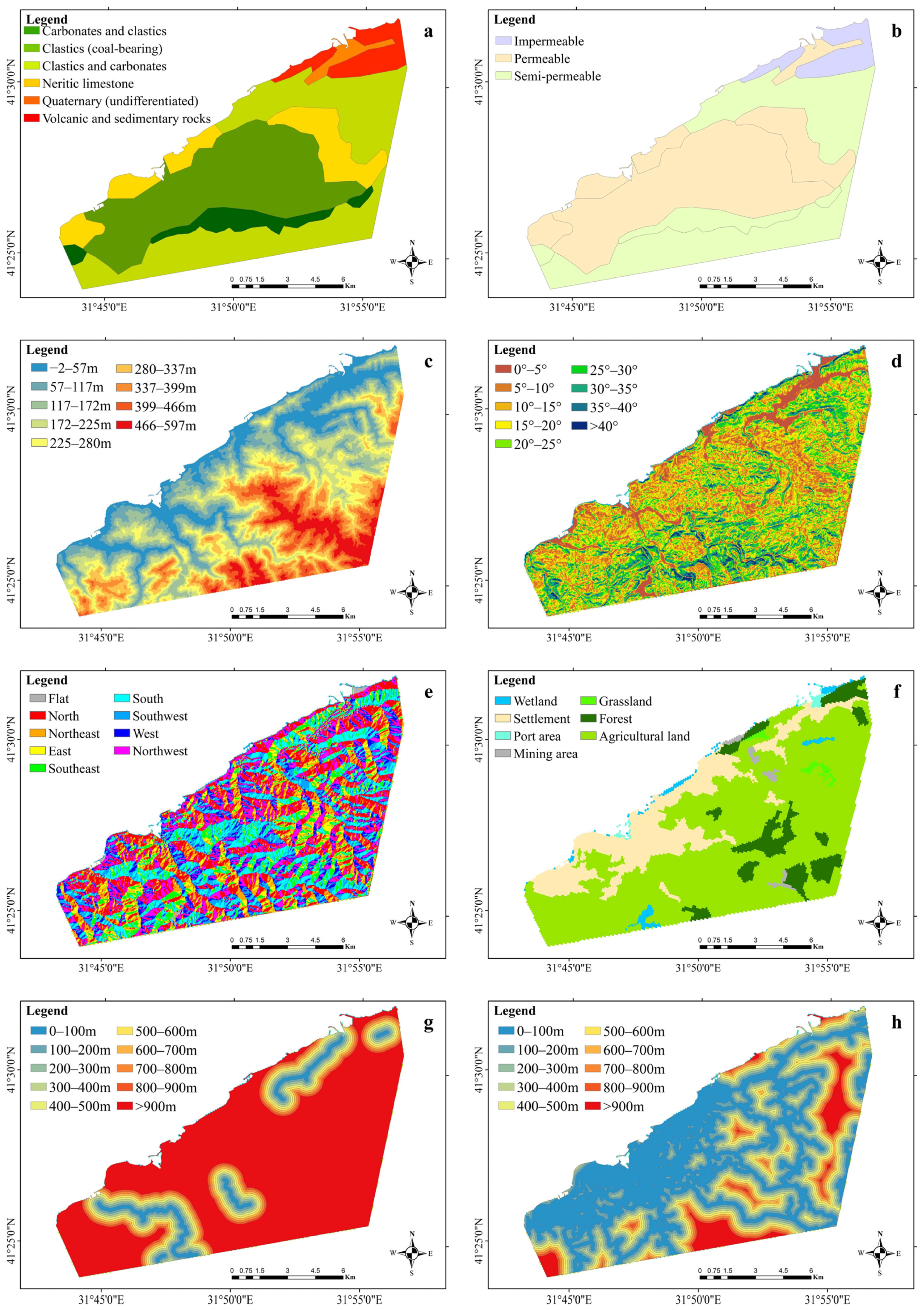
23]. To evaluate the influence of each factor on landslide susceptibility, appropriate thematic datasets are required. Based on literature reviews and field observations conducted within the scope of this study, eight primary parameters influencing landslide susceptibility in the study area were identified (
Figure 1). These parameters include elevation, slope, aspect, land use, distance to rivers, distance to roads, lithology, and hydrogeology.
The thematic data layers representing these eight parameters were converted into raster format for analysis in a GIS environment and classified according to their specific characteristics. Additionally, the raw data sources used to generate the two key datasets employed in this study—namely, the landslide inventory and the InSAR-based deformation map—are presented in
Table 1.
2.2.1. Lithology and Hydrogeology
Lithology is one of the most important factors in landslide occurrence. This variable has been used in almost all studies aimed at preparing landslide susceptibility maps [
29]. The influence of lithology on landslide formation depends on the sensitivity of rock types to landslides [
30]. In the study area, seven lithological units have been identified: carbonates and clastics (d3-1), neritic limestone (j3k-1), clastics (c3), volcanics and sedimentary rocks (k2s), clastics and carbonates (k1), and undifferentiated Quaternary deposits. The lithology layer, initially obtained as vector data, was converted to raster format for use in analyses. The generated lithology map was overlaid with the landslide inventory and deformation maps to determine which units had the highest concentration of landslides. Based on the geological units, three permeability classes were defined: permeable, low-permeable, and impermeable. In the Zonguldak region, landslides frequently occur within weak clastic formations containing claystone, shale, sandstone, and coal-bearing strata. These units generally exhibit low shear strength and high sensitivity to water, making them particularly prone to slope instability. The overlay analysis between the landslide inventory and the lithological map showed that a large proportion of landslides are concentrated within these units. Therefore, lithology was assigned a relatively higher weight in the AHP analysis.
2.2.2. Elevation
Elevation is one of the most frequently used and influential core factors in landslide susceptibility mapping. Elevation can directly or indirectly increase or decrease the likelihood of landslides by affecting various terrain characteristics such as topography, geomorphology, vegetation cover, and erosion rates [
31,
32]. In this study, an elevation map with a spatial resolution of 30 m was used. Additionally, slope and aspect maps were derived from the Digital Elevation Model (DEM) data. Elevation values in the study area range from −2 m to 597 m.
2.2.3. Slope
Slope is an important parameter commonly used in landslide susceptibility analyses. Some studies indicate that landslides are concentrated in areas with steep slopes [
33], while other research shows that landslides can also occur in areas with low slope values [
34]. Based on the DEM of the study area, the slope map was classified into nine subcategories: 0–5°, 5–10°, 10–15°, 15–20°, 20–25°, 25–30°, 30–35°, 35–40°, and above 40°.
2.2.4. Aspect
Aspect is considered in landslide susceptibility maps because it affects factors such as sunlight exposure, precipitation, wind, and soil moisture [
35]. On slopes with high rainfall, the risk of landslides is higher, while solar radiation causes water loss through evaporation [
36]. Therefore, aspect was determined in the study area to evaluate soil moisture conditions. The concentration of landslides on certain slope directions has been statistically assessed in previous studies [
37]. Using the DEM, the slope aspect map was reclassified into nine classes considering both primary and intermediate directions.
2.2.5. Land Use
Land use and land cover (LULC) is an increasingly important factor in landslide susceptibility models [
38]. In this study, data from the National Land Cover Classification System (CORINE) provided by the Ministry of Agriculture and Forestry were used. The land use map for the study area was generalized into four major classes by combining areas with similar susceptibility. These classes include settlements, ports, mining areas, agricultural lands, wetlands, grasslands, and forests.
2.2.6. Distance to Rivers
Rivers can contribute to slope erosion or indirectly trigger landslides by affecting the saturation of slope materials [
39]. River data for the study area were obtained through [
27]. Distance to rivers was calculated using buffer analysis and divided into ten classes at 100 m intervals for analysis.
2.2.7. Distance to Roads
Proximity to roads is frequently used in landslide susceptibility studies [
40]. Road data for the study area were obtained from [
27] and classified into ten categories at 100 m intervals.
Each landslide conditioning factor was classified into subclasses based on its relationship with landslide occurrence. These subclasses were determined using a combination of statistical distribution of the data, literature-based threshold values, and expert judgment. This approach ensures that each class reflects a meaningful variation in landslide susceptibility.
2.2.8. Landslide Inventory Map
Landslide inventory maps provide comprehensive datasets that include the location, extent, and characteristics of landslides that have occurred or been observed in a specific area. These maps serve as a fundamental reference for developing strategies to reduce disaster risks, land-use planning, and conducting scientific analyses [
41,
42].
In this study, observational landslide inventory data for the study area were obtained from the General Directorate of Mineral Research and Exploration [
24] and the Disaster and Emergency Management Authority [
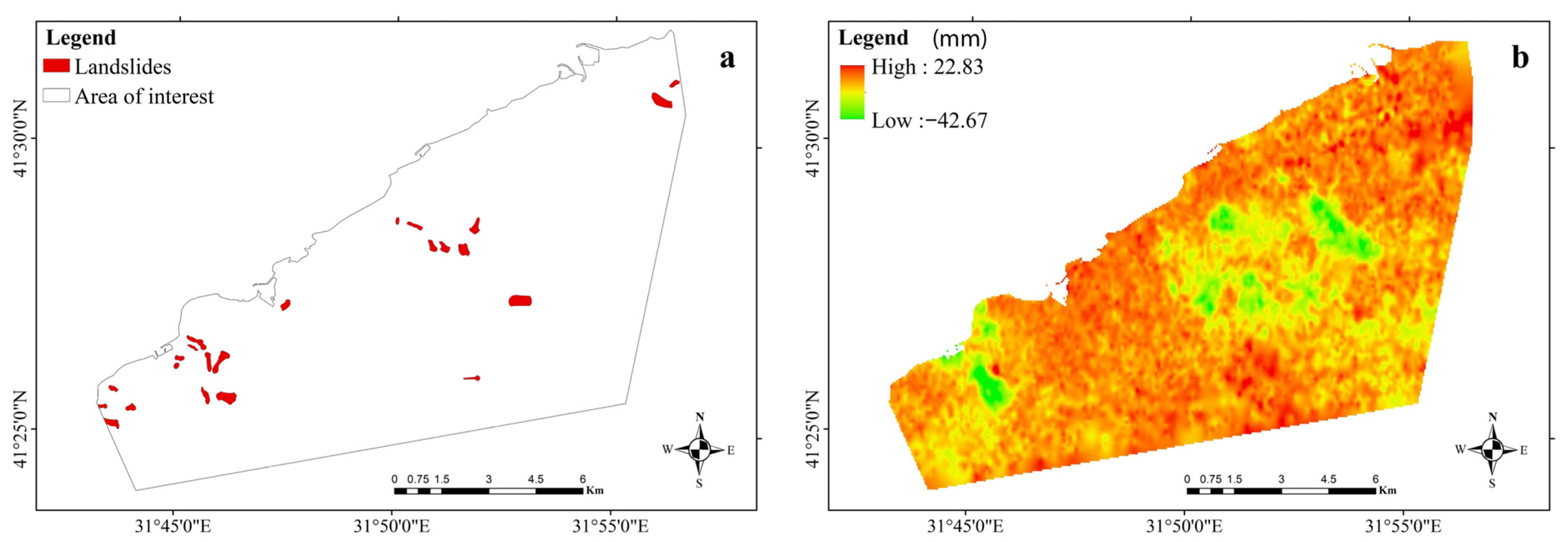
25] for use in the landslide analysis. The data acquired from MTA are based on field observations, while AFAD data include both past and documented landslide events (
Figure 2a). These datasets were used as reference data to validate the susceptibility maps generated in this study. However, the landslides in the inventory do not belong to a single, well-defined, or homogeneous time period. Since the records obtained from MTA and AFAD include documented events that occurred at different times in the past, the occurrence dates of all landslides in the inventory do not fully coincide with the 2019–2024 period used in the SBAS-InSAR analysis.
2.2.9. Deformation Map (InSAR)
In this study, the SBAS (Small Baseline Subset) InSAR method was applied to monitor surface deformations related to mining activities in the Zonguldak region between 4 June 2019, and 4 November 2024. Only SAR data in SLC (Single Look Complex) format from the Sentinel-1 satellite were used in the analyses. To accurately analyze the geological structure and deformation trends in the region, Sentinel-1 images were selected based on a 12-day orbit repeat interval. To improve orbital accuracy, Precise Orbit Ephemerides (POD) and Auxiliary Files were used, and Range-Doppler Terrain Correction (RDTC) was applied to reduce positional errors [
43].
Within the SBAS InSAR framework, interferograms with small baseline lengths were generated to create datasets suitable for time-series analysis. Phase differences between consecutive Sentinel-1 images were calculated using the Differential InSAR (D-InSAR) method, while the topographic phase component was removed using the SRTM 30 m resolution Digital Elevation Model (DEM) [
44]. The multi-temporal InSAR approach allowed long-term deformation trends to be identified (
Figure 2b).
Since no GNSS data were available, various correction methods were applied to reduce atmospheric and systematic errors. Atmospheric phase delays were corrected using GACOS (Generic Atmospheric Correction Online Service) [
45] stable reference points (e.g., reinforced concrete structures, infrastructure facilities) were identified through coherence analysis, and reliable pixels were selected using the Persistent Scatterer Candidates (PSC) method. These steps improved the accuracy of the interferogram analyses.
As a result of the SBAS time-series analysis, surface deformations were calculated using the Singular Value Decomposition (SVD) algorithm, and the annual average deformation rates in the region were found to range between −5 mm/year and −30 mm/year [
44]. The deformation parameter used in this study represents the annual average deformation velocity in the satellite line-of-sight (LOS) obtained from the SBAS-InSAR analysis. These values do not correspond to displacement components projected along the slope direction. Therefore, the InSAR data reflect the component of deformation measurable within the radar viewing geometry, rather than the full magnitude of absolute slope movement. For this reason, the InSAR-based deformation layer was not treated as a dataset that directly represents the timing of all past landslides; rather, it was considered a dynamic indicator reflecting recent active or potentially ongoing surface movements.
2.3. Methods Used in the Study
The Analytical Hierarchy Process (AHP), developed by [
46], is a widely used multi-criteria decision-making method that enables complex decision problems to be structured hierarchically and evaluated based on relative importance weights. AHP has been extensively applied in landslide susceptibility and risk assessment studies. In this method, each criterion and its sub-criteria are compared pairwise using the scale proposed by Saaty, ranging from 1 (equal importance) to 9 (extreme importance) [
46]. In the present study, AHP was employed to determine the relative importance of landslide conditioning factors based on expert judgment, both within individual parameter groups and across different criteria, in order to generate the landslide susceptibility map [
47]. The AHP-derived weights were used to construct a weighted susceptibility index, whereas the same conditioning factors were independently used as input features for the machine learning framework. All input layers were first reclassified to a common scale and subsequently normalized before applying the Analytic Hierarchy Process (AHP). These preprocessing steps ensured consistency among the datasets and allowed for meaningful weighting and aggregation in the susceptibility analysis.
In this study, the AHP and machine learning frameworks were designed as two complementary but methodologically distinct components. AHP was used to derive relative weights based on expert judgment and to construct a weighted susceptibility index. In contrast, the machine learning models were trained using the conditioning factors in their original form as raw input variables. This approach was adopted to allow the algorithms to learn variable importance, nonlinear relationships, and interactions among variables directly from the data. Pre-applying the weights obtained from AHP to the machine learning inputs may directly introduce subjective expert knowledge into the learning process and may partially suppress relationships that classifiers could otherwise identify independently. Therefore, the machine learning framework was designed to remain fully data-driven in order to enable a clearer methodological comparison with the AHP-based expert approach.
In addition to the AHP-based weighting framework, a machine learning approach was adopted to model landslide susceptibility. In this study, 25 different learning algorithms, including Neural Networks (NN), Support Vector Machines (SVMs), tree-based classifiers, ensemble methods, and Bayesian approaches, were evaluated using the same input feature set. The dataset was divided into training (70%) and test (30%) subsets. During the preliminary assessment stage, cross-validation was employed solely to examine model stability; however, the final model selection was primarily based on test dataset performance, as this better reflects generalization ability in spatially heterogeneous environmental datasets. Therefore, in the presence of spatially clustered samples, the random-split approach may introduce spatial dependence between the training and test datasets, potentially causing the model’s generalization performance to appear higher than it actually is. To provide a more comprehensive evaluation of model performance, a one-vs-rest ROC–AUC metric can also be employed, taking into account the multi-class classification structure. This approach allows the discriminative ability of each susceptibility class to be assessed against all other classes.
The Ensemble Bagged Trees method was first introduced by [
48,
49] as a decision tree–specific implementation of the bootstrap aggregating (bagging) approach. In EBT, the same base learning algorithm is iteratively trained on multiple bootstrap samples generated through sampling with replacement from the original training dataset. Each bootstrap sample typically contains approximately 63% of the original observations, while the remaining ≈37% constitute out-of-bag (OOB) samples. An unpruned decision tree is trained for each bootstrap sample, and final predictions are obtained by aggregating individual tree outputs, using averaging for regression problems and majority voting for classification tasks [
50,
51].
Decision trees, particularly when fully grown, are characterized by low bias but high variance, meaning that small changes in the training data can lead to substantial differences in tree structure. The principal advantage of the EBT approach lies in its ability to reduce variance by combining multiple weak learners, resulting in more stable and generalizable predictions. Due to these properties, EBT has been successfully applied across a wide range of fields, including medicine, finance, remote sensing, and material sciences [
52].
The Ensemble Bagged Trees (EBT) model generates class predictions based on an ensemble of decision trees constructed using bootstrap samples of the training data. Each tree produces a class prediction, and the final susceptibility class is determined by majority voting. In addition, class probabilities are estimated as the proportion of trees voting for each class. This enables a probabilistic interpretation of landslide susceptibility, where higher probabilities indicate greater model confidence in the assigned class.
3. Results
To create the landslide susceptibility map using the AHP method, criteria were first defined and a hierarchical structure was established. Pairwise comparisons were then conducted among the criteria (
Table 2). The pairwise comparison matrix used in the AHP analysis was constructed by considering findings from previous landslide susceptibility studies in the literature as well as the relationships between existing landslides and conditioning factors observed in the study area. From these comparisons, normalization matrices and priority vectors were calculated. To check the consistency of the pairwise comparisons, the Consistency Ratio (CR) was calculated. A CR value of 0.1 or lower is considered to indicate that the comparisons are consistent and reliable. In this study, the CR value was found to be 0.04, thereby confirming the suitability of the decision matrices.
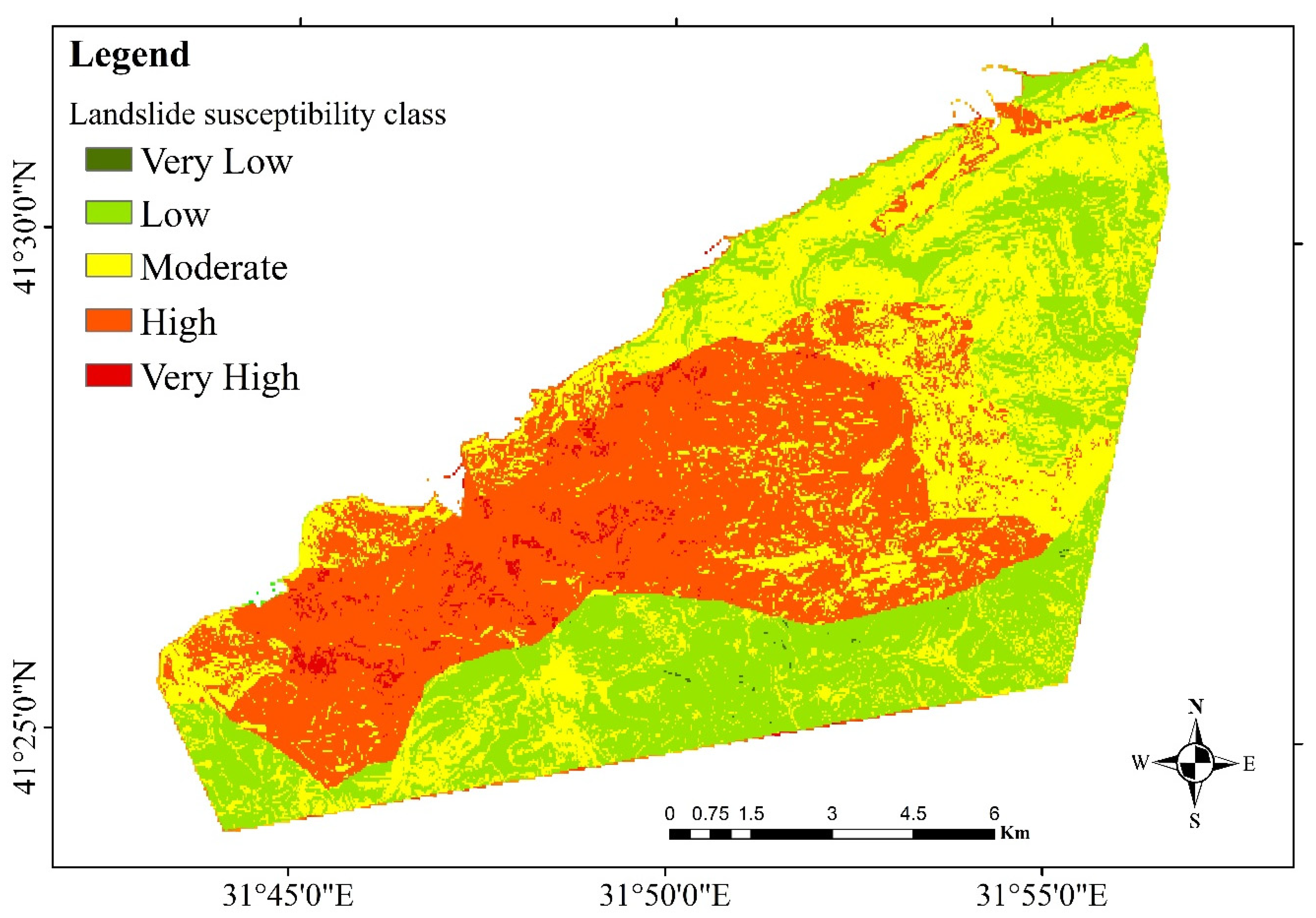
Using the influence weights obtained from the weighting process, analyses were performed in GIS software using ArcGIS 10.8.2 (Esri, Redlands, CA, USA), and landslide susceptibility maps were generated (
Figure 3). The maps were classified into five categories—very low, low, moderate, high, and very high—using a Natural Breaks (Jenks) classification method that considered all raster values. For the AHP-based susceptibility map (
Figure 3), approximately 0.04% of the study area is classified as “Very Low,” 28.46% as “Low,” 32.99% as “Moderate,” 37.27% as “High,” and 1.24% as “Very High” susceptibility.
The produced maps were validated using both the landslide inventory map and the deformation map obtained via satellite-based InSAR techniques. The validation percentages were calculated based on the spatial overlap between the classified susceptibility categories and the landslide inventory and deformation maps. No random resampling, spatial partitioning, or confidence interval estimation was applied for these values; therefore, the reported percentages should be interpreted not as statistical estimates with uncertainty bounds, but as comparative indicators of agreement under the applied classification scheme. Since minor movements not recorded in the inventory or too small to be visually detected could pose reliability issues, the deformation data were also used as a secondary validation.
The comparison results between landslide susceptibility percentages and the inventory and deformation maps are presented in
Table 3. An accuracy of 72.63% was achieved with the inventory map, while the analysis based on deformation data reached 83.05%. This higher agreement may be associated with the fact that deformation data more directly reflect active or potential surface movements; however, it should also be noted that this result can be sensitive to the chosen classification thresholds and validation approach. Additionally, deformation data offer the advantage of detecting movements in areas not covered or updated in traditional inventories. It should also be noted that the agreement percentages are somewhat sensitive to the threshold values used to classify the susceptibility map into Very Low–Very High categories. In addition to these GIS-based susceptibility assessments, a machine learning framework was implemented to model landslide susceptibility and to evaluate predictive performance from a data-driven perspective.
Among the tested algorithms, several classifiers exhibited comparable accuracy levels during the validation phase. Nevertheless, the final model selection was not based solely on average accuracy; performance on the independent test dataset, class-wise prediction consistency, model stability, and practical simplicity were jointly considered. Based on this multi-criteria evaluation, the Ensemble Bagged Trees (EBT) model provided the most balanced and applicable results, achieving a test accuracy of 84.00%. Therefore, EBT was selected as the final classifier for landslide susceptibility mapping in this study.
For the machine learning–based landslide susceptibility analysis, the dataset was divided into 70% training and 30% test subsets. However, because landslide and non-landslide samples may be spatially clustered, spatial independence between the training and test sets may not be fully ensured. In particular, pixels from the same landslide body could be included in both subsets, potentially leading to optimistic estimates of model performance. Therefore, the reported accuracy metrics reflect relative model performance under the current sampling scheme rather than absolute generalization capacity. For more robust performance assessment in future studies, spatial block cross-validation, landslide-object-based splitting, or geographically separated training–testing strategies are recommended. Within the ensemble framework, decision trees were employed as weak learners, and the number of trees was set to n = 30. Accordingly, 30 individual decision trees were trained on different bootstrap samples generated from the training dataset using sampling with replacement. Final class predictions were obtained through majority voting, ensuring equal contribution of each tree to the ensemble decision. The learning rate parameter was set to 1, assigning equal weights to all weak learners and emphasizing variance reduction through bootstrap aggregation rather than differential weighting. The primary focus of the modeling strategy was therefore on the stabilizing effect of ensemble size and resampling, a key advantage of the Ensemble Bagged Trees (EBT) approach.
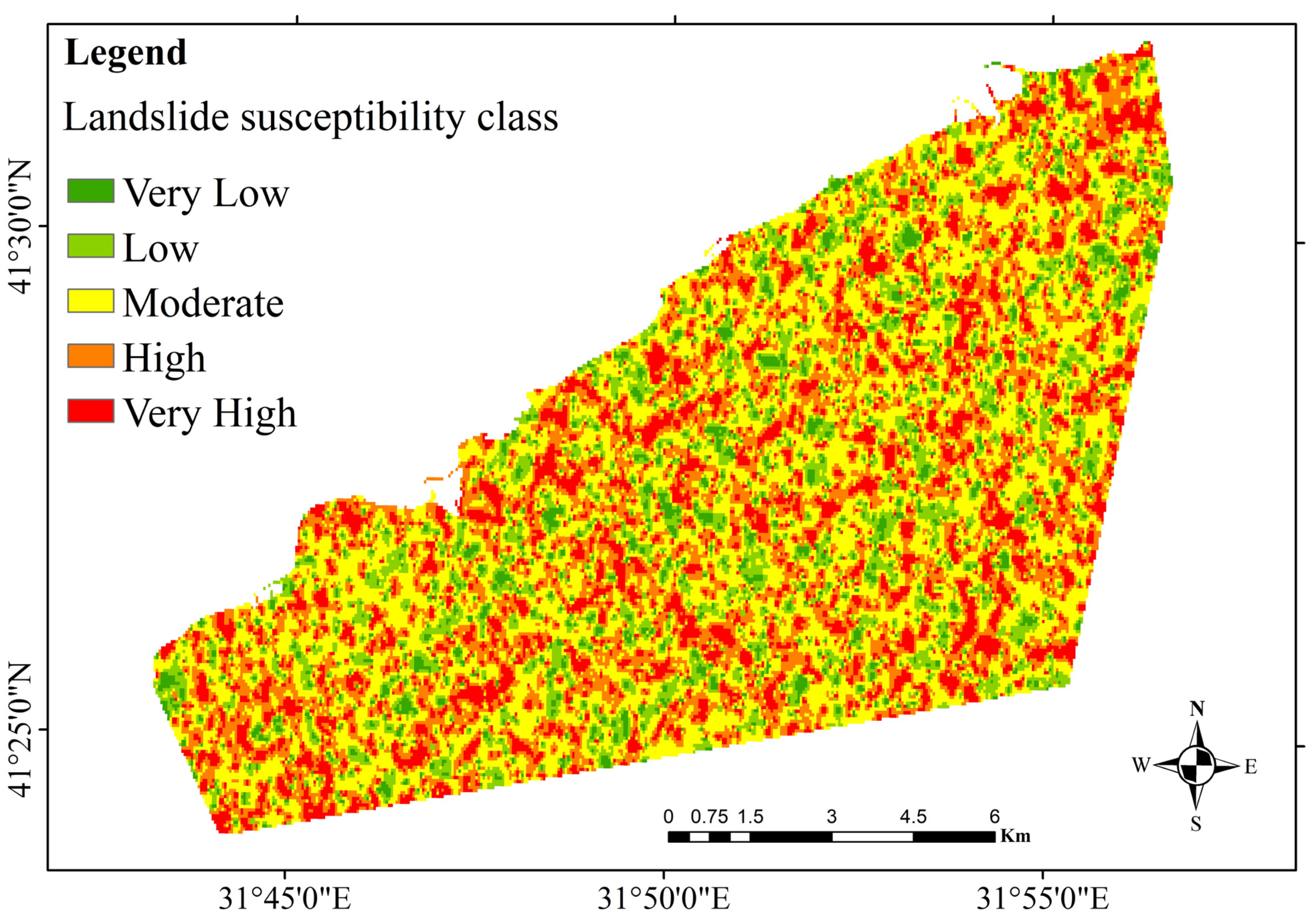
As a result, the model achieved an overall training accuracy of 83.8% and a test accuracy of 84.0%. Class-wise performance analysis indicates high predictive capability for the Low, Moderate, and High landslide susceptibility categories. In contrast, performance was comparatively lower for the Very Low and Very High susceptibility classes (
Figure 4). This is consistent with the spatial distribution of susceptibility classes derived from the EBT model, where approximately 1.91% of the study area is classified as “Very Low,” 3.56% as “Low,” 40.73% as “Moderate,” 37.84% as “High,” and 15.96% as “Very High” susceptibility, based on the Natural Breaks (Jenks) classification method. This method was selected to minimize within-class variance and maximize between-class differences. A comparison between the AHP-based susceptibility map (
Figure 3) and the EBT-based susceptibility map (
Figure 4) reveals notable differences in spatial distribution. These differences are expected, as the AHP method is based on literature-derived weighting and landslide inventory information, whereas the EBT model is data-driven and captures complex nonlinear relationships among conditioning factors. Therefore, the spatial variability observed between the two maps reflects differences in model structure and underlying assumptions rather than inconsistencies in the data.
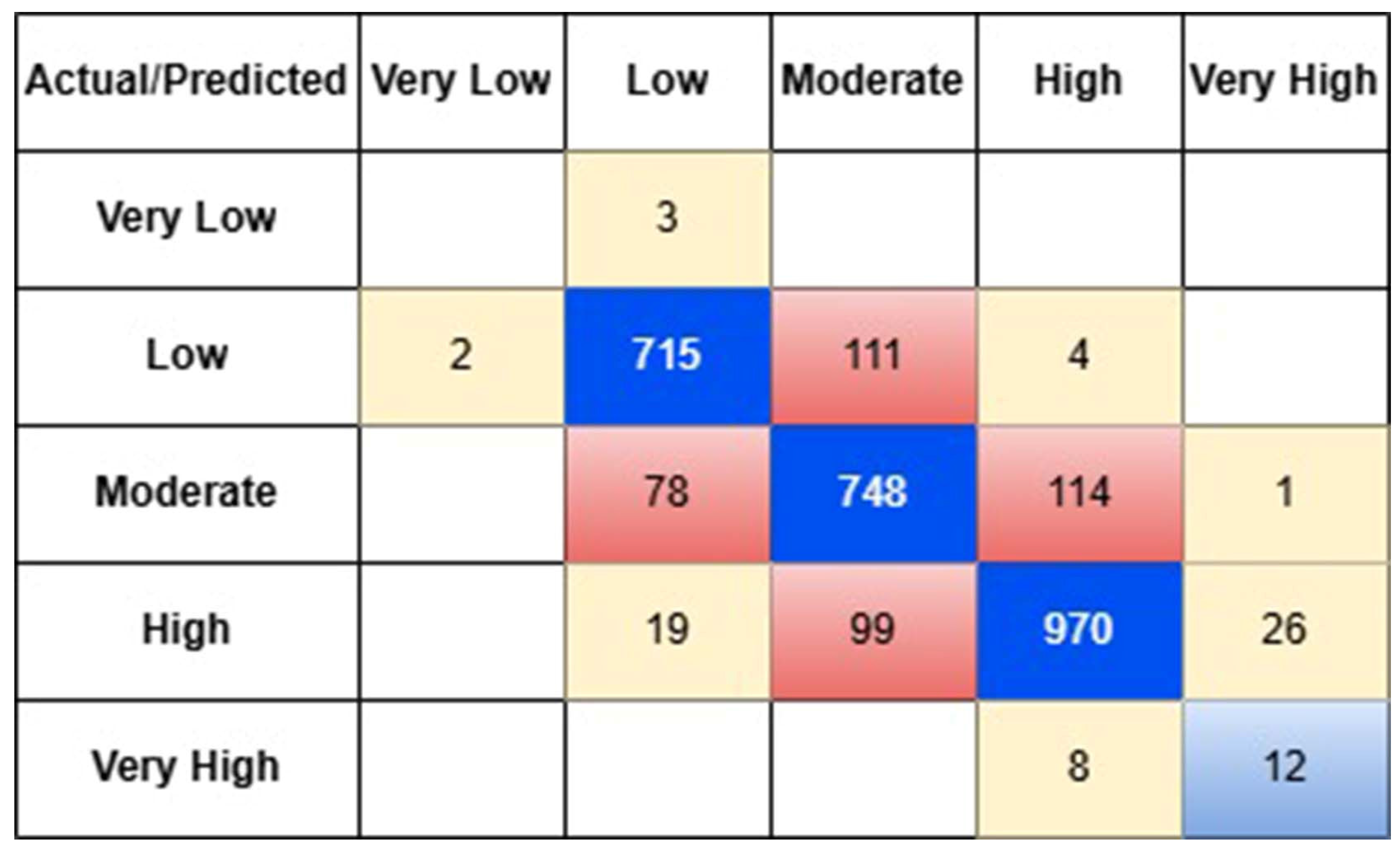
The revised confusion matrix derived from the test dataset (
Figure 5) shows that the class labels are consistently ordered from “Very Low” to “Very High,” with rows representing actual classes and columns representing predicted classes. The matrix reveals that the Very Low class contains only two samples, while the Very High class includes 39 samples, together representing approximately 1% of the total test dataset. Due to this severe class imbalance, the model exhibits limited predictive performance for these minority classes, with very low precision and recall values. Moreover, the extremely small sample size in the Very Low class introduces high uncertainty in the evaluation metrics. Therefore, these metrics should be interpreted with caution and considered as indicative of class imbalance effects rather than statistically robust performance measures. This severe class imbalance explains the reduced classification accuracy observed for these categories. The class-based precision and recall values for the training and test datasets are summarized in
Table 4. In addition, to more clearly present the overall performance of the model, weighted-average precision and recall values have also been included in the table. The metrics reported here are calculated from the training and testing samples generated for the machine learning model; the spatial validation results based on the landslide inventory map and the InSAR deformation map are presented separately in
Table 3. However, since the “Very Low” class in the test dataset contains only two samples, the precision and recall values for this class should be interpreted with caution due to their statistical limitations.
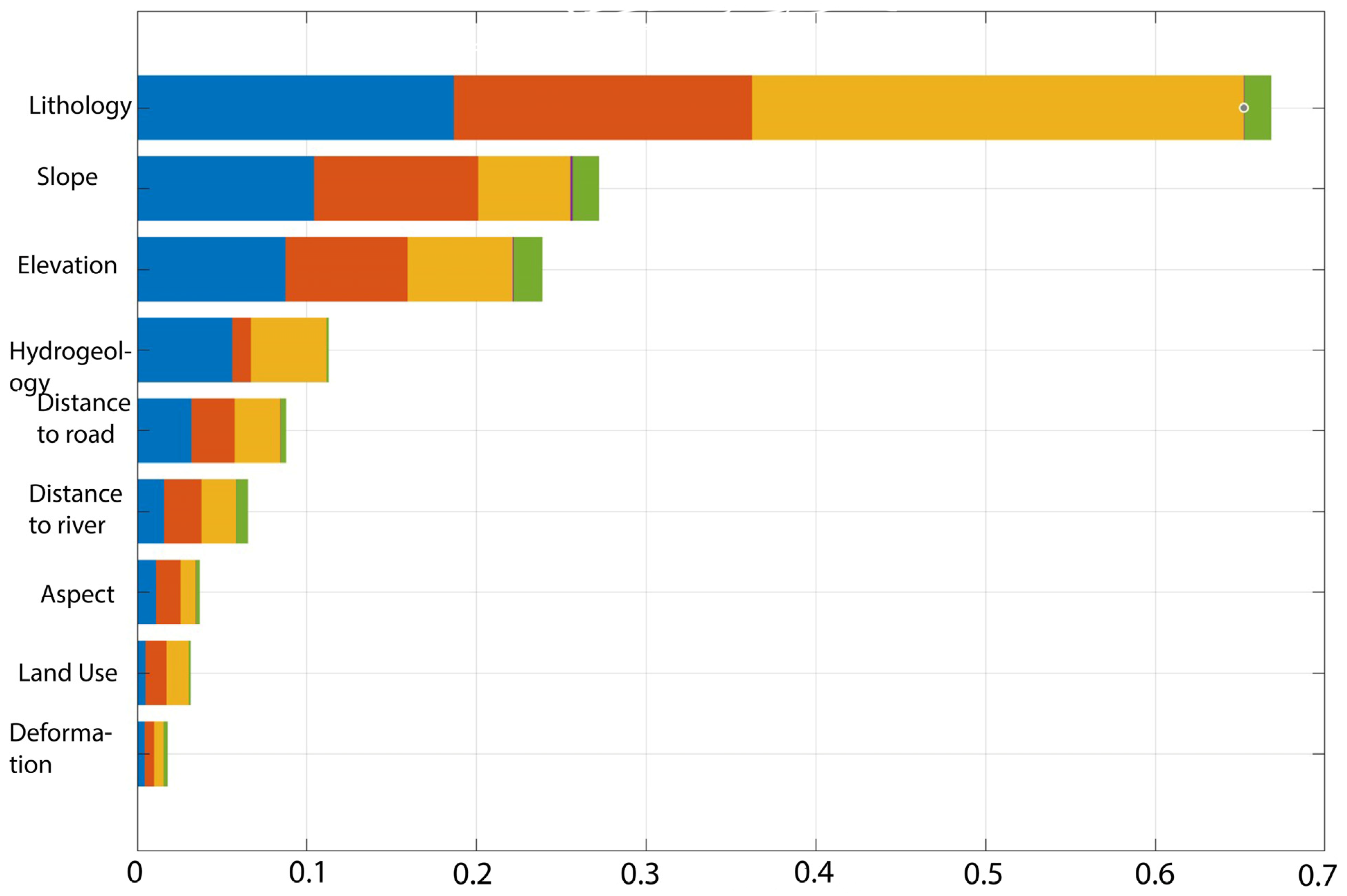
To assess the relative contribution of each conditioning factor to model predictions, SHAP (Shapley Additive Explanation) values were computed for all samples, and mean values were analyzed. The resulting feature importance ranking is shown in
Figure 6. Lithology was identified as the most influential parameter controlling landslide susceptibility, followed by slope and elevation. This finding also supports the use of raw conditioning factors in the machine learning stage, as variable contributions were learned directly from the data rather than being predefined by experts. Conversely, the InSAR-derived ground deformation parameter had the lowest relative importance in the final model. It should be noted, however, that this does not imply the deformation data is uninformative; rather, while static variables such as lithology, slope, and elevation explain the main spatial patterns of landslide susceptibility, InSAR contributes as a dynamic, complementary indicator. In other words, the low relative importance of the deformation variable reflects its limited but meaningful marginal contribution within the model. However, the current SHAP analysis does not examine univariate dependence plots or the nonlinear response ranges of the variables in detail; therefore, the results should be interpreted primarily within the framework of global interpretability. Despite its lower individual importance, including deformation data is essential to capture dynamic slope behavior and complement static conditioning factors. Overall, the SHAP-based interpretability results confirm that the EBT model relies on physically meaningful parameters and produces explanations consistent with established landslide causative mechanisms. Although lithology and slope were identified as the most influential factors in the SHAP analysis, the resulting susceptibility map reflects the combined and nonlinear effects of all conditioning factors rather than the dominance of individual variables. Therefore, areas with high susceptibility are determined by the interaction of multiple factors rather than a single controlling parameter.
The highest test dataset accuracy of 84.0% was achieved using the tree-based ensemble model. Its strong performance is attributed to the ability to capture dominant patterns in the data while maintaining resistance to overfitting, which is crucial when modeling complex environmental processes such as landslide occurrence. Aggregating multiple decision trees trained on different bootstrap samples enables clearer class separation and more stable predictions on unseen data.
4. Discussion
Landslide susceptibility maps for Zonguldak Province were evaluated using an integrated framework that combines conventional conditioning factors with SBAS-InSAR–derived deformation data and artificial intelligence-based classification techniques. The novelty of this study lies in the joint use of 25 machine learning algorithms and multi-temporal deformation measurements within a unified methodology, enabling comprehensive comparison of model behavior and predictive performance. When only the landslide inventory map was used as a reference, the overall accuracy was 72.63%. The integration of SBAS-InSAR deformation information increased the accuracy to 83.05% and demonstrated that time-series deformation measurements provide an important complementary contribution in representing slope instability. It should be noted that the agreement percentages presented in
Table 3 were calculated based on a single classification and overlay scheme, without applying random resampling, bootstrap repetitions, or spatial partitioning to assess uncertainty. Additionally, the results are somewhat sensitive to the thresholds used for the susceptibility classes. Therefore, the higher agreement observed with InSAR validation should be interpreted not as an absolute statistical superiority, but as a comparative indicator within the current methodological framework. In future studies, threshold sensitivity analysis, bootstrap-based confidence intervals, and spatial block validation could be applied to evaluate the robustness of these results in more detail. SHAP analysis suggests that the relatively low importance of the InSAR deformation variable may arise from partial overlap in information with other topographic and geological conditioning factors or with landslide labels. In such cases, the model derives most of its explanatory power from dominant static variables such as lithology, slope, and elevation, while the contribution of the deformation data remains complementary and marginal. Therefore, the role of InSAR in this study should be interpreted not as a primary controlling factor, but as a dynamic supporting layer that is particularly useful for identifying active or slowly evolving instability areas. Similar findings have been reported by [
53,
54], emphasizing that multi-temporal InSAR techniques are effective in detecting slow-moving or previously unrecognized landslides. SBAS-InSAR provides cumulative displacement information over time, allowing identification of potentially unstable areas not evident through conventional field observations alone [
44,
55].
Although certain classifiers, such as the Medium Gaussian Support Vector Machine, showed high performance during preliminary validation, the ensemble tree-based model delivered the most consistent results on the independent test dataset. Nevertheless, the objective of this study was not to combine all high-performing classifiers into a meta-ensemble, but to identify the most balanced single approach based on comparative analysis. Moreover, the selected EBT model is inherently a bagging-based ensemble, consisting of multiple decision trees trained on bootstrap samples. Model averaging, stacking, or other high-level ensemble strategies were not applied in this study, as the focus was to maintain methodological clarity and select the most suitable single model on the same dataset. However, combining similarly performing models via meta-ensemble approaches could provide additional gains in accuracy and generalization in future studies. This underscores the importance of prioritizing test dataset performance over validation metrics, particularly for spatially correlated environmental datasets, where validation accuracy may be overly optimistic. The superior performance of the ensemble model is mainly due to its flexible yet robust structure, which reduces variance and limits sensitivity to noise. Tree-based ensemble approaches are known for handling heterogeneous and multivariate datasets by defining class boundaries in a simplified yet interpretable manner, as documented by [
56,
57].
Recent studies have highlighted the benefits of integrating physics-based or process-aware frameworks into machine learning for landslide susceptibility assessment. For example, ref. [
58] proposed a physics-informed machine learning (PIML) framework that embeds a differentiable physics-based landslide model into neural networks, accounting for hydrological processes such as rainfall infiltration and runoff. Their results demonstrate a substantial improvement in landslide prediction performance compared with purely physics-based models. Similarly, ref. [
59] introduced a hybrid physics–machine learning approach that combines the TRIGRS slope stability model with multiple ML algorithms, achieving higher accuracy and better spatial generalization than traditional methods. These studies emphasize that incorporating physical process knowledge and uncertainty modeling can improve prediction robustness, provide probabilistic interpretation, and enhance scientific consistency, complementing the deterministic AHP–ML–InSAR approach used in the present study.
The weighting of the eight parameters influencing landslide occurrence was determined using the AHP method, considering both expert judgment and evidence from previous studies in the literature, consistent with earlier findings emphasizing the role of structured judgment in multi-criteria decision-making frameworks [
60,
61]. However, the performance of AHP-weighted feature preprocessing compared with the raw input approach was not additionally tested in this study. The main reason for this was not a technical limitation, but rather the intention to analytically distinguish the expert-based AHP framework from the data-driven machine learning framework. This separation was intended to allow the two approaches to be presented in a directly comparable manner. A systematic comparison of AHP-weighted inputs and raw inputs is therefore considered a valuable direction for future research. However, the inherently static nature of inventory-based approaches highlights the necessity of integrating time-series deformation data, a limitation effectively addressed through SBAS-InSAR measurements in this study. However, because the landslide inventory also includes past events while the InSAR data cover only the 2019–2024 period, a complete temporal correspondence between the two datasets may not exist. This may introduce a certain degree of uncertainty, particularly for older landslides that no longer exhibit deformation in the current period, affecting both the validation process and the contribution of the InSAR variable to the machine learning model. Nevertheless, the InSAR data were used in this study as a current and dynamic information layer that complements the conventional inventory. However, InSAR-based deformation measurements depend on the radar line-of-sight (LOS) and reflect only the LOS component of actual ground movement. In areas where the movement direction is poorly aligned with the radar viewing geometry, the measured deformation may underestimate the true displacement. Therefore, the deformation layer used in this study should be interpreted not as a direct measure of absolute slope movement, but as a dynamic indicator representing relative surface instability. In future studies, multi-orbit InSAR solutions or slope-parallel projection approaches could help reduce this limitation. The joint use of time-stamped landslide inventories with temporally consistent deformation time-series would help reduce this uncertainty in future studies.
Overall, the proposed integrated framework successfully identifies both past landslide events and potential high-risk areas. This has important implications for local authorities and disaster risk management, offering a robust and transferable methodology applicable to other landslide-prone regions with similar data characteristics. Additional performance metrics, including class-wise precision–recall values, confusion matrices, and a detailed comparison of all 25 tested machine learning algorithms, are provided in the
Supplementary Material.
From a sustainability perspective, the integration of AHP, artificial intelligence, and InSAR contributes to more informed decision-making processes by enabling proactive risk management. Identifying high-risk areas in advance supports sustainable land-use policies, minimizes environmental degradation, and reduces socio-economic vulnerabilities associated with natural hazards. Therefore, the proposed framework not only improves prediction accuracy but also serves as a practical tool for sustainable disaster risk reduction strategies.
5. Conclusions
In this study, the landslide susceptibility map of Zonguldak Province was successfully generated through the integration of the AHP (Analytical Hierarchy Process) and artificial intelligence methods, and the results were validated using both traditional landslide inventory data and InSAR data. Comparative analyses demonstrated a high degree of agreement between the methods, highlighting the advantage of InSAR data in detecting surface deformations over a wider area. InSAR-based analyses provided a complementary assessment in addition to traditional inventory and static factors, reflecting current surface movements. In particular, InSAR-based analyses provided a comprehensive and reliable assessment for identifying unprocessed or unobserved landslides, going beyond the capabilities of traditional methods.
Within this integrated framework, AHP provided expert knowledge-based weighting, while the machine learning models served as an independent predictive layer, learning the effects of the conditioning factors directly from the data. Consequently, the developed landslide susceptibility map serves as a robust tool for more precise and accurate prediction of future landslide risks in Zonguldak Province. This study provides a valuable reference for local authorities and disaster risk management units in identifying potential landslide areas and establishes an important foundation for adapting the employed methods to other natural disaster risk assessments. While InSAR data and high-quality landslide inventories were essential in this study, the framework can be adapted to regions lacking such data, although predictive performance may be somewhat reduced.
In this regard, the study directly contributes to sustainability by promoting risk-sensitive planning, supporting environmental protection, and enhancing the resilience of human settlements against natural hazards.