How Does Rural Digitalization Affect the Resilience of the Swine Industry? A Sustainable Development Perspective

Abstract
1. Introduction
2. Theoretical Analysis
2.1. Defining the Resilience of the Swine Industry
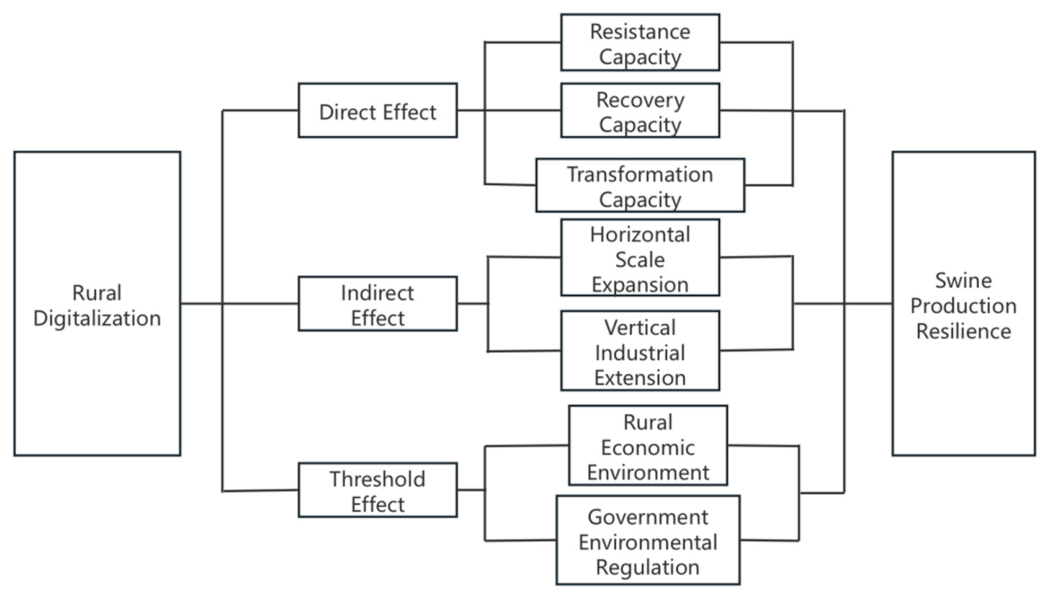
2.2. Direct Impact of Rural Digitalization on the Resilience of the Swine Industry
2.3. Indirect Effects of Rural Digitalization on the Resilience of the Swine Industry
2.4. Threshold Effect of Rural Digitalization on the Resilience of the Swine Industry
3. Study Design
3.1. Variable Selection
3.1.1. Dependent Variable
3.1.2. Core Explanatory Variables
3.1.3. Control Variables
3.1.4. Mediating Variables
3.1.5. Threshold Variable
3.2. Data Sources
3.3. Model Construction
3.3.1. Benchmark Regression Model
3.3.2. Mediation Effect Model
3.3.3. Threshold Effect Model
3.3.4. Difference-in-Differences Model
4. Empirical Testing
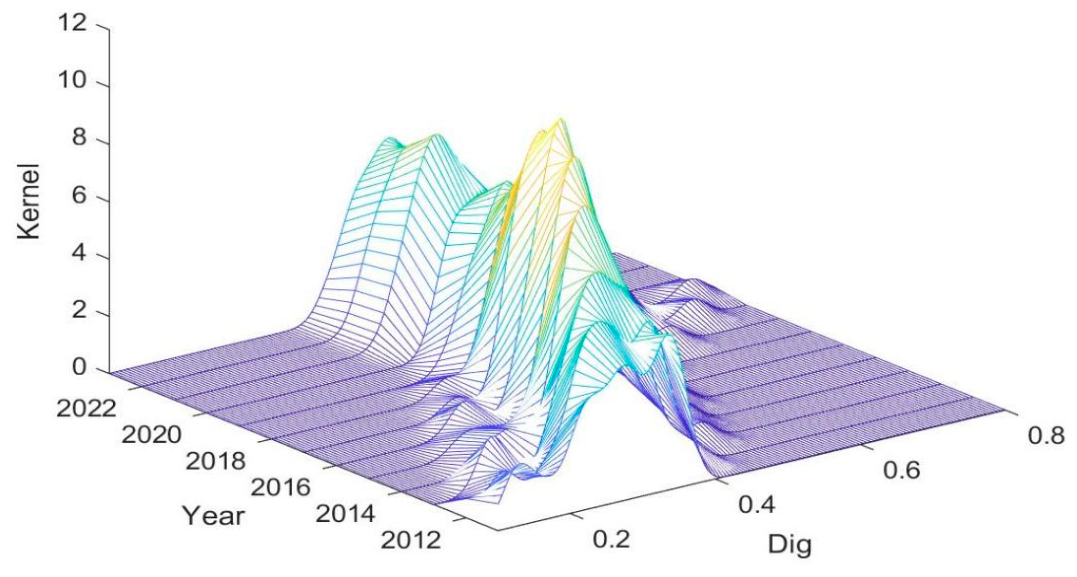
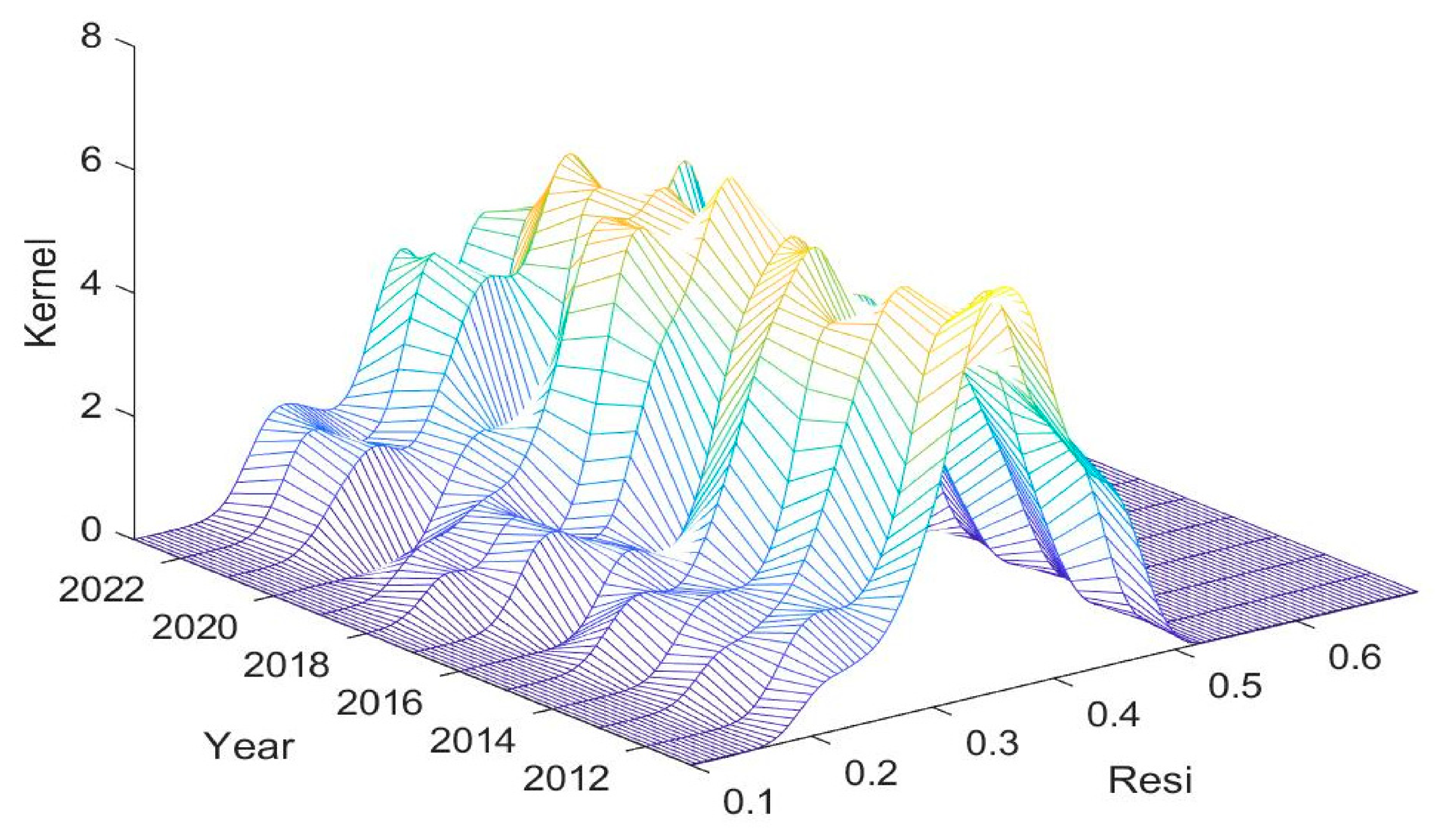
4.1. Analysis of Rural Digitalization and Resi Measurement Results
4.2. Benchmark Regression Results of Rural Digitalization
4.3. Robustness Test Results
4.3.1. Endogeneity Test
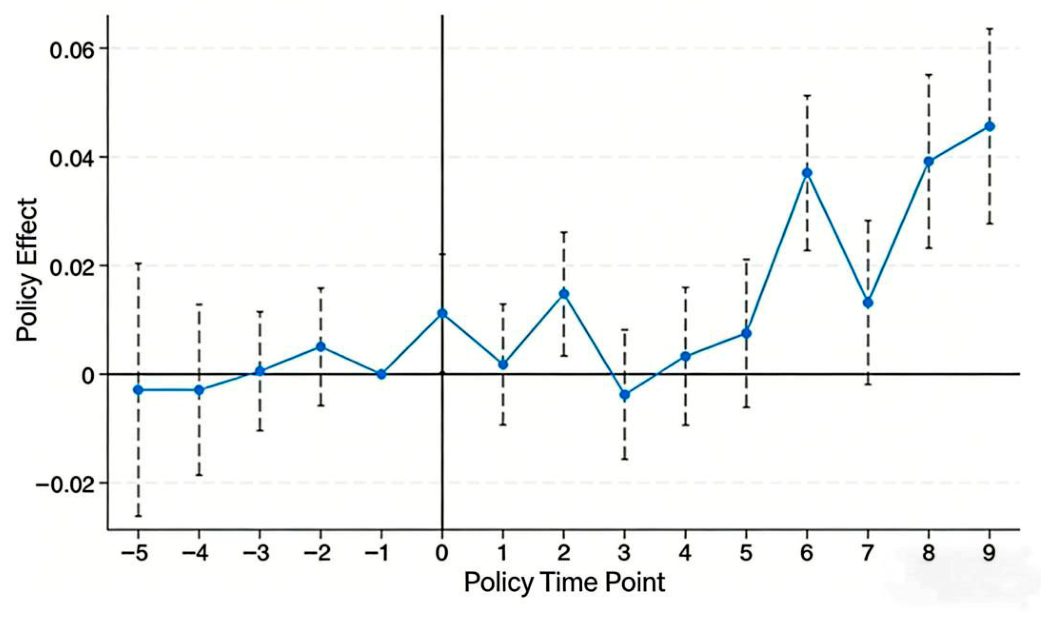
4.3.2. Exogenous Shock Test
4.3.3. Other Robustness Tests
4.4. Results of the Impact Mechanism Test
4.5. Threshold Effect Test Results
4.6. Heterogeneity Analysis Results
4.6.1. Heterogeneity Across Resilience Dimensions
4.6.2. Distinguishing Traffic Conditions
4.6.3. Distinguishing Resource Endowments
4.7. Discussion of Results
5. Research Conclusions and Policy Recommendations
5.1. Research Conclusions
5.2. Policy Recommendations
Author Contributions
Funding
Institutional Review Board Statement
Informed Consent Statement
Data Availability Statement
Conflicts of Interest
References
- Deng, Y.; Tan, Y.; Lu, Q. Impact of Market Price Volatility on Expected Operating Income and Income Risk for Swine Farmers in China: An Analysis of the Effectiveness of Spatiotemporal Sales Strategy Selection. Agribusiness 2025, 4, 26. [Google Scholar] [CrossRef]
- Zhou, D.; Zhang, J.; Huan, H.; Hu, N.; Li, Y.; Cheng, J. Assessing the Impact of External Shocks on Prices in the Live Pig Industry Chain: Evidence from China. Sustainability 2025, 17, 1934. [Google Scholar] [CrossRef]
- Jia, Y.; Sun, W.; Su, G.; Hua, J.; He, Z. The Threshold Effect of Swine Epidemics on the Pig Supply in China. Animals 2022, 12, 2595. [Google Scholar] [CrossRef] [PubMed]
- Hua, J.; Ma, C.; Li, W.; He, Z.; Zhu, P. Effects and mechanisms of digitalization to enhance the resilience of the hog breeding industry: Evidence from China. Front. Sustain. Food Syst. 2024, 10, 1467162. [Google Scholar] [CrossRef]
- Xing, W.; Imran, A. Financial and Technological Drivers of Sustainable Development: The Role of Communication Technology, Financial Efficiency and Education in BRICS. Sustainability 2025, 17, 2326. [Google Scholar] [CrossRef]
- Guo, H.; Aye, Y.N.; Wang, H. The digital divide and hog industry: The impact of digital technology levels on the sustainability of the hog industry in China. J. Clean. Prod. 2026, 538, 147370. [Google Scholar]
- Benjamin, M.; Yik, S. Precision livestock farming in swine welfare: A review for swine practitioners. Animals 2019, 9, 133. [Google Scholar] [CrossRef]
- Wang, H.; Chen, Y.; Xie, J.; Liu, C. Research on digital empowerment, innovation vitality and manufacturing supply chain resilience mechanism. PLoS ONE 2025, 20, e0316183. [Google Scholar] [CrossRef]
- Zhou, K.; Wang, H.; Wu, J.; Li, J. Effect of digital economy on large-scale pig farming: An empirical study from China. Cogent Food Agric. 2023, 9, 2238985. [Google Scholar] [CrossRef]
- Feng, J.; He, S.; Wan, C.; Liu, J.; Xie, F. The effect of swine insurance participation on swine production efficiency: Evidence from China. PLoS ONE 2025, 20, e0317759. [Google Scholar] [CrossRef]
- Xie, Y.; Yang, Y.; Yang, L. How do digital knowledge resources affect the carbon emission intensity of the pig industry? J. Knowl. Manag. 2025, 1, 24. [Google Scholar] [CrossRef]
- Giglio, L.; Rousing, T.; Łodyga, D.; Reyes-Palomo, C.; Sanz-Fernández, S.; Soffiantini, C.S.; Ferrari, P. Economic Resilience in Intensive and Extensive Pig Farming Systems. Sustainability 2025, 17, 7026. [Google Scholar] [CrossRef]
- Zhang, X.; Tian, C. Measurement and influencing factors of regional economic resilience in China. Sustainability 2024, 16, 3338. [Google Scholar] [CrossRef]
- Hu, Y.; Yu, Y. Scale Difference from the Impact of Disease Control on Pig Production Efficiency. Animals 2022, 12, 2647. [Google Scholar] [CrossRef]
- He, J.; Fan, M.; Fan, Y. Digital transformation and supply chain efficiency improvement: An empirical study from a-share listed companies in China. PLoS ONE 2024, 19, e0302133. [Google Scholar] [CrossRef]
- Wang, G.; Wang, J.; Chen, S.; Zhao, C. Vertical integration selection of Chinese pig industry chain under African swine fever—From the perspective of stable pig supply. PLoS ONE 2023, 18, e0280626. [Google Scholar] [CrossRef]
- Ma, M.; Wang, H.H.; Hua, Y.; Qin, F.; Yang, J. African swine fever in China: Impacts, responses, and policy implications. Food Policy 2021, 102, 102065. [Google Scholar] [CrossRef]
- Martin, R.; Sunley, P.; Tyler, P. Local growth evolutions: Recession, resilience and recovery. Camb. J. Reg. Econ. Soc. 2015, 8, 141–148. [Google Scholar] [CrossRef]
- Lu, S.; Zhuang, J.; Sun, Z.; Huang, M. How can rural digitalization improve agricultural green total factor productivity: Empirical evidence from counties in China. Heliyon 2024, 10, e35296. [Google Scholar] [CrossRef] [PubMed]
- Fredeen, H.T.; Harmon, B.G. The Swine Industry: Changes and Challenges. J. Anim. Sci. 1983, 57, 100–118. [Google Scholar]
- Han, M.; Yu, W.; Clora, F. Boom and bust in China’s pig sector during 2018–2021: Recent recovery from the ASF shocks and longer-term sustainability considerations. Sustainability 2022, 14, 6784. [Google Scholar] [CrossRef]
- Yu, Y.; Li, Q.; Bao, Y.; Fu, E.; Chen, Y.; Ni, T. Research on the Measurement and Influencing Factors of Carbon Emissions in the Swine Industry from the Perspective of the Industry Chain. Sustainability 2024, 16, 2199. [Google Scholar] [CrossRef]
- Ambrogio, G.; Filice, L.; Longo, F.; Padovano, A. Workforce and supply chain disruption as a digital and technological innovation opportunity for resilient manufacturing systems in the COVID-19 pandemic. Comput. Ind. Eng. 2022, 169, 108158. [Google Scholar] [CrossRef]
- De Roest, K.; Ferrari, P.; Knickel, K. Specialisation and economies of scale or diversification and economies of scope? Assessing different agricultural development pathways. J. Rural Stud. 2018, 59, 222–231. [Google Scholar] [CrossRef]
- Marić, K.; Gvozdanović, K.; Djurkin Kušec, I.; Kušec, G.; Margeta, V. Smart Pig Farms: Integration and Application of Digital Technologies in Pig Production. Agriculture 2025, 15, 937. [Google Scholar] [CrossRef]
- Mahfuz, S.; Mun, H.-S.; Dilawar, M.A.; Yang, C.-J. Applications of smart technology as a sustainable strategy in modern swine farming. Sustainability 2022, 14, 2607. [Google Scholar] [CrossRef]
- Zhang, X.; Fan, D. Can agricultural digital transformation help farmers increase income? An empirical study based on thousands of farmers in Hubei Province. Environ. Dev. Sustain. 2023, 26, 14405–14431. [Google Scholar] [CrossRef] [PubMed]
- Xie, Y.; Yang, Y.; Xie, Y. The impact of industrial agglomeration on new quality productive forces enhancement in China’s pig farming industry. Sci. Rep. 2025, 15, 18591. [Google Scholar] [CrossRef]
- Xu, Z.; Hu, X.; Xu, F.; Zhang, H.; Zhou, H. The impact of swine diseases on total factor productivity of pig farms of different scales in China. Porc. Health Manag. 2026, 15, 9. [Google Scholar] [CrossRef] [PubMed]
- Papatsiros, V.G.; Tsekouras, N.; Papakonstantinou, G.I.; Kamvysi, K.; Eliopoulos, C.; Fotos, L.; Arapoglou, D.; Meletis, E.; Michailidis, G.; Gougoulis, D. The Use of Food Industry By-Products in Pig Diets as a Challenge Option to Reduce the Environmental Footprint. Agriculture 2025, 15, 2390. [Google Scholar] [CrossRef]
- Lythreatis, S.; Singh, S.K.; El-Kassar, A.-N. The digital divide: A review and future research agenda. Technol. Forecast. Soc. Change 2022, 175, 121359. [Google Scholar] [CrossRef]
- Kerras, H.; Contreras, M.F.R.; Bautista, S.; Gómez, M.D.D.-M. Is the rural population caught in the whirlwind of the digital divide. Agriculture 2022, 12, 1976. [Google Scholar] [CrossRef]
- Long, Y.; Li, Y.; Yu, X.; Zou, S. Human resource service industry and regional economic growth. Financ. Res. Lett. 2026, 100, 109556. [Google Scholar] [CrossRef]
- Depaoli, P.; Za, S.; Scornavacca, E. A model for digital development of SMEs: An interaction-based approach. J. Small Bus. Enterp. Dev. 2020, 27, 1049–1068. [Google Scholar] [CrossRef]
- Wang, G.; Shen, Y.; Li, C.; Zhu, Q.; ZhanBota, A. The regulatory effect of herd structure on pig production under the environmental regulation. PLoS ONE 2022, 17, e0266687. [Google Scholar] [CrossRef]
- Wang, Z.; Wei, W. Regional economic resilience in China: Measurement and determinants. Reg. Stud. 2021, 55, 1228–1239. [Google Scholar] [CrossRef]
- Vonderohe, C.E.; Brizgys, L.A.; Richert, J.A.; Radcliffe, J.S. Swine production: How sustainable is sustainability? Anim. Front. 2022, 12, 7–17. [Google Scholar] [CrossRef] [PubMed]
- Tian, Y.; Liu, Q.; Ye, Y.; Zhang, Z.; Khanal, R. How the rural digital economy drives rural industrial revitalization—Case study of China’s 30 provinces. Sustainability 2023, 15, 6923. [Google Scholar] [CrossRef]
- Asante, B.O.; Villano, R.A.; Battese, G.E. Integrated crop-livestock management practices, technical efficiency and technology ratios in extensive small-ruminant systems in Ghana. Livest. Sci. 2017, 201, 58–69. [Google Scholar] [CrossRef]
- Feng, L.; Yang, W.; Hu, J.; Wu, K.; Li, H. Exploring the nexus between rural economic digitalization and agricultural carbon emissions: A multi-scale analysis across 1607 counties in China. J. Environ. Manag. 2025, 373, 123497. [Google Scholar] [CrossRef] [PubMed]
- Zhang, Z.; Sun, C.; Wang, J. How can the digital economy promote the integration of rural industries—Taking China as an example. Agriculture 2023, 13, 2023. [Google Scholar] [CrossRef]
- Guo, H.; Li, S.; Pan, C.; Xu, S.; Lei, Q. Analysis of spatial and temporal characteristics of carbon emission efficiency of pig farming and the influencing factors in China. Front. Public Health 2023, 11, 1073902. [Google Scholar] [CrossRef]
- Zhang, H.; Zhang, J.; Song, J. Analysis of the threshold effect of agricultural industrial agglomeration and industrial structure upgrading on sustainable agricultural development in China. J. Clean. Prod. 2022, 341, 130818. [Google Scholar] [CrossRef]
- Feng, J.; Wang, Y. Does digital inclusive finance promote agricultural development? A test based on threshold and spillover effects. Financ. Res. Lett. 2024, 69, 106104. [Google Scholar] [CrossRef]
- Mallinckrodt, B.; Abraham, W.T.; Wei, M.; Russell, D.W. Advances in testing the statistical significance of mediation effects. J. Couns. Psychol. 2006, 53, 372–378. [Google Scholar] [CrossRef]
- Wang, S.; Song, Y.; Du, A.M.; Liang, J. The digital economy and entrepreneurial dynamics: An empirical analysis of urban regions in China. Res. Int. Bus. Financ. 2024, 71, 102459. [Google Scholar] [CrossRef]
- Zhang, Y.; Xie, W.; Ding, B. Research on the impact mechanism and spatial effects of digital technology empowering rural revitalization. Sustainability 2025, 18, 230. [Google Scholar] [CrossRef]
- Zhang, Y.; Zang, W.; Sun, C. Riding the terrain: Geographic influence on household adoption of digital finance. Int. Rev. Econ. Financ. 2025, 105, 104816. [Google Scholar] [CrossRef]
- Arronte Ledo, A.; Holl, A. Ultrahigh-Speed Fixed Broadband and Rural Development. Tijdschr. Econ. Soc. Geogr. 2023, 114, 479–500. [Google Scholar] [CrossRef]
- Cai, M.; Huang, G.; Tan, Y.; Jiang, J.; Zhou, Z.; Lu, X. Decoding the complexity of large-scale pork supply chain networks in China. Ind. Manag. Data Syst. 2020, 120, 1483–1500. [Google Scholar] [CrossRef]
- Luo, R.; Zhou, N. Dynamic evolution, spatial differences, and driving factors of China’s provincial digital economy. Sustainability 2022, 14, 9376. [Google Scholar] [CrossRef]



| First-Level Indicator | Second-Level Indicator | Third-Level Indicator | Indicator Connotation | Indicator Direction |
|---|---|---|---|---|
| Resistance capacity | Production coordination | Feed grain production | Provincial feed grain output | + |
| Number of designated slaughterhouses | Number of designated swine slaughterhouses | + | ||
| Level of veterinary expertise | Total veterinary technicians/Total employees | + | ||
| Value added in the service sector | Value added by animal husbandry/Value added by the primary sector | + | ||
| Production stability | Number of employees | Number of employees in animal husbandry × (Output value of the swine industry/Output value of animal husbandry) | + | |
| Fixed asset investment in animal husbandry | Fixed investment in animal husbandry/Total fixed investment | + | ||
| Live swine slaughter rate | Number of swine marketed this year/Swine inventory at the end of last year | + | ||
| Production price stability | Swine production price index | + | ||
| Recovery capacity | Production recovery | Stock of breeding sows | Breeding sow inventory | + |
| Growth rate of output value in swine industry | (Current-year output value/Previous-year output value) − 1 | + | ||
| Expenditures on disease control in swine farming | Livestock healthcare expenses/Material and service expenses | + | ||
| Per capita pork production | Pork production/Total population | + | ||
| Resource consumption | Total pollution | Calculated according to Formula (1) | − | |
| Water consumption per head | Water costs/number of swine marketed | − | ||
| Energy consumption per head | Fuel and power costs/number of swine marketed | − | ||
| Transformation capacity | Government and financial support | Livestock service support | Number of livestock stations | + |
| Financial support for agriculture | Local fiscal expenditure on agriculture, forestry and water affairs | + | ||
| Ratio of agricultural insurance revenue to swine shipments | Insurance income of agricultural insurance/Swine marketed | + | ||
| Technological advancement | Funding for agricultural research activities | Internal R&D expenditures × Total output value of swine/Regional gross output value | + | |
| Number of researchers | Number of R&D personnel × Total output value of swine/Regional gross output value | + | ||
| Mechanization level in swine farming | Livestock machinery and power | + |
| First-Level Indicator | Second-Level Indicator | Third-Level Indicator | Indicator Direction |
|---|---|---|---|
| Digital infrastructure in rural areas | Internet infrastructure | Number of rural broadband internet subscribers | + |
| Digital talent support | Number of agricultural technical personnel | + | |
| Logistics infrastructure investment | Fixed asset investment in postal services | + | |
| Rural modernization equipment | Per capita electricity consumption in rural areas | + | |
| Digitalization of the rural economy | Digital finance development | Digital inclusive finance index | + |
| Rural e-commerce | Number of Taobao Villages | + | |
| Logistics distribution coverage | Length of rural delivery routes | + | |
| Level of digital transactions | E-commerce sales and purchases | + | |
| Rural digital service platforms | Information service consumption | Per capita expenditure on transportation and communications by rural households | + |
| Information technology services | Total volume of telecommunications services | + | |
| Television penetration rate | Comprehensive television coverage rate in rural areas | + | |
| Smartphone penetration rate | Number of mobile phones per million rural households at year-end | + |
| Variable | Observations | Mean Value | Standard Deviation | Minimum | Maximum |
|---|---|---|---|---|---|
| Resi | 390 | 0.368 | 0.075 | 0.167 | 0.607 |
| Dig | 390 | 0.418 | 0.108 | 0.051 | 0.769 |
| Size | 390 | 3.325 | 2.679 | 0.033 | 10.653 |
| Agg | 390 | 0.955 | 0.380 | 0.083 | 1.725 |
| Er | 390 | 3.934 | 3.151 | 0.363 | 27.832 |
| Inc | 390 | 8.996 | 0.408 | 7.971 | 10.176 |
| Cap | 390 | 58.948 | 17.010 | 10.000 | 87.368 |
| Fin | 390 | 3.855 | 0.467 | −0.429 | 4.736 |
| Env | 390 | 6.716 | 0.425 | 5.355 | 7.609 |
| Cons | 390 | 2.841 | 0.545 | 0.262 | 3.882 |
| Variable | (1) | (2) | (3) | (4) |
|---|---|---|---|---|
| Resi | Resi | Resi | Resi | |
| Dig | 0.074 ** (0.033) | 0.089 *** (0.032) | 0.065 ** (0.033) | 0.085 *** (0.033) |
| Cap | 0.001 ** (0.000) | 0.001 ** (0.000) | ||
| Fin | −0.011 *** (0.004) | −0.011 *** (0.004) | ||
| Env | 0.031 *** (0.011) | 0.031 ** (0.012) | ||
| Cons | 0.015 * (0.008) | 0.018 ** (0.009) | ||
| Constant | 0.339 *** (0.015) | 0.090 (0.081) | 0.341 *** (0.009) | 0.081 (0.088) |
| Obs | 390 | 390 | 390 | 390 |
| R2 | 0.368 | 0.412 | 0.368 | 0.412 |
| Fixed effect | No | No | Yes | Yes |
| Variable | (1) IV1 | (2) IV2 | (3) IV3 | (4) DID | |||
|---|---|---|---|---|---|---|---|
| First Stage | Second Stage | First Stage | Second Stage | First Stage | Second Stage | ||
| Dig | 0.146 *** (0.043) | 0.295 ** (0.126) | 0.275 * (0.148) | ||||
| IV1 | 0.796 *** (0.466) | ||||||
| IV2 | 0.012 *** (0.002) | ||||||
| IV3 | 0.002 *** (0.000) | ||||||
| “Broadband China” Pilot | 0.050 *** (0.024) | ||||||
| Unrecognized test | 74.434 *** | 21.458 *** | 21.356 *** | ||||
| Weak Instrument Variable Test | 804.243 | 27.534 | 24.380 | ||||
| K-Prk Wald F | 291.812 | 33.236 | 33.106 | ||||
| Control variable | Yes | Yes | Yes | Yes | |||
| Fixed effect | Yes | Yes | Yes | Yes | |||
| N | 360 | 390 | 390 | 390 | |||
| R2 | 0.078 | −0.030 | −0.010 | 0.192 | |||
| Variable | (1) Adjust the Sample Period | (2) Topsis | (3) Winsorize | (4) Exclude Municipalities |
|---|---|---|---|---|
| Resi | Resi | Resi | Resi | |
| Dig | 0.088 * (0.052) | 0.059 ** (0.023) | 0.087 *** (0.032) | 0.052 ** (0.024) |
| Constant | 0.271 *** (0.089) | 0.198 *** (0.720) | 0.015 * (0.008) | 0.373 *** (0.101) |
| Control variable | Yes | Yes | Yes | Yes |
| Fixed effect | Yes | Yes | Yes | Yes |
| Obs | 210 | 390 | 359 | 338 |
| R2 | 0.139 | 0.904 | 0.429 | 0.130 |
| Variable | (1) | (2) | (3) | (4) | (5) |
|---|---|---|---|---|---|
| Resi | Size | Resi | Agg | Resi | |
| Dig | 0.085 *** (0.033) | 1.118 ** (0.451) | 0.070 ** (0.032) | 0.541 *** (0.130) | 0.055 * (0.033) |
| Size | 0.013 *** (0.004) | ||||
| Agg | 0.056 *** (0.013) | ||||
| Constant | 0.081 (0.088) | 1.422 (1.214) | 0.062 (0.086) | −0.328 (0.350) | 0.099 (0.086) |
| Control variable | Yes | Yes | Yes | Yes | Yes |
| Fixed effect | Yes | Yes | Yes | Yes | Yes |
| N | 390 | 390 | 390 | 390 | 390 |
| R2 | 0.412 | 0.147 | 0.433 | 0.410 | 0.442 |
| Model | F-Value | p-Value | BS Times | Threshold Value | |
|---|---|---|---|---|---|
| Er | Single threshold | 37.33 | 0.037 | 300 | 2.404 |
| Double threshold | 12.87 | 0.213 | 300 | 3.458 | |
| Income | Single threshold | 25.84 | 0.033 | 300 | 9.277 |
| Double threshold | 9.90 | 0.207 | 300 | 8.981 |
| Variable | Threshold Estimation Coefficient |
|---|---|
| E r ≤ 2.404 | 0.092 *** (0.022) |
| Er > 2.404 | 0.043 ** (0.021) |
| Inc ≤ 9.277 | 0.042 * (0.022) |
| Inc > 9.277 | 0.085 *** (0.009) |
| Control variable | Yes |
| Obs | 390 |
| Variable | Full Sample | Traffic Accessibility | Resource Endowment | ||||
|---|---|---|---|---|---|---|---|
| (1) | (2) | (3) | (4) | (5) | (6) | (7) | |
| Resistance Capacity | Recovery Capacity | Transformation Capacity | Developed | Underdeveloped | Eastern | Central and Western | |
| Dig | 0.012 *** (0.004) | 0.020 (0.017) | 0.053 ** (0.026) | 0.118 * (0.063) | 0.135 *** (0.042) | −0.013 (0.067) | 0.097 ** (0.038) |
| Constant | 0.005 *** (0.001) | 0.141 *** (0.045) | −0.052 (0.071) | −0.122 (0.184) | 0.209 ** (0.085) | −0.51 (0.210) | 0.118 (0.095) |
| Control variable | Yes | Yes | Yes | Yes | Yes | Yes | Yes |
| Fixed effect | Yes | Yes | Yes | Yes | Yes | Yes | Yes |
| Obs | 390 | 390 | 390 | 195 | 195 | 143 | 247 |
| R2 | 0.692 | 0.437 | 0.360 | 0.421 | 0.523 | 0.392 | 0.473 |
Disclaimer/Publisher’s Note: The statements, opinions and data contained in all publications are solely those of the individual author(s) and contributor(s) and not of MDPI and/or the editor(s). MDPI and/or the editor(s) disclaim responsibility for any injury to people or property resulting from any ideas, methods, instructions or products referred to in the content. |
© 2026 by the authors. Licensee MDPI, Basel, Switzerland. This article is an open access article distributed under the terms and conditions of the Creative Commons Attribution (CC BY) license.
Share and Cite
Wang, G.; Zhang, X. How Does Rural Digitalization Affect the Resilience of the Swine Industry? A Sustainable Development Perspective. Sustainability 2026, 18, 4251. https://doi.org/10.3390/su18094251
Wang G, Zhang X. How Does Rural Digitalization Affect the Resilience of the Swine Industry? A Sustainable Development Perspective. Sustainability. 2026; 18(9):4251. https://doi.org/10.3390/su18094251
Chicago/Turabian StyleWang, Gangyi, and Xing Zhang. 2026. "How Does Rural Digitalization Affect the Resilience of the Swine Industry? A Sustainable Development Perspective" Sustainability 18, no. 9: 4251. https://doi.org/10.3390/su18094251
APA StyleWang, G., & Zhang, X. (2026). How Does Rural Digitalization Affect the Resilience of the Swine Industry? A Sustainable Development Perspective. Sustainability, 18(9), 4251. https://doi.org/10.3390/su18094251