1. Introduction
Self-regulated learning (SRL) is defined as a process in which students intentionally plan, monitor, and adjust their cognitions, emotions, and behaviors to achieve academic goals [
1,
2]. This perspective, which emphasizes individual agency, has greatly contributed to understanding how students develop cognitive and metacognitive strategies to guide their learning. However, such an individual-centered view is insufficient to address the current demands of higher education environments, which are increasingly characterized by collaboration, interdependence, and collective problem solving [
2,
3]. Recent transformations in higher education have intensified the relevance of regulatory processes that extend beyond individual cognition. Universities increasingly operate in learning environments characterized by complex problem solving, interdisciplinary collaboration, and digitally mediated interaction. In such contexts, students are frequently required to coordinate knowledge, strategies, and responsibilities within groups rather than working independently. This shift has prompted scholars to reconsider traditional models of learning regulation, recognizing that the regulation of cognition and motivation may emerge not only within individuals but also through collective processes embedded in social interaction. Consequently, contemporary educational research has increasingly emphasized the need to understand how regulation unfolds in collaborative settings where responsibility for learning outcomes is distributed among group members [
4]. These developments are particularly visible in pedagogical approaches such as project-based learning, problem-based learning, and collaborative inquiry, which have become central strategies for promoting higher-order thinking and real-world problem solving in universities. In these instructional contexts, effective learning depends not only on individual self-regulatory skills but also on the capacity of groups to coordinate their efforts, maintain shared goals, and sustain collective engagement throughout the learning process. Understanding these dynamics has, therefore, become a critical priority for both educational research and instructional design.
In response, recent research has advanced a sociocognitive and situated view of regulation, framing learning as a co-constructed process that emerges through interaction among individuals working toward shared goals [
2,
5]. Within this perspective, Refs. [
2,
6] propose three interrelated levels of regulation: self-regulation (SRL), co-regulation (CoRL), and socially shared regulation of learning (SSRL). These levels illuminate how groups establish joint goals, negotiate responsibilities, regulate collective cognition, and manage the socio-emotional demands of collaboration. Regulation thus shifts from being an individual competence to a dynamic, distributed process that is socially negotiated [
2,
7]. The conceptual distinction between self-regulation, co-regulation, and socially shared regulation has significantly expanded the theoretical landscape of learning sciences. While self-regulation focuses on individual learners’ capacity to monitor and adjust their strategies, co-regulation refers to situations in which one learner temporarily guides another’s regulatory processes. In contrast, socially shared regulation represents a collective phenomenon in which regulatory control becomes distributed among group members who jointly negotiate goals, strategies, and standards for performance [
4]. This form of regulation requires ongoing communication, mutual monitoring, and adaptive coordination among participants, making it particularly relevant for collaborative academic tasks. Empirical research has demonstrated that socially shared regulation is closely associated with the quality of group interaction and the success of collaborative learning activities. Groups that effectively engage in shared regulation tend to exhibit stronger planning behaviors, more effective monitoring of progress, and greater responsiveness to emerging challenges during problem solving. In addition, socially shared regulation supports the development of collective responsibility, enabling groups to sustain motivation and maintain a productive relational climate even when tasks become cognitively demanding.
Within sustainability-oriented higher education, SSRL can be understood as a collective capacity that sustains collaboration over time by aligning task coordination and socio-emotional engagement with core Education for Sustainable Development (ESD) competencies—such as systems thinking, strategic planning, and interpersonal skills [
8]. Evidence from sustainability further indicates that durable collaborative spaces depend not on formal structures but on shared ownership and relational commitment; as noted, “sustainable collaboration emerged not from formal institutional structures but from shared ownership, cultural alignment, and relational commitment” [
8,
9] (p. 1).
From this perspective, socially shared regulation of learning can be interpreted as an underlying mechanism through which key Education for Sustainable Development (ESD) competencies, such as systems thinking, collaborative problem solving, and interpersonal responsibility, are enacted in real-time learning processes. Thus, SSRL does not only support effective collaboration but also enables the development of socially sustainable learning practices in higher education.
These findings align with recent research in sustainability education that highlights the importance of collaborative competencies as core drivers of social sustainability in higher education systems. In particular, socially shared regulation can be understood as a micro-level mechanism that operationalizes the social dimension of sustainability by enabling collective agency, shared responsibility, and adaptive coordination within learning communities.
Socially shared regulation of learning encompasses cognitive, metacognitive, motivational, and affective dimensions of group interaction [
3,
6,
7,
10]. In higher education, where tasks demand autonomy and interdisciplinarity, SSRL is a strong predictor of performance, engagement, and persistence [
3,
6]. Studies consistently show that groups employing shared strategies for planning, monitoring, and socio-emotional regulation achieve greater cohesion and enhanced collective performance [
11,
12,
13].
From a functional perspective, self-regulated learning in groups (SRLGs) involves two interdependent foci: the regulation of coordination (planning, allocating, monitoring, and adjusting group strategies) and the regulation of collective engagement (sustaining motivation, involvement, and socio-emotional quality) [
14]. These processes operate in dynamic cycles of negotiation and mutual adjustment [
6,
15]. The coordination domain ensures task organization, while the socio-emotional domain fosters a positive relational climate and group cohesion [
16]. Imbalances between these domains can hinder either interpersonal engagement or academic effectiveness [
17]. In line with this perspective, the present study assumes a bidimensional theoretical model in which socially shared regulation of learning is structured through two interrelated domains: coordination regulation and collective engagement regulation. These domains are conceptualized as distinct yet functionally interdependent components of a unified regulatory construct.
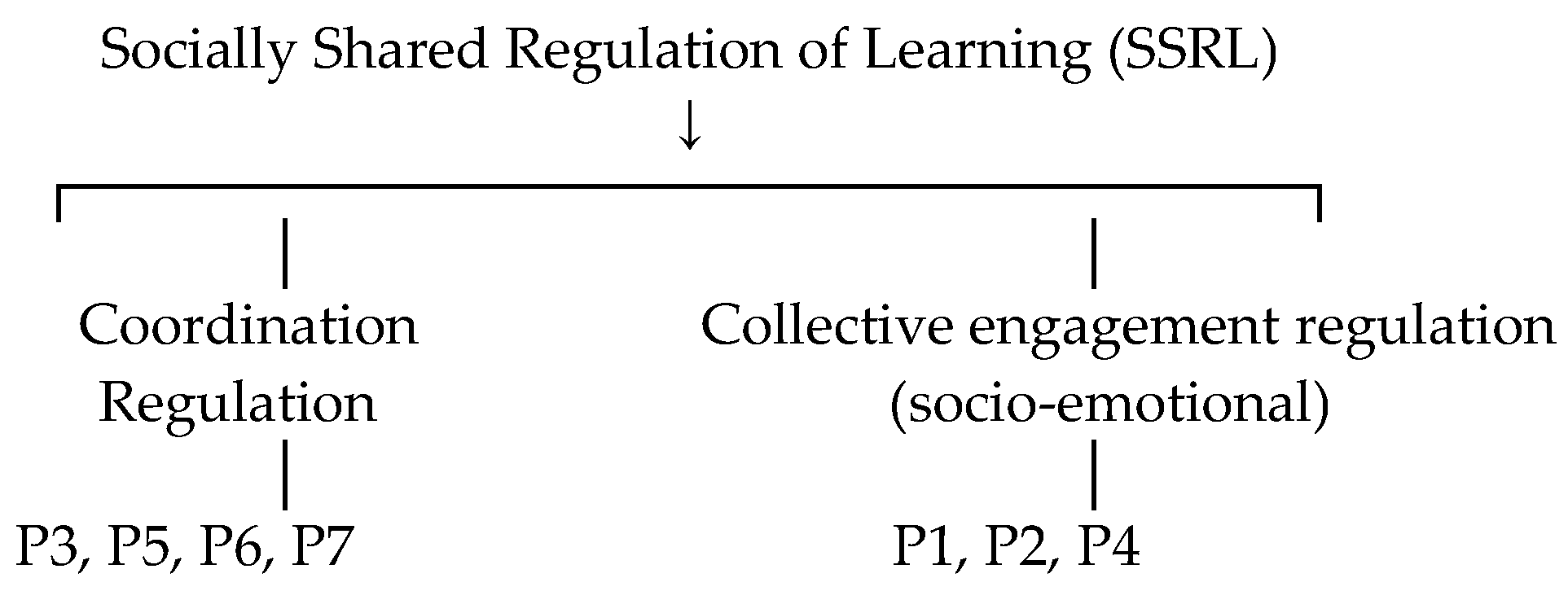
To clarify the conceptual structure of the instrument,
Figure 1 presents the theoretical model guiding the operationalization of socially shared regulation of learning in this study. The model assumes that SSRL is expressed through two interdependent domains: coordination regulation and collective engagement regulation.
Multimodal studies have shown that coordination and engagement represent empirically distinguishable functional domains, supporting a two-dimensional structure of SSRL [
6,
13]. SSRL can therefore be conceptualized as a form of distributed agency shaped by cognitive coordination and socio-emotional support, whose interplay affects learning quality [
18]. The growing attention to socially shared regulation also reflects broader transformations in higher education linked to sustainability and the development of future-oriented competencies. Contemporary universities are increasingly expected to prepare students to address complex global challenges that require collaborative problem solving, ethical decision-making, and the ability to work effectively within diverse teams. These competencies align closely with the goals of Education for Sustainable Development (ESD), which emphasizes systems thinking, strategic action, and interpersonal collaboration as key capabilities for sustainable societies. From this perspective, socially shared regulation can be interpreted as a foundational mechanism that enables collaborative learning environments to function effectively over time. By facilitating the coordination of cognitive efforts and the maintenance of socio-emotional alignment within groups, SSRL contributes to the development of learning communities capable of addressing complex and interdisciplinary problems. Consequently, understanding how these regulatory dynamics operate within higher education contexts is essential for designing educational practices that promote both academic success and sustainable forms of collective engagement.
Despite these advances, most existing instruments designed to assess socially shared regulation of learning tend to adopt multidimensional structures that incorporate a wide range of cognitive, metacognitive, motivational, and reflective components. While these models provide a comprehensive theoretical representation of the construct, they often result in instruments that are difficult to implement in applied higher education contexts due to their length and complexity.
This limitation is particularly relevant in institutional environments where multiple assessments are administered simultaneously, and where the feasibility of measurement becomes a critical factor. As a result, there is a growing need for parsimonious instruments that capture the essential functional dynamics of socially shared regulation without compromising theoretical coherence.
Methodologically, the modeling of SRL and SSRL in higher education has gained relevance by enabling the development of brief, valid instruments that capture the real dynamics of group regulation without overwhelming participants [
7,
15]. Integrating the domains of coordination and collective engagement enhances construct validity and interpretability [
3,
6,
7]. Positioning SSRL within the sustainability agenda additionally highlights its role in cultivating competencies needed to address complex societal challenges [
8]. Cross-institutional studies show that collaborative spaces can strengthen systems thinking, strategic planning, and interpersonal competencies, which are core ingredients for sustainable learning communities [
2,
8].
From this perspective, the present study adopts a functional approach to the operationalization of socially shared regulation of learning, focusing on those processes that are directly observable during collaborative task execution. Specifically, coordination and collective engagement are conceptualized as the two core mechanisms through which socially shared regulation becomes empirically identifiable in real-time group interaction.
Rather than attempting to exhaustively represent all dimensions proposed in broader theoretical frameworks, this study prioritizes those regulatory processes that are most strongly associated with task execution and group functioning. This approach allows for a more parsimonious and context-sensitive measurement of SSRL, which is particularly suitable for higher education environments.
In summary, prior research has established the relevance of socially shared regulation of learning in collaborative higher education contexts. However, existing instruments tend to operationalize the construct through multiple dimensions which, while theoretically comprehensive, may limit their practical applicability in real educational settings due to their length and complexity.
In contrast, the present study proposes a parsimonious two-dimensional model that captures the core functional dynamics of socially shared regulation through coordination regulation and collective engagement. This approach does not seek to replace broader multidimensional models, but rather to provide a complementary, efficient measurement alternative that preserves theoretical coherence while enhancing usability in applied higher education contexts.
Thus, the main contribution of this study lies in providing empirical evidence supporting a brief, structurally valid, and functionally interpretable instrument that can be used to assess key regulatory processes in collaborative learning environments, particularly within sustainability-oriented higher education.
Accordingly, the study addresses the following research objective—to evaluate the factorial structure, reliability, and validity of a two-dimensional instrument for assessing socially shared regulation of learning.
2. Materials and Methods
2.1. Research Design
The present study adopted a cross-sectional by survey study aimed to assess the socially shared regulation of higher education collaborative environment learning, examining the internal structure and psychometric properties of a designed brief scale.
The survey questionnaire was developed in accordance with the protocol for the development and validation of measurement instruments, as well as the methodology widely used in psychometric research to assess reliability, validity, and internal structure [
19,
20,
21]. In addition, cross-sectional designs are appropriate for examining relationships among variables at a single point in time, particularly in large-scale validation studies in educational contexts.
The study focused on evaluating whether a theoretically grounded two-dimensional structure could adequately represent the construct of the social regulation of learning in academic collaborative contexts. Specifically, the research examined whether the domains of coordination regulation and collective engagement regulation could empirically account for the patterns of covariance among the items included in the instrument. In recent years, higher education environments have increasingly incorporated collaborative learning strategies, such as project-based learning, cooperative problem solving, and team-based assignments.
These pedagogical approaches require students to coordinate cognitive, motivational, and socio-emotional processes collectively. Consequently, there is a growing need for efficient measurement tools capable of capturing the regulatory dynamics that occur within groups without imposing excessive response burden on participants. From a measurement perspective, brief instruments offer practical advantages in educational research, particularly in institutional contexts where multiple assessments are often administered simultaneously.
However, reducing the number of items requires careful validation procedures to ensure that the instrument maintains conceptual coherence and psychometric robustness. For this reason, the present study combined exploratory and confirmatory factor analytic techniques to examine the structural validity of the scale.
The procedure in the survey was to establish and organize the following parts of data systematization. The parts of the design survey and data systematization are as follows:
Part 1. The proposed two-factor instrument is conceptually based on the framework of emotional regulation in socially complex learning situations developed by Hanna Järvenoja, particularly as reflected in the AIRE (Adaptive and Interactive Emotional Regulation) instrument. This perspective conceptualizes emotional regulation as a dynamic, context-sensitive, and socially integrated process in which students actively regulate their own emotions while participating in co-regulation processes determined by the demands of interaction in collaborative settings.
Despite its solid theoretical foundation, the multidimensional structure and broad scope of measurement of the AIRE may limit its scalability and applicability in contexts requiring efficient and integrable assessment tools, especially in large samples or institutional tracking systems. This creates a tension between conceptual richness and operational feasibility that remains insufficiently addressed in current measurement approaches.
This bifactorial model addresses this gap by proposing a theoretically grounded redefinition of the construct. Rather than merely reducing dimensionality, the model reorganizes the core components of adaptive and socially mediated emotional regulation into two higher-order latent dimensions that capture the essential regulatory dynamics underlying socially shared learning processes. In doing so, the model shifts the analytical focus from a descriptive multidimensional taxonomy toward a more integrative and structurally coherent representation of emotional regulation as a function of both individual adaptation and social receptivity.
This re-specification constitutes a theoretical contribution by proposing a more parsimonious yet conceptually robust framework that aligns with contemporary perspectives on the socially shared regulation of learning. At the same time, it offers a measurement alternative that improves empirical manageability, facilitates model estimation in complex designs, and supports its use in applied educational contexts where brevity, interpretability, and scalability are essential.
Therefore, the proposed instrument not only preserves the sociocognitive and interactive foundations of the AIRE framework but also expands upon them by offering a simplified and theoretically integrated operationalization, positioning the model as a conceptual refinement and a practical advancement in the assessment of emotional regulation in collaborative learning settings [
22].
Part 2. Survey instrument generating and appearance and content validation: The peer-review process was established based on the appearance and content of the constructs of regulation and collaboration. The application was reviewed by three independent peers using a rubric aligned with the aforementioned constructs. This evaluation enabled the identification, correction, and adjustment of items.
Part 3. Survey planning and sampling design: A sample of volunteers who met the study’s inclusion criteria were selected (individuals enrolled as students, who had no conflict of interest with the study, had no apparent disabilities, and had completed the questionnaire in its entirety); furthermore, an anonymization process was carried out in accordance with data protection laws.
Based on the stability, consistency, and efficiency of the model estimators, more than 200 respondents were selected, resulting in a sample size of 1213, achieving a confidence level of approximately 95% and a weighted relative error of approximately 5%. The sample was organized into an Excel database, considering sociodemographic variables such as age, sex, and field of study, as well as the study variables.
Part 4. Exploratory sampling, reliability, and descriptive analysis: Descriptive statistics were generated to conduct a general and comprehensive exploration of the database; IBM SPSS v.25 was used for this purpose. Reliability analysis was performed using Cronbach’s alpha, and dimensionality analysis was conducted using principal component analysis (PCA) by construct. In addition, a canonical correlation analysis was performed to identify the level of correlation among the constructs; to this end, more than 200 initial samples were collected, which allowed for validation.
Part 5. General sampling construct validation: The complete dataset (n = 1213) was processed, and both univariate and multivariate outlier removal protocols were applied. Covariance-based techniques (masked outliers), such as Mahalanobis distance and individual responses with non-zero deviation, were applied to clean the database, which allowed for the consolidation of n = 973 as the final study sample and ensured quality criteria when applying confirmatory factor analysis, following replication of the global exploratory factor analysis. The final analysis validated the study’s reproducibility, as the results were similar to those obtained in Part 3.
Part 6. Result reports and diagram generating: Convergent validity and discriminant validity were demonstrated, which allowed for the generation of the structural equation diagram from the confirmatory factor analysis (CFA) for the appropriate reporting of the information.
2.2. Participants
The sample consisted of 973 undergraduate students from various Colombian universities, representing fields such as education, social sciences, engineering, and health. The average age was 22.8 years (SD = 6.09; range = 16–52). A total of 60.5% identified as female and 39.5% as male. All participants were enrolled in courses with collaborative work components, a necessary condition for the application of the instrument. Participation was voluntary, anonymous, and without incentives.
The inclusion criteria were (a) being enrolled in an active undergraduate program, (b) having participated in at least one collaborative academic activity, and (c) agreeing to digital-informed consent. No additional exclusion criteria were applied, given the non-clinical and educational nature of the research.
A purposive sampling strategy was employed to ensure that participants met specific criteria relevant to the study objectives. In particular, only students enrolled in courses that incorporated collaborative learning activities were included, as these contexts are necessary for the observation of socially shared regulation processes. Participants were recruited through institutional contacts with faculty members who distributed the questionnaire in eligible courses.
Although this approach does not allow for statistical generalization, it is appropriate for instrument validation studies, where the primary goal is to examine the internal structure and psychometric properties of the measure within a theoretically relevant population.
2.3. Instrument
The Brief Scale of Social Regulation of Learning, specifically designed for higher education contexts, was utilized in this study. The instrument comprises seven Likert-type items, each assessed on a seven-point scale (1 = strongly disagree, 7 = strongly agree). It aims to measure observable regulatory behaviors that emerge during collaborative academic tasks.
The instrument was developed based on the theoretical framework of socially shared regulation of learning (SSRL), which conceptualizes learning as a distributed process involving the cognitive, motivational, and socio-emotional coordination of group members working toward a shared goal.
The initial pool of items was reviewed by three specialists in educational psychology and measurement. The expert review focused on assessing the conceptual relevance, clarity, and contextual appropriateness of each item for collaborative higher education settings. Based on their feedback, minor wording adjustments were introduced to enhance precision and linguistic adequacy while preserving the intended theoretical meaning of each item. The expert review considered four commonly used criteria in content validation studies: relevance, clarity, coherence, and sufficiency. Experts evaluated each item qualitatively based on these criteria. Given the small number of experts (n = 3), a consensus-based approach was adopted instead of quantitative indices. All items were considered adequate across the evaluated criteria, and no items required elimination, although minor wording adjustments were implemented to improve clarity.
The instrument is grounded in a bidimensional theoretical model of socially shared regulation of learning. Within this framework, two core functional domains are identified.
Coordination regulation refers to the cognitive and metacognitive processes through which group members organize, plan, monitor, and adjust their collective activity. This includes defining goals, managing task-related rules, and adaptively redistributing responsibilities.
Collective engagement regulation captures the socio-emotional and interactional processes that sustain group functioning. This dimension reflects shared decision-making, collaborative idea construction, and alignment among group members during task execution.
The experts were selected based on their experience in educational psychology and measurement, and consensus was reached regarding the clarity and relevance of the items.
The instrument includes the following items:
Coordination regulation:
P3. In my team, participation was balanced among members.
P5. In my team, we provided specific support when someone needed it.
P6. In my team, we established clear rules to manage emerging conflicts.
P7. In my team, we reassigned tasks when necessary to achieve the objectives.
Collective engagement regulation:
P1. In my team, we defined clear goals and criteria for the task.
P2. In my team, we built ideas collaboratively based on everyone’s contributions.
P4. In my team, decisions were made collectively.
Empirical evidence from the confirmatory factor analysis supported this two-dimensional structure, with coordination regulation represented by four items (P3, P5, P6, P7) and collective engagement regulation represented by three items (P1, P2, P4). All standardized factor loadings were statistically significant (p < 0.001) and ranged from 0.772 to 0.935, supporting both the internal consistency of the dimensions and their empirical differentiation.
The correlation between the two latent factors was high (r = 0.792), indicating that coordination and collective engagement represent distinct yet strongly interdependent components of socially shared regulation of learning.
This structure reflects a theoretically coherent and empirically supported operationalization of socially shared regulation, capturing both the strategic and socio-emotional dynamics of collaborative learning. Although broader SSRL instruments include a greater number of dimensions, the present model intentionally focuses on two core functional domains that capture the most salient regulatory processes during collaborative task execution, providing a parsimonious and context-sensitive measurement approach for higher education settings.
2.4. Procedure
The study employed an instrumental and cross-sectional design aimed at the psychometric validation of a theoretical construct. Data collection was carried out virtually through an institutional digital questionnaire, which was administered during the 2025-1 academic period.
Before responding, participants reviewed and accepted an electronic-informed consent form that outlined the study’s objectives, ensured the anonymity of their participation, and detailed their ethical rights. The collected data were then exported in .csv format and underwent cleaning and verification processes to eliminate duplicate entries and records with incomplete responses.
2.5. Data Analysis
The analyses were performed using R software (version 4.3.1), primarily using the lavaan and psych packages [
23,
24]
Preliminary analysis: Sample adequacy was assessed using the KMO index = 0.847, and Bartlett’s test of sphericity (χ2 (21) = 4606.411, p < 0.001), which confirmed the suitability of factor analysis.
Exploratory factor analysis (EFA): The principal axis factoring method with oblimin rotation was applied, verifying the presence of two factors with eigenvalues > 1 and loadings ≥ 0.40. The number of factors retained was determined using the eigenvalue greater-than-one criterion and inspection of the scree plot.
Confirmatory factor analysis: Subsequently, confirmatory factor analysis was conducted to test the hypothesized two-factor model representing coordination regulation and collective engagement regulation. Given the ordinal nature of the Likert-type items, the model was estimated using the WLSMV estimator, which is appropriate for ordered categorical variables and provides robust parameter estimates and standard errors.
Model adequacy was evaluated using several widely recommended fit indices:
- -
Comparative Fit Index (CFI)
- -
Tucker–Lewis Index (TLI)
- -
Root Mean Square Error of Approximation (RMSEA)
- -
Standardized Root Mean Square Residual (SRMR)
These indices allow a comprehensive assessment of model fit by considering both incremental and residual-based indicators.
- 4.
Fit indices: The model showed values of CFI = 0.992, TLI = 0.988, RMSEA = 0.137, and SRMR = 0.064. Although the RMSEA exceeded conventional thresholds, this result should be interpreted with caution, as previous methodological research has shown that RMSEA tends to overestimate model misfit in models with low degrees of freedom and a limited number of observed variables [
25]. In such cases, CFI, TLI, and SRMR provide more reliable evidence of model adequacy.
- 5.
Relationship between factors: A high latent correlation was observed (r = 0.792), supporting the interdependence between coordination and collective engagement.
This procedure ensured the structural and conceptual validity of the scale, demonstrating that empirically distinguishable yet interdependent regulatory processes reflect the proposed theoretical dimensions of socially shared regulation of learning.
2.6. Ethical Considerations
The study was approved by the Research Ethics Committee of the University of Research and Development (UDI, Colombia) under protocol CEI-2025-04, complying with the provisions of the American Psychological Association (APA, 2017) and the Declaration of Helsinki (2013) [
26].
Participation was voluntary, and all students provided their digital-informed consent before completing the instrument.
3. Results
The expert judgment process indicated that all items met the established criteria of relevance, clarity, coherence, and sufficiency. Although no quantitative indices were calculated due to the limited number of experts, qualitative agreement supported the adequacy of all items for inclusion in the instrument.
3.1. Preliminary Analysis
Before conducting the factor analyses, the assumptions for factorization were verified. The Kaiser–Meyer–Olkin (KMO) measure of sampling adequacy (KMO = 0.847) was in the “meritorious” range, while Bartlett’s test of sphericity was significant (χ2 (21) = 4606.411, p < 0.001), confirming the appropriateness of the factor analyses. No missing or outlier values were identified in the included variables.
3.2. Exploratory Factor Analysis
An exploratory factor analysis (EFA) was conducted using the principal axis factoring method and oblimin rotation, which allowed for the identification of a two-dimensional structure consistent with the theory of socially shared regulation of learning.
Eigenvalues greater than one and inspection of the scree plot suggested retaining two factors, which together explained 70.1% of the total variance.
The first factor (PA1) grouped items i3, i5, i6, and i7, associated with strategies for planning, monitoring, and jointly adjusting group activity.
The second factor (PA2) grouped items i1, i2, and i4, linked to behaviors of alignment, commitment, and sustaining collective engagement.
Communalities ranged from 0.57 to 0.86, and factor loadings ranged from 0.55 to 0.92, with no evidence of relevant cross-loadings. These results indicated a clear and differentiable factor structure between the two functional domains.
3.3. Confirmatory Factor Analysis
Subsequently, a confirmatory factor analysis (CFA) was conducted using the WLSMV estimator, given the ordinal nature of the response scale. A two-factor model with correlated factors was evaluated, consistent with the theoretical and empirical structure observed in the EFA.
The model showed the following global fit indices: CFI = 0.992, TLI = 0.988, RMSEA = 0.137, and SRMR = 0.064. Although the RMSEA value exceeded conventional thresholds, this result should be interpreted with caution, as this index is known to overestimate model misfit in models with low degrees of freedom and a limited number of observed variables [
25]. In contrast, the high values of CFI and TLI, together with an acceptable SRMR, support the adequacy of the proposed model.
The two-factor model showed an adequate fit to the data, supporting the proposed structure composed of coordination regulation and collective engagement regulation. All factor loadings were statistically significant and above recommended thresholds, confirming the strength of the measurement model.
3.4. Standardized Factor Loadings
All standardized factor loadings were statistically significant (
p < 0.001) and ranged from 0.772 to 0.935, as shown in
Table 1.
3.5. Correlation Between Factors
The factors showed a high latent correlation (r = 0.792,
p < 0.001), confirming their theoretical and empirical interdependence. This relationship indicates that coordination regulation and collective engagement operate as closely interconnected processes in the socially shared regulation of learning [
6,
7].
3.6. Reliability and Construct Validity
To further evaluate the robustness of the measurement model, reliability and construct validity indices were examined. The total scale demonstrated high internal consistency (Cronbach’s α = 0.892). At the dimensional level, coordination regulation showed an alpha coefficient of 0.895, while collective engagement regulation reached 0.826, indicating satisfactory to high reliability across both constructs.
Composite reliability values were also high (CR = 0.934 for coordination regulation and CR = 0.900 for collective engagement regulation), reinforcing the internal consistency of the latent variables. Convergent validity was supported by Average Variance Extracted values above the recommended threshold (AVE = 0.780 and 0.752, respectively), indicating that both constructs explain a substantial proportion of variance in their indicators.
Discriminant validity was assessed using the Fornell–Larcker criterion. The square root of the AVE for coordination regulation (0.883) and collective engagement regulation (0.867) exceeded the correlation between the two constructs (r = 0.792), confirming that both dimensions are empirically distinct despite their strong association.
Table 2 presents the reliability and validity indices, while
Table 3 shows the Fornell–Larcker matrix.
3.7. Summary of Fit and Structural Validity
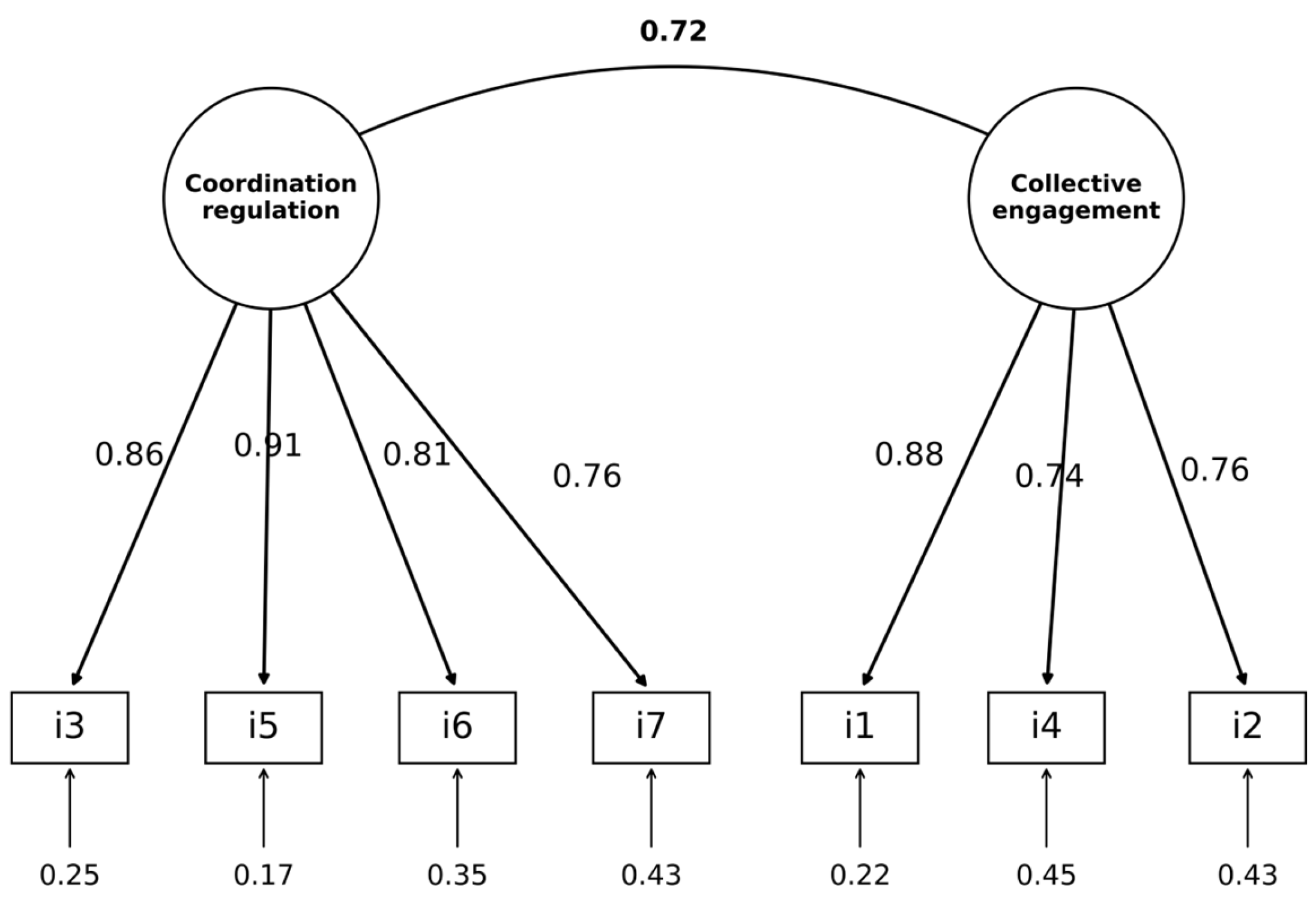
The validated two-factor model effectively represents the relationships between the items and their latent dimensions. The strength of the factor loadings, together with the evidence of reliability, convergent validity, and discriminant validity, supports both the structural validity and the internal coherence of the scale.
Figure 2 illustrates the final structural diagram of the two-factor model, including standardized paths and measurement errors.
4. Discussion
This study provides robust empirical evidence on the internal structure of a brief social regulation scale in higher education, validating a two-factor model consistent with the contemporary theory of socially shared regulation of learning (SSRL). The results show two interdependent domains: coordination regulation, focused on planning, monitoring, and joint task adjustment; and collective engagement regulation, focused on maintaining commitment, emotional alignment, and group cohesion. This empirical differentiation supports the arguments of [
7,
18], who argue that group effectiveness in university settings depends on the functional coupling between strategic and socio-emotional processes. Along the same lines, [
13] observed that planning and emotional regulation sequences operate reciprocally, enhancing the continuity of collective effort and persistence in cognitively demanding tasks.
The strength of this differentiation is further supported by the psychometric evidence obtained. High internal consistency coefficients (α = 0.892 overall; α = 0.895 and 0.826 by dimension), together with strong composite reliability and AVE values, indicate that both constructs are not only theoretically meaningful but also empirically robust representations of socially shared regulation processes.
Rather than attempting to exhaustively represent all dimensions identified in broader SSRL frameworks, the present instrument prioritizes those regulatory processes that are most directly observable during collaborative task execution. In this sense, coordination and collective engagement are conceptualized as the two core mechanisms through which socially shared regulation becomes functionally visible in real-time group interaction.
Beyond confirming the theoretical distinction between coordination and collective engagement, the present findings contribute to the growing body of literature emphasizing the relational nature of learning regulation in higher education. Contemporary research increasingly recognizes that effective collaboration requires more than the aggregation of individual self-regulatory capacities; rather, it depends on the emergence of shared regulatory structures that enable groups to coordinate actions, distribute responsibilities, and sustain collective effort across time. In this sense, socially shared regulation functions as a dynamic system in which cognitive strategies and socio-emotional processes continuously interact to support joint problem solving.
By empirically identifying these two complementary domains, the present study provides additional support for the argument that collaborative learning environments rely on regulatory processes that are fundamentally distributed across participants rather than located solely within individual learners. Moreover, the differentiation between coordination and engagement provides a useful analytical framework for understanding why some collaborative groups achieve higher levels of effectiveness than others.
Groups that successfully coordinate their strategies while maintaining strong socio-emotional alignment are better equipped to adapt to challenges, negotiate differences in perspective, and sustain motivation during complex tasks. This perspective reinforces the view that collective regulation represents a critical mechanism underlying productive teamwork in academic settings.
Importantly, the evidence of convergent validity (AVE > 0.75 in both constructs) suggests that these dimensions capture a substantial proportion of variance in observable regulatory behaviors. This reinforces the interpretation of coordination and engagement as core functional units of socially shared regulation rather than peripheral or overlapping components.
The high correlation (r = 0.792) between coordination regulation and collective engagement regulation observed in this study confirms their strong interdependence within socially shared regulation processes [
27,
28,
29]. This finding suggests that cognitive coordination and socio-emotional alignment do not operate independently but rather function as mutually reinforcing mechanisms that sustain effective collaboration in higher education contexts [
17]. These findings also align with recent studies [
10,
12], which emphasize how important it is to integrate emotional and social dimensions in the assessment of self-regulation, moving beyond purely individual conceptions of self-regulated learning.
This interpretation is also consistent with social cognitive perspectives on motivation and agency [
27,
28,
30], as well as with work emphasizing the role of emotion regulation in sustaining adaptive engagement [
29].
Although this correlation is relatively high, discriminant validity was supported according to the Fornell–Larcker criterion, as the square root of the AVE for each construct exceeded the inter-construct correlation, indicating that coordination regulation and collective engagement retain empirical distinctiveness despite their strong functional interdependence.
The empirical association between coordination and engagement also reflects broader theoretical developments within the learning sciences that emphasize the importance of social interaction in shaping cognitive processes. Collaborative learning research has consistently shown that knowledge construction often emerges through dialog, negotiation of meaning, and mutual monitoring of understanding among group members. Within this context, regulatory processes play a crucial role in enabling groups to maintain shared goals, manage task complexity, and resolve conflicts that may arise during collective problem solving. Importantly, the integration of emotional and motivational dynamics within models of regulation has gained increasing attention in recent years. Emotional alignment within groups contributes to the maintenance of trust, openness to feedback, and willingness to engage in joint reflection. When groups fail to regulate these socio-emotional processes, collaborative tasks may deteriorate into fragmented individual efforts rather than genuine collective learning experiences. Therefore, the high correlation observed between coordination and engagement in the present study provides empirical support for theoretical perspectives that conceptualize learning regulation as an integrated sociocognitive phenomenon.
From a psychometric standpoint, the model demonstrates strong reliability and construct validity. The consistency between Cronbach’s alpha, composite reliability, and AVE values provides additional evidence of the internal coherence and stability of the scale, supporting its use in both research and applied educational contexts.
These findings demonstrate that complex processes of social regulation can be effectively captured using brief and parsimonious instruments without compromising theoretical or empirical precision.
Item economy is particularly important in undergraduate programs, where academic workloads are substantial, and efficiency in the application of educational diagnostic instruments is essential. Viewed through a sustainability lens, capturing the dual dynamics of coordination and socio-emotional engagement provides actionable evidence for strengthening the social pillar of ESD in higher education—namely, fostering inclusion, social cohesion, and collaborative resilience within programs—an emphasis increasingly recognized as necessary for transformative, socially sustainable university practices [
31].
From a sustainability perspective, these findings are particularly relevant for universities seeking to cultivate competencies associated with Education for Sustainable Development [
32,
33,
34]. Sustainable societies require professionals capable of working collaboratively across disciplinary and cultural boundaries, negotiating diverse perspectives, and coordinating collective action toward shared goals.
The development of such competencies depends not only on disciplinary knowledge but also on the capacity of individuals and groups to regulate their collaborative processes effectively. In this regard, socially shared regulation of learning can be interpreted as a foundational mechanism supporting the development of sustainable collaborative practices within higher education.
This need is also consistent with recent evidence on self-regulated and socially shared regulation processes in higher education, including systematic reviews and studies from Latin American contexts [
32,
33,
34].
By enabling groups to align their cognitive strategies and socio-emotional dynamics, SSRL contributes to the creation of learning environments characterized by trust, mutual accountability, and collective responsibility. These qualities are essential for fostering educational communities capable of addressing complex societal challenges, including those related to sustainability transitions, social equity, and global cooperation. Consequently, instruments capable of capturing the regulatory dynamics of collaborative learning become valuable tools for institutions aiming to evaluate and strengthen the social dimension of sustainability in education. The brief scale validated in this study therefore offers a practical mechanism for monitoring how students coordinate their efforts and sustain engagement within collaborative tasks, providing insights that may inform the design of pedagogical strategies aligned with the goals of sustainable education. In this sense, socially shared regulation can be understood not only as a learning mechanism but as a foundational process for sustaining collaborative practices over time, aligning directly with the social dimension of sustainability in higher education.
Furthermore, the results enhance our understanding of how collective regulation impacts student performance, well-being, and engagement [
35,
36,
37,
38]. This aligns with findings from [
39,
40], which highlight the positive effects of shared regulation on motivation and academic persistence. Longitudinal and collaborative studies have shown that shared emotional regulation is a key predictor of a cooperative climate [
22,
41]. Role coordination and peer feedback also help people learn metacognitive strategies [
3,
42]. These results corroborate the validity of the two-factor model developed in this study, wherein planning and emotional engagement function as complementary mechanisms of collaborative learning.
Recent research has further shown that socially shared regulation can be promoted and analyzed through learning design, scaffolding, and technology-supported environments, particularly in collaborative and online settings [
35,
36,
38]. In addition, epistemic emotions remain relevant for understanding how learners interpret and regulate demanding academic tasks [
37].
Methodologically, the model showed excellent fit according to incremental indices (CFI = 0.992; TLI = 0.988) and acceptable residual fit (SRMR = 0.064). Although the RMSEA value was higher than conventional cut-off points (RMSEA = 0.137), this should be interpreted in light of the model’s parsimony and limited degrees of freedom. Previous methodological studies have shown that RMSEA tends to overestimate model misfit in small models with a limited number of observed variables [
25]. In this context, the consistency of CFI, TLI, SRMR, and the strength of the factor loadings provide stronger evidence supporting the adequacy of the proposed structure.
Taken together, the combination of strong incremental fit indices, high reliability coefficients, and satisfactory validity indicators provides converging evidence supporting the adequacy and robustness of the proposed measurement model.
6. Conclusions
This study provides empirical support for the structural validity of a brief scale for assessing the social regulation of learning in higher education, confirming a model of two interdependent functional domains: the regulation of coordination and the regulation of collective engagement. This empirical configuration reflects the dual nature of the socially shared regulation of learning, in which cognitive task management and socio-emotional regulation are articulated as complementary processes in the construction of collective knowledge. These conclusions are supported by the factorial structure, reliability indices, and validity evidence reported in the
Section 3.
The high and consistent factor loadings, along with satisfactory fit indices, underscore the psychometric robustness of the instrument and its potential applicability in university settings that involve collaborative, interdisciplinary, and cognitively demanding tasks [
43]. This scale serves as a valuable tool for assessing the regulatory maturity of academic teams, enabling the identification of strengths in shared planning as well as challenges in maintaining group engagement [
44]. In this direction, its use can be extended to improvement initiatives that seek to strengthen the social dimension of educational sustainability, equity, inclusion, cultural diversity, and community resilience, providing a sensitive indicator of how coordination and collective engagement underpin durable collaborative practices in higher education [
45].
From a theoretical standpoint, the results consolidate the SSRL framework by empirically demonstrating the functional coexistence of strategic coordination and affective involvement, providing a parsimonious and operational representation of the construct. Methodologically, the results demonstrate the viability of brief instruments with high explanatory power, which expands the possibilities for assessment in undergraduate populations and collaborative digital learning environments [
46,
47].
In terms of implementation, the recent literature emphasizes that substantive advances in social sustainability depend both on participatory pedagogies (e.g., experiential learning and service learning) and on institutional and policy frameworks that enable flexible curricula and faculty development; embedding the scale as a diagnostic and feedback tool can support these transformations by monitoring coordination and collective collaboration in courses and programs [
45].
It is recommended that future research investigate additional aspects of factorial invariance across subgroups and contexts and evaluate the predictive validity of the scale in relation to indicators of performance, engagement, and well-being. Moreover, the amalgamation of multimodal and sequential analyses may enhance our comprehension of the temporal dynamics of social regulation. Complementarily, we suggest assessing its sensitivity to change in interventions aligned with SDG 4.7, for example, service-learning projects and community engagement experiences, and combining measurement with qualitative evidence (portfolios, reflective journals, interaction traces) to capture socially relevant outcomes that the literature identifies as priorities yet are still underassessed [
45]. In summary, the evidence obtained supports the preliminary use of this measure as a significant contribution to the assessment and understanding of shared regulation in higher education, opening new opportunities to strengthen teaching, collaboration, and collective agency in contemporary academic settings. Its adoption can also help institutionalize monitoring practices for sustainability-related competencies, such as systems thinking, strategic planning, and interpersonal interaction, supporting continuous improvement and accountability with a focus on social sustainability [
45].





 ,
,