Transforming Landfill Compensation Policy in Bantargebang, Indonesia: An Environmental Justice Perspective

 ,
,
Abstract
1. Introduction
2. Literature Review
2.1. Environmental Justice: A Tripartite Framework
2.2. Green Social Work: A Supportive Framework for Transformation
2.3. Global Context of Waste Management in the Global South
2.4. Waste Management Policy and Challenges in Indonesia
2.5. Cross-Jurisdictional Waste Management Dynamics in Bantargebang Landfill
3. Materials and Methods
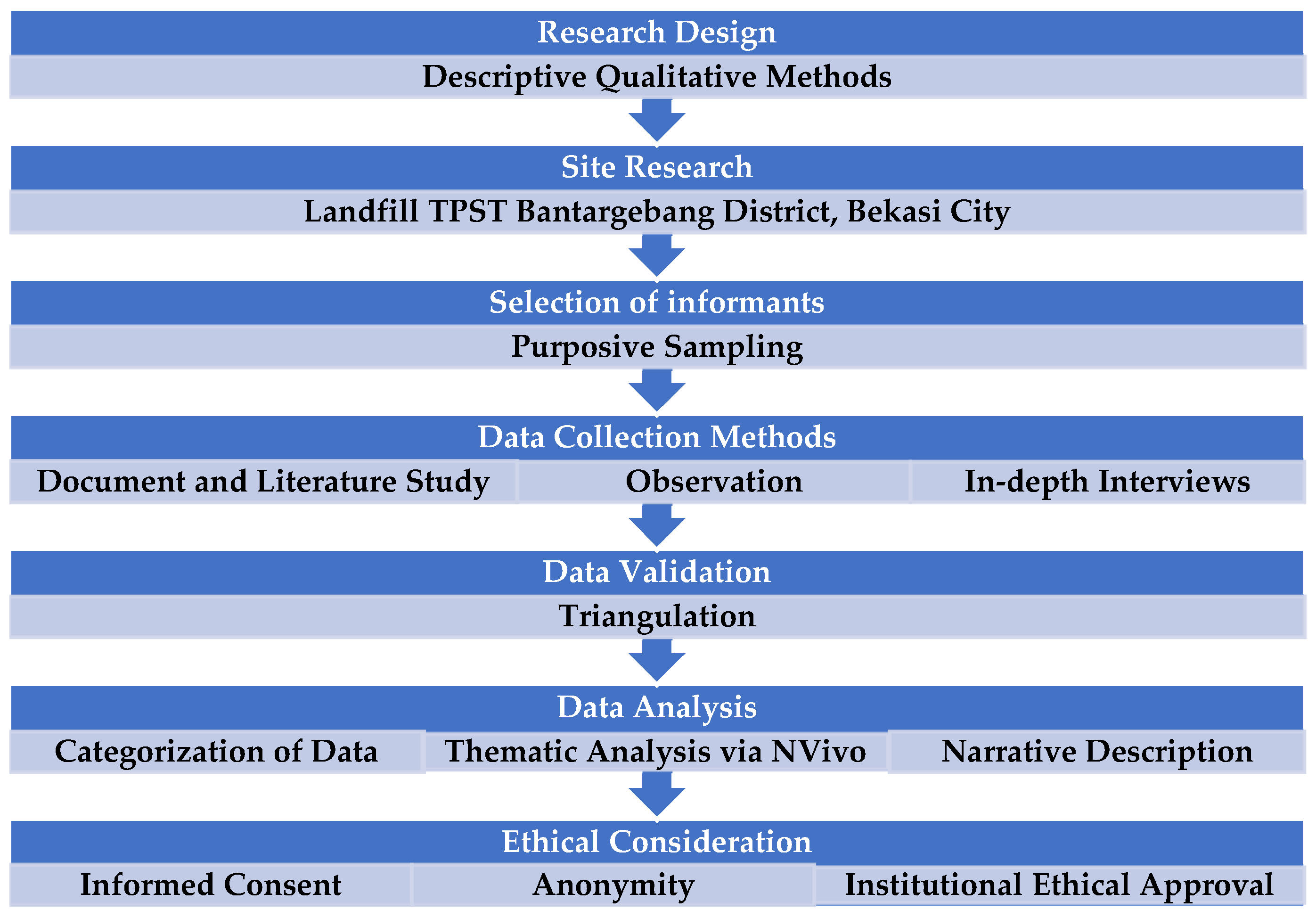
3.1. Research Design
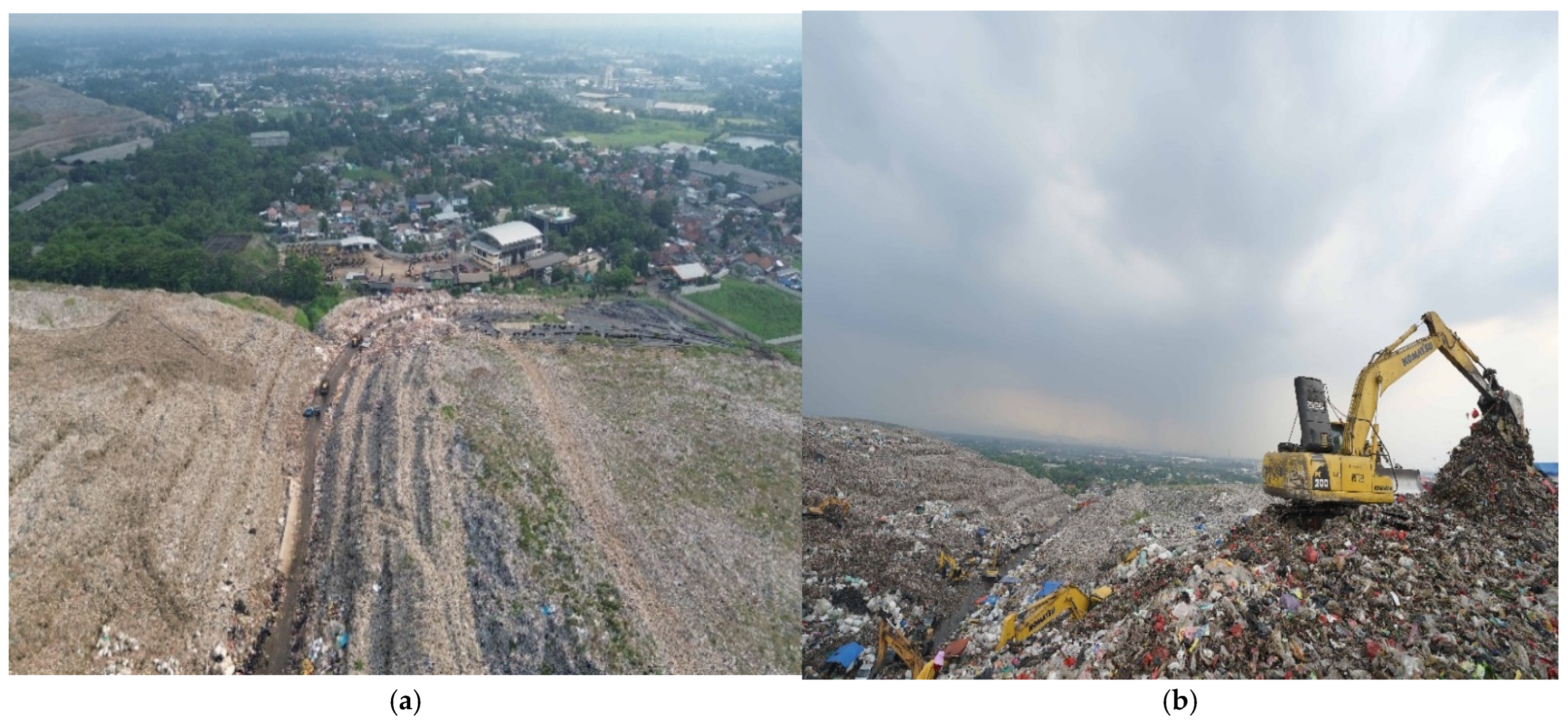
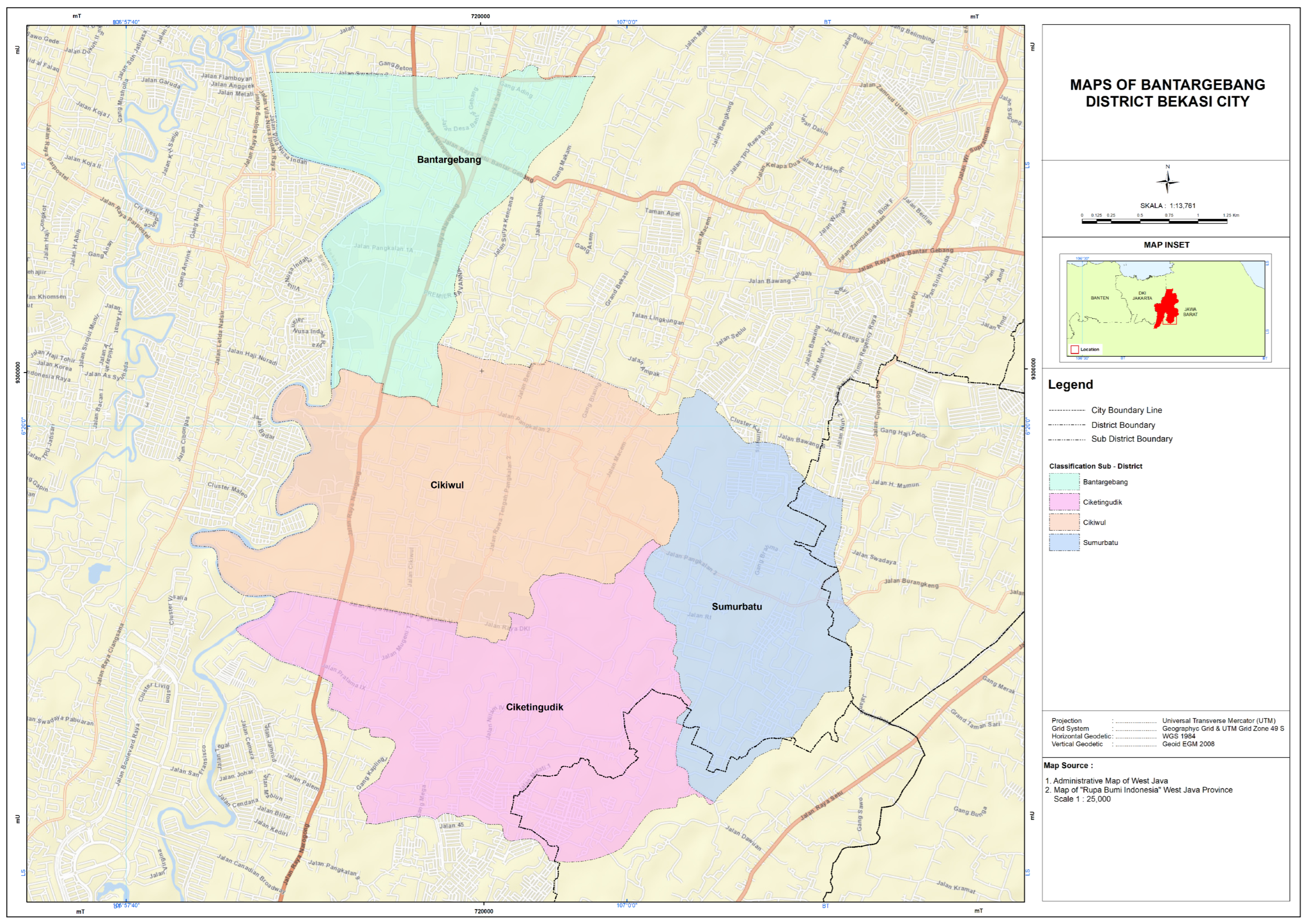
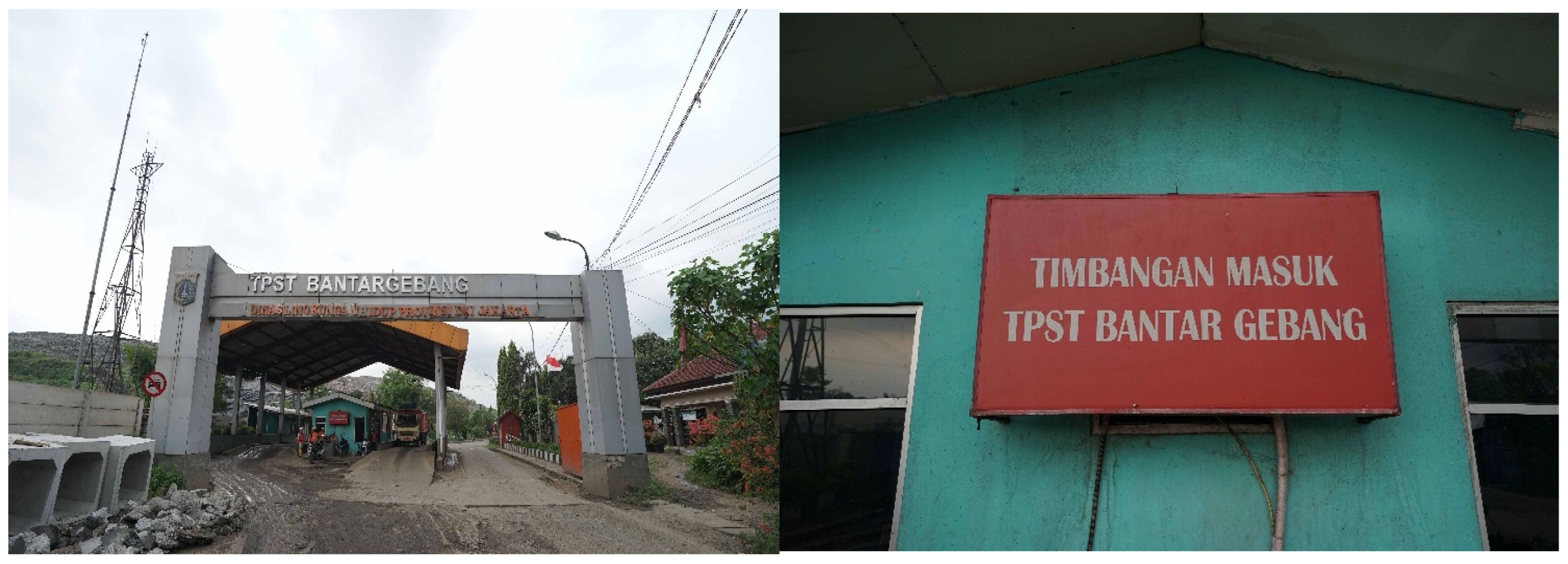
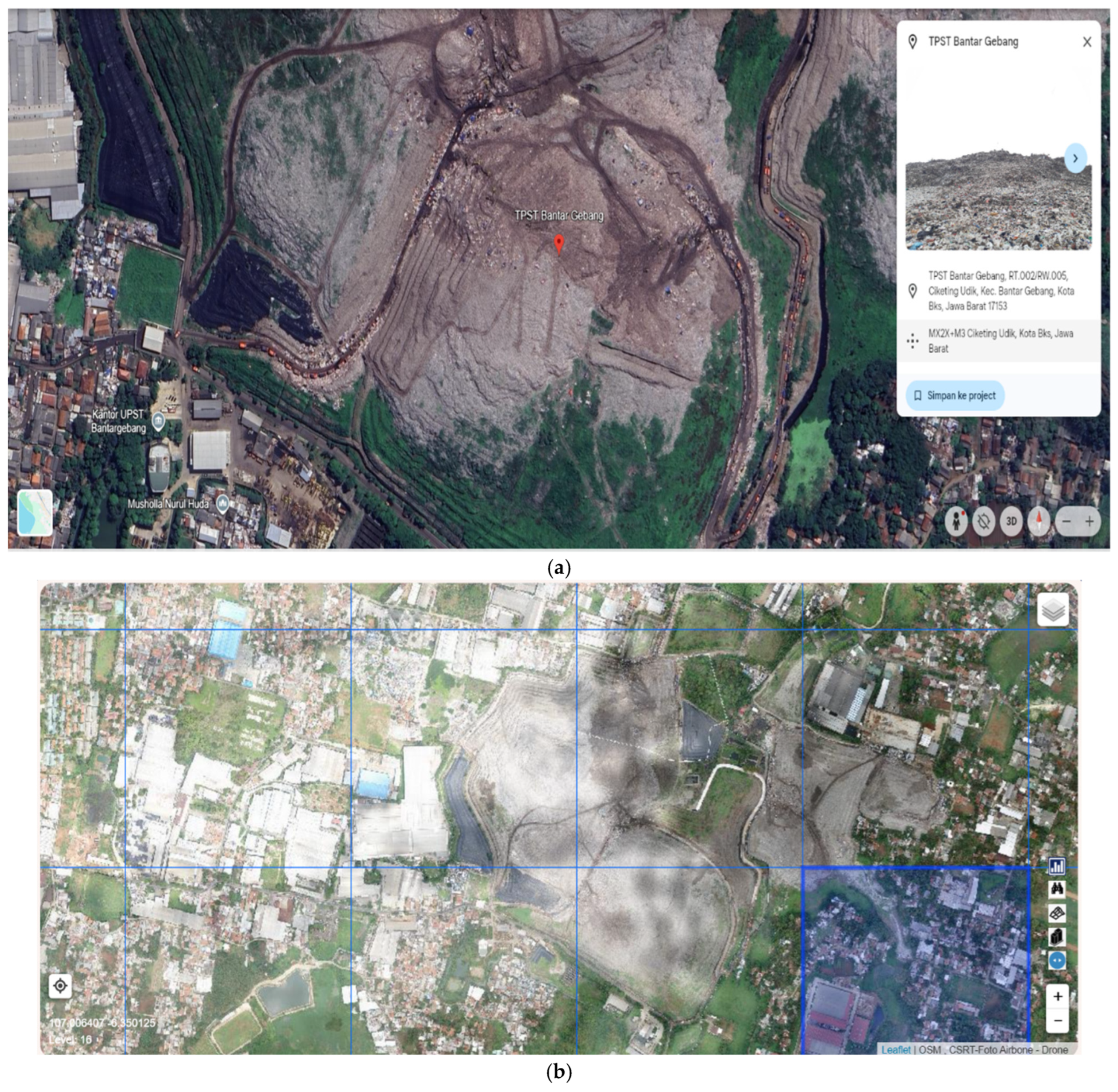
3.2. Location and Spatial Context
3.3. Data Collection
3.4. Selection of Informants
3.5. Data Analysis and Methodological Procedures
3.6. Trustworthiness and Ethics
4. Results
4.1. Policy Implementation and Systemic Barriers in Compensation Fund Distribution
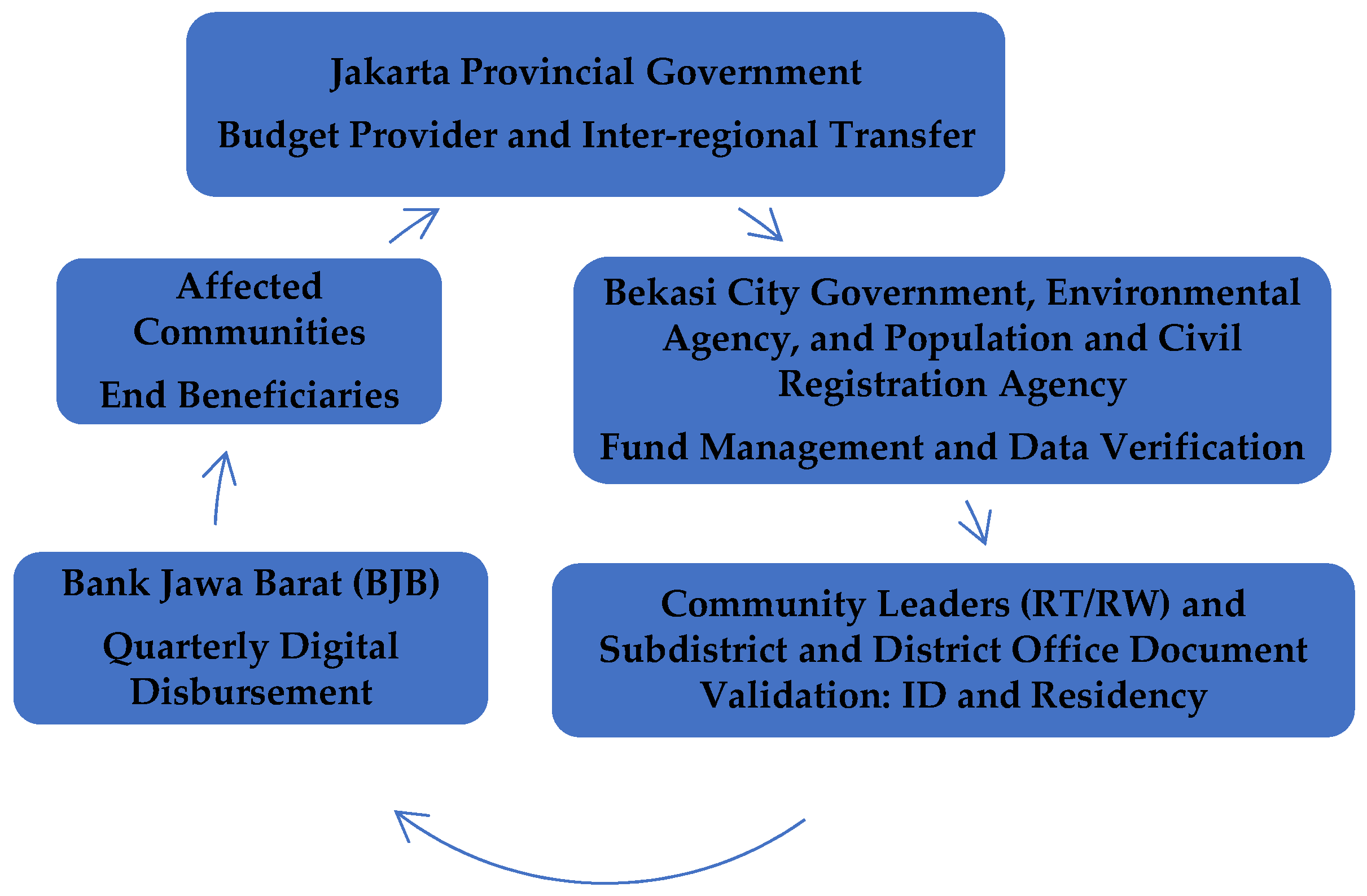
4.1.1. Regulatory Framework and Multi-Layered Distribution Mechanism
“… The Jakarta Provincial Government has fulfilled its responsibility to transfer the funds to the Bekasi City regional treasury promptly, in accordance with the provisions set out in the cooperation agreement between the Jakarta and Bekasi City governments. The technical aspects of transferring funds to residents’ accounts fall entirely within the authority of the Bekasi City Government…”(Informant 1, October 2025)
4.1.2. Nomenclature Distortion: Social Assistance and the Compensation Value Lock-In
“… The system was shifted by cash payments to bank transfers during the administration of Governor Basuki Tjahaja Purnama in an effort to eliminate opportunities for abuse… and it has continued to operate until now. The nominal amount is one million two hundred [per quarter], however, I do not understand the basis for its calculation…”(Informant 2, October 2025)
“… In the local government budget system, there is no mention of the term ‘compensation’… that’s why we say, ‘social assistance’, because that is the nomenclature in the DIPA budget. Therefore, if the term “compensation” is used, the central system (SIPD) will reject the entry because no corresponding account for that category exists in the system. Ultimately, the rights of these citizens are ‘repackaged’ as social assistance so that they can be disbursed…”(Informant 3, October 2025)
“… We are not impoverished individuals seeking charity from the government. We are citizens who have been directly affected by environmental pollution. Yet, despite this reality, we continue to be portrayed and labeled in that way. So, it seems like we are just being given ordinary social assistance, when in fact this is our rightful compensation for air and water pollution…”(Informant 4, September 2025)
“… In fact, officials realized that many residents were uncomfortable being labeled as recipients of social assistance, since such aid is typically intended for the poor, whereas they saw themselves as victims affected by environmental conditions, rather than beneficiaries of poverty alleviation programs. But yes, in terms of government administrative regulations, the legal umbrella that allows the money to be disbursed is only through the social assistance scheme…”(Informants 5 and 6, October 2025)
4.1.3. Administrative Barriers: Quota Queues and Population Data Dynamics
“… Why does the process have to be made so difficult for years… Why are we talking about quotas? We are talking about compensation--we are the ones affected …”(September 2025)
4.1.4. Obstacles to Banking Digitalization and the Reality of Disbursement
“… just three months have passed, sir… as soon as I received the money, it was gone in an instant [to pay off debts] …”(Informant 8, September 2025)
4.2. Ecological Realities and Risk Burdens at the Bantargebang Landfill
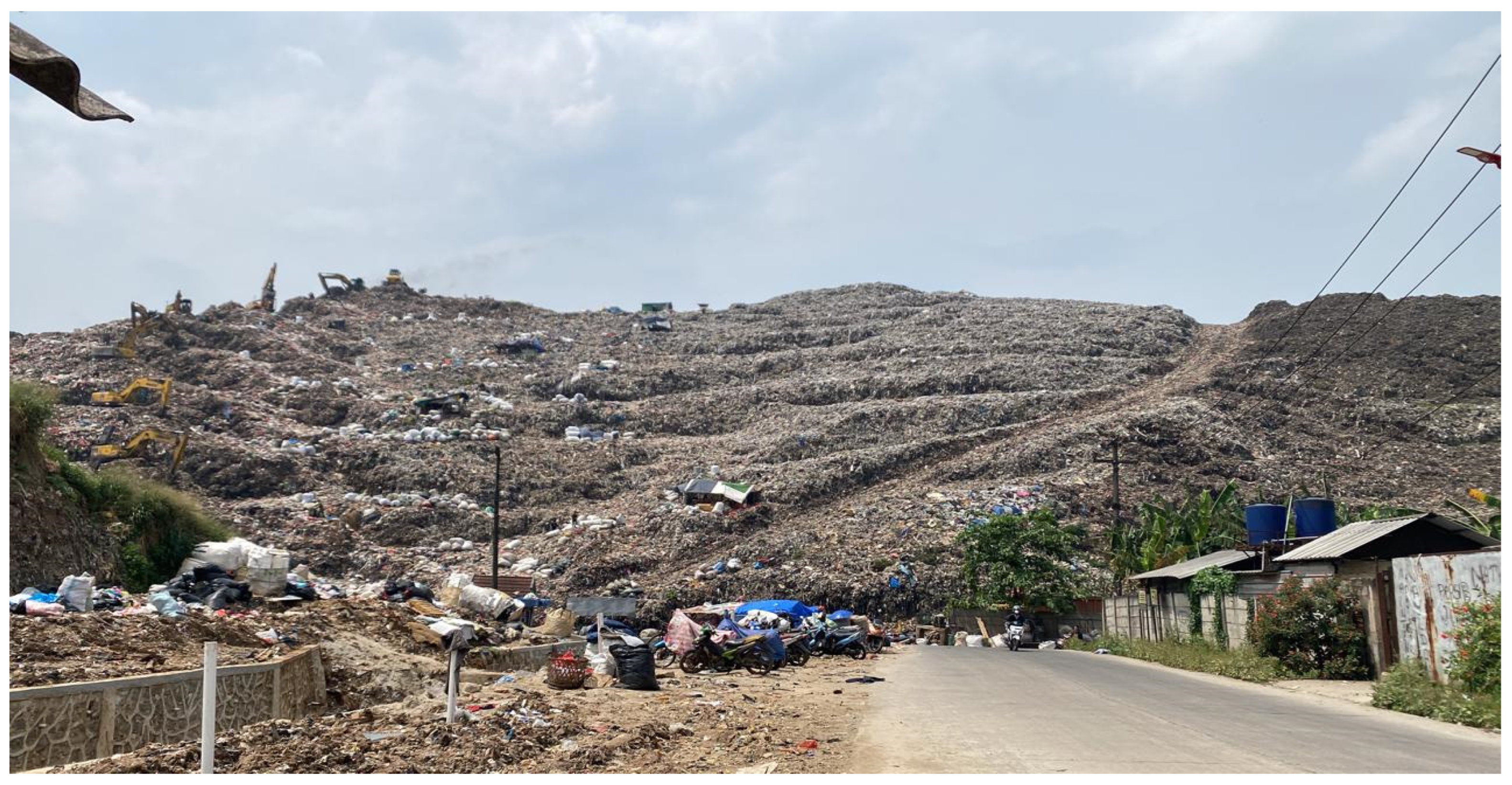
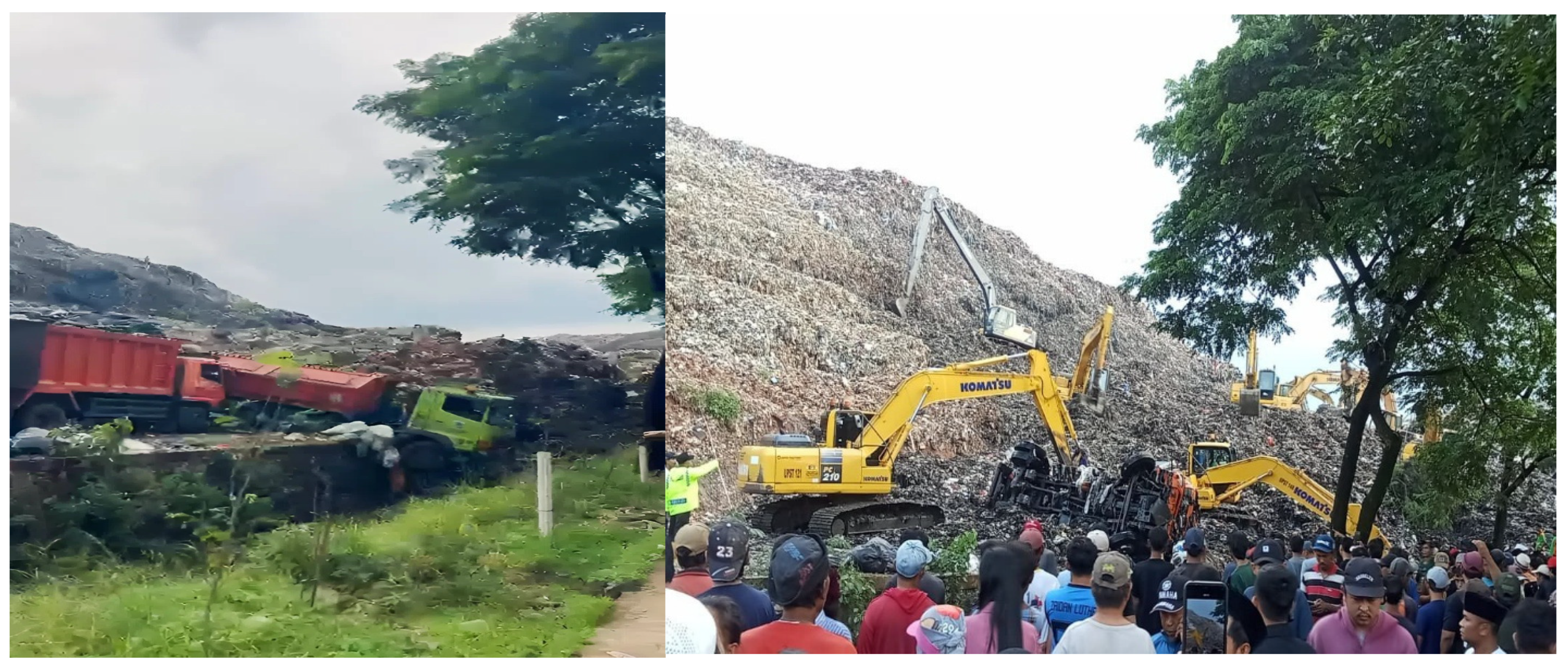
4.2.1. Physical Conditions of the Landfill and Escalation of Operational Burdens
“… It feels like it’s getting closer to a garbage mountain. Of course, we are afraid, afraid of landslides… It’s already very high, so we are very afraid …”(September 2025)
“… Those of us below are always worried when there is heavy rain. If the garbage mountain collapses, it could immediately bury the houses of residents on the border …”(Informant 10, September 2025)
4.2.2. Manifestations of the Bantargebang Ecological Crisis
“… The well water is currently not suitable for use. It appears yellowish, and when stored in a tank for some time, a slippery and oily-like layer forms at the bottom. In addition, the water produces a strong, unpleasant odor similar to rusty iron and a fishy smell. The majority of residents here experience the same thing: well water can no longer be taken from natural sources for consumption, so we are forced to buy water. The water also gives off an unpleasant smell when used for daily activities such as washing clothes, cleaning dishes, and bathing. In addition, it often causes irritation and itching on the skin. In addition to the water, the air is also severely affected, especially by the pungent smell of garbage, which disrupts our daily activities…”(Informant 4, 7, 11, 12, September–October 2025).
“…The smell of garbage is really pungent… but sometimes at night or in the morning, there is a smell of gas, or a smell like burnt wire, I don’t know where it comes from, whether it’s from inside the garbage or elsewhere…”(Informant 11, October 2025).
“…Every day we feel that the air here is very smelly… We are worried about cooking and drinking very poor water quality from wells… worried about coughing, shortness of breath, and skin allergies …”(Informant 13, September 2025).
4.2.3. Disease Prevalence and Hidden Costs
“…. the disease that still dominates the 20 most prevalent diseases is ARI, respiratory tract infection…the measurement result (air particulates) is almost all above the threshold value …”(Informant 14, September 2025)
“… If the IDR 400,000 per month is allocated to purchasing gallon water… that is only sufficient for water consumption, not including vitamins, medicines, or milk… supplements are necessary, or maybe milk and other things…”(Informant 15, September 2025).
“… it’s like we no longer notice the invisible air pollution. If there are newcomers who come here, they will definitely be surprised that the people here [still survive]”(Informants 16 and 17, September 2025).
4.3. Transformation Towards an Integrated Ecosocial Compensation Model
4.3.1. Redefining Nomenclature: From Social Assistance to Ecological Restoration Rights
“… yes, it becomes dependency-inducing aid. In the end, the community depends on that 400 thousand… they forget about the long-term negative impacts they will face. They forget, and it is deliberately designed that way. It’s not about the amount, but about transforming the community’s way of thinking to safeguard the next generation…”(Informant 18, October 2025)
4.3.2. Deconstructing Dependency Through an Integrated Compensation Model
“…we expect an increase in the compensation amount to be more commensurate with our losses due to the impact of this waste. Furthermore, the distribution system must be improved so that it becomes more transparent, delivered on time, and not hindered by administrative procedures that create difficulties for residents.”(September 2025)
“… In my view, the principle of fairness should not be understood as requiring that every resident receive an identical amount of compensation. There should be a distinction based on the distance between their residence and the Bantargebang landfill. For instance, it would be unreasonable if residents living only about 100 m from the landfill received the same amount of compensation as those residing more than 5 km away …”(Informant 20, September 2025)
“… For everyday needs, we can no longer depend on water from our regular wells because it has become polluted, dirty, and foul-smelling. As a result, I have no choice but to purchase bottled water for drinking and cooking. The cost of buying clean water clearly has a significant impact on our family’s monthly expenses. We hope the government will promptly resolve this clean water issue by implementing a long-term solution, such as installing a proper clean water pipeline system…”(Informant 19, September 2025)
“…don’t rely on compensation, because one day Jakarta will stop providing compensation funds, and we must be able to be independent, stand on our own two feet, for example, by running a shop, or whatever. We always give guidance like that… so that residents are aware that compensation is not forever”(Informant 21, September 2025)
“…has there ever been any training or capacity building program related to environmental justice issues or sustainable waste management practices? No… just yesterday there was a meeting to discuss converting waste into electricity, but that’s just a plan.”(Informant 21, September 2025)
“…how can we avoid becoming mere spectators? If the level of education here improves, the community could lead in waste management efforts to minimize pollution. The government is capable of providing free international-standard education… it is not about the amount [of money]. [Justice means] free quality schooling and premium healthcare—that is real compensation. This way of thinking, however, has not yet been embraced by the regional leaders in Jakarta and Bekasi City.…”(Informant 18 and 22, October 2025)
4.3.3. Paradigm Shift: From a Vicious Cycle to a Virtuous Cycle
5. Discussion
5.1. Administrative Dominance of Government and Distortion of Recognition Justice
5.2. Distributive Justice and the Failure of Risk Proportionality
5.3. Green Social Work Criticism of the Charitable Model
5.4. Reconstruction of Rights: Towards VVIP and International Standards as Justice
5.5. Seeking Justice Amidst the Paradox of the Absence of GSW Practitioners
6. Conclusions
Author Contributions
Funding
Institutional Review Board Statement
Informed Consent Statement
Data Availability Statement
Acknowledgments
Conflicts of Interest
References
- Ho, W.S.; Hashim, H.; Lim, J.S.; Lee, C.T.; Sam, K.C.; Tan, S.T. Waste Management Pinch Analysis (WAMPA): Application of Pinch Analysis for Greenhouse Gas (GHG) Emission Reduction in Municipal Solid Waste Management. Appl. Energy 2017, 185, 1481–1489. [Google Scholar] [CrossRef]
- Chen, Y.-C. Effects of Urbanization on Municipal Solid Waste Composition. Waste Manag. 2018, 79, 828–836. [Google Scholar] [CrossRef]
- Kaza, S.; Yao, L.C.; Bhada-Tata, P.; Van Woerden, F. What a Waste 2.0: A Global Snapshot of Solid Waste Management to 2050; World Bank: Washington, DC, USA, 2018. [Google Scholar]
- Bundele, P.; Devaerakkam, M. A Comprehensive Assessment to Harness Artificial Intelligence Technology in the Organic Waste Management of Urban India. Chall. Sustain. 2025, 13, 459–476. [Google Scholar] [CrossRef]
- Sesay, R.E.V.; Fang, P. Circular Economy in Municipal Solid Waste Management: Innovations and Challenges for Urban Sustainability. J. Environ. Prot. 2025, 16, 35–65. [Google Scholar] [CrossRef]
- De-la-Mata-Moratilla, S.; Gutierrez-Martinez, J.-M.; Castillo-Martinez, A. Municipal Solid Waste Management Forecasting Using Neural Networks at Discharge Point Scale. Sci. Rep. 2026, 16, 6903. [Google Scholar] [CrossRef] [PubMed]
- Laksmono, B.S. Rapid Development and Community Transitions for Sustainable Development Goals in Indonesia. In The Routledge International Handbook of Social Development, Social Work, and the Sustainable Development Goals; Routledge: London, UK, 2023; pp. 311–324. [Google Scholar]
- AlQattan, N.; Acheampong, M.; Jaward, F.M.; Ertem, F.C.; Vijayakumar, N.; Bello, T. Reviewing the Potential of Waste-to-Energy (WTE) Technologies for Sustainable Development Goal (SDG) Numbers Seven and Eleven. Renew. Energy Focus 2018, 27, 97–110. [Google Scholar] [CrossRef]
- Coban, A.; Ertis, I.F.; Cavdaroglu, N.A. Municipal Solid Waste Management via Multi-Criteria Decision Making Methods: A Case Study in Istanbul, Turkey. J. Clean. Prod. 2018, 180, 159–167. [Google Scholar] [CrossRef]
- Harris-Lovett, S.; Lienert, J.; Sedlak, D.L. Towards a New Paradigm of Urban Water Infrastructure: Identifying Goals and Strategies to Support Multi-Benefit Municipal Wastewater Treatment. Water 2018, 10, 1127. [Google Scholar] [CrossRef]
- Palansooriya, K.N.; Ok, Y.S.; Awad, Y.M.; Lee, S.S.; Sung, J.-K.; Koutsospyros, A.; Moon, D.H. Impacts of Biochar Application on Upland Agriculture: A Review. J. Environ. Manag. 2019, 234, 52–64. [Google Scholar] [CrossRef]
- Singh, A. Managing the Uncertainty Problems of Municipal Solid Waste Disposal. J. Environ. Manag. 2019, 240, 259–265. [Google Scholar] [CrossRef]
- Hosseinalizadeh, R.; Izadbakhsh, H.; Shakouri G., H. A Planning Model for Using Municipal Solid Waste Management Technologies- Considering Energy, Economic, and Environmental Impacts in Tehran-Iran. Sustain. Cities Soc. 2021, 65, 102566. [Google Scholar] [CrossRef]
- Arfaee, M.; Dehyouri, S.; GanjKhani, F.; Zand, A. Municipal Waste Management in Developing Contexts: Lessons from Islamshahr’s Waste Separation Project. Discov. Sustain. 2025, 7, 64. [Google Scholar] [CrossRef]
- Valenzuela-Levi, N. Factors Influencing Municipal Recycling in the Global South: The Case of Chile. Resour. Conserv. Recycl. 2019, 150, 104441. [Google Scholar] [CrossRef]
- Voukkali, I.; Papamichael, I.; Loizia, P.; Zorpas, A.A. Urbanization and Solid Waste Production: Prospects and Challenges. Environ. Sci. Pollut. Res. 2023, 31, 17678–17689. [Google Scholar] [CrossRef]
- World Bank. Solid Waste Management. 2022. Available online: https://www.worldbank.org/en/topic/urbandevelopment/brief/solid-waste-management (accessed on 10 March 2026).
- Maalouf, A.; Mavropoulos, A. Re-Assessing Global Municipal Solid Waste Generation. Waste Manag. Res. J. Sustain. Circ. Econ. 2023, 41, 936–947. [Google Scholar] [CrossRef] [PubMed]
- Zhang, Z.; Chen, Z.; Zhang, J.; Liu, Y.; Chen, L.; Yang, M.; Osman, A.I.; Farghali, M.; Liu, E.; Hassan, D.; et al. Municipal Solid Waste Management Challenges in Developing Regions: A Comprehensive Review and Future Perspectives for Asia and Africa. Sci. Total Environ. 2024, 930, 172794. [Google Scholar] [CrossRef]
- Boré, A.; Cui, J.; Chen, G.; Themelis, N.J.; Ma, W. Understanding the Evolution of Municipal Solid Waste Incineration Emissions in China: Patterns, Determinants, and Control Measures. Atmos. Pollut. Res. 2026, 17, 102741. [Google Scholar] [CrossRef]
- Khan, A.H.; López-Maldonado, E.A.; Alam, S.S.; Khan, N.A.; López, J.R.L.; Herrera, P.F.M.; Abutaleb, A.; Ahmed, S.; Singh, L. Municipal Solid Waste Generation and the Current State of Waste-to-Energy Potential: State of Art Review. Energy Convers. Manag. 2022, 267, 115905. [Google Scholar] [CrossRef]
- Kumar, S.; Smith, S.R.; Fowler, G.; Velis, C.; Kumar, S.J.; Arya, S.; Rena; Kumar, R.; Cheeseman, C. Challenges and Opportunities Associated with Waste Management in India. R. Soc. Open Sci. 2017, 4, 160764. [Google Scholar] [CrossRef] [PubMed]
- UN-Habitat. World Cities Report-the Value of Sustainable Urbanization; UN-Habitat: Nairobi, Kenya, 2020. [Google Scholar]
- Fayshal, M.A. Current Practices of Plastic Waste Management, Environmental Impacts, and Potential Alternatives for Reducing Pollution and Improving Management. Heliyon 2024, 10, e40838. [Google Scholar] [CrossRef]
- Makkyia, H.M.; Kassim, M.S.; Alimarah, K.A. Decarbonizing Power Through Waste: A Global Perspective on Electricity Generation from Municipal and Industrial Refuse. J. Green Econ. Low-Carbon Dev. 2025, 4, 140–159. [Google Scholar] [CrossRef]
- Kusi-Appiah, M.; Liu, L.; Murphy, R.J.; Zarei, A. Optimising Integrated Solid Waste Management (ISWM) System under Seasonal Variations. Environ. Syst. Res. 2026, 15, 9. [Google Scholar] [CrossRef]
- Hossain, S.; Law, H.J.; Asfaw, A. The Waste Crisis: Roadmap for Sustainable Waste Management in Developing Countries, 1st ed.; Wiley: Hoboken, NJ, USA, 2022. [Google Scholar]
- Yu, Y.; Zhang, W. Greenhouse Gas Emissions from Solid Waste in Beijing: The Rising Trend and the Mitigation Effects by Management Improvements. Waste Manag. Res. J. Sustain. Circ. Econ. 2016, 34, 368–377. [Google Scholar] [CrossRef]
- Bharadwaj, B.; Rai, R.K.; Nepal, M. Sustainable Financing for Municipal Solid Waste Management in Nepal. PLoS ONE 2020, 15, e0231933. [Google Scholar] [CrossRef]
- Cheng, C.; Zhu, R.; Thompson, R.G.; Zhang, L. Reliability Analysis for Multiple-Stage Solid Waste Management Systems. Waste Manag. 2021, 120, 650–658. [Google Scholar] [CrossRef] [PubMed]
- FAO. The State of Food and Agriculture; FAO: Rome, Italy, 2020. [Google Scholar] [CrossRef]
- Farahdiba, A.U.; Warmadewanthi, I.D.A.A.; Fransiscus, Y.; Rosyidah, E.; Hermana, J.; Yuniarto, A. The Present and Proposed Sustainable Food Waste Treatment Technology in Indonesia: A Review. Environ. Technol. Innov. 2023, 32, 103256. [Google Scholar] [CrossRef]
- Govani, J.; Singh, E.; Kumar, A.; Zacharia, M.; Rena; Kumar, S. New Generation Technologies for Solid Waste Management. In Current Developments in Biotechnology and Bioengineering; Elsevier: Amsterdam, The Netherlands, 2021; pp. 77–106. [Google Scholar]
- Zacchaeus, O.O.; Adeyemi, M.B.; Azeem Adedeji, A.; Adegoke, K.A.; Anumah, A.O.; Taiwo, A.M.; Ganiyu, S.A. Effects of Industrialization on Groundwater Quality in Shagamu and Ota Industrial Areas of Ogun State, Nigeria. Heliyon 2020, 6, e04353. [Google Scholar] [CrossRef] [PubMed]
- Campitelli, A.; Schebek, L. How Is the Performance of Waste Management Systems Assessed Globally? A Systematic Review. J. Clean. Prod. 2020, 272, 122986. [Google Scholar] [CrossRef]
- Couth, R.; Trois, C. Cost Effective Waste Management through Composting in Africa. Waste Manag. 2012, 32, 2518–2525. [Google Scholar] [CrossRef]
- Matsakas, L.; Gao, Q.; Jansson, S.; Rova, U.; Christakopoulos, P. Green Conversion of Municipal Solid Wastes into Fuels and Chemicals. Electron. J. Biotechnol. 2017, 26, 69–83. [Google Scholar] [CrossRef]
- Siddiqua, A.; Hahladakis, J.N.; Al-Attiya, W.A.K.A. An Overview of the Environmental Pollution and Health Effects Associated with Waste Landfilling and Open Dumping. Environ. Sci. Pollut. Res. 2022, 29, 58514–58536. [Google Scholar] [CrossRef]
- Rahardjo, P. The Conversion of Jakarta City Solid Waste into Electrical Energy. In Renewable Energy: Policy and Strategy; Ariyanto, S., Heriyant, S.I., Eds.; Penerbit BRIN: Jakarta, Indonesia, 2023. [Google Scholar]
- Kristanto, G.A.; Koven, W. Estimating Greenhouse Gas Emissions from Municipal Solid Waste Management in Depok, Indonesia. City Environ. Interact. 2019, 4, 100027. [Google Scholar] [CrossRef]
- Adeleke, O.; Akinlabi, S.; Jen, T.-C.; Dunmade, I. Towards Sustainability in Municipal Solid Waste Management in South Africa: A Survey of Challenges and Prospects. Trans. R. Soc. S. Afr. 2021, 76, 53–66. [Google Scholar] [CrossRef]
- Qazi, W.A.; Abushammala, M.F.M.; Alazaiza, M.Y.D. Investigation of Integrated Municipal Solid Waste Management Strategies for Oman: An Assessment of Waste Diversion, Electricity Generation and Greenhouse-Gas Emissions. J. Mater. Cycles Waste Manag. 2021, 23, 1588–1598. [Google Scholar] [CrossRef]
- Rangga, J.U.; Ismail, S.N.S.; Rasdi, I.; Karuppiah, K. Contribution of Waste Segregation to GHG Emissions, Land Usage, and Health Risk of NMVOC Exposure: A Study in Malaysia. J. Mater. Cycles Waste Manag. 2023, 25, 181–197. [Google Scholar] [CrossRef]
- Whitmee, S.; Haines, A.; Beyrer, C.; Boltz, F.; Capon, A.G.; De Souza Dias, B.F.; Ezeh, A.; Frumkin, H.; Gong, P.; Head, P.; et al. Safeguarding Human Health in the Anthropocene Epoch: Report of The Rockefeller Foundation–Lancet Commission on Planetary Health. Lancet 2015, 386, 1973–2028. [Google Scholar] [CrossRef]
- Zahrah, Y.; Yu, J.; Liu, X. How Indonesia’s Cities Are Grappling with Plastic Waste: An Integrated Approach towards Sustainable Plastic Waste Management. Sustainability 2024, 16, 3921. [Google Scholar] [CrossRef]
- Oktriono, K.; Kurniawan, T.A.; Meidiana, C.; Wong, W.K.; Onn, C.W.; Pasaribu, B.; Casila, J.C.C.; Abdulkareem-Alsultan, G.; Kusuma, H.S. Reinforcing Synergy between Circular Economy in Tourism and Decarbonization in Waste Sector Using Digitalization: Case Study in Taipei and Sukunan (Indonesia) in Promoting Carbon Neutrality. Waste Manag. Res. 2025, 43, 1605–1624. [Google Scholar] [CrossRef]
- Wiharja; Suherman; Syafrudin; Kholiq, M.A.; Pratama, R.A.; Robbani, M.H.; Suryanto, F. Research on the Matching Relationship of Municipal Solid Waste Management and Alternative Fuel in Indonesia’s Cement Industry. Case Stud. Chem. Environ. Eng. 2025, 11, 101098. [Google Scholar] [CrossRef]
- Gull, A.A.; Sarang, A.A.A.; Shakri, I.H.; Rind, A.A. ESG-Based Executive Compensation and Waste Management: Global Evidence. J. Environ. Manag. 2025, 394, 127367. [Google Scholar] [CrossRef]
- Sejati, K. Pengolahan Sampah Terpadu; Kanisius: Yogyakarta, Indonesia, 2009. [Google Scholar]
- Gallardo, A.; Carlos, M.; Peris, M.; Colomer, F.J. Methodology to Design a Municipal Solid Waste Generation and Composition Map: A Case Study. Waste Manag. 2014, 34, 1920–1931. [Google Scholar] [CrossRef]
- Ferronato, N.; Torretta, V. Waste Mismanagement in Developing Countries: A Review of Global Issues. Int. J. Environ. Res. Public Health 2019, 16, 1060. [Google Scholar] [CrossRef]
- Alam, O.; Qiao, X. An In-Depth Review on Municipal Solid Waste Management, Treatment and Disposal in Bangladesh. Sustain. Cities Soc. 2020, 52, 101775. [Google Scholar] [CrossRef]
- Sallem, R.; Serbaji, M.M.; Alamri, A.M.; Kallel, A.; Trabelsi, I. Optimal Routing of Household Waste Collection Using ArcGIS Application: A Case Study of El Bousten District, Sfax City, Tunisia. Arab. J. Geosci. 2021, 14, 1038. [Google Scholar] [CrossRef]
- Zhang, X.; Liu, C.; Chen, Y.; Zheng, G.; Chen, Y. Source Separation, Transportation, Pretreatment, and Valorization of Municipal Solid Waste: A Critical Review. Environ. Dev. Sustain. 2022, 24, 11471–11513. [Google Scholar] [CrossRef]
- Hashemi, H.; Pourzamani, H.; Rahmani Samani, B. Comprehensive Planning for Classification and Disposal of Solid Waste at the Industrial Parks Regarding Health and Environmental Impacts. J. Environ. Public Health 2014, 2014, 230163. [Google Scholar] [CrossRef] [PubMed]
- Ziraba, A.K.; Haregu, T.N.; Mberu, B. A Review and Framework for Understanding the Potential Impact of Poor Solid Waste Management on Health in Developing Countries. Arch. Public Health 2016, 74, 55. [Google Scholar] [CrossRef]
- Baral, A.; Rafizul, I.M.; Das, S.; Berner, S. Economic and Environmental Benefits of Optimized Waste Transportation Routes in Khulna. Environ. Chall. 2024, 17, 101023. [Google Scholar] [CrossRef]
- Aryampa, S.; Maheshwari, B.; Sabiiti, E.N.; Bateganya, N.L.; Olobo, C. Understanding the Impacts of Waste Disposal Site Closure on the Livelihood of Local Communities in Africa: A Case Study of the Kiteezi Landfill in Kampala, Uganda. World Dev. Perspect. 2022, 25, 100391. [Google Scholar] [CrossRef]
- Wikurendra, E.A.; Csonka, A.; Nagy, I.; Nurika, G. Urbanization and Benefit of Integration Circular Economy into Waste Management in Indonesia: A Review. Circ. Econ. Sustain. 2024, 4, 1219–1248. [Google Scholar] [CrossRef]
- Pratama, R.A.; Wahyono, S.; Sahwan, F.L.; Suryanto, F.; Hanif, M.; Wiharja; Prihartanto; Prasetiyadi; Suprapto; Tilottama, R.D.; et al. Evaluation of the Physical and Chemical Characteristics of Waste Excavated from an Open Dump Site for Sustainable Waste Management. Case Stud. Chem. Environ. Eng. 2025, 11, 101069. [Google Scholar] [CrossRef]
- Setiawan, H.H.; Aldyan, R.A.; Khoiriyah, S.; Handoko, C.T.; Aribowo, W.; Hidayat, A. Community-Based Approaches to Sustainable Municipal Waste Management in Indonesia. In Municipal Waste Management; Kumar, S., Talukder, M.B., Haghi, A.K., Eds.; CABI: Wallingford, UK, 2025; pp. 97–110. [Google Scholar]
- Jaya, R.K.; Machdum, S.V. Indonesia Main (City-Level) Waste Bank for Waste Management toward Circular Economy: A Case Study of Bandung City. In Effective Waste Management and Circular Economy; CRC Press: Boca Raton, FL, USA, 2022; pp. 111–124. [Google Scholar]
- Sondang Siagian, E.; Sumaryana, A.; Widianingsih, I.; Nurasa, H. Public-Private Partnerships in Solid Waste Management in Indonesia: The Need for Technical Regulation. Asia Pac. J. Public Adm. 2019, 41, 246–250. [Google Scholar] [CrossRef]
- Meidiana, C.; Gamse, T. The New Waste Law: Challenging Opportunity for Future Landfill Operation in Indonesia. Waste Manag. Res. J. Sustain. Circ. Econ. 2011, 29, 20–29. [Google Scholar] [CrossRef]
- Damanhuri, E.; Handoko, W.; Padmi, T. Municipal Solid Waste Management in Indonesia. In Municipal Solid Waste Management in Asia and the Pacific Islands; Pariatamby, A., Tanaka, M., Eds.; Environmental Science and Engineering; Springer: Singapore, 2014; pp. 139–155. [Google Scholar]
- Susmono. Indonesia Municiple Solid Waste Life Cycle and Environmental Monitoring: Current Situation, before and Future Challenges. IOP Conf. Ser. Earth Environ. Sci. 2017, 60, 012003. [Google Scholar] [CrossRef]
- Anwar, A. Konflik Sampah Kota; Komunitas Jurnalis Bekasi: Bekasi, Indonesia, 2003. [Google Scholar]
- Suhardono, S.; Lee, C.-H.; Thuy Phan, T.T.; Suryawan, I.W.K. Resident Action in Smart Waste Management during Landfill Disclosure Transition: Insights from Yogyakarta’s Smart City Initiatives. Clean. Prod. Lett. 2025, 8, 100093. [Google Scholar] [CrossRef]
- Badan Pusat Statistik Jakarta. Jumlah Penduduk Menurut Kelompok Umur Dan Jenis Kelamin (Ribu Jiwa) Di Provinsi DKI Jakarta, 2025; Badan Pusat Statistik Jakarta: Jakarta, Indonesia, 2025. [Google Scholar]
- Dinas Lingkungan Hidup DKI Jakarta. Dokumen Informasi Kinerja Pengelolaan Lingkungan Hidup Daerah Provinsi DKI Jakarta Tahun 2025; Dinas Lingkungan Hidup Provinsi DKI Jakarta: Jakarta, Indonesia, 2025. [Google Scholar]
- Pemerintah Provinsi Jakarta. Peraturan Daerah Jakarta Nomor 4 Tahun 2019 Tentang Pengelolaan Sampah; Pemerintah Provinsi Jakarta: Jakarta Indonesia, 2019. [Google Scholar]
- Tamba, W.P.; Laksmono, B.S. Analisis Triangle pada Implementasi Kebijakan Pengelolaan Sampah DKI Jakarta di Tempat Pengolahan Sampah Terpadu (TPST) Bantargebang, Kota Bekasi, Jawa Barat. Saskara Indones. J. Soc. Stud. 2024, 4, 115–133. [Google Scholar] [CrossRef]
- Gao, D.; Zhou, X.; Liu, X. The Bright Side of Uncertainty: The Impact of Climate Policy Uncertainty on Urban Green Total Factor Energy Efficiency. Energies 2024, 17, 2899. [Google Scholar] [CrossRef]
- Gao, D.; Zhang, T.; Liu, X. The Urban Renewable Energy Transition: Impact Assessment and Transmission Mechanisms of Climate Policy Uncertainty. Energies 2025, 18, 2089. [Google Scholar] [CrossRef]
- Liu, L.; Lv, Y.; Gao, D.; Mo, X. Towards a Greener Future: Assessing the Impact of Carbon Emission Trading on Urban Carbon Efficiency in China. Energy Environ. 2025, 36, 3395–3415. [Google Scholar] [CrossRef]
- Gao, D.; Zhou, X.; Yan, Z.; Mo, X. The Impact of the Resource-Exhausted City Program on Manufacturing Enterprises’ Performance: A Policy Measures Perspective. Systems 2023, 11, 415. [Google Scholar] [CrossRef]
- Li, K.; Gao, D.; Zhou, X. Nurturing Sustainability from Risks: How Does Climate Risk Perception Reshape Corporate Green Innovation. Sustainability 2025, 17, 10953. [Google Scholar] [CrossRef]
- Gao, D.; Cai, J.; Wu, K. The Smart Green Tide: A Bibliometric Analysis of AI and Renewable Energy Transition. Energy Rep. 2025, 13, 5290–5304. [Google Scholar] [CrossRef]
- Kuehn, R.R. A Taxonomy of Environmental Justice. Environ. Law Report. 2000, 30, 10681. [Google Scholar]
- Pedersen, O.W. Environmental Principles and Environmental Justice. Environ. Law Rev. 2010, 12, 26–49. [Google Scholar] [CrossRef]
- Collin, R.W. Environmental Justice in Oregon: It’s The Law. Environ. Law 2008, 38, 413–455. [Google Scholar]
- McCauley, D.; Heffron, R. Just Transition: Integrating Climate, Energy and Environmental Justice. Energy Policy 2018, 119, 1–7. [Google Scholar] [CrossRef]
- Schlosberg, D. Reconceiving Environmental Justice: Global Movements And Political Theories. Environ. Polit. 2004, 13, 517–540. [Google Scholar] [CrossRef]
- Jenkins, K. Setting Energy Justice Apart from the Crowd: Lessons from Environmental and Climate Justice. Energy Res. Soc. Sci. 2018, 39, 117–121. [Google Scholar] [CrossRef]
- Clough, E. Environmental Justice and Fracking: A Review. Curr. Opin. Environ. Sci. Health 2018, 3, 14–18. [Google Scholar] [CrossRef]
- Schlosberg, D. Defining Environmental Justice: Theories, Movements, and Nature; Oxford University Press: Oxford, UK, 2007. [Google Scholar]
- Dobson, A. Justice and the Environment: Conceptions of Environmental Sustainability and Theories of Distributive Justice; Oxford University Press: Oxford, UK, 1998. [Google Scholar]
- Gilbert, N.; Terrell, P. Dimensions of Social Welfare Policy, 8th ed.; Connecting Core Competencies Series; Pearson: Boston, MA, USA, 2013. [Google Scholar]
- Gurčinaitė, G.; Barbrook-Johnson, P. From Just Transition Pledges to Policy Practice: A Participatory Case Study Applying the Energy Justice Framework in Early-Stage Transition Planning in Vilnius, Lithuania. Energy Res. Soc. Sci. 2026, 134, 104618. [Google Scholar] [CrossRef]
- Osmanova, A. International Practice of Compensation for Damage Caused by Environmental Violations in the Management of Tailings Storage Facilities and Waste Dumps. Grassroots J. Nat. Resour. 2025, 8, 964–988. [Google Scholar] [CrossRef]
- Jerie, S.; Chireshe, A.; Shabani, T.; Shabani, T. Residents’ Willingness to Pay for Sustainable Solid Waste Management Services: A Case of Glenview Suburb, Harare, Zimbabwe. Smart Constr. Sustain. Cities 2024, 2, 21. [Google Scholar] [CrossRef]
- Honneth, A. The Struggle for Recognition: The Moral Grammar of Social Conflicts, 1st ed.; Studies in Contemporary German Social Thought; MIT Press: Cambridge, MA, USA, 1996. [Google Scholar]
- Fraser, N.; Honneth, A. Redistribution or Recognition? A Political-Philosophical Exchange; Verso: London, UK, 2003. [Google Scholar]
- Melosi, M.V. Fresh Kills: A History of Consuming and Discarding in New York City; Columbia University Press: New York, NY, USA, 2020. [Google Scholar]
- Liu, Y.; Cui, C.; Zhang, C.; Xia, B.; Chen, Q.; Skitmore, M. Effects of Economic Compensation on Public Acceptance of Waste-to-Energy Incineration Projects: An Attribution Theory Perspective. J. Environ. Plan. Manag. 2021, 64, 1515–1535. [Google Scholar] [CrossRef]
- Liu, Y.; Zhang, J.; Zhu, L. Pay for Air Pollution: Ecological Compensation Policy and Corporate Investment. Int. Rev. Financ. Anal. 2025, 97, 103808. [Google Scholar] [CrossRef]
- Dominelli, L. Green Social Work: From Environmental Crises to Environmental Justice; Polity: Cambridge, UK, 2012. [Google Scholar]
- Dominelli, L. Social Work Practice During Times of Disaster: A Transformative Green Social Work Model for Theory, Education and Practice in Disaster Interventions, 1st ed.; Routledge: London, UK, 2023. [Google Scholar]
- Dominelli, L. The Routledge Handbook of Green Social Work; Routledge: London, UK, 2018. [Google Scholar]
- Oo, P.Z.; Prapaspongsa, T.; Ren, J.; Wang, J.; Strezov, V.; Huda, N.; Gheewala, S.H. Life Cycle Assessment of Municipal Solid Waste Management Systems in the ASEAN Region: Strategies toward Environmental Sustainability. Thai Environ. Eng. J. 2025, 39, 1–19. [Google Scholar]
- Singh, D.J.; Dikshit, A.K.; Dangi, M.B.; Tchobanoglous, G.; Kumar, S. Performance Analysis of Municipal Solid Waste Management Using Technical Indicators. Environ. Sustain. Indic. 2025, 26, 100693. [Google Scholar] [CrossRef]
- Sandhi, A.; Rosenlund, J. Municipal Solid Waste Management in Scandinavia and Key Factors for Improved Waste Segregation: A Review. Clean. Waste Syst. 2024, 8, 100144. [Google Scholar] [CrossRef]
- Avfall Sverige. 2023 Swedish Waste Management. 2024. Available online: https://www.avfallsverige.se/ (accessed on 10 March 2026).
- Weghmann, V. Waste Management in Europe; European Public Service Union: Brussels, Belgium, 2023; Available online: https://www.epsu.org/ (accessed on 10 March 2026).
- Reyes, M.R.D. Waste Not! Community Actions for Cleaner and Greener Environs. Soc. Sci. Asia 2017, 3, 53–62. [Google Scholar] [CrossRef]
- Özbay, İ. Evaluation of Municipal Solid Waste Management Practices for an Industrialized City. Pol. J. Environ. Stud. 2015, 24, 637–644. [Google Scholar] [CrossRef]
- Belen, M.A.; Jacinto, J.L.; Go, N.; Santos, L.T.; Zagala, A.J.C.; Santos, R.A.; Apodaca, D.C. Assessment of the Impact of Open Waste Dumpsite on Groundwater Quality: A Case Study of the Payatas Dumpsite in Quezon City, Philippines. IOP Conf. Ser. Earth Environ. Sci. 2019, 344, 012050. [Google Scholar] [CrossRef]
- Yadav, S.; Negi, M.S. A Comparative Study of Municipal Solid Waste Management in Three Major Cities of Uttarakhand, India. Turk. Online J. Qual. Inq. 2021, 12, 4647–4657. [Google Scholar]
- Yadav, S.; Negi, M.S. The Impacts on Environment and Health of Residents: A Case Study of Ghazipur Dumpsite (Landfill), East Delhi. In Population, Sanitation and Health; Alam, A., Rukhsana, Islam, N., Sarkar, B., Roy, R., Eds.; Springer Nature: Cham, Switzerland, 2023; pp. 125–135. [Google Scholar]
- Ito, H.; Igano, C. Bad or Worse? Applying Critical Theory to Explore the Impacts of Payatas Dumpsite Closure on the Former Waste Pickers. Waste Manag. Res. J. Sustain. Circ. Econ. 2023, 41, 1114–1120. [Google Scholar] [CrossRef]
- Harfadli, M.M.; Ulimaz, M.; Ramadan, B.S.; Rachman, I.; Matsumoto, T. Understanding the Informal Waste Sector for Sustainable Waste Management Using the Pressure-State-Response Framework: A Case Study in Balikpapan, Indonesia. J. Mater. Cycles Waste Manag. 2025, 27, 761–776. [Google Scholar] [CrossRef]
- Almansour, M.; Akrami, M. An Environmental Assessment of Municipal Solid Waste Management Strategies in Riyadh, Saudi Arabia: A Comparative Life Cycle Analysis. Sustainability 2024, 16, 9111. [Google Scholar] [CrossRef]
- Ehtasham, L. An Overview of Municipal Solid Waste Collection in Singapore, Mongolia, and Nepal. Indones. J. Soc. Environ. Issues IJSEI 2022, 3, 122–127. [Google Scholar] [CrossRef]
- Lawson, B.A. A Cultural History of Waste Disposal: Environmental Policy and Park Redevelopments, 1st ed.; Routledge: London, UK, 2024. [Google Scholar]
- Soma, T. Space to Waste: The Influence of Income and Retail Choice on Household Food Consumption and Food Waste in Indonesia. Int. Plan. Stud. 2020, 25, 372–392. [Google Scholar] [CrossRef]
- Brotosusilo, A.; Nabila, S.H.; Negoro, H.A.; Utari, D. The Level of Individual Participation of Community in Implementing Effective Solid Waste Management Policies. Glob. J. Environ. Sci. Manag. 2020, 6, 341–354. [Google Scholar] [CrossRef]
- Waluyo; Kharisma, D.B. Circular Economy and Food Waste Problems in Indonesia: Lessons from the Policies of Leading Countries. Cogent Soc. Sci. 2023, 9, 2202938. [Google Scholar] [CrossRef]
- Budiyarto, A.; Clarke, B.; Ross, K. Overview of Waste Bank Application in Indonesian Regencies. Waste Manag. Res. J. Sustain. Circ. Econ. 2025, 43, 306–321. [Google Scholar] [CrossRef]
- Andriani, D.; Atmaja, T.D. The Potentials of Landfill Gas Production: A Review on Municipal Solid Waste Management in Indonesia. J. Mater. Cycles Waste Manag. 2019, 21, 1572–1586. [Google Scholar] [CrossRef]
- Azis, M.M.; Kristanto, J.; Purnomo, C.W. A Techno-Economic Evaluation of Municipal Solid Waste (MSW) Conversion to Energy in Indonesia. Sustainability 2021, 13, 7232. [Google Scholar] [CrossRef]
- Kurniawan, T.A.; Liang, X.; Singh, D.; Othman, M.H.D.; Goh, H.H.; Gikas, P.; Kern, A.O.; Kusworo, T.D.; Shoqeir, J.A. Harnessing Landfill Gas (LFG) for Electricity: A Strategy to Mitigate Greenhouse Gas (GHG) Emissions in Jakarta (Indonesia). J. Environ. Manag. 2022, 301, 113882. [Google Scholar] [CrossRef]
- Ratnasari, S.; Mizuno, K.; Herdiansyah, H.; Simanjutak, E.G.H. Enhancing Sustainability Development for Waste Management through National–Local Policy Dynamics. Sustainability 2023, 15, 6560. [Google Scholar] [CrossRef]
- Fatmawati, F.; Mustari, N.; Haerana, H.; Niswaty, R.; Abdillah, A. Waste Bank Policy Implementation through Collaborative Approach: Comparative Study—Makassar and Bantaeng, Indonesia. Sustainability 2022, 14, 7974. [Google Scholar] [CrossRef]
- Yandri, P.; Budi, S.; Putri, I.A.P. Waste Sadaqah: A New Community-Based Waste-Management Practice in Java, Indonesia. Sustain. Sci. Pract. Policy 2023, 19, 2212510. [Google Scholar] [CrossRef]
- Kurniawan, T.A.; Meidiana, C.; Dzarfan Othman, M.H.; Goh, H.H.; Chew, K.W. Strengthening Waste Recycling Industry in Malang (Indonesia): Lessons from Waste Management in the Era of Industry 4.0. J. Clean. Prod. 2023, 382, 135296. [Google Scholar] [CrossRef]
- Abdillah, A.; Widianingsih, I.; Buchari, R.A.; Nurasa, H. Trends Community-Based Waste Management Practice through Waste Bank in Indonesia: Towards Local Environmental Resilience. Local Environ. 2024, 29, 1004–1007. [Google Scholar] [CrossRef]
- Sembiring, E.; Fenitra, R.M.; Dangkua, A.R.; Khoeriyah, Z.B.A.; Van Der Laan, A.Z.; Fan, Y.; Ceschin, F.; Jobling, S. Improving Household Waste Management in Indonesia: A Mixed-Methods Approach for Waste Sorting. Clean. Waste Syst. 2024, 9, 100185. [Google Scholar] [CrossRef]
- Kurniawan, T.A.; Meidiana, C.; Goh, H.H.; Zhang, D.; Othman, M.H.D.; Aziz, F.; Anouzla, A.; Sarangi, P.K.; Pasaribu, B.; Ali, I. Unlocking Synergies between Waste Management and Climate Change Mitigation to Accelerate Decarbonization through Circular-Economy Digitalization in Indonesia. Sustain. Prod. Consum. 2024, 46, 522–542. [Google Scholar] [CrossRef]
- Pakasi, D.T.; Hardon, A.; Hidayana, I.M.; Rahmadhani, P. Gendered Community-Based Waste Management and the Feminization of Environmental Responsibility in Greater Jakarta, Indonesia. Gend. Technol. Dev. 2024, 28, 205–222. [Google Scholar] [CrossRef]
- Sitinjak, C.; Ismail, R.; Tahir, Z.; Fajar, R.; Simanullang, W.F.; Bantu, E.; Samuel, K.; Rose, R.A.C.; Yazid, M.R.M.; Harun, Z. Acceptance of ELV Management: The Role of Social Influence, Knowledge, Attitude, Institutional Trust, and Health Issues. Sustainability 2022, 14, 10201. [Google Scholar] [CrossRef]
- Soesilo, N.I.; Alfarizi, M. Psycho-Social Conditions of Urban Communities in the Complexity of Waste Management: Are Awareness and Waste Banks the Main Solution? Socioecon. Plann. Sci. 2024, 93, 101834. [Google Scholar] [CrossRef]
- Lahfana, Q.A.A.; Machdum, S.V. Leveraging “Asset-Based Community Development” to Improve Waste Management Through Environmental Cadres. Asian J. Manag. Entrep. Soc. Sci. 2025, 5, 273–293. [Google Scholar] [CrossRef]
- Indrosaptono, D.; Syahbana, J.A. Informal Sector Strategy in Urban Inorganic Waste Management Toward 3 M Management (Merubah: Changing, Mengurangi: Reducing, Manfaat: Benefit) in Semarang City. J. Archit. Urban. 2017, 41, 278–287. [Google Scholar] [CrossRef]
- Latanna, M.D.; Gunawan, B.; Franco-García, M.L.; Bressers, H. Governance Assessment of Community-Based Waste Reduction Program in Makassar. Sustainability 2023, 15, 14371. [Google Scholar] [CrossRef]
- Karjoko, L.; Handayani, I.G.A.K.R.; Jaelani, A.K.; Hayat, M.J. Indonesia’s Sustainable Development Goals Resolving Waste Problem: Informal to Formal Policy. Int. J. Sustain. Dev. Plan. 2022, 17, 649–658. [Google Scholar] [CrossRef]
- Suryawan, I.W.K.; Lee, C.-H. Achieving Zero Waste for Landfills by Employing Adaptive Municipal Solid Waste Management Services. Ecol. Indic. 2024, 165, 112191. [Google Scholar] [CrossRef]
- Suhardono, S.; Fitria, L.; Suryawan, I.W.K.; Ulhasanah, N.; Sari, M.M.; Septiariva, I.Y.; Prayogo, W. Multidimensional Factors of Community Behavioral Responses and Implications to Landfill Closures: A Case Study in Yogyakarta, Indonesia. Environ. Adv. 2024, 16, 100533. [Google Scholar] [CrossRef]
- Ferdinan; Utomo, S.W.; Soesilo, T.E.B.; Herdiansyah, H. Household Waste Control Index towards Sustainable Waste Management: A Study in Bekasi City, Indonesia. Sustainability 2022, 14, 14403. [Google Scholar] [CrossRef]
- Sasaki, S.; Araki, T.; Tambunan, A.H.; Prasadja, H. Household Income, Living and Working Conditions of Dumpsite Waste Pickers in Bantar Gebang: Toward Integrated Waste Management in Indonesia. Resour. Conserv. Recycl. 2014, 89, 11–21. [Google Scholar] [CrossRef]
- Sasaki, S.; Araki, T. Estimating the Possible Range of Recycling Rates Achieved by Dump Waste Pickers: The Case of Bantar Gebang in Indonesia. Waste Manag. Res. J. Sustain. Circ. Econ. 2014, 32, 474–481. [Google Scholar] [CrossRef]
- Sasaki, S.; Watanabe, K.; Lee, K.; Widyaningsih, N.; Baek, Y.; Araki, T. Recycling Contributions of Dumpsite Waste Pickers in Bantar Gebang, Indonesia. J. Mater. Cycles Waste Manag. 2020, 22, 1662–1671. [Google Scholar] [CrossRef]
- Sasaki, S.; Choi, Y.; Watanabe, K. Economic Status of Waste Pickers in Bantar Gebang Compared to Other Workers in Indonesia. Habitat Int. 2022, 119, 102501. [Google Scholar] [CrossRef]
- Zhu, M.; Wang, J.; Zhang, J.; Xing, Z. Responsibility-Sharing and Compensation Scheme of Transboundary Water Pollution Embodied in China’s Inter-Provincial Trade: A Perspective from Economic Value Capturing. Environ. Sci. Pollut. Res. 2024, 31, 8677–8688. [Google Scholar] [CrossRef] [PubMed]
- Pemerintah Kota Bekasi. Keputusan Wali Kota Bekasi No. 000.7.7.1/KEP.45-DLH/1/2026 Tentang Petunjuk Teknis Pemberian Bantuan Sosial di Kecamatan Bantargebang, 2026; Pemerintah Kota Bekasi: Bekasi, Indonesia, 2026. [Google Scholar]
- Creswell, J.W. Research Design: Qualitative, Quantitative, and Mixed Methods Approaches, 4th ed.; Sage Publications: Thousand Oaks, CA, USA, 2014. [Google Scholar]
- Miles, M.B.; Huberman, A.M.; Saldaña, J. Qualitative Data Analysis: A Methods Sourcebook, 3rd ed.; Sage: Los Angeles, CA, USA, 2014. [Google Scholar]
- Hong, J.; Jung, M.-J.; Kim, Y.-B.; Seo, Y.-C.; Koo, J. Analysis of the Compensation System at the Environmental-Adverse-Effect Zone of a Large-Scale Waste Landfill Site. J. Mater. Cycles Waste Manag. 2012, 14, 351–359. [Google Scholar] [CrossRef]
- Harinurdin, E.; Laksmono, B.S.; Kusumastuti, R.; Safitri, K.A. Community Empowerment Utilizing Open Innovation as a Sustainable Village-Owned Enterprise Strategy in Indonesia: A Systematic Literature Review. Sustainability 2025, 17, 3394. [Google Scholar] [CrossRef]
- Ito, H.; Igano, C. Boon or Bane? Examining the Impact of the Payatas Sanitary Landfill Closure on Former Scavengers in the Philippines. J. Urban Aff. 2024, 46, 528–542. [Google Scholar] [CrossRef]
- Liu, M.; Xiong, Y.; Zhang, A. Can China’s Cross-Regional Ecological Fiscal Transfers Help Improve the Ecological Environment? Evidence from Hubei Province. Land 2024, 13, 1132. [Google Scholar] [CrossRef]
- Aleluia, J.; Ferrão, P. Characterization of Urban Waste Management Practices in Developing Asian Countries: A New Analytical Framework Based on Waste Characteristics and Urban Dimension. Waste Manag. 2016, 58, 415–429. [Google Scholar] [CrossRef]
- Günther, P.; Ekardt, F. Human Rights and Large-Scale Carbon Dioxide Removal: Potential Limits to BECCS and DACCS Deployment. Land 2022, 11, 2153. [Google Scholar] [CrossRef]
- Ekardt, F.; Jacobs, B.; Stubenrauch, J.; Garske, B. Peatland Governance: The Problem of Depicting in Sustainability Governance, Regulatory Law, and Economic Instruments. Land 2020, 9, 83. [Google Scholar] [CrossRef]



| Informant Category | Focus on Information and Theoretical Propositions | Objective |
|---|---|---|
| Environmental Agency (Jakarta Province and Bekasi City) | Procedural and Distributive Justice: Examining the process of drafting Cooperation Agreements (PKS), the transparency of fund allocation mechanisms, and identifying obstacles to cross-jurisdictional coordination. | Analyzing administrative accountability and inter-regional policy synchronization |
| Local Authorities (Subdistrict and Village Governments) | Distributive and Procedural Justice: Examining the technicalities of compensation distribution at the grassroots level, the validation of recipient data, and the effectiveness of public complaint mechanisms. | Assessing the accuracy of distribution targets and the inclusiveness of local bureaucratic procedures |
| Affected Communities (Residents in 4 Sub-districts around the Bantargebang Landfill) | Distributive Justice and Recognition: Analyzing the adequacy of nominal compensation for living/health costs, as well as state recognition of non-material losses (social stigma and psychological burden). | Measuring the real impact of policies on the dignity and welfare of citizens |
| Regulatory Instrument | Main Mandate/Key Clause | Relevance to Environmental Justice |
|---|---|---|
| Jakarta Regional Regulation No. 4/2019 on Waste Management | Changes in waste management towards Intermediate Waste Processing Facilities (FPSA) and technological modernization. | Distributive: Promise to reduce waste burden downstream (Bantargebang Landfill) |
| Cooperation Agreement among the Province of Jakarta and the City of Bekasi (2021) | Compensation in the form of financial assistance for infrastructure development, environmental maintenance, and public health for communities affected by TPA/TPST. | Procedural: Regulating the rights and obligations among regions in managing the impact of waste processing at the Bantargebang Landfill. |
| Decision of the Mayor of Bekasi, 2026 (Technical Guidelines for Direct Cash Assistance) | Determination of criteria for residents receiving compensation funds and administrative verification procedures, including documents such as Identity Cards (KTP), Family Cards (KK), and Bank Accounts. | Recognition: Defining residents affected by the Bantargebang Landfill as “Social Assistance Recipients” administratively. |
| Subdistrict | Number of Recipients | Allocationper Quarter (IDR) | Total Annual Allocation (IDR) |
|---|---|---|---|
| Bantargebang | 6933 | 3,119,850,000 | 12,479,400,000 |
| Cikiwul | 7248 | 8,697,600,000 | 34,790,400,000 |
| Ciketingudik | 7045 | 8,454,000,000 | 33,816,000,000 |
| Sumurbatu | 6871 | 8,245,200,000 | 32,980,800,000 |
| --------- | 28,097 | 28,516,650,000 | 114,066,600,000 |
| Parameter | Specific Parameter | Standard (Permenkes No. 2/2023) | Total Samples | Not Meeting Standards (TMS) | Percentage (%) | Parameter Category |
|---|---|---|---|---|---|---|
| Bacteriological | Total Coliform | 0 CFU/100 mL | 60 | 57 | 95% | High risk of gastrointestinal infections |
| Escherichia coli | 0 CFU/100 mL | 60 | 39 | 65% | Direct evidence of fecal/leachate contamination | |
| Chemical | pH (Acidity) | 6.5–8.5 | 60 | 45 | 75% | Corrosive water causes skin irritation/itching |
| Manganese (Mn) | 0.1 mg/L | 60 | 24 | 40% | Slimy texture, metallic odor, and staining | |
| Iron (Fe) | 0.2 mg/L | 60 | 3 | 5% | Turbidity and brownish-yellow discoloration | |
| Physical | Color/Turbidity | 3 NTU (Turbidity) | 60 | 8 | 13% | Aesthetic degradation and visible pollution |
| Comparison Dimensions | Current Conditions (Charity-Based/Remedial Model) | Proposed Model (Green Social Work/Transformative) |
|---|---|---|
| Philosophical Foundation | Residual-Administrative Model (Social Assistance) | Fulfillment of the right to environmental restoration (Justice) |
| Nomenclature | Social Assistance (Local Vernacular: “Uang Bau”/Odor-based Aid) | Ecosocial Compensation/Right to Restoration |
| Community Status | Administrative Object/Passive Aid Recipient | Sovereign Subjects/Environmental Restoration Actors |
| Distribution Unit | Household-based | Individual-based and Spatial Risk Zone (Radius) |
| Orientation Nature | Short-Term (For household consumption) | Long-Term Structural Investment (Economic independence, circular economy, education, and health) |
| Economic Cycle | Vicious Cycle (Dependency Vicious Cycle) | Virtuous Cycle (Self-Reliance and Recovery) |
Disclaimer/Publisher’s Note: The statements, opinions and data contained in all publications are solely those of the individual author(s) and contributor(s) and not of MDPI and/or the editor(s). MDPI and/or the editor(s) disclaim responsibility for any injury to people or property resulting from any ideas, methods, instructions or products referred to in the content. |
© 2026 by the authors. Licensee MDPI, Basel, Switzerland. This article is an open access article distributed under the terms and conditions of the Creative Commons Attribution (CC BY) license.
Share and Cite
Tamba, W.P.; Laksmono, B.S.; Machdum, S.V.; Tamba, D. Transforming Landfill Compensation Policy in Bantargebang, Indonesia: An Environmental Justice Perspective. Sustainability 2026, 18, 4204. https://doi.org/10.3390/su18094204
Tamba WP, Laksmono BS, Machdum SV, Tamba D. Transforming Landfill Compensation Policy in Bantargebang, Indonesia: An Environmental Justice Perspective. Sustainability. 2026; 18(9):4204. https://doi.org/10.3390/su18094204
Chicago/Turabian StyleTamba, Wahyu Pratama, Bambang Shergi Laksmono, Sari Viciawati Machdum, and Dumanita Tamba. 2026. "Transforming Landfill Compensation Policy in Bantargebang, Indonesia: An Environmental Justice Perspective" Sustainability 18, no. 9: 4204. https://doi.org/10.3390/su18094204
APA StyleTamba, W. P., Laksmono, B. S., Machdum, S. V., & Tamba, D. (2026). Transforming Landfill Compensation Policy in Bantargebang, Indonesia: An Environmental Justice Perspective. Sustainability, 18(9), 4204. https://doi.org/10.3390/su18094204