2. Theoretical Analysis and Hypotheses
Enterprise digital transformation, as an innovative strategic transformation model, requires thorough analysis of its impact mechanisms on enterprise cost control from multiple theoretical perspectives.
Resource-based theory provides an important theoretical foundation for understanding the essence of digital transformation. Enterprise sustained competitive advantage originates from valuable, rare, inimitable, and non-substitutable resources and capabilities [
42]. Enterprise growth fundamentally constitutes a process of effective resource allocation and utilization management [
43]. From a resource-based theory perspective, digital transformation transcends simple technology adoption, representing a systematic process whereby enterprises reconstruct and upgrade internal core capabilities through digital technology resource integration. This capability reconstruction manifests not only in tangible technological asset investments but more importantly in intangible digital capability construction, including data processing capabilities, intelligent decision-making capabilities, and process optimization capabilities. These novel capability constructions create unique resource allocation advantages for enterprises, enabling them to achieve identical output objectives at lower costs. This efficiency-driven capability reconstruction also aligns with sustainability principles: by optimizing resource flows and reducing operational redundancy, digital transformation helps enterprises minimize resource waste and environmental impact, creating synergies between economic performance and sustainable development.
Dynamic capability theory further deepens understanding of digital transformation value creation mechanisms. Dynamic capabilities are defined as enterprise capabilities to integrate, construct, and reconfigure internal and external resources to respond to rapidly changing environments [
44], constituting systematic processes for enterprises to solve problems and form new resource allocation methods [
45]. Digital transformation precisely embodies enterprise dynamic capabilities, enabling enterprises to keenly perceive market changes and technological opportunities, rapidly adjust resource allocation strategies, and flexibly reconstruct business processes. This dynamic adjustment capability proves particularly valuable in cost control: enterprises can identify inefficient links in operational processes in real-time, promptly adjust resource investment directions, and dynamically optimize cost structures. Compared to traditional static cost management modes, cost control based on dynamic capabilities demonstrates superior foresight and adaptability.
Skill-biased technological change theory provides important insights for understanding digital transformation human capital effects. New technology widespread application typically elevates demand for highly skilled labor while substituting certain routine, repetitive work [
46]. These “skill-biased” characteristics of technological change manifest particularly prominently in digital transformation. Digital technology complexity and professionalism require employees to possess enhanced technical literacy and learning capabilities, prompting enterprises to emphasize quality over quantity in human capital investment. Highly skilled talent agglomeration not only directly enhances labor productivity but more importantly generates knowledge spillover effects and innovation synergy effects, creating novel possibilities for enterprise cost control. Furthermore, highly skilled talent typically possesses stronger learning capabilities and adaptability, enabling rapid mastery of new technologies and tools, reducing enterprise training and technological transition cost investments.
Based on the aforementioned theoretical analysis, digital transformation can systematically improve enterprise cost management efficiency through pathways including enterprise resource capability reconstruction, dynamic response capability enhancement, and human capital structure optimization. Based on the above analysis, we propose Hypothesis H1.
H1: Digital transformation significantly reduces enterprise operating costs.
However, digital transformation impact mechanisms on enterprise costs prove far more complex than superficially apparent direct effects. According to current theoretical research and practical observations, this influence predominantly realizes indirectly through a series of mediating mechanisms.
Enterprise innovation constitutes the first important bridge connecting digital transformation with cost reduction. Innovation represents a “creative destruction” process, constituting the fundamental driving force promoting economic development and enterprise competitive advantage enhancement [
47]. Digital transformation provides unprecedented technological foundations and data support for enterprise innovation. Big data analysis technology enables enterprises to deeply mine user requirements and market trends, providing precise directional guidance for product and service innovation; artificial intelligence technology accelerates new technology research and application through machine learning and deep learning algorithms; and cloud computing platforms provide elastic computing resources and development environments for enterprises, reducing innovation trial-and-error costs and risks. More importantly, digital platforms expand enterprise innovation boundaries, rendering open innovation, collaborative innovation, crowdsourcing innovation, and other novel innovation models possible. Innovation activities contribute to enterprise cost control in multiple dimensions. Process innovation enhances resource utilization efficiency and reduces raw material waste and energy consumption through improved production technologies and process design; product innovation reduces manufacturing costs and after-sales service costs through optimized product functionality and simplified product structure; management innovation reduces management hierarchies and coordination costs through organizational architecture and business process restructuring; business model innovation optimizes overall cost structure through redesigned value creation and value capture mechanisms. These different innovation activity types’ synergistic effects constitute core mechanisms for digital transformation, achieving cost reduction. Based on the above analysis, we propose Hypothesis H2.
H2: Digital transformation reduces enterprise costs through promoting enterprise innovation.
Corporate governance mechanisms constitute the second important mediation pathway for digital transformation, influencing enterprise costs. Due to information asymmetry and goal conflicts, principals (shareholders) and agents (management) inevitably generate agency costs, including monitoring costs, bonding costs, and residual losses [
48]. Traditional corporate governance mechanisms frequently confront challenges including high information acquisition costs, low monitoring efficiency, and imperfect incentive mechanisms. Digital transformation provides novel technological means and solutions for improving corporate governance. Real-time data monitoring systems enable full-process visualization of enterprise operational processes, with management decision-making behaviors and implementation effects being recorded and evaluated promptly and accurately, substantially enhancing internal and external monitoring mechanism effectiveness. Big data analysis and artificial intelligence technology applications render decision support systems more intelligent and objective, reducing biases and errors from subjective human judgment. Blockchain technology application provides decentralized, tamper-proof trust mechanisms for enterprise governance, improving governance process transparency and fairness. Sound corporate governance promotional effects on enterprise cost control manifest across multiple dimensions. Regarding agency cost control, effective monitoring and incentive mechanisms can constrain management opportunistic behaviors, reducing resource waste from on-the-job consumption, excessive investment, and similar conduct; concerning decision-making efficiency enhancement, scientific decision-making procedures and power balance mechanisms can improve decision quality, avoiding enormous cost losses from major strategic errors; and regarding resource allocation optimization, standardized governance structures can ensure scientific and fair resource allocation decisions, improving resource utilization efficiency. Based on the above analysis, we propose Hypothesis H3.
H3: Digital transformation reduces enterprise costs through optimizing corporate governance.
Human capital theory provides theoretical support for understanding digital transformation’s third important transmission mechanism. Human capital constitutes the core element propelling economic growth and enterprise development, with its quality and structure directly influencing enterprise productivity and cost control capabilities [
49]. During digital transformation processes, enterprise demand for highly skilled talent increases significantly, manifesting not only in direct technical personnel requirements but more prominently in demand for comprehensive talent possessing digital thinking and skills. Highly skilled talent can more effectively utilize advanced technological tools in digital environments, enhancing work efficiency, reducing operational errors, and optimizing business processes. Concurrently, knowledge spillover effects from highly skilled talent and collaborative innovation capabilities can drive overall organizational digital literacy enhancement, forming multiplier effects for cost reduction and efficiency enhancement. Additionally, highly skilled talent typically possesses stronger learning capabilities and adaptability, enabling rapid mastery of new technologies and tools, reducing enterprise training and technological transition cost investments. Based on the above analysis, we propose Hypothesis H4.
H4: Digital transformation reduces enterprise costs through attracting and cultivating highly skilled talent.
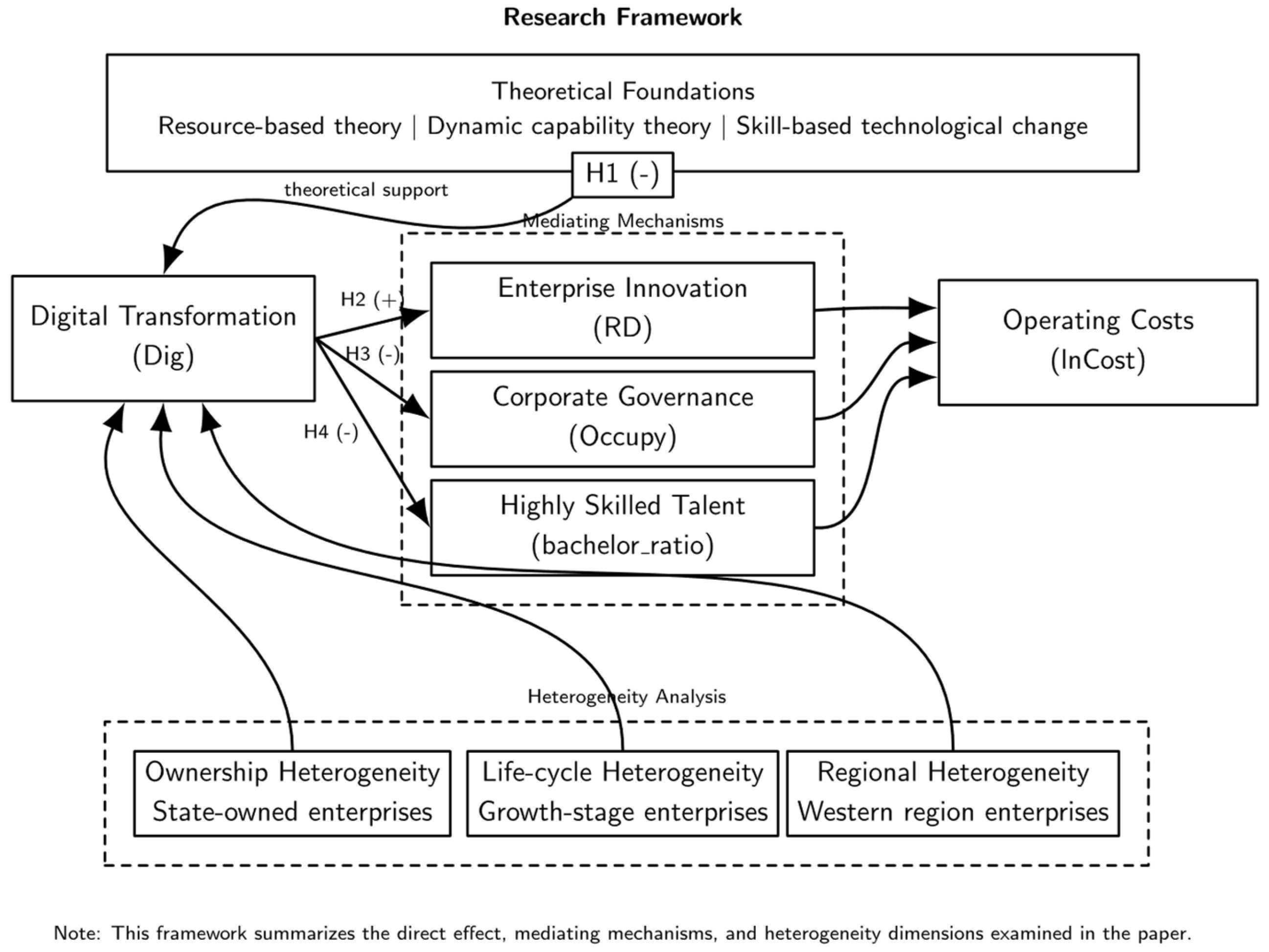
To provide a clearer overview of the analytical logic of this study,
Figure 1 summarizes the proposed research framework. Specifically, it illustrates the direct effect of digital transformation on enterprise operating costs, the three mediating channels proposed in Hypotheses H2–H4, and the heterogeneous perspectives further explored in the empirical analysis, including ownership structure, life-cycle stage, and region. The figure is intended to help readers understand how the theoretical analysis, mechanism tests, and further heterogeneity analysis are connected within one integrated framework.
3. Research Design
3.1. Sample Selection and Data Sources
This study selects Chinese A-share listed companies from 2007 to 2023 as research subjects to examine digital transformation impacts on enterprise costs. The use of a large panel of listed firms is particularly suitable for this study because digital transformation is measured from annual reports, which are systematically available and comparable in the listed-firm setting. To ensure empirical result accuracy and robustness, following prevalent practices in the related field literature [
50], we conduct the following screening and processing procedures on initial samples: (1) Exclude financial industry enterprises, given that financial enterprise financial statement structures and business models demonstrate particularities substantially divergent from general physical enterprises, these are excluded to ensure sample comparability; (2) exclude ST, *ST, and PT enterprises, as specially treated listed companies typically exhibit financial anomalies with data potentially unrepresentative of general market conditions; (3) exclude samples with missing key variables to ensure regression analysis validity, eliminating observations with missing core explanatory variables, explained variables, and principal control variables during the study period; and (4) conduct winsorization treatment to avoid undue influence of extreme outliers on regression results, performing winsorization on all continuous variables at 1% and 99% percentiles. Following these screening procedures, we obtain an unbalanced panel of Chinese A-share listed firms from 2007 to 2023. The number of observations varies across specifications depending on data availability for different variables. Enterprise financial data, corporate governance data, and other requisite data originate from the CSMAR database and Wind database.
It should be emphasized that this study is not based on a single-firm case, but on a large firm-level panel covering more than 5000 Chinese A-share listed companies in the Shanghai and Shenzhen stock markets over the sample period. This broad coverage allows the analysis to capture general empirical patterns among publicly listed firms in China rather than the idiosyncratic behavior of an individual enterprise. At the same time, the representativeness of the sample should be understood in the sense that the findings are most directly applicable to listed firms with relatively standardized disclosure, governance structures, and access to capital markets, and may not fully generalize to smaller non-listed firms.
3.2. Variable Definitions
Explained Variable: Enterprise operating cost. In enterprise cost management and financial analysis domains, operating cost constitutes a comprehensive indicator measuring enterprise resource consumption and operational efficiency. According to cost accounting theory and enterprise value chain analytical frameworks, enterprise operating cost encompasses not only direct production costs but also various indirect costs and period expenses throughout enterprise operational processes.
Specifically, in our context, enterprise operating cost is defined as the summation of operating costs, administrative expenses, selling expenses, and financial expenses (interest expenditures). This definition adheres to fundamental frameworks regarding cost and expense classification in International Financial Reporting Standards (IFRS) and United States Generally Accepted Accounting Principles (US GAAP), while remaining consistent with value chain cost analysis methodologies proposed in competitive advantage theory.
This operating cost definition has been extensively applied and validated in empirical research. From a theoretical perspective, enterprise operating costs should encompass all costs and expenses generated across value chain links, facilitating comprehensive evaluation of enterprise resource allocation efficiency while providing complete analytical foundations for strategic cost management. From empirical applications, cost stickiness-related research has adopted similar operating cost concepts, treating selling costs, administrative expenses, and selling expenses as principal components of enterprise operational costs. Enterprise cost behavior analysis emphasizes that complete cost analysis must simultaneously consider manufacturing costs and period expenses, as they collectively reflect enterprise resource consumption patterns. Further research demonstrates that adopting operating cost indicators encompassing multidimensional costs enables more accurate capture of enterprise cost adjustment behaviors when confronting external shocks.
To eliminate enterprise scale difference influences and satisfy regression analysis statistical assumptions, we apply natural logarithmic transformation to enterprise operating costs (ln_Cost). This processing methodology not only alleviates heteroscedasticity issues but also renders regression coefficients possessing elasticity economic interpretations, facilitating explanation of digital transformation relative impact degrees on enterprise costs.
Explanatory Variable: The core explanatory variable is digital transformation (Dig). Following the text-analysis approach developed by Wu et al. (2021) [
51], we measure firms’ digital transformation by extracting digital-transformation-related keywords from the annual reports of Chinese A-share listed companies and aggregating their frequency of occurrence. Specifically, this approach identifies keywords associated with major digital technologies and digital application scenarios, matches them within annual-report texts, excludes expressions with negation terms or references not referring to the focal firm, and then uses the total keyword frequency to capture the intensity of firms’ digital transformation efforts. Considering the right-skewed nature of such textual frequency data, the indicator is further logarithmically transformed. This measurement strategy is consistent with Wu et al. (2021) [
51], who construct a firm-level digital transformation indicator from annual-report keyword frequencies and provide an important methodological foundation for subsequent empirical research on corporate digital transformation. Although this measure is an indirect proxy and may not fully capture all dimensions of actual digital implementation within firms, it provides a feasible and widely accepted way to quantify firms’ digital transformation intensity in large-sample panel studies.
Control Variables: To control enterprise heterogeneity characteristic influences on costs, following prevalent practices in the enterprise financial characteristic-related literature, we select the following control variables: company size (lnSize), measured by natural logarithm of enterprise total assets; company listing age (ListAge), measured by ln(current year − listing year + 1); asset–liability ratio (Lev), measured by total liabilities/total assets; cash ratio (CashRatio), reflecting enterprise short-term solvency; enterprise profitability level (ROA), measured by net profit/total assets; First Major Shareholder Shareholding Proportion (Top1), reflecting ownership concentration; and industry concentration (Herfindahl3), measured by the Herfindahl index. These variables comprehensively characterize enterprise scale characteristics, financial conditions, governance structures, and market environments.
Mediating Variables: Enterprise Innovation (RD), measured by research and development expenditure proportion of operating revenue to gauge enterprise innovation intensity. R&D intensity constitutes the most direct and commonly employed indicator measuring enterprise innovation investment, capable of reflecting enterprise resource allocation intensity in technological innovation. This indicator demonstrates strong data availability and has been extensively validated in innovation-related research.
Corporate Governance (Occupy): Corporate governance is proxied by controlling shareholder fund occupation (Occupy). This indicator reflects the extent to which controlling shareholders occupy firm resources for their own benefit. In the Chinese corporate governance context, fund occupation is a direct manifestation of tunneling behavior and weak governance. A higher value of Occupy indicates poorer governance quality and more severe agency conflicts.
Highly skilled talent (bachelor_ratio), measured by the proportion of employees with bachelor’s degrees or higher to total employees, is used to gauge an enterprise’s level of highly skilled workers. Human capital constitutes the core element of innovation, with R&D personnel proportion and highly educated R&D personnel quantity serving as key indicators measuring innovation input human capital dimensions [
30]. Bachelor’s degree or higher proportion can be viewed as a reasonable extension of highly educated R&D personnel indicators, enabling more comprehensive reflection of overall enterprise human capital structure’s technological intensity and knowledge intensity.
To precisely identify enterprise digital transformation impacts on enterprise costs, we construct the following two-way fixed effects model:
where the dependent variable
denotes firm
in
+ 1’s natural logarithm of operating costs. The core explanatory variable measures the degree of digital transformation for firm
in
.
denotes a vector of firm-level control variables that may influence costs. To isolate confounding factors, multiple fixed effects are incorporated:
denotes year fixed effects to control for time-varying macroeconomic shocks;
denotes firm-level fixed effects to absorb time-invariant firm-specific characteristics.
is the stochastic error term. Descriptions and definitions of the variables employed in our empirical work are provided in
Table 1.
5. Mechanism Analysis
5.1. Mediation Effect Test Model Construction
To empirically examine these transmission pathways, drawing upon the causal stepwise regression framework of Wen and Ye [
53] and related research frameworks employing causal stepwise regression, we construct the following three-step testing models:
First step examines digital transformation total effects on enterprise costs, with model specification consistent with benchmark regression Formula (1):
The second step examines the effect of digital transformation on the mediating variable (enterprise innovation), specified as Equation (3):
In this model, the dependent variable is the mediating variable—enterprise innovation, proxied by R&D expenditure intensity (RD). A statistically significant coefficient of Dig in Equation (3) indicates that digital transformation affects enterprise innovation, thereby supporting the first link in the mediation pathway.
The third step simultaneously incorporates digital transformation and enterprise innovation into the model to assess the mediation effect, specified as follows:
In model (4), we examine whether enterprise innovation serves as a channel through which digital transformation affects firms’ operating costs. If RD is statistically significant, this means that enterprise innovation is related to firms’ operating costs. We then compare the coefficient of Dig before and after RD is included in the regression. If the coefficient of Dig becomes smaller or loses significance, this suggests that enterprise innovation helps explain how digital transformation reduces operating costs. If the coefficient of Dig becomes insignificant, the evidence is consistent with a complete mediation pattern, and if it remains significant but weaker, the evidence is consistent with a partial mediation pattern.
5.2. Hypothesis H2: Enterprise Innovation Mediating Role Testing
Drawing upon the aforementioned framework, an empirical examination of the mediating role of enterprise innovation is conducted, with detailed results presented in
Table 6.
The total effect test constituting the first step was completed within the benchmark regression, wherein
was significantly negative at the 1% level, corroborating the aggregate cost-reducing effect of digital transformation and establishing a foundation for deeper mechanistic inquiry. The results of the second step are presented in Column (1) of
Table 6, corresponding to model (2). When enterprise innovation (rd_expense_ratio) is designated as the dependent variable, the coefficient of Dig is 0.0006, which is statistically significant at the 1% level. This result suggests that digital transformation is positively associated with firms’ R&D expenditure intensity. Although the estimated coefficient is small, it is consistent with the view that digital transformation may encourage firms to increase innovation investment.
The results of the third step are presented in Column (2) of
Table 6, corresponding to model (3). In this specification, the coefficient of the mediating variable rd_expense_ratio is −0.2377 and statistically significant at the 1% level, indicating that greater R&D expenditure intensity is associated with lower operating costs in the subsequent year. This suggests that enterprise innovation may help firms reduce costs through technological improvement, process optimization, and efficiency gains.
At the same time, the coefficient of Dig attenuates from −0.0016, which is significant at the 1% level in the benchmark regression, to −0.0002 and becomes statistically insignificant after rd_expense_ratio is included. This pattern suggests that, after accounting for enterprise innovation, the direct effect of digital transformation on firms’ operating costs is no longer statistically significant.
The results are consistent with a complete mediation pattern through enterprise innovation. In other words, the cost-reducing effect of digital transformation does not appear to operate directly; rather, the stimulation of innovative activities appears to be an important channel through which digital transformation contributes to cost reduction. Accordingly, Hypothesis H2 receives empirical support.
5.3. Hypothesis H3: Corporate Governance Mediating Role
Corporate governance is an important channel through which digital transformation may affect firms’ cost outcomes. In the Chinese institutional context, agency problems arise not only from the classic separation between ownership and management, but also from conflicts between controlling shareholders and minority shareholders. A salient manifestation of weak corporate governance is controlling shareholder fund occupation. Such tunneling behavior distorts resource allocation, intensifies agency costs, weakens internal controls, and may ultimately increase firms’ operating costs. Against this background, whether digital transformation can curb controlling shareholder fund occupation and thereby improve governance quality is central to understanding the mechanism through which digital transformation affects firms’ costs.
Digital transformation may alleviate these governance problems in several ways. First, digital technologies enhance information transparency and improve the traceability of business transactions, thereby reducing information asymmetry within firms. Second, digital systems strengthen internal control procedures and real-time monitoring, making it more difficult for controlling shareholders to appropriate corporate resources through opaque channels. Third, digital platforms and intelligent management tools improve the standardization of financial and operational processes, which may help restrain opportunistic behavior and reduce the scope for fund occupation. In this sense, digital transformation may improve corporate governance by mitigating tunneling behavior. Better governance, in turn, can reduce inefficient resource use, lower agency costs, and improve firms’ cost management efficiency. Based on this reasoning, Hypothesis H3 proposes that digital transformation reduces firms’ operating costs by mitigating controlling shareholder fund occupation.
To examine this mechanism, this study adopts the same mediation framework as in the previous analysis, using Occupy, which measures controlling shareholder fund occupation, as the proxy for corporate governance. A higher value of Occupy indicates weaker governance quality and more severe agency problems. Column (1) of
Table 7 reports the regression results with Occupy as the dependent variable, capturing whether digital transformation affects controlling shareholder fund occupation. Column (2) reports the regression results for firms’ operating costs after Occupy is added to the model, which allows us to assess whether corporate governance serves as a transmission channel linking digital transformation to firms’ cost outcomes.
The results in
Table 7 provide evidence in support of the mediating role of corporate governance. In Column (1), the coefficient of Dig is −0.0002 and significant at the 5% level, indicating that digital transformation significantly reduces controlling shareholder fund occupation. This finding suggests that digital transformation helps improve governance quality by curbing tunneling behavior and strengthening internal transparency and monitoring. In Column (2), the coefficient of Occupy is 0.0887 and significant at the 5% level, indicating that more severe fund occupation substantially increases firms’ operating costs. This result is consistent with the view that weak governance distorts internal resource allocation, exacerbates agency costs, and undermines cost management efficiency. At the same time, after Occupy is included in the model, the coefficient of Dig becomes statistically insignificant, suggesting that the cost-reducing effect of digital transformation is transmitted, at least to an important extent, through improvements in corporate governance. Taken together, these findings indicate that digital transformation reduces firms’ operating costs partly by mitigating controlling shareholder fund occupation and thereby improving internal governance quality. Therefore, Hypothesis H3 is supported.
Overall, this analysis moves beyond a simple reduced-form relationship and further opens the “black box” of how digital transformation influences firms’ cost performance. More specifically, it shows that digital transformation contributes to cost reduction not only through technological and organizational efficiency gains, but also through improvements in internal governance quality, as reflected in lower levels of controlling shareholder fund occupation.
5.4. Hypothesis H4: Highly Skilled Talent Mediating Role
Human capital constitutes core elements of new quality productive forces and fundamental guarantees for enterprises realizing technological absorption, efficiency enhancement, and cost control. Skill-biased technological change theory indicates new technology applications typically elevate highly skilled labor demand while amplifying their productivity advantages. Based thereupon, research Hypothesis H4 proposes enterprise digital transformation transcends mere hardware and software iterations, accompanied by profound human capital structure reshaping. Digitalization occurs through attracting, cultivating, and empowering highly skilled talent and subsequently having this talent realize workflow optimizations and efficiency revolutions, ultimately achieving enterprise operating cost reduction objectives. To verify “digitalization → attracting highly skilled talent → reducing enterprise costs” transmission pathways, research continues employing mediation effect three-step testing frameworks. The proportion of employees with a bachelor’s degree or higher compared to the total number of employees (bachelor_ratio) was selected as a proxy variable for enterprises’ level of highly skilled talent, with this indicator intuitively reflecting enterprises’ overall levels of human capital. We tested detailed regression results presented in
Table 8.
First-step total effect testing was confirmed by benchmark regression; namely, digital transformation exerts significant negative influences on enterprise costs. Second-step testing examined the effect of digital transformation on firms’ human capital structure, with the results reported in Column (1) of
Table 8. In this model, the dependent variable is the proportion of highly skilled talent (bachelor_ratio), and the coefficient of Dig is 0.6498, significant at the 1% level. This result suggests that digital transformation is associated with an increase in the proportion of highly educated employees. One possible explanation is that digital environments place greater demands on employees’ analytical abilities, learning capacity, and technological competence, which may lead firms to recruit or cultivate more highly skilled workers.
The third-step test incorporates both digital transformation and highly skilled talent into the regression model, with the results reported in Column (2) of
Table 8. The coefficient of bachelor_ratio is −0.0008 and significant at the 1% level, indicating that a higher proportion of highly skilled employees is associated with lower future operating costs. This finding suggests that highly skilled talent may help firms improve the use of digital tools, optimize processes, and reduce operational inefficiencies.
At the same time, the coefficient of Dig declines in magnitude from −0.0016, which is significant at the 1% level in the benchmark regression, to −0.0012, which is statistically significant at the 10% level after bachelor_ratio is included. This pattern suggests that the direct effect of digital transformation is weakened but not fully eliminated after controlling for highly skilled talent.
The results are consistent with a partial mediation pattern through highly skilled talent. These findings indicate that the cost-saving effect of digital transformation depends not only on technological adoption itself, but also on firms’ ability to attract, cultivate, and effectively utilize highly skilled employees. Therefore, Hypothesis H4 receives empirical support.
6. Further Analysis
6.1. Ownership Heterogeneity Analysis
Enterprise property rights constitute core institutional arrangements determining strategic objectives, governance models, and resource constraints. Traditional cognition suggests that non-state-owned enterprises (Non-SOE), which confront stronger market competition pressures and stricter budget constraints, typically possess stronger motivations to utilize digital means for cost reduction and efficiency enhancement, seeking survival and development. However, alternative theoretical perspectives suggest that state-owned enterprises (SOE) implementing major strategic transformations may possess unique advantages that non-state-owned enterprises lack. First, state-owned enterprises possess more substantial capital strength and smoother financing channels, capable of supporting large-scale, long-cycle systematic digital transformations, whereas non-state-owned enterprises may only conduct fragmented, superficial technological applications. Second, state-owned enterprises, particularly crucial central and local enterprises, typically demonstrate a stronger ability to enact responses to national digital strategies, capable of overcoming transformation resistance in a top-down manner. Additionally, state-owned enterprises’ enormous and complex organizational structures and business processes signify more internal optimization spaces through digitalization, with the extent of marginal cost reductions and efficiency enhancements being potentially larger. To empirically test these two theoretical perspectives’ relative importance, research divides samples into non-state-owned enterprise and state-owned enterprise groups based on enterprises’ actual controller attributes for regression analysis. The regression results are reported in
Table 9. In Column (1), the coefficient of Dig is statistically insignificant in the non-state-owned enterprise subsample. In Column (2), the coefficient of Dig is −0.0009 and significant at the 10% level in the state-owned enterprise subsample. These results suggest that the cost-reducing effect of digital transformation appears more evident among state-owned enterprises.
One possible explanation is that state-owned enterprises often have greater access to capital, more stable financing channels, and stronger organizational capacity to implement large-scale digital transformation projects. Under these conditions, digital investments may be more likely to translate into systematic changes in production, coordination, and resource allocation, thereby generating observable cost-saving effects. By contrast, non-state-owned enterprises, especially smaller firms, may adopt digital tools more selectively or incrementally, which may limit their short-term impact on overall operating costs.
However, these findings should be interpreted with caution because the heterogeneity analysis is based on subsample regressions rather than formal coefficient-difference tests. Nevertheless, the results provide suggestive evidence that the effect of digital transformation may vary across ownership structures.
6.2. Enterprise Life-Cycle Heterogeneity Analysis
Enterprises resemble organisms, confronting different strategic emphases and development challenges across different life-cycle stages. Enterprises in growth stages (Growth Stage) typically possess flexible organizational structures, strong innovation motivations, and high new technology acceptance, with core tasks rapidly verifying business models and expanding market shares. Enterprises in mature stages (Mature Stage) possess stable cash flows and market positions but may confront strong organizational inertias, weakened innovation motivations, and “large vessel difficult steering” problems. Based thereupon, reasonable inferences suggest digital transformation effects vary according to enterprise life-cycle stages. Growth-stage enterprises may be more inclined toward utilizing digitalization to construct efficient, scalable operational systems, embedding cost control into business growth genes from inception. To verify this logic, research divides enterprises into growth-stage and mature-stage subsamples using enterprise listing age sample means as boundaries.
The regression results are reported in
Table 10. In Column (1), the coefficient of Dig is −0.0018 and significant at the 5% level in the growth-stage subsample. In Column (2), the coefficient of Dig remains positive and is not statistically significant in the mature-stage subsample, suggesting possible heterogeneity across life-cycle stages.
One possible explanation is that growth-stage firms often have more flexible organizational structures and stronger incentives to build scalable and efficient operating systems through digitalization. Under such conditions, digital transformation may be more easily embedded into core business processes and may therefore generate clearer cost-saving effects. By contrast, mature firms may face greater organizational inertia, legacy-system constraints, and adjustment costs, which can weaken or delay the observable cost effects of digital transformation.
These findings should also be interpreted with caution, because listing age is only an approximate proxy for enterprise life-cycle stage and may not fully capture the broader organizational and strategic dimensions of firm development.
6.3. Regional Heterogeneity Analysis
China’s vast territory and uneven regional development imply substantial differences in firms’ operating environments. Eastern, central, and western regions differ markedly in terms of digital infrastructure, marketization, talent availability, and industrial structure, all of which may shape the effectiveness of digital transformation. To examine whether the cost effects of digital transformation vary across regions, this study divides the sample into eastern, central, and western subsamples according to firms’ registered locations. The regression results are reported in
Table 11.
The results suggest that the impact of digital transformation on firms’ operating costs differs across regions, but not in the way suggested by the original latecomer-advantage hypothesis. In the eastern subsample, the coefficient of Dig is −0.0026 and statistically significant at the 1% level, indicating that digital transformation is associated with lower operating costs for firms in eastern China. However, in the central subsample, the coefficient of Dig is 0.0031 and significant at the 5% level, suggesting that digital transformation is associated with higher operating costs. In the western subsample, the coefficient of Dig is negative but statistically insignificant, indicating that no robust cost effect can be identified for western firms in the current sample.
One possible explanation for the eastern result is that firms in eastern China generally operate in more developed digital ecosystems, with better digital infrastructure, denser professional talent pools, and more mature supporting service markets. Under these conditions, digital transformation may be implemented more effectively and may translate more readily into process optimization, better coordination, and lower operating costs. By contrast, the positive coefficient in the central region may suggest that to some extent digital transformation is still in a stage characterized by substantial upfront investment, adjustment costs, or incomplete organizational integration, so that the short-term cost burden outweighs efficiency gains. For western firms, although digital transformation may still carry potential long-term benefits, the current evidence does not show a statistically robust cost-reducing effect.
These findings indicate that the cost consequences of digital transformation are regionally heterogeneous and may depend on the broader institutional and market environment in which firms operate. The results should be interpreted with caution, because the heterogeneity analysis is based on subsample regressions rather than formal coefficient-difference tests. Therefore, the evidence is better understood as suggestive of regional heterogeneity rather than definitive proof of stronger causal effects in any one region.
6.4. Discussion
The findings of this study can also be related to the emerging literature on sustainability uncertainty and digital transformation. In particular, Chen et al. (2025) [
36] show that ESG rating divergence, as a form of sustainability-related uncertainty, can act as an important driver of corporate digital transformation in China. Their study emphasizes why firms may undertake digital transformation when facing uncertainty in external sustainability evaluation.
Our findings complement this perspective by showing what happens after digital transformation is implemented: digital transformation can reduce firms’ operating costs through three important channels, namely enterprise innovation, improvements in corporate governance, and the accumulation of high-skilled talent. In particular, the evidence on corporate governance suggests that digital transformation helps restrain controlling shareholder fund occupation, thereby improving internal governance quality and further lowering firms’ operating costs. Digital transformation is linked to sustainability not only because sustainability-related uncertainty may induce firms to digitalize, but also because digital transformation itself can generate more efficient, resilient, and cost-saving organizational outcomes. In this sense, our study extends the sustainability discussion from the antecedents of digital transformation to its internal cost consequences.
7. Conclusions and Policy Recommendations
From a theoretical perspective, the findings suggest that digital transformation should be understood not merely as technology adoption, but as a dynamic capability through which firms sense change, integrate digital resources, and reconfigure internal processes. The cost-reduction effect documented in this study is therefore rooted in firms’ ability to transform digital inputs into organizational capabilities rather than in technology investment per se.
Against the backdrop of the deep integration of the digital economy and the real economy, exploring the mechanisms through which digital transformation affects enterprise costs is of great significance for guiding firms to formulate digital strategies scientifically and promote high-quality development. Using panel data of Chinese A-share listed companies from 2007 to 2023, this study employs two-way fixed effects models to examine the impact of digital transformation on enterprise operating costs and its internal mechanisms. The main conclusions are as follows.
First, digital transformation has a significant cost-reducing effect on enterprise operating costs. The benchmark regression results show that digital transformation can significantly reduce firms’ future operating costs. Although digital transformation requires substantial initial investment, the efficiency gains brought about by productivity improvement, process optimization, and lower transaction costs can outweigh these upfront expenditures and ultimately generate net cost savings. Second, the cost-reducing effect of digital transformation appears to operate mainly through specific mediating mechanisms rather than through a purely direct effect. The mediation analysis suggests that enterprise innovation, highly skilled talent, and corporate governance are important channels through which digital transformation contributes to cost reduction, with the results being consistent with a mediation pattern. Specifically, digital transformation helps reduce firms’ costs by stimulating R&D investment and innovation activities, attracting and cultivating highly skilled talent, and improving internal governance quality by restraining controlling shareholder fund occupation. This finding highlights the importance of the coordinated development of technology, innovation, governance, and talent in the process of digital transformation. Third, the cost effects of digital transformation exhibit significant heterogeneity. The cost-reducing effect appears more pronounced in state-owned enterprises, growth-stage enterprises, and firms located in eastern regions, while the central-region results suggest that digital transformation may still involve short-term cost increases.
This study has several limitations. First, the measure of digital transformation is based on annual-report text and therefore captures firms’ disclosed strategic emphasis on digitalization rather than every dimension of actual digital implementation. Second, although controlling shareholder fund occupation provides a more direct proxy for governance quality in the Chinese institutional context, it still cannot capture all aspects of corporate governance. Third, although this study employs fixed effects, robustness tests, and instrumental-variable estimation to strengthen identification, the empirical evidence should still be interpreted with caution, as it is not fully equivalent to definitive causal proof. Fourth, life-cycle classification based on listing age is only an approximate proxy and may not fully reflect the multidimensional nature of enterprise development. Future research may further refine variable measurement and examine more direct sustainability-related outcomes. In addition, although the sample covers more than 5000 Chinese A-share listed firms and therefore provides broad firm-level evidence from the Shanghai and Shenzhen stock markets, the conclusions are still most directly applicable to publicly listed companies rather than to all firms in China. Small and medium-sized non-listed firms may face different digitalization conditions, financing constraints, and governance environments.