Promote or Inhibit? The Impact of Felt Accountability on Coal Miners’ Safety Citizenship Behavior for Sustainable Safety Management


Abstract
1. Introduction
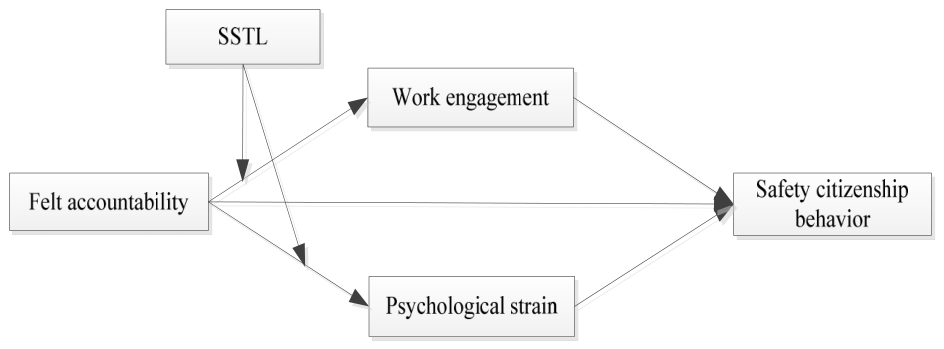
2. Theory and Hypothesis
2.1. Felt Accountability and Safety Citizenship Behavior
2.2. Mediating Role of Work Engagement
2.3. Mediating Role of Psychological Strain
2.4. Moderating Role of SSTL
3. Methods
3.1. Participants and Procedure
3.2. Measures
3.2.1. Felt Accountability (WE)
3.2.2. Work Engagement (WE)
3.2.3. Psychological Strain (PS)
3.2.4. Safety-Specific Transformational Leadership (SSTL)
3.2.5. Safety Citizenship Behavior (SCB)
3.2.6. Control Variables
3.3. Data Analysis
4. Results
4.1. Common Method Bias Test
4.2. Confirmatory Factor Analysis
4.3. Descriptive Statistics and Correlation Analysis
4.4. Hypothesis Test
4.4.1. Direct Effect and Mediation Effect Test
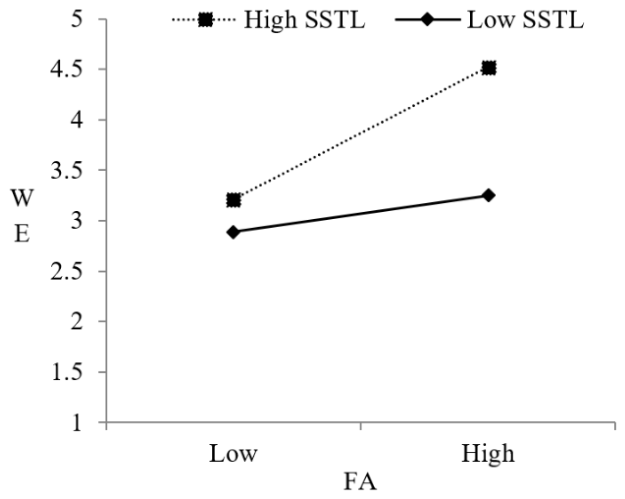
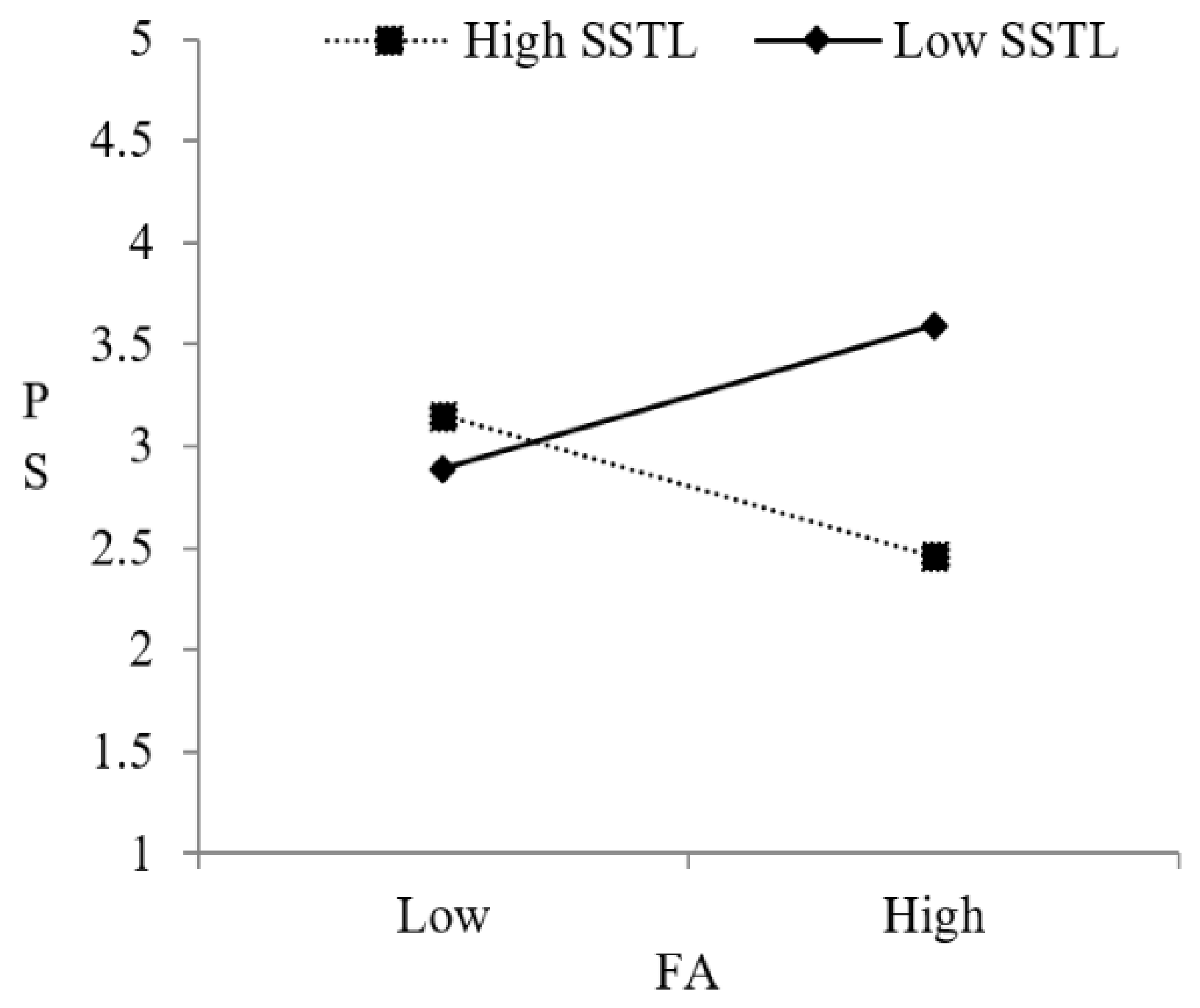
4.4.2. Moderation Effect Test
4.4.3. Moderated Mediation Effect Test
4.5. Alternative Model Test
5. Discussion
5.1. Theoretical Contributions
5.2. Practical Implications
5.3. Limitations and Future Research
6. Conclusions
Author Contributions
Funding
Institutional Review Board Statement
Informed Consent Statement
Data Availability Statement
Acknowledgments
Conflicts of Interest
References
- Xu, G.; Wang, X.; Wang, R.; Yano, G.; Zou, R. Anti-corruption, safety compliance and coal mine deaths: Evidence from China. J. Econ. Behav. Organ. 2021, 188, 458–488. [Google Scholar] [CrossRef]
- Tong, R.; Zhang, Y.; Yang, Y.; Jia, Q.; Ma, X.; Shao, G. Evaluating targeted intervention on coal miners’ unsafe behavior. Int. J. Environ. Res. Public Health 2019, 16, 422. [Google Scholar] [CrossRef]
- Dodoo, J.E.; Surienty, L.; Zahidah, S. Safety citizenship behaviour of miners in Ghana: The effect of hardiness personality disposition and psychological safety. Saf. Sci. 2021, 143, 105404. [Google Scholar] [CrossRef]
- Curcuruto, M.; Conchie, S.M.; Mariani, M.; Violante, F. The role of prosocial and proactive safety behaviors in predicting safety performance. Saf. Sci. 2015, 80, 317–323. [Google Scholar] [CrossRef]
- Qin, K.; Jia, Z.; Lu, T.; Liu, S.; Lan, J.; You, X.; Li, Y. The role of work engagement in the association between psychological capital and safety citizenship behavior in coal miners: A mediation analysis. Int. J. Environ. Res. Public Health 2021, 18, 9303. [Google Scholar] [CrossRef]
- Ning, X.; Zhai, F.; Xia, N.; Hu, X. Protecting the ego: Anticipated image risk as a psychological deterrent to construction workers’ safety citizenship behavior. J. Constr. Eng. Manag. 2024, 150, 4023146. [Google Scholar] [CrossRef]
- Wibawanti, A.B.; Sanny, L.; Siahaan, D.; Djati, S.P. How Safety Awareness Affects Safety Citizenship Behavior: The Safety Motivation Mediation Perspective. Dinasti Int. J. Econ. Financ. Account. 2025, 5, 5937–5945. [Google Scholar]
- Khan, H.S.U.D.; Chughtai, M.S.; Ma, Z.; Li, M.; He, D. Adaptive leadership and safety citizenship behaviors in Pakistan: The roles of readiness to change, psychosocial safety climate, and proactive personality. Front. Public Health 2024, 11, 1298428. [Google Scholar] [CrossRef] [PubMed]
- Omidi, L.; Karimi, H.; Pilbeam, C.; Mousavi, S.; Moradi, G. Safety leadership and safety citizenship behavior: The mediating roles of safety knowledge, safety motivation, and psychological contract of safety. Theor. Issues Ergon. Sci. 2025, 26, 66–83. [Google Scholar] [CrossRef]
- Meng, Q.; Liu, W.; Li, Z.; Chong, H.-Y.; Li, K. Mindful Leadership and Construction Workers’ Safety Citizenship Behavior: A Moderated Mediation Model of Team Psychological Safety, Participative Safety Self-Efficacy, and Leader–Member Exchange. J. Constr. Eng. Manag. 2026, 152, 04025244. [Google Scholar] [CrossRef]
- Wang, D.; Huang, R.; Qiao, Y.; Sheng, Z.; Li, K.; Zhao, L. How perceived leader–member exchange differentiation affects construction workers’ safety citizenship behavior: Organizational identity and felt safety responsibility as mediators. J. Constr. Eng. Manag. 2023, 149, 04023110. [Google Scholar] [CrossRef]
- Yu, M.; Su, Q.; Li, J.; Qin, W. The impact of psychosocial safety climate on construction workers’ safety citizenship behavior: A multilevel chain mediating model. Work 2024, 10519815251408492. [Google Scholar] [CrossRef]
- Liu, W.; Meng, Q.; Li, Z.; Chong, H.-Y.; Li, K. Linking organizational safety support to safety citizenship behavior among construction workers via self-efficacy: The moderating role of trust. Eng. Constr. Archit. Manag. 2025, 1–35. [Google Scholar] [CrossRef]
- Frink, D.D.; Klimoski, R.J. Advancing accountability theory and practice: Introduction to the human resource management review special edition. Hum. Resour. Manag. Rev. 2004, 14, 1–17. [Google Scholar] [CrossRef]
- Hochwarter, W.A.; Perrewé, P.L.; Hall, A.T.; Ferris, G.R. Negative affectivity as a moderator of the form and magnitude of the relationship between felt accountability and job tension. J. Organ. Behav. 2005, 26, 517–534. [Google Scholar] [CrossRef]
- Orakcı, Ş.; Dilekli, Y.; Erdağ, C. The structural relationship between accountability felt and responsible teaching in Turkish teachers: The mediating effect of innovative thinking. Think. Ski. Creat. 2020, 36, 100662. [Google Scholar] [CrossRef]
- Kuo, C.-C.; Ni, Y.-L.; Wu, C.-H.; Duh, R.-R.; Chen, M.-Y.; Chang, C. When can felt accountability promote innovative work behavior? The role of transformational leadership. Pers. Rev. 2022, 51, 1807–1822. [Google Scholar] [CrossRef]
- Li, Y.; Liu, W.; Yu, G. Dancing in shackles: The double-edged sword effect of felt accountability on work outcomes and individual wellbeing. Front. Psychol. 2022, 13, 904946. [Google Scholar] [CrossRef]
- Hochwarter, W.A.; Ferris, G.R.; Gavin, M.B.; Perrewé, P.L.; Hall, A.T.; Frink, D.D. Political skill as neutralizer of felt accountability—Job tension effects on job performance ratings: A longitudinal investigation. Organ. Behav. Hum. Decis. Process. 2007, 102, 226–239. [Google Scholar] [CrossRef]
- Mackey, J.D.; Brees, J.R.; McAllister, C.P.; Zorn, M.L.; Martinko, M.J.; Harvey, P. Victim and culprit? The effects of entitlement and felt accountability on perceptions of abusive supervision and perpetration of workplace bullying. J. Bus. Ethics 2018, 153, 659–673. [Google Scholar] [CrossRef]
- Shankar, U.; Kaul, V.; Gupta, V.; Mishra, N.K. Workplace ostracism and counterproductive work behaviour: Parallel mediation of felt accountability and emotional exhaustion. J. Manag. Dev. 2024, 43, 849–862. [Google Scholar] [CrossRef]
- Wang, D.; Sheng, Z.; Wang, X.; Griffin, M.A.; Zhang, Y.; Wang, Z. How team safety stressors affect proactive and prosocial safety behaviors: Felt safety responsibility and affective commitment as mediators. Saf. Sci. 2022, 147, 105625. [Google Scholar] [CrossRef]
- Hall, A.T.; Frink, D.D.; Buckley, M.R. An accountability account: A review and synthesis of the theoretical and empirical research on felt accountability. J. Organ. Behav. 2017, 38, 204–224. [Google Scholar] [CrossRef]
- Prinsloo, H.; Hofmeyr, K. Organisational culture, frontline supervisory engagement and accountability, as drivers of safety behaviour in a platinum mining organisation. J. Hum. Resour. Manag. 2022, 20, a1705. [Google Scholar] [CrossRef]
- Yi, T.; Dong, Y.; Li, J. Influence of job insecurity on coal miners’ safety performance: The role of emotional exhaustion. Chin. Manag. Stud. 2022, 16, 1254–1270. [Google Scholar] [CrossRef]
- Lazarus, R.S.; Folkman, S. Stress, Appraisal, and Coping; Springer: Berlin/Heidelberg, Germany, 1984. [Google Scholar]
- Hall, A.T.; Royle, M.T.; Brymer, R.A.; Perrewé, P.L.; Ferris, G.R.; Hochwarter, W.A. Relationships between felt accountability as a stressor and strain reactions: The neutralizing role of autonomy across two studies. J. Occup. Health Psychol. 2006, 11, 87. [Google Scholar] [CrossRef]
- Al Hajj, R.; Vongas, J.G.; Jamal, M.; ElMelegy, A.R. The essential impact of stress appraisals on work engagement. PLoS ONE 2023, 18, e0291676. [Google Scholar] [CrossRef]
- Wu, H.; Qiu, S.; Dooley, L.M.; Ma, C. The relationship between challenge and hindrance stressors and emotional exhaustion: The moderating role of perceived servant leadership. Int. J. Environ. Res. Public Health 2020, 17, 282. [Google Scholar] [CrossRef]
- Neves, P.; Mesdaghinia, S.; Eisenberger, R.; Wickham, R.E. Timesizing proximity and perceived organizational support: Contributions to employee well-being and extra-role performance. J. Change Manag. 2018, 18, 70–90. [Google Scholar] [CrossRef]
- Barling, J.; Loughlin, C.; Kelloway, E.K. Development and test of a model linking safety-specific transformational leadership and occupational safety. J. Appl. Psychol. 2002, 87, 488. [Google Scholar] [CrossRef]
- Gill, A.S.; Flaschner, A.B.; Shachar, M. Mitigating stress and burnout by implementing transformational-leadership. Int. J. Contemp. Hosp. Manag. 2006, 18, 469–481. [Google Scholar] [CrossRef]
- Wang, X.; Zhang, C.; Deng, J.; Su, C.; Gao, Z. Analysis of factors influencing miners’ unsafe behaviors in intelligent mines using a novel hybrid MCDM model. Int. J. Environ. Res. Public Health 2022, 19, 7368. [Google Scholar] [CrossRef] [PubMed]
- Webster, J.R.; Beehr, T.A.; Love, K. Extending the challenge-hindrance model of occupational stress: The role of appraisal. J. Vocat. Behav. 2011, 79, 505–516. [Google Scholar] [CrossRef]
- Tuan, D.A. The Effect of Felt Accountability on User Satisfaction with Accounting Information. Emerg. Sci. J. 2024, 8, 732–743. [Google Scholar] [CrossRef]
- Overman, S.; Neo, S.; Hall, A.T. The emotional backlash of public accountability. Public Perform. Manag. Rev. 2025, 1–29. [Google Scholar] [CrossRef]
- Schaufeli, W.B.; Bakker, A.B.; Salanova, M. The measurement of work engagement with a short questionnaire: A cross-national study. Educ. Psychol. Meas. 2006, 66, 701–716. [Google Scholar] [CrossRef]
- Kubicek, B.; Uhlig, L.; Hülsheger, U.R.; Korunka, C.; Prem, R. Are all challenge stressors beneficial for learning? A meta-analytical assessment of differential effects of workload and cognitive demands. Work Stress 2023, 37, 269–298. [Google Scholar] [CrossRef]
- Zheng, X.; Keltner, H.C.; Zhao, Z.; Hochwarter, W. Mitigating abusive supervision’s negative effect on employee outcomes: The role of felt accountability. Leadersh. Organ. Dev. J. 2026, 47, 535–552. [Google Scholar] [CrossRef]
- Hakanen, J.J.; Kaltiainen, J. Work Engagement: Feeling Happy, Motivated, and Resilient at Work. Annu. Rev. Organ. Psychol. Organ. Behav. 2026, 13, 23–48. [Google Scholar] [CrossRef]
- De Clercq, D.; Pereira, R. How resilient employees can prevent family ostracism from escalating into diminished work engagement and change-oriented organizational citizenship behavior. Int. Stud. Manag. Organ. 2024, 54, 25–47. [Google Scholar] [CrossRef]
- Lee, R.T.; Ashforth, B.E. A meta-analytic examination of the correlates of the three dimensions of job burnout. J. Appl. Psychol. 1996, 81, 123. [Google Scholar] [CrossRef]
- Mazzola, J.J.; Disselhorst, R. Should we be “challenging” employees?: A critical review and meta-analysis of the challenge-hindrance model of stress. J. Organ. Behav. 2019, 40, 949–961. [Google Scholar] [CrossRef]
- Bakker, A.B.; Demerouti, E. The job demands-resources model: State of the art. J. Manag. Psychol. 2007, 22, 309–328. [Google Scholar] [CrossRef]
- Hobfoll, S.E. Conservation of resources: A new attempt at conceptualizing stress. Am. Psychol. 1989, 44, 513. [Google Scholar] [CrossRef] [PubMed]
- Wong, K.C.; Chan, A.K. Work antecedents, psychological strain and safety behaviours among Chinese hotel employees. Saf. Sci. 2020, 129, 104825. [Google Scholar] [CrossRef]
- Bowers, J.; Lo, J.; Miller, P.; Mawren, D.; Jones, B. Psychological distress in remote mining and construction workers in Australia. Med. J. Aust. 2018, 208, 391–397. [Google Scholar] [CrossRef]
- Nahrgang, J.D.; Morgeson, F.P.; Hofmann, D.A. Safety at work: A meta-analytic investigation of the link between job demands, job resources, burnout, engagement, and safety outcomes. J. Appl. Psychol. 2011, 96, 71. [Google Scholar] [CrossRef] [PubMed]
- Shi, H.; Mohamed Zainal, S.R. The influence of safety-specific transformational leadership and safety management practices on mindful safety practices through safety motivation: A study in the Chinese petroleum industry. J. Appl. Secur. Res. 2022, 17, 352–368. [Google Scholar] [CrossRef]
- Conchie, S.M.; Taylor, P.J.; Donald, I.J. Promoting safety voice with safety-specific transformational leadership: The mediating role of two dimensions of trust. J. Occup. Health Psychol. 2012, 17, 105. [Google Scholar] [CrossRef]
- Smith, T.D.; DeJoy, D.M.; Dyal, M.-A. Safety specific transformational leadership, safety motivation and personal protective equipment use among firefighters. Saf. Sci. 2020, 131, 104930. [Google Scholar] [CrossRef]
- Irshad, M.; Majeed, M.; Khattak, S.A. The combined effect of safety specific transformational leadership and safety consciousness on psychological well-being of healthcare workers. Front. Psychol. 2021, 12, 688463. [Google Scholar] [CrossRef]
- Ali, M.; Iyiola, K.; Alzubi, A.; Aljuhmani, H.Y. Using safety-specific transformational leadership to improve safety behavior among construction workers: Exploring the role of knowledge sharing and psychological safety. Buildings 2025, 15, 3340. [Google Scholar] [CrossRef]
- Grill, M.; Samuelsson, A.U.; Matton, E.; Norderfeldt, E.; Rapp-Ricciardi, M.; Räisänen, C.; Larsman, P. Individualized behavior-based safety-leadership training: A randomized controlled trial. J. Saf. Res. 2023, 87, 332–344. [Google Scholar] [CrossRef]
- Ye, G.; Xiang, Q.; Yang, L.; Yang, J.; Xia, N.; Liu, Y.; He, T. Safety stressors and construction workers’ safety performance: The mediating role of ego depletion and self-efficacy. Front. Psychol. 2022, 12, 818955. [Google Scholar] [CrossRef]
- Clarke, S. Safety leadership: A meta-analytic review of transformational and transactional leadership styles as antecedents of safety behaviours. J. Occup. Organ. Psychol. 2013, 86, 22–49. [Google Scholar] [CrossRef]
- Cong, W.; Zhang, S.; Liang, H.; Xiang, Q. Impact of challenge and hindrance job stressors on informal safety communication of construction workers in China: The moderating role of co-worker relationship. Eng. Constr. Archit. Manag. 2024, 31, 2011–2033. [Google Scholar] [CrossRef]
- Brislin, R.W. Translation and content analysis of oral and written materials. Methodology 1980, 389–444. [Google Scholar]
- Wong, K.C.; O’Driscoll, M.P. Psychometric properties of the general health questionnaire-12 in a sample of Hong Kong employees. Psychol. Health Med. 2016, 21, 975–980. [Google Scholar] [CrossRef]
- Kelloway, E.K.; Mullen, J.; Francis, L. Divergent effects of transformational and passive leadership on employee safety. J. Occup. Health Psychol. 2006, 11, 76. [Google Scholar] [CrossRef] [PubMed]
- Meng, X.; Zhai, H.; Chan, A.H. Development of scales to measure and analyse the relationship of safety consciousness and safety citizenship behaviour of construction workers: An empirical study in China. Int. J. Environ. Res. Public Health 2019, 16, 1411. [Google Scholar] [CrossRef] [PubMed]
- Meng, X.; Chan, A.H. Demographic influences on safety consciousness and safety citizenship behavior of construction workers. Saf. Sci. 2020, 129, 104835. [Google Scholar] [CrossRef]
- Cohen, J. Statistical Power Analysis for the Behavioral Sciences; Routledge: Abingdon, UK, 2013. [Google Scholar]
- Qiang, W.; Li, F. Work stressors and aggressive driving: The mediating roles of stress appraisals. Saf. Sci. 2025, 181, 106656. [Google Scholar] [CrossRef]
- Wang, X.; Zhang, Z.; Liang, S.; Yang, Z.; Su, C. Faultlines and Miners’ Safety Behaviour: Role of Emotional Exhaustion and Safety Self-Efficacy. Small Group Res. 2026, 10464964261422472. [Google Scholar] [CrossRef]
- Mo, J.; Cui, L.; Wang, R.; Cui, X. Proactive personality and construction worker safety behavior: Safety self-efficacy and team member exchange as mediators and safety-specific transformational leadership as moderators. Behav. Sci. 2023, 13, 337. [Google Scholar] [CrossRef]
- Ye, X.; Jiang, J.; Wang, Z.; Cai, S. The impact of exploitative leadership on safety voice: A moderated mediation model. Saf. Sci. 2026, 194, 107043. [Google Scholar] [CrossRef]
- Yang, J.; Ye, G.; Zhang, Z.; Liu, X.; Liu, Y. Linking construction noise to worker safety behavior: The role of negative emotion and regulatory focus. Saf. Sci. 2023, 162, 106093. [Google Scholar] [CrossRef]
- Shuang, Q.; Shuai, X.; Liang, H.; Bai, J. How work-family conflict affects highway construction professionals’ safety citizenship behaviors: A moderated mediation model. Saf. Sci. 2025, 191, 106976. [Google Scholar] [CrossRef]


| Models | χ2/df | CFI | TLI | RMSEA | SRMR |
|---|---|---|---|---|---|
| 1-factor model (FA + WE + PS + SSTL + SCB) | 2.823 | 0.743 | 0.775 | 0.136 | 0.171 |
| 2-factor model (FA + WE + PS+ SSTL, SCB) | 3.556 | 0.780 | 0.653 | 0.152 | 0.090 |
| 3-factor model (FA + WE, PS+ SSTL, SCB) | 2.712 | 0.857 | 0.768 | 0.091 | 0.125 |
| 4-factor model (FA, WE + PS, SSTL, SCB) | 1.963 | 0.917 | 0.863 | 0.053 | 0.089 |
| 5-factor model (FA, WE, PS, SSTL, SCB) | 1.588 | 0.935 | 0.921 | 0.033 | 0.026 |
| Variables | Mean | SD | 1 | 2 | 3 | 4 | 5 | 6 | 7 | 8 |
|---|---|---|---|---|---|---|---|---|---|---|
| 1. Age | 1.934 | 0.574 | 1 | |||||||
| 2. Education | 2.256 | 0.719 | 0.123 | 1 | ||||||
| 3. LS | 1.872 | 0.620 | 0.094 | 0.052 * | 1 | |||||
| 4. FA | 2.301 | 0.775 | 0.055 | 0.127 | 0.068 | 1 | ||||
| 5. WE | 2.528 | 0.653 | −0.082 | 0.032 | 0.132 | 0.353 ** | 1 | |||
| 6. PS | 2.837 | 0.821 | 0.117 | 0.093 | 0.046 | 0.187 ** | −0.166 * | 1 | ||
| 7. SSTL | 3.120 | 0.598 | 0.036 | 0.060 | −0.031 | 0.273 ** | 0.247 ** | 0.136 | 1 | |
| 8. SCB | 3.076 | 0.736 | 0.173 | 0.148 | 0.070 | 0.416 ** | 0.295 ** | −0.327 ** | 0.259 ** | 1 |
| Variables | WE | PS | SCB | |||
|---|---|---|---|---|---|---|
| Model 1 | Model 2 | Model 3 | Model 4 | Model 5 | Model 6 | |
| Age | −0.128 | −0.117 | 0.183 | 0.178 | 0.207 | 0.184 |
| Education | 0.054 | 0.035 | 0.096 | 0.092 | 0.157 | 0.142 |
| LS | 0.123 | 0.105 | 0.056 | 0.047 | 0.077 | 0.051 |
| FA | 0.571 *** | 0.283 ** | 0.217 * | |||
| WE | 0.329 *** | |||||
| PS | −0.143 *** | |||||
| R2 | 0.059 | 0.294 | 0.017 | 0.378 | 0.026 | 0.472 |
| ΔR2 | 0.059 | 0.277 | 0.017 | 0.362 | 0.026 | 0.433 |
| F | 2.186 | 7.865 | 0.822 | 10.586 | 1.679 | 9.571 |
| Path | Total Effect | Direct Effect | Indirect Effect | S.E. | Boot 95% CI | |
|---|---|---|---|---|---|---|
| Lower | Upper | |||||
| FA → WE → SCB | 0.372 | 0.257 | 0.115 | 0.041 | 0.037 | 0.189 |
| FA → PS → SCB | −1.526 | −1.433 | −0.093 | 0.035 | −0.218 | −0.034 |
| Variables | WE | PS | ||||
|---|---|---|---|---|---|---|
| Model 7 | Model 8 | Model 9 | Model 10 | Model 11 | Model 12 | |
| Age | −0.175 | −0.122 | −0.097 | 0.197 | 0.153 | 0.132 |
| Education | 0.073 | 0.051 | 0.047 | 0.132 | 0.105 | 0.090 |
| LS | 0.137 | 0.089 | 0.053 | 0.062 | 0.042 | 0.037 |
| SSTL | 0.301 | 0.385 ** | −0.297 ** | −0.233 ** | ||
| FA × SSTL | 0.427 *** | −0.186 *** | ||||
| R2 | 0.073 | 0.178 | 0.261 | 0.035 | 0.137 | 0.211 |
| ΔR2 | 0.073 | 0.275 | 0.083 | 0.035 | 0.123 | 0.074 |
| F | 1.355 | 2.973 | 3.178 | 0.581 | 1.586 | 1.963 |
| Path | SSTL | Estimate | S.E. | Boot 95% CI | |
|---|---|---|---|---|---|
| Lower | Upper | ||||
| FA → WE → SCB | High | 0.091 | 0.030 | 0.018 | 0.157 |
| Low | 0.034 | 0.046 | 0.012 | 0.075 | |
| IMM1 | 0.057 | 0.033 | 0.013 | 0.098 | |
| FA → PS → SCB | High | −0.036 | 0.041 | −0.054 | −0.021 |
| Low | −0.152 | 0.039 | −0.255 | −0.073 | |
| IMM2 | 0.116 | 0.035 | 0.038 | 0.217 | |
Disclaimer/Publisher’s Note: The statements, opinions and data contained in all publications are solely those of the individual author(s) and contributor(s) and not of MDPI and/or the editor(s). MDPI and/or the editor(s) disclaim responsibility for any injury to people or property resulting from any ideas, methods, instructions or products referred to in the content. |
© 2026 by the authors. Licensee MDPI, Basel, Switzerland. This article is an open access article distributed under the terms and conditions of the Creative Commons Attribution (CC BY) license.
Share and Cite
Qin, W.; Li, J.; Yu, M. Promote or Inhibit? The Impact of Felt Accountability on Coal Miners’ Safety Citizenship Behavior for Sustainable Safety Management. Sustainability 2026, 18, 4199. https://doi.org/10.3390/su18094199
Qin W, Li J, Yu M. Promote or Inhibit? The Impact of Felt Accountability on Coal Miners’ Safety Citizenship Behavior for Sustainable Safety Management. Sustainability. 2026; 18(9):4199. https://doi.org/10.3390/su18094199
Chicago/Turabian StyleQin, Wenjing, Jizu Li, and Min Yu. 2026. "Promote or Inhibit? The Impact of Felt Accountability on Coal Miners’ Safety Citizenship Behavior for Sustainable Safety Management" Sustainability 18, no. 9: 4199. https://doi.org/10.3390/su18094199
APA StyleQin, W., Li, J., & Yu, M. (2026). Promote or Inhibit? The Impact of Felt Accountability on Coal Miners’ Safety Citizenship Behavior for Sustainable Safety Management. Sustainability, 18(9), 4199. https://doi.org/10.3390/su18094199