Article

Arsenic Removal from Water Using Mg-Based Adsorbents in the Presence of Silicic Acid
Geological Survey of Japan, National Institute of Advanced Industrial Science and Technology (AIST), Central 7, 1-1-1 Higashi, Tsukuba 305-8567, Japan
*
Author to whom correspondence should be addressed.
Sustainability 2026, 18(9), 4162; https://doi.org/10.3390/su18094162
Submission received: 18 March 2026 / Revised: 13 April 2026 / Accepted: 17 April 2026 / Published: 22 April 2026
(This article belongs to the Special Issue Geoenvironmental Engineering and Water Pollution Control)

Abstract

Dissolved silicic acid (Si) in groundwater can reduce the As-removal performance of adsorbents used for treating contaminated water. However, its effects on Mg-based adsorbents remain largely unexplored. In this study, As-removal tests were conducted under various test conditions to evaluate the suitability of Mg-based adsorbents (MgO, Mg(OH)2, and MgCO3) for the purification of As-contaminated water in the presence of Si. As-removal performance varied significantly depending on the Mg-based adsorbent type and dosage (WAd0/V), As valence, and the initial As and Si (CSi0) concentrations. In some cases, As removal improved at relatively low CSi0; however, overall performance decreased with increasing CSi0 for all Mg-based adsorbents. Moreover, compared with Mg(OH)2, the performance of MgO and MgCO3 was more strongly affected by Si. This inhibition is attributed to competition between Si and As for adsorption sites on the adsorbent surface. Furthermore, for MgO and MgCO3, the amount of As removed by coprecipitation with secondarily generated Mg(OH)2 aggregates was inferred to decrease with increasing CSi0, because higher CSi0 lowered the solution pH. Overall, MgO and Mg(OH)2 can function effectively as adsorbents for As treatment when WAd0/V is appropriately selected, considering the range of Si concentrations typically found in groundwater.

1. Introduction

Arsenic (As) occurs in inorganic and organic forms and exhibits both metallic and non-metallic properties [1]. The prevalent inorganic forms of As are trivalent As (arsenous acid; arsenite; As(III)) and pentavalent As (arsenic acid; arsenate; As(V)). Inorganic As(III) is highly toxic, more toxic than As(V), and more mobile than other forms [2]. Symptoms associated with chronic As toxicity have been reported in regions where groundwater is used for drinking, [3,4,5]. Chronic exposure to As-contaminated drinking water can cause a wide range of health effects. Typical As-associated manifestations include skin lesions (e.g., melanosis, leucomelanosis, and keratosis), neurological effects, obstetric problems, high blood pressure, diabetes mellitus, respiratory and vascular diseases including cardiovascular disease, and cancers of the skin, lung, and bladder [5,6]. To mitigate these harmful effects of As, drinking-water quality guidelines of the World Health Organization (WHO) have set 0.01 mg/L as a provisional guideline value for As [6]. The As environmental and wastewater standards in Japan are 0.01 and 0.1 mg/L, respectively [7,8].
Many studies have reported that As contamination of groundwater occurs worldwide [9,10]. Global As-prediction models are being developed to estimate exposed populations in regions beyond those where As-related impacts are currently evident. Podgorsk and Berg proposed a global prediction map of groundwater As exceeding 0.01 mg/L using a random-forest machine-learning model trained on 11 geospatial environmental parameters and more than 50,000 aggregated measurements of groundwater As concentration [11]. By combining this global As-prediction model with household groundwater-usage statistics, they estimated that 94 million to 220 million people may be exposed to elevated As concentrations in groundwater, with the vast majority (94%) residing in Asia [11].
The development of cost-effective As-treatment methods is essential because many regions that rely on As-contaminated groundwater for drinking water are economically disadvantaged. Liu et al. [12] reviewed conventional adsorbents (e.g., activated carbon, zeolites, and waste-derived sorbents) and more recent functional adsorbents (e.g., graphene oxide (GO), carbon nanotubes (CNTs), and metal organic frameworks (MOFs)). After briefly introducing other purification technologies, including ion exchange, photocatalysis, and membrane technology, they concluded that adsorption is an attractive option because of its simple design, low cost, and ease of operation. In their review, they compared the As-removal capacities of functional adsorbents using the As distribution coefficient and discussed the regeneration and disposal of spent adsorbents. They further noted that advanced sorbents such as ZrO(OH)2/CNTs can exhibit high As distribution coefficients and good regenerability [12]. However, the review did not address management of the As-containing wastewater that is likely to be generated during regeneration of spent adsorbents.
A key concern is that As removal by the adsorbent may be compromised by the presence of coexisting ions in the contaminated water. Studies on Fe-based adsorbents for As removal have frequently reported that silicic acid (Si) can markedly affect As uptake. Meng et al. investigated the effects of silicate (Si), sulfate (SO42−), and carbonate (CO32−) on the removal of As(III) and As(V) by coprecipitation with FeCl3 [13]. Batch experiments were conducted using a KNO3 solution (0.04 M) as a background electrolyte under either a N2 atmosphere or ambient air. The solution pH was adjusted with KOH and HNO3 over the range of 3–11, and initial As concentrations ranged from 0.05 to 1.4 mg/L. Coprecipitation was initiated by adding FeCl3 and, where applicable, SO42− or Si stock solutions to the electrolyte. As pH decreased from 10 to 6, As(V) removal increased from 0 to 95%. Conversely, As(III) removal increased from 20 to 80% as pH increased from 4 to 9.5. Removal of As(V) and As(III) was essentially identical under a N2 atmosphere and in ambient air, indicating that carbonate species had a negligible influence on As removal over pH 4–9.5. Similarly, adding SO42− did not affect As(V) and As(III) removal over pH 4–10; no apparent change in As(V) and As(III) removal was observed as sulfate concentration increased from 0 to 300 mg/L at an equilibrium pH of 6.8. Between pH 4 and 10, less than 30 mg/L Fe remained soluble in the KNO3 solution (0.04 M). However, at 5 mg/L Si, increasing pH from 8.6 to 9.4 increased the soluble Fe concentration from 47 to 2040 mg/L and substantially reduced As removal only at pH > 8.6. Overall, As(III) and As(V) removal decreased from approximately 90 to 45% as Si concentration was increased from 1 to 10 mg/L. At pH > 7, As(V) removal decreased in the presence of 4.5 mg/L Si, whereas at pH < 6.8, As(V) removal was unaffected by Si. In contrast, As(III) removal was significantly reduced by Si across a broad pH range, and the magnitude of the Si effect increased as pH increased from approximately 4 to 9.5. The authors concluded that high Si concentrations render As(III) removal by coprecipitation with FeCl3 ineffective [13]. Waltham and Eick investigated the adsorption behavior of As(V) and As(III) on goethite (FeO(OH)) in the presence of Si [14]. For the kinetic experiments, As was added only after Si adsorption had reached steady state (60 h). Adsorption of both As(III) and As(V) on goethite was rapid and essentially complete within 2 h. As pH decreased, the adsorption rates of As(III) and Si decreased, whereas the adsorption rate of As(V) increased. Furthermore, Si uptake on goethite decreased as pH was reduced, while As(III) and As(V) adsorption remained nearly constant over pH 4–8. Si adsorption exhibited an initial rapid phase followed by a considerably slower phase. Across all pH values and concentrations tested, Si decreased both the rate of As(III) adsorption and the total amount of As(III) adsorbed. Inhibition of As(III) adsorption ranged from ~4% at pH 6 and 0.10 mM Si to 40% at pH 8 and 1.0 mM Si. At 0.10 mM Si, As(III) adsorption was reduced the most at pH 4 followed by pH 8. At 1.0 mM Si, As(III) adsorption was reduced the most at pH 8, followed by similar reductions at pH 4 and 6. Si also reduced the rate of As(V) adsorption, with the rate decreasing further as pH and Si concentration increased; however, the total amount of As(V) adsorbed remained nearly constant from pH 4 to 8 at both Si concentrations. The authors concluded that Si at naturally occurring concentrations can reduce both the rate and total amount of As adsorbed on goethite [14].
Mg-based compounds have also been investigated for As removal. Park et al. [15] suggested a method to withdraw As(V) from a plant solution with approximately 470 mg/L of As(V) and 70 g/L of Mo(VI) using MgCl2 or MgSO4. They reported that As(V) can be removed by precipitation of Mg3(AsO4)2 at pH 8–10; however, at pH 12, this process fails because Mg precipitates predominantly as Mg(OH)2 [15]. Yu et al. [16] first prepared flower-like hydromagnesite (F-hydromagnesite) or nest-like hydromagnesite (N-hydromagnesite) by mixing Mg(NO3)2 and K2CO3 solutions, and subsequently calcined them to produce two types of MgO (F-MgO and N-MgO, respectively). The As-adsorption capacities of the MgO samples were substantially higher than those of the corresponding hydromagnesites, and N-MgO exhibited a higher adsorption capacity than F-MgO [16]. Tresintsi et al. [17] investigated the use of granulated MgO for regenerating Fe oxyhydroxide arsenic adsorbents. Their batch adsorption tests were conducted at initial As(III) and As(V) concentrations of 0.25–12.5 mg/L and pH 10–12. They reported maximum adsorption capacities of 59.4 mg/g for As(V) (at a residual concentration of approximately 5 mg/L) at pH 10 and approximately 50 mg/g for As(III) (at a residual concentration of 3 mg/L) at pH 11. Moreover, As K-edge EXAFS spectra indicated that As(V) and As(III) likely adsorbed onto Mg(OH)2 formed by hydrolysis of MgO [17]. Lin et al. [18] prepared monodispersed, porous, pinecone-like Mg(OH)2 (PLMH) for As(V) removal and investigated the effects of coexisting ions (PO43−, CO32−, SO42−, NO3, and Cl) at a 1:1 concentration ratio relative to arsenate. They reported that SO42−, NO3, and Cl had a minimal effect on As(V) removal, whereas PO43− and CO32− significantly inhibited As(V) removal due to competitive adsorption [18]. However, they did not examine the Si effects on As(V) removal. The presence of Si in solutions has been reported to affect the leaching behavior of As from spent Mg-based adsorbents containing As [19]. This suggests that Si may also influence As adsorption onto Mg-based adsorbents. Therefore, the Si effects on As adsorption by Mg-based adsorbents should be investigated.
The above review of the literature suggests that although silicic acid can substantially affect the As-removal performance of adsorbents, its effects on Mg-based adsorbents have scarcely been studied. Therefore, in this study, batch As-removal tests were conducted using powdered reagents of common Mg-based compounds as adsorbents and synthetic As-contaminated waters containing Si. The test parameters were adsorbent type (MgO, Mg(OH)2, and MgCO3), adsorbent concentration (approximately 0.2 and 2 g/L), As valence (trivalent and pentavalent), initial concentration of As (approximately 1 and 10 mg/L), and initial concentration of Si (five concentration levels between 0 and 120 mg/L, including 0 mg/L). The differences in As-adsorption behavior associated with these parameters were evaluated, and the effects of Si on the As-removal performance of Mg-based adsorbents were investigated in detail.

2. Materials and Methods

2.1. Mg-Based Adsorbents

Commercial MgO, Mg(OH)2, and MgCO3 powdered reagents were used as Mg-based adsorbents. Unless otherwise specified, all reagents were procured from FUJIFILM Wako Pure Chemical Corporation (Osaka, Japan). The measurement values of median particle size (Dp50; μm), BET surface area (SBET; m2/g), Mg content (αMg; %), and reagent purity (based on αMg) (P; %) in Table 1 were obtained from a previous study [19]. The main reason that the p values were less than 100% was the presence of adsorbed water.

2.2. As-Removal Tests with As-Contaminated Water Containing Si

2.2.1. Synthetic As-Si Contaminated Water

Powdered NaAsO2 and Na2HAsO4·7H2O were dissolved separately in deionized water to prepare As(III) and As(V) stock solutions (2000 mg/L), respectively. The Si stock solution was prepared by dissolving approximately 1 g of sodium silicate solution (21.2–23.8% with SiO2/Na2O = 3.0–3.6 molar ratio at the nominal value) in 1 L of deionized water. The Si concentration in the stock solution was measured using inductively coupled plasma–atomic emission spectrometry (ICP-AES). Synthetic As-contaminated water containing Si was prepared by mixing and diluting the stock solutions with deionized water at foreordained ratios. The synthetic contaminated water comprised two initial As concentrations (CAS0) (approximately 1 and 10 mg/L) and five initial Si concentrations (CSi0) ranging from 0 to approximately 120 mg/L (including 0 mg/L). The solution pH of the contaminated water was adjusted and maintained at approximately 7 using HNO3 and NaOH solutions. The pH directly after adjustment is represented to as the initial pH (pH0).

2.2.2. Experimental Procedure

Approximately 0.01 or 0.1 g of an adsorbent and 50 mL of synthetic contaminated water were added to a reaction tube (50 mL polypropylene centrifuge tube). These masses correspond to adsorbent concentrations (WAd0/V) of approximately 0.2 and 2 g/L, respectively, where WAd0 (g) and V (L) are the amounts of adsorbent and liquid, respectively. The tube was capped and shaken for 24 h in a thermostatic shaker at room temperature, after which it was centrifuged at 4500 rpm for 20 min. Incidentally, in this study, six shakers of the same type were used to conduct numerous tests simultaneously. Even with the shaking speed setting memory (rotary-dial type) of these six units set to the same position, the measured shaking speeds ranged from 150 to 180 rpm due to individual differences in the shakers. The supernatant was then filtered through a syringe filter (0.45 μm pore size), and the filtrate (treated water) was collected in a polypropylene bottle. The pH of the filtrate was measured using a pH meter (LAQUA F-72, HORIBA, Ltd., Kyoto, Japan). The As concentration in each filtrate was measured by inductively coupled plasma–mass spectrometry (ICP-MS; Agilent 7700X, Agilent Technologies Japan, Ltd., Hachioji, Japan), and the Mg and Si concentrations were measured using ICP-AES (SII SPS3500DD, Seiko Instruments Inc., Chiba, Japan; PlasmaQuant 9100 Elite, Analytik Jena Japan Co., Ltd., Yokohama, Japan).

2.2.3. Experimental Reproducibility

Experimental reproducibility was confirmed by conducting As-removal tests for each adsorbent in triplicate under specific conditions. The characteristics of the synthetic As(V)-Si contaminated water used in the reproducibility experiments were CAS0 = 1.054 mg/L, CSi0 = 56.6 mg/L, and pH0 = 6.74, and those of the synthetic As(III)-Si contaminated water were CAS0 = 1.069 mg/L, CSi0 = 56.6 mg/L, and pH0 = 7.26. The value of WAd0/V was approximately 2 g/L (Table 2). The measured values of the residual As concentration in the treated water (CAS), residual Si concentration (CSi), leached Mg concentration (CMg), treated water pH (final pH, pHf), and standard errors are also listed in Table 2. These results indicate that the experimental reproducibility of this method was acceptable.

2.3. Sample Preparation for X-Ray Diffraction (XRD) Analysis

The forms of As and Si adsorbed by the Mg-based adsorbents were examined by preparing the following samples for XRD analysis.
(a)
Unused Mg-based adsorbent;
(b)
Solid sample withdrawn after adding 2 g/L of Mg-based adsorbent into deionized water;
(c)
Solid sample withdrawn after adding 2 g/L of Mg-based adsorbent into As(III) solution (CAS0 = 10 mg/L and pH0 = 7);
(d)
Solid sample withdrawn after adding 2 g/L of Mg-based adsorbent into As(V) solution (CAS0 = 10 mg/L and pH0 = 7);
(e)
Solid sample withdrawn after adding 2 g/L of Mg-based adsorbent into Si solution (CSi0 = 50 mg/L and pH0 = 7).
The solutions of As(III), As(V), and Si in (c)–(e) were made using the stock solutions in Section 2.2.1. In (b)–(e), the prepared solutions (250 mL of deionized water and As(III), As(V), or Si solution) were each placed into different TPX beakers. The Mg-based adsorbent (0.5 g) was added into each beaker and stirred with a magnetic stirrer. After shaking for 24 h, the samples were subjected to solid–liquid separation using suction filtration (0.45 μm of filter pore size). The concentrations of Mg, Si and As in the filtrates obtained in (b)–(e) were measured by ICP-AES and ICP-MS. The solid samples collected via solid–liquid separation operation were left overnight in a drying oven (40 °C). The crystalline phases for their solid samples were identified using a powder diffractometer (RINT-2500, Rigaku Co., Akishima, Japan) at the GSJ-Lab (AIST).

2.4. Sample Preparation for Scanning Electron Microscopy—Energy Dispersive X-Ray Spectroscopy (SEM-EDS) Analysis

To investigate the morphological and chemical changes in the Mg-based adsorbents before and after As or Si adsorption in detail, the morphologies of solid samples (a), (c), and (e) prepared for XRD analysis in Section 2.3 were observed using SEM. Additionally, elemental mapping was conducted using EDS. Powdered samples were dried overnight at 40 °C and then were attached on carbon tape. After osmium coating (Neoc-Pro, Meiwafosis Co., Ltd., Shinjuku, Japan), they were analyzed using SEM-EDS (JSM-6610LV, JEOL Ltd., Akishima, Japan) at the GSJ-Lab (AIST). Incidentally, elemental mapping was performed for Mg, O, and As or Si.

3. Results

3.1. As-Removal Tests Containing Silicic Acid

This section presents the results of As-removal tests using synthetic As-contaminated water with and without Si.

3.1.1. Concentration of Residual as in Treated Water and As-Removal Ratio

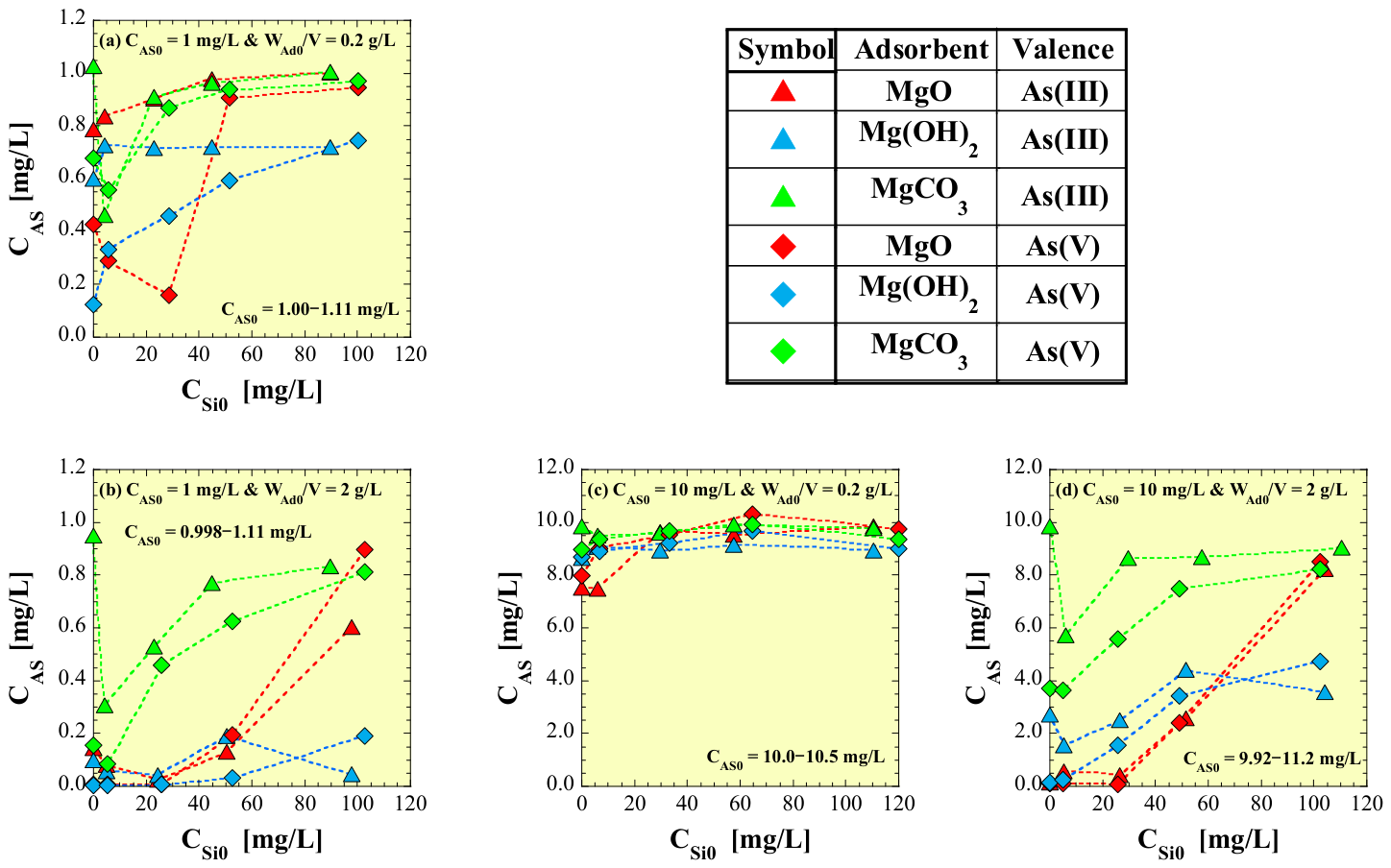
Figure 1 shows CAS from the As-removal tests plotted against CSi0. Figure 1a–d present results for (a) CAS0 = 1 mg/L and WAd0/V = 0.2 g/L, (b) CAS0 = 1 mg/L and WAd0/V = 2 g/L, (c) CAS0 = 10 mg/L and WAd0/V = 0.2 g/L, and (d) CAS0 = 10 mg/L and WAd0/V = 2 g/L, respectively. In each panel, the data are organized by adsorbent type and As valence. The measured CAS0 values for each test are also provided in the corresponding figures.
As shown in Figure 1, the effect of CSi0 on CAS varies with adsorbent type, As valence, and WAd0/V. The dependence of CAS on CSi0 can be broadly classified into four trends.
(i)
CAS increases with increasing CSi0 (e.g., MgO for As(III) and Mg(OH)2 for As(V) in Figure 1a).
(ii)
CAS initially decreases and then increases with increasing CSi0 (e.g., MgO for As(V) in Figure 1a and most cases for MgCO3 in Figure 1a–d).
(iii)
CAS increases with increasing CSi0 up to a certain value and then shows no significant further change (e.g., Mg(OH)2 for As(III) in Figure 1a,c).
(iv)
CAS increases or decreases irregularly with increasing CSi0.
In addition, the relative magnitude of CAS among adsorbent types varied significantly with CSi0. Under the present test conditions, at relatively low CSi0, the overall ordering of CAS was MgO, Mg(OH)2 < MgCO3. Conversely, at relatively high CSi0, the overall ordering was Mg(OH)2 < MgO, MgCO3.
Interpretation of the effects of CSi0 was facilitated by converting CAS to the As-removal ratio, RAS [%], and organizing the figures by the adsorbent type. RAS was calculated as follows:
RAS = (CAS0CAS)/CAS0 × 100
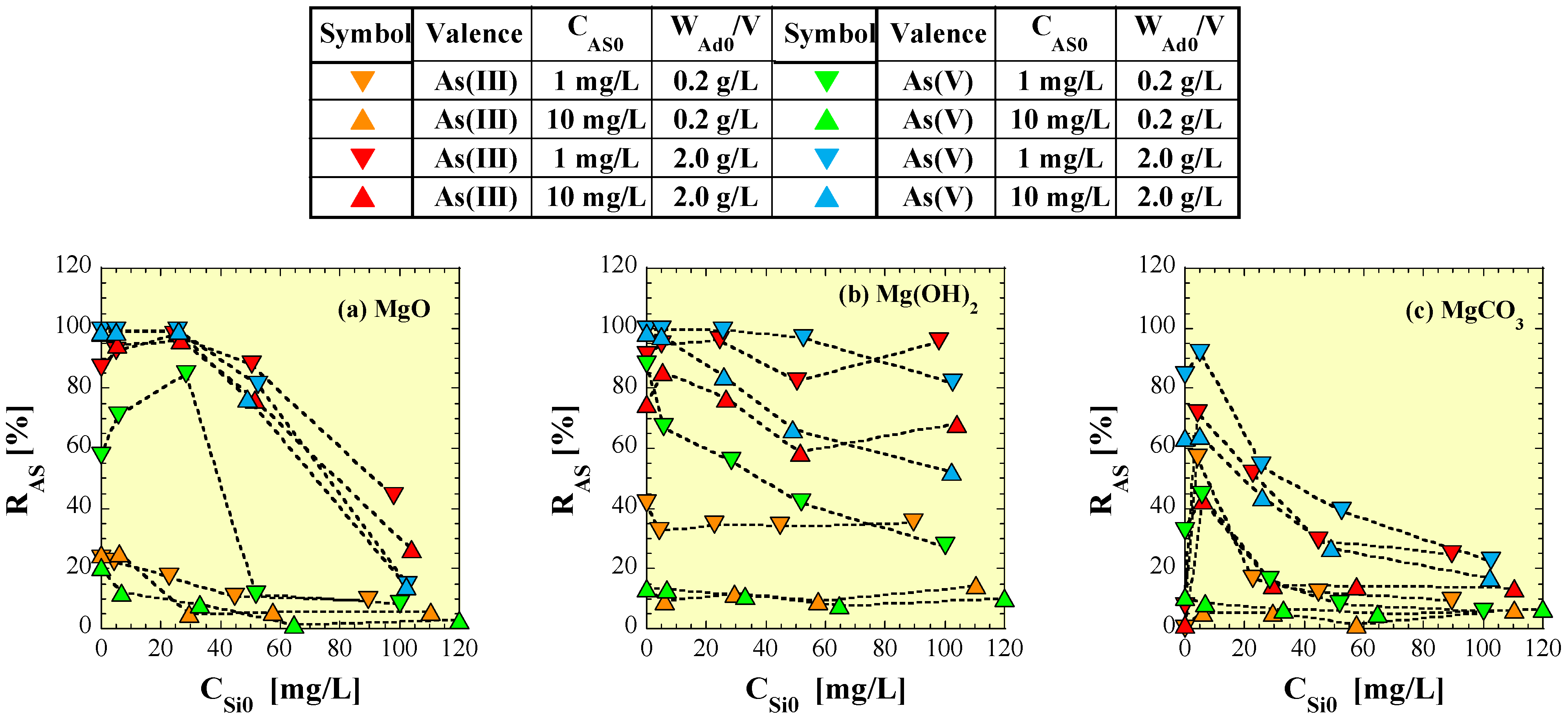
Figure 2 shows RAS obtained from Equation (1) plotted against CSi0. Figure 2a–c present the results for MgO, Mg(OH)2, and MgCO3, respectively.
For MgO, for both As(III) and As(V), RAS at WAd0/V = 2 g/L maintained high values up to CSi0 ≈ 25 mg/L, but decreased rapidly when CSi0 exceeded ~25 mg/L. RAS increased with increasing CSi0 up to ~25 mg/L under two conditions—CAS0 = 1 mg/L and WAd0/V = 2 g/L for As(III), and CAS0 = 1 mg/L and WAd0/V = 0.2 g/L for As(V)—and then decreased rapidly at CSi0 > 25 mg/L. Under the other conditions, RAS generally decreased with increasing CSi0.
For Mg(OH)2, the RAS for As(V) reduced with increasing CSi0 at CAS0 = 1 and 10 mg/L with WAd0/V = 2 g/L, as well as at CAS0 = 1 mg/L with WAd0/V = 0.2 g/L. For As(III) at WAd0/V = 2 g/L, RAS decreased significantly at CSi0 ≈ 50 mg/L but increased again at CSi0 > 100 mg/L. In contrast, at CAS0 = 10 mg/L and WAd0/V = 0.2 g/L, no clear effect of CSi0 on RAS was observed for either As(III) or As(V).
For MgCO3, RAS was higher at very low CSi0 (~5 mg/L) than in the absence of dissolved Si, but then decreased rapidly with increasing CSi0. Overall, at WAd0/V = 0.2 g/L, RAS differed negligibly among As valence states; however, at WAd0/V = 2 g/L, the RAS for As(III) was lower than that for As(V).

3.1.2. pH of Treated Water

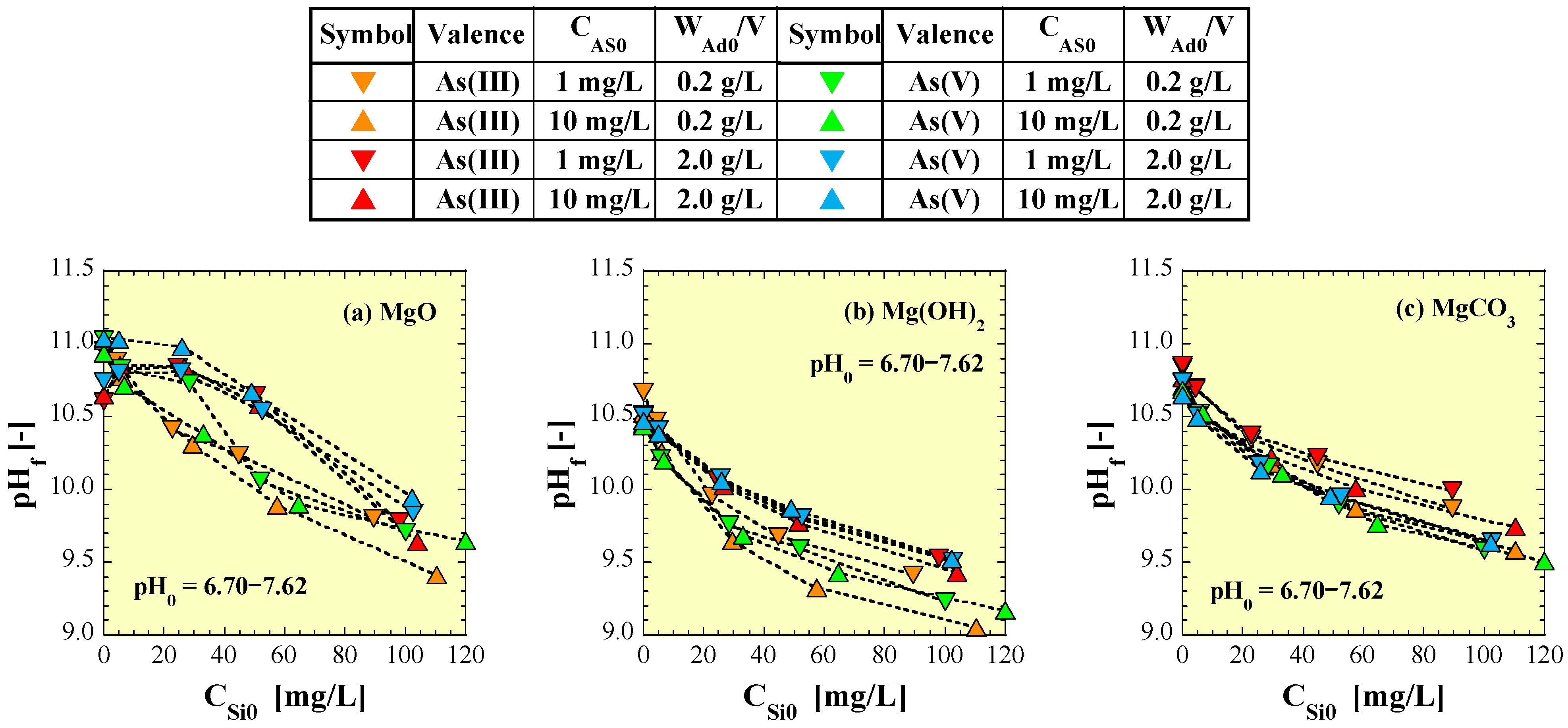
In Figure 3, the final pH (pHf) in the As-removal tests is plotted against CSi0. The results for MgO, Mg(OH)2, and MgCO3 are shown in Figure 3a–c, respectively.
In all cases, pHf decreased with increasing CSi0. For MgO and Mg(OH)2, regardless of As valence and CAS0, the pHf at WAd0/V = 2 g/L was higher than that at WAd0/V = 0.2 g/L. At WAd0/V = 2 g/L, pHf showed no significant dependence on As valence or CAS0; however, at WAd0/V = 0.2 g/L, the pHf of As(V) was higher than that of As(III). For MgCO3, the pHf of As(III) was higher than that of As(V). In addition, for As(III) with MgCO3, the pHf at CAS0 = 1 mg/L was higher than that at CAS0 = 10 mg/L, and the pHf at WAd0/V = 2 g/L was higher than that of WAd0/V = 0.2 g/L.

3.1.3. Concentration of Leached Mg in Treated Water

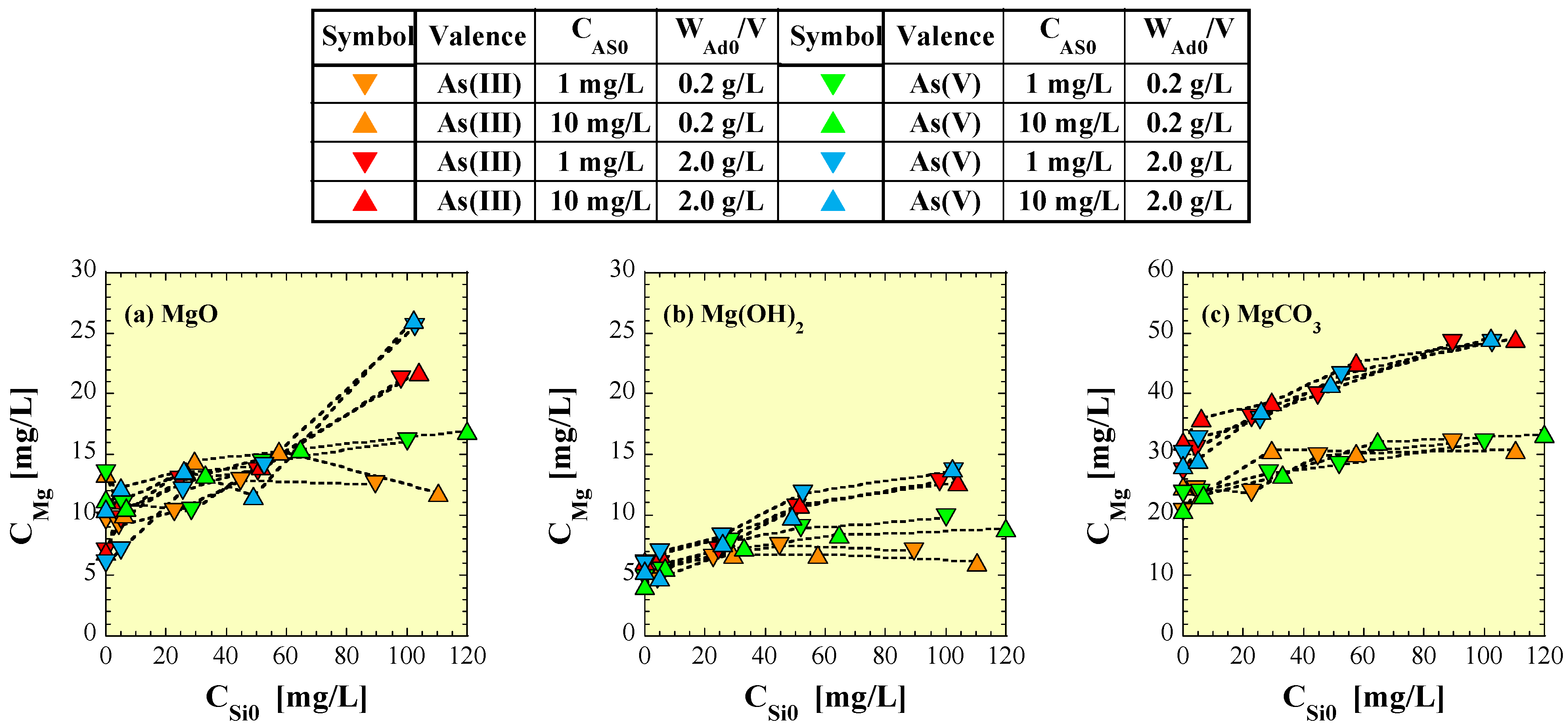
The CMg (mg/L) values obtained from the As-removal tests are shown in Figure 4. Figure 4a–c present the results for MgO, Mg(OH)2, and MgCO3, respectively.
As shown in Figure 4a, for MgO, the relationship between CMg and CSi0 depended on the As valence and WAd0/V. Under the test conditions, in the relatively high CSi0 range, CMg was higher at WAd0/V = 2 g/L than at 0.2 g/L and was higher for As(V) than for As(III). In contrast, in the relatively low CSi0 range, CMg was, in some cases, higher at WAd0/V = 0.2 g/L than at 2 g/L, and the effect of As valence was not clear.
As shown in Figure 4b, for Mg(OH)2, the relationship between CMg and CSi0 depended on the As valence, WAd0/V, and CAS0. For both As(III) and As(V), CMg was higher at WAd0/V = 2 g/L than at 0.2 g/L and was slightly higher at CAS0 = 1 mg/L than at 10 mg/L. In addition, CMg was lower for As(III) than for As(V). Overall, CMg increased with increasing CSi0 under most conditions, except at WAd0/V = 0.2 g/L for As(III). Under this condition, CMg appeared to increase slightly with increasing CSi0 and then decreased slightly, for both CAS0 = 1 and 10 mg/L.
For MgCO3 (Figure 4c), CMg increased gradually with increasing CSi0 under all test conditions. CMg was significantly higher at WAd0/V = 2 g/L than at 0.2 g/L, whereas no clear difference was observed as a function of As valence or CAS0.

3.1.4. Concentration of Residual Si in Treated Water

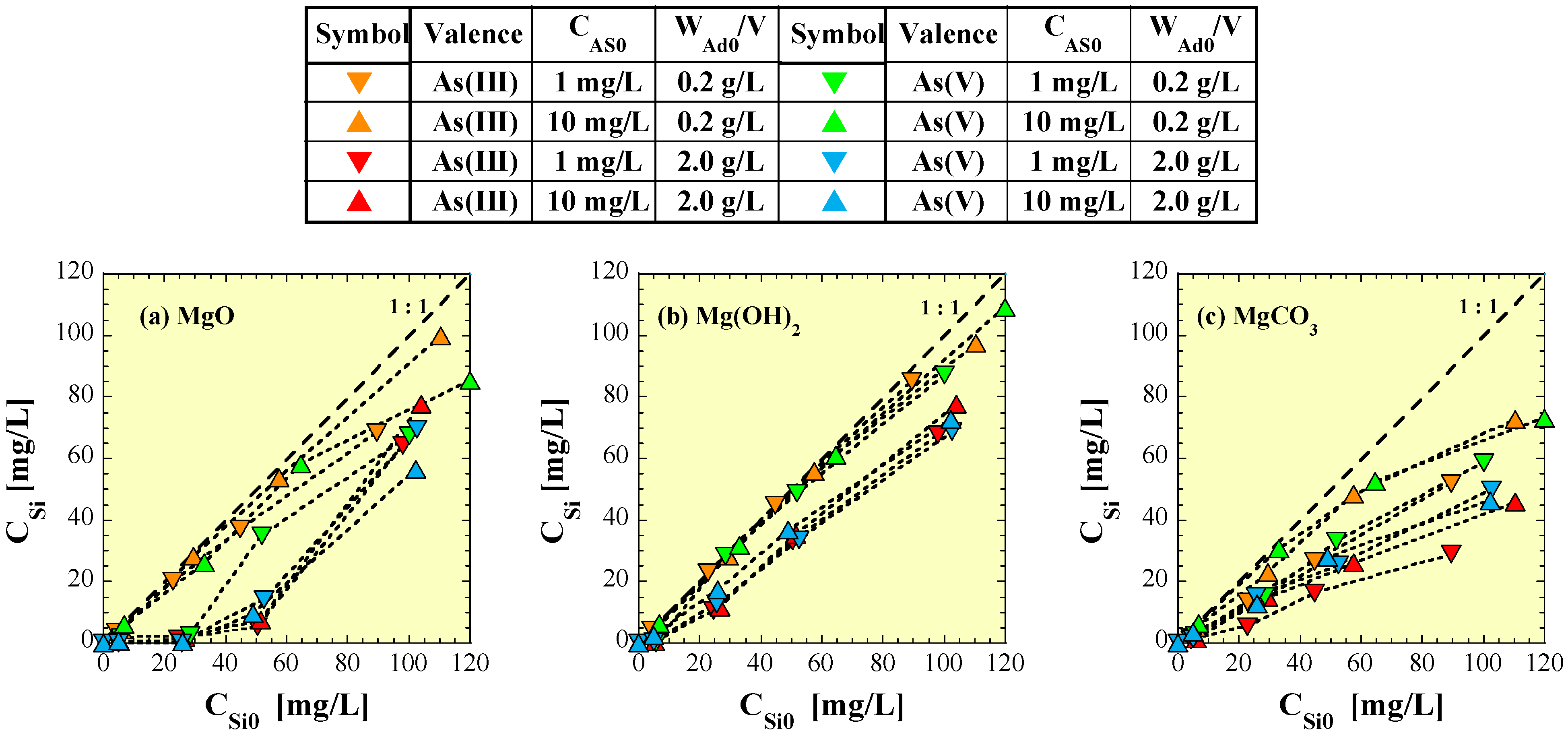
The CSi (mg/L) values in the As-removal tests with CSi0 are plotted against CSi0 in Figure 5. Figure 5a–c show the plots for MgO, Mg(OH)2, and MgCO3, respectively, including the 1:1 line (CSi:CSi0 = 1:1). Data points below the 1:1 line indicate that a fraction of the dissolved silicic acid species was removed from solution by adsorption and/or precipitation.
For MgO and Mg(OH)2, CSi was higher at WAd0/V = 0.2 g/L than at 2 g/L, as shown in Figure 5. At WAd0/V = 0.2 g/L, the CSi data generally lay close to the 1:1 line, except in the relatively high CSi0 range, where the points tended to deviate below the line as CSi0 increased; the exception was MgO at CAS0 = 1 mg/L for As(V). For MgO at WAd0/V = 0.2 g/L, CSi at CAS0 = 1 mg/L for As(V) was nearly zero in the relatively low CSi0 range and increased rapidly with increasing CSi0.
At WAd0/V = 2 g/L, the relationship between CSi and CSi0 varied significantly with adsorbent type. As shown in Figure 5a, for MgO, CSi was nearly zero in the relatively low CSi0 range and increased rapidly with increasing CSi0, similar to the behavior observed at CAS0 = 1 mg/L and WAd0/V = 0.2 g/L for As(V). As shown in Figure 5b, the plot of CSi at WAd0/V = 2 g/L for Mg(OH)2 appears to increase approximately in proportion to CSi0, although it remained below the 1:1 line.
For MgCO3, most data points are below the 1:1 line (Figure 5c). CSi increased with increasing CSi0, but the rate of increase in CSi decreased as CSi0 increased. The effects of As valence and CAS0 on CSi were unclear for MgO and Mg(OH)2, but appeared to be present for MgCO3. Specifically, at WAd0/V = 0.2 g/L, CSi was lower at CAS0 = 1 mg/L than at 10 mg/L, and at WAd0/V = 2 g/L, CSi tended to be lower for As(III) than for As(V).

3.2. XRD Analysis

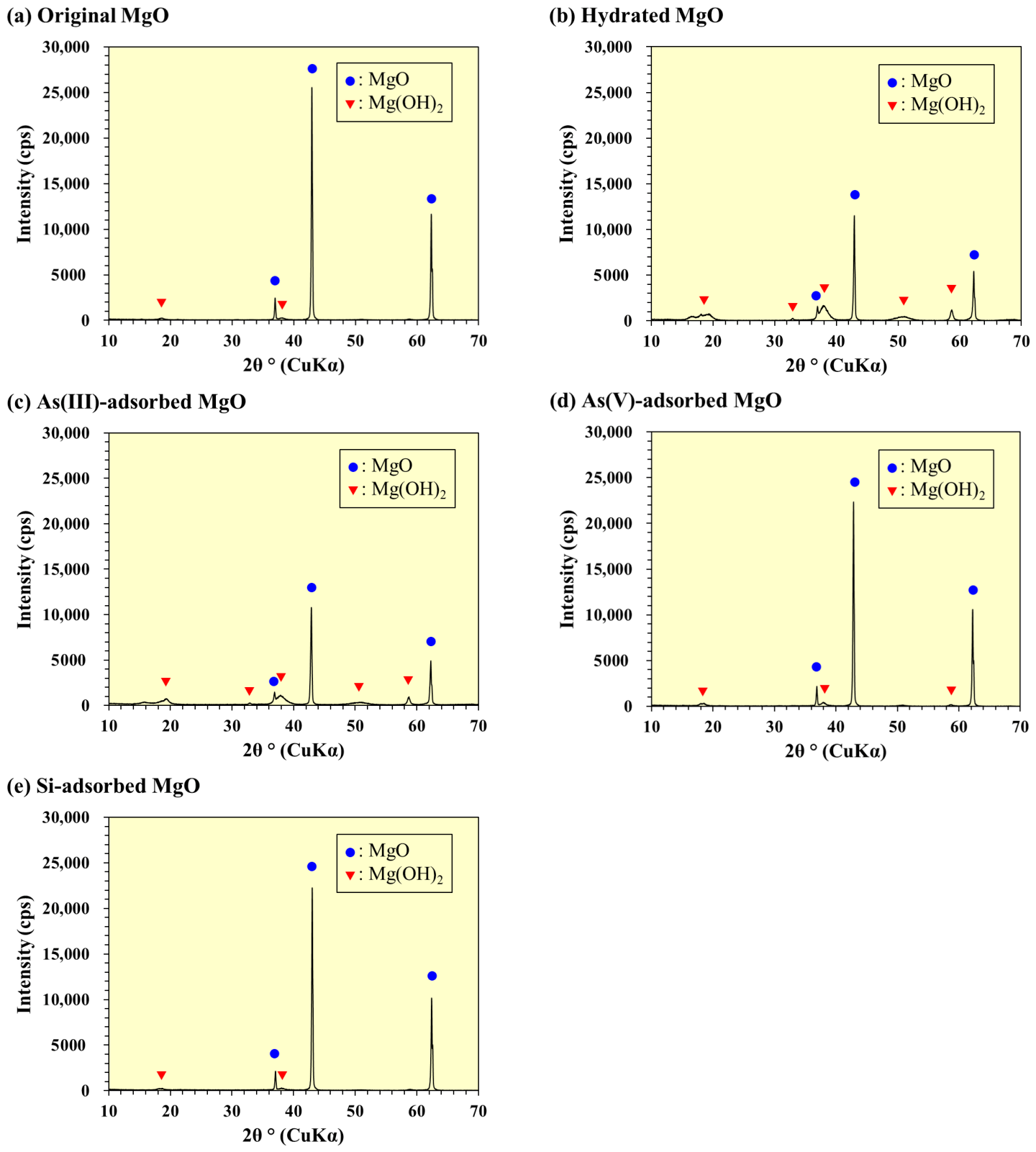
Figure 6a–e shows the XRD patterns for the original (unused), hydrated, As(III)-adsorbed, As(V)-adsorbed, and Si-adsorbed MgO, respectively. The XRD patterns in Figure 6a–d are similar to those reported in previous studies [20,21].
As reported previously [20,21], the original MgO contained almost no hydroxide phase (Figure 6a), whereas hydroxide formation was clearly observed in the hydrated sample (Figure 6b). Hydroxide formation was also confirmed in the As(III)-adsorbed MgO (Figure 6c), but was limited in the As(V)-adsorbed MgO (Figure 6d). In Figure 6c,d, peaks attributable to crystalline phases such as magnesium arsenite or magnesium arsenate species were not detected. Figure 6e shows that hydroxide formation was extremely low compared with that in the original MgO, and no other crystalline phases were observed.
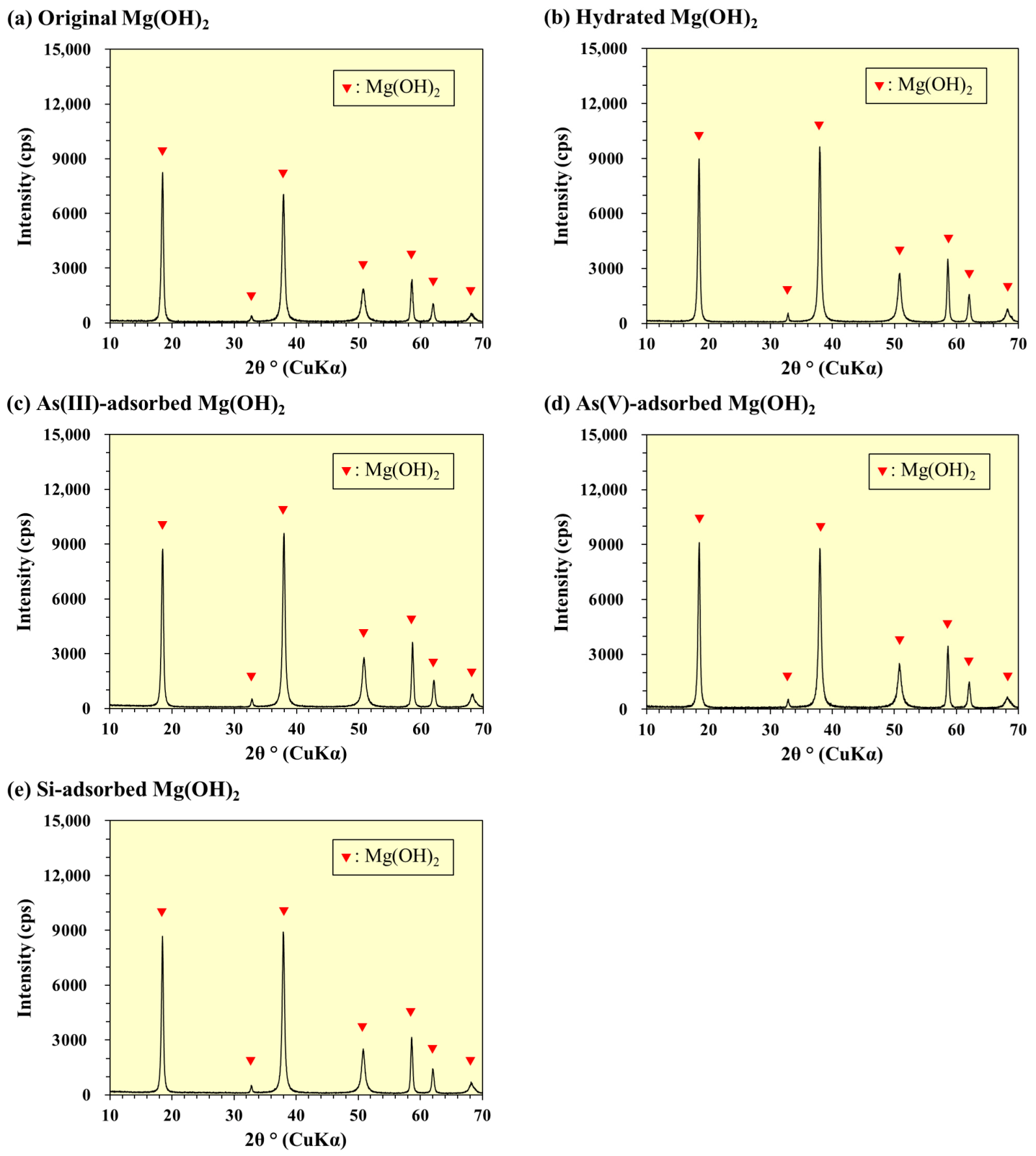
Figure 7a–e show the XRD patterns for the original (unused), hydrated, As(III)-adsorbed, As(V)-adsorbed, and Si-adsorbed Mg(OH)2, respectively. The XRD patterns in Figure 7a–d are similar to those reported previously [20,21].
For the original Mg(OH)2 (Figure 7a), only diffraction peaks attributable to the hydroxide phase were observed, consistent with previous studies [20,21]. In Figure 7b–e, only hydroxide peaks were also observed; no other crystalline products were detected.
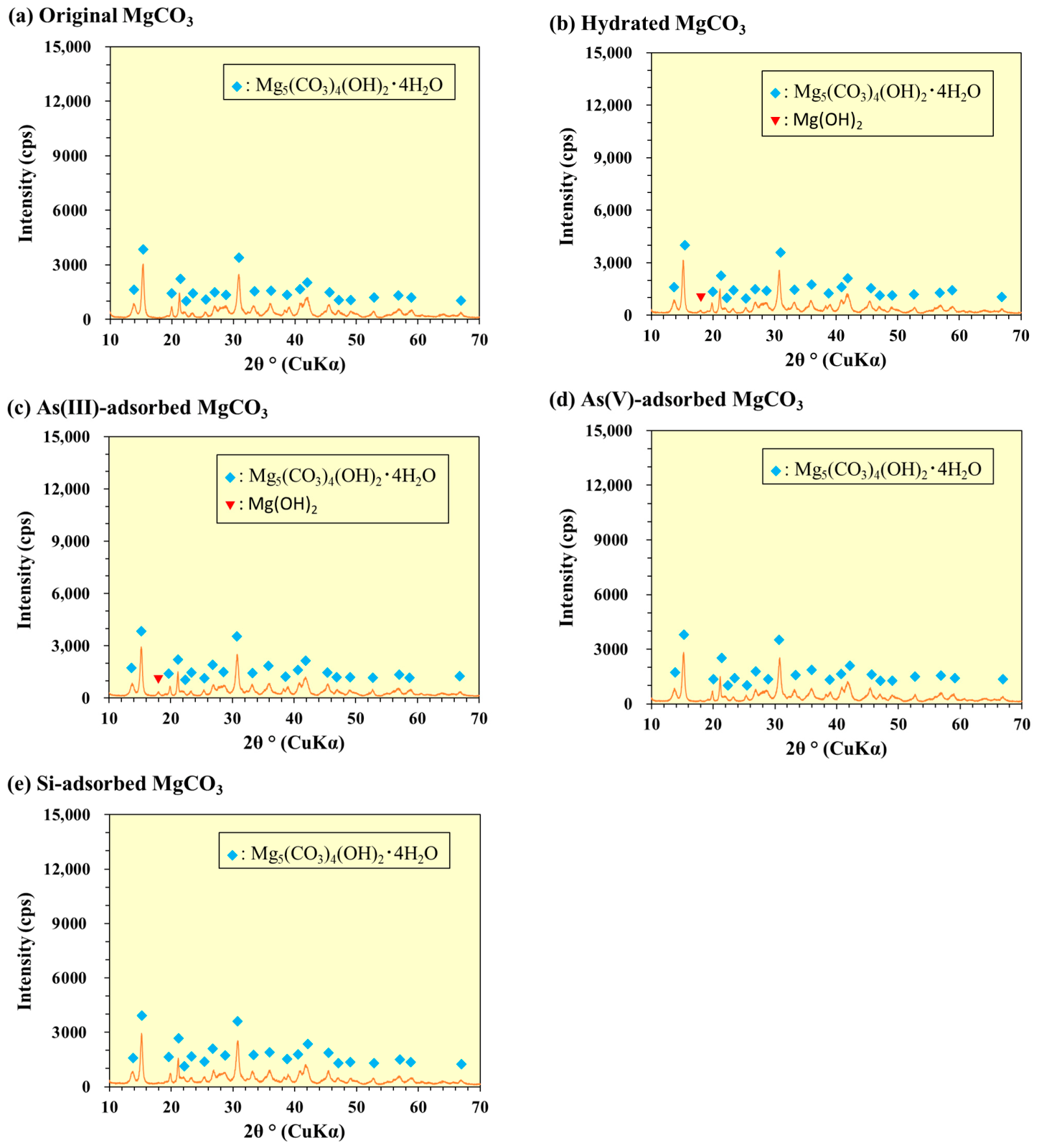
The XRD patterns for the original (unused), hydrated, As(III)-adsorbed, As(V)-adsorbed, and Si-adsorbed MgCO3 are shown in Figure 8a–e, respectively. The data in Figure 8a–d are consistent with those reported previously [20,21].
As described previously [20,21], the crystalline phase of the original MgCO3 comprised Mg5(CO3)4(OH)2·4H2O (Figure 8a). Hydrated MgCO3 showed minimal change in its diffraction pattern; however, the formation of trace amounts of Mg(OH)2 was confirmed (Figure 8b). Similarly, a weak peak corresponding to Mg(OH)2 was detected for As(III)-adsorbed MgCO3 (Figure 8c). In contrast, no distinct Mg(OH)2 peak was observed for As(V)-adsorbed or Si-adsorbed MgCO3 (Figure 8d,e). This trend in the extent of hydroxide formation was consistent with the XRD results from the MgO tests. In Figure 8b–e, no crystalline products were observed other than trace amounts of Mg(OH)2.

3.3. Morphological Observation on Mg-Based Adsorbents

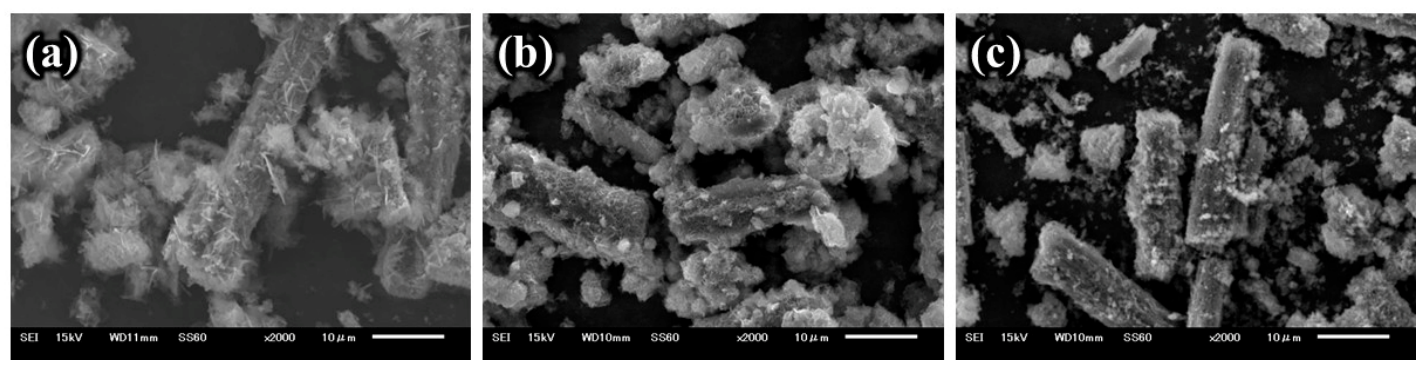
The SEM images of the original, As(III)-adsorbed, and Si-adsorbed MgO are shown in Figure 9a–c, respectively, revealing cuboid MgO crystals. Numerous fine particles are observed on the surfaces of the cuboid crystals (Figure 9b,c). Based on the XRD results in Section 3.2, these fine particles were considered to be primarily Mg(OH)2.
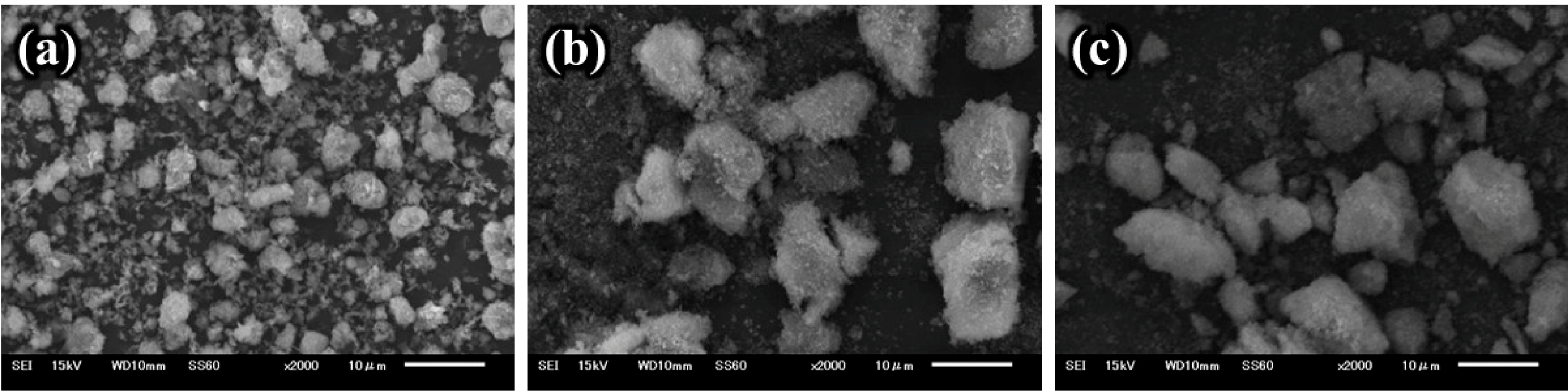
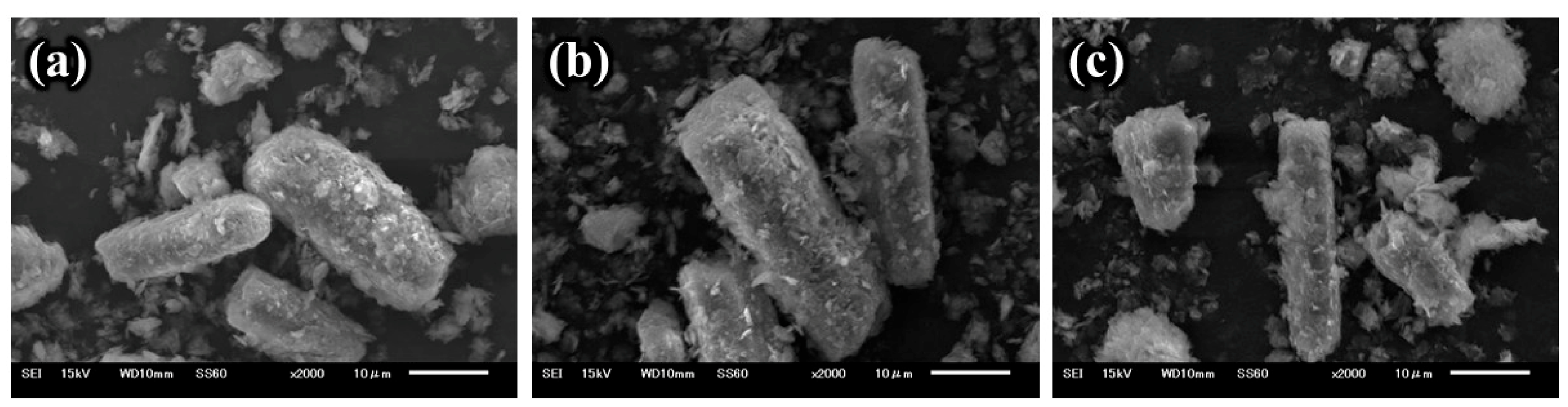
The SEM images of the original, As(III)-adsorbed, and Si-adsorbed Mg(OH)2 are shown in Figure 10a–c, respectively.
As shown in Figure 10a, the original Mg(OH)2 comprised smaller particles than the original MgO (Figure 9a), with a more spherical than cuboid morphology. The As(III)-adsorbed Mg(OH)2 and Si-adsorbed Mg(OH)2 differed in appearance (Figure 10b,c) from the original Mg(OH)2 (Figure 10a) and appeared to be coagulated rather than aggregated.
The SEM images of the original, As(III)-adsorbed, and Si-adsorbed MgCO3 are shown in Figure 11a–c, respectively.
The original MgCO3 had a slightly rounded cuboid morphology (Figure 11a). Both the As(III)-adsorbed and Si-adsorbed MgCO3 exhibited an appearance similar to that of original MgCO3 (Figure 11b,c).

3.4. Elemental Mappings (EM) on Mg-Based Adsorbents

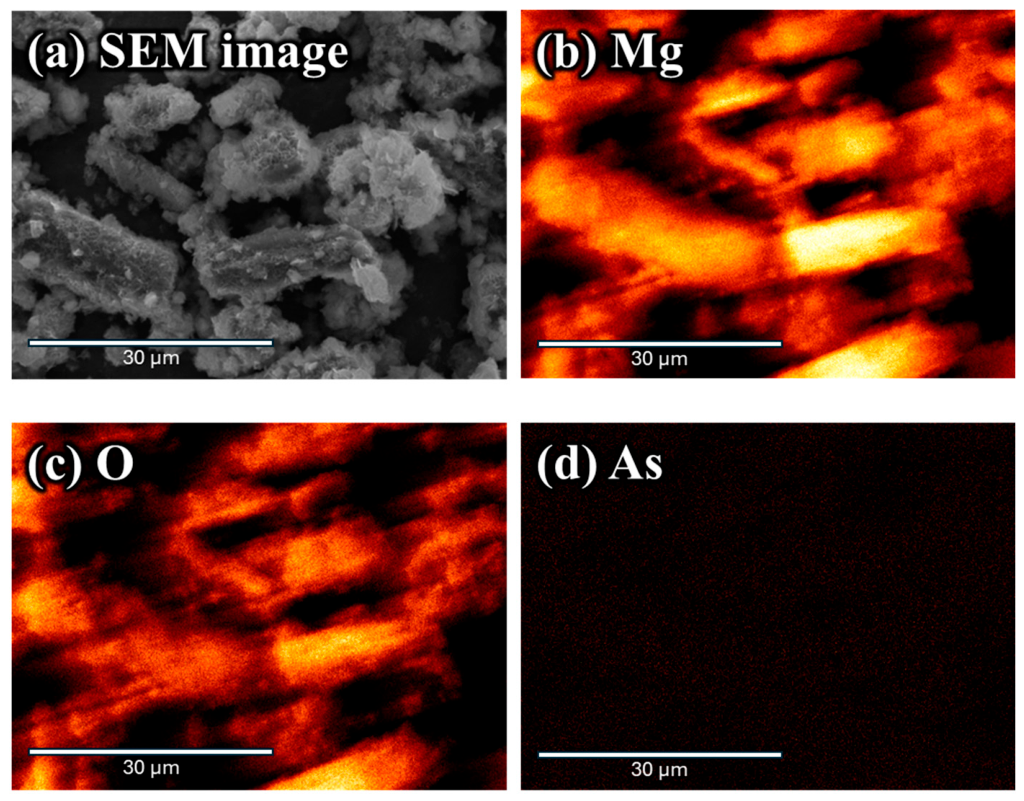
The SEM image and elemental mappings (EM) of Mg, O, and As for As(III)-adsorbed MgO are shown in Figure 12a–d, respectively.
In the EDS analysis, As detection and mapping relied on the As Kα line (10.53 keV), because the As Lα line (1.282 keV) overlaps with the Mg Kα line (1.253 keV). The distributions of Mg, O, and As were nearly identical (Figure 12), confirming that As was uniformly distributed on the surfaces of the MgO particles without localized enrichment, although As was difficult to visualize because of its low adsorption amount.
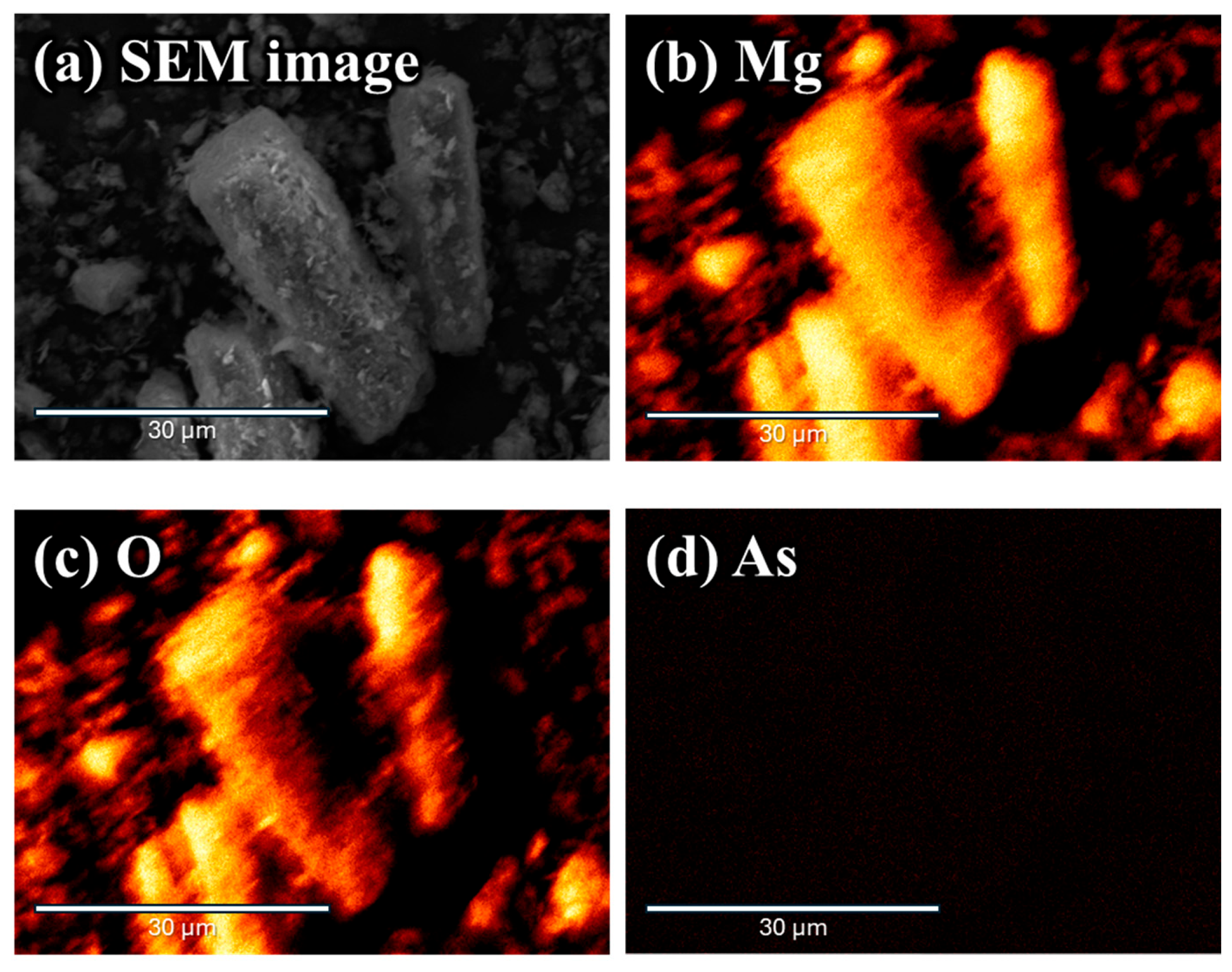
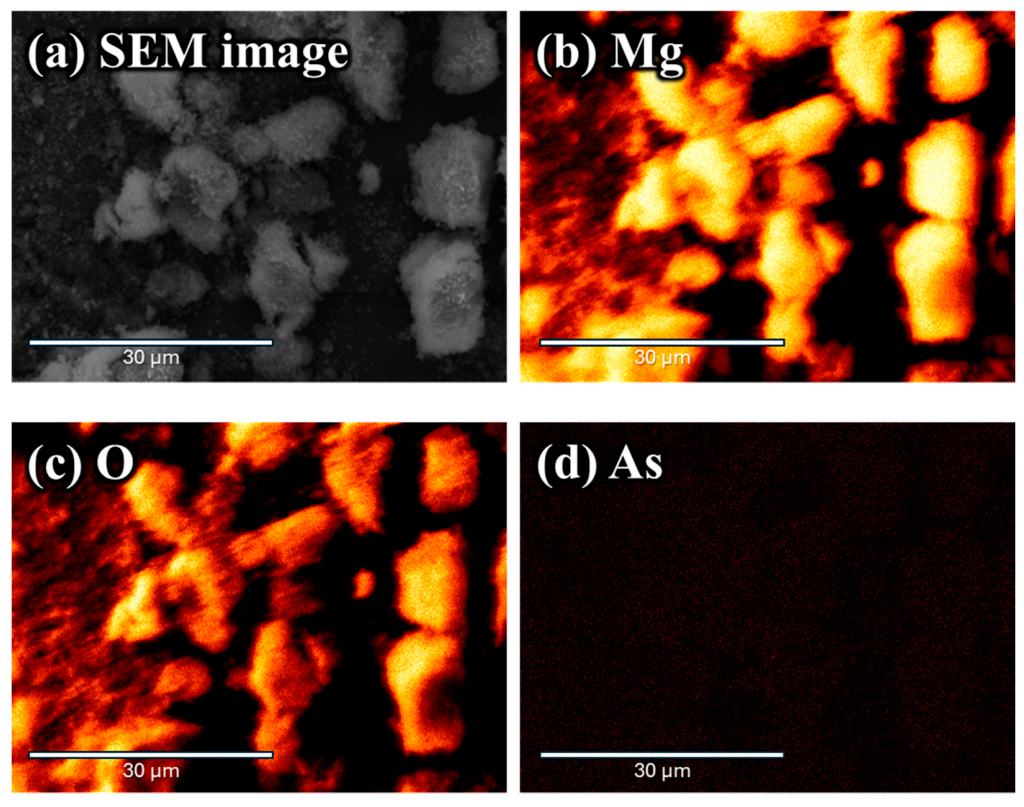
The SEM image and EM of Mg, O, and As for As(III)-adsorbed Mg(OH)2 are shown in Figure 13a–d, respectively.
Consistent with As(III)-adsorbed MgO, the distributions of Mg, O, and As were nearly identical, confirming uniform As distribution on the surface of Mg(OH)2 (Figure 13).
The SEM image and EM of Mg, O, and As for As(III)-adsorbed MgCO3 are shown in Figure 14a–d, respectively.
As shown in Figure 14, consistent with As(III)-adsorbed MgO and Mg(OH)2, the distributions of Mg, O, and As were nearly identical, confirming uniform As distribution on the MgCO3 surface.
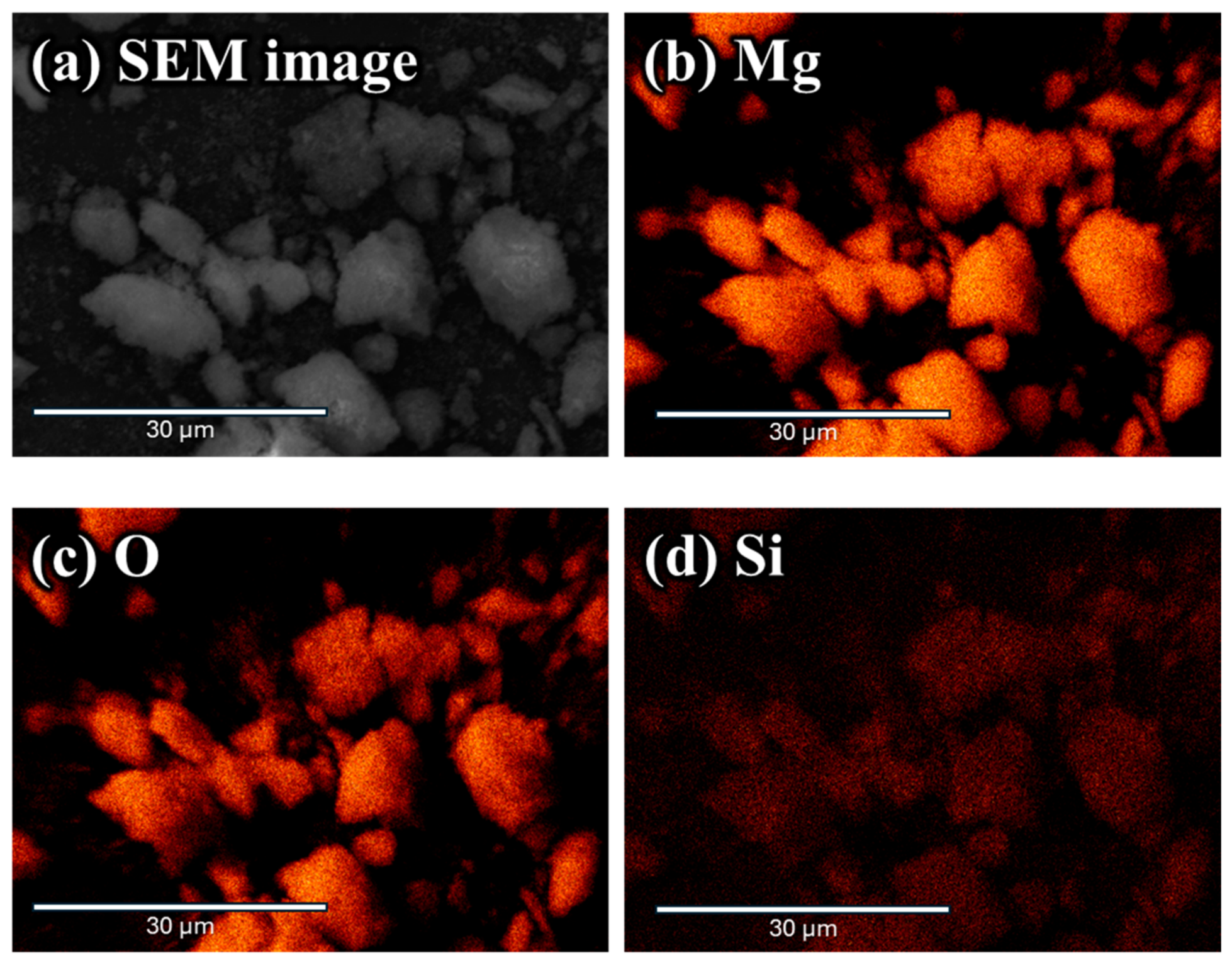
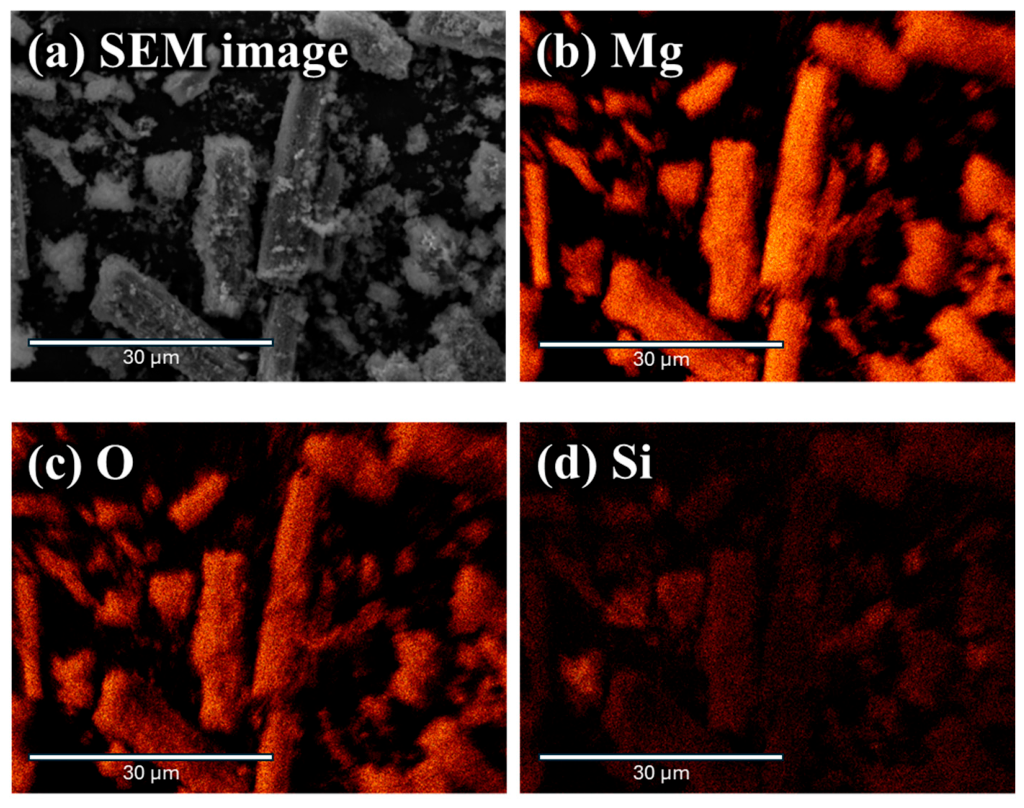
The SEM image and EM of Mg, O, and Si for Si-adsorbed MgO are shown in Figure 15a–d, respectively.
As shown in Figure 15, the elemental distributions of Mg and O were consistent. In contrast, Si was more concentrated in aggregate-like particles than in cuboid particles (Figure 15d).
The SEM image and EM of Mg, O, and Si for Si-adsorbed Mg(OH)2 are shown in Figure 16a–d, respectively.
As shown in Figure 16, the elemental distributions of Mg, O, and Si are nearly identical, confirming that Si is uniformly adsorbed on the Mg(OH)2 surface.
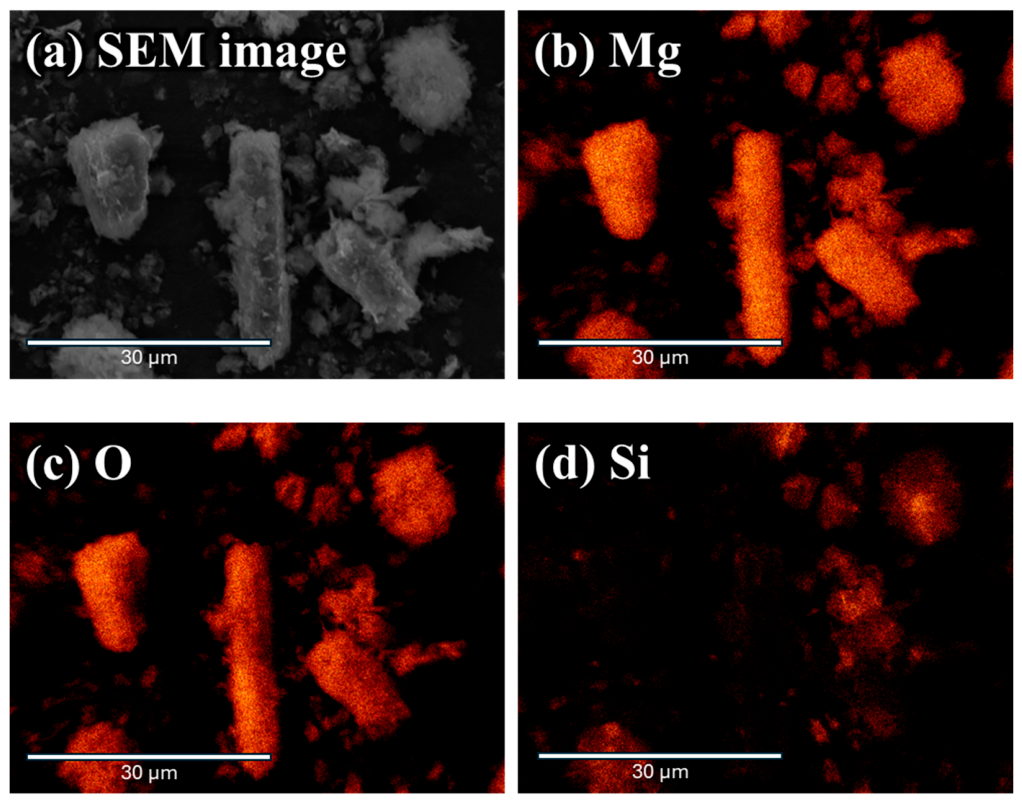
The SEM image and EM maps of Mg, O, and Si for Si-adsorbed MgCO3 are shown in Figure 17a–d, respectively.
As shown in Figure 17, Mg and O are uniformly distributed, whereas Si appears clustered. Similar to MgO (Figure 15), Si is preferentially distributed in aggregate-like particles rather than in cuboid particles.

4. Discussion

4.1. Verification of Correlation Between pHf and CAS, CMg, or CSi

In this section, the correlation between pHf and the dissolved components in solution is examined.
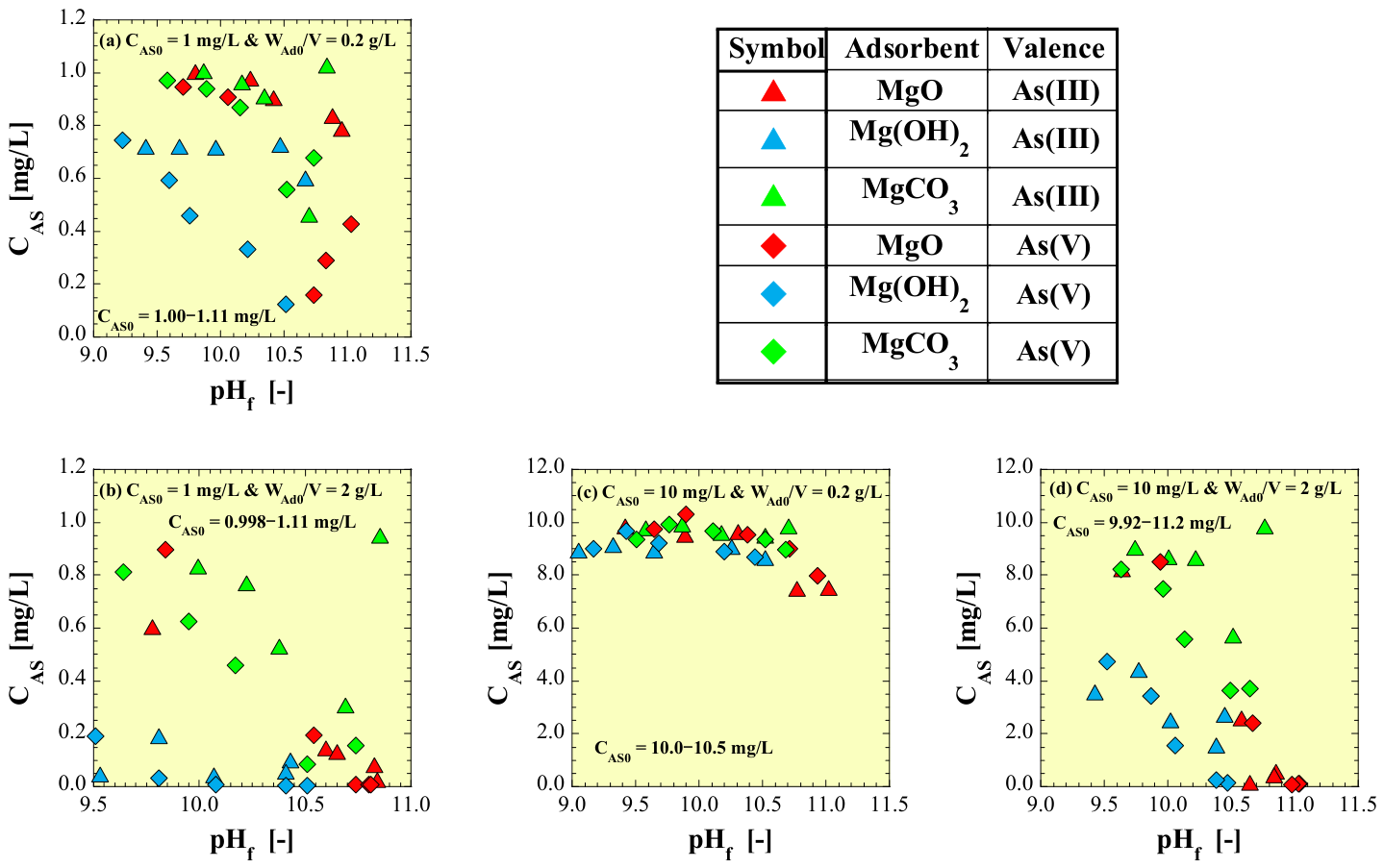
Plots of CAS versus pHf are shown in Figure 18. Figure 18a–d present the results for (a) CAS0 = 1 mg/L and WAd0/V = 0.2 g/L, (b) CAS0 = 1 mg/L and WAd0/V = 2 g/L, (c) CAS0 = 10 mg/L and WAd0/V = 0.2 g/L, and (d) CAS0 = 10 mg/L and WAd0/V = 2 g/L, respectively. Across Figure 18a–d, CAS varies with adsorbent type, As valence, CAS0, and WAd0/V; however, overall, CAS tends to increase as pHf decreases. This trend is more pronounced for MgO and MgCO3 than for Mg(OH)2 (Figure 18a–d). As described in Section 3.2 and Section 3.3, the XRD and SEM observations confirmed the presence of Mg(OH)2 aggregates formed secondarily in hydrated, As-adsorbed, and Si-adsorbed MgO and MgCO3. As shown in Section 3.4, the EM of As further confirmed that As is distributed uniformly on the adsorbent surface and within these aggregates. Therefore, it is concluded that the As-removal mechanism for MgO and MgCO3 proceeds not only via adsorption on the adsorbent surface but also via coprecipitation with secondarily formed Mg(OH)2 aggregates. Accordingly, the stronger increase in CAS with decreasing pH for MgO and MgCO3 than for Mg(OH)2 is attributed to suppression of Mg(OH)2 aggregate formation at lower pH.
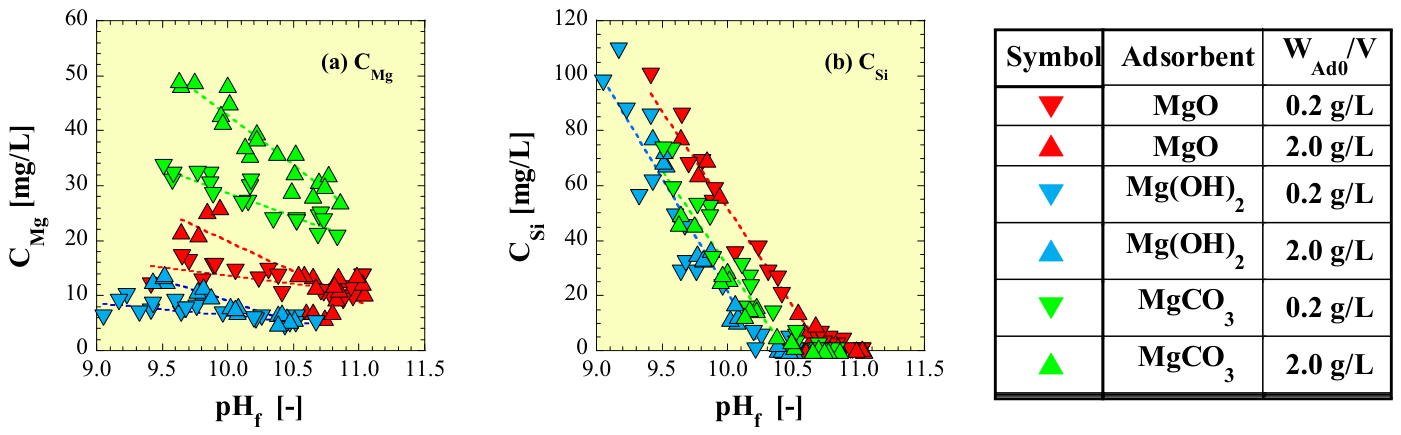
No clear effects of As valence or CAS0 were observed on CMg or CSi. Therefore, CMg and CSi versus pHf are plotted only by adsorbent type and WAd0/V (Figure 19a,b, respectively). As shown in Figure 19a,b, both CMg and CSi clearly increase with decreasing pHf. For CMg, values at WAd0/V = 2 g/L are consistently higher than those at 0.2 g/L, whereas CSi shows no clear dependence on WAd0/V. Therefore, CSi is governed only by adsorbent type and pHf and is independent of As valence and WAd0/V, whereas CMg depends significantly on WAd0/V in addition to adsorbent type and pHf. Under the tested conditions (WAd0/V = 0.2 and 2 g/L), the adsorbents partially dissolved, but most of the material remained in the solid phase. Based on this, if CMg reflected only the intrinsic solubility of the Mg-based compounds comprising each adsorbent, CMg would be expected to be independent of WAd0/V. The results of this study suggest that CMg is strongly affected by silicic-acid adsorption or the generation of magnesium silicate species on the adsorbents. Conversely, as shown in Figure 19b, CSi exhibits no clear dependence on WAd0/V; therefore, under the conditions tested in this study, CSi is inferred to be determined only by adsorbent type and pHf.

4.2. Estimation of Adsorbent Residual Ratio

Leaching of Mg, a base component of the adsorbent, reduces the amount of the adsorbent remaining as a solid phase in solution. Therefore, the residual ratio of the adsorbent was calculated from CMg using the following procedure.
The initial Mg amount, WMg0 (g), was determined using αMg (Table 1) as follows:
WMg0 = (αMg/100) WAd0
The amount of remaining Mg in the solid phase, WMgf (g), 24 h after the added adsorbent was expressed as follows:
WMgf = WMg0 − (CMg/1000) V
As the unit of CMg is mg/L, it was converted to g/L via dividing by 1000. Assuming that the Mg-residual ratio is equal to the adsorbent residual ratio γ (%), the value of γ can be calculated using following equation:
γ = WMgf/WMg0 × 100
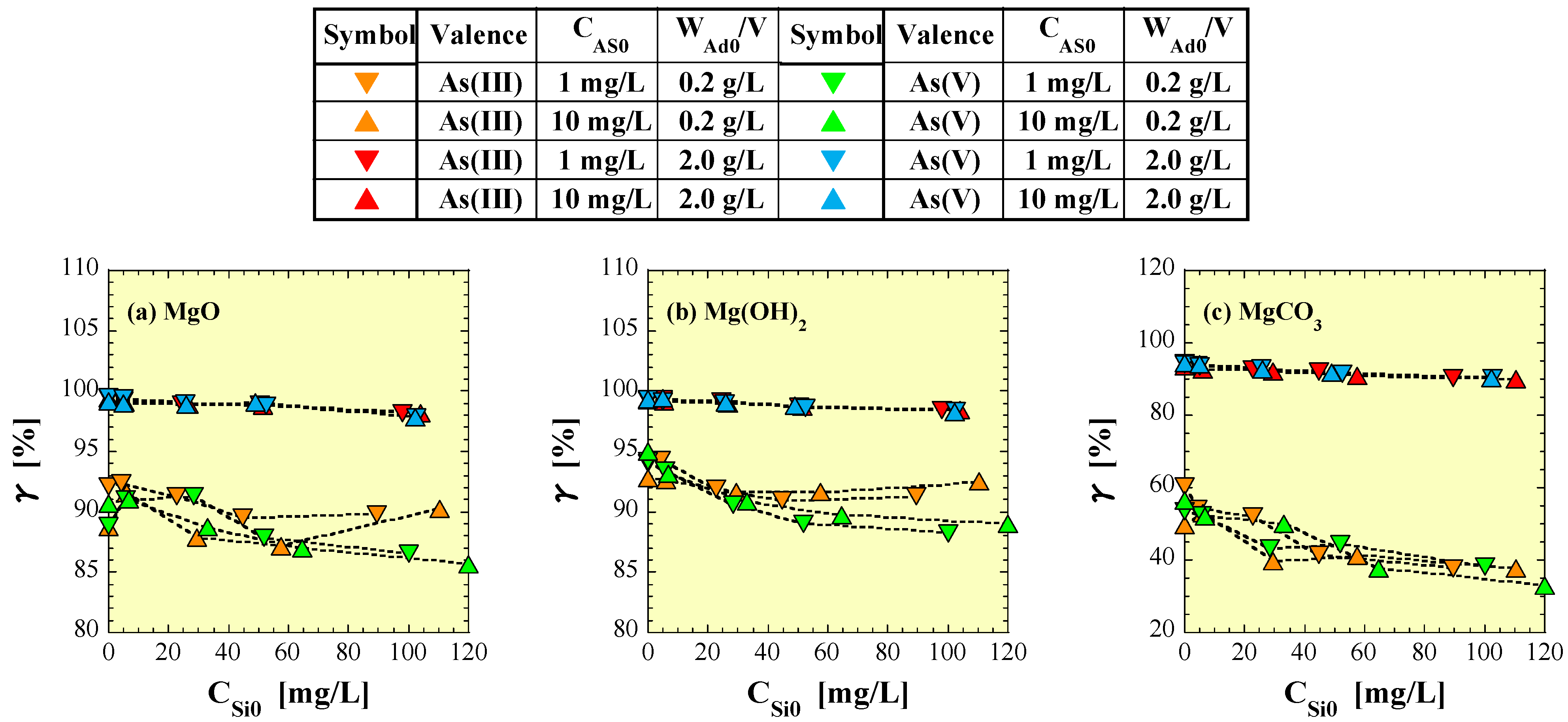
The γ values obtained from the As-removal tests are plotted against CSi0 in Figure 20. Figure 20a–c show the results for MgO, Mg(OH)2, and MgCO3, respectively.
As shown in Figure 20, for all adsorbents, γ at WAd0/V = 2 g/L remained high regardless of the As valence and CAS0 but gradually decreased with increasing CSi0. At WAd0/V = 0.2 g/L, the γ for As(V) tended to decrease with increasing CSi0, whereas the γ for As(III) decreased with increasing CSi0 in the relatively low CSi0 range but then either showed minimal change or increased slightly with increasing CSi0.

4.3. As- and Si-Adsorption Amounts per Unit Mass of Adsorbent

Most Mg-based adsorbents partially dissolve in solution. Nevertheless, the amount of adsorption per unit mass of adsorbent has been often calculated based on the initial amount of adsorbent added. In previous studies on Mg-based adsorbents [20,21], the adsorption amount was estimated considering the Mg leaching from the adsorbents itself. Similarly, the amounts of As and Si adsorbed per unit mass of adsorbent (QAS and QSi, respectively) were calculated using the following procedure.
The concentration of the adsorbent remaining in the solid phase after 24 h, WAdf/V (g/L), was determined as follows:
WAdf/V = (γ/100) WAd0/V
QAS (mg/g) and QSi (mg/g) were calculated using the following equations:
QAS = (CAS0CAS)/(WAdf/V)
QSi = (CSi0CSi)/(WAdf/V)
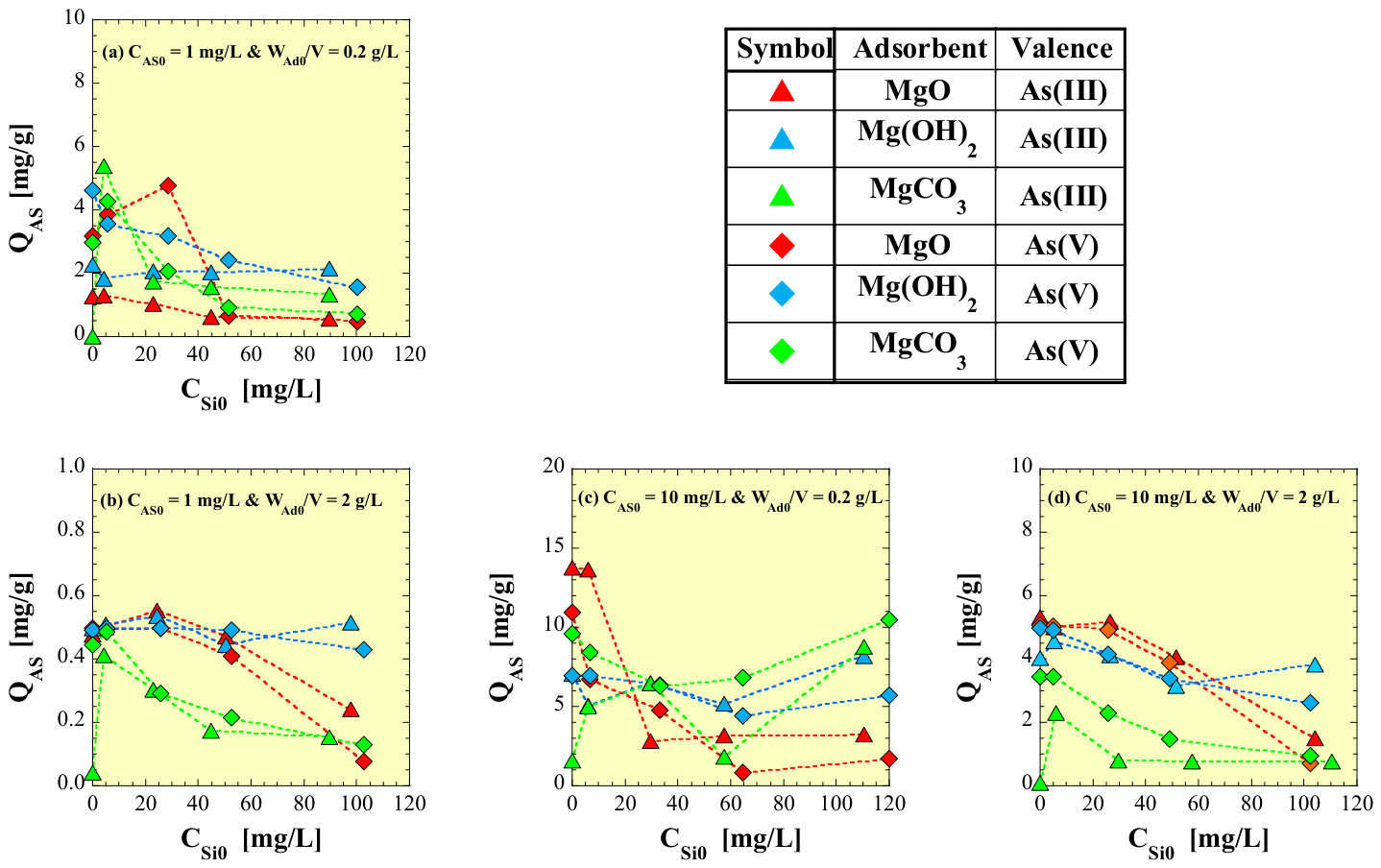
Plots of QAS against CSi0 are shown in Figure 21. Figure 21a–d show the results for (a) CAS0 = 1 mg/L and WAd0/V = 0.2 g/L, (b) CAS0 = 1 mg/L and WAd0/V = 2 g/L, (c) CAS0 = 10 mg/L and WAd0/V = 0.2 g/L, and (d) CAS0 = 10 mg/L and WAd0/V = 2 g/L, respectively, organized by adsorbent type and As valence.
In Figure 21a–d (note the different y-axis scales), QAS is generally higher at WAd0/V = 0.2 g/L than at 2 g/L for the same CAS0 and is higher at CAS0 = 10 mg/L than at 1 mg/L for the same WAd0/V. These results are consistent with the expectation that the amount adsorbed per unit mass of adsorbent depends primarily on the relative ratio of adsorbent to the adsorbing species (As or Si in this study). Although competitive adsorption between As and Si would be expected to decrease QAS with increasing CSi0, this trend was not universal. For most MgO and MgCO3 conditions, QAS decreased with increasing CSi0; however, in some cases QAS increased with increasing CSi0. Notably, for MgCO3, the QAS at CSi0 ≈ 120 mg/L was higher than that at CSi0 = 0 mg/L for both As(III) and As(V) (Figure 21c). The effects of CSi0 on the QAS of Mg(OH)2 were smaller than those for MgO and MgCO3 and were significantly smaller for As(III). As mentioned in Section 3.2, the XRD results for MgO and MgCO3 confirmed the formation of Mg(OH)2 (Figure 6 and Figure 8). However, pHf decreased with increasing CSi0 (Figure 3), suggesting that the amount of Mg(OH)2 formed after the addition of MgO and MgCO3 to the solution decreased with increasing CSi0. Because As removal by MgO and MgCO3 is inferred to occur partly via coprecipitation during Mg(OH)2 formation [20,21], the decrease in QAS with increasing CSi0 is presumably attributable to reduced Mg(OH)2 production. Although no distinct XRD peaks of magnesium silicate species were detected, the formation of low-crystallinity magnesium silicate phases cannot be excluded. Therefore, particularly at high CSi0, the apparent As adsorption amount may increase due to the incorporation of As into such low-crystallinity magnesium silicate phases during their formation.
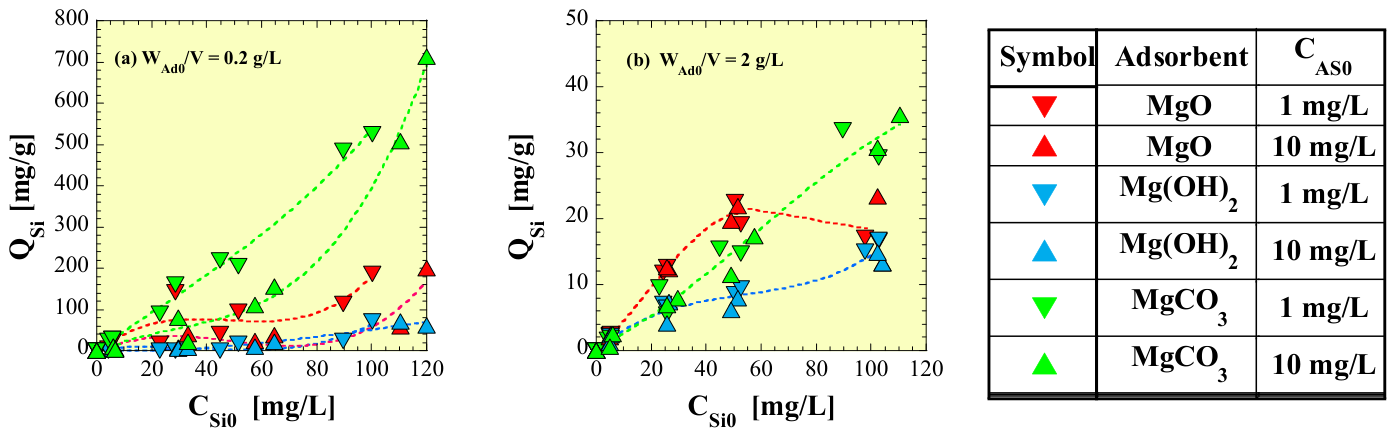
QSi as a function of CSi0 is plotted by adsorbent type, CAS0, and WAd0/V in Figure 22. Figure 22a,b show the results for WAd0/V = 0.2 g/L and 2 g/L, respectively, because no clear effect of As valence on QSi was observed.
The Mg(OH)2 data in Figure 22a fit approximately on a single fitted curve regardless of CAS0, whereas the fitted curves for the MgO and MgCO3 data differ depending on CAS0. In contrast, in Figure 22b, the data for each Mg-based adsorbent fit approximately on a single approximation curve regardless of CAS0. These results suggest that competitive adsorption of As affects Si adsorption at lower WAd0/V (0.2 g/L) but is almost negligible at higher WAd0/V (2 g/L). The higher QSi of MgO and MgCO3 at CAS0 = 1 mg/L than at 10 mg/L at WAd0/V = 0.2 g/L also supports this inference. As an exception, the QSi of MgO in Figure 22b tends to be slightly lower at CSi0 = 100 mg/L than at 50 mg/L; however, this trend may be related to the sudden drop in pHf (Figure 3a).

4.4. Langmuir Isotherm Model

The suitability of the data for adsorption of As(III), As(V), and Si in the As-removal experiments conducted in the presence of Si to the Langmuir isotherm model, which is a general adsorption model, was evaluated.
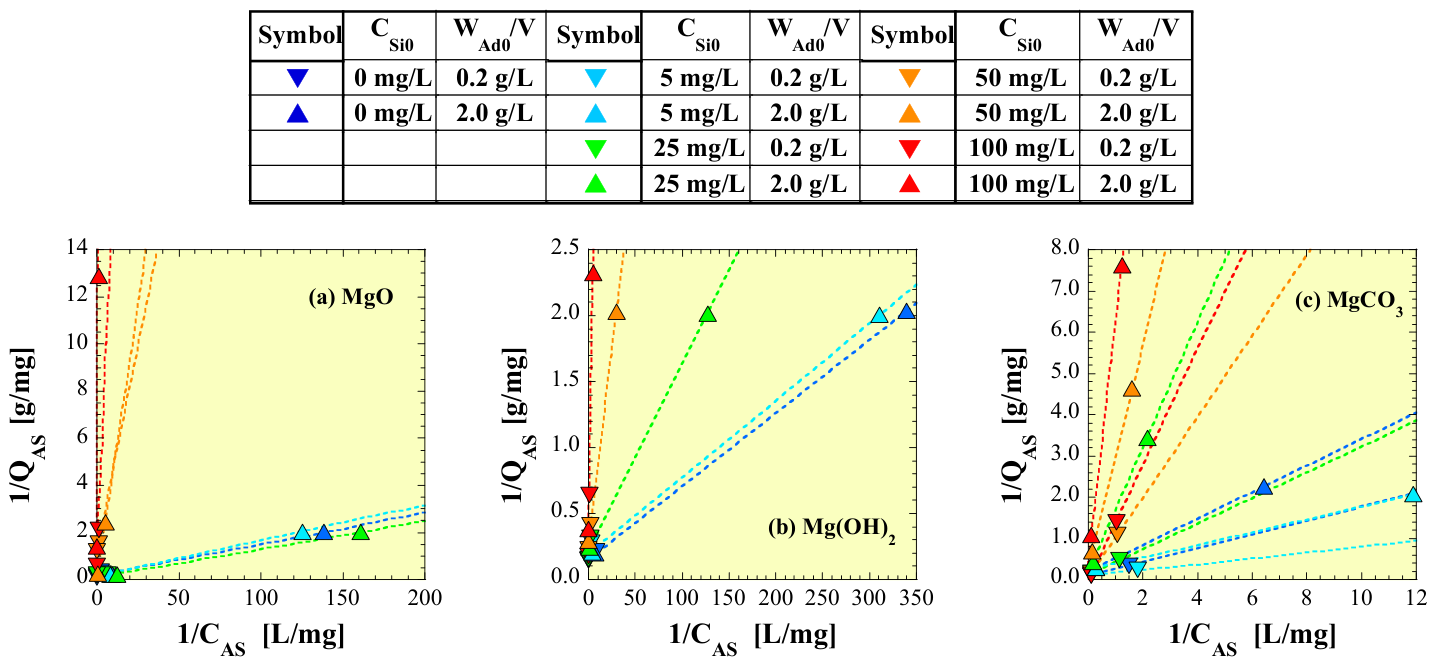
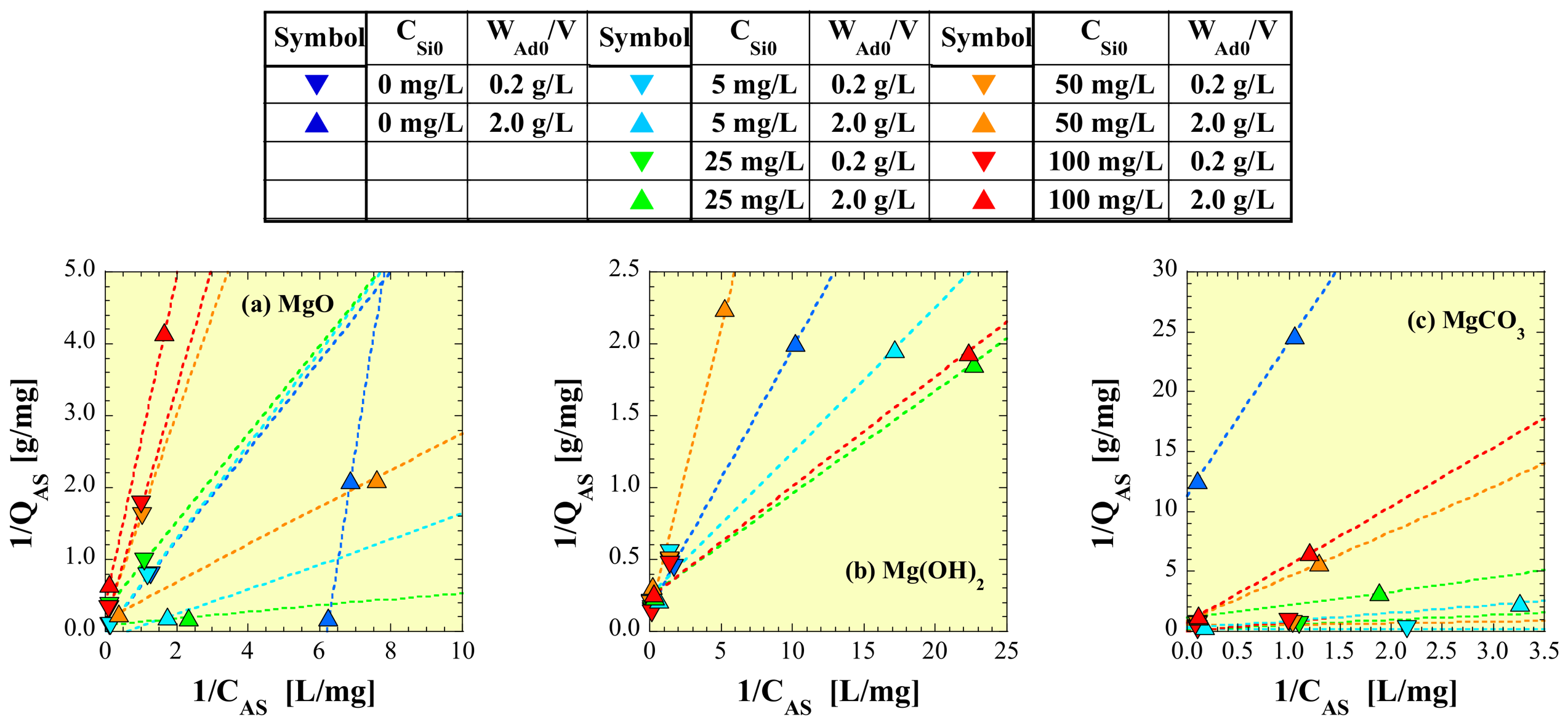
The Langmuir isotherm plots of As(III) adsorption on MgO, Mg(OH)2, and MgCO3 are shown in Figure 23a–c, respectively. For convenience, CSi0 in Figure 23 was grouped into five divisions (0, 5, 25, 50, and 100 mg/L); the corresponding ranges of actual CSi0 values were 0, 4.25–6.06, 22.8–29.5, 44.9–57.6, and 89.5–111 mg/L, respectively. In addition, the plots in Figure 23 are further separated by WAd0/V. However, when both CSi0 and WAd0/V are fixed, the remaining variable, CAS0, takes only two values (approximately 1 and 10 mg/L), resulting in only two data points for each condition (or fewer if no adsorption occurred). Under these conditions, reliably assessing whether the data follow the Langmuir model is challenging. Therefore, the analysis was also performed using four data points (or fewer if no adsorption occurred), assuming that WAd0/V had no effect, and the goodness of fit to the Langmuir model was evaluated using the correlation coefficient r.
The Langmuir equation for As-adsorption is described by Equation (8):
1/QAS = 1/(KL QAS-MAX)(1/CAS) + 1/QAS-MAX
where QAS-MAX is the maximum adsorption amount of As [mg/g], and KL is the Langmuir adsorption coefficient.
Table 3 shows the QAS-MAX and KL values obtained by fitting the data at WAd0/V = 0.2 and 2 g/L together and separately to the Langmuir model. The r values obtained when the WAd0/V = 0.2 and 2 g/L data are fitted together are also listed in Table 3. Incidentally, the r values obtained when the data at WAd0/V = 0.2 and 2 g/L are fitted separately are 1 for all cases, because only two data points are available for each condition. As shown by the fitted lines in Figure 23 and the values in Table 3, the As(III)-adsorption behavior for MgO and MgCO3 is influenced not only by CSi0 but also by WAd0/V. Conversely, for Mg(OH)2, the As(III)-adsorption behavior is affected by CSi0 but not by WAd0/V. As shown in Table 3, the QAS-MAX values for MgO are negative at CSi0 = 0 and 5 mg/L, which is not physically meaningful.
Considering QAS-MAX at CSi0 = 25–100 mg/L, it increases with increasing CSi0 at WAd0/V = 0.2 g/L but decreases at WAd0/V = 2 g/L. For Mg(OH)2, the effect of CSi0 on QAS-MAX is relatively small, although QAS-MAX shows a slight overall decrease. For MgCO3, As(III) is barely removed at WAd0/V = 0.2–2 g/L in the absence of Si, whereas its removal improves in the presence of Si. However, because QAS-MAX at 2 g/L tends to be significantly lower than that at 0.2 g/L, increasing WAd0/V beyond 2 g/L is unlikely to improve As(III)-removal performance.
Focusing on the value of r for the approximate straight line obtained using all data points at WAd0/V = 0.2 and 2 g/L, the As(III)-adsorption behavior on MgO and MgCO3 was judged not to follow the Langmuir model because most r values are significantly low. Conversely, As(III) adsorption on Mg(OH)2 appears to follow the Langmuir model, as all r values are high (>0.99) regardless of CSi0.
The Langmuir isotherm plots of As(V) adsorption on MgO, Mg(OH)2, and MgCO3 are shown in Figure 24a–c, respectively. The ranges of the actual CSi0 values corresponding to these divisions were 0, 4.99–6.72, 25.7–33.1, 49.1–64.7, and 100–120 mg/L, respectively. In addition, Table 4 shows the QAS-MAX and KL values obtained by fitting the data at WAd0/V = 0.2 and 2 g/L, either jointly or separately, to the Langmuir model.
The r values of the fitted lines obtained by applying the data at WAd0/V = 0.2–2 g/L were high for Mg(OH)2 across all CSi0 values, and were also high for MgO and MgCO3 in the lower CSi0 range (Table 4). Focusing on the QAS-MAX values obtained from the four data points at WAd0/V = 0.2–2 g/L, MgO showed a minimum at CSi0 = 50 mg/L, followed by a sharp increase at CSi0 = 100 mg/L. For Mg(OH)2, QAS-MAX appeared largely insensitive to CSi0. In contrast, for MgCO3, QAS-MAX was negative at CSi0 = 25–100 mg/L (Table 4), indicating that these data do not fit to the Langmuir model.
Similarly to the Langmuir equation for As adsorption (Equation (8)), the Langmuir equation for Si adsorption is described by Equation (9)
1/QSi = 1/(KL QSi-MAX)(1/CSi) + 1/QSi-MAX
where QSi-MAX is the maximum adsorption amount of Si [mg/g], and KL is the Langmuir adsorption coefficient, as in Equation (8).
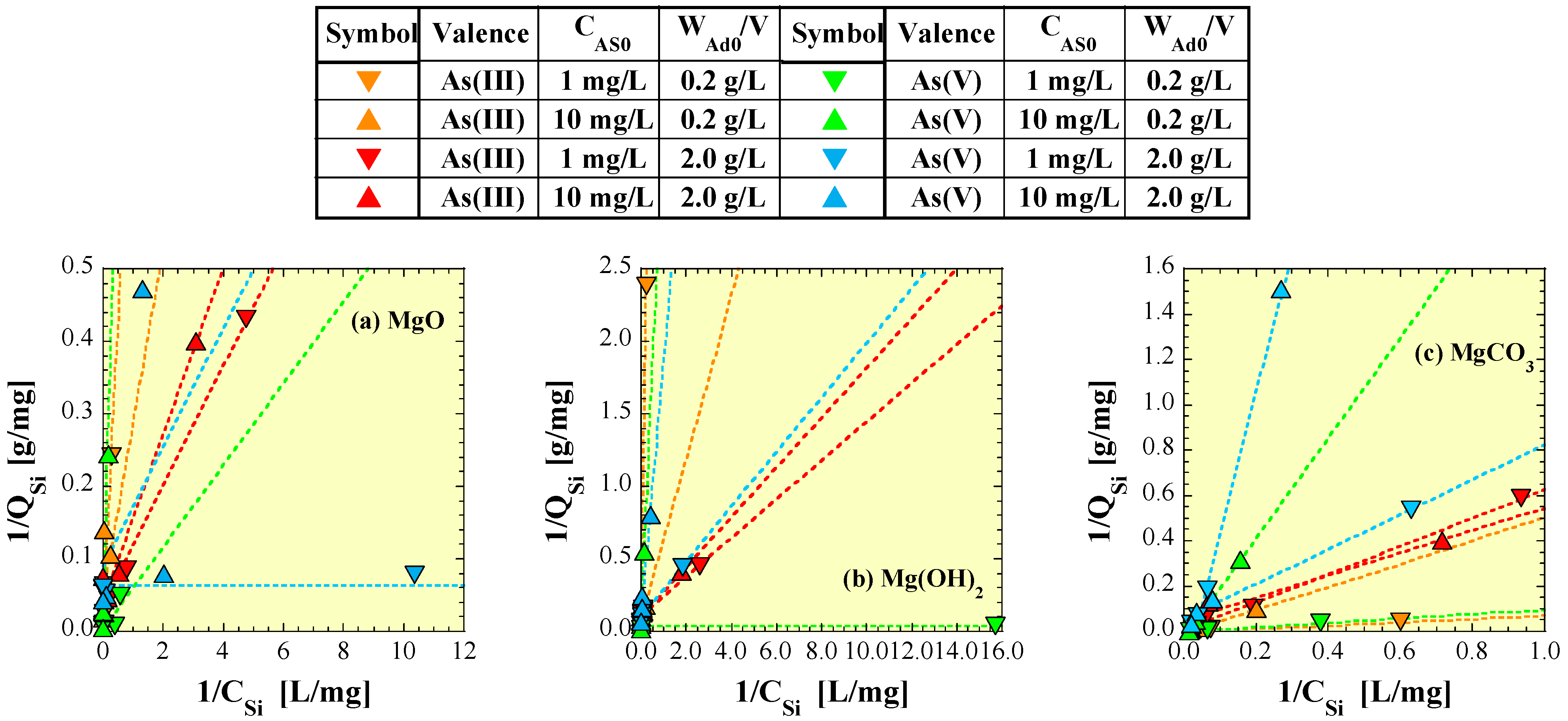
The Langmuir isotherms for Si adsorption on MgO, Mg(OH)2, and MgCO3 are shown in Figure 25a–c, respectively.
Unlike Figure 23 and Figure 24, the plots in Figure 25 are grouped by combinations of As valence, CAS0, and WAd0/V. Each grouped data set generally comprises four data points obtained at different CSi0 values, excluding CSi0 = 0 mg/L. However, for Mg(OH)2, some data sets include fewer than four points because Si adsorption did not occur under certain conditions (CAS0 = 1 mg/L and WAd0/V = 0.2 g/L, for both As(III) and As(V)). Table 5 lists QSi-MAX, KL, and r obtained by fitting each data set to the Langmuir model.
As shown in Table 5, MgCO3, exhibited r values > 0.97 across all data sets; however, the values of QSi-MAX and KL were negative in multiple cases. Therefore, the Si adsorption on MgCO3 in the presence of As is not adequately described by the Langmuir model. For MgO and Mg(OH)2 at WAd0/V = 0.2 g/L, the r values were generally low and the QSi-MAX and/or KL values were negative, again indicating poor agreement with the Langmuir model. By contrast, for both MgO and Mg(OH)2 at WAd0/V = 2 g/L, r exceeded 0.98 and both QSi-MAX and KL were positive, suggesting that the Langmuir model provides an adequate fit under these conditions.

4.5. Dissolved Forms of Arsenous Acid and Arsenic Acid in Solution

This section considers As speciation in liquid phase. The forms of dissolved As(III) are described by the following equations for dissociation reactions of arsenous acid
H3AsO3 ⇌ H2AsO3 + H+
H2AsO3 ⇌ HAsO32− + H+
HAsO32− ⇌ AsO33− + H+
where pKa1 = 9.1, pKa2 = 12.1, and pKa3 = 13.4 (25 °C) [22]. In the synthetic contaminated water before adsorbent addition in the As(III) tests, the dominant species is presumed to be H3AsO3 because the maximum pH0 was 7.62, which is well below pKa1. In the treated water from the As(III) tests, AsO33− is expected to be negligible because pHf << pKa3. The pKa1 and pKa2 values are used in Equations (13) and (14), corresponding to Equations (10) and (11), respectively.
[H2AsO3]/[H3AsO3] = 10 exp (pH − pKa1)
[HAsO32−]/[H2AsO3] = 10 exp (pH − pKa2)
Using the pHf values of 9.06–11.025 in the As(III) tests, (H2AsO3)/(H3AsO3) and (HAsO32−)/(H2AsO3) were calculated as 0.902–84.1 and 0.001–0.084, respectively. These results indicate that the predominant forms of As(III) dissolving in the treated water were H3AsO3 and H2AsO3.
Subsequently, the forms of As(V) dissolved in water are described by the following equations for dissociation reactions of arsenic acid
H3AsO4 ⇌ H2AsO4 + H+
H2AsO4 ⇌ HAsO42− + H+
HAsO42− ⇌ AsO43− + H+
where pKa1 = 2.24, pKa2 = 6.96, and pKa3 = 11.5 (25 °C) [23], and the amount of each arsenic acid species dissolved in water is estimated by the following reactions:
[H2AsO4]/[H3AsO4] = 10 exp (pH − pKa1)
[HAsO42−]/[H2AsO4] = 10 exp (pH − pKa2)
[AsO43−]/[HAsO42−] = 10 exp (pH − pKa3)
For the synthetic contaminated water before adding the adsorbent in the tests with As(V), the abundances of H3AsO4 and AsO43− were presumed to be extremely small and therefore negligible because pKa1 << pH0 << pKa3. Substituting the pH0 values (6.70–7.50) yields [HAsO42−]/[H2AsO4] values of 0.55–3.47. Therefore, the dominant As(V) species dissolved in the synthetic contaminated water were presumed to be H2AsO4 and HAsO42−. For the treated water, the abundances of H3AsO4 and H2AsO4 were presumed to be extremely small and therefore negligible because pKa2 << pH0. Substituting pHf affords [AsO43−]/[HAsO42−] values of 0.014–0.349 for MgO, 0.005–0.104 for Mg(OH)2, and 0.010–0.175 for MgCO3. Therefore, the dominant As(V) species dissolved in the treated water were estimated to be HAsO42− and AsO43−. However, pHf tended to decrease as CSi0 increased; accordingly, the fraction of AsO43− decreased with increasing CSi0.

4.6. Dissolved Forms of Silicic Acid in Solution

Consistent with a previous study [19], the forms of silicic acid dissolved in solution were evaluated based on the following equations for dissociation reactions of silicic acid:
H4SiO4 ⇌ H3SiO4 + H+
H3SiO4 ⇌ H2SiO42− + H+
Denoting the equilibrium constants of the dissociation formulas of silicic acid (Equations (21) and (22)) as Ka1 and Ka2, respectively, affords the following equations
[H3SiO4]/[H4SiO4] = 10 exp (pH − pKa1)
[H2SiO42−]/[H3SiO4] = 10 exp (pH − pKa2)
where the units of the applicable molecular formula are mol/L, pKa1 = 9.86, and pKa2 = 13.1 (25 °C) [22].
The main form of Si dissolved in the synthetic contaminated water before adding the adsorbent was presumed to be H4SiO4 because pH0 << pKa1. The pHf values obtained in this study ranged from 9.06 to 11.04. Substituting these pHf values into Equation (23) yields 0.157–15.2. Additionally, substituting the pHf values into Equation (24) yields values < 0.009, indicating that the dominant dissolved forms were H3SiO4 (a monovalent ion) and H4SiO4 (a non-valent molecule), whereas H2SiO42− did not exist.

4.7. Dissolution Reactions of Mg-Based Adsorbents and Adsorption Reaction of Silicic Acid

The dissolution mechanism of MgO is considered to proceed via both direct dissolution (Equation (25)) and a pathway involving initial hydration to transform into Mg(OH)2 followed by dissolution (Equations (26) and (27)).
MgO + H2O ⇌ Mg2+ + 2OH
MgO + H2O ⇌ Mg(OH)2
Mg(OH)2 ⇌ Mg2+ + 2OH
Reaction (27) is also the dissolution reaction for Mg(OH)2.
The dissolution reaction of MgCO3 is simply expressed by Equation (26); however, the carbonate species released differ depending on the solution pH.
MgCO3 + 2H2O ⇌ Mg2+ + H2CO3 + 2OH
H2CO3 ⇌ H+ + HCO3
HCO3 ⇌ H+ + CO32−
When the equilibrium constants for the dissociation reactions of carbonic acid (Equations (27) and (28)) are denoted as Ka1 and Ka2, respectively, the following equations are applicable
[HCO3]/[H2CO3] = 10 exp (pH − pKa1)
[CO32−]/[HCO3] = 10 exp (pH − pKa2)
where the units of the applicable molecular formula are mol/L, pKa1 = 6.35, and pKa2 = 10.33 (25 °C) [22].
The main forms of carbonic acid dissolved in the synthetic contaminated water before adding the adsorbent were presumed to be H2CO3 and HCO3 because pH0pKa1 << pKa2. However, in this study, the initial amount of carbonic acid was not considered in the calculations of carbonic acid species concentrations because the amount of dissolved carbonic acid in the synthetic contaminated water before added adsorbent was unknown. The abundance of H2CO3 in the treated water can be considered negligible because pHf << pKa3. The pHf values obtained in this study ranged from 9.06 to 11.04. Substituting these pHf values into Equation (32) yields 0.151–3.36. Therefore, the dominant forms of carbonic acid dissolved in the treated water were presumed to be HCO3 and CO32−.
As described above, the form of silicic acid varies with solution pH. Below, adsorption of silicic acid on Mg-based adsorbents is considered using H4SiO4 as an example.
The adsorption mechanism of silicic acid species on MgO is also considered to proceed via both direct adsorption (Equation (33)) and a pathway involving initial hydration to form solid-Mg-OH followed by adsorption (Equations (34) and (35)).
Solid-Mg-O-Mg-Solid + Si(OH)4 ⇌ Solid-Mg-O-Si (OH)3 + HO-Mg-Solid
Solid-Mg-O-Mg-Solid + H2O ⇌ Solid-Mg-OH + HO-Mg-Solid
Solid-Mg-OH + Si(OH)4 ⇌ Solid-Mg-O-Si(OH)3 + H2O
Equation (31) is also the adsorption reaction of silicic acid on Mg(OH)2.
The adsorption mechanism of silicic acid species on MgCO3 is also considered to proceed via both direct adsorption (Equation (36)) and a pathway involving initial hydration to form solid-Mg-OH followed by adsorption (Equation (35) via Equation (37)).
Solid-Mg-O-C(O)OH + Si(OH)4 ⇌ Solid-Mg-O-Si (OH)3 + H2CO3
Solid-Mg-O-C(O)OH + H2O ⇌ Solid-Mg-OH + H2CO3
In addition, the adsorption mechanisms of arsenous and arsenic acid species on Mg-based adsorbents can be expressed by replacing H4SiO4 in the reaction equations in this section. This implies that silicic acid species competitively adsorb with arsenous and arsenic acid species.

4.8. Mass Balance for OH

Solution pH reflects the OH mass balance of the reaction system. As explained in Section 4.7, during dissolution of MgO, Mg(OH)2, and MgCO3, two OH ions are released for each Mg ion released (Equations (25), (27), and (28)). However, for MgCO3, the acid dissociation reaction of H2CO3 (i.e., OH consumption) must also be considered. Specifically, one OH is consumed to convert H2CO3 to HCO3, and two OH are consumed to convert H2CO3 to CO32−. In addition, when silicic acid is present, OH is consumed during its ionization. As mentioned in Section 4.6, H4SiO4 predominates in the neutral pH solution before adsorbent addition, whereas substantial H3SiO4 is produced under the alkaline conditions after adding Mg-based adsorbents. OH is not released during adsorption of silicic acid onto Mg-based adsorbents, as described in Section 4.7. If, instead, adsorption of H3SiO4 (rather than H4SiO4) was assumed, OH would be released; however, the net OH balance across the overall system remains zero because OH is consumed during the preceding ionization of H4SiO4. In contrast, during adsorption of silicic acid onto MgCO3, OH is consumed via dissociation of the H2CO3 produced. In principle, OH is also consumed during ionization of arsenous acid and arsenic acid; however, their concentrations were relatively low in this study and can be ignored in this section to simplify the following calculations.
The values of CMg, CSi0, and CSi (converted to mM) are denoted as [Mg2+], [Si]0, and [Si]f, respectively. The OH concentrations (mM) calculated from pH0 and pHf are represented as [OH]0 and [OH]f, respectively. The concentrations (mM) of H4SiO4, H3SiO4, HCO3, and CO32− in the treated water are denoted as [H4SiO4], [H3SiO4], [HCO3], and [CO32−], respectively.
Because silicic acid in the treated water exists as H4SiO4 and H3SiO4, as mentioned in Section 4.6, the following equation holds:
[Si]0–[Si]f = [H4SiO4] + [H3SiO4]
In addition, because [H2CO3] in the treated water can be neglected, as mentioned in Section 4.7, the following equation holds for MgCO3 based on Equations (26) and (34):
[Mg2+] + [Si]0–[Si]f = [HCO3] + [CO32−]
Furthermore, using the chemical equilibrium constants given in Section 4.6 and Section 4.7, [H4SiO4], [H3SiO4], [HCO3], and [CO32−] can be determined.
In summary, the OH mass balance is as follows:
The mass balance of OH for both MgO and Mg(OH)2:
2[Mg2+] = [OH]f − [OH]0 + [H3SiO4]
The mass balance of OH for MgCO3:
2[Mg2+] = [OH]f − [OH]0 + [H3SiO4] + [HCO3] + 2[CO32−]
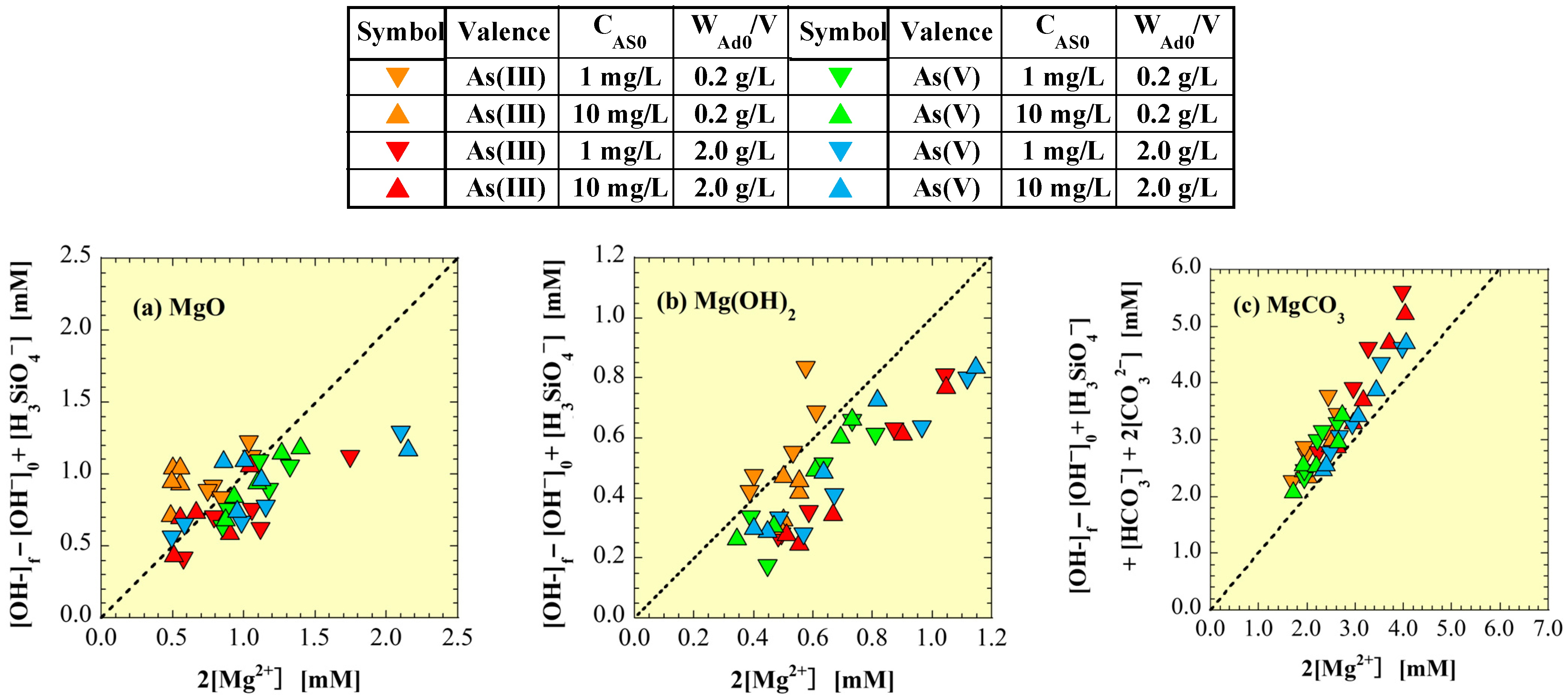
The corresponding plots for Equations (40) and (41) are shown in Figure 26. Figure 26a–c correspond to MgO, Mg(OH)2, and MgCO3, respectively.
A 1:1 line is also shown in each panel. If Equations (40) and (41) are valid, the data should fall on the 1:1 line. In all panels, most points lie close to the 1:1 line; however, some plots deviate from these lines.
As shown in Figure 26a,b, most points—except those for As(III) at WAd0/V = 0.2 g/L—fall below the 1:1 line. In practice, OH in solution is also consumed by ionization of arsenite and arsenate and by dissolution of atmospheric CO2 into the solution during pH measurement; however, these factors were not included in the calculations. Some points for As(III) at WAd0/V = 0.2 g/L lie above the 1:1 line, but the reason for this deviation is unclear.
As shown in Figure 26c, for MgCO3 the points increasingly shift upward from the 1:1 line with increasing [Mg2+]. This behavior reflects that the MgCO3 adsorbent used in this study is basic magnesium carbonate (magnesium carbonate hydroxide). Accordingly, adsorption of silicic acid onto the MgCO3 adsorbent includes the reaction in Equation (35) in addition to Equation (36). However, because the amount of H2CO3 generated during Si adsorption onto the MgCO3 adsorbent was calculated from the total decrease in aqueous Si, the generated H2CO3 was likely overestimated. This overestimation would cause [HCO3] and [CO32−] in Equation (41) to be higher than their actual values.

4.9. Suitability Evaluation in the Presence of Si

As described in Section 3.4, EM analysis of Si on Si-adsorbed adsorbents confirmed that Si was uniformly distributed on the Mg(OH)2 surface, whereas for MgO and MgCO3, Si was concentrated on aggregates rather than uniformly distributed on the adsorbent surface. For any Mg-based adsorbents, in the presence of Si, the amount of As adsorbed decreases due to competitive adsorption with Si. In addition, based on the above observations, for MgO and MgCO3 the RAS likely decreased further because Si co-precipitated instead of As, which would otherwise have been removed by coprecipitation with the secondarily generated Mg(OH)2 aggregates.
The SiO2 concentration in groundwater is usually <45 mg/L [24], with a typical range of 1–30 mg/L and averaging ~17 mg/L [25]. Converting these SiO2 values to Si, the corresponding Si concentration is <21 mg/L, with a range of 0.4–14 mg/L and a typical value of ~8 mg/L. Accordingly, assuming that CSi0 in groundwater is <21 mg/L, the suitability of each Mg-based adsorbent in the presence of silicic acid was evaluated.
As shown in Figure 2a, for MgO, when WAd0/V is sufficiently high (e.g., 2 g/L) and CAS0 is 1–10 mg/L, high RAS can be maintained for both As(III) and As(V) even in the presence of Si. For Mg(OH)2, for both As(III) and As(V), RAS at WAd0/V = 2 g/L does not decrease at CAS0 = 1 mg/L but clearly decreases at CAS0 = 10 mg/L (Figure 2b). However, when CSi0 was ~25 mg/L, RAS was ~10% at WAd0/V = 0.2 g/L but increased to ~80% at 2 g/L. Therefore, if WAd0/V is increased beyond 2 g/L, RAS is expected to improve further. In contrast, MgCO3 is unsuitable for treating As-contaminated water when CSi0 substantially exceeds 5 mg/L because its As-removal performance is strongly affected by Si (Figure 2c). Nevertheless, because the RAS for MgCO3 improves at CSi0 ~5 mg/L, it may be feasible to propose a treatment strategy in which MgCO3 is used as a primary treatment for As-contaminated water with extremely low CSi0, followed by secondary treatment using adsorbents that are more efficient (and more expensive) than MgCO3.
As mentioned in the introduction, Waltham and Eick have reported on the effects of Si on the adsorption behavior of As(V) and As(III) on goethite (FeO(OH)) [14]. Their test conditions were CAS0 = 1.34 mg/L (0.1 mM), WAd0/V = 1 g/L, and pHf = 4, 6, and 8. The lowest As(III) adsorption inhibition ratio was 4% at CSi0 = 3.56 mg/L (0.1 mM) in pH 6, and the highest ratio was 40% at CSi0 = 35.6 mg/L (1.0 mM) in pH 8. For As(V), they reported there was no difference in the total amount of As adsorbed between CSi0 = 3.56 and 35.6 mg/L. The test conditions most similar to theirs in this study are CSi0 = 1 mg/L and WAd0/V = 2 g/L. The effects of CSi0 on QAS under these conditions are shown in Figure 21b. For MgO and Mg(OH)2, the QAS for both As(III) and As(V) hardly changed in the CSi0 range of 0–50 mg/L, indicating no clear inhibition of As adsorption by Si. For MgCO3, the QAS for both As(III) and As(V) decreased significantly with increasing CSi0. Therefore, compared to Fe-based adsorbents (goethite), MgO and Mg(OH)2 may be superior in that the QAS do not decrease even in the presence of Si, not only for As(V) but also for As(III), in the CSi0 range of 0–50 mg/L.
Overall, MgO and Mg(OH)2 appear to be suitable adsorbents for As removal within the typical CSi0 range of natural groundwater. However, special care is required for alkaline groundwater or groundwater mixed with geothermal water, because the CSi0 can be higher than in typical groundwater. The results of this study suggest that a major contributor to the decreased As-removal performance of Mg-based adsorbents in the presence of Si is the reduction in solution pH caused by OH consumption during the ionization of silicic acid. Therefore, achieving high RAS with favorable cost performance, and improving sustainability, requires setting WAd0/V appropriately by considering not only CAS0 but also CSi0 in As-contaminated groundwater.

4.10. Limitations of This Study and Future Issues

In this study, various evaluations were based on the results obtained from tests using synthetic contaminated water. However, actual groundwater and industrial wastewater must contain not only Si but also multiple ions and organic substances that could compete for adsorption with As. Therefore, it will be necessary to conduct tests using actual contaminated groundwater and factory wastewater, and then compare the results with those in this study. The reaction time in this study was set to 24 h, the same as in many common studies on adsorption reactions [16,17,20,21], but it has not been confirmed whether a strict equilibrium state was reached. Therefore, in the future, to conduct kinetic studies, including confirming the equilibrium time, it is essential to perform adsorption tests with reaction time as a parameter. In this study, the matrix components leach from the adsorbents, making it difficult to control the ionic strength to a constant value. Therefore, tests with ionic strength as a parameter were not conducted. However, a previous study [14] suggests that the effects of ionic strength on adsorption behavior are not significant. pH control using pH buffering solution was not performed in this study. The reason for this is that there were concerns that the components contained in the pH buffer solution would affect the adsorption behavior of As and Si. Particularly, phosphoric acid contained in neutral phosphate solutions, which are often used as pH buffer solutions, is known to compete with As for adsorption [18]. Therefore, to conduct adsorption tests with controlled pH, it is necessary to select a pH buffer solution that does not contain competing adsorption components or to investigate the competitive adsorption effects of components contained in the pH buffer solution in advance. In addition to conducting adsorption tests with reaction time and pH as parameters, using chemical equilibrium calculation tools to consider the pH effects on the solubility of Mg compounds and to verify the chemical species formed could be an effective means of constructing advanced adsorption models.

5. Conclusions

Adsorption is a promising approach for purifying As-contaminated water; however, natural groundwater may contain Si, which has been known to reduce the As-removal performance of adsorbents. The effects of Si on the As-removal performance of adsorbents have been studied in detail for Fe-based adsorbents but have been scarcely investigated for Mg-based adsorbents. Therefore, in this study, we focused on MgO, Mg(OH)2, and MgCO3 and conducted As-removal tests using WAd0/V, As valence, CAS0, and CSi0 as test parameters to assess the effects of Si on As-removal performance. It was revealed that the effect of CSi0 on As removal depends strongly on adsorbent type, As valence, and WAd0/V. At WAd0/V = 2 g/L, MgO maintained high RAS values up to CSi0 ≈ 25 mg/L but decreased rapidly when CSi0 exceeded ~25 mg/L. For Mg(OH)2, the RAS for As(V) reduced with increasing CSi0, whereas for As(III) it decreased significantly at CSi0 ≈ 50 mg/L but increased at CSi0 > 100 mg/L. For MgCO3, RAS was higher at very low CSi0 (~5 mg/L) than under Si-free conditions, but then decreased rapidly with increasing CSi0. Under all test conditions, pHf decreased with increasing CSi0. In particular, for MgO and MgCO3, the impact of decreasing pH was greater than for Mg(OH)2, because lower pH inhibits the formation of secondary Mg(OH)2 aggregates and reduces As removal by coprecipitation with these aggregates. As the Si concentration in typical groundwater is reported to be <21 mg/L [24], when the Si concentration in As-contaminated water to be treated approaches this upper limit, MgCO3 is not recommended for As removal. By contrast, MgO and Mg(OH)2 should be able to achieve high RAS, provided that WAd0/V is set appropriately.
Functional adsorbents are often assumed to be recycled because they cannot be readily discarded given their relatively high cost and/or the presence of valuable metals [12]. Consequently, conventional adsorbents that are readily available, inexpensive, and easier to handle are likely to be used to treat As-containing wastewater generated during their recycling. A potential option for spent adsorbents produced during secondary-wastewater treatment is to repurpose them as building materials (e.g., concrete); however, it is reasonable to anticipate psychological resistance to the use of arsenic-containing waste in such applications. Therefore, an important consideration is that adsorbents used to treat this secondary wastewater should be suitable for As treatment when landfill disposal is assumed. The Mg-based adsorbents evaluated in this study meet these requirements.

Author Contributions

Conceptualization, H.S.; methodology, H.S., T.S. and J.H.; formal analysis, H.S. and K.M.; investigation, H.S. and K.M.; resources, H.S., K.M. and J.H.; data curation, H.S. and K.M.; writing—original draft preparation, H.S. and K.M.; writing—review and editing, H.S., K.M., T.S. and J.H.; supervision, J.H.; project administration, H.S.; funding acquisition, J.H., T.S. and H.S. All authors have read and agreed to the published version of the manuscript.

Funding

This study received no external funding.

Institutional Review Board Statement

Not applicable.

Informed Consent Statement

Not applicable.

Data Availability Statement

The raw data supporting the conclusions of this article will be made available by the authors on request.

Acknowledgments

We are deeply grateful to Terumi Oguma for her assistance with the experiments.

Conflicts of Interest

The authors declare no conflicts of interest.

References

  1. Rajendran, S.; Rathinam, V.; Sharma, A.; Vallinayagam, S.; Muthusamy, M. Arsenic and environment: A systematic review on arsenic sources, uptake mechanism in plants, health hazards and remediation strategies. Top. Catal. 2024, 67, 325–341. [Google Scholar] [CrossRef]
  2. Dutré, V.; Vandecasteele, C. Solidification/stabilisation of arsenic-containing waste: Leach tests and behaviour of arsenic in the leachate. Waste Manag. 1995, 15, 55–62. [Google Scholar] [CrossRef]
  3. Rahman, M.M.; Ng, J.C.; Naidu, R. Chronic exposure of arsenic via drinking water and its adverse health impacts on humans. Environ. Geochem. Health 2009, 31, 189–200. [Google Scholar] [CrossRef] [PubMed]
  4. Phan, K.; Sthiannopkao, S.; Kim, K.-W.; Wong, M.H.; Sao, V.; Hashim, J.H.; Yasin, M.S.M.; Aljunid, S.M. Health risk assessment of inorganic arsenic intake of Cambodia residents through groundwater drinking pathway. Water Res. 2010, 44, 5777–5788. [Google Scholar] [CrossRef] [PubMed]
  5. Maity, J.P.; Nath, B.; Kar, S.; Chen, C.-Y.; Banerjee, S.; Jean, J.-S.; Liu, M.-Y.; Centeno, J.A.; Bhattacharya, P.; Chang, C.L.; et al. Arsenic-induced health crisis in peri-urban Moyna and Ardebok villages, West Bengal, India: An exposure assessment study. Environ. Geochem. Health 2012, 34, 563–574. [Google Scholar] [CrossRef] [PubMed]
  6. The World Health Organization (WHO). Arsenic. In Guidelines for Drinking-Water Quality, 4th ed.; The World Health Organization: Tarxien, Malta, 2011; pp. 315–318. Available online: https://apps.who.int/iris/bitstream/handle/10665/44584/9789241548151_eng.pdf (accessed on 4 February 2026).
  7. Ministry of the Environment, Government of Japan. Environmental Quality Standards for Human Health. Available online: https://www.env.go.jp/en/water/wq/wp.pdf (accessed on 4 February 2026).
  8. Ministry of the Environment, Government of Japan. National Effluent Standards. Available online: https://www.env.go.jp/en/water/wq/nes.html (accessed on 4 February 2026).
  9. Abiye, T.A.; Bhattavharya, P. Arsenic concentration in groundwater Archetypal study from South Africa. Groundw. Sustain. Dev. 2019, 9, 100246. [Google Scholar] [CrossRef]
  10. Kobya, M.; Soltani, R.D.C.; Omwene, P.I.; Khataee, A. A review on decontamination of arsenic-contained water by electrocoagulation: Reactor configurations and operating cost along with removal mechanisms. Environ. Technol. Innov. 2020, 17, 100519. [Google Scholar] [CrossRef]
  11. Podgorsk, J.; Berg, M. Global threat of arsenic in groundwater. Science 2020, 368, 845–850. [Google Scholar] [CrossRef] [PubMed]
  12. Liu, B.; Kima, K.-H.; Kumarb, V.; Kim, S. A review of functional sorbents for adsorptive removal of arsenic ions in aqueous systems. J. Hazard. Mater. 2020, 388, 121815. [Google Scholar] [CrossRef] [PubMed]
  13. Meng, X.; Bang, S.; Korfiatis, G.P. Effects of silicate, sulfate, and carbonate on arsenic removal by ferric chloride. Wat. Res. 2000, 34, 1255–1261. [Google Scholar] [CrossRef]
  14. Waltham, C.A.; Eick, M.J. Kinetics of arsenic adsorption on goethite in the presence of sorbed silicic acid. Soil Sci. Soc. Am. J. 2002, 66, 818–825. [Google Scholar] [CrossRef]
  15. Park, Y.Y.; Tran, T.; Lee, Y.H.; Nam, Y.I., II; Senanayake, G.; Kim, M.J. Selective removal of arsenic(V) from a molybdate plant liquor by precipitation of magnesium arsenate. Hydrometallurgy 2010, 104, 290–297. [Google Scholar] [CrossRef]
  16. Yu, X.Y.; Luo, T.; Jia, Y.; Zhang, Y.X.; Liu, J.H.; Huang, X.J. Porous hierarchically micro-/nanostructured MgO: Morphology control and their excellent performance in As(III) and As(V) removal. J. Phys. Chem. C 2011, 115, 22242–22250. [Google Scholar] [CrossRef]
  17. Tresintsi, S.; Simeonidis, K.; Katsikini, M.; Paloura, E.C.; Bantsis, G.; Mitrakas, M. A novel approach for arsenic adsorbents regeneration using MgO. J. Hazard. Mater. 2014, 265, 217–225. [Google Scholar] [CrossRef]
  18. Lin, Q.; Chen, W.; Lin, F.; Zhu, H.; Wang, X. Exaggerated arsenic removal efficiency and pH adaptability by adsorption using monodispersed porous pinecone-like magnesium hydroxide. AQUA 2023, 72, 969–982. [Google Scholar] [CrossRef]
  19. Sugita, H.; Morimoto, K.; Saito, T.; Hara, J. Effects of silicic acid on leaching behavior of arsenic from spent magnesium-based adsorbents containing arsenite. Sustainability 2022, 14, 4236. [Google Scholar] [CrossRef]
  20. Sugita, H.; Morimoto, K.; Saito, T.; Hara, J. Simultaneous removal of arsenate and fluoride using magnesium-based adsorbents. Sustainability 2024, 16, 1774. [Google Scholar] [CrossRef]
  21. Sugita, H.; Morimoto, K.; Saito, T.; Hara, J. Removal performance and adsorption behavior on Mg-based adsorbents in As(III) and F simultaneous removal as in comparison with As(V). Geochem. Explor. Environ. Anal. 2024, 24, geochem2024-022. [Google Scholar] [CrossRef]
  22. The Chemical Society of Japan (CSJ). Kagaku Binran (Handbook of Chemistry), Pure Chemistry II, 4th ed.; Maruzen: Tokyo, Japan, 1993; p. 317. [Google Scholar]
  23. The Chemical Society of Japan (CSJ). Kagaku Binran (Handbook of Chemistry), Pure Chemistry II, 5th ed.; Maruzen: Tokyo, Japan, 2004; p. 332. [Google Scholar]
  24. Pan, S.-Y.; Snyder, S.W.; Packman, A.I.; Lin, Y.J.; Chiang, P.-C. Cooling water use in thermoelectric power generation and its associated challenges for addressing water-energy nexus. Water-Energy Nexus 2018, 1, 26–41. [Google Scholar] [CrossRef]
  25. Khan, A.; Rashid Umar, R.; Khan, H.H. Significance of silica in identifying the processes affecting groundwater chemistry in parts of Kali watershed, Central Ganga Plain, India. Appl. Water Sci. 2015, 5, 65–72. [Google Scholar] [CrossRef]
Figure 1. Changes in the concentration of residual As in treated water with initial Si concentration. (a) CAS0 = 1 mg/L and WAd0/V= 0.2 g/L, (b) CAS0 = 1 mg/L and WAd0/V= 2 g/L, (c) CAS0 = 10 mg/L and WAd0/V= 0.2 g/L, and (d) CAS0 = 10 mg/L and WAd0/V= 2 g/L.
Sustainability 18 04162 g001
Figure 2. As-removal ratio depending on initial concentration of Si: (a) MgO, (b) Mg(OH)2, and (c) MgCO3.
Sustainability 18 04162 g002
Figure 3. Changes in the final pH with initial concentration of Si: (a) MgO, (b) Mg(OH)2, and (c) MgCO3.
Sustainability 18 04162 g003
Figure 4. Changes in the concentration of leached Mg with initial concentration of Si: (a) MgO, (b) Mg(OH)2, and (c) MgCO3.
Sustainability 18 04162 g004
Figure 5. Changes in the concentration of residual Si with initial concentration of Si: (a) MgO, (b) Mg(OH)2, and (c) MgCO3.
Sustainability 18 04162 g005
Figure 6. XRD patterns of MgO adsorbent: (a) original, (b) hydrated, (c) As(III)-adsorbed, (d) As(V)-adsorbed, and (e) Si-adsorbed MgO.
Sustainability 18 04162 g006
Figure 7. XRD patterns of Mg(OH)2 adsorbent: (a) original, (b) hydrated, (c) As(III)-adsorbed, (d) As(V)-adsorbed, and (e) Si-adsorbed Mg(OH)2.
Sustainability 18 04162 g007
Figure 8. XRD patterns of MgCO3 adsorbent: (a) original, (b) hydrated, (c) As(III)-adsorbed, (d) As(V)-adsorbed, and (e) Si-adsorbed MgCO3.
Sustainability 18 04162 g008
Figure 9. SEM images of MgO adsorbent: (a) original, (b) As(III)-adsorbed, and (c) Si-adsorbed MgO.
Sustainability 18 04162 g009
Figure 10. SEM images of Mg(OH)2 adsorbent: (a) original, (b) As(III)-adsorbed, and (c) Si-adsorbed Mg(OH)2.
Sustainability 18 04162 g010
Figure 11. SEM images of MgCO3 adsorbent: (a) original, (b) As(III)-adsorbed, and (c) Si-adsorbed MgCO3.
Sustainability 18 04162 g011
Figure 12. SEM and corresponding EM images for As(III)-adsorbed MgO: (a) SEM image and EM of (b) Ca, (c) O, and (d) As.
Sustainability 18 04162 g012
Figure 13. SEM and corresponding EM images for As(III)-adsorbed Mg(OH)2: (a) SEM image and EM of (b) Mg, (c) O, and (d) As.
Sustainability 18 04162 g013
Figure 14. SEM and corresponding EM images for As(III)-adsorbed MgCO3: (a) SEM image and EM of (b) Mg, (c) O, and (d) As.
Sustainability 18 04162 g014
Figure 15. SEM and corresponding EM images for Si-adsorbed MgO: (a) SEM image and EM of (b) Mg, (c) O, and (d) Si.
Sustainability 18 04162 g015
Figure 16. SEM and corresponding EM images for Si-adsorbed Mg(OH)2: (a) SEM image and EM of (b) Mg, (c) O, and (d) Si.
Sustainability 18 04162 g016
Figure 17. SEM and corresponding EM images for F-adsorbed MgCO3: (a) SEM image and EM of (b) Mg, (c) O, and (d) Si.
Sustainability 18 04162 g017
Figure 18. Plots of CAS against pHf: (a) CAS0 = 1 mg/L and WAd0/V= 0.2 g/L, (b) CAS0 = 1 mg/L and WAd0/V= 2 g/L, (c) CAS0 = 10 mg/L and WAd0/V= 0.2 g/L, and (d) CAS0 = 10 mg/L and WAd0/V= 2 g/L.
Sustainability 18 04162 g018
Figure 19. Plots of (a) CMg and (b) CSi against pHf.
Sustainability 18 04162 g019
Figure 20. Changes in the residual adsorbent ratio with initial concentration of Si: (a) MgO, (b) Mg(OH)2, and (c) MgCO3.
Sustainability 18 04162 g020
Figure 21. Plots of QAS against CSi0: (a) CAS0 = 1 mg/L and WAd0/V = 0.2 g/L, (b) CAS0 = 1 mg/L and WAd0/V = 2 g/L, (c) CAS0 = 10 mg/L and WAd0/V = 0.2 g/L, and (d) CAS0 = 10 mg/L and WAd0/V = 2 g/L.
Sustainability 18 04162 g021
Figure 22. Plots of QSi against CSi0: (a) WAd0/V= 0.2 g/L, and (b) WAd0/V= 2 g/L.
Sustainability 18 04162 g022
Figure 23. Langmuir isotherm plots of As(III) adsorption: (a) MgO, (b) Mg(OH)2, and (c) MgCO3.
Sustainability 18 04162 g023
Figure 24. Langmuir isotherm plots of As(V) adsorption: (a) MgO, (b) Mg(OH)2, and (c) MgCO3.
Sustainability 18 04162 g024
Figure 25. Langmuir isotherm plots of Si adsorption: (a) MgO, (b) Mg(OH)2, and (c) MgCO3.
Sustainability 18 04162 g025
Figure 26. Mass balance of OH: (a) MgO, (b) Mg(OH)2, and (c) MgCO3.
Sustainability 18 04162 g026
Table 1. Characteristics of the Mg-based adsorbents used in this study.
No.AdsorbentDp50 (μm)SBET (m2/g)αMg (%)P (%)
(1)MgO1.544.359.198.0
(2)Mg(OH)24.1322.040.697.3
(3)MgCO315.026.024.886.1
Data obtained from Sugita et al. [19]. αMg: Mg content; Dp50: median particle size; P: reagent purity; SBET: BET surface area.
Table 2. Mean values and standard errors obtained from three replicated experiments.
AdsorbentAs ValenceWAd0/V (g/L)CAS (mg/L)CSi (mg/L)CMg (mg/L)pHf
MgOAs(V)2.05 ± 0.000.194 ± 0.00814.0 ± 0.814.0 ± 0.610.54 ± 0.36
Mg(OH)2As(V)2.04 ± 0.000.033 ± 0.00133.7 ± 0.511.7 ± 0.29.81 ± 0.06
MgCO3As(V)2.03 ± 0.000.625 ± 0.00925.4 ± 1.443.0 ± 0.69.95 ± 0.01
MgOAs(III)2.04 ± 0.000.131 ± 0.0025.26 ± 0.0613.6 ± 0.510.65 ± 0.04
Mg(OH)2As(III)2.03 ± 0.000.191 ± 0.00833.4 ± 0.210.6 ± 0.29.81 ± 0.01
MgCO3As(III)2.01 ± 0.000.601 ± 0.0159.27 ± 0.4046.3 ± 0.39.99 ± 0.00
CAS: residual As concentration; CMg: leached Mg concentration; CSi: residual Si concentration; pHf: treated water pH; WAd0/V: adsorbent addition concentration.
Table 3. Values of QAS-MAX, KL, and r for the approximate straight lines obtained by applying Equation (8) to As(III)-adsorption data.
WAd0/V = 0.2 and 2 g/LWAd0/V = 0.2 g/L *WAd0/V = 2 g/L *
CSi0 (mg/L)AdsorbentNumber of DatarQAS-MAX (mg/g)KLQAS-MAX (mg/g)KLQAS-MAX (mg/g)KL
0MgO40.542 3.96 1.715 −92.81 **−0.017 **−0.05 *−6.191 **
5MgO40.947 5.21 1.286 −72.42 **−0.021 **−9.46 *−0.608 **
25MgO40.884 2.14 13.711 3.56 0.457 10.99 2.074
50MgO40.809 1.70 2.762 5.98 0.119 6.91 0.557
100MgO40.971 8.75 0.051 7.05 0.087 2.53 1.74 × 10⁻⁵
0Mg(OH)241.000 6.85 0.801 8.35 0.627 5.46 1.025
5Mg(OH)240.991 4.04 2.460 5.97 0.606 6.60 1.436
25Mg(OH)240.992 4.07 3.428 7.99 0.488 4.67 2.947
50Mg(OH)240.991 8.38 0.299 5.94 0.724 4.33 0.598
100Mg(OH)240.993 4.27 3.054 10.86 0.345 4.16 3.155
0MgCO330.868 0.21 0.245 - ***- ***0.09 0.884
5MgCO340.753 15.47 0.123 4.96 **−27.9 **3.09 0.504
25MgCO340.774 3.19 0.251 9.04 0.264 0.90 0.964
50MgCO340.667 2.79 0.135 1.86 5.157 1.18 0.225
100MgCO340.689 17.01 0.017 25.49 0.054 1.32 0.156
* The correlation coefficient r is 1 for each case, because the number of data for each condition is only two. ** These values do not fit the Langmuir model but are listed as a reference. *** Cannot be calculated as there was only one data plot.
Table 4. Values of QAS-MAX, KL, and r for the approximate straight lines obtained by applying Equation (8) to the As(V)-adsorption data.
WAd0/V = 0.2 and 2 g/LWAd0/V = 0.2 g/L *WAd0/V = 2 g/L *
CSi0 (mg/L)AdsorbentNumber of DatarQAS-MAX (mg/g)KLQAS-MAX (mg/g)KLQAS-MAX (mg/g)KL
0MgO40.994 6.76 11.0 12.6 0.780 16.0 4.45
5MgO40.998 7.00 9.56 6.88 4.37 15.5 4.13
25MgO40.998 7.30 11.8 4.74 1303 19.7 4.17
50MgO40.835 1.23 2.53 0.86 3.35 15.4 0.141
100MgO40.682 17.69 0.00807 2.44 0.25320.7 4.20 × 10⁻³
0Mg(OH)241.000 6.30 28.664 6.99 15.9 6.17 29.3
5Mg(OH)240.998 5.11 33.540 7.21 2.94 5.55 30.7
25Mg(OH)240.998 4.46 15.900 6.73 1.94 4.29 16.6
50Mg(OH)240.999 3.70 4.627 4.71 1.77 3.60 4.79
100Mg(OH)240.996 5.52 0.449 7.45 0.356 3.32 0.784
0MgCO340.989 20.3 0.143 11.7 0.504 4.89 0.639
5MgCO340.991 9.65 0.636 8.96 1.62 4.03 1.63
25MgCO340.898 −6.29 **−0.111 **7.94 0.405 6.11 0.109
50MgCO340.876 −8.07 **−0.0509 **21.1 0.0487 3.12 0.119
100MgCO340.758 −5.37 **−0.0424 **−18.3 **−0.0388 **2.84 0.0596
* The correlation coefficient r is 1 for each, because the number of data for each condition is only two. ** These values do not fit the Langmuir model but are listed as a reference.
Table 5. Values of QSi-MAX, KL, and r for the approximate straight lines obtained by applying Equation (9) to the Si-adsorption data.
AdsorbentAs ValentCAS0 (mg/L)WAd0/V (g/L)Number of DatarQSi-MAX (mg/g)KL
MgOAs(III)10.240.994149 0.00817
MgOAs(III)12.040.99627.3 0.446
MgOAs(III)100.240.439 17.0 0.254
MgOAs(III)102.040.990 23.5 0.374
MgOAs(V)10.240.759 275 0.0647
MgOAs(V)12.040.998 15.7 1438
MgOAs(V)100.240.992−68.2 **−9.56 × 10⁻³ **
MgOAs(V)102.040.384 11.1 1.10
Mg(OH)2As(III)10.22 *1.000 −12.8 **−7.61 × 10⁻³ **
Mg(OH)2As(III)12.040.987 9.80 0.762
Mg(OH)2As(III)100.240.637 12.5 0.143
Mg(OH)2As(III)102.040.989 95.5 0.0613
Mg(OH)2As(V)10.23 *0.045 27.8 **−329 **
Mg(OH)2As(V)12.040.980 10.1 0.526
Mg(OH)2As(V)100.240.994 207 1.38 × 10⁻³
Mg(OH)2As(V)102.040.992 10.2 0.0559
MgCO3As(III)10.240.993 357 0.0404
MgCO3As(III)12.040.998 122 0.0133
MgCO3As(III)100.240.997 −189 **−0.0104 **
MgCO3As(III)102.040.98220.5 0.0988
MgCO3As(V)10.240.999 1097 9.89 × 10⁻³
MgCO3As(V)12.040.977 16.2 0.0807
MgCO3As(V)100.240.999 −33.9 **−0.0133 **
MgCO3As(V)102.040.988 −5.49 **−0.0295 **
* The number of data is smaller than 4, because there were cases where Si adsorption did not occur. ** These values do not fit the Langmuir model but are listed as a reference.
Disclaimer/Publisher’s Note: The statements, opinions and data contained in all publications are solely those of the individual author(s) and contributor(s) and not of MDPI and/or the editor(s). MDPI and/or the editor(s) disclaim responsibility for any injury to people or property resulting from any ideas, methods, instructions or products referred to in the content.