Systematic Review

Reconceptualizing STEAM Education as a Transformative Framework for Sustainability and Global Competence: A Systematic and Critical Review (2014–2024)


by
Aitziber Sagastizabal-Sáez
*,
Naiara Bilbao-Quintana
and
Javier Portillo-Berasaluce
Department of Didactics and School Organization, Faculty of Education, University of the Basque Country (EHU), 48940 Leioa, Spain
*
Author to whom correspondence should be addressed.
Sustainability 2026, 18(9), 4153; https://doi.org/10.3390/su18094153
Submission received: 17 March 2026 / Revised: 14 April 2026 / Accepted: 20 April 2026 / Published: 22 April 2026
(This article belongs to the Special Issue Towards Sustainable Futures: Innovations in the Education)

Abstract

(1) Background: The global educational landscape increasingly necessitates pedagogical approaches capable of addressing complex socio-environmental challenges. While STEAM education is widely adopted, its contribution to the 2030 Agenda and Global Competence requires further theoretical consolidation. This study proposes a reconceptualization of STEAM as a Transformative STEAM Framework, explicitly aligned with Sustainable Development Goals (SDGs) 4, 5, and 10, as well as the development of Global Competence. (2) Methods: Guided by PRISMA 2020 principles for study retrieval, a search for peer-reviewed research, literature reviews, and relevant institutional documents conducted in Scopus, Web of Science, and ERIC yielded a final corpus of 32 studies (2014–2024). A multi-layered methodological design was applied, integrating a Critical Interpretive Synthesis (CIS) framework for conceptual evaluation alongside a hybrid thematic synthesis to ensure rigorous data coding. (3) Results: The findings indicate that STEAM bolsters Global Competence by fostering intercultural interaction and critical thinking, demonstrating robust alignment with quality education (SDG 4) and gender equality (SDG 5). However, significant gaps remain concerning broader structural inequalities (SDG 10) and the paucity of validated, multidimensional assessment tools for evaluating Global Competence. (4) Conclusions: This review establishes a conceptual framework that positions STEAM as a catalyst for equity and the 2030 Agenda. To realize its transformative potential, future research must explicitly address the reduction in inequalities and develop robust assessment mechanisms.

1. Introduction

The 21st century educational landscape confronts a multitude of challenges driven by globalization, economic inequalities, the digital divide, and the misalignment between academic preparation and labor market demands [1]. Moreover, escalating issues such as climate change, digital expansion, widening inequalities, and the erosion of democracy underscore the urgent need for a profound educational transformation [2]. Traditional pedagogical models, centered on the transmission of fragmented knowledge, are increasingly ill-equipped to address these complex socio-environmental crises.
Within this paradigm, meaningful transformation is driven by the development of key competencies—knowledge, skills, and attitudes essential for active social participation [3]. In this context, Global Competence is redefined not as a static skill set, but as a multidimensional capacity to analyze global issues through a lens of social justice and agency. This competence fosters active participation in diverse communities, contributes to the attainment of the Sustainable Development Goals (SDGs) and promotes core values such as respect, social justice, and sustainability [4]. However, while aligning education with the SDGs is imperative to combat structural problems such as poverty and social exclusion [5,6], these efforts are frequently relegated to a peripheral curricular status. Consequently, they often fail to trigger the systemic change required to address deep-seated gender disparities and social inequalities.
In this context, the STEAM approach has emerged as a pivotal pedagogical tool to foster 21st century skills, apply knowledge across contexts, and resolve real-world problems [7]. Yet, much of the current literature continues to treat STEAM as a mere instructional methodology for content integration. This article argues for a critical paradigm shift: STEAM is reimagined as a strategic pedagogical framework used to address SDGs 4 (Quality Education), 5 (Gender Equality), and 10 (Reduced Inequalities) as transversal axes, thereby catalyzing the mobilization of Global Competence. This strategic alignment transforms STEAM into a purposeful vehicle for providing future citizens with the agency and critical thinking required to address both personal and societal challenges.
Despite the growing body of research, there is a notable paucity of qualitative syntheses elucidating how STEAM specifically operationalizes these transversal axes. Existing reviews often prioritize technical learning outcomes over STEAM’s transformative potential. To address this gap, this review seeks to answer the following question: How has the STEAM approach been conceptualized and applied in educational contexts (2014–2024) to operationalize SDGs 4, 5, and 10 as transformative drivers and, consequently, mobilize Global Competence? By bridging fragmented evidence, this study contributes a novel conceptual framework—Transformative STEAM—moving beyond instructional innovation toward a systemic pedagogy of equity. The following sections detail the methodology of this review, synthesize the evidence regarding the three identified SDGs, and discuss the implications for developing robust assessment tools in transformative education.

2. Theoretical Background

2.1. The STEAM Approach as a Transformative Pedagogical Strategy

The STEAM (Science, Technology, Engineering, Arts, and Mathematics) approach transcends the conventional STEM model by integrating the arts as a foundational component. This integration aims to enrich the educational experience, foster a more holistic pedagogical vision, and facilitate the acquisition of essential societal competencies [8]. This methodological evolution emerges as a strategic response to the complexity of contemporary challenges, which necessitate synthesizing the analytical rigor of the sciences with the creative inquiry inherent in the humanities and artistic disciplines [9]. Beyond enhancing creativity and problem-solving skills, the inclusion of the arts bolsters interdisciplinary knowledge transfer, thereby heightening student engagement and academic motivation [10].
This paradigm shift is driven, in part, by the imperative to address the limitations of the STEM approach, most notably the persistent gender gap. This inequality manifests as a marked underrepresentation of women in careers and occupations linked to these disciplines, perpetuated by socio-cultural stereotypes that undermine confidence and discourage participation [11]. According to the OECD [4], academic trajectories remain gendered, with STEM fields being predominantly pursued by men. By integrating artistic dimensions, STEAM broadens the learning experience while reinforcing a sense of belonging and perseverance. Furthermore, it stimulates innovation by nurturing the creativity required to address technological and scientific challenges with original perspectives while simultaneously developing transversal competencies such as collaboration and critical thinking [12].

2.2. STEAM and Its Contribution to the Sustainable Development Goals (SDGs 4, 5 and 10)

Within this framework, the STEAM approach demonstrates a profound alignment with the principles of the 2030 Agenda, advancing equity and promoting the participation of underrepresented groups in STEM fields, particularly women and minorities [13]. Given that female students often exhibit a greater affinity for the arts than for traditional mathematics or science, this interdisciplinary integration serves as a critical mechanism to narrow gender gaps [14]. STEAM also supports broader educational objectives, such as sustainability [13], quality education, gender equality, economic development, and climate action [15]. Simultaneously, it provides dynamic learning opportunities that enhance high-order cognitive skills, which are essential to navigating a constantly evolving global environment [16]. Furthermore, the STEAM approach addresses student diversity by tailoring instruction to specific needs, thereby cultivating the competencies required to thrive in globalized economies. It also fosters an active and committed citizenship, empowering individuals to undertake personal projects and contribute meaningfully to society—essentially operationalizing 21st century skills [13].
In this sense, STEAM acts as a catalyst for interdisciplinary learning and the acquisition of key competencies linked to sustainable development. The explicit links between STEAM and the SDGs are manifested in three primary areas:
(1) SDG 4—Quality education: ensuring universal access to education is foundational for national education systems to enhance individual well-being and foster sustainable human development. In this regard, STEAM serves as a pedagogical strategy that democratizes access to learning [16]. Through diverse pedagogical strategies, students are empowered to explore, interpret, communicate and understand their environment through participatory and critical inquiry, which favors the learning process [17]. Wu and Chang [18], for example, demonstrate how an interdisciplinary STEAM-based maker curriculum advances quality education by promoting 21st century competencies through active methodologies.
(2) SDG 5—Gender Equality: a cornerstone of the STEAM approach is the cultivation of capabilities and the creation of equitable opportunities across genders, with particular emphasis on the active participation of women in all disciplinary areas [19]. Correspondingly, the work of Alsina and Silva-Hormazábal [20] illustrates how STEAM-driven interventions can facilitate concrete progress towards SDG 5 by integrating gender perspectives into pedagogical design, enabling teachers to implement truly inclusive practices.
(3) SDG 10—Reduced Inequalities: by expanding learning opportunities and resources for girls and marginalized youth, STEAM challenges entrenched gender stereotypes and promotes participation in technical and scientific fields [21]. Specifically, Chung and Li’s [22] study evidences that the STEAM approach, through hands-on and integrated activities, effectively dismantles gender stereotypes within the realm of technical skills.

2.3. STEAM and the Development of Global Competence

Yulianti et al. [23], emphasize the imperative of developing 21st century competencies, as globalization and increasing interconnectedness of societies have reshaped the global educational landscape. STEAM education advocates for a paradigm shift that transcends traditional disciplinary boundaries, fostering formative experiences centered on resolving significant socio-personal challenges. This approach extends the conception of learning beyond subject-specific silos while promoting transversal competencies and equitable access to education [7,24,25].
Consequently, STEAM constitutes a robust framework for integrating the Sustainable Development Goals into educational processes. By strengthening 21st century skills, it cultivates a global and intercultural perspective—specifically, Global Competence. This is defined by the OECD [4] (p. 5) as a:
“Multidimensional and lifelong learning objective. Globally competent individuals can examine local, global and intercultural issues, understand and appreciate different perspectives and worldviews, interact successfully and respectfully with others, and act responsibly towards sustainability and collective well-being”.
To move beyond a purely theoretical definition, this review operationalizes Global Competence within the STEAM framework by mapping the OECD’s four constitutive dimensions [4] to specific pedagogical actions inherent in the STEAM approach:
  • Dimension 1 (Examining local, global, and intercultural issues): This is catalyzed through STEAM’s inquiry-based learning, where students systematically investigate complex socio-environmental phenomena [26].
  • Dimension 2 (Understanding and appreciating the perspectives of others): This is facilitated by the integration of the Arts (A), which encourages students to adopt multi-perspective frameworks and utilize empathy-driven design to explore worldviews that differ from their own [27].
  • Dimension 3 (Engaging in open, appropriate, and effective interactions): This is underpinned by the inherently collaborative and interdisciplinary nature of the STEAM approach [7].
  • Dimension 4 (Taking action for collective well-being): This is realized by applying diverse socio-technical solutions directed not merely toward technical innovation, but toward social justice and the strategic advancement of the SDGs [28].
This conceptual mapping underscores that STEAM serves not merely as an instructional method, but as a purposeful catalyst for mobilizing the observable behaviors associated with global citizenship. Building on this, STEAM aligns with Banks’ [29] contention that education must transcend the mere understanding of diversity. Instead, it must empower students to transform inequitable social structures through a transformative citizenship education that enables learners to identify structural injustices, challenge systemic discrimination, and actively participate in building more just and inclusive societies.

2.4. Toward a Transformative Theoretical Framework: Critical Pedagogy, Sustainability and Inclusion

The 2030 Agenda for Sustainable Development mandates ambitious goals for education, with a steadfast emphasis on sustainability, gender equality, and equity. Attaining these objectives necessitates not only interdisciplinary approaches but also a fundamental paradigm shift in how knowledge is produced, disseminated, and valued. According to Mezirow’s [30] theory of transformative learning, achieving such a shift requires enabling learners to critically examine and reconfigure the mental frameworks that guide their understanding of the world. By reflecting on ingrained assumptions, learners can reframe their perspectives into more inclusive and flexible ones, suggesting that Transformative STEAM can foster profound shifts in how students perceive their social realities beyond mere competency acquisition. Based on the integration of critical pedagogy, this review proposes that transformative practices must transcend technical efficiency; for instance, a STEAM project on electric circuits could be extended to interrogate structures of energy equity.
To actualize this transformative vision, educational institutions must embed the SDGs within both pedagogy and institutional practice, ensuring that these global priorities are reflected in curricula and real-world applications [31]. From this perspective, Freire’s critical pedagogy, reexamined by Villacañas Castro [32], underscores that education should engage students in material participation within the realities they study. However, this participation is often obscured by what Freire called “phenomenal forms”—surface-level appearances that distort deeper understanding. To challenge these distortions, Freire introduced the concept of conscientização: a pedagogical process through which individuals develop a critical consciousness of their social reality. In a Transformative STEAM environment, conscientização manifests when learners move beyond instrumental problem-solving to interrogate the underlying power structures of the challenges they address. For example, students might evaluate the socio-environmental trade-offs of energy infrastructure while designing sustainable urban systems in virtual environments like Minecraft—an approach supported by recent game-based STEAM models [33]. This process enables them to decipher the underlying structures that shape their lives, moving beyond misleading representations. Critical pedagogy, therefore, is not a neutral transmission of information but a transformative act aimed at unveiling systemic inequalities and empowering learners to dismantle them.
In line with this, Sterling [34] argues that the core challenge of sustainability lies positioning it as an intrinsic part of education rather than a peripheral add-on. He differentiates between education for change, which drives personal and social transformation, and education during change, referring to the evolution of educational systems themselves. These two dimensions are interdependent: education cannot effectively promote change without undergoing a systemic metamorphosis. Consequently, STEAM serves as a strategic vehicle for this systemic evolution, shifting the focus from “learning about” sustainability to “learning for” sustainability through hands-on inquiry [35]. For Sterling, sustainability requires a transformative approach where learners are active co-constructors of meaning, rather than passive recipients of fixed knowledge.
Beyond critical pedagogy and sustainability, a Transformative STEAM Framework must incorporate systemic inclusion. As Walton [36] contends school attendance is insufficient for inclusive education if students are denied meaningful access to knowledge and opportunities. Massiah et al. [37] expand on this by emphasizing the role of educational leaders in fostering environments where all learners are empowered to thrive. In this framework, the Arts (A) function as a semiotic vehicle, ensuring diverse learners can express their worldviews and access complex scientific concepts through multimodal representational forms [10].
In summary, advancing a transformative educational agenda aligned with the 2030 SDGs requires more than disciplinary integration or the enrollment of marginalized groups; it demands a critical re-evaluation of the purposes and priorities of education. By synthesizing critical pedagogy, sustainability principles, and inclusive practices, it is possible to envision learning environments that empower students to question and reshape their world. This integrated framework establishes Transformative STEAM as a distinct paradigm that moves beyond the instrumental acquisition of technical skills, positioning interdisciplinary inquiry as a deliberate engine for social justice and global responsibility.

2.5. Theoretical Framing and Conceptual Contribution of This Review

This review transcends the mere systematization of empirical findings to offer a nuanced conceptual analysis of how the STEAM approach is situated within contemporary educational discourse. In the literature, STEAM is framed from at least three distinct lenses: as an active methodology for interdisciplinary learning; as an educational policy championed by international organizations; and as an epistemological framework that challenges traditional disciplinary silos while promoting inclusive, critical education [38]. This review advocates for a conception of STEAM as a Transformative STEAM Framework, wherein disciplinary integration is harnessed to promote equity, diversity, and sustainable development.
Grounded in the premise that literature reviews can generate new knowledge by interpreting and reconfiguring theoretical landscapes [39], this study critically examines STEAM not only as an interdisciplinary pedagogical strategy but as an educational paradigm with profound transformative potential. By situating STEAM within broader frameworks—such as Education for Sustainable Development [2] and Global Competence [4]—it is conceptualized here as a pivotal pathway for addressing equity, diversity, and inclusion in alignment with the Sustainable Development Goals (particularly SDGs 4, 5, and 10) and the advancement of global citizenship.
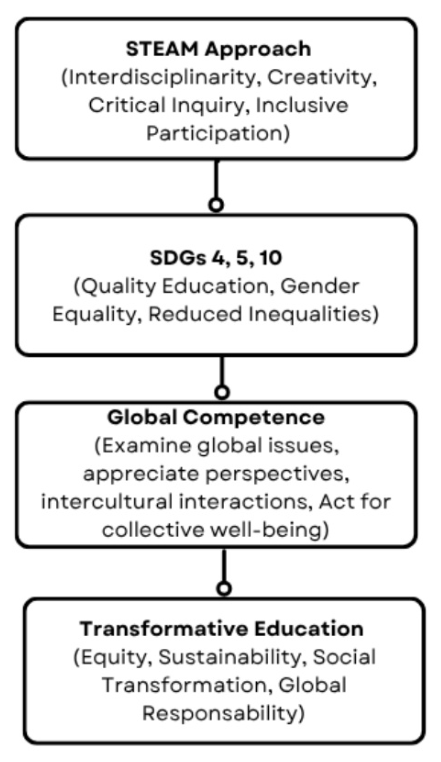
The primary contribution of this review lies in synthesizing disparate literature on STEAM, sustainable development, and Global Competence, thereby mitigating the current dearth of integrated analyses within global educational agendas. Building on this theoretical foundation, this review proposes a conceptual model in which STEAM functions as a driver of transformative education. Through the integration of sciences and the arts, STEAM catalyzes interdisciplinarity, creativity, critical inquiry, and inclusive participation. These mechanisms align directly with the objectives of SDGs 4, 5, and 10, positioning STEAM as a pedagogical conduit toward quality education, gender equality, and the reduction in inequalities. Simultaneously, these elements foster the development of Global Competence, understood as the ability to analyze global issues, appreciate multiple perspectives, engage in intercultural dialogue, and act for collective well-being. Collectively, this reconceptualization establishes STEAM as far more than an instructional model: it is a paradigm that bridges interdisciplinary learning with equity, sustainability, and social transformation across diverse and unequal educational contexts.
Figure 1 delineates the conceptual model developed in this review, illustrating how STEAM serves as the primary entry point connecting with Sustainable Development Goals (SDGs) 4 (Quality Education), 5 (Gender Equality), and 10 (Reduced Inequalities). These goals, in turn, underpin the development of Global Competence, ultimately culminating in a transformative and inclusive educational approach.

3. Materials and Methods

This study employs a qualitative systematic review, grounded in the typology established by Grant and Booth [40]. This methodological approach was adopted for its interpretative nature, which prioritizes the identification of cross-cutting themes and constructs rather than the statistical aggregation typical of meta-analyses. By synthesizing findings from heterogeneous educational contexts, this design transcends mere data summarization to elucidate the multifaceted nature of the STEAM phenomenon. Such a process is instrumental to this study’s objective: it enables the interpretative translation of accumulated knowledge into a robust theoretical synthesis. Consequently, this facilitates the reconceptualization of STEAM as a Transformative STEAM Framework aligned with the SDGs and Global Competence.
To operationalize this objective, we adopted a multi-layered methodological design. This review is underpinned by the framework of Critical Interpretive Synthesis (CIS) [41], allowing for a rigorous evaluation of the literature’s conceptual density and the generation of new theoretical constructs. Within this critical framework, data extraction and coding were executed via a hybrid thematic synthesis approach [42] to ensure methodological rigor and transparency across non-statistical findings. Finally, the review process adheres to the PRISMA 2020 statement (Supplementary Materials), incorporating the recommendations by Page et al. [43] for reviews evaluating educational interventions and qualitative syntheses.

3.1. Search Strategy and Data Sources

In alignment with the aforementioned framework, the documentary search strategy was formulated to identify rigorous scholarly literature addressing the nexus between STEAM, SDGs 4, 5, and 10, and the development of Global Competence in educational contexts. To ensure comprehensive interdisciplinary reach, the Scopus, Web of Science, and ERIC databases were selected. Scopus and Wos provide access to high-impact, peer-reviewed global literature across multiple disciplines, ensuring the inclusion of studies meeting stringent citation standards. Complementarily, ERIC was included as the foremost specialized database in the field of education, enabling the retrieval of specific pedagogical frameworks that generalist databases might overlook. This triangulation mitigates selection bias and ensures that the intersection between STEAM, SDG 4,5,10 and Global Competence is captured from both systemic and specialized educational perspectives.
The final search across all databases was conducted on 15 June 2025. To ensure reproducibility and reflect the theoretical intersection of our framework, the documentary search followed an iterative and complementary design balancing precision and sensitivity. Search strings were constructed by combining key terms grouped into four thematic blocks using Boolean operators (AND, OR), and adapting the syntax tailored to the specific requirements of each database. This multi-stage approach is detailed in Table 1, enabling the identification of the explicit intersection between those domains while functioning as a sensitivity filter for studies addressing the nexus between these areas without necessarily indexing all three components as primary keywords. The screening and selection process was conducted manually to ensure the interpretative sensitivity required by the CIS framework; no automated screening tools or AI-driven software were employed. Although this review follows PRISMA 2020 guidelines to ensure transparency in reporting, it was not pre-registered. This decision is consistent with its interpretive qualitative design based on Critical Interpretive Synthesis (CIS), which prioritizes iterative and theory-generating processes over protocol-driven aggregation [41].
Following the retrieval phase, the subsequent selection process prioritized construct validity over broad sensitivity. By requiring the intersection of three distinct theoretical domains—STEAM, SDGs, and Global Competence—this review deliberately excluded general environmental education studies or STEM interventions lacking an artistic or global citizenship component. This rigorous screening ensures that the selected studies specifically address the transformative nexus proposed in our research question.
To maintain academic rigor, the following stringent inclusion criteria were applied:
  • Subject area: studies focused on the STEAM approach in education; research on Global Competence or global citizenship; and articles analyzing the relationship between STEAM and SDGs 4, 5, and 10.
  • Document type: peer-reviewed research articles, literature reviews, case studies, and relevant institutional documents.
  • Language: English and Spanish.
  • Publication period: 2014 to 2024.
  • Educational context: all educational levels (primary, secondary, higher education, teacher training, etc.).
Conversely, the exclusion criteria were:
  • Studies focused solely on STEM without an artistic dimension or a transformative pedagogical framework.
  • Documents mentioning the SDGs or Global Competence without application to educational contexts.
  • Non-academic documents (e.g., blogs, opinion articles, or non-peer-reviewed materials).
  • Full text documents inaccessible via university repositories or open access.
Regarding language, the restriction to English and Spanish was motivated by the need to ensure interpretative validity. Given the qualitative nature of this review, native or near-native fluency was deemed essential to accurately capture the nuances of theoretical frameworks and pedagogical interventions without relying on automated translation tools. Furthermore, while English covers the global scientific discourse, Spanish represents a significant volume of literature in educational research, allowing for a robust analysis within the authors’ linguistic expertise.
The 2014–2024 timeline was delineated to capture the emergence and adoption of the 2030 Agenda [44] and the formal introduction of Global Competence in the OECD [4] framework. allowing for the analysis of how STEAM has evolved as a strategy for their achievement. Tis period allows for a longitudinal analysis of how STEAM has evolved as a strategy for attaining these global milestones. This strategy ensured consistency with this review’s objectives, providing a robust foundation for analyzing STEAM as a transformative pedagogical strategy.

3.2. Selection Process and Quality Appraisal

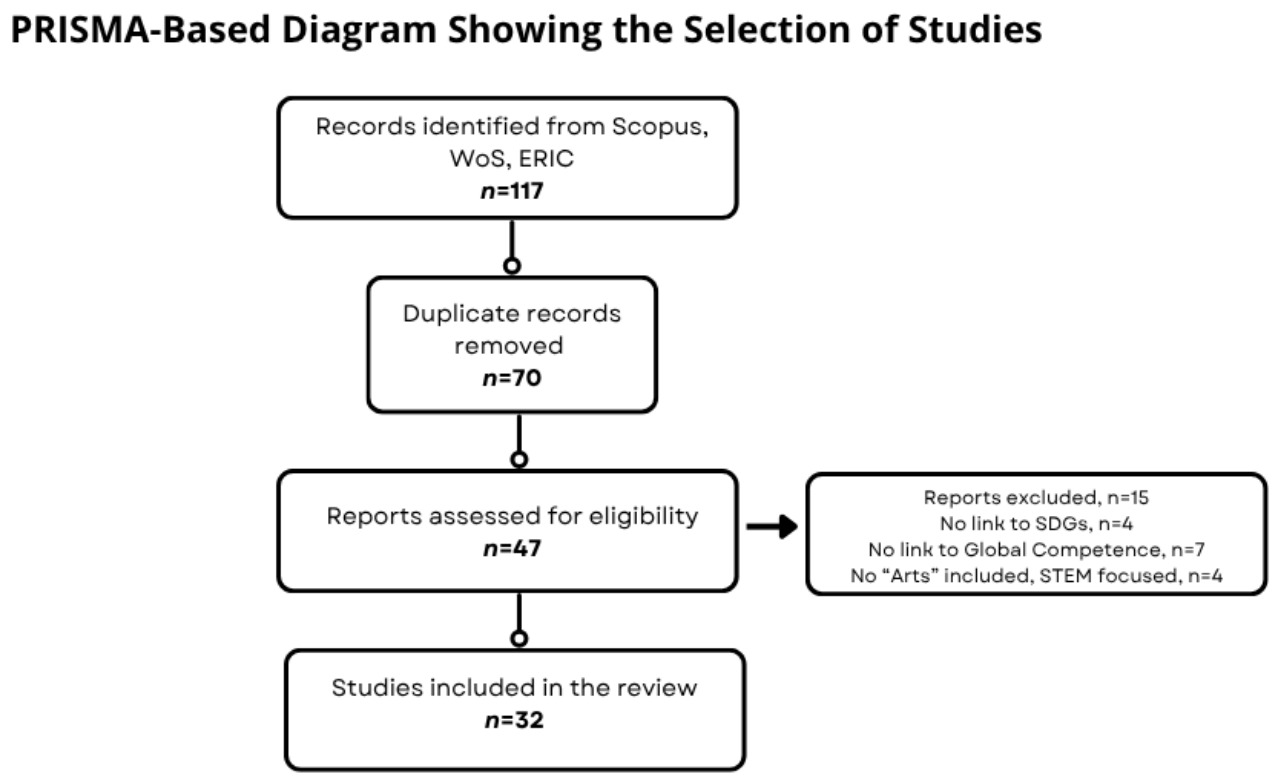
The study selection process was executed in three consecutive phases, as delineated in the PRISMA flow diagram (Figure 2). Initially, the search yielded 117 records. Subsequently, duplicates were removed across databases, resulting in 47 unique records. In the third phase, these 47 eligible records underwent a comprehensive full-text review. The screening and data extraction process was led by the primary researcher and systematically validated through a cross-check of a random sample (20% of records) by the co-authors. This inter-rater calibration exercise ensured consistency in the application of the appraisal criteria and mitigated potential selection bias through deliberative consensus.
Methodological quality and relevance were appraised using the Critical Interpretive Synthesis (CIS) framework [41]. The appraisal prioritized ‘interpretive power’ and ‘conceptual contribution’ over generic procedural checklists, which often prioritize surface-level reporting over theoretical density. Under this paradigm, three interpretive quality axes governed the appraisal process:
(1) Authentic STEAM Integration: distinguishing genuine STEAM interventions from traditional STEM approaches by evaluating whether the Arts (A) functioned as a structural epistemological tool rather than a peripheral decorative element.
(2) SDG Alignment and Purpose: ensuring that the STEAM approach was not utilized solely to produce isolated technological outputs but was explicitly designed to address the socio-environmental targets of SDGs 4, 5, or 10.
(3) Global Competence Development: verifying that pedagogical actions actively fostered the specific dimensions of Global Competence.
This rigorous screening served as a high-standard filter to prevent conceptual dilution within the resulting framework. Consequently, 15 studies were excluded for exhibiting conceptual thinness or a superficial engagement with the transformative variables (e.g., absence of a clearly defined artistic component or lack of concrete application of the SDGs). This purposive, qualitative-driven selection ensures that the final corpus of 32 articles constitutes a high-fidelity theoretical foundation for the Transformative STEAM Framework. In line with interpretive review methodologies, the final corpus size (n = 32) was determined by conceptual saturation rather than statistical representativeness, ensuring depth of analysis over breadth.

3.3. Data Synthesis and Coding Transparency

Once the final corpus was established, data analysis was conducted via a hybrid thematic synthesis approach [42], which synthesizes deductive and inductive coding to ensure both theoretical consistency and interpretative depth. To manage this process systematically, data were extracted into a standardized matrix organized by database and thematic dimensions. Initially, a deductive coding phase was applied using predefined categories derived from the search strategy and the core research question: “STEAM approach”, “Sustainable Development Goals/2030 Agenda”, “Global Competence”, and “Educational context”. This stage ensured that all text segments relevant to the theoretical framework were systematically identified and extracted.
Following this, the analysis proceeded inductively to discern emergent patterns and relationships within the literature. At this stage, we applied the method for generating analytical themes outlined by Thomas and Harden [45]. We examined how the interplay between coded concepts within each study’s narrative, identifying implicit connections. This process enabled us to transcend primary data to formulate what CIS terminology [41] defines as a synthesizing argument: a novel theoretical structure that elucidates the transformative capacity of STEAM to align with SDGs 4, 5 and 10, and Global Competence. By integrating deductive codes with inductive insights, we developed the Transformative STEAM Framework illustrated in the discussion.

4. Results

The systematic screening and selection process culminated in a final corpus of 32 studies. Although this sample size reflects the stringent inclusion criteria applied, it represents a significant empirical finding in itself: it underscores that while STEAM education, the Sustainable Development Goals (SDGs), and Global Competence are robustly documented as independent domains, their theoretical and practical convergence remains a nascent and largely underexplored intersection. The relative paucity of research at this theoretical nexus suggests that the field is currently in an early stage of conceptual and empirical consolidation. Through the hybrid thematic synthesis, three overarching themes emerged, characterizing the operationalization of the Transformative STEAM Framework.

4.1. Theme 1: STEAM as a Driver for Quality, Equity, and Inclusion (SDGs 4, 5, and 10)

Quality, equity, and inclusion emerge as salient outcomes of STEAM initiatives. A robust body of evidence links STEAM implementation to enhanced pedagogical quality [46,47,48,49], and the cultivation of more inclusive learning environments [18,26,27]. The synthesis suggests that this inclusivity is fundamentally underpinned by the multimodal nature of STEAM, which facilitates diverse forms of representation and engagement. Furthermore, a significant body of studies highlights the reduction in gender and participation gaps [16,24,49], directly advancing the targets of SDG 5.
However, the synthesis reveals a pronounced imbalance in SDG coverage. While SDG 4 (Quality Education) and SDG 5 (Gender Equality) receive substantial attention, explicit connections to SDG 10 (Reduced Inequalities) remain scarce and often implicit. This indicates a notable thematic lacuna in addressing broader structural and socio-economic inequalities. Most interventions continue to focus on localized, classroom-level inclusion, rather than seeking the systemic social transformation required to dismantle macro-level disparities.

4.2. Theme 2: Operationalizing Global Competence Through STEAM Mechanisms

The second theme identifies Global Competence as a pivotal outcome of STEAM, cultivated through interdisciplinary, experiential, and problem-based learning approaches [22,23,50]. Inductive analysis reveals that STEAM oriented interventions facilitate the development of this competence by grounding learning experiences in authentic, real-world challenges aligned with student interests.
However, a critical gap persists regarding the transition from conceptual potential to empirical measurability. Despite robust theoretical alignment, there is a notable scarcity of studies providing concrete frameworks or validated assessment tools to objectively quantify the impact of STEAM on Global Competence. Extant evidence remains predominantly focused on qualitative perceptions or self-reported student engagement, suggesting that while STEAM serves as a powerful vehicle for exploring global issues, the field currently lacks the rigorous metrics required to validate the acquisition of these competencies.
As a foundational step toward remedying this deficiency and establishing observable outcomes, Table 2 operationalizes the four dimensions of Global Competence [4] into tangible, observable STEAM pedagogical actions. By synthesizing representative evidence from the reviewed corpus, this mapping demonstrates how various STEAM interventions actively cultivate the dispositions and behaviors associated with global citizenship.

4.3. Theme 3: Epistemological Reconceptualization: From Method to Paradigm

Finally, the third theme attains an analytical level of interpretation [45], serving as the core synthesizing argument of this review. Within this theme, STEAM is reimagined not merely as an instructional methodology, but as a transformative epistemological framework. This paradigm challenges traditional disciplinary boundaries, aligning education with critical, inclusive, and sustainability-oriented pedagogies [38,49,51]. Although this reconceptualization is less firmly established than the practical applications, it provides the theoretical scaffolding necessary to position STEAM as a pivotal catalyst for the 2030 Agenda.
Complementing these findings, Table 3 presents a comprehensive synthesis of the final corpus (2014–2024), categorizing each study by author, year, educational level, geographic region, methodological approach, specific SDGs addressed, linkage to Global Competence, and the functional role assigned to the arts. Furthermore, the conceptual model distilled from this synthesis is illustrated in Figure 1, as previously delineated.

5. Discussion and Conclusions

This qualitative systematic review maps the conceptualization and application of the STEAM approach in addressing SDGs 4 (Quality Education), 5 (Gender Equality), and 10 (Reduced Inequalities) while simultaneously fostering Global Competence. The findings suggest its potential as a transformative pedagogical strategy that integrates scientific, technological, artistic, and social dimensions to promote inclusive, competence-based learning. As illustrated in the proposed conceptual model (Figure 1), the analysis indicates that STEAM may function as a framework capable of contributing to quality education, gender equality, and the development of Global Competence by equipping learners with the values, skills, and dispositions associated with active, critical, and responsible citizenship.
By synthesizing evidence from diverse educational contexts, this review positions STEAM as a potentially transformative framework, aligned with the 2030 Agenda. The analytical themes generated—ranging from pedagogical quality to epistemological shifts—provide a theoretically grounded interpretation of how STEAM can extend beyond integrative methodologies toward more socially responsive educational practices.
At the same time, the findings reveal important limitations in the current body of literature. The limited presence of explicit connections to SDG 10 suggests that the potential of STEAM to address structural inequalities remains underexplored. Likewise, although Global Competence is frequently referenced, it is rarely operationalized through validated empirical frameworks or assessment tools, which constrains its pedagogical implementation and evaluation. In response to these gaps, the following implications are proposed:
  • Curriculum Design: SDGs (4, 5, and 10) should be integrated as structuring axes of STEAM learning experiences rather than as peripheral references. Within this perspective, the Arts (A) can operate as epistemological tools that enable critical and interpretive engagement with complex social realities, extending beyond their frequent use as motivational elements.
  • Assessment and Evaluation: There is a need to develop and validate multidimensional assessment approaches aligned with the Transformative STEAM Framework. Such approaches should move beyond traditional metrics to capture dimensions of Global Competence and their relationship with SDG-oriented action. The development of rubric-based instruments may support the operationalization of these constructs, particularly in relation to socio-ethical dimensions such as those associated with SDG 10.
  • Teacher Education: Teacher professional development could benefit from incorporating critical pedagogy and equity-oriented frameworks, supporting educators in facilitating interdisciplinary inquiry and socially responsive learning processes.
  • Educational Policy: Policy frameworks may consider aligning STEAM initiatives with equity-oriented strategies to ensure that their implementation contributes to reducing educational disparities, particularly in contexts associated with SDG 10.
From a methodological perspective, the use of a qualitative systematic review design [40] and the Critical Interpretive Synthesis (CIS) framework [41] enabled a focus on conceptual depth rather than statistical aggregation. While this approach enhances theoretical insight, it also entails limitations. The restriction to English and Spanish publications may introduce linguistic bias, and the interpretive nature of the synthesis limits statistical generalizability. However, consistent with interpretive review methodologies, the relatively small corpus (n = 32) reflects conceptual saturation rather than representativeness, reinforcing the emerging nature of this research field.
In conclusion, this review proposes Transformative STEAM as an emerging conceptual framework for understanding the intersection between STEAM education, sustainability, and Global Competence. Further research is needed to deepen its empirical grounding, particularly by addressing SDG 10, developing validated assessment tools, and strengthening the structural integration of the arts. Advancing in these directions may contribute to positioning STEAM as a more inclusive and socially responsive educational approach aligned with the goals of the 2030 Agenda.

Supplementary Materials

The following supporting information can be downloaded at: https://www.mdpi.com/article/10.3390/su18094153/s1, PRISMA 2020 Checklist.

Author Contributions

Conceptualization, A.S.-S. and N.B.-Q.; methodology, A.S.-S. and N.B.-Q.; validation, A.S.-S., N.B.-Q. and J.P.-B.; formal analysis, A.S.-S.; investigation, A.S.-S.; data curation, A.S.-S.; writing—original draft preparation, A.S.-S.; writing—review and editing, A.S.-S., N.B.-Q. and J.P.-B.; visualization, A.S.-S.; supervision, N.B.-Q. and J.P.-B. All authors have read and agreed to the published version of the manuscript.

Funding

This research was funded by the European Union’s Horizon Europe programme under Grant Agreement No. 101094874—STEAMbrace (HORIZON-CL2-2022-TRANSFORMATION-01), coordinated by the Weblearner Research Group (University of the Basque Country, EHU).

Acknowledgments

The authors would like to thank the Weblearner Research Group from the Faculty of Education of the University of the Basque Country (EHU) for its valuable institutional support through the development of this research.

Conflicts of Interest

The authors declare no conflicts of interest.

Abbreviations

The following abbreviations are used in this manuscript:
STEAMScience, Technology, Engineering, Arts, and Mathematics
STEMScience, Technology, Engineering, and Mathematics
SDGSustainable Development Goals
SDG 4Sustainable Development Goals 4: Quality Education
SDG 5Sustainable Development Goal 5: Gender Equality
SDG 10Sustainable Development Goal 10: Reduced Inequalities
PRISMAPreferred Reporting Items for Systematic reviews and Meta-Analyses
CISCritical Interpretive Synthesis
OECDOrganization for Economic Co-operation and Development
UNESCOUnited Nations Educational, Scientific and Cultural Organization
ERICEducation Resources Information Center
PBLProblem-Based Learning

References

  1. Delval, J. La escuela para el siglo XXI. Sinéctica 2013, 40, 1–18. [Google Scholar]
  2. UNESCO. Incheon Declaration and Framework for Action for the Implementation of Sustainable Development Goal 4; UNESCO: Paris, France, 2016. Available online: https://unesdoc.unesco.org/ark:/48223/pf0000245656 (accessed on 14 March 2024).
  3. European Commission. Recommendation of the European Parliament and of the Council of 18 December 2006 on key competences for lifelong learning (2006/962/EC). Off. J. Eur. Union 2006, L394, 10–18. [Google Scholar]
  4. OCDE. PISA 2018 Global Competence Framework. Preparing Our Youth for an Inclusive and Sustainable World; OECD Publishing: Paris, France, 2018; Available online: https://www.educacionfpydeportes.gob.es/dam/jcr:df1f4128-5a8f-46f2-b0c4-498f3eb16698/PISA%202018%20Marco%20Competencia%20Global%20(Digital).pdf (accessed on 10 June 2025).
  5. UNESCO. Reimagining Our Futures Together: A New Social Contract for Education; UNESCO: Paris, France, 2021. [CrossRef]
  6. Ministerio de Educación, Formación Profesional y Deportes. La Agenda 2030 y el Papel de la Educación para Alcanzar los ODS. Available online: https://www.educacionfpydeportes.gob.es/biblioteca-central/blog/2024/febrero/agenda-2030-educacion.html (accessed on 14 March 2024).
  7. Bertrand, M.G.; Namukasa, I.K. STEAM education: Student learning and transferable skills. J. Res. Innov. Teach. Learn. 2020, 13, 43–56. [Google Scholar] [CrossRef]
  8. Haraguchi, R.; Ohnuki, A.; Shiihashi, G.; Ishizawa, J. A Study on Japanese-Style STEAM Practices about “Paper” for Early Childhood Education Focusing on the Sustainability Competencies. In Proceedings of the 2024 International STEM Education Conference (iSTEM-Ed), Bangkok, Thailand, 31 July–2 August 2024. [Google Scholar] [CrossRef]
  9. Aguilera, D.; Ortiz-Revilla, J. STEM vs. STEAM Education and Student Creativity: A Systematic Literature Review. Educ. Sci. 2021, 11, 331. [Google Scholar] [CrossRef]
  10. Perignat, E.; Katz-Buonincontro, J. STEAM in practice and research: An integrative literature review. Think. Ski. Creat. 2019, 31, 31–43. [Google Scholar] [CrossRef]
  11. Chan, R.C.H. A social cognitive perspective on gender disparities in self-efficacy, interest, and aspirations in science, technology, engineering, and mathematics (STEM): The influence of cultural and gender norms. Int. J. STEM Educ. 2022, 9, 37. [Google Scholar] [CrossRef]
  12. Allina, B. The development of STEAM educational policy to promote student creativity and social empowerment. Arts Educ. Policy Rev. 2017, 119, 77–87. [Google Scholar] [CrossRef]
  13. Yim, I.H.Y.; Su, J.; Wegerif, R. STEAM in practice and research in primary schools: A systematic literature review. Res. Sci. Technol. Educ. 2024, 43, 1065–1089. [Google Scholar] [CrossRef]
  14. Gavari-Starkie, E.; Espinosa-Gutiérrez, P.T.; Lucini-Baquero, C. Sustainability through STEM and STEAM Education Creating Links with the Land for the Improvement of the Rural World. Land 2022, 11, 1869. [Google Scholar] [CrossRef]
  15. United Nations. Sustainable Development Goals. Available online: https://www.un.org/sustainabledevelopment/ (accessed on 14 March 2024).
  16. Chansaengsee, S. STEAM approach for improving 21st century skills of multicultural students attending inclusive classroom. Kasetsart J. Soc. Sci. 2024, 45, 11–20. [Google Scholar]
  17. Zúñiga-Tinizaray, F.S.; Marín, V.I. Estrategias Educativas STEM-STEAM en Nivel Superior: Revisión Sistemática de Literatura. Rev. Espac. 2024, 45, 16–30. [Google Scholar] [CrossRef]
  18. Wu, S.C.; Chang, Y.L. Designing and implementing maker curriculum for promoting 7th graders’ maker competence. Front. Educ. 2023, 8, 1201534. [Google Scholar] [CrossRef]
  19. Juvera, J.; Hernández López, S. STEAM en la Infancia y La Brecha de Género. Una propuesta para la educación no formal. Rev. Int. Educ. Aprendiz. 2021, 9, 9–25. [Google Scholar] [CrossRef]
  20. Alsina, A.; Silva-Hormazábal, M. Promoviendo la formación del profesorado de matemáticas para la sostenibilidad desde un enfoque STEAM. Av. Investig. Educ. Mat. 2023, 23, 105–125. [Google Scholar]
  21. UNICEF. La Educación STEAM Transformó los Sueños Profesionales de los Estudiantes de Río Zarco. Available online: https://www.unicef.org/elsalvador/historias/educacion-steam-transformo-suenos-profesionales-de-estudiantes (accessed on 14 March 2025).
  22. Chung, S.K.; Li, D. Issues-Based STEAM education: A case study in a Hong Kong secondary school. Int. J. Educ. Arts 2021, 22, 3. [Google Scholar]
  23. Yulianti, E.; Suwono, H.; Abd Rahman, N.F.; Phang, F.A. State of the Art of STEAM Education in Science Classrooms: A Systematic Literature Review. Educ. Sci. 2024, 6, 20240032. [Google Scholar] [CrossRef]
  24. Leavy, A.; Dick, L.; Meletiou-Mavrotheris, M.; Paparistodemou, E.; Stylianou, E. The prevalence and use of emerging technologies in STEAM education: A systematic review of the literature. J. Comput. Assist. Learn. 2022, 39, 1061–1082. [Google Scholar] [CrossRef]
  25. Videla, R.; Veloz, T.; Pino, M.C. Catching the Big Fish: A 4E-Cognition Approach to Creativity in STEAM Education. Constr. Found. 2023, 18, 295–307. [Google Scholar]
  26. Nong, L.; Liao, C.; Ye, J.H.; Wei, C.; Zhao, C.; Nong, W. The STEAM learning performance and sustainable inquiry behavior of college students in China. Front. Psychol. 2022, 13, 975515. [Google Scholar] [CrossRef]
  27. Lu, S.Y.; Wu, C.L.; Huang, Y.M. Evaluation of Disabled STEAM-Students’ Education Learning Outcomes and Creativity under the UN Sustainable Development Goal. Sustainability 2022, 14, 679. [Google Scholar]
  28. Hsiao, H.S.; Chen, J.C.; Chen, J.H.; Zeng, Y.T.; Chung, G.H. An Assessment of Junior High School Students’ Knowledge, Creativity, and Hands-On Performance Using PBL to Achieve STEAM. Sustainability 2022, 14, 5582. [Google Scholar] [CrossRef]
  29. Banks, J.A. Diversity, Group Identity, and Citizenship Education in a Global Age. J. Educ. 2014, 194, 129–139. [Google Scholar] [CrossRef]
  30. Mezirow, J. Transformative Learning as Discourse. J. Transform. Educ. 2003, 1, 59–63. [Google Scholar] [CrossRef]
  31. Ramos-Pla, A.; Del Arco, I.; Olondriz-Valverde, A.; Fornons Casol, L. Education and Nursing in the 2030 Agenda: Challenges and Opportunities for University Education. Sustainability 2025, 17, 2757. [Google Scholar] [CrossRef]
  32. Villacañas Castro, L.S. The Pedagogical Solution: Freire’s Critical Pedagogy and Social Democracy. In Critical Pedagogy and Marx, Vygotsky and Freire; Villacañas Castro, L.S., Ed.; Palgrave Macmillan: London, UK, 2016; pp. 125–150. [Google Scholar] [CrossRef]
  33. Kersanszki, T.; Márton, Z.; Fenyvesi, K.; Lavicza, Z.; Holik, I. Minecraft in STEAM education: Applying game-based learning to renewable energy. Interact. Des. Archit. 2024, 60, 194–213. [Google Scholar] [CrossRef]
  34. Sterling, S. Sustainable Education: Re-visioning Learning and Change; Green Books: Totnes, UK, 2001. Available online: https://www.researchgate.net/publication/289505456_Sustainable_education (accessed on 14 June 2025).
  35. Henze, J.; Schatz, C.; Malik, S.; Bresges, A. How Might We Raise Interest in Robotics, STEAM and Sustainable Development in Teacher Training. Front. Educ. 2022, 7, 872637. [Google Scholar] [CrossRef]
  36. Walton, E. Why inclusive education falters: A Bernsteinian analysis. Int. J. Incl. Educ. 2025, 29, 570–584. [Google Scholar] [CrossRef]
  37. Massiah, A.; Shotte, G.; Rowe, V.; Minott, C. Educational leadership for social transformation: An inclusive approach for schools as places of belonging. Power Educ. 2025, 17, 142–158. [Google Scholar]
  38. Rodrigues-Silva, J.; Alsina, Á. Conceptualising and framing STEAM education: What is (and what is not) this educational approach. Texto Livre 2023, 16, e44946. [Google Scholar] [CrossRef]
  39. Snyder, H. Literature review as a research methodology: An overview and guidelines. J. Bus. Res. 2019, 104, 333–339. [Google Scholar] [CrossRef]
  40. Grant, M.J.; Booth, A. A typology of reviews: An analysis of 14 review types and associated methodologies. Health Inf. Libr. J. 2009, 26, 91–108. [Google Scholar] [CrossRef]
  41. Dixon-Woods, M.; Cavers, D.; Agarwal, S.; Annandale, E.; Arthur, A.; Harvey, J.; Hsu, R.; Katbamna, S.; Olsen, R.; Smith, L.; et al. Conducting a critical interpretive synthesis of the literature on access to healthcare by vulnerable groups. BMC Med. Res. Methodol. 2006, 6, 35. [Google Scholar] [CrossRef]
  42. Fereday, J.; Muir-Cochrane, E. Demonstrating Rigor Using Thematic Analysis: A Hybrid Approach of Inductive and Deductive Coding and Theme Development. Int. J. Qual. Methods 2006, 5, 80–92. [Google Scholar] [CrossRef]
  43. Page, M.J.; McKenzie, J.E.; Bossuyt, P.M.; Boutron, I.; Hoffmann, T.C.; Mulrow, C.D.; Shamseer, L.; Tetzlaff, J.M.; Akl, E.A.; Brennan, S.E.; et al. The PRISMA 2020 statement: An updated guideline for reporting systematic reviews. BMJ 2021, 372, n71. [Google Scholar] [CrossRef] [PubMed]
  44. United Nations. Transforming Our World: The 2030 Agenda for Sustainable Development (A/RES/70/1). 2015. Available online: https://sdgs.un.org/sites/default/files/publications/21252030%20Agenda%20for%20Sustainable%20Development%20web.pdf (accessed on 25 March 2025).
  45. Thomas, J.; Harden, A. Methods for the thematic synthesis of qualitative research in systematic reviews. BMC Med. Res. Methodol. 2008, 8, 45. [Google Scholar] [CrossRef]
  46. Dashdemirov, A.; Sharifov, G. Secondary school STEAM education: Case study research and problems. Adv. Phys. Res. 2022, 4, 111–121. [Google Scholar]
  47. Yakymenko, Y.; Poplavko, Y.; Lavrysh, Y. STEAM as a factor of individual systems thinking development for students of electronics speciality. Adv. Educ. 2020, 15, 4–11. [Google Scholar] [CrossRef]
  48. Mang, H.M.A.; Chu, H.E.; Martin, S.N.; Kim, C.J. An SSI-Based STEAM Approach to Developing Science Programs. Asia-Pac. Sci. Educ. 2021, 7, 549–585. [Google Scholar] [CrossRef]
  49. Balyk, N.R.; Vasylenko, Y.P.; Shmyger, G.P.; Oleksiuk, V.P.; Balyk, A.V. STEAM+H: A model for integrating humanities and sustainable development. CEUR Workshop Proc. 2025, 3949, 72–92. Available online: https://ceur-ws.org/Vol-3949/paper15.pdf (accessed on 15 June 2025).
  50. Lam, K.F.T.; Wang, T.H.; Vun, Y.S.; Ku, N. Developing Critical Thinking in a STEAM classroom. In Proceedings of the CISETEC 2019, Online, 10–12 December 2019; pp. 82–90. Available online: https://ceur-ws.org/Vol-2555/paper7.pdf (accessed on 14 June 2025).
  51. Sorguç, A.G.; Özgenel, Ç.F.; Yemişcioğlu, M.K.; Küçüksubaşı, F.; Yıldırım, S.; Antonini, E.; Bartolomei, L.; Ovesen, N.; Steinø, N. STEAM Approach for Architecture Education. Blucher Des. Proc. 2019, 12, 137–146. [Google Scholar]
  52. Santillán Aguirre, J.P.; Cadena Vaca, V.D.; Cadena Vaca, M. Educación Steam: Entrada a la sociedad del conocimiento. Cienc. Dig. 2019, 3, 212–227. [Google Scholar] [CrossRef]
  53. Hadinugrahaningsih, T.; Rahmawati, Y.; Ridwan, A. Developing 21st Century Skills in Chemistry Classrooms: Opportunities and Challenges of STEAM Integration. In Proceedings of the 4th ICRIEMS, Yogyakarta, Indonesia, 15–16 May 2017. [Google Scholar] [CrossRef]
  54. Yunianto, W.; Cahyono, A.N.; Prodromou, T.; El-Bedewy, S.; Lavicza, Z. CT integration in STEAM learning: Fostering students’ creativity by making Batik stamp pattern. Sci. Act. 2025, 62, 26–52. [Google Scholar] [CrossRef]
  55. Choi, S.; Won, A.; Chu, H.; Cha, H.; Shin, H.; Kim, C. The Impacts of a Climate Change SSI-STEAM Program on Junior High School Students’ Climate Literacy. Asia-Pac. Sci. Educ. 2021, 7, 96–133. [Google Scholar] [CrossRef]
  56. Indahwati, S.D.; Rachmadiarti, F.; Hariyono, E.; Prahani, B.K.; Wibowo, F.C.; Bunyamin, M.A.H.; Satriawan, M. Integration of independent learning in STEAM-based renewable energy education. E3S Web Conf. 2023, 450, 01010. [Google Scholar] [CrossRef]
  57. Arango-Caro, S.; Langewisch, T.; Ying, K.; Haberberger, M.A.; Ly, N.; Branton, C.; Callis-Duehl, K. 3D plants: The impact of integrating design and technology on high school student learning in STEAM. Discip. Interdiscip. Sci. Educ. Res. 2025, 7, 1. [Google Scholar] [CrossRef]
  58. Segarra-Morales, A.K.; Juca-Aulestia, M. Strategies and Skills in STEAM Education Systematic Review. In Information Technology and Systems; Rocha, Á., Ed.; Springer: Cham, Switzerland, 2024; pp. 415–425. [Google Scholar]
  59. Körtesi, P.; Simonka, Z.; Szabo, Z.K.; Guncaga, J.; Neag, R. Challenging Examples of Computer Tools for the Sustainability of Knowledge in STEAM Education. Sustainability 2022, 14, 12991. [Google Scholar] [CrossRef]
  60. Khazaee, M.; Sabourian, L. Improving Children’s STEAM Education and Their Global Competence Through Collaborative Cooking. In Advances in Human Factors in Training, Education, and Learning Sciences; Nazir, S., Ed.; Springer: Cham, Switzerland, 2020; pp. 137–143. [Google Scholar] [CrossRef]
  61. Damaševičius, R.; Maskeliūnas, R.; Blažauskas, T. Faster pedagogical framework for STEAM education based on educational robotics. Int. J. Eng. Technol. 2018, 7, 138–142. [Google Scholar] [CrossRef]
  62. Helvaci, I.; Yılmaz, M. Examining the effect of STEAM approach applications on attitude towards STEAM in visual arts education. Int. J. Curric. Instr. 2022, 14, 2188–2217. [Google Scholar]
Figure 1. Conceptual model positioning STEAM as a strategy to address SDGs 4, 5, and 10, foster Global Competence, and advance transformative education.
Sustainability 18 04153 g001
Figure 2. PRISMA-Based Flow Diagram Showing the Identification, Screening, and Inclusion of Studies for the Qualitative Systematic Review.
Sustainability 18 04153 g002
Table 1. Iterative Search Strategy and Search Objectives.
Query IDSearch StringThematic Focus
Q1“STEAM” AND “2030 Agenda” AND “Global Competence”Initial mapping of the core intersection.
Q2(“STEAM education” OR “STEAM approach” OR “STEAM pedagogy”) AND (“Sustainable Development Goals” OR “SDG 4” OR “SDG 5” OR “SDG 10” OR “Agenda 2030”) AND (“Global Competence” OR “global citizenship” OR “21st century skills”) AND (“education” OR “teaching” OR “curriculum” OR “educational strategy”)Comprehensive intersection of the three primary domains.
Q3(“STEAM education” OR “STEAM approach” OR “STEAM pedagogy”) AND (“Sustainable Development Goals” OR “SDG 4” OR “SDG 5” OR “SDG 10” OR “Agenda 2030”) AND (“education” OR “teaching” OR “curriculum”)Broadened search focusing on the STEAM-Global Competence nexus.
Q4(“STEAM education” OR “STEAM approach” OR “STEAM pedagogy”) AND (“Global Competence” OR “global citizenship” OR “21st century skills”) AND (“education” OR “teaching” OR “curriculum”)Broadened search focusing on the STEAM-Global Competence nexus.
Table 2. Operationalization of Global Competence Dimensions within Transformative STEAM.
Dimension of Global CompetencePractice in STEAM and Evidence from the Corpus
Dimension 1: Examining local, global, and intercultural issuesIntegrating Sustainable Development as the core inquiry axis. For instance, Balyk et al. [49] propose the STEAM + H model, where ecological and socio-cultural problems become the starting point for technological and scientific exploration.
Dimension 2: Understanding and appreciating perspectivesUtilizing the Arts (A) and Humanities (H) to frame scientific challenges through diverse cultural worldviews. Balyk et al. [49] and Yim et al. [13] demonstrate how artistic and humanistic integration enables students to evaluate problems beyond mere technical efficiency, fostering ethical and empathetic understanding.
Dimension 3: Engaging in open, appropriate, and effective interactionsImplementing Project-Based Learning (PBL) where diverse students must negotiate and communicate effectively. Lu et al. [27] showcase this through collaborative physical computing (e.g., Micro:bit), facilitating interaction and shared creation even within special education contexts.
Dimension 4: Taking action for collective well-beingEmpowering marginalized learners to move from passive consumers to active creators. Lu et al. [27] evidence how disabled students take action by designing and programming tangible socio-technical solutions, directly challenging the digital divide and contributing to their community’s well-being.
Table 3. Interpretive Quality Appraisal and Characteristic Synthesis of the Included Studies.
Author and YearEducational LevelCountry/RegionMethodological ApproachSDGs AddressedLink to Global CompetenceRole of the Arts
Hsiao et al. [28]SecondaryTaiwanQuasi-experimentalSDG 4YesIt is considered necessary to achieve balanced learning. It addresses aesthetics, creative thinking, and design.
Alsina and
Silva-Hormazabal [20]
Professional training for primary school teachers.ChileMixedSDG 5YesIt is essential for promoting awareness and action on sustainability issues.
Kersanszki et al. [33]SecondaryHungaryMixedSDG 4YesEmphasis is placed on developing spatial and narrative imagination as a form of creative thinking, which acts as a motivating force for students.
Santillán Aguirre et al. [52]Primary Education, 7th grade of Basic Education, Secondary Education, and the University level.Spain, South Korea and TurkeyInterpretative researchSDG 4YesIt acts as a bridge for sensitive communication and a tool for design and innovation. It helps humanizing technical disciplines and solve complex problems.
Henze et al. [35]Higher Education StudiesGermanyMixedSDG 4YesIt is considered essential for creativity, innovation, problem solving, and visual thinking.
Mang et al. [48]SecondaryAustralia and KoreaDesign-based research with a theoretical-descriptive approachSDG 4YesIt is associated with fostering greater participation, motivation, creativity, and divergent thinking in students.
Wu and Chang [18]SecondaryTaiwanQuasiexperimentalSDG 4YesIt is considered essential to enhance and enrich science learning experiences by adding humanistic and design elements.
Hadinugrahaningsih et al. [53]SecondaryIndonesiaQualitativeSDG 4YesIt is considered necessary to stimulate students’ creativity in the design of projects for the development of curiosity, imagination, and personal expression.
Yim et al. [13]PrimaryInternational reviewSystematic reviewSDGs 4, 5, 10YesIt is considered essential to promote 21st century skills, personal expression, and critical thinking.
Yunianto et al. [54]SecondaryIndonesiaEducational Design Research (EDR)SDG 4YesIt is said that it fosters creativity, improves student engagement and performance, brings different disciplines together, and develops 21st century skills.
Nong et al. [26]Higher educationChinaQuasi-experimentalSDG 4YesIt seeks to improve motivation, creative thinking, problem solving, and the development of computational thinking and critical thinking skills.
Choi et al. [55]SecondarySouth KoreaMixedSDG 4YesIt encourages the development of creativity and is considered valuable for addressing complex content due to its emphasis on intersection or convergence.
Balyk et al. [49]It is not limited to a specific level: the authors conducted a bibliometric analysis of STEM/STEAM education at different levels, specifically mentioning secondary and primary education.UkraineMixedSDGs 4, 5, 10YesDevelops creative and transformative thinking and innovation
Chansaengsee [16]PrimaryThailandQuasiexperimentalSDG 4YesIt encourages creativity, initiative, perseverance, and adaptability.
Haraguchi et al. [8]Early childhoodJapanQualitativeSDG 4YesEncourages reflection and the development of one’s own thoughts.
Indahwati et al. [56]Not specifiedIndonesia and MalaysiaLiterature reviewSDG 4YesDevelops creativity and problem solving.
Lu et al. [27]PrimaryTaiwanSingle case studySDG 4, SDG 10YesHelps to better understand culture and appreciate aesthetics, and develop flexibility, creative thinking, expression, and problem solving.
Arango-Caro et al. [57]SecondaryUnited StatesMixedSDG 4YesIt promotes communication and understanding and encourages creativity and innovation.
Segarra-Morales and Juca-Aulestia [58]Professional training for teachers at different stages: pre-professional, professional, and expert.EcuadorSystematic ReviewSDG 4YesDevelops complex skills such as multi-domain competence and promotes motivation among students.
Videla et al. [25]Higher education: design engineering studentsChileFace-to-face ethnographic participant observationSDG 4YesIt expands learning opportunities, benefits students’ sensorimotor structure, and highlights previously untapped skills.
Körtesi et al. [59]Higher education: first-year university studentsSlovakia, Romania and HungaryQuantitativeSDG 4YesPromotes the development of innovative methods and 21st century skills
Dashdemirov and Sharifov [46]SecondaryAzerbaijanQuantitative-descriptive case studySDG 4YesPromotes communication, problem solving, collaboration, innovation, creativity, and metacognition.
Bertrand and Namukasa [7]PrimaryCanadaQualitative Case StudySDG 4YesPromotes communication and critical thinking skills, the development of creativity, innovation, and a global perspective.
Khazaee and Sabourian [60]Early Childhood and PrimaryUnited StatesMixedSDG 4, SDG 5YesPromotes creative thinking and problem solving
Sorguç et al. [51]Higher educationTurkey, Italy and DenmarkApplied research+ design and validation of STEAM modules for architecture.SDG 4YesPromotes the development of problem-solving skills and creative, innovative, and holistic abilities.
Lam et al. [50]PrimaryTaiwanDesign-Based ResearchSDG 4YesPromotes innovative solutions to real-world problems
Damaševičius et al. [61]Higher educationLithuaniaDescription of the FASTER pedagogical framework based on applied practiceSDG 4YesFosters interest, creativity, and curiosity among students.
Chung and Li [22]SecondaryChinaQualitative case studySDGs 4, 5YesEncourages creativity and innovation and increases interest and engagement
Yulianti et al. [23]Not specifiedNot specifiedSystematic review (PRISMA)SDG 4YesEnriches STEM disciplines and promotes real-world problem solving
Yakymenko et al. [47]Higher educationUkraineDesign-based researchSDG 4YesPromotes the development of creativity, innovation, literacy, expression, and communication.
Helvaci and Yilmaz [62]SecondaryTurkeyMixedSDG 4YesIt encourages creativity and innovation, develops the ability to adapt to different situations, and improves students’ attitudes toward STEM subjects.
Leavy et al. [24]From early childhood education to higher educationNot specifiedSystematic reviewSDG 4YesIt promotes holistic and connected education, fosters the development of creativity and innovation, and allows for the development of human skills (empathy).
The table summarizes all studies included in this review (2014–2024), detailing the author and year, educational level, country or region, methodological approach, SDGs addressed, explicit connection to Global Competence, and the role assigned to the arts. The columns ‘Arts Integration’, ‘SDG Alignment’, and ‘Global Competence Linkage’ represent the three interpretive quality axes defined in the methodology. The descriptive content of each cell demonstrates the theoretical density and epistemological integrity of the studies.
Disclaimer/Publisher’s Note: The statements, opinions and data contained in all publications are solely those of the individual author(s) and contributor(s) and not of MDPI and/or the editor(s). MDPI and/or the editor(s) disclaim responsibility for any injury to people or property resulting from any ideas, methods, instructions or products referred to in the content.