Article

Organizational Self-Management Practices and Employee Happiness in SMEs: A PLS-SEM Study from Peru

by
Miguel Angel Cancharí-Preciado
* and
William Arnold Carrión-Adán
School of Business Administration, Universidad Cesar Vallejo, Av. Víctor Larco 1700, Trujillo 13001, La Libertad, Peru
*
Author to whom correspondence should be addressed.
Sustainability 2026, 18(8), 4139; https://doi.org/10.3390/su18084139
Submission received: 6 February 2026 / Revised: 23 February 2026 / Accepted: 24 February 2026 / Published: 21 April 2026
(This article belongs to the Section Economic and Business Aspects of Sustainability)

Abstract

Employee happiness has become a central concern for the social dimension of sustainability, particularly within small and medium-sized enterprises (SMEs) operating in emerging economies. However, empirical evidence remains limited regarding how advanced organizational self-management practices—especially when integrating holacracy-inspired practices and broader self-management mechanisms that show a positive and significant association with employee happiness in SME contexts, particularly in Latin America. Addressing this gap, this study examines the relationship between organizational self-management practices and employee happiness in Peruvian SMEs, adopting a predictive approach based on Partial Least Squares Structural Equation Modeling (PLS-SEM). Organizational Self-Management Practices (OSMPs) are modeled as a higher-order construct integrating holacracy-inspired and broader self-management practices. Data were collected from 383 SME employees through a structured questionnaire. The findings indicate that organizational self-management practices exert a positive and significant association with employee happiness, operating through an underlying mechanism in which self-management-oriented practices foster greater employee autonomy, participatory decision-making, role clarity, and shared responsibility, thereby supporting fundamental psychological needs and enhancing employees affective and cognitive well-being at work. By promoting these autonomy-supportive organizational conditions, Organizational Self-Management Practices (OSMPs) strengthen employee happiness in resource-constrained SME contexts, highlighting how Organizational Self-Management Practices function as internal governance mechanisms that enhance employee well-being and contribute to social sustainability by strengthening psychologically supportive, autonomy-enhancing, and socially sustainable work environments in emerging economy SMEs. These findings demonstrate that employee happiness represents a micro-level manifestation of social sustainability, linking internal organizational governance mechanisms with broader sustainable development outcomes in emerging economy contexts.

1. Introduction

As key drivers of employment and regional development, small and medium-sized enterprises (SMEs) contribute not only to economic growth but also to social stability and long-term societal sustainability, particularly in emerging economies where they constitute the backbone of productive activity [1,2]. In Peru, SMEs account for a substantial proportion of formal private employment, making them a strategic setting for examining organizational practices that contribute to sustainable work environments and employee well-being [3]. From a sustainability perspective, organizational success is increasingly evaluated not only through economic performance but also through social outcomes, including employee happiness, well-being, and quality of working life [4,5,6].
Recent research published in Sustainability emphasizes that sustainable organizations must integrate human-centered management practices alongside environmental and economic strategies, highlighting employee psychological well-being as a central component of social sustainability [5,7]. In this regard, empirical evidence shows that sustainable human resource management practices are strongly linked to employee psychological well-being, providing support for the integration of HR and sustainability agendas [8]. Employee happiness and psychosocial well-being have been identified as key components of the social dimension of sustainability, closely linked to productivity, organizational commitment, and long-term resilience [6,9,10]. Consequently, understanding how organizational design and management practices are associated with employee happiness has become a critical research agenda within sustainability and organizational studies.
Despite the growing relevance of employee well-being within sustainability research, most empirical evidence on organizational self-management and alternative governance models has been generated in large organizations and developed economies. In contrast, Latin American SMEs—particularly those operating in contexts characterized by institutional volatility, informality, resource constraints, and hybrid management practices—remain significantly underrepresented in the literature [1,3,11].
Peruvian SMEs offer a particularly relevant empirical setting, as they combine high economic importance with flexible and often informal organizational structures, where managerial practices are adapted pragmatically rather than formally institutionalized. This context allows for examining how advanced self-management practices are interpreted and enacted by employees outside highly formalized organizational environments, providing insights that cannot be directly inferred from studies conducted in developed economies. Moreover, a substantial proportion of SMEs in Peru operate as family-owned firms, where governance structures are often relational and informally defined rather than strictly bureaucratic. This organizational reality further reinforces the importance of internal governance practices in shaping employee well-being and perceptions of authority.
These institutional conditions are particularly relevant from a social sustainability perspective. Social sustainability extends beyond macro-level indicators such as employment rates or regulatory frameworks and includes the extent to which organizations provide psychologically supportive, stable, and human-centered work environments [5,7]. In emerging economies such as Peru—characterized by high labor informality, limited union representation, and institutional volatility [1,3]. organizational governance practices play a critical role in shaping employees’ lived experiences of work.
In this context, employee happiness can be conceptualized as a micro-level manifestation of social sustainability. When organizational practices promote autonomy, participation, and role clarity, they contribute to socially sustainable work systems by enhancing psychological well-being, organizational stability, and human development at the firm level [6,12]. Thus, this study explicitly bridges the micro-level perspective of organizational psychology with the macro-level framework of social sustainability by conceptualizing Organizational Self-Management Practices as internal governance mechanisms that contribute to socially sustainable organizational environments.
Employee happiness at work has evolved from a narrow focus on job satisfaction to a broader, multidimensional construct encompassing positive affect, meaningful work, engagement, and psychological well-being [13,14,15]. Empirical studies indicate that autonomy, participatory decision-making, and supportive organizational climates are consistently associated with higher levels of employee happiness and sustainable work outcomes [16,17]. Recent empirical evidence further suggests that sustainable organizational practices in SMEs are positively associated with employee-related outcomes, reinforcing the relevance of examining these relationships in resource-constrained and emerging economy contexts [18]. In SMEs, however, the implementation of such practices often occurs informally, making their predictive association less predictable and underexplored [11].
In response to dissatisfaction with rigid hierarchical structures, organizations have increasingly experimented with alternative forms of governance that distribute authority and promote employee autonomy. Holacracy represents one of the most prominent governance models within this movement, proposing a role-based system characterized by decentralized authority, transparency, and self-organizing teams [18,19]. Although originally developed in innovative and knowledge-intensive firms, holacracy-inspired practices have attracted growing attention in the sustainability literature due to their potential to foster empowerment, adaptability, and employee well-being [20]. Recent research increasingly positions autonomy-supportive governance and self-management as core mechanisms for improving employee well-being and job satisfaction, particularly in organizational contexts characterized by flexibility, decentralization, and resource constraints. Empirical evidence from holacratic and self-organizing organizations indicates that decentralized governance structures can reduce illegitimate task perceptions while enhancing appreciation, person–organization fit, and job satisfaction, thereby strengthening employee well-being outcomes [21]. Similarly, sustainable human resource management research emphasizes that autonomy-supportive practices, employee participation, and developmental HR systems reinforce engagement, resilience, and long-term well-being, highlighting their critical role in advancing the social dimension of sustainability [22,23]. These findings reinforce the importance of examining autonomy-oriented organizational practices as key drivers of employee well-being, particularly in SMEs operating in emerging economies where formal structures are less rigid and management practices are more adaptive.
Closely related to holacracy, organizational self-management refers more broadly to management practices that enable employees to regulate their work, share responsibility, and participate actively in decision-making processes [24,25]. Rooted in theories of self-determination and intrinsic motivation, self-management has been associated with higher engagement, commitment, and psychological well-being [26,27]. Nevertheless, empirical evidence remains mixed, particularly in SMEs and emerging economies, where resource constraints and managerial capabilities may limit effective implementation [11,28].
Rather than positioning methodological choice as the primary source of innovation, this study advances the literature through its conceptual and empirical contribution. Specifically, it introduces Organizational Self-Management Practices (OSMPs) as a higher-order construct that integrates holacracy-inspired practices and broader self-management practices, reflecting how employees in SMEs perceive and experience autonomy-oriented organizational arrangements in practice.
This approach moves beyond treating holacracy and self-management as isolated or competing constructs, offering a more realistic and context-sensitive representation of organizational practices in SMEs operating in emerging economies.
Despite the growing interest in alternative organizational forms, several theoretically and empirically relevant gaps remain. First, empirical studies on organizational self-management and holacracy-inspired practices have primarily focused on large organizations or firms in developed economies, leaving SMEs in emerging contexts underexplored. Second, prior research has tended to analyze holacracy and self-management practices separately, limiting understanding of their integrated predictive associationon employee well-being. Third, quantitative studies using predictive approaches such as PLS-SEM remain scarce in Latin American contexts.
Recent frontier research highlights that the effects of alternative organizational practices on employee outcomes are largely explained by underlying psychological and relational mechanisms rather than by formal structural changes alone [19,20,26]. In particular, studies grounded in self-determination theory emphasize that autonomy, participatory decision-making, and shared responsibility are associated with employee well-being by satisfying basic psychological needs, thereby fostering affective and cognitive dimensions of happiness at work [15,26].
However, existing empirical studies have rarely examined these mechanisms in SME contexts, where self-management practices are often implemented informally and interpreted holistically by employees. By explicitly focusing on these mechanisms within a Latin American SME setting, this study responds to calls for more context-sensitive and mechanism-oriented research in sustainability and organizational studies [11,12,20].
Building on this discussion, the present study investigates the extent to which organizational self-management practices are associated with employee happinessin the SME context.
This article is structured as follows. Section 3 describes the methodological framework of the study, including the research design, sampling strategy, data collection procedures, measurement instruments, and data analysis methods. Section 4 presents the results of the measurement model and structural model assessments. Section 5 discusses the findings in relation to prior literature and highlights their implications for social sustainability and organizational practice. Finally, Section 6 concludes the study by summarizing the main findings, outlining theoretical and practical implications, and suggesting directions for future research.
In institutional environments characterized by regulatory variability, labor informality, and limited external protections, internal organizational governance practices play a critical role in shaping employees’ work experiences. In Peru, where SMEs operate under conditions of economic and institutional uncertainty, autonomy-supportive governance practices may function as internal stabilizing mechanisms that enhance employee well-being and contribute to socially sustainable organizational environments.

2. Literature Review

2.1. Theoretical Background

Taken together, Self-Determination Theory, post-bureaucratic governance literature, and social sustainability perspectives provide an integrated theoretical framework for this study. From this viewpoint, organizational practices that promote autonomy, shared responsibility, and participatory decision-making operate as autonomy-supportive mechanisms that satisfy employees’ basic psychological needs, thereby fostering happiness and well-being at work. This integrated framework allows Organizational Self-Management Practices to be conceptualized not merely as structural arrangements, but as an organizational capability that directly contributes to the social dimension of sustainability through employee happiness.

2.2. Holacracy-Inspired Practices and Employee Outcomes

Holacracy is grounded in post-bureaucratic governance models that seek to replace traditional hierarchical structures with systems based on roles, circles, and distributed authority [18]. From an organizational perspective, such systems align with contemporary work design approaches that emphasize autonomy, role clarity, and active participation in decision-making processes [17,29]. However, empirical evidence indicates that the effects of holacracy are highly context-dependent and largely influenced by the extent to which its principles are genuinely internalized by employees rather than merely implemented at a formal or symbolic level [19,20].
Holacracy represents a formalized governance system characterized by explicit role definitions, distributed authority structures, governance meetings, and rule-based decision-making processes [18]. In contrast, broader organizational self-management practices may emerge more informally through decentralized decision-making, autonomy, participatory governance, and shared responsibility without requiring full implementation of a formal holacratic framework.
While conceptually distinct, these governance approaches share common underlying principles centered on autonomy, distributed authority, and participatory organizational design. In SME contexts, particularly in emerging economies characterized by flexible governance and limited formalization, employees may experience these practices holistically rather than distinguishing between formal governance systems and informal autonomy-supportive practices. This convergence reflects employees’ lived experience of organizational autonomy rather than merely formal structural distinctions.
Recent research on emerging governance mechanisms highlights how algorithmic management reshapes coordination and authority structures within organizations. In particular, evidence suggests that reduced objectification and the emergence of informal leadership can enhance team resilience in highly digitized and decentralized work environments, underscoring the relevance of non-hierarchical governance dynamics [30].
Although the literature conceptually distinguishes holacracy as a formal organizational governance model from organizational self-management as a broader set of autonomy-oriented work practices [18,20], this theoretical differentiation does not always translate clearly into employees’ lived experiences, particularly in small and medium-sized enterprises. Prior research suggests that in organizational contexts characterized by low formalization and hybrid implementation of management models, employees tend to interpret governance and autonomy-related practices holistically rather than as analytically distinct systems [19,25]. Accordingly, while holacracy-inspired practices and organizational self-management practices are conceptualized separately at the theoretical level, it is plausible that, from employees’ perspectives, both represent complementary expressions of an underlying logic of autonomy, participation, and shared responsibility, consistent with self-determination theory [26].
Accordingly, while holacracy-inspired practices and organizational self-management practices are conceptually distinguishable at the theoretical level, employees in SMEs tend to experience them as complementary manifestations of a shared autonomy-oriented organizational logic. Recent systematic and empirical research further supports the relevance of autonomy-oriented governance models in shaping employee outcomes. A systematic review of self-managed organizations highlights that autonomy, shared decision-making, and distributed authority are consistently associated with higher job satisfaction, commitment, and employee well-being, although their effectiveness depends on contextual and organizational conditions [31]. Similarly, empirical evidence from holacratic organizations demonstrates that employees in decentralized governance systems report fewer illegitimate tasks, greater appreciation, and higher levels of job satisfaction compared to traditional hierarchical organizations [21]. Importantly, recent research also emphasizes that the effectiveness of employee self-management practices is context-dependent, particularly in SMEs and emerging economies, where organizational flexibility and informal governance structures influence how autonomy-supportive practices are interpreted and experienced [32]. These findings reinforce the need to examine self-management practices using predictive and context-sensitive analytical approaches. This justifies their integration into a higher-order construct, Organizational Self-Management Practices, which captures the holistic way in which autonomy, participation, and shared responsibility are enacted and perceived in everyday work contexts.

2.3. Organizational Self-Management Practices and Employee Outcomes

Organizational self-management is closely linked to Self-Determination Theory, which posits that autonomy, competence, and relatedness constitute fundamental psychological needs underlying intrinsic motivation and well-being [15,26]. In work contexts, self-management is operationalized through practices that allow employees to regulate their tasks, share responsibilities, and participate in relevant decision-making processes [18,20,33]. Prior empirical studies have reported positive associations between self-management, employee well-being, and performance, particularly in teams and organizations characterized by flexible and non-hierarchical structures [27,34].
Recent conceptual and critical research has examined the growing adoption of self-managed organizational forms, highlighting both their potential benefits and challenges for employee experiences and well-being. In particular, recent reviews emphasize that self-management practices can enhance autonomy and meaningful work, but their positive effects on employees depend strongly on contextual and implementation factors [35]. Additionally, recent studies indicates that self-organizing teams can foster shared leadership and improve team performance, particularly in high-demand and crisis management contexts, where autonomous coordination and collective responsibility are critical [36].

2.4. Employee Happiness and Social Sustainability

Employee happiness is a multidimensional construct that integrates job satisfaction, positive affect, and psychological well-being at work [9,10]. Recent systematic literature reviews further confirm that happiness at work represents a distinct and integrative construct that goes beyond traditional job satisfaction by encompassing affective, cognitive, and meaningful dimensions of work experiences [37]. Prior research indicates that the workplace environment plays a critical role in shaping employees’ well-being, as organizational conditions influence both psychological experiences and affective outcomes at work [38]. Sustainable human resource management has increasingly incorporated employee well-being as a central outcome, highlighting the alignment between people-centered HR practices and organizational sustainability goals [39,40].
Prior empirical research conducted by the authors has likewise demonstrated a positive association between employee happiness and organizational outcomes in labor-intensive contexts, further supporting the relevance of employee happiness as a meaningful construct in organizational research [41].
Employee sustainability has been linked to well-being outcomes, as organizational practices that integrate sustainability principles contribute to healthier and more supportive work environments [42]. From a sustainability perspective, employee well-being represents a core pillar of the social dimension of sustainable development and sustainable human resource management practices [4,5,6,7,12]. Previous research has demonstrated that organizational practices fostering autonomy, fairness, and participation are positively associated with employee happiness and contribute to sustainable organizational outcomes [5,28]. Empirical evidence further shows that social sustainability dimensions positively influence workers’ well-being, extending the understanding of employee happiness beyond environmental sustainability concerns [43].
Recent sustainability research has increasingly emphasized that employee well-being constitutes a foundational pillar of organizational social sustainability, particularly in emerging economy contexts where institutional protections and formal governance structures may be less stable. Human-centered organizational practices that promote autonomy, participation, and psychological well-being have been identified as critical mechanisms through which organizations contribute to sustainable development at the micro-organizational level. These practices strengthen not only individual well-being but also organizational resilience, adaptability, and long-term sustainability, thereby linking internal governance systems to broader sustainability outcomes [44,45,46,47].
From a sustainability perspective, employee happiness represents an empirically observable micro-level indicator of socially sustainable organizational systems. Social sustainability encompasses organizational conditions that promote human well-being, stability, equity, and meaningful work [5,7]. Organizational governance practices that enhance autonomy, participation, and role clarity contribute to socially sustainable environments by strengthening employee well-being, organizational resilience, and long-term human development [12]. In emerging economy contexts, where external institutional protections may be less stable, internal organizational governance mechanisms play an especially important role in ensuring socially sustainable work conditions.

2.5. Research Gaps and Contributions

Addressing these gaps, the present study examines the positively associated with of Organizational Self-Management Practices (OSMPs) on employee happiness, conceptualized as a higher-order construct integrating holacracy-inspired practices and organizational self-management practices, on employee happiness in SMEs in Peru. Using PLS-SEM and data from 383 SME employees, this research provides predictive evidence on how advanced self-management practices contribute to employee happiness in an under-researched emerging economy context.
Despite the growing body of research on alternative organizational forms, several gaps remain. First, most empirical studies on holacracy and self-management have focused on large organizations or developed economies, leaving SMEs in emerging contexts underrepresented [12,20]. Second, few studies have examined holacracy-inspired practices and broader self-management practices simultaneously, limiting comparative insights into their relative effects on employee happiness [25,34]. Third, quantitative studies employing predictive techniques such as PLS-SEM are still scarce in the Latin American context [48,49].
This study makes several theoretical and practical contributions. First, it advances the literature on organizational self-management by conceptualizing holacracy-inspired practices and organizational self-management practices as an integrated higher-order construct, rather than treating them as isolated mechanisms. Second, it provides empirical evidence from Peruvian SMEs, an underexplored context in the literature, thereby extending research on sustainable organizational governance beyond large firms and developed economies. Third, from a practical perspective, the findings offer actionable insights for SME managers and policymakers by demonstrating how autonomy-oriented governance arrangements can are associated with employee happiness and contribute to socially sustainable organizational development.

2.6. Hypothesis Development

The relationship between organizational self-management practices and employee happiness can be theoretically grounded in Self-Determination Theory (SDT), which posits that human flourishing depends on the satisfaction of three fundamental psychological needs: autonomy, competence, and relatedness [15]. When organizational arrangements support these needs, employees experience enhanced intrinsic motivation, well-being, and positive affect at work [26]. Organizational self-management practices, by their very nature, are designed to restructure authority relations and work processes in ways that potentially satisfy these psychological needs.

2.6.1. The Autonomy-Enhancing Logic of OSMPs

Organizational self-management practices fundamentally redistribute decision-making authority from hierarchical managers to employees and teams [20]. Holacracy-inspired governance, for instance, allocates authority to roles rather than to individuals in a chain of command, enabling employees to make decisions within clearly defined domains without requiring approval from superiors [18]. Similarly, self-management practices empower employees to regulate their work methods, schedules, and task prioritization [50].
This redistribution of authority directly addresses employees’ need for autonomy. According to SDT, autonomy support—the provision of choice, minimization of controls, and encouragement of self-initiation—enhances intrinsic motivation and well-being [15]. When employees perceive that their organization grants them meaningful discretion over how to accomplish their work, they experience greater ownership, agency, and psychological freedom [51]. This sense of autonomy, in turn, constitutes a central pathway to happiness at work, as it allows individuals to align their work activities with their values and preferences [10].
In SME contexts, where organizational structures are often less rigid than in large corporations, the introduction of explicit self-management practices may provide a formalized framework for autonomy that was previously ambiguous or inconsistently applied. By clarifying the boundaries within which employees can exercise discretion, OSMPs may reduce uncertainty and role ambiguity while simultaneously expanding perceived autonomy—a combination particularly beneficial for employee happiness.

2.6.2. The Competence-Supporting Logic of OSMPs

Beyond autonomy, OSMPs may enhance employees’ sense of competence—the feeling of being effective and capable in one’s interactions with the environment [15]. Holacracy-inspired practices emphasize transparent role definitions, clear accountabilities, and explicit governance processes [19]. This transparency can help employees understand what is expected of them and how their contributions connect to organizational goals, thereby reducing ambiguity and enhancing felt competence [29].
Furthermore, self-management practices often involve opportunities for skill development, cross-functional collaboration, and participation in decision-making processes that were previously reserved for managers [27]. As employees take on greater responsibility for planning, coordinating, and evaluating their own work, they develop new capabilities and experience a sense of mastery [16]. Empirical evidence suggests that work environments offering opportunities for skill utilization and professional growth are strongly associated with employee happiness and job satisfaction [9].
In the SME context, where employees frequently perform multiple roles and possess generalist rather than specialist skills, self-management practices may provide structured opportunities for employees to expand their competencies and contribute beyond narrowly defined tasks. This broadened scope of contribution can are associated with feelings of effectiveness and value, which are key antecedents of happiness at work.

2.6.3. The Relatedness-Fostering Logic of OSMPs

The third fundamental psychological need identified by SDT is relatedness—the need to feel connected to others, to care for and be cared for, and to experience a sense of belonging [15]. Organizational self-management practices, while emphasizing individual and team autonomy, also foster relatedness through mechanisms of collective responsibility, peer coordination, and participatory governance.
In self-managing organizations, employees are not isolated decision-makers; rather, they participate in shared governance processes, coordinate with peers, and collectively hold accountability for team and organizational outcomes [24,25]. Holacracy, for example, involves structured team meetings where members collaboratively process tensions, propose governance changes, and align on role expectations [18]. These processes create opportunities for meaningful social interaction, mutual support, and shared purpose—all of which strengthen relatedness.
Moreover, the shift from hierarchical supervision to peer-based coordination may transform workplace relationships from vertical (manager-subordinate) to horizontal (colleague-colleague) interactions. Research suggests that high-quality peer relationships and supportive team climates are powerful predictors of employee happiness [28,52]. In SMEs, where teams are often small and relationships more personal, the relational benefits of self-management may be particularly salient, as employees collaborate closely and develop strong interpersonal bonds.

2.6.4. Integration: OSMP as a Holistic Organizational Capability

Importantly, employees in SMEs may not perceive holacracy-inspired governance and general self-management practices as distinct systems. Rather, they are likely to experience them as an integrated organizational reality characterized by autonomy, transparency, participation, and shared responsibility. From a psychological perspective, what matters for employee happiness is not the formal label of the governance model, but whether the organizational environment consistently supports their fundamental needs for autonomy, competence, and relatedness.
Prior empirical research in developed economies provides initial support for the positive association between self-management practices and employee well-being [27]. However, these studies have rarely examined SMEs in emerging economies, where resource constraints, institutional uncertainty, and informal organizational structures may moderate how self-management practices are implemented and experienced. In such contexts, employees’ interpretations of autonomy, participation, and responsibility may be shaped by cultural values (e.g., collectivism, power distance), economic precarity, and limited access to formalized human resource systems.
Despite these contextual particularities, the fundamental psychological mechanisms outlined by SDT are theorized to be universal [26]. Thus, to the extent that OSMPs in Peruvian SMEs genuinely support employees’ needs for autonomy, competence, and relatedness, they should positively predict employee happiness.

2.6.5. Hypothesis

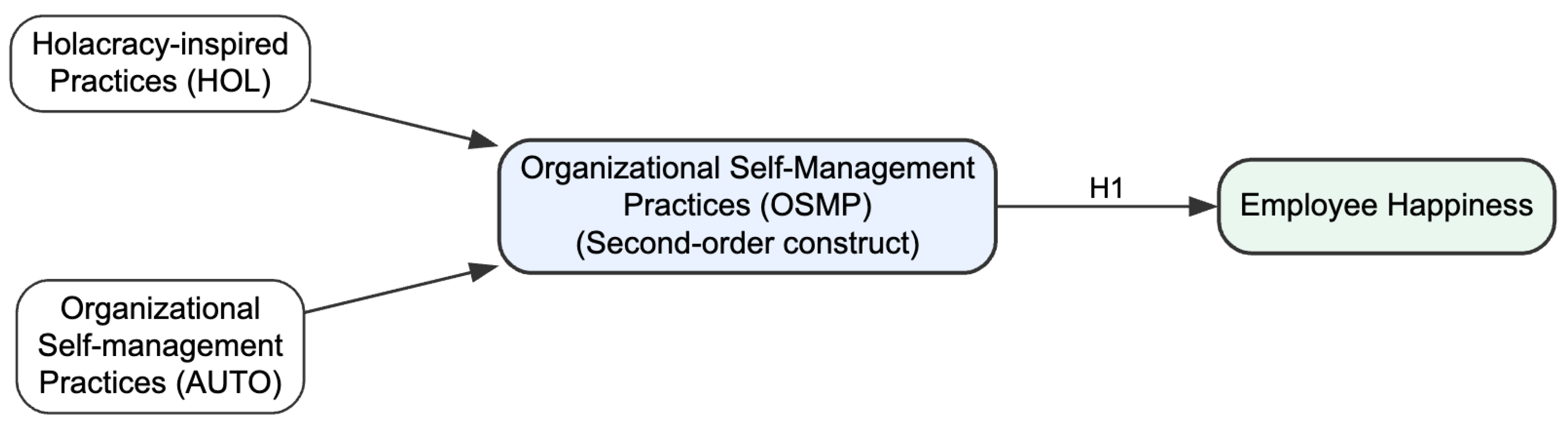
Based on the theoretical logic developed above, we propose the conceptual model shown in Figure 1.
H1. 
Organizational Self-Management Practices (OSMPs) are positively associated with employee happiness in SMEs.
This hypothesis reflects the expectation that, in the SME context, organizational practices promoting autonomy, participatory decision-making, role clarity, and collective responsibility will be perceived by employees as supportive of their psychological needs, thereby enhancing their affective and cognitive well-being at work.

3. Materials and Methods

3.1. Research Design

This study employed a quantitative research approach with a non-experimental and cross-sectional design. The research was correlational and explanatory in scope, as it aimed to examine and explain the predictive relationships between organizational self-management practices and employee happiness. Data were collected at a single point in time from employees of small and medium-sized enterprises (SMEs), without manipulating or controlling the study variables.
The non-experimental design was appropriate given that the variables were observed as they naturally occurred within real organizational settings. The cross-sectional nature of the study allowed for capturing employees’ perceptions at a specific moment, providing a snapshot of the relationships among the constructs [53,54]. Furthermore, the correlational–explanatory approach enabled the assessment of the extent to which self-management-oriented organizational practices predict employee happiness, which is consistent with the study’s objective of understanding perceptual and behavioral relationships in real work contexts.

3.2. Population and Sample

The target population consisted of formal employees working in small and medium-sized enterprises (SMEs) located in the coastal provinces of the Ancash region, Peru, where economic activity is predominantly concentrated in the commerce and services sectors. SMEs represent a substantial proportion of employment in the Peruvian economy, particularly in coastal regions characterized by high levels of commercial and service-related activity.
Due to the absence of an official, comprehensive, and fully disaggregated employee-level sampling frame for SMEs in the study region, a multi-stage sampling strategy was adopted. At the first stage, a probabilistic approach was applied at the organizational level using an available registry of formally operating SMEs. Participating firms were selected through simple random sampling. At the second stage, employee participation within each organization was based on voluntary response, with proportional allocation across firms to ensure balanced representation.
This combined sampling approach is commonly employed in organizational and management research conducted in emerging economies, where access to exhaustive employee-level sampling frames is frequently constrained. Methodological research supports the appropriateness of multi-stage and mixed sampling designs in such contexts, particularly when adequate sample size and proportional allocation across organizations are ensured [48,55,56].
Based on a 95% confidence level and a 5% margin of error, a minimum sample size of 384 observations was estimated. A total of 383 valid responses were collected and included in the final analysis.
Beyond statistical significance, the robustness of the structural relationship was further supported by a medium-to-large effect size (f2) and substantial explained variance (R2), indicating that Organizational Self-Management Practices exert a meaningful and non-trivial positively associated with employee happiness. In addition, the positive Q2 value confirms the predictive relevance of the model, reinforcing the stability and robustness of the findings within a predictive research context.
To further assess the adequacy of the sample size and the robustness of the empirical analysis, an a priori statistical power analysis was conducted using G*Power 3.1.9.7 (Heinrich Heine University Düsseldorf, Düsseldorf, Germany). Following Cohen’s guidelines, a medium effect size (f2 = 0.15), a significance level of 0.05, and a desired statistical power of 0.95 were specified for a linear multiple regression model with two predictors. The analysis indicated a minimum required sample size of 107 observations. The final sample of 383 respondents therefore substantially exceeds this threshold, providing strong statistical power and supporting the reliability of the estimated relationships.

3.3. Data Collection Procedure

Due to the absence of an official, fully disaggregated sampling frame of SME employees, participant selection was conducted using an available registry of SMEs operating in the region. Employees were invited to participate through organizational coordination within each firm using internal communication channels. Participation was voluntary and anonymous, and managers did not select individual respondents. Proportional allocation across participating firms was applied to ensure balanced representation, rather than random selection at the individual employee level.
Primary data were gathered through a self-administered online questionnaire deployed using the Google Forms platform.
Data collection was conducted over a two-month period, between November and December 2025. During this time, the questionnaire was administered on a continuous basis, with daily monitoring of responses to ensure adequate participation across the selected SMEs. This time frame allowed for close coordination with participating organizations, follow-up reminders when necessary, and the achievement of the targeted sample size within the established data collection window.
Participation was voluntary and anonymous. Prior to accessing the questionnaire, all participants were presented with an informed consent form that clearly explained the objectives of the study, the voluntary nature of participation, and the confidentiality of the information provided. Only respondents who explicitly agreed to participate were allowed to proceed with the survey. The data collection process complied with ethical standards for research involving human participants.

3.4. Evaluation of Potential Common Method Variance

Given the use of self-reported data for all constructs, an assessment of potential common method variance was conducted as a preventive diagnostic procedure. An unrotated principal component analysis including all measurement items was performed [57]. The results indicated that the first factor accounted for 42.16% of the total variance, which remains below the conventional threshold of 50%. This suggests that no single latent factor dominates the covariance structure of the data, and therefore common method bias is unlikely to represent a serious threat to the validity of the findings [58].
In addition, given the use of self-reported perceptual measures collected simultaneously, the potential risk of Common Method Variance was carefully evaluated. While statistical diagnostics indicated that CMV was not a critical threat, the possibility of inflated correlations cannot be entirely ruled out. This limitation is acknowledged and discussed in the Limitations in Section 7. The results of Harman’s single-factor test are presented in Table 1.

3.5. Measurement Instruments

Data were collected using a structured questionnaire composed of three instruments corresponding to the study variables: holacracy-inspired practices, organizational self-management practices, and employee happiness. All instruments were developed by the authors based on established theoretical frameworks in organizational management and workplace well-being and were contextualized to the SME setting.
Holacracy-inspired practices were operationalized through a reflective scale of 15 items (HOL1–HOL15), structured across five dimensions: role distribution, structured autonomy, decision-making, responsibility, and role commitment. These dimensions reflect core principles of holacracy, such as clarity and flexibility of roles, distributed authority, participatory decision-making, transparency, and accountability, as proposed in holacratic governance and post-bureaucratic organizational models [18,59].
Organizational self-management practices were measured using a 15-item reflective scale (AUTO1–AUTO15), organized into four dimensions: planning, coordination, control, and decision-making. This instrument assesses employees’ capacity to organize their work autonomously, manage time, coordinate tasks within self-organized teams, engage in open communication, perform self-evaluation, pursue continuous improvement, and assume collective responsibility for decisions and outcomes. These dimensions are consistent with the theoretical foundations of self-management and self-administered work teams [50,60].
Employee happiness was assessed through a 14-item reflective scale (FEL1–FEL14), structured across six dimensions: emotional well-being, job satisfaction, commitment, meaning of work, and work climate. This instrument captures both affective and cognitive components of happiness at work, including positive emotions, absence of excessive stress, satisfaction, recognition, motivation, sense of purpose, interpersonal relationships, and perceived work environment quality, in line with established theories of well-being and happiness at work [28,61].
All items were measured using a five-point Likert scale ranging from 1 (“strongly disagree”) to 5 (“strongly agree”). Prior to data collection, the questionnaire was reviewed by subject-matter experts to ensure content validity, clarity, and contextual relevance. The psychometric properties of the instruments were subsequently confirmed through the measurement model assessment.
The measurement scales were originally developed in English and translated into Spanish following a rigorous translation and adaptation procedure. This process included forward translation, linguistic adaptation to ensure contextual relevance for the Peruvian SME environment, and review for conceptual equivalence. Particular attention was given to governance-related terminology such as autonomy and distributed authority to ensure accurate interpretation in the Spanish-speaking organizational context.

3.6. Data Analysis Technique

The analysis followed a two-stage approach. First, the measurement model was evaluated by assessing internal consistency reliability, convergent validity, and discriminant validity. Special attention was given to the hierarchical modeling of Organizational Self-Management Practices (OSMPs) as a second-order reflective construct composed of two first-order dimensions: holacracy-inspired practices and organizational self-management practices.
Holacracy-inspired practices and organizational self-management practices were conceptualized as two distinct yet highly interrelated first-order reflective constructs. Given their strong theoretical proximity in promoting employee autonomy, distributed authority, and decentralized decision-making, and to ensure adequate discriminant validity, both constructs were subsequently modeled as reflective indicators of a higher-order reflective construct, termed Organizational Self-Management Practices (OSMPs). The high correlation observed between these two dimensions was not interpreted solely as a statistical issue related to discriminant validity, but rather as empirical evidence that, in the context of the SMEs examined, employees perceive holacracy-inspired practices and organizational self-management practices as components of a unified organizational experience. This hierarchical component model was specified following the repeated indicators approach, allowing for a parsimonious representation of conceptually related dimensions while mitigating potential multicollinearity at the first-order level. This modeling strategy is consistent with recent recommendations for higher-order constructs in PLS-SEM and enables a more comprehensive assessment of the joint positively associated with the holacracy-inspired and self-management practices on employee happiness.
Second, the structural model was evaluated by examining path coefficients, coefficients of determination (R2), effect sizes (f2), and predictive relevance (Q2), with statistical significance assessed through a bootstrapping procedure using 5000 subsamples.
The empirical analysis was conducted using PLS-SEM with the SmartPLS 4.0 software (SmartPLS GmbH, Oststeinbek, Germany). PLS-SEM was deemed appropriate for this study given its predictive orientation, flexibility in estimating complex latent variable models, and robustness when data normality assumptions are not met.
Additionally, to address potential concerns regarding common method bias inherent in cross-sectional, self-reported data, a full collinearity assessment was conducted. Variance Inflation Factor (VIF) values below 3.3 were considered indicative of the absence of serious common method bias.
Following a causal–predictive research perspective, the structural relationships were specified based on theory; however, given the cross-sectional design, the results should be interpreted as predictive associations rather than definitive empirical causal effects.

3.7. Ethical Considerations

The study adhered to ethical standards for research involving human participants. Participation was voluntary, anonymity and confidentiality were guaranteed, and no personally identifiable information was collected. The research protocol was approved by the Vice-Rectorate for Research of Universidad César Vallejo under Resolution No. P-2025-192-VI-UCV and was conducted in accordance with institutional ethical guidelines.
In line with recent methodological recommendations for predictive research using PLS-SEM, multiple complementary evaluation criteria were employed to assess the robustness of the proposed model. These included bootstrapping procedures to ensure the stability of parameter estimates, effect size (f2) analysis to evaluate substantive impact, predictive relevance (Q2) assessment to confirm out-of-sample predictive capability, and global model fit indices to assess overall model adequacy. Together, these procedures provide robustness-oriented validation within the PLS-SEM framework and strengthen confidence in the reported results.

4. Results

4.1. Descriptive Statistics of the Sample

Table 2 presents the sociodemographic characteristics of the respondents. The sample consisted of 383 employees, of whom 59.8% were male and 40.2% female. The average age of participants was 36.23 years (SD = 8.55), with ages ranging from 23 to 60 years, indicating a predominantly adult working population. Regarding organizational tenure, 35.0% of respondents reported having worked in their current organization for seven years or more, while 25.6% had between one and three years of tenure. This distribution suggests a sample with substantial work experience and organizational familiarity, which is relevant for evaluating perceptions of self-management practices and employee happiness.
Table 3 summarizes the organizational characteristics of the firms represented in the study. Most respondents worked in small enterprises (70.0%), while 30.0% were employed in microenterprises. In terms of economic activity, 59.8% of participants worked in the services sector and 40.2% in the commerce sector. These results indicate that the sample is primarily composed of employees from small and micro-sized firms operating in service- and commerce-oriented sectors, which are representative of the dominant structure of SMEs in emerging economies such as Peru.

4.2. Measurement Model Assessment

The measurement model was evaluated by examining indicator reliability, internal consistency reliability, convergent validity, and discriminant validity. Indicator reliability was assessed through the standardized outer loadings of each item. As shown in Table 4, all indicators exhibited satisfactory factor loadings (λ ≥ 0.70), with the exception of item FEL1, which presented a slightly lower loading (λ = 0.697). Given its theoretical relevance to the construct of employee happiness, the item was retained for further analysis.
Internal consistency reliability and convergent validity were evaluated using Cronbach’s alpha, composite reliability (CR), and average variance extracted (AVE). As reported in Table 5, all constructs exceeded the recommended thresholds (α ≥ 0.70, CR ≥ 0.70, AVE ≥ 0.50), indicating adequate reliability and convergent validity.
Discriminant validity was initially assessed using the heterotrait–monotrait ratio of correlations (HTMT). The initial HTMT analysis indicated high correlations between holacracy-inspired and broader self-management practices (HTMT > 0.90), suggesting limited discriminant validity between these two first-order constructs. However, this empirical convergence does not necessarily indicate measurement redundancy. Instead, consistent with higher-order construct theory, high correlations between theoretically related dimensions may reflect a broader underlying organizational capability perceived holistically by employees rather than analytically differentiated constructs.
In line with their conceptualization as closely related facets of a broader organizational phenomenon, both constructs were subsequently integrated into a higher-order reflective construct (Organizational Self-Management Practices). Following this hierarchical modeling approach, discriminant validity was reassessed at the second-order level. As shown in Table 6, all HTMT values between the higher-order construct and employee happiness were below the conservative threshold of 0.85, confirming adequate discriminant validity in the final measurement model.

4.3. Structural Model Assessment

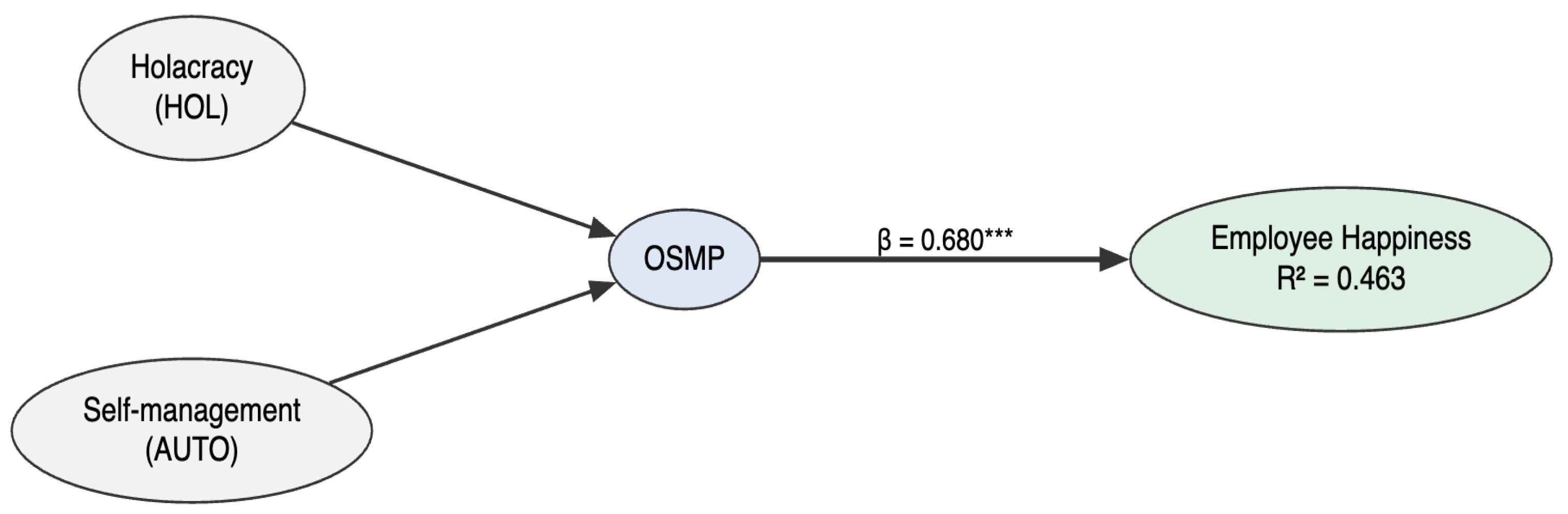
The structural model was assessed by analyzing path coefficients, statistical significance, and effect sizes. The results of the structural model are presented in Table 7 and illustrated in Figure 2. The results reveal a positive and statistically significant relationship between OSMPs and Employee Happiness (β = 0.680, t = 24.070, p < 0.001), indicating that higher levels of organizational self-management practices positively associated with greater employee happiness. The effect size indicates a substantial practical impact (f2 = 0.861). Additionally, the model explains a substantial proportion of variance in Employee Happiness (R2 = 0.463), demonstrating adequate explanatory power in line with recommended thresholds for PLS-SEM models.
In addition to path coefficients and predictive measures, global model fit indices were examined following recent PLS-SEM reporting recommendations. As reported in Table 8, the standardized root mean square residual (SRMR) value is below the recommended threshold of 0.08, and both d_ULS and d_G fall below the 95% bootstrap quantile (HI95), indicating an acceptable global model fit. Furthermore, the normed fit index (NFI) exceeds the suggested cutoff of 0.90, providing additional support for the adequacy of the proposed structural model.
Global model fit indices were examined to complement the assessment of the PLS-SEM results. As reported in Table 8, the standardized root mean square residual (SRMR) for the estimated model was 0.112, which is considered acceptable in the context of PLS-SEM. Consistent with current methodological recommendations, global fit measures are reported for completeness and should be interpreted cautiously. The estimated model corresponds to the final structural specification, in which Organizational Self-Management Practices (OSMPs) are modeled as the predictor of employee happiness.

4.4. Predictive Power of the Model

The predictive power of the model was evaluated using the coefficient of determination (R2) and the Stone–Geisser’s Q2 value. As shown in Table 9, the model explained 46.6% of the variance in employee happiness (R2 = 0.463), indicating moderate explanatory power. The Q2 value was greater than zero, confirming the predictive relevance of the model.
In addition to the explained variance, the Stone-Geisser test was used. The Q2 values for Employee Happiness are above zero, confirming the predictive relevance of the model regarding the social dimension of sustainability.

4.5. Common Method Bias Assessment

To examine the presence of common method bias, a full collinearity assessment was performed. As shown in Table 10, the variance inflation factor (VIF) values for all latent variables in the model were below the recommended threshold of 3.3, indicating that common method bias is unlikely to affect the validity of the results.

4.6. Complementary Analyses: Heterogeneity and Importance–Performance Diagnostics

The multi-group analysis indicates that the structural relationships are stable across sectors. Although the OSMP → Happiness relationship appears numerically stronger in commerce (β = 0.743) than in services (β = 0.636), the difference does not reach statistical significance (p = 0.070). These results suggest that Organizational Self-Management Practices operate consistently across sectoral contexts within SMEs, reinforcing the generalizability of the structural relationship Table 11.
The permutation-based multi-group analysis revealed no statistically significant differences between microenterprises and small enterprises in any of the structural paths (p > 0.05) Table 12. Although the OSMP → FEL relationship appears numerically stronger in microenterprises (β = 0.740) compared to small enterprises (β = 0.661), the difference was not statistically significant (p = 0.198).
Similarly, the paths from autonomy (AUTO) and horizontal organizational structures (HOL) to OSMPs did not differ significantly across firm sizes.
These findings suggest that the structural relationships proposed in the model are stable across SME size categories, supporting the robustness and contextual consistency of the theoretical framework.
The tenure-based multi-group analysis shows no statistically significant differences between employees with shorter and longer organizational tenure Table 13. This suggests that the positive association between OSMPs and happiness is not contingent upon employees’ length of service. Self-management practices appear to are associated with well-being consistently regardless of tenure, supporting their structural rather than experiential nature.
The IPMA results reveal that OSMPs exhibit both high importance (0.680) and moderate performance (63.863), indicating substantial strategic leverage Table 14. Although performance levels are moderate, incremental improvements in OSMPs may generate disproportionate gains in employee happiness due to its high total effect. This diagnostic reinforces the managerial relevance of strengthening autonomy-supportive governance mechanisms.
Item-level diagnostics indicate that specific autonomy and participatory decision-making indicators (AUTO and HOL dimensions) present the highest leverage potential Table 15. Notably, HOL-based participatory governance items show relatively lower performance levels, suggesting strategic room for improvement. These granular insights strengthen the practical contribution of the model by identifying actionable intervention points beyond global construct effects.

5. Discussion

5.1. Overview of Principal Findings

This study provides robust predictive evidence that Organizational Self-Management Practices (OSMPs) constitute a substantial driver of employee happiness in SMEs operating within an emerging economy context. The structural results (β = 0.680, p < 0.001; f2 = 0.861; R2 = 0.463; Q2 > 0) indicate not only statistical significance but substantive explanatory and predictive relevance. The large effect size suggests that OSMPs are not peripheral organizational features but central capabilities shaping employee well-being in SMEs.
The integration of holacracy-inspired practices and broader organizational self-management practices into a higher-order construct reflects both empirical overlap and theoretical coherence. While holacracy represents a formally structured governance system and broader self-management practices may emerge more informally, employees in SME contexts may experience these governance mechanisms as a unified autonomy-supportive system shaping participation, authority distribution, and role clarity. This finding suggests that, from the employee perspective, governance practices are interpreted holistically rather than as discrete formal models. The empirical convergence between holacracy-inspired practices and broader self-management practices reflects employees’ integrated perception of autonomy-supportive governance rather than measurement redundancy. In SME contexts characterized by flexible governance structures, employees may experience governance practices as part of a unified organizational system centered on autonomy, participation, and distributed authority. Therefore, modeling OSMPs as a higher-order construct captures this integrated organizational capability and aligns with contemporary perspectives on autonomy-supportive organizational design.
Importantly, the empirical convergence between holacracy-inspired practices and broader self-management mechanisms supports the modeling of OSMPs as a higher-order construct. Rather than distinguishing analytically between governance labels, employees appear to experience autonomy, participation, and distributed authority as an integrated organizational reality. This finding extends prior research by demonstrating that in SMEs, organizational practices are interpreted holistically rather than as formally differentiated systems. These findings are consistent with recent empirical research demonstrating that autonomy-supportive governance systems, including holacracy and broader self-management practices, are associated with improved employee well-being, higher job satisfaction, and stronger person–organization alignment. Recent sustainability-oriented human resource management studies further confirm that autonomy-supportive organizational practices constitute a critical pathway through which organizations are associated with employee well-being and reinforce the social dimension of sustainability [21,23].

5.2. Mechanisms Linking OSMPs and Happiness

The magnitude of the OSMP–happiness relationship invites examination of the mechanisms through which this capability operates. The findings suggest four interrelated processes.
First, distributed authority are associated with autonomy support within bounded role structures. Employees appear to value discretion embedded within clearly defined responsibilities rather than unstructured independence. This refines autonomy research by highlighting the importance of structured autonomy in SMEs.
Second, participatory governance mechanisms strengthen perceived impact. The empirical patterns suggest that employee voice contributes to well-being primarily when participation translates into observable organizational change, reinforcing arguments that meaningful participation—not symbolic inclusion—drives positive outcomes.
Third, role clarity emerges as a foundational enabler. Contrary to critiques that self-management increases ambiguity, the results indicate that structured role definitions may reduce uncertainty in informal SME environments, enhancing psychological safety and competence perceptions.
Fourth, collective responsibility fosters relational well-being. In a moderately collectivist context, shared accountability appears culturally resonant, strengthening interpersonal cohesion while reinforcing engagement.
Together, these mechanisms suggest that OSMPs satisfy core psychological needs through an integrated system rather than isolated practices.

5.3. Contextual Dynamics in Emerging Economy SMEs

The strength of the observed relationship may be partially explained by the SME and emerging economy context.
SMEs combine flexibility with resource constraints, creating conditions in which formal hierarchical controls are often inefficient. Under such circumstances, distributed authority may are associated with responsiveness and adaptive capacity.
Moreover, in institutional environments characterized by regulatory volatility and managerial informality, transparent governance mechanisms may function as internal stabilizing structures. In this sense, OSMPs may compensate for institutional uncertainty by providing predictable role expectations and decision processes.
Cultural dynamics further nuance this interpretation. In moderate power-distance settings, formally legitimized autonomy may reduce the social risks associated with independent decision-making. Employees may perceive role-based authority as culturally acceptable, whereas informal autonomy might otherwise be interpreted as insubordination.

5.4. Theoretical Implications

This study contributes to three streams of literature.
First, it advances research on post-bureaucratic governance by empirically demonstrating that self-management practices in SMEs are experienced as an integrated organizational capability rather than discrete systems.
Second, it refines self-determination theory applications in organizational settings by introducing the notion of bounded autonomy within informal SME contexts.
Third, it extends sustainability research by empirically linking alternative governance arrangements to the social dimension of sustainability in emerging economies.
The substantial effect size suggests that organizational design plays a more central role in shaping employee happiness in SMEs than previously assumed.

5.5. Practical Implications

For SME managers, the findings suggest that full adoption of formal holacracy models may be unnecessary. Instead, incremental implementation of autonomy-supportive practices—clear role definitions, structured participation, and distributed decision authority—may yield significant well-being benefits.
For policymakers, the results indicate that promoting participatory governance and self-management training in SMEs may are associated with both social sustainability and organizational resilience.
The IPMA results suggest that improving specific participatory governance practices may yield disproportionate gains in employee happiness, highlighting concrete intervention points for SME managers.

5.6. Social Sustainability Implications

The present findings extend the discussion of social sustainability by positioning Organizational Self-Management Practices (OSMPs) as a structural governance capability that directly shapes employee well-being in SMEs operating within emerging economies.
Traditionally, sustainability scholarship has emphasized environmental performance and economic viability, while the social dimension has often been operationalized through compliance-oriented HR practices or well-being initiatives. The results of this study suggest a deeper structural pathway: employee happiness is not primarily driven by peripheral wellness programs, but by how authority, autonomy, and accountability are institutionally distributed within the organization.
The large effect size observed (f2 = 0.861) indicates that governance architecture itself constitutes a major driver of the social sustainability of SMEs. This shifts the focus from sustainability as a set of external CSR-oriented practices toward sustainability embedded in internal organizational design. In this sense, OSMPs function as a social sustainability infrastructure, shaping daily work experiences through autonomy support, role clarity, participatory decision-making, and collective accountability.
From an institutional perspective, the implications are particularly salient in emerging economies characterized by regulatory volatility, labor informality, and managerial hybridity. In such contexts, formal institutional safeguards may be weaker, increasing employees’ dependence on organizational-level governance for stability and predictability. The findings suggest that transparent role structures and distributed authority mechanisms may operate as internal institutional substitutes, enhancing psychological security and organizational cohesion where external institutional frameworks are less stable.
Furthermore, the relationship between OSMPs and happiness may contribute to organizational resilience. Autonomy-supportive structures enable adaptive decision-making, peer coordination, and rapid response to environmental uncertainty—features that are particularly valuable for SMEs facing economic fluctuations and resource constraints. Thus, social sustainability and organizational resilience appear mutually reinforcing rather than independent dimensions.
From a sustainable governance perspective, the study advances the idea that decentralization and structured participation are not merely efficiency-oriented managerial strategies but mechanisms of human development within organizations. By embedding participatory and autonomy-supportive processes into everyday work routines, SMEs can align internal governance practices with broader sustainable development objectives.
Importantly, these findings contribute to Sustainable Development Goals 3 (Good Health and Well-being) and 8 (Decent Work and Economic Growth) by demonstrating that firm-level governance choices materially influence psychological well-being and quality of work. Rather than viewing SDGs as macro-level policy targets alone, this study shows how micro-level organizational design decisions can serve as actionable levers for advancing social sustainability.
Overall, Organizational Self-Management Practices emerge as a strategic mechanism through which SMEs can integrate human well-being into their core governance systems, strengthening both social sustainability and long-term organizational adaptability in emerging economy contexts.
Employee well-being is widely recognized as a core component of the social dimension of sustainability, as it reflects the quality of work life, psychosocial safety, and human-centered organizational functioning. Social sustainability at the organizational level encompasses practices that support employee health, dignity, participation, and psychological well-being, which contribute to long-term organizational viability and societal stability. From this perspective, employee happiness represents a micro-level manifestation of social sustainability, as it reflects the extent to which organizational systems promote human well-being as a central organizational outcome rather than merely an instrumental resource.
This relationship may be particularly relevant in emerging economy contexts such as Peru, where institutional volatility, labor informality, and uneven regulatory enforcement may limit external protections for employee well-being. In such environments, internal organizational governance practices play a critical role in shaping employees’ psychosocial experience. Organizational self-management practices, by promoting autonomy, participation, and transparency, may function as internal governance mechanisms that compensate for institutional gaps and provide organizational stability and psychological security. This internal stabilization mechanism represents an important pathway through which organizational practices contribute to social sustainability in institutionally constrained environments.
These findings must be interpreted within the specific institutional context of Peru, characterized by labor informality, institutional volatility, and a high prevalence of family-owned SMEs. In such environments, internal organizational governance mechanisms may provide stability, predictability, and psychological security that complement or substitute for weaker external institutional protections.
Organizational Self-Management Practices may therefore function as internal governance mechanisms that enhance organizational resilience and contribute to socially sustainable organizational environments in institutionally constrained contexts.

6. Conclusions

This study examined the relationship between Organizational Self-Management Practices (OSMPs) and employee happiness in small and medium-sized enterprises (SMEs) in Peru using a PLS-SEM approach. By conceptualizing OSMPs as a higher-order construct integrating holacracy-inspired and broader self-management practices, the study provides robust empirical evidence that advanced self-management arrangements grounded in distributed authority, autonomy, and participatory governance are positively associated with employee happiness in an emerging economy context. These findings confirm that organizational design choices related to self-management are not merely structural or procedural decisions, but are closely linked to employees’ subjective well-being and their perceptions of meaningful work.
The results indicate that employee happiness in SMEs is shaped less by the formal adoption of specific governance models and more by the consistent enactment of autonomy, role clarity, shared responsibility, and participatory decision-making in everyday work practices. From the employees’ perspective, holacracy-inspired practices and broader self-management practices are experienced as an integrated organizational reality rather than as distinct or competing approaches. This integrated perception supports the modeling of OSMPs as a higher-order construct and suggests that employees interpret self-management holistically, based on how authority and participation are enacted in daily work activities. Consequently, the effectiveness of self-management practices depends primarily on their practical implementation and lived experience rather than on the symbolic adoption of formal post-bureaucratic governance models.
From a theoretical perspective, this study contributes to the growing literature on sustainable and post-bureaucratic organizations by empirically linking organizational self-management practices with employee happiness, a core dimension of social sustainability. While prior research on self-management and alternative governance models has primarily focused on large organizations or developed economies, the present findings extend this body of knowledge by demonstrating that similar mechanisms operate within SMEs in an emerging economy context. Importantly, the results show that self-management practices can be meaningfully examined through employees’ perceptions even when implemented informally, adapted pragmatically, or embedded within flexible organizational structures. By operationalizing OSMPs as a higher-order construct, this study also advances methodological discussions in the PLS-SEM literature by demonstrating the value of modeling closely related organizational practices as integrated organizational capabilities rather than as isolated predictors.
In addition, the findings contribute to sustainability research by emphasizing the social and psychological dimensions of organizational sustainability. Employee happiness is increasingly recognized as a critical outcome of sustainable human resource management and socially sustainable organizations. By demonstrating that self-management practices are positively associated with employee happiness, this study extends sustainability scholarship beyond its traditional focus on environmental and economic outcomes to include the quality of work life and employee well-being. In this regard, the findings provide empirical support for Sustainable Development Goal 8 (Decent Work and Economic Growth) by highlighting the importance of participatory and autonomy-supportive work environments, as well as Sustainable Development Goal 3 (Good Health and Well-being) through their focus on employees’ psychological well-being in organizational contexts.
From a sustainability perspective, these findings further reinforce the view that employee well-being represents a central pillar of organizational sustainability, consistent with recent research published in Sustainability emphasizing the importance of human-centered organizational practices for achieving long-term organizational sustainability [47]. By strengthening employee well-being, autonomy-supportive governance practices contribute not only to individual psychological outcomes but also to broader organizational resilience, adaptive capacity, and long-term sustainability.
From a practical perspective, the findings offer important implications for SME managers, organizational designers, and policymakers. Rather than fully adopting complex and highly formalized governance systems, SMEs may benefit from progressively implementing self-management practices that promote autonomy, participatory decision-making, and role transparency in ways that align with their size, resources, and organizational culture. These practices can are associated with employee happiness and contribute to the social dimension of organizational sustainability while remaining feasible within resource-constrained environments. For policymakers, the results suggest that initiatives aimed at supporting SMEs should not focus exclusively on financial or regulatory instruments, but should also promote organizational practices that are associated with employee well-being, autonomy, and participatory work arrangements.
Overall, this study demonstrates that SMEs are not passive adopters of organizational models, but active environments in which self-management practices are interpreted, adapted, and enacted in context-specific ways. By providing empirical evidence that organizational self-management practices constitute a viable pathway for enhancing employee happiness in an emerging economy context, this study contributes to broader debates on sustainable work, post-bureaucratic governance, and employee well-being. These findings underscore the importance of conceptualizing organizational sustainability as a multidimensional construct that integrates economic viability, social participation, and psychological well-being, and position Organizational Self-Management Practices as a critical organizational capability for promoting employee well-being and social sustainability in SMEs operating in emerging economy contexts.
These findings support the interpretation that autonomy-supportive governance practices contribute to the social dimension of sustainability by fostering organizational environments that promote employee well-being, participation, and psychological safety. In this sense, employee happiness can be understood as a micro-level indicator of social sustainability, reflecting the extent to which organizational systems support human-centered and sustainable work environments. This interpretation is consistent with contemporary sustainability research emphasizing the central role of employee well-being in sustainable organizational development.
These findings demonstrate that internal organizational governance mechanisms play a critical role in sustaining employee well-being in institutionally constrained environments, reinforcing the relevance of autonomy-supportive organizational design for advancing social sustainability in emerging economies.

7. Limitations of the Study

Despite its theoretical and empirical contributions, this study presents several limitations that should be acknowledged when interpreting the findings.
First, the cross-sectional research design limits the ability to establish temporal precedence and definitive causal relationships between Organizational Self-Management Practices (OSMPs) and employee happiness. Although the structural model reveals strong predictive associations (β = 0.680; f2 = 0.861), the simultaneous measurement of constructs does not allow for conclusive causal inference. It is possible that employees with higher levels of happiness may perceive organizational practices more positively, introducing potential reciprocal relationships. Future research employing longitudinal or cross-lagged panel designs would provide stronger evidence regarding causal directionality and the dynamic interaction between organizational governance practices and employee well-being [62].
Second, the reliance on self-reported perceptual measures introduces the potential risk of common method variance and perceptual inflation. Although statistical diagnostics—including Harman’s single-factor test and full collinearity assessment—indicate that common method bias is unlikely to pose a severe threat, the use of methodologically homogeneous data sources may nonetheless amplify observed associations. Additionally, the use of a single predictor in the structural model may contribute to an overestimation of the observed effect size. Future research should incorporate multi-source data collection approaches, including supervisor assessments, objective organizational indicators, or behavioral measures, to strengthen methodological robustness and reduce same-source bias.
Third, the structural model did not include control variables such as employee age, organizational tenure, firm size, or industry sector, which may independently influence employee happiness. While the model was intentionally specified to prioritize theoretical clarity and predictive focus, the absence of control variables limits the ability to fully account for alternative explanations. Future studies should examine the stability of the OSMP–employee happiness relationship using more comprehensive model specifications that incorporate relevant demographic, organizational, and contextual control variables.
Fourth, although the higher-order modeling approach was theoretically justified, future research should examine holacracy-inspired practices and broader self-management practices separately to determine whether specific governance mechanisms exert differential effects on employee well-being across varying organizational contexts.
Future research could examine whether individual dimensions of self-management exert distinct or differential effects under varying levels of organizational formalization, structural complexity, or governance maturity.
Fifth, the empirical context of this study was limited to SMEs operating within a specific regional and national context in Peru. While this setting provides valuable insights into an underrepresented emerging economy environment, institutional conditions, cultural norms, and managerial practices may influence how self-management practices are implemented and perceived. Therefore, caution should be exercised when generalizing these findings to other institutional or cultural contexts. Future cross-national and cross-sector comparative studies would help assess the external validity and generalizability of the proposed model.
Finally, the structural model examined a direct relationship between OSMPs and employee happiness without explicitly modeling potential mediating mechanisms—such as psychological empowerment, work meaningfulness, or job crafting—or moderating factors, including leadership style, organizational culture, or job demands. While the present study establishes a strong predictive foundation, future research should investigate these underlying psychological and organizational mechanisms to develop a more comprehensive understanding of how self-management practices influence employee well-being.
Taken together, these limitations do not undermine the validity of the core findings. Rather, they clarify the scope of inference and provide valuable directions for future research aimed at advancing theoretical development and empirical rigor in the study of organizational self-management and social sustainability.
Because this study employed a cross-sectional design, the findings should be interpreted as predictive associations rather than causal relationships. Although the results demonstrate strong predictive relationships between OSMPs and employee happiness, longitudinal or experimental research designs would be required to establish definitive causal inference.

8. Future Research Directions

Future research can build upon the findings of this study by adopting longitudinal research designs to examine how Organizational Self-Management Practices evolve over time and how their long-term implementation influences employee happiness in SMEs. Longitudinal approaches would allow researchers to establish stronger causal inference and capture dynamic changes in organizational governance practices and employee well-being.
In addition, future studies could incorporate mixed-methods research designs by combining quantitative techniques, such as PLS-SEM, with qualitative approaches including interviews, focus groups, or ethnographic observations. Such approaches would provide deeper insights into how employees interpret, experience, and enact self-management and holacracy-inspired practices in their everyday work environments.
Further research could also examine potential mediating and moderating mechanisms—such as organizational culture, leadership styles, psychological empowerment, job crafting, or work meaningfulness—that may influence the relationship between organizational self-management practices and employee happiness. Examining these underlying mechanisms would contribute to a more comprehensive theoretical understanding of how autonomy-supportive governance systems influence employee well-being.
Finally, comparative research across industries, organizational sizes, and national contexts would are associated with the generalizability of these findings and provide valuable insights into how institutional, cultural, and economic conditions shape the effectiveness of organizational self-management practices. Cross-national and cross-sector studies would be particularly valuable for understanding the role of self-management practices in promoting social sustainability across diverse organizational environments.


Author Contributions

Conceptualization, M.A.C.-P.; methodology, M.A.C.-P.; software, M.A.C.-P.; validation, M.A.C.-P. and W.A.C.-A.; formal analysis, M.A.C.-P. and W.A.C.-A.; investigation, W.A.C.-A.; resources, W.A.C.-A.; data curation, M.A.C.-P.; writing—original draft preparation, M.A.C.-P. and W.A.C.-A.; writing—review and editing, M.A.C.-P. and W.A.C.-A.; visualization, W.A.C.-A.; supervision, M.A.C.-P.; project administration, M.A.C.-P. All authors have read and agreed to the published version of the manuscript.

Funding

The author(s) declare that financial support was received for the publication of this article. The APC was funded by Universidad César Vallejo.

Institutional Review Board Statement

The study was conducted in accordance with the Declaration of Helsinki and approved by the Institutional Review Board of Universidad César Vallejo (Vicerrectorado de Investigación), approval code RESOLUCIÓN DE VICERRECTORADO DE INVESTIGACIÓN N° P-2025-192-VI-UCV.

Informed Consent Statement

All participants provided informed consent prior to their participation in the study.

Data Availability Statement

The data presented in this study are available on request from the corresponding author. The data are not publicly available due to privacy and ethical restrictions.

Acknowledgments

The authors gratefully acknowledge the participation of the organizations and individuals who contributed to this study and generously shared their time and insights. Generative artificial intelligence tools were used to support language editing and improve clarity during manuscript preparation. No generative AI was used for data collection, data generation, or data manipulation. All statistical analyses were conducted using the original dataset collected from the participants.

Conflicts of Interest

The authors declare no conflicts of interest. The funders had no role in the study.

References

  1. OECD. Small and Medium-Sized Enterprises (SMEs) and Inclusive Growth; OECD Publishing: Paris, France, 2017. [Google Scholar]
  2. Beck, T.; Demirguc-Kunt, A.; Levine, R. SMEs, growth, and poverty. J. Econ. Growth 2005, 13, 199–229. [Google Scholar] [CrossRef]
  3. INEI. Características de las Micro y Pequeñas Empresas en el Perú; Instituto Nacional de Estadística e Informática: Lima, Peru, 2023; Available online: https://www.inei.gob.pe (accessed on 26 February 2025).
  4. Elkington, J. Enter the triple bottom line. In The Triple Bottom Line; Routledge: London, UK, 2018. [Google Scholar]
  5. Pfeffer, J. Building sustainable organizations: The human factor. Acad. Manag. Perspect. 2010, 24, 34–45. [Google Scholar] [CrossRef]
  6. De Vos, A.; Van der Heijden, B.; Akkermans, J. Sustainable careers: Towards a conceptual model. J. Vocat. Behav. 2020, 117, 103196. [Google Scholar] [CrossRef]
  7. Kramar, R. Beyond strategic human resource management: Is sustainable human resource management the next approach? Int. J. Hum. Resour. Manag. 2014, 25, 1069–1089. [Google Scholar] [CrossRef]
  8. Chomać-Pierzecka, E.; Dyrka, S.; Kokiel, A.; Urbańczyk, E. Sustainable HR and Employee Psychological Well-Being in Shaping the Performance of a Business. Sustainability 2024, 11, 10913. [Google Scholar] [CrossRef]
  9. Fisher, C.D. Happiness at work. Int. J. Manag. Rev. 2010, 15, 384–412. [Google Scholar] [CrossRef]
  10. Warr, P. Work, Happiness, and Unhappiness; Lawrence Erlbaum Associates: Mahwah, NJ, USA, 2007. [Google Scholar] [CrossRef]
  11. Rauch, A.; Wiklund, J.; Lumpkin, G.T.; Frese, M. Entrepreneurial Orientation and Business Performance: An Assessment of Past Research and Suggestions for the Future. Entrep. Theory Pract. 2009, 33, 761–787. [Google Scholar] [CrossRef]
  12. Guest, D.E. Human resource management and employee well-being: Towards a new analytic framework and research agenda. Hum. Resour. Manag. J. 2017, 27, 22–38. [Google Scholar] [CrossRef]
  13. Diener, E.; Oishi, S.; Lucas, R.E. National accounts of subjective well-being. Am. Psychol. 2015, 70, 234–242. [Google Scholar] [CrossRef] [PubMed]
  14. Bakker, A.B.; Demerouti, E. Job demands–resources theory. J. Occup. Health Psychol. 2017, 27, 273–285. [Google Scholar] [CrossRef]
  15. Ryan, R.M.; Deci, E.L. Self-determination theory and the facilitation of intrinsic motivation. Am. Psychol. 2000, 37, 68–78. [Google Scholar] [CrossRef] [PubMed]
  16. Hackman, J.R.; Oldham, G.R. Motivation through the design of work. Organ. Behav. Hum. Perform. 1976, 11, 250–279. [Google Scholar] [CrossRef]
  17. Parker, S.K. Beyond motivation: Job and work design for development, health, ambidexterity, and more. Annu. Rev. Psychol. 2014, 65, 661–691. [Google Scholar] [CrossRef]
  18. Robertson, B.J. Holacracy: The New Management System for a Rapidly Changing World; Henry Holt and Company: New York, NY, USA, 2015; Available online: https://openlibrary.org/books/OL27184946M/Holacracy (accessed on 23 February 2026).
  19. Bernstein, E.; Bunch, J.; Canner, N.; Lee, M. Beyond the holacracy hype. Harv. Bus. Rev. 2016, 94, 38–49. [Google Scholar]
  20. Lee, M.Y.; Edmondson, A.C. Self-managing organizations: Exploring the limits of less-hierarchical organizing. Res. Organ. Behav. 2017, 37, 35–58. [Google Scholar] [CrossRef]
  21. Weirauch, L.; Galliker, S.; Elfering, A. Holacracy, a Modern Form of Organizational Governance: Predictors for Person–Organization Fit and Job Satisfaction. Front. Psychol. 2023, 16, 1021545. [Google Scholar] [CrossRef]
  22. Madero-Gómez, S.M.; Rubio Leal, Y.L.; Olivas-Luján, M.; Yusliza, M.Y. Companies Could Benefit When They Focus on Employee Wellbeing and the Environment: A Systematic Review of Sustainable Human Resource Management. Sustainability 2023, 17, 5435. [Google Scholar] [CrossRef]
  23. Lu, Y.; Zhang, M.M.; Yang, M.M.; Wang, Y. Sustainable Human Resource Management Practices, Employee Resilience, and Employee Outcomes: Toward Common Good Values. Hum. Resour. Manag. 2023, 47, 331–353. [Google Scholar] [CrossRef]
  24. Laloux, F. Reinventing Organizations: A Guide to Creating Organizations Inspired by the Next Stage in Human Consciousness; Nelson Parker: Brussels, Belgium, 2014; Available online: https://openlibrary.org/books/OL25448615M/Reinventing_Organizations (accessed on 23 February 2026).
  25. Martela, F. What makes self-managing organizations novel? Comparing how Weberian bureaucracy, Mintzberg’s adhocracy, and self-organizing solve six fundamental problems of organizing. J. Organ. Des. 2019, 8, 23. [Google Scholar] [CrossRef]
  26. Deci, E.L.; Olafsen, A.H.; Ryan, R.M. Self-determination theory in work organizations. Annu. Rev. Organ. Psychol. Organ. Behav. 2017, 4, 19–43. [Google Scholar] [CrossRef]
  27. Van Mierlo, H.; Rutte, C.G. Self-managing teams and well-being. J. Occup. Health Psychol. 2016, 26, 334–345. [Google Scholar] [CrossRef]
  28. Salas-Vallina, A.; Alegre, J.; Fernandez, R. Happiness at work and organisational citizenship behaviour: Is organisational learning a missing link? Int. J. Manpow. 2017, 38, 470–488. [Google Scholar] [CrossRef]
  29. Grant, A.M.; Parker, S.K. Redesigning work design theories: The rise of relational and proactive perspectives. Acad. Manag. Ann. 2009, 3, 317–375. [Google Scholar] [CrossRef]
  30. Liu, P.; Yuan, L.; Wang, J. Unpacking algorithmic management: Pathways to team resilience through reduced objectification and informal leadership. Asia Pac. J. Hum. Resour. 2025, 63, e70031. [Google Scholar] [CrossRef]
  31. Malik, E.; Shankar, S.; Nandram, S.S.; Bindlish, P.K. A Systematic Review of the Global Evolution of Self-Managed Organizations through Key Characteristics and Strategies. Discov. Psychol. 2025, 5, 162. [Google Scholar] [CrossRef]
  32. Morikawa, M.; Martela, F.; Hakanen, J.J. Are Employee Self-Management and Organizational Self-Management Related to Work Engagement or Burnout? Evidence from Two Studies. BRQ Bus. Res. Q. 2024, 49, 386–398. [Google Scholar] [CrossRef]
  33. Magpili, N.C.; Pazos, P. Self-managing team performance: A systematic review of multilevel input factors. Small Group Res. 2018, 49, 3–33. [Google Scholar] [CrossRef]
  34. Alarcón, G.M.; Edwards, J.M.; Menke, L.E. Perceived autonomy support and worker well-being: Employees’ judgments as moderators of the relationship between job autonomy and psychological strain. J. Occup. Health Psychol. 2009, 14, 262–274. [Google Scholar] [CrossRef]
  35. Butsch, T.; Bell, R. Does a self-managed organization leave employees behind? A critical review of the current trend. Dev. Learn. Organ. 2025, 54, 8–11. [Google Scholar] [CrossRef]
  36. Gagnon, J.; Turcotte, I.; Teyssier-Roberge, G.; Rousseau, V.; Aubé, C.; Tremblay, S. Do self-organizing teams promote shared leadership and team performance in crisis management? Team Perform. Manag. 2025, 50, 886–905. [Google Scholar] [CrossRef]
  37. Farooq, F.; Mohammad, S.S.; Nazir, N.A.; Shah, P.A. Happiness at work: A systematic literature review. Int. J. Organ. Anal. 2024, 32, 2236–2255. [Google Scholar] [CrossRef]
  38. Dumitriu, S.; Bocean, C.G.; Vărzaru, A.A.; Al-Floarei, A.T.; Sperdea, N.M.; Popescu, F.L.; Băloi, I.-C. The Role of the Workplace Environment in Shaping Employees’ Well-Being. Sustainability 2025, 19, 2613. [Google Scholar] [CrossRef]
  39. Usha, M. The Impact of Sustainable Human Resource Management on Employee Happiness. Sustainability 2025, 19, 1047. [Google Scholar] [CrossRef]
  40. Bai, B. Exploring Sustainable HRM Through the Lens of Employee Wellbeing. Sustainability 2025, 19, 5646. [Google Scholar] [CrossRef]
  41. Preciado, M.A.C.; Sernaqué, M.A.C.; Huayta-Meza, F.T.; Zavaleta, M.I.A.; Llanos, J.F.S.; Centeno, X.L.A.; Chacón, L.F.E.; del Socorro Sotomayor Nunura, G.; Zavaleta, J.M.A. Happiness and Organizational Commitment among Workers in the Fishing Sector of the City of Chimbote—2023. Period. Eng. Nat. Sci. 2023, 11, 116–122. [Google Scholar] [CrossRef]
  42. Wang, Y.; Ummar, R.; Qureshi, T.M.; Ul Haq, J.; Bonn, M.A. Employee Sustainability: How Green Practices Drive Employee Well-Being and Citizenship Behavior. Sustainability 2025, 19, 936. [Google Scholar] [CrossRef]
  43. Vahdati, H.; Rahbar, E.; Ravanbakhsh, M.; Afsar, A. Social and Environmental Sustainability, Workers’ Well-Being, and Affective Organizational Commitment. Sustainability 2023, 17, 9514. [Google Scholar] [CrossRef]
  44. Meng, C.; Cheng, N.; Liang, S.; Pei, X. Enhancing Employee Well-Being Through Scene Innovation in Retail Enterprises: A Case Study on the Chinese Enterprise Pang Donglai. Sustainability 2025, 19, 8681. [Google Scholar] [CrossRef]
  45. Atan, A.; Gelirli, N. Resilience and Grit for Sustainable Well-Being at Work: Evidence from High-Pressure Service Organizations. Sustainability 2025, 19, 7486. [Google Scholar] [CrossRef]
  46. Farmanesh, P.; Gharibi Khoshkar, P.; Vehbi, A.; Solati Dehkordi, N. Leading Sustainability in the Age of Eco-Anxiety: The Role of Employee Well-Being in Driving Environmental Performance Among Green Companies. Sustainability 2025, 19, 10989. [Google Scholar] [CrossRef]
  47. Lai, Z.; Sumbal, S.; Khaskheli, M.B.; Wang, Y. The Impact of Digital Marketing on Sustainable Consumption and Environmental Product Management in China: A Business Model and Legal Perspective. Sustainability 2025, 19, 11353. [Google Scholar] [CrossRef]
  48. Hair, J.F.; Hult, G.T.M.; Ringle, C.M.; Sarstedt, M. A Primer on Partial Least Squares Structural Equation Modeling (PLS-SEM), 3rd ed.; Sage: Thousand Oaks, CA, USA, 2021. [Google Scholar]
  49. Goodhue, D.L.; Lewis, W.; Thompson, R. Does PLS Have Advantages for Small Sample Size or Non-Normal Data? MIS Q. 2012, 36, 981–1001. [Google Scholar] [CrossRef]
  50. Manz, C.C.; Sims, H.P. Leading workers to lead themselves: The external leadership of self-managing work teams. Adm. Sci. Q. 1987, 56, 106–128. [Google Scholar] [CrossRef]
  51. Gagné, M.; Deci, E.L. Self-Determination Theory and Work Motivation. J. Organ. Behav. 2005, 34, 331–362. [Google Scholar] [CrossRef]
  52. Chiaburu, D.S.; Harrison, D.A. Do peers make the place? Conceptual synthesis and meta-analysis of coworker effects on perceptions, attitudes, OCBs, and performance. J. Appl. Psychol. 2008, 93, 1082–1103. [Google Scholar] [CrossRef]
  53. Wang, X.; Cheng, Z. Cross-Sectional Studies: Strengths, Weaknesses, and Recommendations. Chest 2020, 158, S65–S71. [Google Scholar] [CrossRef]
  54. Pérez-Guerrero, E.E.; Guillén-Medina, M.R.; Márquez-Sandoval, F.; Vera-Cruz, J.M.; Gallegos-Arreola, M.P.; Rico-Méndez, M.A.; Aguilar-Velázquez, J.A.; Gutiérrez-Hurtado, I.A. Methodological and Statistical Considerations for Cross-Sectional, Case–Control, and Cohort Studies. J. Clin. Med. 2024, 16, 4005. [Google Scholar] [CrossRef]
  55. Sarstedt, M.; Hair, J.F.; Pick, M.; Liengaard, B.D.; Radomir, L. Progress in partial least squares structural equation modeling use in marketing research in the last decade. Psychol. Mark. 2022, 54, 1035–1064. [Google Scholar] [CrossRef]
  56. Saunders, M.; Lewis, P.; Thornhill, A. Research Methods for Business Students, 8th ed.; Pearson Education: Harlow, UK, 2019. [Google Scholar]
  57. Harman, H.H. Modern Factor Analysis, 3rd ed.; University of Chicago Press: Chicago, IL, USA, 1976. [Google Scholar]
  58. Podsakoff, P.M.; MacKenzie, S.B.; Lee, J.Y.; Podsakoff, N.P. Common method biases in behavioral research: A critical review of the literature and recommended remedies. J. Appl. Psychol. 2003, 88, 879–903. [Google Scholar] [CrossRef] [PubMed]
  59. Puranam, P.; Alexy, O.; Reitzig, M. What’s “new” about new forms of organizing? Acad. Manag. Rev. 2014, 54, 162–180. [Google Scholar] [CrossRef]
  60. Drucker, P.F. The Essential Drucker: The Best of Sixty Years of Peter Drucker’s Essential Writings on Management; HarperBusiness: New York, NY, USA, 2001; Available online: https://www.harpercollins.com/products/the-essential-drucker-peter-f-drucker (accessed on 12 January 2026).
  61. Judge, T.A.; Bono, J.E.; Erez, A.; Locke, E.A. Core self-evaluations and job and life satisfaction: The role of self-concordance and goal attainment. J. Appl. Psychol. 2005, 90, 257–268. [Google Scholar] [CrossRef] [PubMed]
  62. Taris, T.W.; Kompier, M.A.J. Cause and effect: Optimizing the designs of longitudinal studies in occupational health psychology. Work Stress 2014, 49, 1–8. [Google Scholar] [CrossRef]
Figure 1. The conceptual model of the study, illustrating the hierarchical structure in which holacracy-inspired practices and organizational self-management practices are specified as first-order constructs forming the second-order construct Organizational Self-Management Practices (OSMPs), which in turn predicts employee happiness.
Sustainability 18 04139 g001
Figure 2. Holacracy-inspired and broader self-management practices are modeled as first-order reflective dimensions of the higher-order construct Organizational Self-Management Practices (OSMPs).
Sustainability 18 04139 g002
Table 1. Harman’s Single-Factor Test Results.
ComponentEigenvalueVariance Explained (%)Cumulative (%)
Factor 118.54942.15742.157
Note. Principal component analysis without rotation was conducted including all measurement items. Only the variance explained by the first unrotated factor is considered for Harman’s single-factor test.
Table 2. Sociodemographic characteristics of the respondents (n = 383).
VariableCategoryn%
GenderMale22959.8
Female15440.2
Age (years)Mean (SD)36.238.55
Range23–60
Job tenureLess than 1 year6316.4
1 to 3 years9825.6
4 to 6 years8823.0
7 years or more13435.0
Note. Percentages are calculated based on the total number of respondents. Age is reported as mean and standard deviation. Labor tenure refers to the length of time respondents have been working in their current organization.
Table 3. Organizational characteristics of the firms represented in the study.
VariableCategoryn%
Firm sizeMicroenterprise11530.0
Small enterprise26870.0
Industry sectorCommerce15440.2
Services22959.8
Note. Organizational characteristics are reported based on employees’ self-reported information about the firms in which they work. Percentages are calculated based on the total sample.
Table 4. Outer loadings.
ItemConstructLoadingStatus
HOL1Holacracy0.723Pass
HOL2Holacracy0.766Pass
HOL3Holacracy0.771Pass
HOL4Holacracy0.78Pass
HOL5Holacracy0.758Pass
HOL6Holacracy0.748Pass
HOL7Holacracy0.769Pass
HOL8Holacracy0.768Pass
HOL9Holacracy0.788Pass
HOL10Holacracy0.787Pass
HOL11Holacracy0.777Pass
HOL12Holacracy0.748Pass
HOL13Holacracy0.728Pass
HOL14Holacracy0.761Pass
HOL15Holacracy0.751Pass
AUTO1Organizational Self-Management0.783Pass
AUTO2Organizational Self-Management0.818Pass
AUTO3Organizational Self-Management0.766Pass
AUTO4Organizational Self-Management0.79Pass
AUTO5Organizational Self-Management0.798Pass
AUTO6Organizational Self-Management0.814Pass
AUTO7Organizational Self-Management0.785Pass
AUTO8Organizational Self-Management0.786Pass
AUTO9Organizational Self-Management0.776Pass
AUTO10Organizational Self-Management0.781Pass
AUTO11Organizational Self-Management0.8Pass
AUTO12Organizational Self-Management0.79Pass
AUTO13Organizational Self-Management0.772Pass
AUTO14Organizational Self-Management0.797Pass
AUTO15Organizational Self-Management0.813Pass
FEL1Employee Happiness0.694Check
FEL2Employee Happiness0.766Pass
FEL3Employee Happiness0.753Pass
FEL4Employee Happiness0.734Pass
FEL5Employee Happiness0.745Pass
FEL6Employee Happiness0.762Pass
FEL7Employee Happiness0.752Pass
FEL8Employee Happiness0.765Pass
FEL9Employee Happiness0.777Pass
FEL10Employee Happiness0.766Pass
FEL11Employee Happiness0.77Pass
FEL12Employee Happiness0.777Pass
FEL13Employee Happiness0.759Pass
FEL14Employee Happiness0.741Pass
Note. Outer loadings (λ) of the reflective indicators for each construct. The recommended threshold is λ ≥ 0.70. One item (FEL1) shows a marginally lower loading, which was retained due to its theoretical relevance and adequate construct-level reliability and validity.
Table 5. Reliability and convergent validity of the measurement model.
ConstructCronbach’s Alpha (α)Composite Reliability (CR)Average Variance Extracted (AVE)
Holacracy0.9480.9540.580
Organizational Self-Management0.9570.9620.627
Employee Happiness0.9420.9490.570
Note. Cronbach’s α = Cronbach’s alpha; CR = composite reliability; AVE = average variance extracted. All values exceed the recommended thresholds (α ≥ 0.70, CR ≥ 0.70, AVE ≥ 0.50).
Table 6. Discriminant validity (HTMT).
ConstructOrganizational Self-Management Practices (OSMPs)Employee Happiness
Organizational Self-Management Practices (OSMPs)0.714
Employee Happiness0.714
Note. HTMT values below 0.85 indicate adequate discriminant validity.
Table 7. Structural model results obtained through PLS-SEM.
Pathβt-Valuep-Valuef2
Organizational Self-Management Practices (OSMPs) → Employee Happiness0.68024.070<0.0010.861
Note. Path coefficients, significance levels, and effect sizes correspond to the structural relationship between the second-order construct Organizational Self-Management Practices (OSMPs) and Employee Happiness, as estimated in the final PLS-SEM model.
Table 8. Global model fit indices (PLS-SEM).
Fit IndexSaturated ModelEstimated Model
SRMR0.1120.112
d_ULS34.66034.879
d_Gn/an/a
Chi-square
NFIn/an/a
Note. SRMR = standardized root mean square residual. Global model fit indices are reported for completeness, as recommended in PLS-SEM. The estimated model corresponds to the final structural model including Organizational Self-Management Practices (OSMPs) as the predictor of employee happiness.
Table 9. Predictive power of the structural model.
Endogenous ConstructR2Q2
Employee Happiness0.4630.459
Note. Coefficient of determination (R2) and Stone–Geisser’s Q2 values for the endogenous construct. R2 indicates moderate explanatory power, while Q2 values greater than zero confirm predictive relevance of the model.
Table 10. Collinearity statistics (VIF).
Latent variableVIF
Organizational Self-Management Practices (OSMPs)1.37
Employee Happiness1.00
Note. VIF = variance inflation factor. VIF values are reported for the final structural model.
Table 11. Multi-Group Analysis (MGA) by Industry Sector (Commerce vs. Services).
Pathβ Microenterprisesβ Small EnterprisesΔβPermutation p-Value
AUTO → OSMP0.5770.591−0.0140.716
HOL → OSMP0.5640.5580.0060.883
OSMP → FEL0.7400.6610.0800.198
Note. Results based on permutation multi-group analysis using 5000 resamples. Differences are considered significant when p < 0.05.
Table 12. Multi-Group Analysis (MGA) by Firm Size (Microenterprises vs. Small Enterprises).
PathCommerce (β)Services (β)Δβp (Permutation)
AUTO → OSMP0.5870.5840.0030.931
HOL → OSMP0.5270.588−0.0600.101
OSMP → Happiness0.7430.6360.1060.070
Note. Results are based on permutation-based PLS-MGA with 5000 resamples. Δβ represents the difference between microenterprises and small enterprises. Differences are considered statistically significant at p < 0.05.
Table 13. Multi-Group Analysis by Organizational Tenure (<3 years vs. ≥3 years).
Path<3 Years (β)≥3 Years (β)Δβp (Permutation)
AUTO → OSMP0.5820.590−0.0090.809
HOL → OSMP0.5770.5460.0310.400
OSMP → Happiness0.6590.698−0.0390.488
Note. Multi-group permutation test (5000 resamples).
Table 14. Importance–Performance Map Analysis (IPMA) at Construct Level.
IndicatorImportancePerformance
AUTO10.03668.668
HOL110.03659.182
AUTO40.03569.191
HOL90.03559.008
Note. Importance corresponds to total effects on Employee Happiness. Performance values are rescaled latent variable scores (0–100).
Table 15. Top Item-Level Importance–Performance Indicators.
ConstructImportance (Total Effect)Performance (Index 0–100)
OSMP0.68063.863
AUTO0.39965.244
HOL0.38062.551
Note. Indicators selected based on highest total effects on Employee Happiness.
Disclaimer/Publisher’s Note: The statements, opinions and data contained in all publications are solely those of the individual author(s) and contributor(s) and not of MDPI and/or the editor(s). MDPI and/or the editor(s) disclaim responsibility for any injury to people or property resulting from any ideas, methods, instructions or products referred to in the content.