Review

Impact of Integrating Sustainability into Strategic Management on Financial and Sustainability Performance—Literature Review


by
Albadri Albaloula Ali
Department of Management, College of Business Administration in Hawtat Bani Tamim, Prince Sattam Bin Abdulaziz University, Al-Kharj 11942, Saudi Arabia
Sustainability 2026, 18(8), 4137; https://doi.org/10.3390/su18084137
Submission received: 16 March 2026 / Revised: 13 April 2026 / Accepted: 17 April 2026 / Published: 21 April 2026

Abstract

The integration of sustainability into strategic management (SSM) has drawn increased academic interest, yet the literature is conceptually fragmented and lacks a cohesive framework that systematically describes the integration of SSM. This study seeks to fill this gap and uncover the essential strategic dimensions, driving forces, and influencing variables that shape the integration of SSM and planning. This study conducts a systematic literature review (SLR) of peer-reviewed articles indexed in the Web of Science and Scopus databases. Through the application of established search parameters and content analysis methodologies, 30 relevant studies are identified and examined. Under a management theory lens, this study synthesizes the literature using a systematic search method and thematic classification approach. The results show that the interaction between internal capabilities and external pressures leads to the formation of sustainable integration. Stakeholder participation, operational integration, governance and leadership commitment, strategy alignment, and sustainability performance evaluation are important factors. The findings also point to important enabling and limiting variables, including the lack of defined measures, regulatory uncertainties, and resource constraints. This study proposes a structured conceptual framework that connects organizational integration mechanisms, strategic drivers, and sustainable results based on these discoveries. This work contributes to the literature on sustainability-oriented strategic management by offering a theory-driven synthesis and highlighting important boundary conditions. It also provides practical implications for practitioners and researchers alike.

1. Introduction

A substantial amount of research has investigated the relationship between sustainability and strategic management (SSM) through various perspectives, aspects, and analytical frameworks rooted in management theories. Notable contributions encompass the studies in [1,2,3,4,5,6,7,8], among others. Nevertheless, these significant contributions using current methodologies have insufficiently and inconsistently integrated sustainability considerations into a comprehensive strategic management and planning framework. Specifically, insufficient focus has been directed toward integrating sustainability into all strategic management and planning phases—formulation, implementation, evaluation, and ongoing monitoring—within a cohesive and unified frame work. The SSM interaction has been analyzed from several viewpoints, uncovering numerous aspects that either positively or negatively affect its processes, as indicated in different studies [1,7,9,10,11]. It is underscored that attaining sustainable competitive performance requires the alignment of strategic objectives with dynamic environmental, economic, and social concerns [1,12]. Moreover, Ref. [13] contends that this alignment requires a concurrent evaluation of environmental stewardship, social well-being, and economic performance, thus highlighting the intrinsic complexity of sustainability as a strategic concern.
Over the past two decades, the integration of SSM has transitioned from a normative or ethical discourse to a competitive need [1,14]. Research consistently indicates that sustainability-focused management improves organizational performance, resilience, and creativity by aligning corporate goals with environmental and social imperatives [1,12,15,16,17,18]. In response, extensive frameworks have been developed to enhance risk anticipation, foster green innovation, and harmonize stakeholders’ frequently conflicting demands for profitability and environmental accountability [16,18].
Therefore, the systematic integration of SSM has become essential across industries. Researchers have proposed various conceptual and practical frameworks, such as strategic environmental management and the triple bottom line, to promote the incorporation of sustainability across strategic, operational, and cultural dimensions [19,20]. The core elements of strategy must consequently coincide with sustainable integration efforts. In this context, Ref. [7] discovered that the integration of sustainable development as a strategic target is profoundly affected by the manner in which sustainability is expressed within a firm’s vision. Empirical research demonstrates that firms implementing sustainability-oriented initiatives attain enhanced financial and environmental performance outcomes [1,7]. Hence, effective integration requires the identification of essential strategic domains, areas, and enabling conditions, encompassing both internal and external organizational drivers, along with facilitating or constraining factors that influence sustainability integration across corporate, business, and functional strategy levels [9,13,18,21,22,23]. A consensus is emerging that implementation is hindered by resource constraints, deficiencies in managerial capabilities, and inadequate governance structures [8,20]. In contrast, recent research underscores the significance of administrative competencies and stakeholder involvement in enhancing resource utilization and promoting sustainable development [2,16,18]. Sustainability-oriented strategic management requires strong leadership commitment, active stakeholder engagement, and the explicit integration of sustainability into the organizational vision and strategy, thereby promoting long-term performance, competitive advantage, and lasting societal value creation [1,2,24].

1.1. Research Problem

Despite the growing body of research on the relationship between SSM, the current literature and research are fragmented and conceptually unstructured. Most previous studies investigate sustainable integration from particular functional, operational, or sectoral viewpoints rather than as a systematic component of the overall strategic management process. As a result, sustainability is frequently regarded as an operational project or corporate responsibility effort rather than as a fundamental strategic component integrated into organizational planning and decision-making [1,6].
Moreover, the reviewed literature reveals a lack of unified and theoretically robust frameworks that comprehensively explain the integration of sustainability across all phases of the strategic management process, particularly formulation, implementation, evaluation, and control. Although several studies propose partial models or examine specific drivers and barriers to sustainability integration [5,6,25,26], these contributions do not collectively provide a holistic perspective that links sustainability integration to the entire strategic management and planning process.
Consequently, major concerns arise about the systematic integration of SSM processes and the organizational domains and contextual elements influencing this integration. Bridging this gap is essential for improving both the theoretical understanding and practical application of sustainability-oriented strategic management. This study seeks to integrate existing knowledge and offer a thorough perspective on the integration of the SSM process through the application of SLR methodology.
In light of this gap, the following research questions are posited: How can sustainability be methodically included into the strategic management process? What critical areas and influencing factors enable or hinder this integration?
  • Study objectives:
    • To provide a conceptual unified framework that organizes the discovered mechanisms and relationships to facilitate future study and managerial practice.
    • To define and classify the main strategic dimensions and organizational domains through which sustainability is integrated into strategic management and planning.
    • To examine the primary factors, supportive elements, and obstacles identified in the literature that affect successful SSM integration.

1.2. Theoretical Framework of Sustainability-Driven Strategic Management

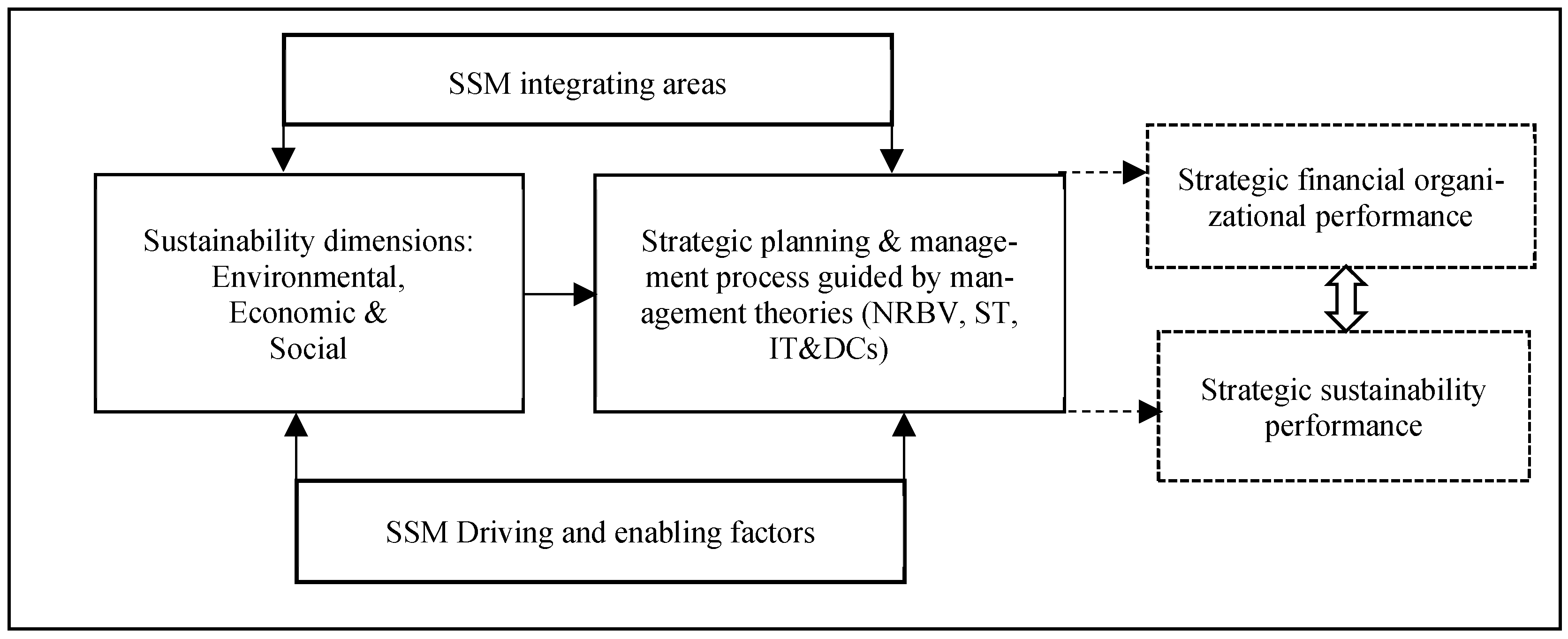
Integrating sustainability into strategic management processes, guided by management theories such as the Natural Resource-Based View (NRBV), Stakeholder Theory (ST), Institutional Theory (IT), and Dynamic Capabilities (DCs), requires a systematic and scientific integration of sustainability-related elements within cross-industry strategic management and planning frameworks, as well as within the broader organizational management context to achieve competitive and sustainable organizational performance. These theoretical perspectives enhance the integration of sustainability across the phases of strategic management. The NRBV supports the development of sustainability-oriented capabilities in strategic formulation; Stakeholder and Institutional Theories provide external alignment in environmental analysis and governance integration; and DCs facilitate ongoing adaptation, monitoring, and digitally enabled transformation.
Figure 1 shows a theory-driven framework for the SSM relationship, wherein the integration of sustainability is embedded within established management theories. ST and IT explain the external influences and legitimacy criteria that impact sustainability-focused environmental analysis. The NRBV supports the integration of sustainability in strategy formulation as a means of achieving competitive advantage by creating unique and non-replicable environmental capabilities and environmentally responsible resource management. DCs support the implementation of a strategy and ongoing adaptation, especially via digital transformation and resource reconfiguration processes. As a whole, these theoretical foundations convert sustainability integration from a procedural planning process into a strategically embedded, capability-driven process that gives answers to questions such as why and how SSM integration enhances both financial and environmental outcomes.
The theoretical framework of sustainability-driven strategic management can be concisely explained as a process in which each phase of strategic management is aligned with established management theories—namely, the Natural Resource-Based View (NRBV), Stakeholder Theory (ST), Institutional Theory (IT), and Dynamic Capabilities (DCs)—through mechanisms that facilitate the integration of sustainability, ultimately generating competitive advantage and enhanced performance outcomes.
This perspective is corroborated by the authors of [27], who emphasize the conceptual development and theoretical foundations of corporate social responsibility (CSR) and corporate sustainability. Their research illustrates that corporate sustainability has evolved from fragmented CSR initiatives toward a more unified and strategically embedded organizational framework, highlighting the alignment of stakeholder-oriented and resource-based perspectives in integrating sustainability into corporate strategy for long-term value creation. Similarly, Ref. [28] demonstrates that sustainability influences strategic decision-making through stakeholder and institutional pressures, as firms develop capabilities to integrate sustainability and enhance both competitiveness and long-term performance.
This review article is organized as follows: Section 1 presents the introduction, which provides a thorough review of the relationship between SSM and describes the research problem, research questions, and research objectives. Section 2 provides a comprehensive analysis of the literature and previous studies, critically analyzing the primary approaches and frameworks for incorporating sustainability into strategic management; the key areas, features, and driving forces of this integration are highlighted. Section 3 describes the study methodology, outlining the procedures for data collection, processing, and analysis. Section 4 presents and analyzes the study’s findings and presents the discussion. Section 5 concludes by summarizing the study’s primary results, while Section 6 offers actionable recommendations, implications, and avenues for future research.

2. General Overview

2.1. Sustainability Strategic Management Framework

Conceptual and empirical studies on the integration of SSM are scarce and frequently fragmented; hence, this study addresses this deficiency by presenting a thorough integration approach. Nonetheless, certain studies suggest the development of more holistic strategies that improve risk forecasting, foster green innovation, and align stakeholders’ frequently divergent expectations for profitability and environmental accountability [16,18].
In recent decades, the integration of SSM has transitioned from a normative or ethical discourse to a competitive imperative, particularly by integrating sustainability into corporate strategic frameworks to ensure that environmental objectives are prioritized in long-term planning and decision-making [1]. A conceptual framework is proposed in [14] that incorporates sustainability into strategic processes and organizational activities, underpinned by empirical confirmation. Likewise, Ref. [20] suggests a five-stage framework—preparation, strategy formulation, implementation, evaluation, and feedback—to enhance the integration of sustainability in manufacturing firms. Furthermore, Ref. [26] presents a three-phase framework for the incorporation of the Sustainable Development Goals (SDGs) and circular economy ideas into operational strategies. Moreover, Ref. [29] presents a conceptual framework that connects sustainability reporting with strategy execution (single-loop learning) and strategy creation (double-loop learning), emphasizing the significance of organizational learning in the integration of sustainability.

2.2. SSM Integration Balancing Organizational Performance

According to the reviewed literature and consistent with the framework depicted in Figure 1, the full integration of SSM has become increasingly essential. Achieving a balance among environmental, social, and economic dimensions requires innovative and comprehensive strategic frameworks. Ref. [1] emphasizes that the emerging paradigm demonstrates that profitability and environmental sustainability are not mutually exclusive but can be mutually reinforcing when sustainability is embedded within strategic planning. The study further highlights the need for organizations to move beyond purely profit-driven approaches by integrating environmental considerations into core management processes. Empirical findings indicate that integrating sustainability into strategic planning and operational practices significantly enhances both financial and environmental performance, particularly through embedding sustainability into corporate strategy, promoting green innovation, ensuring top management commitment, and implementing sustainable supply chain management [1]. Similarly, Ref. [30] demonstrates that integrating environmental sustainability into strategic planning improves organizational effectiveness and performance. Moreover, Ref. [31] shows that sustainable practices, such as oyster farming, can simultaneously support economic growth and environmental objectives, further reinforcing the strategic value of sustainability integration.
Notwithstanding the increasing global focus on harmonizing economic success with sustainability, substantial obstacles to effective integration remain. Ref. [7] contends that, despite heightened awareness of sustainability, numerous firms continue to grapple with its integration into their strategy frameworks. Sustainable development prioritizes a balance between ecological systems and societal requirements to ensure enduring organizational success; nonetheless, companies encounter significant challenges in managing and executing these strategies in the face of unpredictable future circumstances and divergent stakeholder expectations [16,22]. In response to intensifying environmental challenges, resource limitations, and heightened stakeholder demands, corporations are progressively integrating sustainability into their strategy frameworks [1]. Nevertheless, empirical evidence illustrates the ongoing dominance of financial goals, since numerous organizations are constrained by limited resources and capabilities, hindering the adoption of sustainable practices [7]. Similarly, Ref. [5] underscores that failing to integrate environmental sustainability into corporate strategy could endanger industrial competitiveness and long-term market positioning, as evidenced in the Sri Lankan textile and garment industry.
The author of this study contends that the integration of SSM is interrelated with various factors, including decision-makers, stakeholders, the organizational environment, and the effectiveness and efficiency of resources for sustainable future performance, which encompasses both financial and ecological aspects. This assertion highlights the sustainability strategic management framework, its elements, and the motivating and facilitating factors of sustainability strategic management (see Figure 1), which is aligned with ST, IT, DYs, and the NRBV.

2.3. Areas and Dimensions for Integrating Sustainability into Strategic Management

Numerous firms have identified essential elements for integrating SSM processes; however, most initiatives are fragmented and do not encompass all aspects of sustainability and strategy, and they frequently concentrate on discrete factors such as organizational vision or particular strategic levels. Ref. [7] asserts that successful integration requires a definitive alignment between corporate vision and sustainability goals, highlighting that the embedding of sustainable development into strategic objectives is significantly affected by the manner in which sustainability is expressed within the organization’s vision. Moreover, the integration of sustainability can be understood through three strategic levels—the corporate, business, and functional levels—each fulfilling a unique function in tackling environmental issues [13,23]. At the corporate level, strategy sets the primary objective and direction; at the business level, it establishes competitive positioning; and at the functional level, it translates strategy into operational actions. These results emphasize that successful SSM integration requires coherence across all strategic levels, supported by a clearly defined sustainability-oriented strategy. In this regard, authors such as those of [1,22,32] advocate for the integration of sustainability concepts into strategic management processes, asserting that sustainability is a fundamental aspect of strategic decision-making. Likewise, Ref. [7] contends that the establishment of corporate strategy objectives in relation to sustainable development relies on a well-defined organizational vision strengthened by thorough evaluations of environmental and social factors.

2.4. Factors Impacting the Integration of Sustainability into Strategic Management and Planning

The examined literature on the integration of SSM provides a comprehensive array of variables influencing this relationship. From a theoretical standpoint, these aspects reflect the interaction between internal competencies—underscored by the NRBV and Dynamic Capabilities—and external influences, as emphasized by Stakeholder and Institutional Theories. The literature indicates that the integration of sustainability is either promoted or hindered by a firm’s capacity to align internal resources and adaptive capabilities with evolving stakeholder expectations and institutional requirements.
At the organizational level, several aspects have been identified. For instance, Ref. [10] demonstrated that external pressures and stakeholder expectations significantly drive firms to integrate the SDGs into their strategic and operational frameworks. Similarly, Ref. [5] identified various factors influencing the implementation of integrated corporate sustainability plans, including organizational-related factors such as a sustainability-oriented culture, professional branding, and long-term commitment; employee-related factors such as motivation, open knowledge-sharing cultures, and the integration of sustainability into daily practices; and internal and external organizational activities that facilitate implementation.
In addition, Ref. [24] examined the contextual determinants of corporate sustainability integration within strategic management processes. Their findings highlight 19 interrelated elements that support integration, namely, commitment, information availability, materiality assessment, stakeholder engagement, trust, flexibility, idea generation, solution seeking, resource allocation, innovation, organizational transformation, value co-creation, strategic tools, knowledge exchange, performance indicators, monitoring, results assessment, communication, and anticipation.
One of the key perspectives influencing the integration of sustainability into organizational system design is the role of organizational structure, as highlighted in [33]. Similarly, Ref. [34] identified key drivers—such as managerial commitment and organizational capabilities—and barriers, including resource constraints, knowledge gaps, and resistance to change, that influence the implementation of environmental strategies in firms. Likewise, Ref. [35] noted that consultants often play a pivotal role in articulating a sustainable vision and embedding sustainability into corporate strategy.
At the corporate and industrial levels, the challenge lies in translating long-term strategic objectives into daily operational decisions. In this context, leadership support, strategic direction, organizational culture, and stakeholder pressure emerge as the most influential factors for the integration of SSM [1,5,11,18]. Furthermore, Ref. [36] emphasized that essential organizational factors—including reputation, managerial values, management support, and organizational culture—along with leadership commitment and an enabling organizational environment, significantly shape sustainability strategy and are critical for the effective promotion and implementation of sustainability initiatives. Collectively, these findings indicate that successful sustainability integration depends on the interaction of multiple organizational dimensions, grounded in established management theories.

2.5. Roles of Digital Technology in SSM Integration

Digital technologies play a critical role in supporting the integration of sustainability-oriented strategic management processes by enhancing internal and external strategic analysis, facilitating strategy formulation and implementation, strengthening sustainability performance, and monitoring through data-driven decision-making and real-time analytics [22,37]. In the strategy formulation phase, technologies such as big data analytics, artificial intelligence (AI), and decision-support systems improve environmental scanning, risk forecasting, and opportunity identification by analyzing complex sustainability-related data, including climate risks, resource efficiency, stakeholder expectations, and regulatory trends [15,22,37]. During the strategy evaluation and control phase, digital analytics, sustainability dashboards, and AI-driven performance systems enhance the continuous monitoring of sustainability KPIs and ESG metrics. This enables evidence-based decision-making, supports dynamic organizational learning, and facilitates adaptive strategic adjustments, thereby bridging the gap between sustainability objectives and actual performance [7,37].

2.6. Previous Studies on the Integration of Sustainability into SM&P

Table 1 provides a systematic overview of the 30 studies, highlighting the progression of research across several domains and the growing focus on integrating SSM, particularly in competence development, stakeholder involvement, and performance outcomes. These patterns underscore the imperative for a theory-driven synthesis. Initial studies predominantly examined sustainability within the frameworks of corporate social responsibility (CSR) and regulatory compliance, often perceiving it as a peripheral concern [21]. Subsequent research indicates that sustainability initiatives were primarily reactive and separated from core strategic decision-making processes [2]. Recent research increasingly characterizes sustainability as a strategic capability that enhances long-term competitiveness and organizational resilience.
Despite this development, the literature continues to be fragmented, with research investigating sustainable integration from several viewpoints, such as corporate governance, innovation, performance evaluation, and stakeholder involvement. This review achieves the research objectives by employing an integrated theoretical framework based on the RBV, DCs, IT, and ST to address fragmentation. These perspectives offer a cohesive basis for synthesizing the research by connecting internal capabilities, adaptive processes, and external constraints that influence sustainable integration.

2.6.1. Strategic Aspects and Organizational Domains of Sustainability Integration

Based on the review of selected studies, the integration of SSM and strategic planning is found to be a multifaceted and dynamic process integrated across many organizational domains. From a RBV standpoint, the literature progressively defines sustainability as a strategic asset evident in corporate vision, mission, and long-term goals. Empirical research indicates that companies that clearly incorporate sustainability into their strategy objectives are more inclined to undertake systematic environmental evaluations and link their organizational goals with sustainable development aspirations [7]. This strategic alignment is operationalized through mechanisms like circular economy maturity models and the integration of the Sustainability Balanced Scorecard (BSC), which convert resource efficiency and environmental capabilities into actionable practices [25,26]. Focusing on turning sustainability objectives into operational procedures promotes the Natural Resource-Based View (NRBV), underscoring the necessity of integrating environmental capabilities into fundamental organizational routines [35].
Recent studies indicate that integrating sustainability into organizational mission and strategic goals—especially when combined with green innovation and sustainable supply chain practices—can improve both environmental and financial performance outcomes. Nevertheless, the literature suggests that such integration cannot be accomplished exclusively at the strategic level; it requires complementary organizational frameworks and processes. Governance systems, leadership dedication, and participatory management frameworks are regularly recognized as essential facilitators, illustrating the interaction between internal capability enhancement (RBV) and adaptive organizational processes highlighted by Dynamic Capabilities Theory. Institutional leadership and governance structures significantly influence the implementation of sustainability programs, especially in intricate industries like healthcare [2]. Likewise, the dedication of senior management and a conducive organizational culture are crucial for integrating sustainability at strategic, operational, and normative levels [11].
Moreover, a robust environmental commitment, supported by organizational policies and managerial support, significantly improves the efficacy of eco-innovation methods and fosters enhanced environmental and competitive performance [8]. The integration of circular economy ideas into industrial ecosystems emphasizes the strategic significance of linking sustainability goals with operational strategies, illustrating the systemic character of sustainability transformation [26].
A vital aspect of integration is the utilization of strategic management tools and performance monitoring systems. The literature increasingly highlights the importance of tools like the SBSC and multi-criteria decision analysis in facilitating a company’s assessment and management of sustainability performance in a systematic and quantifiable way [19,25]. These methods convert abstract sustainability objectives into measurable indicators, thereby improving accountability, monitoring, and strategic oversight.
These findings indicate that the integration of sustainability within strategic management and planning is a complex, multi-dimensional transformation that encompasses corporate strategy, governance frameworks, operational processes, innovation initiatives, and performance evaluation systems. This highlights the need for firms to implement a cohesive and capability-oriented strategy, bolstered by consistent governance frameworks and sophisticated strategic instruments, to effectively incorporate sustainability into fundamental business operations and attain enduring value generation.
Overall, sustainability integration encompasses corporate strategy, governance frameworks, operational procedures, innovation efforts, and performance evaluation, affirming that it constitutes a strategic orientation grounded in organizational capabilities and transformation, rather than separate initiatives.

2.6.2. Factors Enabling and Constraining Sustainability Integration

Subsequent to identifying the domains and areas for integrating sustainability, the analyzed studies additionally investigate the determinants affecting the successful implementation of sustainability-focused strategic management. These factors influence either the elements and domains of the SSM relationship outlined in Section 2.6.1 or other organizational contexts. They can be broadly classified into enabling conditions, supportive organizational mechanisms, and structural impediments.
Based on the Resource-Based View (RBV) and Dynamic Capabilities (DCs), internal facilitating variables such as leadership commitment, organizational culture, employee engagement, and resource availability have been identified. Leadership is essential for setting strategic direction, allocating resources, and cultivating a sustainability-oriented culture [1,11]. The variables outlined in [11], including organizational skills, information dissemination, innovation capacity, and learning mechanisms, enable organizations to effectively incorporate sustainability into their strategic operations. Also, research has identified various internal elements that influence the adoption of sustainability, including a culture oriented toward sustainability, knowledge exchange, staff motivation, and sustainability training programs [5]. Moreover, Ref. [24] emphasizes contextual factors that affect the integration of sustainability, including commitment, stakeholder involvement, innovation capacity, and monitoring systems.
From an external perspective, IT and ST explain how regulatory pressures, market expectations, and stakeholder demands drive sustainability adoption. Factors such as consumer awareness, competitive pressure, and corporate reputation encourage firms to align their strategies with sustainability principles [9,30]. However, prior research has also identified significant barriers to implementation, including limited financial resources, a lack of standardized sustainability metrics, regulatory uncertainty, infrastructure limitations, and supply chain constraints [2,10,30]. Overall, sustainability integration is shaped by the dynamic interaction between internal resources and capabilities (RBV), adaptive processes (DCs), and external institutional and stakeholder pressures. This interaction provides a cohesive theoretical foundation for understanding and synthesizing previously fragmented findings in the literature.
The research collectively identifies several critical criteria enabling the integration of sustainability. Commitment from top management is regularly recognized as a vital catalyst, as it offers strategic guidance, allocates resources, and cultivates a culture geared toward sustainability [1,9,11]. From the DCs standpoint, leadership is essential in promoting organizational learning and transformation. Another crucial facilitator is stakeholder pressure and participation, as highlighted by ST, which compels enterprises to embrace sustainable practices and seek innovation. Empirical research demonstrates that governmental, customer, and competitive constraints promote green innovation and improve environmental performance [16,18].
Further, strategic instruments and management frameworks—such as the Balanced Scorecard, SWOT analysis, and sustainability reporting—are essential for facilitating integration. These tools facilitate strategic decision-making, performance evaluation, and alignment with sustainability goals, embodying the NRBV regarding capability enhancement and DCs through process integration and adaptability. Moreover, organizational culture, knowledge dissemination, and employee involvement are essential facilitators of successful implementation. A culture focused on sustainability, bolstered by transparent communication and training, enables the effective integration of sustainability initiatives into organizational activities [5,33].
Despite the existence of facilitating factors, numerous limitations persist in obstructing effective sustainability integration. A significant obstacle is the absence of established sustainability indicators, especially for social and environmental performance, which constrains consistency in evaluation and comparison among firms [10,21]. A significant constraint is the trade-off between economic and sustainability objectives, as companies frequently find it challenging to align short-term financial performance with long-term sustainability obligations [9,32].
Moreover, organizational resistance and cultural obstacles substantially hinder integration initiatives. Resistance to change, inadequate awareness, and poor internal alignment are commonly recognized as barriers to the effective execution of sustainability projects [2,11]. Moreover, external uncertainties and institutional constraints, such as regulatory complexity and market volatility, present further hurdles that hinder the integration of sustainability and strategic decision-making.

2.6.3. Comprehensive Framework for Integrating Sustainability in SM

Although the literature provides valuable insights into various aspects of sustainability integration and identifies the influencing factors, many studies examine these elements in isolation rather than as part of a coherent strategic framework. Consequently, the literature lacks a comprehensive model that systematically connects sustainability across the entire strategic management and planning process. This indicates a deficiency in the integration of capability-based frameworks (the RBV and DCs) with external alignment theories (IS and ST).
Numerous studies have attempted to address this gap by formulating conceptual frameworks for the integration of sustainability. Sustainability integration is conceptualized through three interrelated dimensions: strategic process, strategic content, and strategic context [40]. The Integrative Sustainable Intelligence (ISI) paradigm connects sustainability strategy with governance mechanisms, operational processes, performance evaluation, and organizational learning. Alternative frameworks emphasize the significance of multi-level integration. Ref. [33] underscores the necessity of integrating sustainability into corporate frameworks, procedures, and culture via ongoing enhancement mechanisms. Recent studies expand these frameworks by including digital transformation and innovation as essential facilitators for improving sustainability integration [15].
This study contributes knowledge by establishing a foundational conceptual framework that integrates sustainability throughout the overall strategic management and planning cycle. The framework integrates internal capabilities, adaptive processes, and external institutional alignment, offering a more comprehensive, coherent, and theoretically grounded analytical approach.
Limitations and Theoretical Tensions in Existing Sustainability–Strategy Research
The current reviewed studies on the integration of SSM reveal numerous significant limitations. Many empirical studies mainly utilize cross-sectional study methodologies and self-reported managerial data, which may limit the strength of causal findings and add potential response bias. In addition, the majority of these studies are mostly focused on Western or developed economies, which restricts the applicability of the findings to many institutional and cultural contexts.
In addition to these methodological limitations, the literature also reveals significant theoretical conflicts. A primary issue focuses on whether sustainability activities enhance competitive advantage or result in trade-offs between immediate financial success and long-term environmental and social goals. Some studies underscore the strategic advantages of sustainability, while others point out the potential costs and organizational difficulties, revealing a lack of cohesive theoretical frameworks. Furthermore, the literature is fragmented across subject areas. Current research often analyzes sustainability integration from fragmented viewpoints, including organizational capacities, sustainability reporting procedures, or industry-specific efforts. Nevertheless, these methodologies rarely integrate sustainability comprehensively throughout the full strategic management and planning cycle. The integration of SSM, planning, and execution procedures is inadequately understood. Addressing this fragmentation serves as a primary incentive for the current investigation. This review seeks to create a complete framework by synthesizing previous research and determining critical integration points that systematically connect sustainability considerations with the stages of strategic management and planning procedures.

3. Research Methodology

3.1. Research Design

This research utilizes a systematic literature review (SLR) methodology derived from the Preferred Reporting Items for Systematic Reviews and Meta-Analyses (PRISMA) framework. The PRISMA methodology guarantees methodological transparency, consistency, and rigor in the identification, screening, and selection of relevant literature. Due to the conceptual sophistication and multidisciplinary aspects of sustainability-oriented strategic management, a systematic review methodology is suitable for integrating disparate findings and clarifying theoretical and empirical advancements in the relationship between sustainability and strategic management.

3.2. Data Sources and Search Strategy

Two comprehensive academic databases were chosen for their wide-ranging coverage of peer-reviewed publications in management and sustainability research: Web of Science (WoS) and Scopus. The literature search was performed on 16 February 2026, providing a distinct time boundary and improving the transparency and repeatability of the review. The search focused on articles published from 2015 to 2025 to document current advancements in the integration of sustainability-oriented strategic management, especially after the implementation of the UNSDGs.
The search string was concurrently applied within the title, abstract, and keyword fields in both databases to provide comprehensive coverage primarily centered on the study title and its pertinent concepts. The search method was modified to meet the individual syntactic constraints of each database, ensuring consistency across platforms while maintaining its conceptual integrity. The query in Scopus utilized the TITLE-ABS-KEY field, whereas in Web of Science, the corresponding Topic Search (TS), which includes title, abstract, and keywords, was used. Minor modifications to Boolean operators and field tags were implemented where needed to conform to database-specific indexing frameworks. The following Boolean search string was utilized: (“integrating sustainability” AND “strategic management” AND “corporate sustainability” AND “sustainable business models” AND “green strategy”). Only peer-reviewed academic publications published in English that specifically addressed the inclusion of SSM were included to ensure quality and comparability.
The following Boolean search string was applied to titles, abstracts, and keywords.

3.3. Inclusion and Exclusion Criteria

First, the inclusion criteria were as follows:
  • Peer-reviewed journal articles;
  • Published between 2015 and 2025;
  • Written in English;
  • Explicit focus on integrating sustainability into strategic management.
Second, the exclusion criteria included:
  • Book chapters;
  • Conference proceedings and papers;
  • Reviews;
  • Books;
  • Early-access articles (WoS);
  • Non-English publications;
  • Studies lacking a clear focus on strategic management–sustainability integration.

3.4. Study Selection Process (PRISMA Procedure), Comprising Three Main Steps

3.4.1. Identification

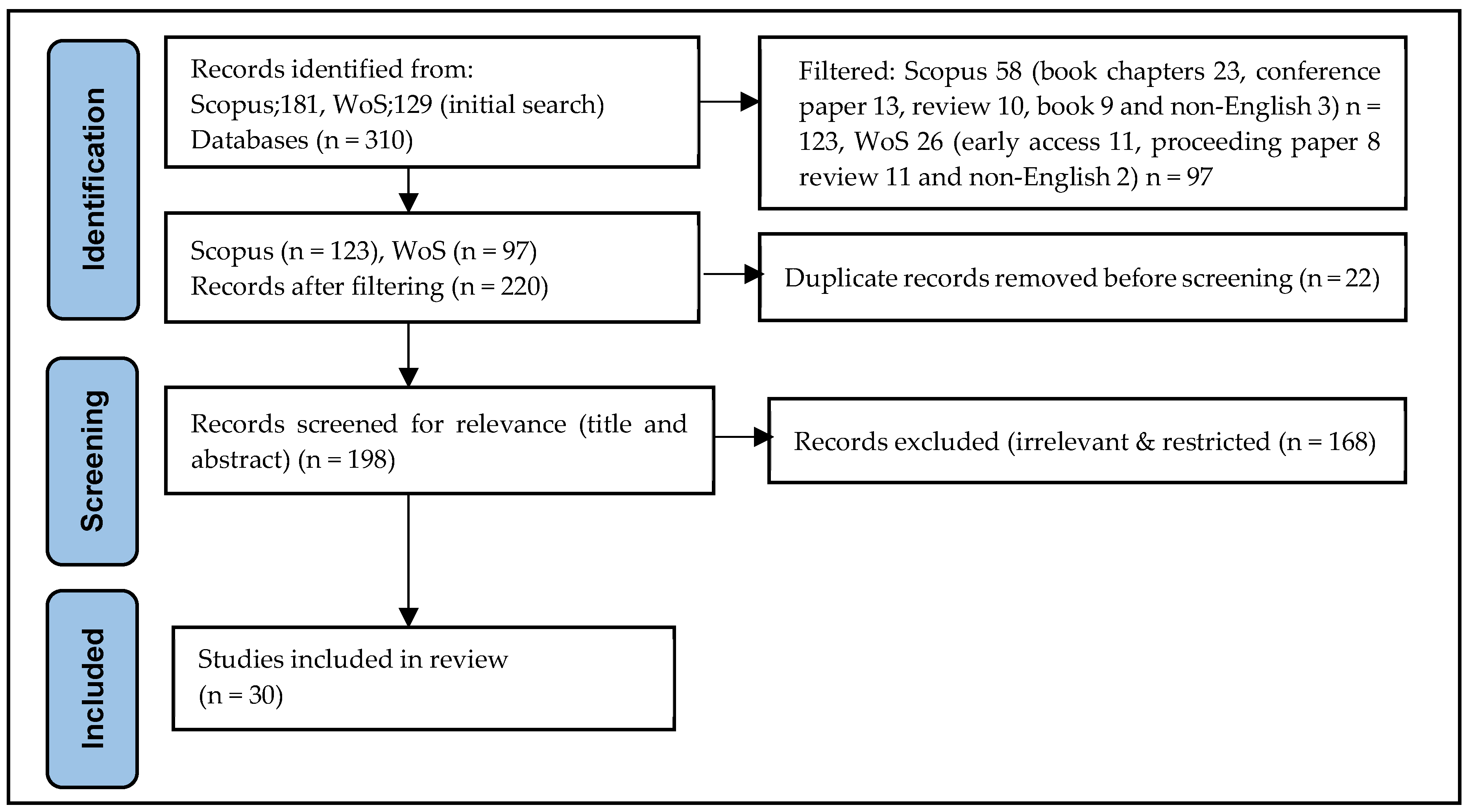
The initial search in Scopus generated 181 records. Following the application of exclusion filters (book chapters = 23; conference papers = 13; reviews = 10; books = 9; non-English publications = 3), 123 articles remained.
The search in Web of Science found 129 records. After removing early-access articles (11), proceedings papers (8), reviews (11), and non-English publications (2), 97 articles remained. The total number of records identified across both databases was 220 articles (Scopus = 123; WoS = 97). See Figure 2.

3.4.2. Screening

After merging the two datasets, duplicate records (n = 22) were removed, resulting in: 205 records.
Titles and abstracts were evaluated for their conceptual relevance to sustainability-oriented strategic management. Studies that focused on sustainability without strategic integration, or on strategy without the integration of sustainability, were excluded. A total of 168 records were excluded during the screening stage.

3.4.3. Eligibility and Inclusion

The remaining studies were subjected to a rigorous full-text evaluation to ascertain their eligibility for inclusion. This phase entailed a comprehensive assessment grounded in established criteria, encompassing: (1) the degree to which the study explicitly integrates sustainability into strategic management processes, (2) the clarity of its theoretical contribution, and (3) its methodological relevance to the research objectives. A systematic evaluation framework was implemented to guarantee uniformity in the assessment procedure. At this stage, studies were rejected if they failed to establish a strong conceptual connection between sustainability and strategic management or did not offer adequate theoretical or empirical insights into sustainability-oriented strategic management (SSM). In instances of doubt, the study was re-evaluated to guarantee precise classification and conformity with the review objectives. Subsequent to this thorough evaluation, 30 articles were conclusively selected and incorporated into the qualitative synthesis, in compliance with the PRISMA methodology, as illustrated in Figure 2.

3.5. Data Extraction and Analytical Procedure

The 30 selected studies were analyzed using a systematic data extraction and coding approach to ensure consistency and reliability. The extracted data included study characteristics, integration mechanisms, enabling and constraining factors, and strategic management phases. A hybrid deductive–inductive coding framework was applied, combining theory-driven and emergent themes. The studies were coded by a single author through iterative review and refinement, supported by an external audit to enhance consistency and reliability.
Table 2 shows how the analytical methodology adheres to a systematic and iterative approach, guaranteeing transparency in coding, consistency in data extraction, and rigor in the formulation of themes and the conceptual framework.

4. Findings and Discussion

This study intends to: 1—identify and categorize the main strategic dimensions and organizational domains through which sustainability is integrated into strategic management and planning, 2—examine enabling and constraining factors, and 3—develop a cohesive conceptual framework that systematically organizes the identified mechanisms and relationships to enhance future research and managerial practice. In the examined literature, several kinds of methods and frameworks were utilized to develop and operationalize the SSM relationship, highlighting significant progress from fragmented approaches to integrated, multi-level frameworks.
The application of the integrated theoretical perspective indicates a clear development in sustainability integration across four groups (Table 3) regarding the evolution of SSM integration. The timeframe from 2016 to 2017 represents the initial phase, which is characterized by conceptual clarification and the acknowledgment of integration shortcomings in SSM. This phase was significantly shaped by the post-implementation context of the SDGs, whereas prior practices were predominantly motivated by CSR initiatives centered on reputation and ethical considerations under institutional pressures. Institutional Theory elucidates how legislation, standards, and market conditions served as important drivers and limitations influencing the first acceptance of sustainability [9,21].
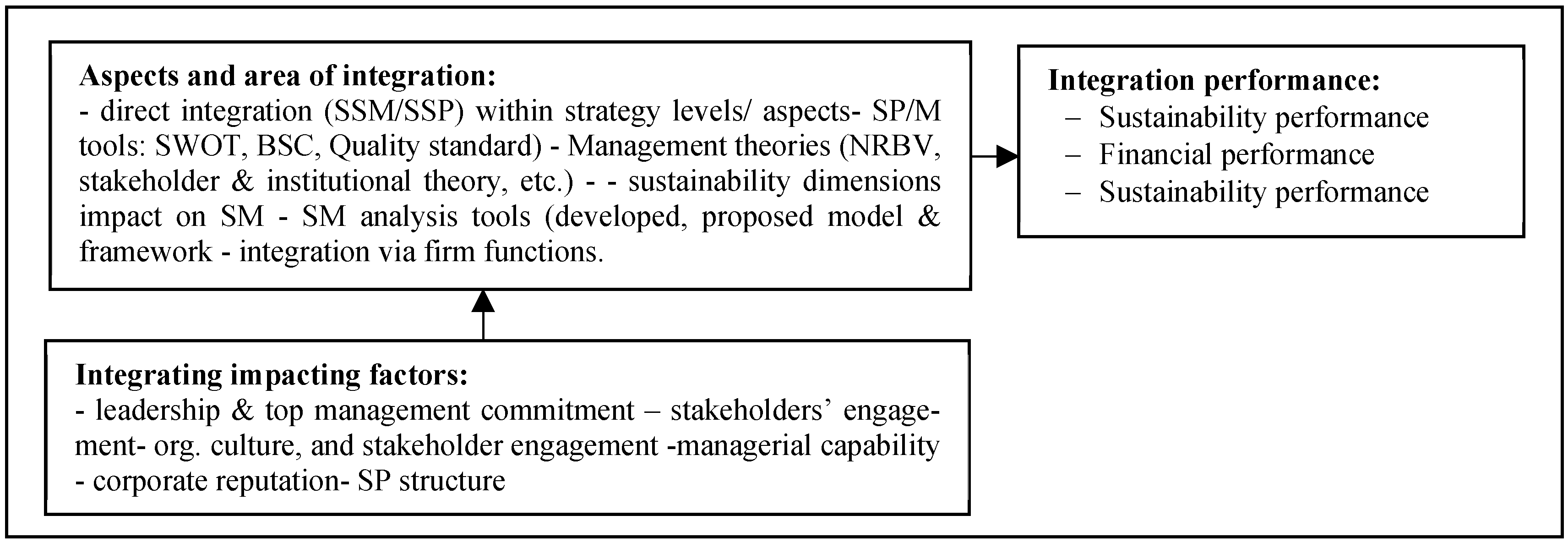
Moreover, the study in [39] investigated institutional logics (ILs) inside sustainability management systems and determined that these logics substantially influence the execution of sustainability management control systems in utility businesses. Their findings indicate that hybrid logics facilitate improved alignment between sustainability goals and organizational practices, hence strengthening the influence of institutional complexity on sustainability integration processes. The strategic stage not only connects sustainability integration to established firms’ vision and norms but also demonstrates alignment with competitive advantage and value generation from a RBV perspective [7]. The period from 2018 to 2021 is identified as a strategic phase during which research increasingly highlights essential driving forces and expectations based on organizational capabilities that underpin sustainability integration. In this phase, companies’ strategic sustainability objectives and results were systematically assessed and evaluated using RBV methodologies [19,25]. This capacity level highlights the enhancement of adaptable organizational competencies for sustainability, in alignment with DCs Theory. Research conducted during this timeframe emphasizes the significance of organizational learning, adaptability, and transformation in facilitating the integration of sustainability. In light of the evolution identified from 2021 to 2024 in the analyzed studies, and in alignment with the objectives of this study, the findings can be summarized into the following: integration aspects and dimensions, influencing factors, and integration frameworks, which are also shown in Figure 2. The next phase (2024–2025) reveals a growing body of literature highlighting the significance of digital technology in facilitating sustainability integration and improving the empirical validation of performance objectives. This phase is defined by the advent of digital transformation, circular economy initiatives, ESG assessment frameworks, SDG implementation, and sophisticated data analytics as essential facilitators of sustainability-focused strategic management [15].
A structured comparative synthesis of the 30 selected studies is shown in Table 4, highlighting how sustainability integration has been examined across multiple domains, including strategy development, governance, innovation, performance measurement, and organizational processes. Through a cross-study comparison, recurring themes were identified and grouped into higher-order categories, including internal capabilities (e.g., leadership, culture, and innovation), external pressures (e.g., regulation and stakeholder demands), strategic tools and processes, and performance mechanisms. The convergence of these themes across different theoretical perspectives (the RBV, DCs, IT, and ST) provided the empirical foundation for the development of the proposed conceptual framework.

4.1. Aspects of Sustainability Integration into Strategic Management

The examined studies show that sustainability is integrated into strategic management and planning via many fundamental strategic aspects and organizational areas, thereby enhancing firm performance. These approaches highlight the key methods by which sustainability is integrated into organizational strategies and operations. However, the integration of SSM occurs through various mechanisms, dimensions, and organizational components, which may be either explicit and formally recognized or implicit within existing strategic processes. From a RBV perspective, the integration of sustainability into corporate vision and strategic objectives enhances competitive advantage and long-term performance [1,4]. Innovation and the development of eco-friendly products operationalize sustainability within firms, particularly when supported by strong leadership commitment and effective resource allocation [8]. Organizational capabilities and internal integration mechanisms further reflect the DCs perspective, enabling firms to adapt, remain agile, and transform in response to evolving sustainability challenges [20,33]. In addition, governance frameworks and stakeholder engagement highlight the influence of IT and ST in shaping strategic sustainability decisions [2]. Empirical evidence further suggests that green innovation improves operational efficiency, eco-friendly product development enhances firm performance, and top management commitment plays a critical role in ensuring the successful implementation of sustainability integration strategies [1,8].
Another aspect of sustainability integration revealed in the examined research pertains to organizational capacities and facilitating variables. Ref. [31] investigates the incorporation of corporate sustainability into organizational system design from three interconnected perspectives: ongoing organizational enhancement, integration into organizational structure, and assimilation into organizational culture. Continuous improvement is evidenced in the examination of performance KPIs, monitoring systems, and organizational learning procedures. Structural integration transpires at strategic, tactical, and operational levels, whereas cultural integration focuses on instilling sustainability values inside corporate norms and behaviors. The authors propose the LEAPFROCS framework as a systematic methodology for aligning sustainability with organizational systems to facilitate this integration. Also, the integration of sustainability can be observed in key strategic areas, particularly within corporate vision, mission, and long-term strategic orientation. Ref. [1] emphasizes the integration of sustainability into fundamental strategic components as a crucial initial step toward embedding sustainability within organizations. Similarly, Refs. [3,20] highlight its incorporation into formal strategic planning processes, demonstrating that sustainability is increasingly embedded in both strategy formulation and execution. Moreover, successful sustainability integration requires alignment across multiple organizational levels. Ref. [35] illustrates the importance of coordination between corporate, business, and operational levels in ensuring effective implementation. Collectively, these findings indicate that sustainability integration is a comprehensive and multi-faceted process embedded within core strategic practices rather than a peripheral organizational activity.
The findings suggest that the three fundamental theoretical perspectives offer a primary framework for explaining the corporate acknowledgment of the significance of CSR and corporate sustainability (CS), thereby creating a cohesive foundation for facilitating corporate decision-making and incorporating CSR and CS into organizational strategy. Similarly, Ref. [2] emphasizes the pivotal importance of institutional leadership, the establishment of participatory governance frameworks, and the execution of strategic plans associated with the Sustainable Development Goals (SDGs). Furthermore, Ref. [29] investigates the function of sustainability reporting in the formulation and execution of strategy, highlighting its significance in enabling the modification of the SSM relationship via organized strategic planning and implementation procedures. The examination of these studies reveals that the integration of SSM occurs through multiple interconnected organizational elements, including corporate strategy, vision, objectives, innovation, green products, organizational theories, capabilities, and governance structures. These elements collectively indicate that sustainable integration extends beyond operational activities, embodying a strategic viewpoint embedded into the firm’s basic direction.
The initial research emphasizes the importance of incorporating sustainability into corporate strategy and organizational vision. Ref. [7] identifies corporate strategy and vision as a vital integration domain, signifying that sustainability must be embedded in the organization’s long-term strategic direction. Likewise, Refs. [1,4] assert that the integration of sustainability objectives into corporate vision and strategic goals enables organizations to attain an enhanced competitive advantage, superior analyst ratings, improved environmental performance, and augmented economic revenue and profitability. The findings corroborate the claim that sustainability is more effective when strategically institutionalized rather than when treated as a peripheral or charitable endeavor. From a strategic management viewpoint (RBV), this integration links sustainability objectives to long-term value generation and competitive positioning. The second group in the domain of dynamic capacities emphasizes innovation and eco-friendly product development as essential mechanisms for facilitating sustainability integration. The studies in [1,8] demonstrate that green innovation enhances operational efficiency and facilitates the creation of eco-friendly goods that improve sustainable organizational performance. Furthermore, these studies emphasize the significance of senior management commitment in enabling the execution of sustainability programs. Leadership support guarantees the provision of resources, strategy alignment, and organizational motivation essential for effective sustainable integration. These findings indicate that sustainability-oriented innovation enhances environmental performance while simultaneously bolstering organizational competitiveness and market differentiation.
This viewpoint underscores that the integration of sustainability requires comprehensive organizational transformation rather than fragmented initiatives. Integrating sustainability into organizational structures and culture allows organizations to institutionalize sustainability initiatives and guarantee their persistence across various managerial levels.
The fourth integration and organizational aspect, as indicated by the findings, underscores the theoretical foundations that reveal the rationale for firms integrating sustainability into strategic decision-making. An increasing body of literature indicates that firms are progressively incorporating sustainability into their strategic decision-making processes, integrating environmental and social considerations into core strategic choices rather than treating them as secondary activities. Ref. [1] demonstrates that the integration of sustainability into corporate strategy directly influences key decisions related to innovation, resource allocation, and supply chain management, resulting in improved financial and environmental performance outcomes. Ref. [3] emphasizes that systematic strategic planning—comprising analysis, formulation, implementation, and evaluation—facilitates the integration of sustainability into decision-making processes, thereby enhancing overall sustainable performance. Ref. [29] illustrates that sustainability reporting supports both strategy implementation and reformulation, enabling organizations to reassess and adjust strategic decisions through double-loop learning mechanisms. In addition, Ref. [15] shows that the integration of sustainability considerations with digital transformation processes plays a critical role in informing strategic decisions within multinational corporations. Refs. [2,25] further assert that sustainability and the SDGs are increasingly embedded within governance structures and strategic planning systems, thereby influencing senior-level decision-making. Empirical evidence in [4] demonstrates that firms integrating sustainability into corporate objectives, rather than adopting isolated initiatives, are perceived more favorably, highlighting the strategic importance of holistic integration. Similarly, Ref. [17] confirms that sustainable strategic planning and management practices significantly influence business model decisions and enhance sustainability performance, particularly in SMEs. Supporting these findings, studies such as [25,26,31] illustrate how decision-support tools—including circular economy frameworks, Balanced Scorecard approaches, and SWOT analysis—facilitate sustainability-oriented strategic choices. Collectively, these studies demonstrate that sustainability is increasingly embedded in strategy formulation, strategic selection, and organizational learning processes, underscoring its central role in shaping long-term strategic decision-making and enhancing organizational competitiveness.
The findings underscore a complimentary relationship: leadership influences strategic intent, whereas governance implements it through formal mechanisms. Together, they operate as interdependent facilitators that dictate the depth and consistency of sustainable integration in strategic management.

4.2. Supporting and Hindering Factors for SSM Integration

The examined literature indicates several different internal capabilities and external pressures that influence the integration of SSM processes. The internal drivers—such as leadership, organizational culture, top management commitment, internal communication, and strategic planning—align with the Resource-Based View (RBV) and Dynamic Capabilities perspectives, enabling firms to build and deploy sustainability-related competencies [1,2,11,24]. The external drivers—such as regulatory pressures and stakeholder expectations—are explained through Institutional Theory and Stakeholder Theory [9,11,24].
Other internal and external factors affecting SSM integration have also been recognized in the literature. Regulatory complexity and market volatility are identified as major external barriers [31,38], while measurement difficulties stemming from the absence of established sustainability criteria impede effective integration [10,21]. Cultural obstacles and reluctance to change, such as insufficient awareness and organizational inertia, hinder the implementation of sustainability initiatives [2,11]. Ref. [3] investigates the impact of systematic strategic planning on sustainable performance in manufacturing SMEs, revealing both direct and indirect effects via strategic intent and strategy development. In a similar vein, [29] investigates the role of sustainability reporting in strategic management, illustrating that it facilitates both strategy formulation and execution by identifying performance deficiencies, guiding corrective actions, enabling materiality assessment and benchmarking, and supporting strategic adjustments. This therefore improves organizational learning and adaptive capacity for sustainability. Moreover, Ref. [10] emphasizes that the absence of established criteria for environmental and social performance, coupled with a changing regulatory landscape, constitutes a significant obstacle to the effective integration of SSM.
The literature indicates that the integration of SSM is affected by the interaction of internal and external influences. Leadership serves as a vital enabler by providing strategic direction, allocating resources, and aligning corporate culture with sustainability objectives. Supplementary internal facilitators include company culture, stakeholder engagement, and effective internal communication, which enhance the implementation of sustainability initiatives. External influences, such as statutory requirements and stakeholder expectations, compel organizations to include sustainability into their strategic frameworks. Furthermore, methodologies such as systematic strategic planning and sustainability reporting facilitate integration by enabling performance evaluation, strategic learning, and continuous improvement. However, other impediments may hinder this process, including the lack of established sustainability metrics, regulatory uncertainty, and organizational constraints such as limited resources and insufficient sustainability expertise. The results demonstrate that effective integration requires strong internal competencies supported by responses to external institutional limitations (Figure 3).
The identified enabling and hindering factors (e.g., resource limitations, absence of metrics, and regulatory ambiguity) reveal an imbalance between internal competencies and external requirements, underscoring the need to combine capability-based (the RBV and DCs) and external alignment frameworks (Institutional and Stakeholder Theories).

4.3. Model and Framework for SSM Relationship

The research indicates that current frameworks lack a cohesive theoretical basis. Numerous models focus on particular dimensions yet overlook the integration of sustainability throughout the entire strategic management process. This study fills this gap by presenting a comprehensive, theory-driven paradigm that integrates internal capabilities (the RBV), adaptive processes (DCs), and external alignment mechanisms (Institutional and Stakeholder Theories).
For example, Ref. [21] emphasizes the integration of studies on corporate sustainability, strategic management, and decision-making, aiming to identify the intersection of these three fields and propose a cohesive cross-industry framework for sustainable integration. These elements are recognized as essential factors influencing the integration of business sustainability into strategic management procedures. Moreover, numerous studies advocated for systematic frameworks to facilitate the integration of sustainability. This led to the development of a sustainable management framework that includes three interconnected strategic dimensions: strategy process, strategy content, and strategy context. Likewise, Ref. [33] investigates the incorporation of corporate sustainability into organizational system design from three interrelated perspectives: ongoing organizational enhancement; integration into the organizational structure at strategic, tactical, and operational levels; and assimilation into the organizational culture. To facilitate this integration, they propose the LEAPFROCS framework as a systematic method for incorporating sustainability into organizational processes.
Numerous studies suggest comprehensive frameworks that tackle the multifaceted aspects of SSM integration. Ref. [38] highlights 14 interrelated study issues (e.g., strategy, ESG, innovation, data, and smart cities), illustrating the intricate and intertwined nature of sustainability and strategic management. Likewise, Ref. [40] defines sustainability management via three interconnected strategic dimensions: strategy process, strategy content, and strategy context, associating these with corporate value generation through sixteen theoretical propositions. This paradigm underscores the need to integrate sustainability into managerial decision-making, clearly articulating it within strategic objectives, and ensuring alignment with both internal and external contextual elements. Furthermore, Ref. [33] presents a systematic approach encompassing the concept, implementation, and assessment phases of sustainable integration. Similarly, Ref. [6] proposes a comprehensive model that unifies strategy, governance, operations, and organizational learning, emphasizing the systemic and cross-functional aspects of sustainable integration in strategic management processes.
In alignment with this, Ref. [20] develops a five-module framework for manufacturing firms in developing countries, comprising preparatory, strategy formulation, strategy implementation, strategy evaluation, and feedback stages. This practical framework addresses the gap in empirical research on integrating sustainability into core business models within developing country contexts. Similarly, Ref. [20] proposes a seven-step approach for integrating the United Nations’ SDGs into the Sustainability Balanced Scorecard (SBSC), addressing the lack of comprehensive and non-industry-specific SDG integration frameworks. The process includes identifying relevant business units, assessing sustainability issues, translating SDGs into strategic objectives, embedding goals into the SBSC, establishing cause–effect relationships, obtaining formal approval, and monitoring performance outcomes.
In addition, Ref. [6] introduces the Integrative Sustainable Intelligence (ISI) framework, which explains how organizations systematically integrate corporate sustainability through four stages: discover, create and add value, value co-creation, and consolidate. This framework integrates strategy, governance, operations, performance assessment, and organizational learning, addressing the problem of fragmented sustainability initiatives treated as secondary activities. Furthermore, Ref. [26] develops a multi-level analytical framework for assessing circular economy maturity within industrial ecosystems, integrating theoretical and empirical dimensions across three phases and validating the model in the context of Russian steel companies.
The reviewed studies demonstrate an initial progress in developing conceptual models and frameworks for SSM integration; however, continued fragmentation in creating a unified cross-industry framework for SSM integration is apparent. Ref. [21] contends that sustainability is mostly addressed at an operational level rather than as a strategic imperative, whilst CSR is often regarded more as a philanthropic endeavor than as an integral component of competitive strategy. Furthermore, Ref. [38] emphasizes that the advancement of research in strategic management and sustainable development is inconsistent across many sustainability dimensions, with notable advances in areas like poverty alleviation and climate change mitigation, while other sectors evolve at disparate rates. Nonetheless, the literature indicates an increasing focus on nascent research domains, such as sustainable economic development, Industry 4.0, and digital transformation, signifying a transition from conventional sustainability issues to more technology-driven and system-oriented viewpoints.
The analysis of studies focusing on developing frameworks for integrating SSM demonstrates significant variation in their elements, structural configurations, and the internal and external contextual factors that affect them. This indicates a structural discrepancy; while sustainability discourse has conceptually advanced, its integration into formal strategic management processes remains inconsistent. The literature confirms a separation between concept and operation, wherein sustainability discourse surpasses systemic strategy integration. This gap indicates a lack of grounding in the RBV and DCs theory, suggesting that sustainability ought to be regarded as a strategic capability rather than merely a compliance tool. However, despite all this progress, there is still no comprehensive framework integrating strategic analysis, strategic formulation, strategic implementation mechanisms, strategic performance management, or capability and ecosystem alignment.

4.4. Performance Outcomes of Sustainability-Oriented Strategic Management

A systematic analysis of the examined studies indicates that sustainability-oriented strategic management affects both financial and sustainability performance; however, these results are not consistently documented. To improve clarity, performance is categorized into two classifications, and patterns of convergence and divergence are summarized.

4.4.1. Financial Performance

The reviewed literature reveals that financial outcomes—including profitability (e.g., return on assets and return on equity), cost efficiency, and market performance (e.g., competitiveness and firm value)—are among the most commonly studied aspects of sustainability–strategic management (SSM) integration. A significant number of the chosen studies evaluate financial performance, either directly or indirectly, in connection with sustainable integration. Nevertheless, the results are inconclusive. Numerous studies indicate favorable correlations between SSM adoption and financial performance, particularly in major corporations and resource-intensive sectors; nevertheless, some studies highlight restricted or context-specific impacts, notably in small- and medium-sized enterprises and emerging nations. These differences seem to be affected by contextual factors like industry characteristics, business size, geographic location, and the methodological approaches utilized in various studies.

4.4.2. Sustainability Performance

Sustainability outcomes include environmental, social, and ESG-related aspects. Environmental performance is typically evaluated using metrics such as emissions reduction, resource efficiency, and waste management. Social performance includes CSR efforts, stakeholder involvement, and employee welfare. Moreover, composite ESG indicators are progressively employed to encapsulate integrated sustainability performance. A significant number of the analyzed studies investigate at least one aspect of sustainability performance, typically demonstrating favorable outcomes of sustainability–strategic management integration. Nevertheless, the results are not completely consistent. Discrepancies among studies can be ascribed to practical limitations, such as constrained organizational resources; a lack of standardized measuring frameworks; and context-specific issues pertaining to industry, company size, and geographic location.

4.5. Consistency, Context, and Causality

The data indicates partial convergence, exhibiting robust patterns for sustainability performance, moderate support for financial outcomes, and context-specific variability. Sectoral variations, organizational scale, and regional context seem to influence these correlations. Methodologically, the majority of studies utilize cross-sectional or case study designs, hence limiting the ability to infer causality. Longitudinal and experimental studies are significantly limited, resulting in unresolved inquiries regarding the causal pathways connecting SSM to performance, which require further investigation.

4.6. Implications for Research and Practice

This synthesis underscores the need for future research to methodically investigate both financial and sustainability outcomes, as well as their interrelations, across many industries, locations, and types of firms. Managers should acknowledge that SSM can enhance sustainability performance with possible financial advantages; however, its effectiveness is contingent upon contextual and organizational elements.

4.7. Integrated Analysis of Results and Observations Across the Study Objectives

The findings indicate that the aspects of sustainable integration in strategic management, the relevant driving and influencing variables, and the current integration frameworks or models are interconnected. The interconnections among these variables affect the efficacy of sustainable integration processes, either promoting or obstructing their successful execution. This underscores the need for an innovative, systematic, and empirically based comprehensive framework to facilitate the effective integration of sustainability into strategic management.
The study demonstrates a significant consensus among studies on the critical roles of leadership commitment, governance frameworks, and stakeholder involvement as essential facilitators of sustainability integration. Divergence arises in the efficacy and execution of these strategies, especially across various organizational contexts and industries. Some studies indicate that formal governance frameworks and performance evaluation tools improve sustainability outcomes, while others emphasize ongoing obstacles such as resource limitations, absence of defined measurements, and superficial adoption. Moreover, discrepancies in methodologies, application domains, and fundamental motivations further hinder the integration of sustainability-oriented strategic management. These findings indicate that the efficacy of SSM depends on contextual and organizational factors.

5. Conclusions

This systematic literature review explored the integration of SSM in contemporary academic literature published in the period of 2015–2025. The findings demonstrate that the integration of sustainability has gradually transitioned from separate environmental initiatives and CSR efforts to more strategically embedded and capability-oriented approaches within organizational governance and long-term strategic decision-making. This review indicates that the integration of sustainability within strategic management and planning is influenced by several interconnected dimensions and factors, including integration processes, driving forces, and conceptual framework models. Also, the literature indicates that many of the existing frameworks are fragmented, insufficient, and frequently focus on particular sustainability elements or isolated phases of the strategic management process. The relationship between SSM is often addressed in a fragmented or disjointed manner.
The examined studies underscore four major mechanisms that facilitate sustainability integration. First, strategic alignment methods integrate sustainability objectives into the firm vision, mission, and long-term strategic priorities. Second, innovation-driven procedures, especially green innovation and sustainable product creation, empower firms to improve both environmental performance and operational efficiency. Third, organizational capability mechanisms highlight the need to harmonize structures, processes, and corporate culture to facilitate sustainability-oriented tactics. Fourth, theoretical mechanisms, including the Resource-Based View, Stakeholder Theory, and Institutional Theory, highlight the reasons why organizations implement sustainability-oriented initiatives and their impact on organizational performance. While these advancements offer significant insights, the evaluation identified some critical gaps in the literature. There is a significant deficiency in research showing how sustainability is systematically integrated throughout the full strategic management and planning cycle, encompassing strategic analysis, formulation, implementation, and evaluation. Moreover, current conceptual frameworks rarely combine internal capabilities, external forces, and governance processes into a cohesive strategy framework. The findings show that successful sustainable integration requires a comprehensive strategy framework that simultaneously connects strategic context, strategic intent, innovative capabilities, organizational transformation, and governance mechanisms informed by theory. This integrated strategy can assist firms in progressing from mere symbolic sustainability adoption to systemic integration, thereby enhancing long-term organizational resilience and sustainable value creation.

6. Recommendations, Managerial Practices, and Future Research

6.1. Recommendations

This study combines the findings to propose a conceptual framework that links strategic drivers, organizational integration mechanisms, and sustainability outcomes, offering a comprehensive structure that can inform future research and managerial practices. These aspects can be grouped as follows:
Future research should transition from viewing sustainability as a normative strategic objective to investigating the organizational factors that facilitate the implementation and maintenance of sustainability plans. Further investigation should examine the micro-foundations of sustainability capabilities, encompassing leadership behaviors, managerial cognition, and organizational learning processes that convert sustainability visions into implemented practices.
The literature could benefit from a more profound integration of DCs theory with sustainability strategy. Although DCs are often cited as facilitating organizational adaptation, there is a lack of empirical research investigating the interplay and interaction between capabilities for digital transformation and those for sustainable integration. Determining whether these capabilities complement, compete with, or transform one another is a significant theoretical inquiry.
This article stresses the need for cross-level integration frameworks that combine strategic decision-making processes with operational execution. Subsequent research should investigate the dissemination of sustainability initiatives across organizational levels, from the development of strategies by top management to the operational procedures inside functional units and supply chains.

6.2. Implications for Managerial Practices

This review also offers practical implications for managers seeking to integrate sustainability into strategic management processes. Rather than treating sustainability as a standalone initiative, organizations should embed sustainability objectives within core strategic decision-making processes, including strategic planning cycles, enhanced by innovation management, and performance evaluation systems. Firms that successfully integrate sustainability tend to align their sustainability goals with innovation strategies, supply chain collaboration, and performance measurement systems, enabling sustainability objectives to influence daily operational decisions.
Furthermore, organizations should develop organizational capabilities that support sustainability integration, including cross-functional coordination, stakeholder engagement mechanisms, and digital tools that enhance sustainability measurement and reporting. Digital technologies—such as data analytics, sustainability dashboards, and integrated reporting systems—can play an important role in linking sustainability objectives to real-time strategic performance monitoring.

6.3. Future Research Directions

Building on the gaps identified in the literature, this review proposes several targeted research questions for future investigation:
  • Subsequent studies should investigate the convergence and divergence identified among studies, especially the different effects of leadership, governance, metrics, and stakeholder engagement strategies in various circumstances.
  • Increased focus is required on the variations in sustainability-oriented strategic management (SSM) across sectors, geographic contexts, study methodologies, and theoretical perspectives, along with its disparate effects on financial and sustainability performance.
  • This study addresses methodological differences and examines the fundamental variables impacting the wide adoption of SSM. A more rigorous empirical inquiry is required to systematically validate and improve the suggested paradigm.
  • Future studies should analyze the distinctions between the dynamic capabilities that facilitate digital transformation and those that promote sustainable integration, as well as the strategic alignment of these skills.
  • Future studies should examine the micro-foundations of leadership and managerial cognition that convert sustainability visions into executed strategic actions.
  • Future studies should investigate the dissemination of sustainability initiatives throughout organizational levels—from corporate strategy to operational implementation—and the governance frameworks that enable this coherence.
  • Future studies should assess the role of digital technologies in measuring, monitoring, and institutionalizing sustainability performance within strategic management systems.
  • Future studies should examine the impact of industrial, institutional, and organizational contexts (e.g., firm size) on the efficacy of sustainability-oriented strategic management frameworks.

6.3.1. Theoretical and Practical Contributions

This study advances the literature on sustainability-oriented strategic management (SSM) by providing a systematic and integrative synthesis of a fragmented research field and moving beyond descriptive reviews toward a theory-informed analytical framework. Theoretically, it contributes by identifying and consolidating core mechanisms—leadership, governance, innovation, and stakeholder engagement—and positioning them within the phases of strategic management, thereby clarifying how sustainability is embedded across formulation, implementation, and evaluation processes. In doing so, the study introduces a structured and process-oriented perspective that explains not only what drives sustainability integration but also how and under what conditions it occurs. Practically, the findings offer actionable insights for managers and policymakers by highlighting the importance of aligning leadership commitment with governance structures, leveraging innovation and digital capabilities, and strengthening stakeholder engagement to achieve measurable sustainability outcomes. The proposed framework thus serves as a guiding tool for organizations seeking to systematically integrate sustainability into their strategic decision-making and performance systems.

6.3.2. Study Limitations

This review has multiple limitations. The conceptual synthesis is mainly derived from secondary literature and hence requires validation by empirical evidence across various industries and institutional contexts. The examined studies predominantly depend on conceptual models and cross-sectional analyses, thereby limiting the understanding of the long-term development of sustainability initiatives within enterprises. Future studies utilizing longitudinal case studies, mixed-method approaches, and comparative cross-industry analysis may yield profound insights into the dynamic progression of sustainability integration.

Funding

The author extends his thanks and appreciation to Prince Sattam bin Abdulaziz University for funding this research through project number PSAU/2025/02/35035.

Institutional Review Board Statement

Not applicable.

Informed Consent Statement

Not applicable.

Data Availability Statement

No new data were created or analyzed in this study.

Conflicts of Interest

The author declares no conflict of interest.

References

  1. Kapoor Bhasin, D.G. Integrating environmental sustainability into strategic management: Achieving the profit–planet equilibrium. Int. J. Environ. Sci. 2025, 11, 130–138. [Google Scholar]
  2. Rodriguez-Cala, A.; Rodó-Cobo, M.; Duran-García, N.; Zango-Martín, I.; Calmaestra-Carrillo, E.; Codern-Bové, N. From commitment to action: Aligning corporate social responsibility with sustainable development goals in the health sector. BMC Health Serv. Res. 2025, 25, 1569. [Google Scholar] [CrossRef] [Scilit] [PubMed]
  3. Mehta, A.M.; Qazi, S.Z.; Haque, R.; Senathirajah, A.R.B.S.; Baig, W.; Sajjad, R.; Rauf, D.A. Strategic planning as a catalyst for sustainability: A mediated model of strategic intent and formulation in manufacturing SMEs. PLoS ONE 2025, 20, e0325887. [Google Scholar] [CrossRef] [Scilit] [PubMed]
  4. Thun, T.W.; Schneider, A.; Kayser, C.; Zülch, H. The role of sustainability integration into corporate strategy: A perspective on analysts’ perceptions and buy recommendations. Heliyon 2024, 10, e25008. [Google Scholar] [CrossRef] [Scilit]
  5. Manninen, K.; Huiskonen, J. Factors influencing the implementation of an integrated corporate sustainability and business strategy. J. Clean. Prod. 2022, 343, 131036. [Google Scholar] [CrossRef] [Scilit]
  6. Silvestre, W.J.; Fonseca, A. Integrative sustainable intelligence: A holistic model to integrate corporate sustainability strategies. Corp. Soc. Responsib. Environ. Manag. 2020, 27, 1578–1590. [Google Scholar] [CrossRef] [Scilit]
  7. Rajnoha, R.; Lesnikova, P.; Stefko, R.; Schmidtova, J.; Formanek, I. Transformations in strategic business planning in the context of sustainability and business goals setting. Transform. Bus. Econ. 2019, 18, 44–66. [Google Scholar]
  8. Katsikeas, C.S.; Leonidou, C.N.; Zeriti, A. Eco-friendly product development strategy: Antecedents, outcomes, and contingent effects. J. Acad. Mark. Sci. 2016, 44, 660–684. [Google Scholar] [CrossRef] [Scilit]
  9. Peters, J.; Simaens, A. Integrating sustainability into corporate strategy: A case study of the textile and clothing industry. Sustainability 2020, 12, 6125. [Google Scholar] [CrossRef] [Scilit]
  10. Oliveira, H.C.; Gomes, M.; Maldonado, I.; Bastos, S.; Silva, P. Integrating the SDGs into corporate strategy: A case study of EDP Group. Adm. Sci. 2025, 15, 253. [Google Scholar] [CrossRef] [Scilit]
  11. Kiesnere, A.L.; Baumgartner, R.J. Sustainability management emergence and integration on different management levels in smaller large-sized companies in Austria. Corp. Soc. Responsib. Environ. Manag. 2019, 26, 1607–1626. [Google Scholar] [CrossRef] [Scilit]
  12. Nagpal, P.; Pawar, A.; Sanjay, H.M. Analysis of entrepreneurial motivation on entrepreneurial success in SMEs. In Sustainable Smart Technology Businesses in Global Economies; Routledge: London, UK, 2025; pp. 149–162. [Google Scholar] [CrossRef] [Scilit]
  13. Epstein, M.J. Making Sustainability Work: Best Practices in Managing and Measuring Corporate Social, Environmental and Economic Impacts; Routledge: London, UK, 2018; Duplicate with Epstein 19. [Google Scholar] [CrossRef] [Scilit]
  14. Patowary, M.M.I. Incorporating sustainability in business model: A literature review. SSRN 2019. [Google Scholar] [CrossRef] [Scilit]
  15. Escandon-Barbosa, D.; Salas-Paramo, J. Driving success: Leveraging strategic decision-making and digital technology for sustainable performance. J. Open Innov. Technol. Mark. Complex. 2025, 11, 100536. [Google Scholar] [CrossRef] [Scilit]
  16. Pedersen, E.R.G.; Tiburzi, L.; Costa, R.; Rosati, F.; Calabrese, A. Those who mind matter: The relationship between stakeholder demands, business model innovation, and corporate sustainability. Corp. Soc. Responsib. Environ. Manag. 2025, 33, 1016–1030. [Google Scholar] [CrossRef] [Scilit]
  17. Sari, R.K.; Alfarizi, M.; Ab Talib, M.S. Sustainable strategic planning and management influence on sustainable performance: Findings from halal culinary MSMEs in Southeast Asia. J. Model. Manag. 2024, 19, 2034–2060. [Google Scholar] [CrossRef] [Scilit]
  18. Xie, J.; Abbass, K.; Li, D. Advancing eco-excellence: Integrating stakeholders’ pressures, environmental awareness, and ethics for green innovation and performance. J. Environ. Manag. 2024, 352, 120027. [Google Scholar] [CrossRef] [Scilit]
  19. Bredebach, C.; Rösner, T. Framework for implementing UN SDGs in corporate strategy using BSC: Presentation of a methodology to use UN SDGs for measuring sustainability in business contexts. Int. J. Sustain. Policy Pract. 2022, 18, 25–41. [Google Scholar] [CrossRef] [Scilit]
  20. Thaher, Y.A.; Jaaron, A.A. The impact of sustainability strategic planning and management on organizational sustainable performance: A developing-country perspective. J. Environ. Manag. 2022, 305, 114381. [Google Scholar] [CrossRef] [Scilit]
  21. Mohammad, J.; Pan, Y.C. Sustainability, the fourth pillar of project portfolio management—A holistic approach. J. Mod. Proj. Manag. 2022, 9, 198–215. [Google Scholar]
  22. Engert, S.; Rauter, R.; Baumgartner, R.J. Exploring the integration of corporate sustainability into strategic management: A literature review. J. Clean. Prod. 2016, 112, 2833–2850. [Google Scholar] [CrossRef] [Scilit]
  23. Wheelen, T.L.; Hunger, J.D.; Hoffman, A.N.; Bamford, C.E. Strategic Management and Business Policy: Globalization, Innovation and Sustainability; Pearson: London, UK, 2018. [Google Scholar]
  24. Fonseca, A.; Abreu, I.; Silvestre, W.J. Investigating context factors in the strategic management of corporate sustainability integration. J. Clean. Prod. 2021, 314, 128002. [Google Scholar] [CrossRef] [Scilit]
  25. Sartzetaki, M.; Karagkouni, A.; Dimitriou, D. Enterprise strategic management upon sustainable value creation: A fuzzy TOPSIS evaluation tool for transport and supply chain enterprises. Sustainability 2025, 17, 5011. [Google Scholar] [CrossRef] [Scilit]
  26. Shkarupeta, E.; Babkin, A.; Babenyshev, S. Conceptual and practical aspects of circular maturity management in corporate industrial ecosystems: The case of Novolipetsk Steel and Metalloinvest. Green Technol. Sustain. 2025, 3, 100133. [Google Scholar] [CrossRef] [Scilit]
  27. Ashrafi, M.; Magnan, G.M.; Adams, M.; Walker, T.R. Understanding the conceptual evolutionary path and theoretical underpinnings of corporate social responsibility and corporate sustainability. Sustainability 2020, 12, 760. [Google Scholar] [CrossRef] [Scilit]
  28. Aragon-Correa, J.A.; Martin-Tapia, I.; de la Torre-Ruiz, J. Sustainability issues and hospitality and tourism firms’ strategies: Analytical review and future directions. Int. J. Contemp. Hosp. Manag. 2015, 27, 498–522. [Google Scholar] [CrossRef] [Scilit]
  29. Monazzam, A.; Nilsson, F. The role of sustainability reporting in strategic management. J. Appl. Account. Res. 2025, 26, 811–828. [Google Scholar] [CrossRef] [Scilit]
  30. Gandrita, D.M.; Gandrita, A.; Rosado, D.P.; Carmo, M.D. Environmental sustainability for strategic planning effectiveness and organizational improvement. Sustainability 2023, 15, 6774. [Google Scholar] [CrossRef] [Scilit]
  31. Mercado-Jiménez, J.C.; Del Rio-Zaragoza, O.B.; Ruíz-de la Torre, M.C.; Vivanco-Aranda, M. Strategic planning for the sustainable development of the cultured Pacific oyster (Magallana gigas) in Baja California, Mexico: A quantitative approach based on SWOT analysis. Sustain. Futures 2025, 10, 101030. [Google Scholar] [CrossRef] [Scilit]
  32. Valcozzena, S.; Riso, V.; Cantele, S. Managing firm sustainability planning process: Insights on strategic integration complexity. Manag. Decis. 2025. [Google Scholar] [CrossRef] [Scilit]
  33. Witjes, S.; Vermeulen, W.J.V.; Cramer, J.M. Assessing corporate sustainability integration for corporate self-reflection. Resour. Conserv. Recycl. 2017, 127, 132–147. [Google Scholar] [CrossRef] [Scilit]
  34. Bey, N.; Hauschild, M.Z.; McAloone, T.C. Drivers and barriers for implementation of environmental strategies in manufacturing companies. CIRP Ann. 2013, 62, 43–46. [Google Scholar] [CrossRef] [Scilit]
  35. Spiegel, D.V.D.; Linke, B.S.; Stauder, J.; Buchholz, S. Sustainability strategies of manufacturing companies on corporate, business and operational level. Int. J. Strateg. Eng. Asset Manag. 2015, 2, 270–286. [Google Scholar] [CrossRef] [Scilit]
  36. Kitsios, F.; Kamariotou, M.; Talias, M.A. Corporate sustainability strategies and decision support methods: A bibliometric analysis. Sustainability 2020, 12, 521. [Google Scholar] [CrossRef] [Scilit]
  37. Bharadwaj, A.; El Sawy, O.A.; Pavlou, P.A.; Venkatraman, N. Digital business strategy: Toward a next generation of insights. MIS Q. 2013, 37, 471–482. [Google Scholar] [CrossRef] [Scilit]
  38. Sedovs, E.; Volkova, T.; Ludviga, I. Sustainable development and strategic management: What is on the horizon in our non-ergodic world research? Sustain. Futures 2025, 9, 100414. [Google Scholar] [CrossRef] [Scilit]
  39. Slacik, J.; Grüb, B.; Greiling, D. New wine in old bottles: Governing logics for applying sustainability management control systems in Austrian electric utilities. Int. J. Energy Sect. Manag. 2022, 16, 50–77. [Google Scholar] [CrossRef] [Scilit]
  40. Baumgartner, R.J.; Rauter, R. Strategic perspectives of corporate sustainability management to develop a sustainable organization. J. Clean. Prod. 2017, 140, 81–92. [Google Scholar] [CrossRef] [Scilit]
Figure 1. Theory-driven sustainability-oriented strategic management framework.
Sustainability 18 04137 g001
Figure 2. PRISMA flowchart. Note: While the study is a systematic review, prior review articles were excluded to focus on primary empirical studies that examine the integration of sustainability within SM. This approach allowed the paper to synthesize direct evidence and identify mechanisms, factors, and theoretical contributions without replicating prior secondary analyses.
Sustainability 18 04137 g002
Figure 3. Aspects and influencing factors of the relationship between SSM/SPP integration.
Sustainability 18 04137 g003
Table 1. Overview of the 30 reviewed studies on the integration of SSM, including author(s), publication year, and primary research focus.
No.Author(s)YearMain Focus of the Study
1.Kapoor Bhasin2025Examines the integration of sustainability into corporate strategy, green innovation, leadership commitment, and sustainable supply chain management to improve financial and environmental outcomes. Emphasizes the importance of senior management in promoting sustainability, enhancing efficiency through green innovation, and aligning supply chains with long-term goals to reduce emissions [1].
2.Mehta, A. M. et al.2025Analyzes the influence of systematic strategic planning (analysis, formulation, execution, monitoring) on the sustainable performance of SMEs. Indicates that strategic planning enhances economic, environmental, and social consequences both directly and through strategic intent [3].
3.Monazzam, A., & Nilsson, F.2025Examines the role of sustainability reporting in the development and execution of strategy via organizational learning. Sustainability reporting detects deficiencies, directs actions, outlines duties, and improves materiality assessment and benchmarking, functioning as an essential instrument for sustainable strategic adaption [29].
4.Shkarupeta, E., Babkin, A., & Babenyshev, S.2025Integrates Sustainable Development Goals and circular economy principles into operational strategies through a three-phase methodology for evaluating circular maturity in industrial ecosystems. Case studies of Novolipetsk Steel (NLMK) and Metalloinvest (Russia, 2016–2020) illustrate tangible advancements [26].
5.Oliveira, H. C. et al.2025Examines integration of SDGs into corporate strategy and operations through management control systems in the energy sector. Finds that commitment to sustainability, stakeholder influence, and responsible culture facilitate integration, though changing legislation and inconsistent social/environmental criteria hinder progress [10].
6.Mercado-Jiménez et al.2025Employs SWOT analysis to assess sustainability prospects and threats in oyster aquaculture. Emphasizes robust internal competencies and external threats while advocating for green technologies, sustainable human resource practices, green finance, traceability, infrastructure enhancements, and workforce development for sustainable operations [31].
7.Sartzetaki et al.2025Examines the integration of sustainability into strategic decision-making through Balanced Scorecard and Fuzzy TOPSIS methodologies, highlighting the significance of multi-criteria approaches for effective sustainability management and enhancement [25].
8.Escandon-Barbosa, D., & Salas-Paramo, J.2025Studies the role of digital technologies in strategic decision-making to improve sustainable performance. Finds that strategy combined with digital adoption and innovative business models enhances global sustainability outcomes [15].
9.Rodriguez-Cala, A. et al.2025Qualitative analysis of CSR integration within health institutions in Catalonia. Identifies strategic planning aligned with the Sustainable Development Goals, leadership, participatory governance, communication, and staff training as essential, while resource limitations, opposition to change, inadequate accountability, and fluctuating priorities hinder sustainability. Promotes inter-institutional cooperation and stakeholder involvement [2].
10.Sedovs, E., Volkova, T. et al.2025Bibliometric analysis of sustainability and strategic management research, highlighting rising areas such as sustainable economic growth, corporate strategies, leadership, digitalization, and Industry 4.0. Emphasizes the intricate, interconnected aspects of sustainability, particularly in the context of global problems such as COVID-19 [38].
11.Pedersen et al.2025The study shows that the intensity and consistency of stakeholder demands significantly drive both business model innovation (BMI) and corporate sustainability (CS), with firms under stronger pressure more likely to undertake transformational changes. Resource availability further strengthens the impact of demand intensity, though it has limited influence on consistency. The findings highlight stakeholders as key drivers of organizational change, supporting Stakeholder Theory, and emphasize that managerial perceptions of these demands play a central role in shaping strategic renewal and sustainability integration while noting limitations related to geographic scope, stakeholder coverage, and the use of survey methodology [16].
12.Valcozzena, S.; Riso, V.; Cantele, S.2025The study shows that sustainability integration begins by extracting existing sustainability initiatives from the strategic plan, which helps raise awareness and supports alignment. It identifies three key integration challenges: trade-offs between business and sustainability goals, difficulties in measuring sustainability KPIs, and organizational and cultural complexity [32].
13.Thun, T. W. et al.2024Compares the impact of integrated versus standalone sustainability strategies on corporate performance. Analysts prefer integrated solutions, while solo sustainability initiatives receive less buy recommendations. Integration does not adversely impact analyst ratings [4].
14.Sari, R. et al.2024Examines the effects of sustainable strategic planning and management on the performance of SMEs in ecological, social, and economic aspects. Emphasizes formal sustainable supply chain management and managerial commitment as essential facilitators of exceptional performance [17].
15.Xie, J.; Abbass, K.; Li, D2024Ref. [18] show that stakeholder pressures, environmental ethics, and environmental awareness positively drive green product and process innovation, which in turn enhances environmental performance. Green innovation acts as a partial mediator between stakeholder pressures and environmental ethics with performance, but not for environmental awareness. Overall, the study highlights the external pressures and internal ethical factors that are key drivers of sustainability outcomes through green innovation.
16.Gandrita, D. M. et al.2023Investigates integration of environmental sustainability into strategic planning to improve employee engagement and retention. Shows that environmental factors in strategy enhance workplace safety, support, and retention [30].
17.Mohammad, A., & Pan, Y.C.2022Examines intersections in the studies pertaining to corporate sustainability, strategic management, and decision-making. Strategic dimensions are frequently overlooked, corporate social responsibility is misconstrued, and there is an emphasis on proactive stakeholder engagement and the need for a standardized framework for sustainability adoption [21].
18.Slacik, J., Grüb, B., & Greiling, D.2022Examines sustainability as a strategic framework and its integration through sustainability management control systems in electric utilities. Identifies the institutional logics that affect implementation, with hybrid methodologies harmonizing strategic and operational processes [39].
19.Bredebach, C., & Rösner, T.2022Proposes a seven-step method to integrating UN SDGs into corporate strategy using the Sustainability Balanced Scorecard, encompassing goal definition, sustainability assessment, target translation, integration, TBL linkage, alignment, and performance monitoring [19].
20.Manninen, K., & Huiskonen, J.2022Research investigates factors affecting the execution of integrated corporate sustainability strategies and presents a conceptual framework. It indicates essential factors such as organizational culture and dedication, employee motivation and knowledge dissemination, effective communication and training, market circumstances for sustainable products, and proactive external involvement to inform market direction [5].
21.Thaher, Y. A., & Jaaron, A. A.2022Investigates the impact of Sustainability Strategic Planning and Management (SSPM) on organizational sustainable performance. It concludes that SSPM enhances economic, environmental, and social performance and suggests a five-stage framework—preparation, strategy development, implementation, evaluation, and feedback—to assist manufacturing enterprises in developing nations in incorporating sustainability into their business models [20].
22.Fonseca, A. et al.2021Identifies 19 contextual factors affecting integration of corporate sustainability into strategic management, including commitment, stakeholder engagement, trust, resources, innovation, value co-creation, monitoring, communication, and performance indicators [24].
23.Peters, J., & Simaens, A.2020Investigates drivers and barriers of sustainability integration in European textile and garment firms. Key drivers: consumer awareness, competitive advantage, sustainability value, reputation, top management commitment, innovation. Barriers: regulation, consumer behavior, infrastructure, value chain, data management, trade restrictions [9].
24.Silvestre, W., & Fonseca, A.2020Introduces the Integrative Sustainable Intelligence (ISI) framework to systematically incorporate sustainability into company strategy. The theoretical framework comprises four stages: discovery, value creation, value co-creation, and consolidation, while integrating strategy, governance, operations, and learning. It underscores that sustainable sustainability requires cohesive organizational intelligence rather than fragmented activities [6].
25.Rajnoha, R. et al.2019Found that integrating sustainability into firms’ strategic objectives strongly depends on a clear corporate vision emphasizing sustainable development. Firms with sustainability-oriented visions conduct deeper environmental analyses and are more likely to monitor and report environmental impacts, while firms focused mainly on short-term profitability show lower engagement with environmental assessment [7].
26.Kiesnere, A. L., & Baumgartner, R. J.2019Finds that sustainability integration requires top management support and an open culture. Implementation is top-down, expanding environmental and HR management before embedding in vision/strategy; bottom-up initiatives need middle management action and a change-promoting leader [11].
27.Baumgartner, R., & Rauter, R.2017Suggests a framework for the strategic integration of business sustainability, connecting strategy process, content, and context. It underscores the integration of sustainability into managerial decisions, connecting programs with organizational culture, stakeholders, and regulatory frameworks. The framework posits that sustainability improves competitiveness, fosters innovation, and boosts long-term performance while also yielding environmental and social advantages, thus establishing a basis for future inquiries into sustainability-oriented strategic management [40].
28.Witjes, S., Vermeulen, W., & Cramer, J.2017Examines corporate sustainability integration via continuous improvement, organizational structure, and culture, proposing the LEAP-FROCS framework. Finds that integration methods are context-specific and inform future sustainability initiatives [33].
29.Katsikeas et al.2016Examines the integration of sustainability in product creation, connecting organizational inputs to ecologically sustainable results. Commitment from senior management and environmental policies enhance projects, although incentives exert minimal influence, with results differing based on operational complexity [8].
30.Spiegel et al.2015Analyzes how sustainability strategies are implemented across corporate, business, and operational levels in manufacturing firms. The study finds that effective sustainability integration requires alignment between strategic intent at the corporate level, competitive positioning at the business level, and execution through operational processes. It highlights that fragmentation across these levels weakens sustainability outcomes, whereas coherent, multi-level integration enhances both environmental performance and operational efficiency. The authors emphasize that embedding sustainability into daily operations—through processes, technologies, and performance management—is essential for translating high-level strategic commitments into tangible results [35].
Table 2. Details of the analytical procedure, which followed a structured and iterative process.
StepProcedureDescriptionPurpose
1Study SelectionFinal sample of 30 studies identified after screening (Scopus and Web of Science)Ensure relevance and quality of included studies
2Data ExtractionExtraction of bibliographic details, study characteristics (design, methodology, theoretical framework), SSM integration mechanisms, enabling and constraining factors, and strategic management phasesProvide a structured and consistent dataset for analysis
3Coding Framework DevelopmentDevelopment of a coding scheme and extraction template prior to analysis using a hybrid deductive–inductive approachEnsure systematic and theory-informed coding
4Deductive CodingInitial codes derived from existing SSM literature and theoretical frameworks (RBV, DC, IT, ST)Ground analysis in established theory
5Inductive CodingEmergent themes identified and incorporated during full-text analysisCapture new and context-specific insights
6Coding ProcessAll studies coded by a single author using iterative review, cross-checking, and refinement of categoriesEnsure internal consistency and reduce bias
7Comparative AnalysisCross-study comparison using constant comparison approach to identify patterns, similarities, and differencesEnable thematic synthesis across studies
8Theme DevelopmentAggregation of codes into higher-order themes (e.g., internal capabilities, external pressures, strategic processes, performance mechanisms)Derive analytical insights from coded data
9Framework DevelopmentIntegration of themes into a conceptual framework linking capabilities, processes, and external driversProvide a structured theoretical contribution
10Reliability AssuranceExternal audit of coding framework and subset of studies by an independent academic peer; feedback used to refine codingEnhance credibility and methodological rigor
Table 3. Stages of SSM relationship during the years 2015–2025.
StageStudy Focus Key Characteristics
Early stageCSR and philanthropySustainability practices focus on reputation or ethical considerations
Strategic stageStrategic integrationSustainability is embedded into competitive strategy
Capability stageDynamic capabilitiesFirms develop adaptive capabilities for sustainability
Digital stageTechnology-enabled sustainabilityAI, big data, and digitalization support sustainability strategies
Table 4. Comparative thematic synthesis of the selected studies (n = 30).
No.StudySSM Domain FocusKey Themes IdentifiedTheoretical LensRole in Synthesis
1Kapoor (2025) [1]Strategy, innovationLeadership, green innovation, SSCMRBV, DCCore internal drivers
2Mehta et al. (2025) [3]Strategic planningPlanning stages, strategic intentRBVStrategy process integration
3Thun et al. (2024) [4]Corporate strategySustainability–performance linkRBVCompetitive advantage
4Manninen & Huiskonen (2022) [5]ImplementationCulture, motivation, knowledge sharingDCInternal capability enablers
5Silvestre & Fonseca (2020) [6]System integrationGovernance, operations, learningRBV, DCHolistic framework
6Rajnoha et al. (2019) [7]Strategy formulationVision alignment, goal settingRBVStrategic embedding
7Peters & Simaens (2020) [9]External integrationRegulation, market pressureIT, STExternal drivers
8Pedersen et al. (2025) [16]Business model innovationStakeholder pressure, innovationSTInnovation driver
9Xie et al. (2024) [18]Green innovationEthics, awareness, performanceST, RBVCompetitive sustainability
10Rodriguez-Cala et al. (2025) [2]Governance, SDGsInstitutional alignment, CSRIT, STInstitutional enabler
11Fonseca et al. (2021) [24]Contextual factorsEngagement, monitoring, commitmentDC, STIntegration determinants
12Sartzetaki et al. (2025) [25]Performance toolsBSC, evaluation systemsRBVMeasurement integration
13Shkarupeta et al. (2025) [26]Circular economyCE maturity, industrial ecosystemsRBVOperational sustainability
14Monazzam & Nilsson (2025) [29]ReportingDouble-loop learningDCStrategic adaptation
15Valcozzena et al. (2025) [32]Strategy complexityTrade-offs, integration challengesRBVStrategic constraints
16Oliveira et al. (2025) [10]SDG integrationMetrics, alignment challengesITMeasurement barriers
17Spiegel et al. (2015) [35]Multi-level strategyCorporate–business–operational linkDCStrategy execution
18Escandon-Barbosa & Salas-Paramo (2025) [15]Digital strategyData analytics, decision-makingDCDigital enabler
19Mohammad & Pan (2022) [21]CSR evolutionCSR vs. strategic sustainabilityITEarly-stage integration
20Kiesnere & Baumgartner (2019) [11]Organizational factorsCulture, leadership, alignmentDCInternal integration
21Bredebach & Rösner (2022) [19]SDG toolsSBSC, measurement systemsRBVPerformance alignment
22Gandrita et al. (2023) [30]Strategic planningSustainability–performance linkSTExternal influence
23Baumgartner & Rauter (2017) [40]FrameworkStrategy process/content/contextRBVFoundational model
24Witjes et al. (2017) [33]Organizational designStructure, culture, processesDCOrganizational integration
25Thaher & Jaaron (2022) [20]Implementation model5-stage frameworkDCProcess integration
26Sedovs et al. (2025) [38]System evolutionESG, Industry 4.0, trendsDCEvolutionary perspective
27Mercado-Jiménez et al. (2025) [31]Strategic toolsSWOT, planning modelsRBVDecision-making support
28Slacik et al. (2022) [39]Institutional logicsHybrid logics, control systemsITInstitutional complexity
29Sari et al. (2024) [17]SME strategyBusiness models, performanceRBVSME integration
30Katsikeas et al. (2016) [8]Innovation strategyEco-product developmentRBVSustainability–performance link
Disclaimer/Publisher’s Note: The statements, opinions and data contained in all publications are solely those of the individual author(s) and contributor(s) and not of MDPI and/or the editor(s). MDPI and/or the editor(s) disclaim responsibility for any injury to people or property resulting from any ideas, methods, instructions or products referred to in the content.