Review

A Critical Review on the Landfill Plastisphere: Coupling Microplastics and Greenhouse Gases Towards Smart Low-Carbon Management

1
School of Environmental Science and Engineering, Shanghai Jiao Tong University, Shanghai 200240, China
2
School of Environmental and Municipal Engineering, Lanzhou Jiao Tong University, Lanzhou 730020, China
3
China-UK Low Carbon College, Shanghai Jiao Tong University, Shanghai 200240, China
4
Gansu Academy of Eco-Environmental Sciences, Lanzhou 730020, China
*
Authors to whom correspondence should be addressed.
Sustainability 2026, 18(8), 4134; https://doi.org/10.3390/su18084134
Submission received: 1 March 2026 / Revised: 6 April 2026 / Accepted: 14 April 2026 / Published: 21 April 2026
(This article belongs to the Special Issue Microplastics and Environmental Sustainability)

Abstract

Landfills are complex repositories where macroplastics degrade into MPs. This review examines mechanical, chemical, and biological pathways of plastic fragmentation, as well as the occurrence, characteristics, and removal efficiency of MPs in landfill leachate. We also explore the landfill plastisphere from the perspective of this complex matrix, considering how plastic surfaces and microbial life may potentially converge to form a key biogeochemical interface that could influence carbon and nitrogen transformations. The plastisphere’s complex surface structure drives microbial differentiation. Given its established links to GHG production in soil and water, we propose it likely represents a key contributor to GHG emissions in the more complex landfill environment. To bridge this conceptual gap, we review a mathematical scaffolding encompassing biofilm growth, polymer degradation kinetics, and gas flux, which can as a theoretical baseline requiring future in situ parameterization to evaluate plastisphere-driven biogeochemical interactions. Building on recent advances in monitoring and remote sensing technologies, including IOT networks, UAV imagery, and AI analysis, we outline a low-carbon landfill framework designed to optimize operational controls. This framework is described to simultaneously mitigate MP release and reduce GHG emissions, lowering carbon footprints. Amid surging plastic pollutants, this review underscores the necessity of holistic, integrated mitigation strategies.

1. Introduction

The rapid global urbanization and population expansion lead the growth of municipal solid waste (MSW), now it has emerged as one of the most pressing challenges to environmental sustainability [1]. Improper management of MSW leads to severe ecological consequences, including the emission of greenhouse gases (GHG) that exacerbate climate change, the leaching of toxic chemicals into groundwater and soil, and the increase in pathogens that threaten public health [2]. To mitigate these environmental problems, modern waste management processes rely heavily on two primary disposal pathways: incineration and landfill. Currently, the pathway of incineration, often integrated with waste resources technologies, has become a mainstream treatment method globally. This method is popular because it can quickly cut waste volume by up to 90%. Meanwhile, it captures heat or electricity, reducing reliance on fossil fuels, which is a key goal in a circular economy [3]. However, incineration generates secondary pollutants such as bottom ash and hazardous fly ash, requiring stringent pollution control measures [4]. Consequently, a significant fraction of waste like incineration residues and MSW in regions lacking advanced infrastructure must be disposed of in landfills. Therefore, landfills remained the indispensable pathway before the zero waste technologies emerged.
As a critical component of urban environmental infrastructure, solid waste landfills have long played a vital role in waste disposal systems [5]. Their development has undergone a fundamental evolution. Early stages relied on simple landfilling, using compaction and daily soil cover to address immediate sanitation issues [6]; in the latter half of the 20th century, driven by regulations such as the Resource Conservation and Recovery Act, landfills entered a highly engineered phase, widely adopting key technologies such as liner systems, leachate collection and treatment, and landfill gas (LFG) management, which significantly enhanced pollution control capabilities [7]; Since the new century, the management philosophy has shifted further toward resource recovery and sustainability, with LFG to energy and material recycling becoming priorities [8], while the zero waste concept has gradually promoted source reduction [9]. However, the rapid global increase in plastic waste in recent decades now poses an unprecedented and severe challenge to existing landfill technologies and management systems [10].
Plastics have become the defining material of the Anthropocene, deeply integrated into the global economy [11]. Annual production now exceeds 400 million metric tons, driven by irreplaceable applications in packaging, construction and electronics [12]. Poor disposal has triggered a pollution crisis: discarded plastics break into microplastics (MPs) and even smaller nanoplastics, infiltrating ecosystems worldwide [13]. Landfills are at the heart of this problem. And they also emit GHG and produce leachates that pose long-term environmental risks [14]. These sites mix plastics with organic waste, creating chemical reactors that release methane (CH4), carbon dioxide (CO2) and nitrous oxide (N2O) [15]. Recent aircraft and satellite data have been identified super-emitter landfills, suggesting that the current emission records are inaccurate and that we have a major opportunity to cut emissions through management [16].
The fate of plastic debris in landfills is a growing concern. A series of physical, chemical, and biological processes drives the fragmentation of macroplastic (>5 mm) debris into microplastics (<5 mm) and nanoplastics (NPs). Key mechanisms include mechanical compaction, aging, polymer backbone hydrolysis, and biotic depolymerization mediated by surface microbes [17,18]. Global studies reported a high abundance of MPs, predominantly polyethylene (PE) and polypropylene (PP), with concentrations spanning several orders of magnitude. Although treatment systems can reduce MP release, removal efficiencies range from very low to almost complete, heavily dependent on the order of the unit operations; moreover, some methods like coagulation and membrane filtration can act as secondary MP sources via particle shear [19,20]. As a result, landfills are now increasingly recognized as consequential and previously underestimated sources of MPs to receiving waters and soils [21]. As plastics break down, to micro- and nanoscale particles, they create a new environment for microbial habitats known as the “plastisphere”. This is a distinct biofilm ecosystem that develops on plastic surfaces [22]. Recent studies show microbial communities are different from those in the surrounding soil, they are specifically evolved to stick to surfaces and break down complex chemicals [23]. Scientists are concerned that these unique communities have lower diversity, and could spread diseases or antibiotic resistance genes (ARGs) [24], potentially disrupting natural carbon and nitrogen cycles [25].
The application of the plastisphere concept to landfills is both timely and necessary, as these sites represent the final destination for most plastic waste. Plastics are concentrated in conditions starkly different from open environments: characterized by low light, high organic loading, shifting redox fronts, and a complex chemical milieu of leachate-borne substances, including metals, nutrients, and anthropogenic compounds like Perfluoroalkyl and Polyfluoroalkyl Substances (PFAS) and plastic additives. Notably, these microbial communities contain microbes and genes that break down plastics, process organic matter, and convert nitrates, which directly influence GHG flux. This evidence supports a hypothesis: the landfill plastisphere is not a passive passenger. Instead, it is a dynamic hub that connects plastic transformation, microbial network integration, and GHG emission dynamics [26]. Viewing the landfill plastisphere as a biogeochemical hub raises several urgent questions. How does it change the plastics? Do the microbes living on different polymers speed up fragmentation and weathering, or chang how the plastic absorbs and releases chemicals? How does it work with other MPs? Does the plastisphere influence the emissions of CH4 and N2O? Can the current management control it? Can we adjust plastics design or landfill operational to steer these microbial communities toward reducing both plastics pollution and GHG emissions? Addressing these requires merging plastisphere science with established microbiology. Landfill methanogenesis production via acetoclastic and hydrogenotrophic pathways is a dynamic process [27]. These processes change based on how old the waste is, available food, and wetness, which depend on plastic buildup and water conditions [28]. While N2O emissions are lower than CH4, they still escape from soils covers and leachate treatment bioreactors [29,30]. By optimizing these biological processes, for instance through controlled carbon dosing for denitrification, presents a viable strategy for cutting down the N2O release [31,32].
The plastisphere is not merely a passive biofilm but an active metabolic interface. It uses depolymerizes to break down plastics, releasing dissolved organic carbon for utilization by methanogenic archaea. It also changes the physical structure of the landfill, influencing how moisture transport and how gases (e.g., CH4, CO2) escape through waste [33]. Current landfill GHG models (e.g., IPCC First-Order Decay (FOD), EPA’s Land GEM), inadequately address plastic-derived CH4 emissions by relying on outdated parameters (e.g., fixed L0 = 0 for plastics, constant, k), while neglecting dynamic impacts of MPs on gas diffusion (Dp) and organic degradation kinetics [34]. This oversimplified approach may lead to significant misjudgment of long-term carbon emissions in landfills. Within this microbial context, plastics and MPs function dually as metabolic substrates and physical scaffolds. Susceptible polymers with hydrolysable backbones for biodegradation can be designed to break down, releasing carbon that feeds nearby bacteria [35]. Other plastics are like as scaffold, their surfaces offer stable, hydrophobic niches, and can huddle together and swap nutrients [36]. These conditions promote syntrophic microbial interactions driving methanogenesis supporting nitrification denitrification coupling in oxic–anoxic zones [37]. However, the sorption of dissolved organic matter, PFAS, and metals onto plastics influences plastisphere composition and metabolic activity. When these toxins later leak back out, they can make the surrounding environment more toxic [38]. Viewing landfills through this plastisphere perspective reveals further strategies for management. These include materials policies that phase out polymers and additives that are difficult to manage or prone to forming problematic secondary MPs, coupled with enhanced pre-landfill sorting to minimize plastic loadings [39,40]. Furthermore, this perspective opens avenues for innovative research, such as bioaugmentation to steer plastisphere communities toward beneficial functions or the development of ecologically informed biocovers [41]. These advanced covers would be designed to not only control GHG emissions but also to retain MPs, thereby addressing both gaseous and particulate pollution pathways without exacerbating MP dispersion.
In the context of low-carbon landfill management, controlling GHG emissions is the top priority. However, the increasing presence of MPs and the unique activity of the plastisphere may enhance these emissions by influencing processes with carbon and nitrogen cycling [42]. Therefore, carbon reduction strategies could pay particular attention to the GHG effects linked to MPs and plastisphere via implementing interventions to mitigate potential contribution to emissions. High-tech tools like satellite and aircraft, have already demonstrated that a small number of super emitter landfills are responsible for most of CH4 coming from waste [43,44]. This finding underscores the significant climate mitigation potential of targeted operational upgrades, such as maintaining cover integrity, optimizing gas extraction, and installing engineered biocovers to enhance microbial CH4 oxidation [45]. At the same time, landfill leachate has been recognized as a significant pathway for MPs and their associated contaminants [46]. Therefore, leachate treatment systems should be deliberately designed to remove particles, using advanced coagulation, media filtration, or membrane barriers, while also preventing the generation of secondary MPs caused by processes like shear induced fragmentation [47].
Given these considerations, this review systematically examines the following five aspects. (i) the transformation pathways of plastics into MPs in landfills via mechanical, chemical, and biological processes, assess occurrence, characteristics, and removal efficiency of MPs in landfill leachate, as well as critical gaps in sampling, detection, and mass flow analysis across treatment systems; (ii) The concept of “ plastisphere” as an integrative framework that links plastic surfaces, microbial community assembly, and GHG relevant metabolisms, with particular emphasis on its role as a biogeochemical interface influencing cycling; (iii) The kinetic models applicable to the degradation of MPs and the plastisphere in landfill environments, including a synthesis of current modeling approaches; (iv) The emerging smart low-carbon landfill framework that integrates digital monitoring technologies, and artificial intelligence (AI), optimize leachate and gas treatment to mitigate CH4 and N2O emissions and curb MP release. (v) A potential framework for integrating the landfill plastisphere into low-carbon accounting systems.
Central to this framework is the reconceptualization of the plastisphere as a dynamic biogeochemical interface. It mediates the transformation of polymer into dissolved organic, hosts the microbes that drive GHG production, and influences the mobility of co-contaminants [48]. While we have seen similar patterns in aquatic plastisphere, the landfills are uniquely shaped by an engineered, predominantly anoxic, and chemically complex medium. An understanding of these couplings necessitates a concerted integration of polymer science, environmental microbiology, and systems engineering. Finally, By taking this integrated path, we can move much faster toward truly sustainable, low-carbon waste management.

2. Landfill as a Source and Sink of Plastics and Microplastics

A MSW landfill is a complex engineered system designed to isolate waste from the surrounding environment through multiple structural and operational components, including waste cells, bottom liners, leachate collection and recirculation systems, daily and final cover layers, gas collection infrastructure, and stormwater drainage networks [49]. Although landfills remain an essential endpoint for the disposal of residual solid waste in many regions because of their relatively low cost and large storage capacity, their long-term environmental footprint has become a growing concern. As waste undergoes physical, chemical, and biological transformation, landfills continuously generate contaminated leachate and landfill gas, while also serving as long-term reservoirs of persistent pollutants [50]. These systems can become important secondary sources of contaminants to soil, groundwater, surface water, and the atmosphere. In recent years, increasing attention has been paid to plastic waste accumulation in landfills, because plastics are resistant to degradation and can fragment into MPs under landfill conditions [51]. Consequently, understanding the occurrence, transformation, retention, and release of plastic debris and MPs within different landfill compartments has become a key research priority in evaluating the environmental risks associated with landfill systems.

2.1. Inputs and Occurrence Across Coupled Media

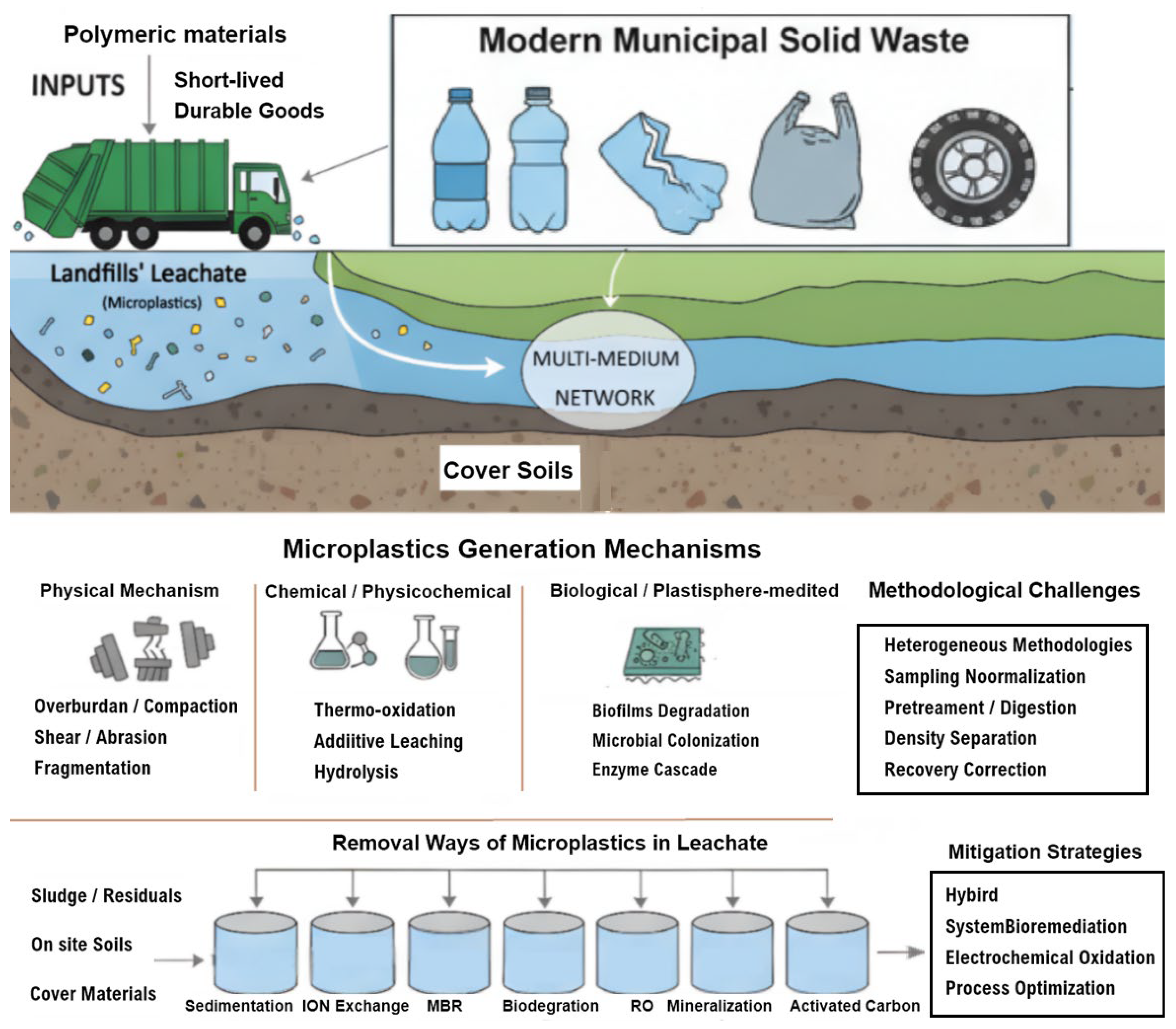
Modern municipal solid waste now contains more plastic than ever, from single use packaging to durable goods; consequently, landfills have become the primary graveyard for plastic waste in many regions (Figure 1). Field syntheses consistently report MPs in raw landfill leachate, typically ranging from 0 to 25 items/L for particle above the measurable size limit. These are mostly fibers and irregular fragments made of common plastics like PE, PP, polystyrene (PS), polyvinyl chloride (PVC), and polyethylene terephthalate (PET) [21]. However, these numbers remain conservative because most surveys do not enumerate particles <100 μm; when finer cutoffs (20–100 μm) are used, reported abundances increase and polymer profiles broaden, reflecting both sampling sensitivity and site-specific inputs [52]. Since 2018, research has confirmed that both active and closed landfills are major sources of MP pollution [53]. In addition, the type of plastic found depends on the waste age: relatively “young” wastes receiving high loads of flexible films and textiles show pronounced mechanical fragmentation signals during compaction, while “older” wastes exhibit, light colored, chemically weathered particles that have broken down over many years [54]. Ultimately, the leachate collection, recirculation system, cover soils, and onsite stormwater constitute a multi-medium network in which MPs are generated, retained, transformed, and released, so that each compartment acts as both source and sink on different timescales [55]. Measuring MPs remains difficult, and comparing results across different studies is a major challenge. To produce reliable data, it is emphasized that strict contamination control, using blank samples for comparison, and testing how specific plastics and sizes are recovered during the process. It is also essential to clearly report the exact size ranges and detection limits used [54,55]. Laboratory studies show that the amount of plastics recovered can change depending on the same type. Without correcting for these losses and accounting for uncertainty, data on removal rates or mass balances can be misleading [56,57]. Several recent reviews of landfill leachate have adopted these strict quality control principles. This shift allows for more reliable comparisons between different sites and a better understanding of how well treatment systems actually perform [21,53].

2.2. Mechanisms of MP Generation in Landfill Environments

MP generation in landfills is a mutually reinforcing effects driven by three pathways. First, physical and mechanical: mechanical stresses such as overburden, compaction, shear, abrasion, and freeze–thaw cycles embrittle plastics and detach fragments, a process strongly amplified by oxidative aging that introduces carbonyl groups, reduces molecular weight, and increases brittleness. This is strongly amplified by oxidative aging, which changes the plastic’s chemistry to make it brittle and prone to snapping. Second, chemical and physicochemical: thermo oxidation proceeds in darkness under moderate temperatures typical of biodegrading waste; redox-active species and trace metals catalyze oxidative scission, creating oxygenated oligomers more prone to comminution and biodegradation. Condensation polymers undergo hydrolysis under aggressive leachate conditions, while extraction of additives undermines mechanical integrity and increases surface roughness. Third, biological: plastic surfaces are rapidly colonized by plastisphere. These specialized microbes use enzymes and metabolites promote surface oxidation and depolymerization; subsequent fragmentation increases specific surface area, further accelerating colonization and chemical weathering, thereby creating a positive feedback that drives size spectra toward micro- and nanoplastics [58]. At the molecular level, a two steep enzymatic cascade depolymerizes PET: PETase first converts PET into MHET, which is subsequently cleaved by MHETase into terephthalate and ethylene glycol, establishing a new mechanistic paradigm for ambient temperature enzymatic depolymerization of plastics [59,60]. While PETase/MHETase were discovered outside landfills, recent metagenome mining indicates that landfill ecosystems are natural breeding grounds for diverse polyester [26,61]. In addition, different polymer and particle shapes show up in leachate samples [21,62]. Light-colored, surface-oxidized fragments usually index extended weathering; fibers can be over represented where airborne contamination controls are weak [22].

2.3. Migration and Release: Leachate Treatment Trains and Residuals

Landfill represent a significant source of MPs, with leachate serving as the primary transport vector for these particles as they are released from waste via physical weathering, fragmentation, and biological degradation [63,64]. Because leachate treatment facilities serve as the final barrier before these pollutants enter the environment, MPs are commonly detected in both raw and treated effluents [65]. However, MP efficiencies vary substantially across different treatment systems. This variability is largely attributed to differences in treatment technologies, operational parameters, and the analytical methodologies used for quantification [52,66,67]. For example, while membrane filtration effectively retains larger particles, smaller fractions can still bypass the system unless pore sizes are sufficiently fine [68]. Conversely, advanced oxidation processes (AOPs) can chemically alter polymer surfaces to enhance particle capture,, but these methods are energy intensive and may promote secondary fragmentation of MPs into smaller pieces [57,66]. Currently, most facilities rely on a mix of biological and chemical methods, such as coagulation, land application, activated carbon adsorption, ion exchange, reverse osmosis, and membrane bioreactors AOPs, separation technologies, dynamic membrane filtration, coagulation/sedimentation integrated with particle concentration, thermal treatment, recycling, biodegradation, and constructed wetlands [54]. Specifically, electrochemical oxidation and AOPs, show promise for MP removal. Biotechnological approaches, including genetic engineering, synthetic microbial consortia, and enzymatic degradation, are being explored. Hybrid systems have demonstrated enhanced removal efficiencies [69]. Nonetheless, we still not fully understand how MPs behave throughout the entire process, main operators focus on simply optimizing their existing infrastructure [52]. Ultimately, this pollution cycle is not limited to water, MPs also settle into the surrounding soil and cover materials, where they can be moved by wind or rain, liking the land, air, and water at the landfill site into one environmental pathway [55,61]. As the landfills act as both sources and sinks of MPs, highlighting the need to establish a foundation for reliable cross site comparisons and evidence-based mitigation [54,55].

3. The Plastisphere—A Unique Microbial Habitat in Landfills

3.1. Assembly and Succession on Plastic Surfaces in Landfill Settings

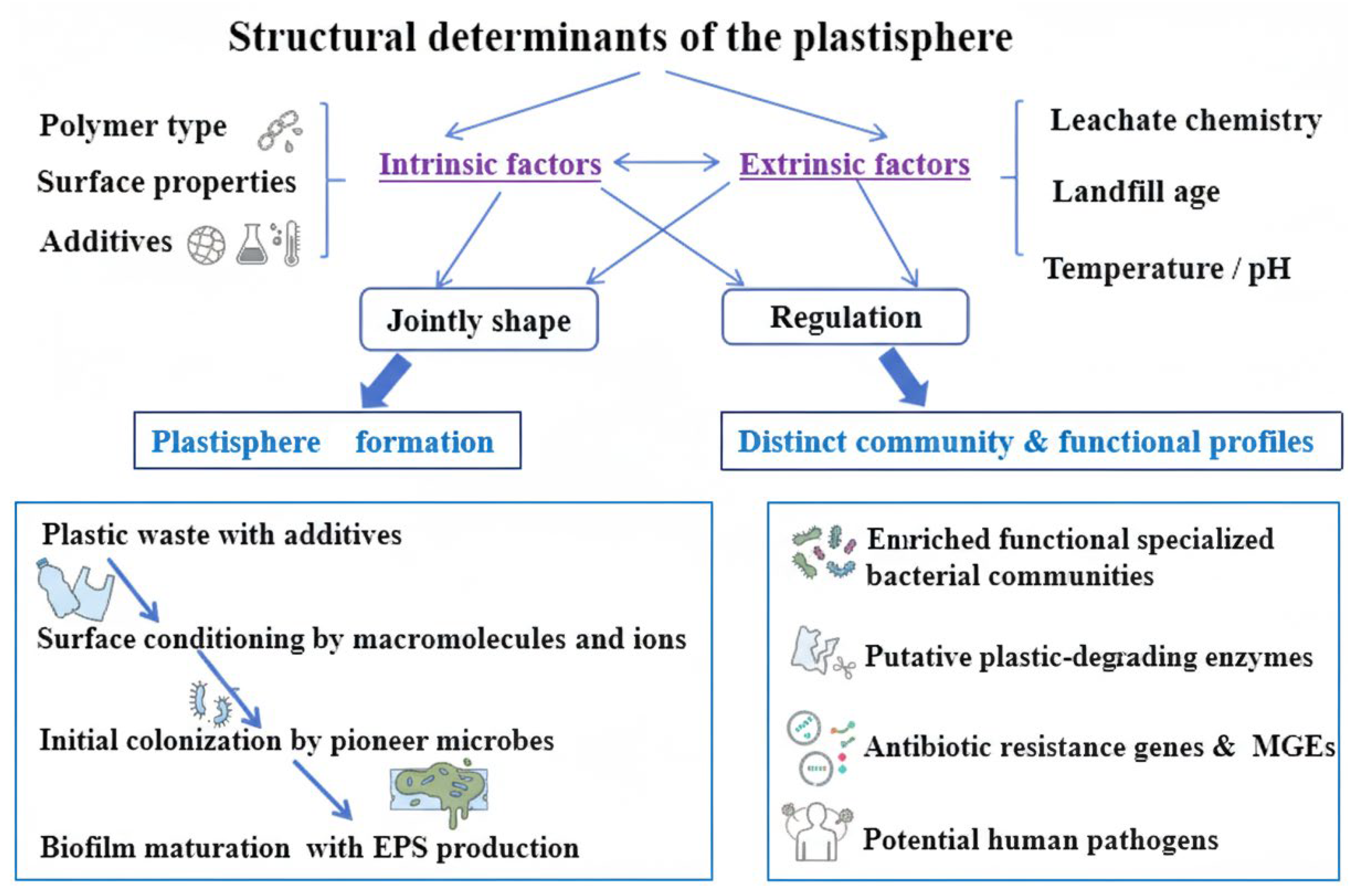
Plastisphere formation typically starts with rapid conditioning of plastic surfaces by organic molecules and dissolved ions, followed by initial bacterial colonization, extracellular polymeric substance (EPS) production, and biofilm maturation [70]. In landfills, this process is shaped by extreme environmental shifts; for instance, oxygen levels change drastically from the survival pressures distinct from those in aquatic or soil environments [71]. Research across different settings show that plastisphere communities are compositionally distinct from surrounding matrices, frequently displaying lower alpha diversity but enrichment for functional specialists, including potential polymer degraders and taxa carrying mobile genetic elements (MGE) [58]. In landfill contexts, leachate chemistry, temperature, pH, and polymer/additive chemistry are expected to control colonization rates, EPS architecture, and metabolic interactions within biofilms [72] (Figure 2).

3.2. Distinct Community and Functional Profiles

Advanced metagenomic studies in multiple ecosystems reveal that plastispheres enrich organisms with hydrolytic/oxidative potential relative to overall matrices [73,74]. In fact, major metagenomic study has identified over a hundred enzymes and dozens of microbial groups that may naturally degrade MPs [61]. In parallel, plastisphere biofilms have repeatedly been shown to enrich potential pathogens and ARGs than their surroundings, likely because the high cell densities and the presence of trapped metals or antibiotics encourage microbes to swap genetic material [75,76,77]. The above reviews and empirical works consolidated evidence that MPs are hotspots for ARGs and MGE, with Methylobacterium, Acinetobacter, Aeromonas, Pseudomonas, and members of Burkholderiales frequently discussed, and that aging and additive leaching can modulate both biofilm composition and resistome signatures. This suggests that landfill plastics, especially in contaminated leachate, could pose health risks to workers or complicate water treatment by carrying resistance, disease organisms. (i) sorption of antibiotics/heavy metals to plastics increases local selection pressure; (ii) EPS-rich biofilms enhance conjugation and transformation; (iii) oxidative stress from aging polymers induces SOS responses and increases mutation gene; and (iv) the carbon available on the plastic surface feeds fast-growing species that take over the community. In soils, multiple omics evidence showed plastisphere hotspots of ARGs and potential pathogens and identified environmental modulators (manure inputs, temperature, moisture), reinforcing that plastisphere selection is influenced by these factors.

3.3. Determinants of Community Structure in Landfill Plastispheres

The type of plastic (PE/PP/PET/PVC) and its chemical additives (plasticizers, stabilizers, flame retardants), and surface energy/roughness fundamentally shape initial attachment and long-term assembly; environmental drivers (pH, temperature, moisture, oxygen content), landfill age, and leachate composition further shape these microbial communities over time [78,79]. Studies show that MPs can concentrate antibiotics and metals, imposing selective pressures that amplify ARG carriage and dissemination; controlled biofilm experiments demonstrated higher ARG loads and slower antibiotic degradation on MP surfaces [76]. In cover soils and biocovers, the co-existence of methanotrophs and heterotrophs within plastic could mediate both CH4 oxidation and nitrogen cycling, linking plastisphere composition to GHG dynamics [80,81].

3.4. Recommendations

Research on the plastisphere within landfills is much harder than in aquatic systems, mainly because the waste is incredibly complex [20]. To bridge this knowledge gap, a multi-faceted strategy is essential. First, standardized sampling protocols that account for the depth dependent biogeochemical gradients and diverse polymer types are critical [82]. This should be coupled with sophisticated particle size fractionation to include the tiny particles smaller than 100 μm, which present a larger surface area for microbial colonization. Using high-resolution imaging techniques like Scanning Electron Microscopy and Confocal Laser Scanning Microscopy are essential to visualize biofilm structure and microbial associations. Furthermore, application of multiple omics to identify genetic potential, gene expression, and metabolomics to profile biochemical activities, thereby revealing the functional state of the plastisphere [54,56]. To ensure the data is reliable, strict quality controls must be used to prevent outside contamination. By measuring how the plastisphere influences outcomes like CH4 production, we can finally understand how they influence the climate and the environmental at waste disposal sites [26,59].

4. Coupling Mechanisms—Toward an Understanding of How Plastisphere Potentially Links MP Transformation and GHG Emissions

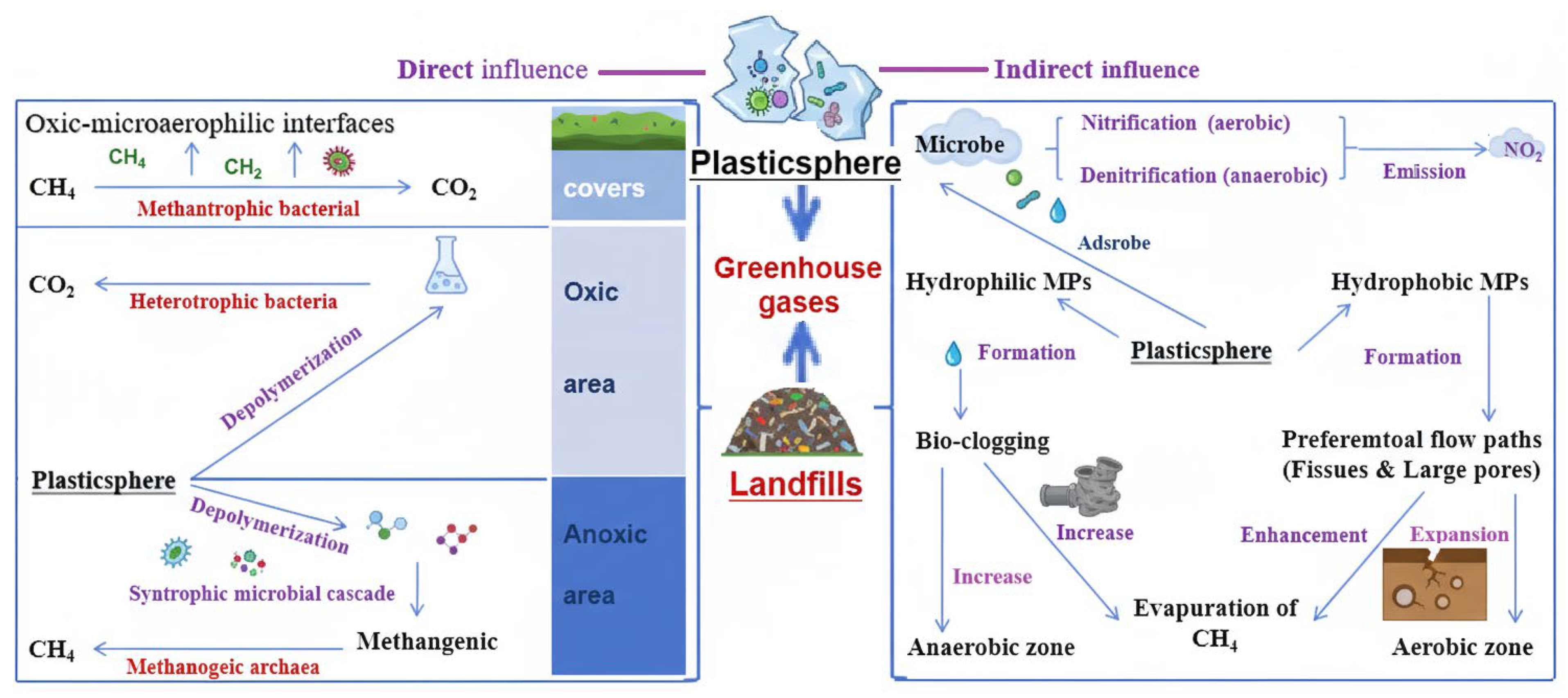
The presence of MPs in landfills significantly alters GHG dynamics. The following sections discuss these complex biogeochemical mechanisms, detailing both the direct microbial degradation pathways of plastic carbon and their indirect impacts on physical waste structures and broader carbon–nitrogen cycling (Figure 3).

4.1. Direct Coupling via Plastic Degradation Pathways

Inside landfills, the way plastic breaks down depends entirely on where it is located. ln oxic areas like the surface soil, microbes can quickly turn plastic byproducts into CO2, which is a less powerful GHG. However, in aerobic zones, such as the cover soils and the peripheries of waste masses, soluble monomers (ethylene glycol from PET hydrolysis) liberated from partial polymer degradation can be rapidly and completely mineralized to CO2 by heterotrophic microbial communities [83]. In stark contrast, within the vast anaerobic core, the fate of plastic carbon is markedly different. Plastisphere-driven depolymerization hydrolyzes complex plastics into soluble intermediates. A syntrophic microbial cascade then processes these into methanogenic precursors like acetate and hydrogen, which methanogenic archaea ultimately convert into the CH4 [84,85]. Additional, methanotrophic bacteria (e.g., Methylocystis, Methylosarcina) in engineered biological covers oxidize diffusing CH4 to CO2 and biomass at interfaces between oxic and microaerophilic areas [86]. Moreover, laboratory studies show dual (inhibitory and stimulatory) effects of MPs on CH4 yields depending on polymer type, particle size, concentration, aging, and co-contaminants, consistent with altered microbial networks and extracellular enzyme dynamics [87,88]. Because factors like localized temperature gradients, moisture content, pH, and the availability of degradable substrates are constantly shifting. This complex interplay between microbial ecology and physicochemical parameters may lead to the formation of spatially and temporally transient GHG emission hotspots [59,89,90].

4.2. Indirect Coupling via Carbon–Nitrogen Process Interactions

MPs and their biofilms can alter physical structure (porosity, water to gas transport) of waste and cover media, thereby modulating oxygen penetration depth and the breadth of methanogenic and methanotrophic zones [20]. Studies have shown that hydrophobic MPs exhibit poor interfacial interaction with the surrounding hydrophilic media, potentially forming water-repellent fissures or large pores. These structures can act as “preferential flow paths” for water and air, allowing oxygen to penetrate more rapidly to deeper layers, thereby expanding the aerobic zone and compressing the underlying anaerobic methanogenic space [91,92,93]. In contrast, once a plastisphere biofilm forms on the MP surface, this scenario may reverse. The hydrophilic biofilm and its secreted extracellular polymers can adsorb water and fine particles, clogging previously connected pores. This bio-clogging effect can significantly reduce media permeability, hindering the downward diffusion of oxygen and the upward escape of CH4 [94,95]. This, in turn, can maintain or even expand the underlying anaerobic environment, promoting the methanogenesis process. Plastisphere may participate in nitrification and denitrification to affect N2O emissions, especially in cover materials [37]. Modeling and field work demonstrate the sensitivity of CH4 transport and oxidation to temperature, rainfall, texture, and compaction, suggesting that plastisphere could influence dynamic of gas and water [96,97,98].

4.3. Limitations and Recommendations

Certainly, Regarding the current state of research, direct evidence on whether the plastisphere promotes or inhibits GHG emissions predominantly originates from aquatic systems, agricultural soils or laboratory anaerobic digesters. Relevant studies remain in their preliminary stages, with a notable scarcity of available data. Critical research gaps persist, particularly the lack of in situ observational data from landfill environments characterized by high-pressure, elevated leachate concentrations and complex redox gradients. We draw upon potential analogous effects observed in these environmentally similar media as contextual references, providing relevant background to serve as a foundation for subsequent investigations building upon this review.
Long-term landfill monitoring and experimental studies reveal that CH4 emission dynamics are intrinsically linked to microbial community succession, highlighting the critical role of methanotrophs at cover interfaces. These oxidizers drive CH4 consumption through Monod/Michaelis–Menten kinetics, which is strongly controlled by temperature, moisture, oxygen supply, and substrate flux, while optimized biocovers can achieve substantial oxidation fractions under favorable conditions [99,100,101]. A critical uncertainty persists regarding the net role of the plastisphere as a source or sink of CH4 in landfill ecosystems. According to historical research and relevant reports, the direction and magnitude of its impact on net CH4 emissions are contingent upon four interdependent factors. (i) the redox architecture and oxygen diffusion dynamics, (ii) the relative abundance and metabolic activity of key functional guilds, specifically methanogens versus methanotrophs, (iii) the availability of readily fermentable substrates derived from both plastics and co-disposed wastes, and (iv) the design and operational management of the landfill cover system. To resolve the effects, a tiered measurement approach integrating seasonal gas flux monitoring, CH4, CO2, O2, and N2O concentrations along profiling with stable isotope, metagenomics and transcriptomics analysis of methanotrophs/methanogens functional markers, and volatile fatty/terephthalic acid metabolite tracing offers an integrated framework for quantifying plastisphere contributions to landfill GHG budgets, validated by long-term research [41,102].

5. From Mechanisms to Conceptual Scaffolding: Kinetic Models of the Plastisphere

While the landfill plastisphere is increasingly recognized as a dynamic biogeochemical interface, transitioning from qualitative phenomenological descriptions to fully integrated quantitative predictions remains a significant scientific challenge. This section presents a conceptual mathematical scaffolding by encompassing biofilm growth, polymer degradation kinetics, and gas transport dynamics, to theoretically outline the mechanisms by which MPs might influence carbon and nitrogen cycling in landfills. It is crucial to explicitly acknowledge the current limitations of this approach. The models discussed currently represent independent dimensions of evaluation rather than a mathematically hard coupled, fully validated multi-scale framework. Due to the extreme physicochemical heterogeneity of the landfill matrix, several important parameters remain theoretical or are extrapolated from aquatic and soil systems, awaiting rigorous in situ parameterization and empirical validation. Nevertheless, presenting this mathematical scaffolding (biofilm growth, polymer degradation, and metabolic flux analysis) provides a valuable theoretical baseline. It translates inferential biogeochemical interactions into quantifiable hypotheses, aiming to guide future targeted experimental designs and real scenario data collection.

5.1. Biofilm Growth and Colonization Kinetics

Microbial colonization on plastic surfaces represents the initial phase of plastisphere formation. The growth rate is directly constrained by the availability of the plastic surface area and the substrate concentration within the leachate. While the classical Monod Equation is typically employed to describe suspended growth, it requires modification for the plastisphere interface to account for “surface area limitation” effects. For biofilms growing on microplastic particles, the available surface area for attachment is often more limited than dissolved nutrients, thereby becoming the primary limiting factor [103]. To accurately model the growth of the plastisphere, it is necessary to modify the Monod equation by introducing a surface area limitation term [104]. We propose the adoption of a Surface-Modified Monod Kinetics model (1):
μ p = μ max · S K S + S · A avail K A + A avail
where μ is the specific growth rate (h−1 or d−1), S is the organic substrate concentration in the leachate (mg/L), Ks is the substrate saturation constant (the substrate concentration at which the growth rate reaches μmax), and Aavail is the effective specific surface area per unit volume of MPs. This model elucidates that as the biofilm matures, the available surface area Aavail diminishes, thereby limiting further exponential growth [105].

5.2. Logistic Model Incorporating Biofilm Thickness—Bertalanffy Model

Beyond growth rate, the evolution of biofilm thickness on the plastisphere is crucial. The Logistic and the Bertalanffy model are used to describe constrained growth. The Bertalanffy model assumes that growth is proportional to surface area (two-dimensional expansion), while decay is proportional to volume (three-dimensional maintenance cost) (2) [106]:
B ( t ) = ( k g r o w t h k d e c a y ) 3 ( 1 e k d e c a y t ) 3
B represents biofilm biomass. Kgrowth represents the surface area proportional growth rate constant. Kdecay represents the volume proportional decay rate constant. This equation captures how the biofilm initial grows rapidly on the MP surfaces, followed by an approach to a stable thickness because there is no more space and waste products build up.

5.3. Polymer Degradation Kinetics: The Inverse Shrinking Core Model

Plastic degradation within landfills is a complex process occurring primarily at the surface where they touch the surrounding liquid. For enzymatic degradation, particularly relevant for polyesters such as PET and polyhydroxybutyrate, the Inverse Shrinking Core Model (ISCM) provides an ideal geometric description. Unlike traditional dissolution models, the ISCM postulates that enzymes act solely on the external surface of the polymer particle. For most enzymatic degradation processes, particularly for hydrophobic plastics, surface adsorption and the catalytic reaction are typically the rate limiting steps [107]. As the reaction proceeds, the particle radius gradually decreases, while the unreacted polymer core maintains its original density and structure. For spherical MPs with an initial radius and molar density, the degradation process is governed by the following sequential steps: diffusion of the enzyme from the bulk solution through the liquid boundary layer to the particle surface; adsorption of the enzyme onto the polymer surface; catalytic hydrolysis reaction at the surface; diffusion of degradation products from the surface back into the bulk solution. Assuming the reaction is controlled by surface chemistry, the relationship between the fractional conversion of the particle and time can be expressed as (3):
t τ = 1 ( 1 α ) 1 / 3
where τ is the time required for the complete disappearance of the particle, defined as (4):
τ = ρ B R 0 b k s C Ez
where α represents the conversion fraction of the polymer (0 < α < 1), ρB is the molar density of the polymer (mol/m3), R0 is the initial particle radius (m), b is the stoichiometric coefficient (often set to 1, as the molar ratio of enzyme action to substrate), ks is the Surface reaction rate constant (m/s or m3/(mol·s), depending on its definition), and CEz is the concentration of active enzyme at the particle surface (or biofilm interface) (mol/m3). This model yields two critical conclusions [108]. First is the size effect, because extremely small R0 of MPs, their degradation rate is significantly faster than that of macroplastics. This explains why landfills act not only as a sink for plastics but also as a rapid source of MPs generation. Second is the surface erosion. degradation induces surface roughness, increasing the specific surface area. This accelerates the biofilm attachment process creates a positive feedback loop where biofilm growth and surface erosion reinforce each other. Addressing this process, Fragmentation Models further predict the power law evolution of MP particle size distributions over time [109].

6. Smart Low-Carbon Landfills Integrating Digital Monitoring Plastic Sensing and Microplastic Control

As mentioned before, the transition from understanding the fundamental microbiology of the landfill plastisphere to implementing comprehensive strategies requires overcoming a critical spatial and temporal disconnect. Traditional LFG monitoring typically relies on static wellhead measurements, sparse surface grids, and periodic manual patrols. These conventional methods implicitly operate under the assumption of relatively homogeneous gas diffusion across the cover system. However, as established in Section 4, the accumulation of MPs and their associated biofilms fundamentally disrupts this physical homogeneity. The interplay between hydrophobic plastic particles and hydrophilic EPS creates highly localized microenvironments, triggering unpredictable shifts between severe bio-clogging and the formation of preferential flow paths.
Consequently, plastisphere-driven GHG emissions do not manifest as uniform surface fluxes; instead, they emerge as highly unpredictable, transient, and spatially concentrated “hotspots” or super emitters. Standard grid monitoring and infrequent manual surveys inherently fail to capture these highly localized anomalies. It is precisely this spatial heterogeneity that necessitates a paradigm shift in monitoring technology. Real-time, high-spatial-resolution tools, such as UAVs equipped with spectroscopy and continuous IoT sensor networks, which were not merely arbitrary operational upgrades. They are mechanistically required to map and detect the specific, localized gas escape routes exacerbated by subsurface MP accumulation. By deploying these advanced digital perception networks (Section 6), operators can move beyond macroscopic approximations and directly target the heterogeneous fugitive emissions driven by the underlying plastisphere dynamics.

6.1. Integrated Advances in Smart Landfill Technology

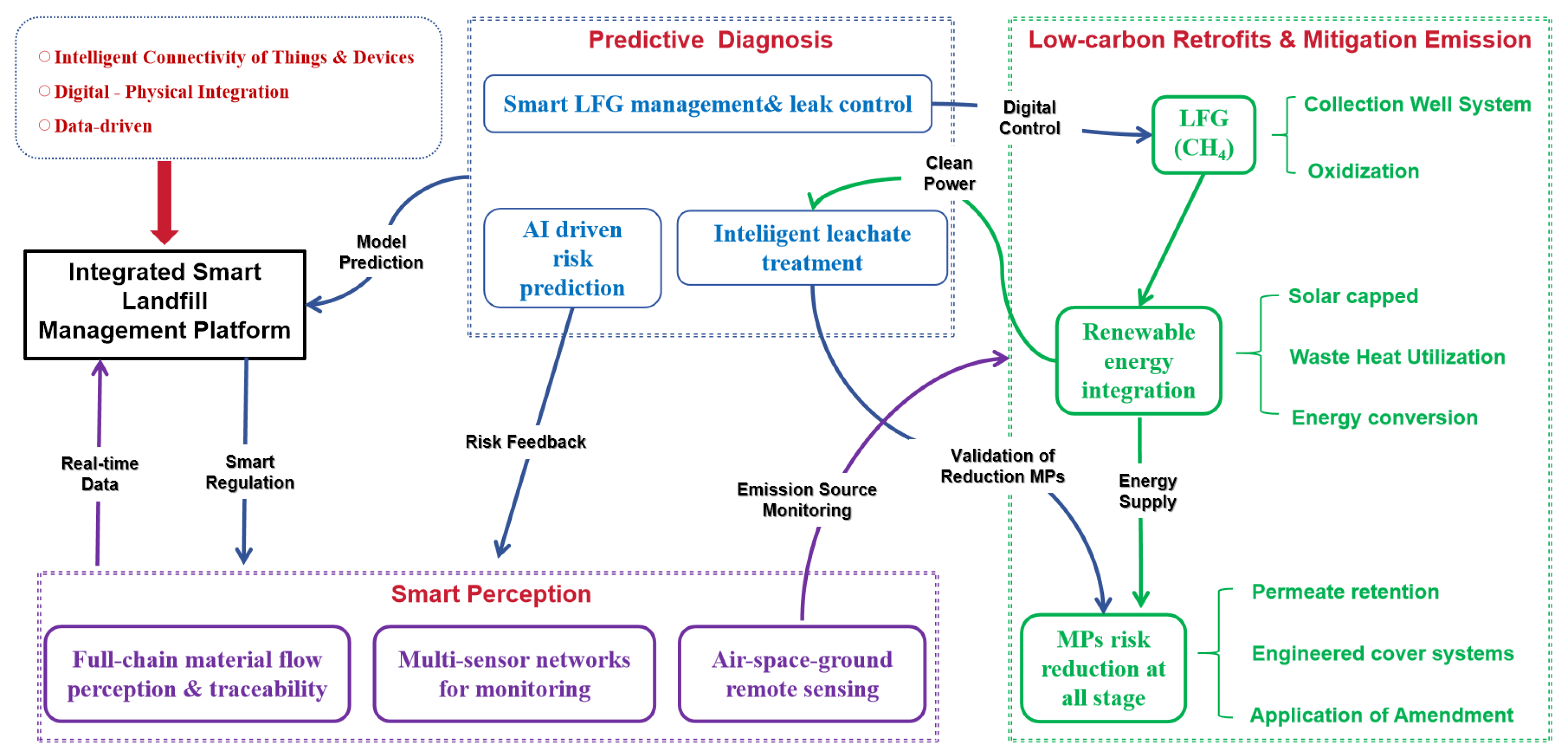
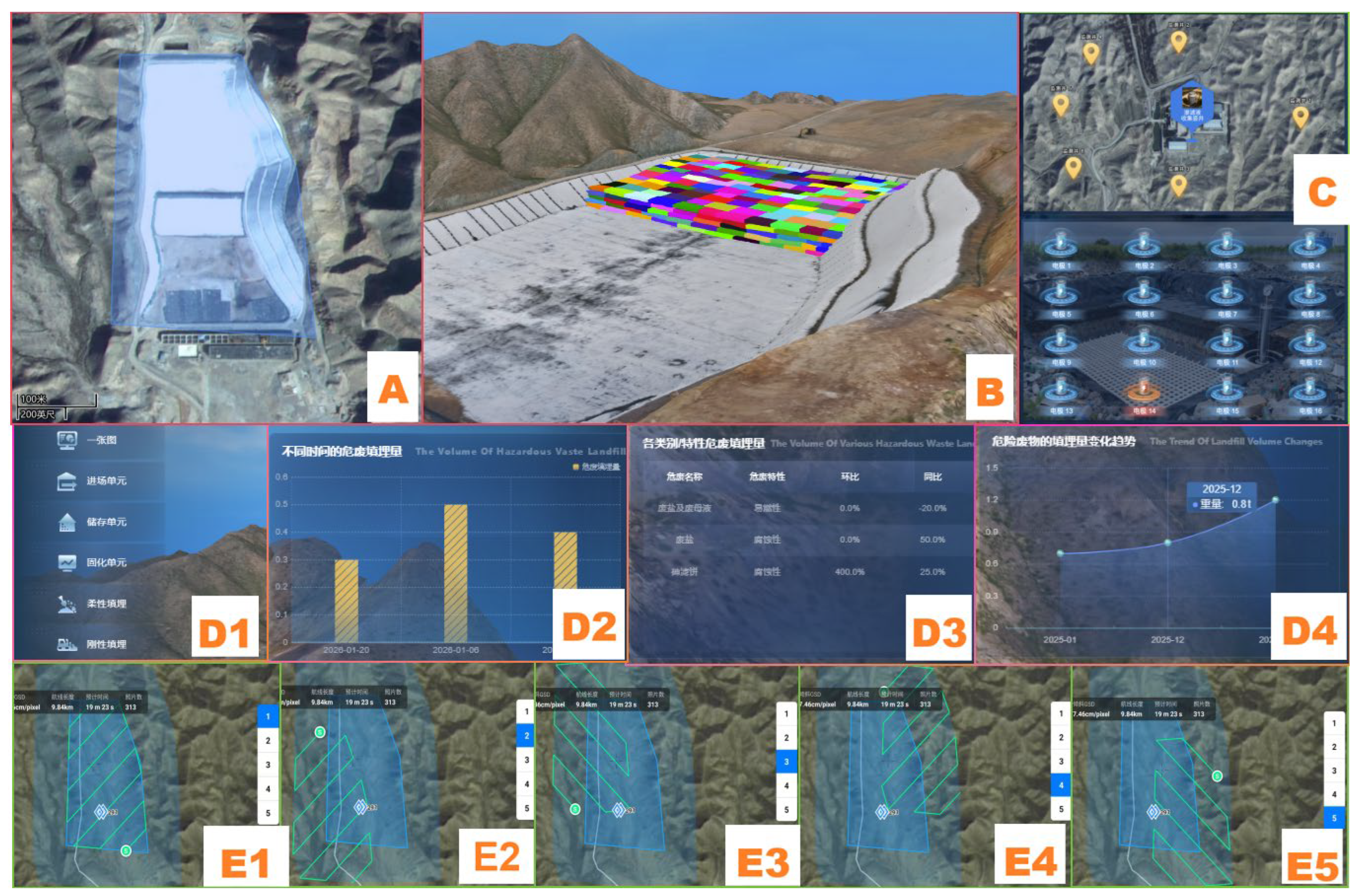
Modern landfill management has evolved into a high-tech field that uses digital technologies for comprehensive monitoring and process optimization. This progress spans two interconnected domains: the real-time perception of material flows and the predictive diagnosis of engineering risks (Figure 4).

6.1.1. Full-Chain Sensitive Perception of Material Flows

Modern landfill management requires precises, real-time visual traceability throughout the entire handling process, from entry and acceptance for temporary storage, testing, pre-treatment, and final landfilling. Technological advances in multiple dimensional spatiotemporal characterization are revolutionizing the monitoring of landfill. At the macro scale, the integration of UAV oblique photography with LIDAR enables centimeter level surface reconstruction [110]. Differential analysis of multiple period Digital Elevation Model data quantifies landfilling increments, with a representative case from a hazardous waste landfill in Southwest China demonstrating a volume calculation error of <1.5% and a 50-fold increase in operational efficiency compared with traditional leveling methods [111]. Simultaneously, the field is shifting from periodic inspections toward real-time monitoring via multiple sensor networks. These networks integrate data on gas emissions (CH4, CO2, and N2O), leachate quality, pore pressure, soil moisture, weather, and geotechnical parameters. Using open standards like the OGC SensorThings API, GIS native dashboards fuse live sensor feeds with spatial context to provide alarms [112,113]. In parallel, UAVs and satellites provide scalable coverage for surface integrity and gas hotspot scouting. Multiple spectral NDVI detects vegetative stress on the cover, while thermal cameras identify anomalies. Recent hyperspectral missions demonstrate rapid identification and attribution of CH4 plumes to specific working faces [114,115]. A 2024 large-scale aerial study found persistent CH4 leaks at over 50% of sites, underscoring the need for continuous remote monitoring [116]. UAVs equipped with spectrometers can localize these leaks within meters, even across complex terrains that are difficult to survey on foot [117].
Effective MP control starts at the entry point through rigorous identification, sorting, and labeling [118]. Management is evolving from simple record to intelligent systems that use multiple source data fusion. At the entry-acceptance stage, these technologies enable the binding of waste source, attributes, and location. QR codes and near-infrared spectroscopy tags link waste categories to specific locations (>92%). Near-infrared spectroscopy can identify waste categories with over 92% accuracy, while onboard weighting creates digital logs that reduce truck verification time to just 15 min. For monitoring complex pollutants like MPs in leachate, automated μFTIR imaging has become the standard for identification particles down to 20 μm. When paired with machine learning, this method significantly improves speed and reproducibility [119]. For rapid screening at treatment plants, Nile Red fluorescence and flow cytometry pipelines enable minute scale counts [67,120]. At the technological frontier, microfluidic chips and AI imaging enable real-time MP detection in leachate streams. These tools can be integrated into the same digital backbone (SensorThings/GIS) that hosts GHG data, creating a unified platform for smarter operational decisions.

6.1.2. Predictive Diagnosis of Engineering Status and Risks

Traditional monitoring and alerts regarding the state of landfills were conducted offline, in a qualitative and static manner, presenting significant limitations. Diagnosing clogging relied on indoor physical simulations can predict the evolution of porosity and permeability. Integrity diagnosis of liners using methods like the dipole technique was typically conducted annually. These delays created a critical gap, allowing leaks to go undetected for long periods [121]. Management encompasses the use of AI assisted membrane processes to enhance leachate treatment. Membranes and AOPs play complementary roles: membranes retain MPs and colloids, while AOPs break down residual polymers. AI-driven optimization of aeration, flux, cleaning, and dosing enhances sub 100 μm MP removal and lowers energy consumption. Recent reviews highlight the fate of embedded layered MPs as a gap AI controllers can fill through sensor fusion and model-based predictive control [20,22,122]. Application of Smart Leak Detection and Repair programs can expedite leak identification by utilizing UAV and satellite data. By coupling vacuum control with weather forecasts, operators can stabilize gas flows and prevent oxygen from entering the system [123,124]. This measurement management is essential, as traditional models often miss the major point source emissions that drive climate change [125]. This digital closure monitoring enhances risk control through sensor integrated covers and vegetation indices to catch surface cracks or slope instability early, effectively preserving CH4 oxidation capacity.
Building on this enhanced monitoring foundation, intelligent technologies extend enhanced monitoring to dynamic risk management across the entire landfill lifecycle. The transition from static models to dynamic risk management is now being realized through real-time sensor data integration, as demonstrated by Gansu Yicheng Environmental Technology’s intelligent platform applied to a solid waste landfill site at the Baiyin High-tech Zone. This case study builds a full process smart visualization platform to regulate concealed hazardous waste landfills (Figure 5). The project integrates Digital Twin, UAV photography, and IoT sensing to map physical landfill to digital counterparts. Through centimeter level 3D reconstruction and intelligent sensors, the system provides real-time monitoring of waste morphology, leachate levels, NH3-N, and liner system integrity. This innovation enables precise coordinate-level positioning of hazardous waste, ensuring full lifecycle digital traceability. This transforms traditional “black-box” operations into “transparent” management and control, which is delivered via its 3D visualized supervision platform. Through multiple model coupling, it provides accurate risk warning and intelligent operational regulation, establishing a standardized model for intelligent environmental governance.

6.2. Low-Carbon Retrofits and Microplastics Risks Reduction in Landfills

Waste management, particularly landfills, contributes 20% to global anthropogenic CH4 emissions. Reducing these emissions is one of the most impactful and cost effective climate actions, according to the United Nations Environment Programme (UNEP), Clean Air Coalition (CCAC) [126]. The primary low-carbon strategy for landfill management involves controlling LFG. Key approaches use vertical wells and horizontal pipes to actively capture CH4 for energy recovery or flaring [127]. In smaller or closed landfills, passive CH4 oxidation and biofilters use methanotrophic bacteria in engineered soil to neutralize CH4 [128,129]. Enhancing these covers with biochar further improves their oxidation capacity [130]. Additionally, injecting air into legacy anaerobic cells accelerates waste stabilization and intercepts CH4 before it escapes [131]. Moreover, captured LFG is a valuable renewable energy source that can be converted into electricity, heat, renewable natural gas (RNG), or liquefied natural gas (LNG) [123,125,132]. The Guangzhou Xingfeng site in China illustrates this shift, moving from simple flaring to large scale power generation and LFG to LNG projects supported by global carbon standards [133,134]. As satellite and aerial data make super-emitters easier to identify, the cost efficiency of these repairs improves, as captured gas translates directly into saleable energy and carbon credits. The next frontier in deep decarbonization is transforming landfills into renewable energy systems. A key strategy is the solar-capped landfill, where photovoltaic systems are installed on closed sections. When engineered with ballasted racking to protect the protective geomembrane, these systems generate clean power without compromising the containment of sites. The Hickory Ridge solar closure in the USA, one of the first full scale geomembrane and thin film photovoltaic retrofits, remains a widely cited proof of concept for this synergistic approach [135].
Landfill decarbonization retrofits provide a critical dual benefit: reducing GHG emissions while mitigating the formation and release of MPs. This synergy is achieved through an integrated approach spanning waste intake, daily operations, and leachate management. The most effective strategy is to divert plastic waste from landfills entirely. Source reduction and smart sorting achieve this through digital pay-as-you-throw systems and AI enhanced sorting, which shift plastics from disposal toward higher value recovery pathways. Technologies like vision-guided systems can increase plastic recovery rates to 50–80%, directly reducing the pool of material for future MP formation. Furthermore, smart collection systems with sensor bins and route optimization further minimize environmental leakage and ensure a steady supply for recycling [52,53]. For plastics already within the landfill, engineered containment is crucial. Engineered cover systems, such as compacted clay with vegetative layers or geomembranes, act as physical barriers of MPs by reducing infiltration and advective particle transport. These systems often host methanotrophic bacteria for CH4 oxidation, providing simultaneous GHG and MP mitigation. Studies indicate that organic rich matrices and biochar amendments enhance MP retention by modifying soil microstructure and moisture conditions. Finally, advanced leachate treatment captures any mobilized MPs. Upgrades like membrane bioreactors, nanofiltration, and reverse osmosis are highly effective at retaining MPs. When coupled with AOPs, these systems can chemically shrink and oxidize plastic particles and additives, enhancing overall capture. While the energy footprint of these processes is high, it can be offset by using cogeneration from landfill gas engines. However, to consider key system trade-offs. For instance, aeration to stabilize landfills may temporarily fragment MPs in stressed zones. This underscores the need for concurrent capture measures, such as polishing membranes in leachate streams and strict QA/QC in MP monitoring to avoid misinterpretation. Furthermore, MPs can themselves inhibit methanogenesis or alter biofilm permeability, with impacts varying by polymer type and concentration. This highlights the importance of monitoring MPs in anaerobic digestion bioreactors and leachate systems, ensuring that efforts to reduce carbon emissions do not accidentally make the MP problem worse [95,97]. Therefore, an integrated strategy is essential to simultaneously cut carbon emissions and MP pollution from landfill.

6.3. Recommendations

Using open standards like SensorThings, landfill operators can co-visualize CH4, leachate chemistry, moisture, and MP analytics, while UAV and satellite-driven LDAR replaces calendar-based patrols with evidence-based maintenance. Mitigation efforts should prioritize point-source CH4 plumes identified through aerial campaigns, pairing repairs with smart wellfield control and tracking the oxidation performance of biocovers across seasons. Landfills can be engineered as controlled system where biofilms and sorbents work together to capture CH4 and retain or transform MPs. Tapping into carbon markets can accelerate the adoption of low-carbon landfill upgrades, such as gas to power system, renewable natural gas projects and solar cap closures. It is essential to standardize MP monitoring, report on the energy and GHG intensities of treatment processes, and track material flows across waste, gas, leachate, and residuals. Policy should link extended producer responsibility and plastics treaty measures with enhanced sorting and resource recovery to reduce plastic inflows, while translating UNEP and CCAC CH4 pathways into city level action plans that jointly address CH4 and MP metrics. By treating the plastisphere as a manageable environment and adopting digital monitoring, landfills can transition into smart, low-carbon hubs for the circular economy, reducing GHG footprints, mitigating MP leakage risks, and improving operational safety and economic viability.

7. Smart Technological Landfill Carbon Accounting and GHG Flux Models

The deployment of smart monitoring networks, such as UAVs and IoT sensors provides unprecedented, high-resolution data on spatial emission hotspots. However, to translate this real-time digital surveillance into actionable climate mitigation strategies, the underlying carbon accounting methodologies must concurrently evolve. Current global standard models, such as the IPCC FOD framework, assume a homogeneous waste matrix and traditionally default to a zero-methane potential for plastics. Consequently, these traditional models are mathematically blind to the highly localized, plastisphere-driven heterogeneities that smart technologies are specifically deployed to detect. To bridge the gap between digital monitoring and regulatory GHG inventories, this section introduces a conceptual mathematical framework for MP-informed carbon accounting. Similar to the kinetic scaffolding presented in Section 5, the modified gas transport and CH4 potential equations proposed represent theoretical constructs rather than fully validated predictive tools. They serve as a conceptual blueprint demonstrating how plastisphere specific variables could be structurally integrated into future GHG inventories, and how the net climate benefit of the smart monitoring interventions themselves can be objectively evaluated via Life Cycle Assessment (LCA). While these equations await rigorous empirical parameterization, they represent a necessary theoretical step to a smart low-carbon landfill accounting system.

7.1. Fugitive Emission and Gas Transport Models Influenced by Microplastics

The accumulation of MPs in the soil cover alters its physical properties, thereby affecting gas diffusion and transport. Fick’s Law and the Millington Quirk Model are commonly used to describe the effective gas diffusion coefficient in porous media, and widely applied in the design of landfill cover layers [136]. Define as (5):
D eff D air = ε 10 / 3 φ 2
where Deff is the effective gas diffusion coefficient, Dair is the gas diffusion coefficient in free air; ϵ is the air-filled porosity; φ is the total porosity. However, this model does not take into account the presence of MPs. Firstly, Pore Clogging Reduces the ϵ, hindering gas diffusion, which may decrease CH4 escape but also inhibits oxygen entry into the oxidation layer; secondly, Preferential Flow Loose bonding at the interface between the MPs and soil, significantly increasing Deff. To incorporate the effects of both MPs and biofilms, a Plastisphere Correction Factor must be introduced. First, the total porosity φ is repartitioned into fluid occupied pores, gas occupied pores ϵ, and the fraction occupied by biofilm and MPs. The presence of biofilm directly reduces the effective air-filled porosity. Second, the tortuosity of the pore structure is altered. Studies indicate that fibrous MPs may enhance pore connectivity in certain soil textures, while spherical MPs are likely to increase tortuosity [137]. Therefore, a modified MQ model is proposed (6):
D eff D air = Ω p ( S M P , S b i o , S h a p e ) ( ε e f f ) 10 / 3 ( φ t o t a l ) 2
where Ωp is a function of microplastic saturation SMP, biofilm saturation Sbio, and a microplastic shape factor, φtotal is a repartitioned into fluid occupied pores, and ϵeff is an effective diffusion coefficient of the air-filled porosity. Experimental data suggest that for media containing MPs, the value of Ωp may range from 0.5 (indicating severe clogging) to 1.5 (indicating preferential channel formation). Accurate determination of Ωp should be calibrated through site-specific soil column experiments or CT scan data.

7.2. A Microplastic Informed Landfill Carbon Model

At present, the core formula for calculating CH4 generation in both the IPCC FOD model and the Land GEM model is the first-order decay equation, which serves as the cornerstone of global landfill carbon accounting [34]. The equation is (7):
Q CH 4 = Σ i [ k i L 0 i M i e k i t ]
where QCH4 is the Rate of methane production (m3/year), i is an index denoting a distinct waste component category; where ki is the first-order decay rate constant specific to component i, characterizing its degradation speed (year−1); where t is the time since disposal (years), which is calculated for each waste batch as the difference between the target calculation year T and the specific year of disposal x(t = T − x); where L0i is the ultimate CH4 generation potential per unit mass of component i (m3/ton); and where Mi is the total mass of waste component i disposed in the landfill (ton). However, based on the analysis presented in Section 5, an MP/plastisphere perspective necessitates the introduction of critical modifications to the standard model. First, a non-zero degradation rate constant (k) must be defined. For biodegradable plastics and highly weathered MPs, a non-zero k value (e.g., within the range of 0.01–0.03 year−1) should be assigned to reflect their slow mineralization over decadal landfill timescales. Second, dynamic adjustments to the CH4 potential (L0) are required. For conventional plastics (e.g., PE, PP, PET), the current model assumption of L0 = 0 is inadequate. Based on the ISCM, it is recommended to introduce either a non-zero, time-dependent function L0(t) that evolves very slowly or, for century-scale accounting, a fixed but small non zero value to reflect long term mineralization potential [138]. Furthermore, as carriers, MPs enrich substantial amounts of organic matter (eco-corona), which effectively increases the CH4 generation potential per unit mass of waste. Therefore, the modified potential, L0 must account for the contribution of this Adsorbed Organic (8):
L 0 m o d i f i e d = L 0 w a s t e + β C M P Γ A O C
where L0modified is the corrected ultimate CH4 yield representing the total CH4 producible from one ton of waste, inclusive of the MP-carried organic carbon; where L0waste is the baseline CH4 potential intrinsic to the conventional waste matrix, disregarding MPs effects; where β is a comprehensive conversion factor that translates the mass of adsorbed organic carbon into a practical volume of CH4 (typically determined via Biochemical CH4 Potential assays); where CMP is the mass concentration of MPs within the waste, quantifying their abundance per unit mass of landfill material; and where ΓAOC is the adsorbed organic carbon capacity, defined as the mass of organic carbon adhered per unit surface area of MPs, thereby quantifying their role as a concentrated eco-corona and secondary carbon source. Ignoring this correction may lead to an underestimation of long-term fugitive emissions from aged landfills.

7.3. Life Cycle Assessment of Drone-Enabled Intelligent Landfills

To replace high-emission manual inspections, the “Smart Low-Carbon Landfill” integrates technologies such as UAVs, sensor networks, and AI computing as lower emission alternatives. However, the deployment of these technologies is accompanied by their own energy consumption and carbon footprint. Building on the various low-carbon detection technologies introduced in Section 6, this part compares these key monitoring methods based on a comprehensive LCA framework (Table 1).
Although the manufacturing of UAV batteries and their electricity consumption generate carbon emissions, their exceptionally high inspection efficiency results in significantly lower monitoring emissions compared to manual methods. Manual methods use a lot of vehicle fuel and waste labor time. LCA data indicate that the carbon footprint of a UAV system is approximately 545 kg CO2eq, whereas the footprint of manned aircraft or large vehicle fleets can emit up to 270,000 kg CO2eq [140]. The big data generated by smart monitoring requires AI processing, which introduces additional data center energy consumption. Adopting edge computing instead of uploading all raw data to the cloud is an effective strategy for reducing the carbon footprint. To verify its low-carbon capacity, it is essential to establish a LCA model to calculate the net carbon benefit Bnet. As follows (9):
B net = E avoided ( E embodied + E operational )
Eavoided (Avoided Emissions): The reduction in fugitive emissions achieved by using UAVs equipped with Tunable Diode Laser Absorption Spectroscopy (TDLAS) sensors pinpoint where CH4 is leaking so that repairs can be made quickly. Studies indicate that UAV inspections can improve leak detection rates by over 30% compared to traditional manual inspections [139]. Eembodied (Embodied Carbon): The carbon emissions associated with the manufacturing of UAVs, sensors, and server hardware. Eoperational (Operational Energy): The energy consumption of UAV flights and AI model training and inference. Model simulations show that while smart equipment increases operational carbon emissions, the enhancement in CH4 capture provides a net climate benefit, supporting the sustainability of this framework [142].

8. Conclusions and Future Outlook

Research on the landfill plastisphere is still at an early stage because landfills are far more heterogeneous and complex than other environments. Progress requires standardized sampling protocols that capture depth dependent biogeochemical gradients, polymer diversity, and especially particles smaller than 100 μm, combined with advanced imaging and multiple omics approaches to reveal microbial structure and function. At present, direct evidence for whether the plastisphere enhances or suppresses GHG in landfills remains limited, and most insights come from analogous systems such as soils, aquatic environments, and anaerobic digesters. Existing studies suggest that its effects on methane dynamics likely depend on redox conditions, oxygen diffusion, the balance between methanogens and methanotrophs, substrate availability, and landfill cover design. Addressing these uncertainties will require integrated field monitoring of gas fluxes, isotopic signatures, metabolites, and microbial functional markers. From a management perspective, digital monitoring platforms, UAV and satellite-based leak detection, and smart control of gas collection and biocover performance can improve methane mitigation while supporting microplastic monitoring. Coupled with standardized reporting, resource recovery, and policy tools such as extended producer responsibility and carbon markets, these approaches could help transform landfills into smarter and lower carbon systems.
Moreover, this article reviews landfills as active biogeochemical reactors where plastics waste degradation and GHG generation are analyzed for their potential links to the landfill plastisphere. MPs and their colonizing microbial biofilms actively modulate carbon and nitrogen cycling, influencing the fate of contaminants and the magnitude of climate-forcing emissions. While the occurrence of MPs in leachates and the distinct, specialized community structure of the plastisphere are supported by a reasonably well-established evidence base, the central hypothesis linking these microscale dynamics to landfill GHG emissions remains largely inferential. Current evidence relies heavily on extrapolations from aquatic or soil systems, necessitating rigorous, environment validation within the complex landfill matrix. The proposed “Smart Low-Carbon Landfill” framework offers a different view. By integrating robust kinetic modeling with advanced digital monitoring technologies, it could help the operators transition from reactive compliance to predictive management. However, Given the novelty of this concept, there are limited reference cases available in the existing literature that link plastisphere dynamics with GHG related models, Consequently, the proposed correlative equations have not yet been validated with laboratory scale experimental data. In future work, we plan to conduct laboratory scale simulation and develop corresponding numerical models to refine these model parameters, thereby enhancing their practical applicability and real-world relevance.

Author Contributions

Conceptualization: J.L. and Y.H.; methodology: J.L. and P.L.; formal analysis and investigation: J.L. and X.G.; writing—original draft preparation: J.L.; writing—review and editing: Y.H. and K.Y.; funding acquisition: X.Z. and Y.H.; resources: F.D., X.Z. and Y.H.; supervision: Y.H. All authors have read and agreed to the published version of the manuscript.

Funding

This study was supported by Central Guidance for Local Science and Technology Development Funds, 24ZYQA025.

Institutional Review Board Statement

Not applicable.

Informed Consent Statement

Not applicable.

Data Availability Statement

No new data were created or analyzed in this study.

Conflicts of Interest

The authors declare no conflicts of interest.

Abbreviations

AbbreviationFull Term
AIArtificial Intelligence
AOPAdvanced Oxidation Process
ARGsAntibiotic Resistance Genes
CH4Methane
CO2Carbon Dioxide
CCACClimate and Clean Air Coalition
EBPREnhanced Biological Phosphorus Removal
EPSExtracellular Polymeric Substances
PFAsPerfluoroalkyl and Polyfluoroalkyl Substances
IoTInternet of Things
ISCMInverse Shrinking Core Model
UNEPUnited Nations Environment Programme
TDLASTunable Diode Laser Absorption Spectroscopy
LFGLandfill Gas
LNGLiquefied Natural Gas
MPsMicroplastics
RNGRenewable Natural Gas
UAVUnmanned Aerial Vehicle
PEPredominantly Polyethylene
PPPolypropylene
PETPolyethylene Terephthalate
PSPolystyrene
PVCPolyvinyl Chloride
GHGGreenhouse Gas
FODFirst Order Decay
N2ONitrous Oxide

References

  1. Kaza, S.; Yao, L.; Bhada-Tata, P.; Woerden, F. What a Waste 2.0: A Global Snapshot of Solid Waste Management to 2050; World Bank: Washington, DC, USA, 2018; Available online: https://documents.worldbank.org/en/publication/documents-reports/documentdetail/697271544470229584 (accessed on 28 February 2026).
  2. Ferronato, N.; Torretta, V. Waste Mismanagement in Developing Countries: A Review of Global Issues. Int. J. Environ. Res. Public Health 2019, 16, 1060. [Google Scholar] [CrossRef]
  3. Malinauskaite, A.; Jouhara, A.; Czajczyńska, D.; Stanchev, D.; Katsou, D.; Rostkowski, E.; Thorne, F.; Colón, J.; Ponsá, S.; Mansour, H. Municipal solid waste management and waste-to-energy in the context of a circular economy and energy recycling in Europe. Energy 2017, 141, 2013–2044. [Google Scholar] [CrossRef]
  4. Kalmykova, Y.; Fedje, K.K. Phosphorus recovery from municipal solid waste incineration fly ash. Waste Manag. 2013, 33, 1403–1410. [Google Scholar] [CrossRef] [PubMed]
  5. da Silva, L.; Prietto, P.D.M.; Korf, E.P. Sustainability indicators for urban solid waste management in large and medium-sized worldwide cities. J. Clean. Prod. 2019, 237, 117802. [Google Scholar] [CrossRef]
  6. Salvato, J.A.; Wilkie, W.G.; Mead, B.E. Sanitary Landfill—Leaching Prevention and Control. J. Water Pollut. Control. Fed. 1971, 43, 2084–2100. [Google Scholar]
  7. Morris, C.E. Conserving Natural-Resources—Toward a Comprehensive State Solid-Waste Recycling Program under the Federal-Resource-Conservation-and-Recovery-Act. NYU Rev. L. Soc. Change 1981, 10, 469–501. [Google Scholar]
  8. Quina, M.J.; Bordado, J.C.; Quinta-Ferreira, R.M. Treatment and use of air pollution control residues from MSW incineration: An overview. Waste Manag. 2008, 28, 2097–2121. [Google Scholar] [CrossRef]
  9. Card, G.B.; Richards, D.J. Building on landfill: A sustainable solution for the 21st century. In Problematic Soils: Proceedings of the Symposium Held at the Nottingham Trent University on 8 November 2001; Thomas Telford: London, UK, 2001. [Google Scholar]
  10. Saquing, J.M.; Saquing, C.D.; Knappe, D.R.U.; Barlaz, M.A. Impact of Plastics on Fate and Transport of Organic Contaminants in Landfills. Environ. Sci. Technol. 2010, 44, 6396–6402. [Google Scholar] [CrossRef] [PubMed]
  11. Zalasiewicz, J.; Waters, C.N.; do Sul, J.A.I.; Corcoran, P.L.; Barnosky, A.D.; Cearreta, A.; Edgeworth, M.; Galuszka, A.; Jeandel, C.; Leinfelder, R.; et al. The geological cycle of plastics and their use as a stratigraphic indicator of the Anthropocene. Anthropocene 2016, 13, 4–17. [Google Scholar] [CrossRef]
  12. Bergmann, M.; Almroth, B.C.; Brander, S.M.; Dey, T.; Green, D.S.; Gundogdu, S.; Krieger, A.; Wagner, M.; Walker, T.R. A global plastic treaty must cap production. Science 2022, 376, 469–470. [Google Scholar] [CrossRef]
  13. Dokl, M.; Copot, A.; Krajnc, D.; Van Fan, Y.; Vujanovic, A.; Aviso, K.B.; Tan, R.R.; Kravanja, Z.; Cucek, L. Global projections of plastic use, end-of-life fate and potential changes in consumption, reduction, recycling and replacement with bioplastics to 2050. Sustain. Prod. Consum. 2024, 51, 498–518. [Google Scholar] [CrossRef]
  14. El-Fadel, M.; Khoury, R. Modeling settlement in MSW landfills: A critical review. Crit. Rev. Environ. Sci. Technol. 2000, 30, 327–361. [Google Scholar] [CrossRef]
  15. Zhang, C.L.; Xu, T.; Feng, H.L.; Chen, S.H. Greenhouse Gas Emissions from Landfills: A Review and Bibliometric Analysis. Sustainability 2019, 11, 2282. [Google Scholar] [CrossRef]
  16. Krause, M.J.; Thoma, E.D.; Bryant, A.; Brantley, H.; MacDonald, M.; Green, R.; Thorneloe, S. A High-Resolution Satellite Survey of Methane Emissions from 60 North American Municipal Solid Waste Landfills. Environ. Sci. Technol. 2025, 59, 15080–15091. [Google Scholar] [CrossRef]
  17. Royer, S.J.; Ferrón, S.; Wilson, S.T.; Karl, D.M. Production of methane and ethylene from plastic in the environment. PLoS ONE 2018, 13, e0200574. [Google Scholar] [CrossRef] [PubMed]
  18. Ren, Y.B.; Zhang, Z.Y.; Huang, M. A review on settlement models of municipal solid waste landfills. Waste Manag. 2022, 149, 79–95. [Google Scholar] [CrossRef]
  19. Enfrin, M.; Lee, J.; Gibert, Y.; Basheer, F.; Kong, L.X.; Dumée, L.F. Release of hazardous nanoplastic contaminants due to microplastics fragmentation under shear stress forces. J. Hazard. Mater. 2020, 384, 121393. [Google Scholar] [CrossRef]
  20. He, P.J.; Chen, L.Y.; Shao, L.M.; Zhang, H.; Lü, F. Municipal solid waste (MSW) landfill: A source of microplastics?-Evidence of microplastics in landfill leachate. Water Res. 2019, 159, 38–45. [Google Scholar] [CrossRef]
  21. Wang, L.; Wang, H.; Huang, Q.; Yang, C.; Wang, L.; Lou, Z.; Zhou, Q.; Wang, T.; Ning, C. Microplastics in Landfill Leachate: A Comprehensive Review on Characteristics, Detection, and Their Fates during Advanced Oxidation Processes. Water 2023, 15, 252. [Google Scholar] [CrossRef]
  22. Amaral-Zettler, L.A.; Zettler, E.R.; Mincer, T.J. Ecology of the plastisphere. Nat. Rev. Microbiol. 2020, 18, 139–151. [Google Scholar] [CrossRef]
  23. Li, C.C.; Wang, L.F.; Ji, S.P.; Chang, M.J.; Wang, L.F.; Gan, Y.D.; Liu, J. The ecology of the plastisphere: Microbial composition, function, assembly, and network in the freshwater and seawater ecosystems. Water Res. 2021, 202, 117428. [Google Scholar] [CrossRef]
  24. Jia, J.; Liu, Q.; Zhao, E.; Li, X.; Xiong, X.; Wu, C.X. Biofilm formation on microplastics and interactions with antibiotics, antibiotic resistance genes and pathogens in aquatic environment. Eco-Environ. Health 2024, 3, 516–528. [Google Scholar] [CrossRef] [PubMed]
  25. Sun, Y.Z.; Wu, M.C.; Zang, J.X.; Du, L.N.; Huang, M.; Chen, C.; Wang, J. Plastisphere microbiome: Methodology, diversity, and functionality. iMeta 2023, 2, 16. [Google Scholar] [CrossRef]
  26. Lin, X.X.; Wang, S.J.; Ni, R.J.; Song, L.Y. New insights on municipal solid waste (MSW) landfill plastisphere structure and function. Sci. Total Environ. 2023, 888, 163823. [Google Scholar] [CrossRef]
  27. Berenjkar, P.; Sparling, R.; Lozecznik, S.; Yuan, Q.Y. The interactive effect of environmental factors on methane oxidation in a continental landfill bio-cover. Environ. Technol. Innov. 2023, 32, 103426. [Google Scholar] [CrossRef]
  28. Rillig, M.C. Microplastic Disguising As Soil Carbon Storage. Environ. Sci. Technol. 2018, 52, 6079–6080. [Google Scholar] [CrossRef]
  29. Wang, X.J.; Jia, M.S.; Lin, X.Y.; Xu, Y.; Ye, X.; Kao, C.M.; Chen, S.H. A comparison of CH4, N2O and CO2 emissions from three different cover types in a municipal solid waste landfill. J. Air Waste Manag. 2017, 67, 507–515. [Google Scholar] [CrossRef]
  30. Wang, X.J.; Jia, M.S.; Zhang, C.L.; Chen, S.H.; Cai, Z.C. Leachate treatment in landfills is a significant N2O source. Sci. Total Environ. 2017, 596, 18–25. [Google Scholar] [CrossRef] [PubMed]
  31. Dang, Q.L.; Zhao, X.Y.; Li, Y.P.; Xi, B.D. Revisiting the biological pathway for methanogenesis in landfill from metagenomic perspective-A case study of county-level sanitary landfill of domestic waste in North China plain. Environ. Res. 2023, 222, 115185. [Google Scholar] [CrossRef]
  32. Borjesson, G.; Svensson, B.H. Nitrous oxide emissions from landfill cover soils in Sweden. Tellus B 1997, 49, 357–363. [Google Scholar] [CrossRef]
  33. Schefer, R.B.; Koestel, J.; Mitrano, D.M. Minimal vertical transport of microplastics in soil over two years with little impact of plastics on soil macropore networks. Commun. Earth Environ. 2025, 6, 278. [Google Scholar] [CrossRef]
  34. Paustian, K.; Ravindranath, N.H.; Amstel, A.V. 2006 IPCC Guidelines for National Greenhouse Gas Inventories; International Panel on Climate Change: Geneva, Switzerland, 2006. [Google Scholar]
  35. Wei, R.; Zimmermann, W. Microbial enzymes for the recycling of recalcitrant petroleum-based plastics: How far are we? Microb. Biotechnol. 2017, 10, 1308–1322. [Google Scholar] [CrossRef]
  36. Rogers, K.L.; Carreres-Calabuig, J.A.; Gorokh, E.; Posth, N.R. Micro-by-micro interactions: How microorganisms influence the fate of marine microplastics. Limnol. Oceanogr. Lett. 2020, 5, 18–36. [Google Scholar] [CrossRef]
  37. Seeley, M.E.; Song, B.; Passie, R.; Hale, R.C. Microplastics affect sedimentary microbial communities and nitrogen cycling. Nat. Commun. 2020, 11, 2372. [Google Scholar] [CrossRef]
  38. Tantawi, O.; Joo, W.; Martin, E.E.; Av-Ron, S.H.M.; Bannister, K.R.; Prather, K.L.J.; Olsen, B.D.; Plata, D.L. Designing for degradation: The importance of considering biotic and abiotic polymer degradation. Environ. Sci.-Process. Impacts 2025, 27, 1303–1316. [Google Scholar] [CrossRef] [PubMed]
  39. Burlakovs, J.; Kriipsalu, M.; Porshnov, D.; Jani, Y.; Ozols, V.; Pehme, K.M.; Rudovica, V.; Grinfelde, I.; Pilecka, J.; Vincevica-Gaile, Z.; et al. Gateway of Landfilled Plastic Waste Towards Circular Economy in Europe. Separations 2019, 6, 25. [Google Scholar] [CrossRef]
  40. Scarpelli, T.R.; Cusworth, D.H.; Duren, R.M.; Kim, J.; Heckler, J.; Asner, G.P.; Thoma, E.; Krause, M.J.; Heins, D.; Thorneloe, S. Investigating Major Sources of Methane Emissions at US Landfills. Environ. Sci. Technol. 2024, 58, 21545–21556. [Google Scholar] [CrossRef]
  41. Kriipsalu, M.; Somani, M.; Pehme, K.; Tamm, O.; Truu, J.; Truu, M.; Orupold, K. Performance of biocover in controlling methane emissions from landfill: A decade of full-scale investigation. Process Saf. Environ. Prot. 2023, 172, 486–495. [Google Scholar] [CrossRef]
  42. Huang, W.; Xia, X.H. Element cycling with micro(nano)plastics. Science 2024, 385, 933–935. [Google Scholar] [CrossRef]
  43. Thorpe, A.K.; Duren, R.M.; Conley, S.; Prasad, K.R.; Bue, B.D.; Yadav, V.; Foster, K.T.; Rafiq, T.; Hopkins, F.M.; Smith, M.L.; et al. Methane emissions from underground gas storage in California. Environ. Res. Lett. 2020, 15, 045005. [Google Scholar] [CrossRef]
  44. Dooley, J.F.; Minschwaner, K.; Dubey, M.K.; El Abbadi, S.H.; Sherwin, E.D.; Meyer, A.G.; Follansbee, E.; Lee, J.E. A new aerial approach for quantifying and attributing methane emissions: Implementation and validation. Atmos. Meas. Tech. 2024, 17, 5091–5111. [Google Scholar] [CrossRef]
  45. Verma, G.; Chetri, J.K.; Reddy, K.R. Evaluating the efficacy of biogeochemical cover system in mitigating landfill gas emissions: A large-scale laboratory simulation. Environ. Sci. Pollut. Res. 2024, 31, 50782–50803. [Google Scholar] [CrossRef]
  46. Novotna, K.; Pivokonska, L.; Cermakova, L.; Prokopova, M.; Fialova, K.; Pivokonsky, M. Continuous long-term monitoring of leaching from microplastics into ambient water—A multi-endpoint approach. J. Hazard. Mater. 2023, 444, 130424. [Google Scholar] [CrossRef]
  47. Zhang, B.; Yue, X.Y.; Tang, H.L.; Qi, R.Q.; Shi, W.X. Enhanced Fe(II)/persulfate process with micro-nano bubbles for highly efficient mitigation of membrane fouling and synergistic removal of acetochlor in an aerobic granular sludge membrane system. Sep. Purif. Technol. 2025, 379, 135098. [Google Scholar] [CrossRef]
  48. Mondal, T.; Choudhury, M.; Kundu, D.; Dutta, D.; Samanta, P. Landfill: An eclectic review on structure, reactions and remediation approach. Waste Manag. 2023, 164, 127–142. [Google Scholar] [CrossRef]
  49. Renou, S.; Givaudan, J.G.; Poulain, S.; Moulin, P. Landfill Leachate Treatment: Review and Opportunity. J. Hazard. Mater. 2008, 150, 468–493. [Google Scholar] [CrossRef] [PubMed]
  50. Szymański, K.; Janowska, B.; Czechowska-Kosacka, A.; Cel, W. Mitigation of pollutant migration from landfill to underground water and air. In Environmental Engineering V; CRC Press: Boca Raton, FL, USA, 2016. [Google Scholar] [CrossRef]
  51. Pelegrini, K.; Bogo, M.R.; Monteiro, W.F.; Ligabue, R.A. From plastics to microplastics. Microplast. Agric. Food Sci. 2025, 57–64. [Google Scholar]
  52. Singh, S.; Malyan, S.K.; Maithani, C.; Kashyap, S.; Tyagi, V.K.; Singh, R.; Malhotra, S.; Sharma, M.; Kumar, A.; Panday, B.K.; et al. Microplastics in landfill leachate: Occurrence, health concerns, and treatment. J. Environ. Manag. 2023, 342, 118220. [Google Scholar] [CrossRef]
  53. Chamanee, G.; Sewwandi, M.; Wijesekara, H.; Vithanage, M. Global perspective on microplastics in landfill leachate. Waste Manag. 2023, 168, 10–25. [Google Scholar] [CrossRef] [PubMed]
  54. Silva, A.L.; Prata, J.C.; Duarte, A.C.; Soares, A.M.; Barceló, D.; Rocha-Santos, T. Microplastics in landfill leachates: The need for reconnaissance studies and remediation technologies. Case Stud. Chem. Environ. Eng. 2021, 3, 1000720. [Google Scholar] [CrossRef]
  55. Brander, S.M.; Renick, V.C.; Foley, M.M.; Steele, C.; Woo, M.; Lusher, A.; Carr, S.; Helm, P.; Box, C.; Cherniak, S.; et al. Sampling and QA/QC: A guide for scientists investigating microplastics across matrices. Appl. Spectrosc. 2020, 74, 1099–1125. [Google Scholar] [CrossRef]
  56. Primpke, S.; Christiansen, S.H.; Cowger, W.; De Frond, H.; Deshpande, A.; Fischer, M.; Holland, E.B.; Meyns, M.; O’Donnell, B.A.; Ossmann, B.E.; et al. Critical assessment of analytical methods for the harmonized and cost-efficient analysis of microplastics. Appl. Spectrosc. 2020, 74, 1012–1047. [Google Scholar] [CrossRef]
  57. Huang, J.; Wang, W.; Wu, T.; Ren, X.; Zhao, X. Photo-electrochemical activation of persulfate for the simultaneous degradation of microplastics and personal care products. RSC Adv. 2024, 14, 16150–16169. [Google Scholar] [CrossRef] [PubMed]
  58. Geyer, R.; Jambeck, J.R.; Law, K.L. Production, use, and fate of all plastics ever made. Sci. Adv. 2017, 3, e1700782. [Google Scholar] [CrossRef]
  59. Palm, G.J.; Reisky, L.; Böttcher, D.; Müller, H.; Michels, E.A.P.; Walczak, M.C.; Berndt, L.; Weiss, M.S.; Bornscheuer, U.T.; Weber, G. Structure of the plastic-degrading Ideonella sakaiensis MHETase bound to a substrate. Nat. Commun. 2019, 10, 1717. [Google Scholar] [CrossRef]
  60. Yoshida, S.; Hiraga, K.; Takehana, T.; Taniguchi, I.; Yamaji, H.; Maeda, Y.; Toyohara, K.; Miyamoto, K.; Kimura, Y.; Oda, K. A bacterium that degrades and assimilates PET. Science 2016, 351, 1196–1199. [Google Scholar] [CrossRef]
  61. Lin, X.; Zhang, R.; Cui, F.-Q.; Hong, W.; Yang, S.; Ju, F.; Xi, C.; Sun, X.; Song, L. Natural-selected plastics biodegradation species and enzymes in landfills. PNAS Nexus 2025, 4, pgaf066. [Google Scholar] [CrossRef]
  62. Scheutz, C.; Kjeldsen, P.; Bogner, J.E.; De Visscher, A.; Gebert, J.; Hilger, H.A.; Huber-Humer, M.; Spokas, K. Microbial methane oxidation processes and technologies for mitigation of landfill gas emissions. Waste Manag. Res. 2009, 27, 409–455. [Google Scholar] [CrossRef]
  63. Dehal, A.; Prajapati, A.; Patil, M.P.; Kumar, A.R. A review on microplastics in landfill leachate: Formation, occurrence, detection, and removal techniques. Chem. Ecol. 2024, 40, 38. [Google Scholar] [CrossRef]
  64. Godvinsharmila, V.; Shanmugavel, S.P.; Tyagi, V.K.; Banu, J.R. Microplastics as emergent contaminants in landfill leachate: Source, potential impact and remediation technologies. J. Environ. Manag. 2023, 343, 118240. [Google Scholar] [CrossRef] [PubMed]
  65. Lodh, A.; Shafi, M.; Goel, S. Microplastics in municipal solid waste landfill leachate and their removal in treatment units: A perspective of controlled and uncontrolled landfills. Environ. Pollut. 2025, 369, 125853. [Google Scholar] [CrossRef]
  66. Hidayaturrahman, H.; Lee, T.G. Microplastics in wastewater treatment plants: Removal and fate. Mar. Pollut. Bull. 2021, 171, 112747. [Google Scholar] [CrossRef]
  67. Sadasivam, B.Y.; Reddy, K.R. Landfill methane oxidation in soil and bio-based cover systems: A review. Rev. Environ. Sci. Bio 2014, 13, 79–107. [Google Scholar] [CrossRef]
  68. Brito, F.; Santos, C.; Carpanez, T.; Moreira, V.R.; Amaral, M. Membrane technology as a strategy for MP removal from landfill leachate (duplicate for emphasis). Water Sci. Technol. 2024, 90, 2469–2487. [Google Scholar] [CrossRef]
  69. Seifi, M.; Kamran-Pirzaman, A.; Kiadehi, A.D.; Rahimnejad, M. A comprehensive comparison of various methods and hybrid systems in leachate treatment: A review. Int. J. Environ. Sci. Technol. 2025, 22, 8425–8520. [Google Scholar] [CrossRef]
  70. Rummel, C.D.; Jahnke, A.; Gorokhova, E.; Kühnel, D.; Schmitt-Jansen, M. Impacts of Biofilm Formation on the Fate and Potential Effects of Microplastic in the Aquatic Environment. Environ. Sci. Technol. Lett. 2017, 4, 258–267. [Google Scholar] [CrossRef]
  71. Kjeldsen, P.; Barlaz, M.A.; Rooker, A.P.; Baun, A.; Ledin, A.; Christensen, T.H. Present and long-term composition of MSW landfill leachate: A review. Crit. Rev. Environ. Sci. Technol. 2002, 32, 297–336. [Google Scholar] [CrossRef]
  72. Gambarini, V.; Pantos, O.; Kingsbury, J.M.; Weaver, L.; Handley, K.M.; Lear, G. PlasticDB: A database of microorganisms and proteins linked to plastic biodegradation. Database 2022, 2022, baac008. [Google Scholar] [CrossRef] [PubMed]
  73. Amaral-Zettler, L.A.; Ballerini, T.; Zettler, E.R.; Asbun, A.A.; Adame, A.; Casotti, R.; Dumontet, B.; Donnarumma, V.; Engelmann, J.C.; Frère, L.; et al. Diversity and predicted inter- and intra-domain interactions in the Mediterranean Plastisphere. Environ. Pollut. 2021, 286, 117439. [Google Scholar] [CrossRef] [PubMed]
  74. Marsay, K.S.; Koucherov, Y.; Davidov, K.; Iankelevich-Kounio, E.; Itzahri, S.; Salmon-Divon, M.; Oren, M. High-Resolution Screening for Marine Prokaryotes and Eukaryotes with Selective Preference for Polyethylene and Polyethylene Terephthalate Surfaces. Front. Microbiol. 2022, 13, 845144. [Google Scholar] [CrossRef]
  75. Liu, Y.; Liu, W.; Yang, X.; Wang, J.; Lin, H.; Yang, Y. Microplastics are a hotspot for antibiotic resistance genes: Progress and perspective. Sci. Total Environ. 2021, 773, 145643. [Google Scholar] [CrossRef] [PubMed]
  76. Zhu, D.; Ma, J.; Li, G.; Rillig, M.C.; Zhu, Y.G. Soil plastispheres as hotspots of antibiotic resistance genes and potential pathogens. ISME J. 2022, 16, 521–532. [Google Scholar] [CrossRef] [PubMed]
  77. Wang, J.; Chen, G. Interactions between antibiotics and microplastics: Recent advances and perspectives. Sci. Total Environ. 2023, 907, 167695. [Google Scholar] [CrossRef]
  78. Lou, F.F.; Wang, J.; Sima, J.; Lei, J.H.; Zhu, C.X.; Huang, Q.X. Microplastic contamination in different aged landfill mineralization. Waste Manag. 2025, 204, 114930. [Google Scholar] [CrossRef]
  79. Rohrbach, S.; Gkoutselis, G.; Hink, L.; Weig, A.R.; Obst, M.; Diekmann, A.; Ho, A.; Rambold, G.; Horn, M.A. Microplastic polymer properties as deterministic factors driving terrestrial plastisphere microbiome assembly and succession in the field. Environ. Microbiol. 2023, 25, 2681–2697. [Google Scholar] [CrossRef]
  80. Grégoire, D.S.; George, N.A.; Hug, L.A. Microbial methane cycling in a landfill on a decadal time scale. Nat. Commun. 2023, 14, 7431. [Google Scholar] [CrossRef]
  81. Gebert, J.; Groengroeft, A.; Pfeiffer, E.-M. Relevance of soil physical properties for the microbial oxidation of methane in landfill covers. Soil Biol. Biochem. 2011, 43, 1759–1767. [Google Scholar] [CrossRef]
  82. Cowger, W.; Booth, A.M.; Hamilton, B.M.; Thaysen, C.; Primpke, S.; Munno, K.; Lusher, A.L.; Dehaut, A.; Vaz, V.P.; Liboiron, M.; et al. Reporting Guidelines to Increase the Reproducibility and Comparability of Research on Microplastics. Appl. Spectrosc. 2020, 74, 1066–1077. [Google Scholar] [CrossRef] [PubMed]
  83. Chi, J.X.; Wang, P.J.; Ma, Y.D.; Zhu, X.M.; Zhu, L.L.; Chen, M.; Bi, C.H.; Zhang, X.L. Engineering for utilization of PET degraded ethylene glycol as sole feedstock. Biotechnol. Biofuels Bioprod. 2024, 17, 121. [Google Scholar] [CrossRef]
  84. Cheng, Y. Effect of Anaerobic Co Digestion of Degradable Plastics and Food Waste on Methane Production and Characteristics of Microbial Community Structure. Ph.D. Thesis, Shanghai Institute of Technology, Shanghai, China, 2021. [Google Scholar]
  85. Li, J.H.; Yu, C.; Liu, Z.Q.; Wang, Y.; Wang, F. Microplastic accelerate the phosphorus-related metabolism of bacteria to promote the decomposition of methylphosphonate to methane. Sci. Total Environ. 2023, 858, 160020. [Google Scholar] [CrossRef]
  86. Chen, X.P.; Zhu, D.; Liu, S.Y.; Sun, M.M.; Ye, M.; Wang, L.; Lin, D.; Zhang, T.L.; Rillig, M.C.; Zhu, Y.G. Unique plastisphere viromes with habitat-dependent potential for modulating global methane cycle. Nat. Commun. 2025, 16, 8098. [Google Scholar] [CrossRef] [PubMed]
  87. Wang, Z.; Ao, G.; Shi, Y.; Liu, Y.; Wang, K.; Yin, M.; Sun, X.; Ge, J.; Ling, H.; Sun, S. Unraveling synergistic cascade inhibition of methane production in anaerobic digestion system by polyethylene microplastics and domestic sewage: Physical adsorption, metabolic disruption, and microbial community decoupling. J. Hazard. Mater. 2025, 498, 139865. [Google Scholar] [CrossRef]
  88. Mohan, M.; Abedien, Z.; Kaparaju, P. Thermophilic anaerobic digestion of polylactic acid, polyethylene and polypropylene microplastics: Effect of inoculum-substrate ratio and microbiome. Biodegradation 2025, 36, 95. [Google Scholar] [CrossRef]
  89. Nanda, S.; Berruti, F. Municipal solid waste management and landfilling technologies: A review. Environ. Chem. Lett. 2021, 19, 1433–1456. [Google Scholar] [CrossRef]
  90. Ali, M.T.; Bari, Q.H.; Rafizul, I.M. Field validation of predictive model for greenhouse gas emissions from unsanitary landfill. Clean. Eng. Technol. 2025, 29, 101086. [Google Scholar] [CrossRef]
  91. Rillig, M.C.; Leifheit, E.; Lehmann, J. Microplastic effects on carbon cycling processes in soils. PLoS Biol. 2021, 19, e3001130. [Google Scholar] [CrossRef]
  92. Zhou, Y.J.; Zhou, S.L. Role of microplastics in microbial community structure and functions in urban soils. J. Hazard. Mater. 2023, 459, 132141. [Google Scholar] [CrossRef]
  93. Han, L.F.; Chen, L.Y.; Feng, Y.F.; Kuzyakov, Y.; Chen, Q.; Zhang, S.B.; Chao, L.; Cai, Y.P.; Ma, C.X.; Sun, K.; et al. Microplastics alter soil structure and microbial community composition. Environ. Int. 2024, 185, 108508. [Google Scholar] [CrossRef] [PubMed]
  94. Wang, Q.; Ko, J.H.; Liu, F.; Xiong, W.; Wang, X.W.; Xu, Q.Y. Bio-clogging mitigation in the leachate collection system of municipal solid waste landfill using graphene oxide-coated geotextiles. Chemosphere 2021, 268, 128779. [Google Scholar] [CrossRef]
  95. Wang, Q.; Ko, J.H.; Xu, Q.Y. Comparison of bio-clogging characteristics of geotextiles in MSW and bottom ash co-disposal landfills. Waste Manag. 2021, 120, 459–466. [Google Scholar] [CrossRef] [PubMed]
  96. Taylor, P.; Steenmans, K.; Steenmans, I. Blockchain Technology for Sustainable Waste Management. Front. Polit. Sci. 2020, 2, 590923. [Google Scholar] [CrossRef]
  97. Huang, X.R.; Yang, L.Y.; Zhou, S.Y.D.; Zhong, L.; Xu, G.H.; Bi, M.H.; Yang, X.R.; Su, X.X.; Rillig, M.C. Plastic Biofilms as Hotspots of Nitrogen Cycling in Estuarine Ecosystems: Comparative Ecological, Genomic, and Transcriptomic Analysis Across Substrates. Glob. Change Biol. 2025, 31, e70329. [Google Scholar] [CrossRef]
  98. Su, X.X.; Huang, X.R.; Zhang, Y.Y.; Yang, L.Y.; Wen, T.; Yang, X.R.; Zhu, G.B.; Zhang, J.B.; Tang, Y.J.; Li, Z.L.; et al. Nitrifying niche in estuaries is expanded by the plastisphere. Nat. Commun. 2024, 15, 5866. [Google Scholar] [CrossRef]
  99. Röwer, I.U.; Geck, C.; Gebert, J.; Pfeiffer, E.M. Spatial variability of soil gas concentration and methane oxidation capacity in landfill covers. Waste Manag. 2011, 31, 926–934. [Google Scholar] [CrossRef]
  100. Gebert, J.; Röwer, I.U.; Scharff, H.; Roncato, C.D.L.; Cabral, A.R. Can soil gas profiles be used to assess microbial CH oxidation in landfill covers? Waste Manag. 2011, 31, 987–994. [Google Scholar] [CrossRef]
  101. Wang, J.; Wang, C.; Chu, Y.X.; Tian, G.M.; He, R. Characterization of methanotrophic community and activity in landfill cover soils under dimethyl sulfide stress. Waste Manag. 2023, 161, 263–274. [Google Scholar] [CrossRef] [PubMed]
  102. Abichou, T.; Mahieu, K.; Chanton, J.; Romdhane, M.; Mansouri, I. Scaling methane oxidation: From laboratory incubation experiments to landfill cover field conditions. Waste Manag. 2011, 31, 978–986. [Google Scholar] [CrossRef]
  103. Tijani, Y.O.; Appadu, A.R.; Aderogba, A.A. Some Finite Difference Methods to Model Biofilm Growth and Decay: Classical and Non-Standard. Computation 2021, 9, 123. [Google Scholar] [CrossRef]
  104. Gonzo, E.E.; Wuertz, S.; Rajal, V.B. The Continuum Heterogeneous Biofilm Model with Multiple Limiting Substrate Monod Kinetics. Biotechnol. Bioeng. 2014, 111, 2252–2264. [Google Scholar] [CrossRef]
  105. Zettler, E.R.; Mincer, T.J.; Amaral-Zettler, L.A. Life in the “Plastisphere”: Microbial Communities on Plastic Marine Debris. Environ. Sci. Technol. 2013, 47, 7137–7146. [Google Scholar] [CrossRef]
  106. Verotta, D.; Haagensen, J.; Spormann, A.M.; Yang, K. Mathematical Modeling of Biofilm Structures Using COMSTAT Data. Comput. Math. Methods Med. 2017, 2017, 7246286. [Google Scholar] [CrossRef]
  107. Torabi, H.; Javi, F.; Deisenroth, T.W.; Pho, T.V.; Barbright, V.; Abbaspourrad, A. Mechanism and kinetics of enzymatic degradation of polyester microparticles using a shrinking particle-shrinking core model. Lab Chip 2023, 23, 4456–4465. [Google Scholar] [CrossRef]
  108. Yoshioka, T.; Motoki, T.; Okuwaki, A. Kinetics of hydrolysis of poly(ethylene terephthalate) powder in sulfuric acid by a modified shrinking-core model. Ind. Eng. Chem. Res. 2001, 40, 75–79. [Google Scholar] [CrossRef]
  109. Sam, H.; Cansu, U.; Patrizia, P.; Katherine, S.; Joana, S.; Brandon, L.; Antonia, P.; Richard, K.C.; Gbotemi, A.; Adediran, C.S.; et al. FRAGMENT-MNP: A model of micro- and nanoplastic fragmentation in the environment. J. Open Source Softw. 2025, 110, 8061. [Google Scholar] [CrossRef]
  110. Lin, D. Dynamic Reconstruction of Solid Waste Heaps and Accurate Monitoring of Storage Capacity. Ph.D. Thesis, Shandong Technology and Business University, Yantai, China, 2024. [Google Scholar]
  111. Zhang, Z.G.; Pu, Q.G.; Zhang, J. Research on Settlement of Vertical Reconstruction of Domestic Waste Landfil. Environ. Sanit. Eng. 2025, 33, 110–116. [Google Scholar] [CrossRef]
  112. Zhang, M.D.; Yue, P.; Hu, L.; Wu, H.Y.; Zhang, F. An interoperable and service-oriented approach for real-time environmental simulation by coupling OGC WPS and SensorThings API. Environ. Model. Softw. 2023, 165, 105722. [Google Scholar] [CrossRef]
  113. Papale, L.G.; Guerrisi, G.; Santis, D.D.; Schiavon, G.; Frate, F.D. Satellite Data Potentialities in Solid Waste Landfill Monitoring: Review and Case Studies. Sensors 2023, 23, 3917. [Google Scholar] [CrossRef] [PubMed]
  114. Runwal, P. Space sensor spots greenhouse gas sources. Chem. Eng. News 2023, 101, 1. [Google Scholar]
  115. Zhao, Y.H.; Zheng, B.; Saunois, M.; Ciais, P.; Hegglin, M.I.; Lu, S.M.; Li, Y.F.; Bousquet, P. Air pollution modulates trends and variability of the global methane budget. Nature 2025, 642, 369–375. [Google Scholar] [CrossRef]
  116. Cusworth, D.H.; Duren, R.M.; Ayasse, A.K.; Jiorle, R.; Howell, K.; Aubrey, A.; Green, R.O.; Eastwood, M.L.; Chapman, J.W.; Thorpe, A.K.; et al. Quantifying methane emissions from United States landfills. Science 2024, 383, 1499–1504. [Google Scholar] [CrossRef]
  117. Marin, D.B.; Becciolini, V.; Santana, L.S.; Rossi, G.; Barbari, M. State of the Art and Future Perspectives of Atmospheric Chemical Sensing Using Unmanned Aerial Vehicles: A Bibliometric Analysis. Sensors 2023, 23, 8384. [Google Scholar] [CrossRef] [PubMed]
  118. Azad, K.; Durgesh, C.; S., N. A Review on Degradation of Microplastic by Various Methods; Blue Rose: Delhi, India, 2023; p. 200. [Google Scholar] [CrossRef]
  119. Jeon, J.W.; Choi, J.W.; Shin, Y.; Kang, T.; Chung, B.G. Machine learning-integrated droplet microfluidic system for accurate quantification and classification of microplastics. Water Res. 2025, 274, 123161. [Google Scholar] [CrossRef]
  120. Kabir, M.S.; Wang, H.; Luster-Teasley, S.; Zhang, L.F.; Zhao, R.Z. Microplastics in landfill leachate: Sources, detection, occurrence, and removal. Environ. Sci. Ecotechnol. 2023, 16, 100256. [Google Scholar] [CrossRef] [PubMed]
  121. Brahmi, S.; Baali, F.; Hadji, R.; Brahmi, S.; Hamed, Y. Assessment of groundwater and soil pollution by leachate using electrical resistivity and induced polarization imaging survey, case of Tebessa municipal landfill, NE Algeria. Arab. J. Geosci. 2021, 14, 13. [Google Scholar] [CrossRef]
  122. U.S. Environmental Protection Agency. Evapotranspiration Cover Systems Fact Sheet; U.S. Environmental Protection Agency: Washington, DC, USA, 2023.
  123. UNEP; CCAC. Global Methane Assessment: Benefits and Costs of Mitigating Methane Emissions; UNEP: Nairobi, Kenya, 2021; Available online: https://www.ccacoalition.org/resources/global-methane-assessment-full-report (accessed on 28 February 2026).
  124. Saunois, M.; Martinez, A.; Poulter, B.; Zhang, Z.; Raymond, P.A.; Regnier, P.; Canadell, J.G.; Jackson, R.B.; Patra, P.K.; Bousquet, P.; et al. Global Methane Budget 2000-2020. Earth Syst. Sci. Data 2025, 17, 1873–1958. [Google Scholar] [CrossRef]
  125. Balasus, N.; Jacob, D.J.; Maxemin, G.; Jenks, C.; Nesser, H.; Maasakkers, J.D.; Cusworth, D.H.; Scarpelli, T.R.; Varon, D.J.; Wang, X. Satellite monitoring of annual US landfill methane emissions and trends (2019–2023). Environ. Res. Lett. 2024, 20, 024007. [Google Scholar] [CrossRef]
  126. Saunois, M.; Stavert, A.R.; Poulter, B.; Bousquet, P.; Canadell, J.G.; Jackson, R.B.; Raymond, P.A.; Dlugokencky, E.J.; Houweling, S.; Patra, P.K.; et al. The Global Methane Budget 2000–2017. Earth Syst. Sci. Data 2020, 12, 1561–1623. [Google Scholar] [CrossRef]
  127. Citrasari, N.; Rachman, I.; Matsumoto, T. Sustainable Methane Emission Reduction from Landfills: The Role of Capture and Flaring Technologies. Sustain. Clim. Change 2025, 18, 1561–1623. [Google Scholar] [CrossRef]
  128. Nelson, B.; Zytner, R.G.; Dulac, Y.; Cabral, A.R. Mitigating fugitive methane emissions from closed landfills: A pilot-scale field study. Sci. Total Environ. 2022, 851, 158351. [Google Scholar] [CrossRef]
  129. Merouani, E.O.; Ferdowsi, M.; Buelna, G.; Jones, J.P.; Benyoussef, E.; Malhautier, L.; Heitz, M. Exploring the potential of biofiltration for mitigating harmful gaseous emissions from small or old landfills: A review. Biodegradation 2024, 35, 469–491. [Google Scholar] [CrossRef]
  130. Huang, D.D.; Chen, Y.K.; Bai, X.Y.; Zhang, R.J.; Chen, Q.D.; Wang, N.; Xu, Q.Y. Methane removal efficiencies of biochar-mediated landfill soil cover with reduced depth. J. Environ. Manag. 2024, 355, 120487. [Google Scholar] [CrossRef]
  131. Behnezhad, M.; Hassani, A.H.; Mahmoudkani, R.; Mirzahosseini, S.A.H. Effects of the aeration-recirculation process on the reduction of leachate pollution load in a landfill in the west of Tehran Province, Iran. Desalination Water Treat. 2025, 324, 101440. [Google Scholar] [CrossRef]
  132. U.S. Environmental Protection Agency. An Overview of Renewable Natural Gas from Biogas (2024 Update); U.S. Environmental Protection Agency: Washington, DC, USA, 2024. Available online: https://www.epa.gov/lmop/renewable-natural-gas (accessed on 28 February 2026).
  133. UNFCCC CDM. Guangzhou Xingfeng Landfill Gas Recovery and Electricity Generation (Project 1075); UNFCCC: Bonn, Germany, 2013. [Google Scholar]
  134. Asia Carbon Asset Limited. Guangzhou Xingfeng Landfill Gas to LNG Project. 2023. Available online: https://projects.globalcarboncouncil.com/project/419 (accessed on 28 February 2026).
  135. HDR; Services, R. Hickory Ridge Landfill Solar Closure Case Study. 2013. Available online: https://www.cbpenvironmental.com/hickory-ridge-landfill (accessed on 28 February 2026).
  136. Moldrup, P.; Olesen, T.; Schjonning, P.; Yamaguchi, T.; Rolston, D.E. Predicting the gas diffusion coefficient in undisturbed soil from soil water characteristics. Soil Sci. Soc. Am. J. 2000, 64, 94–100. [Google Scholar] [CrossRef]
  137. Neubert, K.J.; Weihermüller, L.; Vereecken, H.; Brüggemann, N. Soil texture governs the influence of different microplastics on soil hydraulic properties. Vadose Zone J. 2025, 24, e70044. [Google Scholar] [CrossRef]
  138. Yang, Y.C.; Qiu, J.J.; Zhang, H.; He, P.J.; Lü, F. How soon will landfilled plastics integrate into the geological carbon cycle? Environ. Sci. Ecotechnol. 2025, 26, 100590. [Google Scholar] [CrossRef]
  139. Tassielli, G.; Cananà, L.; Spalatro, M. Detection of Methane Leaks via a Drone-Based System for Sustainable Landfills and Oil and Gas Facilities: Effect of Different Variables on the Background-Noise Measurement. Sustainability 2024, 16, 7748. [Google Scholar] [CrossRef]
  140. Cirez, F.; Arnal, A.J.; Bartolome, C. Life Cycle Assessment for WADI Technique. Zenodo 2020. [Google Scholar] [CrossRef]
  141. Solainayagi, P. Maximizing Efficiency in Landfill Operations Using IoT and Random Forest Algorithms for Green Revolution. In Proceedings of the 2024 International Conference on Intelligent Systems for Cybersecurity (ISCS), Gurugram, India, 3–4 May 2024; pp. 1–5. [Google Scholar]
  142. TFI. 2019 Refinement to the 2006 IPCC Guidelines for National Greenhouse Gas Inventories: Volume 5—Waste; IPCC: Geneva, Switzerland, 2019; Available online: https://www.ipcc-nggip.iges.or.jp/public/2019rf/vol5.html (accessed on 28 February 2026).
Figure 1. Microplastics in leachate—generation pathways, fate, and mitigation strategies. Polymeric materials entering as short-lived or durable goods are embedded within the solid waste, where they interact with leachate and cover soils across a multi-medium network. MPs are generated through three mechanisms: (i) physical processes; (ii) chemical/physicochemical transformations; and (iii) biologically mediated degradation within the plastisphere. Methodological challenges: heterogeneous sampling protocols and pretreatment inconsistencies to density separation and recovery correction. MPs in leachate partition into three main sinks: sludge/residuals retained within the treatment train, on-site soils adjacent to landfill, and cover materials. Mitigation strategies of MPs in leachate include hybrid treatment systems, bioremediation approaches, electrochemical oxidation, and process optimization of existing leachate management infrastructure.
Sustainability 18 04134 g001
Figure 2. Structural determinants and functional outcomes of the plastisphere. Intrinsic determinants (polymer type, surface properties, additives) and extrinsic conditions (leachate chemistry, landfill age, temperature/pH) shape colonization dynamics. Plastisphere formation proceeds four stages: plastic waste input, surface conditioning, initial colonization and biofilm maturation with EPS production. The mature plastisphere exhibits distinct community and functional profiles, including specialized bacterial assemblages, putative plastic-degrading enzymes, antibiotic resistance genes, MGE, and potential human pathogens.
Sustainability 18 04134 g002
Figure 3. The role of microplastics in landfill greenhouse gas emissions. At oxic–microaerobic interfaces, heterotrophic bacteria mineralize plastic derived monomers to CO2, while methanotrophs oxidize CH4. In anaerobic zones, plastisphere-driven depolymerization fuels syntrophic cascades that produce CH4 via methanogenic archaea. Indirectly, hydrophilic MPs induce bio-clogging, reducing gas diffusion, whereas hydrophobic MPs create preferential flow paths enhancing oxygen penetration.
Sustainability 18 04134 g003
Figure 4. Integrated framework for smart landfill monitoring and low-carbon management. All components integrate into a smart landfill management platform, enabled by intelligent connectivity of things and devices, digitalization, and data-driven integration. Smart perception integrates multiple sensor networks, remote sensing, and real-time data transmission for full-chain material flow traceability. Predictive diagnosis employs machine learning models for AI-driven risk prediction, with risk feedback loops continuously informing and refining smart perception. These predictive outputs simultaneously regulate low-carbon retrofits and emission mitigation strategies, including engineered cover systems, collection wells for CH4 oxidation, renewable energy integration, and waste heat utilization.
Sustainability 18 04134 g004
Figure 5. Intelligent dynamic risk platform using UAV 3D reconstruction and digital sensing—the case study of the Gansu Baiyin High-tech Zone Landfill operated by Yicheng Environment Tech. Co., Ltd. (A) Satellite image of the landfill site in Baiyin New District, Baiyin City, Gansu Province, China. The blue area indicates the active working zone of the landfill (2025); (B) Demonstration of the waste traceability function based on UAV technology, utilizing card tags at landfill entry (different colored blocks mark the types and entry times of solid waste); (C) Interface for site condition monitoring and risk early warning at this landfill. The schematic shows the locations of six monitoring wells and the status of 16 embedded electrodes; (D1D4) Sub-windows of the intelligent landfill operation interface for this site (Main Menu, Landfill Volume, Waste Categories, Landfill Trends); (E1E5) Flight trajectories of the UAV for 3D reconstruction of solid waste category identification (the designed 5 planned flight paths).
Sustainability 18 04134 g005
Table 1. Life cycle and Capability Comparison of Low-Carbon Monitoring Technologies.
TechnologyPrimary FunctionCarbon FootprintAdvantagesDisadvantages
Manual SurveyPoint-source leak detectionHigh (vehicle fuel, intensive labor)Established regulatory standard; precise dataSlow speed; hazardous terrain; sparse data points [139]
UAV + TDLASPlume mapping & flux quantificationLow to Medium batteryRapid coverage; excellent accessibility;
high spatial resolution
Weather-dependent; substantial data processing; regulatory restrictions [140]
Satellite RemoteSuper-emitter identificationVery Low (amortized launch cost)Global coverage; identifies large-scale leaksLow resolution; long revisit cycle; difficulty detecting minor leaks [16]
IoT Sensor NetworkContinuous point monitoringLow (post-installation)24/7 temporal resolution; real-time alertsMaintenance costs; spatial coverage limited by sensor placement [141]
Disclaimer/Publisher’s Note: The statements, opinions and data contained in all publications are solely those of the individual author(s) and contributor(s) and not of MDPI and/or the editor(s). MDPI and/or the editor(s) disclaim responsibility for any injury to people or property resulting from any ideas, methods, instructions or products referred to in the content.