Review

Sustainable Valorization of Spent Coffee Grounds Within the Circular Economy: Innovative Applications in Food, Agriculture, Environmental, and Industrial Sectors


by
Nicoleta Ungureanu
1 and
Nicolae-Valentin Vlăduț
2,*
1
Department of Biotechnical Systems, Faculty of Biotechnical Systems Engineering, National University of Science and Technology Politehnica Bucharest, 060042 Bucharest, Romania
2
National Institute of Research—Development for Machines and Installations Designed for Agriculture and Food Industry—INMA Bucharest, 013813 Bucharest, Romania
*
Author to whom correspondence should be addressed.
Sustainability 2026, 18(8), 4127; https://doi.org/10.3390/su18084127
Submission received: 18 February 2026 / Revised: 17 April 2026 / Accepted: 19 April 2026 / Published: 21 April 2026

Abstract

Spent coffee grounds (SCGs) are one of the most abundant agro-industrial by-products worldwide, with 650 kg generated per ton of green coffee processed, corresponding to an estimated global production of 6.7 million tons in 2022/2023. Improper disposal of SCG raises environmental concerns, while their reuse offers opportunities for sustainable resource management and circular economy strategies. This review examines SCG valorization by addressing their chemical composition, functional properties, and key applications in sectors such as food, agriculture, environmental remediation, bioenergy, and selected industrial fields, including pharmaceuticals, cosmetics, construction materials, and functional devices. In this context, it discusses technological approaches, performance outcomes, and implementation considerations, emphasizing the multifunctional potential of SCGs as a renewable feedstock capable of reducing waste, improving resource efficiency, and generating economic value. By consolidating the current state of knowledge and exploring diverse valorization pathways, this work frames SCG utilization within a circular bioeconomy framework and highlights how innovative applications can transform this widely available waste into sustainable and economically valuable products.

1. Introduction

Coffee is one of the most important agro-industrial commodities worldwide and ranks as the second most consumed beverage after water. The average annual consumption is estimated at 42.6 L per person, corresponding to a global intake of nearly 3 billion cups of coffee per day, each with an average volume of 0.2 L. The widespread popularity of coffee has positioned coffee beans among the most valuable and heavily traded agro-industrial products at the international level. Within Europe, the highest levels of coffee consumption are observed in the Scandinavian countries, which consistently lead per capita consumption rankings. Finland ranks first, with an estimated annual consumption of approximately 12 kg of coffee per person, followed by Norway (around 9.9 kg), Iceland (approximately 9 kg), Denmark (8.7 kg), and Sweden (8.2 kg). These values correspond, on average, to a daily intake of 6–8 cups of coffee per person [1]. In other European countries, annual per capita coffee consumption ranges from 6.5 to 8.4 kg, whereas in Central and Eastern Europe it is lower, around 2.2–3 kg per capita per year [2].
According to the International Coffee Organization, global coffee production in 2022/2023 reached approximately 171.3 million bags (60 kg per bag), which was insufficient to meet the estimated consumption of 178.5 million bags [3]. To satisfy projected demand in 2024, global production would need to increase by roughly 1.9% [4]. This imbalance, together with the high scale of production, raises concerns about the environmental impacts of coffee cultivation and processing, particularly due to the large volumes of by-products and residues generated throughout the coffee supply chain.
Approximately 60 countries produce coffee on a large scale, with about 90% located in developing nations, while consumption is concentrated in industrialized economies [5]. The main species cultivated for international trade are Coffea arabica L. (Arabica) and Coffea canephora (Robusta), which account for approximately 60% and 35% of global production, respectively, with Coffea liberica representing the remaining 5% [3,6]. Arabica and Robusta are valued for bean quality, adaptability, and yield, and their cultivation underpins both economic and social stability in coffee-producing regions.
Global production and consumption of coffee support the livelihoods of millions of farmers and contribute significantly to the economies of producing countries. However, coffee processing generates large volumes of by-products and residues, including husks, pulp, parchment, silver skin, and spent coffee grounds (SCGs), which, if not properly managed, can have adverse environmental impacts. Among these residues, SCGs represent one of the most abundant post-consumption coffee by-products, accounting for approximately 45–50% of the initial mass of green coffee beans after brewing, with an estimated global generation exceeding 6 million tons annually [1,3]. Despite this substantial volume, SCGs are still predominantly disposed of in landfills or incinerated, leading to additional greenhouse gas (GHG) emissions and loss of valuable bio-based resources.
Food waste (FW) represents a major global challenge, accounting for nearly one-third of all food produced, and contributing significantly to GHG, soil and water pollution, and inefficient resource use. Recent global assessments estimate that approximately 1.05 billion tons of FW were generated in 2022, corresponding to nearly 19% of the food available to consumers and an average of 132 kg per capita, with households being the largest contributors, followed by the food service, retail, and processing sectors [7]. Similarly, within the European Union, FW exceeded 58 million tons in 2023, equivalent to 130 kg per capita, with households accounting for 53% of the total [8]. Valorization of such waste is therefore critical globally, not only for reducing environmental impacts but also for promoting resource efficiency, circularity, and sustainable development.
In this context, coffee by-products and waste represent a particularly important target for circular economy approaches, as they contain bioactive compounds, polysaccharides, proteins, lipids, and phenolics, which can be converted into value-added products. Through proper utilization, SCG valorization supports multiple Sustainable Development Goals (SDGs), including SDG 12 (Responsible Consumption and Production), SDG 13 (Climate Action), and SDG 15 (Life on Land), while providing additional economic opportunities for farmers and promoting the resilience of coffee-producing communities [9,10].
In recent years, research has explored the potential of SCGs for food, feed, agricultural, environmental, and industrial applications, including extraction of antioxidants and bioactive compounds, development of biofuels, soil amendments, bioplastics, and construction materials [11,12]. Despite this growing interest, a systematic overview of sustainable valorization strategies that emphasize their environmental, economic, and social benefits is still needed. Moreover, existing reviews often address specific application domains in isolation (e.g., bioenergy, agriculture, or food applications), without providing an integrated assessment that critically compares technological readiness, scalability, regulatory constraints, and potential trade-offs among different valorization pathways. A comprehensive synthesis that bridges these sectors within a unified circular bioeconomy perspective remains limited.
The objective of this review is to provide a comprehensive and up-to-date analysis of SCG valorization, highlighting innovative approaches within the framework of a circular economy. We present the chemical composition and functional properties of SCGs, discuss ecological and toxicological considerations, and examine applications across multiple sectors, aiming to inform researchers, industry stakeholders, and policymakers about opportunities for sustainable and economically viable reuse of coffee residues. In addition, this review seeks to identify current research gaps, technological bottlenecks, and priorities for future investigation, particularly in relation to scale-up feasibility, life cycle assessment, and the integration of SCGs into coherent, industrially viable value chains.

2. Coffee Production, Processing and Generation of By-Products

Coffee harvesting is typically performed through selective picking, using only fully ripe fruits, and each variety is processed separately to obtain independent batches. Green, immature, or overripe fruits are sorted and dried separately to prevent quality deterioration due to the development of undesirable flavors [13].
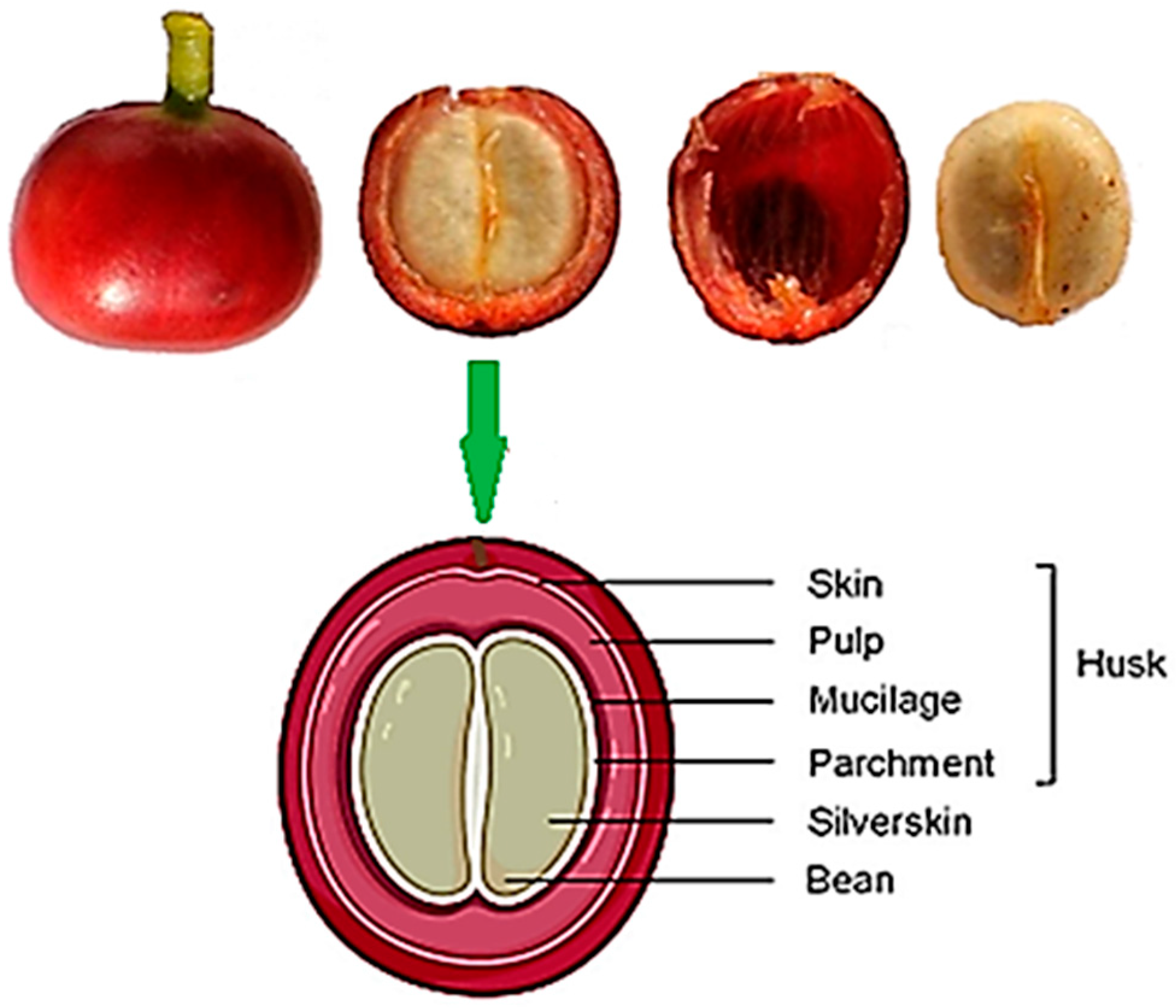
The coffee fruit (cherry) (Figure 1) consists of an outer skin (pericarp), which is green in unripe fruits and red in ripe ones, enclosing a sweet and soft pulp (mesocarp). Beneath the mesocarp lies a viscous, hydrated mucilage layer and a thin endocarp (parchment). The silver skin surrounds two or three green coffee beans (endosperm) [14].
Once harvested, the first post-consumption step focuses on separating the beans from the rest of the fruit components, generating coffee husk as the main by-product. For each ton of harvested coffee, approximately 0.18 tons of husk are produced [16]. Due to its high caffeine and tannin content, coffee husk can contaminate soil and surrounding water bodies and is therefore considered both an inevitable and potentially polluting by-product.
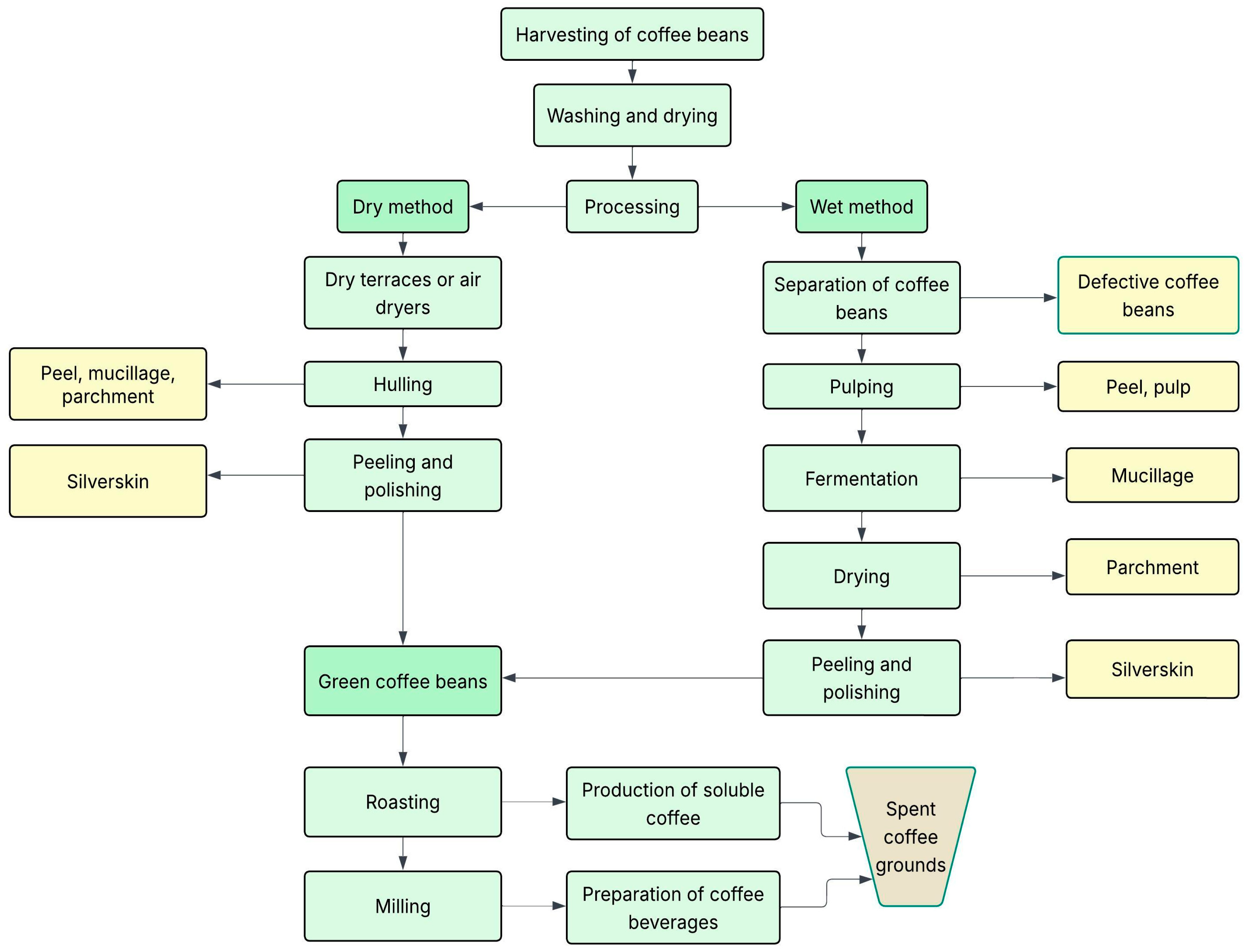
Following husk separation, green coffee beans are obtained through dry or wet processing methods, which also produce additional by-products. Dry processing, predominantly applied to Robusta coffee, involves sun-drying the cherries for 2–4 weeks or using mechanical dryers until the moisture content falls below 12%, followed by hulling and separation of pulp, mucilage, and parchment. Wet processing, preferred for Arabica coffee, includes the removal of the skin and pulp, fermentation of the mucilage for 24–72 h, washing, draining, and drying to approximately 10% moisture, followed by parchment removal [15,16,17]. Both processing pathways are summarized in the flow diagram of coffee cherry processing (Figure 2).
After these initial processing steps, roasting induces chemical and physical transformations in the beans, which influence both the aroma and flavor of the coffee and the structural properties of the SCG. Coffee preparation, through decoction, infusion, or pressure-based extraction, generates SCG as the main post-consumption waste. SCG originates primarily from cafés, restaurants, households, and the instant coffee industry. Collectively, the by-products generated during wet and dry processing, including coffee husk, parchment, pulp, mucilage, and silver skin, represent a substantial fraction of the coffee cherry’s dry weight.
By-products and wastes account for nearly 50% of the dry weight of coffee cherries [4]. Annually, more than 23 million tons of such residues are produced, corresponding to 0.2–0.5 tons of coffee pulp and husk per ton of processed beans and approximately 8 kg of silver skin per ton of roasted coffee [18]. During coffee preparation, approximately 90% of the edible components of coffee cherries are converted into waste or agricultural by-products [19]. This substantial volume of waste is further amplified by the global popularity of coffee, which is widely appreciated for its comforting effect, stimulant properties, and health benefits [20].
Moving to the post-consumption stage, SCG constitutes the main waste stream generated by coffee use. On average, processing one metric ton of green coffee results in about 650 kg of SCG. Global SCG generation can be estimated at approximately 6.7 × 10⁶ tons per year [21]. A significant share of coffee production is directed toward instant coffee, which generates around 2 kg of wet SCG per kg of instant coffee produced [22]. This industrial pathway further contributes to the accumulation of coffee-derived residues at a global scale. Estimating the quantity of SCG generated by coffee shops and large coffee chains is more challenging, as consumption patterns vary considerably between regions and establishments. Espresso-based beverages typically require 7–9 g of ground coffee per cup, while daily coffee consumption in commercial settings may range from 0.5 kg to as much as 12 kg. Consequently, the annual production of SCG per establishment is highly variable, generally ranging between 0.18 and 4.3 tons per year [23].
However, high moisture content (60–80%) in wet SCG complicates storage and transport, increasing costs and risk of microbial spoilage. Furthermore, SCGs are generated in highly dispersed locations (cafés, households, industrial plants), and the absence of coordinated collection and logistics systems significantly limits the practical implementation of circular economy strategies at scale. To overcome this limitation, feasible strategies include the development of localized collection schemes in collaboration with cafés and food service providers, the establishment of regional pretreatment hubs for drying and stabilization of SCG to reduce volume and transport costs, and the integration of SCG into existing municipal bio-waste collection systems. In addition, digital platforms and partnerships between waste producers and valorization industries can facilitate efficient aggregation and supply chain coordination, enabling more practical and scalable implementation of SCG-based processes.

3. Ecological and Toxicological Constraints of Coffee By-Products

Although coffee waste has traditionally been used for low-value applications, such as animal feed or as a raw material in compost for soil fertilization, these residues are often disposed of in sanitary landfills, where they typically undergo uncontrolled decomposition, producing unpleasant odors and acidic leachate that may infiltrate the soil. Moreover, when released into soils or water bodies, coffee waste and its leachate can exert cytotoxic and ecotoxic effects. In addition, the decomposition of these residues emits GHGs that directly contribute to climate change [24]. Notably, coffee waste is known for its remarkable resistance to natural degradation. For these reasons, various valorization strategies have been explored to minimize the ecological and energy-related impacts of the coffee agro-industry while generating value-added products in accordance with circular economy principles.
In parallel, numerous studies have highlighted the beneficial properties of coffee-based beverages, including antibacterial, antioxidant, anti-inflammatory, and anti-obesity effects. However, the environmental leaching of compounds such as caffeine, chlorogenic acid, and tannins originating from coffee waste may lead to severe ecotoxicological effects [24]. While caffeine consumption offers multiple benefits for human health, studies indicate that its presence in the environment has adverse consequences for other organisms. The toxicity of coffee leachate varies depending on the tested organism and its sensitivity to coffee-derived compounds [24,25,26,27,28,29,30,31,32,33,34,35,36,37].
Despite extensive toxicological data on coffee residues, there is currently no widely adopted regulatory guidance specifically addressing acceptable limits for SCG application in agriculture or environmental disposal. Regulations governing organic amendments more broadly (e.g., compost or agricultural waste reuse frameworks) may indirectly apply, but the absence of SCG-specific standards introduces uncertainty for industrial and agricultural stakeholders seeking to valorize SCG responsibly. Consequently, long-term cumulative effects and safe application practices remain largely unexplored.
Focusing first on caffeine, or 1,3,7-trimethylxanthine, is a purine alkaloid and represents the principal constituent of coffee. This alkaloid is removed from coffee beans through the decaffeination process commonly applied at the industrial scale. Nonetheless, extracts obtained from SCGs, both Arabica (0.5%) and Robusta (0.2%), contain lower caffeine levels than low-quality green coffee beans (1.7%) [25]. Caffeine is responsible for the moderate stimulant effect of coffee beverages, contributing to the maintenance of cognitive function and the reduction in central fatigue. Mechanistically, due to its structural similarity to adenosine, caffeine acts as an antagonist of adenosine receptors [26]. By binding to these receptors, caffeine inhibits the action of adenosine, which is known to promote sleep [27]. The benefits of caffeine consumption include a reduced risk of obesity and type 2 diabetes mellitus, alleviation of Parkinson’s disease symptoms, and a delay in age-related cognitive decline and the onset of Alzheimer’s disease [2,15,17,19].
From an ecological perspective, caffeine can affect aquatic organisms, particularly during early developmental stages. For example, studies on zebrafish (Danio rerio) embryos have shown that exposure to concentrations of 5 mM and above induces neuro-muscular disturbances, including hyperactivity, uncoordinated movements, and reduced sensitivity to tactile stimuli, as well as morphological abnormalities such as severe body curvature and impaired growth. An EC50 value of 10 mM at 10 h of exposure has been reported, indicating a substantial biological response under high exposure conditions [28]. Prolonged exposure may lead to irreversible developmental defects and lethality, whereas early removal of caffeine allows partial recovery. Importantly, the EC50 represents the concentration at which 50% of the maximal effect is observed in a biological system. Similarly, chicken embryos exposed to caffeine exhibited teratogenic effects on neurodevelopment, manifested by reduced neuronal outgrowth and disruption of proliferative processes [29]. These findings suggest that caffeine may interfere with normal development and behavior, with potential implications for survival and population dynamics under certain exposure scenarios.
Caffeine and coffee-derived residues can exert differential, concentration-dependent effects on biological systems, including inhibitory impacts on certain plants and bacteria, while potentially stimulating the growth of some fungi. For instance, soil amendment with increasing concentrations of coffee residues was shown to suppress bacterial populations and reduce the abundance of bacterial genetic markers, while simultaneously promoting fungal growth and increasing fungal gene abundance. In the same study, higher coffee concentrations led to a slight decrease in soil pH and negatively affected plant development, with complete inhibition of Phaseolus vulgaris growth observed at the highest tested concentration [30]. These findings indicate that coffee-derived compounds may exert selective ecological pressures and inhibit some organisms while favoring others, depending on concentration and environmental conditions. Moving on to tannins, these compounds are found primarily in the bark of vascular plants and, to a lesser extent, in leaves, fruits, flowers, and seeds. They are widely recognized as antinutritional compounds, which limits their use in animal feed [31,32]. Nevertheless, tannins also exhibit beneficial effects on human health, including antibacterial, antimicrobial, anti-inflammatory, and antiallergic properties, as well as potential applications in the prevention of cardiovascular diseases. However, these beneficial properties may be influenced by structural variations and the degree of polymerization of tannin polymers into oligomers [33]. Tannins are also traditionally used in the leather tanning industry. Ecologically, tannins can become harmful depending on the sensitivity of the exposed organism and the concentration of exposure. For example, they affect the development of sea urchins (Sphaerechinus granularis and Paracentrotus lividus) and algae (Dunaliella tertiolecta), with an increase in fertilization success observed at low concentrations (0.3 mg·L−1) and a decrease at concentrations exceeding mg·L−1 [34]. In Dunaliella tertiolecta, growth inhibition was observed following exposure to tannin concentrations ranging from 0.1 to 30 mg·L−1. Similar results were reported for another algal species, Phaeodactylum tricornutum, for which an EC50 value of 26.04 mg·L−1 was determined [35]. Moreover, tannins are also known for their low biodegradability, which allows them to persist in the environment for extended periods and to bioaccumulate along the trophic chain. Given the health risks associated with wastewater from the tanning industry, numerous studies have investigated its toxicity, particularly in aquaculture and aquatic ecosystems. A comparable phenomenon occurs with by-products from the coffee industry when they are released into the environment; however, studies specifically addressing tannins derived from these waste streams remain limited. For some industrial effluents, tannin concentrations exceeding 100 mg·L−1 have been reported [36], which is considerably higher than many of the reported EC50 values, highlighting the urgent need for tannin removal prior to waste discharge.
Chlorogenic acid (CGA) is a soluble polyphenol resulting from the esterification of caffeic acid with quinic acid [37], which exhibits numerous beneficial effects on human health, including hepatoprotective, antioxidant, anticancer, and neuroprotective properties. Nevertheless, CGA has been reported to act synergistically with plant growth regulators, such as auxins and cytokinins [38], as well as with various other plant functions. Consequently, CGA levels exceeding physiological ranges can induce phytotoxic effects. This represents significant ecological disadvantages and potential long-term implications when SCGs are used as fertilizers. CGA plays beneficial roles in many plant processes, including cell wall synthesis, tissue repair, and root hair formation [39]. However, negative effects have been observed depending on CGA concentration, including reduction in primary root length, shortening of root hairs, decreased total root hair number, and inhibition of root induction [38] when concentrations exceeded 50 mg·L−1, suggesting the existence of an optimal range required for beneficial effects. Adverse effects on germination have also been reported in Arabidopsis thaliana [40]. Additionally, evidence indicates that CGA inhibits fungal growth, likely as part of its role in plant defense mechanisms [41].
On the other hand, coffee waste contains valuable compounds, including carbohydrates, proteins, lipids, and bioactive compounds such as dietary fiber, phenolic compounds, and caffeine. Therefore, the valorization of coffee waste could provide economically profitable opportunities for stakeholders in the coffee agro-industry through the direct commercialization of value-added products. Furthermore, coffee waste utilization can contribute to the diversification of income sources for coffee farmers, reducing their dependence on volatile commodity prices. This, in turn, may enhance the stability and resilience of coffee-producing regions, particularly in developing countries where coffee production represents a significant source of revenue. However, scaling up these valorization strategies requires consideration of regulatory, logistical, and ecological constraints. The absence of harmonized standards for SCG application in food, agriculture, or material production, together with limited long-term ecotoxicological data, introduces uncertainties that may hinder industrial adoption. Policy frameworks, incentives, and coordinated collection schemes are therefore critical to ensure that SCG valorization is both safe and economically viable at a large scale.

4. Characteristics and Chemical Composition of SCG

SCG is a post-consumer waste formed from the unused portion of ground coffee beans remaining after beverage preparation. In this context, SCG represents a valuable resource, as it contains high amounts of sugars, oils, antioxidants, and other useful compounds. Consequently, this waste has the potential to be converted into various high value bioproducts, whether through the extraction of sugars and oils for renewable biofuel production, the isolation of phenolic compounds and antioxidants for nutraceutical supplements, or the combination of SCG with other materials to create novel construction materials [9,42,43].
It should be noted that the composition of SCG depends on the coffee preparation method, as well as growth conditions and coffee type. Nevertheless, most SCGs exhibit a similar profile. The main components are polysaccharides, particularly cellulose and hemicellulose, which account for approximately 50% of the dry mass. Among hemicelluloses, the dominant sugars are mannose, galactose, and arabinose, while glucose is the principal component of cellulose. Lignin and proteins each account for roughly 20% of the dry mass [44]. Moreover, SCG contains a significant amount of lipids, representing over 15% of the dry mass, mainly fatty acids such as linoleic, palmitic, stearic, and oleic acids [45].
Phenolic compounds are present in notable amounts, estimated between 4.6–9.9 mg·g−1, playing a key role in the phytotoxicological activity of SCG [46]. In addition, melanoidins, brown macromolecular compounds formed during the final stage of the Maillard reaction, contribute to the antioxidant, antimicrobial, prebiotic, and anti-inflammatory properties of SCG, while also exhibiting mineral chelation and transport capabilities. Regarding mineral content, SCG is rich in macroelements such as potassium (11,700 mg·kg−1), magnesium (1900 mg·kg−1), phosphorus (1800 mg·kg−1), sulfur (1600 mg·kg−1), and calcium (1200 mg·kg−1), as well as microelements including iron (52 mg·kg−1), manganese (29 mg·kg−1), copper (19 mg·kg−1), cobalt (15 mg·kg−1), and zinc (8 mg·kg−1) [10,17]. Furthermore, a study [23] identified aluminium (27.639 ± 4.025 mg·kg−1), copper (23.660 ± 0.405 mg·kg−1), iron (35.989 ± 2.949 mg·kg−1), magnesium (1106.917 ± 62.165 mg·kg−1), manganese (28.375 ± 1.408 mg·kg−1), strontium (5.871 ± 0.165 mg·kg−1), zinc (32.958 ± 0.807 mg·kg−1), calcium (1589.691 mg·kg−1) and potassium contents (8240.687 mg·kg−1).
Specifically, espresso coffee grounds (dark-roasted Arabica) are primarily composed of mannose (46%), galactose (27%), glucose (20%), and arabinose (7%), with galactomannans being the main polysaccharide, representing approximately 50% of the total carbohydrate content [47].
Table 1 summarizes the chemical composition of SCG as reported in two different studies, highlighting cellulose, hemicellulose, lignin, proteins, nitrogen, ash, total phenolics, sugars, pectic substances, tannins, chlorogenic acid, and caffeine.
Overall, this complex composition makes SCG a valuable organic material for a wide range of applications, ranging from biofuel and nutraceutical production to incorporation into construction materials and soil amendments. It is important to note that the variability in SCG composition depending on coffee origin, roasting degree, and preparation method may affect the efficiency of downstream valorization processes. For instance, lipid-rich SCGs are more suitable for biodiesel production, while polysaccharide-rich SCGs favor biochar or biopolymer synthesis. Such variability necessitates tailored processing strategies and quality control measures to ensure consistent performance of SCG-derived products. Thus, SCG can be considered a key resource for sustainable valorization strategies in line with circular economy principles.

5. Valorization of SCG as an Additive in the Food Industry

Due to their high content of insoluble dietary fiber, bioactive compounds, and characteristic residual aromas, SCG represents a promising resource for the food industry. Recent studies have shown that this agri-food by-product has a valuable chemical composition, being an important source of dietary fiber, proteins, lipids, and minerals, while containing relatively low levels of high-glycemic-index sugars.
In this context, bakery and pasta products are widely consumed and constitute an important source of nutrients; however, conventional formulations are often characterized by high contents of sugars and fats, which are associated with health risks such as weight gain and the development of metabolic disorders. Therefore, the incorporation of SCGs into the formulations of these products has attracted increasing interest due to the presence of antioxidant dietary fibers and phenolic compounds, which may contribute to improving the nutritional profile and reducing negative health impacts [17].
From a technological perspective, the use of SCG requires a preliminary drying step, as the high initial moisture content (approximately 59%) may promote microbial growth; reducing moisture levels to below 8% ensures microbiological stability and ingredient safety. Moreover, the controlled inclusion of SCG in bakery products has been shown to positively influence the sensory, physical, and chemical properties of the final products, providing added value in both functional and qualitative terms [17].
However, beyond moisture reduction and microbiological stability, the incorporation of SCG into food matrices raises important food safety and regulatory considerations. Although SCGs are derived from a widely consumed beverage, their classification as a food ingredient may fall under novel food regulations in certain jurisdictions, depending on the intended use, inclusion level, and processing method. In the European Union, for example, ingredients not significantly consumed before May 1997 may require authorization under Regulation (EU) 2015/2283 [48]. Therefore, clear toxicological evaluation, compositional standardization, and safety assessment are essential before large-scale commercialization.
Moreover, particular attention should be paid to potential contaminants, including process-induced compounds (e.g., acrylamide residues from roasting), mycotoxins from improper storage, heavy metals, and pesticide residues originating from coffee cultivation. While most studies report acceptable safety profiles at low inclusion levels (2–10%), systematic risk assessment and harmonized safety thresholds remain limited in the literature [17]. From a sustainability perspective, ensuring food safety compliance is a prerequisite for translating laboratory-scale valorization into industrial implementation.
Similarly, the valorization of SCG in the formulation of innovative food products has been increasingly investigated, with a variety of applications reported, including fermented alcoholic beverages that retain the characteristic aroma and sensory profile of coffee, thereby conferring a distinct organoleptic identity to the final product [49,50]. Additionally, SCG has been successfully incorporated into bakery and pastry products such as pasta, bread, biscuits, cakes, muffins, cookies, and ice cream cones without adversely affecting sensory acceptability [51,52,53,54,55,56,57,58,59,60,61,62,63]. In these applications, the addition of SCG contributes not only to enhancing the characteristic coffee flavor but also to improving the nutritional value of the products, mainly through the supply of dietary fiber and antioxidant compounds.
The results of sensory studies are noteworthy. In investigations on bread enriched with 2%, 4%, 6%, 8%, and 10% SCG, the sample containing 10% SCG achieved the second-highest preference score, surpassed only by the control bread [51]. Complementary findings on the chemical characteristics of bread were reported by Daniel T. [52] when incorporating SCGs at concentrations ranging from 2% to 10%. Their results indicated that bread containing 10% SCG exhibited the highest protein content. Variations in fat content among SCG-enriched samples were observed, which may be attributed to differences in oil usage and to the coffee brewing process, during which a considerable proportion of unsaponifiable lipid compounds is removed [53]. Furthermore, the highest ash content was recorded in bread with 10% SCG, suggesting a greater concentration of inorganic elements compared to conventional white wheat flour. Fiber content was markedly enhanced in all SCG-fortified breads, with the highest value also observed in the sample containing 10% SCGs. Total carbohydrate levels were higher in bread with 2% and 4% SCG, indicating that SCG-enriched bread may serve as a beneficial energy source. Additionally, bread supplemented with SCG showed increased levels of total phenolic compounds and flavonoids, likely due to the naturally high concentration of these bioactive compounds in SCG [52].
Moving on to pasta, the incorporation of SCG at 4%, 8%, and 10% affected several quality attributes. Uncooked pasta with SCG exhibited greater hardness and tended to break more easily during cooking, indicating that the fibers influence the gluten structure. SCG-containing pasta also showed higher water absorption and a reduced swelling index, likely due to the formation of cohesive fiber–protein networks that limit starch gelatinization. Cooked pasta retained its shape but displayed a darker color, reflecting the pigments and compounds contributed by the SCG [54].
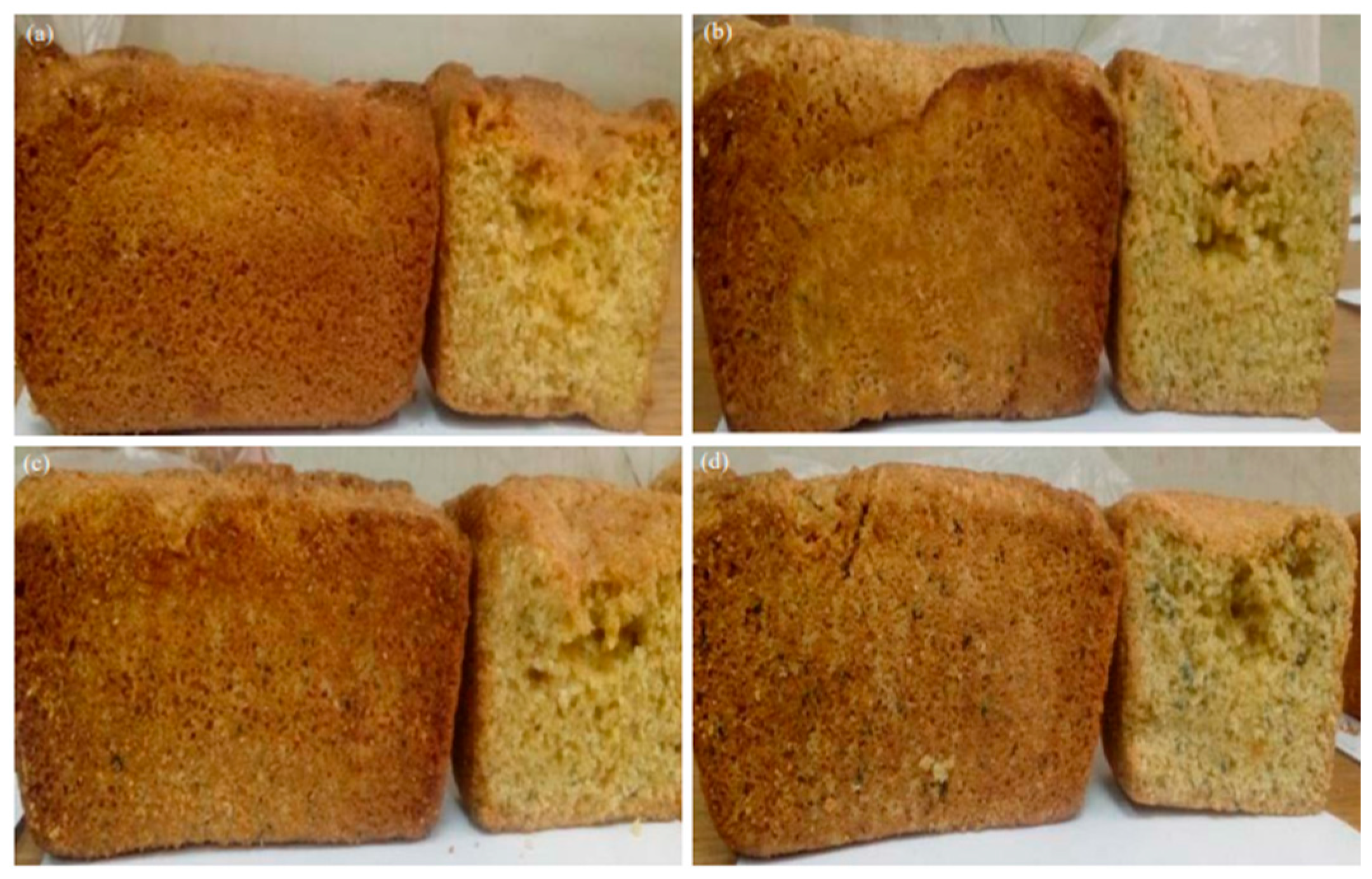
In terms of sweet bakery products, sponge cakes incorporating SCG at proportions of 2%, 4%, and 6% (Figure 3) resulted in significant differences in sensory properties and product acceptability. Among the tested formulations, the cake containing 2% SCG received the highest evaluation scores from consumers, suggesting that the aerated structure and delicate texture characteristic of this type of product are better preserved at lower levels of wheat flour substitution. Increasing the proportion of SCG negatively affected sensory perception, likely due to changes induced in the volatile composition, color, and rheological profile, associated with the high fiber content and low glycemic sugar content of SCG [55].
Similarly, Ahmed et al. [56] investigated the impact of incorporating SCG at concentrations of 1%, 2%, and 3% on the quality of sponge cakes, highlighting the functional and nutritional potential of this ingredient. While the control sample exhibited the highest DM content, cakes enriched with SCG showed significant increases in ash, crude fiber, and mineral content, particularly at the 3% inclusion level. These findings suggest that SCG can enhance the nutritional density of baked products. Moreover, SCG-supplemented cakes demonstrated elevated levels of total phenolic compounds, tannins, and antioxidant activity, emphasizing the ability of SCG to provide bioactive compounds to the final product. The increased antioxidant activity is particularly relevant from a nutritional perspective, given the role of antioxidants in neutralizing free radicals and their potential to reduce the risk of chronic diseases.
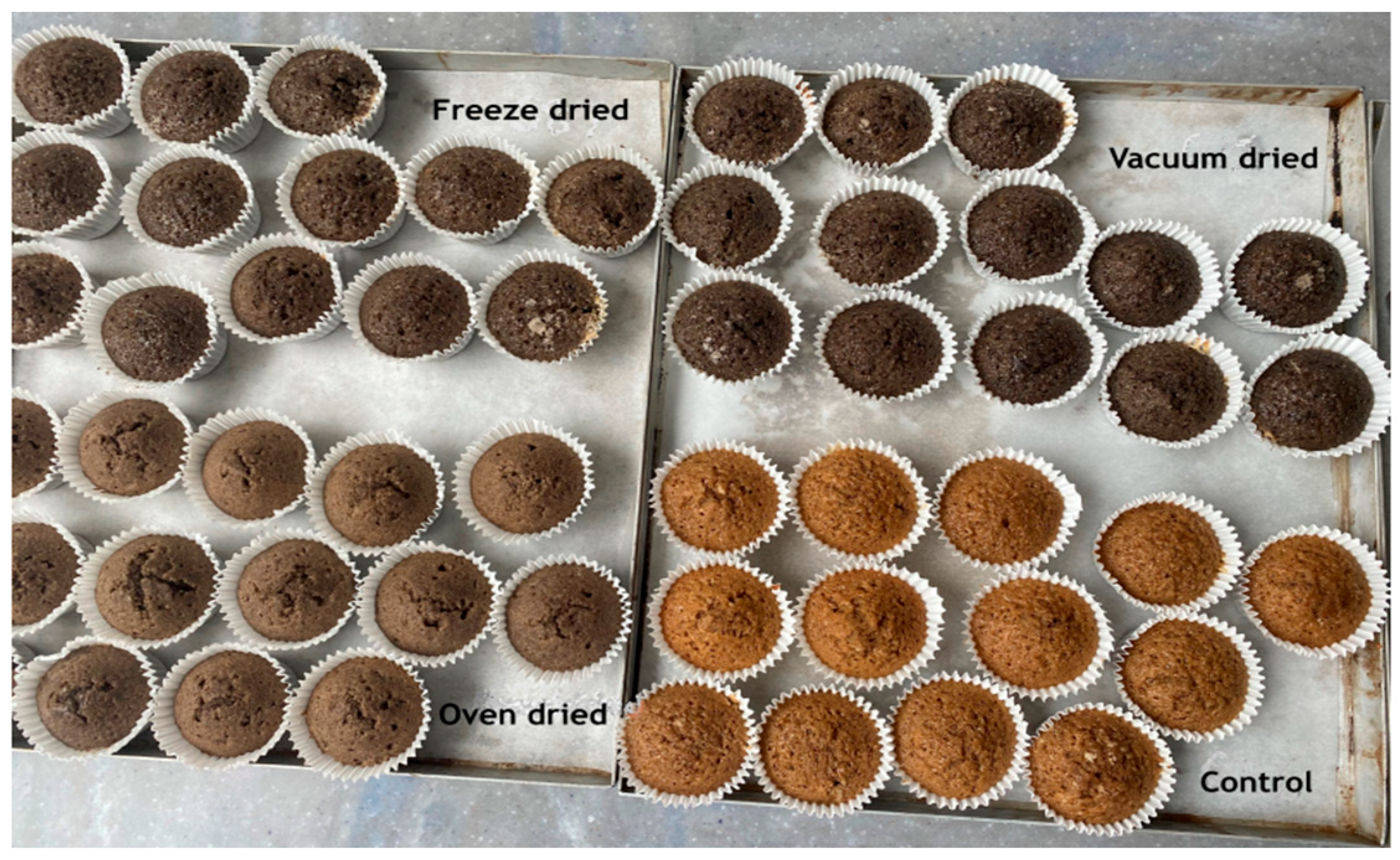
In the case of muffins, Severini et al. [57] tested the chemical composition of muffins enriched with 15% and 30% SCG derived from Arabica coffee beans. Their findings indicated that the inclusion of SCG enhanced the muffins’ antioxidant capacity, phenolic content, and dietary fiber, suggesting that SCG can function as a health-promoting ingredient. Similarly, Benincá et al. [58] studied muffins containing 1%, 16%, 31%, 46%, and 61% SCG from Arabica coffee. They reported that increasing SCG levels led to higher antioxidant activity as well as elevated concentrations of total phenolics, caffeine, chlorogenic acid, and trigonelline. The observed dose-dependent effects highlight the potential of SCG to enrich muffins with bioactive compounds that may confer health benefits, including the reduction in oxidative stress and support for cardiovascular health. Moreover, Solberg and Solberg [59] evaluated the use of SCG as a sustainable coffee-flavouring ingredient in muffins (Figure 4), employing SCG obtained from brewed 100% Arabica dark roast coffee. The study compared different preparation methods for SCGs, including oven drying (100 °C for 2 h), freeze-drying (48 h), and vacuum drying (22 °C under reduced pressure for 24 h), before incorporation at 10% relative to flour weight. All drying methods successfully reduced moisture content below 14%, with freeze-dried SCG achieving the lowest moisture and finest particle size. Sensory and structural analyses revealed that SCG could impart coffee flavour and acceptable texture, although consumer preference was highest for muffins prepared with conventional espresso powder. Among the SCG treatments, freeze-dried SCG produced slightly better flavour and appearance compared to oven or vacuum-dried samples. Their findings underscore that SCG can serve as a functional and sustainable ingredient in baked goods, but careful optimization of processing conditions and inclusion levels is necessary to balance flavour intensity, texture, and consumer acceptability.
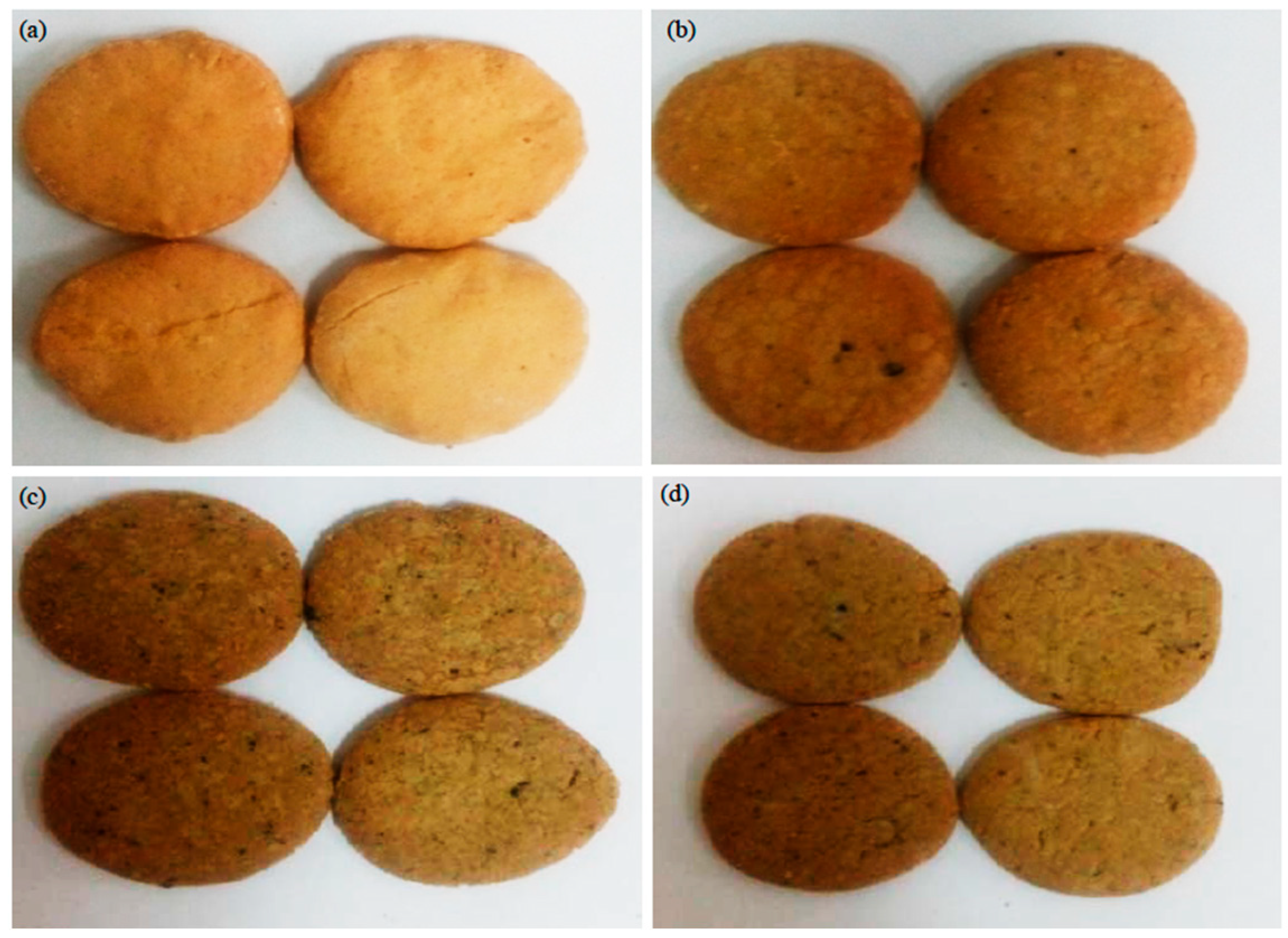
In biscuit formulations, SCG was incorporated into wheat flour at 2%, 4%, and 6% levels to assess effects on dough rheology, chemical composition, sensory properties, and color (Figure 5). Dough rheology was only slightly affected, mainly due to the high dietary fiber content. SCG moisture decreased from 58.98% to 7.47% after drying, confirming the need for pretreatment. Chemical analysis revealed 8.97% protein, 2.77% ash, 51.86% crude fiber, 78.5% total carbohydrates, and 13.89% lipids, resulting in biscuits with proportionally higher fiber and mineral content. Volatile compound analysis identified 38 aroma-contributing compounds. Color measurements indicated a decrease in lightness (L*) from 71.17 in control to 66.31, 54.88, and 43.88 at 2%, 4%, and 6% SCG, respectively, while the red component (a*) increased from 0.45 (wheat) to 3.57 (SCG). Sensory evaluation showed that although color scores declined with increasing SCG, overall acceptability remained largely unaffected, indicating consumer tolerance to visual changes [60].
These findings confirm the potential of SCG as a functional ingredient in biscuit formulations, enabling the production of nutritionally enhanced products with high fiber content and reduced caloric contribution. Therefore, SCG-enriched biscuits can be recommended for individuals with obesity- and diabetes-related conditions, as well as for consumers interested in sustainable and functional food products.
Similarly, Martínez-Saez et al. [61] evaluated the amino acid composition of biscuits enriched with different proportions of SCGs derived from Robusta coffee beans, ranging from 3.50% to 4.40%, and compared them with conventional commercial biscuits. Their results indicated that biscuits containing higher SCG levels, particularly 4.24% and 4.40%, exhibited significantly increased amino acid contents compared to commercial products. In contrast, the amino acid levels in standard biscuits were considerably lower. These findings demonstrate that incorporating SCGs at these concentrations can improve the nutritional quality of biscuits by enhancing their amino acid profile, thereby contributing to better protein quality. This effect is likely associated with the presence of residual proteins and bioactive compounds in SCG, which can increase the nutritional density of bakery products.
Moving beyond solid bakery products, ice cream cones containing 5%, 10%, 15%, and 20% SCG were evaluated, and the results indicated that none of the tested products exhibited significant sensory differences compared to the control in terms of color, aroma, taste, crispness, or overall acceptability [62]. Similar conclusions were reported in studies on cookies, where the addition of SCG produced outcomes comparable to commercial products, with the rich coffee flavor contributing positively to the final sensory profile [63]. Beyond these traditional applications, recent research has explored the use of SCG in functional liquid products, protein bars, breakfast cereals, and vegan or gluten-free foods, enhancing both the nutritional and functional value of these products [17]. Thus, SCG demonstrates versatility as a sustainable resource, aligning with the principles of the circular economy and the global trend toward reducing food waste.
Furthermore, the physicochemical properties of low-moisture meat analogs enriched with SCG were also investigated. The test base consisted of a mixture containing 50% soy protein isolate, 40% wheat gluten, and 10% corn starch, to which SCG was added at levels of 0%, 5%, and 10% relative to the weight of the base mixture. The extrusion process was conducted with a feed rate of 100 g·min−1, 35% moisture content, and a screw speed of 200 rpm. Increasing the SCG content led to a reduction in the porosity of the meat analogs, thereby decreasing their water-holding capacity. In contrast, higher SCG levels increased browning and enhanced antioxidant activity, which was directly correlated with SCG content. Texture analysis revealed that SCG supplementation improved chewiness, cutting strength, and the degree of texturization, without significantly affecting the integrity index between samples. The nitrogen solubility index decreased with higher SCG addition. Sensory evaluation indicated that the inclusion of SCG did not negatively impact flavor or appearance scores compared to conventional meat products [64]. These findings suggest that SCG can be utilized as a functional ingredient in meat analogs, adding value to a food byproduct while also contributing to sustainability by reducing coffee waste.
In addition, the incorporation of SCG into food products provides functional and health-related benefits. Residual phenolic compounds, such as chlorogenic acid and its derivatives, confer antioxidant and anti-inflammatory properties, contributing to the retardation of lipid oxidation and inhibition of pathogenic bacterial proliferation, thereby extending the shelf life of food products [65]. The most prominent phenolic compound identified in coffee and its by-product is chlorogenic acid, present as caffeoylquinic acids, including both mono- and di-caffeoyl forms. These compounds largely account for the antioxidant capacity of SCG. Other significant phenolic compounds found in SCG include caffeic acid, ferulic acid, quinic acid derivatives, and minor amounts of p-coumaric acid, all contributing to the bioactive potential of SCG [25]. All SCG types, except those derived from espresso mocha coffee, contain relevant amounts of total caffeoylquinic acids, ranging from 11.05 mg (espresso) to 13.24 mg (filter) per gram of Arabica SCG, and from 6.22 mg (filter) to 7.49 mg (espresso) per gram of Robusta SCG [66]. Additionally, the low content of high-glycemic sugars makes SCG suitable for products targeted at individuals requiring glycemic control, while the bioactive compounds may positively influence gut health and energy metabolism [61].
Finally, oils extracted from SCG are predominantly composed of linoleic, palmitic, stearic, and oleic acids. Arachidic acid (≤7%) and linolenic acid (<5%) are also present, while lauric and myristic acids are detected only occasionally, depending on the extraction and processing conditions [25]. These oils can be classified into two groups based on their fatty acid profiles: oils with low palmitic acid content (<40%) and high linoleic acid content (>40%), and oils with high palmitic acid content (>40%) and low linoleic acid content (<40% [67]). These clusters result in oils with polyunsaturated fatty acids (PUFA)/saturated fatty acids (SFA) ratios either below or above 1. Oils with a PUFA/SFA ratio >1 are considered less atherogenic and thrombogenic, contributing to the reduction in serum cholesterol levels and decreasing the risk of atherosclerosis, due to the variable concentrations of diterpenes kahweol and cafestol [66]. This characteristic makes them suitable for use in functional foods and nutritional supplements, supporting cardiovascular health.
An innovative application of SCG in the food industry is the development of edible biofilms for packaging. These biodegradable materials are based on natural biopolymers, such as polysaccharides from red algae (Kappaphycus alvarezii), reinforced with SCG particles that improve structural and functional properties. SEM analysis confirms a homogeneous structure and good compatibility between components. The incorporation of SCG enhances mechanical, thermal, and barrier properties, with an optimal tensile strength of 35.47 MPa at 4% SCG, likely due to hydrogen bonding interactions. FT-IR analysis further supports the integration of SCG within the matrix. In addition, increased hydrophobicity improves moisture resistance, making these films suitable for high-humidity environments. The presence of antioxidant and antimicrobial compounds in SCG may also contribute to extended shelf life of packaged foods, highlighting their potential as sustainable, edible, and active packaging materials [68].
Algae- and SCG-based biofilms align with current trends in the food industry, which are oriented toward eco-friendly, consumer-safe solutions capable of reducing the use of conventional plastics. Being made from fully biodegradable and, in some cases, edible ingredients, these films represent an efficient strategy for valorizing SCG, reducing its environmental impact while simultaneously contributing to the development of innovative food packaging with enhanced functional properties.
Table 2 summarizes the applications of SCG in various food products and their effects on nutritional composition, sensory properties, and technological characteristics.
Overall, these studies demonstrate that SCG can be successfully incorporated into various food products and edible biofilms, enhancing nutritional value, functional properties, and sensory profile without compromising consumer acceptability. These results confirm the potential of SCG as a sustainable and versatile ingredient, aligned with circular economy principles and food industry innovation.
Despite the promising functional and nutritional outcomes reported across multiple product categories, several challenges must be addressed before SCGs can be broadly integrated into mainstream food systems. The compositional variability of SCGs, influenced by coffee species, roasting intensity, and brewing method, may lead to inconsistencies in fiber content, lipid fractions, and bioactive compound concentrations, thereby affecting product standardization. In addition, the potential accumulation of process-induced contaminants (e.g., acrylamide derivatives), residual caffeine levels, and agricultural residues necessitate harmonized safety assessment and clear maximum inclusion thresholds.
From a technological standpoint, high fiber content may negatively impact dough rheology, gluten network formation, and product texture at elevated substitution levels, limiting scalability in certain bakery applications. Moreover, consumer perception studies remain geographically limited, and acceptance may vary depending on cultural familiarity with coffee-derived flavors in non-traditional products.
From a research and development perspective, the readiness of SCG-based food technologies can be roughly classified according to Technology Readiness Level (TRL) 3–5: experimental proof-of-concept (TRL 3), laboratory validation (TRL 4), and pilot-scale validation (TRL 5) [17]. Systematic protocols for standardization, safety assessment, and process optimization are essential to ensure reproducibility, consistent functional benefits, and consumer acceptance on a commercial scale. Advancing to higher TRLs will require these measures alongside optimized drying and particle size protocols, scalable incorporation methods, and comprehensive safety assessment.
From a sustainability perspective, future research should integrate nutritional enhancement data with Life-Cycle Assessment (LCA), techno-economic analysis, and regulatory feasibility to determine whether SCG-based fortification provides measurable environmental and health benefits compared to conventional fortification strategies. Only through standardized processing, traceability, and comprehensive risk–benefit evaluation can SCGs transition from experimental formulations to fully commercialized food-grade ingredients.

6. Valorization of SCG in Agriculture

6.1. Valorization of SCG as Organic Fertilizer and Soil Compost

Although numerous organic wastes are efficiently used as natural fertilizers or in composting processes, the direct application of SCG to soil has been shown to exert a range of negative effects on plants and soil microorganisms. Direct application of raw SCG can inhibit plant growth and microbial activity due to its high carbon-to-nitrogen ratio, phenolic content, and acidity, yet several studies indicate that processing or co-application mitigates these risks.
In a study analyzing the growth of various crops (broccoli, leek, radish, viola, and sunflower) on soils amended with SCG, all plants exhibited reduced growth. This effect is primarily attributed to the chemical composition of SCG [69]. Recent research on sunflowers indicated that SCG concentrations ≥35% can significantly reduce germination, plant height, and leaf development, whereas composting SCG for 6 months eliminates its toxicity and allows its effective use as a soil amendment, even at high concentrations [70].
These contradictory effects are determined by the chemical and biochemical composition of SCG: while it contains proteins, sugars, lipids, macro- and microelements, it also harbors phytotoxic compounds such as caffeine and polyphenols, which can be toxic to plants. Despite this potential phytotoxicity, the literature shows that SCG can enhance soil nitrogen (N), phosphorus (P), and potassium (K) levels, while also improve organic matter content, aggregate stability, and water-holding capacity when applied under controlled conditions [71,72,73]. This particularity arises from the fact that coffee beans are seeds rather than structural or protective plant organs, making SCG a unique biodegradable waste whose management requires careful study [10,74]. By supplying organic matter, SCG is particularly valuable for soils with structural deficiencies and low humus content, which are often vulnerable to erosion and degradation.
Under these conditions, SCG may inhibit plant growth even at very low concentrations (<1%) [10]. Recent research highlights that proper dosage and application methods are critical for enhancing soil fertility and agricultural productivity [75].
For example, a two-year field study on ‘Riley’s Super Sport’ bermudagrass (Celebration®) evaluated the feasibility of using fresh and composted SCG, alone or in combination with synthetic and organic fertilizers. Direct application of SCG did not produce typical fertilizer responses; however, when combined with poultry litter in the GeoJava organic fertilizer, turf quality improved, and initial mild phytotoxic effects were mitigated. Despite its acidic nature, repeated SCG applications did not cause long-term changes in soil pH [76]. These findings indicate that SCG can serve as a safe and effective nutrient source in turfgrass systems if appropriately processed or co-applied.
Furthermore, recent experimental studies confirm that the agronomic effects of SCG critically depend on processing. Fresh SCG limits plant biomass growth, whereas vermicomposting or high-temperature pyrolysis (biochar) eliminates phytotoxic effects and allows normal development. These treatments can also influence the availability of microelements such as Zn, Cu, and Fe by modifying natural chelating compounds like polyphenols. In comparison, conventional NPK fertilization results in higher biomass growth but lower micronutrient content in plant tissues [77]. Overall, sustainable utilization of SCG is feasible through technologies such as vermicomposting and biochar production, which reduce toxicity and optimize nutrient effects.
Similarly, preliminary studies in the Vega de Granada region showed that soil amendment with increasing proportions of SCGs (1–15%) led to reduced lettuce growth, with negative effects even at the lowest doses. Nevertheless, nutritional quality improved, with higher concentrations of essential micronutrients in plant tissues [78]. These findings emphasize that SCG use as an amendment requires prior stabilization, and biochar application combined with mineral fertilizers can substantially enhance crop yield, though complementary fertilization is necessary for significant biomass gains.
To analyze the impact of raw SCG on soil health, effects can be grouped into three main classes of indicators: physical, chemical, and biological:
  • Physical indicators. Application of SCG affects soil physical properties. For instance, reductions in bulk density and improvements in water-holding capacity have been observed, associated with increased structural stability of soil aggregates and changes in soil hydrophobicity, contributing to improved hydrological functioning [17,71,72,73]. SCG can promote macroaggregate formation and stimulate fungal development, whose polysaccharides act as binding agents. At the same time, the fine particle size of SCG can fill voids between larger soil particles, potentially reducing porosity and aeration. Although results are sometimes inconsistent due to methodological differences, SCG generally contributes to aggregate stability and enhances hydraulic properties at moderate application rates.
  • Chemical indicators. SCG can increase soil organic matter (SOM) and organic carbon (SOC), including labile fractions, as well as the stability of humic substances. In addition, increased levels of essential nutrients and labile organic fractions support biochemical processes and can positively influence soil fertility [17,71,72,73]. These changes can also affect pesticide transformation and mobility and contribute to the bioremediation of contaminated soils. Soil pH may vary depending on soil type and management practices, and nutrient availability can increase for N, K, Mg, and Ca, while P, Cu, and Zn may respond differently depending on local conditions. SCG can also modify the mobility and bioavailability of potentially toxic elements, reducing the availability of metals such as Cd, Pb, or Zn, and, under certain conditions, increasing arsenic mobility.
  • Biological indicators. SCG influences soil microbial communities by increasing diversity and abundance of beneficial bacteria, including plant growth-promoting rhizobacteria (PGPR) and nitrogen-fixing species. Enhanced microbial diversity is a key indicator of improved soil health, correlating with enhanced decomposition and mineralization of organic matter [17,71,72,73]. SCG can stimulate overall microbial activity and inhibit certain phytopathogens, reducing the risk of seedling damping-off or root rot. Moreover, SCG can serve as a carrier for beneficial microorganisms, such as Trichoderma, amplifying protective effects on plants. Additionally, SCG applications can reduce soil GHG emissions, contributing to decreased N2O and CO2 emissions.
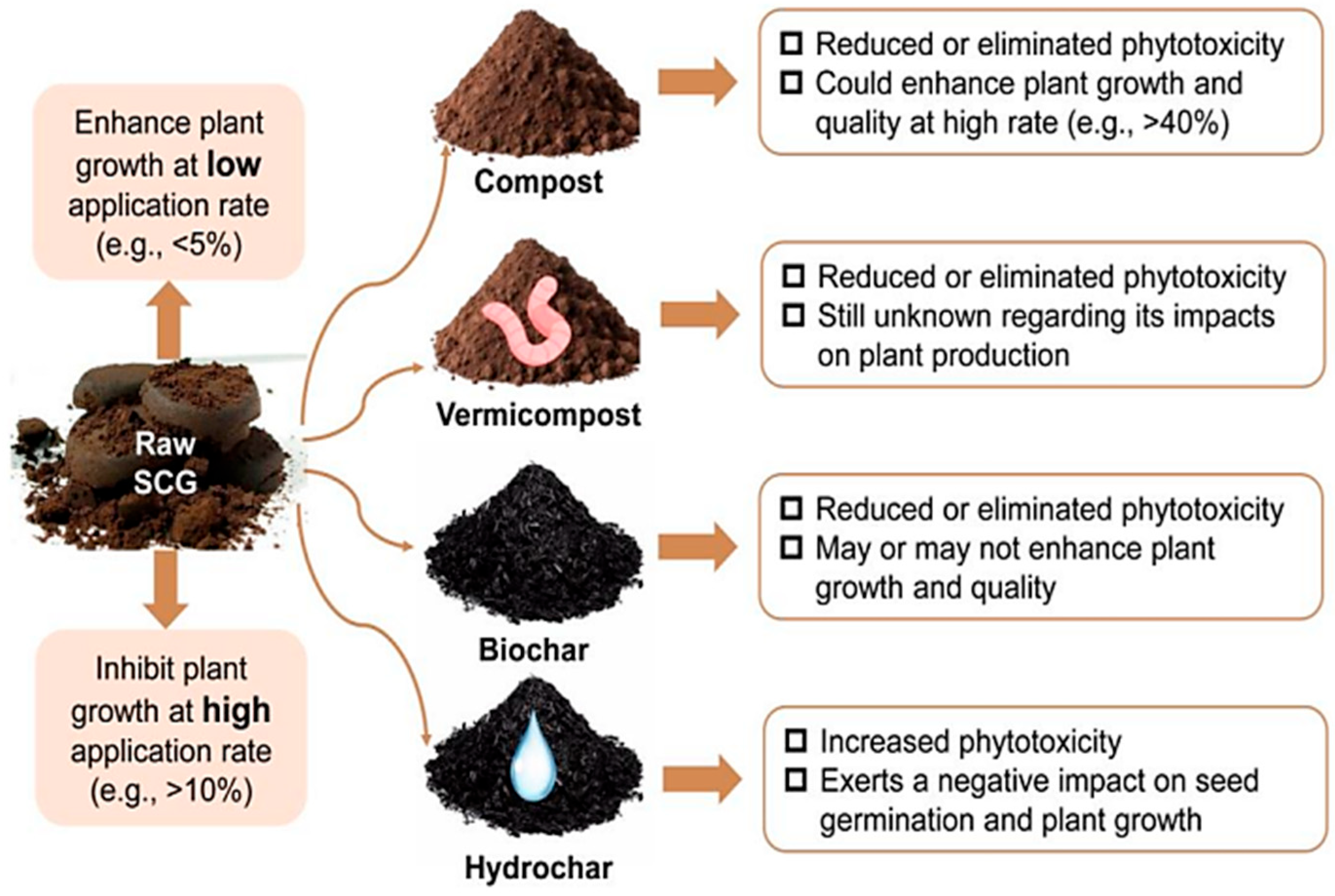
Recent studies on the use of SCG as an organic soil amendment highlight variable agronomic effects (Figure 6), depending on both the proportion applied and the method of application [79].
To mitigate negative effects, SCG should be incorporated into complex compost mixtures along with other organic residues, such as plant debris, leaves, straw, or manure, balancing the C/N ratio and diluting phytotoxic compounds [77]. This approach aligns with sustainable agriculture principles, promoting organic fertilizers with reduced environmental impact compared to chemical fertilizers, which are linked to soil degradation, water pollution, and increased GHGs [10,80,81,82]. At moderate concentrations, SCG acts beneficially in compost, improving soil structure, mineral content, and bioactive compound levels. Responsible management of fertilizers, including organic ones, is essential to maximize agronomic benefits and minimize environmental impact [83,84]. Furthermore, moderate SCG additions can enhance compost antioxidant activity and promote beneficial microorganism dynamics.
SCG can also serve as a substrate for seedlings, although effectiveness depends on careful dosage and stabilization. For example, incorporating used SCG into peat for Brassica seedlings (cabbage, cauliflower, broccoli) showed that a 10% SCG proportion negatively affected plant development, reducing height and leaf number while increasing germination time. Conversely, lower additions (2.5–5%) stimulated germination and biomass in cabbage and broccoli, with cauliflower showing comparable results to control. SCG also influenced mineral accumulation: N, K, and P increased, while Mg and Fe decreased. These findings suggest that up to 5% SCG in peat-based substrate can partially replace peat, but precise dosing and prior stabilization are crucial to avoid phytotoxic effects [85].
A recent experimental study evaluated the effect of SCGs on tomato plant growth, using four main parameters: leaf number, average leaf area, and relative growth rate. Seeds were divided into four groups, with different SCG doses applied post-germination via side-dressing: 0 g, 5 g, 9 g, and 14 g. Results showed that doses higher than 5 g had adverse effects on plant growth, whereas the 5 g dose most effectively stimulated plant development across all measured parameters, demonstrating that this dose can serve as an efficient alternative fertilizer with a positive impact on plant growth [86].
Studies have also assessed the use of SCGs in composting and vermicomposting processes, demonstrating that SCGs can be combined with other organic residues without generating toxic effects on the decomposition process. Vermicompost represents a relevant example of food waste valorization, obtained through the interaction between earthworms and microorganisms, a process that accelerates the biodegradation of unstable organic matter and transforms it into stable, nutrient-rich humus [87]. For instance, the addition of SCG together with Acacia dealbata L. roots and wheat straw in compost showed that, although SCG can be co-composted at any proportion, a 40% addition yielded the best results with reduced GHGs [88]. SCG has also been tested as an alternative to peat and other fertilizers for potted plants; a mixture of up to 40% SCG-based compost combined with peat can improve plant stability and provide quality comparable to that achieved with conventional fertilizers [89]. Batavia lettuce can be grown without yield loss when up to 10% of the soil is substituted with SCG; however, higher doses (20–30%) reduced lettuce yield while increasing photosynthetic pigment content, enhancing the visual appeal of the plants [90]. Considering that high doses of SCG can induce phytotoxic effects, slow-release granules based on SCGs have been developed, capable of gradually supplying nutrients and reducing plant stress risk [91].
In vermicomposting, SCGs have been used together with horse manure using Eisenia fetida worms, with the optimal dose for producing high-quality vermicompost being 25% [92]. The addition of SCGs stimulated worm density and biomass between 14 and 28 days, resulting in approximately 14,000 individuals per m2. Materials obtained through vermicomposting are characterized by a finely fragmented structure, high porosity, good aeration, and increased water-holding capacity, properties like peat, making them suitable as fertilizers or horticultural substrates [87,92]. Even in the presence of bioactive compounds or caffeine, SCGs proved to be a viable substrate for vermicomposting, promoting rapid carbon mineralization and increasing macro- and micronutrient content [93]. However, some studies have reported reduced survival of Eisenia fetida when using pure SCG, suggesting that mixing it with other organic wastes can mitigate this issue [94].
Overall, SCG can be efficiently valorized in composting and vermicomposting, provided they are used in combination with other organic materials in proportions that minimize risks and maximize agronomic benefits.
The valorization of SCG as an organic fertilizer or compost can be framed in terms of TRLs. Current laboratory- and pilot-scale studies indicate that SCG-based composting and vermicomposting approaches are at TRL 3–4 (experimental proof of concept and laboratory validation), while field trials combining SCGs with organic or mineral fertilizers correspond to TRL 5–6 (validation in relevant environments and pilot-scale demonstration) [17]. These TRL assessments highlight that, although SCG shows promising agronomic benefits, including improved soil organic matter, enhanced nutrient availability, and stimulation of beneficial microbial communities, its direct application remains limited due to phytotoxic effects and variability in chemical composition.

6.2. Valorization of SCG as a Substrate for Edible Mushroom Cultivation

Cultivation of edible mushrooms is increasingly recognized as a sustainable strategy to address resource depletion, reduced agricultural productivity, and food insecurity, while providing nutraceutical and sensory benefits [95]. Among cultivated species, saprophytic fungi of the genus Pleurotus are notable for their adaptability and ability to valorize diverse lignocellulosic agro-industrial residues such as sawdust, corn cobs, and sugarcane bagasse [96]. These species are considered functional foods due to their high content of polysaccharides, proteins, essential fatty acids, and minerals, combined with low environmental impact. Their nutritional and medicinal value highlights their potential as sustainable food sources, particularly in vulnerable socio-economic contexts [97].
Recently, interest in using SCG as an alternative substrate arises from its high content of cellulose, hemicellulose, and lignin, making it a valuable lignocellulosic resource [44]. Several studies have demonstrated successful use of SCG in the cultivation of species such as Pleurotus citrinopileatus and Pleurotus salmoneo-stramineus [98], Pleurotus ostreatus [99], and Pleurotus eryngii [100]. In the case of Pleurotus citrinopileatus and Pleurotus salmoneo-stramineus, SCG supplementation supported satisfactory yields and contributed to the development of bioactive properties, including antioxidant, enzyme-inhibitory, and prebiotic effects, although these varied depending on extraction methods and substrate composition [98]. For Pleurotus ostreatus, higher proportions of SCGs, mainly due to caffeine content, were shown to inhibit mycelial growth and delay or reduce fruiting; however, the species demonstrated the ability to degrade caffeine into less complex compounds, suggesting a potential role in detoxifying coffee-derived wastes [99]. In the case of Pleurotus eryngii, the inclusion of SCGs, alone or in combination with other residues, influenced the chemical profile of the fruiting bodies by increasing phenolic content and antioxidant activity, while having minimal effects on key mineral elements [100]. Overall, these findings indicate that SCG represents a promising substrate component, although its impact is dependent on species, concentration, and substrate formulation.
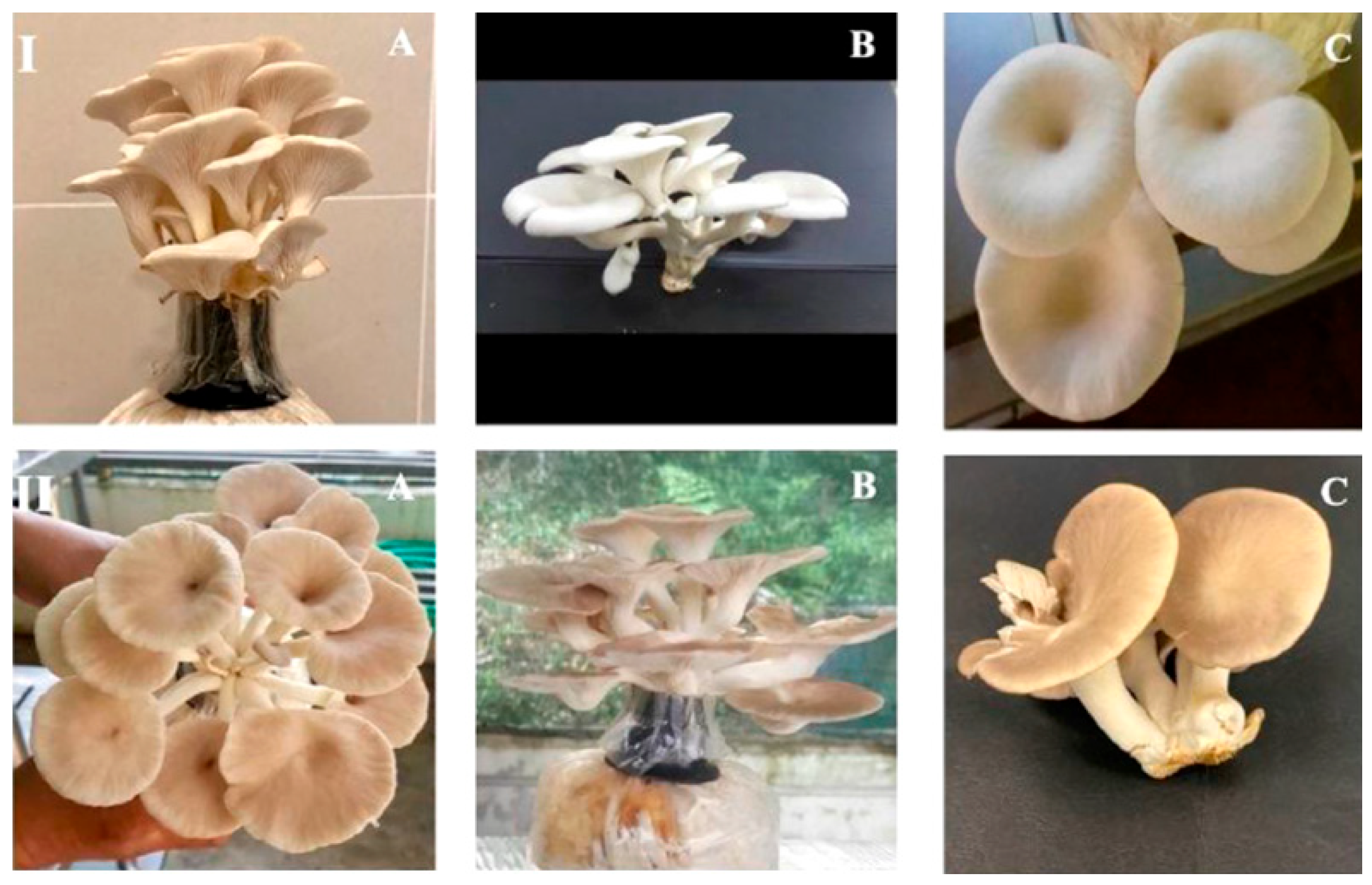
However, the impact of incorporating SCG into conventional sawdust-based substrates on the productivity and chemical composition of Pleurotus floridanus and Pleurotus pulmonarius is not yet fully explored. A recent study indicates that SCG can be used as a supplement in sawdust substrates within defined limits. Results showed that mixtures containing up to 40% SCG can be fully colonized by mycelium, but growth rates progressively slow as SCG proportion increases due to high concentrations of phenolic compounds and caffeine. Fruiting (Figure 7) remains viable only at concentrations up to 20%, a level at which no significant changes in the nutritional composition of fruiting bodies are observed, including mineral content and fatty acid profile. At the same time, Pleurotus species have been observed to reduce caffeine and phenolic compound content in the substrate, likely through bioaccumulation and biodegradation processes, confirming their potential for mycoremediation of SCG [101].
In addition to their nutritional and pharmaceutical value, Pleurotus species are recognized for their bioremediation capabilities. Through the secretion of oxidative enzymes such as laccases and peroxidases, these fungi can degrade phenolic compounds in industrial and domestic wastewater [95]. Thus, cultivating Pleurotus on SCG can simultaneously produce biomass with high nutritional value and reduce phytotoxins present in this type of organic waste, functioning as an effective mycoremediation process [102].
The valorization of SCG as a substrate for edible mushroom cultivation currently falls within TRL 4–5, corresponding to component and/or breadboard validation in laboratory and relevant environment [17]. While laboratory- and pilot-scale studies demonstrate that SCGs can partially replace conventional substrates without compromising fruiting body yield or nutritional quality, challenges remain for scale-up. Variability in SCG composition, due to coffee origin, roasting, and brewing methods, can affect mycelial growth rates and substrate colonization. Standardized protocols for substrate preparation, SCG proportioning, and pretreatment (e.g., sterilization, moisture adjustment) are essential to ensure reproducible outcomes. Furthermore, systematic assessments of potential residual caffeine, phenolics, and microbial contaminants are necessary to guarantee food safety and regulatory compliance. Overall, integrating SCGs into mushroom cultivation at commercial scale requires careful optimization of substrate formulations, traceability, and risk management, bridging current experimental findings to industrial implementation.

6.3. Valorization of SCG as a Substrate for Biochar Production

Slow pyrolysis of SCG has emerged as a promising approach to produce biochar, a material with superior properties compared to the direct application of SCG to agricultural soils. Numerous studies have demonstrated that biochar derived from SCG has much more favorable effects on soil than applying the grounds as such. For instance, a study by Kim et al. [103] investigated the transformation of SCG into biochar and its effects on soil properties. Their findings indicate that converting SCG to biochar removes labile organic compounds that could otherwise inhibit plant growth, while enhancing soil structure, water retention, nutrient availability, and long-term carbon storage.
Tsai et al. [104] further analyzed SCG as a raw material for biochar production through pyrolysis. The process was conducted at temperatures between 400–700 °C, with a heating rate of 10 °C·min−1. Results showed that the resulting biochar exhibited a high carbon content (>80%), fixed carbon (>60%), and a high calorific value (>30.1 MJ·kg−1). Due to these properties, the material can also be used as a solid fuel in the industrial sector. Moreover, biochar can be further functionalized through impregnation with minerals or nutrients, enhancing its efficiency as an agricultural amendment or as a soil remediation agent.
In addition, Cho et al. [105] studied co-pyrolysis of sludge from paper mills mixed with SCG to produce biochar. In this approach, CO2 was used as the reaction medium to stimulate syngas generation and modify the physicochemical properties of the biochar. The synergistic effects of CO2 and the presence of iron and calcium ions reduced the production of pyrolytic oil. The iron content promoted carbon monoxide (CO) formation and was transformed into magnetite (Fe3O4), generating a porous biochar. This co-pyrolysis method allows efficient production of CO and biochar, with potential environmental applications. The biochar produced can be used for wastewater treatment, atmospheric pollutant filtration, or as a support material for catalysts.
Despite the promising agronomic benefits reported at laboratory and pilot scales, several limitations remain insufficiently addressed. The physicochemical variability of SCGs, influenced by coffee origin, roasting degree, and brewing method, may result in inconsistent nutrient availability and soil responses. Moreover, while short-term trials often demonstrate improvements in soil structure and microbial activity, long-term field studies evaluating cumulative effects, potential phytotoxicity, and impacts on soil carbon stabilization are still limited.
From a sustainability perspective, comprehensive LCA and techno-economic analyses are required to determine whether SCG-based amendments provide net environmental benefits compared to conventional fertilizers or composts. Logistics, drying requirements, transportation distances, and potential contaminant accumulation (e.g., heavy metals or residual caffeine) must be carefully evaluated before large-scale agricultural implementation. Therefore, future research should integrate agronomic performance data with environmental impact modeling and regulatory considerations to support evidence-based deployment of SCGs in sustainable farming systems.
The valorization of SCG through biochar production is currently situated at TRL 5–6, corresponding to technology validated in relevant environment and pilot-scale demonstration [17]. Laboratory- and pilot-scale studies consistently show that SCG-derived biochar improves soil physical, chemical, and biological properties while enabling carbon sequestration. However, scaling up the process for industrial applications faces several challenges: variability in SCG feedstock, energy-intensive pyrolysis, control of pyrolytic by-products, and ensuring consistency in biochar properties. Standardized protocols for feedstock preparation, pyrolysis parameters (temperature, heating rate, residence time), and post-treatment are critical to achieve reproducible biochar quality. In addition, safety assessments regarding potential residual contaminants (e.g., heavy metals, caffeine) and regulatory compliance for soil amendments are essential. Integrating techno-economic and life cycle assessments can guide optimization for cost-effective and environmentally sustainable implementation, bridging pilot-scale demonstrations to large-scale agricultural practice.
Table 3 summarizes the valorization pathways of SCGs in agriculture and environmental applications, highlighting their benefits and associated limitations.

6.4. Valorization of SCG in Animal Feed

SCG can be incorporated into the diets of certain animal species. Their nutritional composition includes crude protein, lipids, insoluble fiber, and bioactive compounds (polyphenols, antioxidants), which can contribute to improving feed quality when used in appropriate proportions [106,107,108,109,110,111,112,113,114,115,116,117,118,119,120]. Moreover, the use of SCG in animal feed aligns with the principles of the circular economy, reducing organic waste and valorizing this material with high availability and low cost.
The integration of SCG into ruminant and some monogastric diets has been examined in experimental studies, demonstrating its potential to partially replace conventional sources of energy or fiber. SCG presents both advantages and limitations, and its effects depend significantly on the administered dose. SCG has potential prebiotic properties, contributing to improved ruminal parameters and, when used in controlled doses, can reduce methane emissions, providing environmental benefits. However, polyphenols present in high quantities in SCG can affect nutrient digestibility and animal health if used in excessive doses. Additionally, the high levels of fatty acids in SCG can alter the nutritional composition of the feed and influence ruminant performance [17,106].
SCG use is conditioned by limiting caffeine and tannin content, which can influence digestibility and animal metabolism. Treatments such as washing, fermentation, or drying at controlled temperatures help reduce these undesired compounds, increasing feed safety. Proper processing methods, such as ensiling, are essential to mitigate the negative effects of SCG compounds on animal performance and nutrient utilization. In experiments partially replacing conventional feed with SCG (silage groups 70:30 and 50:50), no significant effects on ruminal fermentation or digestibility were observed, suggesting that these proportions should not be exceeded [106]. In Japan, silages are produced by mixing wet and dry residues, reducing the risk of leachate formation, stabilizing ruminal function, and extending storage time [107]. The addition of lactic acid and soy tofu to silage can improve fermentation and dry matter digestibility while simultaneously reducing methane production in rumen [17,108].
Recent EU-focused studies further demonstrate the experimental feasibility of SCG inclusion in dairy ruminant diets. Feeding trials using SCG from the HORECA sector showed that inclusion of 5% SCG in concentrates did not negatively affect milk yields or fat contents, while only slightly decreasing crude protein by 1.8%, which is negligible from a production standpoint. The drying process with toroidal flash dryer technology ensured microbiological safety, with a recommended storage limit of 4 days for wet SCG. Although in vitro digestibility was low, the in vivo trials confirmed that SCG can be safely used as a second-generation feedstuff for dairy cattle without impairing performance [109]. These results highlight SCG as a sustainable, locally available, and nutritionally valuable ingredient that can partially substitute conventional feed materials, supporting environmental and economic benefits in EU livestock systems.
Research further supports the safe use of SCG in ruminant diets. In a study on lactating Saanen goats, supplementation of up to 100 g·d−1 SCG did not negatively affect milk production, feed intake, or most milk components. However, it influenced certain milk fatty acids, including C18:1, cis-9, trans-11 C18:2, odd and branched-chain fatty acids, and total conjugated linoleic acid. Blood analyses showed that most haematological and biochemical parameters remained within physiological ranges, with positive effects on antioxidant status, evidenced by increased ferric reducing antioxidant power and decreased malondialdehyde [110]. These results suggest that SCG can serve as a functional dietary ingredient to modulate oxidative stress in goats, although dose optimization and longer-term studies are recommended to fully understand its effects.
Moreover, recent trials investigated the effects of three levels of SCG inclusion in the concentrate of dry Latxa dairy ewes on enteric methane production, feed intake, apparent digestibility, ruminal fermentation, microbial protein supply, and blood antioxidant-immune markers. Inclusion of SCG up to 200 g·kg−1 DM did not modify overall ruminal fermentation patterns, while linearly reducing methane emissions per kg of organic matter intake due to decreased digestibility of crude protein and starch. At the same time, microbial protein supply efficiency increased and several oxidative stress and immune-related gene expressions in blood were improved, indicating a positive effect on antioxidant and immune status [111]. These results support the potential of SCGs as a functional feed ingredient that can enhance environmental sustainability and animal health when included at controlled levels. In addition, studies in Latxa dairy ewes demonstrated that increasing levels of SCGs in the concentrate, up to 200 g·kg−1 DM, led to a linear reduction in enteric methane emissions and intensity, while improving the milk fatty acid profile by decreasing total saturated fatty acids and increasing total monounsaturated and polyunsaturated fatty acids. These effects occurred without detrimental impacts on daily milk yield, milk protein, or fat content, and the sensory acceptability of curds remained unaffected [112]. The study highlights SCG’s potential as a functional ingredient that can simultaneously improve environmental sustainability and milk quality, reinforcing its safe inclusion in ruminant diets within controlled levels.
Experimental trials on goats have evaluated SCG as a partial replacement for palm kernel cake (PKC) in concentrate diets. Substituting PKC with SCG at levels up to 50% improved apparent digestibility of organic matter, crude protein, and acid detergent fiber, while maintaining total volatile fatty acid concentrations within functional ranges. Growth performance was highest at 0–25% replacement, with higher inclusion rates (75%) reducing body weight gain and average daily gain. Economic analysis indicated that 25% SCG inclusion in the concentrate provided the most favorable cost–benefit outcome [113]. These results support SCG as a cost-effective and nutritionally viable alternative feed ingredient that can promote sustainable goat production without compromising growth performance.
Furthermore, it has been shown that moderate inclusion of SCG can have beneficial effects on milk production in lactating ruminants. In dairy sheep, inclusion of up to 100 g SCG per kg of DM in the diet increased milk yield as well as protein and fat content, without affecting feed intake, apparent DM digestibility, or feeding behavior [114]. These results indicate that, when used correctly, SCG can serve as a functional ingredient that improves productive performance without compromising digestibility or animal behavior.
Expanding research to pigs further supports the versatility of SCG in monogastric diets. Sikka and Chawla [115] evaluated the effects of including 0%, 10%, and 15% SCG in the diets of twelve fattening Large White Yorkshire pigs over 70 days. The study found that while crude fiber and ether extract content increased and nitrogen-free extract decreased with higher SCG levels, daily weight gain and feed conversion efficiency was significantly reduced at 15% SCG. Importantly, carcass quality was not adversely affected, suggesting that up to 10% SCG can be safely incorporated into pig rations without impacting health or meat quality. Similarly, Tajudeen et al. [116] assessed the impact of 0.5% SCG supplementation on the meat quality of 50 pigs across three crossbreed types (LYD, YB, YW). The results demonstrated that SCG supplementation did not negatively affect physiochemical parameters of meat, including pH, color, water holding capacity, drip loss, or fatty acid composition. Notably, the YB and YW breeds exhibited higher unsaturated and polyunsaturated fatty acid content and favorable meat characteristics compared to LYD. These findings indicate that low-level SCG inclusion can improve or maintain meat quality while posing no detrimental effects on pigs.
Another study evaluated the effects of substituting SCG at 5% and 10% levels in animal feed on growth performance and carcass traits. The results showed that 5% SCG had only a marginal effect on average daily gain, maintaining values close to the control group (0% SCG), while 10% SCG significantly reduced average daily gain and carcass weight, and decreased abdominal fat. No significant differences were observed in the proportion of carcass or in the weight of major muscles (breast and thigh), and liver weight slightly increased with both 5% and 10% SCG inclusion. Overall, 5% SCG substitution appeared safe with minimal impact on production efficiency, whereas 10% SCG clearly influenced both growth performance and carcass quality [117].
Building on research into coffee-based feed supplements in poultry, Ashour et al. [118] investigated the effects of adding green coffee powder at 2.5 g·kg−1 to broiler chicken diets. The supplementation increased feed intake, resulting in higher body weight, improved feed conversion ratio, and reduced abdominal fat levels. This study indicates that moderate inclusion of coffee products in poultry diets can enhance feed efficiency and body composition, aligning with findings on SCG use in other livestock species.
Additionally, SCG use has been explored in aquaculture. A recent study assessed the effects of replacing rice bran with SCG in Nile tilapia (Oreochromis niloticus) diets at levels of 0%, 5%, 10%, and 15% over 90 days. The results showed no significant differences in growth performance, feed conversion, or survival among the groups, and key serum biochemical indices (total protein, albumin, globulin, and glucose) remained stable throughout the experiment. Only minor transient differences were observed in liver enzymes and total cholesterol at day 30 [119]. These findings indicate that SCG can replace up to 15% of rice bran in tilapia diets without negative effects on growth, feed utilization, or health, suggesting a potential application of SCG in sustainable aquaculture feed.
In terms of SCG use in livestock and aquaculture, recent studies have explored its potential as a feed additive for edible insects, such as Tenebrio molitor larvae. Inclusion of SCG at 10% and 25% in the larval diet significantly improved nutritional composition, with crude protein increasing by 45%, vitamin C by 81%, vitamin A by over 800%, and polyphenol content by 29%. Additionally, the oil extracted from SCG-fed larvae exhibited enhanced nutritional quality and higher oxidative stability [120]. These findings highlight SCG as a sustainable feed ingredient capable of boosting the nutritional value of edible insects while contributing to circular economy principles.
Overall, SCG represents a promising alternative ingredient in animal nutrition, offering economic, ecological, and functional benefits. Its use in ruminant feed not only leverages a locally available biowaste but also supports circular economy principles, reduces environmental burden, and contributes to sustainable livestock production in Europe. Careful evaluation of doses, processing methods, and species-specific adaptations remains essential to optimize both animal performance and feed safety.
Despite the substantial body of experimental evidence supporting SCG inclusion across multiple livestock species, several constraints remain to be critically addressed before large-scale implementation. The heterogeneous composition of SCG, influenced by coffee origin, roasting intensity, and brewing method, may result in variability in caffeine, polyphenol, and lipid content, potentially affecting feed consistency and animal responses. While ruminants demonstrate greater tolerance due to ruminal microbial degradation, monogastric species appear more sensitive to elevated inclusion levels, requiring stricter dose optimization.
In addition to nutritional considerations, feed safety remains a central issue. SCG derived from heterogeneous collection streams (e.g., HORECA sector) may contain residual contaminants, including mycotoxins, pesticide residues, or heavy metals, necessitating standardized pre-treatment and quality control protocols. Within the European regulatory framework, feed materials must comply with Regulation (EC) No 767/2009 [121] and associated safety provisions, highlighting the need for compositional standardization and traceability.
From a sustainability perspective, future research should move beyond short-term performance indicators and integrate long-term animal welfare parameters, product quality attributes (milk fatty acid profile, meat characteristics), and comprehensive LCA. Only through the integration of nutritional, environmental, economic, and regulatory dimensions can the true contribution of SCGs to sustainable livestock systems be accurately determined.
The use of SCG in animal feed is currently positioned at TRL 6–7, corresponding to technology demonstrated in relevant environment and system prototype demonstration in operational environment [17]. Experimental evidence demonstrates that SCG can safely and effectively partially replace conventional feed ingredients in ruminants, monogastrics, aquaculture species, and edible insects, offering nutritional, functional, and environmental benefits. However, large-scale adoption requires careful standardization of feed composition, pre-treatment protocols (e.g., drying, fermentation, ensiling), and dose optimization to ensure consistent animal performance and safety. Regulatory compliance under EU legislation (Regulation (EC) No 767/2009) [121] is critical, particularly regarding potential contaminants, caffeine content, and traceability. Additionally, long-term studies integrating animal welfare, product quality, and life cycle assessment are essential to guide sustainable implementation and industrial deployment of SCG-based feed formulations.
Table 4 summarizes the use of SCG in animal feed, highlighting the inclusion levels, effects on animal performance, and associated limitations.

7. Valorization of SCGs as Adsorbent Materials for Wastewater Treatment

SCG is a promising raw material to produce adsorbent materials, due to their porous structure, lignocellulosic composition, and residual aromatic compounds. Both direct utilization of SCG and its conversion into activated carbon through physical or chemical activation have demonstrated high adsorption capacities for a wide range of aqueous contaminants. These contaminants include toxic metal ions such as arsenic, copper, nickel, cadmium, lead, mercury, chromium, and strontium, whose concentrations can be efficiently reduced via specific interactions between the adsorbent surface and the metal species. However, variability in SCG source, brewing method, and pre-treatment can significantly affect adsorption efficiency, highlighting the need for standardized protocols in comparative studies [42,122,123,124,125,126,127,128,129,130,131,132,133].
For example, an experimental study demonstrated the efficacy of SCG-based bioadsorbent for mercury removal from aqueous solutions. Results showed a 97% removal of Hg2+ ions were achieved using 0.4 g·L−1 of bioadsorbent, for an initial Hg2+ concentration of 77.98 mg·L−1, at pH 7, with a contact time of 192.4 min, an optimal temperature of 33 °C, and constant stirring at 375 rpm. Scanning electron microscopy (SEM) of SCG revealed an amorphous, irregular surface rich in cavities (macropores). These cavities form channel-like structures that effectively reduce the specific surface area of the material. After adsorption, SEM images showed that Hg2+ ions occupying the surface reduce the pore volume, which aligns with X-ray dispersive spectroscopy results indicating a decrease in metal ion and organic compound concentrations after adsorption [122]. While these results are promising, the study emphasizes batch experiments under controlled conditions; scaling to real wastewater treatment requires assessment under variable flow rates, pollutant mixtures, and competing ions.
In addition, recent studies have evaluated activated carbon derived from SCG for the removal of antibiotics from aqueous solutions, exemplified by amoxicillin (AMOX), a compound frequently detected in medical wastewater. Experimental findings indicate that SCG-based activated carbon, obtained via KOH impregnation and thermal activation at 800 °C, exhibits a highly porous surface with both acidic and basic functional groups, thereby conferring amphoteric properties and a high adsorption capacity. Under optimal pH and temperature conditions, the material can adsorb up to 370 mg AMOX per gram of adsorbent, surpassing the performance of commercial activated carbon. Moreover, adsorption was found to be spontaneous and exothermic, and the adsorbent could be regenerated and reused multiple times, retaining an adsorption capacity of 250 mg·g−1 after four cycles [123]. A critical point is that long-term stability and fouling resistance under continuous operation are often not reported, representing a gap in assessing practical applicability.
These results highlight SCG as a sustainable source for the fabrication of efficient adsorbent materials for the removal of pharmaceutical compounds from wastewater, complementing its applicability for metals, dyes, and volatile organic compounds.
Furthermore, SCGs and the derived activated carbon also demonstrate high efficiency in the removal of organic dyes from aqueous solutions, including a range of industrially used pigments such as Acid Orange 7, Methylene Blue, Neutral Red, Acridine Orange, Crystal Violet, Malachite Green, Amido Black 10B, Congo Red, Bismarck Brown Y, and Safranin O. This performance is attributed both to the high porosity of the material and the presence of functional groups that facilitate π–π interactions, electrostatic forces, and hydrophobic interactions [42]. Nevertheless, dye adsorption performance can be significantly affected by coexisting organic matter in real effluents, which should be considered when extrapolating laboratory findings.
Additionally, combining SCG with limestone can enhance pollutant removal efficiency while simultaneously neutralizing acidic waters through ionic exchange reactions on the surface of the composite sorbent. In a recent study, SCG and limestone were co-processed via wet granulation to produce effective adsorbents for the removal of both anionic and cationic dyes from water. Wetting properties, mechanical strength, and adsorption capacity were evaluated through standardized tests. The co-granulated adsorbents were able to completely remove Methylene Blue and up to 85% of Orange II in mixed solutions, reaching equilibrium after 6 h for Methylene Blue and 480 h for Orange II. The granules exhibited higher affinity for acidic pollutants compared to basic ones; however, lowering the solution pH to 2 improved the adsorption of basic dyes up to 85%. In addition, the granules demonstrated good mechanical strength and wetting stability, making them suitable for various water treatment methods, including passive systems and column processes [124]. Such strategies demonstrate that SCG can be valorized as a sustainable adsorbent, reducing waste and providing an effective, economical solution for wastewater treatment. Critical evaluation suggests that while performance is high in lab-scale tests, real wastewater streams may present additional challenges such as variable pH, temperature fluctuations, and presence of multiple contaminants.
In a broader context, SCGs have demonstrated potential for the adsorption of emerging contaminants, including bioactive compounds such as hormones, pesticides, phenolic substances, and pharmaceuticals. Among these, caffeine is one of the most widespread contaminants in surface waters and wastewater streams, frequently detected at low concentrations and associated with potential ecological risks [125,126]. Due to these concerns, its removal prior to discharge into aquatic environments is essential, with adsorption being one of the most effective and widely applied techniques due to its simplicity and efficiency [127]. While various adsorbent materials have been investigated, including clays, polymers, zeolites, and activated carbons [128], SCG-derived materials represent a sustainable alternative due to their porous structure and surface functional groups. Their adsorption performance is strongly influenced by pore structure and surface chemistry, enabling interactions such as π–π stacking, hydrophobic effects, and electrostatic interactions with caffeine molecules [129]. However, further research is needed to assess the comparative performance, regeneration capacity, and environmental impact of SCG-based adsorbents under real wastewater conditions.
Building on this potential, SCG can serve as an attractive precursor for the synthesis of nitrogen-doped carbon materials due to their renewable nature. Mengesha et al. [130] prepared hierarchically porous nitrogen-doped carbon via one-step calcination of SCG with KOH under N2, optimizing temperature and KOH concentration to tailor pore structure and nitrogen functionalities. Caffeine adsorption was influenced by nitrogen type and pore distribution, with electron-donor–acceptor interactions between pyridinic-N groups and caffeine dominating, alongside dispersive forces from oxidized nitrogen. Unlike other adsorbents, SCG-derived carbon does not favor electrostatic interactions, and solution pH has little effect, indicating primarily physical adsorption. Maximum caffeine adsorption was 274.2 mg·g−1 at 25 °C, with rapid and spontaneous uptake. The material also adsorbed other micropollutants, such as diclofenac (242.3 mg·g−1), highlighting SCG’s potential in wastewater treatment of pharmaceuticals and personal care products. This study underscores the versatility of SCG-derived carbons yet points to a knowledge gap regarding long-term operational stability, leaching potential, and adsorption in complex multi-component matrices.
Finally, tannin-rich materials, such as SCG, contain functional groups capable of binding metals, including polyhydroxylated polyphenols. A primary limitation of these materials is the difficulty of separating the adsorbent from the liquid phase. One strategy to overcome this challenge is the surface functionalization of the biomass with magnetic materials, allowing rapid recovery via magnetic separation using an external magnet. While the adsorption efficiency of pure magnetic materials is relatively low, numerous magnetic composite materials have been developed to enhance performance. For example, bioelastomeric foams composed of 60% SCG and 40% silicone elastomer, fabricated using sugar-leaching techniques, were employed for continuous filtration and removal of metal ions from aqueous solutions, achieving an adsorption capacity of 4.66 mg·g−1 for 50 ppm solutions [131]. In another study, magnetic SCG was synthesized for the removal of xenobiotics, such as dyes [132]. It was also demonstrated that magnetic biosorbents derived from coffee industry residues exhibit high adsorption capacities for methylene blue [133]. Despite promising lab results, the scalability and economic feasibility of magnetic SCG composites remain underexplored, limiting immediate industrial adoption.
Activated carbon derived from SCG also shows significant applications in gas-phase filtration. This type of adsorbent has been shown to effectively remove residual gases such as CO2 and H2S, as well as volatile organic compounds including nitrobenzene, butane, and ethylene [42]. This versatility positions SCG-based materials as sustainable alternatives to conventional adsorbents while providing a solution for valorizing a widely generated organic waste. Future research should integrate LCA and techno-economic analyses to validate SCG-derived materials as truly sustainable options for industrial-scale wastewater and gas-phase treatment.
SCG-based adsorbent materials are currently positioned at TRL 5–6, corresponding to technology validated in relevant environment and demonstration of a system prototype in operational environment [17]. Laboratory and pilot-scale studies demonstrate high adsorption capacities for metals, dyes, pharmaceuticals, and emerging contaminants, including caffeine. However, moving to industrial-scale application requires addressing key challenges such as feedstock variability, long-term stability, fouling resistance, regeneration efficiency, and separation/recovery strategies (e.g., magnetic composites). Economic feasibility, energy requirements for activation processes, and integration into existing wastewater treatment infrastructure must also be evaluated. Future research combining life cycle assessment, techno-economic analysis, and pilot-scale demonstration under real wastewater conditions is essential to validate SCG-derived adsorbents as sustainable, scalable solutions for wastewater and gas-phase treatment systems.

8. Valorization of SCG for Biofuel Production

8.1. Biogas Production from SCG

Anaerobic digestion (AD) for treating wet SCGs has not been extensively investigated, as mono-digestion often leads to inhibition of the anaerobic process due to toxic compounds present in wet SCGs that affect anaerobic microbial consortia. Nevertheless, various pretreatment strategies can improve performance [134,135,136,137,138,139]. This indicates a critical gap in the literature: most studies focus on lab-scale batch reactors, while continuous or industrial-scale AD of SCG remains underexplored.
For instance, although coffee residues (including SCG, seed husks, and pulp) exhibit low potential for biogas production without pretreatment, chemical treatments can significantly enhance CH4 yields. AD of untreated coffee residues at 35 °C for 120 days produced low biogas yields (45.6 L CH4·kg−1 VS) with a modest reduction in volatile solids (24.2%), attributed to the high lignocellulosic content that is resistant to microbial degradation. In contrast, pretreatment with acidic or alkaline solutions substantially increased biogas production, reaching up to 327.5 L CH4·kg−1 vs. for pretreated samples. Alkaline pretreatment proved particularly effective, yielding approximately 730 L CH4·kg−1 VS, highlighting the crucial role of solubilization and structural breakdown of lignocellulosic components in optimizing the AD of coffee residues [134]. While these results are promising, they also underscore the trade-off between chemical pretreatment efficiency and potential environmental impacts or operational costs associated with large-scale application.
Co-digestion of wet SCGs with other organic substrates, such as algae (AL), food waste (FW), cow manure (CM), or anaerobic sludge (AS), has been shown to provide higher biogas yields than mono-digestion, offering synergistic benefits [135]. A study investigating co-digestion of AL biomass, domestic AS, and SCG in batch reactors at 37 °C for 30 days reported a decrease in biogas production upon adding SCG to the mixture, likely due to pH reduction and potential inhibition caused by caffeine [136]. This suggests that co-digestion strategies must carefully balance SCG ratios and consider inhibitory compounds to avoid process instability.
The feasibility of CH4 production from SCG co-digested with AS in a thermophilic (55–57 °C) anaerobic membrane bioreactor was also examined. Although SCG presents challenges for AD due to nitrogen and micronutrient deficiencies, high tannin content, and inhibition by volatile fatty acids, co-digestion with AS stabilized the system, primarily because the AS supplied essential trace metals [137]. This highlights the importance of supplementing SCGs with nutrient-rich co-substrates, but also raises questions regarding the scalability and economic feasibility of such supplementation in real wastewater treatment plants.
Another study explored mesophilic (35 °C) anaerobic co-digestion of SCGs with other organic wastes, including FW and residual AS. Biochemical CH4 potential tests over 28 days revealed positive effects of co-digesting FW with SCG, yielding 348 mL CH4·g−1 VS, second only to FW mono-digestion (360 mL CH4·g−1 VS). In contrast, adding residual AS as a co-substrate with SCG produced only 247 mL CH4·g−1 vs. (mixture: 25% residual AS, 75% SCG). While residual AS supplies essential trace elements, it negatively impacted CH4 production, resulting in low volatile solids removal (15%). This study confirmed that using SCG as a mono-substrate for AD hinders overall process stability [138]. This points to the need for systematic studies evaluating optimal co-digestion ratios and strategies to mitigate inhibitory effects, which remain largely inconsistent across literature.
Recent studies further emphasize the advantages of co-digesting SCG with FW, particularly when FW is present in higher proportions. Optimal substrate ratios typically involve a dominant FW fraction, which significantly enhances CH4 generation compared to SCG mono-digestion. For example, a mixture containing 75% FW and 25% SCG under mesophilic conditions (35 ± 2 °C) achieved methane yields of up to 0.345 Nm3 CH4·kg−1 VS, markedly higher than those obtained from SCG alone (0.188 Nm3 CH4·kg−1 VS). Moreover, even small additions of SCG (1–4% on a vs. basis) to FW have been reported to stimulate CH4 production relative to FW mono-digestion, likely due to the contribution of residual lipids and structurally complex carbon present in SCG [139]. While these results are encouraging, they also reveal that SCG’s role is often supplementary; its use as a primary substrate is limited without pretreatment or co-digestion strategies. Further techno-economic assessments are necessary to determine the feasibility of integrating SCGs into existing AD facilities.

8.2. Biodiesel Production from SCG

Biodiesel production represents one of the most efficient and extensively studied strategies for energy valorization of SCGs, due to their relatively high residual lipid content. The amount of extractable lipids depends both on the coffee brewing method and on the extraction technique employed.
Various polar solvents, such as isopropanol, ethanol, and acetone, as well as nonpolar organic solvents, including hexane, n-pentane, toluene, chloroform, and petroleum ether, have been tested for oil extraction [17,46].
Beyond solvent chemistry, the efficiency of lipid recovery is closely related to the interaction between solvent polarity and the lignocellulosic microstructure of SCGs [17]. SEM investigations have demonstrated that solvent polarity strongly influences cell wall disruption and oil release. While untreated SCGs exhibit intact cellular structures with oil retained within the matrix, extraction processes lead to significant rupture of cell walls, irregular particle morphology, and increased surface roughness. Polar solvents such as ethanol induce more extensive cell shrinkage and structural collapse compared to nonpolar solvents (e.g., diethyl ether), enabling deeper penetration into the cellular matrix and more effective removal of intracellular material, which explains the higher extraction yields frequently reported for polar solvents despite their lower selectivity for neutral lipids [140]. These microstructural modifications, evidenced by SEM observations (Figure 8), highlight the role of solvent polarity in determining extraction efficiency from SCGs. A critical point is that many studies report laboratory-scale extractions; scaling up to industrial levels may alter extraction efficiency and solvent recovery dynamics.
Polar solvents generally yield lower extraction efficiencies compared to nonpolar solvents like hexane, likely due to competitive formation of fatty acids and carbohydrate degradation products during the process [141]. Extraction efficiency is also influenced by solvent polarity, as polar solvents tend to extract higher amounts of free fatty acids, simultaneously producing gummy residues in the extraction flask, probably associated with proteins, carbohydrates, or compounds formed by interactions between fatty acids and carbohydrate degradation products [17]. This indicates that solvent selection is a compromise between yield, selectivity, and downstream processing requirements, an aspect often under-discussed in the literature.
The oil content in coffee residues ranges between 11–20 wt.%, depending on the source. Defective coffee beans yield 10–12% oil based on dry mass, while SCG contains approximately 10–15% oil [17]. Assuming an oil content of 16% in SCG, its use as a feedstock for biodiesel synthesis could generate significant annual quantities of biofuel. Coffee oil is considered a low-cost feedstock with high potential for biodiesel production [142]. The main fatty acids in SCG oil are linoleic (C18:2), palmitic (C16:0), and oleic (C18:1), whose chain lengths are suitable for diesel fuel production. Final yields also depend on the preparation method of freshly ground coffee (e.g., boiling, filtration, percolation) and the coffee type (Arabica vs. Robusta), which differ in lipid content [142]. Nonetheless, real-world feedstock heterogeneity can impact both biodiesel quality and process reproducibility.
SCG-derived oil, extracted from SCG or defective beans, has been demonstrated as a high-quality and cost-effective feedstock for biodiesel production via transesterification. It is economically advantageous and exhibits superior stability due to the high antioxidant content, along with a pleasant aroma. However, ester-based biodiesel presents limitations, including excessive glycerol formation, low oxidative stability, reduced energy content, and potential deposit formation that can obstruct fuel lines [143,144]. Additionally, due to the presence of oxygen in the molecular structure, biodiesel can typically be used in unmodified engines only at blends of approximately 7–10% [17]. This underscores the need for engine compatibility testing and possible blending strategies to ensure practical deployment.
Several transesterification strategies are employed for biodiesel production from coffee oil [17]:
  • Single-step base-catalyzed transesterification. This is the most used method for biodiesel synthesis. The reaction occurs between alcohol (typically methanol) and triglycerides in the presence of a basic catalyst. However, this method is highly sensitive to reactant purity. The presence of water can cause saponification of esters, and free fatty acids react with the basic catalyst to form soaps, reducing process efficiency and promoting emulsion formation. These effects complicate the separation and purification of biodiesel, making this method suitable only for oils with very low free fatty acid content. This limitation highlights the importance of feedstock pre-treatment or purification prior to reaction.
  • Two-step acid–base transesterification. For low-cost oils with high acidity, such as oil extracted from SCG, single-step transesterification is inefficient due to undesirable reactions between free fatty acids and basic catalysts. In such cases, a two-step approach is employed. The first stage involves acid-catalyzed esterification, converting free fatty acids into esters and thereby reducing total oil acidity. Subsequently, the pretreated oil undergoes base-catalyzed transesterification, converting the remaining triglycerides into methyl esters and glycerol. This method allows efficient utilization of high-acidity feedstocks and ensures higher biodiesel yields. Although effective, this method adds complexity and energy consumption to the process, which must be accounted for in lifecycle assessments.
  • In situ transesterification. A promising alternative is in situ transesterification, in which oil extraction, esterification, and transesterification occur simultaneously. For SCG, this approach enables direct processing of the wet material, eliminating the need for drying and reducing solvent consumption and operational costs. The process produces biodiesel of comparable quality to that obtained via conventional pre-extraction methods. Typically, base catalysts are employed due to shorter reaction times and lower catalyst requirements compared to acid-catalyzed processes. While attractive for scale-up, operational stability and catalyst reuse in the in situ processes require further investigation.
Regardless of the transesterification method, the produced biodiesel requires purification steps to comply with international fuel quality standards. Final characterization may include assessment of visual appearance, acid value, iodine number, water content, reaction yield, methyl ester content, as well as measurements of density, kinematic viscosity, cetane number, flash point, pour point, and cold filter plugging point. Comprehensive reporting of these parameters is often missing in the literature, limiting direct comparisons between studies.
Before extraction, SCG must be dried at temperatures between 50–105 °C to remove moisture and prevent degradation and microbial growth. Moisture in SCG can exist as free water or bound water within the particle microstructure. The bound water content depends on the physical nature of the solids, drying temperature, and duration, which can limit the drying rate [141]. However, wet SCG (with 60% moisture) can be directly used for in situ transesterification [145]. The trade-offs between drying energy input and process efficiency remain under-explored, representing an opportunity for optimization.
Second-generation biodiesel remains a relatively new technology and faces challenges across the entire lifecycle, including production processes and performance/emission characteristics in internal combustion engines. These challenges are particularly relevant for SCG-derived biodiesel due to its recent introduction. Sustainability assessment, including energy balance, GHG emissions, and economic feasibility, is essential to validate the potential of SCG-based biodiesel as a circular biofuel [17,143,144].
In recent years, alternative extraction technologies have been investigated to enhance process efficiency and reduce the use of toxic solvents. These include supercritical fluid extraction (notably supercritical CO2), microwave-assisted extraction, and ultrasound-assisted extraction [143,146]. These methods facilitate lipid release from the lignocellulosic matrix, reduce processing time, and minimize environmental impact, offering viable alternatives to conventional methods. Yet comparative techno-economic and environmental assessments of these advanced methods versus traditional Soxhlet extraction are limited [17].
Oil extraction is most performed using the Soxhlet method with n-hexane as the solvent, due to its efficient solubilization of triglycerides and reproducible extraction yields. Soxhlet extraction times may be as short as 10 min [147]. The oil obtained from SCG exhibits a delicate coffee-specific aroma and a color ranging from orange to chocolate brown [148] (Figure 9).
Supercritical fluid extraction of SCG oil produces yields comparable to Soxhlet extraction with n-hexane, in the range of 10–15% [149]. Microwave-assisted extraction and ultrasound-assisted extraction are similar and relatively simple techniques. Extraction is typically performed with hexane, while microwaves or ultrasound provide additional energy to enhance the release of lipids. Although both methods accelerate extraction and reduce processing time, they have not been shown to significantly alter overall oil yield [150]. Further studies are needed to assess solvent recovery, energy consumption, and lifecycle environmental impacts.
Once the oil is obtained, its conversion to biodiesel involves several specific steps. First, free fatty acids are esterified under acidic conditions to prevent undesirable saponification reactions that may occur in the presence of basic catalysts. Subsequently, the pretreated oil undergoes transesterification, the key step in which triglycerides are converted into methyl esters (biodiesel) using a basic catalyst, typically sodium hydroxide (NaOH) or potassium hydroxide (KOH) [17,143,146]. The selection of catalyst, reaction conditions, and purification methods critically affect both biodiesel yield and quality, yet these factors are inconsistently reported in the literature.
Most experimental studies employ a two-step transesterification process, which first involves acid-catalyzed esterification followed by base-catalyzed transesterification. Acid esterification converts free fatty acids in the coffee oil into esters, making the oil suitable for subsequent base-catalyzed transesterification [151]. This process also generates glycerol as a by-product, which can be valorized in other industrial applications.
However, from an economic perspective, scalability and cost-effectiveness of large-scale production remain uncertain due to expenses associated with SCG collection, oil extraction, and conversion to biodiesel. Environmental implications, energy consumption during extraction, and waste management also present significant challenges.
Overall, while SCG-derived biodiesel offers clear sustainability potential, comprehensive life-cycle, techno-economic, and engine compatibility assessments are necessary before large-scale industrial adoption

8.3. Sugar Recovery and Bioethanol Production from SCG

Besides being rich in oils, SCG is also a source of recoverable sugars. Sugars are generally extracted through the hydrolysis of SCGs, either using acids or enzymes. However, prior to hydrolysis, SCG requires pretreatment to enhance the efficiency of sugar recovery (pretreatments may include ultrasound, the use of concentrated NaOH under ambient conditions, steam explosion, roasting, etc.) [152,153]. The choice of pretreatment critically influences both sugar yield and downstream fermentation efficiency, yet comparative assessments across methods are limited in the literature.
SCG represents a promising feedstock for bioethanol synthesis due to its high carbohydrate content and wide availability. Often, the first step is lipid extraction, or “degumming”, as free fatty acids and triglycerides have been shown to slow down sugar hydrolysis. Once pretreatment is complete, hydrolysis is performed to release most of the sugars. This hydrolysis step is essential as it liberates carbohydrates, particularly cellulose and hemicellulose, making them available for enzymatic action. One of the most common approaches is dilute acid hydrolysis, in which a diluted acid, usually sulfuric acid, is contacted with SCG at high temperatures (>100 °C) for 45–120 min [17]. Alternatively, enzymes (mannanase, cellulase, and hemicellulase) can be used instead of acid to break down the polysaccharides. Research has shown that using enzyme cocktails and optimizing reaction conditions can significantly increase sugar yields. Both methods have been shown to capture over 80% of available sugars when applied after appropriate SCG pretreatment [42]. However, conventional hydrolysis methods may generate inhibitory by-products (e.g., furfurals, phenolics), which can impair microbial fermentation and reduce ethanol yields, an aspect not always addressed in reported studies.
Conventional pretreatment strategies may lead to fermentable sugar losses, particularly from hemicellulosic fractions. Recent studies have demonstrated that optimized liquid hot water (LHW) pretreatment represents an efficient alternative for sugar recovery from SCG. LHW pretreatment conducted at 180 °C for 20 min under a high solid-to-liquid ratio (1:6, w/v) effectively disrupts the lignocellulosic matrix while preserving fermentable sugars, notably mannose and glucose. When combined with a separate hydrolysis and fermentation (SHF) process, this approach achieved bioethanol concentrations of 15.02 ± 0.05 g·L−1 and a productivity of 1.252 g·L−1·h−1. Importantly, the use of high solid loading significantly reduced water consumption and eliminated the need for detoxification, enhancing both the environmental and economic viability of bioethanol production from SCG [21]. While promising, scale-up studies are required to validate process robustness, energy efficiency, and cost-effectiveness at industrial scales.
Researchers have suggested using sugars extracted from SCGs in the food industry. Due to some of the nutraceutical products obtained, such as manno-oligosaccharides, these sugars could serve as food additives, providing health benefits. Another important application is bioethanol production via microbial fermentation, typically using Saccharomyces cerevisiae, with sugars derived from cellulose and hemicellulose. After fermentation, the product can be distilled to reach the purity levels required for bioethanol formulation [17]. This dual-use approach highlights the potential for integrated biorefinery concepts but requires careful process design to balance energy inputs, product recovery, and sustainability metrics.
Co-cultivation of multiple microorganisms can improve fermentation performance and tolerance to inhibitors that may be present in SCGs, such as phenolic compounds. It has been demonstrated that co-cultivation positively influences bioethanol yields and production efficiency in a single system using agricultural residues. This approach has shown promise in increasing overall bioethanol yield and reducing the need for detoxification steps, thereby lowering operational costs. Furthermore, sequential production and co-production of biodiesel and bioethanol using SCGs have been explored, yielding promising results with bioethanol yields of 0.46 g·g−1 SCG and 97.5 ± 0.5% for biodiesel [154]. Despite these encouraging results, comprehensive lifecycle assessments and techno-economic analyses are limited, leaving uncertainty regarding the true sustainability of sequential biofuel production from SCG.
Although sugars extracted from SCG represent a valuable source for bioethanol production, contributing to the valorization of coffee waste and the generation of renewable fuels, challenges in bioethanol production from SCG persist. Additionally, the presence of inhibitory compounds in SCG, such as caffeine and tannins, may impact fermentation performance, necessitating the implementation of detoxification strategies [155]. Future research should systematically address SCG heterogeneity, inhibitor mitigation, and process integration to ensure reproducible, high-yield bioethanol production while maintaining environmental and economic sustainability.

8.4. Direct Combustion and Production of Solid Fuels from SCG

SCG has been investigated as a solid energy resource in multiple configurations, ranging from direct combustion in dedicated boilers to co-incineration with other types of biomasses, such as pine sawdust, crude glycerol and pinewood charcoal [156,157]. Due to its relatively high carbon content and dense organic structure, dried SCG exhibits a higher calorific value than wood pellets at the same moisture level, making it an attractive material to produce compacted solid fuels. However, while calorific value is promising, LCA of SCG combustion, including collection, drying, pelletizing, and transportation, are still limited, leaving uncertainty regarding net energy gain and overall sustainability.
However, its energetic use presents challenges related to emissions generated during combustion. Studies have shown that direct combustion of SCG leads to higher emissions of pollutant compounds, particularly nitrogen oxides (NO2), compared to other types of biomasses traditionally used for solid fuels. These emissions are influenced by the protein content and specific chemical composition of SCG, which necessitates mitigation strategies such as optimization of combustion conditions, the use of advanced gas post-treatment systems, or blending with other lignocellulosic materials [158]. From a critical perspective, emission mitigation adds cost and complexity, potentially limiting large-scale adoption unless integrated into multi-residue biomass strategies.
Despite these limitations, SCG remains a promising candidate to produce solid fuels (briquettes, pellets, or bioenergy blends) due to its high availability, low cost, and potential to partially replace conventional fuels in a sustainable manner. Recent studies have also explored the production of SCG pellets through carbonization, showing that pellets made from SCG carbonized at 350 °C can achieve a calorific value of 30.9 MJ·kg−1, a 40% increase compared to uncarbonized SCG, while maintaining appropriate physical properties such as density and durability [159]. Although residual moisture may remain after production, it does not significantly impact fuel performance. Nevertheless, the energy and emissions associated with carbonization should be quantified, as high-temperature processing may offset the sustainability benefits if not optimized.
This approach not only provides a sustainable solution for managing coffee waste but also produces high-efficiency biomass fuel with enhanced energy characteristics. Furthermore, it has been demonstrated that blending SCGs with other biomass residues can result in competitive solid fuels in accordance with the international standard ISO 17225-2 [160]. Pellets containing up to 10% coffee residues mixed with sawmill residues comply with the A2 quality class limits, while blends with up to 30% SCG meet the requirements of class B wood pellets for commercial and residential applications. However, the long-term durability and storage stability of such blends require further study, especially under variable environmental conditions.
Another study examined the feasibility of using SCG as an additive (5%, 15% and 30%) in pine sawdust (PS)–based pellets (Figure 10), showing that the incorporation of SCG increases the energy value of the pellets but may negatively affect their mechanical durability and intensify CO and NOx emissions during combustion. At the same time, a reduction in volatile organic compound (VOC) emissions was observed [161]. These trade-offs highlight the need for a holistic assessment, balancing energy content, emission profiles, and mechanical performance to ensure that SCG-based solid fuels are truly sustainable.
The results indicated that blends with a low SCG content (approximately 5%) comply with the requirements of the ISO 17225 and EN 303-5 standards, while higher proportions, up to 15%, may be potentially applicable but require further investigation to optimize performance and environmental impact [161]. This suggests that modest incorporation levels are currently the most viable from a sustainability standpoint, and any scale-up should be accompanied by comprehensive techno-environmental analyses.
Based on the aspects presented in Section 8.1, Section 8.2, Section 8.3 and Section 8.4, SCG valorization for bioenergy demonstrates clear potential, yet current studies are largely lab- and pilot-scale (TRL 4–6) [17]. Anaerobic digestion is limited by inhibitory compounds and nutrient deficiencies, requiring co-digestion strategies. Biodiesel production is technically feasible, but feedstock variability, extraction methods, and transesterification conditions critically affect yield and fuel quality. Sugar recovery and bioethanol production benefit from pretreatment and enzyme optimization, yet inhibitory by-products and SCG heterogeneity remain challenges. Direct combustion and pelletization offer high-calorific-value fuels, but emissions, mechanical durability, and blend optimization require further assessment. Across all approaches, industrial-scale implementation demands techno-economic evaluations, lifecycle assessments, energy balance studies, and integration strategies to ensure environmental sustainability, process efficiency, and cost-effectiveness. Future research should focus on scaling-up, process standardization, and hybrid valorization strategies (e.g., sequential biodiesel and bioethanol production), bridging current lab-scale findings to practical, sustainable applications.
Table 5 summarizes the valorization of SCG in the renewable energy sector, highlighting the main production processes, benefits, and associated limitations.

9. Valorization of SCGs in Pharmaceutical, Nutraceutical, and Biotechnological Applications

Due to its high concentration of phenolic compounds and antioxidants, SCG represents a functional resource with applicability in the development of pharmaceutical products and supplements with health-promoting effects. The main phenolic compounds, especially chlorogenic acid and its derivatives, have demonstrated antioxidant, anti-inflammatory, antibacterial, and anticancer activities, providing potential in the formulation of products that support cellular health and protection against oxidative stress [25]. However, the variability in SCG composition depending on coffee type, roasting conditions, and extraction method may affect reproducibility and consistency of bioactive content, which is critical for pharmaceutical standardization and regulatory compliance.
SCG can be used to obtain standardized extracts, concentrated in polyphenols and other bioactive compounds, which can be incorporated into dietary supplements or functional pharmaceutical products. These compounds have been associated with beneficial effects on energy metabolism, glycemic regulation, modulation of intestinal inflammation, and cardiovascular protection, offering opportunities for the development of products aimed at prevention and therapeutic support in chronic conditions [61,67]. However, most of these findings are based on in vitro or preclinical studies, and in vivo efficacy, bioavailability, and clinical validation remain limited. Further research is required to establish dosage, safety, and clinical effectiveness.
Oils extracted from SCGs, with a specific fatty acid profile, can be used in cosmetic and dermatological formulations due to their emollient properties, favorable PUFA/SFA ratio, and local anti-inflammatory effect. Linoleic, palmitic, stearic, and oleic acids, together with small amounts of arachidic and linolenic acids, confer skin hydration and protective properties [25]. Classification of oils based on the PUFA/SFA ratio (>1 or <1) makes them useful in preventing oxidative stress and promoting cellular protection, while diterpenes such as kahweol and cafestol contribute to antioxidant and anti-aging effects [69]. Furthermore, SCG can be valorized in anti-aging products, antioxidant creams, and cosmetic scrubs, due to its ability to protect cells against oxidative stress and improve skin texture and hydration. Yet, extraction efficiency and reproducibility of these compounds for cosmetic formulations require standardized protocols to ensure product consistency and regulatory compliance.
Thus, SCG proves to be a valuable pharmaceutical and nutritional resource, with potential in the development of functional products, cosmetics, and supplements that support health and disease prevention when used in appropriate forms and dosages. However, large-scale applications must consider economic feasibility, supply chain logistics, and sustainability of extraction processes, as solvent use, energy input, and waste generation could compromise environmental benefits.

9.1. Pharmaceutical and Nutraceutical Applications of SCGs: Evidence from Preclinical Studies

Chemical analysis of SCG has confirmed the presence of key bioactive compounds, even after coffee brewing. SCGs contain caffeine (0.35%) and chlorogenic acid (0.16%), as well as characteristic functional groups (O–H, C–N, C–H), highlighting their potential as a source of standardized bioactive ingredients for pharmaceutical and nutraceutical formulations [162].
In vitro studies have highlighted the potential of SCG extracts as sources of bioactive compounds for pharmaceutical and nutraceutical applications. SCG extracts are particularly rich in caffeine and chlorogenic acid derivatives, including 5-O-caffeoylquinic acid, 3-O-caffeoylquinic acid, and 3,5-O-dicaffeoylquinic acid, which are associated with antioxidant and anti-inflammatory activities. Methanol extracts of SCGs were shown to protect neuron-like SH-SY5Y cells against H2O2-induced oxidative stress by upregulating key endogenous antioxidant enzymes such as thioredoxin reductase, heme oxygenase 1, NADPH quinone oxidoreductase, and glutathione reductase. Water extracts effectively reduced lipopolysaccharide-induced neuroinflammation in microglial BV-2 cells by downregulating proinflammatory mediators through modulation of the TLR4/NF-κB pathway [163]. These findings suggest that SCG-derived bioactive compounds may serve as valuable nutraceutical ingredients for supporting neuronal health and mitigating mechanisms underlying neurodegenerative diseases such as Parkinson’s and Alzheimer’s.
Additional preclinical evidence highlights SCG extracts as effective sources of hydrophilic antioxidants with cell-protective properties. Extracts from Arabica filter and Robusta espresso coffee, rich in caffeoylquinic acids (especially dicaffeoylquinic acids) and caffeine, were shown to reduce oxidative stress and DNA damage in human HeLa cells. Short-term exposure (2 h) up to 1000 μg·mL−1 did not affect cell viability (>80%), while both extracts significantly decreased H2O2-induced reactive oxygen species (ROS) levels and DNA strand breaks, providing 29–73% protection as measured by the comet assay. Notably, pretreatment with Robusta SCG extracts also reduced photosensitizer-induced oxidative DNA damage after 24 h. The enhanced effectiveness of Robusta extract, despite lower levels of dicaffeoylquinic acids and melanoidins, suggests contributions from other antioxidant compounds, such as caffeine and Maillard reaction products [164]. These results support the antioxidant and genoprotective potential of SCG extracts, reinforcing their applicability in nutraceutical or pharmaceutical formulations.
Recent investigations highlight SCG extracts as a source of bioactive molecules with antimicrobial and mycotoxin-reducing properties. Using an eco-friendly isopropanol extraction, SCG extracts were found to contain 15 phenolic acids, predominantly rosmarinic and syringic acids, and 8 flavonoids, including apigenin-7-glucoside, naringin, epicatechin, and catechin. In vitro studies demonstrated moderate cytotoxicity against liver cancer (Hep-G2) cells while showing selectivity compared to healthy oral epithelial cells. Antibacterial and antifungal assays revealed activity against pathogenic strains and toxigenic fungi, respectively, and simulated models confirmed the extract’s ability to reduce aflatoxin and ochratoxin A levels in liquid media and spiked dough without affecting cooking processes [165]. These results support the potential use of SCG extracts as functional ingredients in pharmaceutical formulations or nutraceuticals to mitigate microbial contamination and mycotoxin exposure.
Evidence also supports the pharmaceutical potential of SCG extracts through their antioxidant and anti-proliferative activities. Ethanolic extracts obtained from SCGs of different coffee origins (Arabica and Robusta) revealed a diverse phenolic profile, with tyrosol identified as the predominant compound, alongside 4-hydroxybenzoic acid and vanillin. In addition, significant levels of tocopherols were detected, contributing to the overall antioxidant capacity. Among the tested samples, the extract derived from 100% Robusta coffee exhibited the highest antioxidant potential, as confirmed by RACI and GAS indices. Importantly, this extract demonstrated notable anti-proliferative activity against human lung carcinoma (A549) cells, with an IC50 value (61.2 μg·mL−1) comparable to that of the reference chemotherapeutic agent vinblastine (67.3 μg·mL−1) [166]. These findings highlight the potential of SCG-derived extracts as sources of bioactive compounds for anticancer-oriented nutraceutical or pharmaceutical applications.
Further studies have demonstrated the antifungal potential of SCG extracts, highlighting their applicability in pharmaceutical formulations targeting skin and mucosal infections. Ethanolic extracts obtained from both caffeinated and decaffeinated coffee capsules exhibited antifungal activity against clinically relevant strains, including Candida krusei, Candida parapsilosis, Trichophyton mentagrophytes, and Trichophyton rubrum. Notably, fungicidal effects were observed against T. mentagrophytes and T. rubrum. Mechanistic investigations revealed that SCG extracts significantly reduced the content of ergosterol, chitin, and β-(1,3)-glucan in fungal cells, indicating disruption of both cell membrane and cell wall integrity. In addition, the extracts showed cytotoxic activity against tumoral cell lines while maintaining low toxicity toward non-tumoral cells. The presence of phenolic compounds such as caffeoylquinic, feruloylquinic, and caffeoylshikimic acid derivatives further supports their biological activity [167]. These findings confirm the potential of SCGs as a source of bioactive compounds for the development of antifungal pharmaceutical formulations, particularly for dermatological applications.

9.2. Production of Lactic Acid from SCG

Lactic acid is an organic acid with wide applicability in the food, chemical, cosmetic, pharmaceutical, and textile industries, making it a valuable candidate for the development of sustainable practices [168]. Although it can be produced via chemical synthesis, the high cost of petrochemical raw materials and the production of a racemic DL-lactic acid mixture limit the efficiency of this process [169].
A racemic mixture of lactic acid consists of an equimolar mixture of two optical isomers: the dextrorotatory form and the levorotatory form. These two isomers are mirror images of each other and exhibit identical chemical properties, yet they can behave differently in biological or industrial applications [170]. Chemical synthesis of lactic acid naturally generates this mixture, which can be a disadvantage when a specific isomer is required, for example, in the food, pharmaceutical, or biodegradable plastics industries. In contrast, microbial fermentation allows the selective production of a single isomer, either levorotatory or dextrorotatory, depending on the microorganism used [17].
Microbial fermentation offers advantages such as high yield, superior purity and productivity, and the ability to produce stereoselective isomers [171]. Organic substrates, such as food or plant waste, represent alternative, abundant, renewable, and biodegradable raw materials that do not compete with human food, making them ideal for fermentation [172]. SCGs are rich in polysaccharides, lipids, amino acids, proteins, alkaloids, and minerals [42] and can be used as a feedstock for lactic acid bacteria fermentation. However, the recalcitrant structure of coffee grounds, due to covalent and hydrogen-bond interactions between cellulose, hemicellulose, and lignin, limits the accessibility of hydrolytic enzymes [173]. To overcome these limitations, chemical pretreatment and saccharification steps are required, which modify the lignin and hemicellulose composition, increase specific surface area and degree of polymerization, thereby facilitating microbial fermentation [174].
Recent studies have demonstrated that pretreatment of coffee grounds with hydrogen peroxide and acetic acid, in combination with an enzymatic mixture composed of Viscozyme L, Celluclast 1.5 L, and Pectinex Ultra SP-L, enables sugar conversion of 78.9% at a 4% (w/v) substrate concentration. Fermentation induced by Lactiplantibacillus plantarum WiKim0126, with a 4% solid loading, resulted in a lactic acid concentration of 22.8 g·L−1, representing 99.6% of the theoretical maximum yield, and a productivity of 0.95 g·L−1·h−1 within 24 h [175]. These results highlight the potential of SCG for sustainable lactic acid production; however, scalability and process economics require careful evaluation, particularly concerning pretreatment costs, enzyme usage, and downstream purification.

9.3. Production of Phenolic Compounds and Antioxidants from SCGs

SCGs are a remarkable source of bioactive compounds, particularly antioxidants and phenolic compounds such as chlorogenic acid, caffeine, and various flavonoids, which can be valorized in the food and pharmaceutical industries. These compounds contribute to the neutralization of reactive oxygen species and the inhibition of oxidative processes in food products, which is why their extraction from SCG has generated considerable scientific and technological interest.
Regarding extraction methods, alcohols (especially ethanol) are commonly used as solvents due to their high efficiency in recovering phenolic compounds; methanol is used in some protocols but shows lower efficiency compared to ethanol and has toxicity-related limitations. In addition to conventional solvent extraction, advanced methods have been developed to improve both process efficiency and environmental sustainability. These include ultrasound-assisted extraction, subcritical water extraction, microwave-assisted extraction, autohydrolysis, and biotechnological processes such as fermentation with Penicillium purpurogenum GH2, which facilitates the release of phenolic compounds through structural degradation of the lignocellulosic matrix. Hydrothermal pretreatment of coffee grounds can also significantly enhance the availability of bioactive compounds by modifying the cellulose and hemicellulose structure [42].
Through the diversity and efficiency of these methods, coffee grounds are confirmed as a promising material for producing antioxidant extracts, contributing to the sustainable valorization of an abundant agro-industrial waste. However, critical challenges remain regarding solvent recovery, energy use, scalability, and standardization of extract composition, which are essential for industrial application and regulatory approval.
Table 6 highlights the diversity of applications of SCGs in the pharmaceutical and biotechnological industries, demonstrating that with appropriate extraction and pretreatment methods, bioactive compounds can be efficiently valorized, contributing to the development of functional products, supplements, and cosmetics with antioxidant, anti-inflammatory, and anti-aging effects. Future research should also address life-cycle sustainability assessments and techno-economic evaluations to ensure that SCG valorization in these industries is both environmentally and economically viable.
Based on the studies presented in Section 9, Section 9.1, Section 9.2 and Section 9.3, SCG valorization in the pharmaceutical and biotechnology sectors demonstrates strong potential as a source of bioactive compounds, antioxidants, and lactic acid, yet current research is largely lab- and pilot-scale (TRL 4–6) [17]. Extraction of phenolic compounds, antioxidant-rich oils, and sugars for lactic acid fermentation shows promising yields and bioactivity, but process scalability, reproducibility, and standardization remain critical challenges. Variability in SCG composition due to coffee type, roasting, and brewing methods affects consistency, which is essential for pharmaceutical and cosmetic applications. Pretreatment, solvent selection, and enzymatic processes significantly influence product yield and quality, but also impact energy input, operational costs, and environmental footprint. Industrial implementation requires comprehensive techno-economic analyses, lifecycle assessments, and regulatory compliance, particularly regarding solvent recovery, bioactive content standardization, and formulation safety. Overall, while SCG provides a versatile feedstock for high-value products, bridging laboratory findings to industrial-scale production demands careful optimization and integrated process design.

10. Valorization of SCGs in the Cosmetic and Personal Care Industry

The valorization of agro-industrial waste represents a major direction in the modern cosmetic industry, driven by the growing consumer interest in natural, sustainable, and eco-friendly products. In this context, SCGs, generated as a by-product of both industrial and domestic coffee processing, are recognized as a renewable resource with high potential for the development of value-added cosmetic ingredients [176]. SCGs are rich in bioactive compounds such as fatty acids, antioxidants, polyphenols, and diterpenes, making them suitable for applications in personal care products, particularly in formulations intended for exfoliation, hydration, or skin protection [177,178,179,180].
Bio-oils obtained from SCGs represent a particularly valuable category of ingredients, as they can replace synthetic or petroleum-based raw materials, contributing to a circular approach in cosmetic production [178]. Oils extracted from SCGs exhibit physiological and sensory properties like those of oils obtained from healthy, green, or roasted beans, making them functionally competitive [179]. The use of these resources in the cosmetic industry aligns with current trends in eco-design, waste reduction, and more efficient use of raw materials. However, scalable production methods must consider solvent recovery, energy consumption, and environmental footprint to ensure genuine sustainability.
By transforming SCG into a useful resource for cosmetic manufacturing, the industry adopts a sustainable model based on circular economy principles, reducing the environmental impact of waste disposal while generating profitable and eco-friendly products. Considering its rich composition of fatty acids (palmitic, linoleic, oleic, and stearic acids) [17], SCG is a valuable source for developing a wide range of products such as moisturizing creams, exfoliating products, facial masks, balms, and skin-cleansing products.
Oils extracted from SCGs are promising ingredients for skin-cleansing cosmetics due to their chemical composition and functional properties. Scalable and energy-efficient extraction methods could be applied to obtain these oils while minimizing environmental impact, in line with circular economy principles.
Composition analyses in an experimental study demonstrated that oils extracted from SCGs using Soxhlet extraction with n-hexane contain a high fatty acid content (78–94%), mainly palmitic and linoleic acids, followed by oleic and stearic acids, contributing to skin hydration, barrier restoration, and emollient properties. Extraction yields ranged from 8–16%, supporting industrial feasibility. SCG oil proved suitable for formulating facial cleansing products, including makeup removers, which achieved 95.05 ± 3.05% efficacy. Formulations with 40% oil performed better than those with 35% (90.59 ± 1.30% vs. 81.76 ± 1.06%, p < 0.01). Moreover, the developed products were found to be safe and well-tolerated, tested on a group of 20 volunteers (aged 20–22 years, daily makeup users), with no reported adverse reactions [179]. The moisturizing and nourishing properties of the fatty acids in SCG oil contribute to maintaining skin comfort post-cleansing, which is a major advantage in modern makeup removers that must combine efficacy with protection of the skin barrier.
Thus, SCG oil constitutes a sustainable, effective, and industry-compatible cleansing agent. The development of a wide range of cosmetic products, particularly cleansing oils, cleansing balms, or biphasic products, is encouraged, following standardization, quality control, and industrial production optimization steps. This direction highlights the potential of SCG as an innovatively valorized raw material with applicability in the cosmetic, pharmaceutical, and personal care industries.
In addition to the use of SCG oils in facial cleansing formulations, SCGs are also a valuable ingredient in the development of other cosmetic products, particularly emulsion-based scrubs with natural coffee aroma and gentle exfoliating properties. This approach minimizes the entry of microplastics, particularly polyethylene, into soil and water, as polymeric abrasive particles are replaced with SCG, a natural and biodegradable raw material. Emulsion-based scrubs rely on systems in which two immiscible phases are dispersed within each other. The stability of these emulsions is essential for maintaining the product’s properties over time and is ensured using surfactants, thickening agents, emollients, and humectants. Surfactants, especially non-ionic ones, reduce interfacial tension and help maintain phase dispersion, while thickening agents provide appropriate viscosity, preventing phase separation and improving product consistency [17]. Emollients and humectants support skin hydration and maintain its suppleness, while natural abrasive particles, such as SCGs, can be incorporated into the emulsion without compromising system stability. The choice of emulsion type (oil-in-water or water-in-oil) depends on both technical characteristics and consumer sensory preferences, with oil-in-water emulsions generally preferred due to their more pleasant application feel [179].
Studies on scrub formulation have shown that a stable emulsified base is crucial for high-quality cosmetic products. Eco-friendly emulsifiers based on apricot kernel oil, soy lecithin, and olive oil were evaluated. The apricot kernel oil-based emulsifier produced stable emulsions with uniform droplet distribution, both with and without glycerin or castor oil. Adding macadamia oil further enhanced stability, reduced droplet size distribution, and improved the nutritive properties of the final scrub. Soy lecithin generated fine droplets but did not produce durable emulsions, while olive oil-derived emulsifiers showed limited stability even with macadamia oil. These results highlight that droplet interactions and emulsifier compatibility are key factors for effective SCG-based scrub formulations [179,180]. The results of this study emphasize that coffee grounds are a suitable ingredient for developing cosmetic scrubs, both because of their gentle exfoliating properties and their compatibility with natural emulsified bases. Moreover, using natural emulsifiers, particularly those based on apricot kernel oil, opens the possibility of formulating products that are more skin- and environmentally friendly, aligning with the current cosmetic industry trend toward sustainability and natural-origin ingredients.
A recent study has further demonstrated the feasibility of incorporating SCGs into cosmetic formulations with direct practical applicability. SCG-derived particles have been successfully utilized as natural exfoliating agents in skincare products, replacing synthetic abrasives. Formulation and optimization studies have shown that SCG-based exfoliants can be integrated into cosmetic systems while maintaining desirable physicochemical stability and sensory properties. In addition, these formulations benefit from the presence of residual bioactive compounds, including caffeine and phenolics, which contribute to antioxidant activity and skin-conditioning effects. Importantly, the developed products exhibited good skin compatibility and safety profiles, supporting their suitability for regular use in cosmetic applications [177]. This approach highlights the potential of SCGs as sustainable and multifunctional ingredients in dermatological and personal care products, combining exfoliation with bioactive skin benefits.
Table 7 highlights the diversity of applications of SCGs in the cosmetic industry, demonstrating their efficiency and sustainability as an active ingredient in oils, scrubs, and skin-cleansing products.
SCG valorization in the cosmetic and personal care industry demonstrates strong potential as a source of bioactive oils, exfoliating particles, and functional scrubs, yet current research remains largely lab- and pilot-scale (TRL 4–6) [17]. Extraction methods, emulsion formulation strategies, and incorporation into skincare products show promising efficacy, stability, and skin compatibility. However, process scalability, reproducibility of bioactive content, solvent recovery, energy efficiency, and regulatory compliance are critical challenges for industrial adoption. Standardization of SCG composition is particularly important due to variability from coffee type, roasting, and brewing methods. Integrating SCGs into a circular cosmetic production model offers environmental benefits, including microplastic replacement and waste valorization, but requires life-cycle assessments and techno-economic analyses to ensure true sustainability on a scale. Overall, SCGs provide a versatile, eco-friendly raw material for cosmetics, but translation to commercial production demands careful process optimization and standardization.

11. Valorization of SCGs in the Production of Functional and Sustainable Materials

11.1. Production of Plastics, Composites, and Bricks from SCGs

Studies have been conducted on the incorporation of SCGs into the production of composite materials, polyhydroxyalkanoates (PHA), and bricks. Composites made from coffee grounds combined with other materials such as polypropylene have been extensively researched in recent years. Extracting oil from the SCG prior to using them in composite materials improves interfacial adhesion, mechanical and thermal properties, and moisture absorption [181]. This suggests that pretreatment is essential for functional performance, highlighting the need to balance processing steps with industrial scalability.
Composites have been produced using polypropylene with coffee grounds as well as coffee husks, with the latter showing better thermal stability, fat content, and fibrous structure density. Both the oil and sugars in SCGs can be used to produce PHA, as oil can be converted by Cupriavidus necator H16, while sugars can serve as a substrate for Bacillus megaterium to produce PHA. However, variability in SCG composition may impact PHA yields, indicating a potential limitation in standardizing production processes. Bricks made with 17% coffee waste showed compressive strength > 10 N·mm−2, making them suitable for structural use. Additionally, these bricks exhibited lower thermal conductivity (reduced by 50%), making them better insulators than conventional bricks [42]. This dual effect highlights a trade-off between mechanical and thermal performance that must be carefully optimized.
SCGs are particularly rich in alkali and alkaline-earth metals and could effectively replace traditional feldspars, which are commonly used in high concentrations in clay-based ceramic formulations but are becoming increasingly rare and expensive. The potential substitution is promising, but the chemical variability of SCGs may affect sintering consistency and long-term material stability [17].
SCGs can be successfully incorporated as a secondary raw material in clay-based ceramics in proportions ranging from 10 to 30 wt.%, leading to the production of porous lightweight materials with insulating properties. Fired at 1150 °C, these ceramics typically exhibit open porosity >40%, bulk densities of 1.4–1.5 g·cm−3, water absorption > 25%, and thermal conductivity < 0.4 W·m−1·K−1, classifying them as BIII ceramics. While high porosity improves insulation, flexural strength decreases, though acceptable performance (10 MPa) and good dimensional stability are maintained up to 30 wt.% SCG. Mineralogical analyses reveal mullite, quartz, diopside, spinel, and anorthite, highlighting the fluxing effect of SCGs during firing [182]. This trend is clearly evidenced by the progressive development of an interconnected porous microstructure with increasing SCG content, as shown in the optical micrographs of samples fired at 1150 °C (Figure 11).
A similar study evaluated the role of SCG as a fluxing material in an industrial clay-based mixture. Based on characterization results and the mullite–silica–leucite phase diagram, SCGs were added in amounts ranging from 5–20 wt.%, and the resulting compositions were analyzed after sintering at 1100–1200 °C. Results showed that firing temperatures around 1180 °C, combined with an addition of approximately 10% SCG, produced linear shrinkage, water absorption, and flexural strength values in line with standards for ceramic tiles, without requiring significant adjustments to technological parameters [183]. Thus, SCGs can efficiently replace feldspars as a fluxing material, contributing to reduced consumption of natural ceramic raw materials, lower production costs, and decreased waste destined for landfills.
A recent study investigated workability, compressive strength, water absorption, and thermal performance of cement mortar containing different percentages of SCGs to produce ventilation blocks (Figure 12). Mortar was prepared from cement, sand, and water in a 1:2.75:0.6 ratio, with various amounts of SCG added. Specimens were cast as cubes (50 mm × 50 mm × 50 mm) to evaluate workability, strength, water absorption, and dry density. The prototype cubes made from SCG-containing blocks were used for continuous indoor temperature monitoring [184]. This highlights that SCGs can contribute to sustainable construction, but mechanical optimization is necessary.
Adding large amounts of SCGs reduced workability and compressive strength of the blocks, whereas water absorption decreased with increasing SCG content. A SCG ratio of 0.75 was found optimal, providing 48% fluidity, 12.574 MPa compressive strength, and 6.107% water absorption, ideal for producing ventilation blocks. Temperature monitoring also indicated that using SCG blocks reduced indoor temperatures [184]. These findings suggest that incorporating SCG into ventilation blocks requires an optimal proportion to maintain workability and material strength. Additionally, SCG can contribute to reducing indoor temperatures, improving thermal comfort. This study demonstrates the potential of SCG as a sustainable material for ventilation block production.
Flame resistance is a crucial property for polymers, and recent trends focus on replacing conventional flame retardants with bio-based alternatives. Recycled SCG, rich in lignin, cellulose, hemicellulose, proteins, minerals, and carbohydrates, can act as a green flame-retardant material. Its effectiveness relies on char formation in the condensed phase, where the carbon layer acts as a barrier against heat and mass transfer. Combining SCG with phosphorus-based flame retardants further enhances the quantity and quality of the char, improving polymer fire resistance [185]. This indicates that SCG can add functional value to polymer composites beyond environmental benefits, but optimization for industrial use is required.
The incorporation of SCG as an additive in cement and brick manufacturing has received increasing attention, primarily due to its potential to promote waste valorization and reduce the environmental footprint of construction materials. Nevertheless, the inclusion of this organic residue significantly affects the mechanical performance of the final products. Compressive strength generally declines as the proportion of SCG increases, highlighting the need for careful formulation design. Consequently, optimizing the SCG content, firing temperature and duration, as well as combining SCGs with suitable mineral additives or binders, is essential to achieve bricks with acceptable structural properties. This underscores the need for a critical balance between sustainability goals and technical performance. Another important limitation relates to the large quantities of SCGs required for industrial-scale applications, which may pose challenges in ensuring a continuous and reliable supply of raw material. Furthermore, the relatively low chemical stability of SCG necessitates the use of stabilizing agents, such as cement or lime, to prevent biodegradation within the ceramic or cementitious matrix. Even under stabilized conditions, the presence of SCG can adversely influence the performance of concrete and mortar-based materials, requiring precise adjustments of mixture proportions and processing parameters. A reduction in mechanical strength remains one of the primary challenges associated with the use of SCGs in construction materials, making it necessary to carefully balance the amount of added waste and the firing or curing conditions to comply with relevant technical standards. This highlights the practical limitations and need for further industrial studies. In addition, the optimization of these processes involves financial costs, increased energy consumption, and time-intensive experimentation, which must be considered when evaluating industrial feasibility.
In this context, future research should focus on overcoming the current limitations of SCG utilization in the construction sector, with particular emphasis on improving material durability, ensuring safety during use, and developing environmentally sustainable production routes. Long-term performance assessments and life-cycle evaluations are also crucial to validate the applicability of SCGs as a sustainable raw material in brick production and other building applications. This emphasizes the importance of integrating technical, environmental, and economic considerations for true industrial valorization.
The valorization of SCGs in construction and composite materials demonstrates promising functional and thermal properties, as well as potential for waste reduction and resource efficiency. However, most research remains at the laboratory or pilot scale (TRL 4–6) [17]. Key challenges include variability in SCG composition, mechanical performance limitations, scalability of processing (e.g., pretreatment, sintering, mixing), and ensuring consistent material properties at industrial volumes. Addressing these factors is critical to transition from experimental demonstration to commercial application, requiring optimization of formulation, process parameters, and long-term durability assessments.

11.2. Production of Soundproofing Materials/Acoustic Panels from SCGs

SCGs can be valorized as a raw material for producing soundproofing materials, thus contributing to waste recycling and reducing their environmental impact.
For example, SCGs were combined with urea resin to manufacture panels with sound absorption properties. The mixture underwent thermal curing, resulting in a complex porous structure optimized by particle density and size. SEM analysis revealed convex surfaces with numerous pores and a laminated structure, indicating high specific surface area. and suitability for acoustic applications, though particle size variability could affect reproducibility in industrial production. The extended surfaces allow sound energy to be efficiently absorbed through multiple internal reflections, enhancing noise attenuation. Acoustic characterization showed high sound absorption coefficients, with peak performance at a density of 0.4 g·cm−3. In a case study applied in a café, SCG panels reduced sound pressure levels by a 7 dB, shortened reverberation time from 1.2 s to 0.7 s, and increased acoustic clarity (D50) up to 0.8 for frequencies above 500 Hz [186]. While these results are promising, the study emphasizes the need to evaluate performance in different room geometries and with variable environmental conditions to fully validate real-world efficacy.
Another recent study explored SCGs as a resource for advanced functional construction materials by combining them with a microencapsulated phase change biomaterial (MPCM). SCGs were degreased with ethanol, removing oil and impurities as confirmed by SEM, resulting in a cleaner, more stable composite matrix. Integrating MPCM enables controlled absorption and release of thermal energy during phase transitions. DSC analyses showed that 10% MPCM generated a latent heat of 3.8 J·g−1, while thermal imaging indicated slower temperature decline with higher MPCM content, highlighting potential for passive temperature regulation and reduced energy demand. Impedance tube tests revealed that at medium frequencies, composites with MPCM exhibited superior acoustic absorption coefficients, enhancing sound comfort in typical interior space [187]. These results suggest that integrating degreased SCGs into composites with microencapsulated phase change biomaterials is a viable strategy for producing sustainable construction materials with advanced thermal and acoustic performance. Such materials can contribute to energy-efficient building development, ambient noise reduction, and circular valorization of a widely available waste stream.
Furthermore, SCGs have been evaluated as eco-friendly sound-absorbing materials in combination with cardboard (CB), using tapioca starch as a natural binder. Composites with SCG:CB ratios of 30:70, 50:50, 60:40, and 70:30 were prepared by wet mixing, cold pressing, and sun drying. The panels demonstrated high acoustic and thermal performance, with a sound absorption coefficient of 1.19, sound reduction index of 27.32 dB, and thermal conductivity of 0.072 W·m−1·K−1, comparable or superior to commercial polyester cotton panels [188]. This highlights SCG as a competitive, sustainable alternative, yet long-term durability and moisture resistance under real-use conditions should be critically assessed.
Microperforated panels made from coffee waste/PLA composite (CWPLA) have demonstrated excellent sound absorption and reverberation control. 3D printed CWPLA panels reached a peak sound absorption coefficient of 0.90 at 800 Hz, reducing reverberation time by up to 0.59 s with 50% ceiling coverage. Enhanced performance was attributed to increased porosity and internal damping provided by coffee fibers, with cavity depth adjustments further improving absorption via Helmholtz resonance [189]. While these results demonstrate design flexibility, the use of PLA may limit biodegradability, raising questions about the environmental trade-offs of polymer integration.
Additionally, pure SCGs have been evaluated as eco-friendly sound-absorbing materials. SCGs were inserted into cylindrical holders of varying thickness (20–40 mm) and densities (0.2–0.5 g·cm−3), and sound absorption coefficients were measured using an impedance tube. Results indicated that increasing thickness improved low-frequency absorption, while very high densities slightly reduced performance. The optimal noise reduction coefficient (NRC) of 0.61 was achieved at a density of 0.3 g·cm−3 and a thickness of 50 mm. This performance was comparable to other natural sound-absorbing materials such as rice by-products, coir fiber, and peanut husks, highlighting the high potential of SCG as a sustainable acoustic material [190]. However, variability in SCG source and pretreatment may lead to inconsistent acoustic properties, which must be addressed for industrial adoption.
These studies highlight the potential of SCG to be transformed into an innovative, sustainable, and effective construction material for indoor noise control, while also providing a practical solution for recycling waste generated at the point of production. Overall, while SCG demonstrates multifunctional advantages, a critical evaluation of scalability, cost, and performance consistency is necessary to fully integrate these materials into commercial acoustic applications.
SCG-derived soundproofing and acoustic materials show clear potential for sustainable indoor noise control and thermal management, with effective sound absorption and thermal energy regulation. Nonetheless, current studies are largely at laboratory and pilot scale (TRL 4–6) [17], and practical challenges remain for industrial adoption. These include reproducibility across SCG sources, stability under environmental conditions, integration with binders or polymers, and cost-effectiveness of production processes. Systematic evaluation of long-term durability, moisture resistance, and performance across real-world settings is necessary to ensure reliable and scalable industrial implementation.

11.3. Production of Electrode Materials from SCGs

Supercapacitors are energy storage devices that have gained increasing attention due to their high-power density, long cycle life, and potential for integration into flexible, portable, or wearable systems. The performance of these double-layer capacitor devices largely depends on the electrode material, which must exhibit a high specific surface area and a porous volume capable of efficiently accommodating electrolyte ions. In this context, activated carbon is widely used due to its good conductivity and developed porous structure, while interest in natural and renewable carbon sources has grown significantly in recent years. Among the biomasses investigated for producing activated carbon, coffee grounds stand out due to their global abundance and high potential for reuse in advanced applications. A critical evaluation here highlights the dual benefit of SCG: not only as a carbon source but also as a low-cost alternative to synthetic precursors.
It has been demonstrated that SCG from capsules, combined with graphene oxide and subjected to pyrolysis and activation processes, can be transformed into efficient carbon materials for supercapacitor electrodes and lithium-ion capacitors. Optimization of key parameters, such as particle size, electrical conductivity, and mass distribution, allowed the production of high-performance electrodes with large specific surface areas and appropriate pore distribution, facilitating adsorption and double-layer formation. Incorporating graphene oxide into the hard carbon increased capacitance by 40–70%, depending on the applied current, and the activated carbon achieved specific capacitances of up to 200 F·g−1 at low currents, retaining 128 F·g−1 at 10 A·g−1. The assembled devices reached energy densities of approximately 100 Wh·kg−1 at high power densities (9000 W·kg−1) and maintained over 80% of initial capacitance after 3000 cycles, extending up to 15,000 cycles by adjusting the voltage window [191]. These impressive results underscore the importance of process optimization, yet scalability and cost of graphene oxide incorporation require careful consideration for industrial deployment.
Further evidence shows that the electrochemical performance of SCG-derived activated carbon strongly depends on pre-carbonization and activation strategy. Carbon obtained from SCG and activated with KOH exhibited markedly different properties depending on whether the precursor was oxidatively calcinated at 300 °C in air or thermally annealed at 600 °C under argon prior to chemical activation. Oxidative calcination significantly enhanced surface functionalization, leading to the formation of carboxyl groups that promoted stronger interactions with K+ ions from the KOH solution. As a result, these samples developed a much higher specific surface area (up to 1789 m2·g−1) compared to those annealed in argon (658 m2·g−1) and delivered superior electrochemical performance, with specific capacitances of approximately 205 F·g−1 at 5 mV·s−1, versus only 82 F·g−1 for argon-treated carbons [192]. This critical observation emphasizes that subtle variations in pre-treatment can dramatically influence performance, highlighting a key factor for reproducibility in SCG-derived electrodes.
Additional studies further confirm the outstanding potential of SCG-derived carbons for high-performance supercapacitor electrodes. Using alkali activation with potassium hydroxide (KOH), nanoporous carbon materials with ultrahigh specific surface areas (3600 m2·g−1) and large pore volumes (1.80 cm3·g−1) were synthesized from SCGs, with micropores accounting for nearly 95% of total porosity. These structural features favor electric double-layer charge storage by enhancing ion adsorption and transport. Electrochemical evaluation in a two-electrode supercapacitor configuration with an ionic liquid electrolyte showed specific capacitances of 131 F·g−1 at 0.5 A·g−1 and 96 F·g−1 at 4 A·g−1, along with an energy density of 52 Wh·kg−1 and a power density of 871 W·kg−1 at 1 A·g−1. Notably, the SCG-derived activated carbon outperformed commercial activated carbons (2500 m2·g−1) and maintained stable capacitive behavior up to 3.5 V, with minimal pseudocapacitive contributions [193]. This comparison provides a critical benchmark, demonstrating that SCG can be a viable substitute for commercial carbons, but long-term stability under variable operational conditions should be further investigated.
Another study highlighted the role of SCG-derived two-dimensional porous carbon nanosheets (2D PCNs) combined with conductive carbon blacks (BP2000 and Super P) for high-performance electric double-layer capacitors (EDLC) in organic electrolytes. The optimal electrode composition, AC2500/BP2000/Super P = 100/15/5 (AC25-BP75SP25), prepared via suction-filtration achieved a specific capacitance of 226.8 F·g−1 at 0.5 A·g−1 and maintained 194.6 F·g−1 at 5 A·g−1 with a high-voltage window of 2.5–2.7 V and a Coulombic efficiency near 98% after 50,000 cycles. The energy density reached 56.7 Wh·kg−1 at 750 W·kg−1 and 42.8 Wh·kg−1 at 11.8 kW·kg−1, demonstrating excellent stability under demanding charge–discharge conditions [194]. Critically, this indicates the synergistic effect of combining SCG-derived carbons with conductive additives, suggesting that hybrid strategies may be essential for pushing the performance limits of biomass-derived electrodes.
SCG-derived activated carbons have also demonstrated excellent performance in high-temperature EDLCs using ionic liquid electrolytes. Activated carbon obtained from SCGs via hydrothermal acidic hydrolysis and KOH activation at 800 °C exhibited a very high BET surface area (2906 m2·g−1) with dominant microporosity (0.6–0.8 nm). Used as EDLC electrodes with PYR13–TFSI, the materials delivered a specific capacitance of 178 F·g−1 at 20 °C (50 A·g−1), increasing to 182–285 F·g−1 over a wide temperature range (20–120 °C), along with a high specific energy of up to 84 Wh·kg−1 and power density of 202 kW·kg−1, significantly extending the safe operating window beyond that of conventional acetonitrile-based electrolytes [195]. This analysis demonstrates that SCG-derived carbons are not only high-performing but also thermally robust, a critical consideration for next-generation energy storage devices.
A carbon material with favorable properties for lithium-ion battery use was obtained by dry mechanical milling of SCG, followed by carbonization at 800 °C. The carbon derived from SCG was used as an anode, providing a specific capacity of 360 mAh·g−1 in the second cycle at a current density of 0.1 A·g−1. Additionally, the carbon material exhibited competitive anodic performance, with a reversible capacity of 285 mAh·g−1 and nearly 100% Coulombic efficiency starting from the second cycle. The resulting batteries proved excellent capacity retention over 100 cycles, with a degradation rate of only 0.23% per cycle [196]. This critical point highlights that SCG-derived carbons can rival conventional anode materials while remaining low-cost and sustainable.
SCGs from industrial food-processing waste have been successfully converted into high-performance lithium-ion battery anodes via a one-step ZnCl2-assisted carbonization process at 550 °C. The resulting composites consisted of activated carbon matrices embedding Zn-based mixed oxides, mainly Zn2SiO4 and ZnFe2O4, whose content increased with the ZnCl2:SCG ratio, reaching a maximum at 2:1 (wt/wt). The optimized material exhibited a high charge capacity of 692 mAh·g−1 with 86% retention after 100 cycles, outperforming untreated SCG-derived carbon (311 mAh·g−1, 73.3% retention). This enhanced performance was attributed to the presence and stabilization of nanosized Zn-based phases within the porous carbon matrix, confirming the effectiveness of ZnCl2 activation [197]. This critical insight shows that chemical activation can strategically enhance performance but introduces additional process complexity that must be justified by performance gains.
Recent research has demonstrated the potential of SCG as a sustainable carbon source for lithium recovery in membrane capacitive deionization (MCDI) systems. SCGs were converted into biochar (CGB) via pyrolytic carbonization and further activated to obtain activated carbon (CGAC)with a well-developed microporous structure, high BET surface area (1332.4 m2·g−1) and abundant oxygen-containing functional groups, enhancing ion adsorption and selectivity. As MCDI electrodes, CGAC achieved a lithium recovery capacity of 41.6 mg·g−1 and salt adsorption of 22.8 mg·g−1), with excellent selectivity (αLi/Na = 1.4, αLi/Mg = 1.0) and stable cycling performance. In contrast, CGB showed faster adsorption of ions and good regeneration, but lower long-term stability [198]. These findings highlight the feasibility of upcycling SCGs into high-performance, selective electrodes for lithium extraction from wastewater, emphasizing the versatility of coffee waste as a sustainable, scalable material for advanced energy and environmental applications.
SCG was also explored as a sustainable precursor for hard carbon (HC) electrodes in sodium-ion batteries. A two-step thermal treatment (pyrolysis at 500 °C followed by carbonization at 1300 °C) produced hard carbon with increased carbon content (from 52% to 89%) and a porous structure. Structural analyses confirmed graphitic domains with expanded interlayer spacing, favoring sodium storage. Electrochemical tests showed specific capacities of 140–280 mAh·g−1, with good capacity retention and stable rate performance. Full-cell assembly with NaNi0.4Mn0.6O2 (NMO) cathodes delivered energy densities of 440–490 Wh·kg−1 with minimal capacity loss per cycle [199]. This analysis underscores that SCGs can provide versatile electrode structures suitable for both lithium- and sodium-ion systems, but interlayer spacing and structural homogeneity require careful control.
Recent studies have highlighted the role of mineral ash in SCG-derived carbons for sodium-ion batteries. Pre-carbonization of SCG at 750 °C followed by annealing at 1100 °C (Ar atmosphere) produced hard carbons whose performance depended not only on carbon structure but also on the distribution of ash phases (mainly albite, MgO, and K2SO4). Ash-containing carbons outperformed ash-free analogs in cycling stability, Coulombic efficiency, and rate capability, due to enhanced electrode–electrolyte interactions and stabilization of the solid-electrolyte interphase. Reversible capacities of up to 168 mAh·g−1 at 50 mA·g−1 were achieved, indicating that ash removal may not be necessary, as mineral phases can enhance electrochemical performance [200]. This critical insight challenges conventional assumptions, suggesting that mineral residues can positively influence battery performance rather than being treated as impurities.
SCG was explored as a sustainable carbon source for lithium–sulfur (Li–S) battery electrodes. One-step pyrolysis at 900 °C produced hard carbon incorporated into the negative electrode, improving electrochemical stability. The Li–S cells exhibited 340 mAh·g−1 at 0.1 C after 100 cycles and coulombic efficiencies >98% at 1 C. Enhanced cyclability was attributed to the macro- and mesoporous carbon structure, promoting stable solid-electrolyte interphase (SEI) formation. Ex situ X-ray Absorption Near-Edge Structure (XANES) analysis revealed stable sulfur and carbon environments beyond the 10th cycle and accumulation of protective fluorine-containing species, demonstrating the role of the SCG-derived carbon in interphase stabilization and overall Li–S cell performance [201]. The study demonstrates the importance of hierarchical porosity in mitigating polysulfide shuttling, a key limitation in Li–S batteries.
Beyond conventional lithium-ion and lithium–sulfur configurations, SCG has been investigated in emerging bio-battery systems. SCG treated with 30%, 50%, and 70% HCl, and dried at 200, 300, and 400 °C showed that the optimal configuration (50% HCl with thermal drying) operated stably for 52 days and delivered a maximum power of 0.024 W. XRD revealed characteristic peaks at 2θ ≈ 28.9° for the 50% HCl, 300 °C sample, while SEM–EDX showed fused, flake-like carbon structures with visible porosity [202]. This critical note highlights that chemical pre-treatment and thermal processing critically determine the electroactive performance, suggesting potential optimization pathways for bio-battery applications.
A recent study demonstrated that SCG can be converted into nitrogen-doped porous carbon for flexible supercapacitors. Using melamine during carbonization at 600 °C, the resulting material contained 8% nitrogen. Electrodes fabricated from this coffee-ground-derived carbon showed high specific capacitance (139 F·g−1 at 0.5 A·g−1) and excellent cycling stability (>90% retention after 5000 cycles), emphasizing SCG’s potential as a sustainable energy storage material [203]. This demonstrates the added benefit of functional doping, but cost–benefit analysis is essential to determine feasibility at scale.
Beyond electrochemical energy storage, SCG has proven to be a promising carbon source for humidity sensors due to their naturally porous structure and the intrinsic chemical stability of carbon. Carbon is already one of the most widely used materials in sensing technologies, combining a large porous surface area, electrical conductivity, biocompatibility, and electrochemical stability, all essential for efficiently detecting variations in humidity or atmospheric composition. However, integrating conventional nano- or microscale carbon materials into electrodes has often been limited by high costs and toxicity concerns. In contrast, SCGs are a renewable biomass, widely available globally, and serve as an accessible, sustainable source of functionalized carbon.
Moreover, SCG has been investigated as a low-cost electrode material for vanadium redox flow batteries (VRB). Pyrolysis of SCG produced biochar that demonstrated good electrochemical charge transfer kinetics for vanadium redox reactions, achieving higher energy and voltage efficiency compared to conventional graphite electrodes. Physical activation of the biochar by steam increased porosity but did not significantly enhance electron transfer or battery efficiency, indicating that the highly carbonized biochar itself is sufficient for effective VRB performance [204]. This suggests that SCG pyrolysis alone may be sufficient for some applications, avoiding unnecessary process steps and reducing production costs.
In addition to energy storage, SCG-derived biochar has been applied in environmental sensing, particularly as an active material in humidity sensors (Figure 13). Pyrolyzed SCG biochar exhibited a well-developed porous structure with 7 µm cavities, favoring water adsorption. Composite films were fabricated by dispersing the biochar in a polyvinyl butyral matrix and screen-printing, followed by thermal treatment at 300 °C. The sensors displayed strong electrical impedance changes with relative humidity, detecting from 20% RH and decreasing from 25 MΩ to 12 MΩ at 98% RH. Devices showed n-type semiconductor behavior across 20–100% RH, rapid response and recovery (<20 s below 50% RH), and high selectivity with minimal interference from CO2, NH3, NO2, or O3 [205]. Critically, the study demonstrates that SCG-derived biochar combines high sensitivity with environmental sustainability, making it suitable for next-generation low-cost sensors.
Overall, these findings demonstrate that SCG, once converted into carbonaceous materials, serve as a versatile and sustainable precursor for a wide range of electrochemical applications. From high-performance supercapacitors and lithium- and sodium-ion batteries to humidity sensors and emerging bio-batteries, SCG-derived carbons consistently exhibit excellent specific capacitance, capacity retention, and cycling stability, while maintaining low-cost, scalable, and environmentally friendly processing. Valorizing this abundant organic waste not only provides high-value functional materials with tailored porosity and surface chemistry but also supports circular economy strategies by mitigating environmental burden and promoting the sustainable reuse of food industry residues. While the performance metrics are impressive, future studies should systematically address scalability, long-term durability, and cost-efficiency to translate laboratory results into commercial applications.
Table 8 summarizes the main processing methods, structural properties, and electrochemical performances of SCG-derived carbon materials reported in the literature, highlighting their versatility and effectiveness across supercapacitor, lithium- and sodium-ion battery, lithium–sulfur battery, bio-battery, and sensor applications.
SCG-derived carbon materials demonstrate outstanding potential for electrochemical applications, including supercapacitors, lithium- and sodium-ion batteries, vanadium redox flow batteries, humidity sensors, and emerging bio-battery technologies. Laboratory and pilot-scale studies (TRL 4–6) highlight high specific surface areas, tunable porosity, excellent capacitance, and cycling stability [17]. However, industrial adoption faces challenges such as reproducibility across SCG sources, optimization of chemical activation and thermal treatments, integration with conductive additives, and cost-effectiveness at large scale. Further work is needed to evaluate long-term stability under operational conditions, scale-up feasibility, and process standardization to ensure consistent electrochemical performance. Addressing these factors is crucial for advancing SCG-derived carbons from experimental demonstrations to commercial energy storage and sensing applications.

12. Biorefining of SCG

The valorization of organic waste within biorefineries has recently gained momentum as a means of implementing and achieving policies related to the Sustainable Development Goals established by the European Union, such as the bioeconomy strategy and the circular economy objectives. This positions SCG biorefining not just as a technical process but as a strategic tool for policy compliance and sustainability reporting.
Biorefineries are sustainable biomass processing units designed to produce a wide range of marketable products and energy. They may consist of individual facilities, single processes, or integrated groups of installations that valorize biomass through a combination of different technologies [17,206,207,208,209,210,211,212]. Although the concept is not entirely new, it has evolved from traditional extraction or recovery processes into innovative and environmentally friendly technologies for converting biomass into energy and value-added by-products. This evolution highlights the shift from linear waste disposal to circular utilization, emphasizing multifunctionality and process integration.
The products obtained include, among others, biofuels (biohydrogen, methane, bioethanol, biodiesel, etc.), platform chemicals (sugars, carboxylic acids, bioethanol, biobutanol), bioelectricity, biomaterials (biopolymers), biofertilizers, animal feed, and others [206,207]. This diversified product spectrum contributes to increased waste treatment efficiency and to the development of a sustainable bioeconomy. While diversification improves economic feasibility, each product pathway requires optimization to balance yields, costs, and environmental impact. The implementation of integrated biorefineries can reduce dependence on fossil-based refineries and support bioeconomy objectives such as climate change mitigation, resource security, and the provision of ecosystem services. This underscores the systemic benefit of SCG biorefineries: beyond energy production, they contribute to resource efficiency and ecological sustainability.
SCGs have attracted significant interest within the biorefinery concept due to their high content of valuable organic compounds. SCG contains substantial amounts of polysaccharides, lipids, proteins, and bioactive compounds, making it an excellent raw material to produce biofuels such as biodiesel, bioethanol, biogas, bio-oil, biopolymers, antioxidants and biocomposites [208,209,210,211,212]. The calorific value of SCG is also high, often exceeding 20 MJ·kg−1 [148], which makes them a viable energy resource for industrial valorization processes. This highlights the dual advantage of SCG: as both a chemical feedstock and an energy-rich biomass. However, variability in SCG composition could influence process consistency, requiring quality control measures.
The biorefinery approach involves the application of various processes that allow the conversion of SCGs into energy products and useful by-products. Lipids extracted from the grounds can be used for biodiesel production, while the residual sugars can be fermented to produce bioethanol [213,214]. By-products generated during the process, such as glycerol from biodiesel production, can be utilized for biohydrogen generation. Moreover, the solid residues remaining after processing can be valorized for fuel pellet production or biogas generation. SCG can also be directly converted into bio-oil or biochar through processes such as pyrolysis, providing multiple routes for energy and material recovery [212,213,214,215,216,217,218]. The multiple valorization pathways (Figure 14) illustrate process flexibility, but integrating these streams efficiently remains a challenge for industrial-scale implementation.
The application of these technologies not only enables the production of renewable energy but also supports sustainable waste management strategies. The obtained by-products, especially biochar, can be used to improve soil quality, adding extra value to the biorefinery processes. The chemical and physical properties of SCGs allow the use of a wide range of processes, from fermentation and transesterification to pyrolysis and anaerobic digestion, turning an apparently worthless waste into a multifunctional renewable resource. This comprehensive utilization embodies the circular economy principle, yet techno-economic analyses are needed to validate overall process viability.
Thus, SCG biorefining represents a clear example of sustainable valorization, combining renewable energy production, the generation of useful by-products, and the reduction in the environmental impact of agro-industrial waste. This approach contributes to the creation of integrated value chains, in which every component of the SCG is optimally exploited, in line with the principles of the circular economy. SCG biorefineries exemplify how waste can be transformed into a resource, but scaling up, market acceptance, and regulatory compliance are key factors for real-world adoption.
The biorefinery approach for SCG valorization demonstrates significant potential across multiple energy and material pathways, including biodiesel, bioethanol, bio-oil, biogas, biochar, bioelectricity, and platform chemicals. Laboratory- and pilot-scale studies (TRL 4–6) [17] show successful conversion of SCG lipids, sugars, and solid residues into valuable products, with process flexibility allowing for integration of multiple valorization routes. Critical challenges remain for industrial-scale implementation, including feedstock variability, process integration, optimization of energy and material yields, quality control, techno-economic feasibility, and regulatory compliance. Long-term assessments of product stability, energy efficiency, and environmental impacts are needed to advance SCG biorefineries toward full commercial deployment (TRL 7–8). Addressing these factors will be essential for realizing sustainable, circular economy-driven bioindustrial systems based on coffee waste.

13. Conclusions

The valorization of SCG represents a strategic and multi-dimensional approach for reducing agro-industrial waste while generating tangible value across multiple economic sectors. Scientific evidence highlights that SCGs, once considered a low-value residue, can be transformed into a versatile resource with applications spanning food, agriculture, environmental protection, renewable energy, pharmaceuticals, cosmetics, and sustainable materials. This underscores the transition from linear waste management to circular bioeconomy strategies, demonstrating the critical role of SCGs in fostering resource efficiency.
In the food industry, SCG can serve as a functional ingredient, supporting the development of innovative products with enhanced nutritional and bioactive profiles, thus diversifying sustainable food portfolios. However, critical challenges remain, including regulatory approval, safety validation, sensory acceptability, and variability in chemical composition, which currently limit industrial-scale deployment (TRL 4–5).
In agriculture, SCG can be applied as an organic amendment, fertilizer, or biochar precursor, improving soil health, water and nutrient retention, and reducing reliance on synthetic inputs. While pilot-scale studies demonstrate promising results, variability in SCG properties highlights the need for standardization, quality control, and site-specific strategies to enable wider adoption (TRL 5–6).
Environmental applications include pollution remediation, wastewater treatment, and bioenergy production, providing low-impact and circular solutions. Laboratory and pilot studies indicate high potential, but industrial implementation requires careful assessment of energy balance, process efficiency, and environmental trade-offs (TRL 5–6).
In the pharmaceutical and cosmetic sectors, SCG offers a rich source of bioactive compounds, antioxidants, fatty acids, and polyphenols, enabling functional products, supplements, skincare, and personal care formulations. Extraction efficiency, stability, and economic feasibility remain pivotal, and these applications are mostly at early pilot stages, pending process optimization and regulatory validation (TRL 4–5).
In industrial contexts, SCG has demonstrated potential for construction materials, sound-absorbing panels, and electrode materials, supporting circular manufacturing. Pilot-scale and early industrial tests show promising mechanical and functional performance, yet optimization of processing parameters, material characterization, and lifecycle assessment is required for full-scale deployment (TRL 6–7).
Integrated biorefinery approaches highlight SCG’s multifunctional valorization potential, combining energy production, material recovery, and bio-based product generation. While promising at pilot scale, scaling up these integrated systems requires techno-economic optimization, regulatory compliance, and market acceptance (TRL 5–6).
Bridging the gap from laboratory and pilot scales to industrial deployment remains a critical challenge. Future research should focus on process optimization, techno-economic evaluation, Life Cycle Assessment, standardization of raw material quality, and the development of integrated valorization chains. Such efforts will ensure that industrial-scale deployment not only reproduces laboratory success but also delivers measurable environmental, economic, and societal benefits.
At the same time, the decentralized generation of SCGs represents a key barrier to large-scale implementation, as this waste stream is predominantly produced in dispersed locations such as households, cafés, and small businesses, complicating efficient collection and logistics. Addressing this challenge requires the development of coordinated collection systems, partnerships with coffee chains and food service operators, and the establishment of regional pretreatment hubs to reduce moisture and volume prior to transport. The integration of SCGs into existing bio-waste management infrastructures, together with the use of digital platforms to connect waste generators with valorization industries, represents a practical pathway toward improving supply chain efficiency and enabling scalable valorization.
Despite the promising potential demonstrated across these value chains, the practical incorporation of SCGs into the circular economy is still far from reality. Significant challenges related to regulation, standardization, and economic feasibility must be addressed before widespread industrial adoption can occur.
In conclusion, SCG valorization exemplifies circular economy implementation, transforming widely available organic waste into multifunctional materials and energy products. By combining critical evaluation, optimization, and scalable applicability, this approach addresses environmental burdens while contributing to sustainable development, resource efficiency, and bioeconomy objectives.

Author Contributions

Conceptualization, N.U. and N.-V.V.; methodology, N.U. and N.-V.V.; software, N.-V.V.; validation, N.U.; formal analysis, N.U. and N.-V.V.; investigation, N.U. and N.-V.V.; resources, N.U.; data curation, N.-V.V.; writing—original draft preparation, N.U. and N.-V.V.; writing—review and editing, N.U. and N.-V.V.; visualization, N.U. and N.-V.V.; supervision, N.-V.V.; project administration, N.U.; funding acquisition, N.U. All authors have read and agreed to the published version of the manuscript.

Funding

This research received no external funding.

Institutional Review Board Statement

Not applicable.

Informed Consent Statement

Not applicable.

Data Availability Statement

No new data were created or analyzed in this study.

Conflicts of Interest

The authors declare no conflicts of interest.

References

  1. United Nations. International Coffee Association Development Report 2019; United Nations: New York, NY, USA; Geneva, Switzerland, 2019; pp. 1–84. [Google Scholar]
  2. Czarniecka-Skubina, E.; Pielak, M.; Sałek, P.; Korzeniowska-Ginter, R.; Owczarek, T. Consumer choices and habits related to coffee consumption by poles. Int. J. Environ. Res. Public Health 2021, 18, 3948. [Google Scholar] [CrossRef]
  3. International Coffee Organization (ICO). Coffee Report and Outlook; ICO: London, UK, 2023; Available online: https://icocoffee.org/documents/cy2023-24/cy2022-23/Coffee_Report_and_Outlook_April_2023_-_ICO.pdf (accessed on 8 January 2026).
  4. Hu, S.; Gil-Ramírez, A.; Martín-Trueba, M.; Benítez, V.; Aguilera, Y.; Martín-Cabrejas, M.A. Valorization of coffee pulp as bioactive food ingredient by sustainable extraction methodologies. Curr. Res. Food Sci. 2023, 6, 100475. [Google Scholar] [CrossRef]
  5. Serna-Jiménez, J.A.; Siles, J.A.; de los Ángeles Martín, M.; Chica, A.F. A review on the applications of coffee waste derived from primary processing: Strategies for revalorization. Processes 2022, 10, 2436. [Google Scholar] [CrossRef]
  6. Alves, R.C.; Rodrigues, F.; Nunes, M.A.A.; Vinha, A.F.; Oliveira, M.B.P.P. State of the art in coffee processing by-products. In Handbook of Coffee Processing By-Products: Sustainable Applications; Galanakis, C., Ed.; Academic Press: Cambridge, MA, USA; Elsevier: Amsterdam, The Netherlands, 2017; pp. 1–26. [Google Scholar]
  7. United Nations Environment Programme. UNEP Food Waste Index Report 2024; United Nations Environment Programme: Nairobi, Kenya, 2024; Available online: https://www.unep.org/resources/publication/food-waste-index-report-2024 (accessed on 13 January 2026).
  8. Eurostat. Food Waste and Food Waste Prevention—Estimates; European Commission: Luxembourg, 2025; Available online: https://ec.europa.eu/eurostat/statistics-explained/index.php?title=Food_waste_and_food_waste_prevention_-_estimates#Amounts_of_food_waste_at_EU_level (accessed on 13 January 2026).
  9. Kourmentza, C.; Economou, C.N.; Tsafrakidou, P.; Kornaros, M. Spent coffee grounds make much more than waste: Exploring recent advances and future exploitation strategies for the valorization of an emerging food waste stream. J. Clean. Prod. 2018, 172, 980–992. [Google Scholar] [CrossRef]
  10. Pérez-Burillo, S.; Cervera-Mata, A.; Fernández-Arteaga, A.; Pastoriza, S.; Rufián-Henares, J.Á.; Delgado, G. Why should we be concerned with the use of spent coffee grounds as an organic amendment of soils? A narrative review. Agronomy 2022, 12, 2771. [Google Scholar] [CrossRef]
  11. Socas-Rodríguez, B.; Alvarez-Rivera, G.; Valdes, A.; Ibanez, E.; Cifuentes, A. Food by-products and food wastes: Are they safe enough for their valorization? Trends Food Sci. Technol. 2021, 114, 133–147. [Google Scholar] [CrossRef]
  12. Pongsiriyakul, K.; Wongsurakul, P.; Kiatkittipong, W.; Premashthira, A.; Kuldilok, K.; Najdanovic-Visak, V.; Adhikari, S.; Cognet, P.; Kida, T.; Assabumrungrat, S. Upcycling coffee waste: Key industrial activities for advancing circular economy and overcoming commercialization challenges. Processes 2024, 12, 2851. [Google Scholar] [CrossRef]
  13. Janissen, B.; Huynh, T. Chemical composition and value-adding applications of coffee industry byproducts: A review. Resour. Conserv. Recycl. 2018, 128, 110–117. [Google Scholar] [CrossRef]
  14. del Castillo, M.D.; Fernandez-Gomez, B.; Martinez-Saez, N.; Iriondo-DeHond, A.; Mesa, M.D. Coffee by-products. In Coffee: Production, Quality and Chemistry; Farah, A., Ed.; Royal Society of Chemistry: Oxfordshire, UK, 2019. [Google Scholar]
  15. Rebollo-Hernanz, M.; Aguilera, Y.; Gil-Ramírez, A.; Benítez, V.; Cañas, S.; Braojos, C.; Martin-Cabrejas, M.A. Biorefinery and stepwise strategies for valorizing coffee by-products as bioactive food ingredients and nutraceuticals. Appl. Sci. 2023, 13, 8326. [Google Scholar] [CrossRef]
  16. Murthy, P.S.; Madhava Naidu, M. Sustainable management of coffee industry by-products and value addition—A review. Resour. Conserv. Recycl. 2012, 66, 45–58. [Google Scholar] [CrossRef]
  17. Ungureanu, N. Valorization of Food Industry Waste and By-Products; Course for Specialization of Advanced Technologies in the Food Industry; Faculty of Biotechnical Systems Engineering, National University of Science and Technology Politehnica: Bucharest, Romania, 2023; Available online: https://curs.upb.ro/2023/course/view.php?id=5324 (accessed on 6 December 2025).
  18. Durán-Aranguren, D.D.; Robledo, S.; Gomez-Restrepo, E.; Valencia, J.W.A.A.; Tarazona, N.A. Scientometric overview of coffee by-products and their applications. Molecules 2021, 26, 7605. [Google Scholar] [CrossRef]
  19. Esquivel, P.; Jiménez, V.M. Functional properties of coffee and coffee by-products. Food Res. Int. 2012, 46, 488–495. [Google Scholar] [CrossRef]
  20. Dankowska, A.; Domaga, I.A.; Kowalewski, W. Quantification of Coffea arabica and Coffea canephora var. Robusta concentration in blends by means of synchronous fluorescence and UV–VIS spectroscopies. Talanta 2017, 172, 215–220. [Google Scholar] [CrossRef]
  21. Huang, J.; Li, B.; Xian, X.; Hu, Y.; Lin, X. Efficient bioethanol production from spent coffee grounds using liquid hot water pretreatment without detoxification. Fermentation 2024, 10, 436. [Google Scholar] [CrossRef]
  22. Zhao, N.; Liu, Z.; Yu, T.; Yan, F. Spent coffee grounds: Present and future of environmentally friendly applications on industries—A review. Trends Food Sci. Technol. 2024, 143, 104312. [Google Scholar] [CrossRef]
  23. Zuluaga, R.; Hoyos, C.G.; Velásquez-Cock, J.; Vélez-Acosta, L.; Palacio Valencia, I.; Rodríguez Torres, J.A.; Gañán Rojo, P. Exploring spent coffee grounds: Comprehensive morphological analysis and chemical characterization for potential uses. Molecules 2024, 29, 5866. [Google Scholar] [CrossRef]
  24. Fernandes, A.S.; Mello, F.V.C.; Filho, S.T.; Carpes, R.M.; Honório, J.G.; Marques, M.R.C. Impacts of discarded coffee waste on human and environmental health. Ecotoxicol. Environ. Saf. 2017, 141, 30–36. [Google Scholar] [CrossRef] [PubMed]
  25. Campos-Vega, R.; Loarca-Pina, G.; Vergara-Castaneda, H.A.; Oomah, B.D. Spent coffee grounds: A review on current research and future prospects. Trends Food Sci. Technol. 2015, 45, 24–36. [Google Scholar] [CrossRef]
  26. Fisone, G.; Borgkvist, A.; Usiello, A. Caffeine as a psychomotor stimulant: Mechanism of action. Cell. Mol. Life Sci. 2004, 61, 857–872. [Google Scholar] [CrossRef] [PubMed]
  27. Basheer, R.; Strecker, R.E.; Thakkar, M.M.; McCarley, R.W. Adenosine and sleep–wake regulation. Prog. Neurobiol. 2004, 73, 379–396. [Google Scholar] [CrossRef] [PubMed]
  28. Rodriguez, R.S.; Haugen, R.; Rueber, A.; Huang, C. Reversible neuronal and muscular toxicity of caffeine in developing vertebrates. Comp. Biochem. Physiol. C Toxicol. Pharmacol. 2014, 163, 47–54. [Google Scholar] [CrossRef] [PubMed]
  29. Ma, I.; Qin, Y.; Wang, G.; Li, X.; He, R.; Chuai, M.; Kurihara, H.; Yang, X. Exploring the caffeine-induced teratogenicity on neurodevelopment using early chick embryo. PLoS ONE 2012, 7, e34278. [Google Scholar] [CrossRef]
  30. Bello, M.O.; Adejuwon, O.A.; Omotosho, A.K.; Oloruntoba, O.D.; Emetulu, A.P.; Lawanson, F.A.; Adeoyo, O.R.; Folorunso, V.T.; Ekundayo, O.K.; Gbadamosi, T.A.; et al. Effects of coffee on the growth of bacteria, fungi and plants. J. Adv. Microbiol. 2026, 26, 10–22. [Google Scholar] [CrossRef]
  31. Besharati, M.; Maggiolino, A.; Palangi, V.; Kaya, A.; Jabbar, M.; Eseceli, H.; De Palo, P.; Lorenzo, J.M. Tannin in ruminant nutrition: A review. Molecules 2022, 27, 8273. [Google Scholar] [CrossRef]
  32. Nawab, A.; Tang, S.; Gao, W.; Li, G.; Xiao, M.; An, L.; Wu, J.; Liu, W. Tannin supplementation in animal feeding; mitigation strategies to overcome the toxic effects of tannins on animal health: A review. J. Agric. Sci. 2020, 12, 217. [Google Scholar] [CrossRef]
  33. Wei, S.-D.; Lin, Y.-M.; Liao, M.-M.; Zhou, H.-C.; Li, Y.-Y. Characterization and antioxidative properties of condensed tannins from the mangrove plant Aegiceras corniculatum. J. Appl. Polym. Sci. 2012, 124, 2463–2472. [Google Scholar] [CrossRef]
  34. De Nicola, E.; Meriç, S.; Gallo, M.; Iaccarino, M.; Della Rocca, C.; Lofrano, G.; Russo, T.; Pagano, G. Vegetable and synthetic tannins induce hormesis/toxicity in sea urchin early development and in algal growth. Environ. Pollut. 2007, 146, 46–54. [Google Scholar] [CrossRef] [PubMed]
  35. Libralato, G.; Avezzù, F.; Volpi Ghirardini, A. Lignin and tannin toxicity to Phaeodactylum tricornutum (Bohlin). J. Hazard. Mater. 2011, 194, 435–439. [Google Scholar] [CrossRef]
  36. Koyunluoglu, S.; Arslan-Alaton, I.; Eremektar, G.; Germirli-Babuna, F. Pre-ozonation of commercial textile tannins: Effects on biodegradability and toxicity. J. Environ. Sci. Health A 2006, 41, 1873–1886. [Google Scholar] [CrossRef]
  37. Gauthier, L.; Bonnin-Verdal, M.-N.; Marchegay, G.; Pinson-Gadais, L.; Ducos, C.; Richard-Forget, F.; Atanasova-Penicho, V. Fungal biotransformation of chlorogenic and caffeic acids by Fusarium graminearum: New insights in the contribution of phenolic acids to resistance to deoxynivalenol accumulation in cereals. Int. J. Food Microbiol. 2016, 221, 61–68. [Google Scholar] [CrossRef] [PubMed]
  38. Franklin, G.; Dias, A.C.P. Chlorogenic acid participates in the regulation of shoot, root and root hair development in Hypericum perforatum. Plant Physiol. Biochem. 2011, 49, 835–842. [Google Scholar] [CrossRef] [PubMed]
  39. Narukawa, M.; Kanbara, K.; Tominaga, Y.; Aitani, Y.; Fukuda, K.; Kodama, T.; Murayama, N.; Nara, Y.; Arai, T.; Konno, M.; et al. Chlorogenic acid facilitates root hair formation in lettuce seedlings. Plant Cell Physiol. 2009, 50, 504–514. [Google Scholar] [CrossRef]
  40. Reigosa, M.J.; Pazos-Malvido, E. Phytotoxic effects of 21 plant secondary metabolites on Arabidopsis thaliana germination and root growth. J. Chem. Ecol. 2007, 33, 1456–1466. [Google Scholar] [CrossRef]
  41. Villarino, M.; Sandín-España, P.; Melgarejo, P.; De Cal, A. High chlorogenic and neochlorogenic acid levels in immature peaches reduce Monilinia laxa infection by interfering with fungal melanin biosynthesis. J. Agric. Food Chem. 2011, 59, 3205–3213. [Google Scholar] [CrossRef] [PubMed]
  42. McNutt, J.; He, Q.S. Spent coffee grounds: A review on current utilization. J. Ind. Eng. Chem. 2019, 71, 78–88. [Google Scholar] [CrossRef]
  43. Al Balushi, J.; Al Saadi, S.; Ahanchi, M.; Al Attar, M.; Jafary, T.; Al Hinai, M.; Yeneneh, A.M.; Basha, J.S. A comprehensive review on sustainable conversion of spent coffee grounds into energy resources and environmental applications. Biomass 2025, 5, 55. [Google Scholar] [CrossRef]
  44. Ballesteros, L.F.; Teixeira, J.A.; Mussatto, S.I. Chemical, functional, and structural properties of spent coffee grounds and coffee silverskin. Food Bioprocess Technol. 2014, 7, 3493–3503. [Google Scholar] [CrossRef]
  45. Low, J.H.; Rahman, W.A.W.A.; Jamaluddin, J. The influence of extraction parameters on spent coffee grounds as a renewable tannin resource. J. Clean. Prod. 2015, 101, 222–228. [Google Scholar] [CrossRef]
  46. Kovalcik, A.; Obruca, S.; Marova, I. Valorization of spent coffee grounds: A review. Food Bioprocess Technol. 2018, 110, 104–119. [Google Scholar] [CrossRef]
  47. Simoes, J.; Nunes, F.M.; Domingues, M.R.; Coimbra, M.A. Extractability and structure of spent coffee ground polysaccharides by roasting pre-treatments. Carbohydr. Polym. 2013, 97, 81–89. [Google Scholar] [CrossRef] [PubMed]
  48. European Union. Regulation (EU) No. 2015/2283 of the European Parliament and of the Council of 25 November 2015 on novel foods, amending Regulation (EU) No. 1169/2011 and repealing Regulation (EC) No. 258/97. Off. J. Eur. Union L 2015, 327, 1–22. Available online: https://eur-lex.europa.eu/eli/reg/2015/2283/oj/eng (accessed on 13 February 2026).
  49. Masino, F.; Montevecchi, G.; Calvini, R.; Foca, G.; Antonelli, A. Sensory evaluation and mixture design assessment of coffee-flavored liquor obtained from spent coffee grounds. Food Qual. Prefer. 2022, 96, 104427. [Google Scholar] [CrossRef]
  50. Franca, A.S.; Oliveira, L.S. Potential uses of spent coffee grounds in the food industry. Foods 2024, 11, 2064. [Google Scholar] [CrossRef]
  51. Koay, H.Y.; Azman, A.T.; Mohd Zin, Z.; Portman, K.L.; Hasmadi, M.; Rusli, N.D.; Aidat, O.; Zainol, M.K. Assessing the impact of spent coffee ground (SCG) concentrations on shortbread: A study of physicochemical attributes and sensory acceptance. Future Foods 2023, 8, 100245. [Google Scholar] [CrossRef]
  52. Daniel, T. Use of Spent Coffee Ground as Ingredient in Bread Formulation. Master’s Thesis, College of Natural and Computational Sciences, Center for Food Science and Nutrition, Addis Ababa University, Addis Ababa, Ethiopia, 2018. [Google Scholar]
  53. Jenkins, R.W.; Stageman, N.E.; Fortune, C.M.; Chuck, C.J. Effect of the type of bean, processing, and geographical location on the biodiesel produced from waste coffee grounds. Energy Fuels 2014, 28, 1166–1174. [Google Scholar] [CrossRef]
  54. Sugianto, E.C. Incorporating Spent Coffee Grounds into Semolina Pasta: Effects on Its Cooking Quality. Honours Thesis, School of Life and Environmental Sciences, Faculty of Science, The University of Sydney, Camperdown, Australia, 2023. [Google Scholar]
  55. Hussein, A.; Ali, H.; Bareh, G.; Farouk, A. Influence of spent coffee ground as fiber source on chemical, rheological and sensory properties of sponge cake. Pak. J. Biol. Sci. 2019, 22, 273–282. [Google Scholar] [CrossRef]
  56. Ahmed, A.R.; Alqahtani, N.K.; Ramadan, K.M.; Mohamed, H.I.; Mahmoud, M.A.; Elkatry, H.O. The bioactive substances in spent black tea and Arabic coffee could improve the nutritional value and extend the shelf life of sponge cake after fortification. ACS Omega 2023, 8, 33593–33609. [Google Scholar] [CrossRef]
  57. Severini, C.; Caporizzi, R.; Fiore, A.G.; Ricci, I.; Onur, O.M.; Derossi, A. Reuse of spent espresso coffee as sustainable source of fibre and antioxidants: A map on functional, microstructure and sensory effects of novel enriched muffins. LWT Food Sci. Technol. 2020, 119, 108877. [Google Scholar] [CrossRef]
  58. Benincá, D.B.; do Carmo, L.B.; Grancieri, M.; Aguiar, L.L.; Lima Filho, T.; Costa, A.G.V.; Silva, P.I. Incorporation of spent coffee grounds in muffins: A promising industrial application. Food Chem. Adv. 2023, 3, 100329. [Google Scholar] [CrossRef]
  59. Solberg, S.B.; Solberg, S.O. Spent coffee grounds as a sustainable coffee flavouring ingredient in muffins. Explor. Foods Foodomics 2025, 3, 101066. [Google Scholar] [CrossRef]
  60. Ali, H.S.; Mansour, A.F.; Kamil, M.M.; Hussein, A.M.S. Formulation of nutraceutical biscuits based on dried spent coffee grounds. Int. J. Pharmacol. 2018, 14, 584–594. [Google Scholar] [CrossRef]
  61. Martinez-Saez, N.; Garcia, A.T.; Dominguez Perez, I.; Rebollo-Hernanz, M.; Mesias, M.; Morales, F.J.; Martin-Cabrejas, M.A.; Del Castillo, M.D. Use of spent coffee grounds as food ingredient in bakery products. Food Chem. 2017, 216, 114–122. [Google Scholar] [CrossRef]
  62. Lopez-Silva, M.; García-Valle, D.E. Ice cream cone fortified with spent coffee ground: Chemical composition, quality and sensory characteristics, and in vitro starch digestibility. Food Chem. 2024, 459, 140288. [Google Scholar] [CrossRef]
  63. Sharma, A.; Ray, A.; Singhal, R.S. A biorefinery approach towards valorization of spent coffee ground: Extraction of the oil by supercritical carbon dioxide and utilizing the defatted spent in formulating functional cookies. Future Foods 2021, 4, 100090. [Google Scholar] [CrossRef]
  64. Jung, H.; Han, Y.; Gu, B.J. Sustainable utilization of spent coffee grounds in low-moisture meat analogs. Food Sci. Preserv. 2025, 32, 77–87. [Google Scholar] [CrossRef]
  65. Kim, J.; Ahn, D.U.; Eun, J.B.; Moon, S.H. Antioxidant effect of extracts from the coffee residue in raw and cooked meat. Antioxidants 2016, 5, 21. [Google Scholar] [CrossRef] [PubMed]
  66. Cruz, R.; Cardoso, M.M.; Fernandes, L.; Oliveira, M.; Mendes, E.; Baptista, P.; Morais, S.; Casal, S. Espresso coffee residues: A valuable source of unextracted compounds. J. Agric. Food Chem. 2012, 60, 7777–7784. [Google Scholar] [CrossRef]
  67. Acevedo, F.; Rubilar, M.; Scheuermann, E.; Cancino, B.; Uquiche, E.; Garces, M.; Inostroza, K.; Shene, C. Spent coffee grounds as a renewable source of bioactive compounds. J. Biobased Mater. Bioenergy 2013, 7, 420–428. [Google Scholar] [CrossRef]
  68. Rizal, S.; Abdul Khalil, H.; Hamid, S.A.; Ikramullah, I.; Kurniawan, R.; Hazwan, C.M.; Muksin, U.; Aprilia, S.; Alfatah, T. Coffee waste macro-particle enhancement in biopolymer materials for edible packaging. Polymers 2023, 15, 365. [Google Scholar] [CrossRef]
  69. Hardgrove, S.J.; Livesley, S.J. Applying spent coffee grounds directly to urban agriculture soils greatly reduces plant growth. Urban For. Urban Green. 2016, 18, 1–8. [Google Scholar] [CrossRef]
  70. Sinclair, C.L.; Irga, P.J.; Duani, G.; Torpy, F.R. Spent coffee grounds (SCGs) as a soil amendment: The effects of composting time on early sunflower development. Environments 2024, 11, 272. [Google Scholar] [CrossRef]
  71. Cervera-Mata, A.; Delgado, G.; Fernández-Arteaga, A.; Fornasier, F.; Mondini, C. Spent coffee grounds by-products and their influence on soil C–N dynamics. J. Environ. Manag. 2022, 302, 114075. [Google Scholar] [CrossRef] [PubMed]
  72. Cervera-Mata, A.; Molinero-García, A.; Martín-García, J.M.; Delgado, G. Sequential effects of spent coffee grounds on soil physical properties. Soil Use Manag. 2023, 39, 286–297. [Google Scholar] [CrossRef]
  73. Mak, S.L.; Wu, M.Y.T.; Chak, W.Y.; Kwong, W.K.; Tang, W.F.; Li, C.H.; Lee, C.C.; Li, C.Y. A review of the feasibility of producing polylactic acid (PLA) polymers using spent coffee ground. Sustainability 2023, 15, 13498. [Google Scholar] [CrossRef]
  74. Horgan, F.G.; Floyd, D.; Mundaca, E.A.; Crisol-Martínez, E. Spent coffee grounds applied as a top-dressing or incorporated into the soil can improve plant growth while reducing slug herbivory. Agriculture 2023, 13, 257. [Google Scholar] [CrossRef]
  75. Kekelis, P.; Argyropoulou, M.D.; Theofilidou, A.; Papatheodorou, E.M.; Aschonitis, V.; Monokrousos, N. The differentiations in the soil nematode community in an agricultural field after soil amendment using composted coffee waste in various concentrations. Agronomy 2023, 13, 2831. [Google Scholar] [CrossRef]
  76. Flores, G.; Wherley, B.; McInnes, K.; Feagley, S.; Hejl, R.W. Evaluation of spent coffee grounds as a nutrient source for turfgrass systems. J. Plant Nutr. 2024, 47, 3526–3541. [Google Scholar] [CrossRef]
  77. Cervera-Mata, A.; Navarro-Alarcón, M.; Rufián-Henares, J.Á.; Pastoriza, S.; Montilla-Gómez, J.; Delgado, G. Phytotoxicity and chelating capacity of spent coffee grounds: Two contrasting faces in its use as soil organic amendment. Sci. Total Environ. 2020, 717, 137247. [Google Scholar] [CrossRef]
  78. Cervera-Mata, A.; Navarro-Alarcón, M.; Delgado, G.; Pastoriza, S.; Montilla-Gómez, J.; Llopis, J.; Sanchez-Gonzales, C.; Rufián-Henares, J.Á. Spent coffee grounds improve the nutritional value in elements of lettuce (Lactuca sativa L.) and are an ecological alternative to inorganic fertilizers. Food Chem. 2019, 282, 1–8. [Google Scholar] [CrossRef]
  79. Hu, Y.; Li, J.; Wu, Y.; Zhang, D.; Qi, Z.; Yang, R. Spent coffee ground and its derivatives as soil amendments—Impact on soil health and plant production. Agronomy 2025, 15, 26. [Google Scholar] [CrossRef]
  80. Kang, S.M.; Shaffique, S.; Kim, L.R.; Kwon, E.H.; Kim, S.H.; Lee, Y.H.; Kalsoom, K.; Aaqil Khan, M.; Lee, I.J. Effects of organic fertilizer mixed with food waste dry powder on the growth of Chinese cabbage seedlings. Environments 2021, 8, 86. [Google Scholar] [CrossRef]
  81. Litskas, V.D. Environmental impact assessment for animal waste, organic and synthetic fertilizers. Nitrogen 2023, 4, 16–25. [Google Scholar] [CrossRef]
  82. Kaur, R.; Choudhary, D.; Bali, S.; Bandral, S.S.; Singh, V.; Ahmad, M.A.; Rani, N.; Singh, T.G.; Chandrasekaran, B. Pesticides: An alarming detrimental to health and environment. Sci. Total Environ. 2024, 915, 170113. [Google Scholar] [CrossRef]
  83. Mahmood, A.; Iguchi, R.; Kataoka, R. Multifunctional food waste fertilizer having the capability of Fusarium-growth inhibition and phosphate solubility: A new horizon of food waste recycle using microorganisms. Waste Manag. 2019, 94, 77–84. [Google Scholar] [CrossRef]
  84. Weerahewa, J.; Dayananda, D. Land use changes and economic effects of alternative fertilizer policies: A simulation analysis with a bio-economic model for a tank village of Sri Lanka. Agric. Syst. 2023, 205, 103563. [Google Scholar] [CrossRef]
  85. Chrysargyris, A.; Antoniou, O.; Xylia, P.; Petropoulos, S.; Tzortzakis, N. The use of spent coffee grounds in growing media for the production of brassica seedlings in nurseries. Environ. Sci. Pollut. Res. 2021, 28, 24279–24290. [Google Scholar] [CrossRef]
  86. Baranda, R.A.; Cada, A.R.; Carola, J.D.; Rodolfo, C.L.M. The effect of spent coffee grounds on the growth of Solanum lycopersicum (tomato). In DSLU Senior Highschool Research Congress: Sustainability, Environment, and Energy (SEE); De La Salle University Integrated School: Biñan City, Philippines, 2021. [Google Scholar]
  87. Greco, C.; Comparetti, A.; Fascella, G.; Febo, P.; La Placa, G.; Saiano, F.; Mammano, M.M.; Orlando, S.; Laudicina, V.A. Effects of vermicompost, compost and digestate as commercial alternative peat-based substrates on qualitative parameters of Salvia officinalis. Agronomy 2021, 11, 98. [Google Scholar] [CrossRef]
  88. Santos, C.; Fonseca, J.; Aires, A.; Coutinho, J.; Trindade, H. Effect of different rates of spent coffee grounds (SCG) on composting process, gaseous emissions and quality of end-product. Waste Manag. 2017, 59, 37–47. [Google Scholar] [CrossRef] [PubMed]
  89. Ronga, D.; Pane, C.; Zaccardelli, M.; Pecchioni, N. Use of spent coffee ground compost in peat-based growing media for the production of basil and tomato potting plants. Commun. Soil Sci. Plant Anal. 2016, 47, 356–368. [Google Scholar] [CrossRef]
  90. Cruz, R.; Mendes, E.; Torrinha, Á.; Morais, S.; Pereira, J.A.; Baptista, P.; Casal, S. Revalorization of spent coffee residues by a direct agronomic approach. Food Res. Int. 2015, 73, 190–196. [Google Scholar] [CrossRef]
  91. Ciesielczuk, T.; Rosik-Dulewska, C.; Wisniewska, E. Possibilities of coffee spent ground use as a slow action organo-mineral fertilizer. Rocz. Ochr. Sr. 2015, 17, 422–437. [Google Scholar]
  92. González-Moreno, M.A.; García, B.; Marcelino Sádaba, S.; Zaratiegui Urdin, J.; Robles Domínguez, E.; Pérez Ezcurdia, M.A.; Seco Meneses, A. Feasibility of vermicomposting of spent coffee grounds and silverskin from coffee industry: A laboratory study. Agronomy 2020, 10, 1125. [Google Scholar] [CrossRef]
  93. Sánchez-Hernández, J.; Domínguez, J. Vermicompost derived from spent coffee grounds: Assessing the potential for enzymatic bioremediation. In Handbook of Coffee Processing By-Products: Sustainable Applications, 1st ed.; Galanakis, C.M., Ed.; Academic Press: Cambridge, MA, USA, 2017; pp. 369–398. [Google Scholar]
  94. Liu, K.; Price, G.W. Evaluation of three composting systems for the management of spent coffee grounds. Bioresour. Technol. 2011, 102, 7966–7974. [Google Scholar] [CrossRef] [PubMed]
  95. Valverde, M.E.; Hernández-Pérez, T.; Paredes-López, O. Edible mushrooms: Improving human health and promoting quality life. Int. J. Microbiol. 2015, 2015, 376387. [Google Scholar] [CrossRef]
  96. Hoa, H.T.; Wang, C.-L.; Wang, C.-H. The effects of different substrates on the growth, yield, and nutritional composition of two oyster mushrooms (Pleurotus ostreatus and Pleurotus cystidiosus). Mycobiology 2015, 43, 423–434. [Google Scholar] [CrossRef]
  97. Cuesta, M.-C.; Castro-Ríos, K. Mushrooms as a strategy to reduce food insecurity in Colombia. Nutr. Food Sci. 2017, 47, 817–828. [Google Scholar] [CrossRef]
  98. Freitas, A.; Antunes, M.; Rodrigues, D.; Sousa, S.; Amorim, M.; Barroso, M.F.; Carvalho, A.; Ferrador, S.; Gomes, A. Use of coffee by-products for the cultivation of Pleurotus citrinopileatus and Pleurotus salmoneo-stramineus and its impact on biological properties of extracts thereof. Int. J. Food Sci. Technol. 2017, 53, 1914–1924. [Google Scholar] [CrossRef]
  99. Carrasco-Cabrera, C.P.; Bell, T.L.; Kertesz, M.A. Caffeine metabolism during cultivation of oyster mushroom (Pleurotus ostreatus) with spent coffee grounds. Appl. Microbiol. Biotechnol. 2019, 103, 5831–5841. [Google Scholar] [CrossRef] [PubMed]
  100. Gąsecka, M.; Magdziak, Z.; Siwulski, M.; Jasińska, A.; Budzyńska, S.; Rzymski, P.; Kalač, P.; Niedzielski, P.; Pankiewicz, J.; Mleczek, M. Effect of Thymus vulgaris post-extraction waste and spent coffee grounds on the quality of cultivated Pleurotus eryngii. J. Food Process. Preserv. 2020, 44, e14648. [Google Scholar] [CrossRef]
  101. Chai, W.Y.; Krishnan, U.G.; Sabaratnam, V.; Tan, J.B.L. Assessment of coffee waste in formulation of substrate for oyster mushrooms Pleurotus pulmonarius and Pleurotus floridanus. Future Foods 2021, 4, 100075. [Google Scholar] [CrossRef]
  102. Tolera, K.D.; Abera, S. Nutritional quality of oyster mushroom (Pleurotus ostreatus) as affected by osmotic pretreatments and drying methods. Food Sci. Nutr. 2017, 5, 989–996. [Google Scholar] [CrossRef]
  103. Kim, M.S.; Min, H.G.; Koo, N.; Park, J.; Kim, J.G. The effectiveness of spent coffee grounds and its biochar on the amelioration of heavy metals contaminated water and soil using chemical and biological assessments. J. Environ. Manag. 2014, 146, 124–130. [Google Scholar] [CrossRef]
  104. Tsai, W.T.; Liu, S.C.; Hsieh, C.H. Preparation and fuel properties of biochars from the pyrolysis of exhausted coffee residue. J. Anal. Appl. Pyrolysis 2012, 93, 63–67. [Google Scholar] [CrossRef]
  105. Cho, D.-W.; Kwon, E.E.; Kwon, G.; Zhang, S.; Lee, S.-R.; Song, H. Co-pyrolysis of paper mill sludge and spent coffee ground using CO2 as reaction medium. J. CO2 Util. 2017, 21, 572–579. [Google Scholar] [CrossRef]
  106. Batbekh, B.; Ahmed, E.; Hanada, M.; Fukuma, N.; Nishida, T. Assessment of the impact of coffee waste as an alternative feed supplementation on rumen fermentation and methane emissions in an in vitro study. Fermentation 2023, 9, 858. [Google Scholar] [CrossRef]
  107. Cao, Y.; Cai, Y.; Takahashi, T.; Yoshida, N.; Tohno, M.; Uegaki, R.; Nonaka, K.; Terada, F. Effect of lactic acid bacteria inoculant and beet pulp addition on fermentation characteristics and in vitro ruminal digestion of vegetable residue silage. J. Dairy Sci. 2011, 94, 3902–3912. [Google Scholar] [CrossRef] [PubMed]
  108. Khota, W.; Panyakaew, P.; Kesorn, P.; Gunun, P.; Suwannasing, R.; Kimprasit, T.; Puangploy, P.; Kittipongpittaya, K.; Cherdthong, A.; Thiputen, S.; et al. In vitro rumen fermentation of coconut, sugar palm, and durian peel silages, prepared with selected additives. Fermentation 2023, 9, 567. [Google Scholar] [CrossRef]
  109. San Martin, D.; Orive, M.; Iñarra, B.; García, A.; Goiri, I.; Atxaerandio, R.; Urkiza, J.; Zufía, J. Spent coffee ground as second-generation feedstuff for dairy cattle. Biomass Convers. Biorefin. 2021, 11, 589–599. [Google Scholar] [CrossRef]
  110. Carta, S.; Tsiplakou, E.; Nicolussi, P.; Pulina, G.; Nudda, A. Effects of spent coffee grounds on production traits, haematological parameters, and antioxidant activity of blood and milk in dairy goats. Animal 2022, 16, 100501. [Google Scholar] [CrossRef]
  111. Medjadbi, M.; Garcia-Rodriguez, A.; Atxaerandio, R.; Charef, S.E.; Picault, C.; Ibarruri, J.; Iñarra, B.; San Martin, D.; Serrano-Pérez, B.; Martin-Alonso, M.J.; et al. Dose-dependent effect of spent coffee grounds on intake, apparent digestibility, fermentation pattern, methane emissions, microbial protein supply, and antioxidant status in Latxa sheep. J. Anim. Sci. 2024, 102, skae351. [Google Scholar] [CrossRef]
  112. Medjadbi, M.; Goiri, I.; Atxaerandio, R.; Ruiz, R.; Charef, S.E.; Benhissi, H.; Ibarruri, J.; Iñarra, B.; Gutiérrez, M.; San Martin, D.; et al. Effect of feeding increasing levels of spent coffee grounds on milk yield and composition, methane emissions, milk fatty acid profile and curd sensory characteristics in Latxa dairy sheep. J. Anim. Sci. 2025, 103, skaf325. [Google Scholar] [CrossRef] [PubMed]
  113. Chukaew, K.; Srisuwan, C.; Inaoy, P.; Prasanpanich, S.; Rangubhet, K.T.; Kongmun, P. The effects of using spent coffee grounds as a protein source in the concentrated diet of goats. Anim. Sci. J. 2025, 96, e70134. [Google Scholar] [CrossRef] [PubMed]
  114. de Otálora, X.D.; Ruiz, R.; Goiri, I.; Rey, J.; Atxaerandio, R.; Martin, D.S.; Orive, M.; Iñarra, B.; Zufia, J.; Urkiza, J.; et al. Valorisation of spent coffee grounds as functional feed ingredient improves productive performance of Latxa dairy ewes. Anim. Feed Sci. Technol. 2020, 264, 114461. [Google Scholar] [CrossRef]
  115. Sikka, S.S.; Chawla, J.S. Effect of feeding spent coffee grounds on the feedlot performance and carcass quality of fattening pigs. Agric. Wastes 1986, 18, 305–308. [Google Scholar] [CrossRef]
  116. Tajudeen, H.; Ha, S.H.; Mun, J.Y.; Kim, J.S. A comparison of the physiochemical features of three tertiary hybrid pigs with and without spent coffee ground supplementation. J. Anim. Sci. Technol. 2024, 66, 1149–1161. [Google Scholar] [CrossRef]
  117. Klompanya, A.; Mitchaothai, J.; Thammakarn, C. Effects of partial substitution of feed with spent coffee grounds on growth performance and carcass quality in broilers. Int. J. Agric. Technol. 2024, 20, 575–586. [Google Scholar]
  118. Ashour, E.A.; El-Hack, M.E.A.; Shafi, M.E.; Alghamdi, W.Y.; Taha, A.E.; Swelum, A.A.; Tufarelli, V.; Mulla, Z.S.; El-Ghareeb, W.R.; El-Saadony, M.T. Impacts of green coffee powder supplementation on growth performance, carcass characteristics, blood indices, meat quality and gut microbial load in broilers. Agriculture 2020, 10, 457. [Google Scholar] [CrossRef]
  119. Phinrub, W.; Sookying, S.; Srisuttha, P.; Sutthi, N.; Panase, P. Exploring the nutritional potential of spent coffee grounds as a substitute for rice bran in feeds for Nile tilapia, Oreochromis niloticus: An evaluation of growth performance and biological indices. Aquac. Nutr. 2024, 2024, 4858465. [Google Scholar] [CrossRef]
  120. Kotsou, K.; Chatzimitakos, T.; Athanasiadis, V.; Bozinou, E.; Athanassiou, C.G.; Lalas, S.I. Utilization of spent coffee grounds as a feed additive for enhancing the nutritional value of Tenebrio molitor larvae. Sustainability 2023, 15, 16224. [Google Scholar] [CrossRef]
  121. European Union. Regulation (EC) No 767/2009 of the European Parliament and of the Council of 13 July 2009 on the placing on the market and use of feed. Off. J. Eur. Union L 2009, 218, 1–29. Available online: https://eur-lex.europa.eu/eli/reg/2009/767/oj/eng (accessed on 13 February 2026).
  122. Mora Alvarez, N.M.; Pastrana, J.M.; Lagos, Y.; Lozada, J.J. Evaluation of mercury (Hg2+) adsorption capacity using exhausted coffee waste. Sustain. Chem. Pharm. 2018, 10, 60–70. [Google Scholar] [CrossRef]
  123. Laksaci, H.; Belhamdi, B.; Khelifi, O.; Khelifi, A.; Trari, M. Elimination of amoxicillin by adsorption on coffee waste based activated carbon. J. Mol. Struct. 2023, 1274, 134500. [Google Scholar] [CrossRef]
  124. Iakovleva, E.; Sillanpää, M.; Maydannik, P.; Liu, J.T.; Allen, S.; Albadarin, A.B.; Mangwandi, C. Manufacturing of novel low-cost adsorbent: Co-granulation of limestone and coffee waste. J. Environ. Manag. 2017, 203, 853–860. [Google Scholar] [CrossRef] [PubMed]
  125. Delgado, N.; Capparelli, A.; Navarro, A.; Marino, D. Pharmaceutical emerging pollutants removal from water using powdered activated carbon: Study of kinetics and adsorption equilibrium. J. Environ. Manag. 2019, 236, 301–308. [Google Scholar] [CrossRef] [PubMed]
  126. Anastopoulos, I.; Pashalidis, I.; Orfanos, A.G.; Manariotis, I.D.; Tatarchuk, T.; Sellaoui, L.; Bonilla-Petriciolet, A.; Mittal, A.; Núñez-Delgado, A. Removal of caffeine, nicotine and amoxicillin from (waste)waters by various adsorbents: A review. J. Environ. Manag. 2020, 261, 110236. [Google Scholar] [CrossRef] [PubMed]
  127. Lin, S.; Zou, C.; Liang, H.; Peng, H.; Liao, Y. The effective removal of nickel ions from aqueous solution onto magnetic multi-walled carbon nanotubes modified by β-cyclodextrin. Colloids Surf. A Physicochem. Eng. Asp. 2021, 619, 126544. [Google Scholar] [CrossRef]
  128. Rigueto, C.V.T.; Nazari, M.T.; De Souza, C.F.; Cadore, J.S.; Brião, V.B.; Piccin, J.S. Alternative techniques for caffeine removal from wastewater: An overview of opportunities and challenges. J. Water Process Eng. 2020, 35, 101231. [Google Scholar] [CrossRef]
  129. Correa-Navarro, Y.M.; Moreno-Piraján, J.C.; Giraldo, L.; Rodríguez-Estupiñan, P. Caffeine adsorption by fique bagasse biochar produced at various pyrolysis temperatures. Orient. J. Chem. 2019, 35, 538–546. [Google Scholar] [CrossRef]
  130. Mengesha, D.N.; Abebe, M.W.; Appiah-Ntiamoah, R.; Kim, H. Ground coffee waste-derived carbon for adsorptive removal of caffeine: Effect of surface chemistry and porous structure. Sci. Total Environ. 2021, 818, 151669. [Google Scholar] [CrossRef]
  131. Chavan, A.A.; Pinto, J.; Liakos, I.; Bayer, I.S.; Lauciello, S.; Athanassiou, A.; Fragouli, D. Spent coffee bioelastomeric composite foams for the removal of Pb2+ and Hg2+ from water. ACS Sustain. Chem. Eng. 2016, 4, 5495–5502. [Google Scholar] [CrossRef]
  132. Safarik, I.; Horska, K.; Svobodova, B.; Safarikova, M. Magnetically modified spent coffee grounds for dyes removal. Eur. Food Res. Technol. 2012, 234, 345–350. [Google Scholar] [CrossRef]
  133. Zuorro, A.; Lavecchia, R. Removal of methylene blue from aqueous solution by adsorption on low-grade green coffee beans. Adv. Mater. Res. 2013, 800, 72–76. [Google Scholar] [CrossRef]
  134. Battista, F.; Fino, D.; Mancini, G. Optimization of biogas production from coffee production waste. Bioresour. Technol. 2016, 200, 884–890. [Google Scholar] [CrossRef] [PubMed]
  135. Kim, J.; Baek, G.; Kim, J.; Lee, C. Energy production from different organic wastes by anaerobic co-digestion: Maximizing methane yield versus maximizing synergistic effect. Renew. Energy 2019, 136, 683–690. [Google Scholar] [CrossRef]
  136. Flisberg, K. Anaerobic Co-Digestion of Algae, Sewage Sludge and Coffee Ground. Master’s Thesis, University of Borås, Borås, Sweden, 2016. Available online: http://hb.diva-portal.org/smash/get/diva2:943103/FULLTEXT01.pdf (accessed on 24 November 2025).
  137. Qiao, W.; Takayanagi, K.; Shofie, M.; Niu, Q.; Yu, H.Q.; Li, Y. Thermophilic anaerobic digestion of coffee grounds with and without waste activated sludge as co-substrate using a submerged AnMBR: System amendments and membrane performance. Bioresour. Technol. 2013, 150, 249–258. [Google Scholar] [CrossRef]
  138. Kim, J.; Kim, H.; Baek, G.; Lee, C. Anaerobic co-digestion of spent coffee grounds with different waste feedstocks for biogas production. Waste Manag. 2017, 60, 322–328. [Google Scholar] [CrossRef] [PubMed]
  139. Teixeira, R.A.; Bueno, B.A.; Borges, R.M.; Bringhenti, J.R. Biochemical methane potential of spent coffee grounds via co-digestion with food waste. Bioenergy Res. 2024, 17, 1133–1144. [Google Scholar] [CrossRef]
  140. Krinski, I.M.; Leite, V.R.; Moura, L.M.; Mariani, V.C. Critical extraction parameters for maximizing oil yield from spent coffee grounds. Energies 2025, 18, 1346. [Google Scholar] [CrossRef]
  141. Al-Hamamre, Z.; Foerster, S.; Hartmann, F.; Kröger, M.; Kaltschmitt, M. Oil extracted from spent coffee grounds as a renewable source for fatty acid methyl ester manufacturing. Fuel 2012, 96, 70–76. [Google Scholar] [CrossRef]
  142. Blinova, L.; Bartošová, A.; Sirotiak, M. Biodiesel production from spent coffee grounds. Res. Pap. 2017, 25, 113–121. [Google Scholar] [CrossRef]
  143. Suhara, A.; Karyadi; Herawan, S.G.; Tirta, A.; Idris, M.; Roslan, M.F.; Putra, N.R.; Hananto, A.L.; Veza, I. Biodiesel sustainability: Review of progress and challenges of biodiesel as sustainable biofuel. Clean Technol. 2024, 6, 886–906. [Google Scholar] [CrossRef]
  144. Pikula, K.; Zakharenko, A.; Stratidakis, A.; Razgonova, M.; Nosyrev, A.; Mezhuev, Y.; Tsatsakis, A.; Golokhvast, K. The advances and limitations in biodiesel production: Feedstocks, oil extraction methods, production, and environmental Life Cycle Assessment. Green Chem. Lett. Rev. 2020, 13, 275–294. [Google Scholar] [CrossRef]
  145. Park, J.; Kim, B.; Lee, J.W. In-situ transesterification of wet spent coffee grounds for sustainable biodiesel production. Bioresour. Technol. 2016, 221, 55–60. [Google Scholar] [CrossRef] [PubMed]
  146. Parida, S.; Pradhan, S. Extraction Techniques for Biodiesel Production. In Biofuel Extraction Techniques; Prasad, L., Pradhan, S., Naik, S.N., Eds.; Wiley: Hoboken, NJ, USA, 2023. [Google Scholar] [CrossRef]
  147. Najdanovic-Visak, V.; Lee, F.Y.; Tavares, M.T.; Armstrong, A. Kinetics of extraction and in situ transesterification of oils from spent coffee grounds. J. Environ. Chem. Eng. 2017, 5, 2611–2616. [Google Scholar] [CrossRef]
  148. Uddin, M.N.; Techato, K.; Rasul, M.G.; Hassan, N.M.S.; Mofijur, M. Waste coffee oil: A promising source for biodiesel production. Energy Procedia 2019, 160, 677–682. [Google Scholar] [CrossRef]
  149. Barbosa, H.M.A.; de Melo, M.M.R.; Coimbra, M.A.; Passos, C.P.; Silva, C.M. Optimization of the supercritical fluid coextraction of oil and diterpenes from spent coffee grounds using experimental design and response surface methodology. J. Supercrit. Fluids 2014, 85, 165–172. [Google Scholar] [CrossRef]
  150. Rocha, M.V.; de Matos, L.J.; Lima, L.P.; Figueiredo, P.M.; Lucena, I.L.; Fernandes, F.A.; Gonçalves, L.R. Ultrasound-assisted production of biodiesel and ethanol from spent coffee grounds. Bioresour. Technol. 2014, 167, 343–348. [Google Scholar] [CrossRef]
  151. Ahmed, H.; Abolore, R.S.; Jaiswal, S.; Jaiswal, A.K. Toward circular economy: Potentials of spent coffee grounds in bioproducts and chemical production. Biomass 2024, 4, 286–312. [Google Scholar] [CrossRef]
  152. Go, A.W.; Conag, A.T.; Cuizon, D.E.S. Recovery of sugars and lipids from spent coffee grounds: A new approach. Waste Biomass Valor. 2016, 7, 1047–1053. [Google Scholar] [CrossRef]
  153. Samsalee, N.; Sothornvit, R. Different novel extraction techniques on chemical and functional properties of sugar extracts from spent coffee grounds. AIMS Agric. Food 2022, 7, 897–915. [Google Scholar] [CrossRef]
  154. Kwon, E.E.; Yi, H.; Jeon, Y.J. Sequential co-production of biodiesel and bioethanol with spent coffee grounds. Bioresour. Technol. 2013, 136, 475–480. [Google Scholar] [CrossRef]
  155. Pereira, J.; de Melo, M.M.R.; Silva, C.M.; Lemos, P.C.; Serafim, L.S. Impact of a pretreatment step on the acidogenic fermentation of spent coffee grounds. Bioengineering 2022, 9, 362. [Google Scholar] [CrossRef]
  156. Potip, S.; Wongwuttanasatian, T. Combustion characteristics of spent coffee ground mixed with crude glycerol briquette fuel. Combust. Sci. Technol. 2018, 190, 2030–2043. [Google Scholar] [CrossRef]
  157. Cahyani, N.; Yunianti, A.D.; Suhasman; Pangestu, K.T.P.; Pari, G. Characteristics of bio pellets from spent coffee grounds and pinewood charcoal based on composition and grinding method. J. Korean Wood Sci. Technol. 2023, 51, 23–37. [Google Scholar] [CrossRef]
  158. Kang, S.B.; Oh, H.Y.; Kim, J.J.; Choi, K.S. Characteristics of spent coffee ground as a fuel and combustion test in a small boiler (6.5 kW). Renew. Energy 2017, 113, 1208–1214. [Google Scholar] [CrossRef]
  159. Hitachat, H.; Kaosol, T. Carbonization of spent coffee grounds: A pathway to high-energy biomass pellets. ASEAN Eng. J. 2025, 15, 37–45. [Google Scholar] [CrossRef]
  160. Kougioumtzis, M.A.; Filippou, V.; Rontogianni, A.; Karampinis, E.; Grammelis, P.; Kakaras, E. Valorization of spent coffee ground by mixing with various types of residual biomass for pellet production: Evaluation of solid biofuel properties at different mixtures. Biofuels Bioprod. Biorefin. 2024, 18, 968–989. [Google Scholar] [CrossRef]
  161. Sołowiej, P.; Neugebauer, M.; Esmer, O. Coffee grounds as an additive to wood pellets. Energies 2024, 17, 4595. [Google Scholar] [CrossRef]
  162. Prihadi, A.R.; Maimulyanti, A. Chemical compounds of coffee ground and spent coffee ground for pharmaceutical products. Pharm. Biomed. Sci. J. 2020, 2, 49–52. [Google Scholar] [CrossRef]
  163. Angeloni, S.; Freschi, M.; Marrazzo, P.; Hrelia, S.; Beghelli, D.; Juan-García, A.; Juan, C.; Caprioli, G.; Sagratini, G.; Angeloni, C. Antioxidant and anti-inflammatory profiles of spent coffee ground extracts for the treatment of neurodegeneration. Oxid. Med. Cell. Longev. 2021, 2021, 6620913. [Google Scholar] [CrossRef] [PubMed]
  164. Bravo, J.; Arbillaga, L.; de Peña, M.P.; Cid, C. Antioxidant and genoprotective effects of spent coffee extracts in human cells. Food Chem. Toxicol. 2013, 60, 397–403. [Google Scholar] [CrossRef]
  165. Badr, A.N.; El-Attar, M.M.; Ali, H.S.; Elkhadragy, M.F.; Yehia, H.M.; Farouk, A. Spent coffee grounds valorization as bioactive phenolic source acquired antifungal, anti-mycotoxigenic, and anti-cytotoxic activities. Toxins 2022, 14, 109. [Google Scholar] [CrossRef]
  166. Balzano, M.; Loizzo, M.R.; Tundis, R.; Lucci, P.; Núñez, O.; Fiorini, D.; Giardinieri, A.; Frega, N.G.; Pacetti, D. Spent espresso coffee grounds as a source of anti-proliferative and antioxidant compounds. Innov. Food Sci. Emerg. Technol. 2020, 59, 102254. [Google Scholar] [CrossRef]
  167. Calheiros, D.; Dias, M.I.; Calhelha, R.C.; Barros, L.; Ferreira, I.C.F.R.; Fernandes, C.; Gonçalves, T. Antifungal activity of spent coffee ground extracts. Microorganisms 2023, 11, 242. [Google Scholar] [CrossRef]
  168. Rawoof, S.A.A.; Kumar, P.S.; Vo, D.-V.N.; Devaraj, K.; Mani, Y.; Devaraj, T.; Subramanian, S. Production of optically pure lactic acid by microbial fermentation: A review. Environ. Chem. Lett. 2021, 19, 539–556. [Google Scholar] [CrossRef]
  169. Rajendaren, V.; Saufi, S.M.; Zahari, M.A.K.M. A review of the methods for levulinic acid separation and extraction. Biomass Convers. Biorefin. 2022, 14, 13595–13609. [Google Scholar] [CrossRef]
  170. Novotná, V.; Stulov, S.; Cigl, M.; Hamplová, V.; Górecka, E.; Pociecha, D. Mesomorphic properties of lactic acid derivatives and their racemic mixtures in comparison with analogous non-chiral compounds. Liq. Cryst. 2020, 47, 1516–1527. [Google Scholar] [CrossRef]
  171. Ahmad, A.; Banat, F.; Taher, H. A review on the lactic acid fermentation from low-cost renewable materials: Recent developments and challenges. Environ. Technol. Innov. 2020, 20, 101138. [Google Scholar] [CrossRef]
  172. Ortega, F.; Versino, F.; Lopez, O.V.; García, M.A. Biobased composites from agro-industrial wastes and by-products. Emerg. Mater. 2022, 5, 873–921. [Google Scholar] [CrossRef]
  173. Baruah, J.; Nath, B.K.; Sharma, R.; Kumar, S.; Deka, R.C.; Baruah, D.C.; Kalita, E. Recent trends in the pretreatment of lignocellulosic biomass for value-added products. Front. Energy Res. 2018, 6, 141. [Google Scholar] [CrossRef]
  174. Mazzoli, R.; Olson, D.G.; Concu, A.M.; Holwerda, E.K.; Lynd, L.R. In vivo evolution of lactic acid hyper-tolerant Clostridium thermocellum. New Biotechnol. 2022, 67, 12–22. [Google Scholar] [CrossRef]
  175. Kim, S.; Kim, J.-C.; Kim, Y.Y.; Yang, J.E.; Lee, H.M.; Hwang, I.M.; Park, H.W.; Kim, H.M. Utilization of coffee waste as a sustainable feedstock for high-yield lactic acid production through microbial fermentation. Sci. Total Environ. 2024, 912, 169521. [Google Scholar] [CrossRef]
  176. Morea, D.; Fortunati, S.; Martiniello, L. Circular economy and corporate social responsibility: Towards an integrated strategic approach in the multinational cosmetics industry. J. Clean. Prod. 2021, 315, 128232. [Google Scholar] [CrossRef]
  177. Elezović, A.; Kelle, B.P.; Oras, A.; Mujkić, H.; Memić, M.; Kojčin, E.; Bulbulušić, M.; Mujčinović, A.; Nikolić, A.; Bečić, F. Caffeinated skincare development and optimization: Upcycling spent coffee grounds into natural exfoliants. J. Cosmet. Dermatol. 2025, 24, e70607. [Google Scholar] [CrossRef]
  178. Lourith, N.; Kanlayavattanakul, M. Development of para rubber seed oil as the efficient makeup remover. Braz. J. Pharm. Sci. 2020, 56, e18029. [Google Scholar] [CrossRef]
  179. Szaferski, W.; Janczarek, M. Preparation of cosmetic scrub bases from coffee waste and eco-friendly emulsifiers. Cosmetics 2025, 12, 31. [Google Scholar] [CrossRef]
  180. Lourith, N.; Xivivadh, K.; Boonkong, P.; Kanlayavattanakul, M. Spent coffee waste: A sustainable source of cleansing agent for a high-performance makeup remover. Sustain. Chem. Pharm. 2022, 29, 100826. [Google Scholar] [CrossRef]
  181. Wu, H.; Hu, W.; Zhang, Y.; Huang, L.; Zhang, J.; Tan, S.; Cai, X.; Liao, X. Effect of oil extraction on properties of spent coffee ground–plastic composites. J. Mater. Sci. 2016, 51, 10205–10214. [Google Scholar] [CrossRef]
  182. Manni, A.; El Haddar, A.; El Amrani El Hassani, I.; El Bouari, A.; Sadik, C. Valorization of coffee waste with Moroccan clay to produce a porous red ceramics (class BIII). Bol. Soc. Esp. Ceram. Vidr. 2019, 58, 211–220. [Google Scholar] [CrossRef]
  183. Acchar, W.; Dultra, E.J.V.; Segadães, A.M. Untreated coffee husk ashes used as flux in ceramic tiles. Appl. Clay Sci. 2013, 75–76, 141–147. [Google Scholar] [CrossRef]
  184. Shahid, K.; Ganesh, V.; Ghazali, N. The incorporation of spent coffee grounds as an additive in cement ventilation blocks. Open Civ. Eng. J. 2024, 18, e18741495286280. [Google Scholar] [CrossRef]
  185. Vahabi, H.; Jouyandeh, M.; Parpaite, T.; Saeb, M.R.; Ramakrishna, S. Coffee wastes as sustainable flame retardants for polymer materials. Coatings 2021, 11, 1021. [Google Scholar] [CrossRef]
  186. Yun, B.Y.; Cho, H.M.; Kim, Y.U.; Lee, S.C.; Berardi, U.; Kim, S. Circular reutilization of coffee waste for sound absorbing panels: A perspective on material recycling. Environ. Res. 2020, 184, 109281. [Google Scholar] [CrossRef] [PubMed]
  187. Choi, J.Y.; Yun, B.Y.; Kim, Y.U.; Kang, Y.; Lee, S.C.; Kim, S. Evaluation of thermal/acoustic performance to confirm the possibility of coffee waste in building materials in using bio-based microencapsulated PCM. Environ. Pollut. 2022, 294, 118616. [Google Scholar] [CrossRef] [PubMed]
  188. Zaiyumi, N.N.S.N.; Syed Zin, S.M.F.; Wan Jusoh, W.A. Characteristic of insulation panel using waste spent coffee grounds (SCG) and cardboard (CB). Prog. Eng. Appl. Technol. 2025, 6, 231–239. Available online: https://publisher.uthm.edu.my/periodicals/index.php/peat/article/view/19183 (accessed on 24 November 2025).
  189. Kang, S.T.; Choi, J.Y.; Kim, Y.U.; Kim, S. Acoustic performance of coffee waste/polylactic acid composite microperforated panels for noise control in cafe spaces. Build. Environ. 2025, 279, 113062. [Google Scholar] [CrossRef]
  190. Kang, C.-W.; Hashitsume, K.; Jang, E.-S. Investigation of the sound absorbing performances of pure coffee grounds. Bioresour. 2023, 18, 3308–3318. [Google Scholar] [CrossRef]
  191. Gomez-Urbano, J.L.; Moreno-Fernandez, G.; Arnaiz, M.; Ajuria, J.; Rojo, T.; Carriazo, D. Graphene-coffee waste derived carbon composites as electrodes for optimized lithium ion capacitors. Carbon 2020, 162, 273–282. [Google Scholar] [CrossRef]
  192. Padilla-Martinez, E.D.; Perez-Buendia, S.K.; Lopez-Sandoval, R.; Sanchez-Rodriguez, C.E. Electrochemical energy storage from spent coffee grounds-derived carbon by KOH activation. J. Energy Storage 2023, 71, 108115. [Google Scholar] [CrossRef]
  193. Chalmpes, N.; Tantis, I.; Alsmaeil, A.W.; Aldakkan, B.S.; Dimitrakou, A.; Karakassides, M.A.; Salmas, C.E.; Giannelis, E.P. Elevating waste biomass: Supercapacitor electrode materials derived from spent coffee grounds. Energy Fuels 2025, 39, 1305–1315. [Google Scholar] [CrossRef]
  194. Yu, G.T.; Hsieh, T.H.; Lin, Y.H.; Lin, J.H. Porous carbon nanosheets derived from spent coffee grounds for highly stable electric double-layer capacitors enabled by structurally complementary carbons. ACS Sustain. Resour. Manag. 2024, 1, 76–87. [Google Scholar] [CrossRef]
  195. Biegun, M.; Dymerska, A.; Chen, X.; Mijowska, E. Study of the active carbon from used coffee grounds as the active material for a high-temperature stable supercapacitor with ionic-liquid electrolyte. Materials 2020, 13, 3919. [Google Scholar] [CrossRef]
  196. Luna-Lama, F.; Rodríguez-Padron, D.; Puente-Santiago, A.R.; Munoz-Batista, M.J.; Caballero, A.; Balu, A.M.; Romero, A.A.; Luque, R. Non-porous carbonaceous materials derived from coffee waste grounds as highly sustainable anodes for lithium-ion batteries. J. Clean. Prod. 2018, 207, 411–417. [Google Scholar] [CrossRef]
  197. Vo, T.N.; Le, V.T.; Dang, N.K.; Le, M.L.P.; Nguyen, V.H.; Tran, V.M.; Nguyen, M.T.; Tran, N.H.T.; Nguyen, T.L.; Kim, I.T. ZnCl2-based activation for converting spent coffee grounds into a robust anode for Li-ion batteries. Biomass Bioenergy 2024, 181, 107058. [Google Scholar] [CrossRef]
  198. Park, J.; Lee, J.; Shim, I.; Koo, J.W.; Nam, S.H.; Kim, E.; Hwang, T.M. Membrane capacitive deionization by spent coffee grounds electrodes for lithium recovery. Sep. Purif. Technol. 2025, 376, 133994. [Google Scholar] [CrossRef]
  199. Pianta, N.; Florenzano, D.A.; Lorenzi, R.; Navarini, L.; Santoro, C.; Ruffo, R. Hard carbon derived from spent coffee grounds for applications in sodium ions batteries. Adv. Sustain. Syst. 2025, 9, 2500027. [Google Scholar] [CrossRef]
  200. Harizanova, S.; Uzunov, I.; Aleksandrov, L.; Shipochka, M.; Spassova, I.; Kalapsazova, M. The beneficial impact of mineral content in spent-coffee-ground-derived hard carbon on sodium-ion storage. Materials 2024, 17, 1016. [Google Scholar] [CrossRef]
  201. Djuandhi, L.; Gaikwad, V.; Wang, W.; Cowie, B.C.C.; Barghamadi, M.; Sahajwalla, V.; Sharma, N. Pyrolysed coffee grounds as a conductive host agent for sulfur composite electrodes in Li–S batteries. Carbon Trends 2021, 4, 100053. [Google Scholar] [CrossRef]
  202. Haliq, R.; Prawira, K.Y.A.; Ismail, A.I. Utilization of spent coffee grounds with hydrochloric acid (HCl) as electrolyte for bio-battery applications. Defect Diffus. Forum 2022, 421, 121–131. [Google Scholar] [CrossRef]
  203. Pandey, K.; Jeong, H.K. Coffee waste-derived porous carbon based flexible supercapacitors. Chem. Phys. Lett. 2022, 809, 140173. [Google Scholar] [CrossRef]
  204. Krikstolaityte, V.; Joshua, O.E.Y.; Veksha, A.; Wai, N.; Lisak, G.; Lim, T.M. Conversion of spent coffee beans to electrode material for vanadium redox flow batteries. Batteries 2018, 4, 56. [Google Scholar] [CrossRef]
  205. Jagdale, P.; Ziegler, D.; Rovere, M.; Tulliani, J.M.; Tagliaferro, A. Waste coffee ground biochar: A material for humidity sensors. Sensors 2019, 19, 801. [Google Scholar] [CrossRef] [PubMed]
  206. Jomnonkhaow, U.; Plangklang, P.; Reungsang, A.; Peng, C.Y.; Chu, C.Y. Valorization of spent coffee grounds through integrated bioprocess of fermentable sugars, volatile fatty acids, yeast-based single-cell protein and biofuels production. Bioresour. Technol. 2024, 393, 130107. [Google Scholar] [CrossRef] [PubMed]
  207. Lauberts, M.; Mierina, I.; Pals, M.; Latheef, M.A.A.; Shishkin, A. Spent coffee grounds valorization in biorefinery context to obtain valuable products using different extraction approaches and solvents. Plants 2023, 12, 30. [Google Scholar] [CrossRef]
  208. Atabani, A.E.; Al-Muhtaseb, A.H.; Kumar, G.; Saratale, G.D.; Aslam, M.; Khan, H.A.; Said, Z.; Mahmoud, E. Valorization of spent coffee grounds into biofuels and value-added products: Pathway towards integrated bio-refinery. Fuel 2019, 254, 115640. [Google Scholar] [CrossRef]
  209. Mahmoud, E.; Atabani, A.E.; Badruddin, I.A. Valorization of spent coffee grounds for biogas production: A circular bioeconomy approach for a biorefinery. Fuel 2022, 328, 125296. [Google Scholar] [CrossRef]
  210. Kisiga, W.; Chetty, M.; Rathilal, S. Environmental impact assessment of alternative technologies for production of biofuels from spent coffee grounds. Energy Sci. Eng. 2024, 12, 4823–4842. [Google Scholar] [CrossRef]
  211. Battista, F.; Barampouti, E.M.; Mai, S.; Bolzonella, D.; Malamis, D.; Moustakas, K.; Loizidou, M. Added-value molecules recovery and biofuels production from spent coffee grounds. Renew. Sustain. Energy Rev. 2020, 131, 110007. [Google Scholar] [CrossRef]
  212. Mata, T.M.; Martins, A.A.; Caetano, N.S. Bio-refinery approach for spent coffee grounds valorization. Bioresour. Technol. 2018, 247, 1077–1084. [Google Scholar] [CrossRef]
  213. Kafková, V.; Kubinec, R.; Mikulec, J.; Variny, M.; Ondrejíčková, P.; Ház, A.; Brisudová, A. Integrated approach to spent coffee grounds valorization in biodiesel biorefinery. Sustainability 2023, 15, 5612. [Google Scholar] [CrossRef]
  214. Araujo, M.N.; Santos, K.C.; Carmo Diniz, N.; Carvalho, J.C.; Corazza, M.L. A biorefinery approach for spent coffee grounds valorization using pressurized fluid extraction to produce oil and bioproducts: A systematic review. Bioresour Technol. Rep. 2022, 18, 101013. [Google Scholar] [CrossRef]
  215. Rajesh Banu, J.; Kavitha, S.; Yukesh Kannah, R.; Dinesh Kumar, M.; Preethi Atabani, A.E.; Kumar, G. Biorefinery of spent coffee grounds waste: Viable pathway towards circular bioeconomy. Bioresour. Technol. 2020, 302, 122821. [Google Scholar] [CrossRef]
  216. Yeoh, L.; Ng, K.S. Future prospects of spent coffee ground valorisation using a biorefinery approach. Resour. Conserv. Recycl. 2022, 179, 106123. [Google Scholar] [CrossRef]
  217. Karmee, S.K. A spent coffee grounds based biorefinery for the production of biofuels, biopolymers, antioxidants and biocomposites. Waste Manag. 2017, 72, 240–254. [Google Scholar] [CrossRef] [PubMed]
  218. Ubando, A.T.; Felix, C.B.; Chen, W.-H. Biorefineries in circular bioeconomy: A comprehensive review. Bioresour. Technol. 2020, 299, 122585. [Google Scholar] [CrossRef] [PubMed]
Figure 1. Anatomy of the coffee cherry, showing the outer and the inner layers (Adapted from Ref. [15], under the terms of the Creative Commons Attribution License (CC BY 4.0)).
Sustainability 18 04127 g001
Figure 2. Flow diagram of coffee cherries processing by wet and dry methods (Authors’ own drawing).
Sustainability 18 04127 g002
Figure 3. Sponge cakes prepared from wheat flour and blends with SCGs: (a) Control − 100% wheat flour; (b) Wheat flour + 2% SCG; (c) Wheat flour + 4% SCG; (d) Wheat flour + 6% SCG (Reprinted from Ref. [55], under the terms of the Creative Commons Attribution License (CC BY 4.0)).
Sustainability 18 04127 g003
Figure 4. Appearance of the muffins after baking. Freeze dried (top left), vacuum dried (top right), oven dried (bottom left), and control (bottom right) (Reprinted from Ref. [59], under the terms of the Creative Commons Attribution License (CC BY 4.0)).
Sustainability 18 04127 g004
Figure 5. Biscuits prepared from wheat flour and SCG: (a) Control; (b) Biscuits with 2% SCG; (c) Biscuits with 4% SCG; (d) Biscuits with 6% SCG (Reprinted from Ref. [60], under the terms of the Creative Commons Attribution License (CC BY 4.0)).
Sustainability 18 04127 g005
Figure 6. Impact of SCG and its derivatives on plant productivity (Reprinted from Ref. [79], under the terms of the Creative Commons Attribution License (CC BY 4.0)).
Sustainability 18 04127 g006
Figure 7. Fruiting bodies of: (I) Pleurotus floridanus and (II) Pleurotus pulmonarius, cultivated on: (A) sawdust (control); (B) substrate with 10% SCG; (C) substrate with 20% SCG (Reprinted from Ref. [101], under the terms of the Creative Commons Attribution NonCommercial-NoDerivatives 4.0 International License (CC BY-NC-ND 4.0)).
Sustainability 18 04127 g007
Figure 8. SEM characterization for SCG sample and the respective magnification: (a) Before extraction 1000×; (b) Extraction with ethanol 1000×; (c) Extraction with diethyl ether 1000×; (d) Before extraction 5000×; (e) Extraction with ethanol 5000×; (f) Extraction with diethyl ether 5000× (Reprinted from Ref. [140]), under the terms of the Creative Commons Attribution License (CC BY 4.0)).
Sustainability 18 04127 g008
Figure 9. Crude oil extracted from SCG: (a) SCG; (b) Soxhlet extraction with n-hexane; (c) crude coffee oil (Reprinted from Ref. [148]), under the terms of the Creative Commons Attribution NonCommercial-NoDerivatives 4.0 International License (CC BY-NC-ND 4.0)).
Sustainability 18 04127 g009
Figure 10. Pine sawdust pellets (PS) and pellets produced with the addition of SCG (Adapted from Ref. [161], under the terms of the Creative Commons Attribution License (CC BY 4.0)).
Sustainability 18 04127 g010
Figure 11. Optical micrographs showing the porous structure of samples fired at 1150 °C, depending on SCG content: (a) 0%; (b) 10%; (c) 20%; (d) 30% coffee residues (PI: interconnected pores, P: pores, C: cracks) (Reprinted from Ref. [182], under the terms of the Creative Commons Attribution NonCommercial-NoDerivatives 4.0 International License (CC BY-NC-ND 4.0)).
Sustainability 18 04127 g011
Figure 12. Ventilation blocks with SCGs incorporated in cement (Reprinted from Ref. [184], under the terms of the Creative Commons Attribution License (CC BY 4.0)).
Sustainability 18 04127 g012
Figure 13. FE-SEM micrographs of biochar powder derived from SCG at magnifications: (a) 150 k×, (b) 1 k×, (c) 2.5 k×, and (d) 15 k× (Adapted from Ref. [205], under the terms of the Creative Commons Attribution License (CC BY 4.0)).
Sustainability 18 04127 g013
Figure 14. Biorefinery concept for the energetic valorization of SCG (Authors’ own drawing).
Sustainability 18 04127 g014
Table 1. Composition of SCG (based on literature data).
ComponentComposition (%)/g/100 g Dry Matter (DM) [44]Composition (%)
[16]
Cellulose12.4 ± 0.798.6 ± 1.8
Hemicellulose39.1 ± 1.94 (arabinose 3.6 ± 0.52; mannose 19.07 ± 0.85; galactose 16.43 ± 1.66)36.7 ± 5
Lignin23.9 ± 1.7 (insoluble 17.59 ± 1.56; soluble 6.31 ± 0.37)0.05 ± 0.05
Proteins17.44 ± 0.113.6 ± 3.8
Nitrogen2.79 ± 0.1
Ash1.3 ± 0.1
Total phenolics1.5 ± 1
Total sugars8.5 ± 1.2
Pectic substances0.01 ± 0.005
Tannins0.1 ± 0.02
Chlorogenic acid2.3 ± 1
Caffeine0.1 ± 0.02
Cellulose12.4 ± 0.798.6 ± 1.8
Table 2. Application of SCG in food products and its effects.
Product TypeSCG Addition (%)Effect on Nutritional
Composition
Effect on Sensory
Properties
Technological/Rheological
Observations
Refs.
Bread2, 4, 6, 8, 10Increased fiber, protein, and minerals; higher total carbohydrates at 2–4%; increased phenolic compounds and flavonoidsHigh consumer acceptance; 10% achieved the second-highest preference scoreDrying is required for microbiological stability[51,52]
Sponge cake1, 2, 3, 4, 6Increased fiber, minerals, and phenolic compounds; higher antioxidant activity2% addition had the best
acceptability; 3–6% negatively affected texture and color
Aerated structure better preserved at low addition levels[55,56]
Muffins1, 15, 16, 31, 30, 46, 61Increased antioxidants, phenolic compounds, caffeine, chlorogenic acid, trigonellineDid not negatively affect overall acceptabilityCan act as a functional ingredient[57,58]
Biscuits2, 4, 6; 3.50–4.40Increased fiber, minerals, and amino acids; higher phenolic compoundsGood overall acceptability; color score decreased with additionMinor rheological changes; decreased lightness, increased red component[60,61]
Ice cream cones5, 10, 15, 20Increase in fiber and bioactive compoundsNo significant effect on color, aroma, taste, texture, or overall acceptabilitySuitable for sweet products without negative sensory impact[62]
Cookies2–6Increase in fiber and antioxidantsComparable acceptability to commercial productsCoffee aroma improved the sensory profile[63]
Edible biofilms1–4Improved mechanical, antioxidant, and antimicrobial propertiesIncreased tensile strength and water resistance; polysaccharide-phenol interactions[68]
Table 3. Valorization of SCGs in agriculture and agricultural environments.
Field/SubfieldType of ValorizationDescription/BenefitsLimits/PrecautionsRefs.
AgricultureOrganic fertilizer/CompostEnhances SOC, aggregate stability, water retention; stimulates microbial diversity, PGPR, and antioxidant activity; may reduce N2O/CO2 emissionsRaw grounds can be phytotoxic; high C/N, caffeine, and phenolics require pretreatment; dosage critical[47,69,71,72,73,79,88,89,90,91]
VermicompostingProduces stable humus with high porosity, aeration, and nutrient content; stimulates worm biomass at 25% dosePure grounds reduce worm survival; mix with manure/organic residues; dose dependent[87,92,93,94]
Mushroom substrate
(Pleurotus)
Supports mycelial colonization; reduces caffeine/phenolics; produces nutrient-rich biomass; eco-friendlyGrowth slows >20% grounds; fruiting viable up to 20%; high phenolics inhibit development[44,98,99,100,101]
Intensive Agriculture/Environmental ApplicationsBiochar (slow pyrolysis)Reduces phytotoxicity; improves soil structure, water and nutrient retention; long-term carbon sequestration; can be mineral-functionalizedRequires controlled pyrolysis; feedstock-dependent[103,104]
Biochar for remediationFilters pollutants; treats wastewater; supports catalysis; reduces contaminant mobility; porosity/C:N tunable via co-pyrolysisProperties vary with co-pyrolysis conditions; optimization required[105]
Table 4. Application of SCG in animal feed.
Animal/SpeciesSCG
Inclusion (%)
Duration/DietEffects/BenefitsLimits/PrecautionsRefs.
Dairy cattle5% in concentrateNo effect on milk yield/fat; slight protein decrease; safe in vivoShort storage limit for wet SCG[109]
Lactating goatsup to 100 g·d−1Maintains milk yield; improves antioxidant statusDose optimization needed[110]
Goatsup to 50% replacement of PKCImproved digestibility,
economic benefit at 25%
Higher inclusion reduces growth[113]
Latxa ewesup to 200 g·kg−1 DMReduced methane, improved milk FA profile, enhanced immune markersControlled levels required[111,112]
Pigs10%70 daysNo adverse effect on health; carcass quality maintained15% reduces weight gain and feed efficiency[115]
0.5%No negative effect on meat quality; improved fatty acids profile in YB/YW[116]
Poultry/Broilers2.5 g·kg−1 green coffeeIncreased feed intake, body weight, feed conversion ratio; reduced abdominal fat[118]
5–10% SCG5% safe, minimal impact; 10% reduces average daily gain, carcass weight[117]
Nile tilapiaup to 15% replacement of rice bran90 daysNo negative effects on growth, serum biochemistry, survival[119]
Tenebrio molitor larvae10–25%Improved protein, vitamins A and C, polyphenols; oil quality[120]
Table 5. Valorization of SCG in renewable energy sector.
BiofuelProduction ProcessBenefits/AdvantagesLimitations/ChallengesRefs.
AD of wet SCGPotential CH4 production; utilization of organic wasteMono-digestion can inhibit the process; high lignocellulose content; pretreatment required[134,136,137,138]
BiogasCo-digestion with other substrates (FW, AL, AS)System stabilization; higher CH4 yields; micronutrient contributionMay inhibit fermentation; pH decrease; presence of caffeine[135,137,138]
BiodieselOil extraction + base/acid-base/in situ transesterificationHigh lipid content (10–16%); renewable source; good stability; pleasant aromaGlycerin formation; low oxidative stability; limitations in unmodified engines; extraction costs[141,142,146,150]
BioethanolHydrolysis + fermentation
(enzymatic or acid)
>80% sugar recovery; potential for bioethanol; co-production with biodieselPresence of inhibitors (caffeine, tannins); SCG variability; pretreatment required[42,151,154]
Solid fuelsDirect combustion, pelletization, or briquetting; carbonization; blending with other biomassHigh calorific value; low cost; waste valorization; potential to produce high-efficiency biomass pellets; enhanced energy characteristics through carbonization; compliant with ISO 17225-2 and EN 303-5 standards for certain blendsHigh NO2 and CO emissions; combustion optimization required; blending with other biomass may affect mechanical durability; residual moisture; further research needed for higher SCG proportions[155,156,157,158,159,160,161]
Table 6. Application of SCGs in the pharmaceutical and biotechnological industry.
ApplicationTarget Compound/SubstanceMethod/TechnologyResults/EffectsQuantitative Values/ObservationsRefs.
Supplements and pharmaceutical productsPolyphenols (chlorogenic acid and derivatives), flavonoidsStandardized concentrated extractsAntioxidant, anti-inflammatory, antibacterial, anticancer activities; support cellular health, energy metabolism, and blood sugar regulationRelevant amounts of caffeoylquinic acids: 11.05–13.24 mg·g−1 (Arabica), 6.22–7.49 mg·g−1 (Robusta)[25,61,67]
Dermatological productsOils (linoleic, palmitic, stearic, oleic acids, arachidic ≤ 7%, linolenic < 5%), diterpenes (kahweol, cafestol)Oil extractionMoisturizes and protects the skin; anti-aging effect; PUFA/SFA ratio >1 favorable for cellular protectionOils classified according to PUFA/SFA ratio; emollient and antioxidant properties[25,67]
Lactic acid productionCarbohydrates, polysaccharides and proteins from SCGsChemical pretreatment + saccharification + bacterial fermentation (Lactiplantibacillus plantarum WiKim0126)Near-theoretical yield, high purity and productivity; specific levorotatory isomerLactic acid concentration 22.8 g·L−1, 99.6% of theoretical yield, productivity 0.95 g·L−1·h−1, substrate 4% w/v[175]
Extraction of phenolic compounds and antioxidantsChlorogenic acid, caffeine, flavonoidsSolvents: ethanol, methanol; advanced methods: ultrasound, microwave, subcritical water, autohydrolysis, Penicillium purpurogenum GH2 fermentation, hydrothermal pretreatmentEfficient recovery of polyphenols; compounds with antioxidant activity reduce oxidative stress and protect productsEthanol extraction efficient; advanced methods increase yield and reduce environmental impact[42,168,173]
Table 7. Potential application of SCGs in the cosmetic and personal care industry.
Product Type/ApplicationActive Compound/IngredientsMethod/TechnologyResults/EffectsQuantitative Values/ObservationsRefs.
Cosmetic oils (moisturizing, cleansing)Fatty acids: palmitic, linoleic, oleic, stearic; diterpenesSoxhlet extraction with n-hexane, room temperature macerationHydration, skin barrier restoration, emollient effect; skin protection and nourishmentExtraction yield: 8–16%; makeup removal efficiency 95.05 ± 3.05% for 40% oil formulations[176,177,178,179,180]
Scrubs and exfoliantsNatural abrasive particles from SCGs, polyphenols, nourishing oilsOil-in-water or water-in-oil emulsion formulation, natural emulsifiers (apricot kernel, soy lecithin, olive oil)Gentle exfoliation, uniform particle distribution, hydration, skin compatibilityIncreased stability with apricot kernel emulsifier + macadamia oil; small droplet diameters, reduced delamination[179]
Biphasic and cleansing productsSCG oils, non-ionic surfactants, emollients, humectantsIncorporation into emulsions and biphasic productsHigh efficiency in makeup removal, maintenance of skin comfort, safetyTested on 20 volunteers (20–22 years old), no adverse reactions[180]
Hybrid exfoliating productsSCG + natural emulsifiers and nourishing oilsStable emulsion formulationGentle exfoliation, hydration, skin compatibility, microplastic reductionStable emulsions with apricot kernel emulsifier and macadamia oil[178]
Table 8. Representative electrochemical performance of SCG-derived carbon materials for energy storage applications.
ApplicationSCG Processing/ActivationBET Surface Area (m2·g−1)Electrolyte/Battery TypeElectrochemical PerformanceEnergy/Power DensityCycling StabilityRef.
EDLC supercapacitor (high T)Hydrothermal acidic hydrolysis + KOH activation (800 °C)2906PYR13–TFSI (ionic liquid)178 F·g−1 at 20 °C (50 A·g−1); 182–285 F·g−1 (20–120 °C)84 Wh·kg−1/202 kW·kg−1[195]
EDLC supercapacitorKOH activation, oxidative calcination 300 °C vs. Ar annealing 600 °C1789/658205 F·g−1 vs. 82 F·g−1[192]
EDLC supercapacitorKOH activation, ultrahigh surface area3600Ionic liquid131 F·g−1 at 0.5 A·g−1; 96 F·g−1 at 4 A·g−152 Wh·kg−1/871 W·kg−1Stable over wide voltage[193]
EDLC (2D PCNs + carbon blacks)AC2500/BP2000/Super P = 100/15/51 M TEABF4/PC226.8 F·g−1 at 0.5 A·g−156.7 Wh·kg−1/750 W·kg−198% after 50,000 cycles[194]
Lithium-ion battery anodeDry milling + carbonization 800 °CLi-ion360 mAh·g−1 (2nd cycle, 0.1 A·g−1); 285 mAh·g−1 reversible~100 cycles, 0.23% degradation/cycle[196]
ZnCl2-assisted Li-ion battery anodeZnCl2 carbonization 550 °CLi-ion692 mAh·g−186% retention after 100 cycles[197]
MCDI (lithium recovery)Pyrolytic carbonization + high-T activation1332.4Li recovery 41.6 mg·g−1; salt adsorption 22.8 mg·g−1Stable
cycling
[198]
Sodium-ion battery anodeTwo-step thermal: 500 + 1300 °CNa-ion140–280 mAh·g−1440–490 Wh·kg−1 (full cell)Stable rate performance[199]
Sodium-ion batteryPre-carbonization 750 °C + annealing 1100 °CNa-ion168 mAh·g−1Improved Coulombic efficiency[200]
Li–S batteryOne-step pyrolysis 900 °CLi–S340 mAh·g−1 at 0.1 CCoulombic efficiency > 98%[201]
Bio-batteryHCl treatment + thermal dryingMax power 0.024 WStable 52 days[202]
Flexible supercapacitorN-doping via melamine, 600 °C139 F·g−1 at 0.5 A·g−1>90% after 5000 cycles[203]
Humidity sensorPyrolyzed SCG biochar, screen-printedImpedance 25 → 12 MΩ (20–98% RH)Response < 20 s[205]
Disclaimer/Publisher’s Note: The statements, opinions and data contained in all publications are solely those of the individual author(s) and contributor(s) and not of MDPI and/or the editor(s). MDPI and/or the editor(s) disclaim responsibility for any injury to people or property resulting from any ideas, methods, instructions or products referred to in the content.