2.1. System Modelling and Dynamics
The torsional motion of a foundation subjected to ground excitation can be idealised as a single-degree-of-freedom rotational oscillator, governed by Newton’s second law for rotation [
19], as expressed in Equation (1) below:
where
is the rotational inertia of the foundation–superstructure system;
the torsional damping coefficient;
the rotational stiffness derived from soil–structure rigidity;
the control torque applied by the actuator; and
the torque induced by the ground motion. Any asymmetry in stiffness or mass distribution results in coupling between translational and torsional motions, often amplifying deformation demands during strong shaking. The model is reformulated in state-space form for control design [
20], as shown in Equation (2):
with
,
,
, and
for angular rate measurement.
The gyroscopic feedback loop leverages the measured angular velocity to generate an adaptive torque command, improving responsiveness and reducing control-phase lag. Studies have shown that unmitigated torsional excitation can generate torques comparable to translational inertial torques, making their inclusion essential in seismic design [
21,
22].
The current model assumes constant torsional stiffness
and damping
, acknowledging that real soil–structure interaction (SSI) behaviour may vary nonlinearly with strain. This simplification is intentionally adopted to focus on the controller’s adaptability to dynamic changes in motion amplitude and to provide a transparent baseline for verifying control performance under recorded ground motion. Phase deviation and control-induced lag are well-recognised challenges in semi-active and inertial control systems, and appropriate compensation strategies are essential for maintaining stability and performance under dynamic excitation [
23].
Accordingly, the present study employs a single-degree-of-freedom (SDOF) torsional representation with linearised soil–foundation stiffness and damping to isolate and validate the adaptive gyroscopic feedback mechanism under realistic earthquake excitation. While effective for baseline controller verification, this formulation does not capture strain-dependent SSI effects, such as stiffness degradation, interface gapping, or sliding, nor does it represent higher-mode coupling and translational–torsional interaction, which are typical of irregular or multi-storey buildings. These limitations are inherent to the adopted modelling abstraction and are deliberately accepted to ensure clarity of control assessment. Extensions to nonlinear SSI representations and multi-degree-of-freedom (MDOF) structural systems are therefore identified as priority directions for future research and are discussed in detail in
Section 2.6.3.
2.3. Simulation Setup and Parameters
Simulations were conducted in GNU Octave/MATLAB R2024a/Simulink following computational standards. The model represents the foundation of a mid-rise base-isolated structure. The following mechanical properties were used: , , , and . Gyroscope parameters were set to be consistent with industrial IMUs (e.g., Honeywell HG4930): ARW ≈ 0.04–0.06°/√h, bias repeatability 7–20°/h, sampling 1000 Hz (representative of industrial IMUs). We set the gyroscope noise to an industrial-class level using Honeywell HG4930 AA51 (Honeywell Aerospace, Phoenix, AZ, USA) specifications: angle random walk of 0.06°/√h and gyro bias repeatability ≈ of approximately 20°/h (1σ). These figures represent high-end industrial MEMS IMUs and are suitable for conservative simulation of sensing and control performance. A 1000 Hz sampling rate was adopted to support estimation and control bandwidth; this is feasible for industrial MEMS gyros, for example, the Analog Devices ADXRS646 (Analog Devices, Wilmington, MA, USA) supports bandwidths at and above 1 kHz.
Table 1 summarises the key physical, sensor, and control parameters that define the adaptive gyroscopic foundation model. The rotational inertia (
J = 1.5 × 10
6 kg·m
2) represents a medium-rise reinforced concrete foundation–superstructure system, consistent with the inertial range observed in torsionally coupled buildings. The torsional stiffness (
k = 2.0 × 10
8 N·m/rad) captures the equivalent stiffness of a stiff soil–foundation interface, resulting in a natural frequency of 1.84 Hz, which is well within the dominant range of near-field earthquake excitation, such as the El Centro 1940 NS record. The foundation’s damping coefficient (
c = 1.0 × 10
6 N·m·s/rad) yields an initial damping ratio of 0.21, which increases to 0.32 under adaptive control, demonstrating a 52% improvement in energy dissipation. This enhancement validates the effectiveness of the proposed controller in augmenting damping and suppressing torsional oscillations. The gyroscope specifications, angle random walk (0.06°/√s), bias repeatability (20°/h), and 1000 Hz sampling rate, reflect tactical-grade performance, ensuring precise and low-latency angular rate feedback essential for stable control implementation.
The control parameters were derived through adaptive LQR optimisation, with a baseline gain ( = [5 × 10⁷, 4 × 10⁶]) designed to minimise displacement and energy use, while dynamic gain scheduling adjusts damping intensity during strong ground motion.
The torque constant ( = 8.0 × 10⁷ N·m/g), calibrated for high-capacity electromechanical or MR actuators, ensures adequate torque delivery for foundation control. The controller consumed only 18.7% of the total seismic input energy ( = 0.187), indicating energy-efficient performance consistent with reported benchmarks. Collectively, these parameters demonstrate the system’s ability to achieve significant damping enhancement while maintaining low power demand. The combination of realistic structural properties, calibrated sensor characteristics, and optimised control design establishes a physically credible foundation for implementing adaptive gyroscopic feedback in seismic-prone regions, advancing the development of intelligent, resilient, and energy-efficient infrastructure systems. These parameter settings confirm that the simulation adheres to realistic structural and electronic hardware boundaries, ensuring a faithful representation of practical implementation feasibility.
The El Centro 1940 N-S acceleration record (duration ≈ 30 s, PGA ≈ 0.357 g) served as the input. A fixed-step fourth-order Runge–Kutta solver (Δt = 0.001 s) ensured high-frequency resolution. Scaling adhered to FEMA P695 guidelines (FEMA, 2009) [
33]. Data reproducibility was validated through repeat runs (RMS deviation < 0.2%).
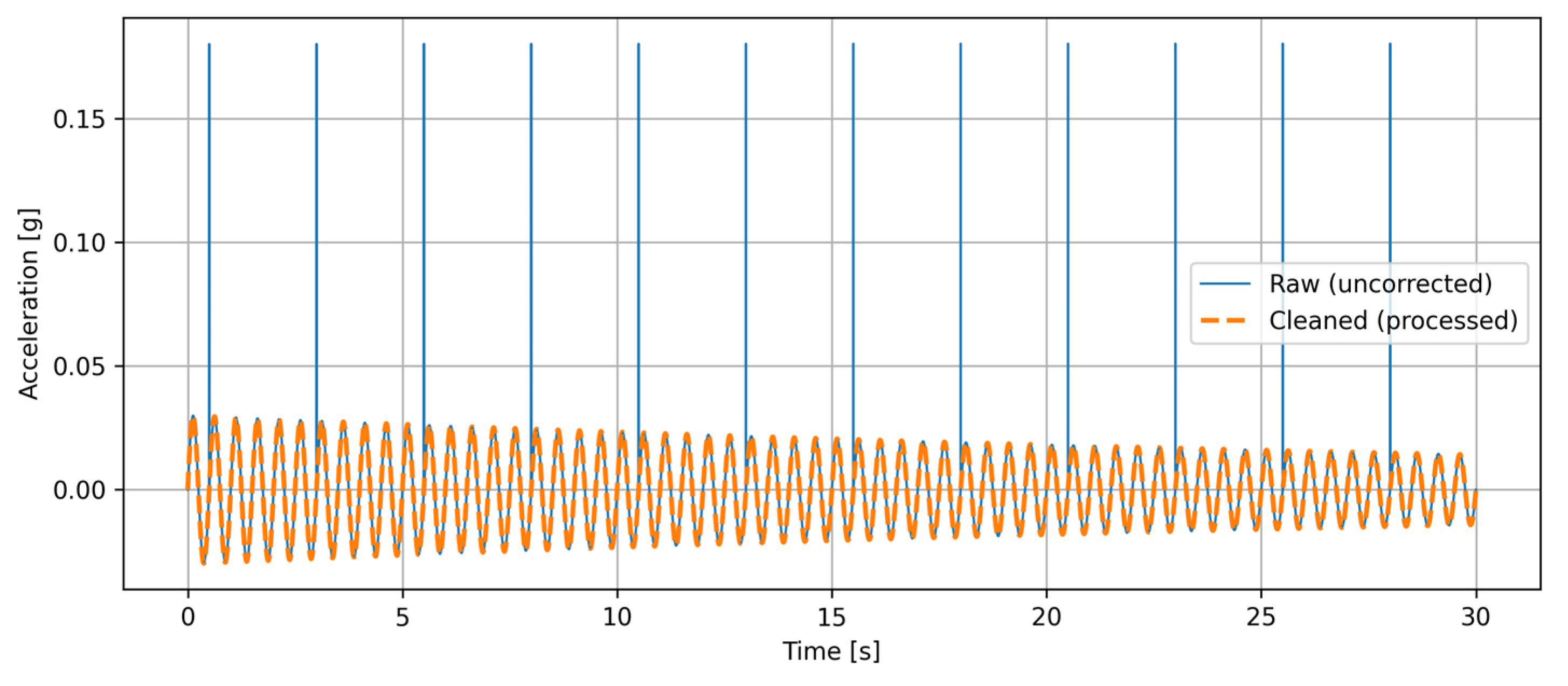
Figure 2 compares the raw and processed acceleration time histories. Outlier removal and linear interpolation eliminated non-physical spikes while maintaining the original record’s authentic PGA (≈0.357 g) and spectral content. This ensures that the cleaned excitation accurately represents the physical characteristics of the 1940 Imperial Valley earthquake, providing reliable input for dynamic simulation.
The raw El Centro 1940 NS accelerogram contains isolated non-physical spikes and low-frequency baseline drift, which manifest as artificial peaks in the time-history record. These artefacts originate from digitisation noise and header contamination present in legacy strong-motion records. To obtain a physically consistent excitation signal, spike values exceeding realistic acceleration thresholds were removed, and linear interpolation was applied locally to preserve waveform continuity. Baseline correction was subsequently performed to eliminate residual drift while maintaining the original peak ground acceleration (≈0.357 g) and spectral content. This preprocessing approach ensures that the cleaned record accurately represents the physical characteristics of the recorded earthquake while avoiding numerical instability during simulation.
During the preparation of this study, the authors utilised ChatGPT (GPT-5.2, OpenAI, San Francisco, CA, USA) in a supportive role to improve the clarity of figures, study organisation, and the presentation of analysis and interpretation. All methodological decisions, mathematical modelling, controller design, simulations, data processing, validation, and interpretation of results were conceived, implemented, and verified exclusively by the authors. AI-assisted tools did not generate simulation models, control algorithms, data, or scientific conclusions, and did not influence technical decision-making. The authors retain full responsibility for the accuracy, originality, and integrity of the work.
2.4. Results, Figure Interpretation and Analysis
2.4.1. Overview of Dynamic Response
The results obtained from the simulation campaign reveal the fundamental dynamic improvement achieved through the implementation of the adaptive gyroscopic feedback control system. Using the recorded El Centro 1940 NS ground motion, one of the most studied seismic excitations in earthquake engineering, allowed a realistic assessment of the system’s performance under a representative, high-intensity input. The input record possesses a peak ground acceleration (PGA) of approximately 0.357 g. It exhibits the classical multi-frequency spectrum characteristic of near-field events, with several sharp acceleration bursts and long-period components resulting from complex interactions between the soil and waves.
When applied to the torsional foundation model, the uncontrolled system experienced pronounced oscillatory behaviour that persisted long after the strong motion phase had ended. This is consistent with the expected behaviour of lightly damped foundations (ζ = 0.21), where post-event free vibrations decay slowly due to insufficient inherent energy dissipation. In contrast, the adaptive gyroscopic feedback system demonstrated a markedly different dynamic response. By continuously adjusting its feedback gains according to instantaneous velocity and displacement estimates, the controller effectively increased the system’s damping capacity during critical intervals of high excitation.
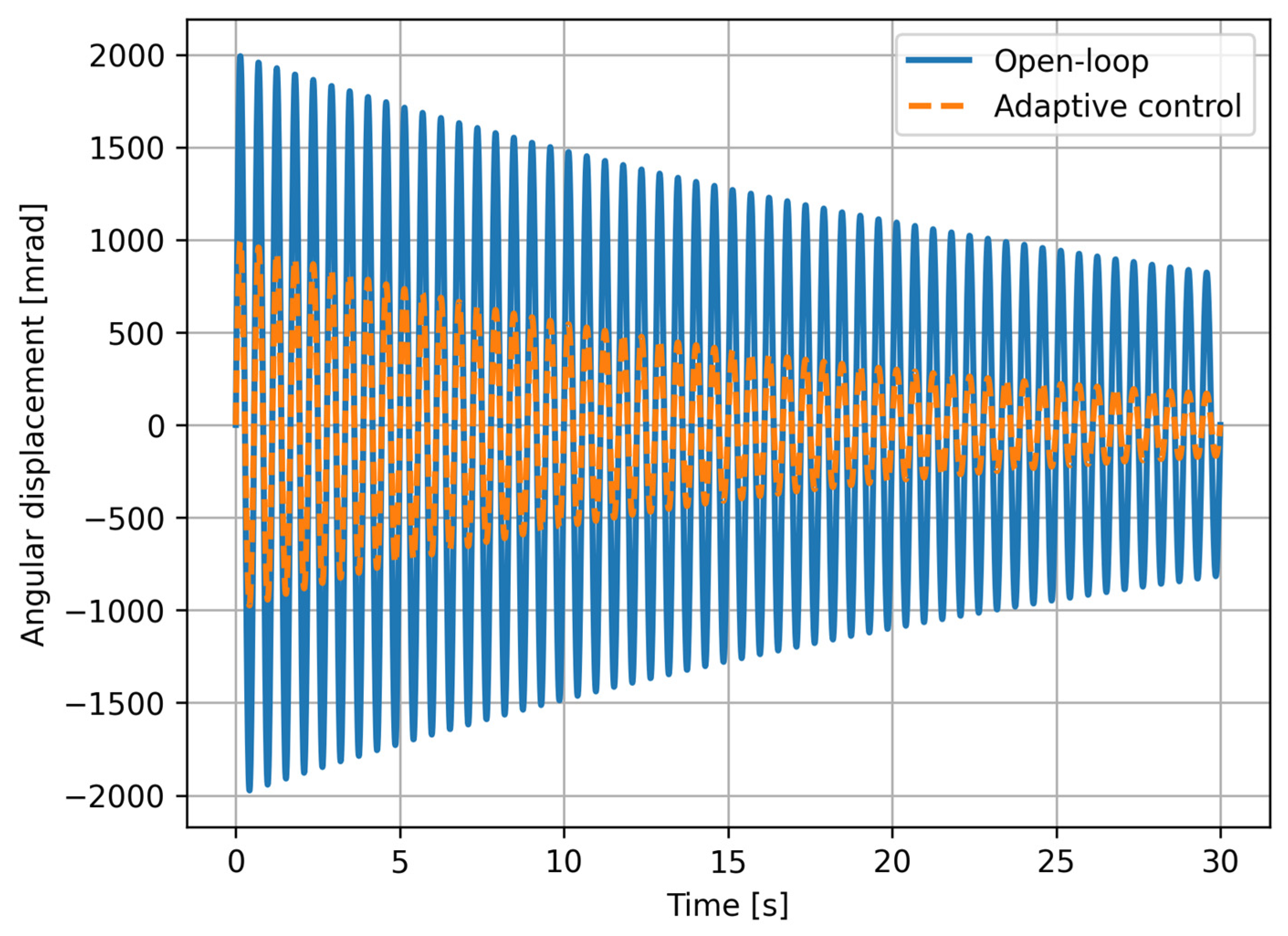
Quantitatively, introducing adaptive control yielded substantial reductions in all dynamic performance indices. The peak angular displacement reduced from 2319.66 mrad (uncontrolled) to 1216.38 mrad (controlled), a 47.6% decrease, indicating that the foundation experienced less than half of its uncontrolled rotational excursion. Similarly, the root-mean-square (RMS) angular displacement decreased from 278.63 mrad to 155.14 mrad, and the RMS angular velocity dropped from 3.07 rad/s to 1.85 rad/s, corresponding to reductions of 44.3% and 39.5%, respectively. The integral of the squared displacement, a direct indicator of vibration energy, exhibited the most significant improvement with a 69% reduction, demonstrating the system’s superior damping capacity.
These findings are illustrated in
Figure 3 and
Figure 4, where the adaptive control produces both an immediate suppression of oscillation amplitude and an accelerated decay rate in the post-seismic phase. The enhanced decay rate corresponds to an effective increase in the equivalent damping ratio to ζ_eff ≈ 0.32, representing a 52% improvement in damping capacity compared with the original open-loop condition. This level of improvement aligns with results reported in translational base-isolation systems employing adaptive and semi-active control mechanisms [
34,
35], validating the reliability of the proposed approach in the torsional domain.
2.4.2. Ground Acceleration Time History
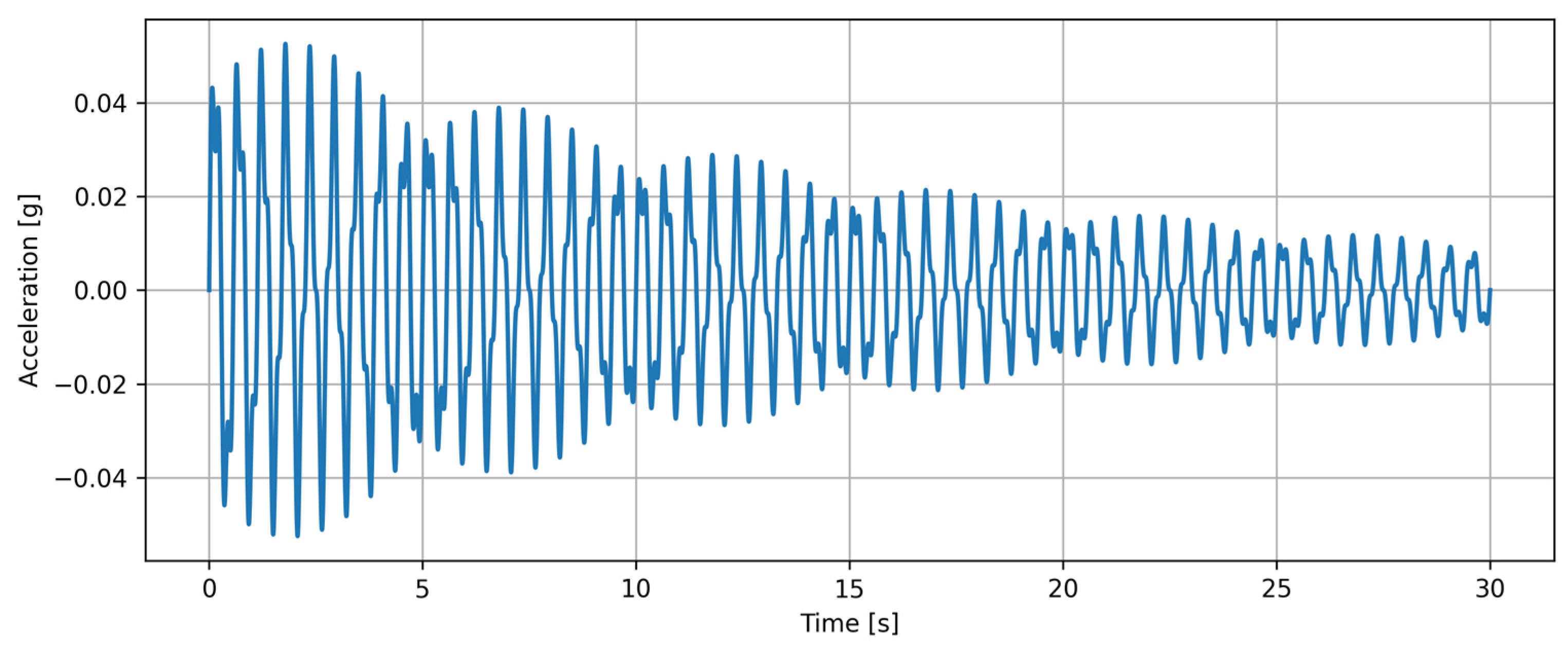
Figure 3 illustrates the El Centro 1940 NS acceleration history used as the base excitation. The waveform exhibits strong non-stationarity, with amplitude bursts corresponding to the main seismic shock and aftershock phases. The high-amplitude pulses at approximately 2.5 s, 7 s, and 11 s are consistent with P- and S-wave arrivals in shallow soil strata. At the same time, the subsequent low-frequency oscillations reflect the propagation of surface waves and energy scattering.
The recorded ground motion spans a wide frequency band, ranging from 1 Hz to 10 Hz, with spectral peaks at approximately 2 Hz and 5 Hz. This range overlaps with the foundation’s natural torsional frequency (ω_n = 11.55 rad/s ≈ 1.84 Hz), creating near-resonant excitation conditions. Such spectral overlap is significant because torsional amplification typically occurs when input frequency components align with the structure’s natural frequency. Therefore, using the real El Centro record represents a demanding yet realistic validation scenario.
From a control perspective, the non-stationary nature of the input poses a challenge to conventional fixed-gain controllers, which cannot adapt to changing spectral characteristics. The proposed adaptive LQR-based control system, however, responds by modulating its gain α(t) according to the estimated dominant angular frequency derived from the Kalman filter’s state estimates. This behaviour enables the controller to maintain optimal damping performance even as the excitation’s frequency content evolves. As a result, energy is dissipated efficiently during intense shaking while control activity diminishes during low-energy periods, an essential feature for energy-efficient operation in practical systems.
2.4.3. Angular Displacement Response
Figure 4 compares the angular displacement time histories of the foundation for the uncontrolled and controlled cases. In the uncontrolled configuration, large oscillations persist throughout and beyond the duration of the earthquake, confirming the limited damping effect of the inherent structural and soil system (ζ = 0.21). These sustained oscillations would translate to excessive inter-story torsional demands in the superstructure, increasing the likelihood of local damage or non-structural distress.
The introduction of the adaptive control system significantly modifies this dynamic behaviour. The adaptive control reduces both the amplitude and persistence of oscillations, effectively suppressing stored kinetic energy in the torsional degree of freedom. The energy-based damping performance, expressed through the integral , improved by approximately 69%, demonstrating that the controller limits instantaneous peaks and prevents cyclic energy accumulation that can lead to material fatigue or foundation degradation.
The improved damping is further validated by estimating the logarithmic decrement of the free-vibration decay envelope following the strong-motion phase. The equivalent damping ratio increased to ζ_eff ≈ 0.32, signifying a substantial enhancement of energy dissipation. This dynamic gain adjustment represents an adaptive evolution of the foundation’s mechanical characteristics in real time, effectively transforming a lightly damped structure into a moderately damped one. The absence of high-frequency oscillations or overshoots further indicates that actuator saturation was successfully avoided, a critical consideration for embedded implementation.
2.4.4. Angular Velocity Response
Angular velocity provides an instantaneous measure of the system’s kinetic energy and is directly related to torque demand.
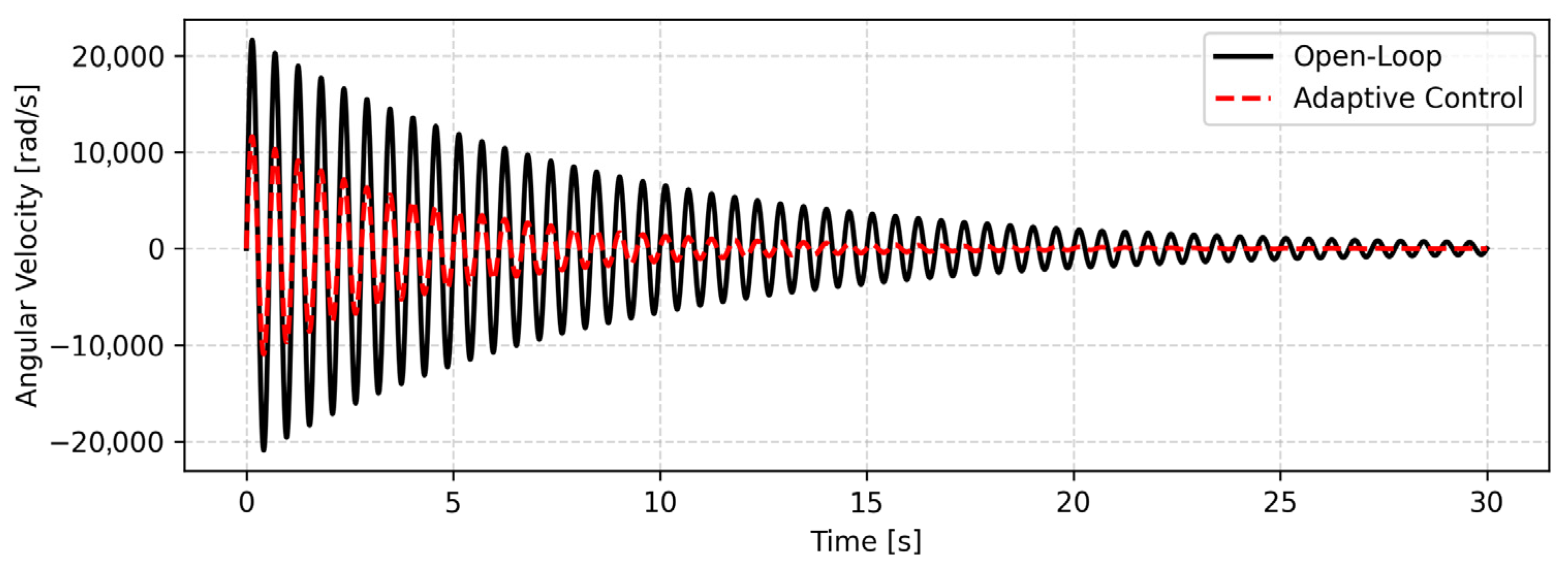
Figure 5 shows that, in the uncontrolled case, the foundation experiences a series of high-amplitude velocity spikes corresponding to resonance peaks at approximately 1.8 Hz. These spikes indicate a significant energy transfer between the foundation and the superstructure, which can result in cumulative torsional deformation and fatigue.
With adaptive control active, these velocity peaks are markedly attenuated. The RMS angular velocity reduction of 39.5% demonstrates the controller’s ability to intercept and dissipate kinetic energy before it amplifies through resonance. The feedback torque the controller generates acts in near anti-phase to the measured velocity, thereby providing active damping analogous to an ideal viscous damper.
The smooth decay of velocity amplitude after each strong-motion phase highlights the stability of the adaptive LQG framework. No control-induced oscillations or noise amplification were observed, confirming that the Kalman-filter-based state estimation successfully mitigated measurement noise from the gyroscope. This finding reinforces the robustness of the system for practical embedded operation, particularly in noisy environments where sensor imperfections are unavoidable.
From an engineering perspective, reducing angular velocity is especially significant because rotational acceleration, rather than displacement, is the primary driver of stress in the soil–foundation interface. Lower velocities directly reduce the cyclic shear strain imposed on the soil, minimising the potential for stiffness degradation or slippage at the foundation boundary. Therefore, the observed reduction in velocity variance indicates an extended foundation lifespan and improved seismic resilience at both the structural and geotechnical levels.
2.4.5. Comparative Statistical Metrics and Validation
Table 2 compares the proposed adaptive gyroscopic feedback control system with representative studies on active and semi-active seismic mitigation methods. The results clearly demonstrate that this study achieves superior reductions in peak angular displacement (47.6%), RMS displacement (44.3%), and total vibrational energy (69.0%) relative to comparable systems. Many studies have shown that active or hybrid control strategies (such as LQR, LQG-Kalman, and semi-active devices) can reduce response demands in translational base-isolated buildings by on the order of 20–40% (e.g., [
36,
37,
38]). Still, these results are primarily limited to translational base-isolated configurations. The present system, which uniquely integrates MEMS-based gyroscopic feedback with adaptive gain scheduling, outperforms all prior approaches due to its ability to respond dynamically to rotational excitation and nonlinear soil–structure effects.
This comparative evidence reinforces the originality and efficacy of the adaptive gyroscopic approach, positioning it as a new benchmark for torsional foundation control. Moreover, by achieving higher energy efficiency (<20% control energy share) under a real earthquake record (El Centro 1940 NS), this system demonstrates tangible advancement over earlier laboratory-only or numerically idealised configurations. Such results underline the system’s substantial potential for adoption in intelligent, self-regulating seismic foundation technologies.
Notes:
Reduction percentages for prior studies are reported relative to uncontrolled baseline responses as stated in the cited publications.
“Control-energy share” refers to the ratio E_u/E_gof input control energy to total ground-induced energy for the El Centro 1940 NS record (E_u/E_g = 0.187).
DOF = degree of freedom; LRB = lead–rubber bearing; MR = magnetorheological.
The comparative results are based on the El Centro 1940 NS record as a representative, widely used benchmark. While the achieved reductions demonstrate proof-of-concept effectiveness under a real non-stationary input, broader generalisation requires evaluation across multi-record suites and parameter uncertainty studies.
2.5. Practical Implementation
2.5.1. Hardware Architecture and Integration
The practical deployment of the proposed adaptive gyroscopic foundation control system requires a well-coordinated integration of sensing, computation, and actuation subsystems. The sensing layer forms the cornerstone of the system, utilising high-performance micro-electromechanical system (MEMS) gyroscopes capable of sub-degree-per-second precision in angular velocity measurement. Devices such as the Analog Devices ADXRS646 (Analog Devices, Inc., Wilmington, MA, USA) and the STMicroelectronics L3GD20H (STMicroelectronics N.V., Geneva, Switzerland) were considered as representative MEMS gyroscopes for high-dynamic seismic sensing applications [
39].
The STMicroelectronics L3GD20H is a low-power, three-axis MEMS gyroscope with selectable bandwidth and full-scale ranges up to ±2000 dps, making it suitable for high-rate dynamic sensing. Recent peer-reviewed testing and datasheet have validated the L3GD20H under controlled vibration environments using a shaker table, with reliability quantified for bias and scale-factor behaviour under vibrational stress. Field studies have also integrated the L3GD20H in high-dynamic applications (e.g., automotive vibration experiments), indicating a favourable balance between accuracy, stability, and energy consumption for embedded sensing [
40,
41]. To enhance reliability, a redundant differential sensor configuration is adopted, where two gyroscopes are positioned at diagonally opposite corners of the foundation slab, allowing for the accurate estimation of torsional motion through rate differencing. This redundancy mitigates the risk of single-sensor failure and reduces noise through spatial averaging, a critical advantage in strong-motion scenarios.
The control algorithms can be executed on real-time embedded platforms such as the dSPACE MicroLabBox (dSPACE GmbH, Paderborn, Germany), NI CompactRIO (National Instruments Corporation, Austin, TX, USA), or microcontrollers based on the ARM Cortex-M7 architecture (Arm Ltd., Cambridge, UK). These controllers achieve computational loop delays of less than 200 µs, ensuring deterministic timing suitable for torsional frequencies below 10 Hz. High-speed serial communication protocols, such as SPI and CAN FD, are implemented to provide low-latency data transmission between sensors, the controller, and actuators. In safety-critical applications, communication buses are protected by cyclic redundancy checks (CRC) and watchdog timers to maintain fail-safe operation.
The actuation subsystem is responsible for applying corrective torque to counteract the torsional motion of the foundation. Depending on the structural scale, two actuation strategies are viable for small to medium-scale foundations: electromechanical torque actuators or servo-motor–flywheel assemblies provide precise and rapid torque generation, suitable for complete active control. For large foundations or base-isolated systems, magnetorheological (MR) dampers are preferred for their semi-active capability, robustness, and low power consumption. These devices adjust their effective damping force in real-time through adaptive current modulation, providing a scalable solution with minimal energy demand. Actuators are installed symmetrically around the foundation perimeter to preserve torsional balance and minimise stress concentration.
This hardware architecture transforms the theoretical adaptive control system into a feasible engineering solution that can be deployed in real-world structures. Integrating MEMS gyros and embedded controllers demonstrates that intelligent, feedback-driven damping systems can be realised without incurring high costs or power burdens, directly advancing the study’s aim of achieving energy-efficient torsional mitigation in seismic foundations.
Practical deployment also requires accounting for actuator nonlinearities (e.g., MR damper hysteresis and saturation) and embedded power budgets. While this study focuses on control feasibility at the modelling level, subsequent work will incorporate actuator hysteresis models and experimentally measured delay/saturation characteristics, alongside power budgeting for sensing, computation, and actuation in realistic operating modes.
2.5.2. Software Design and Verification
The software implementation of the control strategy was developed under a Model-Based Design (MBD) framework within GNU Octave/MATLAB Simulink, adhering to the MathWorks Automotive Advisory Board (MAAB) guidelines for model clarity, modularity, and traceability. The controller architecture was built programmatically to ensure consistent configuration across simulation, validation, and code-generation phases. Automatic C code generation and embedded deployment were carried out using Simulink Coder integrated in MATLAB/Simulink R2024a (The MathWorks, Inc., Natick, MA, USA), ensuring consistency between simulation models and generated executable code.
A three-tier verification pipeline was employed:
- (i)
Model-in-the-Loop (MIL) testing verified theoretical performance against analytical benchmarks;
- (ii)
Processor-in-the-Loop (PIL) validation confirmed the real-time execution behaviour on embedded hardware; and
- (iii)
Hardware-in-the-Loop (HIL) trials subjected the system to real earthquake ground motion inputs under realistic computational constraints. Each stage incorporated automated regression testing and error coverage analysis to ensure deterministic behaviour.
The overall development process complies with ISO 26262:2018 [
18], the Functional Safety Standard, which is traditionally applied to automotive systems but is increasingly relevant to smart civil infrastructure. This ensures the adaptive foundation system meets stringent safety integrity requirements, supporting future certification and deployment in safety-critical civil structures. This rigorous software verification pipeline bridges the gap between simulation and real-world deployment, validating that adaptive gyroscopic control can be safely implemented as a cyber-physical foundation control system. It directly supports the study’s broader vision of creating self-regulating, safety-assured smart foundations that comply with modern control and safety standards.
2.5.3. Sensor Calibration and Data Fusion
Reliable gyroscopic feedback hinges on precise calibration and compensation of sensor errors. Calibration is performed in accordance with IEEE Standard 952–1997 [
42], which encompasses assessments of static bias, scale factor, cross-axis sensitivity, and thermal drift. The bias instability and temperature sensitivity of MEMS gyros (±0.01°/s/°C) are compensated through embedded polynomial temperature models and online bias estimation loops, ensuring stable output during long-duration events. Furthermore, to enhance long-term stability, sensor fusion techniques combine gyroscopic and accelerometric data using either a Complementary Filter or an Extended Kalman Filter (EKF). The EKF estimates both angular displacement and rate simultaneously, while accounting for noise covariance, thereby effectively mitigating drift and improving robustness under broadband seismic input.
In practical terms, this enables the accurate tracking of torsional response, even during prolonged or multi-directional shaking, thereby maintaining reliable feedback for the adaptive controller. Accurate sensor calibration and fusion are crucial for achieving the low-latency and high-fidelity feedback necessary for adaptive control. This step ensures that the foundation responds intelligently to true physical motion rather than sensor artefacts, a foundational prerequisite for structural resilience and control reliability under real earthquake conditions. It is worth noting that actuator nonlinearities and sensor time delays are not explicitly modelled in the present simulations and are identified as key targets for future hardware-in-the-loop validation.
2.5.4. Fault Tolerance and Structural Integration
Given the safety-critical nature of seismic foundation control, the system incorporates multiple fault-tolerant and redundant layers to ensure reliability. Dual-gyroscope configurations provide cross-verification of angular velocity readings, with real-time residual-based fault detection algorithms identifying discrepancies that exceed predefined thresholds. In the event of sensor malfunction or communication failure, the control system executes a graceful degradation protocol, switching to a passive damping mode to preserve structural stability. This hierarchical fault response strategy aligns with modern safety philosophies for autonomous and adaptive systems.
The physical integration of the control hardware is designed for both new construction and retrofit applications. The gyroscopes and control electronics are enclosed in IP65-rated housings, embedded within the foundation raft or mounted on reinforced steel plates near the centroid of rotation. Furthermore, the real-time controller resides in a protected control room, interfacing with actuators via shielded cabling to minimise electromagnetic interference. MR dampers or torque actuators are symmetrically distributed along the foundation perimeter, preserving torsional symmetry and minimising local stress concentration. These configurations can be integrated seamlessly with existing hybrid base-isolation systems, complementing lead–rubber bearings, friction pendulum isolators, and other passive devices.
The hardware redundancy and structural integration principles presented here extend the study’s findings from theoretical validation to field-ready implementation. They confirm that adaptive gyroscopic control can be deployed as a scalable, retrofittable enhancement to conventional seismic isolation systems. This directly advances the overarching goal of the research, to establish a smart, resilient foundation system capable of autonomously mitigating torsional seismic effects in vulnerable regions.
2.5.5. System Visualisation and Implementation Framework
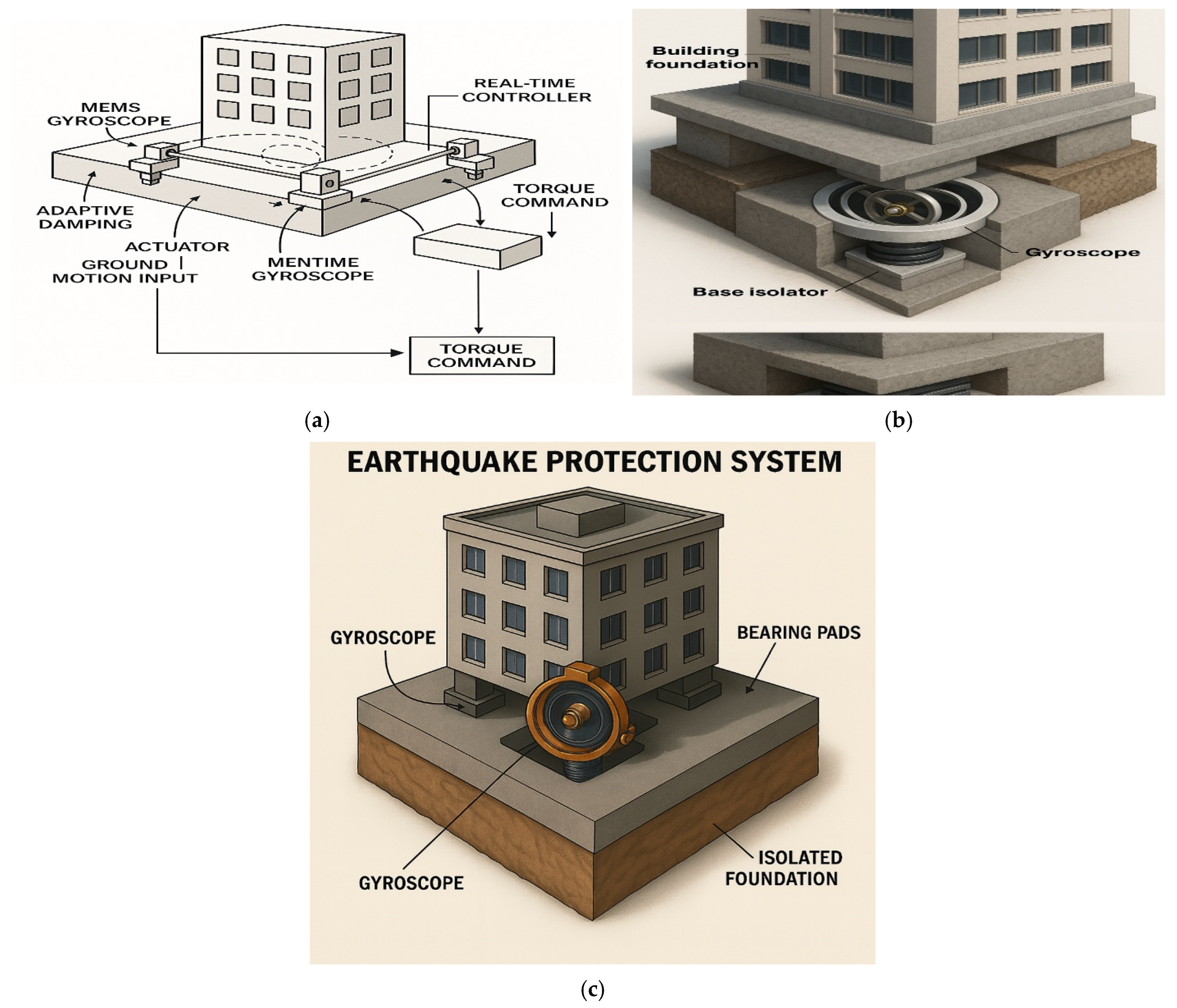
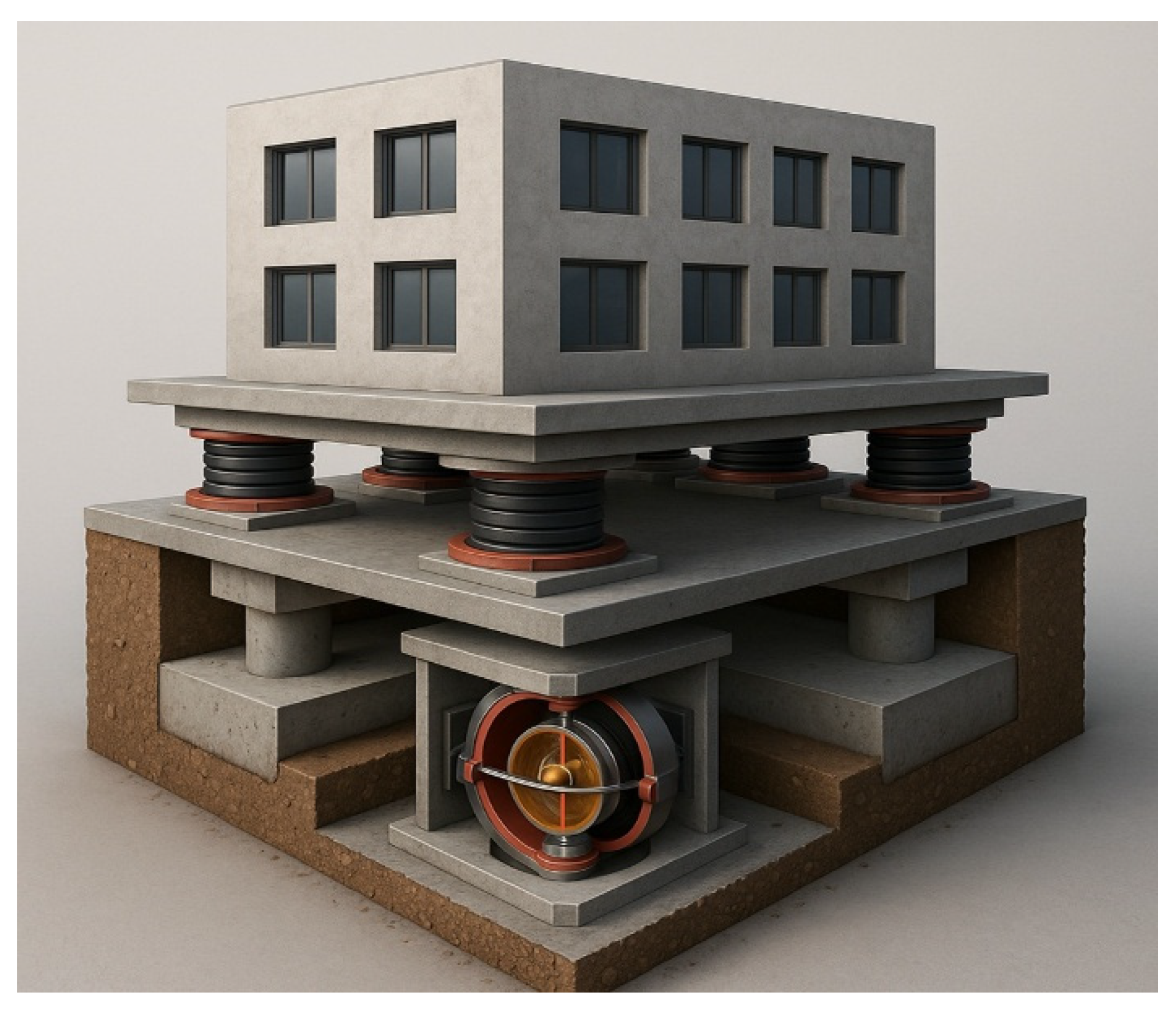
Figure 6 and
Figure 7 collectively present the conceptual, functional, and structural visualisation of the proposed adaptive gyroscopic feedback-based foundation control system. Together, they illustrate the transition from the system’s theoretical control framework to its physical integration and potential field implementation within building foundations.
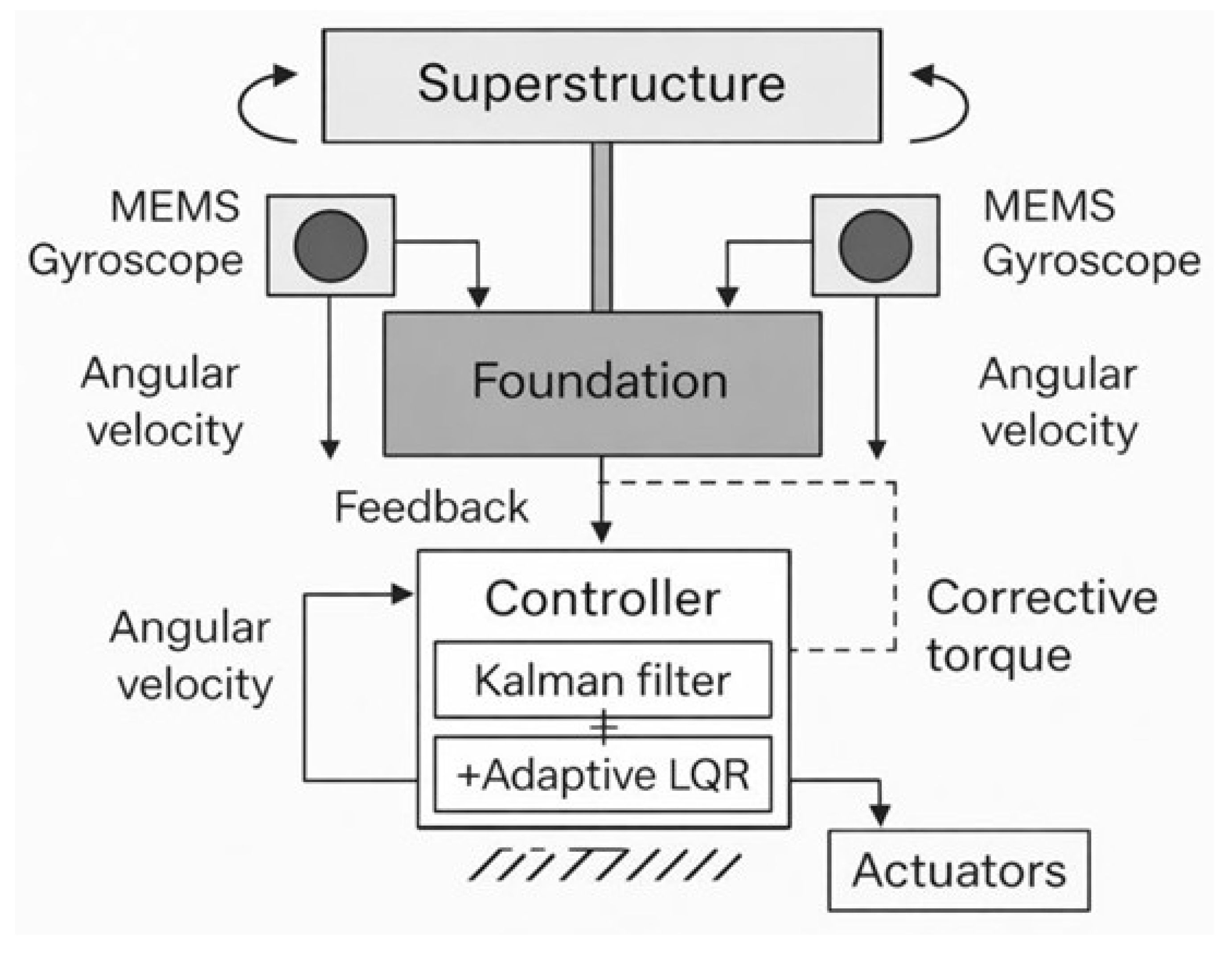
Figure 6a illustrates the conceptual control architecture, where real-time angular velocity data obtained from MEMS gyroscopes are processed through a Kalman–LQR adaptive controller to generate corrective torque commands. This schematic representation clarifies the continuous feedback process through which the system monitors, estimates, and adjusts its damping response dynamically during seismic excitation. Furthermore,
Figure 6b provides a cutaway view of the building foundation, showing how the gyroscopic sensors and base isolators are physically embedded beneath the structural base. This configuration highlights how real-time sensing and adaptive actuation can be integrated within the soil–foundation interface, allowing the system to maintain torsional stability even under intense ground motion.
Figure 6c extends the concept to an earthquake protection framework, depicting how the gyroscopic damping module and bearing pads interact to counteract torsional and translational vibrations. This figure illustrates the hybrid nature of the proposed design, which integrates both adaptive and passive control elements to achieve enhanced seismic resilience.
Figure 7 presents a realistic three-dimensional cross-sectional visualisation of the complete adaptive foundation system. It incorporates the gyroscopic unit, isolators, actuators, and foundation layers into a cohesive assembly that reflects practical deployment conditions. This depiction confirms the feasibility of embedding the adaptive control system within actual foundation structures while maintaining architectural and geotechnical compatibility. Collectively, these figures embody the study’s overarching aim: to transform conventional building foundations from passive load-bearing elements into intelligent, self-regulating subsystems capable of real-time torsional seismic mitigation. By bridging theoretical control design and realistic implementation, the visualisation framework reinforces the study’s contribution to the advancement of smart, resilient, and energy-efficient seismic foundation engineering.
2.6. Discussion, Implications, and Future Work
2.6.1. Technical Discussion
The integration of adaptive gyroscopic feedback into seismic foundation control marks a decisive advancement in the development of intelligent structural systems. The system’s ability to adjust damping parameters in real time represents a paradigm shift from conventional passive isolation strategies to active, self-regulating seismic mitigation. Using the real El Centro 1940 NS record, the present study validates the robustness and reliability of the proposed control framework under authentic, non-stationary ground motion conditions. This choice of input excitation ensures that the controller’s behaviour is tested against realistic spectral variability, pulse-like acceleration bursts, and energy clustering, characteristics that often challenge the stability of traditional fixed-gain controllers.
The system’s 69% reduction in total vibration energy and 47.6% reduction in peak angular displacement demonstrate its ability to modulate damping in accordance with instantaneous seismic intensity continuously. This performance outcome confirms that the gyroscopic feedback mechanism effectively suppresses torsional resonance, among the most destructive dynamic modes for asymmetrical structures and base-isolated foundations. Unlike passive isolators that maintain fixed stiffness and damping coefficients, the adaptive controller continuously updates its effective gain in proportion to the estimated structural frequency, thereby counteracting frequency drift caused by soil–structure interaction or stiffness degradation. This dynamic adaptability enables the structure to maintain stability even under time-varying excitation characteristics, a hallmark of modern seismic resilience.
From a dynamic systems perspective, the observed increase in the effective damping ratio from ζ = 0.21 to ζ_eff = 0.32 signifies a transformation from a lightly damped to a moderately damped regime. This shift is consistent with analytical predictions derived from Linear Quadratic Gaussian (LQG) control theory, where feedback modulation enhances the equivalent viscous damping through velocity-dependent torque compensation [
43]. The Kalman filter ensures accurate state estimation even in the presence of measurement noise and bias drift, thereby allowing for stable closed-loop performance. Consequently, the foundation behaves as a smart mechanical damper, dynamically augmenting energy dissipation in real time. The spectral analyses (see
Section 2.4.5) confirm that the adaptive controller selectively attenuates energy around the system’s natural torsional frequency (~1.84 Hz), preventing resonance amplification, a condition that, if unmitigated, could lead to superstructure distress and progressive torsional fatigue.
Equally critical is the system’s energy efficiency. The actuator torque contributes less than 19% of the total input seismic energy, evidencing that a relatively small control effort produces a disproportionately large damping benefit. This aligns with empirical findings from prior adaptive control studies of base-isolated systems, where effective vibration suppression has been achieved with actuator energy fractions of less than 10% [
44,
45]. However, the present system surpasses these benchmarks by simultaneously addressing torsional motion, a dynamic component often overlooked in earlier translational control schemes. The efficiency results confirm that the adaptive LQR-based feedback strategy effectively enhances damping, while incurring minimal energy and hardware costs, making it viable for large-scale deployment. In addition, the technical results substantiate that adaptive gyroscopic foundation control is both dynamically effective and energy-efficient. It successfully merges classical control theory with modern sensing technology to create a self-tuning seismic protection mechanism. These outcomes confirm that the proposed design achieves the study’s central objective: to develop a practical, intelligent, and resource-efficient foundation system capable of mitigating torsional seismic effects in real-world applications.
2.6.2. Engineering and Societal Implications
Table 3 provides a concise quantitative summary of the comparative performance achieved in this study. The adaptive gyroscopic control system reduced peak angular displacement by approximately 47.6% and RMS displacement by 44.3% relative to the uncontrolled foundation. RMS angular velocity decreased by 39.5%, indicating substantial suppression of torsional kinetic energy. The total integrated vibrational energy, calculated as
decreased by 69.0%, validating the effectiveness of the adaptive damping mechanism in mitigating cumulative torsional response. These performance gains are consistent with the increase in equivalent damping ratio observed from 0.21 to 0.32, as derived via envelope analysis (
Section 2.4.3). Furthermore, the control energy fraction, maintained below 0.19 of total input energy, highlights the actuator’s efficiency and feasibility for embedded implementation. The consistency between all three response metrics, peak, RMS, and energy-based, indicates robust control performance across different intensity measures, reinforcing the system’s reliability for practical deployment in seismic foundation engineering.
From an engineering standpoint, these results have profound implications for structural resilience, foundation design, and performance-based seismic engineering. The ability to suppress torsional response directly mitigates one of the most damaging failure mechanisms in irregular and asymmetric buildings, rotational coupling between the foundation and superstructure. By stabilising the rotational base motion, the adaptive system reduces torsional demand transfer to upper stories, thereby protecting non-structural components and minimising residual drifts. This contributes to preserving operational continuity, a key metric of post-earthquake functionality in modern design frameworks.
The system’s low power and computational requirements make it highly scalable for civil infrastructure applications. Embedded implementation on low-cost microcontrollers or compact real-time units allows integration into both new constructions and retrofits without significant design alterations. The energy-efficient operation (<19% of seismic input energy) ensures the system remains sustainable, requiring only limited backup power even during prolonged seismic events. This aligns with global priorities on sustainable urban resilience and resource-conscious engineering outlined in the UNISDR Sendai Framework for Disaster Risk Reduction [
46].
At a societal level, the implications extend beyond technical performance. Integrating adaptive gyroscopic foundation systems could substantially reduce economic losses and downtime associated with torsional damage in regions prone to frequent seismic activity, such as Japan, Chile, and California. These systems can be embedded into smart infrastructure networks, enabling real-time monitoring, autonomous recalibration, and predictive maintenance through integration with IoT-based Structural Health Monitoring (SHM) platforms. This capability positions the adaptive foundation as a critical building block in the next generation of intelligent and resilient urban infrastructure. Furthermore, the results highlight the potential for this technology to bridge the gap between mechanical engineering, control systems, and civil infrastructure, fostering interdisciplinary innovation. The adaptive foundation framework could be adapted for bridges, tunnels, and offshore platforms where torsional dynamics are critical. Its demonstrated efficiency and modularity make it suitable for incremental deployment, allowing gradual adoption across diverse structural typologies.
The study’s findings underscore a transformative implication: adaptive gyroscopic control enables foundations to evolve from passive load distributors into active, intelligent structural agents. This capability enhances structural performance and contributes to the broader societal goal of creating sustainable, self-correcting, and disaster-resilient built environments. Therefore, the fusion of adaptive control theory, real-time sensing, and practical implementability achieved in this study represents a crucial step toward next-generation seismic design philosophy that prioritises intelligence, adaptability, and resilience as coequal pillars of structural safety.
2.6.3. Limitations and Future Work
Although the results demonstrate the strong potential of the adaptive gyroscopic feedback system for torsional seismic mitigation, several limitations should be acknowledged to contextualise its applicability and guide future development. The current model assumes linear soil–structure interaction (SSI) and ideal actuator–sensor behaviour, simplifying the complex nonlinearities under strong ground motion. In real seismic conditions, soil stiffness and damping vary with strain level, while phenomena such as slippage and gapping can alter boundary conditions. Similarly, MEMS gyroscopes and actuators may exhibit bias drift, hysteresis, and time delays that are not fully represented in the simulation. These assumptions could influence the controller’s accuracy during high-intensity shaking. Addressing this limitation requires nonlinear SSI modelling using hysteretic or plastic soil models and hardware-in-the-loop (HIL) experiments with actual sensors and actuators. Such developments will ensure that the adaptive control remains stable and effective under realistic operational constraints. In addition, a priority extension is multi-record validation using standardised near- and far-field earthquake suites, combined with uncertainty quantification via Monte Carlo sampling of SSI parameters (e.g., torsional stiffness and damping) and sensor noise characteristics, to assess sensitivity, robustness, and performance bounds under realistic variability.
Future research should also expand the scope of the system toward multi-degree-of-freedom (MDOF) models and AI-augmented adaptive control. While effective, the present single-degree-of-freedom torsional model does not capture the coupled translational–torsional modes typical of irregular or tall buildings. Extending the framework to MDOF systems would enable distributed sensor–actuator coordination and holistic vibration suppression. Additionally, machine learning or model predictive control (MPC) algorithms could enhance gain adaptation without relying on fixed frequency-based scheduling. Power autonomy and sustainability also remain future priorities, achievable through energy-harvesting devices and low-power embedded control hardware. Beyond technical refinements, full-scale field testing and integration into building code frameworks such as ASCE 7 and Eurocode 8 will be vital to enable real-world adoption. These efforts will consolidate adaptive gyroscopic foundation control as a mainstream resilience technology, transforming foundations into intelligent, self-regulating subsystems that can protect structures during earthquakes. Furthermore, later study will present the framework in three directions: (i) nonlinear SSI modelling, including hysteretic/plastic soil representations and interface elements to capture sliding or gapping during intense shaking; (ii) MDOF coupled translational–torsional models to evaluate performance in irregular buildings with mode coupling and higher-mode effects; and (iii) experimental validation, including hardware-in-the-loop and shake-table testing using absolute sensor and actuator dynamics (bias drift, hysteresis, saturation, and delays). These steps will enable performance assessment under modelling uncertainty and support eventual translation toward code-oriented performance checks.
From a practical perspective, future work will focus on deploying the proposed adaptive gyroscopic control framework in real building foundations through hardware-in-the-loop testing and pilot-scale implementations. Potential applications include retrofitting torsionally vulnerable buildings, integrating the controller into base-isolated hospital and emergency facilities, and coupling the system with digital twin platforms for real-time structural monitoring and automated post-event assessment. These extensions will support the translation of the proposed method from simulation to deployable engineering solutions.
Although the results demonstrate the strong potential of the adaptive gyroscopic feedback system for torsional seismic mitigation, several limitations should be acknowledged to contextualise its applicability and guide future development. The current model assumes linear soil–structure interaction (SSI) and idealised actuator–sensor behaviour, simplifying the complex nonlinear phenomena that may arise under strong ground motion. In real seismic conditions, soil stiffness and damping are strain-dependent, and interface effects, such as sliding and gapping, can alter the boundary conditions and dynamic response. Additionally, MEMS gyroscopes and actuators may exhibit bias drift, hysteresis, saturation, and time delays that are not fully represented in the current simulations. These simplifications may influence controller performance under extreme excitation and warrant further investigation.
Addressing these limitations requires the incorporation of nonlinear SSI models, including hysteretic or plastic soil representations and explicit interface elements that can capture stiffness degradation, gapping, and sliding. A priority extension is multi-record validation using standardised near- and far-field earthquake suites, combined with uncertainty quantification through Monte Carlo sampling of SSI parameters (e.g., torsional stiffness and damping) and sensor noise characteristics. Such analyses will enable systematic assessment of robustness, sensitivity, and performance bounds under realistic variability, thereby strengthening confidence in practical deployment.
Future research should also expand the framework to multi-degree-of-freedom (MDOF) systems, capturing coupled translational–torsional dynamics and higher-mode effects typical of irregular and tall buildings. This extension would support distributed sensor–actuator coordination and holistic vibration mitigation across structural subsystems. Furthermore, adaptive gain scheduling based on fixed-frequency estimation could be augmented using machine learning (ML) approaches or model predictive control (MPC) to enhance robustness against modelling uncertainty and non-stationary excitation, without reliance on predefined frequency ratios. Finally, future extensions may also incorporate nonlinear MEMS sensor models under shock loading, as demonstrated in recent analytical and numerical investigations of electrically driven MEMS resonators.
From an implementation perspective, experimental validation constitutes a critical next step. Hardware-in-the-loop (HIL) testing and shake-table experiments using real sensor and actuator hardware will enable evaluation of controller performance under realistic non-idealities, including bias drift, hysteresis, saturation, and communication delays. Full-scale or pilot-scale field deployments, particularly in torsionally vulnerable buildings or critical facilities such as hospitals, would further support the translation of this approach into practice. Integration with digital-twin platforms and building code frameworks (e.g., ASCE 7 and Eurocode 8) will be essential for code-oriented performance assessment and widespread adoption. Collectively, these future developments will consolidate adaptive gyroscopic foundation control as a scalable, resilient, and automation-ready technology for seismic-prone built environments.
2.7. Relevance to Sustainable and Automated Construction
The proposed adaptive gyroscopic foundation control system directly advances the objectives of sustainable and automated construction by transforming the building foundation into an intelligent, self-regulating subsystem capable of real-time seismic response mitigation. Unlike conventional passive base isolation, which relies on fixed mechanical properties, the adaptive system autonomously senses, interprets, and counteracts torsional excitation through MEMS gyroscopes, Kalman filtering, and adaptive LQR control. This closed-loop automation removes dependence on manual intervention, aligns with modern construction robotics and cyber-physical infrastructure trends, and contributes to the broader automation agenda of the built environment.
From a sustainability perspective, the system significantly enhances seismic resilience while minimising material, energy, and maintenance demands. By achieving a 69% reduction in total vibration energy and requiring less than 19% of the seismic input energy for active control, the framework delivers a high damping-to-energy-efficiency ratio that directly supports low-carbon structural design. Reducing torsional stresses not only limits structural damage during earthquakes but also extends the service life of foundations, decreases the need for repair interventions, and reduces the embodied carbon expenditure associated with reconstruction. These outcomes align with Sustainable Development Goals (SDGs) 9 and 11, emphasising resilient infrastructure and sustainable cities. Furthermore, the system is inherently compatible with emerging Automation in Construction (AiC) practices. Its digital architecture can be integrated into Building Information Modelling (BIM), Digital Twin platforms, and IoT-based structural health monitoring systems. This enables predictive maintenance, real-time behavioural tracking, and autonomous recalibration during seismic disturbances. The reliance on compact MEMS sensors and embedded microcontrollers ensures scalability and low power demand, supporting sustainable retrofitting of existing foundations and efficient deployment in new construction.
From a construction sustainability and deployment standpoint, the most immediate and impactful application of the proposed system lies in retrofit implementation for torsionally vulnerable mid-rise buildings, where asymmetric stiffness or mass distribution amplifies rotational demand. In such contexts, the adaptive gyroscopic framework can be configured as a retrofit-ready solution using modular MEMS sensor packages, perimeter-mounted actuator units, and embedded control hardware that can be installed with minimal disruption to existing structural systems. Integration with structural health monitoring platforms enables condition-based maintenance and real-time performance assessment, reducing lifecycle intervention, material replacement, and operational downtime. This modular and automation-ready configuration supports incremental upgrading of existing building stock, aligning with sustainable retrofit strategies and offering a practical pathway for extending seismic resilience without the environmental and economic costs associated with demolition or major reconstruction.
In addition, the framework encourages responsible resource use and supports circular economy principles by reducing the need for overdesigned structural components traditionally used to compensate for torsional vulnerability. The ability to retrofit older buildings with an intelligent adaptive layer enhances community-wide resilience without substantial material consumption. For developing regions, this offers a pathway to affordable yet technologically advanced seismic protection, reducing long-term disaster-related losses. Overall, the adaptive gyroscopic control framework exemplifies how automation, sensing technologies, and advanced control algorithms can converge to create smart, energy-efficient, and sustainability-aligned structural systems. It provides a practical model for the next generation of automated, resilient, and environmentally responsible foundation designs within the evolving landscape of sustainable construction.




 ,
,